Question Time with New Zealand’s Health Minister Simeon Brown
Meet Jessica Brown, Australia’s Pharmacy Assistant of the Year
Community pharmacy in Japan and what we can learn
The offical journal of the Pharmacy Guild of Australia and New Zealand
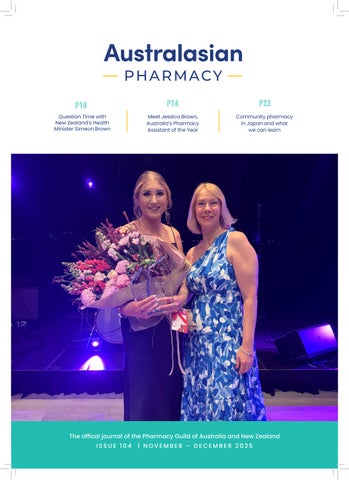
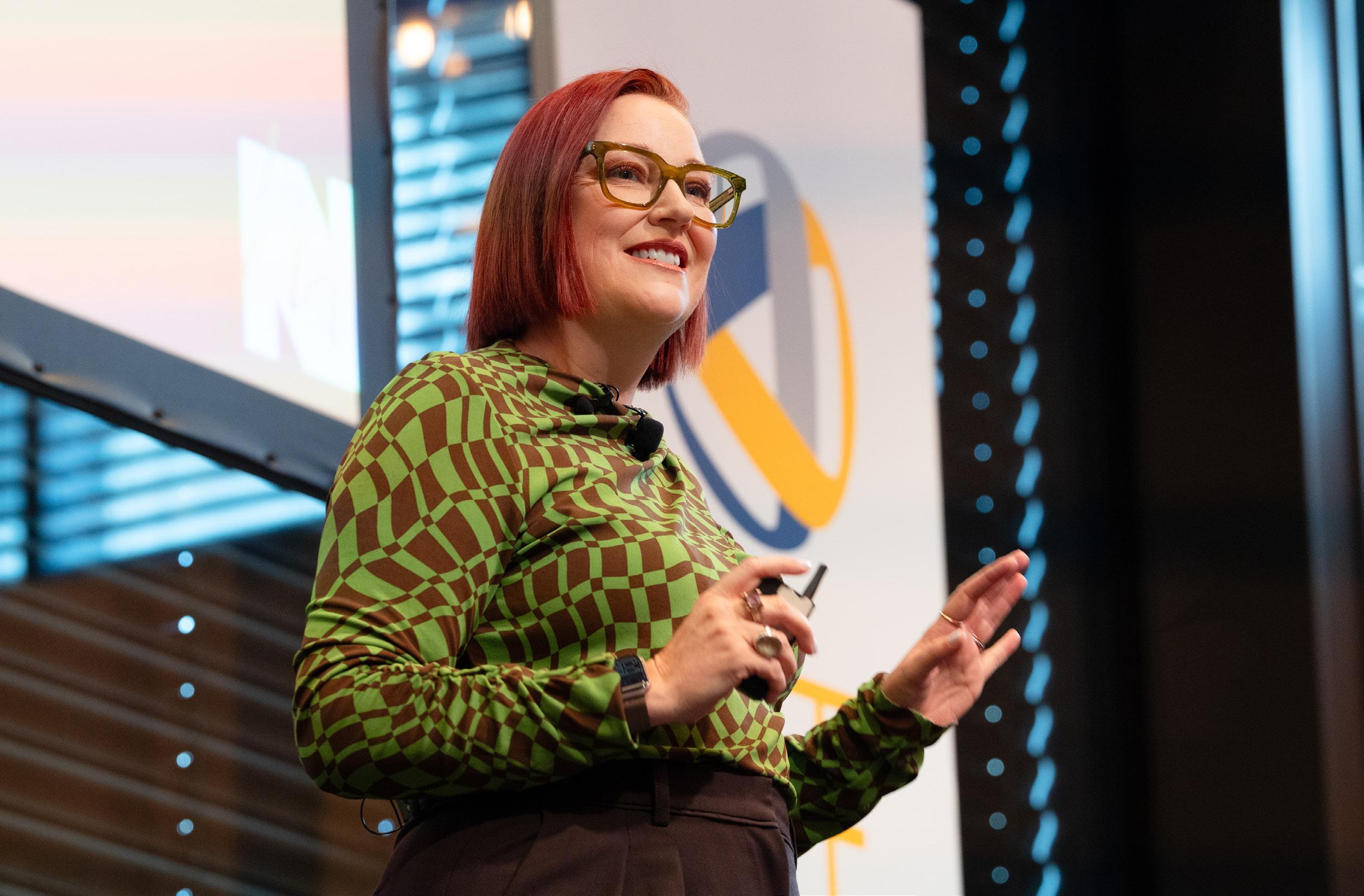
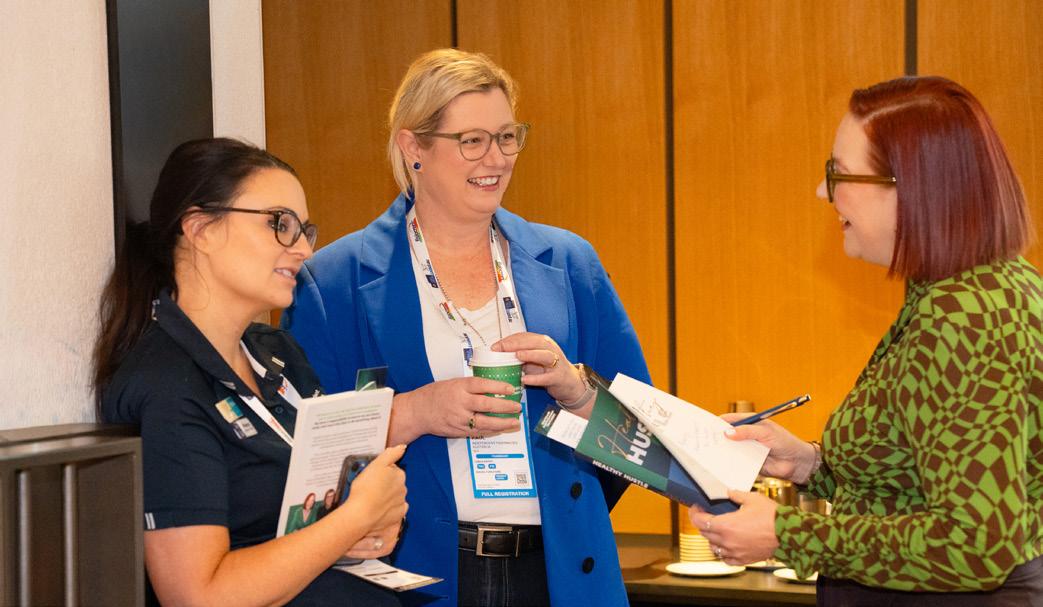
This issue’s cover: Pharmacy Assistant of the Year 2025 — Jessica Brown, pictured with pharmacy owner Louisa Lammers, in Sydney, NSW, at Pharmacy Connect 2025
From the editor
Welcome to the final 2025 issue of Australasian Pharmacy magazine.
In this edition, you’ll find some compelling stories on the expanding scope of practice for community pharmacists across Australia, an interview with PGA’s Pharmacy Assistant of the Year, Jessica Brown (also on our cover), and an insightful Q&A with New Zealand’s Minister for Health, Simeon Brown.
In President Professor Trent Twomey’s message, you’ll also read about our World Pharmacist Day celebrations. Across Australia and New Zealand, more than 7,000 community pharmacies joined the global festivities, highlighting the essential role pharmacists play in providing trusted, accessible care.
This year’s theme, Think Health, Think Pharmacy First, celebrated the vital contributions pharmacists make every day to improve healthcare options in their communities.
The PGA’s annual National Pharmacy Awards are well underway, with events in Sydney and Canberra already recognising outstanding community pharmacists. Read about the winners so far in our News in brief pages, and online at australasianpharmacy.com.au
We’ll be focusing on all the winners in our next issue.
In the meantime, we wish you and your families — and all your staff — a wonderful holiday season, and we look forward to bringing you our first 2026 issue next year.
Best,
Sarah C Porter Editor
News in brief
National Pharmacy Awards are underway
In Sydney and Canberra, the PGA’s annual National Pharmacy Awards were celebrated in style in late October with each branch hosting special evening events to honour the outstanding contributions of community pharmacists across each jurisdiction — and to announce their award winners.
NSW winners:
Community Pharmacy of the Year: Capital Chemist Bathurst
Community Pharmacist of the Year: Timothy Mizzi
Student Pharmacist of the Year: Jesyca Pearson
ACT winners:
Community Pharmacy of the Year: Capital Chemist Kingston
Community Pharmacist of the Year: Bev Mistry-Cable
Student Pharmacist of the Year: Taylor Dudley
Australasian College of Pharmacy to be acquired by Pharmaceutical Society of Australia
The Australasian College of Pharmacy will be acquired by the Pharmaceutical Society of Australia marking a significant step forward for the Australian pharmacy profession. The move will enhance education and training opportunities for pharmacists, pharmacy assistants, and technicians — supporting consistent, high-quality professional development across the country.
For more on these stories, please visit: australasianpharmacy.com.au
Nurses now able to prescribe medicines a welcome move
The PGA has welcomed the news nurses in Australia will be now able to prescribe medicines, saying. the move would dramatically increase access to timely healthcare.
PGA’s National President Professor Trent Twomey said every health professional should be empowered to practice to the full extent of their training, skills and experience.
The move follows similar expansions in scope for pharmacists who can treat and prescribe medications for everyday health conditions, like uncomplicated UTIs.
Pharmacy Guild of New Zealand’s constitution officially updated
PGNZ has been re-registered, along with their new constitution, under the Incorporated Societies Act 2022. This follows approval of the changes by members at PGNZ’s annual general meeting in June. The constitution requires the new board structure to be in place by the 2027 AGM, allowing two appointment cycles to transition from the current structure.
The new constitution sees a move to a fully appointed board. An appointments panel will interview and assess candidates and recommend the most qualified candidate with the right skills for each vacancy. Board member recommendations will be sent to the entire membership to be voted on at each AGM. Importantly, at least 50 percent of the board is required to be made up of current PGNZ members, ensuring strong member representation remains.
Community Pharmacy of the Year in NSW is Capital Chemist Bathurst in regional NSW
Below – Australia’s capital city announced its Community Pharmacist of the Year as Bev Mistry-Cable
Above Right – Winner of the NSW Student Pharmacist of the Year, Jesyca Pearson, a pharmacy student at Charles Sturt University and proud Wiradjuri woman
PGA boss cooks up a storm for
a good cause
The PGA’s Executive Director, Gerard Benedet, rolled up his sleeves in Australia’s capital city, Canberra, to take part in OzHarvest’s CEO CookOff.
OzHarvest is Australia’s leading food rescue organisation, saving surplus food from ending up in landfill and redistributing it to charities supporting people experiencing food insecurity.
Making its Canberra debut, the popular CEO CookOff challenges business leaders to swap the boardroom for the kitchen.
The event saw local leaders, including Mr Benedet, team up with awardwinning chefs such as Mindy Woods from Byron Bay, NSW, and AK Ramakrishna from Canberra’s AK’s Diner to prepare a gourmet feast for guests from charities supported by OzHarvest.
News in brief
For more on these stories, please visit: australasianpharmacy.com.au
Iconic brands join forces to back netball’s Olympic bid
The makers of Australia’s favourite jelly bean — Glucojel — have announced a new partnership with Netball Australia in a bid to finally see netball included in the Olympic Games —in time for Brisbane, 2032. To celebrate, Glucojel is launching a competition from November 1 to 30, 2025 in support of Netball Australia’s Back the Bid campaign.
To find out more about the competition, all community pharmacy customers need to do is buy any pack of Glucojel beans or bears, scan the QR code of the back of the pack, and pledge their support to include netball in the Olympic Games or you can scan the QR code to the left.
Members of Australia’s national netball team, the Diamonds, Hannah Mundy, Sophie Dwyer and Ash Irvin loving a few Glucojel jelly beans
The PGA together with the Australian Medical Association have called on the country’s Health Minister Mark Butler to take urgent action to tackle the largely unregulated increase in medicinal cannabis prescribing and dispensing across the country.
The PGA and AMA raised their concerns in a joint letter to Australia’s Health Minister Butler about excessive and poorly regulated prescribing practices, the long-term use of the special access schemes for medicinal cannabis, and the proliferation of prescribing and dispensing clinics operating outside typical care pathways.
The letter highlighted reports about coercive practices by cannabis companies and adverse health outcomes — particularly among vulnerable populations.
Action required around medicinal cannabis prescribing in Australia
PGA’s Executive Director (second from left) with fellow contenders at the 2025 OzHarvest CEO Cookoff in Canberra
New Zealand proposes changes to pharmacy ownership and prescribing lengths
The New Zealand government is proposing changes to pharmacy ownership and prescribing lengths as part of a Medical Products Bill – moves PGNZ has opposed.
Under the proposed changes within the Medical Products Bill, pharmacies and the companies which own them would no longer need to be majority-owned by registered pharmacists – and 12-month prescribing for some medicines would be introduced.
New Zealand’s government said pharmacy operations would remain regulated to ensure patient safety, and that the bill would improve safe access to medicines and healthcare.
But PGNZ’s President Kesh Naidoo-Rauf said many in the New Zealand pharmacy sector were feeling nervous.
She also noted a change to 12-month prescribing for some medicines proposed real financial risks for pharmacies. New Zealand has a current three-month prescribing limit.
“These are unprecedented challenges,” Ms NaidooRauf said in a video on social media.
“Cost pressures are rising, the now uplift is inadequate, 12-month prescribing poses real financial risks, and now deregulation is being discussed,” she said.
Celebrating excellence in rural and remote pharmacy in Australia
Australia’s Rural and Remote Health Awards, held on November 5 in Canberra as part of Rural Health Month, recognised the outstanding contribution of health professionals and organisations supporting Australia’s most isolated communities.
“It’s understandable that pharmacy owners … are worried about what this means not only for your future but your ability to continue serving patients.”
Ms Naidoo-Rauf said PGNZ was across the issues and working hard for their members.
“We are engaging directly with political leaders and officials to ensure that pharmacies’ voices [are] heard where it matters,” she said.
“We are preparing for all possible scenarios to protect the sector’s viability and resilience.
“These pressures are not just about business sustainability; they directly affect our ability to deliver safe accessible and professional health care.
“Together we will navigate this period and shape a stronger future for community pharmacy in New Zealand.”
The Medical Products Bill is still in draft form.
The Medical Products Bill is still in draft form.
To hear Ms Naidoo-Rauf’s social media message please go to: https://www.facebook.com/PharmacyGuildNZ
For more on this story, please visit: https://www.beehive. govt.nz/release/medical-products-bill-taking-shape
The awards shine a spotlight on individuals and teams delivering essential care in remote and rural regions across Australia.
This year saw a record number of more than 230 nominees, representing communities from the Torres Strait to Tasmania and from Bega to Broome.
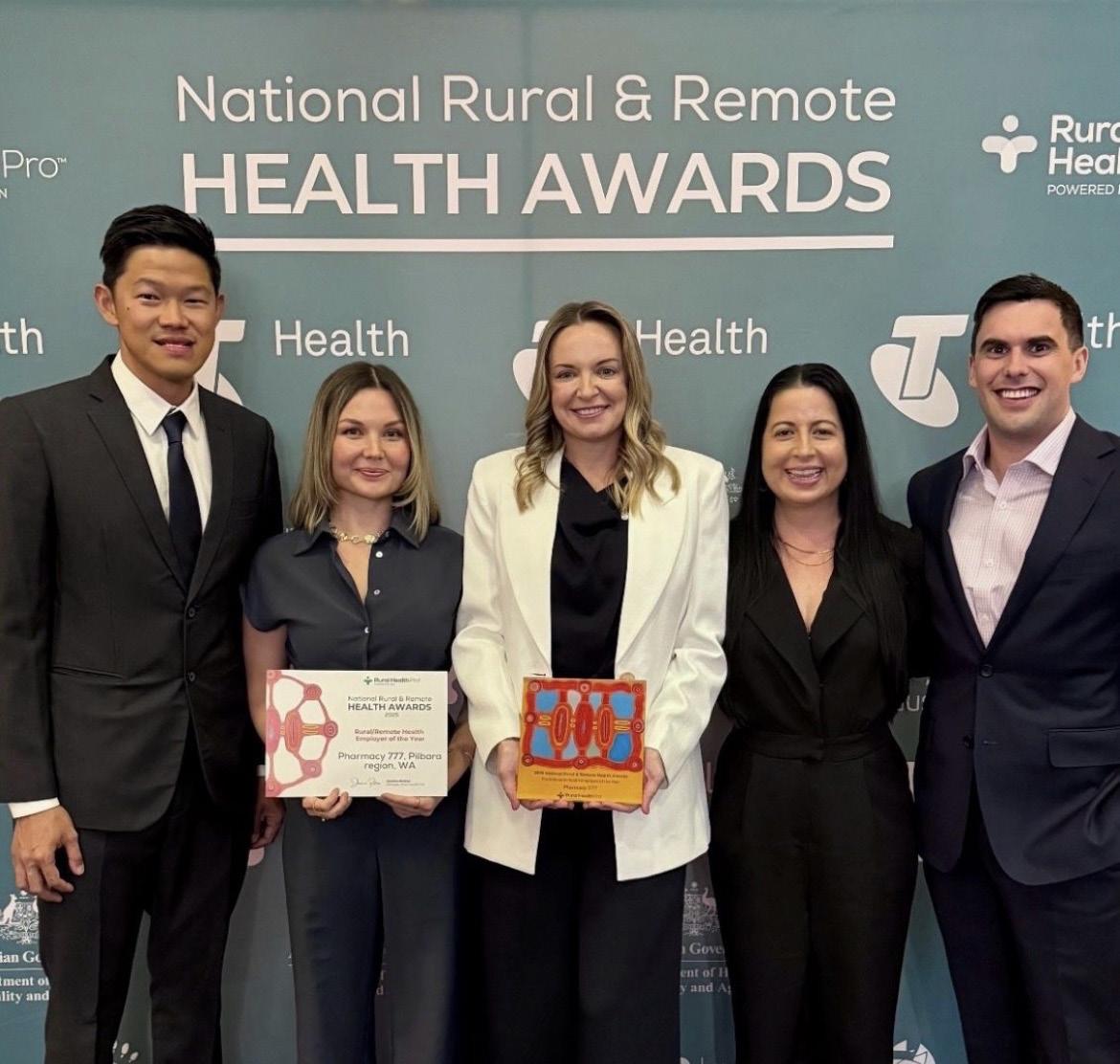
Among the recipients, Pharmacy 777 in the Pilbara region of Western Australia received the Rural/Remote Health Employer of the Year award, reflecting its longstanding commitment to improving access to care in one of Australia’s most remote regions.
Pharmacy 777’s journey in the Pilbara spans more than 20 years — growing from a single store staffed by three pharmacists to a network of four locations supported by a team of 25.
Their approach is grounded in people-first healthcare, local workforce development and deep community engagement, often navigating challenges associated with geographic isolation, workforce shortages, economic pressures and evolving population health needs.
Rural Health Month, established in 2020 by Rural Health Pro, is now a national celebration recognising the programs, initiatives and professionals driving better health outcomes outside metropolitan centres.
For more information:
Rebecca Segrott, Health Project Manager, PGA
Pharmacy 777 in the Pilbara region of Western Australia receiving the Rural-Remote Health Employer of the Year award
President’s message
Professor Trent Twomey National President, the Pharmacy Guild of Australia
Some terrific events to celebrate and take note of in this issue, including World Pharmacists Day, the new National Pharmacy Awards, and the Australasian College of Pharmacy being acquired by the Pharmaceutical Society of Australia.
Firstly, I am honoured to say I’ve most recently been elected to lead the World Pharmacy Council. This is a tremendous honour and one I’m lookiing forward to taking up.
Secondly, to see the Australaisan College of Pharmacy moving to PSA marks a significant step forward for our pharmacy profession.
The move will enhance education and training opportunities for pharmacists, pharmacy assistants, and technicians — and will support consistent, high quality professional development across the country.
For the College, the acquisition represents a continuation of its mission to unify the profession through education. We all agree the move will be an empowering one for our industry.
World Pharmacists Day
On September 25, we led a national celebration for World Pharmacists Day, which is a day to recognise the essential role community pharmacies play in delivering accessible, trusted everyday healthcare for every Australian. This year’s theme — Think Health, Think Pharmacy First — resonated across the country.
From capital cities to rural and regional towns, we saw a wave of appreciation for our profession and for the frontline health services pharmacists provide every day.
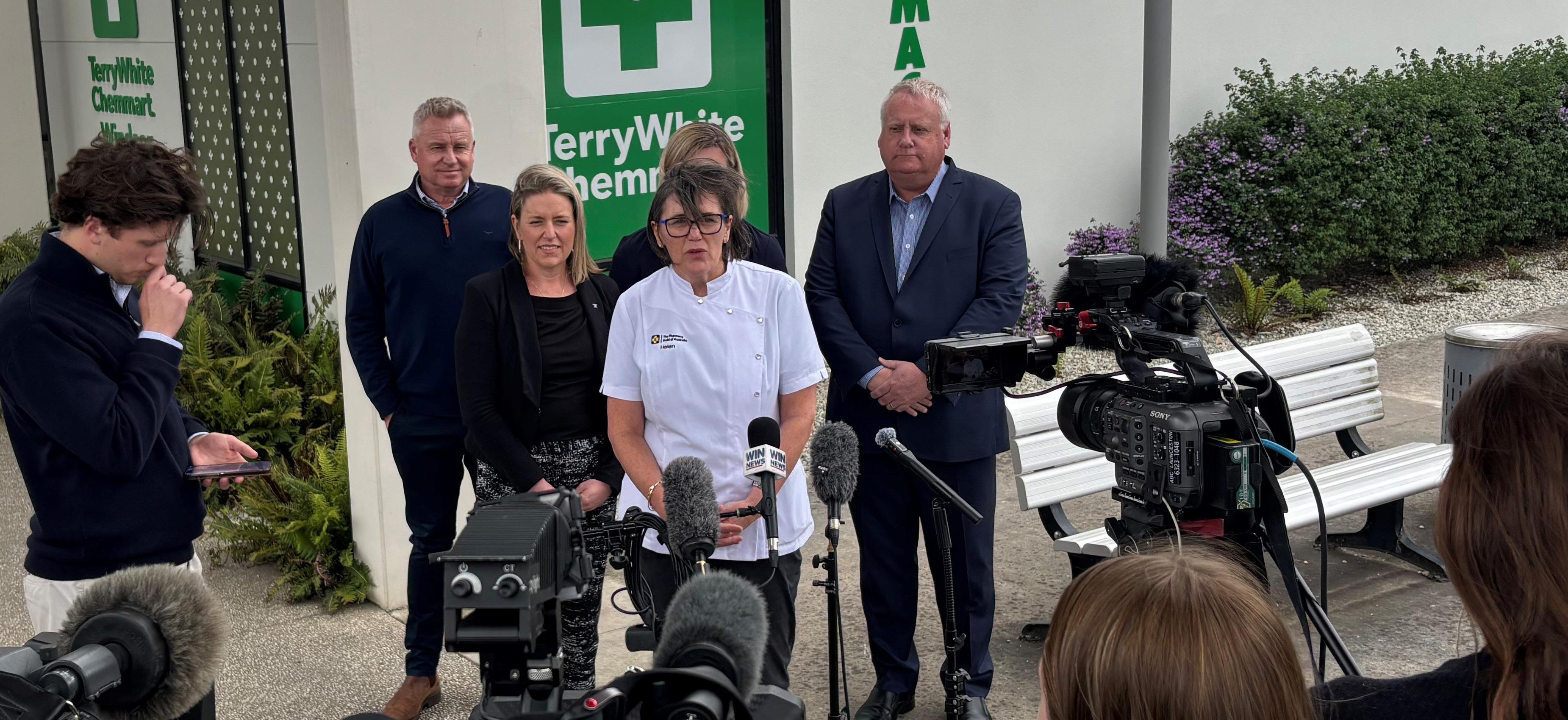
Expanding scope and strengthening agreements I had the privilege of spending World Pharmacists Day in Tasmania, alongside Tasmanian Health Minister Bridget Archer, to welcome a significant announcement on Scope of Practice.
Minister Archer announced a commitment to making a range of conditions permanent practice throughout the state and to support pharmacists to complete their requisite prescribing training.
Importantly, Tasmania joins Queensland and the Northern Territory as leaders in the provision of women’s health services.
From next year, the initiation of hormonal contraception will be available in community pharmacies in five jurisdictions across Australia.
This reform will ensure more women can access timely healthcare from their local community pharmacist — a model we are working tirelessly towards seeing replicated nationwide.
Regardless of what state and territory they practice in, the time is now for community pharmacists to take actions towards gaining their prescribing qualifications.
As a first step, I urge all community pharmacists in Australia to lodge an expression of interest in enrolling in prescribing qualifications, via the Australasian College of Pharmacy.
A national celebration
One of the highlights of this year’s World Pharmacists Day was the Prime Minister and state and territory leaders lending their voices to a special video message, thanking Australia’s community pharmacies for everything they do. The video powerfully reinforced the value of our sector to governments of persuasions. Please visit our website https://australasianpharmacy.com.au/ to see the video.
It was also heartening to see state and federal members of parliament from across Australia celebrating community pharmacy by visiting their local pharmacy and sharing tributes online. This kind of bipartisan support is critical to ensuring pharmacy continues to evolve and expand its role in primary care.
Celebrations in Brisbane
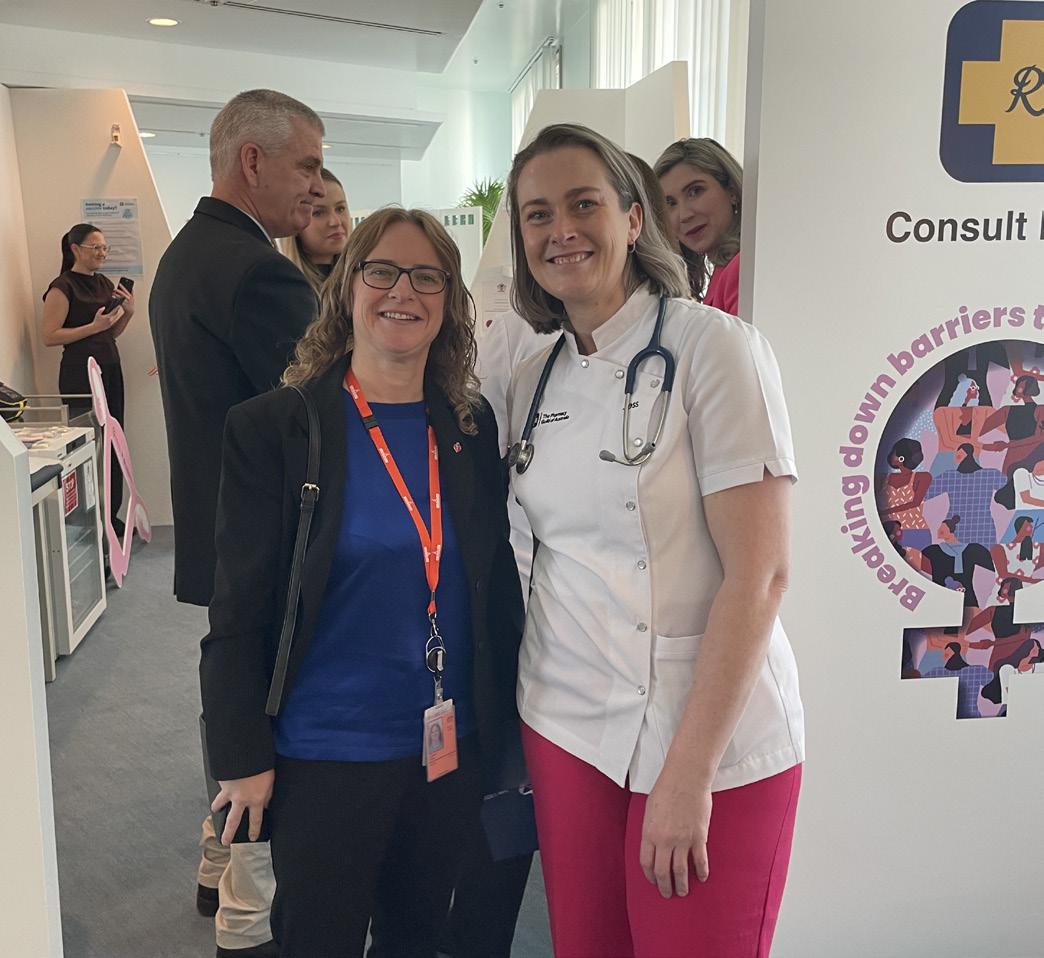
In Brisbane’s suburb of Newstead, and in partnership with Terry White Chemmart, we brought full-scope of practice to life through a life-size consultation room at Gasworks Plaza. The activation gave shoppers a chance to experience first-hand the expanded range of services now available through their local community pharmacy — from vaccinations and blood pressure checks to women’s health consultations and minor ailment treatment.
The installation attracted national media attention, with one of Australia’s longest running breakfast shows, Today, broadcasting live from the consultation room. It was a proud moment for our profession, showing Australians just how far pharmacy has come and how accessible our care really is.
Australians trust us. Governments value us. And as a profession, we stand ready to do even more.
Australians trust their pharmacist
Coinciding with World Pharmacists Day, new independent research by market data firm YouGov Australia reaffirmed the deep trust Australians have in their local community pharmacy.
The findings revealed 82 percent of Australians consider a pharmacist among their top five most visited healthcare providers. Close to 50 percent say their pharmacist is their first port of call for healthcare, and an impressive 84 percent trust the medical advice they receive from their pharmacist.
At the same time, the research highlighted opportunities for greater awareness of the full scope of pharmacy services. Some 48 percent of those surveyed were unaware or unsure a pharmacist can provide a sick leave certificate, while just over 40 percent did not know pharmacists can prescribe treatment for a non-complex urinary tract infection.
These findings underline why community pharmacy awareness campaigns are so important — because when people understand what we can do, they use our services and get the care they need, when they need it.
I was joined by PGA leaders across the country in speaking to media about these results, and the message was clear: Australians trust us, rely on us, and want us to do more.
World Pharmacists Day 2025 was more than a celebration — it was a reminder of how far our profession has come and how much potential lies ahead.
Australians trust us. Governments value us. And as a profession, we stand ready to do even more.
8CPA program evaluation
The PGA continues to work closely with the Department of Health and Aged Care on the review of Eighth Community Pharmacy Agreement (8CPA) programs.
This process is critical to shaping the positive outcomes of future CPAs. It is critical to ensuring the sustainability of our profession and ensure community pharmacies are properly supported to deliver an ever-expanding range of clinical services.
Recognising excellence
Our new awards structure — the National Pharmacy Awards — is now well underway. A key feature of this program is celebrating state and territory winners who have demonstrated excellence and innovation in community pharmacy practice. Congratulations to all winners and finalists who have been recognised at branch events across the country so far.
In Sydney a parliamentary reception was held honouring the outstanding contributions of community pharmacists across the state and announcing the winners of PGA’s National Pharmacy Awards for NSW.
And in Canberra we celebrated our award winners at a the ACT Branch’s fantastic annual dinner. For more on those winners please visit our website australasianpharmacy.com.au
I look forward to celebrating our National Winners at APP on the Gold Coast in March, where we’ll showcase the best of our profession and the extraordinary people driving community pharmacy forward.
On the global stage
In October, I travelled to New Orleans to attend the National Community Pharmacists Association Annual Convention and Expo, where I met with international colleagues to share insights into how community pharmacy can thrive in an evolving healthcare landscape.
I say with much pride Australia is now a firm leader in the evolution of scope of practice, having had the benefit of learning from our peers in the United Kingdom and Canada.
Back home, the Guild’s Group Symposium in late October provided further opportunities to strengthen collaboration across the profession and continue advocating for policies which support the health of Australians and the vitality of community pharmacy.
I look forward in the next edition to reporting on our annual parliamentary dinner to be held in November at Parliament House in Canberra.
Professor Trent Twomey National President, the Pharmacy Guild of Australia.
australasianpharmacy.com
The Queensland Pharmacy Guild Team and our consult room set up at Gasworks Plaza Brisbane for World Pharmacist Day.
President’s message
Kesh Naidoo-Rauf President, Pharmacy Guild of New Zealand
New Zealand, like many countries, is facing a chronic pharmacy workforce shortage. This comes at a time when we are being asked to do more to relieve pressure from our general practice and hospital colleagues, who are also facing workforce shortages.
Current health system reforms are focused on delivering more timely access to healthcare and improving health outcomes, with a more preventive approach to help keep people healthy and well in our communities, to take pressure off general practices and hospitals.
Fiscal pressures also mean the government has an increased focus on seeking better value for money health expenditure.
This focus has created opportunities for community pharmacy service role expansion, including enabling the full range of immunisation services, piloting of minor health condition services and exploring further extended pharmacy services.
However, taking advantage of potential service opportunities is challenging when you don’t have the workforce to provide additional services. We need improved policy settings and funding to enable this.
We recognise the value of working with others to progress workforce issues. It makes sense to pool the knowledge and resources of likeminded organisations to address common issues and achieve common goals.
Workforce data
The 2024 Health Workforce Plan (the plan) was released in December 2024, and included estimates of:
• a current pharmacist shortage of around 1,000 full-time equivalent (FTE) pharmacists
• a current technician shortage of around 620 FTE pharmacy technicians
• a need for 570 more FTE pharmacists by 2033 in addition to the current pipeline.
The actions identified for the pharmacy workforce in the plan are:
• match tertiary training capacity to future need – to outline required tertiary training growth to meet demand by 2035
• attract students to health careers – by launching a national attraction campaign to get students interested in health careers
• improve graduate transitions – establish 20 additional new entry practice roles for allied professionals, with a focus on innovative care settings.
We don’t believe these actions will effectively address our workforce needs as they fail to address the true extent of our workforce shortages and, most importantly, fail to address our biggest staff recruitment and retention issue – pay parity.
It is also difficult for overseas trained pharmacists from some countries – the Non-Recognised Equivalent Qualification Route – to come and work in New Zealand, and the plan hasn’t considered this huge pool of potential staff.
PGNZ workforce advocacy
We continue to push for development and implementation of a sustainable community pharmacy funding model to enable pharmacy owners to pay their staff what they are worth.
We have recently secured commitments from Health New Zealand to develop a sustainable funding model in 2026/27 and develop a nationwide contracting policy for awarding new community pharmacy agreements.
We have been pushing for these for some time – sustainable funding will help address pay parity issues and a contracting policy should mean pharmacies don’t open in areas where there are already sufficient pharmacy numbers, further diluting the limited workforce.
PGNZ has a draft community pharmacy sector workforce plan which identifies recruitment and retention issues for the various community pharmacy roles and the agency or organisation responsible or able to fix the issue.
Workforce issues
We do, however, recognise the value of working with others to progress workforce issues.
Community pharmacy organisations across the sector are dealing with the need to address workforce challenges, while also maximising and creating opportunities to expand community pharmacy services.
It makes sense to pool the knowledge and resources of likeminded organisations to address common issues and achieve common goals.
This is why we are currently leading work via the Community Pharmacy Leaders Forum (CPLF) to develop a comprehensive workforce plan to ensure community pharmacy can deliver its vital and growing role and continue supporting patients with timely access to needed services.
CPLF was established by PGNZ and consists of the leaders of national community pharmacy organisations and local community pharmacy groups.
While this plan is being worked on, we continue to achieve wins for members wherever possible, in the past this has included getting pharmacists added to the Voluntary Bonding Scheme and the Green List’s Straight to Residence pathway.
Kesh Naidoo-Rauf President, the Pharmacy Guild of New Zealand
PGNZ’s work delivers for community pharmacy
Andrew Gaudin Chief Executive, Pharmacy Guild of New Zealand
PGNZ has successfully secured improvements to the next Integrated Community Pharmacy Services Agreement voluntary variation by working outside the limited scope of the national annual agreement review.
We recognise Health New Zealand’s final cost pressure uplift offer of 3 percent is inadequate and fails to consider the reasonable cost pressures faced by community pharmacy, which is a key national annual agreement review (NAAR) obligation.
Our analysis, jointly worked on with the tax and accounting firm Moore Markhams, demonstrated the average cost pressure growth faced by community pharmacy was around 5.3 percent per annum over the last three years.
This aligns closely with Health New Zealand’s independent economic-based estimate of reasonable cost pressures of 5.62 percent for our financial year 2024 to 2025.
Community pharmacy fees growth over the last 17 years has been 20 percent below the consumer price index (CPI), while other parts of our health system have been funded at around CP for general practice, or well over CPI for hospital staff.
Because of the inadequate cost pressure uplift, it is imperative that the forecast adverse 12-month prescription policy funding impacts are fully mitigated, and that the development and implementation of a sustainable funding model is delivered in 2026/27.
Twelve-month prescription impacts
We have consistently and repeatedly advised since October 2024 that the 12-month prescription policy should not have any unintended adverse fee and funding impact on community pharmacy.
Community pharmacy will still have to do the same amount of work as it has always done — such as same medicine, same dosage, same frequency of dispensing — for those existing patients who are stable on a long-term medicine regime.
Ironically, community pharmacies will likely end up needing to provide increased service levels of clinical oversight because of this new policy due to less GP oversight — and should not be punished for this.
Community pharmacy should not be expected to take on the risk of unintended, unjustifiable, and unacceptable fee and funding impacts.
Community pharmacy will still have to do the same amount of work as it has always done — such as same medicine, same dosage, same frequency of dispensing — for those existing patients who are stable on a long-term medicine regime
Without mitigation:
• There will be an unjustified and unacceptable annual fees reduction for community pharmacy of between 26.7 percent and 28.4 percent for dispensed items under the 12-month prescription policy, relative to the current three-month prescription policy.
• The 3 percent cost pressures uplift offer in 2025 to 26 will be ‘wiped out’, as the annual adverse funding impact of the 12-month prescription policy equates to an average 3.5 percent price reduction across all ICPSA activity in 2025 to 26.
Both impacts including fees and funding should be fully mitigated in 2025/26 and beyond.
Put simply, the current community pharmacy funding model has been developed around a three-month prescription duration, and this is not fit or appropriate for use for a 12-month prescription duration.
We are pleased health New Zealand has agreed to an urgent review of the financial impact 12-month scripts will have, and to developing options to mitigate the adverse impacts.
Behind the scenes
Given the issues facing the sector, particularly the inadequate cost pressures uplift offer and potential financial impacts of 12-month prescriptions, we knew how important it was to progress these issues at pace on behalf of members.
We also recognised what can be achieved within NAAR is limited and saw the value in working outside of NAAR and higher within the system.
This work involved PGNZ holding regular meetings with the Health Assurance Unit — which is set up to provide advice to the Minister of Health, the Hon Simeon Brown, as well as the Crown Observer and senior leaders on the Health New Zealand Board.
Our advocacy work over the last three months has resulted in a significant program of work to better position community pharmacy for the future — work which has bene acknowledged by Minister Brown.
While 3 percent does not adequately recognise the cost pressures faced by community pharmacy, and we continue to highlight this, it’s important to ensure we achieve as much as we possibly can for members each year.
Key successes delivered by PGNZ include:
• Additional NZD2.8m in cost pressure funding secured, due to our repeated questioning of the Integrated Community Pharmacy Services Agreement expenditure baseline used by Health New Zealand
• NZD5m annual fund for nationally consistent pharmacy services
• Ensuring the NZD5m fund can be used for staff training costs and investment in technology to expand services
• Commitment to develop and implement a sustainable funding model in 2026/27
Our advocacy work over the last three months has resulted in a significant program of work to better position community pharmacy for the future.
• Urgent review to mitigate financial impacts of 12-month prescriptions by October
• Nationwide contracting policy with conditions for awarding new Integrated Community Pharmacy Services Agreements. These are the right commitments to take the sector forward, and we will work to ensure they are delivered.
This is not the end of the road – but it’s progress – and we will keep pushing for the support our sector urgently needs.
A career built on care: Meet Jessica Brown, Australia’s Pharmacy Assistant of the Year
Sarah Porter and Izzi Madl,
Australasian Pharmacy
From a teenage trainee in Australia’s Dandenong Ranges, in Victoria, to an award-winning pharmacy assistant, Jessica Brown has built her career on commitment, community and a belief in the power of pharmacy teams.
Jessica Brown, recently named 2025 Pharmacy Assistant of the Year (PATY), smiles widely when we ask her how she first found her way into pharmacy.
“I did VCAL at school — a vocational pathway where you split your time between school and work,” she says.
“As part of that I did an introductory pharmacy course run by PGA, and then I got a traineeship at Emerald Pharmacy in my home state of Victoria.”
Jessica was still in her teens. But she says the spark was immediate.
“I knew straight away it was what I wanted to do,” she says.
“I wasn’t someone who dreamed of being in healthcare from the start, but once I stepped into pharmacy I realised how rewarding it is.”
Raised in Emerald in Victoria’s Dandenong Ranges, Jessica has never strayed far from the community which first gave her a chance.
Her parents are still in the region and she and her partner own a home an hour’s drive away in Neerim South. Every workday begins with the long commute back to Emerald.
“It’s about an hour each way,” she says.
“If the workplace wasn’t good, I wouldn’t do it. But our team is like family, and that’s why I keep making the drive.”
Building experience across pharmacy sectors
After finishing high school in Australia, Jessica stayed on at Emerald Pharmacy for nearly seven years before branching into hospital pharmacy — working in both private and public systems.
Those years gave her insight into how different pharmacy environments operate. But eventually, she came back to community practice.
“Community pharmacy is evolving so quickly. In the next five years it’s only going to expand further and become an even larger healthcare hub.”
That perspective has shaped her vision for the future of pharmacy-support staff, too.
She sees assistants and technicians not only as dispensary support, but as frontline healthcare guides.
“Pharmacists have the final clinical knowledge and sign off prescriptions.
“But pharmacy assistants are the backbone of the pharmacy,” she says.
“We support the whole place — we’re advising on over-thecounter products, vitamins, daily health questions. We make sure the business and the care side both run smoothly.”
Teamwork is everything
Emerald Village Pharmacy is a busy operation with around 20 staff. On any given day, two or three pharmacists are on duty alongside technicians, assistants, and front-of-house staff.
For Jessica, part of the pride she has in her career comes from being a team leader, but she says the past few years have tested every pharmacy team.
“The 60-day dispensing change has been difficult,” she says.
“And we’ve had challenges with staff sickness, COVID impacts, and stock shortages.
“But the way we cope is by communicating and pulling together. Teamwork is everything.”
That emphasis on collaboration is more than just words. Jessica has become a mentor to younger staff, relishing the chance to help others grow into the profession — just as she did.
“My favourite part of the role isn’t a single product or service,” she says. “It’s seeing people develop. I enjoy mentoring and watching staff grow through their roles. That’s incredibly rewarding.”
Jessica’s vision for the future
As part of the PATY competition, nominees must present to PGA and other powers the reasons they should be considered an award winner.
Jessica’s award-winning PATY presentation was called Level Up – and it showcased her forward-looking thoughts for pharmacy practice. In it, she proposed streamlining vitamin and mineral testing and treatment through pharmacy-led appointment consultations.
“The idea was you could book one appointment, have your blood taken at the pharmacy, get results back, and then have the pharmacist provide vitamins or treatment in a follow-up visit,” she says.
Pharmacy assistants are the backbone of the pharmacy. We’re here to support, advise, and make the whole place run.
Pharmacy is incredibly rewarding. You can go to work every day knowing you’ve helped someone. If you want a career that makes a difference, pharmacy is a great choice.
“It reduces multiple trips to the doctor, pathology, and pharmacy. It’s all about making healthcare more efficient for the patient.”
Jessica says she believes pharmacy assistants can play a growing role in this model — with the right training.
Currently, Certificate IV qualifications focus mainly on management. Jessica would like to see the creation of a Certificate V with a more clinical stream.
“Pharmacy technicians could be trained in triage, first-line UTI assessment, and blood pressure management,” she says.
“It’s about supporting pharmacists and giving patients faster, more accessible care.”
Recognition in Sydney
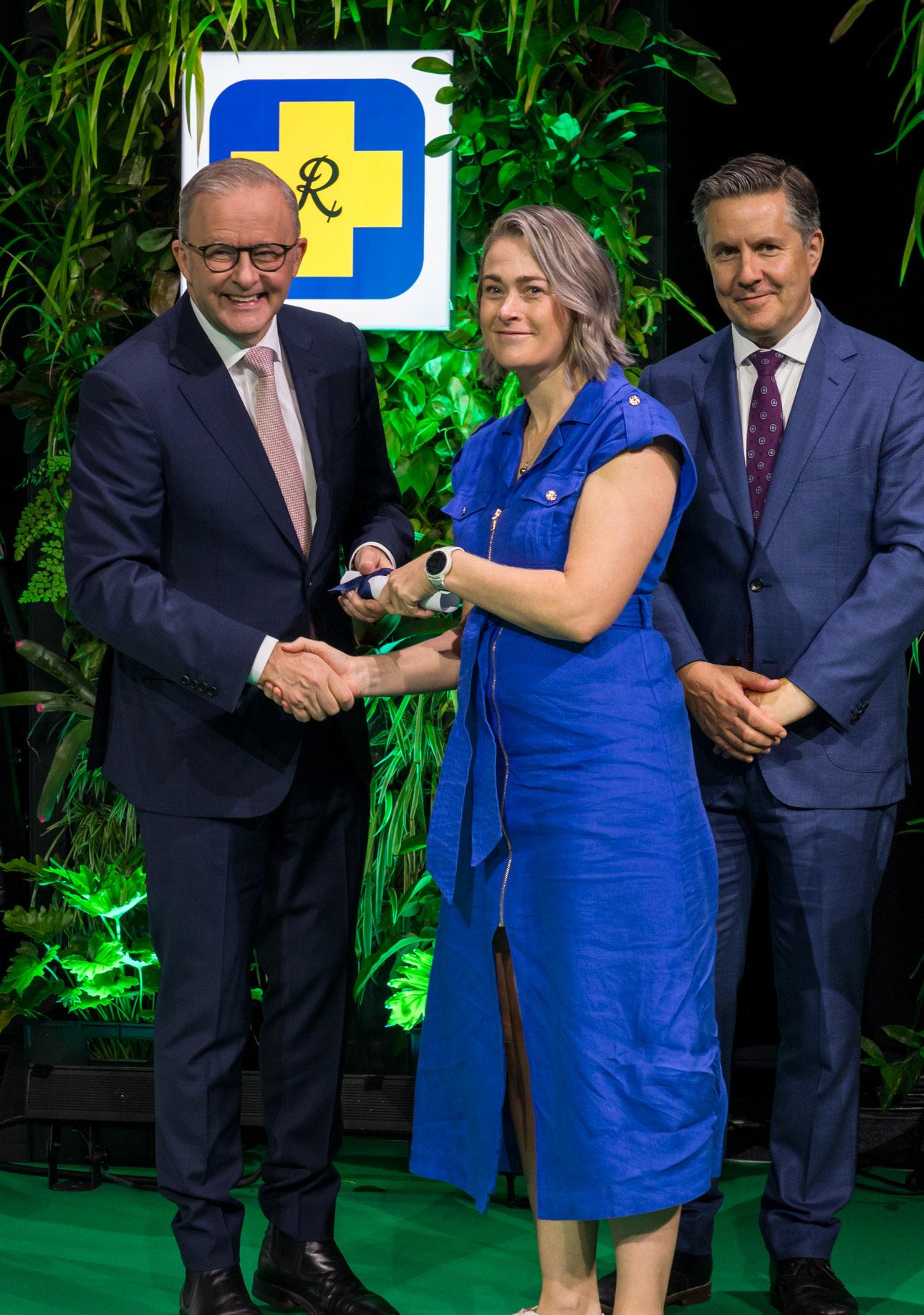
At the national awards ceremony, which was held on Sydney Harbour as part of Pharmacy Connect 2025, Jessica says she was stunned when her name was read out.
“I honestly didn’t expect it. I thought other nominees would win. When they called my name, I was just like, ‘Oh my Gosh’!”
But the honour has only strengthened her resolve to continue championing pharmacy support roles.
She is quick to stress awards like PATY are not just about individual achievement.
“It’s about showing the value of pharmacy assistants across Australia,” she says.
“We’re here because we love helping people, and because we believe in what pharmacy can do.”
As part of the PATY competition, nominees must present to PGA and others the reasons they should be considered an award winner
Advice for the next generation
Looking back at her own pathway, Jessica is clear about the messages she would give a teenager today.
“If you’re 14 or 15 years old and thinking about vocational training — I’d say go for it,” she says.
“Pharmacy is incredibly rewarding. You can go to work every day knowing you’ve helped someone. If you want a career that makes a difference, pharmacy is a great choice.”
Beyond her pharmacy work
Despite her demanding role, Jessica says outside of work she’s always on the go.
She walks, exercises, and hits the gym regularly. She and her partner enjoy weekends away with their caravan and are steadily working on projects around their home.
“I bought my first house at 24 years of age,” she says. “We bought another last year, so I’m always organising things and doing projects at home.”
But no matter how busy life gets, pharmacy remains her anchor.
“I love it,” she says. “If you find the right team, you’ll stay. Pharmacy is where I want to be.”
A career built on care
From her first high school traineeship to becoming Australia’s Pharmacy Assistant of the Year, Jessica Brown has never wavered in her belief that pharmacy is about more than medicine — it’s about people.
“I don’t see myself leaving pharmacy,” she says.
“With the evolving scope, we can deliver so much more to our communities. And that’s exciting.”
And behind every prescription, consultation or blood pressure check is a team Jessica wouldn’t trade for the world.
“As I said — if the workplace wasn’t good, I wouldn’t drive an hour each way.
“But it is good. The team is like family. And that makes all the difference.”
I started pharmacy through VCAL in high school — and I knew straight away this was what I wanted to do.
Did you know...
Australia’s Victorian Certificate of Applied Learning is a senior secondary qualification in Victoria, Australia, which focuses on practical, hands-on, and vocational learning. It’s regarded as an alternative to a year 12 final certificate called the Victorian Certificate of Education, or VCE.
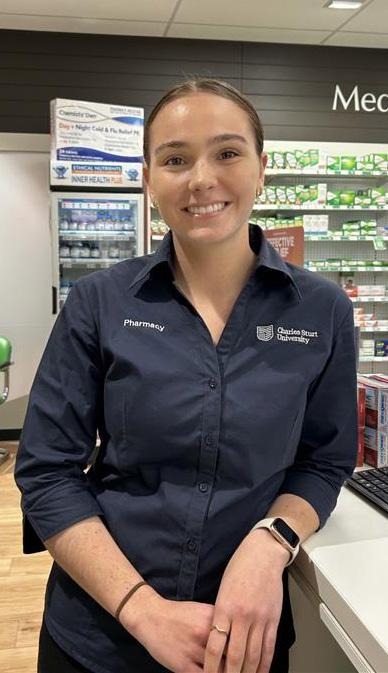
Raised in Emerald in Victoria’s Dandenong Ranges, Jessica has never strayed far from the community which first gave her a chance
Jess’s rural home is an hour’s drive away from the Emerald Village Pharmacy she works in, but she says the drive is worth it
Pharmacy Assistant of the Year 2025 – Jessica Brown and Pharmacy owner Louisa Lammers
Your customers can win a year’s supply of beans, pair of Asics, Diamonds jumper and signed Diamonds dress*, just by scanning the pack and pledging their support.
Stock your shelves today!
*T&C’s apply.
Question Time with...
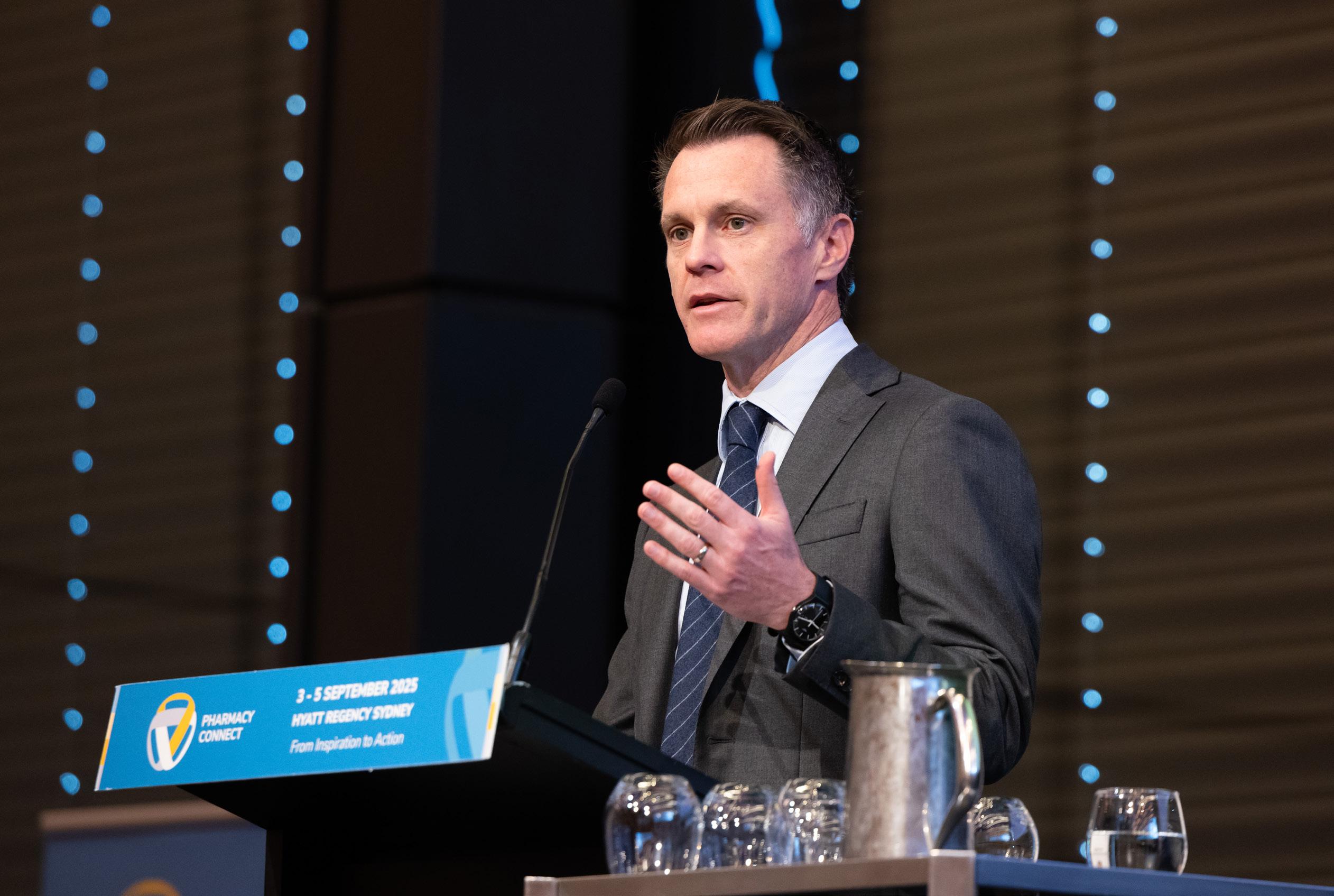
New Zealand’s Simeon Brown is the country’s Minister of Health, Minister for State Owned Enterprises, and Minister for Auckland. He serves as the Member of Parliament for Pakuranga — and has represented his East Auckland community since 2017. In this Q&A, Minister Brown spoke with Australasian Pharmacy about his first memories of visiting his local pharmacy, about wellbeing and health, and about his young family.
I regularly hear just how valued pharmacists are in their communities. People appreciate that they can walk in, speak to someone they trust, and get clear, practical advice about their health.
Minister Brown says people often describe pharmacists to him as the ‘front door’ of the health system, professionals who listen and provide reassurance to the community
Who is your local community pharmacist?
In my electorate, there are many outstanding pharmacists including Vicky Chan at Unichem Pakuranga Pharmacy. Vicky is not only a highly skilled pharmacist but also a real leader in our community and the pharmacy sector. She and her team go above and beyond to support our local community.
What is your earliest memory of visiting a community pharmacy?
My earliest memory is going to the local pharmacy with my parents to pick up my asthma inhalers. I still remember how kind and reassuring the pharmacist was, they took the time to explain things and make sure I understood how to use them properly. It left a lasting impression on me of pharmacists as approachable professionals who genuinely care about the wellbeing of their communities.
What feedback do you regularly hear from or about community pharmacists?
I regularly hear just how valued pharmacists are in their communities. People appreciate that they can walk in, speak to someone they trust, and get clear, practical advice about their health. Pharmacists are often described to me as the ‘front door’ of the health system, professionals who listen and provide reassurance to our community.
How important do you think community pharmacy is in the wider health system?
Community pharmacy is essential. Pharmacists are trusted health professionals who play a hands-on role in supporting patients every day, whether that’s providing advice, dispensing medicines safely, or helping people better understand and manage their health. They build lasting relationships with their patients and are often the most accessible point of care in a community. In doing so, they not only improve individual health outcomes but also help the wider system run more smoothly.
How do you plan to enable community pharmacies to do more to support the health and wellbeing of their communities?
Across New Zealand, more than 1,000 community pharmacies deliver important services to their patients every day. As Minister, I want to make sure they have the support and flexibility to keep doing that well. We’re funding the growth of roles such as Pharmacy Accuracy Checking Technicians (PACTs) and supporting more pharmacists to gain prescribing qualifications. Health New Zealand continues to work closely with the sector through the annual price-uplift process to help expand the clinical services pharmacies can provide within their communities.
In relation to your portfolio, what keeps you awake at night?
What keeps me awake is knowing there are still patients waiting too long for the care they need. Someone who just wants to get back to work, back to their family, and back to living their life. My focus is on making sure those patients are seen, diagnosed, and treated as quickly as possible. Through initiatives like our elective surgery boost and improved diagnostics, we’re already seeing waitlists come down and more New Zealanders getting the care they need sooner. Delivering timely, quality healthcare for patients is what drives me every day.
For me, wellbeing is about balance, both for myself and my family. No matter how busy things get, I try to make time to get regular exercise and eat a balanced diet — which can be a bit more challenging when travelling.
As Health Minister, it’s important you model good health and wellbeing. Do you have a daily routine to stay in tip-top condition physically and mentally?
For me, wellbeing is about balance, both for myself and my family. No matter how busy things get, I try to make time to get regular exercise and eat a balanced diet — which can be a bit more challenging when travelling. Spending time with my family is also a priority with four young children including our newborn son Peter who arrived in August. Our children bring a lot of busy joy into our life, keep us grounded, and also remind me of the reason behind the work we’re doing to improve healthcare matters, because it’s ultimately about helping families across New Zealand live healthier, happier lives.
How do you plan to recharge your batteries over the holiday break for another parliamentary year?
The work of improving our health system doesn’t stop just because Parliament isn’t sitting, so there’s plenty to do over the summer months. That said, I’m looking forward to spending some time with my family, especially with our new baby boy, and recharging before another busy year.
If you weren’t an MP and Health Minister, what would you be doing?
Before entering Parliament, I worked at the Bank of New Zealand, and in local government, so I’ve always enjoyed roles that are about serving people and improving communities. If I weren’t an MP, I’d still want to be doing something that makes a difference, probably in a public or community-focused role where I could help deliver better outcomes for others.
What’s the last television series or movie you watched? Do you like medical dramas?
I’m not the biggest fan of medical dramas, although it’s great to have long-running New Zealand shows like Shortland Street. When I do get the chance to watch something, it’s usually with the kids, so shows like Bluey, Paw Patrol, or Mickey Mouse Clubhouse are often on at our place.
How do you want history to judge your time as Health Minister?
I’d like to be judged on the results I help deliver. Through changes such as the elective boost and diagnostics investment boost programme, we’re reducing waitlists and making sure patients get the timely, quality healthcare they need. Ultimately, it’s about improving outcomes for New Zealanders and building a health system that works better for everyone.
AUSTRALIA’S MOST ATTRACTIVE BEAN.
You don’t need milkshakes to bring all the boys (and girls) to town. You just need Australia’s favourite jelly beans. In fact, in a recent campaign customers of a certain discount pharmacy chain were 23% more likely to visit a community pharmacy after being exposed to Glucojel advertising.
So, if you want feet through your door, you need Glucojel on your shelves.
*Source: Bliss Mobile
Iconic brands join forces to back netball’s Olympic bid
The makers of Australia’s favourite jelly bean — Glucojel — have announced a new partnership with Netball Australia in a bid to finally see netball included in the Olympic Games — in time for Brisbane, 2032.
To celebrate, Glucojel is launching a competition from November 1 to 30, 2025 in support of Netball Australia’s Back the Bid campaign.
To enter the competition, community pharmacy customers simply need to purchase any pack of Glucojel beans or bears, scan the QR code on the back, and pledge their support for including netball in the Olympic Games.
Half time jelly beans and community connections just make sense to us, and we’re so excited to see what we can achieve together.
Netball Australia
By pledging support, pharmacy customers will go in the draw to win a year’s supply of Glucojels, a Diamonds jumper and a signed Diamonds dress. The Australian national netball team is also known as the Australian Diamonds.
Glucojel’s competition aims to rally communities, fans, and families to help make history, one sweet pledge at a time, to build a healthier nation, and to see Netball Australia’s golden dream realised.
One of Australia’s highest profile elite athletes and Chair of Netball Australia, Liz Ellis, has welcomed Glucojel to the Netball Australia family in this social media video, saying she is thrilled to be in partnership to Back the Bid for netball’s inclusion in the 2032 Brisbane Olympic Games.
“Half time jelly beans and community connections just make sense to us, and we’re so excited to see what we can achieve together,” Netball Australia said.
The Pharmacy Guild of Australia owns both the Glucojel and Gold Cross brands.
FOR MORE INFORMATION
How can community pharmacies get involved?
Keep shelves stocked: Gold Cross will be kicking off the consumer campaign next week, so community pharmacists are being encouraged to keep shelves stocked.
In-store presence: Make sure your stores have a point of sale ready to go. Gold Cross is offering A4 posters and wobblers for the competition, as well as counter mats which remind consumers to Back the Bid including QR codes leading to the official pledge page.
Share on social media: Share the news of this exciting collaboration with patients and community on social media channels.
A bit more about netball
Netball is not just a ‘Commonwealth’ sport. More than 20 million people play netball across 117 countries, and 48 of those have an official world ranking.
Netball has huge global recognition. It’s recognised by the International Olympic Committee, has its own World Cups, and is a main fixture in the Commonwealth Games.
Netball is broadcast in more than 100 countries. It even features on Whoopi Goldberg’s All Women’s Sports Network (AWSN) which is available in 65 countries. The 2025 Suncorp Super Netball had a 300-million global broadcast reach.
Source: https://netball.com.au/2032
Community pharmacists can contact Andrew Pattinson at apattinson@guildgroup.com.au for more information. To stay up-to-date with The Diamonds and Glucojel’s partnership please visit https://australasianpharmacy.com.au/
Community pharmacy in Japan and the lessons we can learn
Stephen Armstrong, Chief Economist, World Pharmacy Council
The World Pharmacy Council’s annual Pharmintercom conference brings together the presidents, CEOs, and other senior representatives of community pharmacy organisations from around the developed world.
This year’s Pharmintercom was held in May in Singapore and among a host of opportunities, delegates were invited to hear from two representatives of the Japan Pharmaceutical Association – President Susumu Iwatsuki and Executive Director Atsushi Toyomi.
Mr Toyomi delivered a presentation which revealed how Japan’s community pharmacies are tackling its ‘super-aged society’, offering lessons for Australia and New Zealand these countries both approach similar demographic shifts.
Stark statistics
Japan’s demographic situation is stark, with 29 per cent of its population aged 65 or older.
Australia won’t reach such proportions until the mid-2060s, and New Zealand until the late-2050s. The worker-to-senior ratio in Japan has plummeted from 12 to one in 1950 — to just two to one today, which is the lowest ratio of working-age people relative to elderly people globally. And those numbers continue to decline.
With annual healthcare expenditure consuming 11 percent of gross domestic product, Japan’s universal health system faces an unsustainable budget strain which has forced a radically rethink of healthcare delivery.
The urgency of these demographic trends is driving a rapid evolution of community pharmacy practice. Japan has the highest density of practising pharmacists in the world – one for every 500 people.
Unusually, their model does not have dispensary assistants or technicians, as the law requires that only pharmacists are involved in the dispensing process. The high density of pharmacists represents an opportunity, but authorised scope of practice has lagged many other countries, as has the funding of services beyond dispensing.
Changing roles
Pharmacists in Japan cannot yet administer vaccinations, for example. However, this is changing. The role of pharmacies is expanding beyond dispensing medication to include disease prevention and health promotion.
This strategic shift is essential in addressing Japan’s demographic challenges while maintaining fiscal discipline and health system productivity. While funding remains a major challenge, Japan is empowering its reducing workforce to manage population health more efficiently.
Interestingly, despite the ageing of the population, Japan’s community pharmacy sector has not forgotten young people. In fact, pharmacists are perhaps more ingrained in the lives of school-aged children than in any other developed country.
The school pharmacist
One of Japan’s most distinctive pharmacy initiatives is its school pharmacist system. Since 2003, all schools — elementary through to secondary – have been required to appoint a school pharmacist.
School pharmacists conduct environmental and hygiene assessments, provide advice and support to school principals to help maintain a safe and comfortable learning environment and, perhaps most importantly, they deliver health education, including drug abuse prevention programs for middle school students and lessons on proper medication use across all grades.
Each year, some 9,000 pharmacists deliver 30,000 such classes nationwide. This system leverages the expertise of local pharmacists to create early relationship-building opportunities which prove invaluable later in life.
Children grow up recognising their community pharmacist as a trusted health authority long before they require prescription medications. This early relationship with pharmacists sets the foundation for the systems which supports patients throughout adulthood.
Centralising family care
In 2015, the Japanese Ministry of Health, Labour and Welfare announced a 10 year Pharmacy Vision for Patients. It aimed to shift from a drug-oriented to a patient-oriented model to cope with an ageing society and a fragmented health care landscape.
A major component has been the introduction of the Health Support Pharmacy, or HSP. Under this system, families formally designate one, HSP-accredited pharmacy as their primary provider, and the family pharmacist assumes responsibility for medication management, health counselling, home-care visits, and coordination with the family doctor. Around 70 percent of pharmacies meet the HSP criteria.
A 2019 revision of the Pharmacies Act established a legal requirement for pharmacists to follow up on patients’ medication use after dispensing. This involves checking on the patient’s condition, such as the drugs, effects, side effects and changes in health status, using phone call or message between visits.
Pharmacists prioritise follow up, particularly when a new medication is prescribed or when side effects are suspected and share information with the physician as needed. The objective is to maximise the effectiveness of drug therapy and ensure patient safety.
Failure to complete follow-up is treated with the same seriousness as dispensing errors and is subject to audit by prefectural health authorities.
Supporting Japan’s ageing population at home
With Japan’s aging demographic, home medical care has become increasingly vital. The number of patients receiving care at home is increasing and pharmacies are actively engaged in home medical care by visiting these patients’ homes to manage and guide medication use.
Pharmacies now collaborate closely with physicians, nurses, and care managers to prepare tailored medications, provide usage guidance, and monitor any side effects. As medication experts, pharmacists support patients so they can live their lives with peace of mind at home.
This home care model represents a strategic response to Japan’s demographic challenges, allowing elderly patients to remain in their homes longer while receiving appropriate pharmaceutical care.
The growing use of home-based care also heightens the vulnerability of elderly patients during Japan’s natural disasters, when access to medications and healthcare support can be abruptly severed.
Disaster preparedness
Japan’s vulnerability to natural disasters has led to formal roles for community pharmacy in disaster management. The JPA has built a nationwide system which can quickly reestablish pharmacy services in affected areas. There are 20 mobile pharmacy vehicles available nationwide that can be deployed to an area struck by a disaster.
Recent guidelines promote the inclusion of disaster pharmaceutical coordinators. These coordinators manage medicine supply and hygiene control in evacuation shelters — ensuring displaced residents, including seniors, do not lose access to their vital medications. This has proven essential following earthquakes and typhoons.
Lessons from Japan
The Japanese experience offers valuable insights for countries which must prepare for the demographic shifts. Japan’s school pharmacist program demonstrates how early engagement creates lifelong trust.
The Health Support Pharmacy system represents Japan’s recognition that coordinated care, built around local relationships, leads to better outcomes. The new dispensing follow-up protocols highlight the level of importance Japan places on regular patient-pharmacist contact.
And the extensive and proven framework for community pharmacy involvement in disaster response represents a proactive model of preparedness worth following for any country.
For nations like Australia and New Zealand, Japan’s experience is part warning, part roadmap. As our own demographics shift toward a ‘super-aged’ reality, community pharmacies must become pillars of prevention, continuity, and resilience.
The JPA’s vision for Japan is to build a system which guarantees access to necessary medicines and pharmacist services, ‘anytime, anywhere, for anyone’. This vision can be applied around the world, and Japan’s approach makes it clear: pharmacists are the most accessible, trusted health partners across every life stage — from schoolyards to home aged care, to disaster zones – and are the key to a sustainable, personcentred health system.
Did you know
One of Japan’s most distinctive pharmacy initiatives is its school pharmacist system. Since 2003, all schools —elementary through to secondary – have been required to appoint a school pharmacist
Children in Japan grow up recognising their community pharmacist as a trusted health authority long before they require prescription medications
With annual healthcare expenditure consuming 11 percent of the country’s gross domestic product, Japan’s universal health system faces an unsustainable budget strain which has forced a radically rethink of healthcare delivery.
A clinical service at the heart of healthcare: Dispensing’s vital role
Doug Hoey, Vice President, World Pharmacy Council
Dispensing is at the heart of healthcare, yet chronic underfunding is threatening community pharmacies, patient safety, and equitable access to medicines. The World Pharmacy Council is calling for urgent recognition and investment in this vital clinical service.
The World Pharmacy Council (WPC) is the international representative body for community pharmacy in the developed world. In the majority of the countries we represent, community pharmacies are struggling under the weight of chronic underfunding and rising operational costs. This is a direct consequence of an unsustainable core funding model for dispensing.
For example, in three G7 countries – Germany, the United States, and the United Kingdom – the number of community pharmacies has been in decline for more than a decade. England alone has 800 fewer pharmacies than four years ago. Germany has lost more than 3,000 over the last 10 years, while since 2017 patients in the US now have 8,000 fewer pharmacies from which to choose.
With other parts of the health system also stretched to capacity, this is a public health crisis in the making, and risks dismantling one of the most accessible, trusted, and cost-effective pillars of our healthcare systems.
In September the WPC released its Position Statement on Dispensing & Core Funding, a call to policymakers and healthcare leaders around the world. The message is clear: dispensing is not a transactional task — it is a clinical service, and underfunding of this core role erodes patient safety, health equity, and the viability of community pharmacies.
Advances in science and technology allow patients to be treated with medications which not long ago would have required expensive and invasive hospitalisations.
Every dispensed prescription involves clinical decisions which are often invisible, under-appreciated and therefore unvalued.
Dispensing: the invisible safety net
All pharmacists know dispensing is not simply handing over a box of pills. It is highly regulated and evidencedriven, involving many steps including:
• A clinical review of every prescription for safety, efficacy, and suitability, catching errors that could lead to hospitalisations or worse.
• A thorough patient consultation to identify risks like adverse reactions, drug interactions, or adherence barriers — interventions that studies show prevent harm in one-third to onehalf of cases (PROMISe III Project, University of Tasmania, 2011).
• Extensive care coordination, particularly during high-risk transitions like hospital discharge, where pharmacists reconcile medications and prevent readmissions.
• Significant administrative and cost-containment tasks on behalf of patients and third-party payers, including through generic substitution and record-keeping.
• Ready and dependable availability of medications when patients need them.
Is this dose safe for a renal-impaired patient? Will this new antibiotic interact with the patient’s self-reported herbal supplement? Does this elderly patient’s confusion about their insulin pen require immediate intervention?
Every dispensed prescription involves clinical decisions which are often invisible, under-appreciated and therefore unvalued. Those clinical decisions often prevent early what otherwise can devolve into significant patient harm and costs to health systems.
Medications have never been a more important part of healthcare then they are today. Advances in science and technology allow patients to be treated with medications that not long ago would have required expensive and invasive hospitalisations.
Dispensing serves as the ultimate checkpoint before a medication reaches the patient. The interventions that occur during dispensing prevent hospitalisations, GP visits, or medication-related harm. Yet, despite this profound impact, payers and policy makers often view dispensing as a cost, not an investment in better care.
The domino effect of underfunding
When core funding for dispensing is inadequate, the consequences reverberate across the entire healthcare system:
Access and pharmacy ‘deserts’
In the UK, closures have been disproportionately high in rural and underserved areas – leaving communities without access to essential medicines and advice. This is also the case in my home country, the USA, where the term “pharmacy deserts” started to be used over ten years ago to describe areas where patients must travel unreasonable distances for care. Reduced viability does not always mean closure – similar effects can be felt through pharmacies being forced to cut hours, reduce staff, or remove services.
Shifted burden to GPs and
hospitals
When pharmacies close or reduce services, patients turn to general practice and emergency departments for minor conditions and medication advice. This is inefficient, slow and very expensive. Underfunding dispensing is a bad investment. It doesn’t save money; it shifts more significant costs to more expensive parts of the system.
Worsening health inequities
Community pharmacies are uniquely positioned to combat the “Inverse Care Law”— the phenomenon where those who need healthcare the most receive it the least (Hart, 1971). A UK study — conducted before the most rapid decline in pharmacy numbers there — found while GP practices are less available in deprived areas, pharmacies are more prevalent (Todd et al., 2014). Closing pharmacies in these communities deepens health disparities, disproportionately affecting the elderly, rural populations, and low-income groups.
Erosion of public health capacity
The COVID-19 pandemic proved pharmacies are essential health infrastructure. From vaccinations to medicine supply chain resilience, pharmacies stepped up when other parts of the system were overwhelmed. Yet, without sustainable funding, their ability to respond to future crises — or even maintain current services — is at risk.
All pharmacists know dispensing is not simply handing over a box of pills. It is highly regulated and evidence-driven, involving many steps.
A funding model fit for the future
The WPC’s new position statement outlines five essential elements that must underpin core funding for dispensing to ensure viability, equity, and the productivity of health systems:
Viability
Pharmacies cannot operate as charities. To be viable and continue to provide care for their communities they must also have core business fundamentals. Those include predictable revenue to invest in staff, technology, and expanded services. Dispensing is the core of community pharmacy, and funding for it must consider the business infrastructure cost and a sustainable return on investment.
Responsiveness
Funding models must include automatic indexation for inflation and safeguards against erosion from drug pricing mechanisms. Without regular adjustments, pharmacy funding effectively goes backwards every year.
Equity
Funding must actively support pharmacies in rural, remote, and underserved communities to prevent access gaps.
Separation
Dispensing funding must be distinct from other services (such as vaccinations and medication reviews) to ensure investment in new services doesn’t come at the expense of core dispensing. Each additional service should be individually viable.
Efficiency
Administrative burdens — such as complex reimbursement processes — must be minimised to allow pharmacists to focus on patient care, not paperwork.
The WPC’s Position Statement is a roadmap for change. The starting point is for governments to formally recognise dispensing as a clinical service, not a logistical task. This means acknowledging the expertise, accountability, and patient safety outcomes that pharmacists deliver every day.
Flowing from this is the need for effective funding models that can then leverage community pharmacy as a strategic asset for the health system in each country. This is the key to unlocking pharmacy’s true potential to ease pressures on other parts of the system, reduce hospital admissions, lead public health and preventive initiatives, improve chronic disease outcomes, and optimise government’s stewardship of taxpayer dollars.
Investing in dispensing is investing in the health of our communities. The alternative — underfunding, closures, and a fractured healthcare safety net — is a risk we simply cannot afford to take.
Doug Hoey is the Vice President of the World Pharmacy Council. The WPC’s full Position Statement on Dispensing & Core Funding is available at worldpharmacycouncil.org.
Liebherr’s pharmacy refrigerators meet the most stringent demands
Liebherr designs and manufactures refrigerators specifically tailored to meet the rigorous requirements of Australasian pharmacies. These appliances are engineered to comply with the QCPP (Quality Care Pharmacy Program) standards for the safe storage of vaccines, which demand exceptional temperature accuracy and reliability.
Thanks to its high-quality manufacturing processes, materials, and precise electronic controllers with degree accurate temperature settings, Liebherr pharmacy refrigeration offers outstanding temperature stability, safety features and durability which ensures QCPP compliance.
Liebherr’s pharmacy appliances are Best in Class for the safe and reliable storage of highly sensitive substances, medicines, and vaccines. The wide range of appliances specifically made for the pharmacy sector meets the most stringent standards in quality and safety features.
Constant temperatures are crucial for the safe storage of such substances; this is why Liebherr appliances have an impressive maximum deviation of just ±2°C from the set temperature. This not only maintains the storage climate, but also the value of your stored goods.
This combined with the +2°C SafetyDevice, which activates should temperature fall below +2°C due to a malfunction. The SafetyDevice takes control, stabilising the temperature, activating the alarm and protecting the contents from freezing.
Innovative refrigeration technologies such as One Touch minimum and maximum temperature viewing, which allows the end user to view and manually record minimum and maximum temperatures, as per Strive for 5 guidelines, assists in the reduction of time and the compliance for the holding of vaccines.
Other innovative refrigeration technology allows Liebherr pharmacy appliances to reduce power consumption, whilst still holding the stringent holding conditions required. With as little as 1kwh usage per 24 hours, Liebherr pharmacy refrigeration consumes some of the lowest power of any pharmacy refrigerator in the Australasian market.
Liebherr appliances are designed to keep costs down and to keep the amount of work involved in their operation and maintenance as low as possible — without compromising maximum safety.
Superior performance and sustainability
The superior performance, safety features and reliability of Liebherr pharmacy fridges make them Best in Class for pharmacies, hospitals and healthcare facilities.
Liebherr pharmacy refrigerators are made in Europe, ensuring premium-quality materials are used in the production of the units, with an aim to ensure that Liebherr refrigeration is Best in Class for safety and sustainability.
With materials also being up to 97 percent recyclable, Liebherr strives to ensure all Liebherr appliances meet their strict sustainability standards. This includes power consumption of the units being one of the lowest in Australasia.
With as little as 1kwh usage per 24 hours, Liebherr pharmacy refrigeration has some of the lowest energy usage of any vaccine storage refrigeration within Australia and New Zealand.
Liebherr production facilities use 100 percent green electricity, with all units using natural refrigerants, allowing Liebherr to achieve a Gold Sustainability Rating with Ecovadis.
The right appliance for the right application
Whether a pharmacy, a large research organisation, a medical practice, or an aged care facility, the Liebherr range offers models that will suit every location and every purpose. Appliances with electronic controllers are perfect for the long-term storage of large quantities of sensitive substances.
All Liebherr pharmacy appliances impress with their long lasting, high-performance components, as well as their outstanding energy efficiency.
Liebherr supports Strive for 5
Liebherr appliances are made to meet all requirements for Strive for 5, the national vaccine storage guidelines. With factory set to the optimal temperature of +5°c, the midway point between +2°c and +8°c which is the temperature range recommended for vaccine storage. Liebherr appliances are precisely controlled and calibrated to maintain the optimal temperature of vaccines within this temperature range.
With One Touch minimum and maximum viewing, again, allows reduced time whilst holding that vaccines in the optimum conditions for vaccine storage.
Liebherr is distributed exclusively by Andi-Co Australia Pty Ltd. All Liebherr appliances are supported by an industry-leading five-year warranty.
Community pharmacies and aged care: A vision for today and tomorrow
Matt Ryan Digital Health Manager, PGA
As Australia’s population ages, community pharmacies are increasingly recognised as essential partners in aged care. Their current contributions are substantial — but under PGA’s bold new 10-year plan, Towards 2035, their future potential is transformative.
Community pharmacies already deliver essential services to older Australians, both in residential aged care homes and in the community.
Some of those services include:
• medication management, including medication checks and reviews
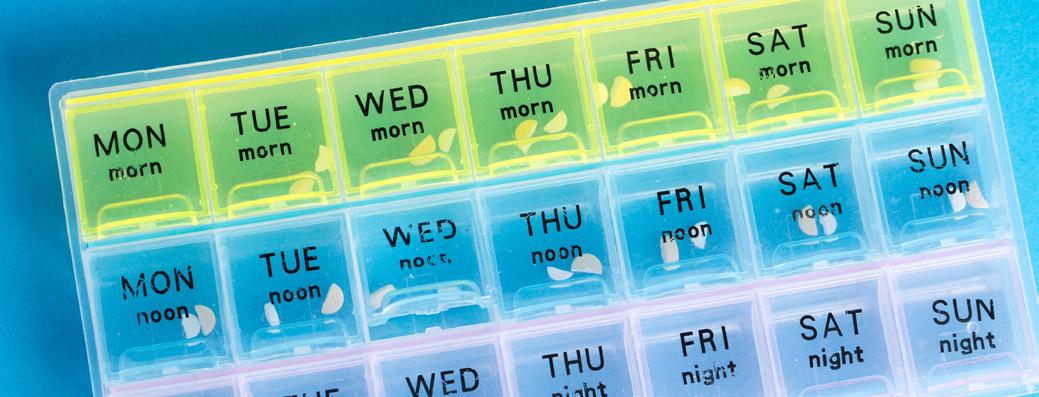
• medication adherence such as dose administration aids, and
• clinical governance and quality use of medicines, supporting safe and effective medication use.
Research shows 99 percent of residential aged care homes have access to at least one pharmacy within 2.5 km radius in metropolitan areas, while 93 percent have that access in regional areas.
Community pharmacies currently supply medicines and medication management services to more than 3,000 aged care homes nationwide. These services work well when underpinned by a strong relationship with the aged care provider together with a commitment to patient safety and continuity of care.
However, in some cases, the model’s application can be fragmented: medicine supply is often separated from other clinical services, and this can lead to inefficiencies, duplication, and an increased risk of medication misadventure.
Funding mechanisms can also exacerbate the issue. Under the Australian National Aged Care Classification funding model, aged care homes have discretion over how medication management funding is applied, and this risks de-valuing and de-prioritising the pharmacy’s dose administration aids service.
This needs to be rectified by ensuring the medication supply service and medication adherence service are separated.
Towards 2035
The PGA’s new 10-year plan sets out a bold vision: to make community pharmacy the first point of contact for healthcare in Australia. It is structured around focus areas with clear strategies and measurable outcomes.
There are several common links between the Towards 2035 strategic plan, the National Aged Care Reforms, and the Scope of Practice Review led by Professor Mark Cormack.
These common themes do present a national strategic alignment in health reform to modernise healthcare delivery, optimise workforce capabilities, and improve patient outcomes — especially for older Australians.
Community pharmacies already deliver essential services to older Australians
Community pharmacies can offer real solutions for older members of their communities, including outreach services and residential care.
Theme Towards 2035 Aged Care Reforms Scope of Practice Review
Workforce Optimisation
Patient-Centered Care
Strategic Planning
80% of pharmacists qualified to prescribe by 2035
Think pharmacy first for healthcare
10-year strategic roadmap with clear focus areas
Collaboration and Integration Advocacy and partnerships to strengthen pharmacy’s role
Aged-care solution providers
Develop a strong workforce strategy for aged care
Place older Australians at the center of care
Strategic plans reviewed periodically for continuous improvement
Engage stakeholders including consumers and providers
Community pharmacies can offer real solutions for older members of their communities, including outreach services and residential care.
Outreach services — where community pharmacists, based at a local community pharmacy, travel to external health facilities or homes—offer a compelling solution. These models allow community pharmacies to act as both suppliers and clinical service providers, reducing fragmentation and improving continuity of care.
Residential care — outreach pharmacists can provide oversight and ensure all medication services are coordinated. In home care, outreach enables older Australians to receive high-quality medication management in the home, aligning with recommendations from the Royal Commission into Aged Care Quality and Safety.
Aged care and digital health
The Electronic National Residential Medication Chart (eNRMC) is a conformant electronic medication management system which allows for the prescribing, supply, and administration of medicines in residential aged care settings without the need for paper prescriptions.
The eNRMC systems are being updated to meet electronic prescribing conformance requirements with the aim of enhancing medication management in aged care homes. This transition aims to improve safety, reduce administrative burden, and streamline pharmacy dispensing processes.
Remove barriers to full scope of practice for health professionals
Improve access and outcomes for marginalised groups
18 recommendations across workforce, education, regulation, funding
Promote multidisciplinary team-based care
The eNRMC proposes significant benefits to community pharmacies, particularly those providing dose administration aids to patients living at home and in aged care homes.
The eNRMC has several key advantages:
Streamlining dispensing workflow
Chart-based electronic prescriptions are accessible via the National Prescription Delivery Service (NPDS), eliminating the need for manual transcription from paper charts [1].
Scan a token or barcode
Pharmacists can retrieve prescriptions directly into their dispensing software, reducing errors and saving time [1].
Extended chart duration
eNRMC charts are valid for six months (up from four months), reducing the frequency of chart renewals and associated administrative burden [1] [2].
Improved coordination and communication
Real-time access to medication charts enhances collaboration between pharmacies, prescribers, and aged care staff [3].
Clinical Information Systems (CIS) and My Health Record (MHR) Integration supporting data sharing and continuity of care [3].
Enhanced safety and accuracy
Reducing transcription errors and supporting timely medication administration [3].
Single source of truth
For medication records, improving visibility and reducing risks associated with polypharmacy [2].
Support for PBS/RPBS claiming
Fully conformant eNRMC systems support PBS/RPBS claiming directly from the chart, removing the need for separate paper prescriptions [2].
Remote access and flexibility
Pharmacists can access live eNRMC charts remotely, which is especially useful for supplying DAAs to patients at home or during temporary leave from aged care [2].
For these benefits to be fully realised, several issues must be addressed, including community pharmacies bearing the brunt of implementation costs — software licensing and upgrading, training, data entry, and verification.
Moreover, prescriber reluctance and a misalignment with pharmacy workflows will introduce inefficiencies and reputational risks. Pharmacies also often find themselves mediating between prescribers and the RACH, advocating for safe practices while absorbing the operational burden.
Key eNRMC transition dates
End of September 2025
From October 1 to February 28 2026
From March 1 2026
Collections of information
The Department of Health, Disability and Ageing has a collection of information about electronic National Residential Medication Chart (eNRMC) products. It includes specific information for residential aged care providers, prescribers, software vendors and pharmacists and can be accessed via here: https://www.health.gov.au/resources/ collections/enrmc-transitional-arrangements-collection
Pharmacy first for aged care
Community pharmacies are already indispensable to aged care. With the strategic direction set by Towards 2035, they are poised to become even more central—delivering accessible, innovative, and patientcentred care that meets the complex needs of older Australians.
This future is not just aspirational — it is achievable. Through bold policy, empowered practitioners, and a commitment to healthier communities, PGA’s vision will ensure older members of our communities and those in aged care residents receive the best possible pharmacy care, wherever they live.
All eNRMC software vendors must have met electronic prescribing conformance.
Transitional arrangements apply for conformant systems.
Only fully conformant eNRMC systems can be used for prescribing; non-conformant systems may be used for administration only[1].
Ace in the deck: Why dose administration aids matter
Medication adherence in older Australians is a complex and persistent challenge, driven by factors such as polypharmacy, cognitive decline, physical limitations, and fragmented healthcare systems.
Dose administration aids – often referred to as DAAs – can improve medication adherence in older Australians by simplifying complex regimens and reducing unintentional non-adherence, particularly among those with cognitive or physical limitations. They really are community pharmacy’s ace in the deck for aged care medication adherence.
However, there is a caveat – a DAA’s effectiveness does depend on individual factors such as motivation, cognitive capacity, and the stability of the medication regimen.
These aids are most beneficial when used as part of a coordinated, multidisciplinary approach to medicines management. These devices, facilitated and packed by pharmacists, organise medications according to the days of the week and times of the day.
They are particularly effective for patients who take multiple medications, as they help to ensure that the right dose is taken at the right time. They are pre-packed by pharmacists and come in various forms, including weekly or monthly packs.
Dose administration aids, or DAAs, have a multitude of benefits and are the most prominent of medication adherence tools.
A dose administration aid’s effectiveness does depend on individual factors such as motivation
Several studies have highlighted the effectiveness of dose administration aids in improving medication adherence and patient outcomes.
Dose administration aids organise medicines according to the days of the week and times of the day
Medication use amongst older people in Australia
High prevalence of medication use
• Nearly 98% of Australians aged 75 and over were dispensed at least one PBS medication in 2022. On average, they were dispensed 8 different medication types [1].
Polypharmacy is common
• 71.5% of people aged 75+ were dispensed five or more medications.
• 32.6% were dispensed 10 or more [1].
• Polypharmacy increases the risk of adverse drug events, interactions, and medication-related harm [2].
Medication management reviews (MMRs)
• Only 5.4% of people aged 75+ had at least one MMR in 2018–19, despite high rates of polypharmacy [2].
Common medication types
• Cardiovascular, nervous system, and gastrointestinal medications are among the most frequently dispensed [1].
Widespread medicine-related problems
• Over 95% of aged care residents have at least one medication-related issue; most have three or more [3].
Inappropriate medication use
• Over 50% of aged care residents are prescribed medications considered potentially inappropriate for older people.
• 20% of unplanned hospital admissions are due to such medications [3].
Common safety concerns
• Sedating medications, antipsychotics, and benzodiazepines are often used for too long.
• Administration errors and altering medications (e.g., crushing tablets) are also prevalent [4].
Community pharmacy fast facts
Highly accessible
• There are more than 6,000 community pharmacies across Australia.
• 97% of people in capital cities live within 2.5 km of a pharmacy.
• Nearly 40% of pharmacies offer after-hours services [4].
Frequent contact
• Australians visit a community pharmacy 18 times per year on average.
• For many older adults, especially those living alone, pharmacy staff may be their only regular face-to-face contact [4].
Social connection role
• Pharmacies are increasingly recognised for their role in addressing loneliness, which is linked to increased medication use, including opioids and benzodiazepines [4].
Community pharmacies currently supply medicines and medication management services to more than 3,000 aged care homes nationwide
Understanding dose administration aids
Dose administration aids have a multitude of benefits and are the most prominent of medication adherence tools.
The use of DAAs has been shown to have a positive impact on patient outcomes. Improved medication adherence leads to better management of chronic conditions, which in turn reduces hospitalisations and healthcare costs.
Patients using DAAs report higher satisfaction with their medication management and a greater sense of control over their health.
How effective are they?
Recent studies have provided valuable insights into the effectiveness of DAAs. For instance, a study conducted by the University of Sydney found that patients using DAAs had a 20% higher adherence rate compared to those who did not use them [5]. Another study published in the Journal of Clinical Pharmacy and Therapeutics reported that DAAs significantly reduced medication errors in elderly patients [6]. Additionally, a nationwide cohort study highlighted that DAAs were associated with a 25% reduction in hospitalizations due to medicationrelated issues [7].
Research and funding
Several studies have highlighted the effectiveness of DAAs in improving medication adherence and patient outcomes. For example, a study conducted by The University of Sydney found patients using
Another study published in the Journal of Clinical Pharmacy and Therapeutics reported DAAs significantly reduced medication errors in elderly patients.
The Australian Government, under the 8th Community Pharmacy Agreement (8CPA), subsidises a weekly DAA service for up to 90 pharmacy patients who live in the community. However, this funding is not available to permanent residents of Aged Care homes.
This type of research shows dose administration aids play a crucial role in supporting the quality use of medicines. They offer numerous benefits, including improved adherence, reduced medication errors, enhanced safety, and convenience.
However, challenges such as cost, accessibility, and the need for patient education must be addressed to maximize their effectiveness. Overall, however, DAAs have a positive impact on patient outcomes and are a valuable tool in the management of medication regimens.
References
[1] Pharmacist Fact sheet: Electronic National Residential Medication
[2] Electronic National Residential Medication Charts (eNRMC) and My Health
[3] eNRMC Integration — emphn.org.au
Australasian Pharmacy is where clinical credibility meets commercial cut-through. Our content connects you with pharmacy owners, frontline leaders, and trusted advisors across Australia and New Zealand—the voices shaping the future of primary care.
Whether in print, eNews, or digital, your message reaches a network of decision-makers that prescribe, recommend, and purchase every day.
The Gold Standard for Pharmacy
Whether it’s Glucojel; Australia’s favourite jelly beans & bears, Australasian Pharmacy; the official journal of the Pharmacy Guild, or the best pharmacy suppliers in their field, if it’s exclusive to pharmacy, chances are it’s proudly brought to you by Gold Cross. A fully owned subsidiary of the PGA, very few organisations know Australian pharmacists better than Gold Cross. And since 1932, no other organisation has worked as hard to partner with an industry to bring a range of pharmacy exclusive products to market for everyday use in pharmacy, and at homes across Australia, while providing financial support to the profession. We’ve partnered with the following professions to help Pharmacy Guild of Australia members manage their business with confidence.
BD Rowa™
Automatic Dispensing Robots and Digital Selling Solutions 1800 697 692 rowa.de/en/ Constellation Technologies
Cold Chain Management System 1800 100 227 constellationtechnologies.com.au
Afterpay
Australia’s biggest Buy Now Pay Later (BNPL) platform 1300 621 603 afterpay.com/en-au/ pharmacy-guild-members
Team Medical
Leading supplier of Medical Equipment and Consumables for Consult Rooms and Patient Treatment 1300 224 450 teammed.com.au iNova
02 9316 1500 pccarx.com
Lease 1
766 369 lease1.au Paperpak
“Ask Your Pharmacist” pharmacy bags 1800 088 258 paperpak.co
Liebherr
and
refrigeration 1800 685 899 home.liebherr.com.au
Interpath Bottle top dispensers 1800 626 369 interpath.com.au
codygroup.com.au
New enforcement powers under the Privacy Act
Hayley Bowman, Mark Fitzgerald and Georgina Odell Meridian Lawyers
Community pharmacists have long been regarded as some of the most trusted and accessible health professionals in Australia. With that trust, comes a legal responsibility: compliance with the Privacy Act 1988 (Cth) (the Act).
Under the Act, any organisation that provides a health service and handles health information is legally required to comply with its provisions. The dispensing on prescription of a drug or medicinal preparation by a pharmacist is expressly recognised under the Act as being a ‘health service’.
As a result, all community pharmacies, regardless of size or annual turnover, must comply with the Act and the Australian Privacy Principles (APPs) that are incorporated into the Act.
The APPs are a set of 13 rules
The APPs are a set of 13 rules that govern how personal information must be handled throughout its lifecycle. Central to the obligations set out in the APPs is the requirement for all community pharmacies to have an up-to-date, transparent, and easily accessible Privacy Policy and to provide individuals with a Privacy Collection Notice at the point of collecting their personal information.
Following the introduction of the APPs in March 2014, the Privacy Commissioner of the Office of the Australian Information Commissioner (OAIC) had limited ability to enforce the APPs.
The OAIC’s enforcement powers were limited to litigation, resulting in action often only being initiated where privacy breaches were serious or repeated, and where civil penalties were sought.
That landscape significntly changed in December 2024, with the introduction of new legislation granting the OAIC broader enforcement powers and increasing the penalties for privacy breaches.
Of particular note for community pharmacists is the OAIC ability to now issue compliance and infringement notices for breaches of specific APPs. This power, set out in section 13K of the Act, enables the Privacy Commissioner to issue civil financial penalties for specific, minor breaches of the Act that are not serious enough to be classified as a ‘serious interference’ with privacy.
These amendments aim to give the Privacy Commissioner an enforcement mechanism to hold entities accountable for technical and administrative privacy failures that are considered less serious violations of the Act.
The OAIC now has the ability to issue compliance or infringement notices – for example, if a community pharmacy does not have a Privacy Policy, or if its Privacy Policy does not contain all information required under APP 1.4.
Infringement notices under section 13K currently have a financial penalty of:
• AUD3,960 per contravention for individuals (12 Penalty Units)
• AUD19,800 per contravention for body corporates (60 Penalty Units), and
• AUD66,000 for contravention by listed corporations (200 Penalty Units).
As a result, even small oversights, like an outdated or incomplete Privacy Policy, can now trigger regulatory scrutiny and financial consequences. While there are not yet any published examples of the OAIC applying these new powers, the risk of penalties can be avoided with good privacy and compliance practices.
Spotlight on APP1 – Privacy Policies
APP 1 of the Act sets out the requirements for organisations to manage personal information transparently.
Under APP 1.3, your pharmacy business must have a clearly expressed and current Privacy Policy that explains how it manages personal information.
APP 1.4 sets out what a Privacy Policy must include. Some simple but essential steps to ensure your Privacy Policy meets these requirements include:
1. regularly review your Privacy Policy — make sure it is accurate, covers all elements of APP 1.4 and is written in plain, accessible language. We encourage you to obtain legal advice to confirm that your policy meets all legal obligations. Your Privacy Policy should also be tailored to your pharmacy business.
2. make it accessible — publish it online and make it available in-store for patients to view or access.
3. train your staff — ensure every team member understands their obligations throughout the lifecycle of the personal information that they may come into contact with, as well as how to respond to privacy enquiries or complaints.
Spotlight on APP5 – Privacy Collection Notice
APP 5 relates to Privacy Collection Notices. A Privacy Collection Notice is equally as important as a Privacy Policy, but they serve different purposes. A Privacy Collection Notice ensures individuals are informed about how their personal information is being collected and used and helps establish valid consent.
APP 5 requires a pharmacy to take reasonable steps to notify individuals of certain information at or before the collection of their personal information. Such a notification is called a Privacy Collection Notice. The Privacy Collection Notice must include:
1. the identity and contact details of the pharmacy
2. the circumstances of collection (e.g. how, when, and from where the personal information was collected)
3. any law that authorises or requires the collection – such as the National Health Act 1953 (Cth)
4. the primary purpose for which the information is being collected
5. the consequences (if any) for the individual if the information is not collected – for example, being unable to provide the requested services
6. the organisations or bodies to which the information will be disclosed
7. a link to the pharmacy’s Privacy Policy where the individual can obtain details about how to seek access to, and correct, their personal information
8. details about how to make a complaint, and
9. confirmation of whether personal information is likely to be disclosed by the pharmacy to overseas recipients – and if so, the countries where those recipients are likely to be located.
Your pharmacy. Your future.
Membership provides exclusive benefits like:
• Expert workplace relations advice and support
• Discounted access to national pharmacy events
• Exclusive deals and discounts
• And more! Learn more about how the Guild can help your pharmacy today.
guild.org.au/ membership
Failure to have a Privacy Collection Notice
Failure to have a Privacy Collection Notice risks breaching the new section 13H of the Act, which establishes a civil penalty provision for ‘interference with privacy of an individual’. A breach of this provision currently attracts a maximum penalty of AUD660,000.
Final thoughts
If your pharmacy does not yet have, or has not recently reviewed, a Privacy Policy or does not routinely use Privacy Collection Notices, now is the time to act. A well-drafted Privacy Policy and Privacy Collection Notices are simple yet crucial steps to protect your customers, your reputation, and your business.
How can we help
If you have any questions or require further information about privacy, commercial, or corporate law please scan the QR code and contact:
Hayley Bowman Special Counsel
+61 3 9810 6723 hbowman@meridianlawyers.com.au
Mark Fitzgerald Principal +61 3 9810 6767 mfitzgerald@meridianlawyers.com.au
Georgina Odell Consultant
+61 2 9018 9975 godell@meridianlawyers.com.au
Learn more
Meridian Lawyers’ Corporate and Commercial team has specialist knowledge in privacy and pharmacy legislation and regulation in Australia. We have detailed knowledge of the pharmacy industry, having acted for many pharmacists throughout the country, and we are the principal legal advisor to the Pharmacy Guild of Australia. Did
This information is current as of October 2025. This article does not constitute legal advice and does not give rise to any solicitor/client relationship between Meridian Lawyers and the reader. Professional legal advice should be sought before acting or relying upon the content of this article.
Pharmacy Guild Australia & Pharmacy Guild of New Zealand members enjoy complementary access to Australiasian Pharmacy, including six magazine editions, weekly EDMs direct to your inbox and breaking news as it happens.
miss out on • The latest Scope of Practice resources and guidance • Health economics and policy updates • Community pharmacy stories from across Australia and New Zealand • CPD materials from the Australasian College of Pharmacy
www.australasianpharmacy.com.au
australasianpharmacy.com
Program launched: 2026 Australasian Pharmacy Professional Conference and Trade Exhibition
APP Conference Convenor, Kos Sclavos AM has announced the release of the official program for the 2026 Australasian Pharmacy Professional Conference and Trade Exhibition (APP2026).
“This year’s theme, ‘Beyond the Script’, is a call to action for pharmacy professionals to embrace innovation, compassion, and collaboration,” said Mr Sclavos. “APP2026 will spotlight the evolving role of pharmacists in patient-centred care and showcase transformative technologies enabling this shift.”
Held from 12–14 March 2026 at the Gold Coast Convention & Exhibition Centre, APP is the largest pharmacy conference in the southern hemisphere and is expected to attract over 7,500 industry professionals. The conference features a comprehensive education program, interactive workshops, and a vibrant trade exhibition with 450+ stands.
APP2026 conference streams include:
• Business, innovation, and leadership
• Clinical pharmacy
• Product updates
• Rural pharmacy
• Harm minimisation
• Early career
• Cultural engagement
• Professional development
Program Overview
The education program will run over four days, as follows: Pre-Conference Workshops: Wednesday 11 March Conference Sessions: Thursday 12 – Saturday 14 March
APP2026 will host 120+ speakers, including industry experts, thought leaders, and motivational presenters.
• Networking & Social Events
• Networking remains a cornerstone of APP2026, with the following events designed to foster connection and celebration:
• Welcome Reception (trade area) – Thursday 12 March
• Women’s Networking Lunch – Friday 13 March
• Happy Hour (trade area) – Friday 13 March
• Pharmacy Assistant Networking Lunch – Saturday 14 March
• APP Street Fiesta – Saturday 14 March
Trade Exhibition
With over 450 exhibition stands, APP is the largest pharmacy trade show in the southern hemisphere, bringing together leading suppliers, innovators, and service providers from across Australia and beyond. Whether you’re looking to upgrade your pharmacy, explore new revenue streams, or stay ahead of industry trends, the trade exhibition is your one-stop destination.
“The trade exhibition is where ideas come to life. It’s a space for discovery, connection, and inspiration,” Mr Sclavos said.
Book now and save
In 2026, three-tiered pricing was introduced in response to attendee feedback:
• Tier 1: Save up to $250 (closed 31 October)
• Tier 2: Save up to $140 (available from 1 November 2025)
• Tier 3: Standard pricing (from 1 January 2026)
“We listened to delegates — affordability matters. This new model ensures more pharmacy professionals can access the biggest pharmacy event in the southern hemisphere,” Mr Sclavos added. “With a price difference of up to $140 between Tier 2 and Tier 3 it’s worth registering now.”
To view the APP2026 program and secure your registration, visit Program – APP Conference
Media Enquiries: Amanda Turner
Marketing & Communications Manager 0447 722 225
Whether you’re seeking inspiration, collaboration, or a chance to unwind, APP2026’s social program delivers.
How to redefine success in community pharmacy: Top tips on creating healthy work habits
At Pharmacy Connect 2025 , TEDx speaker, author, and leadership coach Nicky Miklós challenged the pharmacy profession to rethink the glorification of the hustle culture and to transform unhealthy work habits.
The hustle culture is everywhere. It’s in the late nights at the office, the skipping of lunch breaks, and the endless grind to meet deadlines — all too often, at the cost of our health and well-being.
At Pharmacy Connect 2025, I took to the stage with one simple mission: to disrupt this glorification of the hustle, especially in the pharmacy profession, where burnout is an all-too-common reality.
In my session, Hustle to Happy: Rewrite the Script on Success, I invited participants to reconsider what true success looks like — and how we can achieve it without losing ourselves in the process.
The hidden cost of the hustle culture
Pharmacy professionals, like many in high-demand careers, often find themselves trapped in a cycle of relentless demands.
Whether it’s staying late to fill prescriptions or managing a never-ending stream of patient needs, it’s easy to overlook personal boundaries.
The pressure to ‘do it all’ can leave you running on empty, physically and emotionally.
For years, I too was a member of the ‘hustle culture club’ — pushing myself beyond my limits, ignoring warning signs, and wearing exhaustion like a badge of honour. But there’s a problem with that.
The reality is, this kind of hustle is unsustainable.It can lead to burnout, health issues, and even moments of crisis. I’ve been there. I’ve experienced burnout, pneumonia from overworking, and even panic attacks.
My body hit ‘pause’ multiple times before I learned my drive to over-deliver and over-function was only sabotaging my health.
Reframing to a healthy hustle
In my presentation, I offered a new way to think about success: Healthy Hustle. This is about finding the sweet spot between action and rest, productivity and self-care.
Healthy hustle isn’t about slowing down completely — it’s about knowing when to push and when to pull back. As I put it during the talk:
“When we find the balance of knowing when to push and when to pull back, we find the sweet spot between taking enough action to create forward movement, but not so much that it becomes all-consuming and literally sucks the life out of us.”
This balance is key to a fulfilling career — one where you’re not constantly sacrificing your health, happiness, or time with loved ones in the name of success.
Nicky Miklós
For years, I too was a member of the ‘hustle culture club’ — pushing myself beyond my limits, ignoring warning signs, and wearing exhaustion like a badge of honour.
The power of beliefs
The first big idea I shared with the audience was about the power of beliefs. Many of us are unconsciously driven by beliefs that tell us success requires relentless effort.
Maybe you’ve been taught that working long hours is the only way to show commitment.
Maybe you learned that skipping meals or missing breaks is a sign of being serious about your job. But the truth is, these beliefs are often outdated and unhealthy.
By changing these beliefs, we can change the way we work and live.
Instead of seeing rest as a weakness, we can learn to view it as a necessary part of the equation for long-term success.
By reframing our mindset, we can build healthier habits that lead to greater fulfillment and achievement — without the burnout.
Protecting your energy
While time is fixed, energy is flexible. You only get 24 hours in a day, but how you use your energy is entirely within your control.
That’s why energy management is now more important than time management.
We all have certain activities or people who give us energy, and others who drain us.
Identifying these energy gainers and drainers is crucial for maintaining a healthy hustle. It’s not just about being productive; it’s about being intentional with how you allocate your energy.
When you bring in more of what energizes you and set boundaries to protect your energy from drainers, you will naturally move closer to optimal performance.
It’s about creating space for the things that uplift you, whether that’s time with loved ones, pursuing a passion, or simply taking a break to recharge.
Avoiding distractions
In today’s world, it’s easy to get distracted by a thousand things. But here’s the secret: staying focused on what truly matters will help you make meaningful progress.
A simple tool I shared with the audience to help them decide where to focus their attention is something I call the direction filter. It consists of three questions:
Does this directly move me toward my biggest current goal? If I say yes, what am I saying no to — and is it worth it? Is this keeping my hustle healthy?
The answers to these questions can help you filter out distractions and focus on the actions which truly matter, moving you closer to your goals without burning out in the process.
Make your next move conscious
As I concluded my session, I left the audience with a powerful thought: the average human lifespan is incredibly brief. If we’re lucky enough to live to 80 years of age, we have only about 4,000 weeks on this earth.
How are we spending them? Will we continue to live in a cycle of constant busyness, juggling responsibilities, and burning out? Or will we make conscious decisions about how we work, rest, and live?
The hustle will always be there. But we have the power to change how we hustle. My invitation to you is simple: be intentional with your energy and your effort. Take control of your hustle before the chaos takes control of you. The decision to rewrite your script on success is yours.
By reframing our mindset, we can build healthier habits that lead to greater fulfillment and achievement — without the burnout.
Sharing insights with people ‘in real life’ is a passion of Nicky’s
A stand out message from Nicky at Pharmacy Connect 2025
Loyalty in the fast lane: How pharmacies can keep customers coming back
Customer loyalty isn’t just about points or discounts anymore. New research shows community pharmacy owners have a growing challenge: today’s shoppers are pickier, more tech-savvy, and more emotionally driven than ever.
The latest research from the Retail Doctor Group makes one thing clear: to build real loyalty, you need to understand both the numbers and the emotions behind customer behaviour.
Shoppers in Australia are living through social, political, and tech changes — and this is changing the rules of loyalty. Old-school programs rewarded simple transactions. Now, AI is helping retailers, including pharmacies, connect with customers in smarter ways.
With AI, you can analyse tons of data, predict what a customer needs, tailor offers, and even send real-time rewards. But here’s the catch: technology alone won’t win loyalty. Emotional connection is still king.
Retail Doctor Group’s own neuroscientific tool, Limbic Insights™, shows customers stick with brands which reflect their personalities and values. For pharmacies, this means figuring out what your customers really care about — convenience, advice from staff, special events, or quick, practical rewards.
Pharmacies which create real emotional connections with their customers, through personalised communication, tailored rewards, and attentive service — build loyalty which lasts
For more information go to www.retaildoctor.com.au
Personalisation, prediction and people
Here are some strategies pharmacies can put into action right now:
• Tailored rewards
Personalised discounts or product bundles make a big difference. For example, offering wellness products or health supplements which atch a customer’s needs feels way more relevant than generic deals.
• Predictive engagement
Machine learning can flag customers who might not come back. Then you can step in with helpful nudges, like reminders for prescription refills or wellness check-ins.
• Gamification
Simple challenges or loyalty tiers — like earning points for regular health screenings or vaccination reminders — can make the experience fun, especially for younger shoppers.
• Dynamic offers
Real-time incentives, like a surprise discount on over-the-counter items, can make customers smile and keep them coming back.
Loyalty by pharmacy category
Research shows loyalty isn’t the same across all categories. Grocery and essentials get the most repeat visits, but in areas like beauty and wellness — where pharmacies compete heavily — shoppers are pickier.
One in five customers says they feel stronger loyalty when they have a positive personal connection with staff. For pharmacists, this is a reminder friendly, helpful service goes a long way toward repeat visits.
Brian Walker, the Retail Doctor Group
Designing a loyalty program which works
A few key points for pharmacy loyalty programs:
• Make it valuable and simple: Customers drop programs which are slow to reward or offer little value. Quick points, relevant discounts, or exclusive access to health promotions keep them engaged.
• Segment by personality: Some shoppers love exclusive wellness events, while others prefer straightforward points-for-discounts systems. Tailoring your program to different personalities can really boost engagement.
• Integrate technology thoughtfully: AI is great for personalisation and efficiency, but don’t lose the human touch. A pharmacist’s empathy, advice, and reliability can’t be automated.
• Focus on the customer journey: Check every touchpoint — store layout, website, communication channels, and staff interactions — to smooth out friction and make loyalty easier to earn.
The bottom line for pharmacy owners
Loyalty is strongest where data and emotion meet. AI is a powerful tool, but understanding what drives your customers — their needs, habits, and emotional triggers — is what keeps them coming back.
Pharmacies which mix technology with genuine personal care will see higher engagement, more repeat visits, and customers who happily advocate for them.
In today’s competitive world, where convenience, trust, and personalisation matter more than ever, building loyalty isn’t optional — it’s essential for long-term growth.
RDG tip: emotional connections drive loyalty
Pharmacies which create real emotional connections with their customers — through personalised communication, tailored rewards, and attentive service — build loyalty which lasts. Even small gestures, like remembering a regular customer’s favourite product or wellness goal, can make a big impact.
Who is Retail Doctor Group?
Retail Doctor Group is an Australian consultancy which helps retailers grow and run more effectively. The firm was founded by Brian Walker and his team provides tailored strategies, hands-on support, and training to boost sales, improve customer experience, and lift overall performance. They are based in Australia, but they also tap into a global network, bringing international expertise and best practices to local businesses.
Where to next?
Retail Doctor Group’s Limbic Insights™ methodology gives pharmacies practical ways to connect emotionally with customers, boost visit frequency, and drive lasting engagement. Understanding what motivates your customers and combining it with AI-powered personalisation can turn your loyalty program into a real competitive advantage.
Key benefits for pharmacies
• Game-changing research insights tailored to business growth
• Neuroscience-backed customer insights to identify key segments
• Guidance on optimising operations, in-store and online
• Data-backed decision-making support for the next 12 to 18 months.
Understanding what motivates your customers and combining it with AI-powered personalisation can turn your loyalty program into a real competitive advantage
Keeping pharmacists in the profession: A challenge Australia can’t ignore
Gerard Benedet, Executive Director, PGA
Australia’s community pharmacies are on the frontline of healthcare. They’re where millions of Australians turn for vaccinations, medicine advice, and the everyday support which keeps the system running.
But beneath that reliability lies a growing problem — keeping pharmacists in the profession, and in their jobs.
The latest findings from PGA and the Australian Pharmacy Leaders Forum (APLF) Workforce Roundtable paint a clear picture: workforce retention is one of the most pressing challenges facing the sector in 2025.
The data reveals a sector under pressure from salary costs, excess demand, and unclear career progression. But the same data also points to solutions -— if the profession is prepared to act.
Salaries: the cost of care
Salary is the single biggest operating expense for most pharmacies. As a share of turnover, it outweighs rent, depreciation and interest. That financial reality matters because community pharmacies operate as small businesses, not big corporations. There’s only so much room to move before the balance sheet breaks.
Yet, remuneration is critical. Pharmacists are not simply dispensers— they’re healthcare professionals who deliver vaccination programs, manage medicines, and act as first responders for patients who can’t get into overstretched GP clinics. If salaries lag behind the value of that work, it becomes harder to retain staff, particularly as other parts of healthcare offer more attractive pathways.
Percentage of turnover
A striking 89 percent of pharmacists under the age of 35 say they intend to work in the profession for at least another 10 years. That suggests a deep commitment to pharmacy as a career.
Tenure: a promise versus reality
At first glance, there’s reason for optimism. A striking 89 percent of pharmacists under the age of 35 say they intend to work in the profession for at least another 10 years. That suggests a deep commitment to pharmacy as a career.
But the numbers on actual tenure tell a different story. Across classifications, the average time spent at a single workplace is relatively short. Staff churn is common.
The message is clear: pharmacists want to stay in the industry, but not necessarily in the same job for very long. That gap between intention and reality highlights retention as a structural issue, not an individual choice.
Average tenure (in yrs) for each classification at a single workplace
Demand: more work, same workforce
Layered over this is increasing demand. Forecasts consistently point to excess demand for pharmacists into the future. As other parts of the health system face bottlenecks, pharmacies are taking on more work, and the distribution of hours worked by pharmacists has crept upwards over the past decade.
That might sound like good business, but it’s a warning sign. Rising hours, coupled with limited staff growth, is a recipe for burnout. If retention isn’t addressed, the sector risks a shrinking workforce just as demand reaches new peaks.
Excess damand forecasts at a national level, community pharmacist workforce (FTE)
Surveys show pharmacists value the work itself, but they are far less satisfied with their career development opportunities.
Pharmacists want better career development
Satisfied or Very Satisfied
Dissatisfied or Very dissatisfied
Nursing Career Progression
Clear and encouraged
Pharmacy Career Progression
Unclear and flat
Career development: the weakest link
The data also reveals an important driver of disengagement: career development. Surveys show pharmacists value the work itself, but they are far less satisfied with their career development opportunities. Put simply, they don’t see where the job can take them.
Compared to doctors or nurses, the career progression of pharmacists is flat. Other healthcare professionals move into specialties, leadership or advanced clinical roles. Pharmacy too often looks like a one-track career, with limited recognition for upskilling.
This lack of a clear pathway is a major factor behind churn. People may like the profession, but if they can’t see growth, they will move sideways into roles that offer more.
Solutions: building a profession which retains talent
If pharmacy wants to solve its retention problem, it must build a future which matches the ambition of its workforce. The solutions are not radical, but they require commitment.
First, salaries must be competitive. No amount of passion for healthcare can offset the frustration of perceived low remuneration
Second, structured career pathways must be created. This means building roles beyond the dispensary: in expanded community pharmacy services, management, digital health, research, and expanded community services. Pharmacists need to see a ladder, not a dead end.
Third, work models must recognise balance. Younger workers want flexibility. Rotating across community, hospital and digital roles—or rotating across community pharmacy roles or even working part-time
If pharmacy wants to solve its retention problem, it has to build a future that matches the ambition of its workforce. The solutions are not radical, but they require commitment.
while studying further—should be seen as a strength, not a liability.
Finally, there needs to be a cultural shift. Pharmacy can no longer view itself as a static trade. It must embrace its role as a dynamic healthcare profession, with all the responsibility and recognition that entails.
Retention is healthcare
Retention is more than a human resources issue—it’s a healthcare issue. Without enough pharmacists, services collapse, patients suffer, and the broader health system loses one of its most reliable entry points. The good news is the profession already has the data. Now it’s about action. If pharmacy can invest in its people, create real career pathways, and reward ambition, it won’t just retain staff — it will build a stronger, more resilient future for Australian healthcare.
Graph sources: The Pharmacy Guild of Australia’s; 2024 Forecast Model, Supply and Demand Report (2nd Edition), Remuneration Report (Financial Year 202425),The Pharmaceutical Society of Australia’s PAMELA Survey (2023).
If pharmacy wants to solve its retention problem, it must build a future which matches the ambition of its workforce. The solutions are not radical, but they require commitment. workforce.
Fulfilling the Highest, Safest Pharmaceutical Standards
German-engineered with premium materials, Liebherr’s range of refrigeration for Pharmacy provides the very best in safety, energy efficiency and reliability.
With the „One Touch“ viewing of Min and Max temperatures, Liebherr units are designed to meet Australian standards for holding vaccines.
A new era for community pharmacy: Full scope is reshaping the way communities are served
Jessica Burrey @femininepharmacist
Community pharmacy is entering a new era. Full scope practice is no longer a concept for the future, it is fast becoming a reality, and patients are responding with trust and gratitude. Patients no longer see the consult room as an add-on service; they see it as a clinical space where meaningful care happens.
When pharmacists step into full scope practice, the shift is immediate. Newly acquired clinical skills and reasoning result in every interaction being viewed through a different lens.
Across different community pharmacy settings, structured consultations are uncovering risks, providing timely treatment, and changing the trajectory of patient health. While access to primary healthcare in rural areas adds weight to this work, the truth is that full scope services are not just a rural solution.
They are relevant, viable, and essential in every community pharmacy, regardless of postcode.
Inside the consult room: the clinical return
Every full scope service is delivered as a structured health consultation. Each one begins with a full history, followed by clinical assessment, documentation, and a clear plan for follow-up.
This approach changes the nature of care. Rather than focusing narrowly on a single symptom, we look beyond the immediate concern to understand the patient as a whole. Taking the time to gather a complete history often reveals patterns, risks, or contributing factors that would otherwise be missed.
The impact has been significant. We have identified hidden risks and conditions that required referral, further investigation, or immediate action. These findings were the result of taking a full history and considering the patient beyond a single symptom.
One consultation revealed red flag symptoms of a gastric bleed in a patient who initially presented with vomiting. Another saw irregular heartbeats detected during a smoking cessation consult, prompting referral and a subsequent diagnosis of arrhythmia. The consultation space also allows conversations to deepen. Patients often share concerns they may not have raised elsewhere. A discussion that starts with one symptom naturally extends into prevention, lifestyle, or future planning. These interactions strengthen rapport, build trust, and create lasting loyalty.
Patients leave not only with a treatment plan but also with clarity and confidence about their health. This clinical return on investment results in patient care that is structured, holistic, and transformative.
When pharmacists step into full scope practice, the shift is immediate. Newly acquired clinical skills and reasoning result in every interaction being viewed through a different lens.
Every full scope service is delivered as a structured health consultation. Each one begins with a full history, followed by clinical assessment, documentation, and a clear plan for follow-up.
Is delivery of scope financially viable?
Alongside the clinical return, there is a clear financial return. Early projections and extrapolations prepared by Felicity Crimston from Pitcher Partners show consultation rooms consistently outperform traditional retail space.
Average gross profit per hour from structured consultations demonstrates clear sustainability, and the broader impact is seen in repeat visits, family referrals, and the willingness of patients to invest in meaningful care.
For patients, the value is clear. They experience timely, structured consultations that feel professional, safe, and worthwhile. That confidence only exists because services are delivered under strong clinical governance and regular auditing, ensuring consistency and quality every time.
For practitioners, viability comes from how workflows are redesigned. By transitioning triage and patient intake to interns, and shifting routine administrative tasks to pharmacy assistants, pharmacists can focus their time on high-value clinical activities.
For the practice, this alignment ensures the consult room becomes the most productive and purposeful space in the pharmacy. Financial return is therefore not separate from patient return; it grows out of delivering meaningful, structured care that patients trust and choose to return for.
Shifting patient expectations
Perhaps the most striking change has been in patient behaviour. Personalised care builds trust rapidly. A woman who attends for contraception may leave with a clearer understanding of her cycle health. A UTI consultation can open into education about hydration, prevention, or sexual wellbeing.
These touchpoints strengthen health literacy and reframe what patients expect from their pharmacist. Pharmacy is shifting from a place of supply to a relational health hub where patients know they can receive professional, evidence-based care.
At the same time, managing expectations around traditional pharmacy services is important. As pharmacists transition more of their time into clinical care, wait times for dispensing may occasionally increase.
Communicating this shift helps patients understand the value of structured consultations and why their pharmacist’s time is being directed where it has the greatest impact.
There are also opportunities to move routine health discussions off the floor and into the consult room. By creating space for deeper, uninterrupted conversations, pharmacists can provide greater levels of care, enhance safety, and ensure patients leave feeling supported and informed.
Jessica Burrey (right) helping visitors learn more about women’s health services in community pharmacy at Parliament House in Canberra
(L-R) Australia’s Prime Minister Anthony Albanese with Jessica Burrey and Australia’s Minister for Health Mark Butler at the APP Conference 2025
Challenges still to navigate
The pathway has not been without challenges. The absence of PBS prescribing, increases costs and disadvantages patients who choose care through their pharmacist, limiting the full potential of the model. Until this is addressed, affordability will remain a limiting factor for some patients.
At the practice level, every pharmacy must develop workflows that fit its own environment. The transition from supply-focused roles to clinical consultations cannot be achieved with a single template.
Each team needs to find the right balance by reallocating administrative tasks, embedding booking processes, and creating space for the pharmacist to focus on high-value clinical care.
What is evident is that services can be delivered successfully across a variety of community pharmacy settings and locations. This includes single pharmacist models, where there may be only a limited number of pharmacists in the region, through to larger practices with multiple pharmacists and broader clinical teams.
These challenges are real, but they are not insurmountable. With strong clinical governance, regular auditing, and structured feedback, services continue to strengthen. The foundations are in place for pharmacy to deliver consistent, safe, and sustainable clinical care, and the potential for growth remains significant.
Jessica Burrey
Is a prescribing pharmacist, rural health advocate, and pharmacy owner operating as part of the Direct Chemist Outlet group. Jessica has some 20 years of experience and holds a special interest in women’s health and integrative pharmacy She is the voice behind @femininepharmacist, a platform supporting women through key health transitions with evidence-based, compassionate care.
Pharmacy is shifting from a place of supply to a relational health hub where patients know they can receive professional, evidence-based care.
The future of pharmacy
The broader lesson from early adopters is that full scope is not tied to geography. It is not a rural fix, and it is not a metro convenience. It is a whole-of-industry step forward.
Pharmacy is moving from a transactional model to a relational, patient-centred health destination. Financial viability will increasingly be linked to purpose, and patients are already demonstrating through their trust and their choices that they value this evolution.
The next horizon is specialisation. Full scope creates space for pharmacists to develop services that reflect their expertise and interests, whether that is in chronic disease, preventive health, or women’s health.
Women’s health is an area of immense need and opportunity. Structured consultations provide space to support women through contraception, hormonal health, perimenopause, and beyond in a way that is accessible, evidence-based, and deeply supportive
This shift reinforces the very foundation of pharmacy: improving health, inspiring wellbeing, and connecting with communities in meaningful ways. Full scope is no longer a dream on the horizon. It is here, it is viable, and it is reshaping what pharmacy means to the people we serve.
The broader lesson from early adopters is that full scope is not tied to geography. It is not a rural fix, and it is not a metro convenience. It is a whole-of-industry step forward.
Leading with care: Molly McGuire’s vision for the modern community pharmacy
Molly McGuire is changing the game in her Toowoomba pharmacy. By focusing on her team and expanding patient care, she’s proving modern community pharmacies can be about more than dispensing medicine — they can truly make a difference.
When you step into Molly McGuire’s community pharmacy in Toowoomba, you immediately sense it’s about more than medicines and check-outs. It’s a place of connection, empathy, and evolving care.
As a managing partner, and now recipient of TerryWhite Chemmart’s Pharmacist of the Year award, Molly has become a shining example of how modern community pharmacy can realise its full potential.
“When people feel seen and heard, that’s when real care happens,” Molly said.
A community-first mindset
Molly’s career spans some 15 years in regional Queenslandpharmacy practice. Early in her career, she found being a good pharmacist meant more than dispensing — she found it meant understanding lives, building trust, and being part of a community’s health story.
Whether it’s young families navigating hectic routines or older patients managing several medicines, her approach has always started with listening.
Over time, Molly transformed her ethos into leadership: when she became a managing partner at her pharmacy, she committed to a workplace culture which prioritised care.
I wanted to create a workplace where people wanted to come to work.
“I wanted to create a workplace where people wanted to come to work,” she said.
And from that foundation, the benefits have rippled out to the patients.
Molly has become a shining example of how modern community pharmacy can realise its full potential
Molly is committed to a workplace culture which prioritises care
The pharmacy offers a range of services, including vaccinations, medication reviews, prescribing where applicable, health checks, and more
Embracing full scope of practice
One of the most significant developments in Molly’s work is her adoption of full-scope pharmacy practice — and the recognition that community pharmacists can do far more than dispense medicines; they can prescribe, advise, intervene, and work closely with primary care.
Under the TerryWhite Chemmart network, a program the organisation calls Pathway to Prescribing is a strategic initiative designed to support pharmacists and pharmacy owners in seamlessly moving into expanded services.
The Pathway to Prescribing program covers four pillars:
• Customer and patient acquisition (marketing, digital engagement, seamless online journey).
• Education and clinical support (hands-on workshops, online modules, peer-to-peer mentoring).
• Operational and in-store support (business calculators, workflow change management, care-clinic design).
• Governance and process (compliance protocols, incident management, accreditation frameworks).
Molly has adopted many of these tools in her practice, which has enabled her team to offer advanced services such as prescribing consultations, medication reviews, and extended health-check clinics.
Practicing at the top of full scope
For pharmacies to thrive, Molly believes they must practice at the top of their scope — a mantra echoed across the TerryWhite Chemmart network.
With full-scope practice in motion, Molly’s leadership pivoted to building a team culture strong enough to sustain it.
“When your team feels supported and trusted, it flows through to patient care,” she said.
The pharmacy offers a range of services, including vaccinations, medication reviews, prescribing where applicable, health checks, and more. But what sets it apart is how these services are embedded in everyday conversations and local relationships.
“When you build a culture of care, your team gives their best — and your patients feel the difference.”
Education is key
TerryWhite Chemmart says it strives for a culture of care through its educational platforms, including masterclass workshops focused on advancing leadership, clinical practice, and community care — and equipping pharmacists to lead in full-scope roles.
Molly said these types of educational platforms are crucial.
“The workshops, mentorship, and peer-learning have helped us transition safely into new services,” she said.
For more information on the TerryWhite Chemmart Masterclass, please scan the QR code
When you build a culture of care, your team gives their best — and your patients feel the difference.
Adapting to change
Like many pharmacies, Molly’s store was tested by the pandemic, regulatory shifts, and evolving consumer expectations. She says the recent changes — for example, longer-day dispensing regimes and technological shifts like electronic prescriptions — have meant the role of the community pharmacist is more dynamic than ever. But rather than retreat, she sees opportunity.
“Technology is only as good as the people behind it,” she said, pointing to how digital tools can enhance patient connection rather than replace it.
With the TerryWhite Chemmart Pathway to Prescribing program behind her, Molly has been able to embed new workflows, ensuring when a patient comes in for a consult, the team is supported operationally, clinically, and procedurally.
Business support (cash-flow calculators, workflow redesign) and governance tools (incident management, accreditation policies) give the foundation on which new services can thrive.
Pharmacy’s evolving role
Molly is unequivocal about the future: community pharmacy will play an increasingly central role in primary healthcare.
“Pharmacy is no longer just about dispensing,” she says. “We’re part of the frontline health system, and patients are recognising that.”
With expanded prescribing rights and governmentfunded pharmacist consults on the horizon, Molly says her focus is on making sure her team is ready.
She describes the transformation as both professional and personal. Her leadership is grounded in empathy, authenticity, and consistent effort.
“Leadership isn’t about titles or awards, it’s about showing up with integrity, every day.”
While being named Pharmacist of the Year is a personal milestone, Molly sees the recognition as shared — with her team, the community, and the network of support which enables full-scope of practice in a regional pharmacy.
Her story shows how, with vision, support, and strong community connections, community pharmacy can not only adapt but also lead.
At the time of publication, Queensland’s National Pharmacy Awards were being celebrated at a special parliamentary reception in Brisbane — at which Molly was awarded the state’s Community Pharmacist of the Year 2026. At the awards evening, PGA’s Queensland Branch President Chris Owen said the winners exemplified the future of pharmacy in Australia.
Community pharmacists lead healthcare scope-of-practice expansion: Milestones in Tasmania, ACT, and South Australia
Community pharmacists are taking on more healthcare roles across Australia, from 10,000 UTI consultations in Tasmania to flu vaccines for younger kids in Canberra, and direct contraception access in South Australia.
In Tasmania
In late October, the PGA’s Tasmanian branch celebrated the latest milestone for pharmacy-delivered UTI services, with the local government saying 10,000 pharmacy consultations for UTI services had now occurred in the state.
Helen O’Byrne, senior vice president of the Tasmanian branch, joined the Tasmanian Premier the Hon Jeremy Rockliff MP and the Minister for Health the Hon Bridget Archer MP to make the announcement — saying it was exciting to see expanded sc ope services delivering much-needed care for patients.
“We are proud to have delivered 10,000 UTI services through Tasmanian community pharmacies since 2024,” Ms O’Byrne said. “This service is just the beginning and shows exactly how expanding pharmacists’ scope of practice can make a real difference in our healthcare system.”
In Canberra
In Australia’s national capital, PGA’s ACT branch welcomed an announcement by the ACT Minister for Health, Rachel StephenSmith, confirming the ACT Government is expanding the scope of services pharmacists can offer — including new initiatives to protect younger patients.
As part of the changes, the Pharmacist Vaccination Standards will be amended ahead of the 2026 influenza season, allowing pharmacists and intern pharmacists to administer flu vaccines to children from two years of age, down from the current minimum of five.
Ms Stephen-Smith highlighted the vital role pharmacists play in the health and wellbeing of Canberrans. “Pharmacists contribute significantly to the health and wellbeing of Canberrans through the many services they offer, including administering influenza vaccines,” she said.
In South Australia
From early next year, women in South Australia will be able to access hormonal contraception initiation directly from a community pharmacy, putting the state on par with Queensland, Tasmania, and the Northern Territory.
The PGA has welcomed the news, noting South Australia will, from 2026, take a national lead in women’s health services and community pharmacy care.
The president of the PGA’s South Australia branch, Matthew Gillespie, said the announcement was a milestone for both community pharmacies and patients.
Ms O’Byrne speaking to media in Tasmania to announce the delivery of 10,000 UTI services by community pharmacies since 2024
In the ACT the Pharmacist Vaccination Standards will be amended ahead of the 2026 influenza season, allowing pharmacists and intern pharmacists to administer flu vaccines to children from two years of age, down from the current minimum of five.
Current scope of practice across Australia and New Zealand
People in NSW, Australia, now able to access treatment for skin conditions through their community pharmacy
Australasian Pharmacy
People across the state of NSW in Australia living with common skin conditions now have easier access to care through their local pharmacist. This follows the successful conclusion of a 12-month state-wide trial, which has now paved the way for permanent pharmacist-led treatment.
The trial, which wrapped up earlier this year, allowed pharmacists to treat minor skin conditions such as impetigo (commonly known as school sores), shingles, mild to moderate eczema, and mild plaque psoriasis. For many, this shift could make managing skin health simpler, faster, and more convenient.
Announcing the change at the Pharmacy Guild of Australia’s annual conference, Pharmacy Connect, in Sydney in September, the Premier of NSW, the Hon Chris Minns, highlighted the broader impact on the healthcare system.
“These changes save people time, and it might mean the difference between seeking treatment or not,” Premier Minns said.
“By enabling pharmacists to help manage common conditions, we are increasing access to care and relieving pressure on our GPs and the public hospital system.”
Pharmacists step up in community care
The trial tracked more than 3,200 patient consultations across 470 pharmacies in NSW, showing the significant role community pharmacists can play in everyday healthcare.
Notably, over one third of the participating pharmacies were in regional or rural areas, accounting for more than 40 percent of skin consultations during the year-long trial.
Reflecting the growing scope of pharmacists’ responsibilities, the Australasian College of Pharmacy highlighted its new course on skin conditions, designed to upskill pharmacists and support them in this expanded role.
By making these services permanent, we’re ensuring that patients, especially in rural and regional areas, can access timely, expert care from their local pharmacists – PGA National President Professor Trent Twomey
Shingles (herpes zoster) rash on the lower side of a person’s torso
Building consistency across Australia
The permanent adoption of these reforms represents an important next step. The Pharmacy Guild of Australia’s National President Professor Trent Twomey emphasised the benefits for patients, particularly those living outside major cities.
“By making these services permanent, we’re ensuring that patients, especially in rural and regional areas, can access timely, expert care from their local pharmacists,” Professor Twomey said.
He also noted the importance of consistency across Australian states. “We look forward to consistency with other jurisdictions in Australia, such as QLD, NT, Tas, and WA.”
With this milestone, NSW joins a growing movement recognising pharmacists as frontline healthcare providers — making everyday care more accessible for thousands of Australians.
By enabling pharmacists to help manage common conditions, we are increasing access to care and relieving pressure on our GPs and the public hospital system – Australia’s NSW Premier the Hon Chris Minns
NSW Premier Chris Minns making the skin-scope announcement at PGA’s Pharmacy Connect annual conference in Sydney in September
The PGA’s Prof Trent Twomey says by making more services permanent, it would ensure patients, especially in rural and regional areas, are able to access timely, expert care from their local pharmacists
An industry in transition and the evolving role of pharmacy assistants in Australia
Andrew Pattinson, Strategic Advisor, Guild Group
The pharmacy industry in Australia is evolving rapidly – and with it, the role of pharmacy assistants. At this year’s Pharmacy Connect in Sydney, I moderated a panel of experts to discuss the changes shaping the industry and what they mean for pharmacy staff.
As part of a new stream at Pharmacy Connect focused on pharmacy assistants and pharmacy staff, our panel explored how the assistant’s role is evolving alongside the expanding scope of practice in community pharmacy.
The discussion looked at demographic shifts, emerging opportunities within Australia’s pharmacy landscape, and how assistants can support pharmacies as they take on the role of ‘coordinators of care’ in their communities.
The panel agreed every role within the pharmacy is becoming more specialised, and lifelong learning is essential to meeting the needs of consumers and patients – both now and in the future.
Key insights
1. Understanding demographic shifts
Sashi Anantham – IQVIA
The Australian Institute of Health and Welfare projects by 2026, around 23 percent of Australians will be aged 65 or older – which will be approximately six million people. This is up from less than 10 percent in the 1980s, showing the older population has grown faster than the overall population.
Sashi questioned whether the current healthcare system can sustain this demographic shift given funding pressures and GP availability. While Australians are living longer, many face uncertainty about whether they have the financial resources to maintain quality of life in later years.
He also noted a major shift in Australia’s ethnic composition. Once primarily European, it now includes growing numbers of Indian and Chinese migrants:
• The Indian-born population in Australia has doubled between 2014 and 2024, reaching around one million people.
• 31.5 percent of Australians were born overseas (around nine million people).
• Overseas migration rose from 50,000 in 1993 to 1994, to 435,000 in 2023 to 2024.
• Fertility rates declined from 1.85 births per woman in 1993 to 94 to 1.49 in 2023 to 2024, meaning the population is no longer self-replacing.
Because much of Australia’s population growth now comes from younger, well-educated, and affluent migrants, pharmacies must adapt to diverse cultural preferences, product needs, genetic backgrounds, and health profiles.
As Sashi observed, pharmacy categories and services will need to evolve accordingly.
About the Guild Group
The Guild Group is a PGA subsidiary providing specialist services which support a range of healthcare and community services sectors across Australia.
2. Lessons from retail leaders
Felicity Edmunds – Gold Cross
Felicity highlighted it’s not just pharmacy that’s changing – the entire retail landscape is evolving. She pointed to the Australian beauty retailer Mecca as an example of excellence, where staff are highly trained experts who build customer relationships and drive sales.
She encouraged pharmacy assistants to ‘walk the store’ and see it from the customer’s point of view, focusing on store layout, category organisation, and brand blocking for easier navigation.
Felicity also underscored the importance of prioritising the top 20 precent of products, which typically account for 80 percent of total sales. Pharmacy teams, she said, should know these products inside out, ensuring they are wellstocked, clearly ticketed, and attractively presented.
3. Lifelong learning and professional growth
Alison Hope – Australasian College of Pharmacy
Alison spoke about the growing need for lifelong education and training for pharmacy assistants. This includes both formal accredited qualifications and informal, service-specific learning.
As pharmacists move into full-scope practice and deliver more specialised health services, pharmacy assistants have opportunities to take on expanded responsibilities – for example, leading areas such as appointment triage or sleep apnoea services.
She urged pharmacy owners to review their team structures and identify where assistants can, or want to, step into broader roles to support changing patient needs.
4. Building the pharmacy of the future
Nicole Hooley – Axe Health Services
Nicole described pharmacy assistants as critical to the future pharmacy workflow, enabling pharmacists to focus on clinical care as their scope of practice expands.
She stressed the importance of having a team aligned with the pharmacy’s future vision and goals. Instead of saying ‘we need to change’, Nicole advised discussing new opportunities and pathways for improvement, noting those working in the pharmacy every day often have the best insights into workflow efficiencies.
Empowering the team to take ownership – and celebrating their wins – helps build engagement and momentum, she said.
Nicole also emphasised matching people to the right roles, explaining job satisfaction improves when skills align with responsibilities.
Finally, she encouraged everyone to adopt a growth mindset:
• Progress takes time and effort, but every day is a step forward
• Mistakes are valuable learning experiences
• Anything is possible when teams support one another
• Celebrate small wins and be inspired by others’ success
• Step outside the comfort zone
• Remember: good is the enemy of great.
Looking ahead
The panel’s discussion made one thing clear: pharmacy assistants are central to the future of community pharmacy. As full-scope practice expands, assistants will continue to play a vital role in education, workflow, and customer engagement. Ongoing learning, adaptability, and a team-wide growth mindset will ensure pharmacies remain trusted, effective hubs of care within their communities.
From L to R Sashi Anantham, Alison Hope, Felicity Edmunds and Nicole Hooley
Talking BD Rowa™ Automation with Priceline Pharmacy Jewells, NSW, Australia
In this Q&A by BD Rowa™, David Bell, pharmacist and proprietor of Priceline Pharmacy Jewells, south of Newcastle in NSW, Australia, provides insights to BD Rowa™ Automation, discussing the benefits for overall pharmacy efficiencies, creating more time for customer engagements, health services offering and other revenue driving opportunities.
Who is David Bell?
I’m a proud Novocastrian who has worked across a wide range of community pharmacy roles throughout my career. I also spent 10 years teaching pharmacy practice at the University of Newcastle, starting with the launch of the program in 2004. I’m a University of Sydney graduate, and fortunate to be married to Jenni, who is also a pharmacist and partner in our business.
Can you share some insights into how long you have been a pharmacist and what drives you?
My pharmacy journey began in 1988 while I was still at school, marking 37 years of continuous service in community pharmacy. I have been a registered pharmacist for 32 years, and my motivation remains the same, helping people solve their health problems and improve their quality of life. It’s rewarding to know that our approach resonates with our community, with our store recently nominated for the PGA Community Pharmacy of the Year.
Have you always worked in the Newcastle, Lake Macquarie area?
I completed my internship in Newcastle before moving to Sydney, where I worked in pharmacies at Bondi Junction and Darlinghurst throughout the 1990s. In 1998 we relocated to Newcastle with the goal of purchasing a pharmacy, and I accepted a pharmacist-incharge role at the pharmacy where I’ve now worked for 27 years.
When my employer retired in 2002, Jenni and I became proud owners of Priceline Pharmacy Jewells.
Priceline Pharmacy is one of Australia’s largest and most successful banner groups, would you like to share some advantages of being part of such a successful group?
Being part of Priceline Pharmacy provides strong brand recognition, national marketing support, competitive supplier partnerships, and excellent professional development opportunities. The trusted Priceline brand fosters deep customer loyalty, driving both business growth and meaningful community engagement.
David says it is rewarding to know his team’s approach resonates with the community
David Bell is a proud Novocastrian who has worked across a wide range of community pharmacy roles
What made you decide to automate this pharmacy? What were the main factors that contributed to your decision?
The Covid-19 pandemic was an incredibly challenging time for everyone, particularly those in healthcare. While many people were confined to their homes, our pharmacy became even busier. My team was exhausted, and it was clear we needed additional support to maintain our high level of personalised service. Automation provided the perfect solution, allowing us to sustain efficiency, reliability, and care even when staff availability was affected.
How long have you had your BD Rowa™ Robot, and what model is it?
Our BD Rowa™ Vmax 160, finished in anthracite, was commissioned in October 2023. We affectionately call her Regina. She’s the maximum height model at 3.52 metres, and we had our dispensary ceiling raised prior to installation to ensure an ideal fit. A minor reconfiguration of the existing benches created an excellent workflow layout, and our setup includes a conveyor with two spiral outputs that enable forward dispensing.
This allows pharmacists to continue conversations with patients while preparing scripts, which customers particularly value, especially when they’re unwell and want to get home quickly.
How was your installation experience and service and support since installation?
The process from initial engagement through to completion was absolutely seamless, and BD Rowa™’s support team met all expectations for communication, coordination, and timeliness. As with any complex technology, occasional issues are inevitable, but ours have been minimal. The rapid response and outstanding support of BD Rowa™ support team have been exceptional, and our robot has never stopped working, whether dispensing or loading.
Can you share some of the key benefits of your BD Rowa™ Robots and why you choose BD Rowa™ Robots?
Our BD Rowa™ Vmax 160 delivers precise, automated storage and dispensing, greatly enhancing workflow efficiency while reducing the risk of errors. It saves valuable space and ensures optimal inventory management, so stock levels are always accurate. Large deliveries no longer pose a challenge, and the once-tedious task of date checking has been eliminated, meaning expired stock is no longer an issue. BD Rowa™ Automation has transformed how we operate and helped us work smarter every day.
How has your BD Rowa™ Automation assisted your pharmacy staff and ultimately your customer experience?
Our team genuinely enjoys coming to work, and the robot has freed pharmacists to focus more on patient care and professional services while improving workflow efficiency, even during our busiest times. With five output stations and dedicated dispensing areas, the team can work efficiently without interruption or congestion. The result is a calm, organised environment that enhances both staff morale and customer experience.
What advice would you provide other pharmacy owners who are yet to consider BD Rowa™ Automation?
BD Rowa™ Technologies are market leaders for good reason, their technology is exceptional, and their service support is equally impressive. I have always told my interns and students, “work smarter, not harder,” and BD Rowa™ Technologies makes that possible. By reducing the time spent on manual medication handling, we can focus more on what truly matters, our patients. The efficiency gains are measurable, but the morale and engagement benefits are just as valuable. A happy, motivated team naturally leads to a thriving, customer-focused pharmacy.
After more than two decades in pharmacy, Amanda Seeto has proven you’re never too experienced to take on a new challenge.
Earlier this year, she achieved something unusual: she is now a registered pharmacist in both Australia and New Zealand.
Graduating with a pharmacy degree from the University of Queensland in 1998, Amanda has worn many hats.
She is a community pharmacy owner, a former Pharmacy Guild of Australia National Councillor, Chair of the Return Unwanted Medicines project, and one of the country’s first prescriber pharmacists.
Today, Amanda also serves as CEO of the Australasian College of Pharmacy.
The trans-Tasman experience
In June, Amanda completed a four-week internship in Wellington, the windy capital of New Zealand, to gain her Kiwi registration.
Practising across both sides of the Tasman is more than symbolic — it is central to her role as CEO of the College.
“It took me about three weeks to get the dispensing process down pat, but once I got my head around that, I could focus on clinical conversations again,” she said.
Her time in New Zealand gave her a front-row view of how the two pharmacy systems differ — and what each can learn from the other.
Kiwi pharmacists can initiate subsidised nicotine replacement therapy and erectile dysfunction treatment, while Australia’s authority is more limited.
New Zealand also subsidises a wider range of medicines, such as treatments for eczema and atopic dermatitis, encouraging a more holistic approach to care.
Yet the Kiwi system is more complex. Dispensing is based on quantities for 30 days rather than original packs, and pharmacists can provide up to three months’ supply at once.
“Australia fought very hard against the 60-day dispensing, and while it wasn’t completely abolished, the funding mechanisms around it were well negotiated – New Zealand pharmacy owners don’t have the benefit of that,” Amanda said.
“High dispensing volumes are required for a New Zealand pharmacy to be viable.”
Amanda Seeto (middle) flew to Hamilton, on the North Island, to visit PGNZ president Kesh Naidoo-Rauf (right) and her husband Shaz at their pharmacy
It took me about three weeks to get the dispensing process down pat, but once I got my head around that, I could focus on clinical conversations again.
The pandemic presented an opportunity for the public to see what pharmacists can deliver, and now we need to grasp the opportunities of full scope and show the public what we can really do.
Learning from each other
Despite the differences, both countries face common challenges, particularly around accessibility and affordability in diverse communities.
Amanda sees the solution in pharmacists embracing expanded clinical roles and practising at full scope.
“The first pharmacy I worked in, in 1997, had a consult room for naturopathic consultations.
“I feel like I’ve come full circle – working in a pharmacy with private consultations but we are on the path for funded consultations, which for concession card holders is how it should be.”
Her advice to pharmacy owners on both sides of the ditch is simple: prepare now to take advantage of the evolving role of pharmacists.
“The pandemic presented an opportunity for the public to see what pharmacists can deliver, and now we need to grasp the opportunities of full scope and show the public what we can really do.”
Amanda intends to maintain her registration in both countries — a rare feat she believes will continue to enrich her work and strengthen trans-Tasman collaboration.
“We’ve got so much to learn from each other – it’s exciting.”
Amanda completed her placement in Wellington under the Trans-Tasman Mutual Recognition Agreement (TTMRA) route via James Westbury’s Unichem Kilbirnie Pharmacy to gain registration as a pharmacist in New Zealand.
Amanda is already a Fellow of the Australian Institute of Company Directors – but while she undertook her supervised practice for general registration as a pharmacist in New Zealand, she also completed the requirements to be recognised as a Chartered Member of the Institute of Directors in New Zealand.
From L to R — Amanda Seeto with the owner of Unichem Kilbirnie New Zealand James Westbury, general manager of membership and professional services at PGNZ Nicole Rickman and chief executive of PGNZ Andrew Gaudin
(Left) Amanda with fellow intern Alex (right) during her four-week internship Unichem Kilbirnie, in Wellington
Every mind at work: Building pharmacies which welcome neurodiversity
When Lauren Haworth was awarded Victoria’s Early Career Pharmacist of the Year in 2022, she used her acceptance speech to advocate for more workplace support for neurodiverse pharmacy staff.
It was the first time she spoke about her ADHD (attentiondeficit/hyperactivity disorder) diagnoses within the profession, despite having worked as a pharmacist for eight years.
“It wasn’t necessarily about me receiving the award – it was about the other types of neurodivergent pharmacists and pharmacy staff I represented,” she said.
Spreading the word
Since then, Ms Haworth, who is a managing partner at TerryWhite Chemmart, at Bacchus Marsh in Victoria, Australia, has been on a mission to share her story at conferences and on podcasts, hoping to create a more inclusive pharmacy environment.
She wants others to know people with neurodiverse conditions can make perfectly capable pharmacists.
“You should always hire a neurodiverse staff member because they might have a roundabout way of thinking that completely revolutionises your processes within your pharmacy,” she said.
The Australian Institute of Health and Welfare states the population rate for medication dispensed for ADHA treatment under the Pharmaceutical Benefit Scheme increased from two patients per 1,000, across 2004 to 2005, to 22 per 1,000, across 2023 to 2024.
Despite diagnoses being on the rise due to awareness growing, Ms Haworth said, stigma still exists in the industry.
“I think we have compassion for neurodiverse patients but more needs to be done for staff,” she said.
She said small things, such as regular breaks and step-by-step checklists, can make a big difference in how neurodivergent staff perform at work.
“Customer facing roles are overstimulating, so even a five-minute break can give employees the reset they need to continue performing at a high level.”
Using her voice
The sentiment is shared by Krysti-Lee Patterson who has been a pharmacist for more than 10 years, and is the founder and CEO of Lrnrx, an AI-powered learning platform for pharmacy staff, universities and pharmaceutical suppliers.
In the early stages of her career, Mrs Patterson’s ADHD made it difficult to focus, especially when checking Webster packs in the busy dispensary, where she would get interrupted to serve customers, check scripts or pick up the phone.
Now, she only checks Webster packs in a quiet place and has a process place that involves other staff members taking a phone message for the pharmacist who can return the call when they’re less busy.
Lauren Haworth is a managing partner at her pharmacy in Victoria
Miranda Cook Australasian Pharmacy
I just want other pharmacists and pharmacy students, who are listening and might be neurodiverse, to know they are not alone —Krysti-Lee Patterson
She feels the industry has a ‘suck it up’ attitude because of the culture of urgency in pharmacy.
“We need to be more accommodating for people and realise not everyone works the same way,” she said.
Her advice is for pharmacy owners to lead with empathy and to take time to understand why an employee might be struggling with a task and subsequently work together to find a solution.
“One of the girls would get mixed up with naming on the scripts and because I am open about my ADHD diagnoses, she felt she could be too.
“She explained she needed more time, so we implemented a few things to give her time… she started making less mistakes.”
Eager to use her voice to help others, Mrs Patterson also hosts the Your Pharmacy Career Podcast. While the podcast covers a wide range of topics, some guests have discussed their own experience with a neurodivergent diagnosis.
“I’ve had Yvette Anderson on there to speak about her experiences and why she set up the Spectrum Pharmacist. I’ve also had Susan Nguyen come on to the podcast to speak about her pharmacy and her ADHD clinic.
“I just want other pharmacists and pharmacy students, who are listening and might be neurodiverse, to know they are not alone,” she said.
I
think we have compassion for neurodiverse patients but more needs to be done for staff —Lauren Haworth
You should always hire a neurodiverse staff member because they might have a roundabout way of thinking that completely revolutionises your processes within your pharmacy —Lauren Haworth
Practical tips to make a pharmacy a more inclusive workplace
• Lead with empathy at all times
• Adapt teaching and support methods
• Conduct regular check-ins
• Provide clear objectives but still allowing flexibility and autonomy in how those outcomes are achieved
• Provide regular breaks
• Designate quiet work areas for tasks that require focus
• Rethink how the dispensary operates to make it less chaotic
• Implement clear, accessible communication tools
australasianpharmacy.com
(Right) Lauren with her Early Career Pharmacist of the Year award
Australian pharmacist Krysti-Lee Patterson, who hosts the Your Pharmacy Career Podcast, is open about her ADHD diagnoses
From Pakistan to the Australian outback: Meet one pharmacist making a
huge
difference
A world away from home
For Huzaefa Sheikh, working as a community pharmacist in a remote town in Australia’s Northern Territory has been a world away from practising in a bustling city in his home country of Pakistan.
Following a two-year process to become a registered pharmacist in Australia, Huzaefa is now the pharmacist in charge at United Chemists, in Tennant Creek – one of the most remote pharmacies in the country.
Tennant Creek is a small outback town with a population some 3,000 people, located more than 1,000 kilometres south of Darwin, the Territory’s capital.
The town sits amid vast, arid landscapes and the isolation is real. Hundreds of kilometres of unpaved roads stretch between Huzaefa’s pharmacy and the nearest towns with pharmacies – including Katherine or Alice Springs.
Despite this, the Tennant Creek pharmacy serves some 7,000 people across a council area covering more than 300,000 square kilometres –which is an area about the size of Italy.
“We supply medicines to four bush clinics which are small clinics in very remote areas, as well as a mental health clinic and a First Nations corporation,” Huzaefa said.
Journey to Australian registration
After working as a pharmacist in Pakistan for four years, Huzaefa undertook equivalency exams and an internship to receive his Australian registration, which was granted in July.
Huzaefa represents a growing number of overseas-qualified pharmacists migrating to Australia.
Overcoming cultural differences has been his biggest challenge.
“When I moved here, I wasn’t aware of Indigenous communities and their struggles with healthcare – you only hear about places like Sydney and Melbourne,” he said.
Overseas-trained pharmacists made up more than half of all first-time registrations in the 2023 to 2024 financial year, according to the annual report of the Australian Health Practitioner Regulation Agency.
The report showed some 38,000 pharmacists were registered with the Pharmacy Board.
There were 3,041 new registrants of which 1,322 were domestic registrants and 1,719 were international.
In the previous year, 779 new registrants were from overseas. A spokesperson for the Australian Health Practitioner Regulation Agency and the Pharmacy Board of Australia declined to comment on skilled migration settings — but said the regulator would continue to ensure Australia’s pharmacists are suitably trained, qualified and safe to practice.
Miranda Cook Australasian Pharmacy
Addressing workforce shortages in remote areas
Recruitment is a major challenge, especially in regional areas.
A Pharmacy Guild of Australia 2023 survey found 74 percent of surveyed pharmacies had trouble recruiting and retaining staff, with regional pharmacies having the most difficulty.
Khanh Nguyen works at the Australasian College of Pharmacy as an intern training program and vaccination manager and said she believes enticing more internationally trained pharmacists will help solve the nation’s health workforce shortage, particularly in hard-toreach places.
Khanh said, however, there are strict processes to follow to receive registration in Australia.
The pathway varies depending on a pharmacist’s previous experiences. Supervised practice hours, and oral and written exams, are a requirement.
Some migrating pharmacists need to undergo an accredited internship in the same way Australian university graduates do.
The duration of the process depends on the time it takes to obtain employment, apply for a visa and find suitable accommodation.
Khanh said while each overseas-trained pharmacist faces their own issues during their training and relocation, the common theme was language barriers and cultural differences.
“Some come from very conservative cultures and understanding the Australian way of life and even just using our lingo can be very overwhelming,” she said.
Khanh pointed out overseas-qualified prescriber pharmacists need to undertake a postgraduate course through an Australian provider to enable practising at full scope.
“So, if they were a prescribing pharmacist from England, as an example, their prescribing qualification would not be recognised, and they would be required to complete the full scope practice training here,” she said.
“I believe [though] there could be possible movements towards standardisation in the future.”
A rewarding role in the Northern Territory
For Huzaefa, being a registered pharmacist in Australia has developed his professional skills in a way he never dreamed possible.
He is trained to give vaccinations and has permission to prescribe medicines for urinary tract infections.
He is also enrolled in the Home Medicines Review Training Program and plans to undertake a prescribing course in the Northern Territory.
“You are involved in everything in Australia and have a very important role in the healthcare system,” he said.
“It is very rewarding, and I just want to keep getting better.”
(Left) Overseas-qualified pharmacist Huzaefa Sheikh became a registered pharmacist in Australia in July this year, after completing a year-long internship
Overseas-trained pharmacists made up more than half of all first-time registrations in Australia in the 2023 to 2024 financial year.
We supply medicines to four bush clinics which are small clinics in very remote areas, as well as a mental health clinic and a First Nations corporation.
Khanh Nguyen has been a registered pharmacist for 20 years and oversees the national internship program at the Australasian College of Pharmacy
Weight loss and obesity care
By Deborah Hawthorne Adjunct Senior Lecturer University of Western Australia BPharm, FPS CredPharm(MMR), CDE, GradDip InfoMan, GradDip BusMan
Obesity and becoming overweight continue to be major public health concerns in Australia, with significant and growing health and economic consequences.
Learning objectives
After completing this activity, pharmacists should be able to:
1. Recognise how pharmacists can contribute to weight control through patient education, medication review, and lifestyle support.
2. Evaluate effective interventions, including behavioural, nutritional, and pharmacological approaches including GLP-1 receptor agonists such as semaglutide and terzepatide.
3. Develop strategies to engage patients in non-judgmental, supportive conversations about weight and health goals whilst utilising reliable resources.
This activity has been accredited for 1.0 hr of Group 1 CPD (or 1.0 CPD credit) suitable for inclusion in an individual pharmacist’s CPD plan which can be converted to 1.0 hr of Group 2 CPD (or 2.0 CPD credits) upon successful completion of relevant assessment activities.
NEW ZEALAND
This article aims to equip you with the tools necessary to meet recertification requirements and actively contribute to the growth of your professional knowledge and skills. Effectively contribute to your annual recertification by utilising this content to document diverse learning activities, regardless of whether this topic was included in your professional development plan.
Obesity and becoming overweight continue to be major public health concerns in Australia, with significant and growing health and economic consequences.
In 2022, two-thirds of adults aged 18 and over were living with overweight or obesity, a rate that has remained stable since 2017 but represents a substantial increase since the 1990s [1].
The challenge is not limited to adults — one in four children and adolescents aged two to 17 were also classified as overweight or obese in 2022, however this figure has steadily climbed over the past three decades.
There are marked disparities across different population groups. First Nations peoples are disproportionately affected, with 74 percent of Aboriginal and Torres Strait Islander adults and 38 percent of children aged 2–17 are living with overweight or obesity. Prevalence is also influenced by geography: people living in inner regional (68 percent) and outer regional/remote areas (70 percent) are more likely to be affected compared to their metropolitan counterparts (64 percent) [1].
The health consequences of excess body weight can be grave. Carrying extra adipose tissue increases the risk of chronic conditions such as stroke, coronary heart disease, type 2 diabetes, osteoarthritis, and several types of cancer, including colon, breast, and endometrial cancers2. It also contributes to poor mental health, reduced mobility, increased medication use, and diminished quality of life. As a result, overweight and obesity are among the leading contributors to preventable illness, hospitalisations, and healthcare costs in Australia [3].
Despite the complexity of weight-related issues, even modest weight loss (five to 10 percent) can significantly improve metabolic and cardiovascular outcomes [4]. Community pharmacists are uniquely positioned to provide early identification, education, and ongoing support for people living with overweight or obesity.
With frequent patient contact, clinical expertise, and increasing involvement in primary care services, pharmacists can offer both lifestyle and pharmacological interventions, help reduce the burden of chronic disease, and support sustainable health behaviour change.This article [5] explores the multifaceted approach required for obesity management, emphasising evidence-based, personcentred weight management services that combine clinical insight, medication management, and lifestyle advice. These aspects present opportunities for pharmacists to consider in delivering this service.
Definition and classification
In Australia, overweight and obesity are measured primarily using Body Mass Index (BMI), a simple tool calculated by dividing a person’s weight (in kilograms) by their height (in metres squared). While not a perfect measure, BMI remains a practical, low-cost screening tool in primary care, including pharmacy settings and medical centres.
According to the Australian Institute of Health and Welfare (AIHW) and Department of Health and Aged Care guidelines, adults are classified as [6]:
BMI (adults) Classification
Less than 18.5
18.5 to 29.9
25 to 29.9
30 to 34.9
35 to 39.9
40 or more
Below: Magnitude of weight loss required for improvement in obesity complications [5]
Underweight
Healthy weight
Overweight but not obese
Obese class I
Obese class II
Obese class III
To complement BMI, waist circumference is recommended for assessing abdominal (visceral) fat, which is more strongly linked to cardiometabolic risk. Health risk is increased at [6]:
Medications which contribute to weight gain [8-12].
Pharmacists play a critical role in early detection and engagement. By incorporating BMI and waist circumference into everyday consultations such as medication reviews or chronic disease support, pharmacists can help initiate conversations, guide behaviour change, and refer patients to appropriate services.
Causes
The cause of overweight and obesity are multifactorial and complex. They are influenced by a host of biological, environmental, behavioural and social factors. Simply put, it results from a sustained positive energy balance—where energy intake exceeds energy expenditure. Unfortunately, it isn’t quite so straightforward. Genetic predisposition, altered metabolism, gut microbiota, hormonal imbalances, and certain medications can all contribute to weight gain [7].
Among Aboriginal and Torres Strait Islander peoples, overweight and obesity are strongly influenced by food insecurity, geographic location, and broader social determinants of health. Many communities, particularly in rural and remote regions, have limited access to affordable, nutritious food and rely on energy-dense, processed options. Socioeconomic disadvantage, overcrowded housing, reduced access to healthcare, and fewer opportunities for physical activity further contribute to risk. These factors are shaped by ongoing impacts of colonisation and systemic inequity [7]. For pharmacists, recognising these structural barriers is essential to providing respectful, culturally safe care and supporting holistic, community-driven health solutions.
Management
According to the Australian Obesity Management Algorithm and NHMRC guidelines, treatment of obesity begins with non-pharmacological strategies such as dietary modification, increased physical activity, and behavioural interventions, including goal-setting and psychological support [13]. These lifestyle changes are considered first-line therapy and should be tailored to individual needs. For patients who do not achieve sufficient weight loss through lifestyle alone, pharmacological options like GLP-1 receptor agonists may be considered, especially in those with obesityrelated comorbidities. Treatment decisions should be guided by BMI, risk profile, and patient preferences, with ongoing monitoring and support in primary care.
AUSTRALIAN OBESITY MANAGEMENT ALGORITHM
Non-pharmacological
Non-pharmacological management of obesity is foundational to effective long-term weight control and involves a multifaceted approach targeting lifestyle, behaviour, and environmental factors. Pharmacists play a vital role in supporting supervised lifestyle interventions, which are central to all weight management strategies. Key treatment goals include reducing overall energy intake, improving diet quality, and promoting increased physical activity. It’s important to recognise that a high-energy diet does not necessarily meet nutritional needs, and pharmacists should consider the adequacy of a patient’s nutrient intake when offering dietary guidance [13].
Collaborating with a multidisciplinary team, including accredited practising dietitians, exercise physiologists, and psychologists can enhance patient outcomes and provide comprehensive support tailored to individual needs.
Dietary modification
Weight management is influenced by several interrelated dietary factors, including total energy intake, macronutrient composition, and meal timing. Evidence-based strategies highlight that achieving an energy deficit is the primary driver of weight loss. This can typically be accomplished through a low-calorie diet, often with reduced fat or carbohydrate content. In certain cases, a very-low-calorie diet may be appropriate for short-term use under professional supervision [13].
Diets that manipulate macronutrient ratios — such as ketogenic or high-protein regimens — may be considered for specific individuals.
However, the long-term safety, sustainability, and overall efficacy of these approaches remain uncertain.
Clinical judgement should be applied when evaluating the suitability of such diets, taking into account individual metabolic profiles, comorbidities, and patient preferences [15].
Figure 6: Australian Diabetes Society. Australian Obesity Management Algorithm 2022 [14]
Energy deficit and reducing energy intake options include [13]:
RED Reduced Energy Diet
LED Low Energy Diet
VLED Very Low Energy Diet
• Modest energy deficit by reducing 480-960 kcal/day
• Increased intake of vegetables, fruit, nuts, seeds, lean meat, fish, eggs, milk, cheese, yoghurt, wholegrains and legumes
• Minimise or eliminate discretionary foods
• Reduce total daily energy intake to 1000-1200 kcal/day
• Prescriptive diet often required
• Meal plans, or pre-pared meals
• For those who haven’t responded to RED or LED
• Reduce intake to less than 800kcal/day
• Substituting meals, formulated meal replacement
• May be used prior to bariatric or general surgery when quick weight loss required
• Used for 12 weeks up to 6-12 months (under supervision)
Contraindications
• Pregnancy or lactation
• Certain psychological severe conditions
• Alcoholism or other drugs
• Recent MI or stroke, unstable angina
• Porphyria
• Over 65 years of age
Medication changes required for VLED
Physical activity
Regular physical activity is a key component of managing obesity and improving overall health. National guidelines recommend that all adults engage in consistent physical activity, with both aerobic and resistance-based exercises offering distinct benefits. Resistance training helps preserve and enhance muscle mass and strength, reducing the risk of sarcopenia, while aerobic activity supports cardiovascular fitness and metabolic health [16, 17].
Adaptations may be necessary for individuals with musculoskeletal limitations, for whom low-impact options like aquatic exercise can be beneficial. Similarly, those with cardiovascular or respiratory conditions may require modified, lower-intensity regimens. Referral to an accredited exercise physiologist or participation in structured community-based programs can provide tailored support and improve adherence to physical activity interventions [17].
Behavioural interventions
Behavioural interventions aim to support sustainable lifestyle changes through structured strategies such as goal setting, self-monitoring, problemsolving, and motivational interviewing. These interventions often include dietary and physical activity components, delivered via individual or group-based programs, and may be enhanced through digital platforms or community support. Evidence from systematic reviews shows that behavioural weight management interventions in primary care settings can lead to clinically meaningful weight loss, with average reductions of 2–3 kg sustained over 12–24 months [18].
Great government funded programs that might be available in your state to assist in your consumers’ behavioural change include:
Pharmacological intervention
Pharmacological therapy is an important adjunct in the management of obesity, particularly for individuals who have not achieved sufficient weight loss through lifestyle interventions alone. In Australia, medications are typically indicated for adults with a BMI ≥30 kg/ m², or ≥27 kg/m² with obesity-related comorbidities such as type 2 diabetes, dyslipidaemia, or obstructive sleep apnoea [5, 19].
These agents work through various mechanisms, including appetite suppression, delayed gastric emptying, and modulation of energy balance. While modest weight reductions of five to 15 percent are achievable, the choice of therapy should be guided by individual risk factors, tolerability, cost, and long-term safety.
Pharmacotherapy is most effective when integrated into a broader, multidisciplinary approach that includes dietary, physical, and behavioural support [20].
GIP/GLP-1 dual agonist: Enhances insulin sensitivity and promotes glucosedependent insulin release, while suppressing glucagon secretion. It also slows gastric emptying, thereby delaying glucose absorption, and contributes to appetite reduction. 2.5 mg weekly
Modulates neural pathways involved in appetite control within the hypothalamus and influences reward-driven eating behaviours via the mesolimbic dopamine system
8 mg / 90 mg
Effects/ Contraindications
Nausea, vomiting, GI upset, GORD, hypoglycaemia (when used with SU or insulin), injection site reactions, cholecystitis, pancreatitis, flatulence
CI: Pregnancy, medullary thyroid cancer and MEN-2 (liraglutide)
Phentermine25
Centrally acting adrenergic agonist that suppresses appetite.
15 mg daily
Orlistat19, 26
Gastric and pancreatic lipase inhibitor which inhibits absorption of fat from diet
120 mg three times daily
GI upset, headache, dizziness, seizures, risk of opioid overdose, suicidal thoughts, depression, hepatotoxicity, glaucoma
CI: hypersensitivity, uncontrolled hypertension, seizure disorder, acute alcohol or benzodiazepine withdrawal, severe hepatic impairment, end stage renal failure, MAOI use
C/I: severe hypertension, heart murmur, arrythmia, hyperthyroidism, glaucoma, psychiatric illness, MAOI or SSRI use in 14 days, pregnancy, breastfeeding 6%
Flatulence, steatorrhoea, deficiency in A, D, E and K vitamins (fat soluble), stomach pain
–15%
C/I: Pregnancy, malabsorption 3 – 8%
Bariatric surgery
Bariatric surgery is recognised as the most effective longterm treatment for obesity, offering sustained weight loss and significant improvement or resolution of obesityrelated comorbidities, particularly type 2 diabetes [27].
In Australia, the most commonly performed procedures include sleeve gastrectomy (SG), Roux-en-Y gastric bypass (RYGB), and one-anastomosis gastric bypass (OAGB), with SG accounting for 80 percent of surgeries in 2023. These procedures typically result in an initial total weight loss (TWL) of around 30 percent, with long-term maintenance of 23–27 percent TWL at five years [27].
The surgery is recommended for individuals with a BMI ≥35 kg/ m², or ≥30 kg/m² with type 2 diabetes, and may be considered for those with lower BMI if non-surgical methods have failed [28].
Pharmacist role
Community pharmacists are increasingly recognised as vital contributors to obesity care, offering accessible, evidence-based support within the primary healthcare system. To translate this potential into practice, pharmacists can adopt a structured, patient-centred approach [29, 30]:
Ask: Initiate respectful conversations by asking patients if they would like to discuss weight management and personal health goals.
Assess: Measure BMI, waist circumference, and consider obesity-related comorbidities such as type 2 diabetes, hypertension, and sleep apnoea.
Advise: Educate patients on the health benefits of achieving and maintaining a healthy weight, including improved cardiovascular health, glycaemic control, and reduced medication burden.
Assist: Support patients with weight management strategies, including lifestyle counselling, pharmacotherapy options, and referrals to dietitians, GPs, or bariatric specialists, through GP referral, when indicated.
Arrange: Establish a plan for regular review and monitoring, ensuring continuity of care and adjustment of interventions based on progress and patient feedback.
Recent initiatives [29] have demonstrated the effectiveness of structured, pharmacy-led obesity management programs in community settings. These models emphasise the pharmacist’s role in initiating weight-related conversations, conducting clinical assessments, and delivering tailored interventions. Importantly, they highlight the value of integrating pharmacists into multidisciplinary care teams, where they can coordinate referrals, monitor progress, and provide ongoing support.
A clear example is when community pharmacists dispense GLP-1 analogues (or dual incretins) for weight loss, counselling extends well beyond the medication itself. They can provide practical guidance on injection technique, timing, and storage, as well as strategies to manage common side effects such as nausea or gastrointestinal discomfort.
Pharmacists are also well placed to monitor for potential drug interactions, reinforce adherence, and provide education around the importance of lifestyle measures alongside pharmacotherapy. During recent medicine shortages, many patients had to pause therapy; pharmacists can support safe re-initiation by ensuring treatment is restarted at the lowest available dose to minimise adverse effects. By
being accessible and knowledgeable, pharmacists help patients feel more confident in their treatment and improve long-term outcomes.
Emerging evidence highlights that weight loss from GLP-1 therapy can sometimes include loss of lean muscle mass, particularly when dietary protein intake is insufficient. Pharmacists can help identify patients at risk and encourage balanced nutrition, including adequate protein and resistance exercise. Where appropriate, referral to a dietitian for individualised dietary support can enhance results and help preserve muscle health alongside treatment, or an exercise physiologist for movement support.
Such programs have shown that with appropriate protocols, training, and collaboration, pharmacists can deliver measurable improvements in patient outcomes. They also reinforce the need for sustainable funding models and formal recognition of pharmacists as key providers in chronic disease management. As these approaches gain traction, they offer a blueprint for expanding the pharmacist’s scope in preventive health and chronic condition support.
Future
Obesity pharmacotherapy is entering a transformative phase, driven by the emergence of multi-receptor agonists that mimic and amplify the effects of gut-derived hormones.
Among the most promising innovations are triple agonists — agents that simultaneously target GLP-1, GIP, and glucagon receptors. Retatrutide, a leading candidate in this class, has demonstrated unprecedented weight loss outcomes in phase 2 trials, with up to 24.2 percent body weight reduction over 48 weeks in individuals without diabetes31. These results rival those of bariatric surgery and mark a significant leap beyond earlier single and dual agonist therapies.
As these, and other, therapies progress through clinical development, they promise to reshape obesity management by offering potent, scalable alternatives to surgery [32]. Pharmacists will play a critical role in this evolving landscape — supporting patient education, coordinating care, and reinforcing the importance of sustainable behavioural change alongside emerging medical treatments.
Questions and References
Australasian College of Pharmacy members and subscribers can submit answers online via the College CPD Library (formerly know as GuildEd) at www.acp.edu.au.
Note: Pharmacists will be required to join the College as a member or subscriber to be able to submit answers to these assessments.
The human superpower in pharmacy: Emotional intelligengence for communication and performance
By Chantelle Turner B.Pharm, Leadership Coach
As children, many imagined that reading minds would be the ultimate superpower. In pharmacy practice, leaders may at times wish for those same abilities.
Learning objectives
After completing this activity, pharmacists should be able to:
1. Recognise common personality types within pharmacy teams and understand how they influence workplace interactions.
2. Recall effective communication strategies to foster collaboration and reduce misunderstandings among diverse staff members.
3. Identify the emotionally intelligent behaviours that can improve team communication and performance.
AUSTRALIA
Competencies addressed: 2.2, 2.3, 4.1, 4.3, 4.6
Accreditation Expires: 31/10/2027
Accreditation Number: A2511AUP1
This activity has been accredited for 0.75 hour of Group Two CPD (or 1.5 CPD credits) suitable for inclusion in an individual pharmacists CPD plan upon successful completion of the associated assessment activity.
NEW ZEALAND
This article aims to equip you with the tools necessary to meet recertification requirements and actively contribute to the growth of your professional knowledge and skills. Effectively contribute to your annual recertification by utilising this content to document diverse learning activities, regardless of whether this topic was included in your professional development plan.
Introduction
As children, many imagined that reading minds would be the ultimate superpower. In pharmacy practice, leaders may at times wish for those same abilities. The capacity to understand what their staff are truly thinking, to uncover what lies beneath the surface of their behaviour or what they really mean while talking around points in conversations. While these powers do not exist in the literal sense, emotional intelligence provides a human equivalent.
Emotional intelligence (EI) enables leaders to correctly anticipate the needs of colleagues, offer meaningful support, and consider perspectives that differ from their own. In doing so, emotional intelligence helps to dismantle barriers and open space for conversations, whether challenging, inspiring, or routine. Unlike imaginary superpowers, these abilities are not bestowed by chance; they are cultivated over time, strengthened like a muscle and refined through deliberate practice.
This article examines how emotionally intelligent leadership skills enhance communication and contribute to improved outcomes for individuals, teams, pharmacies, and ultimately, patients [1].
What is emotional intelligence
Emotional intelligence is a set of skills that help us perceive, understand, express, reason with, and manage emotions both in ourselves and others1. These skills help people to effectively work with others, connect, collaborate, and communicate. They help expand perspective and equip people with the skills to become solution-focused and think creatively, laterally and innovate. This improves the quality of one’s performance [1].
While there are many emotional intelligence models, the one explored in this article is the Genos Model of Emotional Intelligence, a behaviour-based model that has identified there are six core competencies:
Self-awareness: The ability to be aware of the behaviour one demonstrates, their strengths and limitations and the impact they have on others [1].
Awareness of others: Noticing and acknowledging others, ensuring others feel valued and adjusting one’s leadership style to best fit with others [1].
Authenticity: Openly and effectively expressing oneself, honouring commitments and encouraging this behaviour in others. It also involves appropriately addressing feelings at work, such as happiness and frustration, providing feedback to colleagues about the way they feel and expressing emotions at the right time, to the right degree to the right people [1].
Emotional reasoning: The ability to use emotional information (from oneself and others) and combining it with other facts and information when decision making [1].
Self-management: Managing one’s own mood and emotions, time and behaviours and continuously improving oneself [1].
Inspiring performance: Facilitating high performance in others through problem solving, promoting, recognising and supporting others’ work. This goes beyond ‘compliance’ style performance indicators, which fail to drive discretionary effort, and shifts to a more inspiring style to empower others to perform above and beyond what is expected of them [1].
As shown in figure 1, if demonstrated more often, these competencies enable people to be the productive being states of present, empathetic, genuine, expansive, resilient and empowering. This is in direct contrast to if emotional intelligence core competencies are not demonstrated. When not demonstrated, people shift to be the unproductive being states, disconnected, insensitive, untrustworthy, limited, temperamental and indifferent [1].
Dialling in on the competency ‘Awareness of Others’ allows leaders the greatest gains when wanting to improve communication and performance.
Awareness of others [1]
Awareness of others is underpinned by seven behaviours:
• Makes others feel appreciated
• Adjusts their style so that it fits well with others
• Notices when someone needs support and responds effectively
• Accurately views situations from the perspective of others
• Acknowledges the views and opinions of others
• Accurately anticipates responses or reactions from others
• Balances achieving results with others’ needs
When these behaviours are demonstrated more often, we become more empathetic. Empathy, the ability to understand and share in another’s feelings. It is important to note this does not necessarily mean agreement, rather respect and understanding. As humans, this can be hard, and as leaders, it imposes an inherent challenge.
Everyone has different values that drive their behaviours. Support to one can be a hindrance or undermining to another. Understanding the drivers of personalities simplifies this challenge and allows leaders to support staff more effectively while minimising the guesswork.
Figure 1
Understand personalities
Research shows that 60-80% of all problems in workplaces are due to a clash of values, personalities and leadership challenges [2]. Acknowledging the impact different personalities have in workplaces is the first step towards adapting one’s style to suit the needs of others. To enable such flexibility, leaders need to understand how people’s personalities and cultural backgrounds influence what, how and why they communicate and behave the way they do [2]. The Global DISC Framework (fig 2) of cultural intelligence explains this further. Cultural intelligence by their definition, is the ability to see the same situations from different perspectives to make better decisions and choose to respond instead of reacting [3].
The model identifies that there are four personality types. Active Task-Oriented, Reactive Task-Oriented, Active People-Oriented, Reactive People-Oriented [4].
Active vs reactive personality types
Dissecting the Global DISC wheel (fig 2) horizontally, a distinction emerges between active and reactive orientations. Individuals on the top half of the wheel are described as active. This orientation is often associated with being extroverted, outgoing, and fastpaced. Active individuals speak and move quickly, typically coming across as confident and energetic. They are enthusiastic starters of new projects and comfortable with change. Their decision-making tends to be quick, sometimes impulsive, and they are highly responsive to whatever is happening around them, including conflict. This makes them positive, adaptable, and dynamic, though at times less consistent in follow-through [5].
In contrast, those on the bottom half of the wheel display a reactive orientation. They are more reserved, moderate-paced, and often introverted. Reactive individuals prefer to take their time, carefully considering decisions and weighing risks before acting. They may appear cautious or hesitant, and while they are less likely to initiate new projects, they are highly reliable at completing what they begin. They value stability and consistency, generally preferring to follow established rules. Their calm, focused, and measured approach means they are less easily distracted, though they may resist change and struggle to express their own needs directly [5].
Task-oriented vs peopleoriented personality types
Dissecting the wheel vertically, a different distinction emerges between task-oriented and people-oriented individuals. Task-oriented individuals prefer working with tasks, concepts, and numbers. They often plan ahead and gain satisfaction from developing and implementing processes. Analytical by nature, they devote their full attention to the task at hand, typically avoiding socialising while working. They approach situations logically, question the accuracy of information, and may appear judgmental or critical of others’ behaviours. Because their priority is task completion, they may give less weight to “soft” emotions and, at times, come across as distant or unfriendly [5].
Conversely, the right side of the wheel reflects people-oriented behaviours. People-oriented individuals are energised by social interaction and thrive on building and maintaining relationships. They are more accepting of others’ behaviours and perspectives, often caring deeply for colleagues, friends, family, and even strangers. They are approachable, easy-going, and emotionally expressive, drawing satisfaction from collaboration and helping others. Their warmth, humour, and friendliness make them natural “people pleasers.” However, because they prioritise relationships, task completion can sometimes become secondary, leading to perceptions of disorganisation or lack of focus [5].
By combining these orientations, we achieve the four primary personality types of the model. Most people can be identified by one dominant personality style, though it is likely that their personality will be a culmination of two or more. Table 3 shows the hallmarks of each personality type, what they value and how to identify them.
Figure 2 Global DISC Framework Wheel
Style How they communicate What they value How to identify them Tips for communicating with them
Active task-oriented
Reactive task-oriented
Active people-oriented
Reactive people-oriented
Direct, assertive, decisive, fast-paced; focus on results; may come across as blunt or impatient.
Reserved, precise, analytical; focus on detail, accuracy, and logic; risk-averse; may appear critical or cautious.
Enthusiastic, expressive, talkative; focus on people and ideas; may be impulsive and easily distracted.
Steady, calm, patient; good listeners; focus on harmony and cooperation; may resist change or avoid conflict.
Busy environment, achievement driven, will talk about wins, display awards; confident body language; will put up a fight in conflict.
Organised and structured desk; formal setting; emphasis on systems and data; becomes stubborn in conflict.
Disorganised but “lively” workspace; likes motivational quotes; animated body l anguage; stories; uses humour or sarcasm to lighten stressful situations
Family photos, comfortable and relational environment; approachable but reserved in groups; Concedes in conflict.
Practical application: Flexing communication to match personality
Be concise, focus on outcomes, provide facts and highlights; don’t waste their time; acknowledge achievements.
Provide written data and rationale; allow time to decide; respect their need for accuracy; avoid emotional arguments.
Be optimistic and energetic; use stories; involve them in discussions; acknowledge contributions; avoid too much detail.
Be sincere and respectful; allow time for trust-building; provide step-by-step instructions; avoid confrontation; show appreciation.
Once a leader can identify where there are similarities and differences to their own dominant personality style, they can begin to identify how they can adapt their communication and behaviour to meet the needs of others.
Example 1 – task vs people priorities
A pharmacy manager, who identifies as active and task-oriented, became frustrated with a dispensary technician who was consistently late completing the daily order. From the manager’s perspective, deadlines and task completion are paramount, so the behaviour appeared careless or disorganised.
Using awareness of others, the manager recognised that the technician’s likely style was reactive and people-oriented—valuing patient care, staff relationships, and harmony over immediate task completion. A conversation confirmed this: the technician understood the process but was regularly side-tracked by patient questions and staff interruptions, which she viewed as more important in the moment.
Together, they agreed on an adapted process: the order would be completed at a set time, at a different computer, with team communication that the technician was not to be interrupted. By reframing the issue as a prioritisation conflict between styles, rather than poor performance, the manager preserved the technician’s relational strengths while achieving task consistency.
Example 2 – results vs relationships
A retail manager, who identifies as active and task-oriented, became increasingly frustrated when a reactive, people-oriented senior pharmacy assistant did not engage with a newly launched diabetes service. The manager, focused on achieving KPIs, set clear expectations that every at-risk or diabetic patient should
be offered the service and that interactions would be tallied on a score-sheet to track discussions and conversions. Despite repeated explanations, the assistant continued to approach patient care as she had for years, seemingly ignoring the directive.
From the manager’s perspective, this appeared as resistance and underperformance. However, by applying awareness of others, the manager considered the assistant’s personality style. As a reactive, people-oriented team member, the assistant valued long-standing relationships, trust, and patient comfort. She found the tally-sheet process transactional and feared that “selling” the service might compromise the genuine rapport she had built with patients over time.
Instead of enforcing compliance, the manager initiated a conversation to uncover the assistant’s perspective. The discussion confirmed that her hesitation was not due to misunderstanding, but to prioritising patient relationships and trust above KPI-driven processes.
Together, they adapted the approach. The assistant would continue engaging patients in her natural relational style but would record discussions at set points in the day rather than during the interaction itself. The manager also acknowledged her strength in building rapport and framed the service as an extension of patient care, not a sales metric.
By reframing the issue as a values clash rather than refusal, and by flexing communication to align with the assistant’s orientation, the manager acknowledged their strengths and preserved their relationship while ensuring service KPIs could still be tracked and achieved.
australasianpharmacy.com
Table 1 – Hallmarks for the four primary personality styles by Global DISC
Demonstrating other emotional intelligence competencies
By developing awareness of others, leaders naturally strengthen other emotional intelligence competencies, creating a synergistic effect on communication, decision-making, and team performance.
Emotional reasoning, for example, is enhanced because leaders can combine insight into team members’ emotions with objective facts when making decisions. In pharmacy practice, this might involve considering staff workload, patient expectations, and personality differences before introducing a new workflow. Rather than enforcing rigid compliance, the leader can anticipate likely responses, address concerns proactively, and gain buy-in [1].
Similarly, awareness of others supports inspiring performance. Leaders who understand what motivates different personality types can recognise achievements in a way that resonates with each individual. A reactive, people-oriented staff member may value personal acknowledgment and trust, whereas an active, taskoriented colleague might respond more strongly to recognition of results and efficiency. Tailoring feedback in this way fosters discretionary effort, enhances morale, and improves retention [1].
Importantly, awareness of others also reinforces authenticity and self-management. Leaders who understand their own emotional triggers can modulate responses in high-pressure situations, while still expressing genuine care and respect for staff. By flexing behaviour based on emotional intelligence insights, leaders transform day-to-day interactions into opportunities for collaboration, growth, and innovation.
In summary, awareness of others is the gateway through which leaders leverage multiple EI competencies, creating a culture that encourages trust, engagement, and high performance across pharmacy teams.
Common pitfalls when awareness of others is absent
While the benefits of emotional intelligence are significant, the absence of “awareness of others” often leads to predictable challenges in pharmacy teams.
Misinterpreting silence as agreement
A team member who is naturally reflective (reactive orientation) may stay quiet in meetings, not because they agree, but because they need time to process information. Without awareness, a leader may assume consensus and later encounter passive resistance or disengagement.
Applying a one-size-fits-all approach
Leaders who communicate the same way with every staff member risk alienating parts of the team. For example, a highly task-oriented leader who provides detailed process instructions may frustrate active, people-oriented staff who prefer collaboration and fast progress.
Undermining trust through overcorrection
Offering support without understanding personal preferences can backfire. A staff member who values independence may perceive “checking in” as micromanagement, reducing trust and morale.
Performance driven only by compliance
When leaders fail to adapt to personality differences, performance may default to meeting the bare minimum. Staff are less likely to offer discretionary effort if they feel unseen or undervalued.
These pitfalls highlight why awareness of others is not a “nice-tohave” but an essential leadership skill in pharmacy practice.
Conclusion
While reading minds may remain in the realm of fiction, emotionally intelligent leaders possess a very real “superpower” in the form of awareness, emotional reasoning, and the ability to inspire performance. In pharmacy practice, these skills are not simply about smoother communication—they underpin safer, more effective teamwork, improved patient outcomes, and a resilient, adaptable workforce [6].
Leaders who cultivate emotional intelligence create environments where staff feel seen, understood, and supported. Misunderstandings are minimised, conflicts are constructively managed, and performance is elevated beyond mere compliance. By adapting leadership style to personality differences and demonstrating empathy alongside accountability, leaders foster trust, engagement, and discretionary effort.
In a sector where precision, safety, and patient relationships are paramount, emotionally intelligent leadership is not optional—it is essential. The human superpower of emotional intelligence equips pharmacy leaders to navigate complexity, inspire teams, and deliver exceptional care, proving that the real magic in pharmacy is rooted in understanding, connection, and thoughtful action.
Questions and references
Australasian College of Pharmacy members and subscribers can submit answers online via the College CPD Library (formerly know as GuildEd) at www.acp.edu.au.
Note: Pharmacists will be required to join the College as a member or subscriber to be able to submit answers to these assessments.