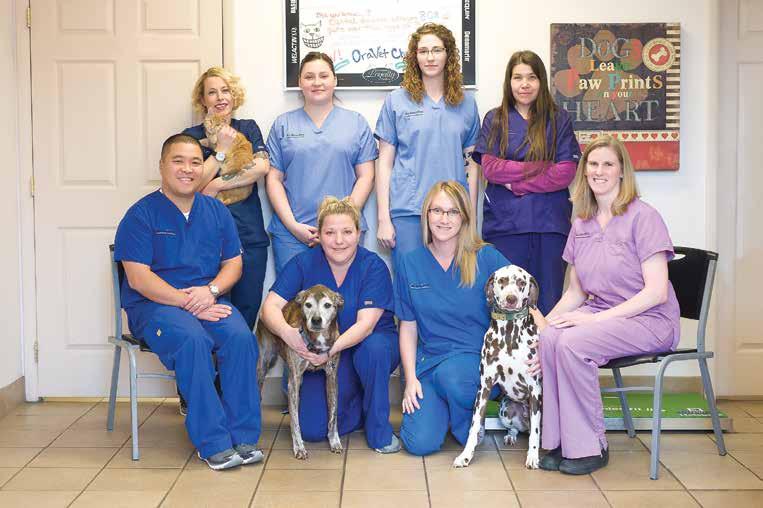
VCA Castle Shannon A nimal Hospital






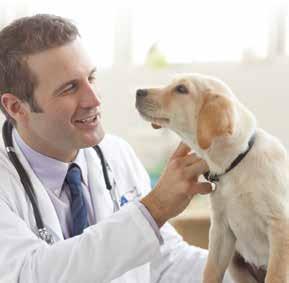




• Complete wellness services: Vaccines, Annual Exams, etc.
• Emergency and Critical Care Services
• Dentistry & Surgery (including Laparoscopic)
• Therapeutic Laser Therapy
• Endoscopy and Ultrasonography
• Exotics and Pocket pets
• Over 70 years of trusted, compassionate care





CORRESPONDENCE
info@pghpetconnections.com
724 -292-7387 All Rights Reserved | © 2018
PITTSBURGH PETCONNECTIONS QUARTERLY
Published by: Pittsburgh PetConnections, LLC. Pittsburgh PetConnections LLC. was formed in 2012. Our mission is to publish a high quality, informative publication focused on the Human-Animal Bond. We support local businesses and also assist local non-profit businesses for pets and people, to give back to our great Pittsburgh communities.
MAGAZINE PUBLICATION STAFF
Carla Mader, Managing Editor
Kara Jones Photography, Photography Kelli Koladish, Graphic Designer
Edward R. Moats, Content Editor
Carla Mader, Sales & Distribution Manager
Edward R. Moats, Media Account Manager
ADVERTISING SALES
Robin Reinfeld, Director of Sales, Pittsburgh 412-780-2254 | rrcd@aol.com
CONTRIBUTING WRITERS
Doug Knueven, DVM, CVA, CVC, CVCH Pittsburgh Veterinary Specialty & Emergency Center
Kristin Hermann April Minech
Bernadette Kazmarski
Edward R. Moats
Cover Photo: Animal Friends
From The Publisher
Welcome to our Pittsburgh PetConnections Magazine’s! Summer 2018, Volume 6 Issue 5
News & Events
It is our 6th Year Anniversary! We published our first issue in September 2012! Thank you to our advertisers, readers and writers for making this possible!
We had our second annual PETCON Pet & Equine Expo in June 9 & 10th at the Greene County, PA Fairgrounds in Waynesburg! Thank you, to our sponsors Humble Carpet, Lisa Brown Allstate Insurance, Pet Valu, Waynesburg Milling, Watters Pool and R & D Watters and The Greene County Chamber of Commerce. Our PETCON Costume contest winner again this year is Roxy & Greyson! “Jason Dunkle and his fiancé’, Mona Gray, and their two Italian Greyhounds, Roxy & Greyson, posed in their Hippie costumes on Barracks Beach at Presque Isle State Park, in Erie, PA. Photo by Christine Erin Photography.”
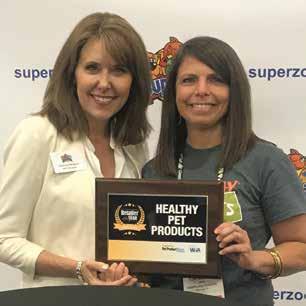
We would also like to congratulate Toni Shelaske of Healthy Pet Products for winning Pet Product News, Retailer of the Year for 2018-19! See their ad and article inside!
Please see our event page for more upcoming summer/fall events, including Blessing of the Pets, Dogtoberfest, Pugtoberfest, Animal Friends Black Tie & Tails, Save a Horse, and more!
GreeneScene magazine’s PetConnections Pet Photo Contest winners!
This Issue


Our cover features Animal Friends! See their Ask the Vet article and Muttster Mash event inside!
Our featured rescue is the Great Pyrenees. Read about CARMAA and the work they are doing with other recues and to spotlight adoptable pets. Lyme Disease is more prevalent than ever in our pets and people. Please read the articles by Dr. Klosterman, and also Dr. Doug inside. We also have an update on CBD oil use in animals by Susan Merenstein, RPh. Courtney Moffatt writes about honing communication with your animals, and Kristin Hermann on moving Forward in rhythm with your horse, and so much more!
As a reminder, PetConnections is published quarterly as follows: Early February, May, August, and November. Our print copy distribution sites will be replenished every 6 weeks. Our online presence has always been much greater than in print with over 275,000 impressions per issue. To subscribe to your own personal copy of PetConnections, please contact us below.
Did you know? PetConnections has evolved into a full-service specialized pet media company, providing services for advertising in print and digital platforms to help our sponsors grow their businesses. Contact us below for information on advertising or sponsoring!
Thank you for picking up this copy of PetConnections. Take care of yourself and your animals and be well!

Warmly,


Carla Mader Publisher Pittsburgh & Central Ohio PetConnections Magazine

Please submit any correspondence to: info@pghpetconnections.com
Please check us out on the web & subscribe at: www.petconnections.pet Follow PghPetMag on Twitter and “Like” us on Facebook! http://www.facebook.com/PghPetconnectionsMagazine
Disclaimer: The views expressed in our content does not necessarily reἀect that of PetConnections Magazine. PetConnections shall be indemni ed against damages from content including ads and articles, false advertising libel, trademark infringement, etc.
June – Izzy owned by Shelby Yourchik July – DUKE & CHEYANNE – Owned by Renee and Madison Kovach
August – “CHLOE” Owned by Abby Rankin
Human-Animal Bond
TRAINING YOUR DOG TO WALK POLITELY ON A LEASH
By Jeff Woods, CPDT-KA
Walking a dog on a loose leash is one of most difficult behaviors for a dog and human to perform together reliably because of much longer durations, distances, and distractions (scents) compared to other behaviors.
Teaching a dog to stay for a couple minutes, is much easier compared to loose-leash walking ten blocks for a couple minutes. Walking your dog on a loose leash is a mental and physical exercise for both you and your dog. It is one of the many ways for you and your dog to connect and bond.
There are several behaviors and combinations of these behaviors for you and your dog to walk on a loose leash. Training these behaviors make a walk fun and challenging for both you and your dog.
“Heel” is a formal walking behavior where your dog’s front right shoulder is parallel and eight to twelve inches away from your left leg at whatever speed that left leg is moving, and when that left leg stops, a dog sits promptly facing the same direction as the handler. While heeling, your dog’s head is up and not sniffing the ground. “This Way” is a walking behavior where the dog is trained to turn and follow you while you hold the end of a loose leash, just as a horse would follow you at the end of the lead rope. “Easy” means to walk slowly. “Pull” means to
pull you only on command on a taught leash, which comes in handy when walking uphill. The majority of dogs enjoy pulling. “Take a break” allows the dog to go to the end of a loose leash and sniff the ground. Smelling the environment is an extremely valuable reward. Dogs have 220 million scent receptors and love to investigate, explore, and check out odors in their environment. Saying “Take a break” or “go sniff’ to your dog to check out the environment can be highly rewarding and enjoyable.
Walking your dog should not be a time for your dog to be spreading their pee-mail (scent-marking) profusely throughout the neighborhood. When dogs profusely scent mark, they are defining their territory. In turn the other dogs in the neighborhood scent mark over your dog’s scent mark. For some dogs scent marking is often perceived as claiming the deed of the territory by other dogs and this can lead to competition, and strong on leash growling reactivity when they see another dog walking towards them.
To teach your dog to heel, gather up and loosely hold the leash in the left hand. Begin shaping this behavior by luring them with a treat or a small toy held in the right hand. Say “heel” and walk forward, keeping your dog’s right leg parallel to your left leg and keeping their attention on the object or treat in your right hand. Take two steps, stop and simultaneously cue your dog to “sit” parallel to your left side facing in the same direction as you. Reward with calm praise and a food treat. Repeat “heel,” gradually taking more steps between each stop to sit. Change direction of your walk periodically to keep your dog thinking, and use an upbeat animated tone in your voice to keep your dog’s attention. Start phasing out the lure once you feel the behavior has been shaped.
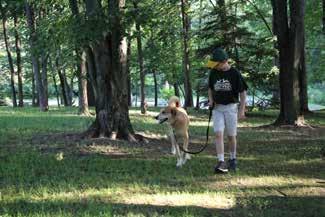
Reward your dog whenever it heels beside you. Read and listen to your dog’s body language, before they indicate that they are going to pull, stop and instruct them to sit and to look at you, reward and start “heel” again. Train “heel” in short progression sequences of distance. Ensure your two-step heel is reliable before moving on to a four-step heel, then to a six-step heel and so on. Using a hand signal cue simultaneously as your left leg stops often helps dogs to sit expediently and parallel on your left side. If your dog is pulling without being told to, stop, encourage your dog to come closer to you and start the heeling over again. Certain breeds, such as the Siberian Husky, Alaskan Malamute, or Bernese Mountain Dog, are more inclined to pull because of selective breeding for this trait. If your dog continues to pull without being asked, a head halter type of collar will be helpful. There are many types of collars and harnesses to aid you in teaching your dog to heel.
It is outside the scope of this article to discuss all the various techniques and methods of teaching owners and dogs to walk politely on a leash. Seek out professional help, such as the trainers at Misty Pines Pet Company, to teach you the various techniques and methods of teaching your dog to heel, and the other walking behaviors. Once these behaviors are trained into your dog, you and your dog will enjoy and gain the many benefits of walking politely on a loose leash. Misty Pines holds a class called “Walking Politely on a Loose Leash” periodically throughout each year specifically to train this behavior so if you need extra work specifically on your leash walking skills, the “Walking Politely on a Loose Leash” class is for you. If you need to work on general training as well, our other training classes incorporate this behavior along with various other behaviors such as sit, down, stay, come, stand, and agility obstacles. Visit us at www.MistyPinesPetCompany.com today to learn more.


Events
Pet Memorial Sunday
Sunday September 9, 2018
Chartiers Custom Pet Cremation www.ccpc.ws
OHPA Bird Fairs www.ohpabirdfair.com

Black Tie & Tails 2018
Friday, Sept. 21 and Saturday, Sept. 22
Animal Friends www.ThinkingOutsideTheCage.org
4th Annual Wags N Whiskers
Adoption Event
SATURDAY SEPTEMBER 22 2018
Pugtoberfest
Saturday September 29th www.swpapug.org
Open House Fundraiser
Save A Horse Stable
Sunday September 30th 11am-5pm Dogtoberfest
Saturday October 6th www.Carmaa-petadoption.com
Muttster Mash
Saturday October 20th
Southpark | Edgebrook Field www.ThinkingOutsideTheCage.org
Pet Walk of the Living Dead
October 22nd
https://www.facebook.com/ events/706118856234478/
Pittsburgh Pet Expo
November 2nd-4th Pghpetexpo.com
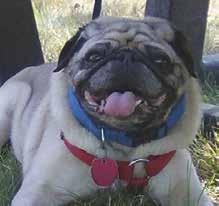
PUGTOBERFEST
Saturday, September 29th
11:00 am – 5:00 pm
Cooperstown Picnic Grounds
2541 Thomas Street, Latrobe, PA 15650 (picnic grounds located behind Cooperstown Event Center)
Gates open at 11 am Activities begin at 11:30 am
Vendors Chinese Auction Food Pug Rescue Fundraising Festival
CONTESTS
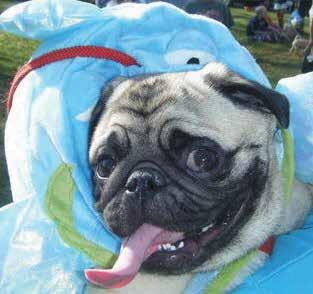
Including Curliest Tail, Best Trick, and many more, plus the always anticipated & creative Costume Contests.
Suggested $5.00 donation per person to attend, children under 12 are free. Proceeds benefit Southwest PA Pugs with Special Needs and Guardian Angels Pug Rescue to pay for medical & ongoing expenses for our rescued pugs.
All dogs attending must be up to date on shots, leashed and under owner control at all times. Non-pug breeds welcome to come join in for a day of doggie fun.
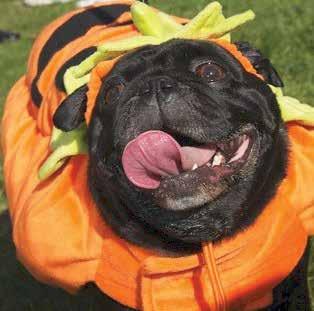


Featured Rescue
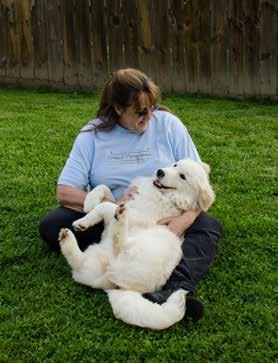
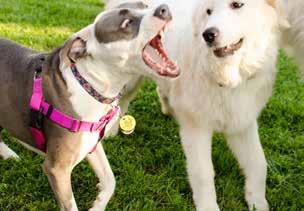
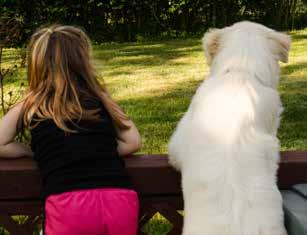
Great Pyrenees Rescue
The Great Pyrenees club has been around for a long time – the late sixties to be exact. “It started as a confirmation club, where members that participated in shows got together and helped and mentored each other with things such as how to stack and groom dogs, what types of head characteristics you were looking for, “says Lynn Pilarski, director and 30-year volunteer. “Through the years, it has grown into more of a rescue club. I got involved around 1988 when a friend called me and said ‘Hey, I know about this dog that’s in a really difficult situation, can you help him?’ And so, I did.”
Lynn says it weighed on her that there were dogs out there that had no help, nowhere to turn except for a shelter. She encouraged friends to join her, and they did the best they could. “I remember back in that first year, I think we helped six or seven dogs. How I yearn for those days!” She exclaims. “There are so many more out there that need us now. We help about 60 or 70 dogs a year, which amazes me because Great Pyrenees are not that popular a breed of dog.”
The biggest way to help the group would be to foster a dog, if possible. “Without foster homes, rescue is moot,” she says with an air of sadness. There’s just no room to take more in. “If you can’t foster, fundraising is the next best thing. We hold all types of events, and always need volunteers and supporters.” The club also needs people to help with transports and home checks, running dogs to the vet, and other day to day services. “But I can’t emphasize the importance of foster homes,” she repeats to make the point. The group has about sixty members, with a solid core of 10-12 regulars.
Where are all these dogs coming from, you may wonder. Lynn says they work with people who call looking for help, and with shelters when they get a Great Pyrenees in. But she admits the most anxiety
By April Minech
riddled part is coordinating transport services, and she don’t do well with that end of it since you have to rely on every link in the chain doing their part. “What if I get a call from someone 6 hours away telling me their relay didn’t show up? If I can’t get there, the dog ultimately pays the price.”
If you feel you may be a good fit to help as a foster, you can contact Lynn directly at Lapyr5@live.com. “The process is similar to the requirements of adopting a dog, with an application and home check. When we get a dog in that seems like a good fit for that applicant, we contact them.”
What would rescue like you to know about the breed?
“The simplest thing to say is they’re not “white” Golden Retrievers,” Lynn chuckles, saying she hears that a lot. “People see them and think they are sweet and cuddly, but they are actually working dogs that are well trained, especially if we have them out in public. They don’t just come that way. No dog comes that way.” She says that the dogs can be stubborn and willful and need someone who can handle their attitude, or they can run all over you. “They were bred to be working dogs, and they’re smart. Dogs that were bred to do jobs have independent thinking and were usually forced to rely on their own counsel. That doesn’t just go away because you’re in the picture. They try to do what their instincts tell them to do.”
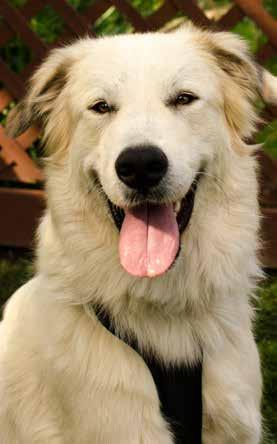
A BEGINNER’S GUIDE TO GREAT PYRENEES:
The Great Pyrenees, or Pyrenean Mountain Dog, is an ancient guardian breed that was bred to handle the guarding of flocks of sheep and other livestock from predators without human intervention. They are regal and predominately white, although some have coloring on their bodies. The double dew claws on the hind legs are also a classic breed characteristic. Typically, Great Pyrenees will range from 90-150 pounds at a healthy weight. The Great Pyrenees were bred to think independently of humans to successfully do their job, and this can often be interpreted as stubbornness as they typically do not strive to please people or listen to commands. Sharing your life with a Great Pyrenees requires a deep understanding of this trait and the patience to be calm and gentle! They can be intimidating with their instinctual deep bark, and it is usually impossible to train this breed NOT to bark. Great Pyrenees are known for roaming, so they require at least a 6’ fence (never an invisible fence) or a leash at all times Great Pyrenees also typically do well with children and small animals, but It’s important to remember that the dogs do not fully mature until at least three years of age. Until then, you will have a clumsy puppy that can easily knock over a toddler accidentally. Drool and fur come for free with every Great Pyrenees! As for training, they respond very well to positive reinforcement through treats and praise and can be extremely sensitive to any harsh words or methods. While they may show little interest in training and will see what they can get away with, training is a must to prevent an unruly, 100-pound puppy. They have specific grooming needs as well and should never be shaved as their coat keeps them warm in the winter and cool in the summer. Shedding occurs year-round with a blowing of their undercoat in the fall and spring and should be brushed 2-3 times per week
?Ask The Vet Rescue & Shelter
By Dr. Theo Nelson Veterinarian of Clinic Services
Why should I vaccinate my indoor cat?
The simple answer is for everyone’s safety. Even if your cat lives indoors, there is always a chance they may slip out an open door or window. Vaccinating is the simplest and smartest measure you can take to ensure the safety of your feline family member, other animals and yourself.
All cats are required by law to be vaccinated for rabies, which is transmitted from mammal to mammal. This means an unvaccinated cat has the potential to transmit rabies to their owner. Rabies can be fatal for both animals and humans – so a cat without a current rabies vaccine could pose a serious threat to themselves or others in the event of a bite.
While most cats spend their lives indoors, they can find themselves outside for various reasons and without warning, so they should receive their basic vaccines regularly. These include rabies and FVRCP –also known as the feline distemper vaccine – which protects against several common respiratory diseases. The feline leukemia vaccine is also recommended for all cats, especially those who may be exposed to the outdoors or other unvaccinated cats.
Is pediatric spay/neuter safe?
To prevent births of unwanted litters, pediatric spay/neuter started being performed as a means of avoid animals being adopted before they are altered. Pediatric patients require certain precautions to ensure their safety during the procedure. Fortunately, special techniques have been developed to minimize anesthetic and surgical complications.
At Animal Friends, all of our staff veterinarians have been specially trained in these techniques and we’re able to complete the surgery in a shorter period of time than a traditional spay/neuter. This lessens the time that the patient spends in surgery and under anesthesia. Pediatric patients actually tend to recover much faster and are awake and playing within hours of surgery. Pediatric spay/neuter allows young animals to find loving homes during their key socializing and bonding period, which helps them grow into happy, healthy pets.
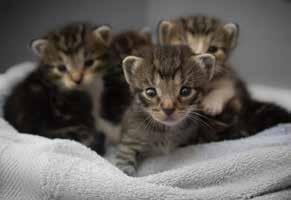
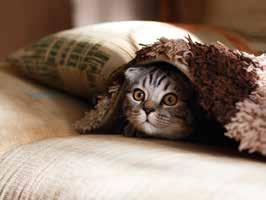
Rescue & Shelter
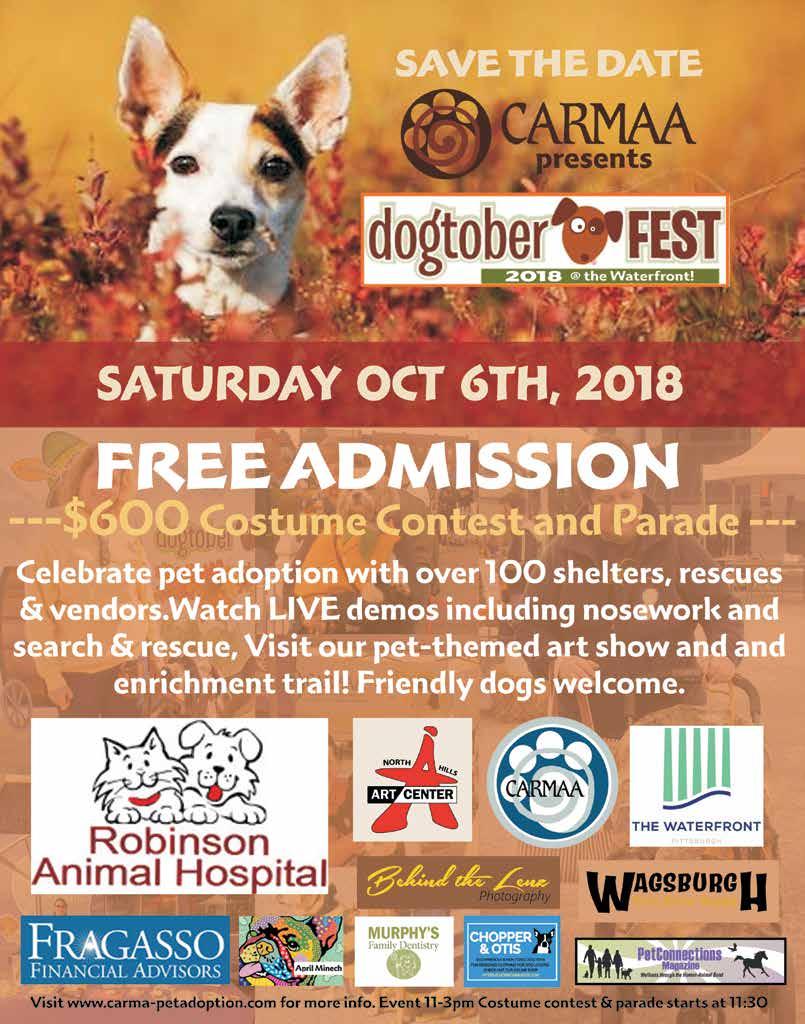
So, what is DogtoberFEST? Hosted by CARMAA (Coalition to Adopt, Rehome and Match Abandoned Animals) A FREE event that celebrates pets and provides everything you need to know about adoption in a festival environment. It’s dog friendly, so you can bring your non-aggressive pet along, and there’s over 100 shelters, rescues and vendors set up for you to visit.
We say Adopt, don’t Shop all the time. There’s a great deal of money being made breeding dogs, so it’s important for people to understand when they purchase a dog what kinds of unscrupulous things they may be unknowingly supporting. Puppy Mills are everywhere, especially in our region. If you want to get a dog from a reputable breeder, expect to wait 6 months to a year. Ask if they show their dogs, see the parents. A typical guarantee from a good breeder is that they will take the dog back at any point during its lifetime. So DogtoberFEST
CARMAA Spotlight
By April Minech
helps people learn where to get a dog, whether they are looking for a certain breed or what type would be a good fit for them. And how to find the support they needs once the dog is home.
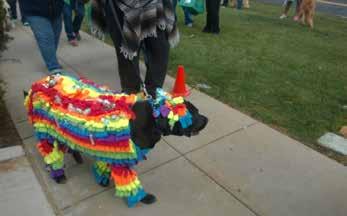
There are lots of fun things to do at the event. For starters, there is an enrichment trail. Dogs like to explore using their noses to discover things. A team of volunteers sets up a trail with hay for owners and dogs to walk through together, filled with special scents, novel toys and treats. And new this year is an art show hosted by North Hills Art Center, and the artists will be providing a special pawprint craft you can make with your dog to keep for a small donation. And it all starts with a giant costume contest. CARMAA gives away $600 in prizes in several categories: Best Costume, Most Original Costume, Best Owner Dog Look-a-like, and some honorable mention prizes. And new this year is special category for shelter/rescue animals!
There have been some great costumes in the past, such as a bulldog dressed as the Liberty Bridge, and a pair of dogs that were just married with all the decorations.
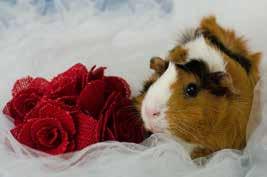
Are there only dogs at DogtoberFEST? Not anymore! When the event first started, the idea was to let people know the different places they could adopt a dog, and where to find support for any issues they might have with the goal of keeping dogs in the home. As the event grew – this is the 8th year – other species rescue groups reached out to ask if they could be included. And CARMAA said “Why not?” So they started including cat groups, and then last year a guinea pig rescue joined in. That led to the creation of CARMAA’s Spotlight program, and many other species have been featured since. PEARL, reptiles, and even turtles.
By April Minech | Photo credits: Kim Lenz, Behind the Lenz Photography
So CARMAA doesn’t have any animals of its own, rather they provide support to groups that do. For example, many rescues are run by a few very dedicated volunteers, who spend most of their time with the hands on caring for animals. Food, shelter, medical needs. They have lots of information about their breeds, but no established marketing department, no fundraising department, no special events department, etc. So they are limited in ways to share all that good information. That’s where CARMAA comes in. Our members have experience working and volunteering with larger organizations, so we try to provide support at the next level. The CARMAA spotlight program interviews the smaller groups and writes an article about them to share, and has an on staff professional photographer that takes pictures of the animals for free. Then the group is featured on their social media sources and shares the marketing package with the rescues to put out through their own network. CARMAA hopes to put a spotlight on as many group0s as possible, so people can go on their site and see reputable organizations to adopt from and get their contact information and hopefully learn more about what to expect from a species or breed. The biggest showcase of all these groups is annual DogtoberFEST event.
basic medical questions to get some direction. And the trainers are great. There are so many fixable issues that people surrender their dogs to shelters for, and maybe if they just knew how accessible professional advice was, we could keep some of those dogs out of the shelters. Potty training, jumping walking on loose leash, are all common issues that can be worked on.
The event will have an Ask-the-Vet booth, sponsored by Robinson Animal Hospital, and an Ask-the-Trainer Booth. Maybe you’ve been wondering about a lump, ingrown toenail or something that seems a bit off – you can ask
They can take a look at your dog and give tips or recommend classes. A lot of people don’t get that classes teach the owner how to work with their dog, how to communicate and build a relationship. It’s always surprising when people think that classes are for dogs to learn tricks. There are classes to do that if you want, but basically classes teach people how to speak “dog”, and the trainers can explain what your dog is saying. Classes make great relationships.
Learn more about the good work being done in your area by visiting the CARMAA web site or joining us at DogtoberFEST! www.carmaapetadoption.com
About CARMAA
CARMAA helps connect resources. For example, a large shelter might be able to provide medical care, food or material needs such blankets or bowls, and rescue could provide a foster home. CARMAA tries to spread the work about who needs what through our social media, delivers physical items, and holds fundraisers for individual groups. Everyone needs money, so they try to get the word out about the good work people are doing to encourage people to volunteer or donate.
Pet Health & Wellness
The Many Manifestations of Lyme Disease
By Emily Klosterman, DVM, MS, DACVIM
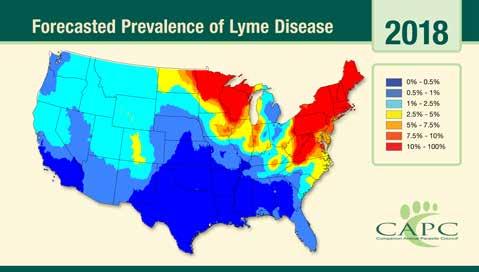
Pennsylvania and other states along the eastern seaboard are common places where dogs might contract Lyme disease. Recognizing the signs of Lyme disease can lead to quicker diagnosis and treatment. However, the disease can manifest in many different ways, thus making it difficult for even the most vigilant of dog owners to know that their pet has Lyme disease.
Lyme disease is a bacterial infection transmitted by tick bites. The bacteria (Borrelia burgorferi) lives in the digestive system of the tick and infects the dog through the tick’s saliva. The bacteria can move around the body and evades detection by the immune system much better than other bacterial infections which makes it a disease that can cause many types of clinical signs. Because the bacteria are so good at hiding in the body, even with antibiotic treatment many dogs are never cured of this infection.
Incidentally discovered infection Many dogs are found to be Lyme disease positive when tested, but fortunately few have signs of disease and the positive test is found with routine screening. A Lyme disease test is incorporated into many general health labwork panels and is also included in many in-clinic tests for heartworm disease. In areas where Lyme disease is common, screening can identify dogs that might need more attention. Screening can also identify dogs that have had previous exposure to the infection but no longer have an active infection (which doesn’t require treatment).
When a dog tests positive, further testing to measure the significance of the body’s immune response is recommended with a test called the quantitative C6
antibody titer test. This test allows your veterinarian to better understand whether your pet has a newer or older infection. Dogs with a low titer probably had their infection in the past or their immune system fought off the infection and do not require treatment. If your pet has a high C6 antibody titer but no clinical signs then their body may be taking care of the infection on its own and treatment with antibiotic may be unnecessary. Sometimes, a veterinarian may recommend antibiotic treatment for dogs with no clinical signs and significant C6 antibody titers. Antibiotics might be recommended in pets with reduced immune system function or in an attempt to prevent some of the more serious manifestations of Lyme disease discussed below. Finally, if your pet has tested positive for Lyme disease your vet will likely recommend testing for excessive protein in the urine. Protein in the urine is a manifestation of Lyme disease that can damage the kidneys but can go unnoticed unless tested for regularly.

Lyme arthritis
One form of active Lyme disease is characterized by fever, swollen lymph nodes, muscle soreness and arthritis. Once the bacteria are transmitted to the dog, they move around the body triggering swelling and inflammation as they travel. The joints appear to be very sensitive to this inflammation and chronic arthritis can become a problem in these pets. In addition, as discussed previously, sometimes the bacterial infection is never completely cleared from the body and chronic infection in the joint is possible. Cases of disease with chronic joint inflammation are complex and so your family veterinarian may recommend that your dog visit a veterinary specialist.
Lyme nephritis
The most devastating way a pet can be affected by Lyme disease is severe kidney inflammation (Lyme nephritis). Dogs are often diagnosed with this type of Lyme disease when they have signs like poor appetite, vomiting or lethargy
and then blood tests performed at the veterinarian’s office reveal kidney failure. Immediate antibiotic treatment is recommended in these patients, but unfortunately the inflammation in the kidney triggered by the bacteria is often so severe that the kidneys continue to fail and never recover. Sadly, many dogs affected by Lyme nephritis will suffer the effects of kidney failure for the rest of their life and ultimately may die from severe kidney failure in a few weeks or months. Outcome in these dogs mostly depends on the severity of the kidney failure, but evaluation by a veterinary internal medicine specialist may help maximize quality of life for as long as possible.
Secondary autoimmune disease
Lyme disease can affect many different organs in the body and this can lead to autoimmune diseases (where the body inappropriately attacks its own tissues). Autoimmune disease is not directly caused by the bacteria and so
even after antibiotic treatment pets can remain sick. Autoimmune blood or joint disorders are most commonly seen and require a specialized treatment course completely separate from the antibiotics for Lyme disease.
Prevention
The longer a tick is attached to its host (esp. > 48 hours) the more likely it is that Lyme disease will be contracted so limiting the time a tick spends on your dog’s body is an important preventative measure. Looking for ticks on your pet’s body can be helpful, but ticks that are not yet fully grown can transmit Lyme disease and they can be too small for you to see or feel. Use of tick preventative medication is an important way to limit the time a tick might spend on your dog’s body.
The Lyme disease vaccination is a unique vaccine in that it is not meant to fight the infection once it is in the body, but
is designed to prevent transmission from the tick. The vaccine attempts to fill a vaccinated dog’s blood with antibodies that will kill the bacteria in the tick’s stomach before it even enters your dog’s body. Lyme disease vaccination is recommended in dogs that live in or travel to high risk areas.
Keep a close eye on your dogs during tick season this year and cat lovers take heart, cats are generally considered resistant to Lyme disease. People cannot get Lyme disease from their dog; however, you can contract the disease from a tick too. Be aware that if your dog is being bitten by ticks carrying Lyme disease then your family could be bitten too.
The Rogan Rexford Animal Blood Bank
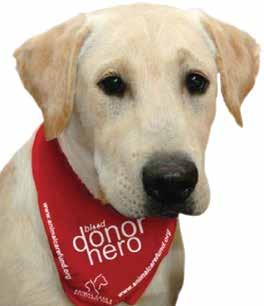


‘Pets
giving pets the gift of life’
Please volunteer your dog to be a ‘blood donor hero’
Dog donor eligibility
• Between 1 and 7 years of age
• Weight: 50 lbs or more
• Healthy with a gentle temperament
• Current with vaccinations
• Never had a blood transfusion
• Tested negative for blood-borne diseases (free testing by blood bank)
• Must be on heartworm, flea and tick preventative
• Not pregnant or currently nursing



Holistic Pet Care
An Integrative Approach to Lyme Disease
By Dr. Doug - The Holistic Vet \ Doug Knueven, DVM, CVC, CVCH
Lyme disease has become a major concern for both pets and people in our area. The deer tick that carries Lyme disease has increased its territory and population. This little blood-sucker has spread to 50% more counties than it called home 20 years ago. According to the CDC, 95% of human Lyme disease is found in 12 states in the Northeast, Upper Midwest, and Mid-Atlantic U.S and up to 70% - 90% of dogs in some of these areas test positive for exposure. (Check out the CDC web site for disease maps and images of the deer tick - http://www.cdc.gov/lyme/).
Because of the increased risk of getting Lyme disease, it behooves everyone to gain a greater understanding of this terrible disease. Although we and our dogs can contract these same bacteria, the disease itself manifests somewhat differently in the two species.
Lyme disease is caused by a bacterium named Borrelia burgdorferi. These bacteria are transmitted to humans and animals through the bite of an infected deer tick. The first fact to know is that the tick must be attached for 48 hours before it can pass on the germs. It is also important to know that although Lyme disease is caused by Borrelia, not every dog who is infected with these bacteria develop Lyme disease. In fact, 90%95% of infected dogs will never come down with Lyme disease. This is very different from the situation with people, 60% - 80% of whom get sick once infected. The in-clinic test that your veterinarian does for Lyme disease (this is often included with the heartworm test) actually checks for antibodies against Borrelia. If a dog tests positive it means that she has mounted an immune response to the bacteria which indicates that she has been infected. However, if she has no symptoms of Lyme disease, then by definition she does not have Lyme disease. Therefore, saying that this in-clinic test is for Lyme disease is a misnomer since it only indicates exposure to Borrelia. Remember that only 5% - 10% of dogs who are exposed will get Lyme disease. And, unless the animal has Lyme disease, treatment is not helpful.
When a pet is bitten by a Borrelia-infected tick, he does not develop a target-shaped rash as people do. In fact, dogs usually do not show signs of infection for weeks to months after the tick bite. The most common signs of Lyme disease in dogs is joint swelling and pain that manifests as lameness that may shift from one leg to another. The pet may develop a fever and become sluggish. Rarely the Borrelia organism can also cause problems with the kidneys leading to renal disease. There is a lot we do not know about Lyme disease in dogs. For example, it is unclear whether a chronic condition can set in or develop years after initial infection, as is sometimes the case in people. It is also difficult to know how to decide which infected dogs to
treat. If a pet tests positive on the in-clinic test, usually an additional blood test is done to determine the exact antibody level. If that level is high, the dog is treated. But this might not be the ideal solution. A recent study found that 40% of dogs diagnosed with Lyme disease actually had another condition instead.
Treatment for Lyme disease usually involves a four-week course of the antibiotic Doxycycline. This drug can be harsh on the GI tract and some dogs do not tolerate it at all. In those cases, there are other antibiotics that can be used. If Doxycycline is used, and the pill or capsule gets stuck in the dog’s throat, it can cause severe damage. For that reason, Doxycycline should be given before a meal, so the food will be sure to push the medicine down the throat. No matter what antibiotic is used, it is vital for the dog to be given a probiotic. Probiotics are supplements that provide beneficial bacteria for the intestine. You see, 70% of the immune system is in the lining of the gut, which makes the GI tract the largest organ of the immune system. Antibiotics throw off the delicate balance of gut bacteria (even if there is no diarrhea), and this can have a negative affect of the body’s immunity. Probiotics have been shown to mitigate the immune system damage caused by antibiotics. It is best to give the probiotics two hours away from the antibiotics and to continue them for 4-6 weeks after stopping the drugs. The probiotic rule is important to keep in mind any time a pet is given antibiotics and most other drugs.
Of course, the best way to handle Lyme disease is to avoid it all together. And the best way to avoid this disease, as well as other tick-borne diseases, is to mitigate tick bites. Since ticks hang out mostly in the weeds at the edges of woods, keeping your dog away from these areas would be ideal. At the same time, many dogs and their people love running and playing outdoors so this advice might not be practical. However, if your yard boarders a wooded area, you can be sure to keep the weeds and tall grasses trimmed.
Another Lyme disease strategy is to do a thorough tick check on your dog daily. This requires that you first know exactly what you are looking for. The deer tick is a tiny creature so have your veterinarian show you what they look like (or check out the CDC web site mentioned earlier). Ticks usually attach on the face, behind the ears, or in the armpit area, so these places need to be especially well examined. The use of a finetoothed, flea comb may help.
Properly removing any detected ticks is the next step. If the body of the tick is squeezed in the process of pulling it off, then it is possible to push diseasecausing organisms into your pet. The easiest way to
safely remove ticks is with a tick removal utensil. There are many, inexpensive, little, prybar-type tools available – ask your veterinarian what she recommends. A thorough, daily tick check/removal can be effective at preventing Lyme disease because the tick must be attached for 48 hours before it can transmit the Borrelia bacteria.
For those who do not have the patience or for those with a dog that has a particularly heavy coat, another way to keep your pet safe from Lyme disease is to stop the ticks from attaching, or killing them fast once they do. I have found ticks to be particularly resistant to natural tick repellants. The most effective ones are essential oil sprays, especially those containing cedar oil.
It is imperative that a safe product and appropriate dilution be used as there have been cases where certain essential oil products have caused serious illness in pets. Just because something is natural does not mean it is safe. Poisoned ivy is natural, but I do not suggest rolling around in it. Also, essential oil products must be applied frequently. A rule of thumb is that if you can’t smell it, it isn’t going to work.
There are many prescription flea/tick medications these days (topical liquids, collars, and oral). Some work better than others, but all of these will result in toxins entering your pet’s system. The herb milk thistle can help the liver detox and clear the chemicals from the body. I personally have found the Seresto collar to be the most effective and least toxic of the chemical tick preventives.
The final Lyme disease protection to discuss is the Lyme vaccine. I mention it last because I’m not a big fan. First of all, according to research, the Lyme disease vaccine is only 60% - 80% effective. The vaccine also provides only a short duration of immunity and may protect for only 6 months. Plus, a study showed that this vaccine is the least safe of all the vaccines vets give. The Lyme disease vaccine has been associated with some of the signs of the illness itself, including kidney disease, which may appear more than a year after the vaccine was given. For these reasons, I avoid giving the Lyme disease vaccine to my patients.
As we consider Lyme disease we realize that it can be serious, but sickness is less common for exposed dogs than for people. Because the tick must be attached for at least 48 hours to transmit the disease, and because the vaccine is far from ideal, the various tick strategies mentioned above are the best option for Lyme disease prevention. A combination plan will no doubt be needed and if you are still finding ticks on your dog despite your best efforts, try something else. Keeping your pet tick-free is an important key to her overall health.
Holistic Pet Care
ANIMALS CBD FOR
By Susan Merenstein, RPh
DearFriends,
As a Holistic Clinical Pharmacist, I am always looking for holistic and natural approaches to health for people and pets. CBD or Cannabidiol is the perfect natural cannabinoid supplement to compliment good lifestyle choices and the desire for quality of life. CBD hemp oils have become more common and as mainstream products are being marketed to pet owners, you may ask, “Should I give my Pet CBD oil?”
My answer is a definite “Yes!!! …but” because not all products are created equally and there are some things consumers should be aware of before purchasing a CBD product.
The good news is pets can benefit from CBD in much the same way humans do. Our furry friends, as well as most animals, have an Endocannabinoid System (ECS) that is responsible for maintaining homeostasis or balance within the body – including regulation of the communication between cells, the body’s immune response, and autonomic functions like appetite, sleep, and metabolism. Basically, the ECS helps the body maintain itself.
Cannabinoid supplements interreact with this system meaning that your pet will potentially derive benefits from CBD in similar ways to their human “parents” do. CBD’s benefits come from its ability to affect the body’s naturally occurring regulatory processes by interacting with the Endocannabinoid System. This chemical communication system includes CB1 receptors, mostly found in the brain, and CB2 receptors found all over the body, including in the gut and immune cells.
Because of this similarity between this system in humans and other animals, many owners have started taking advantage of the availability of CBD products in hopes of treating their pet’s Arthritis, Anxiety, fear of people, fear of loud noises, traveling
stress, seizure disorders, GI disorders, chronic pain, inflammation, and even cancer. Animals, however, can be very sensitive to cannabinoids.
One of the leading experts and writer of Medical Marijuana and Your Pet, Dr. Robert Silver, DVM, MS, CVA, writes “Studies on dogs, conducted in the 1970’s, helped us to understand the working of the endocannabinoid system,” and “it was determined that dogs, as compared to all of the other species studied, have the greatest number of endocannabinoid receptors in their cerebellum and brain stem, which govern coordination and other basic necessary functions like breathing and heart rate. Due to this high density of endocannabinoid receptors in its brain, dogs are extremely sensitive to THC.”
This extreme sensitivity to THC in dogs limits the ability to use traditional medicinal marijuana in our pets, who would quickly turn them into furry THC-zombies. This also means consumers must be very careful that the CBD products they buy DO NOT contain THC. Legally products can be marketed as “THC-Free” so long as they contain less than 0.3% THC which still may be far too high for our THC-sensitive furry friends.
Dogs can easily overdose on THC and have a severe negative reaction called Static Ataxia, which includes: glazed eyes, excessive drooling, loss of bowel and bladder control, rapid breathing, falling over, and an inability to get up again.
CBD has become the cannabinoid of choice for many clients because it is non-toxic and well tolerated in animals, but the dangers of THC are less widely known.
Now you may ask, “How do I choose a CBD Hemp Oil product for my pet?”
First and foremost, you must buy the product from a reputable source. A reputable source is
one that does third party lab testing on their finished products and can produce a Certificate of Analysis to prove that the products actually contain what is on the product labels. Since 2015 the FDA has sent warning letters to CBD manufacturers who claim there is more CBD in the bottle than there actually is. Up to 75% of CBD products were found in one study to be mislabeled and misbranded.1
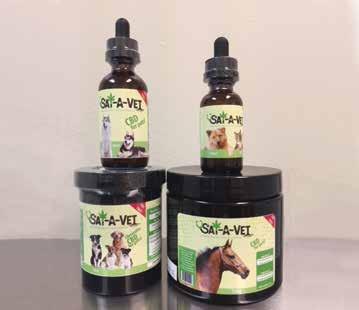
Our LabNaturals PCR Broad Spectrum CBD Hemp Oils have proven NO detectable THC per third party testing, which makes them an excellent choice, especially dogs who are naturally much more sensitive to THC’s psychotropic effects.
Since LabNaturals PCR products are third party tested for potency, purity, and consistency, you can rest assured that our CBD hemp oils are consistent with their labeled strengths. We have Certificates of Analysis available upon request for each of our products. Our oils are free from contaminants – like mold, mildew, and microbes, and are grown without chemicals or pesticides, and are free of heavy metals – protecting your pet’s health and safety over the long-term use of these products.
Second, make sure to purchase CBD oil from a business with professional expertise in health, wellness, and supplementation. It is also important to have someone check your animal’s medications for potential interactions. Finding a pharmacist well versed in both CBD and pet medications is best to be sure that all information is accurate. Our LabNaturals PCR is not your vape shop’s CBD! LabNaturals PCR CBD products contain broad spectrum hemp oil creating an entourage effect where the cannabinoids work together for greater potential benefits. They are also derived from the whole medicinal industrial hemp plant grown, processed, and produced in accordance with the 2014 FARM BILL, Section 7606.
Third, we use a “Low and Slow” “micro-serving” process of building up the serving size in our clients which applies to both humans and animals. This allows us to find the right serving size for the client’s needs. We also consider the pet’s size, species, and weight starting at a serving of 0.25-0.5mg of CBD/kg/day and this serving may be increased on a weekly basis until desired benefits are achieved.
You should feel confident that my 37 years of clinical pharmacy experience is reflected in every handpicked product in my pharmacy, Murray Avenue Apothecary, including our only brand of CBD products LabNaturals PCR Broad Spectrum Plant Oils. This new brand of CBD builds on our already popular LabNaturals Skin Care line which provides affordable, non-toxic, and eco-friendly anti-aging and acne products.
At Murray Avenue Apothecary we are pharmacists for humans and our furry family members and we have done our research into the exciting new world of CBD and cannabinoid supplementation. If you have questions we
will always do our best to answer them as completely as possible. We ensure the purity, consistency, and safety of all our products and compounds because that is exactly what you and your pets deserve.
Discover more about LabNaturals PCR products and view a price list at www.LabNaturalsPCR. com
To Animal and Human Health, Susan Merenstein, Pharmacist/Owner
LabNaturalsPCR Broad Spectrum Plant Oil
References:
1. Bonn-Miller MO, Loflin MJE, Thomas BF, Marcu JP, Hyke T, Vandrey R. Labeling Accuracy of Cannabidiol Extracts Sold Online. JAMA. 2017;318(17):1708–1709. doi:10.1001/ jama.2017.11909
Lab Naturals PCR Pet Testimonial:
“Our Bullmastiff/German Shepherd rescue, Hardy, came to us with a host of lovable quirks, but his anxiety made it difficult for him to enjoy life to the fullest. We tried an expensive prescription separation anxiety medication, but the results were just fair. We switched to LabNaturals PCR and it has made a world of difference! He no longer anxiously follows us from room to room or paces around our home, we’ve been able to trim his nails, and he is overall a more relaxed and happy dog.
What I appreciate most is that he does not seem “sedated,” his fun and sweet personality still shines through. Using LabNaturals’ product has allowed us to get Hardy’s anxiety level diminished to the point of being able to start working on the behavioral modification techniques needed to treat the root of his anxious processes.”
– C.F.

Directories
Animal Educational Exhibits
Nor th:
The Pittsburgh Zoo & PPG Aquarium pittsburghzoo.org
The National Aviary nationalaviary.org
Animal Communication
Greater Pittsburgh Area: Renee Takacs, M.A. intuitguide.com
Animal-Related Art, Photography & Retail
April Minech Custom Portraits | Pet Inspired Ar t www.ladybugdelightz.etsy.com
Nor th:
Nicole Begley Photography nicolebegleyphotography.com
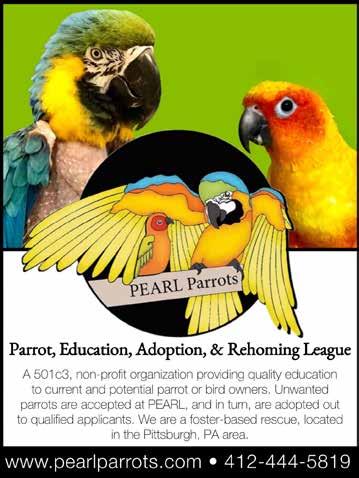
PEARL Parrot Rescue www.pearlparrots.com
Bird & Supplies
Natural Inspirations Parrot Cages www.naturalinspirationsparrotcages.com
Dog Training
Nor th:
AKIN Family Dog Training (Lilian Akin) 412-732-8091 | akinfdt.net
Greater Pittsburgh Area: Happy Pets Training /Christine Flint 412-373-9583 | www.happypetstraining.com
Holistic Practitioners for Guardians
East End:
Judith Levy Wellness Coaching /Energ y Modalities 412-726-2659 | www.judithlevywellness.com
South:
Manning Chiropractic & Wellness Center 412-341-2505 | drastridmanning.com
Holistic Veterinarians
Dr. Doug Knueven, DVM Beaver Animal Clinic
724-774-8047 | beaveranimalclinic.com
Dr. Qiang Li VCA Castle Shannon 412-885-2500
Visit our online di re ct or y at pghpe tc onnections.c om/Dog-Cat -Di re ct or y Pet Portraits 412-407-2590 www.PittsburghPainting.com/portraits
Vibrant Images 724-774-1731 | www.vibrantimages.photography
South: Kara Jones Photography kjones.smugmug.com
Paws ‘n Claws Eyewear PawsnClawsEyewear.com
Animal Rescue Organizations
Nor th: Animal Friends
412-847-7000 | thinkingoutsidethecage.org Beaver County Humane Society 724-775-5801 | www.beavercountyhumanesociety.org Pennsylvania Great Dane Rescue 724-869-9185
Hope Haven Farm Sanctuar y 412-366-1187 | hopehavenfarm.org Western Pa Humane Society 412-321-4625 | wpahumane.org
South:
Animal Care & Welfare 412-24 4-1372 | animalcareandwelfare.org
Droopy’s Basset Rescue 888-9 GET DROOL | www.droopysbassetrescue.com Washington Area Humane Society 724-222-7387 | washingtonpashelter.org
Animals Against the Odds Rescue/Rehab www.aato.rescueme.org
East: Humane Animal Rescue 412-345-7300 | animalrescue.org HAR Wildlife Center 412-345-7300 | animalrescue.org
SW PA Pugs with Special Needs 724-763-2790 | swpapug.org
West: CARMA A
412-780-4983 | carmaa-petadoption.com
Greater Pittsburgh Area: SPAAR www.seniorpetandanimalrescue.org
Guardian Angels Pug Rescue
724-537-3466
www.facebook.com/guardianangelspugrescue
Humane Society of Greene County
724-627-9988 | greenepet.org
Success Just Clicks successjustclicks.com
Nor th Shore: Western PA Humane Society 412-321-4265 | wpahumane.org
South:
Paula’s Professional Dog Services
412-818-2482
Dog Training Clubs
South:
Dogworks Training Center at The Canine Club
Phone: (412) 220-8100 | www thecanineclub.com
Golden Triangle Obedience Training Club 412-653-6880 | gtotc.com
Keystone Canine Training
412-833-2211 | keystonecanine.com
Xcel Canine Training Center
412-833-2504 | xcelcaninetraining.com
Equine Boarding, Lessons & Training Facilities
Nor th:
Rockin’ Horse Stables
724-601-4706 | rockinhorsestables.com
South:
Coventr y Equestrian Center
724-206-9902
Manon’s Farm
724-705-7912 | 724-621-0260
SydMor Equestrian Center
724-969-0510 | www.sydmorstables.com
Equine Holistic Care
Greater Pittsburgh Area: Dr. Michael Savko, DC, CCSP, CVCP 724-261-7915 | drchirovet.com
Equine Tack Stores
Pet Burial, Memorial & Cremation Services
South:
Char tiers Custom Pet Cremation 412-220-7800 | ccpc.ws
Jefferson Memorial Funeral Home 412-655-4500 | jeffersonmemorial.biz
East End: Precious Pets Memorial Center & Crematorium 412-351-PETS (7387) | preciouspetspgh.com
Greater Pittsburgh: Car ved Stone by Serena 724-941-2664 | www.carvedstonebyserena.com
Thousand Hills Pet Crematory 724-355-8296 | www thousandhillspetcrematory.com
Pet Fencing
Greater Pittsburgh Area: Dog Guard Pittsburgh Dog Fence 412-287-5820 | Pghdogfence.com
Pet Grooming
Nor th:
All About Dogs
724-925-1577 | allaboutdogsgrooming.info
Larr y’s Laundromutt 412-534-4052 | larryslaundromutt.com
Happy Tailz Pet Spa 412-759-7620 Happytailzpetspa.com
Healthy Pet Grooming 724-759-7567
Larr y’s Laundromutt 412-534-4052 | Larr yslaundromutt.com
South:
Shady Acres Saddlery 412-963-9454 | www.shadyacressaddlery.biz
South:
Lowr y’s Western Store
724-228-1225 | lowr yswesternshop.com Nor th:
Equine Veterinarians
Dr. Brian Burks, DVM - Fox Run Equine Center 724-727-3481 | foxrunequine.com
Holistic Pet Practitioners
Pet Chiropractor
Nor th:
Dr. Doug Knueven, DVM
Beaver Animal Clinic
724-774-8047 | beaveranimalclinic.com
Greater Pittsburgh:
Dr. Michael Savko, DC, CCSP, CVCP
724-261-7915 | drchirovet.com
Candelore’s Barking Beauties 412-872-5550
Creative Canine Cuts 724-223-9020
Grand Slam Grooming 412-221-5081 | grandslamgrooming.com
Petsburgh Dog & Cat Grooming 412-885-4027
Pets at Home Dog Grooming 412-655-7297 (PAWS)
The Pet Salon 412-279-5331 | petsalonusa.com
Woody’s Dog Wash & Pet Boutique 412-714-464 4 | woodysdogbath.com
East: Animal Elegance
412-361-1177 | www.animal-elegance.com
Candelore’s Barking Beauties Pet Grooming 412-872-5550 | candeloresbarkingbeauties.com
Cat Around Town Cat Grooming 412-461-3700 | cataroundtown.com
West: Paws Here Awhile Pet Resort 724-573-4665 | pawshereawhile.com
Greater Pittsburgh Area: Zoom N Groom (Sonya Patterson) 724-225-4827
Pet Friendly Businesses & Organizations
Bactronix
412-375-7886 | www.bactronix.com
Good Nature Organic Lawn Care 888-LAWNSAFER | whygoodnature.com
Simple Sugars Scrub Simplesugarsscrub.com
Village Shoppes Scenery Hill Elves Lair Christmas & Gifts, Jan’s Tea Shoppe - 2nd Street Coffee Roasters, Velvet Envelope, Westerwald Pottery, Two Old Crows www.sceneryhillpa.com
Greater Pittsburgh Area: Fragasso Financial Advisors 412-227-3200 | www.fragassoadvisors.com Fundvelopes 412-595-8641 | fundvelopes.com
Matt Arch Foundation www.connectarian.com
One Hour Heating & Air Conditioning 724-225-164 4 | www.onehourair.com
OxyMagic 412-781-4110 | www.oxypgh.com
Susan G. Komen Pittsburgh 412-342-0500 | www.komenpittsburgh.org
East Pittsburgh East Nissan 412-824-9020 | www.pittsburgheastnissan.com Unique Home Solutions www.uniquehomesolutions.com
South: Southpointe Chamber www.southpointe.net Pet-Friendly Living
Greater Pittsburgh Area: Pinch Property Services 412-445-8550 PinchPropertyServices.com
East: The Getaway at Glen Highland Farm www.glenhighlandgetaway.com
South:
American Destiny Real Estate Services 412-983-2220 | www.adr-usa.com Amore 877-716-6840 | amoreapar tments.com
Pet Grooming Schools
Nor th:
Pa Academy of Pet Grooming 412-759-7620
Pet Ministries
South:
Christ United Methodist Church 412-277-1096 | christumc.net Westminster Presbyterian Church 412-835-6630 | westminster-church.org
Pet Resor ts - Boarding, Daycare, Grooming & Training
Camp Bow Wow South 971 Killarney Dr Pittsburgh, PA 15234
Camp Bow Wow Southwest 412-276-WAGS(9247)
Camp Bow Wow North 412-931-WAGS(9247)
Camp Bow Wow Highland Park 412-362-PLAY
Camp Bow Wow Pgh East 724-733 CAMP(2267)
Nor th:
Dog stop - Nor th
724-935-DOGS ( 3647) | www.thedogstop.net
The Dog Stop - Sewickley 412-766-DOGS( 3647) | www.thedogstop.net
Lucky Paws Pet Resort
724-728-1484 | www.luckypawsresor t.com
South:
Grandma’s Dog Daycare 412-586-7094 | grandmasdogdaycare.com
Fuzzy Paws Pet Villa 724-746-3899 | fuzzy-paws.com
The Dog Stop - Banksville Rd 412-343-1171 | www.thedogstop.net
Pampered Paw Resort
724-413-3135 | pamperedpawresort.com
East: Pittsburgh Pet Concierge 412-856-8505 | petconcierge.org
The Dog Stop - Monroeville 412-373-3355 | www.thedogstop.net
The Dog Stop - East End 412-361-0911 | www.thedogstop.net
East:
The Dog Stop - East: Strip District 412-315-7050 | www.thedogstop.net
Countr y Lane Pet Hotel
412-824-7991 | www.countr ylanepethotel.com
West:
Paws Here Awhile Pet Resort 724-573-4665 | pawshereawhile.com
Pet Retail/Supply
Nor th:
Healthy Pet Products
412-366-0700 | healthypetproducts.net
South:
Healthy Pet Products
412-831-3700 | healthypetproducts.net
Oddball Pets & Aquariums 412-884-2333 | oddballpets.com
Woody’s Dog Wash & Pet Boutique 412-714-464 4 | woodysdogbath.com
East:
Petagog y petagog y.com | 412-362-7387
Petland East Side Village 412-363-PETS | www.petlandvillageofeastside.com
Greater Pittsburgh Area:
Baskets of Nature
724-831-9437 | www.basketsofnature.com
Dig It Collars dig-it-store.com
Trixie’s Dog Fashions www.trixiesdogfashions.com
List your business today! info@pghpetconnections.com
Pet Sitters
Nor th
Furr y Family Pet Sitting 412-999-9524 | www furr yfamilypetsitting.com
Western PA No Boarders Pet and Animal Care
Home & Farm Sitting 724-219-7801 Noboarders-petcare.com
South:
Your Critter Sitters (Raylene Hoover) 724-4 48-7330 | yourcrittersitters.com
East:
Pittsburgh Pet Concierge
412-856-8505 | petconcierge.org
Veterinar y Hospice & Mobile Services
Greater Pittsburgh Area:
412-801-1071 | gentlejourneyvet.com
Veterinar y Pharmacies
Greater Pittsburgh Area: Murray Avenue Apothecary 412-421-4996 | MAApgh.com
Veterinar y Hospitals
Nor th:
Beaver Animal Clinic 724-774-8047 | beaveranimalclinic.com
Cheyenne Veterinar y Wellness & Surgical Center 412-884-3162 | www.cheyennevet1.com
VCA Northview Animal Hospital 412-364-5353 | vcanorthview.com
South:
All About Pets Veterinar y Hospital 724-745-5503 | aapvet.com
All About Pets Veterinar y Hospital – Washington location 724-503-4887 | www.aapvet.com
VCA Castle Shannon 412-885-2500
East: The Big Easy Animal Hospital 412-908-9301 | tbeah.com Monroeville Pet Hospital 412-372-1100 | www.monroevillepethospital.com
Pittsburgh Premier Pet Care & Rehab 412-795-1215 | premierpetcareandrehab.com
West:
VCA MetVet West Animal Hospital 412-788-6400 vcahospitals.com/met-vet-west
Veterinar y Specialty & Emergency Ser vices
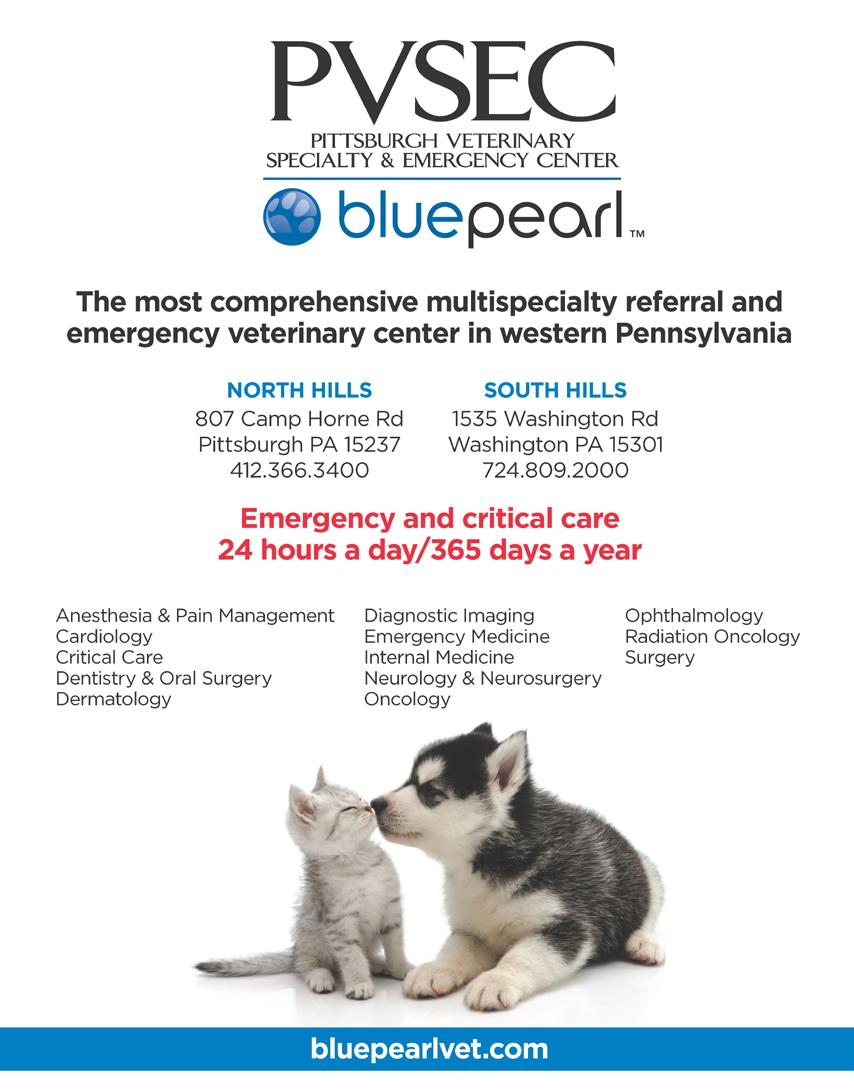
Greater Pittsburgh Area: Pittsburgh Veterinar y Specialty and Emergency Center, Inc. 412-366-3400 | pvs-ec.com
VCA Northview Animal Hospital Specialty Referral Center 412-364-5353 | vcanorthview.com East:
AVETS - Allegheny Veterinar y Emergency Trauma & Specialty 412-373-4200 | avets.com
Veterinar y Technolog y Schools
Greater Pittsburgh Area: Pittsburgh Career Institute 412-281-2600 | pci.edu
Kitty Korner
Cat Resource Guide
Low-cost spay/neuter and animal services in and around Allegheny County
This is an ever-changing list of resources for pet owners in Pittsburgh and beyond including low-cost spay and neuter programs for pets as well as TNR for community cats, after-hours emergency care, help with veterinary bills, pet-friendly rentals in Pittsburgh and across the US and links to shelters for adoption and other services. This information is provided for reference only and subject to change without notice. Please contact the organization or agency before using their services.
TNR and Low-cost Spay and Neuter Organizations and Programs
Homeless Cat Management Team
http://www.homelesscat.org
City of Pittsburgh Free Spay and Neuter for City Residents
City of Pittsburgh offers five free spays/neuters to all city residents www.pittsburghpa.gov/animalcontrol/spay_neuter.htm
Low-Cost Spay/Neuter Programs at Shelters in Allegheny and surrounding counties Shelter Programs
PENNSYLVANIA
Animal Friends
www.thingkingoutsidethecage.org
Humane Animal Rescue
Please call each branch while the two shelters continue their merger.
East Liberty Shelter (formerly Animal Rescue League)
http://www.animalrescue.org/ North Shore Shelter (formerly Western Pennsylvania Humane Society) www.wpahumane.org
Clarion Paws
Serves Clarion, Forest and Jefferson County
Low Cost Spay / Neuter Clinic: spayneuterclinic@clarionpaws.org
Trap-Neuter-Return: tnr@clarionpaws.org http://www.clarionpaws.org/
PET & OUTDOOR OR FERAL CATS
Beaver County Humane Society
http://www.beavercountyhumanesociety.org
Butler County Humane Society
http://www.butlercountyhs.org/FelineSpayNeuter.asp Washington Area Humane Society http://washingtonpashelter.org/services/
EASTERN OHIO
Angels for Animals
http://www.angelsforanimals.org/snWhy.asp
Low-cost Spay/Neuter Organizations in Allegheny and surrounding counties
These are organizations which are not day-to-day clinics but organize, host, sponsor or otherwise provide access to spay and neuter services.
Catnip Acres (Greene County) http://www.catnip-acres.org/clinics.html
Fluffy Jean Fund (Washington County)
http://fluffyjeanfund.weebly.com/ Fund for Feral Cats of Pittsburgh
Reimburses partial funds to help spay/neuter feral cats (funds not always available)
412-521-5352
Lawrence County Animal Relief Fund (LCARF)
http://www.lcarf.com/
Operation Spay/Neuter Butler, PA (for Butler County residents only) http://operationspayneuter.com/ Pet Search
http://www.petsearchpa.org/
SNIPP: Spay and Neuter Indiana PA Pets
Westmoreland/Indiana Counties, Alle-Kiski Valley (Leechburg)
http://www.snippindianapa.org/
Low-cost Spay/Neuter and Veterinary Clinics
These are independent clinics that offer services on site during regular business hours.
Fix ‘Ur Pet
http://fixurpet.org/
Frankie’s Friends
http://www.FrankiesFriendsCatRescue.org/ Penn Hills Spay/Neuter Clinic
http://www.spayaz.com/Pittsburgh.html
Wexford Spay/Neuter Clinic
http://www.spayaz.com/wexford-pa/
Find Local Low-cost Spay, Neuter and Veterinary Care on the Internet
Low-cost Neuter and Spay (search by zip)
http://neuterspay.org/
Love That Cat (online search)
http://www.lovethatcat.com/spayneuter.html
Spay USA
http://www.spayusa.org/search.php
Spay and Neuter Early, a Humane Alliance Campaign
http://www.whentospay.org/get-your-pet-fixed Get Your Fix.org
http://getyourfix.org/
ASPCA searchable map of low-cost clinics in US & Canada https://www.aspca.org/pet-care/general-pet-care/ low-cost-spayneuter-programs
Emergency and After-hours Care
Pittsburgh Veterinary Specialty and Emergency Center (PVSEC)
http://www.pvs-ec.com/
VCA Castle Shannon Animal Hospital
http://www.vcahospitals.com/castle-shannon
VCA Northview Animal Hospital Specialty Referral Center
http://www.vcahospitals.com/northview A-VETS http://www.avets.us/
Pet-friendly Rentals
In the Pittsburgh area, visit this list on the FosterCat website: http://www.fostercat.org/friendly.html
Nationwide (United States only) http://www.rent.com/pet-friendly-apartments
Shelters and Shelter Services
Adoption, surrender, low-cost clinics, pet food pantries, referrals, etc.
Humane Animal Rescue, North Shore (Western PA Humane Society) www.wpahumane.org
Humane Animal Rescue, East Liberty (Animal Rescue League) www.animalrescue.org
Animal Friends (AFI) www.thinkingoutsidethecage.org
Animal Advocates animaladvocates.net
Washington Area Humane Society www.washingtonpashelter.org
Butler County Humane Society www.butlercountyhs.org
Beaver County Humane Society www.beavercountyhumanesociety.org
Animal Cruelty Laws by State (United States) Animal Legal & Historical Center www.animallaw.info/articles/armpstatecruelty.htm
Cat Rescue Resouce















Rescue & Shelter
THE DOG STOP SET TO TRAVEL TO SOUTH KOREA TO RESCUE DOGS FROM LOCAL DOG MEAT MARKET
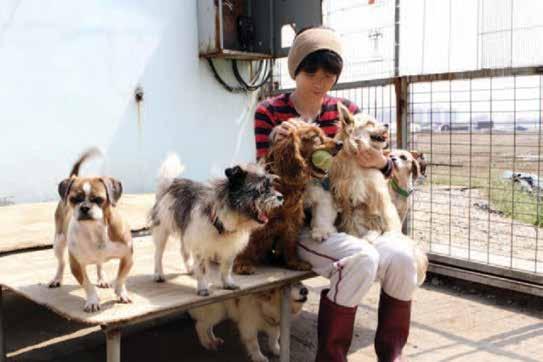
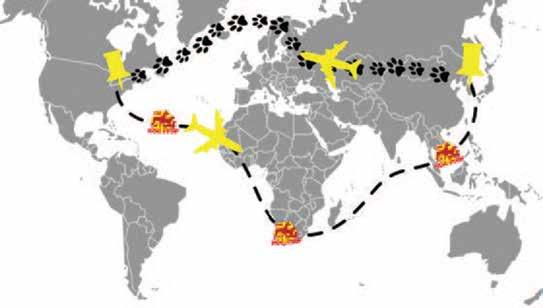
According to the Humane Society International, an estimated 2 million dogs are kept in facilities to be sold off for consumption each year in South Korea. JC McGreehan, owner of The Dog Stop of Monroeville and Rachel Maga, owner of Ten Four Social are set to travel to South Korea in late September with hopes of rescuing approximately six dogs from the local dog meat trade.
With connections to a South Korea rescue shelter, Save Korean Dogs, McGreehan, plans to bring back the dogs to the U.S. for adoption. Plans are underway as The Dog Stop of Monroeville partners with local shelter Pet Match Rescue, to find the perfect home as each dog will be paired with a new family before arriving to the U.S. Upon arrival each dog will be examined by a veterinary staff before meeting their new families.
“This rescue project that my team and I are working on means a lot to me – my dog is a survivor of the dog meat trade and was rescued from South Korea,” says McGreehan, “I can’t imagine my life without her, or what her life would have been like either. There is
a movement to end the sale of dog meat and more people in South Korea are getting behind it. What we’re doing is helping propel that movement forward and provide more homes for the dogs to go to.”
Prior to The Dog Stop, McGreehan, has traveled extensively to various overseas places through both his time in the military as well as his humanitarian volunteer work. His leadership and experience serving others guided his professional shift to provide the best experience for his community and their four-legged companions.
“The Dog Stop understands that dogs are not just pets – but valued members of the family. Every Dog Stop location naturally partners with at least one local animal shelter to help dogs find their forever homes whether we’re fostering or hosting an adoption event,” said JC. “Every dog, regardless of where they’re from or their circumstances, deserves to have a good life and a loving home.”
The Dog Stop is an all-inclusive dog care facility that encompasses the idea of being the
“one-stop-shop” for pet owners. The dog care facility provides daycare, boarding, grooming, obedience training, in-home services, dog walking and a retail store. Founded in 2009 by friends Chris Kane and Jesse Coslov, the two set out to create a business where not only dogs would leave happy but where owners would feel 100% confident in the care their animals would receive.”
“JC and Rachel are putting a lot of work into this rescue and adoption program,” says Co-Founder Jesse Coslov. “We as business partners could not be any more excited or proud to support him. Every one of us has a dog or an immense love for them, and so to be able to connect other dog lovers with a dog in need, and vice versa giving a dog a loving home – that’s the best part about this project.”
In the U.S. it is legal to raise and sell dogs for consumption in 44 states. Florida congressman Alcee L. Hastings has sponsored bill HR1406 also known as the Dog and Cat Meat Trade Prohibition Act. This bill has received bipartisan support, and once it passes will make it illegal to raise dogs and cats for their meat and to sell cat and dog skins and meat.
“Our main goal is to bring these dogs back to America and give them hope for a new life,” says Co-Founder Chris Kane. “JC has the experience of traveling internationally and knowledge of what it entails to adopt a dog from overseas, and more specifically from the dog meat trade in South Korea. I’m confident that this will go well, and I’m excited to see how everyone’s life will change not just the dogs but the adopters as well.”
While the practice of consuming dog meat is culturally based – the movement to end the dog meat trade has grown vastly over the years as younger South Korean generations are now adopting dogs that have been raised for consumption. South Korean President Moon Jae-in has also shown his support as he recently adopted a dog saved from a dog meat facility.
WE’RE GOING ON A MISSION TO RESCUE DOGS FROM THE SOUTH KOREAN DOG MEAT TRADE
Join our efforts to educate and bring us one step closer to ending the barbarity and torture of dogs in the Korean Dog Meat Trade. See the video:
https://tinyurl.com/ DogStopGoestoKorea
ABOUT THE RESCUE
According to the Humane Society International, an estimated 2 million dogs are kept in facilities to be sold off for consumption each year in South Korea. JC McGreehan, owner of The Dog Stop® Monroeville is set to travel to South Korea in late September with hopes of rescuing approximately six dogs from the local dog meat trade.
WE CAN’T DO IT WITHOUT YOU! We are asking for your support! If you would like to learn how you or your business can support this cause, please call (412) 889-4882
HOPE FOR A NEW LIFE
We are securing homes for the rescue dogs, sending care packages to the rescue in Korea and filming a documentary to bring awareness to this horrific industry.
We are in need of very special homes, for these special dogs! If you are interested, contact us below. Please spread the word to potential adopters who have room in their hearts and homes, for the time and commitment to give these dogs the second chance they deserve.
Sponsorship opportunities start at just $250! Our primary goal is to bring these dogs back to America and give them hope for a new life. With the experience JC brings of travelling internationally, and the knowledge of what it entails to adopt a dog from overseas (more specifically from the Dog Meat Trade in South Korea), we are confident that this is just the beginning of a much larger project!
For additional information on how you can sponsor, adopt or help, please contact: Rachel Maga 412-889-4882
Rachel@tenfoursocial.com
ABOUT THE DOG STOP
Founded in 2009 and franchising since 2014, The Dog Stop is an award-winning, allinclusive indoor/outdoor dog care facility offering daycare, boarding, grooming, obedience training, in-home services, dog walking, and retail store. Today, there are 11 locations open and operating in four states, with numerous others in various stages of development across the country. For more information, visit www.thedogstop.net.




Wellness For Guardians
CLEARING YOUR MIND TO LISTEN TO YOUR PETS
By Courtney Moffatt
Animals speak to us all the time but we are not getting the messages. Why, you might ask? It is because of the constant chatter of the mind. From the moment we wake to the time that we fall asleep, our minds constantly run. Dealing with work, school, exercising, activities, child care, cooking dinner, yard work, etc. is the underlying cause of such chatter and technology does not help. Being constantly on our phones and glued to the TV, we feel the need for continuous stimulation. Even when we have a few minutes of down time, we need to entertain ourselves with our phones! It’s sad to say that so many of us don’t know how to just sit in silence. However, regular moments of silence have a healing benefit to the mind.
As many know, the best way to clear one’s mind is through meditation. Meditation has many health benefits such as reducing stress, anxiety, depression and insomnia – just to name a few. Those who have attempted meditation know its challenges. Ironically, thinking of nothing is hard! When trying to think of nothing, the thought of thinking of nothing pops in your mind – and before you know it, you are thinking of something! I always advise people to start with five minutes of meditation. After mastering five minutes of successful nothingness, then try it for ten minutes, and so on and so forth. The objective is to block thoughts as they bombard ones consciousness through tranquil persistence.
In order to connect with animals, one’s consciousness must truly become awoken through the use of all senses, including the sixth, being intuition. Really pay attention to all senses, sharpen them like never before and analyze the data. Before being are around pets, assess yourself. How do you feel mentally, physically, emotionally and spiritually? Then, when being around your pet, assess how you feel again. Any different feelings you get – good or bad – will determine what your pet is feeling. For example, if you have pain in your right knee, take note of it. Then, if you felt pain in your right knee, an upset stomach and a racing heartbeat around your pet, you can discern your pain from your pet’s sickness and anxiety.
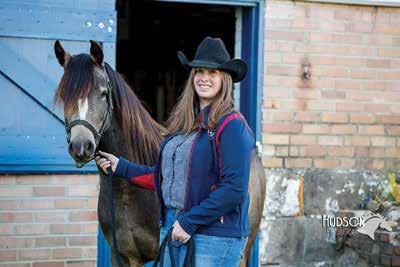
Keep in mind that some animals communicate better than others. In some respects, they are like people. Some are more outgoing with lots of things to say, while others are more quiet and reserved or even shy. With quieter pets, one may have a harder time getting messages from them. Understanding them may require more work.
If you have read my article in the last issue of PetCon Magazine, you might have learned that animals see things by the mental pictures we send to them. Whatever we are speaking, listening to or reading about, it plays out like a movie in our minds. For example, if I imagine my horse running full speed, on a hot summer’s day, through the pasture to plunge into a pond’s cool water, your mind’s eye immediately paints that image as you read. And if your awareness is open, you can feel this by using all of your senses; not just imagery. This is the path of telepathy. Telepathy is remotely sending thoughts, images and emotions. It’s one of the oldest forms of communication. Anyone can be telepathic. You just need to learn how to practice it. Since creation, animals have been masters of telepathy.
One way animals use telepathy is by knowing when their owners are coming home. They check in on us throughout the day, wanting to know what we are doing so they know when to expect us to come home. There are so many animals out there that do this; not just dogs.
Some people might argue that they only know when their owners are coming home because they can hear their vehicle or maybe because their owner routinely comes home at the same time every day. Others say that there is something that is done right before they come home, such as someone starting to cook
supper. All of that could be true, no doubt. But that doesn’t explain all the times when it’s not routine and when they don’t hear that vehicle.
Biologist Rupert Sheldrake from Cambridge University did an experiment on this. He had a large group of dogs that were well known for knowing when their owners were coming home. Wanting to rule out routine and hearing the vehicle, he had the owners come home at all different times though out the day and into the evening. He also had them come home either in their own vehicle or someone else gave them a ride. Sometimes they rode a bicycle or they walked home. Sheldrake mixed it up as much as he could and did the experiment over and over again with the dogs. The results were amazing because those dogs still knew when their owners were coming home! This proved that they were tuning into their owners and seeing what the owners were doing when they were not around their dogs.
Once the mind is able to become less cluttered and more open to receiving information, awareness will increase. This will not only benefit in communicating with animals, but in all aspects of life. Intuition will become stronger and the confidence in trusting it will intensify. Also, the health benefits are well worth it. Too often we turn to easy solutions, but an easy solution is not always the best solution. Getting in the right state of mind and sharpening the awareness will not happen overnight, but given enough time and daily practice, success will come. We owe it to our animals to listen to them, because they are always talking to us!
I would love to hear from you! E-mail me at courtneymoffatt81@gmail.com or you may visit my website to find out more information about animal communication. www. courtneymoffattanimalcommunicator.com




Is your Horse Forward with Relaxation and Rhythm or Rushing and Quick?
By Kristin Hermann
If your horse is moving forward, that is an indication of the horse using his back or whole top line. You can tell if the horse is using its back or moving forward if the horse is tracking up. Tracking up, or covering ground, means the horse is tak-ing a full stride and using its back.
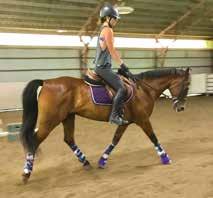
Often when I am judging or training, I say that the horse that needs to cover more ground because it is not tracking up. I don’t like to use the word “forward” because riders misunderstand and often allow the horse to rush or get quick which is moving forward in a bad way. But how does a rider know the difference between rushing which is bad and a horse moving nicely forward?
Tracking up (or a ground covering stride) is what we want as riders in order to know the horse is using its back. We want the horse to use its back in order to lift the rider’s seat and not concave under the weight of the rider. In order for the horse to effectively carry the rider and keep the back lifted, its stride needs to be long or using its full range of motion. Certainly, we don’t want our horse to have an upside down back and a choppy short stride.
As “dressage” riders, we hear all the time that our horses should be more for-ward, but the word isn’t even on the USDF Training Scale. The training scale con-sists of Rhythm, Relaxation, Contact, Straightness, Impulsion and then Collection. At my school of training at Coventry Equestrian Center, we focus on relaxation and rhythm and then contact just like the USDF training scale suggests. Once the horse has these basics in both directions, we then practice keeping these qualities on straight lines and then splice in impulsion when the time is right.
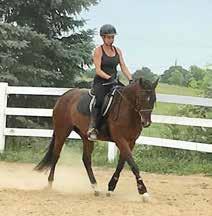
If a horse is not going forward enough, then it is apparently not using its back. We need to ask for more forward and ground covering stride, but rhythm and relaxation should never be compromised. If the rider puts “forward” at the beginning of the training scale without prioritizing relaxation
or rhythm, then they will likely get rushing, and the horse will appear to be out of balance and too quick.
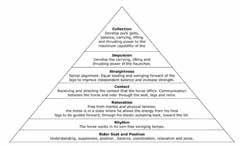
America is the melting pot of riders from around the world, and all the dif-ferent philosophies of training horses can become confusing When you take a dressage lesson, you should know about the trainers’ background. For instance, does the trainer come from a German background where most of the training was done on horses that pulled cannons (Hanoverians)? Or is your trainer from the French tradition where most of the horses were mostly Thoroughbreds? Or, is your trainer of the Spanish tradition where the horses are mostly Baroque? Each one of these riding styles has a different approach to training because of the breed of horse they were trained on. The German horses that were heavier (except for the lighter Trakehner type that the Germans used for the pony express) need-ed to go forward. The French thoroughbreds that are already forward needed to work on patience and waiting because they already were forward. The Baroque style horse was typically trained to collect because these types of horses are built for collection and not so much for forward.
The United States Dressage Federation (USDF) has adopted the German method of training, and of course, we all want our horses forward, ground covering and tracking up from behind no matter what breed. We should only ride with trainers that understand each horse needs to be trained differently, not just shouting commands that they heard from someone else. An educated trainer will know when a horse needs to go “forward” or needs to wait, however, all horses need to move with relaxation and rhythm to progress with the training.
Forward does not mean rushing around which typically makes the horse too quick and on the forehand. Out of balanced horses that are rushing forward are not relaxed, and the rider barley has control. No fun! A rider can always ask for more length of stride as long as the three basics of the USDF Training Scale, rhythm, relaxation and contact are not compromised.
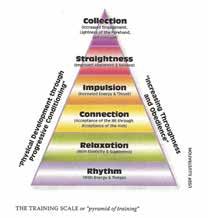
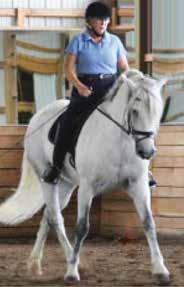






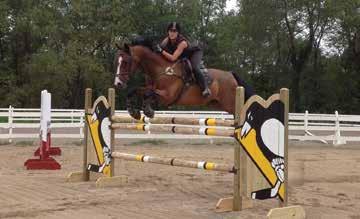





























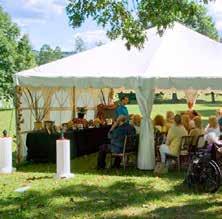
A Remembrance You Can Cuddle Remembrance
By Bernadette Kazmarski
“Your pet is special to you and your family. With this one-of-a-kind bond often comes a family’s desire to memorialize their pet in a special way and CCPC strives to fulfill that request,” said Deb Chebatoris, owner of Chartiers Custom Pet Cremation.
“Listening to you and your family tell me what made your pet special gives me the opportunity to create a one-of-a-kind memorial,” she continued. “Chartiers Custom Pet Cremation is here to see that you have choices so that what you keep in your home brings you comfort and peace.”
As an example of the many unique presentations that Deb has created, the picture shows a white monkey, the pet’s favorite toy, hugging the turquoise bag that contains the pet’s cremains. Another family provided their pet’s favorite brown plaid blanket. His favorite toy, a tan monkey, was made to snuggle the bag (made from his blanket) forever. Still another family
requested to have their beloved pet’s cremains interred inside his favorite toy teddy bear. Perched in a peaceful spot, he will forever be near to hug and snuggle with a small snippet of his fur to see.
The level of care given to your pet as well as your family sets CCPC apart. From personally receiving your pet from your home or your vet to the handmade fabric bag made as the vessel for return of your pet’s cremains, every cremation done by Deb at her facility in Bridgeville reflects the personal attention to detail that is the hallmark of her service.
Deb’s been providing individualized comfort and support to her families all over Western Pennsylvania for over 12 years. She also knows the importance of a remembrance ceremony for pets we’ve lost. That’s one of the reasons she hosts the Pet Memorial Sunday ceremony each September.
Pet Memorial Sunday Remembrance Ceremony
The second Sunday of September was set aside as a time to remember our pets by the International Association of Pet Cemeteries and Crematories. Deb has hosted a ceremony on Pet Memorial Sunday since 2005 for families who have lost a pet.
“Our society does not normally have a ritual to help families transition through the loss of a pet. This event is an effort to meet that need,” said Deb.
Chartiers Custom Pet Cremation will host its annual Pet Memorial Day remembrance ceremony on Sunday, September 9, 2018 from 2:00 p.m. to 3:30 p.m. at Melrose Cemetery in Bridgeville. Anyone who is dealing with grief over the loss of a pet is welcome to attend.
As part of the ceremony three speakers will discuss our relationships with our pets both before and after their death. Topics addressed by the speakers include “Our Last Moments Together”, “Our Grief Response” and “The Joy of Pets: Pet Parenting After Loss”.
Families can add their part to the ceremony
Pet owners in attendance are also invited to offer their own “Words of Tribute” which are read by the speakers as part of the ceremony. The tributes offer a glimpse of what was so very special about their departed pet.
Families are also encouraged to bring a photo or memento of their pet to be displayed during the ceremony.
After the tributes are read, each participant is given a lit candle and is encouraged to join in a Release Recitation focusing on the transition from being in this life to being a treasured memory.

The
dove release
One of the most touching parts of the ceremony is the dove release. To symbolize letting go, a single white dove is offered to each person to touch. Each touch is a final goodbye, a transfer of the family member’s grief and a release of the soul of their beloved pet as the dove rises to the sky.
A permanent remembrance
After the ceremony, pet owners who wish to participate may submit their pet’s photo and tribute which, along with photos and remarks from that year’s event, are made into a video/slideshow, called the “Tribute Scroll”. The Tribute Scroll is added to the CCPC website for families who wish to remember the day and share it with family and friends. Tribute Scrolls from 2010 to 2017 can be viewed at www.ccpc.ws/tribute-scroll/.
Please RSVP
Since the gathering will be held under a tent in the cemetery (rain or shine) it is important that family members who want to attend call to RSVP so that adequate seating can be prepared. Light refreshments are served afterward as participants are invited to share the companionship and experiences of other families who are deeply grieving the loss of their pet. Kindly call Deb to RSVP by Friday, September 7 at 412-220-7800
For more information, please visit www.ccpc.ws/pet-memorial-sunday Also, in order to provide a peaceful environment for all, it is not appropriate to bring live pets to this event.
To read about past Pet Memorial Sunday events, visit the CCPC’s blog “Animus” and read “Pet Memorial Sunday 2011”.

TheGarden of Faithful Friend