

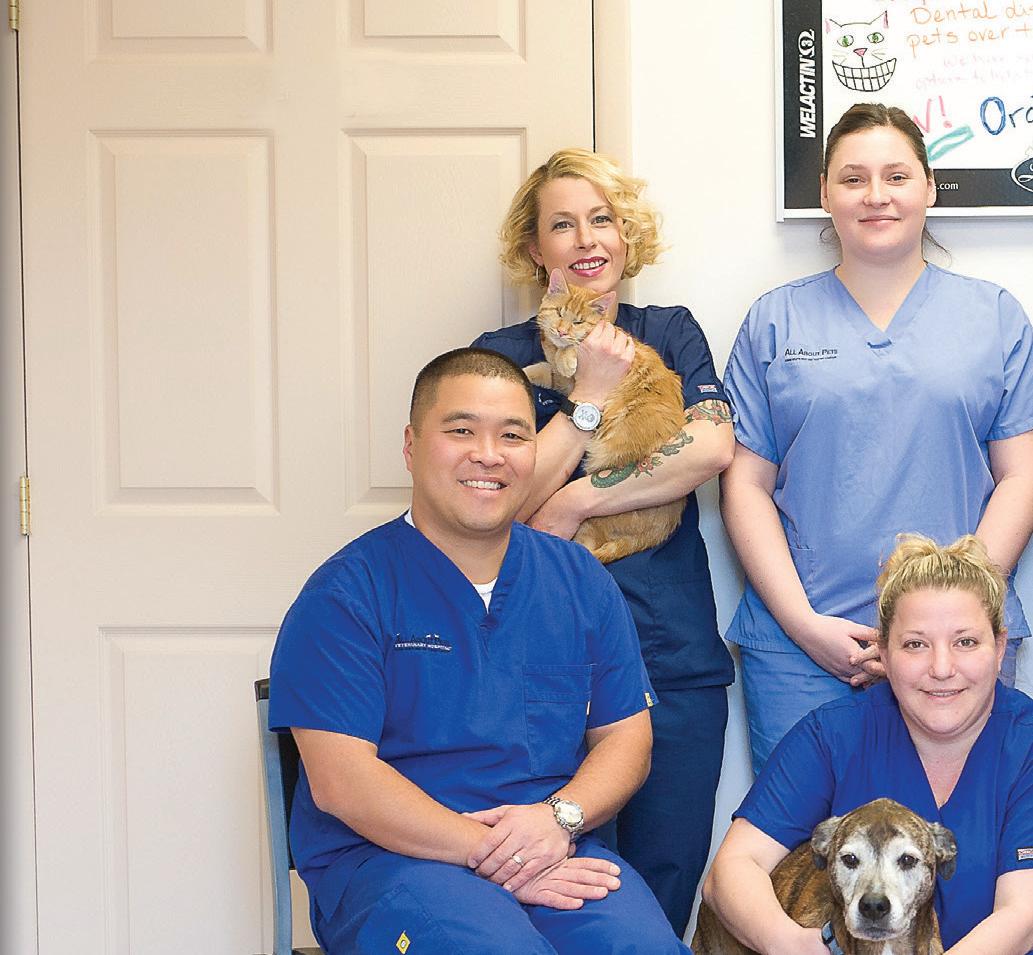
We hope that with each visit you and your pet feel like part of our hospital family.
Free exam includes:
•Status check on weight, nutrition and general health
•Dental check
•Vaccination overview
•Complete wellness services: vaccines, annual exams, etc.
•Emergency and critical care services
•Dentistry & surgery
•Therapeutic laser therapy
•Endoscopy and ultrasonography
•Over 70 years of trusted, compassionate care

MON-SAT: 8:00 AM - 8:00 PM SUN: 8:00AM - 4:00 PM




















SPRING 2020 Volume 7 Issue 4
Winter 2019, Volume 7 Issue 1





Welcome to our Spring 2020 issue of Pittsburgh PetConnections
I hope you are ready for spring and milder weather for some outdoor fun this season! Our Event section includes the Pittsburgh Marathon in May, as well as learning how to help our pet in an emergency with an upcoming a Pet First Aid Certification Class and more.
Welcome to our Winter 2019 issue!
We welcome Ease Animal Massage, Buzzy Photography, and O2 Derm Pet Topical Gel to our supporting advertisers!
We are particularly excited about this year for PetConnections, as we are expanding the magazine to add content such as advertiser videos and podcasts linked to digital ads. We are also launching the PetConnections Pet Pass, a rewards program including our advertiser, reader and distribution point network! We will keep you posted on our Pittsburgh PetConnections Facebook page, when you follow us there!
Introducing our new sister publications coming out in March, Integrative Healing magazine for people (and, of course, a pet section!)
info@pghpetconnections.com
All Rights Reserved | © 2019
PITTSBURGH PETCONNECTIONS QUARTERLY Published by: Pittsburgh PetConnections, LLC.
We are also pleased to announce some fun new things that we have in the works for PetConnections!
Our quarterly newsletter will be sent in early May announcing these developments, by our new editor, Ed Moats! He will be assisting in developing new content, as he has with our Feathered Friends section. He will also be focusing on our digital platform with Podcasts and marketing. Ed is working hand in hand with contributing writers and assistant editors, April Minech, Bernadette Kazmarski for the Kitty Korner section, and all sponsor

We will be publishing pictures of your pet from winners of our new weekly social media photo contests! Also new, our membership sign-up button on our Facebook page, where you can receive news about events and contests, special discounts from our advertisers, discount event tickets, join our PetConnections Birthday Club for Pets, submit your story to be published in our Human-Animal Bond section or Remembrance, and more!
Events
Our Human-Animal Bond section features “A Home for Cesara”, a heartwarming rescue story. Jen Geibel, Director of Clinic and Community Services at Animal Friends, gives great tips for both indoor and outdoor Cats. PVSEC BluePearl veterinary emergency critical care specialist, Dr. Samuel Durkan, wrote an article that every dog owner should read on “Xylitol in Dogs”. February was Pet Dental Health Month and Dr. Doug Knueven has an informative article on how to, “Take a Bite out of Oral Disease”. Bernadette Kazmarski has additional updates for the Cat Resource Guide and wrote “Nothing Like a Good Scratch” to raise understanding on scratching behavior and cats. Declawing is becoming less accepted and many veterinary hospitals, including VCA, recently announced banning the procedure in their facilities. Ed Moats writes about the deadly danger of galvanized bird cages in our Feathered Friends section. Kristin Hermann expands on “Dressage” and gymnastic training for ALL
and
Chartiers Custom Pet Cremation’s Healing Hearts Pet Loss Grief Seminar, Animal Friends’ and CARMAA’s highlighted in our event section.
Our cover features Manon Farm’s Princess Showcase riding show! See the Equine Affairs section article April Minech! Also, a reader, Ruth Maloy-Carter submitted her heart-warming story, “Great to be Ginger”, Animal Bond section! Edward Moats continues his avian nutrition articles, with more great tips, in Also, we are revisiting Integrative Healing for Pets with Dr. Doug, in our Pet Holistic section.
PetConnections is published quarterly as follows: March, June, September, and special Holiday issue in early December! Our print copy distribution sites will be replenished every 6 weeks. Our online presence has always been much greater than in print with now over 400,000 impressions! To subscribe to your own personal copy of PetConnections, please contact us below.
Did you know? PetConnections has evolved into a full-service specialized pet media company, providing services for advertising in print and digital marketing platforms to help our sponsors grow their businesses. Contact us below for information on advertising or sponsoring!
Our rescue section features Nate’s reptile Rescue. PVSEC/BluePearl’s article about winter safety for Korner has Homeless Cat Management Team has spay and neuter info, by Bernadette Kazmarski. Equine Hermann writes about Learning from Source.
PetConnections is published quarterly as follows: Early February, May, August, and November. distribution sites will be replenished every 6 weeks. Our online presence has always been much print with now over 350,000 impressions this year. To subscribe to your own personal copy please contact us below.
Thank you for picking up this copy of PetConnections. Be well and enjoy the renewal of the spring season with your pets!
Did you know? PetConnections has evolved into a full-service specialized pet media company, services for advertising in print and digital marketing platforms to help our sponsors grow Contact us below for information on advertising or sponsoring!
Thank you for picking up this copy of PetConnections.
Warmly,
Warmly,
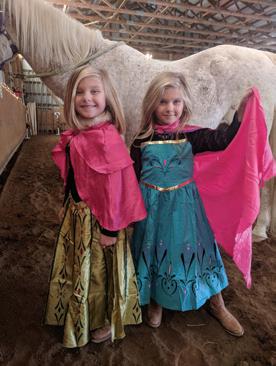
Photo By: Erica Stewart


Carla Mader Publisher
Carla Mader Publisher



Please submit any correspondence to: pghpetconnections@gmail.com
Pittsburgh | Central Ohio PetConnections Magazine
Please check us out on the web & subscribe at: www.petconnections.pet
PetCon Expos
Follow and “Like” us on Facebook! http://www.facebook.com/PghPetconnectionsMagazine
Please submit any correspondence to: info@pghpetconnections.com
Please check us out on the web & subscribe at: www.petconnections.pet
Follow PghPetMag on Twitter and “Like” us on Facebook! http://www.facebook.com/PghPetconnectionsMagazine

















Animal Friends
Bow Wow Bingo Soiree, April 13th, 2020
Pittsburgh Marathon, May 3rd, 2020
www.thinkingoutsidethecage.org
Petagogy Shadyside
Yappy Hour March 27th, 2020
Customer Appreciation PAWty June 7th, 2020 www.petagogy.com
Pittsburgh Marathon Pet Walk May 2nd, 2020
www.thepittsburghmarathon.com/petwalk
Cat Management Team and Pittsburgh C.A.T. spaghetti dinner fundraiser May 17, 2020 3:00 pm – 7:00 pm
J. Verno Studios on the South Side 3030 Jane Street, Pittsburgh, PA 15203

MEDINA, OHI0
735 West Lafayette Rd. Medina, Ohio 44256
PITTSBURGH, PA
Garden City Hall
600 Garden City Dr. Monroeville, PA 15146
May 9, 2020
Aug 22, 2020
April 5, 2020
July 19, 2020
Oct 18, 2020
Sunday, May 17, 2020 11 am – 3 pm
Munhall Borough Building 1900 West Street Pittsburgh, PA 15120
Tickets are $10 or call 412-748-1288

CCPC Sponsors Free Pet First Aid Certification Class for Pet Owners and Animal Professionals

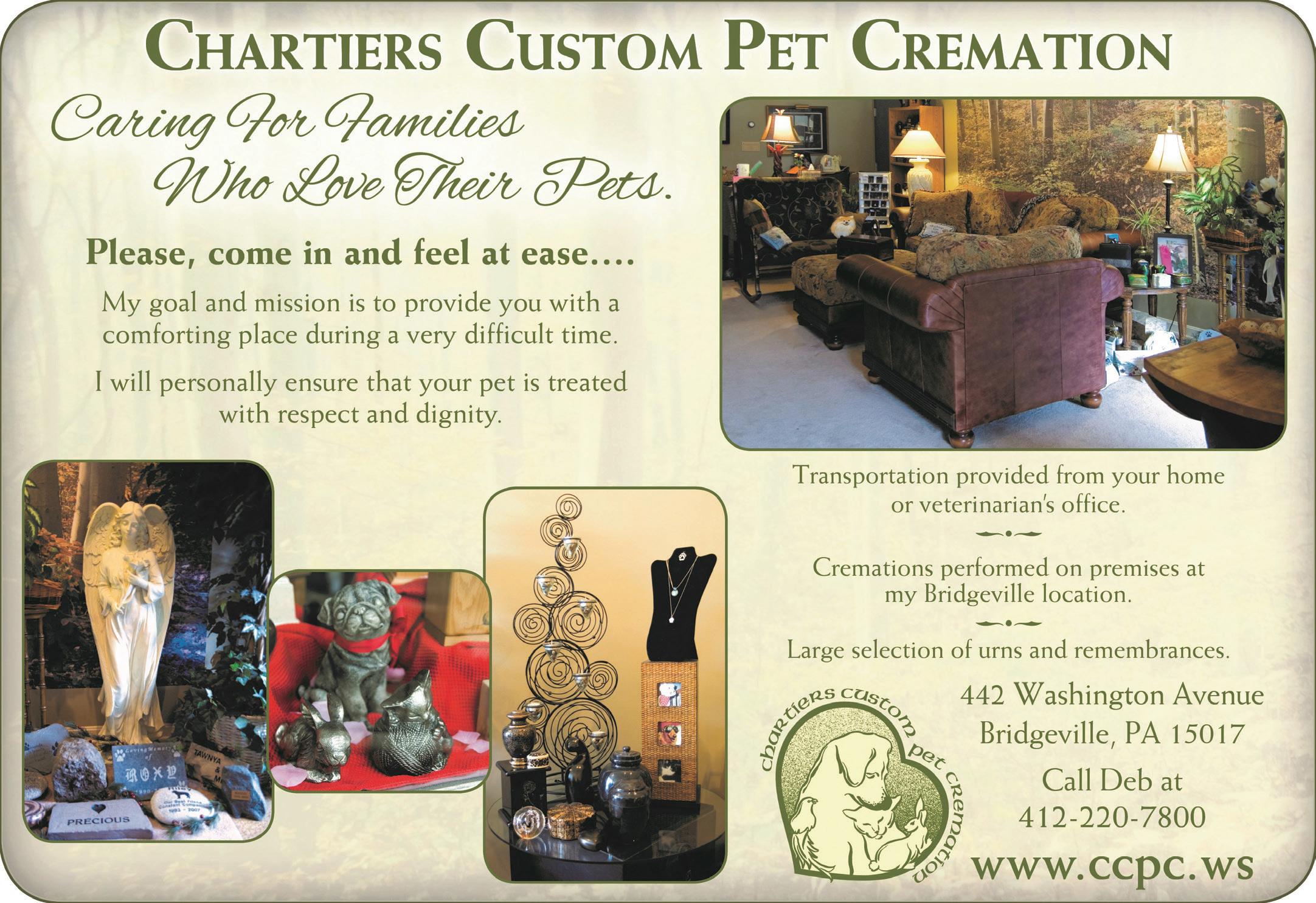
Chartiers Custom Pet Cremation (CCPC) will sponsor a FREE INTRODUCTORY PET FIRST AID CERTIFICATION CLASS ON SATURDAY, APRIL 4, 2020 AT THE BRIDGEVILLE PUBLIC LIBRARY. Participants must register before Saturday, March 28, 2020.
The Pet First Aid Certification Class is five hours long. It’s great for people who work with pets or for pet parents who desire a more in-depth and hands-on knowledge of pet first aid.
A Certificate of Training is awarded at the completion of the class. This class covers all of the topics below, and includes hands-on CPR practice:
• Snout to Tail Wellness Assessment
• Injury Assessment
• Handling & Safety
• Assessing Pet’s Vital Signs
• Bleeding
• Heatstroke and Hypothermia
• Seizures, Poisoning and Choking
• Bites & Stings
• Fractures & Limb Injuries
• Bloat
• CPR Demonstration & Rescue Breathing
• Emergency Preparedness For Your Pets and Assembling a Pet First Aid Kit
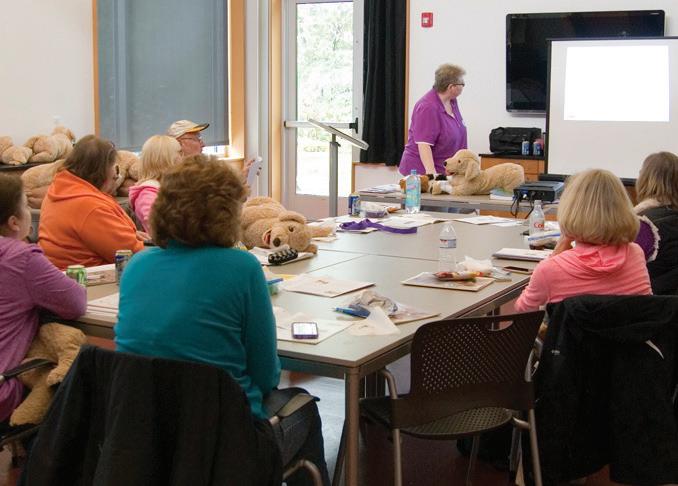
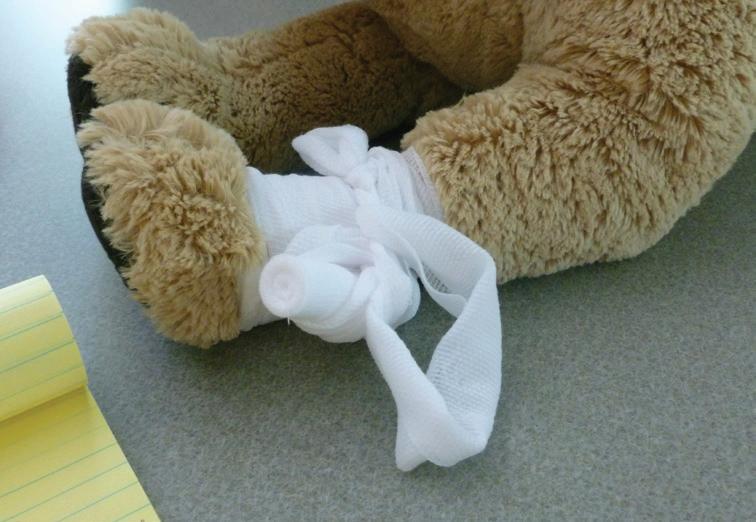
Attendees remark that they are grateful for the information and feel much more confident they’ll know what to do in an emergency, when, as instructor Karen Sable puts it, “you are your pet’s first responder.”
“I was so grateful for the opportunity to learn pet first aid so I can be better prepared as a fur parent and a cat foster mom,” said Tara Czekaj, pet owner and animal rescuer. “Karen provides terrific real life examples to help students apply their new found tools and knowledge!”
“It is difficult when we lose a pet who has lived a full and long life,” said CCPC owner, Deb Chebatoris. “But it’s a real gut punch to say goodbye when the pet is young. The grief is palpable in these situations, with families saying they had such plans for the life cut drastically short,” says Deb. “When I need to work with a family whose young, healthy pet has succumbed to an accidental death, it is a double tragedy.” Not only does the family experience the loss but there is a lingering feeling that “if only” they would have done this or that, the death may not have occurred.
Check the website at www.ccpc.ws/classes-for-you-and-your-pet/ for the full class description.
CCPC owner Deb Chebatoris has offered instructional classes since 2011, such as pet first aid and dog body language, to help people respond to pet emergencies. Even though her business is aftercare for pets and their families, “I don’t want to see any pet until its time, until it has lived the longest and best life it could have,” she said.
CCPC hosts these sessions free of charge to offer families the skills they can use to help save the life of their pet. Deb contracts with Karen Sable, a certified pet CPR and first aid instructor and owner of Pet Emergency Training LLC, to help families learn what to do in the case of a pet life threatening situation.
“If giving a pet owner the basics of pet first aid so that the skills help save the pet’s life in an emergency, that goal is met for me and I’m thrilled I could help the family and the pet continue living happily,” Deb said.
Please RSVP by Saturday, March 28, 2020 by calling Deb at 412-220-7800
A $20 reservation fee is required to hold your reservation in the class, refunded at the end of class.
The website for Pet Emergency Training, LLC is www.pghpetemergencytraining.com

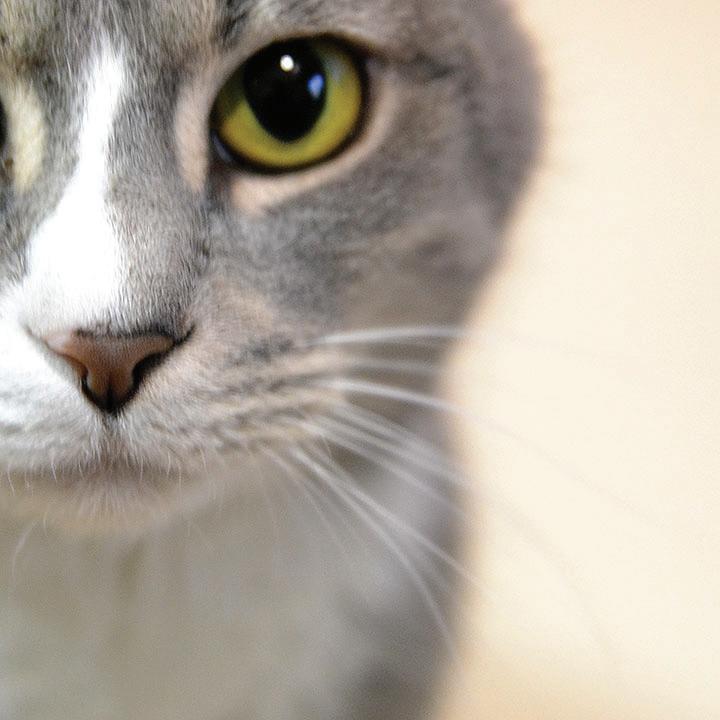
By Jenn Geibel, Animal Friends’ Director of Clinic & Community Services

At Animal Friends, we always encourage pet owners to keep their animal companions inside. Indoor pets are much safer from dangers like vehicles, getting lost, cold weather and encountering predators. They are also at a reduced risk of contracting certain viruses, diseases and other illnesses such as rabies.
At the same time, we recognize that not all cats are suited for a life indoors, making it even more critical for them to be up to date with their vaccinations. And, with overpopulation continuing to be a serious problem facing our region – especially among the feline population – spaying and neutering is more important than ever.
If you see a cat outside, it’s important to know that there are many different types of felines who spend time outdoors. Community cats (or feral cats) have spent most or all of their lives outside and usually prefer not to interact with humans. Because of this, these cats will likely never be cuddly family pets. But, many of them still rely on human caregivers to ensure they are fed, vaccinated and spayed or neutered.
Just because a cat is roaming outside, doesn’t mean they are not someone’s family pet. Although Animal Friends requires our adopters to keep their new feline family members indoors, we know that some other pets have grown accustomed to an indoor/outdoor lifestyle. Our hope is that neighbors will build relationships and keep tabs on which of these cats have homes and which ones need help.
And the Howard Ash Animal Wellness Center at Animal Friends is here to support all cats – especially those whose families are facing financial hardships. Our goal is to break down barriers of accessibility and affordability by giving pet owners access to the low-cost, high-quality services their beloved pets need.
Whether your cat enjoys a life inside or you’re a caregiver for a community cat colony, contact our Clinic Services team today to keep them happy, healthy and feeling their best.
at Animal Friends’
Howard Ash Animal Wellness Center
Spay/Neuter
Contact our Clinic Services team for more information or schedule your appointment online at ThinkingOutsideTheCage.org/SpayNeuter
We regularly host Low-Cost Vaccine Clinics to help you keep your pets healthy and safe at an affordable price. For a list of vaccines and a schedule of upcoming clinics, visit ThinkingOutsideTheCage.org/Vaccine.
Using humane box traps, we’re compassionately and humanely reducing the number of feral cats through Trap Neuter Vaccinate Return. To learn more about trap rentals and special pricing for feral cats, go to ThinkingOutsideTheCage.org/TNVR
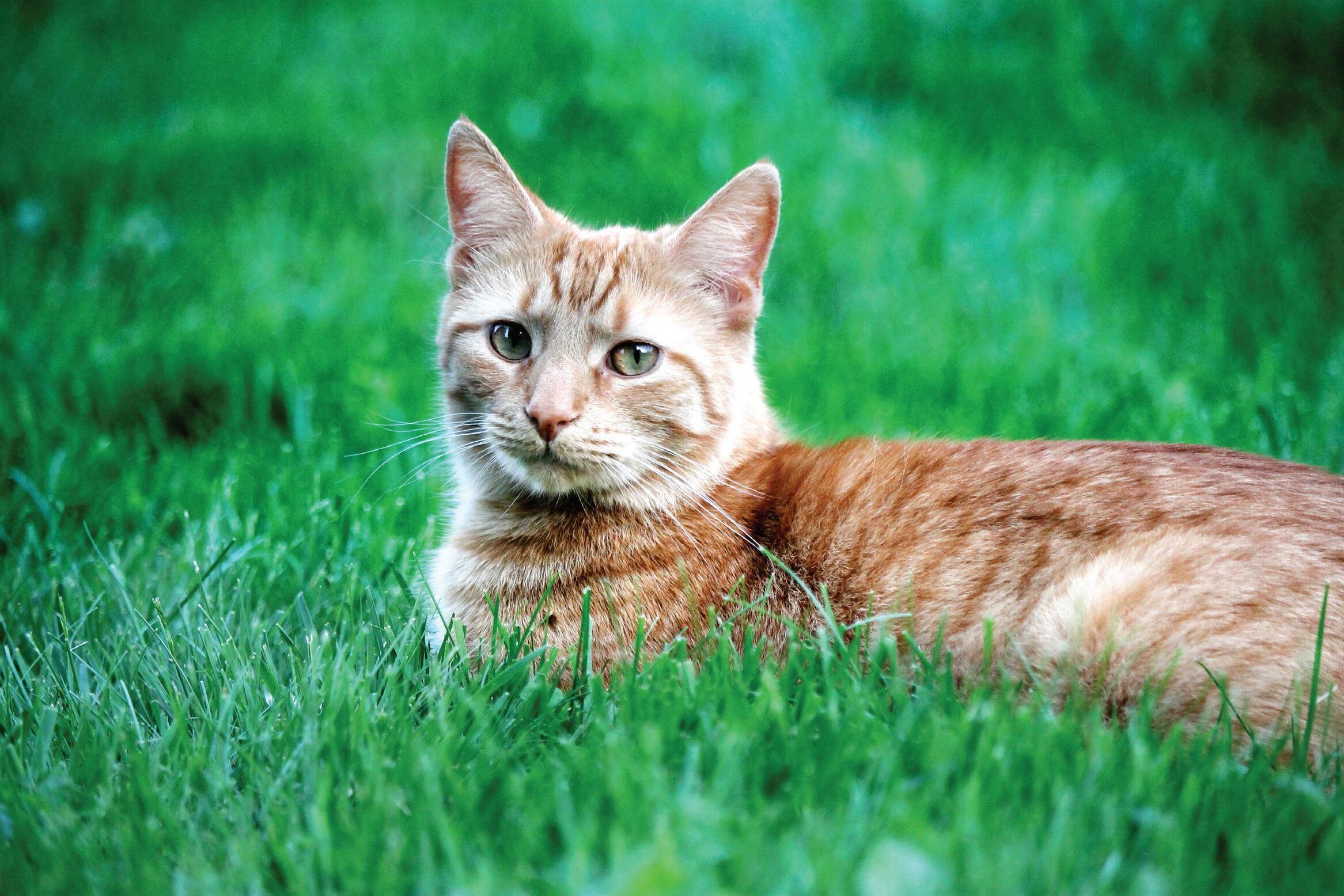
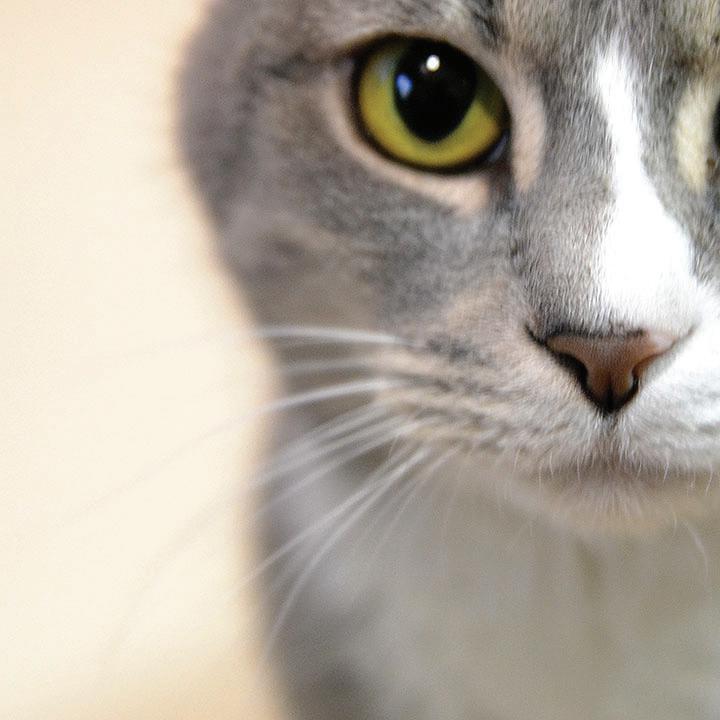

By Samuel Durkan, DVM, DACVECC, Co-medical Director at PVSEC BluePearl Pittsburgh
What is Xylitol? It is a natural sugar substitute found in gum, candy, some medications (mostly children’s), peanut butter and in bulk for baking needs. Xylitol’s popularity is based on its anti-cavity producing properties, unlike sugar for people. This is its main fondness as a sugar substitute in gum. The amount in commercially available gum varies greatly. In people it is sweet and a low calorie substitute for sugar. In our four legged friends the story is different and sometimes fatal. Sorbitol, unlike xylitol does not pose a danger to our furry friends.
Xylitol in dogs can cause clinical signs of hypoglycemia (low blood sugar), weakness, and even cardiovascular collapse. The reason it causes these clinical signs, is that xylitol is a very strong stimulator of insulin. With this surge in insulin release the patient can get mildly hypoglycemic to profoundly hypoglycemic, and even cause seizures. Consumption of levels as low as 0.1g/kg of xylitol can cause clinical signs of a low blood glucose, and levels of 0.5 g/kg can cause acute liver necrosis.
Your pet has ingested something with xylitol, now what? Call ASPCA animal poison control or the Pet Poison Helpline to find out how severe the danger is and what if any treatment is needed. In my opinion you should refrain from using hydrogen peroxide to induce vomiting, unless you are far from an emergency

clinic. Hydrogen peroxide can cause severe esophageal and gastric irritation. If the dose is deemed to be toxic, then go to an emergency clinic such as PVSEC BluePearl Pittsburgh and bring the poison control case number. Depending on the severity of ingestion, your pet may need to stay for several days. Induction of emesis (vomiting) with apomorphine may need to be performed and blood tests may be necessary. Baseline blood work including chemistry panel and blood glucose maybe helpful in determining any liver damage. If the blood glucose is low and there is evidence of liver enzyme elevation, then admission to the hospital and ICU should be strongly considered. Daily monitoring of liver values, IV fluids, and liver protectants should be part of the treatment plan. A continuous infusion of dextrose and monitoring of serial blood glucose for the first 24 hours will likely be required.
If after several days in the hospital, the blood glucose is normal off of supplementation and the liver values are not rising then the patient can likely continue to recover at home. If the liver values continue to rise and there is evidence of liver failure, such as persistent low blood glucose, coagulation abnormalities and increasing liver enzymes and icterus, then the prognosis is guarded and maybe fatal. These patients require aggressive ICU care and transfusions with blood products and plasma.
Always remember that Xylitol is in lots of foods, candies, gum, and is now available in bulk for baking needs. This substance, although benign in people can be deadly in our beloved pets. When in doubt call the Pet Poison Hotline, ASPCA poison control or your local veterinary emergency hospital. Delayed treatment can be disastrous.





•
•
•
•
•
•
•
•








By Doug Knueven, DVM, CVA, CVC, CVCH
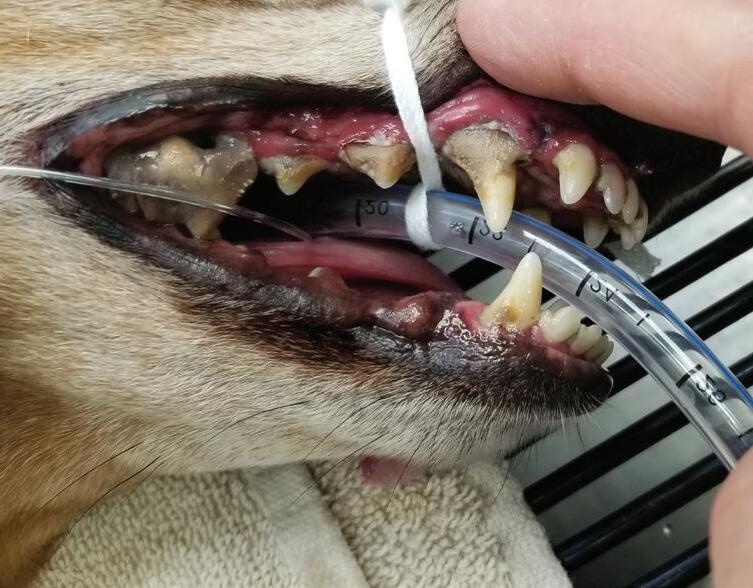
Oral disease is the most common affliction of dogs. Most dogs over the age of three years have some level of gingivitis or periodontal disease, which can lead to even more serious health concerns. Yet, most pet caregivers pay very little attention to their animal’s mouth. Sure, we notice the “dog breath,” but when was the last time you really looked at your pet’s teeth.
Go ahead right now, flip up the lip of your dog or cat and take a peek at those pearly whites way in the back. Do you see that brown stuff stuck on the teeth? (Don’t bother trying, you can’t brush it off). Maybe you can even notice that the edges of the gums are red. That means that your pet has gingivitis (infection of the gums).
The process of oral disease is insidious. Bacteria in the mouth naturally coat the surface of the teeth forming plaque. Over time the bacteria incorporate minerals and develop into thick, brown tartar. Eventually the bacteria work their way under the gum line causing gingivitis. If left untreated, the bacteria dive deeper into the tissues surrounding the tooth root resulting in periodontal disease and tooth root infections.
Once the bacteria are under the gum line they gain access to the blood, possibly leading to infection in the heart and other major organs. Research shows that periodontal disease is linked to heart disease and an increase in systemic inflammation in dogs.
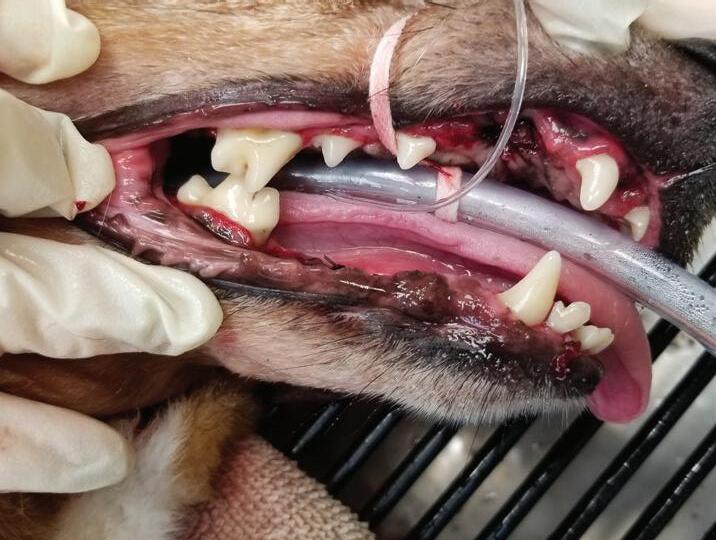
At the stage of tartar and gingivitis, the pet needs to have her teeth cleaned by a veterinarian. Because animals do not rinse and spit the way we do, dental work requires general anesthesia. Many times, extractions are needed. The whole ordeal can get expensive and is not without risk. Obviously, prevention is the best course of action.
Many pet caregivers, and even some veterinarians, believe that kibble cleans a pet’s teeth. The truth is that dry pet food does nothing to scrape the plaque and tartar off the teeth. As soon as the tips of the teeth contact the kibble, the nugget crumbles.
Thinking that chewing dry pet food cleans a pet’s teeth is like believing that chewing
on pretzels keeps our teeth clean – no brushing necessary.
Another thing to consider is that that all dry pet food is high in starch (even grainfree kibble). Since starch readily breaks down into sugar that feeds bacteria, I believe that dry pet food is a major contributor to the pet dental disease epidemic.
Raw pet food in general is low in starch so less likely to promote the growth of bad bacteria in the mouth. But I must admit that there is no substitute for mechanical scraping of the teeth to keep plaque and tartar at bay. The ancestors of our pets kept their teeth clean by chewing on bones. While some bones are dangerous for pets to chew, there are safe chew treats that can help keep a dog’s teeth cleaned.
Keep in mind that dogs and cats only chew with their premolars and molars (the teeth behind the fangs). So, even if you get your pet chomping on great dental chews, there is still a need for brushing the teeth. This is a habit that needs to be done daily to be effective. Having the groomer brush Fido’s teeth every 6 weeks is not going to help much at all. Your veterinarian will be able to recommend the proper toothbrush and paste for your pet.
Keeping your pet’s mouth healthy is one of the most important ways you can positively influence her overall health. I have seen many older animals perk up after getting their teeth cleaned and the bad ones pulled. I can tell you that Jack felt like a new dog after his dental work.

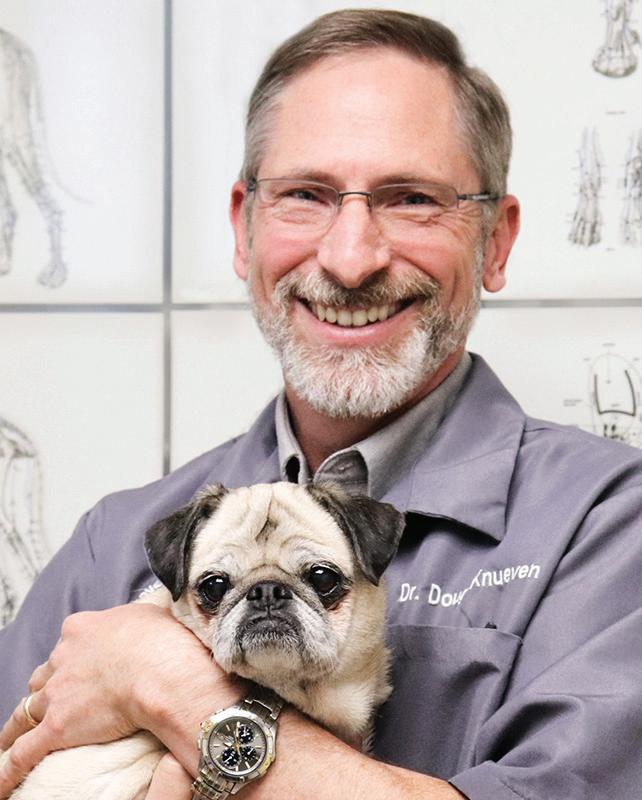
Dr. Doug has been practicing integrative veterinary medicine since 1993. He is certified in acupuncture, Chinese herbal medicine, and chiropractic. With over 30 years of veterinary experience, Dr. Doug has treated thousands of challenging cases. For complete care for your animal companion, see Dr. Doug. Call Beaver Animal Clinic today to set up a holistic exam for your pet.
Young, vibrant Golden Retriever named Bauer is diagnosed with torn knee ligaments, after just 2 visits he is “acting as if nothing had ever happened”, read what Bauer’s dad had to say about working with Animal Healing NOW:
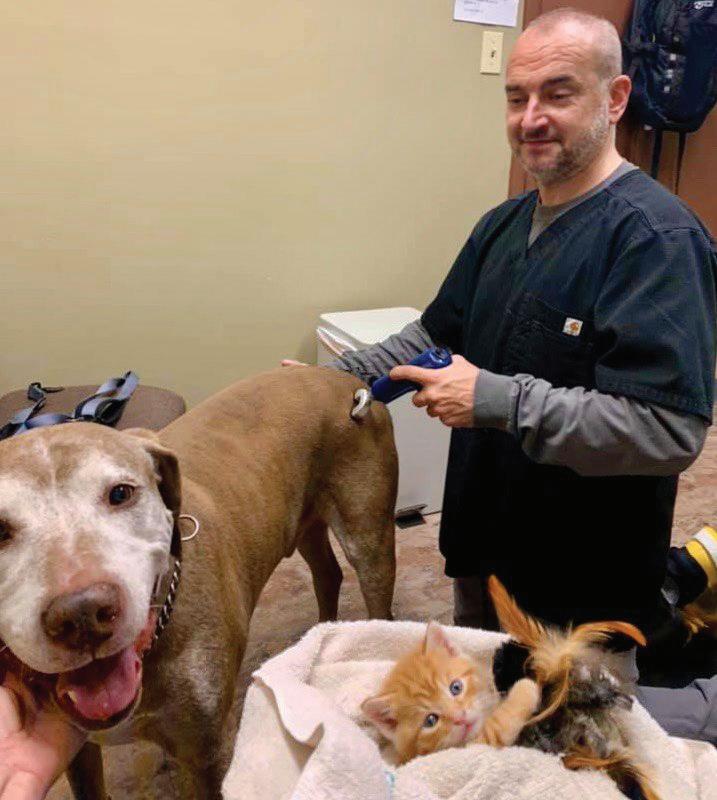
Going to see Dr. Savko was the best decision I have ever made regarding my 9 year old dog Diego. Our pup was totally immobile and the issues had been progressing for about 2 months. Let me tell you after only THREE VISITS to Animal Healing NOW, Diego was walking again! This took about three weeks. I had already spent $600 at traditional vet with no results at all or any idea of what was wrong. I did acupuncture, drugs, and laser therapy with absolutely no results. The next step was to send me to another vet for more tests (more money) but I heard about Dr. Savko and got a referral from my veterinarian to see him. Right away, we got results! Needless to say, try Animal Healing NOW
Dr. Savko is awesome! I took my Golden Retriever to him when the vets thought he tore his ACL. He was limping and not playing a whole lot. Initially the veterinarians had me thinking that expensive surgery after expensive diagnostic testing were my ONLY options for my pal to have a normal life again. If that was the way it had to be then so be it, but I thought maybe there might be a better way so I got a second opinion. I am so glad I got another opinion from a veterinarian that referred me to Dr. Savko. Right away I messaged Dr. Savko frantic about my baby and he responded immediately and was very calming. I’ve
Bring
"Dr. Savko has given my dog her life back!
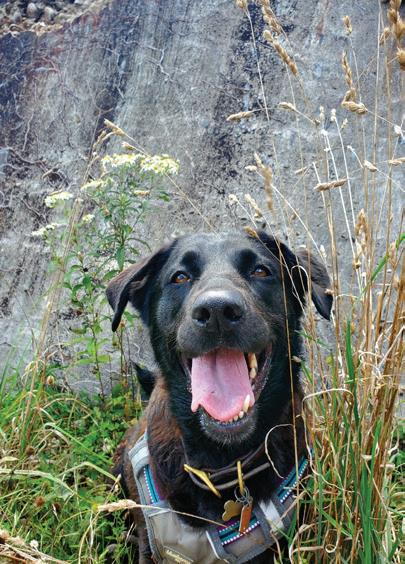
After being hit by a car, she practically couldn't use her left leg for about a year until I found Dr. Savko in a desperate attempt. Since that first visit my 90 pound lab-shep quality of life has improved drastically. She has full use of her left leg, and gets to enjoy an active lifestyle on the farm and on hiking trips. I couldn't be more grateful!! "
first it is non invasive and most importantly it works! What are you waiting for?
since been seeing him for about 8 weeks now and after just 2 visits, Bauer was acting as nothing ever happened and playing with his puppy brother. Dr. Savko saw the progress himself and could’ve
legs having tor m

"Finally a straight shooter D r for once!!
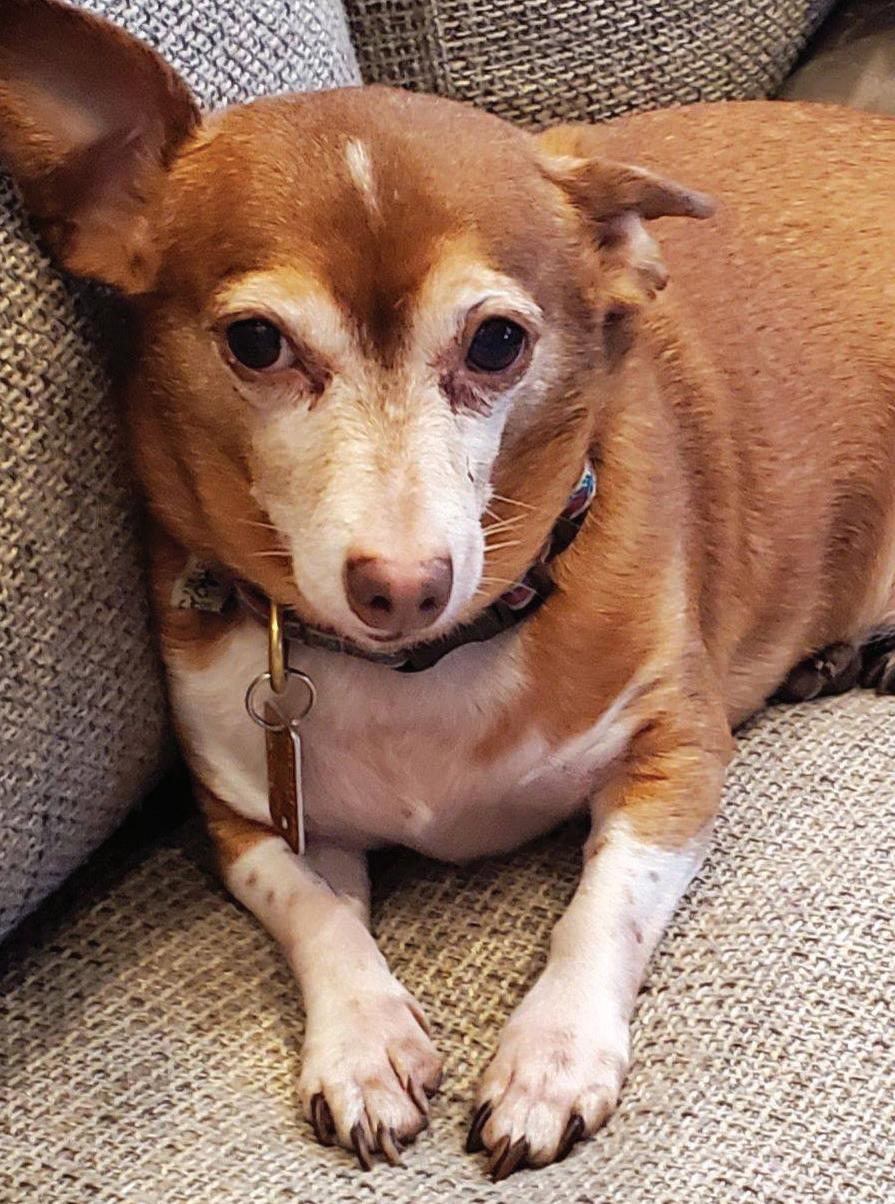
after consulting with my veterinarian, we added Dr Savko. My dog is now running a little with no pain meds and can walk up the steps on his own. He is great and I couldn’t be happier. Not everything needs surgery and my dog is living proof."






LOCATIONS: Holiday Park Animal Hospital, Plum Greenfield Veterinary Hospital, Pittsburgh New Stanton Veterinary Services, New Stanton Fox Run Equine Center, Apollo
“miracle worker”
“a very supporting and caring doctor” “wish I would have known about you sooner” “best time/money we ever spent”
“you have given us hope”
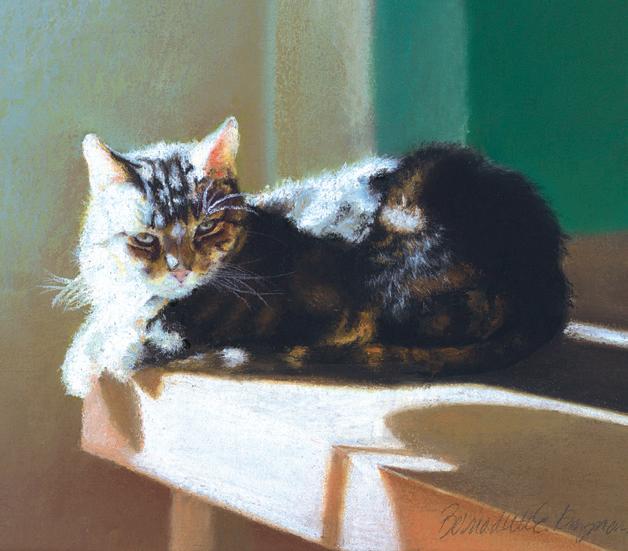
By Bernadette E. Kazmarski, artist and writer
Scratching is high on the list of destructive activities that will get a cat tossed out of the house if she’s scratching the wrong things. But she thinks they are the right things, and she has her reasons. She stubbornly returns to the thing you don’t want her to scratch, and pays no attention to the nice scratcher you went out and got for her. Why?
Cats are stubbornly attached to their biological beginnings. They are both predator and prey, and recognize their part in their community of living things, even though they now live indoors with us, and this, I’ve found, helps interpret a lot of cat things.
Even though we provide a safe shelter for them cats still maintain a territory. They perform regular daily activities such as how and where they eat, regular bathing, and sleeping habits and places, even play, along parameters determined by their ancestral biology. And while scratching things may seem more like play, it’s really an integral step in necessary daily activity for health and well-being.
So cats are not only going to keep scratching things, they are supposed to. You’re not going to get your cat to stop scratching the thing you don’t want her to scratch until you understand why cats in general need to scratch things, and then what your cat wants to scratch and why.
A few elements of biological behavior
Okay, we provide food and safe shelter, and we spay and neuter them so they don’t have to defend themselves, kill for dinner or fight over each other or raise kittens, but they still follow the behavior of an intact, unowned outdoor cat? Yes, their nature demands it. Here are some of the basics of what they do each day:
• ensure their safety within their territory by checking and marking items with scent and claws, and so they can eat, sleep, use the litter box and just exist without fear of a predator
• keep themselves and their environment clean to not attract predators
• exercise and practice to be ready to crouch, chase, pounce and kill in an instant whenever a potential meal presents itself
• rest an adequate amount to prepare their body for the stresses of hunting, fighting, mating and escaping danger
That’s a pretty busy daily schedule of things their instinct is telling them to do. In each of those four sets of activities we can find a reason for scratching.
• to mark a place and communicate to other creatures in their territory using both the physical marks of their claws and the scent from their paws
• to clean old layers of sheath from their claws so they are sharpest when needed
• to exercise and stretch their entire body, staying strong and limber
• to relax before resting, or warm up after resting
In multiple cat households scratching takes on a new dimension when each cat may have its own favorite scratching spot along with common spots because scratching is communication—one cat leaves a mark and scent for the next cat to find. Having a place to scratch and/or climb also helps relieve the occasional stress of close interactions with one or more other cats.
Interpreting that behavior for type and placement of scratching items
Each of the activities indicates a potentially different type of scratching: vertical, horizontal, digging claws in and possibly climbing, rubbing paw pads on a surface, warming up muscles, cleaning up. Watch your cat’s behavior in each incidence of scratching and analyze the need for scratching in that
situation, find an acceptable substitute for the item being scratched if it’s not appropriate, and convince your cat to change over to it if you need to. If you get a scratching item that doesn’t match their need to scratch in that area, or you put it somewhere else hoping they’ll use it there, you won’t really be providing a substitute, and they won’t use it.
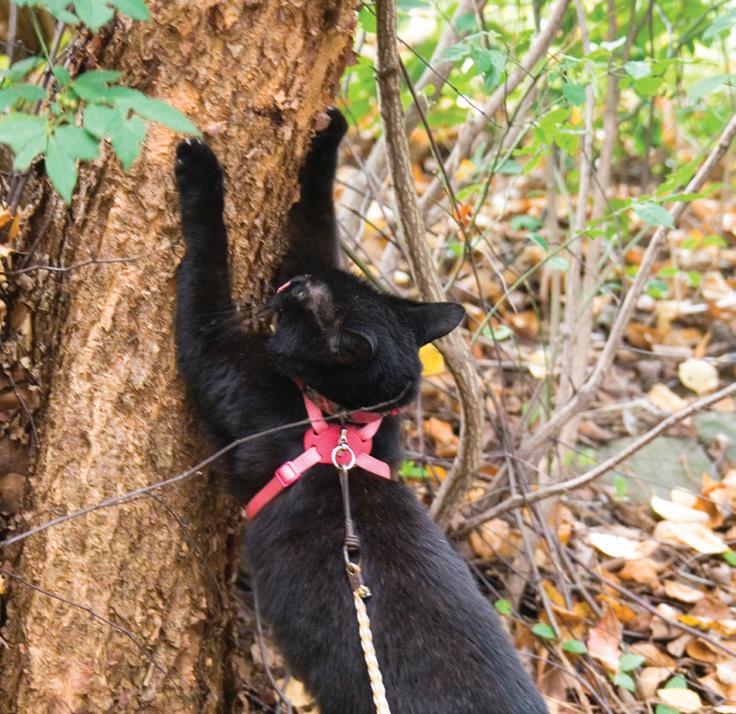
For instance, cats scratch things along a path they walk kind of like the way we mark trees along a trail—basically, the marks guide us and let others know someone else has been there, and cats add the scent from their paw pads. They can continue to see the marks, and the scent of their particular pheromone and that of other known cats comforts them with its familiarity.
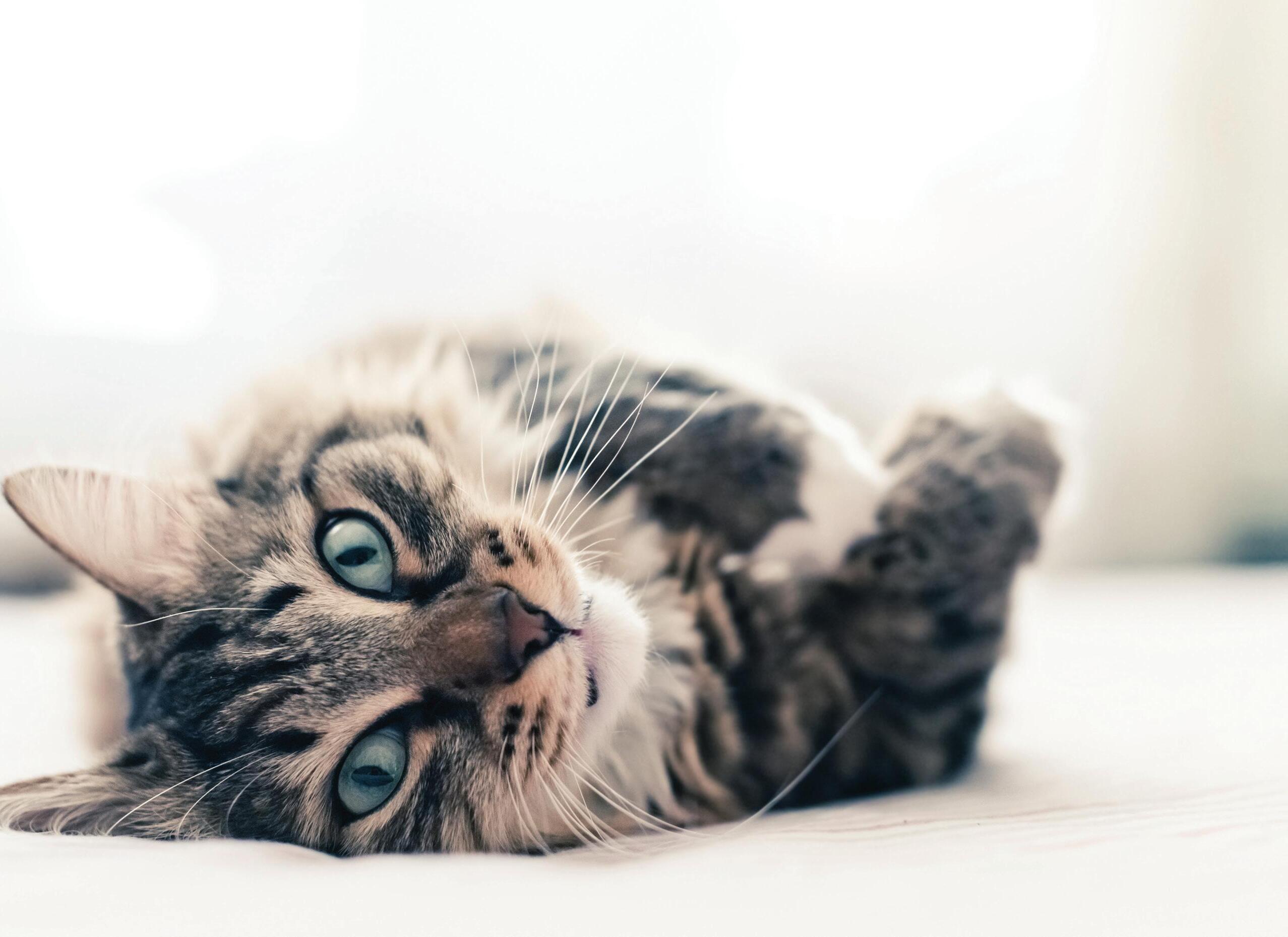
That spot may have been the arm of your couch as she walks past it along a path she regularly travels through your home. That’s a vertical scratch so get a scratcher that’s at least as high as the arm of the couch with a sturdy base and place it right where she was scratching. Cats love to scratch and climb trees, and an imitation of the rough surface of the bark is one of the things to provide in her scratcher, usually sisal rope or the edges of corrugated cardboard. You can place double-stick tape over the area where she liked to scratch so it’s less appealing and make the scratcher more appealing with catnip, toys tied to it, or interacting with her and the post so she has a positive association with it.
Later, she might dig her claws into a rug outside your bedroom door when she’s about to go in and have an afternoon nap on the bed. That’s a horizontal scratch and she’s having a good stretch to relax her back and neck and legs before she has a bath and then curls up for a nap. A flat scratcher of some sort would be good to have right in the spot where she’s been scratching, and encourage her to use it.
Your cat is going to scratch things. Understand and anticipate this, don’t punish scratching the wrong thing or react in any way that gives attention, instead reward positive behavior. Find what your cat likes and give it to her and chances are you’ll get along fine.
Resources:
Dr. Marci Koski, certified Feline Behavior and Training Professional, www. felinebehaviorsolutions.com
• Stop Scratching without Declawing
• How to Use Positive Reinforcement for Good Cat Behavior
Cats surrendered for behavioral reasons: Common Surrender Reasons (Cats), www.mspca.org/pet_resources/ common-surrender-reasons-cats
Study: Behavioral Reasons for Relinquishment of Dogs and Cats to 12 Shelters, https://www.researchgate.net/profile/Philip_Kass/ publication/45251733_Behavioral_Reasons_for_Relinquishment_of_Dogs_ and_Cats_to_12_Shelters/links/02bfe50eeeb0123565000000.pdf



Help us lower the population of homeless and abandoned cats in the Pittsburgh area and have a great meal along with great company. Join us for the 5th annual Homeless Cat Management Team and Pittsburgh C.A.T. spaghetti dinner fundraiser.
May 17, 2020, 3:00 pm – 7:00 pm
J. Verno Studios on the South Side
3030 Jane Street, Pittsburgh, PA 15203
The menu includes pasta with vegan marinara sauce, salad, roll, drink and dessert which includes vegan and gluten-free options, made and served by volunteers for HCMT and Pittsburgh C.A.T.
You can also buy tickets for a room full of incredible gifts in Chinese auction/silent auction to help raise even more support. Prizes include not only unique and sometimes handmade cat trees and toys and other goodies for your kitties but for you as well. In the past prizes have included a 4-pack of tickets to the Heinz History Center, two tickets to the Pittsburgh Symphony, four tickets to the Pittsburgh Zoo & PPG Aquarium, five free games at Arsenal Bowling Lanes, plus massages and acupuncture, hair and nail services and more.
Vendors with gifts for you and your cats will also be in attendance and donating a portion or all of sales to the organizations. And to help support us even more, before you leave you can purchase a sweet treat from our famous bake sale tables.
If you want to help HCMT and Pittsburgh C.A.T. even more or if you can’t attend and still want to help, you can donate an auction item or basket for the raffle, sponsor a table or buy an ad in the program to be distributed at the dinner. Donors and sponsors are recognized before, during
and after the dinner with signage, publicity and social networking. Over 500 people the dinner each year.
The Homeless Cat Management Team and Pittsburgh C.A.T.
HCMT is a freestanding all-volunteer organization whose mission is to reduce the population of cats living outdoors through TNR as well as providing low-cost spay/neuter to pet cats. “TNR”, or trap-neuter-return, is the process of trapping cats living in colonies outdoors for spay or neuter, then returning them to caretakers who feed and provide veterinary care for them.
Not all cats are returned to caretakers, however. An important part of the success of TNR in reducing the population of cats living on the streets is removing all friendly cats and kittens of age to socialize to be adopted. HCMT’s sister organization Pittsburgh C.A.T. was founded to foster and adopt those cats and kittens taken in from TNR efforts along with cats we rescue. These cats and kittens are spayed or neutered, vaccinated, microchipped and given all necessary veterinary care before they are adopted into a loving forever home.
HCMT spays and neuters over 1,000 cats each year at its clinics, and Pittsburgh C.A.T. fosters and adopts about 500 cats and kittens each year. That’s a lot of cats who are no longer reproducing on the streets or who no longer live on the streets, and the births of hundreds of kittens prevented each year. HCMT and Pittsburgh C.A.T. largely rely on donations and fundraisers to keep up this work.
Tickets for the dinner are $10 for adults and $5 for children 5 and under. Valet parking is available. All proceeds help our mission of providing low-cost spay and neuter services to Pittsburgh area cats and socializing and finding adoptive homes for rescued cats.
For tickets, donation and information on our clinics and low-cost spay and neuter, please visit www.homelesscat. org.
CLINIC REGISTRATION
FREE CLINICS (ferals only)
May 23 – sponsored by Spaghetti Dinner Fundraiser June 20 – sponsored by Lumpy’s Country Deli & Pie Shop
Our clinic is located at 207 Allegheny Street, Tarentum, PA 15084. At this time, we treat only cats at our clinics. You must call to register prior to any clinic.
Low-cost Spay and Neuter Organizations and Programs
TNR AND LOW-COST SPAY/NEUTER PITTSBURGH AREA
Homeless Cat Management Team
207 Allegheny St., PO Box 100203, Tarentum, PA 15084, 412-321-4060 http://www.homelesscat.org/
Feral Cats and Rescued Cats. Feral cats must arrive in a humane trap. Check the website for clinic dates. All appointments must be made by calling the phone number. No walk-ins. Ferals: $30.00 Fast Track, no-charge at free clinics. Rescued Cats: Females $55.00, Males $40.00 Both include rabies, earmite and flea treatments. Other services available.
Catnip Acres (Greene County)
155 Dark Hollow Rd, Waynesburg, PA 15370
BY PHONE: call 412-321-4060 and leave a message. Please include your name and phone number in your message. Someone will return your call and complete your pre-registration. HCMT is all volunteer and this may take some time. Clinics fill up quickly and it’s best to call at least two weeks in advance of the clinic you want to attend. BY EMAIL: Email cathomeless@gmail.com with your name, number of spots you need and which date you are registering for. You will receive a confirmation email ONLY if you are registered. NOTE: dates may be added and are subject to change.
FAST TRACK CLINICS
March 28 – in memory of James McDonald Jr. May 9– sponsored by Samantha Ginsburg March 14
https://catnip-acres.com/upcoming-events
To schedule a spay/neuter, please call 724-833-0954 and leave a message.
Fix ‘Ur Cat Spay & Neuter Clinic
Low Cost Spay Neuter Washington County, Inc., DBA Fix ‘Ur Cat 18 West Pike Street, Canonsburg, PA 1531
Call 724-405-7FIX (7349) for an appointment.
Animal Friends
$30 PER FERAL - See website for other costs
June 6
This is an ever-changing list of resources for pet owners in Pittsburgh and beyond including low-cost spay and neuter programs for pets as well as TNR for community cats, after-hours emergency care, help with veterinary bills, pet-friendly rentals in Pittsburgh and across the US and links to shelters for adoption and other services. This information is provided for reference only and subject to change without notice. Please contact the organization or agency before using their services.
Open Monday-Friday. Walk-in services for ferals.
Pet/TNR: Spay $56, Neuter $37, visit website for details and scheduling. Also offers low cost vaccinations and basic medical treatments.
https://spayaz.com/locations/pittsburgh-north-hills/
Find Local Low-cost Spay, Neuter and Veterinary Care on the Internet
Low-cost Neuter and Spay (search by zip) http://neuterspay.org/
Spay/neuter clinics are by appointment only, on Mondays, Tuesdays, and Wednesdays. Pets and TNR surgeries. Early morning drop-off; late day pickup. https://fixurcat.org/
City of Pittsburgh Free Spay and Neuter for City Residents City of Pittsburgh offers five free spays/neuters to all city residents http://www.pittsburghpa.gov/publicsafety/animal-control/spay-neuter.html
Low-Cost Spay/Neuter Programs at Shelters in Allegheny and surrounding counties SHELTER PROGRAMS
https://www.thinkingoutsidethecage.org/pet-care/spay-neuter/ Pet/friendly cats: $50 spay or neuter, includes pain medication – vaccines require are an additional fee.
Feral/Outdoor Package: $50, includes pain medication, rabies, FVRCP, ear tip and flea treatment. Cats must be feral and in a humane trap to receive this service. Humane Animal Rescue https://www.humaneanimalrescue.org/veterinarycenters/spay-neuterservices/
East End: 66209 Hamilton Ave., Pittsburgh, PA 15206, 412-661-6452 North Shore: 1101 Western Ave., Pittsburgh PA 15233, 412-321-4625 Pet/friendly cats: $70 spay/neuter, rabies, FVRCP (distemper), microchip Feral/Outdoor Package: $50, includes pain medication, rabies, FVRCP, ear tip and flea treatment. Cats must be feral and in a humane trap to receive this service.
Beaver County Humane Society 3394 Brodhead Road, Center Township, PA 15001, 724-775-5801 http://www.beavercountyhumanesociety.org Friendly or feral cats, 3 packages: $35.00/$70.00/$100.00 Visit website for more information.
Clarion Paws (Serves Clarion, Forest and Jefferson County) Mailing address: P.O. Box 804, Clarion, PA 16214 Current Location: 11348 Route 322, Shippenville, PA (Clarion River Hill, between Kronospan and Clarion Electric) http://www.clarionpaws.org/programs/spay-neuter/ Monthly clinics, submit an application and you will be called when an appointment becomes available. Pets or ferals: $65 spay, $45 neuter. Includes rabies vaccine, ear mite check and treatment and flea treatment. Optional services at an upcharge. Low Cost Spay/Neuter Clinic: spayneuterclinic@clarionpaws.org or call 814-229-1231. Trap-Neuter-Return: tnr@clarionpaws.org or call 814-229-1231 and leave a message
Butler County Humane Society 1015 Evans City Road, Renfrew, PA 16053
https://butlercountyhs.org/clinic/ Occasional clinics with mobile spay/neuter unit. Call 724-789-1150 for upcoming low-cost Pet/TNR clinics
Washington Area Humane Society 1527 Route 136, Eighty Four, PA 15330 http://washingtonpashelter.org/ Currently moving into new building.
Low-cost Spay/Neuter Organizations in Allegheny and surrounding counties (alphabetical)
Fluffy Jean Fund (Washington County) 724-941-3991
http://fluffyjeanfund.weebly.com/
Fund for Feral Cats of Pittsburgh
Reimburses partial funds to help spay/neuter feral cats (funds not always available) 412-521-5352
Lawrence County Animal Relief Fund (LCARF) PO Box 8514, New Castle, PA 16107, 724-510-4952
http://www.lcarf.com/
Operation Spay/Neuter
Butler, PA (for Butler County residents only)
http://operationspayneuter.com/
Pet Search
P.O. Box 1653, Washington, PA 15301 Call 724-228-7335 for clinic information.
http://www.petsearchpa.org/
Monthly clinics: $65 Spay/Neuter for Cats and Kittens! Includes a rabies vaccine, FVRCP vaccine, (distemper) and flea and earmite treatment. Visit website for more information.
For all surgeries call for an appointment at 724-287-SPAY (7729).
SNIPP: Spay and Neuter Indiana PA Pets Westmoreland/Indiana Counties, Alle-Kiski Valley (Leechburg) Monthly low cost clinics. Call 724-541-7205 for clinic information. http://www.snippindianapa.org/
Low-cost Spay/Neuter and Veterinary Clinics
Fix’N Wag’N
THESE ARE INDEPENDENT CLINICS THAT OFFER SERVICES ON SITE DURING REGULAR BUSINESS HOURS.
Frankie’s Friends
730 5th Avenue, New Kensington, PA 15068, 724-889-7011
http://www.frankies-friends.org/
Penn Hills Spay/Neuter Clinic
11644 Frankstown Rd, Pittsburgh, PA 15235, 412-244-1202
Open Monday-Friday. Walk-in services for ferals.
Pet/TNR: Spay $56, Neuter $37, visit website for details and scheduling. Also offers low cost vaccinations and basic medical treatments. http://www.spayaz.com/Pittsburgh.html
Love That Cat (online search) http://www.lovethatcat.com/spayneuter.html
Spay USA http://www.spayusa.org/search.php
Spay and Neuter Early, a Humane Alliance Campaign http://www.whentospay.org/get-your-pet-fixed Get Your Fix.org http://getyourfix.org/
Mobile low-cost spay/neuter and vaccination clinics scheduled in communities partnering with rescues. Visit the website for upcoming dates and places. https://fixnwagn.com/
Spay/neuter for pet/feral cats: Neuter $40, Spay $55, includes Rabies, Ear mite treatment, Flea Treatment. Also offers low cost vaccinations and basic medical treatments.
ASPCA searchable map of low-cost clinics in US & Canada https://www.aspca.org/pet-care/general-pet-care/ low-cost-spayneuter-programs
EMERGENCY AND AFTER-HOURS CARE
Pittsburgh Veterinary Specialty and Emergency Center (PVSEC) http://www.pvs-ec.com/ VCA Castle Shannon Animal Hospital http://www.vcahospitals.com/castle-shannon
VCA Northview Animal Hospital Specialty Referral Center http://www.vcahospitals.com/northview A-VETS, http://www.avets.us/ PET-FRIENDLY RENTALS
In the Pittsburgh area, visit this list on the FosterCat website: http://www.fostercat.org/friendly.html
Nationwide (United States only) http://www.rent.com/pet-friendly-apartments SHELTERS AND SHELTER SERVICES
Adoption, surrender, low-cost clinics, pet food pantries, referrals, etc.
Humane Animal Rescue, North Shore (Western PA Humane Society) www.wpahumane.org
Humane Animal Rescue, East Liberty (Animal Rescue League) www.animalrescue.org
Animal Friends (AFI), www.thinkingoutsidethecage.org
Animal Advocates, animaladvocates.net
Washington Area Humane Society, www.washingtonpashelter.org
Butler County Humane Society, www.butlercountyhs.org
ANIMAL CRUELTY LAWS BY STATE (UNITED STATES)
Animal Legal & Historical Center www.animallaw.info/articles/armpstatecruelty.htm
These are organizations which are not day-to-day clinics but organize, host, sponsor or otherwise provide access to spay and neuter services.
North Hills Spay/Neuter Clinic
3967 William Flinn Hwy, Allison Park, PA 15101, 412-213-7353
Beaver County Humane Society, www.beavercountyhumanesociety.org
ANIMAL EDUCATIONAL EXHIBITS
North:
The Pittsburgh Zoo & PPG Aquarium pittsburghzoo.org
The National Aviary nationalaviary.org
ANIMAL COMMUNICATION
Greater Pittsburgh Area: Renee Takacs, M.A., intuitguide.com
ANIMAL-RELATED ART, PHOTOGRAPHY & RETAIL
April Minech Custom Portraits | Pet Inspired Art www.ladybugdelightz.etsy.com
North:
Kim Lenz, Behind the Lenz Photography 412-983-0981, https://www.facebook.com/ Behind-the-Lenz-127787624032093/ Buzzy Photography
412-371-5212 | anita@buzzyphoto.com
South:
Kara Jones Photography, kjones.smugmug.com
Paws ‘n Claws Eyewear, PawsnClawsEyewear.com
ANIMAL RESCUE ORGANIZATIONS
North:
Animal Friends
412-847-7000 | thinkingoutsidethecage.org
Beaver County Humane Society 724-775-5801 | www.beavercountyhumanesociety.org
Pennsylvania Great Dane Rescue, 724-869-9185
Hope Haven Farm Sanctuary 412-366-1187 | hopehavenfarm.org
Western Pa Humane Society 412-321-4625 | wpahumane.org
South:
Animal Care & Welfare
412-244-1372 | animalcareandwelfare.org
Droopy’s Basset Rescue 888-9 GET DROOL | www.droopysbassetrescue.com
Washington Area Humane Society 724-222-7387 | washingtonpashelter.org
Animals Against the Odds Rescue/Rehab www.aato.rescueme.org
East:
Humane Animal Rescue
412-345-7300 | animalrescue.org
HAR Wildlife Center 412-345-7300 | animalrescue.org
SW PA Pugs with Special Needs 724-763-2790 | swpapug.org
West:
CARMAA, 412-780-4983 | carmaa-petadoption.com
Greater Pittsburgh Area: SPAAR, www.seniorpetandanimalrescue.org Guardian Angels Pug Rescue, 724-537-3466 www.facebook.com/guardianangelspugrescue
Humane Society of Greene County 724-627-9988 | greenepet.org
PEARL Parrot Rescue, www.pearlparrots.com
BIRD & SUPPLIES
Natural Inspirations Parrot Cages www.naturalinspirationsparrotcages.com
North:
AKIN Family Dog Training (Lilian Akin) 412-732-8091 | akinfdt.net
Greater Pittsburgh Area:
Happy Pets Training/Christine Flint 412-373-9583 | www.happypetstraining.com
Success Just Clicks, successjustclicks.com
North Shore:
Western PA Humane Society 412-321-4265 | wpahumane.org
South:
Paula’s Professional Dog Services, 412-818-2482
DOG TRAINING CLUBS
South:
Dogworks Training Center at The Canine Club 412-220-8100 | www.thecanineclub.com
Golden Triangle Obedience Training Club 412-653-6880 | gtotc.com
Keystone Canine Training 412-833-2211 | keystonecanine.com
Xcel Canine Training Center 412-833-2504 | xcelcaninetraining.com
EQUINE BOARDING, LESSONS & TRAINING FACILITIES
North:
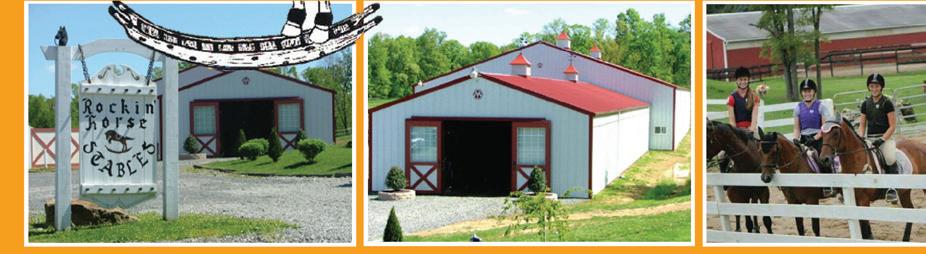
Rockin’ Horse Stables 724-601-4706 | rockinhorsestables.com
South:
Coventry Equestrian Center, 724-206-9902
Manon’s Farm, 724-705-7912 | 724-621-0260
SydMor Equestrian Center 724-969-0510 | www.sydmorstables.com
EQUINE FEED & SUPPLY
AGWAY - SOUTHERN STATES
North:
Mount Nebo Agway, Sewickley, PA | 412-364-4430
Beaver Agway, Beaver, PA | 724-775-0535
Mars Agway, Mars PA | 724-625-2340
South:
Eighty Four Agway, Eighty Four, PA | 724-222-0600
East:
Ligonier Agway, Ligonier, PA | 724-238-6207
West:
Imperial Agway, Imperial, PA | 724-695-7388
EQUINE HOLISTIC CARE
Greater Pittsburgh Area:
Dr. Michael Savko, DC, CCSP, CVCP 724-261-7915 | drchirovet.com
EQUINE TACK STORES
North:
Shady Acres Saddlery 412-963-9454 | www.shadyacressaddlery.biz
South:
Lowry’s Western Store 724-228-1225 | lowryswesternshop.com
EQUINE VETERINARIANS
Dr. Brian Burks, DVM - Fox Run Equine Center 724-727-3481 | foxrunequine.com
HOLISTIC PET PRACTITIONERS
Pet Chiropractor
North:
Dr. Doug Knueven, DVM, Beaver Animal Clinic 724-774-8047 | beaveranimalclinic.com
Greater Pittsburgh:
Dr. Michael Savko, DC, CCSP, CVCP 724-261-7915 | drchirovet.com
EASE Animal Massage 412-447-8490 | www.easeanimalmassage.com
HOLISTIC PRACTITIONERS FOR GUARDIANS
East End:
Judith Levy Wellness, Coaching/Energy Modalities 412-726-2659 | www.judithlevywellness.com
South:
Manning Chiropractic & Wellness Center 412-341-2505 | drastridmanning.com
HOLISTIC VETERINARIANS
Dr. Doug Knueven, DVM, Beaver Animal Clinic 724-774-8047 | beaveranimalclinic.com
Dr. Qiang Li VCA Castle Shannon 412-885-2500
PET BURIAL, MEMORIAL & CREMATION SERVICES
South:
Chartiers Custom Pet Cremation 412-220-7800 | ccpc.ws
Jefferson Memorial Funeral Home 412-655-4500 | jeffersonmemorial.biz
Greater Pittsburgh:
Thousand Hills Pet Crematory 724-355-8296 | www.thousandhillspetcrematory.com
PET GROOMING
North: All About Dogs 724-925-1577 | allaboutdogsgrooming.info
Happy Tailz Pet Spa 412-759-7620 | Happytailzpetspa.com
Healthy Pet Grooming 724-759-7567
Larry’s Laundromutt 412-534-4052 | Larryslaundromutt.com
South: Candelore’s Barking Beauties, 412-872-5550 Creative Canine Cuts, 724-223-9020
Grand Slam Grooming 412-221-5081 | grandslamgrooming.com
Petsburgh Dog & Cat Grooming 412-885-4027
The Pet Salon 412-279-5331 | petsalonusa.com
Woody’s Dog Wash & Pet Boutique 412-714-4644 | woodysdogbath.com
East: Animal Elegance
412-361-1177 | www.animal-elegance.com
Cat Around Town Cat Grooming 412-466-7877 (PURR) | cataroundtown.com
West:
Paws Here Awhile Pet Resort 724-573-4665 | pawshereawhile.com
Greater Pittsburgh Area:
Zoom N Groom (Sonya Patterson), 724-225-4827
PET FRIENDLY BUSINESSES & ORGANIZATIONS
Bactronix, 412-375-7886 | www.bactronix.com
Good Nature Organic Lawn Care
888-LAWNSAFER | whygoodnature.com
Simple Sugars Scrub, Simplesugarsscrub.com
Village Shoppes Scenery Hill
Elves Lair Christmas & Gifts, Jan’s Tea Shoppe - 2nd Street Coffee Roasters, Velvet Envelope, Westerwald Pottery, Two Old Crows, www.sceneryhillpa.com
Greater Pittsburgh Area:
Fragasso Financial Advisors 412-227-3200 | www.fragassoadvisors.com
Fundvelopes, 412-595-8641 | fundvelopes.com
Matt Arch Foundation, www.connectarian.com
One Hour Heating & Air Conditioning 724-225-1644 | www.onehourair.com
OxyMagic, 412-781-4110 | www.oxypgh.com
Susan G. Komen Pittsburgh 412-342-0500 | www.komenpittsburgh.org
East
Pittsburgh East Nissan 412-824-9020 | www.pittsburgheastnissan.com
Unique Home Solutions www.uniquehomesolutions.com
South:
Camp Bow Wow Highland Park 412-362-PLAY
Camp Bow Wow Pgh East 724-733 CAMP (2267)
North:
Dog stop - North 724-935-DOGS (3647) | www.thedogstop.net
The Dog Stop - Sewickley 412-766-DOGS (3647) | www.thedogstop.net
Lucky Paws Pet Resort 724-728-1484 | www.luckypawsresort.com
South:
PET SITTERS
Fuzzy Paws Pet Villa 724-746-3899 | fuzzy-paws.com
The Dog Stop - Banksville Rd. 412-343-1171 | www.thedogstop.net
East:
Pittsburgh Pet Concierge 412-856-8505 | petconcierge.org
The Dog Stop - Monroeville 412-373-3355 | www.thedogstop.net
The Dog Stop - East End 412-361-0911 | www.thedogstop.net
Grandma’s Dog Daycare 412-586-7094 | grandmasdogdaycare.com
Pampered Paw Resort 724-413-3135 | pamperedpawresort.com
North
Furry Family Pet Sitting 412-999-9524 | www.furryfamilypetsitting.com
Western PA No Boarders Pet and Animal Care
Home & Farm Sitting 724-219-7801 | Noboarders-petcare.com
South:
Pets at Home 412-655-7297 (PAWS)
East:
Southpointe Chamber, www.southpointe.net PET-FRIENDLY LIVING
Greater Pittsburgh Area:
The Getaway at Glen Highland Farm www.glenhighlandgetaway.com
South:
American Destiny Real Estate Services 412-983-2220 | www.adr-usa.com
Amore 877-716-6840 | amoreapartments.com PET GROOMING SCHOOLS
North:
South:
Christ United Methodist Church 412-277-1096 | christumc.net
Pinch Property Services 412-445-8550 | PinchPropertyServices.com
Pa Academy of Pet Grooming, 412-759-7620 PET MINISTRIES
Westminster Presbyterian Church 412-835-6630 | westminster-church.org
PET RESORTS - BOARDING, DAYCARE, GROOMING & TRAINING
Camp Bow Wow South 971 Killarney Dr Pittsburgh, PA 15234
Camp Bow Wow Southwest 412-276-WAGS (9247)
Camp Bow Wow North 412-931-WAGS (9247)
Country Lane Pet Hotel
West:
The Dog Stop - East: Strip District 412-315-7050 | www.thedogstop.net
Paws Here Awhile Pet Resort 724-573-4665 | pawshereawhile.com
Greater Pittsburgh Area:
PET RETAIL/SUPPLY
North:
Oddball Pets & Aquariums 412-884-2333 | oddballpets.com
Woody’s Dog Wash & Pet Boutique 412-714-4644 | woodysdogbath.com
East:
Petagogy, petagogy.com | 412-362-7387
Greater Pittsburgh Area:
Baskets of Nature
Dig It Collars, dig-it-store.com
Trixie’s Dog Fashions www.trixiesdogfashions.com
Your Critter Sitters (Raylene Hoover) 724-448-7330 | yourcrittersitters.com
East:
Hounds Town USA 412-232 -5085 | www.houndstownusa.com
Greater Pittsburgh Area:
724-831-9437 | www.basketsofnature.com
412-824-7991 | www.countrylanepethotel.com
Pittsburgh Pet Concierge 412-856-8505 | petconcierge.org
VETERINARY HOSPICE & MOBILE SERVICES
VETERINARY PHARMACIES
Greater Pittsburgh Area:
Murray Avenue Apothecary 412-421-4996 | MAApgh.com
VETERINARY HOSPITALS
North:
O2 Derm Pet Topical Gel, www.O2Dermpet.com
Petland East Side Village 412-363-PETS | www.petlandvillageofeastside.com
Beaver Animal Clinic
Nancy A. Ruffing, DVM 412-801-1071 | gentlejourneyvet.com
VCA Northview Animal Hospital 412-364-5353 | vcanorthview.com
South:
724-774-8047 | beaveranimalclinic.com
Cheyenne Veterinary Wellness & Surgical Center 412-884-3162 | www.cheyennevet1.com
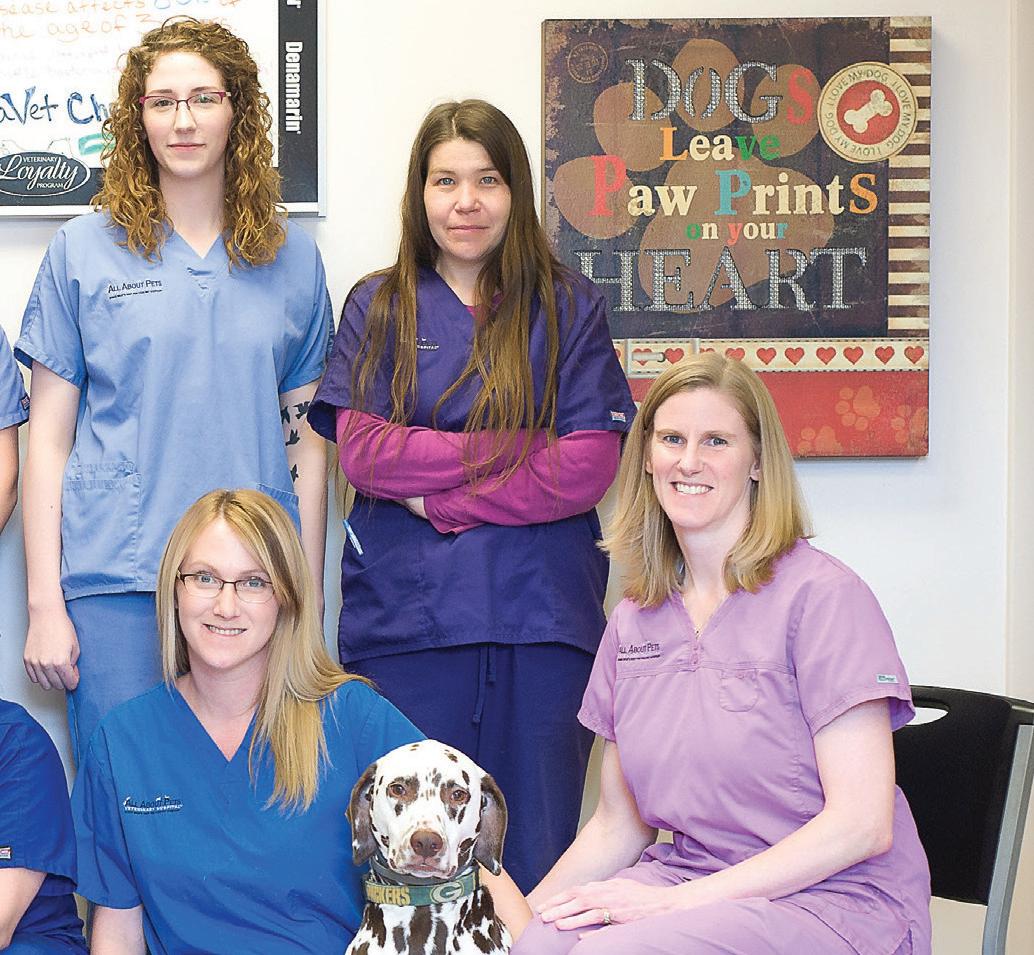
All About Pets Veterinary Hospital
724-745-5503 | aapvet.com
All About Pets Veterinary Hospital – Washington location 724-503-4887 | www.aapvet.com
VCA Castle Shannon 412-885-2500
East:
The Big Easy Animal Hospital 412-908-9301 | tbeah.com
Monroeville Pet Hospital 412-372-1100 | www.monroevillepethospital.com
VETERINARY SPECIALTY & EMERGENCY SERVICES
North/South:
Pittsburgh Veterinary Specialty and Emergency Center, Inc. 412-366-3400 | 724-809-2000 pvs-ec.com
North:
VCA Northview Animal Hospital Specialty Referral Center 412-364-5353 | vcanorthview.com
List your business today! info@pghpetconnections.com
Dressage? (Or You mean Gymnastic Training for All Horses?) From Wikipedia: Dressage; a French term, most commonly
From Wikipedia: Dressage; a French term, most commonly translated to mean “training.”
By Kristin Hermann
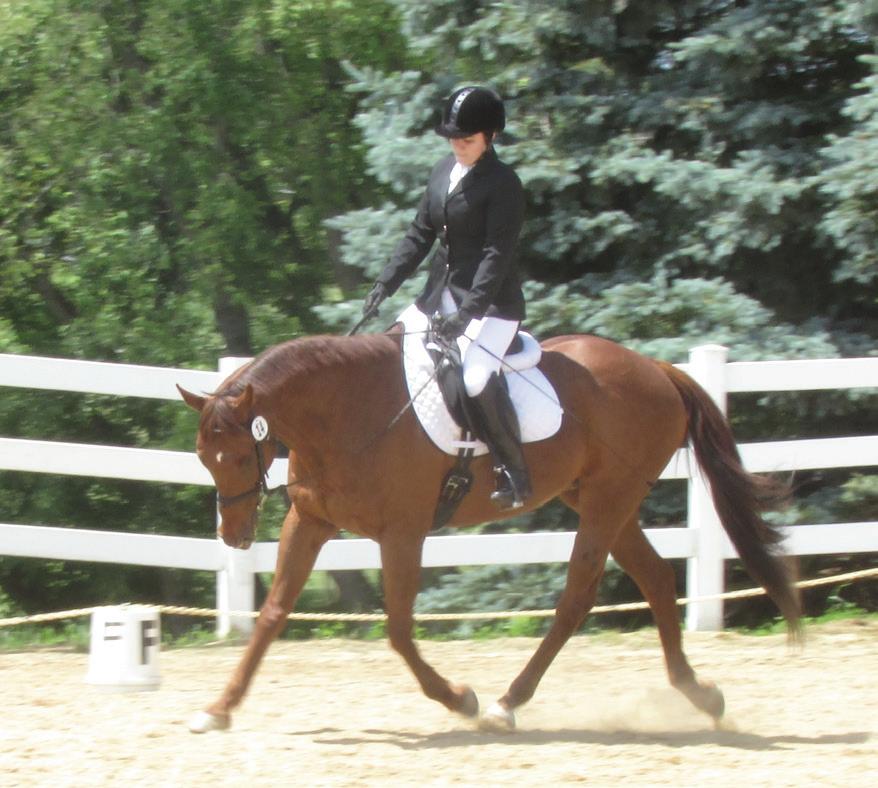
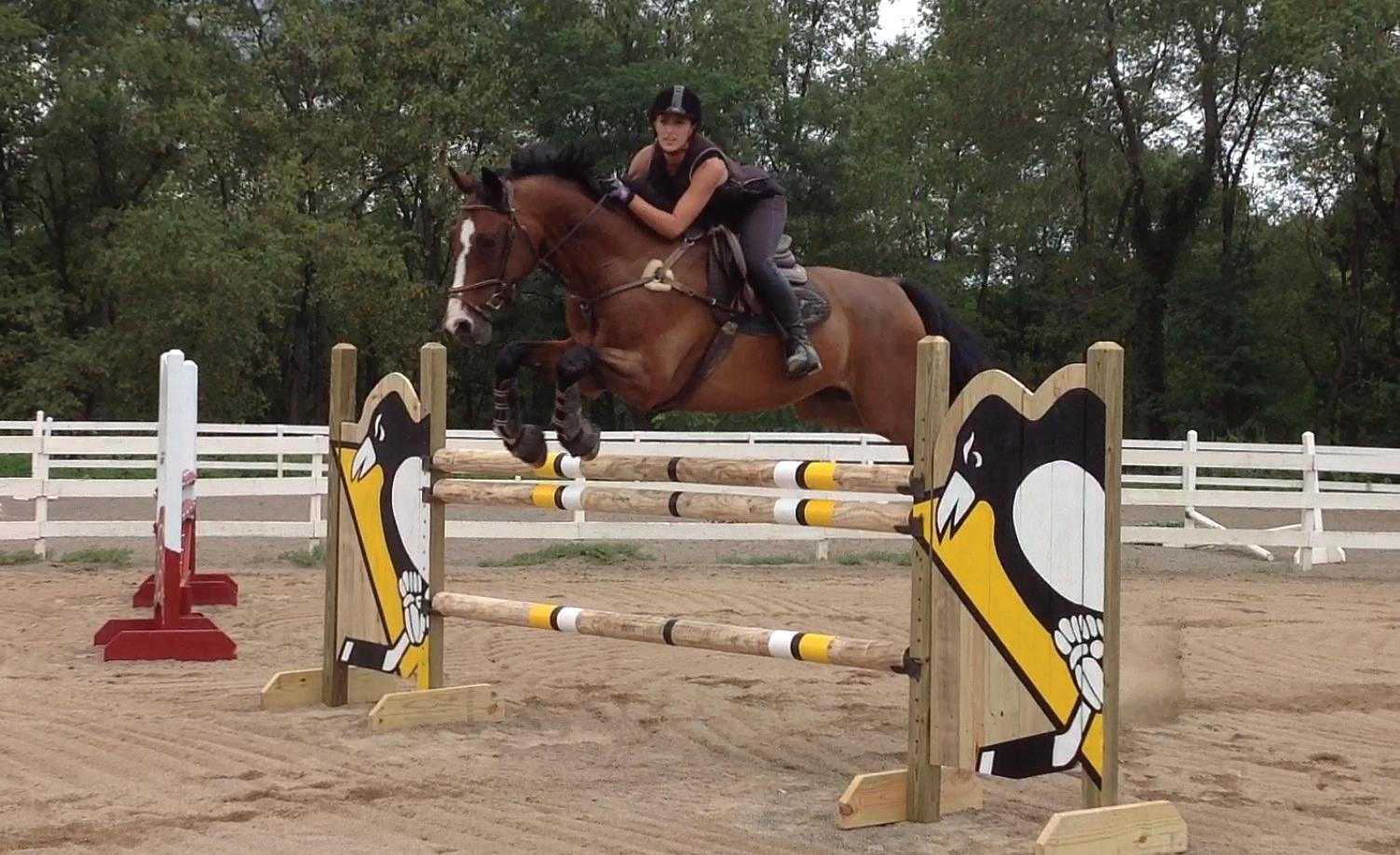
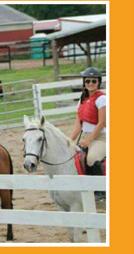
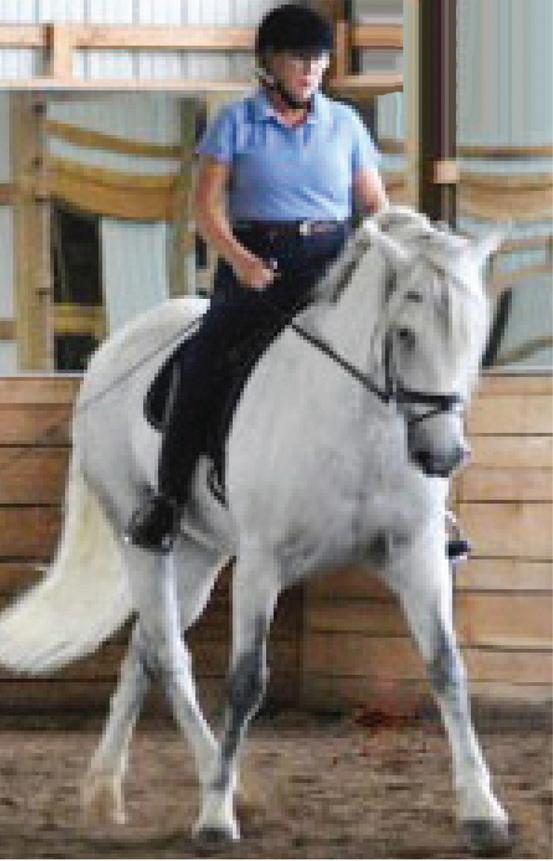
What does the word dressage mean? It means training. Training is what most of us do when we ride our horses. I am just not sure why so many riders differenciate between a horse being a dressage horse and one being a hunter? All hunter riders school flat work (or dressage) to train over fences and many dressage horses jump because it’s fun and good athletic training. However, there seems to be a divide between what riders tell their peers: I am a hunter rider, I am a dressage rider. How about, I am an equestrian!
No matter if you show over fences or if you pay a dressage judge to evaluate your training in a “dressage test” we are all just training our horses to perform the best they can with our personal riding skills as athletes.
Training level or basic training for a dressage horse is the horse being schooled at all three gaits and in both directions. Showing Training Level dressage shows the judge how well a horse has been trained in both directions and at all three gaits. This basic training should show the horse moving “unconstrained” with the rider. When the horse moves ups the levels the circles get smaller to strengthen and supple the horse as the horse improves in collecting and extending the gaits. The hunter horse is evaluated in its way of going over a fence and then the jumps get bigger as the horse moves up the levels. Certainly better flat work and precision is required between the fences as the horse moves up the hunter levels. Just as a dressage horse advancing requires more precision and refinement of training so it is with all disciplines of riding.
Event riders on the other hand, do all three events: dressage, stadium and cross country jumping. I don’t know why, but I constantly hear that the event riders don’t like dressage/training and just tolerate the test to get to the fences. (Sad face.) One of the first ingredients for training a horse is relaxation. Wouldn’t you want a relaxed ride when you ride cross country or fences in general? I remember in the day there was a term for galloping, it was called a “hand gallop.” It meant that the horse was on the aids or galloping “in hand,” or in control. Not just gone with the wind! (Hee haa, I suppose there is time for that too.)
There is no doubt that training a horse is discipline and perhaps that is the problem. We are so used to easy, “ready made things” and training a horse requires patience time and discipline. Also, learning to ride correctly reguires a lot of hard work, dedication, time and discipline. Learning how to put a horse straight - whether over a fence or down centerline and then bending it correctly in both directions requires what is called “equestrian tact” and this is developed over years and countless hours in the saddle. As I say, our horses or riders don’t come out of the Cracker Jack box already pre assembled. We have to work to put it all together.
Dressage merely means training a horse. But we can use fancy words like laterally (side to side) or longitudinally (front to back), but all horses in any discipline need to be trained on both sides and “over the back” no matter if you are merely riding on the flat or over fences.
As an equestrian who trains horses in dressage, I even fall into the trap of saying I teach “dressage” to persons who inquire about lessons. Really, I should say, I teach “equestrian tact” or better yet, I’ll teach you how to ride and then learn how to gymnasically train your horse. Then voila, … dressage! And here we go again and the cycle continues…
Want to be judged in a “dressage test,” or see how well you are schooling your horse on the flat by performing a dressage test in the comfort of your own arena? Go to www.myvirtualequestrian.net. This a program offered by a local equestrian group Three Rivers Equestrian Association.
horse being a dressage horse and one being a hunter? dressage) to train over fences and many dressage horses athletic a divide I am How about, you pay training training can with Training dressage at all Showing judge both basic “unconstrained” horse smaller as the
Square halt. Pony softly accepting contact or connection with the bit in a hunter line up. Young rider is in a nice position.
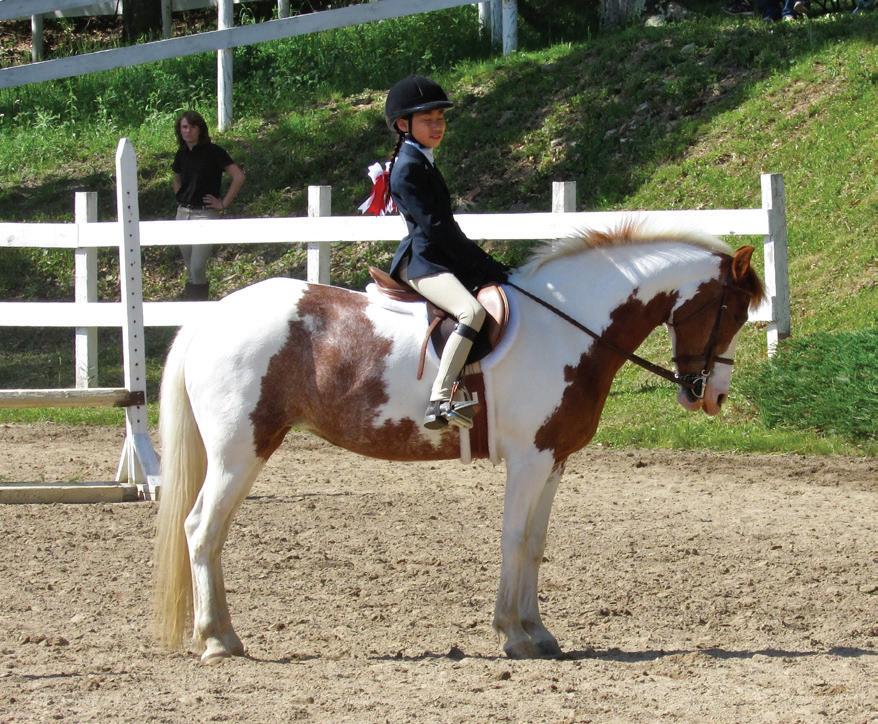
Square halt. Pony softly accepting contact or connection with the bit in a hunter line up. Young rider is in a nice position.
halt. Pony softly accepting contact or connection with the bit in a hunter line up. Young rider is in a nice position.
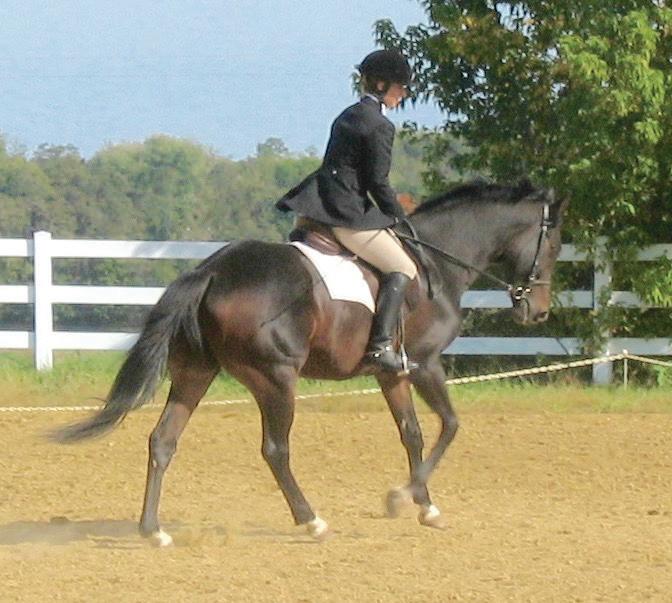
Dressage merely means training a horse. But we can use fancy words like laterally (side to side) or longitudinally (front to back), but all horses in any discipline need to be trained on both sides and “over the back” no matter if you are merely riding on the flat or over fences. As an equestrian who trains horses in dressage, I even fall into the trap of saying I teach “dressage” to persons who inquire about lessons. Really, I should say, I teach “equestrian tact” or better yet, I’ll teach you how to ride and then learn how to gymnasically train your horse. Then voila, … dressage! And here we go again and the cycle continues…
What does the word dressage mean? It means us do when we ride our horses. I am just not sure why horse being a dressage horse and one being a hunter? dressage) to train over fences and many dressage horses athletic a divide I am
How about, you pay training training can with Training dressage at all Showing judge both directions basic “unconstrained” horse smaller as the
extending the gaits. The hunter horse is evaluated in its jumps get bigger as the horse moves up the levels. Certainly required between the fences as the horse moves up horse advancing requires more precision and refinement of riding. three country constantly like dressage/training test to the first relaxation. when general? term gallop.” aids or just there There discipline
“Hunt seat rider” bending her horse laterally right. You can train dressage in hunt seat tack, I mean gymnastically train a horse.
We are so used to easy, “ready made things” and training a horse requires patience time and discipline. Also, learning to ride correctly reguires a lot of hard work, dedication, time and discipline. Learning how to put a horse straight - whether over a fence or down centerline and then bending it correctly in both directions requires what is called “equestrian tact” and this is developed over years and countless hours in the saddle. As I say, our horses or riders don’t come out of the Cracker Jack box already pre assembled. We have to work to put it all together.
extending the gaits. The hunter horse is evaluated in its jumps get bigger as the horse moves up the levels. Certainly required between the fences as the horse moves up the horse advancing requires more precision and refinement of riding. three country constantly like dressage/training test to the first relaxation. when general? term gallop.” aids or just gone there is There discipline





By Edward R. Moats
Everyone wants the very best for their pet. And that includes having a cage large enough to sustain the comfort and health of our birds. In hard economic times, pet parents are looking for ways to save money on the equipment needed to house and maintain their pet(s). However, a word of caution to those considering a cage made from Galvanized Wire. Most Galvanized Wire is toxic to birds and can cause severe illness and death. There are two ways of processing Galvanized Wire, Electroplated and Hot Dipped. Many Veterinarians feel that Electroplated is safe. However, Hot Dipped is a major concern. If you plan on using Galvanized materials, be sure you can confirm which process was used to manufacture your supplies. I prefer to ere on the side of caution and not use any form of Galvanized products.
Galvanized Wire is treated with Zinc. The Zinc coating ensures that the wire will be easy to clean and free from any oxidation. Sounds like a great material to use for a cage. Right? You need to look at the behavior of most birds. Especially hookbills. Hookbills utilize their beaks in order to navigate through their cage by holding on to wires. It is this practice that makes birds susceptible to toxicity by potentially chipping the wire with their beaks and the flakes being ingested into the bird. Over time, the on-going ingestion of these flakes can accumulate Zinc and other metals within the bird’s liver and kidneys.
It’s not just Galvanized Wire. A pet parent should be mindful of other hardware such as toy hooks and clamps that may be galvanized. These objects can also chip and be ingested.
The continued ingesting of Zinc contributes to a condition known as Zinc Toxicosis. Symptoms of Zinc Toxicosis can include: high levels of urea in droppings, neurological signs such as appearing off-balance, the inability to perch or spending most of the time on the cage floor, dark green droppings or diarrhea, lethargy, weight loss, seizures, increased ingestion of water, decreased appetite, and sudden death.
Blood testing is required for a diagnosis of Zinc Toxicosis. In diagnosing, blood serum can reveal anemia, hyperglycemia, and an elevation in kidney enzymes. A level of Zinc over 2 parts per million is considered toxic. Zinc Toxicosis is treatable. However, it’s best to avoid possible exposure to these products by eliminating them from contact with your pet.
BROOKE’S STORY:
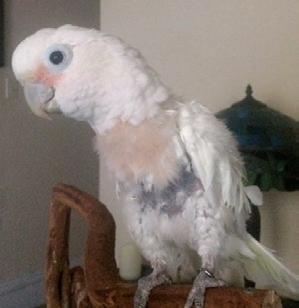
Two years ago, I was asked to foster a Goffin’s Cockatoo that was diagnosed with Zinc Toxicosis. Upon meeting Brooke, I was concerned by her condition and appearance. She was grossly underweight. (Half the body weight of a healthy Goffin’s Cockatoo.) Many of her feathers were either barbered or plucked. She had also started to exhibit selfmutilation by chewing a small hole in her upper breast. And nutrition was a great concern. This little girl was a parrot in crisis.
Upon receiving some of the historic background regarding Brooke, it was confirmed that she was housed in a Galvanized Cage. She had already
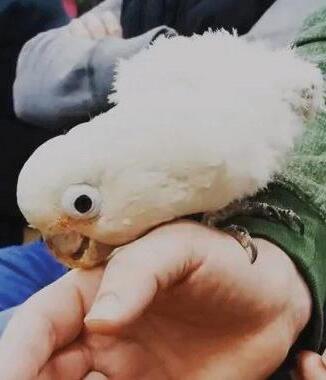
received initial veterinary care that confirmed Zinc Toxicosis and a treatment plan was initiated. However, she didn’t seem to be thriving. The group of people responsible for her care felt that along with her underlying diagnosis of Zinc Toxicosis, she also was having difficulty acclimating to her surroundings. When I first laid eyes on this little soul, she appeared to be very uncomfortable and nervous. This could have also contributed to her self-mutilation. I had to help Brooke in any way possible. During our group meeting, this little cockatoo never left my side. At the end of the meeting, I agreed to foster Brooke in order to assist with her on-going care.
Over the next few months, Brooke began to put on weight and self- mutilation and feather plucking had lessened. Her little personality shined through once she understood that she was in a safe environment. Brooke was on the path to recovery. For the next year, Brooke continued to thrive and maintain her weight. She had also bonded with another Goffin’s Cockatoo that I was fostering by the name of Juliet. Brooke was very protective of Juliet. And I was happy that she had found comfort in another flock member. However, one day Brooke started to exhibit aggressive behavior with other members of my flock. I believed she was so protective of Juliet that other flock members were perceived as a threat. Sadly, for the safety of the entire flock, including Brooke and Juliet; another foster family agreed to care for my cockatoo girls. I was heartbroken. However, I truly felt that the new foster family would be able to provide an environment where Brooke would not feel the need to defend Juliet.
On July 12, 2019, Brooke and Juliet’s foster parent messaged to inform me that Brooke had passed suddenly without any sign of distress. The foster family elected not to conduct a necropsy. However, I cannot help but think that Brooke’s years of exposure to Zinc may have contributed to her sudden demise. I am quite confident that Brooke had damage to her liver from the exposure. What other damage had been done to her little body?
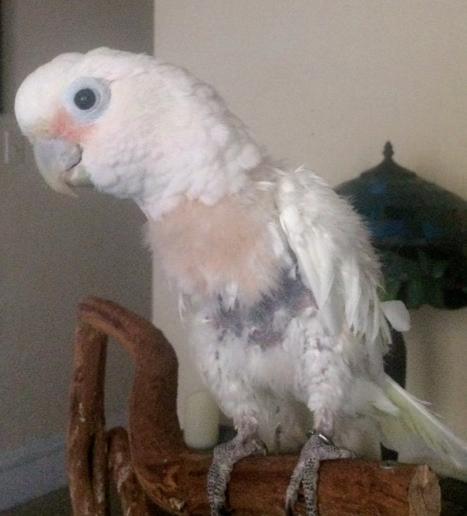
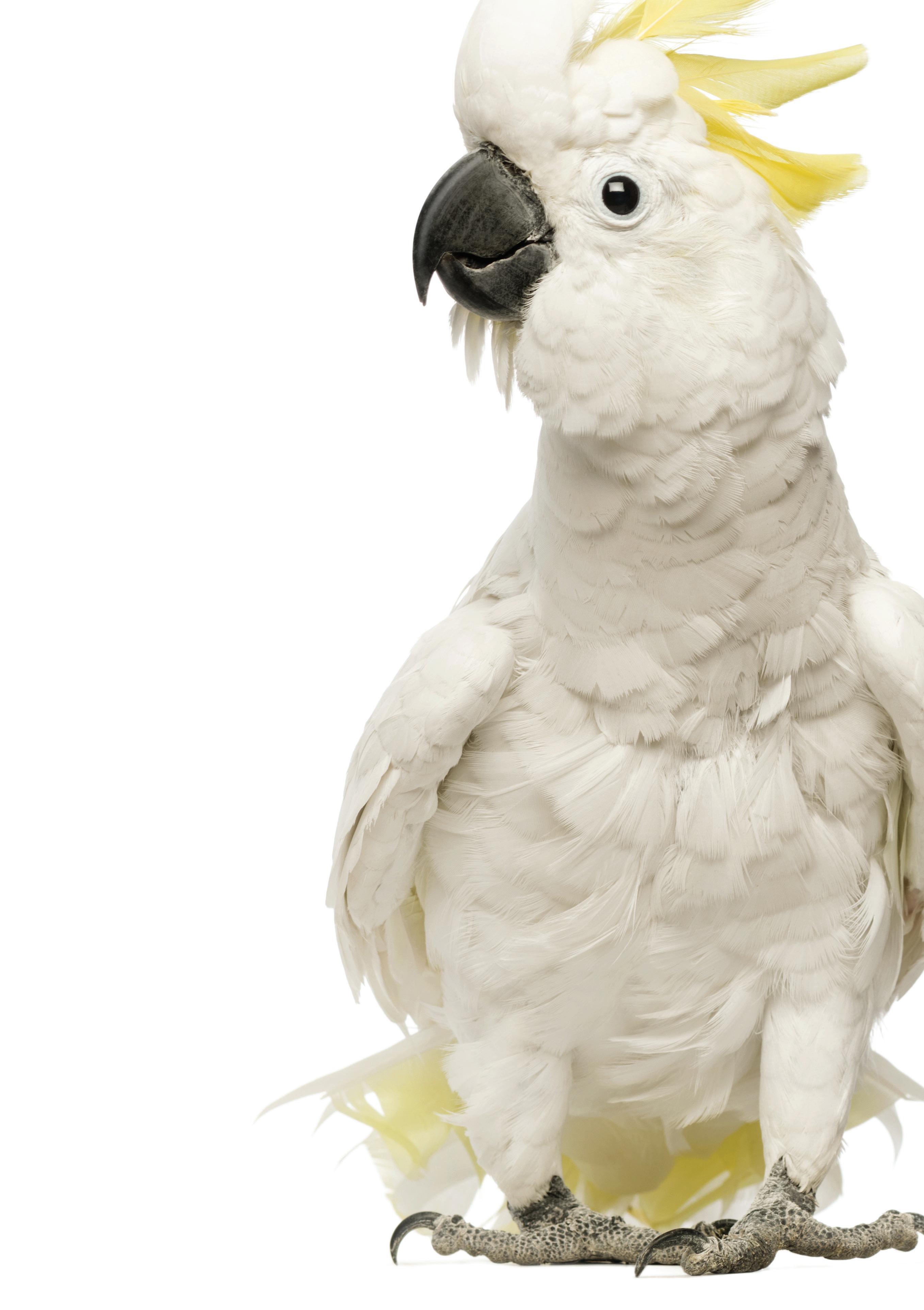
What would I like for you to take away from this article? Understand that Galvanized Wire can contribute to various health issues including death in our birds. And again, the best way to ensure that your bird does not suffer from Zinc Toxicosis is to avoid Galvanized Wire and products all together.
Fly free Brooke-Brooke, we will miss you....
There is a special place in the southern suburbs of Pittsburgh that is open, cozy, and tranquil respite from the bustle of the surrounding community.
Affording beatific vistas of rolling hills and wooden glens that wrap around friendly nearby neighborhoods. Jefferson Memorial Cemetery has provided a a peaceful resting place since 1929 when it was founded by Harry C. Neel.
Jefferson Memorial Park was founded in 1929 and passed down to his only son, John D. Neel, who is credited with the growth and innovation that has made Jefferson Memorial what it is today. John’s eldest son, also Harry C. Neel, currently runs the business as President and CEO. Harry’s oldest daughter, Dagny V.N. Fitzpatrick, joined the sales department of Jefferson Memorial and is now Vice President in charge of Family Services. Harry’s second daughter, Whitney R. Neel, joined the Funeral Home team in 2013 and will become the family’s 1st Funeral Director upon completion of her mortuary degree in December 2016.
Jefferson Memorial Funeral Home Facts
• A fully handicap accessible facility
• 18,500 square feet of floor space, beautifully decorated in Williamsburg décor
• 5 visitation rooms
• A chapel with vaulted ceiling and cushioned pews to seat up to 115 people
• Hospitality room and lounge with parquet hardwood flooring
• A children’s room that offers parents and guardians the ability to express their condolences without a babysitter (adult supervision is required)
• Lighted parking lot that holds 178 cars with 6 handicap accessible parking spots
Jefferson Memorial Cemetery Facts
• Jefferson cemetery consists of 340 owned acres with 170 acres developed and 180 acres available for future development
• 1500 average annual interments
• 38 traditional ground burial gardens including 4 lawn crypt sections for double depth burials


By Clyde Callicott, Director of Marketing – Jefferson Memorial Funeral Home Cemetery
• 14 mausoleum cremation niche units
• 14 gardens that contain cremation niches
• Mausoleum Crypt spaces constructed for casketed burial that includes 5 separate buildings and 4 private mausoleums
• 24 garden statues of bronze or marble

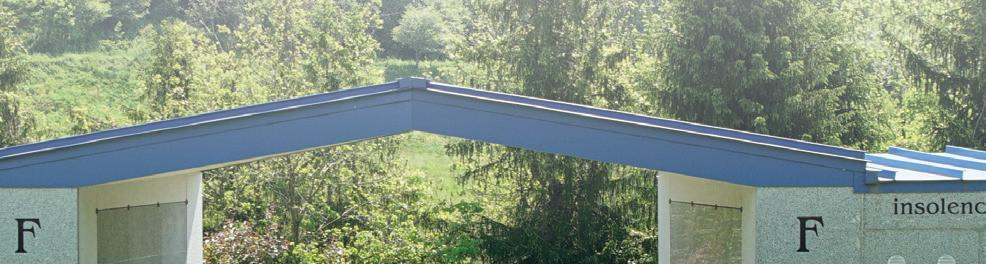
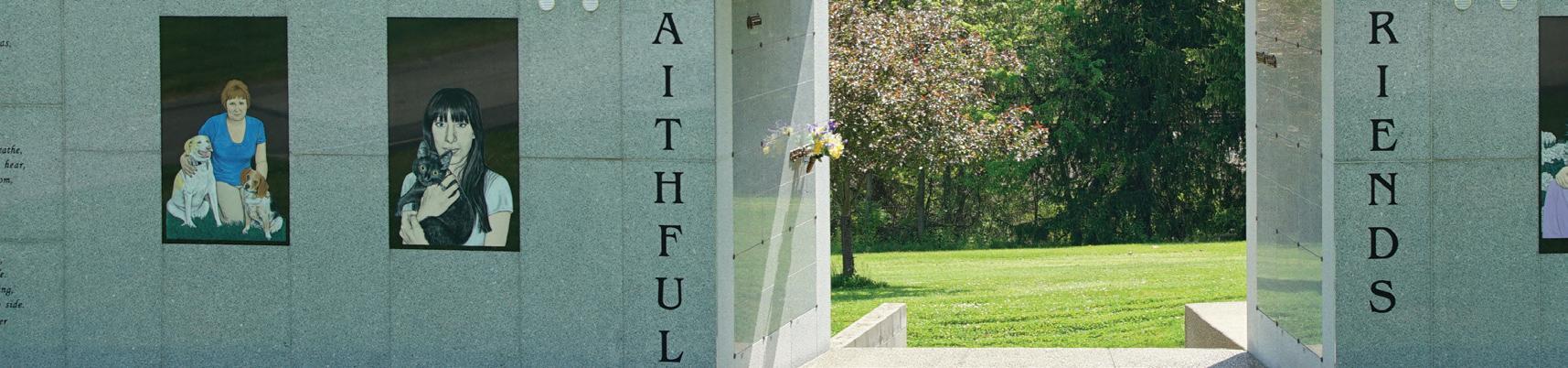
Unlike many cemeteries and funeral home’s today, Jefferson Memorial has a place dedicated to our furry friends that’s open, cozy and, tranquil – The Garden of Faithful Friends. Within the garden is the Faithful Friends Mausoleum, which houses crypt spaces for your pet, and unlike any other cemetery in the area, space for you and your pet. In that same building are niche spaces for pet and human cremated remains.

The mausoleum is an elegant visual feature that expresses meaningful sayings and showcases people with their pets. Like a full-service funeral home, Jefferson Memorial offers visitation opportunities to all pet families.

We at Jefferson believe that a pet who gave love and loyalty through life deserves the respect and dignity of having their remains placed in a lasting and final resting place, just as you would your human counterpart, for they too are a part of the family.
We have developed a distinctive pet room that consists of an arrangement room, a display room for caskets, urns and memorials, as well as a visitation room. Our before needs representatives and Family Service team aim to serve our pet families in every way we can.
We all love our pets and want to know they are in a safe and respectful place. Our Garden of Faithful Friends allows your pet to stay at your side forever. It truly represents our motto – Family is at the Heat of Everything We Do

For more information on how we can help you in your pets time of need, please reach out to our trained professional representatives at www.jeffersonmemorial.biz or call us directly at 412.655.4500






By Joanna Roberts
Aurelie (French for blond) started out her life in a pet store. She was purchased as a Christmas present for someone. Her pet parent came to realize that she didn’t like other dogs. And they sadly surrendered her to a French Bulldog Rescue. When I saw her on the rescue site with all her pictures and videos, I knew she was the girl for me. My life hadn’t started out so great either and I knew I had to give her a chance.
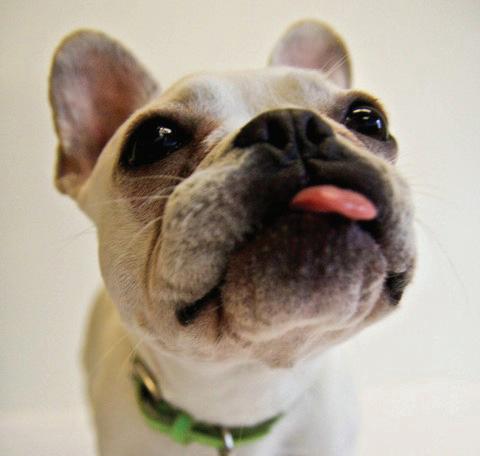
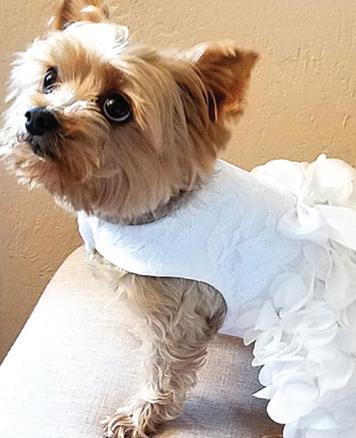
My sister and I drove from Boston to Pittsburgh to meet her and we were inseparable right up until the end. She loved car rides and would sit quietly on the seat just like any other passenger casually looking out the window. She didn’t really like to go potty outside and would sometimes hold it for hours to avoid it on rainy days. I bought her a matching raincoat and boots. But it didn’t seem to help. However, when she would meet new people, she wouldn’t stop wiggling and wagging like they were the best thing that ever happened in her life. It was her superpower. And everybody felt special when she greeted them. I got my share every night when she would snuggle up on me and bury her head under my chin while giving a million kisses. She loved to play with toys and let me dress her up like a princess.
We had a lot of good years. She was my comfort on bad days. I could always count on a kiss good night. She liked being the center of attention. But had enough manners to visit with other dogs on our walks. She did not like to share with “lesser” dogs.
She was a healthy French Bull Dog. And never needed more than regular vet visits. Then one day she didn’t want to eat and seemed to be sad and not having her usual spark. We went to the vet and found out she had an aggressive cancer. She didn’t respond to any treatment and was gone within 2 weeks. Even though she was old for her breed, it felt so sudden. Everything reminds me of her still. Opening the top cupboard where I kept her treats and remembering how she used to come running to see if it was treat time. The little rug by the door where she used to sit and wait for walks. Waking up and seeing the alarm clock instead of the top of her little blond head.
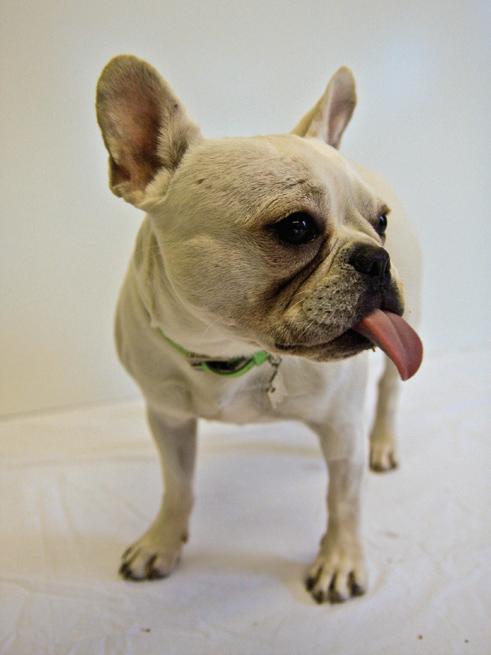
I try to think of all the happy times with her. And even though everyone thinks this, I know I had the best dog ever. In my dreams, she still runs up to greet me when I come home. And sometimes in bed, I can almost feel her snuggling right under my chin. I love you Aurelie. See you on the other side.
• Preventive and routine medicine (vaccines, spay/neuter, dentistry, routine diagnostic lab tests such as heartworm, fecal, CBC/chemistry, microchipping)
• VCA CareClub® – A wellness plan to help your pet live a happy, healthy life –is available for every stage of life!
• Surgery - Orthopedic, advanced soft tissue, laparoscopy/arthroscopy
• Internal Medicine - Diagnosis and medical management of complicated cases
• Integrative Medicine and Acupuncture - A mix of conventional western medicine and alternative eastern medicine
• Avian and Exotic / ZooMed - Fur, scales, feathers, fins, and slime!
Avian & exotic / zoological companion animals are unique and delicate. Their anatomy and physiology is vastly different from dogs and cats, yet require the same amount of expertise and care, special dedicated equipment, housing, and staff
• Advanced Diagnostics - Digital radiography, ultrasound, CT, endoscopy
Mention that you saw our ad in PetConnections when you book your appointment to receive a special offer upon check-in.

Critical
Dentistry
Dermatology Diagnostic
Ophthalmology
Radiation
Surgery
Neurology