Central Ohio PetConnections SEPT-OCT 2016 Digital Edition Vol. 2 Issue 5
wellness through the human-animal bond wellness through the human-animal bond
Radiation
•
Care
Anesthesiology
Oncology
Oncology
Integrative
Dermatology
Anesthesiology
Oncology
Oncology
Integrative
Dermatology
Anesthesiology
Oncology
Oncology
Integrative
Dermatology
Anesthesiology
Oncology
Integrative
Dermatology
Anesthesiology
Oncology
Oncology
Integrative
Dermatology
Anesthesiology
Oncology
Oncology
Integrative
Dermatology
Anesthesiology
Oncology
Oncology
Integrative
Dermatology
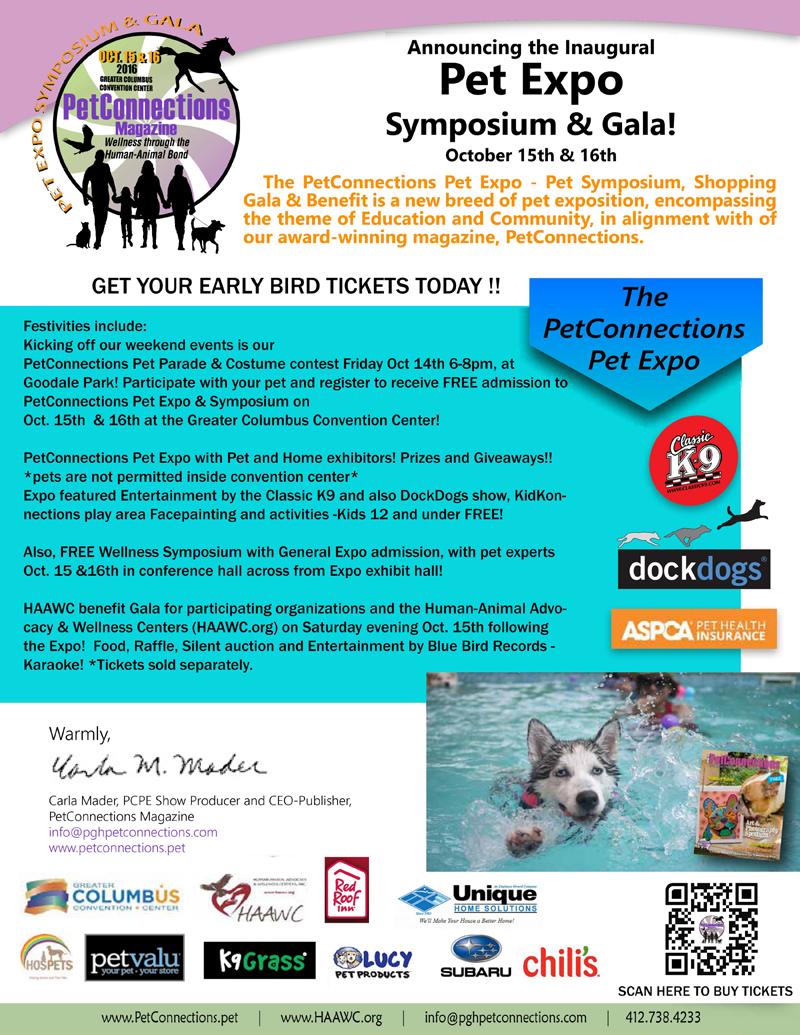
Inaugural PetConnections Pet Expo Symposium & Gala
Coming to the Greater Columbus Convention Center Columbus, Ohio on October 14-16, 2016!
Join us for a Symposium on Wellness, Expo with shopping, entertainment and benefit Gala!
Pets are welcome at our PetConnections Pet Parade and Costume Contest, Friday October 14th!
The PetConnections Pet Expo Symposium & Gala is Oct. 15 & 16th and is a new breed of pet exposition, encompassing the theme of Education and Community, in alignment with of our award-winning magazine, PetConnections. *Pets are restricted from inside convention center for this portion of our weekend events.
Kicking off the weekend events is our PetConnections Pet Parade & Costume Contest on Friday, Oct. 14th! Saturday and Sunday, we are offering educational seminars with veterinarians, pet experts and people wellness speakers at our PetConnections Symposium. Exhibitors are offering the latest and greatest in pet and home products and services, with local pet businesses and organizations. Our attractions include DockDogs Diving Competition, K-9 Classic Show, Events by Maddy, and entertainment by BlueBabe Records. Also, our HAAWC Gala to benefit participating community organizations and HAAWC -the Human-Animal Advocacy & Wellness Centers, Inc. for pet-related programming. (www.haawc.org). See our ad on the back cover for Q code to buy your Early Bird tickets and save! FREE admission for Kids 12 and under – 50% off for Seniors & Veterans!
Summary of the Oct 14th 15th and 16th Weekend Events:
1.) PetConnections Pet Walk and Costume Contest
Join us Friday October 14th from 6pm-8pm at Goodale Park, for the PetConnections Pet Parade and Costume Contest sponsored by Pet Valu. Dress your four-legged friend in their best costume and join in the parade and your chance at one of 500.00 in prizes! Sponsored by Pet Valu. Each registrant receives a pet Pet Valu bag with free coupon to get into expo and more!
Friday October 14th 6pm – 8pm
Location: Goodale Park Shelterhouse 120 W. Goodale St. Columbus, OH 43215 (View on Map), $500 in prizes
Proceeds to benefit: Hospets
A non-profit that helps elderly with their pets www.hospets.org
Pre-register ONLINE Today! Cost is $15.00 or at the door for $20.00. Kids 12 and under FREE! 25% Discount for Seniors 55+, Military & Disabled Persons
2) PetConnections Pet Expo
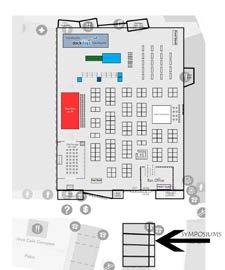
Greater Columbus Convention CenterEXHIBIT HALL C - (Lower Level of GCCC)
Sponsored by: ASCA Pet Insurance, Hatfield Subaru, K9- Grass/Forever Lawn of Ohio, Lucy Pet Products, Handicapped Pets
Saturday October 15th 9am-7pm Sunday October 16th 9am-5pm
Pre-register ONLINE Today for Early Bird registration and Cost is $13.50 or at the door for $20.00. Receive a Pet Valu bag with a free coupon for admission the PetConnection Symposium!.
Kids 12 and under FREE! 25% Discount for Seniors 55+, Military & Disabled Persons
Visit with the Pet and Home Exhibitors: Best Breed Holistic Pet Nutrition
Natures Logic Pet Food
Willow Wood Pet Resort & Training Center
Creative Foundations
DoTerra
Lucy Pet Products
Events by Maddy –Face painting Renewal by Anderson
Hatfield Subaru
HandicappedPets
Able Roofing
WindowPRO dog doors
Forever Lawn/K-9 Grass
Timber Wolf Leather
Pet Valu
Kris Keller for Ohio
ASPCA Pet Insurance
Bath Fitter
KitchenSaver
Gutter Helmet
Direct Satellite TV
Real Big Puppy
PBJ Connections
More updates to come….
Enjoy Entertainment from: Dockdogs K-9 Classic BlueBabe Records, LLC.
Presentations from the particpating Exhibitors and Organizations:
Michael Hites – Creative Foundation
Dr. Jill Hayes - Closure at Home
More to be announced!
KidConnections
Kids Entertainment Area!
Kids can connect thru our activities with crafts & more in our designated play area and Events by Maddy – Face painting, henna tattoos and balloon twisting.
Pre purchase tickets online for $13.50 here ONLINE or day of the event for 20.00 at the door.
Saturday, October 15th 10am-6pm & Sunday, October 16th 10am-5pm
Come Listen to one of our prestigious Veterinarians, Wellness Professionals and Pet Experts!
* Saturday 10am – 6pm and Sunday 10am -5pm *
Speaker List
Dr. Susan Wagner (Neurology) – Essential Oils & Pets
Marcy Wright – Message
Traci Shreyer – Behavior
Taylor Yurick – Positive Training
Kristen Hermann – Equine Riding Instruction
Dr. Jane Flores – Pet Acupuncture
Dr. Barbara Oglesbee – Birds
Dr. Melissa Ferry – Rabbits
Wildlife Center – SCRAM Humane Removal
Joelle Nielson – Pet Loss and Grief
Jen Ortman – Animal Communication
Shari Yinger - Animal Assisted Therapy
Tamie Wilson – Wellness for Guardians
Click to Find out more on our website: www.petconnections.pet email: info@pghpetconnections.com
Adam Turpen, Director of SCRAM Wildlife Control
NATURAL, HUMANE, PERMANENT
I am a 1997 graduate of the University of Toledo. I have a Bachelors degree in Wildlife Management. I conducted Mule Deer, and elk studies for the Colorado Division of Wildlife for 4 years and was a Park Ranger in North Carolina for 5 years.I have spent my last 9 years with the Ohio Wildlife Center as the Director of SCRAM WILDLIFE CONTROL. I work and train Border Collies for Canada Goose mitigation services.I enjoy the outdoors and learning more about animal behavior and biology.
Joelle Nielsen, MSW, LSW
4) HAAWC Gala
The Gala will take place in the Exhibit Hall C of the GCCC
Starts Saturday, Oct. 15th at 8:00 p.m.
HAAWC - the Human-Animal Advocacy & Wellness Centers, Inc. is in programmatic for animal-assisted activities, veterinary assistance, education and Research.
The Gala proceeds will go to benefit both HAAWC and participating organizations!
Featuring:
Silent Auction - Items donated from exhibitors and area businesses!
Entertainment by Blue Bird Records, LLC Karaoke Jockies
Hor ‘doeuvres, Cash Bar
Tickets $25.00 Register ONLINE for this event separately from the Pet Parade and Expo/Symposium.
Barbara L. Oglesbee, DVM, DABVP (Avian), is a Graduate of Ohio State University College of Veterinary Medicine. She has been board certified in Avian Medicine and Surgery since the specialty began in 1993. She began teaching Avian and Companion Exotic Mammal medicine at OSU College of Veterinary Medicine in 1989, where she was an Associate Professor and served as head of the Exotic Animal Service, and continues to teach all of the exotic courses as Adjunct Professor today. She is currently in private practice, treating exclusively Avian and Exotic patients at MedVet Hilliard, and has been on staff since 2009. Dr. Oglesbee wrote the clinical textbook The 5-Minute Veterinary Consult: Ferret and Rabbit. She has also authored many book chapters in veterinary textbooks and clinical papers on the diagnosis and treatment of disorders of birds, rabbits, and other small mammals, and lectures at state, national, and international veterinary meetings.
Jennifer Ortman, MS, RMT, CTMT
A life-long Animal Communicator, Jen Ortman has worked in the pet and veterinary industries since 1986. As the owner of Holistipet, Jen has communicated with world-level agility dogs, provided medical-intuitive insight for veterinarians, and has acted as a vast resource for owners seeking to holistically improve the bond with their pets. Since 2004, Jen has provided services as part of a seven-doctor veterinary practice in east-central Ohio. She also offers consultations and sessions for practices and pet owners world-wide.
A canine therapeutic and sports massage business owned by Marcy Wright. She is certified in small animal massage as well as several forms of body energy balancing. Beyond the basic small animal massage certifications Marcy has been trained in advanced massage techniques such as lymph drainage and myofascial release. Rounding out her skill base and knowledge Marcy has taken seminars for canine structural and gait analysis, fitness exercises for the healthy dog and canine behavior seminars. For scheduling and information please contact: Pawsitive Kneads, LLC 614-764-1488 www. Pawsitivekneads.net
Joelle has been licensed as a social worker in the State of Ohio since 1991 and received her Master in Social Work (MSW) from The Ohio State University College of Social Work in 1998. For the first half of her career, Joelle’s focus was helping victims of violent crime, sexual assault, and family violence. She held positions with the Franklin County Prosecuting Attorney’s office, as well as Nationwide Children’s Hospital and Center for Child and Family Advocacy. Her experience with crisis intervention and work in a pediatric medical center, as well as her love for animals made for an easy transition to her current position, which she started in September, 2007. Joelle is the Program Coordinator for the Honoring the Bond program at The Ohio State University Veterinary Medical Center. In her role as a veterinary social worker, Joelle provides support to VMC clients as they encounter difficult situations regarding their beloved animals, especially during end-of-life stages. She is also highly involved in teaching communications skills to veterinary students, interns, residents, faculty and staff. She has been responsible for developing and implementing the yearly Animal Remembrance Ceremony, which has been held every year, beginning in 2009.
Susan Wagner DVM, MS, is a veterinary neurologist and a pioneer in the area of the human–animal bond. She is coauthor of Through A Dog’s Ear: Using Sound to Improve the Health and Behavior of Your Canine Companion. Dr. Wagner offers integrative medicine at MedVet Medical & Cancer Centers for Pets, and is a Healing Touch for Animals practitioner. She is also an active public speaker and adjunct faculty at the Ohio State University College of Veterinary Medicine. Dr. Wagner has been seen on CBS Early Morning and The Today Show on NBC.
Traci A. Shreyer, MA Traci received her undergraduate degree in psychology from The Ohio State University in the spring of 1992.She received her Master of Arts degree in Psychobiology, with a major in Comparative Psychology, in 1994. She is certification eligible through the Animal Behavior Society. She opened her own consulting practice in Columbus, Ohio and served clients and pets referred by their primary veterinarian for 15 years. Traci spent the 5 years on staff in a combined appointment between the Veterinary Teaching Hospital and college at The Ohio State University. She created the low stress animal handling curriculum and coordinated the hands on labs for the core first year behavior course. Along with her team she also created a one of a kind program in the area of applied animal behavior relevant to general practitioners that taught 4th year veterinary students during their “Community Practice” rotation, and supported the needs of their patients and clients.
PetConnections
8 FEATURED ORGANIZATION HOSPETS HumanAnimal Bond The Wisdom of Black Cats
12 Pet Health & Wellness Dog Walking Tips for Fall
Cover
ADVERTISING INQUIRIES
PLEASE SUBMIT ANY CORRESPONDENCE TO: info@pghpetconnections.com 412-738-4233
CENTRAL OHIO PETCONNECTIONS BI-MONTHLY
Published by: Pittsburgh PetConnections, LLC. Pittsburgh PetConnections LLC. was formed in 2012. Our mission is to publish a high quality, informative publication focused on the Human-Animal Bond. We support local businesses and also assist local non-profit businesses for pets and people, to give back to our great Central Ohio communities.
MAGAZINE PUBLICATION STAFF
Carla Mader, Managing Editor
Susan Wagner, DVM, Content Editor
Jaimee D. Greenawalt, Art Director
Carla Mader, Sales & Distribution Manager
Tamie Wilson, Senior Sales & Marketing Director Central Ohio
Jessica Miller, Sales Manager Central Ohio Ken Holton – Sales
Kara Jones Photography, Photography
CONTRIBUTING WRITERS
Our contributing writers have many years of combined experience and expertise in the fields of veterinary medicine and the Human-Animal Bond.
All Rights Reserved | Copyright 2016
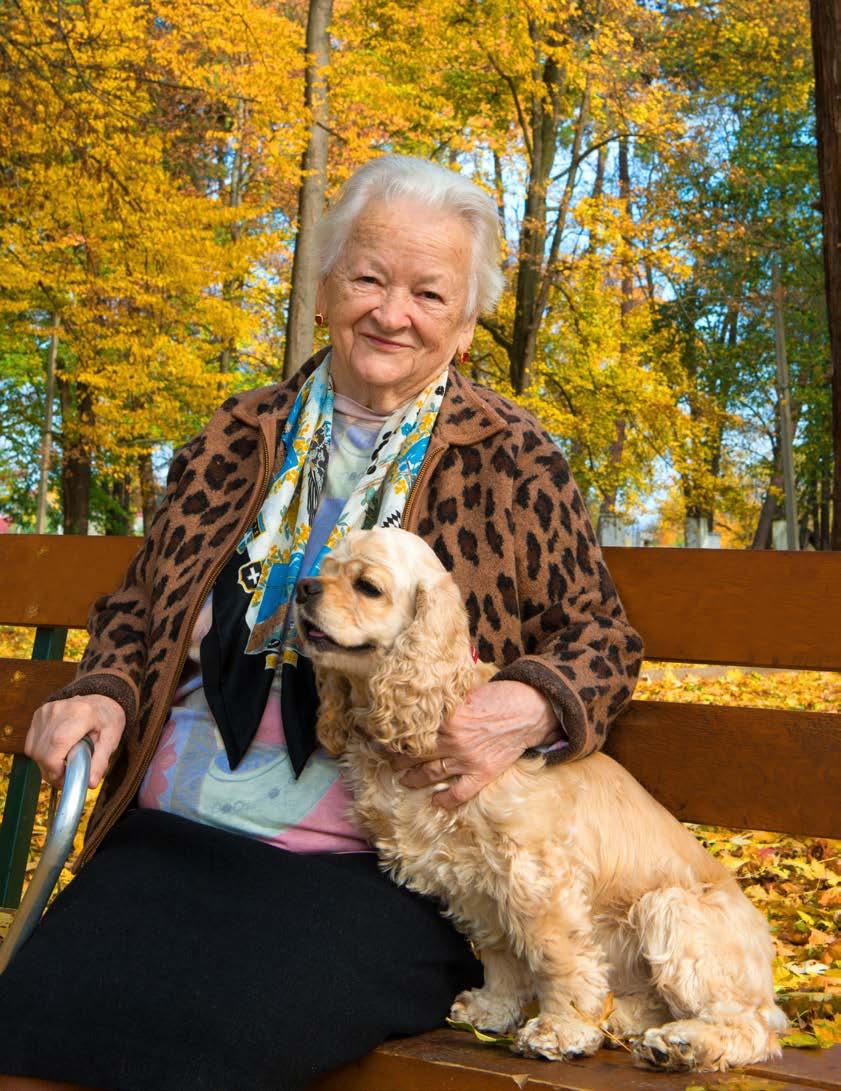
Cover photo: Photos courtesy of HosPets
From the Publisher
Welcome to our Central Ohio PetConnectionsMagazine September / October 2016 Vol. 2 Issue 5
News & Events
We welcome Tamie Wilson, Jessica Miller and Ken Holton to our Central Ohio team! Tamie is leading the team with her vast experience in management and media. Jessica and Ken bring their skills in all types of media sales. They are all pet lovers and involved with the community.
PetConnections is also now producing our own new breed of pet exposition encompassing the theme of Education and Community, in alignment with of our award-winning magazine! www.petconnections. pet/PetConnections-Pet-Care-Expo-Gala
Kicking off the weekend events is our PetConnections Pet Parade & Costume Contest on Friday, Oct. 14th! Saturday and Sunday, we are offering educational seminars with veterinarians, pet experts and people wellness speakers at our PetConnections Symposium. Exhibitors are offering the latest and greatest in pet and home products and services, with local pet businesses and organizations. Our attractions include DockDogs Diving Competition, K-9 Classic Show, Events by Maddy, and entertainment by BlueBabe Records. Also, our HAAWC Gala to benefit participating community organizations and HAAWC -the Human-Animal Advocacy & Wellness Centers, Inc. for pet-related programming. (www.haawc.org). See our ad on the back cover for Q code to buy your Early Bird tickets and save! FREE admission for Kids 12 and under – 50% off for Seniors & Veterans! Please see our event page for more fall listings.
This Issue
Our Featured Organization is Hospets, whose mission is to provide pet care assistance to senior citizens and hospice patients to help keep pets in the home as long as possible. Read about Traditional Chinese Veterinary Medicine Food Therapy for Pet by Dr. Doug, Dog Walking Tip for Fall, Equine Influenza, Ready for Release by The Ohio Wildlife Center and Friendship & Assistance, by Bernadette Kazmarski. This heartwarming story won a 2014 Dog Writers Association of America Certificate of Excellence and the Adoptashelter Award for dog rescue and improving life for dogs in shelters (http://thecreativecat.net/frankencat-andogd-are-dog-writers-association-of-america-award-winners/).
PetConnections supports local organizations and small business and we have established a community network of readers & members, writers, advertising sponsors and distribution points. Please support our advertising sponsors! See their locations on the map page. Check out our PetConnections Resource Directories for categorized listings.
Subscribe today for your own personal bi-monthly copy of PetConnections and VIP Membership and become part of the Petconnections Community! www.petconnections.pet/subscribe
See how PetConnections can help you market and advertise with content which supports your message with our multi-media partnership packages! Our a partnership with BENN Advertising Solutions offer more targeted and effective digital marketing and advertising campaigns to our sponsors for Central Ohio, as well as Western PA.
For PetConnections Advertising inquiries contact: 412-738-4233 info@pghpetconnections.com PetConnections is also looking to grow our team with additional sales account manager professionals.
Please submit your photos and stories, as well as remembrances to be featured online and in future issues to: info@pghpetconnections.com.
Thank you for picking up PetConnections. Take care of yourself and your pets this Fall season and be well!
Warmly,
Carla Mader, Publisher - Pittsburgh & Central Ohio PetConnections Magazine
Please submit any correspondence to: info@pghpetconnections.com
Please check us out on the web & subscribe at: www.petconnections.pet. Follow PghPetMag on Twitter and “Like” us on Facebook! http://www.facebook.com/PghPetconnectionsMagazine
Human-Animal Bond
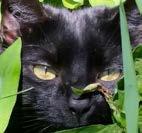
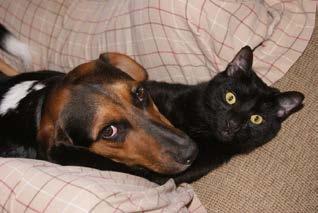
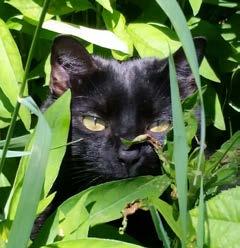
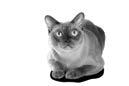
The Wisdom of Black Cats
Susan Wagner, DVM, MS, ACVIM
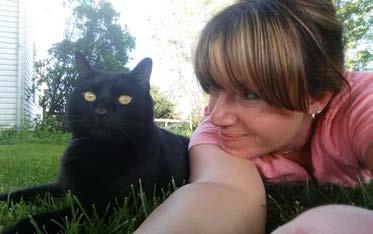
It’s almost Halloween, and I’m seeing black cat decorations all around me. Black cats have gotten a bad rap for centuries — many cultures have perpetuated myths about them. They have been maligned and even tortured because of their alleged association with evil and witchcraft. The Chinese believed a black cat was an omen for poverty, and German folklore says that a black cat jumping on a sick bed signals that death is near.
We cat lovers know the truth about black cats. They make very loving, playful companions. And so as I wait for the coming of Trick-or-Treaters and The Great Pumpkin, I would like to take a moment to thank all the black cats who have crossed my path over the years. They weren’t bad luck at all, but a source of joy and wisdom. There are far too many to mention, but a few stand out.
Thanks to Maya, who opened a friend’s heart, and continues to watch over the stepchild he has lost. Thanks to Puyi, named for a boy emperor, who as a tiny kitten had the courage to leap into my sister’s hands from the roof
We cat lovers know the truth about black cats. They make very loving, playful companions.
of an apartment building. He continued his journey by comforting my widowed mother, and helping her have the courage to go on.
And many kudos to Mabel, who came into my cousin’s life just in time to help him through difficult surgeries, rehabilitation and his final transition. Soon after arriving, Mabel began staring at him and wouldn’t let him out of her sight, as if she was trying to say something. It soon made sense as the familiar numbness radiated down his arm, letting him know the tumor was back. She continued to watch over his parents until it was time to reunite with her special human.
And finally, thanks to Lovey, who used to visit us, and now has adopted us. He most certainly lives up to his name. I can’t sit down for more than three seconds before he jumps into my lap. And on a cold fall day, there’s nothing like a purring cat to warm us up.
I’d also like us all to remember the feral black cats who don’t have laps to sit in, and who risk injury and cruel pranks this Halloween season. They remind us of the violence that haunts humanity far worse than any horror movie character could. I know that once we rid ourselves of underlying causes such as poverty and ignorance, all creatures will be safe.
We can’t face the ills of society, however, by hating those who hurt black cats. We can only evolve by taking responsibility for doing our own work. It’s about having Puyi courage, and seeing where anger and judgment live in our own hearts. It’s about having Mabel persistence, and staring adversity right in the face. And it’s about living life as Lovey and Maya would — by being kind to a stranger and being patient with those around us.
This Halloween, make a black cat proud! PC
...and here’s to Kinten, who had the courage to leave his brothers and sisters to find me while I was out getting my mail one day. Check him out, he is one cool cat : )
~ Jaimee Greenawalt, Graphic Designer for PetConnections
Starts at 4:30. End time varies according to sunset. WHAT: A special evening to spend with your favorite four-legged friend WHERE: all around the Olde Gahanna downtown area / Mill Street / Creekside Plaza. (117 Mill St.) (Gahanna Exit/Rt 62) www.oldegahanna.com/paws_in_the_plaza
Featured Organization
By April Minech
“In the summer of 2011 my father became ill and moved in with us,” says Hospets founder Lisa Zimmerman. “My father was a huge animal lover, and that often led to discussions with the hospice nurses and aides who were in and out almost daily.” The caregivers often told horror stories of pets that were in pain and suffering because they could not get veterinary care. Pets that were so matted they couldn’t walk or had nails growing into their paw pads because their owners could not get them groomed. They spoke of seniors who would get their Meals on Wheels delivered and place it on the floor for their pets because they couldn’t afford pet food, or didn’t get their prescriptions filled so they could afford pet food. She explains, “We heard stories of seniors who refused needed medical treatment because there was no one to care for their pets while they went in for treatment. My father passed away on December 3rd of 2011, and Hospets was founded and up and running by January 11, 2012.”
“Our mission is to provide pet care assistance to senior citizens and hospice patients to help keep pets in the home as long as possible. Pet ownership provides enormous health and emotional benefit for seniors,” she says. “The presence of a pet is the strongest social predictor of survival, and pet ownership is especially important in increasing interest in
life – pets give the elderly something to care for, as well as providing an opportunity for exercise and socialization.” While pet ownership brings great rewards, there are also costs with that ownership. Many of the pet’s senior owners are unable to adequately provide for those expenses. Statistics show 11.6% of Seniors are living below Federal Poverty Level and 19% are living below Self Sufficiency Levels. Many seniors will feed their pets before they feed themselves and many will forego their own medication in order to provide for their pets. “Seniors should not have to deny their needs in order to experience the health and emotional benefits of pet ownership,” claims Zimmerman.
When seniors are unable to provide proper preventative care for their pets, this may create a health hazard not only for the pet and the pet owner, but also for anyone entering the home (social worker, nurse, aide etc) seniors are at an increased risk for disease. Lisa provides some staggering health facts: “Around 95% of the senior owned pets we have assisted have been found to have fleas and/or ticks and are lacking vaccines. Additionally, many senior pet owners are unable to afford to provide basic veterinary care and/or spay/neuter surgeries which may lead to chronic disease in their pets, unplanned litters and potential hoarding situations”.
To combat these issues, Hospets helps on a variety of fronts, including providing pet food, basic grooming and vet care. The majority of their clients are referred through Senior Services agencies, Meals on Wheels, Community Action or through local home health agencies.
List of Services:
Pet Food – Hospets will deliver pet food to seniors in need once a month. Typically, they deliver whatever brands of food that have been donated, but also assist seniors who have pets on expensive prescription diets.
Basic Grooming – At their visits, they can provide nail trims, bathing, basic grooming, and have even occasional training. Professional groomers have volunteered their time and services to help with the more severe cases.
Veterinary Care – As the cost of veterinary care increases, many seniors are unable to even afford a basic office call, much less any emergency needs. Hospets tries to assist as much as possible. They hold an annual vaccine clinic providing free pet vaccines for seniors in Union County. In the past, they helped with emergency surgery for a Pomeranian with an abscessed cyst, a Maltese with bladder stones the size of golf balls, a partially paralyzed Corgi, and a cat that the owner sprayed with Raid while trying to kill fleas. “And sometimes the greatest thing we can do is simply offer reassurance”, says Lisa. “Some of our seniors tend to panic over every little scratch or bump. During those times, simply showing up to the home and letting them know that what they are seeing is normal and not a threat to the health of their pet not only saves their pocketbook but also saves their peace of mind.”
Education – Many of the seniors they serve are not familiar with some of the basic needs of pets, or even have items in the home that may be hazardous to pets. With every visit, they take the opportunity to try and educate at every opportunity.
Transportation – Many of the seniors served are unable to drive or unable to physically transport their pets to the veterinary office or groomer. Hospets will pick the animals up at the home and transport to and from the vet or groomer.
Low Cost Spay and Neuter – Many of our seniors do not have the funds to pay to have their pets spayed or neutered. Not having this done may lead to unplanned litters and create potential hoarding situations. Hospets provides free spay neuters to senior owned house pets. They pick up the pets and trans-
port them to vets in Columbus and return them home after the surgery. At that time, the pets also often receive vaccines and other basic veterinary care.
Preplanning – One of the very first questions we ask when first meeting a new client is “If something happens to you, what will happen to your pet”, says Zimmerman. Often seniors have their financial affairs in order but they tend to assume that a family member will automatically take the pet. Or the pet owner fears their pet might be a victim of abuse or neglect if they are no longer able to care for them so they want to have their pet put to sleep if something happens to them. By asking them that one question “If something happens to you, what will happen to your pet” it starts the dialogue and gets them to consider what needs to be done. If the senior is not sure how to approach their family to ask, we will help with that discussion. We will also let seniors know that going to a shelter is not the only option for their pet and that we have many resources available to place their pet into a safe, loving well screened home, allowing the pet to live out the remainder of its years. We also discuss our Petcare Power of Attorney. A petcare Power of Attorney allows a pet owner to legally designate someone as the caregiver for the pet should the owner be unable to care for the pet. A copy is kept with the will, or on the refrigerator with the File of Life, or with the housing manager. A pet owner can designate a family member, a friend or they can even designate Hospets to be the care provider. The power of attorney gives the authorized caretaker the legal authority to take possession of the pet so the animal does not have to be picked up by animal control.
Pet Deposits – We often run into situations where a senior had been living independently but now needs to move into senior housing or assisted living. They often have a beloved pet and wish to take the pet with them; unfortunately they are all too often required to pay a $300 pet deposit which many simply cannot afford.
Rehoming assistance – Unfortunately, there are times when a pet must be rehomed. Either the owner passes away or becomes physically unable to care for the pet. Hospets will assist by seeking qualified rescues or adoptive homes for the pets. We have rehomed, cats, dogs, birds, mice and even goldfish and are currently assisting with ducks, chickens and a miniature horse.
“Our mission is to provide pet care assistance to senior citizens and hospice patients to help keep pets in the home as long as possible.
we also offer temporary foster care. This is by far the greatest need we have seen. All too often seniors will refuse to get surgery or testing done because they have no one to take care of their pet while they are hospitalized and they certainly can’t afford boarding. Hospets offers temporary care during those times. We typically rely on a network of foster families who open their homes to take these animals in and treat them as their own while the senior is getting care. It can be for just a couple of days and in some cases it has been over a year. Occasionally we have seniors who have too many pets to be able to utilize a foster home environment and in those cases we have volunteers who are able to go into the home multiple times a day to provide care for the animals in their own home. Foster care is such a huge need and has resulted in a large undertaking for Hospets.
Home
Away
From
Emergency Management – Hospets is also an emergency resource for the Union County Emergency Management Association. Last spring when the Windsor facility burned down, we had many clients living in that facility. The Red Cross is able to assist the people but is not able to offer any assistance with the pets. Hospets set up an emergency shelter for the pets, enabling the pet and the owner to be close to each other during this time of stress. We went into the building and helped bring out pets were left behind and trapped or in hiding and even brought out the deceased pets so they could be cremated and the ashes returned to the owners. And
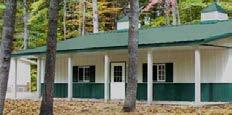
Home Hospets have built the first in the nation, foster care facility for senior owned pets. This building is used to provide temporary housing for senior owned dogs is located in Union County, serving seniors throughout Central Ohio.
Hospets is the first and only group in the nation to offer all of these services and support to senior pet owners, and do it all with volunteer support. They have no paid staff, just a lot of hard working dedicated people. Although they are funded in part with grants from the Union County Senior Services Tax levy, their main source of support is through donations and fundraisers.
To volunteer or donate, please contact Lisa Zimmerman at 614-266-3267 or Lisa@hospets.org for more information. Every donation to this wonderful organization counts! PC
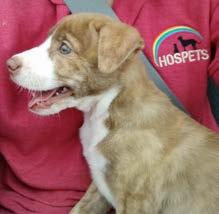
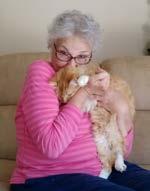
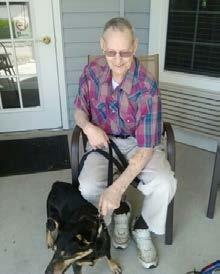
Photos courtesy of HosPets.
Directories
Adoption, Rescues & Shelters
Almost Home Dog Rescue of OH 614-766-1001 www.almosthomeohio.org
Canine Companions 1-800-572-BARK (2275) www.cci.org/northcentral Capital Area Humane Society 614-777-7387 cahs-pets.org
CHA Animal Shelter 614-891-5280 chaanimalshelter.org
Colony Cats Adoption Center 614-593-0055 Colonycats.org Columbus Dog Connection 614-471-9000
Columbusdogconnection.com
Cozy Cat Cottage Adoption Center 614-336-8510 cozycatcottage.org
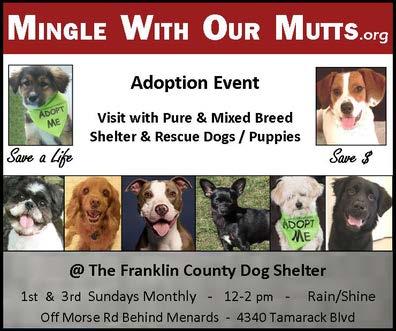
Franklin County Dog Shelter & Adoption Center 614-525-3647
franklincountydogs.com
Pets without Parents
614-267-7297 petswithoutparents.net/
Avian & Exotics
MedVet Medical & Cancer Centers for Pets (Hilliard)
614-870-0480 medvetforpets.com
OHPA Bird Fairs www.ohpabirdfairs.com
Dog Parks
Alum Creek Dog Park www.alumcreekdogpark.com
Companion Club Dog Park 740-881-2000 www.columbusdogpark.com
Godown Road Dog Park www. worthingtondogpark.com
Heritage Trail Dog Park www.hilliardohio.gov/play/heritage-trail-dog-park
Pizzurro Park and “Dog Park” www.gahanna.gov/departments/parks/ communityParks.aspx
Equestrian
Central Ohio Riding Club
614-873-6644 centralohioridingclub.com
Equus Now! 740-549-4959 Equusnow.com
OSU Veterinary Medical Center 614-292-6661 vet.osu.edu/vmc/
Landscaping & Lawncare
Forever Lawn
844.614.TURF(8873) foreverlawnohio.com
Good Nature Organic Lawn Care 888-529-6723 www.whygoodnature.com
Pet Burial, Cremation & Memorial Services
Crystal Remembrance for Pets
888-930-7363
Crystalremembranceforpets.com
Day Manofsky Funeral Service 614-532-5012 Daymanofskyfuneralservice.com
Rutherford Funeral Homes
614-885-4006
Rutherfordfuneralhomes.com
Schoedinger Pet Services
614-224-2691 schoedingerpetservices.com
Pet Fencing
Invisible Fence
614-888-3647 www.columbuseast.invisiblefence.com
Pet Stop of Ohio Columbuspetfence.com
Pet-Friendly Auto Dealerships
Central Ohio Area
Byers Subaru 877-265-2083 www.columbussubaru.com
Pet-friendly auto dealers: Harfield Subaru
877-371-2094 www.hatfieldsubaru.net
Pet Insurance
ASPCA Pet Health Insurance
1-888-716-1203 aspcapetinsurance.com
Pet Resorts- Boarding, Daycare, Grooming, Agility & Training ARF! Agility and Rally for Fun! www.arfagility.com
Unique Home Solutions 614-845-0500 www.uniquehomesolutions.org
Wildlife
Columbus Zoo and Aquarium www.columbuszoo.org
Ohio Wildlife Center 614-793-WILD ohiowildlifecenter.org
SCRAM! Wildlife Control ohiowildlifecenter.org
The Wilds www.thewilds.columbuszoo.org
List your business today! info@pghpetconnections.com
pghpetconnections.com/Dog-Cat-Directory
Pet Health & Wellness
Dog Walking Tips for Fall
By Dr. Mary Beth Leininger and Gina Fortunato
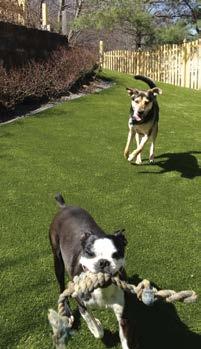
Ah, that crisp, fresh air! And the beautiful colors of the leaves as they change from green to glorious reds, yellows, and browns! Fall is a fabulous time to enjoy leisurely walks, trail hikes, and visits to the pumpkin patch with your dog. But if your pooch isn’t behaving on a leash, going out together can become a drag—quite literally! These tips can help you address three common dog walking problems, so you can enjoy autumn adventures with your best friend.
1. Pulling on the Leash Dogs often pull on the lead when something interesting grabs their attention. Some dogs also pull when you first head out the door because they’re just too excited to contain themselves. You can try these techniques to help stop your dog from pulling:
• Walk faster. By picking up the pace, your dog will have less chance to notice things, like scampering squirrels or interesting scents, that can prompt pulling.
• Try a different route. Take your dog to places where there are fewer temptations. For instance, if your dog tends to pull when in the presence of other dogs, choose a quieter time of day or a path that isn’t too busy for your walks.
• Calm your dog down first. While most dogs are enthusiastic about going outside, a dog who is bouncing around the room before you even get the leash on may be more likely to pull. Teach your dog to stay calm before a walk by holding the leash quietly until all four paws are on the ground. Be patient and shower your dog with praise when they get it right.
• Talk to your dog. Keep your dog’s attention on you and away from distractions by talking as you go along.
You can chat about the scenery, the weather, your plans for the day, or (hopefully!) how nicely your dog is behaving.
It can also be helpful to put a few treats in your pocket to reward your dog for good walking manners.
2.
Chewing on the Leash
Like pulling, chewing is a natural behavior for dogs. It’s also a healthy one since it helps keep their teeth clean and jaws strong. But chewing on the leash before and during walks can become problematic, not to mention wear out your leash.
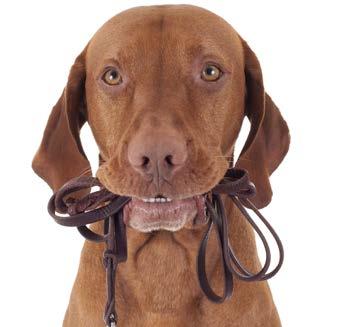
You can try switching to a chain leash, which isn’t as fun to chew on as the synthetic or leather kinds. You can also try distracting your dog with some of the tips mentioned to avoid pulling, like picking up the pace and offering treats when your dog walks without noshing on the leash.
3. Barking or Lunging
It can be embarrassing when your typically friendly dog starts barking or lunging at other dogs or people while you’re out walking. If these kinds of behaviors come up suddenly, you might want to take your dog to the vet erinarian. An illness or health condition, like arthritis or ligament damage, can make a dog irritable and more easily upset.
These behaviors can also start after an incident with another dog. If this is the
case, you might need to gradually get your dog comfortable being around other fourlegged friends. You can set up a supervised play date with a familiar dog or visit the dog park when it’s not too busy. If you’re not sure how to help your dog, talk to a Certified Professional Dog Trainer (CPDT) or other professional for advice.
Dog Walking Safety
As you go out and enjoy fall activities, remember to keep your dog’s safety in mind. All sorts of injuries can happen unexpectedly. Your dog can get scratched or bit by another dog or small animal, get tangled in the leash, or eat something toxic before you realize it.
Of course, you can’t always protect your dog, but you can help your best friend get the best medical care possible with coverage from an ASPCA Pet Health Insurance plan. You can cover your dog for accidents, illnesses, preventive care, and even behavioral issues that can prevent you from enjoying walks with your dog. Visit www. IsYourPetCovered.com to learn more today!
Pre-existing conditions are not covered. Waiting periods, annual deductible, co-insurance, benefit limits and exclusions may apply. For all terms and conditions visit www.aspcapetinsurance. com/terms.
Plans are underwritten by United States Fire Insurance Company and administered by Fairmont Specialty Insurance Agency (FSIA Insurance Agency in CA), a Crum & Forster company.
The ASPCA does not offer insurance. Through a strategic licensing agreement, in exchange for the use of ASPCA trademarks, the ASPCA is paid a royalty fee of up to 10% of the purchase price, with a minimum of $335,000 per year. PC
READY FOR RELEASE
By Linda Forte-Spearing, Volunteer, Ohio Wildlife Center
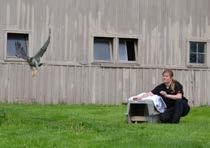
Founded by Dr. Donald Burton in 1984, Ohio Wildlife Center releases almost 5,000 animals back into the wild every year.
WILDLIFE HOSPITAL: TREATING OUR WILD NEIGHBORS
April through August is the most dangerous time for young, inexperienced wildlife. As such, it is the busiest time of the year for Ohio Wildlife Center—admitting hundreds of baby birds, squirrels, rabbits and the like to its Wildlife Hospital every week.
These pint-sized patients require weeks of continual feedings and round the clock care from experienced staff and an army of volunteers. The animals who are brought in as infants are time-intensive to care for, but can typically be released back to the wild.
There are special cases, however, involving wildlife with severe injuries or disease. Patients falling into this category usually need extensive surgical or medical treatments, wound management and physical therapy.
A surgical procedure alone can require more than $800 in pain medications, anesthesia, equipment, sutures, x-rays and post-surgical care. The additional costs of food, housing and physical therapy can double this figure over the entire length of that patient’s stay. With longer hospitalization and recovery times, these animals also require a reconditioning period before they can be set free.
PRE-RELEASE FACILITY: CONDITIONING FOR LIFE BACK IN THE WILD
The Pre-Release Facility is the last stop for those on their way to release. Comprised of more than a dozen species-specific enclosures, this temporary housing offers increased space and gradual exposure to the elements. An extended-stay animal must be acclimated to local weather and light cycles to ensure the greatest chance of survival when s/he is permanently released to the outdoors.
BACK TO THE WILD: WHERE WILD ANIMALS BELONG
Patients at this point are fully healed, properly acclimated, and ready to be returned to nature. And if a location is, in fact, known, every attempt is made to release each animal where it was originally found.
Instances when a patient cannot be returned to the wild (due to the extent of an injury), Ohio Wildlife Center can provide a permanent home and a job as an Ambassador Animal. These animals provide opportunities for children and adults to interact with and appreciate their wild neighbors on location or during scheduled offsite visits.
Ohio Wildlife Center is a private non-profit, relying solely on individual donations and grants for its daily monitored information hotline, the running of its Wildlife Hospital and the educational services it offers.
If you would like to make a donation, there are several ways to do so. A prioritized supply list is published at www.ohiowildlife-
center.org, and includes everything from medical supplies like latex gloves to food and kitchen supplies including unsalted nuts, rabbit pellets and goldfish flakes. Laundry detergent, disinfectant wipes and garbage bags are also in high demand.
If you shop at Kroger and register your Kroger Plus Card, Kroger will donate a percentage of each grocery bill to Ohio Wildlife Center through their Community Rewards program.
AmazonSmile is another simple and automatic way for you to support Ohio Wildlife Center at no cost to you. When shopping online, log onto www.smile.amazon.com, enter Ohio Wildlife Center in the search bar, and Amazon will donate 0.5% of the purchase price back to this life-saving organization.
Thanks to its many generous donors, Ohio Wildlife Center has treated almost 4,000 animals from 146 species in just the first half of this year.
For additional information about Ohio Wildlife Center, including a listing of the licensed wildlife rehabilitators in your area, visit. www.ohiowildlifecenter.org. Please call the Center’s monitored information hotline at 614-793-WILD for assistance with common wildlife situations. PC
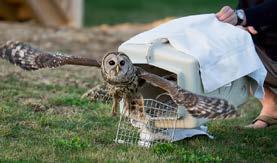
Barred Owl release photo by Tim Neumann.
Holistic Pet Care
Traditional Chinese Veterinary Medicine Food Therapy
By Doug Knueven, DVM, CVA, CVC, CVCH
For the ancient Chinese, the maintenance of health was of supreme importance. Healthcare was not something they went to a doctor to get; it was a way of life. These wise people meditated, used massage, herbs and acupuncture, and did tai chi (gentle exercises) on a regular basis not just to treat disease, but to maintain health. In addition to these therapies, the Chinese considered every meal they ate as a form of treatment for their bodies.
The Chinese discovered that different foods had different energetic effects on the body. They worked out an elaborate diet ingredient classification system to guide them in eating the right foods for any given bodily disharmony. This Chinese food therapy method can be applied to our pets to benefit their health as well.
The intricacies of Chinese food therapy can make the therapy difficult to apply. The good news is that eighty percent of the value of Traditional Chinese Veterinary Medicine (TCVM) food therapy is simply based on balancing bodily heating and cooling mechanisms.
From a TCVM point of view, there are foods that are warming, foods that are cooling, and foods that are neutral. To say that a food
Cody
is warming does not necessarily mean that it creates a warm or hot sensation in the mouth. The Chinese determined that some foods produced a warming influence in the body while others created a cooling response. Warming foods are used to counterbalance cold conditions. Cooling foods are used to bring a hot condition down in temperature. Neutral foods are given when everything is on an even keel.
Hot conditions can range in intensity. Some pets seek cool surroundings and pant a lot. A “hot” pet may overheat easily and feel hot to the touch. In more severe cases, the heat may manifest as red, smelly skin rashes, red eyes, green or yellow discharges, or diarrhea with blood. Often the animal’s tongue will be red and dry. Any pet with these signs may benefit from being fed cooling foods.
“Cold” pets seek warmth and may shiver a lot. They avoid the cold and their skin might feel cold. Their skin and tongue may be pale and any discharges are clear or whitish. These pets do best when fed warming foods.
We must take into consideration that Chinese medical concepts were developed for people. Unlike us, different breeds of dogs were bred for different climates. If you live in Miami, Florida and your Husky pants all day long, it does not mean he has an internal problem; it merely means he is being affected by his external environment. Similarly, a Chihuahua that shivers throughout the winter in Maine is normal.
Although these behaviors are typical for the breeds under these circumstances, the
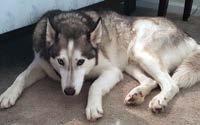
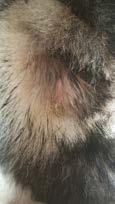
Cody is a five-yearold husky who was vacationing with his caregivers at Virginia Beach in the middle of the hot summer. Within a day of arrival, he broke out with a hot spot above his tail. (Notice how our common name for this condition indicates there is excessive heat involved).
animals may be better able to adapt to their conditions if fed food that can compensate for the temperature stress being placed on them. Likewise, a typical, neutral dog may feel better if fed warming foods in the cold of winter and cooling foods in the heat of summer.
Here are some examples of Chinese food therapy temperatures.
The technical name for a hot spot is “lick granuloma.” A hot spot manifests as a localized area of irritated skin that the animal licks excessively. They are often thought to be caused by allergies complicated by infection.
As part of his treatments, his caregivers gave Cody slices of cucumber and celery as treats. Within a few days, Cody was feeling much more comfortable, licking less, and his skin irritation was beginning to clear up.
The Chinese also considered that how a food is prepared affects its temperature. Raw foods are very cooling. Foods that is steamed or boiled are more neutral. Foods that are grilled baked or fried are warming, canned pet food is hot, and dry pet food is off the scale hot.
If your pet is hot, choose a diet made with cooling foods or feed cooling foods as treats and avoid processed foods. You may also want to add some of these cooling spices to his food – Mint, salt, honey, flax/sesame/soybean oils. If your pet is cold, feed warming foods and avoid totally raw diets. You might also want to try some of these warming spices – Chives, clove, ginger, garlic, horseradish, mustard, nutmeg, pepper, thyme, turmeric, olive oil, rice wine vinegar.
As helpful as the concepts of food energetics are, I do want to make it clear that the end result tends to be subtle. TCVM food therapy works best when it is employed as part of a healthy lifestyle. If your pet has a serious health issue, she needs to be seen by your holistic veterinarian for care. But, no matter what the health issue is with your companion, TCVM food therapy can be used in conjunction with any other therapy and may give your pet a leg up. As the Chinese proverb goes, “He that takes medicine and neglects diet, wastes the skills of the physician.” PC
Kitty Korner
Friendship and Assistance, Old Grand Dad and Frankencat Rescued Each Other
Article and Photography By Bernadette Kazmarski
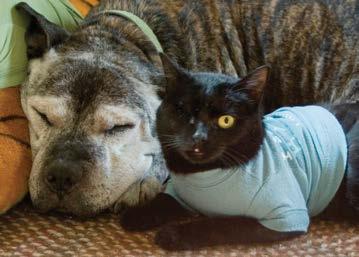
All the levels of their challenges and their differences from each other would make a deep friendship between two unwanted animals, a blind and deaf geriatric pit bull and a rescued one-eyed FeLV-positive black cat, highly unlikely but they are following a basic rule of rescued animals—love can live anywhere. Old Grand Dad and Frankencat aren’t concerned about rules, besides being great friends they found they need each other too.
About Frankencat
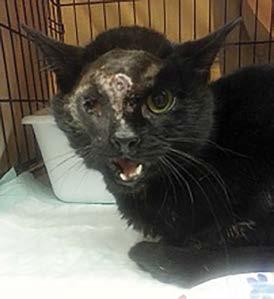
A small black cat was found on the street in November 2013 with an atrophied eye, a badly-healed broken jaw that held his mouth open and a necrotic wound between his eyes. Volunteers for the Pittsburgh Feral Cat Movement (PFCM) trapped him and took him to the Homeless Cat Management Team (HCMT) clinic in Tarentum and because of his truly frightening appearance the group named him Frankencat. Though the condition of his face made him appear wizened he turned
This story won a 2014 Dog Writers Association of America Certificate of Excellence and the Adoptashelter Award for dog rescue and improving life for dogs in shelters
out to be somewhere younger than three years old. His recovery from all this was progressing well after he responded immediately to an antibiotic for the necrotic wound, his eye was removed and he was neutered but then took an uncertain turn when his FeLV test came back with a faint positive. He was well enough to go to a foster home for long-term recovery but with that diagnosis he needed to wait six weeks to retest, and he needed a cat-free place to live to help reduce the chances of spreading the virus to other cats.
About Old Grand Dad, or OGD
Old Grand Dad (aka OGD) is 15 years old, deaf and blind and somewhat senile, and as an unneutered pit bull in a Carrollton, OH pound he stood little chance of adoption and in fact had an appointment with the gas chamber in August 2013. Heather Long spoke for him, intending to foster him until a spot was available with a rescue in Pennsylvania that specializes in hospice care, set up a room that met his needs and ensured his safety and got him to a veterinarian. The hospice spot was quickly available, “However, since I was aware of the challenge it can be for a deaf and blind dog to settle in to a new environment, and the safety setup I had created for OGD was working, I decided that OGD could stay here, and that open spot could better be used by another dog who didn’t have any other options,” Heather said.
How Frankencat came to live there Heather actually lives with six rescued dogs but she also enjoys cats, and in fact owns a pet care company called Au Purr, LLC where she provides home visits and hands-on in-
home care for all pets and other animals. Because of her known “soft spot for special needs and physically handicapped animals” she was called out to foster and care for Franken. Two of her dogs are not cat-friendly but she decided Frankencat could safely be roomies with OGD.
Getting to know you
“I was careful, being unsure as to whether Frankencat would like dogs; and while I figured OGD would be fine in his elderly, senile state, I needed to see that before trusting them alone,” she said. OGD tends to aimlessly wander around the room and he could easily seem threatening to Frankencat, even unassumingly corner him causing a confrontation where either could hurt the other. Frankencat stayed in an extra-large dog cage for the first few days, then Heather began to let him out while she was in the room and immediately “began to see their bond blossom.”
Frankencat initially had a rather frightening personality but by the time he arrived at Heather’s home he was wary, though after a few days of interacting with OGD Heather noticed Frankencat wasn’t as frightened of her. “I don’t know whether seeing me care for OGD made him realize I was okay, or if it was something else. But one day, Frankencat switched gears and began vocalizing while weaving around my ankles.
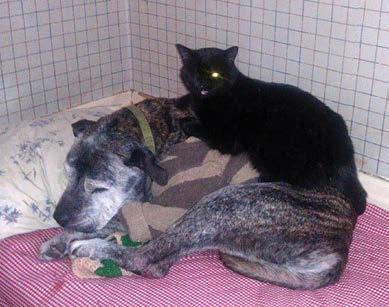
“It was around this same time that Frankencat showed his devotion to OGD. When I would come to their bedroom to put Frankencat in his crate before I left the house, I’d find Frankencat cuddling contentedly with OGD, or laying on [OGD’s] back while milktreading his skin, or grooming OGD gently,” she explained. “And OGD was visibly content with this relationship too. I took that as a sign that these two
were surely friends, and began leaving Frankencat out of the crate at all times, eventually removing the crate altogether.
From friend to caretaker
“Frankencat has become OGD’s one-eyed Seeing Eye Cat,” Heather said. “OGD often gets ‘lost’ with his senility, and will begin barking while in a corner. Frankencat seems to recognize this, and assists OGD to their bed,” she remarked. “OGD is deaf and blind, but Frankencat incrementally guides OGD first by using touch, either rubbing up against him and/or wrapping his tail on him, and then scent. After Frankencat touches OGD, he will move a few steps ahead and wait. OGD appears to smell him, and walks in that direction. Frankencat will then follow up with another touch, and then move a few steps ahead to let OGD guide himself by smell again. Ultimately, Frankencat will wait on the bed, and OGD finally gets there too with him,” Heather finished.
them; OGD needs Frankencat, and Frankencat clearly enjoys being OGD’s friend and having a purpose in OGD’s life.”
Eventually, Old Grand Dad’s journey here will end and Heather can see Frankencat “all alone in his room”. She’d like to begin now with a new owner who will visit Frankencat so he’ll
OGD also has petit mal seizures, a minute or so of confusion and trembling. Heather isn’t certain of the cause, though they suspect OGD may have some form of cancer or it may simply be due to his age. “Frankencat is keenly aware and concerned when OGD goes into an episode, and uses his touch to gently guide OGD down to lay on the ground. In the video I have of this, Frankencat clearly uses his tail to envelope OGD as he physically guides him downwards to safety. It is the most awe inspiring thing,” Heather said, and provided videos of both activities.
In the future
Frankencat is now clearly healed and feeling well, well enough to find another home that could accept a cat with FeLV, but for now Heather would like the two to stay together. “Given the special bond that Frankencat and OGD have formed, my plan is for them to stay together ‘til death do them part’. It seems unnatural to split
be accustomed to the visitor before OGD’s passing and actually be able to provide comfort and familiarity in Frankencat’s grief for his friend.
“It makes me very sad to think about Frankencat not being in my life,” Heather said, a little teary-eyed, “but it wouldn’t be fair to have him live alone in a bedroom, and he can’t safely and responsibly be out because not all of my dogs are cat friendly.”
As an FeLV-positive cat, Frankencat would have to go to a home with no other cats or with only other FeLV-positive cats, or cats vaccinated against FeLV, though there is risk associated with this since the vaccine is not 100% effective and FeLV is easily transmitted with shared food and water bowls and even toys.
Frankencat has met three of Heather’s other dogs since befriending OGD, and when she enters their room those dogs will often follow her in. “Frankencat greets
them with his cheerful meow, and gives them affectionate headbutts too,” she said.
“I don’t actually know if Frankencat even likes other cats since I’ve never seen him around one, but I can say with certainty that he loves dogs, and would love a home with any dogs who are cat friendly and enjoy cuddling.
“Frankencat is extremely loyal, gentle, friendly and affectionate once he gets to know you. He can be shy at first; but once he’s yours, he will never turn his back,” she described. He doesn’t play with too many toys but prefers cuddling and affection, and is very wellmannered, especially considering his beginnings, with no inappropriate scratching and excellent litterbox habits. “He also enjoys going out on walks with OGD to sniff around, but acts afraid of being outside on his cat harness when OGD isn’t there with him,” Heather said.
Imagine how many people along the way who would have given up on Frankencat because of how he looked and how he acted, and how many people likely did give up on Old Grand Dad for him to end up in a pound at his age. Through the efforts of so many people these two soulmates were brought together at a time when they needed each other, in a place that was safe and loving, and possibly rescued a little bit of each of us who see what can happen when you literally and figuratively can’t see each others’ differences. PC
Wellness For Guardians
Living & Loving The Real You
By Tamie Wilson
As I get older, the realization that life is really a constant discovery of who you truly are and accepting that which is revealed becomes more apparent. Throughout life there will be moments when you lose yourself. You will forever fight the internal battle of wanting to be accepted by others, that is until you fully accept who you are and value your own opinion of yourself over others.
Your self-acceptance and self-confidence will be perpetually challenged until you truly love yourself. You will change friends, change jobs, and change significant others as you come into the fullness of you. Even though those life changes tend to be painful and even depressing when you’re going through them, you’re much better off making those changes.
Self-love is really about loving yourself enough to allowing yourself new opportunities. When you don’t love yourself, you stay in unhealthy environments and relationships. A sign of personal growth and self-love is when you make life changes that allow you to live with more peace, love and happiness.
Every day you make over a thousand decisions from what you say, what you wear, where you work, how you work, etc., etc. I challenge you to a week-long self-evaluation. For the next week, be mindful as to your motivation behind your decisions. Be aware as to how many of those decisions are influenced by other’s expectations, wishes and desires of you. Notice when you don’t really say what you want to say. Notice when you do something you don’t want to do. Notice when you go somewhere you don’t want to go.
The following week, practice honoring yourself. Don’t be so quick to act or say yes. Practice honoring
yourself by giving yourself time to evaluate and then decide if how you’re about to react is indeed what you really want to do and say. Don’t allow yourself to feel pressured. Give yourself a break by simply saying, “Let me think about that and get back with you.” You truly can’t live your full purpose and be truly happy in life until you can learn to live and love the real you.
Tamie Wilson is a well-known Certified Holistic Coach™ Inspirational Teacher & Speaker in the fields of Personal and Professional Development. Tamie helps people discover and cultivate their authentic self through self-awareness using a spiritual approach. She was a TV consultant for ONN (Ohio News Network). She was a radio consultant for Power 107.5 and WVKO 1580 Talk Radio. She was featured in Just Women magazine, The Columbus Dispatch, and Columbus Alive. Tamie Wilson has assisted people through life challenges for over 20 years. PC
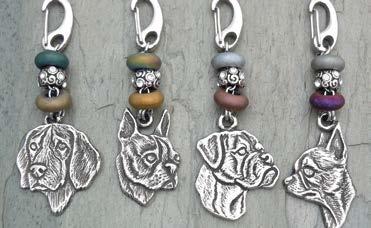
is a collection of jewelry and gifts for pet parents and pet lovers.
Visit feifish.etsy.com to find other unique collections that are near and dear to your heart
• Hot Dogs • Show Dogs • Cool Cats • Home, Love & Faith
• School Spirits • Birds Unlimited • Sea of Love
• Endangered Species and many more Portion of all sales proceeds will be donated to animal charity.
10% Discount for PetConnections readers, enter promo code PCC2016
Equine Affairs
Straight Lines and Circles, Oh My! Equine Influenza
By Brian S. Burks, D.V.M., Dipl. ABVP- Board Certified in Equine Practice
Hippocrates first described a disease resembling influenza around 412 B.C. It continues to cause significant morbidity and mortality in both humans and animals.
Equine influenza is the most common cause of viral respiratory disease. It is an acute respiratory infection of horses, donkeys, and mules. It is caused by two distinct subtypes (H7N7, formerly equi-1, and H3N8, formerly equi-2) of influenza A virus. Outbreaks can occur when horses are housed in close contact at race tracks, sale barns and horse shows. The virus spreads when horses cough or sneeze on other horses. Contaminated buckets, clothing, and grooming supplies may also aid transfer to other horses.
Clinical signs of equine influenza include fever, partial or complete anorexia, lethargy, watery nasal discharge (it may become muopurulent if secondary bacterial infection occurs) and coughing. Uncomplicated cases resolve in one to two weeks, though a cough can persist longer. Complications may be severe and include bacterial pneumonia, myositis (muscle inflammation) myocarditis (heart muscle inflammation), and limb edema (swelling). It spreads rapidly in susceptible populations.
Prevention is through biosecurity and vaccination. Biosecurity includes cleaning tack and grooming utensils, as well as buckets. Clean clothing should be donned after handling a sick animal. Do not share anything with another person at any horse show. It is also a good idea to re-clean the stalls at a show facility (fairgrounds). Clean out any organic material (bedding, cobwebs) and spray the walls and floor with 10% bleach water. Lime stone can be put on the floor to further help eliminate any viruses or bacteria.
Likewise, horses travelling need to be rested every eight hours, and taken off of the trailer for fresh air. Ventilation of the trailer is a must, but direct drafts should be avoided. Horses should be able to put their heads down
when going long distances, as this helps to clear the airways. They should also be provided hay and fresh water.
Vaccination is the second most important way to prevent equine influenza. There are several types of vaccination available; killed virus, modified-live virus, and chimera vaccines. The first type must be used frequently to have any affect- every 2 months. The latter two are much more protective and last for 6 months. The intra-nasal Fluavert has a very quick protective time- as little as three days, where the killed vaccine won’t be protective for 2 weeks, as it stimulates the anamnestic response. It is important to remember that vaccinated horses can still shed virus; vaccinated horses can bring the virus back to the barn where any unvaccinated horse is susceptible.
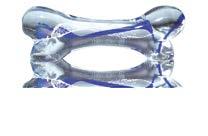
The protection against influenza is by the mucocilliary apparatus and secretory IgA (Immunoglobulin-A). This antibody is secreted from the mucus membrane barrier and can prevent viruses and bacteria from taking up residence in the respiratory tract. The attached picture shows what happens to cilia when they are damaged by the virus. The cilia are no longer able to keep debris and pathogens out of the respiratory tract, and secondary infection is likely, which can lead not only to pneumonia, but to pleuropneumonia.
Protection from any virus or bacteria begins with a healthy horse. This means good nutrition, plenty of clean hay and fresh water. It does not necessarily mean grain- that depends upon the situation; many horses do not need grain to be in good condition. This is why many horses that go through auctions are ill; poor nutrition and overcrowding, with exposure to many different pathogens.
Influenza often undergoes antigenic drift, the accumulation of small changes over time. This new virus might not be recognized by
the body, accounting for repeat episodes of influenza. The process is much slower for equine influenza compared to human influenza strains.
Antigenic drift may account for vaccine failure, but sometimes influenza strains from other species may infect a different species. For example transmission of H5N1 and H7N9 bird flu strains to humans. In the United States, equine H3N8 influenza to dogs has occurred, creating a novel canine respiratory pathogen. The reverse has not been found to occur naturally and only very mild clinical signs have been experimentally induced.
Influenza represents a significant infectious disease due to antigenic shifts and its occasional ability to cross species. The virus causes fever, nasal discharge, and lethargy, representing a major source of morbidity and the inability to ride the horse. Vaccination and biosecurity are the best ways to prevent this disease.
Dr. Brian S. Burks, Dipl. ABVP- Board-Certified in Equine Practice, is the owner/veterinarian at Fox Run Equine Center, a 24-hour medicalsurgical center near Pittsburgh, Pennsylvania. He is Board Certified by the American Board of Veterinary Practitioners (Equine Practice). This certifies him as an expert in all categories of equine practice. He enjoys the diagnostic and treatment challenges of internal medicine,
Shane
Jen and I made the decision to buy our first home. I cared less for the actual house than the fact that we could finally have a dog. Adoption was the obvious choice and two weeks before we moved in we spent a Saturday morning at Action For Animals. We saw this little scraggly looking guy. Goofy with a ratty tail. Jen and I looked at each other and said, what do you think? She said “I like him”. “I like him too.” I responded back. As it turned out, Shane (who was already named) was our Gift of the Maggi. Neither Jen or I really thought that much of Shane but we thought the other loved him. So we adopted Shane and he moved into our home the day we did. That was late November of 2000.
That simple miscommunication changed our lives in ways we didn’t imagine back then. From that point, we never looked back. We were his and he was ours. Jen and I never had children, we had Shane and we never wanted for more. He was our North Star; my Little Man and Jen’s Little Prince of Egypt (because of the black eye liner it looked like he was
In Remembrance
wearing). Shane made us a family. Of course, Shane was the greatest in the world, as every furry child should be. But he was also moody, stubborn, and even a little mean. And we loved him for it. Shane had the ability to be the center of attention while still wanting none of it. He made you earn his love and respect. He was his own person and we nurtured that in him.
As the years went by... Nearly 15 of them. We knew that the time to say goodbye was getting near. Shane began to let us know he was getting tired. Arthritis had taken its toll and then a cancer diagnosis in his last few months put Jen and I into uncharted waters. When was the right time to say goodbye? The day came in late April of 2015. Jen and I held Shane as he passed at the doctors office. Jen kissed his head as I rested my head on his chest. I heard his last heartbeat and he was gone. We cried as we sat with Shane and tried to console each other.
As we look back on the trivial things that we gave Shane, food, 6 beds and about 100 toys at any given time... He gave us so much more, more than we realized. When Shane passed we moved. Our home was now just a house. All of the sounds were different. The smells had changed and so had our lives. There isn’t a day that goes by that we don’t wish we had just one more day with him. But we are eternally grateful for the years we got to spend spoiling and loving him.