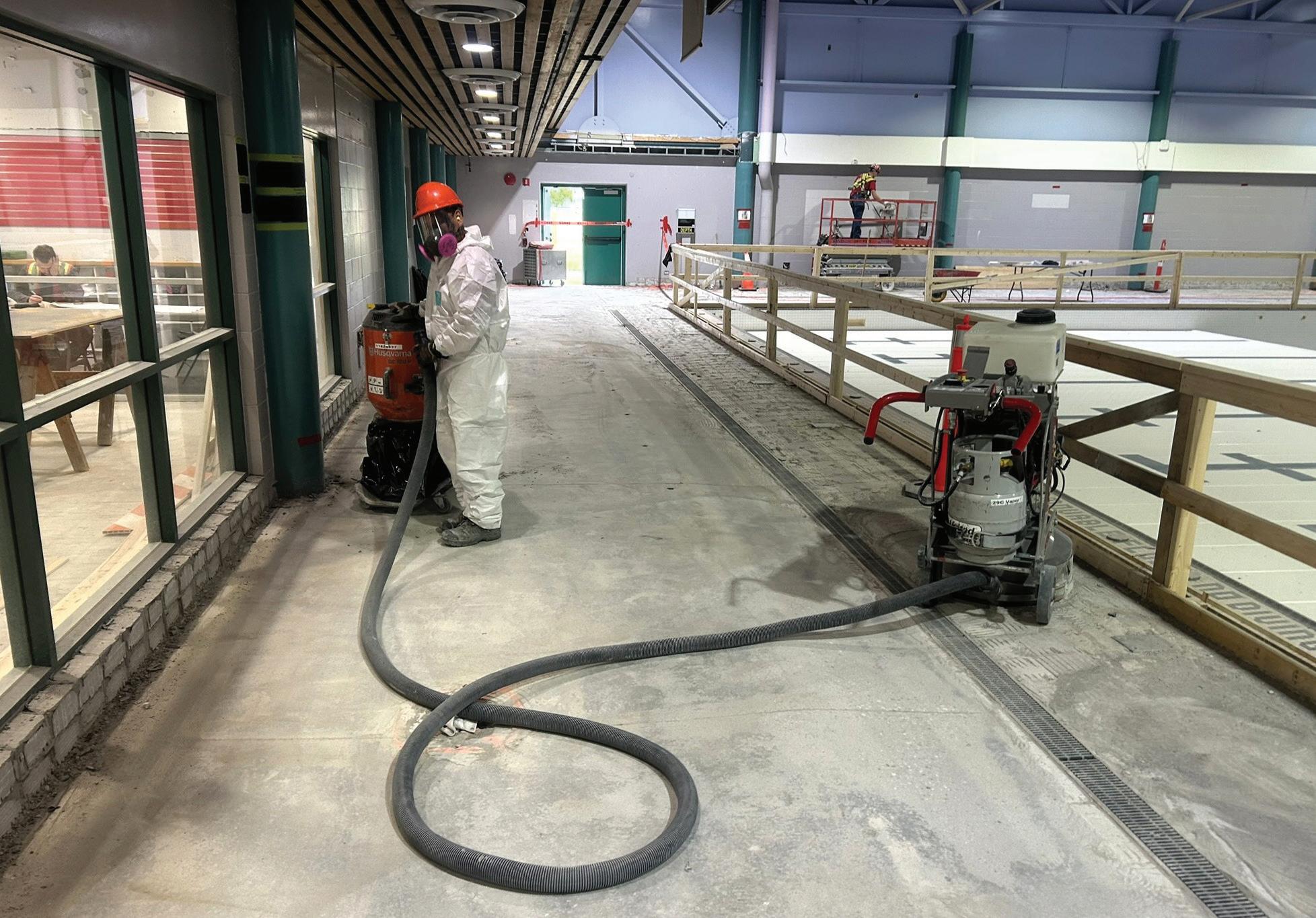
Renovations at the Prince George Aquatic Centre are on time and on budget, with much of the demolition work complete, mayor and council
additional testing revealed more water damage, corrosion and mould not previously detected.
To address these concerns, the city had to work with the firm managing construction to find savings to prevent the project from going over
Four problem propertes no longer on council’s radar
The owners have cleaned the places up and complaints have ceased, council hears
COLIN SLARK Citizen Staff
Nuisance abatement orders on four properties were rescinded by Prince George city council at its Monday, July 6 meeting.
Under city bylaws, people are prohibited from causing nuisances on properties they own or occupy.
Nuisances are defined as “any activity which substantially and unreasonably interferes with a person’s use and enjoyment of a highway, park or other public area or land a person owns or occupies.”
Activities considered a nuisance include creating excessive noise, littering, trespassing, accumulating water or other liquids, creating unsanitary conditions and more.
The city has the power to issue an order to the owner or occupier of a property to stop causing a nuisance and if they do not, the city can address the issue, issue a fine of up to $10,000 and recover any incurred costs from the offender.
Coming into the July 6 meeting, city staff asked for four previously-issued orders to be rescinded.
The first was issued on March 22, 2021 to the property at 7003 Adam Dr. The Citizen reported at the time that the property contained a mobile home that had been abandoned.
There had been numerous complaints regarding unsightly premises, dangerous dogs that led to Canada Post discontinuing deliveries, 17 derelict vehicles, drug overdoses, burning copper wire and more.
Staff said that since the order was issued, the abandoned mobile home was demolished and a new one installed in its place. No complaints have been received since Dec. 17, 2021.
The second order was put in place on Nov. 18, 2024 for the property at 389
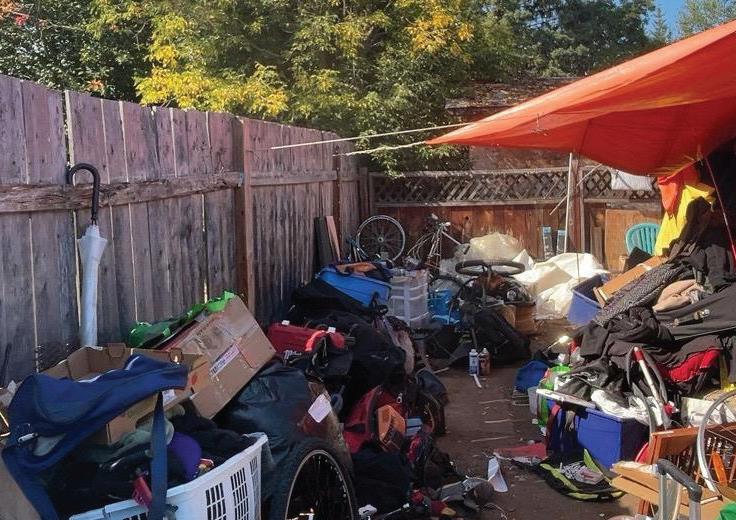
City of Prince George bylaw services took this photo at a nuisance property at 4235 Quentin Ave. on Wednesday, Sept. 10, 2025. At the Monday, July 6, 2026 city council meeting, staff said the property has been cleaned up and recommended that a nuisance abatement order be rescinded.
Nicholson St.
When the order was put in place, The Citizen reported that city staff had received 17 complaints over the previous five years ranging from garbage, unleashed dog and loud disturbances to RCMP investigations into drug trafficking.
Since then, city staff said the property was remediated and sold, with the purchaser paying all remediation costs. No bylaw complaints have been registered at this property since Aug. 16, 2025.
At the same meeting as the last order was issued, another was implemented for the property at 1105 Vancouver St.
Another Citizen report from the time described multiple interventions from bylaw officers, the RCMP and Prince George Fire Rescue.
“The property has been associated with a range of nuisance activities, including illegal drug use and sales, discarded waste, and what a city staff report describes as dangerous behaviour such as outdoor fires and frequent disturbances,” The Citizen reported.
Included with the meeting agenda was a letter from the four owners of the
and contractor costs borne by the city have been billed to the landlords. There have also been no complaints to bylaw services since Oct. 21, 2025.
A report presented at the June 12, 2024 council meeting referenced an abatement order for 1359 Iona Rd.
However, staff said they’d determined that while other enforcement measures were taken, no official order was placed on the property.
Discussing the report, Depenau said this was the first time since the bylaw was established that council has been asked to rescind nuisance orders. He said there’s no sunset clause or expiration date in the bylaw and that in these four cases, staff feel that enough progress has been made to justify rescinding the orders.
property, Jarnank, Mohinder, Ram and Sudershan Manhas.
They said since the nuisance order was issued, they made “significant efforts to address the concerns that led to the designation,” including picking up garbage and debris, renovating the interior and exterior of the building and improving property management to make sure reference checks, property checks and monitoring are carried out.
They said there have been no complaints since the order was issued.
This is confirmed in staff’s report, which acknowledges the remediation work, new tenants at the property and no bylaw complaints since August 22, 2024.
The final order is less than a year old, issued for the property at 4235 Quentin Ave. on Oct. 20, 2025.
At that council meeting, both the owners and tenant of the property were asked to rein in their dogs, clean up garbage and end backyard camping. At the time, the city’s bylaw department said its officers had visited the site 25 times and the RCMP 19 times since July 2024. Since then, staff said, the property has been cleaned up, tenants have changed
In a separate agenda item, staff reported back on a request by council made at the Oct. 20, 2025 meeting to review the nuisance abatement bylaw and examine the possibility of establishing a threshold for calls for service for a problem property where, once passed, it would automatically trigger the implementation of fines before a nuisance abatement order is issued.
The report advised against making any changes at this time, saying that it would limit the discretion of staff, cause staff to bring forward reports on cases where an order shouldn’t be implemented, disproportionately impact property types where the use is prone to generating protective services responses and prove challenging in cases where vexatious complaints are made.
Coun. Trudy Klassen asked whether the current rules have led to any nuisance abatement orders being issued against service providers.
Director of administrative services Eric Depenau said that hasn’t occurred since the bylaw was established in 2018.
Vote summary
Motion: Council acknowledges satisfaction of the nuisance abatement orders in effect for the properties at 7003 Adam Dr., 389 Nicholson St., 1105 Vancouver St. and 4235 Quentin Ave.
Result: Approved unanimously.
CITY OF PRINCE GEORGE PHOTO
Council will tour the Aquatc Centre in the coming months
CONTINUED FROM PAGE 1
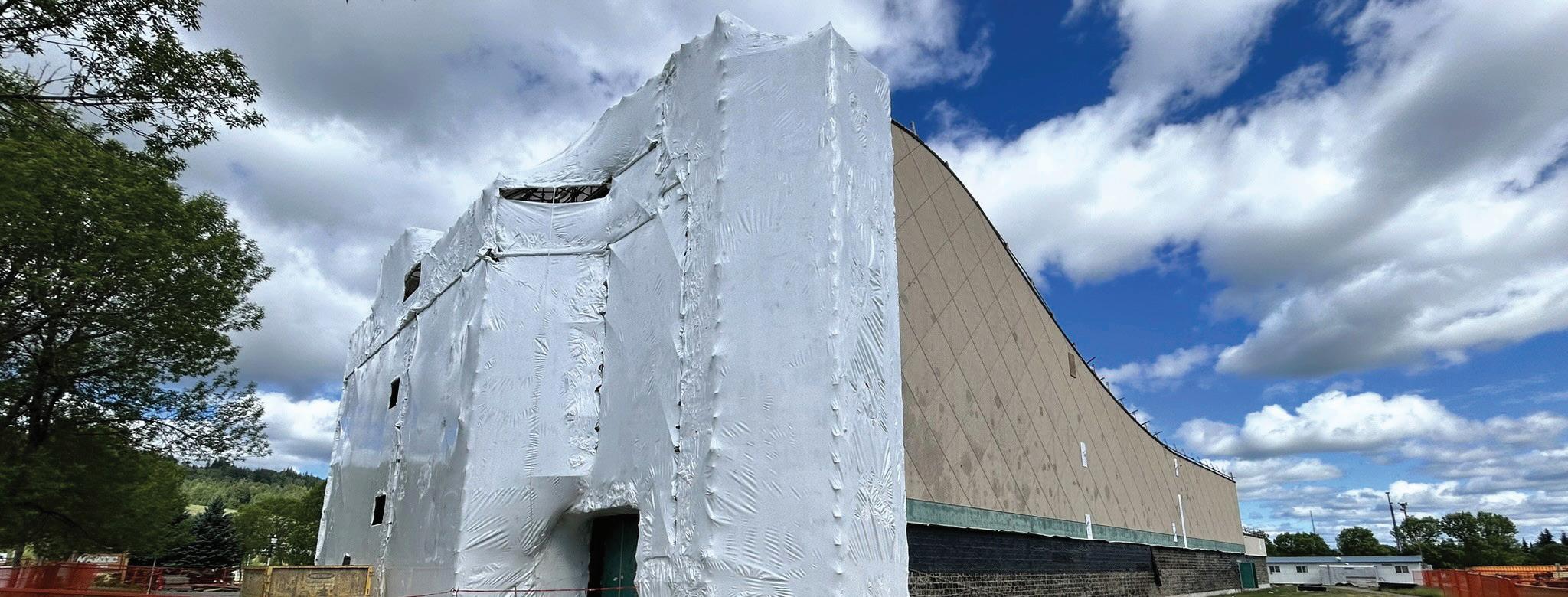
On the outside of the building, the concrete block veneer has been removed, scaffolding has been installed on the south and west sides, the walls are being prepared for the installation of a new vapour barrier, removal on the exterior insulation finishing system has started, the parapets have been removed and part of the roof over the dive tower has been removed.
Parts of the exterior of the building are wrapped in a white covering. Inside the mechanical portions of the facility, two air handling units have been demolished, a concrete slab has been x-rayed to prepare for electrical and structural work and protection has been installed for the building’s gas work.
Underwater pool lights, valence lighting, refrigerant, solar panels and related systems have all been removed.
Paint mock-ups have been created inside the natatorium (swimming chamber), changerooms and restrooms.
Security cameras have been installed to protect the construction site, shoring has been designed for the pool deck,
permits for work in confined spaces have been applied for and safety plans for potential rescues from high angles have been developed with the help of Prince George Fire Rescue.
Beesley concluded his report by
promising more updates and saying that a tour for council’s benefit is being arranged in the coming months.
Council did not discuss the progress update, instead voting to receive the report for information.
Exterior scaffolding and shrink wrap are seen on the exterior of the Prince George Aquatic Centre as renovations continue.
City staf error puts new deck too close to neighbours
Neighbours say owners of the Croft Road
property shouldn’t be given a break after mistake
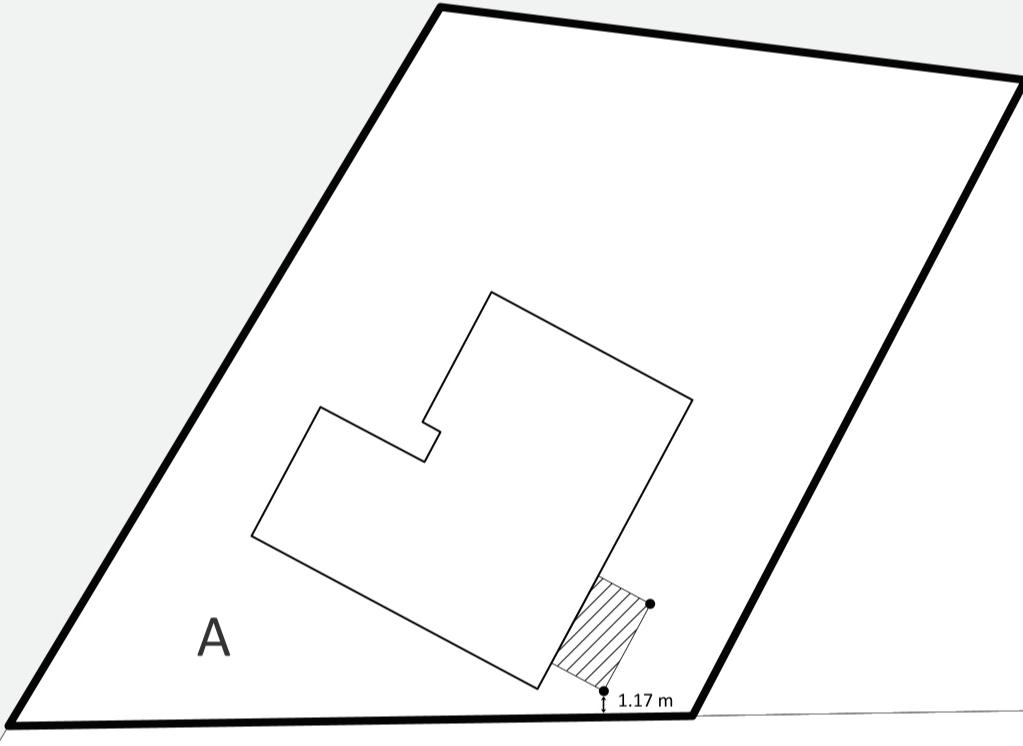
This City of Prince George diagram shows the 1.17-metre rear setback being applied for between the property at 2239 Croft Rd. and its neighbour on Dunbar Place. A planned deck is too close to the property line due to a city staff error.
NOTICE OF INTENT TO CONSIDER AMENDING
Regional Board Procedure Bylaw No. 3267, 2022
In accordance with the Local Government Act, notice is hereby given that the Regional District of Fraser-Fort George Board intends to consider amending Regional Board Procedure Bylaw No. 3267, 2022 on July 16, 2026 at 1:30 pm at 155 George Street, Prince George.
Proposed Amendment Bylaw No. 3425, 2026 improves meeting procedures, clarifes correspondence management, and updates electronic participation and voting provisions. On July 9, 2026, the proposed bylaw and report will be on rdfg.ca in the July 16, 2026 Regional Board Meeting Agenda.
For more info, contact Corporate Services at 250-960-4400 or corporateservices@rdffg.bc.ca
COLIN SLARK Citizen Staff
An improperly issued building permit and a slate of angry neighbours had the City of Prince George and city council trying to figure out the right way forward at its Monday, July 6 meeting.
Council ultimately voted against issuing a variance, leaving the construction of a house and rear deck — for which the foundation has already been poured — in limbo.
In August 2023, the owners of 2239 Croft Rd. — a company called Mehsem Holding Ltd. — applied for and eventually received a building permit for a house with a rear deck on the property.
However, after the foundation had been poured, city staff reviewed the application and determined that the permit had been granted in error.
City staff misinterpreted the definitions of rear and side yard setback and mixed them up while considering the permit application, council heard.
Under the RS1 zone the property is under, there has to be a six-metre setback between any structure and the property to the rear.
The foundations that have been laid would have the edge of the deck be just 1.17 metres away from the property to the rear, which prompted complaints from neighbours last August.
To address the city’s own error, staff encouraged the owners to apply for a development variance permit to allow for the reduced setback.
Councillors debated the best way to resolve the issue as the city is at fault in issuing the permit, but nearby neighbours wrote letters expressing unhappiness that the reduced setback violated their privacy.
Mike and Vanessa Godfrey wrote that their property on Dunbar Place has a side property line that lines up with the rear property line of the Croft Road property.
“My backyard privacy has been significantly diminished, and the close proximity of this new home has
negatively affected my property’s appeal and my quality of life,” they wrote, encouraging council to deny the permit. “The situation has become so discouraging that I have made the difficult decision to sell my home after 20 years of living here.”
Chris Arronge, also of Dunbar Place, said he disagreed with the permit as well. “I could see if it was just a couple of feet, that would be fine, (did) they not have a survey done before starting to build?”
Another Dunbar resident, Darrell Orosz, said the developer should know the setback requirements before starting to build and accused them of not having done a legal survey before commencing construction.
Celia Godin-James said she lives at a property owned by her parents on Dunbar Place below the Croft Road property.
She accused the developer of having removed some trees on her family’s side of the property line and asked council to consider the impact on longtime families in the area before issuing the permit.
Jim and Gayle Hesse of Enns Road said that regardless of whether the error was committed by the city or the developer, neighbours would have to bear the brunt of the mistake.
A fifth Dunbar Place resident, Krista French, advocated for the permit to be rejected as the placement of the deck would be too close to the neighbours’ yard.
During council’s debate, a couple who appeared to be neighbours upset with the application expressed occasional disbelief when a councillor expressed interest in trying to find a path forward that would allow for the reduced setback to be implemented.
Coun. Cori Ramsay wondered if it would be fair to increase the side setback to make up for the decreased rear setback and keep the buildable space at the same size. CONTINUED
A partial foundation can be seen at 2239 Croft Rd. in this Google Street View screenshot. Prince George city council voted against issuing a development variance permit to decrease the property’s rear setback at its Monday, July 6.
Council debates whether owners can go forward
CONTINUED FROM PREVIOUS PAGE
Coun. Susan Scott said buildings being built right up to property boundaries is not a unique occurrence in the city, but there haven’t necessarily been complaints in other cases. She said the short distance between the rear of the building and the next property was disrespectful to neighbours and she would oppose the permit.
Coun. Garth Frizzell asked whether the permit not getting approval that night would allow the property owners to look into other options and come back with a different proposal or whether it would be prudent to postpone a decision, thereby putting construction on hold.
He said staff made an error and it wouldn’t necessarily be fair to deny a variance, but the city has to make things right for the neighbours as well.
Coun. Brian Skakun said he wasn’t dismissing neighbours’ concerns, but the city has an onus to make up for its mistake and he’d support the variance.
Coun. Kyle Sampson asked if there was any precedence for this kind of situation and if so, how the city dealt with the problem.
Sitting in for director of planning and development Deanna Wasnik was manager of economic development Deklan Corstanje, who said he couldn’t recall anything like this happening in his time with the city.
City manager Walter Babicz said council could postpone its decision if it wanted more information before making a decision. Sampson said he was leaning towards not granting the permit, but he
wanted to get more information before making his decision, including potentially legal advice.
Coun. Tim Bennett said he was worried about the homeowner who’s had to pause construction in a city where construction seasons aren’t very long, so he would hate to prolong a decision.
Ramsay said she wouldn’t support deferral and would like to see the variance granted as the builders were working in good faith.
Coun. Ron Polillo said he agreed that the matter shouldn’t be deferred as this was the city’s mistake.
Sampson moved for the matter to be deferral for consideration at a future meeting, but the motion was rejected by a margin of five votes against to three in favour.
The permit was then defeated after an even number of councillors in the chamber led to a four-to-four tie vote.
After the vote, Babicz said administration will consider the implications of the situation and report back to council as necessary.
The neighbours then left council chambers, with one saying to the other “What happens now?”
Vote summary
Motion: Council approves a development variance permit allowing for a reduced 1.17-metre rear yard setback at 2239 Croft Rd.
• In favour: Ramsay, Polillo, Skakun, Frizzell
• Against: Scott, Yu, Bennett, Sampson
Result: Defeated after 4 to 4 tie vote, with Coun. Trudy Klassen absent
GOOGLE STREET VIEW IMAGE
Track repairs complicatng Litle Prince shelter project
COLIN SLARK Citizen Staff
Archaeological work and repairs to the track the Little Prince miniature train runs on are obstacles to the construction of a new shelter and the establishment of a new operating agreement between the City of Prince George and the Exploration Place, city council heard during a Monday, July 6 meeting of the committee of the whole.
The meeting focused on unfunded capital projects pulled for discussion during this January’s budget talks.
Each year, council members can forward items that are identified as necessary capital projects — but for which a funding source has yet to be determined — for discussion during a mid-year committee of the whole meeting to see if they should be funded in the next year’s budget.
During 2026 budget talks, councillors Garth Frizzell and Susan Scott pulled the project that would build a new storage shelter for the train for further discussion.
The Little Prince, built in 1912, was used to help bring railway lines to the Prince George area more than a century ago. It was donated to the city by CN Rail in 1971.
The city owns the train but contracts operation and maintenance to the Exploration Place at Lheidli T’enneh Memorial Park. The track is the smallest railway system licensed by Transport Canada, meaning that it has to abide by federal regulations.
The current shelter is undersized and leaking, which makes it difficult to both preserve the historic train and for staff to maintain it.
In September 2025, the city said it wanted a long-term operating agreement with the museum and science centre before committing to the then estimated $1.2 million price tag and the Exploration Place said it wanted the new shelter before signing that agreement.
Since the project was discussed during budget talks, the Exploration Place announced in May that the train
The Little Prince, a staple of Lheidli T’enneh Memorial Park, will be out of commission for the foreseeable future due to infrastructure concerns.
will not be able to run until erosion issues along the tracks as well as some elements of the track itself are fixed.
This work would include the construction of a new retaining wall.
Because Lheidli T’enneh Memorial Park was once home to Lheidli T’enneh First Nation’s village, archeological work must be undertaken to make sure that historically significant areas are not disturbed.
In a May phone interview, Exploration Place executive director Alyssa Leier said the estimated cost for three days of archeological work was $10,000 but could go higher if anything important is discovered.
During construction of a new playground at the park that opened in fall 2025, archeological work made up a significant portion of the expenses for the project.
When the item came up for discussion during the July 6 committee meeting, both city staff and councillors outlined a chicken-and-egg scenario: should a new shelter be built if the future of the track is uncertain and if the future of the train’s operation depends on the new shelter, should the track be repaired before that project is sorted out?
Director of civic operations Blake McIntosh said city staff are trying to identify a location around the museum where the new shelter could be built. There was thought of using an existing foundation to cut down on costs, but that didn’t pan out and now staff are looking at placing a new concrete slab in the footprint of a previous structure.
McIntosh said the estimated price tag
for the shelter project is now about $1.5 million. Though the track repairs and archaeological issues are the responsibility of the Exploration Place, he said the city would help where it can by assisting with the construction of a new retaining wall and assisting with grant applications.
If the location of the new shelter isn’t the same as the old one, some parts of the track may need to be realigned or new track may need to be laid.
Director of civic facilities and events
Andy Beesley said staff haven’t wanted to ask council for shelter funding without having an operating agreement in hand.
He praised the Exploration Place’s co-operative spirit during talks and said both parties are eying a 10-year agreement. However, he said the museum has two non-negotiables: the new shelter and the resolution of the archaeological hurdles so the track can be repaired.
Beesley said there had been some recent positive movement on the archaeological front. Permission has been granted by the federal government to work on the railway ties. However, excavation permission to deal with the erosion has not been received and it could be a long time coming.
Staff, he said, are hoping to come back to council with a progress update by the end of the year.
As council’s discussions over the item started, Frizzell recused himself from the debate as one of his family members has recently become employed by the museum.
Scott said she didn’t know much in
the way of current specifics, but that it was worthy of discussion given the many problems the shelter has had in recent years.
Coun. Tim Bennett said both the track repairs and the new shelter are worthy of a larger discussion as the city shouldn’t pursue $1.5 million if the train can’t operate afterwards.
Coun. Trudy Klassen encouraged her colleagues and staff to look at less costly options for a new shelter, saying that it just needs to be functional, not beautiful.
Mayor Simon Yu said he walked along the tracks on Father’s Day and estimated that about 30 per cent of the rail ties need to be replaced. He said it’s hard to approve proceeding with the shelter when the future of the tracks is up in the air.
Coun. Brian Skakun moved for the project to be forwarded to next year’s funded capital plan.
Coun. Kyle Sampson expressed concern that preservation of the train as a historical artifact might be outside the scope of the city’s responsibilities and wondered whether funding for the shelter could be received from Heritage Canada.
He then put forward an amendment to Skakun’s motion adding a clause that would have staff return a report including alternatives for the project including a more direct replacement of the current shelter.
Coun. Ron Polillo said he was worried that the city is carrying the financial burden of maintaining an important historical artifact that’s more than a century old.
Yu said he has directly spoken with federal Minister of Canadian Identity and Culture Marc Miller and would be happy to reach out again to advocate for funding as long as he’s supplied with information beforehand.
Council ultimately voted unanimously to approve both Sampson’s amendment and Skakun’s amended main motion.
As the Committee of the Whole cannot directly order staff work, this motion will be forwarded to a future regular council meeting for final approval.
EXPLORATION
City-wide residental zoning changes get fnal approval
COLIN SLARK Citizen Staff
City-wide changes to three types of residential property zones are now in effect after a bylaw received fourth and final reading from Prince George city council on Monday, July 6.
Council first heard about the proposed changes from city staff at its Monday, June 22 reading.
At that meeting, director of planning and develop Deanna Wasnik said that changes were needed to the RM1, RM2 and RM3: Multiple Residential zones were needed to comply with changes to provincial legislation on small-scale, multi-unit housing passed last year.
That legislation, Wasnik wrote, states that “a zone that has any parcel of land that is restricted to duplexes and/or a single detached home is considered a restricted zone and must meet the minimum unit density requirements on all lots” and that it “expands the definition
Council has approved zoning changes so the city comply with changes to provincial legislation on the construction of small-scale, multi-unit housing passed last year.
of a Restricted Zone to include all lots where a single detached home with a secondary suite and detached accessory dwelling unit are allowed.”
For the RM1 zone, the changes mandate a maximum residential density of 30 dwellings per hectare except on parcels that are 280 square metres or less in size, where there is a limit of three dwellings. It also mandates a minimum of four dwelling units on parcels within
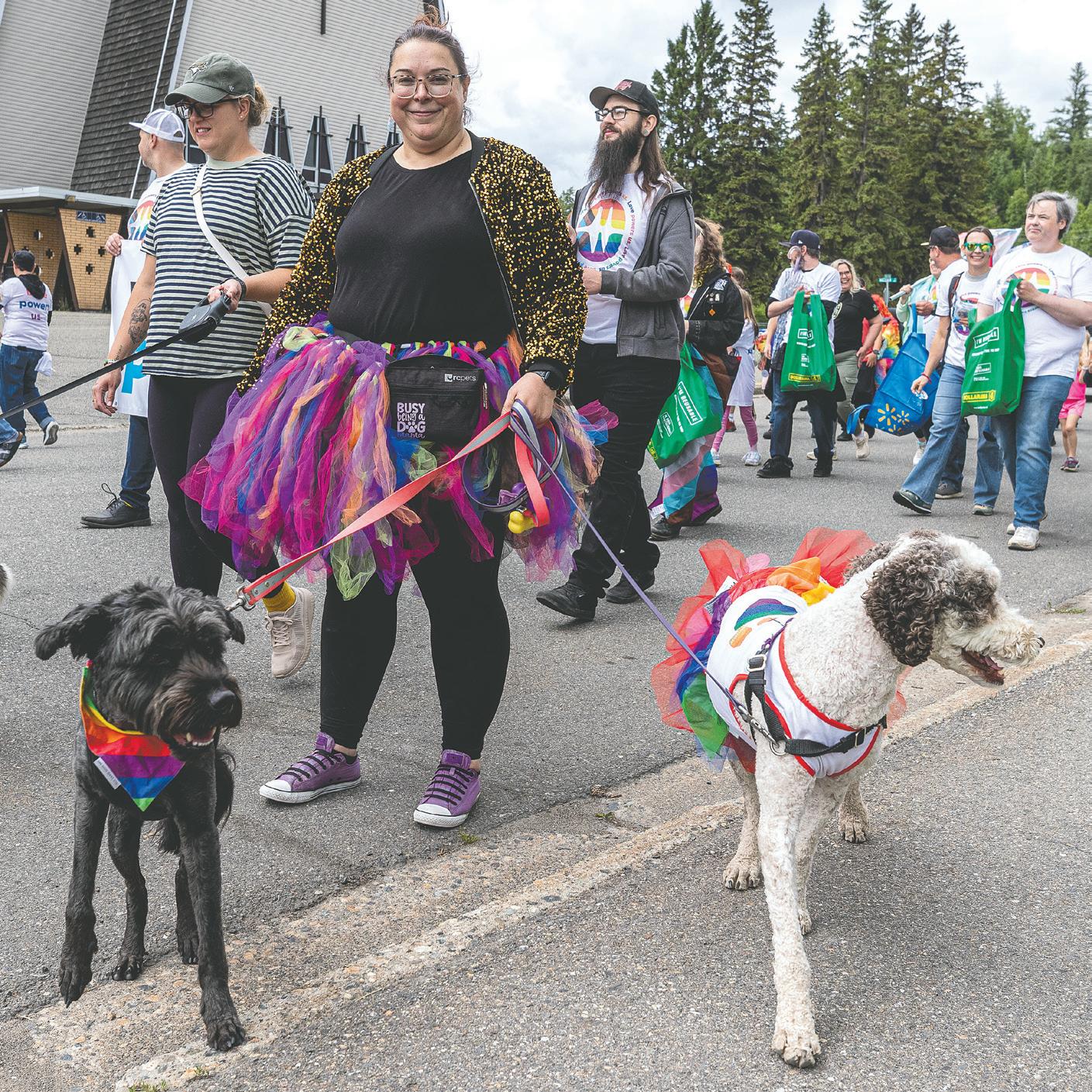
Celebratng Canada Day in PG
the zone greater than 280 square metres in size.
The RM2 and RM3 changes are almost identical, except that the maximum residential density is 60 dwellings per hectare. The maximum and minimum for properties bigger or smaller than 280 square metres are proposed to be the same as under the RM1 zone.
These changes did not require a pub-
align with the Official Community Plan. Fourth and final reading was passed at the July 6 meeting without debate.
Vote summary
Motion: Council approves fourth and final reading of city-wide zoning amendments relating to density for the RM1, RM2 and RM3 multiple residential zones.
Vanderhoof International Airshow
CITIZEN PHOTO BY CHUCK NISBETT
Jesse De Melo (left) and cousin Theo Simon enjoy some flag play while taking in Canada Day celebrations with their families at Lheidli T’enneh Memorial Park on Wednesday, July 1. The park was the hub of the community’s celebration of Canada’s birthday.
OPINION
Help those who need help, jail those who need jail
KENNEDY GORDON Citizen Managing Editor
We’ve all seen them. Early in the morning, late at night, or even in the middle of the day: Staggering down a street or hunched over on a corner or collapsed on a sidewalk, they’re clearly dealing with tough combinations of mental illness and addiction.
Are they a threat? Or do they just want to be left alone?
For decades, we’ve relied on the judgment of our first responders to determine what to do with them, deciding whether they need a police car or an ambulance, a hospital bed or a jail cell.
Now a new tool called HealthIM, first tested right here in Prince George, is giving the RCMP a better option for when officers encounter them on BC streets. It helps police consider important questions while assessing each situation.
The new diversion model recognizes a reality that frontline officers have known for years: repeatedly arresting people whose criminal behaviour is driven primarily by addiction, mental illness or both is not solving the problem.
Cycling vulnerable people through courtrooms, holding cells and correctional facilities before returning them to the same streets does almost nothing to improve public safety or the lives of those caught in that cycle.
Giving police another option is a pretty clear acknowledgment that catch-and-release has reached its limits.
If the RCMP can point people toward treatment and support instead of automatically processing them through the criminal justice system, communities stand to benefit.
But diversion, on its own, is only one piece of a much larger puzzle.
For some people, the barriers created by severe addiction and untreated mental illness are so profound that they can’t be trusted to make decisions in their own best interests — or, by extension, the safety of the people around them.
When someone is repeatedly overdosing, living in psychosis or creating dangerous situations for themselves and others, waiting for them to voluntarily seek help is pointless. That’s why the involuntary care centre can’t open fast enough.
But we shouldn’t confuse every repeat offender with someone whose
criminal behaviour stems solely from illness.
There is another group of offenders who repeatedly exploit a justice system that has become far too comfortable with revolving-door bail and minimal consequences. They may also struggle with addiction or mental health challenges, but they also make conscious choices to victimize others through theft, assault, weapons offences and persistent property crime.
For offenders who repeatedly demonstrates through their actions that they pose a real risk to public safety, tougher bail conditions and meaningful jail sentences are key. Addiction can’t become a blanket excuse used to override accountability. The challenge for governments is recognizing the difference.
Some people need treatment before anything else. Others need treatment alongside incarceration because their
criminal intent cannot simply be separated from their addiction. Pretending these are the same population serves neither group well.
The RCMP’s new diversion initiative suggests police increasingly understand that distinction, which makes sense considering what frontline officers see every day (and night). They know many of the people they encounter do not belong behind bars if appropriate treatment is available. They also know there are habitual offenders who repeatedly cycle through the system because of generous bail conditions and light sentences, continuing to prey on the community almost immediately after release.
That reality demands a balanced approach rather than ideological extremes.
PG won’t become safer by simply locking everyone up. Nor will it become safer by releasing repeat offenders with little expectation that anything will change.
Real public safety means building a system that combines compassion with accountability: diversion where appropriate, involuntary care when people are incapable of seeking help themselves, and consequences for anyone who continues to endanger others despite every opportunity to change.
The RCMP appears to be moving toward that practical middle ground. Now Premier David Eby, BC Attorney General Niki Sharma and Health Minister Josie Osborne need to follow that lead.
We acknowledge the fnancial support of the government of Canada.
Nous reconnaissons l’appui fnancier du gouvernement du Canada.
FRONT DESK & CLASSIFIED frontdesk@pgcitzen.ca 250-562-2441 NEWS AND SPORTS news@pgcitzen.ca
LETTERS TO THE EDITOR editor@pgcitzen.ca
OWNER / PUBLISHER owner@pgcitzen.ca
CITIZEN FILE PHOTO BY MATTHEW HILLIER
RCMP officers escort an arrested suspect to a police car on Tuesday, June 2 in Prince George BC.
Cameron Stolz Owner / Publisher
Randall-Stolz Owner
OPINION
Lessons in legacy, stewardship, and community ambiton
ELI KLASNER Guest Columnist
A remarkable project is taking shape in Vancouver.
The Jewish Community Centre of Greater Vancouver is preparing to build JWest, a new community campus that will include a community centre, theatre, art gallery and other cultural spaces, high school, childcare facilities, housing, fitness facilities, and other community amenities. The project carries a price tag of approximately $200 million. While the federal and provincial governments have committed a total of $50 million toward the project, roughly $150 million has been raised through individual donors, family foundations, and matching campaigns. For a community numbering only about 30,000 people in British Columbia, it represents one of the most ambitious and successful fundraising efforts in the province’s history.
For generations, the Jewish Community Centre has served far more than the Jewish community alone. Vancouver residents from a wide range of cultural, ethnic, and religious backgrounds have used its fitness facilities, attended performances and exhibitions, participated in programs, and gathered in its community spaces. While rooted in Jewish life and values, the Centre has long functioned as a community asset that contributes to the broader civic life of Vancouver.
This broad community impact helps explain why governments were willing to become partners in the project. But it does not explain the most remarkable part of the story: why thousands of individuals and families chose to contribute approximately $150 million of their own money toward building it.
Some donors are seniors. Some no longer have children living at home. Some may rarely set foot in the completed facility. Yet they continue to give. The answer is not really about a building. It is about continuity—the idea
that institutions worth inheriting are also worth strengthening for those who come next.
The most successful and sustainable institutions are often built around a simple idea: each generation inherits something from those who came before it and has a responsibility to pass it forward stronger than it was received. People contribute not because they expect a personal return on investment, but because they see themselves as temporary stewards of institutions that must outlast them. The new community centre is simply the physical expression of that philosophy.
In many ways, the most interesting aspect of the JWest project is not the fundraising itself. It is the mindset that made the fundraising possible. The donors supporting the project are not acting primarily as users. They are acting as custodians.
A user asks what a facility can do for them. A steward asks what they can do to ensure a facility exists for future generations.
That distinction matters because every community faces the same challenge. Every generation inherits
community assets it did not build. The arenas where children learn to skate. The libraries where students discover new ideas. The theatres where performers take their first steps onto a stage. The parks, pools, museums, community centres, and gathering places that become a vital part of everyday civic life. These facilities did not appear by accident. They exist because previous generations invested time, money, leadership, and energy into creating something larger than themselves.
The question is whether we intend to do the same.
That question feels particularly relevant in Prince George today. Across the city, important conversations are underway about cultural infrastructure, recreation facilities, downtown development, and the future of the Civic Core. Consultants are studying options. Community organizations are advocating for new facilities. Other voices are advocating for repairing existing facilities over building new ones. And as always, elected officials and municipal administrations are evaluating priorities and resources.
Many of these discussions naturally
focus on cost, and cost matters. However, cost is only one part of the equation. The deeper question is whether we believe these institutions are important enough to sustain.
If we believe hockey builds discipline, teamwork, and community, then we should be prepared to support hockey facilities. If we believe the arts inspire creativity, confidence, and expression, then we should be prepared to support theatres, performance spaces, and community arts centres. If we believe libraries, recreation centres, museums, and gathering places contribute to a healthy community, then we should be prepared to invest in their future.
Government has an essential role to play in all of these things. Yet thriving communities are rarely built by government alone. They are built by volunteers who give their time, donors who contribute their resources, foundations that invest in the future, community leaders who advocate for institutions they may never personally benefit from, and ordinary citizens who decide that certain things are worth preserving. Long before major fundraising campaigns begin, institutions themselves must also help their core audiences and stakeholders understand why the future they are imagining is worth building.
Ultimately, the lesson of JWest is not about fundraising. It is about ownership—not legal ownership, but a deeper sense of responsibility. The belief that the institutions we inherit are not merely services we consume, but legacies we are entrusted to carry forward. Every community eventually decides what it values. The more important question is whether it is willing to invest in those values.
And perhaps the most important question of all is this: What are we prepared to leave behind?
Eli Klasner writes about community development, civic infrastructure, and the role of culture in building strong communities.
JWEST/FACEBOOK PHOTO
JWest, a new community hub being planned in Vancouver, is an example of why culture continuity through institutions matters, Eli Klasner writes today.
OPINION
Letter to the editor: Prince George needs a new 10,000seat arena
A perfect example of how we frame community development around cars — and hockey — instead of people. We don’t need more land converted to parking.
Downtown already has plenty. The real issue is that many people expect to park directly in front of their destination. Hockey fans will happily park at the far end of the CN Centre lot and walk a block or two, yet somehow walking a couple of blocks downtown becomes a problem.
Do we want a downtown dominated by parking lots and event traffic, or a vibrant city centre where people live, work, gather and spend time?
Prince George needs more housing, street-level businesses, green space, public plazas and cultural venues that bring life downtown year-round.
A thriving downtown is built by people living there, not by cars parked there.
Let’s think ambitiously about the future, but city-building should be about creating places for people, not more parking lots.
D Goods
Letter to the editor: Prince George needs a new 10,000seat arena
The CN Centre was built in 1995, and there was a great deal of controversy over the amount of seating available even then. Some people felt that 6,500 seats was too many, while others believed 8,000 seats would have been better. There were a lot of hard feelings over the decision. I believe the CN Centre should be expanded or rebuilt to hold 10,000 seats at capacity.
Now on to Kopar Memorial Arena. It is well known that it is well past its expected lifespan, having been built in 1958, and there is no doubt that a new arena needs to be built. However, the same questions arise: How many seats should it have? How much parking should be available? Where should it be built? And, as usual, how much will it cost taxpayers? In my opinion, Kopar Memorial Arena should hold up to 5,000 seats if rebuilt. I firmly believe that the city can support two arenas with ample seating, as Prince George is the hub for the North, serving a regional population of around 270,000 people north of 100 Mile House.
Dearth
Letter to the editor: Our 68-year-old rink is clearly near the end of its life
I think it’s important that we don’t reduce the Civic Core Plan to an arena replacement debate.
Kopar Memorial Arena is important, and Prince George does need to address aging recreation infrastructure, but the arena is only one piece of a much larger downtown citybuilding project.
The Civic Core area includes Kopar Memorial Arena, the Civic Centre, Canfor Leisure Pool, the downtown library, Two Rivers Gallery, Civic Plaza, City Hall, green space, the former Four Seasons Pool site, the former fire hall and the Knights Inn property.
These pieces need to be planned together, not treated as separate one-off projects. Downtown land is limited, and every decision about Kopar affects what can happen around it — including housing, hotel space, pedestrian connections, parking, public space and a potential performing arts centre. We need modern recreation infrastructure, but it must support the broader Civic Core Plan, not consume it.
D Goods
Prince George Cougars part-owner Ray Fortier dies
A very successful businessman and devoted family man. A wonderful rags-to-riches story built on a lifetime of hard work.
The businessman-accountant relationship between Fortier and Pateman reminds me of the partnership between Jim Treliving and George Melville, who combined to build the Boston Pizza empire.
Success stories about people who started with nothing and built substantial businesses are always fascinating. RIP.
BGeez
Busy bees at Pine Centre Mall
Everyone blames the varroa mite for the decline in honeybees, but you don’t hear much about how air pollution and pesticides stress bees, making them much more susceptible to varroa mites. Many of the problems affecting animal populations are often a byproduct of stress, especially on large industrial farms, where animals are kept in unnatural, overcrowded conditions.
I’ve always liked the idea of green roofs. The amount of space on top of the mall could make a nice-sized park.
Zangief
Share your views on our stories at
UNBC nursing professor appointed to Order of Canada
MATTHEW HILLIER Citizen Staff
One of the key educators, researchers and academics behind building up nursing in Northern and remote communities has been appointed a member of the Order of Canada.
Martha MacLeod, a former University of Northern British Columbia UNBC professor, was appointed to the Order on Friday, June 26.
“I am both humbled and thrilled,” said MacLeod. “I’m just delighted that rural, remote and northern nursing and health care are being acknowledged. It’s been a long time coming. So I’m really pleased about that, as well.”
The Order of Canada is described as the second-highest honour for merit in the system of orders, decorations, and medals of Canada, after the Order of Merit.
“Martha MacLeod has transformed nursing education and rural health care in Canada through a career defined by leadership, collaboration and an unwavering commitment to improving health outcomes for northern and remote communities,” wrote UNBC interim president Bill Owen in a statement emailed to The Citizen. “As a founding member of UNBC’s School of Nursing, her vision helped shape programs, partnerships and research that continue to strengthen health care across the North while inspiring generations of nurses, educators and researchers. This appointment to the Order of Canada is a fitting recognition of a remarkable legacy that reflects the very best of UNBC’s commitment to serving northern communities.”
MacLeod, a full professor at UNBC since 2008 and chair of the School of Nursing for more than 12 years, has been credited with leading nursing curriculum development, most notably through her development of the Rural Nursing Certificate Program, which continues to support nursing education pathways for registered nurses in both BC and Alberta.
She has also helped establish the Northern Collaborative Baccalaureate
Nursing Program in partnership with the College of New Caledonia and Coast Mountain College and has helped create three pathways for Master of Science in Nursing degrees, those being thesis, project, and family nurse practitioner.
As well, MacLeod has had her research taken up nationally and internationally, and she co-led the first and only two national studies of rural nursing practice.
In addition, she has held leadership positions on been involved with the Canadian Institutes of Health Research, the Canadian Institute for Health Information, Health Research BC, the Canadian Rural Health Research Society, the BC SUPPORT Unit and the UNBC Health Research Institute.
Her work has been recognized by the College of Registered Nurses of British Columbia and UNBC with awards in research excellence and mentorship. In 2022, she was also inducted as a Fellow
“I’ve led the research and I’ve led the education programs to help nurses who do know the day-to-day work of rural communities to then get in positions to do the teaching,” she said. “I’ve been more of the organizer and facilitator … Plus, I’ve been doing direct research to help articulate what rural and remote nursing is and then find ways to communicate it to policymakers and educators, and practitioners.”
MacLeod also shared a list of current and former nursing faculty at UNBC who have been students and postdoctoral fellows of hers that she believes are making a difference in healthcare.
• Lela Zimmer: A member of the first Post Diploma BScN class and was a long-term coordinator of the Undergraduate Program and is now retired
• Catharine Schiller: A PhD student who is now the chair of the School of Nursing
• Erin Barker: An early nurse practitioner faculty member and a PhD student of MacLeod’s who is now a leader in rural nursing
into the Canadian Academy of Nursing.
MacLeod believes that her work in building up rural nursing capacity in the province builds up not only the health of the population but of the province as a whole.
“Rural and remote communities generate 30 per cent of Canada’s GDP. I think it’s critical for Canada’s safety, security, sustainability, and sovereignty that these communities are healthy,” she said. “But without healthy rural communities, you don’t have the healthy water sources. Without healthy rural communities, you don’t have the safety that you need for earth and agriculture … nurses are key to them because without nurses, you don’t have vibrant communities because you don’t have proper health care.”
MacLeod has helped train thousands of students, including undergraduate nurses, Phd students, teachers and administrators.
• Shannon Freeman: a post-doctoral fellow who is now the academic director of the Centre for Technology Adoption for Aging in the North program
• Davina Banner-Lukaris: A post-doctoral fellow who is now a senior faculty member in nursing and a former associate vice president of research operations for UNBC
Since her retirement in June 2022, she has been volunteering to teach PhD students, with her latest PhD student, Steinunn Jónatansdóttir now leading rural nursing research in Iceland, following her research into social intimacy in rural communities.
“I helped build research capacity and teaching capacity,” said MacLeod. “For instance, at UNBC, of the nursing faculty who were there, I would say over a third of them, in terms of the permanent faculty, were students of mine at some point in time. That’s a lovely thing where you set them up for taking off in fields of their own.”
UNBC PHOTO
University of Northern British Columbia Prof. Martha McLeod has been appointed to the Order of Canada.
Clare named house leader as Findlay takes the reins
Bird is named community safety critic; Giddens stays on labour le
CITIZEN STAFF
Prince George-Valemount MLA Rosalyn Bird has been appointed critic for community safety and Prince George-Mackenzie MLA Kiel Giddens will remain in his role as critic for labour as the BC Conservatives revamp their caucus’s shadow cabinet.
New party Leader Kerry-Lynne Findlay announced the Official Opposition critic assignments Tuesday, June 30, one day after unveiling the caucus leadership team, which includes Prince George-North Cariboo MLA Sheldon Clare, who will serve as Official Opposition house leader.
“The BC Conservative team is more united than ever, and I am proud to have the support of the other leadership contestants, including Peter Milobar,” Findlay said in a news release.
“Together, we will stand up for British Columbians against the dishonesty and incompetence of the NDP, and prepare to form government after the next election.”
Findlay said the shadow cabinet includes MLAs with experience in their assigned portfolios who are prepared to hold the NDP government to account. Bird, Clare and Giddens were all first elected in 2024.
Bird had been critic for citizen’s services before this most recent change.
Other key appointments include Peter Milobar as finance critic, Anna Kindy as health critic, Gavin Dew as economic development critic, Larry Neufeld as energy critic, Ward Stamer as forestry critic and Lynne Block as education critic.
Former party leader John Rustad,
MLA for Nechako Lakes, was named treasury board critic.
In a phone interview after the announcement, Clare told The Citizen that the house leader’s job is to manage their party’s affairs inside the Legislature. This involves arranging for MLAs to speak during question period, making sure MLAs have their speeches and materials ready ahead of debates and managing the schedule.
“I’m incredibly honoured to have been selected as the house leader,” Clare said. “It’s a pretty impressive team and I know everyone is very keen and eager to get to work.”
Clare said he has invited both Findlay and Premier David Eby to attend Quesnel’s annual Billy Barker Days festival from July 19 to 26.
He added that while his Prince George constituency office at 4621 Highway 16 W. in the Vanway neighbourhood has yet to officially open, he recently held his first meeting in the space.
The complete list of critic roles:
• Leader of the Conservative Party and critic for land and property jurisdiction: Kerry-Lynne Findlay
• Interim leader of the Official Opposition and critic for childcare and early childhood education: Heather Maahs, MLA for Chilliwack North
• Official Opposition house leader: Sheldon Clare, MLA for Prince George-North Cariboo
• Deputy house leader and assistant deputy speaker: Lorne Doerkson, MLA for Cariboo-Chilcotin
• Official Opposition whip: Macklin McCall, MLA for West Kelowna-Peachland
• Deputy whip and critic for children and family development: Reann Gasper, MLA for Abbotsford-Mission
• Caucus chair and critic for government services: Jody Toor, MLA for Langley-Willowbrook
• Critic for tourism: Bruce Banman, MLA for Abbotsford South
• Critic for transportation: Harman Bhangu, MLA for
Langley-Abbotsford
• Critic for community safety: Rosalyn Bird, MLA for Prince George-Valemount
• Critic for education: Lynne Block, MLA for West Vancouver-Capilano
• Critic for arts, culture and AI: Brent Chapman, MLA for Surrey South
• Critic for mining and critical minerals: Pete Davis, MLA for Kootenay-Rockies
• Critic for seniors and rural health: Brennan Day, MLA for Courtenay-Comox
• Critic for economic development: Gavin Dew, MLA for Kelowna Mission
• Critic for parental rights and sports: Mandeep Dhaliwal, MLA for Surrey North
• Critic for labour: Kiel Giddens, MLA for Prince George-Mackenzie
• Critic for transit and ICBC: Trevor Halford, MLA for Surrey-White Rock
• Critic for rural infrastructure and development and caucus representative to the CPBC board: Sharon Hartwell, MLA for Bulkley Valley-Stikine
• Critic for environment and parks: Linda Hepner, MLA for Surrey-Serpentine River
• Critic for health: Anna Kindy,
MLA for North Island
• Critic for attorney general: Steve Kooner, MLA for Richmond-Queensborough
• Critic for prosperity and social development: Kristina Loewen, MLA for Kelowna Centre
• Critic for municipal affairs: Tony Luck, MLA for Fraser-Nicola
• Critic for Indigenous relations: Scott McInnis, MLA for Columbia River-Revelstoke
• Critic for finance: Peter Milobar, MLA for Kamloops Centre
• Critic for trade and skills training: Lawrence Mok, MLA for Maple Ridge East
• Critic for post-secondary education and international credentials: Korky Neufeld, MLA for Abbotsford West
• Critic for energy: Larry Neufeld, MLA for Peace River South
• Critic for agriculture: Ian Paton, MLA for Delta South
• Critic for mental health, addictions and social housing: Claire Rattée, MLA for Skeena
• Critic for Treasury Board: John Rustad, MLA for Nechako Lakes
• Critic for forestry: Ward Stamer, MLA for Kamloops-North Thompson
• Critic for solicitor general and emergency response: Bryan Tepper, MLA for Surrey-Panorama
• Critic for infrastructure: Misty Van Popta, MLA for Langley-Walnut Grove
• Critic for housing: A’aliya Warbus, MLA for Chilliwack-Cultus Lake
• Critic for multiculturalism and community partnerships: Teresa Wat, MLA for Richmond-Bridgeport
• Critic for BC Hydro and electrical energy development: David Williams, MLA for Salmon Arm-Shuswap
• Critic for water, land, fisheries and wildlife management: Donegal Wilson, MLA for Boundary-Similkameen
With files from Colin Slark
Clare
CITIZEN FILE PHOTO BY MATTHEW HILLIER
Prince George-area MLAs Rosalyn Bird and Kiel Giddens were first elected in 2024.
Terrace family turns kitens over to PG for adopton
MATTHEW HILLIER Citizen Staff
The BC Society for the Prevention of Cruelty to Animals (BC SPCA) says five kittens from Terrace will soon find homes in Prince George.
Through partnerships between the BC SPCA’s Cariboo and North regional community services team, Northern Health and the ‘Ksan Society, a nonprofit social service agency in Terrace, vulnerable rural residents were connected with essential services for their pets.
One example of the partnership is a pilot expansion of the BC SPCA’s community spay/neuter program through dedicated Spay/Neuter Your Pet (SNYP) days for clients referred to the society.
One family was referred through Northern Health to the BC SPCA’s first SNYP day in Terrace to receive spay or neuter surgeries and follow-up care for their four adult cats.
During the visit, however, BC SPCA community services staff learned the family was also struggling to care for five 11-week-old kittens from an earlier accidental litter and was planning to rehome them.
Although the BC SPCA does not have services in Terrace, teams from across the region worked together to bring the kittens into care, allowing the family to focus on caring for its adult cats.
The five kittens are now recovering with a foster family in Prince George after receiving spay/neuter surgeries at the BC SPCA’s Prince George Spay Neuter Clinic.
They will soon be available for adoption in Prince George.
Jamey Blair, senior manager of community services at the BC SPCA, said the organization is planning to expand care across northern communities.
“Some of the more remote areas in the province, especially our Northern communities, often feel underserved and under-resourced,” Blair said.
“The BC SPCA established a regional
UNTIL AUGUST 31ST
community services team in late 2025 to grow local connections so both vulnerable people and vulnerable animals have access to the help they need, especially where we don’t have a physical animal centre to turn to.”
Blair said the organization is continuing to learn how to best serve those communities.
“We’re still learning how our team can have the biggest impact to help prevent animal suffering,” Blair said.
“We know partnering with other organizations is a key part of expanding our reach to connect with those who need us most. These partnerships also allow us to understand and tailor our approach to the specific needs of a community.”
The BC SPCA’s community services team has now held two SNYP days in the Cariboo and North region, with additional dates scheduled across the province through July.
BCSPCA PHOTO
This is one of five 11-week old kittens given up to the BCSPCA by a Terrace family. They will soon be up for adoption in Prince George.
UNBC professor receives Polar Medal for Arctc work
MATTHEW HILLIER Citizen Staff
University of Northern British Columbia (UNBC) political science Prof. Gary Wilson is the first in the university’s history to receive the Polar Medal.
Wilson received the medal at Rideau Hall in Ottawa on June 25 from newly appointed Gov. Gen. Louise Arbour.
The Polar Medal is awarded to people who have strengthened understanding and awareness of Canada’s North and polar regions through research or advocacy.
Wilson spoke to The Citizen about receiving an award recognizing more than 20 years of research.
“To be honest, it was a little overwhelming,” Wilson said. “I was very humbled and grateful to my colleagues who nominated me, my family and UNBC as an institution that has supported me throughout my career. It’s been a wonderful journey. This recognition reflects the work of many people, and I’ve had the privilege of knowing so many individuals throughout my career who helped me get to this point.”
Wilson believes he was nominated by professor emerita Gail Fondahl, who praised her colleague in a UNBC news release.
“Wilson has had an impact on the Canadian North through the education, training and inspiration of Canadians who are actively making a difference today,” Fondahl said. “They serve in organizations such as the First Nations Health Authority, Carrier Sekani Family Services and as university researchers in Indigenous governance, to provide just a few examples. Gary is a natural mentor. He is highly committed to Northern Canada and its people, to good governance and to educating his fellow citizens in a multitude of ways through myriad activities.”
Wilson said the medal ceremony was a new experience and an honour.
“Aside from convocations, I haven’t really been involved in a ceremony that formal before,” Wilson said. “It was very regal, and it was a great pleasure to meet Louise Arbour, our new Governor
General. It was her first medal ceremony, and it was great to be in a room full of deserving Canadians doing great things in their communities.”
Wilson’s work has established him as one of the leading academics in Northern Arctic governance. His research has taken him to communities across Nunavut and the Northwest Territories, as well as to polar regions in Russia, Siberia and Sweden.
His research primarily focuses on the evolution of self-government in the Inuit regions of the Canadian Arctic. He has also been heavily involved with academic organizations, including the Association of Canadian Universities for Northern Studies, the International Arctic Social Sciences Association and the University of the Arctic.
As well, he has worked with Nord University in Bodø, Norway, to develop a master’s degree program that enabled Canadian and Norwegian students to complete exchange semesters at each other’s institutions.
“It’s been a great honour to have the opportunity not only to travel to those regions but also to meet the amazing people advancing the cause of self-government in the Arctic and the North,” Wilson said. “It’s been a privilege to hear their stories, learn about the challenges they face and celebrate their
successes.”
Wilson, who chairs the political science department, co-ordinated the Northern Studies Program for more than 15 years and recently returned to that role in an acting capacity.
He told The Citizen that, through his research, he has seen models of Indigenous Arctic self-governance spread across BC.
“I think it’s important because it’s the next stage in our country’s political development,” Wilson said.
“What we’re seeing in BC is the emergence of self-governing Indigenous regions. That’s been happening in the Arctic and the North for five decades, and I think it’s insightful for what may happen here in BC in the future. It’s something many Canadians are not very aware of.”
Wilson has also brought his decades of experience into the classroom, saying passing that knowledge on to UNBC students has been one of the most rewarding aspects of his career.
“As a professor, you bring research into the classroom,” Wilson said. “The work I’ve been doing on Inuit self-government is covered in some of my courses, and I hope I’ve helped inform the next generation of Canadians, who will become our future leaders, about the important things happening in the
North and why they matter. Through my work with these academic associations, I’ve been able to help fund new research and support up-and-coming students focusing on issues of importance in the North. Those are probably my main contributions.”
Wilson also introduced Polar Day to UNBC, an annual event that gives students the opportunity to hear guest speakers from the North, Arctic and Antarctic regions discuss important research and new developments in the field.
In a media release, UNBC interim president Bill Owen praised Wilson’s contributions to both the Arctic and the university.
“Wilson’s research has informed public discourse, contributed to evidence-based policymaking and strengthened connections among governments, Indigenous communities, researchers and citizens,” Owen said.
“It has helped ensure northern perspectives are not only heard but respected in conversations that shape the future of Canada and the Circumpolar North. Beyond his scholarly contributions, Gary has been a dedicated educator, mentor and colleague whose work exemplifies the values of engagement, collaboration and service that define UNBC.”
UNBC PHOTO
UNBC Prof. Gary Wilson poses for a photo after receiving the Polar Medal from the Governor General. He was the first UNBC faculty member to receive the honour.
Health Canada orders recall of Thermos products
CITIZEN STAFF
Prince George residents are advised to check their gear for a certain kind of Thermos product.
More than 1.2 million Thermos food jars and beverage bottles sold in Canada have been recalled because their stoppers can forcefully eject when opened, posing impact injury and laceration hazards.
Health Canada says the recall affects Thermos Stainless King Food Jars, model numbers SK3000 and SK3020, manufactured before July 2023, as well as the Thermos Sportsman Food and Beverage Bottle, model number SK3010, which was discontinued in 2016.
The affected products include the 16-ounce (470-millilitre) SK3000 food jar, the 24-ounce (710-millilitre) SK3020 food jar and the 40-ounce (1.2-litre) SK3010 food and beverage bottle. They were sold in a variety of colours, with the Thermos trademark on the side and the
model number printed on the bottom.
While the word “Thermos” has become a generic name for hot/cold beverage containers, this recall applies only to products made by Canadian Thermos Products Inc.
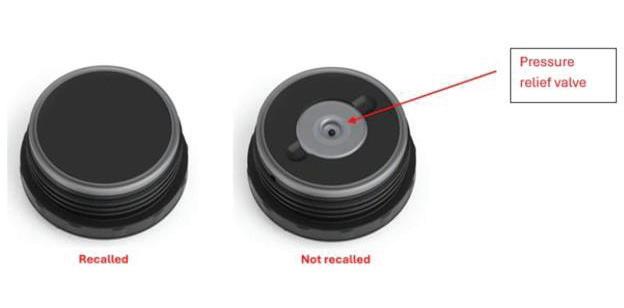
According to Health Canada, the recalled products have stoppers that do not contain a pressure relief feature in the centre. If perishable food or beverages are stored in the containers
Highway 16 closed near McBride afer fuel thef, collision, pursuit
MATTHEW HILLIER Citizen Staff
RCMP in McBride are investigating after a fuel theft and subsequent collision that occurred on Saturday, July 4.
At approximately 5:15 p.m RCMP received a report that fuel and batteries had been stolen from heavy equipment located on a rural property.
A short time later, police were then notified of a collision near the intersection of Goat River Pit Road and Highway 16.
McBride RCMP determined that a witness to the theft had followed the suspicious vehicle. When the vehicle exited Goat River Pit Road, it collided with the witness’s vehicle. The driver of the suspects’ vehicle lost control and crashed into the ditch. The four occupants of the vehicle then fled on foot.
Police used a canine unit and the emergency response team to search of
the area.
Three suspects were located in a nearby wooded area, while a fourth was later located by police dogs in the woods.
Two of the suspects received medical treatment for injuries sustained during the incident, including injuries related to the collision.
RCMP report that a section of Highway 16 was closed for a time following the collision while investigators and emergency responders were on scene.
All four suspects were arrested in connection with the investigation and have since been released pending further investigation. McBride RCMP report that the investigation into the theft and the collision is ongoing.
Anyone with information regarding the incident is asked to contact the McBride RCMP Detachment at 250-569-2255.
for an extended period, pressure can build up, causing the stopper to eject forcefully when opened and creating a risk of serious impact injuries and lacerations.
As of June 24, the company had received 10 reports of incidents in Can ada, including three reports of injuries.
Health Canada is advising consumers to stop using the recalled products
Health Canada has issued a recall of certain Thermos-brand products
The issue involves a certain kind of pressure relief valve (pictured above) which can eject forcefully and cause injuries or lacerations.
Thermos Products Inc. website for more information.
The affected products were sold in Canada between January 2009 and November 2021. The company says tured in China and Malaysia, were sold
Under the Canada Consumer Product be redistributed, sold or given away in
RCMP investgatng June 30 Lansdowne Road shootng
Witnesses to a Landsdowne Road shooting that occurred on June 30 reported seeing this vehicle leaving the scene.
CRIME NOTES
Crown alleges man had drugs and brass knuckles
A man charged with trafficking four types of drugs and carrying brass knuckles more than three years ago is scheduled to go on trial in BC Supreme Court next spring.
During a June 29 hearing in Prince George, Justice Kevin Loo confirmed the trial of Kerridge Andrew Lowley will proceed April 12-16, 2027.
Lowley’s lawyer Georges Rivard told Loo that Lowley continues to retain him for the case.
Lowley is accused of possession for the purpose of trafficking para-fluorofentanyl, fentanyl, methamphetamine and cocaine and possessing a prohibited weapon on March 3, 2023 in Prince George.
Rivard is also representing Lowley in a separate case involving 2026 chargers.
Lowley, 50, and Robyn Ann Bradley, 37, pleaded not guilty on May 5 in Prince George Provincial Court and elected to be tried by a judge.
Prince George RCMP announced charges against Bradley and Lowley in March, the result of an investigation that began in December 2023.
In that matter, Lowley faces nine counts of possession for the purpose of trafficking, four trafficking charges and
Police are looking for a car with Alberta plates
MATTHEW HILLIER Citizen Staff
The Prince George RCMP is investigating a shooting that targeted a trailer on the 3700 block of Lansdowne Road. It happened on Tuesday, June 30 at approximately 8 a.m. Prince George RCMP report in a media release that witnesses reported hearing shots fired in the direction of a mobile home.
A grey sedan with Alberta licence plates was spotted leaving the area at the time of the shooting and police believe it to be involved.
Police found three people inside the trailer. They were unharmed.
“We are asking for anyone in the area who may have witnessed the event or has dash camera footage or video surveillance showing the incident or movement in the neighbourhood at the time it occurred to please contact our non-emergency line to speak with a police officer,” states Corporal Jennifer Cooper, media relations officer for Prince George RCMP.
The investigation remains ongoing.
one charge of possessing a prohibited or restricted firearm. Bradley faces 13 charges. Their next appearance is scheduled for July 20.
Airport carjacker has new lawyer,
sentencing delayed
Tanner Jordan Meier pleaded guilty last Oct. 27 to charges of robbery, dangerous driving causing bodily harm and assault related to the Aug. 24, 2024, theft of a car at YXS.
BC Supreme Court Justice Kevin Loo adjourned the case to July 13, after Meier told the court on June 29 that he is on the verge of retaining a lawyer to replace Kenneth Thomson.
The Law Society of BC suspended Thomson in January. Thomson told The Citizen that he lost his bookkeeper and was therefore unable to complete his annual trust report on time.
“We’ve been in a holding pattern as to what Mr. Thomson’s status would be,” said Crown prosecutor Rodney Withall, who reminded the court that he would apply for Meier to be assessed for potential long-term offender designation.
Meier was ordered to appear in court on May 25 after refusing to emerge from his cell on previous occasions. He was returned to Kamloops Regional Correctional Centre after pledging to find a new lawyer by the end of June.
Withall told Loo that Thomson
contacted him and said he expected to return to his practice by Aug. 24. But Meier said he had found a new lawyer.
“I found counsel, Bobby Movassaghi, and he’s going to be my lawyer,” Meier told Loo. “I just have to call Legal Aid to get him approved.”
That would mean a further delay, because Withall said that once the retainer is confirmed, evidence disclosure would have to be provided.
If Withall’s application is approved, and Meier deemed a long-term offender, he would be jailed for a minimum two years, followed by a supervision order of up to 10 years.
New lawyers for Mackenzie murder accused
The new lawyers for a man charged in a fall 2024 murder in Mackenzie are expected to seek a delay in the case.
Drake Matthew Kerr was charged with second-degree murder after RCMP officers responded to a shots fired call and found a man’s body at a residence on Sept. 29, 2024. Kerr was at-large after the incident, but was arrested on a warrant and made his first court appearance on Oct. 5, 2024.
Kerr was denied bail last October by a BC Supreme Court judge when his defence lawyer was Jason LeBlond.
LeBlond was named a Provincial Court judge on June 12.
On June 29 in Prince George, Justice
Kevin Loo heard that Kamloops-based lawyers Jeremy Jensen and Jay Michi had recently taken over the case and would make a formal application for adjournment because they are not available for the scheduled trial dates.
Loo set July 13 for Kerr’s next appearance.
Guilty plea after incident at Miworth Transfer Station
A man pleaded guilty to mischief $5,000 or under before going on trial in Prince George Provincial Court on July 3 for assault with a weapon.
Jamie Ross Harkley, born in 1981, was accused of the Oct. 27, 2025 offences.
Crown prosecutor Katie Diehl said on Oct. 27, 2025, around 9 a.m., two RCMP officers responded to the Miworth Regional Transfer Station after a report of a male who had started a fire.
Two concerned citizens pulled into the transfer station and asked for Harkley to put the fire out and stop feeding the fire with objects.
Harkley maintained his guilty plea to the allegation that he picked up a pipe and began to swing it at one of the pair, who followed Harkley to the next location while waiting for police to arrive.
Brecknell sent the Crown and defence to the judicial case manager to find a date for another 90 minutes.
Court reporting by Bob Mackin, Local Journalism Initiative Reporter
RCMP PHOTO
House arrest for temporary resident guilty of sex assault
BOB MACKIN Local Journalism Initiative Reporter
A BC Supreme Court judge sentenced a temporary resident from India, who pleaded guilty to sexual assault, to 170 days house arrest, followed by 18 months probation.
Karandeep Singh, 24, admitted June 30 to the incident on June 13, 2024 in Prince George.
An agreed statement of facts read in court said Singh met the woman through her cousin the previous month. On the day of the crime, she communicated via Snapchat with someone she believed to be Singh, but Singh said it was a friend who was using his account. They made plans to visit West Lake Provincial Park for a bonfire, but they instead went to the basement suite at a house near Ospika Boulevard.
The man’s friend brought the woman into a bedroom. Singh remained outside “and became turned on and excited.”
Once his friend left the bedroom, Singh entered and immediately took off his pants and underpants before forcing her into sex acts.
Later, he asked the woman and her cousin if they wanted to leave, so he drove them back to where they were picked up.
The woman complained to Prince George RCMP. The next day, Singh was arrested. He gave a statement, predominantly in Punjabi, to an RCMP officer. Singh “admitted that he made a mistake,” because he did not ask the
Probaton for breach of curfew
Highway 16 to investigate a dropped 911 call from the room.
woman if she wanted to have sex and he did not take reasonable steps to ascertain her consent.
Justice Kevin Loo said Singh had been in Canada since 2023, had no prior criminal record, is married and works as a security guard at a hotel in Prince George.
Loo said the Crown submission conceded the negotiated sentence was low because there could be issues with the warned statement Singh gave to police, including language and constitutional rights. While the complainant
cooperated with the Crown, she expressed reluctance to testify in court.
Loo also said Singh’s guilty plea and cooperation with police were mitigating circumstances.
“The sentence, which is the subject of the joint submission, is below the normal range,” Loo said. “However, they say that, in the unique circumstances of the difficulty of the Crown’s case, and the other circumstances described above, this is a fit and reasonable sentence.”
During Singh’s first 190 days of probation, Loo said he will be under a 10 p.m. to 6 a.m. curfew.
He must not contact or be in the vicinity of the victim and other named individuals. He must provide a DNA sample and not possess firearms for 10 years.
Loo chose not to place Singh on the national sex offender registry after hearing that he faces potential immigration consequences.
A man who pleaded guilty to violating court orders to stay away from a woman and live under curfew was sentenced July 3 to a conditional sentence and 12 months probation.
If Alexander Michael Coyles completes the probation, he will not have a record of the offences. The sentence was jointly proposed by lawyers for the Crown and defence.
Provincial Court judge Michael Brecknell heard that Coyles was released on an order that he have no contact with a certain woman after an alleged Sept. 17, 2025 offence. A separate judge released him on another file six days later. That included a no contact order with the same woman and an order that he reside under a curfew.
Just over two months later, on Nov. 28, 2025, Prince George RCMP visited a room at the Best Western Hotel on
Inside the hotel room, they located the woman with whom Coyles was supposed to have no contact. At the time of the incident, Coyles was absent from the address where he was supposed to be during the curfew hours.
Given a chance to speak in court, he told Brecknell that he is “not a violent man.”
“I’m guilty of breaching the judge’s order. It’s not lost on me, the seriousness of it. I just want to move forward with my life and put this all behind me,” Coyles said.
“Well, sir, given that you have almost finished your fifth decade on this planet, we looked at the previous criminal convictions,” Brecknell said. “Given that the lead informations have both been stayed because of (the alleged victim’s) non-participation, I think the resolution the lawyers have worked out is an appropriate one.”
CITIZEN FILE PHOTO
A man from India will serve 170 days of house arrest after being convicted of sexually assaulting a woman in Prince George court.
BOB MACKIN
Local Journalism Initiative Reporter
Saik’uz, Vanderhoof urge province to back forestry plan
CITIZEN STAFF
Saik’uz First Nation and the District of Vanderhoof are calling on the provincial government to adopt a new approach to forestry that they say better reflects current forest conditions while protecting long-term jobs, local manufacturing and forest health.
In a joint statement, the two governments said decades of mountain pine beetle infestations, increasingly severe wildfires and historical over-harvesting have dramatically changed the forests surrounding Vanderhoof, leaving existing forestry policies out of step with conditions on the ground.
The leaders argue that provincial harvesting decisions continue to authorize timber extraction levels based on outdated assumptions about the region’s available fibre supply, despite significant changes to the landscape over the past two decades.
“We are at a crossroads,” said Saik’uz Chief Priscilla Mueller. “Everyone in this region understands that the forests are not what they were 20 years ago. We need forestry decisions that reflect what is actually on the ground today, not outdated assumptions about what should be there.”
Saik’uz First Nation, whose members have stewarded the territory since time immemorial and participated in the forestry economy for roughly a century, has spent several years developing a
Saik’uz First Nation and the District of Vanderhoof officials say provincial harvesting decisions continue to authorize timber extraction levels based on outdated assumptions about the region’s available fibre supply.
long-term land use plan aimed at restoring forest health while maintaining a sustainable supply of fibre for local mills and forestry workers.
According to the Nation, the plan combines Indigenous knowledge, scientific expertise and years of collaboration with the Province of British Columbia. Officials say it is designed to balance ecological restoration with economic sustainability, recognizing forestry’s continued importance to the regional economy.
The District of Vanderhoof has endorsed the approach, saying forestry remains a cornerstone of the community and an essential source of employment for Indigenous and non-Indigenous families throughout the region.
“The people of Vanderhoof want to
see a strong local forest economy,” said Mayor Kevin Moutray. “Forestry remains important to many Indigenous and non-Indigenous workers, families and communities throughout the region. The District of Vanderhoof is committed to working with local forestry partners to advance responsible planning and development.”
However, Moutray said the municipality opposes a system that allows what he described as the remaining fibre supply to be treated as a short-term opportunity for companies with limited local investment.
The two governments expressed concern that multinational forestry companies continue to receive access to timber despite closing or reducing
manufacturing capacity in the region. As a result, they say logs harvested near Vanderhoof are increasingly transported hundreds of kilometres away for processing, reducing local employment opportunities and economic benefits while placing additional pressure on forests already under strain.
The joint statement also argues that this trend undermines reconciliation commitments and existing agreements intended to strengthen Indigenous participation in forestry and local economic development.
“We are calling on the Province to respect local land use priorities, including the Nation’s land use planning work, and embrace collaborative decision-making,” Moutray said. “Forestry decisions must account for cumulative impacts, wildfire risk, changing forest conditions, biodiversity concerns, long-term sustainability and local opportunities.”
Mueller emphasized that the Nation is not seeking an end to forestry but rather a shift toward practices that ensure the industry can continue for future generations.
“Saik’uz has a plan,” she said. “We have the tools. Together with the District of Vanderhoof, we have local support. What we need now is for the province to respect local knowledge and step up to work with us toward building a better future for our forests, our economy and our communities.”
Major federal funding for North Coast Transmission Line
BOB MACKIN Citizen Staff
VANCOUVER — The federal government is pledging $3.5 billion toward the first two phases of the $6 billion North Coast Transmission Line (NCTL).
Under the Canada-British Columbia Cooperative Prosperity Agreement announced Thursday, July 2 in Vancouver, Prime Minister Mark Carney also said $500 million would be spent on the Red Chris copper mine near Dease Lake.
“We will support the development of the power, the mining, and the trade infrastructure needed to unlock Northern British Columbia’s full economic potential in an environmentally sustainable way,” Carney said.
NCTL’s first phase goes 170 kilometres from Williston substation, east of Prince George Airport, to Glenannan, west of Fraser Lake, with a 2030 target for completion.
Phase 2 is a 275 km section to the Skeena substation near Terrace, with a
2032 completion target. A third phase is scheduled for 2034.
Under the deal, the North Coast tanker ban will remain in place and the federal government will compensate BC for any environmental damage from a new pipeline from Alberta on a southern route.
In exchange, Premier David Eby agreed not to oppose such a project. BC had previously lost a court challenge in 2020 of the Trans Mountain pipeline expansion.
“We will not be going to court to fight
a pipeline project,” said Eby, who was attorney general at the time. “Instead, we will ensure we fulfill our constitutional obligations in good faith. Pipelines are federal jurisdiction.”
The agreement also includes $10 billion for Roberts Bank port expansion in Tsawwassen and $3 billion for the Massey Tunnel replacement project between Delta and Richmond.
Also included: childcare funding, trades training and protection of whale habitats around southern tanker routes.
CITIZEN FILE PHOTO
Four local First Natons buy Plateau Sawmill site
TED CLARKE Citizen Staff
Four area First Nations have joined forces to purchase the shuttered Plateau Sawmill in Vanderhoof from Canadian Forest Products in a deal completed Tuesday, June 30.
The Stellat’en, Nadleh Whut’en, Saik’uz and Lheidli T’enneh First Nations purchased the properties and equipment on the site west of Vanderhoof and have renamed it Ncha Koh Industrial Park.
“This is a transformational moment for our nation,” Stellat’en Chief Robert Michell said. “By acquiring this strategic industrial asset, we are creating a platform for long-term economic growth, strengthening our self-determination and ensuring our nation has a meaningful role in shaping the future of our regional economy.”
The site will serve as the laydown yard and worker camp for BC Hydro’s Phase 1 of the North Coast Transmission Line, a project to twin the hydro transmission line from Prince George to Terrace.
The industrial site will also support other tenants requiring power, highway and rail access, along with a workforce for projects in the surrounding area.
“Our communities have been locked out of industrial activity for decades,” Nadleh Whut’en Chief Beverly Ketlo said. “We expect new industrial growth to include us while aligning with our values and our relationships with our territories. Our four First Nations share a vision for the future.”
The purchase includes all mill equipment, but there are no immediate plans to reopen the mill. The four First Nations purchased all properties and equipment outright.
“When First Nations work together, particularly through economic opportunities, we become stronger as nations and communities,” Lheidli T’enneh Chief Dolleen Logan said. “We believe in building economic resilience through revenue generation and strategic
partnerships that strengthen the communities in which we live. We will continue building for the future of our communities.”
Plateau Sawmill closed in December 2024 because of a shortage of economically viable fibre, weak lumber markets and increased tariffs on wood products exported to the U.S.
The closure resulted in the loss of 260 direct jobs, as well as hundreds of indirect jobs for local contractors and suppliers.
The mill was Vanderhoof’s largest employer. When it was operating, it provided the municipality with $580,000 in annual tax revenue. The closure removed 670 million board feet of annual production capacity.
The deal marks the first time neighbouring First Nations in the region have collaborated to purchase an industrial property. The purchase is expected to create jobs and skills development opportunities for area First Nations as well as non-Indigenous workers.
“This ownership move elevates our ongoing commitment to support our regional economy within this province,” Saik’uz Chief Priscilla Mueller said.
“As business leaders, we will continue working with our neighbouring communities to realize the full potential of the Ncha Koh Industrial Park alongside our neighbouring nations.”
Originally built on the north side of the Nechako River in 1969, Plateau Sawmill was purchased by the provincial NDP government in 1973 and has had at least 17 owners in its 57-year history.
Canadian Forest Products upgraded the mill significantly to handle large volumes of beetle-killed timber during the mountain pine beetle infestation from 1999 to 2015. It became the largest production sawmill in the world during that period, but its operations were scaled back as the timber supply declined. The mill was reduced to a single shift before closing.
More details about the purchase and plans for the industrial site will be announced Friday, July 10.
FIRST 100 $10 BONUS PLAY
Please see Guest Services for more details. For exciting updates, follow us on Facebook! Treasure Cove Casino & Bingo Please see www.treasurecovecasino.com for
Texas cyclists ride through area during 6,437-km trek to Alaska
Texas 4000 riders gather for a photo outside the McBride Anglican United Church while passing through the town in late June. Texas 4000 is led by 20 students who have a personal connection to cancer and are cycling from Austin, Texas, to Anchorage, Alaska, through the Colorado Rockies. Each student is responsible for raising $7,500 for cancer research and support services, with many surpassing that amount. This year’s Texas 4000 riders have raised $363,002 toward their $550,000 goal and were a little under three-quarters of the way through their trip when they arrived in Prince George on June 30. ‘We went through McBride, which was awesome,’ said assistant ride director Saylor Black. ‘I just found out today it’s the highest point in the Canadian Rockies. We’ve seen a lot of beautiful places in both the U.S. and Canada that we never would have visited otherwise.’ The riders also do volunteer work along the way.
Man found guilty of defying sockeye fshery closure
BOB MACKIN Local Journalism Initiative Reporter
An 81-year-old Alexandria First Nation member was found guilty of unlawfully possessing sockeye salmon, according to a Provincial Court judgment released at the end of June.
In Williams Lake Provincial Court on Feb. 11, Judge Linda Thomas gave oral reasons after a trial that took place sporadically between 2021 and 2025.
Thomas Leonard Billyboy, the judge ruled, failed to provide, on a balance of probabilities, that he exercised reasonable care to avoid committing the Fisheries Act offence.
Billyboy was stopped by Department of Fisheries and Oceans officers
on Sept. 5, 2019 during inspections on Highway 20 West before Sheep Creek Bridge. Officers found Billyboy had fished during a sockeye fishing closure.
None of the six Tsilhqot’in National Government (TNG) member bands had been issued an aboriginal community fishing licence.
During the on-again, off-again hearings, Billyboy changed lawyers and applied for mistrial, but withdrew. The Crown relied on evidence from a Conservation Officer, two Fisheries Officers and an aboriginal affairs advisor from DFO about the 28 seized salmon.
Thomas decided Billyboy’s only witness, Ervin Charlieboy, had no
Mr. Billyboy was adamant: as a Tsilhquot’in person he had the right to fish without restriction.”
relevance to her verdict.
Thomas found that Billyboy was aware of the Big Bar landslide fishing closure because he heard about it on CBC.
He also knew fishery closure notices had been posted at fishing sites and on
his gate and that it was the talk among community members. The future of sockeye salmon was at risk and the TNG and DFO took immediate measures to protect the fish. But Billyboy had other ideas.
“Mr. Billyboy was a former chief for 25 years and because of that experience, he would be knowledgeable of the relationship between DFO and TNG and the fishing licences regime,” Thomas concluded.
“However, his evidence was consistent; he did not accept the authority of DFO and TNG to prohibit the retention of sockeye salmon. Mr. Billyboy was adamant: as a Tsilhqot’in person he had the right to fish without restriction.”
THARAKAN PHOTO
SRFI lawyer says membership, decisions not at issue
A lawsuit involving the Salmon River Farmers’ Institute is before the courts
BOB MACKIN Local Journalism Initiative Reporter
Salmon River Farmers Institute lawyer says membership, decisions not at issue
Bob Mackin
The Salmon River Farmers Institute (SRFI) should not be required to accept anyone as a member, and the size of its membership is irrelevant, the organization’s lawyer told a BC Supreme Court judge June 25.
The Salmon Valley Community Farmers Institute, Salmon Valley Community Association and Salmon Valley Gymkhana Club are before Justice Sandra Sukstorf in Prince George, challenging the SRFI’s authority and the validity of its bylaws.
The plaintiffs say the SRFI has been “a closed organization, controlled by the Cheramy family” since at least 2009. They allege the institute has refused new members and failed to comply with applicable laws.
Defence lawyer Alexa Hopwood said the institute’s membership size “is not evidence that the institute or its bylaws are not consistent with the spirit of the act.”
“The objects do not require the institute to admit everyone as a member, and neither does the act specifically require this,” Hopwood said.
She also argued the court should not interfere with the bylaws or internal governance of an organization operating within the law. Determining or overseeing who should be a member is also beyond the court’s role.
“Rather, they are required to offer community opportunities to socialize, learn and further agricultural-related purposes, among other things,”
Investgaton contnues into double ATV fatality near Vanderhoof
BOB MACKIN Local Journalism Initiative Reporter
A BC Supreme Court judge in Prince George ordered the retention of a blood sample from a participant in a fatal fall 2024 collision.
On Oct. 13, 2024 near midnight, a passenger on an all-terrain vehicle and the driver of another died in a collision near the Sinkut Mountain forest service road, south of Vanderhoof.
Justice Kevin Loo heard June 29 that no mechanical issues contributed to the collision.
After being hospitalized, blood was drawn from a survivor and the blood concentration was beyond the legal limit.
Mohammad Hajivandi, appearing on behalf of the Crown, told Loo there had been police and prosecution delays. In February, the Crown sought more
Hopwood said. “In my respectful submission, this has been met.”
Hopwood said Aime Cheramy, the society’s president since 1990, and the other directors care deeply about the community hall and ensuring its longevity.
“As Mr. Cheramy states, he loves the hall,” Hopwood said. “The defendant has clearly sought to clarify and amend the bylaws to ensure they are consistent with the act, as best understood by them. They are also seeking to clarify how to properly comply with that same act.”
The community hall is available for rent to members and non-members alike on a user-pay basis. It has hosted open houses, buy-and-sell events, farm swaps, weddings, elections and a meeting about the proposed JX LNG project. Through May 16, the hall had hosted up to 60 events in 2026.
A group of 50 people generally pays a base rental fee of $500. A group of 125
people, including 15 overnight campers, was quoted $1,400 for a three-day rental.
Hopwood said none of the plaintiffs has ever applied to rent the hall.
“The community has, in all respects, had the ability to participate in events and use the hall, regardless of membership,” Hopwood said. “Again, the defendants have undertaken to maintain the hall to ensure it can continue to be used by the community.”
In court filings, the three plaintiff organizations describe the SRFI as “a closed organization, controlled by the Cheramy family” since at least 2009.
The SRFI was incorporated in 1921 and is governed by the Farmers and Women’s Institute Act. It purchased a 20-acre property in 1953, built the community hall in 1974 and resolved to make it available for community use.
A dispute split the community association in 2008, and operation of the hall reverted to the SRFI in 2009.
investigation by the RCMP.
It is also waiting to receive the completed report by the BC Coroner’s Service.
Hajivandi conceded the blood sample is no longer needed by Crown, but it asked for preser-vation of the blood sample for trial.
“On the basis that the defence, if charges are laid, would have an entitlement to analyze the blood sample themselves,” he said.
Additionally, Hajivandi said, there is the interest of justice.
“Two individuals have lost their lives in the small community of Vanderhoof, and again, using side-by-side is a very popular sport and means of spending time,” Hajivandi said.
Loo was satisfied that detention is warranted for purposes of trial and in the interest of justice to extend retention of the sample until Oct. 14, 2026.
What’s happening in PG
Dinner Under the Stars 2026 goes Friday, July 10 at City Hall, Veteran’s Plaza. This is an elegant long-table dining experience created by White Goose Bistro, including a curated fivecourse exclusive secret menu, featuring wines from Hillside Winery, presented by Winemates, live musical ambiance and an immersive art installation. This is an adults-only event. Tickets are $150 each. For more information and tickets visit www.downtownpg.com/ dinner-under-the-stars/ Picnic in the Past goes Sunday, July 12 from 11 a.m. to 4 p.m. at Huble Homestead on Mitchell Road. Every place has a story and this is the chance to enjoy a relaxing afternoon celebrating Historic Places Days while exploring the park hunting for rarely-seen antique photos, take a special tour for a behindthe-scenes look at how the house was restored, take part in old-fashioned games and ice cream making, and recreate Huble family photos at themed stations. Huble Homestead is located 40km north of Prince George, just off Highway 97 on Mitchell Road. Entry is by suggested donation of $10 per family. For more information visit hublehomestead.ca or call 250-564-7033.
Naloxone Training goes Tuesday, July 14 at the Prince George Public Library, main branch, from 6 to 7:30 p.m. Join harm reduction staff from Northern Health and learn how to use Naloxone. Kits will be available to take after the training. Everyone welcome to attend.
SunFrolics 2026 goes Wednesday, July 15 to Sunday, July 19 at Pineview Hall, 6355 Bendixon Rd. This is the Pineview Recreation Commission’s annual community celebration featuring activities and events for all ages. There is a volleyball tournament, pickleball tournament, slow pitch tournament, crib tournament, a classic car show, a junk in the trunk market, kids games and activities and concession. Whether you’re looking to compete, shop, enjoy great food, spend time with family or reconnect with friends and neighbours,
People enjoy the first of this summer’s Foodie Fridays on Friday, July 3 at Canada Games Plaza. The city’s showcase of local food trucks and vendors returns July 10 (11 a.m.- 3 p.m.), July 17 (4 p.m - 8 p.m.) and from 11 a.m.-3 p.m. on July 23, July 31, Aug. 7 and Aug. 28.
there’s something for everyone at SunFrolics. For more information and updates visit https://www.facebook. com/pgpineviewhall
Paint & Sip with Erin Stagg: Campfire goes Thursday, July 16 from 6 to 8:30 p.m. at Two Rivers Gallery, 725 Civic Plaza. Join nationally awarded Métis artist Erin Stagg for a relaxing evening exploring acrylic painting as she leads participants in creating a beautiful campfire artwork. Bring friends to enjoy the ambiance of the gallery and sips. All supplies and one beverage are included. Additional beverages can be purchased. Participants will use artist quality acrylic paint and brushes on canvas to explore the importance of affordable but quality art supplies. Cost is $75.60 and event is for those 19+. For more information and tickets visit www.tworiversgallery.ca/programs/ paint-sip-campfire
Foodie Friday – Soccer Spectacular goes Friday, July 17 at 4 p.m. at Canada Games Plaza where there will be food vendors on site and Tourism
PG’s Nanguz’An Market will be open to explore, drop in to Tourism PG to see what’s new for city swag, then pop back out to enjoy live entertainment showcasing Hey Day, Good Juju and Chris Goodwin Band.
Third Annual Thank You Prince George Party goes Friday, July 17 from 11 a.m. to 3 p.m. at CN Centre Parking Lot. Join WorkBC Centre Prince George for the party, a free, fun-filled celebration to bring the community together. There will be a barbecue, face painting, mascots, car smashing and bouncy castles. This event is hosted in partnership with The Salvation Army.
Northern BC Rapid Chess Tournament goes Saturday, July 18 at 10:15 a.m. at Great White Toys Comics Games, at Spruceland Mall. Six-round Swiss open section, CFC rate. Round time start at 10:30 a.m. and go every hour until 3:30 p.m. For all the details and to register visit www.docs.google. com/forms/northernbcrapidchess Dominick Antonelli performs live Saturday, July 18 at 8 p.m. at Trench
Brewing, 399 Second Ave. This is his first tour in BC where he will be sharing an evening of original music. Dominick utilizes the guitar and Ableton to create inspiring, healing, and contemplative experiences. This is a free event.
Cowboy Challenge goes Sunday, July 19 at 8:30 a.m. at Dusty Trail Riders, 10597 Blackwater Road starting at 8:30 a.m. Riders will spend some time working around and with obstacles then each rider will get a chance to ‘run’ the pattern. Order of riders will be assigned at random. Current HCBC required. All riders are required to wear a helmet when mounted. Lead Line: for those unable to ride alone, regardless of age (free for Dusty Trail Riders member/ $15 non), Little Britches: age up to 7 ($5 member/ $15 non), Pee Wee: 8-12 ($5 member/ $20 non), Junior: 13 to 18 ($10 member/ $20 non), Adult: 19 to 49 ($10 member/ $25 non), Jack Benny: 50+ ($10 member/ $25 non). Event will run depending on weather and condition of the arena. For more information visit www.facebook.com/events/ DustyTrailRiders
Quebec Street Night Market goes Sunday, July 19 from 5 to 9 p.m. Celebrate the excitement of the world’s biggest soccer tournament with a community Watch Party and Night Market that will feature local vendors, live music, delicious street food. Gather with friends and family, wear team colours, and enjoy a night filled with fun, food, shopping, and celebration. Best of all, proceeds from the event will help support the Canadian Mental Health Association, making this a night that gives back to our community.
Watch Party in the Plaza goes Sunday, July 19 at noon at Canada Games Plaza. Food vendors, Tourism PG’s Nanguz’An Market will be on site. After the game there is an after party at 5 p.m. with the event ending with the first ever drone light show in Prince George at around 10 p.m. CONTINUED ON NEXT PAGE
CITIZEN PHOTO BY MATTHEW HILLIER
CONTINUED FROM PREVIOUS PAGE
COMMUNITY
movie-night-in-the-orchard-mamma-miatickets
CN Centre Night Market goes Tuesday, July 21 from 5 to 9 p.m. An unforgettable evening celebrating community, shopping local and summer fun. Browse over 100 local vendors, enjoy delicious eats from Prince George’s best food trucks and take in free live entertainment all evening long.
Truent/Omniesia/Hot Boii Summer goes Tuesday, July 21 at 7 p.m. at Omineca Arts Centre, 369 Victoria Street. Hot Boii Summer is a local post hardcore band that will perform and Vancouver bands Truent, death metal band & Omniesia, groovy tech death band are hitting the road and taking over Western Canada with a tour that’s guaranteed to go hard. They’ll be ripping fan favourite tracks, bringing insane energy, and… maybe some brand new music? This is an all ages event. Tickets are $25 at the door or $20 in advance at www./ orangetickets.ca/truent/omniesia/ hotboiisummerPG
Sonic Symmetry with Anomalist and Blood to Ash goes Friday, July 24 at 8 p.m. at Omineca Arts Centre, 369 Victoria St. Two great local bands that will perform at this all ages event. $15 at the door. Doors open at 7 p.m. Lovingly Yours, Nellie Book Signing goes Friday, July 24 from 11 a.m. to 2 p.m. at Books & Co., 1685 Third Ave. Meet local authors Sandra Hyslop & Pat Klassen, who took letters and articles discovered by her grandchildren, that depict their grandmother’s life story during the early settling of Saskatchewan & British Columbia.
Movie Night in the Orchard –Mamma Mia! goes Friday, July 24 at 9:45 p.m. at Northern Estates Winery, 745 Prince George Pulpmill Road. Get ready for a night of music, laughter and island vibes in the orchard at the winery. Join us for a special outdoor screening of Mamma Mia and sing along to all your favourite ABBA hits under the stars. Family-friendly fun for all ages. For all the details and tickets visit www.eventbrite.ca/e/
Hallowed Be Thy Name goes Saturday, July 25 at 7 p.m. at the Legion 43 PG, 101-1116 Sixth Ave. On July 20, 2025
Deanna Lemky lost her battle with cancer. Anyone who knew her knows how amazing she was and how she touched many people’s lives and hearts. She was a wife, a mother and she was a huge supporter and part of the local music metal scene for many years. Hosted by Madloon Promotions, Plagued by Fire, including Deanna’s husband Steve Lemky, are putting on a show to honour her memory and raise money with all proceeds going towards cancer research. Featuring LOWR - The Lich of Willow River. This is a 19+ event — no tickets, entry by donation minimum of $10.
Craft & Chat at the main branch of the Prince George Public Library goes every Saturday from 1 to 3 p.m. in the magazine corner, second floor, where fibre artists are invited to bring their latest projects to share, vent frustrations, brag about successes, get and give help and join in lively discussions. Snacks provided. This event is in partnership with Great Northwest Fibre Fest.
Myeloma Support Group goes every third Saturday from 1 to 3 p.m. at Commonwealth Financial, 575 Victoria St. Everyone is welcome who has been diagnosed, those who are caregivers, family members and friends. Wheelchair accessible parking at the back of the building. For more information call Viv Lougheed at 250-981-2618.
Chronic Condition Support Group takes place the first Tuesday of every month from 1 to 2 p.m. at the Nechako Branch of the Prince George Public Library, 6547 John Hart Hwy. This is a community social group where people with any chronic condition can come together to socialize, connect and learn from each other. This is a free drop-in event.
Curious Art Workshop goes Tuesdays until June 23 from 5 to 8 p.m.
at Studio 2880, Upstairs Workshop Zone, 2880 15th Ave. This series of workshops are filled with art, mindfulness, letting go of control and building community, and of course, fun! Participants will explore watercolours with instructor Anne Beauchemin who is new to Prince George. For more information and to register visit www. studio2880.com/programs/art-classes/ curiousartworkshop
Trivia Night at Nancy O’s goes every other Wednesday at 8 p.m., 1261 Third Ave. Book a spot by calling ahead at 250-562-8066. Open Mic at Nancy O’s goes every other Wednesday from 8 to 11 p.m. Open mic is hosted by Danny Bell and friends. Come on down and share songs, poetry, dance, stories, and anything else you can think to do on stage. All are welcome.
Wednesdays from 10 a.m. to noon at
Studio 2880, 1880-15th Ave. Presented by the Community Arts Council Prince George & District these sessions feature a variety of artists. July 27 Watercolour Splash & Flow with Liana Ziemer takes place, T-shirt Madness with Cat Sivertsen goes July 15 and August 19, Acrylic on Canvas with Marylin Schmaus goes July 22 and Aug. 12 and Art Journaling with Si Transken goes July 29 and August 5. Each session is $50 and these events are geared for those ages 13 to 17. For more information and to register visit www.studio2880.com/programs/ youth-programs/summer-arts-camp
If you’ve got an event coming up email us at news@pgcitizen.ca to offer details
PG PRIDE 2026
A lively parade leads the celebration to Lheidli T’enneh Memorial Park
ABOVE: A sign close to the stage gives a few tips on how to enjoy the Picnic in the Park, which followed the Pride Parade on Saturday, July 4.
LEFT: Many canines joined their human companions and dressed up for the PG Pride Parade, which featured colourful dancers (above) and more.
ABOVE: Amanda Wood shares some of her original music.
BELOW: O’Dreamy adds some high energy to the entertainment at the park.
ABOVE: PG Special Olympics athlete and artist Chase Caron waves from the CNC Student Union truck during the PG Pride Parade.
ABOVE: Genevieve Jade graces the stage at the Picnic in the Park.
BELOW: Lila Holtby, 6, takes a picture of her sister Rose, 9, as she poses in a rocket cutout at Lheidli T’enneh Memorial Park.
LEFT: Shannon Holst demonstrates some of the moves used in belly dancing while fouryear-olds Kya Varchol and Frankie K. try to follow along.
CITIZEN PHOTOS BY CHUCK NISBETT
SOCIAL MEDIA
The federal government wants to stop children under 16 from using Instagram, TikTok and Snapchat. What will this mean for your family?
MATTHEW HILLIER
Citizen Staff
A new bill proposed by the Government of Canada is adding to the national conversation about social media safety for children.
Marc Miller, minister of Canadian identity and culture, introduced Bill C-34 on June 10. The bill, titled the Safe Social Media Act, aims to ban social media use for youth under 16 and impose new safety requirements on social media services and AI chatbot services.
“We have seen the very serious consequences that online harms can have,” Miller said while announcing the bill. “As technologies evolve, we must ensure our laws keep pace, because parents cannot face these challenges alone. The safety of children cannot be an afterthought. This legislation will introduce stronger responsibilities for online platforms to ensure their services are safe by design and include appropriate measures to keep children safe.”
A Government of Canada press release notes that while strong
protections for victims and ways to punish criminals in cases of online crimes targeting youth are in place, there are currently not enough safeguards to prevent those crimes from occurring.
Prince George counsellor Michelle Marrelli said she agrees with the intent of the bill.
“What I’m seeing is that there’s an emotional, psychological and physical toll on the kids,” said Marrelli. “ What I’m seeing is really concerning because their self-esteem and confidence are getting knocked.”
She said she believes algorithms used by social media platforms to keep users engaged and scrolling are especially dangerous for youth under 16, creating harmful echo chambers and exposing young people to images or ideas they may not yet be prepared to process.
“You have to understand these young people are just forming what their values are,” said Marrelli. “What their ideas of life are. With social media, we have adults specifically targeting them through social media tech companies. That’s not about values and morals.
They’re doing that for profit. Whatever clickbait they can use is a numbers game for them — more money in the bank. That’s not in the best interests of youth.”
The proposed legislation aims to ensure large social media and AI companies are responsible for addressing harm before it occurs and making online services more accountable and transparent.
These measures include the previously mentioned ban on social media use for youth under 16, with a possible exemption if services can reliably demonstrate that they have sufficient safeguards in place for children.
This includes, but is not limited to, measures to reduce children’s exposure to certain content and high-risk interactions. Regulated services would be required to identify, mitigate and address risks on their platforms.
“The proposed legislation will create a legislative and regulatory framework through a new Digital Safety Act for social media services, including user-uploaded livestreaming and adult-content
services, and for certain AI chatbot services,” the statement reads.
A government press release noted the framework would operate under three core duties:
• The Duty to Protect Children, which will apply to all regulated services under the Act
• The Duty to Act Responsibly, which will require services to assess and mitigate risks associated with exposure to seven categories of harmful content, apply labels to synthetically generated content, and provide clear and accessible ways for users to flag harmful content and block other users
• The Duty to Make Certain Content Inaccessible, which will require the rapid removal of content that sexually victimizes a child or re-victimizes a survivor, or intimate content communicated without consent, including deepfake sexual images
CONTINUED ON NEXT PAGE
Generatve AI has created a new kind of online problem
CONTINUED FROM PREVIOUS PAGE
AI chatbot services would also be subject to the Duty to Act Responsibly, with rules specifically tailored to those services, including requirements to:
• Mitigate the risk of the chatbot communicating harmful content
• Be transparent about reporting thresholds in crisis situations, such as when a user intends to harm themselves or another person
• Mitigate the risk that the chatbot will engage in harmful behaviour
The proposed legislation would also establish an independent Digital Safety Commission to enforce the regulations, ensure compliance, make online services safer for children and support victims of online harms.
According to a Government of Canada press release, regulated services such as social media platforms, livestreaming services and user-uploaded adult-content services would also be required to: Identify risks of harm on their services and adopt measures to address those risks
• Implement safety-focused design features
• Apply labels to synthetically generated content
• Make user guidelines accessible
• Provide tools such as blocking and flagging
• Submit publicly disclosed Digital Safety Plans
• Comply with oversight from the new independent regulator
The proposed legislation has already sparked controversy, with the Canadian Constitution Foundation launching a petition against the bill and describing it on the petition page as possibly the “greatest threat to free speech in decades.”
Another concern Marrelli has observed among Prince George youth is a lack of understanding about the permanence of online activity. She said she has often helped young people looking for work clean up their online histories during job searches.
The proposed ban also aims to
protect youth from scams, extortion and other online crimes targeting young people, as outlined in its three core duties.
Crimes committed against youth online are increasing in Canada, particularly cases involving online child sexual abuse and exploitation material (OCSAEM) and online sexual offences against children (OCSE).
OCSE includes luring youth online, the non-consensual distribution of intimate images involving victims aged 17 or younger, and invitations to sexual touching offences. OCSAEM involves possessing, accessing, creating or distributing images or videos related to OCSE offences.
A Statistics Canada report by Laura Savage titled Online Child Sexual Exploitation: A Statistical Profile of Police-Reported Incidents in Canada, 2024 highlights the growing complexity and number of cases.
According to the report, police services across Canada reported 16,905 OCSE incidents in 2024, 77 per cent of which involved OCSAEM offences.
More concerningly, the increased use of generative AI, which can create realistic images and video, has created new complications.
“Due to a substantial increase in the volume and complexity of these cases (many of which involve generative artificial intelligence), many police services do not have the resources to investigate all cases forwarded by the Royal Canadian Mounted Police’s National Child Exploitation Crime Centre,” the report states.
The report further notes that 94 per cent of OCSAEM incidents and 76 per cent of OCSE incidents were not cleared by police in 2024.
This means an accused person had not been identified in connection with the incident, or there was insufficient evidence to proceed with laying or recommending charges.
Cpl. Jennifer Cooper, media relations officer for the Prince George RCMP, frequently speaks at schools in Prince George about cybercrime and discussed the complexities of combating
this form of crime.
“We do talk a lot about how the person online might not be who they say they are, and we recently started really focusing on how the AI landscape is changing that for students,” she said.
“Anybody, but particularly those in that age group, tend to believe everything they see online, and there are people trying to convince them that just because someone is sending them a video that makes it look like they are someone in their age group or someone they might be interested in, that could very well be a lie.”
Cooper encourages parents across Prince George to talk to their children about the issue, even if the conversations are difficult.
“Crimes that happen in the online sphere tend to be underreported,” she said.
“One of the messages we would love parents and youth to hear is that these aren’t the types of things you’re going to
Anybody, but particularly those in that age group, tend to believe everything they see online ...”
be able to solve on your own as a youth. If you are the victim of online sexual extortion or if you’ve been lured somewhere under false pretences, you need to reach out to law enforcement, your parents or caregivers, or a counsellor at school and really talk about it because these are situations that even adults find difficult to navigate, and we would never expect a youth to navigate them alone.”
CONTINUED ON NEXT PAGE
Questons raised about how a ban would be implemented
CONTINUED FROM PREVIOUS PAGE
Cooper also said Prince George RCMP currently has a Special Victims Unit that specializes in handling local cases and working with youth and their families who have suffered from these crimes.
However, she remains convinced that prevention is by far the best way to protect youth from online harms.
“It comes back to parents and caregivers sitting down with their kids and having these really tough conversations about what can happen online. If you don’t know as a parent what could happen online, you need to Google it and catch yourself up because we shouldn’t be letting our kids into an online sphere where we know less than they do,” said Cooper.
Conservative MP Todd Doherty, in a statement sent to The Citizen, said he supports the bill’s objective but questions the Liberals’ ability to implement it.
“Conservatives support protecting children online, but the question is whether this bill will deliver meaningful results,” he wrote. “After more than a decade in government and years of delays, the Liberals are now on their third attempt at online-harm legislation. Conservatives have not stood on the sidelines. We have put forward practical solutions and encouraged the government to adopt them, including legislation introduced by Conservative MP Michelle Rempel Garner to better protect children online.”
Canada is not the only country proposing or implementing such restrictions. The United Kingdom has proposed similar legislation with the goal of implementation in spring 2027.
Australia implemented a similar ban on Dec. 10, 2025. However, many Australians have raised concerns about possible privacy violations because implementation requires the storage of personal information such as identification documents and facial scans, among other data, in centralized databases.
Doherty shares those concerns and said his party will examine the legislation before taking a position.
“Protecting children online is a top priority for Conservatives, and we share parents’ concerns about the content their children are exposed to, as well as the need to safeguard the privacy and mental health of both children and families,” he wrote. “Conservatives will carefully examine this legislation and hear from parents, experts and stakeholders to determine whether it effectively protects children while respecting privacy rights before taking a position.”
He also said he is concerned about the possibility of the Liberal government expanding its reach into online spaces.
Ben Daniel, director of the University of Northern British Columbia Centre for Teaching, Learning and Technology, said he supports the legislation’s overall objective, he is concerned about how the ban would be implemented and whether personal data would ultimately be deleted.
“My opinion is that regulation will be heavily based on companies,” said Daniel. “There should be some clarity between regulation and banning something altogether. These are two different things. I think the way those regulations will be imposed on companies, or how companies actually implement the ban, might also backfire. Companies would have an opportunity to gather more information, and if they deny someone access, can they still retain
dependence on social media and the vulnerabilities that can result.
“We are focusing on the symptoms of the problem,” said Daniel. “Some kids go online as a way to cope with really difficult issues. Why are they online? What education are we providing to those kids about the risks of engaging online? What education are we providing to parents and communities about working together to ensure kids are not engaging in things online that may not be good for them?”
Another concern is the existence of loopholes that can be used to circumvent bans.
that information? To me, there are some really serious privacy implications.”
His main concern is what happens to the proof required to demonstrate a user is over 16. He believes methods for collecting, storing and destroying that information must be transparent.
“The challenge would be what mechanisms government or other parties would put in place to ensure that actually happens. Another potential risk is what security measures those companies would put in place to ensure that data is not linked to other platforms. We know those platforms are linked. Today you buy something from Amazon, tomorrow you get advertisements from Walmart. How do you ensure that information is not linked beyond the collection point?”
While concerned about privacy implications for social media platforms, he believes the proposed AI chatbot regulations are a major step in the right direction.
“We go back to the basic principles of artificial intelligence,” said Daniel. “One of them is that AI should be used to help human beings do things better. AI should not be used, or built, in a way that can harm people. Those are core principles developed in the 1950s and 1960s. A company providing AI should abide by those principles.”
He also believes society needs to address the root causes behind youth
In the case of Australia’s social media ban, a March 2026 poll conducted by the Molly Rose Foundation found that 61 per cent of youth aged 12 to 15 who previously had accounts on banned platforms continued to have access to one or more active accounts.
The poll also found that 70 per cent of children surveyed said it was “easy” to circumvent the restrictions.
According to the report, methods included the use of virtual private networks (VPNs), having a friend or family member create an account for them, or registering an account using an age above the restriction threshold.
The report also found that the majority of users under 15 who retained access simply never had their accounts banned.
Daniel offered his perspective on whether similar bans in Canada would be effective.
“There will be individuals who might comply immediately and pull out,” said Daniel. “There might also be parents who ensure that happens. What I know is there are lots of others out there who have little or no understanding of what companies are doing with their information. If kids have parents who do not necessarily have the tools or knowledge about the dangers and challenges, how are they going to enforce or monitor their children? I think implementation and monitoring need to be multi-channel so the policy can be assessed for effectiveness and ensure it is fit for purpose.”
CITIZEN FILE PHOTO
The Prince George RCMP has a Special Victims Unit that deals with online crimes against young people.
Lheidli T’enneh fag now fies in Prince George’s County
Maryland man is fascinated by all things Prince George
CHRISTINE DALGLEISH Citizen Staff
We get all kinds of phone calls at the Citizen office from people looking for details about events, offering news tips, hunting for old articles or photos and even making serious requests, like the woman who gave up her son in 1969 and wondered whether we could put out a call to help find him.
We also get plenty of emailed press releases from people who think we’re the newspaper in Prince George’s County, Md., not a city in the middle of BC.
Then there are the requests that come out of left field — the unusual ones where we do our best to help. We rarely share those feel-good moments, but this time we’re taking you through the whole process to tell a happy little story connecting two Prince Georges in two countries.
One day, Michael Kast, graphic designer and layout artist at The Citizen, got a voicemail on his work phone. It was from George Hoskey, a history teacher from Prince George’s County, Md., who was asking whether we could help him get a flag from the local First Nation because he collects flags.
As Kast listened to the message, he realized it wasn’t a mistake. Hoskey was looking for a Lheidli T’enneh First Nation flag from Prince George, BC. Kast told managing editor Kennedy Gordon about Hoskey and said he’d like to make it happen.
After getting Gordon’s approval, Kast got to work.
“George likes to fly different flags,” Kast said. “He’s a teacher in Prince George’s County, and when I talked to him on the phone he sounded really laid back. He also really likes The Tragically Hip. He even asked them to play at his wedding and got a response saying, ‘We’re going to be out on tour, but we would if we could.’
Chief Dolleen Logan of the Lheidli T’enneh First Nation gifts a flag for Michael Kast of The Citizen to pass along to George Hoskey, who lives in Prince George’s County, Maryland, U.S.
“So then I got hold of Jen Rubadeau (Lheidli T’enneh First Nation communications manager) to see if we could get a flag. She got back to me and said, ‘Yup, come pick up the flag.’”
That’s when the plan started to come together.
Gordon directed Kast to me, and we decided to visit the Lheidli T’enneh First Nation office to receive the flag. Kast would accept it, and I would take photos for the story because we wanted to share this little adventure with our readers.
“I think this is just a cool little story,” Kast said. “I’m just doing my part — nothing grand, nothing grandiose. It’s little gestures that build connections and friendships.
“’Hey, man, you want a flag? We’ll do our part to get that for you.’ We’re the newspaper of record, and that’s why George called us. He could have called anybody, but he called us, so I wanted to see if we could do this for him.”
Kast and I recently made our way to the Lheidli T’enneh First Nation office, which, coincidentally, used to be the Citizen building at 145 Brunswick St.
If you’re curious, it’s unrecognizable. A prominent wheelchair-accessible ramp leads to the entrance, and inside there’s a large open space and a lounge area where people can gather in front of a big-screen TV. There are toys for children to play with, too.
connection to our city.
That connection between our Prince George and his Prince George’s County began with a simple mistake.
He searched for “rock station in PG” and ended up finding a radio station here instead of one back home.
“So that’s the station I listen to,” Hoskey said. “And it’s awesome!”
It was that simple for Hoskey to become connected to — and intrigued by — everything Prince George, BC, Canada, has to offer.
“The Lheidli T’enneh flag will be flown on the front porch of my house,” Hoskey said.
He already has a City of Prince George flag, which he’s been flying since receiving it a couple of weeks ago.
The ceilings are still open, with the giant ductwork exposed — the only feature I recognized from the building’s former days. Rubadeau and Chief Dolleen Logan greeted us and led us into a beautiful conference room, where we did a brief interview and took photos as Logan presented the flag to Kast.
“When Jen told me about this, I said, ‘Yes, absolutely, give him a flag,’” Logan said. “If he wants to recognize Lheidli T’enneh in another country, then yes, absolutely.
“I would actually like to invite him to see what we do up here so he can learn more about our history.”
I told Logan and Rubadeau that when I reached out to Hoskey for a chat, he said he had taught a unit with his history students about the struggles First Nations people have faced in recent years, including the Wet’suwet’en First Nation protests against Coastal GasLink.
“So it’s a real Prince George connection,” Kast said.
“He’s the kind of history teacher I would’ve liked to have when I was in school. He’s the kind of teacher you learn from.”
After Kast received the flag and we returned to the office, I called Hoskey out of the blue. He returned my call shortly after I left a voicemail, and I got to share the good news that we would be sending him the flag. But first, I wanted to know more about his
So who is the man who feels such a connection to a city he’d never even heard of until recently?
“I am a high school history teacher,” Hoskey said. “I’ve been a teacher for 21 years.”
He’s always been interested in people around the world and has had a longtime connection to Canada. In the late 1980s, he lived in Mohawk, N.Y., near the Akwesasne Mohawk Reservation.
The territory spans Quebec, Ontario and New York, and Hoskey said a tragic incident in which a First Nations child was killed sparked a tremendous public outcry that has stayed with him ever since.
While listening to the Prince George radio station, he also learned about the Wet’suwet’en First Nation protests against Coastal GasLink. He followed both those protests and the campaign to save the Ancient Forest near McBride — the world’s only inland temperate rainforest — from logging. The forest is now permanently protected as a provincial park.
He’s also quietly supported other causes and protests around the world throughout his life.
Hoskey had one final message for the Lheidli T’enneh First Nation.
“Thank you so much, Chief Logan,” Hoskey said.
“It is a great honour to fly your Nation’s flag.”
CITIZEN PHOTO BY CHRISTINE DALGLEISH
ZD Pickering Family Farms of Prince George wins heavy horse world championship at Calgary Stampede
Percherons trot in perfect unison to win $25,000 purse
TED CLARKE
Citizen Staff
Zane and Diane Pickering of Prince George have been entering heavy horse competitions for 15 years and have a long history of winning wherever they tread in North America.
But what did that team of Percheron draft horses did in the arena Sunday, July 5 at the Calgary Stampede was something special and it brought ZD Pickering Family Farms a prestigious title they’ve never claimed before. They’re heavyweight champions of the world.
With Larry Burton of Kentucky driving the Big Six team of Percherons, they trotted in perfect unison to the World Champion Heavy Horse Hitch title and a $25,000 purse, the richest payday of all draft horse competitions.
“We won the world title and I’m just in awe,” said Zane Pickering. “I’ve been driving horses for 15 years now and we’ve won some bigger events but not a world title. It’s pretty cool.
“It’s a lot of work to keep horses going in a straight line and that, there’s a lot of development. One horse can do you wrong and that’s the end of your class.”
Three days of competition determine the winners in halter, cart, hitch and team classes and the event attracts Percheron, Belgian, Clydesdale and Shire horses.
The Pickerings beat out eight other contestants from Canada and the United States for the world title.
Teams are judged on the horse’s movement, footwork, conformation, overall presentation and how they respond to commands from the teamster driving them.
Once the results were announced at the Nutrien Western Event Centre, Zane and Diane were called down to the
arena infield for a photo shoot before the entire team jumped into the wagon to make its way to the Stampede Park grandstand.
The stands were packed with a full house of 18,000 spectators there to watch the Rangeland Derby chuckwagon race and evening grandstand show and the high-stepping Pickering team was introduced to cheers from the crowd.
“There’s nothing like watching a Big Six (team) all shined up, there were some pretty good roars there, it seemed like a lot of people in there on both sides of the track now,” said Zane. “We’ve never paraded to a crowd like that, we’ve had wins in arenas where there’s five of six thousand people.”
It rained most of the afternoon for the rodeo on Sunday and the grounds were pretty sloppy by the time Pickering got there with his horses.
“They had mud from their heels to their rumps and the wagon was filthy, so we were doing lots of hosing in the
wash, easy on and easy off,” he said.
ZD Pickering Family Farm teams won eight other hitch and cart events over the weekend in Calgary, claiming top marks in: Percheron Gelding or Grade Mare four years and over; Percheron Gelding/Grade Mare champion and reserve; All Breeds Four; All Breeds Classic Cart; All Breeds Six; All Breds Unicorn; All Breeds Ladies; and Youth Heavy Horse Team (nine-to-14 years).
Diane Pickering finished fourth driving in the All Breeds Ladies cart (single horse) class.
“It’s been an incredible journey,” said Zane Pickering. “Thanks to the Calgary Stampede staff and volunteers and the many show opportunities they have provided. Calgary continually provides us with the opportunity to compete against the best and pushes us to elevate to new levels.”
Pickering said the $25,000 prize money they won will be divided among the seven or eight horse handlers. Teamster Tim Sparrow and his wife
Brittany live in Cromwell, Ind., and they travel around Canada and the States, taking care of the teams that are boarded in Columbus, Ky., where heavy horse hitch teamster Burton lives.
“That’s the biggest heavy horse purse they’ve ever doled out,” said Zane
“Some of the kids took third and fourth place in some of the smaller cart classes and with our show we support the kids, the next generation to continue on the draft horse industry.”
Last year the Pickering team won the Calgary Stampede heavyweight horse pulling middleweight title. They’ll have a chance to defend their championships starting on Friday, and will also enter teams in the lightweight and superheavyweight pulling classes.
Heavy horse pulling dates back to pioneer days when farmers would enter their strongest draft horses, usually in teams of two, to find out which horses could pull the heaviest stone boat (a steel sled weighed down with cement blocks) over a 14-foot distance.
ZANE PICKERING PHOTO
Teamster Larry Burton drives the ZD Pickering Family Farms of Prince George heavy hitch team of Percherons to their first world championship title on Sunday, July 5, 2026 at the Calgary Stampede
Throwback Thursday: Week of July 9
July 8, 1983: Prince George Symphony Orchestra Terry Preshaw (with French horn), symphony president Geoff Bonser and rst violinist Bob Brooks prepared to set the tune for a casino night and dinner on July 26 at the Bower House on Highway 16 East. CITIZEN FILE PHOTO
July 9, 1998: Eileen Ulrich went into character for The Citizen as part of a story about how local people had been cast as inmates when the crime thriller Double Jeopardy, starring Ashley Judd and Tommy Lee Jones, shot scenes at the old Prince George Regional Correctional Centre. About 1,600 people applied; Ulrich was one of the lucky 250 to make it into the movie. CITIZEN FILE PHOTO BY BRENT BRAATEN
July 9, 2012: Thomas Saar of the Prince George Gnats attempted to break through past George Baker and Steve Drozd of the Terrace Northmen in exhibition rugby action at what was then called Kelly Road Secondary School. CITIZEN PHOTO BY DAVID MAH
July 9, 1969: Linda Chew (left), 5, and twins Larry and Gerry Arko played with building toys while student teachers watched during a summer school program that helped the students qualify to teach kindergarten. About 15 pre-schoolers took part, with 10 student teachers (all women, The Citizen pointed out) observing. CITIZEN FILE PHOTO
Nurse practtoners joining emergency departments
Growing out of a pilot program, it’s a rst for Northern Health
HOLLY HUGHES Northern Health
When Brandin Lilgert first walked into an emergency department (ED) as a nursing student, he knew he had found his place.
More than a decade later, he became the first nurse practitioner (NP) to work in a Northern Health (NH) ED at Bulkley Valley District Hospital (BVDH). What started as a pilot project is providing further insight as NH explores new opportunities to stabilize emergency care in the North.
“I had this role in my sights for a long time,” Lilgert said. “It’s what I set out to do in the beginning.”
Lilgert’s nursing career began in emergency care. As a nursing student, he completed ED placements in Vancouver and Kelowna, and his first job as an RN was in a Kelowna ED.
He spent four years working on the front lines of emergency care in Kelowna, Vancouver, Trail, Powell River and Haida Gwaii, building clinical experience in high-acuity, fast-paced environments.
Afterward, he earned a master’s degree in nursing from the University of Northern British Columbia (UNBC) and graduated as an NP in 2017. At the time, NP positions in BC were limited and largely focused on primary care and community settings. Opportunities to practise in EDs were almost nonexistent.
“I always hoped emergency work would be something I could find again,” he said.
That opportunity began to take shape when Lilgert accepted an NP position with NH and moved to Smithers. Initially, he worked at the Witset Health Centre alongside First Nations Health Authority colleagues. When that role ended, he transitioned, with support from NH leadership, into an urgent care position in nearby Houston,
allowing him and his family to remain in Smithers.
For five years, Lilgert worked in urgent care, which he described as “essentially a small, rural emergency department.” During that time, he gained experience caring for a wide range of patients while balancing the realities of rural medicine.
“By then I had a family with kids, and we wanted to stay in the North,” he said.
While working in urgent care, Lilgert began thinking more seriously about embedding an NP directly in the ED. Although the role did not exist within
was formally presented to the medical director group for discussion.
At the same time, NH was working to address service interruptions across the North, and a special task force was established. With its support, NH moved forward with the formal implementation and integration of the NP role into EDs. In 2025, an interprofessional team developed a guidance document to support implementation.
The early work by the NP working group laid the foundation for the shift, and Lilgert became the ideal candidate. Medical and operational leadership at BVDH supported the pilot project, creating an environment focused on quality improvement and learning.
Lilgert held numerous discussions with medical staff, pursued additional emergency-focused education and completed shadow shifts in the ED to build his skills and competency in a rapidly evolving field.
“There was a lot of discussion about how this could work,” Lilgert said. “The local medical staff really bought in.”
Lilgert has now been in the role for just over a year, working during the busiest daytime hours in the ED from Monday through Thursday. He works four days a week, allowing his family to maintain balance at home, particularly with young children and a spouse who is a physician in Smithers.
In the ED, Lilgert supports patients across the full spectrum of care.
“There’s no specific demographic,” Lilgert said. “I take whoever comes through the door.”
Northern Health, he and NP leaders explored what it could look like.
The concept is not entirely new. NPs have worked in diagnostic and treatment centres in small rural communities across Northern BC for the past 20 years, responding to urgent and emergent patients much as they do in EDs. They have also provided care in specific ED clinical settings when requested or when opportunities arose.
In early 2024, NP leadership convened a group to discuss the role, assess the additional education required for ED work and gather feedback. The information
Like physicians and nurses, Lilgert works within a triage system and refers patients when surgical or specialized care is required. He emphasized the importance of understanding professional scope and limitations while working collaboratively.
“I work closely with the physicians,” he said. “Sometimes I reach out to them for support, and sometimes they reach out to me — especially since I’m here four days a week and very familiar with the ED processes.”
NORTHERN HEALTH PHOTO
Brandin Lilgert and his wife Elizabeth Kruithof enjoy the local mountain bike trails near Smithers. He’s a nurse practitioner at Bulkley Valley District Hospital
Educaton for nurse practtoners contnues to evolve
CONTINUED FROM PREVIOUS PAGE
That consistency is part of what makes the NP role especially valuable in the North, where physician availability can vary.
Lilgert is also contributing beyond the bedside. Emergency Care BC was tasked by the Ministry of Health and the Nursing Policy Secretariat with developing competencies for NPs working in EDs. He serves on a provincial working group developing standardized credentialing for NPs in EDs across BC, an important step in defining emergency NP practice.
“We’re all working at 110 per cent,” Lilgert said. “Adding more clinicians with a slightly different skill set helps complement what’s already being offered.”
“There is also a growing pool of highly skilled RNs graduating as NPs, many with emergency experience,” he said. He believes the NP role represents a missed opportunity if it is not fully used
in emergency settings.
“By piloting NPs in this environment, it forces more structure into place,” he said. “It helps us better define education, scope and licensing.”
The position has not come without challenges, one of the biggest being education.
“NP programs are very primary care focused,” Lilgert said. “For some people, transitioning into emergency medicine can be a big leap.”
Formal education pathways for NPs entering emergency departments are still evolving. Like many pioneers, Lilgert has taken much of that learning into his own hands, completing continuing nursing education (CNE) and courses outside funded programs to maintain and advance his skills.
“Because this work is cutting-edge, the programs simply don’t exist yet,” he said. “That’s something that needs to be developed.”
Helen Craig, executive director of NPs
Tips to prepare for hot weather
CITIZEN
STAFF
With periods of extreme heat becoming more common, residents are encouraged to prepare their homes and make plans to stay safe before temperatures climb.
Northern Health officials recommend taking steps now to keep indoor spaces cool.
Some places within your community may offer space for people to cool down and get relief from extreme heat. These locations will vary depending on the community you live in, so be sure to check in with them before the weather gets too hot. Here are some potential options to consider:
• Libraries
• Community centres
• Shopping malls
• Movie theaters
• Religious centres
• Parks and other shaded green spaces
in the North, is committed to working with senior leaders to ensure NPs are included as team members in all clinical settings. The emergency department is one such setting, but many other clinical services across the North also support access to care.
Introducing a new role into the emergency department requires patience and persistence. While the response has largely been positive, Lilgert acknowledged there was some uncertainty at first.
“People didn’t always know what to expect from me as an NP,” Lilgert said. “Lab, radiology, even other clinicians. But once you demonstrate your skills, people just go with it. You all just get the job done.”
Patient response has also been encouraging. Lilgert makes a point of clearly identifying his role and educating patients when appropriate. Most patients are familiar with the NP title, and he said no one has questioned his presence or care because of it.
For Lilgert, the pilot is just the beginning. Evaluation of the NP role in the ED, along with evaluation of the supports for the pilot, remains an important and ongoing part of the work.
There is growing interest in expanding NP roles within EDs across the region.
NH is recruiting for NP positions in EDs in Burns Lake, Dawson Creek, Fort St. James, Kitimat, Prince George and Tumbler Ridge.
The ED in Smithers operates 24-7, and Lilgert sees value in expanding NP coverage beyond his current role to further stabilize care.
“It’s awesome,” Lilgert said. “This role has been a long time coming, and I’m excited about where it can go.”
For NPs or nursing students considering emergency medicine — or a move to Northern BC — his advice is straightforward: work hard, keep learning, stay flexible and don’t be afraid to build experience in ED-adjacent settings such as urgent care.
There are modifications you can make to your home to help prepare for an extreme heat event.
• If you can, install a window mounted air conditioner
• Use thermal curtains or window coverings
• Have fans available to help move cooler air around your home. It is important to remember, however, that fans can’t effectively reduce body temperatures or prevent heat-related illness in people at risk. Do not rely on fans as your primary cooling method during an extreme heat event.
• If you can, install exterior covers or reflective films on your windows. No fancy supplies are needed; this can be as simple as using cardboard on the outside of your windows.
Remember that heatstroke is an emergency. Overheating can be harmful to your health and potentially deadly.
Thursday, Aug 6th • BCNE Rodeo Grounds
Community - Compassion - Country Music
Aaron Goodvin
Chris Goodwin Band
The Rick Stavely Band and additional country music artists.
For more information or to purchase tickets; SCAN THE QR CODE
Funds raised through the Hospice Country Music Festival will support the Prince George Hospice Palliative Care Society
WHL to allow teams to fy to one game a season Local Sports
Chilliwack is still in the expansion picture but it’s turned into a two-horse race
TED CLARKE Citizen Staff
At first glance, the Western Hockey League’s decision to allow teams to fly once each season to and from road games played in the other conference seems tailor-made for teams like the Prince George Cougars who live on the outer limits of league boundaries.
The Cougars’ closest road destination is Kamloops and the chance to board a bird to shave off a day or two of travel every season is an alluring prospect.
All 23 teams are eligible for that plane trip, provided it involves visiting another conference and is more than a 10-hour bus trip away.
“This could take a significant burden off the players when you think about rest and recovery and strength and conditioning and the fatigue that you endure in 68 games getting home after a five- or six-game road trip right away and having a few days to rest and recover versus like half of that recovery happening on the bus,” said WHL commissioner Dan Near, who also touched on expansion to Chilliwack, a first-round playoff format change and the league’s preseason experiment with a revised version of 3-on-3 overtime at a virtual news conference Tuesday.
The relaxation of the total ban on flights for WHL teams — a restriction put in place in the after the 1997 playoffs after the well-rested Portland Winterhawks took advantage of a chartered flight to get to Prince George hours ahead of the Cougars — doesn’t excite Cougars head coach and general manager Mark Lamb and he certainly wasn’t advocating the rule change, made at the
WHL governors meetings last month.
“I don’t think like that, it’s junior hockey, it’s a bus league, it’s not a flying league,” said Lamb.
“Each team can take one flight, but it’s not a gamechanger for me. It’s just progression. We’ll go through the schedule and see when is the best time to use it or if we use it.
While it might shorten the time spent of the road visiting places like Brandon or Portland, flights are expensive and cost could be an issue for some teams whether they fly or not.
“Everyone looks at the teams on the outside that travel a lot and say it’s
going to be good for them but there’s a little bit more to it. You’ve got to get the equipment there and the bus driver and if it’s there and back you still need a bus there. It’s not as easy as it sounds, there’s more to it than just flying. We don’t know what we’re going to do with it, it’s an option the league put in.”
Playoffs cut short, week added to regular season
League governors voted to shorten the first round of playoffs to a best-offive format and all additional rounds will be best-of-seven affairs. The 2026-27 season will start on Friday, Sept. 18 and
will end on Sunday, March 28, 2027. The extra weekend will accommodate teams that want to avoid midweek games that are a harder sell for fans. Playoffs will start Wednesday, March 31. The shorter first round will mean a WHL champion will be determined before the Memorial Cup tournament begins.
“We think 68 games is a good model,” said Near, “and so it wasn’t our inclination to go and try and make a change in that regard, but decompressing it would be something that would be healthy for the guys.
CITIZEN FILE PHOTO BY CHUCK NISBETT
Cougars forward Lee Shurgot fires a shot past Vees goalie AJ Revelts to make it 2-1 the first period of Game 4 of their Western Conference semifinal series at CN Centre Wednesday, April 15.
PG Cougars averaged 4,099 fans per game last season
CONTINUED FROM PREVIOUS PAGE
“We found that we have teams sitting idle after the first round because they often end faster. And you might save one trip between two real long distances. Everybody, of course, is nervous that a really strong team loses Game 1 and then got their back up against the wall, but we’re going to test these things out and see how it goes.”
The first-round game format will depend on how far the teams are apart from one another and the higher seeded team will determine what format is followed in the first round.
If it’s Penticton playing Kelowna it could be 1-1-1-1-1. Some teams could play a 2-2-1 series or elect to start on the road playing 1-2-1 or 2-3 format, but if it’s Prince George playing Portland the close geography format is not an option.
Lamb says he likes the traditional seven-game first-round series he grew up with as a player. For the Cougars, a best-of-five series could mean only one home game in the first round and the conference geography always involves lengthy trips for both teams.
“I like the best-of-seven, I just think the NHL does it and we follow the NHL,” said Lamb. “For us, we have to do the 2-3-2 most of the time with the teams that we’re playing. Now that it’s best-offive, it’ll really tighten that up.”
WHL to test attacking-zone rule variation in OT
In basketball, once a team crosses the centre line into the front court the team holding ball can’t intentionally return the ball to the backcourt, and doing so results in a change of possession. For WHL preseason games the WHL will try something similar during 3-on-3 overtimes to try to create more excitement. If the attacking team crosses the blueline into the offensive zone, then exits the zone with the puck, the play will be blown dead and a defensive-zone faceoff for that team will result.
The rule will be tested only in the preseason after each 60-minute game, regardless of the score.
“We contemplated all kinds of things,”
said Near. “We talked about the removal of the blue line once you’re in, and it goes back to the red line. We talked about shot clocks. We had a lot of discussions about what constitutes a deliberate or inadvertent exit, how we’re going to administer that.
“But the crux of it is that if you deliberately exit the zone, it’ll essentially be a delayed whistle. And if there’s not a possession change and you touch it once you take it out, it’ll be an automatic whistle, go back to your own zone in the preferred circle of the opposing team, and you’ll have no change opportunity.”
Two groups entered in Chilliwack expansion sweepstakes
After adding the Penticton Vees to the league as an expansion team last year, the plan was for Chilliwack to join the WHL for the 2026-27 season. That’s been pushed back to 2027-28 after a potential deal on a 10-year lease between MRG Group and the City of Chilliwack to play at the 5,000-seat Chilliwack Coliseum was scuttled when the two sides failed to reach a lease agreement. Now there’s a second ownership group involved and the MRG Group has lost the exclusivity it once had to negotiate a deal.
“I’m really interested and excited about the party that we’ve got at the
table right now,” said Near. “They have a degree of authenticity to the Chilliwack market, to Western Canada, that would be a really, really good fit for us, and represent an outstanding addition to our league. It’s a different type of group, but I like the new group equally. And I think it’s a centre that would fit very, very well into our footprint.”
Penticton learned in February 2025 they were in and that left little time for scheduling and to work out details of the draft. But the Vees were already operating as a BCHL team and it was relatively simple for them to switch league allegiances. That won’t be the case for the Chilliwack group, regardless of which group is chosen, and they will be basically starting from scratch.
“It’s not like Penticton, where Penticton was using all of their existing people, the existing team name - they really just changed the logo on the jerseys and then had to build the player pool,” said Near.
“Chilliwack could be different in that it’s a startup. And so, as you can imagine, the amount of preparation and planning, billet programming, education programming, you just need more time to get that off the ground. It really does kind of need to be done in the next 30 days or so, though, for me
to feel comfortable saying that we’ll be successful in launching fall of ‘27.”
WHL attendance remains healthy
Attendance in 2025-26 averaged 4,144 per game and more than 3.2 million fans went through the turnstiles, a four per cent increase from 2024-25. That made the WHL the world’s highest-attended junior hockey league.
The Cougars averaged 4,099 fans per game, 10th in the league. Edmonton (7,645) led the league.
All WHL games were streamed live on Victory+, allowing fans who registered for free subscriptions full access to any game. Making it a free service resulted in a 50 per cent rise in viewership in the regular season compared to the previous year and a 63 per cent increase in the playoffs.
Scholarship update
This past season 370 graduated players were awarded scholarships from the league’s program – a $40 million collective investment for the teams. Players receive a guaranteed full year of tuition, books and compulsory fees at their chosen post-secondary school for each season they play in the league. The scholarship program has been in place for 33 years.
WHL commissioner Dan Near made his first visit to Prince George on April 14, 2026 to watch the Cougars play the Penticton Vees in Game 3 of the Western Conference semifinal series at CN Centre.
Last month, defenceman Carson Carels announced he was leaving after two seasons with the Prince George Cougars to play NCAA college hockey next season for the University of North Dakota.
On Wednesday, June 24, defenceman Landon DuPont said goodbye to the Everett Silvertips after he signed with the University of Michigan for 2026-27.
Carels and DuPont making the choice to ditch their major junior teams to advance to higher-level NCAA Division 1 teams is a sign of changing times in the hockey world.
Following the lead of his teammates Terik Parascak, in 2024 (Washington) and Josh Ravensbergen last year (San Jose), Carels became the third consecutive Prince George Cougar to make the first-round draft list.
The Calgary Flames drafted Carels sixth overall on Friday, June 26 in Buffalo.
He earned his accolades as a top prospect after a spectacular sophomore season in which he scored 20 goals and had 73 points in just 58 games and got the Cougars into the second playoff round, also helping Canada win world junior bronze.
For DuPont, the draft is still a year away from happening. At 17, he’s moving on to the NCAA after two spectacular seasons with the Everett Silvertips.
DuPont started his WHL career as a 15-year-old when he was granted exceptional status and this season led the Silvertips to their first WHL championship and a berth in the Memorial Cup after an 18-goal and 73-point regular season.
In June, the NCAA announced it is changing its eligibility model to allow Division 1 athletes five years of competition instead of only four.
The redshirt rule that allowed athletes to play partial seasons and prolong their eligibility by as much as one year due to injuries or other circumstances has been eliminated.
Now, after the changes, the eligibility
clock starts when players first enrol as full-time college students or when they reach their 19th birthday, whichever comes first.
The new model will add a year to athletes who have eligibility years remaining beyond the 2025-26 academic year, but those whose fourth season was completed in the spring of 2026 will not be allowed to take advantage of the rule change.
For Prince George Spruce Kings general manager Mike Hawes, the revamped NCAA rules do not change or simplify recruiting strategies for his BC Hockey League team.
“It’s business as usual, we would have to approach things the same way,” said Hawes. “With that in mind, we need to work with our players a little more closely on timing and what makes sense for those players that are going into the NCAA in the future.
“When we have an NCAA-committed
a good young player on our team and they have some success during the season there’s a chance a CHL team could come calling for that player.”
The Spruce Kings have already lost 18-year-old right winger River Arnason to the WHL’s Kamloops Blazers. Defenceman Evan Bellamy bolted to the QMJHL’s Baie-Comeau Drakkar halfway through the 2024-25 season, but did return to PG last October for his final season of junior eligibility.
The Cougars had been counting on centre Ben Riche, a mid-season trade acquisition last year, returning for the 2025-26 season, but he left for college Quinnipiac University.
The Cougars did benefit from the NCAA’s decision to drop its ban on players paid to play by their hockey teams or those who receive personal endorsement money from sponsors. Last summer the Cougars were able to sign forwards Brock Souch and Jack Finnegan, defenceman Phoenix Cahill and goalie Alexander Levshyn, all of whom are pursuing NCAA futures.
Souch went on to become the Cougars’ second-leading scorer and has signed with St. Cloud State as a 19-year-old.
player, the player still needs to be ready hockey-wise to go to the NCAA. We work closely with the player and the NCAA school on that and the player goes when he’s ready. If it’s after his 19-year-old season and he’s still eligible for the five years that’s great, and if it’s after his 20-year-old season he’s still eligible for four years.”
The threat of players leaving for college early was always there for BCHL teams and now they’re doubly exposed to losing roster players at any time to other leagues, especially the major junior Canadian Hockey League or U.S. Hockey League.
No BCHL team has managed to avoid player raids that began in November 2024 when the NCAA dropped its restriction on CHL players joining college teams.
“Now that CHL players are eligible to go to the NCAA it’s a coveted route, and it should be,” said Hawes. “If we have
Kamloops Blazers winger J.P. Hurlbert is another prominent example of a player who came to the WHL last season from Texas only because his college eligibility would remain intact.
He was drafted 23rd overall by the Detroit Red Wings on June 26 and will head to the University of Michigan in the fall.
Hawes can sympathize with teams like the Cougars and Silvertips who lose players they’ve scouted and developed early in their hockey careers but there appears to be no solution.
“These are elite-level players that sell tickets for teams in the Western Hockey League and they’re leaving really early in their hockey development and it’s just part of what everybody has to deal with,” said Hawes.
“It’s the new hockey landscape and we still don’t know where this is going to go, we’ll just try to deal with it as it comes.”
PRINCE GEORGE COUGARS PHOTO
Everett Silvertips defenceman Landon DuPont lets a point shot go at Prince George Cougars goalie Josh Ravensbergen while Cats defenceman Viliam Kmec stands guard during a game at CN Centre on Feb. 14, 2025.
Now the hard work begins for Cougars’ NHL draf picks
TED CLARKE Citizen Staff
Things were different in June 1982 when Mark Lamb was drafted in the fourth round, 72nd overall by the Calgary Flames.
Back then there was no internet, no modelling a new jersey in a nationally televised event in a crowded NHL arena. For Lamb, raised on a farm near Ponteix, Sask., 572 kilometres east of Calgary, it was a phone call from Flames director of player development Al MacNeil and he missed it.
It was a neighbour, Herb Butz, who broke the news to Lamb. He’d heard it on the radio.
“I didn’t even know I got drafted,” said Lamb. “I was out at the farm and something was wrong with our phone that day. I had no idea what was going on, and after you get a phone call they send you a jersey in the mail and you go to camp. Pretty uneventful, really, but you still have the same feelings.”
When the Flames picked Carson Carels sixth overall Friday, June 26 at the draft in Buffalo he knew it was going to happen. Carels was hyped near the top of every draft list for the better of a year. What did surprise many observers was he didn’t attend the draft, choosing to stay home to keep up with the daily chores on the farm near Cypress River, Man., where he shared the moment watching on TV with about 50 friends and family.
Lamb, who went on to play more than 400 games as an NHL centre, had a similar post-draft celebration in Ponteix.
“We had a party at my house, just had friends and family over,” he said. “I took the bus to my first (Flames) training camp. How crazy is that? I went from training camp in Medicine Hat and just jumped on a bus.”
Carels’s high selection marked the third consecutive year the Cougars have produced a first-rounder. Winger Terik Parascak went 17th overall to the Washington Capitals in 2024 and goalie Josh Ravensbergen was picked 30th last year by the San Jose Sharks.
“We’re real proud of that, and they’re
all so different,” said Lamb. “It’s not like they were rated the best players when we drafted them either. Carson was a first-round pick but he wasn’t in the top 10 (the Cougars chose him 16th overall in the 2023 WHL Prospects Draft).”
Parascak was the Cougars’ fourth-overall pick in the 2021 WHL draft and Ravensbergen was signed as a free agent in 2023 on the recommendation of former Cougars goalie coach Sean Murray.
Cougars right winger Kayden Lemire was picked the fourth round, 112th overall, by the Minnesota Wild.
Developing players of that calibre and identifying them as young teenagers having that potential is a fine art and the Cougars and their scouting staff of 13 have done their homework. Sixteen of the 25 Cougars on their 2026 playoff roster were chosen by the team, either in the WHL Prospects Draft or the CHL Import Draft.
“It’s a lot of people doing a good job,” said Lamb. “Give the scouts all the credit for finding these players, that’s the main thing, that’s what makes a good team. Our scouts do a really good job of finding them and once they get here the coaching staff does a really good job of developing them and making them really good teammates and
Carels is signed to attend the University of North Dakota next season but if he signs with the Flames right away and doesn’t make the NHL team he’ll return to Prince George for another season with the Cougars. He made that possibility clear in his post-draft media interviews.
“When they asked about North Dakota he put a pause on that and said, we’ll see what happens here,” said Lamb. “ I know what’s going on and it’s good for other people to see that.
“He’s a high-end player and I think he has a chance to make their team.”
Prince George native Chase Harrington went 36th overall in the second round to the Flames and was in Calgary with Carels for the Flames’ development camp, which included on-ice sessions.
players, which makes a good team.”
The Flames under general manager Craig Conroy have jettisoned their more marketable veterans in recent trades for draft picks. That’s freed up roster positions for promising young players in the organization like Carels to slot in on the blueline in the near future as a potential defence partner for right-hand shot Zayne Parekh, his world junior teammate.
“I think it worked out really well for him,” said Lamb. “It’s an up-and-coming team and they’re looking for younger guys and when you break it right down other teams are really good but this seems like a good fit for him.
“It makes sense, you have the offensive upside with Parekh, and Carson can take care of his own end. Seems like it could be the perfect pair for a lot of years moving ahead and I’m sure they were thinking about that when they were making the pick. I think they were really excited he was still there at that point.”
Carels is getting his first taste of the Calgary Stampede.
“It kind of fits for him, his upbringing with the cattle and the goats, it’s a western city and there’s a lot of things to like about it,” said Lamb. “Every rookie camp is different.”
The Wild made a trade with Columbus from 121st to 112th to select Lemire. Minnesota did not have a first-rounder and their only other picks were to acquire Swedish centre Adam Andersson (89th) and Brandon Wheat Kings goalie Filip Ruzicka (137th)
“That’s an excellent spot for Kayden, they traded away a lot of their draft capital and to be part of a small draft is special,” said Lamb.
Lemire won’t be seeing former Cougar centre Riley Heidt, who played last season in the AHL for Iowa Wild, until rookie camp in the fall. The Wild produced a video that shows what might be ahead for Lemire in the coming weeks.
Cougars forwards Souch and Dmitri Yakutsenak, and defenceman Arsenii Anisimov and Phoenix Cahill didn’t get drafted as 18-year-olds, but that doesn’t rule out an NHL future. Forwards Borya Valis, Ondrej Becher, Chase Wheatcroft and Zac Funk all developed as older players with the Cougars before signing free agent deals with NHL teams.
“There’s always reasons NHL team didn’t draft them and you’ve got look yourself in the mirror and not feel sorry for not getting drafted because it’s not the end-all and be-all,” said Lamb. “All it should do is motivate them more. If you want to be a hockey player you’ve got to stick with it.”
CALGARY FLAMES PHOTO
Prince George Cougars defenceman Carson Carels walks towards the dressing rooms at the Scotiabank Saddledome in Calgary prior to the CHL/USA Prospects Challenge, Nov. 25, 2025.
Fastball legend Darren Zack checks out PG tournament
TED CLARKE Citizen Staff
The John Cho Cup tournament that wrapped up Sunday, June 28 at Carrie Jane Gray Park brought hundreds of fastball fans to the ball parks to watch some of the best teams in the country battle for women’s, men’s and U-23 men’s championships.
The three-day event also brought out fastball royalty when legendary pitcher Darren Zack accepted an invitation extended by tournament organizer Sheldon Bjorklund and Zack and his 10-year-old grandson Kovu made the trip to Prince George from Ontario. His home is at Garden River, just east of Sault Ste. Marie, Ont.
“I’m having a great time, you guys have so much talent here, just watching the games it’s unbelievable,” said Zack. “I’m so glad I came.
“I had such a great time here this past weekend and I’d like to thank Sheldon for having me here.”
Now just a few months shy of his 66th birthday, Zack won everything there was to win in fastball during the prime of his career in the 1990s when he was voted International Softball Congress (ICS) pitcher of the decade.
He’s a four-time ISC World Tournament champion with the Toronto Gators (1993, 1995), Tampa Smokers (1998) and Decatur (Ill.) Pride (2000). He also won three Pan-American Games gold medals, 1991, 1995 and 1999,
SPORTS NOTES
Spruce Kings sign Ontario forward Max Mahoney
Hockey forwards who buzz the net often get rewarded for their efforts. Max Mahoney got into that habit playing for the St. Michael’s Buzzers the past two seasons in the Ontario Junior Hockey League and he’s decided to take his knack for producing offence west with him to Prince George next season.
The 2006-born Toronto
before he retired from competitive fastball in 2003.
Capable of throwing 90-mile-per-hour fastballs, while playing for the Toronto Gators at the 1995 ISC World Tournament in Sioux City, Iowa, Zack set a tournament record when he struck out 150 batters, going 10-0 and pitching 69 2/3 scoreless innings.
Named to the Canadian Sports Hall of Fame in 2025, Z-Man kept up his skills playing masters fastball and last came
signed with the Spruce Kings.
“I’m excited to be joining the Spruce Kings organization next season,” said Mahoney. “After speaking with the coaching staff and learning more about the team’s culture and development program, I felt it was the right fit for me.
“I’m looking forward to contributing
up. Much like the Potskins, Ghostkeepers and Fultons in and around Prince George who have been instrumental in keeping the sport alive, fastball is a longstanding tradition in the Zack family handed down to him by his dad John and his brothers, who all played. His sister Leslie and brother Brenden and their friends in the neighbourhood often shared the same field playing games together and they played until it got dark.
“There was nobody back home that didn’t want to play catch with you,” Zack said. “Everybody played ball.”
Zack was sitting in the stands at Spruce City Stadium watching the men’s division semifinal Sunday, June 28 when Brokenbow Blazers centrefielder Joshua Pablette, part of a wave 30 Argentinians playing this summer for BC teams, raced in from his spot in the outfield to gun down a Gordy’s Selects base runner trying to reach home on a shallow hit.
to Prince George to play in the Canadian Native championship with a team from Cross Lake, Man., one of several tournaments Zack played at Spruce City Stadium.
He also toured with the Horse Lake Thunder until a back injury ended his competitive career.
Originating from Garden River First Nation, which had a population of about 1,200, Zack said there was never a shortage of ball players when he was growing
to the team’s success, continuing to grow as a player, and becoming part of the Prince George community.”
Listed at six feet, 179 pounds, Mahoney, scored 20 goals and had 36 assists for 56 points in 41 games with the Buzzers last season. He also contributed two goals and three assists in six playoff games. He had 15 goals and 36 points in 56 games with St. Michael’s in 2024-25.
“Max is an experienced, complete player who will be a big piece of our lineup,” said Kings general manager Mike Hawes.
The Prince George-based Spruce City Men’s Fastball Association now has several international players from the Southern Hemisphere living in the city for the North American summer ball season and they’ve had a significant effect, raising the calibre of play in the seven-team league.
Their tournament abilities will be on display again when Prince George hosts the 2026 Canadian Native Fastball Championships, July 31-Aug. 2.
“I’m just impressed with everyone playing ball here, it’s great to watch,” said Zack.
Quesnel teen wins Prince George golf tournament
Kobe Johnson took home a trophy after winning the Findlay Young Junior Open on June 28 at the Prince George Golf and Curling Club. Johnson shot a 1 under 141 total (73-68) to win on the second day of the tournament by four shots. Two other Quesnel golfers, Hunter Pucek and Kody Schweitzer, also made their tournament debuts. This brief by Local Journalism Initiative reporter Yashvika Grover originally appeared in The Williams Lake Tribune
CITIZEN PHOTO BY TED CLARKE
Legendary fastball pitcher Darren Zack of Garden River, Ont., a four time ISC World Tournament champion, was riveted to the action on the final day of the 2026 John Cho Cup tournament at Spruce City Stadium, June 28.
native has
Mahoney
Posse brings home silver from A2 lacrosse provincials
TED CLARKE Citizen Staff
Time heals wounds and the Prince George Posse will eventually look back at winning silver at the BC Provincial U13 A2 lacrosse championship as the major accomplishment it is.
But their 5-3 loss to the Chilliwack Mustangs in the championship game Sunday, July 5 in Salmon Arm was a bitter emotional letdown for the Posse and in the post-game team photo you can see the disappointment on the faces of the Prince George squad, a group of 11- and 12-year-olds that went into the final hoping to cap off their undefeated run to the provincial title.
“The gold-medal game was a good game, the boys really hadn’t played a game like that,” said Posse co-head coach Adam Moleki. “They had a lot pf pressure on and they did so well.”
Prince George started the eight-team tournament Thursday, July 2 with a 9-8 win over the Kamloops Rattlers, then beat Coquitlam Adanacs 5-4 in the nightcap. Their 7-4 win over Chilliwack on Friday led to a two-goal semifinal triumph Saturday over the Peninsula Warriors of North Saanich and a berth in the final.
The U13 Posse roster includes Connor Wood, Jase Trottier, Wyatt Torbohm, Peyton Schultz, Hunter Overton, Isaac
Moleski, Zachary Legg, Linden Lancaster, Anika Kurisu, Luka Jurkovic, Noah Hansen, Callaghan Cropley, Cain Carpenter, Lachlan Brandner, Connor Brand and Jacob Anderson.
Moleski said he can always count on a few of them — Schultz, Carpenter, Torbohm — to score a goal of two each game, but it’s usually scoring by committee that’s led the Posse to success.
“We have a well-rounded team,” said Moleski. “It was a team effort, most of the kids picked up a goal or two.”
Legg is the only Posse goalie and he was especially sharp at the provincial tournament.
“He played extremely well, honestly,
he was fantastic,” said Moleski
As the only U13 A2 team north of Kamloops, the Posse have no league in which to play. So to get ready for provincials they took on the U15 Posse team that’s representing Prince George that the provincial U15 B tournament starting Thursday at the Kin Centre.
That lone exhibition was the only game the U13 Posse played in the month of June. Moleski said tournaments typically played in the Lower Mainland didn’t happen this year due to the FIFA World Cup, which put a strain on available hotel rooms.
In May, they beat a Calgary team in the final to win the North Okanagan
tournament and in their only other tournament this season they were the runners-up in Kelowna.
Moleski’s twin brother Jeff, who played 14 seasons of professional lacrosse in the NLL, is always available for advice and Adam says he leans on that resource often. They and U13 co-coach Clarke Anderson last played together with the Prince George Posse team that won bronze at the 2003 national junior B Founder’s Cup championship in Port Coquitlam.
Jeff Moleski is now head coach of the junior Posse that’s vying for a berth in the junior B Tier 1 provincial tournament later this month. He and junior Posse assistant Brent Mitchell, also an NLL veteran, and some of the junior players they coach have lent their experience and knowledge of the game to the U13s at practice.
But they couldn’t help them gain the upper hand in the final. Chilliwack led 2-0 after one period and PG trailed 4-2 after two. Having defeated the Mustangs by three goals in the round-robin a day earlier the Posse had understandably high hopes they’d be bringing home the BC banner.
“We beat them before,” said Moleski. “They had one really good player, he was a stud and I think he got three of their five goals in the last game.
UNBC hoops schedules released for 2026-27 season
TED CLARKE Citizen Staff
Four months ahead of the new season, U SPORTS Canada West Conference has released its basketball schedules and both UNBC Timberwolves are starting out at home.
The TWolves men’s and women’s team will host their closest geographic rivals, the Thompson Rivers University WolfPack of Kamloops on Saturday, Oct. 24 at the Northern Sport Centre.
Both teams then take to the road to play consecutive weekend dates at UBC-Okanagan, UVic, UBC and Fraser Valley.
The UNBC women and men return home to face Trinity Western (Nov. 19) and Victoria (Nov. 21), then head to Alberta to play the Lethbridge Pronghorrns (Nov. 27-28). They’ll take on Fraser Valley (Dec. 4-5) at the NSC just before the Christmas break.
After the semester break, the two UNBC teams will play four more home dates, against Okanagan (Jan 22-23), and a season-ending set with UBC (Feb. 5-6).
They’ll have two January roadtrips, Jan. 8-9 to Kamloops to face TRU, and Jan. 29-30 in Langley against Trinity Western.
Each UNBC basketball team in 2026-27
will play a 20-game season, nine at home and 11 on the road.
Sergey Shchepotkin, hired in August 2013, is starting his 14th season as head coach of the UNBC women.
Todd Jordan, a former UNBC player when they competed in the BC Colleges Athletic Association (now PAACWEST), is starting his 17th season as the TWolves men’s head coach.
UNBC player Isaiah Bias jumps around the Calgary Dinos’ Noah Wharton in a 2024 exhibition game at Brownridge Court.
SUBMITTED PHOTO
The Prince George Posse claims the silver medal at the BC Lacrosse Association U13 A2 provincial championship on Sunday, July 5, 2026 in Salmon Arm.
Life Events
Inga Bertha Marie Smaaslet (née Gogolin)
March 16, 1952 - July 1, 2026
Inga went home on July 1, 2026, to be with Teddy (brother), Annie (sister), Mickey (Mom), and Earnest (Dad).
She will be missed by many, loved by more. Inga leaves behind her brother Henry (Debbie), Alma (sister), her daughter Nicole (David), and her granddaughters Katrina, Cassidy (Kidega), Sydney, many nephews and nieces.
Celebraton of ife will be held in September.
Marianne Grace Cale
It is with great sadness that we announce the peaceful passing of Marianne Grace Cale on June 27, 2026, at Hospice House afer a courageous batle with cancer. Marianne is predeceased by her parents; Grace and Eric, and her brother Mike.
She will be lovingly remembered by her devoted husband Kelvin of 52 years; son; Jason (Kara), daughter; Sherry (Chuck), siblings; Rose, Tom, Dote (Kelly), Pedro, and Jose as well as 7 grandchildren, 2 great grandchildren, many nieces, nephews, extended family, and dear friends.
The family would like to express their heartelt grattude to the compassionate staf at Hospice House for their exceptonal care, kindness, and dignity provided to Marianne during her fnal days. Flowers or donatons can be made to Hospice House in lieu of Marianne’s memory.
In keeping with Marianne’s wishes, there will be no service.
Bruce Arthur Lilley
August 19, 1939 - June 19, 2026
It is with deep sadness that we announce the passing of Bruce Arthur Lilley on June 19, 2026, at the age of 86.
Bruce was born on August 19, 1939, in Crooked River, Saskatchewan. In 5 , he setled in Prince George, ritsh Columbia, where he lived the remainder of his life.
ruce is lovingly remembered by his wife of years, Eli abeth illey; his daughters, Julie yfeld (Kelly) and inda Doerges ( ruce); his grandchildren, anessa, Jenna, Daniel, Ryan, and icole; and many nieces and nephews. He was predeceased by his parents, Carl and Erma illey, and his sisters, Pat (Tom) ehm and Carol ( ob) Tindale.
Bruce dedicated 44 years to the forestry industry. He en oyed carpentry, building model airplanes, gardening, and camping and fshing with his family. He and Elizabeth also loved travelling throughout Canada, the United States, and Mexico, with Hawaii holding a special place in his heart.
A devoted husband, father, and grandfather, Bruce will be remembered for his kindness, uiet strength, generosity, and willingness to help others. His family will forever cherish the love, guidance, and memories he gave them.
The family extends heartelt grattude to Dr. . hmed and the healthcare teams who cared for Bruce throughout his cancer journey.
celebraton of ruce’s life will be held at a future date.
May 10, 1959 - January 6, 2026
Duane Johnson, 66, a beloved father, grandfather, brother, and friend, passed away on January 6, 2026, at Kelowna General Hospital, surrounded by his three children.
orn on May , 5 , in elson, ritsh Columbia, Duane lived a life defned by hard work, uiet strength, and a generosity that asked for nothing in return.
He was the purest of hearts—someone who put others frst, ofered kindness without hesitaton, and carried a gentle wisdom that made people feel seen and supported. Duane never sought recogniton; he earned respect through humility, compassion, and the steady way he cared for those around him.
For more than years, he worked as a tradesman, owning his own business and mastering his craf. His exceptonal workmanship and willingness to mentor others lef a lastng impact on his profession. et above all, family was the center of his world. Being a father and grandfather was his greatest joy. He showed up, supported his children, and created memories they will forever hold close. His laughter, warmth, guidance, and unconditonal love will contnue to live on in those who knew him.
Duane found peace in nature. From a young age, he felt deeply connected to the woods and the water—a connecton shaped in part by his Indigenous heritage and his respect for all living things. hether golfng, playing ball, or spending tme by the lake or ocean, he found meaning and calm in the outdoors.
Duane is survived by his children—Keith (Loraine), Darren (Laura), and Chantelle (Chris) and their mother inda; his sister Dawn (Douglas); and his nephew and niece, Christopher and Carlee as well as Jennifer Penner-Watney. He will be deeply missed by his brother-in-law Harley Green, step-father Jake Thiessen and fve grandchildren Santaya, exy, Kohen, Rylan, and Ayla.
He is predeceased by his parents, Carl Johnson and Judy Thiessen, and his sister, Dori yn Johnson. celebraton of life will be held on Saturday, ugust , 2 2 , at p.m. at ll Saints nglican Church, 2 5 27th Street, ernon, C.
Duane Douglas Johnson
Lynda Mary Gail Wate (Clarke)
June 4. 1941 - June 5, 2026
In loving memory
Alexander Fredrick Hogh
June 20 1986-July 8 2021
5 years missing you loving you and remembering you In our hearts forever Love Mom Dad, Chris, Andy, Julia, and Luke
It is with great sadness that we announce the passing of our beloved mother ynda Mary ayle Wa e on June 5, 2026, at the age of 85 with her two beloved sons by her side.
ynda was born in Pentcton B.C on June , 19 1, to Charlie and Aggie Clarke. She grew up alongside her younger sister Trudy and her two younger brothers David(Sharron) and Michael. Afer completng high school ynda atended the niversity of Britsh Columbia where she earned her teaching degree. She began teaching in 19 with her frst postng being in the small village of Bella Coola B.C. ver the next years she taught in Kamloops, Prince George, Gibson and fnally Tulameen where she fnished her career as the soul teacher in a one room schoolhouse. In 19 9 ynda married Rick Wa e of Prince eorge together they built a loving family. Lynda helped raise Rick’s four daughters Deanna, Dawn, Anita (Steve) and Pa and was a devoted mother to her two sons Brad (Corrie) and Brent (Cocine). ynda was a proud grandmother to Britney (Dustn), Brian (Dayna), Dylan, Senna, Tegan and Reese and a cherish great grandmother to Piper, Finn, Ha el and Bowen. And an aunt to many nieces and nephews.
Following retrement ynda and Rick en oy travelling the world together. They spent many winters in Ari ona and travelled extensively throughout Mexico in their motorhome. Lynda treasured her family and held a special place in her heart for the many dear friends she made during her travels and the places she lived, whom she considered part of her extended family. ynda will be remembered for her dedicaton to educaton, her adventurous spirit, her kindness and her deep love she shared with her family and friends. She leaves behind a legacy of learning, compassion and cherished memories that will live on in all who knew her.
She was proceeded by her father Charle, mother Aggie and her husband Rick.
The family would like to extend a heartelt, thank you to the staf and caregivers at the amloops Senior village who provided compassion, care and support.
A celebraton of life will be held in ynda’s cherished place, Tulameen B.C. September , , at the Community Hall.
Irma Evenson (née Penner)
December 29, 1929 - June 29, 2026
With heavy hearts, we announce that Irma Evenson passed away peacefully in Prince George, BC, on June 29, 2026, at the remarkable age of 96½.
Irma (née Penner) was born in Sedalia, AB, on December 29, 1929, to Peter and Katarina (née Dueck) Penner. She grew up on a farm in Tofeld, AB, and in 1944 the family moved to Chilliwack, BC. Raised alongside six siblings, she developed the deep faith, strong work ethic, and compassionate spirit that guided her throughout her life.
Irma became a teacher, a profession that suited her caring nature, teaching in Pouce Coupe, North Bend, and at Cambie Secondary in Richmond. At Cambie, fellow teacher Millie introduced Irma to her brother-in-law, Warren Evenson. They married in 1963 and moved to Vancouver Island, where they ran a trucking business and welcomed three children: Leone, Duane, and Noreen.
The family lived frst in the remote community of Mahata River, BC, then in Holberg, before setling in Grande Cache, AB, in 1975. There, Warren and Irma ran heavy dump trucks at the coal mine, established the family’s machine and repair shop, and raised their children in a life centred on hard work, faith, and community. They retred to Prince George, BC, in 1996.
Afer Warren’s passing in 1998, Irma remained in Prince George, close to the family she cherished. Irma was an actve member of her Mennonite church, volunteering as a Sunday morning greeter
and working faithfully at the annual Mennonite Fair.
She travelled the world with church groups and was a devoted Prince George Cougars fan who rarely missed a game, ofen walking laps around the concourse. She had an exceptonal green thumb, and her African violets fourished under her gentle care.
More than anything, Irma treasured her family. Irma was predeceased by her beloved husband, Warren; her parents, Peter and Katarina Penner; her brothers Henry, John, Ervin, and Vern; her sister, Kay; and her granddaughter, Ashley.
She leaves to mourn her children, Leone, Duane, and Noreen (Ron); her grandchildren Jesse (Kylie), Ryan, Russell, Dale, Megan, and Amy (Justn); her brother, Ernie; numerous great-grandchildren, nieces, nephews, and extended family members.
The family wishes to express their heartelt grattude to the staf and caregivers who provided Irma with compassionate care during her fnal years.
A graveside service will be held Monday, July 6, 2026, at 11:00 a.m. at the Prince George Cemetery.
Family and friends are warmly invited to celebrate Irma’s life. Following the service, a recepton will be held in the Spirit Room at the Prestge Treasure Cove Resort.
Sekani Forest Products Ltd. Operatons Map #3260, public review and comment from June 30, 2026 to July 30, 2026, at link below, by mail, or in person by appointment Mon-Fri 9am-4pm. Contact the forestry department at the email or phone number below to schedule an appointment. This FOM is applicable for 3 years and may be relied upon to apply for a cutng or road permit to harvest a cutblock or construct a road displayed on the FOM.
Strategic Natural Resource Group 931 Great St, Prince George, BC V2N 5R7 778-763-0999
IN THE MATTER OF THE BANKRUPTCY OF Chevy Kenneth Dalziel
NOTICE is hereby given that Chevy Kenneth Dalziel fled an Assignment in Bankruptcy on June 30, 2026, and that John S. Beverley & Associates Inc. was appointed as Trustee. The frst meetng of creditors will be held on the 21st day of July, 2026 at the hour of 11 o’clock in the morning, at the ofce of the Trustee, 1240 5th Avenue, in the city of Prince George, in the Province of Britsh Columbia.
Dated at Prince George, BC this 3rd day of July, 2026.
* On July 20, 1963, Jan and Dean’s song “Surf City” made it to the coveted top of the American pop charts. While its memorable opening line “Two girls for every boy!” was more wishful thinking than fact, it helped create an image of California as a paradise that featured plenty of sun, sand, endless waves and equally endless summers.
• On June 22, 1611, after a winter spent trapped by ice in what is now northeastern Canada’s Hudson Bay, the starving crew of the Discovery launched a mutiny against their captain, English navigator Henry Hudson, setting him, his teenage son, and seven of his supporters adrift in a small open boat. They were never seen again.
• On June 23, 1956, Gamal Abdel Nasser was elected the first president of the Republic of Egypt. Nasser had overthrown the country’s monarchy four years earlier, in a military coup, and was the sole candidate on the ballot. His new constitution, making Egypt a one-party socialist state with Islam as its official religion, was also almost unanimously approved by voters.
* On July 21, 365, an earthquake off the coast of Greece, estimated by
• On June 24, 1374 a “dancing plague” swept through Germany, causing medieval villagers to writhe and whirl uncontrollably and leaving many people in a state of exhausted collapse in the streets or dead from heart attacks and strokes. The cause is still unknown, though ergot poisoning, mass hysteria and religious devotion have all been suggested.
• On June 25, 1910 Congress passed the Mann Act, which was ostensibly intended to keep young women from being enticed into prostitution, but was more about a way to make various types of consensual sexual activity a crime.
ARIES (March 21 to April 19) You might be the Zodiac’s Sheik of Sheep, but Cupid could soon turn you into a dotng litle Lamb who wants to be somebody’s very special someone!
• On June 26, 1948 American and British pilots began delivering food, water, clothing, medicine and fuel by airplane to Berlin after the city was isolated by a Soviet Union blockade.
Some in President Harry Truman’s administration had called for a military response to the blockade, but Truman believed such an action could incite another world war.
TAURUS (April 20 to May 20) Your gif for creatng order out of chaos might be severely tested as problems contnue to arise. Be alert! Someone might be trying to undercut your eforts.
• On June 27, 1985 the American Association of State Highway and Transportation Officials decertified the iconic Route 66, which in its heyday stretched about 2,400 miles over a span of eight states from Chicago, Illinois, to Santa Monica, California, and voted to remove all its highway signs.
• On June 28, 2007, the bald eagle was removed from America’s List of Endangered and Threatened Wildlife.
GEMINI (May 21 to June 20) A romance that seemed to have a chance for a long run could be winding down instead. Take tme to assess your true feelings before atemptng to restart it.
modern scientists to actually have been two tremors in succession, caused a tsunami that devastated the city of Alexandria, Egypt. Approximately 5,000 people were killed and 50,000 homes destroyed.
* On July 22, 1894, the world’s first automobile race took place, with 17 of 21 entrants completing the route from Paris to Rouen, France, covering a distance of 78.3 miles. The ParisRouen Trial paved the way for future such races and signaled the dawn of the motor age by showcasing the reliability of the automobile.
* On July 23, 1923, John Dillinger
signed on with the Navy in an attempt to avoid auto theft charges. His military career was short-lived, however, as within months he had gone AWOL several times.
* On July 24, 1998, Steven Spielberg’s World War II epic “Saving Private Ryan” was released in theaters. Starring Tom Hanks and Matt Damon, the film was lauded for its realism and nominated for 11 Academy Awards, earning five.
* On July 25, 1941, automaker Henry Ford penned a letter from his desk in Dearborn, Michigan, to Indian nationalist leader Mahatma
CANCER (June 21 to July 22) More allies rally around as you deal with your workplace challenger. However, things are much easier on the home front, where good news brings cheer to you and your kin.
LEO (July 23 to August 22) An unexpected complicaton might force you to change your usual travel plans. But instead of growling over the situaton, see it as a chance for a new experience.
VIRGO (August 23 to September 22) A hazy atmosphere that you’ve been living under is clearing up. Things become more defned and easier to deal with. Celebrate with your special person!
Gandhi, praising him and his civil disobedience campaign that aimed to force the British colonial government out of India.
* On July 26, 1797, future American president John Quincy Adams, the son of second president John Adams, married Louisa Johnson in London, England. For more than two centuries, Louisa would be the only foreign-born first lady of the United States. In 1828, their son John would wed Louisa’s niece, Mary Catherine, in the first White House wedding for a president’s child.
LIBRA (September 23 to October 22) Expect to learn some surprising facts about some people in your life as you sort out a misunderstanding. Everyone benefts when the air is fnally cleared.
SCORPIO (October 23 to November 21) Your aspects are positve for new ventures. As usual, let your sharp insight guide you as you consider a new undertaking. Travel is also favored!
SAGITTARIUS (November 22 to December 21) If you’ve been planning a career change, you could soon get some excitng news. Positve developments are also favored on the home front.
CAPRICORN (December 22 to January 19) A longtme relatonship with a partner or spouse is put to a severe emotonal test. Your strength and innate wisdom will help you get through the difcult tmes.
AQUARIUS (January 20 to February 18) Contnue to make the needs of your loved ones your priority despite distractons. Once things are setled in your personal life, you can deal with other challenges.
PISCES (February 19 to March 20) Go with the fow and let a new relatonship develop before you make a commitment. Things that you might have missed will come to the surface with tme.
Homes & Living
Humane Ways to Deal with Household Pests
Few things can be as unsettling as hearing scratching in the walls, discovering chewed food packaging, or spotting a mouse darting across the floor.
While mice, rats, and squirrels can become unwelcome houseguests, they are also simply wild animals looking for food, water, and shelter.
Rather than turning immediately to poisons or lethal traps, homeowners have several humane and effective options for resolving the problem while preventing future infestations.
The first step is identifying exactly which animal has moved in. Mice typically leave behind tiny droppings, gnaw marks, and evidence of shredded paper or
insulation used for nesting.
Rats tend to leave larger droppings and can cause more extensive damage due to their size and stronger teeth.
Squirrels are most commonly found in attics, where they can be heard running or scratching during daylight hours. Knowing which animal you’re dealing with helps determine the most effective course of action.
One of the most important principles of humane pest control is understanding why the animals entered your home in the first place. In most cases, they’re seeking warmth during colder months, protection from predators, or a dependable food source.
Eliminating those attractions is often more effective than simply removing the animals.
Start by inspecting your home from top to bottom. Seal cracks around foundations, repair damaged vents, replace broken screens, and close any gaps around utility pipes or cables entering the house.
Mice can squeeze through openings no larger than a pencil, while rats need only a slightly larger gap. Squirrels often enter through damaged soffits, roof vents, or loose fascia boards.
Food storage is another critical factor. Store cereals, grains, pet food, and bird seed in sealed plastic or metal containers. Clean up crumbs promptly, avoid
leaving pet food out overnight, and ensure garbage bins have tightfitting lids. Compost bins should also be maintained properly to avoid attracting rodents.
When animals are already inside, live traps can be an effective solution when used correctly.
Live-capture traps for mice and squirrels allow the animal to be safely contained without injury. However, these traps require frequent monitoring—ideally every few hours—to reduce stress on the captured animal.
Once caught, the animal should be released according to local wildlife regulations and in a location where it has access to suitable habitat.
Be aware that relocating wildlife
continued on next page
may not always be permitted or
so it’s wise to check local bylaws or consult wildlife authorities before releasing an animal.
Poison should generally be considered a last resort—and many wildlife experts discourage its use altogether.
Rodenticides can cause prolonged suffering and often result in secondary poisoning when predators such as owls, hawks, foxes, or household pets consume poisoned rodents.
Animals that die inside walls can also create unpleasant odours and require expensive removal.
Snap traps remain more humane than poison if lethal control becomes absolutely necessary, but they should only be used when other options have failed and should always be placed where children and pets cannot access them.
Squirrels require special consideration. During spring,
mother squirrels often establish nests in attics to raise their young.
Sealing entry holes before ensuring babies have safely left can separate families and leave young animals to die inside the structure. Wildlife control professionals can determine whether young are present and safely reunite or relocate the family when necessary.
Natural deterrents may also help reduce future visits. Trimming tree branches at least two metres away from the roof makes it more difficult for squirrels to access your home. Keeping firewood stacked away from buildings eliminates hiding places for rodents.
Maintaining a tidy yard free of dense brush, clutter, and fallen fruit also removes valuable food and shelter.
Homeowners should also remember that ultrasonic repellents and many commercially marketed scent deterrents often
HEMLOCK STREET $265,000
Well-cared-for 1/2 duplex in the desirable Millar Additon featuring a basement suite with private laundry in both units. This property has seen several updates over the years and ofers a fully fenced yard, perfect for children and pets. Conveniently located close to Lheidli T’enneh Memorial Park, walking trails, schools, shopping, and other amenites. An excellent opportunity
produce mixed results.
While they may temporarily discourage some animals, they are rarely effective as a standalone solution. Physical exclusion— preventing animals from entering in the first place—remains the most reliable long-term strategy.
For larger infestations or situations involving rats, professional wildlife or pest control companies that specialize in humane exclusion techniques may be the best choice.
Many now focus on sealing entry points, installing one-way exit doors, and preventing re-entry rather than relying solely on extermination.
Ultimately, successful pest control isn’t about declaring war on wildlife. It’s about creating a home that no longer offers easy food or shelter while allowing animals to continue living in their natural environment.
With patience, proper maintenance, and humane
practices, homeowners can protect both their property and the wildlife that shares our communities.
A little prevention today can save considerable frustration— and expense—tomorrow, making humane pest management a solution that benefits everyone.
space, greenhouse, and storage shed. Walking distance to Buckhorn Elementary School.
7830 ST MARY PLACE $750,000
Spacious 2storey home on a quiet cul-de-sac in desirable St. Lawrence Heights, backing onto green space. This 4-bed home features beautful mahogany hardwood foors on the main level, complemented by elegant Italian tle. Fully fnished basement is great for an in-law suite or mortgage helper. Enjoy entertaining in a bright living room, large media room, and formal dining area. Beautfully landscaped yard, underground sprinklers,