




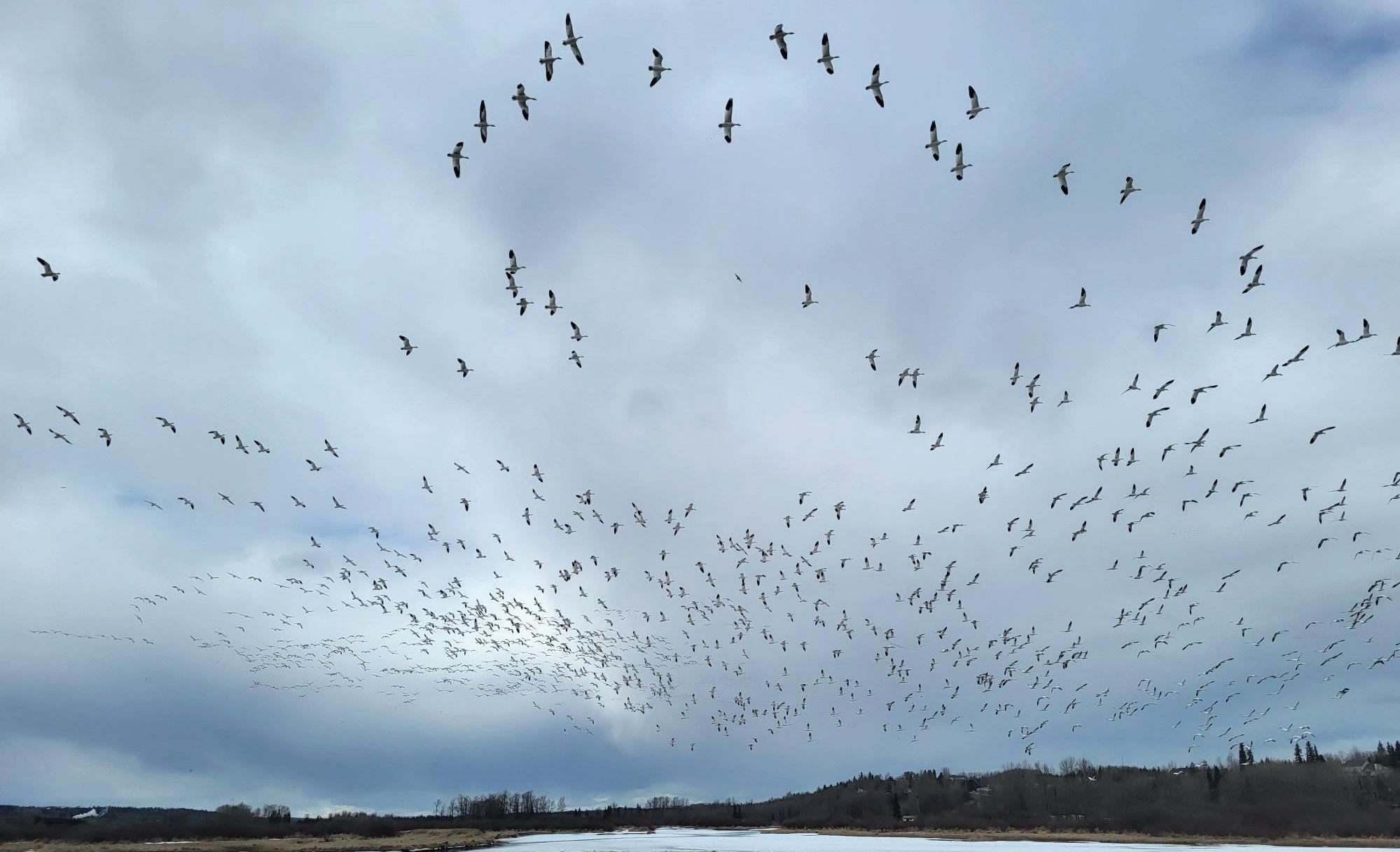

Snow geese circle above the Nechako River in Vanderhoof on Friday, April 3, part of a migration that sees thousands of birds stop off in the town west of Prince George every March and April. Also spotted were trumpeter swans and Canada geese. The Nechako River Migratory Bird Sanctuary is the fowl’s rest stop on their way to Alaska in the spring. Visit pgcitizen.ca to see video of the birds in the air.

They lost almost everything when their mobile home went up in ames
MATTHEW HILLIER Citizen Staff
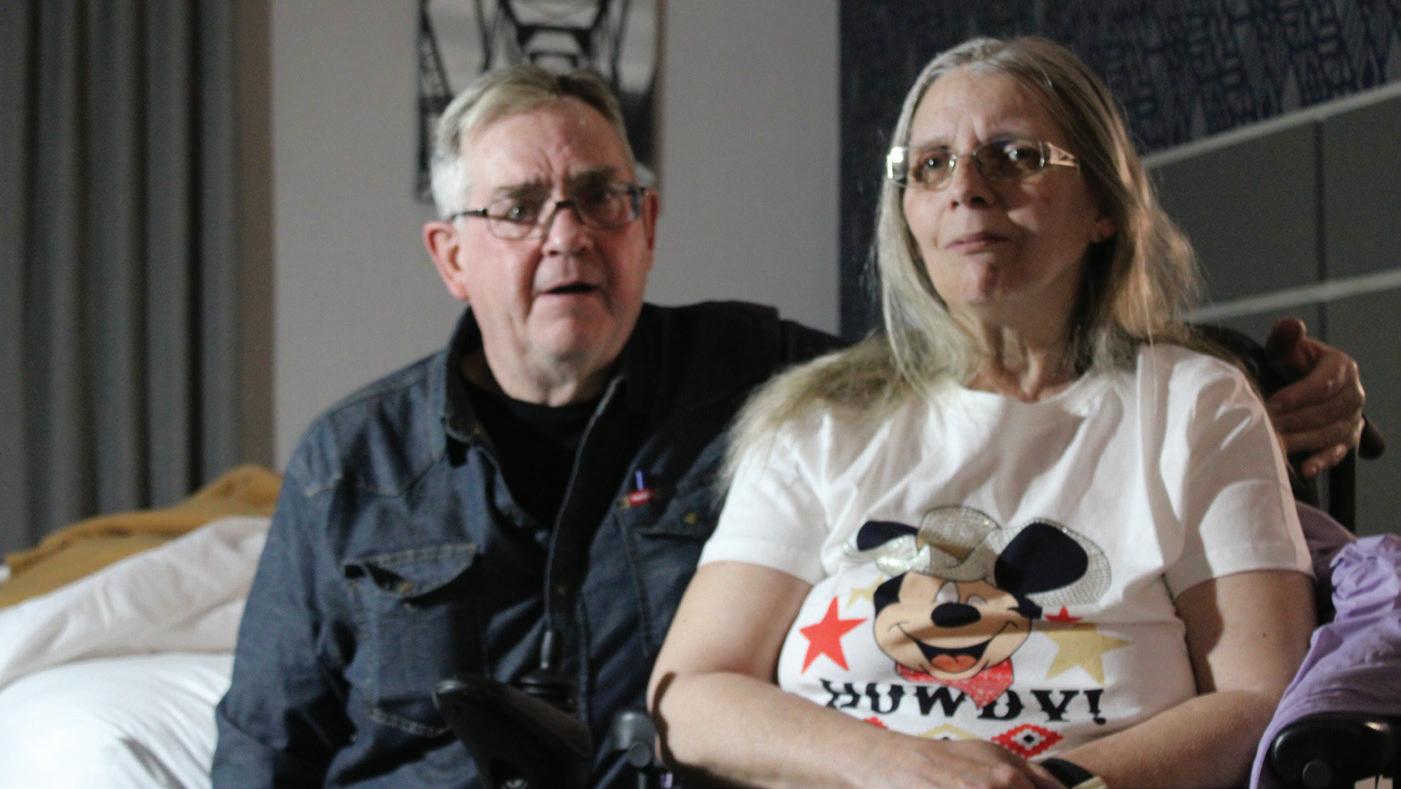
Charlie Irvin Wiley and Cindy Coburn were settling in for an average evening when, in less than five minutes, their lives changed drastically.
The couple lost their home to a fire that occurred on March 24 and have had to start from scratch due to having no insurance — their home had been deemed non-insurable.
However, the couple has received community support in the form of donations to a GoFundMe started by their relatives.
The senior couple had only a few minutes to escape their home located on Cessna Road near the airport. They recounted the night to The Citizen during an interview.
“I was in the bathroom brushing my teeth and I could smell smoke so I rushed out of the bathroom and grabbed the fire extinguisher and opened the door for the ramp and the flames were halfway up the door already,” said Wiley. “So I sprayed it down with the fire extinguisher and closed it and as I was headed towards the kitchen, Cindy says ‘we got to get out, we got to get out.’ She kept yelling.”
During their escape from the home, Wiley called for help and parked the car near the entrance so he and his wife, who suffers from mobility issues, could escape more easily.
Coburn had managed to escape the home on her own, which Wiley noticed while parking the car.
Her escape was harrowing as she lives with multiple sclerosis and cerebral palsy, which severely limit her mobility. Their former home hadn’t been modified for her electric scooter, making her escape even more difficult.
“I was sitting in my chair, the TV went off, so I got up off my chair into my
wheelchair, and I told Charlie, ‘get out now,’” she said. “I went straight outside, and I turned my wheelchair off, and got off it, because I didn’t want him going back in for my purse or his wallet. I was going to walk down, but I thought there was no time, so I sat on my butt to go down those four stairs.”
Even worse, Coburn’s lifeline device was unable to call for help, since the fire had damaged the wires for the phone under the couple’s home.
The couple then got into their car and drove down the road to call for help.
However, a neighbour and his son had woken up and were attempting to rush into the home to assist, thinking that the couple was inside. Wiley then had to leave the car to prevent them from entering the home, which was by then engulfed in flames.
“At that time in the morning, to jump out of bed and come running out after someone who isn’t even your relation, that’s something else,” said Wiley. The home was completely engulfed in
flames in less than five minutes and had completely collapsed in 15.
The couple lost almost everything, with only some damaged photo albums being salvaged from the wreckage. The losses included Coburn’s essential medical equipment and mobility aids, including two electric wheelchairs, which both exploded in the fire when their batteries were exposed to the flames.
As well, the couple lost their identification and important documents.
Currently, Wiley and Coburn are living out of a hotel and are planning their next steps to secure housing and stabilize their lives.
“We need lots of help and a place to stay because here is too expensive,” said Wiley. “It’s very good and all the people are very good to us. We’ve been trying to stay positive and do whatever we can to move forward but the price of everything is so high.”
He added that supporting his wife has become more difficult now that they are living out of a hotel. Thankfully, the
couple was able to find a new electric wheelchair for Coburn from MEDIchair North BC.
“We need a lot of help because I can’t do everything on my own to help Cindy,” said Wiley. “If it wasn’t for MEDIchair and other things that came through for Cindy, we’d really be in a tough spot because I can’t push her around in a wheelchair all day. I’m 74 years old and if I were 16, it would be no sweat, but I’m not.”
To this end, family members Linnea Izony and Crystal Coburn have organized a GoFundMe to assist with the couple’s transition and have so far raised $2,030 out of the $7,500 goal. It’s at www.gofundme.com/f/ help-for-charlie-cindy-wiley.
Funds raised for the GoFundMe will go towards helping the couple rehome and support their daily costs of living, including food, medical support and more.
The couple was surprised at the support from people donating to the fund and others donating meals.
“We really appreciate all the help,” said Wiley. “Another place that’s really, really been helpful is the Alano Club. People have been donating meals at the Alano Club. We get breakfast here in the hotel, but even then, we have a hot plate and other things here that we can cook a few things, but if we were to go and buy food every day from a store, or if we were to buy pizza or Chinese food every day, we’d never survive because we don’t have that kind of money.”
Wiley added that he and his wife are incredibly grateful to their neighbours on Cessna Road, who helped them both during the fire itself and currently as they are trying to get on their feet.
“We couldn’t ask for a better little community,” he said.

MATTHEW HILLIER Citizen Staff
The long saga of the Lower Patricia Boulevard encampment, also known as Moccasin Flats, is now over following the placement of the last resident in a local BC Housing facility.
The resident was protected by an August 2025 court order that allowed 20 people to stay on site, who were unable to find housing or had concerns with available options.
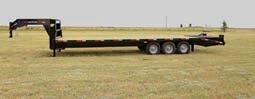
People watched from atop Patricia Boulevard as the City of Prince George removed the last remaining residents’ shelter, a fifth-wheel trailer, from the fenced-off area of Lower Patricia Boulevard on Thursday, April 2.
The final structure has been a frequent headache for the city and local police, with two shootings and an arson attempt all occurring in the same trailer.
The trailer will be sent to a local landfill and the gates to the site will now
be locked.
A section of the site will continue to serve as a temporary overnight shelter (TOS) and will be available for overnight camping from 7 p.m. to 9 a.m.
At a March 23 city council meeting, the TOS site was reduced to 2,699 square metres from 7,449 square metres and currently has the capacity to accommodate 20 sheltering sites. However, the remainder of the former encampment is currently available for overflow camping if needed.
The city has been working hand-inhand with BC Housing to place the last remaining residents since the closure of the site in October 2025.
“The City of Prince George has been working very hard with partners, namely BC Housing, to find appropriate housing for all occupants of the Lower Patricia Boulevard encampment and to remediate that site,” said Eric Depenau, the city’s director of administrative services, in a Citizen interview. “As of
this afternoon, the final individual has moved into housing, the final structure at Lower Patricia Boulevard encampment has been removed and the gates have been shut, effectively bringing an end to a multi-year saga on that site.”
There’s still work to do to address homelessness in the city, he added.
“We know that today’s success achieved through partnerships doesn’t solve homelessness and that there are more resources that are needed to be brought to bear,” said Depenau.
“Our point-in-time homeless count and other factors show us that there’s a great need in this community. It does, I believe, show a major progress toward addressing those issues and bringing this site to a closure.”
He added that the closure of this site has been a frequent topic of discussion and even as the trailer was being removed, he saw residents looking on.
With the site now being closed and expected to be fully cleaned up in the
following days, Depenau told The Citizen that this will allow for further use of the site.
“At this time, the bylaw designates it as an overflow area for our temporary overnight sheltering space,” said Depenau. “We’re going to continue working with partners to bring additional housing shelter spaces to the community as might be needed. Future plans are yet to be determined but today’s achievement enables a different future.”
Depenau also addressed concerns with sections of the site still being used for overnight camping and clarified that bylaw enforcement on this site will be given more room to operate.
“We haven’t had challenges with that thus far,” said Depenau. “We recognize that it’s early days and the weather is only starting to warm. I think it’s reasonable to expect that the site will become more frequently used through the summer months.




The former chief is remembered as a warrior, a diplomat and a champion of his people
TED CLARKE Citizen Staff
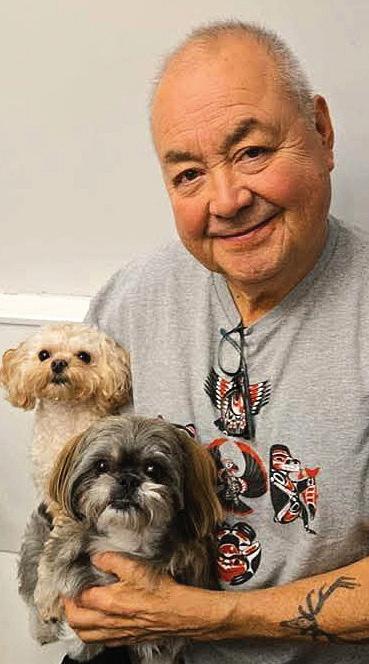
Barry Seymour, an influential former chief of the Lheidli T’enneh First Nation who helped negotiate an agreement to bring self-government to the people of his nation, died at on Friday, April 3 in Vancouver after suffering a heart attack.
He was 67.
Longtime friend Dan George, who considered Seymour his older brother, says his passing is a deep loss to the community.
“He was a visionary, he was a bridgebuilder, he was a diplomat and he was a warrior, a champion of our people taking our rightful place within the socioeconomic fabric of our territories,” said George.
“He understood that we would lose our language and culture faster in poverty than we would in prosperity, so having us become part of the economy was important to Barry.”
On July 28, 2003, as Lheidli T’enneh First Nation chief, Seymour signed a historic agreement in principle with the provincial and federal governments, a major step in the treaty to provide the 306 members with an independent government, 4,000 hectares of reserve land, $12.8 million in cash, a commercial fishery and an area-based forest licence.
That began a process to phase out member tax exemption, which gave the band law-making authority for direct taxation of its citizens on treaty land. The agreement, signed by Gordon Campbell, was only the second in 11 years of the BC treaty process. The deal was never ratified by members, who voted it down in 2007 and 2018.
“He has been one of the long-term leaders of the Lheidli T’enneh and he was always a balanced voice, he always understood that collaboration and negotiation were the way of the future to improve the situation for Indigenous people in the Prince George area,” said George.
“It was important to Barry that the services we provided were also available to all people who were of low income, understanding that when you’re struggling there really is no native or non-native, you’re just all trying to help one another.”
Seymour was 35 in March 1995 when he defeated incumbent chief Peter Quaw to become chief and development corporation CEO of what was then known as the Lheit-Lit’en Nation. Seymour was re-elected to four terms, serving until March 2005. Prior to that, he was the lands manager of the Shelley-based band.
He served as president of the Prince George Native Friendship Centre, president of the United Native Nations and was a central figure in the creation of the Central Interior Native Health Society. He was also a director for The Exploration Place museum.
Seymour developed strong relationships with Prince George mayors John Backhouse and Colin Kinsley, and they worked together as advocates lobbying higher levels of government for support during some of the most formative years of the Friendship Centre. He provided a clear vision of the services the Friendship Centre needed to provide the community, and his leadership laid the foundation that will carry on into future generations.
“There were a lot of progressive minds at that time that understood that it’s very important to work together and focus on what we have in common, rather than amplifying difference that serve no real benefit to any of us,” said George.
George was 25 when he was appointed executive director of the Friendship Centre on Seymour’s recommendation, and they arranged the purchase of the Third Avenue provincial government building in 1997, after the Prince George courthouse opened. Seymour excelled in sports growing up in Prince George. He excelled in
could talk to. We had him as the emcee for many years for community meetings. He had an amazing sense of history, he was like a sponge, and he kept it all and the good thing is he shared his knowledge.”
After his teenaged son Trent was left a paraplegic in a hunting accident, Seymour moved to Vancouver while Trent was recovering at G.F. Strong Rehabilitation Centre. During that time, starting in February 2020, he worked as the executive director for the Vancouver Native Health Society until he returned to Prince George, where he was self-employed as a project management consultant.
“Barry was a chief, an athlete, an outdoorsman, and a cultural repository, but most of all, I will remember him as a family man,” said George. “Because of his family and community, he knew who he was, where he came from, and what truly mattered.
fastball and football with the Prince George Eagles, and he passed on his athletic traits to his children and grandchildren. He was a fixture watching family members play at the native fastball and hockey tournaments in Prince George. He loved to hunt and fish and was a steward of the land, which instilled in him the need to protect the environment, especially on the Lheidli reserve.
Seymour was known to have had a good understanding of the history and the creation story of his people. As a nobleman to the Saik’uz First Nation, Seymour was given the traditional name Tusyen.
“He was a respected Elder and a wealth of knowledge, not only corporate, but the clan system, the traditional systems and members — we lost so much when we lost him,” said Chief Dolleen Logan.
“He was a very kind person who would always help out when needed. He was a voice of reason, someone you
“Barry carried himself with a quiet strength, even through the health struggles he was facing. He never let those challenges define him. He stayed connected, present, and engaged — always willing to participate, to share, and to speak about the future as if there was still so much ahead. That’s what made him who he was.”
Seymour’s health deteriorated about a decade ago, and he went into kidney failure, which was related to the heart attack that eventually claimed his life.
Seymour is survived by his wife, Phyllis; daughters Tandi, Tash and Tamara; his son, Trent; and his grandchildren. Tandi wrote in a Facebook post on Oct. 25, 2025: “One of the greatest gifts of coming home has been the time I get to spend with my dad. He is the reason we came back — for him, for myself and for my boys. Every time he speaks about our land, our nation, the history of our governance, I feel the depth of his knowledge and the strength of his spirit and our ancestors. His words are powerful and the pride I feel when I listen to him always brings tears to my eyes.”
A memorial service is being planned at a date yet to be determined.





























COLIN SLARK Citizen Staff
The local advocacy group that pushed for more greenspace protection during the City of Prince George’s public consultations over the Official Community Plan in 2025 is raising concerns over the proposed development of 35 acres of the University of Northern British Columbia’s endowment lands.
At the Monday, March 23 city council meeting, UNBC interim president Bill Owen and manager of business development Claudia Barreira asked councillors to support the university’s call for the province to remove the reverter clause for part of its 47-acre land trust.
The university is eying a mixed-use residential development on Cranbrook Hill opposite its campus on University Way that could eventually house up to 4,000 people.
However, the land was granted to the university by the BC Government with a provision that would see it revert to the Crown if it’s ever used for non-educational or university purposes.
Council unanimously voted to have its Standing Committee on Intergovernmental Affairs advocate for the removal of that provision, also called a “reverter clause.”
Ginter’s Green Forever (GGF) sent out a media release April 1 decrying the lack of public consultation and the potential negative consequences of the proposed development.
The organization made waves last year during the public hearings on Prince George’s new Official Community Plan, advocating for more protections for local greenspaces such as the area it’s named after.
Speaking with The Citizen on Thursday, April 2, GGF organizer Jenn Matthews said the group has concerns about the potential environmental impacts, the lack of public consultation

Sun shines on University Way near the entrance to the University of Northern British Columbia on Thursday, April 2. To the right is university-owned land that is the proposed site of a 4,000-person mixed-use residential neighbourhood.
thus far and the continuation of development away from Prince George’s core.
By having city council voice unanimous support at this early stage for the project, Matthews said she was worried that when elements come to the council table such as rezoning or OCP amendments, their passage could be a foregone conclusion.
With the OCP having recently received large-scale revisions, she said it would have been nice if the consultation process had included discussions over planned future developments.
“Coun. (Kyle) Sampson sort of acknowledged it, he said ‘I’ll have to keep an open mind when it comes to that,’ but you can’t keep an open mind if you’ve already exclaimed your excitement for this project in a public meeting, right?” Matthew said.
If this development was taking place somewhere in the bowl, Matthews said, the new tax revenue could go towards improving and maintaining existing infrastructure rather than having to build new infrastructure.
Instead, there’s a chance that the infrastructure costs might outweigh any new tax revenues.
“It’s frustrating as a citizen to listen to city staff say ‘this is why our taxes keep going up and up and here’s our problem with keeping up with infrastructure costs’ and then at the same time we’re
Booth spoke multiple times during last year’s OCP hearings, criticizing what she saw as deficiencies in the city’s public consultation process over the plan.
Speaking to The Citizen on April 1, she articulated similar concerns over the proposed university development.
“In this case, it’s not just the city not doing any reasonable engagement with the public, it is the university not doing any reasonable engagement with students, staff or faculty,” Booth said. “This was a bit of a surprise. Nobody knew this was really happening at the university.”
making decision that keep feeding into that,” she said.
“At some point we have to figure that out, otherwise we’re just going to keep kind of donut-ing our city — building shiny new things on the outside and letting the inside crumble.”
She said Ginter’s Meadow and the escarpment is at risk from the kind of development being proposed and other projects that have already been built on Cranbrook Hill.
While the public might have a chance to weigh in on any projects when they reach the land-use stage and council has to decide on whether to approve them, Matthews said this fall’s upcoming municipal election gives residents a chance to ask potential candidates for mayor and council whether they support the project.
She added that GGF might approach the provincial government and local MLAs regarding the issue as well.
If universities are having trouble making ends meet, Matthews said, it would be better to address the root causes rather than have them look outside their academic roles to find one-time cash cows, which likely won’t be longterm solutions.
Another of the signatories of the media release was Annie Booth, a full professor in UNBC’s environmental and sustainability studies department and a registered professional planner in BC.
That lack of engagement, she said, is a problem because those are the groups who will be most affected by the development.
She said that after the March 23 city council meeting, she brought up the project with one of her classes where her students discussed concerns about the project, including potential water shed issues, loss of wildlife habitat, a lack of consultation and the potential betrayal of UNBC’s self-proclaimed status as “Canada’s Green University.”
While it’s easy to accuse interest groups of being anti-development, Booth said in this case Ginter’s Green Forever is more concerned about inappropriate, out-of-place development.
Going into a forested area, she said, requires cutting down a lot of trees, with the city taking on the cost of installing and then maintaining new infrastructure and services.
The removal of the trees could make water retention on the hill worse, sending rainfall down the slope. She said the university’s campus has seen that kind of slippage down the hill along University Way over its more than three decades of existence and this would only worsen the situation.
Further towards Forests for the World on Cranbrook Hill, there have been issues with homeowners struggling to get water from wells dug into the nearby aquifer.
“It’s a fairly shallow water table and so the more demands you put on it, the more likely it is that you’re going to be dealing with water shortages,” Booth said.
Beyond the development site itself, she said Tyner Boulevard and University Way would likely need to be twinned for their entire length to accommodate the extra traffic. That could be difficult on University Way, where there isn’t a lot of room to the sides of the existing road.
Booth said it would be better to develop underutilized lots in the city that are already serviced by infrastructure instead of continuing development on the periphery of the city.
As a local property owner, Booth said she’s worried about the impact the project could have on her tax burden with the new costs being borne by the city without having had a chance for locals to weigh in.
“The one thing the city does not like to do is ask for more taxes,” Booth said. “They have a multimillion-dollar burden in infrastructure replacement as it is and they want to add more to that burden. That is just foolish.”
While the project promises to add shopping to the top of Cranbrook Hill, Booth said that could just mean diverting customers from existing residents in the beginning and then having traffic die off over time as people stop wanting to go out of their way to shop in that neighbourhood.
Going forward, Booth said she’d like to see proper engagement and not “yet another lousy open house with stale donuts.”
She said last year’s OCP public hearings aren’t the model to follow either, as so many people showed up that staff got scared and undercover police officers were brought in to monitor the crowd on the second night of the first hearing.
“That means very careful, thoughtful
one-offs,” Booth said. “A series of engagements that actually says, ‘this is not a done deal, we are actually con cerned about what it is that you believe, the issues that you raise and we wish to address them.’
“The effect of the acting president and the business person going down to city hall and that’s where the university community heard about it, that’s where the City of Prince George heard about it, makes it seem like they are trying to do an end run and to bias public engagement.”
Booth said she teaches public engagement at the university and in her opinion, neither UNBC nor the city knows how to do it properly.
In a statement sent by email, Owen said that the university has already undertaken extensive consultation with both its own community and external partners and that will continue as it progresses.
“The Land Trust remains in its early stages,” the university’s interim presi dent said. “Any development proposals are several years away and will be subject to municipal zoning processes, which will include opportunities for community consultation and public input.”
A university spokesperson added that two workshops were held in 2022 where students, faculty and staff could provide feedback on the land trust’s guiding principles and how they would be used for high-level design considerations.
Later in the same year, they said, UNBC also held 18 group interview sessions with both internal and exter nal organizations to discuss land uses, potential opportunities and other con cerns as well as engagement through a third-year environmental studies course.
Since then, the spokesperson said, the university has continued to provide updates through formal governance processes like board of governors and senate meetings as well as on UNBC’s website.


KENNEDY GORDON Citizen Managing Editor
There’s a version of Prince George’s future growth that includes a row of condominium towers and high-end homes along Cranbrook Hill, offering spectacular views in all directions, along with easy access to the University of Northern British Columbia campus, newly developed nearby retail stores, community services and schools.
There’s another version that sees UNBC as the only tenant up there, with the surrounding area staying as green as it is today.
Which version happens is yet to be determined, and any change is years (or decades) away.
What we now know is that the university is exploring the idea of leasing some of its property — known as endowment lands — to developers. The university is struggling, like most publicly funded post-secondary institutions in Canada, and its leadership wants to find new sources of revenue.
Whether this idea would be a financial success isn’t in question. There’s obvious appeal. New residential developments are being built along Tyner Boulevard, offering spectacular views out over the southern half of the city and of the mountains in the distance. People will want to live up by the university, and they’ll spend big to do it. That’s what the university is after.
But this isn’t a simple real estate deal. Endowment lands aren’t quite private

property. The province gave the land to the university for its own use, with a caveat: it can’t be sold off or leased for commercial development.
UNBC wants the province to waive that stipulation and allow for a 99-year ground lease. This would allow developers to build up to 1,800 new homes, housing as many as 4,000 people, on the 47 acres. The UNBC Land Trust would retain long-term ownership and collect a steady revenue stream for almost a century.
We’re of two minds about this possibility.
If UNBC plans to put revenues from this deal toward its capital budget for building improvements, then yes, do it.
Like other public buildings in the city that were built 30 or so years ago, the UNBC campus is showing its age.
The Aquatic Centre is closed for two years for major renovations. CN Centre requires extensive work to its building envelope. The university’s buildings, despite their design excellence, are also past due for renovations, repairs and refreshment.
Any proceeds from the lease of surrounding land have to be put toward making sure the campus is standing and functional for at least another 30 years.
But if the plan is for the revenues to be added to the general operating budget, forget about it. We’d rather have undeveloped green space than more pay raises for administrators.
We’ve seen this happen in local education before. School District 57 has had a habit of turning the proceeds of the sale of school land and buildings into anything but improvements to the
schools that remain. This approach just results in further costs down the road while new schools such as Duchess Park and Shas Ti Kelly Road are built to the Ministry of Education’s minimum standard, instead of offering more opportunities for students.
Advocates for the development of some of the endowment lands make good points. The university is an island in itself up on the hill, and the idea of having a vibrant new neighbourhood surrounding the campus could be good for UNBC and good for PG.
It makes even more sense if the proceeds mean the university is given a significant facelift over the next decade, one that includes structural and systems upgrades, and continues to use the revenues for capital costs over the 99 years of the lease.
UNBC has been overfunded for the number of students who attend since it was founded more than three decades ago. If the plan is to put proceeds toward operational costs — bloating even further the university’s already padded administration — then the province should consider it carefully.
We urge Jessie Sunner, BC’s Minister of Post-Secondary Education and Future Skills, to take the university’s plans for the money into account before giving the green light for UNBC to profit from what were once public lands.
If intelligently managed, this deal makes sense, but not if it means the money vanishes into C-suite pay and perks.
We
Nous
the




OFFICE (8:30a - 4:30p) 505 Fourth Avenue Prince George, B.C. V2L 3H2
FRONT DESK & CLASSIFIED frontdesk@pgcitzen.ca 250-562-2441

NEWS AND SPORTS news@pgcitzen.ca
LETTERS TO THE EDITOR editor@pgcitzen.ca
OWNER / PUBLISHER owner@pgcitzen.ca

Other than educating our society, the most important thing the University of Northern British Columbia could have done for Prince George was to revitalize the downtown.
Instead, against much opposition and in a decision that only grows more regrettable by the day, UNBC was plopped up on the hill, far away from housing, services, and the fabric of downtown Prince George.
The poor thinking behind that decision was exposed almost immediately. Punching University Drive up the unstable slopes of the escarpment resulted in a mudslide and ongoing slippage. By August 1994, the cost of the road had ballooned to around $16 million, nearly double the $8.7 million that was budgeted.
The isolation from the city has necessitated a lot of ongoing travel and road maintenance. Indirectly, this isolation has created a sense of cultural and intellectual disconnection from the community at large.
The other effects of the university’s location are more far reaching. Its location — and the expensive road the public paid for to access it — has spurred the massive and expensive urbanization of the Cranbrook Hill escarpment. It has spurred the transfer of investment and community from downtown to a far-flung exurban location. Huge amounts of wildlife-rich forests have been leveled for high-end homes in the “University Heights” neighbourhood. The natural stormwater control these forests have provided has been replaced with impervious surfaces and underground pipes feeding into an already overloaded stormwater system. Stormwater is a major expense for our city.
It is estimated we should be spending $9.3 million annually to upgrade our existing stormwater infrastructure. In 2023 we spent a fifth of that.
To make up for the shortfall we now have a city-wide stormwater “tax” in the form of a new levy.
We don’t have a clear answer, unfortunately, as to how much of this is to help pay for the development of University Heights. But its demands on the system are large and growing.
Many kilometers of new piping have been extended to the new developments. New stormwater retention ponds have been constructed, some with federal money, to deal with water coming down Tyner.
In 2024 and 2025 we authorized $1.575 million to start work on upgrading the Ferry-Avenue-to-Range-Road stormwater system in part to accommodate future development in University Heights.
What the cost of a new pipe up the hill will be, we have no idea.
Now Tyner Boulevard is too small. Even though the federal government just spent hundreds of thousands of dollars on upgrading the trail alongside it, the city’s unfunded capital plan is proposing we double this road at the cost of at least $10.2 million. Additional work on traffic lights and intersection
upgrades will add to this.
When and if this happens, the twolane bridge over Shane Creek, which we just spent $1.2 million to fix, will have to be replaced with a four-lane bridge. This will likely cost us many millions more.
Now another play is afoot.
At the Monday, March 23 city council meeting, we learned UNBC leadership, without any previous consultation with staff or students, wants to level nearly 40 acres of publicly owned forest for a massive new development of up to 4,000 residents.
To put this in perspective, this is a nearly the population of Vanderhoof.
Whether or not this happens will likely depend on the province making an exemption to the requirement that university endowment land be used for educational purposes, not more development. It will also depend on the city’s ongoing generosity.
A community of 4,000 residents will require significant off-site infrastructure that the developer won’t be paying for. This includes more stormwater catchment systems, demands for more arterial road expansions, probably a new elementary school and ongoing costs to service and maintain all of this.
University leadership claims there will be significant tax revenues from this development. If fully built out, the
city could see anywhere from $6.6-$10.7 million in annual civic property tax revenues.
But let’s not pretend that’s all profit for the city. This community will require city services and expenditures just like anywhere else. Exactly how much, we don’t know, but it’s likely more than the city average when you consider all the hard infrastructure this project will require.
As it stands, as of the last census year of 2021, Prince George needed $178 million in revenue to service a population of 74,708. This works out to around $2,320 per resident.
If this new community is expected to receive the same levels of service as everyone else, and assuming this baseline number hasn’t grown, we will need to budget an additional $9.3 million per year in additional municipal services for this new community.
And if it only brings in $6.6 million per year, well that could leave a gaping hole in city finances the rest of us will have to cover.
But really the main deficit in what is happening on the hill is found at the bottom: downtown.
Decades of development in the outer edges of our city has drained our downtown of life, culture, community, and investment. It has imposed new costs on existing taxpayers, and is likely a factor driving the massive increases in property taxes we are seeing.
If the university leadership cared about the City of Prince George they’d focus their energies on developing more of a campus downtown. They’d try to integrate themselves into the community, not try to further separate themselves from it.
The last thing we need is an institution of higher learning, Canada’s “green university,” serving as an ongoing pawn for irresponsible development that is rapidly undermining our greenspace, our town’s beauty, our downtown, and our fiscal situation.
James Steidle is a Prince George writer.
Looking for a new approach as we chart a better path forward
ELI KLASNER Guest Columnist
Across Canada, mid-sized cities are facing a growing but often under-discussed challenge: aging cultural infrastructure that no longer meets the needs of their communities.
When we talk about “cultural infrastructure,” we are referring not only to physical arts facilities such as theatres, studios and galleries, but to the broader system that supports them — including organizations, programming, funding models and community use. It is this larger ecosystem that is now under strain in many mid-sized cities.
Many arts facilities were built decades ago, in a very different economic and social context. Today, they are increasingly expensive to maintain, limited in flexibility and often unable to support the scale and diversity of programming that modern communities expect. At the same time, municipalities are navigating rising costs, constrained capital budgets and competing priorities.
The result is a quiet but significant gap between what communities need and what existing facilities can deliver.
Traditionally, the response has been to seek funding to replace or renovate aging arts facilities. But in many midsized cities, this approach is becoming less viable. Public funding alone is often insufficient, and large-scale capital projects can stall for years without a clear path forward.
In effect, we have been trying to solve a system-level problem — cultural infrastructure — through building-level solutions. And increasingly, that approach is falling short.
This moment calls for a different way of thinking.
One emerging model is to approach cultural infrastructure as part of a

STUDIO
Today’s community arts spaces were built decades ago and have become more and more expensive to maintain, former Community Arts Council executive director Eli Klasner writes in a guest column today.
broader, integrated development strategy. Rather than treating arts facilities as standalone projects, this model explores how cultural space can be combined with other community and market-driven uses.
In Prince George, this broader conversation is already underway through initiatives such as the City’s Civic Core District Plan, which seeks to guide the future of key municipal properties in the downtown. As these planning processes evolve, they highlight an important consideration: cultural infrastructure cannot be treated as an afterthought or a single-site solution. It must be integrated early, as part of the overall vision
for how a downtown functions and serves its community.
During my time working in Prince George, I explored such a model in the context of the aging Studio 2880 facility. Rather than viewing the site solely as an arts facility redevelopment, the concept proposed a mixed-use approach: integrating a new community arts hub with market-based seniors housing within a single development, delivered through a public-private partnership (P3).
In this model, the municipality’s role is not to fully fund a new facility, but to enable it — through land use planning, rezoning and a clear articulation of community benefit. Private-sector
investment, in turn, helps unlock financial feasibility, while the arts component remains central to the project’s purpose and identity.
This kind of approach offers several important advantages.
First, it improves financial viability. By incorporating revenue-generating elements such as housing, the overall project becomes more sustainable and less dependent on limited public funds.
Second, it makes better use of land. Many aging arts facilities are located on valuable urban sites that can support more intensive and integrated development.
Third, it strengthens community connection. Combining cultural space with residential or other uses creates more active, intergenerational environments — places where arts and daily life intersect.
Finally, it introduces a level of scalability. While every community is different, the principles behind this model can be adapted to suit a range of local contexts. None of this suggests that traditional models of cultural funding are no longer important. Public investment remains essential.
But if we rely on those models alone, many communities will struggle to move their cultural infrastructure forward in a meaningful way.
The opportunity in front of us is not simply to replace aging arts facilities, but to rethink how cultural infrastructure is conceived, funded and integrated into the life of a community.
In doing so, we may find that the future of cultural infrastructure is not smaller or more constrained — but more connected, more resilient and more reflective of the communities it serves.
In Part 2 next week, I will explore how similar approaches are beginning to take shape in other Canadian cities — and what lessons they offer for communities like Prince George.
Eli Klasner is the former executive director of the Community Arts Council.
Editorial: City wasted time and money on a pointless probe of mayor
What an absolute waste of money. Not only that, the stress it puts on an elected official is incredible.
It could lead to the mayor or a council member having to deal with an expensive external lawyer and a separate investigator hired by the city.
Then, depending on the circumstances, they may also have to hire their own lawyer to fight their case.
There has to be a balance between holding elected officials accountable and preventing frivolous and costly investigations.
We have gotten to the point at the City of PG where free speech is being limited. This is the tip of the woke-ism iceberg at city hall.
As far as this particular investigation, every member has the ability to comment publicly on this issue, as I previously did. Remaining silent is not an option.
I hope the PG Citizen interviews all of us on council to see where we stand on this issue. My opinion only.
Brian Skakun
Editorial: City wasted time and money on a pointless probe of mayor
You hit the nail on its head.
The city councillors — the mighty six — work for the people.
They forgot that the day after the election. It seems they formed a coalition between themselves and city management. This event should be made public, not held in camera. Council and all involved should be held accountable publicly.
Perhaps there are two council members that might have more insight on sanctions. Our city council perhaps has members who perceive no honesty or trust — only lies and deceit.
Good for Simon to hang in there. I know how stressful it can be. Come October, if he makes the choice to have another go for the office, there will be a changeout of the six.
The people of PG can’t afford to keep them.
They have done nothing but raise taxes, approve high expenditures, been selfabsorbed and not supportive of the Legion or seniors in their time of need. It won’t be forgotten.
Milton Mahoney
Province strengthens BC Timber Sales
They have to start cleaning up the left-behind fibre in the bush better than what is currently happening now.
Where I live, there have been tenders put out to process and haul wood that was bunched during the 2023 fires.
Last camper standing: Why there’s one legal resident left at Moccasin Flats
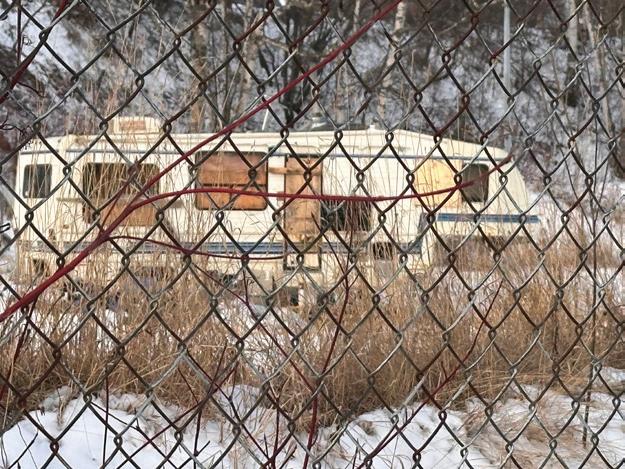
Just looked at some of the related headlines to this story:
“Teen girl shot at Moccasin Flats”
“Police say latest Moccasin Flats shooting the result of careless gun use”
“Two injured in shooting at Moccasin Flats”
I remember another story as well, where people showed up and sieged the trailer while screaming about their daughter.
The trailer picture is either The Citizen’s stock photo for Moccasin Flats stories, or it has been the site of many disturbances. Lol.
Careless gun use? It’s careless to let these people even have firearms!
Bloody ridiculous.
Zangief
In two years, no one has bothered to bid on the contracts, and that wood is now basically a fire hazard and needs to be hauled for pulp, pellets or burned before another fire takes hold. Even an industrial chipper would make more sense
Editorial: Proud fans can help fuel Prince George teams’ hockey playoff runs My dad never played organized sports — period. He hunted, fished and stayed active his whole life, but zero sports. I, on the other hand, grew up playing organized sports — hockey, soccer, basketball, etc. Playing team sports has been shown to benefit child development and contributes to the success of a person in career and life. While my dad never played, he supported me all my life in whatever sport I chose. Most parents do. They care if their child succeeds (wins); they have a personal stake in it. As for cheering for a team? Well, cheering for our local junior teams does add to our local economy by attending games. It aids development programs for young players and fosters local pride in that a person feels like they’re contributing to an effort to win, and at the end of the day — it’s entertaining and fun. Viquick

than just burning it, but I am sure that is what will happen to it eventually. If the forestry industry doesn’t do it, then the people who live here will have to do it when it can be done safely.
The loggers who logged here
for the past five years and have now left have left so much fibre along the roadside and in slash piles — complete dry trees, not just tops and slash — that I can only shake my head and wonder who makes the rules.
Chestor
If you hear howling at Prince George International Airport, it might not just be someone devastated to learn their flight has been delayed.
When an abnormal incident occurs at an airport in Canada, it is frequently reported to Transport Canada through the Civil Aviation Daily Occurrence Reporting System (CADORS).
A public database of CADORS reports is available to search.
Looking up Prince George in this database shows three incidents where airport or air carrier staff had to contend with coyotes on or near runways over a three-day period in January.
On Tuesday, Jan. 20, a helicopter from Yellowhead Helicopters reported that a coyote was spotted running toward runway 19 from a wooded area.
“After running at the helicopter, the coyote was scared off back into the
woods,” the CADORS report said.
The helicopter had to wait for the coyote to be chased away from the runway before it could continue its circuit.
Seventeen hours later, a helicopter from the same company was conducting circuits on runway 01 when a truck requested permission to scare away a coyote located in a nearby grass triangle.
The helicopter was diverted to another runway as personnel in the truck shooed away the animal.
Then, on Tuesday, Jan. 22, there was a report of two coyotes on runway 15 that maintenance personnel had to scare off. This incident did not have any impact on operations.
These three incidents follow two similar incidents that happened in 2025.
On March 13 and Aug. 5, 2025, aircraft reported coyotes on runways at the airport. In the first case, maintenance staff had to scare them away, while the coyotes simply ran away in the second.



Other than coyotes, there are occasional wildlife incidents reported at the local airport. On Tuesday, Jan. 3, a Carson Air plane that arrived in Prince George from Vancouver reported that it had hit a bird while landing.
An inspection by maintenance staff found a dead “medium-large owl” on runway 33. Its mate was seen flying nearby.
In 2025, there were two reported potential bird strikes where no evidence was found afterward and another in which a small sparrow carcass was found after a flight took off for Vancouver.
In a Thursday, April 2, interview, airport director of people, safety and culture Sabrina Angus told The Citizen that wildlife interactions are not unusual.
“I wouldn’t call it a problem,” Angus said. “The presence here is something that airports like ourselves manage on an ongoing basis. They do make an appearance from time to time,
particularly in environments and regions like Northern BC. They’re not uncommon.”
She said the Prince George Airport has a wildlife management plan, as required of all airports by Transport Canada.
Reports of wildlife in or around the airfield are usually made by pilots or employees carrying out routine checks. She said the number of reports per year is steady.
To this point, she said wildlife interactions at the airport have not put employees or passengers at risk.
Typically, Angus said, it is either birds or coyotes that are reported. How the animals are dealt with is laid out in the management plan.
To her knowledge, she said there had not been any further wildlife sightings reported since January. If a member of the public spots wildlife in or around the airport’s lands, she said they can call 250-963-2400, ext. 2414 to make a report.
BOB MACKIN Local Journalism Initiative Reporter
An equipment operator with the City of Prince George pleaded guilty April 1 to providing false or misleading information to ICBC.
Provincial Court Judge Charles Hutchinson fined Parmjeet Singh Bhathal $2,000 under the Insurance Vehicle Act after the 56-year-old lied to ICBC between Sept. 9-Dec. 16, 2024.
“Mr. Bhathal fraudulently reported an accident that he had caused as having happened to his vehicle, when it was unattended at a different location,” Hutchinson said. “Given opportunities to change his statement, he declined, and only when presented with video evidence did he finally acknowledge responsibility.”
Court heard that Bhathal was driving a vehicle that struck a parked vehicle in the Costco lot on Sept. 7, 2024, causing damage to both vehicles. He drove

away without leaving a note for the driver of the other vehicle.
Two days later, Bhathal filed a damage claim with ICBC, alleging a collision in the Walmart parking lot on Sept. 8, 2024.
Damage was estimated at $7,270.
He signed a copy of his statement to
ICBC on Sept. 30, 2024. An ICBC representative emailed Bhathal on Oct. 2, 2024, asking if he was aware of any other collisions involving his vehicle. He said he was not.
On Dec. 16, 2024, a special investigations unit officer interviewed Bhathal and gave him the opportunity to change

his statement. He declined, until the officer informed him that the collision outside Costco was captured by a surveillance camera.
Bhathal also admitted the Walmart hit-and-run report was false.
“Crown submits deterrence is paramount for this type of offence, because it is easy to commit, hard to detect, and consists of fraud against a public benefit scheme, which relies on honest reporting to function,” said Eva Miller, an articled law student acting for the Crown.
Bhathal’s lawyer, David Jenkins Jr., told Hutchinson his client was born and raised in India and came to Canada in 1994. Jenkins said Bhathal has worked for 25 years with the city and runs a janitorial business on the side. He has no criminal record, but is remorseful.
Jenkins said Bhathal spent thousands of dollars on repairs after his claim was denied. ICBC also decided to only issue him basic insurance for a period of

Kwadacha resident was found guilty of manslaughter last year
BOB MACKIN Local Journalism Initiative Reporter
A Kwadacha man found guilty of fatally shooting his wife more than three years ago was sentenced March 30 to another two years and six days in jail.
In the oral decision, published April 2, BC Supreme Court Justice Sandra Sukstorf sentenced Brent Angus McCook, 28, to a total of six years and nine months, plus three years on probation. The jail sentence was reduced due to credit for pre-trial custody.
Last June 17, Sukstorf acquitted McCook of second-degree murder because he was too drunk to form intent to kill Rochelle Poole on Jan. 24, 2023. But he was found guilty of manslaughter for causing her death.
For reasons unknown, McCook loaded his .308-calibre Tikka rifle and fired it twice from within his residence in the town, also known as Fort Ware, toward his parked truck outside.
Two bullets passed through the windshield. One fatally struck Poole in the head while she sat in the passenger seat.
Crown sought a 16-year jail sentence, less credit for pre-trial custody, because of the use of a firearm at close range and the death of an Indigenous intimate partner who allegedly suffered abuse.
Defence asked for five years in jail, less time served.
In proposing the shorter sentence, McCook’s defence lawyer, Lisa Helps, emphasized his lack of criminal record, Indigenous background, sobriety in custody, remorse and desire to care for his two children.
“Although McCook’s moral blameworthiness is attenuated by the absence of planning, motive or deliberate targeting,
the gravity of the harm and the lethal risk created by the use of a firearm require a substantial custodial sentence,” Sukstorf said.
McCook was severely drunk and suffering significant cognitive and motor impairment after 17 hours of excessive drinking when he fired the rifle. He did not know that Poole was in the vehicle and there was no evidence of an argument in the hours leading up to the incident. Their demeanour was described as calm and affectionate, despite an earlier disagreement over Ski-Doo keys.
“While the forensic evidence established the direction of fire, it did not demonstrate visibility into the vehicle, deliberate targeting or purposeful aim at Poole,” Sukstorf said.
Poole was likely asleep, unconscious or otherwise incapacitated, and her body was found slumped with alcohol in her lap.
McCook did not attempt to flee. The judge said witnesses and police officers
described him as “incoherent, erratic, confused and severely impaired immediately before and after the offence.”
Sukstorf found McCook’s crime within the “middle portion” of the manslaughter range. Mitigating factors include systemic and intergenerational forces, including early removal from his family, the legacy of Indigenous residential schools and normalization of alcohol abuse.
Kwadacha has assumed interest in McCook’s rehabilitation through a structured plan for reintegration, based on accountability, sobriety, healing and community safety.
The plan, Sukstorf said, “includes expectations designed to support both his rehabilitation and the community’s need to heal and, in time, move toward forgiveness.”
Sukstorf also banned McCook from possessing firearms for life, except to hunt, and ordered him to provide a DNA sample.
Prince George RCMP are reporting that the use of a police dog team and a drone has resulted in the arrest of a man wanted on several warrants.
RCMP stated in a media release that shortly after midnight, on Monday, March 30 they were notified of an unauthorized person inside a compound located on the 2000 block of First Avenue.
Frontline police officers responded to the scene and, using the tactics and tools mentioned previously, arrested the person without incident. He was then transported to the Prince George RCMP detachment.
The suspect was later identified as James Edward Martin Smith, who had two outstanding unendorsed arrest warrants at the time of this arrest.
Smith was held in custody until he

could attend court.
“The speed at which investigators located and arrested the suspect was due in part to the quick notification to police of the occurrence, but also due to our blend of traditional police tactics with advancements in available technology,” stated Cpl. Jennifer Cooper, media relations officer for the Prince George RCMP, in a press release.
“We look forward to the continued use and positive results we are seeing with the new technologies we have been integrating into our investigations.”
BOB MACKIN Local Journalism Initiative Reporter
The five-member jury that heard the inquest into the 2020 death of Lake Babine Nation’s Everett Riley Patrick made five recommendations aimed at improving skills, policies and procedures in police cells.
At the Burnaby Coroners’ Court on Thursday, April 2, the jury returned around 11:30 a.m. and the foreperson said the verdict was unanimous. The panel classified Patrick’s April 20, 2020 death in University Hospital of Northern BC accidental, caused by a subdural hemorrhage — bleeding in the brain — due to or as the consequence of a blunt force injury of unknown origin.
Officers had been called around 4:30 a.m. on April 12, 2020 to investigate an alarm at firearms and ammunition dealer E&I Sports and arrested 42-yearold Patrick after a standoff. He suffered cuts, bruises and bites from a police service dog.
After emergency assessment and treatment by Dr. Matthew Janzen, at the University Hospital of Northern BC, an officer escorted Patrick to the cells at the RCMP detachment.
Janzen said Patrick did not meet the threshold for a CT scan.
However, Patrick suffered medical distress around 4 p.m. and was taken back to the hospital by paramedics. Almost eight days later, he died at 2:55 a.m. in hospital.
The Independent Investigations Office, the civilian-led agency that probes police-involved injuries and deaths, recommended charges to Crown counsel in 2022, but none was filed.
The jury directed its recommendations to the Minister of Public Safety and Solicitor General, RCMP E Division and the City of Prince George.
The top recommendation was to improve cell guard training standards to provide trauma-informed care and ensure cell checks include a timely response to any concern for detainee wellness.
“The jury heard that cell guard

training was limited to the informal shadowing of another cell guard,” the foreperson said.
Wellness-check training and standards should also be reviewed and guards should use verbal confirmation with detainees to determine their condition. The jury heard that “training and standards do not encourage routine verbal communication with detainees.”
The jury said civilian staff in detention facilities should receive mandatory cultural sensitivity training after hearing from RCMP Insp. Chris Riddle.
The watch commander the day that Patrick was in the Prince George detachment cells was, the jury said, “unsure if civilian staff received cultural sensitivity training recommendations to the RCMP national headquarters and E division.”
New technology should be adopted — specifically, a passive biometric monitoring system — in detention facilities to ensure detainee wellness. The jury heard that RCMP E Division and other Canadian police forces have piloted the technology. In 2025, the Surrey Police Service began installing scanners to monitor prisoners for abnormal heart rate and breathing.
“The jury heard the cell guard was limited to assessing the wellness of detainees through visual assessment only.”
Finally, there should be training to help officers and guards to recognize detainee non-compliance and medical distress, because witnesses made assumptions that Patrick was being uncooperative.
Kara Haack, a civilian guard employed by the City of Prince George, testified March 31, that she conducted visual checks on Patrick from outside the cell over the course of several hours and believed Patrick was under the influence of drugs.
When the cell door was opened before 4 p.m., Patrick did not move.
Const. Ross Browne discovered Patrick
had vomited. Haack called paramedics and he was wheeled away on a gurney, breathing from his mouth.
Presiding coroner Carolyn Maxwell and the jury heard testimony for 2 1/2 days. The jury deliberated for around 21 hours.
Recommendations will be forwarded by the chief coroner to the appropriate ministry or agency.

BOB MACKIN Local Journalism Initiative Reporter
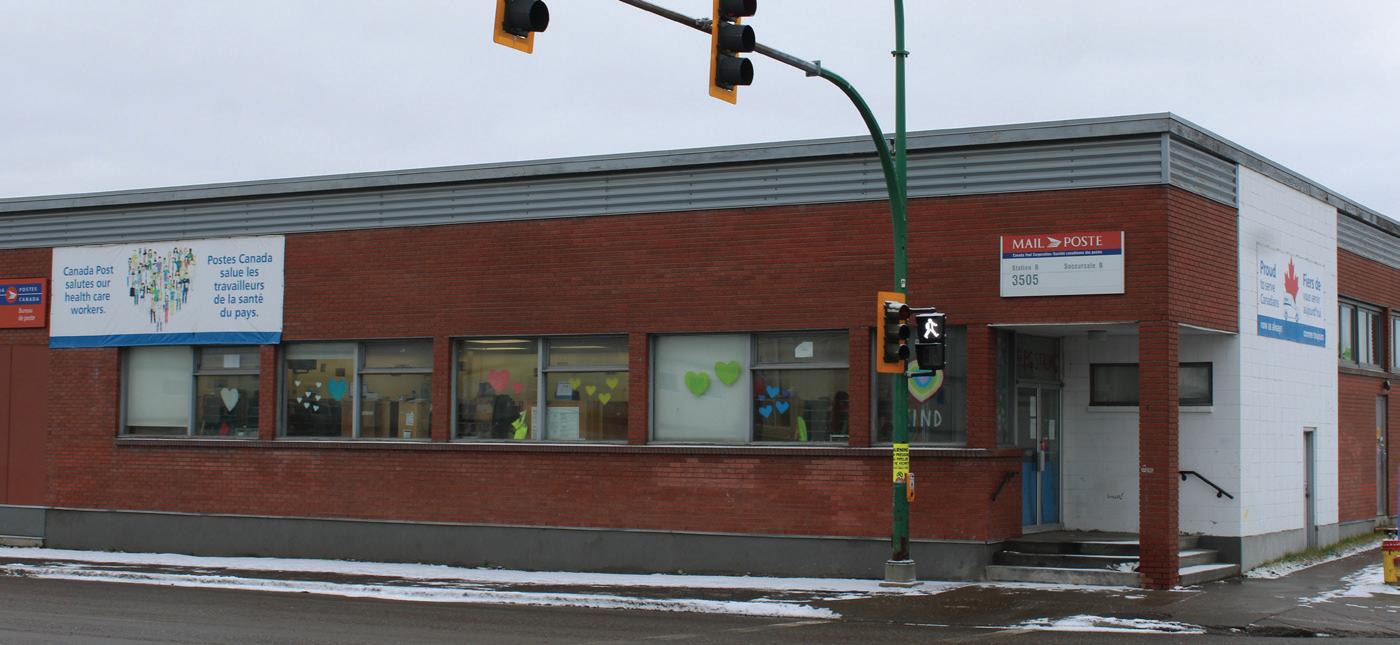
Six months of house arrest followed by three years of probation for a former Canada Post shop steward in Prince George who was convicted of sexual assault.
That is the sentence Justice Dev Dley ordered March 31 for Aaron David Paul Brandly, who touched a co-worker’s buttocks and breasts without her consent. After a BC Supreme Court trial, Dley acquitted Brandly of both criminal harassment charges and a second sexual assault charge.
Dley said a suspended sentence would not “address the gravity of Mr. Brandly’s offending conduct and the impact it has had.”
Dley was not convinced Brandly poses a danger to the community, despite a pre-sentencing report that remarked on his limited insight into the factors that caused the crime.
So he decided on house arrest rather than jail.
“I am satisfied that the emphasis on deterrence, both specific and general, together with an expression of denunciation, can be satisfied by a six-month sentence followed by a lengthy period of probation,” Dley said. “This is proportionate to Mr. Brandly’s degree of moral blameworthiness and the gravity of the offence.”
Dley said aggravating factors included “repeated and persistent sexual touching” without consent and in the workplace. It severely impacted the victim, who moved away, lost income and suffered physically and emotionally.
The victim provided a statement to the court that said Brandly’s behaviour “caused her considerable trauma and upheaval,” Dley said.
“I struggle with a constant sense of fear and unease, which has eroded my confidence and sense of safety,” said the letter from the victim, whose identity is protected by a publication ban. “The trauma has left me battling ongoing feelings of shame, sadness and
self-doubt, making it difficult to fully engage in day-to-day life.”
She said the result has been sleep-deprivation, anxiety, headaches, muscle tension and fatigue.
From a mitigating standpoint, Dley acknowledged that Brandly is a firsttime offender, has not breached bail terms, has a good support network and expressed genuine remorse and willingness to rehabilitate.
“As abhorrent as Mr. Brandly’s conduct was, it is on the lower-end of the spectrum,” Dley said. “There are aggravating factors that I have already referred to, there will be some aggravating factors in virtually every case.”
Brandly admitted during testimony
last November that he may have used inappropriate language, but denied sexually assaulting the complainants or causing them to fear for their safety. He explained that he was simply joking around with workplace buddies.
While Brandly, 54, attempted to portray himself as respectful and sensitive at the workplace, Dley said “he was anything but.”
One of the women worked at the depot from August 2017 to August 2024, the other from January 2022 to August 2024. They both accused Brandly of constant assault and harassment, including vulgar remarks “about camel toes, asking the complainants to smell his fingers, pull his penis, writing vulgar messages on their vehicles,” Dley said on Jan. 6.
During the house arrest, Brandly is prohibited from possessing alcohol and non-prescription drugs. He must attend a psychiatric intake assessment or treatment program through forensic psychiatric services, as directed by a probation officer.
Brandly is banned from contacting, directly or indirectly, the victim and must not be within 100 metres of wherever she is.
He is allowed to temporarily leave his residence for one two-hour absence per week and if he should require emergency medical treatment.
BOB MACKIN Local Journalism Initiative Reporter
A man was acquitted March 30 of sexually assaulting a woman more than two years ago in Prince George, after a Provincial Court judge found he had reasonable doubt.
Judge Peter McDermick said the “events probably unfolded exactly as” the victim testified. “But that is, of course, not the legal test.”
The identity of the victim is under a publication ban.
McDermick decided Crown did not
meet its burden of proof in an “oath-versus-oath” case that lacked an independent witness or other evidence to assist in breaking the impasse.
“After a careful consideration of all the evidence, I’m unable to decide whom to believe,” McDermick said. “The defence evidence raises a reasonable doubt with respect to the element of a lack of consent.”
McDermick said the woman was at an events conference on Nov. 2, 2023, in the Civic Centre when she saw the man. They had known each other for a year and made plans to get together. Later
that evening, they exchanged texts and arrangements were made for him to visit her home to bring rum and hang out.
He arrived at 10:40 p.m. They had conversation and drinks, but she was not drunk.
She testified that the man’s demeanour changed from “shy to aggressive” and they had sex without her consent.
The man offered a different version when he testified in his own defence. He claimed the woman made advances on him, they disrobed and “it was just kind of mutual, it was like we both wanted to have sex.”
While the woman said she expressed a lack of consent, the man said she conveyed it through her actions.
McDermick called the woman a good witness and her evidence “flowed in a reasonable, rational and cogent fashion.”
“She had no motive to lie,” he said.
Likewise, the man had a reasonable recall of the events, was consistent and fully engaged in both direct and cross-examination.
“His answers were connected with the questions asked, and he did not seem evasive.”
BOB MACKIN Local Journalism Initiative Reporter
Sentencing was reserved April 2 for a Prince George man who pleaded guilty more than a year ago to a charge of accessing child sexual abuse and exploitation material.
Crown prosecutor Anne Baines said in Provincial Court that Jeremie Longhurst, 26, should be jailed for 18 months, plus three years probation, and be listed on the national sex offender registry for 20 years. Baines said some of the content Longhurst collected depict bestiality and sadism.
Longhurst’s defence lawyer, Jason LeBlond, said his client should serve an 18-to-24 month conditional sentence in the community, with the first 12 months under round-the-clock house arrest.
Judge Michael Brecknell set April 21 for a hearing to schedule the date of his verdict.
Baines said the National Center for Missing and Exploited Children, based in Alexandria, Va., received a report on Feb. 4, 2023 that Longhurst had downloaded suspected child exploitation material. The information was forwarded to the Prince George RCMP, which obtained a production order and subscriber information. Officers searched Longhurst’s residence on May 2, 2023 and seized his smartphone. It contained 583 images — 388 of them unique — and 166 videos totalling four hours, 42 minutes and 13 seconds of adults sexually exploiting children. Some of the victims appeared to be infants.
With a trial looming, Longhurst pleaded guilty on March 31, 2025. Baines said sentencing was delayed, in-part, when Longhurst missed a forensic risk assessment appointment.
“With respect to the videos, they are disturbing,” Baines warned Brecknell before launching into graphic
descriptions of the recorded contents. Baines said those that access, possess, discuss and exchange child pornography encourage the abuse of children.
A pre-sentencing report considered Longhurst a moderate risk to reoffend. She acknowledged Longhurst’s guilty plea and lack of diagnosis of a learning or cognitive challenge. He is a youthful offender without a prior criminal record and the collection of images was deemed medium-size.
She noted he is remorseful and undergoing counselling. Court also heard that Longhurst was charged, but not convicted, in 2019 of possessing child pornography. After that, he abstained for eight to 12 months before accessing it again.
LeBlond said his client has a supportive family that can monitor him during a house arrest and emphasized a pre-sentencing report mentions that his mother
was a police officer until 2006.
LeBlond also quoted from an expert assessment that said Longhurst would also benefit from further analysis and treatment for Tourette’s disorder, attention deficit and hyperactivity disorder and autism spectrum disorder.
Near the end of the hearing, Longhurst gave a short statement, acknowledging that he hurt the victims and his family and friends.
“For that, I am truly sorry,” Longhurst told Brecknell. “I understand the consequences and the impact of my actions, and for that, I take full responsibility. I am taking steps to better myself, and will continue to take those steps for as long as it takes, as much as I would like to. I can’t undo the past, but I am working towards a better future of bettering myself with family, with gaining employment, and working towards being a productive member of society, and as well as supporting myself in the future.”
Barkerville Gold Mines Ltd. proposes to change its plans for the Cariboo Gold project by shifting the power line route, moving worker accommodations and expanding the mine site footprint. The EAO is holding a public comment period on the proposed changes to the project and is seeking public feedback to understand potential impacts speci cally related to the changes from March 17 to April 16, 2026
April 2 | 11:30 am-1:00 pm PST
To register, visit the link or QR code on right
MATTHEW HILLIER Citizen Staff
A new community-driven event led by local neighbourhood leaders is hoping to promote wildfire mitigation through friendly competition and prizes.
The Prince George branch of the Canadian International Council (CIC), through its Community Resilience Working Group, is launching Break the Blaze, a new event beginning Friday, May 1, 2026, which will run until Thursday, June 11, 2026.
Wildfire mitigation in urban areas such as Prince George often falls upon private homeowners, with simple actions like raking leaves, moving firewood and removing debris from rooftops greatly reducing the risk of losing a home.
This is why Break the Blaze is seeking to bridge the gap between awareness and local action through engagement, competition and prizes.
The centrepiece of the competition will be neighbourhood captains who will rally their friends, family and neighbours to FireSmart their properties and compete in weekly challenges.
Founder of the event and CIC Prince George branch president Sean Simmons spoke with The Citizen on why this six-week competition is so important to wildfire safety in the city.
“I’ve heard talks from experts in emergency preparedness, and it seems like private property is one of the gaps,” Simmons said. “Public agencies don’t have the ability to go into private property, and most of Prince George is private property. Making sure that we focus attention on people’s private residences and fire preparedness in those locations is an important element of overall fire preparedness.”
He also provided additional information on what residents participating in the competition can expect.
“What’s going to happen is starting May 2, we’ll have weekly challenges that

we announce. We’re not going to tell you what they are, but will announce them every Saturday morning at 8 a.m.,” Simmons said. “There’ll be prizes, cash prizes, gift certificates, for folks that report first, as well as random draws for those who don’t report first but participate through that week. Then, based on where you’re from, which postal code you’re in, your entries will count as points toward your neighbourhood. It’ll be a fun rivalry between neighbourhoods to see who’s best prepared for a wildfire.”
Simmons said that in his experience,
events like this can often be more effective in encouraging change than awareness campaigns.
“Active involvement of property owners is going to be an integral part of being fire-prepared across the whole city,” Simmons said. “Finding ways of engaging people that don’t seem like having to sit through a classroom, but are something fun and engaging. We’ve certainly found in other examples that if you make it more like a competition where you’re part of a team, that often incentivizes and motivates people to action. So that’s what we’re hoping to achieve.”
Simmons, in his work as founder and president of MyCatch and Angler’s Atlas, said one of the essential roles in making a competition like this possible is local leadership.
To this end, organizers are looking to recruit as many neighbourhood captains as possible.
“In my experience, when I’ve run experiments like this in the past — and we’ve run them extensively across the sport fishing space — if I can get a dozen captains, that’d be awesome,” Simmons said. “Even half a dozen captains is enough for a proof of concept, and that’s really what we’re hoping to do, to see if this moves the needle. Because if this doesn’t move the needle, there’s no sense in continuing it. But if we can move the needle in a significant way, then we have a replicable, scalable model that we can apply and double down on.”
The first captain to sign on to Break the Blaze is Cole Paciejewsk, who has 12 years of experience with the BC Wildfire Service and has served with Prince George Fire Rescue for three years.
He has also launched a new business, Northern Shield Land Management, which specializes in reducing wildfire risk around homes in the North, and cited this as one of the reasons behind joining the competition.
He will be the captain for the Berman, Bednesti and Norman Lakes area during the Break the Blaze event.
Paciejewsk, during his career in fire management and mitigation, has seen
the impact that wildfires can have on poorly managed properties.
“I’ve seen firsthand what can happen to homes and cabins and properties when a wildfire comes through,” Paciejewsk said. “And I’ve seen firsthand what can happen when you’ve taken the time and done a little bit of work to clean up your property and how it can be — it doesn’t need to be a ton of work, but a few little things can be done that can greatly increase the protection around your home.”
Like Simmons, he believes the competition and local engagement will help make more properties fire-safe across the city.
“It’s great if one person does their own property. But then there can still be effects from neighbours and other properties,” Paciejewsk said. “The more people in close proximity that band together, the better success you’re going to have with this. I think being able to put it into a competition-type format, where everyone can team up and have some fun along the way, will lead to more buy-in and help get more people in the community to band together.”
He added that it’s often the simple things that can go a long way toward preventing damage to homes from wildfires.
“I think the biggest key is to kind of start from the inside out,” Paciejewsk said. “You want to look at the structure itself. The biggest thing would be keeping debris out of your gutters, keeping debris off your roof, and then keeping any flammables away from the house. You see people with stacked firewood and stuff like that right beside the house. The farther away you can move that kind of stuff, the better. Then, moving out from there, if you can just keep your lawn cut and watered, that also makes a huge difference.”
If you are interested in joining the competition, you can join the Break the Blaze Facebook group at facebook.com/ groups/breaktheblaze.
For more information or to sign on as a neighbourhood captain, email Simmons at cic.princegeorge@gmail.com.
ABIGAIL POPPLE Local Journalism Initiative Reporter
Researchers James Whitehead, Rebecca Innes and Christine Callihoo make it their business to know how small communities recover from natural disasters. The trio is beginning work on what Whitehead describes as a passion project that will look into how local businesses are recovering from the knock-on economic effects of the Jasper wildfire.
In an interview with The Goat, Whitehead and Innes said Valemount makes a good pilot community to explore possible further research on how small businesses are impacted by natural disasters.
After the Jasper wildfire resulted in a month-long closure of Highways 93 and 16 in July and August 2024, local businesses saw an average loss of $35,000, a report from consulting firm Strategies North found.
Those initial losses, supply chain issues, plus a lull in tourism due to the severe 2024 wildfire season, snowballed into about $1.5 million in total financial losses for the community.
“The goal of this is really to better understand the challenges that were faced by businesses in Valemount, how they’ve been successful in recovering or have struggled, and to think about what lessons and takeaways there are for businesses and communities elsewhere that might be going through similar challenges,” Whitehead said.
Innes added that small rural communities are often disproportionately impacted by climate change–enhanced disasters.
A Calgary-based consultant specializing in disaster recovery, she’s seen firsthand how emergencies can have long-lasting impacts on communities and local businesses.
“Much attention is placed on emergency response, but the longer, more complex challenges lie in recovery — how businesses reopen, stabilize, adapt and build,” Innes said.
The project is still taking shape and may involve providing business
resiliency workshops from Innes’s consulting firm or creating focus groups, Whitehead and Innes said. What’s certain is that the trio will be speaking with local business owners in April and May to hear about their experiences following the Jasper wildfire, likely reaching out virtually or by contacting community organizations.
Valemount may serve as proof of concept for a broader research project on how small communities throughout Western Canada are impacted by natural disasters, Whitehead added, though he’s not comfortable naming other potential research sites just yet.
“There’s been a lot of communities that have had impacts, most notably due to fire, throughout BC and Alberta, but also expanding that to consider floods and other hazards… (we’re) really looking for communities that have experienced those disasters at a variety of time periods,” he said.
“Obviously Valemount has been impacted in the last couple of years, but thinking about what that looks like 10 years down the line, we may talk to communities that went through a similar process a little bit before Valemount.”
It’s unclear what form the research will take — whether it will be a presentation for the local government, a published article or some other format — but the group intends to make it public-facing, Whitehead said. He expects the research on Valemount to be done within six months, though the project may take longer if other communities are added.
Regardless, the group hopes their findings will prove valuable for businesses in Valemount and elsewhere.
“Small businesses are central to the economic vitality, employment base and social fabric of rural communities in British Columbia and across Canada,” Innes said.
“We’ll be generating practical, placebased lessons to inform future economic resilience and disaster recovery planning.”
This story originally appeared in The Rocky Mountain Goat.



MICHELLE GAMAGE Local Journalism Initiative Reporter
A preventive health-care solution that could benefit rural, remote and Indigenous communities across BC is struggling to find staff.
More than half of 101 full-time community paramedic positions in B.C. are currently unfilled. These paramedics are assigned to 95 stations across the province, supporting 65 communities. Of the 101 positions, 53 are open and seven are supported by temporary backfill coverage, according to BC Emergency Health Services.
Community paramedics are trained and licensed BC paramedics who focus on preventive rather than emergency medicine. The role varies slightly depending on the needs of a community but can include home visits for seniors and others with chronic health conditions, wound care, blood pressure and medication monitoring, and in general identifying and addressing health complaints before they become a crisis.
“Any municipality or small district would be way better off with a community paramedic,” Owen Torgerson, mayor of the Village of Valemount, told The Tyee.
Valemount is located a little over an hour’s drive from Jasper, Alberta. The resort town “has more pillows than people,” Torgerson said, and its population of about 1,000 can swell to four times its size in the summer.
The village has a community health centre staffed by five full-time doctors, support staff, lab technicians and nurses, and a paramedic station with nine full-time paramedics, he said. When patients can’t be cared for locally they’re sent to the village of McBride, about an hour’s drive away, or Prince George, which is more than a three-hour drive from Valemount.
The remoteness of small towns is in part why community paramedics are such a critical part of health care. They work alongside local care teams who help triage which patients might need a visit, and can travel between small communities to offer care. This helps reduce

Ambulances wait near the scene of a situation on a rural road in this file photo. Some paramedics work in a community capacity, focusing on preventative measures rather than emergency response.
the amount a sick or injured patient has to commute to access care.
Torgerson said Valemount has worked with two community paramedics who “rock.” He said they supported vulnerable community members, often with mobility issues, and did home visits to change wound dressings and check in on people who had seen a doctor and needed followup care but weren’t sick enough to require a hospital stay.
Paramedics’ training and experience mean they can quickly adapt to a lot of different situations, Torgerson added, including entering people’s homes and offering care there.
The Northern Rockies Regional Municipality similarly benefited from the community paramedic program. On top of home visits, the paramedic set up a “track social” that encouraged seniors to come out and walk around an indoor track together twice a week.
At its height the track social brought together 75 seniors who were encouraged to exercise, have their blood pressure checked and combat loneliness all in one go, Lorraine Gerwing,
higher-acuity care centres in other parts of the province.
When a patient is transported by medevac one way, they have to find their own way home, she added.
Which is why preventive medicine offered by the community paramedics is so important, she said. People might not seek out a doctor because their health is fine, which means they can miss important precursors to illness or disease.
She said her own high blood pressure was flagged by the community paramedic at a track social event. That moment could have saved her from a stroke 10 years down the line, she said.
The Northern Rockies Regional Municipality is currently struggling to retain a community paramedic and in January sent a letter to BC Emergency Health Services advocating for more hires to fill positions across the province.
What BC is doing to fill the gaps
deputy mayor for the municipality, told The Tyee.
Located in the northeastern corner of the province, the Northern Rockies Regional Municipality covers 10 per cent of BC’s geographic area and sits at the foothills of the stunning Rocky Mountains.
“It’s like Banff but without the crowds,” Gerwing said.
The municipality has a population of 5,400, most of which is concentrated in Fort Nelson.
Fort Nelson has five doctors and a 22-bed hospital, with 15 acute care beds and seven long-term care beds, Gerwing said.
Despite that, patients often are sent out of town for care. Local doctors make about 400 CT referrals annually and the closest CT scanner is in Fort St. John, about a four-hour drive away on a road that is frequently without cell service, she said.
Gerwing said that in 2025 there were six service interruptions at the local hospital, closing the emergency department for more than 63 hours. There were 153 medical evacuations in 2025, Gerwing added, where patients were transported by air ambulance to
In an emailed statement sent to The Tyee, BC Emergency Health Services said it is committed to developing a long-term and sustainable approach to the community paramedic program and that it is working with the Ministry of Health to increase frontline staffing, recruit workers from rural and Indigenous communities to work close to home, and do outreach in high schools.
“We recognize that it can take time for remote community members to obtain the training and certifications required to join BCEHS,” the statement read. “To reduce this barrier, we work closely with third-party training organizations to co-ordinate local training whenever possible.”
This has already helped train paramedics in Dease Lake and Valemount and is currently training people in Stewart, Kitwanga, Bella Bella, Zeballos and Anahim Lake, it added.
Health-care services are struggling to recruit and retain staff across the province, and paramedicine is no different, said Ian Tait, communications director with the Ambulance Paramedics of BC, or CUPE 873.
SEE ‘RURAL’ ON NEXT PAGE
COLIN SLARK Citizen Staff
A Prince George MLA is being fined by Elections BC for exceeding the maximum allowed amount in anonymous donations during the 2024 provincial election campaign.
On Wednesday, April 1, Elections BC sent out a media release announcing five penalties being levied in relations to the 2024 election, including a $1,500 fine for Prince George-North Cariboo Conservative MLA Sheldon Clare.
Clare was elected to the BC Legislature with 56.82 per cent of the vote in the 2024 election, beating out incumbent Coralee Oakes, a former BC United MLA running as an independent.
In a letter to Clare dated March 30, a copy of which was posted online, Elections BC director of investigations Adam Barnes wrote that Clare reported taking in $7,007.75 in anonymous donations during the 2024 campaign.

That’s $4,007.75 over the $3,000 limit that had been set for the campaign.
Barnes said he spoke with Clare’s financial agent, Gary Blair, who said that these anonymous campaign contributions were received by volunteers at a meet and greet on July 5 and at a booth during Billy Barker Days from July 18 to 21, both in Quesnel.
These anonymous donations, Blair said, were collected in cash and in amount under $50. Once they were collected, they were given to Clare, who then deposited them in his campaign bank account.
Clare received a letter containing Elections BC’s preliminary findings on March 18 this year, Barnes said, but he did not respond or provide any
His union represents about 6,000 paramedics, call takers and dispatchers. There are about 400 unfilled full-time paramedic positions across the province, Tait said.
Tait estimates between 100 and 200 paramedics are currently trained as community paramedics, but that doesn’t necessarily mean they want to work in a smaller community.
“When you live super remote you don’t always have a grocery store or a public pool, and that only attracts a certain kind of person who wants to move there,” he said. “That’s not always why someone goes into health care.”
At the same time he said rural communities and BC Emergency Health Services are working on solutions to make their communities, and the job, more attractive.
additional information.
After reviewing information collected by an investigator, Barnes said he concurred with the finding that Clare had violated BC’s Elections Act when he accepted anonymous contributions beyond the $3,000 limit.
“Accepting anonymous contributions above the legislated limit gives a candidate an advantage in that they do not need to collect the required information to ensure the contributions are from eligible sources,” Barnes said. “Accepting contributions above the limit reduces transparency in the campaign’s financing.”
Barnes also noted that Clare’s campaign did not have any measures in place to prevent the acceptance of these contributions beyond the limit, but he did not find any evidence to suggest a deliberate attempt to break the rules and his campaign co-operated with the investigation.
Under the Elections Act, Elections BC
has the authority to impose a penalty equal to double the amount the anonymous contribution limit was passed by. In this case, that would have been $8,015.15.
However, Barnes ordered a penalty of $1,500.
Clare now has 40 days from the date the letter was dated to pay the penalty, though he also has 14 days to request the case be reviewed by an adjudicator. In a text message, Clare said that he and his agent “duly reported those donations and we fully co-operated with Elections BC.”
“I thank the chief electoral officer for the diligence of her team in educating us about the limits,” he said.
The MLA briefly joined the race to replace John Rustad as the leader of the Conservative Party of BC but suspended his campaign after too many of the 250 signatures from party members he gathered were determined not to be from party members in good standing.
When the community paramedic program was introduced about 10 years ago, BC Emergency Health Services hired a lot of part-time workers because there wasn’t enough demand for full time in smaller communities, he said. But workers struggled to make ends meet, and now a lot of those positions are being changed to full time, with community paramedics covering more than one community.
Community paramedics might be coming to more urban centres too. In Surrey, community paramedics visited Ted Kuhn Towers, which provides supportive housing to low-income individuals, twice a week for a year. This translated to 38 per cent fewer 911 calls and an estimated cost savings of $450,000 to the health-care system, according to Global News. This article originally appeared in The Tyee.

Miracle Theatre Presents The Garage Sale, now running until April 19, at ArtSpace, above Books & Co., 1685 Third Ave. Tuesday through Saturday the play goes at 7:30 p.m. and Saturday and Sunday matinees are at 2 p.m. This comedy is by David King, a BC playwright, about Phil, who is holding a garage sale as the first step in his secret plan to escape the rat race and move to the desert — but he didn’t even tell his family. And if that’s not enough, Phil is visited by the wackiest of shoppers. And then the neighbourhood grump starts to stalk his best customer. Tickets are $40 at Books & Co. or order by phone and pick up at the door before the performance.
Teen Art Showcase goes until May 1 at the Bob Harkins branch of the Prince George Public Library. Awards reception is set for Saturday, May 2. Teens between 13 and 18 are welcome to display their work. All mediums are accepted and will be on display in the main stairwell from April 1 to May 1. Submissions can be dropped off at the library from Friday, March 27 and Monday, March 30.
Earth Songs, a PG Symphony Orchestra Chamber Social, goes Saturday, April 11 at 7:30 p.m, at Knox Performance Centre 1448 Fifth Ave. This evening of music inspired by nature is a walk through musical landscapes. Chamber Socials are an intimate evening out by candlelight with food, drink, and spectacular live music performed by the principal players of the PGSO. Appetizers are included with table seats, and a cash bar is available to all. For details and tickets visit www.tickets. pgso.com/tickets/earth-songs
28th Annual Popsicle Stick Bridge Building Contest goes Saturday, April 11 at 11 a.m. at the Pine Centre Mall, 3055 Massey Drive. This annual event is presented by BC Society of Engineering & Geoscience Central Interior Branch. Bridge testing goes from noon to 3 p.m. at Centre Court. There are multiple age groups as well as an adult division. This event encourages creativity,

problem-solving, and hands-on learning while celebrating the fundamentals of structural engineering. For more information visit www.bcseg.ca/event/ central-interior-branch-28th-annual-popsicle-stick-bridge-building-contest
The July Crowd with The Infirmary and Madbomb perform Saturday, April 11 at 7:30 p.m. at Omineca Arts Centre, 369 Victoria St. Alt-Pop Punk outfit The July Crowd return to Prince George for the first time since signing with NY-based label Manic Kat Records. The July Crowd is built on finding hope in the connections that feel intimate, explosive and real. Tickets at the door are $28 or in advance for $18 at www. eventbrite.ca/e/the-july-crowd-w-the-infirmary-madbomb-tickets
Parkinson Support Group Open House goes Saturday, April 11 from 1 to 4 p.m. at the Elder s Recreation Centre, 1692 Tenth Avenue. This event
coincides with the annual Parkinson’s Awareness Day and includes sharing of information and having conversations about Parkinson’s, a chair exercise demonstration, and video presentations. Light refreshments will be available. Please come and visit and share this day with us.
Pineview Recreation Commission annual general meeting goes Tuesday, April 14 at 7 p.m. at Pineview Hall, 6470 Bendixon Road. There are several positions open on the board plus opportunities to volunteer in a variety of ways including Snow Frolics, Sun Frolics, Halloween Haunted House, craft fairs, concessions and youth programs. Get involved, meet new people, help make decisions for your community and have fun. To hold a position on the board or vote at the AGM you must be a resident of Regional District Area D and a member of the Pineview Rec Commission ($5
annual memberships available at the AGM). Those who just want to volunteer or participate in our events & programs do not need to be members and are welcome from any area. For more information call Jodi at 250-963-8214 or email admin@pineviewhall.com.
Delhi 2 Dublin goes Thursday, April 16 at 7:30 p.m. at Knox Performance Centre, 1448 Fifth Ave. This is part of the Community Arts Council of Prince George & District performing arts series. What started as a one-night collaboration at Vancouver’s Celtic Fest in 2006 has evolved into a world-touring phenomenon captivating audiences from Mumbai to Nevada. Known for their high-energy, genre-defying performances, Delhi 2 Dublin delivers. For tickets visit www.knoxcentre.ca/ delhi-2-dublin
Prince George Coed 55+ Slo Pitch League 2026 registration and general meeting goes Friday, April 17 at 1:30 p.m. at the Prince George Golf & Curling Club. Teams will consist of seven men and minimum three women. This is a Thursday morning league from 10 a.m. to noon that will play at the Nechako Fields. Start date is tentatively set for May 7 and last day is July 30. Past players and new players are welcome. For more information contact Jackie Burns at 250-962-9230 or Dom DeMarzo at 250562-6144. All equipment is supplied. Just bring your glove and wear runners.
Richard Kingston Live goes Saturday, April 18 at 7 p.m. at Deadfall Brewing, 1733 Nicholson St. S. Join Prince George’s own guitar legend Richard Kingston for a solo night of music and stories from the lead guitarist of Fallensun. Tickets at Deadfall Brewing.
Set Free Recovery Dessert Night Fundraiser is set for Saturday, April 18 from 6 to 8 p.m. at Lakewood Alliance Church, 4001 Fifth Avenue. Restoring Hope one dessert at a time this fundraiser offers sweet treats, door prizes and a silent auction. Tickets are $5 each. Please RSVP by calling 778-241-1599.
CONTINUED ON NEXT PAGE
Spring Slammer featuring The Cavernous/Brainium/The Goomahs goes Saturday, April 18 at Omineca Arts Centre, 369 Victoria St. The Cavernous is a heavy psychedelic electronic duo from Kelowna featuring a wall of synths, sequencers, samplers and an electronic drum kit. Brainium is a local hard rock/ alternative metal band here to show a true blend of ‘90s grunge rock and modern alternative metal. The Goomahs are a fierce indie garage rock band with plentiful jazzy notes that’ll be stuck in your mind for weeks. All ages welcome. $15 at the door and there’s a 19+ bar. Epik’s 420-Eve Block Party goes Sunday, April 19 from 11 a.m. to 5 p.m. at 356 George St. Kicking off 420 weekend with a full day of community, connection, and celebration. Bring friends and good vibes. This is a family-friendly block party with something for everyone. There will be more than 30 local vendors so customers can browse handmade goods, artisan creations, local businesses to discover unique finds. There will be food trucks on hand serving up crowd favourites all day long. There will be a clearly marked, separate area for adults who wish to partake responsibly.
String Bean Family Concert goes Sunday, April 19 at 2 p.m. at the Prince George Playhouse, 2626 Recplace Drive, presented by the Prince George Symphony Orchestra. Meet String Bean: a bean with big dreams. Follow its journey from tiny seed to towering vine, guided

Learn about calla lilies, dahlias and other perennials at a spring flower bulb workshop at Hunniford Gardens on April 21.
by lively music, fairy ballet, and engaging storytelling with surprises at every turn. Family concerts are designed to appeal especially to children ages 5-11 and everyone is welcome. Performances are 30-45 minutes, with a Q&A session following the performance. Shows use a narrator and visual imagery to tell an immersive story with music. For more information and tickets visit www.pgso. com/tickets/string-bean
Spring Flower Bulb Workshop goes Tuesday, April 21 from 5:30 p.m. at Hunniford Gardens, 8845 Aquarius Rd. Open up a wider world of flower growing possibilities with this bulb growing workshop that will offer guidance through potting up 3 easy and spectacular flower bulbs, as well as growing tips and post-planting care of calla lilies, a dahlia (choose from several types/colours) and lilies (perennial). Fee is $40 and includes the required bulbs, pots and soil. Workshop spaces
are non-refundable. To register call 250-967-4325 and for more information and to register visit www,hunniford-gardens.shoplightspeed.com/ spring-flower-bulb-workshop-april-21
Cruising PG goes every Wednesday and is presented by the Carefree Society, providing accessible and inclusive transportation services in Prince George and area. Cruising PG is a great way to get out of the house, enjoy the city and socialize without a long commitment. Pick up typically begins at 1 p.m. Recommended rate is $20. Fridays in March sees visits to the PG Astronomical Observatory for their open house event at 7:30 p.m. This outing is a unique opportunity to explore, learn and enjoy a structured community experience. Recommended rate is $30. Book early as space is limited. To reserve a seat call 250-562-1397 or email book@carefreesociety.org
Seniors Paint Club goes Thursdays
until May 21 from noon to 2 p.m. at Studio 2880-15th Ave in the Jack Bryan Room. These sessions are geared for those 55+ to learn new art techniques. Take up painting with your friends and enjoy an afternoon creating art. On April 9 the theme is Waterfalls, April 23 the Abandoned Cabin in the Mountains, April 30 Happy Sunflowers, May 7 Campfire Stories, May 14 Calm Water and May 21 is Big Red (a tractor). Each session is $25 and includes supplies. To register visit www.studio2880.com/ programs/art-classes/seniorspaintclub Craft & Chat at the main branch of the Prince George Public Library goes every Saturday from 1 to 3 p.m. in the magazine corner, second floor, where fibre artists are invited to bring their latest projects to share, vent frustrations, brag about successes, get and give help and join in lively discussions. Snacks provided. This event is in partnership with Great Northwest Fibre Fest. Myeloma Support Group goes every third Saturday from 1 to 3 p.m. at Commonwealth Financial, 575 Victoria St. Everyone is welcome who has been diagnosed, those who are caregivers, family members and friends. Wheelchair accessible parking at the back of the building. For more information call Viv Lougheed at 250-981-2618.
If you’ve got an event coming up email us at news@pgcitizen.ca to offer details including name of the event, the date, time and location, ticket price and where to get them and a little bit about what’s happening, too. LOCF

Northern Lights Estate Winery hosts a day of family fun as spring returns to Prince George




CHRISTINE DALGLEISH Citizen Staff
Pet ownership is truly a joy most days but when it’s not, you and your pet might end up on My Pet Ate What? a hit Canadian docuseries on CTV Wild Channel created by Tyson Media Productions that follows veterinary teams as they treat animals that have ingested truly unbelievable items.
In its second season show producers decided to super-size the experience and made its way to Westwinds Mobile Veterinary Services right here in Prince George where co-owner Joanna Koehler is showcased helping our equine friends with gastrointestinal trouble.
Mostly the show is about much smaller pets, including dogs, cats, and even some of our feathered friends so to see Koehler in action on location from McBride to Smithers, Quesnel to Mackenzie, is a whole other animal.
like that and sometimes we get down there and we see bot larvae in the stomach, which is super gross, it’s like little worms living in the stomach and we’ve seen that quite a few times and we’ve seen enteroliths blocking the entry to the stomach and we had to break it down with cola, which is kind of interesting,” Koehler said.
An enterolith, Koehler explained, is a hardened feed mass that sits at the top of the stomach and cannot pass and cannot be broken down.
“It just sits there and can be very irritating,” Koehler said.
Koehler moved from Alberta to Prince George in 2010 and is a veterinary technician besides being a co-owner of Westwinds.









































Westwinds Mobile Veterinary Services’ appearance on the show started with a phone call.
“They just called me out of the blue to see if we scoped horses because they saw it on our website and I said yes we do and they were very interested in that because a lot of their show is based on scoping small animals and going in and retrieving the object by gastroscopy so I think they were just intrigued to see a bigger animal receiving a similar procedure,” Koehler explained.
So Koehler said she agreed to have them come and see a scope.
“Horses were a big part of my world in Alberta and then coming to Prince George where the horse community is a little bit different and the service isn’t here compared to what we would see in Alberta so horses here didn’t always get the priority seat in the booking schedule,” Koehler said.


















“And then it turned into way more,” Koehler laughed.



























“All of a sudden we’ve got a series of events and they’re following us to Smithers and other places and doing case studies on different animals so that was interesting.”



















As one can imagine, horses aren’t really picking up toys or an item of clothing and eating them like beloved pets might do upon occasion, so the Palomino, Appaloosa or Paint come with entirely different issues.
“Instead, the scope we’re using is going down the esophagus into the stomach to visualize ulcers and things
“Small animals are often sicker, dying and really not doing well where a horse might just have a limp so my biggest focus was to really see an increase in support serviceability to the equine specifically because I just really wanted them to perform at their best because I know clients put their heart and soul into their horse by training every day, so five days a week they are riding them, so when they go lame or get sore or something like that, it could be career ending or they could miss their show or whatever goal they were working towards — and that’s how I grew up — showing horses and wanting them to perform — so it resonates with me when clients reach out and say ‘hey, my buddy isn’t feeling 100 per cent and we have a show in three weeks — now what?’”
Koehler said the equine patients have always been the priority for her as she knows other veterinary clinics in the area have got the smaller animals covered.
Central Builders PG, winners of the Dodge, Duck, Give Back: 2026 Dodgeball Championship, celebrate after their dodgeball victory during intermission at the Saturday, March 14 Prince George Cougars game. The event raised $9,895 for the Kordyban Lodge through the Spirit of the North Healthcare Foundation over two nights during intermissions at Cougars’ games. Kordyban Lodge provides a home for cancer patients while they undergo treatment, regardless of the length of their stay.

CONTINUED FROM PREVIOUS PAGE
Westwinds Mobile Veterinary Services has a special interest in equine health and provide dental and vaccine services, do hernia repair and castrations, lameness exams, joint injections – a little bit of everything, Koehler said.
During our conversation Koehler seemed like a person solely dedicated to her work and I started to wonder how she found it, having a camera crew
follow her everywhere, trying to capture just the right clip during the couple of months of shooting.
“Ummm, it was weird,” Koehler laughed.
“It’s just like ‘oh, the whole world is going to see us in action — OK, cool.’ But then you kind of forgot about it and just really focused on the job and the reasons you were there was to try to help these horses and these animals and so for us it just became normal to have them following us
around and we were just happy to do our thing.”
Season 2 of My Pet Ate What? premiered on April 5 on CTV Wild Channel and can be streamed the next day on Crave. There will be 14 episodes to enjoy.
There is another veterinary team new to the show from Calgary called Trinity Hills 24 Hour Pet Hospital, which is a busy emergency clinic led by Dr. Heather Suttie.
The show is anchored once again
by Dr. Eugene Gorodetsky (Dr. G) and his son Ben, who are returning from Season 1. Based in Vancouver, Dr. G owns BC Mobile Animal Endoscopy and is a sought-after mobile expert in foreign body extraction, serving hundreds of veterinary clinics across the region.
Tune in to see My Pet Ate What? every Sunday evening at 6 p.m.
Check out the trailer for Season 2 at www.youtube.com/ watch?v=FPFcw8XZvg4



year, revisiting a different side of his artistic talents.
CHRISTINE DALGLEISH Citizen Staff
Trevor Stanley, a local artist, has answered the Art Battle call, where contestants do round after round of 20-minute explosions of creative expression as they paint complete works right before the eyes of the beholder.
The event takes place Friday, April 24, at 6:30 p.m. at Knox Performance Centre, where the music is pumping and the audience circles around the artists during each round.
It creates an atmosphere of intensity unlike any other artistic event in Prince George.
Stanley has participated in the past and will be taking another shot at it this

Stanley was selling Harley-Davidson motorcycles until about a year into the pandemic, and when the shop shut down, he decided to move in a different direction.
“I was the sales manager and finance manager, and it was really intense, and I didn’t really have time to focus on my creativity, but on the back burner I kept things going,” Stanley said.
One of his customers from Quesnel was a tattoo artist and asked him what was next for him.
“I was pretty much done with sales, and I was 25 years in at that time, and it was exhausting after a while, and I wanted to change direction,” Stanley said.
“She said you’re going to be a tattooer. And I said, ‘that’s great, how am I going to do that?’”
His customer brought him some equipment, and then he found a local tattoo artist and joined their shop for





five years, Stanley said.
Stanley said getting tattoos had become quite trendy as television shows about it became quite popular, and the idea of getting a tattoo was well-received by the general public.
“Tattoos weren’t just for outlaws, bikers and criminals anymore,” Stanley said.
“The style of tattoos changed, and people realized it could be something beautiful, decorative and ornamental.”
It didn’t have to have a deep meaning or be a reflection of your character, he added.
“That opened it up for a lot of customers for the craft,” Stanley said.
“It worked out really well for me. It was really difficult — I was raising three kids on my own at the time. It was pretty challenging.”
He’s still got one teen at home, he added.
He now works at Fatally Femme Collective, and it was staffed by all women
when he started there, he noted.
“It’s been really fun, really interesting, and I love it, and that’s kind of where I’m at now,” Stanley said.
“It’s been a whirlwind of 10 years of change and adaptation and trying to stay at the creative grindstone as much as I can. My painting is typically a little bit more therapeutic now. I still try to do graphite drawings for people, like cats and motorcycles and things like that, just to keep my technical abilities strong and to expand on that.”
It’s cathartic and inspires other outlets of creativity, he added.
“Like, I’ll paint for a couple of hours, and then I’ll find myself writing a poem or playing guitar, coming up with a new song or playing the piano or something,” Stanley said.
“It kind of mixes all together at this point.”
So ... Art Battle.
SEE ‘ARTISTS’ ON NEXT PAGE

MATTHEW HILLIER Citizen Staff
Students graduating from the web and graphic design diploma program at the College of New Caledonia (CNC) will be showcasing the best of their portfolios at Omineca Arts Centre throughout April.
The show by 25 CNC students will include work done during their internships with local businesses, showcasing web design, graphic design, illustration, 3D prototyping, interactive multimedia, personal branding, typography and more.
CNC web and graphic design student and event organizer Philip McCallum spoke to The Citizen about what people can expect from this showcase.
“We’re picking out our favourite projects that we’ve made or things we’ve

Karabo Kolisang-Tshehle, the designer of this graphic, and others from the CNC web and graphic design class of 2026 will showcase highlights of their work at Omineca Arts Centre, from April 2 to April 29.
made outside of the design program,” said McCallum. “We’ve actually done a project where we refine our own work and look through everything and figure out which ones we really enjoy. It’s going to be a whole mix match of specific projects. You might see some recurring projects from different students in totally different styles.”
“Michael Kast, a great, great human being, sent me a message a couple of weeks ago, and he urged me to sign up for Art Battle again this year,” Stanley said.
“I’ve done it before. I think I’ve done it three times. The first time was when I first moved back here in 2016, and it was really amazing. I still have great friends from that experience, and that was probably the best art experience I have ever had in my life.”
because he had just moved to town from back East, where he was making and selling art and had a lot of momentum going.
“And I was feeling like I was building a career at it, and then for unforeseen circumstances we moved out west, and it was like starting fresh again, and I felt like the wind had come out of my sails,” Stanley said.
“I was just searching for something to do, and I had never heard of Art Battle before, and I am typically not competitive when it comes to the arts, but I recognized it as a really good opportunity

He added that not only is this a good opportunity for students to showcase their collective work, but it can also provide them with opportunities for employment after graduation.
“People can come in and see it and a lot of people are going to have business cards there,” he said. “If some people like their work, they can get a hold of
them and hopefully maybe have some job opportunities there.”
He added that this will also increase student confidence as they head into their careers as designers.
“It’s really encouraging for students to be able to put their artwork at an actual art display where people can come in and view it,” said McCallum
Students will also be hosting workshops for the public on April 25 and 26, with McCallum himself hosting an intro to Adobe Illustrator.
The showcase will be open to the public at the Omineca Arts Centre until Wednesday, April 29. A public reception will also be held on Saturday, April 11, from noon to 2 p.m. The centre is at 369 Victoria St. between Third and Fourth avenues.
An online showcase is available at 2026.webandgraphicdesign.ca/
to become a little bit more known in the arts community and create art for people.”
He ended up in the finals.
“And it really just ended up feeling really welcoming,” Stanley said.
“I didn’t feel quite as lost — like frantic — about this new town I was in where I didn’t know anybody, and that was pretty cool. So Michael urged me, so here we go again.”
During Art Battle, the audience is judge and jury and casts its vote for the ultimate winner.
But that’s not all. As the night
unfolds, all of the stunning artwork produced during the competition will be up for grabs in an exclusive auction.
Artists joining Stanley in Art Battle include past winners Carla Joseph and Lacey Anderson; Karen Erickson, Kat Valcourt and Diane Levesque, who are returning artists; and Anne Beauchemin, Auden Derksen and Quintin E. Carew, who are all new artists.
For more information and tickets, visit www.eventbrite.com/e/ art-battle-prince-george-april-24-2026

CHRISTINE DALGLEISH Citizen Staff
A 1955 Prince George Senior Secondary School yearbook has reconnected two Prince George families 71 years later. Here’s how it all came to be.
Eli Klasner
Some of you might know that the former executive director of the Community Arts Council of Prince George & District, Eli Klasner, recently left the city to become executive director of the Jewish Museum & Archives of BC in Vancouver.
Klasner lived in Prince George for about 13 years, spending the last decade at the arts council making strong connections throughout the community.
“So when I started here in January at the Jewish Museum & Archives, one of the members of the council of governors asked me to lunch so we could get to know each other, and he said he had a family connection to Prince George.”
The member of the council of governors told Klasner about Sam and Dora Arbour, who were in the sawmill business in Prince George and whose children and grandchildren were in Vancouver.
“So I told him to send an email to introduce me,” Klasner said.
“And then I realized I know the two people in Prince George who know everyone in the sawmill industry in Northern BC — Jim and Noreen Rustad.”
Klasner then reached out to the Rustads, who definitely remembered the Arbours.
“In fact, they lived in the Rustad family home for a time,” Klasner said.
Doing the math, Klasner realized the Arbours’ children could be close to Noreen and Jim’s age.
Hinda Simkin is Sam Arbour’s daughter who still lives in Vancouver, and she is the star of this tale.
“I always think about how little things can be the trigger, and this is a reconnection after 70 years,” Klasner said.
“It’s across time and space kind of thing, and this is why I love being in the
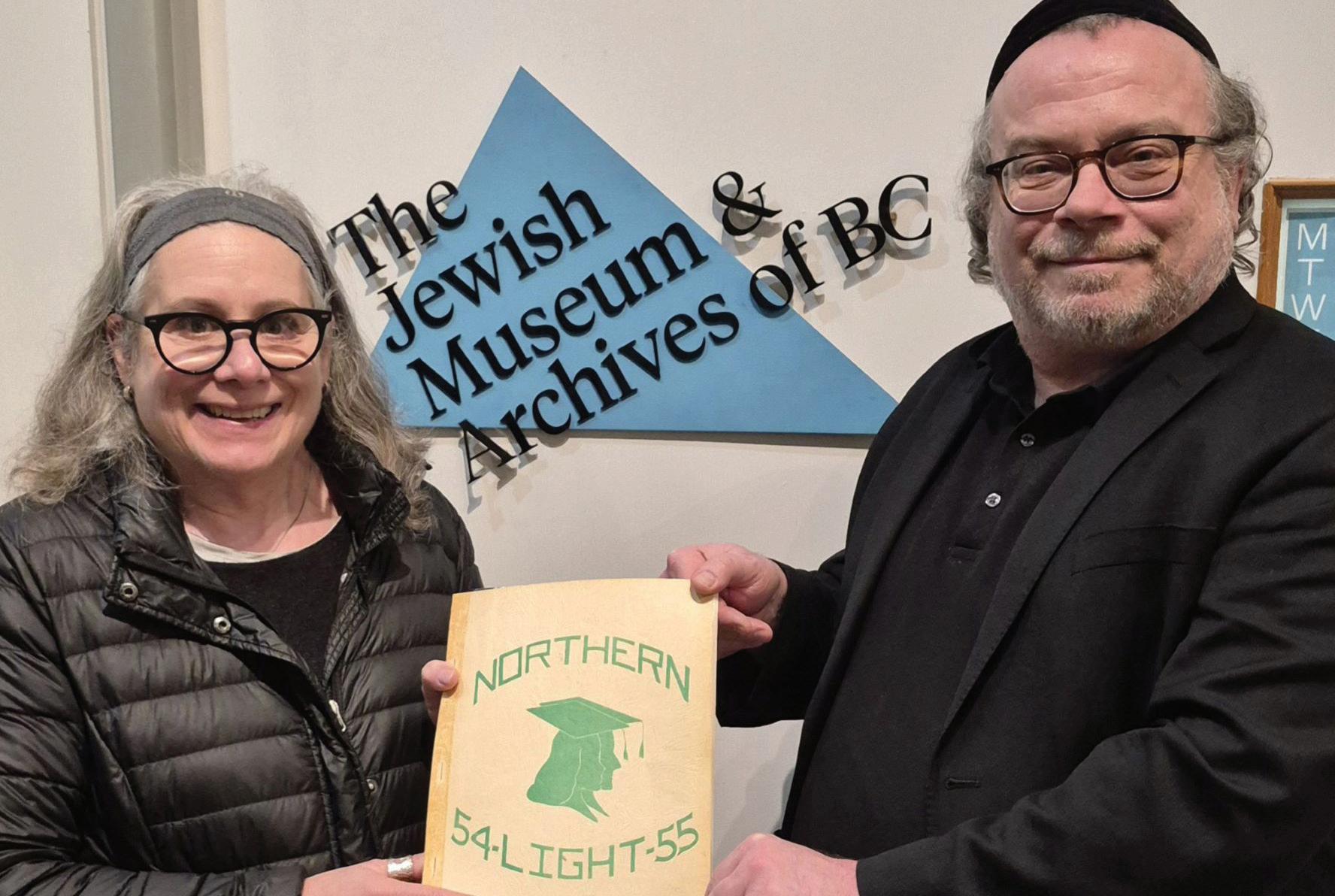
cultural history business. I love seeing things like this happen. And especially for me, every chance I get to learn a little bit more about Jewish history in Prince George and Northern BC, it’s very cool. And when you actually know the people who are part of that history, it’s even more exciting.”
This is what Noreen Rustad had to say about Klasner reaching out about the Arbour family.
“This is the funniest story because these grandparents had lived in a little house that Jim’s mom and dad had built when they first came to Prince George,” Noreen said.
When the Rustad business got going, they built themselves a bigger home and kept the small one, she added.
Both homes were on McBride Crescent.
“The Arbours were the ones who were renting the little house — how could you ever find a connection like this? People keep talking about this being a small world, but this is just incredible,” Noreen said with a laugh.
“Sam Arbour had a mill in McBride, and then he came to Prince George and built a mill out Chilako way, past
Arbour granddaughters Nadine and Jodi
Nadine and Jodi did a telephone interview with me while their mother, Hinda, listened in.
“My mom has done nothing but pore over the yearbook since she got it, and the smile on her face has been unbelievable,” Nadine said about her mother, who has dementia.
“It’s been truly beautiful to see.”
“My mother takes great pride in her early years in McBride and the amazing accomplishments that came out of the one-room schoolhouse and how that group of kids went on to the Prince George Senior Secondary School,” Jodi said.
“I think it was really incredibly formative for her, and it was an enormous part of her identity.”
Mud River, and he called his company McBride Timber, and that McBride Timber Road still exists today.”
Noreen let Klasner know that she didn’t remember the Arbour girls, but she would look them up in the high school yearbook.
Noreen discovered the Arbours’ daughter, Hinda, who had graduated as valedictorian in 1955.
Hinda’s valedictory speech was published in the yearbook, and Noreen said it was the only one published — she checked her other annuals from the years surrounding 1955.
“This whole thing was so serendipitous,” Noreen said.
Noreen and Jim went to the same school and each had a yearbook from 1955, and both had hung on to them all these years.
So Noreen sent one of the yearbooks to Klasner to give to Hinda and her daughters, Nadine, Jodi and Natalie.
“It seems like the yearbook went to the right place,” Noreen said about the gift and the connection between the Arbours and the Rustads.
“It was meant to be. And it’s always nicer to give things than to receive things. It’s a real pleasure to give this yearbook to the family.”
Nadine said that having the yearbook in Hinda’s hands has provided the opportunity to revisit the family history with her own children.
“It just brings it all together,” Nadine said.
“And it really speaks to the incredible interest my mom had in education and the things that were formative for her,” Jodi said.
“It really brings it all full circle. Mom made great efforts to ensure that her children and Nadine’s children had the opportunity to visit McBride to see where she grew up, and we’ve spent so much time in Prince George, Nadine, Natalie and I, and then to be able to carry that forward to ensure that Nadine’s children had a sense that when my mom said she had to walk to school and then take a horse, that really happened. It’s a great reminder of those stories and the history that comes behind it for our family.”
Jodi said it was very important to retain the long-term connection her family has to Prince George.
“Our grandparents lived in Prince George until we were quasi-adults, and we had a cabin at Norman Lake. We lived the Prince George experience, and this experience of getting the yearbook just reminds us of those memories.”
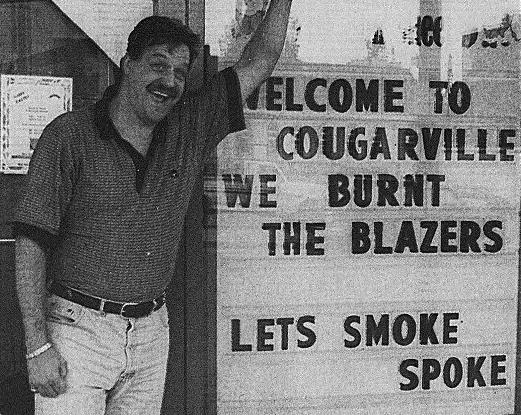
April 8, 1998: Cougars fan Shel Jacobsen set up a sign outside Shel N. Jacobsen Financial Services to show his support for the team, which had just lost a heartbreaker to Spokane and were down 2-1 in the best-of- ve series. The Cougars had already beaten Kamloops in the rst round but went on to be knocked out by the Chiefs in Game 4. CITIZEN FILE PHOTO BY BRENT BRAATEN

April 9, 2013: Ava Toyota, 8 (left), Nadine Finch, 11, Sarah Ford, 8, Mac
10 and Claire Finch, 8, took part in a tournament organized by the UNBC Underwater Hockey Club at the Aquatic Centre. The sport works like ice hockey or oor hockey, with players using short sticks to move the puck along the bottom of the pool. CITIZEN PHOTO BY DAVID MAH
April 9, 1984: RCMP Const. Heather Warren takes a closer look at what was left after someone used a torch in an unsuccessful attempt to break into a safe at city hall. While the crook was able to get through two steel-panelled vault doors after prying open a back door of the building, the safe itself was still intact. The incident came after two safecracking incidents at local travel agencies that netted thieves $350. CITIZEN FILE PHOTO BY RIC ERNST

April 9, 1969: A Citizen photographer took to the air in a Piper piloted by Bernie Holmquist of Columbia Airlines to photograph members of the Prince George Skydiving Club leaping from a Cessna 172 piloted by Steve Buba. The results, shot with a 134-mm motor drive, turned into a page of photos in the paper. This shot is the fth in a series showing the whole sequence of a jump. CITIZEN FILE PHOTO BY ED ROBERTSON






CHRISTINE DALGEISH Citizen Staff
The Parkinson’s Awareness Month proclamation and flag raising took place Thursday, April 2 at 12:15 p.m. at Prince George City Hall.
Parkinson’s is the fastest-growing neurological condition in the world. There are about 100,000 people with Parkinson’s in Canada and of those about 17,500 live in British Columbia.
Mayor Simon Yu joined members of the local Parkinson’s community and about 50 other people to raise awareness and show support for those impacted by Parkinson’s disease.
After Yu made the proclamation and Gina Beddome, chair of the Prince George Parkinson’s Support Group, raised the flag, The Citizen caught up with some of the volunteers and those affected by the disorder.
“I think it’s really important as a community to surround people who are facing Parkinson’s, whether you are facing a diagnosis or are a caregiver, we want them to know we see them, we hear them and we care about them,” said Shirley Bond, a volunteer with the non-profit organization.
“So today is a visible symbol of our support. We look forward to a number of other activities throughout the month as we raise awareness about Parkinson’s and we’re looking forward to an even bigger Super Walk when we get there in the fall.”
Vernon Winder was one of the people gathered at the event, who was diagnosed four years ago and now volunteers to help run the Prince George Parkinson’s support group.
Beddome and Winder stood shoulder to shoulder in the afternoon sun to speak to the media, with Beddome’s arm linked with Winder’s in a lovely show of support.
“It’s wonderful to have Parkinson’s recognized in the City of Prince George,” Beddome began.
“I can see one day that Prince George will be known as the city that supports those with Parkinson’s because we are really getting the word out there about

A group gathers to recognize Parkinson’s Awareness Month at a flag raising in front of Prince George City Hall on Thursday, April 2.
Parkinson’s and how it affects families and friends. So this is a very significant day for us.”
Last year Selen Alpay, philanthropist and owner of Canadian Tire in Prince George, shared his diagnosis of Parkinson’s disease with the community.
“The courage it took for Selen to come out and do that was amazing and since that day — in June of last year — we have seen the difference in the number of people who have come up and approached us at our booths and who have contacted us who were afraid to step out before,” Beddome said.
“So Selen had the courage to do it and his courage has been passed on to others and it’s had a significant impact on Parkinson’s awareness in Prince George and in BC.”
In response to those kind words Alpay said Beddome is one of the sweetest people on the planet.
“There are a lot things that would never have happened in the community without Gina and Serena (Sanghera), who is an amazing young lady who’s
done all kinds of work to keep the Parkinson’s Support Group going and these ladies have been doing the Super Walk for years and years and all of that would never have happened without them and that’s pretty inspirational to me,” he said. “I am honoured to be associated with them doing all that good work.”
Alpay said the group would like to the city to get a movement disorders clinic, which would be dedicated to the diagnosis and management of Parkinson’s disease and other related disorders, such as tremor and dystonia, just like the clinic at the University of British Columbia in Vancouver.
“Gina and I were on the radio yesterday and I vowed that we would get a movement disorders clinic in Prince George and we’re going to make that happen,” Alpay said. “And we are very excited about that. It will serve the people of Prince George and the people of the North as well.”
Parkinson’s disease is a progressive, neurodegenerative disorder caused by
a loss of the cells that produce dopamine in an area of the brain called the substantia nigra.
Dopamine is a brain neurotransmitter that sends signals from one nerve cell to another.
It affects the parts of the brain that control smooth, voluntary movements, such as walking, writing, throwing a ball, or buttoning a shirt. Dopamine is also crucial for regulating involuntary functions, such as blood pressure and bowel function.
The symptoms of Parkinson’s typically appear when over half of the dopamine-producing cells are lost.
Parkinson Support Group Open House goes Saturday, April 11 from 1 to 4 p.m. at the Elder Citizens Recreation Centre, 1692 10th Avenue. This event coincides with the annual Parkinson’s Awareness Day and includes sharing of information and having conversations about Parkinson’s, a chair exercise demonstration, and video presentations. Light refreshments will be available.
HOLLY HUGHES Northern Health
Burns Lake has faced a challenge of physician staffing over the past year, resulting in last-minute emergency department (ED) service interruptions affecting residents and families across the Lakes District. With just over a third of physician positions filled, the community and existing team of health-care providers have been carrying the strain of pressures to find emergency coverage and improve access to primary care.
Fear not — good news is on the horizon!
Northern Health is pleased to share that recruitment efforts in Burns Lake have gained significant momentum.
As of December 2025, five full-time physicians have been hired, with all five signing letters of offer. Each of these incoming physicians will provide emergency department (ED) coverage, helping to stabilize and strengthen the local ED over the long term.
Three of these physicians — Ben Bedford, Harminder Gakhal and Konrad Joseph — are completing their medical residencies at UBC/UHNBC. All have expressed enthusiasm about joining the Burns Lake medical community and contributing to patient care in the Lakes District.
Harminder Gakhal, his wife, Bal, and their daughter were welcomed by a Burns Lake provider group and staff, including Lwando Nogela; Ashley Flavelle, NP student; Erin Barker, NP; Beth Berlin, NP; Tammy Downton; Lisa Puglas; and Tammy Williams.
Two international physicians will also be coming under the Practice Ready Assessment program, a program that supports internationally trained family physicians with the requirements for licensure in BC. Two associate physicians have also been hired to work alongside fully licensed physicians in all areas of practice.
If all proceeds as planned, these new physicians will begin arriving as early as summer 2026, bringing important relief to the current workforce.

Despite the challenges, Burns Lake’s dedicated health team continues to work tirelessly. Three local physicians are actively covering ED shifts while also balancing responsibilities in primary care and their private practices. While this doesn’t cover all the shifts, Northern Health is deeply grateful for the commitment of local physicians, as well as the commitment of nurses, nurse practitioners, laboratory staff, locums and administrative teams who continue to support patient care every day.
Over the past year, Burns Lake has also seen a net gain of 11 new non-medical employees, with more on the way. While there are still challenges in filling some roles, such as licensed practical nurse (LPN) positions, ongoing recruitment is showing encouraging results, and a new program is now available to support health-care assistants’ transition into LPNs — at no cost to them.
Northern Health knows how stressful ED service interruptions can be for residents, and it wants to assure the community that every effort is being made to strengthen local staffing. This includes:
• Partnerships with community leaders to attract and retain health professionals in Burns Lake and surrounding areas.
• Virtual supports allow patients to be seen by the ED team with the support of virtual physician oversight, helping ensure continuity of care where possible.
While these efforts are helping, the reality is that rural and remote regions across BC are all competing for a limited number of health-care providers. Recruitment takes time, and Burns Lake has been affected by several overlapping factors — retirement, maternity leave and several clinicians relocating to other communities in the North.
While the staffing situation remains challenging, the arrival of five new full-time physicians marks a significant positive shift and a hopeful step forward for Burns Lake.
Recruitment will continue, partnerships will strengthen, and Northern


• Active recruitment of physicians, associate physicians, nurse practitioners and nursing staff. There is a current job posting for an NP role to work exclusively in the ED.
• Improved hiring pathways for U.S. and internationally trained practitioners, helping remove barriers and shorten timelines.










Spokane pushes team hard in an effort to even series in Game 6
TED CLARKE Citizen Staff
Get ready for the second round of the WHL postseason, Prince George.
It’s coming your way.
The Cougars are driving that playoff train, picking up passengers to watch them try for a spot in the final four. They punched their ticket to a second-round best-of-seven encounter with the Penticton Vees after a 5-3 win over the Spokane Chiefs in Game 6 on Easter Sunday to emerge as 4-2 series victors in what was a tough, physical matchup.
Riley Ashe fired the go-ahead goal midway through the second period when there was still plenty of time for the Chiefs to mount a comeback. But after what happened in Game 5, when the Cougars blew a two-goal lead in the final 10 minutes and lost in overtime, with a chance to wrap it up in six, they avoided that precarious situation again.
“It was a close series, every game we were both there right at each other, and tonight we just came out and we said, ‘hey, let’s stay disciplined and stay out of the box, we can beat these guys 5-on-5,’ and that’s exactly what we did,” said Ashe.
“After a loss like (Game 5) you’re a little tight and after that I thought we started to play a little free, a little more aggressive and everything started to work out for us after that. We just stuck to the plan, we knew to stick with it and we knew we’d win.”
Dmitri Yakutsenak had his best game in the series Sunday, scoring twice — the first WHL playoff goals for the big Russian winger, who brings the strength of an ox to the ice.
“He’s a big, strong Russian boy,” said Ashe. “He looks like he grew up in

Chiefs forward Tristan Buckley’s wraparound backhand is deflected up in front of Cougars goalie Josh Ravensbergen in game six of their first-round playoff series at CN Centre Sunday, April 5.
the middle of nowhere, he’s thick and strong and when he wants to he can just power through anyone.”
Chiefs centre Owen Martin opened the scoring 8:46 into the game. Logan Wormald took a long pass along the left-wing boards from Coco Armstrong and took off on a 2-on-1 with Martin, and the Winnipeg Jets draft pick let the shot go as soon as the puck touched his stick for his fourth of the playoffs. The Chiefs had the better scoring chances in the early going, and Martin’s line, with Wormald and Armstrong, gave the Cougars plenty of trouble.
The tone was noticeably different after the Cougars finally scored late in the opening period.
“We’re a confident team but I thought we looked nervous,” said Cougars head
coach and general manager Mark Lamb. “We were tentative in a lot of areas. We looked like we didn’t want to make a mistake and we got it going in the second a little bit. I think when (Yakutsenak) scored his second goal in the second period it made our bench loosen up a bit and we started playing. In the third, I sensed it again, we got a little tight. We didn’t want to make a mistake.”
Aggressive checking initiated by Cougars winger Kaden Lemire led to the tying goal from Yakutsenak late in the period. Lemire picked off a pass in the Cougar end and took the puck in deep, and defenceman Arseni Anisimov made a strong play at the line to hold the zone in the offensive zone. He eventually got a shot away that was partially blocked, and Lemire dug it out of the corner and gave
it back to Anisimov, who passed to Yakutsenak in the right circle. The 18-year-old draft-eligible winger then used his soft hands to drag the puck around Armstrong and fire off a low shot just inside the post behind goalie Carter Esler.
The Cougars’ power play, already working at a 50 per cent clip, upped its production a few more percentage points when Nathan Mayes was sent off for a hit from behind. The Cats collected their ninth power-play goal on their 17th chance of the series, and it was the usual suspect, Kooper Gizowski, who did the deed. He set up in his usual spot in the right circle, and Carson Carels found him for a one-timer that gave the Cats a 2-1 lead.
CONTINUED ON NEXT PAGE
The Chiefs got that one back less than three minutes later. Martin scored his second of the game when he took a short pass out of the corner from Logan Wormald and chipped it in over Joshua Ravensbergen’s shoulder.
The response from the Cougars was immediate, and they took control of the puck and got plenty of shots through to Esler the rest of the period and were rewarded with a pair of goals 90 seconds apart.
Tyrone Sobry collected the puck in the Cougar end and fed it ahead for Ashe, who took off at full speed with Koy Funk as the decoy on an odd-man rush. Ashe had nothing but open ice around him, and he let go a shot from 20 feet away into the top corner for his first of the playoffs.
As loud as the crowd reaction for that goal was, with 5,376 mostly Cougar
fans in attendance, they went absolutely nuts when Yakutsenak snuck behind enemy lines and was waiting just outside the blue-line along the left wall to accept a stretch pass from Bauer Dumanski. In all alone, Yakutsenak ripped a shot high into the corner behind Esler.
“It was a tough series, that was a good team against us and maybe we just relaxed after that third win, but now it’s all good,” said Yakutsenak.
“My first goal, Anisimov gave me a good pass and I just put it in the back of the net. My second goal, Bauer Dumanski found me on the far blue-line and I just shot. I didn’t expect that, to be honest. I think it was a bad (Spokane) defenceman change. It was a good game but hopefully my best games are coming.”
Down by two, the Chiefs went on the power play for the first time with four minutes left in the second period.
Spokane won the draw, and the Chiefs came oh-so-close to narrowing the gap but could not beat Ravensbergen. The Cougar goalie came up with three showstopping saves and had one puck kiss the crossbar in a frantic sequence in front of the Prince George net, with Dominik Petr and Prince George native Chase Harrington firing the shots, but came out unscathed.
“I think we kind of dug ourselves a hole early and we were trying to claw back but couldn’t get it done,” said the 18-year-old Harrington, who had the tying goal and the OT winner in the fifth game in Spokane. “It was a game of inches out there and it just didn’t go our way.
“It was super-physical, in your face, both teams had that play style and it was a good, hard series. We have a lot of heart and we just never gave up as a team and I think we showed that in Game 5.”

It came down to the final 20 minutes to decide whether the Chiefs had it in them to force Game 7. Spokane captain Will McIsaac whipped a wrister from the blue-line that came within a crossbar of making it a one-goal game five minutes into the period.
The Chiefs held the puck in the offensive zone for much of the period, outshooting the Cougars 12-6, but the Cats kept their lead intact until Terik Parascak cast away all doubts with an empty-netter.
Chiefs left winger Sam Oremba ended his six-season WHL career Sunday — his 317th game — scoring his last goal on a rebound with 3.3 seconds left.
“It was unfortunate, the second period we had a bit of a lull and it ended up hurting us in the end,” said Oremba. “I thought we had a good push in the third but we just couldn’t put the puck in the net.”
Oremba played for Seattle and Regina before he joined the Chiefs in 2024. He and forwards Wormald and Petr were the Chiefs’ overagers this season.
“On the last final shift, usually your 20-year-olds go out, and I kind of wanted one more shot on goal and I was lucky enough to get that shot that went into the back of the net,” Oremba said. “I’m super grateful I was able to do it with the other two 20-year-olds on our team that are brothers to me.”
The Cougars outshot the Chiefs 29-24.
The Cougars won the first three games, then lost Games 4 and 5 in Spokane. Two games were decided in overtime.
“It was a real tough series,” said Lamb. “It had a lot of everything that playoffs does, it had goals, it had physicality, it had suspensions, it had injuries. Both teams are pretty tired right now and we need to get some rest and get ready for the next one.”
The Cougars were set to travel to Penticton on Wednesday to meet the Vees in the Western Conference semifinal series starting on Friday. The Vees host the first two games and then the series switches to PG for Games 3 and 4 Tuesday, April 14, and Wednesday, April 15.
TED CLARKE Citizen Staff
The small town of Vernal, Utah, a three-hour drive east of Salt Lake City, is not well known as a hockey hotbed, but the arrival of an NHL team two years ago has had a trickle-down effect that has boosted the sport’s popularity in that U.S. state.
A winning team never fails to attract a crowd, and the Vernal Oilers, a team of junior-aged players in the US Premier Hockey League’s Tier 3 Premier Division, have done nothing but win the past two seasons, and that has whipped up a frenzy of fan support.
The Oilers wrapped up their second straight national championship March 29 in Wayne, N.J., at the USPHL tournament, guided by a Prince George head coach, Ryan Howse, and two forwards, Brody Wood and Jack Tidsbury, who cut their hockey teeth playing in Prince George Minor Hockey Association.
The Oilers dominated their league, going through the season with a 42-2 record, which led to a two-game sweep over Seattle in the regional championship and a perfect 5-0 run at the national tournament. The Oilers beat the Fresno Monsters of California 6-4 in the final.
A year ago, Howse took the Oilers through an undefeated 44-0 season and a 4-1 run at the national tournament that led to the team’s first national title.
“I think I cherished this one a little more than I did the first year because the first year kind of flew by and it’s your first championship, but this year I got to enjoy it a little longer and a little more,” Howse said.
“Vernal is a tiny community, about 10,000 people, but the support we get here locally and from the surrounding towns — they all come together and fill our rink. We sold out probably our last 20 home games, so playing in that environment is massive.”
Howse, 34, is a Prince George native

and former right winger for the Cariboo Cougars U18s who also played for the Prince George Spruce Kings (BCHL) and Chilliwack Chiefs (WHL). He was drafted by the Calgary Flames in the third round, 74th overall, in 2009 and went on to play two seasons of minor pro in the AHL with the Abbotsford Heat and also played in the ECHL for the Utah Grizzlies.
Howse started coaching in 2015 with the Cariboo Cougars U18s, then was an assistant with the Spruce Kings and returned to coach the Cariboo Cougars U16s before a two-year stint with the Hinton Timberwolves junior team.
Howse knew player agent David Imonti, the GM/director of hockey operations in Vernal, who hired him to coach the Oilers four years ago when they joined the USPHL.
“When I got here four years ago it was pretty quiet — the rink was being renovated and we didn’t have a dressing room, we had to change in the lobby. Now we have one of the best dressing rooms in the nation for this level,”
Howse said.
“Hockey has just ramped up here in Utah. Living in Canada all my life and being from there, hockey is in our blood — it’s what we do every day growing
wing, had 13 goals and 14 assists for 27 points in 33 games. The 18-year-old led the team with 151 penalty minutes.
Howse knows Wood’s dad, Derek, and when Brody and Tidsbury were cut after a tryout with La Ronge of the SJHL, Howse asked them to come to Utah. They did not regret it.
“It was awesome, every game was sold out pretty much and you get treated like a celebrity there,” Wood said. “We just have a really good coach and good leadership — the older guys led the way. We had a lot of guys from last year and they had already been through that before, and they did a good job showing us the culture there.”
Both liked playing for Howse and they intend to return to Vernal next season when the team makes the jump to Tier 2 in the National Collegiate Development Conference.
up outside — and now you’re seeing it today with USA Hockey. It’s starting to feel a little like home and the players are getting better, so it’s a lot of fun.”
After breezing through the season to win their fourth-straight Northwest Division title, the Oilers got a harsh wakeup call in their first tournament game and fell behind 3-0 to Hawkesbury of Ontario, but rallied to win that game and never looked back.
The team flew back to Denver and rode the bus back to Vernal the following day. Most of the townspeople turned out to watch the Oilers’ victory parade, with the players and coaches waving the trophy while riding on top of a fire truck.
“The whole community loves us down there, it’s awesome,” said Tidsbury, an 18-year-old centre who finished the season with 30 goals and 57 points in 41 games.
“We went 5-0 at the tournament, which was even better than they did last year, so the coaches were super happy. Losing only two games the whole season — I wouldn’t have even thought of that before going into this year.”
Wood, Tidsbury’s second cousin and his minor hockey linemate on right
“He’s really good at connecting with players, on and off the ice, and he leads the way, gives really good speeches,” Wood said.
“You can just tell he knows the game,” Tidsbury added. “He’s so good at giving these little pointers that can make a difference. It’s awesome to have someone who knows the game that well to play for. Our team had so much talent — you could learn a lot from them, too.”
Wood and Tidsbury were among six Canadians on the Oilers this season, and they billeted with Howse’s wife Melissa’s parents. The other four Canadians were from Ontario and the rest of the team was a mix of Europeans and Americans. Howse said his team would be comparable in calibre to a top team in the Kootenay International Junior Hockey League.
Howse would like to get a few more players from northern BC to try out for his team, and he plans to send a few of his Oilers to the Spruce Kings’ spring prospects camp, Aug. 14-16.
He stays in regular contact with his best buddies from Prince George — Spruce Kings assistant coaches Brandon Manning and Sam Muchalla and Cariboo Cougars assistant RJ Berra, who were there in Utah when he married his wife five years ago.
TED CLARKE Citizen Staff
It’s sometimes said that a three-goal lead in hockey is never safe. What about a four-goal lead?
The Prince George Spruce Kings had one of those and in a dicey third period it almost looked like they were about to blow it against a determined bunch of Langley Rivermen.
In the end, the Spruce Kings managed to hang on to a 4-2 win that evened the best-of-seven BCHL Coastal East Division semifinal series at a game apiece Saturday, April 4 in front of crowd of 961 at Kopar Memorial Arena.
Games 3 and 4 were Tuesday and Wednesday, after this edition of The Citizen went to press.
On Saturday, the Spruce Kings got the result they were after thanks to goals from River Arnason, Robbie Hoch, Ozbej Reb and Lucas Busch and a steady 31-save outing from goalie Colin Reay.
It appeared the Spruce Kings were well on their down easy street holding a 4-0 lead with nearly three minutes of power-play time to work with to start the third period. But they got away from the hustle and determination that led to their strong start and rather than continue to be the aggressors, sat back and tried project their lead and the Rivermen fed off of it.
Defenceman Brody Juck broke up Reay’s shutout bid with a power-play shot from the point that found its way through bodies in front of the net and Langley continued to push.
Harshaan Kaila led a rush into PG territory and found Cale Colwell in front with the pass for his second goal of the series with almost 12 minutes left on the clock.
The Riverman continued to pound rubber at Reay, who had to make five more quality saves down the stretch to preserve the win.
Reay figures his team will learn from what transpired that final period and be better for it the rest of the playoffs.
“It’s good for our group that we got to experience that and now we know

Rivermen forward Andreas Mikrogiannakis is sandwiched between Spruce Kings defenseman Dracen Campbell and forward Mason Loewen in game two of their playoff series at Kopar Memorial Arena Saturday, April 4.
to never let up, you can’t take a minute off in playoffs,” said the 20-year-old Reay. “It was a good way to grind it out there in that last 13 or 14 minutes so I’m proud of the group for that.
“I thought I played well tonight, those two goals, they didn’t bug me too much. I was nice and calm, I didn’t fluster at all, we still had a two-goal lead. In my mind, we shouldn’t be the ones panicking, they should, being down by two, and I just used my experience there.”
After getting skunked 2-0 in Game 1, the Spruce Kings came out firing and had a tremendous start, scoring three times in a dominant opening period.
Defenceman Isaac Holt knows all about the lively boards behind the nets at Kopar and that worked to the Kings’ advantage when his shot missed the net and bounced out to Arnason, who batted the puck in for his first career BCHL playoff goal, 5:01 into the game.
Spencer Masters then won a draw back to Hoch and the Kings d-man let go a slapshot that kicked off the leg of goalie Eric Young and fluttered high and in over his shoulder for a 2-0 lead, 24 seconds after Arnason’s goal.
The Kings’ offence continued to find success and Tai Ushio led a fast-break into the Langley end and he threaded a pass to Marcus Lougheed, whose shot kicked off Young’s pads into the slot for
Crosby with a cross-check to the chest and a second cross-check that caught Crosby in the head area.
Three players on each team were penalized and Deschenes was handed a major and game misconduct that gave the Spruce Kings nearly three minutes of leftover power-play time to start the third period. The Rivermen killed that off without incident and shortly after used their third power-play chance to get themselves on the scoreboard.
After Juck scored, the Rivermen came right back with another solid shift and Reay was forced to make another save, prompting Kings head coach Brad Tesink to call his timeout with five minutes gone in the period.
Ozbej Rep and the league’s highest-scoring defenceman this season wired in a shot that got through.
Reay had to be sharp in the second period when Rivermen winger Parker Forlin fired off a dangerous-looking shots on goal during Langley’s second power play of the game but the best scoring chance during that penalty time came at the other end when Ben Vreugdenhil was sprung free on a shorthanded breakaway.
He got a quality shot away but Langley goalie Eric Young got his pad in the way to keep it a 3-0 game.
“We started the game perfectly, I would say, we were all over them, sticking to our game plan,” said Rep. “After the second we came out on the power play and were a little bit on our heels and then I think we started to play their game and that’s why we got scored on twice.”
Adam Crosby played his first BCHL shifts since being called up from a Minnesota high school team and the 18-year-old winger got involved in a bit of rough stuff late in the second period. The Kings were called for offside just as Crosby got the puck in the slot and he fired off a shot at Young just after the whistle that incensed Rivermen defenceman Frederic Deschenes, who came after
“I thought we were pretty consistent for 40 minutes there, doing the right things, and then we decided to play hang-on hockey for 20 minutes and we need to be better,” said Tesink. “Our older guys need to take accountability for some of the stuff that happened early in that third period and for me we need to win the right way. I believe we took our foot off the gas pedal and you can’t do that in playoffs, not for a shift, not for a full period.’
Tesink elected to go with Reay after Ryder Green started Game 1, an alternating pattern he established with both goalies throughout the season, and Reay lived up to the task, especially with the Rivermen coming on strong while they outshot the Spruce Kings 16-7 in the third period.
Winning the third period provided a confidence boost the Rivermen hope to use to their advantage when the series resumes.
“They’re a good team and we knew they were going to push and they came out with a great start and we didn’t match it, obviously, but I’m proud of the guys,” said Rivermen head coach and general manager Brad Rihela.
“The comfort of home is a real thing, for sure. We would have liked to take two out of here but coming up and getting the split, we feel pretty positive about that. It’s just a little more familiarity, a bigger ice sheet and we’ll try to get to our game early.”
TED CLARKE Citizen Staff
Getting drenched by bubbly in a champagne celebration is not just for F1 race car drivers.
Evan Bichon earned that podium perk on the slopes of Mont St. Anne, Que., when he finished third in the FIS World Cup snowboard cross men’s big final on Saturday, March 28.
“To be on the podium at a World Cup, in front of a home crowd in Canada, at the final race of the year, I couldn’t have drawn it up any better, for the first podium of my career, what a surreal moment,” said Bichon.
“I was exhausted from racing but at the same time my shoulders felt pretty light stepping up there. Adam Lambert got me pretty good with the champagne. I feel it’s been a long time coming but to finally achieve that is one of the best feelings ever.”
The 27-year-old from Mackenzie had a lead on Lambert of Australia and Leon Ulbricht of Germany after the fourth corner heading into the bottom third of the course. But Ulbricht and Bichon made contact with each other on the fifth turn and that was just enough for Lambert to slide by on the outside and take the lead and he hung on for a close victory with Ulbricht second and Bichon a close third.
It was a year to the day that Bichon posted his previous best World Cup result on the Mont St. Ann course when he finished fourth. He also won the Canadian championship that follows the World Cup race there the previous two years but was unable to stay for that race on Sunday.
“I love the mountain and track, it’s by far my favourite course that we have each and every year and I’m really thankful Canada hosts a World Cup, especially there,” said Bichon.
Bichon accomplished one of his lifelong ambitions this season when he competed in the Olympics for the first time. He qualified 11th and finished 17th in Livigno, Italy. He tried to build on his Olympic success at the next race in Montafon, Austria but didn’t get the

result he’d hoped and Mont St. Anne was his last chance before the sixmonth off-season.
It was also a breakthrough race for Colby Graham of Prince George, 24, who advanced to a World Cup semifinal for the first time in his career and finished eighth out of 51 riders.
Unlike Graham who qualified 17th in his first run, Bichon didn’t make the top-20 cut and had to put down a fast second qualifying run to end up 22nd in the 32-rider order for the heats.
Both men’s semifinals came down to photo finishes.
Bichon crossed the line a split-second behind Julien Tomas of France and was just ahead of third-place finisher Jonas Challet of France. Only the top two advance and it almost didn’t happen for Bichon.
“Going over the jump from the first corner to the second corner I landed
off-balance and almost crashed and as my feet touched the ground going into the second corner I Iocked the edge in and got a really good speed boost and went from third or fourth to second right away,” said Bichon.
It was virtual three-way tie between Graham, Ulbricht and Alessandro Haemmerle of Austria in the other semifinal to decide second place behind Lambert. Graham just missed moving on to his first career big final when Ulbricht ended up about a centimetre ahead of the Prince George rider.
“I couldn’t be more proud of Colby,” said Bichon.
“He was riding so strong on the Mont St. Anne weekend and I know he’s been working really hard his whole career and especially this year, so to see him so close to making the big final with me is unbelievable.”
Graham has been steadily progressing
up the World Cup ladder and had a strong second half of the season, posting a career-best 16th in January at Dongbeiya, China, which set the tone for the Quebec race.
“That was super close, a fun last race of the season and to race those guys and be close like that and have that opportunity presented to me was awesome,” said Graham.
“It is a grind, 100 per cent. It’s a lot of years and a lot of failures and you just keep going on, trusting in you when it’s not working out and to have that result come together was really nice.”
Graham was the second alternate for Canada’s men’s Olympic team and made the trip to Italy for the Games to support his teammates, including his good friend Bichon, who lost his mom Trish to cancer Nov. 14.
CONTINUED ON NEXT PAGE
“There’s nobody on the tour who deserves (a podium finish) more, especially after the year he’s had, it was so amazing,” said Graham. “I’ve been following behind him since I was 13 years old. It was so cool to be there to watch that.
“We were on the opposite sides of the bracket during the race so we never met each other like we would have in the big final. We kept hearing each other’s name moving on and we were both feeding off that and it was just increasing the confidence.”
While perennial medal favourite Eliot Grondin dropped out early due to an illness, the fans in Quebec didn’t hold back on showing their love at having two Canadians in the medal hunt.
“It was amazing, it’s the best crowd and the biggest crowd we have all year, we’re not at home but we were at home, and it’s so much fun,” said Graham. “To
put on a show for the people and get them cheering, that’s what it’s all about.”
This is Bichon’s fourth full-time World Cup season and he ended up 23rd in the points standings, while Graham was 36th on the list. Ulbricht, who won four races, claimed his first Crystal Globe points championship with 435 points, 22 ahead of second-place Lambert.
Charlotte Bankes of Great Britain won the women’s race in Mont St. Anne to solidify her third Crystal Globe.
Bichon moved from Mackenzie to Prince George with his parents and sister when he was 12. He attended D.P. Todd Secondary School one year behind national team veteran Meryeta O’Dine and three years ahead of Graham. They all attended the Canadian Sport School at UNBC.
O’Dine, 28, fought through an injury-plagued season and made it to the Olympics but crashed in a training run in Livigno and broke her ankle. She finished 29th in the World Cup standings.
Lack of funding support clouds Bichon’s snowboard cross future
Projecting into his future in the sport, Bichon is targeting another shot at the Olympic team in 2030, but says he can’t look beyond next season.
Funding and the lack of support for the Canada’s snowboard cross team fell far short of paying the costs of being a regular on the World Cup circuit and Bichon says that’s the downside of being a Canadian athlete, even those on top of their game.
“Now that it’s at the end of the Olympic cycle I’m hoping Canada and the national sport organizations are able to take a new look on how we can improve things going into the next four years because I do think the lack of medals by Canadians at this year’s Olympics is directly correlated to funding for our athletes,’ said Bichon, who returns to his job next week in North Vancouver as a painter-detailer at Performance Yacht Services.
Bichon is all in favour of the Canadian
government funneling taxes from betting apps or perhaps a national lottery to support national sports organizations to reduce what it costs the athletes to compete at the highest levels. He sees other riders from Europe who are paid full-time salaries and are starting families while Canadian athletes are struggling to pay the bills and put their personal lives on hold chasing success.
“There’s no lack of passion and effort going on throughout every sport in Canada but at a certain point if you don’t have the right support you can only get so far,” he said.
Bichon has also learned that the Municipal District of Mackenzie has approved naming the ski lodge at Little Mac ski hill in Mackenzie the Evan Bichon Ski Chalet in his honour as the first Mackenzie athlete ever to compete in the Olympics.
His dad Ryan introduced a five-yearold Bichon and his older sister Dana to snowboarding 22 years ago.



















Kurt Van der Lans
1948 - 2025
A celebraton of life will be held on April 18, 2026 from 1 pm - 4 pm at the Hart Pioneer Centre 6986 Hart Highway, Prince George, BC
Johanna Dalziel an ary , 192 - April 1, 2026
Johanna Dalziel, born January 5, 1923, in Lanigan, Saskatchewan, passed away peacefully on April 1, 2026, at the age of 103.
Born to a e and i y oyle, he wa one of een children and grew up on a farm north of Whitefox. She was married in 1941 to Ken Dalziel, and together they raised four children; Mel, Dona, Alt, and Doug, in Love Siding, before moving to Prince George in 1962, where they contn ed to b ild a clo e- nit and lo ing family that wa the center of her life.
Celebrated for her quick wit, warm heart, and welcoming nature, Johanna made her home in Prince George a true gathering place. Her legendary baking brought family together for day lled with la ghter, game , and storytelling. She loved playing bingo, watching the Blue ay and c rling while ho tng anyone and e eryone he door was always open at Johanna’s house.
A de oted mother, grandmother, great-grandmother, and great-great-grandmother, ohanna cheri hed e ery moment with her family, bringing joy, humour, and love to each generaton he lea e a la tng legacy of trength, indne , and de oton ow re nited with her belo ed husband, Johanna will be deeply missed by all who knew and loved her.
A service will be held at Sacred Heart Cathedral, 887 Patricia Blvd, Prince George on Saturday April 11, at 1:00 pm.
March 31, 1940 - March 1, 2026
Patricia ynn Co , 8 year of age, of ictoria, BC formerly of Prince George, BC , died on nday, arch 1 t at the Gorge oad ehab Ho pital in ictoria
he wa a longtme teacher, commi ed ol nteer, mother of two, and lo er of m ic and learning
Pat wa born on arch 1 t, 1940, in dmonton, Alberta to thel and oy t enni he grew p in Po ce Co pe, BC, and went to high chool nearby in aw on Cree
he tarted teaching right o t of high chool, earned her teaching cert caton at Camo n College, and then went to mmer chool at BC for e eral year to complete her degree Pat ta ght in aw on Cree , and then in Prince George at the College of ew Caledonia before going into primary ed caton for the remainder of her career he retred in 1994, and ol nteered wee ly at Glenwood lementary to tay connected with the id who meant o m ch to her Pat en oyed her long retrement in Prince George before mo ing to ictoria to be clo er to family in ecember, 2024
Pat married enni Co in ctober of 1964 he had on ohn in ne, 196 and on Colin in an ary, 19 0 he lo ed m ic and ang for many year , tra elling far and wide with the weet Adeline chor PG chapter
he ol nteered for the Prince George Co ncil of enior , and wa recogni ed for her contrib ton of many year of er ice to the Arthrit ociety
of Canada ewing wa a tr e pa ion of her and he de oted co ntle ho r to ma ing clothe for her elf, her ibling and her id he wa a c er for a tra hy romance no el he lo ed a good chat, and he lo ed card game Pat organi ed bridge and cana ta gro p with her friend and neighbo r where er he went he did not belie e in organi ed religion, preferring her own co ncil in thi life and the ne t
Pat had a great capacity for oy and connecton, wa a terrible force in a ght, lo ed her id , wa o erly critcal of her elf, made a real e ort to tay in to ch with lifelong friend , wa wrong a lot of the tme b t right t a o en, and, really, t wanted to be lo ed hich he wa
Pat i r i ed by her on ohn Cindy and Colin ri tl and their familie grandchildren amantha, Pamela, Ale ander, athilde and ncan, great grandchildren athaniel and Arabella, and by her ibling Patric and arion
he wa predecea ed by her parent , thel and oy t enni , her brother oger, and her i ter Ardath and ne
An interment er ice for clo e friend and family will ta e place at Hatley emorial Garden in Colwood at 11 am, ne th, 2026
onaton in Pat memory can be made to the Arthrit ociety of Canada




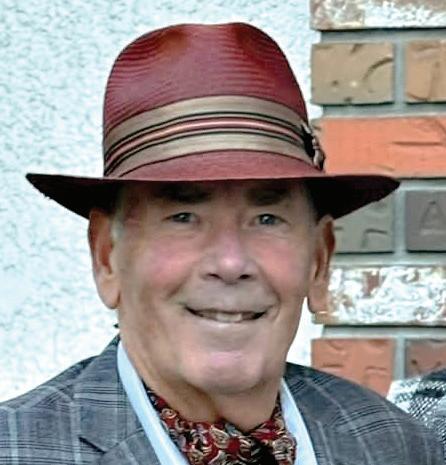
It is with heavy hearts that we announce the passing of Gary Neil Clarke, who was surrounded by his family as he went peacefully into the arms of Jesus on March 22, 2026.
Gary was born on March 13, 1951, at the Royal Victoria Hospital in Montreal, Quebec, to Neil and Thelma Clarke. A true legend and community builder, Gary touched many hearts—his family, friends, and all who had the privilege of knowing him. A man of strong Christan faith with a happy dispositon, a brave and adventurous spirit, all while being exceedingly kind and generous.
Predeceased by his parents R. Neil Clarke (1984) and Thelma Clarke (2019) and sister-in-law Mary Clarke (2017).
He is lovingly remembered and survived by his wife, Rhonda; his children, Rebecca Worthington (Jim), Neil Clarke (Lana), John Clarke (Margarita), and Stephanie Mocibob (Simon); and his 12 cherished grandchildren, Abigail, Anna, Amaya, Alivia, Ward, Weston, Ella, Oscar, Grace, Eve, Celeste and Thalassa, all of whom he deeply loved. He will also be missed by his siblings Greg (Peggy), Lorraine (Dave), and Anne (Doug), many nephews and nieces, extended family, and countless friends.
Gary lived a big, happy and vibrant life. In 1969 he moved from Quebec to BC to atend Royal Roads Military College for two years. From there he moved to Prince George in to work in constructon for S uare B Constructon. e atended Lakewood Alliance Church where he became a Christan and met his loving wife, Rhonda. In
1975 he began his career in Life Insurance and built strong business connectons. In the early s he helped sponsor Vietnamese boat people from Hong Kong and did bible studies with them. They in turn taught him how to speak Chinese.
Gary served several terms as chairman of the Board at Cedars Christan School and helped secure the land where the new gym is located. Gary was very creatve, and in the s he was inspired to build his own backyard pond for his new koi sh. his led him to create the Prince George Koi and Garden club, where he inspired and helped others build their own ponds, and even organized bus tours to view these ponds and gardens around town. Gary also built the impressive “glass tower” building on Central St in the s, which housed his insurance and investment businesses, and featured a sh pond in the lobby.
e en oyed internatonal travel with Rhonda with trips to China, Japan, Hong Kong, Austria, the former Czechoslovakia, Italy, Ireland, Mexico, USA, various Caribbean islands, ahit, the Bahamas and Israel. He loved learning languages. Gary memorized over 1200 Chinese characters before going to China to make his travel easier and more meaningful. He also learned some Japanese and Hebrew before travelling to Japan and Israel, respectvely.
In the s Gary and Rhonda led numerous Alpha courses at Lakewood Alliance Church. In the s he brought the Chik-Fil-A Leadercast event to Prince George for 5 years with
a group of dedicated locals. He was later invited to join the PG Peacemakers group and eventually became Executve Director and revived the local Mayor s Prayer Breakfast. His last act of service was leading the Ekklesia Course and teaching others of how to love their families and the local community more compassionately, like Jesus would.
e en oyed y shing with his sons and heading out on the Stellako River for adventure. He was an amazing downhill skier and a strong swimmer.
Gary had a keen sense of humour, understood world politcs, retained history facts easily, and dominated bible trivia. His laugh was boisterous and his style impeccable. His favourite place was his home. He loved swimming with the grandkids in his backyard pool on a hot summer day or si ng on his deck watching the koi swim in the beautful pond he built.
We are so grateful for the love, strength, happiness and connecton he brought into our lives. He will be deeply missed and forever remembered.
A memorial will be held on April 11 at pm at irst Baptst Church, Gillet St, Prince George, BC.
“For I know that my Redeemer lives, and that in the end He will stand on the earth.” — Job 19:25
In lieu of owers, donatons can be made to either Cedars Christan School or the PG Peacemakers.
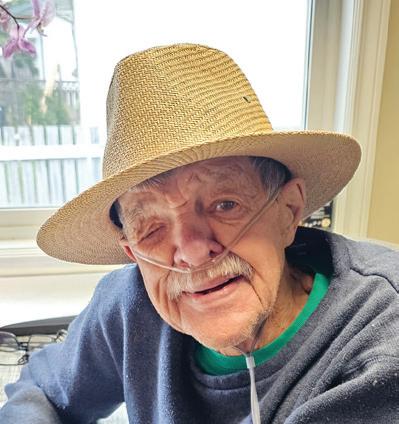
Marvin Theodore Gogolin
April 8, 1943 - March 23, 2026
With deep sadness we announce the passing of our father Marvin Theodore Gogolin on March 23, 2026. He was 82 living in Edmonton, surround by family. He was predeceased by his parents Ernest Emile Gogolin, & Alice Marie Gogolin, his sister Anita Dingwall. He was survived by Brother Henry Gogolin, sisters Alma Head & Inga Smasslet, as well as his children Jody, Brian, Tammy & Trina. Grandchildren Johnathan, Melissa, Zachary, Rory & Evan. Great granddaughter Isabelle.
A Celebraton of life will be held at a later date. ”Thumbs Up Dad”.
McDonald May 9, 1952 - March 27, 2026
Elaine McDonald, age 73, passed away peacefully on March 27, 2026, at her care home in West Vancouver surrounded by her loving family, from the efects of Lewy Body Dementa. She was born in Toronto and made her way west, eventually setling in Prince George and establishing a career as a Registered Nurse. Elaine loved spending tme outdoors, and enjoyed skiing, hiking, kayaking, swimming, snorkeling, and gardening.
She was involved with various charites and spent tme ofering nursing care to rural communites in India. She loved traveling the world and experiencing new cultures and she taught herself how to speak Spanish.

She was outgoing, fun loving, and cherished her many friendships. Mom was never afraid to try new things and was tough beyond measure for her size! She challenged herself to swim one minute for every year of age, even in the brisk water of Cluculz Lake. And most of all she loved her family and was a devoted mother and grandmother. She thought her grandkids were the cutest in the world!
She is survived by her husband, Norm McDonald, children Kim Vlchek (Steve) and Ben Williams (Cindy), grandchildren Kelly, Mitchell, Jared and Brody, her brothers Peter and Chris, and numerous nieces and nephews.
She will be missed more than words can express.







Prince Rupert Grain Ltd. (PRG) operates a state-of-the-art grain shipping facility on Ridley Island in Prince Rupert. The terminal receives grain by rail and processes, sorts and stores grain for loading onto ships bound for markets around the world. PRG is currently accepting resumes for the position of Operations Supervisor.


Reporting to the Operations Department, this position will ensure that all operational and sta resources are fully deployed and functioning consistent with department and Company standards regarding health and safety, quality control and housekeeping.
Skills required:
• Knowledge of the Bulk Terminal Operations is an asset
• Self-starter
• Some mechanical aptitude
• MS O ce and report writing talents
• Time and people management
• Motivational skills
Quali cations:
• Post-secondary degree/diploma and ve years related experience or a combination of education and experience.
• Excellent organizational skills with the ability to prioritize and achieve targets and meet deadlines.
• Experience in Railyard Operations, Agriculture, Power Engineering or Maritime Industry would be an asset.
• High comfort level working in a diverse unionized environment.
PRG provides an excellent compensation package that includes pension, extended bene ts plan, training, and career development opportunities.
For full job description please see our website at https://prgrain.ca
Interested individuals who want to join a great team are invited to submit their resumes electronically to our website: https://prgrain.ca/human-resources.
We will only accept PDF les. Applicants should indicate which position they are applying for in the message eld.
Only applicants under consideration will be contacted to proceed through the hiring process. Prince Rupert Grain Ltd. is an equal opportunity employer.

Tuesday, May 7, 2024
Monday, May 11, 2026 4:30pm to 6:30pm Central BC Railway & Forestry Museum 850 River Road, Prince George. Please join us for the presentaton of the 2025 Annual Report and Operatonal Review. This meetng will also include a Community Consultaton Commitee meetng.
ARIES (March 21 to April 19) Aspects indicate a potental for confusion or misunderstandings. Keep the lines of communicaton open between you and your mate or signifcant other.
TAURUS (April 20 to May 20) Romantc aspects are strong but confusing. Be alert! Use your good Bovine sense to avoid charging into something that isn’t quite what it seems to be.
GEMINI (May 21 to June 20) Working out problems with family members or others who are close to you should be your priority. Meanwhile, travel aspects are strong, especially in jobrelated situatons.
to Remove Private Land from Woodlot Licence W0271
Please be advised that K. Mitchell is proposing to remove 42.5 hectares of private land from Woodlot Licence W0271 located west of Cinema, B.C. Inquiries comments to this proposal must be submited to Cariboo Forest Consultants Ltd., 841 Elm St., Quesnel, BC, V2J 7J8, Atn Glenn Goymer, R.P.F. by April 2 , 202 . Only writen inquiries received by the above date will be responded to.
Informaton about this proposal can be obtained by contactng Glenn Goymer, R.P.F. at 2 0- - 382.

CANCER (June 21 to July 22) The CANCERian Crab likes to take charge of things. But be careful that you don’t pinch of more than you can hold, or you might fnd it all slipping out of your grasp.
LEO (July 23 to August 22) A new opportunity beckons for LEOs and LEOnas who are ready to take on some tough challenges. Additonally, family maters contnue to improve but stll need close atenton.
VIRGO (August 23 to September 22) What seems to be a disappointment could be a blessing in disguise. Use your good Virgan mind to analyze the situaton and learn some valuable lessons.

IN THE MATTER OF THE BANKRUPTCY OF Ana
NOTICE is hereby given that Ana Evasin fled an Assignment in Bankruptcy on March 31, 202 , and that John S. Beverley Associates Inc. was appointed as Trustee. The frst meetng of creditors will be held on the 1 th day of April, 202 at the hour of 11 00 o’clock in the morning, at the o ce of the Trustee, 12 0 th Avenue, in the city of Prince George, in the Province of Britsh Columbia.
Dated at Prince George, BC this 1st day of April, 202 .

LIBRA (September 23 to October 22) There are some confictng consideratons that will need careful sortng out. Remember, you do best when you’re able to balance sense and sentment.
SCORPIO (October 23 to November 21) Aspects show confictng signs around friendships. Be careful about taking advice from someone who might have an agenda that isn’t in your best interests.
SAGITTARIUS (November 22 to December 21) Relatonships are supposed to be about give-and-take, but you might fnd that you’ve been doing all the giving while getng litle in return.

CAPRICORN (December 22 to January 19) Sometmes indecision can be a positve factor in helping to resolve doubts about a potental commitment. Don’t be rushed into actng before you feel ready to do so.
AQUARIUS (January 20 to February 18) Take of your rose-colored glasses and see this new situaton for what it is -- and for what it isn’t. Remember, you haven’t been told the whole truth yet.
PISCES (February 19 to March 20) Watch that you don’t drain your energy reserves as you dive into a new and increasingly demanding project. Take tme out for rest and relaxaton.



(NC) Moving to a new home is an exciting time, and there’s a lot to process. Between closing documents, packing and unpacking, it’s easy to lose track of some administrative details. You can save yourself some potential headaches by taking these items into consideration:
Update online services and subscriptions. A lot of these use your home address, so get ahead of the move by updating them to your new address. This will help you avoid disruptions and having to scramble to get everything where it needs to be on top of having to settle in.
Make a record of valuable items. In case anything gets damaged or goes missing during a move, it’s


important to have a clear record of what you had before the process. One useful trick is to photograph any valuables from a couple of angles for easy reference later on.
Plan ahead for connectivity in a new home. Getting internet, TV and phone services set up is an early priority during a move. You can notify your provider to help make the process easier, but the truth is that issues can happen. You may run into unexpected fees during a move or even service disruptions. If your service provider doesn’t deal with the issue to your satisfaction, you still have options, such as taking the issue to the Commission for Complaints for Telecom-television Services (CCTS), an independent agency that can
deal directly with providers. It handles unresolved wireless, TV, phone and internet service issues from thousands of Canadians each year.
Take the opportunity to lighten your load. Moving can also be a chance to only take what you truly value with you. Instead of looking at all your stuff as automatically coming with you, try imagining it was something being offered to you for your new home. If it’s something that excites you to have there, pack it—if not, consider letting it go. Moving is always stressful, but staying connected during the process doesn’t have to be. You can learn more about resolving issues with your telecom service provider at letsstayconnected.ca.






































Images

Sale End Date: April 17th