



TED CLARKE
Citizen Staff
Since 1949, the National Newspaper Awards have recognized excellence in newspaper and online journalism and for only the second time in the history of The Prince George Citizen the work of one of our own was judged to be the best by the NNA panel.
Citizen managing editor Kennedy Gordon has won the Claude Ryan Award for Editorial Writing for his work in 2025.
He received the award during a dinner gala on Friday, April 24 at the Delta Hotel in downtown Toronto.
“Gordon’s work demonstrates why local newspapers are essential for democracy in Canada,” said one of the National Newspapers Awards judges.
There were more than 900 entries in

24 categories from news organizations across Canada.
“The editorial is a group effort. It’s based on the excellent reporting by our
news team and written with input from our owner and publisher and other staff members before it hits the page, so we all share in this honour,” said Gordon.
Gordon joined the Citizen news team in May 2024 after more than three decades at daily newspapers in Ontario, most notably The Sudbury Star and The Peterborough Examiner.
The Citizen entered three of Gordon’s editorials which focused on funding for seniors programs, the significance of the debate over funding local media, and misinformation and NIMBYism.
• Grinches on Prince George city council yank seniors’ Christmas gift away, Dec. 18
• Debate about local media is proof of its importance to Prince George, June 13
• Open, clear communication vs. rumour, misinformation, March 7
“The Citizen was on the verge of closure two years ago, and now we’re winning national awards,” Gordon said. “Like the judges said, local newspapers still matter, and I’m proud to be part of this one.”

COLIN SLARK Citizen Staff
The City of Prince George’s 2026 financial plan featuring a 4.94 per cent tax hike for homeowners was granted first three readings at a city council meeting on Monday, April 27.
Though council deliberated and approved the 2026 budget after a pair of meetings in January, the city must still approve a financial plan for the years 2026 through 2030 and submit it to the province by May 15 each year.
On top of that, it must pass a bylaw approving this year’s tax rates.
As reported by The Citizen, city administration’s original draft budget called for a 6.15 per cent tax increase before council whittled down spending by around $1.8 million during the second day of budget talks.
That included a second-straight year of gambling on the snow control budget, lowering it by $1.2 million from the suggested $11 million to $9.8 million.
This year’s financial plan includes about $73 million in spending on capital projects and around $187.7 million in operating expenses.
At a Feb. 18 meeting of the Standing Committee on Finance and Audit, councillors passed a motion recommending that on top of the 4.94 per cent tax hike for residential properties,

the tax rate for all other property classes should be raised equally to collect the rest of the require revenues for this year’s budget.
Included in the financial plan documents attached to the council agenda are some high-level figures on where this year’s revenues are coming from.
The largest source of revenues, representing 61.24 per cent of the total are from property value taxes.
Coming in second are fees and charges for city services at 23.42 per cent.
Rounding out the rest of the list are 8.45 per cent from other sources like grants, 5.96 per cent from borrowing and 0.94 per cent from parcel taxes.
There’s also a breakdown of how the property value taxes are separated
between property classes.
Here’s that list, from highest to lowest percentage:
• Residential: 54.62 per cent
• Business: 26.39 per cent
• Major industry: 13.4 per cent
• Light industry: 4.21 per cent
• Utility: 1.31 per cent
• Recreation/non-profit: 0.05 per cent
• Farm: 0.01 per cent
• Supportive housing: 0 per cent
• Managed forest land: 0 per cent
The city is also offering around $2.2 million in permissive tax exemptions and around $1.56 million in revitalization exemptions in 2026.
During discussion over the financial plan and tax rates, Coun. Trudy Klassen said she wasn’t satisfied with
administration’s assertion that council should only get high-level information during a discussion over renovations at the Aquatic Centre earlier in the evening. For that reason, she said she would vote against both bylaws.
Coun. Brian Skakun asked what would happen if council defeated the plan. Director of finance and IT services Kris Dalio said council has a legal obligation to pass the bylaws and has no mechanism to levy taxes without it.
However, council ultimately approved first three readings of bylaws approving the 2026-30 financial plan and the tax rates for 2026.
With the next council meeting scheduled for Monday, May 11, council will have time to grant it final approval before the province’s deadline.
Motion: Council gives first three readings of a bylaw approving the 2026-30 financial plan.
In favour: Ramsay, Polillo, Scott, Skakun, Yu, Frizzell and Bennett. Against: Klassen and Sampson. Result: Approved 7 to 2.
Motion: Council gives first three readings of a bylaw approving the 2026 tax rates.
In favour: Ramsay, Polillo, Scott, Skakun, Yu, Frizzell and Bennett. Against: Klassen and Sampson. Result: Approved 7 to 2.
CONTINUED FROM PREVIOUS PAGE
Citizen co-owner/publisher Cameron Stolz and co-owner Terresa Randall-Stolz, also attended the awards. Now in its 110th year, they bought The Citizen from Glacier Media in February 2024.
“Terresa and I are exceptionally proud of our managing editor, Kennedy Gordon, for the historic milestone he has achieved for himself and The Prince George Citizen by winning the highest national award for editorial
writing,” said Stolz. “His professional leadership and passion for community news have been the cornerstone of The Citizen’s return to award-winning local journalism.
“His win showcases for the rest of Canada what can be done in Prince George.”
Claude Ryan was the renowned editor of Le Devoir, a French-language daily newspaper in Montreal, and as one of the province’s most distinguished editorialists he had a great influence on the world of journalism in Quebec. The
Claude Ryan Award is sponsored by Le Devoir.
Also nominated were Stéphanie Grammond of La Presse, for editorials on seizing the opportunity Donald Trump provides for Canada, Canada Post and the catastrophic hidden costs of low-cost trucking, and Louise-Maude Rioux Soucy of Le Devoir for editorials on the sweeping scope of a school scandal, the provincial government’s dispute with doctors and the immigration debate.
Gordon is the first Prince George
Citizen staff member to win a National Newspaper Award since 2007, when reporter Gordon Hoekstra won the Local Reporting Award for his Clearing the Air series of articles that focused on air quality issues in Prince George.
Last year, The Citizen was a runner-up in three Canadian Community Newspaper Awards categories: Ted Clarke for Best Local Civic Reporting, Colin Slark for Business Reporting and Chuck Nisbett for Best Spot News Photo.
Sam Connell (left), Drew Gray, Alex Chun and Caitlin Gammer do their part in Spring Clean Up 2026 by cleaning along Foothills Boulevard Sunday, April 27. Volunteers tackled messy jobs all over the city for Earth Day, aiming to bring Prince George back to life as warmer spring weather sets in. There’s sunshine in the forecast for the weekend, with temperatures in the mid-20s Celcius.


The City of Prince George’s contract for conventional and accessible bus services will increase by nearly $320,000 for the next fiscal year after city council approved a new operating agreement at its Monday, April 27 meeting.
Each year, the city and BC Transit agree to a new annual operating agreement for transit services.
The agreements correspond to the province’s fiscal year rather than the city’s, meaning the next agreement will cover the 2026–27 provincial fiscal year.
The city covers 53 per cent of costs for conventional transit service and 34 per cent for custom transit, which includes accessible buses.
In the 2025–26 fiscal year, the city paid $4,920,983 for conventional transit and $626,621 for custom transit, for a total of $5,547,604.
A report from city staff attached to the April 27 agenda shows that, if approved, the city will pay $5,234,685 for conventional service and $631,151 for custom service, for a total of $5,865,836 in 2026–27.
That is an increase of $318,232, or about 5.6 per cent.
Presenting the new agreement were BC Transit manager of government relations Iris Brown and the city’s transit planner Daniel Pearce. Brown said she rode a local bus route for the first time that morning to familiarize herself with the system.
Her presentation included a snapshot of the most-used bus routes in Prince George. The top three are Route 88 (Westgate), Route 15 (UNBC to downtown) and Route 89 (Hart).
Those three routes, along with Route 5 (Victoria), were selected for expanded service hours this past January due to sustained ridership growth, Brown said.
In total, BC Transit offers 17 or 18 fixed conventional routes in Prince George, depending on the time of year. On fleet management, the presentation noted there is no longer a viable market for medium-duty buses. As a result, BC Transit is shifting to a mix of

The city covers 53 per cent of costs for conventional transit service and 34 per cent for custom transit, which includes accessible buses.
heavy- and light-duty buses over several years.
Prince George currently has 20 heavy-duty, seven medium-duty and five light-duty buses. Pearce said after the presentation that new parts are no longer available for the medium-duty buses.
He added that BC Transit and city staff are reviewing their fare strategy for the first time since 2019 and will eventually present options to council for updating fares and introducing new purchasing methods.
Coun. Tim Bennett asked about the potential expansion of HandyDART accessible service in the city. Pearce said that because funding is shared between the province and the city, and the province has indicated there will be no additional funding, expansion in the near term is unlikely.
Coun. Trudy Klassen asked whether on-demand service is being considered and was told it is not at this time.
Pearce said cash will continue to be
accepted on local buses and that the ability to tap a debit or credit card to pay fares is coming soon.
Coun. Garth Frizzell asked about potential operating cost increases due to rising fuel prices. Pearce said fuel costs are set at a fixed rate in the annual operating agreement.
Coun. Kyle Sampson introduced a motion directing administration to work with BC Transit to explore ways to expand HandyDART service.
He added that he and Mayor Simon Yu recently rode a bus with representatives from the local branch of the CNIB, which works with people with vision impairments. He said inconsistencies such as signage and bus stop locations create barriers and could be addressed.
Coun. Susan Scott asked whether HandyDART service in Prince George uses multiple types of vehicles. Pearce said there is a single bus type equipped with accessibility features such as a rear lift.
Coun. Cori Ramsay asked whether
any fee increases to the city’s annual agreements are expected. Pearce said such elements are set in the BC Transit Act and no changes are anticipated from the provincial government.
Coun. Ron Polillo asked whether a route to the airport could be introduced in the future. Pearce said it is under consideration, but priorities must be determined from a list of potential routes.
Mayor Simon Yu said he would like to see a rapid transit line connecting downtown, the hospital, the College of New Caledonia, CN Centre and the University of Northern BC.
Motion: Council approves the 2026–27 annual operating agreement with BC Transit for bus services in Prince George.
Result: Approved unanimously.
Motion: Council directs administration to work with BC Transit to explore ways to expand HandyDART accessible transit service in Prince George.

MATTHEW HILLIER Citizen Staff
Prince George residents may soon see FortisBC workers at their homes as the company upgrades gas meters in residences across the city.
The FortisBC Gas Advanced Metering Infrastructure (AMI) project has been underway since May 2025 and is expected to replace an estimated 31,000 meters in the city.
More than a million meters are expected to be replaced across the province, an initiative FortisBC says is the most substantial upgrade to its gas meter technology in more than 100 years.
The project will replace traditional gas meters with wireless advanced meters.
The new wireless meters are being installed in phases and will provide more information about energy consumption, along with safety improvements.
In most cases, the new meters will transmit data wirelessly, meaning FortisBC workers will no longer need to enter customers’ properties for manual readings.
There will be no charge to homeowners for these installations, except for those who choose the radio-off option, which disables wireless transmissions from the new meter.
In those cases, FortisBC will need to send someone to conduct a manual meter reading.
Most customers will not need to make
an appointment for the upgrade during the warmer months, with the meter exchange taking approximately one to two hours.
However, during the fall and winter months, when home heating is needed, FortisBC will contact customers receiving upgrades to set up appointments. Here is some further information for those getting new meters in Prince George:
• A FortisBC employee may need to temporarily shut off gas service and may need to enter the premises to relight gas appliances once the meter exchange is complete
• If someone 16 years of age or older is on-site at the time of the exchange and able to provide access, they will be able to relight gas appliances immediately
• If no one is present during the exchange, FortisBC will leave a door hanger with instructions on how to have a technician return to relight gas appliances
• To assist the technician, FortisBC asks customers to maintain a clear path to the meter and keep the surrounding area free of items that may block access
The program is expected to wrap up in Prince George in December 2027.
For more information about the Gas AMI project, visit: https:// www.fortisbc.com/about-us/projects-planning/energy-projects/current-large-scale-natural-gas-projects/ advanced-gas-meters




COLIN SLARK Citizen Staff
A delegation from a Chinese city is set to visit Prince George in May and are asking city council to consider entering an agreement to become sister cities according to a letter received at a Monday, April 27 meeting.
The letter is from Mayor Wu Xiaohui of Jiangmen, a city located in Southern China northwest of Macau and Hong Kong.
A website run by the Hong Kongbased Academy of Chinese Studies lists a population of 4.82 million for Jiangmen.
Xiaohui’s letter said that the two cities have longstanding cultural bonds.
“In the early development of British Columbia, a large number of ancestors from Jiangmen traveled to northern British Columbia and the Prince George area, devoting themselves to railway construction and took part in the Barkerville Gold Rush, making important contributions to local development,” Xiaohui said.
He also noted that both cities are important regional centres with rich natural resources and pulp industries.
Over the years, Xiaohui said, exchanges and dialogue have occurred under the terms of former mayors Colin Kinsley and Shari Green, with the help of Coun. Garth Frizzell.
“I would like to inform you that I will lead a Jiangmen delegation to visit Prince George from May 7 to the morning of May 8, 2026,” Xiaohui said.
“On the eve of this visit, I am writing to respectfully request the city council of Prince George to give favorable consideration to and support the official establishment of international sister city relations between our two cities.”
Becoming sister cities, Xiaohui said, would allow for expanded economic, trade, educational, tourism and cultural links between Jiangmen and Prince George.
“At present, stable and reliable international relations are increasingly important. It is timely and of far-reaching significance to restart and deepen
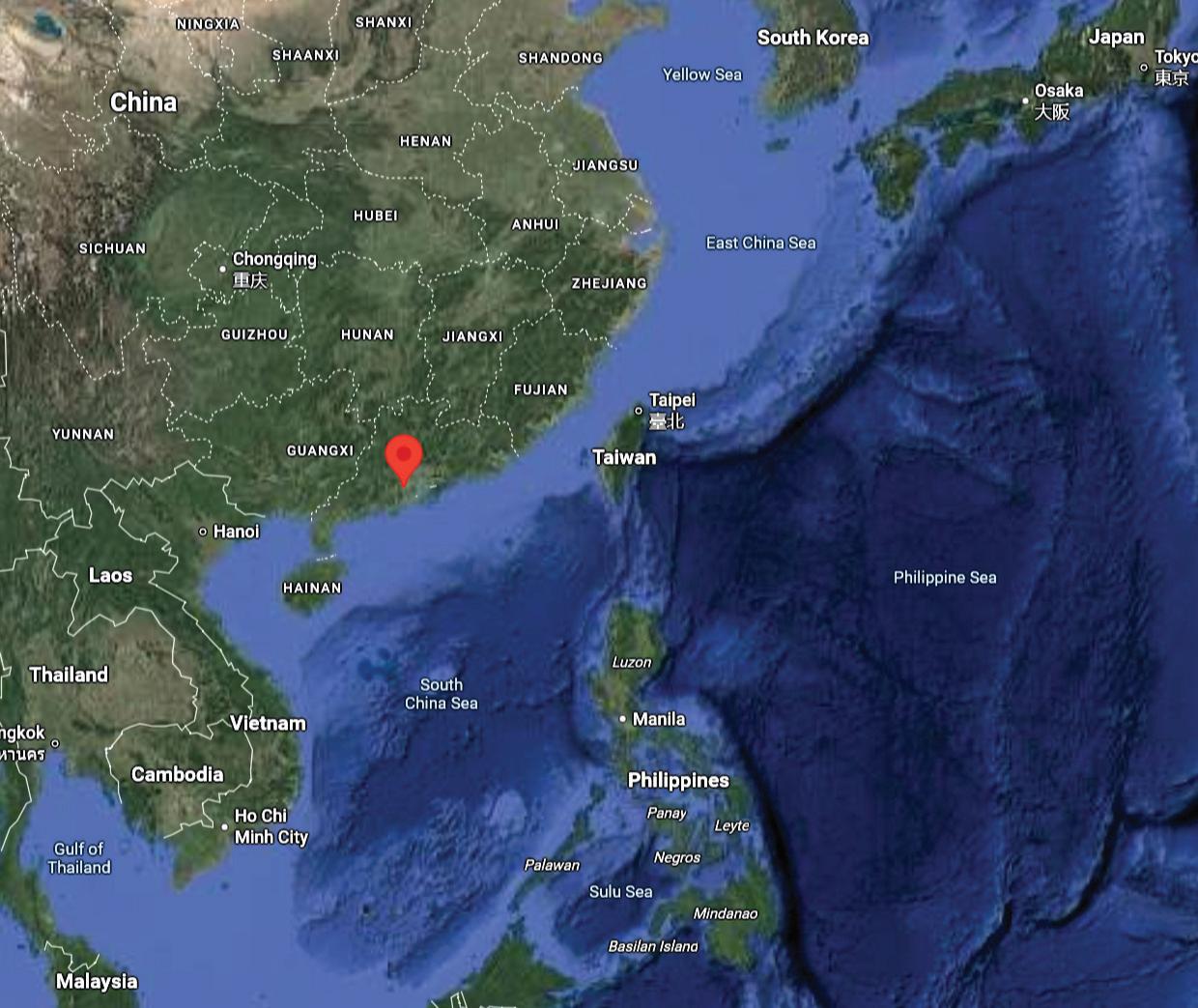
The red dot on this map of East Asia shows the location of Jiangmen, China. Mayor Wu Xiaohui of Jiangmen sent a letter to the Monday, April 27 Prince George city council meeting announcing a delegation to the latter city and requesting a sister city agreement.
the friendly cooperation between Jiangmen and Prince George,” Xiaohui said.
Speaking during the meeting, Frizzell said his work with Jiangmen started in his first term on council. While the relationship has languished somewhat since Green was mayor, Frizzell said it was good to see it being picked up again with the mayor’s planned visit.
He moved for council to direct the Standing Committee on Intergovernmental Affairs to prepare a response for the Jiangmen delegation.
Coun. Brian Skakun said it would be tight timing with the next committee meeting scheduled for May 8, but it could get done.
City manager Walter Babicz said that it might make more sense for the motion to refer the matter to the mayor’s office to make sure it gets done before the delegation arrives.
Mayor Simon Yu called Jiangmen a city the size of Vancouver and said a partnership could bring a lot of opportunities.
Prince George city council spent more than half of its contingency funds for 2026 in the first quarter of the year, according to a report presented at its Monday, April 27 meeting.
Two expenditures were noted in a report from city administration. They first used $25,000 to set up a new grant stream for local seniors’ organizations. This was approved during budget deliberations this January. It came after council rejected a proposal from Mayor Simon Yu to distribute the remainder of its 2025 contingency funds equally between the city’s five seniors’ centres last December.
He said the delegation would visit a burial site for Chinese immigrants during their trip to the region and he was looking to get Indigenous involvement in the delegation’s visit.
Yu added that Premier David Eby’s office has been notified of the visit and it could be brought up the next time he visits China if the sister city agreement is finalized.
Jiangmen, Yu said, has a museum dedicated to locals who have emigrated across the world the size of the Prince George Civic Centre.
Coun. Trudy Klassen said immigrants from Jiangmen helped build the railway from North Vancouver to Prince George that a group of BC Municipalities is currently trying to save.
Motion: Council directs the mayor’s office to prepare programming for the upcoming delegation from Jiangmen, China.
Result: Approved unanimously.
Then, in March, council approved spending $1,500 to host a public Party in the Plaza event at Canada Games Plaza during the annual general meeting of the North Central Local Government Association.
The NCLGA is an advocacy group made up of representatives from local governments across north and central British Columbia. Prince George is hosting its AGM this year at the Civic Centre between May 20 and 22.
With a total of $26,500 in approved spending from 2026 contingency funds, council has $23,500 remaining to spend until the end of the year.
Contingency funds unspent by the end of a calendar year are rolled into that year’s surplus.

COLIN SLARK Citizen Staff
Members of Prince George city council claimed nearly $16,000 in expenses in the first quarter of 2026, according to a report presented at a meeting on Monday, April 27.
After each financial quarter, councillors are required to submit a report outlining how much of their annual expense budget they used during that period.
Councillors can spend up to $10,000 on expenses, while the mayor’s expense budget is set annually. In 2025, Mayor Simon Yu had an expense budget of $22,800.
In the first quarter of 2026, Yu claimed $5,470.34 in expenses.
His report said the expenses were related to attending the BC Natural Resources Forum, dining at The Keg with the visiting consul general from the United Kingdom, attending a Prince George Spruce Kings event in
COLIN SLARK Citizen Staff

Burns Lake, registering for the annual Federation of Canadian Municipalities convention later this year, attending an International Women’s Day breakfast, going to a Connective leadership summit in Vancouver and other activities.
Here is a list of what the rest of council claimed, along with a brief summary of their expenses.
• Coun. Trudy Klassen claimed
• $28,865 to Mirkwood Engineering BC Ltd. for refrigeration and heating at the CN Centre
The City of Prince George spent more than $450,000 on consultants in the first quarter of 2026, according to a report presented to council on Monday, April 27.
The spending is divided into two categories, those that received $25,000 or less in payment and those who were paid more than $25,000.
Between Jan. 1 and March 31, 2026, six consulting firms were paid more than $25,000:
• $87,340 to L&M Engineering forwork at sanitary lift stations
• $65,654 to R.F. Binnie & Associates for work at Carrie Jane Gray Park
• $63,427 to FaulkerBrowns Architects for services for the Prince George Aquatic Centre and the CN Centre
• $30,790 to Associated Engineering (BC) Ltd. for a wastewater treatment centre master plan
• $26,949 to Deloitte LLP for economic development consulting
In the $25,000 and below category, there were 17 firms that were paid a total of $150,286.
Here were the top five:
• $20,480 to BL Association Corporate Psychologists Inc. for firefighter recruitment
• $17,221 to GeoAdvice Engineering Inc. for a hydraulic impact analysis and a digital water model rehabilitation
• $16,667 to Unify Partners Inc. for economic development consulting
• $15,087 to Rae McLean and Associates for HVAC work at the Civic Centre and the Two Rivers Art Gallery
• $14,886 to BOT Corp. for monthly sewer data reporting
$2,124.84 for a tour of the Lillooet Nation, a UNBC business faculty dinner, a BC Assembly of First Nations economic development event, a tour of a Seaspan facility and work related to the Northern Rail Connector project, among other activities.
• Coun. Ron Polillo claimed $2,090.71 for an International Women’s Day event, registration for the Union of BC Municipalities (UBCM) convention in Vancouver in September and registration for the Federation of Canadian Municipalities (FCM) convention in Edmonton in June.
• Coun. Susan Scott claimed $1,317.75 for FCM registration but noted in her report that she cancelled and the refund will be included in her next report.
• Coun. Kyle Sampson claimed $1,255 for FCM registration.
• Coun. Tim Bennett also claimed
$1,255 for FCM registration and for attending events as acting mayor, including Winterfest, Persian New Year and a Black History Month gala.
• Coun. Cori Ramsay claimed $1,081 in expenses related to this year’s BC Natural Resources Forum. While Ramsay is currently president of UBCM, she noted in her report that the city is not incurring any expenses related to those duties.
• Coun. Brian Skakun claimed $965 related to this year’s BC Natural Resources Forum.
• Coun. Garth Frizzell claimed $160 in expenses related to this year’s FCM convention.
Combined, the mayor and council claimed $15,720.14 in expenses during the first quarter.
Subtracting Scott’s expenses, which she said will be refunded, brings the total to $14,402.39.



KENNEDY GORDON Citizen Managing Editor
Prince George has a pretty good transit system. Your editor, having used transit in cities large and small for decades, spent some time on the bus here during a between-vehicles situation last year, and was impressed with its schedule, its efficiency and the way people call out “thank you” when they disembark.
A lot of communities take a business approach to their transit systems, operating on the idea that the goal is to keep costs down, balance the books and avoid asking for more cash.
But if you take a look at the City of Prince George’s latest transit operating agreement with BC Transit, you see some different thinking, along the lines of buses being a service, not a moneymaker.
The current numbers tell a pretty straightforward story.
The city’s transit system costs far more to run than it brings in through fares. After revenue and the provincial contribution are factored in, Prince George still pays roughly $5.9 million locally to keep buses on the road.
That’s not a failure, though. That’s the design. Public transit, like roads, parks and libraries, isn’t supposed to turn a profit. Transit exists because people need it.
And people really do need it.
The problem is that the current plan is built around maintaining what already

exists, not around making it better. City staff describe the 2026-2027 agreement as focusing on “stabilizing existing operations” rather than expanding service. That might sound responsible in a tight fiscal environment, but it sidesteps the fact that demand isn’t standing still. Ridership data shows people are using the system, and recent changes — like expanded weekend service on some routes — were introduced precisely because buses were getting busy.
So we have a system that’s being used, a population that depends on it and a plan that calls for … holding the line?
That isn’t a strategy. It’s a pause button.
If you’re a student or someone working outside a typical nine-to-five schedule, that pause has real consequences. Transit in Prince George does run seven days a week, but service levels taper off at the exact times many people need it most — late evenings, Sundays
and holidays.
For someone trying to get to a night shift, or home after a late class, “limited service” can easily mean “no practical option.”
That’s where the conversation about transit often misses the stop. It’s not just about buses. It’s about access. If you can’t reliably get to or home from work or school, your opportunities shrink. And not everyone can afford to use taxis or ride-share services – or own and operate a vehicle, especially with the rising cost of living (and gas!).
A city that underinvests in its transit is blocking the avenues available to its own residents.
The same logic applies to accessibility. Prince George operates both conventional transit and custom services like handyDART, which provide door-to-door transportation for people who qualify. That’s a crucial piece of infrastructure. But custom transit operates at a much smaller scale and doesn’t run on many holidays. For riders who
rely on this, gaps in service aren’t inconvenient. They’re isolating.
If we take seriously the idea that transit is an essential service, then these gaps matter. They point to a system that’s functioning but not fully serving the community’s needs.
There’s also a bigger payoff to getting this right. The city has already identified environmental protection as a strategic priority, and transit plays a direct role in that.
More reliable and accessible service means fewer cars on the road, lower emissions and a more sustainable urban footprint. But those benefits don’t materialize if the system is just chugging along in the same gear.
We should be honest about what “fiscal responsibility” really means here. Yes, costs are rising — fuel, maintenance and fleet replacement all add pressure. But choosing not to invest more doesn’t eliminate those problems; it just shifts the burden onto riders through reduced service quality, limited availability and, eventually, rising fares.
A healthy transit system is part of a healthy community. It connects people to jobs, education, healthcare and one another. It makes a city more livable, more inclusive and more resilient.
Prince George has already committed to keeping transit running. The next step is deciding whether “running” is enough.
Your editor, by the way, was on the TTC in Toronto last week and called out “thank you” when getting off the bus.
We acknowledge the fnancial support of the government of
Nous reconnaissons l’appui fnancier du gouvernement




OFFICE (8:30a - 4:30p)
505 Fourth Avenue
Prince George, B.C. V2L 3H2
FRONT DESK & CLASSIFIED frontdesk@pgcitzen.ca 250-562-2441 NEWS AND SPORTS news@pgcitzen.ca
LETTERS TO THE EDITOR editor@pgcitzen.ca
OWNER / PUBLISHER owner@pgcitzen.ca


Editorial: Random violence should never be ‘just part of the job’
When judges allow violent offenders back out on the street because they want to go on out on a limb they are part of the problem.
We aren’t focusing on solving the addiction issue, society wants to stop at giving Narcan to stop overdoses.
Yet this just enables the behavior to continue. The addict comes out of their high angry and attacks.
If we pushed for rehabs and helping people get over their addictions maybe things would change. But pushing drugs on addiction won’t help.
Alucard
Editorial: Random violence should never be ‘just part of the job’
This editorial focuses on violence against paramedics but also refers to those who keep us safe.
That should include the RCMP.
Last week, an RCMP spokesperson described the risks officers face during a large-scale fentanyl lab raid in Chilliwack, including exposure to toxic chemicals.
He called on the justice system to do its job after officers risked their lives.
Many Canadians feel those dangers are not being taken seriously. Common sense is missing when officers have to make that appeal.
waymar10@telus.net
City of Prince George to ask public to OK $15.86M in CN Centre work
The building didn’t appear to need major work during my last visit. Other downtown buildings need maintenance more urgently. If CN Centre generates revenue, why can’t it fund upgrades? This suggests a management issue.
Mike with concerns
City of Prince George to ask public to OK $15.86M in CN Centre work
This cost should be covered by CN Centre revenues, not taxpayers.
Alan Addams

City of Prince George to ask public to OK $15.86M in CN Centre work
The alternative approval process (AAP) feels like a sneaky way to make decisions. Many people won’t take the time to submit opposition forms. Major spending should be decided during an election.
Skidderbugs

The idea of free education is interesting. A pilot program focused on trades and health care, funded federally, could be a practical start.
D Goods
City of Prince George to ask public to OK $15.86M in CN Centre work
This sounds similar to the aquatic centre project. Concerns about the building envelope seem vague. Buildings made of concrete and steel can last 50 to 100 years. There may be more behind these upgrades, possibly tied to environmental targets.
Zangief

Fraser-Fort George directors look to bring vacancy tax north
Adding another tax seems like a lazy solution. It looks more like an attempt to extract more money rather than address real problems.
Canadians are already heavily taxed while seeing fewer returns.
When do we start evaluating public-sector performance and costs? Why are judges receiving raises during a time of rising crime?
Meanwhile, people struggle financially. Government spending is also concerning — for example, a reported $130,000 clothing allowance for the Governor General.
Zangief
Fraser-Fort George directors look to bring vacancy tax north
Adding another tax seems like a lazy solution. It looks more like an attempt to extract more money rather than address real problems.
Canadians are already heavily taxed while seeing fewer returns. When do we start evaluating public-sector performance and costs? Why are judges receiving raises during a time of rising crime? Meanwhile, people struggle financially.
Government spending is also concerning — for example, a reported $130,000 clothing allowance for the Governor General.
D Goods
Students from the University of BC Northern Medical Program pose for a picture at their graduation celebration at UNBC. The 27 members of the Class of 2026 will now begin two to seven years of medical residency or fellowship training, many of them in rural communities. Some will become family doctors. Others will enter specialty fields like pediatrics, anesthesiology, obstetrics, internal medicine and dermatology.

BOB MACKIN
Local Journalism Initiative Reporter
A report to BC’s chief coroner on Monday, April 27 recommended a co-ordinated provincial response to intimate partner violence (IPV) by aligning ministries, standardizing policies and ensuring accountability.
Between 2016 and 2024, at least 135 people died at the hands of their partner, prompting chief coroner Dr. Jatinder Baidwan to convene a death review panel of two dozen experts to study the issue.
The panel called such deaths “overwhelmingly preventable” but healthcare providers, police and others missed the warning signs or were unable to adequately respond due to systems that were uncoordinated or overburdened.
“Things have not improved (since the early 1990s),” Baidwan said in a Victoria news conference.
Baidwan said the solution is not

necessarily to increase budgets and spend more money.
“When you look at these deaths, what they share is that people knew that it was happening,” Baldwan said. “It’s not just about government taking responsibility, it’s about communities taking responsibility. it’s about people being open and honest about these things.”
The report emphasized rural and northern communities face elevated
risk.
“Northern Health had the highest rate of IPV-related deaths, and rural communities were over-represented,” it said. Statistics showed that Northern Health had 22 victims during the eightyear period. The rate of 8.3 per million person-years was more than double the Interior Health region.
The panel’s report said women were disproportionately the victims — more
than three-quarters of victims killed by an intimate partner were female.
Although only 5.9 per cent of the population, 24 per cent of the victims were Indigenous.
Firearms and sharp objects the most-common weapons used and nearly three-quarters of victims were killed in their own homes.
“A known history of violence was common but not universal. 36 per cent of victim-perpetrator relationships had at least one prior incident of police-reported IPV and, of these, 29 per cent of incidents occurred within one month of the death,” the report said. “Over half of perpetrators had a history of assault.”
The panel also recommended a standing committee to review individual deaths, enhance training for first responders to identify the violence and support survivors, enhance data collection and information sharing and launch a public awareness campaign.
COLIN SLARK Citizen Staff
Plans for renovations at the Prince George Aquatic Centre have changed after additional issues, including mould and corrosion, were discovered by the firm contracted to manage the work, city council heard at its Monday, April 27 meeting.
However, city staff said the project remains on schedule and is expected to come in under budget due to revisions to the scope of work.
Initially, $14.9 million in spending was approved in 2020 for energy-efficiency improvements, as well as upgrades to walls, the roof and mechanical systems.
For that work, the city received $6.3 million in federal and provincial funding, but it has yet to be carried out due to delays caused by the COVID-19 pandemic.
In May 2024, the city approved $22.15 million in additional debt-funded spending for the pool after it went through the alternative approval process.
The pool closed for $37 million in renovations on Jan. 1, 2026.
Since the closure, posts in local social media groups have expressed concern over an apparent lack of activity at the pool.
A report from city staff explained the perceived lack of progress.
The report says the project includes the complete replacement of the building envelope, installation of metal panels on exterior walls, addition of a new dehumidification system, replacement of some air-handling units, new acoustic baffles, new tiles in the pool, lobby and change rooms, accessibility improvements, new signage, a new fire alarm system and sprinkler heads, among other upgrades.
After the city signed a contract with a construction manager last October, the release said the firm reviewed the plans and conducted additional testing on the building.
That testing could not take place while the pool was in use and revealed issues not visible on the surface, including water damage, corrosion and mould,
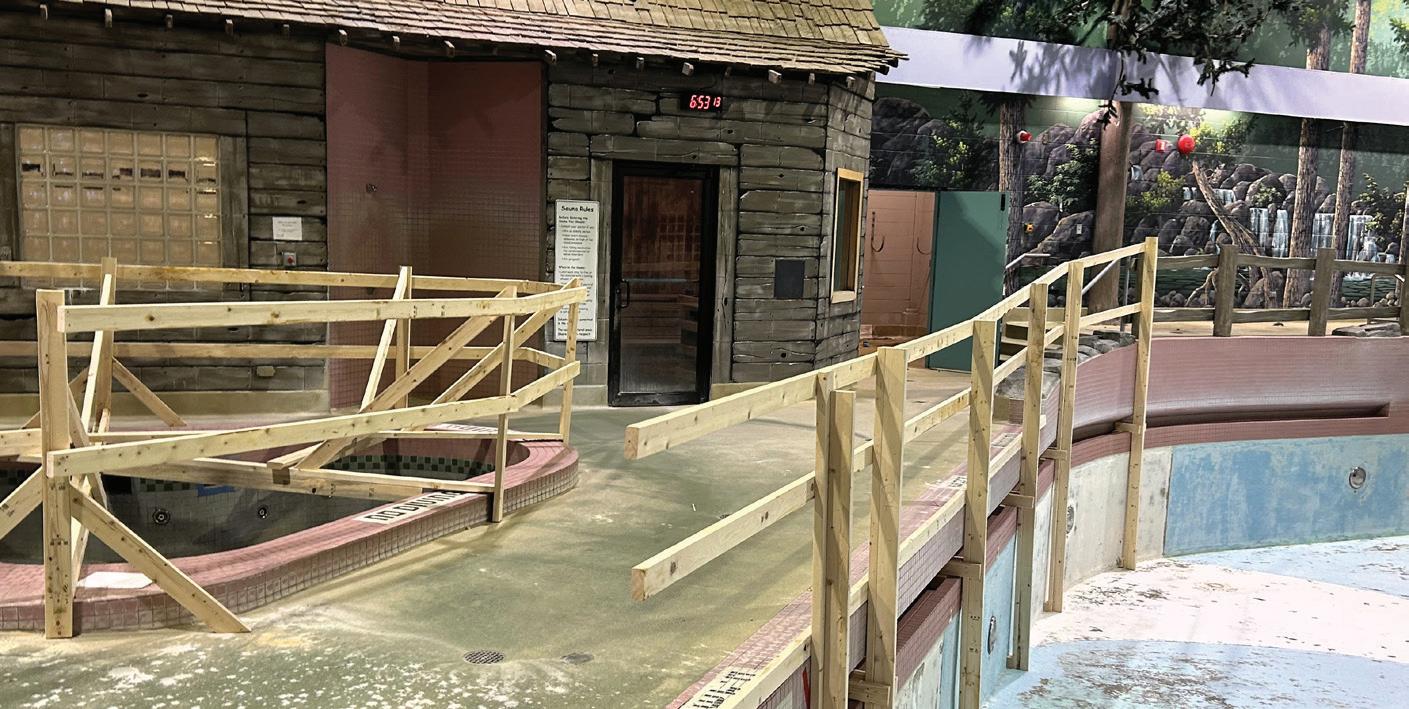
Temporary wooden railings are seen on the edges of pools inside the Prince George Aquatic Centre as part of renovations at the building. An update on construction was provided at the Monday, April 27, 2026 Prince George city council meeting.
which had to be incorporated into the construction plans.
When the construction manager reviewed the project budget, it determined costs would exceed what the city had allocated.
This led the city to undertake a “value-engineering” effort to identify savings.
Revised tender documents for various aspects of the updated plans were released in January, and contracts were signed in March.
“As a result of this conservative and methodical approach, the Aquatic Centre project is currently projected to be under budget,” the staff report said.
The city added that after the pool closed at the end of last year, preparations for construction included removing furniture, equipment and other materials, and draining water from various systems.
Draining water from the three pools alone took three weeks, while cleaning out equipment and 30 years of accumulated materials took three months.
So far, interior elements such as tiles and carpet, washroom and changeroom fixtures, and mechanical and electrical equipment have been demolished, removed or disconnected.
Safety measures, including barricades, storage and shoring elements, have also been installed. In one photo provided by the city, temporary barricades have
closed last weekend.
Coun. Ron Polillo asked what will happen when the Canfor Leisure Pool closes for its annual maintenance, leaving Prince George without any pools.
The shutdown is not optional, Beesley said, but staff are reducing it to three weeks this year from the usual month or longer. The closure is expected in August or September.
He added there have been no layoffs or staffing reductions due to the Aquatic Centre closure, although temporary layoffs are likely during the annual maintenance shutdown.
been set up along the rim of the wave pool.
During the meeting, director of civic facilities Andy Beesley said it is a massive project with many moving parts and the city needed time to ensure it was properly managed.
He said the building has now been completely cleared out and construction is underway.
Coun. Cori Ramsay commended staff for keeping the project on budget and asked how many businesses would be involved in the renovations.
Beesley said that, at a high-level estimate, there are 12 contractors and dozens of workers on site, with only three contractors based outside the city.
Ramsay also asked whether any labour shortages are expected. Beesley said contractors have indicated the project will remain on schedule, suggesting shortages are unlikely to be an issue.
Ramsay said regular updates, including photos and videos, would be of interest to the public during the project.
Coun. Tim Bennett praised efforts to accommodate swim clubs at the Canfor Leisure Pool during the closure, saying he has heard positive feedback from parents.
Beesley said there have been challenges, but also successes. He noted the Canfor Leisure Pool hosted its first swim meet since the Aquatic Centre
Coun. Brian Skakun asked about the nature of the non-destructive testing. Beesley said some testing was done last fall before the pool closed, but full access during the closure was needed to complete it.
Skakun also asked how value engineering affected the scope of work.
As an example, Beesley said that while some windows need replacement, the city examined whether others could be deferred.
Mayor Simon Yu asked whether council members could visit construction sites to verify details outlined in reports, including projects funded through borrowing approved via the alternative approval process.
City manager Walter Babicz said council’s role is primarily policy-focused and that members receive asset management reports before work is approved, though tours could be arranged at a high level.
Yu then asked whether a resolution would be required for him to visit the Aquatic Centre. Babicz said the matter could be discussed further, depending on the purpose of the visit.
Yu said he wants to be informed so he can answer questions from the public. Babicz said that could be arranged. Yu added he would visit the Aquatic Centre the following day.
Ramsay said she would prefer any tour be open to all council members and scheduled when it is safe and appropriate. The mayor said he would not enter a construction site without permission from a supervisor.

MATTHEW HILLIER Citizen Staff
The Canadian Union of Postal Workers (CUPW) entered into a ratification vote on Monday, April 20 that has left many members in Prince George nervous.
The new five-year agreement is the result of more than two years of job action undertaken by CUPW.
However, CUPW 812 president Nicole Chouinard said postal workers in Prince George are concerned for the future.
“There’s a lot of apprehension, there’s a lot of nervousness,” said Chouinard. “There will be uncertainty for a while because the voting process takes as long as it does to deal with a nationwide union; everybody will be waiting on pins and needles.”
She said that the majority of this concern comes from the newly unveiled transformation plan by Canada Post, which proposes ending door-to-door delivery altogether with a transfer to community mailboxes.
Chouinard said door-to-door delivery is how the majority of Prince George residents receive mail.
As well, Canada Post CEO Doug Ettinger has stated that the company is looking to reduce the workforce by
30,000 positions by 2035, through either retirements or voluntary departures rather than layoffs.
These recent announcements have left many CUPW workers in Prince George with the impression that this new tentative agreement is just a stopgap.
“We’re concerned about, literally, whether or not we will have jobs in the next few years,” said Chouinard. “That is stressful for a lot of people. The numbers have come out, and they’re looking to eliminate 25 to 40-ish per cent of our workforce. That is very stressful for a lot of people, and it’s forcing people to consider early retirement or look for other work.”
She added that despite some nervousness about the future, the new agreement can give workers peace of mind while they work to solve other issues.
“If this tentative agreement is ratified, our job security still exists until the end of this agreement,” said Chouinard.
“That’s a good thing. A lot of people are happy with that because that was something that wasn’t on the table in previous offers from Canada Post. Job security at this point is a really good thing for us, and we will continue to fight back on community mail box conversion.”
Canada Post also announced in a media release on Monday — the same day that voting began on the new agreement — that it is operating at a $1.57 billion loss before tax for 2025. This is nearly double its losses in 2024.
However, Chouinard was not surprised at the recent downturn.
“Canada Post has been losing money, allegedly, since 2018,” said Chouinard. “But it wasn’t a topic of conversation or a top news story until negotiations started. That’s troubling. The reality is that if they’ve been losing money since 2018, they have had six to eight years to diversify or trim the fat or whatever has needed to happen between then and now.”
She believes that Canada Post is losing money because Canadians are losing faith in its services.
Chouinard said that continuing to cut jobs and remove services like door-todoor delivery is not the way to address that.
“The reason why they’ve lost as much money as they have is because of the job uncertainty that’s been happening over the last two years,” she said. “You’re going to have less faith in Canada Post if you have no level of service. At the end of the day, Canada Post is a public service. If you take that service
away from Canadians, it’s a slippery slope.”
Chouinard, in addition to being her local CUPW president, is a relief letter carrier who handles door-to-door delivery.
Her estimate is that if the conversion to community mailboxes takes place in Prince George, approximately 40 per cent of letter carriers in town would be out of work.
During her routes, she has also heard from Prince George residents about the proposed conversion.
“They’re seniors with mobility issues,” she said. “They’re low-income people who don’t have vehicles. They don’t want to have to drive four blocks away or walk four blocks away or whatever the case may be. They want it at their door.”
She has been encouraging people who are concerned about the switch to contact local federal representatives.
“I tell them when they talk to me about it, please contact your MP,” said Chouinard. “The only leg that we can reasonably stand on as constituents of our MPs in this area is to contact them and say, ‘Do something. Stop this. This isn’t what Canadians want.’”
Voting on the new agreement continue until May 30.
COLIN SLARK Citizen Staff
The College of New Caledonia’s board passed a balanced budget for the 202627 fiscal year at a meeting on Friday, April 24 despite a projected $8.7 million drop in international tuition.
A media release sent out on the afternoon of April 24 was scant on details, except that the decision to close the college’s Fort St. James campus as of March 31 as well as workforce reductions due to retirements or layoffs were “difficult decisions” made during the budgeting process.
Quoted in the release, college president Cindy Heitman said it was one of the most difficult budgets in recent history for CNC.
“Balancing this budget required thoughtful, and at times difficult, decisions,” Heitman said. “We did not take these lightly. Every step was guided by our responsibility to ensure CNC remains strong, sustainable, and able to serve our students and communities into the future.”
Documents attached to the agenda for the college board meeting stated that the college saw a drop in international tuition of $7.1 million from the previous
school year in 2025-26 after Immigration, Refugees and Citizenship Canada decided to let fewer international stu dents into the country each year.
This year, CNC is projecting a further $8.7 million drop in international stu dent tuition.
That means that the college has seen those revenues drop around $15.8 mil lion in just two years.
While grants from the provincial government are projected to increase by around 1.16 per cent from 2025-26 to 2026-27, that’s not enough to cover the projected 64.18 per cent drop in overall tuition revenue mostly driven by fewer international students.
To find savings, the college will spend around $6.1 million less on instructional expenses in the next academic year. Support expenses are being cut by around 12.2 per cent as well.
The total number of cut positions was not stated in the budget documents, but the college is cutting just over $8 million worth of employee-related expenses.
The college is projecting expenses and revenues to balance at $83,044,904 this year. That’s a drop of more than $9.5 million from the $92,641,975 balanced expenses and revenues in 2025-26.



BOB MACKIN Local Journalism Initiative Reporter
A Prince George-born woman was sentenced to five-and-a-half years in jail for speeding away from the Canada-U.S. border with 108 kilograms of methamphetamine hidden in a vehicle trunk.
Sukhvinder Kaur Sangha, 47, drove a rental car with Florida licence plates across the U.S. to the Pacific Border crossing in Surrey, BC on Oct. 18, 2021. Rather than submit to the secondary search, Sangha fled from Canada Border Services Agency officers before she was nabbed more than four kilometres away from the border.
Just over three years later, Sangha pleaded guilty to unlawful importation of methamphetamine.
The Crown wanted 10 to 12 years in jail. The defence proposed a two years less a day sentence in the community plus probation. Sangha had no pretrial sentencing credit.
The Crown stayed the charge of possession for the purpose of trafficking.
Sangha had, for the past 10 years, worked as a producer and broadcaster in Punjabi language media.
Sangha said she was told indirectly to pay $150,000 or her teenage son would

The RCMP shared this composite image showing baggies of methamphetamine found in a vehicle searched at the Surrey border crossing in 2021.
be injured or killed. So she chose to import drugs in lieu of payment.
Justice John Gibb-Carsley said Sangha expressed remorse because she was caught, rather than for her offending behaviour. Gibb-Carsley counted her plea as a mitigating factor.
“I have assessed Ms. Sangha’s moral blameworthiness and conclude that
she was aware that she was importing a large quantity of illegal drugs into Canada,” the judge ruled. “Given her previous work with youth and police, she would be aware of the harm that methamphetamine can wreak on individuals and society.”
Gibb-Carsley said he hoped that Sangha understood the “significant
risks, dangers and consequences associated with the illegal drug trade. It is not a victimless crime.”
He addressed her directly: “My hope is that you can use your time of incarceration productively and positively such that this is your last interaction with the criminal justice system.”
BOB MACKIN Local Journalism Initiative Reporter
A Provincial Court judge in Prince George rejected a joint recommendation on April 22 for a man guilty of possessing drugs for the purpose of trafficking to serve a suspended sentence.
James Alan Webb was charged with the Sept. 13, 2023 offences after a Prince George RCMP officer attended a residence on 20th Avenue to investigate a report that a male was outside a residence, screaming that he wanted his stuff back, kicking a door at a residence and threatening to kill a woman.
Knocks on the front door went unanswered.
So the officer went to the rear and found Webb crouched down in the corner of the garage next to a small backpack with one of hand in the pocket of the backpack. The officer saw a table in the garage with a stack of $20 bills, baggies and what appeared to be methamphetamine and fentanyl. He arrested Webb and another man.
Police seized $1,359 in cash and 41 grams of fentanyl, 34.8 grams of methamphetamine and 15.21 grams of cocaine from the backpack.
The fentanyl was worth an estimated $3,000 to $18,000, depending on how it would be sold.
Federal Crown Prosecutor Amritpal Gill described Webb’s record, which
began in 2002, as “long.”
Webb has been sentenced 26 times for offences ranging from property crime and theft to assaults, firearms and vehicular offences. He had two prior trafficking convictions from 2008 and 2012, but this was his first fentanyl charge.
“The fact that Mr. Webb was in possession of such drugs for the purpose of trafficking, he did contribute towards that overall collateral harm to the society,” Gill said.
Gill told Judge Cassandra Malfair that the guilty plea, remorse and accepting responsibility are mitigating factors, as is his Indigenous background and efforts toward rehabilitation.
The Crown and defence proposal
included two years probation and 40 hours of community work service.
But Malfair said that Webb has an “astonishing record” and she refused to agree to the proposed sentence, because of two aggravating factors.
“His record is just too bad and that’s just too much fentanyl,” Malfair said.
Malfair said the only way the proposal would pass muster is if there were exceptional circumstances.
“If more time were to pass, Mr. Webb were to come back six months from now, for example, and he was still on the right path,” Malfair said. “Then, possibly.”
She ordered an updated pre-sentence report and set Oct. 14 as the deadline.
BOB MACKIN
Local Journalism Initiative Reporter
The former executive director of the Northern BC Graduate Students’ Society (NBCGSS) wants a judge to order the BC Human Rights Tribunal to reconsider the decision to dismiss his complaint and proceed to a hearing.
In February, the tribunal dismissed Alden Chow’s complaints about discrimination that allegedly led to his Oct. 31, 2023, resignation.
Chow accused the society of discrimination on racial, colour, ancestry, place of origin and mental disability grounds. He is of Chinese descent and has suffered anxiety and depression.
Chow’s April 13 petition for a judicial review in the BC Supreme Court’s Prince George registry said the tribunal failed to fulfill its mandate — by
breaching procedural fairness and natural justice — when it granted the society and the respondent’s application to dismiss the action without a hearing.
The tribunal also agreed to anonymize the respondent’s application.
Chow also said the tribunal “improperly made decisions on the merits of the petitioner’s complaint and amended complaint, and improperly made findings of facts on a summary dismissal application without a hearing.”
Chow alleged 20 failures by the tribunal in total, including improperly conflating statutory language of “race” under the Human Rights Code as the same statutory language as “colour, ancestry and place of origin” under the Human Rights Code.
Chow said it incorrectly found as fact that he worked for the society at University of Northern BC from
BOB MACKIN Local Journalism Initiative Reporter
A Prince George Provincial Court judge ordered a 17-year-old boy to spend another 15 days in the Burnaby Youth Custody Centre for disobeying curfew.
The boy, whose identity is protected under the Youth Criminal Justice Act (YCJA), was under a 120-day supervision order after a January sentence on four offences. He had been released on community supervision on March 22, but breached conditions almost immediately and again the next day.
On the first day of community supervision, the boy did not return to his approved residence until 2:41 a.m. He also broke curfew the next day. His youth probation officer did not hear from him while he was at large until after his April 15 arrest by RCMP.

November 2018 to October 2023, when evidence submitted said he worked in the position earlier than November 2018. He also submitted evidence that board members were not volunteers, but employees who were paid income.
The tribunal, Chow claimed, also failed to consider “the petitioner’s intersecting identities of race, colour, ancestry, place of origin and mental disability together as a whole.”
Chow had complained that the society was a toxic workplace and he was forced to resign because of the discrimination
he experienced. His complaint mentioned three 2020 incidents, including the spreading of misinformation against Chinese people and COVID-19 in a group chat with Chow and the board.
Chow accused the same person of expressing doubt about the official pandemic death toll and the efficacy of vaccines.
Tribunal member Ijeamaka Anika concluded that, based on evidence, there was no reasonable prospect that a hearing could find Chow was constructively dismissed from the job.
The warrant of apprehension issued March 24 paused the community supervision that was to expire May 1.
At the April 24 hearing, court heard the boy has 20 convictions for breaches of YCJA orders on his criminal record and two instances of failing to abide by a community supervision order.
Simpkin asked if he had anything to say.
Among other things, he said “I guess I messed up” and “should have done better.”
“What faith do I have that, in 15 days, we’re not going to be right back here with you ignoring terms of the supervision order?” Simpkin asked.
He answered it “just really sucked” being in cells waiting to appear in court. “I want to spend my life, I want to be enjoying my life, I don’t want to be messing this up.”



BOB MACKIN Local Journalism Initiative Reporter
Seven days’ time served, plus 18 months’ probation for a man who pleaded guilty to wilfully resisting or obstructing Prince George RCMP officers more than a year ago.
Alexander Edward Senez, a 33-yearold Indigenous man, had also been charged with break and enter and committing an indictable offence, unlawful
Local Journalism Initiative Reporter
A Provincial Court judge gave the Prince George RCMP another year to keep items seized during an investigation into child pornography.
In a Feb. 13 decision by Judge Micah Rankin, published April 24, a lawyer for the Attorney General of Canada successfully applied for the extension order under the Criminal Code.
Court heard the investigation began in January 2025 and resulted in the search of a residence for child sexual abuse and exploitation materials (CSAM). Police seized computers, cellphones and a hard drive. In April 2025, the RCMP retained Teel Technologies to extract the data. Teel returned the devices to the Prince George RCMP in October 2025.
Rankin said he was satisfied, based on sworn evidence provided, that the investigation is ongoing and further detention is warranted.
“In particular, based on the affidavit evidence that has been provided, it is apparent that police have been examining the data, which was received by them in or around October 2025 and continue to look for materials that are relevant to this investigation for possessing and accessing CSAM material,” Rankin decided.
confinement or imprisonment, assault with a weapon, possessing a weapon for a dangerous purpose and criminal harassment.
The two complainants did not appear for the scheduled Provincial Court trial in Prince George on April 23, so all charges were stayed except for the one that Judge David Simpkin referred to as the “least serious.”
The incident began Feb. 23, 2025, when Senez was in a room with a
woman and refused to comply with the officers’ commands to come out peacefully. They also demanded he drop a piece of glass that, at one point, he held to his own neck.
Senez, who earlier possessed a machete, jumped out of the window of the room, was Tasered by an officer and taken into custody.
His conviction list had only two offences, both after the date of the charges, and he has been in custody
since September 2025.
“It’s clear from the circumstances set out by the Crown that Mr. Senez was suffering from some mental health issues at the time of this offence,” Simpkin said.
The Crown and defence jointly proposed the sentence, which includes what is called a Rogers audit. That involves reporting to Forensic Psychiatric Services, attending appointments and taking prescribed medications.

disturbances landed in Prince George court on Friday, April 24.
BOB MACKIN
Local Journalism Initiative Reporter
Time served was ordered for a 47-year-old man who pleaded guilty to assault with a weapon, mischief under $5,000 and breach of an undertaking.
Keghan Samuel Cosh appeared April 24 in Prince George Provincial Court before Judge David Simpkin, who also ordered two years probation — six months longer than the Crown sought.
“If you’re serious about your rehabilitation, it’s going to take a while,” Simpkin said.
“That’s why it’s for two years.”
Cosh, an Indigenous male who has battled addictions and homelessness, served a total of 62 days prior to sentencing, for which he was given 93 days’ credit under the time-and-a-half rule.
Court heard that, on July 28, 2025, staff of the Prince George Courtyard Marriott hotel called Prince George RCMP to report damage to the outside of the hotel that occurred at 10 p.m. Damage included scratches and broken siding.
An officer who reviewed the surveillance video recognized Cosh from multiple interactions.
At 1:47 p.m. the next day, an officer found and arrested him for mischief, but released him on an undertaking.
On Sept. 9, 2025, a man working at 10th on Central Liquor Store saw a pit bull running in the parking lot without its owner.
He noticed the dog hiding in a bush near Burger King and tried to help the dog out of the bush.
Then Cosh suddenly approached him with a knife in a sheath around his neck. Cosh took the knife out, pointed it at the man and walked toward him.
“Leave my f------ dog alone,” Cosh said. The man backed up, returned to the store and called police.
When police arrested Cosh, they found a machete in a black sheath on his waistband. He was released the next day.
“Mr. Cosh, you shouldn’t be wandering around Prince George with machetes that you wave or knives around your neck,” Simpkin said. “It’s only going to get you into trouble.”
On Nov. 12, 2025, Cosh was arrested for possessing a butane torch, contrary to his undertaking, when he was found lighting a paper bag on fire near Burger King at 12:56 a.m.
Simpkin prohibited him from possessing weapons and incendiary devices.
Simpkin remarked that he presided over one of Cosh’s bail hearings, where he claimed to have lit a fire to heat up a doughnut.
Simpkin said he did not initially recognize Cosh at the latest hearing because he had gained weight.
“So obviously keeping off drugs and getting healthy is going to have a quick turnaround there, Mr. Cosh,” Simpkin said. “So hopefully you’ll be able to keep it up.”
BOB MACKIN Local Journalism Initiative Reporter
A former human resources manager with the Tsay Keh Dene First Nation pleaded guilty April 22 to defrauding an insurance company of almost $18,000.
Nelson Ugonna Onwuliri administered the band’s employee benefits plan and created accounts in the names of band members, ultimately using the accounts to file fraudulent claims with Sun Life Insurance for medical services from Dec. 1, 2022, to May 4, 2023.
A total of $17,742 from those claims was directed to one of Onwuliri’s personal accounts.
Sun Life, the victim of the fraud, recovered $13,200 from Onwuliri’s accounts. Court heard that the company confirmed in the past week that the outstanding amount of $4,542 was paid.
Associate Chief Judge Paul Dohm agreed to a joint Crown and defence sentencing proposal for a five-month

Court heard that depression over his father’s murder led to a man faking benefits claims from Tsay Keh Dene members in order to steal $17,742.
conditional sentence in the community, followed by 12 months’ probation.
Onwuliri, who had no prior criminal record, avoided jail by co-operating with the RCMP and Sun Life and pleading guilty as charged.
Dohm said the joint proposal recognized aggravating factors, including breach of trust and the “high degree of
Judge notes accused’s mother drank while pregnant with him
BOB MACKIN Local Journalism Initiative Reporter
A 45-year-old man charged with assault causing bodily harm maintained his not guilty plea, but entered into an 18-month peace bond during an April 21 hearing in Prince George Provincial Court.
Robert Richard Olsen had been charged with the Jan. 21 offence, but the victim did not wish to proceed.
Judge Martin Nadon heard that a man who walked by a woman’s residence noticed the woman with blood on her head. She was taken to hospital, while Prince George RCMP arrested Olsen
and took him to the detachment.
He was released the next day. Despite signing a no-contact undertaking, Olsen texted the woman and showed up at her residence with a case of beer. The woman did not answer his knocks on the door.
Police arrested Olsen again. He spent 90 days in jail and received credit for 135 days under the time-and-a-half policy.
Olsen, a member of the Cheslatta Carrier Nation, had struggled with fetal alcohol syndrome and attention deficit hyperactivity disorder.
“You’ve got a horrible record, and it’s clear to me that you’ve got a substance use problem, alcohol,” Nadon said. “I think you’ve got some other personal challenges that stem from the fact that your mother was drinking while you were in the womb.”
human resources management from the College of New Caledonia in Prince George and a Harvard Business School certificate in First Nations governance.
Defence lawyer David Jenkins Jr. told the court that his client still works in the field of human resources, but is ashamed and has an “enormous amount of remorse.”
Jenkins said Onwuliri committed the fraud over $5,000 after becoming depressed when his father was murdered by poisoning at a time when travel was restricted due to the COVID-19 pandemic.
moral culpability, but the exceptional efforts taken to amend the wrongdoing by paying back the full amount.”
The 34-year-old married father of four is a native of Nigeria who has lived in Canada for the past nine years and became a Canadian citizen in 2023. He has university degrees from Nigeria and the United Kingdom, a diploma in
Jenkins said his client’s personal circumstances were no excuse for the crime, but he was “in a mindset where he could commit a fraud such as this.”
Onwuliri must stay in BC unless he receives prior written permission from a conditional sentence supervisor.
“Keep looking after your family, keep working and no more of this kind of behaviour,” Dohm said to Onwuliri. “Understood?”

COLIN SLARK Citizen Staff
A Giscome Road restaurant has something to sing about after Prince George city council approved a recommendation for its liquor license to be amended to allow for karaoke events at its Monday, April 27 meeting.
The application was from Bonnet Eatery at 6947 Giscome Rd., which opened in September 2017.
A rationale letter from the owners attached to the meeting agenda said that since the restaurant opened in
September 2017, it has become a hub for neighbourhood families and a source of jobs for local teens.
The owners also own and operate OM Pizza Bar Café at 1970 Ospika Blvd. South, near the CN Centre.
By getting an endorsement for patron participation use, the owners said they’re looking to start hosting a weekly karaoke event using software that allows guests to register using their mobile devices without leaving their seats.
“The benefit of this is that it mitigates crowding and a line up of people, which in turn reduces the chances of
confrontation between patrons,” the letter said. “This set up creates a much more streamlined karaoke experience very different from a regular bar style karaoke.”
Also included on the agenda is a letter of support from Jonathan Asquith of Evasko Road, who said he lives around the corner from the restaurant.
He said he operates a short-term accommodation and frequently recommends that guests go for a meal at Bonnet Eatery as “a genuine local establishment that reflects the friendly and community-oriented nature of Prince
George.”
A report from city staff recommended that council pass a resolution endorsing the change to the liquor license and forward it to the provincial Liquor and Cannabis Regulation Branch for consideration.
Council approved the endorsement without debate.
Motion: Council endorses a liquor license amendment for Bonnet Eatery at 6947 Giscome Rd.
Result: Approved unanimously.
COLIN SLARK Citizen Staff
The City of Prince George issued more than double the dollar amount of building permits in March 2026 compared to the same month in 2025.
A report presented at the Monday, April 27 city council meeting broke down the number, type and estimated dollar value of permits issued this March.
In total, 37 permits with an estimated construction value of $13,963,737 were issued in March 2026.
That’s a much higher total than the 21 permits worth $6,960,427 issued in March 2025 and the 32 permits worth $6,325,840 issued in March 2024.
As of the end of March 2026, a total of 84 permits worth $29,051,348 had been issued. That’s a modest increase over the 74 permits worth $22,144,446 that had been issued at the same point in 2025.
However, it’s quite a bit lower than the 104 permits worth $41,833,901 that had been issued as of the end of March 2024.
The permits issued in March of this year included 15 for single-family detached homes and representing 13 housing units, six multi-family permits and 16 commercial, industrial and institutional permits.

Of the residential permits issued, a report from city staff noted that it included six permits relating to secondary suites, four permits for duplexes and nine permits for new single-family dwellings.
Among the commercial, industrial and institutional permits, there were 11 permits worth around $6.8 million for new buildings and five relating to building alterations worth $858,222.
Discussing the figures at the April
27 meeting, director of planning and development Deanna Wasnik said the city appears to be on track for a good year for construction. She added that she hopes the pace of construction will stay steady.
COLIN SLARK Citizen Staff
An expansion project for a natural gas pipeline going through the Regional District of Fraser-Fort George that Lheidli T’enneh First Nation owns a minority stake in was granted approval by the federal government on Friday, April 24.
The Westcoast pipeline transports natural gas from northeastern British Columbia down to Sumas, near the border with Washington state. It was originally built by Spectra Energy before that company merged with Enbridge in 2017.
The Sunrise Expansion Program aims to add an additional 139 kilometres of new pipe using looping segments and compressor stations to boost Westcoast’s capacity by 300 million cubic feet of natural gas per day.
A media release from the federal government pegged the value of the project at $4 billion, while also adding $3 billion to Canada’s gross domestic product
and adding more than $700 million in provincial and federal tax revenues.
Last year, Lheidli T’enneh First Nation and the McLeod Lake Indian Band were among 36 First Nations who partnered to buy a 12.5 per cent stake in Westcoast for a sum of $715 million.
The approval for the project includes 47 binding conditions, including some relating to environmental protection and engagement with Indigenous groups.
Federal Energy and Natural Resources Minister Tim Hodgson said in the release that the approval fulfills the government’s commitment to get projects approved and built.
“This project will enable us to heat more homes, businesses, hospitals and schools while bolstering British Columbian industry, including for LNG and creating thousands of jobs,” Hodgson said.
“It is proof that, in partnership with industry and Indigenous partners, we
BOB MACKIN Local Journalism Initiative Reporter
The company that employs Canadian Air Transport Security Authority (CATSA) screeners at Quesnel, Smithers, Williams Lake and four other small airports did not violate labour law when it ended administrative pay, an arbitrator has determined.
Due to the COVID-19 pandemic, Paladin Airport Security Services Ltd. introduced administrative pay for security screeners.
But on March 31, 2025, it ceased the policy, prompting a grievance from the Teamsters Local Union 213.
In an April 14 ruling, arbitrator Jitesh Mistry explained the pay covered “circumstances where the bargaining unit member is not working due to there being no flight to attend to at their airport, but they are still paid for their
can strengthen energy security and price stability and create new international trade opportunities while meeting rigorous environmental and safety standards.”
Enbridge president and CEO Greg Ebel said his company is thankful for the support of the federal government and stakeholders in the project.
“The multibillion-dollar Sunrise Expansion Program is a shovel-ready, critical natural gas infrastructure project that supports the advancement of Canada’s energy superpower ambitions,” Ebel said.
“We’re proud of our long history investing and building in Canada and British Columbia, and we’re excited about the role this project will play in increasing economic prosperity and energy security.”
The federal sign-off on the project comes after the federal energy regulator recommended approval back on Feb. 4.
Enbridge said that construction is expected to start in July for the facilities needed for the project with work on the pipeline starting in August. Work is expected to be finished by the end of 2028.
During a regional district board meeting last year, Enbridge representatives said they were intending to build temporary accommodations for 850 workers on the project inside Fraser-Fort George. Across the province, an estimated 2,500 workers will be needed to build the expansion. The Fraser-Fort George section of the work will include five segments of pipeline looping and include 1,400 workers.
One of those sites will go near Mackenzie with capacity for up to 700 workers. The second will be closer to the Powder King ski resort and will accommodate up to 150.
regular eight-hour shift.”

Paladin successfully bid in summer 2023 to take over the CATSA contract in the Pacific region.
When it began delivering the service on April 1, 2024, Paladin unilaterally continued the practice.
However, during contract negoti ations almost a year later, Paladin decided to end it.
Mistry found there was no mutual intent between Paladin and Local 213 to continue the administrative pay indefinitely, nor was there anything to prevent the employer from ending the practice.
“The alleged staff retention and outside transfer issues resulting from the end of administrative hours simply amount to business decisions that may or may not be prudent, but cannot be said to breach the collective agree ment,” said the ruling.

Another portion of the work will be near Hixon, but Enbridge intends to use









ABIGAIL POPPLE
Local Journalism Initiative Reporter
The Upper Fraser East region recorded some of the highest snowpack levels in BC this March, according to the Ministry of Water, Land and Resource Stewardship’s April snow conditions bulletin. The region is sitting at 121 per cent of normal levels, compared with the provincial average of 92 per cent of normal.
This winter, the region has seen its highest snowpack levels since 2022. Storms in early January, followed by a wetter-than-usual February, helped return Upper Fraser East to its 1991–2020 normal snowpack levels after several years of drought that limited accumulation.
This month was no exception. An atmospheric river event in mid-March added further snow to the region. While snowpack stood at a healthy 106 per cent of normal in the March 1 bulletin, the April 1 update recorded 121 per cent of normal — a 15-point increase.
Last year at this time, conditions were significantly lower. The April 1, 2025 bulletin reported snowpack at 79 per cent of normal, 42 points below this year’s levels.
This year’s elevated snowpack can be partly attributed to La Niña, a meteorological pattern in which cooler-than-average Pacific Ocean surface temperatures bring wetter and colder conditions to North America.
The U.S. National Weather Service issued a La Niña advisory in the fall, and
those conditions persisted through the winter.
However, the ministry notes that La Niña conditions are weakening and are expected to end between April and June. Environment and Climate Change Canada is forecasting above-normal temperatures across BC during that period.
It remains difficult to predict how shifting conditions will affect spring precipitation, the bulletin says. Still, April 1 spring runoff forecasts are near normal, with the McBride Fraser River station projecting 105 per cent of normal runoff volumes this year.
The bulletin also indicates an increased likelihood of freshet flooding in the Upper Fraser East region this spring. At the same time, the region is
unlikely to experience drought conditions, unlike the Lower Fraser and Lower Thompson regions.
Typically, about 97 per cent of BC’s annual mountain snowpack accumulates by April 1.
The ministry’s next four bulletins — based on data collected May 1, May 15, June 1 and June 15 — will reflect spring precipitation trends.
“Although snowpack conditions are indicative of seasonal hazard, spring weather remains the dominant control on outcomes,” the bulletin says. “Rapid warming, heavy rainfall, or rain-on-snow events can increase flood hazard, while prolonged warm and dry conditions can exacerbate drought hazard.”
This story originally appeared in The Rocky Mountain Goat.
The board of directors for the Regional District of Fraser-Fort George was busy managing volunteer fire departments at its Thursday, April 16 meeting, approving the purchase of three water trucks and approving five bylaws relating to pay or funding.
District staff asked directors to approve these purchases:
• $917,748 from Fort Garry Fire Trucks Ltd. for a water tender/ pumper truck for the Valemount & District Volunteer Fire Department,
• $787,354.63 from DRAE Trucks a frontline water tender/pumper truck for the Ferndale/Tabor Volunteer Fire Department and
• $674,670 also from Fort Garry Fire Trucks for a water tender/ pumper truck for the Pineview Volunteer Fire Department.
A report from staff noted that the truck for Valemount likely wouldn’t be delivered until 2028.
Other reports noted that the existing trucks for Ferndale/Tabor and Pineview

are expected to reach the end of their service life in 2027 and ordering their replacements in advance “will allow the fire department to maintain the current dwelling protection grade assigned by the (insurance) underwriters.”
In the district’s 2026 budget, just $850,000 was allocated for the purchase of the Valemount pumper truck. Because the purchase amount
exceeds that total, changes to the financial plan will be included when the amended financial plan is brought up for discussion next February.
A similar process will happen for the Ferndale/Tabor purchase, which exceeded its $750,000 budget. That won’t be needed for the Pineview purchase, as the purchase price is more than $50,000 below the
$725,000 allocated in the 2026 budget.
For two other volunteer fire departments — Salmon Valley and Red Rock/Stoner — and the Chilako River-Nechako Rescue Squad, the board of directors approved changes to their grant structures.
Previously, Red Rock/Stoner and Salmon Valley received a grant for each member of their departments that attended a call-out or training event.
The new bylaw instead provides a flat $6,000 per year to fund those activities.
The rescue squad is already under the flat rate model, but directors voted to increase their rate from $6,000 to $7,000.
Finally, in two other fire departments, the board approved changes to the honorarium structure for members.
A bylaw was passed for the McBride District Fire Department increasing the fire chief’s honorarium from $1,000 to $2,100 a month. On top of that, truck maintenance was added as a reimbursable expenses at a rate of $10 an hour.
Then, for Ferndale/Tabor, a bylaw was passed establishing captain and lieutenant as new honorarium positions. The captain is to receive $200 a month and the lieutenant $100 a month.
BOB MACKIN
Local Journalism Initiative Reporter
A hunting guide must pay another outfitting company more than $2,500 after a Civil Resolution Tribunal (CRT) ruling on April 21.
Last West Outfitting director Franck Rene Besseat entered a contract with Mountain Spirit Outfitters Inc., which said it leased hunting licences to Besseat’s company, 2385777 Alberta Inc. Mountain Spirit’s territory is 1,200 square kilometres in an area southeast of Prince George and northeast of Williams Lake.
Mountain Spirit said it provided accommodation, meals and pet care, but Last West failed to pay a $2,781.50 invoice.
Last West refused to pay because it said there were incorrect charges, so it claimed to owe only $750. Last West countersued Mountain Spirit for allegedly not paying $1,574.40 for

A dispute between two guide outfitters involving bear, moose and goat tags landed in front of the province’s Civil Resolution Tribunal.
hunting licences, which would leave an $824.40 balance owing.
Tribunal member Peter Nyhuus found Mountain Spirit and Besseat agreed in a one-page contract in March 2022 for Besseat to lease three moose tags, up to eight black bear tags and up to five mountain goat tags for the fall hunting season.
Besseat was required to pay for each hunt before Mountain Spirit sought the
Local Journalism Initiative Reporter
Valemount Mayor Owen Torgerson was arrested on allegations of sexual assault earlier last week, but charges had not been laid at the time this issue of The Citizen went to press.
Torgerson told The Goat via email that he has retained legal counsel.
“Those are allegations that anyone should take seriously,” he wrote.
Torgerson said he will continue to serve in his roles as the village mayor and director on the Regional District of Fraser-Fort George board as charges have not been laid.
If Torgerson is charged, he will be mandated to take a leave of absence under sections 109.2 and 109.3 of the Community Charter.
An email statement from the RCMP said a report that includes evidence and a summary of what allegedly occurred, as well as a recommendation on
potential charges to lay, has gone to the BC Prosecution Service.
The timeline for making the decision to lay charges varies from case to case, the statement said.
In an email to The Goat, Valemount CAO Anne Yanciw said the Village is aware of the situation.
“Our organization is taking steps to ensure continuity of operations and support of our employees,” she wrote.
“It is not appropriate for the Village of Valemount to comment further at this time.”
While he is remaining on council and on the regional district board, Torgerson confirmed he has voluntarily resigned from his position as chair of the Columbia Basin Trust board of directors.
He told The Goat that he decided to resign so he would have more personal time to address the allegations.
This story originally appeared in The Rocky Mountain Goat.
licences. He required Mountain Spirit owner Christine Franke to sign his licence in order for him to guide within BC.
The contract set the lease rates for each animal tag and also made Besseat responsible for all equipment, food and staff expenses and an additional $100 per day while using Mountain Spirit facilities.
Besseat said he paid $5,000 in July
2022 for one moose and one goat licence. Despite assurances that the licences would be available upon his arrival at camp, they were not.
“Mr. Besseat says he had to drive back to Prince George to purchase the licences from a government service office,” Nyhuus wrote. “He says this office is a four-hour drive from the cabin and that this unexpected task took him two days to complete.”
Nyhuus ordered Besseat to pay Mountain Spirit $2,521.87 within 14 days. Nyhuus decided that Besseat did not prove Mountain Spirit failed to properly arrange the licences, so Nyhuus dismissed the counterclaim.
Meanwhile, in Provincial Court on April 15, Besseat was fined $1,000 for taking a hunting client outside his employer’s permitted territory near McBride in September 2022.
He was also ordered to pay $29,000 to the Habitat Conservation Trust Foundation.

Spring Fever Water Colour Classes
Cherry Blossoms and Chicks goes Mondays including May 4, 11 and 18 from 6:30 to 8:30 p.m. at Studio 2880 at the Upstairs Workshop Zone, 2880-15th Ave. These classes are geared for beginners to intermediate artists who wish to gain some insight with instructor Wendy Framst. To register visit www. studio2880.com/programs/art-classes
Northern FanCon 2026 goes Friday, May 1 from 4 p.m. to 9 p.m., Saturday, May 2 from 10 a.m. to 7 p.m. and Sunday, May 3 from 11 a.m. to 5 p.m. Northern FanCon is Northern BC’s premier pop culture expo, bringing together fans, creators, and special guests for an unforgettable weekend of fandom, creativity, and community. There are celebrity meet and greets, professional photo ops and autographs, engaging panels, behind the scenes stories from film, television, gaming, anime, and comics, plus a vibrant show floor filled with artists, creators, and specialty vendors. For more information visit www.ticketsnorth.ca/event/ northern-fancon-2026.
Teen Art Showcase goes until May 1 at the Bob Harkins branch of the Prince George Public Library. Awards reception is set for Saturday, May 2. Teens between 13 and 18 have their work on display at the library for all to enjoy.
Chris Gaskin Old & New, Past Favourites goes Friday, May 1 and The New Act goes Saturday, May 2 at the Prince George Playhouse, 2626 Recplace Drive. Gaskin was born and raised in Prince George and is returning as one of Canada’s best comedians. May 1 show features Mike McGuire and Sara Jones while May 2 show features Brian Majore and Kylie Lewis Holt. Gaskin has been featured on Just For Laughs, SiriusXM, and CBC, and has worked with brands like BMW, Porsche, and Yuk Yuk’s. There will be four other local acts on stage who have been picked as the best comedians Prince George has to offer. Like a small comedy festival, this will be an event you won’t want to miss. For more information and tickets visit www.
Singer-songwriter Allen Dobb performs at ArtSpace on Saturday, May 2.
chrisgaskin.net/old-and-new
Yes, She’ll Love it Pre-Mother’s Day
Sale goes Saturday, May 2 and Sunday, May 3 from 10 a.m. to 4 p.m. at the Coast Hotel Ballroom, 770 Brunswick St. Presented by the Vendor Vault this a curated, high-energy shopping experience designed to help you find the gift that makes Mom light up. There will be an incredible lineup of local makers, bakers, creators, and small businesses bringing thoughtful, unique, and beautifully made gifts.
Mother’s Day Tea goes Saturday, May 2 at 1 p.m. at the Prince George Italian Club, 1209 Fifth Ave. Celebrate Mamma’s special day by indulging in delicious sandwiches, scones, cupcakes and biscotti with tea or coffee. Tickets are only $15 for members and $20 for non-members. Purchase tickets by e-transfer at pgitalianclub1@gmail.com. Deadline Wednesday, April 29. Twenty Years of Song goes Saturday,
May 2 at Knox Performance Centre, 1445 Fifth Avenue. Nove Voce has become one of BC’s and the nation’s best community choirs. They have travelled to concerts and competitions everywhere from Gothenburg Sweden to Powell River, representing Prince George and making friends along the way. Join them for this celebration where they will perform favourite pieces from all 20 years, featuring artists like Alanis Morissette, famous works by Mozart and commissioned pieces written specifically for Nove Voce. Jose Delgado Guevara will join on violin, Casey Clark-Cretien on percussion and Maureen Nielsen on piano. Tickets are $25 at www.eventbrite.ca/e/ twenty-years-of-song-tickets
Allen Dobb with Moranz and Fremlin goes Saturday, May 2 at 7:30 p.m. at ArtSpace above Books & Co, 1685 Third Ave. Bluegrass duo Moranz and Fremlin join up with Vancouver
Island singer/songwriter Allen Dobb to celebrate the release of their respective new albums Williwaw and The Afterlife Sessions. This all-acoustic double-bill concert with brilliant musicianship, stories, and songs is not to be missed. Tickets are $30 each at Books & Co or online at www. skippingstonemusic.ticketspice.com/ allen-dobb-with-moranz-and-fremlin
Prince George Potters’ Guild
Seconds Sale goes Saturday, May 2 from 10 a.m. to 4 p.m. at 2880 Artisan Gift Shoppe at 2880 15th Avenue. The seconds sale offers reduced prices on functional pottery with minor aesthetic flaws, such as glaze imperfections or slight warps so they are perfectly imperfect pottery pieces at up to 70 per cent off.
Storm and Stress PGSO Mainstage Concert stars soloist Lydia Hug and goes Sunday, May 3 at 2 p.m. at Vanier Hall, 2901 Griffiths Ave. This is the Prince George Symphony Orchestra’s season finale filled with drama. Opening with Canadian composer Abigail Richardson-Schulte’s Eris, about the Greek goddess of discord and strife, this passionate concert moves on to Liszt’s heroic celebration of life’s struggles, Les Préludes. To bring the season to a thunderous close, it builds to Brahms’ gargantuan violin concerto, where the Concertmaster Lydia Hug will take the stage as a soloist. For tickets visit www.pgso.com/tickets/ storm-stress-concert
Curious Art Workshop goes Tuesdays from May 5 to June 23 from 5 to 8 p.m. at Studio 2880, Upstairs Workshop Zone, 2880 15th Ave. This series of workshops are filled with art, mindfulness, letting go of control and building community, and of course, fun! Participants will explore watercolours with instructor Anne Beauchemin who is new to Prince George. For more information and to register visit www. studio2880.com/programs/art-classes/ curiousartworkshop
Dutch Canadian Liberation Day Flag Raising goes Tuesday, May 5 at 12:15 p.m. at City Hall Veterans’ Plaza. The Dutch Canadian community in Prince George invites everyone to come celebrate the role that Canadian soldiers played in the liberation of Holland 81 years ago. Attend the annual flag raising ceremony with Mayor Yu and members of the Dutch community.
Mother’s Day Tea goes Wednesday, May 6 from 1 to 3 p.m. at the Hart Pioneer Centre, 6986 Hart Highway. Enjoy an afternoon of relaxation and camaraderie with your mom, sister, grandma, niece, neighbour and best friend featuring delicious croissants and dainty sandwiches with a special Mother’s Day dessert. Tickets are $15 each, limited seating. Call 250-962-6712 before May 4 for tickets.
Cops for Cancer Tour de North Pub Night Fundraiser goes Friday, May 8 at 6 p.m. at Nelly’s Pub, 2280 Hart Highway. Everyone is welcome to attend this fundraising dinner that includes raffles, a silent auction, and 50/50 tickets. Funds raised from these activities, after pub-related costs, will go to supporting the Canadian Cancer Society, helping drive groundbreaking pediatric cancer research and making it possible for more than 600 children each year to attend Camp Goodtimes, a medically supervised, recreational program for children and teens with cancer and their families. Entry is $30 and includes dinner and beverages. For more information visit https://support.cancer.ca/ site/TR/?pg=team&team_id=543419&fr_ id=30615
Spruce Capital Senior Centre Garage Sale goes Saturday, May 9 from 9 a.m. at 3 p.m. at 3701 Rainbow Drive, lower level, follow the signs to the side of the building entrance. There will be household goods, Christmas and Easter décor, fall clothes – plus size and regular. Craft projects, craft supplies, outside and inside items, too much to list. Fresh baked goods, hot dogs, chips

and pop will be on offer. Help the cause by dropping off donations Monday to Thursday between 9 a.m. and 3 p.m. until Thursday, May 7.
Mother’s Day Elvis Tribute Show goes Saturday, May 9, doors open at 5:30, buffet dinner at 6 p.m. and show at 7:30 at Bon Voyage Restaurant, 4366 Highway 16 West. Steve Elliott has been coming to Prince George to perform his Elvis Tribute Show for 18 years and puts on an extraordinarily interactive showcase of everyone’s favourite Elvis songs. It is a very interactive show where people are encouraged to clap and dance. Tickets are $65 each, cash only. To make reservations call 250-964-2444.
Mother’s Day 5k goes Sunday, May 10 at Lheidli T’enneh Memorial Park with bib pick up and day of registration opens at 8:45 along with the free kids fun run and then the 5k run starts at 9 a.m. for everyone else. For all the details and to register visit www.pgroadrunners.ca/join-us/registration
Cruising PG goes every Wednesday and is presented by the Carefree Society, providing accessible and inclusive transportation services in Prince George and area. Cruising PG
is a great way to get out of the house, enjoy the city and socialize without a long commitment. Pick up typically begins at 1 p.m. Recommended rate is $20. Fridays in March sees visits to the PG Astronomical Observatory for their open house event at 7:30 p.m. This outing is a unique opportunity to explore, learn and enjoy a structured community experience. Recommended rate is $30. Book early as space is limited. To reserve a seat call 250-562-1397 or email book@carefreesociety.org
Canadian Cancer Society is looking for Wheels of Hope drivers who make a significant impact on the lives of those battling cancer. For more information contact Wheels of Hope at 1-800-9393333 or email volunteer@cancer.ca or visit www.cancer.ca//living-with-cancer/ how-we-can-help/cancer-travel-and-accommodation-services-bc
Craft & Chat at the main branch of the Prince George Public Library goes every Saturday from 1 to 3 p.m. in the magazine corner, second floor, where fibre artists are invited to bring their latest projects to share, vent frustrations, brag about successes, get and give help and join in lively discussions. Snacks
provided. This event is in partnership with Great Northwest Fibre Fest.
Myeloma Support Group goes every third Saturday from 1 to 3 p.m. at Commonwealth Financial, 575 Victoria St. Everyone is welcome who has been diagnosed, those who are caregivers, family members and friends. Wheelchair accessible parking at the back of the building. For more information call Viv Lougheed at 250-981-2618.
Parkinson Support Group meetings are the first Saturday of each month at 1 p.m. at the Spruce Capital Seniors Centre, 3701 Rainbow Drive. Meetings are informal and are for sharing information about slowing down the progression of PD. There are guest speakers, special events and biweekly exercise sessions and positive social interaction. Use lower parking lot beside ball diamond to access the seniors centre.
Chronic Condition Support Group takes place the first Tuesday of every month from 1 to 2 p.m. at the Nechako Branch of the Prince George Public Library, 6547 John Hart Hwy. This is a community social group where people with any chronic condition can come together to socialize, connect and learn from each other. This is a free drop-in event.
Trivia Night at Nancy O’s goes every other Wednesday at 8 p.m., 1261 Third Ave. The winning team gets a custom Nancy O’s Trivia trophy and a round of drinks, their photo on the wall that goes into the winners’ book after two weeks. Book a spot by calling ahead at 250-562-8066. Open Mic at Nancy O’s goes every other Wednesday from 8 to 11 p.m. Open mic is hosted by Danny Bell and friends. Come on down and share songs, poetry, dance, stories, and anything else you can think to do on stage. All are welcome.
If you’ve got an event coming up email us at news@pgcitizen.ca to offer details including name of the event, the date, time and location, ticket price and where to get them and a little bit about what’s happening, too. LOCF
CHRISTINE DALGLEISH Citizen Staff
We’ve all heard it before.
People arrive in Prince George for work, promising themselves they are out of here in a year or two, only to find themselves happily staying in the city for decades surrounded by the best that nature has to offer.
That’s Andrea Fredeen’s story. She worked as a physiotherapist for years, has since retired and now painting takes up at least some of her leisure time, inspired by her spending time in nature.
Fredeen’s artwork will be showcased in the Feature Gallery of Studio 2880 at the Community Arts Council of Prince George & District beginning with an opening reception for Our Neighbourhood on April 30 from 5 to 7 p.m.
Fredeen said she started with art early.
“I’ve always been a creative my entire life — I have artists in my family,” Fredeen said.
“Ever since I was a child I have been drawing and painting but I did get my degree in physiotherapy and I have had a full career as a physio and I retired in 2018 and in that time I raised my family and I kept painting and drawing through all of that.”
More than 30 years ago Fredeen said she was first introduced to oil paint by Gene Bricker, a wonderful local artist.
“And once I tried oil paints I just haven’t gone back,” Fredeen said.
“I mean I love water colours and I draw a lot with charcoal and whatnot but oil paint is my first love.”
Oil paint best suits how Fredeen works, she explained.
“The way it moves on the canvas or the wood panels, once you put a colour on the canvas that’s what you get and in my experience when you use acrylics the colours can change a bit when they dry,” Fredeen said.
“Oil just suits the way I work on something. I can let that colour layer dry while I am looking at it and thinking about where I gotta go next so that allows me the time to do that and I think that’s why I like charcoal as well
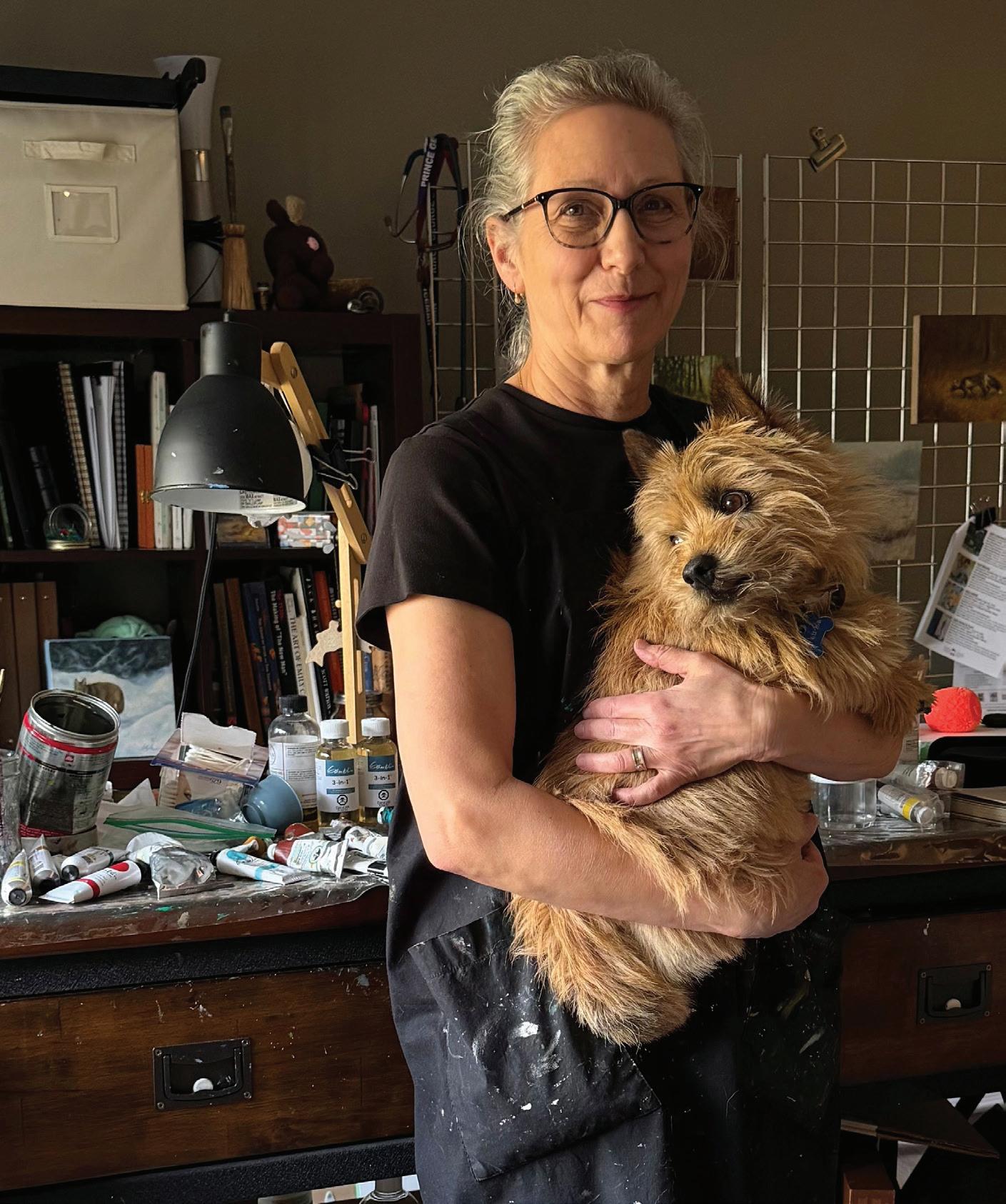
SUBMITTED PHOTO
This is artist Andrea Fredeen and her studio supervisor Oscar. Fredeen’s art exhibit opening reception for Our Neighbourhood goes Thursday, April 30 from 5 to 7 p.m. at Studio 2880’s Feature Gallery at 2880 15th Ave.
because it’s very painterly the way you can work with it.”
Fredeen said she was one of the fortunate ones who took part when the Emily Carr was still the Institute of Design and came to Prince George to offer a joint degree with UNBC.
“So I got my bachelor of fine arts while still working as a physio and then I did end up with my master of arts through UNBC and that was great because they allowed me to do a creative thesis,” Fredeen explained.
Her thesis consisted of paintings accompanied by short stories, she added.
“I finished that in 2017 and I had
retired from physio and I have just been painting full time and I teach, I run a few workshops every now and then,” Fredeen said.
“I have led a charmed life, I gotta say.”
Fredeen said she and her husband are originally from Saskatchewan and moved around the country a bit before coming to Prince George in the early 1990s, never dreaming they’d stay here for long.
“There’s so much interesting nature around here — the river and the trees — I just became kind of obsessed with it. We’ve been out on the trails a lot and I take a lot of pictures and that ended up being a constant theme throughout the
years of my work.”
Fredeen said she usually went to Ginter’s Meadow, Moore’s Meadow, the Greenway Trails behind UNBC and Forests for the World as a hiker and a runner.
“It’s a recurring subject for me because I keep running into animals and I am concerned about the way the city is developing,” Fredeen said.
“Because I have been here over 30 years and have been visually documenting the green space around us, I just feel like it’s really being — I don’t know what the right word is — threatened. I know that we need development because we have a growing population but I sort of feel like there hasn’t been a lot of really good consideration to how that affects the creeks and the river systems and the animals. There are wildlife corridors through here and they’re just kind of an afterthought.”
Fredeen said she knows there’s got to be a way to preserve nature.
“I imagine that somehow we can incorporate space for these lives that have lived here so much longer than us,” Fredeen said.
“This is their home. So this series is just a focus on those specific areas so Ginter’s Meadow, the Greenway Trails, which is kind of timely with UNBC wanting to do that big development right now which kind of worries me. Seeing development occurring very close to Forests for the World and with roads being put in and stuff like that I’m just saying ‘hey, there’s stuff here that we should not forget about.’”
The show is called Our Neighbourhood.
“And it’s called that because it is my hope that we should be able to live as good neighbours with the other lives around us,” Fredeen said.
“And not just humans but the wildlife, the plants, the creeks — everything. We are fortunate to have this gem of a place to call home and it needs to be cared for.”
Everyone is welcome to attend Fredeen’s Our Neighbourhood exhibit opening event at Studio 2880’s Feature Gallery on Thursday, April 30 from 5 to 7 p.m.


Art Battle returned to Knox Performance Centre on Friday, April 24 with a lineup of emerging and established artists in a highenergy live competition featuring multiple rounds of 20-minute painting sessions in front of a live audience. Spectators surrounded the artists as music played, then voted to decide who would advance and ultimately win, with all completed works auctioned off at the end of the night

Project asks hunters to collect and submit hair, tissue samples
MATTHEW HILLIER Citizen Staff
A growing collection of wildlife samples stored at -80 C at the University of Northern British Columbia (UNBC) is already proving its value by creating new research opportunities for students and wildlife experts across the province.
The UNBC Biobank was founded by trapper and BC Trappers Association member Glen Cartwright after discussions with provincial wildlife experts during a trapping weekend.
Shortly after, UNBC Ecosystem Science and Management associate Prof. Jamie Gorrell joined the initiative and helped launch the project at the university.
“We came up with the idea and then we applied for funding from the Habitat Conservation Trust Foundation,” Gorrell said. “They actually didn’t fund us the first time we applied. That’s because there is nothing like this anywhere in Canada. We are not just the first ones to do it in BC. We’re the first ones to do it anywhere in the country.”
The Habitat Conservation Trust Foundation later approved funding and has since supported the project for a total of three years.
The initiative, known as the British Columbia Furbearer Project, has been steadily building partnerships with local hunters, trappers and First Nations while expanding its collection of samples.
Its scale and accessibility have attracted attention across the province, as wildlife sample requests can otherwise take years to fulfill. The biobank provides a growing repository that students and researchers can access as it expands.
Even more importantly, the collection, built through ongoing partnerships with BC trappers and hunters, can provide year-by-year snapshots of species health and environmental conditions
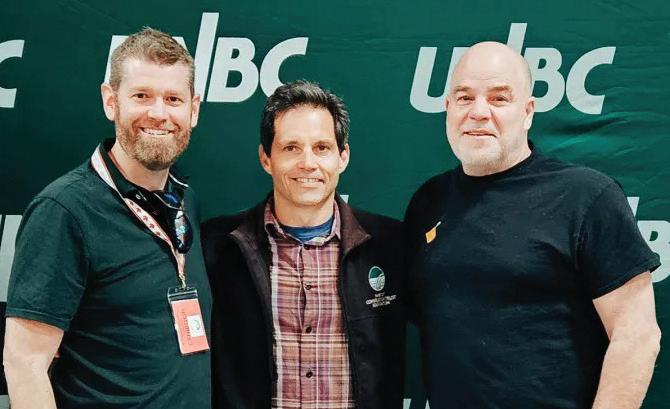
there’s sort of an echo of colonialism in that approach … the things that were caught in the North stay in the North.”
Cartwright also highlighted the project’s ability to support both proactive and reactive research, since samples are collected year-round.
“Fur trappers are always trying to react to what the need is,” he said. “Of course, you’re only getting what’s being requested and you’re not being proactive around getting what should be collected all the time. You can’t go back and get samples from before something happened.
“For example, the Mount Polley spill. If there’s a massive dump of toxins in the environment, we could study the effects afterwards, but we don’t have samples from before it happened.”
across the province.
The collection currently holds 2,032 samples from 24 species of harvested wildlife, including mink, marten, beaver and bobcat. The project aims to collect approximately 2,000 to 3,000 samples annually going forward.
Samples are collected during legal harvesting seasons by participating trappers and hunters. Each sample consists of a small piece of skin with hair and a small portion of thigh muscle, approximately the size of a human thumb.
They are labelled with a barcode and logged using a custom smartphone app connected to a database developed by UNBC computer science Prof. Waqar Haque and his students.
The samples can be requested by a wide range of users, including university researchers, provincial and federal governments, Indigenous communities and non-profit organizations.
Much of this year’s winter sampling was collected at the BC Trappers Association annual convention in Quesnel, with Gorrell and UNBC summer students spending the season cataloguing and preserving specimens in the biobank.
Both Cartwright and Gorrell identified a gap in access to wildlife research samples, which they hope the biobank
will help address as it grows.
“I would typically get 20 to 30 phone calls a year asking for tissue samples, mostly from master’s and PhD students who have waited two years to do a program that would take me five or six years to collect the number of samples they needed,” said Cartwright.
The biobank also allows researchers to move beyond small or isolated studies. DNA analysis can reveal how animals move through their habitat, population connections, diet, disease exposure, physiological stress and parasite or toxin exposure.
Gorrell said it made sense to host the collection at UNBC.
“We’re central,” he said. “There are lots of trappers north of us as well. From a geographic perspective, it’s a great meeting point. These samples come from all directions, and we are in the centre of the province. It makes sense where you would store these things. It also makes sense in terms of sharing those samples.”
He added that UNBC’s location helps ensure northern science and harvesting communities are better represented.
“A lot of it is northern data sovereignty,” said Gorrell. “Typically, everything goes south from the North. It all goes to Victoria or Vancouver, and
The Furbearer Project aims to maintain a large, continuous archive so researchers can return to it as new technologies emerge, even decades into the future.
“The piece of meat is actually about the size of your thumb, which is all that we need,” said Cartwright. “When that goes to the lab, our summer students clean that up and cut it back to a five-millimetre container that’s put in a minus-80 freezer. It’s good forever. It never deteriorates at minus 80. We’ll be offering most of our samples to government and university students. However, we’ll always retain a small percentage, probably 15 to 20 per cent, for projects 20, 30, 40 years down the road.”
From Cartwright’s perspective as a trapper, the project also helps ensure harvesters are directly involved in research that affects their livelihoods.
“We as trappers, hunters and fishers always seem to be under the gun. There are a lot of papers and programs telling us what we’re doing wrong and that animal numbers are declining, and all the negatives of our heritage,” he said.
“The best thing about this program is that we are retaining ownership of the data that comes out of every one of the papers or tests that are done with our samples.”
MATTHEW HILLIER Citizen Staff
Six UNBC researchers will have the opportunity to share both their expertise in their fields of study and their Northern perspectives at Science Meets Parliament BC on April 28 and April 29.
Science Meets Parliament is an initiative designed to help create and strengthen connections between provincial scientists and provincial policymakers, with researchers sharing their ideas with members of the BC Legislative Assembly and senior policy leaders.
“The program highlights the importance of building relationships between researchers and government,” says UNBC provost and vice-president academic Michel Beaulieu in a press release. “Researchers at UNBC generate knowledge that directly builds capacity for the advancement of healthy, productive and thriving communities. Initiatives like Science Meets Parliament help to ensure that the insights generated through research can contribute to public policy.”
The program will bring together the UNBC representatives, along with researchers from across the province, to meet with members of the BC Legislative Assembly.
UNBC will be sending the following researchers:
• Engineering assistant Prof. Oliver Iorhemen
• Northern Analytical Lab Services director Hossein Kazemian
• Physical therapy assistant Prof. Taru Manyanga
• Psychology assistant Prof. Sonia Kong
• Centre for Teaching, Learning Technology director Ben Daniel
• Post-doctoral researcher Aki Gormezano
Daniel stated in a UNBC press release that he is hoping to examine the intersection of artificial intelligence and environmental sustainability in higher education, something he describes as “green AI in education.”
“I am excited to share early insights and explore how this work can inform policy and practice as AI becomes more

embedded in society. I also see strong alignment with the important sustainability work already underway at UNBC, which has positioned the university as one of Canada’s leading green institutions,” Daniel says.
He added that, in particular, he is most looking forward to bringing any insights gained during his trip back to UNBC to further inform and shape local education.
“I am particularly excited about the opportunity to engage at the parliamentary level and bring those insights back to UNBC. I believe such an experience will help inform how we, in the Centre for Teaching, Learning and Technology,
can develop a faculty development program that supports why and how faculty can share their research more broadly with Canadians.”
Kazemian sees the program as giving UNBC a chance to highlight its impact as a northern research institution.
“This is an opportunity to demonstrate how regional research infrastructure and talent development support emerging sectors such as clean technology and bio-based industries while strengthening the communities we serve,” Kazemian said.
Iorhemen said she is looking forward to discussing the role of research in sustainable water management and strengthening collaboration between scientists and the BC government.
“Researchers need opportunities to engage directly with government so evidence, innovation and community realities can meaningfully inform public policy,” Iorhemen said. “I hope to help strengthen collaboration between science and government to support resilient and equitable water systems across British Columbia.”
Cartwright said results will be shared publicly after researchers complete their work. “We give them the time to do their thesis, to do their papers, to do whatever they’re going to do with the information they got. Then we’re going to put that information out to the
public. So everybody gets to see it,” he said.
He said this open approach could reduce duplication of research and improve efficiency.
“There’s no use doing the same project five times,” said Cartwright. “Our research money is so valuable. There’s not enough out there. We’ll have a
library. If a study has been done two or three times, we’re not going to give you samples. We’re actually going to give you the insight into all the information, all the raw data that was collected before. You’re going to save a ton of time and a bunch of money.”
Cartwright said he has already received interest from other
universities, provinces, BC Parks, Parks Canada and others interested in collaboration.
The project’s goal is to reach 60,000 total samples within its first 10 years, with Gorrell hoping it becomes self-sustaining within five years, a milestone he says would be unprecedented for a program of this kind.




Two local artists have put a colourful focus on nature
CHRISTINE DALGLEISH Citizen Staff
Goosebumps.
Walking into the Prince George Civic Centre main entrance, visitors may be stopped in their tracks by two recently completed murals.
Cottonwood Island Park trails and waterways are showcased in paintings that highlight nature at its sun-dappled finest.
When a call went out for artists to collaborate on the mural project, Erin Stagg and Kim Hayhurst answered.
As one might expect, painting is typically a solitary pursuit, but when it became clear the murals would be collaborative in nature, Stagg and Hayhurst shared the work.
They went further still. Rather than dividing the space or working on separate sections, the artists fully interwove their contributions.
Work on the Civic Centre murals, which began Feb. 18, represents a complete blending of their styles. Stagg’s sweeping landscapes, filled with fine
detail that reflects her Métis heritage, merge with Hayhurst’s Scandinavian influences, subtly expressed through whimsical wildlife and intricate design elements throughout both murals.
“This is a collaboration in the truest sense in that Kim and I have gone back and forth and you cannot really distinguish between what is her work and what is mine,” Stagg said.
“We are literally blended together in this piece and it is because of the relationship Kim and I have as artists that we managed to just blend our stuff together — and it’s not effortless — but we’ve managed to make it so when you view it you get a sense of peace.”
Stagg noted it would have been easier to work independently.
“It’s actually harder for us to work together like this, but that was what was called for,” she said.
“When I saw the call for submissions, I immediately thought of Kim — look at how much whimsy it has,” Stagg said, gesturing to the Cottonwood Island Park trail mural.
“Look at the little bunny with the dandelion — it’s so whimsical and sweet. I am a landscape painter, so I made the land, and she’s put in all the little details that you love to look at. Kim has added all those little things and she’s enriched
what I put in first.”
“We went back and forth and back and forth and had so many conversations that you don’t normally get to have as artists about how our unique approaches to our work are pushing and pulling the painting,” Hayhurst said.
“And where we are finding areas of challenge is where we are actually able to talk through that in a way that doesn’t happen if you are isolated as an artist in your own studio.”
“And no one is right or wrong,” Stagg added. “I have moved over and Kim has moved over — we both learned from each other, increasing our artistic skills.”
Viewed as a whole, the trail mural invites people to follow a sunlit path that feels almost walkable.
“You’re tempted to step into the painting,” Stagg said with a smile.
“Which was my goal.”
The work hints at a section of the Cottonwood Island Park trail near a bridge, giving visitors a sense of familiarity. The companion waterway mural nods to the Cottonwood Island Trail along the river.
“The murals are deliberately not so perfect that you could pick the exact spot because then it would lose its whimsy, and we wanted the whimsy to be very much part of this project,” Stagg said.
“The gift of public art is you can actually get right up close to it,” she added.
Visitors are encouraged to step in close or view the work from afar, discovering Stagg’s dot work and florals inspired by her Métis heritage and connection to the land, alongside Hayhurst’s detailed wildlife imagery.
Subtle motifs include floral designs tucked into a bunny’s ear, patterns in a bear’s fur and symbolic elements in a moose’s antlers reflecting Hayhurst’s Scandinavian heritage.
The murals also carry a broader community purpose.
“These pieces are not only here for the enjoyment of the community of Prince George, but anybody who has a conference in here, anybody who visits this place also gets to experience this art, which is a representation of the beauty of this land,” Stagg said.
Seeing the work in person, the significance of that statement lands clearly.
The conviction behind Stagg’s words and her awareness of the murals’ impact reflects the intent behind the project. While many artists let their work speak for itself, she readily articulates what the images mean for the community.
These murals are likely to become a point of pride in Prince George.
Two-night festival features groups from Vancouver, Edmonton and Northern BC
MATTHEW HILLIER Citizen Staff
The Prince George Metal Festival (PGMF) is launching its first event and aims to unite metal bands from across BC and Alberta with local bands in the North.
The event will take place May 29 and 30 at Legion 43, with a two-night lineup featuring artists from Edmonton, Vancouver and the North.
A total of 11 bands will perform during the two-day event, including headliner Cocaine Mustache, Vancouver bands Terrifier, MVLGRAVE and Shattered Throne, and longtime heavy hitter of the western Canada metal scene, Edmonton’s Quietus.
Longtime metalhead and PGMF organizer Brad Foster said the event drew a lot of interest during the planning stage, thanks in part to fellow organizer and metalhead Dusty Gagnon.
“The PGMF is myself and Dusty Gagnon from the band Dead Horse Hill. It literally started with a conversation over Facebook. He messaged me and said he wanted to do something with Cocaine Mustache, our Friday night headliner. I said let me see what I can do, and that put the wheels in motion. From inception to finishing the first one was about a week,” said Foster.
Foster said he is particularly excited

“They’re a fantastic party band. They’re not your typical blast beat, full-on speed metal band. They’re more of a very heavy blues rock band that has a fantastic message about partying — that it’s just part of everyone’s life. It’s a fantastic release, just like the music, just like the mosh pits,” he said.
Foster has been a frequent member of the northern scene for decades and is a fan of the bands playing. His own band, Deveined, is also scheduled to perform May 30.
He said the metal scene in Prince George and the North is strong, something that made him want to showcase its growth over decades.
“The metal scene here is strong. Omineca (Arts Centre) and the Legion put on constant shows,” said Foster. “Omineca allows all ages, which really helps. The metal scene here has been around since the early 1970s. I don’t

know if some people even realize that it goes back that far.”
He added the scene has grown in recent years because local bands are choosing to stay in Prince George, something the PGMF can benefit from.
“What you see now is a lot of people staying in Prince George,” said Foster. “In the past, a lot of really quality players moved to Vancouver or Edmonton or other locations for a bigger market, but I feel that local metal bands right now are staying close to home and supporting each other. There’s a lot of support.”
He attributed the North itself as one of the reasons for that growth, inspiring the metal scene for one simple reason: “People being forced to spend half their time indoors,” he said.
Funds from a PGMF ticket contest will also go to a good cause. Foster said a local metalhead and his family have fallen on hard times, with serious
medical issues leaving him unable to work.
While the individual is receiving disability support, it is not enough and has forced the family to downsize significantly.
The rules for the contest are listed below:
• Send an e-transfer of $5 to PGMF@Proton.me
• Make the security answer: PGMF
• Include your name and phone number in the message section so organizers can reach out
Winners will receive five weekend passes to the festival, with the winner announced May 15.
Tickets for PGMF are $35 for one night or $60 for both nights when purchased together.
Tickets are available at Grow King Hydroponics. Those outside Prince George who plan to attend can message PGMF on Facebook to purchase tickets.

It’s name translates to “House of the Future”
CHRISTINE DALGLEISH Citizen Staff
Nusdeh Yoh (House of the Future) Elementary is an Indigenous choice school with 170 students enrolled in Kindergarten to Grade 7 and 44 staff members.
“There is amazing work going on here,” said Sara Heppner, vice-principal at Nusdeh Yoh.
“We have experienced a huge increase in academic success of the students, community engagement, but even more than that is the self-worth — people are coming here, they want to be here, they want to learn and they want to be part of the community and everybody is working together to make that happen.”
Heppner said the school takes a holistic approach to education.
“Being Nusdeh Yoh, we approach everything with that holistic learning model, so it’s not just about the child, it’s also about the culture, the family, the community, and everything comes together,” she said.
Alison Thibodeau, community school co-ordinator at Nusdeh Yoh School, said it’s a really beautiful thing she has seen develop since 2011, when she started working at the school.
“At our school, we are in our second year of implementing our literacy intervention model, so every single child in the school gets a minimum of 30 minutes a day of direct instruction in a small group, anywhere from two to eight children with one adult focused on literacy,” Heppner said.
“And we’ve noticed when kids come to school, they are not asking if they missed gym, they are asking if they missed literacy, so they are walking in the door excited to be here.”
“And when I’m doing it, I think the small group allows us to get to know the children better,” Thibodeau said.
“So they are excited to come because they have a relationship with another

person — an adult — and they’re connected.”
“And when we think about student engagement, relationships are key,” Heppner added.
“It’s not just about the students, it’s about the families, and right now we have an Elders tea going on in our Circle Room, where the Elders teach about culture and history, so students are making that connection and weaving it through every piece of the academics here at school.”
Thibodeau said there are 18 afterschool programs taking place each week.
“It’s about creating that wraparound after school,” she said.
The programs go until 4 p.m. every day and include trips into the community.
“So everyone has that wonderful opportunity to go to the park or go
swimming, things like that, and it’s children of all ages who are in a group together. I was looking through the data and we had 125 children go through the after-school programs during our last school year. It’s about increasing that sense of empowerment, independence, and joy.”
Something meaningful happens when students from all grades, including Kindergarten, come together through a common interest.
“It’s about how they are now a group and how they have bonded together,” Thibodeau said.
“So a Grade 7 student gets to know a Kindergartener and there is respect and kindness shown there. They have learned to trust in themselves and they have learned they can do so many things.”
Heppner said she wanted to add that when she goes on an excursion with
students, she sees their resilience as they try something new, like skiing, falling again and again with a smile on their face, continuing to try and improve as the day goes on.
They return to the school with an “I can try” attitude that carries over into other school activities.
“And it flips that narrative for them that they can carry through into other areas of their lives,” Heppner said.
“When learning takes place out on the land, you don’t see the behavioural or other concerns you might see in the classroom because the students are engaged — this is what’s important to them. For everyone, going out into nature helps you feel calm and relaxed, and doctors give prescriptions for national parks now, right? There is something to be said for it.”
CONTINUED ON NEXT PAGE
‘We have
Thibodeau said many children are “screen-locked,” so when they go outside, they experience the pure joy of it.
“I think it grows their spirit to be outside,” she said.
“And it’s about the connectedness to the land and the sense of belonging.”
I couldn’t help but think about what it was like when I was in elementary school.
If you didn’t fit into that box, you were in trouble. There was no alternative if you coloured outside the lines. It was just wrong. There was no support for outside-the-box thinkers and doers. When you reacted in frustration because you didn’t understand something being taught traditionally, then you were the problem, and that stigma could stick with you throughout your entire school career. So instead of expressing yourself as an individual and shining, you were just one of the flock of sheep that followed the accepted route.
“We allow our students to be who they are, trust in themselves, in their community and the people around them, and we all support one another,” Heppner said.
“And part of the reason we can do all the amazing things we do is because of Miss T and our grants and funding, so there are no barriers to any of this for anybody. There is equal access to all of it. Everybody can come in, take advantage of it, and participate. It’s not about how they show up because we take them as they are.”
“And if you don’t have a coat, we’ll get you a coat,” Miss T added.
And she’s not kidding. There is a full storage room below the stage in the school’s auditorium that has everything a student could need by way of clothing, all sorted and neatly organized for easy access.
Another key component for Nusdeh Yoh students is a connection with those who have graduated from the school before them.
Because the focus in recent years was to get children to attend school regularly — and that’s been achieved — staff
can now build on that by bringing back things like school sports teams.
“So when we have basketball in the gym, we have students from high school come down and coach, so that leadership and mentorship is there,” Heppner said.
When students move on to high school, they already have relationships with people they are familiar with, which helps carry them through the transition, she added.
There is more programming that sees high school students come back to the elementary school, like the reading program.
“And the students love their mentors,” Heppner said.
“And you see the difference in the high school students, too. When they are guiding the elementary school students, they modify what they are doing, they change their language, and that changes to an equal relationship of respect,” Miss T said.
“And they grow together as a group.”
The staff must be proud of the work they are doing at Nusdeh Yoh Elementary.
“It is challenging work at times, but there is a reason we all are here,” Miss T said.
“The kids, the staff — why we all show up — and it is bucket-filling for sure.”
There is a teacher, D’Arcy Davis, whose job is land-based education.
“D’Arcy takes kids out on the land, and right now his students are gathering firewood that they will chop up and give to Elders,” Heppner said.
A component of the land-based education includes sharing information about traditional land use, stewardship, plant identification, and the second language taught in every class at Nusdeh Yoh, which is Dakelh.
“They do harvesting and processing of traditional foods. We bring Elders in and they teach the students how to harvest a beaver. They teach them how to can, so they go out and collect berries, make jam, can it and give it away as gifts to our Elders. There’s fish camp, where they go fishing and then process the fish, and they learn to make fish leather. We have a smokehouse in the schoolyard that the kids built with our Elder, Vince (Prince), and it’s amazing.”
The school also has a garden, and the meals worker prepares some of it for all to enjoy, Heppner added.
There’s another program where students learn how to prepare and cook a meal and then bring it home to
their families. The program is creating a recipe book so others can make the nutritionally sound meals on their own.
Miss T said they extended the afterschool program hours.
“Because the students love being here,” she said.
Heppner said Miss T’s programs are never determined by a student’s behaviour. It doesn’t matter what happens at school — students are always welcome to join the after-school programs.
“Because we see the value in those opportunities provided by the programs,” Heppner said.
“And that’s when they are successful.”
“Because it’s a safe learning space,” Miss T said.
“And it’s just different learning.”
“Our school is meant to be a community hub where everybody, hopefully, walking in feels valued,” Heppner said.
“We have a nurse practitioner who visits the school every Thursday for those who don’t have a family doctor. We bring things in-house, like our dental program, where dental students come in to do presentations, and Miss T will take children to the dentist if the need arises.”
“It feels like we’re all family here,” Miss T said.

CHRISTINE DALGLEISH
The StoryWalk is back at Duchess Park and features the book Outside Art by Madeline Kloepper, who is an author who lives in Prince George.
StoryWalk is a project presented by the Prince George Public Library where visitors to Duchess Park can walk along the fence to read each laminated page of the imaginative story that encourages readers to see the world through the eyes of animals watching human creativity.
It’s an outdoorsy literacy project.
Kloepper said her work is inherently narrative and often influenced by childhood, nostalgia and the relationships forged with nature, the biography on her website explained.
The idea of Outside Art started with wondering what animals think of us, she said.
“And that grew into imagining them creating art, too,” Kloepper said.
“Being featured in StoryWalk, right in my neighbourhood, is incredibly meaningful and honestly pretty special.”
Kloepper grew up in the Lower Mainland and earned her fine arts degree at the Emily Carr University of Arts and

Design. Over the years she’s written nine children’s books.
A few years ago Kloepper moved to Prince George and in 2022 painted the Wild Side mural at the Two Rivers Gallery.
Blending curiosity, humour, and heart, Outside Art explores what art might mean beyond the human experience, reminding us that creativity can
take many forms, from play to memory, Steve Hamilton, the library’s manager of communications and engagement, said in a recent news release.
“StoryWalk® is a free, family-friendly experience that combines literacy, outdoor activity, and community connection, one page at a time,” Hamilton said.
“Come take a walk, turn a page, and see art from a whole new perspective.”
The StoryWalk® Project was created by Anne Ferguson and developed in collaboration with the Kellogg-Hubbard Library in Montpelier, Vermont. StoryWalk® is a registered service mark owned by the Kellogg-Hubbard Library.
MATTHEW HILLIER Citizen Staff
Sixty pre-selected Grade 10 and Grade 11 students from Prince George will have the opportunity to gain hands-on experience in healthcare and human service careers this summer.
The Adventures in Health Care program is returning to Prince George for another year and will guide these 60 students through four days of experiential learning.
The program is led by the Rotary Club of Prince George: Yellowhead and delivered in collaboration with the College of New Caledonia (CNC), the University of Northern British Columbia (UNBC), Northern Health, and School District 57 (SD57).
“School District 57 has a variety of career exploration programs, but Adventures in Health Care is one of the most comprehensive for students to experience a variety of medical career fields. They gain skills, knowledge, and most importantly, insight into what their future can be,” said Steven Foster, SD57 career program co-ordinator. Hands-on activities will expose students to a wide range of disciplines, including medicine, physiotherapy, nursing, chemistry, dental hygiene and social work.

“At CNC, we are proud to provide students with meaningful, hands-on experiences that bring healthcare and human services education to life. Programs like Adventures in Health Care and Human Services give students the opportunity to explore different pathways, build confidence and see themselves in these important roles,” said Jenn Scott, dean of health sciences and human services at CNC.
Each day of the four-day program will
be hosted by a different partner organization, showcasing the wide range of opportunities in Northern BC across multiple fields.
Sessions will take place at AIMHI Community Living Services on May 3, CNC on May 4, UNBC on May 5 and Northern Health on May 6.
Throughout the program, the 60 students will have opportunities to connect with healthcare professionals and alumni from CNC and UNBC, who will
share insights from their own educational and career pathways.
These experiences are intended to give students a clearer understanding of what working in these fields looks like in the North.
“Programs like Adventures in Health Care matter. When students are introduced to health care careers early, they see what’s possible close to home, pursue education locally and consider returning to work in their own communities,” said Emelye Macfarlane, regional manager for recruitment at Northern Health.
The program originally launched in 2017 and has since involved hundreds of Northern students in Prince George, Quesnel, Terrace and the Peace Region, supporting long-term sustainability in the region’s health workforce.
“We’re seeing strong, tangible results from Adventures in Health Care. More than 70 per cent of graduates from our first three years are now either working in health care, some as nurses and medical lab technologists, or continuing their education in areas such as mental health, dentistry and medicine,” said Ron Davis, director of the Rotary Club of Prince George: Yellowhead.
For more information on the program and alumni, visit https://adventuresinhealthcare.com/.


April 30, 2008: Kendra Holland, 2, was holding hand with Lance Shelke, 4, as he made a splash along Victoria Street on a rainy spring day. CITIZEN FILE PHOTO BY BRENT BRAATEN

April 30, 1964: The six nalists for the Queen Aurora crown were announced in a Citizen story. From left were Sherry Chiles (Miss Jaycee), Judy Strom (Miss Kiwanis), Sharon Thesen (Miss Lions), Carol Duff (Miss Rotary), Eileen Leslie (Miss Legion) and Darlene Sherba (Miss Hotels Association). Strom, the new queen, would be chosen in June and crowned in August. The annual event was a collaboration between service clubs and operated by the Queen’s Committee. CITIZEN FILE PHOTO
April 30, 1981: Pup in a cup: the front page of the paper featured a pomeranian named Tetley Teabags, who was photographed in a coffee mug while waiting at a local grooming salon. The tiny dog belonged to Pearl Max eld of Prince George. CITIZEN FILE PHOTO BY BROCK GABLE


April 30, 1993: A crowd of more than 2,500 schoolchildren watched as the Canadian Forces Snowbirds performed aerial acrobatics over the city. The yers were headed to Smithers and Prince Rupert next. CITIZEN FILE PHOTO BY BROCK GABLE






ETHAN READY Northern Health
A Northern Health (NH) virtual pharmacy team based in Quesnel is being recognized at the provincial level for transforming how patients receive medication support in acute care and for demonstrating that virtual care can strengthen, rather than replace, relationships on the ground.
The team recently received a BC Health Innovation Award for a pilot project that introduced virtual clinical pharmacy services into Quesnel’s acute care setting, filling a critical gap after the community lost on-site pharmacist coverage.
“We were trying to solve a very real problem,” said Barbara Falkner, NH’s professional practice leader and virtual clinical pharmacy leader. “There was a gap in acute care pharmacy services, and patients weren’t getting the level of medication support they deserved.”
Traditionally, hospital pharmacists work directly on patient wards, collaborating with physicians and nurses to optimize medication therapy. In Quesnel, that model was no longer possible due to staffing challenges. Rather than accept reduced service, the pharmacy team tested a new approach, pairing a virtual pharmacist with on-site pharmacy technicians.
What began as a pilot quickly exceeded expectations.
“It worked extremely well — much better than any of us thought it would,” Falkner said.
The pilot ran from November 2024 to March 2025 and focused on supporting patients admitted to acute care. From a patient perspective, the virtual pharmacist provided medication reviews, counselling and support around side effects and safe use, while working closely with the on-site care team.
Patients were receptive to the model, Falkner said, as were physicians and nurses.
“The interprofessional team really embraced it,” she said. “That collaboration helped patients get discharged sooner and even improved patient flow in acute care, which was a really

The project’s success was supported by detailed evidence, a key requirement for the provincial quality award. The team tracked drug therapy problems identified and resolved, along with other performance indicators such as patient counselling and medication education. They also gathered feedback through surveys from patients, staff and physicians. The results showed improvements in medication safety and effectiveness, as well as high levels of satisfaction among patients and staff.
Keeping care personal in a virtual setting
Relationships were central to making the virtual model work, Falkner said. While the pharmacist worked remotely, pharmacy technicians were on site as familiar faces already trusted by patients and staff.
“They made a huge difference,” she said. “They represented the virtual pharmacist incredibly well and helped bridge that connection.”
The virtual pharmacist assigned to the pilot had also previously worked with the hospital in another capacity, meaning many clinicians already knew
her. The team also made a point of visiting the site in person before the pilot launched.
“Face-to-face still matters,” Falkner said. “Where we can do that, we do.”
The model also allowed the pharmacist to practise at the full scope of their training, focusing on complex medication decisions and optimization.
“She was able to use all her skills and knowledge,” Falkner said. “That was really satisfying — and it’s important for recruitment and retention, too.”
A win for staff: building confidence and momentum
Staff satisfaction emerged as one of the project’s strongest outcomes, reinforcing the model’s value for the teams delivering care.
“Our pharmacy staff took this project and made it their own,” Falkner said. “Every week we met, we tweaked things, and when it felt ambiguous at the beginning, they never gave up. They just kept making it better.”
The award also included funding to support shared learning and ongoing development. That money will be used to provide additional training for on-site pharmacy technicians, helping prepare
teams at future sites to support virtual pharmacists.
What’s next: expanding to other communities
Since the pilot ended, NH has continued the work in Quesnel and is planning to expand the model to other under-serviced communities. The goal is to bring virtual clinical pharmacy services to hospitals without on-site pharmacists and to explore hybrid options that can support coverage during vacations or periods of high patient volumes.
“My dream is to have this available at all our hospitals that don’t have on-site pharmacists,” Falkner said. “All patients deserve this level of care.”
Why the recognition matters
For the team, the provincial recognition was unexpected and meaningful.
“They show up every day and do their best work,” Falkner said. “To have that recognized is really gratifying.”
More importantly, she said, the award helps ensure the work can continue.
“Sometimes it’s a battle to keep innovative services going,” she said. “This recognition really helps cement the importance of this model and allows us to keep moving forward.”
NANCY SHELFORD Northern Health
In a hemodialysis unit, patients spend hours receiving life-sustaining treatment. During that time, a warm blanket, a friendly smile or a simple conversation can make a difference.
Theresa is one of the volunteers who helps provide those moments.
She began volunteering with Northern Health in 2023 in the neonatal intensive care unit as a newborn cuddler. Today, she continues to volunteer both there and in the hemodialysis unit at UHNBC in Prince George.
For her, the motivation is simple.
“The people, and the babies,” she said. “When you pour love into a baby who may have challenges, you could be changing their life. And I need the cuddles as much as they do. They’re so precious.”
Some moments have been emotional, particularly in the NICU, where she once spent the night reading and singing to a newborn whose mother could not be present.

In hemodialysis, the connections are just as meaningful.
“Showing up with a smile changes their day,” she said. “Some people are there three days a week for three or more hours. People enjoy talking and are excited to share news, like when they make the transplant list.”
Since joining Northern Health in December 2024, Gail has become a key leader in the volunteer wayfinding program at Ksyen Regional Hospital in Terrace.
She not only guides patients and families through the hospital but also supports and orients new volunteers so they feel confident, welcomed and ready to serve.
Encouraged by a friend in the lab,

she applied and quickly became an essential presence. Now volunteering twice a week, she brings warmth, steadiness and an instinct for supporting others — both the public and her fellow volunteers.
“Gail’s consistent dedication to strengthening our volunteer program and supporting our clinical teams has directly elevated patient satisfaction. Her profound empathy and tireless contributions are truly irreplaceable assets to our hospital,” said Justin de Medeiros, manager of rehab and clinical supports.
One moment that has stayed with Gail came during a shift escorting an expectant couple to the birthing unit.
Hours later, they returned full of gratitude.
Her response reflects her humility.
“I’m so appreciative of you wanting to give me a gift,” she said. “I really can’t accept it, but I’m just happy to be here and help you get where you need to go.”
From her first days in the rehabilitation department at Northern Health, Jordyn has brought warmth, professionalism and a strong commitment to supporting patients in their recovery. She began volunteering during a school break and quickly became a valued
member of the team in Fort St. John — someone patients look forward to seeing and staff trust.
A kinesiology student at UBC Vancouver, she was initially motivated to gain experience for a physiotherapy program, but her reasons run deeper.
“I’ve always been passionate about helping others and about rehabilitation,” she said.
One moment that stands out came from a patient she supported regularly. After learning about her goal of becoming a physiotherapist, the patient told her, “You belong in rehab. You are really good at encouraging me.”
“That reaffirmed that this is the right path for me,” she said.

Jordyn’s impact is clear in how patients respond to her steady presence — whether she is offering encouragement, helping staff or simply listening.
“Seeing how my support helps patients is incredibly rewarding,” she said.
Rehabilitation lead Desiree Lillico said volunteers play an important role.
“This unit is already a fun and active space, and having volunteers creates even more positivity,” she said. “Patients respond to that energy and feel more motivated during their sessions. Jordyn brings such warmth and
encouragement — her presence fills the space with laughter, conversation and smiles.”
Laura
When Laura Balkwill began volunteering with Northern Health in 2022, she saw it as a step toward becoming a physiotherapist. What began as a requirement quickly became something more meaningful.
After starting in Quesnel and moving to Prince George in September 2025, she found her place at Gateway Lodge, where she now volunteers weekly.
“I love this role and the staff I work with,” she said. “When I ask residents to take part in activities, they’re so excited to see the other people on their floor.”

The third-floor community has become a highlight of her week.
“There are about 20 people,” she said. “They’re all joking and a little competitive. They have such a close community.”
What keeps her coming back is the joy.
“It’s just fun,” she said. “It’s refreshing to be in such a different place. I like being part of their lives.”
She recalls a trip to the Festival of Trees with a resident named Yuki.
“She kept saying, ‘Isn’t this one beautiful?’ She loved all the trees,” Laura said.
“We are fortunate to have Laura at Gateway Complex Care,” said Lynn Aucoin, recreational therapist supervisor. “She is a natural at building rapport with residents and encouraging participation. Her smile brightens everyone’s day.”
For Laura, those connections are what matter most. “They’re so happy to see me,” she said.
Her advice to others: “Put it into your schedule. It doesn’t take long, and it’s really rewarding. I would happily keep doing it.”


TED CLARKE Citizen Staff
Prince George rugby can trace its roots to one Sunday morning in August 1976.
A group of about a dozen players who had read The Citizen ad or heard it on the radio gathered at Lakewood field with like-minded individuals who thought it might be a good idea to form a 15-a-side rugby team.
At the time, Don Hope had just moved to Prince George from England, where he grew up with the game. The ranks were a little thin, so they went into the downtown bars to try to recruit players for their first game the following month in Jasper.
“That’s always been our history — for the first few years, 12 guys show up and then you grab three more guys off the sidewalk,” said Hope, now 74. “When I look at the ’76 group that got together, we were all from out of town.”
The original Gnats were Hope, Doug Hughes, Dwight Zackus, Jim French, Jim Brown, Dale Reid, Gary Stewart, Ed Elliott, George Lesniewicz, Kasper Walraven, Bruce Nairn and Brent Waldie. French, a former national team player, was the driving force who got them started, and he lived in PG for three or four years before moving back to Vancouver.
The Invermere Tigers were their first opponents. Stewart, Elliott and Lesniewicz were former Tigers who moved to Prince George, and that’s how the matchup came together.
“We didn’t have enough players, so the night before we recruited some guys in the bar,” said Lesniewicz from his home in Salmon Arm. “They were familiar with rugby, but not a lot.
“We had our wives there, and it was a lot of fun.”
The Tigers flew to Jasper that day in a DC-3 because one of their players was a pilot who flew charters, and the game
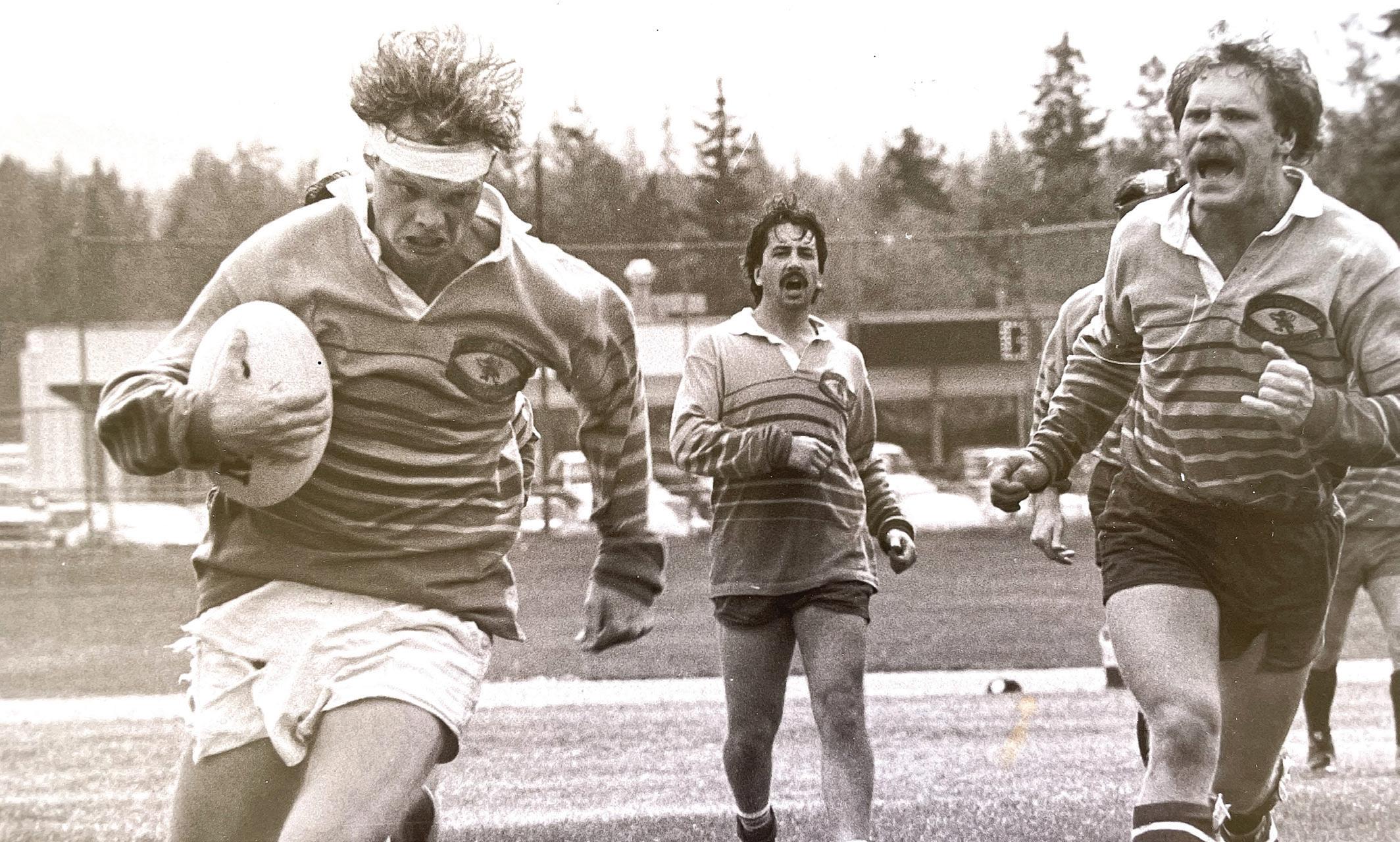
August 2026.
was played in a light snowstorm on a frozen field.
“I’ll always remember, Kasper Walraven played in his pajamas (to stay warm in the snow) — that was my introduction to Canadian rugby,” said Hope. “One guy blocked me and I saw stars, and I was thinking, what the hell?
There’s no blocking in rugby.”
Prince George played one more game that year in Smithers against a team from Terrace.
The following year, they met at the Yellowhead Inn, determined to come up with a team nickname, and left as the founding members of the Prince George Gnats Rugby and Athletic Society.
That summer, the Gnats made the trek to Smithers to play the Terrace Northmen, and from there they went to the Liftspan Open on the August
long weekend on a concrete-like field in Kelowna. Those were the days of beer strikes that usually happened in the hot summer months and completely shut down suds sales at liquor stores, but tournament organizers managed to find a beer truck that came up from the States.
“It was great, they had beer,” said Hope. “When you played a game, you got so many points for the game, and you got equal points for the boat race (beer-chugging contest) after.”
The Gnats weren’t part of a league in their early years.
They just played weekend games against teams from the northern half of the province and started entering tournaments like the Abbotsford Gobbler at Thanksgiving.
The Central Interior Rugby Union
(CIRU) formed in 1984 as a four-team league with the Gnats, Williams Lake Rustlers, Quesnel Axemen and Fort St. John Moosemen, and they tuned up in exhibition games against the Terrace Northmen and Prince Rupert Seamen.
The Prince George Barbarians became part of the league in 1985.
Blackburn Junior Secondary School had a strong rugby program led by Steve Mamic, who brought them into the adult league in 1983.
Known for their youthful speed and free-flowing tactics, the Barbs competed locally in the Prince George Rugby League with the Springboks, Spartans, Boors and Vanderhoof Honkers, and the big event was the Royal Plate invitational tournament in May.
Sponsored by a local dentist, the tournament got its name from a row of dentures he donated to glue to the trophy.
The Gnats had years of success as CIRU champions and had enough players to form a B squad. The A team went on a run from 1999 to 2003, in which they finished as BC Rugby Union Division 3 provincial finalists five straight years, but they could not beat the Cowichan Piggies for the Saratoga/ Columbia Cup, getting as close as a 10-point loss in the 2001 final, played on home turf at Massey Place Stadium.
The fact the Gnats made several provincial finals was a small miracle considering the timing of the tournament in May — only a couple of weeks after the traditional opening of sports fields in Prince George.
In 2010, the Gnats won their first BC crown, the Provincial Independent Club Championship, when they beat the Kootenay Selects 15–12 in the final in Penticton.
Chuck LeBlanc had a background in minor football and played for the Duchess Park Condors rugby team, coached by Rick Collins and Neil Harker, a stepping stone that prepared him to play for the Gnats as an adult in 1985.
“In northern BC you’ve got such a small window,” said the 59-year-old LeBlanc. “You hopefully get on the fields May 1 and by September it’s getting iffy, and the lasting part of it is players want to play, and to play you’ve got to get involved.
“Rugby’s a lifestyle,” he said. “In the wintertime, even though we weren’t playing, we’d still get together for a run, or ‘silly buggers’ — two-hand touch in a gym, anything to touch the ball, and then you’d go out for a beer. That’s the rugby way.”
Other high school coaches got rugby programs started — Matt Pearce at Duchess Park, Bob Ormond and Dave Dunlop at College Heights, Bruce Northrup and Troy McKenzie at Kelly Road, Sid Jawanda and Mike Tait at PGSS — and that created the feeder

system that funnelled rugby talent to the Gnats.
“These teachers, people like Sid Jawanda, who didn’t really coach but were happy to coach, had so much impact at multiple schools, just getting kids out there and doing all the backhouse work so we could travel,” said McKenzie.
When McKenzie was coaching at Kelly Road, the five Prince George high schools made up 10 teams — five senior, five junior. Now there are just two— one boys team at PGSS and one girls team at Shas Ti Kelly Road. He said there are enough community coaches willing to volunteer, but there are too many administrative restrictions put on school teams, and that’s killing participation.
The love of the game has always been what keeps rugby alive in the city, and that enthusiasm continues. The Gnats entered a sevens tournament this year, April 25–26 in Jasper, to kick off their season.
Some of LeBlanc’s best rugby memories are the post-game beer gardens at tournaments, where one team would start singing a song loaded with foul lyrics and the other teams would join in because, invariably, they knew all the
through their pickup game at the 50th celebration in August unscathed. Rugby players are a different breed, and after tearing each other apart on the field for 80 minutes in heated battles where tempers sometimes flare, chances are you’ll see the two teams sitting side by side in the pub discussing the plays they made a few hours earlier at each other’s expense.
Undeniably, there is an “old boys club” mentality that binds the players to their sport in a figurative scrum that never fades. Best friends for life is a common theme among rugby teammates.
“It’s a great camaraderie, always has been,” said Hope. “We try not to be too cliquey, but once a person is in the group, I’m still talking to guys I knew 50 years ago. I still get in contact with people I was at university with (playing rugby).”
words.
“We know a lot of songs, and most of them you can’t sing in public spaces,” said LeBlanc. “But everybody knows those songs, and you’ll get eight or 10 teams getting involved. We had success on the field, but those are the memories I have.”
LeBlanc’s rugby career came to an end at age 34 in a game in March 2001 in Kelowna, as a warmup to hosting the provincial tournament in Prince George, when he got tackled and ruptured a disc that came close to breaking his neck. He never played again but remained involved in the game as a coach and organizer, and he intends to continue for as long as he can.
At 35, Hope suffered a career-ending injury playing as a 220-pound centre for the Vancouver Meralomas in a game when an Australian named Nigel threw him to the turf and broke his shoulder.
McKenzie suffered a broken ankle in a game. While serious injuries are uncommon, there’s always a risk. The Gnats hosted a 30th anniversary in 2006 at Baldy Hughes and had a game of two-hand touch, and within the first five minutes two players were out with shoulder injuries. They’re hoping to get
As much as it was a man’s game in those early years, the wives and girlfriends of the Gnats players were heavily involved in the club, especially in the October to April off-season, when they’d take turns hosting the team for dinner parties.
“We’d rotate dinners at different people’s houses, so you’d go with two or three other couples to someone’s house, and that started those relationships,” said Hope. “So those women are still friendly with each other through all these years.”
The tradition petered out by the time the next generation came up.
“The old guys never invited me,” laughed LeBlanc.
The love for the game gets passed down through generations. Several father-and-son combinations shared the field playing for the Gnats and were impact players — Don and James Hope, Bob and Paul Ormond, Richard Bundock and his sons Zak and Joel.
Don Hope played rugby as a kid in England and became a utility player with the Gnats, used wherever he was needed because he knew how to play all positions.
CONTINUED ON NEXT PAGE
Spruce Kings forward Tai Ushio launches himself across the ice in an attempt to poke the puck of the stick of Chiefs defenseman Adam Boatter during Game 5 of their playoff series at Kopar Memorial Arena Friday, April 24. With a win in Chilliwack on Sunday, April 26, the Chiefs pushed the Spruce Kings to a seventh game on Tuesday night — after this issue of The Citizen went to press. Visit www.pgcitizen.ca for the details and to learn whether the Spruce Kings are moving on in the BCHL playoffs or packing up their gear for the summer.

“I had hands, and I could kick, too — punting for position,” said Hope.
His son James grew up as a player at Kelly Road and followed his dad’s lead as club president and a Prince George rugby organizer.
“It’s so strange that Don is here and I coached his son in Grade 8 when I came back to Prince George, and now James is one of my best friends, and also a rugby compatriot,” said McKenzie. “He lives the same rugby culture that I lived. It’s from respect and understanding, and that’s why we have so many friendships, because in rugby there’s no place to hide. If you don’t commit, you don’t make the squad.
“If you’re doing it right, it’s a tough sport. There’s something subconscious that happens in a sport where you have
to put your body on the line.”
Now 55, the halfback speed and powerful kicking leg that made McKenzie a constant scoring threat have diminished with time, and he hasn’t played for three years.
But he’s getting back into the game this year, knowing the Gnats’ 50th anniversary will bring old friends back together, some of whom haven’t seen each other in years.
More than 1,000 players have suited up for the Gnats in their 50-year history. McKenzie has seen some incredible ruckers and maulers make an impact with the team, such as scrum half Dennis McCarthy, a high school wrestling champion at Kelly Road, and PGSS grad Paul Bryant, a judo master who grew from 165 pounds to 225 in just a few years playing flanker as an adult. Both used their individual skills and
strength to excel in combative sports and become game-breakers in rugby.
But as athletes go, McKenzie says it’s hard not to pick Matt Pearce at the pinnacle of the Gnats’ all-time greats. A Grey Cup-winning fullback in 1993 with the Winnipeg Blue Bombers, Pearce wasn’t into the party scene of rugby, but nobody carried the ball with more authority or was tougher to knock off his feet.
“This guy dominated on the field — talk to Todd Pritchard in Williams Lake or whoever else — you want fear, he brought fear. Teams adjusted their whole game plan around Matt Pearce,” said McKenzie. “Not only was he impossible to tackle, but defensively he was the most punishing open-field tackler you’d ever see.”
Don Hope remembers two draft dodgers who came up from the United States
fleeing the Vietnam War who opened a Mexican restaurant in Prince George in the late ’70s, and they dominated the game playing for the Gnats in the CIRU until they returned to the U.S. three years later after being granted amnesty. In Hope’s era in the ’70s and ’80s, Ormond, known by his peers as “The Animal,” and John Miller were the guys everyone used to measure where they stood on the rugby ladder.
McKenzie’s Black Clover restaurant/ pub on Fifth Avenue will be the gathering point for three days of 50th anniversary activities, which will include a “runaround” scrimmage at Duchess Park field.
The Gnats don’t know how many people will attend, but they expect representation from Australia, New Zealand, Ireland, the western provinces and the rest of BC.
TED CLARKE Citizen Staff
As the newly appointed head coach of the Prince George Kodiaks, Ryan Bellamy is in a difficult, if not impossible, situation.
How do you replace Jamie Boreham, who in his third season led the Kodiaks into the playoffs for the first time in the team’s four-year history and was named BC Football Conference/Canadian Junior Football League coach of the year?
Bellamy was the Plan B the Kodiaks turned to when it became apparent the not-for-profit team could not afford Plan A to rehire Boreham (fired in February with one year remaining in his contract when the club abolished his dual role as head coach and director of football operations).
Bellamy knows his football resumé doesn’t come close to matching that of Boreham, an all-Canadian punter/placekicker/safety in U SPORTS who went on to play eight seasons in the CFL and won the Grey Cup with the Saskatchewan Roughriders in 2007.
Before he came to the Kodiaks, Boreham was a high school and elementary school teacher in Kelowna and Vancouver who served as head coach of the Okanagan Sun for three seasons (2019–21).
He got them to the Canadian Bowl final in his last season before he left the team for family reasons.
Those are indeed big shoes to fill for the 42-year-old Bellamy, who held the role of Kodiaks assistant head coach in 2025 and has been with the team since the day they joined the BCFC in 2022.
It’s an unenviable position, being handed the coaching reins at a time when the Kodiaks are struggling with a $436,703 debt and the turmoil that came with the entire nine-member board of directors resigning in March.
Even more remarkable is Bellamy has taken on the job as an unpaid volunteer.
“It’s a tough act to follow the coach of the year and the current state of things makes it even more challenging,” said Bellamy. “My willingness to put my

hand up comes from a place of I believe it’s good for the players, I believe it’s a great thing for the community and I believe it’s something we want to succeed and continue to go for many years to go.
“Just with the current state of things and not being able to afford what we’ve had for the coaching staff we’ve had before with Jamie, I said I’d be willing to do it for a year. Just coach the junior football team, and allow the team to recoup what they would have paid out there as a savings to hopefully be able to get on a better footing and be able to set themselves up to be stable with the money in the bank moving forward to make whatever decisions they make after this season.”
Junior football rosters are large, with upwards of 80 players required to make a competitive team, and a large percentage of those players need the support of billet homes for a season that lasts from July to October.
The Kodiaks’ sixth annual golf tournament will happen at a yet-to-bedetermined date at Aberdeen Glen Golf Course. The event has traditionally sold out every year and is the team’s biggest annual fundraiser.
“The community has been amazing for the team, they’ve showed up and supported it, the product on the field has gotten better, year over year, and it’s really been exciting to watch,” Bellamy said. “The group that’s involved right now all sees all the positives there’s been for the community and
that’s the goal of the board and staff alike to put our foot forward and do what we can to continue to see that be successful.”
The big question for Bellamy is how many players will be coming back to Prince George. With the team’s spring camp coming up (May 8-10 at Masich Place Stadium), time is short and Bellamy has been busy talking to them since he took on the head coaching job on Thursday, April 23.
The Kodiaks have already lost six players with junior eligibility who left for university teams.
“We have the ability to return up to 65 to 70 guys from last year’s roster and our hope is that the majority of those players are in camp and we’ll have new recruits in there, so we feel good about the numbers,” said Bellamy.
“The next week will be getting the feel of where the roster sits heading into our spring camp, getting the guys on the field and letting them experience some of the new coaches that are going to be in place and the guys returning to the staff,” he said.
“It’s an opportunity for the players to see if the fit and feel is going to be what’s best for their careers moving forward.”
Bellamy has yet to confirm who will be helping him coach, but said there will be returning staff. He’s rounded up several new coaches — Kodiaks alumni — who will be joining him on the sidelines this season.
In addition to coaching the junior
team as director of football operations, Boreham also ran the spring flag football program and fall tackle league for minors, coached a group of high school players whose schools don’t offer football and oversaw the Kodiaks’ off-season indoor training sessions. Those programs, if they continue, will not be on Bellamy’s plate and other coaches plan to step into those roles.
Bellamy has coached football for 22 years, starting when he was 18, when he served as an assistant for a Prince George bantam team. At 20, he started the high school team at Kelly Road Secondary School when high school football returned to the city for a spring season in 2004, and he remained with the team until the Kodiaks arrived.
He played Prince George minor football from a young age and spent four seasons as an offensive lineman in the BCFC with the Kamloops Cowboys and Vancouver Island Raiders until his playing career was cut short in 2006 by a knee injury.
“I came through PG minor football and there was a lot of good people involved that had given me the opportunity to play football, but nobody really exposed me to what the opportunities were to continue playing,” he said.
“It wasn’t until my second year of midget football that somebody told me about junior football and myself and five others from town ended up playing for the Kamloops Cowboys that year and that set me into the junior football stream.”
Bellamy, a former Prince George Minor Football Association president, coached local teams that competed in spring and summer provincial tournaments and in 2013 he formed the Northern Eagles juvenile team to compete in the BCFC Tier 2 Division, and his influence led to a junior exhibition game coming to Prince George.
“I coached at Kelly Road and put out 70-plus players to junior football and six to university football. Part of the reason we looked at wanting to get a junior football team in Prince George was (to give local players the chance) to get to the next level.”
TED CLARKE Citizen Staff
Clair Keehn is the grand prize winner of the Spruce Kings Show Home Lottery. Her lucky ticket was among 14,033 picked out of the barrel Friday, April 17 when the draw was made at the house at noon.
Keehn was out for lunch with a friend when Kyle Anderson, the Spruce Kings’ executive director of business operations/director of communications and broadcasting, called to give her the exciting news that she’s now the owner of the $855,000 furnished home built by Hopson Construction in the Aberdeen Glen subdivision at 2922 Links Dr.
“Are you kidding me?” was Keehn’s initial reaction.
The 27-year-old federal government public servant brought her two-year-old son and her friends with her to see the house for the first time and accept the keys from Spruce Kings staff who met her there about an hour after the draw.
“It’s crazy, I honestly didn’t think about it, I didn’t buy a ticket thinking we’re going to win it, it was just buy a ticket, support the Spruce Kings,” said Keehn.
“I actually won a ticket to the Hospice Show Home in December at my work Christmas party and a week later I was with my husband Christmas shopping and we were like, ‘hey we got one ticket free, let’s buy one for the Spruce Kings.’ I was shocked when I got the call.”
Keehn says she bought a ticket on the Spruce Kings draw when she was 19 but doesn’t usually play lotteries. She had ticket No. 1101459.
After walking through the 2,400 square-foot house with her two-yearold son and her friend, Keehn says it’s pretty tempting for and her husband Zach to keep it and move in. They have a house in the Hart area they bought in 2021 and were making plans to renovate one of the bedrooms into a nursery, with their second child expected in September.
“I’m just very thankful,” Claire said. “I never expected something so fortunate to happen. I’ve been very lucky to have

a fortunate life with good family, good friends, a husband and wonderful child, and something just so out of the ordinary like that is so unexpected.”
Claire was born and raised in Prince George and Zach was born in Nanaimo and moved to PG with his family when he was five.
Their families live close by and Claire is thinking their new house is ideal for entertaining.
“It’s beautiful, I love the kitchen and the big kitchen island,” she said. “We have a pretty big village, lots of family and friends, and I love hosting. I really love how open it is and I can see myself hosting there.
“It opens up a lot of doors, for sure.”
Zach works as a mechanic and wasn’t able to tour the house right away.
Claire’s brothers played minor hockey and she grew up a hockey fan and is getting caught up in playoff fever, with the Spruce Kings and Cougars both doing well in the postseason.
Prince George bucked up in a big way in the final week of ticket sales leading up to the deadline and more than 2,000 tickets were sold in that week, including a single-day record 833 sold on the final day Wednesday. The tickets cost $125 each or were sold in 1,500 packs of three for $300.
There were 500 more tickets printed compared to last year’s draw and this year’s lottery was just 467 short of a sellout. The lottery is the major annual fundraiser for the Spruce Kings hockey team, providing more than 60 per cent of operating costs to allow the team to
compete in the BC Hockey League, and profits go directly to the team.
“Overall, when you look at the number it’s a better show home year than last year, results-wise, and it give us the ability to help our players and treat them the way they should be treated here in Prince George, so they’re able to compete in the BCHL” said Anderson.
“We know how our travel budget has increased with the way expenses have gone so it’s a big help to see that many tickets sold.”
The Spruce Kings Mega 50-50 draw No. 2 pool has reached $229,125 and will keep climbing until the tickets sales deadline on May 27.
The winner gets half the total and the draw will be made on Friday, May 29 at 11:45 a.m.

















The family of Georgina Seniunas invite you to a Celebraton of her Life on Saturday May 9th from 12-2 at the L’heidle T’enneh Park pavilion by the playground. Please join us. Feel free to contact Faellen at 250 617-6979
James Norman Delaurier
January 3, 1941 - March 22, 2026
James Norman Delaurier passed away peacefully on March 22, 2026, at the age of 85, surrounded by his family.
He was predeceased by his parents, Albert Delaurier and Engelina (Bruneau) Delaurier; his brother Romeo Delaurier; his sister Diane Zdep and her husband Bill; and his sister Maryanne Dutka and her husband Ed Dutka.
James is lovingly remembered by his devoted wife, Sylvia Delaurier (Spuzak); his daughter Michelle Basisty (Delaurier), and her children Kelly and Christopher Basisty; and his daughter Nadine Hilton (Delaurier), her husband Trevor Hilton, and their children Taylor Eikum (Seth Lapre) and Kyle Eikum.
James will be remembered for his love of family and the quiet strength and presence he brought to those around him. He leaves behind a legacy of love, dedicaton, and cherished memories that will live on through his family.
He will be forever remembered and deeply missed.
There will be a mass at Sacred Heart on May 23, 2026 from 1pm – 2pm followed a recepton at the Elder Citzens ecreaton Associaton at 2: 0pm.

June 5, 1944 - April 17, 2026
Afer years of entertaining us with his jokes, stories, and impressive dance moves, Keith Andersen took his fnal bow on April 17, 2026.
Keith was born on June 5, 1944 to Helen and Ivan Andersen, and he spent his early years in the small town of Sinclair Mills. It was there he built memories that would stay with him and be shared for years to come.
As a teenager, he made the move to the “big city” to atend high school at PGSS and later atend UBC, where he earned his Bachelor of Commerce degree and formed friendships that would last a lifetme. Afer beginning his career with Arthur Andersen and obtaining his Chartered Accountant designaton, Keith returned north to join the family business, contnuing to build not only a successful career, but also a wide circle of close, valued friends.
Keith is survived by his loving wife of 45 years, Lynn, the woman he adored so much that, even as his memory faded, he made his kids swear to never let him forget fowers for every Valentne’s Day, birthday, and anniversary. She was his world, and she kept their dates going to the very end.
Also lef to remember (and possibly take credit for his once-dark hair turning grey) are his three kids: Jen (Waylon), Erik (Natalie), and Holly. His grandchildrenIvan, Ellie, Ally, Zachary, Quinn, Emily, and Jessie - were his true pride and joy. Whether he was cheering extra loudly at their hockey and baseball games, playing Barbie’s, colouring masterpieces, or sneaking in extra cuddles, Papa was always there.
His partner-in-crime was his brother, Gord (Theresa), who he was always proud to sit beside at every board meetng or family dinner, sharing jokes and maybe a litle mischief. He loved to make his ever-caring sister Ethel (Les) laugh. And, of course, all his cousins, nieces, nephews, and in-laws were as much a part of his heart
as they were his stories.
To his golfng buddies, both those stll here and those who surely welcomed him with a fresh set of clubs and a cold pint, thank you. You gave him one last great game before the Alzheimer’s took over, and he cherished every round with you. We know he’s already scoutng the best fairways on the other side.
To his work family, you kept him laughing and proud every single day. From his Apollo crews in the 70’s and ‘80s, to his Lakeland family in the ‘90s and early 2000’s, and his Sinclar buddies untl retrement, you brought him so much joy. Whether it was swapping stories, celebratng weddings, recommending songs, or sharing jokes he couldn’t wait to repeat, you were a huge part of his life. You made the long hours more than worthwhile.
To all his business partners over the past 50 years - the Stewarts, Killys, Shaws, Manojlovics, Scots, Larsens, and others - thank you for the partnerships and the shared stories.
We are deeply grateful to Dr. Wooldridge and all the care aides, staf, and nurses at Gateway Complex Care. You cared for Keith with kindness and treated him like family throughout the past 5 years. Your dedicaton and compassion made his fnal years comfortable, and we truly appreciate you all.
In lieu of fowers, the family asks you to consider donatng to your favourite charity. Keith was always impressed with the work done by local charites such as the Prince George Community Foundaton, Prince George Hospice Palliatve Care Society, The Spirit of the North Healthcare Foundaton, and the Kordyban Lodge – Canadian Cancer Society, to name a few.
We are stll planning the details for his celebraton of life. We will let you know when and where when plans have been made.
Cheers to a life well lived!





Kathleen “Kay” Fisher
April 14, 1937 - March 30, 2026
It is with great sadness that we announce the passing of Kathleen (Kay) Fisher, our Mom, Nana and friend. Celebraton of ife will be held at the Prince eorge olf Curling Club, on onday, ay th at pm, with light refreshments a er. In lieu of owers, donatons in ay s name will be accepted at the Prince eorge Hospice, which too great care of her in her nal days.
A complete obituary can be found at www.dignitymemorial.com where condolences can be shared online.

David Wayne Palser
October 31, 1945 - March 30, 2026
Dave passed away peacefully on March 30th, 2026. He was born in Moosomin Saskatchewan on October 31st, 1945.
The family came to West Lake in 1951 and he was educated in Prince George. A few years later he atained his accountng degree, running sawmills for Canfor, Isle Pierre, Netherlands and Polar for a tme. He retred at 55 and enjoyed many years travelling with Heather and spending tme with family friends and grandkids, in Prince George as well as Boston. He enjoyed many summers watching his grandson play baseball. He came out of retrement to help run Dollar Saver Lumber, he truly loved working and the people he met along the way.
He is survived by his children Chris, Nicki (Russ, Dani, Brady), Charlena (Emme, Ashton, Ethan). and his loving wife Heather.
Celebraton will be announced at a later date.

December 18, 1949 - March 29, 2026
It is with heavy hearts that we announce the passing of Alice Downing on March 29, 2026.
Alice is lovingly remembered by her only child, devoted daughter Carole Ann Downing, with whom she shared an immeasurable bond. She is also survived by her brother Bob Downing and sister Ruby Rioux (JP), sisterin-law Carole Downing (Melvin) and Johanna Downing (Bill). She will be fondly remembered by her many nieces, nephews, a wide circle of cherished friends and respected colleagues. She was predeceased by her loving brothers Bill and Melvin.
Alice was born on December 18, 1949 in Kimberley, BC to her parents Leona “Tiny” Downing and Arthur “Duke” Downing. While her childhood was spent in Kimberley, Alice lived many years in Prince George before retring to majestc alt pring Island in . lice s grace and humanity created communites built of love, generosity and passion for life; she and Carole warmly embraced their “chosen family” in the distance of relatves. No mater where, lice delighted in bringing people together with her remar able cuisine and natural air in the itchen a gracious, awe-inspiring hostess.
She held many respected roles throughout her professional life. With great courage and extraordinary energy, she advanced humbly into leadership positons never before held by women. he believed strong organi atons were built by empowering people. he had a gi for ma ing others feel appreciated and valued, and always treated others with honour, dignity and respect. With her atenton to detail, sharp intellect and a wic ed sense of humour, she earned trust easily and inspired those around her. Her contributons to healthcare governance at the provincial and natonal levels, and the numerous boards she served on, were signi cant and lastng.
Gerda Korolek 1939 - 2026
Celebraton of ife will be held on ay th from pm pm at the lder Cit en ecreaton ssociaton C th ve., Prince eorge, C.
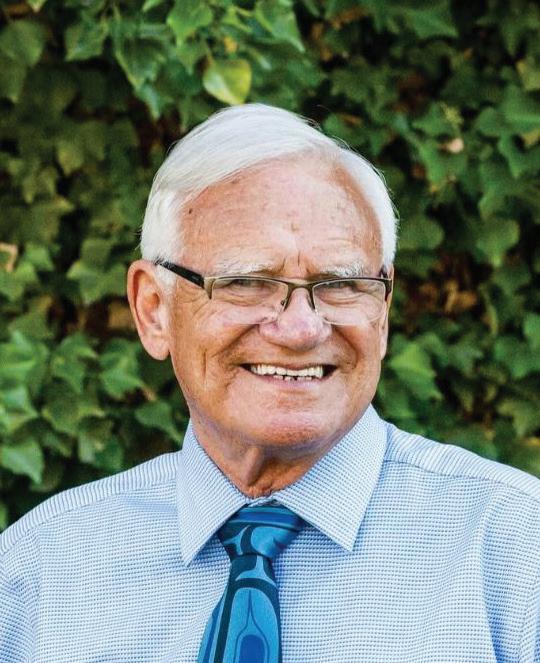
July 21, 1940 -February 8, 2026
Surrounded by his loving family, George Lacerte passed away peacefully on February 8, 2026.
George’s family takes solace in knowing he is reunited with his beloved wife ety, who has been waitng for their heavenly dance since February 8, 2003. George is predeceased by his children Kenny and Karen, brothers Victor and Jack, and parents Sophie and Philippe.
Throughout his life, George’s kindness touched many souls. He sought to help those in need with quiet acts of generosity, empathy and compassion. George met each day by focusing his energy on what was within his control, living with an optmistc outloo and unwavering faith. George never allowed his cancer diagnosis to de ne him and, when as ed how he was doing, his steady response was a resounding ‘Absolutely Amazing!’. Without a doubt, George’s positvity and determinaton, together with the e ceptonal care of r. Christan ollmannsberger and his team at C Cancer, allowed his family and friends to enjoy many cherished years together.



She was, in every sense, a kind of sunshine vitaminbrightening lives, li ing spirits and leaving the world a beter place than she found it. Her love lives on in all those fortunate to have known her, and the kindness she gave so freely contnues to shine in the lives she touched.
celebraton of life will be held in alt pring and Prince George this summer. A gathering of family and celebraton will be held as she is put to rest in Kimberley columbarium.
lice is leaving a legacy donaton to alt pring Hospice ociety. In lieu of owers, please consider a donaton in her honour.
George will forever be remembered for his unconditonal love, wisdom, humour and encouraging presence and will be deeply missed by his daughters onnie, enise, ichelle and oni ue, their spouses, grandchildren, great-grandchildren, extended family and loving partner Gloria.
Family and friends are invited to join us as we joyfully honour eorge at his Celebraton of ife, held on aturday, ay , at Nadleh hut en Hall at am. ecepton will follow.


To anyone related to ALLAN, AMANDA LESLIE about the trailer MHR#043921, Serial#2584, 1968, GLENDALE CORP, GLENDALE , located at #26 - 10180 Hart HWY, Prince George, B. C., Northland HWY97 Estates Ltd., the owner of Northland RV& Trailer Park, 251-3381 Cambie St., Vancouver, B.C. V5Z 4R3 (604-248-7505), will dispose o the above-mentoned trailer unless the person being not ed takes possession o the property and establishes a right of possession of it within 0 da s rom the date the notce is served on that person.
PLEASE RECYCLE THIS NEWSPAPER


Sinclar Group Forest Products Ltd. has prepared a replacement for its Forest Stewardship Plan (FSP) #10, which applies to operatons in the Stuart-Nechako and Prince George Natural Resource Districts.
In accordance with the Forest Planning and Practces Regulaton, the replacement is available for public review and comment from April 17th, 2026, to June 17th, 2026. The FSP replacement can be viewed at Lakeland Mills Ltd. Woodlands Ofce, 1325 Foley Crescent, Prince George, BC, V2L 4V4, during regular business hours (8:00 AM – 4:00 PM).
Please contact Andrew Peacosh, RPF at andrew.peacosh@sinclar.com or 250-617-1184 to schedule an appointment.
Writen comments can be submited via email, dropped of in person or mailed to: Andrew Peacosh, Sinclar Group Forest Products Ltd., 1515 Nicholson Street South, Prince George, BC, V2N 1V7.



• On Nov. 11, 1831, Nat Turner, an American slave and educated minister who believed that he’d been chosen by God to lead his people into freedom, was hanged in Jerusalem, Virginia, for leading a revolt with 75 followers through Southampton County, killing about 60 white people.
* On May 11, 1659, the Massachusetts Bay Colony passed a law banning the celebration of Christmas, with a prohibition on “feasting and similar satanic practices” accompanied by a five-shilling penalty. Nearly 40 years earlier, the governor of the Plymouth Colony, in similar Scrooge-like spirit, had actually
• On Nov. 12, 1969, investigative journalist Seymour Hersh revealed the extent of the U.S. Army’s charges against 1st Lt. William L. Calley at My Lai, Vietnam, in a cable picked up by more than 30 newspapers, saying that “The Army says he [Calley] deliberately murdered at least 109 Vietnamese civilians during a searchand-destroy mission in March 1968, in a Viet Cong stronghold known as ‘Pinkville.’”
ARIES (March 21 to April 19) You’re the frst sign in the Zodiac and like to take the lead wherever you go. But this tme, you’d be wise to follow someone who has much to teach you.
(and personally) confiscated toys.
* On May 12, 1903, cameraman H.J. Miles filmed President Theodore Roosevelt as he rode in a parade in his honor. The resulting movie, later played on nickelodeons in arcades across the country, was unusual not just because Roosevelt was one of the first presidents to have an official activity recorded in that medium, but because his carriage was escorted by the Ninth U.S. Cavalry Regiment, an all-Black company.
* On May 13, 1920, the Socialist Party nominated Eugene V. Debs as its candidate for president in
the upcoming November election, notably undeterred by the fact that he happened to be serving a decade-long sentence at an Atlanta federal penitentiary.
* On May 14, 1973, Skylab, America’s first space station, was successfully launched into orbit around the earth. Eleven days later, astronauts Charles Conrad, Joseph Kerwin and Paul Weitz rendezvoused with the station, repaired a jammed solar panel and conducted scientific experiments during their 28-day stay aboard it.
* On May 15, 1982, the Paul McCartney and Stevie Wonder

CANCER (June 21 to July 22)
duet “Ebony and Ivory” grabbed the coveted top spot on the Billboard Hot 100, holding it for seven weeks and eventually becoming the biggest hit record of McCartney’s post-Beatles career.
* On May 16, 1985, three scientists from the British Antarctic Survey announced, in the scientific journal “Nature,” their detection of abnormally low levels of ozone over the South Pole. Within two years, 46 nations signed the Montreal Protocol, pledging to phase out substances known to cause ozone depletion.


LIBRA (September 23 to October 22)
TAURUS (April 20 to May 20) Your adversary hasn’t given up trying to undermine you at your workplace. Contnue to stay cool -- someone who’s in authority knows what’s happening.
• On Nov. 13, 1979, Philadelphia 76ers center Darryl Dawkins leaped over Kansas City Kings forward Bill Robinzine for a memorable slam dunk that shattered the fiberglass backboard. His equally memorable comment on the move, which was not his last and the sound of which spectators likened to a bomb going off: “It wasn’t really a safe thing to do, but it was a Darryl Dawkins thing to do.”
GEMINI (May 21 to June 20) Spring debuts with a positve aspect for relatonships! Paired Twins grow closer, while the single set fnds new romance -- perhaps with a LEO or LIBRA.
• On Nov. 14, 1882, outlaw Frank “Buckskin” Leslie shot and killed Billy “The Kid” Claiborne, who had publicly challenged him, in Tombstone, Arizona.
• On Nov. 15, 1984, Baby Fae, a month old infant who received the world’s first baboon heart transplant, died at California’s Loma Linda University 20 days after the operation. Three other people had received animal heart transplants, but none survived longer than a few days.
• On Nov. 16, 2001, British author J.K. Rowling’s most famous and beloved creation, the bespectacled boy wizard Harry Potter (played by Daniel Radcliffe in his first major role), made his silver-screen debut in “Harry Potter and the Sorcerer’s Stone,” which went on to become one of the highestgrossing movies in history.
• On Nov. 17, 1903, the Russian Social Democratic Labour Party split into two factions: the majority Bolsheviks and minority Mensheviks. The Bolsheviks went on to become the Communist Party of the Soviet Union.
© 2024 King Features Synd., Inc.
Wavering aspects this week mean weighing your words carefully to avoid misunderstandings with others, who could take what you say and run with it.
LEO (July 23 to August 22) You could soon be on a new career path in pursuit of some long-standing goals, but don’t cut any current tes untl you’re sure that you’re ready to make the change.
VIRGO (August 23 to September 22) A former colleague wants to reestablish an old professional connecton. It would be wise to make the contact, at least untl you know what they are planning.
A relatonship that survived some rocky moments could be facing a new challenge. Deal with the problem openly, honestly and without delay. Good luck!
SCORPIO (October 23 to November 21)
A recent and much-appreciated change in the workplace inspires you to make some changes in your personal life as well. Start with a plan to travel more.
SAGITTARIUS (November 22 to December 21) A friend needs your kind and caring advice, but you need to know what they are hiding from you before you agree to get involved.
CAPRICORN (December 22 to January 19) Your circle of friends contnues to widen. Expect to hear from someone in your past who hopes to reestablish your once-close relatonship.
AQUARIUS (January 20 to February 18) Your aspects favor the arts. Indulge in whatever artstc expression you enjoy most. Meanwhile, a workplace situaton will contnue to improve.
PISCES (February 19 to March 20) Warning! Your tendency to let things slide untl the last minute could have a negatve efect on a relatonship that you hope can develop into something meaningful.


(NC) From farmers’ markets to grocery store shelves, more Canadians are paying attention to where their food comes from. Choosing local fruits and vegetables helps farmers, strengthens communities and protects Canada’s ability to feed itself.
Here are three reasons to put Ontario-grown produce on your plate this year.
It supports local farmers and communities
Fruit and vegetable farms are deeply rooted in their communities, creating jobs and contributing to local economies. Consumer support helps them continue producing fresh, high-quality food close to home.
When you buy local, more of your food dollar stays in Ontario. That
means you’re supporting farm families, seasonal workers, food processors and the many small businesses across the province connected to our food system. It strengthens Canada’s food sovereignty
Recent global disruptions have shown how vulnerable international supply chains can be. From wars and extreme weather events to tariffs and political upheaval, events far from home can quickly affect what’s available on our store shelves.
Choosing locally-grown produce supports our own food production. It also- strengthens Canada’s food sovereignty—our ability to grow and supply as much of our own food as possible. We know we can’t grow everything here due to our climate, but a strong local











fruit and vegetable sector reduces our reliance on imports and helps keep food available, even during uncertain times. It’s fresh, seasonal and full of flavour
Local produce doesn’t have to travel far, meaning it can be harvested closer to peak ripeness and reach stores faster.
In spring, look for these local items:
Greenhouse tomatoes, cucumbers and peppers
Asparagus
Rhubarb
Green onions and early leafy greens.
As summer arrives, your choices include:
Strawberries
Snap peas and radishes
New potatoes
Sweet cherries and raspberries
Buying in season delivers better flavour and quality. It also connects you to the rhythm of the growing season right here at home.
Every purchase adds up. By choosing local fruits and vegetables, you’re not just eating well, you’re supporting local businesses, communities and a stronger, more self-reliant food system.





(NC) Whether you’re looking to save a bit of money on contractor costs, crave the sense of purpose in taking care of household tasks yourself—or a bit of both—there are many reasons why people tackle DIY reno projects. No matter your skill set, it’s important to take chemical safety precautions when doing work around the house. Here are four key considerations. Beware of asbestos
Older homes can contain dangerous materials in and behind the walls. Asbestos, for example, was commonly used in a wide range of products for insulation and fireproofing before the 1990s. It can be found in attics, wrapped around heating ducts or embedded in products like exterior siding and floor tiles.
Generally, asbestos doesn’t pose a health risk if it’s left undisturbed. But if your project involves removing old tiles, opening up walls or other demolition, you should
consider contacting a professional to test for and remove asbestos if present.
Look out for lead
Another toxic ingredient that was commonly used in building materials is lead. Older homes may have lead in the paint or the plumbing supply lines. If lead paint is sanded or scraped, the airborne dust poses a risk. Exposure to lead can cause a variety of harmful health impacts on the brain, kidneys, nervous system and more. Lead paint also has a sweet taste, so children sometimes eat flakes of it.
The risk is greater for young children whose bodies are developing. A certified inspector can measure lead levels in the paint in your home. You can also mail paint chip samples to a testing laboratory. If you do have lead-based paint, consider hiring a professional to remove it.
Many municipalities provide testing kits to detect the presence of
Life Transitions
Senior Move & Estate
Cleanout Support


Decluttering Services
Families & Transitions
Storage Container Clean-out

lead in your water supply, and can suggest ways to fix the problem if it’s found.
Be VOC-aware
Volatile organic compounds, more commonly known as VOCs are commonly associated with “new car smell,” but they’re also found in things like paint and furniture. Despite being organic, the off-gassing of VOCs can cause headaches, breathing issues and irritation of the eyes, nose and throat. When purchasing materials for your project, look for items labelled as “low emission,” “low VOC” or “no VOC.”
Before you begin work, seal off the area from the rest of the home. When possible, open the windows, use exhaust fans and take frequent fresh air breaks.
Suit up for safety
Every reno project will require specific safety gear. Always read the label and wear all the recommended personal protective equipment, such as gloves, goggles and masks.
By taking some safety steps, you can set yourself up for reno success. Find more safety tips for your next DIY project at canada.ca/ healthy-home.

www.newscanada.com