









COLIN SLARK Citizen Staff
The Canadian Army is looking to adapt to shifting geopolitical conditions and Prince George’s army reserve company has a role to play in those efforts, city council heard at its Monday, April 13 meeting.
The Rocky Mountain Rangers Regimental Association, the non-profit arm of the army reserve’s B Company, were represented in person at the council meeting by Dan McLaren, Harvey Smerchynski and Frank Flood and remotely by commanding officer Lt.-Col. Torry White.
The rangers are one of four infantry regiments in British Columbia, headquartered out of an armoury in Kamloops and maintaining a rifle company in Prince George.
White said he took command of the rangers in 2023 at a change of command ceremony in Prince George.
With changing geopolitical circumstances like greater sea access to the Arctic and issues with Canada’s presumed allies, White said the Canadian Forces need to be ready to protect this country’s interest.
So the rangers can play their part in that, White outlined four pillars the regiment seeks to embody by promoting recruitment and retention: supporting people, operational readiness, advancing professionalism and enhancing capabilities.
These pillars, he said, also tie into the armed forces’ new industrial strategy for defence. White said Prince George could have a role to play in this project to ensure the Canadian Forces have the materiel they need to defend the country.
This strategy, presentation slides said, is looking to boost government investment in defence-related research and development by 85 per cent, increase defence exports by 50 per cent and create 125,000 new defence-related jobs across the country.
“The army we have is not the army we need,” White said. Because of that, the Canadian Army engaged in major
modernization efforts last year that focuses on adaptation and being more standalone rather than participating as part of coalition operations.
Rocky Mountain Rangers, the presenters said, continue to be deployed to countries like Latvia, the United Kingdom, Jordan and Iraq.
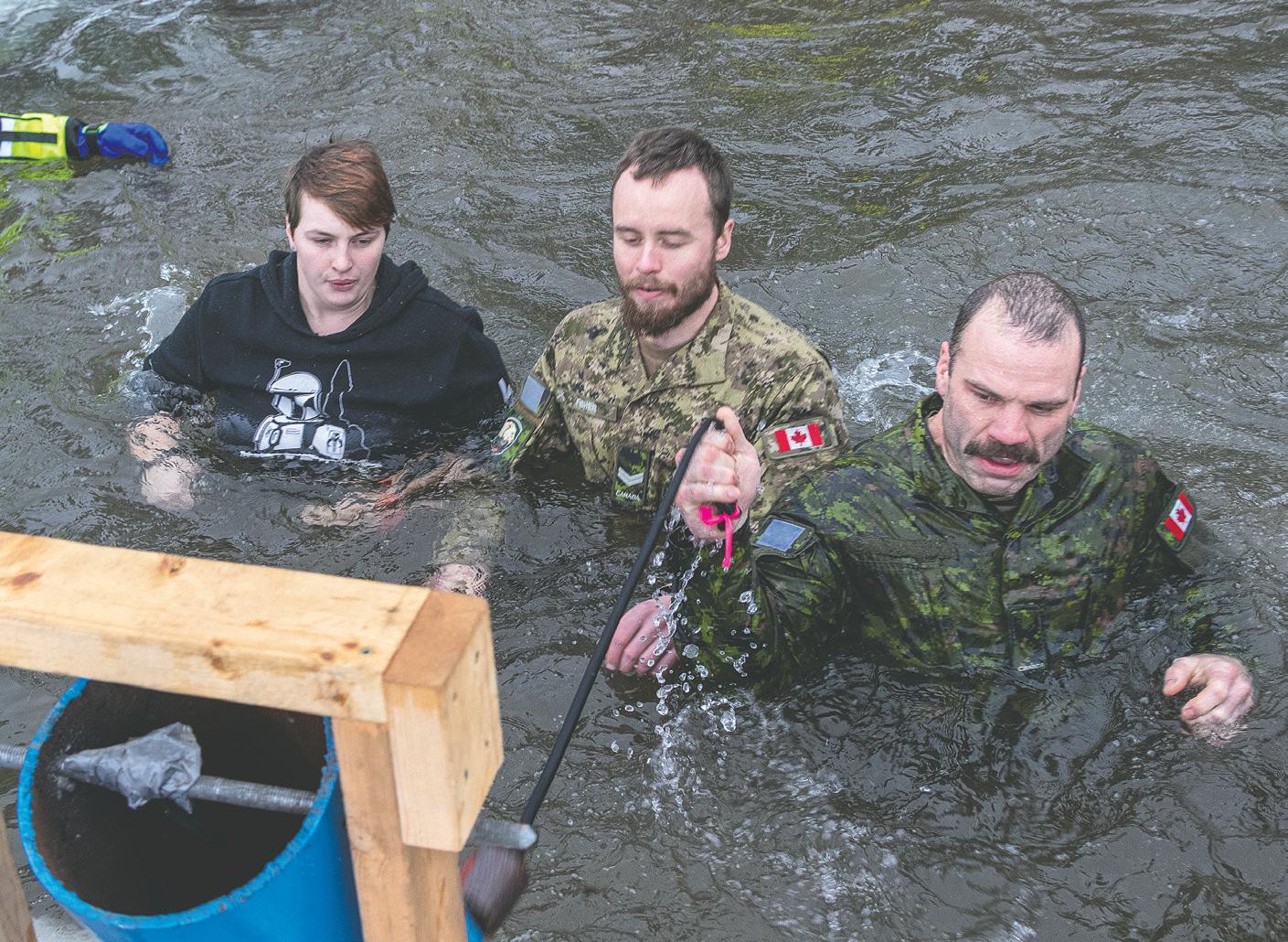
Recently, rangers participated in “significant” live fire training in the Chilcotin region as well as snowmobile training.
For the rest of this year and into 2027, rangers are expected to participate in several events including airmobile training in Wainwright, Alta., enemy force training with the 15th Field Artillery in Vancouver, a reunion in Armstrong, infantry courses in Nanaimo and Williams Lake, a division training exercise again in Wainwright and mountain operations training in Clearwater.
Airmobile training involves work with helicopters, White said. That training is taking place later this week.
The rangers are also undertaking recruitment efforts here in Prince George as well as Kamloops.
The presenters also listed some of the rangers’ accomplishments from 2025, which included Eric Depenau
the national strategy.
Coun. Kyle Sampson agreed that Prince George is well positioned to be a part of the federal defence strategy due to its positioning and status as a transportation hub.
He said council has a meeting with the provincial parliamentary secretary for armed forces development and veterans affairs Darlene Rotchford next week and could bring up this matter then. Sampson also moved for council to direct administration to prepare a letter of support that the rangers could use in efforts to expand their presence in Prince George and refer the matter of military investment to the Standing Committee on Intergovernmental Affairs.
Coun. Tim Bennett said that increased military spending is a good Canada-first way of investing in both the country and the communities.
— the City of Prince George’s director of administrative services — being promoted to Major, being the top contributor to the annual Canada Army Run and undergoing cold weather operator training.
After the presentation, Mayor Simon Yu discussed hearing Prime Minister Mark Carney speaking about the need to scale up defence investments at an event last year.
He said at a subsequent panel during the same event, someone asked how the average citizen can support the armed forces. One of the panellists emphasized to support the army through sending kids into cadet programs, joining a reserve unit or supporting veterans.
Coun. Garth Frizzell said it was worth celebrating former mayor Colin Kinsley on his 80th birthday on April 13 as he was one of the main reasons that the rangers were re-established in Prince George.
Coun. Cori Ramsay said that she’s heard a lot of focus on defence spending being on communities with bases and she wants to make sure that communities with reserve units aren’t left out of
Coun. Ron Polillo asked for more information on the rangers’ recruitment efforts. White said the biggest change to their efforts has been the addition of a full-time recruitment officer, which has allowed him to focus more on training and procuring the right equipment for members.
Mayor Simon Yu said that at one point, Minister of National Defence David McGuinty had invited him to submit a two-page report on the rangers’ operations in Prince George and their importance to the community.
He said he could include a desire for defence investments in that letter and said he could speak with the presenters for feedback.
Motion: Council directs administration to prepare a letter of support expressing the city’s support for the Rocky Mountain Rangers expanding its presence in Prince George.
Result: Approved unanimously.
Motion: Council refers advocacy of Prince George as a suitable location for Canadian Armed Forces Investment to the Standing Committee on Intergovernmental Affairs.
Result: Approved unanimously.
COLIN SLARK Citizen Staff
Prince George city council voted in favour of advocating against the end of a provincial property tax grant that could see locals have to shell out an additional $200 starting next year at its Monday, April 13 meeting.
The BC government offers residents a $570 homeowner benefit each year
to help offset the cost of municipal property taxes.
In rural and northern parts of the province, property owners had been offered an additional $200 grant by the province.
A page on the provincial government’s website states that this was put in place to help offset the extra costs that BC’s carbon tax imposed on those residents, but as the consumer tax was
repealed last year, the extra credit is being phased out for 2027.
At the Tuesday, April 7 meeting of the city’s Standing Committee on Intergovernmental Affairs, members voted in favour of sending the matter to council to approve sending a resolution to the Union of BC Municipalities’ 2026 convention. calling for the benefit to be maintained.
They argued that the amount being
saved by the province was essentially a drop in the bucket for it, but would have a significant hit to locals’ pocket books.
Vote summary
Motion: Council approves sending a motion calling for the continuation of the rural and northern home owners grant to the UBCM’s 2026 convention for discussion.
Result: Approved unanimously.
Prince George city council approved an application for a potential $40,000 emergency preparedness grant from the Union of BC Municipalities at its Monday, April 13 meeting.
City staff told council that it wanted to apply for the grant to fund the
completion of Prince George’s evacuation response plan, especially parts of it relating to planning evacuation routes.
“The scope of this work is planned to include evacuation-zone-specific plans, public notification templates and an overarching evacuation route plan for the entirety of the City of Prince George,” a report from staff said.
The city’s current evacuation response plan was written in 2018.
Director of administrative services
Eric Depenau said schools across the city are generally identified as muster points for evacuation efforts.
As was seen recently with the gas leak in the Heritage area in March, there would also be collaboration with the RCMP to get the word out to residents
about evacuations.
Vote summary
Motion: Council approves a grant submission to the Union of BC Municipalities’ emergency preparedness fund for public notification and evacuation route planning for a potential $40,000 in funding.
Result: Approved unanimously.




She’s running to replace John Rustad as head of the BC Conservatives
MATTHEW HILLIER Citizen Staff
BC Conservative leadership hopeful Kerry-Lynne Findlay made the last stop of her northern tour of the province at the Bon Voyage Restaurant on Monday, April 13, meeting about 80 local people.
Findlay, one of five candidates in the race for the party leadership after the resignation of John Rustad on Dec. 4, gave a speech to the crowd and took questions.
“Normally, as a mayor, I like to meet all the people who throw themselves into a political race,” said Mayor Simon Yu, who was in attendance. “Left, right, federal, provincial, it doesn’t matter. Because for me, I admire people willing to give themselves up for public service and also all views are important. Only during this debate can we hear each other, and we can find out what the common thread is.”
Findlay was the MP for South Surrey-White Rock from 2019 to 2025 and federal Conservative chief Opposition whip from 2023 to 2025.
She had previously been the MP for Delta-Richmond East from 2011 to 2015, serving as federal minister of national revenue.
Findlay touted her extensive political experience as a federal Conservative party member and MP, along with her experience working under the Stephen Harper government, as one of the biggest reasons why she is qualified for the top job in the BC Conservatives. Of the 11 original candidates, five are left: Findlay, former BC Liberal cabinet minister Iain Black, political commentator Caroline Elliott, entrepreneur Yuri Fulmer and MLA Peter Milobar.
“This is not an entry-level job, with all due respect,” said Findlay. “ … With the five of us left in the race, I’m sure they all care about British Columbia. But nobody has lived and experienced what

I have; that is so relevant to the issues we need to face today.”
She added that she believes her experience can help unite the Conservative party and oust the NDP, with many concerned about divisions in the party.
“If you can bring together people with 80 per cent commonality, you can move forward,” she said. “That’s what I would hope to achieve. I believe I’m uniquely qualified to help lead that, and bring together the people who would be running under our banner.”
Party members began voting April 9, with the new leader to be announced May 30.
With many in BC dealing with a rise in the cost of living and increasing prices, Findlay believes that addressing and solving these issues will both unite the party and bring more people under the Conservative banner.
“I quoted Margaret Thatcher saying, ‘first you win the argument, then you win the vote,’” said Findlay. “I believe if the people of BC see that our policies, our platforms, our approach is going to improve the quality of their life, is going to lower their taxes, is going to give them more money in their pockets at the end of their paycheques, I believe they will vote for that.”
During her speech, she also spoke on her opposition to the Declaration on the Rights of Indigenous Peoples Act (DRIPA), her opposition to sexual
as Findlay’s speech to locals.
“As a leadership candidate for the Conservative Party of BC, I pledge to you that I will get rid of DRIPA,” Findlay said during her speech. “Because it is an overriding, property-affecting, pan-provincial decision that will hurt us all.”
Findlay also shared her disappointment at the way the NDP has been handling crime.
orientation and gender identity education in schools, her wish to improve infrastructure in the province, her distaste for the handling of the natural resources industry under the NDP and more.
“I feel my province needs my talents at this particular time,” Findlay told The Citizen in an interview at the restaurant. “I have experience as a minister. I have experience governing as a Conservative. I have experience helping bring us out of a recession and into surplus balance and lowering taxes. I think this province desperately needs this approach at this juncture in time, and it’s my home.”
Findlay said she feels that those in BC are feeling the pinch and that they need a government that listens.
“I think a lot of British Columbians are actually feeling quite desperate at the moment,” said Findlay. “They’re unsure about their property rights, they are out of work. We’ve had 31 sawmills closed down in five years. We have a government that is not listening to foresters, to our fishers, not listening to our miners or our farmers. There’s so much we can do to improve life in British Columbia.”
DRIPA in particular is a focus for Findlay. She says the act needs to be repealed. DRIPA has recently been a hot-button topic, with the NDP backing down from voting to pause parts of the act on Monday, April 13, the same day
“Look at the Alberta model, they’ve put money into it,” said Findlay. “They’ve put money into care centres, recovery beds, and they’re having success. Governments don’t create wealth. They prioritize the spending of our taxpayer dollars, and I think this government is guilty of fiscal malfeasance. I think that they have spent too much money in the wrong places.”
Findlay has also been an advocate during her race for revitalizing the natural resources sector in the province. She admitted during her interview that she was not an expert on forestry itself but would listen to the opinions of industry leaders to help revitalize the industry.
She also believes that the NDP is “gatekeeping” the industry and that it is fundamentally mishandling how these goods are handled on the international market.
“There’s no reason that we should be becoming an exporter of raw logs that are all processed in Asia, sold back to us, or that our oil is sold at discounts to the Americans to be refined and sold back to us at world prices. We need to open this up and invest.”
When it comes to natural resources, she also believes that BC and, by extension, Canada should become energy-independent.
“We need all forms of energy,” said Findlay. “We need nuclear energy. We need green tech. We need to embrace the innovations that people have already created, that are already there, that will help us deal with environmental issues. We need to get our natural resources out of the ground and to use them domestically and also get them to our export markets. I would have a BC-is-open-for-business attitude.”
































Survey results outline what local taxpayers think of the idea
COLIN SLARK Citizen Staff
Prince George city council voted to add consideration of a public washroom in the downtown core to its 2027 budget discussion at its meeting on Monday, April 13.
In December 2024, city council approved a motion directing staff to update cost estimates for improving downtown washroom access, apply for washroom-related grants, add washroom-related questions to surveys and get the Standing Committee on Intergovernmental Affairs to advocate on washroom-related topics.
Staff came back with a report on those topics in September 2025, which led to council requesting public engagement to see what residents wanted for washroom access in the downtown core.
During the April 13 meeting, engagement co-ordinator Imogene BrobergHull said the city first started public engagement over public washrooms in 2018.
That was followed up by the washrooms at Canada Games Plaza being open during the COVID-19 pandemic. Then, in 2022, there was further consultation with service providers and their clients in 2022.
The city’s recent public engagement took the form of an online survey open from Feb. 9 to March 2, with 1,512 people filling it out. A summary of the findings and a report from staff were attached to the meeting agenda.
This is one of the highest response rates for a city survey in years, BrobergHull said.
The survey had seven questions, asking residents to chime in on how frequently they interact with the downtown core, whether they think more public washrooms are needed, where washrooms should be located if more were to be opened, what approach to running the washrooms should be

The city has been looking into the idea of opening more public washrooms downtown. After reviewing the results of a public survey, council decided to push the motion to the 2027 budget process.
taken, what factors are most important, whether it should be a priority to build washrooms and how much they’re comfortable with the city spending on washrooms.
Of the respondents, 51.59 per cent said they thought more washrooms were needed downtown. A further 42.99 per cent said more washrooms aren’t needed and 5.42 per cent were unsure.
A total of 674 pins were placed on a map where respondents could identify where they’d like to see public washrooms.
The most popular locations were near city hall, near the civic centre, near the intersection of Fifth Avenue and George Street and near the intersection of Third Avenue and Quebec Street.
Broberg-Hull said the Third Avenue corridor and city-owned properties like Canada Games Plaza and city hall were also popular options.
The question on what kind of washroom should be considered offered respondents five options: a staffed washroom at Canada Games Plaza (22.62 per cent support), a durable, single-occupant washroom (17.64 per cent), a washroom provided in partnership with a service provider (12.59 per cent), integrating a public washroom into an existing civic facility (24.40 per cent) or another approach (22.76 per cent).
The answers under the category of “other” had many respondents express their outright opposition to installing a downtown public washroom.
“Common concerns related to safety, vandalism, drug use and ongoing
maintenance costs, with several respondents emphasizing that any facility would require close monitoring or staffing to remain clean and safe,” the report said.
“A smaller number of responses suggested alternative approaches, such as using existing civic facilities, installing temporary or lower-cost structures, or partnering with businesses or service providers.
“Some respondents also framed the issue more broadly, noting that washroom access is connected to larger challenges related to homelessness, addiction, and downtown conditions, and expressed the view that one washroom alone would not address these underlying issues.”
Here were the most important washroom factors identified by respondents:
• Cleanliness and maintenance (80.09 per cent)
• Safety (75.66 per cent support)
• Staffing and monitoring (44.31 per cent)
• Year-round access (40.15 per cent)
• Cost to the city (37.96 per cent)
• Long, daily operating hours (22.55 per cent)
• Visibility and location (16.87 per cent)
• Accessibility features (15.48 per cent)
• Other (8.47 per cent)
While most respondents expressed a desire for more downtown washroom access, there was less support for making it a priority and spending money on it.
Just 32.41 per cent of respondents said it should be a priority, while 42.39 per cent said no, 21.76 per cent said it would depend on the cost and 3.44 per cent were unsure.
As for the cost, 52.18 per cent of people said the city should spend up to $250,000 on a public washroom, 31.31 per cent they should spend between $250,000 and $500,000, 9.59 per cent said $500,000 to $1 million should be spent and 6.92 per cent said more than $1 million should be spent.
Last September, city staff said the cost to partner with non-profits to open washrooms would likely cost between $67,000 and $80,000 per year per location and opening washrooms at Canada Games Plaza between April and November would cost between $268,385 and $295,502 a year.
With those survey results in hand, city administration recommended three possible paths forward for council: receive the report for information but not proceeding with more action at this time, identify a preferred approach and direct staff to report back on logistics and costs or finally, direct staff to add a downtown washroom as a funded project in the 2027 budget.
After the presentation, Coun. Tim Bennett said he was eying the second option, not because he wanted to create more debate, but because he was interested in discussing the addition of a public washroom to next year’s capital plan.
City manager Walter Babicz said he didn’t think a report could be completed by an upcoming May or June meeting of the Committee of the Whole, but that information could be prepared for inclusion as a funded capital plan for the 2027 budget.
Bennett decided to put the second option up for a vote.
Coun. Trudy Klassen asked whether the public consultation included targeted engagement with BC Housing, Northern Health or any other service providers.
Broberg-Hull said this round of engagement was focused on the general public as previous consultation had been focused on service providers.
Coun. Cori Ramsay said there are plenty of washrooms downtown within the buildings of service providers or at public buildings.
With a lot of respondents voicing disapproval for new washrooms or spending on washrooms, she said she was trying to figure out if washroom access was as big of a problem as it used to be.
Coun. Kyle Sampson said he was trying to approach this with an open mind, but the survey shows a division in the community and not enough support to justify an ongoing operational expense.
He said plenty of downtown facilities offer washroom access, especially to their customers and he’d rather see more investment in “facilities with a greater purpose” instead of washrooms alone.
Coun. Brian Skakun said that he believed that if downtown businesses alone were surveyed, they’d likely want another public washroom given issues they’ve experienced with public defecation. He said there would be a cost attached, but it was time to finally invest in downtown washrooms.
Coun. Garth Frizzell said he concurred with Skakun and that it would be an investment in workers, families,
business and more in the downtown core.
Coun. Ron Polillo said that like resi dents, he too was split on the issue. He said the 2020 pilot project at Canada Games Plaza did not go well and he is wary of using a civic facility to provide washroom access.
However, he said he was leaning towards the second option so the city could explore its options. Ideally, he said, this would include a partnership with another entity.
Commenting again, Sampson said washroom access has improved at facilities like the Prince George Public Library, the Canfor Leisure Pool and through expanded events at Canada Games Plaza.
He said the real question was not sim ply public washroom access but wash room access for the unhoused. The city, he said, needs to be more proactive in encouraging these people to use what’s available instead of “crapping on the street.”
“Adult diapers?” Mayor Simon Yu quipped.
Later, he said that Sampson was right: council is really talking about 24-7 washroom access for the city’s home less community. However, he said the survey also indicates there is a desire for more washrooms in some hotspots around downtown.
Coun. Susan Scott said she was also conflicted. She said council might be operating on the assumption that if a washroom is opened, that it will be used. Many of the washrooms men tioned during the discussion, she said, have limited operating hours.
Motion: Council directs administra tion to undertake planning to include a downtown public washroom in the 2027 budget cycle and return with a report.
• In favour: Ramsay, Polillo, Scott, Skakun, Yu, Frizzell, Klassen and Bennett
• Against: Sampson


KENNEDY GORDON Citizen Managing Editor
The people we count on to keep us safe in emergencies are being put in danger just for doing their jobs.
Violence against first responders is happening more often. This affects everyone.
Don’t think for even a second that this kind of violence is “part of the job.” Paramedics, nurses and other emergency workers are trained to help people, not to be abused. But these days they’re facing random attacks while trying to do their work, and we have to change how we talk about this.
We already know how big the problem is. Studies show that about three out of four paramedics experience violence at work, and many of them deal with it again and again.
We just saw it happen here in Prince George. Two of our paramedics had to be taken to the hospital after someone threw an object through the open window of their ambulance. While the RCMP wouldn’t tell us what the object was, the provincial paramedics’ safety director told us it was a “weighted backpack.” Think about something like that coming through your car or truck window while you’re driving.
We also saw a recent court case involving a University Hospital of Northern British Columbia emergency room nurse being attacked on the job.
When it’s this common, something isn’t working. It’s pretty obvious there’s

not enough being done to protect the people who protect us, and that affects all of us, not just them.
If first responders have to stop and think about their own safety, it slows everything down. They may need to wait for backup or delay to take extra precautions. In an emergency, even a few seconds can matter. Their fear shouldn’t be getting in the way of fast, effective care.
There’s also a heavy personal cost. Being exposed to violence over and over can lead to stress, anxiety and burnout. Experienced workers (like the
nurse mentioned earlier) are quitting their jobs, not because they don’t care, but because it’s become too dangerous. That makes Northern BC’s already chronic staff shortages worse and puts more pressure on people still on the job.
Of course, this being PG in 2026, the issues go deeper. Many of these violent incidents are connected to bigger problems like addiction, homelessness and mental health challenges.
We’ve talked about “compassion fatigue” before. It hasn’t gone away. When people — both workers and the
public — are constantly dealing with crises and feel unsafe, it wears them down. Over time, it becomes harder to care. That’s a loss for everyone.
Surveys like the city’s recent poll on downtown bathrooms show that safety is one of the top concerns for residents, even when being asked for their takes on basic services.
It doesn’t mean people are against helping others (although there are certainly some who feel that way). It means they want help to be delivered in a way that’s safe.
So what do we do? Will things improve once the province brings involuntary care back to Prince George? We can hope, but we are still waiting on Premier David Eby and Health Minister Josie Osborne to deliver on their promises for that facility. But for now, we have to live with what’s happening today.
We can recognize that mental illness, addiction and homelessness play a role in a lot, if not most, of these situations. But we can’t start to think of random violence as normal.
A caring society doesn’t ask its first responders to take abuse without support.
It sets clear limits and enforces the law while maintaining emergency services to help people in need. People will support services that help, but they also expect clear rules, accountability and consequences for harmful behaviour. That’s not a contradiction — it’s common sense.
We acknowledge the fnancial support of the government of
Nous reconnaissons l’appui fnancier du gouvernement du Canada.




Kennedy Gordon Managing Editor
OFFICE (8:30a - 4:30p)
505 Fourth Avenue
Prince George, B.C. V2L 3H2
FRONT DESK & CLASSIFIED frontdesk@pgcitzen.ca 250-562-2441 NEWS AND SPORTS news@pgcitzen.ca
LETTERS TO THE EDITOR editor@pgcitzen.ca
OWNER / PUBLISHER owner@pgcitzen.ca


ELI KLASNER Guest Columnist
If mid-sized cities across Canada face similar challenges with cultural infrastructure, it follows that new approaches are emerging in parallel.
No two communities are identical, but several Canadian cities offer useful examples of more integrated, partnership-based models.
In Kelowna, the evolution of the cultural district has involved sustained collaboration between municipal leaders, arts organizations and private partners. Facilities such as the Rotary Centre for the Arts show how multiuse spaces can serve diverse needs while supporting broader downtown development.
In Kingston, the Isabel Bader Centre for the Performing Arts reflects a different approach — rooted in institutional partnership and philanthropy — but aligned with a broader shift toward purpose-built, flexible and sustainable cultural space.
In Calgary, the cSPACE King Edward project — developed within a repurposed heritage school — combines arts incubation space with commercial tenancies, creating a hybrid model that supports both cultural activity and longterm operations.
These examples differ in form, but share a common shift in mindset. Cultural infrastructure is no longer treated as a stand-alone civic amenity. It is increasingly understood as part of a larger ecosystem that includes housing, education, commercial activity and community services.
For mid-sized cities, this shift is critical. Without the scale or financial capacity of major urban centres, they must find ways to do more with limited resources. Integrated models offer one path forward.

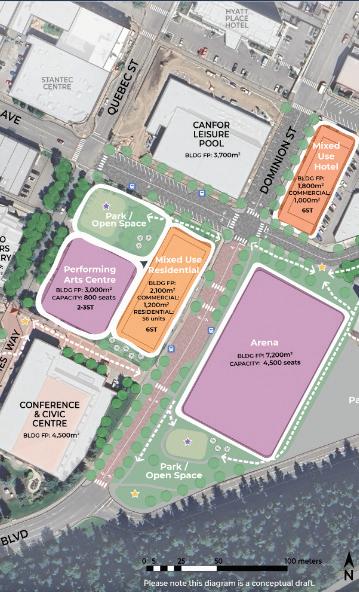
Here is the first of two concept designs for the civic core. A second option (below) presented to council in 2025 has a smaller performing arts centre and residential units.
They are not simple. Partnership-based projects require alignment across sectors, careful planning and a willingness to navigate complexity.
They also demand strong leadership to move from concept to implementation.
But the alternative — continuing to rely solely on traditional approaches to funding and replacing arts facilities — may leave many communities unable to meet their broader cultural infrastructure needs.
The question is not whether change is needed, but how it is approached.
In Prince George, as the Civic Core District Plan moves from vision to implementation, there is a timely opportunity to think at the level of systems rather than individual projects. Embedding arts and cultural space within broader development strategies — from the outset — can help align
cultural infrastructure with the longterm economic and social goals of the downtown.
For Prince George, and for many cities like it, the opportunity is to be both pragmatic and ambitious: to recognize constraints while exploring new ways of building the shared spaces communities need.
At its core, this is a conversation about community — about how we gather, how we tell our stories and how we invest in the places that shape our collective life.
If we are willing to think beyond individual buildings, the next generation of cultural infrastructure in Canada can do more than address today’s challenges. It can help build stronger, more connected communities for the future.
Eli Klasner is the former executive director of the Community Arts Council.
Advocacy group slams lack of public consultation on UNBC development plan

The proposed development of 35 acres of UNBC’s endowment lands has sparked concerns from the advocacy group Ginter’s Green Forever (GGF). They worry about the lack of public consultation and potential environmental impacts, especially since UNBC seeks to remove a reverter clause that could return the land to the Crown if not used for educational purposes.
The recent history of the “Veda” Building (2001), intended as student housing, raises skepticism about the new plan. With rents exceeding $1,000, the Veda has basically become a single-room occupancy (SRO), failing to meet its original purpose.
In the current Canadian economy, this new development appears to be a cash grab, potentially straining city infrastructure without adequately addressing community needs. Both GGF and local residents emphasize the need for genuine public engagement to ensure that future developments align with community interests and do not repeat past mistakes.
Nathan Findlay
Advocacy group slams lack of public consultation on UNBC development plan
I have lived in the Charella, Starlane area (north of Highway 16) for over 10 years and noticed the following: hundreds of new houses every year being built, some of the highest taxes in BC for the value of the homes, and very little infrastructure being built during that time. There are no stores, no schools, no government services and only a handful of businesses in our busy area. Tyner to UNBC should have been twinned 10 years ago. I have no confidence that city planners and city leadership are willing to spend any money on areas outside of the downtown money pit.
Brian1
Editorial: We have questions about UNBC’s land-lease proposal
You make an excellent point. The government should require a detailed plan from the university showing how the proceeds will go into capital projects and be used to upgrade or enhance the university’s buildings. We have seen far too much public money being siphoned off to increase administrators’ salaries and bonuses at all levels of government and at Crown corporations, both federal and provincial. I hope it is not asking too much for the parties involved to put the money toward capital expenditures and not operating expenses. However, it appears our provincial government has difficulty telling the difference.
Keith Brain
Editorial: We have questions about UNBC’s land-lease proposal
Kennedy, your analysis of the UNBC land situation is well thought out. During the past 20 years, UNBC’s administration has become bloated with overpaid management positions. They have also doubled their number of deans. At the same time, student enrollment numbers have declined. UNBC is no longer the lean and efficient operation that it once was. UNBC needs a shakeup at the top and then match its resources to the programs that it can reasonably offer to students.
They may have programs where the cost per student far exceeds UNBC’s ability to deliver them. Property development is not an educational function, but it does open the door to the possibility of kickbacks being paid to senior administrators by property developers.
They have hundreds of millions to play with.
Ed Prout
James Steidle: UNBC’s big plans could end up costing the City of Prince George
Well said, James, and thank you for giving us the numbers to consider.
Everything comes with a cost, whether it’s monetary or otherwise.
I hope people can also see the incredible value that our forests and green spaces give to making PG a better place to live.
S Moffat
Transport Canada asks drivers for input on super-bright headlights
Biggest problem that I see is cargo. People load cargo into the rear of a vehicle, unrecognized to the driver. The headlights then aim upwards. The problem can be compounded by levelling (lift kits), non-OEM tire sizes in trucks, pulling trailers, or just a load of people. Start paying attention to which vehicles blind you and you’ll see the pattern. Vehicles are built for comfort, with less robust suspension than they used to. Not going to downplay the amount of people who buy Amazon-type lights and put them in the wrong application. Shark Tank
Transport Canada asks drivers for input on super-bright headlights
They are ridiculous. There is lighting all over the city; you don’t need to be blinding other drivers. On the highway, where you actually need brighter lights, you have secondary high beams and light bars. The biggest factor for people getting hit is people driving like they are in a race. Doing 60+ in the city and passing everyone recklessly to get nowhere fast is foolish and disrespectful to everyone else on the road.
Zangief
Share your views on our stories

Two were hurt when someone threw a heavy backpack through an open ambulance window
MATTHEW HILLIER Citizen Staff
The safety of paramedics is in the spotlight after a recent violent incident that sent two of them to the hospital.
“There is a bigger propensity to violence than I’ve ever seen in all my 26 years in this organization,” said Corey Froese, who oversees safety for the provincial paramedics’ union. “I’ve never seen it this bad and it’s gotten worse year by year.”
It happened April 2 when a person threw an object through the open window of an ambulance heading down First Avenue, hitting one of the paramedics on board, which resulted in an arrest.
Froese, provincial safety director for the Ambulance Paramedics of BC (APBC), which is CUPE local 873, told The Citizen that the incident left him with questions.
“You have a unit of two completely innocent female paramedics driving to a call, headed out toward the airport, not bothering anybody, and somebody to the side just throws a weighted backpack through the side window, smacking the paramedic in the face,” he said. “For no apparent reason other than to injure somebody. It’s just violence that I don’t understand.”
Paramedic Chiefs of Canada reported in a 2014 study that 75 per cent of paramedics reported experiencing violence on the job, with 74 per cent reporting multiple forms of violence.
“I think that overall, what Prince George has seen is not an isolated case,” said Froese. “It’s happening all over our province. We are riddled with problems of violence that are escalating and people are generating this very dark kind of atmosphere that we are seeing in our communities.”
Froese said violence has begun to severely affect how paramedics perform their jobs.
“It’s a discouraging trend that we’ve seen from way back in 2010 that has
been escalating propensity of the violence ever since 2010 right up into 2026,” said Froese. “We’ve seen an absolute explosion in the rules around what it means to be a paramedic in dealing with the public because of the propensity of people that seem to want to generate violence for paramedics for no apparent reason.”
He added that he sees a high percentage of incidents involving a particular type of emergency response call.
“Most of the violence seems to be attributed to the unhoused and addiction,” said Froese. “It’s often attributed to encampments and treatment centres, and that overlaps into other properties and areas around communities. Cities end up having to deal with the overflow and the anger and the misery that people who are suffering with addiction.”
The reality of having to deal with violence on the job, said Froese, has led many to seek other types of work, impacting an occupation that often struggles with retention.
“If you happen to be somebody who is subjected to a serious violent incident, it affects how you run your career,” said Froese. “It may affect you from ever returning to the vocation again. Sometimes these people never come back when they’re subjected to these types of treatments.”
Trauma from violent incidents affects more than job retention, as Froese explains that it can often lead to lasting mental effects.
“It creates trauma, psychological events and physical injuries,” said Froese. “It makes people more vulnerable as a paramedic when you go back on the streets, because you don’t want to see that happen again and it creates fear and anxiety.”
In addition, Froese noted that the reality of violence faced by paramedics often requires regular risk assessments, which can delay going on calls but are a necessity in a changing health-care scene.

Froese deals with regulation and prevention when it comes to these incidents. However, both BC Emergency Health Services and APBC have robust psychological support groups that can be reached by those suffering, he said.
As well, there are internal policies in place that can aid with both physical and mental recovery.
However, Froese said that often the biggest struggle for those faced with violence is returning to work.
“The big one is trying to get back into the swing of things,” he said. “You have this fear and anxiety about getting back on the streets, which can be a huge detriment to the longevity of somebody’s
career. But we do have support. It’s limited because once the damage is done, it’s done.”
One thing that Froese struggles to understand in his role is why paramedics are targets for violence in the first place.
“We are riddled with problems of violence that are escalating and people just generating this very dark kind of atmosphere that we are seeing in our communities, where first responders are basically targets for this type of senseless violence,” he said. “The biggest thing that boggles my mind is that these are groups of people that just want to help the communities.”
MATTHEW HILLIER Citizen Staff
Drums and the names of those missing or murdered on the Highway of Tears echoed throughout Cottonwood Island Park as a new commemorative marker was unveiled.
The marker is named the Pillar of Hope and stands as a reminder of those lost and as a gathering place for those looking to memorialize and remember loved ones.
The families of those lost on the highway, along with supporters and friends, gathered in the park on Friday, April 10, on the last day of the 20th Anniversary Highway of Tears Symposium.
Family members of those lost on the Highway of Tears led the unveiling and embraced each other and placed their hands on the new pillar while drummers performed and sang.
Mary Teegee-Gray, CAO, child and family services at Carrier Sekani, (CSFS), spoke to the media on Ingenious-led healing and why this pillar being placed in the park is so important to those still grieving.
“This wonderful, beautiful spot in Lheidli T’enneh territory amongst the trees, around the water, right by the water, that’s healing for our people,” said Teegee-Gray. “Being by the water is healing. This spot that we picked out is a special place. You feel it. That sense that the ancestors are here with us. The creator is here with us.”
The pillar showcases the four seasons on each side, with Indigenous healing symbols throughout.
It also stands as a space for those who still have not found the remains of missing loved ones to find peace.
“When you’re looking for your lost loved one and you have a missing person. It’s a totally different type of pain,” said Teegee-Gray. “There’s really no sense of closure. At least this place, we’re hoping for it to be balm for the

Supporters and family members of those lost gather around the Pillar of Hope, on Friday, April 10. The pillar showcases a change in seasons on each of its sides with this side representing Summer.
soul and give peace to our families that are grieving.”
During the unveiling ceremony, family members said the names of those lost as drums beat and voices sang songs of healing.
Teegee-Gray was particularly moved by seeing the impact the pillar has made on the families attending.
“It’s their pillar,” said Teegee-Gray. “It’s especially meaningful when so many of the families you hear when
“It’s been a long battle to get the funding and the fighting and everything that we had to do for advocacy,” said Teegee-Gray. “To have a dream and realize it, it’s very meaningful because I just know how much the families’ hearts are broken and hurting. And if we just give them a moment of reprieve, it meant everything.”
Currently, CSFS is working with an artist and is planning to construct another commemorative marker in Prince Rupert. As well, they are planning on installing benches at the Pillar of Hope in the future.
The pillar in Prince Rupert will be named the Pillar of Strength, with Teegee-Grey hoping that these two pillars unite those on both ends of the more than 700km stretch.
“I think it’s connecting all of us and uniting all of us in the north,” said Teegee-Gray. “It’s uniting us along the highway. The is highway connecting all of us as human beings first and foremost. Connecting us to school, connecting us to important health services. but connecting us in spirit.
It’s really important that we have recognition of the start and the beginning of the highway, whichever way you look at it, for some Prince Rupert, that’s the start of the highway. The end is in Prince George. So it’s very symbolic and it’s meaningful.”
Teegee-Gray hopes that this new marker will also serve as a reminder and recognition of the fact that the Highway of Tears and those lives lost on it are still an issue.
they’re calling out their loved one’s name, that they are still missing. At least this is something tangible where they could come. I think people take it for granted that, we can go, we can visit a grave site,”
CSFS has been working behind the scenes to get funding for this pillar for the past few years, with some funding coming from the provincial government, along with proposals and collaborations with the federal government.
“We’re trying to say that, we’re not just statistics, we’re not just disposable. There’s still a recognition that this issue is ongoing. We still have to be vigilant. We still have to be safe and society needs to know that,” she said.
The dedication came on the fourth and final day of the symposium, which saw the Civic Centre filled with workshops, guest speakers, panel discussions and more.
It was held to mark 20 years since the original symposium, at which resolutions were developed to address the crisis on the Highway of Tears.
MATTHEW HILLIER Citizen Staff
The second day of the 20th anniversary of the Highway of Tears Symposium on Wednesday, April 8, 2026, held special significance as an update was provided on the efforts of a prominent task force working on Highway of Tears cases.
Those attending the day’s events heard from members of Project E-Pana, the task force created in 2005 by the RCMP’s “E” Division Criminal Operations, which ordered the review and investigation of an initial nine cases that occurred on or were linked to Highway 16.
The original purpose of the task force was to determine if a serial killer or killers was operating on the highway. However, a few years after its founding, the scope of Project E-Pana expanded from nine cases to 18 cases, and the project expanded its range to
cases on Highways 5, 24 and 97.
The project’s name, Pana, comes from an Inuit goddess who looks after the souls of those who have passed away before they go to heaven or are reincarnated.
The RCMP stated in a 2012 press release that Project E-Pana consists of 13 homicide investigations and five missing persons investigations.
Wayne Clary, the project lead of E-Pana, spoke at the symposium about the current activities of the project and what investigators have learned over the years.
One case that received more information was the cases of Colleen MacMillen, Pamela Darlington and Gale Weys, who were all killed or went missing between 1973 and 1974.
Bobby Jack Fowler, an American who died in prison of lung cancer during a 16-year sentence for rape, kidnapping and attempted rape in Oregon, is a strong suspect in the



three cases.
Project E-Pana found DNA evidence in 2012 from Fowler that matched DNA from Colleen MacMillen’s crime scene, thanks to careful preservation.
As well, further investigations found Fowler had delivered products to sawmills from Prince George to Kamloops, making it a likely possibility he was involved in the murders.
Clary shared this information during a press conference in 2012 and, during the symposium, recounted a moment he had with some of the original investigators from the 1970s.
“Investigators who worked on that case from the 1970s,” Clary said. “There are three or four of them that came to the press conference, and they thanked me. There were tears in their eyes, and that made me pretty proud of where it worked and what I did.”
During the course of the investigations, members have spoken to more than 140 family members of those
missing and murdered.
One of the strongest aspects of these new methods of communication is hearing from the community, with Clary noting that many useful tips come from speaking with community members at events like the symposium.
“A couple of tips came in yesterday, I suspect it came from folks in the audience,” he said.
That kind of dialogue is crucial, he explained, thanking people who had offered information.
“What I’d like to say is that there are people from many communities around here. Go back, talk about girls and women, talk about all the other cases that were on the sides around here, and funnel the information to the police.”
He offered contact information for people who may not trust their local police service.
To contact Project E-Pana, call their tip line at 1-877-543-4822 or contact Crime Stoppers at 1-800-222-8477.
The claim involves complaints made by Indigenous students
BOB MACKIN Local Journalism Initiative Reporter
A lawyer representing the RCMP is asking the Federal Court to overturn a Canadian Human Rights Tribunal (CHRT) decision that found the force discriminated against Indigenous people who complained that a gym teacher abused them at Catholic-run schools in Burns Lake and Prince George in the 1960s and 1970s.
On March 2, CHRT member Colleen Harrington awarded $7,500 in compensation to each of the four complainants — including the estates of two deceased — and to four individuals who were not complainants but who testified during the tribunal’s 44-day hearing between May 2023 and February 2024.
Harrington ruled, on a balance of probabilities, that race and national or ethnic origin were factors in “some of the adverse differential treatment or denial of service that was experienced by some of the complainants and their witnesses in relation to the RCMP’s investigations.”
Whitney Dunn, a lawyer for the Attorney General of Canada in Vancouver, said in an April 1 filing that the tribunal erred in determining “that the RCMP receipt and investigation of criminal allegations, excluding recommendations to charge, is a ‘service’” under the Canadian Human Rights Act.
Dunn also alleged the tribunal erred by ruling that the individuals who were not complainants were victims of discrimination and eligible to be compensated.
“RCMP enforcement activities, such as police criminal investigations, are not and cannot properly be found to be ‘the provision of … services … customarily
available to the public’ for the purposes of Section 5 of the Act,” the filing said.
The RCMP’s appeal application said the tribunal failed to consider police investigative independence, because police officers who conduct a criminal investigation are not providing a service under the law.
“The conduct of a criminal investigation engages core law enforcement functions,” the filing said. “Core law enforcement functions such as decisions made by police in the course of a criminal investigation are not a ‘benefit’ extended to any individual member of the public but rather are in the general public interest.”
The RCMP also maintains that the proper places for a discrimination complaint to be heard are the Civilian Review and Complaints Commission for the RCMP or the courts, rather than the tribunal.
In Harrington’s ruling, the compensation was less than the $20,000
sought for each Indigenous person who suffered abuse at the schools and was disbelieved or deprived of justice. She rejected the demand for a new investigation led by an Indigenous organization because she determined the RCMP acted thoroughly and diligently in its investigations. No charge was recommended.
Harrington ordered the RCMP to review policies, procedures and training so that its investigations of historical abuse allegations are trauma-informed and culturally appropriate. It must report the outcome of the review to the commission within a year.
Harrington stated that the case was only about the RCMP investigations, not whether the alleged abuse occurred or the conduct of A.B., who worked as a gym teacher and coach at Immaculata Elementary School in Burns Lake and Prince George College. Due to a publication ban, he was identified only by the initials A.B.
BOB MACKIN
Local Journalism Initiative Reporter
A 60-day conditional sentence order with a curfew and nine months’ probation have been ordered for a man who pleaded guilty April 1 to possessing a stolen licence plate worth under $5,000 and driving while his licence was suspended.
John Walter Linn, 60, appeared before Prince George Provincial Court Judge Charles Hutchinson.
Crown prosecutor Astitwa Thapa said a man reported to RCMP on Sept. 25, 2025, that someone stole the rear licence plate from his vehicle while it was parked overnight.
More than two months later, on Nov. 29, 2025, officers found an unattended 2003 Nissan Sentra with Alberta plates in a neighbourhood near South Fort George.
On Dec. 2, 2025, another officer drove by the same address and found the
same vehicle, but with a BC licence plate attached. The vehicle was gone almost two
hours later, but was seen parked and unoccupied on Seventh Avenue near Vancouver Street.
When an officer drove by 20 minutes later, he observed an older, heavier-set white male enter the driver’s seat, turn the vehicle on and drive it southbound.
Police stopped the vehicle and confirmed the plate was stolen.
Linn was sentenced to 30 days’ time served and a three-year driving ban on Dec. 17, 2025, in Port Coquitlam for operating a vehicle in September 2022 while over 80 mg blood-alcohol content and while his licence was suspended.
Hutchinson ordered Linn to have no contact with the licence plate theft victim and not go within 100 metres of where the victim lives, works, attends school or worships.
Linn must also live under a 9 p.m. to 6 a.m. curfew and cannot leave his residence unless he receives a probation officer’s permission for work. He may also leave if he needs emergency medical treatment. The sentence includes a ban on possessing any weapon defined in the Criminal Code.
BOB MACKIN Local Journalism Initiative Reporter
Scheduling of the sentencing hearing for the CrossRoads Brewing and Distillery arsonist was postponed April 7 because a court-ordered report on Richard Alex Gordon Titchener is taking longer than anticipated.
Crown prosecutor Rodney Withall asked BC Supreme Court Justice Ronald Tindale for the adjournment to May 19.
“A forensic assessment has been ordered, and (Titchener’s defence lawyer) and I have received a request from forensics — and I believe the court has the same letter — indicating that they cannot complete the assessment, or could not complete the assessment, before today,” Withall told Tindale.

“They’re indicating that they can have it completed by May 13.”
Tindale agreed to adjourn the matter to May 19.
Titchener, who is in custody, did not

appear in court on April 7, but was represented by his lawyer Georges Rivard. Titchener is also not required to attend the May 19 hearing.
Titchener pleaded guilty as charged
on Jan. 12 to lighting the fire that destroyed CrossRoads in downtown Prince George on Sept. 5, 2025. The maximum prison sentence under the Criminal Code for arson (damage to property) is 14 years.
Tindale ordered a pre-sentence report and psychiatric assessment report about Titchener to be delivered before the April 7 hearing.
At the January hearing, the court heard that video evidence led to Titchener’s guilty plea. Specifically, the nearby Keg Restaurant’s surveillance camera in the back alley captured images of Titchener igniting cardboard and causing the blaze. Prince George Fire Department received a call just before 3 a.m. about the fire at 508 George St.
CrossRoads owner Daryl Leiski told a Prince George city council committee meeting on public safety on Sept. 16, 2025, that he wants to rebuild, but not downtown due to crime.

BOB MACKIN Local Journalism Initiative Reporter
The associate chief judge of the Provincial Court sentenced a 37-year-old convict on April 7 for assaulting a fellow inmate at the Prince George Regional Correctional Centre.
Judge Paul Dohm agreed to the joint Crown and defence proposal for a concurrent four-month sentence for Wilfred Patrick Prince, 37, one of three inmates who attacked Robert Jansen in September 2024.
The assault was captured on video, which prompted the guilty plea from Prince, who is in jail for a 2023 liquor store robbery.
“It is clear that this offence occurred prior to a robbery that Mr. Prince was sentenced on subsequently, and so that is the reason for why counsel’s suggestion is concurrent,” Dohm said.
Crown prosecutor Astitwa Thapa told the court that jail staff called Prince George RCMP at 10:45 p.m. on Sept. 17, 2024, to report an assault between
inmates.
Jansen told a police officer that, while he was sleeping, two individuals came into his cell and kicked him in the head and kicked and punched his body multiple times before he slipped and fell down.
Corrections staff intervened and stopped the assault. Jansen was seen at the correctional centre’s medical unit and then transferred to University Hospital of Northern BC.
Jansen said he did not know the people who assaulted him, but described all three as Indigenous.
Thapa called Prince’s criminal record “absolutely atrocious” due to prior convictions for break and enter, assault causing bodily harm, firearms possession and court order breaches.
“I don’t say this lightly,” Thapa said. “But Mr. Prince is a menace to society. He has a long time left to serve in jail, and I hope he uses his time in custody to manage his anger, control his emotions and figure out a way to live a lawful life. Should he choose to engage in

A 37-year-old man was one of three inmates who attacked another prisoner in the Prince George jail in 2024.
any further criminal activity, the Crown will seek lengthy prison sentences.”
Prince, who appeared by video from Kamloops Regional Correctional Centre, apologized to the court.
In January 2025, Prince pleaded guilty to theft under $5,000 and robbery for a Sept. 14, 2023, incident at the River Point Liquor Store, where he pulled
an imitation firearm out of a bag and threatened to shoot employees. At that hearing, Carleton told the court that his client was homeless, drinking and relapsing into opiate use.
Judge Judith Doulis sentenced Prince to almost four years in jail. His net sentence was almost two years, due to credit for time served.
BOB MACKIN Local Journalism Initiative Reporter
A judge denied an application by a man accused of second-degree murder in Smithers to move his case to Prince George.
Sylvester Gordon Joseph was arrested in September 2024, almost a year after the Sept. 8 crime in Smithers.
According to a March 12 oral verdict, published this week, Judge Gregory Brown said Joseph was in custody at the Okanagan Correctional Centre, but scheduled for transfer to the Prince George Regional Correctional Centre for a late-March preliminary hearing.
Joseph’s lawyers told Brown that, as of last November, the RCMP stopped detaining accused individuals at the Smithers detachment. That meant Joseph would be sent from Prince George to Smithers in the morning
for each court date and flown back to Prince George afterward.
“The flight time is over an hour to 90 minutes each way,” Brown said. “The Crown says it is less, but that does not include transport time from Prince George Regional Correctional Centre and the Prince George airport and transfer time from the Smithers airport to the Smithers courthouse.”
Joseph estimated he would wake up before 6 a.m. daily and not be returned to his cell until after 7:30 p.m., within two hours of lockdown. He is on medication for ADHD and Suboxone, the anti-opioid medicine, and is anxious about flying.
Brown said justice should be conducted locally whenever possible and a change in venue would delay the hearing by several months.
“Some but not all of the witnesses are from the Smithers area, but that is
A murder suspect who was arrested in Smithers in September 2024 wants to move his case to Prince George, but a judge has refused.
where this serious crime is alleged to have occurred,” Brown said. “The situation of flying out from Prince George is not ideal. However, it is most expedient to keep the preliminary inquiry in Smithers and that will promote the most fair and efficient process from my perspective.”
After a March 26 preliminary inquiry,
Joseph was ordered to stand trial and the second-degree murder indictment formally filed in Smithers on March 31.
The next date for the case before a judge is April 13 in Terrace, but Joseph’s presence is not required.
Brown’s ruling noted that time is of the essence. The 30-month ceiling for the case is March 2027.
BOB MACKIN Local Journalism Initiative Reporter
Another catch-and-release case closed was on April 8 in Prince George Provincial Court.
Dustin Lucas Daniel Wilson was sentenced to more than 31 months’ time served after he pleaded guilty to assaults causing bodily harm and breaches of release orders between 2022 and 2024.
“Mr. Wilson has been in and out of custody four times over the life of these files,” Crown prosecutor Eric Rines told Judge Rose Raven. “And, most recently, he has been in custody from September 2024 until present.”
Court heard that Wilson was arrested for a Feb. 25, 2022, attack on a woman in Kamloops.
He struck her in the face with a closed fist, then she fell to the ground and he kicked her in the head, back and stomach. He also pulled her hair and caused

A man who was involved in a fight at Rainbow Park in August 2022 was given 31 months’ worth of time served in relation to that and other violent crimes in Prince George court.
a tooth to puncture her lip.
On Aug. 20, 2022, in Prince George, Wilson was involved in a fight at Rainbow Park.
Back in Kamloops, on Dec. 7, 2022, Wilson and a man engaged in an
argument in a Tim Hortons bathroom. The conflict escalated, and Wilson’s victim ended up bleeding on the floor and called the RCMP.
On Jan. 18, 2023, Wilson assaulted a taxi driver in Kelowna.
Wilson left the Integrity recovery house in Prince George without permission, contrary to a release order, on May 27, 2023. He breached another release order on Jan. 11, 2024, when he cut off an electronic monitor from his ankle. Raven agreed to the joint Crown and defence proposal for the overall 945day, time-served sentence. Wilson had been in custody for 656 days, which is worth 984 days under the time-and-ahalf credit.
Raven ordered 12 months’ probation and a 10-year firearms ban for Wilson, who turns 24 years old on April 14. Even though she was not provided with a pre-sentence report or a Gladue report on Wilson’s Indigenous background, Raven acknowledged several mitigating factors. Those included the Gitxsan man’s time in foster care, that he witnessed and suffered abuse throughout his childhood and has abused substances, including alcohol, cannabis, ecstasy and amphetamine.

In a changing world, the things that stay steady matter.
Natural gas helps keep homes across BC warm, lights on and energy costs more predictable— especially during long winters and peak demand. It’s the dependable energy behind everyday moments, from your first cup of co ee to evenings spent together at home.
As communities grow, we’re focused on delivering reliable, a ordable energy—safely, responsibly and ready when you need it.
> Visit enbridge.com/bc to learn more.
COLIN SLARK Citizen Staff
Prince George city council approved a temporary use permit that will allow for a Nordic spa to be operated out of a residential property east of the airport at its Monday, April 13 meeting.
Rebecca Sue Menge and Jonathan Patrick Asquith asked for a three-year permit to allow for a “service, personal” land use to allow for the spa to run out of an accessory building at 2697 Evasko Rd.
That land use is not permitted under the property’s current AF: Agricultural & Forestry zoning.
Included with the meeting agenda was a rationale letter prepared for the property owners by L&M Engineering.

“The Fir Haven Nordic Spa would be designed as a small-scale, outdoor wellness escape rooted in well-established Nordic bathing traditions that focus on heat, cold and rest,” the letter said.

Date:
The letter emphasizes that the business would not be an entertainment venue, nor a water park, with the spa located in and around a 1,600-squarefoot accessory shop surrounded by forest.
Intended business hours are Wednesdays through Fridays from 10 a.m. to 8:30 p.m. and Saturdays and Sundays from 8 a.m. to 8 p.m., with guests cycling through on a two-to-three hour

To accommodate customers, an area with up to 15 parking spaces has been cleared. Lights used for the spa will meet the dark sky standard to avoid light pollution.
Included with the application package were 176 signed form letters of support for the business from nearby neighbours, the general public and other businesses.
City administration recommended that the permit be granted, but restrictions would be placed on the business license for the spa to maintain the form and character of the neighbourhood.
Those conditions included making sure the forested buffer on the property remains undisturbed, making sure that nuisances are not detectable outside of the property and not exceeding more than 12 clients at any one time.
Once the three-year term of the
temporary use permit expires, the property owners will be able to apply for a single extension. If they do so, once the extension expires they will be required to apply for the property to be rezoned to continue operating the business.
Discussing the application, Coun. Brian Skakun asked what avenue residents had should there be any issues with the operation of the spa.
Director of planning and development Deanna Wasnik said that residents can make complaints to bylaw services if the need arose.
Coun. Ron Polillo noted the large number of letters of support and said that the land use would essentially be unchanged.
Coun. Cori Ramsay said she appreciated the applicants’ willingness to be available to answer council’s questions.
Mayor Simon Yu said the area is beautiful and he wishes the applicants success.
Coun. Kyle Sampson thanked the applicants for being proactive in providing information relevant to their application.
Motion: Council grants a three-year temporary use permit to the owners of 2697 Evasko Rd. so that a Nordic spa can be operated.
Result: Approved unanimously

TED CLARKE Citizen Staff
Despite an unplanned shutdown in March due to mechanical failure in the milling process, Artemis Gold is reporting spectacular quarterly results from its Blackwater Mine, 160 kilometres southwest of Prince George.
During the first three months of the year ending March 31, the efficient and profitable mine produced 61,923 ounces of gold.
Not factoring in the costs of production, with the spot market price for gold on Friday at US$4,750, 61,923 ounces is worth US$294.13 million.
Gold recovery at the Blackwater mill — the percentage extracted compared with the total gold present — hit a record 90.6 per cent in Q1 of 2026, up from 88.1 per cent in Q4 of 2025.
The plant processed 1.32 million tonnes of ore, and feed grades being processed remained strong, averaging 1.59 grams per tonne. The company said that helped offset reduced throughput that came as a result of a seven-day shutdown required to address a gearbox failure on the ball mill that crushes the ore into fine powder for further
processing.
“We recovered quickly from an unexpected shutdown of the mill in March,” said Artemis CEO Dale Andres.
“Both mining and milling operations are currently performing very well. The mill achieved record gold recoveries during the first quarter, and optimization opportunities to further improve are continuing.”
Artemis is forecasting it will maintain production of between 265,000 and 290,000 ounces of gold in 2026 and that it will make up for the unplanned downtime by stepping up production.
“Looking ahead, we expect improved mill throughput and higher gold production for the next three quarters and remain well positioned to achieve our full-year production guidance,” said Andres.
“We are also continuing to advance the Phase 1A expansion and the expanded Phase 2 projects, which we expect to fund from operating cash flow. These projects will see us increase annual throughput to 21 million tonnes per annum before the end of 2028, which is more than triple our current capacity, and are expected to increase annual gold production at Blackwater to over 500,000 ounces.”
The public is invited to review and comment on the BC Timber Sales Prince George (BCTS TPG) Forest Operations Map, showing proposed road construction and cut block development under Forest Stewardship Plan #24 within Forest Development Units in the Mackenzie Forest District, Prince George District and Headwater District. The map will be valid for the operating period from May 27, 2026 – May 27, 2029. During the operating period, the Timber Sales Manager may invite applications for Timber Sale Licenses for the harvesting of cut blocks shown on the map and apply for road permits to construct roads shown on the map.
The map is available for public review and comment online, at: fom.nrs.gov.bc.ca/public/projects
The map is also available for in-person review and comment by appointment at the BCTS TPG o ce, Monday to Friday from 8 a.m. to 4:30 p.m., at:
BC Timber Sales Prince George 2000 Ospika Blvd S
Prince George, B.C., V2N 4W5 Telephone: 205 614-7400
Comments will be accepted from April 27 – May 26, 2026. Comments may be submitted directly through fom.nrs.gov.bc.ca/public/projects, emailed to tpg.ref@gov.bc.ca, delivered in person to the address above during business hours listed above, or mailed to the address above to the attention of Jonathan Taylor.
If you have questions or require assistance, please contact: Jonathan Taylor, Planning O cer, by phone: 250 649-4366, or email: tpg.ref@gov.bc.ca
CN crews work to lay new tracks after a 22-car derailment on Saturday, April 11 in Sinclair Mills, about 90 minutes east of Prince George. CN Rail confirmed in a statement that the cars derailed east of the small community at about 12:30 p.m. the day before, destroying a section of the rail line. CN crews were working to put in new rails along the wrecked section. The railway stated that there were no injuries, leaks, or fires and that there is no anger to the public as a result of the derailment.
There was no word on the length of the cleanup or what the derailed trains were carrying. The cause of the derailment is under investigation.

Local Journalism Initiative Reporter
The McBride and District Housing Society will not be receiving the funding it was hoping for after BC Housing had to cut its 2026 budget, says Jackie Edwards.
The organization applied for BC Housing’s Community Housing Fund last July to pay for a development on Horseshoe Lake Road, hoping to hear back about its application by October 2025. Following the society’s goal of providing affordable rentals in McBride, the proposed development would have 32 units total, with one-, two- and three-bedroom units in the mix.
However, a Feb. 17 letter from BC Housing’s vice-president of development and asset strategies, Mike Pistrin, threw a wrench in those plans.
“With today’s provincial budget tabled, we can now confirm that the pace of planned housing investments
will need to slow to remain aligned with available funding,” Pistrin wrote. “As a result, the 2025 (Community Housing Fund) will not proceed, and applications submitted under this call will not be advanced.”
Edwards said the announcement caught her and the rest of the society off guard. While BC Housing suggested member organizations pursue the federal Build Canada Homes grant, the Horseshoe Lake project is too small to qualify.
The project has already received funding from BC Housing and the Canada Mortgage and Housing Corporation to produce studies on the project, Edwards added.
“We’ve used all that money up, and we’re not the only ones who have spent that money (whose) projects now aren’t going any further,” she said.
The purchase of the lot where the development would be built was contingent on the society eventually getting
more funding to develop the land, Edwards said.
“I can’t say a lot about the agreement that we have on the land … but there is a possibility that if BC Housing doesn’t come through with funding within, say, the next year, that our agreement with this person could be lost,” she said. “So we wouldn’t have a chance at having that piece of land, which is an ideal piece of land for building on.”
Since McBride is largely surrounded by Agricultural Land Reserve lots — which are restricted to agricultural rather than residential use, unless approved by a provincial commission — losing a chance to develop on Horseshoe Lake Road would pose a big difficulty for the society, Edwards added. And while the Valemount Affordable Rentals Society has received funding from both BC Housing and Columbia Basin Trust, McBride does not have a similar organization to fall back on, she said.
“We were heavily, heavily relying on BC Housing,” she said.
In a statement to The Goat, the Ministry of Housing said the Community Housing Fund has not been cancelled for good.
“Although projects submitted under the 2025 intake cannot advance at this time, BC Housing has encouraged proponents that wish to proceed with their projects ahead of the next (Community Housing Fund) intake to explore other funding sources where possible,” the statement reads.
While the setback is disappointing, Edwards has not written off the project entirely.
“We’re looking into what the other possibilities might be. It’s pretty limited, but we’re not completely dead in the water yet,” she said. “We’ve been working on this for seven years. Why would we quit now?”
This story originally appeared in The Rocky Mountain Goat.
BOB MACKIN Local Journalism Initiative Reporter
Four City of Quesnel employees fired in February 2022 for disobeying the COVID-19 mandatory vaccination policy lost their application for reconsideration.
In a March 31 BC Labour Relations Board (LRB) ruling, Jennifer Glougie and vice-chairs Sherry Shir and Paul Todd upheld an August 2025 LRB decision that their union, CUPE Local 1050, did not breach the section of the Labour Relations Code that prohibits a union from representing members in an arbitrary, discriminatory or bad-faith manner.
After the civic policy was implemented in November 2021, the union filed a grievance.
The four workers were put on involuntary, unpaid leave in January 2022 and fired almost a month later in February 2022.
The union and employer reached a
settlement in November 2022, which entitled individual grievors to certain settlement payments if they signed a release document.
The four applicants did not.
“Rather, they sought to challenge the settlement agreement through the union’s internal appeal process,” said the LRB ruling.
The original LRB dismissal found their application was filed more than 28 months after they were aware the union dismissed their appeal and that they were not entitled to attend or participate in the mediation process.
Also, the panel found they did not have “a good arguable case of sufficient merit.”
“Reconsideration is not an opportunity to argue the case before a different panel of the board in hopes of achieving a better outcome,” the LRB said. “Rather, the applicant must show there is a serious question as to the correctness or fairness of the original decision.”
BOB MACKIN Local Journalism Initiative Reporter
The Northern Health Authority (NHA) lost its appeal of an arbitration award to a Terrace pediatrician fired for refusing to get a COVID-19 vaccination in 2021.
In a BC Court of Appeal ruling on April 9, Justice Bruce Butler dismissed the NHA appeal of the breach of contract award of more than $388,000 to Dr. Jannie du Plessis.
The pediatrician, 73, worked on a series of one-year service contracts since 1999. He required coronary bypass surgery in July 2019. NHA agreed that he would no longer provide on-call or hospital services.
“The NHA was satisfied with Dr. du Plessis’s level and mode of service delivery,” Butler wrote.
When the province declared the COVID-19 pandemic emergency on

March 16, 2020, du Plessis closed his clinic and moved to telephone consultations from his house. The Provincial Health Officer (PHO) eventually ordered medical staff to be immunized.
The appeal decision said that the NHA understood the PHO orders applied regardless of how medical staff delivered services. NHA’s vice-president of medicine, Dr. Ronald Chapman, told du Plessis that his contract would be terminated Nov. 14, 2021, if he did not obtain a first dose of vaccine or a medical exemption. Du Plessis, whose agreement contained an arbitration clause, was terminated three days later.
He contested the firing and sought redress through an arbitrator, who decided in September 2023 that NHA breached the contract. In February 2024, the arbitrator awarded compensation for damages and costs totalling $388,528.13.

Delhi 2 Dublin goes Thursday, April 16 at 7:30 p.m. at Knox Performance Centre, 1448 Fifth Ave. This is part of the Community Arts Council of Prince George & District performing arts series. What started as a one-night collaboration at Vancouver’s Celtic Fest in 2006 has evolved into a world-touring phenomenon captivating audiences from Mumbai to Nevada. Known for their high-energy, genre-defying performances, Delhi 2 Dublin delivers. For tickets visit www.knoxcentre.ca/ delhi-2-dublin
Prince George Coed 55+ Slo Pitch League 2026 registration and general meeting goes Friday, April 17 at 1:30 p.m. at the Prince George Golf & Curling Club. Teams will consist of seven men and minimum three women. This is a Thursday morning league from 10 a.m. to noon that will play at the Nechako Fields. Start date is tentatively set for May 7 and last day is July 30. Past players and new players are welcome. For more information contact Jackie Burns at 250-962-9230 or Dom DeMarzo at 250562-6144. All equipment is supplied. Just bring your glove and wear runners. Friends of the Library Annual Spring Book Sale goes Friday, April 17 from 2 to 5:30 p.m. at the Bob Harkins Branch of the Prince George Public Library. This is the members-only presale. Memberships can be purchased or renewed at the door for $5, cash only. Then on Saturday, April 18 from 10:30 a.m. to 3:30 p.m. is the general public sale. Lots of books available for a cash donation and everyone is welcome. Bring your own bags to load up with treasures.
Richard Kingston Live goes Saturday, April 18 at 7 p.m. at Deadfall Brewing, 1733 Nicholson St. S. Join Prince George’s own guitar legend Richard Kingston for a night of music and stories. Kingston is the lead guitarist of Fallensun. Formerly a member of Adamant, Makaria, Doomsday Machine and Over the Coals. This is the debut of a solo show. Tickets at Deadfall Brewing. Set Free Recovery Dessert Night Fundraiser is set for Saturday, April 18

from 6 to 8 p.m. at Lakewood Alliance Church, 4001 Fifth Avenue. Restoring Hope one dessert at a time this fundraiser offers sweet treats, door prizes and a silent auction. Tickets are $5 each. Please RSVP by calling 778-241-1599.
Spring Slammer featuring The Cavernous/Brainium/The Goomahs goes Saturday, April 18 at Omineca Arts Centre, 369 Victoria St. The Cavernous is a heavy psychedelic electronic duo from Kelowna featuring a wall of synths, sequencers, samplers and an electronic drum kit. Brainium is a local hard rock/ alternative metal band here to show a true blend of ‘90s grunge rock and modern alternative metal. The Goomahs are a fierce indie garage rock band with plentiful jazzy notes that’ll be stuck in your mind for weeks. All ages welcome. $15 at the door and there’s a 19+ bar.
Saturday Dances goes Saturday, April 18 at 7 p.m. at the Prince George Senior Activity Centre, 425 Brunswick St. Featuring live music by Spur Crazy, everyone 19+ is welcome to attend the dances that take place every other week until June 20. There is a cash bar and 50/50 raffle with all proceeds going to help support the operating costs for the Centre. On May 2 the live performance will be by Rewind, May 23 Spur Crazy, June 6 Caribou Thunder, and June 20 Deuces Wild. Then it’s summer break
until September.
Epik’s 420-Eve Block Party goes Sunday, April 19 from 11 a.m. to 5 p.m. at 356 George St. Kicking off 420 weekend with a full day of community, connection, and celebration. Bring friends and good vibes. This is a family-friendly block party with something for everyone. There will be more than 30 local vendors with handmade goods, artisan creations, local businesses to discover unique finds. There will be food trucks on hand serving up crowd favourites all day long. There will be a clearly marked, separate area for adults who wish to partake responsibly.
String Bean Family Concert goes Sunday, April 19 at 2 p.m. at the Prince George Playhouse, 2626 Recplace Drive, presented by the Prince George Symphony Orchestra. Meet String Bean: a bean with big dreams. Follow its journey from tiny seed to towering vine, guided by lively music, fairy ballet, and engaging storytelling with surprises at every turn. Family concerts are designed to appeal especially to children ages 5-11 and everyone is welcome. Performances are 30-45 minutes, with a Q&A session following the performance. Shows use a narrator and visual imagery to tell an immersive story with music. For more information and tickets visit www.pgso. com/tickets/string-bean Miracle Theatre Presents The
Garage Sale, now running until April 19, at ArtSpace, above Books & Co., 1685 Third Ave. Tuesday through Saturday the play goes at 7:30 p.m. and Saturday and Sunday matinees are at 2 p.m. This comedy is by David King, a BC playwright, about Phil, who is holding a garage sale as the first step in his secret plan to escape the rat race and move to the desert — but he didn’t even tell his family. And if that’s not enough, Phil is visited by the wackiest of shoppers. Tickets are $40 at Books & Co. or order by phone and pick up at the door before the performance.
Spring Flower Bulb Workshop goes Tuesday, April 21 from 5:30 p.m. at Hunniford Gardens, 8845 Aquarius Rd. Open up a wider world of flower growing possibilities with this bulb growing workshop that will offer guidance through potting up 3 easy and spectacular flower bulbs, as well as growing tips and post-planting care of calla lilies, a dahlia (choose from several types/colours) and lilies (perennial). Fee is $40 and includes the required bulbs, pots and soil. Workshop spaces are non-refundable. To register call 250-967-4325 and for more information and to register visit www,hunniford-gardens.shoplightspeed.com/ spring-flower-bulb-workshop-april-21
CONTINUED ON NEXT PAGE
CONTINUED FROM PREVIOUS PAGE
Naloxone Training goes Thursday, April 23 at 6 p.m. at the Nechako Branch of the Prince George Public Library. Join harm reduction staff from Northern Health and learn how to use Naloxone. Free kits will be available to take after the training.
Earth Day with REAPS goes Friday, April 24 from 1 to 2 p.m. at the Prince George Public Library, main branch. The Recycling & Environmental Action Planning Society will present a special Earth Day program. Learn about the wonders of the earth, plant a seed and make and earth-themed craft.
Pottery Paint Night in the Greenhouse goes Saturday, April 25 at 6 p.m. at Hunniford Gardens, 8845 Aquarius Rd. Join Three Mad Potters for a delightful evening to paint an unglazed pottery mug. Once completed, mugs will be taken back to the Three Mad Potters studio to finish the glazing process and fire them in the kiln. In two to four weeks the mug will be available for pick-up. Ticket includes all pottery supplies, a pop, water or, juice, and a four inch tropical plant to take home. Cost is $110 plus tax. Call 250-967-4325 to reserve your spot or visit www.hunniford-gardens.shoplightspeed.com/2026pottery-paint-night-saturday-april-25
REAPS Annual General Meeting goes Saturday, April 25 from 2 to 4 p.m. in the hall at St. Michael’s Anglican Church, 1505 Fifth Avenue in downtown Prince George. There will be a year in review and the guest speaker will be Jennifer Cote of Moose Mushrooms and Mud
presenting on local mushrooms and where to find them and how to use them. For more information visit www. reaps.org.
Drive Thru Spring Community Shred
It event goes Saturday April 25 from 10 a.m. to 2 p.m. at the Prince George Secondary School parking lot, 2901 Griffiths Avenue. This event is presented by Northern BC Crime Stoppers and offers the opportunity to shred personal or important documents to prevent victims of identity theft. Donation of minimum $10 per bag or box and is not meant for business owners. For another $5 donation you can enjoy a tasty Mr. Mike’s burger from 11 a.m. to 1:30 p.m.
Spring Fling Bazaar goes Saturday, April 25 from 10 a.m. to 3 p.m. at Spruce Capital Seniors Centre, 3701 Rainbow Drive. Presented by the Prince George Royal Purple this event sees lunch offered as well as sales of crafts with lots of vendors, a bake sale and draws. Apple pie and apple crisp will be available for sale but only in limited numbers. Vendor and crafter tables can be rented for $35 each. For more information email m_schram@hotmail.com
Cruising PG goes every Wednesday and is presented by the Carefree Society, providing accessible and inclusive transportation services in Prince George and area. Cruising PG is a great way to get out of the house, enjoy the city and socialize without a long commitment. Pick up typically begins at 1 p.m. Recommended rate is $20. Fridays in March sees visits to the PG Astronomical Observatory for their
open house event at 7:30 p.m. This outing is a unique opportunity to explore, learn and enjoy a structured community experience. Recommended rate is $30. Book early as space is limited. To reserve a seat call 250-562-1397 or email book@carefreesociety.org
Seniors Paint Club goes Thursdays until May 21 from noon to 2 p.m. at Studio 2880-15th Ave in the Jack Bryan Room. These sessions are geared for those 55+ to learn new art techniques. Take up painting with your friends and enjoy an afternoon creating art. On April 9 the theme is Waterfalls, April 23 the Abandoned Cabin in the Mountains, April 30 Happy Sunflowers, May 7 Campfire Stories, May 14 Calm Water and May 21 is Big Red (a tractor). Each session is $25 and includes supplies. To register visit www.studio2880.com/programs/art-classes/ seniorspaintclub
Canadian Cancer Society is looking for Wheels of Hope drivers who make a significant impact on the lives of those battling cancer. By providing crucial transportation to treatment appointments volunteers offer not only a ride but also a supportive presence. This role involves flexible scheduling, confirming travel arrangements, ensuring client safety while adhering to CCS policies. CCS will provide training as volunteers join a dedicated team of more than 1600 drivers. Commit to a minimum of half a day to one day per week and be part of a mission to support and uplift those in need. For more information contact
Wheels of Hope at 1-800-939-3333 or email volunteer@cancer.ca or visit www. cancer.ca//living-with-cancer/how-wecan-help/cancer-travel-and-accommodation-services-bc
Craft & Chat at the main branch of the Prince George Public Library goes every Saturday from 1 to 3 p.m. in the magazine corner, second floor, where fibre artists are invited to bring their latest projects to share, vent frustrations, brag about successes, get and give help and join in lively discussions. Snacks provided. This event is in partnership with Great Northwest Fibre Fest.
Myeloma Support Group goes every third Saturday from 1 to 3 p.m. at Commonwealth Financial, 575 Victoria St. Everyone is welcome who has been diagnosed, those who are caregivers, family members and friends. Wheelchair accessible parking at the back of the building. For more information call Viv Lougheed at 250-981-2618.
Trivia Night at Nancy O’s goes every other Wednesday at 8 p.m., 1261 Third Ave. Open Mic at Nancy O’s goes every other Wednesday from 8 to 11 p.m. Open mic is hosted by Danny Bell and friends. Come on down and share songs, poetry, dance, stories, and anything else you can think to do on stage. All are welcome.
If you’ve got an event coming up email us at news@pgcitizen.ca to offer details including name of the event, the date, time and location, ticket price and where to get them and a little bit about what’s happening, too. LOCF





Local kids put their engineering skills to the test at the BC Society of Engineering and Geoscience’s 28th annual Popsicle Stick Bridge Building Contest at Pine Centre on Saturday, April 11. Competitors built their bridges (limited to 100 popsicle sticks and white glue), then watched as their structural strength was evaluated with a device called the Crusher

Now she volunteers to help kids learn about engineering
CHRISTINE DALGLEISH Citizen Staff
As a reporter doing a happy little story like the one about the annual Popsicle Stick Bridge Building Contest, I was pleased to see it lead to something else to showcase in Prince George. Here’s how it all went down.
The bridge-building contest, held at Pine Centre Mall on April 11, was hosted by the BC Society of Engineering and Geoscience’s Central Interior branch, which promotes STEM — science, technology, engineering and math — especially to youth in the community. The contest sees each bridge put in the crusher to see how much pressure it can withstand before the structure fails.
When chatting with Danika Doucette, an environmental engineer who volunteers with the society, to get the story out, I asked about her, too.
Much to my delight, I discovered Doucette is the industrial energy manager at Canfor and received the education at UNBC that put her on the path of her adventurous career.
“I think it’s important to approach this age bracket, so the younger kids can start to develop their interest in science in general,” Doucette said during our initial interview about the bridge-building contest.
Of course, that statement prompted me to share — because I’m chatty — that science was not encouraged when I was in elementary school and I was told — as a girl — to “write stories instead,” and you see where that got me! OK, so it worked out for me, but what about all those other young girls who might have missed the opportu-

Tuesday April 21, 2026 @ VanBien Elementary Training Centre
that could have changed their whole career trajectory?
I am happy to report that, in today’s climate, that has changed enough for women to eventually find their way into engineering careers. Doucette told me her story and she graciously has allowed me to share it with you, our readers.
Doucette grew up in Ontario and, like me, was not presented with information about what engineering actually was at an early age, she said. And she’s much younger than me, and it was still happening.
“It came to me much later,” Doucette said. “I went through school in southern Ontario and the one thing I did know, kind of at that middle/early high school age, was that I was drawn to environmental causes and environmental pieces of my education as a direction I would take in my life.”
Doucette started her post-secondary education with environmental science, she added.

REGISTRATION : 5:30PM, 6PM START 311 WILSON CRES. PG $25 Entry Fee
Includes Free Co ee, Bottled Water, Soft Drinks & Snacks Cash Prizes for 1st 2nd & 3rd place (50% of net proceeds) Funds raised will fund local rotary service Programs
Further informaton: Jay Lazzarin @ 250-563-2202 or the rotary club of Prince George Yellowhead facebook page
that UNBC was in British Columbia. I had been out here once as a Grade 12 student and, as a kid coming from Ontario who had never seen the mountains, it’s hard to describe the visceral impact it has on you, so there was a big part of me that would just love to come back out west and spend some time in and among the mountains of Northern BC,” Doucette said.
“So that was a big part of it and I think also UNBC being newer and smaller — I think the descriptions of the program online were delivered in such a personal way and conveyed such a personal message that it made it pretty clear that the faculty was unique in how they would offer it. So all of that combined to make a big positive impression on me.”
In what could only be described as a whirlwind of activity, Doucette moved out to Prince George two months later to start her schooling at UNBC.
“It led me to a college program that had two options at the end of it, where you could go complete your degree, and one of those was an environmental engineering degree that you could get in two years in Australia, which sounded very exciting to 21-year-old me,” Doucette said.
“Or you could get your bachelor of science at Royal Roads University.”
So she looked into both and found out it wasn’t going to work out for Australia after all, and by then she had her heart set on environmental engineering, she explained.
“So I started looking across the country for environmental engineering undergrads at Canadian institutions, and there weren’t many — I think at the time there might have been four,” Doucette said.
“One of them was at Dalhousie, one of them was at U of T and I didn’t really want to go to a giant Ontario university again, then one at University of Calgary and one at the University of Northern British Columbia.”
She did her research online and learned what she could.
“My decision was based on the fact
“So it all happened really fast and not uninformed but just loosely informed and kind of on a gut feeling,” Doucette said about her big leap in September 2010.
“It wasn’t a big cohort — there were 20-odd students — and I would say within a week we started forming these new bonds and these friendships that carry on today. So that was a huge part of it. The smaller nature of UNBC was a massive draw for me and it definitely panned out in a lot of the ways I thought it would. So that’s how I got here.”
Doucette finished the program and had some good opportunities in the North after graduation that prompted her to stay here. Her fellow students were pretty much evenly divided between students from the Lower Mainland and Northern BC, so a good number of students went back down south, she added.
“And a few of us stayed here and found jobs, and I was one of them,” Doucette said.
“And those jobs would roll into other jobs as you were working and meeting new people, and that’s how I stayed up here.” CONTINUED ON NEXT PAGE

Right now, Doucette is the industrial energy manager at Canfor.
“And what that means is that I work on energy conservation projects in an industrial setting,” Doucette explained.
“I work for Canfor on the solid wood side of the business for the sawmills, so I travel throughout BC and Alberta and support the mill teams in identifying and developing projects that reduce our energy consumption, with the goal of reducing operating costs, improving our sustainability long term, reducing our greenhouse gas emissions and a couple
of other targets that are niche, and it’s a profit-management type of role with an environmental undertone to it.”
To keep everyone employed, the operation must be sustainable, Doucette concluded.
“And it’s been really fun,” Doucette said about her five-year employment with Canfor.
Before that, she spent three years working at UNBC.
“Similar objectives, different projects. Still super neat and it’s really cool that UNBC pursues that kind of thing and it’s a big part of their identity and their mandate.”
While Doucette is happy in her thriving career, it allows her to enjoy her off hours.
“Region-specific, I love paddleboarding the Nechako and other rivers and lakes in the area,” Doucette said.
“I love hiking. I love the access we have just east of town to the foothills of the Rockies. It’s a very special place that is pretty quiet. We really don’t fight that human traffic that the folks in the Lower Mainland do for these outdoor recreation opportunities. I love taking my dogs out for mountain bike rides. They are pretty big fans of that. Lots of outdoorsy stuff when the seasons allow,
so I ski in the winter and honestly I end up doing a lot of home improvement projects where my work life spills over a little bit, as I do think about the ways in which general efficiency concepts can be applied at home.”
Doucette said, when looking at career options, it’s so important to provide ideas to children at an early age.
“It’s never too early to introduce children to different concepts of what their future can be — and obviously I have a soft spot for STEM, but it doesn’t matter if that’s what they actually grasp onto. Maybe they become a musician, an artist, maybe they become anything else — providing kids with at least ways to interact with science and math is important and we need to support them to work through those hard things. I imagine for most of us these are always the hardest subjects in school that we are forced to do, right? At least that’s how it was for me. And a lot of people just stopped doing it because they maybe weren’t given the opportunity to learn in the way that worked for them.”
Doucette said there are a lot of different ways to learn STEM.
“That isn’t like the classic format that makes people want to quit,” Doucette said.
“STEM is creative, so teaching this stuff to kids in a way that encourages their curiosity, encourages that innate creativity in everybody, I think that makes it a bit more appealing. So that’s what I would like to see, for parents and teachers to continue thinking of STEM as a creative space for kids. And it’s fun. It’s hard, but it’s fun.”








CHRISTINE DALGLEISH Citizen Staff
With 45 actors on stage at once, 30 crew behind the scenes and even a 14-staff-member production team making the magic happen, the Duchess Park Theatre Company is at it again, presenting a barely-contained-on-the-stage production from April 21 to 25.
Disney’s High School Musical: On Stage is presented in the Duchess Park Secondary School theatre.
The play sees East High School’s basketball team captain Troy Bolton and shy top student Gabriella Montez try out for the leads in their school’s musical and quickly fall in love, despite the lack of support from their classmates, particularly Sharpay Evans and her sidekick brother, Ryan.
Carley Hennebury, a Grade 12 student, shares the role of Ms. Darbus, the East High drama teacher, with Kassidy







though, and sees this as the last big production of her secondary school career.
And how do you learn the most lines in a play?
“For me, I get someone to hold the script up for me and then I’ll start talking and then if I make any mistakes — like the smallest mistake — I’ll get them to stop me and I’ll redo it and I’ll redo it until I get it right and once I know it I’ll just keep going over it in my head as I’m falling asleep, as I’m in the shower, it just keeps going,” Hennebury explained.
There is a bit of a throwback in this play to pay homage to their first production, Game of Tiaras.
As part of the drama teacher’s wardrobe, Hennebury will wear one of the tops from Tiaras.
“That part I definitely love and Ms. Darbus’s outfits are super extravagant — I have flowy sleeves or a crazy shirt and I really like how out there the outfits are,” Hennebury said.
“I’m kind of the one that ultimately brings Gabriella and Troy together in a way,” Hennebury said about the
“I am kind of a mix of Jackie Friesen and Shelby Meaney in one character.”
Friesen and Meaney are the Duchess Park drama teachers who Hennebury
“And I did that because Ms. Darbus is mean, she’s sassy, she’s there and she knows what she wants,” Hennebury
“Ms. Darbus is the stereotypical drama teacher that wears the crazy outfits, who’s all about Shakespeare, supports all the arts,” Friesen said.
“So definitely you can see sides of me and Shelby Meaney rolled into that
“Yeah, my first line is a Shakespearean line,” Hennebury said with a smile. “So it’s very, very ‘theatre.’” She also has the most lines in the show, Friesen added. She’s got the most lines, the hardest dialogue and she just
Hennebury, who has been with the theatre company since it started four years ago, is up for the challenge,
“Theatre is the place to be loud, so you’re going to have a loud personality and I think the wardrobe reflects that.”
This year, Mr. Clapperton, a Duchess Park math teacher, takes on the role of Coach Bolton in the play, and he and Ms. Darbus get into an argument.
“I think the fight with Coach Bolton is really funny because I get to be super loud and right in Mr. Clapperton’s face,” Hennebury laughed.
“Coach Bolton is Ms. Darbus’s nemesis, who represents the athletics masculine head teacher, and we needed a pinch hitter and so we asked Mr. Clapperton, who is the sweetest man alive, and to see Carley and her counterpart, double-cast mate Kassidy Heffernan, going toe-to-toe with him is pretty funny.”
“And that’s definitely my favourite part,” Hennebury said. “At one point we dance together. It’s a good time.”
Kate Green, a Grade 12 student, has taken on the challenge of playing Ryan Evans, Sharpay’s brother, who does his best to support Sharpay in her schemes to keep everyone in their place.
Green shares the role with Rohan Sarita.
“During the show Ryan comes out of his shell and realizes that maybe it’s not so bad that everyone is mixing and in the end he’s mingling with jocks and the nerds and at the end when everyone is mixing he’s trying his best to help with that without getting into too much trouble with his sister,” Green explained.
Green said the hardest part about her role is the blocking on stage, where she has to be in specific places at specific times.
“So before every run-through I’m looking at my script to try to figure out where I am when, because I am so terrified that if I’m in the wrong place I will collide with a pillar or table or another actor,” Green said.
“One of the things you need to know about Kate is that over the last few years you could be in the audience and at any given time Kate will have the most amazing expression on her face and will just have you in stitches the whole entire time,” Friesen said.
“Kate is the person who has gone from being Smeagol in Game of Tiaras, to Grandma in The Addams Family, to the farmers, etc., etc., as one of our ensemble members, to one of our leads and at any moment that Kate’s on stage and you look at her face it’s just amazing.”
Green said she loves the process and that dress rehearsals are her favourite

“I love getting to try on the costumes, the makeup and it’s a lot of fun because it’s the first time we see the show put together with everything going and it’s just really special,” Green said.
Because she shares the role with Rohan Sarita, Green can sit back and enjoy dress rehearsal as an audience member, sitting among stuffed toys that make up a mock audience for the actors on stage.
“No matter what I’m always pleasantly surprised when I watch it during dress rehearsal. When you’re in the show you don’t fully see how amazing it is. You see the technical stuff, you see what’s going wrong, but then when you’re just watching it and everything is suddenly there it’s like ‘wow.’”
Grace Bergman, a Grade 10 student, shares the role of Sharpay Evans with Sophia Deni.
This is Bergman’s first production with the Duchess Park Theatre Company, and she quickly landed one of the leads, Friesen said.

“Sharpay is the villain of the piece,” Friesen added.
Bergman was quite candid about why she joined the theatre company.
“I just really want to be seen in theatre,” Bergman said.
“I like to be in the spotlight and that is one of Sharpay’s traits that I align myself with a little bit. I don’t think I’m as obnoxious as she is but I do like having eyes on me.”
The students agree that the Duchess Park Theatre Company is a welcoming community that supports each other as they go through the challenge of creating a production such as High School Musical: On Stage.
“High School Musical has that Disney energy that everybody loves,” Friesen said.
“The main concept for High School Musical is that you have a basketball school trying to have a theatre program and Duchess is well known as the sports school, the basketball school, which we’ve got huge accolades for, and we’re here with our theatre program. The one major difference, and I’ve said this before to my colleagues, is that whereas in the fictional East High
you have the athletics and the theatre department butting heads, our athletics department has been nothing but supportive.”
The Duchess Park Theatre Company has grown over the years.
“And we’re so deep in talent now we can double cast the leads, and I believe we have the biggest theatre program in the district now and we’ve always got lots of people joining up, which is fantastic,” Friesen said.
“We’ve already got 80 kids signed up for next year and it just keeps getting bigger, which is lovely because I would love to be full-on eyeballs-deep in talent, energy and good will.”
Friesen credits the PAC for their support and also student and parent volunteers who fundraised for the new projector at the back of the stage that allows sets to be projected instead of fully built.
“And we can have fun with that,” Friesen said.
“The production has been a labour of love, it’s been crazy, and you have the Disney expectations and you have a show that is so nostalgic and so many people know and love it, so there is a lot of expectations, but the kids have been working on it since September and everything has come together and it’s going to be amazing.”
Tickets are $20 for adults and $10 for students and can be purchased at the school office during school hours. Cash and debit are accepted. Follow the theatre company on Instagram @duchessparktheatre for ticket updates and behind-the-scenes content.

MATTHEW HILLIER Citizen Staff
A new community-driven event led by local neighbourhood leaders is hoping to promote wildfire mitigation through friendly competition and prizes.
The Prince George branch of the Canadian International Council (CIC), through its Community Resilience Working Group, is launching Break the Blaze, a new event beginning Friday, May 1, which will run until Thursday, June 11.
Wildfire mitigation in urban areas such as Prince George often falls upon private homeowners, with simple actions like raking leaves, moving firewood and removing debris from rooftops greatly reducing the risk of losing a home.
This is why Break the Blaze is seeking to bridge the gap between awareness and local action through engagement, competition and prizes.
The centrepiece of the competition will be neighbourhood captains who will rally their friends, family and neighbours to FireSmart their property and compete in weekly challenges.
The founder of the event, CIC Prince George branch president, Sean Simmons spoke with The Citizen about why this six-week competition is so important to wildfire safety in the city.
“I’ve heard talks from experts in emergency preparedness, and it seems like private property is one of the gaps,” Simmons said. “Public agencies don’t have the ability to go into private property, and most of Prince George is private property. Making sure that we focus attention on people’s private residences and fire preparedness in those locations is an important element of overall fire preparedness.”
He also provided additional information on what residents participating in the competition can expect.
“What’s going to happen is starting May 2, we’ll have weekly challenges that we announce. We’re not going to tell you what they are, but we will announce them every Saturday morning at 8 a.m.,” Simmons said. “There’ll be prizes, cash
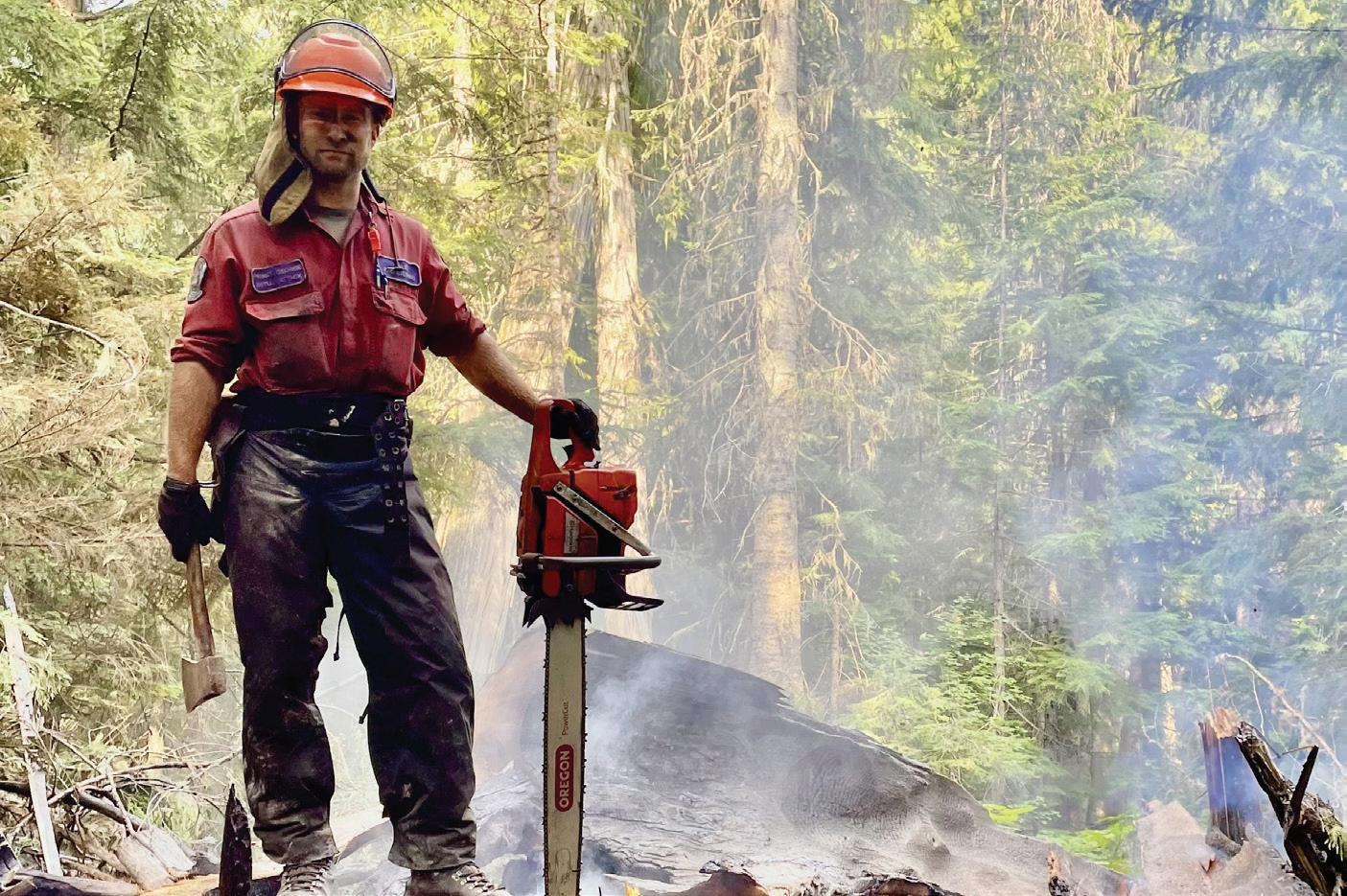
prizes, gift certificates, for folks who report first, as well as random draws for those who don’t report first but participate through that week. Then, based on where you’re from, which postal code you’re in, your entries will count as points toward your neighbourhood. It’ll be a fun rivalry between neighbourhoods to see who’s best prepared for a wildfire.”
Simmons said that in his experience, events like this can often be more effective in encouraging change than awareness campaigns.
“Active involvement of property owners is going to be an integral part of being fire-prepared across the whole city,” Simmons said. “(We’re) finding ways of engaging people that don’t seem like having to sit through a classroom, but are something fun and engaging. We’ve certainly found in other examples that if you make it more like a competition where you’re part of a team, that often incentivizes and motivates people to action. So that’s what we’re hoping to achieve.”
Simmons, in his work as founder and president of MyCatch and Angler’s Atlas, said one of the essential roles in making a competition like this possible is local leadership.
To this end, organizers are looking
the impact that wildfires can have on poorly managed properties.
“I’ve seen firsthand what can happen to homes and cabins and properties when a wildfire comes through,” Paciejewsk said. “And I’ve seen firsthand what can happen when you’ve taken the time and done a little bit of work to clean up your property and how it can be. It doesn’t need to be a ton of work, but a few little things can be done that can greatly increase the protection around your home.”
Like Simmons, he believes the competition and local engagement will help make more properties fire-safe across the city.
to recruit as many neighbourhood captains as possible.
“In my experience, when I’ve run experiments like this in the past — and we’ve run them extensively across the sport fishing space — if I can get a dozen captains, that’d be awesome,” Simmons said. “Even half a dozen captains is enough for a proof of concept, and that’s really what we’re hoping to do, to see if this moves the needle. Because if this doesn’t move the needle, there’s no sense in continuing it. But if we can move the needle in a significant way, then we have a replicable, scalable model that we can apply and double down on.”
The first captain to sign on to Break the Blaze is Cole Paciejewsk, who has 12 years of experience with the BC Wildfire Service and has served with Prince George Fire Rescue for three years.
He has also launched a new business, Northern Shield Land Management, which specializes in reducing wildfire risk around homes in the North, and cited this as one of the reasons behind joining the competition.
He will be the captain for the Berman, Bednesti and Norman Lakes area during the Break the Blaze event.
Paciejewsk, during his career in fire management and mitigation, has seen
“It’s great if one person does their own property. But then there can still be effects from neighbours and other properties,” Paciejewsk said. “The more people in close proximity that band together, the better success you’re going to have with this. I think being able to put it into a competition-type format, where everyone can team up and have some fun along the way, will lead to more buy-in and help get more people in the community to band together.”
He added that it’s often the simple things that can go a long way toward preventing damage to homes from wildfires.
“I think the biggest key is to start from the inside out,” Paciejewsk said. “You want to look at the structure itself. The biggest thing would be keeping debris out of your gutters, keeping debris off your roof, and then keeping any flammables away from the house. You see people with stacked firewood and stuff like that right beside the house. The farther away you can move that kind of stuff, the better. Then, moving out from there, if you can just keep your lawn cut and watered, that also makes a huge difference.”
If you are interested in taking part in the competition, you can join the Break the Blaze Facebook group at facebook. com/groups/breaktheblaze.
For more information or to sign on as a neighbourhood captain, email Simmons at cic.princegeorge@gmail.com.

April 16, 1986: Ophthamologist Graham Lewis from Maple Ridge examined Sheena, a golden retriever, for eye disease while visiting Prince George during Animal Health Week. Two local vet clinics teamed up to hold the event. CITIZEN FILE PHOTO BY LISA MURDOCH

April 16, 1971: Judy Palmer (Grade 7) and Marilyn Rogers (Grade 1) displayed their winning entries in the Prince George Public Library book illustration contest. Six of 618 entries from local kids received $5 book vouchers.
CITIZEN FILE PHOTO


April 17, 2015: Kindergarten students from Sacred Heart school performed The Cats’ Tea Party during the 33rd annual Speech Arts and Drama Festival at Lakewood Alliance Church. Actress Alana Hawley returned to Prince George to serve as the festival’s adjudicator. CITIZEN FILE PHOTO BY BRENT BRAATEN
April 17, 2000: Lee Meise slid down the pole into the truck bay at the downtown re hall as fellow high school students Brandon Nesbitt and Stephanie Arndt (both wearing re ghters’ gear) looked on. The re department welcomed students for a day of work experience. CITIZEN FILE PHOTO BY DAVE MILNE






CHRISTINE DALGLEISH Citizen Staff
It’s never easy going through treatment for cancer, but for one group of patients, Cheryl Duzenli has made it a bit easier in Prince George and other BC Cancer centres in the province.
Duzenli led the team that developed a breast cradle to help ideally position a patient for optimum precision during radiotherapy to better treat their cancer.
“How to best position a breast for treatment has been a universal problem, particularly for some body types which make positioning more challenging,” Duzenli said.
She is the principal investigator and former department head of medical physics at BC Cancer.
Consistency is key, and because each patient’s body is different, it was a challenge to ensure radiation was targeting the right area.
A multidisciplinary team at BC Cancer, including radiation therapists, radiation oncologists, medical physicists, nurses, engineers and an in-house machine shop that helps build specialized devices, set out to design a better way, according to BC Cancer.
Together, they addressed three design challenges:
• Finding a shape that could support a range of breast sizes
• Developing a structure that was light enough not to interfere with radiation
• Ensuring the device could be repositioned exactly the same way for patients who return for multiple treatments
The solution was CARA, the Carbon-fibre Adjustable Reusable Accessory, the official name for the breast cradle designed to reduce painful skin reactions and improve precision, comfort and consistency in radiotherapy for patients of all body types.

As the device evolved, it became a collaboration with the University of British Columbia Composites Research Network to refine the design, test materials and prepare it for use in clinical settings. The partnership combined expertise in cancer care with advanced knowledge of composite materials to build something light and durable, according to BC Cancer.
To help develop the cradle, every aspect had to be tested, so it was introduced to patients and staff through
oncologists are on board it really helps.”
Duzenli said the team from Vancouver came up to Prince George at the beginning of 2025.
“It was a really nice way of bringing the therapists together,” she said.
“The therapists all know each other and it’s really interesting how tight-knit that community is. The willingness of the people in Prince George to embrace this and bring it to their patients right off the bat was big. They were instrumental in providing really good feedback for us to be able to make improvements over the years.”
The breast cradle is now a universal, ergonomic and reusable clinical device, ensuring each treatment session is delivered with the same precision every time for every patient.
“Prince George has really embraced it,” Duzenli said. “We are so happy to be working with our colleagues in Prince George. It’s a smaller centre and Prince George is a great model in terms of how they conduct their day-to-day activities and how the staff interact.”
Duzenli added that Prince George uses the cradle, on a percentage basis, more than some of the bigger centres in BC.
clinical trials that took place in Prince George at the BC Cancer Centre for the North under Rob Olsen’s oversight. Duzenli said she had nothing but good things to say about the experience.
“In Prince George there was always a champion — is what we call them — a therapist who wanted to lead the introduction of something new,” Duzenli said.
“And of course, with Rob — you call him Dr. Rob — he’s amazing and he just jumps on board and he very much led the clinical trials, comparing it to what was done before and what could be done now, and Rob stepped right up to make sure patients were getting into the trial so we collected some good-quality data about the benefits so that was a huge part of it as well. When the
“Which is good to see, and that’s a reflection on the staff — the radiation therapists — because when they have been accustomed to doing something in a particular way, usually there is a lot of resistance when change is introduced because that means they have to spend time learning something new and it’s going to be a little less familiar. So the fact that they right away stepped up and said, ‘oh yeah, we want to try it and we want to get going with this,’ was so encouraging.”
Currently, patients at BC Cancer centres in Prince George, Kelowna, Victoria and Vancouver are being treated with the CARA device, as prescribed by radiation oncologists. Abbotsford centre is equipped with the device and is working towards clinical implementation. This work was made possible with generous funding support from the Canadian Cancer Society and the Michael Smith Foundation for Health Research.
MATTHEW HILLIER Citizen Staff
Donna Flood, executive director of Prince George Hospice Palliative Care Society (PGHPCS), has announced her retirement after 11 years of service and 44 years of health-care experience.
Flood will be retiring on Aug. 28.
“I look back and I’ve been in the nursing profession for over 44 years,” said Flood. “I’ve had various roles in various places and have had an excellent career and would recommend nursing to anyone. But I think it’s time. It’s time now to start spending more time with my husband who’s been retired for a year and a half, and also to give the opportunity for someone else to bring hospice forward into the future.”

CITIZEN FILE PHOTO BY CHUCK NISBETT
Donna Flood, executive director of the Prince George Hospice Palliative Care Society, speaks during an event at Lheidli T’enneh Memorial Park on Saturday, June 7, 2025.
In Flood’s 11 years at the hospice society, she helped increase the active number of programs in the community, including home hospice, which allowed people to be cared for in their own homes.
“I’m really proud of some of the programs that we started,” said Flood. “Home hospice was the first home
these new US-trained health-care workers are practising:
• Allied health professionals: two
hospice across the country. We were also the first outside of Ontario to receive accreditation and, due to the great support and diligence and care of my staff, we’ve increased our community programs from three to about 20 programs to meet the needs of the community. We’ve really seen great growth in the last decade and great support from our community.”
She described to The Citizen the impact the home hospice program had.
“I think we were seeing so many people who were coming distraught and with complex grief because they had made that promise to their loved one that they would care for them at home,” said Flood. “So they wouldn’t have to go back into the hospital and then at night, whether it was a crisis or they were scared, they made that call to the ambulance and they ended up in hospital and dying in the hallway. That was something that all of us at hospice felt that we could do something to change.
So we developed home hospice.”
Because of the extensive community outreach done and services provided by the society, Flood said, she has seen the impact of her career and team everywhere she goes.
“There’s not a day that I don’t walk down the street and come across someone who has a story of hospice and is grateful for the care,” said Flood. “It really is a society that has impacted the whole community and we see it and we hear that every single day.”
Flood also wanted to thank both PGHPCS staff and volunteers for their hard work and the community for their donations.
“We wouldn’t have hospice without the generosity of our community,” she said. “It’s because of Prince George that we have this hospice.”
The board of directors at the hospice is currently looking for a new executive director, with Flood saying the process will begin in the next week.
The BC government has announced that, as of February 2026, 500 health professionals from the United States have been hired across the province.
As stated in a media release, this includes 109 doctors, 315 nurses, 51 nurse practitioners and 29 allied health professionals.
Additionally, from March 2025 to February 2026, the province received more than 2,900 job applications from US health-care professionals.
Of the 500 health-care workers hired, 30 are now working in communities in the Northern Health service area.
This includes Prince George, Terrace, Quesnel, Fort St. John, McBride and many more.
In an emailed statement, the BC government outlined the fields in which
• Nurse: 20
• Nurse practitioner: one
• Physician: seven
However, the statement did not include the specific communities that these doctors are serving in.
The media statement goes on to add that BC now has the most doctors per capita of any province in Canada, with 15,000 physicians serving in the province, equal to 271 physicians per 100,000 residents.
This is in addition to the growth of nursing staff, with the workforce increasing by 3,300 in 2025, bringing the total to 78,750.
According to a BC government press release, 77 per cent of British Columbians now have a primary care provider.