04 Eskay Creek mine under construction after 18-year hiatus
05 2025 a pivotal year for the BC mining sector
06 From Prince George to Cayman Islands, IDL Projects building communities
08 BC mining at a turning point, says exploration CEO
10 BC construction industry warns government action needed to meet infrastructure goals
1 1 A decade of impact — and reasons for a hopeful future in forestry
12 Construction is on an upswing
14 Forestry grant supporting workers affected by tariffs
15 Forestry giant reports weaker earnings for first quarter of 2026
16 Who really pays for BC’s electricity?
18 Marmot Builders puts its stamp on area history
19 Nunavut electricity production more than doubles over two years
20 Smithers making way for new mining opportunities
21 BC, Simpcw begin consent talks on Yellowhead copper mine review
22 BC First Nations push to replace salmon farm ban with Indigenous-led system
23 Report highlights most in-demand skilled trades
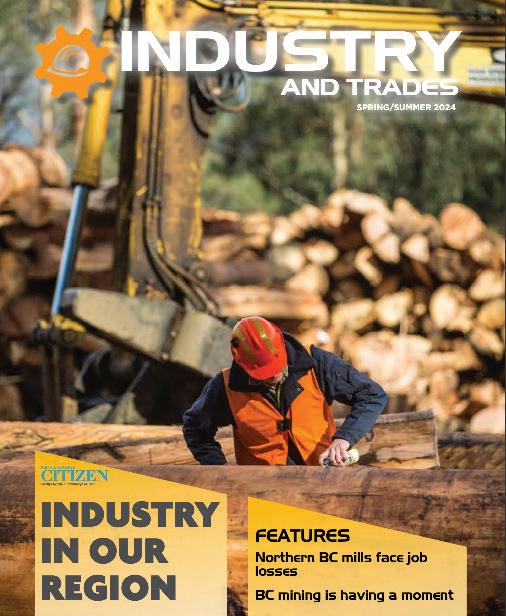
INDUSTRY AND TRADES - SUMMER 2026 Published by: Prince George Citizen
Publisher: Cameron Stolz
Editor: Kennedy Gordon
505-4TH AVENUE, PRINCE GEORGE BC 250.562.2441 frontdesk@pgcitizen.ca www.princegeorgecitizen.com
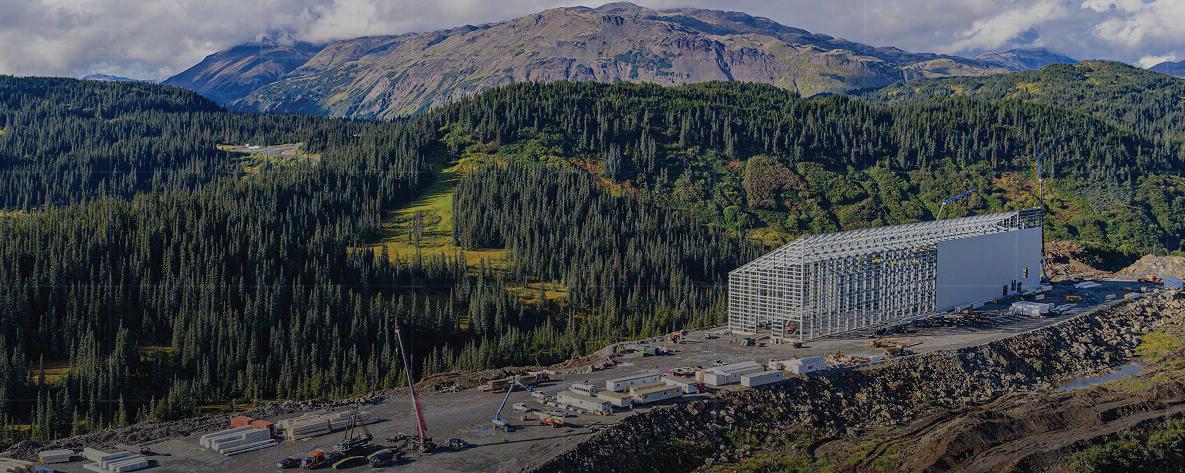
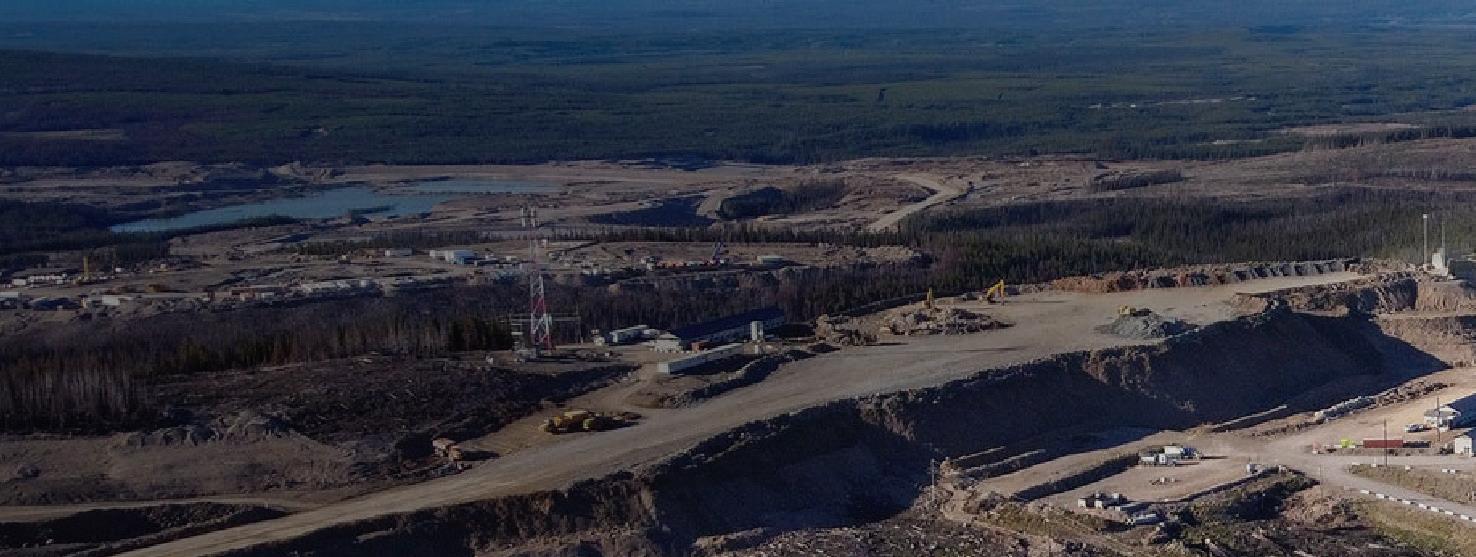
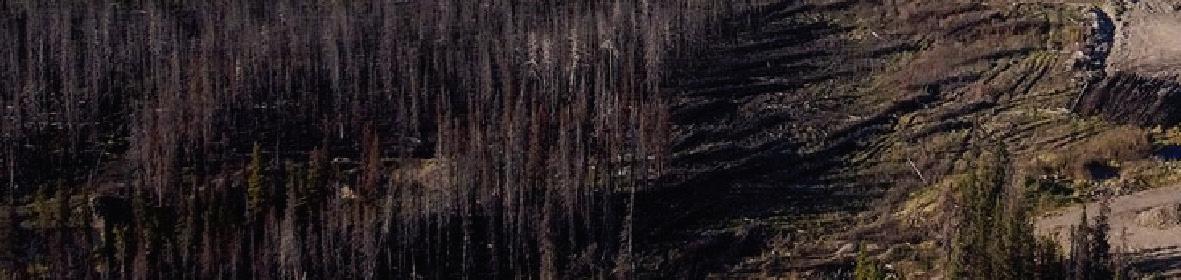
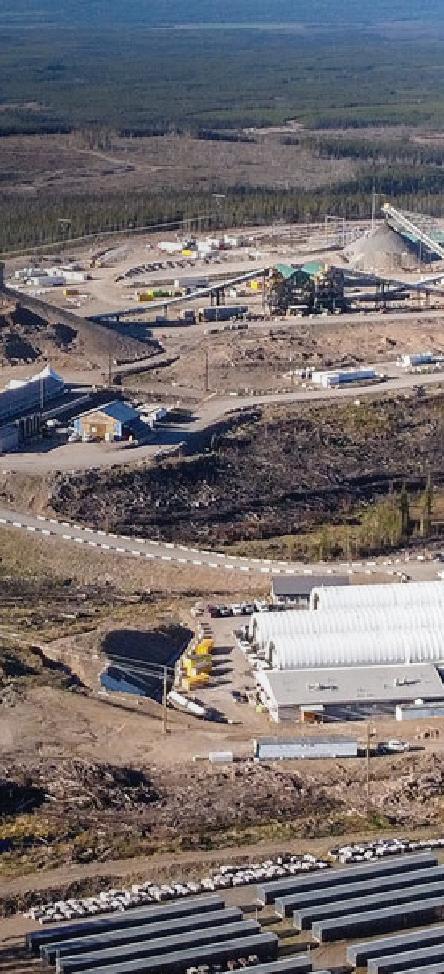
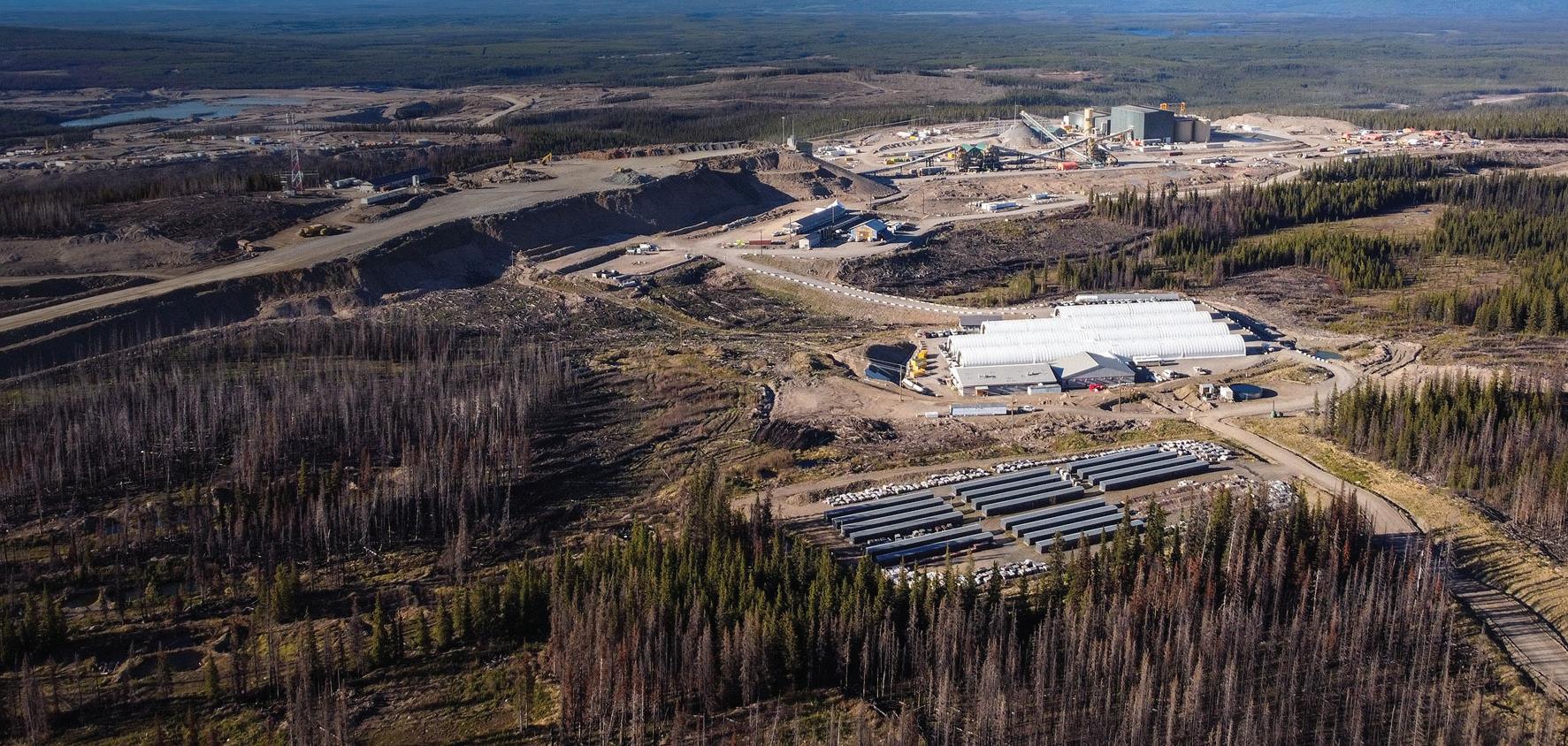
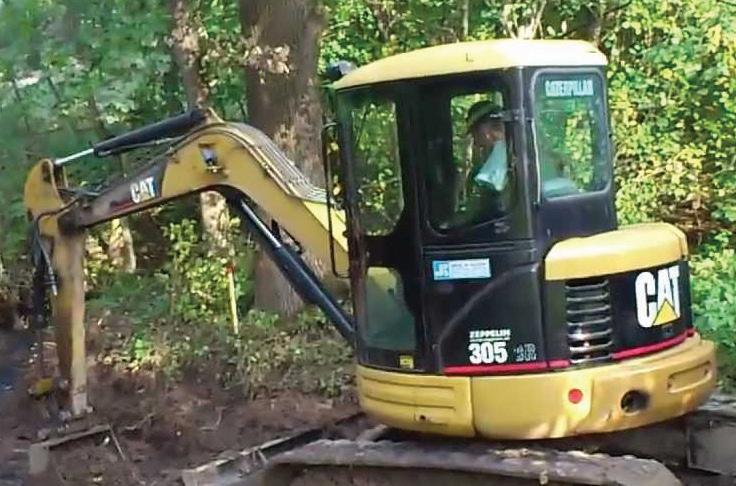
Eskay Creek mine under construction after 18-year hiatus
The Eskay Creek Mine, which closed in 2008, has received environmental assessment approval from the BC government to explore reopening.
Skeena Gold and Silver estimates the mine will be ready by 2027
MATTHEW HILLIER Citizen Staff
Skeena Gold and Silver is investing in northwest BC by reviving one of the country’s most significant historic gold producers.
The Eskay Creek Mine, located in northwest BC in the Golden Triangle, originally closed in 2008 and has remained dormant since. However, after receiving environmental assessment approval from the BC government in January 2026, development has moved ahead.
Construction began in December 2026 on the Eskay Creek Mine to convert the former site into a high-grade open-pit silver and gold operation.
Nalaine Morin, senior vice-president of environment and social affairs for Skeena Gold & Silver, told The Citizen that the mine is expected to produce 450,000 goldequivalent ounces in its first five years.
“It ran in the late ’90s to the early 2000s, and at the time was the richest gold mine in the world. We call our new vision for the project the Eskay Creek revitalization,” she
said.
Morin provided an update on the mine’s redevelopment at the Minerals North Conference held in Smithers from May 6 to May 8.
The mine is expected to have an operating lifespan of 13 years, with gold production projected to decline to 370,000 ounces annually after the first five years.
Morin said the project will bring both critical minerals and economic benefits to BC, including employment and regional investment.
“This is a significant opportunity in terms of employment. We’re looking at 1,500 jobs in construction, 885 jobs in operations, and the mine itself will operate for 13 years. In addition to three years for closure and reclamation, and two years of construction, so we’re looking at an 18-year mine life,” she said.
Morin said the project will also create opportunities for contractors and existing businesses across the North.
The fact that Eskay Creek was previously developed has helped accelerate construction timelines.
“There were a number of things that were pre-existing that supported the development of the project — existing authorizations in place, of which we were able to undertake activities to support development of the project under these current authorizations. That really allowed us to optimize the building and the construction schedules for this project,” she said.
She also noted that a previously permitted all-weather access road and tailings infrastructure further streamlined development.
The mine is located on the territory of the Tahltan First Nation, and Skeena Gold and Silver currently has an impact benefit agreement with the Nation.
Morin also highlighted that the project was the first to receive a consent-based decision-making agreement under British Columbia’s Declaration on the Rights of Indigenous Peoples Act (DRIPA) between the Tahltan Central Government and the Province of BC in June 2022.
According to the BC government, the agreement was entered into under
section 7 of DRIPA for the environmental assessment of the Eskay Creek Project. The assessment was conducted collaboratively by the Tahltan First Nation and the BC Environmental Assessment Office.
While some in the mining industry have raised concerns that DRIPA could create uncertainty, Morin views it as a path forward in reconciliation efforts.
“I believe that it’s an important part of the work that we’re doing to advance reconciliation in this province. The majority of lands in BC are not under treaties; they’re unceded, traditional lands of First Nations across the province. Each one of these nations has existing governments and laws in place and responsibilities to steward their lands. So right now, DRIPA is certainly a mechanism that we in the province can utilize to advance the work that we are doing, moving towards reconciliation,” she said. Construction to convert the mine to an open-pit design is expected to be completed in the second quarter of 2027.
SKEENA GOLD AND SILVER PHOTO
Citizen Staff
Mining industry leaders say that despite ongoing uncertainty over the past year, momentum that has been building in recent years is beginning to pay off.
Michael Goehring, president and CEO of the Mining Association of BC, attended the recent Minerals North Conference in Smithers, held from May 6 to May 8. There, he delivered a keynote address on the state of the industry and spoke about building sustainable and resilient mining supply chains.
Goehring said he brought positive news to the conference and heard similar optimism from other mining leaders in attendance.
“I came bringing some positive news, which was welcome given the challenges we’re facing with BC’s economy and our finances. That being that after years of inertia, there is finally momentum in BC’s mining sector,” said Goehring. Goehring explained that after years of permitting and authorization challenges, progress is finally being made on major mining projects in BC.
“Since last June, five major mines have received permits and authorizations to proceed with either mine restarts, mine revitalization or mine extensions. This is very good news for the industry and for northern BC,” he said. He added that the developments come at a critical time, with Canada beginning to distinguish itself on the world stage.
“2025 really marked a pivotal year for Canadian mining and BC mining because critical minerals have emerged as a core national security consideration in Canada and among allied nations. You can trace that back to China and China’s restriction of exports of critical minerals and rare
earths to the U.S.,” said Goehring.
The ongoing U.S. trade war and tariffs on China have resulted in the U.S. launching “Project Vault,” a $12-billion initiative aimed at stockpiling critical minerals in the country.
Goehring said the move has prompted other countries, including Canada and other G7 allies, to begin developing their own stockpiles and strengthening domestic industry and trade relationships independent of the U.S. He said that if the trend continues, Canada — and northern BC in particular — will have a critical role to play in the future.
“Canada has increasingly over the past year been seen as a potential global go-to supplier of critical minerals and metals and, if we play our cards right, British Columbia, particularly northern BC, can make a significant contribution to this effort,” said Goehring.
While Goehring acknowledged that the mining permitting issue has improved, he said there is still significant work to be done.
“Momentum without action is nothing.
To sustain that momentum, we need certainty and while there’s been meaningful gains, there’s much more work to do. The number one issue is that complex permitting processes remain the chief barrier to new mine development. They delay investment, job creation and government revenues,” he said. He added that permitting challenges and other issues, including what he described as uncertainty surrounding the Declaration on the Rights of Indigenous Peoples Act (DRIPA), may cause investors to delay or withdraw investments until conditions become more stable.
“Deposits aren’t mobile, right? A deposit stays in the ground. You’re not going
2025 a pivotal year for the BC mining sector
Mining president and CEO says the North has a big role to play
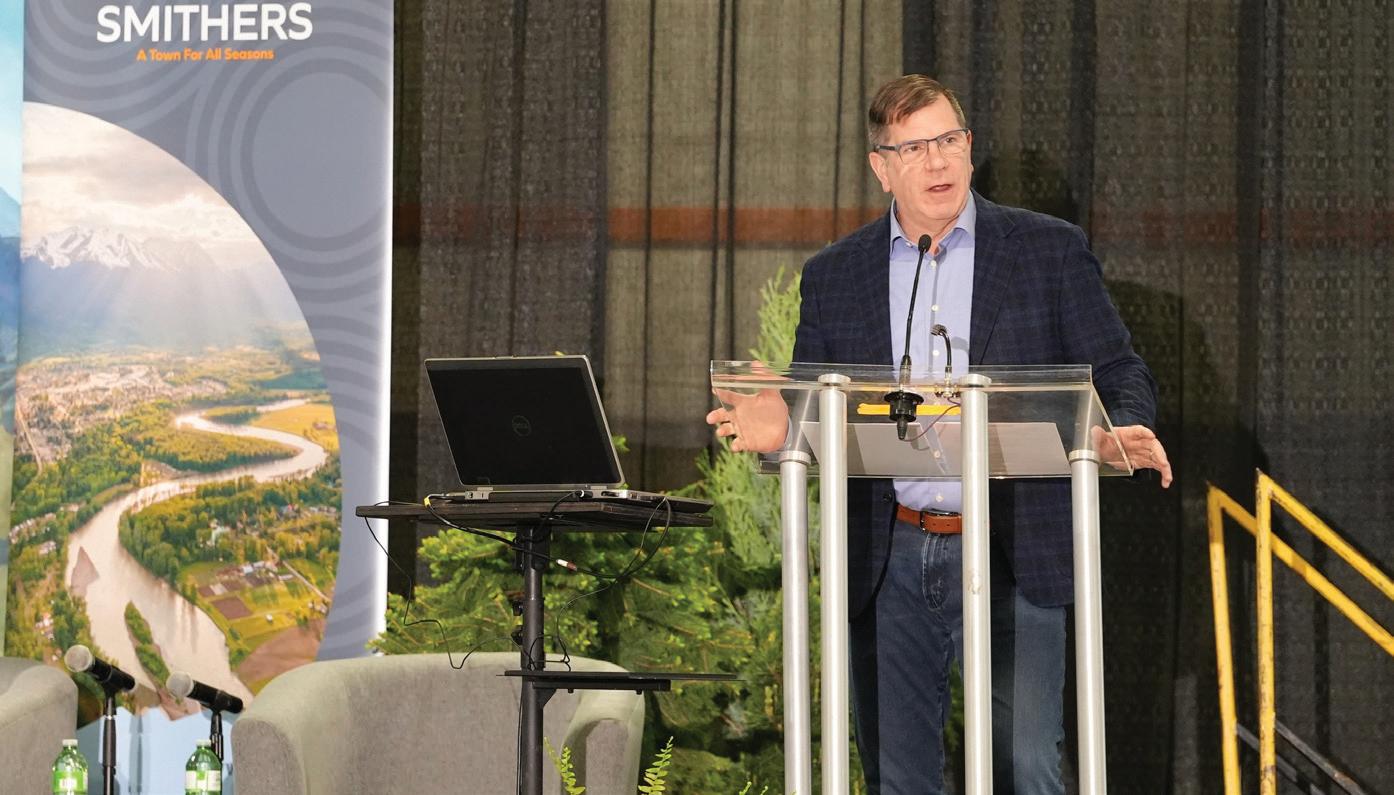
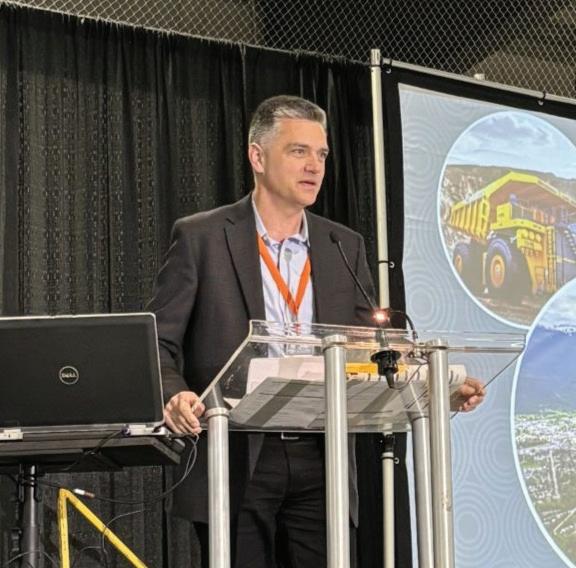
MINERALS NORTH
PHOTO Michael Goehring, president and CEO of the Mining Association of British Columbia, speaks at the Minerals North Conference held in Smithers from May 6 to May 8.
to move it. What you do see is a lack of certainty. Investment hates uncertainty. Investment’s a coward. It’s hard to tell because investment just quietly quits. Large global miners and investors making decisions on where to place capital may decide to go to another jurisdiction because there’s more certainty and it’s more predictable,” said Goehring. Despite those potential setbacks and concerns about investor uncertainty, Goehring said northern BC is wellpositioned to become a key region for the
industry in Canada and among its allies. “Northern BC is poised to be an economic powerhouse. There are 24 critical mineral, precious metal and steelmaking coal mines on the books for the North. If they’re constructed, they will deliver a combined economic output of $69 billion. That’s powerful. The economic impact of those mines is significant. Mines punch above their weight. There are a small number of existing mines in BC, but they have a big economic impact,” said Goehring.
MATTHEW HILLIER
From Prince George to Cayman Islands, IDL Projects building communities
BC Construction Association recognizes builder for exceptional workplace culture
Sheldon Boyes says it’s never a chore to drag himself to work each day at a job he created for himself, but if there comes a day when inspiration is waning, all he needs to do is take a drive down Massey Road in Prince George.
On that road bordering Carrie Jane Gray Park is one of the most striking buildings in the city — the $17 million sloperoofed charcoal-grey Prince George Fire Rescue Hall No. 1 that Boyes and his crews built from the ground up.
“That’s one of the nicest things about construction — you can walk away every day and you see the fruits of your team’s labour,” said Boyes.
For Boyes, president of IDL Projects, the footprint of a company he started 21
years ago with Dennis Schwab and Todd Patterson is visible across the city — more than 35 buildings that are part of a portfolio of nearly 200 major structures completed across Western Canada.
In 2025, IDL Projects completed more than $350 million worth of project work.
IDL specializes in heavy civil and infrastructure, commercial, public and institutional, industrial and mining construction services. When the company formed in 2005, Boyes had worked for Schwab for 10 years in the building division at Western Industrial Contractors, and Patterson brought the business expertise he gained in the paving industry.
“We provide three main services: everything civil, which could be highways, site development, utility work for municipalities, and we do
buildings — multi-unit, institutional, so universities, colleges, and commercial and industrial work as well,” said IDL Projects vice-president James Morrison.
“We compete against what people would think are the bigger contractors in the province in Western Canada, but we also service locally, and that’s our differentiator.”
In 2025, IDL Projects won Northern Regional Construction Association awards for employer of the year, excellence in safety, and prime contractor over $20 million for its Prince George U-Haul building project.
This past April, at the BC Construction Association Builders Code Champion Awards dinner, IDL was the northern BC regional winner of the workplace culture award.
“We’re quite proud of that,” said
Morrison. “It’s the first time we’ve won that one. It’s about the overall culture that we have at IDL in terms of how we treat our people, how we take care of each other from a safety perspective — both mentally and physically on the site and off the site.
“It’s something we put a lot of time and effort into, and we really don’t look for recognition. We like to call ourselves the undercover contractor, but it’s nice to be acknowledged for that.”
IDL has adopted four core values — take care of each other, build great things, have fun and be innovative — guiding principles that have helped the company grow into one of the largest general construction contractors in the northern half of the province.
While the head office is in Prince George, most of its work is outside the city,
MATTHEW HILLIER Citizen Staff
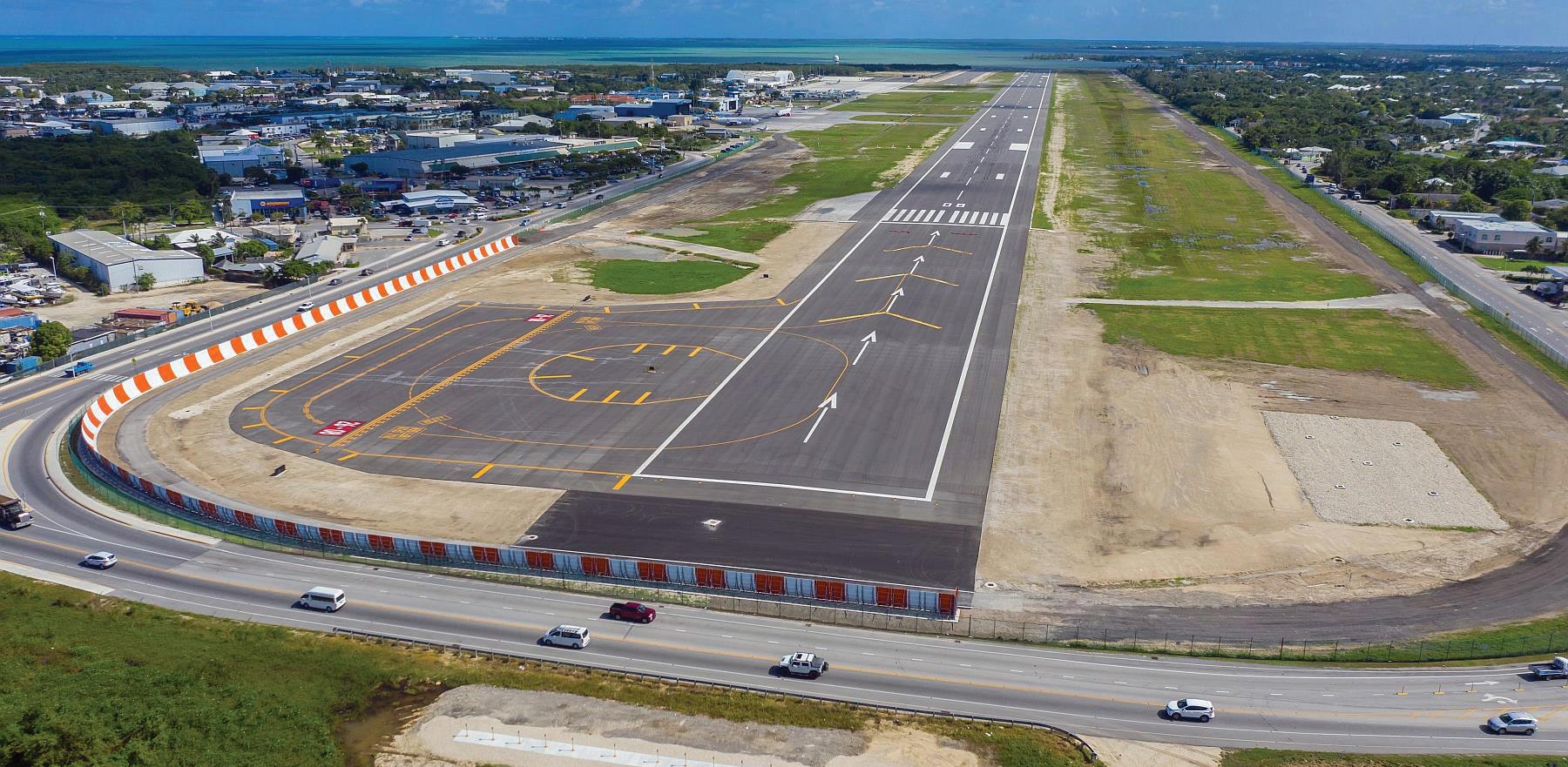
IDL PROJECTS PHOTO IDL Projects of Prince George built this runway on the Cayman Islands at Owen Roberts International Airport.
including the northwest region — Prince Rupert, Terrace and Kitimat — as well as Fort St. John, Kamloops, Kelowna, Vancouver Island and the Kootenays.
IDL now has close to 1,000 employees involved in about 350 projects annually across Western Canada, as well as the Caribbean (Turks and Caicos Islands, British Virgin Islands and Cayman Islands) and South America (Colombia). It has also done work in Africa.
Among its current projects is Providence Living at the Rivers senior residence in Prince George at 6500 Southridge Rd. next to Home Depot. When complete, sometime in 2028, the $120 million project will offer 200 long-term care beds arranged in 16 households, each with 12 private rooms.
In partnership with BC Housing and Northern Health, IDL is building a supportive housing complex at 140 Ontario St. to provide single-room housing and support services for the city’s homeless population.
The company also works closely with area First Nations and has built the 17th Avenue Aboriginal Housing Society of Prince George community development adjacent to Massey Drive.
“One of the ways we differentiate ourselves is we really emphasize a culture around building Indigenous participation, so right now we have more than 30 formal First Nation partnerships across Western Canada, and in the last year 70 per cent of our work was done in partnership with First Nations,” said Morrison.
IDL specializes in design-build work and emphasizes early contractor involvement. If an owner has a design in mind, project coordinators meet with architects, engineers and clients to assess what is possible within budget and to reduce the risk of cost overruns early in the process. On design-build projects, where clients know exactly what they want, IDL brings consultants, engineers and contractors together to develop a final design aligned with budget expectations.
“We’re doing a lot with technology right now, whether it’s tech on our equipment or using artificial intelligence for quite a few of the things we’re doing,” said Morrison. “Right now all our costing is being tracked using AI to provide the best pricing for all the work we’re doing. Same thing on the administrative side — we’re decreasing our administrative load by a whole bunch of AI tools we’ve implemented. It’s actually helping people do the work better.
“One of the challenges we always had is there’s a lot of legislation you have to
work within in construction, whether it’s WorkSafeBC, client requirements, insurance requirements or legal requirements. There’s a lot for our teams to consider when they’re executing the work. So we’re setting it up so they can do their job more effectively by doing less administratively while still adhering to all the rules and regulations.”
The downturn in the forestry economy has reduced IDL’s involvement in pulp mill construction, but the company maintains a 350-employee safety services group ready to assist mills with planned and unplanned shutdown and turnaround work.
“We built the company to be very diverse so when one industry or area slows down, there’s another area that picks up, so we’re able to pivot and move into that, and we’ve seen that coming on the forestry side for quite some time,” said Boyes. “You’re constantly looking for backlog and you’ve got to be looking years in advance to do it.”
With several new mines proposed for northern BC, IDL is positioning itself as an informed bidder for future contracts once projects are approved. The company provided civil engineering and utility work during construction of Centerra Gold’s Mount Milligan copper-gold mine west of Mackenzie.
“We’ve always been in mining but right now all the existing mines that are doing work already have the contractors and we’ll bid if they ask us,” said Boyes.
“It’s the up-and-coming mines that are probably a year or two out that we’re providing budget pricing and helping with feasibility studies, with the hopes we’ll be there when construction actually starts.”
IDL is also involved with the Prince Rupert Port Authority on the CANXPORT site development project on the south end of Ridley Island, building integrated large-scale bulk transload facilities and an integrated off-dock container yard, slated for completion later this year.
An exterior cladding project at the College of New Caledonia in Prince George is nearing completion, and the company has also done work on the University of Northern British Columbia main campus and Northwest Community College in Terrace. It built the RCMP building in Prince Rupert and is nearly finished the city’s public works building.
IDL employs heavy-equipment operators, carpenters, pipelayers, mechanics, labourers, service workers and safety professionals, as well as project
managers and coordinators. While some construction jobs are seasonal, IDL keeps most employees working year-round, even in cold-climate areas, through planning that allows foundational work to begin well before winter sets in.
BC Hydro is planning the $6 billion North Coast Transmission Line project from Prince George to Terrace, and IDL is in discussions to participate as a contractor. The two-phase, 450-kilometre high-voltage line will supply electricity to support expansion of mining and liquefied natural gas projects on the north coast.
An aging workforce has created a shortage of experienced tradespeople as retirements accelerate, and replacing that expertise remains one of the biggest challenges ahead for IDL. High school work experience programs that introduce young people to the trades for academic credit, along with the promise of well-paying jobs after training, have helped reverse demographic trends, but companies continue to struggle to find enough workers.
“In the last 15 years, a lot of the old crowd are retiring and with that goes all of that expertise and experience,” said Boyes. “There’s a lot of good young people coming into the industry, but they just don’t have that 20 years of
experience.”
IDL depends on workers from Newfoundland and the Maritimes who rotate in to work 20 days straight, then go home for 10 days. The company’s strong employee retention is one of its key strengths, with many staff having been with IDL since year one.
“We attribute that to our culture and the way we treat people and the way we’re constantly filling our backlog with work so they don’t have to worry about where the next job is,” said Boyes.
IDL also has a long-standing tradition of community involvement and support for local charities and sports organizations. That includes Prince George Kodiaks Football, Prince George Minor Lacrosse, Prince George Youth Volleyball, Prince George Minor Hockey, Cariboo Cougars, Northern Baseball Training, Spruce City Men’s Fastball, Spirit of the North Healthcare Foundation, Canadian Cancer Society, Kidney Foundation, Special Olympics BC, Festival of Trees, Prince George Rodeo, Operation Red Nose, Mothers Against Drunk Driving Canada, Halfway River Rodeo, St. Vincent de Paul Society, Prince George Council of Seniors, The Salvation Army, high school graduation programs and high school trades programs.
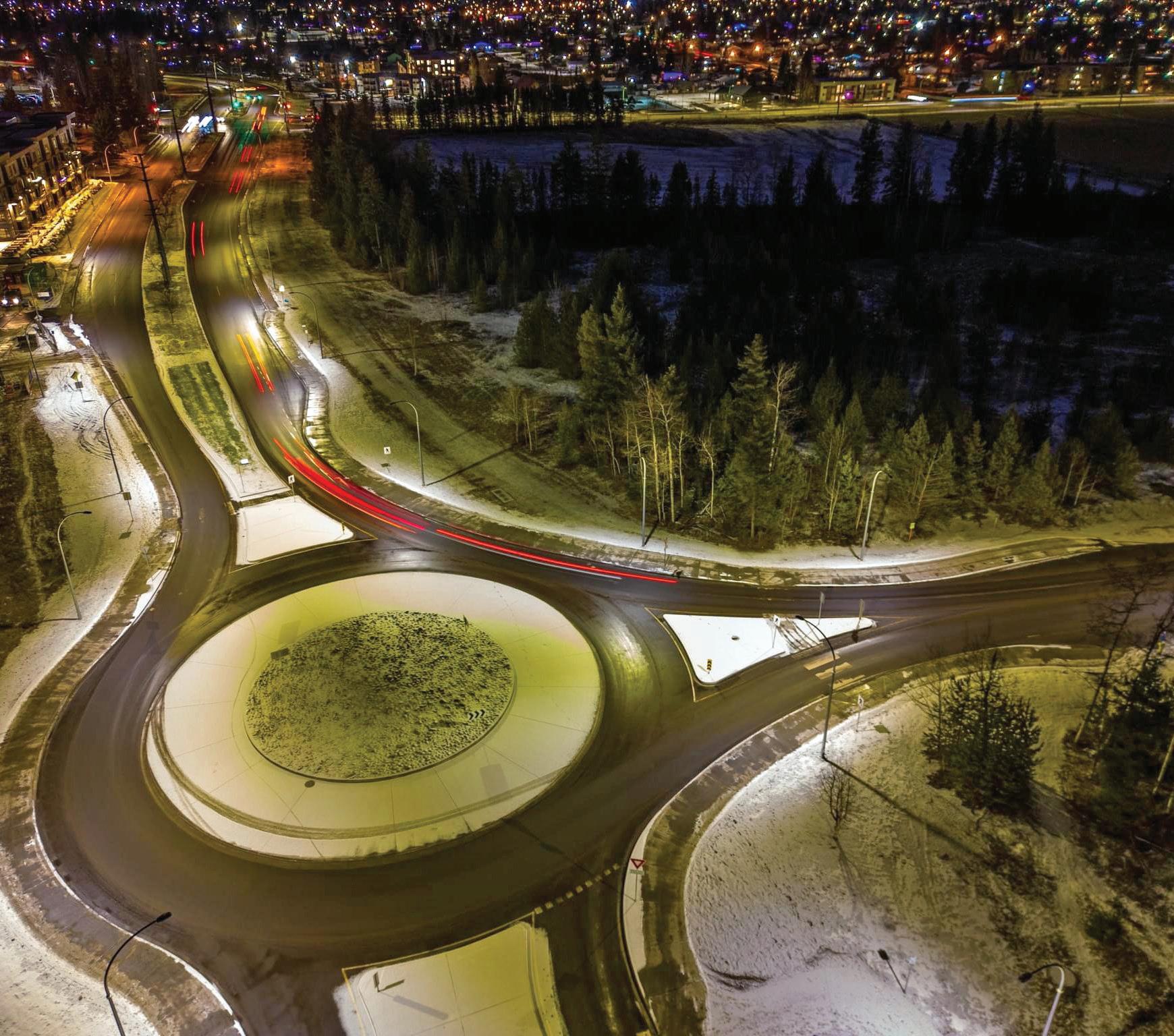
IDL PROJECTS PHOTO This aerial shot shows the Prince George roundabout at Foothills Boulevard and18th Avenue built by IDL Projects.
Investment
BC mining at a turning point, says exploration CEO
HANDOUT PHOTO Todd Stone, president and CEO of the Association for Mineral Exploration BC, speaks at the opening of the Minerals North Conference on May 7, 2026, in Smithers, BC.
and momentum are a focus for the BC sector of this expanding industry
MATTHEW HILLIER Citizen Staff
Those involved in BC’s mining industry, particularly the exploration sector, are seeing renewed momentum and interest in a growing and increasingly diverse segment of the Canadian economy. With many in the industry concerned about red tape and investment stagnation, some still see a path forward to help BC stand out within the global mining sector. Todd Stone, former BC cabinet minister and president and CEO of the Association for Mineral Exploration, is one of them.
Stone recently helped open the Minerals North Conference in Smithers, which ran from May 6 to May 8, and said the event showcases the momentum generated in recent years by BC’s mining industry.
“There’s no question that in the northwest and the Golden Triangle in particular is really the epicentre of tremendous momentum in the exploration sector in British Columbia. That is not the case in many other regions of the province,” said
Stone.
The Golden Triangle is a highly mineralized and lucrative region of northwestern BC, which extends from south of Kitsault to the Iskut River in the north, and the Stikine River in the northwest. The area is rich in deposits of gold, copper and silver.
Stone said in an interview with The
Citizen that in 2025, the exploration sector of the mining industry received about $750 million in investment, with 58 per cent of that funding spent exploring the northwest region of the province.
He credits the surge in investment to growing momentum in BC’s Golden Triangle, where several notable mining projects are underway.
“There’s just a tremendous number of well-developed brownfield sites,” Stone said. “The projects that are seeing investment and exploration spend, but also final investment decisions and so forth, are projects that have been around for quite some time. All of that just happens to be coalescing around a number of projects in the Golden
Triangle, which cumulatively adds up to a pretty significant dollar increase in the investment that’s flowing into the region.”
Stone said he does not want to see that momentum confined to BC and hopes it spreads to other regions, including the Kootenays, Vancouver Island and northeastern BC.
“It represents a lot of good-paying jobs and a really good bump in our GDP. We want to see that level of activity and that level of investment really begin to take hold in other parts of the province,” he said.
Energy infrastructure, he added, will be key to sustaining that momentum, and he praised the BC government for advancing the Northwest Transmission Expansion Project.
“There is absolutely no question that without the Northwest Transmission Expansion Project, many of these new mines that will be coming online in the near future in the northwest would not be possible. That’s the bottom line. There would not be enough power on the grid for those projects to exist,” said Stone.
Stone also praised the federal government’s Defence Industrial Strategy (DIS), launched in February 2026 and backed by $6.6 billion.
The strategy aims to strengthen Canada’s sovereign capabilities by modernizing the Canadian Armed Forces and reinforcing the domestic defence industrial base.
While supportive of the initiative, Stone said its success depends on securing longterm access to critical minerals.
“For that strategy to actually take hold and deliver the results and deliver on the prime minister’s ambitions, critical minerals and rare earth metals are the most important factor that has to be in place. Not just for the next five to 10 years, but for the next generation and the generation beyond that. We absolutely have to make sure that we’re making the right decisions around policy choices, infrastructure investments and all other considerations today in order for that to be possible.”
Stone said BC has a significant role to play in ensuring both the DIS and the mining sector remain viable amid
We have some of the largest known deposits of many of the critical minerals and rare earth metals that are on the federal government’s list. We have them here in British Columbia in large volumes “
uncertain economic conditions.
“We have some of the largest known deposits of many of the critical minerals and rare earth metals that are on the federal government’s list. We have them here in British Columbia in large volumes. The challenge is, do we have the fortitude and the focus and the discipline to make the right policy choices in order to get those critical minerals and rare earth metals out of the ground as fast as we possibly can?” he said.
While he believes industry participants are capable of meeting the challenge, Stone said there are still significant barriers.
Like many in the sector, he is frustrated with the length of time required to obtain permits in BC, although he acknowledged the provincial government has made progress in the past year.
Another major concern is land access, particularly the proposed 30 by 30 conservation target.
The initiative, advanced by the United Nations, aims to protect 30 per cent of the world’s land and oceans by 2030. BC has committed to the target and currently protects about 19 per cent of its land base. Stone, however, argues the policy could constrain development.
“The province is continuing to work on opportunities to add even more land to that inventory that would serve to further restrict exploration activities. You restrict the land base, you restrict the opportunities for exploration, less exploration means you’re going to find fewer deposits, you find fewer deposits, you’re going to find fewer mines coming on through the pipeline in the decades ahead,” he said.
Uncertainty in markets and policy has also been a persistent issue for the industry.
Stone pointed to the Declaration on the Rights of Indigenous Peoples Act (DRIPA) as a source of unpredictability, and said he is frustrated with the current NDP government’s approach.
“Nothing compromises investment faster than uncertainty, and we see more uncertainty building each day, not less. Largely as a result of the government’s flip-flopping back and forth on one day saying DRIPA is a big problem and compromising British Columbia’s economy and the next day saying we’re not going to do anything about it, we’re just going to keep talking about it,” he said.
Stone stressed he is not opposed to
DRIPA itself, but would like to see amendments to reduce uncertainty. “We proposed significant amendments to DRIPA. There are four amendments that we’ve proposed that we think would take DRIPA back to its original intent and would restore certainty, maintain the aspirational aspect of DRIPA, because we are all supportive of and want to continue to be engaged with reconciliation. No question about that, but also ensure that we lift this cloud of uncertainty that’s beginning to build,” he said.
Despite the challenges, Stone said he still sees strong momentum in the sector. He pointed to Smithers-based Hightech Drilling as an example of BC success on the global stage.
“I think they employ about 2,000 employees now worldwide, but the head office, the largest employee base, is still in Smithers, where they were founded. They’re just winning projects and winning bids on drilling projects all over the world. That is a poster child of a company that is knocking it out of the ballpark on the international stage and doing it from a small rural community in northwest British Columbia. That is something we should all be very proud of,” he said.
BC construction industry warns government action needed to meet infrastructure goals
New survey shows strong sector under strain from costs, delays and procurement challenges
CITIZEN STAFF
The British Columbia Construction Association (BCCA) is calling on the provincial government to take urgent action to address rising pressure in the construction sector, warning that BC risks falling short on major infrastructure commitments despite a large and active industry.
The group has released its 2026 BC Construction Industry Survey and Spring Stat Pack, based on responses from 858 employers and tradespeople across all seven of BC’s development regions. The data shows construction remains the No. 1 employer in BC’s goods-producing sector, supporting 264,600 workers — up five per cent year over year. Of those, 199,900 are skilled tradespeople, contributing $28.5 billion annually, or 9.2 per cent of provincial GDP.
Despite those figures, the industry reports ongoing challenges, including payment delays, contract disputes, procurement practices and rising costs.
According to the survey, 89 per cent of respondents said they had been paid late at least once in the past year, while 61 per cent reported being paid late more than 25 per cent of the time.
“Across British Columbia, our industry is consistently being asked to do more with less,” said Chris Atchison, president of the BCCA. “The industry has shown incredible resilience, especially in light of ongoing economic, global and
supply chain instability and uncertainty, but resilience cannot be mistaken for invincibility.”
The BCCA is urging the province to adopt a multi-year capital plan, modernize public procurement, align federal and provincial infrastructure strategies and pass a Construction Prompt Payment Act. It also cites what it calls systemic barriers, including contract disputes, delayed payments and procurement rules that discourage bidding.
The survey found contractors build an average risk premium of 14.5 per cent into bids, while 43 per cent said onerous contract clauses are the top reason they avoid bidding on public projects.
The association also flagged new cost pressures, including the introduction of provincial sales tax on architectural, engineering and related professional services in Budget 2026.
“British Columbia depends on builders,” Atchison said. “But high costs, risks and uncertainty have created an environment that makes it harder for our sector to deliver at the level this province requires.”
He said the province currently has $173 billion in proposed construction projects, warning that delivery risks are growing without policy change.
The BCCA’s 2026 Stat Pack provides a broad snapshot of the sector:
• Construction is the No. 1 employer in BC’s goods sector — unchanged
• The construction industry accounts for 9.2 per cent of BC’s GDP, totalling
$28.5 billion — unchanged
• 264,600 people rely directly on the construction industry for a paycheque
— down one per cent since fall 2025, up five per cent since spring 2025
• Skilled trades employment: 199,900 workers — up five per cent year over year
• Women in construction trades: 12,394 workers (6.2 per cent) — up from 5.3 per cent in April 2025
• Number of construction companies: 28,173 — unchanged
• Average annual wage in construction: $85,488 — up five per cent year over year
• Current job vacancies: 8,240 — up 13 per cent since fall 2025, down 29 per cent since spring 2025
• Estimated value of proposed major projects: $173 billion — unchanged
• Value of active major projects underway: $145 billion — down eight per cent year over year
• Industrial, commercial and institutional building permits: $801 million — up 15 per cent since fall 2025, up 32 per cent since spring 2025
• Multi-unit residential permits (sixmonth rolling average): 2,910 units
— down 24 per cent since fall 2025, up two per cent since spring 2025
• Multi-unit residential starts (sixmonth rolling average): 34,556 units — down 15 per cent since fall 2025, down two per cent year over year
• BC labour productivity ranking in
Canada: No. 5 — unchanged
• Share of multi-unit residential investment nationally: 19 per cent — ranked No. 3, unchanged
• Estimated building investment (Q3/ Q4 2025): $9.4 billion — ranked No. 3 nationally, up from No. 4 in fall 2025
• Construction cost inflation: up 2.5 per cent year over year — ranked eighth highest in Canada, down from No. 4
• Tower cranes operating in BC: 380 — up nine per cent
The association says BC’s construction sector remains fundamentally strong but is increasingly constrained by policy and cost pressures that could limit its ability to deliver future infrastructure.
It warns that without clearer procurement rules and long-term capital planning, project delays and cost escalation are likely to continue.
“British Columbia depends on builders,” Atchison said. “With $173 billion in proposed construction projects on the books, our province can’t afford to move forward without adequate support for industry.”
The BCCA is a non-partisan, non-profit organization representing more than 10,000 employers in BC’s industrial, commercial, institutional and multiunit residential construction sectors. It works with four regional construction associations and advocates for policies that support productivity, stability and workforce development.
CITIZEN FILE PHOTO The British Columbia Construction Association has released its 2026 BC Construction Industry Survey and Spring Stat Pack.
A decade of impact — and reasons for a hopeful future in forestry
SUBMITTED PHOTO The Forest Enhancement Society of BC has a positive outlook on the future of the industry
An update from the Forest Enhancement Society of BC
FESBC GUEST COLUMN
As the Forest Enhancement Society of BC (FESBC) marks its 10th anniversary, the organization is reflecting on a decade of investments aimed at improving the resilience and health of forests and communities across British Columbia.
Established in 2016, FESBC was created during a period when BC forests were under growing pressure from catastrophic wildfire risk, the mountain pine beetle epidemic, shifting economic conditions in the forestry sector and increasing concern about climate change.
Doug Donaldson, former minister of forests, lands, natural resource operations and rural development (now the Ministry of Forests), said the organization’s role evolved in ways that were not initially anticipated.
“When I first became minister, there were questions about how the Forest Enhancement Society of BC was structured and what it could achieve,” Donaldson said. “But what I saw over time was an evolution and the society found a niche where it could deliver real, on-the-ground outcomes in a very efficient way.”
Over the past decade, FESBC has supported hundreds of projects focused on wildfire risk reduction, forest rehabilitation and the utilization of residual fibre left after harvesting, thinning operations or wildfire events. Donaldson said the organization’s lean structure helped it deliver results
efficiently across the province.
“With relatively low overhead and a small team, the Forest Enhancement Society of BC has been able to run a wide range of programs to invest in forest enhancement projects that make an impact with positive outcomes in so many communities,” he said. “And that impact is not easy to achieve.”
He said site visits during his time as minister left a lasting impression, particularly the collaborative nature of the work.
“I could tour a project site and see so many different values being addressed all at once,” he said.
Those included Indigenous values, wildfire fuel reduction, wildlife habitat improvement, public safety benefits and local employment.
“It was really cool to see how it all came together in a way that reflected the needs of that area and the community,” Donaldson said.
Donaldson said collaboration has been central to FESBC’s approach, particularly with First Nations and local governments.
“In British Columbia, there is a duty to ensure First Nations are fundamental to decision-making on the land base,” he said. “The Forest Enhancement Society of BC projects have certainly helped create those entry points for collaboration, where Indigenous leadership and communities can all work together in meaningful ways.”
He added that locally driven solutions are key to long-term success. “First Nations and other local
communities must have a strong voice in what happens in their own backyards,” he said. “In my experience, the society has been a tool to help make that happen, supporting projects that are shaped by local knowledge and carrying out those priorities.”
Donaldson said that approach has helped build trust over time.
“In my estimation, First Nations and communities didn’t see the Forest Enhancement Society of BC as ‘government’ in the traditional sense, and that made it easier for the society to engage and build connections for collaboration,” he said. “The trust built in the past 10 years has enabled forest enhancement projects not only to meet important objectives that impact us all, but to create better relationships that will carry forward into the future.”
Donaldson said the organization’s performance stood out during his time in government.
“In government, you’re often dealing with issues where things aren’t going as planned,” he said. “But with the Forest Enhancement Society of BC, I didn’t really have that concern. Things were cooking along well. The work was clear, it was communicated well, and the projects were delivering real results on the ground. As minister, that gave me confidence.”
While challenges remain in BC’s forest sector, Donaldson said he remains optimistic.
“It’s a tough time for many people, families and communities tied to BC’s traditional forestry model,” he said. “But
I have a lot of faith in people’s resilience and there are many people working toward new approaches to forest management in this province, which gives me a real sense of hope.”
FESBC executive director Jason Fisher echoed that outlook.
“We are grateful to former minister Doug Donaldson for his leadership and his deep understanding of the connection between forest resilience and the resilience of rural communities in British Columbia,” Fisher said.
“His perspectives reflect what we see on the ground, where First Nations, community leaders and partners are coming together to do impactful and important forest enhancement work. We continue to support that good work and help advance practical solutions that strengthen the resiliency and health of our forests now and for generations.”
The Forest Enhancement Society of BC works to improve environmental and resource stewardship of BC forests by preventing and mitigating wildfire impacts, improving damaged or low-value forests, enhancing wildlife habitat, supporting fibre utilization from damaged and low-value stands, and supporting treatments that improve greenhouse gas management.
FESBC has received millions of dollars in funding from the Government of BC, through the Ministry of Forests, to support hundreds of projects across the province.
This column was provided by the Forest Enhancement Society of British Columbia.
Construction is on an upswing
A breakdown of building permits issued in Prince George
COLIN SLARK
Citizen Staff
The first quarter of 2026 proved to be busier for building permits issued by the City of Prince George and in the rural electoral areas of the Regional District of Fraser-Fort George compared to the same period in 2025.
As of March 31, 2026, the City of Prince George had issued 84 building permits worth $29,051,348 in construction.
That’s an increase of nearly 31.2 per cent and about $7 million from the 74 permits worth $22,144,446 that had been issued by the same point in 2025.
In the regional district’s seven rural electoral areas, 21 permits with a construction value of $6,133,100 had been issued by the end of March.
While that’s only an increase of three permits from the first quarter of 2025, it represents an increase of almost $10.1 million in construction value — about 21.7 per cent.
Here’s a look at what’s driving those increases.
City of Prince George
In Prince George, there are two main factors behind the increase in the first quarter of 2026.
The first is a substantial increase in both the number and value of commercial, industrial and institutional building permits, which are frequently abbreviated as C.I.&I. in the city’s reports. There were 21 C.I.&I. permits issued in the first quarter of 2025 worth $8,713,553.
The number of permits almost doubled to 37 in the first quarter of 2026, and the dollar value more than doubled to $18,508,044.
That included 22 permits for new industrial construction worth a combined $12,850,000 — more than the entire category in the first three months of 2025.
The second major factor is a modest increase in the value of construction projects related to single-family detached homes.
The number of permits in this category actually declined from 40 in the first quarter of 2025 to 39 in 2026. However, the dollar value increased from $6,737,754 to $9,076,573.
This category includes not just homes, but also garages, carports and the installation of mobile homes.
The largest factor in this category was 15 permits for new single-family detached homes worth $8,245,796. Again, that’s a higher dollar value than the entire category
in the first quarter of 2025. However, there is one area where the picture was less positive.
There were 13 permits issued for construction projects related to multifamily developments, including apartment buildings and duplexes, in the first quarter of 2025 worth $6,693,139.
While there were only five fewer permits issued in the first quarter of 2026, the dollar value fell by more than 78 per cent to $1,466,731.
Despite the overall increase in permits and dollar value, totals in the first quarter of 2026 remain lower than in the same period in 2024, when 104 permits worth $41,833,901 were issued.
Here’s a breakdown of building permits issued in the first quarter of 2026:
• New industrial construction: 22 permits worth $12,850,000
• Institutional alterations: one permit worth $1,444,000
• New duplex construction: four permits representing four housing units and $1,369,816 in construction
• Duplex secondary suites: four permits representing four housing units and $96,915 in construction
• Garage or carports: five permits worth $179,592
• Mobile home alterations: two permits worth $30,800
• New single-family detached homes: 15 permits worth $8,245,796
• Single-family detached home alterations: six permits worth $277,472
• Single-family detached home secondary suites: 11 permits representing 11 housing units and $342,913 in construction
Development permits issued by the city in the first quarter of 2026 included:
• Façade improvement for the building at 729 Fourth Ave.
• Vegetation removal from a riparian area at 10117 Western Rd.
• Industrial form and character development permit for a grocery store at 4431 Turner Rd.
• Multi-family residential permit for the construction of two 36-unit apartment buildings at 5001 North Nechako Rd.
• Industrial form and character permit for a new building at 3833–3851 22nd Ave.
• Riparian protection permit for septic system replacement at 9229 Sunset Pl.
• Riparian protection permit for a singlefamily dwelling at 8250 Corral Rd.
CITIZEN STAFF PHOTO A new apartment building is seen under construction in Prince George. The first quarter of the year was a busy one in for new building permits.
Regional District of Fraser-Fort George
With lower population density, the number and value of permits issued in the Regional District of Fraser-Fort George’s rural electoral areas consistently remains lower than in the city.
The district issues permits only for developments in its rural electoral areas and not in the municipalities within its boundaries. The City of Prince George, the District of Mackenzie, the Village of McBride and the District of Valemount handle their own permitting processes. By the end of March 2025, 18 permits had been issued worth $5,041,000 in construction.
Three more permits had been issued by the same time in 2026, but the value of those projects was higher at $6,133,100. However, both the number and value of single-family detached home permits dropped from 12 worth $4,692,000 by the end of March 2025 to five permits worth $2,945,000 by the end of March 2026. Like in Prince George, the dollar value of permits issued so far in 2026 is higher than in 2025 but still lower than in 2024. By the end of the first quarter of 2024, 20 permits worth $6,465,000 had been issued. Something the regional district tracks that the city does not is permit fee revenue.
Here’s how much in fees the district collected in the first quarters of the last three years:
• 2026: $39,031
• 2025: $29,545
• 2024: $41,956
Here are the construction values and number of permits issued in each of the rural electoral areas in the first quarter of 2026:
• Electoral Area A (Salmon River–Lakes): eight permits worth $1,092,000
• Electoral Area C (Chilako River–Nechako): six permits worth $1,736,500
• Electoral Area D (Tabor Lake–Stone Creek): one permit worth $220,000
• Electoral Area E (Woodpecker–Hixon): no permits issued
• Electoral Area F (Willow River–Upper Fraser): two permits worth $826,000
• Electoral Area G (Crooked River–Parsnip): two permits worth $2,060,000
• Electoral Area H (Robson Valley–Canoe): three permits worth $198,600
In August 2023, the regional district decided to combine the dollar value of plumbing and heating permits into the primary building permit, making it more difficult to compare current totals with those prior to 2024. Here’s a breakdown of permits issued in all
rural electoral areas in the first quarter of 2026:
• Accessory: five permits worth $745,000
• Carport: one permit worth $396,000
• Commercial addition: one permit worth $50,000
• Demolition: two permits worth $112,000
• Industrial addition: one permit worth $1,060,000
• Mobile home: one permit worth $220,000
• Plumbing: two permits worth $5,100
• Single-family dwelling: four permits worth $2,725,000
• Single-family dwelling addition: two permits worth $650,000
• Sundeck: $40,000
Also listed were development permits issued by the district in the first quarter of this year.
Just two were issued — one for the construction of a detached garage near Ness Lake and another to allow for the construction of a cement pad near Hoodoo Lakes, located northwest of Prince George, Chief Lake and Nukko Lake.
Although the meeting had not yet occurred when this article was written, the agenda for the regional district board’s Thursday, May 14 meeting had been released and it
contained statistics showing a busy April for permits.
Another nine permits worth $2,981,460 were issued in April alone, bringing the year-to-date total to 30 permits worth $9,114,560.
That’s nine more permits and about $2.6 million more than the 21 permits worth $6,561,000 that had been issued by the end of April 2025.
Three of those permits, with a value of $613,260, were issued in Electoral Area A, one permit worth $1.5 million was issued in Electoral Area C, two permits worth $167,000 were issued in Electoral Area D and three permits worth $701,200 were issued in Electoral Area H in April.
Included as a bonus in the regional district’s quarterly permit reports was information from the Village of McBride.
That report said the village issued a single building permit by the end of March 2026 for a commercial project worth $450,000. It also collected $2,043 in building and plumbing permit fees.
Another permit for a sundeck worth $7,000 was issued in April, bringing the total permit value for the year to $457,000 and increasing total permit fees collected to $2,179.
Together we can unlock the full potential of our economy by growing our industry and trade sectors - driving
and
Forestry grant supporting workers affected by tariffs
CITIZEN STAFF
Forestry workers and contractors across British Columbia will receive targeted financial and training support through a new $20.8-million provincial initiative aimed at helping the sector withstand ongoing tariff pressures, global market uncertainty and shifting demand conditions.
The forestry workers support grant, delivered through the CanadaBC Workforce Tariff Response, is expected to assist up to 1,400 workers and is being administered in partnership with the Northern Development Initiative Trust (NDIT). The Province says the funding will support worker retention, wage subsidies, rapid retraining and community-led projects intended to stabilize employment in forestrydependent regions.
Forests Minister Ravi Parmar said the program is a direct response to external trade pressures affecting the sector.
“There are serious global pressures impacting forestry workers in BC, including unfair and punishing duties and tariffs driven by U.S. President Donald Trump,” Parmar said. He added the Province is taking immediate steps to protect jobs. “We are not backing down,” he said. “The new forestry workers support grant is one tool we’re taking action on right now to protect jobs today.”
According to the Ministry of Forests, the grant will fund a mix of supports including rapid re-employment services, skills training, wage subsidies and workforce stabilization measures designed to keep workers employed while industries adjust to market disruptions.
It will also support community-led initiatives aimed at creating local jobs and strengthening economic resilience
in forestry-dependent regions.
The program includes the ability to bundle training and wage supports with land-based or operational contracts made available through BC Bid. Officials say this is intended to give contractors and workers additional flexibility to remain active in the sector.
The Province said the initiative is not restricted to Crown land or BC Bid opportunities, allowing participants to pursue a wider range of employment options across both public and private forestry work.
The forestry grant is part of a broader Workforce Tariff Response initiative jointly funded by Ottawa and Victoria, which confirmed $70.4 million in federal support over three years in March 2026.
The program is expected to support more than 8,000 workers across BC, including those in forestry and related resource industries affected by tariffs and market disruptions.
Sheila Malcolmson, BC’s Minister of Social Development and Poverty Reduction, said the initiative is intended to help workers transition quickly into new opportunities.
“Forestry workers, families and communities in British Columbia are facing real uncertainty because of global tariffs and they deserve support they can count on,” Malcolmson said. “We’re funding the Northern Development Initiative Trust to help people build skills and move into new opportunities quickly.”
Federal Jobs Minister Patty Hajdu said the program reflects a broader effort to help workers adapt to changing global conditions.
“Canada thrives when workers are prepared to meet current and emerging opportunities,” Hajdu said.
“This investment will ensure that workers in the forestry sector receive
the support they need to thrive.”
NDIT chief executive officer Ben Campbell said the funding will have a direct impact in forestry-dependent communities.
“Administering this new funding for BC will result in real, positive impacts for community members who have based their livelihoods in the forestry sector,” Campbell said.
“Northern Development is honoured to be administering another partner program on behalf of the Province of BC to increase our collective impact.”
He said the organization’s focus is on community-driven economic development and workforce resilience.
“Our mission is to stimulate entrepreneurial activity and community resiliency,” he said. “This funding program provides a new, substantial avenue to build a stronger province.”
Forestry industry groups and labour organizations broadly welcomed the announcement, saying workers are facing growing uncertainty tied to global trade disputes and domestic market pressures.
Peter Lister, executive director of the Truck Loggers Association, said the support will help retain experienced workers in the sector.
“This targeted support for training and retention is critical to keeping highly skilled and highly sought-after forestry workers in the sector and forestry-dependent communities,” Lister said.
He added that training flexibility will be important as workers adjust to evolving industry demands.
Chuck LeBlanc, interim president of Public and Private Workers of Canada, said the timing of the announcement is important for affected families.
“With the current uncertainty in the forestry industry, our members
and their communities need critical, timely supports in place,” LeBlanc said.
Jeff Bromley, chair of the United Steelworkers Wood Council, said forestry workers have been under sustained pressure.
“This initiative is something that forestry workers who are impacted by the current turmoil that continues to affect our members in communities across BC, sorely need,” Bromley said. The Province said the grant builds on existing labour-market training programs delivered in communities such as Prince George, Kamloops, Cranbrook, Nanaimo and Langley. Those programs have included wildfire response training, natural resource skills development and youth-focused forestry education. Officials said up to 120 youth have already received training in areas such as field assessment, species identification, Indigenous ecological knowledge, equipment operation and wildfire suppression certification. The Province said the goal is to help workers remain employed while also preparing them for emerging opportunities in the natural resources sector.
The initiative comes as BC’s forestry sector continues to face uncertainty tied to global trade tensions, particularly ongoing softwood lumber disputes and tariff pressures affecting exports.
The Province says the program is also intended to strengthen longterm competitiveness by supporting diversification, skills development and regional economic stability.
Officials say additional supports, including wildfire reduction equipment funding and compensation programs for forestry contractors, bring total recent investments in the sector to more than $30 million.
Forestry giant reports weaker earnings for first quarter of 2026
West Fraser posts adjusted EBITDA loss
CITIZEN STAFF
West Fraser Timber Co. Ltd. reported its first-quarter 2026 results on April 29, citing weaker earnings despite improved commodity pricing and ongoing operational recovery efforts. All dollar figures are in U.S. dollars unless otherwise noted.
The company, based in Vancouver, reported sales of $1.334 billion and a net loss of $188 million, or $2.40 per diluted share, compared with a loss of $751 million, or $9.63 per diluted share, in the fourth quarter of 2025.
Adjusted EBITDA came in at a loss of $66 million, compared with a loss of $79 million in the previous quarter. The result included a $114-million charge related to duty adjustments from prior periods in the lumber segment.
Lumber operations posted an adjusted EBITDA loss of $84 million, also reflecting the duty adjustment. North American engineered wood products generated adjusted EBITDA of $11 million, while European engineered wood products reported $10 million. In a statement, president and CEO Sean McLaren said the company benefited from improved commodity pricing but was impacted by non-cash duty adjustments tied to earlier shipments. He also pointed to operational recovery efforts following a January fire at the company’s Blue Ridge lumber operation, noting the mill has since returned to normal operating levels with no recordable injuries. McLaren also confirmed the wind-down of the company’s High Level, Alberta OSB mill is now complete.
“Excluding the impact of prior year duty adjustments, we were pleased to see all of our core segments — lumber, North American EWP and Europe EWP — report positive adjusted EBITDA,” McLaren said. He said housing affordability remains a key constraint for the sector, adding that mortgage rates rising above 6 per cent following geopolitical tensions in the Middle East could create additional headwinds.
The company said it continues to focus on cost control, disciplined spending and integrating recent capital investments.
West Fraser reported cash and shortterm investments of $81 million as of April 3, down from $202 million at the end of 2025. Borrowing under its $1-billion credit facility rose to $203 million from nil over the same period. The company spent $94 million on capital expenditures in the quarter, paid a $0.32 per share dividend and did not repurchase any shares under its normal course issuer bid.
Looking ahead, West Fraser said it expects continued support from longterm housing demand drivers, including an ageing U.S. housing stock and improving affordability conditions over time. However, it warned that near-term uncertainty remains due to interest rates, inflation and global geopolitical tensions.
The company reiterated its 2026 shipment targets, including 2.4 to 2.7
billion board feet for lumber, 5.9 to 6.3 billion square feet for North American OSB and 1.0 to 1.25 billion square feet
for European OSB.
It also maintained its expected capital spending range of $300 million to $350 million for 2026.
West Fraser said it will hold a conference call Thursday at 8:30 a.m. PT to discuss the results.
The company operates more than 50 facilities across Canada, the United
States, the United Kingdom and Europe, producing lumber, engineered wood products and pulp used in construction and industrial markets.
It cautioned that its outlook is subject to risks including trade restrictions, interest rate volatility, supply chain disruptions, wildfires and broader economic uncertainty.
CITIZEN FILE PHOTO West Fraser Timber Co. has reported sales of $1.334 billion and a net loss of $188 million.
Who really pays for BC’s electricity?
Province faces rising demand as power needs grow for homes, industry and electrification
MATT SIMMONS
Local Journalism Initiative Reporter
A British Columbian uses around 10,000 kilowatt hours of electricity per year. With about 2.2 million homes in BC, that means the province must generate roughly 22 billion kilowatt hours annually just to keep residential lights on and homes heated.
That figure does not include electricity needed for industry, commercial users or a rapidly expanding electric-vehicle market.
The average BC resident pays about $100 per month for electricity — roughly $1,200 per year for those 10,000 kilowatt hours.
Rates rose again on April 1, when BC Hydro increased prices by 3.75 per cent. The utility says part of the increase reflects efforts to recover costs tied to major infrastructure investments already underway.
Electricity demand is expected to rise steadily over coming decades as the province moves away from fossil fuels while also connecting new industrial projects to the grid.
That raises a central question: where will the power come from, where will it go — and who will ultimately pay for it?
Electricity is measured in kilowatts, megawatts and gigawatts, which refer to power at a moment in time. One
megawatt equals 1,000 kilowatts, and one gigawatt equals 1,000 megawatts. When the term “hours” is added — kilowatt hours, megawatt hours or gigawatt hours — it refers to energy used or produced over time. BC Hydro bills are based on kilowatt hours.
For example, a refrigerator using about 200 watts per hour consumes roughly 1,750 kilowatt hours annually. Multiply that across millions of households and the scale of demand becomes clear.
Ensuring enough supply is becoming increasingly expensive for government and ratepayers.
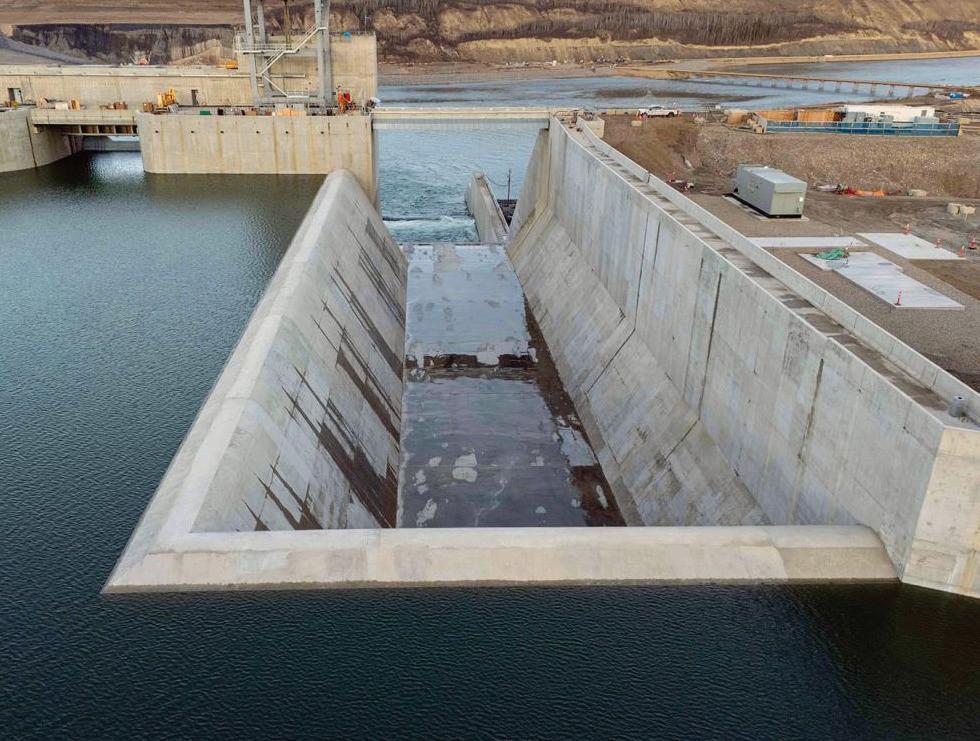
BC’s newest hydroelectric project, the Site C Dam, produces about 5,100 gigawatt hours per year — or 5.7 billion kilowatt hours — adding roughly eight per cent to provincial generation capacity.
The project cost about $16 billion and is not expected to be fully paid off until 2094, nearly 70 years after it began producing electricity.
The province is also planning major transmission expansion, including at least $6 billion for the first two phases of the North Coast Transmission Line, a network of roughly 450 kilometres of high-voltage power lines in northwestern BC.
The government says the project is needed to support mining and liquefied natural gas development. A potential
third phase could push total costs significantly higher.
To put those figures in perspective, one million seconds is about 11.5 days, while one billion seconds is more than 30 years.
Alongside infrastructure spending, BC also provides financial incentives to support large industrial developments, costs that are ultimately reflected in broader public finances and utility rates.
Last year, the province committed about $200 million to connect Cedar LNG to the electricity grid.
The larger LNG Canada project has also received a mix of tax credits, reduced electricity rates and exemptions from carbon pricing in its early years. Combined federal and provincial support is estimated at nearly $4 billion.
BC Hydro projects electricity demand will rise from 58,400 gigawatt hours in 2025 to more than 87,600 gigawatt hours by 2050 — an increase of roughly 50 per cent.
The utility says new demand will be driven by housing growth, industrial electrification and transportation, including electric vehicles. However, forecasts remain uncertain. Interest rates, inflation, economic conditions and industrial development plans could all significantly affect future consumption.
One of the largest drivers of future
demand is expected to be liquefied natural gas production.
The proposed Ksi Lisims LNG facility has requested electricity equivalent to about 5,200 gigawatt hours per year — roughly equal to the entire output of Site C.
Cedar LNG is expected to require up to 1,800 gigawatt hours annually.
Together, those two projects alone could consume as much electricity as roughly 700,000 average homes.
Industrial proponents argue BC’s hydroelectric system gives them a low-carbon energy advantage in global markets, where products are increasingly marketed as “clean” or “net zero.”
However, liquefying natural gas is highly energy intensive. Even when electricity is used instead of gas turbines, the process requires large-scale continuous power supply — one of the reasons new transmission infrastructure is being developed.
Residential customers in BC currently pay about $118.70 for the first 670 kilowatt hours used each month, rising to about $140 per additional 1,000 kilowatt hours.
Small businesses generally pay rates similar to residential users.
Large industrial customers — those using more than 550,000 kilowatt hours annually — pay about $67.90 per
BC HYDRO PHOTO Site C is located on the Peace River, 14 kilometre southwest of Fort St. John and about 80 kilometres downstream from the W.A.C. Bennett Dam.
1,000 kilowatt hours, less than half the residential rate.
The challenge facing BC is not only how much electricity is needed, but how quickly it must be delivered.
BC Hydro recently revised its forecast upward, saying it will need an additional 2.7 billion kilowatt hours beyond earlier projections, largely due to industrial demand.
Because BC relies heavily on hydroelectric generation, supply is also vulnerable to drought conditions. When domestic output falls, the province must import electricity from neighbouring
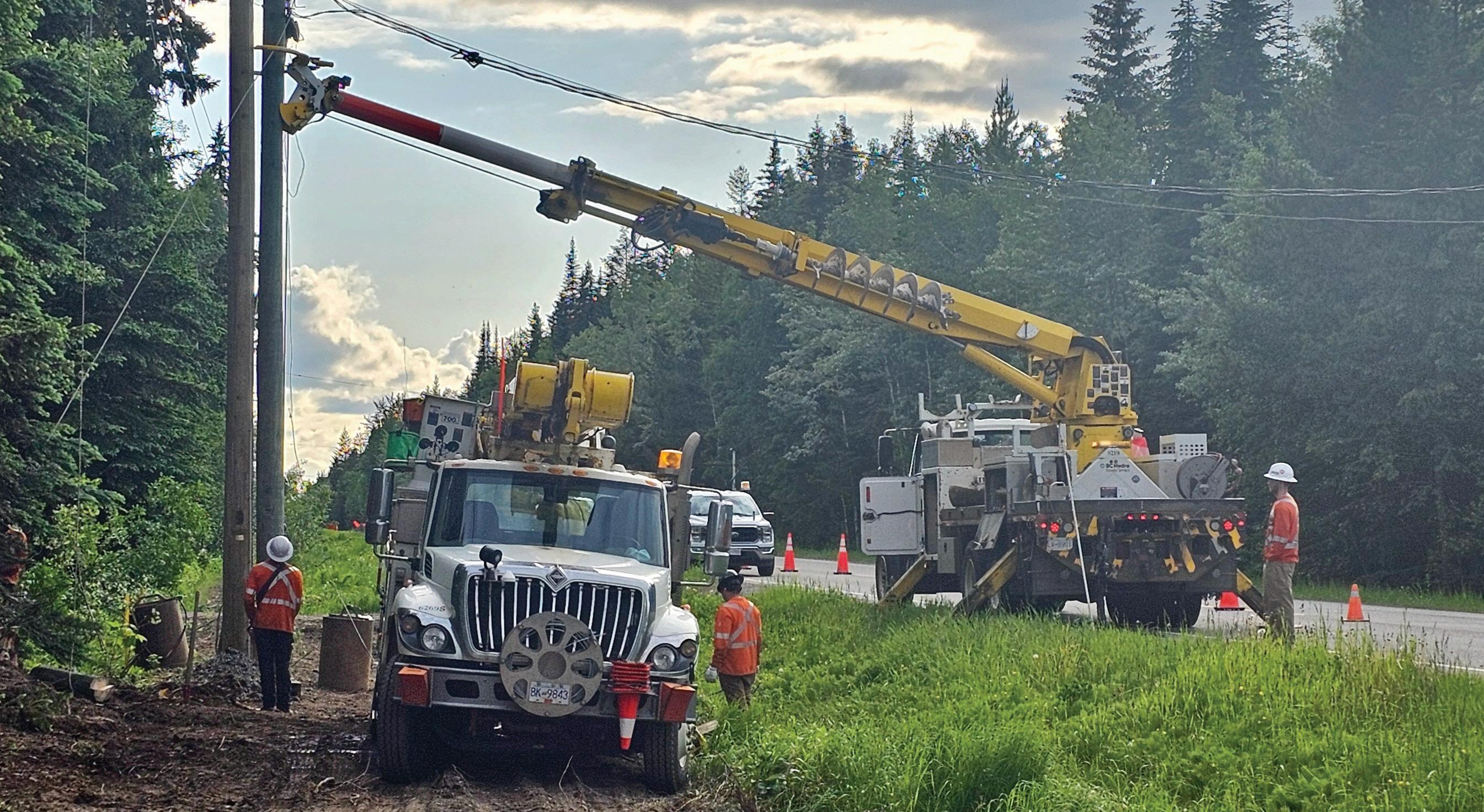
CITIZEN STAFF PHOTO
Crews work to repair a hydro pole at Chief Lake Road and Honeymoon Drive on Friday, June 13, 2025 in Prince George.
jurisdictions, including Alberta. Government policy aims to balance household affordability with economic development, while using industrial revenues to help offset system costs. But analysts warn that large infrastructure commitments, rising demand and unpredictable industrial growth could eventually shift more costs onto ratepayers.
Whether through monthly bills, taxes or indirect economic impacts, British Columbians are already paying for today’s decisions about how electricity is generated, distributed and allocated — and those costs are expected to grow as demand continues to rise.
This story originally appeared in The Narwhal
Marmot Builders puts its stamp on area history
MARMOT BUILDERS PHOTO
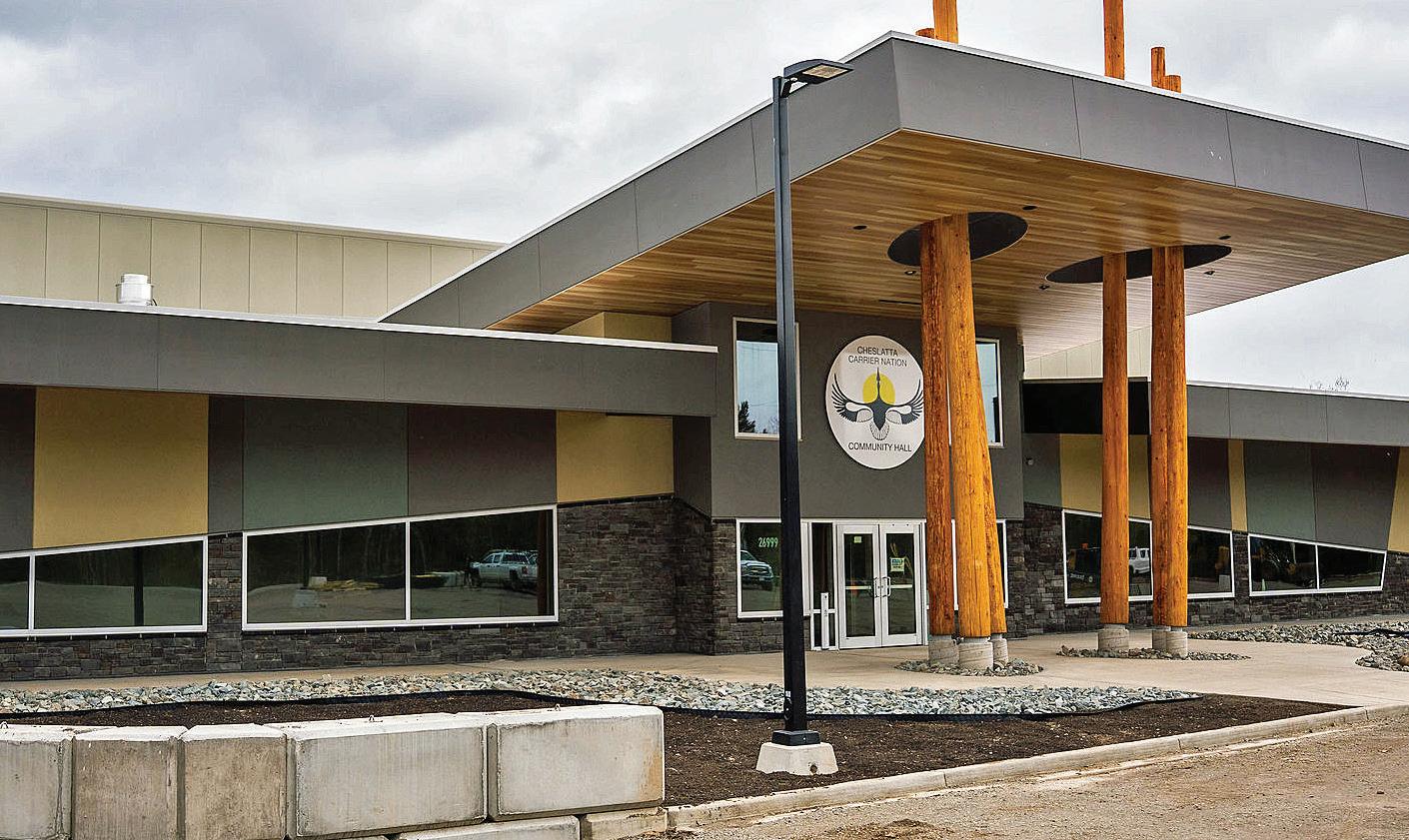
The $19 million Cheslatta Carrier Nation Community Centre built near Francois Lake by Marmot Builders of Prince George provides a permanent home for Cheslatta’s community functions and administrative work.
PG company wins construction award for building Cheslatta Carrier Community Centre south of Burns Lake
TED CLARKE Citizen Staff
Displaced by the manmade flooding of the Nechako Reservoir that put 410 square kilometres of their traditional territory at Ootsa Lake under water decades ago, the people of the Cheslatta Carrier Nation were seeking a gathering place.
On Sept. 25, 2025, when the Cheslatta Carrier Nation Community Centre and Administration Building officially opened near the south shore of Francois Lake, the roots of the people were eternally cemented in their “Forever Building.”
Constructed by Marmot Builders of Prince George, the project was selected in April for the Northern Regional Construction Association (NRCA) Prime Contractor Project Award in the over-$20-million category.
“That’s the one I’m most proud of,” said Marmot Builders CEO and managing partner Jonathan Burkholder. Built to power the Kemano hydroelectric generating station for the Alcan smelter at Kitimat, the Kenney Dam was completed in 1952, reversing the flow of the Nechako River. Over the next four years, that created the 900-square-kilometre Nechako Reservoir. The initial flooding forced the Cheslatta people to move from Ootsa Lake to a village at Cheslatta Lake.
“They had their village, their building, church, graveyard — the whole thing — and then, when they flooded Ootsa Lake, the decision was made to put in the Skins Lake Spillway as the outlet from the Nechako Reservoir into the
Nechako River,” said Burkholder.
“They were told that because of construction they had to leave their village for the winter, and when they came back in the spring, the Skins Spillway had raised the lake level significantly and there were, literally, wood caskets floating on the shoreline.”
Since then, the people have been scattered on reserves throughout their own land in the Southside community, 23 kilometres south of Burns Lake. For 30 years, until the new $19-million building opened last year, community functions and band administration operated out of a small office in a condemned school.
“This administration and community centre is their home,” said Burkholder.
“It’s somewhere they can all gather. They have all their offices in one place. There’s a community centre that can seat 450 people in the gymnasium, and it has a commercial kitchen to feed those 450 people. There’s an art gallery in the front for them to display their old artifacts.
“It’s the closest thing they have to a home and gathering place they can all return to. It’s not on their traditional territory because they don’t really have one centralized reserve, so they ended up buying the piece of land in Danskin. It’s the most central spot for all the scattered places where their people live.”
The building project was completed in May 2025, and the grand opening took place four months later.
Burkholder started Marmot in Prince George in April 2019 as a joint venture with company president and managing partner Preston Aitchison. Both are former employees of Prince George-
based IDL Projects, one of the largest general contractors in northern BC, where they learned how to complete large building projects from the ground up.
Burkholder, who is from Burns Lake, was already a builder when he joined IDL in 2006, where he worked until 2013. He then moved on to the LNG project in Kitimat and also worked on the Site C dam near Fort St. John before returning to IDL as a project manager from 2017 to 2019. That’s where he met Aitchison, a carpenter who worked his way up through the trades to become an estimator and project manager.
“We compete with IDL a little bit, but they are a big enough company that they’re kind of in a league of their own in Prince George,” said Burkholder. Marmot also won for its renovation of Hub City Volkswagen in Prince George, which was selected for the $10-millionto-$20-million Project Award category.
In 2025, the company won the NRCA under-$5-million Project Award for its Cariboo Crossing Phase 1A commercial development at Boundary Road and Highway 97 South. Marmot also built the city’s newest Wendy’s restaurant, which opened this spring along the Hart Highway.
The company has 18 employees. Much of the work Marmot does involves construction management and working with subcontractors.
One of Marmot’s biggest ongoing projects is the Carrier Sekani Family Services Tachick Lake Healing Centre for recovering substance users, now under construction about 20 kilometres south of Vanderhoof on the former site of Tachick Lake Resort. When it
opens, the Indigenous-led treatment centre will have capacity for a 10-bed detox program and a 36-bed residential treatment program.
“Building projects that matter to people — I enjoy that,” said Burkholder. One of the most meaningful jobs Marmot has taken on was the St. John’s Heritage Church restoration project in Burns Lake, which involved foundation repairs and replacement of the exterior siding and roof.
Improvements to the wood-frame Anglican church — the third-oldest building in Burns Lake — not only enhanced the appearance and functionality of the building but also significantly reduced its susceptibility to fire. Marmot built an addition onto the back of the building to install plumbing fixtures, a kitchen and washrooms.
“It had old wood siding on it and was built in (1929), and we replaced it with concrete board that matched the profile and the colour,” said Burkholder. “It had a cedar shake roof, and we found a composite product that matched the colour and looked like cedar shake, but it’s got a 50-year warranty and a 100year life expectancy.”
Coastal GasLink contributed to construction costs, and the Village of Burns Lake raised some of the money for the $600,000 project, which was completed in March 2023.
“I grew up in Burns Lake, and that project is a favourite of mine,” said Burkholder. “We don’t have many old buildings in the north. You get to turn it back into something useful that can still be used. Now it’s a usable piece of history.”
Nunavut electricity production more than doubles over two years
WILLIAM KOBLENSKY VARELA
Local Journalism Initiative Reporter
Electricity production in Nunavut has more than doubled over the past two years, Statistics Canada data shows.
In January, 43,000 kilowatt hours of diesel electricity was produced in the territory.
That’s a massive increase from January 2024, when just 18,600 kilowatt hours of diesel electricity was generated in Nunavut.
Last year marked the most power ever produced in the territory, with over 383,000 kilowatt hours generated, beating the previous record of 260,000 kilowatt hours, set in 2018.
Mining operations and infrastructure projects are behind the higher output, according to the Qulliq Energy Corporation (QEC).
“Nunavut’s mining sector and broader economic activity saw growth throughout 2024, which can contribute to increased demand across communities and supporting services,” QEC stated. Power generation in Nunavut had remained relatively steady between 2012 and 2023,
according to Statistics Canada data.
But in October 2024, power production more than doubled to 30,600 kilowatt hours from just one month earlier, when it was 14,600 kilowatt hours in September 2024.
During the summer months of 2025, when electricity generation is typically at its lowest, more power was being produced than in any previous winter on record.
No new QEC power generating stations came online in that period.
Mines in Nunavut use their own diesel generators because they’re not close enough to communities for QEC to connect power lines to their operations.
This story originally appeared in The Nunavut News.
“Many large industrial operations in the territory operate independently from QEC,” the utility explained.
The October 2024 spike in power generation tracks with the end of B2Gold’s Goose mine construction south of Cambridge Bay.
Since then, diesel electricity generation has continued to eclipse all previous records in Nunavut.
More housing construction helped drive up demand.
“The continued increase in 2025 is largely attributable to steady population growth and the advancement of major infrastructure and housing projects across Nunavut,” QEC said.
“Several territorial projects that were delayed during the Covid-19 pandemic resumed or accelerated during this period, resulting in sustained higher electricity demand across multiple communities.”
Almost all electricity in Nunavut is powered by diesel.
But 2025 also marked the highest year of production for solar power in Nunavut’s history.
Last year, 153 kilowatt hours of solar electricity were generated in the territory, well up from 86 hours in 2024 and 91 in 2023.
Solar power also produced electricity in every month of the year for the first time in 2025, eking out two kilowatt hours in January 2025 and one in December 2025. There’s a snowball effect driving up the usage of solar, according to Marth Lenio,
lead renewable energy consultant at The Arctic Renewables Society non-profit.
“Once a community does a smaller installation and sees how easy it is to operate it, and how much it’s saving on their energy bills, all of a sudden that small one turns into a larger one,” Lenio said.
A 10-kilowatt system on Gjoa Haven’s community centre was expanded because of its success, Lenio pointed out.
That turned into five homes in the hamlet getting solar panels installed on their roofs.
“There’s the solar project in Naujaat, and the wind energy project in Sanikiluaq. These are the first really big projects for communities, where in Naujaat, that solar would, I think, allow for the community to turn off their diesel generators in the summer,” Lenio said.
Lenio said the wind project in Sanikiluaq — the first of its kind in Nunavut — would offset 50 to 70 per cent of the diesel power use in the community.
Until that comes online, solar is the only renewable source of energy in the territory. This story originally appeared in The Hamilton Spectator.
Mayor Gladys Atrill talks about Minerals North Conference and future opportunities Smithers making way for new mining opportunities
MATTHEW HILLIER Citizen Staff
The town of Smithers recently welcomed 458 members of the BC mining industry during the Minerals North Conference, held from May 6 to May 8.
Located southeast of British Columbia’s Golden Triangle, Smithers has long served as a key service, housing and support hub for some of the province’s most profitable mines.
Smithers’ investment in and support for the northwestern mining industry made it a natural location to host the conference.
Smithers Mayor Gladys Atrill spoke at the conference opening, provided input on the Northwest BC Resource Benefits Alliance and helped close the event. Atrill has a background in tourism and regional infrastructure development. She told The Citizen during the conference that the event served as a reminder of Smithers’ longstanding role in the mining industry.
“I think that’s a good reminder for everyone that mineral exploration and mining have operated in Smithers for a very long time and that the community is still key to what goes on in northwestern British Columbia in both exploration and mining. So I think it’s a nice rounding out of that,” she said. She emphasized that Smithers remains one of the province’s key mining hubs and said it is important for both
residents and outsiders to recognize that role.
“We all like to use the word hub, and Smithers uses that word too. This is my hometown, so I’m aware that, definitely on the exploration side, diamond drilling and those sorts of things have been going on here for a very long time. That sector is a part of what makes up the economy in Smithers and the Bulkley Valley,” she said.
Despite Smithers’ population of approximately 5,600, its airport and numerous mining offices continue to play an important role in the northwestern mining sector.
“We’re a smaller community, but we do play a key role. Our airport is convenient for folks wanting to get up north, whether they’re connecting by charter to the Golden Triangle or travelling by road, and both happen if the supply sector needs to travel up Highway 37 to deliver. It’s a key part of the economic blend in Smithers,” said Atrill.
However, as a longtime resident of Smithers, Atrill said she understands the mining industry is not always in a growth cycle.
Atrill told The Citizen that economic diversification is essential during periods when the community’s role as a mining hub becomes less active.
“One of the strengths of any community is variety. Having more sectors rather than fewer sectors makes sense so that when one is up and one is down, we
balance out. This is definitely an up time for exploration and mining, but it’s not always an up time. We’ve lived through down times as well.
“Having multiple economic streams is really what we’re hoping for — mineral exploration and mining, forestry, agriculture, education, health care, tourism and transportation. The more streams we have in our community, the more resilient we’re going to be,” she said.
Continued investment in the Golden Triangle and the BC mining industry comes at a time when Canada is attempting to reduce reliance on U.S. trade and strengthen its own economy.
One recent example is Canada’s firstever Defence Industrial Strategy (DIS), released in February 2026 by Prime Minister Mark Carney.
The DIS is intended to support the domestic defence industrial base and help Canada and its military become more self-reliant.
One focus of the strategy is domestic critical mineral development for national security and supply chains.
Atrill said that with initiatives such as the DIS underway, Smithers has an important role to play in supporting the mining industry both provincially and nationally.
“We are in a key part of the province at a critical time for Canada, and I think each of our communities is going to find a way to support not only ourselves, but our province and
our country in such a strange time when I think we are looking for ways to pull together to make sure that our communities, our residents and our businesses can all be healthy going forward,” she said.
Although optimistic about the future, Atrill acknowledged there are significant challenges ahead as miningsector momentum drives development in Smithers.
“We probably face some of the same challenges as other communities, ensuring that we can be ready to host businesses as they develop. Can we, as a community, make sure we’re developing appropriately? Do we have the money to build the infrastructure businesses in any sector are going to want if people choose to locate in Smithers? Can we have industrial land ready quickly enough? Those are real challenges for us,” said Atrill.
She added that while it is impossible to predict the future, the best thing Smithers can do is remain prepared to welcome residents, businesses and industry.
“These days, with global affairs as they are, none of us know exactly what’s coming in the next few weeks or months. But what we can do here on the local front is do our very best to make sure that we have a community well-suited and ready to host residents, businesses and industry when they come along,” she said.
HANDOUT PHOTO Smithers Mayor Gladys Atrill speaks at the Minerals North conference in Smithers.
BC, Simpcw begin consent talks on Yellowhead copper mine review
Proposed agreement would align provincial and Indigenous environmental assessments and give Simpcw First Nation a decision-making role over the project near Vavenby.
CITIZEN STAFF
The Province of BC and Simpcw First Nation have begun negotiations on a consent-based decision-making agreement for the proposed Yellowhead copper mine near Vavenby. The agreement would establish a framework for co-ordinated environmental assessments by the Environmental Assessment Office and Simpcw First Nation under the Declaration on the Rights of Indigenous Peoples Act and the Environmental Assessment Act. If finalized, Simpcw consent would be required for the mine to proceed.
The proposed open-pit mine, planned by Taseko Mines Ltd., would be located about 150 kilometres northeast of Kamloops in Simpcw territory. The company has proposed a production capacity of 90,000 tonnes of ore per day over a 25-year mine life.
Environment Minister Tamara Davidson said the agreement would help ensure
major projects are reviewed with a focus on environmental protection and economic development.
“Working together to review projects shows how partnerships between First Nations, the Province and proponents can advance reconciliation, strengthen investment confidence, and support a sustainable future for everyone in BC,” Davidson said in a statement Wednesday.
Simpcw Chief George Lampreau said the nation created its own assessment process so projects can be evaluated according to Simpcw priorities, values and stewardship responsibilities.
“We have the inherent right to make decisions about what happens in our territory,” Lampreau said.
He said Simpcw also recognizes the need for collaboration and transparency with residents and neighbouring communities. The proposed agreement would align the provincial and Indigenous assessment
processes in an effort to avoid duplication and create a more streamlined review.
Mining Minister Jagrup Brar said the Yellowhead project could create jobs and attract long-term investment to the region.
“This Section 7 agreement represents an opportunity to provide a clear process for the Nation, government and the proponent to work within,” Brar said.
The Province said local governments, industry organizations and potentially affected First Nations will be consulted during negotiations.
Those consultations will include the Thompson-Nicola Regional District, Cariboo Regional District, the districts of Clearwater and Barriere, the Mining Association of BC and the Association for Mineral Exploration.
Potentially affected First Nations expected to be consulted include Adams Lake Indian Band, Neskonlith Indian Band, Skwlāx te Secwepemcúlecw, Stswēcemc Xget’tem,
Tsq̓éscen̓ First Nation and Whispering Pines/Clinton Indian Band.
According to Taseko, the project would contribute more than $900 million annually to BC’s gross domestic product if approved and developed. The company said the mine would create 525 permanent direct jobs and involve a capital investment of $2 billion.
Taseko president and CEO Stuart McDonald said the company supports the agreement because it could improve certainty and efficiency for the project while respecting Simpcw rights and priorities.
The Yellowhead project entered Simpcw’s assessment process in May 2024 and BC’s environmental assessment process in July 2025.
The province has previously signed similar consent agreements with Tahltan Central Government for the Eskay Creek project and the Red Chris mine expansion.
BC First Nations push to replace salmon farm ban with Indigenous-led system
Coalition says federal phase-out threatens jobs and wants co-management model to protect fisheries and communities
SONAL GUPTA
Local Journalism Initiative Reporter
Some BC First Nations are calling on Ottawa to reverse its planned ban on open-net salmon farming and instead adopt an Indigenous-led system they say would better protect wild salmon while preserving jobs in coastal communities. In 2024, the federal government announced plans to phase out open-net salmon farms by 2029, citing concerns about disease, sea lice and pollution affecting wild salmon populations. The industry is expected to transition toward closed containment or land-based systems.
But members of the First Nations Finfish Stewardship Coalition — a group of 17 First Nations from BC’s central and north coasts and western and central Vancouver Island — say the policy is already causing job losses and deepening food insecurity in remote communities.
Representatives from the coalition travelled to Ottawa recently, holding a press conference on Parliament Hill to urge a change in federal direction. Dallas Smith, of the Dallas Smith, said the federal government made a “dangerous and irresponsible” decision under political pressure, without proper transition planning for affected communities.
“We can’t just go to Walmart or just go
to the next available job place in remote communities,” Smith said. “These are career, family-supporting jobs, and to just simply take them away without any kind of transition plans or opportunities is irresponsible as well.”
Smith said the salmon aquaculture sector in BC has already contracted by about 40 per cent since the ban was announced, resulting in roughly 1,000 job losses.
He said communities want greater control over how salmon farms operate in their territories, rather than a full phase-out.
At the Ottawa news conference, the coalition outlined a five-pillar plan that would allow salmon farming to continue beyond 2029 under Indigenous governance. The proposal includes creating an Indigenous-led aquatic health science centre, a nation-led stewardship fund financed by industry payments, increased government investment, and territory-specific siting rules using new monitoring technologies.
The plan also calls for greater First Nations equity in processing and harvesting, and the ability for First Nations to issue their own aquaculture licences within their territories by 2029. Smith said many First Nations are already operating their own monitoring systems, including sea lice tracking, technology testing and independent
oversight through guardian programs.
In Ahousaht territory, he said, bubbleskirt containment and site-specific technologies have significantly reduced sea lice levels, falling from 1.93 motile lice per fish in 2022 to 0.30 in the most recent cycle under Indigenous standards stricter than federal rules.
“If we thought wild salmon were being harmed by this industry, we wouldn’t be involved in it,” Smith said. “We’re working to make sure the industry is accountable and we’re using some of the benefits to invest in wild salmon restoration and habitat protection.”
Smith warned that June represents a critical decision point for salmonfarming companies, which must decide whether to stock fish for a six-year production cycle. Without policy clarity, he said, companies risk investing in stock that may later be destroyed or forced into early shutdown.
“It’s just as time has gotten closer and the job losses are starting to pile up,”
he said. “The lines at the food bank are growing from jobs that used to be in place. And now the drop off is going to be quicker.”
He said the sector’s decline has already contributed to increased pressure on social supports in remote communities.
Isaiah Robinson said salmon aquaculture has provided critical economic stability in his community, located on BC’s central coast.
He said partnerships with industry have brought long-term contracts, employment and training opportunities that have helped address unemployment and social challenges.
“This industry has been able to give our membership a purpose, to get out of bed,” Robinson said. “It keeps them happy [and] focused.”
He warned that a full ban could have serious consequences, noting the industry accounts for about 51 per cent of his community’s economy. Its removal, he said, could worsen addiction and mental health challenges.
Smith, who played a role in the creation of the Great Bear Rainforest agreement, said that process succeeded because all parties negotiated shared solutions that balanced conservation with economic development.
He said similar cooperation is needed in the salmon farming sector, but tensions have emerged over differing views of the industry’s future.
Smith said First Nations will continue engaging with the federal government but are prepared to act independently in their territories if necessary.
Fisheries and Oceans Canada did not respond to a request for comment before publication.
This story originally appeared in Canada’s National Observer.
HANDOUT PHOTO Several BC First Nations want the federal government to reverse a ban on open-net salmon farming.
Report highlights most in-demand skilled trades
Expect 72,070 job openings over the next decade in BC
CITIZEN STAFF
According to BC’s Labour Market Outlook: 2025 Edition, 15 skilled trades are expected to account for 72,070 job openings over the next 10 years. The report says these occupations require a combination of on-the-job and in-class training and offer strong earning potential.
The province is encouraging workers to explore skilled trades careers as part of B.C.’s growing economy.
Below are the 15 trades projected to see the most job openings between 2025 and 2035:
• Cooks — 7,770
• Carpenters — 10,420
• Construction trades helpers and labourers — 10,030
• General building maintenance workers and building superintendents — 5,280
• Automotive service technicians, truck and bus mechanics and mechanical repairers — 4,940
• Hairstylists and barbers — 5,380
• Heavy equipment operators — 4,490
• Bakers — 2,820
• Electronic service technicians (household and business equipment)
— 3,130
• Electricians (except industrial and power system) — 3,930
• Welders and related machine operators — 3,110
• Construction millwrights and industrial mechanics — 2,760
• Heavy-duty equipment mechanics
— 2,350
• Painters and decorators (except interior decorators) — 2,760
• Plumbers — 2,900
The outlook notes that individuals pursuing these careers can access training pathways that combine classroom instruction with practical experience, along with opportunities for stable employment and long-term career growth.