
The Quiet Before the Boom: Why 2026 May Be a Defining Moment for Multifamily

The Quiet Before the Boom: Why 2026 May Be a Defining Moment for Multifamily
By Mitch Siegler, Senior Managing Director
Multifamily real estate investors may think about value creation and operating performance in the context of big moves: acquisitions, dispositions or major capital investments. These are visible, measurable and often transformative actions which can have dramatic impacts.
Over the long haul, small moves, made consistently over time – rather than dramatic moves – may be what brings the more durable gains in operating performance. One foot in front of the other kind of stuff.
Remember playing dominoes as a kid? A domino is 2” tall. When it tips, it can create a ripple effect, taking down the next domino. Aided by gravity, this principle works even when the next domino is 1.5 times taller.
Imagine that domino #1 is 2” tall, #5 is 10”, and #10 is 23”. Here, the power of compounding – which Warren Buffet dubbed the eighth wonder of the world –accelerates as #18 is 47´ high (a telephone pole), #25 is 810´ (the Empire State Building) and #30 is 6.1 miles high (Mount Everest).
Business isn’t child’s play, but the same concept can be applied. A modest improvement pushes the next domino forward and a few small changes together create momentum. In the apartment business, momentum from small changes can compound into stronger operations, better resident experiences, and ultimately higher revenues, income and values.
Investors and operators who apply this principle consider property performance holistically and also break everyday processes into bite-sized pieces and seek opportunities to improve them. They ask basic questions repeatedly: Where are we leaking revenues, expenses, time or tenants? Where are we creating friction for residents or team members? The answers generally don’t point to a single large fix. Instead, they reveal opportunities for small tweaks in various areas.

In a multifamily portfolio, each domino represents a process that influences performance: leasing response times, turnaround time (to make a vacant unit rentready), workorder response time, timing of outreach to residents for lease renewals, reducing operating expenses, managing rent collections, minimizing delinquencies and more. Tip one domino, and others may begin to fall.
Improving lead response time by even a few minutes can meaningfully increase tour conversion rates. Improved prospect conversion rates translate to higher occupancy. Higher occupancy rates produce greater revenue and allow for improved operating expense efficiency (fixed costs spread across more leased units). Stable revenue allows for more reinvestment into the property and the team. Stronger teams deliver better service, improving resident satisfaction and renewal rates. Higher renewal rates reduce turnover costs and vacancy losses, leading to higher income. Each improvement cascades into the next.
None of these steps requires a dramatic operational overhaul. Often, improvements come from small adjustments: stronger communications, improved tracking of performance metrics or better technology. The results accumulate slowly at first and then faster over time – like dominoes or compound interest.
If you think of multifamily operations as a chain, any link can be an opportunity for process improvement. The leasing funnel is often a good place to identify such opportunities.

Recently, property leasing offices operated from 9:00 a.m. to 5:00 p.m. Monday-Friday and closed for lunch. Prospective tenants needed to make an appointment and visit during regular hours. Now, best practices include virtual tours on a property website.
Similarly, prospective tenants who called a leasing office at 6:00 p.m. on Friday didn’t hear back until Monday. By then, many had signed leases elsewhere, rendering the prospective lead worthless and wasting the marketing dollars to secure the lead. Using technology, more prospective tenants can tour units virtually, resolving for themselves questions about unit layouts and finishes, answering many questions instantly. Our property websites feature an AI agent which is trained on the property (and which continues to learn) that can address questions in real time, 24/7. Agents can also coordinate virtual tours and book inperson tours (synchronizing with the onsite manager’s calendar).
Technology solutions may also enable faster followup after a prospective tenant visits or conducts a selfguided tour – which can also boost conversion (and occupancy) rates.
Bad actors can also use technology to falsify credit applications, work histories and paystubs, leading to a cascading series of events relating to signing leases with people of poor character; this leads to delinquencies, legal expenses for eviction, higher cleaning costs and increased vacancy. We use AI-assisted technology to identify fraudulent documents and reduce these expenses.
The process of making a vacant unit rent-ready (cleaning carpet and touching up paint) is another opportunity for incremental gains. Standardizing scopes of work, coordinating vendors and batching tasks can reduce the time between the move out and move in. Reducing average make ready time by a few days can unlock meaningful revenue across a portfolio.
Another small but powerful change we’re making is providing each property’s maintenance team with tools for detecting and addressing water intrusion issues (moisture meters, plumbing repair kits, dehumidifiers, fans) so we don’t need to call a plumber for every minor leak or repair situation, saving time and money and improving resident satisfaction.
Preventive maintenance provides similar opportunities. Regular inspections, clear maintenance tracking, and proactive resident communication can reduce emergency repairs and improve resident satisfaction (increasing their propensity to renew leases or recommend the community to their friends). The benefits are both direct (lower expenses) and intangible (fewer disruptions to residents’ daily lives and greater satisfaction).
Renewal strategy is another domino. Personalized outreach and well timed communication with residents can increase renewal rates. Even modest improvements reduce turnover costs and help stabilize occupancy rates and cash flow.
Better vendor management, collections processes, and data reporting/analysis present similar opportunities. Each process can be refined incrementally – one domino tipping over the next. No single change is revolutionary – each follows from the previous one, contributing to momentum.
If average days to lease improves by one day, renewal rates rise by 1%, delinquency rates and controllable expenses each fall by 1%, the impact on income can be significant. When applied across thousands of units, these small shifts meaningfully change financial performance.
And because real estate values are closely tied to income, higher income translates directly into higher value.
Disciplined operators embrace this reality. They track the small stuff and celebrate incremental wins. They build systems centered around continuous improvements. Over time, those systems separate average portfolios from exceptional ones.
Stronger processes are a necessary condition for improved operations, but they’re not sufficient to maintain improvements in the long run. A culture which rewards innovation and experimentation and tolerates periodic mistakes (not every new initiative succeeds) determines whether small changes can become permanent.
In high performing organizations, team members at every level feel ownership of outcomes. Pathfinder asset

managers are in regular communication with property leasing professionals and regional managers, who understand how their daily actions (and those of other team members – like maintenance technicians) influence the property’s performance. Equally important, our asset managers use information as an early warning system for problems and encourage property teams to identify better ways of working. We ask questions to identify problems and opportunities for improvement. Curiosity is an important part of our culture.
When teams are empowered to suggest improvements, they may identify opportunities that might otherwise not be exposed. A technician may be empowered to streamline a work order process. A leasing agent may discover a more effective follow up method. A manager may refine how vendors are scheduled or how data is reported. Individually these ideas are small. Collectively they may help transform operations.
We focus on building systems to capture these insights. Our team evaluates large amounts of data on dozens of properties. The volume of data can be overwhelming; the art form is identifying what is most important. A new
information system which we have implemented sifts through data from all properties and presents it in a standardized format, enabling comparisons between properties and allowing our asset managers to focus the onsite property managers on the more compelling issues. What did we learn from property A that might be applied to property B? Regular operational reviews and property visits, key performance indicators and frequent communication allow ideas to surface quickly and spread across a portfolio. This helps create a culture of continuous improvement.
There’s a multiplier effect on higher apartment income –an additional dollar of income might boost the property value by $20 (assuming a 5% capitalization rate). Moves to boost revenues (improving occupancy or lease renewal rates or leasing cycles) increase income. Steps like preventive maintenance drive down costs. Better and more actionable data speeds decision making. Faster response time may reduce unit downtime and streamline lease renewal cycles. Each improvement strengthens the performance of the portfolio.
Great operators are disciplined and understand the power of compounding. They create a culture of continuous improvement, always sweating the small stuff. In the apartment business, dominoes isn’t just a game – it’s a way of boosting performance.
Mitch Siegler is Senior Managing Director of Pathfinder Partners. Prior to co-founding Pathfinder in 2006, Mitch founded and served as CEO of several companies and was a partner with an investment banking and venture capital firm. He can be reached at msiegler@pathfinderfunds.com
By Lorne Polger, Senior Managing Director
There’s a particular kind of opportunity that hides in plain sight – one that arrives not with fanfare, but with the slow grind of forces that have been building for years. The 2026 multifamily real estate market is auxh a moment.
After enduring one of the more turbulent real estate cycles in recent memory – a pandemic-era construction frenzy, historic interest rate hikes, and a new supply wave that hasn’t been seen since the 1970s – the multifamily sector is approaching something rare: a structural realignment where the stars are aligning for disciplined, forward-looking investors.
The most compelling part of the bull case isn’t speculative – it’s math.
Between 2023 and 2025, developers delivered one of the largest waves of new apartment units in recent history. In markets like Austin, Nashville, and Phoenix, inventory swelled by close to 20% in just three years. Vacancy rates climbed, rent concessions rose, and investors who bought at peak valuations found themselves in difficult situations.
But here’s what matters now: new construction has declined in a meaningful way. In 2024, developers broke ground on 335,000 units, down sharply from the peak of 531,000 just two years earlier. While the number rose slightly in 2025, it is expected to fall substantially in 2026-2028. According to the National Association of Home Builders, new multifamily starts over the next few years are expected to hover in the mid-300,000 range – 40% below the 650,000 units delivered in 2024.
Prior to ‘22, the last time 400k+ units were delivered was ’72
‘26 forecasted deliveries in Pathfinder markets: ~1%-5% of existing housing stock
We hit a short-term oversupply blip (especially in the Class-A space), and it had a significant impact on rents, net operating income and valuations. But the markets are wise. Generally, when new construction doesn’t pencil, developers don’t develop and lenders don’t lend. The pipeline, the single biggest headwind for investors, has been draining fast.
While headlines focused on rising vacancies and softening rents, little was mentioned about the ongoing (and in some cities, rising) demand for apartments.
Over 350,000 new units were absorbed in 2025, the third highest total in 25 years. Renters are filling new units now almost as fast as they are being delivered. According to CBRE, net absorption totaled 78,100 units in the first quarter of 2026. More than 90% of the markets tracked by CBRE (63 of 69 markets) recorded positive net absorption in the first quarter.
In 2025, the median age of first-time homebuyers reached 40, the highest age on record, underscoring the long-term shift toward delayed homeownership driven by elevated mortgage rates, high home prices, and limited affordability. With the average newly originated mortgage payment 35% higher than the average apartment rent, millions of would-be buyers are remaining renters for far longer than previous generations. That’s not a temporary blip but a structural shift that underpins multifamily demand for years to come.
From 2023-2025, rising interest rates squeezed the life out of multifamily transactions. Investments that penciled at 3% borrowing costs no longer worked at near double that. Sellers held. Buyers retreated. Volume cratered. Pathfinder sat on the sidelines.
That environment began changing about 20 months ago. After three consecutive 25-basis-point reductions in late 2025, the federal funds rate now stands at 3.50% to 3.75%, with markets wavering on whether we will see one more interest rate reduction this year. Multifamily borrowing rates from the agencies (Fannie Mae and Freddie Mac) can still be had in the low 5% range (with a rate buydown ). In our most recent acquisition, we obtained a five-year loan from Fannie Mae at 4.82%.

And the markets are taking note. Total multifamily originations are projected to reach approximately $400 billion in 2026, a 20% increase over 2025.
Lower rates are starting to bring investors and capital providers back. The question is whether you are positioned before the crowd arrives.
Approximately $162 billion in multifamily loans are scheduled to mature in 2026, a 56% increase from the prior year, with an estimated 60% of apartment loans originated during the 2021–2022 vintage expected to come due in the second half of 2026. For borrowers who financed at low rates and now face refinancing in a significantly higher rate environment, the math is unforgiving.
This is creating a wave of motivated sellers – owners who are unable to hold, refinance, or recapitalize without taking a loss. For buyers with ready access to capital and operational expertise, properties currently underwater for their owners due to overleverage (and not their physical and operational characteristics), are likely to present buying opportunities. That’s where Pathfinder is primarily hunting.
Historically, these windows don’t stay open long; we’ve seen how this plays out before. Once rates stabilize further and the worst of the maturity wall clears, values are likely to rise and distressed deals will evaporate.
Institutional capital is making its way back into multifamily, with many large investors adjusting their
buy boxes and deploying capital into what they see as more rationally priced assets – stabilized and well-located properties where future rent growth is more likely.
The return of institutional buyers is significant. These are not sentimental actors; they are deploying billions based on rigorous underwriting. Their re-entry is a signal that the risk-reward profile of multifamily has improved.
For sub-institutional groups like Pathfinder (we fly below the radar of the largest institutions, targeting properties too small to attract their interest), the window is now –before institutional capital fully reprices the market. We believe that high-growth markets like Phoenix, Salt Lake City, and Denver will see considerable value creation over the next several years, driven by superior renter demand and reduced construction pipelines, leading to accelerated rent growth.
The Case for Acting Now
This is not a call to speculate. The risks are real. Tariffs and geopolitical uncertainty, weakening consumer financial health, a new Federal Reserve chair and the possibility of stagflation all present genuine headwinds. Markets that were oversupplied may take longer to recover.
But the fundamental thesis is sound: for investors focused on stability, resiliency, and wealth compounding over time, 2026 does not represent the end of a challenging cycle – it marks the beginning of the next one.
The plummeting supply of new units is real. Demand for apartments remains strong as young people continue to delay (or forego) the purchase of that first home. Capital is returning. And the distressed deals that define the best vintages of any cycle are making their appearance now (we saw this as investors in the early 1990s and the early 2010s and see it again today).
Investors who look back on this period with satisfaction will not be the ones who wait for certainty. They will be the ones who recognize that certainty, when it arrives, has already been priced in.
We have all learned pearls of wisdom from sage investors over the years. One of my favorites comes from Warren Buffett. “If you wait for the robins, spring will be over.”
Lorne Polger is Senior Managing Director of Pathfinder Partners. Prior to co-founding Pathfinder in 2006, Lorne was a partner with a leading San Diego law firm, where he headed the Real Estate, Land Use and Environmental Law group. He can be reached at lpolger@pathfinderfunds.com.
By Matt Quinn, Managing Director
In The Narrative of Arthur Gordon Pym of Nantucket, Edgar Allan Poe popularized the idea of casting a message into the sea – handwritten, sealed in a bottle and sent into an uncertain future. When the bottle is found and the message is read, will it still hold up? The suspense is riveting!
Real estate investing isn’t all that different. When you build or acquire a property, you’re making assumptions and sending them five, ten or 20 years into the future, hoping they still apply when you get there. The challenge today is that the world is changing faster than ever. The next 20 years may bring more change to how people live and work than any period before, which makes getting those assumptions right harder.
It’s easy to find examples. Think about an office developer underwriting a new high-rise in 2019, before Covid reshaped how people use office space. Or a retail investor in the mid-1990s assuming brick and mortar shopping would dominate indefinitely. Those were reasonable assumptions at the time, but the world moved on.
Apartments are in a better position. Housing is a fundamentally physical need – you still can’t sleep on the internet (at least not yet) – which provides some insulation from the disruption we’ve seen in office and retail. But it doesn’t mean we can stand still. If anything, it reinforces the need to stay thoughtful about where things are heading.
With that in mind, here are a few longer-term themes shaping how Pathfinder is thinking about investing today:
• The homeownership rate will continue to decline, and more Americans will be renters: The U.S. homeownership rate has fallen from 69% in 2004 to 65% today. A recent report

from Apartment List – adjusting for the rise in multigenerational living (30% of Millennials live with their parents) – suggests the true rate may be closer to 59%. We expect further pressure from affordability constraints, delayed household formation and more shared living arrangements, all of which support long-term apartment demand.
• Suburban apartments will see outsized demand: Remote and hybrid work have expanded the map. Where people live is no longer dictated just by where they work. With roughly half of U.S. workers in hybrid arrangements, proximity to the office is now just one factor alongside quality of life, safety and space. At the same time, Millennials – the largest cohort in the country – are forming families and prioritizing those same characteristics, many of which are found in suburban markets.
• Strong operations and thoughtful renovations will drive value, not falling interest rates: The past decade benefited from declining interest rates and cap rate compression. That tailwind is less certain going forward. Value will be created at the property level through disciplined operations, cost control and targeted renovations that support rent growth. Execution will matter more than financial engineering.
• Always underwrite a margin of safety: As outcomes become harder to predict, the cost of being wrong increases. That means stress-testing rents, expenses and exit values and avoiding dependence on favorable market conditions. Building in downside protection is how we preserve capital when things don’t go quite as planned.
• Maintain flexibility in our target markets: Regulations, job growth and population trends are shifting across the country. Markets that look
attractive today may face headwinds down the road, and vice versa. Staying flexible allows us to move with these shifts rather than getting stuck in markets that are moving in the wrong direction.
If there’s a takeaway from The Narrative of Arthur Gordon Pym of Nantucket, it’s not just where the message ends up, but how carefully it’s written. In real estate, outcomes matter, but over time they’re shaped by the discipline of the initial assumptions. As the pace of change accelerates,
thoughtful real investors need to be disciplined in their assumptions and flexible in their approach.
Matt Quinn is Managing Director at Pathfinder Partners, focusing on asset management activities. Prior to joining Pathfinder in 2009, Matt worked with a San Diego-based firm which consulted on mergers and acquisitions and with the Wealth Management division of a California regional bank. He can be reached at mquinn@pathfinderfunds.com.
For years, apartment marketing revolved around a familiar playbook: good photos, internet listing services and quality websites. Owners competed for visibility on platforms like Apartments.com and Zillow, and the winners were often those with the largest marketing budgets. As a result of artificial intelligence, that model is changing.
Today’s renters are increasingly turning to AI to navigate their apartment search. Instead of scrolling through dozens of listings, a renter may ask Chat GPT: “Find me a safe one-bedroom apartment within five miles of downtown Denver for less than $2,000/month with covered parking, good reviews and good schools.” AI then curates a short list.
The implication for property owners is significant. A prospective renter querying AI about apartment communities in a certain neighborhood will not scroll through ten links. They will read what the model reports and act on it.
For property owners, the important question is not just whether your property shows up, but what AI says about it.
Research from Birdeye’s State of AI Search 2026 identifies four layers AI consistently pulls from: (i) owned website content, (ii) Google Business profile, (iii) third party sites/aggregators and (iv) online reviews/social media. Weaknesses in any one of them reduce the confidence AI can place in a property. And online reviews can carry the most weight. In the AI era, reviews are data inputs that influence whether a property surfaces in a search and AI can quickly identify recurring themes. Maintenance response times, safety concerns, cleanliness and management responsiveness can filter a community out or warn a renter before they schedule their property visit.
The paid-search arms race that defined the last decade favored those with large marketing budgets, not necessarily those with the best properties. AI search, with its reliance on authentic user-generated content and resistance to easy manipulation, levels the playing field.
The winners in the next phase of multifamily leasing may not simply be the properties with the best locations

or fanciest amenities, but the communities that AI trusts enough to recommend.
For much of the past decade, multifamily performance was driven by a rising tide. Broad rent growth, strong demand and declining interest rates lifted most properties, regardless of strategy or execution. Following a rapid increase in interest rates and a historic level of new supply, the environment has shifted. Vacancy rates have risen and operators have spent the past several years protecting occupancy in a mostly flat (or negative) rent growth environment. These factors – combined with rising operating costs – is returning the market to a more fundamentals-driven approach.
The 2026 Emerging Trends in Real Estate report by Urban Land Institute and PwC – based on insights from approximately 1,700 industry participants – says investors and operators are placing greater emphasis on submarket and micro-location analysis. Crime maps and school scores are back in focus, playing a larger role in acquisition screening, pricing assumptions and renovation strategies. Properties located just blocks apart can underwrite differently based on perceived safety or school quality, even when a traditional rent comparable analysis may suggest similar values. In many cases, these factors directly influence tenant demand, achievable rents and ultimately, property value.
In this environment, understanding how a property is viewed locally is just as important as understanding traditional comparable properties. Broad trends still matter, but they no longer tell the full story. Performance is increasingly determined by asset quality and local dynamics – often down to the property’s block, the crime score of the immediate area or the quality of the assigned schools.
“Polishing a La Mesa Gem”
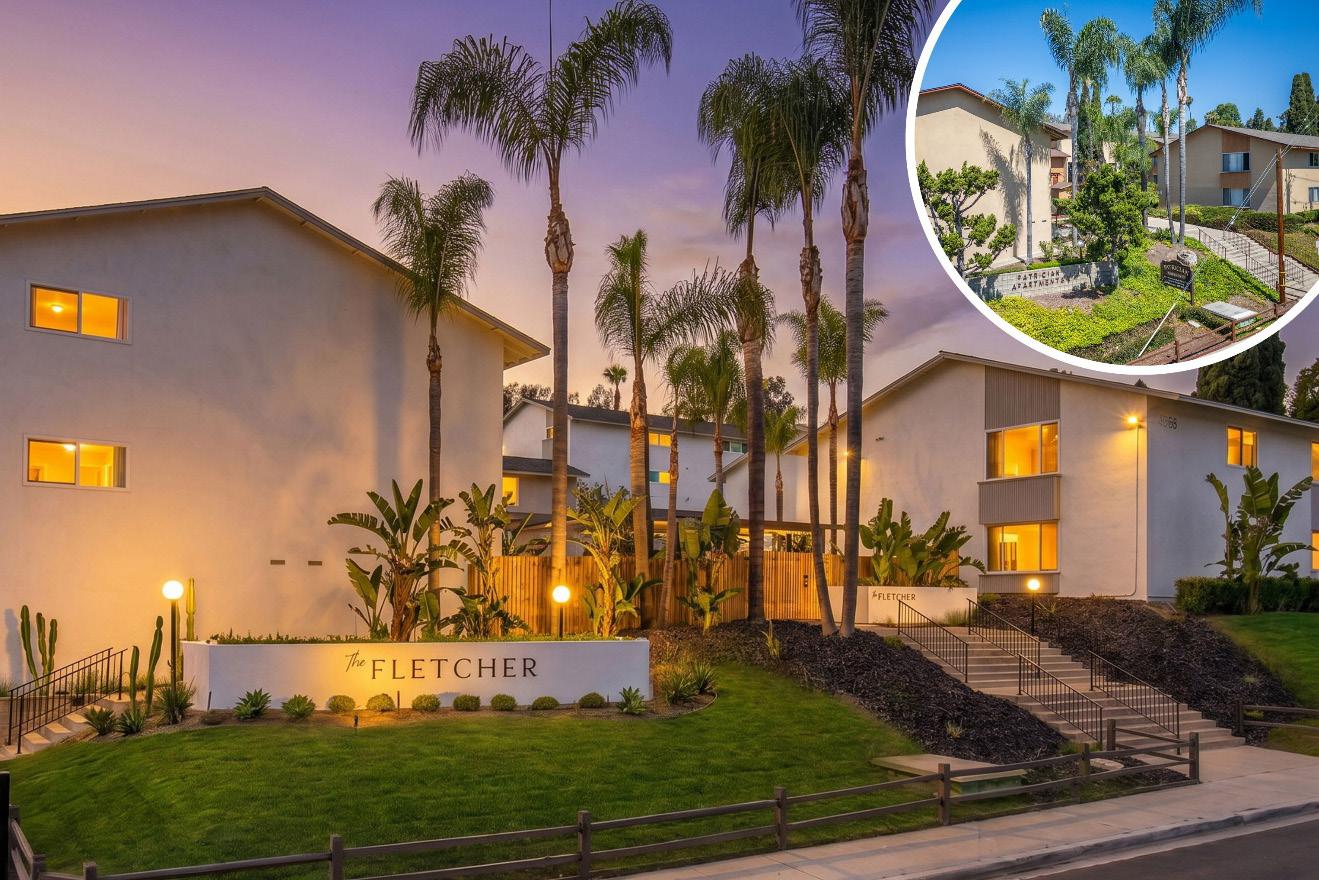
La Mesa, nine miles east of downtown San Diego, blends suburban charm and convenience. Dubbed the “Jewel of the Hills,” the city features tree-lined neighborhoods, a vibrant downtown village and a strong sense of community that appeals to families and young professionals.
Pathfinder acquired The Fletcher, a 92-unit apartment community in La Mesa, in September. The property, built in 1970, offers a mix of one- and two-bedroom apartments ranging from 780 to 900 square feet and features a leasing office, pool and laundry room. Residents enjoy nearby retail and dining including the Grossmont Center (a 925,000-square-foot retail mall) and the La Mesa Gateway (a Costco-anchored retail center). The property is also near major freeways (Interstate-8 and State Route 125), the San Diego Trolley and large
employers, including Sharp Grossmont Hospital and Kaiser Permanente.
Formerly known as The Patrician, we rebranded the property as “The Fletcher,” in homage to Ed Fletcher, a leading figure in La Mesa’s early development. While well maintained, the property had never been upgraded, creating an opportunity to enhance the apartment interiors and common areas.
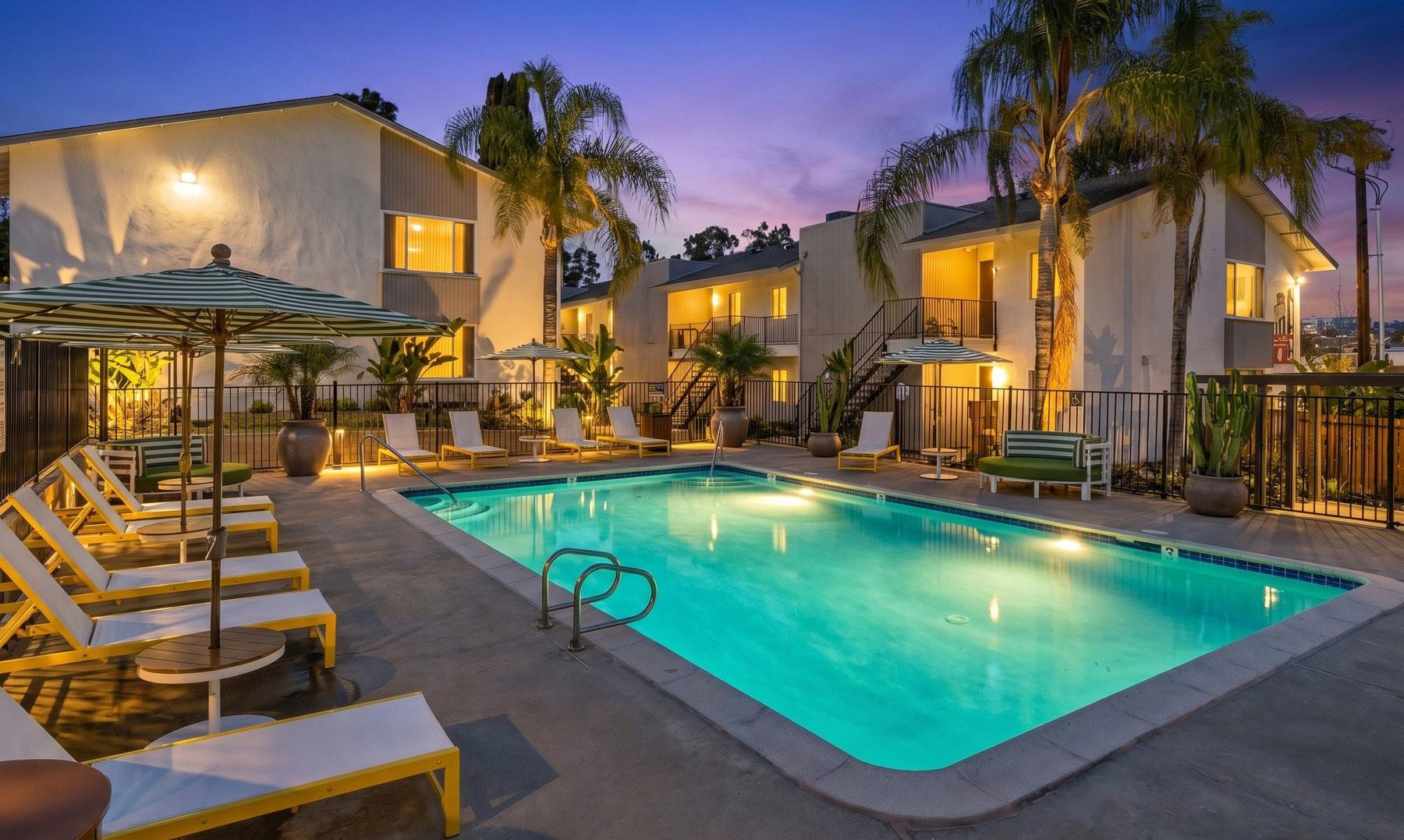
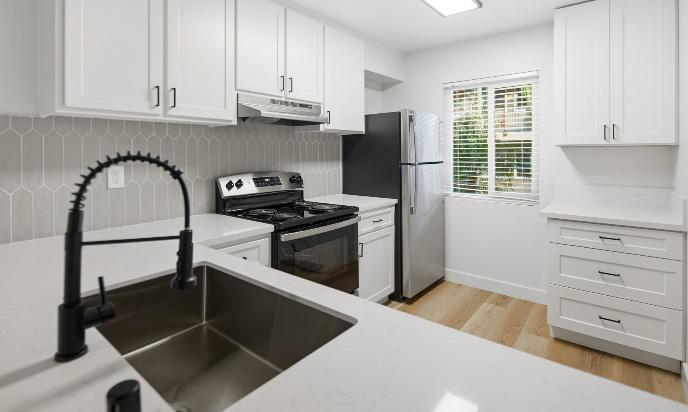
Since acquiring The Fletcher, we’ve renovated 15 apartments with new flooring, modern kitchens (shaker cabinet fronts, quartz countertops and tile backsplashes) and updated bathrooms. We’ve also repainted all buildings, enhanced the landscaping, upgraded the electrical systems, repaired second-floor landings, repaved the parking lot and installed new windows, exterior lighting, signage, fencing,
pool furniture, entrance pergola and gas barbecue. We are currently remodeling the leasing office, with completion scheduled for this summer.
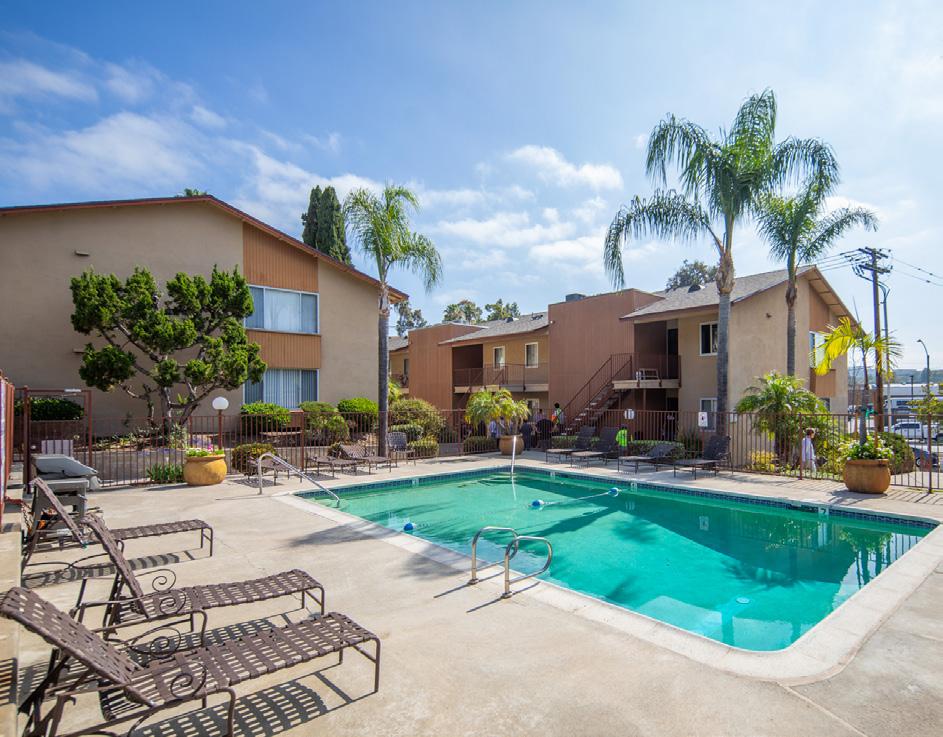
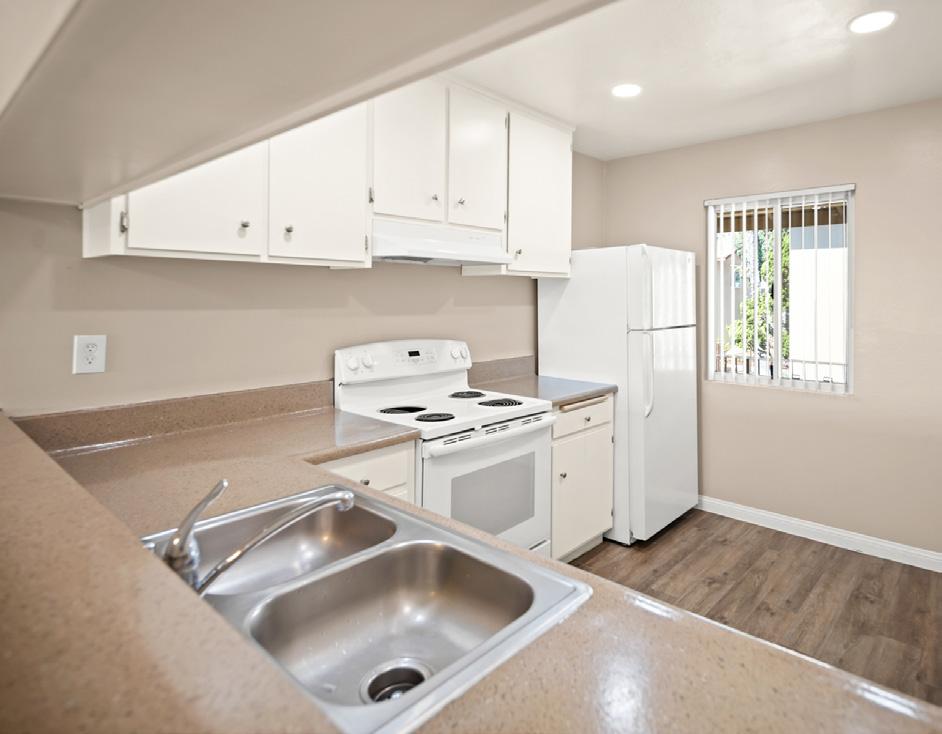
We look forward to further polishing The Fletcher and solidifying its place as a gem of the La Mesa community.
La Mesa: Did you know?
Hollywood Before Hollywood: In the early 1900s, La Mesa was home to one of Southern California’s first film studios, where director Allan Dwan filmed more than 150 silent westerns against the area’s rural backdrop earning it the nickname “Hollywood before Hollywood”.
Mid-Century Design Influence: The La Mesa area features hundreds of mid-century modern homes that reflect the post-war design influence of architects like Richard Neutra and Cliff May.
Mission Trails Regional Park, just minutes from The Fletcher, spans over 7,200 acres making it one of

the largest urban parks in the country with more than 60 miles of hiking, biking and equestrian trails, including the popular Cowles Mountain summit – the highest point in the City of San Diego.
“Character”
“Character is like a tree and reputation like a shadow. The shadow is what we think of it; the tree is the real thing.”
- Abraham Lincoln, U.S. President
“Be more concerned with your character than your reputation, because your character is what you really are, while your reputation is merely what others think you are.”
- John Wooden, American Basketball Coach
“Character is the real foundation of all worthwhile success.”
- John Hays Hammond, American Inventor
“Real integrity is doing the right thing, knowing that nobody’s going to know whether you did it or not.”
- Oprah Winfrey, American Television Producer
“Knowledge will give you power, but character [will give you] respect.”
- Bruce Lee, Chinese-American Martial Artist
“I’ve learned that people will forget what you said, people will forget what you did, but people will never forget how you made them feel.”
- Maya Angelou, American Poet
“What we know matters, but who we are matters more.
- Brené Brown, American Professor
“ Weakness of attitude becomes weakness of character.”
- Albert Einstein, American Physicist
“The content of your character is your choice. Day by day, what you choose, what you think, and what you do is who you become.”
- Heraclitus, Greek Philosopher
“You can easily judge the character of a man by how he treats those who can do nothing for him.”
- Johann Wolfgang von Goethe, German Writer
Copyright 2026, Pathfinder Partners, L.P. (“Pathfinder”). All rights reserved. This report is prepared for the use of Pathfinder’s clients and business partners and subscribers to this report and may not be redistributed, retransmitted or disclosed, in whole or in part, or in any form or manner, without our written consent.
The information contained within this newsletter is not a solicitation or offer, or recommendation to acquire or dispose of any investment or to engage in any other transaction. Pathfinder does not render or offer to render personal investment advice through our newsletter. Information contained herein is opinion-based reflecting the judgments and observations of Pathfinder personnel and guest authors. Our opinions should be taken in context and not considered the sole or primary source of information.
Materials prepared by Pathfinder research personnel are based on public information. The information herein was obtained from various sources. Pathfinder does not guarantee the accuracy of the information. All opinions, projections and estimates constitute the judgment of the authors as of the date of the report and are subject to change without notice.
This newsletter is not intended and should not be construed as personalized investment advice. Neither Pathfinder nor any of its directors, officers, employees or consultants accepts any liability whatsoever for any direct, indirect or consequential damages or losses arising from any use of this report or its contents.
Do not assume that future performance of any specific investment or investment strategy (including the investments and/or investment strategies recommended or undertaken by Pathfinder) made reference to directly or indirectly by Pathfinder in this newsletter, or indirectly via a link to an unaffiliated third-party web site, will be profitable or equal past performance level(s).
Investing involves risk of loss and you should be prepared to bear investment loss, including loss of original investment. Real estate investments are subject to the risks generally inherent to the ownership of real property and loans, including: uncertainty of cash flow to meet fixed and other obligations; uncertainty in capital markets as it relates to both procurements of equity and debt; adverse changes in local market conditions, population trends, neighborhood values, community conditions, general economic conditions, local employment conditions, interest rates, and real estate tax rates; changes in fiscal policies; changes in applicable laws and regulations (including tax laws); uninsured losses; delays in foreclosure; borrower bankruptcy and related legal expenses; and other risks that are beyond the control of Pathfinder or the General Partner. There can be no assurance of profitable operations because the cost of owning the properties may exceed the income produced, particularly since certain expenses related to real estate and its ownership, such as property taxes, utility costs, maintenance costs and insurance, tend to increase over time and are largely beyond the control of the owner. Moreover, although insurance is expected to be obtained to cover most casualty losses and general liability arising from the properties, no insurance will be available to cover cash deficits from ongoing operations.
Please add msiegler@pathfinderfunds.com to your address book to ensure you keep receiving our notifications.