

CHARTING THE COURSE
Looking Ahead to 2031: Demographic Shifts, Likely Economic Scenarios Bullish for Multifamily Investing
By Mitch Siegler, Senior Managing Director

While the next five years could make the demographic changes and economic turbulence we’ve experienced since the pandemic look like the warmup act, multifamily investors should take heart as many high probability scenarios ought to be constructive for apartment investing.
Already, demographics are shifting in ways that significantly impact demand for housing. Federal budget deficits, already in nosebleed territory, are worsening. (The Treasury Department announced in July that the budget deficit hit $1.4 trillion for the first nine months of fiscal 2026, a $1.9 trillion annualized level). If that weren’t enough, artificial intelligence (AI) is changing hiring and employment in unprecedented ways, and its adoption is accelerating at breathtaking speed.
The multifamily construction pipeline, which ballooned in 2021-2022 and led to a wave of new apartment deliveries since 2024, has been shrinking rapidly, setting the stage for undersupply for the next few years. Only developers with the strongest stomachs will take on 7%+ construction loans in an uncertain environment. And real estate firm JLL’s July 13 report, which flagged construction cost increases of 5% for the first half of 2026 (and the possibility that these could hit 8% by year-end) is another nail in the coffin for new development. And, while we’d love the Federal Reserve to reduce rates, today’s (or higher) interest rates are likely here to stay for a while.
Our investors trust us to deploy capital in a disciplined fashion by acquiring and improving apartments in markets we know well. Before deploying capital, we analyze a property thoroughly, stress-test our assumptions with sensitivity analysis and seek to anticipate potential changes in markets. That process is less about predicting the future and more about developing scenarios with reasonable likelihoods of coming to pass.
The scenarios below are intended to help us think strategically about our business and portfolio over the next five years. They are based on demographic and economic factors, but not potential regulatory changes, since these vary greatly by locality.
First, we unpack likely demographic shifts, essentially baked in the cake today. Then, we offer several highprobability economic scenarios. While the economic scenarios lead in slightly different directions, all roads should lead to destinations constructive for multifamily investing.
“...Across a variety of economic and investing scenarios, the case for U.S. multifamily real estate in supply-constrained, demographically attractive markets with diversified economies should be stronger in 2031 than in the prior decade.”
Demographic Changes Ahead. (Remember: The Die is Already Cast.)
Forecasting future market performance is different from projecting demographic changes in five years: The former requires extensive fundamental and financial analysis and a bit of conjecture. The latter is basic math – bringing today’s data forward to tomorrow.
The headline is that our population, 342 million, will barely grow – to 352 million in 2031, according to U.S. Census Bureau estimates. That sluggish growth rate, about half of what we’ve grown accustomed to, is because fertility levels – just 1.57 children per woman, per The Wall Street Journal – remain well below replacement rates and immigration has slowed to a crawl. Even massive shifts in birthrates or immigration –unlikely, to say the least – won’t meaningfully change the population in 2031.There will be winners and losers, of course – some cities will grow as others shrink but U.S. population growth in the next five years will be largely a zero-sum game.
The story gets more interesting when you peel back the onion. By 2031, the entire Baby Boomer generation –

73 million – will be 67 to 85, meaning all Boomers will be of retirement age. In five years, Boomers will comprise 23% of the population, more than a onethird larger share of the population than a decade earlier (17% in 2022), according to the Census Bureau.
In 2031, the primary renter cohort, those 25 to 34, will shrink modestly. But this will be swamped by three countervailing forces which should turbocharge apartment demand. First, Millennials (31 to 45 today), who have increasingly been delaying homeownership and choosing to rent apartments, will continue to do so, especially with today’s 6-7% mortgage rates. Second, many in the Gen Z cohort will finally leave their parents’ homes and launch households of their own. And third, the Boomer downsizing wave will hit full stride by 2031, and many Boomers will vacate their homes (primarily for financial or health reasons). Most will move to rental communities (both traditional apartments and senior housing communities) to save money, reduce maintenance or for more amenities. It’s ironic: Boomers told their kids for decades that renting was throwing money away yet by 2031, many will be renters.
Economic Scenario #1: Extended Soft Landing
In our first 2031 scenario, the Federal Reserve’s soft landing, brought about by aggressive interest rate hikes in 2021-2022, has held – sort of. Inflation in the next five years will run hotter than the Fed’s 2.0% target, probably in the range of 2.5-3.0%. Markets adjust, accepting higher inflation as the new normal. Economic (GDP) growth has been tepid, ranging from 1.8–2.4% annually since 2026, sustained by government spending, AI-driven productivity gains, and consumer spending on services and experiences. Not a recession but the economic equivalent of a treadmill at 2 mph.
Federal deficits have remained elevated, at $1.5-2.0 trillion annually. We’ve sustained high deficit spending because the U.S. dollar has remained the world’s reserve currency and Treasury auctions continued to be successful. By 2031, the U.S. federal debt-to-GDP ratio could hit 115-120% (up from about 102% or $31.7 trillion now), according to estimates by J.P. Morgan Asset Management. The bond market will continue to absorb the increased debt, and the 10-year Treasury

will remain in a stable range of 4.5-5.0%.
AI will, of course, disrupt labor markets. Boston Consulting Group forecasts that AI automation will eliminate (or dramatically change) up to one in seven white-collar positions (think customer service and backoffice roles) by 2031. (On the bright side, the other six office workers will be busy, among other things writing AI prompts.) New job categories – those requiring physical presence, human judgment, or specialized (trade) skills – offset many of these job losses, enabling the unemployment rate to remain in the 5.0-5.5% range. Demand for and wage growth for skilled and trade workers will remain strong. Less so for entry-level office workers.
The 2031 environment for apartment investors and operators is more favorable than the prior decade. Few projects started after 2024 (because of elevated interest rates and construction costs) and delivery slowed significantly after 2027, creating tight supply. This generates 3-5% annual rent growth from 2028-2031. The 2031 apartment market benefits from this undersupply and from the strong demand for housing because of
Extended Soft Landing
Economy Annual inflation of 2.5-3.0%, above Fed’s 2.0% target. GDP growth of 1.8-2.4%. $1.5-2.0 trillion federal deficits
10-Year Treasury 4.5-5.0%
Credit Markets Debt-to-GDP ratio rises from 102% in 2026 to 115-120%
Multifamily Limited new supply, solid demand drivers, 3-5% annual rent growth
Who Benefits? Multifamily owners with fixed-rate debt
demographic drivers – Millennials continuing to rent and Boomers downsizing, many into apartments. (As reported by Newsweek in June 2025, Point2Homes’ U.S. Census data analysis found that the number of renters over the age of 65 increased by 2.4 million, nearly 30%, between 2013 and 2023.)
Economic Scenario #2: Fiscal Fracturing
In our second 2031 scenario, the U.S. experiences fiscal fracturing, likely triggered by a foreign policy event, a failed Treasury auction, and/or the dollar’s loss of reserve currency status. Whether this will happen prior to 2031 or not is a variable – we consider both options below. The forces for such a fracturing (financial markets balking at excessive federal debt and high government spending) have been building for decades and will be challenging to avoid.
If such an event happens in the late 2020s, the economy would likely be in recovery by 2031. If not, the federal government will have kicked the can through modifications to spending on entitlement programs (Social Security/Medicare), and we will have narrowly avoided financial disaster – for a bit. In this case, the underlying fiscal imbalances will have only deepened further, leaving the system even more fragile. Either way, in this scenario, the 2031 economic environment will be stressed.
Category
If a fiscal fracture materializes prior to 2031, the 10year Treasury yield could spike to 6.0-7.0% and banks and private lenders would likely experience significant distress. These factors (higher interest rates and lender distress) would likely lead to a recession. A downturn would probably cause the Fed to cut interest rates aggressively, driving down the 10-year Treasury yield to 4.5-5.5%, starting a new credit cycle.
The spike in Treasury rates would drive mortgage rates to 8.0-9.0% and take the remaining air out of the single-family home market, providing a further tailwind for rental demand. (Keep in mind that demographic shifts mean there’s little single-family homebuyer demand before mortgage rates rise with many Boomers downsizing and Millennials who have been renting continuing to do so.)
Now, if we avoid a fiscal fracture prior to 2031, the underlying federal debt dynamics would likely have worsened. Imagine the bond market’s reaction to a federal debt-to-GDP ratio of 125% or more in 2031; it would likely boost risk premiums for U.S. treasuries, keeping 10-year yields elevated in the 5.0-6.0% range. In this case, construction financing costs would be largely prohibitive crimping new apartment development; the multifamily supply/demand imbalance would be even more acute in this scenario. However, existing property owners with fixed-rate debt would enjoy a moat,
Fiscal Fracture Scenarios – Two Paths
Fracture Happens
Trigger Foreign policy shock, failed Treasury auction, or dollar loses reserve currency status
10-Year Treasury Spikes to 6.0-7.0%; Fed cuts to 4.5-5.5% as recovery begins
Credit Markets
Banks/private lenders experience distress. Little lending/development
Economy Moderate, uneven recovery
Housing 8.0-9.0% mortgage rates collapse homebuying demand, driving additional apartment demand with little new supply due to high interest rates
Who Benefits?
Well-capitalized buyers who can act during distress
Fracture Delayed
Political discipline (or inertia) delays reckoning through entitlement modifications or continued deficit spending
Stays elevated at 5.0-6.0% as debt-to-GDP is 125%; risk premiums rise
Construction financing costly; little development
Recession deferred, but deepening underlying economic fragility
High rates persist, homeownership unaffordable, driving apartment demand; little new apartment supply
Operators with conservative leverage and fixed-rate debt already in place
protecting them from new competition.
In either version of this fiscal fracturing scenario, disciplined apartment operators with conservative capital structures and fixed-rate debt who own properties in cities with diversified employment and a chronic undersupply of housing should be rewarded. The earlier fracturing would create extraordinary buying opportunities in 2029-2031 while later fracturing would push off the day of reckoning – and generational buying opportunities –for a few years.
Quality Multifamily Operators/Properties Should Benefit in Any Case
As noted above, demographic drivers through 2031 set the stage for high apartment demand and much reduced new supply. In either of our economic scenarios, an essentially flat population, higher fiscal deficits and dislocation to employment from AI are virtually assured. These conditions probably mean muted consumer confidence, contributing to weak homebuying and stronger apartment demand, supporting multifamily investments.
After years of flat capital allocations, the macroenvironment in 2031 is constructive for apartments, which are again a core allocation for institutional investors as a portfolio diversifier and driver of investment returns. Institutions will need alpha in their portfolios in an environment where equity returns are likely much lower than in the prior decade.
By 2031, investment performance will be largely determined by property performance (not cap rate compression), which will be driven by operator quality (evidenced by property selection and operations, capital structures and type and term of debt). Capital will flow to strong operators with reasonable capital structures and away from most everyone else.
This environment plays to the investment philosophy Pathfinder has maintained consistently across cycles: conservative leverage, fixed-rate agency (Fannie Mae and Freddie Mac) debt, thoughtful portfolio construction across resilient and diversified-employment metro areas, and a focus on the value-conscious, workforce housing segment.
We believe our process of stress-testing acquisitions for
higher cap rates or lower rent growth environments should pay off during challenging economic environments. This sort of underwriting isn’t glamorous but it sure beats missing the mark and having investments go sideways – or worse.
What this Means for Our Portfolio
This scenario framework is a systematic way of thinking about a range of environments in which we may be operating and deploying capital over the next five years. Markets do have a way of producing “Black Swan” events not on most bingo cards and these “out of left field” outcomes can confound even well-constructed scenario analyses.
What this approach tells us is that across a variety of economic and investing scenarios, the case for U.S. multifamily real estate in supply-constrained markets with diversified economies should be stronger in 2031 than in the prior decade. The supply trough is deepening. Demographic demand drivers are broadening with several large renter cohorts – young adults constrained by affordability, the Gen Z generation leaving their parents’ homes and launching in apartments of their own, Millennials who deferred homeownership during their peak buying period, and Boomers selling their homes and downsizing, many in apartments.
The landscape reinforces our continued use of longerterm, fixed-rate debt and the need to continue to stress-test potential acquisitions for “higher for longer” interest rate environments. It also supports our focus on resilient metro areas with diversified employment where workforce apartments offer excellent housing value.
2031 will be here before we know it. We expect the next five years to bring twists and turns that historically come about only every decade or two. As we’ve learned over the past 20 years, our disciplined investment approach leads to resilient investment portfolios which can thrive even in turbulent times.
Note: The information here should not be considered a forecast or investment advice.
Mitch Siegler is Senior Managing Director of Pathfinder Partners. Prior to co-founding Pathfinder in 2006, Mitch founded and served as CEO of several companies and was a partner with an investment banking and venture capital firm. He can be reached at msiegler@pathfinderfunds.com.
FINDING YOUR PATH
The 2026 Midterms: What Real Estate Investors Need to Know
By Lorne Polger, Senior Managing Director

With the midterm elections now less than four months away, conversations among investors have increasingly turned to how the outcome might reshape the commercial real estate landscape.
The headline: the elections themselves are unlikely to cause immediate disruption to property values or transaction volume. But the policy environment that emerges from the 120th Congress could meaningfully influence several forces that matter deeply to real estate investors, including tax policy, federal spending, interest rates and regulatory environments. Here’s how we’re thinking about it.
The Political Landscape Heading into November
Republicans currently hold slim majorities in both chambers of Congress –218 seats to 214 in the House (with three vacancies), and 53 seats to 47 in the Senate (assuming that Senator McConnell returns from the “Injured Reserve” list and the late Senator Lindsey Graham’s (R, SC) successor is from his party, as is nearly certain). Democrats need to gain just three House seats to reclaim the majority, and four Senate seats to flip control there.
Recent polling has Democrats with an edge in the generic congressional ballot, and President Trump’s approval ratings are hovering in the mid-30’s. Redistricting battles in Texas, California and Virginia add further uncertainty to the final tally.
Three scenarios are plausible: continued full Republican control (long odds), a divided Congress (highest current likelihood, with Democrats reclaiming the House and the Republicans keeping the Senate), or a Democratic sweep of both chambers (also plausible). Each carries distinct implications for commercial real estate.

How Elections Impact Commercial Real Estate
CBRE’s research team has conducted statistical analysis across election cycles dating back to 2000, examining transaction volumes, impact on cap rates, and investment activity across property types and markets. Their conclusion: federal elections generally have little impact on commercial real estate investment activity or values in the months immediately before or after elections.
The pattern that does appear in the data is one of uncertainty – investors adopting a “wait and see” approach in the run-up to elections – followed by greater confidence and less uncertainty once outcomes become clear, regardless of which party wins.
What does matter is the policy environment that emerges over the full term of a given Congress. Government spending, tax structure, and regulatory frameworks are long-term drivers of commercial real estate values and activity.
Tax Policies
The most consequential near-term variable for real estate investors is a change in tax policy.
For example, the One Big Beautiful Bill Act (OBBBA) delivered several significant wins for real estate investors: 100% bonus depreciation was permanently restored for qualifying properties, the Opportunity Zone program was made permanent, and 1031 exchanges survived fully intact with no caps or limitations. These provisions represent a powerful set of tools that investors can deploy with long-term certainty, without the artificial urgency created by prior sunset deadlines.
A Republican-controlled Congress is generally expected to maintain the current framework. A divided Congress or Democratic-controlled House would not automatically reverse these provisions –undoing legislation requires affirmative action, not just inaction – but it could complicate any further enhancements and would increase uncertainty around future modifications, particularly if deficit concerns re-emerge as a legislative pressure point. Historically, 1031 exchanges have faced periodic threats from both parties as a potential revenue offset, and that dynamic could resurface. That said, we believe that most of the widely applicable tax advantages currently available to commercial real estate investors, including bonus depreciation and 1031 exchanges, are durable regardless of the outcome of the midterm elections.
Housing Policies
The most significant piece of real estate-related legislation in 2026 was just enacted: the 21st Century ROAD to Housing Act, which passed with overwhelming bipartisan support. The bill is primarily designed to increase housing supply by reducing federal regulatory barriers and providing incentives to states and localities to ease land-use regulations – developments seen as broadly positive for multifamily developers and valueadd investors.
The more controversial element of the bill is a ban on large institutional investors – those owning 350 or more properties – from purchasing additional singlefamily homes. After negotiations following industry pushback, a provision requiring build-to-rent investors to sell properties within seven years was removed, meaningfully reducing the most damaging implications for institutional real estate capital. For our funds, which are focused on multifamily rather than single-family assets, the practical impact is limited – but it signals a broader political environment in which institutional real estate ownership of residential properties faces continued public and legislative scrutiny.
A change in House control would likely mean more aggressive housing regulation proposals – rent stabilization measures, tenant protection legislation, and potentially additional restrictions on institutional investor activity. Conversely, full Republican control could continue the current emphasis on deregulation rather than further operating restrictions.
Interest Rates and the Federal Reserve
No analysis of commercial real estate and elections would be complete without addressing the dominant force in the current market: interest rates and the cost of debt capital.

The Federal Reserve is an independent institution, and its rate decisions are driven by economic data –not election outcomes. The Fed has held rates steady this year as it has navigated competing pressures: moderating inflation, and economic uncertainty, including energy price shocks related to the conflict with Iran.
What elections can influence is the fiscal backdrop against which the Fed operates. High federal deficits and expanding spending – historically more likely under a Democratic-controlled Congress than a Republican one – can put upward pressure on longterm Treasury yields, which in turn affect commercial real estate cap rates and refinancing costs. Morgan Stanley has specifically flagged political pressures, high deficits, and energy price volatility as factors that could fuel bond volatility and keep long-term rates elevated.
For the distressed and value-add multifamily opportunities we are actively pursuing – particularly those involving properties with maturing loans – the path of interest rates over the next year or two is arguably more important than the election outcome. Assets facing refinancing stress in a ~6% rate environment may see a glimmer of hope if rates decline 100 basis points over the same period; conversely, the stress on legacy borrowers will rise if rates increase.
State and Local Elections: Often More Impactful
One dynamic that frequently gets lost in the focus on federal elections is the outsized influence of state and local policy on commercial real estate. Zoning laws, rent control ordinances, tax incentives and issuance of building permits are overwhelmingly determined at the state and municipal level – and November’s ballot includes hundreds of those races and ballot initiatives.
In Phoenix, for example, the Maricopa County policy environment – including permitting timelines, tax assessments, and multifamily regulations – is shaped by candidates who will be on the November ballot. In Colorado, state-level rent stabilization and eviction policy debates continue to occur at committees in the state house. These local outcomes often have a more direct and immediate impact on property-level cash flows than anything happening in Washington.
How Pathfinder Is Positioning
We seek to remain focused on property fundamentals and deal-specific economics, while staying informed about the policy backdrop. Specifically, we are:
• Actively deploying capital in distressed multifamily properties where asset-level economics – loan maturities, operating distress, motivated sellers – drive the thesis, independent of election outcomes;
• Taking advantage of the current tax framework, rather than waiting for election clarity that is
unlikely to change the fundamental toolset available to us;
• Monitoring the interest rate environment closely as rate trajectories have a more direct impact on deal economics and exit valuations than the November results; and
• Watching state and local elections in our target markets for developments affecting the regulatory or tax environment and our properties.
Conclusion
A shift in congressional control could alter the pace and direction of future tax legislation, housing regulation, and fiscal spending. That said, elections themselves usually do not move commercial real estate values or transaction volumes in a material way.
What moves real estate values are fundamentals – the cost of capital, the supply-demand balance in specific submarkets and the operating performance of individual assets. Those forces will continue to be our primary focus.
It should be another interesting election.
Lorne Polger is Senior Managing Director of Pathfinder Partners. Prior to co-founding Pathfinder in 2006, Lorne was a partner with a leading San Diego law firm, where he headed the Real Estate, Land Use and Environmental Law group. He can be reached at lpolger@pathfinderfunds.com.
GUEST FEATURE
Technology Isn’t Replacing Accounting and Finance – It’s Elevating It
How AI can create more room for experience, judgment and better decisions
By Jeff Wurtz, Chief Financial Officer

There’s an old saying that knowledge is knowing a tomato is a fruit; wisdom is knowing not to put it in a fruit salad.
It’s funny because it captures something we all understand intuitively: having the right information and knowing what to do with it are two very different things, whether you’re a chef, an executive or an investor.
That distinction is particularly relevant today as artificial intelligence becomes part of nearly every conversation about business and technology. AI can access enormous amounts of information, analyze data, identify patterns and produce answers in seconds. It is great at giving us more knowledge, faster.
But knowledge has never been the most valuable thing a manager brings to the table. Wisdom is.
Wisdom comes from experience – making decisions, seeing what happens, adjusting and making the next decision a little better. In a cyclical business like real estate, that’s valuable.
The question I find most interesting about AI isn’t whether it can replace parts of the accounting and finance functions. It obviously can and increasingly will. The more interesting question is: what can accounting and finance teams do with the time we get back?
Iteration, Not Repetition
There’s an important difference between repetition and iteration. Repetition means doing the same thing over and over. Iteration means doing it again but adapting and improving based on what you learned the previous time.
Both involve experience. Only one – iterating and

improving – has a compounding effect.
If I prepare the same report 100 times using the same process, I’ve accumulated 100 repetitions. I may get a little faster, but the value of the 100th report isn’t dramatically different from the first.
Iteration is different. I make a decision. I see the outcome. I learn something. I incorporate that into my next decision – and adapt again when the variables change unexpectedly. Each iteration varies and builds on the last.
That’s what makes experience valuable. It isn’t valuable simply because something happened to us. It becomes valuable when we incorporate what happened previously into what we do next.
That’s wisdom. And it’s exactly what more time gets us. The time AI frees up isn’t just time saved – it’s expanded capacity for the kind of decision-making activities that actually compound.
Where Time is Actually Spent
Accounting and Finance teams historically spend a significant amount of their time producing information rather than interpreting it. According to EY’s 2026 “DNA of the CFO” survey, CFOs report that 47% of their capacity still goes to operational tasks – compliance, reporting, internal controls and core finance processes. The same survey found that only 27% of respondents see finance as a genuine strategic partner in value creation; most organizations still view the function in a more traditional light with these priorities:
• Close the books. Reconcile accounts. Build reports.
• Update forecasts. Prepare investor materials.
• Respond to audit requests. Explain why one number doesn’t tie to another in a spreadsheet someone built six months ago.
AI can compress that 47% of time spent on operational tasks dramatically, freeing up time for more strategic projects. Systems can pull data together automatically. First drafts of variance explanations can be generated in seconds. Loan documents can be reviewed for key terms without someone manually searching hundreds of pages. Forecasts can update as assumptions change.
People don’t disappear from these processes – financial information still needs controls, review and judgment. But the human bandwidth required to produce them declines.
Which raises the real question: where should that bandwidth go?
Moving Upstream
Much of traditional accounting and finance happens in response to something after it occurs. Sign the lease –record it. Refinance the property – update the debt schedule. The property’s financial performance was below budget – explain the variance.
If technology reduces the effort required downstream, finance gets more room to participate upstream – before decisions are made. This is the idea Dan Heath explores in his book Upstream. He lays out the concept and premise of the book with a well-known parable: two people keep pulling drowning children out of a river, one after another, until one of them finally stops and wades upstream instead – to find whoever is throwing the children in, and stop it at the source.
The pattern is the same whether the subject is drowning children or a fund’s next investment decision: waiting for the problem to surface is the expensive way to solve it.
That shift – from reporting outcomes to influencing them – is where AI can create the greatest value. However, most finance organizations haven’t reached that point. One CFO survey found that while 90% of finance leaders have automated some part of their workflow, only 1% describe AI as fully integrated into their work, and more than a third are saving less than two hours a week from it. The bottleneck isn’t the technology. It’s whether finance leaders

intentionally redirect the time it frees up to more valuable areas of focus. There’s also one more place that time can go, and it may be the most overlooked of all: relationships.
Relationships
Reclaimed bandwidth isn’t only useful for analysis. Some of the most valuable time a manager or principal gets back should go toward relationships – both building new ones and deepening those that already exist – well before there’s a specific deal, financing need or fundraise attached to the conversation.
This is where the business case is most direct for us. Some of the best real estate opportunities rarely reach the open market. Recent industry surveys put the share of deals sourced off-market as high as 40%, and the pattern holds for a simple reason: sellers, brokers and lenders bring their best opportunities to the buyers they already know, trust and believe can execute. A principal who has time to cultivate those relationships isn’t just being collegial –they’re widening the firm’s access to acquisitions that never get marketed at all, where there’s less competition and far more room to negotiate price, terms and timeline.
Relationships don’t compound on a single transaction any more than judgment does. They compound the way iteration does – through repeated, deliberate contact over time, long before a deal or a loan maturity makes the relationship urgent.
AI creates bandwidth. Where we choose to spend it –creating a new relationship or deepening an existing one – often determines whether we see the next deal before it’s marketed or hear about it after someone else already closed.
The Human Advantage
This brings us back to the tomato. AI can tell us a tomato is botanically a fruit – and probably produce 100 fruit salad recipes before you finish reading this sentence. But deciding whether it belongs in a fruit salad requires something different – judgment. The same is true for executives and companies.
AI can flag that insurance costs across a portfolio have risen sharply – and they have! Commercial property insurance premiums rose more than 15% annually between 2019 and 2024, spiking nearly 30% in 2023 alone. Experience is what tells an executive whether that’s a temporary budget variance or a structural shift requiring new underwriting assumptions or a comprehensive change in strategy, like a broker/carrier rebidding process or a change in deductibles or other coverage elements.
AI can flag a looming debt maturity – and there’s no shortage of those coming: roughly $875 billion in commercial and multifamily mortgage debt, about 17% of the market outstanding, matures in 2026 alone. Experience is what helps us decide whether to refinance now, wait, sell, contribute equity, or start a conversation with the lender early.
AI can show that an asset is underperforming its original underwriting. Wisdom is what determines whether the right response is more capital, a changed business plan, or the discipline to stop putting good money after bad.
These aren’t questions of information. They’re questions of judgment – the kind built by adapting once reality diverges from the plan – which real estate, a cyclical industry, does regularly. Just over the last several years we’ve seen a pandemic, an inflation shock, a historic rate cycle, and a challenging insurance market that virtually no underwriting model saw coming. AI can get that information to decisionmakers faster. Experience and judgment determine what they do with it.
The Future
There’s understandable concern about what AI means for accounting and finance jobs. The more useful question is what it allows those professionals to become.
When spreadsheets replaced handwritten ledgers, finance didn’t disappear. When cloud software automated reporting,

CFOs didn’t disappear. The work shifted more from producing numbers to explaining what they meant. AI will likely follow the same pattern. The finance professional who spends most of the day moving information from one place to another should expect their role to change. The one who understands the business, recognizes patterns, asks good questions and helps others make better decisions may become more valuable than ever.
More Time for Fruit Salad
Former heavyweight boxing champion Mike Tyson, famously once said, “everyone has a plan until they get punched in the mouth.” In the real estate industry – like most businesses – the real world sometimes makes it necessary to modify the initial plan and AI won’t change that. However, AI will give us more of an early warning about the moment reality diverges from the plan, and what triggered the divergence. What AI can do exceptionally well is reduce the time finance spends gathering and producing information – so we have more time to understand what the information truly means and make better decisions about what to do next.
The greatest promise of AI isn’t that it will do our jobs for us. It’s that it may give us more time for the parts of our jobs that require experience, judgment and wisdom.
After all, a chef who knows the tomato is a fruit may be able to use that knowledge in a trivia game or a game show. Knowing how best to use the tomato is where the true culinary art form is.
Jeff Wurtz is Chief Financial Officer of Pathfinder Partners. Prior to joining Pathfinder in 2012, Jeff worked as a CPA focused on real estate and technology clients. He can be reached at jwurtz@pathfinderfunds.com.
ZEITGEIST –
SIGN OF THE TIMES
The record rent growth of 2021-2022 triggered a historic apartment construction boom. By 2023, nearly 970,000 multifamily units were under construction nationwide – the largest pipeline since the early 1970s, according to the National Association of Home Builders. As those projects delivered in 2024 and 2025, vacancy rose, rent growth stalled and concessions returned to many markets. But that construction peak is now behind us, and the pipeline is rapidly diminishing.
One of the most reliable indicators of future supply is the percentage of a market’s existing apartment inventory under construction. According to the National Construction Pipeline report from MMG Real Estate Advisors, at the peak of the construction cycle in late 2023, Austin had 15.6% of its existing inventory under construction, followed by Phoenix (13.1%), Salt Lake City (11.9%) and Denver (9.1%). Today, the picture is dramatically different: every one of Pathfinder’s target markets (below) has a pipeline below 5% (several below 3%) of inventory.
The reasons for the development pullback are well documented: elevated construction costs, expensive debt, cautious lender underwriting and several years of flat (or negative) rent growth. And because the timeline from a developer’s decision to build until the first resident moves in is three to four years, today’s low construction starts translate into a shortage of new deliveries in 20272028 and beyond.
Apartment Demand Outpaces Supply
According to RealPage and CoStar, net apartment absorption exceeded 250,000 units during the first half of 2026, making it one of the highest levels of supply absorption on record. Additionally, demand outpaced new deliveries by roughly 100,000 units, allowing occupancy to recover from the supply wave.
While encouraging, the high absorption doesn’t mean that all markets have completely recovered. Occupancy and rent growth remain below prior-cycle peaks and operators in several markets continue to compete aggressively for residents with concessions. As newly delivered communities continue to lease up, they are capturing a disproportionate share of renter demand, creating a highly competitive environment for other properties.
Strong demand is expected to endure as new renter households continue to form, reflecting the essential nature of apartments. This resilience is being driven by continued household formation, a growing affordability gap between renting and owning (very expensive because of high interest rates and construction costs) and the flexibility apartments offer renters.
For property owners and investors, the takeaway is measured optimism. Challenges remain – including affordability – but the outlook is improving. The historic supply surge is beginning to recede, demand continues to outperform expectations and occupancy continues to strengthen. If these trends persist, improving fundamentals should support greater pricing power and stronger operating performance. The first half of 2026 signals that the multifamily sector is moving in the right direction.
TRAILBLAZING: COWLES LANDING, SAN CARLOS (SAN
DIEGO), CA
“Where the Trail Begins”
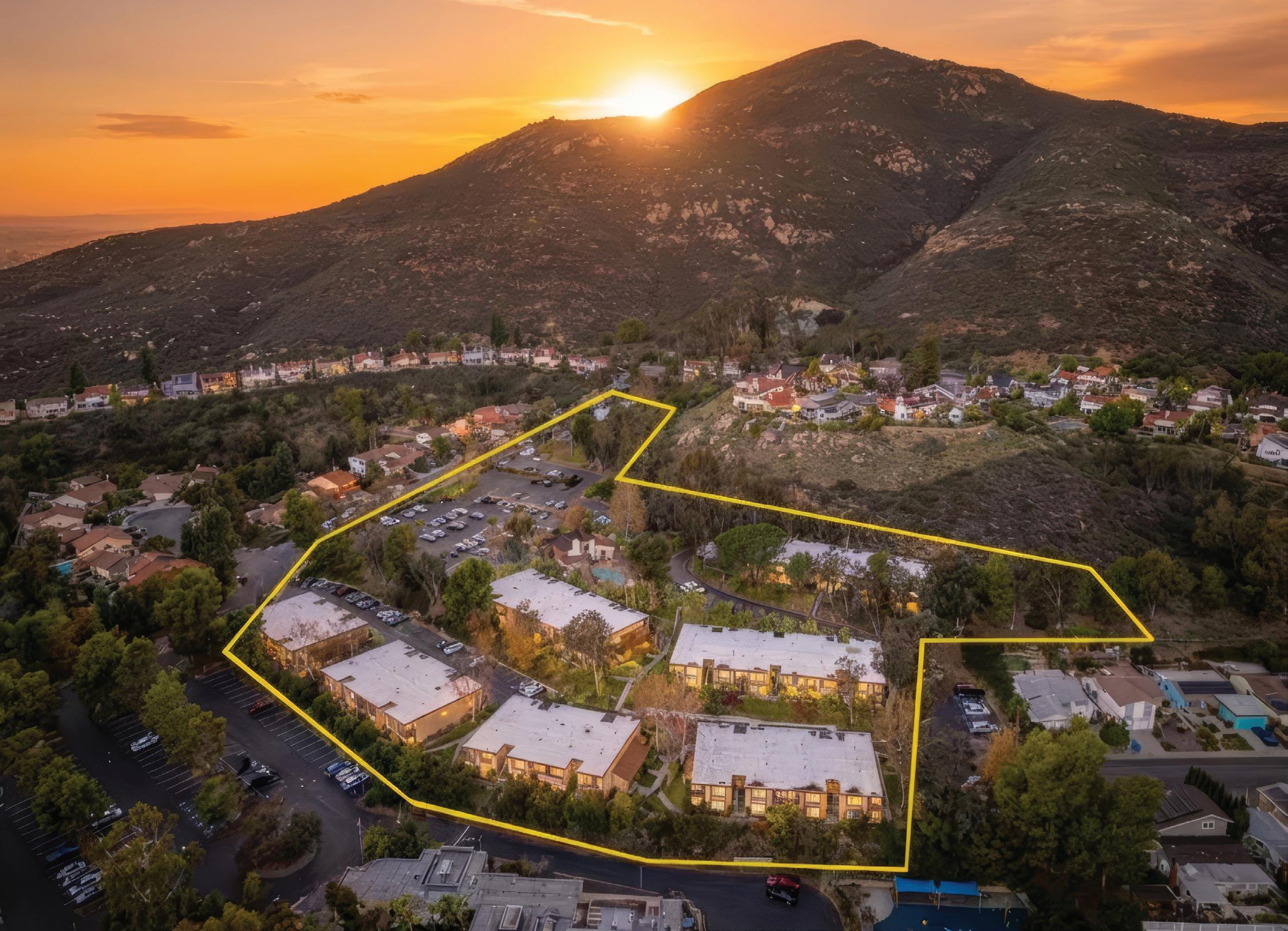
Nestled at the base of Cowles Mountain – San Diego’s highest peak – San Carlos is one of San Diego’s most established and family-oriented neighborhoods. Nine miles east of downtown San Diego, San Carlos is known for its blend of suburban tranquility, outdoor recreation and convenient access.
In February, Pathfinder acquired Cowles Landing, a 160-unit apartment community in San Carlos. Built in 1980, the property encompasses seven acres with only 21 apartments per acre, providing a park-like atmosphere that is rare in apartment developments. The community features studio, one- and two-bedroom apartments, a clubhouse, swimming pool, spa and mature landscaping. Residents enjoy an active lifestyle with direct access to Cowles Mountain and nearby Mission Trails Regional
Park, which spans more than 8,000 acres and features 65 miles of trails.
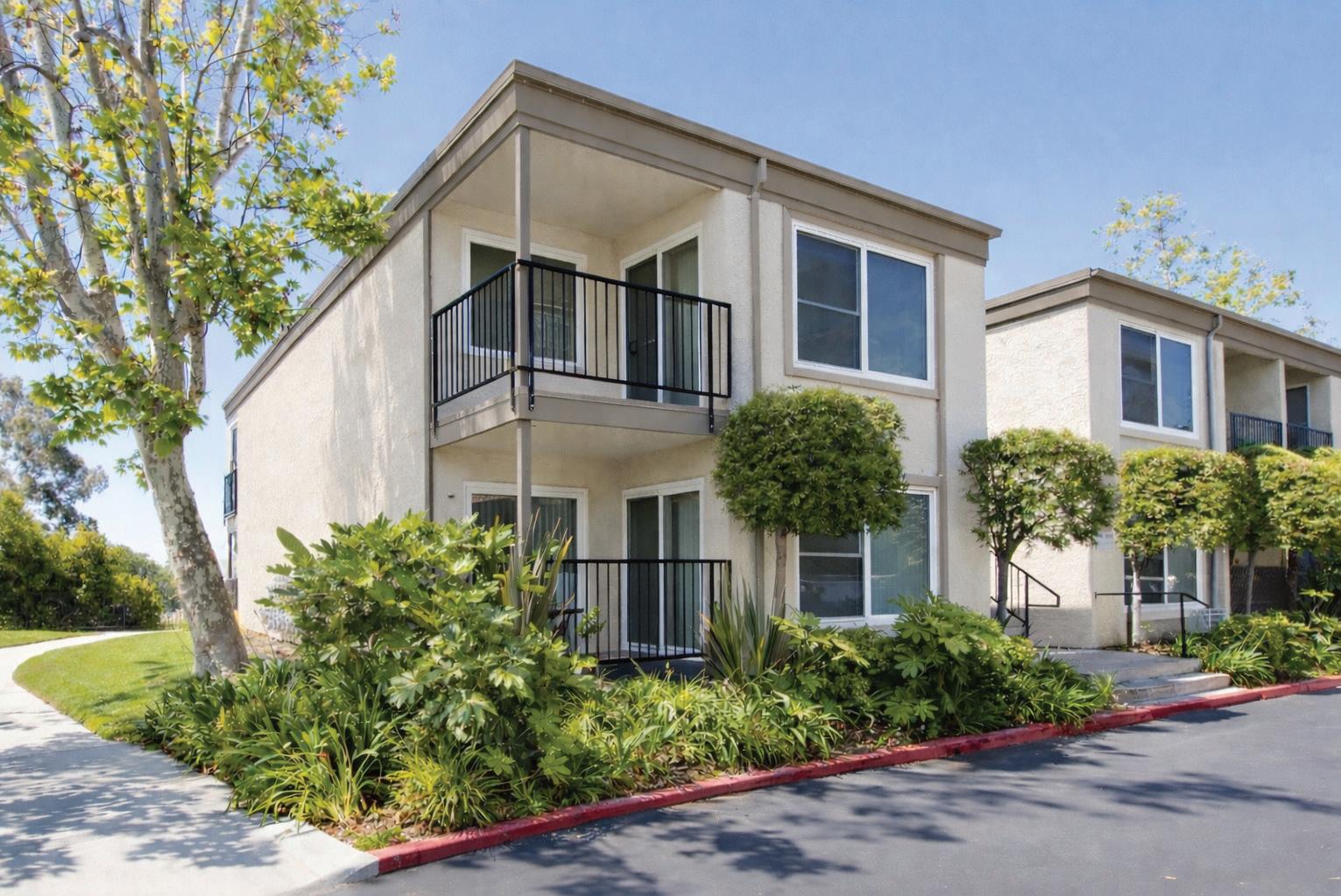
Rendering of Renovated Building Exterior
While well maintained, both the apartment interiors and common areas were in original condition, presenting an opportunity to modernize the community, add new amenities and enhance its appeal while preserving the existing charm.
Since acquiring Cowles Landing, we’ve renovated 19 apartment homes with new flooring, modern kitchens, quartz countertops, tile backsplashes and updated bathrooms. We have also completed roof and plumbing repairs and are currently repainting all buildings, installing new windows, renovating the

Cowles Mountain: Did you know?
leasing office, adding new signage, constructing a fitness room and BBQ gathering areas and upgrading the pool furniture. These improvements should be completed next year; apartment renovations will continue over the next several years as apartments are vacated.
Building exceptional communities requires thoughtful planning, careful execution and a long-term view. By implementing this approach at Cowles landing, we aim to elevate the resident experience in their homes and throughout the community.

• San Diego’s Highest Peak: Cowles Mountain rises 1,593 feet above sea level, making it the highest point in San Diego. More than 100,000 hikers summit the mountain each year to enjoy panoramic views of Mexico to Catalina Island.
• The Original “S” Mountain: Before it became known as Cowles Mountain, the peak was locally called “S Mountain” after nearly 500 San Diego State students painted a 400-foot-tall white “S” on its hillside in 1931. During World War II, the military ordered the giant white “S” on Cowles Mountain to be covered because it could serve as a landmark for enemy aircraft.
• Everest-ing Cowles Mountain: In 2025, San Diego ultrarunner Louka Dlagnekov climbed Cowles Mountain 32 times in under 24 hours, covering 92 miles and more than 29,000 feet of elevation gain, the equivalent of climbing Mount Everest.

• An Ancient Observatory: Long before Cowles Mountain became San Diego’s most popular hike, the Kumeyaay people used the mountain as a winter solstice observatory, aligning stone markers to track the sunrise each December.
Before and After – Renovated Kitchen at Cowles Landing
Sunset View from Cowles
NOTABLES AND QUOTABLES
“Simplicity”
“Simplicity is the ultimate sophistication.”
- Leonardo da Vinci, Italian Scientist/Artist
“Simplicity is about subtracting the obvious and adding the meaningful.”
- John Maeda, American Designer
“Life is really simple, but we insist on making it complicated.”
- Confucius, Chinese Philosopher
“Make every detail perfect and limit the number of details to perfect.”
- Jack Dorsey, American Entrepreneur
“Simple can be harder than complex: you have to work hard to get your thinking clean to make it simple. But it’s worth it in the end because once you get there, you can move mountains.”
- Steve Jobs, Apple CoFounder
“
“
“Simplicity is the keynote of all true elegance.”
- Coco Chanel, French Fashion Designer
“The ability to simplify means to eliminate the unnecessary so that the necessary may speak.”
- Hans Hofmann, German-American Painter
“Simplicity is the master key to financial success.”
- John C. Bogle, American Businessman
“There seems to be some perverse human characteristic that likes to make easy things difficult.”
- Warren Buffett, American Investor
“Everything should be made as simple as possible, but not simpler.”
- Albert Einstein, German-American Physicist
IMPORTANT DISCLOSURES
Copyright 2026, Pathfinder Partners, L.P. (“Pathfinder”). All rights reserved. This report is prepared for the use of Pathfinder’s clients and business partners and subscribers to this report and may not be redistributed, retransmitted or disclosed, in whole or in part, or in any form or manner, without our written consent.
The information contained within this newsletter is not a solicitation or offer, or recommendation to acquire or dispose of any investment or to engage in any other transaction. Pathfinder does not render or offer to render personal investment advice through our newsletter. Information contained herein is opinion-based reflecting the judgments and observations of Pathfinder personnel and guest authors. Our opinions should be taken in context and not considered the sole or primary source of information.
Materials prepared by Pathfinder research personnel are based on public information. The information herein was obtained from various sources. Pathfinder does not guarantee the accuracy of the information. All opinions, projections and estimates constitute the judgment of the authors as of the date of the report and are subject to change without notice.
This newsletter is not intended and should not be construed as personalized investment advice. Neither Pathfinder nor any of its directors, officers, employees or consultants accepts any liability whatsoever for any direct, indirect or consequential damages or losses arising from any use of this report or its contents.
Do not assume that future performance of any specific investment or investment strategy (including the investments and/or investment strategies recommended or undertaken by Pathfinder) made reference to directly or indirectly by Pathfinder in this newsletter, or indirectly via a link to an unaffiliated third-party web site, will be profitable or equal past performance level(s).
Investing involves risk of loss and you should be prepared to bear investment loss, including loss of original investment. Real estate investments are subject to the risks generally inherent to the ownership of real property and loans, including: uncertainty of cash flow to meet fixed and other obligations; uncertainty in capital markets as it relates to both procurements of equity and debt; adverse changes in local market conditions, population trends, neighborhood values, community conditions, general economic conditions, local employment conditions, interest rates, and real estate tax rates; changes in fiscal policies; changes in applicable laws and regulations (including tax laws); uninsured losses; delays in foreclosure; borrower bankruptcy and related legal expenses; and other risks that are beyond the control of Pathfinder or the General Partner. There can be no assurance of profitable operations because the cost of owning the properties may exceed the income produced, particularly since certain expenses related to real estate and its ownership, such as property taxes, utility costs, maintenance costs and insurance, tend to increase over time and are largely beyond the control of the owner. Moreover, although insurance is expected to be obtained to cover most casualty losses and general liability arising from the properties, no insurance will be available to cover cash deficits from ongoing operations.
Please add msiegler@pathfinderfunds.com to your address book to ensure you keep receiving our notifications.