9 minute read
YOUSUF JABBAR

1.
An interview with Muhammad Yousuf Jabbar
Advertisement
PhD Researcher at University of Calgary
Q.1) A little about Muhammad Yousuf Jabbar.
While pursuing Mechanical Engineering at Ghulam Ishaq Khan Institute of Engineering Sciences and Technology in my 3rd year, I was selected for the only internship opening at Baker Hughes, Pakistan. During my stay there, as part of my field training, I was taken to the oil rig on-site where I witnessed the actual drilling operation for the extraction of hydrocarbons. The entire process made a huge impact on my professional inclinations and preferences. I was highly fascinated by this field and decided to pursue a career in the Oil & Gas sector. Upon graduation, I went for my Masters to KFUPM in Petroleum Engineering. Since then I volunteered and represented SPE in various capacities and had the opportunity to travel, learn, and develop my leadership skills. I worked for my MSc research at Schlumberger Carbonate research centre, a unique opportunity for a student, and got to know the industry very early in my career. Besides my research, the centre was also working on regional and global challenges faced by the operator and working to provide solutions. I learned how to work under time constraints, visualise abstract concepts, and apply them to industrial projects in real-time. Upon graduation, I started as a Reservoir Engineer with TOTAL and held responsibility for the EOR studies, development for a mature offshore field in Abu Dhabi. After 4 years with TOTAL, I Started as a Reservoir Engineer for ADNOC Offshore for the largest offshore field in the world (Upper Zakum) based in ExxonMobil Technology Centre. I have worked extensively in reservoir simulation for future field development, an area I was always inclined to learn and develop my skills. After a decade in the Middle East, I moved to Calgary last year and currently I am in my second year of Ph.D. at the University of Calgary.
Q.2) You did your bachelor’s degree from Pakistan, Masters from Saudi Arabia following the PhD. from Canada, how was your experience studying abroad and representing Pakistani talent?
In my opinion, our undergraduate program prepared me well to compete with the leading universities across the globe. Studying at KFUPM was a great experience specific to the Petroleum Engineering major since for most graduate courses the faculties are from Saudi Aramco and you hear about the current and upcoming challenges, in terms of research and operations, from the largest onshore and offshore fields in the world. I am fortunate to also co-author with Dr. Sami Neam, later SPE President for 2018-19. The MSC research at the state of art SLB labs and collaboration with Saudi Aramco was a rewarding experience. At KFUPM, Pakistani students have a strong presence and growth over the period, have significant achievements in research, and leading roles in the industry. In pursuing
my Ph.D. in Canada alongside students from across the globe which brings greater competition but with it, exposure and opportunities as well. I have learned a lot in my research area but like most researchers, I still have a long way to go.
Q.3) How would you describe your experience as a Reservoir Engineer at ADNOC Offshore?
ADNOC offshore was no doubt the best work experience in my career so far. I worked at the Upper Zakum Field, the world's largest offshore field, and based in ExxonMobil Technology Centre. I was involved in Reservoir simulation for future field development plans, design, and modelling of Chemical EOR study, reserves reporting, follow on R&D studies with ADNOC HQ, and prestigious global research and academic institutes. I also got an opportunity to mentor summer students for their internship. The work environment as well as the mentorship I received from Exxon Mobil Advisors in the reservoir and field development was very enriching. At times I feel like I am in school again. Lastly, I worked in close collaboration with ExxonMobil Upstream Research Company (URC), based out of Houston, TX on the modelling and evaluation of Chemical EOR in carbonates and co-authored publication with one of the SPE Distinguished Lecturer, Dr. Gary Teletzke. I wish I could have stayed longer because the environment and opportunity were just ideal and one all Reservoir engineers dream of.
Q.4) Can you tell me about your research on Carbon Sequestration and how do you see it as a potential area for companies to invest?
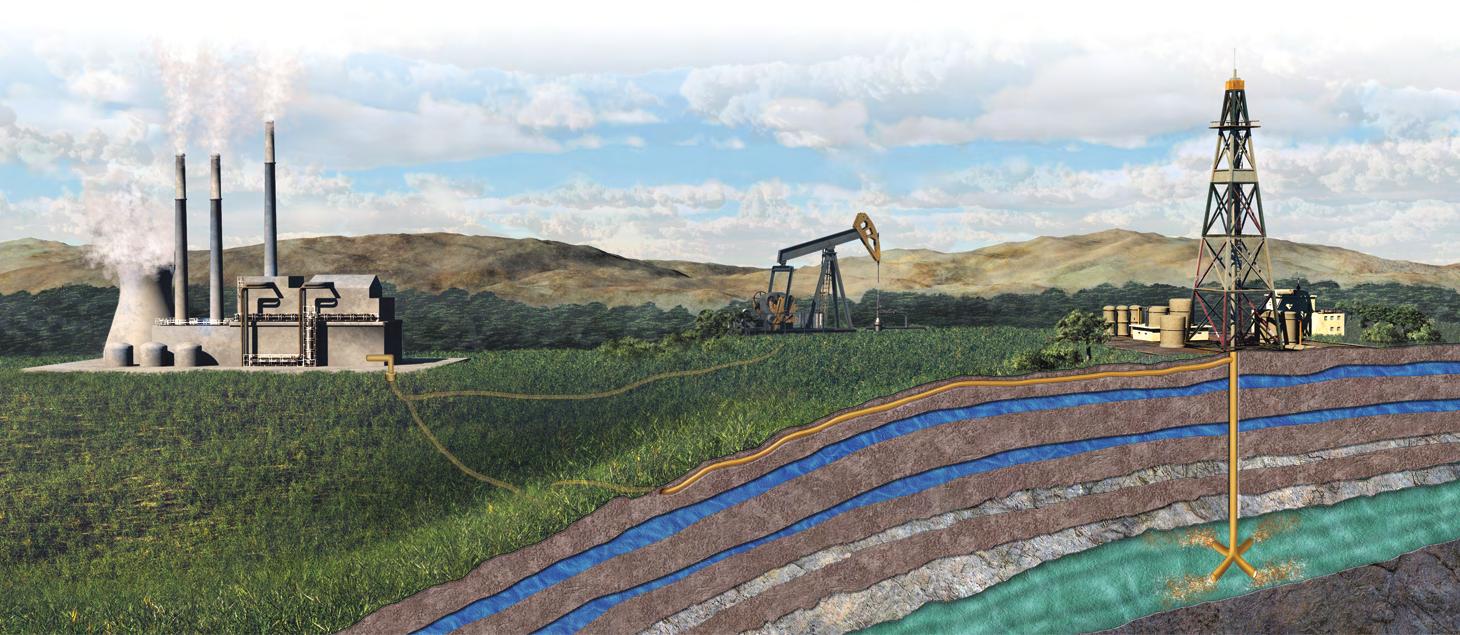
My Ph.D. research is to develop tools and evaluate the “cradle-to-grave” life cycle assessment of CO2 capture from industrial sources and utilization for CO2-EOR for North American oil fields. The developed tools will be used to evaluate the carbon intensity of the oil produced for some of the existing CO2-EOR projects, the resulting carbon intensity of the transportation fuels, and understand how these compare to other crude oil available in the market. Further, I would evaluate the drivers of uncertainty in the resulting carbon intensity, how different operation strategies might affect the resulting carbon intensity, and how different approaches to allocating CO2 emissions across the life cycle would impact the results. In the International Energy Agency (IEA) Sustainable Development Scenario (SDS), which is aligned with the Paris Agreement, Carbon Capture Utilization and Storage (CCUS) accounts for 9% of global emissions reduction by 2050 (International Energy Agency [IEA], 2019). Carbon Capture Utilization and Storage (CCUS) is a critical mitigation technology in the fight to reduce global emissions and CO2 utilization through Enhanced Oil Recovery (EOR) is an influential economic driver. EOR has been successfully used around the world for decades to extract oil, but it was not deployed to maximize CO2 storage as well. Even when the potential is huge, today there are only 21 CCUS facilities around the world with the capacity to capture up to 40 MtCO2/year. Although the industry never intended to maximize the CO2 storage, still the lessons learned in the past 3 decades of an operation mainly in North America have made CO2-EOR more attractive than ever. This can be seen by the increase in the investment plans for more than 30 new integrated CCUS facilities that have been announced since 2017. In my opinion with the significant curb in exploration by supermajors to find
and develop new resources and with the current annual decline of 3-5% of the existing fields, CCUS for EOR from existing oil fields with infrastructure can play an important role to fill the increasing demand for oil and simultaneously mitigate emissions.
Q.5) How essential Reservoir Engineering (RE) skills are for a Petroleum Engineer to make a transition into the field of Carbon Capture and Sequestration?
I think RE skills are key since all the burden is on the EOR site to sequester the CO2 molecule. RE skills play a key role in terms of evaluation through reservoir simulation and reservoir surveillance to understand the CO2 movement, design of the flood (Continuous Gas, WAG) to optimize the dual objective of oil recovery and CO2 storage. In the past RE, the role was to maximize reserves but in the low carbon environment, the future would demand RE (and so-called Energy Engineers) to optimize both oil and CO2 storage. Accurate evaluation of CO2 storage requires a good understanding of the reservoir and post storage monitoring to ensure CO2 is stored for longer. Many of the job opportunities that will arise in the CCUS sector will also be able to make use of the subsurface skills and experience of personnel in the oil and gas sector, which has seen significant job losses. These opportunities include the near-term employment needs associated with CO2 storage exploration, as well as the more intensive phase of characterization and development of new storage facilities. Q.6) Can you explain the keywords used
as net-zero and carbon negative in the field of Carbon Capture and Sequestration?
Net-zero requires that any CO2 released into the atmosphere from human activity be balanced by an equivalent amount being removed, either through nature-based solutions (including afforestation, reforestation, and other changes in land use) or technological solutions that permanently store CO2 captured (directly or indirectly) from the atmosphere. The sooner net-zero emissions are achieved, the greater the chances of meeting the most ambitious climate goals. An increasing number of countries and organizations have adopted net-zero emissions targets, drawing attention to the need for CCUS. A growing number of corporations across a range of industry sectors, including oil and gas, power generation, manufacturing, transport, and technology services, are also adopting net-zero emissions targets (IEA, 2020a). Today, between 0.3 t and 0.6 t of CO2 is injected in EOR processes per barrel of oil produced, although this varies between fields and across the life of projects (IEA, 2018). CO2-EOR has the potential to deliver climate benefits but assessing the net impact on emissions requires a quantitative life-cycle assessment taking account of project-specific characteristics. If an anthropogenic source of CO2 is used and the amount of CO2 stored exceeds the emissions from the production and combustion of the oil itself, the oil could be described as net “carbon- negative”.
In other words, to produce “carbon-negative oil” – that is for CO2-EOR actually to reduce the stock of CO2 in the atmosphere – the CO2 either has to come from the combustion or has to be captured from the air such as DAC (Direct air capture) of CO2 from the air. The limitation of DAC is the low CO2
concentration in ambient air compared with industrial sources of CO2, which makes this technology expensive compared with the industrial streams. This aligns with my Ph.D. research, which is primarily to evaluate the life cycle and economics of EOR oil and compare it with other pathways of CO2 usage.
Q.7) What message would you like to share with students and professionals, keeping in view the current diversification trends being followed by companies?
The dual COVID and collapse in commodity prices are certainly very challenging for the overall economy and, in particular, for the energy industry. As we all know, oil prices are cyclical so there are good times and then there are downturns. I would say these are tough times for the energy industry and this, too, shall pass. There are areas such as CCUS and Data Science which have gained a lot of attention in recent years and engineers that are equipped with these skills can contribute largely to the energy industry making it attractive again. Give your 100% and focus long term and keep investing in yourself. By this I mean, every engineer should know how to “code”, automate your workflows, get yourself acquainted with the applications of Machine Learning, Artificial Intelligence (AI), Reinforcement Learning (RL), and visualization tools. Stay connected to the industry by being an active member of SPE and events. In anything you do, try to see the value you add to the community, to your employer, and in yourself by learning a particular skill set. To my experience the energy industry is very rewarding, the company invests a lot in your training and you travel a lot. The benefits are huge and so are the risks.