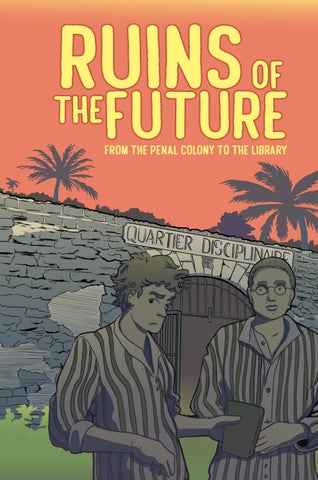
Pavement Books Nottingham, UK www.pavementbooks.com First published 2025 © nicole marie burton, Hugh Goldring and Sophie Fuggle Cover Image art by nicole marie burton The authors have asserted their rights under the Copyright, Designs and Patents Act 1988 to be identified as the author of this work. All rights reserved. No part of this publication may be reproduced, stored in a retrieval system, or transmitted, in any form or by any means, electronic, mechanical, photocopying, recording or otherwise, without the prior permission of the author and the publisher. British Library Cataloguing in Publication Data. A catalogue record for this book is available from the British Library. ISBN: 978-1-8380137-2-1
Acknowledgements Sophie would like to thank, first and foremost, Rodolphe Hammadi for sharing his photos and interviews with Icek Baron as well as for his and Delphine’s wonderful hospitality. Secondly to nicole and Hugh at Petroglyph Studios for their immense patience, shared vision and exciting conversations. The comic is also indebted to Claire Reddleman whose photographs have been key to transforming the space of French Guiana into comic form. Sophie is also hugely grateful to Charles Forsdick for his shared love of comics and for pointing out typos in the script. Thanks also go to Katharina Massing for her ongoing friendship and for encouraging the project in the early days and to Chantal Cointot for help with the forthcoming French translation. There are a number of amazing people in French Guiana who have offered wider support for the research underpinning the comic – Lydia Joannie, Vanessa van der Walle, Arnauld Heuret, Samuel Tracol and former librarian at the Bibliothèque Icek Baron, Martine Palton. Further thanks to Gilles Poizat at the Archives Nationales d’Outre-Mer in Aix-enProvence (now at the Archives Nationales) for encouraging a creative approach to stories of reading and writing within the penal colony. The various fieldwork and archival trips which made this research possible were generously supported by an Arts and Humanities Research Council fellowship (AH/ R002452/1) for which Sophie is also immensely grateful. A special thanks to Manon Plasschaert for providing writing huts in Saint Laurent du Maroni and Puybrun and to Christophe for the pirogue trips. And, finally, to Theodor and Annabel for giving comics pride of place on our bookshelves at home.
Contents COMIC : “Ruins of the Future”
4
DOSSIER
22
I.
A short history of France’s overseas penal colonies
23
II.
Guide to the geography of the penal colony in French Guiana
25
III.
Glossary
28
IV.
Transcriptions of archival material
32
1. ‘Against the seizure of works of purely literary interest and of no immoral character whatsoever.’
2. Complaint from Paul Roussenq about the state of the library addressed to the Procureur Général, 6 April 1920.
3. Request for a library by Joseph Marlier. 19 June 1934.
4. Manifesto of the Prisons Information Group
V.
A short guide to the ruins of the penal colony
38
VI.
Further reading
42
VII.
Filmography
47
4
5
6
7
8
9
10
11
12
13
14
15
16
17
18
19
20
21
Dossier
I. A short history of France’s overseas penal colonies France’s overseas penal colonies were established in the wake of the abolition of slavery in the mid-nineteenth century when another source of ‘free’ labour was required for colonial development. Transportation was also a response to the overcrowded dockyard prisons and growing ‘crime’ problem in mainland France. Inspired by the (apparently) successful use of convict labour to develop Australia, the creation of penal colonies by the French, in both South America and the Pacific, occurred at a point when the British Empire was winding down their system of overseas convict transportation. Between 1852 and 1953 over 70,000 convicts were transported to French Guiana including around 1,000 women. Approximately 21,000 convicts including approx. 500 women were also sent to New Caledonia which operated as penal colony between 1864 and 1924. The favourable conditions in comparison to French Guiana meant that for a period, European prisoners were sent there and only convicts from France’s other colonies/colonial subjects were sent to French Guiana. The racist logic behind this was that those from warmer climates would be better suited to the difficult conditions in French Guiana. However, this also demonstrated a lack of concern for the high death rates amongst non-French subjects. The original rhetoric around the penal colonies was one of colonial development and the opportunity for individual redemption via hard work. However, this was soon replaced with a more repressive vision of the ‘bagne’ as a space in which to deposit unwanted individuals from France and its other colonies. Although the ‘bagne’ had always been a source of popular storytelling, during the early 1920s, journalists such as Albert Londres alongside charitable organisations like the Salvation Army, drew wider public attention to the abject conditions of the ‘bagne’ as well as its expense and corruption. Attention also began to be paid to the complex racial politics of French Guiana. The French government became increasingly anxious about the image of the ‘vieux blancs’ [washed up former convicts obliged to stay in the colony] living alongside a middle-class Creole ¹ The irony of U.S. criticism of the penal colony in French Guiana should not be lost given their own use of extraterritorial prisons including, most famously, Guantanamo which still operates today.
23
population, many of whom had positions in local government. Criticism was particularly strong from the United States where escaped convicts such as René Belbenoit had achieved celebrity status and citizenship. The last convoy of convicts was sent to New Caledonia in 1897 and the penal colony ceased its operation in 1924. Transportation to French Guiana was abolished in 1938. However, the penal colony continued to operate until 1945 with conditions particularly brutal during the Second World War under the Vichy regime. Repatriation of former convicts to France, Europe and North Africa continued until 1953. The French Indochina wars meant those returning to Vietnam had to wait until the 1960s to go home.
24
II. Guide to the geography of the penal colony in French Guiana The penal colony in French Guiana does not consist of a single prison, camp or island. There were multiple camps located across the territory. Some of these were located on sites formerly linked to slave plantations whereas others were chosen with the intention of further expanding the agriculture and infrastructure of the territory. Where one camp closed due to disease outbreaks, another would open. There are thought to have been about 80 camps in total. Most camps were located along the Atlantic coast or the Maroni and Oyapock rivers which act as borders to the neighbouring Suriname (Dutch Guiana) and Brazil. The islands located off the coast of French Guiana and on its rivers were often used to isolate prisoners from the rest of the convict population whether due to disease and contagion or their status as political prisoners or dangerous and incorrigible criminals. The interior of the territory is part of the Amazon rainforest and between 1930 and 1946 formed a separate administrative territory known as Inini. Travel to the penal colony did not only happen directly from France. The boat would often pick up additional prisoners from North Africa, stopping off at Oran on its way to French Guiana. The journey from Europe via North Africa would take about 3 weeks with many dying en-route. At various points, prisoners from French Indochina (Vietnam) were also transported to French Guiana and sent to newly created camps (see the entry for the Centres Penitentiaires spéciaux below). Cayenne - this is the capital of French Guiana, the territory’s largest town. It was well-established prior to the creation of a penal colony yet the term is often used as a metonym for the bagne itself. Where the arrival of a new source of free and cheap labour was welcomed by the inhabitants of the territory, there was awareness of the dangers of French Guiana becoming thought of purely as a space for dangerous criminals. When the first convoys of convicts arrived, they had to build their accommodation and would return each night to sleep aboard prison hulks. Centres penitentiaires spéciaux (also known as Établissements penitentiaires spéciaux) – these were specially created camps for Indochinese prisoners transported from French Indochina in 1931 including many arrested in the Yen Bay uprising of that year. Where many prisoners had been sentenced as political or ‘semi-political’ prisoners in Indochina and had been selected for 25
transportation in order to remove a subversive political element, things were arranged so that they would be required to undertake forced labour alongside regular criminals on arrival in French Guiana. Camp Crique Anguille – built on the site of a former plantation, the camp housed 395 Vietnamese (Annamite) prisoners in 1931. The site was also the administrative centre for the Inini region of French Guiana. The camp’s convict labour was applied to the development of the region including the building of several roads. Camp la Forestière – prior to the creation of the camp, the site had been exploited (legally and illegally) for forestry and gold-mining. About a hundred Vietnamese prisoners were sent there to work on road and railway construction. Camp Saut-Tigre – located on the Sinnamary River, the camp which held a maximum of 280 Vietnamese prisoners was mainly used for agricultural production. It operated until 1942 but permanent buildings were only put in place in 1936. Charvein – one of many forest camps situated along the Maroni River not far from Saint Laurent, Charvein has the reputation for being the most brutal. Les Hattes – a penal settlement situated at the northwestern most tip of French Guiana established in 1858 for elderly and infirm convicts. However, the area had been inhabited by Kalina people since before European colonisation. Kourou – a small town located 60km Northwest of Cayenne. Today it is home to the Centre Spatial Guyanais (also known as Europe’s Space Port). It is also the departure point for the Iles du Salut [Salvation Islands] and housed a nuber of penitentiary buildings during the operation of the penal colony. Prior to the establishment of the penal colony, the town saw a mass influx of European (mostly French) settlers in 1763. Out of a population of around 1012,000 settlers, around 6,000 died due to the insalubrious conditions of the town which were exacerbated by the surrounding rainforest and marshlands.
26
Ilet la Mère – the largest of the Iles de Rémire, located 11km from Cayenne, the island was used as a leper colony for slaves and free black men prior to the abolition of slavery. It was used at multiple points during the operation of the penal colony first housing political prisoners and later sick and infirm prisoners before being abandoned due to an outbreak of yellow fever. It was used as a prison farm in the 1920s run by a former convict, Edmond Duez, and his wife. After decades of rewilding, it was taken over by the Pasteur Institute in 1981 to house squirrel monkeys being used to test anti-malaria serums. Iles du Salut – The Salvation Islands were formerly known collectively as the Iles du Diable. However, in 1763 they became a sanctuary following widespread disease outbreaks in Kourou. Ile du Diable – the smallest of the Iles du Salut, the island is formed of rocky outcrop. It was mainly used for political deportees including, most notably, Alfred Dreyfus. Ile Royale – the largest of the Iles du Salut, the island was used for dangerous convicts and those who had been caught escaping. Ile Saint Joseph – the island was used for those sentenced to solitary confinement. Saint Jean du Maroni – located about 17km up the river from Saint Laurent, Saint Jean was the site of the huge Camp de la relégation, reserved for relégués. After the closure of the penal colony in the mid-1940s, the site became a temporary work camp for Eastern European refugees fleeing war-torn Europe. It was later taken over by the French army with many buildings converted into barracks. Saint Laurent du Maroni - this was the purpose-built prison town which was established in 1862. The penal administration (A.P.) was based here and all convicts (except those considered most dangerous, who were sent directly to the Iles du Salut) were sent to the Camp de la Transportation for processing.
27
III. Glossary A.P. – Administration pénitentiaire [penal administration]. This was marked on the bricks used to build camp buildings. Although they remain property of the French government, today bricks are a much sought-after collector’s item. Bagnards – the generic name given to convicts sent to French Guiana although these were divided into three main categories: deportés, relégués and transportés. Bagne – this is the name commonly given to all penal colonies in the French empire. It originated in the dockyard prisons in Toulon, Rochefort and Brest where convicts would undertake work on galleys and other forms of labour associated with shipbuilding. The etymology of the term ‘bagne’ has been linked to the Italian word ‘bagno’ referring to a prison in Rome that had once been a Roman bath, but also evokes a wider association with water. The dockyard prisons in France operated from the mid-eighteenth century although convicts had been sentenced to work on galleys since the fifteenth century. The closure of the dockyard prisons roughly coincided with the opening of the penal colonies in French Guiana and New Caledonia in the second half of the nineteenth century. Barre de justice – this was an iron bar to which convicts were attached by the ankles using a manacle. La Belle – a nickname used by convicts to describe escape from the bagne. Biribi – This was the term used to refer to France’s overseas military prisons usually located in North Africa. Many of those who found themselves sent to the penal colony in French Guiana had first done time in the biribi usually for crimes such as desertion. Blockhaus – The term ‘blockhaus’ was used to refer to buildings located in the ‘quartier disciplinaire’ where convicts were held awaiting hearings at the Tribunal Maritime Spéciale usually for escape attempts. There would be about 70 convicts held in a single blockhaus where they would sleep on a raised stone block attached to a communal ‘barre de justice’ (see above). 28
Camelote – Convicts would find creative ways to generate extra income. This was known as ‘camelote’ and included making artworks and small craft objects. Convicts would carve designs onto coconuts or use surplus materials found in the workshops. Guards and visitors would commission art and crafts, often supplying the necessary materials. One of the most popular objects was a cigar cutter in the form of a guillotine. Today these objects are highly sought after by collectors fetching around €1,500. Cayenne – Although Saint Laurent du Maroni was the administrative centre of the penal colony, ‘Cayenne’ is frequently used in France as a metonym for the penal colony. Deportés – political prisoners. One of the most famous political prisoners to be sent to French Guiana was Alfred Dreyfus who spent five years on Devil’s Island before being cleared of wrongdoing. Many political deportees were sent to New Caledonia including Louise Michel and other communards and the Kabyle rebels. Vietnamese ‘semi’-political prisoners were sent to French Guiana in 1931 where their status was ‘modified’ to ensure they could be obliged to carry out forced labour. Devil’s Island – The English translation for ‘Ile du Diable’ is often used as a metonym in the UK and United States to refer to the penal colony in its entirety. Doublage – Once convicts had completed their sentence in the bagne, they were required to spend the same amount of time again living in French Guiana. Those with sentences over eight years were consigned to the colony for life. The logic behind this was to encourage former convicts to develop agricultural concessions and contribute to the economic growth of the colony. This rarely happened. For many doublage was the beginning of real hardship as libérés did not benefit from the food and accommodation provided to bagnards and struggled to find employment. Doublage was only abolished in 1938 as part of the move to wind down the bagne. Dry Guillotine – many of those transported to French Guiana had escaped the death penalty. ‘Guillotine sèche’ was the expression used to describe the slow death of life working in the forest camps where life expectancy was rapidly reduced due to starvation and disease.
29
Green Hell – ‘Enfer vert’ was often used to describe life in French Guiana due to the tropical climate and dense forest which covers most of the territory. Incorrigible – Convicts such as Paul Roussenq deemed incapable of reform. This type of convict was often sent to the Iles du Salut. Libéré – A convict who had finished his/her sentence but was required to remain in French Guiana as part of the system of doublage. (see also vieux blancs). La Marseillaise – this was a card game that was very popular with convicts. Card games and gambling were banned, and illicit games usually took place in dormitories and blockhaus at night. Le Martinière – this was one of the ships used to transport convicts from Saint Martin de Ré in France to French Guiana. Up to 670 convicts were held in cages below deck during the 3-week journey. Additional convicts were picked up in North Africa. Mitard – a type of individual prison cell used as a severe punishment. Môme – prison wife. Homosexual relationships within the penal colony in French Guiana are generally depicted (by historians, journalists and in convict memoirs) in homophobic terms which reduce all coupling to uneven power dynamics. Recently the comic, Paco, les mains rouges has offered a fictional challenge to this narrative. Papillon – Commonly associated with the convict Henri Charrière, the nickname ‘Papillon’ was common in the penal colony. Charrière’s famous butterfly tattoo was also a popular symbol of escape and freedom. Plan – A small metal tube, often made of aluminium. Convicts would hide their ‘plan’ in their rectum and used them to store money, other small valuables, and escape tools. Réclusionnaire – convict sentenced to cellular confinement usually on Ile Royale or Ile Saint Joseph.
30
Relégués – an additional category of offenders introduced in 1887. A total 17,000 relégués were sent to French Guiana for recidivism rather than serious crimes. Often born into poverty or victims of circumstance, relégués were treated with disdain by other convicts, guards, administrators and civilians alike. Système D – To survive in the penal colony as either convict, guard or administrator required the ability to improvise and also profit from others wherever possible. Rations were frequently skimmed by those responsible for managing food and other supplies. Smuggling was rife amongst convicts and the administration alike. This was known as Système D. ‘D’ is short for ‘debrouillard’ meaning ‘to get by’. Têtes-durs – Hardened, violent criminals who often belonged to gangs within the penal colony. Tirailleurs sénégalais – The Senegalese Tirailleurs were an infantry corps in the French Colonial Army. They were sent to French Guiana to guard the Vietnamese Camps, the French colonial logic being that the two races would treat each other with hostility and suspicion (although there is evidence of solidarity between the two groups). Transportées – the main category of convict. Transportées were usually sentenced to transportation and forced labour due to committing violent or serious crime. Many had escaped the death penalty. Vieux blancs – a nickname for former convicts or ‘libérés’ still residing in French Guiana and living in extreme poverty. Their presence in the colony alongside middle class Creoles was seen as a source of shame to the French due to the reversal of established racial/racist colonial hierarchies. Yellow Fever – A disease transmitted through mosquito bites. Prior to the creation of a vaccine, the death rate was very high and it was one of the common causes of death in the forest camps.
31
IV. Transcriptions #1. ‘Against the seizure of works of purely literary interest and of no immoral character whatsoever.’ REPORT. Administrative information regarding a claim by Transportee Chaou (Convict no. 40006) submitted for inspection by form no. 270, 7 June 1918 (Penitentiary Service) and making the following declaration: The seizing of books which cannot be returned to convicts takes place following the assessment of a Commission and the approval of the Director. Certain convicts, including Chaou, receive a large quantity of books and publications from France which have been chosen haphazardly and difficult to classify as good or bad based on their titles. The Commission cannot undertake the reading required to ascertain whether these publications contain subversive doctrines or licentious passages. Contrary to Chaou’s claim, classical books are never seized but it is possible that they are not delivered if their intended recipient is undergoing disciplinary punishment and, in accordance with regulations, has been deprived of the right to reading material. Publications whose titles are cause for suspicion are confiscated and sold with the profits being added to the convict’s own account. It is also necessary to reduce the number of book deliveries since their storage requires installing bookshelves in the huts which is not possible. These books will be sold or stolen, leading to trafficking and subsequently disorder harmful to discipline. There are also occasions when even classical texts are seized because they contain illicit things or secret communications. It was thus the case with an illustrated Larousse dictionary addressed to Chaou which was not returned because the following words were handwritten on the last page: “obnubilation, shkaigne, blennhorragie, emetine, Escrine, amine, sulfonal” As we were unable to find the meaning of these words which do not appear in the dictionary, we had cause to think that they must be a form of code allowing the sender to secretly communicate with the recipient. Perhaps there are other handwritten inscriptions inside the dictionary, but it would be too long and difficult to check. 32
These are necessary measures to reduce the methods used to outwit our surveillance but also to refuse entertainment to those who have repeatedly committed crimes and escape attempts. Saint Laurent, 3 April 1919. Signed: Tell, Director of the Penal Administration Archives Nationales d’Outre-Mer, H1971
#2. Complaint from Paul Roussenq about the state of the library addressed to the Procureur Général, 6 April 1920. Monsieur le Procureur Général, I draw particular attention to the paucity and dilapidation of the library located in cellular reclusion. In 1916, the library was composed of 300 volumes, all donations from convicts, notably former réclusionnaires [translator’s emphasis] Jacob and Boullan, who contributed 100 and 40 volumes respectively. Without these donations, the library would not exist despite the requirement that it be provided for by the State. During this critical period (1916) when the destiny of the Country was at stake, the Minster of the Colonies was preoccupied with the moral improvement of those condemned to forced labour: independent of the ability to receive reading material from their families, he ordered for their benefit – I do not mean the creation of libraries already envisaged in the regulations which had up until then gone unheeded – the stocking of penitentiary libraries. It was certainly not in the Minister’s intentions that the Reclusion library be stripped in order to form the basis of that of the camp, and yet that’s exactly what happened: 150 volumes were removed to that unwarranted destination. Since then, the Minister has sent book shipments; these have been distributed here and there but only 20-odd have been delivered to the Reclusion library which is currently reduced to 170 volumes (one hundred and seventy). If this figure is sufficient for those condemned to two years imprisonment, it will be clear to you that it is insufficient for those sentenced to 4 or 5 years – and I am one of those. The majority of the existing volumes are in such a state of 33
disrepair that they are in pieces; out of necessity, they can only be put back together. There was a time when we had a librarian (not a réclusionnaire) who carefully checked each book when it was returned and who carried out immediate repairs when needed. He was called to another position and replaced for a few months by a réclusionnaire. However, for more than two years, no one has take on this role: it is therefore not surprising that the books are in a lamentable state. By these irrefutable motives and considerations, I ask that the library in cellular reclusion is urgently restocked and expanded by care of the Administration to whom this charge falls and subsequently regularly maintained. I address this letter to you unsealed so that the Head of the Penitentiary can control, check and support its contents. Moreover, it will be easy for you to ascertain whether things remain unchanged during your next inspection and if there is cause, present your observations in your annual report. I think that, in light of the powers conferred to you, you are highly qualified to bring about the measures required to remedy the things I have mentioned. With deepest respect, The convict, 37664, Roussenq. Archives Nationales d’Outre-Mer, H5259
34
#3. Request for a library by Joseph Marlier. 19 June 1934. With respect I transmit my humble remarks and request that, should these appear justified, you will receive them favourably. We are aware of your opinion that, concerning penal matters, it is necessary to impose strict measures to evacuate the evil that provokes the abuses and excesses committed by transportation. We also know your determination to make use of the full powers of your authority to achieve this end. Far be it from me to complain about this state of things, it would be unintelligent and useless. I am undergoing at this present moment a sentence of five years of reclusion of which I still have two to go. I am aware of having deserved this punishment which is why I have never muttered, never complained about the rigours of the rules. These are nevertheless hard, almost cruel and even dangerous. However, their creator, understanding that having hit hard it was necessary to soften the regime, offers signs of certain amendments, [such as] conditional liberation, definitive periods outside, reading. These privileges no longer exist. And it is here, Monsieur le Directeur, that I want to draw your attention. There is no prison in the civilised world that does not have a library for the use of its inmates. Or, rather, there is one that exists and it is [our] cellular reclusion. The regulations relating to this subject say in effect that « when an inmate has so many months of good behaviour, […] proving his reform, he will have the right to enjoy a library provided by the penal administration when it possesses the means to do so. » Reclusion has been in place for many years, yet the library remains a project. It is possible that people will tell you there are books in reclusion. There are, indeed, two or three inmates in possession of texts but these are their personal property. They are kind enough to lend these to their fellow inmates. Yet, the volumes are, for the most part, in very poor condition and very few in number. Beyond the moral well-being that a good library would impart upon the mentality of the inmates, there is a further encouragment to good behaviour. When an inmate deserves a punishment, the Commission […] statute and inflicts a certain number of days of confinement to his cell. If an inmate is in a period outside of confinement, this punishment carries weight since morning coffee is withdrawn and he must return to his cell after an hour’s exercise. But if he is already undergoing a period of confinement, his situation doesn’t change and the punishment is pointless and ineffetive. Conversely, if there was a library, it would be in his interest to behave well for his entire sentence due to the possibility of reading. Monsieur le Directeur, you are too severe to not be fair. I have confidence that you will listen with kindness to what I have left to say. 35
And first of all, I would like to make a proposition on the advice of the Superior Commander himself with whom I have consulted on this subject. I could, through my work, populate the site assigned to a library with chosen books. Here are the conditions. I would work under supervision of a guard on drawing and painting with materials provided for the work. The produced work would be exchanged for books. I would be compensated by the work given to me and the reception of the books thus acquired. If you find any obstacles to this project, I would ask instead that you authorise me to buy on my account some classic literature and various other materials such as: Arithmetic book (superior level) Textbook on universal history Textbook on human anatomy Ten school exercise books Ten sheets of drawing paper (60x40) Two pencils : Conté, Paris no2 Box of coloured pencils (Corot) I conclude with confidence this too long letter, for which I demand pardon, by assuring you of my deep respect and complete and very humble submission. Signed: Marlier Archives Nationales d’Outre-Mer, H1971
#4. Manifesto of the Prisons Information Group No one among us can be sure of avoiding prison. Today less than ever. The systematic policing of our day to day lives gets tighter: in the street, on the roads, closing its grip on foreigners and young people; thought crimes have returned: anti-drug measures proliferate arbitrarily. We are all under the shadow of police custody. We are told that the courts are overwhelmed. We can see that much for ourselves. But what if it is the police that have overwhelmed them? We are told that the prisons are overpopulated? But what if it is the population who have been overimprisoned? 36
Very little information has been published on prisons; it’s one of those hidden regions of our social system, one of those dark corners of our lives. We have a right to know, we want to know. This is why, alongside magistrates, lawyers, journalist, doctors and psychologists, we have formed a Prisons Information Group. We undertake to make known what prison is: who goes there; how and why one goes there; what happens there; what life is like for prisoners as well as, equally, for prison staff; what the buildings are like; the food; hygiene; how internal regulations work; medical control; workshops; how one gets out and what it means, in our society, to be someone who has got out. This information is not to be found in official reports. We ask anyone who has any experience or relationship with prison to inform us. We request they get in touch with us and tell us what they know. A questionnaire has been compiled that is available on request. As soon as there are enough responses, these will be published. It is not for us to suggest reforms. We just want to know the reality. And to make this known immediately since time is passing. This is about raising the alert and remaining alert. We will try and use all the available daily, weekly and monthly information outlets. We will appeal to all possible platforms. Finally, it is good to know what threats we face and also good to know how to defend ourselves. One of the first tasks is to publish a short ‘Guide to the Perfect Arrestee’, obviously supplemented with a ‘Notice to arrestors’. Anyone wanting to share information, find out more or get involved in the group’s work, can write to the G.I.P: 285 rue de Vaugirard, Paris XV. On behalf of the Prisons Information Group Jean-Marie Domenach Michel Foucault Pierre Vidal-Naquet Read out by Michel Foucault and distributed to the press, 8 February 1971. Reproduced in J’Accuse, no.3, 15 March 1971, p.26.
37
V. A short guide to the ruins of the penal colony While the penal colony in French Guiana operated for over a hundred years, many of the work camps were only temporary. Materials used for constructing camps including bricks were recycled at other sites later. This means that apart from the main administrative centres, there are very few ruins left of the penal colony. The tropical climate in French Guiana, which is located on the equator also means that vegetation has taken over many of the sites since the penal colony closed in 1952. Today it is possible to visit the following sites* that were once part of the penal colony: Camp de la Transportation, Saint Laurent du Maroni - Located next to the tourist office in Saint Laurent, the site now houses the Icek Baron Municipal library, the Centre d’Interpretation d’Architecture et du Patrimoine, the Kokolampoe theatre group, a gallery showcasing work by artists in residence, La KazLab (Fab Lab) and the Musée du Bagne [Museum of the Bagne]. Today a statue of an unknown bagnard (by sculptor Bertrand Piéchaud) is located outside the Camp. You can walk around the main part of the site for free and without a guide. To visit the museum and take a guided tour of the ‘Quartier disciplinaire’, tickets must be booked at the tourist office. Monthly night tours of the camp are also organised. It is possible to identify other buildings and ruins linked to the town’s former role as the administrative centre of the bagne. These include the hospital, the vestiges of the dock and the red brick walls found outside many residences. Camp de la relégation, Saint Jean du Maroni – Situated about 16km from Saint Laurent, the Camp de la relégation is now used as a military barracks. Some of the former camp buildings have been restored including the doctors’ quarters which now house the colonel’s office. Access to visitors is restricted to erstwhile tours organised by the Association Meki wi libi na wan.
* There are other vestiges of the penal colony situated all over the territory. However, these are often located on private property or secondary forest and so it is important to visit with a knowledgeable local guide.
38
Cimetière des bagnards [convict cemetery], Saint Jean – A short walk from the Camp de la relégation, past a small squat and uphill, you will see signage for the preserved ‘Cimetière des bagnards’. Amongst the trees, it is possible to make out the contours of individual graves although few have been identified. Porcherie, Nouveau Camp [Pig Farm] – Just before you arrive at Saint Jean on the road from Saint Laurent, you will see signs for the Porcherie. Follow the forest trail for about 15 minutes and you arrive at the former pig farm composed of stone enclosures. This is one of the more unusual sets of vestiges belonging to the bagne in French Guiana. Ile Portal – During the operation of the penal colony, the island was used as a distillery employing convicts to produce rum and tafia. Today it is possible to see former machinery imported from Scotland. Located on the Maroni River opposite Saint Jean, the island is now privately owned by a real estate company located in France. Attempts to remove indigenous inhabitants have largely failed and there are a number of squats located across the island. Organised visits to the ruins of the distillery are sometimes arranged as part of heritage days. Otherwise, it is important to visit with a local guide who knows the island’s caretaker. Ile de la Quarantine – A small island located on the Maroni River in between Ile Portal and Saint Laurent. The island was once used as a leper colony. Vegetation has been cleared and wooden shelters set up for visitors wanting to bring picnics to the island. Salvation Islands – since 1965, the Salvation Islands have come under the jurisdiction of the Centre Nationale des Études Spatiales (CNES). The islands lie within the trajectory of rockets launched from the Spaces Station in French Guiana. Access to the islands is heavily restricted during launches. However, at other times it is possible to visit the islands by catamaran. Ile du Diable – due to the difficult terrain making it hard to dock, access to the island is generally prohibited. Boat tours to the islands often pause in front of Dreyfus’ former cabin which has been preserved. There is also a good view of the island from the restaurant on Ile Royale. Ile Royale – the island is used by the military and also houses telemetric equipment used by the space station to chart rocket launches. 39
Since the 1980s, it has been possible to stay overnight on the island in the Auberge [hotel] and also camping areas. Key buildings and sites linked to the bagne have been preserved and restored including the hospital, the chapel (which features frescoes painted by Francis Lagrange), the warden’s house (now a small museum) and a cemetery where children of the guards were buried. Ile Saint Joseph – in contrast to many of the restored buildings on Ile Royale, the ruins on Saint Joseph have been maintained in a state of arrested decay. It is possible to walk the perimeter of the island which takes you to the so-called ‘Piscine des bagnards’ [a sheltered area once used by convicts for bathing] and a cemetery where guards were buried. Heading inland up one of sets of large stone steps takes you directly to the ruins. Access to the island is limited to dinghies. Ilet la Mère – Today the site is a protected area and continues to house a large population of squirrel monkeys brought over by the Pasteur Institute in the 1980s and 1990s. There are very few discernible ruins linked to the operation of the bagne. Tours by small motorboat operate during certain times of the year. Unlike Ile Royale, there are no amenities on the island and overnight stays are prohibited. Visitors can follow the trail round the island originally laid out by convicts. Saint Joseph’s Church, Iracoubo – the small town of Iracoubo lies on RN1 between Kourou and Saint Laurent du Maroni. It is where French border controls take place. Nicknamed the ‘Sistine Chapel of the Amazon,’ the small church features wall and ceiling frescoes by the convict Pierre Huguet who arrived in the town in 1893. Camp Crique Anguille – the site forms part of a trail that ends up at the Crique Anguille where local families go to picnic and swim. As with Ile Saint Joseph, the vestiges at the site are in a state of arrested decay with paths and panels providing visitors with further context. Notable vestiges include railway tracks, latrines and individual cells as well as the quarters belonging to the Tirailleurs sénégalais who were drafted to the camp to guard the Vietnamese prisoners. Camp Forestière – Located off the Route d’Apatou on the banks of the Maroni River, vestiges from the former camp can be found about a ten-minute walk from 40
the road or via pirogue. These consist of brick pillars, chimney, staircase and dock. A commemorative plaque was placed at the site in 2011 (marking the 80th anniversary of the site) by the Comrades of the Vietnamese Nationalist Party and the Vietnamese People’s Memory.** Camp Saut-Tigre – The vestiges of the camp have been mainly submerged underwater with the creation of the Petit-Saut Dam in 1993. A few buildings including the pharmacy and warden’s house are visible above the water with more vestiges becoming visible during the dry season. Awala-Yalimapo (Les Hattes) – The penal settlement of Les Hattes operated until 1950. In the late 1940s, the village of Awala was created by Amerindians and in 1950, the village of Yalimapo was established by families from Ayawande and Galibi in Suriname. The Awala-Yalimapo commune was created in 1988. Former penal colony buildings are located by the beach (Plage des Hattes) and it is possible to see the former dock as well as bricks and other debris belonging to the penal settlement. Tour Dreyfus – A semaphore tower used for communication between the mainland and the Iles du Salut and nicknamed after Devil Island’s most famous prisoner. Situated on the Roches Beach, it is one of the few remaining, accessible ruins located in and around Kourou. Standing on the beach, it is just possible to make out the three islands on the horizon.
** It is advisable to bring a machete with you when walking in the forest in French Guiana due to the rapidity with which vegetation can grow, blocking established paths and trails!
41
VI. Further reading Memoirs René Belbenoit, Dry Guillotine: Fifteen Years among the Living Dead (Boston, MA: E.P. Dutton, 1938). Henri Charrière, Papillon (New York, NY: Harper Perennial Classics, 2005). Henri Charrière, Banco: The Further Adventures of Papillon (London: Harper Collins, 1994). Albert Clarac, Mémoires d’un médecin de la Marine et des colonies (1854-1934) (Service historique de la Marine, 1994). [in French] Léon Collin, Des hommes et des bagnes (Paris: Libertalia, 2015). [in French] Aage Krarup-Nielsen, On Devil’s Island: Hell Beyond the Seas. A convict’s own story of his experiences in the French penal settlement in Guiana. Re told by Aage Krarup-Nielsen (New York, NY: Vanguard, 1936). Francis Lagrange (with William Murray), Flag on Devil’s Island (Garden City, NY: Doubleday, 1961). Louis Rousseau, Les hommes punis: Un médecin au bagne (Paris: Nada Édi tions, 2020). [in French] Paul Roussenq, 25 ans au bagne (Paris: Le manufacture des livres, 2016). [in French] Raymond Vaudé, Passeport pour le bagne (Paris: Éditions Henri Veyrier, 1977). [in French]
42
Reportages and Travel Writing Frédéric Bouyer, La Guyane française: Notes et souvenirs d’un voyage exécuté en 1862– 1863 (Paris: Hachette, 1867). [in French] Jean-Claude Demariaux, Les Secrets de Poulo-Condore: Le grand bagne indochinois (Paris: J. Peyronnet et Cie, 1956). [in French] Albert Londres, Au Bagne (Paris: Gallimard, 1923). [in French] Albert Londres, L’Homme qui s’évada (Paris: Éditions de France, 1928) [in French] Alexander Miles, Devil’s Island: Colony of the Damned (Berkeley, CA: Ten Speed Press, 1989). Andrée Viollis, Indochine S.O.S. (Paris: Gallimard, 1935). [in French]
Fictionalised accounts of the bagne Mouloud Akkouche, Cayenne, mon tombeau (Paris: Flammarion, 2002). [in French] W. Somerset Maugham, ‘A Man with a Conscience’, Collected Short Stories, Vol. 4 (New York, NY: Vintage, 2002). W. Somerset Maugham, ‘An Official Position’, Collected Short Stories, Vol. 4 (New York, NY: Vintage, 2002). Blair Niles, Condemned to Devil’s Island: The Biography of an Unknown Con vict (London: Jonathan Cape, 1930).
History of French Guiana Serge Mam Lam Fouck, Histoire Générale de la Guyane française (Cayenne: Ibis Rouge, 2002). [in French] Peter Redfield, Space in the Tropics: From Convicts to Rockets in French Gui ana (Berkeley, CA: University of California Press, 2000).
History of France’s overseas penal colonies Colin Forster, France and Botany Bay: The lure of a penal colony. (Melbourne: Melbourne University Publishing, 1996). Eric Fougère, Île-prison: Bagne et deportation (Paris: L’Harmattan, 2003). [in French] Michel Pierre, Le Temps des bagnes, 1748-1953 (Paris: Éditions Tallandier, 2017). [in French] Steven Toth, Beyond Papillon: The French Overseas Penal Colonies, 1854-1952 (Lincoln, NE: University of Nebraska Press, 2006). 43
On French Guiana Christèle Dedebant, Le Bagne des Annamites: Les derniers déportés politiques en Guyane (Arles: Actes Sud, 2024). [in French] Danielle Donet-Vincent, De Soleil et de silences. Histoire des bagnes de Guyane (Paris: La Boutique de l’histoire, 2003). [in French] Danielle Donet-Vincent, La fin du bagne (Rennes: Éditions Ouest-France, 1992) [in French] Jean-Lucien Sanchez, A Perpétuité: Relégués au bagne de Guyane (Paris: Vendémiaire, 2013). [in French] Miranda Spieler, Empire and Underworld: Captivity in French Guiana (Cam bridge, MA: Harvard University Press, 2012).
On New Caledonia José-Louis Barbançon, Le Mémorial du bagne calédonien: Entre les chaînes et la terre, 2 vols. (Papeete: Au Vent des Iles, 2020). [in French] José-Louis Barbançon, L’Archipel des forçats: Histoire du bagne de Nou velle-Calédonie (1863-1931) (Villeneuve d’Ascq: Presses Universitaires du Septentrion, 2003). [in French]
On North African prisons (biribi) Dominique Khalifa, Biribi (Paris: Tempus/Perrin, 2016). [in French]
On Poulo Condore (Con Dao) and French Indochina Frédéric Angleviel, Poulo-Condore: Un bagne français en Indochine (Paris: Vendémiaire, 2020). [in French] Jean-Claude Demariaux, Les secrets des îles Poulo-Condore: Le grand bagne Indochinois (Paris: J. Peyronnet, 1956). [in French] Franck Sénateur (with Paul Miniconi), Poulo-Condore: Le Bagne d’Indochine (Paris: Gobelines, L’École de l’image, 2016). [in French] Peter Zinoman, The Colonial Bastille: A history of imprisonment in Vietnam. 1862-1940 (Berkeley and Los Angeles, CA: University of California Press, 2001).
44
On prison libraries and reading Collectif, Lectures de prison, 1725-2017 (Paris: Le Lampadaire, 2017). [in French] William J. Coyle, Libraries in Prisons: A Blending of Institutions (New York, NY: Greenwood, 1987). Józef Czapski, Lost Time: Lectures On Proust In A Soviet Prison Camp. Translated by Eric Karpeles (New York, NY: New York Review of Books, 2018). Janet Fyfe, Books behind Bars: The Role of Books, Reading, and Libraries in British Prison Reform, 1701–1911 (Santa Barbara, CA: Greenwood, 1992). Daniel Genis, Sentence: Ten Years and a Thousand Books in Prison (New York, NY: Viking, 2022). Jill Grunenwald, Reading Behind Bars: A Memoir of Literature, Law, and Life as a Prison Librarian (Centerpoint, 2019). Megan Sweeney, Reading is my window: Books and the art of reading in women’s prisons (Chapel Hill, NC: University of North Carolina Press, 2010).
On the work of the Prisons Information Group Le Groupe d’Information sur les prisons. Archives d’une lutte 1970-1972 (Paris: Éditions de l’IMEC, 2003). [in French] Perry Zurn and Andrew Dilts (eds)., Active Intolerance: Michel Foucault, the Prisons Information Group and the Future of Abolition (New York, NY: Palgrave, 2016). Perry Zurn and Kevin Thompson (eds)., Intolerable: Writings from Michel Foucault and the Prisons Information Group, 1970-1980 (Minneapolis, MN: Minnesota University Press, 2021).
On prison abolition Alain Brossat, Pour en finir avec la prison (Paris: La Fabrique, 2001). [in French] Joël Charbit, Shaïn Morisse and Gwenola Ricordeau, Brique par brique, mur par mur. Une histoire de l’abolitionnisme penal (Montréal: Lux, 2024. [in French]
45
Collectif, Au pied du mur. 765 raisons d’en finir avec toutes les prisons. (Paris: Insomnique, 2000). [in French] Angela Y. Davis, Are Prisons Obsolete? (New York, NY: Seven Stories, 2003). Angela Y. Davis, Abolition Democracy: Beyond Empire, Prisons and Torture (New York, NY: Seven Stories Press, 2005). Joy James (ed.), The New Abolitionists: (Neo)Slave Narratives and Contemporary Prison Writings (Albany, NY: State University of New York Press, 2005). Mariame Kaba, We do this ‘til we free us: Abolitionist Organizing and Transforming Justice (Chicago, IL: Haymarket Books, 2021). Jacques Lesage de la Haye, The Abolition of Prison, translated by Scott Branson (Oakland, CA: AK Press, 2021). Ruth Morris, Penal Abolition: The Practical Choice: A Practical Manual on Penal Abolition (Toronto: Canadian Scholars’ Press, 1995). Ruth Wilson Gilmore, Abolition Geographies: Essays on Liberation (London and New York, NY: Verso, 2022).
On colonial ruins Patrick Chamoiseau and Rodolphe Hammadi, French Guiana: Memory Traces of the Penal Colony, translated by Matt Reeck (Middletown, CT: Wesleyan University Press, 2020). Dominique Darbois, Regard sur le bagne (La Seyne sur Mer: Maison du patrimoine et de l’image, 2010). Exhibition catalogue. [in French] Jean-Luc de Laguarigue, Bagne A.P. (Ivry sur Seine: GANG, 2011). [in French] Ann Laura Stoler, Duress: Imperial Durabilities in Our Times (Durham, NC: Duke University Press, 2016).
Other comics on French Guiana [in French] Fabien Bedouel and Patrice Perna, Forçats 1: Dans l’Enfer du Bagne (Paris: Editions des Arènes, 2016). _______ , Forçats 2: Le prix de la liberté (Paris: Editions des Arènes, 2017). Stéphane Blanco and Samuel Figuière, Nengue: L’Histoire oubliée des esclaves des Guyanes (Paris: Steinkis, 2018). Stéphane Blanco and Laurent Perrin, Aux îles, point de salut (Petit-Bourg, Gua deloupe: Caraïbéditions, 2011). _______ , Cayenne, matricule 51793 (Blanco/Perrin, 2013). Collectif, Maroni: Les gens du fleuve (Paris: Futuropolis, 2022). Olivier Copin and Dennis Lamaison, Histoire de la Guyane (Strasbourg: Editions du Signe, 2021). 46
Frédéric Bihel and Stéphane Piatzszek, L’Or 1. Issaïas ou le colibri (Paris: Futuropolis, 2015). _______ , L’Or 2. Michel ou le Tamanoir (Paris: Futuropolis, 2015). _______ , L’Or 3. Lilo ou le jaguar (Paris: Futuropolis, 2017). _______ , L’Or 4. Étienne ou le hibou (Paris: Futuropolis, 2017). Eric Guttierez and François Migeat, Le Vol des Urubus: Les Ombres du fleuve (Issy les Moulineaux: Vents d’Ouest, 1991). _______ , Le Vol des Urubus 2: La Fièvre de l’or (Issy les Moulineaux: Vents d’Ouest, 1993). Joub, Nicoby and Copin, Les jeunes aventuriers 1. Les Chants Kalawu (Remire-Montjoly: Plume Verte, 2016). Emmelyne Octavie and Samuel Figuières, Billet pour l’exil (Vanves: Éditions Marabout, 2023). _______ , Les jeunes aventuriers 2. Salut les îles (Remire-Montjoly: Plume Verte, 2016). Laurent Maffre, L’Homme qui s’évada, adapté de l’oeuvre d’Albert Londres (Arles: Actes Sud, 2006). Nicoby, Joub and Copin, Manuel de la jungle (Paris: Dupuis, 2015). Cécile Richard, Sanseverino and Sylvain Dorange, Sanseverino est Papillon (Saint Avertin: La Boîte à Bulles, 2016). Fabien Vehlman and Eric Sagot, Paco, les mains rouges. 1: La Grande Terre (Paris: Dargaud, 2013). _______ , Paco, les mains rouges 2: Les Îles (Paris: Dargaud, 2017).
Filmography Papillon (1973), directed by Franklin K. Schaffner. United States. Papillon (2017), directed by Michael Noer. United States. Les Prisons aussi (1975), directed by Hélène Châtelain and René Lefort, France. Sur les toits (2014), directed by Nicolas Drolc. France.
47
Sophie is an academic based in Liverpool, UK. She is interested in the cultural and ecological legacies of French colonialism and how to imagine better worlds without prisons and borders. She can usually be found somewhere between the prison and the beach.
PETROGLYPH is a comics creation studio co-founded by Hugh Goldring and nicole marie burton, based in Ottawa Canada on the unceded territory of the Algonquin peoples. Since their founding in 2019, they have collaborated with scholars, NGOs, unions and activists to produce dozens of comics, posters and graphic novels with the goal of engaging and informing a diversity of readers.
48
2025 © Sophie Fuggle and PETROGLYPH COMICS with art by nicole marie burton and scripting by Hugh Goldring
Nottingham, UK www.pavementbooks.com