
AI RESHAPES SPORTS BETTING

AI RESHAPES SPORTS BETTING INDUSTRY
The 2026 summer sporting calendar arrives carrying every expectation the industry can hold. A new format World Cup with 104 matches, a full NFL season fast approaching and a packed Formula One year will test platforms, traders and marketing teams in public.
This issue of Sports Betting Operator tracks how the sector is preparing.
Our cover roundtable brings together Rob Pryce of Xtremepush, Matt Howard of Orbital.bet and Luke Campbell of CreateFuture on the technology behind that test. Paysecure sets out intelligent payment orchestration. RAAS LAB makes the case for relevance in sportsbook advertising. Boomerang shows how live behaviour is reshaping sports marketing.
IBIA, meanwhile, examines what integrity now looks
RIGHT: Mark McGuinness, Editor in Chief, Sports Betting Operator

SPORTS BETTING OPERATOR

like in Canada and Brazil, the markets shaping the next chapter.
A consistent thread runs through every piece. AI has moved from slide deck to live production. Whether the operator is ready or not, kickoff is coming.
Mark McGuinness Editor in Chief Sports Betting Operator
CONTENTS

3
VOLUME 008 - ISSUE 022
CONTACTS
Publisher – Peter White peter@outsourcedigitalmedia.com
Editor in Chief – Mark McGuinness mark@outsourcedigitalmedia.com
Editor EMEA – Damien Connelly damien@outsourcedigitalmedia.com
Las Vegas Correspondent – Ryan Slattery ryanslats@gmail.com
Associate Editor North America –David McKee dmckee314@gmail.com
Associate Editor EMEA – Andrew Behan a.behan@librasgroup.com
Designer – Stewart Hyde www.de5ign.co.uk
Tel: 44 (0) 1892 740869
W: www.sportsbettingoperator.com
Editorial Policy: The views and opinions expressed in Sports Betting Operator remain principally the views of contributors and do not necessarily reflect those of the editor or publishers.
The publishers wish to avoid inaccuracies and, whilst every precaution has been taken to ensure that information contained in this publication is accurate, no liability is accepted by the editor or publishers for errors or omissions, however caused.
Unless otherwise stated, articles appearing in this publication remain the copyright of the publishers and may not be reproduced in any form without the publisher’s written consent.
Printed in the UK by Pensord Press.
EDITOR’S LETTER
AI Reshapes Sports Betting Industry
Mark McGuinness on a summer calendar that moves AI from theory into live production.
5 FEATURE: ROUND TABLE
Betting’s 2026: When Hype Meets Engineering
Rob Pryce (Xtremepush), Matt Howard (Orbital.bet) and Luke Campbell (CreateFuture) on peak-event readiness, legacy estates and where AI is real.
14 FEATURE: SPORTS IN AMERICA 2026
FIFA World Cup and NFL Wagering in America
Victor H. Royer on 39 states, 135 million online bettors and a near-seamless summer-to-winter wagering calendar.
19 FEATURE: PAYSECURE
Payments Become Strategic Weapons
Viktoriia Degtiarova on intelligent orchestration, fraud defence and compliance built into the payment flow.
22 FEATURE: RAAS LAB
Relevance Drives Sportsbook Success
Thomas Ives on AI-powered contextual advertising and the open web as a performance channel.
24 FEATURE: EASTERN EUROPE
World Cup Betting Boom
How the 2026 tournament is turning Eastern Europe into a fast-growing force in global sports betting.
By Marko Mitevski
29 FEATURE: IBIA
Protecting Canada’s Sporting Integrity
IBIA, the CFL and Genius Sports on athlete education ahead of Alberta’s regulated market launch.
32 FEATURE: IBIA
Brazil Reshapes Betting Integrity
Inside IBIA’s Q1 2026 report: 70 suspicious alerts, rising esports cases and Brazil’s expanding influence.
36 FEATURE: BOOMERANG
Sports Marketing Gets Smarter Boomerang Partners on real-time behaviour, retention and lessons from the TIME TO WIN tournament.
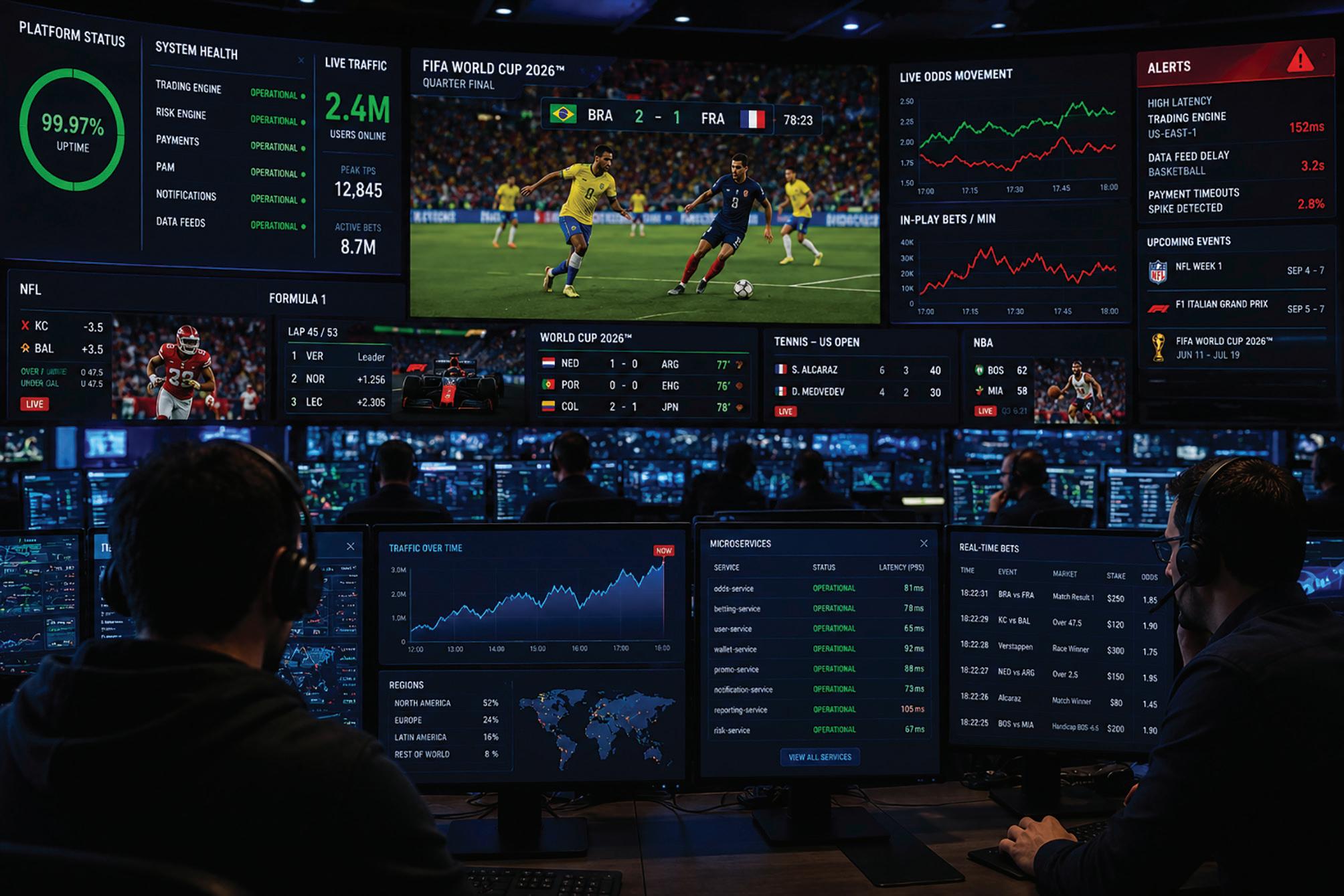
BETTING’S 2026: WHEN HYPE MEETS ENGINEERING
With the World Cup, the NFL season and a full Formula One calendar converging, 2026 will be the year sportsbook platforms are tested in public. Three industry voices set out what readiness now means, and where the gap between marketing ambition and engineering reality is widest.
The 2026 sporting calendar arrives carrying outsized commercial expectations.
The FIFA World Cup, the NFL regular season and a packed Formula One schedule will push sportsbook traffic, inplay volumes and cross-channel engagement into territory that few platforms routinely handle. For chief revenue officers, this is the moment to convert acquisition spend into lasting value. For engineering teams, it is something rather less romantic. It is an audit.
Sports Betting Operator invited three perspectives to the table.
Rob Pryce, Chief Revenue Officer at Xtremepush, focused on engagement architecture, single customer data and AI-driven personalisation.
Matt Howard, Director at Orbital. bet, who has spent his career inside operator and supplier platforms and is candid about the legacy estate that still dominates the sector.
Luke Campbell, Head of Technology, iGaming at CreateFuture and formerly CTO at Racing & Wagering and PokerStars, who treats peak-event readiness as an engineering discipline problem rather than a marketing one.
The three views do not always agree. That is the point.
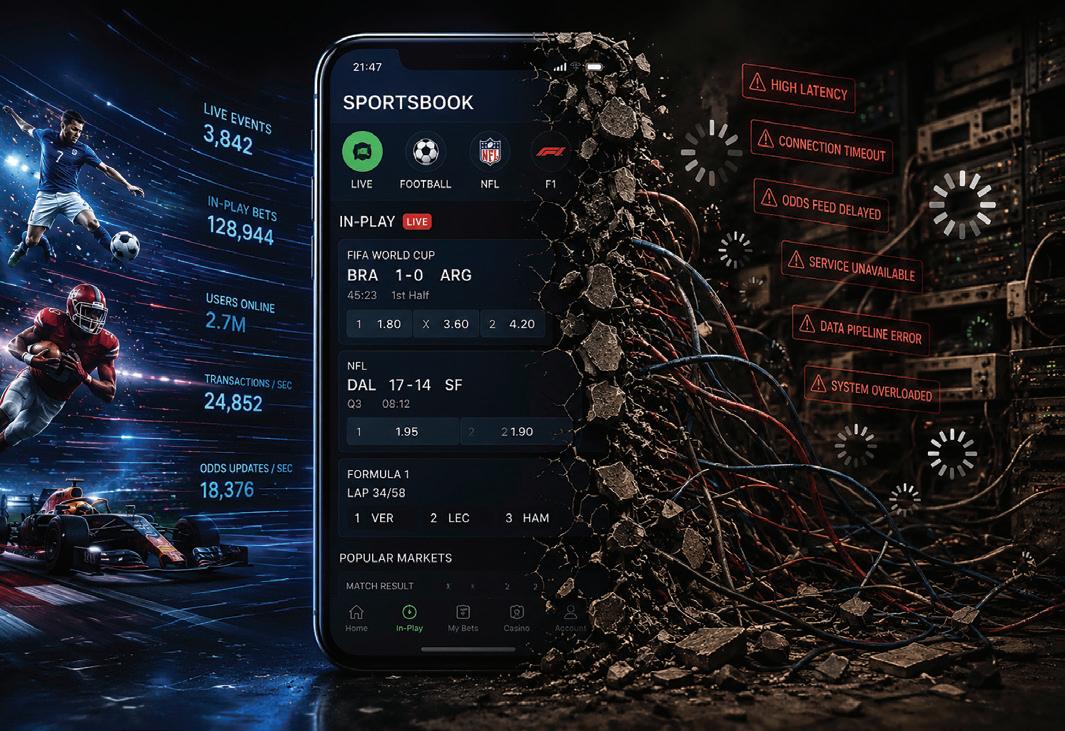
Preparing for the Biggest Sporting Calendar
With the 2026 FIFA World Cup, the upcoming NFL season and a packed schedule of Formula One Grands Prix expected to generate record engagement, how are operators and technology partners preparing platforms for the next wave of peak traffic and in-play betting demand?
Rob Pryce, Xtremepush
During a packed sporting calendar, the margin of error during peak acquisition and engagement moments is razor thin. This makes it critical that operators can rely on supplier relationships that they can trust, which stems from a blend of flawless technology and deep industry expertise which knows the sports betting game inside out.
Operators are moving away from transactional vendors and now want to work with teams that truly understand their realities. We position ourselves as “experts in the room” that act as an extension to internal teams, so we can guide on what brands should have in place before a major tournament kicks off, so that they can build that lasting engagement long after the trophy is lifted.
This sits on a foundation of clear communication that allows sportsbooks to have the peace of mind that their masses of data sync without error or delay so that decision makers are seeing a clear, live, and actionable picture of their users, allowing them to confidently turn traffic into major boosts in lifetime value.
Matt Howard, Orbital.bet
The true peaks are what concern the technologies that underpin the sports betting platforms. These are normally seen in small windows of either huge single events, or multiple major events at the same time. The likes of the Grand National horse race in the UK, Superbowl in the US or a Champions League night with multiple major concurrent events have all made the headlines for taking down the sports betting platforms of many an operator (or supplier of operators). The preparation is normally both long-term and very short-term. The long-term being looking at ways of auto-scaling technology to mitigate the risk of unforeseen, or unplanned for, data spikes without needing intervention. Or, where this isn’t a possibility, to beef up the systems capabilities for the expected spike manually.
Luke Campbell, CreateFuture
Major sporting events no longer create isolated “busy days”. They create sustained periods of extreme concurrency, volatile in-play activity and near-zero tolerance for failure. The strongest operators prepare in three layers.
First, platform resilience. That means aggressive load testing against realistic behavioural patterns rather than synthetic benchmarks. NFL Sundays, World Cup knockout matches and Formula One race weekends all create very different transaction profiles.
Second, operational readiness. Infrastructure scaling alone is not enough. Trading systems, thirdparty data feeds, payments, PAM integrations, customer support tooling and monitoring all need to be pressure tested, because failures rarely happen in isolation.
Third, architectural simplification. Peak events expose technical debt brutally. Fragile dependency chains, synchronous bottlenecks and ageing integration layers become very expensive very quickly.
The operators who perform best will not necessarily be the ones with the flashiest front ends. They will be the ones whose engineering teams have prepared for failure, designed for graceful degradation, and understand exactly what happens when traffic moves from “busy” to absolute carnage.
The Future of Mobile Sports Betting
Customer expectations around mobile betting continue to evolve rapidly. What innovations do you believe will have the biggest impact on the mobile and online sportsbook experience over the next 12 months?
Rob Pryce, Xtremepush
While you could argue that core sportsbook products and UI has reached a plateau in recent years when it comes to raw functionality, the defining battleground will be around customer experiences. The most impactful innovations will revolve around hyper-personalisation and building those genuine one-to-one relationships that foster deep brand trust.
Players now expect a seamless, continuous journey as they move between devices; this is just a hygiene factor in today’s sports betting space.
RIGHT: Rob Pryce, Chief Revenue Officer at Xtremepush

To capture and retain attention during and after major acquisition events, such as the World Cup, operators must move beyond batch-andblast communications and tap into progressive messaging that fits with the behaviours found on different channels.
Whether that’s through native, habit-forming gamification, or realtime rewarding, the innovations that develop the sportsbook experience won’t necessarily be obvious from a front-end point-of-view, but will those subtle touches that leverage single customer data, helping users feel understood and valued.
Matt Howard, Orbital.bet
Sports betting has only followed the rest of the world in rapidly moving to a mobile experience. Designing “mobilefirst” is probably a decade old term now and for good reason. What should now be the key area of this experience is maximising the experience for customers. This, for me, is in 3 main areas; content management, social experiences and personalisation. There is so much content now within a sportsbook that it is arguably getting in the way of customers experience. Sorting this into manageable portions is a first step to improving that experience. Layering in social and
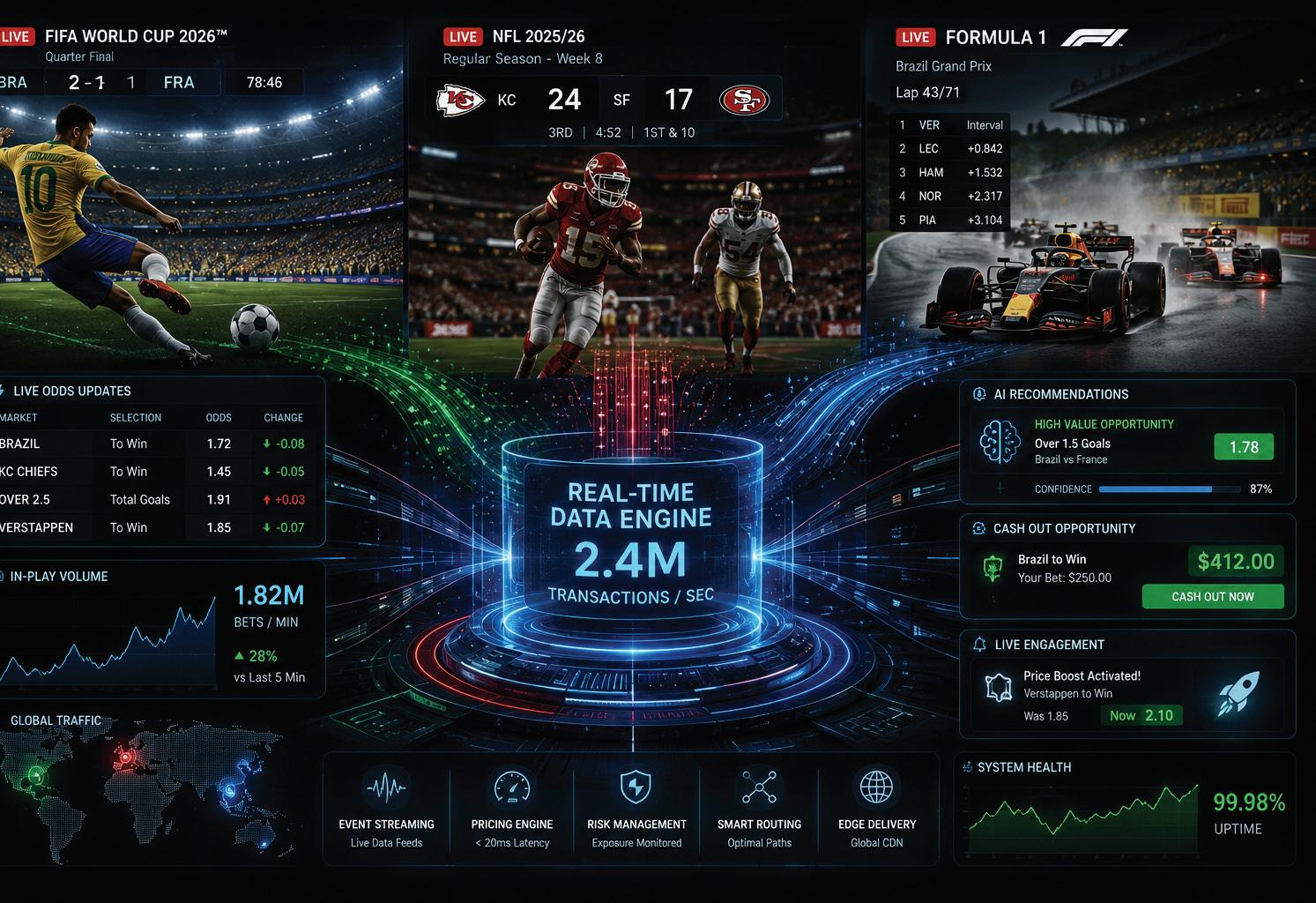
gamified features is something we are beginning to see a new wave of and seems an obvious way, to me, to both stand out and give customers a reason to return. Lastly, the oft-mentioned personalisation point. I’ve seen very little of this which is truly personalised and even less that is intelligently personalised beyond very simple areas like geo.
Luke Campbell, CreateFuture
Customer expectations are increasingly shaped by the best consumer apps in the world, not just other betting operators.
Speed, simplicity and relevance are now the baseline.
Over the next 12 months, I think three areas will matter most.
First, friction reduction. Faster onboarding, cleaner identity journeys, simplified payments and fewer taps between intent and bet placement. Every unnecessary step costs conversion.
Second, meaningful personalisation. Not the usual “recommended for you” lip service, but genuinely smarter experiences based on customer behaviour, preferred markets and how people actually use the product. Third, richer live experiences. Faster
cashout interactions, contextual stats, more intuitive in-play interfaces and smoother real-time engagement across devices.
There is also a broader expectation shift toward always-available mobile experiences. If an app freezes during a key F1 moment or stutters during NFL in-play betting, customers will simply move elsewhere.
Mobile is no longer just a channel.
For most sportsbook users, it is the product.
AI and Personalisation in Sports Betting
How do you expect AI to influence sportsbook operations, player engagement, personalisation and safer gambling tools during major live sporting events?
This is where the panel diverges most sharply.
Rob Pryce, Xtremepush AI will not merely influence these areas; it is already fundamentally transforming all aspects of our industry. From a player engagement perspective, we are exiting the era of manual, step-by-step campaign execution and now fully in the age of agentic output.
Solutions, like our XpertOS, demonstrate that true AI innovation is about far more than just operational efficiencies, they’re about scaling reach and deepening relationships, beyond what any existing human team could realistically execute.
Today’s teams only build campaigns for the audiences they can manage, leaving vast amounts of player value untouched. AI, in this example, changes this by autonomously identifying hidden revenue opportunities and drafting hundreds of campaign variants for them, within minutes.
Across the board these approaches, when combined with governance and compliance built as a priority within the AI architecture, elevate professionals from task executors to high-level strategists, allowing individuals to focus on holistic brand goals, not just the next campaign build.
Matt Howard, Orbital.bet
As touched on above, I think personalisation is only happening, in sports betting, in very minor and basic ways. I think any operator, or supplier, who really gets this embedded in the experience is going to win. Other online experiences are catered to what the data tells them about customers and, with all the content now within sports betting, they should expect this to be sorted for them here too.
In the case of AI, I’ve seen a lot more in casino and I understand that is because there is a lot less complexity and variance there than in sports betting. Technology owners, be they operators or suppliers, are investigating AI, but I do honestly believe we’re a long way from seeing it having significant impact in sports betting. That said, I think there are some very interesting areas it could work. Lots of decisions in trading and risk management are consistent, and areas like CRM are based on data, so can be looked into heavily.
However, on both points, sports betting technology, as a rule, is not modernised. Many companies run on the same platforms that were built over 20 years ago for a very different business. This legacy technology comes with serious constraints. This is holding back innovation as much as anything else.
Luke Campbell, CreateFuture AI is one of those areas where the hype occasionally gets ahead of
RIGHT: Matt Howard, Director at Orbital.bet

reality, but there are some genuinely transformative use cases for sportsbook operators.
I have long believed that the traditional one-size-fits-all approach to customer experience does little to help operators improve retention or protect margin in an increasingly competitive market.
Customers move between operators more freely than ever. The old assumption that loyalty naturally follows brand familiarity is becoming weaker.
The operators who get true personalisation right, particularly for recreational players, will be the ones who create meaningful long-term differentiation. That means genuinely relevant experiences, smarter content discovery, better recommendations and customer journeys that feel tailored rather than generic.
Of course, that has to be done responsibly and transparently, always asking what is genuinely best for the customer rather than simply what improves short-term commercial outcomes.
Safer gambling is where AI becomes especially compelling.
Pattern recognition at scale can identify behavioural shifts far earlier than traditional rules-based systems, allowing earlier intervention where appropriate.
In regulated environments though, AI should augment human decisionmaking, not replace it. Explainability, governance and trust will matter just as much as technical capability.
Modernising Betting Infrastructure
Many operators are balancing legacy systems with the need for cloud-native, scalable and compliant platforms. What are the biggest technology challenges the industry still faces when modernising sportsbook and player account management infrastructure?
Rob Pryce, Xtremepush
The most significant technological hurdle the igaming and sports betting industry faces is the ongoing reliance on the complex web of legacy “bolt-on” systems. Stitching together standalone tools creates an incomplete, fragmented picture of data, user behaviour, and a misalignment with the metrics that matter across marketing, trading teams, and the like.
When data is siloed, not accessed from a single hub, time lags occur and real-time personalisation becomes impossible. To modernise effectively, operators must urgently transition toward unified technologies and platforms. This architectural shift is the only way to eliminate lags that erode customer relationships, while allowing all relevant departments to speak the same language at the right time.
Aligned with this holistic approach is the complementary need to deploy next-gen AI tools which automate workflows and scale engagement opportunities safely.
Matt Howard, Orbital.bet
I’ll focus on sports betting technology,
as that’s my area. As touched on before, the industry rarely runs sports betting on technology under 15 years old. Certainly not at scale. The main problem here has been the complexity of the systems that need to be rebuilt being seen as too much of a task to take on when they are, just about, coping still. The lack of product and technology experience of building a top-class, high-performance sports betting platform is also very rare. So, whilst we do sometimes see newer builds, they are not nearly as strong as the old, legacy ones. The exceptions here would be where completely new modules are needed, or old ones completely fail, and this forces a rebuild.
Luke Campbell, CreateFuture
The biggest challenge is that most operators are not modernising in a clean-room environment.
They are modernising while live, regulated, revenue-generating platforms continue operating 24/7.
That changes everything.
Legacy sportsbook and PAM estates often contain years of embedded operational logic, commercial workarounds and regulatory adaptations that may be poorly documented but remain absolutely business-critical.
The challenge is not simply moving to cloud or adopting microservices. It is untangling deeply coupled systems without introducing operational risk.
Third-party dependency management remains another major challenge. Operators rely heavily on pricing feeds, data providers, payments, KYC vendors, geolocation services, CRM tooling and external trading integrations. Modernising one layer often exposes fragility elsewhere.
FEATURE: ROUND TABLE DISCUSSION
Compliance adds another level of complexity. Architecture decisions must satisfy resilience, performance, auditability and jurisdictional governance expectations simultaneously.
In practice, successful modernisation is less about choosing fashionable technology and more about disciplined engineering execution.
Boring, stable transformation tends to outperform ambitious architectural moonshots in this industry.
Delivering Real-Time Experiences at Scale
Live betting audiences now expect ultra-fast odds updates, realtime data and seamless in-play experiences across every device. What technologies or engineering strategies will be most important in delivering reliable real-time betting experiences during high-volume global sporting events?
Rob Pryce, Xtremepush
Beyond live trading mechanics, delivering real-time marketing and native loyalty experiences is critical for retaining players after expensive acquisitions. Today’s bettors demand instant, personalised gratification. This is what they see in ecommerce and other industries, and this is now required in sports betting.
Bettors expect their loyalty to be recognised immediately, and that’s only amplified during in-play moments. An appeasing email a day after a bad beat is condescending, while a primed nudge a few seconds later builds that relationship quickly, despite forming from a negative experience. This approach is now a must-have, not a roadmap aspiration, and those that can execute it will see those live experiences transform into major lifetime value uplift down the line.
RIGHT: Luke Campbell, Head of Technology, iGaming at CreateFuture

The most vital engineering strategy for this is ensuring real-time loyalty and engagement architecture is in place that can trigger live communications, such as contextual betting nudges, dynamic offers, or tailored gamification prompts, the moment a behavioural signal fires. Legacy solutions fall down at this hurdle too often, and those catching up will only fall behind when it comes to mega events such as this summer’s World Cup.
Matt Howard, Orbital.bet
The industry, in a sense, is creating more problems for itself here by constantly introducing more content. Be that events themselves, or more markets, or even new areas such as esports adding further strain in terms of the sheer volume of data being processed. The sensible thing to do here is to split the system up as much as possible, with modular architecture or splitting services that are running multiple separate types of task. This reduces the pressure on the individual module or service, but also can mean that if one thing fails, it does not bring the entire system crashing down. The most forward-thinking companies are employing cloud-based infrastructure, modern messaging management and


upgrading, or even moving entirely, the DB’s to no longer all be based in some central monolith. Technologies like AI are also now forcing product and technology teams to look at how it can be introduced. This is asking questions of the underlying technology and whether it is ready to maximise AI, if not it is also pushing for upgrades which have been pushed down previously.
Luke Campbell, CreateFuture
Real-time betting at scale is fundamentally an engineering discipline problem.
Customers see fast odds updates, instant interactions and seamless inplay betting. Underneath that sits a fairly unforgiving combination of event streaming, low-latency processing, pricing engines, caching strategy and resilient front-end delivery.
A few areas matter most.
Event-driven architecture is critical for handling rapid state changes efficiently.
Intelligent caching and edge delivery become essential when huge volumes of customers want access to the same rapidly changing data simultaneously.
Observability is massively underestimated. During live sporting events, teams need immediate visibility into latency, degradation and failing dependencies before customers notice.
Graceful degradation strategy is equally important. If one component struggles, the entire customer journey should not collapse with it.
And finally, engineering culture matters as much as tooling.
The strongest platforms are usually run by teams who rehearse failure scenarios, understand their bottlenecks and treat resilience as a core product feature.
During major sporting events, customers do not care whether your
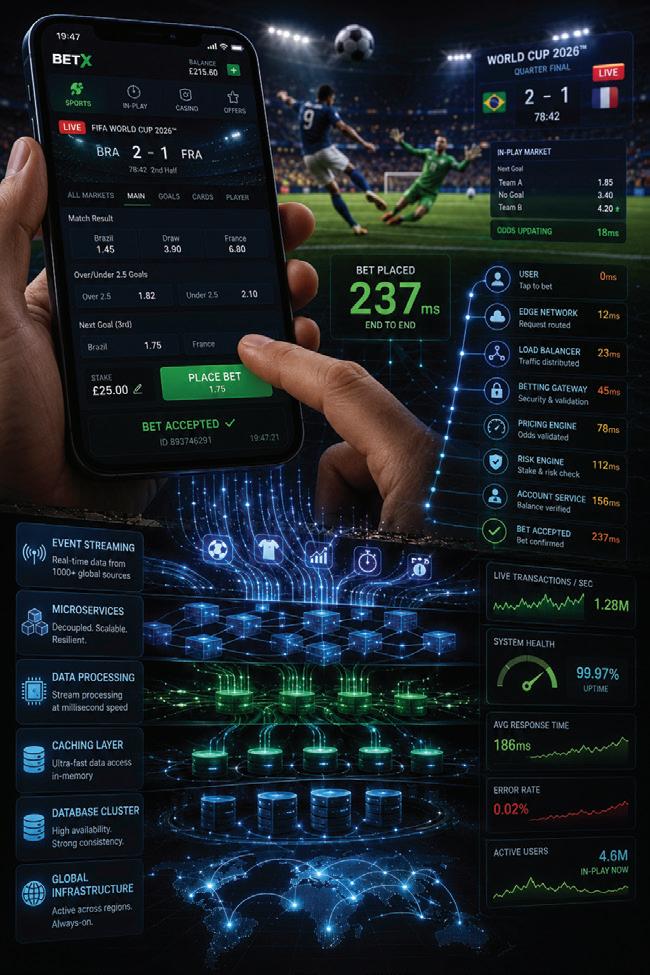
architecture diagram looks elegant. They care whether the bet goes on in time.
The Final Whistle
Three voices, three vantage points, one calendar. Pryce sees the year as an engagement and lifetime-value test, with AI moving from assistant to operator. Howard, plainly, sees a sector still running on platforms older than most of its players, and warns that the AI conversation runs ahead of the infrastructure beneath it. Campbell sees an engineering discipline problem that rewards preparation, observability and graceful degradation over architectural ambition.
By the time the final whistle blows on the World Cup, the sector will have learned which operators built for the moment and which simply hoped for it. The receipts will not be in the marketing recaps. They will be in the latency graphs and the retention curves.
Thank you to Rob, Luke and Matt, for sharing their views and insights.
SPORTS IN AMERICA 2026
FIFA World Cup Football and NFL American Football 2026.
By Victor H. Royer
America stands at a rare and remarkable intersection of two sporting giants in 2026:
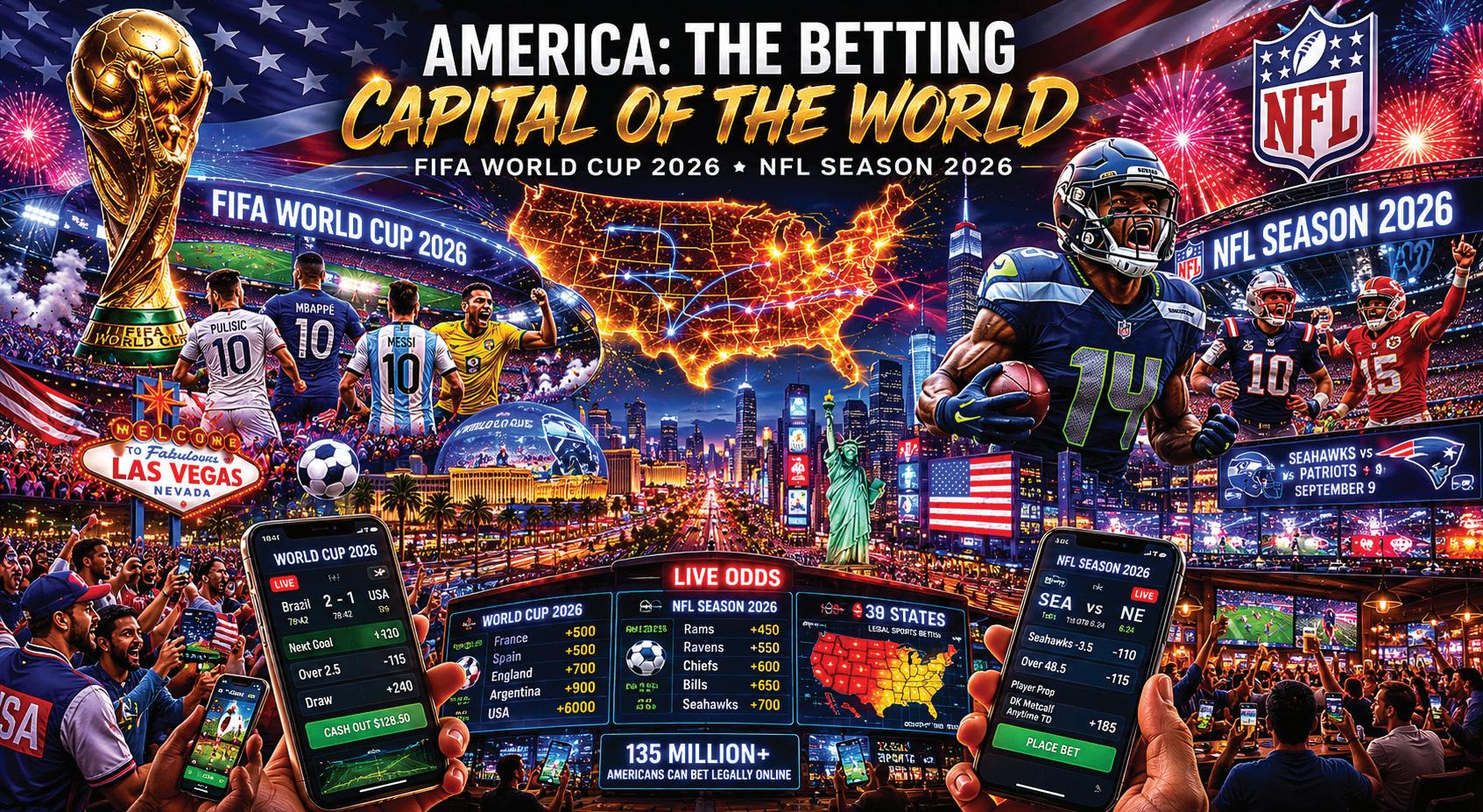
The FIFA World Cup, hosted on American soil for the first time as a tri-national event alongside Canada and Mexico, and the imminent kickoff of a new NFL season packed with intrigue, drama, and extraordinary wagering opportunity.
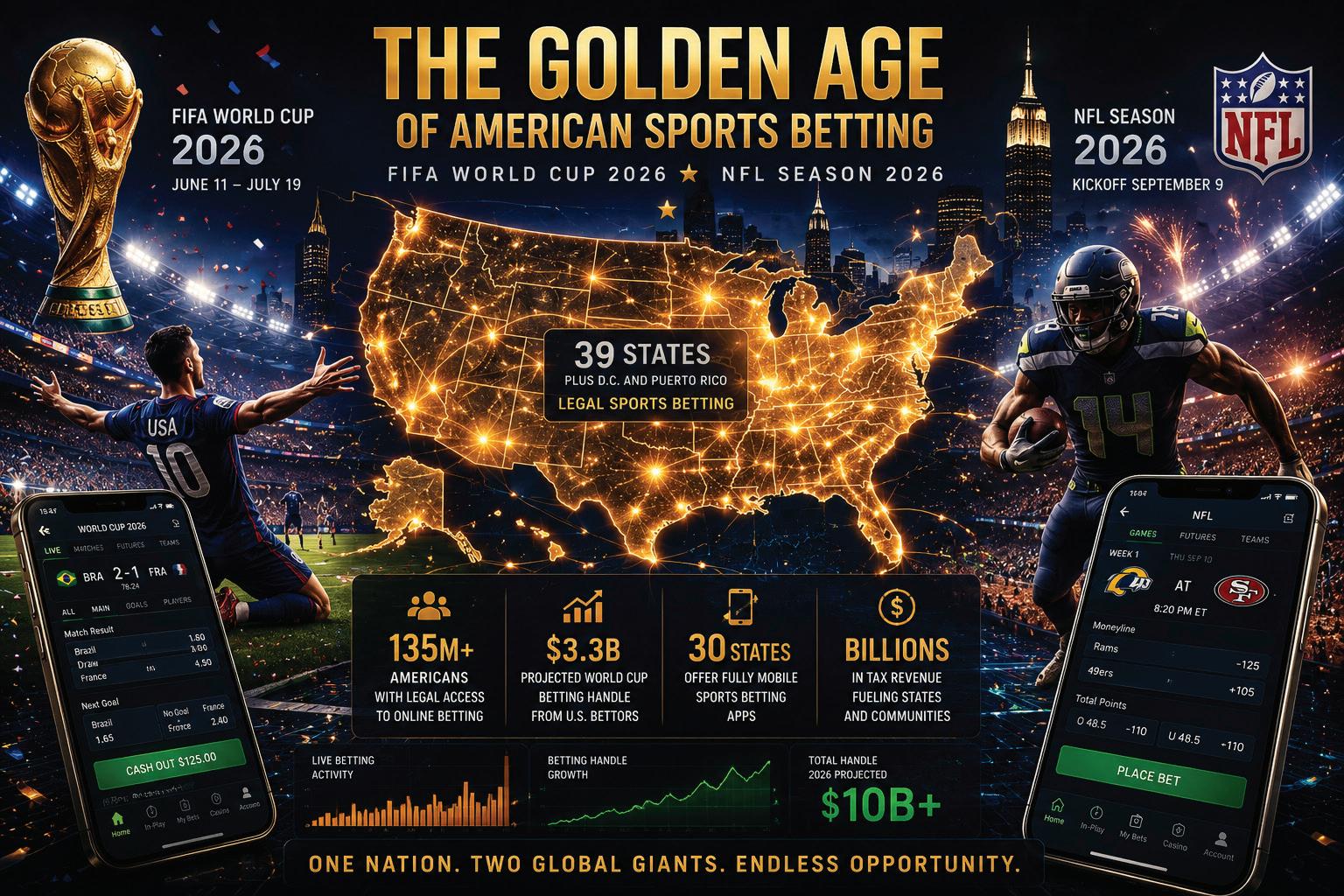
With 39 States now offering legal sports betting, an estimated 135 million Americans are able to wager legally online, and analysts are projecting record-shattering betting handles across both events. Consequently, 2026 promises to be the most consequential year in the history of American sports wagering. The Golden Age of American Sports Betting is officially here!
FIFA and NFL Sports Wagering in America
Let us be absolutely clear about one thing right from the start: 2026 is not just another year on the American sports calendar. It is, without question, the most momentous convergence of marquee sporting events and sports wagering opportunity that this country has ever seen. And if you happen to be in the sports betting business, in gaming, in media, in technology, or in any of the dozens of industries that orbit the wagering ecosystem, then buckle up, because what is happening right now is historic.
We are talking about the FIFA World Cup, the single most-watched sporting event on the planet, being hosted across 16 cities in the United States, Canada, and Mexico, running from June 11 through July 19.
And just a few weeks after the final whistle blows at MetLife Stadium in New Jersey, the NFL will be cranking up its own engines. The regular season officially opens on Wednesday, September 9, with a highly anticipated Super Bowl LX rematch between the defending champion Seattle Seahawks and the New England Patriots.
The World Cup Wagering Boom
Let’s start with the FIFA World Cup, because frankly, the projections alone are enough to make any industry executive sit up straight and pay close attention.
Deutsche Bank analysts have projected that the 2026 FIFA World Cup will generate between $2.5 billion and $4.1 billion in legal sports betting handle from American bettors alone, with a base-case estimate of $3.3 billion.
To put that in perspective, the 2022 World Cup in Qatar generated an estimated $1.6 billion in US betting handle. We are looking, therefore, at a potential doubling, or more, of World Cup betting activity in just one tournament cycle.
What is driving this extraordinary surge?
Several powerful forces are converging at exactly the right moment.
• Accessibility: Approximately 135 million Americans now have access to legal online sports betting, which is a 30% increase since the Qatar tournament in 2022. Seven additional States have legalized sports betting since Argentina lifted the trophy four years ago. The market is simply bigger, deeper, and more engaged than it has ever been.
• Expanded Format: The expanded 48-team field means 104 matches in total, up from 64 in 2022. That is 40 additional games, each one representing a fresh set of wagering markets, live betting opportunities, player props, futures, and parlay combinations. For sportsbooks, more matches mean more handle, more revenue, and more customer engagement over a longer period of time. The tournament window stretches nearly six weeks of continuous high-intensity wagering action.
• Home-Field Advantage (Time Zones): North American kickoff times eliminate the scheduling nightmare that plagued bettors during the Qatar tournament, when matches kicked off in the early hours of the morning US time. American fans can now watch every single match in prime viewing windows, fueling in-game wagering activity and sustained attention, and the kind of sustained attention that translates directly into betting handle. That is a competitive advantage that no amount of marketing budget can replicate.
Wagering Futures Markets
On the futures markets, the action is already lively.
France and Spain are co-favorites at +500 to lift the trophy, with England close behind at +700, and defending champion Argentina at +900.
The United States team, playing in their own backyard and competing in front of what promises to be an intensely enthusiastic home crowd, is drawing enormous public wagering interest at +6000, long odds, yes, but the kind of patriotic wager that American bettors love to make. The US has the highest percentage of bets at
most sportsbooks for a team at those odds, which tells you everything you need to know about the emotional engagement of the American fan base with this tournament.
Individual sportsbooks are already anticipating transformative revenue figures.
Deutsche Bank estimates that FanDuel alone could see an incremental $1.3 billion in World Cup handle, with DraftKings expected to generate approximately $1.1 billion, and BetMGM in the range of $250 million. These are not the numbers of a niche soccer audience discovering wagering for the first time. These are the numbers of a mature, sophisticated, nationally distributed sports betting market embracing the world’s game with full conviction.
The NFL: America’s Betting Juggernaut Rolls On
If the FIFA World Cup represents the spectacular summer appetizer, the NFL is the main course that America never tires of, and from a sports wagering perspective it remains without peer as the single most bet-upon sporting product in the United States.
The 2026 NFL season, set to open September 9, is already generating
exceptional pre-season wagering interest, with sportsbooks posting full win-total markets, futures odds, and Week 1 game lines across all 32 teams.
The storylines are rich and plentiful.
The Los Angeles Rams enter the season as Super Bowl favorites, having assembled what many analysts describe as the most talented roster in the NFC.
Baltimore Ravens quarterback Lamar Jackson and the Buffalo Bills will be the AFC teams to beat, with both franchises projected at or near the top of their respective divisions.
The Kansas City Chiefs, never to be counted out while Patrick Mahomes is under center, return to the schedule with plenty of motivation and primetime placement.
And across the league, new coaching situations, major free agent moves, and the annual drama of the NFL Draft have given oddsmakers and bettors alike an enormous menu of wagering angles to explore from opening day forward.
The NFL’s international ambitions are also expanding the betting landscape in ways that were inconceivable just a decade ago.
Nine international games are on the 2026 schedule, including a historic Week 1 matchup between the Rams and 49ers at the Melbourne Cricket Ground in Australia, kicking off in US prime time on Thursday, September 10.
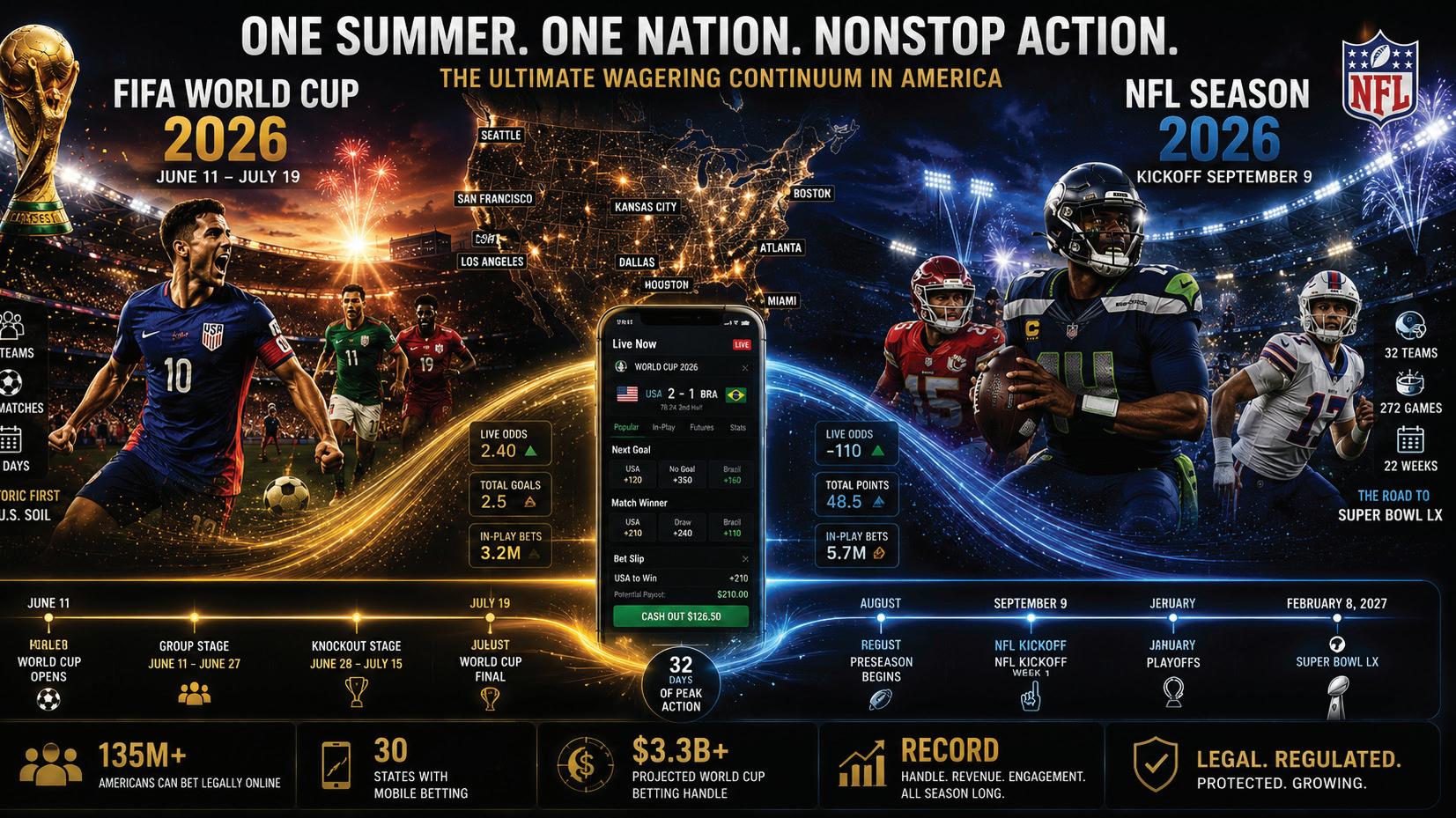
Critically, the timing of the World Cup and the NFL season creates a near-seamless wagering continuum for American sports bettors.
The FIFA tournament wraps on July 19, and the NFL preseason action
begins in August. And then the regular season kicks off in September. From mid-June through February, there is not a single week in which American bettors will be without a marquee wagering event demanding their attention.
For the industry, this is not just a good year: It is potentially the best single calendar of sports wagering opportunity in American history.
The Legal Landscape: 39 States and Growing
The foundation that makes all of this possible is the remarkable expansion of legal sports wagering across the United States, an expansion that has now reached 39 States plus Washington, D.C. and Puerto Rico.
Following the landmark Supreme Court decision in May 2018 that struck down the Professional and Amateur Sports Protection Act, State after State has moved to legalize, regulate, and launch their own sports betting markets. The most recent major addition was Missouri, which launched legal sports betting on December 1, 2025, becoming the 39th State to do so.
As of May 2026, the following States offer legal sports betting in some form, representing a combined population that covers the overwhelming majority of American adults:
• Arizona, Arkansas, Colorado, Connecticut, Delaware;
• Florida, Illinois, Indiana, Iowa, Kansas;
• Kentucky, Louisiana, Maine, Maryland, Massachusetts;
• Michigan, Mississippi, Missouri, Montana, Nebraska;
• Nevada, New Hampshire, New Jersey, New Mexico, New York;
• North Carolina, North Dakota, Ohio, Oregon, Pennsylvania;
• Rhode Island, South Dakota, Tennessee, Vermont, Virginia;
• Washington, Washington D.C., West Virginia, Wisconsin, Wyoming;
• Puerto Rico;
Of these 39 States plus the District of Columbia, 30 States offer fully mobile and online wagering through licensed apps, meaning that the vast majority of American sports bettors can place a wager on their smartphone from the comfort of their living room, their
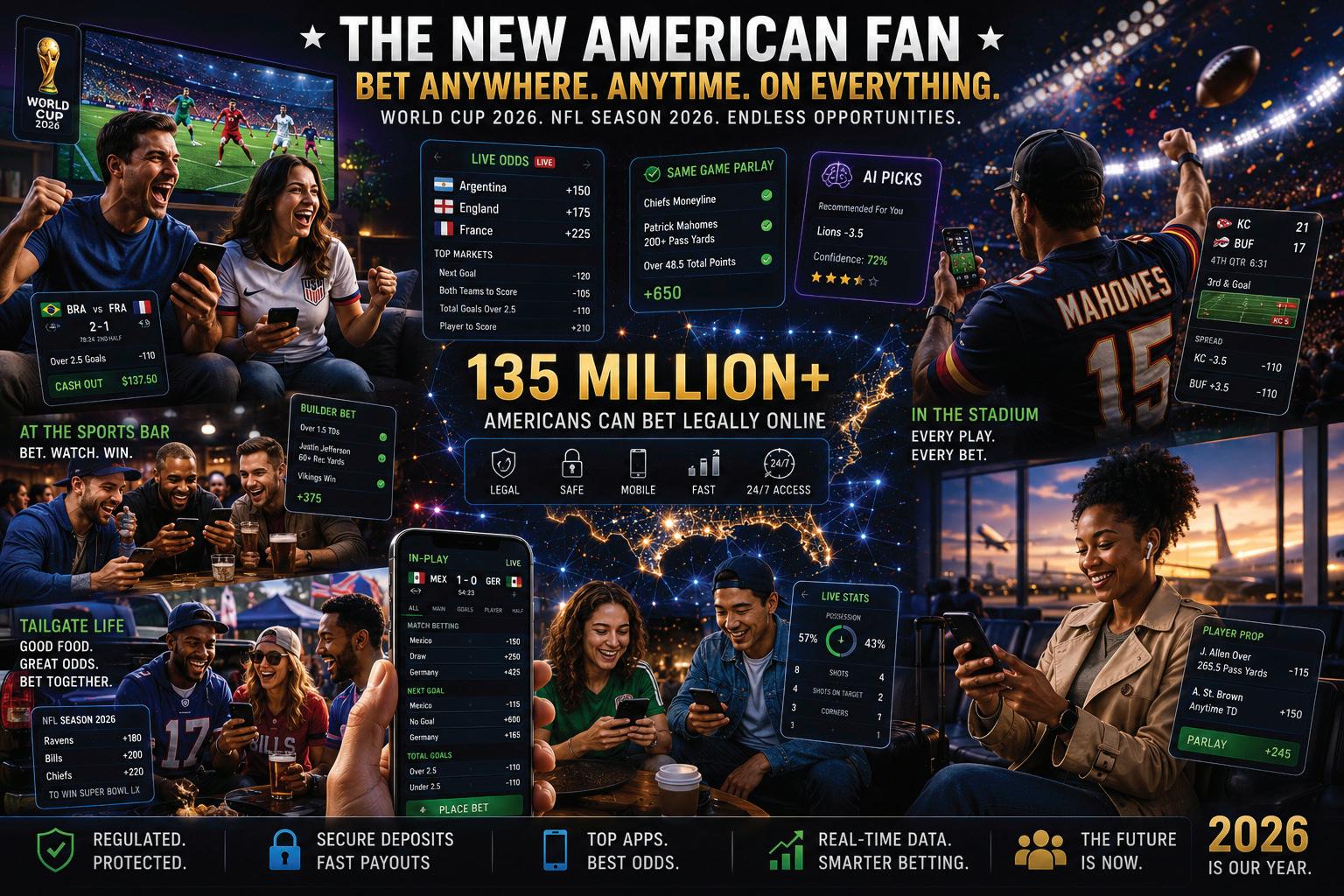
local sports bar, or their seat inside one of the World Cup host stadiums, all entirely within the framework of a licensed, regulated, consumerprotected legal market.
The economic impact of this expansion is substantial and welldocumented.
New York alone collected its first billion-dollar haul in sports betting tax revenue in 2024, driven by a staggering $22.7 billion in annual handle. New Jersey remains a powerhouse, particularly relevant given that MetLife Stadium in East Rutherford will host the FIFA World Cup Final on July 19. States are recognizing not just the revenue potential of their existing markets, but the extraordinary once-in-a-generation opportunity that the combination of a home World Cup and a new NFL season represents for their tax base.
The Road Ahead
The numbers, the timing, and the market structure all point to the same
conclusion: 2026 is a watershed year for American sports wagering. The FIFA World Cup will almost certainly shatter every domestic soccer betting record ever recorded, and quite possibly challenge Super Bowl handle figures for the first time in history.
The NFL season that follows will sustain and amplify that momentum, carrying the industry through a winter packed with marquee matchups, Super Bowl futures action, and the continued growth of mobile wagering across the country.
For industry operators, technology providers, media partners, and State regulators alike, the opportunity in front of them right now is as clear as it is compelling. America’s sports betting market has matured with remarkable speed since 2018. It has regulatory infrastructure, consumer trust, worldclass technology platforms, and 135 million potential online bettors. All that is left is for the games to begin.
And with the World Cup opening on June 11, they very nearly already have.

PAYMENTS BECOME STRATEGIC WEAPONS
AI-driven payment orchestration is transforming sports betting through smarter fraud prevention, seamless transactions and real-time compliance automation worldwide. By Viktoriia Degtiarova, CCO at Paysecure
In the high-stakes arena of global sports betting, the payment stage represents the single most critical conversion moment in the player journey. For many operators, however, it is also the most vulnerable. As the industry transitions into the era of Payment 3.0, the focus has shifted from simple transaction connectivity to the strategic use of real-time intelligence to protect both the player and the platform.
For a modern sports betting operator, the challenge is no longer just about moving money from point A to point B. It is about deploying
ABOVE: Viktoriia Degtiarova, CCO, Paysecure
an intelligent technology layer that can distinguish between a loyal VIP and a high-risk actor in the blink of an eye. By placing a flexible payment orchestration solution at the heart of their operations, operators can move beyond fragmented, manual connections to a unified brain that automates complex workflows while simultaneously fortifying the business against fraud.
The cornerstone of this modern defensive strategy is intelligent payment routing, a tactical engine that goes far beyond the basic capabilities of traditional gateways. While standard
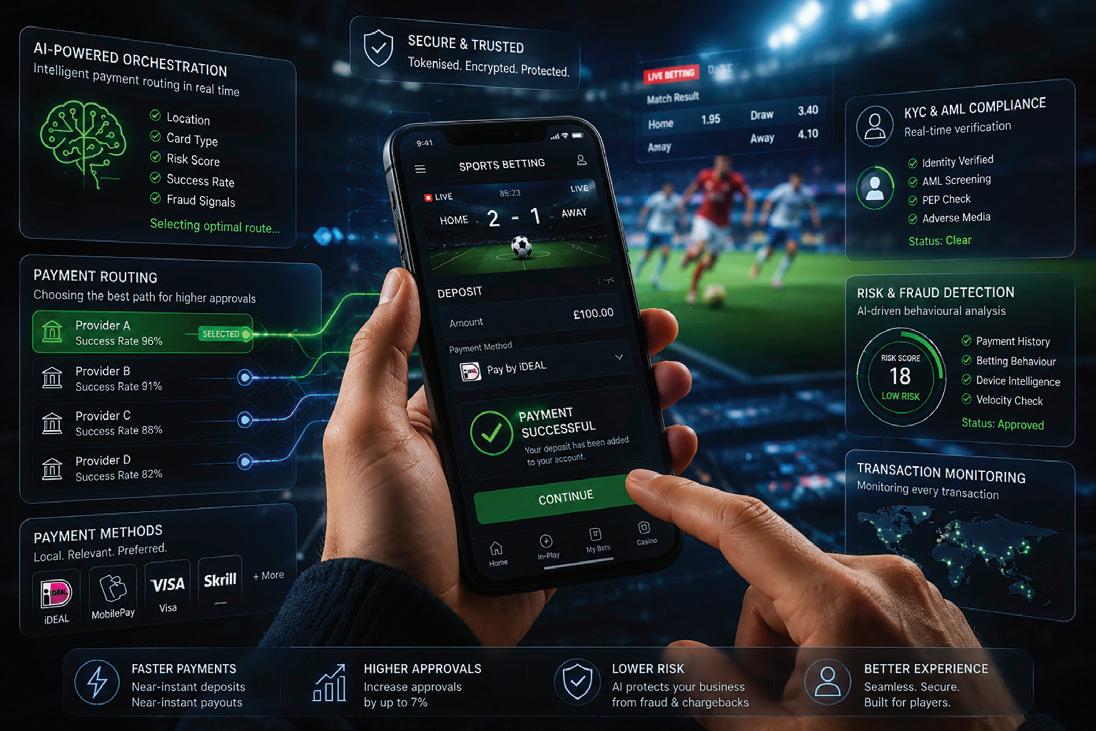
routing simply directs a transaction to a provider, intelligent routing, as part of a wider orchestration ecosystem, utilises sophisticated logic to select the most efficient and secure path for a payment based on live variables such as location, card type, and historical success rates.
This level of precision is vital in a market where 62% of players who experience a payment failure will never return to the site. By intelligently routing transactions to the processor most likely to approve them, operators using Paysecure’s solutions typically see transaction approvals rise by up to 7%. Furthermore, the implementation of cascading or fallback logic ensures that if a primary provider fails, the system instantly retries the transaction through an alternative provider, ensuring the player never encounters an error message. This creates a resilient infrastructure that protects revenue while maintaining the seamless experience that modern bettors expect.
Beyond technical efficiency, the true power of orchestration lies in its ability to unify payments with robust risk management and compliance protocols. Historically, Know Your Customer (KYC) and Anti-Money
Laundering (AML) checks have been treated as separate, friction-filled hurdles that disrupt the player experience. In jurisdictions like the United Kingdom, where regulators have eliminated grace periods for identity verification, the pressure to maintain compliance without losing players to frustration is immense. An intelligent orchestration platform solves this by triggering real-time verification within the payment flow itself, ensuring a player is compliant before the first deposit is even attempted. This approach consolidates all transaction and compliance data into a single, auditable ecosystem, reducing the administrative burden on the operator while providing a smoother journey for the user.
The integration of AI into this orchestration layer has further revolutionised how operators manage behavioral risk. By leveraging AI-driven behavioral intelligence, platforms can now analyse payment history and betting patterns to create a unique User Trust Score for every individual. This data-driven strategy allows merchants to offer frictionless checkouts for trusted, loyal players by removing time-consuming security steps like 3D Secure where appropriate. Alternatively, the system can automatically apply stricter filters and additional security layers to suspicious or high-risk actors. This tailored approach significantly reduces cart abandonment and player churn by removing unnecessary hurdles for legitimate buyers, while maintaining an ironclad defense against fraudulent activity.
Furthermore, an orchestration layer acts as a vital buffer against the ever-increasing weight of global regulation. In 2025 and 2026, governments have intensified their interventions, frequently managing the iGaming industry via their service providers. From the official launch of federal frameworks in Brazil to the tightening of affordability assessments in the UK, the compliance landscape is a moving target. A third-party orchestration platform insulates an operator’s core infrastructure from new laws emerging or local payment regulations changing, the updates occur within the orchestration ecosystem rather than requiring a total rewrite of the operator’s backend. This agility is particularly crucial for challenger operators who need to enter new markets quickly without being slowed down by the months of resource-intensive development required for an in-house build.

information is handled with the highest standards of security, further cementing the bond between the player and the operator.
Ultimately, this boils down to the decision to buy a modular orchestration solution rather than build a proprietary system is a strategic choice that defines a true challenger. While an in-house build may promise total control, it often becomes an anchor that requires massive ongoing investment in specialised expertise and hardware.
For the player, this sophisticated under-the-bonnet technology translates directly into increased trust and security. In an era where mobilecentric wagers account for roughly 80% of all online bets, players demand instant wagers and near-instant payouts. Orchestration meets this demand by offering a wider variety of preferred local payment methods, such as MobilePay in Denmark or iDEAL in the Netherlands, through a single API connection. When a player sees their preferred local option and experiences a lightning-fast, successful transaction, their confidence in the platform grows. Furthermore, the use of centralised tokenisation and realtime data ensures that their financial
By partnering with a third-party provider like Paysecure, operators gain access to best-in-class technology that was once the exclusive domain of industry giants. This democratisation of infrastructure allows mid-sized firms to compete on customer experience and security, rather than the size of their balance sheet. In the ultra-competitive sports betting market, the ability to harness real-time data to mitigate risk and personalise the player journey is what differentiates a simple transaction from a transformative financial experience. Placing an intelligent, flexible orchestration solution at the heart of the business is, quite simply, the most strategic move an operator can make to ensure long-term resilience and growth.
RELEVANCE DRIVES SPORTSBOOK SUCCESS
AI-powered contextual advertising is transforming sportsbook marketing by delivering personalised messaging exactly when bettors are most engaged online. By
Thomas Ives, Co-Founder, RAAS LAB
With the global gambling market projected to surpass £478bn ($650bn) by the end of 2026, the stakes in the iGaming sector are high. The revenue up for grabs has fostered fierce competition. However, too many sportsbook brands are relying on trusted but tired promotional tactics, such as welcome bonuses, boosted odds, and extensive display advertising. In a market where acquisition costs are rising and loyalty is fragile, a “business as usual” approach to digital marketing no longer feels like a smart bet.
In 2026, the single most important factor powering sportsbook advertising performance is not scale, but Relevance - the seamless alignment of message, creative and timing with the user’s immediate context. Research consistently shows that around 65% of sports bettors find personalised marketing offers appealing. They want offers that reflect their interests, their behaviour and, crucially, the moment they are in. Despite this, much of the digital advertising they receive does the opposite.
To understand the power of Relevance, consider the financial success of major social platforms. Social platforms, with their closed ecosystems, rich user data and deterministic identifiers, have become formidable performance channels.

Thomas Ives, Co-Founder, RAAS LAB
They have also raised consumers’ expectations about how “personalised” advertising should work. Sportsbook brands have, understandably, invested heavily in marketing via these walled gardens, targeting users based on declared interests and past behaviour.
Context is crucial
The issue for marketers is that social media is only part of the story. Consumers spend roughly 30–35% of their media time in premium, open web environments: sports news sites, betting previews, podcasts, analysis pieces, live blogs and so on. These trusted, high-quality editorial contexts are important because reader/ viewer attention is deeper and engagement is
ABOVE:
more deliberate in these environments. Recognising context is essential, as a user reading a 1,000-word tactical breakdown is in a different mindset from someone simply scrolling a feed.
For years, sportsbook operators have favoured social media with their media budgets, as the open web has struggled to compete on performance. While social networks can marry audience data with creative in a closed measurement loop, the open web has often relied on blunt contextual categories for targeting purposes. As a result, the ad rarely matched the precise moment or the editorial context, leading many sportsbook operators to regard the open web as a branding channel rather than a performance engine.
Now, AI has changed that equation. Today, AI can act as an analyst at impression level, processing realtime signals such as page context, sentiment, time of day, device type and even live match data. This allows the creative being served to respond to the moment.
For example, if a user is actively engaging with live, in-play betting content on a global sportsbook or entertainment platforms, the creative can reflect those markets rather than serving generic, non-contextual messaging. Every impression becomes an opportunity to align messaging with context and deliver real Relevance. For sportsbook brands, this shift is particularly powerful because betting is inherently moment-driven. Sports scores change, odds move, moods shift: advertising that ignores this dynamism feels out of touch with its context.
Relevance and trust
The environment in which an ad appears influences how a brand is perceived. Premium editorial settings
carry authority and credibility that cluttered social feeds often lack. Research from Newsworks, in partnership with Lumen Research and Peter Field, shows that ads in high-attention, premium environments deliver significantly stronger business outcomes. When an ad appears alongside trusted sports journalism and genuinely reflects the content being consumed, it feels less like an interruption and more like a service. It actually enhances the experience.
Relevance also reduces fatigue. Instead of bombarding users with the same creative across multiple channels, operators can deliver variations that align with the audience’s situation at the moment. This improves engagement rates, extends campaign longevity and protects brand equity.
The open web is no longer just a soft metric environment, useful only for impressions and reach. With the right technology and integration, it can now deliver measurable commercial returns: improved click-through rates, stronger conversion rates and clearer attribution. AI-driven creative matching enables operators to achieve both scale and sophistication in their campaigns.
iGaming advertising needs to treat Relevance as a strategic priority. Sportsbook brands that continue to rely on generic creative in low-quality environments will find it increasingly difficult to stand out. By aligning messaging with the moment and pairing premium media with dynamic creative, the open web is transformed into a core performance channel.
In a market where margins are tight and attention is fleeting, Relevance is no longer an optional play. It is the new performance advantage. When it comes to the allocation of ad budgets, it’s time for the sportsbook industry to place a new set of bets.
WORLD CUP BETTING BOOM
How the 2026 FIFA World Cup is transforming Eastern Europe into one of the fastestgrowing and most influential forces in global sports betting. By Marko Mitevski
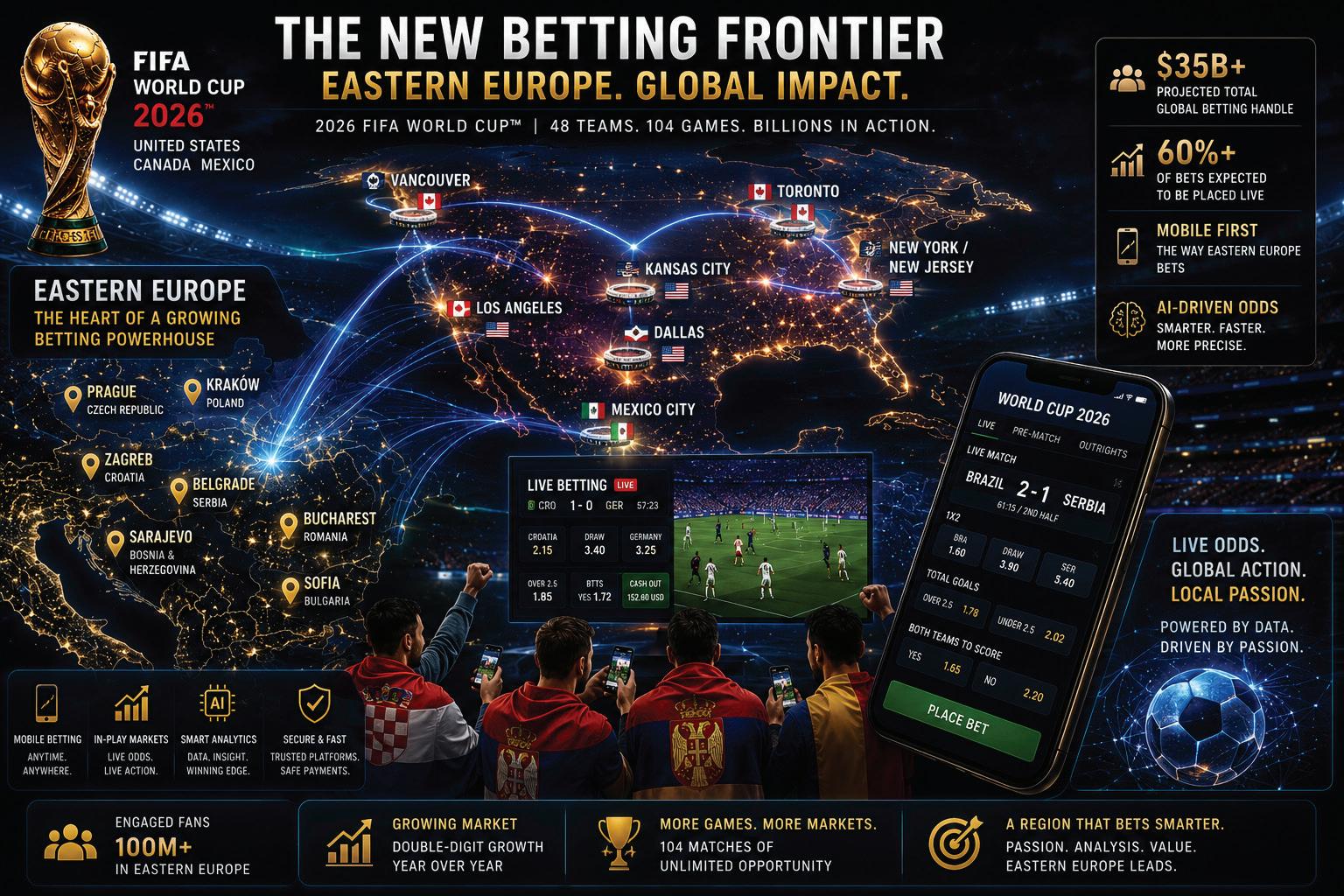
Being the biggest sporting event of the year, the 2026 FIFA World Cup will have significant implications on the sports betting industry and the world economy in general. Featuring an increased number of 48 national teams and 104 games, the tournament, which will take place at various locations in the United States, Canada, and Mexico, is projected to be the most viewed sports event ever, possibly drawing a global audience of more than six billion people.
While the hosting countries will continue to be the primary focus in terms of logistics and commercial facets, Eastern Europe still finds itself
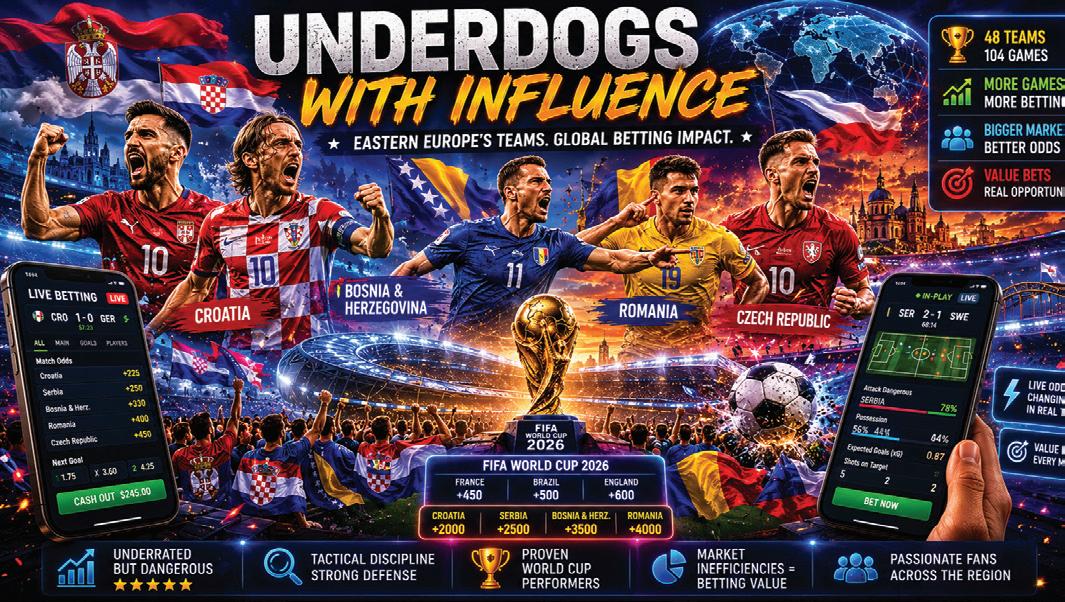
in a quite a distinct and powerful role. Not only the region is a source of national teams capable of competing at the highest level but also it is a betting market evolving rapidly with great potential and a key player within the global football economy. Nations like Croatia, Serbia, Bosnia and Herzegovina and Romania are challenging for success on the pitch and, at the same time, being responsible for the alteration of betting patterns and territorial market changes.
This piece considers the engagement of Eastern Europe in the 2026 World Cup through the prism of three principal issues: the development
of betting trends, the results of national teams, and the extended market influence.
The Expansion Effect: Why 2026 Changes Everything
Expanding the pool from 32 to 48 teams is a radical change, affecting the sports and commercial aspects of the game in equal measure. Besides more teams, there will be more matches, more stories and, most importantly, more chances to place bets. It is estimated by experts that at the global level nearly $35 billion could be wagered on this mega event, which is a huge jump from previous years.
On the other hand, it makes things a bit challenging for bettors also. Given that there will be 12 groups and knockout rounds, it will be a more complex structure and bettors who are able to do deeper analysis will be the ones winning. Betting on group winners, qualification scenarios, and in-play betting will be among the most popular ones.
Eastern Europe’s betting style fits nicely with this complexity since they have generally been inclined towards analytical methods, statistical modeling, and value betting.
The Rise of In-Play Betting
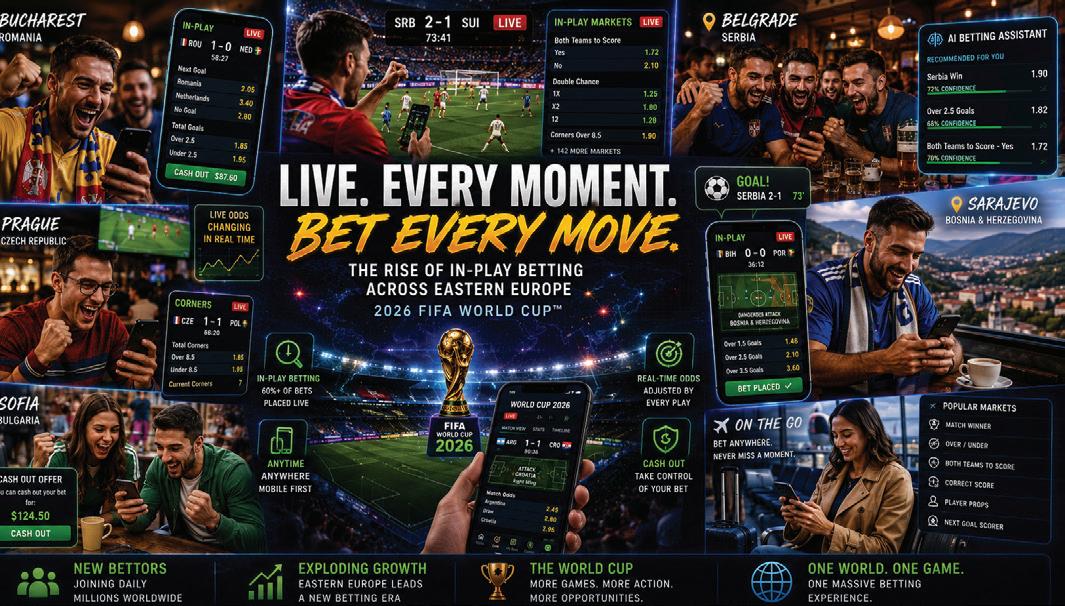
One of the major trends shaping the 2026 World Cup is the overwhelming popularity of in-play betting. It is anticipated that more than 60% of bets will be made live during games, signaling a move towards instant interaction.
The Eastern European bettors seem to have leapt ahead in embracing this trend. Good internet facilities together with extensive mobile betting platform usage in the region have made live betting not only a feature but a crucial aspect of the whole experience. Bets are adjusted to changing game situations, new tactics, or even the decisions of the referees, making the market continuously evolving and very lively.
The Explosion of First-Time Bettors
The 2026 World Cup will certainly be a major source of interest for new bettors in general. According to market research, more than sixty percent of soccer enthusiasts around the world are considering placing bets on this tournament with a majority expecting to make their betting debut at this occasion. Additionally, in some parts of Eastern Europe, the issue is not only about willingness but also about accessibility which is being extensively facilitated by the regulatory environment. For example, Romania and Bulgaria have been actively working on the legalization and regulation of this type of gaming for a while and several other nations are working on providing frameworks for online gambling in particular. Under such circumstances it is easy to see how international events like the World Cup offer great opportunities for sports betting companies to not only meet the demand but also attract firsttime customers.
Personalization and AI-Driven Odds
Nowadays, many bookmakers are turning to AI in their efforts to personalize the experience of the users. Through adjusting the odds or recommending bets made specifically for the user, these tools are meant to draw more users and make them stay longer.
Eastern Europe is an area rich in skilled technical workforce and a flourishing fintech industry. Besides being a market for these products, this region also plays a role in developing such innovations. Firms and programmers from the area are seriously engaged in creating the new breed of betting platforms.
Eastern European National Teams: Underdogs with Influence
The Legacy of Overperformance
Eastern European teams have often
surprised the football world by doing better than expected in major international tournaments. For instance, Croatia was the runner-up at the 2018 FIFA World Cup, and Bosnia and Herzegovina is the reason why Italy will miss their third consecutive World Cup.
Their historical performances thus affect betting markets. Punters normally see these squads as “value picks” since they get better odds as compared to the usual powerhouses but still have solid opportunities to go far in the tournament.
Emerging Contenders
The expanded format brings a chance for teams like Bosnia and Herzegovina and the Czech Republic to step in. These countries have been making good progress continuously over the years, thanks to their well-established youth training systems and more frequent appearances of their players in the best European leagues.
For bettors, these teams are potential candidates to exploit market inefficiencies. As pointed out in betting reviews, underdogs are frequently a source of great value, especially in group-stage and knockout progression bets.
Tactical Identity and Betting Implications
One of the most common traits of Eastern European teams is that they are wellorganized in defense and very adaptable tactically. These attributes generally cause games to have a low number of goals scored. So, betting options relying on the number of goals, such as betting on fewer goals or both teams scoring, are in fact very popular in this region-oriented market.
It is very important for those who are placing bets to thoroughly understand the subtle differences between playing styles. At the same time, it is a reminder of how local knowledge can be a powerful tool, giving bettors from Eastern Europe
a great advantage when analyzing their national teams.
Market Impact: Eastern Europe as a Betting Powerhouse
A Rapidly Growing Industry
Eastern Europe is fast becoming the most promising betting market globally. Some of the reasons contributing to the rise include internet access expansion, higher disposable incomes, and changed legal environments.
The World Cup serves as a great opportunity for the betting market to grow rapidly. This is mainly because big sporting events not only trigger but also reach the utmost levels of betting activities. Hence, the size of the 2026 event will most certainly increase the betting craze to a big extent.
Cross-Border Platforms and Global Integration
While Western European countries have rather well-developed markets, Eastern Europe is still working on adapting a similar mix of local and international industry players. A lot of gamblers therefore rely on cross-border platforms and take advantage of even the global markets and their odds.
Such integration has a number of consequences. For one, it enhances rivalry among the operators, pushes them to innovate, and at the same time, broadens the selection of betting opportunities that the local market players can offer to the bettors. Nevertheless, it also brings up regulatory issues, especially with regard to the protection of consumers and promotion of integrity in the local betting environment.
Economic Spillover Effects
Besides betting, the economic impact of the World Cup is quite extensive. More engagement not only results in greater advertising revenues but also sponsorship
and media rights sales. Eastern European companies, particularly tech and payment service providers, hold a major position in this ecosystem.
The tournament worldwide is anticipated to trigger a huge wave of economic activity with billions circulating across diversified industries. The region of Eastern Europe will witness new jobs, inflow of investments, and enhanced recognition on the world map as a result of this.
Technology, Data, and the Future of Betting
The Role of Official Data
The collaboration between FIFA and companies like Stats Perform who supply data shows how crucial the role of official data in gambling on sports has become. Correct live data is the backbone for betting during the course of the game, as it allows sportsbooks not only to provide their customers with continuously changing odds but also betters to base their decisions on solid data.
The technology industry in Eastern Europe is one of the key players in the sphere, especially in areas of data analysis, developing software, and improving the user experience on betting platforms.
Mobile-First Betting
Mobile devices are the most popular platform for betting in Eastern Europe. This is in line with global trends but it is especially true of the region because of the high number of people using smartphones and the fact that mobile banking is very popular.
The World Cup’s arrangement, with games happening in various time zones, also serves to promote the use of mobile devices. Bettors can place bets whenever they want, leading to a rise in the level of activity overall.
The Influence of Cryptocurrencies
Cryptocurrencies are another budding trend in betting. Eastern Europe, having been among the major crypto technology adopters, is now home to many platforms that offer crypto betting options.
This new trend is a double-edged sword. On the one hand, it offers greater privacy and flexibility. On the other hand, it gives rise to worries about the issues of regulation and the financial system’s stability.
Challenges and Risks Regulatory Uncertainty
Although great steps have been made, regulatory frameworks in Eastern Europe are still quite patchy. While some countries have fully implemented systems, others are only starting to develop their legislative mechanisms.
For operators as well as bettors, this mismatch of regulations poses a challenge. Taxation, licensing and consumer protection are some of the aspects that differ greatly, thus making cross-border operations difficult.
Market Saturation and Competition
The fast expansion of the betting sector has resulted in a rise of competition. Although consumers are the main beneficiaries of this
situation through improved odds and various promotions, operators are also faced with the challenge of distinguishing themselves.
The Football World Cup further escalates this struggle for competition because firms fight for a share in the market during the unexpectedly huge period of the tournament.
The Broader Football Economy Ticketing, Tourism, and Economic Impact
The 2026 World Cup could potentially be one of the most profitable sports events ever, given the huge interest in tickets and the major economic estimates.
Yet, problems like the expenses of flying and visa restrictions might impact attendance, especially for foreign fans. As for fans from Eastern Europe, these elements might prevent them from going to the stadium, at the same time they could lead to an increase in their online participation such as betting and watching through a digital medium.
Financial Pressures on National Associations
One of the most pressing concerns of Eastern European football associations is the financial difficulties they face in participating in the tournament. In fact, escalating costs and the logistical issues involved can limit the football
associations’ budgets, at the same time when prize money is on the rise.
Such a situation results in a paradox: the World Cup on one hand presents football associations with a great chance in terms of revenue, on the other hand, the smaller nations bear the burden of the financial risks involved.
Conclusion: Eastern Europe at the Heart of a Global Phenomenon
The 2026 FIFA World Cup is not only a football event - it is a worldwide economic and cultural phenomenon that will leave a deep impact. For Eastern Europe, it can be a door to possibilities but also a big hurdle.
When it comes to betting, the area is expected to become a hub, mainly because of new technologies, changes in gambling laws, and enthusiastic sports lovers. Features like live betting, prop markets, and AI-based personalization are changing the market, and it is Eastern Europe that is leading these innovations.
The expanded format of the competition, in terms of national teams, offers more opportunities for representation and success. At the same time, Eastern European teams, which are usually top-class in terms of their resilience and tactical discipline, will be able to contribute to the game as well as to the betting markets.
The overall market impact highlights even more the region’s increasing significance in the global football economy. Eastern Europe, in terms of technology and data, consumer engagement and economic contributions, is a fundamental part of the World Cup ecosystem.
As the football fiesta is just around the corner, one thing is crystal clear: Eastern Europe is not merely going to be a part of the 2026 World Cup, they will be the ones to shape it.

PROTECTING CANADA’S SPORTING INTEGRITY
IBIA, CFL and betting operators unite through athlete education initiatives to combat match-fixing risks across Canada’s expanding betting market
As Canada’s regulated sports betting market continues to expand, integrity stakeholders are placing greater emphasis on athlete education as part of wider efforts to safeguard sport and betting markets.
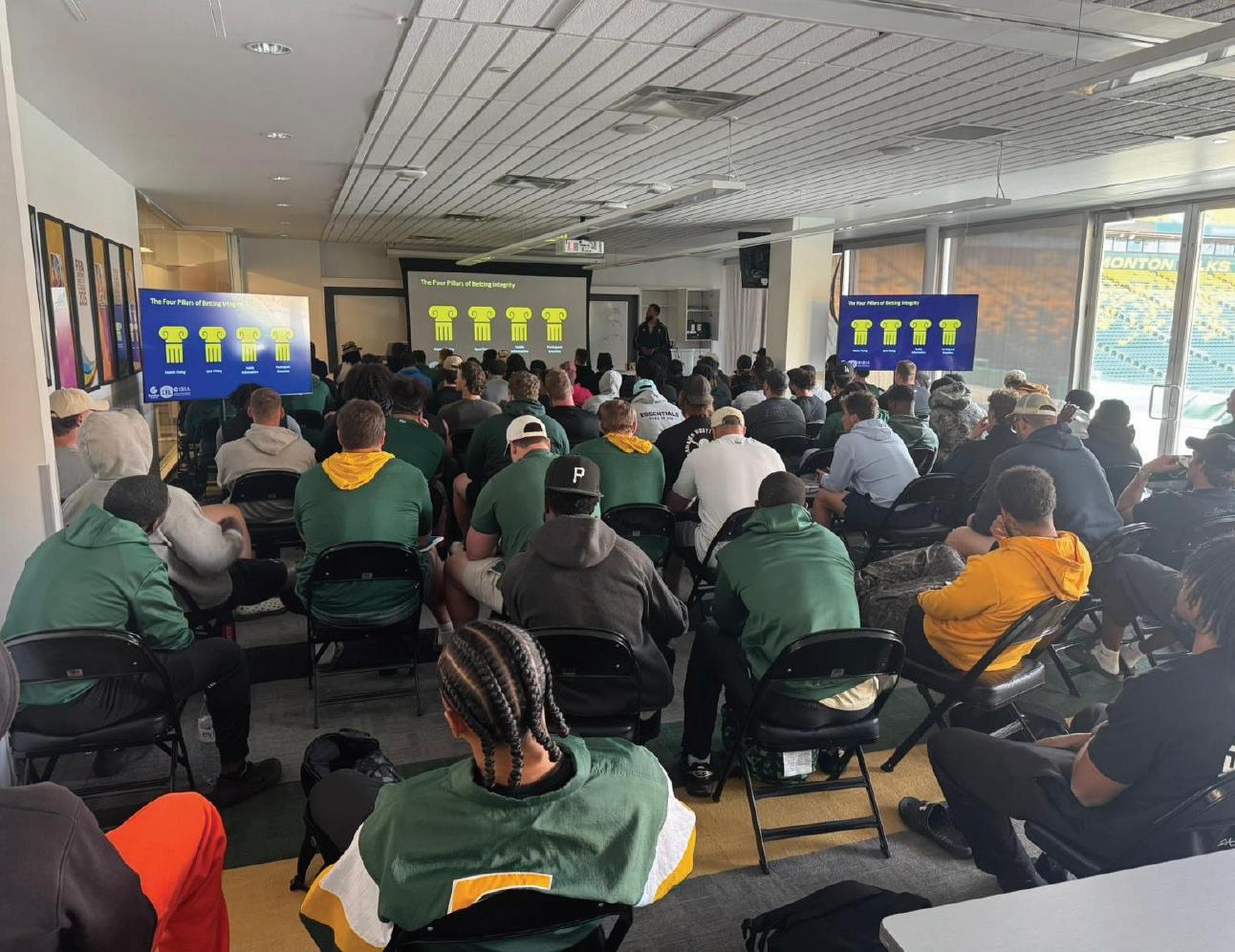
A new integrity training programme delivered across all nine Canadian Football League (CFL) teams has brought together the sport, its data specialist, betting operators and their integrity monitor in a coordinated effort to better protect athletes and competitions from match manipulation and betting-related corruption.
The initiative is being led by the International Betting Integrity Association (IBIA), the leading integrity monitor in Canada, alongside CFL’s official data partner, Genius Sports. The sessions have been delivered face-to-face, allowing direct engagement with players around the risks and pressures they may encounter.
Athletes from all nine CFL teams have taken part in the programme, including franchises in Edmonton and Calgary, ahead of Alberta’s planned
launch of a regulated online sports betting and gaming market in July. Teams in Toronto and Hamilton have also participated, reflecting Ontario’s established role as Canada’s first province to open its online market to private operators in 2022.
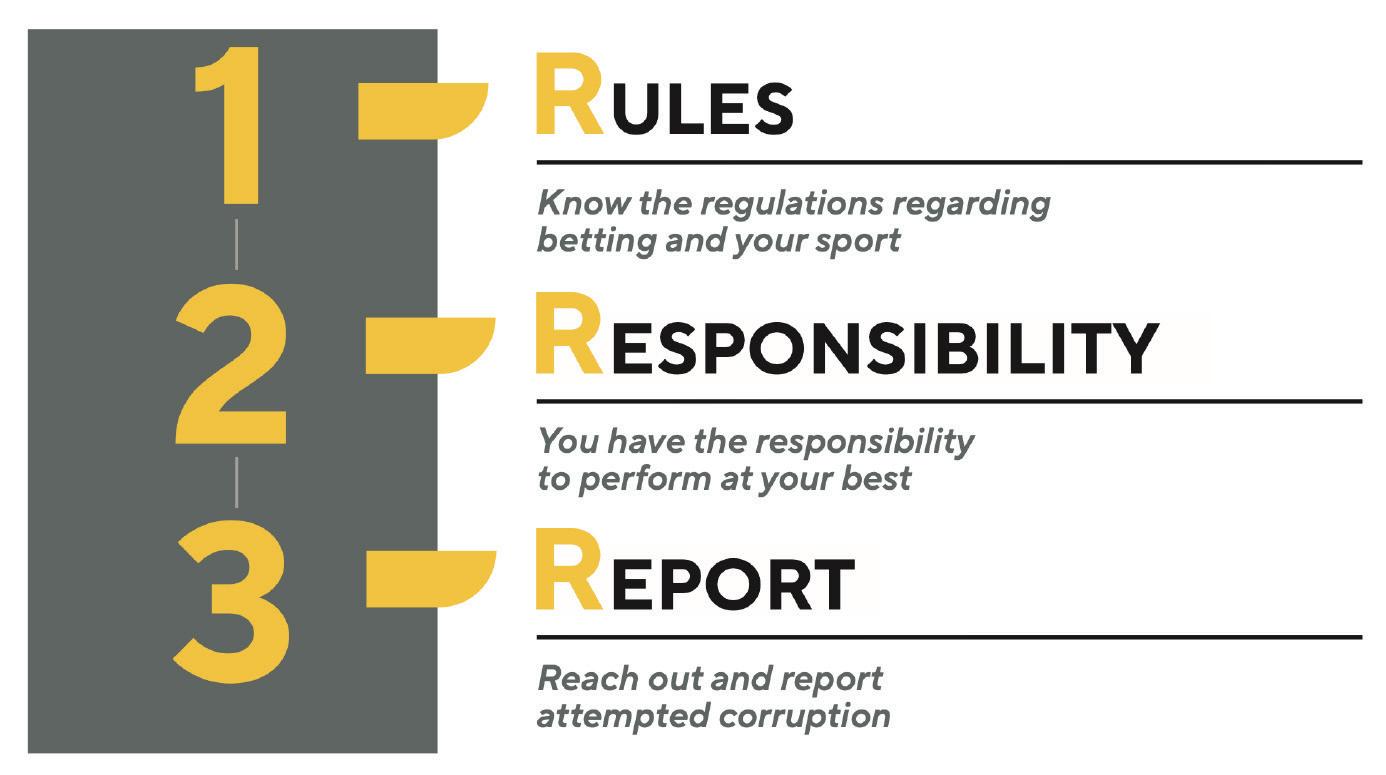
The training sessions were delivered by IBIA Education Ambassador, JeanFrançois Reymond and consultant and former NFL, CFL and EFL player Anthony Mahoungou using the association’s “3Rs” framework: Rules, Responsibility and Report. As former professional athletes in American football and basketball respectively, they utilised their understanding of the challenges facing players and focused the sessions on practical scenarios linked to match-fixing, the misuse of inside information and other forms of betting-related corruption. The importance of reporting and whistleblowing was also highlighted.
“In-person training reflects a simple reality: integrity measures don’t work on paper alone, they work when athletes understand them, trust them and use them,” Mahoungou said. Reymond added that “having a former football player alongside us really

helps to get the message across. There is a level of trust and confidence that is very important in a locker room.”
That focus on direct engagement reflects a deep understanding of the importance of preventative integrity measures rather than relying solely on monitoring and enforcement after suspicious activity has already occurred.
For sports leagues and betting operators alike, athlete awareness is increasingly viewed as a critical part of integrity protection. The rapid growth of regulated and unregulated betting markets has expanded the visibility and accessibility of sports wagering, increasing the importance of ensuring athletes understand the risks associated with insider information, approaches from third parties and betting-related misconduct.
The IBIA-Genius Sports-CFL initiative also highlights how integrity education is becoming more operationally integrated into wider market
development strategies in Canada.
Khalid Ali, CEO of IBIA, said the effectiveness of integrity measures depends on cooperation between stakeholders across sport and betting.
“Sport’s integrity is only as strong as the investment and cooperation behind it,” he said. “When leagues, athletes, operators and integrity bodies work together, and education truly connects, it moves from theory into action, creating a powerful tool to helping athletes to recognise and respond to risks in real situations.”
The initiative forms part of a CAD$300,000 investment committed by IBIA and its members FanDuel, bet365 and Betway, to support integrity education and prevention measures in Canadian sport.
That funding will also support a third consecutive year of integrity education sessions for Canadian Premier League players and staff later this year in partnership with PFA Canada.
As Canada’s regulated betting
market continues to evolve, integrity stakeholders are increasingly positioning prevention and athlete education as essential components of long-term market sustainability. While monitoring and enforcement remain central to integrity frameworks, initiatives such as the CFL programme underline the growing emphasis on reducing risks before they escalate into wider sporting or betting-related issues.
That focus comes at a particularly important time for the Canadian market, with Alberta preparing to open its regulated iGaming and sports betting framework in July. Ahead of that launch, IBIA has also been approved as a licensed integrity monitor in the province, meaning integrity monitoring and informationsharing mechanisms will form part of the market structure from day one. Through its Global Monitoring & Alert Platform (MAP), IBIA will support operators and regulators in identifying, assessing and escalating suspicious betting activity, helping to strengthen integrity protections as the new market develops.

BRAZIL RESHAPES BETTING INTEGRITY
IBIA’s latest report reveals rising integrity risks, growing esports alerts and Brazil’s expanding influence on global betting markets
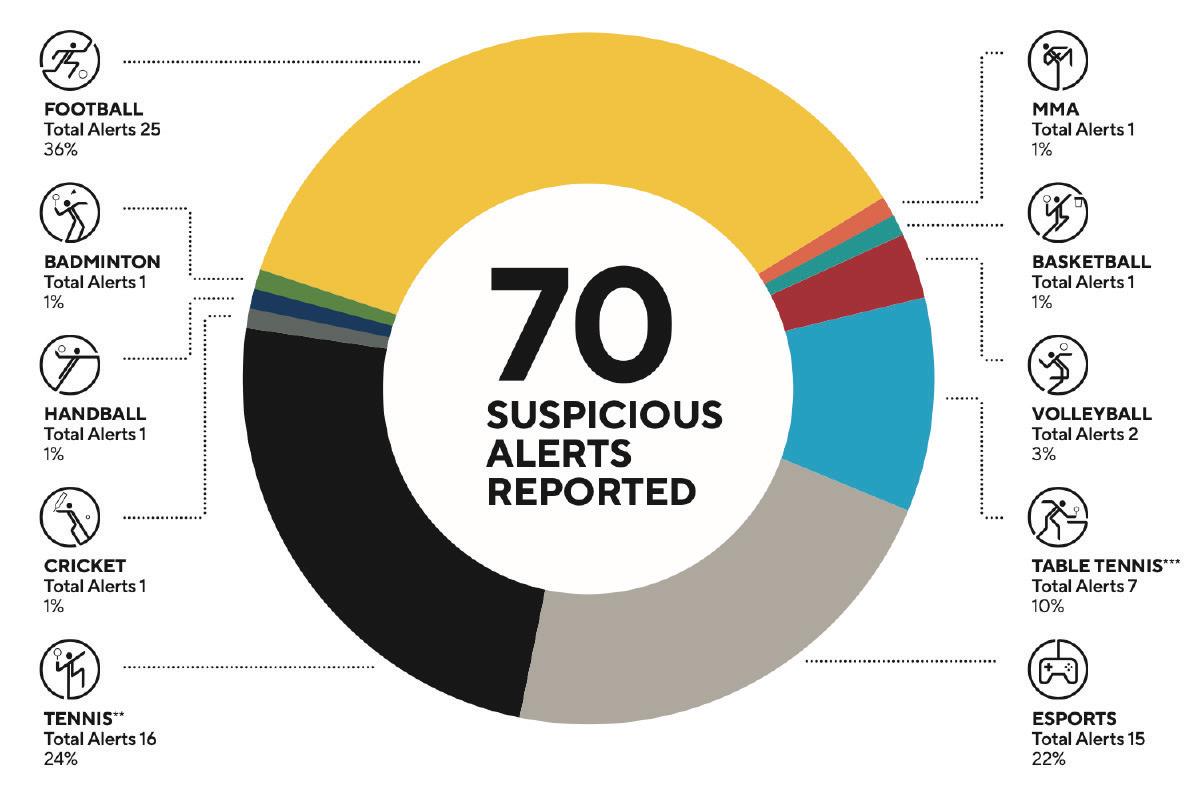
The International Betting Integrity Association (IBIA) reported 70 suspicious betting alerts during Q1 2026 across 10 sports, with football, tennis and esports accounting for 80% of cases. The report also highlighted the growing importance of Brazil and the wider Latin American market as regulated betting activity continues to expand. Football remained the most reported sport, generating 25 alerts, representing 36% of all cases reported during the quarter. Tennis followed with 16 alerts, while esports accounted for 15 alerts. Table tennis recorded 7 alerts, with the remaining cases spread across volleyball, badminton, cricket, handball, basketball and MMA.
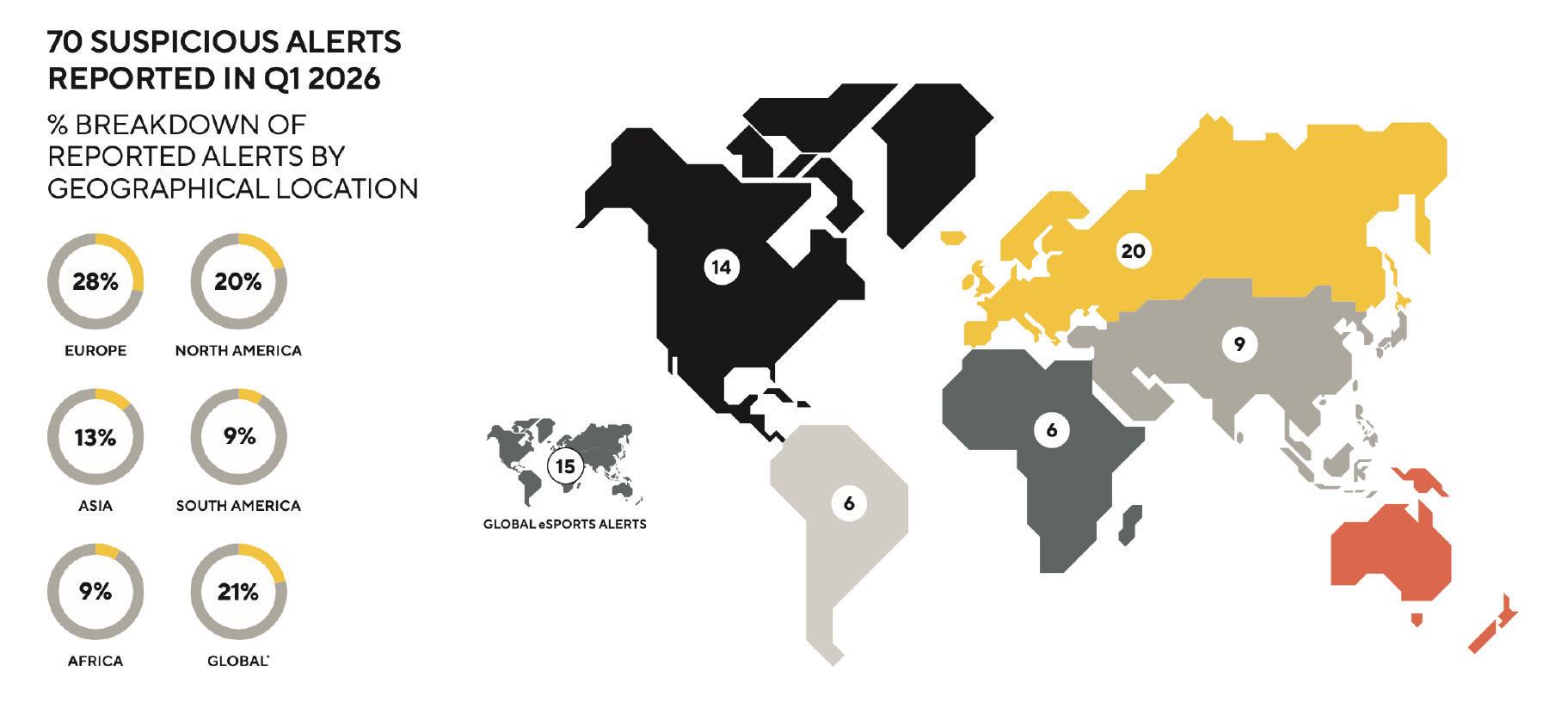
IBIA noted that six of the tennis alerts related to events outside the main professional tours, while all seven table tennis alerts concerned competitions outside International Table Tennis Federation oversight. From a regional perspective, Europe accounted for the largest share of alerts with 28%, followed by the “global” esports category at 21% and North America at 20%. Asia represented 13% of reported alerts, while Africa and South America each accounted for 9%. Football alerts were recorded across multiple regions, with Mexico generating eight cases during the quarter. Additional football alerts were reported in Ghana, Malta, Cyprus, Albania and Brazil.
Tennis alerts were geographically dispersed, with cases reported in India, Chile, Egypt, Mexico, Spain, France and the UAE among others.
Esports continued to feature prominently within IBIA’s monitoring activity, with all 15 alerts categorised as “global” due to the transnational nature of esports competitions and betting activity.
A key focus of the report was Brazil’s rapidly developing regulated betting market and the protection of
that market, which requires all licensed operators to be part of an integrity monitoring body. Leading industry data and intelligence company H2
Gambling Capital has calculated that IBIA and its licensed members monitor 90% of the turnover of the Brazilian sports betting market.
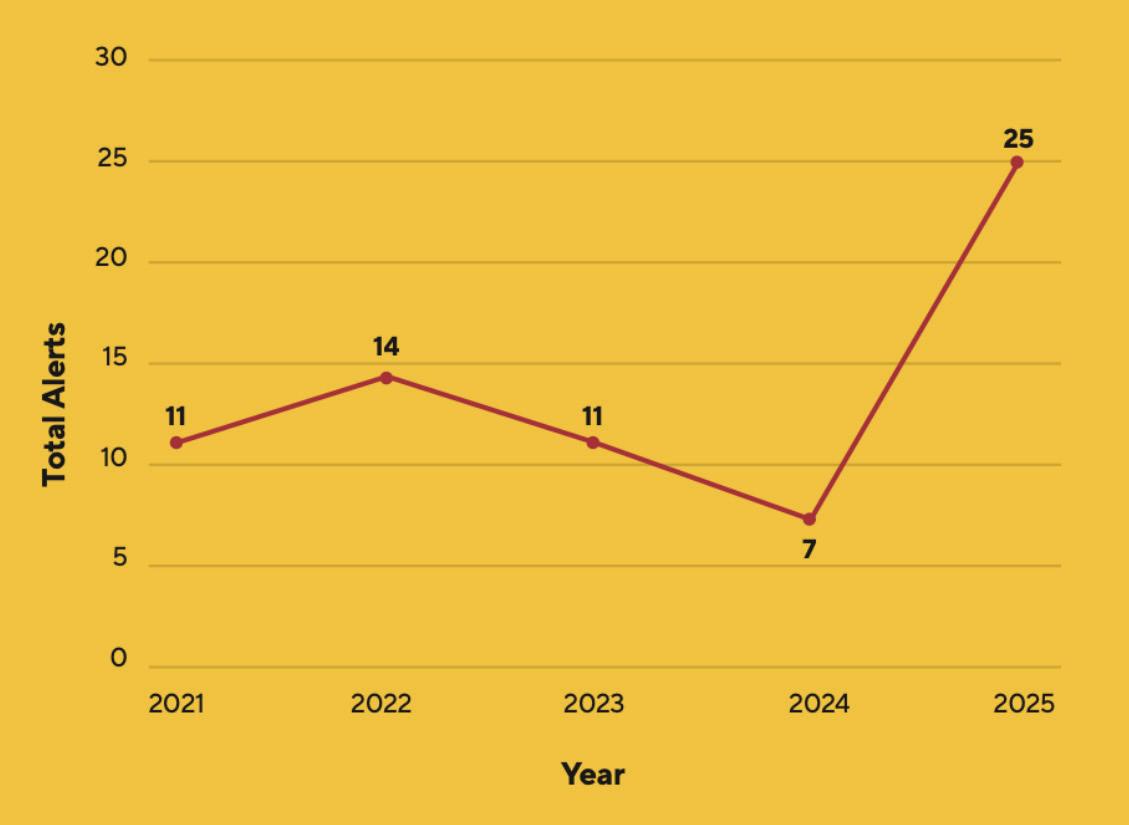
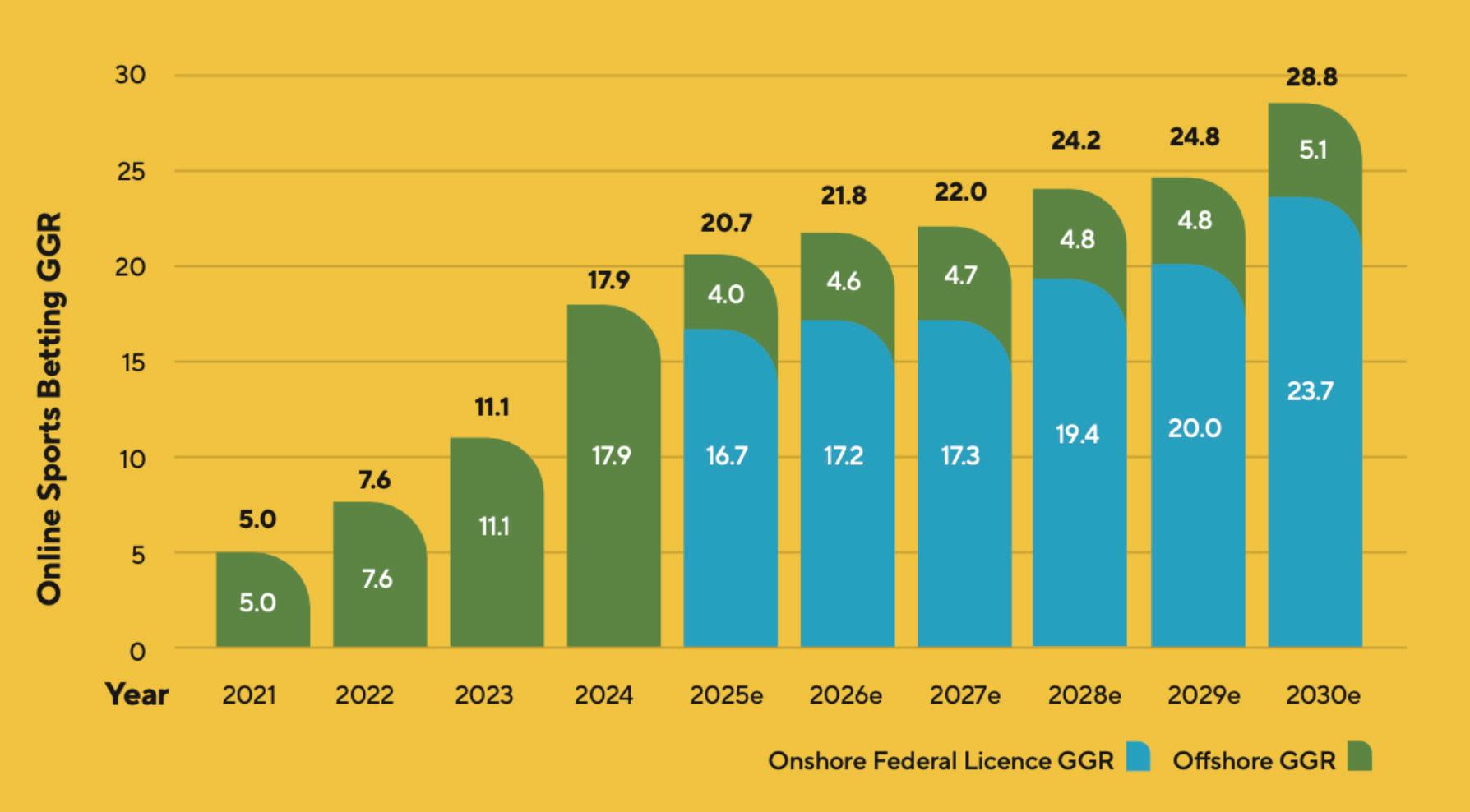
IBIA stated that 68 suspicious betting alerts relating to Brazil had been reported between 2021 and 2025 across eight sports, with football accounting for 51 (or 75%) of those alerts. Basketball and tennis each recorded six alerts during that period. The report also highlighted forecasts surrounding Brazil’s transition towards federally licensed betting activity following the introduction of regulation in 2025. According to the report, Brazil’s online sports betting gross gambling revenue is forecast to reach BRL28.8bn by 2030, with onshore licensed operators expected to
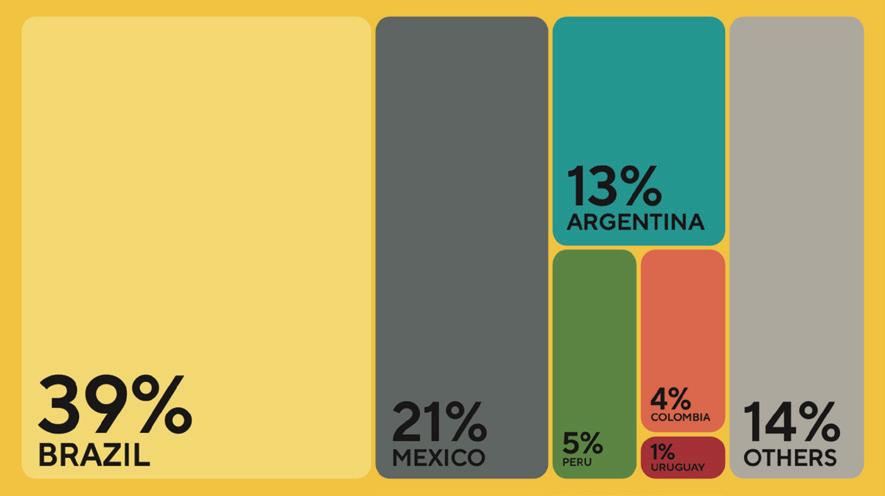
account for more than 80% of market GGR. Brazil is projected to account for 39% of the total Latin American betting market in 2026, ahead of Mexico at 21% and Argentina at 13%. Collectively, those three markets are expected to represent more than 70% of the region’s total betting GGR. Taken together, the Q1 figures underline the continued concentration of suspicious betting alerts within football, tennis and esports, while also highlighting the growing operational significance of emerging regulated markets such as Brazil.
5 design services in one creative hub



SPORTS MARKETING GETS SMARTER
Boomerang Partners reveals how real-time behavior, AI-driven strategy and audience retention are reshaping the future of sports marketing
Sports marketing used to be relatively straightforward.
Major sports events – from international tournaments to league finals – meant big audiences, and visibility was often enough to drive results.
By 2026, that model is no longer enough. Competition for sports traffic has intensified, acquisition costs have increased, and audiences have become more selective in how they engage. Being present around major sports events is no longer a differentiator –everyone is there.
What matters now is not just how brands capture attention, but how they choose to work with it.
This shift is especially visible in affiliate-driven environments. As brands rethink how they engage sports audiences – and face tighter regulation and greater competition – affiliate strategies have to adapt just as quickly.
Performance is measured in real time, with teams competing under the same conditions and reacting to the same events.
This is where new formats and mechanics start to matter. Earlier this year, Boomerang Partners, a sports-focused affiliate program, brought together affiliate teams as part of the TIME TO WIN affiliate tournament.
The insights in this article come from real partner activity – from day-to-day campaign work to what teams tested during the TIME TO WIN tournament.
It’s no longer campaign-driven
The way sports marketing works is no longer built around campaigns. It’s built around behavior. What used to be planned weeks in advance now shifts during the event itself. Timing changes. Messaging changes. Sometimes, even the format changes.
The shift is simple: marketing is no longer planned around events – it adapts to them continuously, with messaging, concepts, and storytelling evolving from one moment to the next. These shifts don’t just affect how brands work with players – they also reshape how affiliate partners operate. As a result, partners have to adapt their strategies, formats, and approaches to engagement.
Personalization plays a big role here. Not as a feature, but as a baseline. Generic offers don’t hold attention anymore. If it’s not relevant to what the user is watching or reacting to, it gets ignored.
This is also changing how sponsorships work. Visibility still matters, but it’s no longer enough on its own. Brands are moving into formats that go beyond the match – content, integrations, and ongoing digital touchpoints.
At the same time, the space has expanded. Sports, esports, streaming – they now compete for the same attention, alongside a much broader set of content and digital experiences.
That makes timing harder. Big tournaments still drive peaks, but the build-up and the drop-off matter just as much. Planning around these moments is becoming more data-driven. Earlier this year, Boomerang Partners introduced its Sports Marketing and Betting Calendar 2026, built to map those patterns and help affiliates align campaigns with key moments and make more informed decisions around their strategy. In practice, partners use it to plan ahead for major events, streamline research, and structure content around both highdemand and niche sports.
From watching to reacting
Audience behavior has changed faster than most strategies – and it becomes especially visible in live, competitive environments.
During the TIME TO WIN tournament, this shift was hard to miss. Affiliate teams worked with sports traffic in real time, around live events, where attention moved constantly, and decisions were made on the spot.
Watching sport is no longer passive. During major matches, users follow the game while checking odds, reacting to moments, and switching between platforms. The second screen is no longer secondary – it’s part of the experience.
In practice, this meant that teams competing in the tournament had to adapt quickly – reacting to live moments, adjusting content, and aligning campaigns with audience behavior in real time.
That changes how campaigns are built. Timing matters more. Missing the moment often means losing the user.
Content is changing as well – and fast. Short-form formats capture a growing share of attention, especially among younger audiences. The full match is no longer the only point of engagement.
Behavior is becoming more social. Communities form around events –not just around teams, but around the experience itself.
Olesea Naidion, Brand Manager at Nightrush, TIME TO WIN participant, noted:
“The biggest shift I’ve noticed is that audiences don’t just ‘watch’ sports anymore – they’re actively participating. During major matches, people react to every moment – every corner, every substitution, every momentum shift.
The second-screen behavior is fascinating. Fans have their phones out the entire time – checking odds, chatting, and reacting on social media while the match is happening.
The traditional ‘sit back and watch’ experience is no longer how a large part of the audience engages with sport.”
What actually matters now
Not all traffic is equal anymore. Volume still matters, but it no longer defines success. What matters is what happens after the click – how fast users convert, how long they stay, and whether they come back.
This shift was clearly visible during the TIME TO WIN tournament. When campaigns ran around real-time events, performance was measured differently. There was no long funnel – the decision happened immediately, or not at all.
In practice, traffic and performance closely followed the sports calendar. Early peaks aligned with major tournaments, while quieter periods –such as international breaks – led to visible slowdowns. Consistent spikes on weekends also highlighted how closely user activity tracked liveevent density.
Conversion has become timesensitive. Delays cost results.
Retention matters more now. Acquiring users is more expensive, and users have more options. If they don’t see value quickly, they move on.
As a result, performance is evaluated differently. Impressions and reach are no longer enough to justify spending. What matters is whether activity turns into deposits, bets, and repeat engagement.
Olesea Naidion, Brand Manager at Nightrush, TIME TO WIN participant, commented:
“Engagement rate, conversion velocity, and customer lifetime value have become the most critical metrics. Impressions don’t pay the bills – action does.
We need to understand if content drives real behavior in real time, especially during live events when the conversion window is minutes, not days.”
What defines success
Sustaining results has become harder. Strong performance can still happen in short bursts. But without consistency, it doesn’t hold. The gap between short-term gains and long-term growth is becoming more visible.
What separates teams now is not access to traffic or events. It’s how that traffic is handled – how quickly it converts, how long it stays, and whether it returns.
That shifts the focus from individual campaigns to the full user journey. Acquisition, conversion, and retention are no longer separate – they have to work as a single system.
This is also reflected in how partners performed in the TIME TO WIN tournament. Even beyond the initial launch phase, participation continued to build, showing that sustained performance – not just early momentum – defines success.
When that connection breaks, performance drops just as quickly as it grows.
Anete Dunina, Head of Sales at Revpanda Group, TIME TO WIN participant, noted:
“Success in sports marketing will be defined by control over the full user journey. It’s about acquiring, converting, and retaining the right users, not just traffic.
Short-term wins don’t build long-term business.”
The shift is already visible across the market. It goes beyond marketing –reflecting broader changes in how sport is consumed, how brands operate, and how affiliate ecosystems evolve. Those who can adapt to it consistently will shape what sports marketing looks like next.