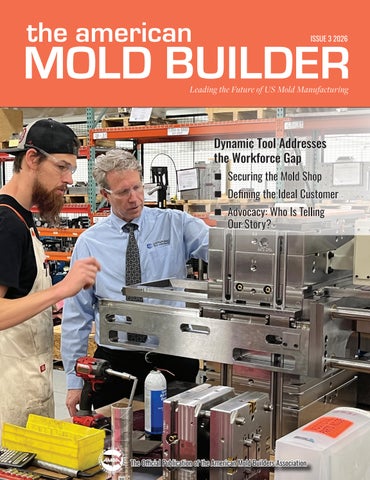
ISSUE 3 2026
Dynamic Tool Addresses the Workforce Gap Securing the Mold Shop
Defining the Ideal Customer Advocacy: Who Is Telling Our Story?
The Official Publication of the American Mold Builders Association
“With easy ordering and competitive pricing, Pro is our default Mold Cylinder source.” Marshall Cole, Operations Manager, Michigan Tool Works
Versa-Slide® Assemblies
Top Locks
Vented Ejector Pins
NEW ADVANTAGES Michigan Tool Works specializes in high-tolerance, fast lead-time aerospace tooling. These needs align with Progressive’s full component range, now with newly added Mold Cylinders:
Plate Latch Locks
“We’ve been impressed by the simplicity and personal touch of the Cylinder ordering process, and with such competitive pricing and deliveries, Progressive is now our default Mold Cylinder source.” Also new are Versa-Slides®, with MTW finding that “it’s the fastest way to get a slide done and reduce overhead tooling lead time.” Request a v18 Catalog or visit procomps.com/New to discover Pro’s expanding product line—designed for the industry’s evolving needs.
PROCOMPS.COM/v18 SHOP.PROCOMPS.COM
Stainless Steel Ejector Pins
Mold Cylinders
Save the Date!
2027
Built on Excellence
Built on Excellence March 16-18 ▪ Grand Rapids, MI
REGISTRATION OPENs SOON
ambaconference.com
STAY UP-TO-DATE ON REGISTRATION, programming, and more AMBACONFERENCE.COM | INFO@AMBA.ORG | 317.436.3102
ISSUE 3 2026
8
Speak Out .................................................6 News ....................................................... 22
By Liz Stevens, writer, The American Mold Builder
14
Association ........................................... 28
FOCUS Securing the Mold Shop: A Q&A on Cybersecurity, AI and Digital Readiness By Lindsey Munson, managing editor, The American Mold Builder
Calendar ................................................ 38 Ad Index ................................................. 38
EDUCATION Dynamic Tool Uses Apprenticeships to Address the Workforce Gap
20
BENCHMARKING More Than Shop Rates: How Industry Intelligence Drives Better Business Decisions By Rachael Pfenninger, director of strategic execution, AMBA
Cover photo courtesy of Dynamic Tool. 4
the american MOLD BUILDER | Issue 3 2026
AMERICAN MOLD BUILDERS ASSOCIATION 7321 Shadeland Station Way, #285 Indianapolis, IN 46256 P: 317.436.3102 • F: 317.913.2445 info@amba.org • www.amba.org
8
25
ADVOCACY Who Is Telling Our Story? By Kym Conis, managing director, AMBA
30
TALENT Beyond the Paycheck: Why Benefits and Culture Drive Retention in Mold Manufacturing
25
AMBA TEAM
Troy Nix, Executive Director Kym Conis, Managing Director Susan Denzio, Business Manager Rachael Pfenninger, Director of Strategic Execution Ashlynn Burns, Communications Specialist
Advising Editor: Kym Conis Advertising/Sales: Susan Denzio PUBLISHED BY:
By Rachael Pfenninger, director of strategic execution, AMBA
33
SALES Creating Clarity: The Importance of Defining the Ideal Customer By Shelly Otenbaker, president, WayPoint Marketing Communications
37
PREVIEW MD&M Midwest: A Connecting Point for Modern Manufacturing
2150 SW Westport Dr., Suite #101 Topeka, KS 66614 P: 785.271.5801 Vice President, Editorial: Dianna Brodine Managing Editor: Lindsey Munson Vice President, Design: Becky Arensdorf Graphic Designer: Hailey Mann Opinions expressed in this publication may or may not reflect the views of the Association and do not necessarily represent official positions or policies of the Association or its members.
www.americanmoldbuilder.com | AMBA.org
5
A MESSAGE FROM THE AMBA PRESIDENT
G ANDY PETERSON AMBA President,
INDUSTRIAL MOLDS
reetings, AMBA members. I’m not sure how 2026 has been for you, but for me, both professionally and personally, this year has brought challenges that I did not expect. In the Industrial Molds shop, we have had a string of retirements that is putting our plan to train new talent to the test. There have been both victories and setbacks. Personally, there have been challenges that have tested me and caused me to reevaluate some of the core beliefs I have held. But during this time, I came across the story of Bill Ackman, a hedge fund manager who in 2011 was named CEO of the Year. Within five years, his fund was on the brink of collapse, shareholders were suing him, net worth was dropping by the day and his wife of 20-plus years was divorcing him. He had every right to call it quits and give up. But he didn’t.
Instead, he realized he still had his health and could change his trajectory. He could not compare himself to where he was, as the gap was too great. He realized that all he needed to do was improve by 0.5% a day. A simple, achievable 0.5% a day. Be better today than yesterday. With time and the power of compounding, the change would be great in a short period of time. We all have the power to do 0.5% a day. The apprentices and junior moldmakers with a few years of experience cannot replace the senior moldmaker with more than 40 years, but they can be better than they were yesterday. In business, I can improve every day in my decision-making or relationships with customers. Any particular day I might not notice the change, but compounded day in and day out, the change becomes impossible to miss. This is my challenge to all AMBA members: Be better by 0.5% each day. Share with someone – or at least yourself in a journal – what you are doing to achieve this challenge. This mindset change in my life has had a huge impact. For example, the apprentices might have made mistakes that then make me question their abilities and long to have the skilled toolmaker back, but a question I started asking myself is, “Are they improving daily?” I make mistakes, but am I improving and getting better each day? I have been able to say “Yes!” and am amazed by how many people have noticed the change in my life within the last six months. I look forward to hearing about others’ successes. For connection within the AMBA, there are many opportunities to connect and grow this year. For those looking to continue to increase sales into 2027, there is a Sales and Marketing Roundtable on September 2 at 1 p.m. (EST). I have multiple people from my team who plan to join for insight and sharing of best practices. Also, there is the Third-Quarter Advocacy Update webinar by AMBA’s lobbying team and Omar Nashashibi on September 16 at 1 p.m. (EST). Then, on October 22, Hanson International will host a plant tour workshop, followed by MD&M Midwest set for October 28-29. I encourage you to check out these events as well as others on AMBA’s website – each event offers an opportunity to connect and improve by 0.5%. Until next time. n
OFFICERS
National President Andy Peterson, Industrial Molds Vice President Hillary Thomas, Westminster Tool
6
the american MOLD BUILDER | Issue 3 2026
Secretary and Legal Counsel Alan Rothenbuecher, Benesch, Fiedlander, Coplan & Aronoff LLP Treasurer Kyle Klouda, MSI Mold Builders
BOARD OF DIRECTORS
Jeff Ford, BICO Steel Justin Gregg, Dramco Tool Co., Inc. Scott Kraemer, Xact Metal Steve Michon, Zero Tolerance Troy Roberts, Tolerance Tool Camille Sackett, Accede Mold & Tool Scott Smith, Tessy Tooling Todd Steging, Prestige Mold
ALLIANCE SPECIALTIES CORP. / ALLIANCE LASER SALES, INC.
• MOLD FINISHING • LASER WELDING • LASER ENGRAVING • HOT RUNNER REPAIR • MOLD MAINTENANCE • LASER MACHINE SALES
ESSENTIAL WHEN YOUR MOLD MATTERS
We offer mold finishing, laser welding, laser engraving, mold maintenance, and hot runner manifold repair all under one roof. We also manufacture and sell the only fully American made laser welding and laser engraving systems, custom built specifically for your toolroom. Let Alliance make a difference for you.
BUILT BY MOLDMAKERS FOR MOLDMAKERS EVERY PART OF THIS MACHINE IS EASILY ADJUSTABLE TO ALLOW YOU THE VERSATILITY AND FLEXIBILITY YOU NEED TO MEET ALL OF YOUR DEMANDS.
• FIBER LASER TECHNOLOGY • MADE IN AMERICA • HIGH PRECISION LASER WELDING • NO MAINTENANCE NEEDS
PROUD PARTNER MEMBER
265 INDUSTRIAL DR. WAUCONDA, IL 60084
PHONE
847.487.1945
ONLINE
ALLIANCELASERSALES.COM
ADDRESS
CONTACT US TODAY ABOUT AN IN-HOUSE DEMO, TO SEE THE ALLIANCE DIFFERENCE.
DYNAMIC TOOL USES APPRENTICESHIPS TO ADDRESS THE WORKFORCE GAP By Liz Stevens, writer, The American Mold Builder
W
orkforce recruiting is a perennial task for mold builders, and stark numbers back up the claim. For just one category of jobs – machinists and tool and die makers – more than 1/4 million job openings are estimated over the next eight years. According to the US Bureau of Labor Statistics, “Overall employment of machinists and tool and die makers is projected to decline 2% from 2024 to 2034. Despite declining employment, about 34,200 openings for machinists and tool and die makers are projected each year, on average, over the decade.” 1 Knowing this, mold builders like Dynamic Tool take workforce recruiting as seriously as any other aspect of its business, approaching it strategically to address the workforce gap. Dynamic Tool Corporation, Menomonee Falls, Wisconsin, builds high-productivity injection molds for medical, packaging, personal care and industrial applications, supporting all phases of plastics injection mold builds. Its expertise stems from its industry-specific workforce, including engineers, designers, programmers, toolmakers, machinists, quality control specialists and mold maintenance specialists. In an industry that continually faces recruiting challenges, Dynamic has used apprenticeships to meet its recruitment needs since 2020, when it formally organized an apprenticeship program. John Berg, Dynamic’s director of marketing, shared insight with The American Mold Builder about the company’s program.
“Workforce development has long been a foundation and focus of Dynamic,” Berg said. “The offshoring mindset of the early 2000s dealt a near-fatal blow to interest in manufacturing careers in southeast Wisconsin. The 8
the american MOLD BUILDER | Issue 3 2026
stories of lay-offs and plant closures had our home market convinced that we couldn’t competitively make products here anymore.” As a result, enrollment in trades education dropped significantly. “Where there once was a waiting list to enroll in the tool and die program in our region’s technical colleges, there now were more empty seats than full ones,” Berg said. “This led to the big age gap in tool shops and machine shops. There was a good base of 50-to65-plus-year-old workers, very few in their mid-30s to 40s, and a small number in their 20s to 30s.” GROWING A WORKFORCE For Dynamic, the first step was recognizing that a mold builder cannot successfully grow the shop’s innovative capabilities without new talent and ideas. With veteran toolmakers retiring at that time, Dynamic didn’t want to grow its business at the expense of other shops by soliciting their talent. “While our culture, growth and performance reputation has attracted local toolmakers as new team members, we focused on growing our own,” said Berg, “by seeking candidates while they were in high school and even late grade school.” The apprenticeship concept was not new to the company, as Dynamic has been a strong proponent of apprenticeships from its earliest days. “Several of our company’s senior toolmakers, project managers and company leaders served their apprenticeships at Dynamic decades ago,” Header photo: Company President Steve Eberle, who served his apprenticeship and earned his journeyman certificate at Dynamic, has decades of experience as a moldmaker, design engineer and project manager.
WISCONSIN’S APPRENTICESHIP PROGRAM The state of Wisconsin supports its manufacturers with an apprenticeship program. Dynamic’s office manager, Tracy Rhyner, is the apprenticeship liaison and makes certain that the company’s program is compliant with the Wisconsin Department of Workforce Development. “The state’s apprenticeship program is extensive; it covers nine different classifications/career applications,” Rhyner said. “Wisconsin tool shops and machine shops are in the industrial and manufacturing registered apprenticeship category, which has 21 areas of focus. Our apprentices generally fall under the tool and die or machinist programs. We also have developed our own apprenticeship program for mold design, which is not affiliated with the state.” Scott Matenaer, Dynamic’s chief development manager, is a mentor and one of the company’s apprentice program leaders. He described the value of the Wisconsin apprenticeship program. “The team and system behind the state’s program have a long history of success,” he said. “The program continues to grow and improve; it has a solid online presence explaining the options available, and it provides support and guidance needed by the student and the employer.” THE TEAM BEHIND DYNAMIC’S APPRENTICESHIP PROGRAM Dynamic Tool built its apprenticeship program with a firm understanding of the requirements for success and sustainability. In Wisconsin, a company’s main responsibility as an apprenticeship sponsor is to provide on-the-job training to an apprentice under the supervision of skilled workers. For the moldmaker apprenticeship, the specified 10,400 hours of learning activity requires
thousands of hours of support from a shop’s mentoring and administrative side. At Dynamic, several people dedicate time to apprentice-related activities every day. Michael Welnak, mold manager at Dynamic, is the lead apprentice program manager, ensuring that each apprentice receives the needed support. “Dynamic chooses mentors based on their desire for the role and their ability to communicate and teach,” Welnak said. “We have program mentors with a general perspective, and we have process mentors to teach the details of particular operations, like hard-cutting, graphite machining and sinker and wire EDM.” Matenaer described aspects of an apprenticeship. “Using a tool and die apprenticeship as an example,” he said, “we have a seven-phase, 10,400-hour program. In the first 1,000 hours, an apprentice learns about and manufactures gibs, wear plates and simple mold components. During this period, an apprentice begins reading prints and learning basic CAD functions.” The next 1,000 hours challenge an apprentice to perform simple core and cavity preparation tasks, as well as post-heat-treat grinding and squaring. “This increases apprentices’ CAD skills, and they then will start working on job timelines,” Matenaer said. “The responsibilities, as well as the depth and breadth of the studies, increase with every phase of the program. An apprentice meets regularly with the management team and department mentors for feedback on progress and support.” Currently, Dynamic has two apprentices, two
t
Berg said. But a more concentrated and consistent approach to apprenticeships began in 2020, when Steve Eberle, Dynamic’s president, became majority owner. “Steve recognized the challenge our industry faces with the shortage of toolmakers, machinists and designers,” Berg said. “He created a team to manage the monitoring, engagement, growth and potential of every apprentice and intern.”
Top left photo: One of an apprentice’s first projects at Dynamic is to understand an injection mold’s many components. Organized identification and cataloging of each mold’s components become a valuable resource for customers and for Dynamic. Top right photo: A supportive, engaged management team is imperative to creating, maintaining and growing Dynamic’s culture of education. An apprentice relies on the shop team for education, experience and career progress. The shop needs the apprentice for fresh perspectives and approaches to new challenges. www.americanmoldbuilder.com | AMBA.org
9
t interns preparing for apprenticeship and four interns who are attending school. One Dynamic apprentice earned his journeyman certificate this summer, and four others became journeymen in the last year. MATCHMAKING: DYNAMIC TOOL + APPRENTICE It takes a good judge of character to choose a candidate who will make a good apprentice. While Dynamic’s involvement in workforce-cultivating activities – school tour events, open houses and participation at school recruiting fairs – yields potential apprenticeship candidates, Matenaer said that the initial interview is a critical step. “Before Dynamic considers any prior experience or exposure to machining, we look for certain attributes,” he said. “We seek candidates with an innate interest and understanding of mechanical properties and actions of engineering. Are they good at math? Do their hobbies (e.g, cars, cycles, ATVs, boats) involve maintenance activities? Did they grow up in an agricultural environment, regularly repairing and maintaining equipment? Do they have a passion to devise engineered solutions?” Matenaer described Dynamic’s aim with an apprenticeship. “Our goal is to monitor, support and provide opportunities
to interns or apprentices to become their best at whichever focus resonates with them,” he said. “During the five-year tool and die program, apprentices gain experience in project planning, materials procurement, team collaboration, machining process phases, mold assembly and component documentation. By the end of the apprenticeships, they become accountable, responsible members of our mold building teams.” MAKING IT HAPPEN John Berg shared best practices for recruiting and apprenticeships. “The key is to have members of the company’s team involved with recruiting, engagement and execution,” he said. “Recruiting includes defining the shop’s role requirements and the attributes of the team members being sought.” Company introspection also is needed, including these suggested topics: Is the company recruiting from another company or a shop in its area? Is a company willing and able to grow its own new talent? Are there high schools and technical colleges in the area with strong trades curricula? “Next comes communicating with the target audience,” said Berg, “such as engaging with the local educational resources and educating them about career opportunities in mold building. Also, participating in school career fairs and hosting career fairs at the shop and introducing the company to the community – to students and to parents, too.” WHAT’S POSSIBLE: APPRENTICE TO PRESIDENT Dynamic Tool’s President Steve Eberle began his career at the company as an apprentice. He credits the apprenticeship for the mold building knowledge that equipped him to succeed and eventually take the helm at Dynamic. Eberle offered advice to mold builders on the search for talent. “Toolmakers are retiring at a higher rate than people entering the moldmaking trade,” he said. “Unfortunately, most school systems don’t understand the thermoplastics industry – so they don’t encourage students to consider our industry as a solid career path. We need to educate school leaders and show off our industry’s opportunities.”
the american MOLD BUILDER | Issue 3 2026
t
10
Eberle underscored that moldmaking and mold design are great career choices. “There are opportunities to learn and advance throughout a worker’s entire career, including gaining in-depth technical knowledge and sophisticated skills. The opportunities in mold building include learning to operate an array of equipment and IT tools, and gaining understanding of many principles.” To wit: • Operate advanced machining practices and processes on state-of-the-art equipment • Learn effective, efficient manufacturing principles and procedures • Learn how to develop and execute detailed schedules • Master multiple mold building technologies and techniques
WELCOME RECEPTION SPONSOR
EMPOWER. ENGAGE. EXCEL.
Sept. 29 - Oct. 1, 2026 Indianapolis, IN
You’re INvited Visit our 138,000 ft2 state-of-the-art facility in Auburn Hills, Michigan, where we design, manufacture, assemble, test and service Hot Runner Systems for the North American Market. In addition, INCOE, a USA family-owned business since 1958, offers engineering solutions, flow simulation, individualized training, 24/7 service and support that includes 300,000+ in-stock replacement components. Experience first-hand the benefits of USA based manufacturing - schedule a Facility Tour or Hot Runner Training Maintenance and Repair Course today at info@incoe.com.
10
CLASSROOM TRAINING
LAB TRAINING
North America | Europe | Asia | South America
620 1718 206210 201
202 19 021081 2081 8 5
5
-202
2016
www.americanmoldbuilder.com AMBA.org 11 Learn more @ |INCOE.COM © 2026 INCOE®
t • Make use of multiple CAD/CAM systems • Understand the characteristics of thermoplastic resins and their applications • Practice Engineering for Productivity and Design for Manufacturing • Become proficient in mold sampling and testing • Apply metrology at the highest level for steel and plastic parts Eberle stressed that Dynamic has made the commitment and allocated the resources to hire its next generation of ‘makers.’ “We need all companies servicing our industry to invest in the future of thermoplastics in America – to promote, educate and train,” he said. “We at Dynamic are passionate about providing opportunities and support for the next generation of moldmakers, designers, programmers and machinists.” Dynamic Tool demonstrates how mold building companies can approach apprenticeships strategically, implement successful programs and make an investment that pays dividends for years to come. n More information: www.Dyntool.com
APPRENTICESHIP PROGRAMS y Wisconsin’s Apprenticeship Program (Tool and Die): https://dwd.wisconsin.gov/ETPL/Home/ Details/194?Keyword=tool%20and%20die%20makers y Western Technical College Apprenticeship Program, La Crosse, Wisconsin (Tool and Die): www.westerntc.edu/ programs-possibilities/apprenticeships/machinisttooldie-maker y Federal Apprenticeship Program Source for career seekers, employers and education partners with apprenticeship resources: www.apprenticeship.gov y Nationwide Directory of US Department of Labor’s (DOL) Offices of Apprenticeship (OA) and recognized State Apprenticeship Agencies (SAA): www.apprenticeship.gov/about-us/apprenticeship-system References 1. “Machinists and Tool and Die Makers,” Occupational Outlook Handbook, US Bureau of Labor Statistics. https:// www.bls.gov/ooh/production/machinists-and-tool-and-diemakers.htm
THEY GAVE THEIR ALL. LET’S GIVE SOME BACK. The iWarriors mission is to honor severely injured soldiers from all branches of the Armed Forces by providing personalized tablets and technology to aid in their rehabilitation and recovery. Support is from the American Mold Builders Association, MoldMaking Technology, and suppliers.
2026 Golf Outing Friday, September 25
2026 Golf Outing Friday, October 23
2027 Bowling Party Wednesday, February 10
JOIN INDUSTRY FRIENDS RAISING FUNDS FOR OUR VETS: www.iWarriors.org WWW.iWARRIORS.ORG 12
the american MOLD BUILDER | Issue 3 2026
U
AS
ER
.S
FR
.A.
IN
MAC HI
ASSEM BL ED
D& NE
,M
ICHIGA
N,
TOP
WORK
PLACES
2023-2025
PART OF THE USA TODAY NETWORK
www.americanmoldbuilder.com | AMBA.org
13
SECURING THE MOLD SHOP: A Q&A ON CYBERSECURITY, AI AND DIGITAL READINESS By Lindsey Munson, managing editor, The American Mold Builder
A
dvancements in artificial intelligence (AI), digital systems and connected technologies are creating new opportunities across the molding industry to improve productivity, streamline workflows and gain greater visibility into operations. At the same time, these technologies present challenges surrounding cybersecurity, data protection, employee training and long-term technology strategies. For mold shops, understanding where to begin and how to build a solid digital platform is becoming increasingly important. To explore this topic, The American Mold Builder magazine brought together three industry professionals with unique expertise and experience. Roger Bassous, president of R.E.R. Software, Inc., shared his perspective from decades of experience developing software solutions that help manufacturers improve planning, production tracking and operational visibility. Kristopher Chandler, partner at Benesch Friedlander Coplan & Aronoff LLP, provided insight into the legal, risk management and cybersecurity considerations. Kyle Klouda, president of MSI Mold Builders, offered the viewpoint of inside a mold builder’s shop applying technology in a real-world manufacturing setting. FOR SMALL- TO MEDIUM-SIZED SHOPS, WHAT DOES DIGITAL READINESS LOOK LIKE TODAY, AND WHERE SHOULD BUSINESSES BEGIN? Bassous: Mold shops vary widely in their level of digital readiness, and in how far they have progressed along their digital transformation journey – with many still in the early stages. Digital readiness falls into two key areas: hardware and software. From a hardware perspective, the first step is to establish a reliable technology infrastructure.
14
the american MOLD BUILDER | Issue 3 2026
This includes networking machines and connecting the PCs, tablets and other devices used throughout the shop floor. From a software perspective, the process begins by identifying where digital solutions can deliver the greatest business value. Whether the priority is quoting, planning, production tracking or operational oversight, it is important to clearly define the process the company wants to improve and the data it wants to capture or make more accessible. Once those objectives are established, the next step is to evaluate software providers (or internal efforts) and select the solution best aligned with the company’s operational needs, business goals and long-term digital strategy. Chandler: Digital readiness does not necessarily mean adopting every new technology at once. It means having the systems, data practices and internal discipline to use technology in a way that improves the business without creating unnecessary risk. In practical terms, that includes knowing what digital assets the company has, where critical customer and design data resides, who has access to it, how that access is controlled and how the business would continue operating if a system went down. Companies should begin with the basics: map the most important business processes and data flows. For example, how does a customer CAD file enter the organization, where is it stored, who can view or modify it, how is it shared with vendors or subcontractors and when is it archived or deleted? That exercise often reveals immediate opportunities to improve efficiency and security at the Photo courtesy of R.E.R. Software.
The best starting point is not usually a major technology overhaul. It is in building a practical digital foundation: create inventory systems, classify sensitive data, tighten access controls, back up critical information and make sure new technology decisions are being made with input from operations, IT, management and legal or contractual advisors where appropriate. Klouda: For most mold shops, digital readiness isn’t about having every new piece of technology. It’s about being able to find information quickly, know where a job is at and make decisions based on data instead of chasing employees down for answers. A good starting point is looking at how information moves through the shop. From quoting and design to machining, EDM, assembly and sampling, there usually are a few places where information gets stuck or entered multiple times. Fixing those bottlenecks often provides more value than buying new software. Mold shops get the biggest wins by improving their existing systems, digitizing paperwork where it makes sense and creating better visibility into what’s happening on the floor. Start with the basics and build from there. FROM A BROADER PERSPECTIVE, WHERE CAN AI PROVIDE THE GREATEST VALUE FOR MOLD SHOPS, AND WHERE SHOULD THEY PROCEED WITH CAUTION? Bassous: The most accessible AI opportunities for mold builders today include data analysis, search, marketing and proposal development. AI can accelerate quoting by reviewing past estimates, identifying similar jobs and potentially automating much of the process. It also can generate marketing images and content while helping employees strengthen proposal-writing skills. However, companies must consider internal and customer data-privacy requirements before using cloud-based AI tools, as submitted information may be retained or used for model training. AI results should be carefully reviewed, with human oversight before any output is accepted or applied. Chandler: AI can provide real value to mold builders by helping employees to make better, faster decisions from information the shop already has. Near-term opportunities include quoting support, project scheduling, predictive
maintenance, quality analysis, document review, customer communications, inventory planning and identifying patterns in job performance. AI also helps organize institutional knowledge, preserving expertise from veteran employees. One of the most promising applications is analyzing operational data to identify trends behind rework, delays, machine downtime and quoting variance. In that sense, AI is less about replacing skilled employees and more about giving them better information. Shops should proceed with caution when AI tools touch customer’s confidential information, proprietary designs, trade secrets, pricing models or employee data. Public AI tools are not simply productivity applications – data retention practices, usage rights and terms of use matter. Uploading customer or proprietary information without understanding how it will be used can create contractual, confidentiality and intellectual property risks. Accuracy also requires attention. AI can generate confident but incorrect results, making human oversight essential. Organizations should establish clear policies for AI use, limit sensitive data exposure and begin with lower-risk applications before expanding into more critical business functions. Klouda: Right now, AI is most valuable when it helps employees work smarter, not when it tries to replace them. Mold building is a highly skilled trade, and AI isn’t going to replace experienced mold designers, programmers or moldmakers anytime soon. The biggest opportunities are with things like quoting, searching historical job data, helping with design reviews, CAM programming assistance, scheduling and finding patterns in shop data. These are areas where employees spend a lot of time digging through information, and AI can speed that up. The area where shops need to be careful is treating AI output as fact. AI can be a great assistant, but it doesn’t inherently understand tooling, shutoffs, cooling layouts, steel selection or customer requirements the way experienced people do. It should help support decisions, not make critical engineering decisions on its own. FOR A COMPANY BEGINNING ITS DIGITAL TRANSFORMATION, WHAT IS ONE PRACTICAL STEP IT CAN TAKE TO IMPROVE EFFICIENCY, DATA MANAGEMENT OR TECHNOLOGY ADOPTION? Bassous: One practical step a mold shop can take today is to measure machine utilization. By identifying idle time, bottlenecks and unrealized machining capacity, a shop can improve scheduling, increase throughput and generate more value from equipment it already owns. This also creates a strong data foundation for future digital transformation efforts.
www.americanmoldbuilder.com | AMBA.org
t
same time. Many organizations rely on software platforms, cloud storage, ERP systems, machine monitoring tools and outside IT providers. Before adopting new tools, companies should understand who owns the data, how the data may be used, whether the vendor can use it to train AI systems, what security commitments the vendor is making and what happens if the relationship ends.
15
t
From a legal and risk-management standpoint, this exercise especially is useful because it connects business operations to contractual obligations. Many shops receive customer data under purchase orders, nondisclosure agreements or supplier terms that impose confidentiality, security or datahandling requirements. A shop cannot reliably meet those obligations unless it knows where the data is and who can access it. Klouda: One of the best things a mold shop can do is create a technology roadmap. Start by evaluating how the business manages data, communicates and uses technology across the organization. Identify the biggest gaps, then prioritize the improvements that will have the greatest impact. It also helps to get an outside perspective. That doesn’t have to mean hiring an expensive consultant. Invite an AMBA member that the company respects to spend a day in the shop and provide honest feedback. Even the solution providers making cold calls can be a valuable resource – they’re often willing to point out opportunities for improvement. The key is to understand where the shop is today so it can build a realistic plan for the future. WHAT CYBERSECURITY RISKS ARE COMMONLY UNDERESTIMATED BY MOLD BUILDERS? Bassous: Most ransomware incidents and intellectual property losses result from inadequate IT security and insufficient employee training. Limiting administrative access and controlling software installations can significantly reduce the risk of malware from infected downloads. Because phishing attacks increasingly are sophisticated, all employees should be trained to avoid suspicious links and independently verify sensitive requests. For example, confirming wire instructions directly with a vendor rather than relying on email alone. Chandler: One risk mold builders often underestimate is the sensitivity and value of the data they hold. Many 16
the american MOLD BUILDER | Issue 3 2026
shops understand that they need to protect financial information or payroll data, but they may give less attention to some aspects of customer files, technical drawings, specifications, prototypes, production data, pricing information and communications about future product plans. That information can be highly valuable to customers and competitors, and it may be protected by contractual confidentiality obligations. This is important because a cyber incident at a mold shop may not just be an internal IT problem. It can become a customer relationship issue, a contractual issue and potentially an intellectual property issue. If a shop loses access to files due to ransomware, production can stop. If customer design files are accessed or exfiltrated, the impact may extend beyond the shop’s own operations. Another commonly underestimated risk is employee access. Many incidents do not start with highly sophisticated attacks. They start with compromised credentials, phishing emails, weak passwords, shared accounts or former employees retaining access longer than they should. For a smaller shop, these issues can feel administrative, but they often are central to real-world cybersecurity risk and contractual and legal exposure. Klouda: The biggest risk many shops underestimate is the value of their CAD files and design data. Most companies think cybersecurity starts and ends with ransomware, but customer models, tool designs, CAM files, quotes and engineering data are some of the most valuable assets a mold shop has. If those files get into the wrong hands, the damage may not be obvious right away, but it can have a long-term impact on the shop and the customer. The challenge is that these files move around a lot. They’re shared with customers, programmers, vendors and remote employees. Every handoff introduces some level of risk. That’s why protecting intellectual property has to be treated with the same importance as keeping servers and workstations running. IF EVERY MOLD SHOP COULD IMPLEMENT JUST ONE CYBERSECURITY BEST PRACTICE THIS YEAR, WHICH PRACTICE WOULD PROVIDE THE GREATEST IMPACT, AND WHY? Bassous: If every mold shop could implement one cybersecurity best practice this year, it should be maintaining secure, regularly tested backups of critical business and production data. Mold builders rely on valuable CAD files, customer information, machine programs, quotations and operational records. A ransomware attack, hardware failure or accidental deletion can bring production to a halt if that information cannot be recovered quickly. Backups should
t
Chandler: One practical step is to create a simple data and systems inventory. It does not need to be complicated. A shop can start by listing its key systems, what each system is used for, what types of data are stored there, who has access, whether the system is cloud-based or on premises and whether the information is backed up. That inventory creates immediate value because it gives management a clearer picture of the business’s digital operations. It can reveal duplicate tools, inconsistent storage practices, outdated permissions or critical information that only one person can access. It also becomes a foundation for better cybersecurity, vendor management, insurance applications and future technology adoption.
WHO’S BRINGING NEW LEVELS OF PERFORMANCE TO COMPACT HOT RUNNER/MANIFOLD SYSTEMS? At Plastic Engineering & Technical Services, we are.
for better process repeatability, and no over-pressurizing the
We define performance. For nearly 30 years, we’ve helped our
cylinders. It all adds up to a reduced sized hot runner system,
customers to produce more efficiently, with lower cycle times
shorter heating times and better tool performance.
and lower per unit costs.
We deliver value. We complement our hardware with
Our new compact stainless steel, modular unitized system
leading-edge analytical tools, including Moldflow® and
features flexible heaters that can be utilized on multiple designs,
MOLDEX3D software. We’ll work with you on design issues
so you don’t have to stock custom bent heaters. Our new drop
and optional gating solutions before the mold or hot runner
heaters provide more uniform heating and feature smaller
manifold system is ever built. Use us for the mold flow analysis
pockets and no clamps. They have in-line flow restrictors
and the manifold build, and we’ll do whatever it takes to make your hot runner/manifold system work to your complete satisfaction. We’re committed to your success. Find out more.
Call us today at 248.373.0800 or visit us at www.petsinc.net.
t
Organizations will need to carefully monitor their current and future compliance obligations as they build their AI infrastructures and increase their reliance on AI tools. be automated, stored separately from the main network and tested regularly to confirm that the data actually can be restored. This relatively straightforward step significantly can reduce downtime, protect intellectual property and help a shop recover more quickly from a cyber incident. Chandler: If one cybersecurity measure had to be prioritized, implementing multifactor authentication would be the recommendation, especially for email, remote access, cloud storage, ERP systems and any system containing customer or business-critical data. Multifactor authentication is not perfect, but it is one of the most practical and effective steps a shop can take to reduce the risk that a stolen password becomes a full compromise. Email is important because it often is the gateway to the rest of the business. If an attacker gains access to an email account, they may be able to impersonate employees, redirect payments, access customer files, reset passwords or gather information for a more targeted attack. Adding multifactor authentication creates an additional barrier that can prevent many credential-based attacks from succeeding. The key is to implement it thoughtfully. Multifactor authentication should apply to leadership, finance, engineering, project management and anyone with access to sensitive customer or operational data. It also should be paired with basic access reviews so the shop can confirm that employees and vendors only have the access they need. Klouda: If only one cybersecurity measure could be implemented, it should be multifactor authentication (MFA) across the entire business. Most of the attacks the industry hears about start with a compromised password. MFA adds another layer of protection that can stop attackers even if 18
the american MOLD BUILDER | Issue 3 2026
they already have someone’s login credentials. Priority should be given to Microsoft 365, email, VPN access and remote-access tools, as these systems often serve as the entry point into a company’s network. There are a lot of important cybersecurity controls, but MFA provides companies one of the biggest security improvements for the least amount of effort and cost. WHAT ROLE DO EMPLOYEES, TRAINING AND CULTURE PLAY IN PROTECTING A COMPANY’S DIGITAL SYSTEMS AND DATA? Bassous: Employees play the most critical role in cybersecurity. Training them to understand malware and data-privacy risks is the simplest first step, while bulletinboard notices and recurring reminders help keep security top of mind. Chandler: Employees are essential. Cybersecurity is not just an IT function; it is an operational discipline. A shop can buy good technology and remain vulnerable if employees do not know how to recognize suspicious emails, handle customer files, use approved tools or report concerns quickly. Training should be practical and specific to the shop’s work. Employees should understand why customer data, quotes, specifications and production data matter. They should know when it is acceptable to use personal devices, external drives, cloud-sharing tools or AI applications, and when it is not. In addition, employees should know how to report a suspected phishing email, lost device or accidental disclosure without fear that they will be blamed for speaking up. Culture matters because people often avoid reporting mistakes if they think they will be punished. That delay can turn a manageable incident into a serious one. A strong cybersecurity culture encourages employees to pause before clicking, verify unusual requests, question unexpected payment or file-transfer instructions and escalate concerns quickly. Management sets the tone. If leadership treats cybersecurity as a business priority tied to customer trust, quality and continuity, employees are more likely to take it seriously. For mold builders, that framing is important. Protecting digital systems and data is part of protecting the shop’s reputation and the customer relationships that sustain the business. Klouda: The reality is that employees either are the strongest defense or the biggest vulnerability. Most cybersecurity incidents don’t happen because a firewall
failed. They happen because someone clicked a malicious link, responded to a phishing email or shared information with the wrong person. That’s why training is critical. Employees don’t need to become cybersecurity experts, but they should know how to recognize suspicious emails, handle customer data properly and report something that doesn’t look right. Creating a good security culture is just as important. When employees feel comfortable asking questions or reporting mistakes without getting blamed, issues get identified much earlier and usually are much easier to contain.
as they build their AI infrastructures and increase their reliance on AI tools. Partnering with legal professionals will be important to ensure organizations understand what obligations and exposure are arising from AI usage.
LOOKING AHEAD, HOW ARE AI, CYBERSECURITY AND DIGITAL TECHNOLOGIES EXPECTED TO RESHAPE THE INDUSTRY OVER THE NEXT THREE TO FIVE YEARS? WHAT STEPS SHOULD BE TAKEN NOW TO PREPARE? Bassous: If AI reaches artificial general intelligence, its global impact will be profound. Even without AGI, current AI can and will be used for data analysis, quoting, CAD/ CAM, better decision-making and automating routine tasks. The best preparation is to centralize and digitize as much business data as possible so it can deliver value now and support future capabilities.
Shops do not need to solve everything at once, but they should avoid drifting into digital transformation without governance. The most successful shops will be those that treat technology as part of their overall business strategy.
Cybersecurity equally is important, and achieving CMMC Level 2 or higher will place manufacturers in a strong position. For mold builders outside the defense supply chain, the NIST Cybersecurity Framework 2.0 provides a practical foundation for assessing and improving cybersecurity risk management. Chandler: Over the next three to five years, digital capabilities are expected to become increasingly tied to competitiveness. Customers will continue to expect faster communication, better visibility, stronger data protection and more sophisticated use of technology throughout the supply chain. AI and data analytics likely will play a larger role in quoting, scheduling, quality control, maintenance and knowledge management. At the same time, cybersecurity expectations will rise. Customers increasingly may ask suppliers to demonstrate that they have basic controls in place, such as access management, incident response procedures, employee training, backup and secure handling of confidential information. Cybersecurity may become not only a riskmanagement issue, but also a business development issue.
Mold builders should prepare by building a scalable foundation now. That means organizing data, modernizing outdated systems where appropriate, documenting key processes, reviewing vendor and software contracts, adopting reasonable cybersecurity controls and developing clear internal policies for AI use.
AI, cybersecurity and digital tools should support craftsmanship, customer service, quality and efficiency. They should not be adopted just because they are new. A thoughtful approach will help mold builders use these technologies to strengthen their operations while protecting the customer trust and proprietary know-how that are central to the industry, all while navigating compliance obligations and legal exposure. Klouda: Over the next few years, data will become one of the biggest competitive advantages a mold shop can have. AI will continue improving and will be a daily tool for things like quoting, project planning, design review, knowledge sharing and finding information buried in years of historical job data. Shops that effectively can organize and use their data will benefit the most. At the same time, cybersecurity is going to become increasingly important. As more equipment, software and vendors become connected – the attack surface grows. The best thing shops can do today is get their data organized, strengthen basic cybersecurity practices, clean up access permissions, implement MFA and start testing AI in focused areas where it can deliver real value. The shops that take those steps will be in a much better position five years from now than the shops that wait. n More information: www.beneschlaw.com, www.msimoldbuilders.com and www.RERSoftware.com
Over the next few years, those closely monitoring the regulatory environment expect significant state and federal laws and regulations to be implemented governing AI development and deployment. Organizations will need to monitor their current and future compliance obligations
www.americanmoldbuilder.com | AMBA.org
19
MORE THAN SHOP RATES: HOW INDUSTRY INTELLIGENCE DRIVES BETTER BUSINESS DECISIONS By Rachael Pfenninger, director of strategic execution, AMBA
I
n late spring 2026, American Mold Builders Association (AMBA) conducted its Shop Rate Survey, which benchmarks US rates across moldmaking, engineering and specialty services. This year, over 80 domestic mold builders participated, providing insight into their average charge rates and available service offerings. This report, now a biannual effort, serves as a benchmark of what establishes the strength and value of the AMBA community. Not only is the information it contains proprietary and unique to the US mold building community, but its aggregate data is accessible only to current AMBA members.
What makes this data so valuable? Of course, its access to average shop rates provides benchmarks available nowhere else in the industry (for pay or otherwise). However, equally valuable is data on the types and quantity of services offered, as well as the trends identified year-over-year that illustrate how the American moldmaking community is shifting to stay in business and remain profitable. Even more than that, this report provides access to the collective knowledge of its participants, who are identifying gaps in their businesses and sharing how they’re examining technology investments and implementing workforce strategies to do more with less. Its value comes from highlighting the best practices of industry peers and demonstrating how they’re moving their businesses forward through AMBA-driven opportunities, such as the AMBA Conference, executive-level discussions and plant tours. “AMBA has a really unique ability to connect mold builders who are facing many of the same challenges,” said Hillary Thomas, vice president at Westminster Tool. “It’s an organization that is very specific to our industry, so the resources, conversations and benchmarking are directly relevant to the work we’re doing every day. In a business where margins can be tight and there are always new challenges to navigate, having access to that kind of knowledge and a network of people who understand the industry is incredibly valuable.” 20
the american MOLD BUILDER | Issue 3 2026
EXPERT INSIGHTS HIGHLIGHT INDUSTRY TRENDS Additionally, the report’s value is fueled through the pairing of industry trends with takeaways from AMBA partners, like CAM-TOOL and R.E.R. Software, who identify how AMBA members are differentiating themselves in the marketplace and running their facilities more efficiently. These industry insights bring the actual mold manufacturing landscape – and the meaning of its charge rates and service availability – to light. For example, Ryan Weekes, CGS North America, Inc., wrote the following: “Mold builders are investing in technologies that improve consistency and reduce dependence on individual programmers’ experience. Labor shortages and increasing part complexity are driving shops to capture proven machining processes that can be repeated across multiple programmers and machines. Rather than simply focusing on faster cutting speeds, the emphasis has shifted toward creating repeatable processes that reduce polishing, minimize handwork and enable more unattended machining.” Ed Bassous, R.E.R. Software, provided additional context. He said, “By consolidating diverse operations, such as 5-axis machining, finishing and 2D operations, onto a single platform, moldmakers drastically can improve their effective shop rate and overall profitability. Eliminating the need to transfer parts between dedicated roughing mills, 5-axis finishers and boring mills slashes set-up times, reduces work-in-progress inventory and minimizes the risk of tolerance stacking from multiple set-ups.” Curious about what the AMBA 2026 Shop Rate Report and its insights hold? Join the AMBA and gain access to this report and to the best practices and strategies of AMBA members who successfully are planning the trajectory of their businesses in the near- and long-term future. n The AMBA 2026 Shop Rate Report table of contents can be viewed alongside the full report (available for purchase by AMBA members) at www.amba.org/publications.
www.americanmoldbuilder.com | AMBA.org
21
EMUGE-FRANKEN EXPANDS TOP-CUT VAR EMUGE-FRANKEN USA, West Boylston, Massachusetts, a manufacturer of end mills, taps, thread mills, drills and other rotary tools, has expanded its TOP-Cut VAR with the introduction of two chipbreaker configurations: the TOPCut VAR Square End Chip Breaker and the TOPCut VAR Corner Radius Chip Breaker. The TOPCut VAR Square End Chip Breaker mills are available in diameters from 1/2" to 3/4" and are offered in multiple lengths to support a wide range of milling strategies. The TOPCut VAR Corner Radius Chip Breaker is available in diameters from 1/2" to 3/4", with multiple corner radius options from 0.030" to 0.120" to suit a range of profiling and finishing requirements. For more information, visit www.emuge.com. GROB INTRODUCES GP1350 GROB Systems, Bluffton, Ohio, a global supplier of manufacturing systems and machine tools, has introduced the GP1350 5-axis portal milling machining center. The GP1350 offers 55" x 77" x 43" of X-Y-Z travel and accommodates workpieces up to 69" in diameter and 65" in height, with a maximum load capacity of 3.6 tons. A tool magazine with capacity for up to 408 tools supports efficient production, while optional pallet changers, storage systems and autonomous loading solutions enable automation. For more information, visit www.grobgroup.com/en/. OPEN MIND UPGRADES HYPERMILL® OPEN MIND Technologies, Needham, Massachusetts, a global developer of CAD/CAM software solutions, has upgraded hyperMILL® 2026, the latest version of its CAD/CAM software suite featuring new finishing and programming capabilities designed to improve machining efficiency, accuracy and part quality. Upgrades include redesigned 5-axis rest machining strategies with new calculation algorithms for precise detection and removal of residual material, improved collision avoidance and optimized cutter orientation. New deburring and holebrushing capabilities increase process reliability while reducing programming time through automated contour sequencing and milling direction optimization. For more information, visit www.openmind-tech.com/en-us.
22
the american MOLD BUILDER | Issue 3 2026
PCS OFFERS EDM BLANKS PCS Company, Fraser, Michigan, a supplier of products and solutions for the plastics injection molding, moldmaking and die casting industries, now offers hardened precision tool steel EDM blanks designed to help mold builders reduce machining time and improve toolroom efficiency. Supplied pre-hardened and precision-ground square and parallel, the mold-ready blanks provide dimensional stability and predictable EDM performance. The 8" x 8" blanks are available in one-, two- and three-inch thicknesses and three material grades: DCMX matrix-type cold work steel (59-61 HRC) for wear resistance and toughness, H-13 hot-work steel (50-52 HRC) for thermal stability and 420 ESR stainless steel (51-53 HRC) for corrosion resistance and polishability. For more information, visit www.pcs-company.com. PROGRESSIVE EXPANDS EJECTOR PIN Progressive Components, Wauconda, Illinois, a global developer and distributor serving the injection molding market, has expanded its line of Stainless Steel Ejector Pins. These high-performance ejector pins are suited for medical and cleanroom environments, as well as for applications involving PVC and other corrosive plastics. The new Stainless Steel Ejector Pins are made from 440C stainless steel and heat-treated to 55-60 HRC, providing a balance of high hardness, wear resistance and corrosion resistance. For more information, visit www.procomps.com. PLATINUM PARTNERS WITH TECHNICAL TOOL Platinum Tooling, Prospect Heights, Illinois, an importer and distributor of live tools, angle heads, Swiss machine products, knurling tools and marking tools, has partnered with Technical Tool & Gage, Inc., Murrieta, California, to expand sales coverage. The agreement extends Platinum Tooling’s operations to Arizona, Southern California, Colorado and New Mexico. Led by Owner and President Troy Morace, the sales team includes Technical Applications Specialists Chris Ochoa, Oscar Cordero and Randall Martin. For more information, visit www.platinumtooling.com. R.E.R. INTRODUCES AI REPORTING MODULE R.E.R. Software, Rochester, Michigan, a provider of
technology to improve manufacturing operations and drive efficiency, has introduced a new AI analysis, reporting and dashboards module for its InFocus AutoTrack manufacturing intelligence platform. The AIpowered tool enables manufacturers to create custom reports and interactive dashboards by simply asking questions in natural language, eliminating the need for database queries or specialized reporting expertise. Integrated directly into the InFocus AutoTrack platform, the module provides instant access to machine monitoring, downtime, OEE, quality and production data to support faster, data-driven decision-making on the shop floor. For more information, visit www.rersoftware.com. SECO INTRODUCES TOOLHOLDING SOLUTION Seco Tools, Troy, Michigan, a cutting tool solutions company, has introduced the ER HP Collet Chuck, an enhanced toolholding solution designed for high-speed milling and 5-axis machining. The updated design features a finely balanced, rigid construction that improves surface
finish, extends tool life and increases machining reliability. Built for demanding applications, it addresses tool slippage, vibration and inconsistent clamping, helping reduce downtime and material waste. For more information, visit www.secotools.com. SLIDE LAUNCHES MOLD CLEANER Slide Products, Wheeling, Illinois, a manufacturer of industrial process aids designed for the plastics molding and moldmaking industries, has launched a new acetone-based premium mold cleaner designed to maintain pristine A-Level mold surfaces. The Zero Film Mold Cleaner high-pressure aerosol flushes away diamond compound polish and stubborn contaminants in high-stakes manufacturing processes. Containing no abrasives and requiring no wiping, a delicate mirror-finished mold is maintained without risk of scratches. For more information, visit www.slideproducts.com. n
IN MEMORIAM: LESTER M. DONIEC The industry has lost one of its quiet craftsmen and steadfast leaders with the passing of Lester M. Doniec, co-founder of Ultra Polishing, whose career was defined by technical excellence, integrity and an unwavering commitment to quality. After immigrating from Poland with his family in 1971, Doniec built not only a life in the US, but a remarkable career in mold manufacturing. Alongside his lifelong friend and business partner, Casey Gwozdz, they took a “leap of faith” in 1987 and founded Ultra Polishing. What began with long days, late nights and a strong work ethic grew into one of the industry’s most respected mold polishing companies. Doniec was known for tackling the jobs others thought couldn’t be done. His ability to polish intricate, complex molds became his trademark. He kept the shop moving, trained every employee who came through the doors and set a standard for craftsmanship that became the foundation of the company. That same commitment extended beyond his own business. Doniec was a longtime supporter of the American Mold Builders Association and believed in the value of sharing knowledge, building relationships and strengthening the mold manufacturing community. For close to four decades, Doniec helped shape not only Ultra Polishing but also the careers of those he mentored and the partnerships he built throughout the industry. His legacy lives on through his family, with his son and Gwozdz’s son to hopefully be the next generation leading the company, and the countless mold builders who were fortunate enough to work alongside him. AMBA extends its heartfelt condolences to his wife, Josephine, their children, grandchildren, the entire Ultra Polishing team and all who called Doniec a colleague and friend. He will be remembered for the exceptional work he produced, but also for the character, humility and dedication that defined his life. To read Lester Doniec’s full obituary, visit kaminskifamilyfuneralhomes.com/obituaries/Lester-M-Doniec?obId=48619063. n
www.americanmoldbuilder.com | AMBA.org
23
NOV. 18-19, 2026 GREENVILLE, SC
SAVE the DATE! Educating and Connecting Leaders in Injection Molding Presented by Plastics Technology for more than 30 years, the Molding Conference is the premier education and networking event for the molding community. Join your peers for a dynamic event where the latest developments in molding processes, equipment, materials and management techniques are discussed. It’s your opportunity to connect with the brightest and most influential minds in the industry! You’ll learn how to add value to your business and stay ahead of the competition.
moldingconference.com
PRESENTED BY:
SCAN HERE TO FIND OUT MORE!
WHO IS TELLING OUR STORY? By Kym Conis, managing director, AMBA
Following those meetings, each participant was asked to reflect on the experience – considering what surprised them, whether they felt their concerns were heard and whether these conversations truly mattered. The expectation was that the discussions would center on tariffs, trade agreements and policy mechanics. What emerged instead was something much more important. Each participant, independent of the others interviewed, arrived at essentially the same conclusion: Leaders of the US moldmaking industry cannot assume policymakers fully understand their challenges. COMPETING GLOBALLY Some participants were surprised by how little government officials knew about the day-to-day realities of competing in today’s global marketplace. Others observed that while the USTR team demonstrated a solid understanding of many trade issues, important gaps remained in areas such as transshipment, regional trade dynamics and the unique economics of the mold building industry. Yet every participant walked away encouraged. The most important takeaway was summarized in one simple statement: “They don’t know unless we tell them!” For years, many in the industry have assumed that government officials recognize the realities of competing against foreign manufacturers operating under entirely different economic systems, including the effects of government subsidies, intellectual property theft, tariff circumvention, workforce shortages, healthcare costs and the investment required to remain globally competitive. The truth is that officials only know what they are told. And if mold builders are not actively sharing their experiences, someone else is telling the story instead. A plastics processor president recently shared that the overseas tooling supplier supporting one of his company’s operations actively is exploring plans to establish a mold repair shop in Kentucky. During AMBA’s annual
conference, one member company owner reported being contacted by his local economic development organization, which asked whether he would host a visiting delegation of foreign mold builders touring US facilities. When that story was shared with one of AMBA’s supplier partners, it turned out similar visits are taking place in communities across the country. Regardless of how one views these activities – whether as foreign investment, economic development or international business expansion – they underscore an undeniable reality: others actively are building relationships, educating decision-makers and telling their side of the story. The obvious question becomes: “Who is telling ours?” DIVERSIFIED BUSINESS EXPERIENCES The conversations with USTR also reinforced another important lesson, namely that there is no single story that represents the American mold building industry. One participant noted that while much of today’s trade discussion centers on China, his company’s greatest competitive challenge is coming from India. Serving the medical market, he described competing against companies capable of assigning 10 highly qualified engineers to projects for what many US mold builders can afford to pay one. Add healthcare costs, labor expenses, compliance costs and the overall price of operating in the US, and the competitive landscape becomes more uneven. His observation was both thoughtful and important, cautioning against viewing the industry’s challenges through a single lens. The realities facing a medical mold builder may differ significantly from those serving automotive, consumer products, packaging, aerospace or other markets. Effective trade policy requires understanding those differences. Perhaps the most insightful observation of the entire discussion was this: “Four companies cannot represent the experiences of an entire industry.” The American mold building industry is incredibly diverse. Companies vary by size, geography, market focus, technology, customer base and competitive pressures. Some are battling subsidized overseas competitors. Others struggle with engineering shortages, currency differences, healthcare costs, workforce development or the growing sophistication of competitors in emerging global markets. www.americanmoldbuilder.com | AMBA.org
t
E
arlier this year, four American Mold Builders Association (AMBA) member CEOs had the opportunity to meet directly with representatives from the Office of the United States Trade Representative (USTR). Their purpose was straightforward: to help government officials better understand the realities facing America’s mold builders and the impact of international trade policies.
25
t No single company can tell that complete story, which is precisely why AMBA exists. Too often, advocacy is viewed as something that happens only in Washington, D.C., by lobbyists or elected officials. The most effective advocacy begins when manufacturers share their firsthand experiences with policymakers. No economist, consultant or attorney can replace the perspective of a mold builder explaining what it means to quote against a subsidized competitor, lose business because of unfair trade practices or invest millions of dollars to remain competitive while operating under a very different cost structure than competitors overseas. Members also underscored that advocacy is about much more than tariffs. American mold builders create far more than molds. Every mold built in the United States enables downstream manufacturing. It supports production in the automotive, medical, consumer products, appliance, aerospace, packaging, defense industries and more. It protects intellectual property and strengthens domestic supply chains. It develops highly skilled careers, and it contributes to the nation’s manufacturing capabilities and, in many respects, to national security. SPEAKING FOR THE INDUSTRY One participant also emphasized that advocacy is most effective when it represents a unified voice. Individual companies naturally will have different experiences and priorities, but AMBA’s responsibility is to identify the issues that matter most to the membership and communicate those priorities consistently, professionally and credibly. That is one of the greatest strengths of a trade association: It does not speak for one company; it speaks for an industry. These conversations connect directly to AMBA’s future direction. During recent strategic planning discussions, AMBA’s board spent considerable time discussing the goal of becoming a more trusted, respected and influential voice for the American mold building industry. The meetings with USTR demonstrated exactly what that means in practice. Being influential is not measured by the number of meetings attended. It is measured by whether policymakers better understand the industry because of AMBA’s communications and connections. It is measured by whether OEMs begin to recognize the value of engaging US mold builders earlier in the product development process, and by whether their sourcing professionals understand the true total cost of ownership, not simply the quoted purchase price. It is measured by whether plastics processors begin to appreciate the strategic value of maintaining a strong domestic mold building industry. 26
the american MOLD BUILDER | Issue 3 2026
Ultimately, it is measured by whether members become more competitive because AMBA helped shape the conversation. One participant noted that taking part in the USTR meeting only made him want more conversations like it, a sentiment worth building on. Influence is never vacant. If the industry chooses not to engage, others will gladly define it, its challenges and its future. AMBA has both the opportunity and the responsibility to ensure that doesn’t happen. The American mold building industry has an extraordinary story to tell: a story of innovation, precision, entrepreneurship, resilience and manufacturing excellence. But it also is a story far too complex to be told by only a handful of mold building leaders. The conversations with USTR were a reminder that government cannot develop effective policy from only a few voices. It requires hearing from an entire industry. That is AMBA’s responsibility: to bring those voices together, to identify the issues that unite the industry and to recognize the challenges that make its members different, while also ensuring the people shaping America’s trade policies understand the realities facing the men and women who build the tools that make American manufacturing possible. If this resonates, members are encouraged to share with AMBA (info@amba.org) what they are seeing. When a foreign competitor establishes a presence in their community, when a customer sources overseas on price alone or when a policy change lands on a shop floor, the AMBA office needs to hear about it. Those specifics are what advocacy partners carry into meetings in Washington. Generalities do not move policy; experience does. Members should invite representatives to tour their facilities because policymakers who walk the floor and meet apprentices do not forget what they saw. When these events happen, notify AMBA at info@amba.org. If the opportunity comes to join AMBA in Washington, members should take it. Every member who has sat across the table from a decision-maker comes back saying the same thing the USTR participants said: “I want to do it again.” It is every leader’s responsibility in America to start it! n Kym Conis is the managing director of the American Mold Builders Association. She can be reached at kconis@amba.org.
www.americanmoldbuilder.com | AMBA.org
27
AMBA BENCHMARKING OPPORTUNITY Shop Rate Report – Now Available! The AMBA 2026 Shop Rate Report now is available for purchase. This report includes data related to aggregate charge rates for services in engineering, moldmaking and specialty services. These findings will allow domestic mold manufacturers to benchmark their shop rates against AMBA’s nationwide community of mold builders, as well as better understand current vs. anticipated capacities and related company demographics. The report is available to participating AMBA members at no charge and can be purchased by all other members for $399. For more information, visit www.amba.org/publications. THIRD QUARTER ADVOCACY UPDATE On September 16, 2026, AMBA’s lobbying team in Washington, D.C., Omar Nashashibi, Inside the Beltway Solutions, LLC, will provide members with an update on the association’s latest activities, developments from policymakers and how those actions may impact the industry. Topics to be discussed include the latest tariffs on steel products, trade discussions with Mexico over Chinese transshipments, USMCA negotiations and the latest legislative and regulatory developments. For more information and to register, visit www.amba.org/events. PLANT TOUR: HANSON INTERNATIONAL On October 22, 2026, AMBA is heading to St. Joseph, Michigan, for an exclusive behind-the-scenes look at Hanson International. Specializing in the design, build, sampling and inspection of precision molds for the die cast and injection molding industries, the company serves customers throughout North America and around the world. For more than 60 years, Hanson International’s commitment to innovation, craftsmanship and continuous improvement has driven measurable growth and long-term success. Plant tour highlights include the following: y Strategic technology investments, including machine monitoring and artificial intelligence training y Investment in the company’s new Yizumi HPM 1800T die cast machine to expand capabilities and support future growth y Advanced machinery, including 5-axis machining, high-speed milling, boring mills and sinker EDMs 28
the american MOLD BUILDER | Issue 3 2026
y Leveraging local, state and federal partnerships, grants and resources to support continued growth y Process-driven sales and workforce strategies For more information on registration, agenda, hotel and more, visit www.amba.org/events. SAVE THE DATE: AMBA CONFERENCE 2027 AMBA Conference 2027 is returning March 16-18 in Grand Rapids, Michigan, and will be a vibrant, industry-focused event where executives, management teams and upand-coming professionals will meet with one another to tackle the challenges faced by mold manufacturers today. The three-day conference will drive off-the-chart value for attendees as mold manufacturers engage with peers and industry suppliers to identify new business opportunities, profitability and growth strategies, new technologies and more. Registration will open in September 2026. For more information, visit www.amba.org/conference. VIRTUAL PEER NETWORKING OPPORTUNITIES RTD – Sales and Marketing, September 2, noon-1 p.m. (EST) AMBA’s sales and marketing professionals will meet to discuss current challenges, strategic investments and best practices. Tradeshow attendance, customer communication, CRM use, new market strategies and more will be discussed. RTD – Senior Leaders, November 3, noon-1 p.m. (EST) AMBA’s senior leaders will gather to discuss executive-level challenges, spanning from topics like member profitability and industry trends, to employee retention, operational efficiencies and technological investments. For more information and to register, visit www.amba.org/events.
UPCOMING GOLF OUTINGS IN SUPPORT OF IWARRIORS Alliance Specialties On September 25, 2026, in Mundelein, Illinois, Alliance Specialties will hold its annual golf outing in support of iWarriors. Taking place at Countryside Golf Club, the event begins with an open house at Alliance Specialties at
GETS YOU TO MARKET FASTER
ISO 9001-2015 CERTIFIED
8 a.m. Registration and lunch will take place before the golf tournament at 10:30 a.m., and the event will begin with a shotgun start at noon, followed by dinner and awards at 6 p.m. For more information, sponsorships or to register, visit https://alliance-charity-golf-outing.perfectgolfevent.com.
Questions can be directed to golf@utminc.com. For more information and to register, visit www.utminc.com.
Services
• Finishes to all SPE-SPI standards • Diamond Lapping • Textured Surface Prep • Benching • Quoting from Drawings, Prints, Pictures and Parts • On-Site Support
Capabilities • 50+ Polishers • 40 ton Capacity • 24 hours – 7 days • Pick-up and Delivery • 3-D CAD File Capabilities
Partnerships
• Welding NEW PAYMENT SOLUTION FOR AMBA MEMBERS Ph: 847-352-5249 • Plating AMBA recently has partnered with Service First Processing Fx: 847-352-4052 • Texturing (SFP), a comprehensive payment solution provider, to unlock even more value for its members. SFP works to provide 2023_Ultrapollishing_AMBA_quarterpgV1.indd 1 users with lower payment processing costs, improved cash flow through streamlined AR and AP automation, enhanced visibility and reporting, and exclusive member rebates and benefits.
1320 Holmes Rd., Elgin, Illinois
sales@ultrapolishing.com www.ultrapolishing.com
EXPLORE THE
2/14/2023 3:42:12 PM
>>>>>>>>>>>>>
United Tool and Mold On October 23, 2026, in Fountain Inn, South Carolina, United Tool and Mold will host its annual golf outing in support of iWarriors at the Carolina Springs Golf Club. The day will begin with lunch at 11 a.m. and the tournament will start with a shotgun start at noon. Attendees can go online to register, explore sponsorship opportunities or donate prizes for the raffle drawings. Registration will open on the United Tool and Mold website in early September.
ARTICLE ARCHIVE
For more information and to learn more, visit www.amba. org/membership/GPO-programs. NEW MOLD BUILDERS Hexa Plastics 6400 Frankfort Ave. Suite 3 Baltimore, Maryland 21220 Main POC: Rob Pollock Email: rob@lorobbees.com Website: www.hexaplastics.com Phone: 410.618.6013 Hexa Plastics is a full-service shop – from design to final part – that specializes in a seamless, pain-free manufacturing process engineered specifically for startups and fast-moving innovators. Keeping every critical step under one roof allows the Hexa Plastics team to bypass typical delays and the risks of overseas manufacturing. Components are timely, built to spec and finished to a higher standard of durability. n
VISIT americanmoldbuilder.com/article-archive
www.americanmoldbuilder.com | AMBA.org
29
BEYOND THE PAYCHECK: WHY BENEFITS AND CULTURE DRIVE RETENTION IN MOLD MANUFACTURING By Rachael Pfenninger, director of strategic execution, AMBA
I
n AMBA’s 2025 report, Recruitment and Retention Takeaways for US Mold Manufacturers, respondents demonstrated that employees recommend and remain at their companies for several reasons. Employees cited advancement opportunities, work-life balance, reimbursement for training, respect, collaboration, clean facilities and investment in people as core drivers of company and role satisfaction. The report also noted that managers struggle to compete on wages alone, making benefits, culture and a willingness to train increasingly important differentiators in today’s marketplace. While many AMBA members are struggling with the challenges faced by their industry peers, others are having success with recent workforce efforts. One such member is Hanson International. It has seen its talent investment pay off in workforce expansion and progress towards companywide goals. Read on to learn more from Julie LaVanway, president at Hanson International. FIRST, LET’S HEAR A LITTLE BIT ABOUT YOURSELF AND YOUR COMPANY. Hanson International, St. Joseph, Michigan, is a familyowned company that specializes in the design, build, sampling and inspection of precision molds, primarily for the die cast and injection molding industries. Founded in 1966 by Merlin Hanson, we have spent nearly six decades building a reputation for delivering world-class tooling solutions to customers around the globe. Today, the company remains committed to the same values that guided our founding: investing in people, maintaining first-class facilities, honoring our commitments and continuously improving our capabilities. IN WHAT WAYS HAS YOUR STRATEGIC FOCUS IMPACTED OR DRIVEN HANSON’S INVESTMENT IN TALENT AND EMPLOYEE RETENTION? Our strategic focus is centered on addressing some of the biggest challenges facing manufacturing today:
30
the american MOLD BUILDER | Issue 3 2026
technological advancements, labor shortages and workforce skill gaps. We understand that overcoming those challenges requires significant investment in people. That’s why we continuously invest not only in equipment and technology, but also in training, apprenticeships and employee development. We view workforce development as a longterm strategy that allows us to remain competitive while creating meaningful career opportunities for our teammates. WHICH EMPLOYEE BENEFIT HAS HAD THE GREATEST IMPACT ON RETAINING EMPLOYEES, AND WHAT FEEDBACK HAVE YOU RECEIVED FROM YOUR TEAM ABOUT IT? One of the most impactful investments we have made is our commitment to career development through our registered apprenticeship program and ongoing training opportunities. Employees consistently tell us they appreciate having a clear path to grow their skills and advance within the company instead of feeling they need to look elsewhere for opportunities. Knowing the company is willing to invest in their future creates a strong sense of loyalty and engagement. HOW HAS INVESTING IN TRAINING, EDUCATION REIMBURSEMENT AND/OR CAREER DEVELOPMENT IMPROVED EMPLOYEE ENGAGEMENT AND RETENTION? Training and development are essential to our business. Hanson has maintained a US Department of Labor registered apprenticeship program for decades because we recognized early on that developing skilled talent internally would be critical to our future. Apprentices attend classes through Lake Michigan College at the Hanson Technology Center while gaining hands-on experience in our facility. We also provide continuous training throughout the organization on topics such as lean manufacturing, standard work procedures and mistake-proofing. Header photo: Julie LaVanway, pictured right, speaking with a die technician during a tour for Western Michigan University students.
WHAT ROLE DOES COMPANY CULTURE PLAY IN RETENTION, AND HOW DO YOU INTENTIONALLY BUILD THAT CULTURE? Culture is one of our strongest retention tools. We work intentionally to create a workplace where employees feel respected, informed and appreciated. Transparency is a key part of that effort. Employees understand our goals and share in our successes, including monthly raffles when company shipment goals are achieved. We also focus on recognition and engagement through events and activities ranging from pizza lunches and holiday celebrations to retirement parties that celebrate an individual’s contributions. Combined with twice-yearly performance reviews and goal-setting discussions, these efforts help employees feel connected to both the company and their own growth. It’s why we retain our employees year after year. WHAT RETENTION STRATEGY PRODUCED THE BIGGEST SURPRISE – SOMETHING THAT DELIVERED STRONGER RESULTS THAN YOU EXPECTED? One of the most successful strategies has been our focus on creating clear career paths. Through our apprenticeship mapping tools, cross-functional training and regular performance discussions, employees understand where they are today and where they can go in the future. We’ve found that employees are far more likely to stay engaged when they can envision a long-term career rather than just a current job. The positive impact of providing that clarity has exceeded our expectations. IF ANOTHER MOLD MANUFACTURER COULD IMPLEMENT JUST ONE CHANGE TO IMPROVE RETENTION TOMORROW, WHERE WOULD YOU RECOMMEND STARTING? Invest in developing your people. Technology and equipment are important, but the quality of your workforce is what truly differentiates one company from another. Create a structured process to train, mentor and develop employees, while providing them with a clear path for growth. When employees see that a company is committed to their future, they are much more likely to commit their future to that company as well. As we often say at Hanson, the one asset our competitors cannot replicate is the quality of our workforce. n Learn more about Hanson’s workforce strategies at the upcoming AMBA plant tour workshop at Hanson International, October 22, 2026, St. Joseph, Michigan. For details, registration and hotel information, visit www.amba.org/events.
THE NEW STANDARD IN SURFACE FINISHING:
MEET RUBY DARK Exceptional Control. Extended Stone Life. Consistent Results.
Engineered with blockier, less friable abrasive grains, the new Ruby Dark specialty polishing stone delivers unmatched durability and extended life. Its hard structure maintains shape longer than conventional stones, giving toolmakers and polishers maximum control, precise cutting action, and superior surface finishes on every job.
231.929.2121 | borideabrasives.com | info@borideabrasives.com
www.americanmoldbuilder.com | AMBA.org
31
Take a fresh approach to shipping. As a member of AMBA, you can save big!
AMBA members can receive discounted shipping rates on eligible services. Sign up for the FedEx Advantage® discounts program for free to start saving on eligible services. With the FedEx Advantage program, you’ll get:*
50% off
FedEx Express® shipping
30% off
FedEx Ground® shipping
30% off
FedEx Home Delivery®
Up to
42.3% off
FedEx One Rate®
25% off
Delivery Area Surcharges
25% off
Residential Delivery Charges
It’s free to sign up using your FedEx account number, and there are no quotas or commitments. Typically, your FedEx discounts will be available 7 to 10 business days after you join the FedEx Advantage program.
To enroll, go to PartnerShip.com/AMBA-FedEx
* FedEx shipping discounts are off standard list rates and cannot be combined with other offers or discounts. Discounts are exclusive of any FedEx surcharges, premiums, minimums, accessorial charges, or special handling fees. Eligible services and discounts subject to change. For eligible FedEx® services and rates, please call 1.800.GoFedEx 1.800.463.3339. See the applicable FedEx Service Guide for terms and conditions of service offers and money-back guarantee programs.
CREATING CLARITY: THE IMPORTANCE OF DEFINING THE IDEAL CUSTOMER By Shelly Otenbaker, president, WayPoint Marketing Communications
High-performing manufacturing organizations are shifting away from broad, catch-all marketing strategies and toward a more disciplined approach: defining their ideal customer profile (ICP) and building clear buyer personas. The result? Better leads, stronger customer relationships and more predictable revenue. MANUFACTURING SALES AND MARKETING ARE EVOLVING – FAST The rules have changed, and today’s buyers are more informed than ever before. Competition is increasingly global, and the sheer volume of messaging in the market makes it harder to stand out. At the same time, the pressure to perform has intensified, driven by shorter timelines, tighter margins and higher expectations from leadership. For the molding industry, this creates a critical challenge: How do organizations ensure their sales and marketing efforts are not just active, but effective? The answer starts with clarity. THE COST OF TRYING TO BE EVERYTHING TO EVERYONE Many mold builders fall into a familiar trap: “We can serve a wide range of industries, so we should market to all of them.” While that may feel like a growth strategy, it often leads to the opposite outcome. When an organization tries to reach everyone: y messaging becomes diluted and generic, y sales and marketing operate with different definitions of a “good lead,” y marketing budgets get spread thin across too many channels and y the pipeline fills with low-quality opportunities.
This isn’t just inefficient, it’s expensive. Time, money and energy are spent pursuing work that doesn’t align with an organization’s strengths or generate meaningful profit. The goal isn’t to shrink the market. It’s to sharpen focus. DEFINING THE IDEAL CUSTOMER An organization’s ICP is not just a marketing exercise; it’s a strategic decision about where the business wins. The right customers: y are profitable, y align with operational strengths, y value what an organization does best and y fits the organization’s culture and ways of working. When an organization clearly defines its ideal customer, everything changes. The organization’s messaging becomes more specific and resonant. The organization’s marketing spend becomes more targeted. And the organization is better equipped to make decisions on which tactics to move forward with – whether that’s the right tradeshows, industry associations, publications or digital channels. Also, an organization’s sales team gains clarity on where to focus its outreach and which opportunities to prioritize. WHAT DOES AN IDEAL CUSTOMER LOOK LIKE IN MOLD MANUFACTURING? For mold builders, defining an ICP requires identifying patterns in the types of companies the organization serves best. This might include: y mold type (high-volume vs. low-volume, tight tolerance vs. general purpose), y end markets (medical, automotive, consumer, industrial), y mold complexity and size, y secondary services required (mold design, sampling, validation, repair or maintenance), y geographic considerations, y typical lead times and production volume and y common challenges or change triggers. START WITH DATA – AND BE HONEST Defining the organization’s ideal customer takes time www.americanmoldbuilder.com | AMBA.org
t
I
n today’s manufacturing landscape, activity is not the same as progress. Mold builders and their suppliers are investing more than ever in marketing – new websites, digital ads, tradeshows, CRM systems and automation tools. On paper, it looks like momentum. But in reality, many organizations are generating more noise than results: unqualified leads, long sales cycles and missed revenue targets. The problem isn’t effort. It’s focus.
33
t and, more importantly, a willingness to challenge its assumptions. Internal data holds the answers, but only if an organization is willing to look at it objectively. Instead of relying on gut instinct or the loudest voice in the room, step back and evaluate the organization’s customer base through a more critical lens. Consider which customers truly drive profitability, which ones efficiently move through the sales process and which relationships feel operationally smooth rather than strained. Often, the customers who refer others or become long-term partners share common traits that are easy to overlook when an organization is focused on short-term wins. As the organization analyzes this data, patterns will begin to emerge. An organization may notice concentrations in specific industries, similarities in company size or structure, or shared urgency behind why customers chose to work with that organization. These patterns are the foundation of an ICP because they reveal not just who the organization serves, but who it serves best. Just as important is identifying who doesn’t belong in that profile. Every organization has customers that drain resources, extend timelines or create friction across teams. These are the projects that look promising at the start but ultimately erode margins and morale. To guide this process, start by asking a focused set of questions: y Who generates the most profit? y Who has the shortest sales cycle? y Who is easiest to serve? y Who refers others? y Who aligns with the organization’s strengths? The goal isn’t perfection, it’s clarity. And clarity begins when an organization is willing to let the data challenge its assumptions and refine its direction. UNDERSTANDING THE PEOPLE BEHIND THE RFQ While the organization’s ICP defines the type of company, personas define the people making the decisions. In mold manufacturing, buying decisions rarely are made by one individual. Engineers, procurement professionals, operations leaders and executives all play a role. For each key decision-makers, the organization needs to understand • their role in the buying process, • their primary responsibilities, • what risks are they trying to avoid, • what success looks like to them, • their common objections and • how they prefer to communicate. For example, an engineer may prioritize technical capability, mold design and engireeing support; a procurement manager may focus on cost, reliability and risk 34
the american MOLD BUILDER | Issue 3 2026
mitigation; and an operations leader may care most about ontime delivery, mold performance and production continuity. When an organization understands these perspectives, its messaging becomes more relevant and more persuasive. FROM DEFINITION TO ACTION Defining an ideal customer and personas only is valuable if it changes how an organization operates. Armed with this information, the next step is alignment. Start by creating a regular cadence between sales and marketing so they can share insights from the field and refine what a “qualified lead” actually means and looks like. Then, evaluate the organization’s current pipeline. How many of the organization’s existing leads truly match its ICP? Which opportunities should be prioritized, and which should be deprioritized? Next, consider where the ideal customers go for information. Are they active in specific moldmaking or industry associations? Do they attend certain tradeshows? Are they engaging on LinkedIn or consuming specific publications? The answers define where an organization’s marketing should live. Finally, revisit the organization’s messaging. The website, sales presentations and digital content should clearly communicate not just what the organization does, but why it matters to its ideal customers. Focus on them by speaking directly to their challenges, risks and goals. A MORE PREDICTABLE PATH TO GROWTH In an industry as competitive and complex as mold manufacturing, growth doesn’t come from doing more – it comes from doing the right things, for the right customers, in the right way. When an organization defines its ideal customer with clarity and builds its strategy around them, it moves from reactive to intentional. Companies that do this generate better leads, close stronger customers and build a business that grows with greater consistency and confidence. Clarity converts. The question an organization must ask: Is it clear who the organization is built to serve? n Shelly Otenbaker is the president of WayPoint Marketing Communications. She specializes in the manufacturing industry, and is known for helping organizations strengthen their brand, communication and growth initiatives. More information: www.waypointmc.com Republished with permission from Plastics Business, plasticsbusinessmag.com.
Your Employees Are A Key Piece Of Your Business
Strategies For Retaining Key Employees Commercial Insurance Property & Casualty | Life & Disability Income | Workers Compensation | Business Succession and Estate Planning | Bonding
Keeping your key employees with your company is beneficial. Private bonus plans provide strong incentives for top team members to remain with your business. Stand out among other employers while creating a positive workplace where employees feel valued. The content of this publication is for general information purposes only and should not be considered legal advice or an offer of insurance. Coverage will be determined solely by the terms of your policy, if approved for issue. Consult with a qualified professional to discuss questions specific to your circumstances.
Federated Mutual Insurance Company and its subsidiaries* | federatedinsurance.com 25.07 Ed. 11/24 *Not licensed in all states. © 2024 Federated Mutual Insurance Company
Scan to learn about the benefits of key person coverage and Federated’s® Triple Protection PlanSM to help you retain your valued employees.
Higher Standards for Molds and Dies Call us: 800-760-5715
Visit Us: regalcomps.com
CUSTOM PRECISION CORE PINS, SLEEVES, EJECTORS, BLADES AND PUNCHES
Molders with non-standard requirements can order custom precision core pins, sleeves, ejectors, blades and punches from Regal Components. Custom components are used in molding a variety of medical, electronics and consumer products that require extreme precision, such as needles sheaves, closures, nipples, pipettes, IV connectors, shavers, electronic components and writing instruments. For greater control over thermal transfer,
-Tolerances as tight as ±0.000050 inches
properties, we can make components of a
-Lengths up to 14 inches
steel, powdered steels, stainless steel and
surfaces
tensile strength, hardness and other physical variety of materials including standard tool copper alloys including M-2, A-2, H-13, S-7,
PMM-4, PM 10V, 420SS
Call us: 800-760-5715 727-299-0800
-Tips as small as 0.002 inches
-Polished, coated and/or plated molding -Custom details (e.g. tapers, rings, vents, ribs
and spirals) can be shaped using wire EDM
10 Almeida Avenue, East Providence, RI 02914 sales@regalcomps.com
regalcomps.com
A CONNECTING POINT FOR MODERN MANUFACTURING
M
D&M Midwest returns to the Minneapolis Convention Center on October 28-29, 2026, offering a snapshot of where advanced manufacturing is headed and how the landscape is interconnected. The 2026 event is expected to feature more than 575 exhibitors, 5,000 attendees and over 30 hours of free education, reinforcing its role as a high-caliber landing spot for both technical learning and those seeking out new suppliers. The show floor is organized into five interconnected sectors: MedTech, Automation, Design and Manufacturing, Plastics and Packaging. The mold building industry continues to face increasing pressure from shorter lead times, tighter tolerances, complex geometries and evolving material requirements. At the same time, customers expect faster delivery and greater flexibility. MD&M Midwest offers mold manufacturers valuable opportunities to explore these challenges through its exhibitors and educational programming.
On the floor, attendees will find technologies geared toward: • Advancing injection molding performance and process control • Expanding the range of high-performance polymers and engineered resins • Integrating automation and robotics into mold processing and production • Accelerating prototype-to-production workflows through additive manufacturing • Supporting cross-sector applications in medical, automotive and consumer markets Complementing the exhibit floor is a wide range of educational programs, with more than 30 hours of free sessions. For mold builders, these sessions are less about what’s trending and more about operational knowledge: how emerging technologies affect quoting accuracy, cycle time reduction, tool longevity and downstream manufacturability. n More information: www.mdmmidwest.com
TIME TO GET INSPIRED: CHECK OUT MD&M MIDWEST’S HOURS OF OPERATION Registration Hours • Tuesday, October 27, 8 a.m. to 5 p.m. • Wednesday, October 28, 8 a.m. to 5 p.m. • Thursday, October 29, 7 a.m. to 4 p.m.
Expo Hours • Wednesday, October 28, 10 a.m. to 5 p.m. • Thursday, October 29, 10 a.m. to 4 p.m.
MD&M Conference Hours • Wednesday, October 28, 9:00 a.m. to 4:15 p.m. • Thursday, October 29, 9:00 a.m. to 4:15 p.m.
www.americanmoldbuilder.com | AMBA.org
37
SEPTEMBER Roundtable Discussion – Sales and Marketing, September 2, www.amba.org/events
NOVEMBER Roundtable Discussion – Senior Leaders, November 3, www.amba.org/events
Webinar: Third Quarter Advocacy Update – White House, Congress and AMBA, September 16, www.amba.org/events
Webinar: ITR Fourth Quarter, November 12, www.amba.org/events
2026 iWarriors Alliance Charity Golf Outing, Mundelein, Illinois, September 25, www.iwarriors.org/golf OCTOBER Plant Tour Workshop: Hanson International, St. Joseph, Michigan, October 22, www.amba.org/events iWarriors United Tool and Mold Charity Golf Outing, Fountain Inn, South Carolina, October 23, www.iwarriors.org/golf
DECEMBER Roundtable Discussion – Sales and Marketing, December 1, www.amba.org/events Webinar: Industry Outlook and Fourth Quarter Advocacy Update, December 15, www.amba.org/events MARCH 2027 AMBA Conference 2027, Grand Rapids, Michigan, March 16-18, www.amba.org/conference
MD&M Midwest, Minneapolis, Minnesota, October 28-29, www.mdmmidwest.com
Alliance Specialties and Laser Sales ........................................ www.alliancelasersales.com........................................................7 AMBA Conference 2027.......................................................... www.ambaconference.com.........................................................3 BORIDE Engineered Abrasives ............................................... www.borideabrasives.com........................................................31 Crystallume, A Division of RobbJack Corporation. ................ www.crystallume.com..................................... Inside Back Cover DME ......................................................................................... www.dme.net..............................................................Back Cover Federated Insurance.................................................................. www.federatedinsurance.com...................................................35 Grainger.................................................................................... www.grainger.com....................................................................27 INCOE Corporation.................................................................. www.incoe.com.........................................................................11 iWarriors .................................................................................. www.iwarriors.org.....................................................................12 Molding Conference 2026........................................................ www.moldingconference.com...................................................24 NPE 2027.................................................................................. www.npe.org/AMBA................................................................21 PartnerShip................................................................................ www.PartnerShip.com/AMBA-FedEx......................................32 PCS Company........................................................................... www.pcs-company.com............................................................13 Plastic Engineering & Technical Services, Inc......................... www.petsinc.net........................................................................17 Progressive Components .......................................................... www.procomps.com........................................Inside Front Cover Regal Components.................................................................... www.regalcomps.com...............................................................36 The American Mold Builder...................................................... www.americanmoldbuilder.com...............................................29 Ultra Polishing, Inc................................................................... www.ultrapolishing.com...........................................................29 Vincent Tool.............................................................................. www.vincenttool.com...............................................................31 Wisconsin Engraving Co. Inc./Unitex...................................... www.wi-engraving.com............................................................10
38
the american MOLD BUILDER | Issue 3 2026
YOUR CHOICE FOR MACHINING
GRAPHITE
ELECTRODES NEW PRODUCTS — PCD Inserts — PCD Drills —PCD End Mills NOW AVAILABLE
DIAMOND DONE RIGHT Made in the U.S.A.
For the toughest jobs & finest details, manufacturers rely on Crystallume.
To learn more, call 1-800-789-4322 www.crystallume.com
©2026 Crystallume