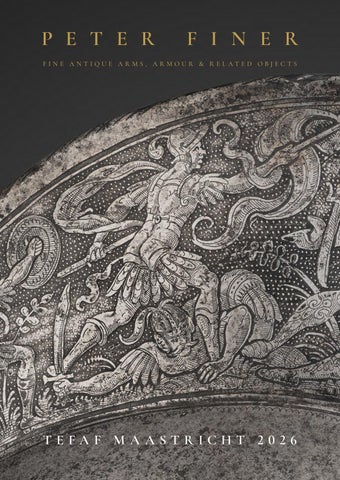
P E T E R
F I N E R
FINE ANTIQUE AR MS, AR MOUR & REL ATED OBJECTS
TEFAF M A ASTRICHT 2026
CON T EN TS 1
A Very Fine Armour for Light Cavalry or Service on Foot, Etched and Gilt with Bands of Renaissance Trophies in the Lombard Fashion c. 1570-80
2
An Extremely Rare and Very Fine Milanese Parade Shield Damascened in Gold and Silver c. 1565-75
3
A Burgonet for a Light Cavalry Armour Very Finely Etched in the Manner of the Brunswick Ducal Court c. 1560-70
4
A Rare Close Helmet for Field Service, the Skull Broadly Fluted ‘alla Tedesca’ c. 1510-20
5
A Comb Morion of the Trabantenleibgarde of the Prince-Electors of Saxony c. 1580-1600
6
A Suite of Magnificent Armour for Man and Horse, Etched and Gilt in the Lombard Fashion late 16th Century
7
A Riding Sword with Silver-Encrusted Hilt of Distinguished Quality c. 1625-35
8
A Fine Seven-Flanged Mace Damascened in Silver mid-16th century
9
A Bronze Cannon attributed to the Foundries of Hans Christoph Löffler c. 1550
10 A Very Rare and Historic Bronze 6-Pdr ‘Drake’ Cast for the Rotterdam Admiralty by Cornelis Ouderogge, from the site of the Battle of Lowestoft fought on 13th June 1665, dated 1658 11 An Exceptionally Rare Rifled Small-bore Cannon of Twist Steel Damascened in Gold and Silver (Prunkgeschütz), made by Johann Sebastian Hauschka for August Wilhelm, Prince of Brunswick-Wolfenbüttel, dated 1729 12 The Royal Arms of King Henry VIII c. 1525
13 A Superb Cased Chest or Cabinet Lock and Key of Guild Masterpiece Quality dated 1717 14 A Very Rare Pair of Catalán Miquelet-lock Pocket Pistols Profusely Mounted in Silver c. 1785-90 15 An Exceptionally Rare Tula Silver-mounted Flintlock Sporting Gun in the Madrid Fashion, the Barrel with de Luxe Gilt Twist Finish in the manner of Exotic Mokume-gane work, dated 1743 16 A Silver-mounted Flintlock Sporting Carbine or Fusil Simple with Smoothbore Barrel By Boutet, Directeur Artiste, Manufacture à Versailles c. 1800-1804
1
A Very Fine Armour for Light Cavalry or Service on Foot, Etched and Gilt with Bands of Renaissance Trophies in the Lombard Fashion c. 1570-80 Northern Italy, Milanese workshops. Steel, gold, copper alloy, modern leathers, regilded, some elements restored and conserved 175 cm × 62 cm / 70 in × 24.4 in Provenance Louis Bachereau, from his gallery at 46 Rue de Provence, Paris; To Edward Hubbard Litchfield, New York (1835-1930), Thence to his son, Edward Hubert Litchfield, included in the sale of his late father’s collection, Parke-Bernet Galleries Inc., New York, The Important Collection of Arms and Armor Mainly European. XV-XIX Century, Formed by the Late Edward Hubbard Litchfield, December 5 and 6, 1951, lot 122 (described incorrectly as French); Private collection, Mexico City.
B
eyond the immediate shimmer of bright and contrasting etched steel attention is drawn to the sweeping sculpture of the burgonet helmet, to the pleasing V-shaped form of the breastplate, a mirror to the dash and elegance of the period costume, and then to the great etched concentration of classical and biblical icons and trophies of the Italian late Renaissance. Just as we view this armour today, so shall it have been received in the late 16th century. While armour of this configuration had evolved in northern Italy for use in field combat, the notion of style remained central and important, not only as a mirror to wealth and rank within the aristocracy, but also to instil a uniform sense of loyal pride within select bodies of troops.
The etched designs are ordered as a series of bands, in the present armour accentuating the bold contours of the burgonet and similarly emphasising the respective shapes of the breastplate, backplate and the pauldrons defending the shoulders. Inwardly bordered by guilloche lines heightened by very slender blackened lines, these bands are characteristically tightly filled with myriad small trophies-of-war, monsters, beasts and mythical grotesques and all interspersed with figural emblems inspired by classical history, mythology and biblical sources, and all alternating with burnished vacant surfaces. The burnished surfaces on the pauldrons are invariably each occupied by an elaborate cartouche front and rear, in the present instance these are filled with 16th century personifications of the Virtues.
Consideration should be given equally to those examples worn by the foot soldiery of the late 16th century, not least because within this school of etching little difference existed between that which was applied to armour supplied to the nobility, and that on the armour worn more extensively by bodies of troops. One such illustration of this egalitarian distribution is found in the series of half-armours (corsaletti da piede), extending to the tassets (upper thigh defences) only and worn by the Amsterdam city guard, circa 1580; one of these armours is currently on loan to the National Military Museum in Soest. The only significant point of difference seen in the majority of military examples is that most these armours worn by common soldiers were supplied with a simple morion (zuccotto aguzzo) in place of a finely constructed and expensive burgonet.
This style of work is correctly referred to as the Lombard school of etching. Formerly and erroneously having been associated with the city of Pisa alone, this style of work is correctly ascribed to the workshops of Milan, Brescia and to the smaller centres of armour production throughout the Lombardy region.
In the instance of the armour at the centre of this discussion, the upper core of this armour, that is to say the complete defences including the tassets over the upper thighs, forms in its own right the complete half-length type of north Italian armour worn in the latter decades of the 16th century and early 17th
The portraits of military commanders wearing etched armour of this type are many, although one excellent example, complete with leg armour, exists in Caravaggio’s portrait of Alof de Wignacourt, Grand Master of the Order of Malta, circa 1607-8 (Musée du Louvre, inv. 57). Armour decorated in this distinctive manner appealed widely within the trading spere of the armour workshops of Milan and Brescia. Armours of this general type were certainly supplied over a broad geographic area, for example from the well-funded Amsterdam city guard and the armed retinues of Italian Princely and Ducal ruling Houses, to the Malta garrison of the Order of the Knights of St. John (as exemplified in the portrait referenced above).
century, specifically for field combat on foot (i.e. a corsaletto da piede); the absence of holes pierced in the breastplate for fitting the lance-rest essential to heavy cavalry further supports this. Of anecdotal interest, half-armours of this type were notably popular worn by the Italian knightly aristocracy in the portraiture of the period, with the helmet removed but usually proudly visible to one side.
An armour such as this present one might also be supplied with full leg defences; the addition of these would naturally provide the protection necessary for mounted officers and light cavalry fighting from the saddle. Leg defences would be supplied as accompanying elements of a larger garniture of armour, or more commonly as a supplementary defence, perhaps even supplied subsequent to the initial purchase of the half-armour. As a garniture the legs would have been etched to provide a nearseamless match with the core pieces, but as possible subsequent additions it follows that the etching, while stylistically closely related, would unlikely be an exact match. Without doubt the most extensive example of such a garniture etched in the Lombard fashion is that removed from the armoury of Marquesses de Don Aguas in Valencia, which was made in Milan, circa 1550-75. Not only complete with its original leg defences, this armour additionally comprises an astonishing range of exchange pieces for both heavy cavalry and use in the variations of the tournament (Metropolitan Museum of Art, New York, acc. 1927.159. 1a-p). Numerous etched armours of the Lombard School are preserved in the arms and armour collections of museums in Italy, Spain, Britain, north-western Europe and the United States. Among these, examples most closely comparable with the present armour, include the following: The Philadelphia Museum of Art, the burgonet similarly fitted with a falling buffe (1977.167.26), The Metropolitan Museum of Art, New York (acc. 16.154.2), The Museo Nazionale del Bargello, Florence (M 1444 & 1133), The Stibbert Museum, Florence (ST 3495), The Museo Civico Marzoli, Brescia (943) The Museo Poldi Pezzoli, Milan (inv. 340) The Royal Armouries, Leeds (II.47), The Wallace Collection, London (A 55 & A54, the latter including a closely comparable burgonet).
DESCRIPTION Decorated throughout with etched tightly filled bands and figural cartouches in the Lombard fashion, in part on a gilt ground and all arranged within gilt guilloche borders edged with slender blackened lines. The armour comprises at its core a complete half-armour for fighting on foot. This is formed of a burgonet of notably high quality, with one-piece skull somewhat swept to the rear, rising to a tall narrow comb cabled over the top, drawn-out at the front to well-developed acutely pointed peak, and with a corresponding neck-guard at the rear. Fitted with hinged pierced cheekpieces formed of a single plate, decorated brass plume-holder at the nape, and the lower sides of the skull fitted with brass pivot hooks for attaching a buffe, in the ‘Hungarian’ manner, involving three falling lames locked by spring-studs. The uppermost of these is symmetrically pierced with both horizontal and vertical large slotted breaths, the medial lame pierced with a broad band of smaller slotted breaths across its full frontage, the next in lower succession is pierced in a similar manner, and the bottom lame shaped for the chin and carrying a single neck-lame. Collar of one lame front and rear and hinged at one side. Breastplate of fine strongly pronounced form drawn downwards to create a prominent point and a shallow medial ridge, with raised turned cabled flanges at the openings for the neck and arms, the etched decoration enriched by a pair of lightly embossed cabled volutes issuant from the upper corners and enclosing a pair of male and female classical heads within their terminals, and fitted with a single waistlame carrying a pair of short tassets each of eight moveable lames, each of the lower lames decorated with a pair of volutes en suite with the breastplate. The original backplate decorated in a matching fashion, formed with a narrow outward flange at the base. Full arm defences, constructed with a pair of large symmetrical pauldrons each of eight lames, the main plates each decorated with a further pair of raised
volutes complementing the cuirass and tassets, looped about the front and rear contours to form larger tightly curled terminals enclosing classical heads over the sides, the central broad surfaces front and rear each centring on an elaborate etched cartouche filled with a classical personification, the figures at each front representing Venus & Cupid and Prudence respectively. Each of the lower lames carrying a tubular turner secured by a swivel pin, with composite vambraces formed of tubular upper-cannons, a pair of bracelet couters over the elbows, and hinged lower-cannons, and together with two fingered gauntlets (not a pair). Together with composite full leg defences comprising two cuisses (not a pair), poleyns of four lames and with wings with V-shaped gutters, and well-shaped greaves with hinged inner plates. Concerning the modern provenance of this armour, Louis Bachereau, from whom the great American collector Edward Hubbard Litchfield had acquired the armour, was by the beginning of the 20th century the Paris dealer most able to procure the finest examples of European armour for a wealthy but discerning clientele. Highly regarded as an antiquary, he ran his business from a sumptuous showroom at 46, Rue de Provence, the source of many of the armour and weapons treasures which are today preserved in the leading museum collections. Louis Bachereau had inherited the dynastic business from his father, Victor, who had in turn taken over from preceding family. As a business they had dominated the Paris arms & armour trade for much of the 19th century and continued to do so under Louis until the late 1920’s or early ‘30’s. The celebrated collectors William H. Riggs and the Duc de Dino, each significant benefactors of The Metropolitan Museum of Art arms and armour collection, were among Bachereau’s foremost clients, as was Lord Astor of Hever, to whom Bachereau sold a number of the select-quality armours, all of which were ultimately included in the landmark Sotheby’s sale of the Hever Castle collection in 1983.
2
An Extremely Rare and Very Fine Milanese Parade Shield Damascened in Gold and Silver c. 1565-75 Northern Italy, Milanese workshops Steel, gold, silver, copper alloy. The spike and mount probably later Provenance Richard Zschille, Grossenhain, Saxony (1847-1903), included in the sale of his distinguished collection of arms and armour, Christie, Manson & Woods, January 25, 1897, lot 39; subsequently re-offered and sold Rudolph Lepke, Berlin, 21st -22nd March 1900, lot 34; Frank Gair Macomber collection, Boston; included in the negotiated sale of the collection to The Cleveland Museum of Art over the period 1916-23, the purchase funded by Mr. & Mrs. John Long Severance. Subsequently deaccessioned. Joe Kindig Jnr., York, Pennsylvania. Private collection, U.S.A Exhibited The Chicago World’s Fair (aka. The World’s Columbian Exposition) May 1-October 30 1893, together with the Zschille collection of arms and armour as a whole. Metropolitan Museum of Art; Catalogue of a Loan Exhibition of Arms and Armor, February 6th -April 16th, 1911, by Bashford Dean, New York 1911, cat. no. 81, pl. XXXIII, lent by Frank Gair Macomber.
Literature Claude Blair, ‘Appendix List of Objects by, or decorated in the manner of Diego de Çaias and Damianus de Nerve’, in Metropolitan Museum Journal, volume 3 / 1970, no. 36, p. 196 Francis Henry Cripps-Day, A Record of Armour Sales 18811924, London 1925, p. 102, lot 39. Robert Forrer & Richard Zschille, Die Waffensammlung des Herrn Stadtrath Rich. Zschille in Grossenhain (Sachsen), Berlin 1894, vol. I, cat. no. 681, vol. II, pl. 177. Helen Ives Gilchrist, A Catalogue of the Collection of Arms & Armor Presented to The Cleveland Museum of Art by Mr. and Mrs. John Long Severance, 1916-1923, Cleveland 1924, cat. no. L7, p. 253, pl. L (acc.no. 16.1523, withdrawn). Frank Gair Macomber, Catalogue of Arms and Armor, the author’s collection in 8 vols. of bound manuscript, 1900, vol 3, cat. no. 135, illustrated (held by The Cleveland Museum of Art, Ingalls Library).
C
onventional to the period the greater part of shield body is of shallow convex form with a flat narrow rim and turned cabled edge. At the centre a pyramidal spike is fitted seated on an engraved and gilt calyx washer. The body is pieced with pairs of holes originally for rivets attaching the enarms (armstraps), the rim retains some if its brass-capped rivets for attaching a lining. The entire outer surface is lavishly decorated with a complex gold-and silver-damascened plan made up of concentric bands of emblematic cartouches, their edges minutely punched and damascened in gold throughout, the remaining smaller spaces filled with finely drawn gold arabesques, the smaller inner series of these repeated in expanded form within the third band of cartouches and again between the elaborate cartouches encircling the rim. The innermost band of cartouches is formed as six petals each filled with a damascened flowering spray, the middle band is formed of six ovals all filled with minutely detailed differing architectural landscape vignettes, variously involving trees, rivers and classical ruins scattered with tiny hunting dogs, birds and a wyvern, and finely damascened throughout in gold picked-out in silver. Similarly damascened, a series of trophies-of-war punctuate the ovals of the middle band, pendant from the central band. The third band comprises a series of cartouches shaped as classical shields, each enclosing a damascened rampant dragon, these characteristically graphic monsters arranged as prominent opposing pairs; an alternating arrangement of further trophies and shaped rectangular gold arabesques is placed between. The damascened designs covering the rim reprise the theme of architectural landscape vignettes, now in a slightly larger scale and drawn to reveal an extraordinary level of characterful detail all pickedout in gold and silver. The buildings involved are in part neo-eastern, part Italianate, involving whole towns with church spires and domes, arches, rivers and trees, while scattered within are minute birds, animals and fantastic beasts, together with mounted warriors including St. George slaying the dragon.
Set between these cartouches is a further series of shaped rectangular arabesques, now alternating with a series of complex designs of tightly scrolling leafy tendrils with monster’s head terminals and inhabited by birds, and heightened by a contrasting open and spirited tendril pattern damascened in silver, transposed over the goldwork. The entire design set against a very light russet ground, naturally oxidised from the original blue, in very fine untouched condition throughout, the damascening preserved with little wear. The damascening on the present shield had at the end of the 19th century been ascribed by Guy Laking to Hieronymus Spacini of Milan, a view now broadly dismissed. This attribution was determined on the basis of comparison with a damascened shield in the Wallace Collection (A 334), which is signed by Spacini, then working in Bologna. Despite a very general shared resemblance to the style in which the damascened designs are ordered, in part as bands of prominent framed vignettes, modern study has judged the style and workmanship used to be unrelated to the present example. The earliest examples of European armour decorated with damascening in gold and silver are the parade pieces from the Milanese workshops of the distinguished Negroli dynasty of armourers, circa 1540. Foremost among these examples is a signed helmet dated 1543, preserved in The Metropolitan Museum of Art, New York (acc. 17.190.1720). Also attributed to the Negrolis is the damascened ‘Armure aux Lions’ of Francis I of France, circa 1540-45 and similarly the silver-damascened armour made for Henry II as dauphin, circa 1540, each attributed to Negrolis and each in the Musée de l’armée, Paris (G 50 and G 118). From this beginning in Milan a prolific line of development in the damascening of armour, the hilts of swords and daggers, maces, the barrels, locks and mounts of firearms, as well as luxurious domestic objects can be traced, flourishing in Milan well into the mid-17th century.
Almost parallel to this evolution in Milan a rival tradition of damascening had emerged in Spain, shortly joined by a near-identical ‘school’ of work in the Flemish city of Antwerp. The Spanish enterprise is attributed to Diego de Çaias, perhaps from Castille, his earliest known work, a gold-damascened ear dagger of circa 1530, is now in The Metropolitan Museum of Art, New York (acc. 39.159.1). Other examples of his damascened works confirmed as his own follow from circa 1539 to the mid-16th century, two of which he made for Henry II of France, another for Henry VIII of England and another for his son, Edward VI. Thereafter the numerous other damascened works created in the style apparently established by de Çaias are more loosely attributed, over course falling into the category of ‘workshop of’, suggesting the work of followers only. The Antwerp branch of damascening followed the Spanish designs extremely closely and were only initially confirmed by the existence of a damascened rapier hilt in the Historisches Museum, Dresden (E.58), signed by Damianus de Nerve and dated 1556. A further twelve distinguished examples of damascened hilts and firearms are firmly attributed to de Nerve, together with the damascened decoration of a parade armour made for the Emperor Maximilian II, circa 1555-59. The design style common to both is essentially the use of very fine but small arabesque scrollwork patterns punctuated by small vignettes and all usually set within fine linear borders. The vignettes, both framed and unframed, involve a number of variations but are universally characterised by working to a minute scale, most commonly illustrating walled towns or other architecture in pastoral landscapes, augmented by tiny figures, domestic animals and fantastic mythical beasts. A series of small damascened caskets ascribed to the de Çaias / de Nerve workshops and dating from the mid-16th century well-illustrates these themes: one in the Poldi Pezzoli Museum, Milan (inv. 557), another belonging to the Waddesdon Bequest (17) in the British Museum, and a third in Cluny (no. 14397), (see Blair 1970, nos. 31-33, pp. 196-7, figs. 73-76).
In 1970 the distinguished arms and armour scholar Claude Blair published in the Metropolitan Museum Journal his ground-breaking survey and study of de Çaias, de Nerve, and the works ascribed to them (see Literature). From the lengthy list of works put forward for consideration, in his Appendix to the main study Blair categorised the objects according to the strength of their possible attribution. The present shield was included under Blair’s Category E, the ‘possibly by workshop of’ group, its addition possibly a thirdparty suggestion. At this point it should be noted that excluding the firmly attributed Maximilian II armour, only two other pieces of armour are loosely ascribed as possibly coming from the de Çaias / de Nerve workshops: one a comb morion in the Musée de Cluny, and the other of course the present shield (referred to above), each being decorated in a similar manner to the other. While the architectural vignettes and arabesque ornaments existing in abundance over present shield draw obvious comparison with the de Çaias/ de Nerve designs, we contend that these current designs, and the overall greater freedoms displayed, possess qualities more closely aligned with the style of Milanese damascening. In support of the present shield’s proposed attribution to a Milanese damascener’s workshop, the example is offered of a Milanese half-armour in the Hofjagdund Rüstkammer of the Kunsthistorisches museum, Vienna (A 1408). Details such as the design of the more elaborate cartouche frames are clearly shared. On this armour also exist the tightly packed arabesque designs and the exotic small architectural designs more frequently attributed to Spain, but displayed here, as on the shield, within the finesse of Milanese style. It would appear that Blair was unaware of this armour at the time of writing.
A further comparison can be made with the wellknown series of magnificent damascened glaives made, almost certainly in Milan, for the guard of Cardinal Scipio Caffarelli-Borghese, circa 160510. The additional use of freely scrolling silverdamascened lines superimposed over the arabesque ornament draws obvious comparison, a lively decorative feature not present in any of the known Spanish work. An additional comparison can be made, although somewhat anecdotally, with the similarity in the graphic characterisation of the respective dragon devices, which on the glaives forms a half of the Borghese arms. The term ‘damascening’, as it applies to the particular technique used in the decoration of this shield, is best explained by the following account paraphrased from Chambers’s Cyclopaedia of 1788: “…… make hatches, or strokes across the iron, and cut …. such as is to be used in the making of small filings. …… it is necessary the gravings, or incisions, be made in the dove-tail form; that the gold or silver wire, which is thrust forcibly into them, may adhere the more strongly. ….. (the method is) having heated the steel till it changes to a violet, or blue colour, they hatch it over and across, with the knife; then draw the design, or ornament, intended, on this hatching, with a fine brass point or bodkin. This done, they take fine gold wire, and conducting it or chasing it accordingly to the figure already designed, they sink it carefully into the hatches of the metal with a copper tool.” Peter Finer gratefully acknowledges the scholarship of Claude Blair, former Keeper of Metalwork, the Victoria and Albert Museum.
3
A Burgonet for a Light Cavalry Armour Very Finely Etched in the Manner of the Brunswick Ducal Court c. 1560-70 Germany, Nuremberg. Steel. One of the cheek pieces later 30.4 cm × 22.8 cm × 33 cm / 12 in × 9 in × 13 in Provenance Private collection, United Kingdom
A
n open-faced burgonet of this type would have been intended conventionally for wear either as part of a light cavalry half-length armour (Trabharnisch) or with a three-quarter armour for service on foot (Landsknechtharnisch). As indicated by the city control mark (beschau) struck on the peak, this burgonet was bought-in entirely undecorated from a Nuremberg armourer, his accompanying mark, a helm with bifurcated nodular crest, is not currently identified. The present example, however, does not appear to have belonged to any surviving armour decorated with a closely corresponding etched pattern. In consideration of this and of the strikingly imaginative, lively and highly accomplished etching, it is quite plausible that this originally ‘blank canvas’ will have been a stand-alone exercise, a Brunswick etcher’s ‘masterpiece’ submitted for his essential admission to the ‘Painters’ ‘guild, historically the guild also encompassing the art of etching on metals. Entry to the guild provided members with the means of gaining significant employment from the etching of armour. (The Brunswick artist Bonaventura Abt, recorded 1518-52, is known for his role in the etching of armour for Duke Heinrich the Younger of Brunswick-Wolfenbüttel and is referred to in contemporary accounts as ‘painting’ an armour for the Margrave Joachim of Brandenburg, then residing at Wolfenbüttel.). In 1566 the guild noted that among other items it could accept as a masterpiece either a heavy or light field armour, etched.
The same suggestion of a ‘masterpiece’ has also been made in respect of a superb comb morion ascribed to circa 1560-65, now in The Metropolitan Museum of Art, New York (1999.62). In a readily comparable manner to the present burgonet, the morion is etched in the manner of armours directly associated with the Brunswick ducal court. In that example as in this also, the exuberant use of minutely detailed figural vignettes from ancient history dominates the work. In each instance the etcher captures and conveys exactly the characterful drama of the opposing warriors and their unfolding combats. On the present burgonet the significant height and breadth of the comb provide ideal surfaces for the etcher to demonstrate the gamut of his abilities. The two side panels perhaps represent scenes from the Trojan Wars differing in their composition, but more certainly each will have been inspired by the original Mannerist designs by the French virtuoso designer and engraver Etienne Delaune (active 154095). Particular comparison is made to his series of panels entitled ‘Combats et Troimphes: Combats de Cavaliers et de Fantassins’, ascribed to the 1560’s. Below the comb, the further etched scheme is ordered as a series of narrow bands, involving swagged clusters of fruit interspersed by Franco-
Italianate trophies of war and extending fully over the sides of the skull and to the frontal peak. A further band of trophies suspended within flowering scrolling foliage runs along the outer border of the peak. A circular arrangement of conventional acanthus foliage provides a framework for the pierced aural holes of the cheekpieces. The etched bands over the skull continue over the neck lame at the rear and the outer border naturally matches that on the peak. The cheekpieces and neck-guard are additionally decorated with narrow strips filled with an imbricated leaf pattern to form subsidiary borders, the primary etched panels all segmented by single blackened lines backed by very lightly scribed invected linear ornament. The etched decoration meticulously detailed throughout, all contrasting within blackened granular panels and preserved in exceptionally fine unrestored condition. The identity of the etcher is regrettably uncertain, although details within the present work draw comparison with details in the magnificent etched Brunswick court armour in Windsor Caste (RCIN 62997), in turn for which Franz Bock (recorded 155078) has been suggested as a possible candidate etcher.
4
A Rare Close Helmet for Field Service, the Skull Broadly Fluted ‘alla Tedesca’ c. 1510-20 Northern Italy, Milan or Brescia. Steel, leather. The visor a working life replacement 30.5 cm × 22 cm / 12 in × 8.6 in Provenance William Randolph Hearst, sold Parke Bernet Galleries New York, The William Randolph Hearst Collection, part VII, November 24-25 1939, lot 118 (as part of a German ‘Maximilian’ armour). To French & Co., Inc., New York, 1940. Sold to the William Rockhill Nelson Trust, on behalf of The Nelson-Atkins Museum of Art, Kansas City (acc. 40-9/1). Subsequently de-accessioned and sold 2018.
T
his helmet belongs to a notably small surviving group of boldly fluted north Italian armour ascribed to the period 1510-20, a visually striking characteristic hammered in relief from the inside and typically arranged as decorative fans. As a group these various elements of armourfall within the wider Lombard type characterised as having been constructed and decorated ‘alla Tedesca’, that is to say in imitation of contemporaneous German technique and fashion. High quality armour such as this was for the greater part intended for the lucrative export market north of the Italian Alps. Centred in Milan and Brescia, from about 1450-1530 this export production formed a significant share of the prolific output from armour workshops throughout northern Italy. On the evidence of surviving examples, however (and at least one example in Italian Mannerist art detailed herein), it appears that this Germanic armour decorated with particularly bold fluting, as exists on the present helmet, was to a large degree retained for the Italian domestic market.
Italian armour of this type may be further sub-divided: classified as that decorated with pronounced V-shaped fluting and that with fluting which is either convex over its raised upper surfaces, or correspondingly flattened, as in the present example, or even concave. In the majority of examples of either type, the fluted patterns are accompanied by etched decoration, either as border ornament (as exists largely as traces on the present example), or as significantly wider coverage (see for example the globose breastplate in the Royal Armouries, Leeds, circa 1515-20, from the armoury of the Knights of St. John, Rhodes, Inv. III.1087). The close helmets within this group are fluted over the rear half of the skull only, predominantly without a comb, and are constructed in the German fashion, i.e. with the visor and the bevor each moving on common pivots. This differs from the Italian system of the 15th and early 16th century in which the bevor is formed of two halves closing at their front and moving on corresponding hinges at the sides. This last Germanic characteristic of the early 16th century is for the most part not otherwise found on close helmets made for Italian use until after about 1530.
Within this surviving fluted group of close helmets, the foremost example is ascribed to circa 1510-20, made by the renowned Milanese armourer Gian Giacomo Negroli (1463-1543), and is now in the Metropolitan Museum of Art, New York (2014.282). In common with the present helmet, the skull of the Negroli example is gracefully rounded in profile, and in each of the skulls the bulbous shape of the rearward portion is accentuated by the dramatic dispersal of a fan of flutes, characteristically swelling from their narrow lower cluster over the nape, upward to a line extending over the mid-point of the crown and immediately behind the visor and bevor pivots. In the present example this upper terminal line is reinforced across its front by a transverse border of two narrow recessed flutes. This contrasting narrow fluting is repeated over the upper edge of the faceopening, around the upper edge of the bevor and about the lower edges of the neck-lames front and rear. Beneath the base of the fluting at the nape of the skull a pair of eye-like motifs are embossed either side of the area originally occupied by a plume-holder.
The present visor is of the distinctly South German ‘bellows’ type but may be recognised as Italian work from the addorsed pair of scroll-like marine monsters cut in low relief at the centre of the upper edge. The visor doubtless dates from circa 1515-20 but is almost certainly a period replacement, the fit of its pivot arms suggesting the expedient use of an existing visor rather than one newly made for this helmet. Another comparable helmet is in the Museo Civico L. Marzoli, Brescia (inv. 319); in this example the upper surfaces of fluting over the skull are slightly concave and the visor is cut with a scrollwork contour at the centre of its upper edge. Among other comparable helmets is an example formerly in the Harold L. Peterson collection, sold Christie’s London, 5 July 1978, lot 176. The present helmet skull may also be compared with the fluted skull of another helmet of this period, later repurposed for use in the Pisan mock combat called the Gioco del Ponte; in this last example the fluting terminates across its apex in a transverse band of narrow flutes, in a similar fashion to the fluting on the present skull.
5
A Comb Morion of the Trabantenleibgarde of the Prince-Electors of Saxony c. 1580-1600 Germany, Dresden or Nuremberg workshops. Steel, copper alloy, gold, leather, textile 29 cm × 22 cm / 11.4 in × 8.6 in Provenance The Dresden armouries of the Prince-Electors of Saxony. Most probably included in the transfer to the Königliche Historisches Museum Dresden in 1831/2.Subsequently included in one of the series of officially directed dispersals from the collection which took place from the mid-19 th century and thereafter. Two Nuremberg examples from the same series, near-identical to this one, are preserved in the Rüstkammer, Staatliche Kunstsammlungen Dresden (Inv.-Nr. N 111, N 113a) Dr. Justin G. Stein collection, United States Ray Petry collection, United States
C
omb morions of this series were worn by both the mounted and foot contingents of the elite guard of the Saxon electors. Contemporary paintings and prints show the guard resplendent in gold and black uniforms and equipped with etched and gilt comb morions to match. Many of these helmets were subsequently polished bright. The sole known dated example is dated 1568 (Metropolitan Museum of Art, New York, 1989. 288), for a member of the guard of the Elector August I (r.1553-86). These morions continued to be used and perhaps added to within the successive reigns of the Electors Christian I (r.158691) and Christian II. In keeping with all examples from the series, their etched bands of scrollwork develop to form cartouches suspending the Roman Heroes Mucius Scaevola and Marcus Curtius in Selfsacrifice, respectively over the sides of the skull, each an inspirational subject naturally appropriate to the troops of the guard. In a similar manner, the Saxon ducal arms and those of the Saxon Electoral Office, the Hereditary Archmarshalship of the Holy Roman Empire, are suspended over the sides of the comb.
Detail from a contemporary illustration of Musketeers of the Trabantenleibgarde of the Prince Elector Johann Georg I, parading at the Dresden Fastnacht Foot Tournament of 1614. Note the continued wear of etched and gilt comb morions of the present type, although those in the illustration appear to have been polished bright.
6
A Suite of Magnificent Armour for Man and Horse, Etched and Gilt in the Lombard Fashion late 16th Century The Armour dating circa 1580-85 and possibly made for Don Carlos d’Aragona y Tagliavia, Duke of Terranova, Prince of Castelbeltrán, Count of Castelvetrano and Spanish Royal Governor of Milan (the helmet and cuisses both of a contemporary late 16th century armour.) The Horse Armour and the Shield dating circa 1560 from a garniture made for Emanuel Filibert, The Duke of Savoy.
Provenance of the armor: The Rt. Hon. Lt. Col. Charles Seale Hayne, M.P. (d.1903), of Fuge House and Kingwear Castle, Devon. To F. Robert, Paris, 1904. Acquired by William Waldorf Astor, later 1st Viscount Astor; thence by descent through the family. Sold Sotheby’s London, The Hever Castle Collection, 5th May 1983, lot 54 (including associated elements now not present).
Northern Italy, Milanese workshops. Steel, gold, copper alloy, period textile forming the bridle, leather. Height of the suite: 244 cm / 96 in Overall installation length of the suite (nose to tail): 272 cm / 107 in Maximum width of the suite (outside of stirrup to outside of stirrup): 107 cm / 42 in
Provenance of the horse armour and shield: By descent through the Ducal House of Savoy to the Royal Sardinia-Piedmont line. These pieces of armour were dispersed, together with other constituent pieces, from the extensive garniture made for Duke Emanuel Filibert, the dispersal almost certainly occurring prior to 1840 and most likely prior to the establishment of the new royal armoury in Turin in 1837. Acquired by Count Hector de Economos, Paris. Included in the purchase of the Economos collection in its entirety by William Randolph Hearst, 1924. William Randolph Hearst, as Anonymous sale, Galerie Fischer, Luzern, 29 November 1972, lot 71. Acquired by a private collection, USA. Anonymous sale, Christie’s, London, 12 December, 1997.
THE ARMOUR and DON CARLOS LUIGI d’ARAGONA y TAGLIAVIA
T
he armour for the mounted figure has recently been ascribed to the historical ownership of Don Carlos Luigi d’Aragona y Tagliavia, called ‘Magnus Siculus’ (‘Great Sicilian’), 1530-99. The likely period in which the armour was constructed (circa 158085) saw Don Carlos at the zenith of his career in the service of the Spanish Habsburg crown.
A soldier and statesman of Sicilian noble birth, Don Carlos rose to become a veteran of high office; he had been appointed Spanish Viceroy of Sicily twice, for 1556-68, again for 1571-77, and Viceroy of Catalonia for 1581-82 also. He had additionally served with conspicuous bravery and distinction commanding one of the ten Sicilian galleys engaged at the very heart of the great naval Battle of Lepanto in 1571 (within the Sicilian contingent commanded by Captain General Juan de Cardona he was one of fifty survivors out of the original complement of five hundred). Don Carlos continued his service in the Habsburg campaign in Flanders, later being deployed in the army engaged in Northern Italy. In 1583 Don Carlos came to Milan and there received the royal appointment of governor of that city from Philip II of Spain (who was himself Duke of Milan). It was possibly in this year also that Don Carlos commissioned the present armour. Today, the remarkable state in which this armour is preserved is likely explained by it being worn purely to reflect the high status of its owner. Don Carlos was 61, and such an armor not intended for war, and even less for tournament sport. Don Carlos held his appointment as Governor of Milan until 1592; following his death seven years later it follows that the original morion helmet and gauntlets would have been removed for use as funerary achievements over his tomb. The helmet and gauntlets replacing those pieces here are contemporaneous and have been carefully selected as a good stylistic match. The choice of an openfaced morion helmet (zuccoto aguzzo) accords specifically with the type evidenced in the portraiture of the period, for use with an armour of the present
type, specifically constructed for combat on foot (corsaletto da piede). Similarly in keeping, the tassets and the gorget are each of one-plate construction, a feature of some Italianate foot armour of the period but also said to have been favoured by naval officers. This last detail may possibly indicate an element of naval provenance in the original owner’s background. We have of course presented this armour mounted in the saddle: a figure of high rank needed to be visible among his troops and would not have walked. The fine etched decoration of the core elements of this armour is undoubtedly that of a Milanese workshop, the quality and style suggesting the general influence of the renowned armourer Pompeo della Cesa. The blackened bands of gilt etching are conspicuously close-set, leaving very little vacant space between them; the compact design is given further emphasis set within a framework of plain blackened linear borders. This less usually found arrangement forms an alternative decorative plan distinct in its striking appearance from the more frequently seen widely spaced bands from the north Italian palette, which typically are packed with an assortment of small and essentially generic trophies. In common with the etched designs observed among the more select Milanese armours of late 16th century, the close-set bands on the present armour are filled with symmetrical arrangements of scrollwork suspending a series of curvilinear cartouches, the latter in turn framing figures representing both Christian and classical allegories, together with heroic figures from classical Roman mythology. On the breastplate for example, a small cartouche immediately below the neck-opening contains the figure of Marcus Curtius leaping into the Fiery Gulf, while below, in larger scale within the central band, are the figures of Gaius Mucius ‘Scaevola’ proving his bravery before the Etruscan King Lars Porsena. Towards the base and on the backplate also are the figures of female Christian Martyrs, and the gorget displays the figure of Judith with the head of Holofenes.
Almost certainly prior to this armour being acquired by William Astor, circa 1904/5, the cuisses and poleyns defending, respectively, the thighs and knees, were added. These are again contemporaneous with the arm defences and main body of the armour. These pieces have in common with the greater part a similar close-set arrangement of etched bands with black linear borders, but the contained ornament differs in being largely formed of vertical designs of welldrawn trophies-of-war. The attribution to Don Carlos has only recently been determined by Italian scholarship, and we thank Mario Scalini for his work on this, through the interpretation of an etched palm branch and crown motif, a predominant feature recurring throughout the etched bands of ornament over the core elements of the armour. This palm motif has been identified as the impresa (personal emblem) of Don Carlos, which is carved in relief on the tomb of Don Carlos, in the church of San Domenico in Castelvetrano, Sicily. Essential in the consideration of the provenance of this armour is that imprese were the informal emblems chosen by individual members of the Italianate nobility. Unlike a family coat-of-arms, they were not hereditary. In the case of Don Carlos, the palm is derived from the Tagliavia palm tree device found within his family arms, which had been quartered with those of Aragona in 1522 (upon the union by marriage with the niece of Frederico II, King of Sicily). An additional motif recurring in conjunction with the palm on the armour discussed, appears to be a representation of the bulb-like Mandrake fruit. It has been suggested that this may have been included for its talismanic qualities. The repeated incorporation of the Tagliavia impresa etched on the present armour is strikingly paralleled in one of the finest surviving armours made by Pompeo della Cesa. In a similar recurring manner to the armour of Don Carlos, this example carries both the motto and the ‘three rings’ impresa of the Borromeo family dispersed throughout the decorative scheme.
The helmet from the Borromeo armour is separately preserved in the Poldi Pezzoli museum, Milan, while the body of the armour is in the Stibbert Collection in Florence. The armoured figure is superbly mounted for display, complemented by the shield and its matching elements of horse armour from an important etched garniture made, circa 1560, for Emanuel Filibert, Duke of Savoy, 1528-80.This situation came to an abrupt end, however, on 10th August in that year, with the decisive route of the French by Emanuel Filibert’s Habsburg army at the battle of San Quintino. Following both this defeat and yet further military failures the majority of French troops left Piedmont, to pursue another ill-fated campaign in the Hautede-France. Subsequently, a succession of French defeats in Piedmont, again at the hands of Emanuel Filibert, heralded the end of the twelve-year war with Habsburg Spain. The consequential Peace of Cateau Cambrésis in 1559 saw not only the return to Savoy of almost all of its hereditary lands but it additionally gave Emanuel Filibert a bride, Margherita of Valois, sister of Henry II, King of France (together with substantial dowry). Anecdotally, the elaborate festivities that accompanied the marriage in July included a week of knightly tournaments, and it was while jousting on 30th June that Henry II was mortally wounded, dying within a few hours of the marriage. With the restitution of Savoy completed under the terms of the marriage, Emanuel Filibert then handed the government of the Spanish Netherlands to a daughter of Charles V, to take up residence in Nice and commence the reconstruction of the Savoyard Duchy. In the course of his pursuit of the Swiss Savoyard lands a religious war now erupted in Piedmont, the complex political outcome of which was settled in 1561 by Emanuel Filibert’s skills as a statesman rather than as a soldier. He next gave his attention to agrarian reform in the duchy, together with the reconstruction of mining and commerce, to be followed by an extensive re-building and reorganisation of the Savoyard army and the birth of a naval force also.
Thus re-equipped, the Savoyard Duchy under Emanuel Filibert became a new force in the alliance of the Holy Roman Empire, rendering valued onward assistance in the eternal fight against a Turkish conquest of the Mediterranean. A bronze equestrian statue of Emanuel Filibert, Duke of Savoy, is in the Piazza San Carlo, Turin.
THE HORSE ARMOUR, SHIELD and EMANUEL FILIBERT, THE DUKE OF SAVOY
I
n the context of the history of 16th century Northern Italy, Emanuel Filibert the duke was a singularly influential and pivotal figure. He provided both the blunt militaristic force and the diplomatic finesse necessary for the restitution of the Savoyard Duchy, the essential strategic buffer between longstanding French ambition and access to the Spanish Habsburg lands within the Italian peninsula. Through his prowess and courage as a general in the army of The Holy Roman Empire, but in particular for the wresting of his paternal duchy back from the invasive French, Emanuel Filibert became known in his lifetime as ‘Testa di Ferro’ (‘Iron Head’).
Armour belonging to this garniture is shown worn by Emanuel Filibert in a portrait of circa 1565, by Giacomo Vighi, called l’Argenta (d.1573), at the Galleria Sabauda, Turin. The majority of the surviving parts of this garniture remain in the Royal Armoury in Turin (inv. nos. B4- C86- C151- C227/228- E12), other pieces having been dispersed prior to 1840, in which year it is recorded that a helmet and a breastplate were in the possession, respectively, of the Conte S. Martino La Motta and the Marchese Claudio d’Aix. The latter, a distinguished general, was aide-de-camp to King Carlo Alberto of Sardinia and related to the first director of the newly established royal armoury, Vittorio Seyssel d’Aix. It is reasonable therefore to suggest that these two pieces were royal gifts. By extension, the present shield and horse armour from this garniture may have been dispersed from the royal collection under similar circumstances. The present elements of horse armour from the historic garniture comprise a half-shaffron complete with its poll-plate, and the original leather-covered saddle-tree mounted with four plates over the bow and its rear cantle defended by a pair of large plates. The original matching circular shield from the garniture provides a complementary bridge with the armoured figure.
These pieces are preserved in superb condition throughout, with little evidence of wear. The matching etched and gilt pattern is clearly identical to the etched and gilt armour detailed in Emanuel Filibert’s portrait. The etched pattern takes the form of a series of broad bands both radiating across and bordering the bright steel surfaces. The bands are filled with a repeating design of partly-foliated interlaced strapwork, alternating with quadruple loops at intervals, and all on a gilt ground within subsidiary herringbone border ornament. The shaffron extends down to the upper part of the muzzle, with flanged cut-outs for the eyes, separate riveted ear-guards, tubular brass plume-holder, and bolt for fitting an escutcheon. The poll-plate moves on a hinge at the apex. The original saddle leather is authentically dressed in rich textile, after the fashion of the period. Its applied plates are retained by screws with prominent rosettelike heads. Both the saddle and the shaffron are painted with the inventory number ‘16’ on the inside. The shield is of slightly concave form on its inner side, the outer face fitted with an iron acanthus calyx. It retains its original brown velvet lining edged in decorated braid, and additionally its original leather braces, which are partly velvet-covered. To this historic ensemble are added a pair of late 16th century stirrups damascened with fine gold ornament in the North Italian taste, together with a pair of rowel-spurs also dating from the 16th century and similarly damascened in gold. Elements of a contemporary equestrian garniture (including a half-shaffron, armoured saddle and shield) are etched in an almost identical pattern to the corresponding pieces under discussion; made for capitano Valerio Corvino Zacchei of Spoleto, this smaller garniture remains in the Royal Armoury, Turin (nos. B7- E38- F23).
As Prince of Piedmont, Emanuel Filibert acceded to the title Duke of Savoy upon the death of his father, Duke Carlo III, in 1553. Under the weak tenure of Carlo III, Turin and the majority of the Savoyard lands in Piedmont had since 1536 been annexed by France. Thus, with no option other than the church, in 1545 at the age of seventeen Emanuel Filibert had embarked on a military career, in the service of his great-uncle, the Emperor Charles V. From this beginning he would rise quickly to become both a highly accomplished field commander and statesman, and ultimately the much-acclaimed redeemer of the Savoyard lands from French occupation. As a soldier Emanuel Filibert engaged with distinction first in the Schmalkaldic War of 1546-7, thereafter continuing in the service of Charles V in support of his son, the Habsburg Infante Filippo (later Philip II of Spain), fighting the French in the Habsburg-Valois (or Italian) War which had erupted in 1551. In 1553 Emanuel Filibert was appointed lieutenant-general and Governor of Flanders, in supreme command of the imperial army there. In Savoy meanwhile, France further extended its territorial grasp over the succeeding two years, and subsequent efforts by the new Spanish Governor of Lombardy to reverse the position achieved little. A brief truce was followed by the re-commencement of the ever-worsening attrition in Piedmont in 1557. This situation came to an abrupt end, however, on 10th August in that year, with the decisive route of the French by Emanuel Filibert’s Habsburg army at the battle of San Quintino. Following both this defeat and yet further military failures the majority of French troops left Piedmont, to pursue another ill-fated campaign in the Haute-de-France. Subsequently, a succession of French defeats in Piedmont, again at the hands of Emanuel Filibert, heralded the end of the twelve-year war with Habsburg Spain. The consequential Peace of Cateau Cambrésis in 1559 saw not only the return to Savoy of almost all of its hereditary lands but it additionally gave Emanuel Filibert a bride, Margherita of Valois, sister of Henry II, King of France (together with substantial dowry).
Anecdotally, the elaborate festivities that accompanied the marriage in July included a week of knightly tournaments, and it was while jousting on 30th June that Henry II was mortally wounded, dying within a few hours of the marriage. With the restitution of Savoy completed under the terms of the marriage, Emanuel Filibert then handed the government of the Spanish Netherlands to a daughter of Charles V, to take up residence in Nice and commence the reconstruction of the Savoyard Duchy. In the course of his pursuit of the Swiss Savoyard lands a religious war now erupted in Piedmont, the complex political outcome of which was settled in 1561 by Emanuel Filibert’s skills as a statesman rather than as a soldier. He next gave his attention to agrarian reform in the duchy, together with the reconstruction of mining and commerce, to be followed by an extensive re-building and reorganisation of the Savoyard army and the birth of a naval force also. Thus re-equipped, the Savoyard Duchy under Emanuel Filibert became a new force in the alliance of the Holy Roman Empire, rendering valued onward assistance in the eternal fight against a Turkish conquest of the Mediterranean. A bronze equestrian statue in the Piazza San Carlo, Turin, commemorates the life of Emanuel Filibert, Duke of Savoy.
7
A Riding Sword with Silver-Encrusted Hilt of Distinguished Quality c. 1625-35 Germany. Steel, silver, wood 110 cm × 22 cm / 43.3 in × 8.6 in Provenance Swedish ancestral collection
T
he exceptional quality of this hilt has the added dimension of historic interest arising from its ancestral Swedish ownership. The original owner would undoubtedly have been a member of the Swedish nobility. With that perhaps, it is reasonable to suppose he was engaged within the tumultuous period of Swedish military campaigning across northern and central Europe. Both practical and supremely elegant, riding swords with rapier hilts sharing the constructional style of the present example would seem to have been popular among senior officers in the Swedish service during the Thirty Years War (1618-48). This vogue probably radiated from members of the royal circle of King Gustavus Adolphus (r. 1611-32), whose surviving personal weapons also reveal a preference for this style. The hilt of the king’s silver-encrusted rapier not only shares the typological characteristics of the present hilt, but ause of conspicuously naturalistic flowers, similar to those within the silver decoration of the present hilt; this rapier from the royal wardrobe is preserved in the Livrustkammaren, Stockholm (inv. 1845). Another of the royal rapiers, the hilt being of the same constructional type as this but instead made of plain gilt-iron, is believed to have been carried by the king at the battle of Dirchau in 1627, where it was extensively damaged; this too is in the Livrustkammaren (inv. 1947).
Evidence of a further link between this present type of sword and the Swedish royal court is provided by the related hilt in a portrait, dated 1624, of Friedrich Kasmir, Pfalzgraf von Jülich, Cleve und Berg; the sitter was second cousin and brother-in-law to Princess Katarina of Sweden, mother of King Charles X. The portrait hangs in the Swedish royal residence of Gripsholm castle, Mariefred. Further closely related hilts coupled with a historic Swedish provenance include the sword of Colonel Måns Silverjelm, of the Västgöta Regiment, killed in 1645 (Livrustkammaren inv. 4311), together with that of Governor Melchior Wernstedt, who also died in that year: his sword is preserved in Roslagsbro Church, Uppland. While yet another, a rapier ascribed to circa 1630, is in the Army Museum, Stockholm (inv. D 17532). The constructional grouping of the hilts to which each of these and the present example belong is defined chiefly by the single large side-ring which is sharply up-turned towards the hand, its top supported by a loop-guard and filled with a pierced sprung-in plate. In historic portraiture, the earliest example of a hilt of this type dates from circa 1625, in a painting by Frans Hals, in the Alte Pinakothek, Munich (inv. 14101). Another example is in a painting by Cornelis de Vos dating from the 1630’s, which is in the National Museum, Stockholm (cat. no. 689). The configuration of the inner-guard of the present hilt again conforms to a recorded type, identified by the thumb-ring linking the quillon-block to the centre of an ogival ring-guard. Matching the outer-guard, this is up-turned and filled with a pierced plate. An example of this configuration exists in the rapier hilt in the Army Museum, Stockholm, referenced above. The process of inlaying silver (or gold) decoration onto iron is in general referred to as damascening. In the present instance this inlay forms an attractive relief pattern rather than one which is conventionally flat. The relief work is referred to as ‘encrustation’, and the small silver motifs of the encrusted design are further enlivened by engraving these in minute detail. Regarding the present hilt once more, the
untouched and high degree of preservation of the silver ornament is made apparent by the clarity of its engraved detail. The exception (and observed widely among other examples) is the flat damascening applied over the pierced plates front and rear, and about the inner ring-guard also. Understandably this flat treatment was considered sufficient in providing a plain contrasting ground to the pierced design of the plates, also providing a balance with the complexity of the predominant patterns elsewhere. Also, in expectation of normal wear from the suspension of the hilt next to the body, the abandonment of relief ornament about the inner-guard is rightly excused. In place of this, the silver borders are deliberately finished flat and engraved with an imbricated pattern set within silver beaded lines. Over the bars of the hilt the encrusted ornament takes on a complexity found among the higher quality hilts of the period.Taking advantage of the linear nature of these parts, the design is made up around an undulating pattern of slender tendrils interspersed with husks, ballflowers, conventional flowerheads, acorns and elongated leaves, which in part resemble ears of wheat, and all on a ground sown with minute silver pellets. At the centre of the ring-guard both ends of the tendril pattern loop about a pair of expanded large rosettes, framing between them a half-eagle, neo-armorial with wings displayed. The elegantly tall pommel is cut with a bold gadroon pattern segmented by silver beaded lines and echoes the previous encrusted themes, making further use of large rosettes and to which are added running hounds and sphinx-like creatures alternating about the middle ground. The grip-binding of patterned silver wire is made luxurious by a chequered design of small silver rectangles and set between a pair of wire ‘Turk’s head’ knots over the ends. Few 17th century silver-encrusted hilts remain in this little-used state, the present hilt comparing in this respect with the silver-encrusted hilts of five rapiers and two of the daggers in the James A. de Rothschild Collection at Waddesdon Manor.
Another silver-encrusted rapier with a pommel closely related to the present example was formerly in the collection of Lord Astor of Hever.
with a mark in the Toledo fashion, repeated multiply, a marketing practice customary among 17th century German bladesmiths.
The blade of the present rapier is in a similarly fine state of preservation. Stylistically this blade conforms to the robust type frequently associated with riding swords, that is to say the type of combined cut and thrust sword intended for use from the saddle in the late 16th and 17th centuries. Typical of the period, this blade is double-edged, cut with a pair of broad fullers running over its entire length on both sides, and tapers evenly over is length to a point. This blade type, of greater practicality in warfare than the conventional slender rapier type, exists in conjunction with rapier hilts intended for campaign use.
The relationship between the encrusted silver work seen on both English and German hilts dating from circa 1605-20 is without doubt a close one. Direct parallels exist in both the overall styling and in much of the detail found on hilts ascribed to each country. This closeness is such that (the specific work of identifiable English royal hilt-makers aside) the majority of those hilts wishfully attributed to an English origin are only safely identified as such by certain national characteristics in their constructional form, rather than by their encrusted decoration.
The thumb-ring forming a part of the inner-guard on the present hilt is equally a typical element of the riding sword. A closely comparable blade can be seen on the silver-encrusted German riding sword formerly in the collections of the Barons Nathaniel and Albert von Rothschild, sold Christie’s London, 8 July 1999, lot 66. The blade is signed by the cutler or bladesmith in a series of letters stamped within the parallel fullers on both sides: ‘ PETER BERG / ME FECIT SOLINGEN’ repeated in two tiered parts punctuated by a series of repeated decorative marks, and including the Reichsapfel mark arranged in pairs (an orb of office involving the letter ‘S ’ repeated over respective sides of the cross: ref. Weyersberg, SolingerSchwertschmiede des 16. und 17. Jahrhunderts und ihreErzeugnisse, 1926, Pl. IV, fig. 201 D). The ricasso is additionally struck over sides
This cultural fusion is explained by the arrival in England of German hilt-makers and silver smallworkers within the reign of James I (r. in England 1603-25), fulfilling the fashion-driven demand for fine silver-encrusted hilts derived from their native working style. A good example of the very close similarities existing is found between the present German hilt and the surviving by-knife, pommel and crosspiece of the English cross-hilted sword made for the Earl of Kimberly after 1607 (Claude Blair, ‘An English Sword with an Ottoman Blade in the Swiss National Museum – The Hilt and Scabbard’, in Blankwaffen, ed. Karl Stüber and Hans Wetter, Zurich 1982. In A.V.B. Norman’s detailed published survey of this present type of rapier hilt (type 84 and inner- guard type 39), he concludes that surviving examples of this type are rare. We are indebted to this author’s seminal study, The Rapier andSmall-Sword, 14601820, London 1981.
8
A Fine Seven-Flanged Mace Damascened in Silver mid-16th century Italy. Steel, silver 63 cm / 24.75 (overall length) Provenance Christie’s London sale, July 17, 1975, lot 27 Bonhams London sale, April 14, 2005, lot 370 Private collection, France
A
seven-flanged mace of blackened iron with a cruciform fleur-de-lys in the center. Short hollow shaft, twisted grip and rounded faceted pommel. Hole for leather strap. Entirely blackened surface with Islamic-inspired silver damascened vegetal decoration. The spirally-fluted grip encrusted with silver ropework, baluster finial and faceted pommel. Two similar damascened maces by Diego de Caias belonging to Henri II of France are in the Metropolitan Museum of Art, New York (Rogers Fund 04.3.59) and the Musée de l’Armée, Paris. These are discussed by Claude Blair in the Metropolitan Museum Journal volume 3, 1970 pp. 149-198. Another comparable example is in the Wallace Collection, London, no. A 985.
9
A Bronze Cannon attributed to the Foundries of Hans Christoph Löffler c. 1550 Austria or Bohemia. Bronze. The touch hole cover is a restoration. 54.9 cm / 21.6 in (overall length) Provenance Sotheby & Co., 15th May 1972, lot 117 Private collection, United States
C
ast with a plaquette of ‘Fortuna’ over the middle of the chase, modelled after an original design by Hans Sebald Beham of Nuremberg. Cast with a further pair of small rising birds flanking the raised vent, and the latter fitted with hinged decorated cover (an expert replacement modelled on a Löffler original).
10
A Very Rare and Historic Bronze 6-Pdr ‘Drake’ Cast for the Rotterdam Admiralty by Cornelis Ouderogge, from the site of the Battle of Lowestoft fought on 13th June 1665 dated 1658 The Netherlands, Rotterdam. Bronze 202 cm / 79.5 in (barrel length) Provenance Recovered from the wreck of ‘De Eendracht’ (73 guns), the flagship of Lieutenant-Admiral van Wassenaer, Lord Obdam, which exploded in action against ‘The Royal Charles’ during the Battle of Lowestoft, a decisive naval action of the Second Anglo-Dutch War. The wreck site is protected by law and is under the management of the Cultural Heritage Agency of the Netherlands. Private collection, The Netherlands
The Battle of Lowestoft, 1665, etching by Thomas Doesburgh, 1690-92. In the foreground the powder magazine of the Dutch Flagship Eendracht explodes. Rijksmuseum, Amsterdam.
T
his finely preserved gun was cast for the Admiralty of Rotterdam, known also as the Admiralty of de Maze, and the arms of the admiralty are cast in relief over the first reinforce section of the barrel. On a ribbon scroll immediately below is the dated inscription ’16 D. ADMIRALITEYT TOT. ROTTERDAM 58’. The remainder of the barrel is further cast in relief, with astragal mouldings at either end of the chase section, each of these in turn backed by bands of tulip ornament (the forward bands lightly corroded), a broader band of scrolling foliage forms a border for the ogee at the head of the reinforce, the foliage framing at its centre the symbolic device of the Union of the Seven Provinces of the Republic, two hands meeting to clasp a sheaf of seven arrows.
With continued decorative mouldings forming borders at both ends of the reinforce and about the vent-field, raised moulded base-ring cast with the founder’s signature ‘CORNELIS . OVEROGGE . FECIT . ROTTERDAM’, and with the unit weight ’74.6’ below. With a prominent cascable button cast in the form of a nodular and leafy pod, its base projecting from the cascable formed as an acanthus calyx against a stippled ground. Complete with a pair of trunnions and a pair of lifting handles, the latter in the form of marine monsters finely cast in the round. The gun is preserved in professionally conserved condition, with a natural green patina throughout. The ornamental bands immediately to the rear of the muzzle show light seabed corrosion.
The proportions and design of this gun anticipate many of the features belonging to the Dutch Seven Provinces pattern for ships’ ordnance formally adopted in 1666, although in this respect this gun is not unique, with the comparable example of a 24-pdr from the same foundry, and again from the Eendracht wreck, being dated as early as 1631. The shape of the muzzle section conforms to that laid down for gun barrels of 6, 12 and 18-pdr calibre. Cornelis Jansz Ouderogge (1599/1600-1672) was the son of the bell and gun founder Jan Cornelis Ouderogge of Amsterdam and Rotterdam. He ran the Rotterdam gun foundry from about 1642, jointly with his brother Dirk who died in 1649, after which Cornelis continued the business until his death. Two 6-pdr Drakes cast by Cornelis Ouderogge in 1662 and 1666 respectively, each for the Admiralty of Rotterdam, are now in the Rotterdam Maritime Museum. Another Drake dating from about 1650 was recovered near Rotterdam at the archaeological site ‘Eurogeul 12’. A further example of a 6-pdr by Ouderogge was formerly in the important collection of antique Netherlands ordnance of H.L. Visser, Wassenaar (HVC89). This example is dated 1667 and was also made for the Rotterdam Admiralty. Notably, the casting is less ornate than on the present example, the arrows device of the Union of Provinces is not included and the arms of the Rotterdam Admiralty are crowned. The Eendracht went down with the loss of 404 lives out of a ships’ complement of 409. Admiral Jacob van Wassenaer, the commander of the Dutch Fleet had himself been killed by a cannon ball shortly before the magazine explosion. The Eendracht had been completed in 1654 and had taken part in a number of engagements under van Wassenaer’s
Portrait of Jacob, Baron van Wassenaer, Lord of Obdam, Lieutenant Admiral of Holland and West Friesland. Killed at the Battle of Lowestoft, shortly before the destruction of his Flagship, the Eendracht.
command. The present gun, cast in 1658, may have fired in anger during the Eendracht’s fight against the Swedes in the Battle of the Sound, on 8th November of that year. It will certainly have done so in its heated fight with The Royal Charles under Sir William Penn. In 1987 in the course of their survey of the North Sea the Dutch Ministry of Infrastructure and the Environment discovered at a depth of 38m an area full of bronze cannon, at Nieuwe Ankerplaats. Fragments of wooden ship construction and rope were present also. Similar finds, though in smaller numbers, were found in the vicinity of the site, corresponding with the explosive destruction of the Eendracht.
11
An Exceptionally Rare Rifled Small-bore Cannon of Twist Steel Damascened in Gold and Silver (Prunkgeschütz), made by Johann Sebastian Hauschka for August Wilhelm, Prince of Brunswick-Wolfenbüttel dated 1729 Signed by the maker ‘S. Hauschka 1729’ on the fillet moulding at the head of the first reinforce. The ducal monogram ‘AW’ and the motto ‘Parta Tveri’, together with the crown and quartered arms of August Wilhelm as Prince-Elector are also found on the series of etched state partisans dated 1718, carried by the trabantenleibgarde of Duke August Wilhelm. Northern Germany, Wolfenbüttel. Steel, gold, silver, copper alloy (brass, bronze) and wood. 166.5 cm / 65.5 in × 63.5 / 25 in Literature Robert Bohlmann, ‘Johann Sebastian Hauschka Braunschweigischer Hof-Büchsenmacher’, in Zeitschriftfür Historische Waffen- undKostümkunde, Band 3 (12), Heft 8, September 1930, pp.187-193
Provenance Schloss Wolfenbüttel, residence of the Princes of BrunswickWolfenbüttel; one of four cannon of this type made by Hauschka and recorded in the 1732 inventory of the princely armoury, the present cannon historically recorded as ‘Nr.3’ in that inventory. Subsequently transferred within the latter decades of the 18 th century to the von Veltheim family, Schloss Harbke, Saxony-Anhalt. In 1945 the castle and its estate were expropriated by Soviet forces, the contents having been removed prior to then by the surviving heir, Mechthild-Karin, Gräfin zu Pappenheim (née von Veltheim, d.2008). Sold anonymously by her heirs.
J
ohann Sebastian Hauschka was a gunmaker and artist of significant accomplishment. The roll of royal recipients of Hauschka’s firearms is a visible testimonial of his worth, namely the Dauphin of France, later Louis XV; the Holy Roman Emperor Carl VI; the Empress Maria-Theresa; King Friedrich Wilhelm I of Prussia; and Crown-Prince Friedrich of
Prussia, later Friedrich II, ‘The Great’. Their magnificent firearms from Wolfenbüttel are today preserved in the important museum collections of Leeds, Vienna, Berlin, New York and Brunswick, while further examples of Haushka’s royal and presentation-quality firearms are in the Royal Collections at Windsor and in private ownership.
12
The Royal Arms of King Henry VIII c. 1525 England. Wood and polychrome 97 cm / 38.2 in × 73 cm / 28.7 in Provenance Private collection, United Kingdom Private collection, Belgium
T
he lion is one of the earliest animals to appear in royal arms, as a traditional symbol of bravery, strength and valour. Its earliest recorded use by an English monarch was the gift of a shield, decorated with small golden lions, given to Geoffrey Plantagenet by Henry I when he married Henry’s daughter Matilda in 1127. In Medieval Europe the lion was long a Christian symbol: associated with St Mark and St Jerome, the lion exited first from Noah’s ark and the bible states that ‘the righteous are as bold as a lion.’ In the ancient world lions had roamed southern Europe (they appear in cave drawings at Chauvet, France), but by the Middle Ages lions were as fabled, and powerful, a creature to most Europeans as a unicorn. For a ruler to draw the analogy between their own ascendency and the regal ‘king of beasts’ was natural propaganda. This finely carved wooden panel shows the royal arms of England used by King Henry VIII throughout his reign. These arms had been restored by King Edward IV, first in 1461 and again ten years later, and were used by successive British monarchs thereafter, until replaced in 1554 by Queen Mary I on her marriage to King Philip of Spain. The arms consist of four quarters; the upper left and lower right containing the three gold fleurs-de-lis of France on a blue ground, the upper right and lower left the three gold lions of England on a ground which would originally have been red, the polychrome today aged.
The shield holding the arms overlays a garter carved as a belt of blue with a gilded buckle and gold borders and lettering. It carrys the motto of England’s most senior knightly order, founded by King Edward III in 1348 (the Most Noble Order of the Garter). HONI٠SOET٠QI٠ITL٠I٠P[-]NSE (modern accepted spelling being ‘Honi soit qui mal y pense’) is a Middle French maxim that translates as ‘shamed be whoever thinks evil of it.’ It is said to derive from Edward III’s admonishment of his courtiers after he chivalrously picked up his dancing partner’s fallen garter and placed it on his own leg, in an effort to soften her embarrassment. This story first appears nearly 200 years after Edward III’s reign however, and scholars today propose that the motto was more likely directed at those who objected to the King’s aim of ruling France. This panel is a finely carved and originally costly example of the nature of decoration regularly commissioned to decorate fine buildings in England during the first half of the 16th century. It almost certainly dates from the reign of King Henry VIII, and was perhaps originally part of a decorative scheme for one of his own buildings or that of one of his notable and distinguished contemporaries.
13
A Superb Cased Chest or Cabinet Lock and Key of Guild Masterpiece Quality dated 1717 France. Steel, walnut, copper alloy, textile 24 cm × 31 cm × 24.5 cm / 9.4 in × 12.2 in × 9.6 in (cased) Provenance Private collection, France
I
n France this boxed form of warded lock together with its bushed key remained very little changed over the greater part of the 17th century, remaining popular beyond the death of Louis XIV in 1715, to even beyond the middle of the 18th century. The present lock mechanism, constructed on a sprung system of seven parallel bolts, was made within the brief period of regency prior to the child King Louis XV coming of age in 1723. The baroque artistry of the two facing plates, however, remain conspicuous in their debt to the foremost Paris metalwork ornementistes influential throughout Louis XIV’s lengthy reign, virtuoso designers such as Thomas Picquot, De Lacollombe and Jean Bérain. In this respect the eye is immediately drawn to the key hole placed in what is the intended inner face of the lock, masterfully formed as the snarling maw of a ‘Green Man’ grotesque mask chiselled in high relief. The key-pipe protrudes from the centre of the mask, its key aperture formed as a fleur-de-lys precisioncut to fit the bushed shank of the inserted key, and by this highly skilled ingenuity provide additional security. A fleur-de-lys motif would certainly have been the most exacting to achieve among the many but relatively less complex bushing motifs displayed by the master locksmiths of the period, and this feature alone is a testament to the extraordinary ability of the present lock-maker.
The outer border of the inner plate covering the mechanism is formed of delicate pierced tracery bandwork, a particularly French ornamental device popular across the range of luxurious decorative art, but notably popular from the outset of the 18th century with the makers of fine locks. Bandwork had evolved from the linear element of the 17th century Netherlandish and Italian designs for arabesques and grotesques, but in this later period frameworks such as this had themselves become the primary ornamental theme. On the present lock this pierced surround creates a striking burnished presence negating the need for conventional engraved ornament.
At one end of the tracery the manufacturing date ‘1717’ is suspended within an oval as a part of the pierced design, together with a stylised coronet above; at the opposite end a monogram and coronet occupy the corresponding position. The initials of the monogram include the letter ‘M’ and almost certainly will relate to the name of the maker.
Another exotically styled chiselled human grotesque mask complements the centre of the outer cover for the mechanism. Together with the keyhole mask described on the inner plate, the two masks are closely inspired by examples included in the widely influential published pattern sheets of the royal designer Jean Bérain (1640-1711), and further disseminated through the published designs adapted by his followers. Corresponding with the lock, the original key is formed of a shank bushed with a fleur-de-lys motif and finely decorated with a deep-cut segmented pattern of narrow flutes alternating with differing raised slender ribs. The bow is formed as a symmetrical frame of addorsed pairs of small monsters and human busts chiselled in the round, supporting at their centre the openwork monogram ‘L L’. At the forward end, the bit is cut with a series of extremely narrow wards to engage with the lock mechanism. An exquisite illustrated record of French of locks and keys of the period exists in twelve engraved plates of designs by Antoine Pierretz (le jeune), published in 1660-66 by F. de Poilly, under the title ‘Livre nouveau de Serrurerie’ : a set is held by the Victoria and Albert Museum, London (E.1197-1908). The present lock and its key are in their original walnut case, the interior floor fitted to seat the outer face of the lock, the lid is constructed as a distinctive pyramidal dome to accommodate the vertical protrusion of the key fitted for display into the inner face of the lock within. Fitted with an early 18th century bail-type carrying handle and retaining its blue baize lining, the lining edges bordered by faded yellow textile trim secured by domed brass nails (the lining old, probably 18th century), the case lock retains its original small iron key.
14
A Very Rare Pair of Catalán Miqueletlock Pocket Pistols Profusely Mounted in Silver c. 1785-90 Spain, possibly Ripoll. Steel, silver, wood, leather, textile 13.5 cm / 5.3 in (length of each pistol) Provenance Joe Kindig Jnr. Collection, York, PA
T
he relatively small number of firearms attributed to the gunmakers of the Catalán town of Ripoll today enjoy distinct prestige within the broader rich history of Iberian gunmaking. Situated some 50 miles north of Barcelona, Ripoll was ideally placed to become a centre of firearms production, being blessed with local deposits of iron ore and coal, together with water power provided by a confluence of rivers. Culturally and geographically distant from Madrid and other northern Spanish influence, Ripoll gunmaking developed in near-isolation, revealing much closer links to the Catalonian trade with France, northern and central Italy and with the Kingdom of Naples. The decorative rather than technical influences of these foreign gunmaking centres melded naturally with a local Ripoll folk tradition, resulting in unique characteristics little changed at their core over almost three centuries. While it is therefore tempting to ascribe all such firearms to the town of Ripoll itself, it is now acknowledged that the Ripoll style had evolved in the neighbouring Catalán towns of Igualada and Manresa, spreading eventually also to Barcelona and even to Naples. The present pair of pistols are made the more charming and very rare by their diminutive proportions. Pocketsized pistols of this type are almost entirely unknown within the Ripoll ‘school’ of gunmaking; the present pistols must therefore represent a bespoke order, most likely for a client within wider Catalonia.
Unusually, the barrels do not end in a ring moulding about the muzzles, but significantly the length of each of the muzzle sections is in balanced proportion with the length of the breeches. Furthermore, this forward section is forged with the subtle swell found among fine French pistol barrels as a stylistic alternative to the ubiquitous Iberian ring moulding. The sighting rib running over this forward section of the barrel is certainly a firm Ripoll characteristic, as too are the fluted breeches, this distinctive and long enduring latter feature being the legacy of the earlier renowned Italian barrel-makers of Brescia and Tuscany. The locks on the present pistols do, however, betray their late 18th manufacturing date. While at first inspection seeming to differ little from the cinched Ripoll locks produced 70-100 years earlier, the refinement of their bevelled edges and of the pronounced drawn-out shape of the rear terminal are each characteristic of the later Ripoll production. The shape of the butts again conforms with pistol stocks identified as belonging to the latter decades of 18th century Ripoll production, having long moved on from the spherical pommel but now concurrent with the so-called ‘carbine’ style of the mid-century. Typically, the stock mounts are entirely of silver, the trigger-guards no longer including the earlier spur. The profusion of pierced silver plaques displays a level of sophistication corresponding with the best Ripoll work of the period, the foliage is clearly related to the engraving (now lightly visible) on the barrels, and the putti figures suspended within the meandering scrollwork are rendered with care and clarity, a departure from the many which oddly resemble monkeys! The pistols retain their early pair of red velvet bags with ornamented draw-strings, and are perhaps contemporaneous. Ripoll pistols of this period were never sold cased, but in common with the earlier English and Continental practice were received in bags such as these; surviving examples are particularly rare.
15
An Exceptionally Rare Tula Silver-mounted Flintlock Sporting Gun in the Madrid Fashion, the Barrel with de Luxe Gilt Twist Finish in the manner of Exotic Mokume-gane work dated 1743 Russia, the Imperial workshops, Tula. Steel, gold, silver, textile, horn 142.5 cm / 56 in (overall length) Provenance A Prince of the House of Sayn-Wittgenstein, possibly of the branch descended from Ludwig Adolf Peter, Graf zu Sayn-Wittgenstein-Ludwigsburg-Berleburg (1769-1843), a notable in the field during the Russian Napoleonic campaigns, latterly Major General and ultimately Field Marshal in the Imperial Russian army, called ‘The Saviour of St. Petersburg’; created Prince zu Sayn-Wittgenstein in 1834.
I
ncluded among six lots of antique firearms offered as ‘The Property of a Collector’, of which this gun and four preceding lots were stated to have formerly been in the Collection of Fürst (Prince) Wittgenstein’, Sotheby & Co., November 30th 1962, lot 115 (the sixth preceding lot, 110, is described as bearing the crowned monogram of the former Prince Wittgenstein). Lot 115 sold to the distinguished motor enthusiast and firearms collector Douglas Burnell ‘Bunny’ Tubbs.
16
A Silver-mounted Flintlock Sporting Carbine or Fusil Simple with Smooth-bore Barrel By Boutet, Directeur Artiste, Manufacture à Versailles c. 1800-1804 France, the workshops of the Grand-Commun, the Palace of Versailles; together with Rouen, the département of the Seine-Inférieure Steel, gold, silver, walnut wood, horn, bone 122 cm / 48 in (overall length) Provenance Private collection, France
N
icolas Nöel Boutet is unquestionably the most easily recalled maker and designer in the history of French firearms manufacturing. The design and neoclassically inspired decoration belongs to the period of the Versailles arms manufactory during which Napoleon Bonaparte led the French government as First Consul from November 1799 until his coronation as emperor in May 1804. Henceforth from this last date, the phrase ‘à Versailles’ (as exists in the maker’s signature in the present instance) was up-dated by Boutet to instead read ‘Manufact.re Imperiale’. An identical set of silver marks, including that of the same maker, are struck on the silver mounts of a flintlock sporting gun by Boutet, now in the Royal Armouries. Leeds (XII 1278). This, together with a gun in the Wallace Collection (A 1128) are the surviving parts of a superb garniture of eleven firearms made for presentation to Charles IV of Spain, but subsequently altered for the use of Joseph Bonaparte. Noteworthy also was the original inclusion in the garniture of six ‘fusil simples’, i.e. a smooth-bore sporting carbine of the same configuration as the carbine under discussion. The term appears historically in Boutet’s own records.
A N T I Q U E A R M S , A R M O U R & W O R K S O F A RT 38–39 Duke Street, St James’s, London, SW1Y 6DF +44 (0)20 7839 5666 gallery@peterfiner.com www.peterfiner.com