

APRIL 2023 | ISSUE 23/01 MAGAZINE































GESGB April 2023 | Issue 2023/01 3 CONTENTS Photography Spread 42 ISSUE 1 > 5 A Word from the President Julian Bessa 6 GESGB Logo and other news... 8 In-house Notices 9 Norman Hempstead - Geophysicist and Gentleman 10 The Museum of Bath Stone 11 Educational Training Programme Updates 13 Rare Earth Minerals and Geoscience 16 The Value of Your Membership 19 SIG News 21 Cost Overhang Scenario Suggests Drop in Upstream Asset Valuations for Latin American Countries 30 Diversity & Inclusion SIG 34 Depth Conversion for Oil and Gas and Beyond 39 Diagnosis Before Cure: When to Call an Upstream Doctor 44 The Emerging Zechstein Gas and Oil Play in the Southern North Sea UPCOMING EVENTS > 2023 16-18 MAY EGC1 20-21 June DEVEX 2023 20-21 SEPTEMBER Africa Conference 3-6 October CCUS Conference 2023 www.ges-gb.org.uk/upcoming-events 50 Sustaining Sponsors 52 CO2 for EOR – Good for Economy, Environment, and Climate 54 Consultant Directory 7 YP Committee Welcome 20 YP Quarterly Quiz 29 YP Energy On Draft 31 Young Professionals in Conversation YOUNG PROFESSIONALS
EXECUTIVE COUNCIL
President
Julian Bessa
President Elect
Ian Sayers
Treasurer
Mark Rees
Secretary
Natasha Hunt
Director Aberdeen
Andrea DeSilva
Director Elect Aberdeen
Andrew Miles
Director Young Professionals
Jade Metcalfe
Director Education & Training
Aaron Lockwood
Director Communications
Matthew Allen
Gerald Stein
Outreach Director
Past President
James Churchill
GESGB, Business and Technology
Centre, Bessemer Drive, Stevenage, Hertfordshire, SG1 2DX
Tel: +44 (0)20 7408 2000
Email: gesgb@ges-gb.org.uk
Registered charity no. 1085619
ABOUT YOUR MAGAZINE
Please note that this magazine is produced solely for members’ convenience. Circulation is restricted to members of the Society, who are able to access the publication digitally on the membership platform or through the printed magazine service. Additional copies are not available for sale. Although the GESGB does not intend to publish or circulate any article, advertisement or leaflet containing inaccurate or misleading information, the Society cannot accept responsibility for information contained in the magazine or any accompanying leaflets that are published and distributed in good faith by the GESGB. Items contained in this magazine are contributed by individuals and organisations and do not necessarily express the opinions of the GESGB, unless explicitly indicated. Any enquiries regarding advertisements should be made to the advertisers themselves and not to the Society. The GESGB does not accept responsibility for items, articles or any information contained in or distributed with the magazine. Reproduction of the magazine in any form is strictly prohibited. Usage of the magazine or any of its contents for commercial purposes is strictly forbidden.
© GESGB 2022
GET INVOLVED >
The GESGB welcomes contributions, comments, articles and feedback from the Membership. If you would like to comment on anything you read in the magazine, or perhaps you have an item you would like to be considered for inclusion, please email gesgb@ges-gb.org.uk
ON THE COVER: POST-SALT CARBONATES, NAMIBE, ANGOLA SHOT BY: IAN SHARP
TAKEN ANY GREAT PHOTOS? >
We are always looking for photographs for future covers of the GESGB magazine. If you have some interesting pictures, especially landscape or geological subjects and you are happy to allow their unrestricted use by the GESGB, we would be pleased to hear from you.
Please send any images by email to events@ges-gb.org.uk and remember to provide a suitable caption for your images and some context if possible.

@GESGB WHY NOT FOLLOW US ONLINE:
ges-gb.org.uk
PRESIDENT’S LETTER TO MEMBERS
Julian Bessa
Welcome to our first edition of our quarterly magazine in 2023.
Over the following months, you will begin to see our new logo being rolled out with our new name, the Geoscience Energy Society of Great Britain. After careful consideration and challenge, your Council agreed upon a logo which I believe represents a visual image that remains true to your Society’s character. With elements that invoke the subsurface profession of many members, I like to think that the symbol also represents the continued evolution of our Society, with each successive generation of professionals standing on the shoulders of those that forged their professions before us. At our core remains the oil and gas industry that providers vital energy, tax revenue and employs hundreds of thousands of people across the UK, and has a critical part to play in the energy transition.
I was also reminded of similar themes that ran through at Stuart Payne’s (Chief Executive of the North Sea Transition Authority) speech at the International Energy Week at the end of February. Whilst the industry continues to operate in a polarised external environment, Stuart Payne highlighted that the key to a successful energy transition is the next generation of subsurface professionals seeing the North Sea as a viable place for a career. Without it there is a risk that our capabilities, together with the industry’s capital and infrastructure, could be lost before the opportunities of new technologies are sufficiently scaled up. To quote Stuart’s words ‘turning off the taps today will not deliver a clean, resilient energy system tomorrow’. Our industry is stepping up to the challenge to ensure that energy is produced as cleanly as
possible. The speech highlighted progress in this area with emissions in the North Sea falling 20% since 2018 which includes a reduction of 41% in flaring and venting.
Last year also saw the first UK carbon storage licence round, although at time of writing results are yet to be announced. Carbon Capture and Storage (CCS) was also the theme at our symposium titled CCS4G -Super Critical Connections in mid-December last year. This one-day symposium arose from a demand from the Society membership for a forum to discuss the geoscience aspects of CCS, and to highlight that collaboration and openness are required to drive down costs. It was great to experience the buzz of in-person events again, which followed on to the Winter Social in the evening.
In the next couple of months, we have two important conferences in London and Aberdeen. The first is the Business and Opportunities Show, in collaboration with AAPG and brings together AAPEX and PROSPEX to show case opportunities in 2023 (25-26 April). The second is the Energy Geoscience Conference (EGC) in Aberdeen –‘Powering the Energy Transition through the Subsurface’ (16-18 May). The EGC is a new conference series being jointly launched by the Geological Society and the GESGB to replace the old Petroleum Geoscience or ‘Barbican’ Conference. This broader conference reflects the role of geoscience in energy supply as the energy mix shifts. Launching EGC is a bold, ambitious and forward-looking move by the GESGB and Geological Society.
Also, I know that there is strong appetite from Members for a
return to in-person lectures to enable face-to-face networking, which is so important for us for a variety of reasons. This is a key priority for Council as these lectures have become a core part of our Society and culture. A Working Group led by our President-Elect Ian Sayers, has been looking at how we can make these lectures financially sustainable. The Working Group are tasked with broadening our thinking to identify options for consideration that could be tested for feedback within Q2 2023.
Also important is that attendance at virtual lectures has been far more accessible to those of you living some distance from the traditional centres of London and Aberdeen or internationally. Despite this benefit not being originally envisaged when lectures were forced to move online during the pandemic, we now do not want to lose the inclusivity that it has brought to the society. I look forward to attending the first in-person lecture again!
As always, please feel free to contact me with any questions or feedback at gesgb@ges-gb. org.uk. We are working on your behalf for your Society.
 Julian Bessa
GESGB April 2023 | Issue 2023/01 5
As you now know, we as a society have voted to change the name of our organisation. Of course, this also means a change was needed to the logo. After some hard work and deliberation, the Executive Council have settled on a new logo for the GESGB.




We are thrilled to announce the launch of our new logo, moving into the next phase of this transitional period. This new look is a reflection of the next stage in our continued evolution as a society and the opportunities that the Energy Transition will provide for subsurface professionals. We believe that this will expand the scope of the societies reach building from our strong core and positioning towards a stronger future for the society.
Our previous logo had served us well, but this is not the first time the society has changed its logo, and it may well not be the last! After months of careful consideration, brainstorming and adapting, we have designed a new logo that encompasses our core val-
ues and mission, as predominantly subsurface scientists. Sticking to our identity, by keeping our signature colour and simple title look, the new logo does feature new tones of green and a new icon. The icon needed to remain simple, due to reproducibility and design work scope. We decided on a simple icon which represents the core and layers of the earth, a nod to the subsurface work of our members.
Throughout this process, we have been focused on ensuring that we preserve our society’s essential character while simultaneously reflecting the exciting evolution that is taking place. We are happy to finally share this new look with our members, as we know this process has been some time in the making. We do believe it will help us better communicate who we are and what we stand for, increasing the reach to other societies, young professionals and to allow us to once again communicate with universities and students.
As part of our rebranding efforts, we will be updating our website, social media channels, and marketing materials to reflect our new logo and visual identity. Our goal is to provide a seamless and consistent experience across all touchpoints, so that our customers will be able to recognize us immediately and connect with us in a mean-
ingful way. This process will take some time, so please be patient as we embark on the task of replacing the old logo with the new.
We are very grateful for your continued support as we begin this exciting new chapter. Your loyalty and enthusiasm mean the world to us, and we look forward to our continued bright future for our society.
6 GESGB April 2023 | Issue 2023/01 GESGB NEWS >
GESGB LOGO AND OTHER NEWS…
New Committee Welcome GESGB Young Professionals

Evelyn is as a Geothermal Geoscientist at CGG, based in Crawley. Evelyn joined CGG in 2021 after graduating UCL with an Earth Science degree. After a year aboard at University of California San Diego she is a self-proclaimed surfer chick. Outside of work, Evelyn is a keen hiker, dog lover and cold water swimmer!

James joined Harbour Energy as a Graduate Geophysicist in 2021 after completing his master’s in petroleum Geoscience at Imperial College London. He is currently working in the geophysical operations team, prior to this he was working on UK exploration. On the weekends you can find him hiking a hill somewhere in the Cairngorms, on the links or running.

GESGB April 2023 | Issue 2023/01 7
Evelyn Haynes joins the London Committee
James Kressinger-Dunn joins the Aberdeen Committee
Article by Evelyn Haynes and James Kressinger-Dunn
For more information on YP sponsorship opportunities email gesgbyp@gmail.com
GESGB Young Professionals Committee Members
NATALIE - OUR NEWEST STAFF MEMBER!
Natalie Davison – Sponsorship and Exhibition Manager

Natalie completed her BSc in Geology at the University of Liverpool and went on to complete her MSC in Integrated Petroleum Geoscience at the University of Aberdeen. She lived in Aberdeen for a few years working for Baker Hughes as a Completions Field Engineer, designing lower completion systems with clients and deploying them on North Sea oil rigs. Her move to work for CGG as a Sales Geoscientist took her to North Wales, where she currently lives with her partner and her cat Saffron.
Growing up in the Lake District, Natalie has always appreciated the mountains. She is over halfway through completing the Munros in Scotland and also enjoys hiking and rock climbing closer to home in Snowdonia. She also spends a lot of time growing her own vegetables at her allotment, doing renovations on her home and furniture upcycling. Natalie is
also a very frequent traveller and loves to experience new countries and cultures as often as she can.
NATASHA - NEW SECRETARY
Natasha has a strong background in Sales & Marketing and has played a key role in numerous projects enabling energy companies to efficiently manage their hydrocarbon reservoirs using quantitative seismic interpretation techniques.

attendee of PETEX conferences, Presidents Evenings, and Surrey PESGB meetings.
Natasha has over 20 years of experience in the Energy industry and is currently working for GeoSoftware as a Business Manager covering Southern Europe and Sub-Saharan Africa. Natasha started her career with Veritas HampsonRussell which then became CGG and more recently a CSI owned company.
Natasha has a deep understanding of the industry and is well-versed in the current challenges it faces and has more recently been involved in setting up research initiatives looking into energy transition workflows.
An active member of the Petroleum Exploration Society of Great Britain (PESGB) since 2014, Natasha is a frequent
In her personal life, Natasha has a passion for local history and photography, and living near Hampton Court provides her with the perfect opportunity to indulge in her hobbies. She is also an avid traveller and has had the opportunity to visit many interesting cities throughout the world for both work and leisure.
Natasha is looking forward to working with the Geoscience Energy Society of Great Britain and contributing to the societies continued growth and success.
8 GESGB April 2023 | Issue 2023/01
GESGB NEWS
NORMAN HEMPSTEAD - GEOPHYSICIST AND GENTLEMAN

It is with great regret that we note the passing of Norman Hempstead a Geophysicist, Gentleman and valued Honorary Member of the PESGB. Norman was born in 1930 the same year as GSI was founded, and he was still actively engaged with the PESGB Geophysics Special Interest Group until the pandemic in 2019, a career of over 60 years.
Following National Service most of Norman’s career was spent with G.S.I. (Geophysical Services Inc.) an offshoot of Texas Instruments, which he joined in 1957. Norm had an assignment, shortly after joining, in Iran for the Anglo-Persian Oil Company. APOC was later named the “Anglo-Iranian Oil Company” AIOC, then it became National Iranian Oil Company (NIOC) and the British interest became BP. Norm kept his valuable contacts with NIOC for many productive years.
Mike Golding remembers when Norm celebrated his 25th anniversary with GSI in 1972. A merry time was had by all at the White Hart Godstone for lunch - and not very much work carried out in the afternoon when we later returned to the office! In the late 1970’s / early 80’s, when he was an Area Geophysicist Norman led a technical team introducing, and selling, 3-D surveys to many oil companies based in Europe (single streamer and small number of
channels in those days!). This was probably when I first met him, as Hamilton Brothers Oil and Gas Ltd shot its first 3D seismic survey on the Bruce Field in 1981/82. Later he was Marketing Manager for GSI and was noted for his ability to talk geophysics or business at any level, whether it was a technical discussion or a business one. He was greatly respected and admired by oil company clients.
It is though Norman’s commitment to the PESGB that many of us admire most. Norman contributed to the volume celebrating the 25th year anniversary of the PESGB Tales from Early UK Oil Exploration. In 2003 the PESGB hosted a conference on Geophysical Technology – Present and Future Capabilities. The seminar organised by PESGB stalwarts Norman, Mike Golding and Nick Bright was a great success. For the next decade and more Norman was a significant contributor to the Geophysics Special Interest Group organising seminars and conferences.
Jim Henderson’s favourite anecdote, “is his decision aged 65 to get a year younger with every birthday and I remember him saying proudly a few years ago that he was now younger than his son!”
A true gentleman who will be much missed.
GESGB April 2023 | Issue 2023/01 9
THE MUSEUM OF BATH STONE
Steve Pickering - Bath Oil Training and Development
Most people, when asked what they remember most about the city of Bath, will instantly say the beige / yellow hue of the fabulous Georgian buildings. The Bath stone for the Georgian city, which was mined locally at Coombe Down, was deposited as an oolitic limestone in warm shallow tropical seas during the Middle Jurassic Bathonian Age circa 163-166 mya. These deposits being the same age as the deltaic sediments of the Brent Group in the North Sea.

The mining operations beneath the village of Coombe Down (on the outskirts of Bath) have now ceased. Stone was extracted using the room and pillar method very close to the surface, as result
of which there have been several collapses. The area has now been stabilised.
The Museum of Bath Stone tells the story of Coombe Down, its stone and its people. https://museumofbathstone.org/. It has an excellent website. The museum is temporarily closed but reopens in the Spring on Friday sand Saturdays, (or for private groups by appointment at other times).
Nearby (a pleasant 30 minute walk) lies Tucking Mill House, the home of William Smith, the Father of English Geology (aka Strata Smith), who lived there during the surveying of the Somerset Coal Canal and where he recognised the concept of stratigraphy. His
hypothesis originally entitled “The Principle of Faunal Succession” was based on the same Middle Jurassic rocks you can see in the museum.
If you have a car the nearby Radstock Museum https:// radstockmuseum.co.uk/ is only eight miles from The Museum of Bath Stone. The Radstock tells the story of Somerset Coalfield Life and is well worth visiting.
Article >
EDUCATIONAL TRAINING PROGRAMME UPDATES

Our training programme is at the core of our mission as a society. As we aim to advance education in the scientific and technical aspects of subsurface energy and related technologies.
As we go through the transition from the PESGB to the GESGB, this intention remains our top priority.

While we continue to provide staple programmes including Night School, day training courses and Field Trips, our offering will continue to develop, with the new Training Partner Programme, and a return to Evening Lectures.
Please be patient with the roll out of our new logo throughout all our programmes and events.
Field Trip: Boulby Mine
We will be returning to Boulby Mine twice this year, with our first visit in June and second in November. We are excited to be returning to examine the subsurface material. We will be able to examine a variety of different subsurface evaporite types and, if operations allow, the important Kirkham Abbey Formation. Boulby Mine has lots to offer whether you are a geologist, geophysicist or well planner!
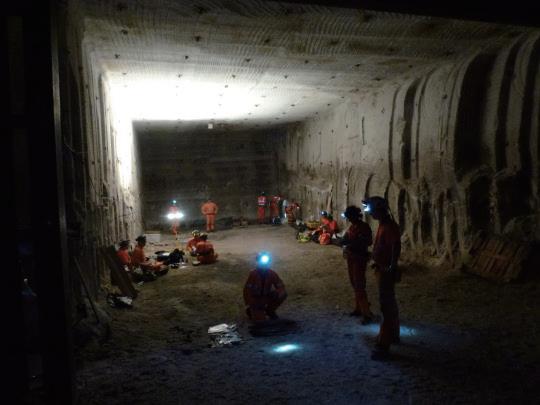
Spaces are extremely limited.
Dates: 16 June 2023 | 17 November 2023
Field Trip: North Sea Core Connections
Are you keen to see the great variety of North Sea geology on display in one room? On Friday 8 September you’ll be able to see the latest additions to our selection of the best bits of the North Sea at our core store. We’ll guide you through what is on display and illustrate the relevance to what is currently happening in the basin. With drinks and nibbles served, this will be a great opportunity to not only brush up your geology, but also share experiences and catch up with friends and colleagues.
Date and Time: 8 September 2023 | 3:00 pm - 7:00pm
GESGB April 2023 | Issue 2023/01 11 GESGB NEWS >
EDUCATIONAL TRAINING PROGRAMME
Night School 2023: A Detailed Look at the Basics of (Marine) Seismic Data Processing
Date and Time: 19-28 June 2023 | 6:00 pm - 8:00 pm
Facilitator: Gareth Williams, Geophysicist
Part 1 - 19 June | Geometry and Kinematics

Part 2 - 21 June | Transforms
Part 3 - 26 June | Resolution and Broadband
Part 4 - 28 June | Multiples
Fundamentals of Petroleum GeoMechanics
Date and Time: 4-6 September 2023 | 6:00 pm - 8:00 pm
Facilitator: Vamegh Rasouli, Geomechanic
Night School Recordings
Don’t forget, if you have missed any Night School Sessions that you would like to catch up on, you can now purchase Night School recordings. Visit our website for more information.
Have you heard about our Corporate Training Pass?
This pass allows unlimited access to our Educational Training Programme. The Corporate Training Pass can be used across your company for as many employees as you wish and it provides unlimited access to 16 Night School Recordings or more than 100 hours of learning! With our pass you can also access our live Night Schools and benefit from high quality training across a broad range of subjects. To receive the best offer contact us at events@ ges-gb.org.uk
Training Partner Programme
Keep an eye out for our next course in the training partner programme. In the meantime, if you are interested in partnering with us and sharing your kownledge, please email events@ ges-gb.org.uk
To find out more and to get involved with the GESGB Educational Training Programme, please visit our website or contact tamara@ges-gb.org.uk
12 GESGB April 2023 | Issue 2023/01
RARE EARTH MINERALS AND GEOSCIENCE
 Colin Clarke - Consulting Geoscientist
cult to acquire, and expensive.
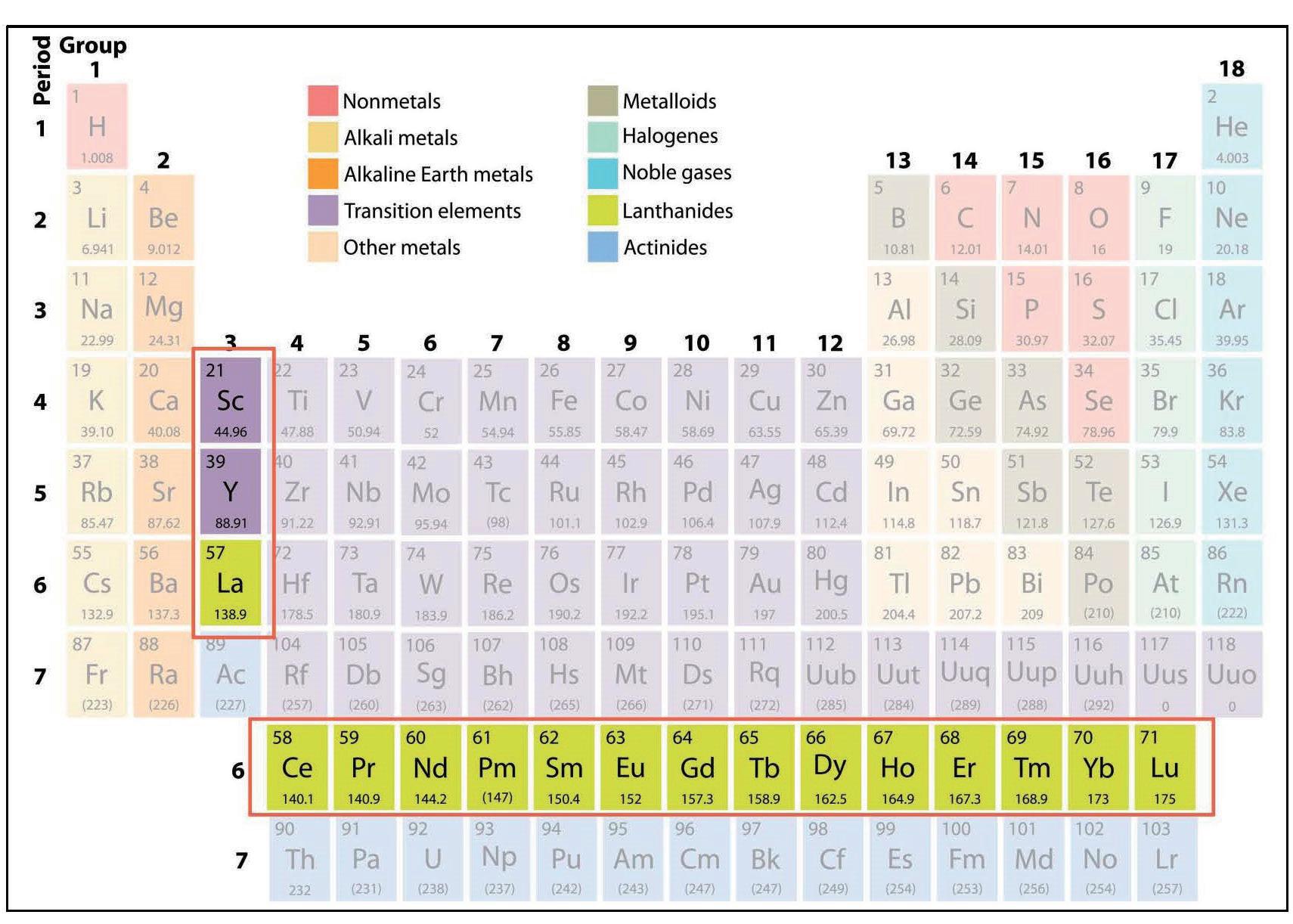
There are now 17 designated rare earth elements REES (Figure 1). Many applications have been found. From fiberoptic amplifiers in broadband systems, to phosphors for flat screen TV’s and mobile phones, and in the case of Neodymium, the strongest known permanent magnets (Figure 2). REOs are now produced in significant quantities-280,000 metric tons in 2021 (USGS 2021) and they are seen as critical minerals in the energy transition (I.E.A. 2022).
Superconducting metal oxides
In 1986 two Swiss physicists Georg Bednorz and K. Alex Müller, announced that a compound they had recently discovered became a superconductor at 35 Kelvin (-238 Celsius). Superconductors can carry large electrical currents with no resistance (and heating) and can generate powerful magnetic fields.
Powerful magnets have wide ranging uses, in medical imaging, transport and electrical supply grids and networks.
The new superconductor contained lanthanum, strontium, copper and oxygen. The lanthanum (La), a rare earth element (REE) used in the synthesis of the material, was available in the form of lanthanum oxide, a rare earth oxide (REO). At the time it was diffi-
However, they have still only been found in a few locations in sufficient ore grade for commercial extraction (USGS 2010).
The Rare Earths
The first rare-earth mineral discovered (1787) was gadolinite, a black mineral composed of cerium, yttrium, iron, silicon, and other elements. It
GESGB April 2023 | Issue 2023/01 13
Article >
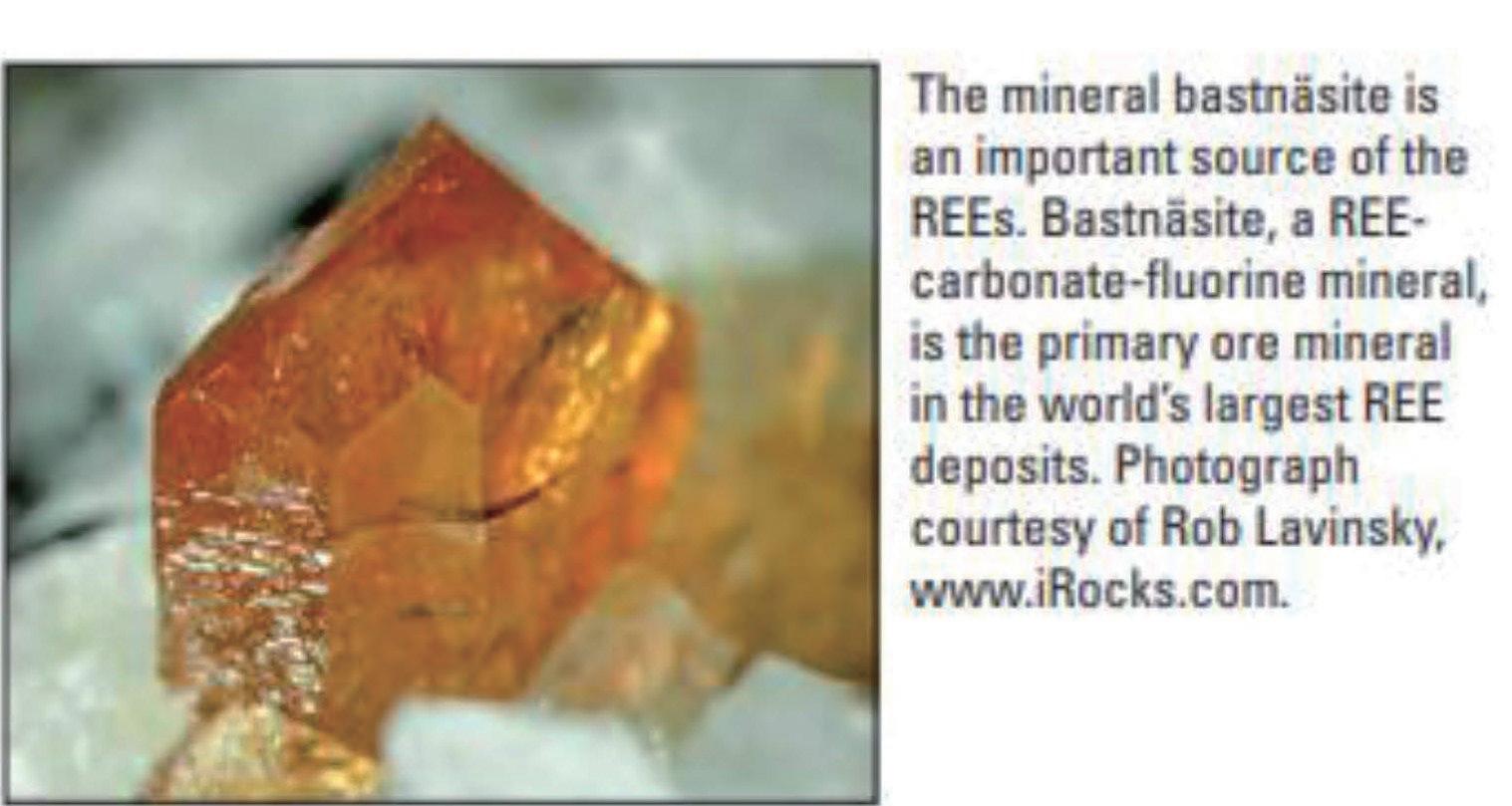
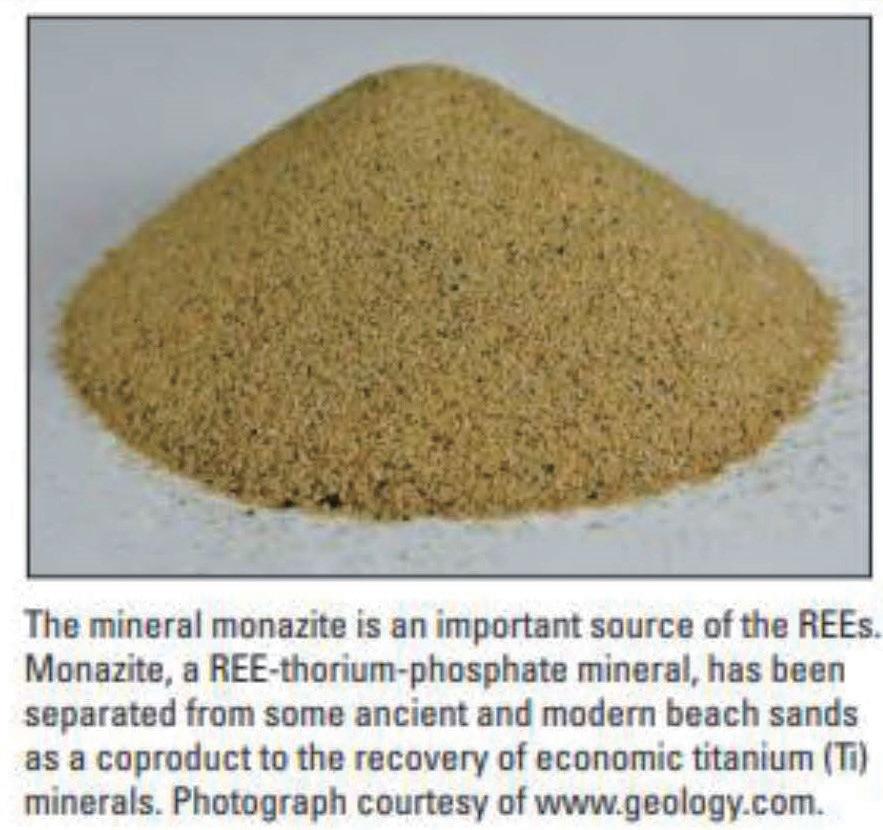
Figure 2: The two most significant REE minerals. Left Bastnasite, right Monazite. Source USGS 2012
Figure 1: There are 18 rare eath elements in the periodic table. Despite their name, rare earth metals are not rare at all. Their unique magnetic, luminescent, and electrochemical properties make them essential to such products as smartphones, electric cars, camera lenses, X ray scanners, wind turbines, and computer hard drives. Rare Earth Elements (rareelementresources.com)
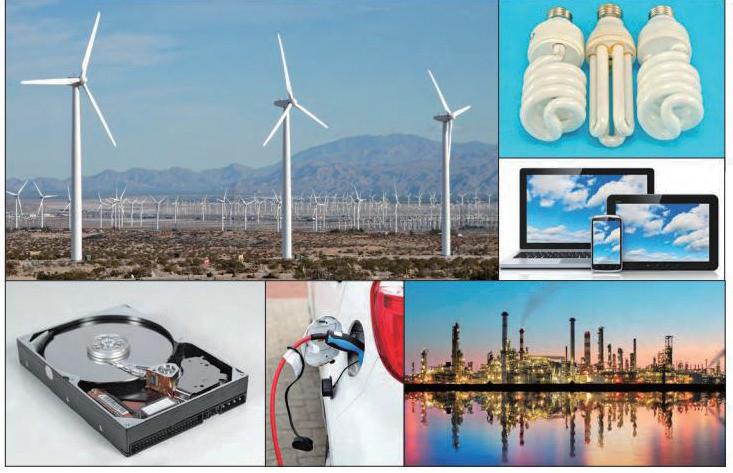
Figure 3: Rare earth elements (REEs) are used in the components of many devices used daily in our modern society, such as: the screens of smart phones, computers, and flat panel televisions; the motors of computer drives; batteries of hybrid and electric cars; and new generation light bulbs. Lanthanum based catalysts are employed in petroleum refining. Large wind turbines use generators that contain strong permanent magnets composed of neodymium iron boron. Photographs used with permission from PHOTOS.com.
was found near the small town Ytterby in Sweden. While rare earths are relatively abundant in the Earth’s crust, minable concentrations are less common than for most other mineral commodities.
In North America, measured and indicated resources of rare earths are estimated to include 2.4 million tons in the United States and more than 15 million tons in Canada. In these deposits the REES are bound together in minerals of oxygen, fluorine and carbonBastnatite and Monazite. Within sediments of placer depositional alluvial, fluvial and coastal paleo-environments (SEG 2016- Figure 3).
Carbonatite host the world’s largest REE deposits and are typically most enriched in the light REEs. Carbonatites are unusual igneous rocks derived from carbonate-rich magmas, in contrast to the more common silica-rich magmas. Carbonatites have been the world’s main source for light
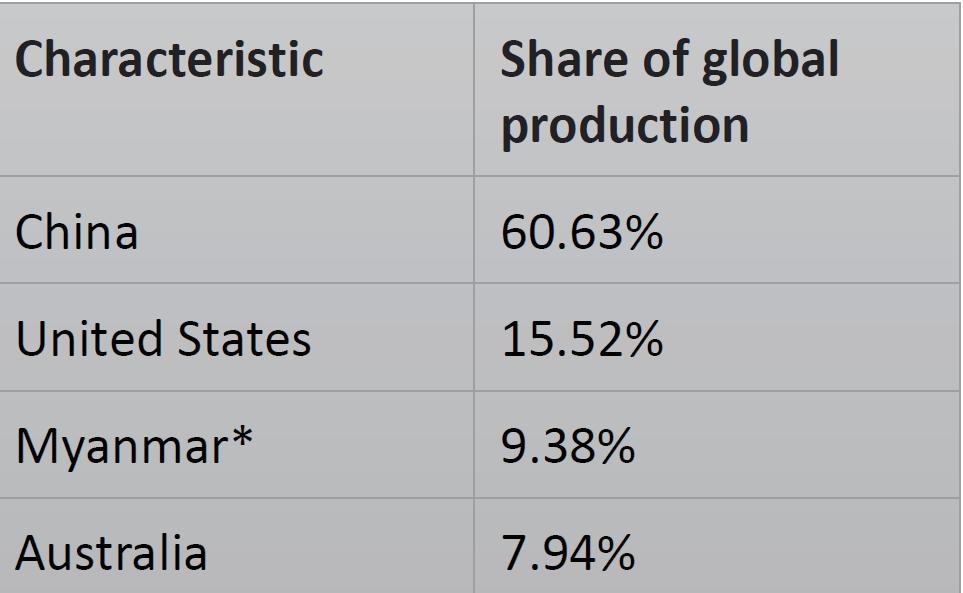
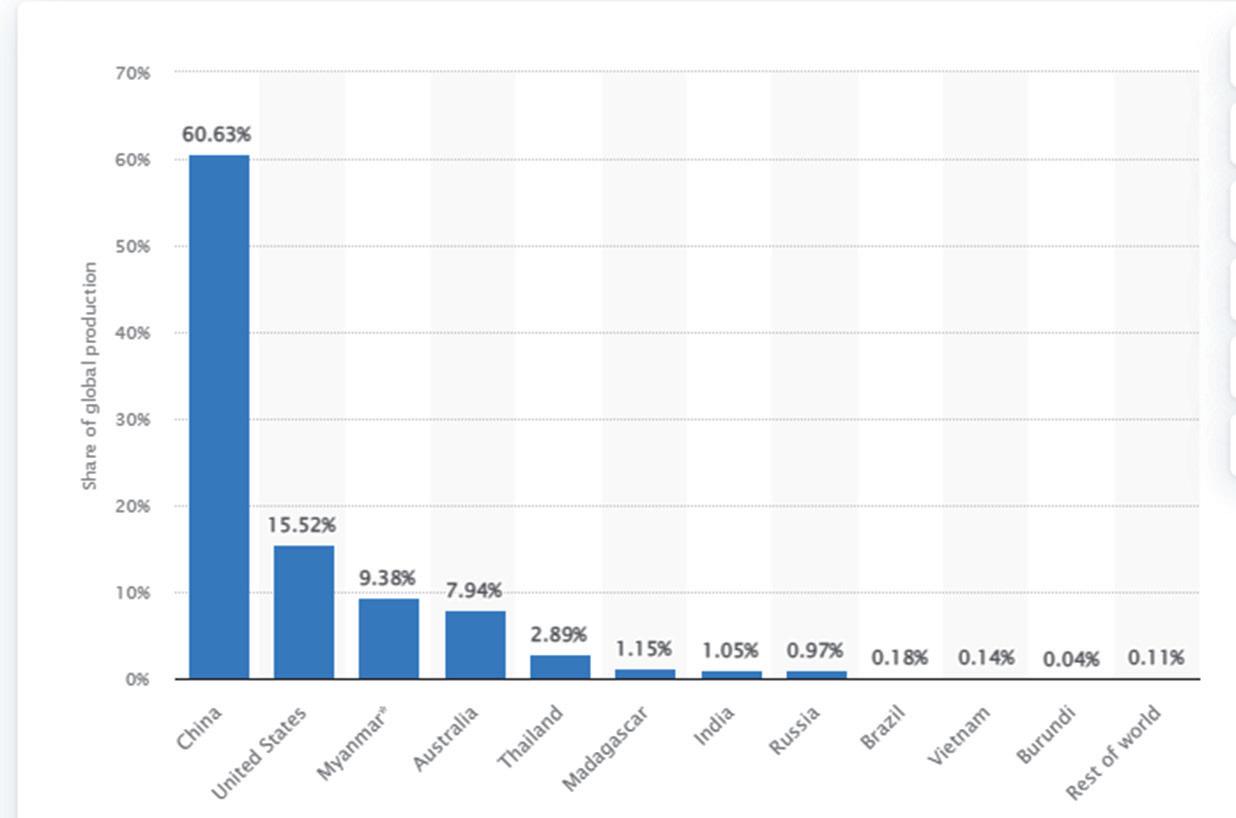
REEs since the 1960s. Currently, REEs are mined from these large carbonatite bodies in the United States and in China (Bayan Obo, Maoniuping, Daluxiang, and Weishan). The Mount Weld mine in Western Australia, produces REEs from a weathered zone that overlies a carbonatite.
For many years industrial demand for these elements was small. Their usage being in relatively small tonnages for a diverse high-technology applications mentioned. REE magnets are now used in Wind Turbines, high performance metal alloys in the defense industry, in EV batteries and for phosphors in light emitting flat screen devices.
(
Figure 4
For many years industrial demand for these elements was small. Their usage being in relatively small tonnages for a diverse high-technology applications. REE magnets are now used in Wind Turbines, computer hard drives, high performance metal alloys in the defense industry, in EV batteries and for phosphors in light emitting flat screen devices.
The pace and scale of the energy transition in particular and the use of Neodymium and Samarium in high magnetic density, light-weight magnets place a critical and increasing larger scale dependence on REES resources. Exploration for additional REE deposits is ongoing and REE reserves are likely to increase. So rare earth elements are again in the news, because of the energy transition and how they underpin modern technology. Some estimate that proven-reserves of rare earth metals are orders of magnitude below that predicted to be required in the Net Zero energy landscape. (GTK 2021).
What about the UK
At COP26, over 100 hundred countries signed-up to steady reductions in fossil fuel use, with firm, measurable commitments to the clean energy transition. Government agencies are again alert to the fact that access to some elements is of strategic importance.
14 GESGB April 2023 | Issue 2023/01
The pace and scale of the energy transition in general and the particularly the use of Neodymium and Samarium in high magnetic density, lightweight magnets used in rotors and generators. Places a critical and rapidly increasing dependence on REES resources ).
REE are Critical and Strategic
With current production limited to only a few countries, the UK Mineral Intelligence Committee has been formed (UKMIC), as well as the important Critical Minerals Association (CMA).
Ytterby no longer produces REE’s, though five of the rare earth metal elements are named after the town. The discoverers of LSSCO won the 1987 Noble Prize for physics. Their work opened up a huge area of research, in pursuit of even high temperature superconductors and in REE applications. Though to date no room temperature superconductors exist. If discovered, It is likely that these too will involve the REE’s.
These realities are a signal call to geologists, geophysi-
cists and energy companies to seek new sources of these materials. Like energy supplies, it is essential that REE supplies must be reliable, secure and affordable.
This is only likely to be of increasing significance in years ahead.
References and further reading
USGS 2010 The Principal Rare Earth Elements Deposits of the United States – A Summary of Domestic Deposits and a Global Perspective; Long, Keith R.; et al http://pubs.usgs.gov/sir/2010/5220/
USGS 2002 Rare Earth Element Mines, Reports and Occurrences; Greta J. Orris1 and Richard I. Grauch2; Open-File Report 02-189
USGS 2014 The Rare Earth Elements – Vital to Modern Technologies and Lifestyles; ISSN 2327– 6932 (online) http://dx.doi. org/10.3133/fs20143078
SEG 2016 Rare Earth and Critical Elements
in Ore Deposits. Chapter 4 Placer-Type Rare Earth Element Deposits; Debashish Sengupta and Bradley S. ISBN: 978-1629495-76-7
GTK 2021 Assessment of the Extra Capacity Required of Alternative Energy Electrical Power Systems to Completely Replace Fossil Fuels; Simon P. Michaux.; A Bottom-up Insight Reveals: Replacing Fossil Fuels is Even More Enormous Task Than Thought | GTK
U.S. Geological Survey, Mineral Commodity Summaries, January 2021. Prepared by Joseph Gambogi. Rare Earths (usgs. gov)
I.E.A. 2022 The Role of Critical Minerals in the Clean Energy Transition The Role of Critical Minerals in Clean Energy Transitions – Analysis - IEA
UK Critical Minerals Intelligence Centre (ukcmic.org)
Critical Minerals Association | Secure & Sustainable Supply I United Kingdom
GESGB April 2023 | Issue 2023/01 15
Figure 4: Distribution of rare earth mineral production by country as of 2021.
SEVEN GREAT REASONS TO JOIN THE GESGBTHE VALUE OF YOUR MEMBERSHIP
The PESGB, a membership society grew from those originally working in hydrocarbon exploration, in 1964. Sixty years later in 2024, and as the GESGB, we will be a membership society for those working in across the E&P cycle, other sub-surface energies and related technologies. We remain a professional society representing individuals working in energy, an industry that powers the world. Our events will continue to have the community feel that they have always had. Indeed over the years, this has become part of our culture.
Our membership numbers are around 2,700 (as of February this year), with around 12 new members joining each month. Our energy knowledge and passion for what we do is powering society , which will provide for future generations (and members) well into the next century!
The majority of our members pay £55 per year, and this has remained the same since 2017. I think that represents great value for money, as your society continues to provide all the things that industry professionals, currently working or ‘resting’, with all the things that were originally set out in the 1964 plan for the society.
For the GESGB charity, membership fees currently bring in only 28% of the overall income, with the remainder
coming from a mix of event income, donations and sponsorship. Interestingly for other industry associations the average is 45%, again underlining that the current membership fee offers great value in today’s inflationary environment.
I would like to highlight seven great reasons to join the Society or renew your membership for another year.
(1) Join a Special Interest Group & Attend their Events
Members can join a Special Interest Group (SIG) at no additional charge, which is an important member benefit. Each of our SIG’s focus on a specific area of our industry and offer the chance to connect with other professionals with similar areas of interest, to share knowledge and best practice, and grow professionally.
We currently have eleven SIGS encompassing Africa, Diversity & Inclusion, Exploring the Energy Transition, Geophysics, Machine Leaning in Geoscience, Middle East, Sales & Marketing, Old Timers, Risk, Resources, Economics & Commercial, UK Onshore Energy & Young Professionals. Given the breadth and depth of the SIGS, there is one to cater for most of our professional interest! The most active are the Geophysics, Old Times & Young Professional, and these tend to hold events
on a monthly basis.
(2) Join A Society Branch Event
A Society branch is more informal than a SIG, and membership also offers participation at no charge to any of our branch events. Often these provide an opportunity to connect and network over a drink. The oldest and most active is the Surrey Branch that meet on a bi-monthly basis at the White House pub in Guildford. They also host the annual Society hash that is always very popular.
(3) Receive the Quarterly Magazine & Monthly e-Bulletin
Membership provides a copy of our quarterly magazine and monthly e-bulletin. Both provide informative technical articles and news to stay up to date in the industry. Our last magazine had eighty-four pages and informative articles on ‘UK Hydrocarbon Production’ and ‘Reshaping E&P Activity areas in Italy’. The ebulletin provides and update on industry news, upcoming news and training events; keeping you connected every month.
(4) Access the Online Membership Directory
Long standing members may remember that this used to be provided as a hard copy. How-
16 GESGB April 2023 | Issue 2023/01
GESGB >
ever, we found that as soon as it was printed, it became outdated! The now online membership directory provides a platform to search members find key contacts and network with industry professionals from around the globe.
(5) Attend a Low-Cost Training Course or Field Trip (Exclusive to the Society)
Over the last few years, the Society has developed a programme of training and development courses including the GESGB Night School, which supplement our field trips. These courses are exclusive to members. They aim to provide members access to low-cost, high-quality training to boost professional development. In particular, the Night School classes have been specifically designed for members who are keen to participate in our training courses but are unable to take time off work.
As the name suggests Night School classes are held outside office hours and focus on skills required within the work environment, with themes ranging from specific technical skills to petroleum economics and reserves reporting. The classes are facilitated by highly experienced tutors keen to help you build skills for a solid future in the energy industry. Upcoming Night Schools Include ‘West Africa Petroleum Systems’ taught by Duncan MacGregor and a ‘Detailed look at the basics of marine seismic processing’ facilitated by Gareth Williams.
(6) Attend A Society Monthly Lecture
Society lectures are and important part of our heritage and Society culture, and offers talks on a wide variety of relevant topics cross the energy sector. During the pandemic these were held online. We are now looking to bring these back to enable face-toface networking, and are looking to trial different models in London and Aberdeen in Q2 2023.
(7) Receive Discounted Registration Rates to GESGB Conferences & Event
As a GESGB member you are entitled to a special discount for GESGB conferences and events, and is often one of the biggest drivers to our membership. The discounts are far greater than the cost of Society membership, and I often wonder why delegates pay the non-member rates and do not join the Society! For example, to attend the Business and Opportunities Show in April, members currently save £92 on the rate. This increases to £120 for the Energy Geoscience Conference in 2023.

GESGB April 2023 | Issue 2023/01 17
Development Bites
CommunicationwithNickSteel
Following the success of the 'Development Bites' sessions that we held at the 2022 YP Summit, the YP committee are building on this with follow up sessions with our speakers with recommended books, articles and podcasts on various topics of personal development.
In this issue we hear from Nick Steel. Nick is a Board and C-suite Advisor, Executive Coach, Trustee, Visiting Lecturer, and Adaptive Rowing Coach. A Chartered Geologist, he has over 35 years' international upstream energy experience in technical and senior leadership roles within a wide range of operating environments and organizational scales. Nick has kindly shared with the YP team recommendations on communication self-coaching:
Books:
Crucial conversations by Kerry Patterson, Joseph Grenny, Ron McMillan, Al Switzler (2021, McGraw Hill)


Fierce conversations by Susan Scott (2017, Piatkus)

Speak Up by Megan Reitz (2019, FT Publishing)

Thinking, fast and slow by Daniel Kahneman (2011, Penguin)

The Chimp Paradox by Steve Peters The Chimp Paradox by Prof Steve Peters

TED Talks:
Steve Peters - Optimising the Performance of the Human Mind - YouTube

TEDx Hult Ashridge Talk — Megan Reitz
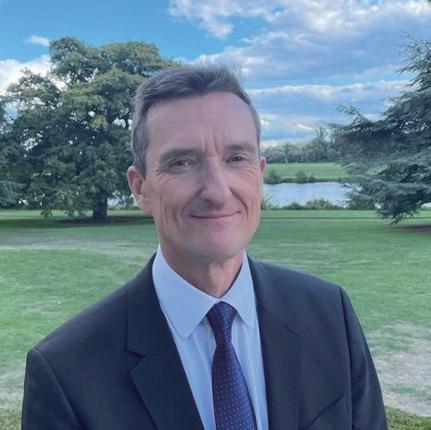
Article by Jade Metcalfe, Commercial Analyst
 GESGB Young Professionals Director
-
CNOOC

18 GESGB April 2023 | Issue 2023/01
more information on YP sponsorship opportunities email gesgbyp@gmail.com
For
GESGB Young Professionals
Get in touch with Nick on Linked In: linkedin.com/in/nick-steel-a3992013 Reading in the magazine online version? These links are interactive
RISKS, RESOURCES, ECONOMICS AND COMMERCIAL SIG NEWS
Steve Pickering - Bath Oil Training and Development
In February the Risk, Resources, Economics and Commercial SIG hosted an online presentation by Oswald Clint (Bernstein) who gave a talk entitled Implications of today’s Rupturing Global Energy System. The presentation looked at the current shortfalls in supply and demand for energy related commodities, noting the shortfall in capital investment below the levels needed to meet demand. Although investment in clean energy has been rising, oil and gas companies are receiving mixed signals. The growing mix of
energy sources signalling volatile markets ahead.
Watch the whole presentation here. https:// members.pesgb.org.uk/ groups/60474503c7ffef0007d7aa5e/chat
Risk, Resources, Economics and Commercial Agreements underpin the upstream energy industry, being equally applicable with regards to projects in the Energy Transition. Overtime, industry standards have continuously changed and it is important that there
is an interchange of ideas with regards to industry standards, training and best practice.
Organisations wishing to sponsor this SIG should contact: gesgb@ges-gb. org.uk
Gaia Earth Group
SIG >
GESGB Young Professionals
Email gesgbyp@gmail.com with your answers. Top 3 scoring submissions will receive a shout out in the next quarterly YP Quiz.
Quiz Masters
1. What does BRENT stand for?
2.Outside of oil and gas – what is a brent?
3. What comes after brent?
4. What is the connection between the composer Felix Mendelssohn and the Staffa Field?
5. What are the oldest rocks in the UK and where can I find them?
6. If I am the Sherwood to the British, what am I to the Europeans?
7. What is a 'geopetal structure’?
8. I am a grain-supported carbonate rock that contains 1% or more mud-grade fraction. What am I?

9. I am a mud-supported carbonate rock that contains greater than 10% grains. What am I?
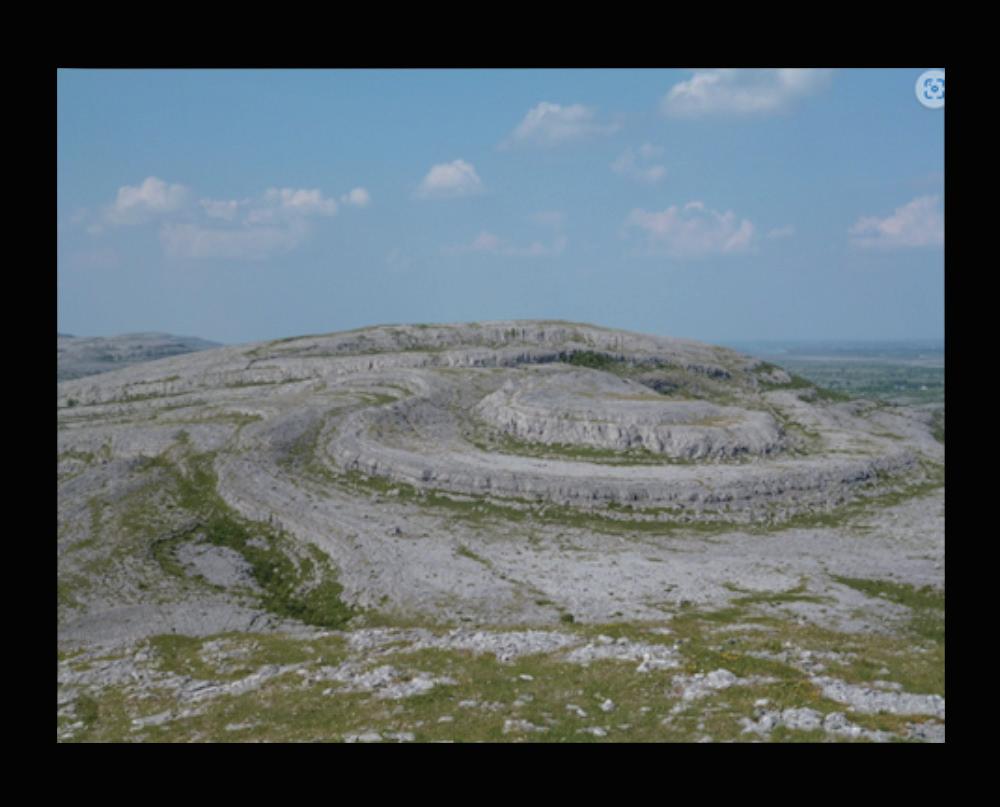
Bonus Round: What and where are these outcrops?

10.
11.
Article by Max Richards, International Business Manager - OPC GESGB Young Professionals Committee Member
20 GESGB April 2023 | Issue 2023/01
opportunities
For more information on YP sponsorship
email gesgbyp@gmail.com
COST OVERHANG SCENARIO SUGGESTS DROP IN UPSTREAM ASSET VALUATIONS FOR LATIN AMERICAN COUNTRIES
Renata Machado, Stephanie Vargas, Fernanda Machado, Siddhartha Sen
The Latin America countries offshore production in context
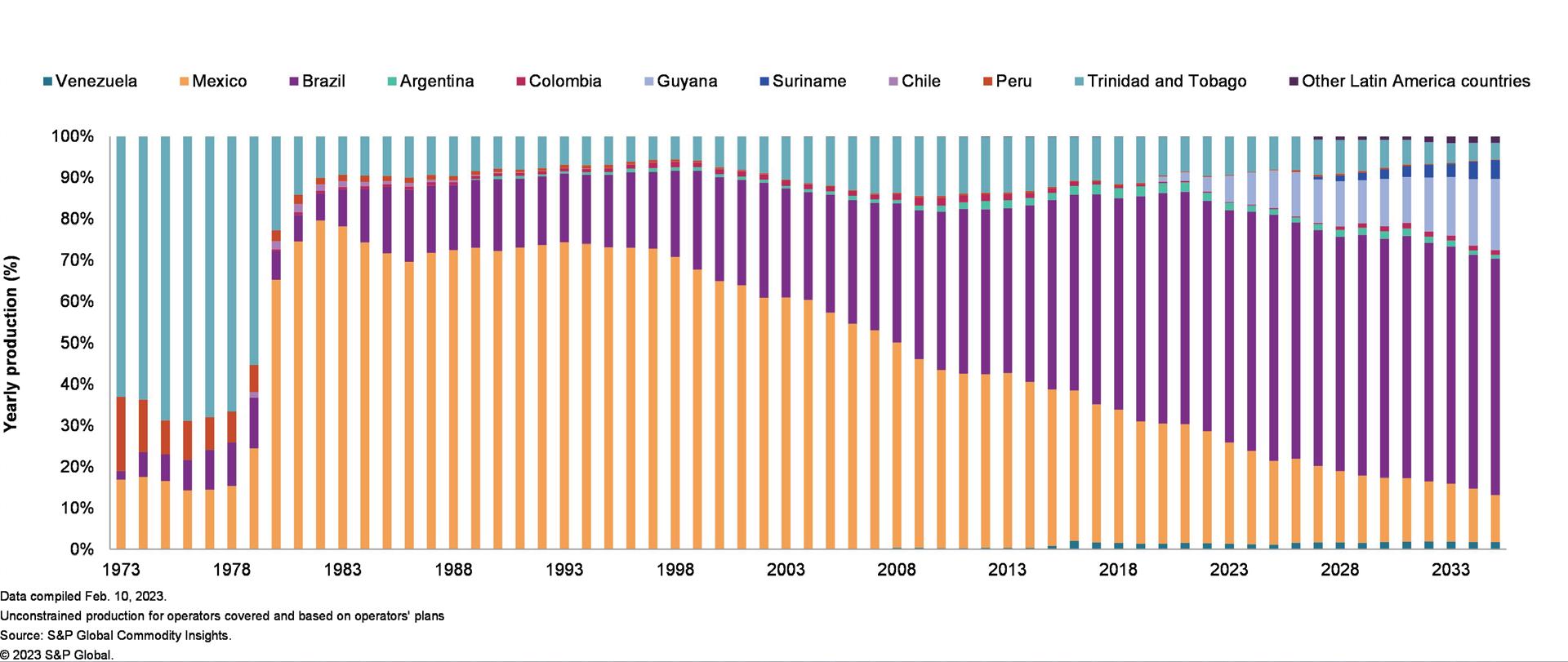
The Latin America region has historically been responsible for about 10% of the world’s hydrocarbon production over the last five decades. While the region has maintained a stable share of global output, the source of production has experienced an inherent change. In 1973, offshore production contributed to 3% of the region’s total, while in 2022 it has ballooned to 57%.
During the same time period, overall production in the region has also stepped up from about 2 Bboe (Billion barrels of oil equivalent) per year to over 3.5 Bboe per year. Production activity in the region is still recovering from the 2020 COVID crisis.
During the 80s and 90s, Mex-
ico led the show accounting for 73% on average of the total output relying mainly on its giant fields discovered in the shallow waters of the Sureste Basin. Brazil saw its share starting to grow with the first large discoveries in Campos Basin, but the country’s production uptick is greatly related to fields discovered this century in the pre-salt, mostly in Santos Basin. Brazilian contribution to regional offshore production has grown from 2% in 1973 to 56% in 2022. The next significant growth is expected from the Guyana Basin (Guyana and Suriname). More than 17 Bboe has been discovered offshore in this basin since 2015. Liza, the first and largest discovery to date, is already producing. Guyana’s contribution was at 4% in 2022 and is expected to reach around 17% by 2035. This growth will be driven by
bringing online just a few of the fields already discovered. Another important offshore producer in Latin America is Trinidad and Tobago. The country has managed to keep its 10% share in regional offshore hydrocarbon production over the last 20 years. The dominance of natural gas to the country’s production mix distinguishes it from the other big players in the region.
Offshore production is expected to reach approximately 4 Bboe per year by 2035 and these five countries should continue to remain the most important producers (see Figure 1). In the future, Guyana may replace Mexico as the second largest source of hydrocarbon production in the region, according to S&P Global Vantage®.
IHS
>
Article
Figure 1: Latin America hydrocarbon unconstrained offshore production percentage by country
Increases in capital and operational costs provide further challenges
The cost of developing upstream oil and gas assets is tracked by the S&P Global Upstream Capital Costs Index (UCCI) and S&P Global Upstream Operational Costs Index (UOCI)1. Cost indexes analyses leverage the S&P Global Energy Scenarios to consider the impact of geopolitical events on oil and gas development costs, as well as current environment of the prime oil and gas markets. UCCI is evaluated through the performance of 10 key markets: steel, engineering, and project management (EPM), construction labor, equipment, bulk materials, fabrication, offshore rigs, onshore rigs, subsea, and installation vessels. The UOCI market drivers are operations labor, production chemicals, diesel, facilities inspection and maintenance, supply services, aircrafts, well services and materials, and vessels.
Upstream capital costs rose at their sharpest rate in 14 years in 2021, with further upward pressure in 2022. Higher upstream costs are mainly driven by the cost of steel, offshore and land rigs, equipment, and labor – and this was experienced in 2021 and 2022 as
well. UCCI and UOCI both increased almost 10% in 2022 and the escalated costs are expected to remain elevated for the next few years, although at a lower rate. Costs continued to be driven upwards by the ongoing conflict in Ukraine and the increase in upstream project activity globally on account of elevated oil and natural gas prices, among others.
In the same way that UCCI and UOCI are developed, offshore indexes are calculated considering the increasing costs in the offshore market. Offshore global UCCI and UOCI are expected to increase on average 3% and 3.5% by year, respectively, until 2040.
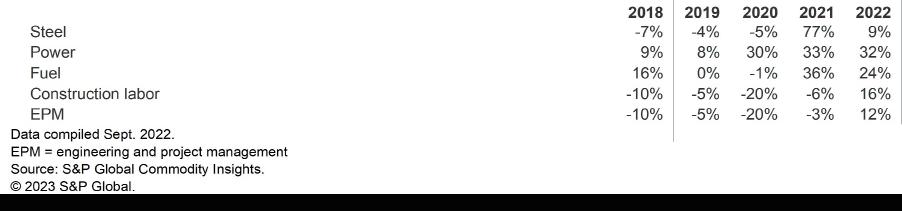
The impact of market cost changes needs to be considered in the asset valuation for future developments as they can have material ramifications on the project cashflow and overall viability. Ignoring cost increases can lead to wrong conclusions on the project investment needs and operator’s portfolio strategy. Table 1 shows how some key market components behaved in Brazil in the last 5 years, giving a deep sense on how these costs can affect economic results locally.
The impact of increasing costs in Latin America pro-
jects
A sensitivity study was developed to evaluate the impact of costs increase in offshore project developments according to the UCCI and UOCI expectations. Two scenarios were evaluated:
• Base case scenario - 2022 capital and operational costs were used with an inflation adjustment factor for future years.
• Indexed scenario - base case costs were adjusted by S&P Global offshore UCCI and UOCI (nominal values). The offshore global market indexes are a good approximation to what is expected in Latin America countries since a great part of procurement strategies are done overseas. In this scenario, there is no consideration of new technologies adoption, development optimizations or changes in current country’s fiscal terms.
Both scenarios consider same values for oil and gas prices. The oil price is defined by Brent oil price adjusted for oil quality and escalated at 2% every year according to S&P Global Vantage2 methodology. Domestic gas prices are estimated by S&P Global technical research team which will depend on countries specificities. The main offshore
22 GESGB April 2023 | Issue 2023/01
1 Detailed UCCI and UOCI reports are available for subscription based clients. If you would like more information on the same, please contact Pritesh.Patel@ spglobal.com
producing countries were selected to comprehensively represent a variety of ongoing and new oil and gas projects. The time period for the valuation scenarios was between 2023 to 2040.
To see the hypothetical effect of cost increases, over 350 offshore projects were evaluated across the region and then analyzed to capture the impact on the AT NPV (After Tax Net Present Value – nominal values) at a country level. Figure 2 shows the difference between the base case scenario and indexed scenario. Total AT NPV has decreased almost 15% in the region in the indexed scenario.
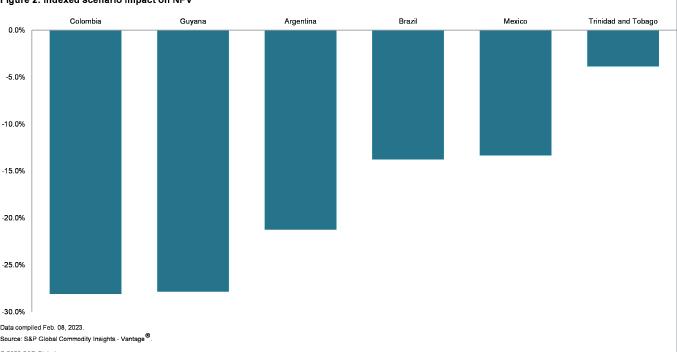
Colombia and Guyana assets are impacted more than the other countries in the scenario analysis, decreasing more than 25% when UCCI and UOCI are applied. Although the countries are in a different pace on offshore production contribution for the region, both have new developments that could be highly impacted by the increasing capital expenditures costs due to the intensive capital required in the future to reach peak production.
Colombia’s offshore is represented by 7 gas projects lo-
cated all over the coast of the Caribbean Sea. Chuchupa is the only project currently producing. The legacy shelf field has significant production forecasted until the mid-2030s. With no major capital expenditures expected, the current AT NPV of close to USD 1 Billion is not expected to be materially impacted by operating expenditures increases. On the other hand, remaining projects are in deep-water and in the appraising stage, therefore development concepts have yet to be defined. Deepwater production is expected to begin by the late 2020s at best. New projects could be severely impacted by the increasing capital costs, along with the difficulties to negotiate and secure contracting and materials for emerging deep-water developments in Colombia.
Guyana’s analysis considers 26 projects, all of them located in the Guyana Basin. Two projects, Liza Phase 1 and Liza Phase 2 have reached production status with a significant part of the development capital already spent. Although it could still represent an AT NPV of over USD 25 Billion, the Liza asset (three development phases) could suffer a notable reduction in its value of over 10% under the
cost indexed scenario. Most of the new developments included for Guyana have an estimated start date from 2030 – 2040. These projects are capital intensive and, although only 4 projects become uneconomic given the impact of UCCI and UOCI indexes, the AT NPV could diminish over 30% thus influencing the overall returns for underdeveloped offshore assets in the country.
Argentina takes the third place in the analysis resulting in about 20% reduction in NPV after indexes cost increases. The evaluation includes a total of 6 offshore projects, all located in the shallow waters of the Austral Basin, of which 4 are already in production. Operational costs in offshore Argentina play a huge role in producing projects like Magallanes which is at the end of field life. The Carina project, with over 200 MMboe of remaining resources is the only one better positioned to handle the fluctuation in operating costs. With Fenix in initial stages of development, the offshore project expects increased capital expenditures investment in the next years.
Brazilian assets have the largest AT NPV in the region and a substantial catalog of opportunities to grow production in the near and midterm. The country is in a better position with a diversified number of projects at different stages of development, with producing projects and new projects almost equally distributed. Over 200 projects were included in the analysis, most of them from the Campos and Santos Basins, but also new projects
GESGB April 2023 | Issue 2023/01 23
2 Detailed Vantage valuation results and methodology are available for subscription based clients. If you would like more information on the same, please contact Siddhartha.Sen@spglobal.com
from the Espirito Santo Basin and Potiguar Basin. The AT NPV would be impacted by over 13% including capital and operating cost increases. The procurement strategy adopted in producing projects in Brazil already embraces measures of capital expenditures reduction in the short term, such as the leasing contract for FPSOs, the adoption of large platforms, or massive gas injection technology (that avoids the construction of pipelines and gas processing modules in the FPSOs). When looking at new projects, half of them are expected to be developed through subsea tiebacks, thus reducing the overall capital investment required.
The majority of projects considered for Mexico are located in the Sureste Basin and Tampico-Misantla Basin. Most of them are in a producing stage, and they account for close to 60% of the remaining recoverable resources estimates in the country. These projects have already incurred intensive capital expenses and the main impact to the overall AT NPV is due the UOCI over the remaining life of the projects. New projects represent 33% of the total evaluated, and they are in different maturity stages. Altogether, the asset valuation could decrease about 13% when considering the cost increases due to UCCI and UOCI. This could also make the development of 4 new future projects uneconomic either due to the cost associated with deep-water developments (as for NobilisMaximus and for the Contract area 32 - Round 3.1, both located in the Sureste Basin),
or the modest size of the resources in place such as for the shelf projects.
Trinidad and Tobago is in a unique position considering that half of the projects, from over 35 analyzed, are already in production, and most of the new projects will begin production in the next five years, therefore accounting for lower impact from capital expenditures increases. The development concept adopted in the country also impact the result as 50% of the new projects are modelled considering tiebacks to existing facilities. The simplified development concept significantly reduces the capital expenditures associated to each new project.
Conclusion remarks
All markets are subject to cost increases due to global economic conditions that continue to prop up inflation and have pushed and tightened financial market conditions. At this point, most companies have chalked out strategies to deal with this scenario, with cost containment or project delays. It is up to operators to be aware of cost increases and protect themselves in the best way possible to reduce the impact of this risk. Negotiating contracts in a period of lower hiring costs could reduce capital and operating expenditures in the future. Additionally, reevaluating development concepts can be an option to manage capital investments, thus strengthening valuation before cost increases. In the offshore market, there are opportunities for innovation and optimization to
keep costs better under control.
Overall, in selected Latin America countries, the indexed scenario showed a potential decrease in AT NPV for offshore projects if no action is taken to reduce costs. For the region, altogether, the AT NPV decreased 14%. For producing projects, which represent about 45% of the data analyzed, on average, there was a reduction of 8% in AT NPV. For new projects some were impacted with a decrease of 28% or higher in AT NPV, while most of them, close to 40% of the total data analyzed, decreased 13%.
Additionally, smaller projects, with low estimated recoverable resources can be highly affected by cost increases, becoming uneconomic. Almost 50 projects evaluated had its AT NPV turn negative after applying the cost escalation indexes. These small projects represent 1.4% of the offshore total estimated recoverable resources in the region. The hypothetical scenario highlights the vulnerability some assets have in each country and emphasizes the constant need for new technologies and optimization developments that could drive significant cost savings in the future and avoid the impact of cost escalations.
24 GESGB April 2023 | Issue 2023/01















GESGB April 2023 | Issue 2023/01 25 www.energygeoscienceconf.org 16 - 18 MAY 2023 16 - 18 MAY 2023 P&J LIVE, ABERDEEN P&J LIVE, ABERDEEN Powering the Energy Transition Powering the Energy Transition Through Subsurface Collaboration Through Subsurface Collaboration Media partner Sponsors #EGC2023




25-26 April 2023 Business Design Centre, London BRINGING APPEX & PROSPEX TOGETHER Join us for the second edition of BEOS, where you’ll have the opportunity to meet with participants from Oil and Gas Majors, NOCs, Governments, Independents and E&P companies to discover global opportunities. REASONS TO ATTEND... FIND NEW EXPLORATION OPPORTUNITIES INCREASE YOUR NETWORK RAISE YOUR COMPANY PROFILE ONE-STOP SHOP FOR GLOBAL PROSPECTS events@ges-gb.org.uk General Enquiries: #BEOS2023 www.beosevent.com

28 GESGB April 2023 | Issue 2023/01
GESGB Young Professionals



In February five societies came together to host the first ‘Energy on Draft’ event of 2023.
Energy on Draft Networking Event
Attracting over 80 energy professionals, the February event was held in Belgravia at the Paxton’s Head pub. The fourth instalment of this networking series was another great success with a room packed full of interesting discussions socialising and making new connections.


Thank you to our partner societies SPE, AAPG, EAGE and IChemE for extending the reach of this event and helping to connect a great group of people. The GESGB committee is now busy planning for the next instalment of ‘Energy on Draft’ on 20th April 2023 at 'The Thirsty Bear' and are looking forward to seeing you there!




This quarterly energy industry event gained momentum and popularity through 2022, and now brings together like minded professionals from a wide range of companies and disciplines with various levels of experience.
Article by Francesca Twynam, Geophysicist - SLB GESGB Young Professionals Committee Member
GESGB April 2023 | Issue 2023/01 29
For more information on YP sponsorship opportunities email gesgbyp@gmail.com
DIVERSITY AND INCLUSION SIG
The Co-chairs of the Diversity and Inclusion Special Interest group have updated the name of the group to: Equity, Diversity and Inclusion SIG or EDI SIG. All members are welcome to join and participate in our EDI discussions and activities. These fundamental principles have become essential components of any organization’s business objectives. In the EDI SIG we are discussing how organization compare in terms of revenue improvement; diverse companies earn 2.5 times higher cash flow per employee and inclusive teams are (more) productive by over 35%.” (2022 Global Industry Analysts Inc report). Also, that AI and data-driven technologies are increasingly
used to make important decisions about our everyday lives but there are indications that some data and results contain biases and inequalities, for example in automated screening of job applications.
Similarly, the budget allocation to EDI efforts in 2023 has increased within companies, in recruitment processes, in training for employees and overall corporate activities related to EDI. XpertHR studied 218 UK and international organisations between June and July 2022 found that just 2 in five (38%) have allocated or planned to allocate a budget specifically for EDI. Of those that plan to allocate budgets, only 36% considered their current or planned EDI budget sufficient but the vast majority (96%) of businesses
were undertaking some form of EDI initiatives over the next 12 months, and around 84% had a strategy in place or were planning to introduce one. ( www.peoplemanagement. co.uk/article/1800577).
Among other subjects, we talk about EDI best practices within our own working environment and the importance of being aware of individual biases and promote positive actions within the companies we work for, using guidelines from the UK Equality Act 2010 and related publications. The SIG takes interest in bringing expertise from outside our Energy industry on EDI issues being tackled in other industries, to learn from these experiences. GESGB members can contact gesgb@ges-gb. org.uk to join our SIG!
30 GESGB April 2023 | Issue 2023/01
In conversation with...
Leanne Smart

Well Placement Engineer at SLB
This quarter we sat down with Leanne Smart. Leanne is a Well Placement Engineer at SLB where she forms a team supporting clients through well trajectory optimization projects Leanne previously worked as an Offshore Geophysicist and holds a BSc in Geophysics from the University of Edinburgh and an MSc in Structural Geology with Geophysics from the University of Leeds.
Tell us about your career path so far
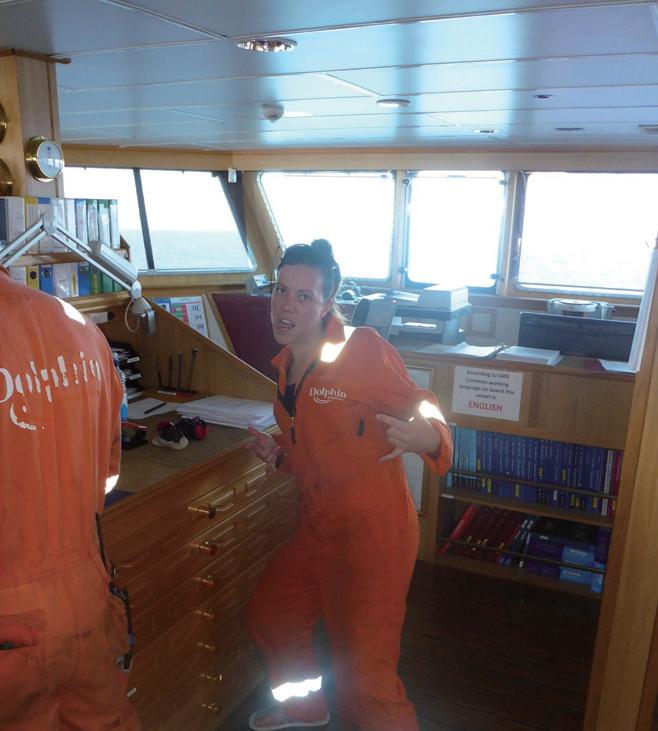
I graduated from the University of Edinburgh in 2012 with a BSc in Geophysics. I then undertook a summer internship with Dolphin Geophysical at their Tunbridge Wells office From there I was offered full time position working as an Offshore Geophysicist where my role was processing seismic data that was acquired by the seismic vessels In 2016 I moved to the University of Leeds where I began an MSc in Structural Geology with Geophysics. In 2017 I was awarded a scholarship internship with SLB until I graduated. In 2018 I moved to Aberdeen and began a full-time position with SLB as a Geologist. In the October of 2022, I moved into the Well Placement team, working in my current role

What inspired your career change to move from Offshore Geophysics and pursue a masters in Geology?

Albeit a fascinating role, after 4 years I decided that I wanted to move into an onshore position. I was intrigued about the geological side of the seismic data that had been acquiring and wanted to learn about how it was applied in industry The Structural Geology with Geophysics masters course combined my preexisting knowledge of geophysical techniques with structural principles to solve real-world geological problems across a range of subsurface environments Through the programme I developed subsurface interpretation and modelling skills that led to a 12month internship with SLB in Leeds.
GESGB
Young Professionals
G e t i n t o u c h w i t h L e a n n e o n L i n k e d I n : l i n k e d i n . c o m / i n / l e a n n e - s m a r t - 6 5 0 a 3 3 4 8
Welcome to the fifth edition of "In Conversation With..." where we share the experiences of young professionals navigating their way through the industry!
Have you had the opportunity to travel much with work?

Whilst working offshore I had fantastic opportunities to travel. We worked on 5 weeks on, 5 off rotation. This meant that every second month I had a month-long vacation. During this time, I took the opportunity to travel as much as I could. I ventured to Ecuador, Peru, the Galápagos Islands, climbed Kilimanjaro and went snowboarding in Japan, Canada, America, Austria and France Within my current role, SLB have training centres in Abu Dhabi and in Paris, so I regularly travel for various training occasions
What does a typical day on the job look like for you?
It is difficult to describe a 'typical' day within my current role Activities vary depending upon the drilling timetable and varies between the extremes. Slower paced activities include pre and post-job work, for example preparing models and presentations for clients. Conversely, during real time drilling the team works in 12 hour shifts with the operator’s operations team involving Geologists, Reservoir Engineers and Completions Engineers. My responsibility as a Well Placement Engineer is to understand and explain the real-time response that we observe to help guide real time geosteering decisions. During these operations we integrate data from deep azimuthal EM resistivity tools and a range of LWD (LoggingWhile-Drilling) tools to adjust a geological model in real-time and optimize well trajectories Projects typically are Development & Production horizontal wells in the UK and Europe As a team our key priorities are to assist the ops teams in achieving a well objective either by safely maximising the footage the trajectory is in the target formation or avoiding undesirable locations which could compromise the well
What do you find most interesting about your current role?
I really enjoy the variety that the role brings. Every project is different, and it presents the chance to work with different clients and new operators over short time periods in a high pressure environment Each project brings new fields, new geological challenges with different expectations Some of our clients are very familiar with our tools, whilst some have never been involved with any geosteering activities which in itself adds another dynamic to the job. It is a great environment for developing skills and an understanding of the operational side of the industry
Are there any projects you would like to get involved with in the future?
We are about to drill our first Geothermal well with these EM resistivity tools. It is an exciting example of how well engineering projects are evolving as the energy transition unfolds. Well trajectory optimization will be required for Geothermal and CCS projects so there is a place for these tools and associated skills in the future. I'm looking forward to being more involved in these types of projects and the engineering challenges that they will bring.
Are there any groups that you are involved with at SLB?
I am a member of the SLB QSC (Quality Steering Committee) which is responsible for maintaining a high standard of service within the digital group. This has provided a greater understanding and knowledge of SLB processes and quality assurance. I am also a member of Connect Women, a Diversity and Inclusion initiative which supports and encourages women working within our industry. The group provides an empowering space where women can connect, break stereotypes and promote gender equality.
What do you enjoy most about living in Aberdeen?

For me Aberdeen is the ideal size. It's a small but vibrant city and I love that I can get from one side to the other within 20 minutes. There is a great balance between things going on in town and the close proximity to the surrounding hills. Having a very energetic dog, it's ideal being located so close to many beaches and the mountains which provides great places to walk. And despite what everyone says, it doesn’t actually rain that much!
Calling Young Professionals
Are you a young professional who would like to share your story in the next issue? Please drop us a message at gesgbyp@gmail.com
Article by Jade Metcalfe,

Commercial
Analyst - CNOOC
GESGB April 2023 | Issue 2023/01 33
GESGB
For more information on YP sponsorship opportunities email gesgbyp@gmail.com
Young Professionals Director
DEPTH CONVERSION FOR OIL AND GAS AND BEYOND
Glyn Pugh, Andy Allison, Michael Braim
Introduction
Over the past twenty years or so ERCE has been engaged to build or review velocity models, which have been built almost entirely for the purposes of oil and gas exploration and production. However, over the last few years we have been asked to turn our experience to velocity models and depth conversions beyond the field of oil and gas, most notably unconventional resources and carbon capture and storage (CCS) projects.
On one level these other projects present the same challenges as a traditional oil and gas job, i.e., we have a surface measured in Two Way Time and we would like to understand its structural form in depth, and the uncertainty associated with this estimate. Therefore, the techniques and approaches used to perform velocity modelling and depth conversion for oil and gas are applicable to unconventional and transitional energy projects. The main difference from the traditional oil and gas job is the project emphasis.
The subject of velocity modelling and depth conversion is a broad topic, and we do not try and address the technical details within the scope of this article. Instead, we attempt to compare how velocity model-
ling and depth conversion differs between traditional oil and gas, and transitional projects like CCS or unconventional resources.
It is pertinent to say that approaches to velocity modelling vary, primarily depending on the geology and available data. However, the geoscientist’s preference can often influence the selected model and worse, anchor views, reducing appreciation of the potential uncertainty associated with the depth structure.
Main Concerns with Oil and Gas Projects

Let us start by outlining the main concerns associated with our regular oil and gas projects.
When we calculate in-place volumes for either oil or gas (HIIP), we multiply the gross
rock volume (GRV) by a net to gross ratio, a porosity, a hydrocarbon saturation, and a formation volume factor. There is uncertainty in all these parameters, but usually it is the GRV that has the largest range and biggest influence on the resulting HIIP. Figure 1.1 presents a schematic tornado plot illustrating the relative importance of each of these parameters.
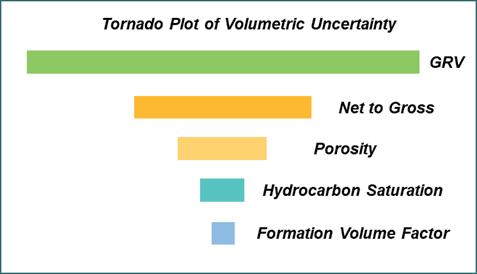
So, to try and understand how small or large our oil/gas field can be, we need to have an idea about the GRV variability, or the size of ‘the tank’.
To do this we need to consider the three variables that impact the size of our trap. First of all, there could be alternative top reservoir time interpretations, and if we are dealing with 2D data there is also uncertainty in the time structure between lines. Secondly, there are of-
34 GESGB April 2023 | Issue 2023/01
Article >
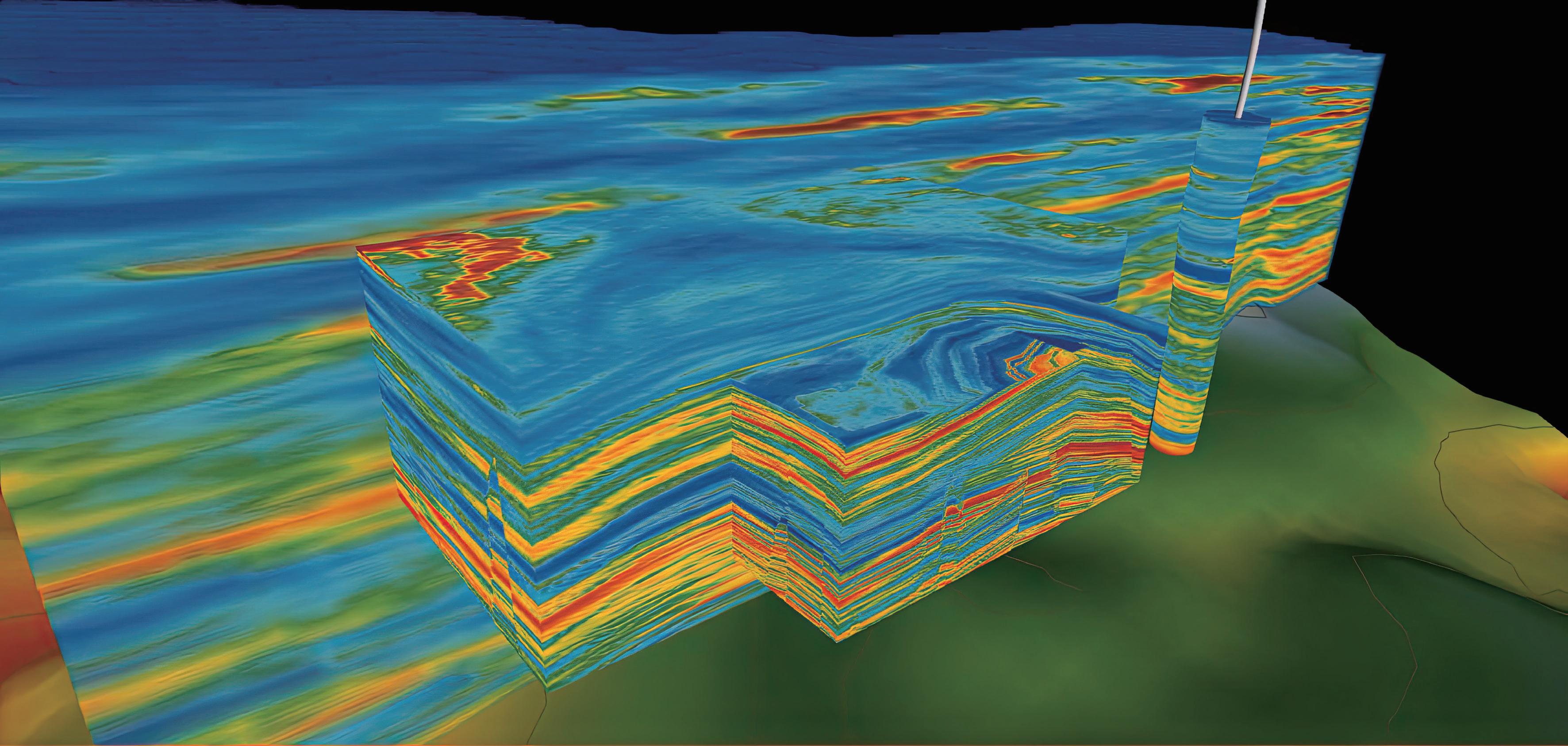
Figure 1.1: Tornado Plot Showing the Typical Relative Importance of Factors that Contribute to HIIP
ten questions about how thick the reservoir could be. However, usually the largest variable associated with GRV is the uncertainty in the rock velocities down to the top reservoir.
The tornado plot in Figure 1.1 focuses on the primary reason why we are most often asked to run a number of depth conversions, that is to work out how big or small the “prize” might be, but we do get asked other questions; such as where in the trap is the best place to locate a well, and what is the depth prognosis and associated depth range to top reservoir?
Velocity modelling also plays an important role in risk mitigation for drilling activities by predicting the depth of possible hazards such as shallow gas, location of faults or possible pressure kicks.
Velocity Model Evolution
Unsurprisingly, how we make the velocity model for our depth conversion is determined not only by the geology and its complexity through the overburden but also the availability of the data. There are velocities involved in every step of the exploration, appraisal, and production process. Figure 1.2 shows the evolution of a velocity model, together with the interacting processes, that both provide input data and use the velocity model as part of a parallel work stream.
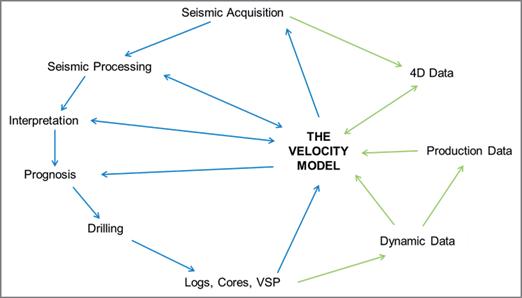
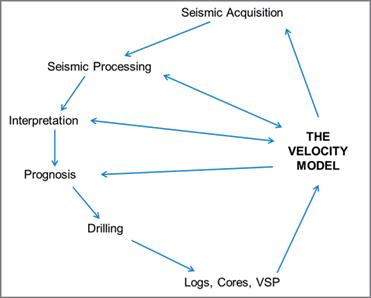
As the field matures, fewer wells are generally drilled, and the amount of new velocity data tends to decrease. The
emphasis is now placed on maximizing recovery from existing infrastructure and how we might adapt our in-place estimates to honour the dynamic behaviour of the reservoir determined by our engineers and potentially by a 4D seismic response.
Figure 1.3 shows how the velocity model is supplemented by this additional data and its role in the further evolution of the model as part of the development life-cycle.
Relative Importance of Velocity Modelling and Depth Conversion
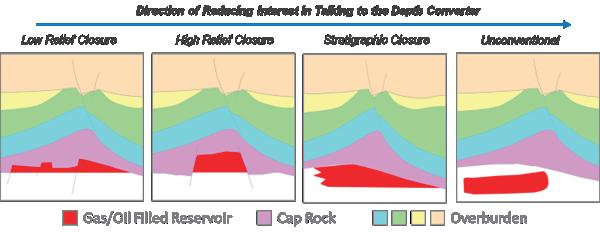
It is not surprising that people are most excited about depth conversion and velocity models when the depth structure is the key control on the in-place volume. Figure 1.4 presents a schematic that shows how this sensitivity can change with respect to different trapping mechanisms.
GESGB April 2023 | Issue 2023/01 35
Figure 1.2: Pre-Development Velocity Model Cycle
Figure 1.3: Development Velocity Model Cycle
Perhaps the most velocitysensitive situation occurs when there is a relatively low relief four-way closure with the possibility of a shallow spill reducing or removing volume. As we move from this situation to a robust high relief closure, then to a stratigraphic trap and finally to an unconventional reservoir the sensitivity of in-place estimates to depth conversion reduces (Figure 1.4).
Unconventional Reservoirs
Whilst it is true to say that in-place unconventional resource estimates may not be as sensitive to the form of the reservoir depth structure,
depth conversion still plays a role particularly for well planning purposes.
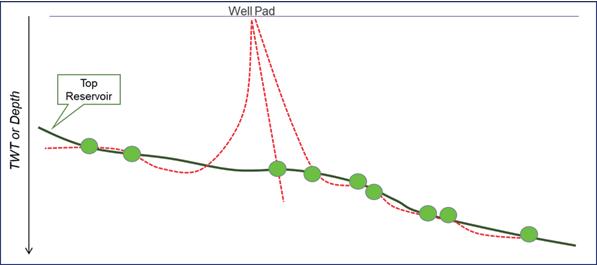
As unconventional reservoirs are developed, the number of top reservoir penetrations generally far exceeds those in a conventional oil and gas setting. The number of formation tops can increase further if a technique known as “porpoising” is used while geosteering. This is a strategy of staying in the reservoir by regularly diving then lifting the well trajectory until the well encounters the top of the reservoir, at which point the driller will dive the well again.
The principle is illustrated by
the schematic in Figure 1.5.
Whilst these multiple penetrations help to reduce depth uncertainty, they present new challenges to the depth modeller, in how they can quickly and effectively incorporate a multitude of control points as part of an ever-evolving velocity model, prior to drilling the next well. To some extent ultra-deep azimuthal resistivity tools offer ‘look-above’ techniques which can give similar control points to horizontal wells drilled in conventional reservoirs.
Figure 1.4: Schematic Showing Reducing Sensitivity of Depth Conversion to HIIP
Figure 1.5: Deviated Well Trajectories ‘Porpoising’ an Unconventional Reservoir.
Carbon Capture and Storage
Figure 1.6 presents a schematic showing the possible subsurface targets for carbon capture and storage.
One of the possible sites evaluated for CCS are depleted hydrocarbon reservoirs. These can offer a particular advantage to the depth converter: in addition to there being a relative abundance of different velocity data, historic production data should help to define the available storage space, the best example being a P/Z plot which provides a relatively accurate estimation of the GIIP connected to the wells.
This information enables the depth converter to narrow the range of plausible velocity models to ones which honour the P/Z estimates.
Whilst there are advantages to assessing depleted hydrocarbon reservoirs with long production histories, the legacy wells which can potentially act as leakage pathways present additional modelling considerations that need to be taken into account.
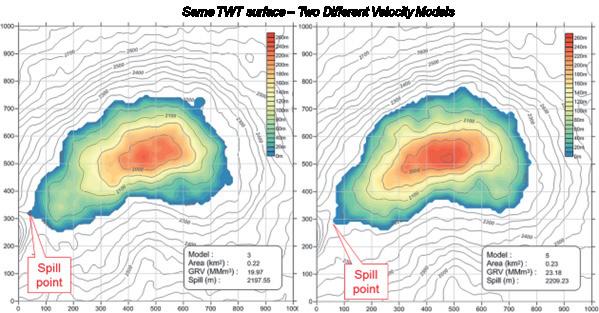
This brings us to the main role of velocity modelling for such scenarios, which is to be able to identify all structural spill points of the primary container and in addition, all other potential leakage points, and their likely migration pathways, hopefully towards potential secondary traps (Figure 1.7). Then we can assess the structural uncertainty and volumetric capacity on these, usually less understood, secondary structures.
The advantage of assessing a saline aquifer trap for CCS is
that generally they are robust structures, for example the Bunter Sandstone Formation of the Southern North Sea (SNS), and they are not usually peppered with old wells. However, while we have an abundance of well based velocity data for a depleted field CCS project, we often have little well-based information for our saline aquifer, and certainly no dynamic data.
This means we are back to using the early days oil and gas approach to derive a reasonable GRV range and identify where, and at what depth, our spill point might be. This way, we can map the most likely direction of CO2 movement if the trap is somehow overfilled, or if horizontal intra-reservoir baffles cause non-uniform filling.
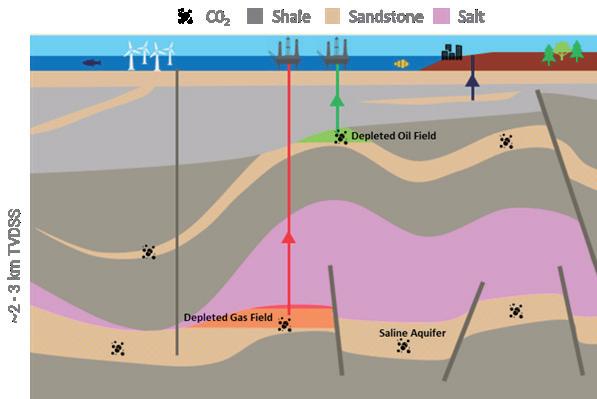 Figure 1.6: Schematic Showing Possible Sites for Carbon Capture and Storage.
To summarise, depth conversion, like many practical science matters, is non-unique and there may be several methods that yield acceptable models. However, this range is not always explored, and can be limited by bias or preferred approaches to depth conversion. Examples being exclusive reliance on seismic processing velocities, insistence on tying depth residuals through the overburden, only applying one ‘geostatistical’ assessment of uncertainty, or
only applying a ‘multi-deterministic’ view.
After many a tedious argument about depth conversion dogma over the years we have often found it best to see if the result of someone else’s approach is reasonably close to ours before we lift the lid on all our methodological preconceptions.
This attitude probably comes from ERCE’s common role as an auditor, where we do
a ‘Top Down’ assessment of someone else’s work. In all aspects of the client’s evaluation, we will ask four questions - What do they say? What do we say? What’s the difference? And why?
While this article addresses depth conversion, the answering of these four questions applies equally to other geoscience and reservoir engineering disciplines, from petrophysics to dynamic modelling.
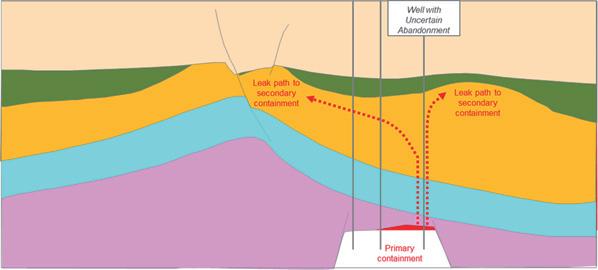 Figure 1.7: Schematic Showing Possible Leakage to Secondary Containment Structures.
Figure 1.8: Robust Saline Aquifer Depth Maps – Small GRV Changes and Similar Spill Locations
DIAGNOSIS BEFORE CURE: WHEN TO CALL AN UPSTREAM DOCTOR
Andy Spriggs, Managing Director
At Rockflow, the challenge with every upstream project is finding what the real problem is.

You might come to us with an idea of that problem, like a patient who suspects they know what ails them. Frequently, though, the reason companies come to us is because they’ve exhausted their own resources - and sometimes their own understanding - and they need an independent, veteran expert to tell them what is going on.
That means we first need to pose the right questions.
In our experience there are typically three types of issues that an O&G company will want our perspective on. And while purely technical problems might have a direct solution, there are many that first require an accurate diagnosis.

1. A technical issue
When you know you have a technical problem and you’re not certain of the solution.
At the purely technical level, you don’t necessarily need a diagnosis, you simply need a solution that fits.
In this instance, you want the equivalent of a highly practised tailor who can measure you at a glance and produce exactly what you need – whether that’s a reserves audit or a feasibility study. The quality of the solution and its speed and efficiency all matter here, and that’s why many companies choose us and keep returning to us.
What they’re also looking for, however, is reassurance that the issue does not go any deeper; if we believe there are other dimensions, we are well placed to identify them and let
the client know.
2. A diagnosis issue
When you have a technical problem, and you don’t know the exact nature of that problem.
One company asked us to investigate an issue they were facing with a fracking project: their wells weren’t producing gas, instead they were producing water.
They had already hired a number of other consultancies who had attempted to resolve the issue and, had it been an engineering problem, no doubt they would have succeeded. But the company was keen to find a solution and were willing to throw more resources at it.
Based on our experience, we suspected the issue was not with the well and our investigation determined that it
Article >




#Africa2023 20 – 21 SEPTEMBER 2023 LONDON Submit your Abstract Now! Submission deadline: 28 April 2023 For more information visit: https://africa.pesgb.org.uk/ UNLOCKING AFRICAN ENERGY TO POWER THE FUTURE
PHOTO SPREAD
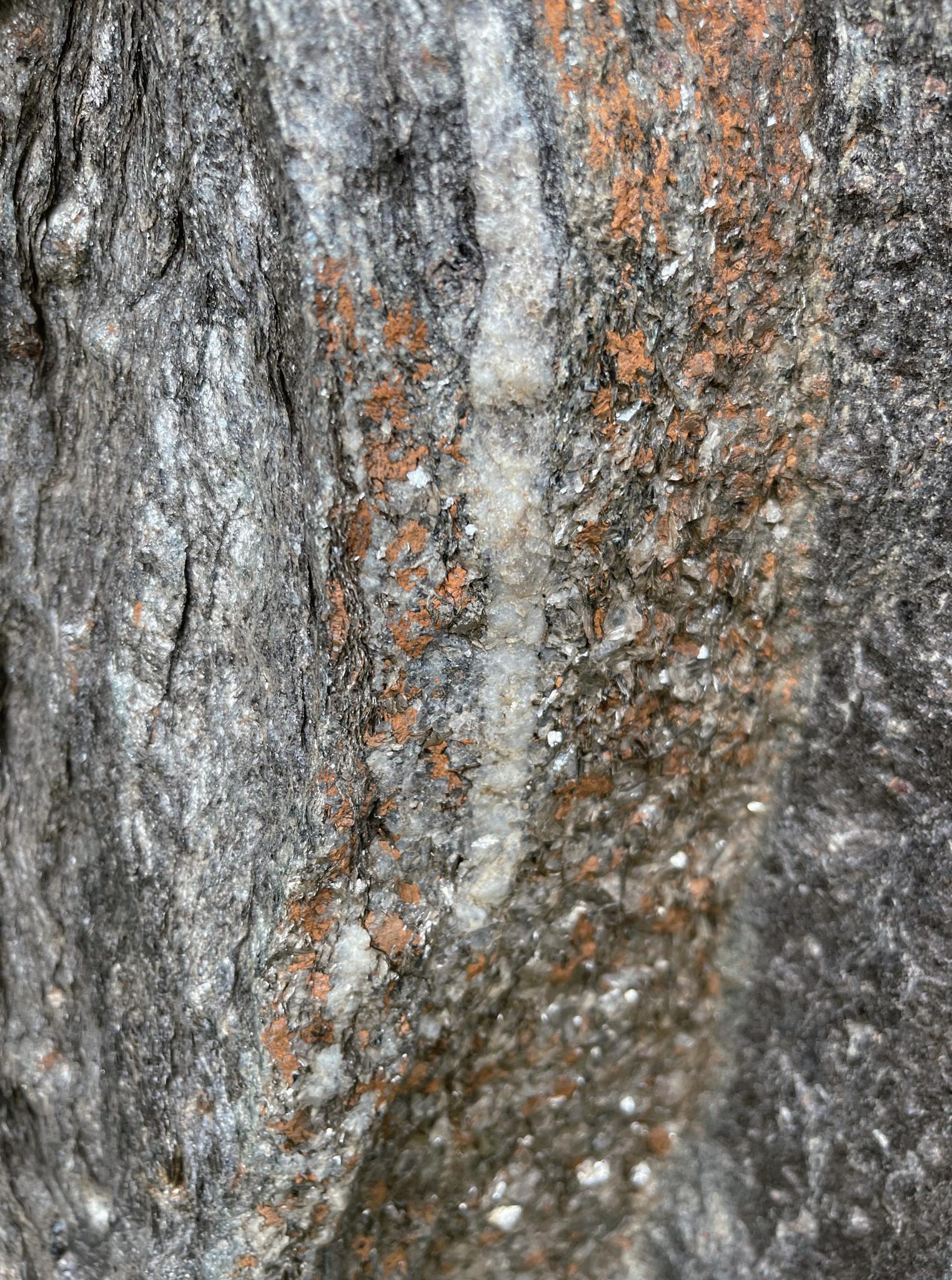
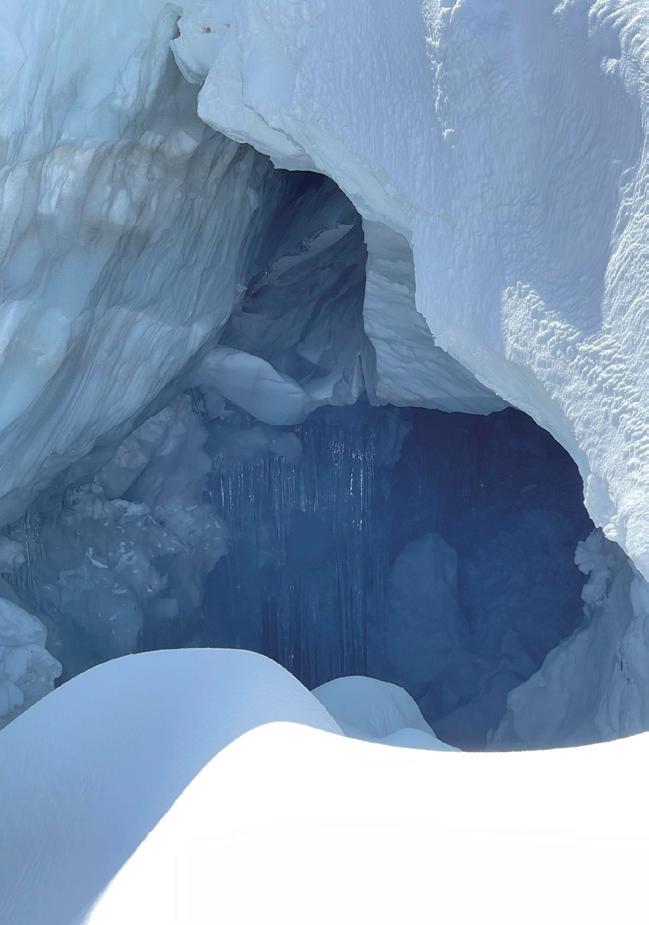
Photo Competition! We are offering a free, full page advert for any individual or Company who sends through the best photo for the next issue of the GESGB Magazine. Please share your photos via email at gesgb@ges-gb.org.uk by 30st May 2023.


42 GESGB April 2023 | Issue 2023/01
Zermatt, Switzerland
Zermatt, Switzerland
Glomfjord, Norway
Gozo, Malta

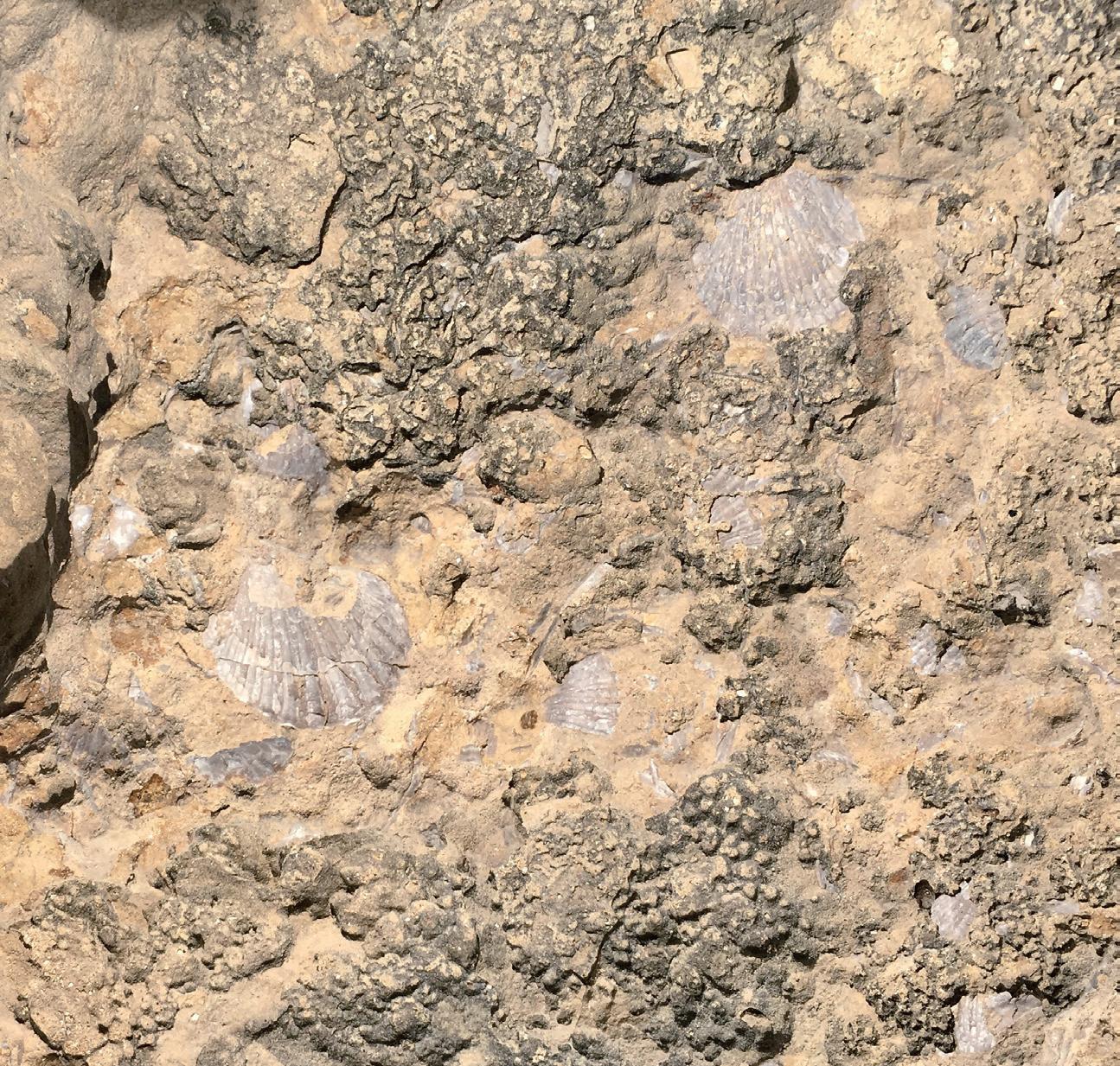
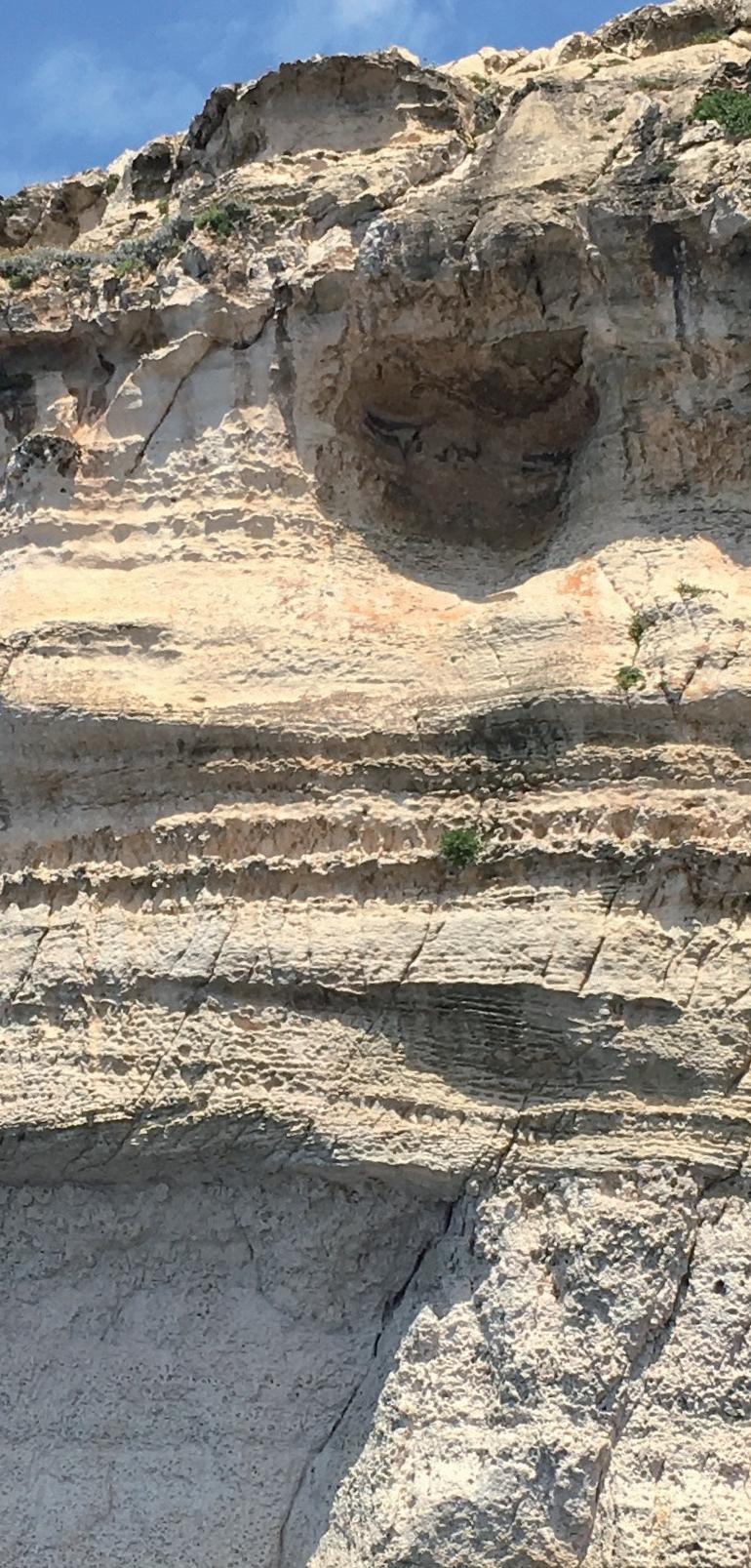
Gozo, Malta
THE EMERGING ZECHSTEIN GAS AND OIL PLAY IN THE SOUTHERN NORTH SEA
Beagle Consultants and Canadian Discovery Ltd

Recent exploration results highlight developing interest in the Zechstein carbonate play in the Southern North Sea and adjacent areas. On Humberside, the West Newton discovery (2013), potentially one of the largest gas finds onshore UK, was followed by the award of substantial acreage in the north-western South Permian Basin and southern flank of the Mid North Sea High from
the 28th to the 32nd offshore rounds, with further awards anticipated in the 33rd Round. Many of these blocks were taken specifically to evaluate Zechstein prospectivity, with 3D surveys acquired over key prospects (e.g. Pensacola and Plymouth). ION Geophysical acquired 10,930 km2 of multi-client 3D over much of the Zechstein play fairway in 2020 and 2021. Key recent wells
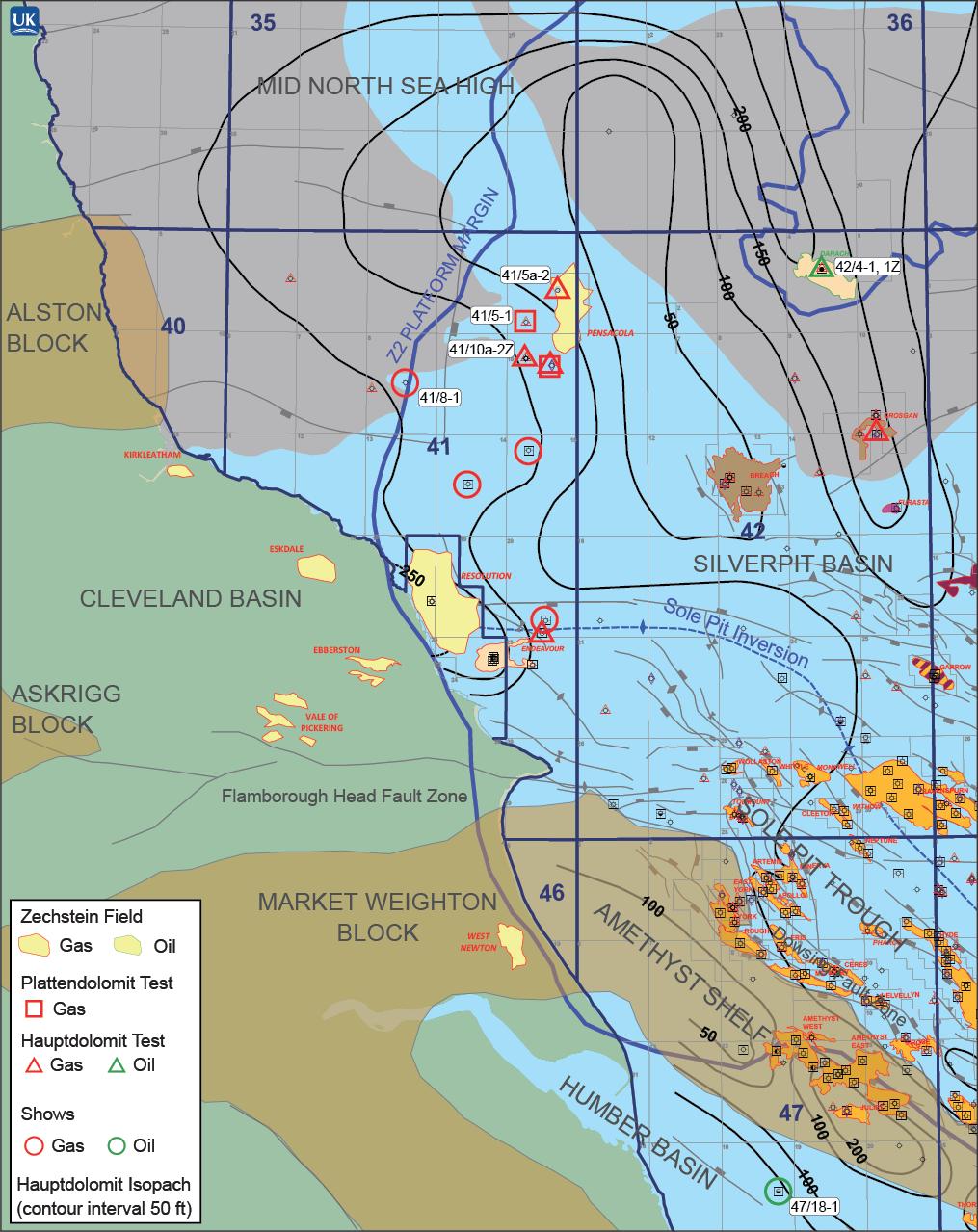
include the Shell’s play-opening 41/5a-2 gas discovery on Pensacola, with associated light oil and the serendipitous discovery of oil by Ossian well 42/4-1Z (ONE-Dyas, 2019).
Carbonate reservoirs within this area include the Zechstein Z2 Hauptdolomit Formation (Kirkham Abbey Formation onshore) and the Z3 Plattendolomit (Brotherton Formation). Platform sequence developed along basin margins includes high-energy oolitic/ pisolitic sand shoals and bars and low energy lagoonal mudstones and stromatolite (microbialite) facies, with bryozoan/algal reefs developed along the shelf margin and as isolated pinnacle reefs and atolls within the basin. Porosity and permeability are generally associated with dolomitization, secondary moldic/vuggy pores and fracturing. Porosities for Z2 platform carbonates average 12–13% onshore, but reach 20%, with porosities of 15–22% reported from wells on the Mid North Sea High. Matrix permeabilities are moderate to low (1–30 mD), but are often enhanced by fracturing to up to 100 mD. Thick Zechstein Z2 and Z3 platform carbonates are developed within the Cleveland Basin of Yorkshire, along Humberside and in adjacent offshore areas and, locally over the Mid North Sea High, but pass via
44 GESGB April 2023 | Issue 2023/01
Article >
Figure 1: Location map
interbedded slope mudstones and shelf-derived carbonate clastics into thin basinal facies (Stinkschiefer facies).
Gas was first proved onshore at the Eskdale Field in 1937 and Kirkleatham in 1946; both in Z3 Brotherton dolomites. Further discoveries followed from 1966 to 1988, mostly in the Z2 Kirkham Abbey Formation, in extensional fault block structures, with reservoirs in dolomitised oolite shoal carbonates.
Early exploration in adjacent offshore areas (principally Quadrants 41 and 42) focused on large structural closures at Bunter level associated with Zechstein salt swells and base Permian/Variscan anticlines and fault blocks. Although the Leman Sandstone reservoir proved to be absent over much of the area, many of the wells drilled from 1966 to 1970 encountered gas, with minor oil shows in the Zechstein, with at least seven wells tested from the Hauptdolomit and Plattendolomit. Although some wells did not flow, gas was produced by five wells, most notably from two wells drilled by Total in 1969; 41/24a-1 (with 14.86 mmcfgpd + 1,003 bcpd from the Plattendolomit) and 41/25a-1 (up to 22.95 mmcfgpd from the Hauptdolomit). To the south, well 48/22-1 (Burmah, 1966) tested 38.6° API oil at 1,584 bopd from the Hauptdolomit (this remained the only significant oil test in the UK Southern North Sea until the Ossian well was drilled) and 47/18-1 (Burmah, 1967) encountered residual live oil from cores in fractured Hauptdolomit car-
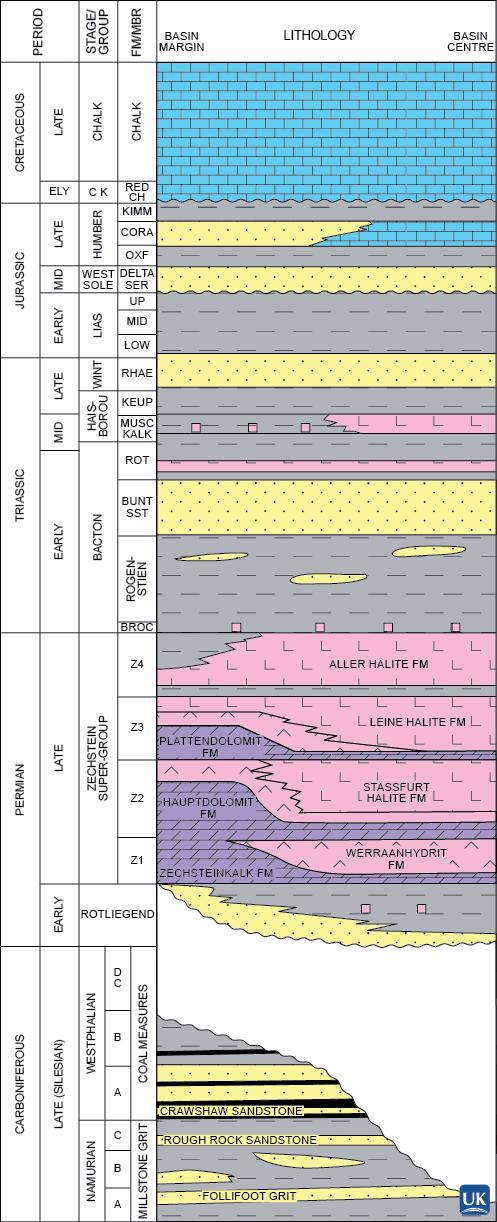
GESGB April 2023 | Issue 2023/01 45
Figure 2: Quadrant 41/42 Stratigraphy
bonates. The Hauptdolomit and Plattendolomit in most of these wells were developed in slope to basinal carbonate facies, with poor matrix porosity and permeability limited to natural fracturing.
Since 1970 three exploration wells, all in the northern part of Quadrant 41, have specifically targeted the Zechstein, although two appraisal wells were drilled on the 41/24a-1 (Endeavour) discovery, whilst two wells with Carboniferous objectives (42/15a-2 on Crosgan and 41/10-1) encountered Zechstein gas.
The 41/8-2 well (Conoco,
1995) targeted the Carboniferous and oolite grainstone facies in the Hauptdolomit on a horst block structure located up-dip of water-wet shelf carbonates seen in the 41/8-1 (Home Oil, 1969). The Hauptdolomit, drilled from 2,661–2,880 ft TVDSS consisted of 219 ft gross of dolomitised oolite with porosities averaging 18% (range 5–30%) resulting largely from oo-moldic porosity, with a sparry cement matrix. Although this well was water-wet it confirmed the high reservoir potential of Z2 shelf carbonate facies.
Walter Petroleum drilled the 41/5-1 well, on the Fairhaven
prospect, a base Permian dipclosure in 2004. This was the first offshore well in the area to have Zechstein as the primary target. The well suffered heavy mud losses of up to 300 bbl/hour in the Hauptdolomit. Reservoir damage resulted in poor log quality and left drill stem test results open to interpretation (due to poor isolation and water flow behind casing), but the Plattendolomit produced some dry gas on test and drilling gas data indicated full columns in the Plattendolomit and Hauptdolomit.
The 41/10a-2 well (Lundin, 2007), on the Lytham prospect, had a Namurian primary objective on a north-south trending anticline. This structure, with dip-closure from base Permian and throughout the Zechstein, is probably a young Alpine inversion. Lytham lies up-dip of the 41/101 well, which encountered 25 ft of total gas pay in the Hauptdolomit and Plattendolomit, but with low porosities of 6–7%. The Lundin well also encountered gas, again in a poor-quality Hauptdolomit reservoir with 57–107 ft of net gas pay and an average porosity of 7%.
Up to this point available, mostly 2D data made imaging and mapping of units within the Zechstein difficult, with exploration focused on base Permian or Intra-Carboniferous structures. In western Poland, the NW-SE trending Wolsztyn Ridge is a prominent intra-basinal horst block within the south-eastern part of the South Permian Basin and has been compared as a play analogue to the Mid North Sea
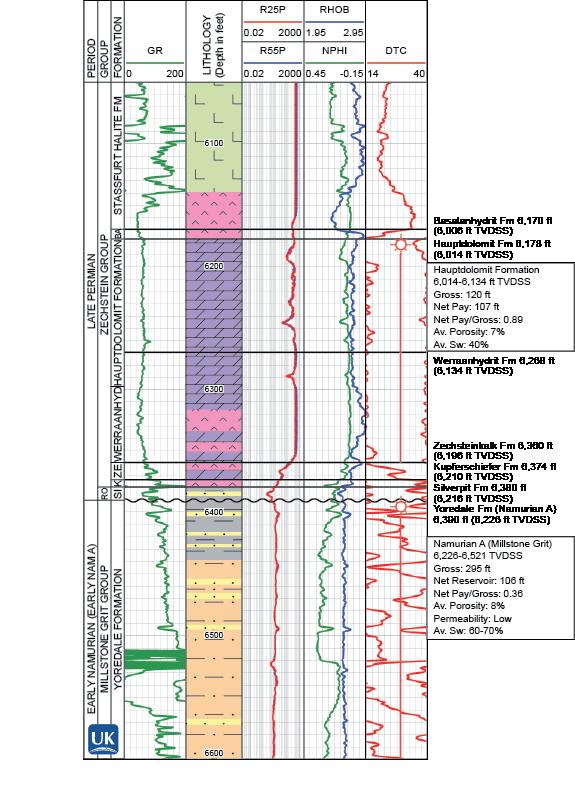
46 GESGB April 2023 | Issue 2023/01
Figure 3: Lytham prospect well 41/10a-2Z
and Ringkobing-Fyn highs, and to several isolated highs within the western basin area. The Wolsztyn Ridge is characterised by Zechstein Z1 anhydrite slope/shelf facies in the north-west, with isolated bryozoan/algal patch reef and pinnacle reefs (Zechstein Limestone Formation) in the south-east, hosting several commercial gas fields. Reef facies show good porosities (10–20%) and permeabilities (c. 40 mD, but up to 4 Darcies) resulting from dolomitization, with an extensive moldic and vuggy pore system.
Zechstein Z2 carbonate shoal facies of the Main Dolomite Formation, draping Z1 anhydrites are oil and gas-bearing in the north-west, including the large Barnowko-MostnoBuszrwo (BMB) oil and gas field. Discovered in 1993, the BMB Field had an original inplace of 377 mmbbl of oil and 1 TCF gas in the Zechstein Z2 Main Dolomite (Hauptdolo-
mit equivalent), with the trap defined by a combination of drape over the anhydrite shelf and faulting around the margins of the Wolsztyn Ridge. Reservoir consists of up to 270 ft gross of peloidal and oolitic grainstones and stromatolitic mudstones, with a mixture of primary porosity, secondary dolomites and secondary pores from vadose zone dissolution, giving overall porosities of 4–27% (averaging 9.6%) and permeabilities of 11–28 mD. The oil has been correlated to basinal and slope facies Z2 dolomites with a TOC content averaging 0.27% (maximum 0.94%), dominated by oil-prone algal Type II kerogens.
Arguably, the current phase of Zechstein exploration in the UK began in 2013 with the drilling of two prospects (Crawberry Hill and West Newton) on Humberside licence PEDL 183 (awarded to Rathlin Energy in the 13th Onshore Round
- 2008). Both prospects were interpreted as isolated patch reefs in the basal Z1 Cadeby Formation; analogous to the pinnacle reef reservoirs of the Wolsztyn Ridge. The Crawberry Hill well was dry, as was the Cadeby objective at West Newton. However, the well encountered gas in Z2 Kirkham Abbey shoal facies dolomites, directly overlying the Cadeby; suggesting a lack of top-seal for the deeper target. Mapped from 3D seismic these facies are developed over the crest of the Z1 reef and pass to the west into lagoonal facies and to the east into basinal carbonate mudstones. Subsequent wells proved a 387 ft gas column, with a net/gross of 0.86 and porosity averaging 7% (up to 14%) with good permeability resulting from extensive fracturing. Reserves are estimated at 198 bcf gas and 0.6 mmbbl condensate, with a horizontal appraisal well planned for 2023.
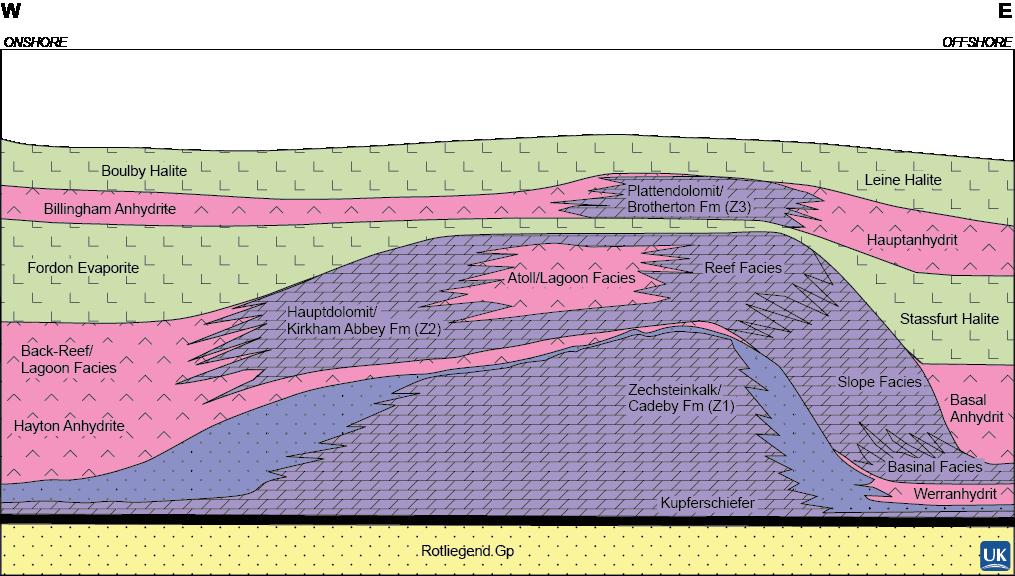
GESGB April 2023 | Issue 2023/01 47
Figure 4 Zechstein carbonate reef play depositional model
A Visean faulted anticline, with closure at base Permian and a primary objective in subcropping Lower Carboniferous sandstones (the Darach prospect) was the target of the 42/4-1 well, drilled by ONE-Dyas in 2019. Although
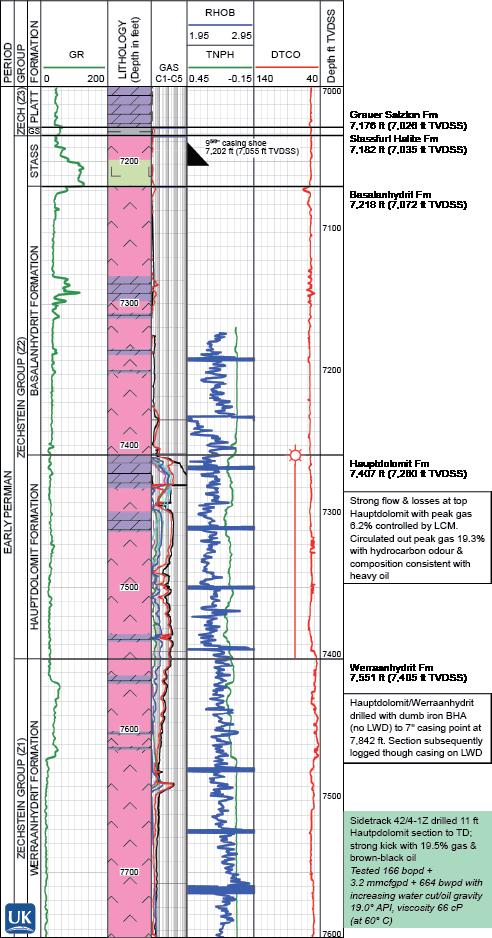
a previous operator had identified a potential Hauptdolomit reef play (Ossian), coinciding with the deeper structure and located on the margin of the Z2 shelf, re-mapping indicated a thin Hauptdolomit in basinal facies (prognosed
at 23 ft in the well). Although not considered as an objective, it was planned to fully log the Hauptdolomit and take samples. The Hauptdolomit at 7,260 ft TVDSS and 145 ft gross was significantly thicker than anticipated and composed of fractured sucrosic dolomite interbedded with anhydrite. A strong gas kick meant that the Hauptdolomit could not be logged in open hole, with the section cased off to drill the Carboniferous, which proved to be dry. The 42/4-1Z sidetrack, drilled to evaluate the Hauptdolomit, also encountered a strong kick, with oil and gas flows and only 11 ft of reservoir could be drilled. An open-hole test achieved an average rate of 166 bopd + 3.2 mmcfgpd and 664 bwpd, with water cut increasing during the test. Oil gravity was 19.0° API with a viscosity of 66 cP (at 60° C). Although the Ossian discovery proved to be sub-commercial, the well demonstrated the potential for an oil play along the southern flank of the Mid North Sea High.
Pensacola is a Hauptdolomit reef/atoll play located along a north-south trending Variscan anticline, which was the target of 41/15-1 and the 41/10-1 gas well. Originally mapped from 2D data, the Pensacola trap has 650 ft of relief and is sealed vertically by the Stassfurt Halite. Farming-in in 2019, Shell acquired broadband 3D across the prospect, showing Pensacola to be an atoll structure, separated from the Z2 shelf margin to the north, with a fringing reef/slope facies and central lagoon. The 41/5a-2 well, spudded in
Figure 5: Ossian discovery well 42/4-1
late 2022, was drilled on the western reef and encountered a high-quality reservoir, with 62 ft net and an average porosity of 16%. On test the well flowed at an initial rate of 4.75 mmcfgpd plus 8 bpd of 34–36° API oil after acid, but with the rate declining to 1.75 mmcfgpd during the 12-hour test. Partner Deltic Energy estimate a P50 resource of 302 bcf recoverable (range 164519 bcf).
Although the source for the heavy oil at Ossian and the associated light oil at Pensacola remains unproven, candidates include basinal Zechstein carbonates, the basal Zechstein Kupferschiefer and oil-prone shales in the Lower Carboniferous. Oil and gas in the Polish Main Dolomite correlates
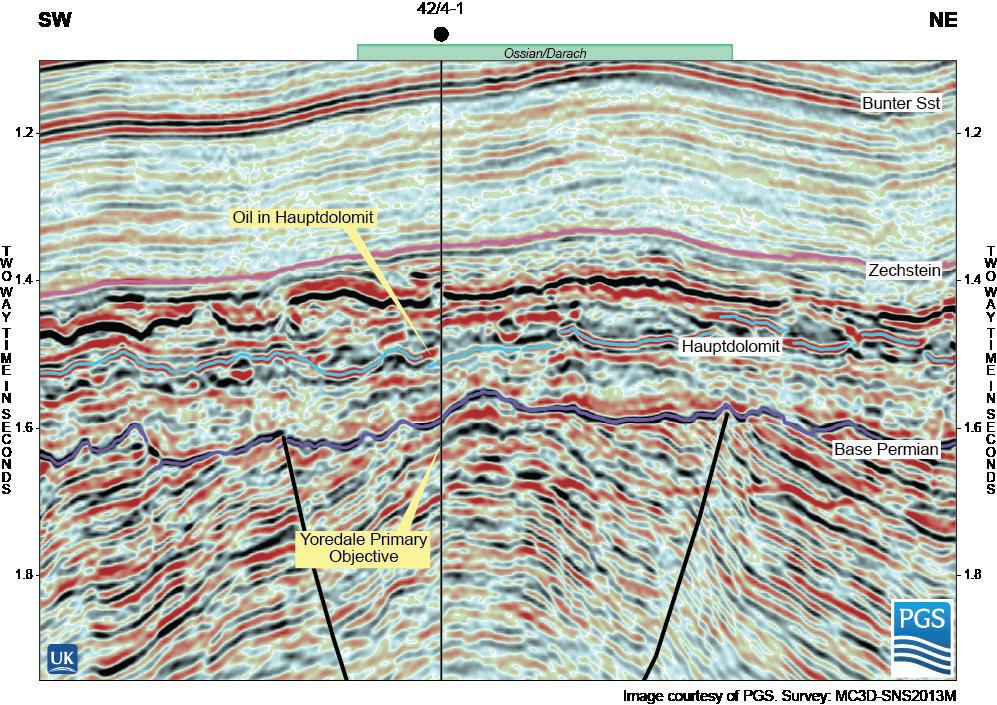
to Z2 slope/basin facies carbonates, but gas in the Polish Zechstein Limestone reefs was sourced from subcropping Carboniferous coals. A similar source is likely for UK fields.
Approximately twenty undrilled Zechstein carbonate reef prospects and leads have been identified within the play fairway, with many covered by 3D data, and several subject to farm-in. These include Draupner Energy’s Balvenie and Durham prospects in southern Quadrant 38, Horizon Energy’s Dabinett prospect (42/5) and the Plymouth prospect, an isolated Hauptdolomit reef on blocks 43/8 and 9, which was the subject of a farm-in by Capricorn to the Deltic Energy operated licence; a 680
km2 2D survey was acquired in 2021. Recent exploration results are likely to see several of these prospects progress to drilling in the near future.
This article is abridged from a report on the Zechstein play in preparation for the UK Discovery Digest and based on studies of this play prepared by Exploration Geosciences over the last twenty years.
To see more, visit https://ukdigest.canadiandiscovery. com/
GESGB April 2023 | Issue 2023/01 49
Figure 6: Ossian discovery tie-line




















50 GESGB April 2023 | Issue 2023/01
GESGB April 2023 | Issue 2023/01 51
CO2 FOR EOR – GOOD FOR ECONOMY, ENVIRONMENT, AND CLIMATE
AGR

Balancing increasing demand for oil while lowering greenhouse gas (GHG) emissions is the greatest challenge facing the industry today.
If the world is to meet the targets of the Paris Agreement, Carbon Capture and Storage (CCS) needs to capture at least a fifth of CO2 emitted by the fossil fuel industry by 2050. Currently, this stands at less than 4%.1
Here’s a thought - use the carbon emitted to enhance oil recovery (EOR). As a result, we finance the future carbon storage sites, provide energy for increased demand using current infrastructure and
safely lock away carbon dioxide deep in oil and gas reservoirs and aquifers. (Figure 1)
CO2 for EOR – a proven method
Pioneered in Texas in the early 1970s, both the USA and Canada have been actively and successfully utilizing the technique ever since, without government subsidies.
CO2 as a fluid has the ability to mobilize remaining oil towards production wells and has a long history in the USA. Carbon injection has been used in The Kelly-Snyder oilfield since 19722. Located on the eastern edge of the Permian
Basin in Texas, the operator, Kinder Morgan, has ramped up CO2 injection on the giant oil-producing area which has seen production increase from 9,600bbl/d to more than 30,000bbl/d.
The CO2 mixes miscible with oil, improving its mobility, and so allowing it to flow more easily. Most notably, a considerable amount of the injected CO2 is retained in the pore space or dissolved in water. Some CO2 will return to the surface and will be separated and reinjected.
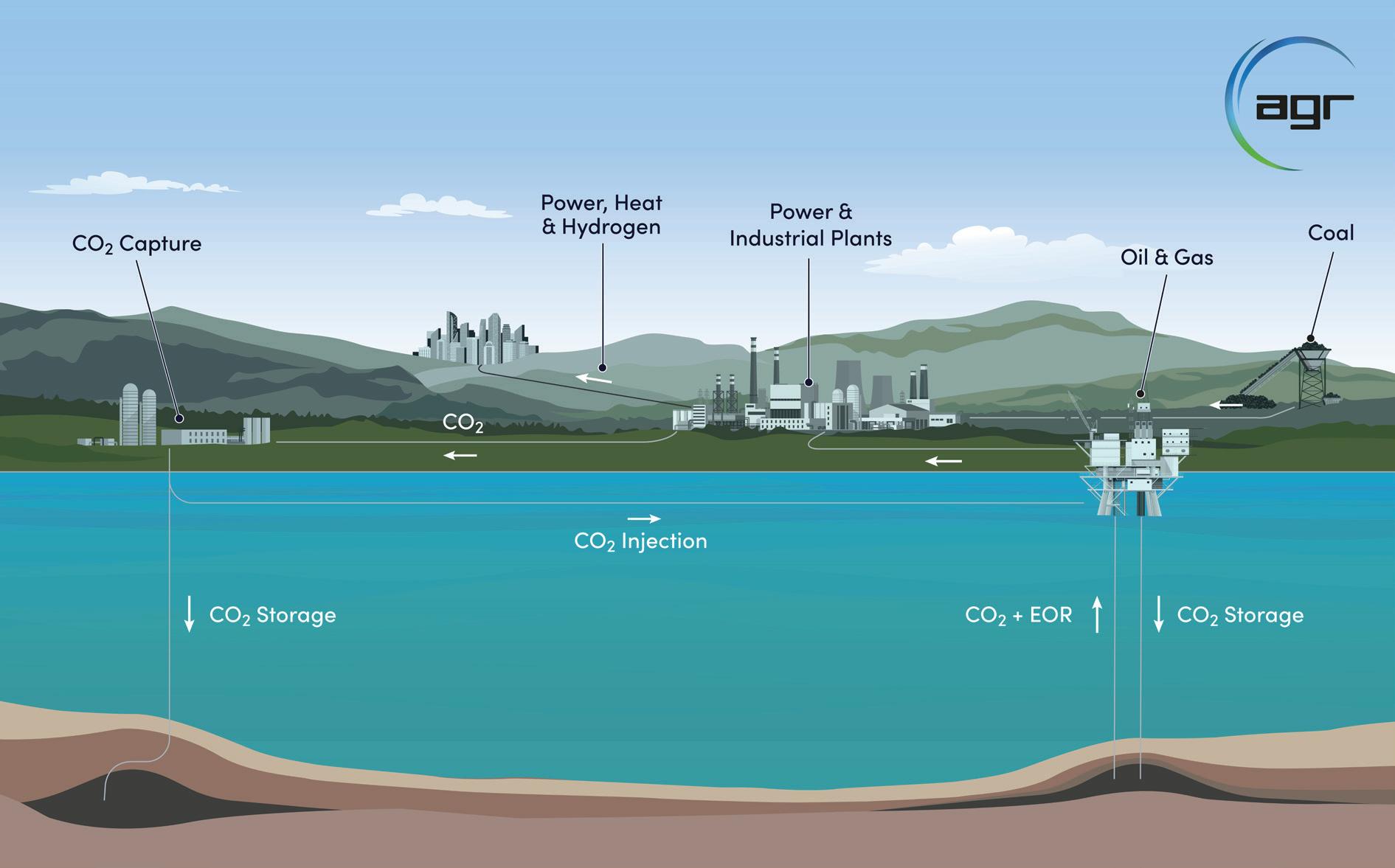
Hesitancy in Europe
Despite the fact that the legis-
GESGB April 2023 | Issue 2023/01
Article
>
Figure 1: Illustrative graph of carbon capture, use and storage
lators, academia and major oil companies have carried out studies that indicate increased recovery through the use of CO2, no decisions have been made either in Norway or in other European oil-producing countries to invest in the establishment of CO2 storage in combination with EOR. There are several reasons for this:
• Mammoth investment in infrastructure which will be required if support from government subsidies are limited
• CO2 has not been available in the North Sea basin
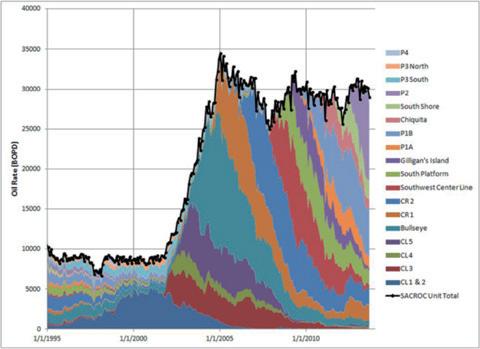
• Reluctance around the perception of safety, environmental and economic risk associated with introducing CO2 into existing wells and facilities.
Moreover, this averseness is largely due to EU taxonomy guidelines forcing through a phase-out of fossil energy and not classifying EOR as a climate mitigating action. Companies and investors will have to prepare for reporting under a number of new and complex sustainability disclosure
standards and adapt as they continue to evolve: ESG (Environmental, Social and Governance) has become really important. The interest and appetite for CCS endeavors, however, is gaining momentum in Europe in particular.
Adopting CO2 for EOR technologies and upscaling CCS infrastructure could help finance energy demand and lower emissions before more expensive green energy claims the largest stake of the energy mix by mid-century. According to the latest projections by the IEA, to deliver deep emissions reductions and limit global temperature increases to 2°C by 2060, 14% of cumulative emission reductions must be derived from CCS technologies4
It is important to emphasize that the amount of stored CO2, as a function of EOR, will be greater than carbon emissions created from extra oil extraction5.
It’s a win-win solution for the sector eager to shrink its car-
bon footprint and seek more efficient and economical prospects. As operators are looking for ways to reduce their own emissions, offshore CCS is emerging as a competitive alternative. The green shift is underway with the industry taking a solid step-by-step approach to adapt operations and adopt innovation.
References
1.https://www.dnv.com/focus-areas/ccs/index.html
2. https://onepetro.org/SPEIOR/ proceedings-abstract/16IOR/All16IOR/SPE-179569-MS/187312
3. https://www.researchgate.net/ publication/314938627_Overview_ of_CO2_Injection_and_WAG_Sensitivity_in_SACROC
4. https://www.iea.org/reports/ ccus-in-clean-energy-transitions/ ccus-in-the-transition-to-net-zero-emissions
5. Large scale tertiary CO2 EOR in mature water flooded Norwegian oil fields, Energy Procedia 114 ( 2017 ) 7096 – 7106, E. Lindeberg et. al.
GESGB April 2023 | Issue 2023/01 53
Figure 2: 1996-2013 CO2 flood project area contribution to total SACROC unit 3
CONSULTANT DIRECTORY
AKM Geoconsulting Ltd.
Dr Adam K Moss – Core Analysis Petrophysicist
Core provides a unique opportunity to “see and touch” a reservoir: AKM Geoconsulting can help you make the most of this prospect. Adam Moss is a core analysis expert with over 25 years’ petrophysical experience; he works with assets and multi-functional teams to define best-practice workflows and ensure high quality core analysis data. He can also help with: design and management of SCAL test programmes, core to log integration, building saturation height function models and integration of core data into reservoir models. Adam provides bespoke training on a wide range of petrophysical topics to an international portfolio of clients.
T: +44 (0)785 8089247
E: adam@akmgeo.co.uk
W: www.akmgeo.co.uk
Gneiss Geophysics
Malcolm King – Geophysical Partner
I have over 40 years of experience in all aspects of seismic surveying (planning, the operational phase and processing) for both onshore and offshore surveys. I was the founder of Monarch Geophysical over 30 years ago and I am now offering the same services T/A Gneiss Geophysics. I am working with some of my old Monarch colleagues.
T: +44 (0)7831828423
E: malcolm@gneissgeophysics.co.uk
W: www.gneissgeophysics.co.uk
Needham Geoscience Limited
Dr Tim Needham – Structural geologist
Consultant structural geologist with 35 years of experience worldwide, including NW Europe, Africa, Middle East, South Asia and the Americas. Work at all scales, ranging from core description to regional tectonics with extensive experience in fault and fault seal analysis, fractured reservoir studies, structural restoration and QC of interpretations for exploration and production.
T: +44 (0)1943 277030 / +44 (0)7884 404373
E: tim@needhamgeoscience.co.uk
W: www.needhamgeoscience.co.uk
SeisWise Ltd.
Seismic Data Processing Consultant
Contractor supervision; expert advice on reprocessing, trial processing, processing contracts; training courses. Over 40 years experience, MA (Cambridge, mathematics), MBA (Cranfield).
Christopher H. Walker
T: +44 (0)1234 771 536
E: chris@seiswise.com
W: seiswise.com
TERRASYS Geophysics
Integrated Multi-Physics Analysis, Modelling, Inversion and Interpretation
As independent consultancy for international subsurface studies, our services focus on efficient Gravity/ Magnetic/EM integration for reliable earth models, from resource exploration to near-surface investigations. To support our clients, TERRASYS applies flexible, target-oriented workflows, from structural joint inversion to petrophysical modelling. Our multi-disciplinary approach to geology-driven solutions reduces uncertainty, risk and cost.
Markus Krieger
T: +49 40 2800460
E: krieger@terrasysgeo.com
W: www.terrasysgeo.com
54 GESGB April 2023 | Issue 2023/01 DIRECTORY >
Pmoll-Seismic Limited
Phil Mollicone – Independent Consulting Geophysicist
Extensive background of E&A seismic mapping; prospect evaluations; opportunity assessments; divestments; collaborative in-house & remote working; depth conversion& sensitivity analysis; seismic acquisition & processing oversight. All of it across a wide range of geologic and geographic provinces.
T: +44 (0)777 572 6408
E: philmollicone@aol.com
Do you have a consultancy business?
Are you a freelancer looking to raise your profile and promote the services you offer?
Our Consultant Services advertising opportunities could help you! Enjoy targeted exposure with a Consultant listing to showcase your expertise.
As part of this service, share more information about your company/services on the Consultant Services webpage including key contact information. This page is not only accessible to GESGB members but also a wider industry network of professions in need of your services.
You’ll also benefit from additional advertising in the GESGB membership Magazine (both online and print), giving your business visible to the GESGB community and beyond.
Freelancers rates:
3 months (1 issue): £88 + VAT
6 months (2 issues): £132 + VAT
12 months (4 issues): £242 + VAT
Companies rates:
3 months (1 issue): £129 + VAT
6 months (2 issues): £228 + VAT
12 months (4 issues): £408 + VAT
If you would like to place a listing or find out more information about this ser vice, please contact: events@ges-gb.org.uk
GESGB April 2023 | Issue 2023/01 55
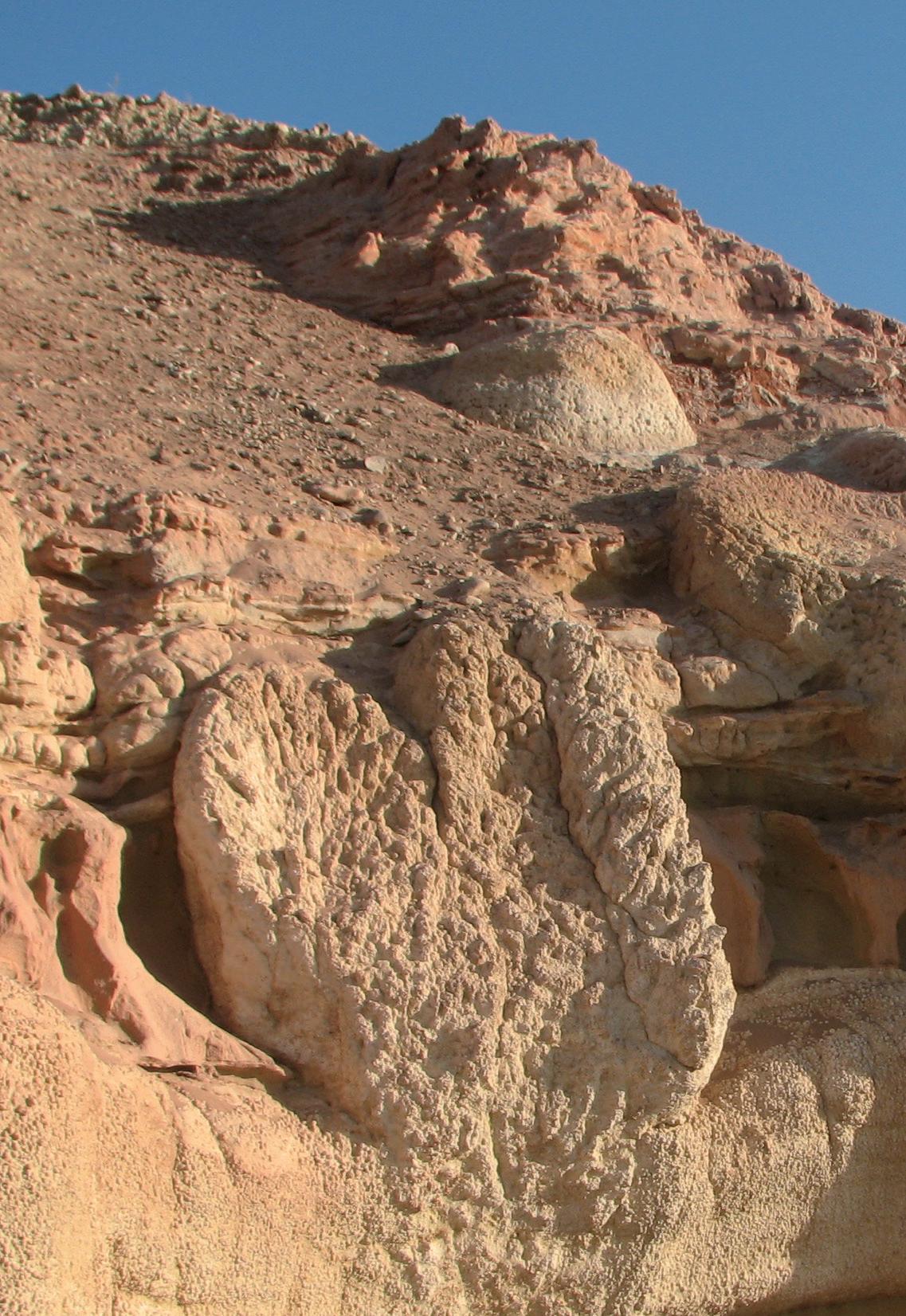

gb.org.uk To advance, for the public benefit, education in the scientific and technical aspects of subsurface energy and related technologies
ges-
T: 020 7408 2000 E: g esgb@ges-gb.org.uk Registered charity no. 1085619