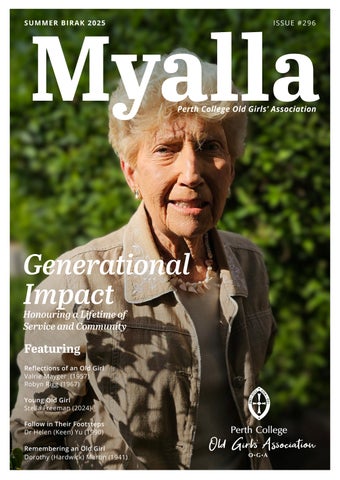
Myalla
SUMM E R B I RAK 2025
ISSUE # 296
Perth College Old Girls’ Association
Generational Impact Honouring a Lifetime of Service and Community
Featuring Reflections of an Old Girl Valrie Mayger (1957) Robyn Rigg (1967) Young Old Girl Stella Freeman (2024) Follow in Their Footsteps Dr Helen (Keen) Yu (1990) Remembering an Old Girl Dorothy (Hardwick) Martin (1941)
Contents
Noongar Seasons
F ROM THE E DIT OR
3
OGA P RE SIDE N T ’S RE P ORT
5
OGA MORGA N F AM ILY E N DE AV OU R A W A R D
6
S CHOLARSH IP S
7
R E FLE CTI ON S F ROM OLD GIRL
8
HONORARY OLD GIRL
12
F OLLOW ING IN T H E IR F OOT ST E P S
14
VALE OLD GIRL
16
OTHE R RE FLE CT ION S
18
OUT AND AB OU T
19
Y OGA NE W S
20
P C OGA NE T BALL
22
C ONNE CT
25
2 | P ER T H C O L L E G E
The Noongar people of Western Australia have six seasons: Birak, Bunuru, Djeran, Makuru, Djilba, and Kambarang. These seasons are marked by changes in the environment, such as the flowering of plants, hibernation of reptiles, and moulting of swans. This edition of the Myalla Magazine is being distributed during the season of Birak, during December and January. This is a time of warmth, renewal and returning colour across boodja (land). Birak’s energy and brightness mirror the theme of this edition: connection, continuity and community.
From the Editor Threads of Connection As the season of Birak settles over Perth, bringing warm days, bright blossoms and the gentle movement of the first summer winds, it feels fitting that this edition of Myalla is shaped by the theme Threads of Connection. Birak is a time of renewal and returning energy — a reminder that we are part of something larger, rhythmic, and interconnected. In much the same way, the stories gathered here reflect the ties that weave Perth College women together across generations. This edition brings voices that span nearly a century of PC history, including Dorothy ‘Dot’ Martin who passed away in October after celebrating her 100th birthday earlier this year, and still recalled her school days with clarity and humour, to Stella Freeman, whose young adulthood is just beginning but already grounded in legacy, leadership, and purpose. Though born eight decades apart, these women share the same sense of belonging and community that defines the PC experience. That continuity runs through all the stories you’ll read in this edition. It appears in our OGA President’s Report, which highlights the generosity and commitment of Old Girls who invest in scholarships, mentorships, and traditions that bind our community. It re-emerges in the rare honouring of Caroline Risah, whose service to the OGA was marked by warmth, dedication, and countless behind the scenes contributions that strengthened our alumnae community in lasting ways.
Especially in Stella’s narrative, we see the next generation weaving its own thread into our tapestry. Her family’s long connection to PC shaped her sense of identity, and through YOGA, coaching, and leadership, she now carries those threads forward. And then there is the growing community of PC OGA Netball, which turned a single last-minute team into a hub of enthusiasm, mentorship, and belonging. It is a living reminder that community can build through sport just as powerfully as through tradition. Life’s milestones also form part of our tapestry whether in a newborn wrapped in a handmade blanket, or the achievements of PC students supported through OGA bursaries. These remind us that connection exists not only in shared memories of school days, but in all the chapters that follow, too. As Editor, compiling these stories revealed just how deeply connected our community truly is between us all. Even though the women in these pages lived in different eras and pursued vastly different paths, their values through courage, capability, care, creativity and service are all unmistakably shared. May you recognise your own experiences in these stories and feel the threads that connect every PC OGA woman to one another. Once a PC girl, always a PC girl. Be always part of these threads....
Connection also appears through memory. Val Mayger’s beautiful reflections transport us to the PC of the 1950s, where the Sisters shaped generations of young women with discipline, wit, compassion and the quiet conviction that “a girl can do anything.” Her decades in education and equestrian sport reflect the enduring power of those values. Connection shows itself, too, in stories of creativity and craft. Robyn Rigg shares memories of sewing lessons that blossomed into a lifelong passion, which carried her into fashion design, and decades later back into the PC archives with treasured items rediscovered after her parents passed away. Another thread woven through this edition are the ways Old Girls continue to strengthen their communities beyond Perth College. Whether through leadership, service, advocacy, creativity, or quiet acts of care, the stories here show how deeply the PC values echo long after our graduation.
EZRI NA ( W H I TE) F EW I NGS ( 1994)
MYA L L A SUMMER BI RA K 2025 | 3
Old Girls’ Association Committee 2025 PRE SIDE NT
CA R OL Y N B R I G H T (1 9 9 0 )
V ICE P RE SIDE N T
L I N D A (ME Y E R S ) H Y L A N D (1 9 6 8 )
SE CRE TARY
K A T R I N A (P OR T ) H A R R I S ON (1 9 8 8 )
TRE ASURE R
SA M A N T H A S H A R P (1 9 8 9 )
COUNCIL R E P RE SE N T AT IV E
ST E P H A N I E (J E N N I N G S ) F U L L A R T ON (1 9 7 9 )
FOUNDATION CH AIR
ANG E L C H E N (2 0 0 8 )
BURSARY TRU ST E E S
PRE S I D E N T , T R E A S U R E R A N D F OU N D A T I ON C H AI R
MYALLA E D IT OR
EZ R I N A (W H I T E ) F E W I N G S (1 9 9 4 )
GE NE RAL C OM M IT T E E
L E S L E Y K E E N (1 9 5 8 ), MA L I N D A B L A I R (1 9 9 6 ), J US T I N E (B E A S L E Y ) L E G G E (1 9 8 6 ), P E T A C OOK E ( 2 00 9 )
OGA PATRON
PR I N C I P A L S A R A H MC G A R R Y
YOUNG O LD GIRLS’ ADV ISORY ( YO G A ) S U B -C O M M I T T E E C O O R D I N A T O R S MILA CA PEL L I ( 2 0 2 4 ) , STEL L A F R E E M A N (2 0 2 4 ) A N D E M I L Y S L A T E R (2 0 2 4 )
4 | P ER T H C O L L E G E
OGA President’s Report It has already been a wonderfully full and rewarding year for the Old Girls’ Association (OGA). Our annual events highlight the heart of what we do: connecting Old Girls across generations and strengthening the ties between alumnae and current students. Throughout the year, the OGA Committee devoted countless volunteer hours to supporting both the School and the wider alumnae community. Their efforts sit quietly behind many initiatives, events and moments of connection that enrich the lives of Perth College women. Scholarships remain one of the most important aspects of our work. In 2025, we awarded both the Sisters’ Memorial Bursary and the OGA Heritage Scholarship (our partnership with the PC Foundation) providing 50% tuition for three years to a daughter or granddaughter of an Old Girl entering Year 10 in 2026. These scholarships reflect our commitment to supporting girls within the OGA family, particularly those who may not otherwise have the opportunity to attend Perth College. Applications for the Sisters’ Memorial Bursary and the 2027 Heritage Scholarship will open soon, with selection scheduled for February 2026. We also expanded our support for Young Old Girls through scholarships to attend the Scotch Accelerator Program. The week-long residential course offers practical business, leadership and networking skills for university students preparing to enter the professional world. With much success our inaugural recipients returned with enthusiasm and insight. In August, we were delighted to host the Ladies Long Lunch at Fraser’s in Kings Park. Moving the event closer to the city proved popular, with 141 Old Girls attending. Kings Park has long been a gathering place for the Whadjuk Noongar people and remains a place of reflection, celebration and community. Perth College has its own historic connection to the area, with our first school, Hawkesbury House, located nearby.
Another highlight was the Following in Their Footsteps luncheon and assembly in October of which 38 Old Girls attended this year including Val Mayger (1957) and current Perth College teachers who are also PC Old Girls. Introduced in 2019, this tradition strengthens the connection between Old Girls and current students and holds special meaning for the Year 11s as they step into leadership. A joyful assembly tradition is the presentation of flowers to the ‘oldest Old Girl’ in attendance. This year we celebrated a three-way tie between Helen Treloar, Margaret Nichol and Val Mayger. Guest speaker Dr Helen (Keen) Yu (1990) offered an inspiring reflection on her PC experience and the impact it had on her life. We were also honoured to induct Caroline Risah as our newest Honorary Old Girl. Although she did not attend Perth College, her outstanding service to the OGA and the wider community has been exceptional. First joining the PC community as a parent before becoming a staff member in 2018, she contributed warmth, professionalism and creativity to countless initiatives. It was a pleasure to present her with honorary life membership and the traditional Camellia charm. As we look ahead to 2026, our new Alumni Coordinator and Old Girl, Donna Carter (1987), will assist with reunions, including the 18-month, 5, 10, 20, 30, 40, 50 and Vintage gatherings. Anyone interested in helping or attending is warmly encouraged to contact oga@pc.wa.edu.au. The strength of our connections by our volunteers, alumnae, young graduates and supporters continues to define our community. We look forward to celebrating more moments and stories in the months ahead.
Special guests included our new Principal and OGA Patron, Ms Sarah McGarry, along with Mrs Judith Cottier, Mrs Ally Pember and Mrs Affie Karalis. The event raised just over $6,000 for the Emma and Bessie Cotton Fund, supported by a silent auction and raffle. We extend our thanks to all who contributed, including Fraser's Restaurant, WA Ballet, Grand Cru, Matusik Jewellers, The Dispensary Chemist, Swanview Plant Farm, and the many Old Girls who donated prizes or funds. We also thank those who helped make the event a huge success: Old Girl Ellie Freeman (2019), who sang as guests arrived; Heritage Officer Lesley Page (retired in December 2025), who sourced archival photographs; and the OGA Committee members who organised and supported the day. We look forward to welcoming everyone at the next Ladies Long Lunch on 23 August 2026.
CA RO L Y N BRI GH T ( 1990)
MYA L L A SUMMER BI RA K 2025 | 5
OGA Morgan Family Endeavour Award The OGA Morgan Family Endeavour Award was established in 2023 to acknowledge the significant courage and resilience Hannah Morgan (2021) showed during her fight against serious illness. The annual Award is given to a Young Old Girl who demonstrates success in a field of endeavour and who embodies the Perth College values of being capable, courageous, and caring.
This year’s prestigious award went to Ebe Ganon (2015). Ebe Ganon is the 2025 recipient of the OGA Morgan Family Endeavour Award. She is a community engagement and inclusion practitioner based in Canberra, working across government agencies, universities, community organisations and the private sector. Her practice focuses on combining lived experience, evidence‑based approaches and collaborative methods to improve the accessibility and inclusiveness of systems and services. Ebe’s professional work includes facilitating co‑design processes, advising government and non‑government teams, delivering training for educators and clinicians and presenting at national events on disability, leadership and human rights. Her work centres on practical strategies that support inclusion in workplaces, educational settings and public spaces. Her academic background includes a Master of Disability and Inclusion from Deakin University, a double Bachelor in Science and Arts from the Australian National University and a Certificate IV in Australian Sign Language. She is currently completing a PhD in disability employment at UNSW Canberra, where she is researching factors that influence employment outcomes for people with disability. Ebe received the Change Making Award at the 2024 National Awards for Disability Leadership. In 2025, she represented Australia as an Emerging Young Leader delegate at the United Nations Conference
of State Parties to the Convention on the Rights of Persons with Disabilities, contributing to international discussions on disability policy and practice. She also serves on the board of a national not-for-profit organisation advocating for children and young people with disability. This role involves governance, sector engagement and contributing to policy discussions affecting families across Australia. Alongside her advisory and research work, Ebe runs her own training and facilitation business, delivering inclusive practice and neurodiversity confidence training. She also teaches accessible group fitness classes in cycle and Pilates studios, supporting participation from a wide range of community members. Ebe intends to use the OGA Morgan Family Endeavour Award bursary to undertake the Foundations of Disability Leadership course run by the Disability Leadership Group. She will enrol in the first 2026 intake, aligning with the commencement of her PhD and allowing her to complete the program within the 12-month bursary period. The OGA Morgan Family Endeavour Award recognises individuals who demonstrate commitment, leadership and ongoing contribution in their field. Ebe’s work across research, advocacy, community programs and sector collaboration aligns with the award’s criteria.
E N D E A V O U R A W A R D A P P L I C A T I O NS Generously supported by the OGA and the Morgan family equally, this bursary is intended to support a young Old Girl aged 18 to 30 years. Previous award winners were Lucy Strapp (2016) who undertook a three-month placement at the United Nations Office of the High Commissioner for Human Rights (OHCHR), and Victoria Abbott (2013) who undertook further pilot training to prepare for her first job as a station pilot. For more information about the OGA Morgan Family Endeavour Award and how to apply please go to OGA page of the Perth College website.
Photos courtesy of ebeganon.com.au 6 | P ER T H C O L L E G E
Scholarships
Celebrating the Future of Perth College At the beginning of Term 4 2025, Perth College proudly hosted its annual Scholarship Afternoon Tea, welcoming the newest scholarship recipients who will commence their school journeys in 2026. This special event brought together 21 successful scholarship winners between Year 5 and Year 10, along with their families, to connect with the School’s leadership team, Council and Foundation members, and most importantly their future cohort. The afternoon was a warm celebration of achievement, community, and tradition. It also highlighted the enduring legacy of the Perth College Old Girls’ Association (PC OGA) and Old Girls whose generous support continues to shape the lives of young women through scholarships and bursaries. Since its founding in 1913, the PC OGA has been a cornerstone of support for the School. One of its earliest initiatives, a modest scholarship fund established in 1932, has grown into the Sisters’ Memorial Bursary (named in honour of the Sisters of the Church; the founders of Perth College). This bursary enables daughters or granddaughters of Old Girls to begin their journey at PC from Year 7 and has a proud tradition of nurturing students who make meaningful contributions to school life and beyond. In recent years, the OGA introduced the Heritage Scholarship, which offers daughters or granddaughters of Old Girls, who are not already enrolled at PC, the opportunity to complete their final years (Years 10 to 12) at the School. We are delighted to announce the 2026 recipients of these prestigious awards: • Zara Boyle (Year 7) – Sisters’ Memorial Bursary • Molly O’Malley (Year 10) – Heritage Scholarship Both students will join the Boarding House community and bring with them a vibrant enthusiasm for music and sport. Their energy and talents promise to enrich the life of the School, and we look forward to watching them grow and thrive in the years ahead. The OGA takes a genuine and active interest in the wellbeing and progress of its scholarship recipients. Through ongoing engagement and support, the OGA ensures that these young women feel connected to a legacy of generosity, resilience, and excellence. Applications for the OGA scholarships are now open and the scholarship exam will be held on 12 February 2026. For more information, please contact the School via oga@pc.wa.edu.au.
MYA L L A SUMMER BI RA K 2025 | 7
Reflections from an Old Girl Valrie Mayger (1957) OAM When Old Girl Val Mayger reflects on her life, she carries with her the quiet strength of the Sisters, the discipline of remarkable teachers, and the joy of a community that shaped her from childhood into adulthood. Warm, witty, and rich with memory, Val’s reflections remind us of the enduring power of community and the message the Sisters instilled generations ago: a girl can do anything. This feature invites you into the story of a woman who has lived those words with grace, conviction, and a lifelong commitment to uplifting others. On talking about her journey with Perth College, Val Mayger does so with the unhurried warmth of someone revisiting a beloved home. Her association with the school stretches all the way back to the early 1950s, however like all the best life stories, the beginning is almost accidental. As Val recalls it, her mother was determined that she would have opportunities beyond those available locally. Private schooling had never been on the family’s radar; her parents were hardworking people who had saved diligently to buy a car, and the idea of a private school seemed financially impossible. But her mother was persistent — the kind of quiet, gentle persistence that reshapes the future without ever sounding forceful. She rang Perth College countless times about a place for her daughter, keeping Val’s name on what was then a brisk waiting list. Eventually, perhaps worn down or simply recognising that this determined mother and bright young girl belonged there, the school said ‘Yes’. Val arrived at Perth College in 1953, wearing her best dress, ready to embark on a journey she could never have imagined.
A SCHOOL SH AP E D BY SIST E RS, TE ACHE RS, AN D CH ARACT E R Perth College in the 1950s was a unique place. It was a blend of tradition, innovation, and an understated spirituality grounded in the presence of the Sisters. Val speaks with particular affection about the teachers and Sisters who oversaw her education: Sister Karina, Sister Joy, and Sister Shirley, as well as formidable teachers like Miss Strempel and Miss Button. They were strong women, often with unexpected backstories, who taught with discipline, wit, and a wicked sense of humour. Many were women whose lives were profoundly impacted by war, who poured their talents into teaching. “They were old-fashioned by today’s standards,” Val says, “but my goodness, we learned.” Their influence was lasting. They didn’t just teach subjects; they built character. They taught girls to stand tall, speak clearly, think generously, and understand that being a young woman was not a limitation but a strength. The Sisters, Val says, gave the school a distinctive feeling that was not doctrinal, but deeply human. “They weren’t running religion down your neck. It was just part of life. Chapel was important, but in a
8 | P ER T H C O L L E G E
gentle way.” PC was also unusually inclusive for the era, welcoming Jewish students who observed their holidays and maintained their traditions without judgement. This spirit that was warm, grounded, and quietly progressive left a mark on Val’s sense of community and belonging.
J O YF U L M E M O R I E S A N D L E S S O N S LEARNED Val continued her school life filled with colour and small, vivid moments. There were musical productions in the old studio (a building Val still describes in perfect detail), school dances, and memories of songs like ‘Golden Wedding,’ One memory that still makes her grin is when she accidentally dropped a piece of equipment behind a basin that only resurfaced years later during renovations — complete with her neatly engraved name. A Sister mailed it back to her with a note: “You were meant to come back to us.” Val still treasures that moment. There was also mischief of the gentle kind that underlines camaraderie more than rebellion. By asking a Sister to define the word ‘begat’, or planning silly pranks which unfortunately backfired, or laughing uncontrollably in Scripture, these memories, as Val tells them, reveal a school that took learning seriously but never forgot that joy was also part of education.
ENTERING ADULTHOOD, AND WALKING A DIFFERENT PATH After graduating, Val initially thought she would become a nurse. She had said it for years to her parents; however, as her final year approached, doubt crept in. Her mother saw it before Val ever voiced it out loud, and one day while driving without looking over, she simply said, “You don’t have to be a nurse if you don’t want to be.” That single sentence gave Val permission to imagine another life as teaching became her true calling. Despite an early appointment that landed her unexpectedly in a high school rather than a primary school — “completely crazy!” as she puts it — Val soon adapted. She taught English, History, and eventually Music. Her voice, classically trained, became part of her signature teaching style, and she developed a quiet confidence in guiding young people.
Her career grew in scope and variety. She taught at Bentley High School, then Perth Modern (long before it was academically selective), and later joined the Department of Education to develop emerging curriculum areas, including a pioneering subject called human relationships. It was modern, bold, and challenging for the era, but Val thrived. Her calmness, empathy, and practicality made her the perfect teacher for discussions about identity, relationships, and growing up.
B E COMING A P RIN CIP A L A N D F IN D I N G A COMMUNIT Y In the mid-1970s, an unexpected opportunity came: the Education Department asked Val to take on the principalship of Kobeelya College in Katanning, a small country boarding school that Penrhos College had taken responsibility for during financial hardship. Val moved into the role with characteristic steadiness. The school consisted of 50 day students and a boarding program that needed almost as much care as a small town. The girls kept their horses on campus, and riding became central to school life. An accomplished equestrian who had begun riding in young adulthood, Val was deeply connected to this world. She eventually bought her own horse for 40 pounds that she paid off in installments as a young teacher. At Kobeelya, her love of horses became a bridge between her and her students. She coached them, organised clinics, supported competitions, and created bonds that lasted decades. Girls still contact her through social media, sharing achievements and
memories of dusty paddocks, hard-earned ribbons, and the thrill of feeling seen and supported. Val spent 10 transformative years at Kobeelya. It was an emotional loss for many families when the 1980s recession forced the school to close, although Val’s leadership had kept it alive longer than anyone had expected.
A N E W C HA P T E R I N L E A D I N G P E N RHO S COLLEGE Returning to the Department, Val found herself encouraged by a friend to apply for Deputy Principal at Penrhos College. She didn’t think she’d get the job, but submitted the application under the door on a Sunday. She was called in for an interview, and the Principal was impressed. He offered her the job with a calmness that mirrored her own. “I find myself in the position of offering you the role,” he said, which Val accepted. She spent 12 years at Penrhos, shaping the school in ways that are still felt today. Her leadership style was relational, practical, and quietly firm. She knew every girl by name — not as a trick, but because she cared. She was deeply involved in boarding life and in the daily rhythms of the school. Many former students still approach her today, sometimes with daughters of their own, thanking her for the influence she had on their growing years. Val had opportunities to rise further as she was encouraged to apply for principalships, including PLC, however she always knew where she was happiest. “It suited me,” she says. “I was content.”
MYA L L A SUMMER BI RA K 2025 | 9
HORSE S, E XCE LLE N CE , AN D AN U NE XP E CTE D N AT ION A L WIN
G R A T I T U D E , W I S D O M , A N D HO P E S FO R THE FUTURE
Val’s equestrian life continued to flourish alongside her educational career. One of her proudest moments came in 1996, when she travelled to Sydney for the Grand Nationals: the biggest show horse event in the country. Her horse, number 96, won the national championship. It was the first time a Western Australian horse had ever done so in that class.
When asked what she is most grateful for, Val answers without hesitation: her parents. “They were farsighted enough to go outside the bounds of their own lives to give me something different.” Her mother, bright and ambitious but limited by her era, instilled in Val a belief that women could — and should — pursue any path they wished.
“I’d never even fallen off him,” she jokes.
This message echoed those of the Sisters at Perth College, who always told girls: “You can do anything. Don’t ever think you can’t because you’re a girl.” Val carried that message throughout her entire career and hopes today’s girls will do the same.
She describes those days with sparkling detail from the travel, the coaching, the thrill of competition, the English judge who praised her horse’s gentle manners, and the disbelief she felt when her name was called. Those achievements weren’t outliers; they were part of a lifelong pattern of dedication, joy, and community involvement. Val served on organising committees for major equestrian events, chaired state bodies, and remained a respected figure in Australia’s riding circles.
L IVING AUTH E N T ICA LLY Val never married, a decision she speaks of without hesitation or regret. “It just didn’t suit me,” she says. “I don’t think I would have made anyone a good wife. I liked being out doing things.” She built her life around meaningful work, deep friendships, travel, and her horses, and throughout it her sense of independence was always central. She is happy with the life she carved out for herself — one that is rich with purpose and connection.
1 0 | P E R T H C O L L E GE
Her advice for current and future Old Girls is simple: Stay connected. Stay curious. Stay committed to community. “You miss out if you let go of that connection,” she says. “Once a PC girl, always a PC girl.” Even now, decades after she first walked up Beaufort Street in her school uniform, Val still feels a deep sense of belonging at Perth College with a connection that reflects not only her own life, but the ever-evolving spirit of the school across generations.
The Governor-General and Chancellor of the Order of Australia, His Excellency General the Honourable David Hurley AC DSC (ret.) recognised Ms Valrie Mayger for Outstanding Contributions to Equestrian Sports in the 2024 Australia Day Honours List. She was recognised for her unwavering dedication to equestrian sport.
MYA L L A SUMMER BI RA K 2 025 | 11
Honorary Old Girl Caroline Risah
When Caroline Risah first stepped into a Perth College event as a parent, she could not have known that the moment would mark the beginning of a relationship that would shape her life for years to come. She remembers it as simple and unremarkable at the time: a friendly conversation with Natalie Swannell (another Honorary Old Girl), as a moment of shared warmth, and then an invitation in the way threads often cross without our noticing. Not long after, Caroline was interviewing to become Natalie’s assistant in the Development Office. She laughs now at how seamlessly it all unfolded, but looking back, it feels almost destined. Some connections announce themselves loudly; others stitch their way quietly into our lives. This was the latter.
J O INING TH E P C COM M U N IT Y Along with her husband, Caroline had already chosen Perth College for their two daughters — Aisha Risah (2020) and Maya Risah (2023) — as they were drawn to the School’s spirit, values, and sense of belonging. She felt connected even before she worked there. “PC has always been known for its strong community,” she says. “It’s what sets us apart.” Perhaps this is why, from the moment she joined the Development Office, she never once felt like she was stepping into a place she didn’t know. Instead, it felt as though she was stepping into a role she had always been meant to fill.
OP E NING CO N N E CT ION S What became quickly clear to her colleagues, Old Girls, and anyone who encountered her, was that Caroline possessed an extraordinary gift for people. Not the superficial kind, but the deep, human kind. She remembered names. She remembered faces. She remembered spouses, grandchildren, pets, leaving years, wedding anniversaries, and the kinds of stories most of us forget moments after hearing them. And she remembered them all while juggling trays of champagne, event schedules, committee conversations, and last-minute crises with calm, unflappable grace. Yet ask Caroline how she managed it all, and she will shrug as if it were the most natural thing in the world. “It’s just part of valuing people,” she says simply. Nothing about it was a performance. She listened because she cared. She cared because the people mattered. And because they mattered to her, they felt seen. Those early months in the role revealed just how vast and varied the PC community truly is. Caroline found herself meeting Old Girls whose school years were separated by decades, Council and Foundation members deeply invested in the School’s future, staff and teachers devoted to their students, and parents who were forging their own connections with the community. Far from overwhelming her, this tapestry of people was energising. She loved the richness of the stories she encountered, and the glimpses of history, the memories of the Sisters, the mischief, modern achievements, the ways PC lives on in the lives of women long after they leave the campus. 1 2 | P E R T H C O L L E GE
And through these interactions, Caroline came to hold a unique perspective: that PC is not just a school; it is a network of relationships, a living organism sustained by connection, tradition, and the countless quiet acts of service that hold a community together.
B RINGI NG EV E N T S T O LIF E Her work brought her into the heart of some of the OGA’s most memorable events. The OGA 110th celebration stands out as one of her great achievements. It was a true organisational feat that stretched across three locations, featured multiple musicians, required creative problem‑solving under COVID restrictions, and resulted in a celebration that Old Girls still speak about with fondness. For Caroline, the memories of that day are not about the challenges but about the joy: seeing people reconnect, watching them rediscover friendships, hearing laughter bounce across the campus after months of isolation.
S ERVICE BE YON D T H E SP OT LIGH T But not every moment of Caroline’s contribution happened in the spotlight. In fact, many of her most meaningful acts took place where no one was looking. She stayed late to help clear the last plates. She washed dishes in the kitchen. She chased down runaway tablecloths, located missing name tags, and quietly calmed panicked committee members who thought they’d forgotten something essential which, thanks to Caroline’s diligence, they never did. It was often in these humble behind‑the‑scenes moments that she felt most connected to the people around her. Her work with reunions was particularly dear to her. She witnessed first‑hand the magic that happens when decades slip away the moment old friends see each other. She witnessed the tears, the joy, the disbelief at how quickly time seems to pass. She witnessed the stories that resurfaced, and stories that had slept for thirty, forty, or fifty years and woke again the moment someone said, “Do you remember when…?”
RECOGNITION AND LEGACY This clarity about people, purpose, and belonging is one of the many reasons the OGA Committee voted unanimously to name Caroline an Honorary Old Girl, a recognition given only to those whose service is truly exceptional. For Caroline, the honour is emotional. “It feels like being adopted by a very large, very fabulous family,” she says with a smile that says everything. Perhaps the most remarkable thread running through her story is that Caroline, who had never attended PC as a student, embodies the School’s values as fully as anyone who had ever worn the uniform. Her warmth, professionalism, humour, and generosity reflect what the Sisters hoped their students would become: women who care for others, who build community, and who make things better simply by showing up with heart. As she looks toward the next chapter of her life, Caroline jokes that she’s looking forward to “sleeping in on weekends without worrying about event set‑up.” But she leaves behind a piece of guidance for those who follow in her footsteps — a combination of practicality and wisdom: “Never close off a booking, and never underestimate the power of a name tag — printed in large font.” Her message to Old Girls is even more distilled, a final offering that captures the spirit of Myalla, the OGA, and the theme of this edition: “Keep telling your stories. They are the heartbeat of Perth College.” Caroline’s story is a reminder that connection is not always born from shared childhoods or shared classrooms. Sometimes, it emerges from simply choosing to belong, and then working every day to make that belonging real for others. She has woven herself into the tapestry of Perth College with care, humour, and unwavering love, and the OGA community is so much richer for it.
Caroline’s pride in her work wasn’t rooted in accolades, but in gratitude. Every “thank you” from an Old Girl mattered deeply. Every moment she was told she had made someone feel welcomed or valued reaffirmed what she believed about community that it is built not through grand gestures, but through countless small ones. Her understanding of community has only deepened after years of service. “Community is people who show up for each other,” she says. “Whether it’s for a reunion or a crisis.” In her words, you hear both the simplicity and the gravity of what connection truly means.
MYA L L A SUMMER BI RA K 2 025 | 13
Following in Their Footsteps Dr Helen (Keen) Yu (1990) When Dr Helen Yu walked back onto the Perth College campus to deliver the Following in Their Footsteps address, she returned not only as an accomplished clinician, researcher, and leader, but as a woman shaped in countless ways by her years at PC. Her story is one of courage, curiosity, generosity, and the enduring influence of a school that taught her to ask bold questions, and to believe firmly in her ability to do hard things. Helen began her reflections with a smile. “PC in my day was a very different place,” she said. The world was different too in that technology was limited, expectations were shifting, and leadership pathways for women were only beginning to open. And yet, the essence of the School and the values that still form the backbone of the PC experience were already there. Even now, decades later, she recognises how deeply they shaped her. One of Helen’s sharpest memories is the legendary Year 11 Outward Bound camp. Today’s students know camps as carefully organised outdoor programs, but in Helen’s time, PC took a bold and experimental leap. The girls were dropped into the Walpole bush with canvas packs, basic rations, and a two metre plastic sheet for shelter, and then given a map each morning and told to find their way, with teachers following discreetly behind. “It was tough,” she laughs. “Really tough. But step by step, we all got through it.” When she came home, footsore and exhausted, she told her mother (in a sentence her mother still remembers): “I can do hard things.” It became a mantra she would carry through university, medical school, speciality training, research, and later in leadership roles. PC also taught her to explore fearlessly. She remembers her co-curricular life (with affectionate self deprecation) on gymnastics, diving, debating, school plays, and sport - all activities she joined even when she was “never particularly good” at them. But achievement was never the point. “We were encouraged to try things,” she says. “Things we might fail at, things that were new, things completely outside our comfort zones.” From those years came another guiding question: “What have I got to lose?” After PC, Helen began her medical journey, working in hospitals before moving between Perth, Sydney, and Adelaide for specialist training. She later completed a year of research at one of the world’s leading rheumatology units in the UK. Her career now spans clinical medicine, research, and medical education.
1 4 | P E R T H C O L L E GE
Today, she leads the Department of Rheumatology at Fiona Stanley Hospital and serves as a Clinical Associate Professor at UWA. But titles, she says, are not what define her. What defines her is the why. She speaks passionately about her patients, about the need for treatments that genuinely improve lives, and about contributing to a field that is rapidly evolving. Earlier this year, she co authored a study published in the New England Journal of Medicine — one of the rarest achievements in medicine. This research introduced a novel therapy for a devastating autoimmune disease that can cause sudden, irreversible blindness. For Helen, the significance was not prestige, but hope: hope for patients, families, and better outcomes around the world. Helen’s reflections also turned tenderly toward her family, which are the private threads of her life that ground her far beyond the clinic and university lectures. She spoke of her mother, whose quiet strength shaped her understanding of care, resilience, and purpose. It was her mother who first heard her say, after Outward Bound. “I can do hard things.” Helen smiles and states “She remembers it better than I do... and she never let me forget it.” Her mother’s steadiness influenced Helen deeply, not only as a doctor, but later as a mother herself. When she had children, she began thinking differently about what she truly wished for them. She recalled listening to an interview with Archbishop Kay Goldsworthy AO, another Honorary Old Girl, who was asked what she wished for her twin sons. Helen was certain the answer would be happiness. Instead, Archbishop Kay replied: “I wish for them to love.” It stopped Helen in her tracks. “Happiness is something you feel,” she reflected. “and love is a gift you give, not receive.” The realisation reshaped how she approached parenting, purpose, and the world. Her children keep her balanced, even now reminding her to rest, laugh, step away from the intensity of her roles, and to reconnect with what matters most. “Family,” she says, “is not separate from who I am as a doctor or leader. It’s interwoven.” Service remains central to her life. Helen volunteers on the boards of two organisations, one transitioning into a new charitable structure next year. “Volunteering gives me the opportunity to nurture community,” she says, “and in turn, that community nurtures me.”
She also finds purpose in movement. Helen is an avid marathon runner, often raising money for the Juvenile Arthritis Research Foundation. Crossing the finish line of the Sydney Marathon (its first year as a World Major), Helen heard the echo of the same truth she learned as a teenager in the bush: One foot in front of the other — I can do hard things. Throughout her speech, the threads between past and present continually surfaced. She remembered Judith Cottier’s message at the School’s Centenary celebration: “The only justification for your privileged education is that you give something back.” The sentence struck her deeply as an adult, and now she shares it with students, hoping it anchors them as it has anchored her. Helen also reflected on how profoundly Perth College’s three core values — capable, courageous, and caring — have shaped her. “They might sound simple,” she said, “but they are intrinsic to this community, and they will serve you well long after you leave PC.” As she concluded her reflections, Helen honoured the lineage of women who walked before her from the Sisters who shaped early generations, to Old Girls whose contributions were made quietly, compassionately, and without expectation. “You are part of a lineage of capable, courageous, and caring women,” she told the Year 11 students. “And one day, others will walk in your footsteps.” Her journey from Beaufort Street to global medical research is a testament to what happens when a girl learns early that she can do hard things, that trying is always worth the risk, and that giving back with love is a life well lived. The threads woven in her school years continue to guide her, and now she passes them on to the next generation. MYA L L A SUMMER BI RA K 2 025 | 15
Vale Old Girl Agnes Dorothy (Hardwick) Martin (1939-1941) Dorothy’s journey began on a family farm in Mandiga, near Bencubbin. She was born in 1925 and faced tragedy early. Her father Roy had returned from World War I in 1919 with lung damage after being gassed in France. As his health deteriorated his wife Nelly, son Frederick, daughter Barbara, and youngest child Dot picked up the load on the farm. Roy died when Dot was seven, after which the family continued to work on the farm with Dot learning to cook, sew and run the home. In her early school days Dorothy walked a mile each way to Mandiga Primary School accompanied by a schoolteacher who boarded with her family. When Mandiga school closed, she rode a horse six miles each way to Gabbin Primary School. Later she drove a horse and cart to the school collecting neighbouring children en route. Just a few years later, when Dot was 14, her mother Nelly passed away after what should have been a routine surgery. The three children were now orphaned, and the decision was made for Dot to join her sister Barbara as a boarder at Perth College supported by Legacy. Dorothy and Barbara shared 8 months together at Perth College before Barbara left to pursue nursing. It was at PC that Dot discovered her talent for art, sewing and cooking. She spent another 6 months at the school before, in 1941, PC’s much-loved headmistress Sister Rosalie obtained a job for her at Shirley’s dress shop in Perth, owned by the very kind
1 6 | P E R T H C O L L E GE
Mr Maurice Zeffert. It was at Shirley’s that Dot continued her dress making training. Dot’s work at Shirley’s was during World War II and she and her fellow Shirley’s staff were ‘manpowered’ for the war effort. Dot and the other girls worked in Devon House, 729 Hay St Perth, making soldiers’ uniforms. As the government “knew best” and allocated what they believed was necessary to make a uniform, refusing to reduce the quantity supplied, there was always leftover material, which they turned into shorts or other personal clothing. Dot told the story of the government officer regularly calling into Shirley’s to check on the work being done by the staff. When he was seen entering, a knocking warning system would commence, and the girls would quickly hide any frocks they were making and bring out the uniforms for inspection. Dot later received a ‘manpower’ certificate from the government acknowledging her contribution to the War effort. During the War it was considered indulgent to have beautiful clothes made, but there were many who continued to want them. When time allowed, Shirley’s still served women in the western suburbs, often remaking old clothes into something new. Because of shortages, beading was recovered from outdated frocks and reused. Dot’s skill with beading became well known, and she turned many worn garments into beautiful creations. In 1946, at 21, Dorothy married Ernest Martin and their daughter Helen was born in 1947. In 1952 Dot
and Ernie purchased a newly built, fibro, post-war house and 2 acres of land in Kenwick. It cost 3,000 pounds and came with a cow, so Dorothy quickly learned to make butter, cream and scalded milk. Her cooking became legendary, and she won many local show prizes for her baked goods. For years, she supplied the Kenwick Cricket Club with weekly afternoon teas. As the family grew, with Wendy and Geoffrey arriving in the 1950s, Dot stayed home looking after her children and making ends meet by selling eggs, dress making and living frugally. Dot’s daughter Wendy had a difficult birth which resulted in an intellectual disability. Wendy was a much loved and important member of the family and Dot was a loving and devoted mother. Sadly, Wendy died in 1985 aged 32 from a heart condition. This was a grievous blow that tested Dot’s resilience and from which she never fully recovered. With her dressmaking, Dot was a great fan of the bow, and they regularly appeared on items of clothing she was sewing “to finish it off”. Dot became a bridal specialist, making not only wedding gowns but full bridal party outfits. She always including a horseshoe and garter with her hand-sewn dresses and often attended the weddings. Dot’s garden at home was a source of pride, and even as her eyesight declined from macular degeneration she continued to live independently and enjoy her surroundings. She remained active, even walking the Graham Farmer Freeway in 2000 when it opened, aged 75. Dot loved to travel and did so frequently with Ernie or Helen. Favourite trips were to the Chelsea Flower Show, a Russian river trip and a Baltic Sea cruise. Dot said she would never have believed she would see so many different countries in her lifetime. Dot and Ernie became heavily involved in growing and showing irises and both became specialist
iris judges. They were members of various horticultural committees, receiving Life Memberships from the WA Iris Society in 2009. In 2001 Dot lost sight in one eye due to macular degeneration then in 2003 the other eye was affected. Despite every intervention, nothing could be done to save her sight and by 2018 she was declared legally blind. As a result of not being able to read, her memory became her diary, and her family were always amazed at how well she could remember appointments and other relevant dates. Dorothy lost Ernie in 2014, after 68 years of marriage. Following Ernie’s passing, Dot took an even greater interest in the garden, winning many prizes at the Canning and Gosnells shows. The talent for art she had discovered at PC had not diminished and became evident again when she won multiple awards for flower arranging. A highlight for her was winning The State Championship for Vase of Flowers awarded by The WA Horticultural Council in 2011. In 2016 Perth College advertised a Heritage Walk to celebrate 100 years on the Mount Lawley campus. It had been over 75 years since Dot had left the school. Helen recounts how they had the best time with Dot showing her all the places she remembered from her school days: from her shared bedroom on the first floor to the swimming pool where, she admitted, she had succumbed to peer pressure and snuck out of the boarding house to take a midnight swim! Dot even broke into the PC chant, which she remembered perfectly. Soon after their visit to the campus, Dot, then aged 94, recorded an interview with the PC archivist, sharing her memories of the time she spent at Perth College. She was able to recall the names of all the Sisters and shared her favourite (Sister Rosalie) and least favourite (Sister Cecelia)! A highlight from Dot’s PC days was being asked to run a cooking class
when the home science teacher, Miss Sawyer, was absent. This was a great honour and something she remembers as being extra special in her life. She also won the annual cooking prize, which was a book, recalling the title without hesitation: Rolling Stones Gather No Moss. After having reconnected with PC, Dot attended a Vintage Reunion in 2019 and was thrilled to be reunited with her second cousin, Stephanie Fullarton, then President of the Old Girls’ Association. Dot had made Stephanie’s dresses for PC formals, the PC 150th Ball celebrating WA’s sesquicentennial, and her wedding dress, as well as those of her bridesmaids. In 2023 Dot moved into aged care where, despite her vision and hearing loss, she remained mobile. She looked forward to turning 100 and had remarked about how happy she was because even though she had lost her sight and hearing, she was still mentally sharp and “that means everything.” On 12 June 2025 Dot celebrated her centenary, and she was delighted to receive acknowledgements from King Charles III, Governors, Prime Minister Anthony Albanese, Premier Roger Cook and other dignitaries. Four months later in October 2025, she passed away. Dot’s fortunate life of 100 years spanned wars, depressions and the early loss of her parents and middle child, Wendy. She was a special matriarch who enters the record books as the longest living member of her family. Dot’s daughter Helen described her as a positive, no-fuss woman. “She always used to say, ‘It is what it is,’” Helen said. “She doesn’t stress. She’s always been strong, resourceful and focused on her family.” Although the PC values — capable, courageous and caring — had not yet been adopted during her time at the School, it’s safe to say Dorothy (Hardwick) Martin exemplified them perfectly.
Rest in Peace, Dot. MYA L L A SUMMER BI RA K 2 025 | 17
Other Reflections Robyn Rigg (1965-1967)
For Robyn Rigg, the first thing that comes to mind when she thinks of her school days is not the buildings or the uniforms, but the feeling — the unmistakable sense of camaraderie and belonging that defined her years at PC. “Even when you come back 30 or 40 years later,” she says, “you see your old friends and it all comes back: the fun, the laughter, the way we were together.” In her mind’s eye, she still sees them all in their uniforms, just as they were. Robyn’s memories are stitched together with the hallmark threads of a PC education: the warmth of friendship, the structure of chapel life, and the guiding presence of the Sisters. These elements, she says, created an ethos in a sense that school was far more than lessons and textbooks. It was community, identity, and grounding. Even now, decades on, the sound of the chapel organ or a glimpse of a PC hat can summon the feeling instantly. When her parents passed away and the time came to sort through the family home, Robyn uncovered a small treasure trove carefully kept by her mother: her original Perth College bag, her hat, and a prize book she had been awarded in 1967 for sewing. The book, embossed with the gold PC crest, took her straight back to the classrooms where she first learned the skills that would carry her through a lifetime of creativity and design. “I thought, if the School wants these, I’ll hand them on,” she said. And she did by sending the bag, the hat, and the beautiful prize book back to Perth College, where they now contribute to the School’s growing heritage collection. It was a gesture of reconnection, a way of returning a piece of her story to the community where it began. Sewing, for Robyn, was more than a subject. It became a passion that shaped her life. She grew up in a family of makers from her grandmother who was a milliner, and there were seamstresses throughout her family tree; however, it was at PC that she received her first structured lessons. “I still remember the outfits I made,” she says with eagerness. Those early lessons became the foundation for a career in fashion and design. Even after leaving PC at the end of Year 10 to attend business college, she continued to sew, eventually studying fashion at Perth TAFE for three years and going on to work in Perth’s bustling manufacturing industry of the 1970s and 80s. Robyn made everything from daywear to formal gowns. She designed her own wedding dress, and later her daughter’s, as well as ball dresses, occasion wear, and countless bespoke garments for others. Fashion became a way of expressing both creativity and care. “I came from a sewing family,” she reflects, “but PC was where I had my first proper lessons.”
1 8 | P E R T H C O L L E GE
The thread from those early days carried her through years of craftsmanship, creation, and connection. Her professional life, too reflects the flexibility and capability PC cultivated in its students. After finishing Year 10, she followed in the footsteps of her two older sisters, Jennifer Rigg (1963-1965) and Susan Rigg (1962-1964) and went to business college, working as a secretary for several years before following her heart toward design. The skills she learned in those early years of structure, communication, organisation, supported her even as her career branched into new, more creative territory. Robyn’s connection to PC has never waned. Although life took her in many directions, the School remained a touchstone — a place tied to cherished memories, formative experiences, and friendships that have lasted a lifetime. She speaks of the joy of reunions, where time collapses and conversations pick up as if no years have passed at all. The School’s ethos in its warmth, its sense of belonging, its grounding rituals all remains woven through her life and identity. In telling her story, Robyn reminds us that the threads of connection do not fade. They stretch across decades, linking childhood to adulthood, memory to present, creativity to legacy. Her journey from sewing lessons in a PC classroom to a life built through craftsmanship, family heritage, and enduring friendships captures the essence of what it means to be a Perth College Old Girl. Her story becomes part of the tapestry of this edition: a reminder that even the smallest moments from our school days in a lesson, a stitch, or a prize book can grow into lifelong passion, purpose, and connection.
Out and About Ladies Long Lunch 2025
The Ladies Long Lunch brought Old Girls together for an afternoon of connection, conversation and celebration at Fraser’s in Kings Park. With a stunning backdrop and a warm, joyful atmosphere, the event was filled with familiar faces, shared memories and plenty of laughter. From the beautiful setting to the generosity shown through the raffle and auction, the day reflected the strength and spirit of the PC community. Guests enjoyed the chance to reconnect across year groups, with many commenting on how special it felt to gather in such a meaningful location. The energy in the room grew throughout the afternoon as stories were shared and new friendships formed. It truly was a highlight of the OGA calendar, showcasing the enduring bond between Old Girls.Here are some moments that captured it best.
SUNDAY, 23 AUGUST 2026
MYA L L A SUMMER BI RA K 2 025 | 19
YOGA News Stella Freeman (2024)
Stella Freeman’s story at Perth College doesn’t begin with her, nor even with her sisters. It begins decades earlier, with a grandmother who refused to take no for an answer. When Alice Scott first approached Perth College looking for work, she wasn’t considered for the science role she wanted. It wasn’t because she lacked the talent, but because she was a woman in a time when opportunity was rationed. So she wrote a letter. And then another. And then another. Eventually, PC relented and offered her a position in physical education. She taught her way into human biology, then into biology, and ultimately rose to become Head of Year 12: a quiet triumph, and the start of a family legacy. That history became a kind of foundation stone for the Freemans. Stella’s mother, Rebecca (Scott) Freeman (1983), and aunt, Christine (Scott) (1976-1980), both attended Perth College. Stella mentioned her aunt was one of the first to swim in the new school pool, and her mother was honoured with the St Michael Award in 1983. By the time Stella and her sisters Ellie Freeman (2019) and Mia Freeman (2021) arrived, the school had already been deeply woven into their family’s fabric. For Stella, it felt less like enrolling and more like stepping into a story already in progress.
2 0 | P E R T H C O L L E GE
She grew up just a short walk from the campus. “I basically lived here,” she says, laughing at the memory of origami clubs, sports training, and the endless stream of after school activities that meant she never really spent afternoons anywhere else. That sense of belonging, of occupation and routine, would become the foundation of who she grew into: a leader, a swimmer, a friend, a mentor, and now a Young Old Girl returning to shape the future of the community she came from. When Stella talks about her time at PC, the first thing she mentions is camp. Camps, for her were not just outdoor adventures; they were the hinge on which friendships connected and stayed fastened. Her sisters had endured the legendary Outward Bound program in rain, cold, with leeches, mud and all. So when Stella was sent off on a ten day camp at Ninghan Station, the jealousy in the household was immediate and loud. “They were like, ‘Why do you get tents? Why do you get good weather?’” she grins. But the jealousy was affectionate. Camps were where Freeman resilience was forged. It was on these long dusty walks, cold mornings, and late-night card games that Stella formed the friendships that still anchor her: Millicent, Keeley, Sienna and Ada. They weren’t just friends; they were the people she learned to trust, to laugh with, and rely on.
Swimming was the other constant. PC students pass the large gym wall without thinking, but Stella once walked in to find her own face plastered there from a Year 6 photograph of a swim stroke she couldn’t even quite identify. “Everyone kept saying, ‘Is that you?’ And I’m thinking: I have no idea what stroke that is; my head’s not even in the water!” It is, perhaps, the perfect summary of young Stella: giving everything she had, even when the technique wasn’t perfect yet. Swimming would go on to become a core part of her leadership journey. She rose through captaincies from house captaincies, junior roles, small leadership moments that snowballed into greater ones until Year 12, when she became Swim Captain, and then School Captain. “Being School Captain was one of the proudest things I’ve ever done,” she says. Not because it was a title, but because it represented the trust the school community had placed in her. Leadership came naturally, though not in the way people expect. Stella wasn’t the type to be the loudest voice in the room. Her leadership grew from observation, curiosity, and the willingness to step forward quietly and consistently. “It’s not about being loud,” she says. “It’s about taking ownership. Being confident enough that people feel safe following you.” She learned this through watching others such as older students she admired, coaches, teachers, and later her peers at university. Her approach was shaped as much by imitation as innovation. “I look at the people I admire,” she says, “and I try to learn from them.” It’s a philosophy that guided her especially through her later years at PC, when well-being became something she had to actively manage rather than simply enjoy. At the start of Year 11, Stella sustained a significant spinal injury of bilateral pars defects in L5, which caused chronic pain. The injury made the thing she loved most, swimming, nearly unbearable. “Swimming was my wellbeing, so it was heartbreaking.” Pain radiated through her hips and legs; she needed special seating in exams. The injury was invisible to most people, but for Stella it was constant. Her coaches helped her reimagine what staying in the water could look like such as shorter sessions, modified training and slow rebuilding. “They taught me so much about the body,” she says. And when swimming wasn’t possible, another passion slipped in to fill the space: singing. She and her friends threw themselves into choir, finding joy in harmonies, performances, and the sense of being part of something living and collective. After graduation, Stella’s world expanded quickly. She entered UWA and began studying engineering — first chemical, then mining. “I realised I didn’t like chemistry,” she says dryly. But mining felt right. It had structure, problem solving and scale. It also had opportunity.
There were not many women, which for Stella felt like an invitation rather than a barrier. “Leadership is where you step into spaces that need you,” she says. “Engineering needs women.” Her sense of belonging at university deepened when she was awarded the Fogarty Scholarship, which is a prestigious leadership and academic program “whose impact”, she says, “is much bigger than most people realise. On paper it looks like money, but actually, it’s a community.” Her cohort includes people studying everything from physics to law to marketing. There are two women and nine men in her year — a ratio Stella found confronting at first, coming from an all girls school; however, it quickly became a source of growth. “They are such good people,” she says, “and they’ve taught me so much about leadership.” She speaks with admiration about the quiet assertiveness she observes in many of her Fogarty peers from the way they take ownership, speak clearly, think decisively. “It’s not about volume. It’s confidence in action.” These lessons have already shaped her emerging professional identity. Through Fogarty connections, Stella landed a highly competitive internship with BHP and Rio Tinto called the ‘Mining Experience Program’ . This was something she hadn’t even known existed until a friend encouraged her to apply. Despite her accelerating university life, PC has remained a gravitational centre. She still coaches swimming at the school several times a week. She still sees former teachers in the hallways. She still feels the echo of who she once was. “I think I come back because so much of who I am came from this place,” she says. “And I want to be that person for other girls.” She remembers admiring older students such as Erin Fish (2019) and Sophia Davies (2019), who were living examples of the kind of leadership she aspired to become. Now she stands in that place for girls who watch her the way she once watched them. Her entry into the Young Old Girls Association (YOGA) happened almost by accident. “Mille Capelli (2024) dragged me and Emily Slater (2024) to the AGM,” she laughs. Halfway through, someone announced the new committee members: herself included. “We just sort of looked at each other like… oh! I guess we’re in YOGA.” But what began as a surprise quickly grew into something meaningful. YOGA, for Stella, represents a bridge as a way for younger graduates to stay connected to the PC community and to each other in the bewildering transition into adulthood. “You don’t know what you don’t know,” she says. “But when you meet another Old Girl — even if she’s ten or 20 years older — you share something.”
MYA L L A SUMMER BI RA K 2 025 | 21
PC OGA Netball She talks about the comfort of bumping into former PC students on the UWA campus: the raised eyebrows, the immediate recognition, the easy conversation. “It matters,” she says. “It’s grounding to know someone who shares your background, your traditions, your memories. Even if the school changed a bit over time, there’s a thread that stays the same.” That thread is woven from more than tradition. For Stella, it is tied to diversity, culture, and the expanding world she continues to negotiate. One of her strongest reflections is the importance of exposure to different perspectives. This is something she values deeply, especially as someone now studying management alongside engineering. She speaks passionately about the importance of diversity in education, in teams, and in leadership. “Different perspectives make things better. Full stop.” Her own cultural curiosity was sparked by studying Chinese at school; not just the language, but the culture woven through its festivals, traditions, and storytelling. She still peppers her conversation with Mandarin phrases, half sheepish, half proud. She hopes the school continues to emphasise cultural richness represented in more festivals, more visibility, more celebrations. Her childhood itself was an eclectic mix of Perth local life: bus rides to the city to look at Christmas decorations, train trips to Cottesloe Beach, snorkelling spots near North Cottesloe, family trips to Tasmania and Harvey (“I thought Harvey was like Vegas”), endless mornings of swimming training, school carnivals, and afternoons filled with clubs and coaches and friends. All these threads between family, school, sport, leadership, Fogarty, coaching, YOGA all form the tapestry of Stella’s young adulthood. She is only at the beginning of her journey, but already she moves with the clarity of someone who knows the power of community, continuity, and connection.
“I just want to be someone younger girls can look up to,” she says near the end. “The way I looked up to others. The way my grandmother did for so many. The way my sisters did. That’s what a sisterhood is.” And perhaps that is the most fitting thing of all — a young woman, shaped by decades of PC legacy before her, now shaping the next generation in turn.
2 2 | P E R T H C O L L E GE
F R O M O N E T E A M T O A C O M M U N I TY: T HR E E S E A S O N S O F P C O G A N E T B ALL In 2023, the PC OGA Netball Club hit the courts at Matthews Netball Centre for the first time. It was a lastminute dash to get the team on the court and we called in some 1990’s Old Girls who had not played in a very long time, but who willingly put their bodies on the line to get our fledgling club on the court. Our first team was a group of young women from a range of leaving years who played every game with smiles, enthusiasm and grit, coming together and supporting each other every week. Despite a rough start, a few late registrations and plenty of subs, the team improved every week, and the finals were in reach. Unfortunately, they missed out on percentages, and I won’t deny it stung a little, but it did not change the fact that these women, who mostly did not know each other before the first game, had had a remarkable season. I was so proud of their efforts and grateful they gave us a go and joined the inaugural team.
OUR STORY Netball is arguably one of the sports most participated in at PC. With a daughter who played netball for 6 years, finishing PC in 2021, the idea of a PC alumni team was on my mind. There are other alumni teams like golf and tennis, made up of previous students who come together at different times of the year, so why did we not have a netball team, given the number of girls who played with the Perth College Netball Association (PCNA)? Previously, girls could join local clubs and university teams after PC, but in speaking to past students they shared that local teams were well established and difficult to get into. Many of the university teams were more social; however, if you wanted to join with friends from your PC team, that wasn’t an option. In 2022 the discussions and research began. We sent out a survey to gauge interest and it revealed that while many students had not continued with netball after PC, most would have been interested in joining an alumni team and the majority were after a balance between competitive and social. We spoke to MLC who already had several teams and were grateful for their insight around what went well and the challenges they had faced in the first few years. We connected with Adam Selwood, who was Head of Sport Development at PC and Renae Campbell from the Physical Education Department, who were instrumental in helping us in the early stages. This was followed by additional meetings with them both and PCNA to work out the best structure that enabled us to work alongside and complement PCNA, rather than be in competition with them.
Anne Green who worked at PC previously helped me navigate some of the early challenges, came to sessions at Perth Netball Association (PNA) with me and helped me make connections with other people who could help. Despite not knowing too much about netball, Adam organised the design and production of our dresses, players began registering, copious phone calls were made by all members of the OGA committee to complete the team. PNA was amazing, and very patient as we navigated the coordination of our new club. Each year I set myself a goal. 2023, get a team on the court. 2024, two teams. We were joined in 2024 by a team of 2022-2023 leavers. These girls took optimism to new heights and despite not winning a game, every week they were smiling, setting goals and enjoying the experience together. Our 2025 goal was to find a coach. We had been very lucky to be connected with Libby, a previous parent who agreed to umpire for us for two seasons. Despite not needing to be at Matthews every week, in 2025 she offered to come down when she could and provide the girls with some coaching which resulted in improvement, and the team making the elimination and semi-finals. When I expressed to Libby’s daughter, Emma (Woods) Downborough how grateful we are for her support, she commented that, “Mum always loves an underdog”. This year we recognised our wider goal of supporting PCNA when two of our players coached PCNA teams.
GIRLS SP ORT One reason Adam actively supported us, was due to the rates girls and young women disengage with team sports in particular. He saw an alumni club as a practical and real way we could support girls in choosing sport after PC. “Reducing the barriers to sports participation for Perth College Old Girls is one of the goals of the Sports Development and Performance Program. Examples of this include supporting the establishment of the Old Girls Netball Program and the Perth City Masters Swimming Club initiative. The focus on connecting sporting clubs with some of our program delivery for current students will also help promote ongoing participation in the future.”
In an article published in April 2025 titled ‘Closing the Gender Play Gap’ , it discusses that not only do we need to consider reducing dropout rates, but also how we can re-engage young women in returning to sport. It suggested that the social connection, a sense of belonging, opportunity to connect outside of sport and maintaining a connection with past players who may like to return at some point was vital. In relation to future proofing sporting organisations moving forward, it highlights the opportunity for women to be mentors for younger players and prioritising an environment that promotes the idea of women leading, women learning together. What struck me the most about the points above was their alignment with the purpose of the Perth College Old Girl’s Association and what a great opportunity we have to continue to build a sense of belonging, connection and a culture of women leading and supporting women. Adam’s sudden passing in May 2025 left a legacy to the OGA in his contribution to PC OGA netball and running.
REFLECTION I won’t lie, this has not been an easy venture. There have certainly been a few challenges over the first three seasons, and it was a steep learning curve to go from being a team manager for my daughter’s school team, organising who was timing, scoring and bringing oranges each week, to becoming a coordinator of an, albeit small, club — but the reward is worth the efforts. I had the privilege of getting to know over 30 remarkable women in the last three seasons and it has been a privilege to watch them grow, support each other, and enjoy the game and the experience of sharing and engaging with other women through sport. To all of our players and supporters over the first 3 seasons, thank you for trusting me and helping us get the PC OGA Netball Club off the ground. We could not have done it without you.
W E W O U L D L O V E YO U R S U P P O R T As we are still a growing club and the hard work is far from done, we are grateful for any help we receive. If you are interested in playing, umpiring, coaching or being on our substitute player list for the 2026 season, please get in touch. I am always happy to answer questions or have a chat. We will announce when 2026 registrations open on social media and via email. We are also keen to hear from anyone who would like to sponsor the club. We are aiming to keep netball fees at a reasonable rate, as this can be a deterrent for girls to continue playing, so we welcome support that will help us do this and cover some of the extras such as netball equipment, team gear bags, etc. Email if you would like to discuss how you would like to contribute. Written by Malinda Blair (1996)
MYA L L A SUMMER BI RA K 2 025 | 23
Births
Other news
OGA Handmade Gift
2026 Victoria’s Australian of the Year
On behalf of the OGA, Vice President Linda Hyland lovingly coordinated and sewed a handmade quilt which was gifted to our OGA Patron, Principal Sarah McGarry, on the arrival of her second son Sidney.
From small beginnings as Dance Captain in Year 12 to the Victoria’s 2026 Australian of the Year! Huge congratulations to Carrie Bickmore OAM (1997) for her incredible work raising awareness and funds for brain cancer research, particularly through her Beanies for Brain Cancer initiative and The Brain Cancer Centre, following the loss of her first husband to the disease. She is now a nominee for the national Australian of the Year Award, to be announced in January 2026.
Achievements Rowing Old Girl Thea Adamson (2008) has just won a spot on the Welsh Beach Sprints team for Coastal Rowing. Thea helped PC in the rowing program for the last couple of years as a coach, and was in the last winning Perth College First VIII in 2008. In September, she competed for Wales in the Mixed Double at the Home Internationals in Donegal, Ireland, and at the Commonwealth Beach Sprint Championships in Barbados late November 2025. Perth College will be competing at the Australian Rowing Championships in 2026, and we hope to develop many more rowers like Thea through the PC Rowing Program.
2 4 | P E R T H C O L L E GE
Help us organise your Reunion in 2026 The Old Girls’ Association is excited to host reunions for classes celebrating their milestone years! We’ve got reunions coming up for the class of 1966, 1976, 1986, 1996, 2006, 2016, 2021, and 2024. These reunions take place every 10 years, as well as a special 5-year and 18-month gathering. We are looking for volunteers from these class years to help make the celebrations memorable and fitting for the occasion. Not sure of your class year? It’s based on when you graduated Year 12, even if you left early! If you’d like to get involved in organising, reach out to us at oga@pc.wa.edu.au or call on (+61 8) 9471 2163. Do you live interstate or overseas? We’d love to hear from you, too! If you’d like to organize a gettogether in your city, please reach out, and we’ll do everything we can to help make it a reality.
PERTH COLLEGE FOUNDATION The Perth College Foundation raises much-needed funds and resources for facilities, programs, scholarships and enabling the ongoing delivery of a world class educational experience at Perth College. The passion and commitment of donors and supporters has helped to build the School it is today, and to continue the work of the Foundation, investing in the School and inspiring future generations of capable, courageous and caring women. We would like to acknowledge and thank 1951 Leaver, Sandra Gray (Dec) for the generous donation she left in her will to Perth College. If you are interested in making a donation or leaving a bequest in your will, contact Trish van Leeuwen our Head of Philanthropy, on (+61 8) 9471 2100 or email foundation@pc.wa.edu.au. For more information click on the link to visit the Perth College website.
THANK YOU FOR YOUR DONATIONS We sincerely thank those who have supported the Perth College Old Girls’ Association through significant and generous donations. All contributions large or small are greatly appreciated.
MYA L L A SUMMER BI RA K 2 025 | 25
Connect DO YOU KNOW A ‘LOST’ OLD GIRL? If you know someone who has lost touch with the Old Girls’ Association or has changed their contact details, please encourage them to get in touch with the OGA via oga@pc.wa.edu.au or call 9471 2163 as we would love to reconnect with them.
THE OGA IS ON INSTAGRAM The Perth College Old Girls’ Association is on Instagram! Follow us @perthcollegeoga and keep up to date with events and news, share photos and articles and submit information or updates.
MYALLA IS NOW AVAILABLE DIGITALLY Myalla is now available to be received electronically via email. Those without an email, or who prefer to receive their magazine in the post, can still receive a printed edition. Let us know how you would like to receive your Myalla magazine via oga@pc.wa.edu.au
31 Lawley Crescent, Mount Lawley WA 6050 (08) 9471 2100 | info@pc.wa.edu.au perthcollege.wa.edu.au ABN 60 629 470 092
CRICOS Code 00445D