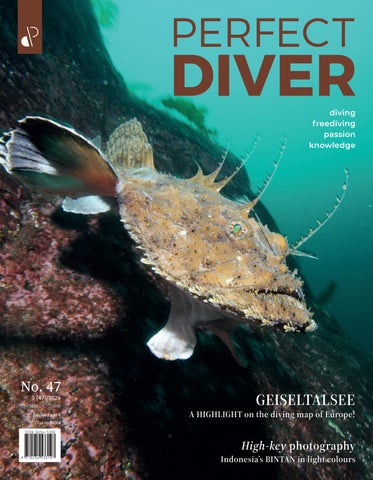
diving freediving passion knowledge
No. 47 5 (47)/2026
SEPTEMBER/ OCTOBER Price 12,50 € Tax included
GEISELTALSEE
A HIGHLIGHT on the diving map of Europe!
High-key photography Indonesia’s BINTAN in light colours 1
TECLINEDIVING.EU 2
the foreword
Wojciech ZGOŁA Editor-in-Chief
Autumn reminds us that winter is on its way. There are upsides – quite a few, actually Underwater visibility improves, fewer people are swimming, and after a dive you can go mushroom picking. You can also head somewhere warmer, such as Lanzarote, Lembeh, Bali and Nusa Penida, Mexico or Bintan. We write about these destinations in the latest issue. And here’s a bonus: at Bonito Diving Lanzarote, say “Perfect Diver” and you’ll get a discount! If your budget is tight, our e-edition can help, at least a little. Sebastian Dobrowolski is trying to decide where to take his first diving course. Somewhere far away in a warm country, or locally, close to home? Pros and cons, arguments for and against… And you – where did you take your first diving course, and was it the right choice? The cover is by Marcin Trzciński and features his “ugly” frogfish. Because… cold waters can be fascinating too. See how this photo was taken – and maybe you have an even better one? This issue has more on cold-water diving. I finally managed to persuade Wiesiek
Baska to publish his photos. That finally happened because Adam Krupa wrote about the place. And it turns out to be “A highlight on the diving map of Europe”! We’re talking about Geiseltalsee in Germany… But see for yourselves what it’s like there. On the cold-water side, we also have Lake Piłakno in Jacek Kubiak’s story, Lake Łęsk in Magdalena Gil’s article, Georgia in Beata Pytel’s piece, and Piotr Bałazy’s account of an incredible encounter with a South American sea lion in a remote corner of Argentina. There’s also another article on underwater photography. It’s a challenging subject: how to photograph wildlife, especially wildlife that moves and can be unpredictable and full of surprises. Piotr Stós also shares a few pointers on photography ethics. We also have Przemek Zyber’s warm, colorful shots of coral reefs. The issue closes with a practical piece by Wojtek A. Filip titled “What if that’s not true?” What does he write about? Find out for yourself!
Tell your friends about us. Take your time with the articles, find inspiration and knowledge in them. We are here for you!
Did you like this issue? Give us a viral coffee buycoffee.to/perfectdiver Visit our website www.perfectdiver.com, check out Facebook www.facebook.com/PerfectDiverMagazine and Instagram www.instagram.com/perfectdiver/
PERFECTDIVER No. 5 (47)/2026
3
table of contents
14
travels 10 14 18 22 30 34 38
LANZAROTE. Lava Beneath the Surface High-key photography. Indonesia’s BINTAN in light colours LEMBEH. A land flowing with nudibranchs and shrimp NUSA PENIDA and BALI. Where Dreams Lead I Was Afraid to Go Back! RED SEA GEORGIA. Batumi, Caucasus Mountains and Khinkali DOS OJOS
fresh water 42
46 50
A HIGHLIGHT on the diving map of Europe! How the GEISELTALSEE turned from a lunar landscape into a diving paradise. PIŁAKNO LAKE. An Icon of Diving in Masuria ŁĘSK. An unassuming lake full of surprises
my point of view 54
4
30
DIVNG COURSE Close to Home or on Holiday?
10
42
22
Table of contents
70 underwater photo 60 How to Photograph Underwater Nature 68 ANGLERFISH in Skjelfjord 70 Face to Face with a LION
tips & curiosities
60
72
72 JET FINS only for technical divers? What if that's not true?
Publisher PERFECT DIVER Sp. z o.o. ul. Folwarczna 37, 62-081 Przeźmierowo redakcja@perfectdiver.com ISSN 2545-3319
Editor-in-Chief
Wojciech ZGOŁA
Technical Diver World Geography & Travels Reportage Image Consulting English Language Translators Legal Care Graphic Designer Advertisement
Tomek KULCZYŃSKI Anna METRYCKA Dominika ABRAHAMCZYK Waldemar RYDZAK Agnieszka GUMIELA-PAJĄKOWSKA, Arleta KAŹMIERCZAK, Piotr WITEK, Tomek KULCZYŃSKI Lawyer Joanna WAJSNIS Brygida JACKOWIAK reklama@perfectdiver.com
THE MAGAZINE IS FOLDED WITH TYPEFACES Montserrat (Julieta Ulanovsky), Acumin Pro (Robert Slimbach, Adobe), Source Serif 4 (Frank Grießhammer, Adobe)
DISTRIBUTION online store sklep.perfectdiver.pl redakcja@perfectdiver.com
PRINTING Wieland Drukarnia Cyfrowa, Poznań, www.wieland.com.pl
www.perfectdiver.com
If you like this issue, donate any amount! Donation is voluntary. PayPal.Me/perfectdiver
COVER PHOTO Marcin TRZCIŃSKI LOCATION Norway, Skjelfjord IN THE PHOTO Anglerfish
The Editorial Office does not return unsolicited materials, is not responsible for the content of advertisements and reserves the right to shorten, edit, title the submitted texts and select illustrative materials. Reprinting of articles or parts thereof, copying only with the consent of the Editorial Board. Editors are not responsible for the form and content of advertisements.
PERFECTDIVER No. 5 (47)/2026
5
editorial team
Wojciech ZGOŁA
Dominika ABRAHAMCZYK
Tomek KULCZYŃSKI
A man who travels by diving. Connected with water since childhood – from learning to swim, through sailing, to discovering the secrets of underwater lakes, seas, and oceans. Later came a passion for photography and writing, which allow him to share the beauty of the underwater world and the unique stories of each place. He has completed over 900 dives in Poland as well as in remote, exotic warm and cold locations. Each dive is treated as an encounter with nature and history. A lover of Nature in its purest form, he believes that diving is not only a sport, but also a way of building awareness – of the environment, other people, and oneself.
Infected with a passion for diving by Perfect Diver. She continues to expand her diving skills. Although she definitely prefers warm waters, she dons a dry suit and explores colder bodies of water as well. Her favorite dives are those with plenty of marine life! Recently, she’s been taking her phone underwater in a protective case, trying her hand at amateur photography. She’s also curious about diving medicine. Professionally, she’s a Master’s degree nurse and a surgical scrub nurse.
For Tomek, diving has always been his greatest passion. He started his adventure at the age of 14, developing into a recreational and technical diving instructor, a first aid instructor and a diving industry technician. Currently, he runs the 5* COMPASS DIVERS Pobiedziska Diving Center near Poznań, where he passes his knowledge and skills to beginners and advanced divers, which gives him great joy and satisfaction from being part of their underwater adventure...
Anna METRYCKA
Waldemar RYDZAK
“Human! Dive underwater. If the beauty you see down there doesn’t shake you to your core – nothing interesting awaits you in life.” A diving enthusiast, connected with the water since childhood. She completed her first scuba course at the age of 14 and has never parted with diving since. She wrote her master’s thesis on dive tourism during her geography studies at the University of Warsaw. Starting in 2013, she contributed to the magazine nuras.info and took part in underwater photo shoots. Since 2018, she has been writing articles for Perfect Diver magazine (previously as Ania Sołoducha) and has been part of the editorial team for several years. She pours her knowledge and experience onto the page, sharing and promoting what she loves most – diving. For 13 years, she organized diving expeditions around the world, because working with people and creating new projects is where she truly thrives. She takes part in diving fairs and events, as well as lake clean-ups. She has often had the pleasure of speaking as a presenter at diving expos and conferences and has a number of diving webinars to her name. She has already dived in many places around the globe – and her dream list keeps growing. For the past few months, she has been the owner of her own company organizing diving and active travel – Umiko Expeditions – with a head full of ideas for the next adventures. An optimist with a constant smile and an individual approach to every client. Her best life chapter is just beginning! www.umikoexpeditions.pl anna@umiko.pro +48 516 621 211
He comes from a mining region, where water was more of an exception than an everyday presence. He learned to swim and dive to overcome his fear of water – and, over time, to turn it into curiosity about the world beneath the surface. He has been connected with diving since 2000 (Divemaster, CMAS). He doesn’t chase depth or records; he prefers calm exploration, mindfulness, and the details that are easy to miss when you’re in a hurry. In his day-to-day work, he is a researcher and communication practitioner (Dr hab., Prof. UEP), involved in research and teaching in the areas of creative markets and digital and crisis communication. Within the Perfect Diver editorial team, he supports the crew where content meets technology – on video productions, data analysis, and building the brand strategy.
constant cooperation
Wojciech A. FILIP
Jakub BANASIAK
Łukasz METRYCKI
Sylwia KOSMALSKA-JURIEWICZ
He has been diving for 35 years. He has spent more than 16,000 hours underwater, most of them diving technically. He has been an instructor and mentor instructor for many organizations including CMAS, GUE, IANTD, PADI. He co-created the training programs for some of them. He is a professional with vast knowledge and practical experience. He has participated in many diving projects as a leader, explorer, initiator or speaker. He was the first Pole to dive the HMHS Britannic wreck (117m). He was the first to explore the deep part of the Glavas Cave (118m). He made a series of dives documenting the wreck of ORP GROM (110m). He has documented deep (100-120m) parts of flooded mines. He is the creator and designer of many equipment solutions to improve diving safety. Technical Director at Tecline, where, among other things, he manages the Tecline Academy a research and training facility. Author of several hundred articles on diving and books on diagnosis and repair of diving equipment. He dives in rivers, lakes, caves, seas and oceans all over the world.
Zoopsychologist, researcher and expert in dolphin behavior, committed to the idea of protecting dolphins and fighting against keeping them in dolphinariums. Passionate about Red Sea and underwater encounters with large pelagic predators. Member of the Dolphinaria-Free Europe Coalition, volunteer of the Tethys Research Institute and Cetacean Research & Rescue Unit, collaborator of Marine Connection. For over 15 years, he has been participating in research on wild dolphin populations, auditing dolphinariums, and monitoring the quality of whale watching cruises. As the head of the "Free & Safe" project (formerly "NO! for a dolphinarium"), he prevents keeping dolphins in captivity, promotes ethical whale & dolphin watching, trains divers in responsible swimming with wild dolphins, and popularizes knowledge about dolphin therapy that is passed over in silence or hidden by profit-making centers. on this form of animal therapy.
/ Luke Divewalker A long, long time ago in a galaxy far, far away there was chaos... …that is, the multitude of thoughts and delights after my first immersion under water in 2005 in the form of INTRO while on vacation in Egypt. By then I had completely immersed myself in the underwater world and wanted it to have an increasing impact on my life. 2 years later, I took an OWD course, which I received as a gift for my 18th birthday, and over time, further courses and skills improvement appeared. "Photography" appeared not much later, but initially in the form of a disposable underwater "Kodak" from which the photos came out stunningly blue I am not a fan of one type of diving, although my greatest weakness at the moment is for large pelagic animals. The Galapagos Islands were my best opportunity to photograph so many species of marine fauna so far. I share my passion for diving and photography with my buddy, who is my wife IG: luke.divewalker www.lukedivewalker.com
A traveller and a photographer of wild nature. A graduate of journalism and a lover of good literature. She lives in harmony with nature, promotes a healthy lifestyle: she is a yogini and a vegetarian. Also engaged in ecological projects. Sharks and their protection are especially close to her heart. She writes about the subject in numerous articles and on her blog www.blog.dive-away.pl. She began her adventure with diving fifteen years ago by total coincidence. Today she is a diving instructor, she visited over 60 countries and dived on 5 continents. She invites us for a joint journey with the travel agency www.dive-away.pl, of which she is a co-founder.
Laura KAZIMIERSKA
Przemysław ZYBER
Marcin TRZCIŃSKI
Barbara GLENC
Laura is a journalist, instructor trainer, CCR and cave diver. She has been developing her diving career for over a decade, gaining knowledge and experience in various fields. Her specialty is professional diving training, but her passion for the underwater environment and its protection drives her to explore various places around the world. From the depths of the Lombok Strait, caves in Mexico and wrecks in Malta to the Maldives, where she runs a diving center awarded by the Ministry of Tourism as the best diving center in the Maldives. Laura actively contributes to promoting the protection of the marine environment, takes part in scientific projects, campaigns against ocean littering and cooperates with non-governmental organizations. You can find her at: @laura_kazi_diving www.divemastergilis.com
I photograph because I love it, I film because it excites me, I write because I enjoy sharing, I teach because I support growth, I travel because I love discovering new things. www.facebook.com/przemyslaw.zyber www.instagram.com/przemyslaw_zyber/ www.deep-art.pl
A graduate of the University of Warsaw. An underwater photographer and filmmaker, has been diving since 1995. A co-operator at the Department of Underwater Archeology at the University of Warsaw. He publishes in diving magazines in Poland and abroad. The owner of the FotoPodwodna company which is the Polish representative of Ikelite, Nauticam, Inon, ScubaLamp companies. www.fotopodwodna.pl m.trzcinski@fotopodwodna.pl
I am a traveler and a technical diver, exploring the world both on land and underwater. I have been diving for 16 years. Since I am a professional photographer, a camera has accompanied me from my very first dive. I started with recreational diving, but over time, I obtained full trimix and full cave certifications, allowing me to explore caves, wrecks, and great depths. Underwater, I find a peace that is hard to experience on the surface. Every dive is not just an adventure for me but also an opportunity to capture the extraordinary underwater world through photography. barbaraglenc.foto@gmail.com
our authors
Piotr STÓS
Paula SUSZKO
Jacek KUBIAK
Photographer, biologist, storyteller, SSI Instructor Trainer. He considers it his duty to teach diving at every level. Since the dawn of time, he has been associated with Nautica with an inseparable umbilical cord of co-ownership. He nests on the Croatian island of Vis, on safari boats in Egypt and where under water it is beautiful as the world long and wide. He works at Nautica Safari. nautica.pl, piotr.stos@nautica.pl
Paula has been diving for 15 years, taking her first underwater breaths at Lake Hańcza with Adriatic Diving Center. She later spent several years in Ireland, diving the cold waters of Dublin Bay and the Atlantic Ocean. Since 2018, she has been living in Singapore. During the week, she works for a multinational corporation as an External Contracts Manager, while on weekends she teaches and guides divers as an SSI Instructor at the local dive centre, Cuddlefish Divers. Whenever she has the opportunity, Paula travels throughout Southeast Asia to explore its underwater world, capturing the region's extraordinary marine biodiversity through her photography. IG: @pauladives
Is 45 years old and married, has been working professionally in the metallurgical industry for 25 years, has been diving since 2009 and diving has become a way of life and passion for him. He lives in Kętrzyn and is associated with the Mazursharks Club.
Adam SOKÓLSKI
Beata PYTEL
Magdalena GIL
Diver, diving instructor, underwater photographer. I have been diving for 28 years and working in underwater photography for 18. I have completed thousands of dives in Poland, across Europe, Africa, and Asia. Diving, training new divers, and creating underwater images are not only my profession, but above all my passion. I am particularly fascinated by macro photography, which is why underwater I most enjoy photographing small, very small, and even microscopic creatures. I always gladly return to the Philippines, Indonesia, and Malaysia, where underwater life amazes with its richness. My photographs have been published, among others, in National Geographic.
She is the kind of person who, if one door closes, will find another way in. If the window is shut, she'll come through the chimney. The phrase "it can't be done" simply doesn't exist in her vocabulary – because she believes there is always a solution. Born and raised in Opole, she has always enjoyed taking on new challenges. After meeting her future husband, Marek, she discovered diving through him. The beginnings were far from easy, but her determination paid off. Today, the underwater world is her sanctuary and a welcome escape from the fast-paced life she leads. Her life revolves around one journey after another, often leaving barely enough time to repack her suitcase before setting off again. Running her own travel agency is both her profession and her passion, allowing her to explore the world – above and below the surface. She is also the proud and devoted owner of a Wire Fox Terrier named Santi. opole@traveliada.pl www.traveliada.opole.pl
I’ve been diving for six years. When I started, I was convinced my adventure would end with the OWD course – just a few dives, a glimpse of the underwater world, and that would be it. I had no idea how wrong I was. Diving hooked me completely. It evolved from a hobby into a part of my life, and eventually, my career. I’m constantly upgrading my qualifications, learning new skills, and setting myself new challenges so I can dive deeper and explore what lies even further afield. Today, my mind is full of diving dreams. And perhaps that’s the most beautiful part of it all: when I started, I never imagined I’d one day dream of things that now seem entirely within reach. I hope to make them all a reality – even the ones I wouldn’t have dared to think about six years ago.
Adam KRUPA
Wiesiek BASKA
Sebastian DOBROWOLSKI
Piotr BAŁAZY
He has been diving since 2021. What began as curiosity about the underwater world quickly evolved into a genuine passion and a vital part of his life. A technical diver, he has gained experience in a wide variety of aquatic environments. While he runs his own business in his professional life, he prefers to spend his free time underwater. He has also recently taken up underwater filmmaking, capturing extraordinary locations and sharing the unique beauty of the underwater realm with others. www.youtube.com/@adamk8802
How do you fill your time in retirement? By doing what you’ve always dreamed of. So, in 2015, I made my dream a reality... the OWD course. It was smooth sailing from there. Today, I’m a technical diver and divemaster with a passion for underwater photography. A camera has been with me from the very beginning; I even did my OWD training with a camera strapped to my head. That habit stuck. I love taking photos of divers in interesting settings; since they tend to forget the plans made on the surface once they’re underwater, I use a photojournalist’s eye to capture those fleeting moments – so that later, when looking through the pictures, they can enjoy seeing themselves through my eyes. www.facebook.com/wiesiek.baska www.instagram.com/wiesiek_baska/
He is the co-founder and CEO of the IDF International Diving Federation. A cave and technical diving Instructor Trainer, he has been involved in diving and cave exploration for over 25 years. He is the co-author of more than a dozen diving manuals covering recreational, cave, technical, and rebreather diving. Professionally, he serves in the Polish State Fire Service and is involved in training rescue divers and special forces personnel, as well as organizing diving expeditions. He specializes in cave diver training, promoting a modern and responsible approach to diving education based on the “Safety First” philosophy.
Marine biologist, assistant professor at the Department of Marine Ecology and Diving Officer at the Institute of Oceanology of the Polish Academy of Sciences (IO PAS). www.piotrbalazy.com
sponsored article
LANZAROTE
Lava Beneath the Surface
Text and photos Wojciech ZGOŁA, Dominika ABRAHAMCZYK
Lanzarote feels different from the moment you start driving. It only takes a few kilometres to understand why. Volcanic landscapes, cones in shades of black, brown and red, no billboards, no high-rise buildings and no tangled overhead wires. Instead, there is space, wind and the ocean.
C
ésar Manrique, the Canary Islands’ most famous architect, did much to ensure that Lanzarote would not become just another mass-tourism destination.
And underwater? That is where another story begins. In August, we returned to see our friends at Bonito Diving Lanzarote in Playa Blanca. Kasia, the dive centre manager, looked after us for most of our stay. The ocean was a very com-
10
fortable 24–25°C. For divers, that is almost a luxury, although water temperatures like these cannot always be taken for granted in Lanzarote. Visibility was not quite as good as during our previous visits in spring and autumn, averaging around 10–20 metres. Still, there was more than enough to appreciate what nature has created beneath the surface. And what it has created is remarkable. Centuries ago, hot lava flowed into the ocean, cooled and solidified, gradually building an extraordinary underwater landscape.
sponsored article
Walls, ridges, tunnels, caves, depressions and passages create a multi-level world beneath the surface. Between them lie patches of black, grey and pale sand. No two sections of seabed seem quite the same. Playa Flamingo is a good example. From the shore, it may not look like the kind of place where anything particularly exciting is waiting. Put your head underwater, though, and the picture changes. We scan the sand for rays, flounders and lizardfish. Morays, crabs and shrimps hide in the cracks and crevices. With a little patience – and a trained eye – you may spot a seahorse, a spider crab or a small cuttlefish doing its best to disappear against the seabed. Rays are a regular part of the experience here. Stingrays and butterfly rays are not unusual, and there is always the possibility of encountering an electric ray. They can be surprisingly difficult to spot, lying almost completely buried in the sand. Playa Flamingo is particularly special after sunset. At night, the same stretch of ocean becomes a completely different place. Creatures that remain hidden during the day emerge into the beam of our torches: large spotted sea hares, octopuses, crabs, scorpionfish, cuttlefish and countless sea urchins. Golden morays hunt in the water column. During one of our night dives, we witnessed a scene that will stay with us for a while. One of the morays caught a cuttlefish and, right in front of Domini-
ka and Kasia, began to feed.A few minutes later, a large stingray appeared. It was just a shore dive at Playa Flamingo, but underwater something is always happening. And Playa Flamingo is only one small part of what Lanzarote has to offer. Puerto del Carmen is home to several wrecks, some of which can be visited during the same dive. We head out from the harbour by RIB and, after around five minutes, arrive at the site. One wreck lies at about 20 metres, resting on its side. The second – or rather, the larger and smaller sections that remain of it – lies at around 40 metres. It was here, several years ago, that I came across a 1.5-metre angel shark. It was lying peacefully on the sand, surrounded by pieces of the wreck. On another dive, large stingrays appeared between the wrecks. And perhaps that is one of the things I like most about Lanzarote: you never quite know what the next descent will bring. The angel shark is, of course, one of the encounters divers hope for most. The best time to see them is roughly from late September through April. Outside that period, sightings become more difficult. Bonito Diving Lanzarote has also been involved for years in the annual angel shark counting initiative, helping to keep track of these increasingly rare animals.
PERFECTDIVER No. 5 (47)/2026
11
sponsored article
Bonito Diving Lanzarote continues to develop its facilities. A new compressor has been installed, allowing tanks to be filled with air and nitrox up to 40%. Equipment is gradually being replaced with new gear, all required inspections and certifications are kept up to date, and the centre has an agreement with a hyperbaric chamber should an emergency ever occur.
12
”
This time, however, our main reason for coming back was a little different. We wanted to spend time with our friends and see what had changed at the dive centre. Quite a lot, as it turned out.
Lava. Sand. Caves. Walls. Wrecks. Rays. Groupers. Morays. And, if you are lucky, an angel shark. Day dives and night dives.
Bonito Diving Lanzarote gives
you the opportunity to experience that diversity.
These are the things you ideally never need to think about during a diving holiday. But it is good to know that someone has. Because Bonito is, above all, about people. The passion is still there. And, just as importantly, so is the willingness to put in the work. They are happy to talk, explain, advise and look for the right dive site according to the conditions. They patiently answer questions and take the time to make sure things are understood. It is professional without being distant. Friendly without being forced. Simply human. And that matters a lot when you are diving. After each dive, we return to the base in Playa Blanca. We rinse and hang up our equip-
ADVERTISEMENT
sponsored article
ment, fill in our logbooks, have something cold to drink and talk about what we have seen. Sometimes the conversation turns to the next dive. Sometimes it is about where to eat. And sometimes it has nothing to do with diving at all. You can also find the printed edition of Perfect Diver at the centre. There is something particularly satisfying about seeing your own magazine in a place where divers are preparing to head out into the Atlantic. Perhaps that is the best way to describe Bonito Diving Lanzarote. Not as a dive centre that has “everything”, but as a team that knows the island, knows its dive sites and knows where it is worth diving on any given day. Because the diversity is, first and foremost, Lanzarote’s own. Lava. Sand. Caves. Walls. Wrecks. Rays. Groupers. Morays. And, if you are lucky, an angel shark. Day dives and night dives. Different landscapes, different conditions, different encounters. Bonito Diving Lanzarote gives you the opportunity to experience that diversity. After our August visit, one thing has not changed. We still want to come back. Not only for the warm water and the ocean, but also for the people – the ones we can once again join beneath the surface and, together, discover what Lanzarote has in store for us this time.
PERFECTDIVER No. 5 (47)/2026
13
TRAVELS
High-key photography
Indonesia’s BINTAN in light colours Text and photos Paula SUSZKO
Scuba diver and pufferfish
Bintan is the largest island in the Indonesian Riau Archipelago, located southeast of the Malay Peninsula, at the outlet of the Strait of Malacca. Only a narrow strip of the Singapore Strait separates Bintan from Singapore, and fast ferries cover the distance between the metropolis and the northern coast of Bintan in just one hour.
T
here are luxurious hotels, golf courses, fine dining restaurants, and developed beaches – geared towards weekend tourists from Singapore. Most visitors know Bintan only from this perspective. But you only need to get off the beaten tourist path to the east or south of the island to find kampungs – traditional fishing villages located on the edge of mangrove forests, where life moves at a slow pace. For centuries, the Riau Islands provided shelter for the so-called Orang Laut ("People of the Sea") – nomadic sailors
14
and fishermen whose lives have been linked solely to the sea for generations, and to this day the traditions and culture of these peoples are still alive here.
Living on the waves Local fishermen use not only boats, but above all kelongs: floating or stilt-mounted platforms common in the waters of Indonesia, Malaysia, and the Philippines. Built from local wood (often palm and bamboo trunks), kelongs operate mainly at night and in the early
Travels
Floating kelong
Surrounded by water
morning: strong lights attract fish and squid, and nets are simply lowered under the platform and then pulled up with the catch. Kelongs are also sometimes adapted into intimate marine "agritourism" establishments, including diving centres, such as the Bintan Black Coral center. Staying on a kelong makes you feel as if time has stopped: there are no special comforts, instead of air conditioning there is a sea breeze, and the food is simple but tasty. The rhythm of the day is dictated by tides and wind, and under the floorboards you can hear the continuous sound of water. The experienced crew knows the local conditions and sea currents perfectly and plans dives according to the current situation.
which lasts from April to October. Underwater, we will see a mosaic of sandy patches interspersed with seagrass meadows and clusters of coral and anemones. We dive slowly, looking for macro fauna. Colourful starfish rest on the bright sand, and glass symbiotic shrimp and
entire families of active clownfish hide among the delicate arms of soft corals. We will see various nudibranchs, crustaceans, sometimes a shy seahorse, and cephalopods. Octopuses hide in the sand or seek protection in empty shells or old pottery discarded by humans. Cuttlefish are easy to miss, as their camouflage allows them to blend into their surroundings. At night, numerous squids appear, attracted by the lights of the kelongs. There are no spectacular depths or vertical walls here, but encounters with larger species do happen: bamboo and reef sharks, stingrays, or green and hawksbill turtles.
The magic of high-key photography The clarity of the water around Bintan can be variable: from 5 to 15 meters, but even with lower visibility, light penetrates to the very bottom. In sunny weather, it is bright underwater, and the reef sparkles with pastel colours. These are ideal conditions for trying the high-key photography technique.
Underwater Bintan The shallow, warm waters surrounding Bintan usually allow for long, relaxing dives, though currents can surprise you and suddenly pick up speed. Water temperatures of 28-30°C provide comfortable conditions throughout the dry season, Art of the sea
PERFECTDIVER No. 5 (47)/2026
15
travels
Sea slugs of the genus Costasiella, probably C. ocellifera
A small fish from the dragonet family
A juvenile clownfish shares an anemone with a glass shrimp
16
Juvenile tiger-tail seahorse
In classic underwater macro photography, highly contrasted frames dominate, often with a black background obtained using snoots. High-key photography is the complete opposite of this approach. In this technique, the frame is deliberately overexposed (usually by one or two stops), allowing the light to dominate the scene, and the background becomes almost white, milky, or gently pastel. In underwater photography, this aesthetic is extremely popular in Japan. Photographers there highly value the lightness of the style and its poetic, "watercolour" mood. The image is not meant to scream with sharpness, but rather to evoke a daydream-like feeling – this technique is even sometimes referred to as yume-iro (Japanese for "dream-coloured"). From a gear standpoint, the key to success is working with a very wide aperture. Instead of the classic f/8 or the f/16 or higher typical for macro, we choose values ranging from f/2.8 to f/5.6. We turn the strobes down to a minimum to gently illuminate our subject, and rely on ambient light to illuminate the background. Working with a wide aperture carries significant challenges: the depth of field is the thickness of a sheet of paper and measures fractions of a millimeter. A slight movement of water, a deeper breath, or a twitch of the hand is enough for the focus point to slip away from the animal's eye. However, in this difficulty lies a certain charming "trick." In high-key photography, technical perfection of the image ceases to be a priority. Our goal is no longer to achieve tack sharp images. We want the subject to be softly
An octopus shelters in a discarded glass
Larson's goby
blurred, and the artistic bokeh background is meant to give the image a dreamy mood. Any shortcomings in sharpness turn into a deliberate artistic choice. High-key technique works well for critters with transparent or light bodies: glass symbiotic shrimp, bright clownfish among light anemones, colourful nudibranchs, and also small cephalopods against a sandy background. It is worth breaking established patterns and experimenting with new techniques. And most importantly – you don't have to fly to the other side of the world to do it. The high-key photography can be practiced wherever the water is shallow enough to let in plenty of natural light: on the paradise reefs of Asia, but also in the shallow, clear bays of Polish lakes or in shallower parts of quarries. Juvenile broadclub cuttlefish
Diving season and conditions:
Equipment tips:
The most convenient way to reach Bintan is directly from Singapore. From the Tanah Merah ferry terminal, located near Changi Airport, fast and comfortable ferries operate, and the cruise to the island takes only 50–60 minutes. After arriving, the journey to the eastern or southern coast continues by local car transfer, followed by a short boat crossing directly to the selected kelong.
The season lasts from April to October, during the southwest monsoon, when the sea remains calm and rainfall is low. The months from November to March should be avoided, as the northeast monsoon brings strong winds and waves. The water temperature is 2830°C, which allows for diving in a thin 3 mm wetsuit or even just a protective rash guard.
In macro photography in the high-key style, a camera with a macro lens with a focal length of 60 mm or 90–105 mm works best. Diopters may come in handy for capturing smaller specimens. Instead of a narrow beam of light from a snoot, strobes with diffusers should be used.
PERFECTDIVER No. 5 (47)/2026
PRACTICAL INFORMATION
How to get there?
17
TRAVELS
LEMBEH
A land flowing with nudibranchs and shrimp Text and photos Adam SOKÓLSKI
Once upon a time, in faraway Indonesia, not far from Manado, lies a fairy-tale land that every underwater macro photographer dreams of visiting. This is Lembeh Strait.
I
’ve dived in many places that can get a photographer’s pulse racing – in the Philippines, Bali, and Malaysia. And yet somehow, the road to Lembeh always seemed to get longer. First, the world took a break called COVID, and then it turned out that this is not the kind of destination you book on a whim – “how about next week?” – because the budget has quite a lot to say about it. But finally, I made it! And after my first stay, I can say one thing: calling Lembeh the “macro capital of the world” does not seem like an exaggeration at all. Of course, you can have endless debates about whether Lembeh is better than Anilao, Dauin, or Semporna. Make a spreadsheet, award points for the number of nudibranchs found per hour or the size of the frogfish, appoint a panel of experts... But why? Each of these places is fantastic and has its own character. For me, what is more interesting than asking “which one is the best?”
18
is what you can find here, and how good the dive operation and underwater guides are.
Black sand? Yes. But not only Lembeh is associated above all with muck diving – searching for critters on an apparently empty seabed covered in volcanic sand. At first glance, these sites do not look as though there is anything worth photographing there, but in reality they can hide some incredibly interesting creatures. And indeed, many dives look exactly like this: an empty sandy bottom, a few rocks, and nothing else. But Lembeh turns out to have a completely different side as well: genuinely beautiful reefs. Healthy corals, interesting formations, and scenes that could easily appear in a brochure advertising classic tropical diving. I went there expecting black sand and strange creatures
Travels
that looked as though someone had designed them after a wild night out – but I discovered that you can enjoy a great reef dive here just as easily as you can take classic macro shots on the sand. And I think that was what surprised me most. Lembeh has a reputation as the muck diving capital of the world, but confining it to that category alone would be a little unfair.
More than 50 reasons to get in the water There are more than 50 dive sites in Lembeh Strait. When you visit for the first time, you can put together a very long wish list. It usually includes seahorses, octopuses, ghost pipefish, frogfish, shrimp, and a whole army of nudibranchs with strange names. Sometimes I travel with a list of critters I would like to see and photograph. Because this was my first trip to Lembeh, this time I relied entirely on the guides’ instincts. They know exactly what can be found and where, as well as what is currently showing up at each site. During my stay, practically every day brought something new. One day we would find creatures I had been waiting a long time to see, and the next the guide would point out something I had not expected at all. And that unpredictability was exactly what I liked most: Lembeh can surprise you with something new every day. In keeping with best practices at dive resorts geared toward macro photography, we had plenty of time underwater to take photos. There was no rush: we could work on each shot, change settings, and try a different approach. The dives were long and relaxed – exactly the way I like them. If we found an interesting animal, we could stay with it for longer instead of moving on after a few minutes to follow a preplanned route. There was no pressure to stick to a specific plan or tick off one site after another. Everyone could focus on whatever interested them at the time and spend as long on it as they needed. With small, mobile animals, that kind of freedom makes a huge difference. You can observe them calmly, try different shots, change your camera settings, and look for another way to photograph the same subject. No nervously checking the
PERFECTDIVER No. 5 (47)/2026
19
travels
clock and no worrying that you will have to leave an interesting animal simply because the rest of the group is moving on.
Four shots I’ll remember most During this trip, I took quite a few photos that I genuinely like. Here are a few that have stayed with me in particular. Denise’s pygmy seahorse. Right at the beginning of the trip, I took a photo that I still like more than most of what I brought back from Lembeh: a tiny seahorse perched on top of its coral home, with all the polyps open. Open polyps usually mean that nothing and no one has disturbed the scene beforehand – and that is exactly why a shot like this is so satisfying. Darek, one of the participants on the trip, wanted a similar shot so badly that we returned to the same place three more times. Each time we were the first ones there – and each time the polyps were closed. Sometimes macro photography is as much about skill as it is about plain luck Coconut octopus. An octopus known for hiding in shell halves or coconut shells. Despite the several thousand dives I have under my belt, this was my first time seeing one in person. And honestly, watching the octopus in action was much more fascinating than I had expected. It carried its shelters around, disappeared beneath a shell, and closed its little “house” with its arms. All of this made it hard to take my eyes off it. Bargibant’s pygmy seahorse. We found a wonderful scene – two microscopic seahorses sitting side by side on a beautiful gorgonian fan. I started taking photos of them, but at one point I took my eye away from the viewfinder to slightly adjust my
20
strobes. When I looked again, they were gone. Or rather, they were still there – I just could not see them. Bargibant’s pygmy seahorse blends into its home so perfectly that even when you know exactly where it is, you can lose sight of it from just a few centimeters away. Tozeuma shrimp. A shrimp with a very sharp, angular shape that readily poses while perched on blades of seagrass or sticklike sponges. There were surprisingly many of them in Lembeh. Its colorful body and unusual silhouette offer plenty of photographic possibilities, especially when you manage to find a suitable contrasting background. It is one of those small Lembeh stars you may overlook at first, only to discover that it is hard to take your lens off it.
Will I go back? Definitely. Lembeh is one of those places you leave feeling certain that there are still plenty of critters waiting to be found and photographed. Then you go through the photos you took and more thoughts creep in: I framed this one badly, I could have approached that one differently, that critter got away too quickly, and that eye looked sharp but unfortunately isn’t... And you realize there is only one thing to do: go back
PERFECTDIVER No. 5 (47)/2026
21
TRAVELS
NUSA PENIDA and BALI Where Dreams Lead Text and photos Barbara GLENC
We traveled to Indonesia with one goal – to make our dream of meeting a Mola mola come true. We had no idea, though, that this would only be the beginning of a journey filled with extraordinary dives, spontaneous decisions, and magical places.
A
fter landing in Denpasar, we went straight from the airport to the harbor and boarded a speedboat that took us to the island. The crossing was short, but even then we could feel something changing – the farther we moved away from Bali, the wilder and more rugged the water and the horizon became. We arrived on Nusa Penida with nothing arranged – no accommodation, no reservations, no plan. We got off at the harbor and simply wandered around for a while with all our dive gear, wondering what to do next. We found a place to stay very quickly, almost by accident. The first place we walked into turned out to be good enough, and after a short conversation we decided to stay there for a few nights. We dropped our gear in the room and, that same day, went looking for a dive center. It was around noon. We walked into the
22
first one without many expectations, mostly just to ask how things worked. But the atmosphere felt so natural and the people were so friendly that we immediately knew there was no need to look any further. We booked two dives for the next day – one in search of Mola mola, the other at Manta Point. And that was the entire plan. The rest would happen on its own. Our first morning with Mola mola. The alarm went off before five in the morning. The island was quiet, with only the sound of scooters and waves breaking on the shore. At the dive center, everyone moved around in silence. We assembled our gear, I checked my camera, housing, and cylinders, and there was a sense of excitement in the air. Everyone had the same goal – to see an ocean sunfish. We left the shore before sunrise. The boat cut across the
Travels
FACTS ABOUT MOLA MOLA (ocean sunfish) Mola mola is one of the most unusual fish in the world. Size and weight: they can reach up to 3 meters in length and weigh more than 2 tons. Diet: feed mainly on jellyfish, plankton, small fish, and larvae. Lifespan: are estimated to live for around 10–20 years, although exact data is difficult to establish. Reproduction: females are record-holders among vertebrates – they can release up to 300 million eggs at a time. Pregnancy: they do not have a pregnancy in the mammalian sense – the eggs are fertilized in the water and development takes place externally. Young: only a small percentage of the millions of eggs survive. Fun fact: despite their enormous size, they are completely harmless to humans and move very calmly, almost as if they were “drifting” through the ocean. Their appearance is so unusual that it is hard to believe they are still fish.
calm surface of the sea as the first rays of light slowly appeared above the horizon. Nobody talked much. Everyone was focused on what was about to happen. After a dozen or so minutes, we reached Crystal Bay. A short briefing, a buddy check, and moments later we disappeared beneath the surface. After just a few meters, it was obvious that this was not a typical Indonesian dive. The water temperature dropped to just 18°C. The cold immediately seeped beneath my wetsuit, reminding me that it is precisely these cold currents that draw ocean sunfish to this spot. The currents were moderate – strong enough to feel the power of the ocean, but not strong enough to make the dive difficult. We descend to around 40 m and settle in by the wall.
We wait. At this depth, time seems to move differently. Every second feels longer, while our eyes constantly scan the blue for even the slightest movement. Suddenly, the guide points energetically ahead. I look in the direction he is indicating and at first see only a vague shadow, growing larger and clearer with every moment.
Mola mola It doesn’t rush into view. It slowly emerges from the blue, as if it had been there all along, simply invisible until now. Huge, calm, and majestic, it swims straight toward us. Instinctively, I raise my camera, but I already know this will be more than just another photo.
PERFECTDIVER No. 5 (47)/2026
23
travels
”
Seeing two Mola mola at the same time is something truly extraordinary. This time, I don’t keep taking photos nonstop. More often, I simply watch..
24
Travels
This is the encounter I have been waiting for for years. It swims just a few dozen centimeters from my camera housing. It doesn’t flee. It circles beside us for several minutes, slowly turning and showing us its extraordinary profile. I have the impression that it is deliberately posing for photos. At that moment, I stop thinking about the depth, bottom time, or camera settings. All I feel is a shiver running through my entire body and a sense of complete disbelief. It really happened. First dive. First attempt. And our biggest dream is coming true right before our eyes. For years, I had seen photos and videos showing Mola mola as a calm, almost slow-moving fish. That made what happened moments later even more surprising. One powerful sweep of its fin, and suddenly this seemingly cumbersome giant shot off into the blue at a speed I had never expected. Within seconds, the fish was gone. I kept staring at the place where it had disappeared for a long time… When we surfaced, every one of us was grinning from ear to ear. The emotions were so intense that there was only one possible decision. We’re coming back tomorrow.
Day two – Mola mola and Manta Point After the excitement of the previous day, we returned to Crystal Bay hoping the ocean would surprise us once again. The next morning, the alarm went off before five again. At the dive center, there were quick preparations, coffee, and gear checks. Nobody said it out loud, but everyone was hoping for another encounter with Mola mola. Once again, we descend to around 40 meters and wait by the wall. And suddenly, there they are. First one, then a second Mola mola.
They circle calmly in the open water, approaching a cleaning station where small fish remove parasites from their skin. Seeing two Mola mola at the same time is something truly extraordinary. This time, I don’t keep taking photos nonstop. More often, I simply watch. It is one of those moments you want to remember, not just record. After a few minutes, the fish slowly disappear into the blue and we begin our ascent. At around 15 meters, something incredible happens – one of the Mola mola leaves the wall and swims very close to our group. It pauses for a moment, as if observing us, then turns calmly and disappears into the depths. Once we reach the surface, nobody speaks for quite a while. Everyone takes it in in their own way. Our second dive that day took us to Manta Point, one of the best-known dive sites around Nusa Penida. The water was more exposed, the currents stronger, and the atmosphere completely different from Crystal Bay. We didn’t have to wait long. First one manta appeared, then another. They circled gracefully above the cleaning station, moving in slow, hypnotic sweeps. Watching them was pure magic – enormous animals moving with incredible lightness.
Nusa Penida – above the surface We spent only three nights on Nusa Penida, but that was enough to experience a completely different rhythm of life from Bali. This isn’t an island of resorts designed for lounging around. Everything feels rougher, more authentic, and far less polished. The best way to get around was by scooter, and from the first day it became our main means of transport. The roads are narrow, winding, and often rocky. In places, the asphalt disappears altogether, replaced
PERFECTDIVER No. 5 (47)/2026
25
travels
we returned to Bali and rented a car. From that point on, the trip looked completely different. We could go wherever we wanted and dive at our own pace. Our base was Amed – a peaceful seaside town where life moves much more slowly. Every morning we set out from there for another dive, and it quickly became clear that the atmosphere was completely different from Nusa Penida.
Tulamben – the wreck that came alive One of our first stops was the legendary USAT Liberty in Tulamben. It is one of the few wrecks in the world that you can simply swim out to from the beach. The ship was torpedoed during World War II, and after the eruption of Mount Agung in 1963 it slid into the sea, where it still lies today at depths ranging from just a few meters to around 30 meters. What makes the biggest impression, however, is not the history itself but the way nature has taken over. The entire structure is covered in coral and has become home to countless species of fish. Schools of snapper, barracuda, moray eels, lionfish, and parrotfish make it hard to believe that this was once simply a ship.
Boga Wreck – a wreck given a second life
by dust and uneven ground that demands your full attention on every bend. Riding here has little to do with comfort – it is an experience in itself, because every few moments another view appears around a corner and makes you pause for a second. Hills, green cliffs, the ocean below, and sudden drops in the terrain all remind you that you are on an island that has not yet been fully shaped around tourism. Every ride felt a little different because the road itself was part of the attraction. One of the places that impressed us most was Kelingking Beach. It is one of the best-known places on Nusa Penida and in all of Indonesia. Seen
26
from above, the cliff resembles the shape of a dinosaur and drops steeply toward a small turquoise bay. The view from the top feels unreal because the contrast between the vertical rock face and the color of the water is so striking that it is hard to believe you are not looking at a drone shot or a visualization. Simply standing at the edge of the cliff gives you a sense of the scale of the island and the ocean surrounding it. During those three days, Nusa Penida was a stopover for us, but an incredibly intense one.
Amed – another side of Bali After three intense days on Nusa Penida,
A few kilometers north of Tulamben, in the small village of Kubu, lies the Boga Wreck – a wreck completely different from the famous Liberty. It has no wartime history or dramatic sinking behind it. It was deliberately sunk in 2012 to create an artificial reef and a new habitat for marine life. We reach the wreck from shore, walking across black volcanic sand. At first, there is nothing around us but blue, until suddenly the dark silhouette of the ship appears ahead. Much of the wreck’s structure remains intact, allowing us to swim around the hull and peer into its various nooks and crannies. The water temperature is around 27–30°C, but the dive can be challenging because the currents can be strong. The wreck begins at around 18 m, while its deepest sections reach approximately 40 m, so this site is mainly suited to experienced divers.
Travels
Today, the Boga is already heavily overgrown with marine life. Soft corals, sponges, and sea fans grow among the steel structures, while schools of fish circle the wreck. Turtles can be seen here, and reef sharks and rays also occasionally appear nearby. It is particularly fascinating to watch how an artificial structure gradually stops looking like a sunken ship and begins to resemble a natural part of the reef. The ocean did not need many years to give it a new life. The Boga is therefore more than just another wreck – it is a place where you can watch a human-made structure slowly become a home for the ocean’s inhabitants.
The kingdom of macro photography Amed and Tulamben are a true paradise for macro enthusiasts. Diving here is completely different. There is no rush and no chasing large animals. Instead, you slowly move over black volcanic sand, patiently searching for the reef’s smallest inhabitants. Local guides play a huge role. Their trained eyes can spot creatures that are completely invisible to most divers. Colorful nudibranchs, seahorses, ghost pipefish disguised as pieces of vegetation, frogfish, and tiny shrimp – every dive felt like a photographic safari.
PERFECTDIVER No. 5 (47)/2026
27
travels
28
Menjangan and Pemuteran – Bali’s quieter side We spent the final days of our journey in northwestern Bali, around Pemuteran and Menjangan Island. As soon as we arrived, we could feel that this was a completely different world. Fewer tourists meant less noise and a much slower pace of life. We also noticed a clear cultural shift – there were far fewer of Bali’s characteristic temples, while we increasingly passed mosques and heard calls to prayer. This part of the island has a completely different atmosphere from Amed or Ubud. It was here that we decided to bring our Bali adventure to an end. We did our first dive from shore at one of the more popular sites near the harbor. It had been recommended to us as a must-do while staying in this part of Bali, so our expectations were high. Unfortunately, it turned out to be the biggest disappointment of the entire trip. Underwater, instead of colorful reefs and abundant marine life, we mostly saw degraded, in places dead corals, plenty of silt, limited visibility, and trash littering the bottom. Fish were few and far between, and most blended perfectly into the gray surroundings. The whole area felt heavily affected by human activity and its proximity to the harbor. After only a few minutes, I caught myself counting down the time until we could surface instead of looking around with curiosity. Dives like this happen too, and they are worth talking about, because the ocean does not always show us its most beautiful side. Fortunately, even that day it still managed to surprise us. Our guide pointed out a tiny seahorse. I had expected to see it among corals or marine plants, but instead its home turned out to be… a plastic tube lying on the bottom. Trash was scattered all around, while this tiny seahorse was trying to adapt to a world shaped by humans. It was one of the most moving images of the
entire trip. On the one hand, I was glad to see that nature can fight to survive even in such difficult conditions. On the other, it was hard to hide the sadness and anger that humans had brought the place to this state. Fortunately, coral reef restoration projects have been running around Pemuteran for years, and with each passing year larger areas of the seabed are coming back to life. It gives hope that, if given the chance, nature can recover. The next day, we took a boat to Menjangan Island, located within West Bali National Park. After only a few minutes underwater, we knew we had entered a completely different world. The reef around Menjangan is unlike what we had seen earlier near Tulamben and Amed. Instead of black volcanic slopes and sites ideal for macro photography, there were impressive vertical walls covered in soft corals, enormous gorgonians, colorful sponges, and sea fans. Everything felt more open, brighter, and incredibly colorful. Excellent visibility allowed us to take in entire walls covered in life. Schools of fish, turtles, moray eels, and dozens of other species created one of the most beautiful underwater landscapes we saw during the entire trip. Here, I was no longer searching for individual nudibranchs or seahorses. All I had to do was swim along the wall, take in the colors and the vastness of the space, and enjoy the tranquility of the place. It was the perfect ending to our journey. After the excitement of meeting Mola mola, hours spent shooting macro in Tulamben, and hundreds of kilometers driven across Bali, we could simply sink into the silence of the ocean and marvel at its beauty one more time. Because that is what Bali is like. It can amaze you, surprise you, move you, and sometimes disappoint you too. And perhaps that is exactly why you want to keep coming back.
PERFECTDIVER No. 5 (47)/2026
29
TRAVELS
I Was Afraid to Go Back! Text and photos Przemysław ZYBER
The last time I visited the Red Sea was in 2024, and I was convinced that it would be my farewell trip to this part of the world. By then, probably everyone had heard about coral bleaching and the devastating toll it took that year.
S
ince marine life, and coral reefs in particular, are extremely close to my heart, seeing endless white graveyards where an explosion of colour had once dominated was deeply discouraging. Two years later, however, I decided to return and see with my own eyes whether the Red Sea had been irreversibly lost.
Fear and memories from the south I won’t hide the fact that I was afraid. The last time, I said goodbye to Egypt with tears in my eyes. I was taking part in a southern sa-
30
fari, and the underwater landscape looked nothing like the scenes I had come to know so well from previous trips. Places that had once been teeming with life looked as though they had been hit by an atomic bomb. The dead reef structure resembled the peaks of snow-covered Alpine mountains – wherever you looked, there was only one terrifying colour: white. I knew that the corals in the north were still holding up relatively well, while the south had lost its battle for survival.
Heading north To avoid another disappointment and heartbreak, this time I chose the northern route – the wreck route. Around the sleeping steel giants, the reef had always teemed with life, and the beauty of the corals there could take your breath away. Full of apprehension, but with a flicker of hope, I set off to see how things stood. I desperately wanted to believe that I would still see these underwater metropolises in all their former glory.
And you know what? I wasn’t disappointed! Already on the first dive, in the lagoon near Dolphin House, close to Hurghada, I was greeted by a rainbow of colours and thousands of fish. Along the reef slope stretching as far as the eye could see, hard corals proudly reached towards the sun. Colourful creatures
Travels
PERFECTDIVER No. 5 (47)/2026
31
travels
32
sheltered in their nooks and crannies. Red anthias danced to the rhythm of the waves, while schools of snappers stood out in vivid yellow against the deep blue of the sea. As if that weren’t enough, dolphins joined us for a moment. They suddenly emerged from the open water and swam straight towards us like a welcoming procession. Sunlight breaking through the surface created beams of light underwater, adding a touch of magic to the whole spectacle.
A weight off my shoulders When I jumped into the water, I had no idea what to expect. I wondered whether the ongoing bleaching would ultimately take away my love for Egypt, or whether, on the contrary, I would once again see depths teeming with life. After just a few minutes, I knew this safari would be special. Anxiety immediately gave way to awe. With every subsequent dive, that sense of wonder only grew stronger. I had visited these places many times, but I had never seen the reef looking this good. Of course, I am judging it from the perspective of the last nine years of my diving experience. People with longer experience will probably say that it was even more beautiful twenty years ago. Still, during my time, I have never seen these reefs in such excellent condition. I did not notice any signs
of bleaching at any of the sites I visited. Nature was thriving in all its diversity of forms and species.
Hope for the underwater world The reef is recovering, and the number of animals is increasing. Could the worst already be behind us? I heard wonderful news from the guides: even in the south, where the ecosystem had seemed completely devastated, colours and life are slowly returning. This clear improvement makes me incredibly happy and means that I will most certainly be planning another southern safari very soon. I have fallen in love with diving in the Red Sea all over again, and I am already planning my return to Egypt next year.
Why is it worth going? It is a relatively close and affordable destination, but above all, it is incredibly colourful and diverse. Warm water and reliable sunshine make for unforgettable experiences. Most importantly, it is an ideal destination for divers at every level of experience. Photographers can hone their wide-angle skills here, while macro and detail enthusiasts certainly won’t be bored. Wreck divers will love the wreck route, while fans of underwater caves and spectacular passages will feel right at home in the south.
PERFECTDIVER No. 5 (47)/2026
33
TRAVELS
GEORGIA
Batumi, Caucasus Mountains and Khinkali Text Beata PYTEL
Photos Traveliada.pl
Ever since I was a child, the Filipinki song 'Batumi, oh Batumi' had been echoing in my head - Georgia, a country that always sparked positive emotions, thanks to the stories told by the older generation who were completely enchanted by its idyllic climate...
A
nd then it finally came true – a flight to Kutaisi, followed by a comfortable night journey to Batumi, a city situated right by a gorgeous, palm-lined promenade that felt just like the Spanish Costa Brava. Batumi can definitely make an impression, although the beach is narrow and covered with massive rocks the size of a Fiat 126p, requiring good coordination and water shoes – just like in Croatia. The water temperature in June is quite crisp and far from the azure we would expect.... planes landing in Batumi literally skim the Black Sea with their wheels, sending a rush of adrenaline through the passengers, while tourists standing on the shore take out-of-this-world photos of these flying metal machines. At first glance, Batumi looks like a stately New York or a magical Cartagena in Colombia – few cities in the world can boast as many skyscrapers and such spectacular architecture as seen in the high-rises that are constantly springing up. Architects are competing with their bold ideas, while Saudi Arabia, which bought up huge hectares of prime beachfront land, is practically building a second Dubai here. Batumi is a blend of modernity, but it is the Old Town that captivates you the most. Among stunning Orthodox shrines, churches, mosques, and monuments, we visit the seaside Boulevard and the
34
famous moving sculpture of Ali and Nino. These views make us smile to ourselves, squinting our eyes as if in a dream. Another fantastic feature is Atmosphere – a unique, rotating restaurant at the top of the iconic Alphabetic Tower (highly recommended for a brilliant, surprise proposal). It offers a breathtaking, 360-degree panoramic view of the Black Sea and the skyscrapers – high-rises that lack any life, where no lights glow with a magic of colors like they do in Manhattan... Georgia cannot do without a real off-road tour of the Caucasus, where at an altitude of 2400 m above sea level..in June, there are still glacial tongues that we have to push through in our cars – vehicles that carry us boldly forward, while Georgian music softly drifting from the driver's radio makes the journey all the more pleasant. The
Travels
crystal-clear lakes emerging unexpectedly in meadows nestled between rolling hills, carpeted with hundreds of flower varieties, are truly impressive. This is the place to dive – and it’s absolutely worth it. You just need an organizer to bring the equipment to the spot and handle the logistics of the dive (there are agencies that do this, and what's more, they are run by Poles). Stops along the way are super, because through this we have direct contact with sheep, shepherd dogs, and Georgians from the Caucasus (who immediately want to host us – they bring strong Chacha (it can have even up to 82% alc.), goat cheeses, good Georgian cold beer) – they give a feeling as if we were detached from reality, as if it were a beautiful dream that we don't want to end... The scent of flowers, a sip of water from a mountain river, a moment of rest and a quick sleep on a bench in the space of Caucasus – Me, or spending time as a couple by a huge swing with a view of the Beautiful World with a capital W is indescribable. You have to feel it yourself, for such moments it's worth living... When it comes to diving in the Black Sea in the Batumi region, we found one dive center (a monopolist), with which communication was very hard. They replied to messages with a few days' delay, and when it already seemed to us that we had fixed a date, they stopped responding and only in the afternoon before the planned day did they contact us saying we could dive the next day. Unfortunately, for the next day, we already had other plans. And the prices do not encourage, for a dive day (2 dives) you have to pay about 400-600.00 PLN (depending on which dive site you choose).
PERFECTDIVER No. 5 (47)/2026
35
travels
Georgia is still a poor countryside, where sometimes the only attraction is the tourists, who are invited like brothers to drink a joint shot of Chacha, because Chacha rules Georgia, and Georgians rule Chacha. There was such a moment in the life of Georgians where a family received 1 cow and a piece of land per farm to maintain themselves, and a cow means milk, butter, sour cream, and land means potatoes, vegetables, fruit and "life goes on somehow," because life in Georgia does not belong to the easiest due to the fact that nothing really belongs to the Georgian nation. Russia, Turkey, Kazakhstan, Azerbaijan took over the key economies of Georgia, for example, the dams on the rivers and the electricity associated with it are held by, as it is nicely said, the "strategic partner" Turkey. Georgia, under Saakashvili's rule, lost its beautiful country through the embezzlement of budget funds, which is now "ruled" by other nations. In a village shop on the way back from the off-road, where we bought out half the goods and the seller had a daily turnover like an annual turnover, they still count with an abacus, like once in the first grade of primary school in the 80s in Poland. The price of every good is a "lottery" – one person is charged 1 lari (GEL), and another 2 lari for the exact same
36
ice cream or pastry. In the grocery shop, they immediately warm up the cheese Khachapuri for us, we buy delicious cheeses, because Georgia is famous for its cheese production, around 250 traditional types made from cow, sheep, goat, or buffalo milk. The food in Georgia is delicious, fresh and mainly based on distinct flavors, fresh herbs, nuts and meat. Many flour dishes go well with delicious cheeses in various forms. It is worth trying Georgian cuisine, in Batumi you will find a lot of restaurants serving: Adjara Khachapurs; Khinkali; Badri-
jani: Fried eggplant strips rolled with walnut, garlic, and fresh coriander paste, and Ostri: a spicy beef stew with tomatoes, garlic, and herbs. Do not underestimate Kharcho: filling, thick meat soup with rice, tomatoes and lots of spices. And you must definitely try the wine (it will mostly be sweet or semi-sweet notes), it's hard to find a dry wine here, well, maybe with the exception of 'Mukuzani'. Often the label will say: 'dry wine', and it doesn't have to reflect a dry wine at all; we should rather expect light wines with a floral-fruity taste. Wine and Chacha tastings in Georgia are a so-called MUST HAVE. I will return to Georgia, because it captivates you, makes you fall in love, and shows how little a person needs to be happy, to live life in peace and harmony, without rushing, without a whip over oneself. "Supposedly, when God was dividing the lands among the nations, the Georgians were late – they were just raising toasts in His honor. When they finally appeared, God gave them this piece of land that he kept for himself." At least that's how they tell it in their folklore. If you can feel this paradisiacal climate anywhere, it is especially in Batumi – a resort loved by tourists on the Black Sea coast, to which I invite you from the bottom of my heart.
Every refined detail creates a perfect whole.
CUT THROUGH THE DARKNESS PERFECTDIVER No. 5 (47)/2026
37
TRAVELS
DOS OJOS Text and photos Tomasz KULCZYŃSKI
As you may remember from my previous article, I wrote that every cenote is spectacular enough to deserve an article of its own… So let’s start with the absolute cherry on top: Dos Ojos.
I
’d say it is definitely one of the most popular cenotes, not least because it was the very first one we visited! Compared with the other cenotes, Dos Ojos is also one of the easiest to access. You stop at the entrance gate with its huge, colorful sign, and once inside, you’ll find a reception area, shops, and solid stone steps leading down to the entrance. You can immediately tell that there is a lot going on here. Of course, it was also the busiest place we visited. But let’s not exaggerate – it is still only mildly crowded, especially compared with Honoratka on a weekend Let’s start with who can actually dive in a cenote. Officially, you need an AOWD-level certification. Keep in mind that there is a huge variety of cenotes to choose from. Some are suitable
38
for AOWD divers, while many others are intended exclusively for cave divers. The main issue is that we are diving within an entire cave system, and a wrong turn from the guideline we are following could accidentally take us toward the cave section! Fortunately, every such turn is marked with a special warning sign telling us that we are entering the advanced cave section. I’ll save a photo of that sign for later, because there is quite a story behind it. So how is it possible to dive in a cenote without cave-diving qualifications? According to our guide, if something happened to someone at any point along the route, there would always be direct access to an exit, although not necessarily back through the entrance itself. It might simply be an open space between
the water surface and the cave ceiling, or just a hole in the ground somewhere in the jungle The subject is a little complicated, but generally speaking: AOWD is enough to dive here, and you must be accompanied by a certified guide! So let’s move on to the crème de la crème: Dos Ojos (officially in Spanish: Sistema Dos Ojos, literally “Two Eyes System”) is part of a flooded cave system
located north of Tulum, on the Caribbean coast of the Yucatán Peninsula, in the Mexican state of Quintana Roo. In other words – Riviera Maya! Exploration of Dos Ojos began in 1987 and continues to this day. Around 82 km of the cave system has been explored, with 28 known entrances in the form of sinkholes, locally known as cenotes. In January 2018, a connection was discov-
ered between Sistema Dos Ojos and Sistema Sac Actun. As a result, the smaller Dos Ojos system became part of Sac Actun, making Sistema Sac Actun the longest known underwater cave system in the world. I’ll just add that several teams had tried to find this connection, and our fellow Pole Krzysztof Starnawski was very actively involved in the search… Unfortunately, in the end, someone else found it. Dos Ojos lies north of the rest of the Sac Actun system. As a separate system, Dos Ojos had ranked among the ten longest underwater cave systems in the world since the late 1980s, and at times even among the top three. Dos Ojos contains the deepest known cave passage in Quintana Roo, at a site called “The Pit.” It reaches a depth of 119.1 m and was discovered in 1996 by cave divers who reached it from the main entrance, around 1,500 m away. The deeper sections of the cave include Wakulla Room, the Beyond Main Base (BMB) passage, Jill’s Room, and The Next Generation passage. In August 2012, Dos Ojos was connected to Sistema Sac Actun via a dry passage. By March 2014, the total length of the connected system was 319.05 km. Dos Ojos is an anchialine cave system, meaning it contains water-filled caves connected to the sea and influenced by
PERFECTDIVER No. 5 (47)/2026
39
travels
tides. The points where water from this system reaches the coast have not yet been explored by humans all the way to the ocean. Dye-tracing studies have, however, shown that large volumes of groundwater flow toward Caleta Xel-Ha, a nearby coastal lagoon. The name Dos Ojos means “Two Eyes” and refers to two neighboring cenotes that connect into one huge shared chamber. From the surface, they resemble two enormous eyes leading into an underground world. These cenotes were the starting point for the first diving explorations of the entire system. The Dos Ojos underwater cave system was featured in the 2002 IMAX film “Journey Into Amazing Caves,” as well as in the 2006 BBC/Discovery Channel series “Planet Earth.” Some scenes from the 2005 Hollywood film “The Cave” were also shot within the Dos Ojos cave system. The water temperature remains around 25°C throughout the year, while the maximum depth near the Dos Ojos cenotes is around 10 meters. The water is exceptionally clear because rainwater is filtered through the limestone bedrock, and there is very little soil in the region because the limestone here is so pure. A typical day of cenote diving usually goes like this: we do one dive, pack up, and then drive to another cenote. Most are not large enough to make two dives at the same place worthwhile. Dos Ojos is different. The infrastructure is very good,
40
you can grab something to eat and take a break, and most importantly – there are two separate lines to follow here. Bat Cave – as the name suggests, this route includes a cave halfway along the way that is full of bats!!! You actually surface inside an open chamber, where a sharp shaft of light pours in through an opening about 2 meters in diameter. And hanging from the entire ceiling is a colony of sleeping bats!!! The cave has a very distinctive atmosphere – some people love it, while others cannot wait to keep moving. What crossed my mind had absolutely nothing to do with diving. If there is a relatively small hole like this hidden in the middle of the jungle, anyone unaware of the danger could fall into it, and believe me, there would be no chance of getting out without help… The Maya made use of this fact, but I’ll leave that story for later as well. Besides the cave itself, there are beautiful rock formations and an otherworldly play of light. There is plenty of space, and all you really need to do is take it all in! I think the photos will do the best job of showing what it is like down there, be-
cause these experiences are almost impossible to put into words! Barbie Line – this is a 500 m route and the first of the two routes at Dos Ojos. Both routes begin and end in the same cenote – the First Eye (East Eye). The route takes divers along the West Eye, where you can admire dancing beams of light, fossils, and extraordinary rock formations. Halfway along the route is a distinctive spot marked by a Barbie doll and
a crocodile figurine, one of the more unusual highlights of the dive. The route itself takes its name from this figure. I hope that after today’s article you have a clearer idea of how diving qualifications and cenote diving work. I also think you now know enough about Dos Ojos to at least begin to imagine what this kind of diving is like. And believe me – what we saw underwater simply cannot be fully described. You have to see it for yourself!
PERFECTDIVER No. 5 (47)/2026
41
FRESH WATER
A HIGHLIGHT
ON THE DIVING MAP OF EUROPE! How the Geiseltalsee turned from a lunar landscape into a diving paradise Text Adam KRUPA
Photos Wiesiek BASKA
The May weekend is the official start of the season for most of us. When we were planning this year's May holiday, one thought immediately appeared in my head: we have to go back there. It is about a place that is becoming more and more famous in our environment – the German Geiseltalsee.
I
had been there before, but this water has something in it that makes you come back. This is a fascinating proof of what an incredible metamorphosis an area completely destroyed by heavy industry can undergo. Today, it is the largest artificial diving lake in Germany, and for me – an absolute must-visit on the diving map of Europe. When you stand on the shore, it is hard to believe that lignite (all brown coal) was mined here for almost 300 years. The scale of this industrial machine was enormous – 16 towns were razed to the ground, and thousands of people lost their homes. After the
42
mine was closed, there remained a gigantic, raw crater – a lunar landscape. Everything changed when the water was let in. Filling this gigantic basin (8 by 4 kilometers!) took as long as 10 years. When you dive into the Geiseltalsee, you quickly realize that this is no ordinary lake. Under the water, you can still feel the spirit of a true explorer. There are still thousands of square meters of completely unexplored terrain, the so-called exploration zone, which are just waiting for our flashlights.
Fresh water
The lake currently offers about 18 varied routes. During this trip, we focused on two flagship points: the underwater forest and the canyon (stary dopływ – alter einlauf ). We dived descending to 30 meters with slight decompression. With such profiles, it is definitely worth taking nitrox with you – it allows you to safely extend the bottom time and enjoy what the body of water has to offer much longer. And there is a lot to see, because the visibility during our May holiday was almost brilliant and could reach over 20 meters! Here are the places you just need to get to: ● Unterwasserwald (Underwater Forest): This is probably the biggest attraction of its kind in Europe. Swimming among sunken, monumental trees at a depth of up to 30 meters is an out-ofthe-world experience. The crystal clear water makes sunlight cut through the branches, creating an amazing, mystical and deep climate. ● Alter Einlauf: A place steeped in history. Under the water, you can still find technical relics of the former mine, including the huge building of the former water inlet. The structures covered with underwater life, emerging from the twenty-meter transparency, make an incredible impression and give a powerful injection of adrenaline. ● Wreck of "Pauline": A steel, 13-meter cabin boat. It sits perfectly at 13 meters – a perfect destination for a quiet, recreational dive in the gap between deeper entrances. ● Terraced slopes: Going deeper, you can clearly see the former shape of the open-pit mine. The bottom descends with characteristic, gigantic steps. ● Training Platforms: Suspended at 5, 10, 16 and 20 meters – the perfect place if you want to practice trim or test new equipment before the season. From May 20th, 2026, the so-called Western Field (Westfeld). For us divers, this means one thing: legal access to the deepest, dark parts of the lake reaching as much as 84 meters! All logistics on site are commanded by a team from the Tauchzentrum Geiseltal on the Stöbnitz peninsula. It is manda-
PERFECTDIVER No. 5 (47)/2026
43
fresh water
44
tory to register in the database (www. tauchzentrum-geiseltal.de). The center is run by a close-knit family – Anja, Darius and Heiko Günzel. They are enthusiasts you instantly connect with. They have been building a base on the lake since 2008 and they know perfectly well what a diver needs to be happy Our May trip to the Geiseltalsee turned out to be a hit. The combination of clear water, unique views and great infrastructure makes it a must-see for each of us. I will definitely return there more than once!!!
From the Editors: From the German-Polish border, from Zgorzelec, it is a distance of about 260 km. The first documented mention of lignite mining in the Geiseltal dates back to 1698. In the nineteenth century, there were 4 to 12 smaller mines in the area. In 1906/1907, after the merger of smaller mines, industrial open-pit mining began. In 1949, the large open-pit mine Tagebau Mücheln was established here, the excavation of which is now an essential part of the Geiseltalsee. Lignite mining was definitively terminated on June 30, 1993. Fun fact: Around 1.03 billion tonnes of lignite have been mined over the entire life of the Geiseltal.
PERFECTDIVER No. 5 (47)/2026
45
FRESH WATER
PIŁAKNO Lake An Icon of Diving in Masuria Text and photos Jacek KUBIAK
I have been diving for 17 years. And since I live in Masuria, it would be rather difficult not to become a regular visitor to Piłakno Lake. As far back as I can remember, conversations about diving at Piłakno have always been accompanied by a smile. And not just from one or two people.
P
retty much everyone has a story, a memory or an experience connected with this magical lake. Recently, just out of curiosity, I asked my instructor, Piotr Płuciennik from Bydgoszcz, how he remembered his dives at Piłakno. I didn't have to wait long for the reaction. A smile. Then: “I remember being taken out to 56 metres. Straight down to the bottom, then back along the guideline.” He said it with obvious satisfaction. According to Piotr, Aquarius and its instructors at the time, Michał and Krzysztof, ran the best dive centre in Poland.
46
Before getting into the diving, though, it is worth saying a few words about the lake itself.
A deep, clear Masurian lake Piłakno is one of the cleanest and deepest lakes in the Mrągowo Lakeland, in the Sorkwity municipality of Poland's Warmian-Masurian Voivodeship. It lies within the Krutynia River basin and covers around 260 hectares. For divers, the key number is 56.6 metres – the lake's maximum depth. The eastern shoreline is well developed, while the western side is largely wooded. A few small streams also feed the lake. You can find references online to the remains of an ancient pile-dwelling settlement near the western shore, dating from the Early Iron Age, roughly 400–120 BC. The site is associated with the West Baltic Barrow Culture. However, after speaking to several divers who have looked into the subject in more detail, I would strongly advise against diving there in search of the remains. According to all of them, what you are likely to find is little more than pieces of wood buried in the mud. Apart from being an unattractive dive, searching the area could also damage an important archaeological site. There is plenty more to see at Piłakno.
Fresh water
The visibility One of the things that makes Piłakno stand out, apart from its depth and underwater topography, is the visibility. Even in summer, when many Polish lakes turn into what divers jokingly call “soup”, visibility here can reach 8 metres. I did five dives at Piłakno in August and the figures were quite encouraging. In the littoral zone, down to around 6 metres, visibility was approximately 6–8 metres. Below that, it dropped to around 2–3 metres, before improving again at about 20 metres, where I had roughly 5–7 metres. And that is summer – the season when visibility is usually at its weakest. Autumn and winter are a different story altogether.
Aquarius – part of Piłakno's history There are three places I particularly like for diving at Piłakno. But given how much time I have spent here, I have to start with Aquarius. The Bydgoszcz-based dive centre has had a presence on Piłakno for more than two decades. I still remember its original location on the eastern shore, next to the Duszak resort. It was a fantastic spot, directly opposite the deepest part of the lake. When talking about Aquarius, it is impossible not to mention its founder, Michał Górny – a man who devoted a large part of his life to building a diving base in Masuria. I recently had the opportunity to meet Michał and talk to him about both the cen-
PERFECTDIVER No. 5 (47)/2026
47
fresh water
tre and the lake. It was not always easy, he recalls. The base was established in 2002. Over the following 17 years, hundreds – if not thousands – of divers passed through its doors. Aquarius became one of the pillars of diving in Poland. There was hardly a diver who had not dived there or, at the very least, heard of the place. Then came the COVID-19 pandemic. Like the rest of the tourism and diving industry, Aquarius was hit hard. The circumstances forced the centre to suspend its Masurian operations, bringing a remarkable run to an abrupt end. But when the dust finally settled, Aquarius returned to Piłakno – this time in a new location, on the northern shore of the lake, at the Widok holiday resort. It is a beautiful setting, directly opposite an island. The view when you first arrive is impressive. The Aquarius base has everything a diver could reasonably expect. There is a complete equipment and preparation area, and
48
the centre also has a boat for taking divers out to their favourite sections of the lake. Looking around the equipment storage, I also spotted Suex scooters waiting to be fired up and sent into the depths. What more could you ask for? There is one more unmistakable symbol of Aquarius: the smiling shark. It was there at the old base and is still there today, keeping divers company at the new location. Michał describes Piłakno as a lucky lake for diving. There has never been a fatal diving accident here. Considering the depth of the lake and the number of divers who have visited it over the years, that is quite something. Let's hope it stays that way.
Fresh water
Królewska Sosna The second place I would recommend is the Królewska Sosna holiday resort. This is another legendary name when it comes to diving at Piłakno. Over the years, several well-known dive operations have based themselves here, including the late Paweł Rosłaniec, Kurka Wodna and Nautica. The resort occupies a beautiful position on the eastern shore, roughly in the central part of the lake. There is extensive access to the water, long piers and plenty of waterfront infrastructure for holidaymakers. For divers, there is a particularly useful natural feature: a steep underwater slope that acts almost like a permanent guideline. Follow it down and you can descend without relying heavily on a compass. There is also an interesting detail for anyone interested in diving history and military diving. For the past ten years, Polish soldiers have regularly come to both Królewska Sosna and Aquarius for training camps involving dives to depths of up to 50 metres.
The water intake point There is one more dive site at Piłakno that I find particularly interesting. But this one comes with a warning. It requires
considerable experience and is definitely not a place I would recommend to beginners. It is known locally as the water intake point – at least, that is what the sign used to say. Coming from the direction of Mrągowo towards Królewska Sosna, you normally continue straight on. Instead, turn left at what looks like a small stone roundabout, about 500 metres before the resort and not far from the former Aquarius base. You will find a small pier with several wooden boats belonging to local fishermen. Getting into the water here is not easy. The seabed around the pier is extremely soft and muddy. With a twinset on your back, stepping in from the shore can mean sinking into the mud almost to your waist – and the soft bottom continues for another hundred metres or so. The best approach is to inflate your BCD or wing, as well as your drysuit, and once you reach the shallows, lie back and work your way across the difficult section on your back. It is hard work. But the underwater topography makes it worthwhile. Here you can find impressive clay walls that look almost like rock formations. And this is the quickest route from shore to the 56-metre depth. Personally, I love this site.
Fish everywhere Piłakno is about much more than depth and underwater terrain. It is the exceptionally clear water, the beautiful setting in the middle of the forest and, of course, the fish. Pike, perch, vendace, tench, roach, bream, eels, zander and catfish all inhabit the lake. Their presence adds another dimension to the dives. And then there is the big smiling shark hanging around the Aquarius base. Whenever I feel like filming pike or tench, Piłakno is one of my safest bets. From Kętrzyn, it is only 44 kilometres away. For me, that is pretty much perfect.
The Jarocin of Polish diving If I had to compare legendary dive sites with music, I would say that Piłakno is the Jarocin of Polish diving. Jarocin is an iconic name in Polish rock music. If you listen to rock and have never been to Jarocin, can you really call yourself a rock fan? I feel much the same way about Piłakno. If you have been diving for years and have never dived Piłakno, you are missing one of the places that has shaped the history and culture of diving in Poland. It is deep, clear, atmospheric and full of stories. And once you have been there, you will probably come back.
PERFECTDIVER No. 5 (47)/2026
49
FRESH WATER
ŁĘSK An unassuming lake full of surprises Text Magda GIL
Photos Anna ŁUBIŃSKA
You don't have to go deep to discover that quite a few surprises are waiting beneath the surface. I'm not a huge fan of diving in Polish waters. Warm tropical seas, good visibility, and colors that, in Polish lakes, you sometimes simply have to... imagine are definitely more tempting to me.
B
ut I love being underwater. So despite the cold, the darkness, and all those little anxieties that sometimes appear before I even get in the water, I find myself diving in Polish lakes more and more often. Because once I descend below the surface, everything suddenly goes quiet. All that's left are the bubbles, my breathing, and a completely different world. It's not warm, it's not always bright, and sometimes instead of visibility stretching for dozens of meters, you can see... your own hand
50
But that's exactly what makes it special. Polish lakes have an atmosphere all their own. Raw, mysterious, and a little unpredictable. And although they're a long way from tropical reefs, underwater I still find what I love most – silence, calm, and the feeling that, for a moment, I'm in a completely different world. This time, my underwater destination is Lake Łęsk. It is a glacial lake reaching a depth of around 40 meters. Its bottom drops away quite steeply – sandy in some places, sandy and gravelly in others, with only a few areas covered by more silt. I arrive at the “Nemo” Holiday Resort in Kulka together with the Manta Dive Club from Nowa Dęba. I already know the place, but I've never dived here before. This time, thanks to the club's invitation, I have the opportunity to see Łęsk from a completely different perspective – a few meters below the surface. Manta has been coming here for years, so for the club members this is a familiar and well-proven dive site. For me, it's my first dive in Łęsk, and I'm very curious to see what we'll find between the surface and the bottom. And there's plenty to look for. A number of underwater attractions and dive routes have been set up here. Permanent guidelines lead to submerged objects, making it easier to plan a dive and find each successive site.
Fresh water
Photos Magda Gil
Along the routes you'll find, among other things, training platforms at around 6 and 25 meters, a submerged Trabant, a sailboat, a kayak, a field kitchen, hoops you can swim through, and plenty of other underwater curiosities. On the first day, we start our dive on the right-hand side of the lake. Once in the water, we follow the guideline toward a platform at around 6 meters. A mirror suspended from it allows beginners to practice their trim, while more advanced divers can check whether there is still anything to improve in their underwater position. Just below the platform, we come across a large number of small fish – Eur-
asian ruffe from the perch family, with their characteristic spiny dorsal fins. Together with the net suspended beneath the platform, they create a really interesting underwater atmosphere. We move on. Unfortunately, at a depth of around 8 meters, visibility begins to drop sharply. With every meter it becomes less clear, and the guideline becomes our best friend. In visibility like this, you need to keep a close eye on it so you don't lose the route. Despite the poor conditions, we reach the first attraction – the kayak. And here's a small surprise. I expected the kayak to be lying on the bottom, but instead it's stuck into the lakebed, standing with its bow pointing upward.
It catches me off guard a little, but then again, it's exactly these unexpected surprises that make us love diving. The next guideline takes us to another attraction – a submerged field kitchen at around 10 meters. Divers with entry-level certifications can see this site too. That day, however, the right-hand side of the lake isn't treating us to much visibility, so for the next dive we decide to explore the left-hand side. And here, things change dramatically for the better. The left-hand side of the lake welcomes us with much better water clarity. It's brighter, calmer, and we can take a closer look at what's happening around us. Since some of us feel the cold more than others and not everyone has a warm undersuit, we stay in the shallower part of the lake. And it turns out you really don't have to go deep for there to be plenty going on. There's lush vegetation here and countless small fish swimming in large schools. There are also plenty of perch swimming alongside us. We also have sunny weather that day. Rays of sunlight penetrating the surface make the fish shimmer in the water, and the entire underwater landscape looks truly beautiful. Along the way, we encounter medium-sized pike. Some are hidden among the vegetation, blending almost perfectly into their surroundings, while others hover calmly as if completely unconcerned by our presence. And that's when I start wondering whether Polish lakes are really that bad after all On the second day, we head underwater again. This time we have a specific goal – we want to reach the submerged Trabant. Unfortunately, the conditions are no longer as good as the day before. Visibility has deteriorated significantly, so navigation requires more concentration, and once again the guidelines become our best friends. We keep going, almost feeling our way forward, looking for something we can barely see in the first place. And finally, there it is!
PERFECTDIVER No. 5 (47)/2026
51
fresh water
The Trabant. Well... saying “there it is” may be a bit of an exaggeration, because in this visibility we can't really get a good look at it. We know we've found it more than we can actually see it. But what a feeling! Because moments like these are some of the best things about diving. It isn't always about the perfect photo, excellent
52
visibility, or a spectacular view. Sometimes the greatest satisfaction comes simply from finding the destination you set out to reach, especially when the conditions aren't making it easy. Trabant: checked off the list. We can move on. Once again, we choose the shallower route along the left-hand side of the lake. Despite the poorer visibility, it quick-
ly becomes clear that there is still plenty to see. One of the things that impresses me most is the large branches that have fallen into the water. Their spreading limbs create something like a submerged forest beneath the surface. Fish swim between them, while vegetation winding around the wood makes the whole scene look incredibly mysterious. Large branches rising from the bottom, dense vegetation, and limited visibility create an atmosphere that can't be compared with a tropical reef. It's raw, a little dark, and at times genuinely magical. Among the vegetation, we encounter crayfish calmly making their way across the bottom, carp, and plenty of perch. There are also pike patiently waiting in their hiding places. Along the way, we come across submerged hoops that you can swim through. For beginners, they can be a great place to practice buoyancy and body-position control underwater; for more experienced divers, they're simply an interesting feature along the route and a bit of underwater fun. And that's when it hits me that every dive in Łęsk can look completely different.
On the first day, the right-hand side gives us poor visibility from around 8 meters down, while the left lets us enjoy much clearer water. The following day, even that same part of the lake already looks different. Sometimes we focus on submerged objects; at other times we stop to watch the fish or swim between large branches. And I think that's exactly what makes it so much fun. Underwater, you're never guaranteed to see exactly what you expect. Sometimes it's a kayak standing bow-up instead of lying on the bottom. Sometimes it's a school of perch suddenly appearing among the vegetation. Another time it might be a crayfish walking across the bottom, a carp swimming past, a pike hidden in the weeds, or a Trabant that you find more than you actually see. And sometimes all it takes is one large fallen branch that you swim between, and for a moment you feel as though you're diving through a submerged forest. Łęsk is a body of water you can discover gradually. There are shallower areas for less experienced divers, training platforms, submerged objects, and deeper sections of the lake for more advanced divers, where visibility improves. There is also an underwater clay wall, one of the site's curiosities. Unfortunately, I didn't manage to see it this time. Maybe it simply gave me a reason to come back. I'll have to leave the wall and the deeper attractions for my next visit. There are also permanent guidelines and a map of the underwater attractions, making it possible to plan future dives and choose a different objective each time.
“Nemo” provides comfortable facilities for divers. You can prepare your gear on tables, have cylinders filled with air or nitrox, and in the colder months make use of heated rooms. After getting out of cold water, having somewhere to warm up is a real advantage. And if someone isn't diving, they won't be bored here either. The resort offers kayaks, SUP boards, pedal boats, volleyball and badminton courts, as well as a heated hot tub. And that's exactly why Manta from Nowa Dęba has been coming back here for years. Some people dive, others make use of the resort's attractions, and still others simply relax. Everyone spends the time a little differently, but in the end, everyone leaves happy. This time, I came here first and foremost to dive in Łęsk. And I have to admit, the lake surprised me a little. I wasn't expecting a tropical reef or visibility stretching for dozens of meters. What I got instead was something completely different – silence, mystery, fish, submerged objects, crayfish, carp, plenty of perch, pike, underwater hoops, and large branches creating a genuine submerged forest. And I think that's exactly what diving is all about. It isn't always about seeing the deepest point, the biggest wreck, or having perfect visibility. Sometimes it's enough to submerge yourself in cold Polish water, take hold of the guideline, and head forward. Because you never know what's waiting around the next bend. And although I still definitely love warm tropical seas much more, after these dives in Łęsk I have to admit one thing: Polish lakes really can draw you in – and surprise you.
PERFECTDIVER No. 5 (47)/2026
53
MY POINT OF VIEW
DIVING COURSE Close to Home or on Holiday? Text Sebastian DOBROWOLSKI
Photo Wojciech Zgoła
“Where is the best place to take your first diving course - close to home or while on holiday in warm waters?” is one of those questions that keeps returning on diving forums and social-media groups with almost clockwork regularity. It is probably surpassed in popularity only by the perennial question of whether it is possible to buy a small scuba cylinder that could be filled with a bicycle pump.
T
he frequency with which the question is asked suggests that it matters a great deal to beginners. The sheer number of completely contradictory answers, however, suggests that the issue is nowhere near as straightforward as supporters of either option would have us believe. Some insist that a real diver can only be trained in cold, dark water – preferably the kind where you can see your own fins only after you have climbed back onto the shore. Others counter that learning to dive in such conditions is like learning to drive a car during a snowstorm, at night, on an unpaved road. Both sides have some good arguments. Both, however, are also rather fond of drawing conclusions that go considerably further than those arguments actually justify. So let’s take a closer look at some of the opinions that come up most often, limiting ourselves to the basic Open Water Diver course. Advanced and technical training follow somewhat different rules and deserve an article of their own.
54
MYTH 1 – “You won’t learn anything in warm water” According to this version of events, a student at a holiday dive centre is lowered into the water for a few moments, like a teabag being dunked into a cup, and then – still wet but already certified – released into the world. Courses like that undoubtedly exist, just as there are poorly run driving schools of the kind mentioned in the introduction. At the same time, badly conducted courses can be found in lakes, quarries and swimming pools. The problem is not caused by water temperature or salinity, but by the dive centre’s business model, group size, organisation of the training and the attitude of the individual instructor. Warm water has several very real advantages when it comes to training. Students get cold more slowly, can spend more time underwater and usually wear a thinner exposure suit and less ballast. That means they have slightly fewer variables to master right from the start. It is easier to concentrate on breathing, buoyancy and fin technique when you are not simultaneously
My point of view
Photo Wojciech Zgoła
Photo Dominika Abrahamczyk
wrestling with thick gloves, frozen fingers and the uncomfortable thought that losing all feeling in your feet might not actually be a desirable symptom. Longer training dives also mean more time to become familiar with the equipment, repeat exercises calmly and simply get used to being underwater – something that even the best classroom lecture cannot replace. Modern training standards define a minimum level of knowledge, skills and practical experience. But minimum means exactly that: a lower limit, not a description of the ideal course. The same number of dives can mean sessions that end the moment the required exercises have been completed, or long, relaxed dives during which a student begins not merely to perform procedures, but to actually feel comfortable in the water. The problem with holiday courses arises when training is squeezed between arrival, an excursion and the return flight, while the dive centre itself is operating at peak season like a production line. If the group is large, the schedule is tight and the next customers are already waiting for their turn, warm water will not help. It will merely allow a poorly organised course to be conducted at a more comfortable temperature. That, however, is not a disadvantage of the tropics. It is a consequence of mass-market training. For that reason, if you decide to take your course while travelling, it is worth looking for an instructor who teaches individuals or small groups, preferably in a language in which you are completely comfortable understanding even critical feedback. Being highly proficient in a foreign language does not automatically mean be-
ing comfortable with diving terminology. When discussing exercises, emergency procedures and communication protocols, there should be no room for guesswork. Before entering the water, you should understand exactly what you are going to do, how the instructor will signal each exercise and how you should respond if something does not go according to plan. Another good option may be travelling with an instructor who normally works in your home region. This combines the comfort of warm water with the opportunity to prepare beforehand, learn in your native language and remain in contact with the instructor after the course is over. It often provides something that does not appear anywhere in the training syllabus: a group of people you can later dive with, develop your skills alongside and travel with on future trips. That is far more important than it might seem. Without a regular group, dive buddies and natural opportunities to keep diving, a diving career can easily end before it has properly begun.
MYTH 2 – “If you learned to dive in cold, dark water, you’ll cope anywhere” At this point I am always reminded of the joke about the blind horse that was excellent at steeplechasing because it could not see the obstacles. The ability to dive in limited visibility obviously has value, just as experience with thermoclines, thick exposure suits, heavier weighting, easily disturbed silt or somewhat more complicated water entries does. But that does not mean that more difficult conditions automatically produce better divers.
PERFECTDIVER No. 5 (47)/2026
55
my point of view
Photo Dawid Strączek
Difficult conditions can enrich a training programme, but they do not, by themselves, teach good technique. Everything depends on whether the instructor uses those conditions to develop the student’s skills – or simply expects the student to cope with them. If all the exercises are performed kneeling on a platform, every dive takes place just above the bottom, and the safety stop is made while clinging tightly to a line, a student can complete the entire programme without ever learning to maintain depth freely in open water. As long as there is a bottom six metres below, the problem may remain largely invisible. Hovering above a wall that drops several dozen metres, however, reveals it immediately. Conversely, training in a warm sea does not automatically provide the experience needed to dive in a cold lake or quarry. A diver who has never worn a thick exposure suit, experienced a sudden drop in temperature, encountered silt that reduces visibility to mere tens of centimetres, or dealt with darkness arriving at relatively shallow depths should not assume that a colourful certification card bearing an impressive-sounding qualification will somehow solve those problems. The same applies in reverse. A diver trained exclusively in inland waters will not necessarily know how to deal with currents, make a boat entry, climb back aboard in waves, control an ascent in open water, or respond appropriately to encounters with creatures they have never seen outside an aquarium. Cold water teaches you to dive in cold water. Limited visibility teach-
56
es you to function in limited visibility. Diving in currents, waves, from boats or in open water likewise requires its own experience. No environment contains the complete catalogue of challenges a diver may encounter around the world. Versatility, therefore, does not come from choosing the single “most difficult” location for your first course. It comes from gradually and sensibly experiencing different conditions after the course is over. The purpose of a first course is to build a solid foundation – not to prepare someone, within a few days, for every body of water and every condition they might encounter later. Much like the driving course mentioned earlier.
MYTH 3 – “Local courses are old-fashioned, while holiday courses are modern” International training organisations devote considerable attention to standardisation. They define required competencies, minimum practical experience, safety procedures, certification criteria and instructor qualifications. They also provide textbooks, presentations and examinations in numerous languages. As a result, an Open Water Diver course conducted under the same banner in different parts of the world should lead to broadly comparable results. The word “should” is more important here than it might seem. A standard establishes a framework and a minimum level, but it does not eliminate differences between instructors – just as the same national curriculum approved by a ministry does not mean
www.rehasport.pl PERFECTDIVER No. 5 (47)/2026
57
my point of view
the difficulty level to be increased gradually. Warm seas, on the other hand, offer natural variety, encounters with marine life and opportunities to learn boat diving. They often provide considerably more motivation to stay underwater for longer. None of these characteristics determines the quality of a course on its own. They are simply tools – tools that a good instructor knows how to use and a poor one can just as successfully waste.
A Certificate Is Not a Passport to Every Body of Water in the World
Photo Dawid Strączek
that every maths teacher teaches equally well. One instructor may treat the training materials as a starting point for discussion and a broader explanation of the subject. Another may simply run through the presentation and read its contents as quickly as possible. Some may even decide that the entire theory component can be dealt with through self-paced e-learning – ideally while sitting in a doctor’s waiting room, shortly before collecting the medical certificate confirming that they have no contraindications to diving. The practical side works much the same way. One instructor will repeat an exercise until the student can perform it calmly and independently. Another may decide that a single “good enough” attempt is sufficient because the day’s schedule leaves no room for delays. Old-fashioned methods have no nationality. They can be found in a small local dive school just as easily as in a modern centre beside a beautiful beach. Likewise, thoughtful, modern training can be found in a tropical bay, a cold sea, a lake, a quarry or some other body of water whose name has absolutely no chance of appearing on a world tourist map. Local dive sites, incidentally, are often extremely well suited to training. They may have platforms, fixed lines, convenient entry areas, appropriate surface facilities and conditions that allow
58
One of the fundamental principles of safe diving is that, when diving independently – which in recreational diving usually means diving with a suitably trained buddy – we should stay within conditions similar to those in which we were trained and gained experience. When entering a new environment, it is sensible to seek the assistance of a local dive centre, instructor or guide who knows the site and the hazards associated with it. The principle works both ways. Someone trained in warm, clear seas should not plan an independent dive in cold, low-visibility water without appropriate preparation. Likewise, someone trained in a lake should not assume that experience gained in still water has also prepared them for diving in a strong current. These are entirely new conditions, requiring appropriate planning, technique and responses. A basic course is not a promise that its graduate will always cope, everywhere. It is confirmation of a particular level of competence – and the beginning of a process of gaining experience. A good instructor should explain this distinction, because a diver who understands their own limitations is considerably safer than one who believes that the depth limit printed on a certification card is the only restriction relevant to the conditions in which they can dive.
Fine – But Where Should I Actually Take the Course? The shortest answer is: wherever you can find a good instructor, a suitably small group and a programme in which the date of certification is not decided in advance regardless of your actual level of competence. Before signing up for a course, it is worth asking not only about the price, maximum permitted depth and number of training days, but also about the actual student-to-instructor ratio, the amount of time you can expect to spend in the water and whether an additional session can be arranged if it turns out to be necessary. It is also worth finding out whether the same instructor will conduct the different parts of the course. Continuity can have a significant effect on the final result. And what happens if the student is not ready for certification on the final day scheduled in the programme? The answers to these questions tell you considerably more about the quality of a course than the temperature of the water. If you are planning to dive regularly close to home, taking your course there makes a great deal of sense. You will become familiar with the environment you are most likely to return to, as well as local procedures, the dive centre, instructors and potential buddies. If, on the other hand, diving is likely to be primarily part of your travels, a warm-water course can be an equally sensible starting
ADVERTISEMENT
Photo Jacek Michno
point – provided you do not choose it simply because it can be squeezed in between breakfast and the evening entertainment beside the hotel pool. There is also a third option: split the training. Complete the theory and confined-water sessions close to home, then do the open-water dives during a trip. This can work particularly well if both parts are conducted by the same instructor and there is no long gap between the stages. It allows you to reduce the amount of holiday time devoted to training without turning the trip into a several-day race to obtain a certification card. The most important factor, however, remains the instructor. Their attitude, patience, standards and ability to build a sense of security will determine whether you finish the course wanting to return underwater – or conclude that diving is primarily an activity involving freezing, stress and trying to remember what that hose on the left-hand side is actually for. It is worth listening to other people's recommendations, but your own instincts matter too. If, during your first conversation, you feel that the instructor is not listening to you, dismisses your questions, promises certification regardless of how the course goes, or simply fails to inspire confidence, find someone else. Recreational diving should not only be safe. It should also be enjoyable and free from unnecessary stress. There is no single best place to start diving. There are good courses and bad courses, conditions that are used well and conditions that are wasted, and instructors who teach – as well as those who merely deliver a syllabus. Warm water does not mean poor training, just as cold water does not guarantee the making of a perfect diver. So, if you feel that diving might be for you, do not spend the next few years waiting for the perfect country, the perfect season and the perfect water temperature. Find the right instructor and start with the conditions available to you. Then gradually explore others. After all, the purpose of a first course is to open the door to diving – not to decide once and for all which part of the world you are allowed to feel at home underwater.
PERFECTDIVER No. 5 (47)/2026
59
UNDERWATER PHOTO
HOW TO PHOTOGRAPH UNDERWATER NATURE
Text and photos Piotr STÓS
Mandarinfish mating takes place every day at dusk, yet capturing the intimate interaction of these shy little fish is anything but easy. (Lembeh Strait, Indonesia)
For years, I have watched with great pleasure the passion with which underwater photographers document life beneath the surface, and how much satisfaction they get from sharing the results of their work.
O
f course, I experience the same emotions whenever I try to photograph organisms (or their behavior) that I have never had the opportunity to encounter before. Most likely, nature photography will also become one of the goals of your own photographic activity.
Underwater nature photography – what exactly is it? Underwater nature photography focuses primarily on capturing aquatic animals at different scales and using a range of techniques. It includes both wide-angle images showing organisms
60
in the context of their environment – for example, green turtles feeding on the sandy bottoms of bays near Marsa Alam in Egypt – and super-macro photographs of smaller inhabitants of the underwater world, such as pygmy seahorses or freshwater water mites. This means you should be able to adapt the way you work not only to the subject itself, but also to the environmental conditions and the nature of the scene you are observing, choosing the optimal lens focal length and deciding whether to shoot with ambient light or use a strobe. The scope of underwater nature photography is not limited to the animal world. Landscape photography is also an important part of it, with underwater vegetation, expanses of coral reef, and elements of the non-living environment such as rocks, bottom sediments, walls, caves, or patterns of light in the water column all playing a significant role. In this sense, underwater nature photography encompasses the entire natural environment – not only individual organisms, but also the spaces in which they live. It is therefore always more than a way of recording reality; it is also a way of discovering and understanding it. The role of the diver model, who appears in many photographs documenting nature, is also worth mentioning. Their presence provides a sense of scale, allowing viewers to judge the size of both elements of the underwater landscape and the
Underwater photo
The role of a model in wildlife photography is invaluable. In this image, the diver’s silhouette provides a useful sense of scale for the school of jacks. (Blue Corner, Palau)
animals being photographed. This applies to larger animals such as manta rays, dugongs, and whale sharks, as well as smaller ones, for example moray eels, octopuses, and seahorses. This reference makes the image easier to interpret for people who are not divers or who have not yet had the opportunity to observe these animals in the wild.
Unpredictable and spontaneous Compared with other areas of underwater photography, nature photography is distinguished by the limited degree of control you have over how a photographic situation unfolds. You can be sure that a wreck or cave will always be in the same place, that a model will behave underwater as you agreed before the dive, and that many elements of a shoot can be anticipated, planned, and partly repeated. When photographing animals, this level of predictability is much lower. Animals do not follow a predetermined script, do not appear on demand, and cannot be made to fit your photographic intentions. Modern camera equipment does not solve the problem either: even if you have the latest technology at your disposal, the animals still dictate the conditions. It is precisely this unpredictability that makes nature photography far more spontaneous and natural than any other type of underwater photography. It requires not only technical skill, but also patience, attentiveness, and a readiness to respond to situations that cannot be fully planned. Luck and chance undoubtedly play
an important role – sometimes you simply have to be in the right place at the right time – but whether you can make the most of such a moment depends on your ability to recognize that what you are seeing is truly exceptional and worth photographing.
Why it is not easy There is another fundamental difference between nature photography on land and its underwater equivalent. A photographer working on the surface can use a telephoto lens and observe an animal from a considerable distance, minimizing their presence in its immediate surroundings. Underwater, this approach does not work, because the aquatic environment forces you to work at close range. To obtain a high-quality image, you almost always need to get close to the organism you are photographing. This need for proximity means that underwater we can find ourselves much closer to wild animals than we normally would on land. It is exciting, but it also places a great deal of responsibility on us. Understanding an animal’s behavior, its tolerance of human presence, and its possible defensive reactions becomes fundamental. This knowledge determines not only your chances of taking a worthwhile photograph, but also your safety and whether the encounter can take place without excessive interference with the animal’s natural behavior. Anyone who has tried to photograph a triggerfish guarding its nest and been chased off by a fish snapping its teeth knows exactly what I mean.
PERFECTDIVER No. 5 (47)/2026
61
underwater photo
Shy thresher sharks are easiest to encounter at shallow cleaning stations. When left undisturbed, they will often close the distance on their own, allowing for successful photography. The use of strobes is prohibited. (Kimud Shoal, Philippines)
It also does not help that underwater you work within a much shorter time window than a wildlife photographer on land. Sitting in a hide, you can wait for hours, sometimes even days, for the right moment. Underwater, your working time is limited by diving conditions, gas supply, depth, temperature, and the diver’s own physiology. This means that choosing a subject and deciding to take the shot usually have to happen faster and with a much smaller margin for error.
Preparation Just as important as understanding the behavior of the organisms you are interested in is knowing where and when to look for them. The animals that become subjects of nature photography do not occur randomly in every sea and ocean, nor can they be found everywhere throughout the year. Many species occur only in specific regions or habitats, and knowing when they appear seasonally or become more active genuinely increases your chances of encountering them. Of course, individual manta rays can occasionally be encountered in the Red Sea, but feeding aggregations of mantas are observed in the Maldives at specific locations and during particular times of the year. The spectacular spawning of bumphead parrotfish can be seen in Palau only on 2–3 mornings around each full moon.
62
Having this information is a prerequisite. Look for it on photography forums and in diving magazines, and talk to other photographers, who are usually very willing to share their knowledge. In my experience, however, the most valuable help comes from local guides and dive centers, whose teams know the behavior of local species and the places where they can be found extremely well.
Interaction on the animal’s terms One of the most difficult aspects of nature photography is knowing where to draw the line between being an observer and becoming an intruder. Over the years I have spent photographing underwater, I have made mistakes myself and watched others make them too. Most often, they resulted in stress for the animals and the loss of an opportunity to take a good photograph. The biggest mistake is when a photographer turns observation into a chase. It is very easy to get carried away and pursue a stressed subject that is already swimming off. This is understandable, but it rarely leads to a good photograph. Let’s be honest: underwater, we have virtually no chance of keeping up with most inhabitants of the reef, open water, or seabed anyway. Another common mistake is closing the distance too aggressively. If an animal starts to retreat, changes direction, hides, speeds up, or shows signs of distress, the best strategy is to stop and wait patiently.
Underwater photo A cleaner shrimp and a Mediterranean moray eel are a classic example of symbiotic behavior, much sought after by photographers. (Vis, Croatia)
And these are the most valuable encounters: an animal that feels safe may allow you to come closer, stay longer, and see more. Ethical behavior underwater benefits everyone – the animals, the environment, and the photographer. It gives you a better chance to learn more about the species you photograph and to create authentic, meaningful images.
Feeding sites – between observation and staging
It is worth remembering that fleeing is not a minor inconvenience for an animal, but a real cost. Every organism has to expend energy to find food, locate a mate, defend its territory, or survive an encounter with a predator. The energy you force it to spend on an unnecessary escape is taken directly from that budget. A photographer who provokes panic simply to get closer not only ruins their own chance of a good photograph, but also depletes the animal’s energy reserves and compromises its welfare. Approaching an animal directly from above is particularly problematic. For many organisms, this kind of movement signals a threat and often triggers an immediate escape response. Instead, it is best to ap-
proach from the front or side and, whenever possible, at the animal’s eye level. Let it see you at all times and leave it a clear route to move away. This increases the chance that you will not be perceived as an aggressor and that the animal will remain where it is, allowing you a glimpse into its world. If your subject begins to swim away, try to anticipate its route, position yourself calmly to the side or slightly ahead of it, and let the animal decide whether it wants to come closer. To sum up, calmness and patience should be key qualities of an underwater nature photographer. If you do not chase animals, block their escape routes, or obstruct their hiding places, you increase the chances of observing natural behavior.
Feeding sites for large marine animals – sharks above all – provoke strong emotions. On the one hand, they offer a chance to observe species that, under natural conditions, remain beyond the reach of most divers. On the other, they carry the risk of altering behavior, causing stress, habituating animals to human presence, and, in extreme cases, making them dependent on an easily available source of food. It is worth distinguishing between two situations: provisioning and baiting. Provisioning means regularly supplying animals with food that becomes a genuine part of their energy intake. This is the more problematic practice, because it can alter natural feeding routes, activity patterns, and relationships between individuals. The animal begins to associate people not only with their presence, but with food. Baiting is different: it involves using scent, traces of food, or a small amount of bait to increase the likelihood of an encounter without continuously feeding the local population. It is still a form of interference, but usually a smaller one than systematic provisioning. The boundary can be thin, however, which is why the scale, frequency, amount of food, species, location, and the way the entire interaction is managed all matter. Another key difference lies in the setting and in the animal’s freedom to choose. An open environment in which an animal can approach, ignore the situation, or leave is very different from an enclosed area where interaction is imposed. The more freedom the animal has, the closer we are to observation. The more we control the place, timing, behavior, and “positioning” of the animal for the needs of viewers or photographers, the closer we move toward staging.
PERFECTDIVER No. 5 (47)/2026
63
underwater photo
The magic of interaction on the animal’s terms. Not every grey seal will let you take its portrait. But sometimes a little miracle happens and the animal chooses to spend a few minutes in our company. (Farne Islands, England)
This does not mean that all dives at feeding sites should automatically be condemned. In many places, safely managed interactions with large predators have become an important argument for their protection. A shark, manta ray, or other large ocean animal that attracts divers, photographers, and filmmakers can become more valuable to the local community alive than as a catch. Promoting informed, safe encounters with predators can therefore reduce fishing pressure, support local economies, and build public support for species conservation. For a photographer, this is also one of the best opportunities for a close encounter with large predators. It is important to remember, however, that the opportunity to take a spectacular photograph does not remove your responsibility. Before joining such a dive, it is worth checking who organizes it, what procedures they follow, whether they work with local guides and biologists, whether they limit the amount of food used, whether they avoid forcing contact, and whether diver behavior could provoke competition or aggression among the animals.
Documentary photography At the opposite end from staging is documentary photography. Quiet, often without spectacular effects, yet extremely valuable. It records the state of the environment and animal behavior without embellishment, interference, or arranging the world to suit the needs of an impressive frame.
64
This is precisely the kind of photography that gains value over time. It becomes evidence of change, a reference point, and sometimes proof. Contrary to appearances, it does not require less skill. Quite the opposite: it demands patience, attentiveness, and a willingness to give up easy visual effects. Sometimes the most important images are technically imperfect and compositionally ordinary, yet contain information that could not have been collected in any other way. Documentary photographs can help identify individual animals, track their migrations, confirm the presence of species in a particular area, or describe environmental changes. We most often think of degradation here: disappearing reefs, dying gorgonians, damage caused by anchoring, drifting ghost nets, or rubbish lying on the seabed. But positive processes are also worth documenting: habitat restoration, the return of life to previously damaged sites, and the recovery of biodiversity. Images showing animals making use of waste that should never have ended up underwater can be particularly striking. A crab using a bottle cap as shelter, a fish hiding in a bottle, an octopus building a den from beer cans. These are not always “beautiful” photographs, but they matter because they show the context in which elements of human civilization are entering the world of aquatic animals. If such a photograph includes information about the date, location, and depth, it stops being merely a souvenir from a dive.
Underwater photo Local guides can be invaluable when it comes to finding the subjects photographers are looking for. I owe this photo of a “mama mantis” (peacock mantis shrimp) with a ball of eggs to the local knowledge and dedication of one of the guides at Anilao Photo Academy. (Anilao, Philippines)
It becomes a document that can contribute to our knowledge of the aquatic environment and its inhabitants. Do not waste an opportunity to provide this kind of material. In moments like these, you become more of a naturalist than an artist – and that is one of the most valuable roles an underwater photographer can take on.
The path to mastery The development of an underwater nature photographer usually happens in stages and rarely begins with a deliberate choice of subjects and the patient construction of a story. Most often, the first stage is much simpler: you photograph almost everything you encounter underwater. Every animal seems interesting, and simply documenting the encounter brings a great deal of satisfaction. This is a natural and necessary stage that trains your powers of observation, teaches you to use your equipment efficiently, helps you react quickly, and gets you accustomed to the emotions that accompany the photographic hunt. Over time, however, a merely “correct” photograph stops being enough. You begin returning to species you have already photographed and looking for better images – more refined technically and compositionally, and more interesting in terms of subject matter. Increasingly, what matters is not only what you photograph, but also how you present it.
At the next stage comes an irresistible urge to build your own collection of iconic species. You want photographs of pike, turtles, clownfish, sharks, dolphins, and other animals that have become symbols of the underwater world in your portfolio. This is a natural stage because it helps organize your photographic ambitions and define the directions you want to pursue next. Eventually, you may reach the most deliberate stage, when you stop photographing everything in front of you and start plan-
Camouflage coloration allows this flatfish to blend seamlessly into the volcanic black sand. (Komodo, Indonesia)
PERFECTDIVER No. 5 (47)/2026
65
underwater photo
Aggressive mating behavior in male tawny nurse sharks includes biting the female’s pectoral fins. The mating took place in a strong current; I remember getting seriously out of breath trying to get closer to this pair of lovers. (North Malé Atoll, Maldives)
ning dives and entire trips around selected species or specific behaviors. This is no longer documentation carried out incidentally during a dive, but purposeful photographic projects based on prior research and the collection of information about the right location, season, conditions, and equipment requirements. At that point, one truly good photograph can be enough reward for all the effort involved. Sometimes, for that one frame, it is worth returning to the same place again and again and patiently waiting for the right moment. At this level, you also begin to view failure differently: it becomes a natural part of the process rather than a reason to become discouraged. You already know that the bar has been set high and that achieving the desired result can be difficult, time-consuming, and largely dependent on factors beyond your
THE MOST COMMON SUBJECTS in nature photography In practice, despite the enormous variety of aquatic animal species found around the world, underwater nature photography most often focuses on a number of recurring themes. Even so, there is no danger of boredom, because the range of possible “variations on a theme” seems endless. The most common include: ● photographs of schools and aggregations of animals, ● images showing organisms in their typical habitats, ● reproductive and mating behavior, ● defensive behavior, ● hunting and feeding behavior, ● camouflage, ● symbiosis, ● parental care.
66
full control. And if you did not manage to take the photograph you dreamed of this time? Well, you will make sure there is another opportunity! Piotr Stós/ Nautica Safari This text is an excerpt from a forthcoming book on underwater photography.
BASIC PRINCIPLES of underwater nature photography: ● put the welfare of the environment and its inhabitants first, ● control your buoyancy and be mindful of your position relative to the bottom, ● do not touch or move the organisms you are photographing, ● give the animal time to become accustomed to your presence, or space to move away, ● do not approach from above and move slowly toward your subject, ● read the “body language” of the organisms you photograph, ● take a test shot before moving closer to your subject, ● limit the number of strobe shots to 10, ● do not leave things to chance – find out when, where, and how to photograph the organism that interests you, ● choose dive operators and guides consciously. ● REMEMBER: the most enjoyable and rewarding wildlife encounters are those in which the animals interact on their own terms!
PERFECTDIVER No. 5 (47)/2026
67
UNDERWATER PHOTO
ANGLERFISH in Skjelfjord
Text and photo Marcin TRZCIŃSKI
68
Sometimes, you’re simply unlucky. You can plan everything down to the last detail, only to watch the whole carefully constructed plan go straight to hell when the moment finally arrives.
Underwater photo
Exposure: Manual mode, 1/20 sec., f/6.3, ISO 640 Camera: Nikon D300 Lens: Sigma 10-20 f/4-5.6 (set to 12mm) Housing: Ikelite + 6" dome port Strobes: 2 x Ikelite DS160
ers, hoping to spot whatever it is they’ve stopped to photograph. And since the first anglerfish they found was tiny – so tiny that photographing it should really have counted as macro work – I ended up spending quite a while beside it. The trouble was, I had a wide-angle lens. Not only did I fail to capture anything particularly worthwhile in the frame, I also managed to miss several other, much larger specimens only a few metres away.
H
ow else could I describe that afternoon dive in Skjelfjord, when everyone else saw large anglerfish – some of them several – while I spent 48 minutes staring into the gloom and seeing absolutely nothing? You see, my problem underwater is that I’m nothing like Natty Bumppo (better known as Hawkeye). I’m much more like a mole. That’s why I tend to stick close to the oth-
The failure stayed with me for the rest of the evening. It kept nagging at the back of my mind, refusing to let go. Eventually, sometime towards dawn, after hours of tossing and turning in bed, I had a new plan. I decided to persuade someone to abandon our scheduled wall dive at Hamnøy and head back to Skjelfjord instead. Then I would somehow find a vehicle to transport all the gear, and negotiate with the tide tables to determine the best possible time to dive. The whole thing seemed as easy as pie. Eventually, I fell asleep. Surprisingly, things went rather smoothly in the morning. Kaśka and Jacek agreed to join my little expedition, while Dominik handed over the keys to his Navara without too much persuasion. Incidentally, it’s
a pretty damn good vehicle for off-road driving with a load of diving gear in the back. Neptune, meanwhile, promised to stick to the schedule dictated by the tides. It was almost eleven when I parked on the gravel drive beside a small pier. A quick check of the gear, one last inspection, and then, amid the hiss of bubbles streaming from our regulators, we disappeared beneath the surface. I descended along a rocky ridge that disappeared into the dark water below, glancing at my buddies from time to time to make sure I didn’t miss any of their discoveries. For a moment I looked away, admiring the brown kelp covering the slope, when suddenly something caught my eye. A fairly substantial tail protruded from beneath the broad leaves. I froze. If there was a tail, there was probably a fish attached to it somewhere beneath the kelp. I swam around to the other side of the rocky ridge and… Bingo! An ugly, twisted face stretched into a mocking grin, with a pair of nasty little eyes staring straight at me. It was another success for the day. I backed away slightly and, while adjusting my exposure settings, composed the shot with a neighbouring rock in the frame. We were at 23 metres, so there wasn’t much ambient light left. Wanting to keep the background reasonably bright, I increased the ISO slightly and then slowed the shutter speed quite substantially. I gently turned back towards my model. The first two shots were fine, but apparently the fish’s nasty personality matched its appearance. Without giving me any chance to recompose, the brute suddenly took off, swimming around the rocky ridge and continuing along the slope while gradually increasing its depth. Oh, for crying out loud! I went after it, trying to get far enough ahead to bring it into the frame from the front. Fortunately, it wasn’t moving particularly quickly, so after a few metres I managed to turn around and there it was – coming straight towards me, faceon. Of course, it was still wearing that same mocking grin. But it allowed me three shots…
PERFECTDIVER No. 5 (47)/2026
69
UNDERWATER PHOTO
Face to Face
with a LION Text and photos Piotr BAŁAZY
Young male South American sea lion Otaria byronia. Beagle Channel, Tierra del Fuego. 5 m depth.
I
t was our final diving day and the end of our stay dedicated to kelp forest research. After the first dive at the site farthest from Ushuaia, we were supposed to dive in the most beautiful, most extensive and densest Macrocystis forest, home to the largest sponges. We were really looking forward to the dive because we had been there before and had seen all the wonders hidden within it with our own eyes, including Peale’s dolphins patrolling its edges. But of course, busy with scientific work, we hadn’t had our cameras with us… But things turned out differently. A friend diving with us – an Argentinian, an excellent diver, photographer and an even better filmmaker, who knows these waters like the back of his hand – somehow managed to convince us to go somewhere else, to what he called “otro bosque” (Spanish: another forest). As it turned out, we moved back from a site directly exposed to the open ocean toward the inner part of the channel. The water movement there was much weaker, and the forest itself was poorer. Imagine our disappointment after descending, when visibility was only a few meters and the color of the water had changed from deep blue
70
to greenish. So we cursed that “otro bosque,” muttering unprintable words through our regulators and thinking about how we would “thank” our local friend once we surfaced. And we probably would have, had it not been for an encounter near the end of the dive, during which we had strayed a little off course. At first, at the very edge of visibility, I noticed only a fast-moving gray shadow. I dismissed it, thinking my imagination was playing tricks on me. A moment later I spotted the shadow again, so I could be sure it was not an optical illusion. It appeared only briefly, darting past at a distance and at high speed. My heart started beating faster. I already knew I was dealing with something large – some kind of mammal. In this location, most likely South American sea lions, as it was already too late in the season for leopard seals. Photographing them, however, seemed almost impossible, so after several unsuccessful attempts and constantly looking around (you never knew where the next one would come from), I started to retreat. The dive was already coming to an end and I was approaching my reserve gas. Imagine my surprise when a much larger shape suddenly appeared right in front of me. It
was swimming at tremendous speed, accelerating even more just before reaching me, and then made a sudden turn. It was a male, known to the locals as “macho, lobo marino.” The encounter was unexpected and intense, because as the animal turned it also released bubbles, almost as if it were barking underwater. You do not need to be an animal behaviorist to guess that this was a display of strength – defending its territory and the females quietly slipping past nearby from a strange, clumsy, finned creature releasing the same kind of air bubbles and perhaps (?) provoking the whole situation. For a photographer, it was a dream encounter: the animal was charismatic and clearly unafraid of being close to a human. At the same time, it was slightly unsettling. After all, this was a large animal, incredibly agile underwater and approaching from such unexpected directions that there was simply no way to control the situation. Underwater, compared with the animals that live there, we are almost blind and deaf. So I felt uneasy, but I was determined to document the encounter. As I backed away (although it was hard to call it retreating in any particular direction, because, not wanting to be surprised from behind, I kept turning around my own axis), after several attempts I finally succeeded – and that is how this photograph was taken. I am glad I managed to include a small part of the surface in the frame, showing not only the sea lion itself but also the environment it inhabits. Although the photograph has already been shown publicly – at several exhibitions, in the press and in competitions – I decid-
ed to tell its story because, interestingly enough (at least I think so), the story is not only about the circumstances in which the image was created, but also about the different ways it has been received. In one of Poland’s major wildlife photography competitions, it was removed from the competition on the grounds that the animals had been disturbed (I hold no grudge about that!). This may have resulted from my unfortunate description, because none of us had intentionally entered the male’s territory – there was no known colony at that location. In another competition, this time one more specifically aimed at underwater photographers, I later learned behind the scenes that the image would have scored better if it had been cleaned up more by removing the backscatter visible on the left side of the frame… In the previous competition, however, any alteration of the image was frowned upon, so I did not do that here either. The competition history of this photograph was therefore almost as full of twists as the dive itself – for some, there had been too much interference in the animal’s life; for others, too little interference in the image itself. At first we did not want to go to “otro bosque,” then we wanted to get away from it as quickly as possible, and today it is from that very place that I have one of the most memorable photographs of the entire trip. And perhaps there is a lesson in that: underwater, it is not always worth judging a place, a dive, or even an unassuming gray shadow hovering at the edge of visibility too quickly.
PERFECTDIVER No. 5 (47)/2026
71
tips & curiosities ACADEMY
Jet fins only for technical divers?
WHAT IF THAT'S NOT TRUE? Text Wojciech A. FILIP
Photo Tecline
In this article, I'll explain how to choose fins that suit the way you dive, help you maintain good trim, and perform well in rescue situations.
The typical selection process usually looks like this: you buy fins that fit your oversized, undersized, or otherwise unusual feet. How can you do it better?
What kind of suit do you dive in? 1. I dive in a wetsuit Choose positively buoyant fins – when placed in the water, they stay on the surface instead of sinking. An example? LightJet. To keep your feet even higher off the bottom, replace the spring strap with a bungee strap. Why this choice?
72
A wetsuit compresses with depth, causing your legs to sink progressively lower. Positively buoyant fins will help you maintain good trim. 2. I dive in a drysuit Choose negatively buoyant fins with an in-water weight of 250 grams or more. An example? LightJet in the “Negative” version or PowerJet. Why this choice? A drysuit can keep lifting your legs throughout the dive. A little extra weight from the fins can significantly improve both comfort and safety.
tips & curiosities ACADEMY
Important note: the weight of your fins on the surface is different from their weight underwater. Don't assume that because a pair of fins weighs 3 kg, that's how much extra weight you'll be putting on your feet. Don't remove any ballast on that basis, either. These fins weigh much less underwater. For example: A PowerJet fin weighs 1.69 kg out of the water and 0.37 kg underwater. A JetStream fin weighs 1.69 kg out of the water and 0.47 kg underwater. A LightJet fin (ideal for wetsuit diving) weighs 1 kg out of the water and is positively buoyant underwater. Photo Tecline
How can you benefit from properly selected fins? Fins increase what you can do underwater. Properly selected, they: ● improve your trim stability, ● reduce gas consumption, ● help you use a variety of finning techniques.
I've chosen my fins, but my boots don't fit I've chosen fins with very good performance characteristics, but my neoprene boots are too loose in the foot pockets. How do you match fins to your feet?
I dive in a wetsuit Use a technique common among advanced divers. Your options include neoprene socks, neoprene boots, and socalled rockboots, versatile footwear used by different groups of divers, including rescue divers, special forces personnel, and people operating in difficult terrain. Choose the option that is most comfortable and provides good thermal protection. Test 2-3 options before buying.
Plan A – the greatest flexibility With a wetsuit, instead of neoprene boots, choose neoprene socks with reinforced
soles and rockboots or… sneakers in your favorite color. Rockboots fill the fin pocket better and provide a stable connection between your foot and the fin. Sneakers are no joke. If they suit your diving outfit, they'll work just as well.
Something worth remembering: your fins should allow you to tow your buddy effectively both on the surface and during an underwater rescue.
Plan B – the fin pocket is very narrow Use just a neoprene sock with a reinforced sole. Interestingly, this may even allow you to use full-foot fins.
Plan C – nothing fits… A neoprene sock + a larger neoprene boot or one with a different shape. Look for models from different manufacturers. This combination will fill a fin pocket of medium volume or width.
I dive in a drysuit A drysuit with neoprene socks gives you the greatest flexibility when matching different fin models. As in the examples above, you can then use: ● rockboots, ● sneakers, ● neoprene boots, ● just the socks.
Photo Kira Rauner
Important note: choose your fins before choosing your boots – you'll find instructions on how to do this at the end of this article.
PERFECTDIVER No. 5 (47)/2026
73
tips & curiosities ACADEMY
How was it done in the past? It is worth knowing that before turbosole- and flexsole-type boots were developed, the most popular solution was neoprene socks + rockboots. Over time, divers began attaching soles made of thin microcellular rubber to neoprene socks, while drysuit manufacturers developed this solution further by adding extra reinforcement around the heel and toes.
It is a good idea to choose the sock size so that there is room inside for 2 pairs of thick insulating socks without compressing your feet. Turbosole – or flexsole-type boots offer the least flexibility when matching different fin models. Popular flex soles have many advantages, but they also have one drawback: they are difficult to make wider, which makes them difficult to match with a wider fin pocket. How do you choose fins? Even if you're a beginner, below you'll find a simple formula for choosing the best fins for you.
One test for all fin models Choose the right test: ● for beginners, ● for advanced divers. Read the description carefully, selecting the test elements that match your requirements and diving plans. Write them down in your wetnotes or on a slate. You can find the full description of the test in issue 17 of Perfect Diver on page 70
Photo Karola Takes Photos
…and my instructor says jet fins give beginners a sore throat!? I invite you and your instructor to Tecline Academy – I'll show you a few natural ways to deal with a sore throat WAF
https://teclinediving.eu/tecline-academy 74
The Seacraft GO! revolution in the segment of compact underwater scooters office@seacraft.eu, www.seacraft.eu
ATTACK
TOUGH ON THE OUTSIDE – ULTRA-SOFT ON THE INSIDE TECLINEDIVING.EU