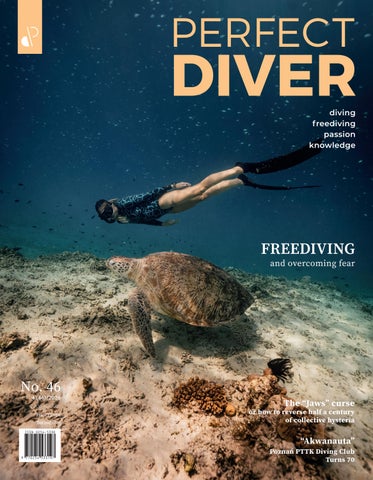
diving freediving passion knowledge
FREEDIVING
and overcoming fear
No. 46 4 (46)/2026
JULY/ AUGUST Price 12,50 € Tax included
The “Jaws” curse
or how to reverse half a century of collective hysteria
“Akwanauta” Poznań PTTK Diving Club Turns 70 1
TECLINEDIVING.EU 2
the foreword
Wojciech ZGOŁA Editor-in-Chief
Which is better: buying a 1-liter cylinder with a regulator, or taking a freediving course? Who will stay underwater longer, and which option is safer?
Be sure to read Beata Pytel’s article as well – it was inspired by the very practical approach that Poles, and many others, take to last-minute travel.
Every now and then, ads pop up for 0.5- or 1-liter cylinders with a hand pump. They often claim these are scuba cylinders, that you can dive with them to a depth of 10 or 20 meters, even for up to 20 minutes… Wojtek A. Filip lays out the whole truth in a short piece. All it takes is a little math, some awareness, and basic diving knowledge. See for yourselves – perhaps you will help save someone’s life, or at least spare them serious harm.
On the photography side, there is plenty of the underwater macro world to discover, and along the way you can get to know specific dive sites. Komodo makes an appearance, as does Mexico with its cenotes. There is another story behind one carefully chosen frame, as well as the next part of our guide to photographs that catch the eye.
I am always happy to see new authors appearing alongside the editorial team’s regular contributors. This time there are four of them – or actually five, because Małgorzata Sobońska-Szylińska has already presented her photos in the pages of PD; now she shares her observations and photographs on sharks and Jaws. We also have Iza Lisek and Martin Petrus (congratulations on the cover) with their article on freediving. And there is Paula Suszko, whose piece about diving around Singapore – for the vast majority of travelers more of a stopover than a destination in its own right – may come as a pleasant surprise.
From time to time, you will find QR codes in the magazine that lead to videos. That is also the case in this issue. And on top of that, there is an article about the magic of moving images. We are also publishing an interesting piece about a club celebrating its 70th anniversary this year: Akwanauta from Poznań. Not long ago, we spoke with them on camera – check the QR code. Is that all? Of course not, because this issue still has plenty of photos and material to explore. We are already preparing the next issue, and on social media we are sharing all kinds of interesting tidbits and reminders. So do not stop at knowing we are here – take a look inside.
Tell your friends about us. Take your time with the articles; find inspiration and knowledge in them. We are here for you!
Did you like this issue? Give us a viral coffee buycoffee.to/perfectdiver Visit our website www.perfectdiver.com, check out Facebook www.facebook.com/PerfectDiverMagazine and Instagram www.instagram.com/perfectdiver/
PERFECTDIVER No. 4 (46)/2026
3
table of contents
10 22 travels 10 16 22 30 52
In the Shadow of the Skyscrapers. SINGAPORE'S Underwater Treasures SEMPORNA. Can a legend be true? KOMODO. The kingdom of mantas, dragons, and ocean currents MEXICO, the beginning... Last minute
freediving 42
Freediving and overcoming fear
underwater photo 34 46
58
16
Patience Rewarded Images that catch the eye. On the Big Five of underwater photography and the “WOW” effect The Magic of the Moving Image. Going Beyond the Red Button
fresh water 54
4
Dive Between the Canals. Dive into a Lake Full of Surprises. LAKE JAGODNE
58
46
Table of contents
36
planet earth 36 The “JAWS” curse, or how to reverse half a century of collective hysteria 67 NO! TO dolphinariums. The Blue Evolution of Polish Travel Agencies
events 64 Poznań PTTK Diving Club “Akwanauta” Turns 70
68
tips & curiosities 68 Small Cylinder, Big Problem
Publisher PERFECT DIVER Sp. z o.o. ul. Folwarczna 37, 62-081 Przeźmierowo redakcja@perfectdiver.com ISSN 2545-3319
Editor-in-Chief
Wojciech ZGOŁA
Technical Diver World Geography & Travels Reportage Image Consulting English Language Translators Legal Care Graphic Designer Advertisement
Tomek KULCZYŃSKI Anna METRYCKA Dominika ABRAHAMCZYK Waldemar RYDZAK Agnieszka GUMIELA-PAJĄKOWSKA, Arleta KAŹMIERCZAK, Piotr WITEK, Tomek KULCZYŃSKI Lawyer Joanna WAJSNIS Brygida JACKOWIAK reklama@perfectdiver.com
THE MAGAZINE IS FOLDED WITH TYPEFACES Montserrat (Julieta Ulanovsky), Acumin Pro (Robert Slimbach, Adobe), Source Serif 4 (Frank Grießhammer, Adobe)
DISTRIBUTION online store sklep.perfectdiver.pl redakcja@perfectdiver.com
PRINTING Wieland Drukarnia Cyfrowa, Poznań, www.wieland.com.pl
www.perfectdiver.pl
If you like this issue, donate any amount! Donation is voluntary. PayPal.Me/perfectdiver
COVER PHOTO Martin PETRUS LOCATION Indonesia, Gili Air IN THE PHOTO Izabela LISEK Green sea turtle, Chelonia mydas
The Editorial Office does not return unsolicited materials, is not responsible for the content of advertisements and reserves the right to shorten, edit, title the submitted texts and select illustrative materials. Reprinting of articles or parts thereof, copying only with the consent of the Editorial Board. Editors are not responsible for the form and content of advertisements.
PERFECTDIVER No. 4 (46)/2026
5
editorial team
Wojciech ZGOŁA
Dominika ABRAHAMCZYK
Tomek KULCZYŃSKI
A man who travels by diving. Connected with water since childhood – from learning to swim, through sailing, to discovering the secrets of underwater lakes, seas, and oceans. Later came a passion for photography and writing, which allow him to share the beauty of the underwater world and the unique stories of each place. He has completed over 900 dives in Poland as well as in remote, exotic warm and cold locations. Each dive is treated as an encounter with nature and history. A lover of Nature in its purest form, he believes that diving is not only a sport, but also a way of building awareness – of the environment, other people, and oneself.
Infected with a passion for diving by Perfect Diver. She continues to expand her diving skills. Although she definitely prefers warm waters, she dons a dry suit and explores colder bodies of water as well. Her favorite dives are those with plenty of marine life! Recently, she’s been taking her phone underwater in a protective case, trying her hand at amateur photography. She’s also curious about diving medicine. Professionally, she’s a Master’s degree nurse and a surgical scrub nurse.
For Tomek, diving has always been his greatest passion. He started his adventure at the age of 14, developing into a recreational and technical diving instructor, a first aid instructor and a diving industry technician. Currently, he runs the 5* COMPASS DIVERS Pobiedziska Diving Center near Poznań, where he passes his knowledge and skills to beginners and advanced divers, which gives him great joy and satisfaction from being part of their underwater adventure...
Anna METRYCKA
Waldemar RYDZAK
“Human! Dive underwater. If the beauty you see down there doesn’t shake you to your core – nothing interesting awaits you in life.” A diving enthusiast, connected with the water since childhood. She completed her first scuba course at the age of 14 and has never parted with diving since. She wrote her master’s thesis on dive tourism during her geography studies at the University of Warsaw. Starting in 2013, she contributed to the magazine nuras.info and took part in underwater photo shoots. Since 2018, she has been writing articles for Perfect Diver magazine (previously as Ania Sołoducha) and has been part of the editorial team for several years. She pours her knowledge and experience onto the page, sharing and promoting what she loves most – diving. For 13 years, she organized diving expeditions around the world, because working with people and creating new projects is where she truly thrives. She takes part in diving fairs and events, as well as lake clean-ups. She has often had the pleasure of speaking as a presenter at diving expos and conferences and has a number of diving webinars to her name. She has already dived in many places around the globe – and her dream list keeps growing. For the past few months, she has been the owner of her own company organizing diving and active travel – Umiko Expeditions – with a head full of ideas for the next adventures. An optimist with a constant smile and an individual approach to every client. Her best life chapter is just beginning! www.umikoexpeditions.pl anna@umiko.pro +48 516 621 211
He comes from a mining region, where water was more of an exception than an everyday presence. He learned to swim and dive to overcome his fear of water – and, over time, to turn it into curiosity about the world beneath the surface. He has been connected with diving since 2000 (Divemaster, CMAS). He doesn’t chase depth or records; he prefers calm exploration, mindfulness, and the details that are easy to miss when you’re in a hurry. In his day-to-day work, he is a researcher and communication practitioner (Dr hab., Prof. UEP), involved in research and teaching in the areas of creative markets and digital and crisis communication. Within the Perfect Diver editorial team, he supports the crew where content meets technology – on video productions, data analysis, and building the brand strategy.
constant cooperation
Wojciech A. FILIP
Jakub BANASIAK
Łukasz METRYCKI
Sylwia KOSMALSKA-JURIEWICZ
He has been diving for 35 years. He has spent more than 16,000 hours underwater, most of them diving technically. He has been an instructor and mentor instructor for many organizations including CMAS, GUE, IANTD, PADI. He co-created the training programs for some of them. He is a professional with vast knowledge and practical experience. He has participated in many diving projects as a leader, explorer, initiator or speaker. He was the first Pole to dive the HMHS Britannic wreck (117m). He was the first to explore the deep part of the Glavas Cave (118m). He made a series of dives documenting the wreck of ORP GROM (110m). He has documented deep (100-120m) parts of flooded mines. He is the creator and designer of many equipment solutions to improve diving safety. Technical Director at Tecline, where, among other things, he manages the Tecline Academy a research and training facility. Author of several hundred articles on diving and books on diagnosis and repair of diving equipment. He dives in rivers, lakes, caves, seas and oceans all over the world.
Zoopsychologist, researcher and expert in dolphin behavior, committed to the idea of protecting dolphins and fighting against keeping them in dolphinariums. Passionate about Red Sea and underwater encounters with large pelagic predators. Member of the Dolphinaria-Free Europe Coalition, volunteer of the Tethys Research Institute and Cetacean Research & Rescue Unit, collaborator of Marine Connection. For over 15 years, he has been participating in research on wild dolphin populations, auditing dolphinariums, and monitoring the quality of whale watching cruises. As the head of the "Free & Safe" project (formerly "NO! for a dolphinarium"), he prevents keeping dolphins in captivity, promotes ethical whale & dolphin watching, trains divers in responsible swimming with wild dolphins, and popularizes knowledge about dolphin therapy that is passed over in silence or hidden by profit-making centers. on this form of animal therapy.
/ Luke Divewalker A long, long time ago in a galaxy far, far away there was chaos... …that is, the multitude of thoughts and delights after my first immersion under water in 2005 in the form of INTRO while on vacation in Egypt. By then I had completely immersed myself in the underwater world and wanted it to have an increasing impact on my life. 2 years later, I took an OWD course, which I received as a gift for my 18th birthday, and over time, further courses and skills improvement appeared. "Photography" appeared not much later, but initially in the form of a disposable underwater "Kodak" from which the photos came out stunningly blue I am not a fan of one type of diving, although my greatest weakness at the moment is for large pelagic animals. The Galapagos Islands were my best opportunity to photograph so many species of marine fauna so far. I share my passion for diving and photography with my buddy, who is my wife IG: luke.divewalker www.lukedivewalker.com
A traveller and a photographer of wild nature. A graduate of journalism and a lover of good literature. She lives in harmony with nature, promotes a healthy lifestyle: she is a yogini and a vegetarian. Also engaged in ecological projects. Sharks and their protection are especially close to her heart. She writes about the subject in numerous articles and on her blog www.blog.dive-away.pl. She began her adventure with diving fifteen years ago by total coincidence. Today she is a diving instructor, she visited over 60 countries and dived on 5 continents. She invites us for a joint journey with the travel agency www.dive-away.pl, of which she is a co-founder.
Laura KAZIMIERSKA
Przemysław ZYBER
Marcin TRZCIŃSKI
Barbara GLENC
Laura is a journalist, instructor trainer, CCR and cave diver. She has been developing her diving career for over a decade, gaining knowledge and experience in various fields. Her specialty is professional diving training, but her passion for the underwater environment and its protection drives her to explore various places around the world. From the depths of the Lombok Strait, caves in Mexico and wrecks in Malta to the Maldives, where she runs a diving center awarded by the Ministry of Tourism as the best diving center in the Maldives. Laura actively contributes to promoting the protection of the marine environment, takes part in scientific projects, campaigns against ocean littering and cooperates with non-governmental organizations. You can find her at: @laura_kazi_diving www.divemastergilis.com
I photograph because I love it, I film because it excites me, I write because I enjoy sharing, I teach because I support growth, I travel because I love discovering new things. www.facebook.com/przemyslaw.zyber www.instagram.com/przemyslaw_zyber/ www.deep-art.pl
A graduate of the University of Warsaw. An underwater photographer and filmmaker, has been diving since 1995. A co-operator at the Department of Underwater Archeology at the University of Warsaw. He publishes in diving magazines in Poland and abroad. The owner of the FotoPodwodna company which is the Polish representative of Ikelite, Nauticam, Inon, ScubaLamp companies. www.fotopodwodna.pl m.trzcinski@fotopodwodna.pl
I am a traveler and a technical diver, exploring the world both on land and underwater. I have been diving for 16 years. Since I am a professional photographer, a camera has accompanied me from my very first dive. I started with recreational diving, but over time, I obtained full trimix and full cave certifications, allowing me to explore caves, wrecks, and great depths. Underwater, I find a peace that is hard to experience on the surface. Every dive is not just an adventure for me but also an opportunity to capture the extraordinary underwater world through photography. barbaraglenc.foto@gmail.com
our authors
Piotr STÓS
Paula SUSZKO
Jacek KUBIAK
Photographer, biologist, storyteller, SSI Instructor Trainer. He considers it his duty to teach diving at every level. Since the dawn of time, he has been associated with Nautica with an inseparable umbilical cord of co-ownership. He nests on the Croatian island of Vis, on safari boats in Egypt and where under water it is beautiful as the world long and wide. He works at Nautica Safari. nautica.pl, piotr.stos@nautica.pl
Paula has been diving for 15 years, taking her first underwater breaths at Lake Hańcza with Adriatic Diving Center. She later spent several years in Ireland, diving the cold waters of Dublin Bay and the Atlantic Ocean. Since 2018, she has been living in Singapore. During the week, she works for a multinational corporation as an External Contracts Manager, while on weekends she teaches and guides divers as an SSI Instructor at the local dive centre, Cuddlefish Divers. Whenever she has the opportunity, Paula travels throughout Southeast Asia to explore its underwater world, capturing the region's extraordinary marine biodiversity through her photography. IG: @pauladives
Is 45 years old and married, has been working professionally in the metallurgical industry for 25 years, has been diving since 2009 and diving has become a way of life and passion for him. He lives in Kętrzyn and is associated with the Mazursharks Club.
Adam SOKÓLSKI
Małgorzata SOBOŃSKA-SZYLIŃSKA
Beata PYTEL
Diver, diving instructor, underwater photographer. I have been diving for 28 years and working in underwater photography for 18. I have completed thousands of dives in Poland, across Europe, Africa, and Asia. Diving, training new divers, and creating underwater images are not only my profession, but above all my passion. I am particularly fascinated by macro photography, which is why underwater I most enjoy photographing small, very small, and even microscopic creatures. I always gladly return to the Philippines, Indonesia, and Malaysia, where underwater life amazes with its richness. My photographs have been published, among others, in National Geographic.
She has been diving since 1998 and feels like she has already been everywhere – yet she continues to discover new underwater locations that fill her with awe. She has never been without a camera since her early youth; the first one she took underwater, back in the last century, was an analog camera. She once dreamed of becoming an ichthyologist or Tony Halik, but out of love for Themis, she became a lawyer instead. She is a graduate of a two-year program at the Academy of Photography in Warsaw and holds a degree in philosophy. She is fascinated by large animals, vibrant schools of fish, and any place where she can uncover the secrets of the ocean. Through her texts and photographs published in diving and lifestyle magazines, she seeks to inspire readers with empathy for animals and admiration for nature – whose beauty deserves care and protection. And, as she sees it, naturally in this context, she has not eaten animals for at least three decades, out of respect for the natural world.
She is the kind of person who, if one door closes, will find another way in. If the window is shut, she'll come through the chimney. The phrase "it can't be done" simply doesn't exist in her vocabulary – because she believes there is always a solution. Born and raised in Opole, she has always enjoyed taking on new challenges. After meeting her future husband, Marek, she discovered diving through him. The beginnings were far from easy, but her determination paid off. Today, the underwater world is her sanctuary and a welcome escape from the fast-paced life she leads. Her life revolves around one journey after another, often leaving barely enough time to repack her suitcase before setting off again. Running her own travel agency is both her profession and her passion, allowing her to explore the world – above and below the surface. She is also the proud and devoted owner of a Wire Fox Terrier named Santi. opole@traveliada.pl www.traveliada.opole.pl
Izabela LISEK
Martin PETRUS
Izabela Lisek is a freediving instructor and competitive athlete specializing in both pool and depth disciplines. She is the co-founder of Quest Freediving, a sports club based in Warsaw, where she teaches freediving courses and training sessions in both pool and open-water environments, combining her competitive experience with professional instruction. In 2024, Izabela competed at the World Championships and was selected to represent the Polish national team at the Depth World Championships. She remains dedicated to her athletic development through consistent training and continuous improvement of both her competitive performance and instructional expertise.
Martin is a freediving instructor and a coach certified by the Polish Freediving Association (PZF). As an active athlete, he regularly competes in national and international freediving competitions. He specializes in breathing techniques, focusing on the integration of health improvement with the development of physical and mental performance. His work incorporates and teaches methods such as Pranayama, the Buteyko Method, Oxygen Advantage, and Transformational Breathwork. Martin combines a variety of methodologies, integrating evidence-based approaches with the spiritual dimension of breathwork. He works with both freedivers and athletes from other disciplines, blending modern hypoxic training techniques with traditional Pranayama practices to optimize performance, recovery, and overall well-being.
TRAVELS
IN THE SHADOW OF THE SKYSCRAPERS
SINGAPORE'S Underwater Treasures
Text and photos Paula SUSZKO A flatworm of the genus Pseudobiceros
Singapore is – along with Hong Kong, Taiwan and South Korea – one of Asia's legendary financial tigers. This wealthy city-state is a global business and logistics hub, mostly associated with a forest of skyscrapers surrounded by beautiful, yet tightly controlled nature.
F
or most divers traveling to Southeast Asia, Singapore is just a stopover on their way to Indonesia, Malaysia or the Philippines. These countries lie in the heart of the famous Coral Triangle – the epicentre of marine biodiversity – and this is where we usually direct our underwater steps. Singapore itself rarely appears on the dream map of the average diver. But is it justified?
10
Global Logistics Hub Diving opportunities in this island nation are severely limited. Of the 64 islands that belong to Singapore, legal underwater exploration is allowed in only a few places. The main obstacle is extremely difficult conditions. Singapore is one of the busiest transshipment ports in the world – a gigantic, global hub through which hundreds of powerful container ships
Travels
Keppel Bay Marina
Tiger seahorse
On the way to Pulau Hantu – Ghost Island
constantly pass. Work on dredging fairways, proximity to large industry and continuous land reclamation projects mean that visibility under water rarely exceeds 3 meters, and very often drops to just one metre. Strong tidal currents make the task even more difficult. However, where there is water, there will always be diving enthusiasts. So there is a small but thriving diving community in Singapore. For those who are not afraid of poor visibility and sea currents, hidden treasures await under the water: crustaceans, cephalopods and nudibranchs, and even sometimes sharks or sea turtles.
Ghost Island The most common destination for Singaporean divers is Pulau Hantu, an island just half an hour away from the main mainland. In Malay, this name means "Ghost Island". Legend has it that it is
haunted by the spirits of ancient warriors who fought a deadly battle there. From a geological point of view, today's Pulau Hantu is a fascinating hybrid of nature and human engineering. Originally, these were two small, natural coral islets surrounded by a shallow reef: Pulau Hantu Besar (Great) and Pulau Hantu Kecil (Small). Between 1974 and 1975, the Singapore government carried out a gigantic hydrotechnical project there. Using more than 400,000 cubic meters of sand, the space separating the two islets was shallowed, creating artificial recreational lagoons, stone breakwaters and concrete protective walls were built, and the area of the islets was expanded severalfold from just over two hectares to as many as 12. Interestingly, right next to Pulau Hantu lies Pulau Bukom. This is another island that has been drastically expanded by infilling the sea. Today, it houses a huge, industrial refinery complex of the Shell concern. The view from the diving boat at Pulau Hantu is surreal: on one side we have tropical greenery and palm trees, and just behind the water the smoking chimneys of the refinery and the tankers gliding slowly. Although these works irreversibly destroyed the original, shallow coral reef, nature turned out to be extremely strong
PERFECTDIVER No. 4 (46)/2026
11
travels
Male cardinalfish carrying eggs in its mouth
12
Baby Shark – Juvenile Reef Shark
Singapore's octopuses are usually quite shy
– over time, sponges and corals, and with them other marine species, began to return to local islands and colonize artificial structures. It is there – in the vicinity of the large oil industry – that you can escape from the hustle and bustle of the city and immerse yourself in the underwater world for half a day.
When visibility is far from perfect... Diving in Singapore requires a completely different attitude than the one that accompanies us on the heavenly, transparent reefs of neighbouring countries. Here, you don't look for wide plans, blue and spectacular coral formations. The key to success is patience, perfect mastery of buoyancy and a keen eye. Singaporean dives are definitely a treat for macro fans. With a bit of luck (and with the help of local guides, whose eyes are used to the darkness prevailing even at 10 meters) we will find here some species of snails that made Anilao in the Philippines or Tulamben in Indonesia famous: those of the genus Costasiella, Doto, Hypselodoris, Elysia or Janolus. There are also various crustaceans and cephalopods. Many octopuses, squids and cuttlefish hide during the day, but after sunset they go hunting, so night dives can be very exciting here. Sometimes it is also possible to find larger animals, such as hawkbill sea turtle, ribbontail rays or small marbled catsharks
View after a night dive – Shell Refinery
Doto greenamyeri nudibranch with an egg ribbon
and bamboo sharks, but photographing them in low visibility conditions remains a challenge. Local underwater photography enthusiasts focus mainly on small creatures. For the persistent, the reward is the discovery of a beautiful underwater world, and those who dive here often and have the patience to stop for a few minutes (or longer) can also observe interesting behaviours: mating, laying eggs, feeding or symbiosis between different species.
Underwater Singapore: hit or miss? So, is it worth diving in Singapore? The answer is: yes and no. If you're planning an expedition solely to dive in the local waters, the poor visibility and damaged reefs may disappoint you. Singapore is not a competitor to the paradise coral gardens of neighbouring countries. However, if you spend a few days here for business, tourism or plan a longer stopover on your way to Indonesia or the Philippines, and your passion is the macro world, Singapore can positively surprise. Instead of spending another day in an air-conditioned shopping mall or Changi Airport, it's a good idea to pack your camera, get on a boat at one of the local dive centres and give the local waters a chance. The underwater life hidden here proves that fascinating macro treasures can be found in the most unobvious places in the world.
PERFECTDIVER No. 4 (46)/2026
13
travels
Hypselodoris bullockii nudibranch
Critically Endangered Hawksbill Sea Turtle
PRACTICAL INFORMATION
A sea slug of the genus Costasiella
14
How to get there? You can easily fly to Singapore directly from many European airports. The easiest way to get to Pulau Hantu is by booking a spot on one of several local dive boats that depart from the centrally located Keppel Bay Marina or the Republic of Singapore Yacht Club Marina a little further from the centre. The journey takes about 30-45 minutes. The island is uninhabited, there are only toilets and picnic shelters. Operators provide water and small snacks, as well as ballast and filled cylinders. It is also possible to rent equipment. Diving season: You can dive all year round, but the best conditions (and slightly better visibility) are usually from March
Juvenile broadclub cuttlefish
to June. During the southwest monsoon (June-September) and northeast monsoon (December-February), the waves and currents can be much stronger, which can also negatively affect visibility. Recommended Photographic Equipment: Definitely a camera with a macro lens. Lighting will be key – preferably a strobe with a snoot attachment, which will allow you to illuminate the main subject of the photo and eliminate the problem of backscatter in the water. A dioptre will also be useful to capture the smallest specimens.
Every refined detail creates a perfect whole.
CUT THROUGH THE DARKNESS PERFECTDIVER No. 4 (46)/2026
15
TRAVELS
SEMPORNA Can a legend be true? Text and photos Adam SOKÓLSKI
I came across An by chance while scrolling through Instagram. I have been diving and photographing underwater for many years. I have seen hundreds of creatures, visited many outstanding macro-photography destinations, and I thought there was not much left that could still surprise me. And yet.
A
s I looked through the photos An posted from dives in Semporna, Malaysia, I kept stopping at one image after another and asking myself: “What exactly is that?” Of course, I recognized some of the critters, but many looked completely different from anything I had encountered underwater before. The diversity was truly incredible. The more of her photos I saw, the more I wanted to see the place with my own eyes. When I started looking for information about her dive center, Semporna Macro Critters, I came across something even more interesting – legends. In different parts of the world, on diving and photography trips, I met people who knew An, or at least had heard about her from friends. The stories were surprisingly similar. People said she was one of the best macro guides in Asia. That dates had to be booked even several years in advance. That getting
16
a spot with her was almost a miracle. That many divers had never seen her without a mask. That she could find a nudibranch on a reef faster than most divers could find their own buddy. And sometimes, even that she had a seventh sense that connected her mentally with nudibranchs – like an underwater ninja. The more I listened to these stories, the more I wanted to find out how much truth there was in them, and how much was the result of staring at sand through a macro lens for too long. Eventually, the opportunity came. I was organizing a group trip to Sipadan at the time, and Semporna was on the way. I thought it was the perfect chance to see what all the fuss was about. I sent her a message and, to my delight and surprise, there was an available slot, which I booked immediately. The very first dives showed that the legends had not come out of nowhere.
Travels
An – the Queen of the Macro World From the very beginning, I was impressed not only by the number of creatures she found, but above all by their diversity. Every dive brought something new. Sometimes these were species I knew only from photographs. At other times, they were creatures I had never seen before. An’s knowledge of underwater creatures is almost encyclopedic. It is not just that she can find practically anything. She knows the names of species, varieties, and subspecies, and at times I had the impression that she was also familiar with levels of classification that most divers, and often even marine biologists, had never heard of. The story from the beginning of her diving journey says a lot about her approach. Even before she earned her diving certifi-
cation, she already knew the names of most nudibranchs. She had also already bought an underwater camera. So you could say that before she learned to dive, she already knew what she would be looking for underwater. As in other top macro-photography destinations, dives with An are long, and photographers have as much time with a subject as they need. There is no rush and no pressure to move quickly from one find to the next. If a creature is interesting, you can stay with it longer, observe its behavior, wait for the right moment, or refine your composition. An takes a maximum of five people underwater. I admit that at first I had some concerns, because it seemed like quite a lot. In many places, finding an interesting subject in a group like that means a line of photographers waiting for their chance. Here, it
PERFECTDIVER No. 4 (46)/2026
17
travels
worked completely differently. There were so many creatures, the cooperation between photographers was so good, and An’s care was so attentive that everything ran exceptionally smoothly. The dives kept their intimate character. There was no crowding, no rushing, and no situation in which several people tried to photograph the same subject at once.
Why did I like Semporna so much? Over the years, I have dived in many excellent places focused on macro photography. Long dives, small groups, and guides who understand the needs of photographers are not impossible to find elsewhere. The difference lay in something harder to describe. Semporna Macro Critters feels like a place created by someone who is genuinely fascinated by the macro world. It is not just another dive center that also happens to organize dives for photographers. Here, macro photography seems to be the whole reason the place exists. It is An’s passion that makes the biggest difference. It is not only that she can find extraordinary creatures, but that she talks about them with the same enthusiasm, knows them inside out, and pays enormous attention to them. It is hard not to catch that fascination yourself. Diving with her feels a little like entering a world known mainly to the initiated. A world that macro photographers talk about quietly on boats and at photography festivals. A bit like a secret brotherhood of macro freaks that is hard to get into, but once you do, you quickly understand where the whole legend came from.
18
PERFECTDIVER No. 4 (46)/2026
19
travels
20
There is one more thing that makes diving in Semporna exceptional. We were always alone at the dive sites. Just An and her small group of photographers. No other boats, no queues for interesting critters, no chaos. It is a luxury that is increasingly hard to find in many popular diving locations. Semporna itself is not a place I would visit solely for the atmosphere of the town. Fortunately, I spent most of each day on the boat. Three long dives a day meant that contact with land was kept to an absolute minimum – eat something, charge the batteries, and go to sleep. Some of the dives took place on classic, beautiful reefs covered with dense, healthy coral. In between observing tiny creatures, you could briefly look up and see a broader, more “landscape-like” side of the underwater world. But the muck dives made the strongest impression. At first glance, the seemingly empty sandy bottom did not promise anything special. After a few minutes, however, it turned out that life was hiding literally everywhere –
and that it had an impressive talent for camouflage. Fish pretending to be leaves, crabs pretending to be sponges, shrimps pretending to be sticks... At some point, I began to feel that almost everything was trying to look like something else. I do not know whether Semporna is the best macro-photography destination in the world, but it is certainly one of the most extraordinary I have had the chance to visit.
Although I am still looking for new places and new subjects to photograph, I have already been to An twice. And I am sure I will go back again. And if one day you dive with An and see her pull a camera out of her pocket underwater and start taking pictures of something, drop everything and swim closer. It is probably some purple-and-yellow ibex, or something even stranger.
PERFECTDIVER No. 4 (46)/2026
21
TRAVELS
KOMODO
The kingdom of mantas, dragons, and ocean currents
Text and photos Barbara GLENC
Some places appear on a diver’s bucket list and patiently wait for their turn. Komodo was exactly such a place. For years I had looked at photographs of mantas circling above cleaning stations, colourful reefs teeming with life, and divers drifting through powerful currents.
I
knew that one day I would go there. What I did not expect was that reality would prove even more spectacular than all the photographs I had seen before. After landing in Labuan Bajo, we stepped aboard the boat that would become our floating home for the next several days. Our group quickly adapted to the new reality. From the very first moments, it was clear that this would not be an ordinary stay on a boat. The wooden vessel had an extraordinary atmosphere – decks creaking under our feet, the sound of the waves, and the endless sea all around made it possible to feel the true spirit of a maritime adventure. Each day was shaped by dives, briefings, and shared meals. It was around the table that we spent many exceptional moments. Breakfasts before the first dive, lunches filled with stories from the last immersion, and dinners stretching late into the evening. After a few days, I felt that we were no longer taking
22
part in a dive safari, but gathering around one great family table. There was something remarkably warm and natural about it. The atmosphere resembled a Christmas Eve dinner – we met every day in the same company, sharing experiences, laughter, and emotions. And all around us stretched landscapes that are difficult to describe in words. Green islands rising from turquoise water, empty beaches, rocky hills, and sunsets painting the sky in every shade of orange, red, and purple. There were moments when I sat on deck with a cup of coffee and simply looked ahead, absorbing this extraordinary atmosphere. Only then did I truly feel that the adventure I had dreamed of for years was beginning. The first dives were gentle and allowed us to get used to the local conditions. We were not yet chasing mantas. Instead, we focused on the reefs and their tiniest inhabitants. Among the
Travels
corals, we searched for seahorses, nudibranchs, tiny shrimp, and other creatures that are easy to miss without the trained eye of a guide. That was when I first realized how incredibly diverse Komodo is. One day we descended onto a reef that resembled an underwater garden. Soft corals swayed with the current like colourful flower fields moved by the wind. Pink, red, and orange colonies of dendronephthya and sinularia created a fairy-tale setting, while thousands of anthias darted among them. It was enough to pause for a moment and look around to notice life literally everywhere. The next day the scenery was completely different. Hard corals dominated, forming vast structures that resembled underwater cities. Small reef fish slipped between them, and the light filtering down from the surface drew extraordinary patterns on the seabed. The most impressive sight, however, was the extensive fields of acropora corals resembling reindeer antlers. Their branching structures created natural labyrinths full of life. From a photographer’s perspective, they were the perfect place to build compositions. Every meter of reef offered a new idea for a photograph. And then came the day everyone had been waiting for since the beginning of the expedition – diving at Manta Point was one of the greatest experiences of the entire safari.
PERFECTDIVER No. 4 (46)/2026
23
travels
” 24
... there is something truly special about manta rays. It's not just their size. They possess a calmness and elegance that make it impossible to look away.
Travels
The briefing was short. We would jump into the water, find the cleaning station, and wait. Just a few minutes after we descended, our guide pointed ahead. First, a single manta ray appeared. Then another. Then a third. Within minutes, there were so many that it was impossible to decide where to look. The mantas glided gracefully in endless circles above the cleaning station. They came astonishingly close – sometimes within two meters, sometimes just one, and a few passed so near they seemed almost within arm's reach. Of course, no one even considered touching them. All we had to do was remain perfectly still and watch. Their movements were mesmerizing. These giant animals, with wingspans stretching several meters, moved with incredible grace, as if they weighed nothing at all. Every so often, one would perform an elegant turn, revealing its white underside before returning to its path and completing another slow circle above the cleaning station. Time lost all meaning. No one nervously checked their dive computer. No one thought about returning to the boat. We wanted to stay there for as long as possible. Through my camera lens, I had already photographed sharks, whales, dolphins, and countless other marine creatures. But there is something truly special about manta rays. It's not just their size. They possess a calmness and elegance that make it impossible to look away. For a brief moment, we were simply guests in their world, and they allowed us to witness one of their everyday rituals.
Even after we returned to the boat, the excitement lingered. Everyone had their own story, their favourite photograph, and their favourite manta. Conversations about that dive continued late into the evening. But Komodo had no intention of slowing down. One of the highlights of our liveaboard safari was a visit to Komodo Is-
land, located within Komodo National Park. A UNESCO World Heritage Site, the park encompasses dozens of islands and is famous not only for its Komodo dragons but also for its extraordinary biodiversity. Dry savannas blend into tropical forests, while the surrounding waters rank among the richest marine ecosystems on Earth. After coming ashore, we set off on a guided walk accompanied by a local park ranger, who ensured our safety while sharing fascinating stories about the island and its inhabitants. The walk itself was unforgettable. Sun-scorched hills, scattered trees, and the island's rugged, untamed landscape created an atmosphere unlike anywhere else. We spotted our first Komodo dragon almost immediately. It lay motionless in the shade, seemingly uninterested in its surroundings. Only when it began to move did we fully appreciate its impressive size. Several meters of muscular body, powerful legs armed with sharp claws, and its distinctive forked tongue constantly sampling the air made for an unforgettable sight.
PERFECTDIVER No. 4 (46)/2026
25
travels
During the walk, we encountered more than a dozen dragons. Our ranger explained their behaviour, hunting techniques, and the remarkable efficiency of these reptiles. Although they often appear sluggish, they are capable of surprising bursts of speed over short distances. They are opportunistic predators and scavengers, feeding on birds, small mammals, deer, wild boar, and carrion, which they can detect from several kilometres away. It is hard to believe that these prehistoric-looking reptiles have survived into modern times, confined to just a handful of small islands in the Komodo Archipelago. That afternoon, another unforgettable experience awaited us. Our boat dropped anchor beneath one of the archipelago's most iconic islands. The plan was simple: hike to the summit and watch the sunset. The climb wasn't particularly long, but the tropical heat made every step feel more demanding. Still, each meter of elevation rewarded us with increasingly spectacular views. By the time we reached the top, a breathtaking panorama of dozens of islands rising from the turquoise sea stretched out before us. Then the show began. The sun slowly started to sink toward the horizon... The sun slowly sank toward the horizon. Gold melted into orange, orange into crimson, and crimson into shades of pink and violet. The sea reflected every colour of the sky, while the surrounding islands gradually faded into dark silhouettes. It was one of those moments that cannot be planned or fully captured in a photograph. A picture
26
can preserve the view, but it can never convey the silence, the scent of the ocean, or the emotions that accompany moments like these. The following day, it was time to say goodbye to Komodo and continue our journey to Bali. But fate had one more chapter to add to our story. Just a few hours before our scheduled departure, our phones began vibrating one after another. First came a few isolated messages. Then more followed. Finally, the email that no traveller ever wants to receive during a trip appeared in our inboxes... Flight cancelled. An eruption had occurred on the island of Lombok. A massive ash cloud drifted across the region, forcing airports to suspend operations. For a moment, we simply looked at one another in silence. Only a few hours earlier, we had been watching the sunset over Komodo. Now we were wondering whether we would
make it to Bali at all. Fortunately, our group wasn't the type to give up easily. We headed to the airport anyway. The closer we got to the terminal, the more conflicting information we heard. Some people insisted that every flight had been cancelled. Others claimed that some services were gradually resuming. No one seemed to know what was actually happening. Then, at last, we heard the news we had been hoping for. Our flight had been reinstated. First came silence. Then laughter. Moments later, excitement and joyful chaos took over. As the aircraft lifted off the runway and the islands of Komodo slowly disappeared beneath the wing, I realized this had become one of those journeys that stays with you forever. Not only because of the manta rays. Not only because of the extraordinary reefs. Not only because of the Komodo dragons, the unforgettable sunsets, or the photographs stored on memory cards. Komodo proved to be a place that surprised us every single day. A place where powerful currents bring life, and where every reef is different from the last. A place where you can spend an entire hour admiring a pygmy seahorse no larger than a fingernail, only to find yourself face to face the next day with a manta ray whose wingspan is wider than a person is tall. For a diver, it is one of the most exhilarating destinations in the world. And for me? A dream fulfilled after years of waiting. And one of those rare places you continue returning to long after you've gone home. First in your memories. Then through your photographs. And eventually... by planning your next trip back.
PERFECTDIVER No. 4 (46)/2026
27
TWÓJ SKAFANDER YOUR DRYSUIT TWOJE NURKOWANIE YOUR DIVE SKAFANDRY SYSTEM - SZYTE DLA CIEBIE, DIVE SYSTEMDIVE DRYSUITS - BUILT AROUND YOU, GOTOWE NAANY KAŻDE WYZWANIE READY FOR CHALLENGE.
Tailored Fit Perfekcyjne dopasowanie Maximum Comfort Maksymalny komfort Reliable in Every Niezawodność Condition w każdych warunkach 28
Find your Znajdź swój model model
DIVESYSTEM DRYSUITS DRYSUITS DIVESYSTEM Od pierwszego suchego skafandra From your first drysuitpo to najbardziej the most wymagające nurkowania techniczne. demanding technical dives. Seria DiveSystemSolo Solo obejmuje modele stworzone z myślą o The DiveSystem range includes models designed for different nurkowania, wykonane z wytrzymałych różnych diving, built from high-performance Rip-Stop, Kevlar and styles of stylach materiałów klasy Rip-Stop, Kevlar i Dyneema. Dyneema materials.
Solo N Dyneema Dyneema Solo N 13 13700,00 700,00złpln
Solo Cave Solo Cave 10 700,00 700,00 pln 10 zł
SoloShipboarding ShipboardingNATO NATO Solo 12500,00 500,00pln zł 12
SoloCave CavePlus Plus Solo 000,00 zł 1111000,00 pln
Solo Expedition Solo Expedition 11 000,00 11 000,00 plnzł
Solo SoloPolluce Polluce 1010 300,00 pln 300,00 zł
Solo SoloRanger Ranger 9460,00 plnzł 9460,00
Solo SoloAdventurer Adventurer 9400,00 plnzł 9400,00
WWW.SPRZETDONURKOWANIA.PL WWW.SPRZETDONURKOWANIA.PL
PERFECTDIVER No. 4 (46)/2026
29
TRAVELS
MEXICO
THE BEGINNING... Text and photos Tomasz KULCZYŃSKI
THE BEGINNING OF WHAT? Of a journey, a passion, diving, or maybe some kind of path... So let’s start at the very beginning, at the source.
Y
ou watch a documentary, scroll through social media, or maybe you just happen to overhear a conversation and snap – the idea of a trip to Mexico suddenly appears in your head. You’re done for! Still in the planning stage, I had never in my life come across such a huge amount of contradictory information about one place. On the one hand, many people consider cenote diving one of the best experiences of their lives. On the other – an equally large group claims it is overrated and boring. Why is that? Let’s follow Google’s lead and leave all the praise aside for a moment, because praise is always there. Let’s focus on the negative. The opinions I heard mainly revolved around one thing: that cenotes are just caverns. That after two or three
30
days everything starts to look the same. That there is no life there, no colorful fish, no reefs... only tight spaces, little room, and half-light. In short – “a pretty hole in the ground, and that’s it.” Then there is Mexico as a country. And here the opinions can be even more “colorful.” You’ll be kidnapped and your organs sold. You’ll be robbed of everything. Don’t leave the hotel, because it’s dangerous. Cartels, drugs, chaos. And the person reading all this before the trip begins to wonder whether they are going there to dive or to survive. So, from the beginning... Is it worth going to Mexico to dive in the cenotes? The answer is not simple. And that is probably the first thing we need to say honestly – each of us is different. I have already
written about this in a separate article, but here it becomes even more obvious. In my group, opinions were strongly divided. For me personally, Mexico is right up there with Scapa Flow!!! Although, to be fair, it is hard to compare them one to one, because I was in Scotland some thirteen years ago. Still, something about Mexico completely won me over. What? From a diving perspective – above all, the play of light and shadow. Imagine this: you are walking through the jungle, nothing special, ordinary undergrowth, a bit of mud, a bit of earth... and suddenly you go a few steps down and an entrance appears in front of you. An ordinary, inconspicuous hole in the ground. As if someone had left an open well in grandma’s garden and forgotten about it. And then you step into the water. And everything changes. Crystal-clear fresh water. Warm, calm, as if time flowed more slowly there. A halocline that suddenly blurs the image like liquid glass. Clouds of hydrogen sulfide that look like underwater fog. Trees sticking out of the bottom, as if someone had planted them in another world. Rock formations that seem almost alive. And suddenly it turns out that this “hole in the ground” is an entrance to something that is hard to compare with anything else. A story thousands of years old. Another world beneath the surface. This is a subject that stirs up plenty of emotion and even more misunderstanding. To dive in the cenotes, you need an authorized guide with the proper credentials, and there is no
getting around that. This is not a place where you simply get into the water and swim wherever you like. The main routes are set up so that throughout the dive you remain in a safe and legal cavern zone. In other words, a zone where you always have the option of returning toward the light or surfacing. And this is where the first surprise begins. Because very often it looks like this: you get into the water, go down, and suddenly you feel as if you are in a classic cave. You enter through one opening, move through corridors, and then come out somewhere else. And that is when the first thought appears in your head: “But these are caves...” Only later does the guide explain that the whole system is routed in such a way that you can return to the open zone at any moment. And this is precisely what distinguishes recreational diving from cave diving. Of course, side passages also branch off – strictly cave territory – and there is no room for chance there. In front of every such entrance stands the characteristic sign with a skull, saying very clearly: do not go any farther if you do not have the proper certification. And honestly – it makes an impression. At every cenote, there are also boards with information about the level of difficulty. This makes it possible to realistically judge whether a given place is right for you. And here one thing matters – buoyancy. It really has to be good. Not only for safety reasons, but also because these places are incredibly delicate. Every touch can damage rock formations that took
PERFECTDIVER No. 4 (46)/2026
31
travels
thousands of years to form. The guides watch this very carefully. And if someone is not controlling their buoyancy, they can react very quickly and very directly. In addition, many people also point out the ascent. There are cenotes where you descend vertically to greater depths and then ascend gradually, circling and looking at everything around you. But there are also places where the ascent is practically “straight up,” through a narrow vertical shaft. Then it gets really specific – every few moments you look up, keep track of the space around you, and hundreds of bubbles rising above your head create something like underwater vertigo. Not everyone likes that. A typical dive day looks fairly simple: two dives – either in two different cenotes, or two dives in one larger cenote with different routes. Departure is usually around 9:00, return around 16:00. It sounds turn to the open sea, colors, and everything relaxed, but you have to remember that the most people associate with the exotic. Then cenotes are scattered across the whole reIn my opinion, three there was Belize, which in our case creatgion, so the drives can take more than an dive days in the hour. And that is also part of the whole ed a huge contrast, and everyone found cenotes is the absolute puzzle – this is not “one base and one dive something to enjoy there. minimum if you want In most cases, divers base themsite.” It is constant movement between selves in Playa del Carmen. Of course, completely different underwater worlds. to see the key places there are other options too, such as Cancun To sum up cenote diving – it is not for and understand what it or Tulum, but Playa has one major advaneveryone, but in my opinion everyone should is all about. tage – location. It is positioned in such a way experience it firsthand, because this truly is one of those places that are hard to believe until you that travel times to most cenotes are more or less see them. similar. As a result, you do not spend whole days in the Guides can match cenotes to practically any diver. There car – you actually dive. The city itself also has everything: local shops, restaurants, supermarkets, nightlife, souvenir shops, and are shallower places, deeper places, places with a halocline, even things that have very little to do with tourism – such as with clouds of hydrogen sulfide, with trees growing out of the photos with tiger cubs, which are, of course, illegal and above bottom, or with incredible rock formations that look as if they belong to another world. all unethical. There is one thing I would like to draw particular attention In my opinion, three dive days in the cenotes is the absolute to – food. Even breakfast in Mexico can look like a solid lunch minimum if you want to see the key places and understand what You can really see there that food matters. Lots of local eateries, it is all about. We did six dive days, because we simply traded our days off for more dives 😊 Honestly – I would have done even more. street food stands, and places where everything is made fresh. For some, it was already too much; for others, still not enough. And importantly – the spiciness is greatly overrated. All the stories about “hellishly spicy Mexico” did not prove true in our case. A very good idea is to combine cenotes with something more We did not come across anything we could not eat comfortably. “classic.” In our case, that meant bull shark dives and reefs acWhen you travel around the world a bit, you start to notice cessible from Playa. And that makes a huge difference, because that every place has its own character. Architecture, atmossuddenly, after several days in the underground world, you re-
”
32
phere, smell, light – all of it comes together into something that is not easy to describe. And Mexico is exactly that kind of place. It cannot be easily compared to other countries. It simply has its own style. Of course, there are things that may surprise you – such as police checks or soldiers on the streets. But after a few days, it simply becomes part of the landscape, something everyday. If someone stays longer, there really is plenty to do. Tulum, Bacalar Lagoon, Chichén Itzá, Ichkabal, and plenty of smaller, atmospheric places. Each of them is different and each offers something different. In my opinion, Bacalar Lagoon is an abso-
lute highlight and a place you simply have to see. Chichén Itzá is already a classic and a must-see if someone wants to say they have truly been to Mexico. At this point, you probably have one question in your head – how can all of this fit into one article? The answer is simple: it can’t! That is why each cenote will get its own piece, because each one deserves its own story. I hope I have managed to spark your curiosity, because this is only the beginning of the story. And the next part will already be about a specific cenote... the one that has something to do with eyes See you in the next article – there will be plenty going on.
PERFECTDIVER No. 4 (46)/2026
33
UNDERWATER PHOTO
Text Marcin TRZCIŃSKI Photo Aleksandra GOLDI GODLEWSKA
34
Underwater photo
Patience
REWARDED
T
he St. Johns Islands, in the southern part of Egypt’s Red Sea, are home to many spectacular dive sites. But for Goldi, one site mattered above all others – Claudia. More precisely, it was the cavern there, riddled with openings like Swiss cheese (or, perhaps even more aptly, like Poland’s ever-growing budget deficit), that had captured her imagination. At just the right time of day, when the sun’s rays pour through the holes in the cavern’s ceiling at the perfect angle, the interior transforms into a truly magical cathedral, illuminated by almost unreal vertical columns of light. Goldi knew this well. She had already dived there several times during previous liveaboard safaris. The problem was that she still hadn't captured her dream photograph. She knew exactly what she wanted the image to look like, but first her photographic skills weren't yet up to the task. Later, after she had improved as an underwater photographer, fate seemed de-
Exposure settings: Shutter speed: 1/60 s, aperture: f/6.3, ISO 500 Camera: Olympus PEN E-PL7 Lens: Olympus M.Zuiko Digital 14-42 f/3.5-5.6 EZ (set to 14 mm) Wet lens: Inon UWL-H100 with dome port Housing: Olympus PT-EP12
termined to mock her – and always in exactly the same place. Once her camera battery died, even though she was certain she had replaced it. On another trip, cloud cover robbed the cavern of its magical light. The next time, Claudia was as crowded as Piccadilly Circus at rush hour, making any worthwhile photograph impossible. And every attempt required another long liveaboard safari. "You know the routine," she laughs. "A week on a boat, four dives a day. On the surface it's a grind that makes Navy SEAL and SAS selection courses combined look easy. There's no time for anything except charging batteries, downloading and quickly reviewing photos, cleaning and maintaining equipment. If you manage to grab a bite to eat, or, even more rarely, get a little sleep, you feel as though you've won the lottery." This expedition was no different. "One by one we all started dropping dives, because skipping a dive was the only way to squeeze in a desperately needed nap. The question wasn't whether to miss a dive anymore – it was which one would cost us the least." Finally, after several exhausting days, the long-awaited name appeared on the briefing board: Claudia. "I couldn't wait to get into the water. I checked everything: camera, lens, wet converter. The timing was perfect, too. Not a single cloud obscured the sun. This time it simply had to work." Except... instead of being the first buddy team into the water, Goldi and Wojtek allowed another pair to enter ahead of them. Unfortunately, those divers finned through the cavern stirring up clouds of sediment from the bottom, ruining both the visibility and any chance of taking decent photographs. I was about to cry. The following day, after the first dive – which had only been made possible by a bucketful of very strong coffee – they both decided to skip the second dive. They were simply cold, exhausted, and sleep-deprived. On their way back to their cabins, they glanced once more at the briefing board. Oops... Either fatigue was playing tricks on their eyes, or someone had changed the schedule. The second dive had been switched to... Claudia Cave. Another bucket of coffee – this time even stronger – and then a sprint to the dive deck. They were determined not to let anyone beat them into the water this time. They moved so fast that even the Road Runner would have developed an inferiority complex. When they finally reached the cavern, they had it entirely to themselves. Not for a minute or two, but for half the dive. The water was crystal clear. Sunbeams danced through the openings overhead. They could take turns posing for each other, carefully composing exactly the images they had imagined for so long. Using only the available light, Goldi captured frame after frame. Sometimes Wojtek appeared in the composition; sometimes he didn't. Sometimes the columns of light dominated the centre of the image, sometimes they framed it from the side. In moments like these, you become completely absorbed in bringing an idea to life, and time slips away unnoticed. But that's hardly surprising. She had waited years for this opportunity. And at last... she got the shot. Ola was heard, and her story was brought to life in writing by Marcin Trzciński
PERFECTDIVER No. 4 (46)/2026
35
PLANET EARTH
THE “JAWS” CURSE
or how to reverse half a century of collective hysteria Text and photos Małgorzata SOBOŃSKA-SZYLIŃSKA
Fear of sharks is one of the most effective fears ever planted in the human mind. Most people have never seen a shark in real life, have never swum in the ocean far from shore, and yet the word “shark” is enough to make their pulse quicken.
I
t is extraordinary – to fear an animal with which, statistically, we are unlikely ever to have any contact at all. Popular culture, and the Jaws films in particular, reinforced this primal fear, becoming for many people a dark filter that for decades has distorted the true image of these magnificent predators. It is therefore hardly surprising that the issue of so-called shark chumming during dives has been stirring heated debate for years – especially in places where encounters with sharks are almost part of daily life, such as the Bahamas, known, among other things, for tiger sharks and great hammerheads. For some,
36
it is an effective educational tool and a real contribution to the protection of threatened predators. For others, it is an unacceptable interference in the wild, one that changes animals’ natural behavior and subordinates them to the human pursuit of adrenaline. Let us try to defuse this dispute with facts.
Shark chumming – what are we actually talking about? In the popular imagination, anything involving the use of bait tends to be thrown into one big box labeled “feeding.” And that is a mistake. Chumming, when carried out responsibly, is not the same as feeding and follows a clearly defined procedure. It involves using a scent stimulus (chum), establishing a fixed encounter site and observing clear rules: maintaining distance, positioning the group properly, giving the guide a clearly defined role, not feeding the sharks, and limiting the duration and intensity of the stimulus. The aim of this practice is not to “feed predators,” but to make observing them in the vast space of the ocean more predictable and repeatable. This distinction is not merely linguistic – it also has practical significance. The International Shark Attack File (ISAF), maintained by the Florida Museum of Natural History, classifies shark-bite incidents involving humans as either unprovoked or provoked.
Planet Earth
The latter include situations in which a person directly interferes with an animal’s behavior – for example by touching or harassing a shark, attempting to catch it, handling a fish on a hook or indeed feeding it, meaning offering food directly to the animal. These are circumstances in which people themselves increase the level of risk by initiating an interaction with a predator. Feeding, then, means directly providing an animal with food. Chumming, by contrast, consists only of creating a scent in the water that may attract a shark to a given place – without handing it any food. The difference is fundamental: in the first case, the animal receives food from a human being and enters into direct interaction with that person; in the second, it simply appears where it has detected the scent of potential food.
Where does the opposition to chumming come from? The most common concerns tend to sound similar: “the sharks will become dependent,” “we will change their natural behavior,” “the risk of an attack will increase,” “it is unethical.” These concerns are understandable, given that any contact between humans and an apex predator such as a shark can hardly be considered entirely neutral. Dispelling them is neither simple nor straightforward. Much depends on the place, the species, the scale of the operation, the level of control and
the legal regulations in force. The Bahamas makes such an interesting case study because most of these conditions have been deliberately regulated there. In the Bahamas, diving interactions with sharks do not take place in a legal vacuum. They function within one of the most restrictive shark-protection systems in the world, where tourist activity – including dives that use scent stimuli – is subject to licensed operators and defined safety procedures.
What good can chumming do and where is the line? Knowledge and documentation At sites to which sharks return regularly, each subsequent dive stops being just an encounter with an anonymous predator. Over time, familiar silhouettes begin to emerge – recognizable by the pattern of their stripes, the shape of their fins or scars that function almost like fingerprints. Only then can we begin to notice the relationships between individual animals, their place in the hierarchy, the seasonality of their presence and subtle changes in the way they respond to humans. During our trip to the Bahamas this year, Emma appeared beside us at Tiger Beach almost every day – the matriarch of the local tiger sharks, calm and fully assured of her position. Her presence seemed to organize the space around her, as if
PERFECTDIVER No. 4 (46)/2026
37
planet earth
the other sharks instinctively acknowledged her precedence. Off the coast of Bimini, meanwhile, Gaja would sometimes emerge from the blue – the largest of the female great hammerheads observed there. Her slow, wide circles around the divers always announced a moment of particular tension and focus. Both females are tagged, so their life histories are known and well documented. It is precisely the repeatability of such encounters that allows us to distinguish chance from pattern – and that distinction is at the heart of the scientific understanding of the natural world. For a photographer or filmmaker, every recorded frame becomes something more than just an image. It is a record of behavior, something that can be revisited months or years later, analyzed, compared and used to draw conclusions. The image that changes emotions Photos and films from dives show that a shark usually – or, in fact, almost never – “hunts humans.” It is curious, cautious and sometimes even withdrawn, if we insist on interpreting its behavior through human patterns. A tiger shark can glide up calmly like a blimp and move away once it has “assessed” the situation. Then it returns and continues to investigate. At times, one might
38
even feel that it is posing. In this way, step by step, material is created that helps build a new story – one in which the shark is no longer seen as a mindless, bloodthirsty beast, but begins to appear as a creature worthy of fascination. Changing the narrative is a necessary condition if humanity is to stop applauding the pointless killing of sharks and finally begin to recognize the need to protect them. What does “responsible” chumming look like in practice? The line between education and a risky attraction does not lie in the mere use of a scent stimulus, but in the way the dive is conducted. Everything depends on the operator’s working culture. The best teams – the ones I have had the chance to observe as a diver and photographer – follow simple rules. Encounters are organized at fixed sites, away from heavy human traffic. Sessions take place at specific times of day and are strictly limited in duration (breaks between successive dives are either very short or absent altogether), while divers are positioned so that the shark can see the whole group and assess the situation freely. The dive sites are shallow. The guide plays a key role, carefully observing the animals’ behavior and, if necessary, ending the dive without hesitation.
Planet Earth
When a shark has space, is not cornered and is not exposed to chaotic movements, it most often chooses calm and simply swims in and out. Risk appears only when humans create it – by chasing the animal, trying to touch it, leaving the agreed position or unknowingly trapping the shark in a narrow corridor between divers. That is why, during well-run dives, everyone knows their place – including the photographer – and “the best shot” is never more important than safety and the animal’s welfare.
A study published in Biological Conservation estimated the contribution of sharks and rays to the Bahamian economy at around USD 114 million (for 2014), with tourism playing the dominant role. “Shark tourism” functions here as a mechanism for financing conservation: divers pay for it, and the local chain of services benefits. In practice, this helps achieve the long-desired goal of social acceptance for nature protection, because sharks become a reason to care for the sea.
The absurdity of fear in numbers: how many people
die “because of sharks”? Does chumming change shark behavior? Fear of sharks often has an almost cinematic quality. In the colTo be fair, chumming can influence shark behavior to some extent. Sharks are intelligent animals: they learn, remember places lective imagination, they grow into one of the greatest threats in and associate stimuli. So if, at a particular location, a scent the ocean, even though statistics tell a completely different story. suggesting the presence of food appears from time to time, ISAF data show that, worldwide, the number of fatal, unprovoked a shark may return there more often. That does not, however, shark bites involving humans remains extremely low – in the mean that its natural way of life has changed. On the scale of years 2020–2024, the annual figures were 10, 9, 5, 10 and just 4 cases, respectively. the ocean, such encounters remain only brief episodes – a small fragment of the day of an animal that What do tragic shark incidents have in common? spends most of its time traveling across vast Most often, not the species itself, but the conspaces and hunting according to instincts text. Incidents usually occur during activities shaped by millions of years of evolution. such as surfing in the surf zone, where, from The paradox is that the greatest a shark’s perspective, the human silhouette More than 150 sharks change may occur not in the shark, but may resemble natural prey. Food-rich lodisappear from the cations and local conditions also matter in the human being. Repeated interspeoceans every minute – – limited water visibility, the presence of cies encounters allow people to see the almost unnoticed, yet schools of fish or sea temperature. animal not as an anonymous threat, but In 2022, two fatal incidents that ocas a specific living being guided by precontinuously. dictable behavior. It is precisely from this curred on the same day off the coast of Egypt shift in perspective that knowledge is born – also showed that periods of elevated risk can appear even in regions considered relatively safe. and with it, the willingness to protect a species Analysis of the reports also shows that such cases are that for decades has been mindlessly killed because not distributed evenly around the world, but are concentrated it inspires panic. It is worth remembering that “shark” is not a single archetype around specific activities and locations. – out of more than 600 species, only literally a handful can, under ISAF data indicate that in 2023 surfing accounted for certain conditions, pose a real threat to humans. In practice, about 42% of unprovoked shark incidents worldwide, and then, what matters is not superficial ideology, but knowledge that some fatal events occurred while surfing in Australia. of the specific species and an assessment of place, season The conclusion to draw from these statistics is not that risk should be dismissed. Rather, they show that what matters most and situation. is how risk is managed: the choice of place, time of day, type of And from a purely “human” perspective, chumming has one activity and environmental conditions. That is far more reasonmore value: it allows people to spend time with a shark, calmly and at length, in its natural environment. The duration of that able than demonizing an entire group of animals. contact effectively disarms the imagination. After several, sometimes a dozen or more, minutes, something surprising often hapThe reverse imbalance: how many sharks are killed pens: fear turns into attentiveness, and attentiveness into awe. by humans? This is where things become uncomfortable. These figures have The Bahamas as a laboratory of shark conservation: been cited before, but they are worth repeating. For years, scilaw, tourism and social benefit entists have estimated that around 100 million sharks are killed The Bahamas shows that shark protection does not have to be in global fisheries every year. The latest analyses published in Science show that despite the introduction of successive regmerely a romantic slogan. In its case, it is hard state policy. The ulations limiting the fin trade, actual fishing mortality over establishment of a national shark sanctuary, including a ban on the past decade has remained at around 76–80 million indishark fishing, possession and trade in shark products, reversed the previous logic: the shark stopped being treated as a raw viduals per year. material and began to be seen as part of nature – one whose Put another way, more than 150 sharks disappear from the greatest value lies in remaining alive. oceans every minute – almost unnoticed, yet continuously.
”
PERFECTDIVER No. 4 (46)/2026
39
planet earth
The sources of this phenomenon are well known: the international fin trade, bycatch in industrial fisheries, the elimination of sharks as “competition,” and the ongoing degradation of their habitats. The deeper problem, however, is this: sharks are not fish capable of rapidly rebuilding their populations. Most species mature late, produce few young and reproduce slowly. That is why the tens of millions of sharks killed each year are not just a fishery statistic. They represent the gradual depletion of the ocean’s biological capital – a resource whose rate of recovery is simply slower than the rate at which it is being exploited.
The silence after the predators... What happens to the ocean when sharks disappear? The disappearance of an apex predator can disrupt the balance
40
of an entire food chain: pressure from mesopredators increases, the abundance of herbivorous fish changes, and coral reefs find it increasingly difficult to compete with expanding algae. Such trophic cascades are very well documented in the literature on reef ecosystems, and institutions dedicated to ocean conservation have for years emphasized the crucial role of apex predators in maintaining the stability of marine environments. The call to intensify efforts to improve shark protection is therefore neither abstract nor new.
Sharks – is admiration more fitting than fear? If sharks play such an important role in the balance of the ocean, then it is worth asking a simpler question: who are the animals we fear so much? The more we know about them, the more clearly fear gives way to curiosity.
Planet Earth
Sharks can learn and remember experiences, use information from other individuals, and, during their migrations, orient themselves in space by using the Earth’s natural magnetic field. Yet they perceive the world in a way entirely different from ours – through a set of senses perfectly adapted to the three-dimensional environment of water. They have something we humans can only dream of: electroreception. It allows them to detect electrical impulses generated by living organisms; the lateral line registers the slightest vibrations, and an extraordinarily sensitive sense of smell guides them through the ocean like an invisible compass. In many respects – especially in how they receive stimuli and move through water – sharks surpass humans. They read their surroundings faster and more fully than we do. There is one more detail that always fascinates listeners when it is mentioned. The skin of many shark species is covered with microscopic scales, known as dermal denticles, which reduce drag and water turbulence. Thanks to them, a shark can glide almost silently – not because it is hunting, but because in its own environment it has simply been designed to perfection by evolution.
A coherent world and “buddies” on both sides Divers say: “Sharks don’t eat divers, because divers are buddies.” I would like that to work both ways: humans do not kill marine animals because they are buddies, too. I have not eaten meat, fish or seafood for almost 30 years, ever since I started diving – because I cannot admire fauna, including underwater fauna, and then treat the ocean like a store. The enormous work of changing attitudes begins with changing the narrative: from fear to curiosity, from myth to facts, from indifference to care. Who would not care for a buddy in need? Finally, it is worth recalling the words of Steven Spielberg himself, who admitted years later: “I truly, and to this day, regret that the book and the film led to such great destruction of shark populations.” The director of Jaws said this in an interview for the BBC Radio 4 program Desert Island Discs, broadcast on December 18, 2022, referring to the increase in sport fishing for sharks after the film premiered in 1975. A similar regret was also expressed before his death by Peter Benchley, the author of the novel Jaws, who later actively supported shark conservation. Nothing more, nothing less…
PERFECTDIVER No. 4 (46)/2026
41
FREEDIVING
FREEDIVING and overcoming fear
Text and photos Izabela LISEK & Martin PETRUS, Quest Freediving
Scan and see what a first freediving training session looks like!
Most people think that freediving primarily teaches you how to dive on a single breath. In practice, however, it very often becomes something more – mental training.
I
t teaches emotional regulation, staying calm under pressure, connecting with your own body, and acting despite fear. Water quickly exposes patterns that we manage to hide or ignore in everyday life. When you descend underwater and go deeper and deeper, there is a good chance that, in addition to pressure and cold, you will feel something else – fear. Fear is something all of us know. It accompanies us almost every day – when we face difficult decisions or situations over which we do not have full control. In freediving, it appears almost inevitably, sooner or later. And perhaps that is why this is not
42
just a sport. It is something more – a way to work with your own emotions instead of running away from them. Underwater, you cannot run away from yourself. There are no conversations, no phone, nothing to distract you. You are left alone with your breath, your body, and everything that is happening in your head at that moment. And that is exactly why freediving shows, so uncompromisingly, how we respond to stress. There is no pretending down there.
What is fear? Fear is natural. More than that – it is absolutely essential. It allowed our ancestors to recognize danger in time and survive another day. Today, it works in exactly the same way – it warns us of danger and mobilizes the body for action. It does not always show up in the same way. Sometimes it is just a slight tension somewhere deep inside; at other times it becomes strong anxiety, and in extreme cases even a panic attack. Fear is not just a thought or an image in the mind. It is a very real physiological response – and I truly feel it in stressful situations I experience every day. The heart speeds up, the muscles tighten, breathing changes. The body prepares to fight, flee, or freeze. When I first read about the amygdala – the small structure in the brain responsible, among other things, for detecting threats – many things suddenly made sense. It turns out that it
Photo Jakub Wittchen
is also sensitive to rising levels of carbon dioxide in the blood. That was an “aha” moment for me – this is precisely why, during a longer breath-hold, we start to feel growing unease. The body reads rising CO₂ as an alarm and does everything it can to force us to take a breath, even if we still have plenty of oxygen available. The good news? The nervous system can be tamed. I can confirm this myself – regular, safe breath-hold training has, over time, increased my tolerance to CO₂ and softened that stress response. Fear does not disappear completely and, honestly, I do not think it should. What changes is my relationship with it.
Freediving as mental training At first glance, it may seem that freediving is mainly about perfecting technique, extending breath-hold time, or gaining additional meters of depth. In practice, however, the biggest changes happen not in the body, but in the mind. When I began my freediving journey, I had no idea about this. I thought it was a sport like any other – you train the body and a little bit of the mind, but only so you do not give up, so you can run farther or lift more. After my first few dives, I began to wonder what was actually happening and why I could not go deeper, why I felt “different” after surfacing. And then it dawned on me that my diving was not really about depth at all. It was about me. And what I was feeling was fear – fear of myself, of being with myself completely. From that moment on, I began to look at this sport differently. I now treat it a little like “free therapy” – every dive has a therapeutic dimension for me. It allows me to check in with how I really am. Only underwater do I feel where my body is tense, how my mind is functioning, whether I am worried about something, whether I am simply happy, or perhaps whether I am feeling fear – and what that fear actually is. Noticing tensions and emotions underwater forces me to accept them – and that is what makes it beautiful. When I fight difficult emotions or try to force tension to release, it has the opposite effect and I am unable to go deep. Only when I let go, when I accept things as they are in that moment, can such a dive become beautiful. This lesson in letting go and acceptance translates incredibly well into stressful conversations, public speaking, and difficult decisions. I see a huge difference in the way I handle stress in everyday life. And I can say one thing with complete conviction: freediving has truly changed my life.
What really triggers fear underwater? Many people are convinced that the greatest source of fear underwater is lack of air. Very often, I hear the same question from people just beginning their freediving journey: “What if I run out of air at depth?” It is a completely natural concern. I had it too. But the truth is that it is not lack of air that limits us. Our bodies can last on a single breath much longer than we think. The strong urge to breathe that we feel appears much earlier than the moment when we are actually running out of oxygen. I noticed this myself – what at first felt like the limit
Photo Kostek Strzelski
of my ability was, in reality, just a signal, one of many that my body was reacting to before anything truly dangerous had begun to happen. So where does that fear come from, if not from lack of oxygen? In my experience, most often from uncertainty. You do not know what to expect, how your body will respond, or whether everything will go according to plan. Added to that is the sense of losing control – underwater, you do not function the way you do on the surface, and your senses receive everything completely differently. I remember how, in the beginning, the silence itself terrified me – that complete separation from all the stimuli I am used to in daily life. Another time, it was the awareness of the vast amount of water above me – several or more than a dozen meters separating me from the surface. And finally – the confrontation with yourself. The body sends signals of discomfort, and the mind begins to add scenarios that usually have nothing to do with what is actually happening. More than once I caught myself realizing that far more was happening in my head than was actually happening in my body. And that is exactly why I believe freediving is such an effective form of mental training. In safe, controlled conditions, you learn to distinguish a real threat from a simple nervous-system response. Instead of automatically giving in to fear, you
PERFECTDIVER No. 4 (46)/2026
43
freediving
begin to observe it, get to know it, and make peace with it. Over time, you discover that many things that once seemed terrifying are simply new experiences – ones your nervous system has not yet had time to get used to. Because it is not the underwater conditions that change. Our reaction to them changes. “I remember how, during one of my first dives, at a depth of around 10 meters, very strong fear suddenly appeared. I was frightened by the enormous amount of water above me and immediately surfaced. Only later did I realize that it was a reaction connected to a childhood experience, when I had almost drowned for a brief moment. The next dives became conscious work on recognizing that fear and gradually letting it go. After a few sessions, that feeling disappeared and never returned.” – Martin Petrus Martin’s experience also shows something very important. Underwater, we are often not dealing only with the challenge of the present moment. Sometimes we confront stories that were written into our bodies many years earlier.
When does overcoming fear stop being healthy? It is easy to be impressed by stories about pushing your limits. On social media, we see spectacular achievements and one depth record after another. It can give the impression that growth is only about doing more and more. Reality looks different. Not every act of pushing beyond a limit leads to growth. Sometimes it becomes nothing more than running away from yourself or trying to satisfy the ego with another achievement. I know that feeling myself – the moment when I catch myself caring more about showing a result than about how I really feel underwater. Freediving can have a therapeutic effect, but it can also reinforce unhealthy patterns. Sometimes someone begins to focus obsessively on results, depth, and comparing themselves with others. Then diving stops being a path toward calm and becomes yet another source of pressure.
44
Photo Federico Buzzoni
Photo Claudio Bonato
One of the most important skills in freediving is listening to your own body. Ignoring signs of fatigue, tension, or overload can lead not only to poorer performance, but also to injury and truly dangerous situations. Paradoxically, mature divers usually know when to let go. They understand that rest is part of training, not its opposite. I had to learn this myself – and I am still learning it. I now know that one calm, conscious dive can give more than ten dives driven by ambition. True courage is not about ignoring fear. It is about being able to recognize when it is worth taking the next step and when it is wiser to wait.
”
How can we work with fear?
The goal is not to eliminate fear completely. That would be impossible and even dangerous. Fear has an important protective function and helps us make sensible decisions. The most That is why patiently building experience Freediving does important thing is learning to act despite is so important. There is no need to rush not teach us to live its presence. toward the next meters of depth. It is far without fear. It The first step is careful observation more valuable to repeat calm, conscious teaches us to live of your own reactions. Instead of immedives many times – dives during which the diately judging your emotions, it is worth body has time to adapt. in such a way that simply noticing them. What is happening After some time, you may notice somefear does not make in the body? What thoughts are appearing in thing truly remarkable. A situation that only decisions for us. the mind? For me, awareness of these processes a few months earlier caused strong stress just alone often means I am no longer completely conat the thought of it becomes completely natural. Not because the threat has disappeared – but because the way trolled by them. Over time, my relationship with fear also changes. It stops my nervous system responds to it has changed. being something I want to avoid at all costs. It becomes simply And this is precisely one of the greatest values of freediving. It does not teach us to live without fear. It teaches us to live information sent by the body – I can notice it, understand it, and in such a way that fear does not make decisions for us. consciously decide how to respond to it. Through patience, regular practice, and the gradual building The most effective way to build mental resilience is gradual of trust in my own body, I discovered that my greatest limitaexposure. Repeating the same situations in safe conditions teaches the nervous system that they do not pose a real tions were very often not underwater at all – but in the way threat. Each calm descent that follows strengthens the sense I interpreted my own experiences. And when that perspective of safety and trust in your own abilities – I have been observing changed, not only my diving changed, but also the way I functhis in myself for years. tion in everyday life.
PERFECTDIVER No. 4 (46)/2026
45
UNDERWATER PHOTO
IMAGES
THAT CATCH THE EYE on the Big Five of underwater photography and the “WOW” effect Text and photos Piotr STÓS
Underwater photography is changing its face. It is happening gradually, almost imperceptibly, but all it takes is to look back at photographs from diving magazines from a dozen or twenty years ago to see how different they are from what is published today.
W
e photograph differently now. We light differently, frame differently, edit differently. Every few years, a new technology appears that lets us look at old subjects with fresh eyes, and with it come new ideas and trends. In an age of freely sharing photographs, leaders quickly find countless imitators, and hundreds or thousands of similar frames enter media circulation. Then the race for the viewer’s attention begins all over again.
46
What makes a good photograph? Although we all want to take great photographs, what that means is a little different for each of us. A beginner photographer sees things differently from a photography competition judge. A diver who knows the underwater world will react differently from someone who has never dipped their head below the surface. For some, a shot of a starfish against seagrass will be an excellent photograph; for others, it will be a banal frame with little value. It is hard to argue with that, because beauty really is in the eye of the beholder. To paraphrase Marek Kondrat’s words about wine, one could say that a good photograph is one you like. There is, however, a problem. A photograph that the author likes does not always catch the viewer’s attention. Every photographer knows that feeling. We come back from a dive with a frame that matters to us deeply, because we know what it took to make it, while to others it is just a “snapshot”. The first photographs of a wreck, shark, turtle or dolphin always bring huge satisfaction, even if years later they evoke tenderness more than pride. That is completely normal. So what makes some photographs draw attention, absorb us, sometimes even irritate us, and yet remain in memory for a long time?
Underwater photo
During one of the morning dives on Elphinstone Reef in Egypt, I came across a Spanish dancer – a beautiful red nudibranch laying eggs. The lacy ribbons of this nudibranch’s eggs are seen quite often, but the act of laying them is rare. Despite thousands of dives in the Red Sea, I saw it for the first time. As luck would have it, I had a fisheye lens mounted, which is only moderately suited to photographing small subjects. The photograph I took then has enormous emotional and documentary value for me, although it usually does not inspire any particular admiration in viewers. And there is nothing wrong with that. But as my dive buddy aptly commented: “Everyone says Spanish dancers lay eggs like that, but only the two of us know for sure that they do.”
Five questions
Technique first
I do not believe in one simple recipe. Ansel Adams once said: “There are no rules for good photographs, there are only good photographs.” It sounds beautiful, but for a beginner photographer such an opinion is not always helpful. Because if there are no rules, what exactly are we supposed to learn? How do we distinguish chance from an intentional frame? How do we understand why one photograph works, while another, though correct, quickly disappears from memory? For my own use, I like to think about good underwater photography through the prism of the Big Five. It is not a rigid formula. Rather, it is five questions worth asking when looking at a photograph: is it technically good, does it have a clear subject, was it taken from close range, is it beautiful, and can it intrigue? Photographs that meet all the criteria of the Big Five are not the norm, and that is exactly why they make such a strong impression. The good news is that most mistakes made by underwater photographers concern the basics, which can be mastered relatively quickly: photographing from close range, controlling sharpness and exposure, choosing a clear subject, and composing consciously. The Big Five organizes the way we think about underwater photography and lets us evaluate both other people’s photographs and our own work with awareness. It shows what conditions a photograph must meet to be good, very good or outstanding. In practice, however, meeting these conditions alone still does not guarantee an image that will hold the viewer’s attention for longer. Technically correct, well-composed photographs that are “on topic” may still be nothing more than further variations on familiar patterns.
The first condition is the most obvious. A photograph must be technically sound: sharp, well exposed, readable. We can discuss artistic exceptions, but in practice underwater photography rarely forgives technical chaos. Fortunately, modern cameras are becoming increasingly effective at helping us achieve focus and proper exposure, and once we stop fighting the camera, we can truly focus on the image.
A photograph with a subject Every photograph needs a clearly defined subject, main motif, situation or story. Without one, the image becomes a story “about everything”, which in practice means about nothing. Too many elements then compete for the viewer’s attention, and the author’s intention remains unclear.
A photograph taken up close Water absorbs and scatters light, which is why in underwater photography minimizing the distance between the subject and the lens is crucial. Apart from exceptional visibility and lighting conditions, good photographs are taken from very close range, often from a distance of several dozen centimeters (we wrote more about this in the previous issue of Perfect Diver). This improves contrast, color saturation and the clarity of details, while also reducing the effect of backscatter from suspended particles. Of course, this must always be done with respect for safety, animal welfare and the environment.
A beautiful photograph Good photographs evoke aesthetic emotion. Color, light and composition work together in them in a natural way. The ability to combine these elements is, for some photographers, a matter
PERFECTDIVER No. 4 (46)/2026
47
underwater photo
of intuition and innate sensitivity; for others, it is the result of conscious practice, because the ability to “see photographically” can be developed. Classical rules of composition, conscious use of light, color control, working with the background and consistently analyzing good photographs all help.
An intriguing photograph And finally, the fifth element – the one that most often determines the “WOW” effect. A photograph must intrigue. A technically correct, attractive image with a clear subject is a major success, especially at the beginning of the photographic journey. Over time, however, we begin to see that many underwater photographs are very similar to one another. The same fish, the same reefs, the same silhouettes of divers, the same kinds of frames. Everything is correct, sometimes even very pretty, but it does not stay in memory at all. Stanisław Orzepowski, author of the 1975 book Underwater Photography, wrote: “It is the same with photographing sailing, windsurfing or underwater photography. All photographs look alike unless you manage to draw something out of the image that has not been there before. Searching precisely for that ‘something’ is the greatest joy; that is why you have to photograph a lot
48
– sometimes Neptune throws something your way, especially for the stubborn.” Words written half a century ago remain surprisingly relevant. Today it may be harder than ever to surprise the viewer. It is easy to feel that everything has already been done and that escaping photographic banality is becoming an ever greater challenge. So how can we increase the chances of creating an image with a “WOW” effect?
The moment that brings the frame to life Photography, unlike film, is a static image. It can be brought to life by composition, perspective, light and, above all, action captured at the right moment: a gesture, movement, interaction or the climax of an unfolding scene. This fleeting instant is known as the decisive moment. The term was introduced by Henri Cartier-Bresson, the French photographer, co-founder of Magnum Photos, regarded as the father of reportage and of the photographic approach now known as street photography. The “decisive moment” is a frame that tells a story in a single image. Its power depends on whether the shutter is pressed at exactly the climax of the action. A fish in a sudden turn,
Underwater photo
super macro, or taking photographs in overhead environments: caves and inside wrecks. Do not leave these situations to chance. Discuss your needs with your buddies, look for photography buddies, choose trips and dive centers that are photographer-friendly. It is an investment that will pay off sooner than you think.
f/8 and be there
Once I was photographing a group of friends jumping into the water from a liveaboard. Scenes like this look simple only in our imagination. In practice, someone jumps too early, someone too late, someone covers their face, someone hits the water in an awkward position. This time the team agreed to repeat the jump, and only then did I manage to capture the right moment. It is a small thing, but a photographer’s readiness is built from exactly such small things.
a shark’s jaws opening just in front of the lens, a diver’s dynamic gesture, fins bending under the force of the water, or a split-second interaction between two animals – these are the moments that give photographs energy and emotional weight. It is worth training your eye and mastering the camera well enough to react without hesitation. A fast camera and burst mode increase the chances of success, but the final decision – the moment of raising the camera, the choice of where to look and the selection of the best frame – always belongs to the photographer.
Photographs do not like being rushed How much time should you devote to taking a single photograph? A friend of mine once told me a story from a photography workshop in Cuba. Every morning, a group of photographers would go out into the streets of Havana to hunt for scenes from city life. In the afternoon, it turned out that the best photographs belonged to their mentor, an experienced street photographer. Asked
about his secret, he replied: “You run after the subject. I sit in one place and wait for something interesting to happen.” The reef, like the street, has its own rhythm. Meanwhile, during photographic dives, we often rush ahead, taking dozens of shots in the hope that something will “turn up”. Does the reef care? I do not think so. Like a Havana street, it tries to live its own life, as long as we do not get in its way. Spooked fish flee, tiny organisms retreat into their hiding places, and we, distracted by too many stimuli, fail to give any potential subject enough attention. Stopping in one place and observing patiently often brings better results. Of course, reality is rarely generous: the group swims on, and the photographer, tormented by guilt, abandons the subject and starts chasing after them. Many good photographs are made “on the run”, but sooner or later such “instant” subjects run out, and more demanding images need time. Time underwater is the photographer’s most valuable currency. You will feel this especially clearly when photographing mobile animals, shooting
There is one more condition: presence. It sounds banal, but in practice it often decides everything. On a liveaboard, when you do several dives a day, putting on a wet wetsuit again can be both a physical and mental challenge. It is easy to skip it. Easy to say: “next time”. Except that there may be no next time. Imagine you have already taken off your gear when someone says there is a stonefish lying a few dozen meters from the boat – the one you have been looking for since the beginning of the trip. You can shrug it off, or you can prepare the camera again and get back into the water. Situations like this happen more often than we would like to admit. Many magical encounters happen during ordinary check dives, on dives that at first glance promise nothing special. At Shaab El Erg near Hurghada, bottlenose dolphins may appear. Either you were ready in time and have your camera with you, or after the dive you look at the dolphins in someone else’s photographs. Robert Capa, the outstanding war photojournalist, was once asked what advice he would give to people who want to take better photographs. He answered briefly: “f/8 and be there.” In underwater photography, that sentence works perfectly. It is not really about camera settings. It is about attitude. About readiness and the ability to anticipate. About patience and the awareness that the most interesting situations are rarely announced well in advance.
Luck favors the prepared A photograph with a “WOW” effect is rarely a matter of pure chance. More often, it is created at the point where preparation meets luck. You need to know your equipment, be a competent diver, under-
PERFECTDIVER No. 4 (46)/2026
49
underwater photo
stand light, control your buoyancy, anticipate animal behavior and have the reflex to reach for the camera exactly when needed. You also have to accept that many attempts will fail. That the perfect moment will pass half a second too early. That the fish will turn its tail toward you. That the strobe will not recycle in time. That
The power of a photograph often comes down to the moment when we press the shutter. A shallow cavern off the island of Greben, on the eastern side of Vis. A freediver appears in the light of the entrance. For a moment, we do not know whether she will swim inside or simply pass the cavern by. She moves lightly, gracefully, yet the curve of her fins reveals the energy held in every movement. You can tell at once that water is her element. No wonder – this is Emilia Biała, one of Poland’s best freediving instructors. Thank you for this session, Emilka.
50
suspended particles will spoil the background. This is part of the game.
Neptune rewards the stubborn There is, then, no single secret trick for making a photograph that catches the viewer’s attention. The Big Five helps organize the way we think about photographs. Technique, subject, short dis-
tance, beauty and an intriguing moment are not always a guarantee of success, but they create a strong foundation. Most of the mistakes we make underwater concern precisely these basics, and the most interesting photographs are created when all the elements meet in a single frame. The most important thing, however, is to keep diving with a camera even when
Underwater photo
Wildlife photography often begins with stopping still. I had been visiting this anemone at Gota in Marsa Alam for a long time, but always only for a moment. I would swim up with a group, point out who lived inside it, and then we had to move on. This time, I had twenty minutes to myself. Once the clownfish and semi-transparent shrimps stopped reacting to my presence, the quiet magic of symbiosis revealed itself – the kind that cannot be captured in a hurry. This is one of my favorite wildlife photographs.
nothing special has been promised. Sometimes Neptune really does throw something your way. Most often to those who are especially stubborn.
Practical tips If you want to increase your chances of making a photograph that truly holds attention: ● listen carefully to the briefing and find out what subjects may be possible during the dive; ● use the experience of guides and other photographers when choosing a lens or converter; ● match your equipment to the most likely subject, not to every possible subject at once; ● swim with your camera switched on; ● anticipate what may appear in your field of view in a moment; ● set an initial exposure and take a test shot; ● do not turn off your camera until the very end of the dive; ● limit reviewing images on the LCD screen, because a moment of inattention can cost you the best frame of the day; ● use burst mode when photographing dynamic scenes; ● after the dive, analyze not only the successful photographs, but also the ones where you were a fraction of a second too late. This text is an excerpt from a forthcoming book on underwater photography.
PERFECTDIVER No. 4 (46)/2026
51
TRAVELS
LAST MINUTE Text Beata PYTEL Photos Traveliada.pl
For the past 12 years, my husband Marek and I have been running a travel agency, dividing our time between travelling and diving. A few years ago, we had the idea of combining these two passions, and since then we have been organizing overseas holidays that blend relaxation with scuba diving.
W
e began with Egypt – a destination that holds a special place in our hearts. It was there that we took our first steps in combining our travel business with Marek's passion and profession as a diving instructor. Before long, our adventures expanded far beyond Egypt. Over the following years, we travelled with our groups to Asia, the Caribbean, Central and South America, and soon we will be heading to Indonesia, with even more exciting destinations already on the horizon. Twelve years in the travel industry have taught us a great deal. We have seen first-hand how unpredictable the tourism market can be
52
and how many unexpected challenges may stand between travellers and their dream holiday. We have always believed that our role is to help make those dreams come true, because a satisfied client is our greatest success. Over the past three years, we have noticed one clear trend: Poles have fallen in love with two words – LAST MINUTE. In 2026, an overwhelming number of travellers are planning to book their holidays at the very last moment. However, 2026 has proven to be an exceptionally challenging year for the travel industry, requiring close cooperation and mutual understanding between travel agents and their clients. Why? For many years, we became accustomed to genuine last-minute deals appearing just a few days before departure. Families could book dream holidays at very attractive prices. This year, however, the situation is quite different. Many travellers overlook the factors that have significantly reduced the availability of last-minute offers. What are these factors? 1. The growing popularity of First Minute bookings. More and more travellers book their holidays several months in advance, benefiting from attractive incentives such as low deposits, price guarantees, free booking amendments, complimentary parking and other bonuses. As a result, flights and hotels fill up much earlier, leaving far fewer options for those who wait until the last minute. 2. Airline capacity management. Every autumn, before the next holiday season, tour operators negotiate charter contracts with airlines, estimating how many seats they will require. It is often better for an operator to sell remaining seats at a slightly reduced price a month before departure than risk flying with empty seats that generate losses just days before take-off.
book a holiday to Turkey for themselves and their neighbours, and secure the very last two available rooms at Hotel X. The phone calls, emails and messages we receive clearly indicate that many Polish travellers are determined to book their 2026 holidays at the last minute. Unfortunately, many of them will leave disappointed after discovering that no suitable offers remain. Some parents will have the difficult task of explaining to their children that, instead of flying abroad this year, the family will spend a week much closer to home. It is also important to remember that genuine last-minute deals may be extremely limited – or simply unavailable – during public holidays and at the peak of the travel season, particularly in July, August and even September. If you choose to wait for a last-minute holiday, you must be highly flexible. You need to be ready to make a decision immediately, have your bags practically packed, be willing to accept the available hotel and travel conditions, and – most importantly – be prepared to complete the booking without delay. Sometimes you have only minutes to secure your holiday. You may think, "That sounds like a race against the clock!" As a travel agent, I can assure you that it often is. What's more, for the past two years the holiday season has no longer been limited to July and August. More and more travellers, hoping to avoid peak-season prices, have moved their holidays to early June or Sep-
tember. Unfortunately, those periods are no longer significantly cheaper either. I greatly appreciate clients who trust our experience, believe our advice and make prompt decisions. These are the smoothest transactions, reducing stress for everyone involved. There is nothing more satisfying than being able to tell them: "Phew! We got it!" I wish everyone unforgettable holidays. Explore the world – it is beautiful, diverse and waiting for you on every continent. Don't be afraid to take a chance; more often than not, it pays off. Find a travel agent you can trust – someone who will guide you through the booking process efficiently and without unnecessary stress, helping you discover the journey of a lifetime. After all, that's what travel is all about.
”
3. Changing market conditions. Fuel prices, airport charges, airport closures caused by armed conflicts, and the broader geopolitical situation all have a direct impact on holiday prices. Instead of reducing prices, tour operators are frequently forced to increase them in order to cover rising operating costs. 4. Infrastructure limitations. The capacity of popular airports and hotel accommodation is limited. Aircraft often have fewer available seats than there are interested travellers, and it is relatively uncommon for tour operators to add new flights in the middle of the holiday season. Taking all these factors into account, we increasingly see the opposite of what many travellers expect. Instead of prices dropping shortly before departure, they often rise because demand is so strong that someone will almost certainly buy the remaining places anyway. Another important aspect of last-minute offers is that they usually involve only a handful of available seats or rooms. This is why it is often unrealistic for several families hoping to spend their holidays together to wait for a last-minute deal. From a travel agent's perspective, arranging such bookings is extremely difficult. Hotel rooms and airline seats are limited, while reservation systems are operating simultaneously in thousands of travel agencies across Poland. At any given moment, the Kowalski family from Szczecin may walk into a travel agency,
Twenty years from now you will be more disappointed by the things you didn't do than by the ones you did do. So throw off the bowlines. Sail away from the safe harbour. Catch the trade winds in your sails. Explore. Dream. Discover. Mark Twain
PERFECTDIVER No. 4 (46)/2026
53
FRESH WATER
Dive Between the Canals. Dive into a Lake Full of Surprises.
Lake JAGODNE Text and photos Jacek KUBIAK
Lake Jagodne is a ribbon lake located in the Masurian Lake District in the WarmianMasurian Voivodeship of northern Poland, between the Kula Canal and the Szymon Canal.
T
he lake stretches for 8.7 km and reaches a maximum width of 1.8 km. According to Wikipedia, its greatest depth is 37.4 metres, although during countless crossings of the lake I have often seen depths approaching 40 metres on my boat's echo sounder. As you travel along the lake, you come across four unnamed islands that separate the deep open waters from quiet, secluded bays waiting to be explored. Thanks to its location, Lake Jagodne has become an important transit point, lying almost at the heart of the Great Masurian Lakes route. It is a vast body of water, covering approximately 900 hectares. The deepest area lies near the village of Prażmowo, in the western part of the lake. This village will
54
reappear later in the story because it is connected with what I believe is one of the most fascinating diving tales associated with this lake. Lake Jagodne lies between the Szymon Canal, leading towards Mikołajki and Ryn, and the Kula Canal, which connects the lake with Lake Boczne and continues north towards Lake Niegocin and Giżycko. The villages lining its shores – Jagodne Wielkie and Jagodne Małe on the eastern side, and Prażmowo and Kozin on the western shore – have been closely tied to fishing since Prussian times. These lands also bear the scars of history. During the First World War, the front line passed directly through this area. Even today, numerous graves of Prussian soldiers can be found hidden in the forests surrounding the lake. The Kula Canal and its surroundings became the site of Fort Kula at the turn of the nineteenth and twentieth centuries – a complex of Prussian military fortifications built to protect the bridge connecting the lakes, an important strategic crossing. This is my favourite place to dive early in the year, when the other Masurian lakes are still covered with ice. The current flowing through the canal between Lake Boczne and Lake Jagodne keeps both the canal and the adjacent bay ice-free, allowing comfortable winter dives. In January, underwater visibility
Fresh water
can reach up to 10 metres, while during the height of summer you are often fortunate to have just one metre. From a diver's perspective, however, Lake Jagodne can be quite demanding during spring and summer. Drainage ditches carrying water from nearby fields and meadows bring significant amounts of nitrogen compounds and phosphates into the lake, reducing underwater visibility. Fortunately, every disadvantage has its upside. Because visibility is often limited during summer, diving here requires experience in low-visibility conditions. As a result, relatively few divers explore the lake. Anything that ends up on the bottom tends to remain there, despite the constant boat traffic along this busy waterway. That means there are still genuine treasures waiting to be discovered. One local diver experienced this first-hand when, several years ago, he recovered a more than 200-year-old Admiralty-pattern anchor believed to have belonged to one of the flagship Prussian ferries. This year has been exceptional for Lake Jagodne. Having spent virtually every free moment here for the past thirty years, I believe I know the lake well enough to say so with confidence. An unusually cold May followed by a cool June slowed down biological activity and the absorption of nutrients suspended in the water. As a result, good visibility lasted much longer than usual. I experienced this myself. In previous years, dives in May and June usually offered between one and one and a half metres of visibility. This season, however, I enjoyed four to five metres. Personally, I love diving in the lakes along the Great Masurian Lakes route because you never know what awaits beneath the surface. My Italian instructor friend from Sardinia, Duccio, always laughs when he sees photographs of what we discover here. He says, "Jacek, you're like an underwater Indiana Jones." So what can divers expect? For fish lovers, this lake is a paradise. Nearly every species found in the Masurian Lakes can be encountered here,
PERFECTDIVER No. 4 (46)/2026
55
fresh water
56
Fresh water
especially large pike-perch, which thrive in these waters. The reason is simple: countless trees and branches have fallen into the lake over the years, creating an extensive natural reef that provides perfect habitat. My favourite dive site is the wreck of a barge more than one hundred years old. Pike-perch and perch have built their nests there, and no matter when I visit, they are always waiting. It is an unforgettable experience. The moment I enter their territory, they regard me as an intruder and continuously circle around me, keeping a close eye on every movement.
Lake Jagodne is a vast body of water filled with islands, secluded bays and villages whose history has shaped what now lies beneath the surface. One event is still remembered vividly by local residents. Between 1992 and 1995, more than 300 firearms were recovered from the lake in a remarkable salvage operation. What made it extraordinary was not only the sheer number of weapons but the fact that the work was carried out during winter, beneath the ice, not by specialised government units but by local divers. Rumour has it that photographs from the operation still exist – but, of course, they remain top secret. Then again, people in Prażmowo tend to see and hear everything, so an operation like that could never pass unnoticed. Most importantly, remember that Lake Jagodne is part of the Great Masurian Lakes navigation route, where motorboat traffic is unrestricted. Diving safety is therefore absolutely essential. Surface marker buoys, dive flags and surface support are strongly recommended. There is no dive centre or dive base on the lake or in its immediate vicinity, so divers should arrive fully equipped with their own gear. This is my fifth article about diving in Masuria published in Perfect Diver, and I sincerely hope it will not be the last. See you beneath the surface.
PERFECTDIVER No. 4 (46)/2026
57
UNDERWATER PHOTO
The Magic of
THE MOVING IMAGE Going Beyond the Red Button
Text and photos Przemysław ZYBER
58
Underwater photo
Many of us consider underwater photography to be the pinnacle of craftsmanship in the world of underwater art. After all, a photographer has to compose a frame perfectly, measure the light precisely and freeze the movement, all in a fraction of a second. Compared to this, shooting video seems simple.
M
odern technology suggests that all you have to do is take an action camera, jump into the water and press the red button, and the algorithms and digital stabilization will do the rest. The reality of professional underwater production brutally shatters this illusion. A moving image taken with a professional camera places such requirements on the operator that,
in comparison, taking a single photo turns out to be a much simpler task.
The "red button" trap The real difference between amateur fun and professional underwater filming lies in the control over the creative process. The sports camera is based on automation. It itself decides on exposure, sharpness and colours, which in difficult lighting conditions drastically degrades the image quality. When we go underwater with a professional mirrorless camera body, enclosed in an aluminium housing, automation becomes the enemy. An underwater photographer has the comfort of correcting a temporary lack of stability or minor errors, with a powerful flash of strobes and advanced retouching of a single RAW file. Filmmakers do not have such a margin of error – they need continuity. Every second of the shot requires: ● Maintaining a constant, perfect flow of movement in three-dimensional space. ● Flawless focus tracking in low-contrast environments. ● Perfect control over the white balance, which changes drastically when the depth changes by just a few meters. In professional production, there is no room for error. The operator becomes an underwater engineer, for whom pressing the record button is just the end of a complicated procedure.
PERFECTDIVER No. 4 (46)/2026
59
underwater photo
Pre-production: What do we want to say and how do we say it? In underwater filming, the dry planning phase determines each subsequent move. On land, changing the concept during filming requires only a short break. Under water, this flexibility ceases to exist. Enclosing a professional camera in a case is like preparing a spacecraft for a mission. Before the operator puts on their suit, they must know exactly what kind of footage they want to bring to the surface.
Architecture of the frame: Wide angle or macro? The first decision concerns the scale of the story. The operator must choose the subject unambiguously, because it is not possible to change the lens underwater: ● Wide shots – ideal when the target is majestic wrecks, caves, flooded mines or large marine mammals. This kind of shot requires the use of wide-angle or fisheye lenses and the installation of a large, hemispherical glass dome that corrects the optical distortion of the water. ● The macro world – focusing on the microworld invisible to the average eye (nudibranchs, shrimps). It requires lenses with a long focal length, extremely precise focusing, and a flat optical port. Trying to shoot wide angles with a macro set (or vice versa) will end up with technically useless footage.
60
Music and pace as the foundation of editing A professional operator thinks about editing at the stage of planning shots. The key to success is the prior selection of music or precisely determining the rhythm and emotion of the film: ● Dynamics and action – if the film is about a fast dive into the current or hunting predators, the music must be fast and rhythmic. The operator then uses short, cut shots in standard frame rate (25 fps) and decisive camera movements. ● Majestic stillness (Slow motion) – when the goal is to convey the magic of caves or depths, recording at a high frame rate (50, 100 or 200 fps) is the ideal solution. A slow-motion image needs subdued, spatial and cinematic music. It allows the viewer to celebrate every slow movement of the fins or the dance of air bubbles. Scheduling this on shore allows for choosing the right recording parameters in the camera, saves space on memory cards and prevents chaos in post-production.
Technical Configuration: PAL Standard and the Physics of Frame Rates Once the artistic vision is established, the operator configures the camera from a technical point of view. A major mistake made by amateurs is uncritically recording in the American NTSC standard (24, 30, or 60 fps). Professional production intended
Underwater photo
for the European market is governed by other laws, ignoring which destroys the smoothness of the image.
Why does Europe require a PAL system? In Europe, the applicable television and production standard is the PAL system. It results directly from the frequency of alternating current in European power grids, which is exactly 50 Hz. For this reason, the heart of any underwater project in Europe must be a frame rate based on 25, 50 or multiples of 25 frames per second.
The Mathematics of Fluidity in Post-Production Choosing the right frame rate is of paramount importance for the final editing. To prevent the footage from stuttering on screens and streaming platforms, the timeline in the editing program must synchronize with the source files: ● Natural Motion (Real-Time) – recording at 25 fps with shutter speed set to 1/50 of a second gives perfect, cinematic motion blur that matches human perception. ● Perfect Slow Motion – footage recorded at 50 fps or 100 fps is slowed down in post-production exactly two or four times on a 25 fps timeline. This ensures that every movement maintains mathematical fluidity, without dropped frames or micro-stuttering.
White Balance Craft: Fighting colour loss Light behaves completely differently underwater than on the surface. Water acts as a powerful, natural filter that absorbs more colours with each metre of depth. Understanding this physics and being able to manually manage White Balance is the most important skill distinguishing a professional from an amateur.
Disappearing spectrum Your own perception quickly verifies the theory: as you descend deeper into the water, the colours fade in a strictly defined order: ● At a depth of about 3-5 meters, the red colour disappears completely. ● Around 10-15 meters, the water absorbs orange and yellow. ● At greater depths, everything around becomes monotonous, blue-green and grey. An amateur camera in Auto White Balance (AWB) mode is desperately trying to save the situation based on algorithms. As a result, the image drastically changes coloration in one shot – from vivid purple to unnatural green. A professional camera forces us to take full manual control.
The sacred routing: Manual white balance underwater To deceive nature and restore vivid colours to the image, the operator must regularly perform the manual white balance (Custom WB) procedure. Since the filtration of light depends on the thickness of the water layer above us, the white balance changes with each metre of depth. A change of only 2-3 meters requires recalibration. The camera needs a reference point, for which proven techniques are used:
● Grey card or underwater white balance slate – the operator takes a special, matte plastic slate with them. At a given depth, it is placed in front of the lens so that the ambient light falls on it and forces the camera to read the reference sample. The camera instantly corrects the colour cast, boosting the cut-off red tones. ● A dive cylinder or a diving partner's fin – you need to be flexible underwater. A light grey aluminium cylinder of your partner or a white element of their equipment can be used as a reference point. All you have to do is point the lens there, take a test photo and define it in the menu as a reference. Thanks to this, the sensor captures a rich colour palette, and the skin of divers or the colours of the reef regain their natural glow directly in the video file.
The exposure triangle in the dark: The High ISO trap In onshore filming, working in semi-automatic modes (e.g. Auto-ISO) is common. Underwater it is the shortest way to destroy the footage. The operator must absolutely control three parameters: shutter speed, aperture and ISO sensitivity. The challenge is that as you descend into the depths, the light drastically decreases, and each element of the triangle has rigid limitations.
Strict Shutter Speed Limits The filmmaker is not free to extend the shutter speed to let in more light. Sticking to the iron rule of a shutter angle of 180 degrees, this speed must be closely related to the frame rate. For the 25 fps standard, it is exactly 1/50 of a second, and for slow-motion (50 fps) – 1/100 of a second. The exposure time is therefore locked in, and we cannot use it to brighten a dark frame.
Aperture and the Physics of the Dome Port It might seem that in a dark mine, the simplest solution is to open the lens to its maximum aperture (e.g., f/1.8 or f/2.8). This is a mistake. The wide-open aperture drastically narrows the depth of field. In moving water, with continuous micro-movement of the operator and the subject, maintaining focus at f/2.8borders on a miracle. Additionally, for the lens optics to perfectly match the curved dome port of the housing and ensure sharpness at the edges of the frame, the aperture must be stopped down (narrowed: usually to f/5.6 – f/11).
The Critical Moment and Digital Destruction Since shutter speed and aperture are constrained, at a depth of 20–30 metres, the camera plunges into deep darkness. If the operator leaves the sensitivity in Auto-ISO mode, the processor will drastically amplify the signal from the sensor, and the sensitivity will skyrocket (e.g. ISO 12,800). The consequences for the video file are deplorable: ● The image is ruined by heavy digital noise, which looks like moving grain in dark water. ● The dynamic range drops drastically – blacks become grey, and details in the shadows disappear. ● Digital noise reduction 'blurs' the image, making the video look out of focus.
PERFECTDIVER No. 4 (46)/2026
61
underwater photo
62
Underwater photo
When natural light is insufficient to maintain a low, clean ISO (such as a base ISO of 640 or 800), a professional does not let the camera operate independently. They turn on powerful external video lighting, introducing photons directly in front of the lens. Mastering these three video settings underwater can be extremely difficult. Fortunately, however, there is a "Golden Key" that allows you to tame these parameters.*
Building Dynamic Stories Underwater Once the gear is configured and you, as an experienced technical diver, have full control over your buoyancy, it is time to focus on directing the image. Working with a camera underwater is governed by absolute laws, and the moving image draws on these rules to the fullest.*
Light as your Main Ally One of the most important rules for creating depth is conscious management of the sunlight. Many scenes are worth shooting directly into the sun (backlit). This procedure drastically increases the contrast of the image, highlights the edges of objects and gives the shots a cinematic quality. The rays penetrating the water create spectacular, dynamic light curtains on the screen.
Avoid the "gloomy bottom" When creating a composition, you must categorically avoid shots in which the lens is pointed straight down. Sand or silt are usually dark, flat and devoid of dynamics. Instead, try to build the shot so that at least half of the space is an open body of water, closed at the top by a lighted surface. The presence of a surface with dancing rays of the sun gives the viewer a point of reference, creates space and allows them to feel the real, majestic immensity of the underwater world.
Post-production: The Digital Darkroom of the Moving Image Once you drop the footage onto a drive, the stage begins that ultimately decides the cinematic character of your work.
This phase requires full colour and tonal consistency to be maintained throughout the sequences. Professional underwater editing includes key processes: ● Colour grading (Rescuing colours) – pulling out contrasts, restoring the missing red, and precisely matching the unique tone of the water depths. ● Working with the shadows – digitally recovering details from the dark, underexposed corners of caves or wrecks. ● Denoising (Noise reduction) – Removing digital grain from underexposed parts of the image without losing edge sharpness. ● Stabilisation – micro-correcting motion smoothness to achieve perfectly smooth camera moves. Raw video files with a high bitrate can bring even powerful computers to their knees. However, this process is fully manageable if you choose the right work environment.
DaVinci Resolve: A Hollywood tool in your hands The best program for this purpose is DaVinci Resolve. The Studio version offers full capabilities, but the basic version can be downloaded from the web completely free of charge. This software
is the absolute standard in the cinema industry. Even in the free version, you get a powerful tool where you can fine-tune every hue, correct focus, and extract depth from underwater frames. Working on the socalled nodes gives you total control over the exposure and colours. This allows you to turn a raw, grey camera file into a vibrant, detail-rich image straight from National Geographic.
Summary Underwater filming is a merciless but extremely rewarding craft. It requires being simultaneously a calm technical diver, a precise equipment engineer, a visual artist, and a skilled editor. Every element – from the dry vacuum test and the strict PAL standard frame rate, through manual white balance and composing backlit shots, to advanced colour grading in DaVinci Resolve – determines whether your film will captivate the viewer or pass completely unnoticed. * For those interested, I can tell you that this topic is expanded upon in my book on the canons of photography, and for those hungrier for knowledge and secrets on how to master the art of filmmaking, I invite you to join my signature course.
PERFECTDIVER No. 4 (46)/2026
63
EVENTS
Poznań PTTK Diving Club
“AKWANAUTA”
Turns 70 Text and photos AKWANAUTA
On 24 September 1956, six enthusiasts of underwater exploration gathered at a venue on Poznań’s Old Market Square at the initiative of Andrzej Marchwicki: Edward Ciołkowiak, Włodzimierz Niewiecki, Czesław Płoszajczak, Lech Sokołowski, and Wojciech Wiewiórowski. Discover 70 years of the Club's history – scan and watch the film
T
ogether, these six men founded the Underwater Tourism Section within the Poznań Branch of the Polish Tourist and Sightseeing Society (PTTK). It was the second underwater tourism section in Poland, following the one in Warsaw, and marked the beginning of what is today the Poznań PTTK Diving Club “Akwanauta.” The section’s first president was Lech Sokołowski. Although training sessions began as early as mid-October 1956 at the swimming pool on Wroniecka Street, and the local press covered the club enthusiastically, the section initially faced organizational difficulties from the management of the Poznań Branch of PTTK, which found it hard to recognize underwater tourism as a legitimate form of tourism. Undeterred by this lack of support, the section’s members continued organizing training sessions, exhibitions of diving equipment at the Poznań International
Fair, and screenings of films promoting skin diving. Thanks to their determination and resourcefulness, in 1957 the club became the first in Poland to acquire top-quality equipment from the French company L. Spirotechnique – two scuba sets and an ALIZE portable air compressor. On 2 June 1958, the section gained independence and was officially renamed the Poznań PTTK Diving Club, with its own regulations and, more importantly, the ability to receive funding under PTTK’s statutes. Between 1959 and 1966, the energetic and highly active members of the Poznań PTTK Diving Club participated in archaeological research into the origins of the Polish state through underwater exploration. Their investigations of Lake Lednica, Lake Koskowice, and Lake Bnin uncovered numerous Slavic artifacts, recovered in cooperation with researchers from Adam Mickiewicz University in Poznań. Archaeological work at these sites continues to this day. The 1960s were a period of organizational growth, equipment acquisition, and archaeological research, but also one of sporting success. The club organized the “Silver Fin of the City of Poznań” competitions, took part in the Adriatic Winter Underwater Spearfishing Championships, and ran nationwide scuba diving courses in Yugoslavia. In 1967, the Poznań PTTK Diving Club adopted the name “Akwanauta” (“Aquanaut”), a name proposed by Norbert Skupniewicz. The 1970s saw many club members specialize in professional underwater work, which at the time provided a valuable source of income. These commercial projects fiSeven decades of AKWANAUTY
64
Events
From the Club Chronicles, Founding of the Poznań Scuba Diving Section, 1956
From the Club Chronicles, Góreckie Lake, diving show, 1958
P1 Course, Giewartów, 2008
P1 Course, 2026
nanced the club’s activities, enabled the purchase of new equipment, and provided remuneration for members. At the same time, Akwanauta remained a volunteer-based organization, continuing to organize competitions, training camps, and taking part in its first international expeditions, including ORIENT ’77 and SICILY 1980. Members of Akwanauta also played a key role in establishing new diving clubs in Poznań, including PKDP and Mistral. During the 1980s, by then celebrating its 30th anniversary, Akwanauta continued its training activities despite the limitations imposed by Poland’s political and economic circumstances. The club established cooperation with the Berlin Deutscher Underwasser Club and organized diving expeditions to Yugoslavia and Greece. Unfortunately, financial constraints forced the suspension of the “Silver Fin of the City of Poznań” competitions. The 1990s and early 2000s brought profound social and economic changes. Like many volunteer organizations, the club struggled with financial challenges and had to adapt to a new reality. Nevertheless, it continued to train scuba divers and organize diving trips throughout Poland and abroad. Today, Akwanauta is a thriving organization that remains part of the PTTK structure. It continues to operate as a non-profit association serving its members as well as the residents of Poznań and the Greater Poland region. The club organizes numerous recreational diving expeditions in Poland and around the world and offers CMAS-certified training at all diver levels. It currently has six active instructors holding CMAS M1 and M2 instructor qualifications, as well as what it values most – its members, the Akwanauts.
The club’s alumni and members have achieved remarkable diving records. Trimix divers Michał Piechocki reached 105 metres in Lake Hańcza and 150 metres in the Blue Hole, Egypt, while Jarosław Gabryelski and Jan Mikliński reached 120 metres in the Blue Hole. Club members meet regularly at the club headquarters in Poznań and at the summer diving base in Giewartów on Lake Powidz, maintaining a close-knit community united by a shared passion for diving. They continue to pass on to new generations the words of Dr. Charles William Beebe, a motto that has accompanied the club for decades: "Man, dive beneath the water! If the beauty you see there does not move you, then life has nothing more wonderful in store for you."
Lednica 1960, 1000-Year-Old Dugout Canoe
PERFECTDIVER No. 4 (46)/2026
65
www.rehasport.pl 66
planet earth
NO! TO dolphinariums
Adaland
THE BLUE EVOLUTION
Lisbon ZOO
OF POLISH TRAVEL AGENCIES
Text and photos Jakub BANASIAK
T
he NIE! DLA DELFINARIUM campaign (NO! nariums or programs involving swimming with dolphins A dolphin TO DOLPHINARIUMS), which Perfect Diver kept in captivity. According to the statement sent to us, is a living being, has supported from the very beginning, is not such attractions are not included either in Grecos' own not a tourist losing momentum. The combined forces of two organioffer or in the offer of local agencies cooperating with attraction! zations – the Viva! Foundation and Captain Paul WatGrecos. The company also does not recommend that son Foundation Poland – are working "flipper to flipper" its clients take part in such activities, nor does it promote to persuade Polish travel agencies to stop promoting and them as tourist attractions. Because if there are to be encounters with dolphins, they should take place only during selling trips to dolphinariums. In the first three months of the campaign, four of Poland's boat trips on the open sea. ten largest travel agencies have already joined the initiative. Among The travel marketplaces Wakacje.pl and Travelplanet.pl (currently the TOP 10 tourism companies in Poland, EXIM Tours Polska was the operating under the same management) also want to focus on responfirst to officially confirm that it neither offers nor in any way promotes sible tourism and declare that they have begun an active dialogue with trips to dolphinariums. Soon afterwards, eSky Group – a global online their business partners – travel agencies – in order to develop solutions travel agency, a Polish company operating in more than 50 markets on that will make it possible to end the sale of trips to dolphinariums. Rainboth sides of the ocean and the owner of the internationally recognized bow Tours has also decided to gradually withdraw from its offer trips that include visits to dolphinariums. As we read in the Rainbow Tours Thomas Cook brand – also confirmed in a statement: "We do not carry statement: "Our goal is to completely eliminate from our offer programs out activities promoting trips to dolphinariums or other places based on and attractions that may have a harmful impact on dolphin welfare. We feel the exploitation of animals kept in captivity." responsible for the quality of our clients' experiences and for the impact Best Reisen, a tour operator specializing in many countries where that tourism has on the environment and animals. Therefore, we do not dolphinariums unfortunately still operate, is also among the companies distancing themselves from pseudo-attractions involving captive dolwant to support the popularization of entertainment that has such a negphins. That is why the company's statement is so important: Best Reisen ative impact on dolphins." does not publish or promote attractions based on animal shows or direct Given the contracts and agreements already in place, concrete interactions that raise ethical concerns. All these companies have not steps by Wakacje.pl, Travelplanet.pl, or Rainbow Tours are likely not exonly issued official declarations, but have also removed previous offers pected until the coming season. But the "blue evolution" toward dolof trips to dolphinariums and all posts that could in any way suggest phin-friendly tourism is already a fact. to customers that dolphinariums are places worth visiting. In June, EXIM Tours, eSky Group and Best Reisen were joined by HUGE APPLAUSE FOR ALL THE TRAVEL AGENCIES another travel agency from the TOP 10 of the Polish travel industry – THAT HAVE SET THIS WAVE IN MOTION! GRECOS Holiday – which confirmed that it does not sell trips to dolphi-
PERFECTDIVER No. 4 (46)/2026
67
tips & curiosities ACADEMY
SMALL CYLINDER
BIG PROBLEM Text Wojciech A. FILIP Photo Tecline
ADVERTISEMENT No. 1
ADVERTISEMENT No. 2
ADVERTISEMENT No. 3
A 1-liter cylinder can last you for up to 15 minutes of diving.
A 0.5-liter cylinder can last you for up to 10 minutes of diving.
Read this article and... ...I never thought I would ever write that tired social-media slogan: “The ending will really surprise you.” This time, it may not even be a lie.
Could the word “advertisement” really change the laws of mathematics?
I assume that, as divers, you come across people asking about these micro cylinders “for diving.” Read the text below and share it with those who are planning to dive this way.
68
Diving rules for non-divers. 1. To dive, you need to be able to swim – you can always surface somewhere where your feet will not touch the bottom – divers use special air-filled buoyancy jackets, or BCDs – you do not have one.
tips & curiosities ACADEMY Graphic generated by AI using the original Perfect Diver prompt
What is your consumption?
2. As you descend, pinch your nose with your fingers and gently blow into that blocked nose – this is how you equalize the pressure in your aching ears – a bit of diving magic. If you do not do this you can damage your eardrum, and then you are in trouble. 3. If you get scared underwater, or feel that you are struggling to breathe, or feel as if you have just taken your last breath, exhale as you ascend – if you do not, you can seriously injure yourself, and more often lose your life – this is not a joke, but a skill every diver learns from the very beginning. 4. When you are sitting in an armchair reading this text, you need air – you breathe without thinking about how much you use (probably no one does ), while underwater the amount available to you is limited to that little bottle you want to use for diving. I will teach you how to check how much time you can spend with it underwater.
When you read this text, you need about 8 liters of air per minute. As with a car, it is better to assume that consumption is a little higher, because it is safer. I would use 10 liters/minute myself. In simplified terms, this means that if you had a 10-liter cylinder and were sucking air out of it, it would last you for 1 minute, and then the engine would stall from lack of fuel Divers compress air – this means they can load much more of it into a cylinder than the cylinder’s actual volume. The working pressure is given on that small bottle – this is an important information (for example, 200 bar or 3000 psi). Its capacity is also given there, for example 1 liter. If air were pumped into such a cylinder at a pressure of 10 bar – or atmospheres (for our purposes, we can assume this means the same thing) – there would be 10 liters of compressed air inside, exactly as much as you need to read this article – provided you manage it in 1 minute.
For now, I suggest you think about why even beginner divers use cylinders more than 10 times larger. Even when they only want to try diving...
If you read the advertisement for this bottle carefully, you will immediately say: hey! this cylinder will have 200 bar! That means you will have 200 liters of air. If you divide that by your per-minute consumption (10 l/min), it turns out that, sitting in your armchair, you can read Perfect Diver for 20 minutes!
First, a little about a vacation. When you plan a vacation, you fill up the car and know roughly how far you will get on a tank, because you know how much fuel your car uses. An additional gauge shows you how much fuel you still have. This means you can reach your destination safely, and when the tank is almost empty, you can refuel and continue your journey. I think this is so obvious that no one really thinks about it – it simply happens. Divers learn to plan their dives – in other words, they know how much they “burn,” or rather how long the air in their cylinder will last. In addition, they have various instruments and rules, and they learn procedures for unexpected situations.
A few important points before you get the idea that all you need now is to buy a speargun and run to the nearest pond to hunt an underwater monster... Your air consumption in an armchair is like the fuel consumption of a car with the engine running while parked – it is very low. When you enter the water, even before you descend, you will start breathing faster, and when you start swimming, your consumption may increase as much Source Internet
PERFECTDIVER No. 4 (46)/2026
69
tips & curiosities ACADEMY
as threefold, meaning that for every minute you may need as much as 30 liters of air. Whoa, whoa! I do not use that much! I am fit, I run a lot and swim several times a week! Really? If that is truly the case, then use the consumption rate of many good divers – 20 liters per minute. Let’s pause for a moment... you have 200 bar of air in a cylinder with a capacity of 1 liter. If you multiply 200 bar x cylinder capacity, you get the number of liters of air available to you, which is 200 liters. As you said, you are a fit person, so your consumption is 20 liters per minute. You divide 200 liters by 20, and you get how long you can breathe from the cylinder at the surface. When you go underwater, one more very important element comes into play, and you cannot ignore it:
Pressure
Photo Tecline
At 5 m, the pressure is half again as high as at the surface; at 10 meters, it is twice as high. Your air consumption will increase by exactly that amount. So you have 200 liters/20 liters = 10 minutes at the surface, but divide that again by 1.5 if you want to swim down to 5 m. What do you get? Six and a half minutes. And what about 10 meters? Divide those 10 minutes by 2, which gives you 5 minutes.
cluding underwater, and it takes them several minutes. You will have 2. All right... I need to tell you something. That 1-liter cylinder costs too much, so I bought a half-liter one – the advertisement said it would last up to 10 minutes! Fortunately, dive math is simple – if you calculated that a 1-liter cylinder would give you 2 minutes, then with a cylinder half that size, you will have 1 minute.
If significant stress appears, the calculation could look like this: 200 liters in the cylinder / 50 liters of consumption under stress / 2 atmospheres of pressure at 10 meters. What do you get? 2 minutes until you have nothing left to breathe. A cramp, for example, could cause stress and increased consumption – divers learn how to deal with cramps, in-
A few notes – read them and decide for yourself what to do with them 1. The air consumption of a person who is not especially fit can easily reach 30 or more liters per minute. If that person gets stressed underwater – for example, gets a cramp – 50 liters per minute will be no problem at all. Calculate how long your air will last... 2. That small bottle costs EUR 100–350.
Call your nearest dive center and ask how much a so-called introductory dive costs. Try one – it is really worth it (very likely, it will be cheaper than the cylinder in question). 3. In advertisements for similar devices, you will often find claims of 10, 15, and sometimes even 20 minutes underwater. You do not have to believe either me or the advertisement. You now have all the data you need to do your own calculations. If you read in an advertisement about 15 minutes underwater, check for yourself what air consumption and what depth were needed to achieve that result. And of course, if you want to count it together, you are welcome at Tecline Academy. WAF
https://teclinediving.eu/tecline-academy 70