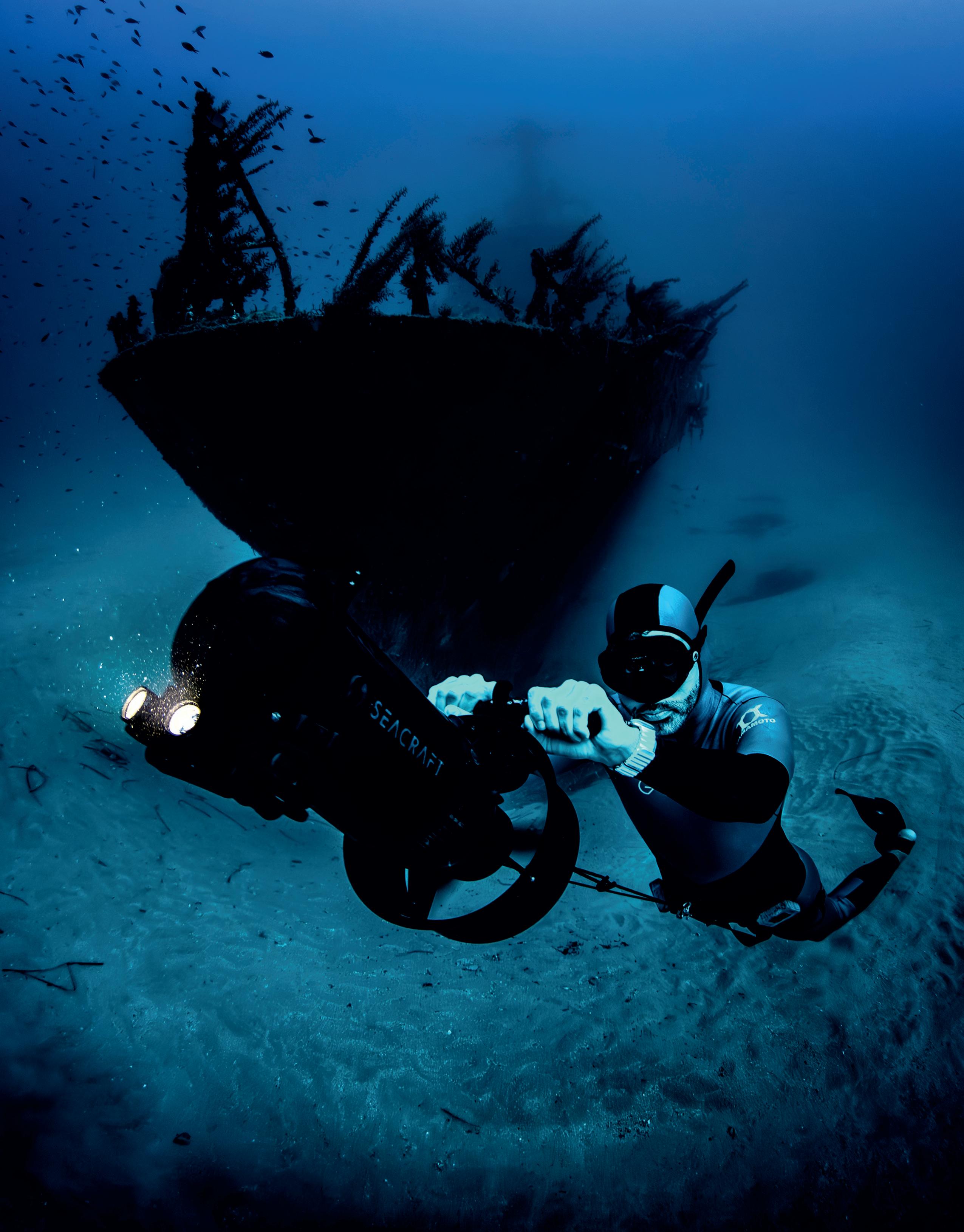

Here we go again! Once again, we have managed to prepare the next issue of the magazine to satisfy your desire to learn new directions, expand your knowledge and inspire you. Because, I guess that's what we dive for – to make dreams come true and reach where others are sometimes afraid to even look.
Why? Water unquestionably calms you down, gives respite to your "psyche", relaxes tense muscles and makes you forget, at least for a moment, about unpleasant, insignificant and tiring things. Gives you joy The inner one.
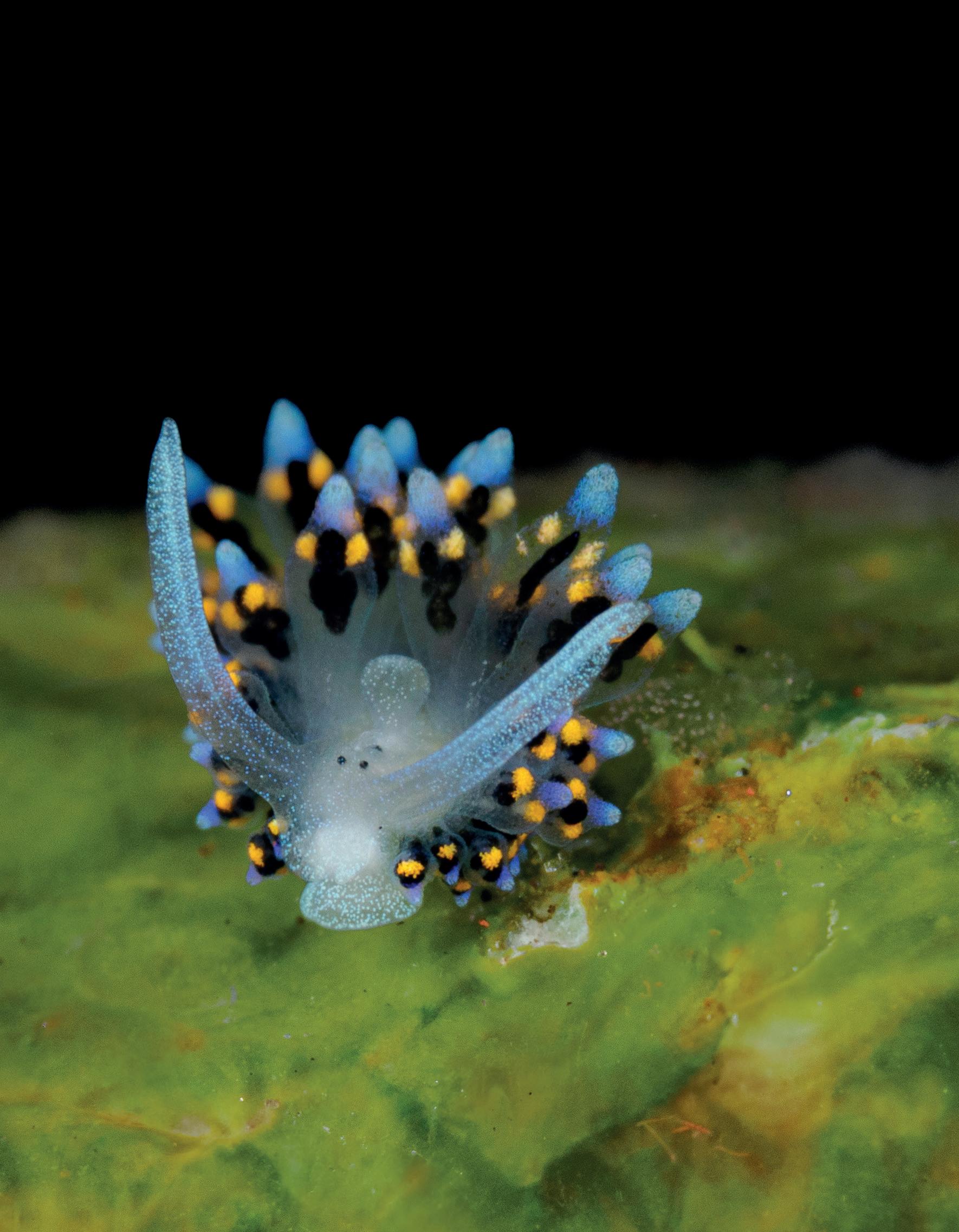
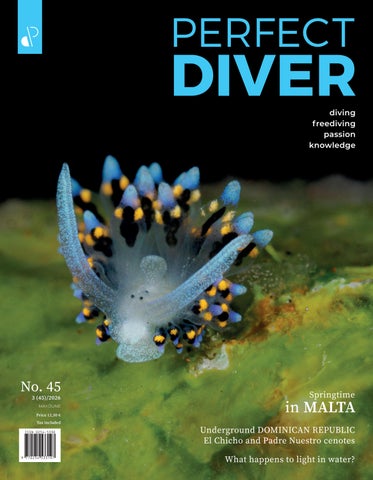
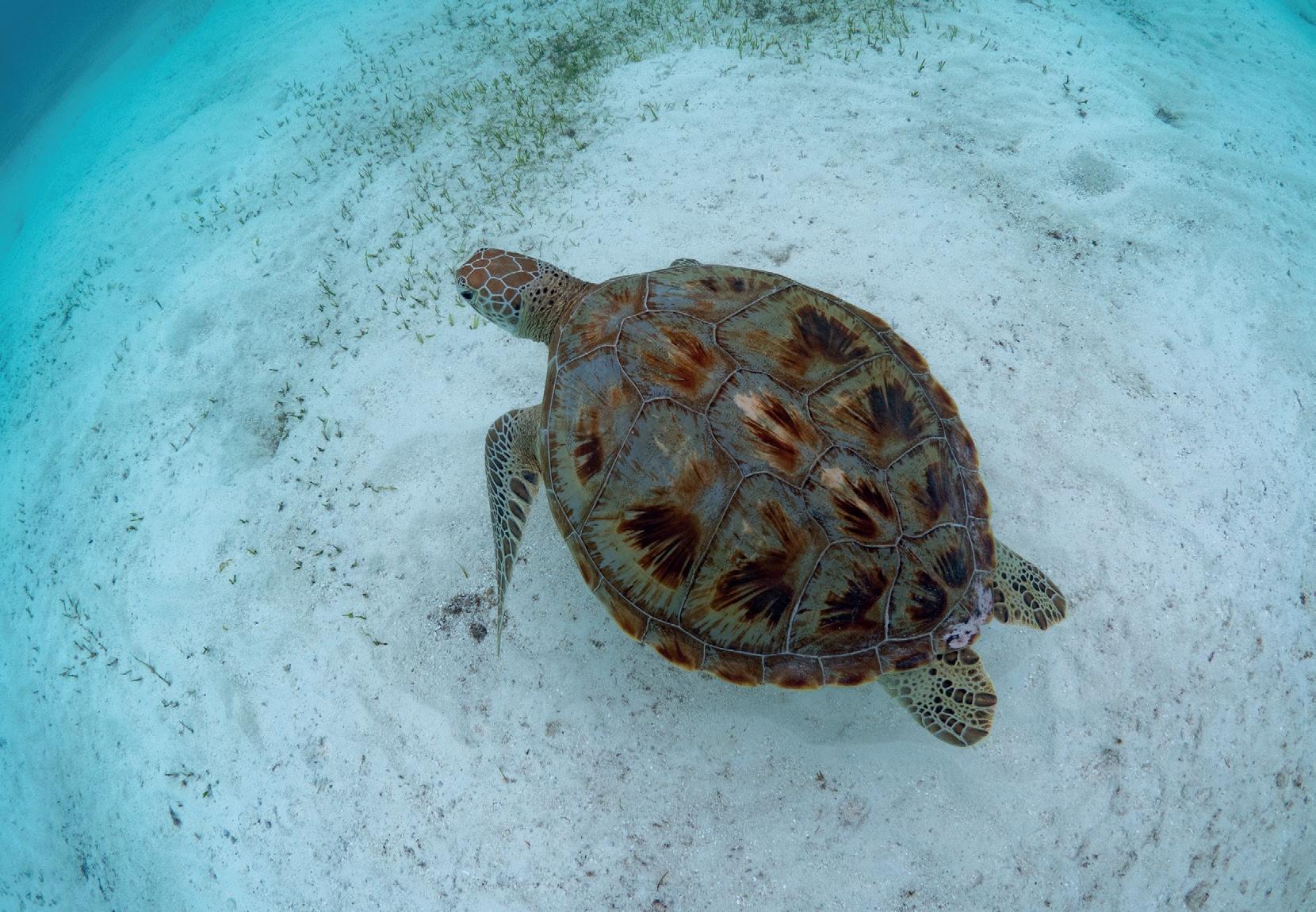
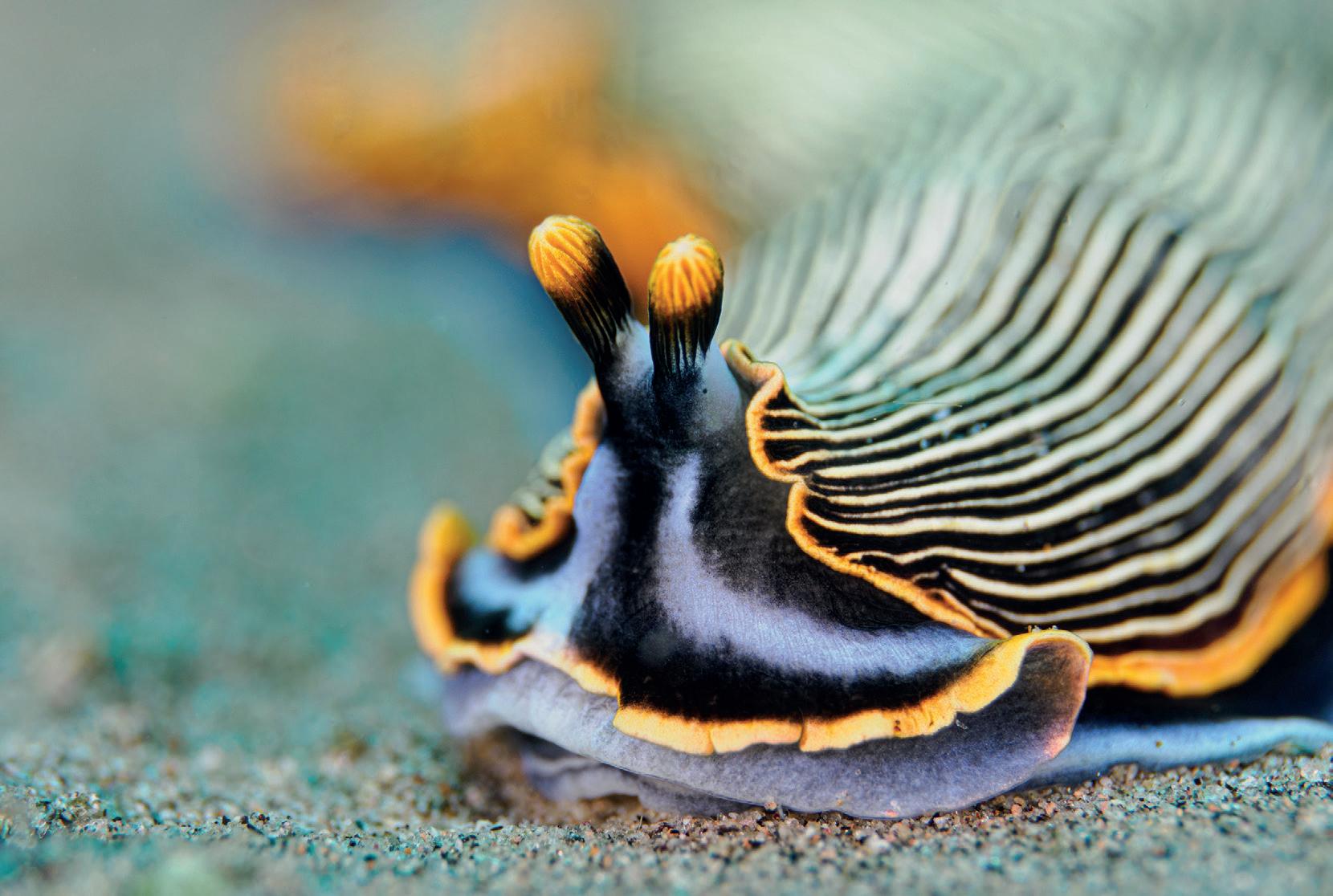
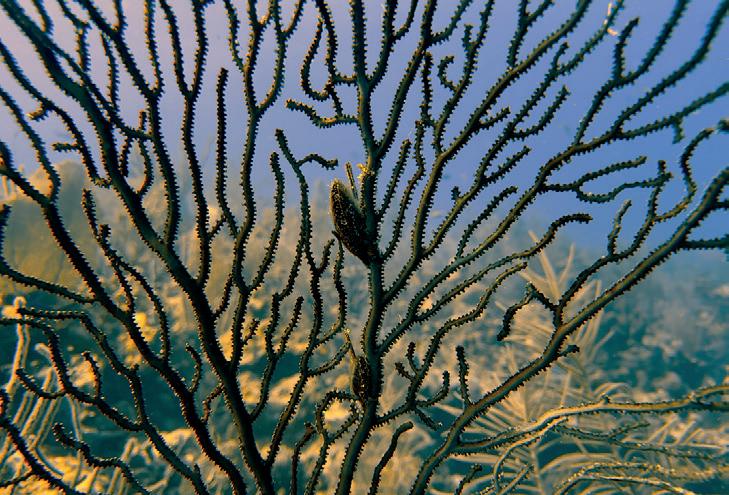
This edition is simply filled to the brim with material that we hope will take you to several completely different worlds. The cover with the creature with which Adam Sokólski, the author of this photo, is in love, adorns our 45th issue. And inside you will also find the story of the creation of this photograph heard and written down by Marcin Trzciński and an explanation of what you actually see on it:)
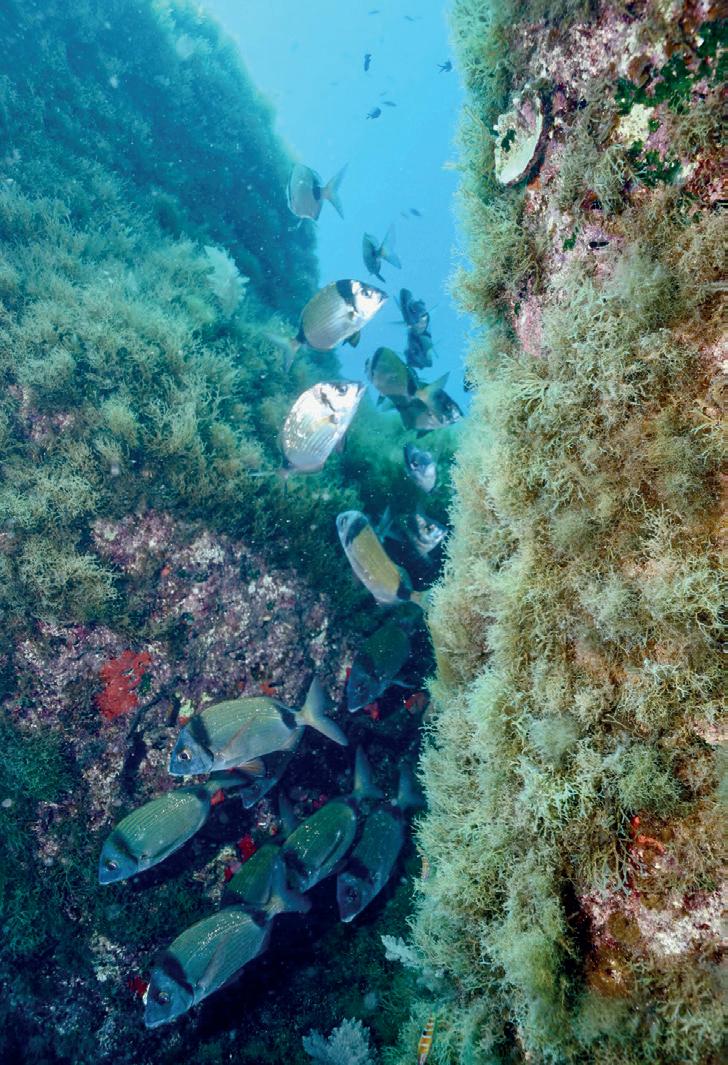
The material on Malta in the spring opens this issue. It’s worth noting that March, April, and May can be absolutely stunning there. Sunny, green and blooming, strawberry, and crisp underwater – about 16–17°C.
It's warmer underwater in Australia, among other places. Dominika Abrahamczyk talks about her first ever diving on a coral reef – and right away on the Great Reef! We also have a very interesting interview with Łukasz Ginalski about
sharks and the controversial topic of shark baiting.
Anthony Leydet’s piece on the island where they help sea turtles also looks very interesting. The Maldives shown from a completely different perspective. And also Jakub Banasiak's material about the Sataya reef and the dolphins there.
On the photography front, we have prepared the second part of Piotr Stós’s photography series, travel macrophotography by the aforementioned Adam Sokólski, and a photo safari through the eyes of Przemek Zyber.
And what about Belize, which Tomek Kulczyński recently wrote about? See for yourself!
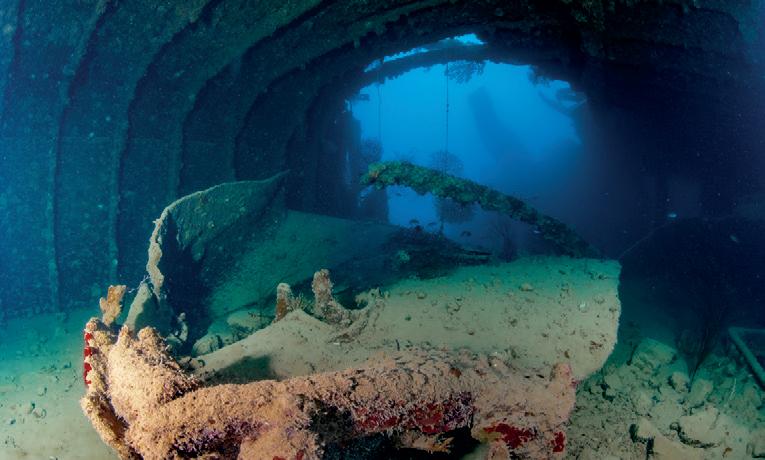
Wreck enthusiasts can dive with Basia Glenc and discover two specific wrecks. And if you don't already know it – there are cenotes in the Dominican Republic. Michał Czerniak tells us all about them.
In terms of hardware, you will also find a few interesting things – including our tests of Suunto computers, a few spreads, a calendar for the coming months and a few words after the big meeting of the Huish Outdoors Group.
The magazine closes with an article by Wojtek A. Filip about the left and right… hand? Check it out for yourself, as it is once again a very practical take.
And finally: tell your friends about us so they can take a look inside!
Did you like this issue? Give us a viral coffee buycoffee.to/perfectdiver Visit our website www.perfectdiver.com, check out Facebook www.facebook.com/PerfectDiverMagazine and Instagram www.instagram.com/perfectdiver/


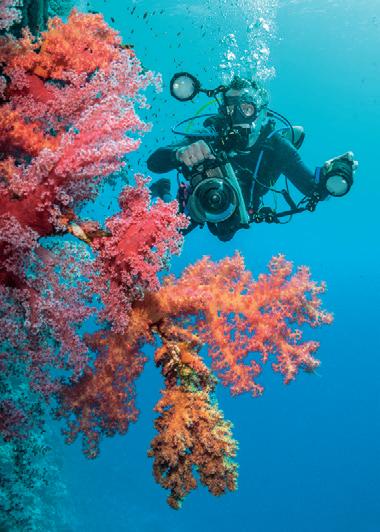
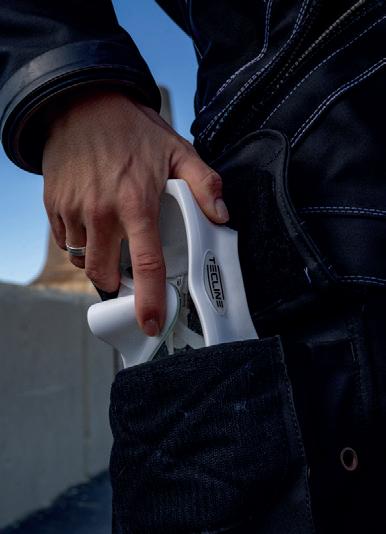
27 Suunto dive computers tests: NAUTIC S and Suunto NAUTIC
Publisher PERFECT DIVER Sp. z o.o. ul. Folwarczna 37, 62-081 Przeźmierowo redakcja@perfectdiver.com ISSN 2545-3319
28 Somwhere in the Meadow 34 Why we photograph underwater at close range, in other words: what happens to light in water
64 Photo Safari: A School for Masters
52 DIVErsion 2026, Huish Outdoors Group distributors meeting in Malta events 69 Left or right?
Editor-in-Chief
Technical Diver
World Geography & Travels
Reportage
Image Consulting
English Language Translators
Legal Care
Graphic Designer
Advertisement
Wojciech ZGOŁA
Tomek KULCZYŃSKI Anna METRYCKA
Dominika ABRAHAMCZYK
Waldemar RYDZAK Agnieszka GUMIELA-PAJĄKOWSKA, Arleta KAŹMIERCZAK, Piotr WITEK, Tomek KULCZYŃSKI
Lawyer Joanna WAJSNIS Brygida JACKOWIAK reklama@perfectdiver.com
THE MAGAZINE IS FOLDED WITH TYPEFACES
Montserrat (Julieta Ulanovsky), Acumin Pro (Robert Slimbach, Adobe), Source Serif 4 (Frank Grießhammer, Adobe)
PRINTING
Wieland Drukarnia Cyfrowa, Poznań, www.wieland.com.pl
www.perfectdiver.pl
DISTRIBUTION online store sklep.perfectdiver.pl redakcja@perfectdiver.com
The Editorial Office does not return unsolicited materials, is not responsible for the content of advertisements and reserves
Reprinting of articles or parts thereof, copying only with the consent of the Editorial Board. Editors are not responsible for
advertisements. If you like this issue, donate any amount! Donation is voluntary. PayPal.Me/perfectdiver
and
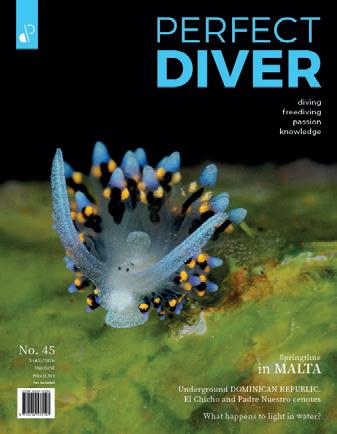
COVER PHOTO Adam SOKÓLSKI
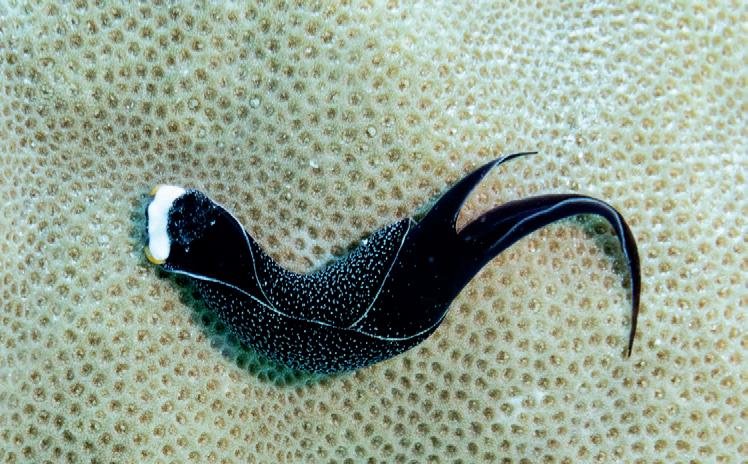
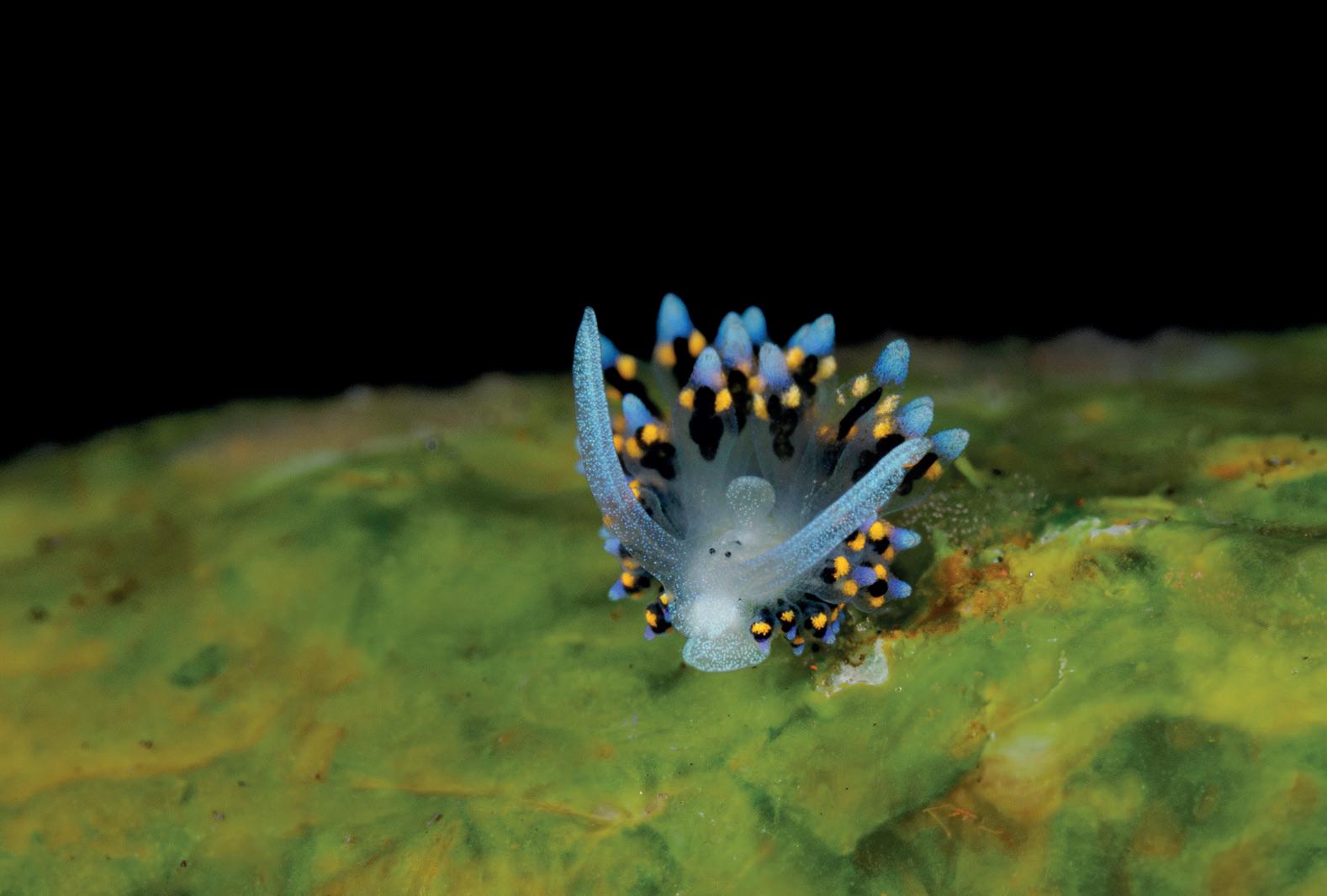
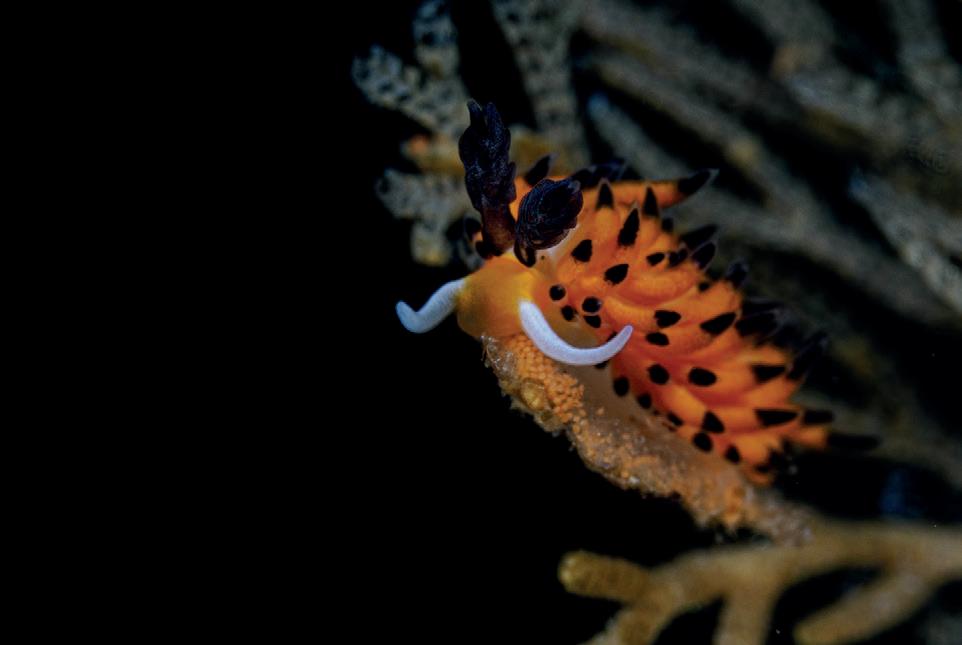
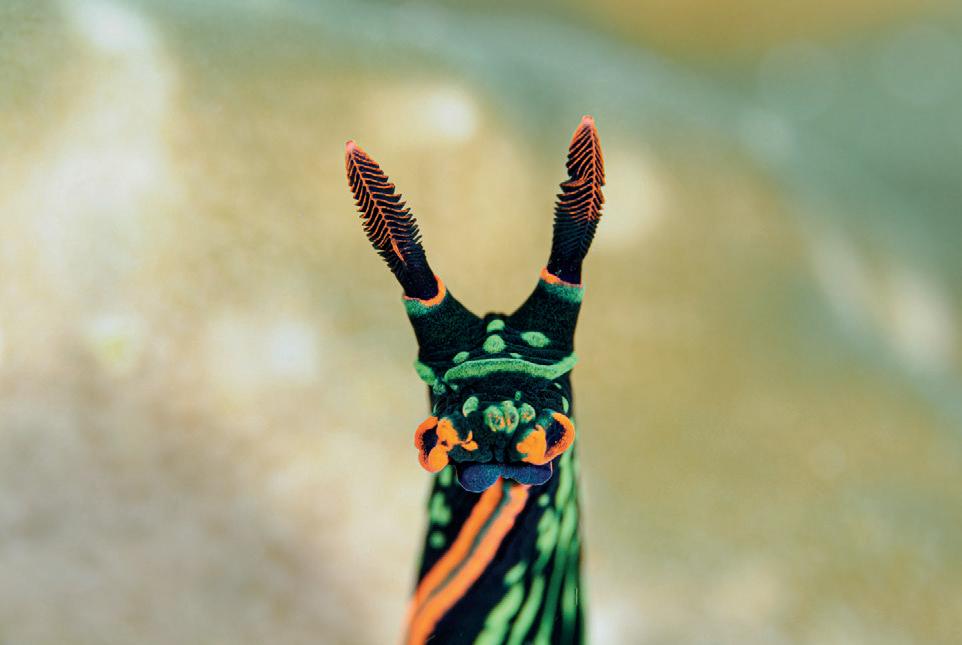
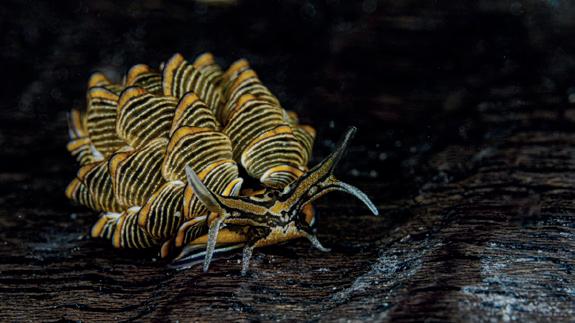
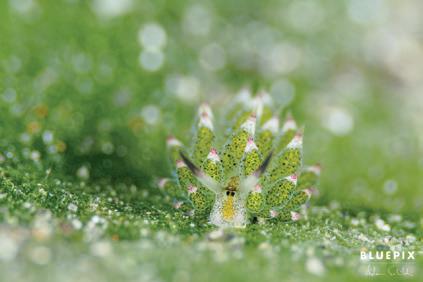
LOCATION Indonesia, Tulamben IN THE PHOTO Sea slug Stiliger Sp.
Wojciech ZGOŁA
A man who travels by diving. Connected with water since childhood – from learning to swim, through sailing, to discovering the secrets of underwater lakes, seas, and oceans. Later came a passion for photography and writing, which allow him to share the beauty of the underwater world and the unique stories of each place. He has completed over 900 dives in Poland as well as in remote, exotic warm and cold locations. Each dive is treated as an encounter with nature and history. A lover of Nature in its purest form, he believes that diving is not only a sport, but also a way of building awareness – of the environment, other people, and oneself.
Infected with a passion for diving by Perfect Diver. She continues to expand her diving skills. Although she definitely prefers warm waters, she dons a dry suit and explores colder bodies of water as well. Her favorite dives are those with plenty of marine life! Recently, she’s been taking her phone underwater in a protective case, trying her hand at amateur photography. She’s also curious about diving medicine. Professionally, she’s a Master’s degree nurse and a surgical scrub nurse.
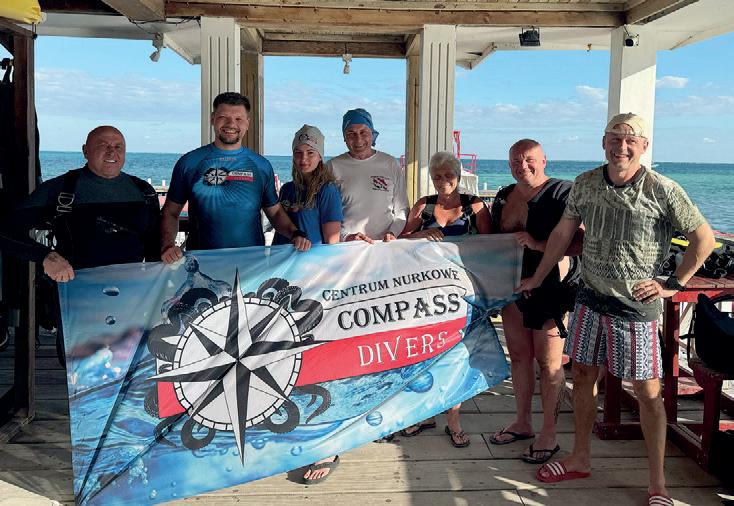
For Tomek, diving has always been his greatest passion. He started his adventure at the age of 14, developing into a recreational and technical diving instructor, a first aid instructor and a diving industry technician. Currently, he runs the 5* COMPASS DIVERS Pobiedziska Diving Center near Poznań, where he passes his knowledge and skills to beginners and advanced divers, which gives him great joy and satisfaction from being part of their underwater adventure...
“Human! Dive underwater. If the beauty you see down there doesn’t shake you to your core – nothing interesting awaits you in life.”
A diving enthusiast, connected with the water since childhood. She completed her first scuba course at the age of 14 and has never parted with diving since. She wrote her master’s thesis on dive tourism during her geography studies at the University of Warsaw. Starting in 2013, she contributed to the magazine nuras.info and took part in underwater photo shoots. Since 2018, she has been writing articles for Perfect Diver magazine (previously as Ania Sołoducha) and has been part of the editorial team for several years. She pours her knowledge and experience onto the page, sharing and promoting what she loves most – diving. For 13 years, she organized diving expeditions around the world, because working with people and creating new projects is where she truly thrives. She takes part in diving fairs and events, as well as lake clean-ups. She has often had the pleasure of speaking as a presenter at diving expos and conferences and has a number of diving webinars to her name. She has already dived in many places around the globe – and her dream list keeps growing.
For the past few months, she has been the owner of her own company organizing diving and active travel – Umiko Expeditions – with a head full of ideas for the next adventures. An optimist with a constant smile and an individual approach to every client. Her best life chapter is just beginning! www.umikoexpeditions.pl anna@umiko.pro +48 516 621 211
He comes from a mining region, where water was more of an exception than an everyday presence. He learned to swim and dive to overcome his fear of water – and, over time, to turn it into curiosity about the world beneath the surface. He has been connected with diving since 2000 (Divemaster, CMAS). He doesn’t chase depth or records; he prefers calm exploration, mindfulness, and the details that are easy to miss when you’re in a hurry. In his day-to-day work, he is a researcher and communication practitioner (Dr hab., Prof. UEP), involved in research and teaching in the areas of creative markets and digital and crisis communication. Within the Perfect Diver editorial team, he supports the crew where content meets technology – on video productions, data analysis, and building the brand strategy.
He has been diving for 35 years. He has spent more than 16,000 hours underwater, most of them diving technically. He has been an instructor and mentor instructor for many organizations including CMAS, GUE, IANTD, PADI. He co-created the training programs for some of them. He is a professional with vast knowledge and practical experience. He has participated in many diving projects as a leader, explorer, initiator or speaker. He was the first Pole to dive the HMHS Britannic wreck (117m). He was the first to explore the deep part of the Glavas Cave (118m). He made a series of dives documenting the wreck of ORP GROM (110m). He has documented deep (100-120m) parts of flooded mines. He is the creator and designer of many equipment solutions to improve diving safety. Technical Director at Tecline, where, among other things, he manages the Tecline Academy a research and training facility. Author of several hundred articles on diving and books on diagnosis and repair of diving equipment. He dives in rivers, lakes, caves, seas and oceans all over the world.
Laura is a journalist, instructor trainer, CCR and cave diver. She has been developing her diving career for over a decade, gaining knowledge and experience in various fields. Her specialty is professional diving training, but her passion for the underwater environment and its protection drives her to explore various places around the world. From the depths of the Lombok Strait, caves in Mexico and wrecks in Malta to the Maldives, where she runs a diving center awarded by the Ministry of Tourism as the best diving center in the Maldives. Laura actively contributes to promoting the protection of the marine environment, takes part in scientific projects, campaigns against ocean littering and cooperates with non-governmental organizations. You can find her at: @laura_kazi_diving www.divemastergilis.com
Zoopsychologist, researcher and expert in dolphin behavior, committed to the idea of protecting dolphins and fighting against keeping them in dolphinariums. Passionate about Red Sea and underwater encounters with large pelagic predators. Member of the Dolphinaria-Free Europe Coalition, volunteer of the Tethys Research Institute and Cetacean Research & Rescue Unit, collaborator of Marine Connection. For over 15 years, he has been participating in research on wild dolphin populations, auditing dolphinariums, and monitoring the quality of whale watching cruises. As the head of the "Free & Safe" project (formerly "NO! for a dolphinarium"), he prevents keeping dolphins in captivity, promotes ethical whale & dolphin watching, trains divers in responsible swimming with wild dolphins, and popularizes knowledge about dolphin therapy that is passed over in silence or hidden by profit-making centers. on this form of animal therapy.
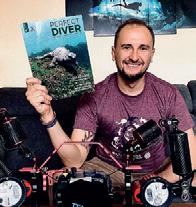
A long, long time ago in a galaxy far, far away there was chaos... …that is, the multitude of thoughts and delights after my first immersion under water in 2005 in the form of INTRO while on vacation in Egypt. By then I had completely immersed myself in the underwater world and wanted it to have an increasing impact on my life. 2 years later, I took an OWD course, which I received as a gift for my 18th birthday, and over time, further courses and skills improvement appeared.
"Photography" appeared not much later, but initially in the form of a disposable underwater "Kodak" from which the photos came out stunningly blue I am not a fan of one type of diving, although my greatest weakness at the moment is for large pelagic animals. The Galapagos Islands were my best opportunity to photograph so many species of marine fauna so far. I share my passion for diving and photography with my buddy, who is my wife IG: luke.divewalker www.lukedivewalker.com
I photograph because I love it, I film because it excites me, I write because I enjoy sharing, I teach because I support growth, I travel because I love discovering new things. www.facebook.com/przemyslaw.zyber www.instagram.com/przemyslaw_zyber/ www.deep-art.pl
A graduate of the University of Warsaw. An underwater photographer and filmmaker, has been diving since 1995. A co-operator at the Department of Underwater Archeology at the University of Warsaw. He publishes in diving magazines in Poland and abroad. The owner of the FotoPodwodna company which is the Polish representative of Ikelite, Nauticam, Inon, ScubaLamp companies. www.fotopodwodna.pl m.trzcinski@fotopodwodna.pl
Sylwia KOSMALSKA-JURIEWICZ
A traveller and a photographer of wild nature. A graduate of journalism and a lover of good literature. She lives in harmony with nature, promotes a healthy lifestyle: she is a yogini and a vegetarian. Also engaged in ecological projects. Sharks and their protection are especially close to her heart. She writes about the subject in numerous articles and on her blog www.blog.dive-away.pl. She began her adventure with diving fifteen years ago by total coincidence. Today she is a diving instructor, she visited over 60 countries and dived on 5 continents. She invites us for a joint journey with the travel agency www.dive-away.pl, of which she is a co-founder.
I am a traveler and a technical diver, exploring the world both on land and underwater. I have been diving for 16 years. Since I am a professional photographer, a camera has accompanied me from my very first dive. I started with recreational diving, but over time, I obtained full trimix and full cave certifications, allowing me to explore caves, wrecks, and great depths.
Underwater, I find a peace that is hard to experience on the surface. Every dive is not just an adventure for me but also an opportunity to capture the extraordinary underwater world through photography. barbaraglenc.foto@gmail.com
Piotr STÓS
Photographer, biologist, storyteller, SSI Instructor Trainer. He considers it his duty to teach diving at every level. Since the dawn of time, he has been associated with Nautica with an inseparable umbilical cord of co-ownership. He nests on the Croatian island of Vis, on safari boats in Egypt and where under water it is beautiful as the world long and wide. He works at Nautica Safari. nautica.pl, piotr.stos@nautica.pl
Diver, diving instructor, underwater photographer. I have been diving for 28 years and working in underwater photography for 18. I have completed thousands of dives in Poland, across Europe, Africa, and Asia. Diving, training new divers, and creating underwater images are not only my profession, but above all my passion. I am particularly fascinated by macro photography, which is why underwater I most enjoy photographing small, very small, and even microscopic creatures. I always gladly return to the Philippines, Indonesia, and Malaysia, where underwater life amazes with its richness. My photographs have been published, among others, in National Geographic.
He was supposedly born with a camera in hand… Some say he uses lenses instead of glasses and develops photos before they’re even taken! Thanks to his unique powers, he combines travel, photography, and diving into one passion. A man of contradictions: he loves the mountains but feels drawn to the sea, lives for adventure yet works in boring IT, adores warmth but resides in a country where it’s dark and cold for half the year. His spirit animal is the manatee: he freezes below 23 degrees Celsius, and although he looks hefty, he has only a thin layer of fat. A technology enthusiast, especially when it comes to anything related to capturing images. In his free time, he browses and compares flight deals to diving destinations, which keeps his bank account permanently in the red.

Anthony LEYDET
Based in Marseille on the Mediterranean, Anthony Leydet is a french underwater photographer, blogger, and writer, published worldwide in diving magazines.
www.zesea.com
IG: @anthonyleydet_uw_photography
A graduate of the Poznań University of Technology, financier, the auditor. A diver fascinated by theory diving - physics and physiology. In love passionate about history in underwater archaeology Ancient Rome, active Centurion in the group reconstructionist Bellator Societas (Rome I century BC). He dreams of attending at least once underwater archaeological research a then describe everything in a series of columns. It can be found as often as under water in Japan, whose culture and history he has been fascinated by nearly three decades.
Text Wojciech ZGOŁA
Photos PERFECT DIVER

For thousands of years, the MALTESE ARCHIPELAGO has fascinated, inspired, and made people return here – or want to come for the very first time.
Because even though we know the history, even though we know that Malta and Gozo are home to the world’s oldest stone temples, older even than the Egyptian pyramids, and that the Hospitallers, the Knights of Malta, lived and operated here, each of us still wants to discover it personally. It is one thing to talk about painting and look at Caravaggio’s works in a book or multimedia presentation, and quite another to enter one of the chapels of St John’s Co-Cathedral in Valletta, where semi-darkness reigns, and experience the original “Beheading of Saint John the Baptist” in person, in quiet contemplation.
Malta as a country is changing. Anyone who was here 20 years ago and has returned now may experience a slight shock. Driving from Mellieħa to the airport, I counted more than 20 cranes actively involved in construction. Once, in St Julian’s, there was just one tall building: the Portomaso Business Tower, with 23 floors and a height of 98 m. In 2020, it was overtaken by Mercury Tower. Today, several high-rises are under construction.
The old-school buses from the 1950s are gone. The entire fleet has been replaced with modern, air-conditioned vehicles. There are more good roads and better traffic solutions. Unfor-
tunately, the traffic jams have not disappeared, and during rush hour a journey of just a dozen or so kilometers can take an hour. What there is less of – significantly less – is litter. In this respect, Malta and Gozo have changed for the better for the natural environment. This applies both on land and at sea.
For us as divers, the most important thing is that the infrastructure supporting the pursuit of diving and freediving is widely available here, with dive centers scattered across both islands.
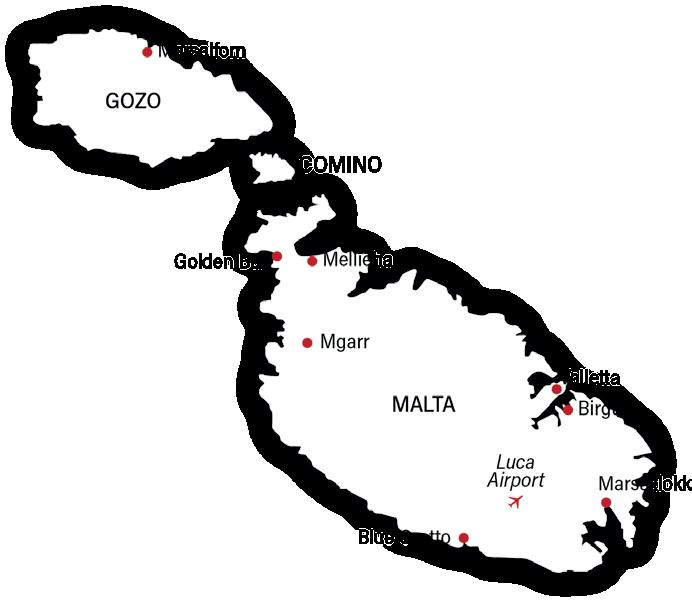
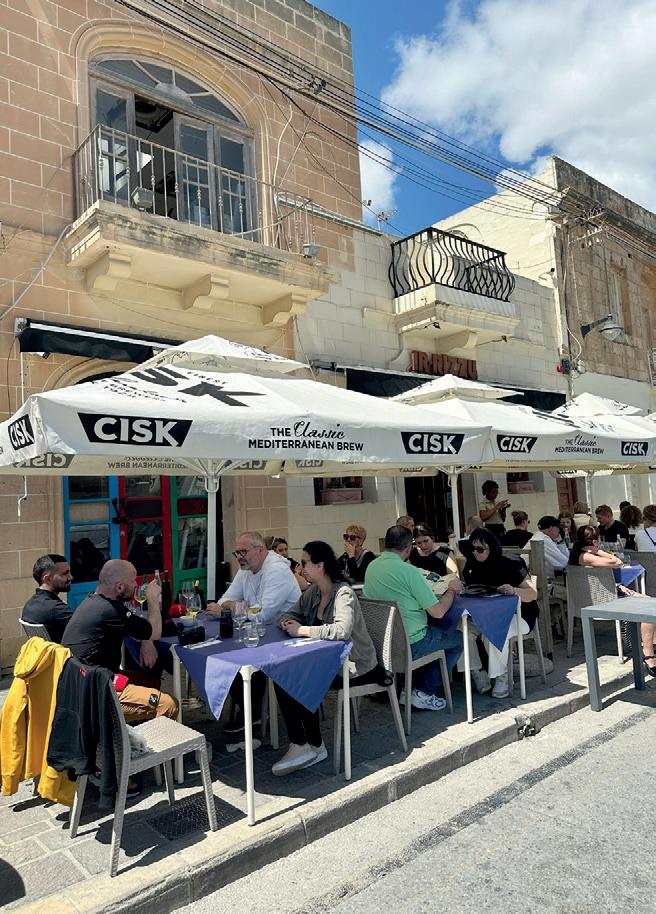
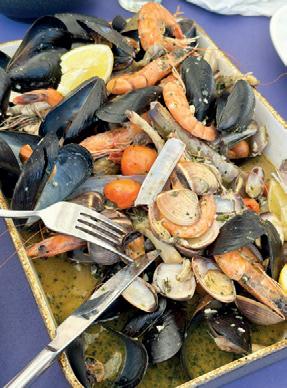
Following an invitation from the MTA (Malta Tourism Authority) extended to Perfect Diver Magazine, and after finalizing a few points in the program of our stay on Maltese soil, we arrived at the expanded Luqa Airport in mid-April 2026. Our host, Sean, was already waiting for us together with the driver. We began our exploration with a drive to Marsaxlokk and lunch at the restaurant ir Rizzu. Here, the Mediterranean Sea cuts into the land, forming a natural bay of the same name – Marsaxlokk Bay. We are on the southeastern coast of Malta, in a traditional fishing village. We soak up the atmosphere of “old Malta,” famous for its luzzu boats with the “eyes of Osiris,” for the largest concentration of fish restaurants in the entire archipelago, and for its Sunday fish market, held from 6:00 a.m. to 2:00 p.m. Today, the place is something of a mix between an authentic harbor and a row of seafood restaurants. The tables stand right by the street, while well-stocked stalls for tourists line the harbor.
After a very tasty and generous meal – which was supposed to be light – consisting of several starters, two main courses, dessert, and coffee, we could barely get up from the table.
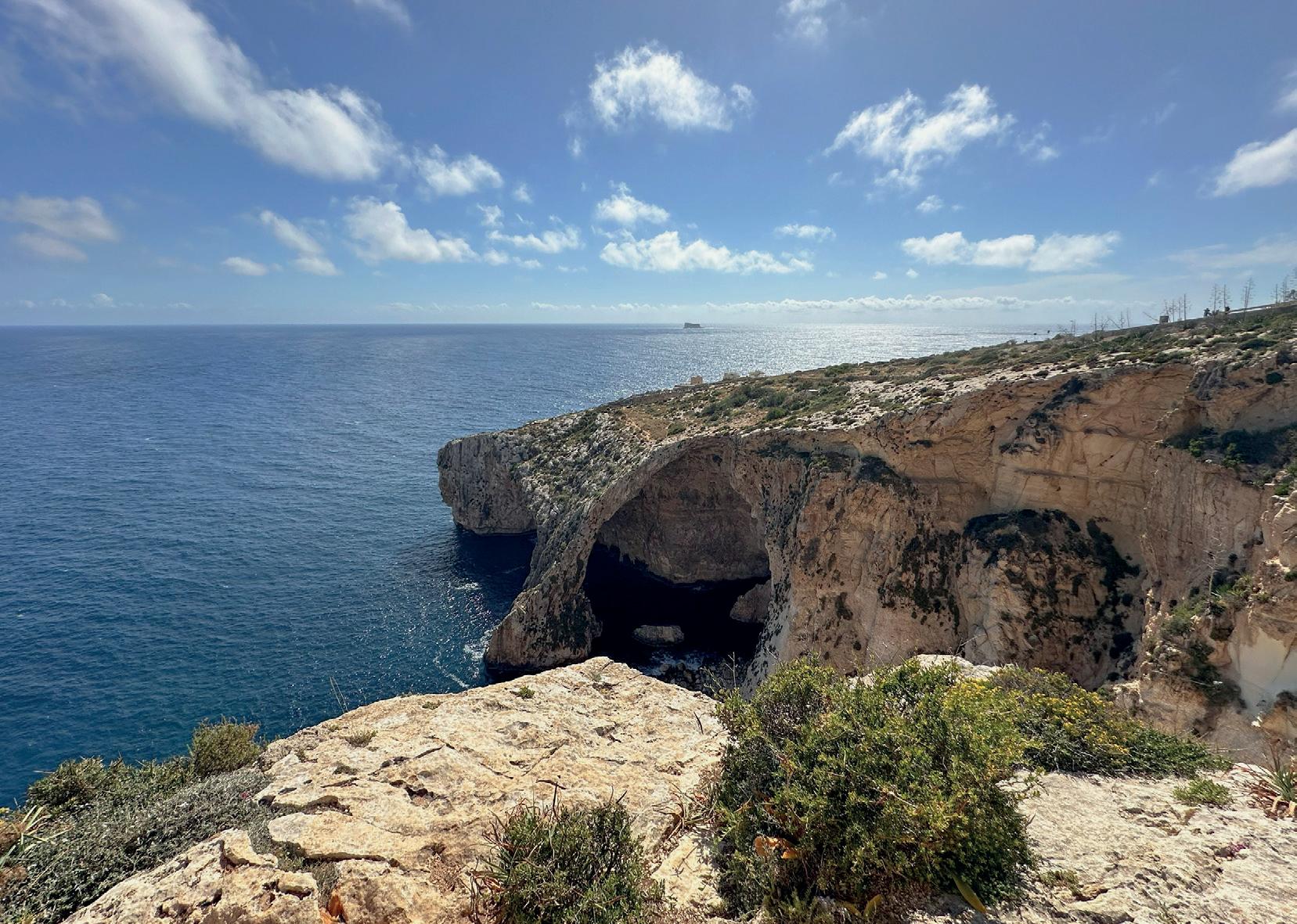
Admiring the green island, full of colorful flowers, blooming herbs, and ripe field-grown strawberries, we drove to the Blue
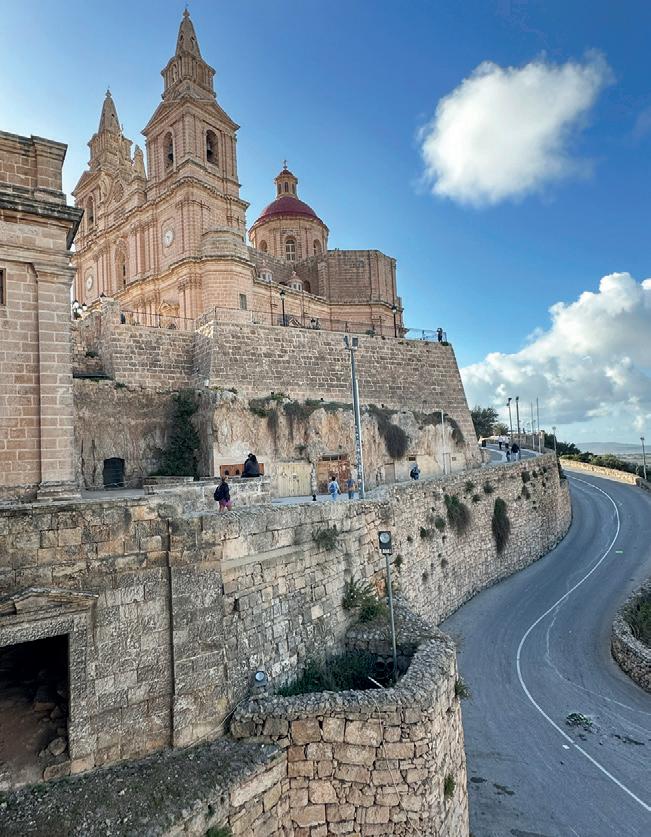
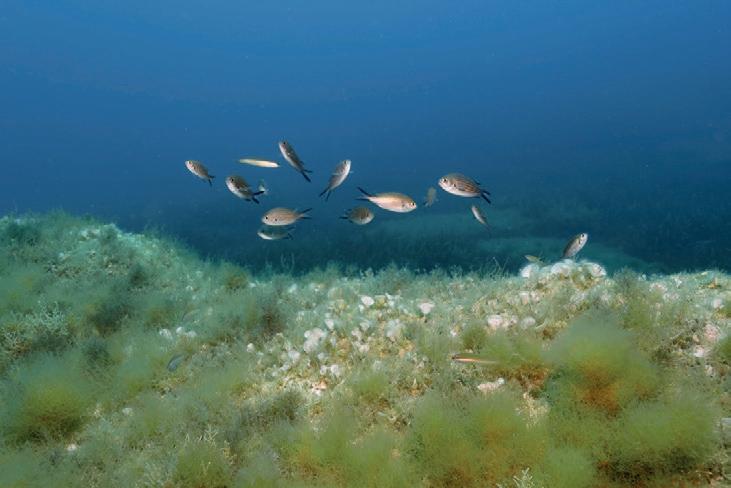
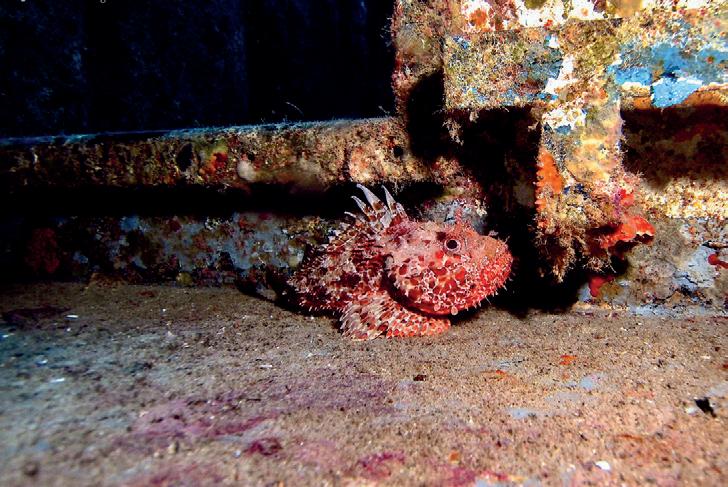
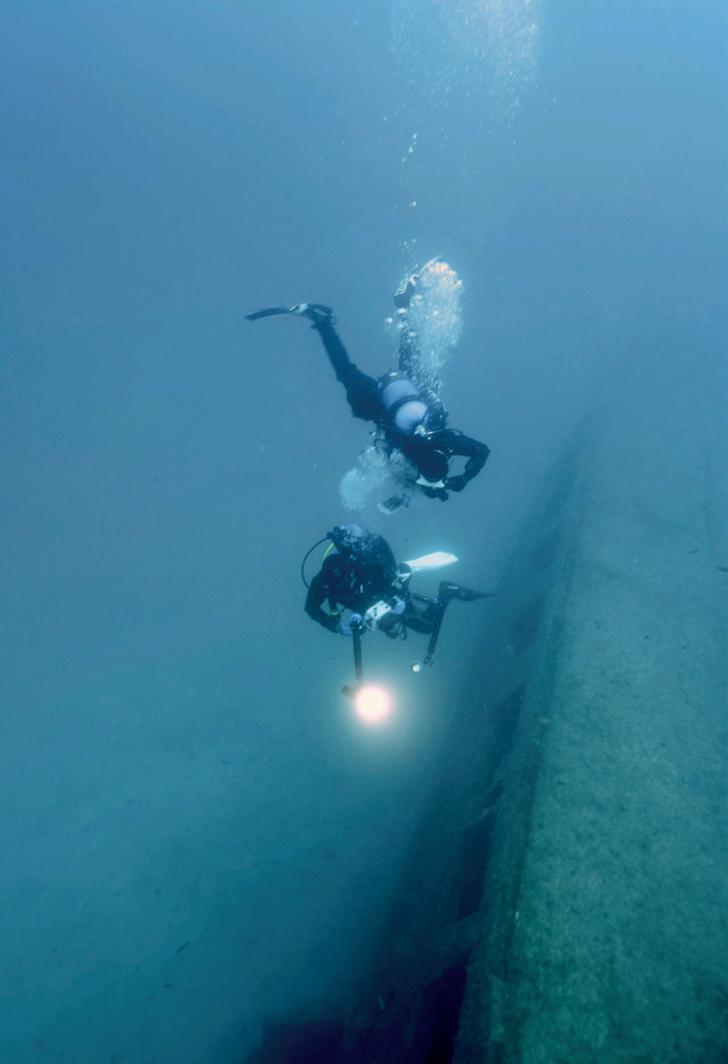
Grotto to see the system of sea caves and rock arches. This is the area of Wied iż-Żurrieq, famous for its intensely blue water and light reflections. You can go all the way down to the sea and take a boat trip to explore it from the water. There is also an excellent dive site here, and underwater you can find, among other things, the wreck of the tanker Um El Faroud, scuttled in 1998. It lies at a depth of 15–36 m and is 110 m long. In 2005, it broke into two parts during a severe storm. It is one of Europe’s top wrecks.
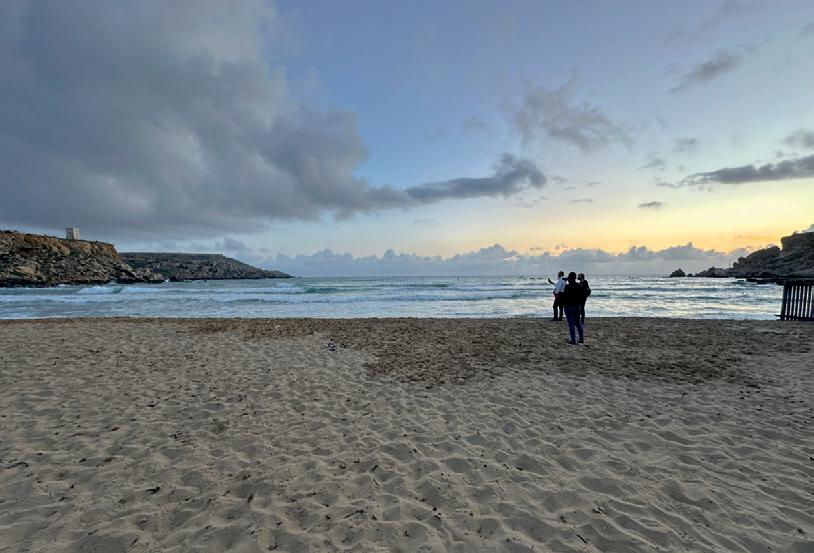
The MTA accommodated us at the 4-star Solana Hotel in Mellieħa. Before the obligatory Maltese-style dinner, we went to Golden Bay to admire the sunset. Or at least that was the plan, but apparently the sky had plans of its own and covered itself with a light layer of clouds.
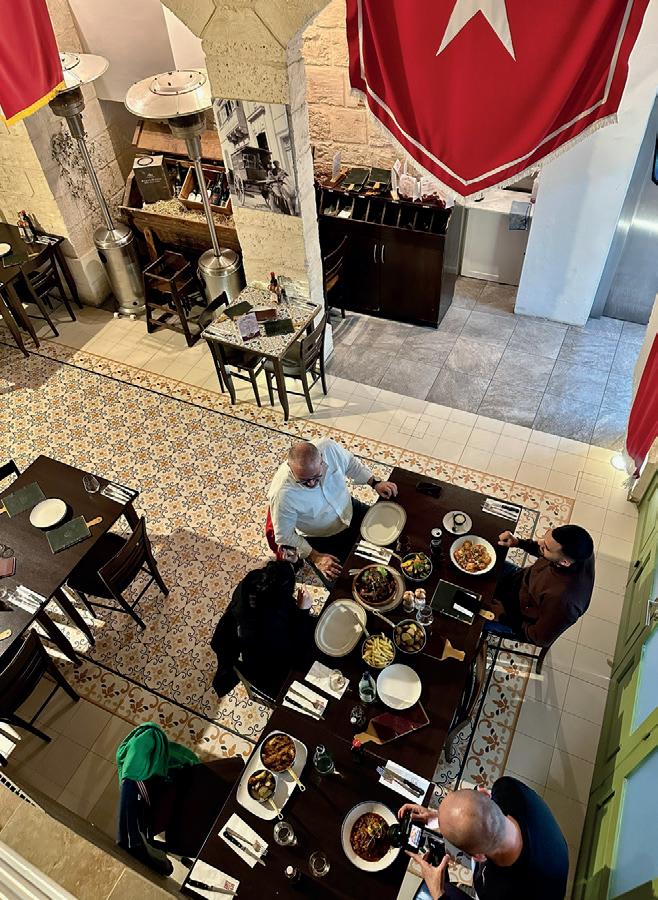
We had dinner – the local kind of dinner – in the village of Mġarr, at a restaurant serving Maltese specialties. Among other dishes, we were served rabbit, which is Malta’s national dish.
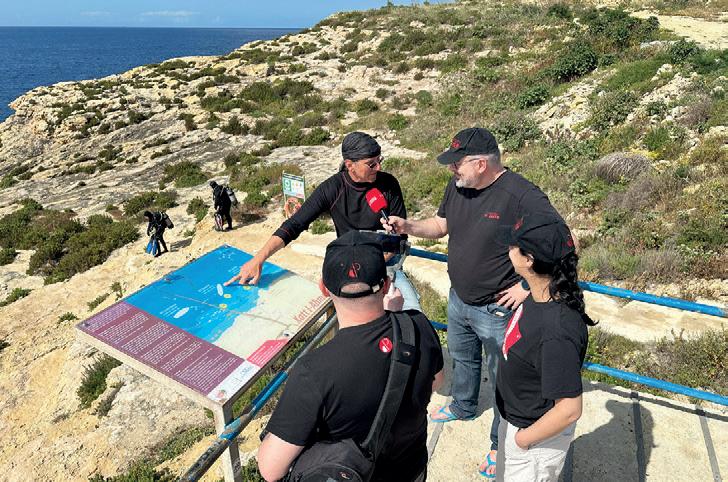
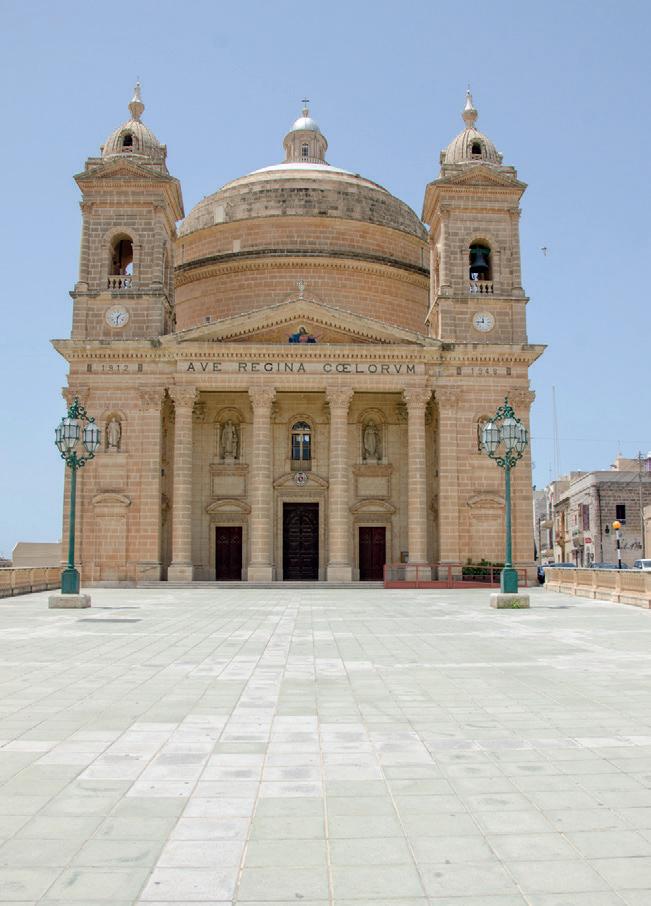
Right next to the restaurant, literally just a few steps away, stands the main church in Mġarr. It is the Parish Church of the Assumption of the Blessed Virgin Mary. Interestingly, it has a distinctive egg-shaped dome. It was built by the local community, which was known for raising laying hens and producing very high-quality eggs. The residents wanted their church to be different from the “round” ones, so they chose a more stylistic and symbolic solution.
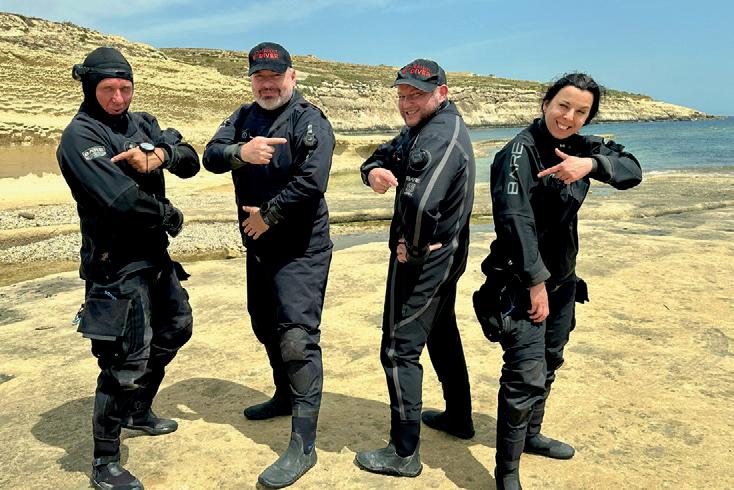
We spent the next 2 days between Gozo and Malta, diving intensively both on wrecks and among rocks richly sculpted by the sea, the sun, and time. We dived with Atlantis Diving Center, and Bogdan Trzcionka looked after us.
That is why our mornings began with a quick breakfast, a ferry crossing to Gozo, and a fast transfer to Marsalforn in the north of
the island. There, we would decide together where to dive. We took into account the weather conditions, mainly the wind, as well as our own little “whims” ;)
After the dives, we had lunch at Vini e Capricci, and dinners, once back on Malta, in a succession of restaurants selected by the MTA.
Saturday, before our departure, was devoted to the spirit of history I mentioned at the beginning. After breakfast, a car was already waiting for us, along with our guide. We took the longer route to Valletta, following the coastline. The sight of the open Mediterranean stretching all the way to the horizon brings a sense of inner calm, and for divers it automatically suggests that underwater it must be incredible.
Office
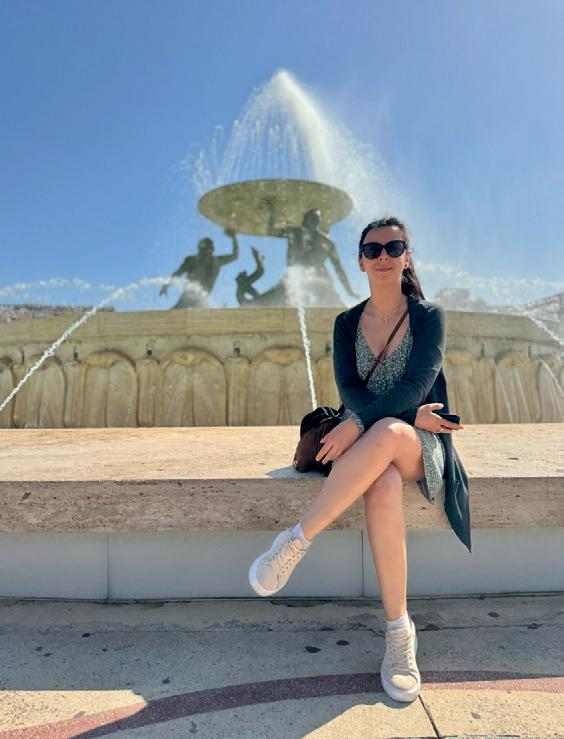
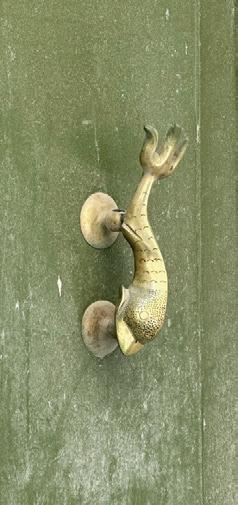
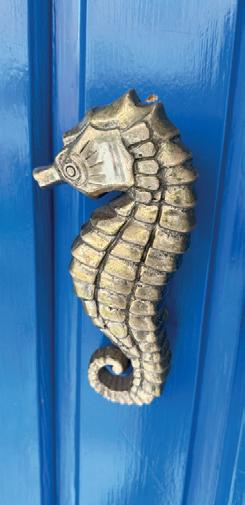
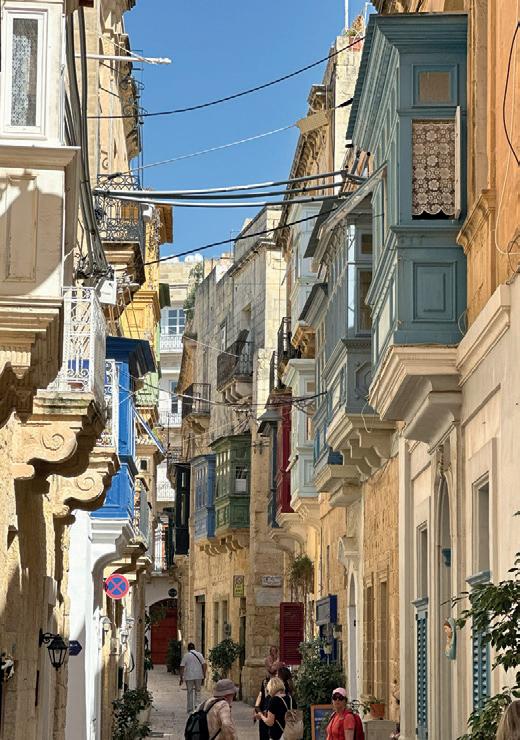
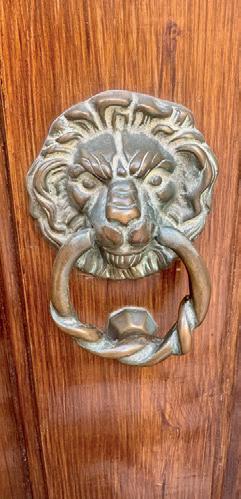
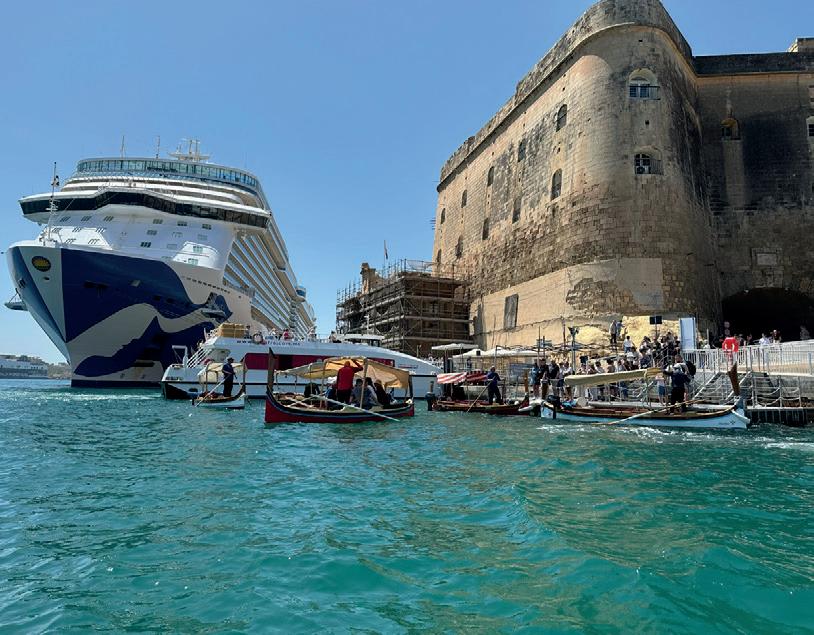
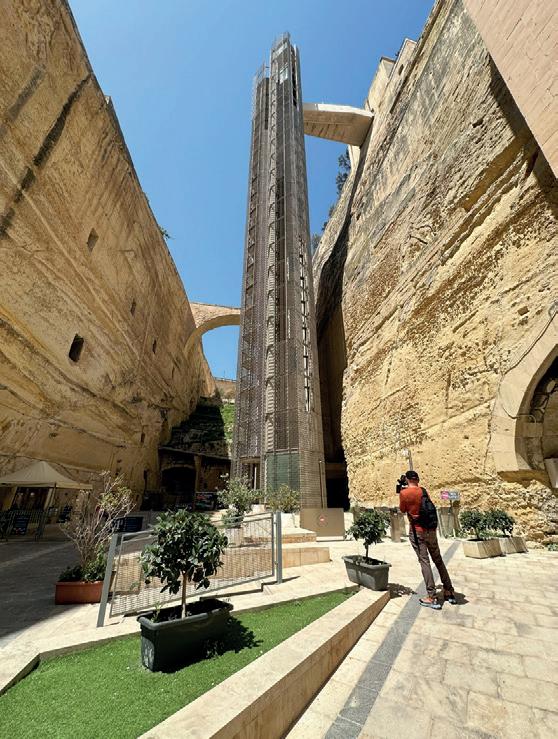
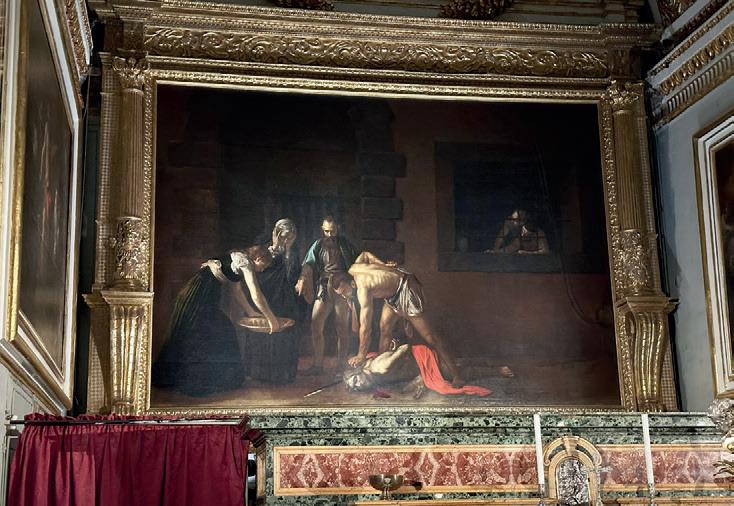
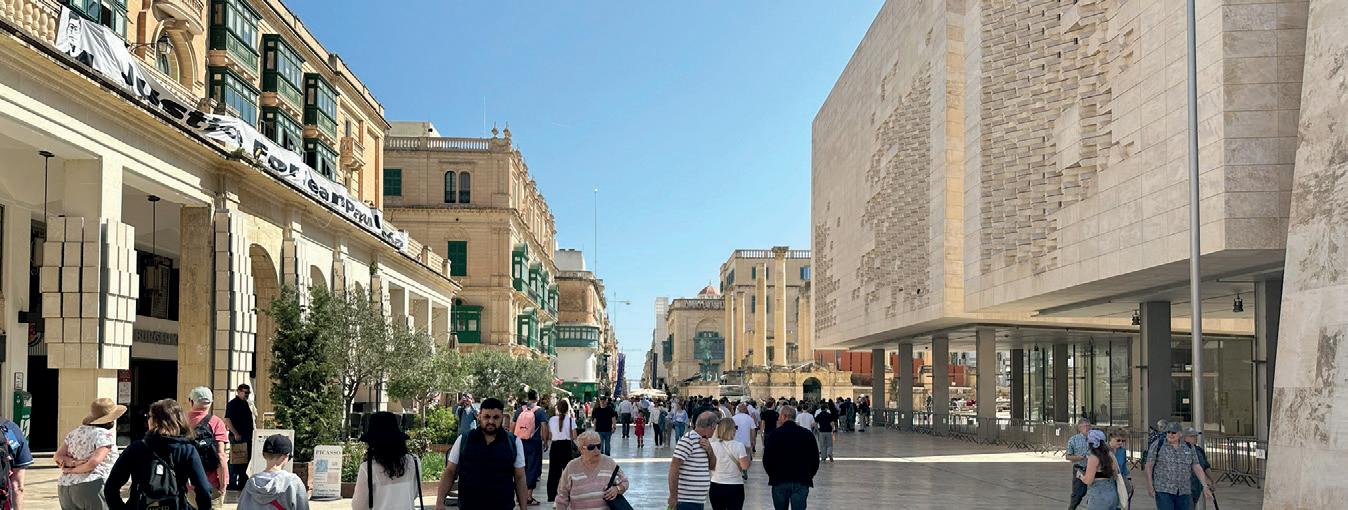
We began our sightseeing at the monumental Triton Fountain, located at the entrance to the historic center of Malta’s capital. The fountain was created in 1959 to a design by Vincent Apap and consists of three tritons supporting a water basin. From there, we pass through the gate and, leaving the Parliament of Malta on our right, lose ourselves in the streets of the capital, founded in the 16th century by the Order of St John. It is fair to say that Valletta is a Baroque city built with military precision, constructed from pale limestone. All the buildings are visually consistent and have a golden color. The doors, on the other hand, very often still fitted with knockers, are green, blue, and red. The narrow streets with balconies form a rectangular grid, while the whole city is enclosed by bastion fortifications adapted to the shape of the peninsula. As you walk, you can clearly see the changes in elevation and the natural rock creating the effect of a “wall” descending straight into the water. Valletta lies about 50–60 m above sea level, for example around the Upper Barrakka Gardens, and it was built on that rock. The walls on the Grand Harbour side are 40–60 m high.
It is worth seeing and visiting St John’s Co-Cathedral, the palace of the Knights of St John, stopping for excellent coffee, usually Italian, in one of the many cafés, taking a look inside the National Museum of Archaeology, and walking to the Barrakka Gardens, with their beautiful view of the harbor and the Three Cities: Birgu, Isla, and Bormla.
What is pleasant is that when you walk on a hot day, you naturally look for shade, and because the sea is always close, every now and then you can count on a light breeze carrying moisture and the scent of the harbor.
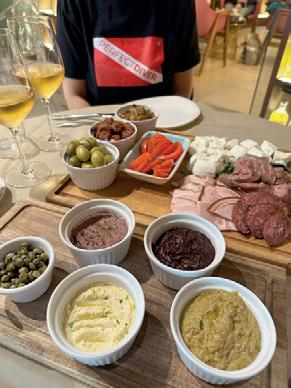
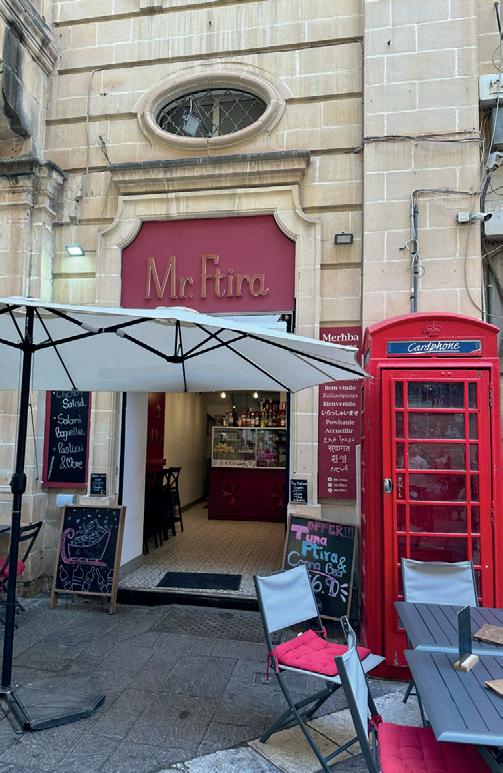
When we get hungry and do not have time for a longer stop, we should definitely reach for ftira – the classic version is the one with tuna, olives, and capers – or pastizzi, filled with ricotta or peas, accompanied by a chilled Kinnie, a herbal drink made in Malta.
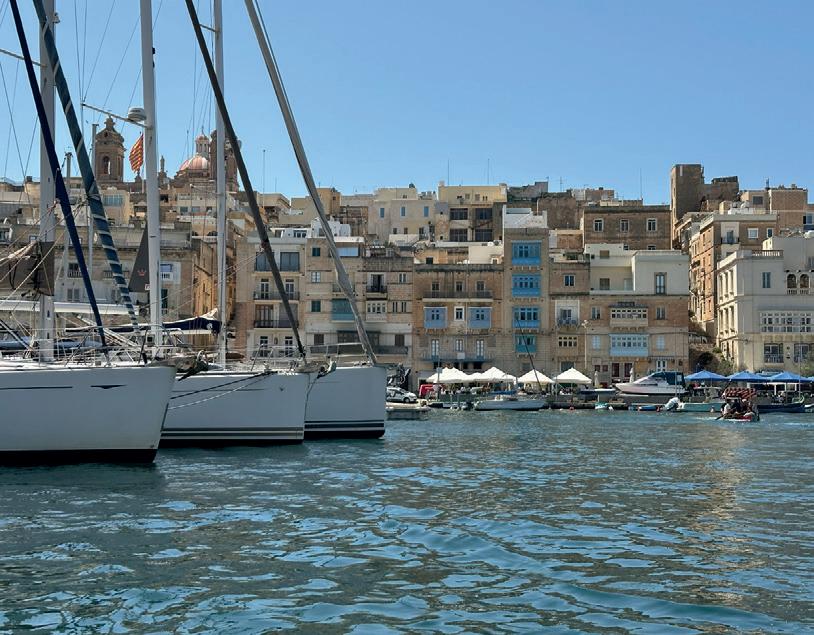
Do you think that was the end? No. We still took the lift that runs down from the Barrakka Gardens to the outside of the city walls near Grand Harbour. After walking a short distance, we could take a short boat ride to Birgu, which is exactly what we did. There, we looked for a Polish restaurant and had lunch while speaking Polish with the staff. It turns out that around 4,000 Poles live on the islands, and it is usually they – apart from tourists – who come there to eat, for example, pierogi. After filling our stomachs to the brim and catching our breath, we headed deeper into Birgu, admiring its corners, streets, and architecture, especially the parts where sea and land meet.
In the evening, we still had a delicious dinner ahead of us in the company of Michelle from the MTA, which we enjoyed at a restaurant in Qawra. As befits the middle of the weekend, we spent a lot of time in the car.
The next day we returned to Poland. From 22°C and sunshine, we landed in
5°C, clouds, and rain. Malta, Gozo, and Comino are an excellent choice around March, April, and May – especially for anyone who does not enjoy 40-degree heat and crowds. During this period it is warm and sunny here, with perhaps an hour of light rain. There is color everywhere, plenty of flowers, the first harvests, and strawberries picked straight from the plant, grown in the ground. Spring in Malta seems like a very good option. It is safe here, the food is delicious, and at the same time there is something distinctly exotic about it.
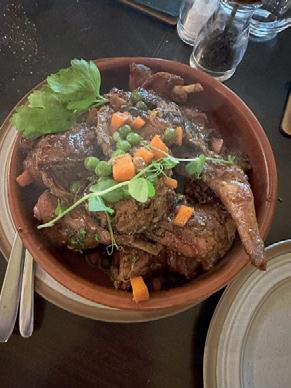
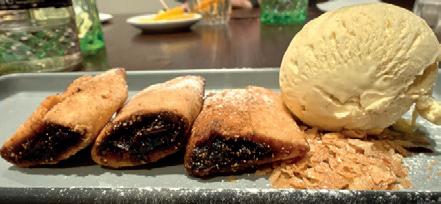
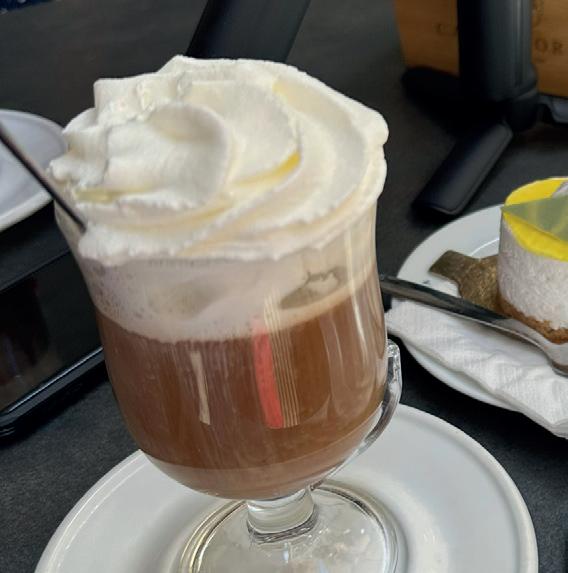
And what did we eat there, among other things?
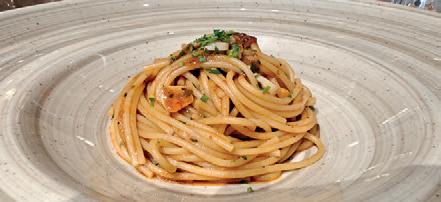
Spaghetti Tal-Fqira, Imqaret, Carre Di Vitello, Gozitan Tnaqqir. Maltese-style coffee consisted of: strong coffee (espresso), anise, cloves, cinnamon, orange peel, a little rose water, plus brown sugar/honey or – as in our case – a version with whipped cream and alcohol.
Not that I’m accusing anyone of cheating… BUT ;)
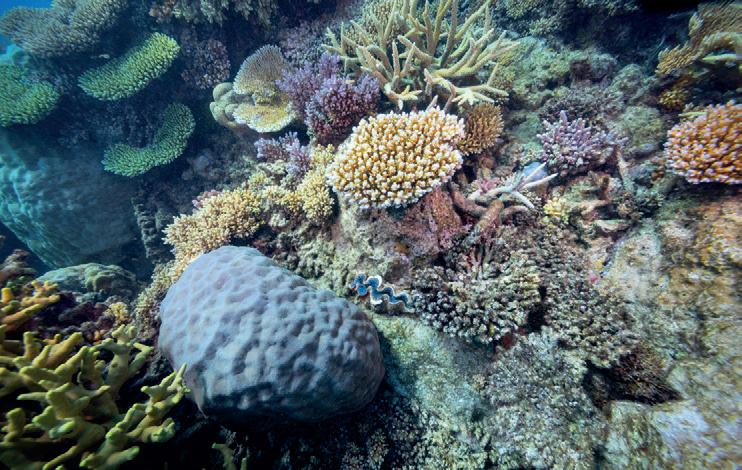
Every time I looked at photos or videos from coral reefs, I couldn’t help thinking: there’s no way those colors are real.
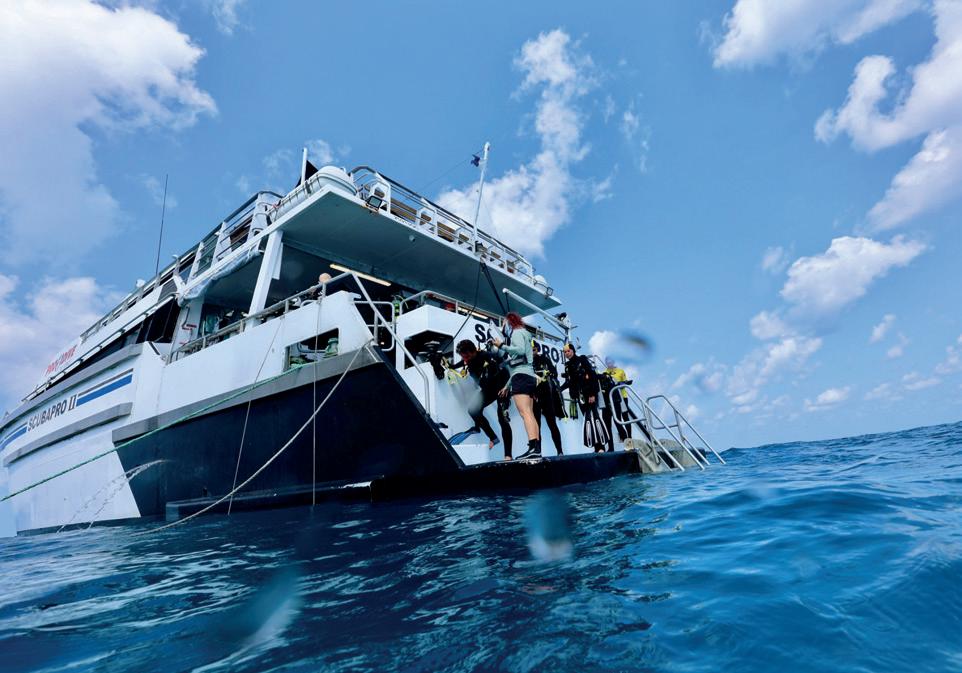
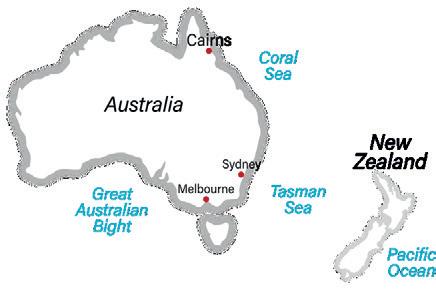
The long-awaited moment had finally arrived – Wojtek’s dream (and mine too – although he had been dreaming about it longer, haha) was about to come true: Australia. Jumping kangaroos, koalas in eucalyptus trees and, of course, the Great Barrier Reef. Because if you are going to start your reef adventure, you might as well go all in… ;) Well, I am something of a diving anomaly – I have never been to Egypt. The thought of a liveaboard on the Great Barrier Reef filled me with extreme emotions… on the one hand fear (because seasickness, because sharks, because jellyfish...), and on the other excitement… because it was the Great Barrier Reef (!), because Nemo,
because maybe thousands of creatures I had never seen before. This liveaboard was the grand finale of our almost month-long stay in this part of the world, so the thoughts swirling around in my head were giving me a pretty hard time.
We were sailing out of Cairns. The first few hours were a disaster. The worst-case scenario was coming true: seasickness. The acupressure bands didn’t help, looking at the horizon didn’t help, and the pills didn’t really have enough time to kick in… Wojtek was probably happy, because he got double meals ;) I was praying for a quick return to dry land and, deep down, cursing the day I had let myself be talked into this. The
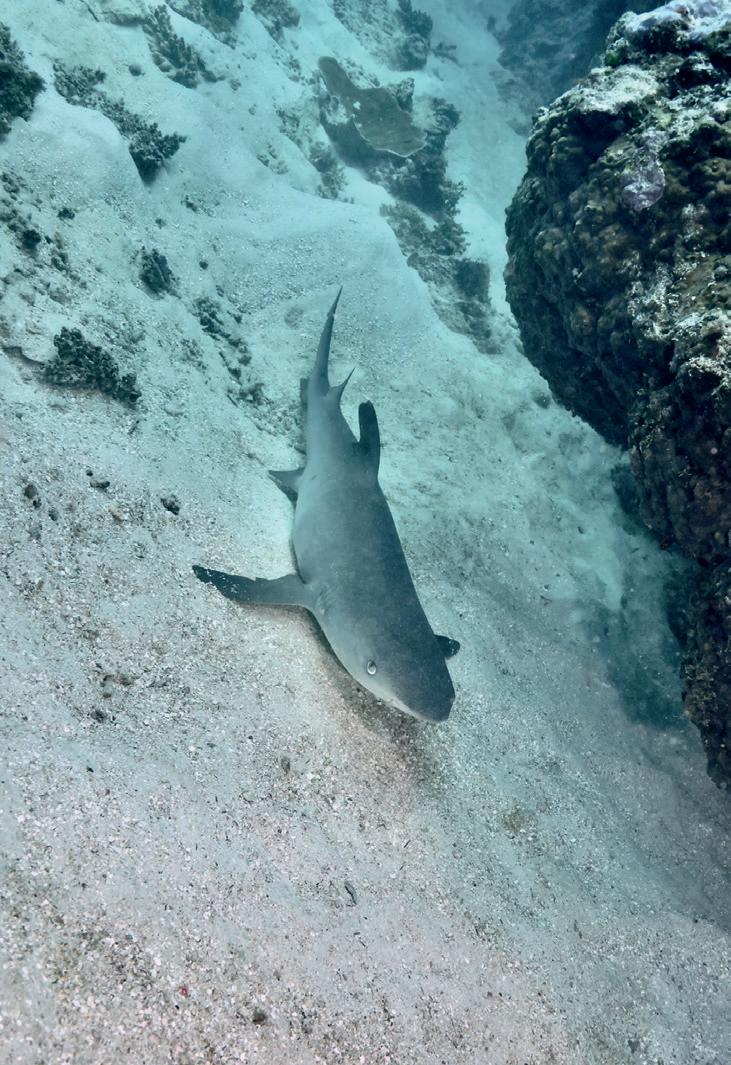
only consolation was that I was not the only one, and I finally understood how support groups work – suffering brings people together. Fortunately, once we entered the Reef, the waves calmed down and I could breathe again. One thought stayed in my head: let this whole escapade be worth it.
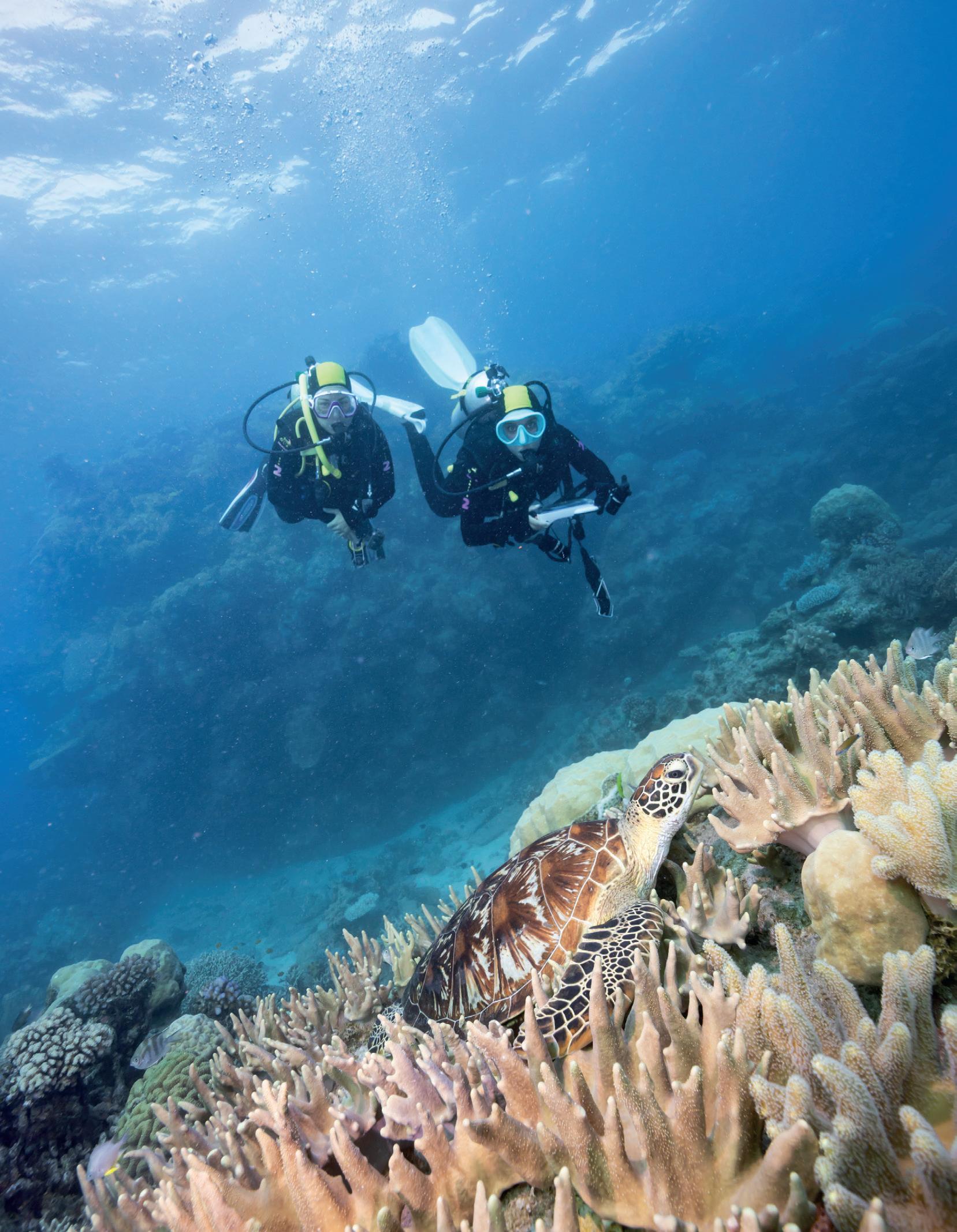
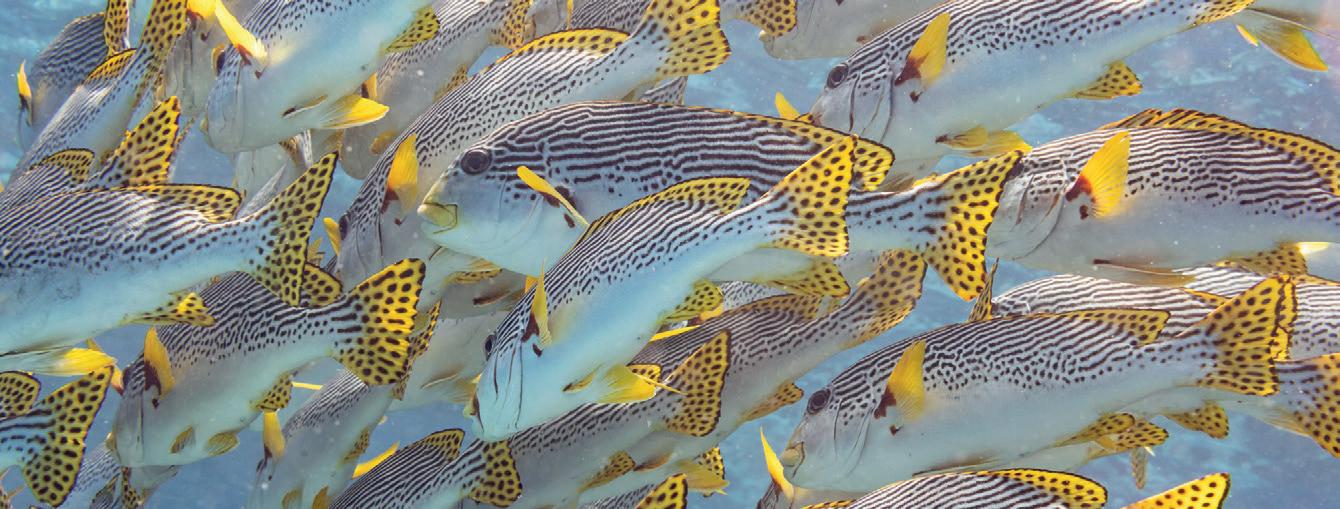
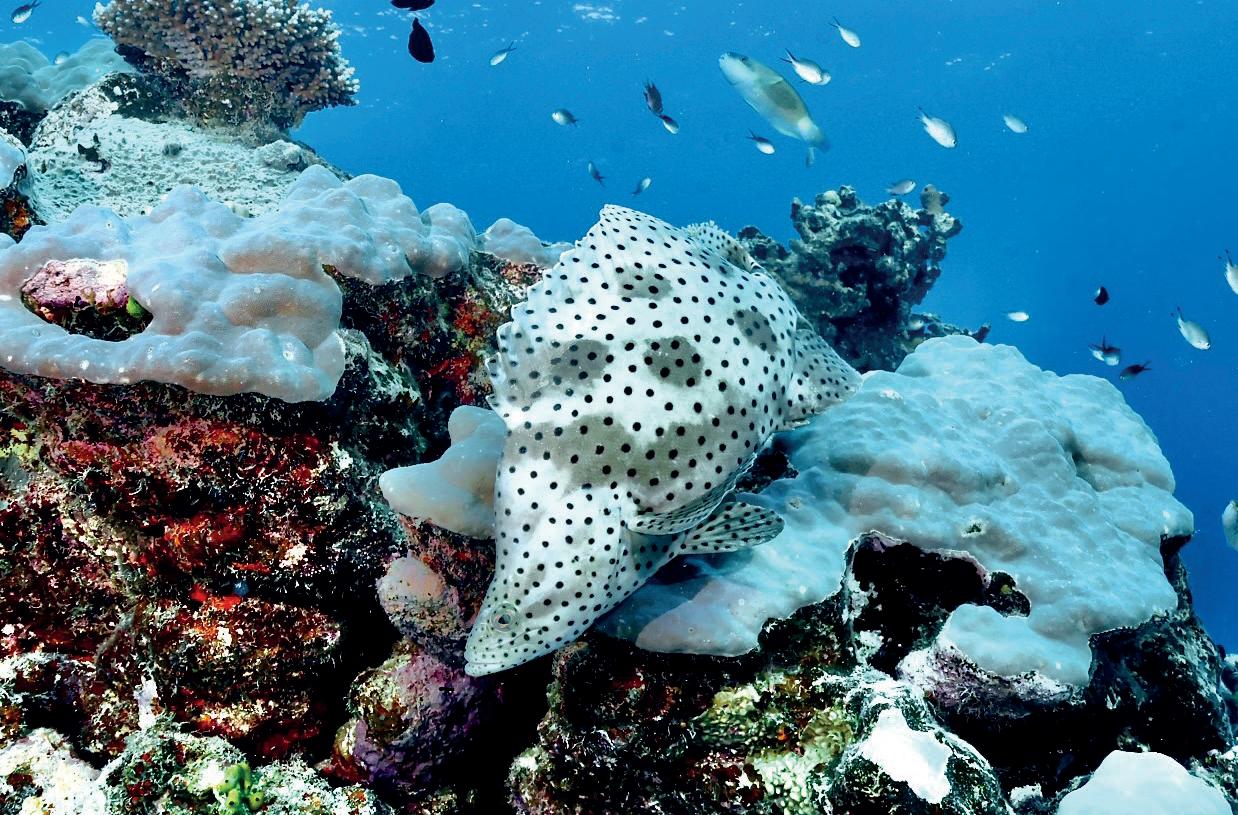
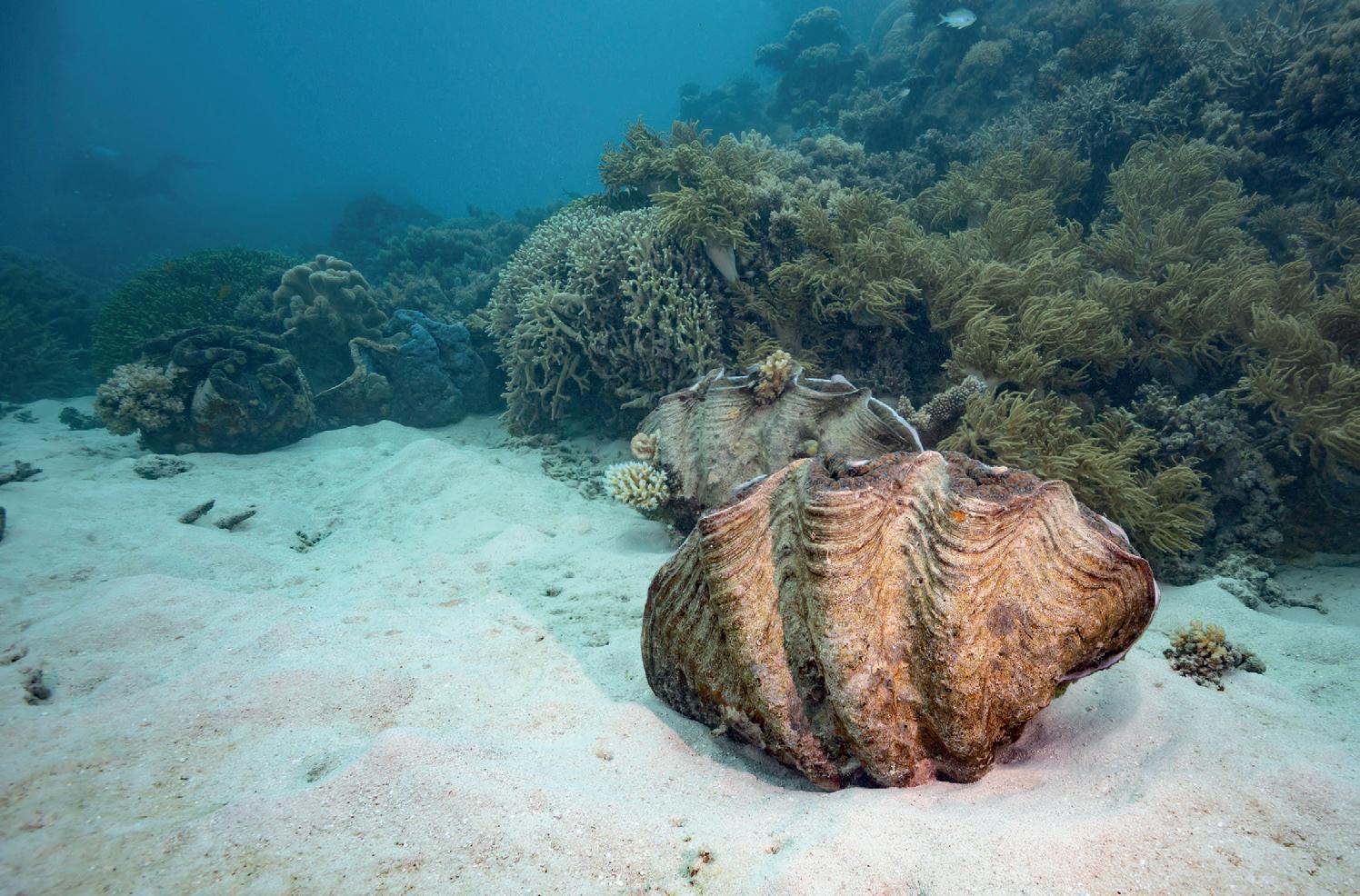
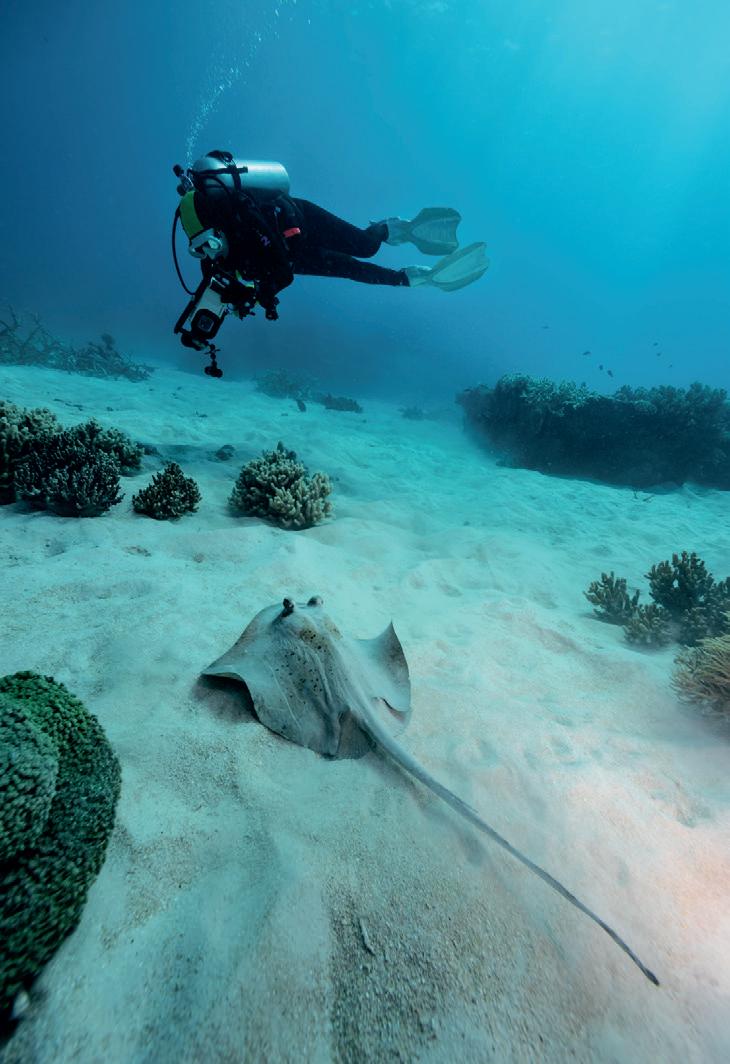
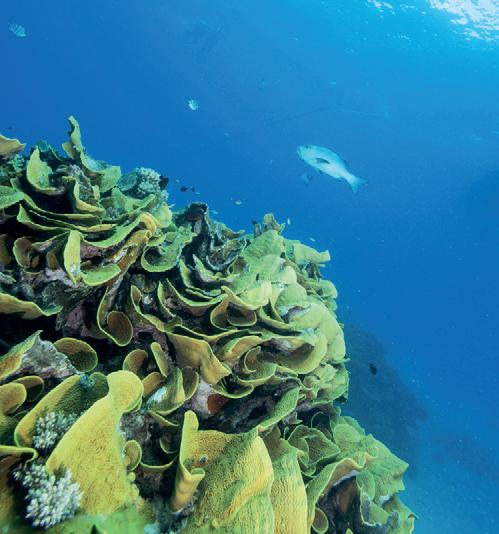
The water was wonderfully warm. 28 degrees. That was the first plus. We were given stinger suits – Lycra suits that protect against jellyfish. The dive briefing was quite important, because dives here are done without guides. Unless someone really needs one, in which case, for a not-so-small handling fee, you can dive with a guide. Efficient gear setup and splash into the water… aaand… I can’t believe my eyes!!! Shock! Sooo many colors, sooo many fish, smaller ones, bigger ones, yellow, red, and look at those anemones, and those corals, and look – a turtle! And over there, a ray! So they weren’t lying after all! Nothing has been exaggerated! For a moment I wondered whether overdosing on Aviomarin might cause hallucinations ;) But from the faces of my fellow divers, I realized they were seeing exactly what I was seeing. A wonderful, perfectly interconnected ecosystem straight out of a paradise story.
What should I do? Admire it? Record videos? Take photos? It’s hard to decide – on the one hand, you want to simply be there and stay in that moment, and on the other, you want to have material to show this beauty to the non-diving world, so that they too can quietly wonder, “Surely this hasn’t been slightly enhanced…?” How good it is that we’re staying here for a while…
Back on the boat, I kept replaying everything in my head, and with the seasickness pills finally working, I managed to fall asleep – only to be woken up at 5:30 for… the next dive :) Well, not only was this my first real encounter with a coral reef, it was also my first liveaboard. Four dives a day – that is a real treat, especially once you’ve adjusted to life at sea and can actually eat again. It was a pioneering trip for me also because it was my first encounter with “real” sharks ;) Until then, the only ones I had ever seen were angel sharks. Here, I had the chance to see whitetip reef sharks and grey reef sharks. Noble creatures, inspiring more admiration than fear, moving with agility and grace between coral colonies. Not exactly keen on posing for the camera though. During a night dive, we were incredibly
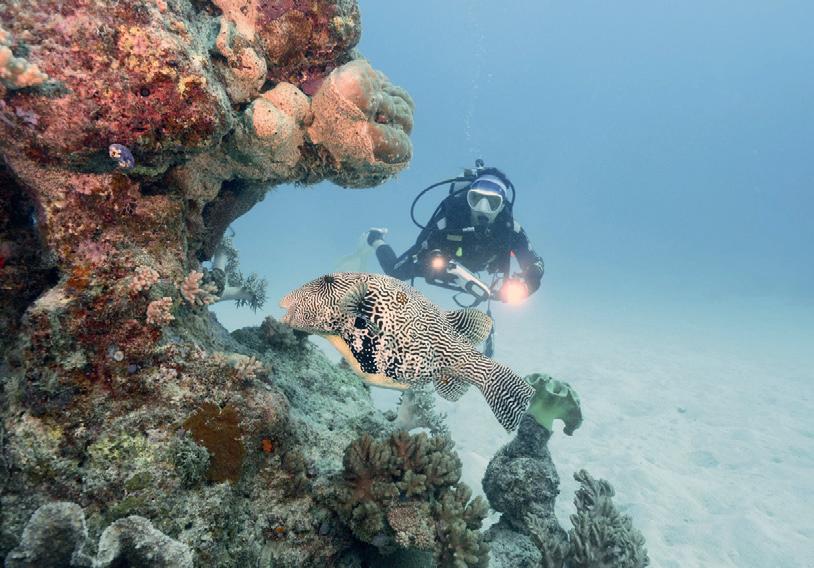
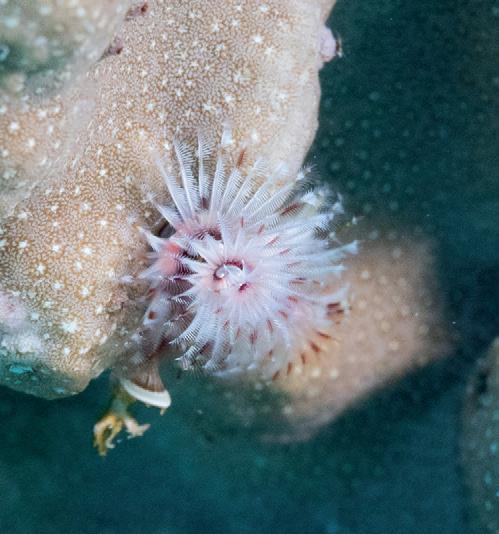
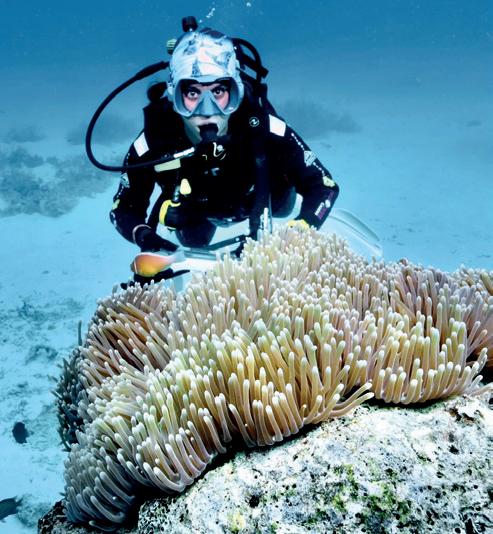
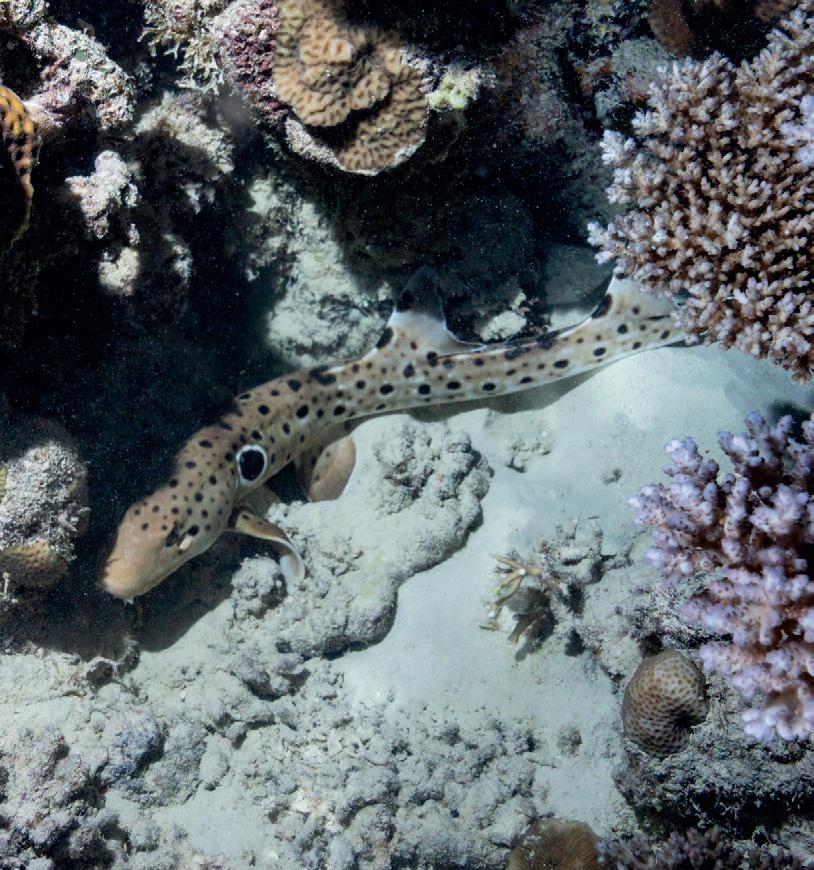
lucky to see an epaulette shark, which is not encountered very often. Its name comes from the large black spots edged in white, resembling military epaulettes, while its characteristic feature is its strong pectoral fins, which allow it to “walk” across the bottom, over shallow reefs, and even between tide pools during strong low tides. It’s a shame it is quite shy, because getting a full-body photo of it in all its glory is so difficult.
On night dives, a powerful light was attached to the boat to make it easier to find our way back. On one of those dives, as we were already heading toward the boat, we noticed four sharks swimming in circles near the ladder. You know that meme where daddy shark teaches his son to circle a human a few times before eating him, so he doesn’t eat him with all the sh… still inside? ;) Of course, at that exact moment it shot straight into my head, and a laughing fit underwater was inevitable ;) Luckily, those sharks were not particularly interested in making contact with us and kept widening their circles as we ascended. The whole team surfaced with the same headcount, and even the number of fingers checked out.
I don’t even know when we reached the end of this trip. There were so many emotions underwater that between dives I used every free moment to sleep and recover. Now all I can do is wait for the next adventure and share with others what I was lucky enough to see.
Text and photos Anthony LEYDET
A paradise for honeymooners and travelers seeking the ultimate tropical escape, with its postcard landscapes, turquoise lagoons, and coconut palms casting refreshing shadows over coral-white sands, the MALDIVES ARCHIPELAGO is, above all, an incredible and infinite sanctuary for marine life.
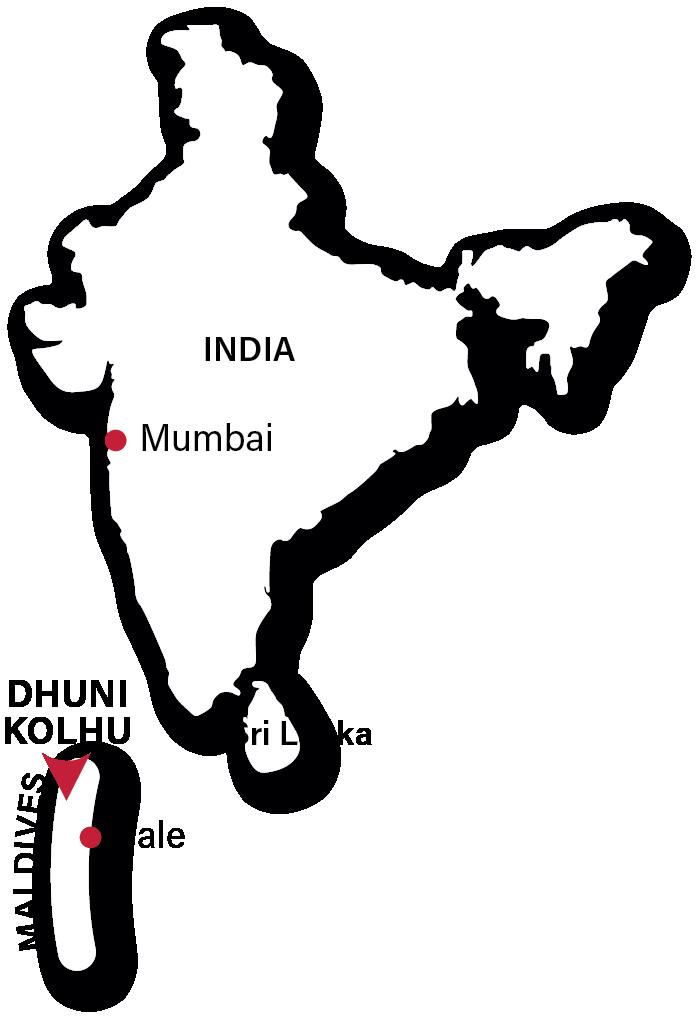
While many diving enthusiasts dream of a liveaboard to cover the best sites in a short window, a land-based stay offers a unique opportunity to truly soak in the wild atmosphere of this vibrant archipelago. Join me as I explore the small island of Dhuni Kolhu in the heart of Baa Atoll, managed by the Coco Palm eco-resort, whose multi-award-winning eco-responsible commitment sets a gold standard in the region.
Dhuni Kolhu: a rough diamond in the heart of Baa Atoll
Arriving in Malé, the capital of the Maldives, is somewhat disconcerting. After long hours of flying, one longs for immediate paradise, yet the reality is quite different: it is concrete, traffic, and high-rises that first greet tourists. But our "bird of paradise" is waiting. Comfortably settled
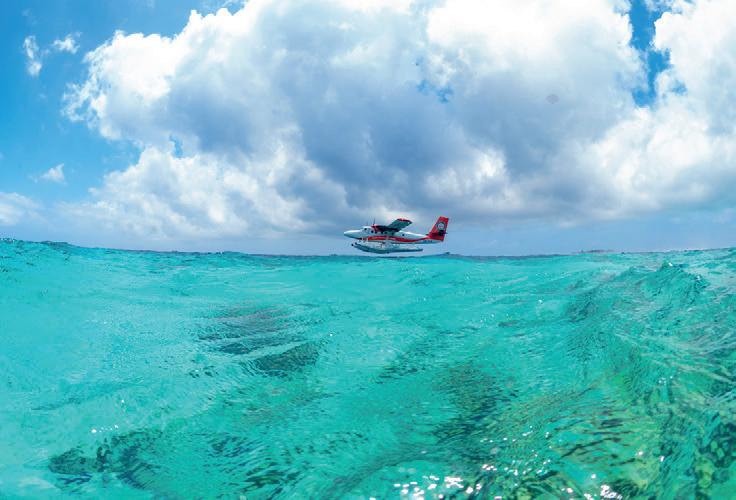
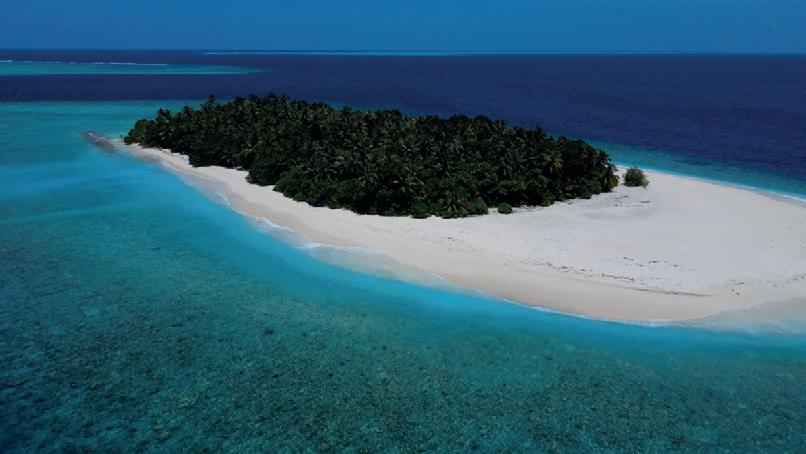
(or nearly so!) in the small cabin of a seaplane, the two Trans Maldivian Airways pilots, resplendent in their uniforms and "cockpit flip-flops", throttle up from the channel. We soar northwest toward Baa Atoll, a UNESCO Biosphere Reserve. After a 45-minute flight over islands and ocean in a thousand shades of blue, we splash down in front of Dhuni Kolhu. A true paradise measuring 630m long by 260m wide, the island is blanketed in dense tropical forest and fringed by coral sand beaches that melt into translucent waters. Within moments, you are immersed in a postcard that has finally become real.
The choice of this island was an easy one, given the environmental dedication of the Coco Collection brand, which has worked for years to protect nature both on land and at sea.
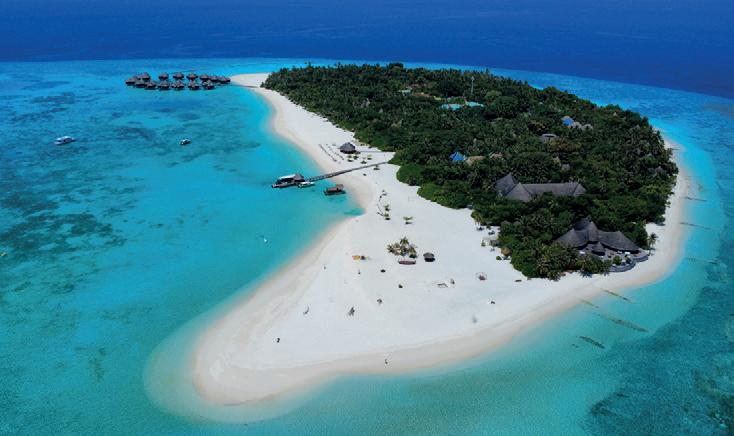
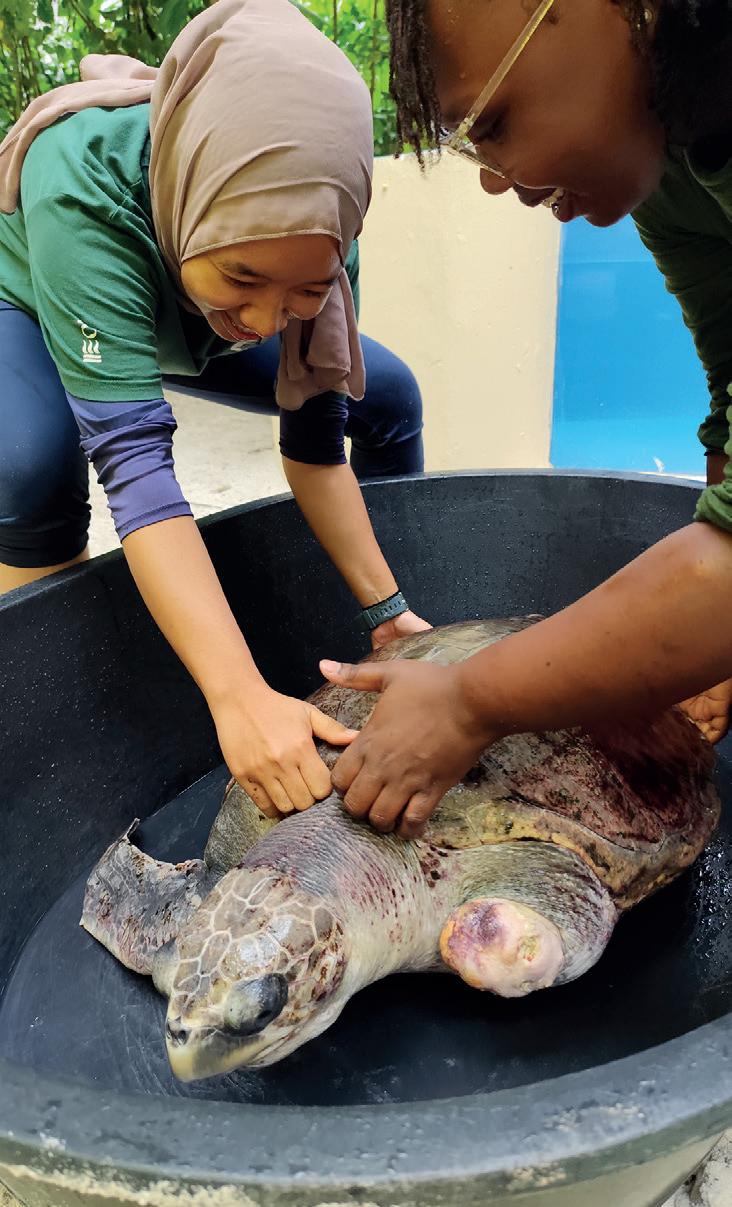
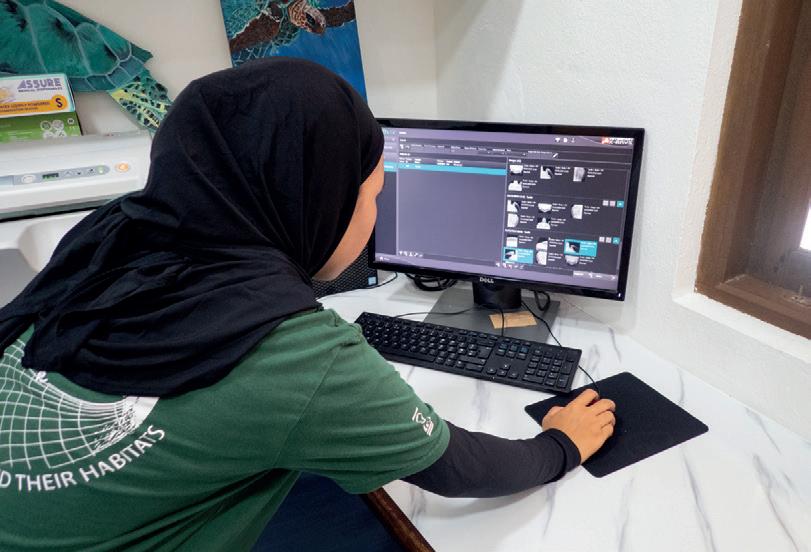
This devotion has been recognized with numerous awards, establishing Coco Palm as one of the most eco-friendly retreats in the Maldivian archipelago. Plastic is banned, drinking water is bottled directly on-site, there is a dedicated organic garden, and a strict policy of using sustainable materials avoids all waste. Furthermore, a solid partnership with The Olive Ridley Project has established a sea turtle rescue center on the island. A permanent marine biologist educates guests through weekly lectures and hands-on field sessions, such as coral gardening and the monitoring of numerous turtle nests. The "barefoot" lifestyle, the island's relaxed vibe, and the villas, luxurious yet essential and perfectly integrated into the forest, evoke a sense of authenticity, a rediscovery of the Maldives of yesteryear.
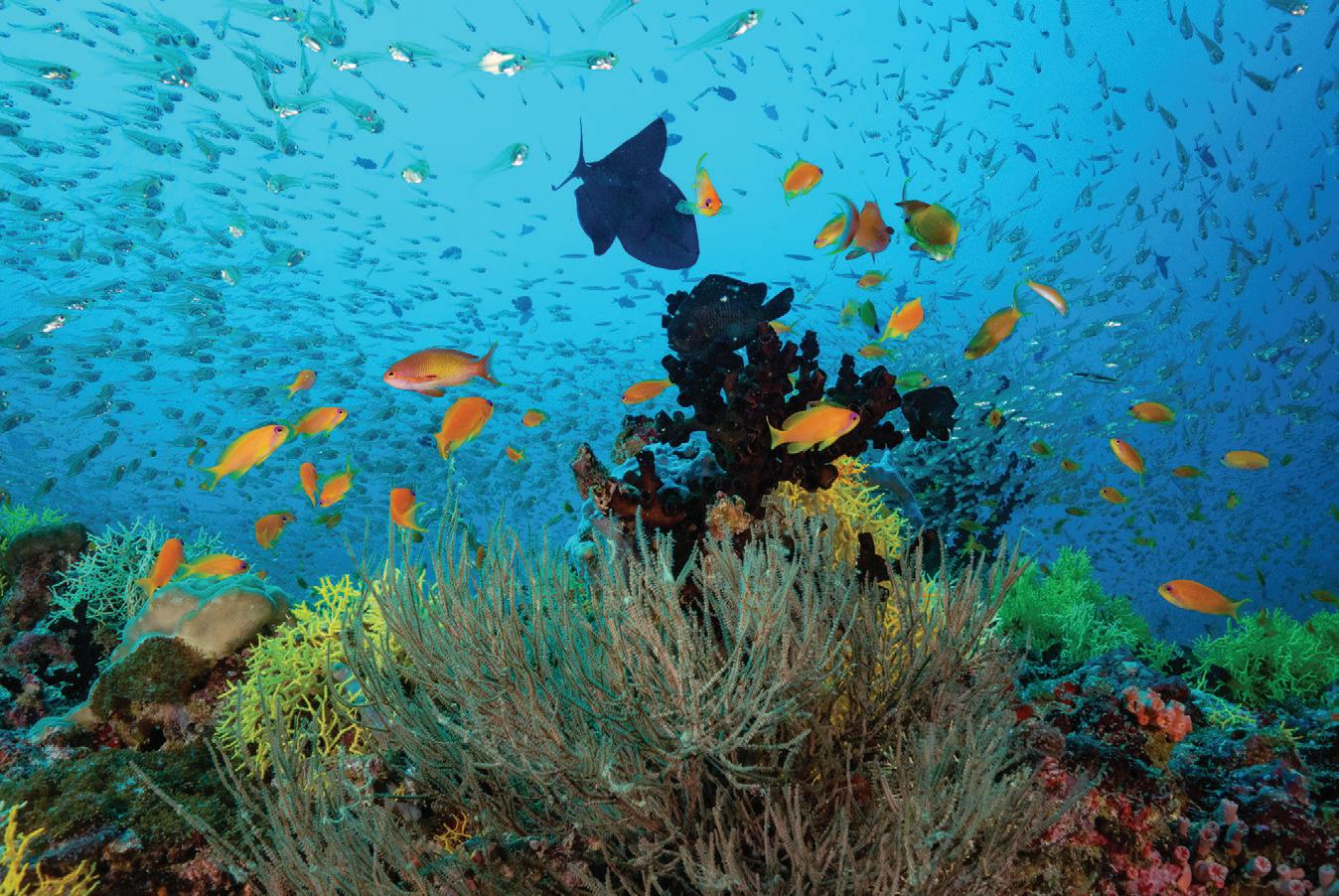
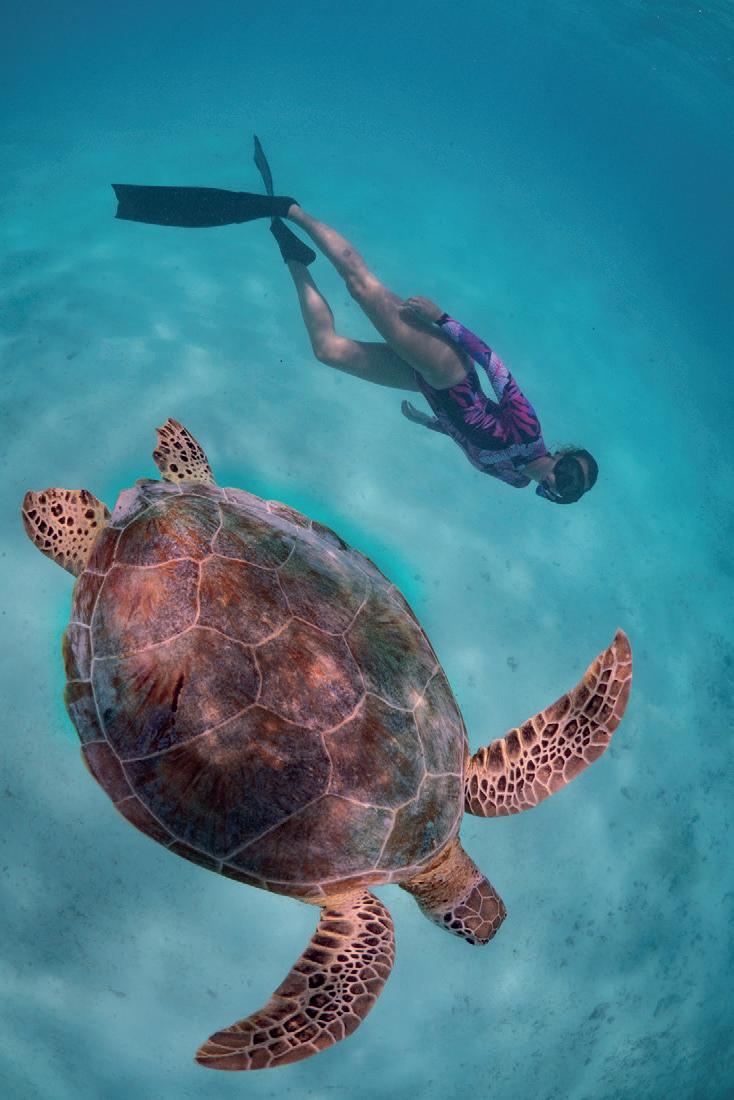
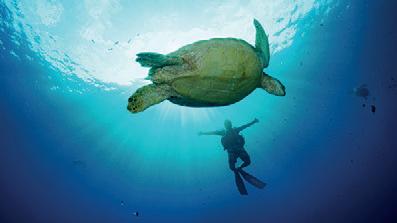
It doesn't take long to understand that everything here is geared toward turtle protection. A simple snorkel off the main beach allows anyone to observe green turtles grazing peacefully in the nutrient-rich seagrass beds, occasionally crossing paths with a blacktip reef shark or elegant stingrays. The other side of the island, more heavily decorated with coral, is perfect for encountering hawksbill turtles and a vast collection of tropical fish.
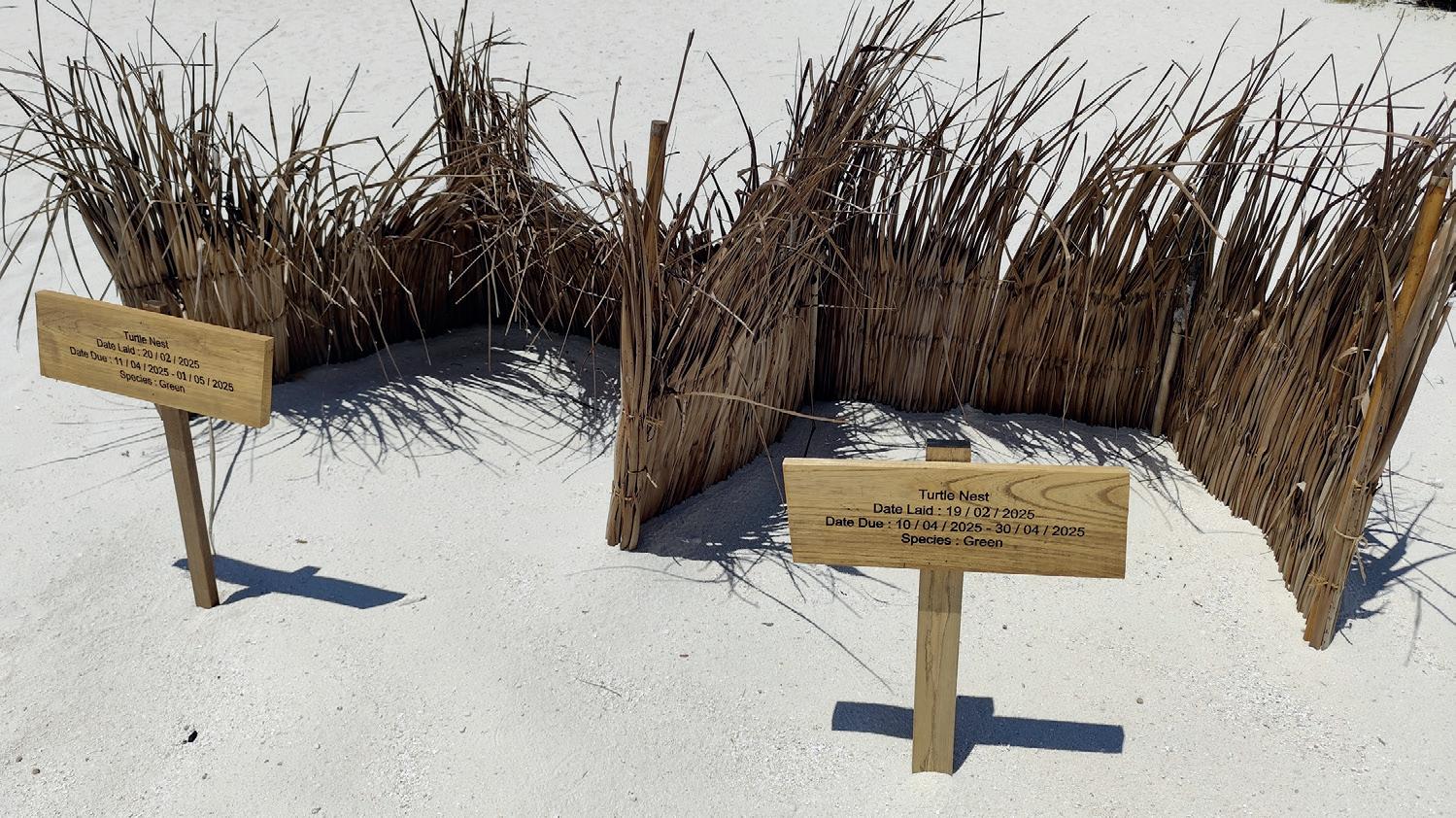
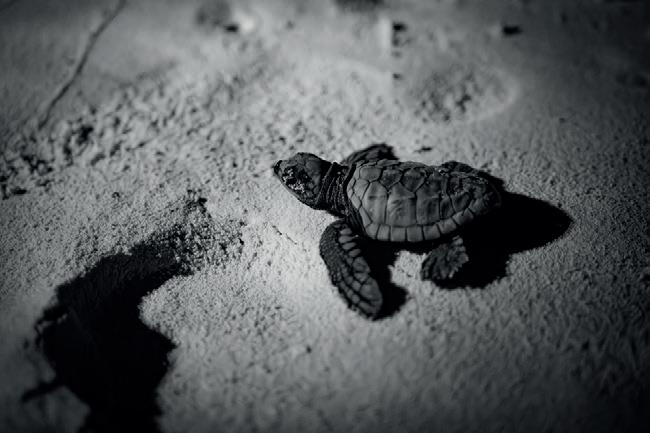
A stroll around the island takes less than 30 minutes and reveals numerous turtle nests, all marked and protected with data such as the laying date, species, and expected hatching period. Three species come to lay their eggs on Dhuni Kolhu’s beaches: hawksbill, olive ridley, and green turtles. With a bit of luck, guests can witness the emergence of hatchlings under the strict supervision of the marine biologist, a deeply respectful and unforgettable experience. Further inland, the Marine Turtle Rescue Centre houses basins primarily for olive ridleys (Lepidochelys olivacea). Less familiar to divers, this is essentially a pelagic species that too often falls victim to abandoned "ghost" fishing nets.
Baa Atoll: a Biosphere Reserve and underwater paradise!
Set within a lush landscape, the Coco Dive PADI diving center is welcoming, spacious, and perfectly organized. Harsha and his team, always smiling, are passionate about sharing the area’s premier sites. More than twenty nearby dive sites await those eager to explore Baa Atoll’s depths. The verdict is always the same: the biomass is staggering. Life is incredibly abundant, particularly at sites like the thila named 12.5 (a "thila" is an underwater coral mount that attracts prolific marine life); Rangali Faru, a superb drop-off dotted with caves; or Muthafushi Thila, which we discovered under a dense blanket of fish, a theater for underwater hunting where jacks and sharks took turns claiming their prey. Located in the southwest of the atoll, a one-hour boat ride reaches the famous Hanifaru Bay, the annual gathering site for manta rays from June to September (a phenomenon dependent on currents and plankton density).
When tourists participate in coral reef preservation
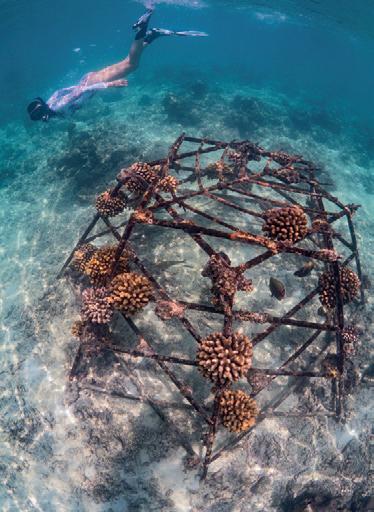
As part of their eco-responsible mission, Coco Collection works actively to preserve coral reefs. In the lagoons of their two islands (Dhuni Kolhu in Baa and Bodu Hithi in North Malé),
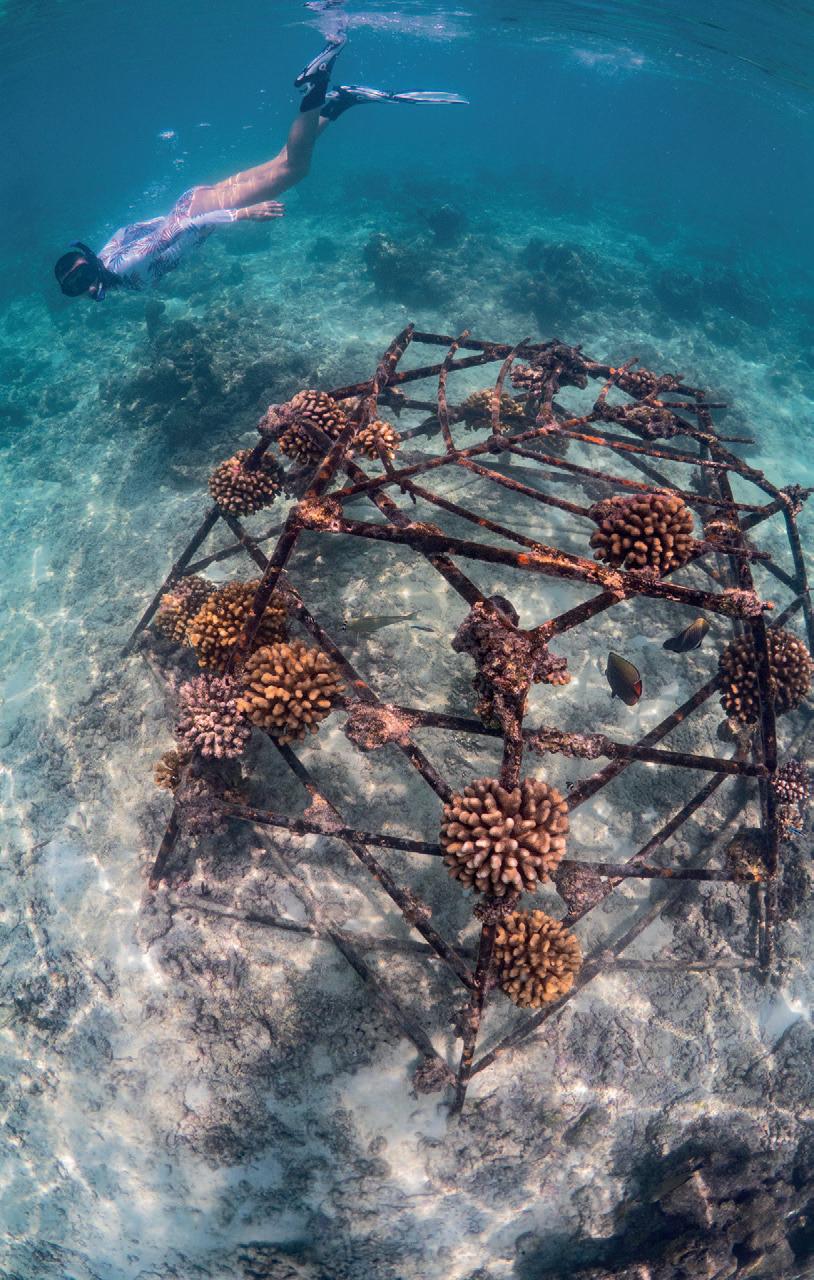
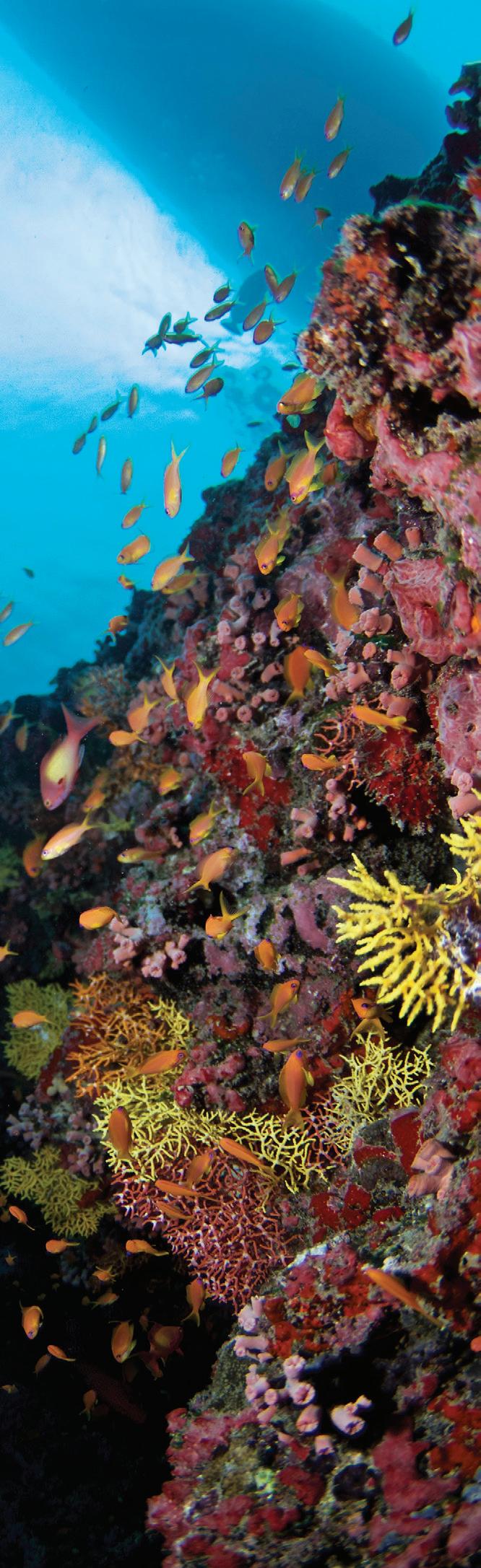
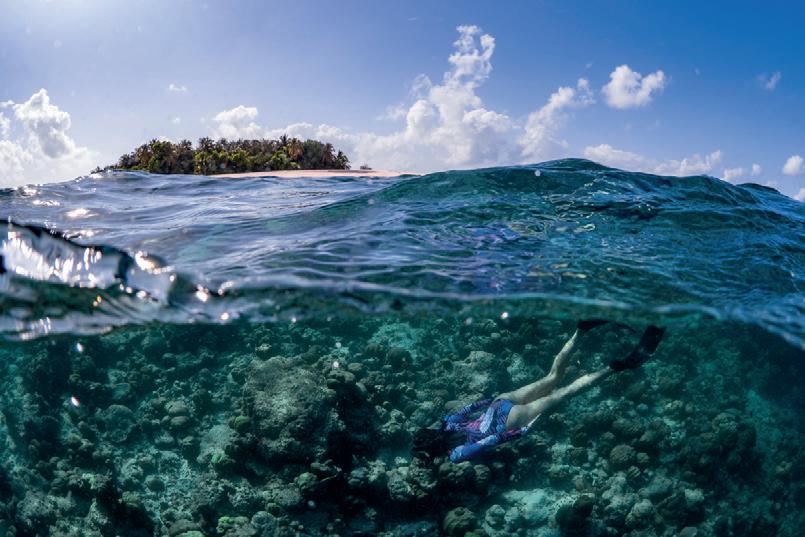
marine biologists organize coral gardening sessions for guests. This allows everyone to contribute to reviving a portion of the lagoon, creating a coral nursery as a tribute to a loved one or a souvenir of a honeymoon. After an educational briefing, "budding gardeners" attach small pieces of coral, naturally broken fragments collected by the biologist, onto a metal structure. The structure is then submerged alongside existing nurseries, some of which have shown remarkable growth. Almost immediately, curious fish arrive to welcome their new home. We can only wish a long life to these coral fragments!
Just a 15-minute speedboat ride from Dhuni Kolhu, you can enjoy a once-in-alifetime experience: being dropped off on a desert island to spend a few hours or even a night. After a few safety instructions (you still keep a cell phone in case of problems), this tiny private island, completely deserted (except for a few chickens and rabbits), is wide open to you: BBQ, naps, swimming, snorkeling, exploring the trails, everything you need to feel like an adventurer!
Dhuni Kolhu offers the certainty of discovering a wild and preserved nature, far from mass tourism, where marine life remains flourishing. It is a form of tourism that seamlessly blends luxury with authenticity. Watching this pearl of the Indian Ocean fade away from the seaplane window brings an inevitable pang of regret, but you leave with a head full of unforgettable images.
Anthony LEYDET IG: @anthonyleydet_uw_photography
have been delivered to our editorial team for testing:
We've done a few dives with them – the deepest up to 40m – and let's take a look at the Nautic S first, because it deserves special attention.
Text and photos PERFECT DIVER
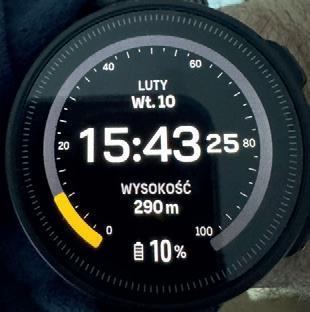
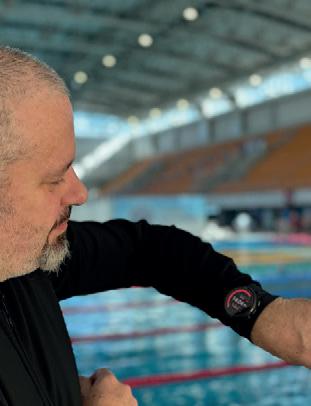
The Nautic S is a watch-sized dive computer with a ~50 mm diameter and a weight of ~81 g. It has an optimal size: it looks modest and businesslike, much less bulky than "technical bricks", fits comfortably on the hand and is easy to hide under the cuff of the shirt. Thanks to the widgets, you can personalize the appearance of the watch face, which is very practical in daily use.
The AMOLED screen makes a big difference – it gives you perfect black, high contrast and vivid colors. In practice, this means very clear display even in murky water; PPO2 and decompression alarms are highly visible, and at the same time the device saves the battery. Nautic S performs brilliantly underwater – we tested itamong others, under ice, in the Mediterranean Sea and in swimming pools in various conditions. The snorkeling/freediving function works flawlessly, and watching the computer work while diving with the equipment was pleasant and comfortable.
Functionally, it is a versatile piece of gear: featuring multi-gas, trimix, sidemount, tank pressure integration, a compass, as well as GPS and maps. The Buhlmann ZHL-16 algorithm with Gradient Factors was used; PPO2 can be set in the range of 1.0-1.6 ata. The computer supports up to 5 gases (Nitrox/Trimix) and has a declared maximum depth of 80 m. The Gradient Factors preset is set to "Medium" (40/95) by default, but the user can choose a more aggressive 45/95 or a more conservative 35/75.
The battery lasts up to about 60 dives, which translates into several days of intensive use without recharging. However, it should be remembered that the Nautic S is not a full-fledged smartwatch and has limited sports features. The dedicated textile strap is comfortable, although it may turn out to be too short for a very thick suit. This is certainly not a classic "tech computer" for extremely advanced applications.
TO SUM UP:
The Suunto Nautic S is a modern, 'pure' dive watch – making it an excellent choice for freediving, recreational, and light technical diving. Elegant for everyday use, practical underwater and legible in difficult conditions.
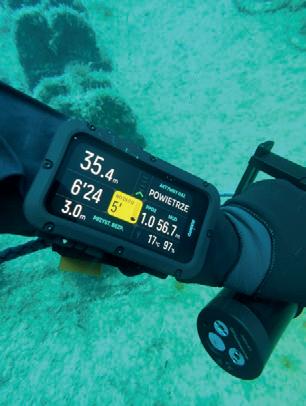
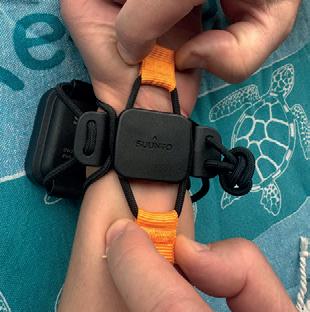
When "switching" from the watch-size computer to Suunto Nautic, the higher weight of the device (232 g) is immediately noticeable, which is related to its dimensions and larger display. We tested two types of straps: a textile Velcro strap, which unfortunately proved to be far too long for me in practice, and a bungee cord, which turned out to be the perfect choice for a very slim wrist. The adjustable elastic bands allow for complete customization, while the fastening mechanism ensures quick and convenient donning and doffing.
The large and very clear display gives comfort during diving and we have the ability to configure the screen according to our needs and preferences. The interface is very intuitive and simple – changing gases takes just a few clicks.
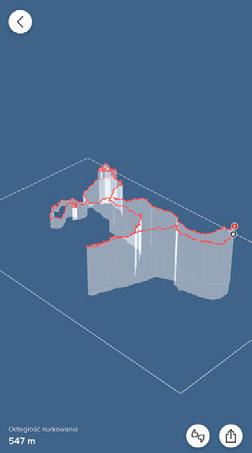
The computer is also equipped with a digital compass and a flashlight – an important backup on every dive – and GPS. The icing on the cake is the application, with a logbook, which also saves the dive route, not just its profile. A very good dive computer that meets the needs of divers at various levels of proficiency. The manufacturer declares the possibility of diving up to 200 m. Suunto Nautic uses the Bühlmann 16 GF diving algorithm with the ability to modify gradient coefficients.
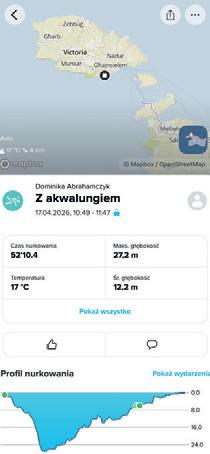
Text Marcin TRZCIŃSKI
Photo Adam SOKÓLSKI
There are people who like small things. You know, Snow White, the Japanese, the engineers responsible for designing the Fiat 126p, and… Adam. Ever since he got involved in the Blue Photo Adventures project dedicated to underwater photographers, somehow, purely by coincidence, all of their trips lead to the islands of the Pacific Ocean. And not to World War II naval battle sites full of wrecks for wide-angle lenses, but to dive sites described in diving guides as macro paradises.
Exposure settings: M mode, 1/250 s, f/18, ISO 200
Camera:
OM-System OM-1
Lens:
OM-System 90mm macro
Housing: Nauticam NA-OM1 + flat port
Lighting: 2x Inon Z240
One such place, which attracts people with serious eyesight problems (apparently at least 12 dioptres defect is recommended), is Tulamben in Indonesia. Located on the northeastern coast of the island of Bali, this village is like a temple for them, where they add more invisible-to-the-naked-eye creatures to their “must see” lists. The black volcanic sand covering the ocean floor is full of organisms that no one except them is able to notice. This is no longer even macro photography, but something on the border between mega-macro and microscopic imagery. That is why in such places, just as important as photographic skill and attentiveness is having a good guide –a spotter who knows what to look for and where in this extraordinary scenery, and who can successfully be considered a co-author of the resulting images.
Adam himself does not hide this: “For some time now, while diving in Tulamben, I’ve had the same guide – Dyon. I consider him excellent: calm and with a remarkable eye. In macro photography, a good guide is absolutely essential, you can have the best equipment and experience, but without someone who knows the seabed like the back of their hand and can spot a millimetre-sized detail among sand and stones, many things would simply be missed.”
On that day they were diving together.
“Dyon moved slowly, methodically, with the characteristic focus of someone who knows that the greatest wonders are the smallest ones. At one point he stopped and gently pointed at something tiny on a rock. I swam closer, but honestly I couldn’t see anything specific, just a bright speck, maybe a grain of sediment. Something so small that it was hard to perceive any shape with the naked eye. But if he was pointing at it, it had to be something special.
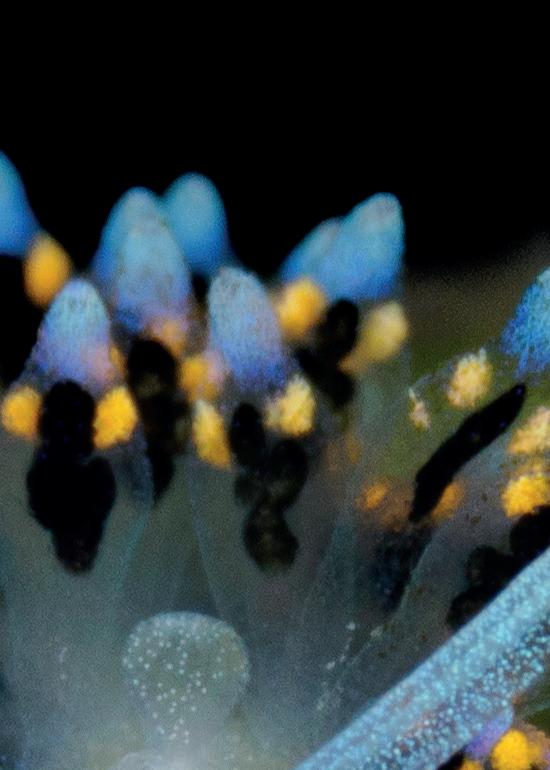
I lay down on the seabed, in Tulamben it is mostly sandy, so with proper care you can lie or kneel without damaging anything. I stabilized the camera and took the first shot almost ‘blindly.’ I looked at the display and zoomed in. On the screen a delicate, almost transparent silhouette stared back at me, with small, leaf-like appendages. It slowly began to dawn on me what I was looking at. Stiliger species – one of my favourite sea slugs, which I had previously only seen in other people’s photographs. This time it was right in front of my mask, in real life. The emotions were immense. Even after thousands of dives, I can still feel that childlike thrill of excitement when I discover something for the first time. And this was exactly such a moment. I began working even more carefully, every movement had to be controlled so as not to stir up sediment and lose this microscopic model. I stabilized the camera and brought my eye to the viewfinder. The world suddenly expanded. The model’s body structures became distinct, subtle colours began to stand out from the rock background. What a moment ago had been an almost invisible dot transformed into a complex, perfectly designed organism. In moments like these, a person can even forget to breathe…
When I surfaced after the dive, I knew I would remember this day for a long time. Even if you think you’ve seen everything already, the ocean can still surprise you. Tulamben once again reminded me that in the ocean, the greatest emotions are often just a few millimetres in size.”
Adam Sokólski’s story was listened to and then written down by Marcin Trzciński
My previous article was a story about beginnings –about how, many years ago, I first fell into the world of underwater macro photography.
This one is about a trip I have only just returned from. I wrote it almost immediately, before the memories had time to fade – with my head still full of images and emotions from the latest dives, still feeling salt on my skin, sun on my face, and wind in my hair.
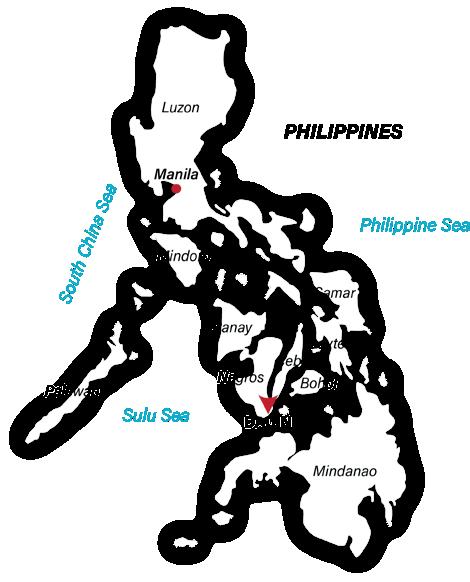
This time, in pursuit of small, strange, and extraordinary creatures, I ended up in Dauin in the Philippines. This place often gets lumped together with nearby Dumaguete, but in reality, it’s Dauin that’s the true destination for macro photographers. Maybe it’s not as widely recognized as Anilao, but within the community it’s known as one of the best macro photography spots in the world – and after this trip, it’s hard to disagree.
Dauin is famous above all for frogfish. They’re practically everywhere – from tiny, millimeter-sized youngsters to large individuals sitting calmly on mooring lines, in both “hairy” and completely smooth versions, in colors ranging from white, through yellows and oranges, all the way to green and deep black. But
that’s only part of the charm of this place – it’s full of other incredible macro critters too, hidden on the bottom and waiting to be discovered.
Muck diving is the dominant style here – you dive over a bottom that seems completely empty, where absolutely nothing is happening. That emptiness is deceptive. Suddenly, one gesture from the guide changes everything, and a story begins about another strange creature, often difficult to classify. Those are exactly the moments that keep you from taking your eyes off the seabed, and with every dive you feel like something interesting is about to happen.
Right next to Dauin lies Apo Island – a completely different world, full of walls, corals, and open space. For a macro pho -
tographer, Apo isn’t the main goal of the trip, but as a break it works perfectly. After a few days of slow “crawling” over sand, you can step away, look out into the blue, and simply dive without constantly searching. It’s a bit like switching a lens from macro to wide-angle – suddenly everything changes, from perspective to the way you experience your surroundings.
If someone has read my earlier texts, they know that one of the most important elements of a successful photography trip is a good dive center, where people understand the needs of divers shooting with cameras. This was my third trip to Dauin, and only now did I finally land in a place that truly meets those expectations.
Silver Reef Dive Resort turned out to be exactly what a photographer is looking for. No one here is surprised that you spend fifteen minutes with a single critter, and you don’t have to explain why you want to return to the same spot several times. On top of that, there’s a well-prepared camera room where you can take care of your gear in peace and leave it overnight, and guides who can find little creatures that you yourself, even with a magnifying glass, would never notice.
This time my guide was Adrian. Not only did he have an excellent eye and find plenty of strange – often microscopic – creatures on every dive, but on shore dives he also brought an underwater scooter with him, which was a pleasant surprise. It quickly turned out to be a great idea. Instead of wasting energy on shallow stretches or fighting the current on the way back, we could move efficiently between dive spots and focus exclusively on photography. It’s a level of comfort that’s hard to compare to anything else –and one you get used to surprisingly fast.
As expected, there were lots of frogfish. On the house reef alone, we found several – an orange one, a white one, a yellow one, and a black one. Each had something unique about it. Something that made you stop every time and take yet another photo, even after hundreds of similar encounters.
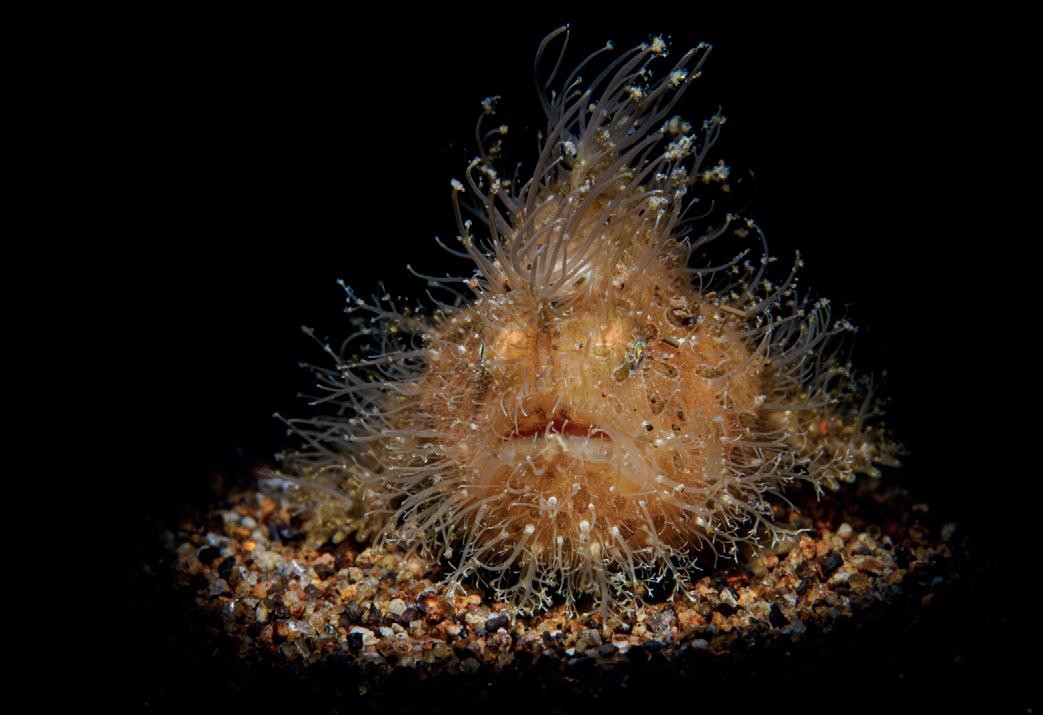
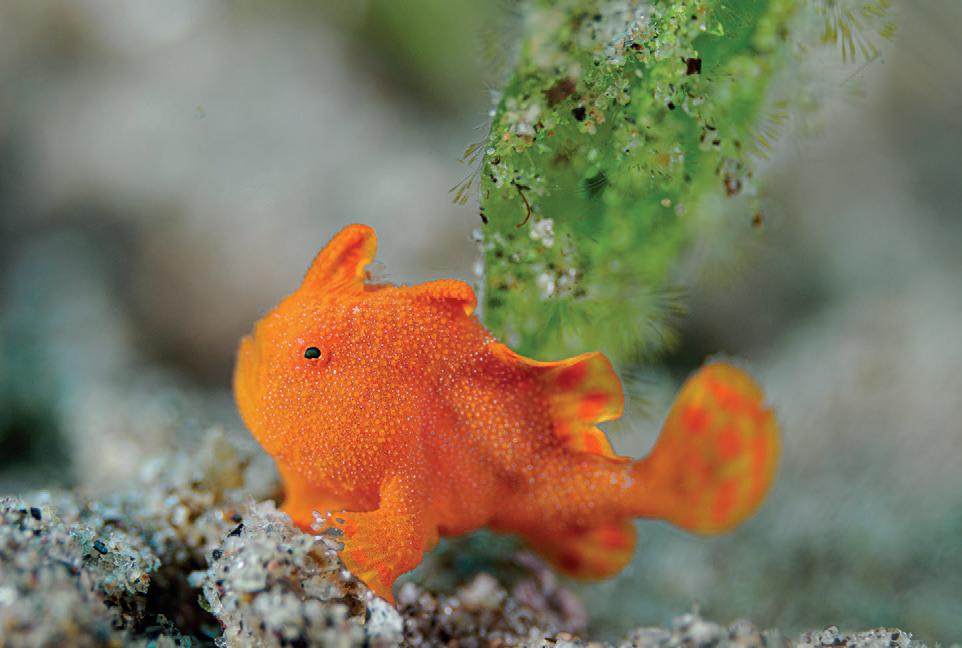
They’re creatures straight out of another planet. They’re especially fascinating when hunting. To lure fish in, a frogfish uses a small antenna with a tip resembling a worm. It waves this lure while pretending it isn’t there at all, blending perfectly into its surroundings. When an unsuspecting fish comes too close, the frogfish “jumps” with surprising speed and swallows its prey. Unfortunately, despite many attempts, I’ve never managed to capture that exact moment in a photo.
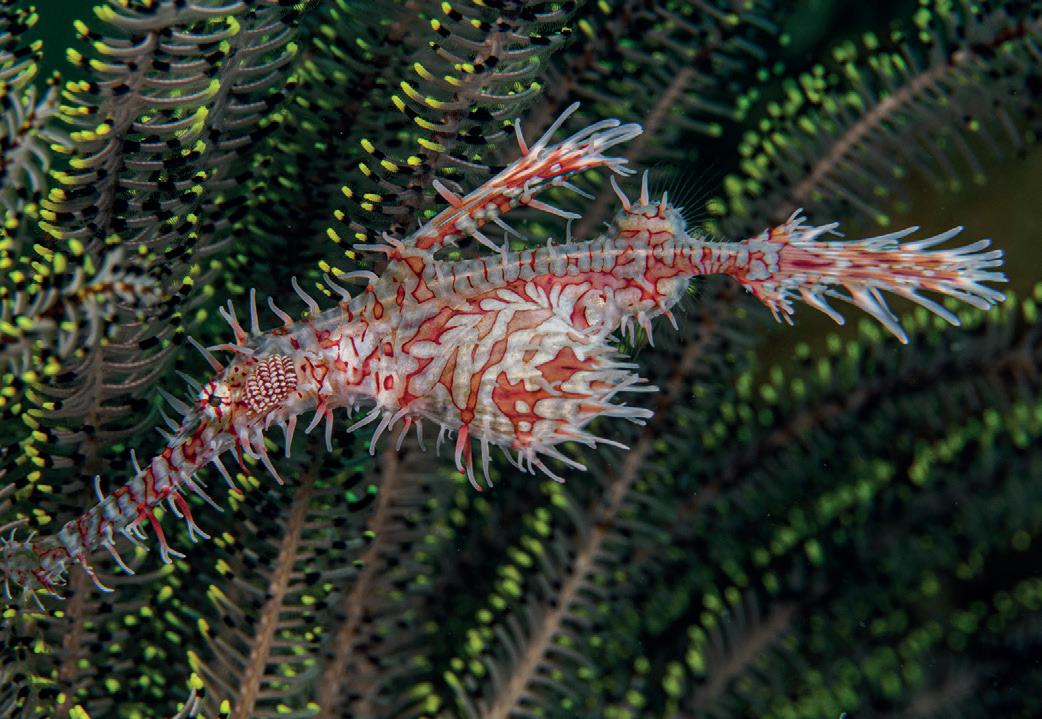
One of the reef’s frequently encountered – and at the same time extraordinary –residents is the ghost pipefish. These bizarre fish usually appear in pairs and hover just above the bottom, with their heads pointed downward. Their coloration can vary widely – from deep black, through intricate colorful patterns, all the way to a solid pink – which, combined with their unusual shape, makes them very hard to spot. We managed to find a velvet ghost pipefish, which was a special experience – even for my guide, who, despite thousands of dives, had only seen this creature for the second time.
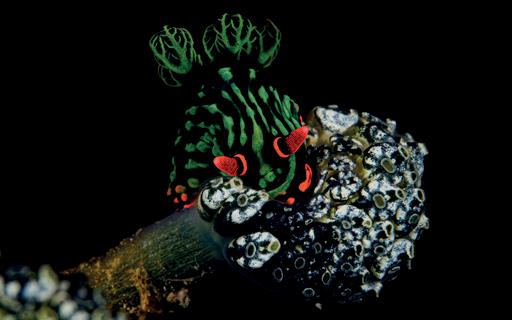
Dauin is a true paradise for nudibranch lovers. One of my favorite “models” is Nembrotha kubaryana – a relatively large nudibranch with a dark body and vivid orange accents. It looks as if it is asking to be photographed. I have come across them many times and know that every now and then they will stop, raise their head, and seem to “look around” – the perfect moment for a successful portrait.
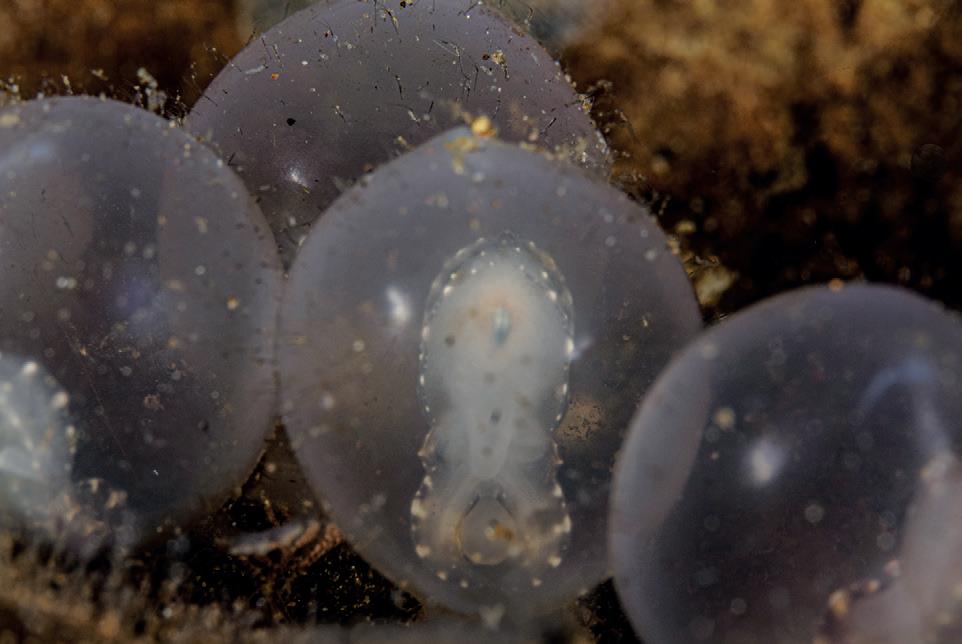
For a long time, I had dreamed of seeing flamboyant cuttlefish eggs in real life –until then I had only known them from photographs. And finally, it happened! We found them one day at one of the dive sites. We came back there several times and watched the tiny cuttlefish develop. Day by day they became more distinct and began to show their characteristic colors. There was something hypnotic
about it. I was really hoping to capture the moment of hatching, but this time it did not happen.
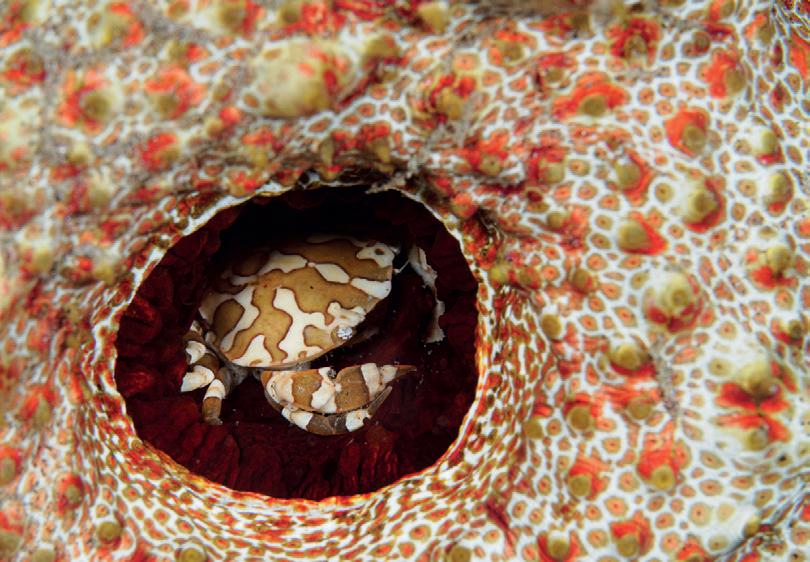
I also experienced something that will stay in my memory for a long time, because it will be hard to “unsee.” An encounter with an “ass crab” (an informal name), meaning a crab that lives in the anus of a sea cucumber. The sight alone was surreal enough, but the real fun began when I started taking photos. It wasn’t easy, because everything happened in the rhythm of the “entrance” opening and closing, so good timing on the shutter was essential. At one point, the sea cucumber decided to end the scene in a way that, all things considered, was probably to be expected, and the crab found itself directly in the line of “fire.” It was one of those moments that are simultaneously comic, slightly shocking, and absolutely unforgettable.
In places like Dauin, there is always something that slips past you and becomes the best reason to come back. In underwater macro photography, it is often the detail you missed that becomes the hero of the next image. Return visits are never the same, because every dive is like opening a small box of surprises –sometimes strange, sometimes funny, always fascinating.
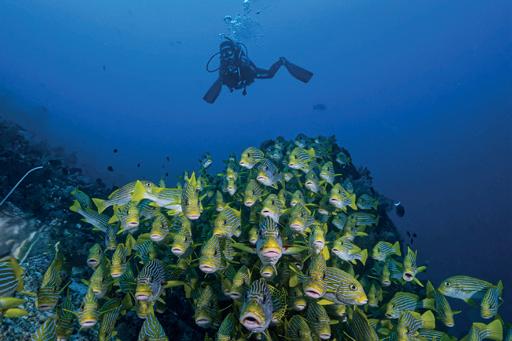
Why we photograph underwater at close range
Text and photos Piotr STÓS
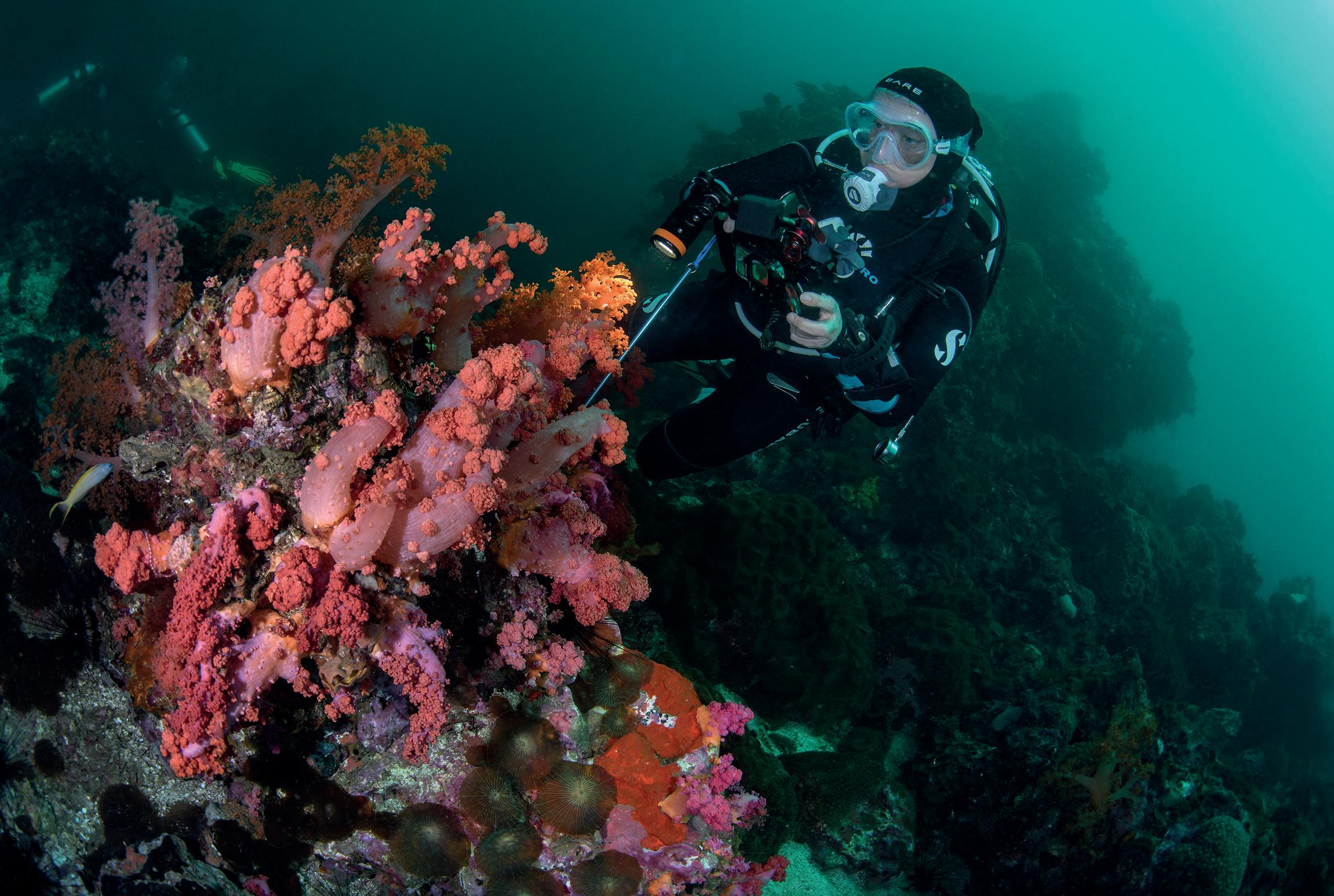
There is no photography without light, and underwater photography also cannot exist without water.
Under natural sunlight, the underwater world is always darker and less colourful than the one on land.
The colour of light, its degree of scattering, and its intensity all change, which does not make photography easier, but gives underwater landscapes an extraordinary charm and the atmosphere of mystery. It is probable that this difference is what holds the greatest appeal of underwater scenery, sending shivers down the spine and making us reach for the camera.
The problem is that water has a very strong effect on light: it absorbs it and gradually strips it of warm colour shades. The quality of the recorded image deteriorates with every centimetre you move away from the object and with every meter of depth.
Unlike air, in which light can travel relatively freely, water, 800 times denser, strongly weakens its beam. Even chemically pure water, free of mechanical impurities, changes the charac-
ter of light regardless of the direction it travels. The situation is even worse in natural bodies of water: lakes, seas, and oceans, where phytoplankton and fine mineral suspension further limit the propagation of light rays.
Therefore, before you start getting frustrated with your first underwater shots, read this article carefully to learn what tools and techniques to use to start taking the best possible photos as quickly as possible.
from the surface: how much light enters underwater
When you squint on a sunny day because of reflections on the water, it means that only the portion of light that does not dazzle you penetrates the surface. When the sun is lower on the horizon, or when the water surface becomes rough, a larger percentage of light is reflected, and it becomes darker underwater.
In discussions and publications on underwater photography, you will often find suggestions to shoot at midday, when the sun at its zenith strikes the water at the steepest angle. Indeed, under such conditions the water will have a beautiful blue colour, and photographing deeper objects such as wrecks will not require pushing exposure settings. However, it is the morning or afternoon light that has a magical quality, and giving up photography at those times is an unforgivable sin.
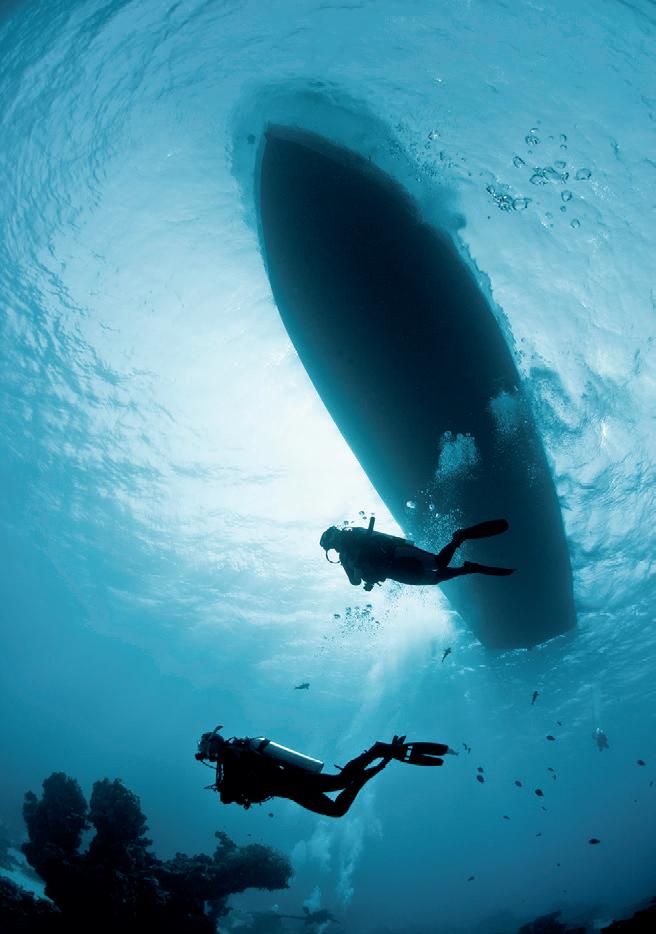
When the day is cloudy, light intensity is low, and warm spectral components are lacking, you can immediately expect problems with exposure and colour reproduction.
In such conditions, the importance of shooting at short distances and using artificial light always increases.
Scattering: why underwater images lose contrast
Another phenomenon that makes it difficult to obtain good underwater photos is dispersion, i.e., the scattering of light on particles of algae and sediment suspended in the water, as well as on water molecules themselves, which are in constant but invisible thermal motion. When light interacts with them, it changes direction, and the image it carries becomes distorted. It becomes less contrasty, softer, and, despite correct lens settings, is perceived as less sharp.
Scattering is particularly troublesome when illuminating a scene with flash or continuous light: light reflected from suspended particles is recorded by the camera as tiny bright dots (backscatter) that clutter the image, reduce clarity, and further lower contrast. The more suspended matter in the water and the longer the distance the light has to travel, the greater the risk that this effect will completely ruin the photo.
Even in waters free of suspension and phytoplankton, horizontal visibility does not come close to values found on land. In my hometown of Kraków, we can occasionally see the Tatra peaks, 100 kilometres away. By comparison, the clearest water I have encountered was during under-ice research dives in “Czarny
Staw pod Rysami”. I estimated horizontal visibility at 60 meters. Enclosed under nearly two meters of ice and snow, the lake was free of even the smallest mineral or organic suspension. I floated in the water as if in a vacuum, with the impression that the water around me practically did not exist. Through the hole cut in the ice, from a depth of several dozen meters, I could clearly see the red down jackets of my colleagues releasing a safety line. Through that opening, a beam of sunlight entered, concentrated like a laser, and the water wrapped it in a subtle cone of blue, scattered light. The view was otherworldly. After leaving the freezing water, we remained silent for a long time, trying to process the experience.
The most well-known optical phenomenon to divers is the selective absorption of components of the white light spectrum as depth increases. Even in basic diving courses, we learn that the visible colours gradually disappear as the distance of light traveling underwater increases.
Warm colours are absorbed first:
● red – at a depth of 5–7 meters
● orange – around 9–10 meters
● yellow – at 12–15 meters
Shorter wavelengths, perceived as green and blue, are absorbed much less and therefore penetrate deeper. At 20–30 meters below the surface, the entire scene is illuminated by bluish or greenish light, which, like a giant monochromatic spotlight, gives everything a uniform, cool colour cast. Regardless of how colourful the seabed is at that depth, to record the “true” colours of objects we must use artificial lighting, which provides white light and allows colours to be rendered in their full range.
Selective absorption of spectral components naturally leads to a decrease in overall light intensity. Thus, the deeper you go, the less colourful and the darker it becomes. This is compounded
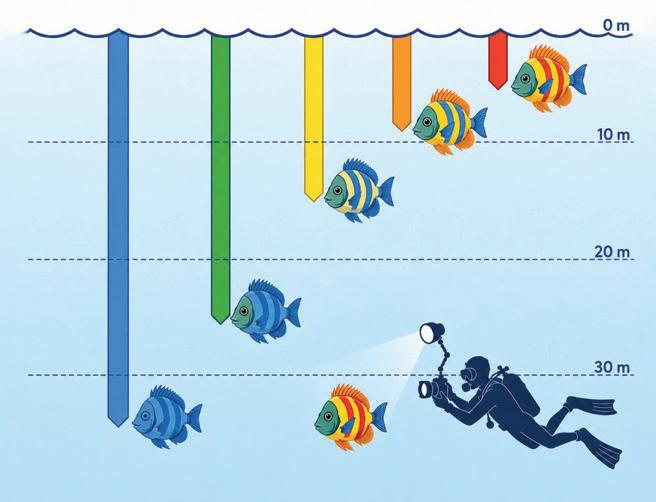
Fig. 1
Selective absorption of components of the white light spectrum occurring with increasing depth. To show a fish in its full range of colours at depth, artificial light must be used.
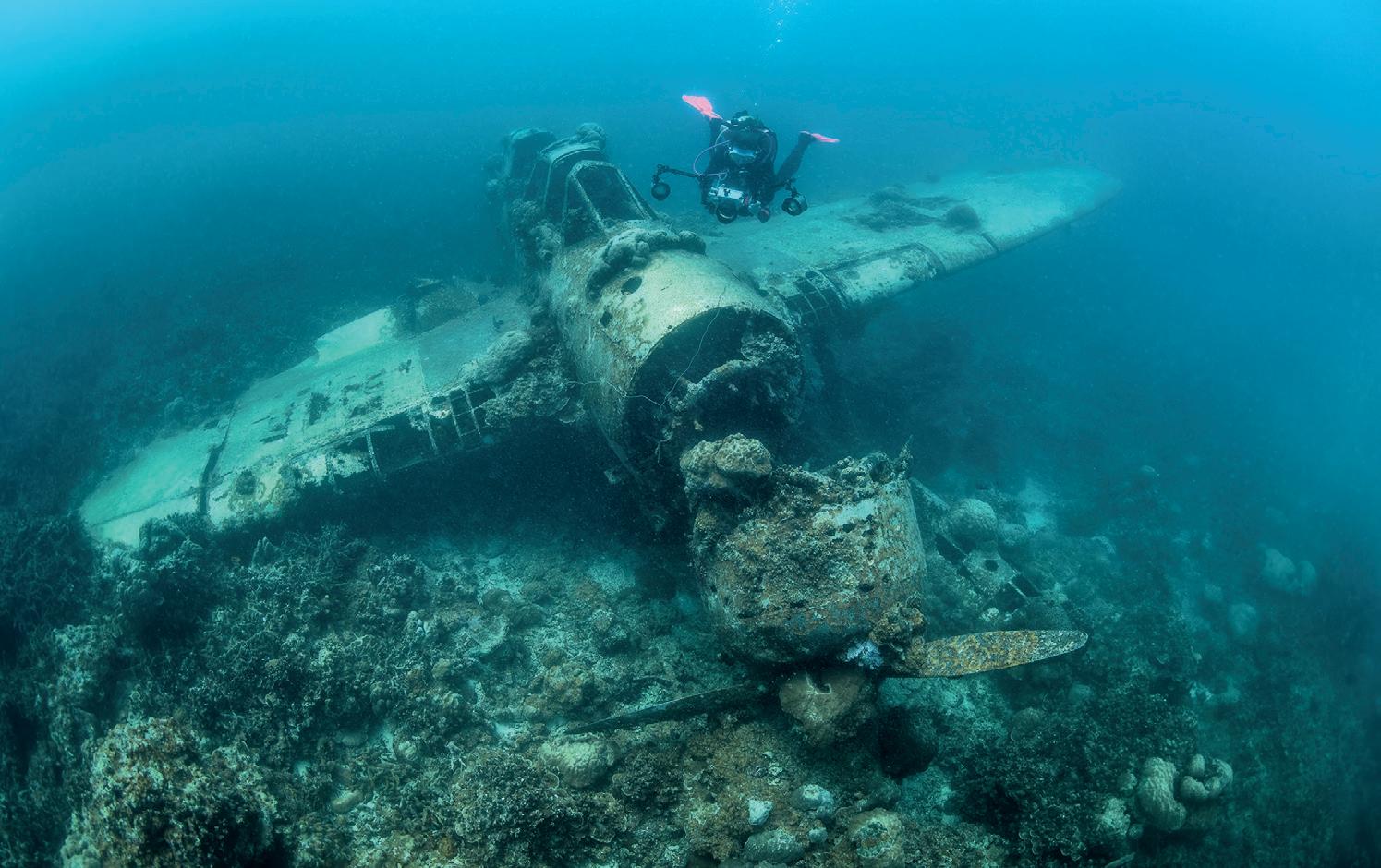
by the scattering of light on particles of ubiquitous phytoplankton, which further reduces its energy. Accept the fact that water “eats” light, and its appetite increases with depth.
In seas and oceans, where light intensity decreases on average by half every 10 meters of depth, the human eye can still detect it at 200 meters. In the clearest lakes of Northern Poland, this happens much faster, and darkness sets in already at 20–30 meters, while in most of them complete darkness occurs at around 40 meters.
Water absorbs light not only when it travels vertically. Horizontal travel also strips it of energy and distorts the information it carries. Therefore, the final result depends on the total distance that light rays travel: first downward into the water while illuminating the object, and then horizontally on their way from the object to the camera after being reflected. If, in sunlight, you photograph a large colourful fish at a depth of 6 meters from a distance of 2 meters, the colour effect of the resulting photo will be the same as photographing an identical fish at a depth of 2 meters from a distance of 6 meters. In both case, between the surface, the object, and the camera, the light travels a total distance of 8 meters, losing its warm colours along the way. The beautiful deep blue background so characteristic of underwater photographs taken in tropical seas is also the result of filtering out the warm components of white light in a thick horizontal layer of water.
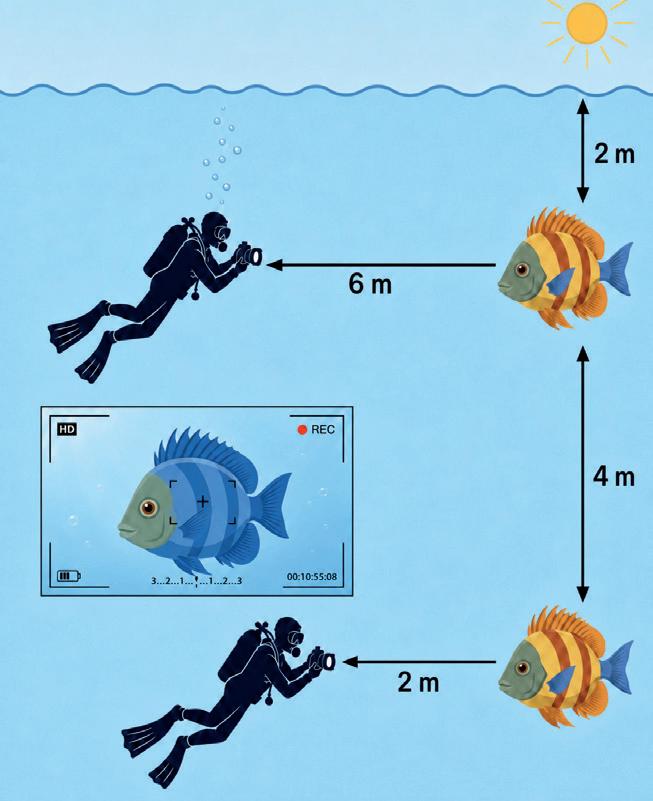
The disappearance of colours is influenced by the total distance that light travels both vertically and horizontally.
Refraction: why a lens “sees” differently underwater
The bending of light at the boundary between water and air is another optical trick we encounter when viewing the underwater world through a mask. When light passes from water into the air space inside the mask, it changes speed and direction of propagation. The result of this phenomenon is an apparent magnification and apparent reduction in distance. Your eyes, instead of perceiving the object at its true distance, register a virtual image that appears about 25% closer. Initially, the brain is easily fooled, and when you reach your hand toward an object, you may “search” for it too close. However, adaptation happens very quickly. I do not recall having any problems later on with judging distances or grasping objects after the initial mistakes made while swimming with a mask.
A camera lens enclosed in a housing behind a flat viewing window is deceived in exactly the same way as an eye behind a mask lens. It records an apparently
magnified image. When I used a Nikonos camera with a lens in which focus was set manually, it was necessary to account for this effect and set the focus to about 75% of the actual distance.
In the era of autofocus cameras, the issue of apparent magnification of the object is no longer a problem. The AF sys-
tem sets the sharpness at the distance at which the apparent image appears. There is also no problem when focusing manually: on the LCD screen or in the viewfinder you will see the moment when the image becomes sharp, which is additionally confirmed by the control system of focusing.
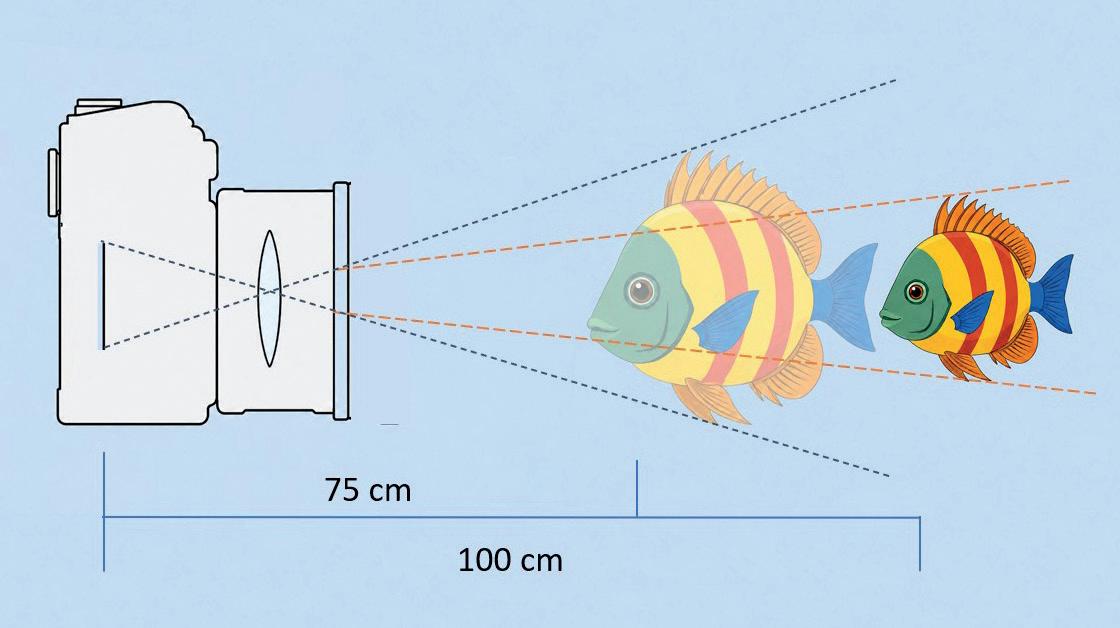
3
A lens hidden behind a flat viewing window records a virtual image that appears about 25% closer than the real position of the photographed object. In practice, this means a narrowing of the lens’s field of view, or an effective increase in focal length by 33%.
For the underwater photographer, however, the most important consequence of refraction is that the angle of view of a lens placed behind a flat port is reduced by about 33%, which can also be described as an apparent increase in focal length by the same amount. What does this mean in practice? A popular compact-camera lens with a 24 mm equivalent focal length, in a horizontal frame on the surface, can capture a full standing human figure from a distance of about 1.75 m. The same camera, once placed in an underwater housing with a flat viewing window, will from the same distance show a body cropped roughly at the knees. To fit the entire person back into the frame, you would need to move back to about 2.33 m. This of course degrades image quality, because the amount of water between the obbject and the lens increases. The problem can be solved by using a dome viewing window, which preserves the “surface” angle of view, or by using additional external “wet” wide-angle optics mounted on a flat viewing window. For example, the INON UWL95 converter, when paired with a 24 mm lens, provides an underwater diagonal field of view of about 95°. In practice, this allows you to photograph a full human figure in a horizontal frame from a distance of about 1.45 m. This means that instead of backing away from the object, you can move closer, reduce the water column, and thereby improve contrast and colour saturation.
Here is another example concerning refraction and the apparent position of an image.
After one dive on an Egyptian reef, I noticed that in photos taken over a sandy bottom, the flash did not illuminate the main object. The light patch fell in front of the photographed coral, not reaching the target. After a moment, I realized that when positioning the flash head, I had been guided by what my eyes saw through the mask. Based on that, I judged the object’s position and the angle of the flash. As a result, instead of aiming the light at the actual coral, I was aiming at the place where its apparent, magnified image seemed to be located, and there, in reality, there was only sand.
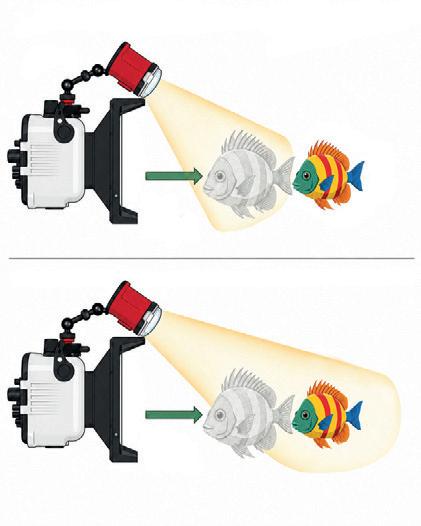
If you use a flash equipped with a modelling light, a small torch that shows the direction of the flash beam, this problem essentially disappears. You can clearly see where the light beam is falling and adjust the flash head so that it truly illuminates the object.
In summary: photographic image capture is based on information carried by light reflected from the object. The thicker the layer of water that light must pass through on its way to the camera, the worse the resulting image quality.
In a sense, underwater photography is similar to shooting on land on a foggy day. The farther you are from the person you are photographing, the less distinct their outline becomes. Many beginners in underwater photography are thereFig. 4.
Estimating the position of the flash head based on the observed position of the object (its apparent image) can lead to errors. Use a modelling light to ensure that the flash will actually illuminate the photographed object.
fore disappointed with their first images. What can be done about it?
The guru of war photojournalism, Robert Capa, had a solution. He used to say: “If your pictures aren’t good enough, you’re not close enough.” This advice applies perfectly to underwater photography as well. However, the concept of “close” often surprises beginners. At first, it is difficult to accept that the distance to a foreground object is usually in the range of 1 to 0.5 meters, and sometimes even less. Yes, only such a thin layer of water is relatively harmless to light and allows for very high-quality images. The saying: “get as close as you can to what you are photographing, then evaluate the distance and get even closer” is one of the most valuable pieces of advice for people starting underwater photography.
Since in underwater photography the overriding principle is to minimize the layer of water between the lens and the object, the photographer’s basic tools become optics that allow closerange shooting, ultra-wide-angle and macro lenses. Although the subjects of these images can be completely different, the effect of shooting from close range is often stunning: it reveals the underwater world in its most spectacular, vivid, and colourful form.
Once it is understood that underwater subjects are best photographed within arm’s reach, the next issue in the magazine will explain what makes our photos truly capture the viewer’s attention, in other words, how to take images with a “WOW!” effect.
KULCZYŃSKI
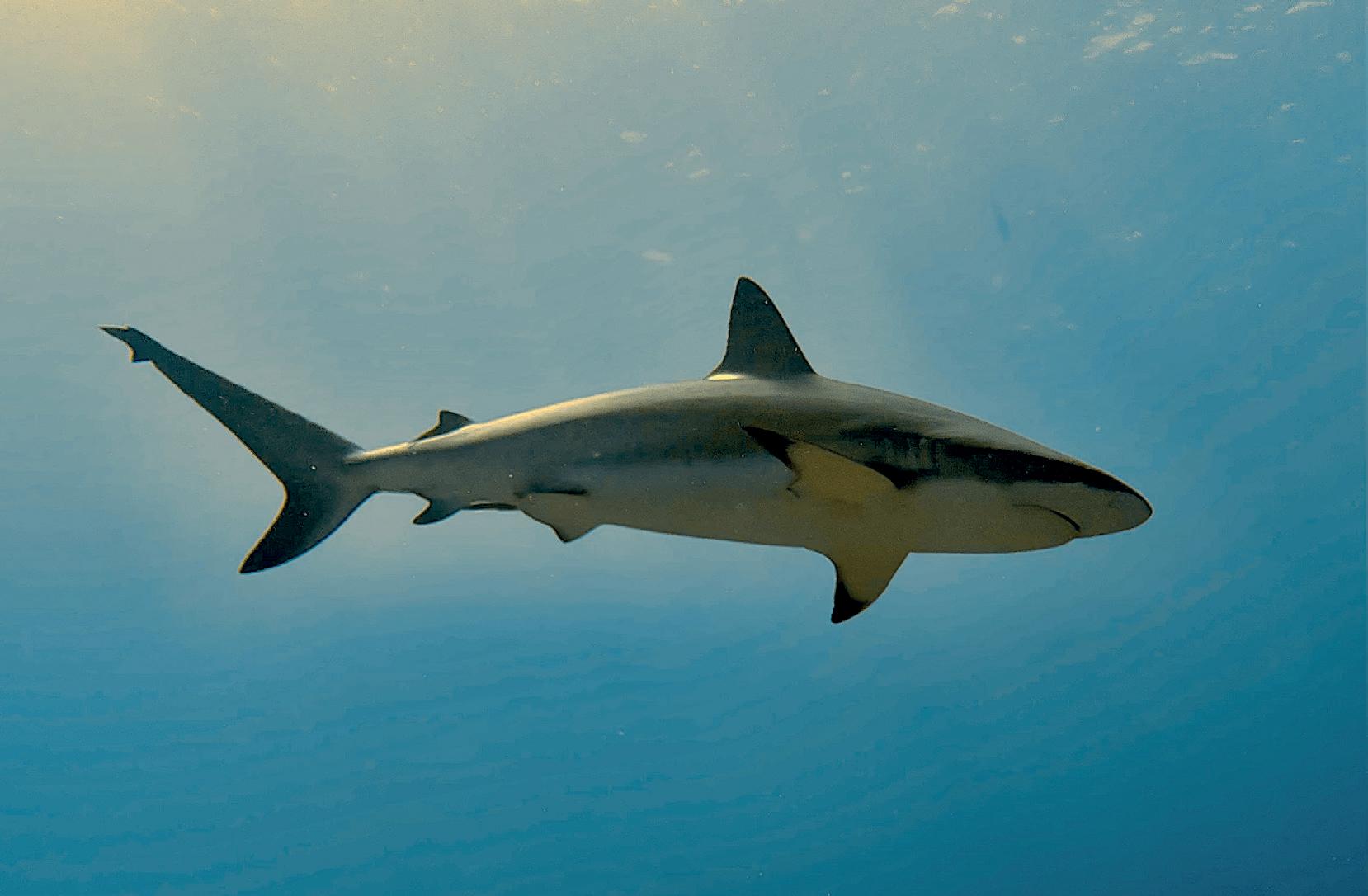
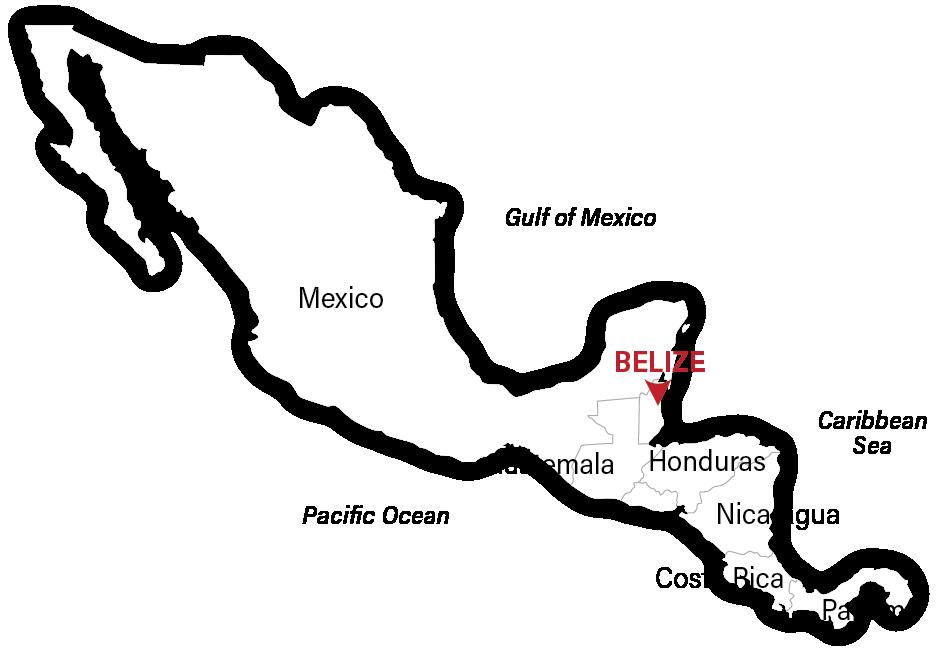
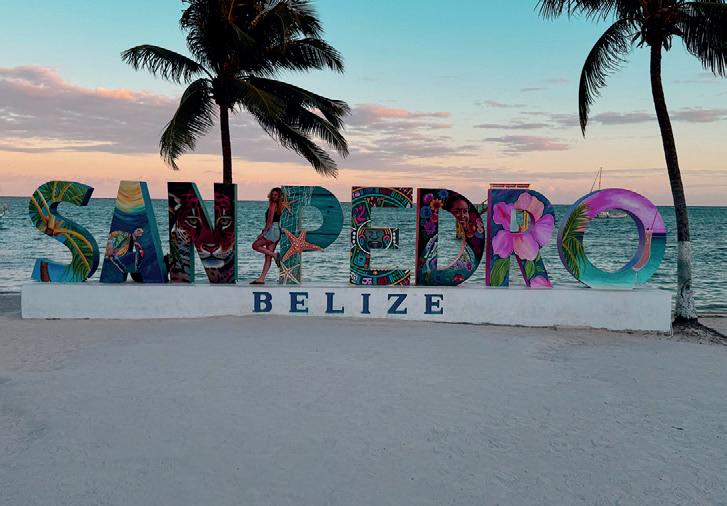
In the previous article you could read my objective view on diving in the largest Blue Hole in the world, and now let’s take a look at additional dive sites around San Pedro, BELIZE.
We could also phrase it a bit differently: “Interesting dive sites visited while going to the Great Blue Hole.” Either way, judge for yourselves.
As you know from my articles, under the guise of interesting diving places and events I always try to smuggle in a bit of practical knowledge and show you things that can be surprising and sometimes difficult to predict. That’s why even before every trip I try to find any article about the given destination or dives, just to prepare a bit better. So apart from beautiful photos, I’ll also point out things that can catch you slightly off guard… or seriously irritate you ;-)
Let’s start with San Pedro itself. A typical holiday destination where time flows
in a completely different way. People don’t treat daily schedules rigidly; life follows its own rhythm and nobody sees this as a problem. Just because a restaurant is open one day doesn’t mean it will be open the next, so it’s worth checking the day before. You can’t pay everywhere with a card, so cash is more than recommended.
The exchange rate, however, is perfect: exactly 2:1 against the US dollar. So for 1 USD you get 2 Belize dollars, no tricks, no calculator, no advanced maths needed ;-)
Most importantly, Belize has a completely unique vibe. I have never been anywhere in the world that even remotely resembles San Pedro. Everyone moves around in golf carts.
There’s a total mix of locals, tourists, and workers living there temporarily. On the beaches you’ll see dive boats next to fishermen and anglers. A lot is happening at once, and at times it looks like one big controlled chaos. A broader description of the place already appeared in the previous article.
From a purely diving perspective, I’ll shock you with something else, the diving day starts here at around 5 a.m.! Yes, it’s still dark. At least in February. Hotels are asleep, people are asleep, dogs are asleep, and divers are already eating breakfast at the dive centre.
We eat quickly, load gear onto the boat, and around 6 a.m. we set off. And here we should pause for a moment, because this relatively simple plan looks completely different in practice. In reality, the crew is running around with tanks, people with croissants in their mouths and yogurts in their hands are trying to find their gear, and everywhere there is a classic artistic mess.
Someone forgets something at the hotel and suddenly sprints back at full speed. Someone else is searching for fins lying a meter away. I had a situation where a sidemount ended up under the boat because a young guy dropped it while boarding. Don’t ask… he was maybe 14, so you don’t even have the strength to get angry ;-)
In the end, if I had focused only on eating and not checked my gear properly, I would probably have ended up diving on
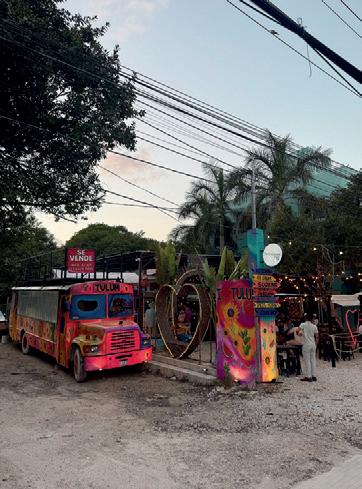
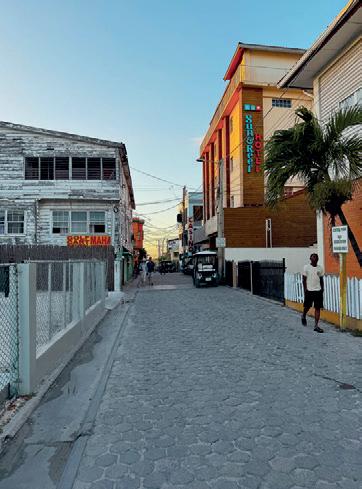
a single tank. That’s why it’s so important to carefully check whether everything made it back onto the boat. On a dive safari this usually isn’t a problem, but here, although the boat is the same size, it’s just emptied every night.
Another very important issue is equipment compatibility. What do I mean? Let’s start with valves. We were a fairly large group, and there weren’t enough cylinders with DIN valves. In such cases, adapters for INT yoke regulators literally save the day… or at least the dive.
This is exactly the piece of equipment I always used to ignore and considered a useless gadget. After returning, the first thing I did was order adapters and add them to my mandatory travel checklist.
Of course, with a single tank, something always gets “sorted out” on site ;-) With a sidemount, it becomes a bit less funny.
Staying with compatibility, you can easily get confused by units of measurement. It really makes communication with guides difficult. One guy says: “Let me know at a certain PSI.” We ask: “And in bars?” He replies: “I don’t know.” And thank goodness Google exists ;-)
It’s still fine when someone honestly admits they don’t know something. It’s worse when classic diving “expert acting” begins. We dive at some depth in feet. We ask: “How many meters is that?” He replies: “About 45.” We respond with a smile: “Then we can go to 40” ;-)
A good idea is simply to write down basic conversions in a notebook or use gauges with a dual scale. You know, like in cars: kilometres and miles. Sounds great, but the problem is that underwater you already have enough information to process, and those tiny numbers only add more confusion.
Gear packed, we set off, and shortly after the fun ends because waves appear. Unfortunately, during our stay they were present almost every day. For some people, seasickness appeared very quickly… but that’s a topic for another article ;-)
We usually sailed about three hours to the dive sites. Most people tried to sleep a bit more, but there were also long conversations and socializing with people from all over the world.
Guess who we met? Of course, a Polish woman ;-) She was in Guatemala at the time and, tempted by the marketing of the world’s largest Blue Hole, decided to dive here. The group was truly international and of all ages.
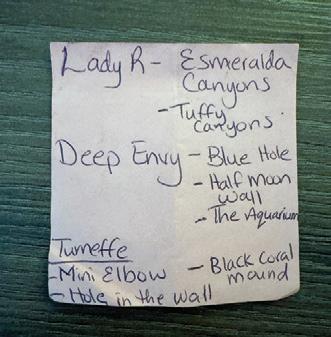
After all these efforts, we finally arrived at the site. I’ll include dive site names in the photos. And here comes a huge surprise, because after diving in the famous Blue Hole, a truly magical world of micro – and macro-life opens up underwater.
It’s impossible to list the biodiversity found there. Reef sharks are everywhere, and proper ones, around two meters long, with eyes like something out of “The Lord of the Rings.” Not some small harmless “baby sharks.” There were really a lot of them, and they were not shy around people. For me they were fantastic. For others they were just “another reef shark.”
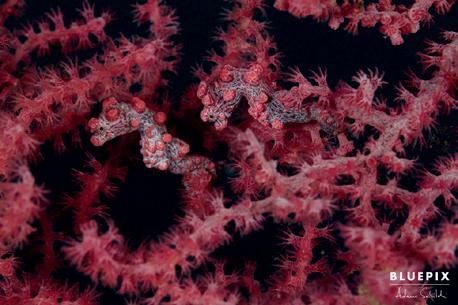
On the other hand, there were seahorses: tiny, colourful, the size of a fingernail. Nudibranchs, underwater stick-like creatures, and other wonders where the guide points at something and you ask: “But what is it?” ;-) For me they were just ok. For others they were the highlight of the whole trip.
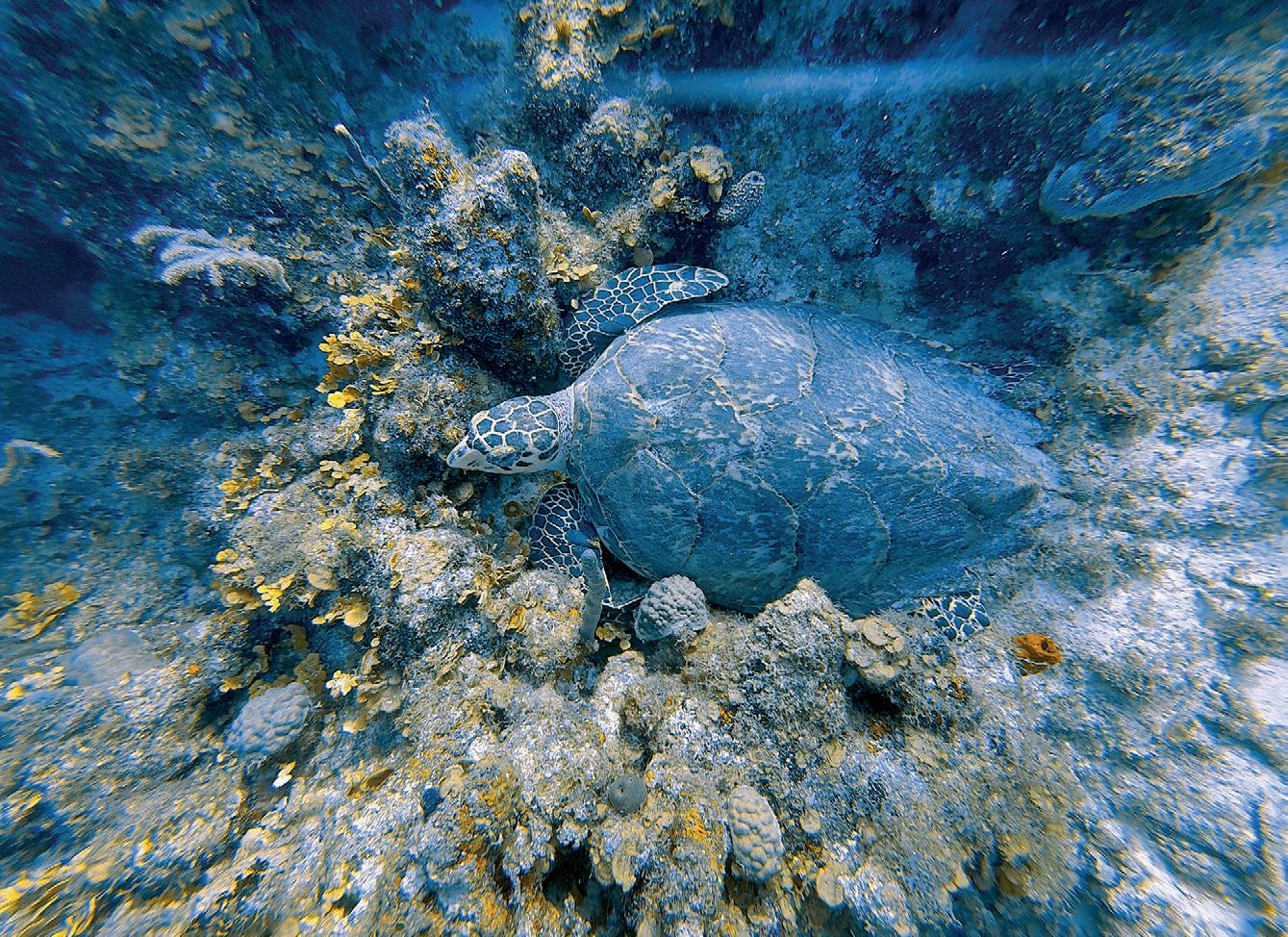
Also impressive were eagle rays. We saw them maybe four times, usually in pairs. And turtles – small, large, colorful, algae-covered, lazy, or simply impossible to catch.
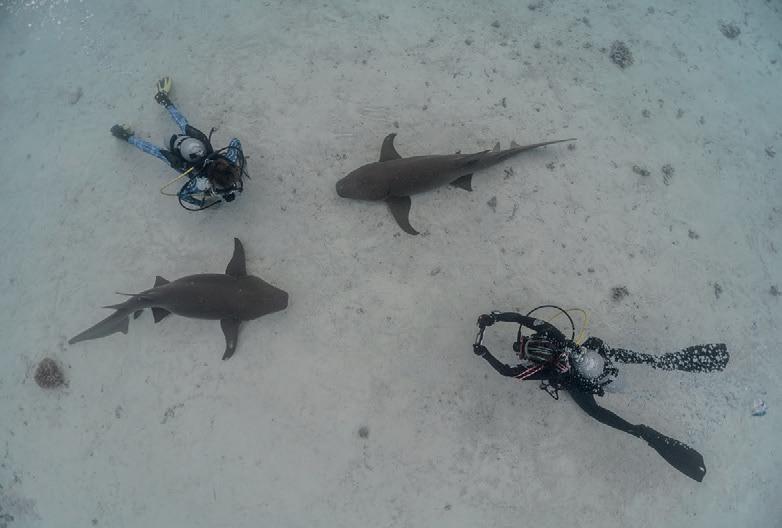
There were also nurse sharks, and here they behaved completely differently than those in the Maldives. They either swam away immediately and that was the last you saw of them, or they froze motionless, allowing you to admire their beautiful, almost hypnotic skin.
Among the smaller creatures there were countless others. I can also mention lobsters, which usually sat in pairs as well. Apparently a very romantic region ;-)
This brings us to another very important point: the perspective. As you can see from my description, seahorses, small frogfish, and other micro-life were somewhat casually ignored by me, because I’m simply most interested in sharks, eagle rays, and turtles. Everything else is an extra for me.
However, I know I was in the minority on the boat, and most people were more interested in the small inhabitants of reefs, underwater seagrass beds, and coral “cabbages” ;-)
And that’s exactly why diving is so diverse. That’s also why we have such radically different opinions about the best dive
sites in the world. Take a look at a few “Top 10 dive sites in the world” rankings and you’ll quickly notice that almost every list is different. It all depends on who creates it and what they are looking for underwater.
Between dives we explored nearby islands and had lunch on the boat. The food was really excellent, because it was prepared the day before and transported in insulated containers keeping it cool. Honestly, both the food on the boat and in San Pedro itself were among the best culinary experiences of the entire trip.
What struck me as a total oddity was that after the final dive, a party would start on the boat ;-) Music playing, fruit, chips, Coke, Fanta, and of course the favourite drink of pirates.
Even more surprising was the pace of its consumption, which really resembled a proper pirate ship. Luckily, most divers still chose juices and non-alcoholic drinks, and the crew members were mainly responsible for maintaining the “atmosphere” ;-)
In total, we did three dives in a single day and returned to San Pedro only around 6 p.m. There wasn’t much time left for sightseeing, and you still had to get some sleep because the next day everything started again at 5 a.m.
In summary, I’d like to refer back a bit to the first part of the article about the Great Blue Hole and how much the character of diving changed throughout the trip. As I wrote before, it all depends on individual preferences. It’s very hard to find a place that pleases absolutely everyone.
For some, Egypt is beautiful because of its reefs. Others love the Maldives for its large marine animals. Still others adore cenotes, where there is theoretically no life, but the atmosphere makes up for it.
After this trip to Belize, I learned one very important thing, it’s worth having a broader perspective. Instead of doing five dives in the Blue Hole itself, it’s definitely better to do one and spend the rest of the time on something completely different. Of course, provided you have that option.
Text and photos Łukasz GINALSKI
When I tell someone that I’ve dived with sharks, the reaction is usually the same: the question comes up – weren’t you afraid?
When I show photos or videos from such dives, the emotions are even stronger: people cover their mouths, look away, or stare as if hypnotized. You can see fear in their eyes! A primal fear of sharks, along with the images from Spielberg that we were fed in our youth, has left its mark on how we perceive these marine animals – as bloodthirsty beasts…
Meanwhile, when we talk about sharks, we should first ask: which sharks do we mean? Few people know there are over 600 species and that they’ve been on Earth for nearly 400 million years. From tiny 15-centimeter dwarf sharks to the largest fish in the world – the whale shark – which, like manta rays or some whales, sucks in water, filters it, and feeds on the plankton, crustaceans, and eventually small fish contained in it. Among the shark family there is also the longest-living fish in the world – the Greenland shark, which can live over 400 years – as well as the goblin shark, living in the eternal darkness of the deep. From the epaulette shark that can move by “walking”
over rocks, through the wobbegong, which looks like a Persian carpet with tassels on its snout, the thresher shark that uses its long tail like a whip to stun fish, all the way to the ancient sixgill shark that hasn’t changed for the last 250 million years.
SO WHAT’S THE REAL STORY WITH SHARKS?
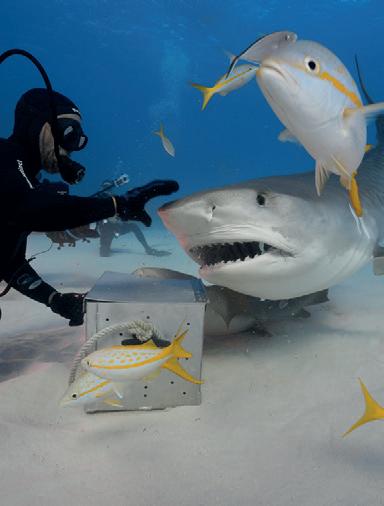
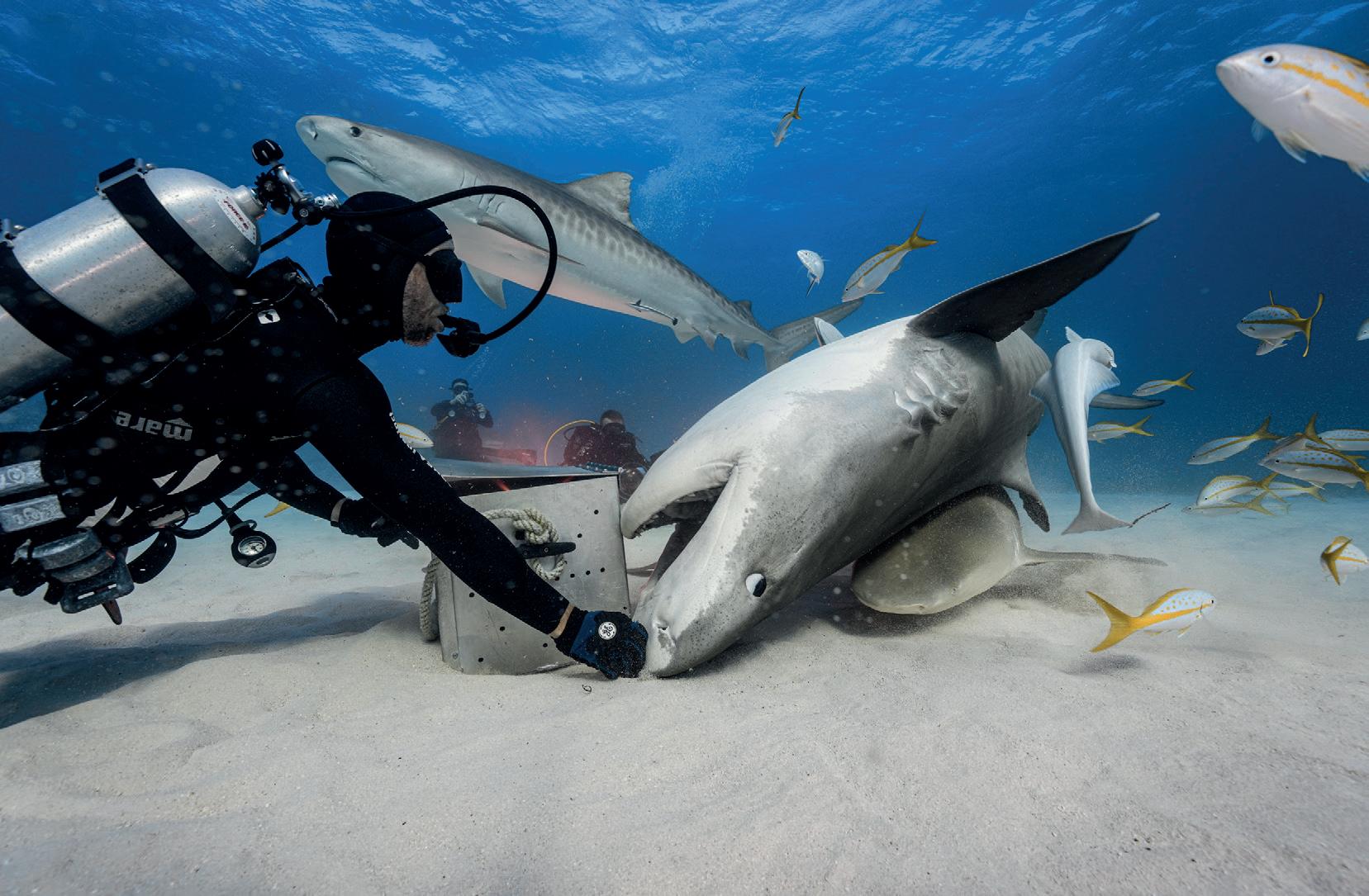
About sharks, their protection and research, their bad PR, and diving with them, I will talk with South African, Morne Hardenberg –the founder of Shark Explorers, who for 25 years has been spreading knowledge about sharks through education and by showing them to people up close… very close!
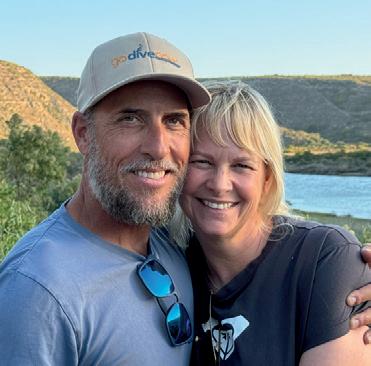
L.G.: You are the creator and founder of Shark Explorers. You have your dive shop in Simon’s Town near Cape Town and a catamaran in the Bahamas. Where did your interest in sharks come from, and how did you turn it into a way of life?
M.H.: I grew up spear fishing and abalone diving around the Gansbaai area, which is an area well known for the presence of
great white sharks. Growing up watching the movie Jaws, I was very afraid of sharks and when I saw one while diving I always tried to get out of the water asap. In the early 90’s the white shark cage diving industry was born in Gansbaai and my family who were commercial fishing at the time got work captaining the cage diving vessels around the rugged Gansbaai area. I remember my first time as a teenager going on the boat with them and once I saw a white shark swim around the boat and how they behave, it changed my perspective and I wanted to learn more about them. I realized all the information I had about sharks was not factual, it was driven by misinformation and fiction. I finished my school and started working in the white shark industry from 1999 as a dive master and eventually boat captain. In the 10yrs spent working with white sharks, I learnt about the many different species of shark in our oceans and my goal was to bring more divers in contact with more species. This is where the idea of shark explorers came from.
L.G.: Why is educating people so important in shark conservation?
M.H.: We believe that showing people a positive experience while feeding, providing information about their behavior, leads to more shark advocates and also gives people first hand knowledge in how to behave and interact with sharks.
L.G.: Does that mean: the more people know, the more they care?
M.H.: Yes absolutely! People only protect things they care about, experience and understand. We see how being in the water with sharks changes the way people see sharks, and the more people talking positively about sharks, the more sharks will be in the spotlight for protection and research.
L.G.: How can we undo the bad PR sharks have? How do we change the perspective from which we look at them?
M.H.: Slowly the bad reputation around sharks is disappearing. I mean 25 years ago, when you said “Shark in the water!! Everybody get out!!”, nowadays we say “Shark in the water!!! Everybody get in!!!”. This shows that there are positive things happening and we are changing peoples views and opinions about sharks.
L.G.: You’re right about divers. But we’re in a bubble. It is enough to say „Shark!” among non divers to see them panic! I will rephrase the question: How can divers influence non divers to overpass bad image of sharks?
M.H.: The more divers encounter sharks in a positive way, the more they talk to non divers about shark conservation. That is one way divers make a difference! But we can’t bring all the non divers to the sharks, so we need to bring the sharks to them. This is achieved by divers sharing images and videos of sharks to get the conversations started. In my world I have been an underwater cameraman for over 20 years now and started a production company called Atlantic Edge films. We believe by making conservation minded documentaries is a way to bring sharks to those people who can’t get to experience it in real life. We have gone as far as producing VR films which we supply
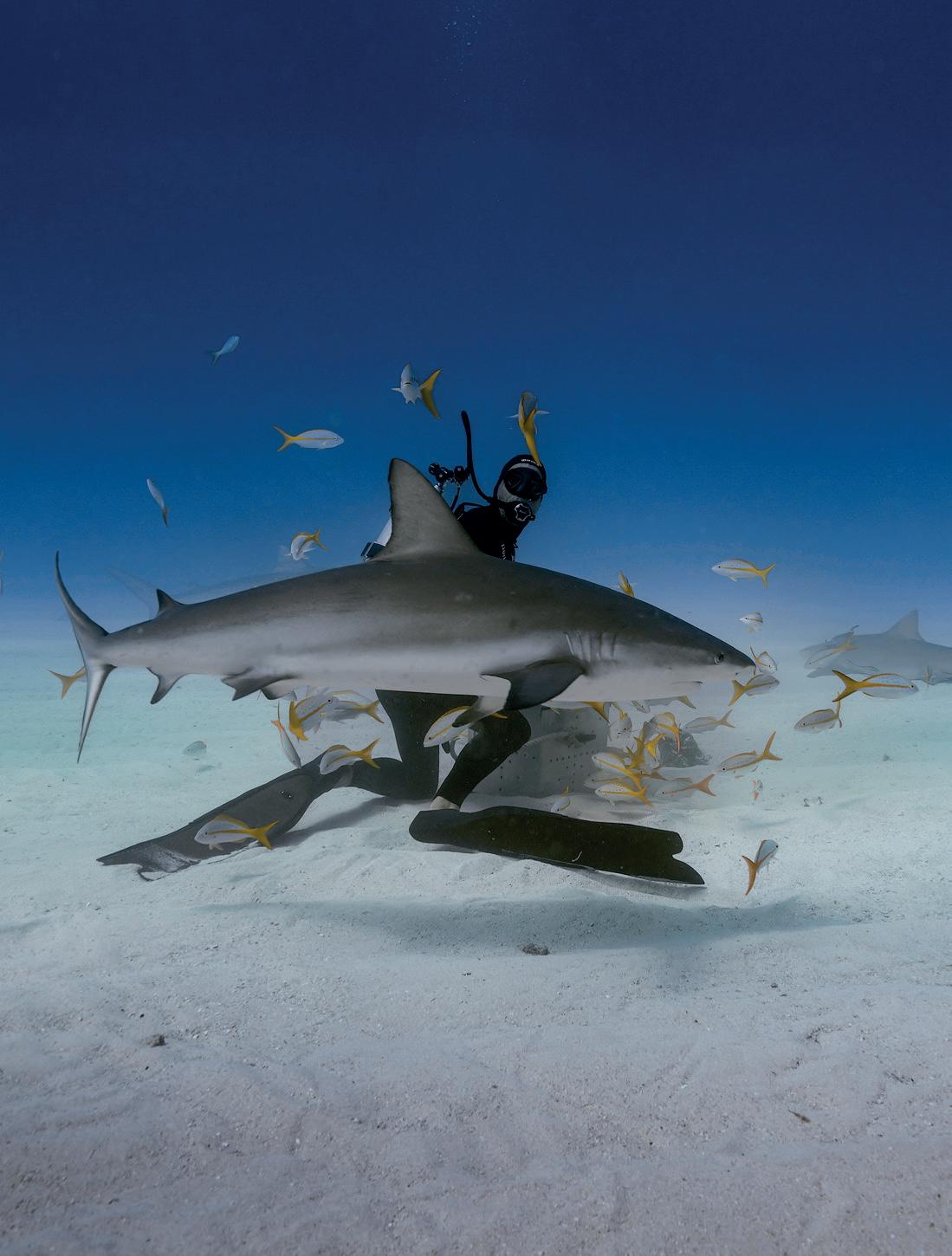
to schools and universities, this is as close as you can get to the real life experience.
L.G.: What do you do differently when it comes to diving with sharks?
M.H.: Shark explorers attach great importance to respect sharks for the apex predators they are, we don’t see them as pets. We learn about their behavior and we put this knowledge in our diving operations to ensure we have positive and calm interactions around them. Not an adrenalin rush, it’s not a rollercoaster ride… It's a hunt for knowledge and coexistence.
L.G.: Understanding over prejudices? But there is always a thrill when you get in the water with sharks. Do you still feel it?
M.H.: Oh yes there is always a “thrill”, I mean they are apex predators just like a lion or tiger on land. We meet many different sharks and we get to learn about their individual personalities. Some are cautious and skittish, others are confident and relaxed. That is why it never gets old, we meet new sharks on a daily basis.
L.G.: But is diving with sharks really as dangerous as most people think?
M.H.: Sharks are predators on the top of the food chain, but they are not mindless killing machines. So sharks can potentially be
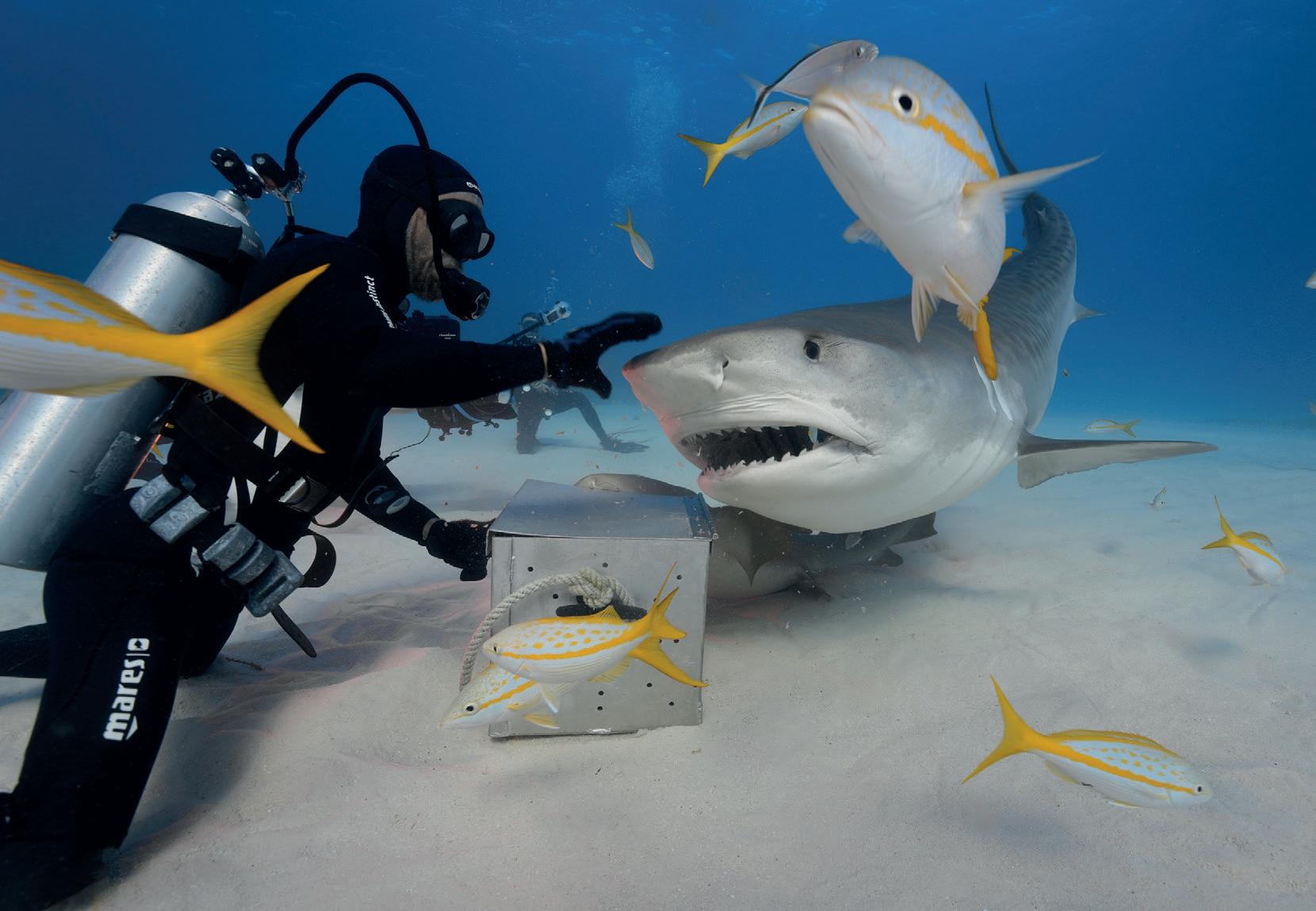
dangerous in different circumstances for example when they are hunting. Diving with sharks can be as safe as walking in a park, you just need to be knowledgeable about the surroundings, their behavior and how to interact with them in a positive way.
L.G.: I have to ask this here: so you think there could be less accidents with sharks if more people who get into the water where sharks may be present, would be aware how to behave or/and understand what may trigger the shark to attack?
M.H.: Yes, I believe knowledge and experience can be helpful for anybody entering the wild ocean. I don’t mean we can stop shark bites all together. There are different reasons sharks bite people, and there are many of them we don’t understand yet. My thoughts are that in many cases we can neutralize a situation with an aggressive shark if we have the knowledge of what to do and what not to do. For example – most people’s first reaction when they see a shark in the water is to run for safety. In a shark’s world all things that run form them are potentially food, so that is the worst thing to do. We educate people to remain calm, keep eye contact with the shark, stand your ground. This is confusing to the shark and makes them think instead of reacting on instinct. This can give the person the time to interact back with the shark and eventually make it to safety to tell the tale.
L.G.: Does chumming/attracting sharks affect their behavior and habits? Why are so many people opposed to this practice?
M.H.: Studies have shown that baiting or chumming potentially has a short term impact on their behavior. After all, we are creating a scavenging scenario by putting the smell in the water. Many people don’t understand chumming and the effects, so many people have the wrong opinion. Sharks have shown that no matter how much you chum, they will always follow their instinctive migrations and do what they have done for millions of years. The fact is that there are many different ways chumming happens. Cleaning fish out at sea, or in a marina, or just bait fishing, all these kinds of practices creates chumslicks and so if sharks are in that area they might come to investigate the source. The only way to bring sharks close to divers is to attract them with bait/chum. We don’t throw buckets of blood in the water, that only happens in the movies. We use fish that are natural to their diet, and we use as little as is needed to have them around us for a certain amount of time. Without chum, sharks generally keep their distance. So we believe that the benefit of using chum to bring them close to divers outweighs the negative narration around chumming. The funny thing is that in many places you can chum sharks in to kill them and
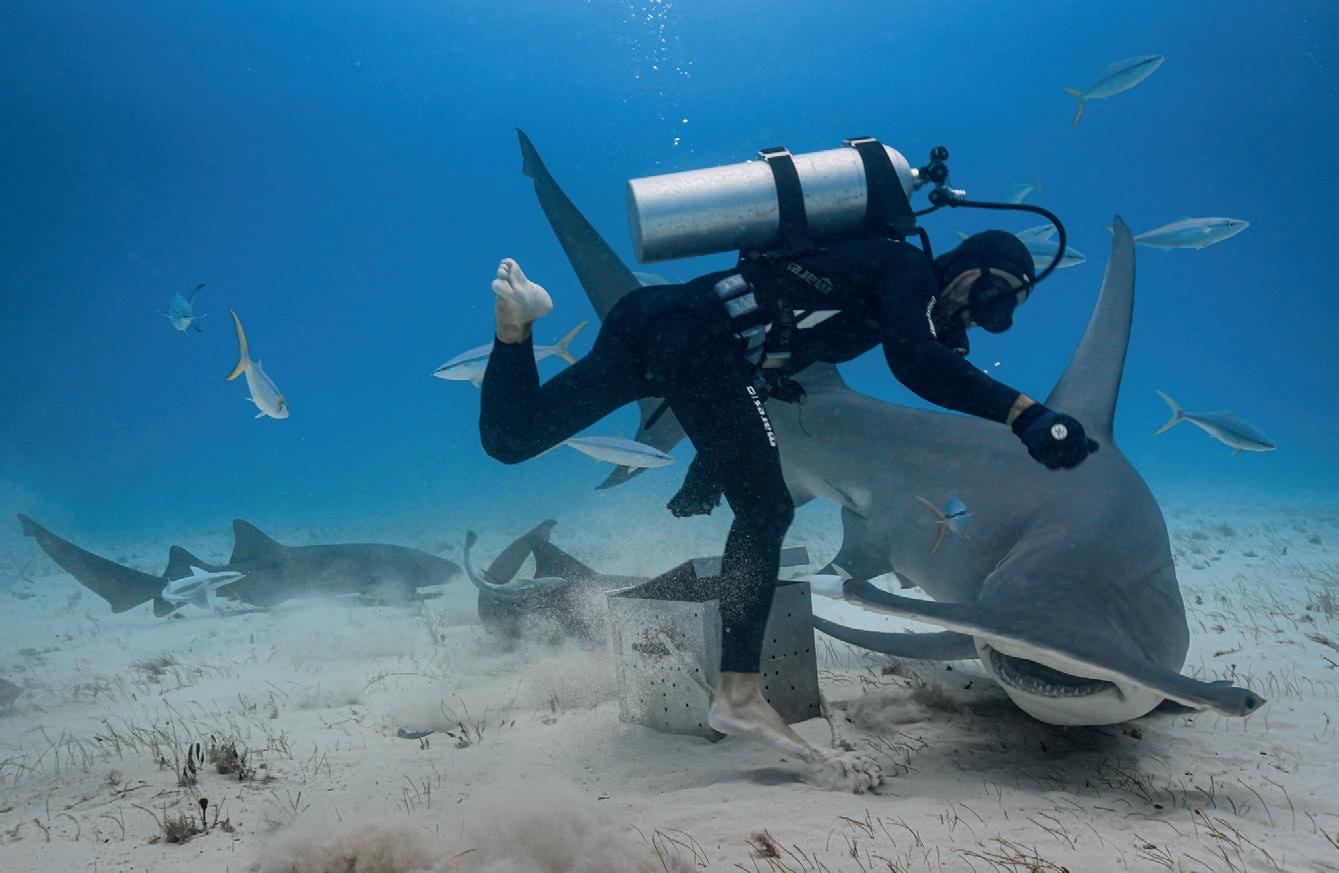
nobody says anything, but when you chum a shark in to have a positive in water encounter without harming the shark, people have lots to say.
L.G.: Let’s bust the myth here: human blood attracts sharks!
M.H.: This is one of my favorites! Humans are land mammals and we don’t belong in the ocean or form part of the oceans ecosystem. So sharks don’t know the smell of human blood, or pig blood for that matter. Over millions of years sharks have had the same diet, mostly fish, so their blood wins over human blood. Sharks also bleed and research has proven that when a shark is killed in an area the other sharks disappear as they sense the piste risk danger.
L.G.: This leads us straight to the question: are you currently involved in any projects related to shark research?
M.H.: I have always been involved with shark research, this is how I met my wife who is a marine scientist and her PHD was specifically on white sharks. My support to scientists is in their field research, I offer my knowledge and experience to hands on shark work. From tagging sharks to servicing underwater research equipment, I think science and learning is important and I myself want to learn more!
L.G.: Well, I guess, I know the answer: which of the shark species fascinates you the most?
M.H.: My number one shark species is the white shark. Maybe because I spent the most time around them, but also the fact that they are very complex animals and each shark has its own per-
sonality. We will never know everything there is to know about the famous great white shark.
In reality, only about six shark species out of more than 600 can pose a direct threat to humans (the great white shark, tiger shark, oceanic whitetip shark, shortfin mako, bull shark, and bronze whaler shark). Nearly 100,000,000 sharks die each year as a result of finning and bycatch. Over the past 30 years, some shark populations have declined dramatically, with certain species now on the brink of extinction. Saving sharks is more important to us as humans than we may realize. Scientists warn that without them, ocean ecosystems could become severely disrupted, and this affects all of us living on land.
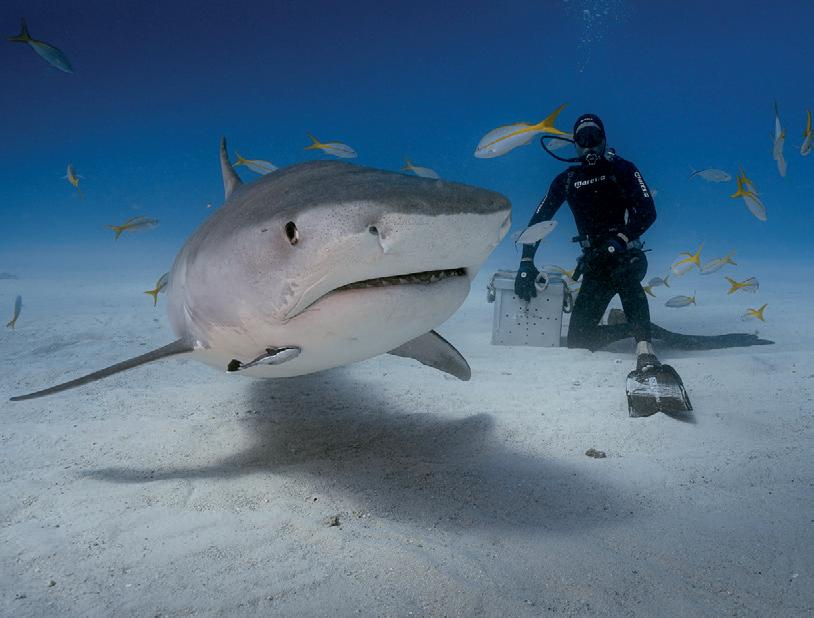
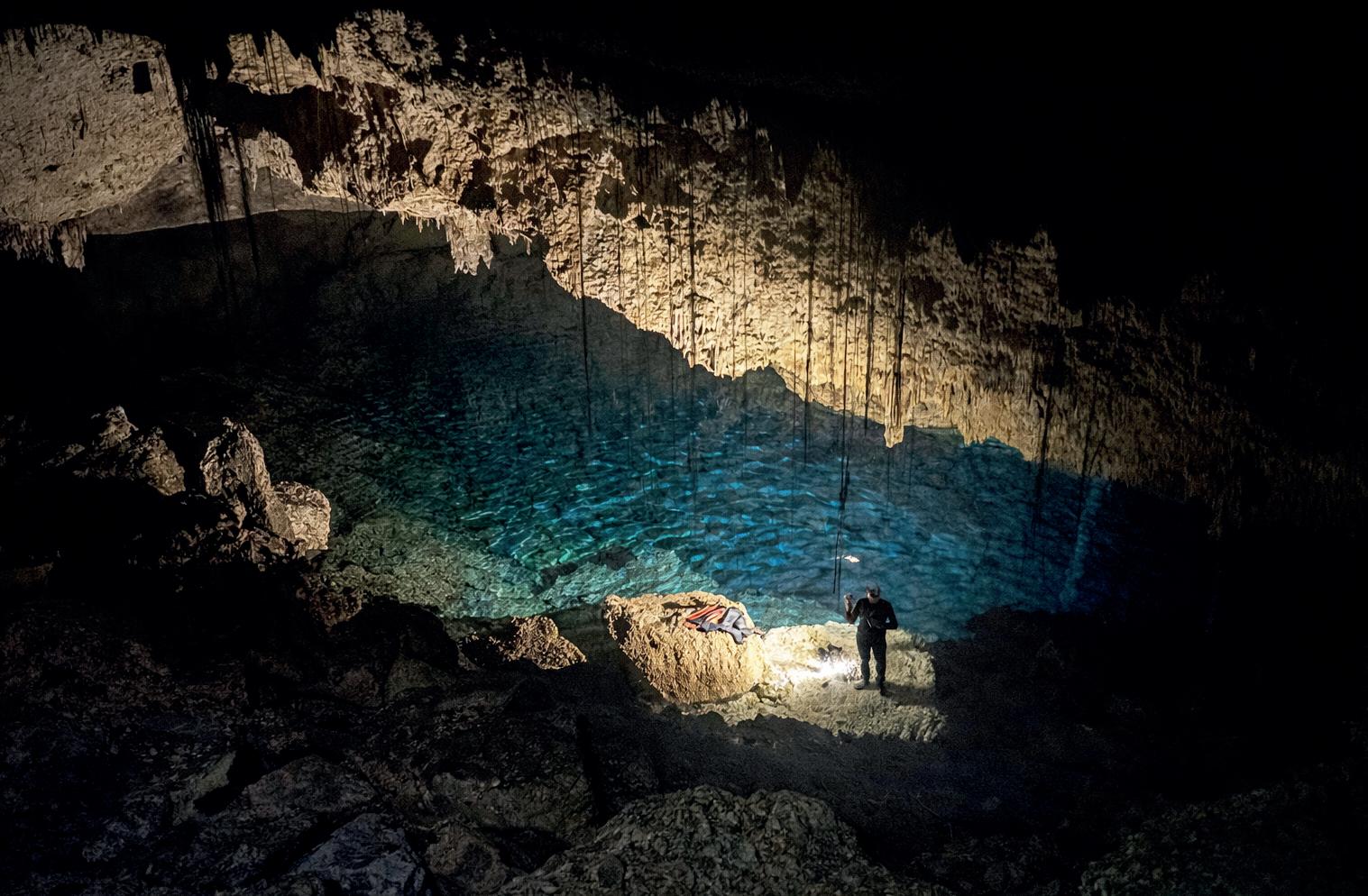
Text and photos Michał CZERNIAK
The Dominican Republic is most often associated with palm trees, warm seas, and the coral reefs of the Caribbean. Few people realize, however, that just a few kilometers from the tourist beaches of Bayahibe and La Romana lies a completely different world –cool, silent, and hidden underground. A world of cenotes and limestone caves filled with crystal-clear freshwater.
Within Cotubanamá National Park are two of the Dominican Republic’s most distinctive underground attractions: El Chicho and Cueva Padre Nuestro. These are places that attract cave divers from around the world.
While in the Dominican Republic, I decided to accept an invitation from friends I had met during a previous visit – the team from “The Art of Diving.” Thanks to them, I was able to immerse myself in this hidden underwater world. Their experience, excellent organization, and passion for cave exploration turned the trip to the El Chicho and Padre Nuestro cenotes into a fascinating introduction to Dominican karst landscapes and their history.
It is worth remembering that the entrances to these underwater caves are usually hidden deep within the jungle – dense, humid, and full of insects and plants best avoided – so every expedition begins with facing its very earthly challenges.
On the Dominican Republic Speleological Society website, there is what can only be described as an invitation to adventure: “Prepare yourself for difficult terrain, aggressive wasps, tarantulas, foot-long centipedes, fire ants, and poisonous trees. Usually, everything comes down to one thing – you! The jungle is mostly extremely dense, with hidden crevices everywhere just waiting to break your leg, so watch where you step! Most caves
and sinkholes are usually invisible and completely overgrown, so you really have to pay attention and look for any signs of a cave below. Once you find something, you must be extremely careful when cutting through vegetation so as not to disturb wasp nests or – even worse – a wild beehive, which can potentially be fatal, as the entire hive may attack you at once!”
It is difficult to resist an invitation like that…
Cenotes are natural sinkholes and water-filled caves formed through karst processes. Over millions of years, rainwater saturated with carbon dioxide seeped through the island’s limestone bedrock, gradually dissolving it. This process created underground rivers, chambers, and tunnels, and when the ceiling could no longer support the weight above, it collapsed – revealing the water beneath.
Although the term “cenote” comes from the Mayan language and is most commonly associated with the Yucatán Peninsula in Mexico, the Dominican Republic geologically belongs to the same karst world. The island of Hispaniola hides dozens of caves and underground reservoirs, only a handful of which are accessible to visitors – there were eleven around the area where I was staying.
The journey to the cenotes is already part of the adventure itself. Leaving the asphalt road behind, the route leads deep into the tropical jungle of Cotubanamá National Park. Humid air, the scent of earth, and the sounds of birds surround you.
In both cases, the final part of the route must be completed on foot. The steep descents are accompanied by a noticeable drop in temperature – the deeper you go, the cooler it becomes. Daylight gradually gives way to twilight until, finally, it ap-
pears: the perfectly still surface of crystal-clear freshwater.
El Chicho is a cenote that often stays in your memory for a lifetime. On the surface, it looks like nothing more than an ordinary hole in the ground – a sinkhole hidden among the dense vegetation of Cotubanamá Park. It is hard to believe that beneath this inconspicuous entrance lies one of the Dominican Republic’s most fascinating underground worlds. Only when you begin descending the uneven limestone steps, with daylight slowly disappearing above the rim of the opening, do you realize how misleading that first impression was.
After a steep 15–20 meter descent, the cave opens into a vast, dark chamber. You switch on your torch, and the beam reveals a scene that remains etched in your mind: a calm turquoise mirror of water, massive columns rising from both floor and ceiling, and dense clusters of stalactites hanging overhead. The sounds of the jungle fade away – all that remains is the coolness of the rock and the sound of your own breathing beneath the cave roof.
For centuries, this place has attracted people. The Taíno, the indigenous inhabitants of Hispaniola, already knew of it, leaving behind petroglyphs on the cave walls as evidence of El Chicho’s importance.
Yet it is only underwater that the cave reveals its true scale. The water is crystal clear, warm (around 26°C), and perfectly still. In the dry sections above, bats fly through the darkness, while beneath the surface you may occasionally spot guavinas – small fish adapted to life in the shadows.
From a diver’s perspective, El Chicho is a very welcoming site. Depths ranging
Cenote El Chicho Source Dominican Republic Speleological Society
from 8 to 16 meters, exceptional visibility, and a natural architecture filled with chambers, columns, and passageways make it an ideal cenote for first cavern-diving experiences, while also offering a taste of true cave diving. The wide cavern zones provide a sense of space and safety, while each successive chamber reveals a world that feels more like a fantasy landscape than an ordinary hole in the ground.
El Chicho is not “small.” It is monumental – you simply have to descend deep enough to see it.
If El Chicho offers peace and space, Cueva Padre Nuestro captivates with its diversity. The approach follows a steep trail descending into the jungle. The cave itself is visually more complex – filled with stalactites, stalagmites, corridors, and natural chambers. Beneath the surface, passageways connect different sections of the cave, while rock formations create natural “cathedrals.”
The cave’s name comes from the former village of Padre Nuestro, once home to around 180 families. It was only in 2003, when the area received protected status, that the community was relocated and the cenote once again became the domain of nature and archaeology.
From the outside, Padre Nuestro appears rather inconspicuous – a shallow pool hidden beneath a rocky overhang, framed by roots hanging down like jungle curtains. Yet all it takes is putting your face beneath the surface to discover something entirely different.
The surface of the water stretches deep beneath the rock, forming a narrow greenish ribbon that leads into the heart of the cave. This entrance – visible only from beneath the surface – creates an unforgettable impression when you emerge from the darkness. The sight becomes the culmination of the dive itself. As you return from exploring the cave, the darkness behind you slowly gives way to a glowing blue oval ahead. From a distance, it looks like the eye of the outside world peering into the underground. Every ripple of light refracts across the rocky ledges, while the ceiling shimmers like glass.
It is one of those places where divers often stop for a moment, hovering motionless in the water, simply watching. Because here, the return to the light can be just as mesmerizing as the descent into darkness.
Padre Nuestro is different from El Chicho. Less monumental, less “cathedral-like,” yet far more intimate.
Underwater, you can see irregular, fractured limestone blocks forming debris fields that resemble rocky terraces. In some places, the ceiling drops low enough that a single fin movement can stir up fine sediment. Farther on, the space opens once again into larger chambers filled with formations shaped over thousands of years by contact with water.
The topography is remarkably varied – wide passages leading into larger halls, narrow sections above rocky cones, natural terraces descending toward deeper areas, and hidden corners where torchlight reflects like crystal.
In many places, the formations are sharp, jagged, and raw – this is a cave that has not been “smoothed out” by thousands of years underwater. You can see it, and you can feel it.
Diving in Padre Nuestro is a very particular experience. You sense the closeness of the rock and hear the sound of your own breathing echoing from the ceiling. Every chamber reveals something
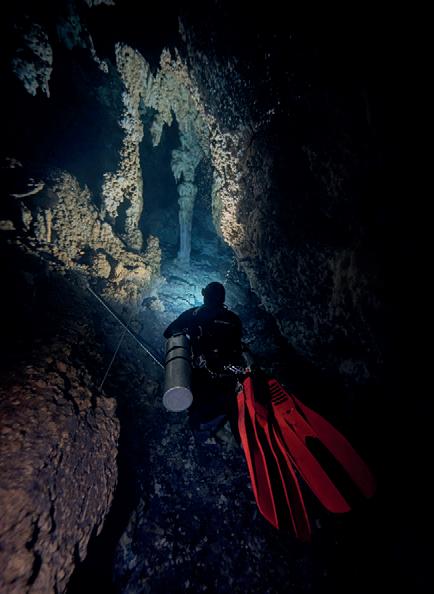
new – a different rock texture, a different play of light, a different depth.
The caves of the Dominican Republic were familiar to people long before the arrival of divers. The indigenous Taíno regarded them as special places –deeply connected with water, light, and mythology. In other caves across the region, ritual artifacts and petroglyphs have been discovered.
Although El Chicho and Padre Nuestro are archaeological sites open to visitors, the awareness that they were part of the Taíno world for centuries adds an entirely different layer of meaning and history. The Taíno were the indigenous inhabitants of the Greater Antilles – including Hispaniola, where the Dominican Republic is
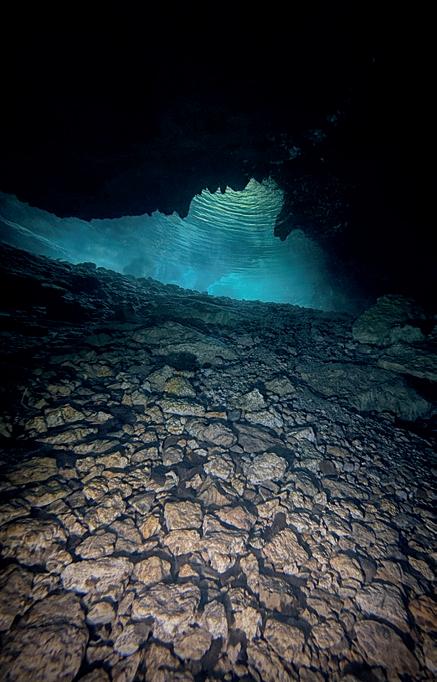
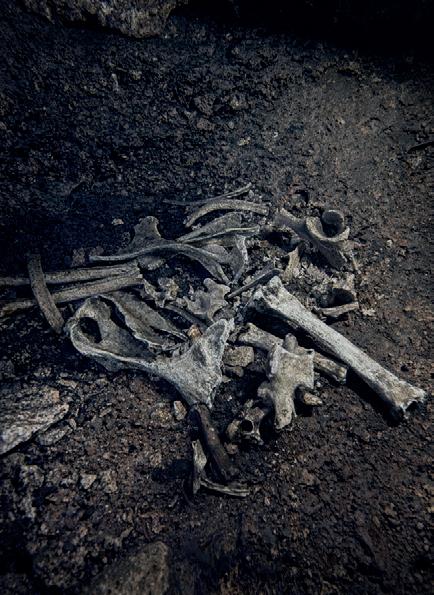
located today. They arrived in the Caribbean from South America long before Columbus reached the region. They formed settled agricultural communities, living in villages led by chiefs who held both political and spiritual authority.
Water, light, and caves played an important role in their culture. Cenotes such as El Chicho and Padre Nuestro were not seen as empty holes in the ground, but as places of profound symbolic significance. The Taíno believed that water was a gateway between worlds: the underworld – the realm of spirits and ancestors, the surface – the world of humans, and the sky – the domain of the gods.
That is why, in the illuminated sections of the caves where natural light reached inside, they left behind petroglyphs: sym-
bols carved into the rock depicting the faces of deities, spirals representing the cycle of life and water, anthropomorphic figures, and signs associated with Atabey – the Mother of Waters, fertility, and rivers.
In some cenotes, archaeologists have also discovered fragments of Taíno pottery. These are believed to have been part of water rituals – offerings made to gods and ancestors.
This is why a modern diver descending into El Chicho or Padre Nuestro is not merely exploring cave passages. They are also entering a space that was sacred to the Taíno people. The underground world where today we admire stalactites and light filtering through blue water was, for them, a meeting place of humans, gods, and ancestors.
During one of our dives in the cave zone, we came across bones of unknown origin. Most likely, they are remains from the time when some of the chambers were still dry and inhabited by the Taíno, though this remains only a hypothesis – its verification belongs to archaeologists. For divers, the rule is simple: we take nothing, we do not publish exact locations, and we inform the appropriate authorities. That is how such places – and their history – are protected.
In Padre Cave, near the end of the dive and close to the exit, exhaled bubbles strike the rocky ceiling, creating a brief but noticeable vibration – almost like a small earthquake. The phenomenon is perfectly normal and quite fascinating, though it is better to know about it beforehand, because without warning it can be genuinely startling.
El Chicho and Cueva Padre Nuestro are the hidden underground heart of the Dominican Republic – invisible from the beaches, yet unforgettable for those willing to descend beneath the surface. They are a meeting point of geology, water, and time flowing at a different pace. For divers, they are both a challenge and a reward. For travelers, they become a story carried home long after the journey ends.

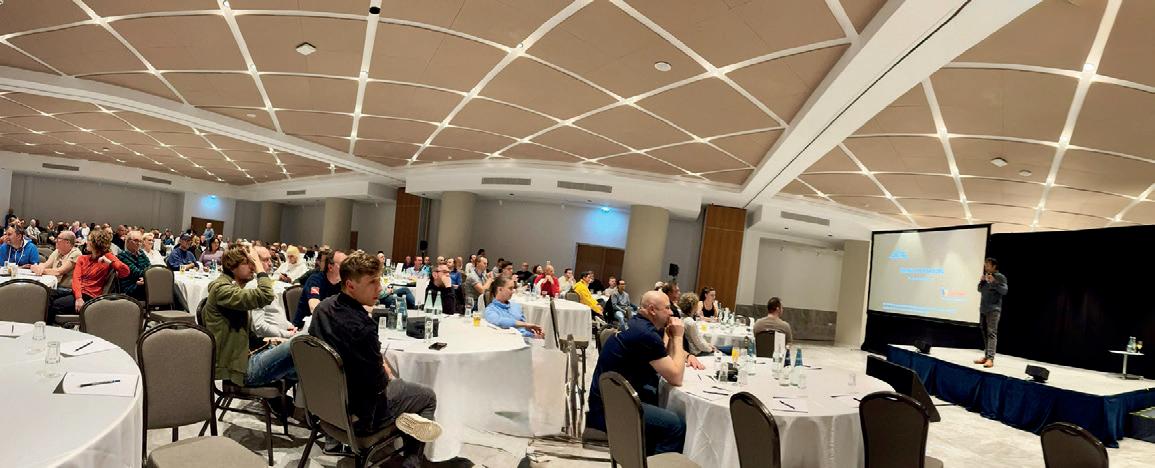
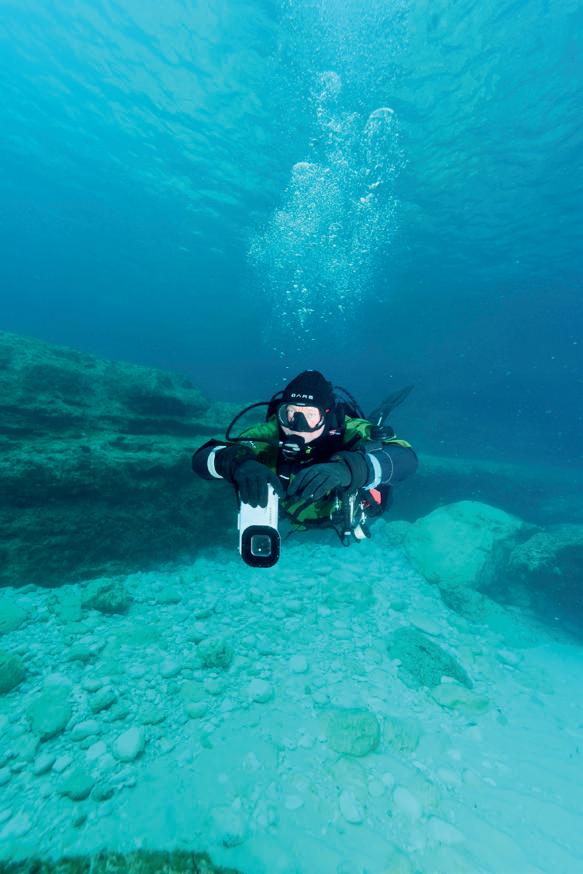
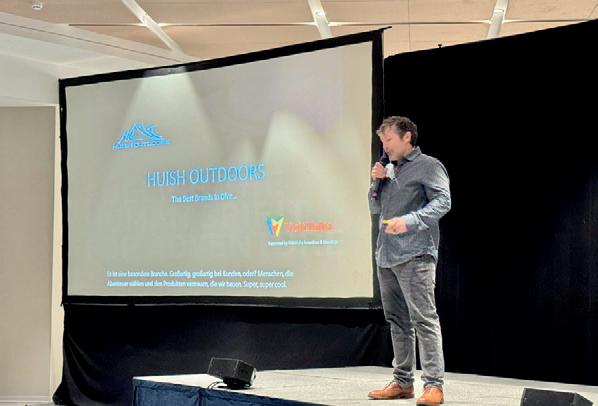
Huish
It may have been short, but it was intense and completely free of the boredom that can sometimes creep into this type of meeting. Although I have to admit – I had never been to a dive industry event quite like this before. I was invited by the Polish distributor of the Huish Outdoors Group:
One place for the editor-in-chief of Perfect Diver. Was there a risk, given that I always try to speak and write things as they are.
More than 200 people from different parts of the world attended, with the exception of Australia and Oceania. This year, Malta and an excellent resort were chosen as the venue for the Group’s annual distributor meeting, and we dived with CN Seashell from Mellieha.
We were divided into 4 groups. Most of the presentations were held for everyone, as the schedule started early in the morning. While some were diving, others were visiting the factory producing drysuits, wetsuits and undersuits, while another group took part in practical workshops dedicated to specific product cate -
gories. Within the hotel grounds, we also had access to a pool for diving and getting familiar with the equipment.
Imagine a “Gear Room” – an area filled with equipment to look at and test. But here’s the thing: we had around 50 regulators available, dozens of masks and fins, a huge number of suits, wings and BCDs. Of course, this included Oceanic’s latest BCD, as well as colorful Katana 2, and even the option to take an iPhone housing underwater – there were about 40 of those as well.
The logistics and scale were truly American. Plenty of space at round tables. No pushing or crowding. Excellent sound. The stage was set up so that there were two large screens on the sides, with one or two speakers in the middle, depending on the topic. In addition to the Huish Outdoors leadership team, industry and marketing directors, several special guests were invited. Among other things, we listened to talks about Malta’s wrecks and the latest discoveries, and during the break guests had VR goggles available, so they could virtually dive selected wrecks. And here’s the thing – there weren’t 5 headsets. Once again, there were 50.
On top of that, the meals were full-on, with unlimited seconds. The daily schedule was arranged in a way that left time for informal conversations behind the scenes. Everyone was smiling, although toward the end of the stay, people were getting less and less sleep ;) Transfers, the number of buses, punctuality, food, drinks, atmosphere – everything was 10 out of 10.
You can clearly see how much importance the company places on every detail, even the smallest one. Before they decide to release something, testing goes on and on. In cold water and warm water. Any corrections are introduced immediately – and then come more tests. On top of that, they use top-quality materials and very practical solutions designed for safety and comfort.
The whole meeting was run in a relaxed way, but at the same time it was very specific and to the point. It was interesting to watch people like Mike Huish or Nick Hollis, who truly live and breathe what they do. They were assigned to groups and dived with us, even though the conditions were definitely on the more challenging side ;)
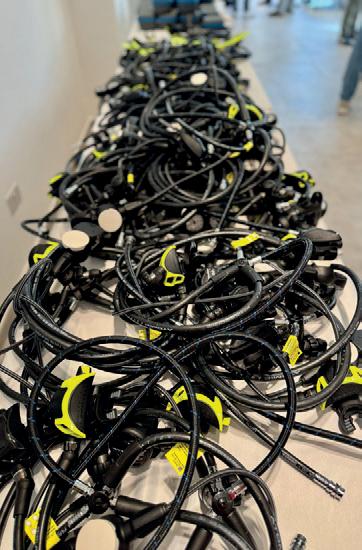
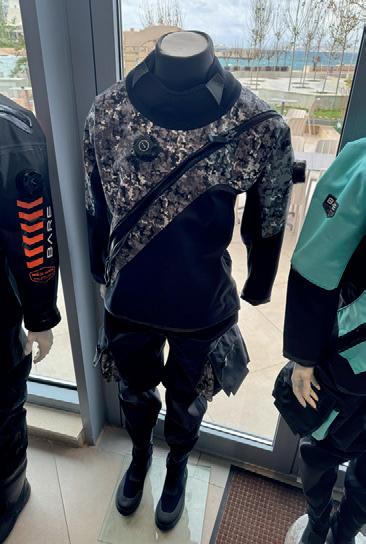
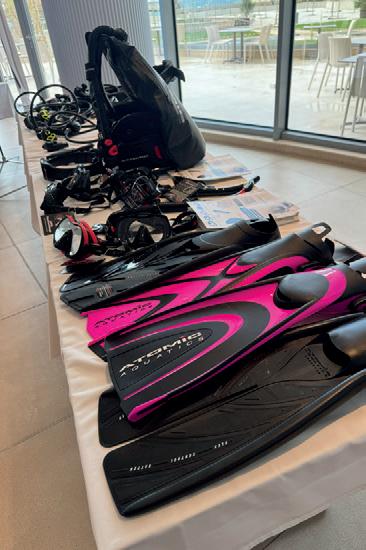
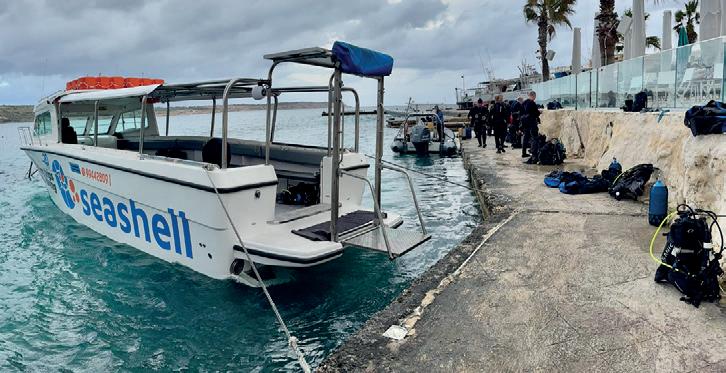
Meetings like this open your eyes wider and recharge your creativity and passion. And on top of that, it turns out that the industry still has new, surprising solutions to offer – backed by experience and knowledge.
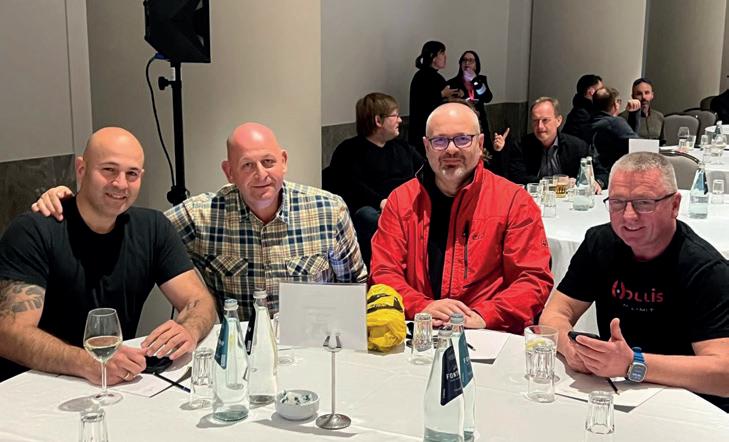
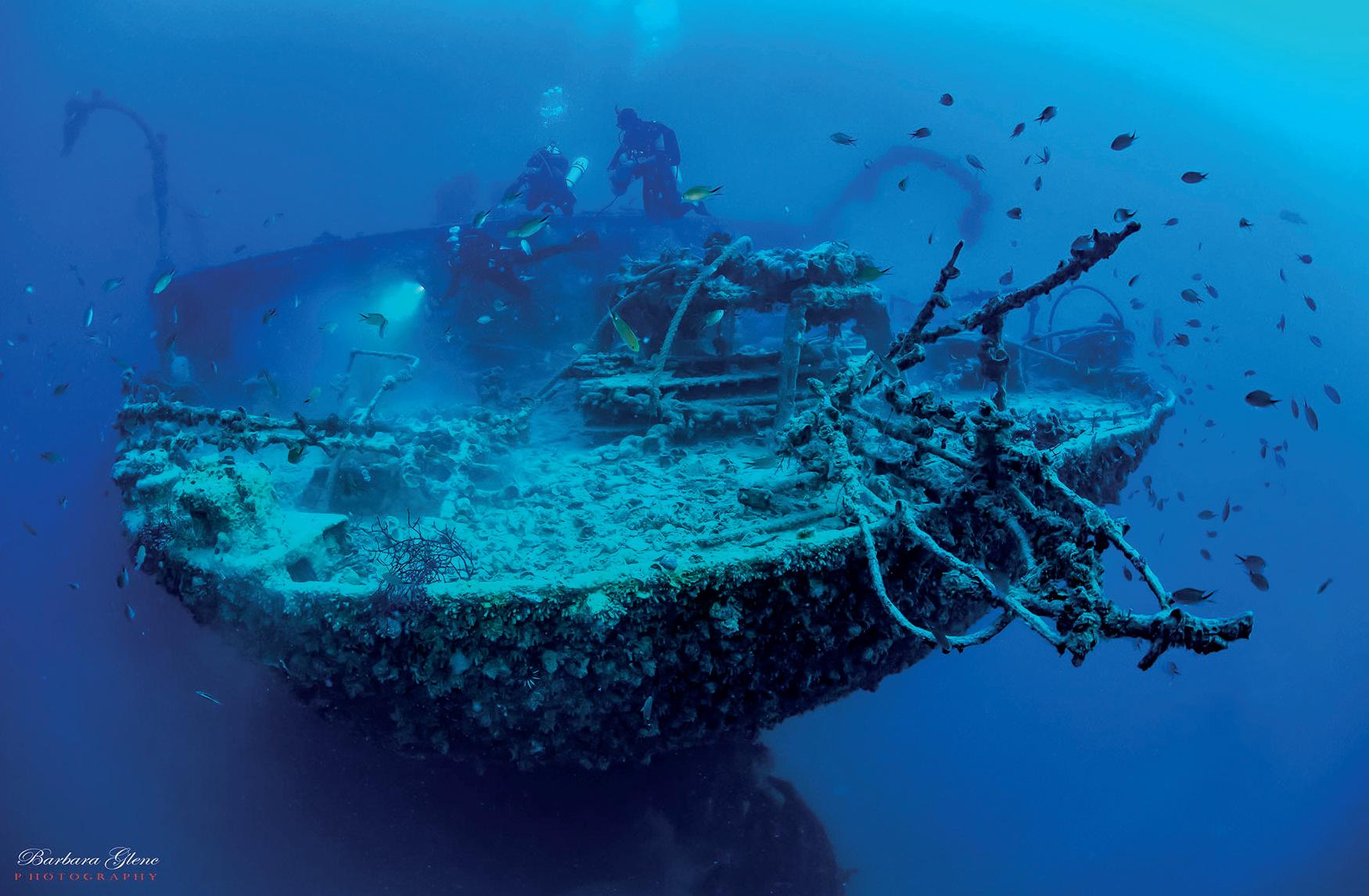

A diving safari in Egypt — the very first voyage of SIMBA, STM Diving Cruises’ new vessel.
From the start, it was clear this wouldn’t be an ordinary trip. Debbie and Manuel took care of every detail, and the whole experience was polished from beginning to end.
We started the safari in March, but instead of wind and waves we got perfect conditions. The sea was mirror-calm all week, with no rocking and no swell. The water was 23°C, the air around 25°C – perfect for diving.
SIMBA was a brand-new boat, and we were on her maiden trip. Spacious, comfortable, and very well equipped. I’m not a big fan of liveaboards – usually the waves, engine noise, and cramped cabins wear me out – but here I felt more like I was in a comfortable hotel than on a dive boat. A lot of that came down to the excellent crew: professional, calm, and genuinely warm.
From the moment we stepped on board, you could feel how new everything was – the wood, the gear, the cabins, all of it smelled like a freshly delivered vessel. The dive deck was comfortable and well thought out, and the spacious seaview cabins only added to that sense of comfort.
A liveaboard quickly pulls you into its rhythm. Your day is set by the bell: briefing, dive, food, a short rest, and dive again. Usually 3–4 times a day. Between dives there’s coffee, conversations about wrecks, scrolling through photos, and staring out at the sea. After a few days you stop knowing what day of the week it is, but you remember every wreck perfectly.
We dived many sites, but two wrecks in particular stayed with me: Rosalie Moller and El Mina.
SS Rosalie Moller
We had very good conditions – calm water, good visibility, and minimal suspended particles. Thanks to that, we could take our time and swim the entire wreck. Bottom time: about 60 minutes. Decompression: about 40 minutes on the line.
We dived as a four-person team with Manuel and Rafael, who know this wreck inside out. That allowed us to focus on exploration rather than navigation.
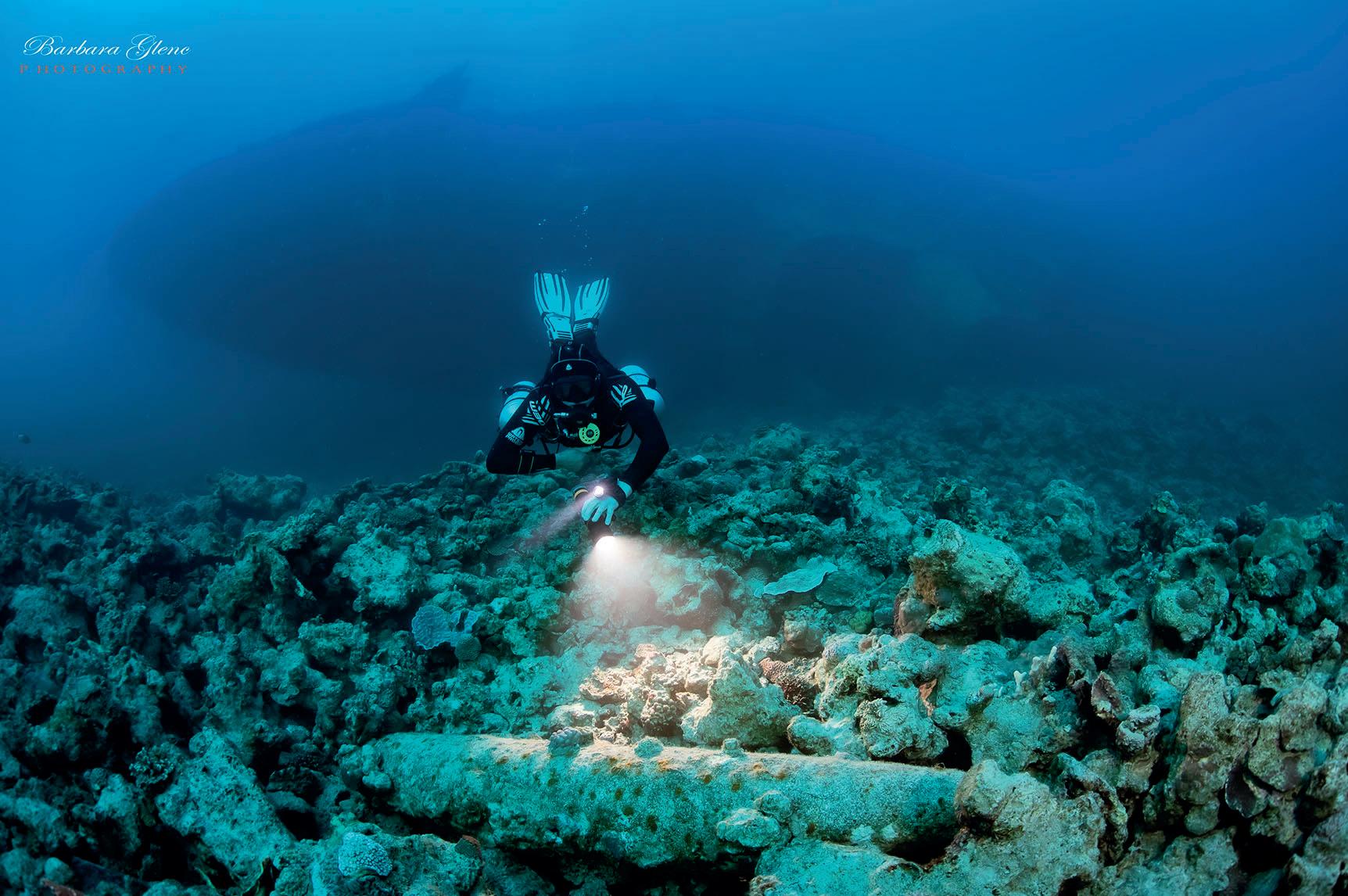
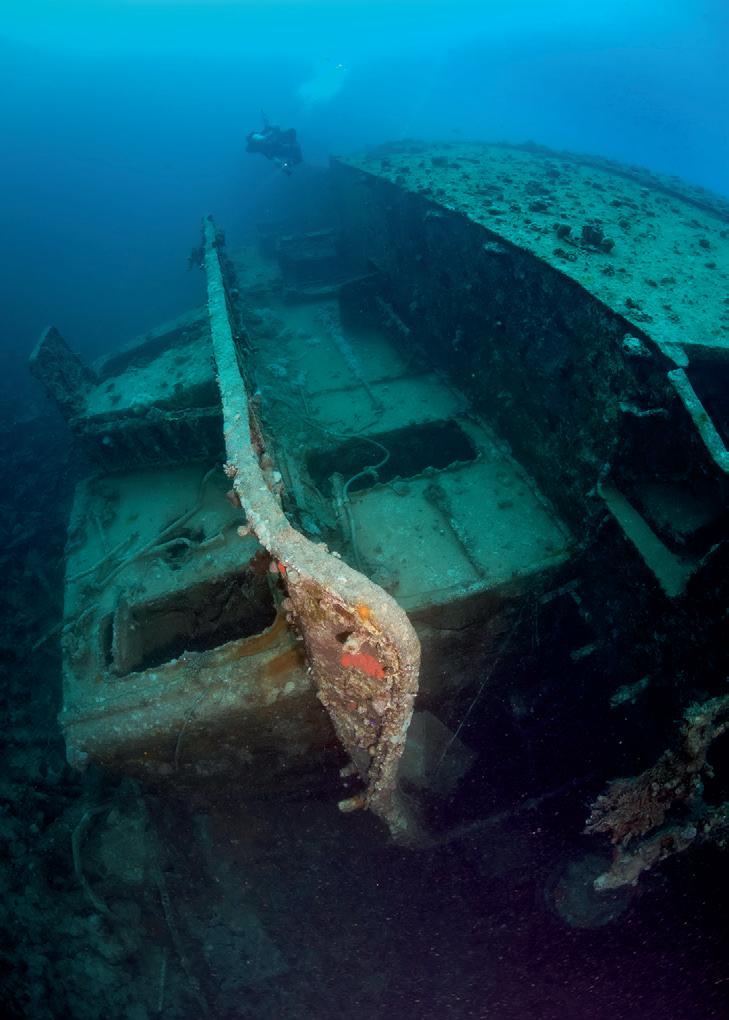
We started at the bow, with the anchor clearly visible, then moved through the holds, railings, masts, and sections of the superstructure all the way to the stern and the massive propellers at around 45 m. Emerging from the distinctive “fog,” they looked incredible.
Then we returned to the large breach left by an aerial bomb and entered the wreck. The penetration route led through open cargo holds, narrow structural passages, and an engine room packed with pipes, platforms, and system components. The biggest impression came from the crankshaft, the drive shaft, and the heavy propulsion machinery.
The entire wreck is surrounded by tiny suspended particles that create a characteristic “fog.” Torch beams cut through it like layers of smoke, giving the place a raw, almost unreal atmosphere.
SS Rosalie Moller was a British merchant ship from 1910. In 1941, it was bombed by the Luftwaffe in the Gubal area and sank – and to this day it still stands upright on the seabed.
After the dive, we returned to the decompression line. That’s the moment when you’re still replaying the wreck in your head – the light, the interiors, the shafts, and the atmosphere of the place.
Rosalie Moller is a wreck that demands experience, but rewards you with an extraordinary mood and the chance for a complete, technical exploration.
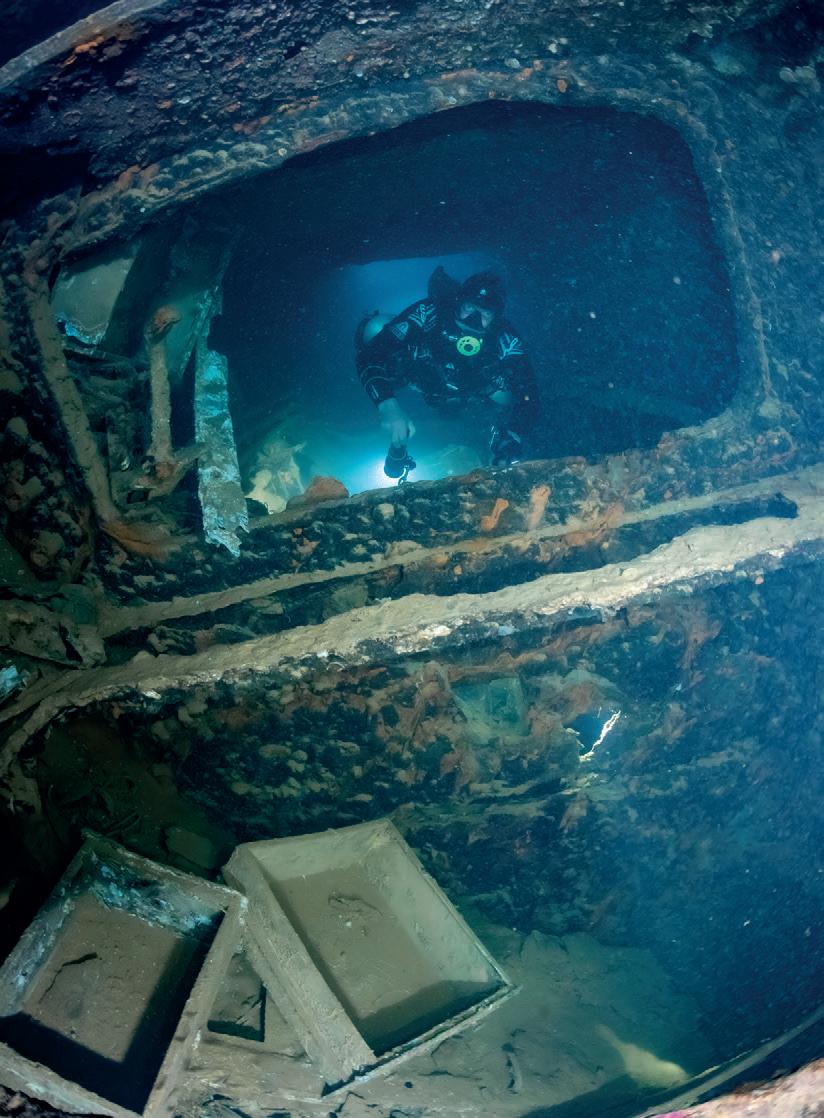
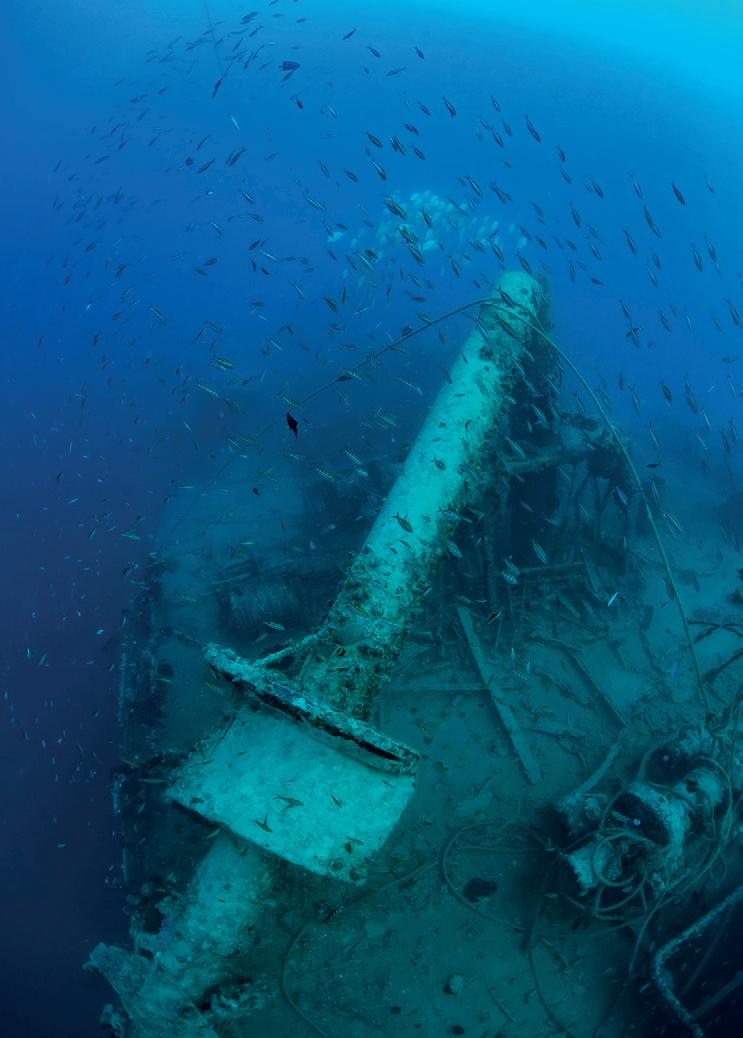
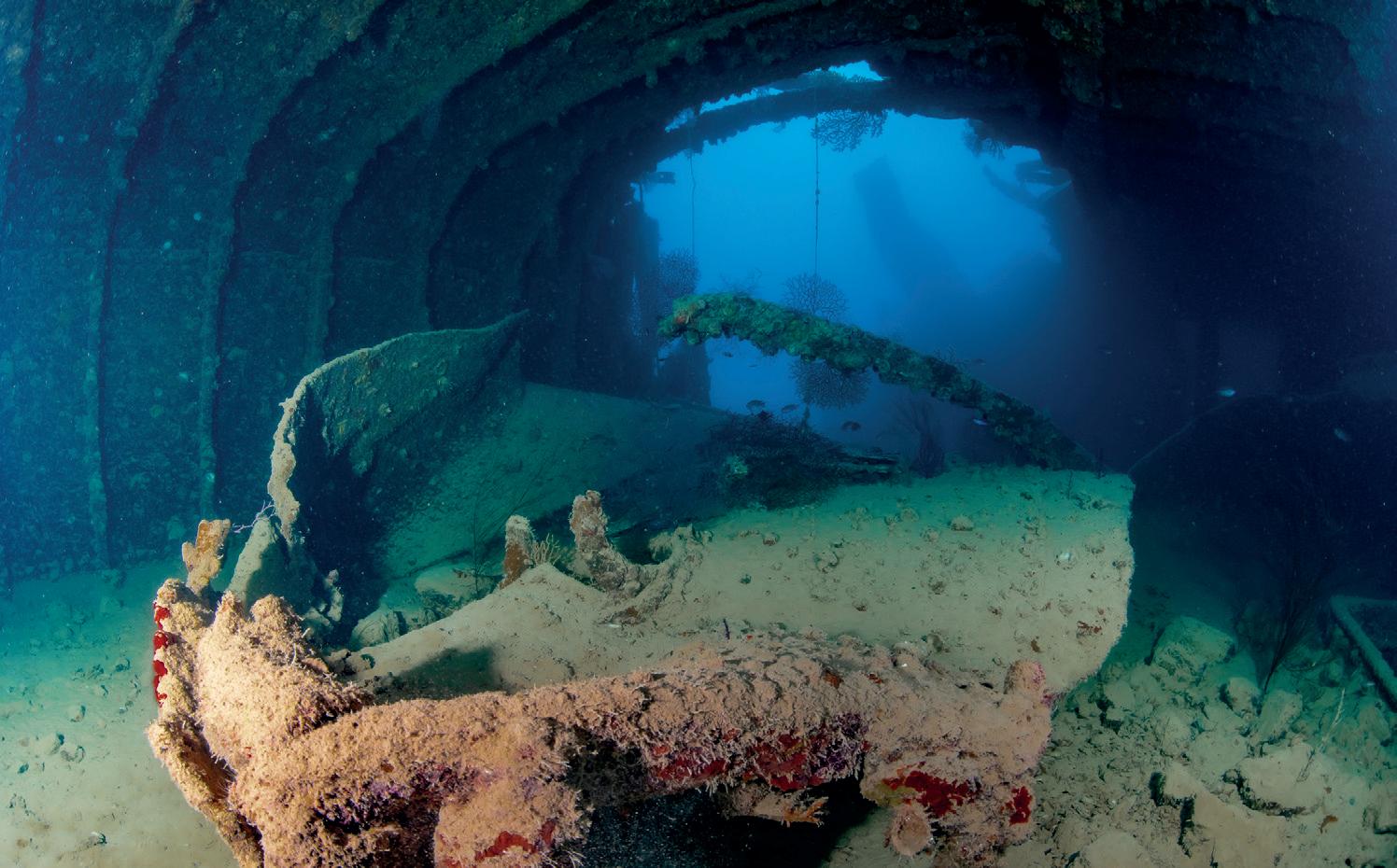
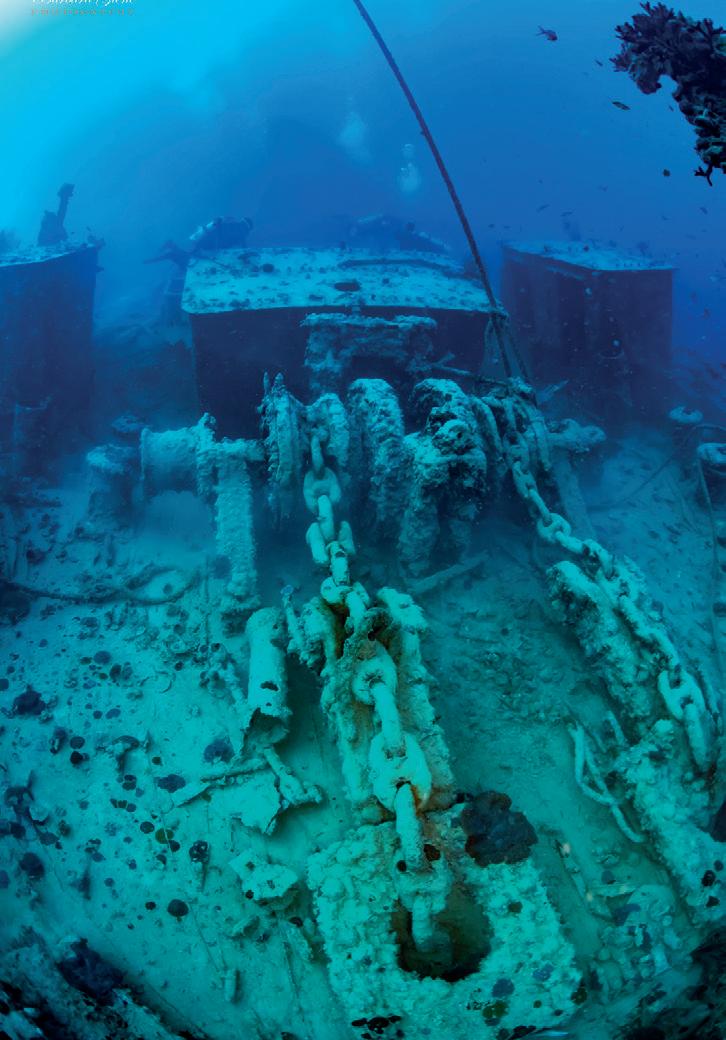
El Mina – a dive you don’t expect
Before getting in the water, we heard the usual lines: “a harbor wreck,” “poor visibility,” “nothing special.” Meanwhile, just a few meters into the descent it turned out the conditions were excellent – visibility reached around 30 m.
The wreck slowly emerged from the blue. Right at the bow, an element resembling a torpedo or a large shell embedded in the structure immediately caught the eye. A few meters farther along the deck, more shells lay scattered – clear traces of history.
El Mina rests on her port side, but she has still kept a very readable profile. The anti-aircraft guns, sections of the superstructure, and entry points into the interior are all clearly visible.
We head inside. Schools of small fish briefly reduce visibility almost to zero, but a moment later the space opens up. Inside the wreck, visibility is around 2 m – enough to explore narrow corridors, crew quarters, and steel bulkheads.
Here, the light from the OrcaTorch D950V, which I tested throughout the entire safari, played a huge role. Its powerful, wide beam cut through the suspended particles extremely well and lit the interior evenly, which worked perfectly for wreck photography.
Once back outside, we pass the anti-aircraft guns again and make our way toward the stern. There are two distinctive pro -
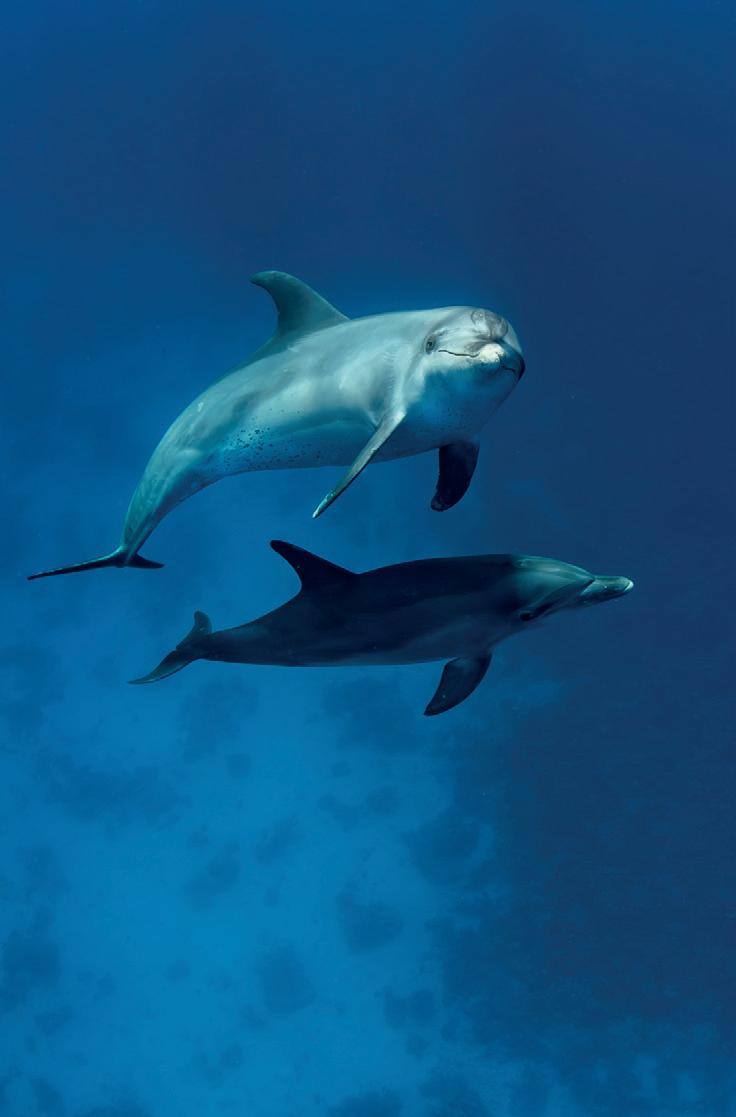
pellers there – one partially buried in sand, the other beautifully preserved and perfect for photos.
El Mina is an Egyptian minesweeper from the 1950s, sunk on February 6, 1970 during an Israeli air attack in the port of Hurghada. To this day, traces of the explosion and armament are still visible on the wreck.
This liveaboard showed us the Red Sea at its very best. Calm water, no swell, excellent conditions, and wrecks that can completely change the way you think about wreck diving in Egypt. Every descent had its own character – from the massive, raw Rosalie Moller to the tighter, more military, and unexpectedly impressive El Mina.
But what stays with you most isn’t just the steel and the history – it’s the atmosphere of these dives. The silence as you descend along the line, torchlight cutting through the haze, long decompressions, and the wreck talk that continues after you surface. After a few days, you start living entirely by the rhythm of diving, the sea, and the bell calling you to a briefing or a meal.
And that’s when a wreck liveaboard becomes more than just a diving trip. It’s a week of total immersion – in technical dives, the stories of sunken ships, and the Red Sea’s unmistakable mood, which can hook you faster than you’d expect.
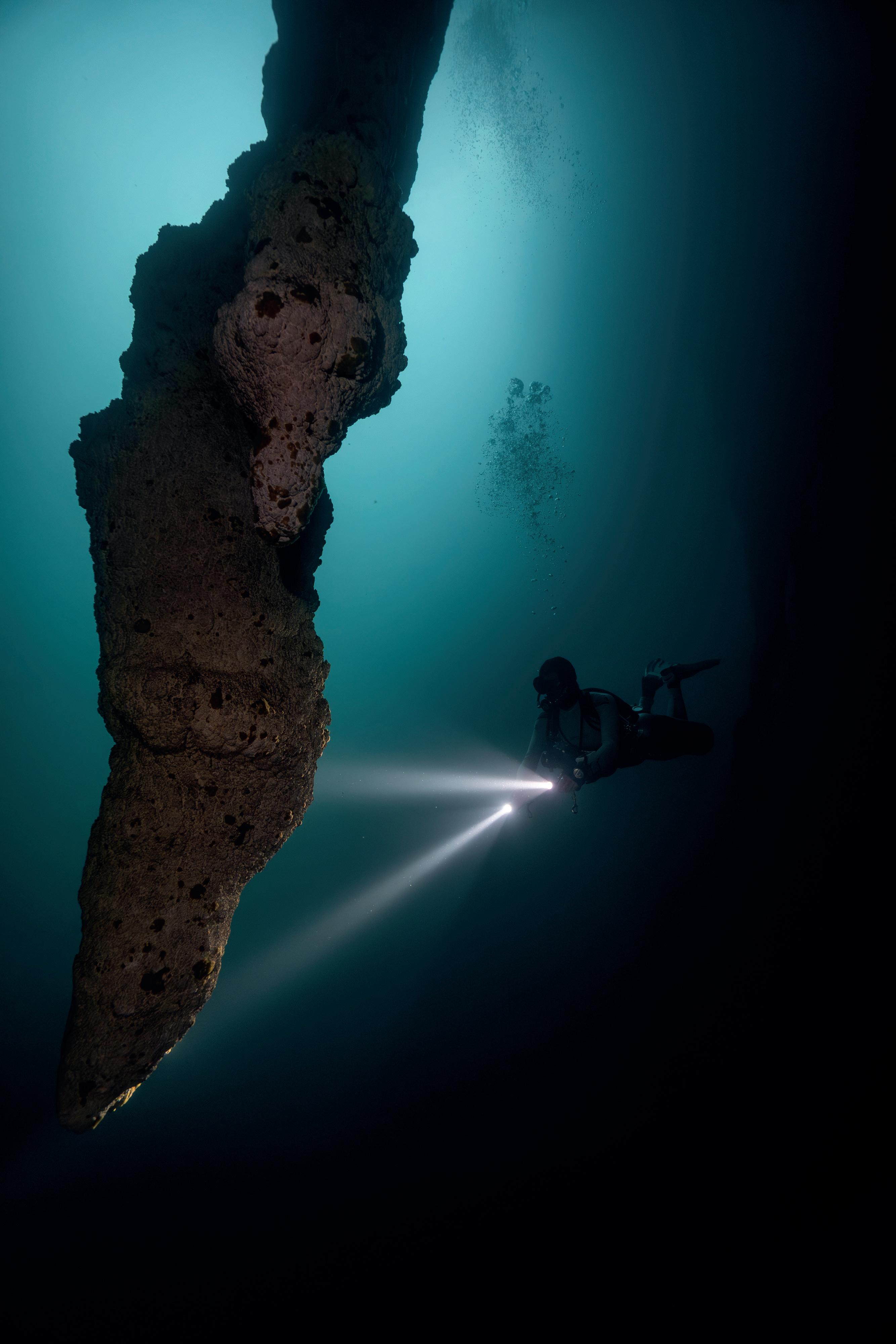

Wrecks, caves, murky water with near-zero visibility - ORCA7 shines where other dive lights give up.

One two brightness levels, five body 125 G • 3000 LUMENS • 150 M DEPTH RATING M DEPTH
One button, two brightness levels, f ive body colors.
5000 mAh batter y with USB-C charging. battery with USB-C
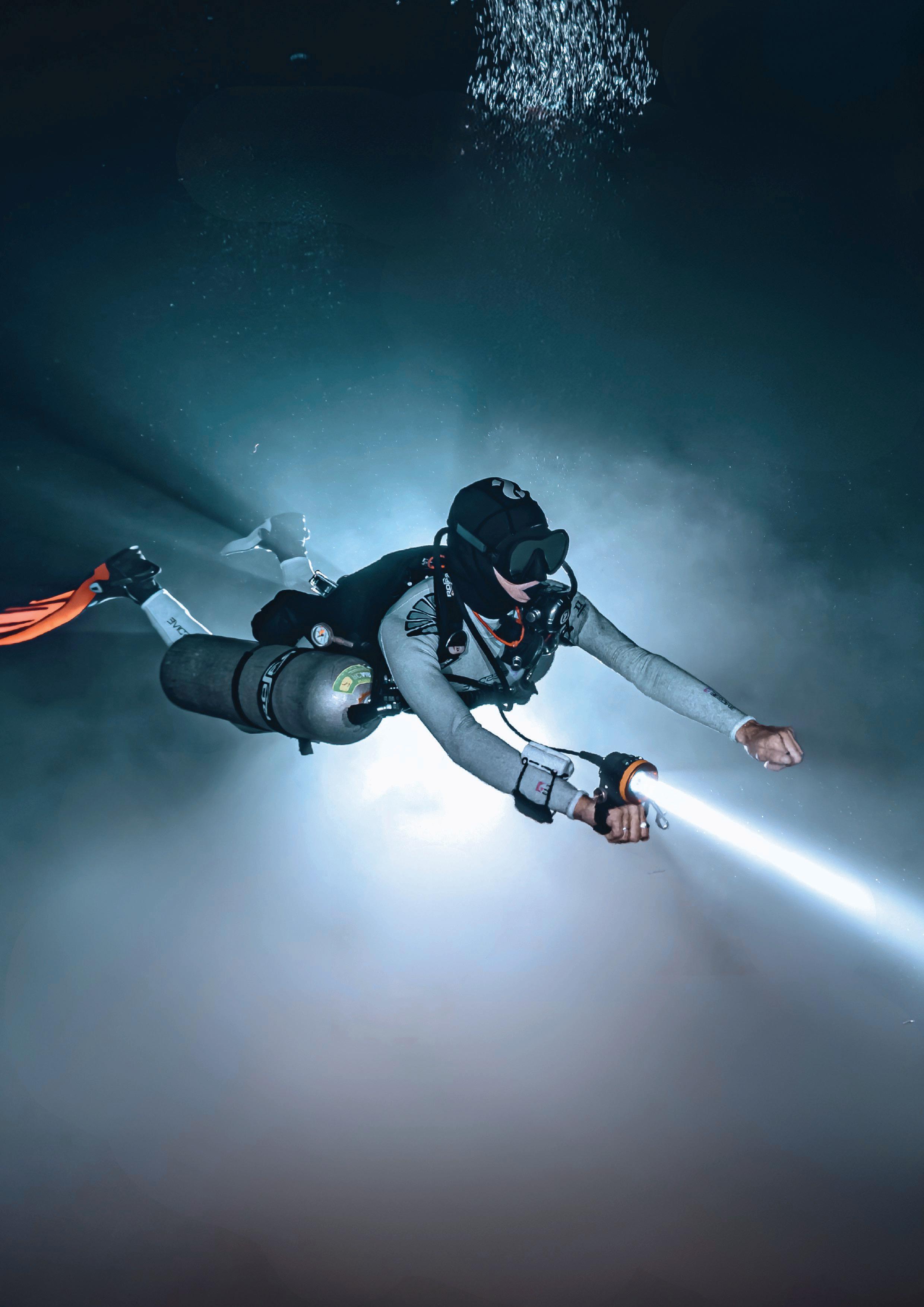


A modular dive light system that adapts to your environment, configuration, dive type, and dive duration.
8000 lumens with no gradual dimming.
8° spot beam for penetration.
150° flood beam for wide-area illumination.
98 Wh battery with USB-C charging. Up to 22 hours runtime.
- the choice is yours.
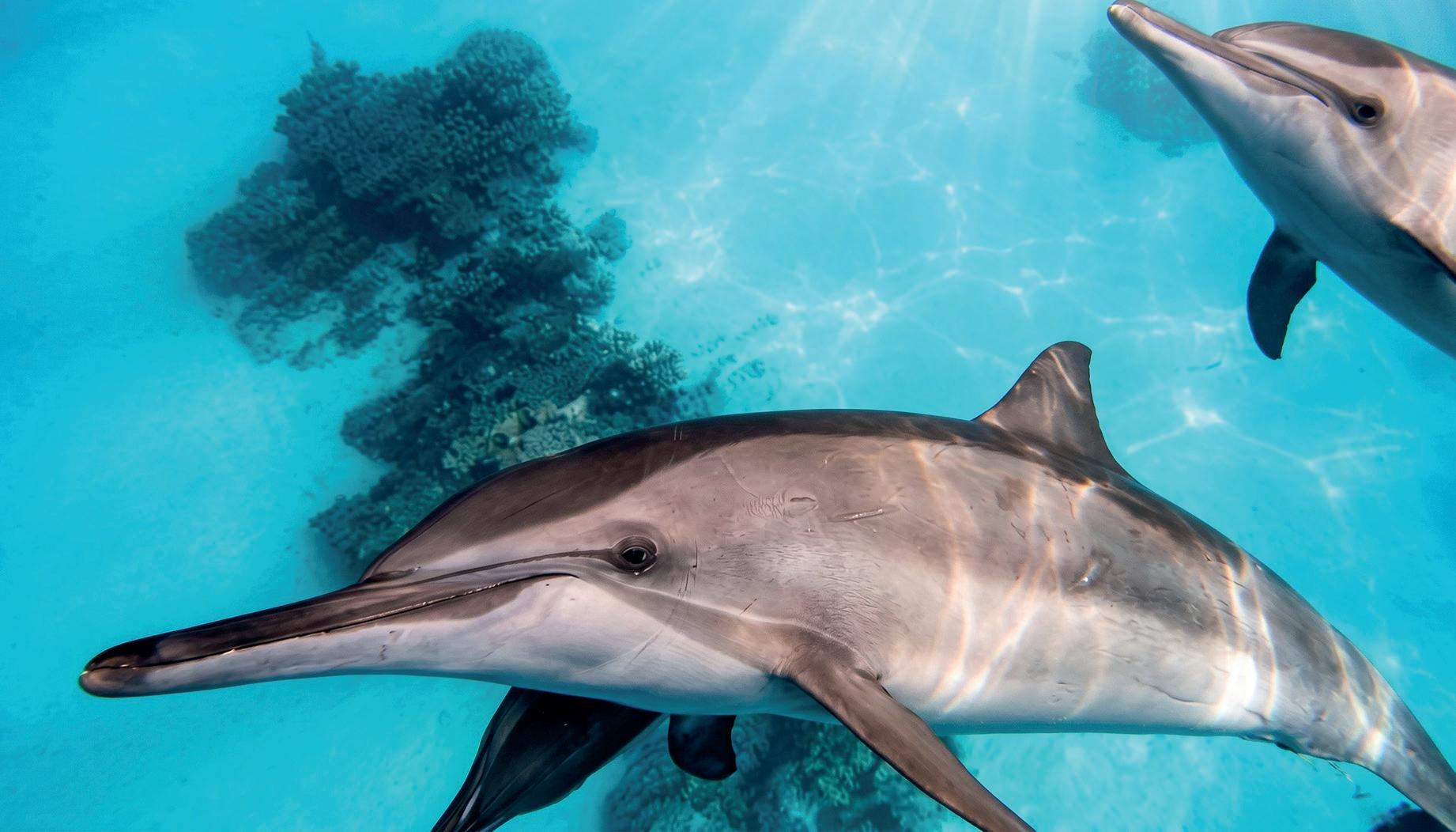
Text and photos Jakub BANASIAK
For many of us, it is a must-see on the map of Egyptian diving safaris. The southern route, the alarm clock at dawn and the entrance to the crystalline water inside the lagoon, where the blue is intersected by dozens of characteristic, slender silhouettes.
The Sataya Reef in the Wadi El Gemal Reserve in Egypt, known as DOLPHIN HOUSE, is a magical place.
However, the latest reports from last year and the alarming results of research by marine biologists make it clear: if we do not change the rules of the game, Sataya may be closed to tourists, as it happened with some dolphin inhabited waters in New Zealand or Hawaii.
The situation on Sataya has ceased to be idyllic. Pier Paolo Celeste, coordinator from the Italian Marevivo Foundation, during a December meeting in Egypt in 2025 during 24thConference of the Parties to the Barcelona Convention (COP24), did not delivered a stark warning: "This is no longer a sanctuary. Sataya has become an arena of chaos, reminiscent of Cairo's Tahrir Square at rush hour."
The problem lies in the scale. Every day, the lagoon is visited by dozens of safari boats and motorboats. The roar of the engines, which does not stop for a moment, and the hundreds of
swimmers surrounding the groups of dolphins, create a "circus of noise". For spinner dolphins (Stenella longirostris), for which Shaab Sataya is a habitat reef, this is not just an inconvenience. It is an existential threat. These mammals are nocturnal hunters –they feed on the high seas after dark, and the shallow lagoons of Sataya are used for regeneration, sleep and care for their young. Every time a dolphin is pulled out of the resting phase by an intrusive diver, swimmer or zodiac, it is a real energy cost that affects their health and ability to reproduce.
The research led by Dr. Maddalena Fumagalli sheds light on the condition of the local population of spinner dolphins. Sataya is home to a population of between 140 and 200 dolphins per year, which form an almost isolated community. During the day, there are usually between 60 and 100 dolphins on the reef. Scientists, studying the impact of dolphin watching boats and swimmers in various bodies of waters, have shown that in the presence of tourists, the rest time of dolphins decreases drastically.
HERE'S WHAT THE FACTS SAY:
● 66% less sleep: This is how much the rest time of dolphins in the presence of intensive tourist traffic is shortened.
● Domino effect: Interrupting sleep forces dolphins to be alert, which increases their energy expenditure by several percent.
● No regeneration: Dolphins cannot compensate for the lost time. Exhausted individuals are an easier target for predators once they have head out into the open sea.
● Constant stress and pressure from tourists cause a decrease in the level of natural immunity in these animals and a greater susceptibility to disease.
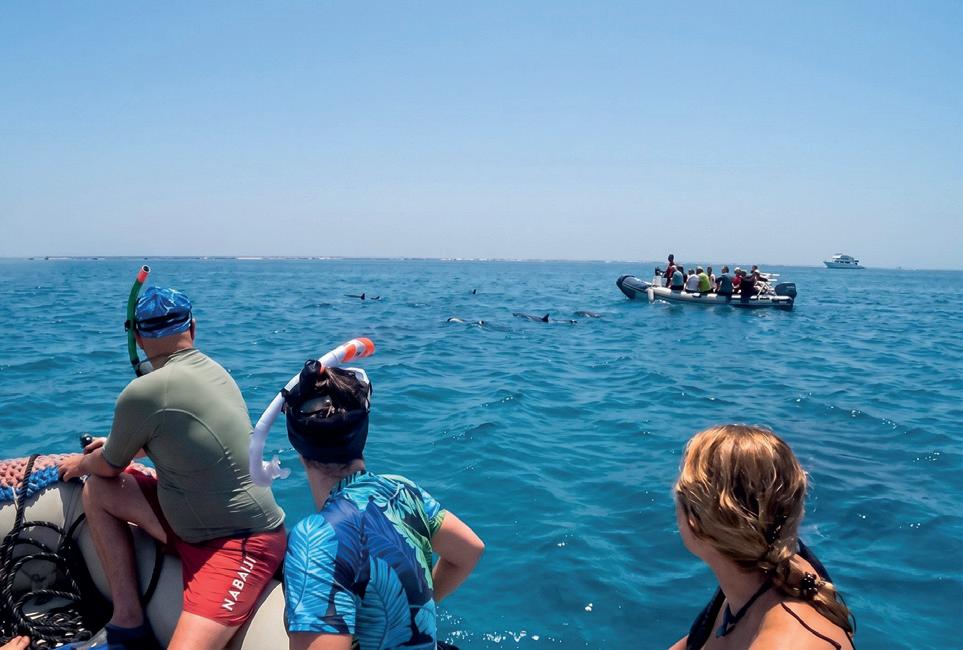
Lars Bejder and David Lusseau, pioneers of research into the impact of tourism on cetaceans, warn against the concept of "captivity without bars". It turns out that serious violations of dolphin welfare are committed not only by dolphinariums or oceanariums, but also by tourists swimming with wild dolphins and some organizers of "whale & dolphins watching". Dolphins on Sataya are free, but the pressure of boats and people in the water makes their natural habitat a place of chronic stress.
Egypt does not want to close the reef, but it must save it. Ali Abo Sena, head of the Egyptian Agency for The Environment (EEAA) announced a revision of the management strategy at Shaab Sataya. The plan postulated by Marevivo and HEPCA (Hurghada Environmental Protection and Conservation Association) builds on the success of the Samadai reef, where a restrictive zoning and limited visiting hours have been in place since 2004.
Until the summer of 2003, between 500 and 800 tourists had been brought in every day to swim with dolphins in the lagoon in Samadai. Their contact with dolphins was completely unregulated, and many observers were concerned about the welfare and safety of dolphins, tourists, and the future of the wild dolphin sighting industry in the region. In 2003, the authorities made the resolute decision to completely suspend all visits to Sama-
dai Reef and began consultations to create a management system that would protect dolphins while allowing tourism activities to take place on the reef, which is a resting place for dolphins, as well as one of the more popular diving and snorkeling destinations. //wwhandbook.iwc. int/en/case-studies/egypt-samadai-reef According to the developed plan, a restrictive division into zones was introduced for Shaab Samadai:
● Zone A (No-Entry Zone): It is an internal lagoon, dedicated to dolphins as their resting place. Entry is strictly prohibited here. Dolphins prefer this zone, especially in the morning.
● Zone B (Swimmers and Snorkelers Only): An area reserved exclusively for swimmers and snorkelers. Motor boats are prohibited.
● Zone C (Other Activities): An area where mooring, scuba diving and other activities are allowed. The boundaries between the zones are marked with buoys: orange for the A/B zones boarder, white for the B/C zones boarder. A maximum of ten boats per day can enter Samadai Reef, carrying no more than 175 people swimming in ABC equipment and 100 divers into the reef area. Boats with snorkelers are allowed in at 10 a.m.:00-14:00, and boats with divers at 9 a.m.:00-15:00. If the organizer already has an entry ticket to the reef area, this guarantees that the boat will be allowed in. Buoys clearly separate the diver and snorkel areas from the "dolphin only" rest area. Those who choose to snorkel are
required to wear a life jacket, partly for safety reasons and partly to prevent an overly enthusiastic snorkeler from diving underwater in pursuit of dolphins.
The last 20 years of Samadai conservation show that the quick actions of the authorities, who turned to the scientific community for help, led to an almost immediate transition from the uncontrolled, potentially harmful business of swimming with dolphins, to a carefully controlled and well-monitored situation of sustainable management in this habitat reef. The introduction of a complete suspension of all activities that were previously allowed has helped to change the situation and make tourism operators aware that it will not be possible to return to the current, uncontrolled mode of operation. Assigning monitoring vessels (including the coast guard) and the necessary personnel to carry out monitoring activities was costly, but crucial to the success of this, as well as any other government marine environmental management system.
Scientists, both from Egyptian and international organizations, have monitored and continue to control the population of spinner dolphins on Samadai and swimming activity with dolphins. Studies have shown that the tourism management program on Samadai is functioning properly, with very few violations, and the dolphin population appears to be stable and healthy, with no visible signs of stress, decline, or attempts to abandon the habitat reef.
The world has long noticed what unregulated tourism leads to. Studies on bottlenose dolphins in Doubtful Sound Bay (Fiordland) in New Zealand have proven that frequent interactions with tourist boats force dolphins to increase their submerged time. This is a huge energy expenditure, especially affecting smaller females. The consequences were drastic – a radical increase in the number of stillbirths was observed and a drastic decrease in the entire population from 67 to 56 individuals.
In the US, the US government agency NOAA has introduced strict bans on tourists in Hawaii, consisting of an absolute order to keep a distance of at least
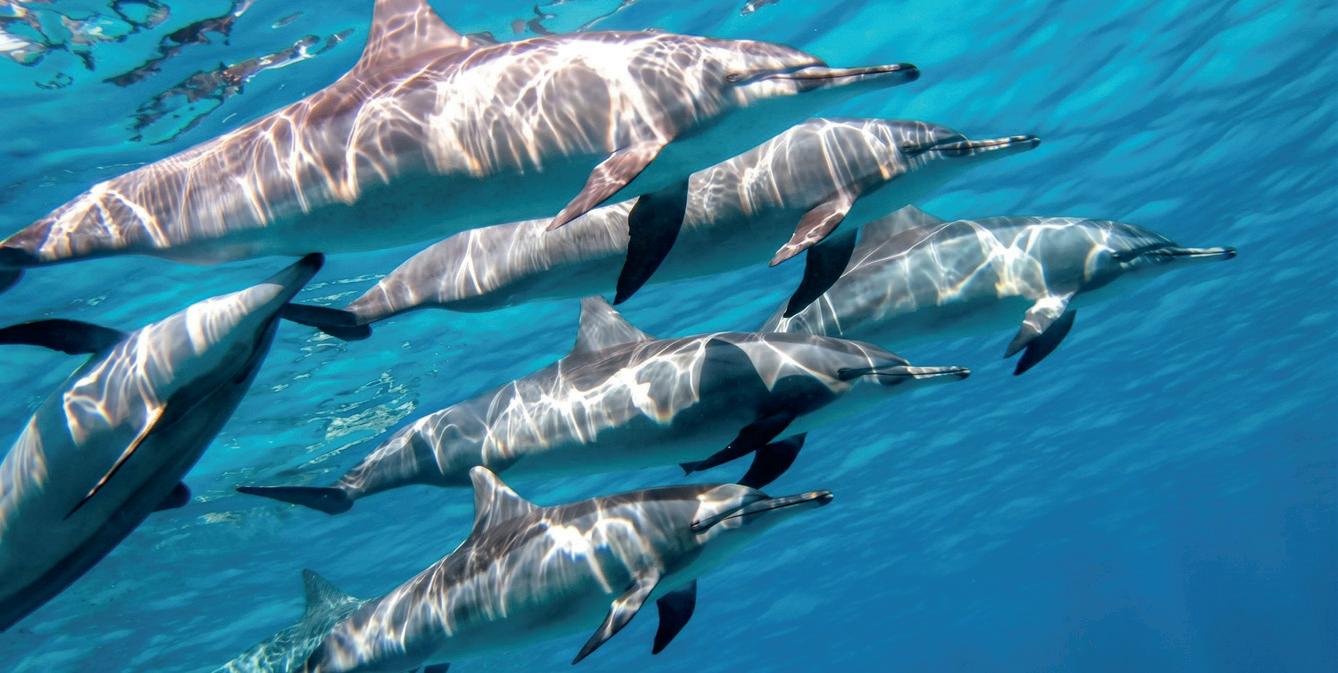
50 yards (about 45 meters) from Hawaiian spinner dolphins. It was understood that the very fact of forcing an animal resting during the day to avoid tourists reduces its physical condition and consequently exposes it to predator attacks.
On the other hand, in Brazil, on the Fernando de Noronha Islands, an archipelago that brings together the world's largest regular population of spinner dolphins, there has been a strict ban on swimming and diving with dolphins for tourists for years. Only observation from land (from designated viewpoints) or from strictly regulated boats is allowed, and only authorized scientists using "passive diving" techniques are allowed to dive there. The Spinner Dolphin Project, which has been in operation for 35 years, proves that tourism around dolphins can flourish without destroying their habitats and disturbing their welfare.
On Shaab Sataya, scientists suggest following the good practices from the Samadai reef. They recommend in particular:
1. Access restrictions (marine zoning): Separation of the "A" zone – a total ban on entry for humans, reserved only for dolphins. Zone "B" would be for controlled snorkeling, and "C" for mooring boats.
2. Limited number of vessels: An end to the unlimited number of boats. Introduction of a limit on the number of vessels allowed in the lagoon simultaneously at any given time.
3. Electric drives: The postulate of the transition of the zodiacs to silent electric motors to eliminate the high-frequency noise that is painful for dolphins.
4. Certification and training: Mandatory training for safari boat guides and crews.
"Dolphins are a pillar of Marsa Alam's tourism economy. If they escape, all life on the coast will collapse," the researchers emphasize.
We don't have to wait for Shaam Satay's status to change to ensure the welfare of the spinner dolphins during their time
on this reef. It is about following the basic rules and basic knowledge about the biology of the Stenella longirostris. The author of this article has been training divers and snorkelers in the principles of swimming and diving with dolphins for several years, respecting their welfare. He also offers short videos about the proper conduct on the Sataya reef, which can be used on a dive boat for a briefing before swimming with spinner dolphins. There is also a specialized course "Dolphin Defender" for all those who want not only to swim safely with dolphins, but also to actively engage in their protection and deepen their knowledge of human-dolphin contacts.
We invite all interested parties to contact us e-mail: jakub.b@viva.home.pl
As a diving community, we have a vested interest in keeping Sataya open. But we are the ones who need to change our behavior. Remember that every attempt to touch a dolphin or chase it with a camera is an act of aggression, not love for nature.
Recommendations for safari in this area are simple:
● Choose responsible operators: Ask if the dive boat crew adheres to the HEPCA code and if they do not "chase" dolphins with zodiacs.
● 50 meter rule: Keep your distance. If dolphins want interaction, they will approach you on their own. If they swim slowly in a tight group – they sleep. Leave them alone.
● Zero contact: Never touch dolphins. Bacteria from human skin and the stress of touch can be a significant threat to them.
● Educate others: If you see harmful behaviors on the zodiac, react. Your attitude sets the standard on your boat, but also on other safari boats.
Sataya is the home and a sanctuary for wild animals. Unless we learn to respect them, a complete ban on entering the lagoon will be the only way to ensure their protection. The choice is ours – divers who love this blue the most.
Every refined detail creates a perfect whole.
CUT THROUGH THE DARKNESS
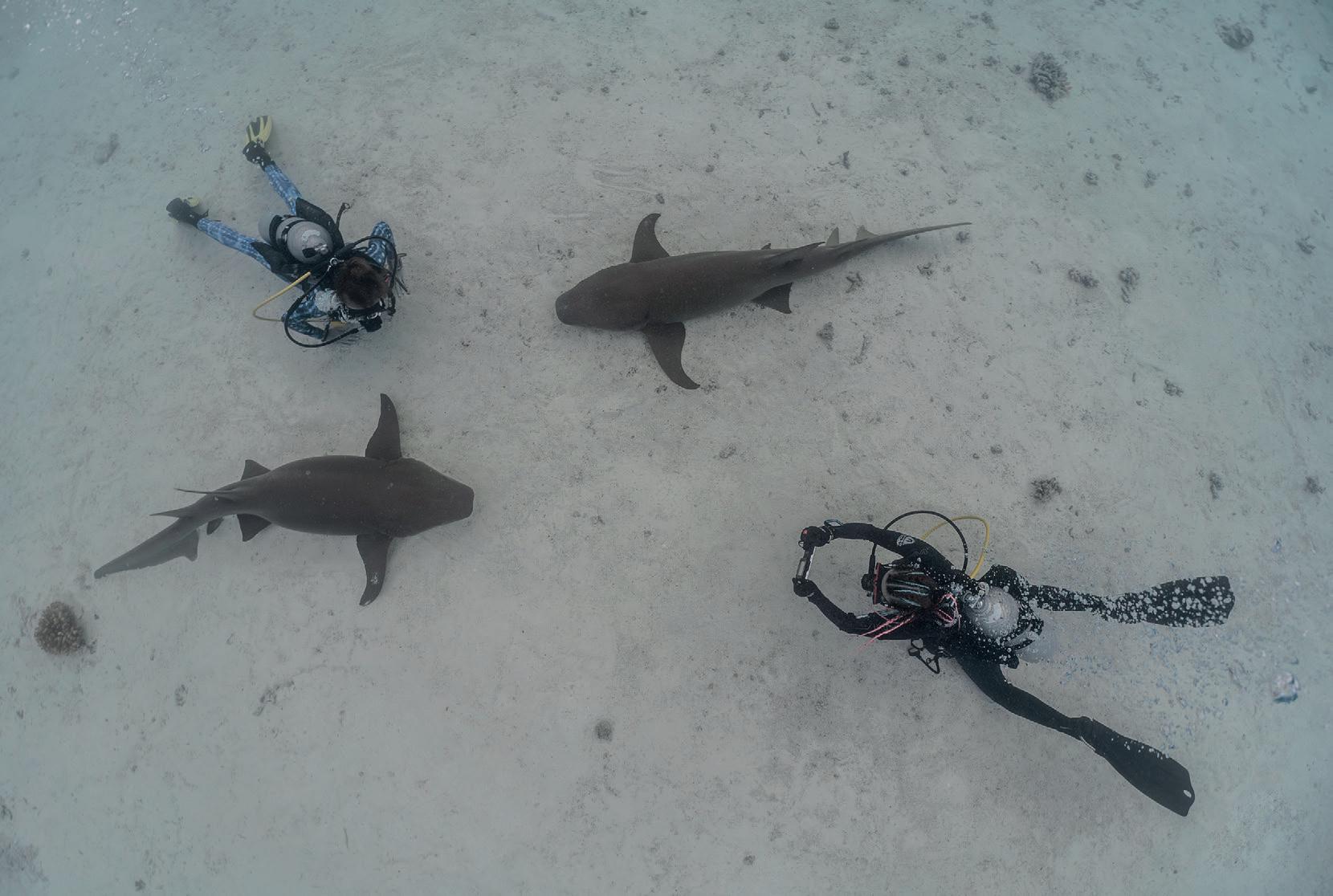
Text and photos Przemysław ZYBER
You’re underwater, and right in front of your mask a spectacle of nature unfolds – light pierces through the surface, creating dancing reflections, while a majestic shark swims right beside you.
You raise your camera, press the shutter… and well, the result often falls short of what your eyes saw.
Underwater photography is a difficult art of compromise between the physics of water and the capabilities of your equipment. The same question often arises: “Where is the best place to learn? What’s the next step so that photos stop being just souvenirs and become art?” The answer may surprise you, because you won’t find it in your camera manual.
The “quick course” trap
Don’t get me wrong – local reservoirs are great places to test equipment or refresh basic buoyancy skills. But if you truly want to grow in photography, one day is not enough. Why? Because photography is a process.
In a short course, you learn it in theory or in very limited conditions. You get one, maybe two chances to capture a shot before time or visibility runs out. It’s a bit like learning to drive a Formula 1 car in a supermarket parking lot. You may master the steering wheel, but you won’t feel the speed or the forces.
So let’s compare a typical weekend photography course at a Polish lake with a week-long safari. On a local course you have only a few hours underwater, often in constant and heavily limited lighting conditions. The subjects you can photograph are usually reduced to a predictable set of flora and fauna. Moreover, photo review is often rushed and superficial, usually done after the session in haste.
Meanwhile, on a safari you spend underwater time equivalent to around 20 dives in a week! This means working across the full spectrum of lighting – from soft morning light, through harsh midday sun, to the challenges of night dives. You also get a unique opportunity to photograph the full range of the underwater world – from tiny macro details to massive schools of fish and spectacular wrecks. And all of this comes with professional
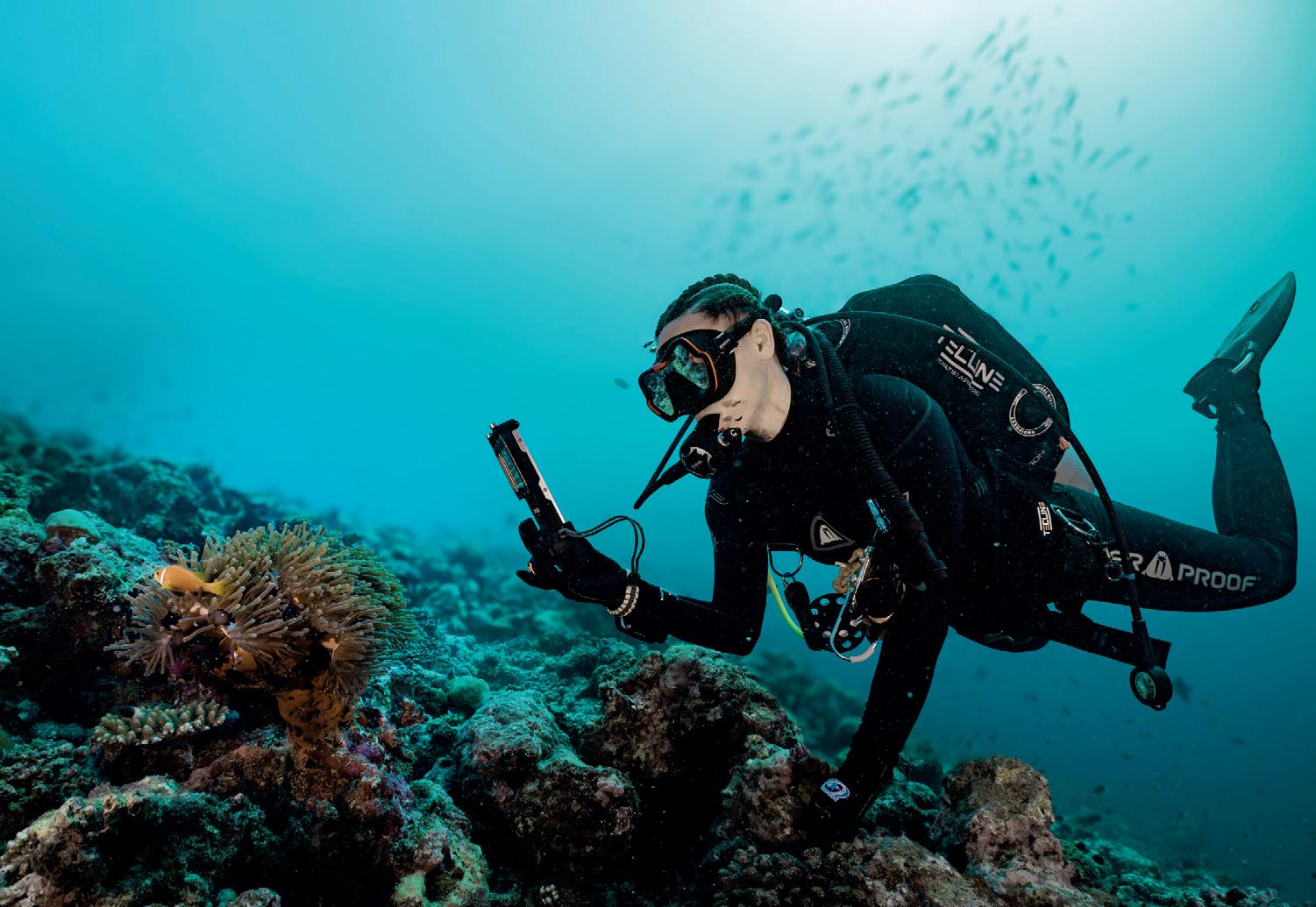
support in the form of daily evening workshops and in-depth analysis under the watchful eye of an expert.
A real breakthrough happens when you fully immerse yourself in the process – literally and figuratively. That’s why I believe the best path of development is a shared photographic safari. I clearly see in my students’ progress that diving photo safaris are a true game changer. Why do I think so? First, time is on our side – we have an entire week without rush. Additionally, each day of the safari we face different challenges:
● Light variability: Dives in the morning, under strong midday sun, and at golden sunset. Each requires a different approach to exposure.
● Dynamics vs. stillness: One day we practice macro – patiently focusing on a motionless snail. The next, we shift perspective to wide-angle, capturing massive schools of fish surrounding a majestic wreck.
● Water that teaches: Sometimes we enjoy crystal-clear visibility; other times the water is full of plankton. This is the best lesson in handling backscatter and training in constantly changing conditions.
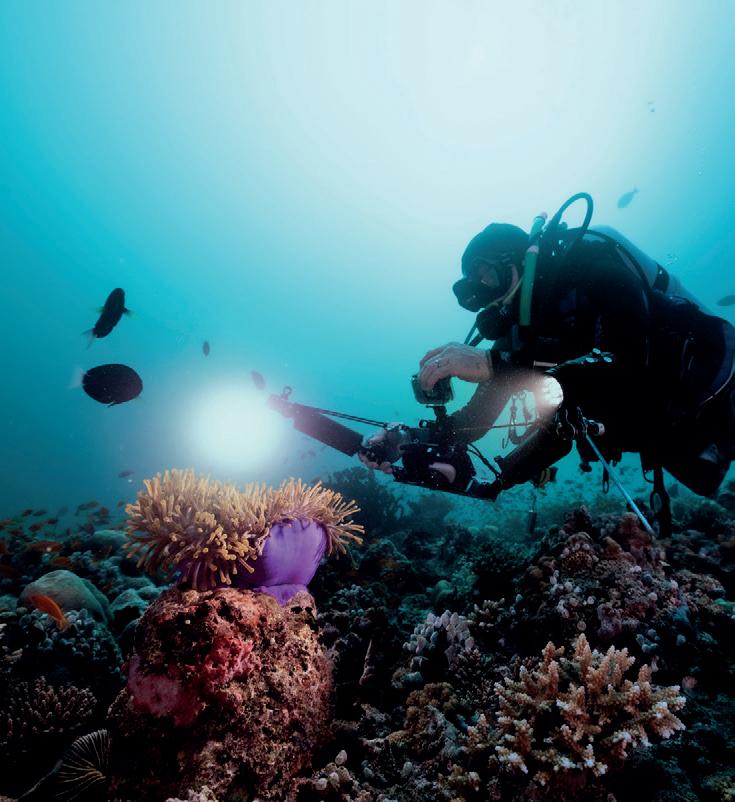
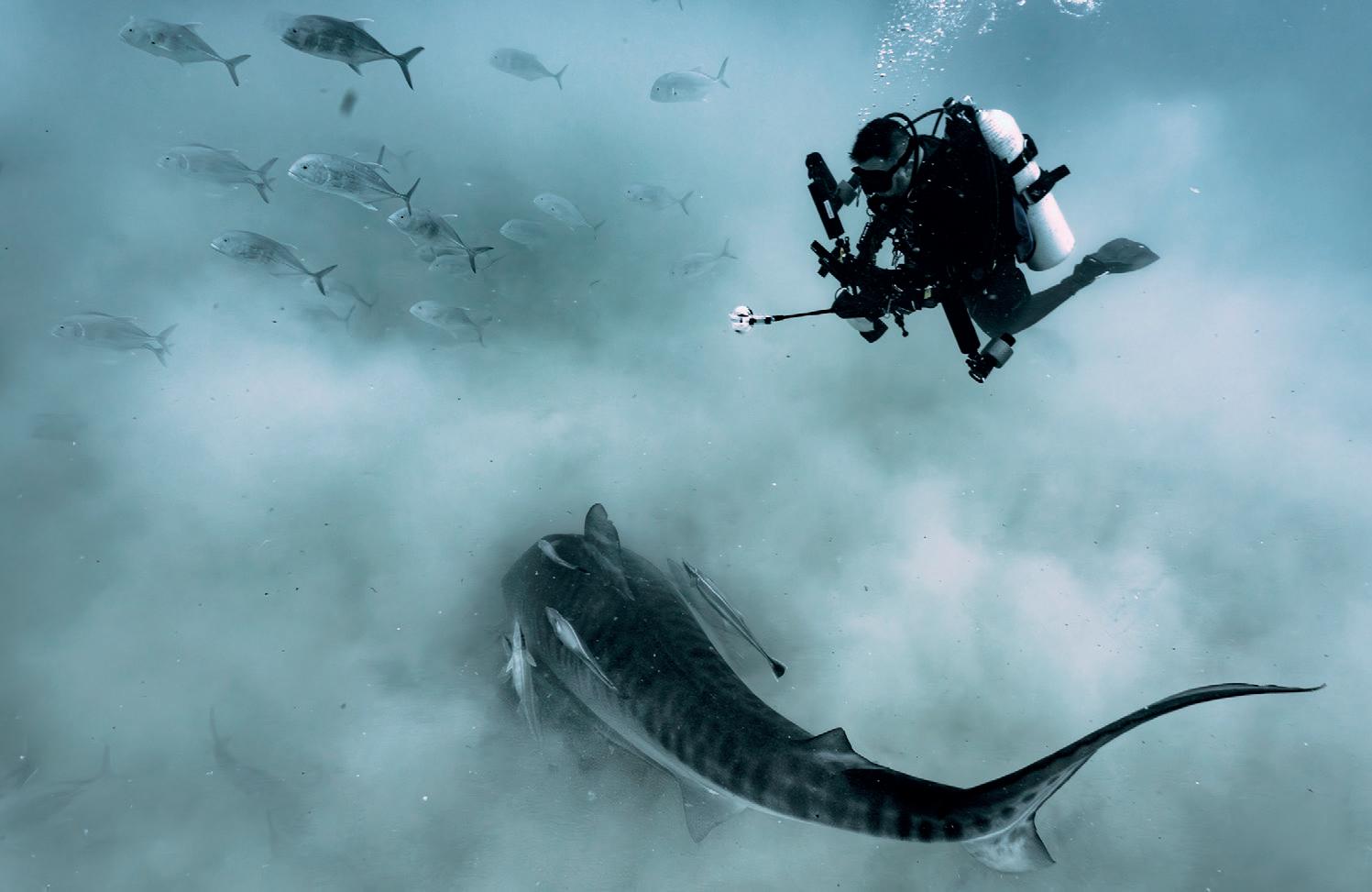
On such trips, I place huge emphasis on understanding what happens to colour. As you know, water acts as a filter that steals colours with every meter of depth. First red disappears, then orange, until everything becomes blue-grey.
During the safari, we don’t just talk about this – we test it at every depth. We learn how to manually correct white balance and how to set lights to restore natural colours. You must see on your own screen how dramatically an image changes with depth. And when you spend a full week training this, the results of such intensive practical learning become visible very quickly.
The greatest value of the safari, however, happens not underwater but on deck, after taking off the wetsuits. Shared evenings with a laptop, reviewing every frame, analysing composition and photographic principles – this is the moment when everything clicks.
This analysis is crucial, because sometimes it’s enough to understand that shifting composition, waiting for the right moment, or changing your shooting position can produce images that are truly stunning. Most importantly, the next day you go underwater again, applying the lessons learned from the evening review in practice. That is exactly why progress during a safari is so significant.
Underwater photography is an extreme sport for your creativity. Don’t be afraid of difficult conditions – they forge the photographer. But don’t do it alone – go on a safari with someone who will help you avoid mistakes that took me years to make.
Among other reasons, this is why together with Kasia –a master of logistics, organization, and making the impossible happen – we created the diving travel agency Deep Art Travel, whose advertisement appears at the end of this article. We organize extraordinary trips.
We create experiences that stay with you for years. We take people to the most beautiful places underwater and on land –where nature shows its most spectacular face, and every day becomes a story worth telling.
We combine a passion for diving, photography, and travel with extensive organizational experience, so you can focus on what matters most – living the moment, discovering the world, and developing your skills.
From shark-filled reefs in the Maldives, through wrecks hiding history, to safaris and photographic expeditions – we create trips that inspire, teach, and allow you to feel the true freedom of travel.
Because the best memories begin where routine ends.
And see you underwater!


www.rehasport.pl

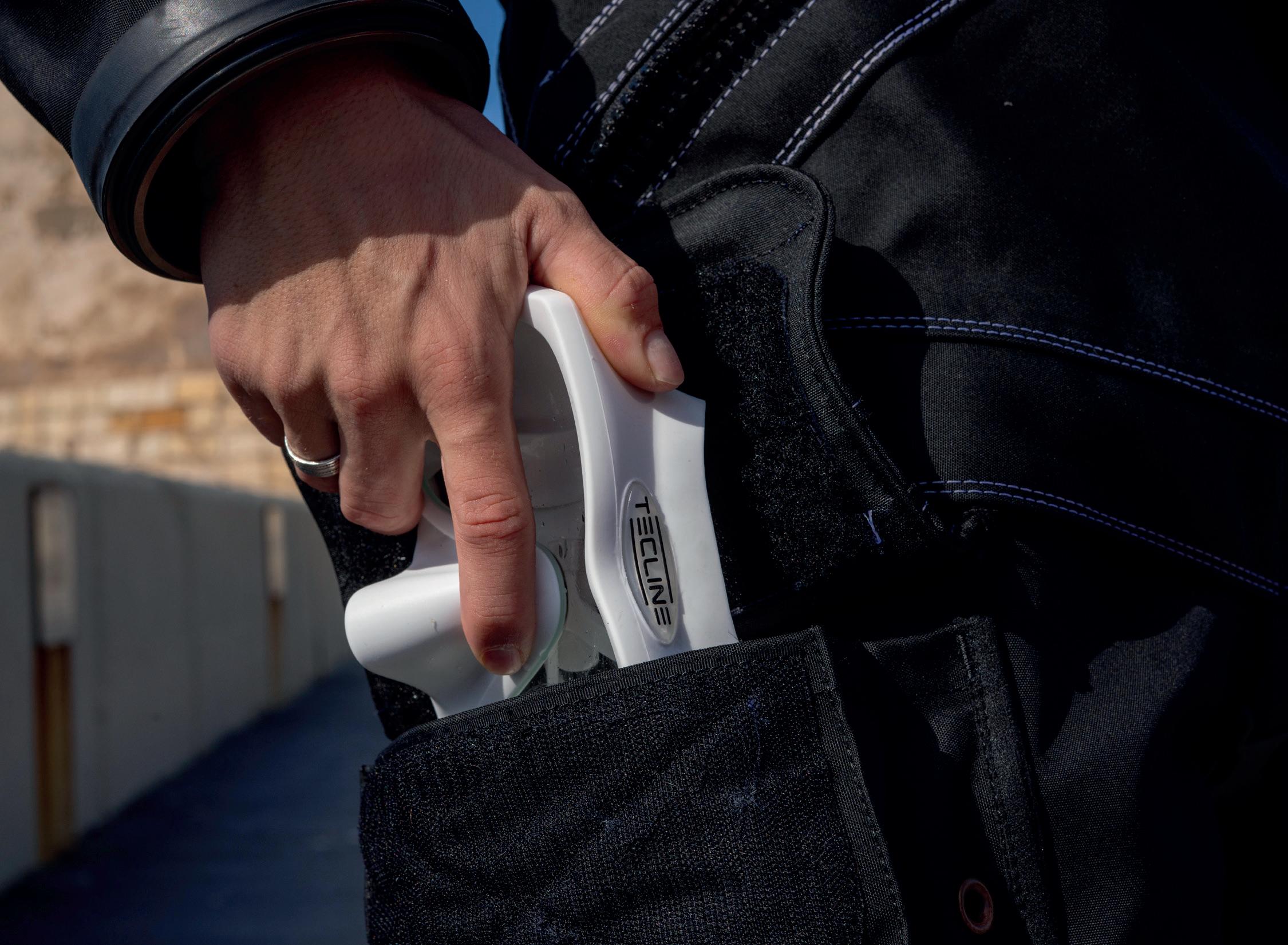
Whether you are right- or left-handed does not matter in diving.
What matters is which side you standardize on in your equipment configuration and in the way you execute procedures.
Read this, think it through, and ask yourself not only what solutions you use, but more importantly, why you use them.
1. Mask (backup) In the right pocket.
Why? When you reach for it, you will probably have to correct your buoyancy. Buoyancy controls – the inflator, rear dump valve, and the drysuit dump and inflation valves – are always operated with the left hand.
2. Regulator (OOG situation)
Always try to donate with your right hand.
Why? A diver who is out of gas may also be unstable in the water, and in that case it is better to keep your left hand free for buoyancy control.
3. Light (if you use one )
Try to keep it in your left hand.
Why? You donate gas with your right hand, so it is better if the recipient actually ends up with a regulator in their mouth
The second issue is the backup mask mentioned above. Signal a lost mask by moving the beam of your light. If you do that with your left hand, you can simultaneously reach to the right for your backup mask.
Wait!
Is that right?
…then what about buoyancy? How are you supposed to operate the inflator or dump valve with a light in your hand? Use a Goodman handle – a mount that secures the light to your hand while keeping that hand free.

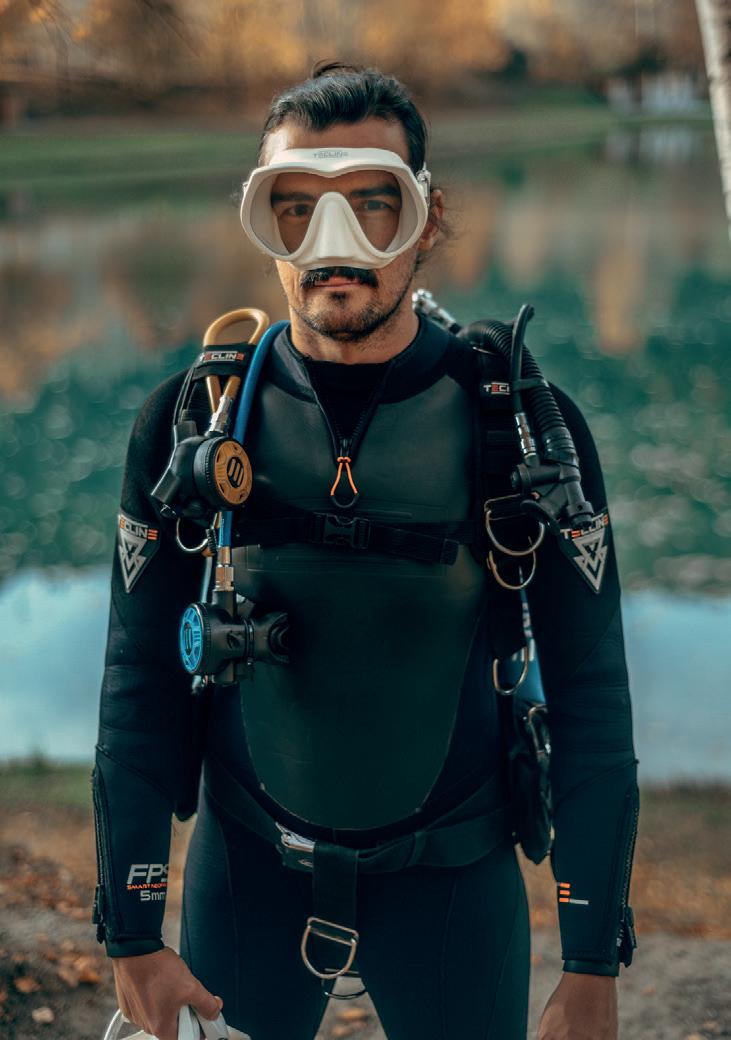
4. Computer (depth gauge)
On the right hand.
Why? You monitor your computer while operating the inflator, rear dump valve, and drysuit valves with your left hand.
5. Harness buckle
On the left side (not under the crotch strap).
Why? Because if necessary, you can release the lower part of the harness with a single movement.
6. Wing on a twinset
You should always rig it so that the dump valve is on the diver’s left side.
Why? Not long ago I watched a course video where someone had mounted the wing backwards – it was easy to spot because the dump valve was in an unusual place: on the right side, between the wing and the gas tank. That is dangerous in a rescue situation. A rescuer transporting a diver then has to manage two buoyancy systems – and all buoyancy-control
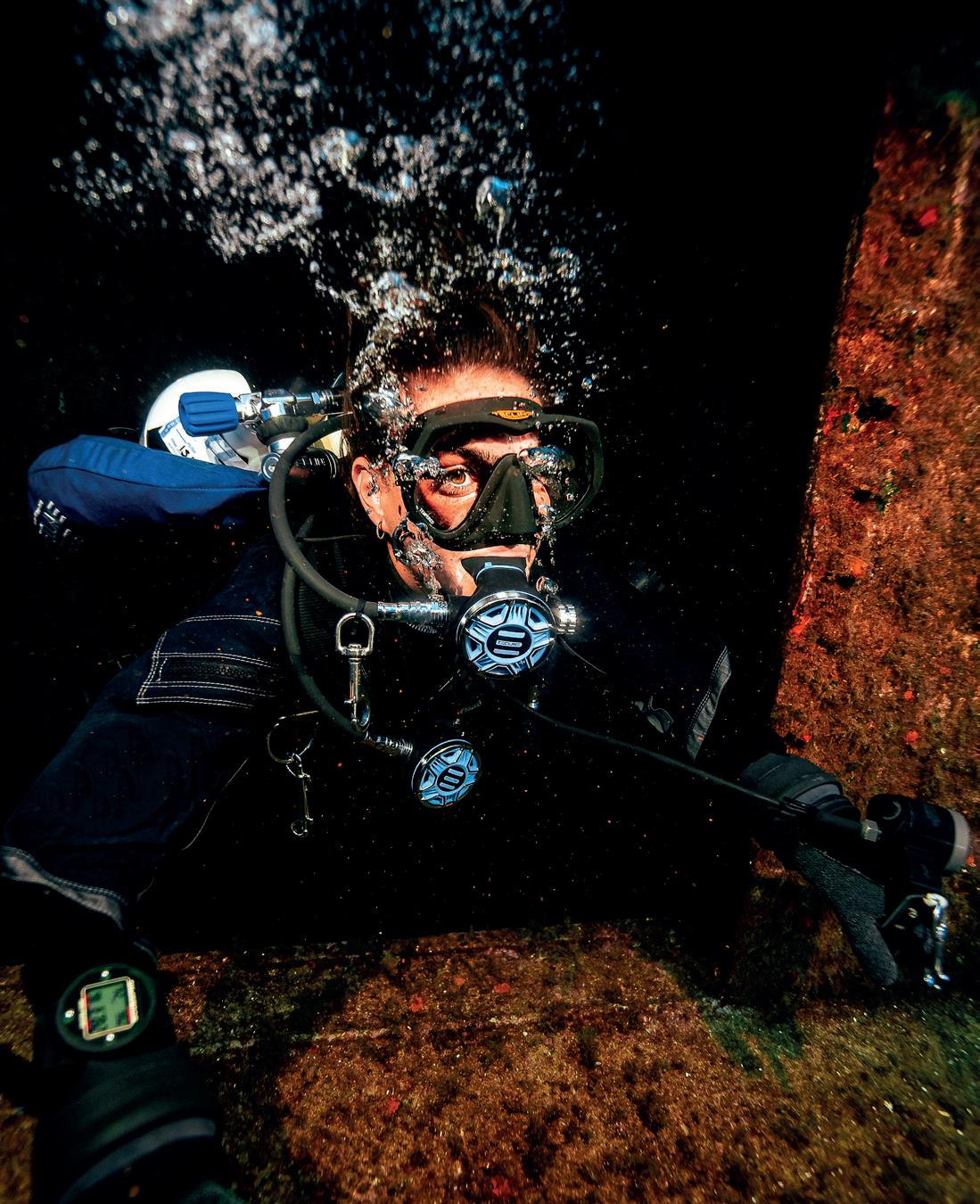
components should be on the left side.
SUMMARY
These six points do not exhaust the topic. But they do follow one consistent logic: buoyancy belongs on the left side, and there is no good reason to change that.
That does not mean everything else automatically belongs on the right. If that is how your setup works – make sure you know why.
Safe diving! WAF
The author of this text has spent more than 18,000 hours underwater. He is a strong advocate and an uncompromising practitioner of standardization and procedures. He has never had a diving accident.
He shares his experience, among other places, at the Tecline Academy, where he also serves coffee – definitely worth checking out