





It’s undeniable that there was a time when global sport revolved around a handful of traditional powerhouses. Countries such as the US, England, Australia, and New Zealand often dominated headlines, dictated sporting trends, and collected silverware with remarkable consistency. While emerging nations occasionally produced moments of brilliance, they were seldom viewed as permanent members of the sporting elite. Today, that narrative is rapidly changing.
As someone who follows sport religiously, I’ve come to see that the global sporting landscape has undergone a remarkable transformation over the last decade. Financial investment in athlete development, advances in sports science, increased professionalism, and greater accessibility to international competitions have created an environment in which a select few nations no longer monopolise excellence. The world of sport has become more competitive, more unpredictable, and, most importantly, more inclusive. South Africa has quietly become one of the biggest beneficiaries of this changing landscape.
The saying “No DNA, just RSA” has become a part of our sport communities’ daily affirmation. Across football, rugby, athletics, and cricket, South African athletes are no longer merely taking part on the world stage, but they are also influencing it. They’re rewriting expectations, challenging established hierarchies, and proving that success is no longer defined by history alone. Instead, it’s earned through resilience, innovation, and belief. On an even lighter note, I hope we have all seen the memes that came out of the 2026 FIFA World Cup at the expense of Bafana Bafana. They had a massive influence on my enjoyment of the tournament.
What makes South Africa’s rise even more remarkable is that it has occurred against significant economic and infrastructural challenges. Financial constraints, inconsistent governance, limited facilities in some communities, and unequal access to sporting opportunities continue to present obstacles. Despite these realities, South African athletes continue to compete with and often outperform countries with greater resources. That reality deserves more than applause. It deserves recognition as one of the defining sporting stories of this generation.
Sport has always served as more than entertainment. It reflects national identity, inspires social cohesion, and offers hope during periods of uncertainty. Every medal won, every trophy lifted, and every young athlete inspired contributes to a larger narrative about who a nation believes it can become. Yes, the stats and numbers are important, but I swear it is bigger than that.
I’d also like to highlight that South Africa’s current sporting momentum is not accidental. It’s the product of generations of athletes who refused to accept limitations, coaches who invested countless hours into developing talent, communities that rallied behind local heroes, and supporters who continued believing long before success became fashionable. I don’t want the next part to sound too formal, but I’d like to highlight a few areas and moments that inspired the writing of this piece.
For many years, South African football has lived in the shadow of its own expectations. Hosting the 2010 FIFA World Cup is still one of the country’s proudest sporting achievements. The tournament displayed South Africa’s ability to organise an event of unprecedented global significance while introducing millions to the vibrancy of African football culture. In the years that followed, many supporters expected sustained international success that never quite materialised. The disappointment surrounding Bafana Bafana often overshadowed genuine progress taking place beneath the surface. That feeling is beginning to change.
The national team has gradually rediscovered an identity built upon tactical discipline, collective organisation, and unwavering determination. Rather than relying solely on moments of individual brilliance, South Africa has embraced a style that prioritises teamwork and resilience. Recent performances in continental competitions, especially AFCON, have proved that
Bafana are once again becoming difficult opponents capable of challenging Africa’s strongest footballing nations such as Senegal, Egypt, and Morocco. Just as encouraging is the growth of our domestic football.
The Premier Soccer League continues to provide a competitive platform for emerging talent, while South African clubs have become increasingly influential in continental competitions. Clubs such as Mamelodi Sundowns have elevated professional standards through sustained excellence, proving that African football can be both commercially successful and technically sophisticated. Young players now see clearer pathways from academy football to professional careers. Coaches are embracing modern tactical approaches, and supporters are reconnecting with domestic football through renewed optimism rather than nostalgia. The most inspiring development, however, has been the continued rise of women’s football. Apart from August being Women’s Month, it is only right that I also shed light on our ladies in football.
Banyana Banyana have fundamentally altered beliefs of what South African football can achieve. Their success has extended far beyond winning matches; they have challenged long-standing assumptions about investment in women’s sport and shown that opportunity often matters as much as talent. Every international victory stands for more than three points. It represents another young girl believing that football belongs to her too. In my view, that’s the true legacy of sporting success.
If football is South Africa’s resurgence, rugby has become its benchmark for sustained excellence. #StrongerTogether.
Few teams in modern sport command the respect currently afforded to the Springboks. Successive Rugby World Cup triumphs did more than add silverware to an already impressive collection; they reinforced South Africa’s reputation as one of the greatest rugby nations in history. And yet, the Springboks’ influence extends far beyond winning championships. They have redefined what leadership looks like within elite sport. The recent posts I have seen on X from English and Scottish fans about the Bokke? Our team is doing its number on World Rugby, for sure.
Let me remind everyone that modern rugby demands extraordinary physical preparation, tactical adaptability, and psychological resilience. South Africa has mastered all three.
Most importantly, the Springboks have become renowned for their ability to evolve without abandoning their identity. Their traditional strengths ranging from physical dominance and defensive discipline to their relentless forward play remain central to their philosophy. At the same time, they have embraced innovation, expanded their attacking options, and demonstrated tactical flexibility against the world’s strongest opponents. This willingness to evolve has become one of South African sport’s defining characteristics.
Great teams rarely succeed by standing still. They stay successful because they continuously seek improvement. The Springboks have embraced exactly that mindset. Equally significant has been the diversity of leadership appearing within South African rugby. Players from diverse backgrounds, cultures, and communities have united under a shared purpose, demonstrating how sport can transcend historical divisions while reflecting the country’s broader aspirations.
Young rugby players across the country no longer dream simply of wearing the green and gold jersey. They dream of contributing to a culture built upon accountability, humility, and collective excellence. This explains why South African rugby continues producing world-class talent.
If football has rediscovered its confidence and rugby has reaffirmed its dominance, then athletics has become the purest expression of South Africa’s sporting potential. Our people can run!
There’s something profoundly democratic about athletics. It requires no expensive equipment to dream. A pair of running shoes, a stretch of road, a school field, or a local track can
become the starting point for greatness. Across South Africa, countless young athletes lace up every morning with ambitions that stretch far beyond provincial championships. They dream of Olympic podiums, World Championship finals, and national records. Increasingly, those dreams are becoming a reality. South African athletics has quietly assembled one of its strongest generations in decades. The country’s sprinters, middle-distance runners, hurdlers, jumpers, and relay teams have consistently demonstrated that they belong among the world’s finest. Established stars have continued to inspire while a new generation of athletes has appeared with the confidence to compete against the absolute best.
Few sporting journeys capture South Africa’s changing sporting identity more powerfully than that of the Proteas Women. Not long ago, women’s cricket occupied little space in mainstream sporting conversations. Coverage was limited, financial investment lagged behind the men’s game, and public expectations remained modest. But through persistence rather than publicity, the Proteas Women steadily transformed themselves into one of the country’s most respected national teams. They just returned from participating in the 2026 ICC Women’s T20 World Cup. And they did not just take part – they made it all the way to the semi-finals. As I see it, the Proteas Women did not demand recognition. They earned it.
Apart from the World Cup, every international tournament brought renewed belief. Every keenly contested match showed technical improvement, tactical maturity, and emotional resilience. As performances improved, so too did public appreciation. Supporters who once followed women’s cricket only during major tournaments began following the team throughout the year. I can also admit that I am guilty of that.
Young girls started seeing cricket not as an alternative to other sports, but as a genuine professional aspiration. Sponsors recognised growing commercial value, and broadcasters increased visibility.
The Proteas Women have also challenged outdated assumptions surrounding women’s sport. Their achievements have reinforced an increasingly important truth: investment should never be decided by historical popularity, but by present excellence and future potential. Every run scored, every wicket celebrated, and every international victory contributes to something larger than cricket itself. It expands the possibilities available to future generations. In many ways, the Proteas Women have become ambassadors for every young South African athlete seeking equal opportunity to pursue sporting excellence. Their story reminds us that progress often begins quietly before it becomes impossible to ignore.
Historically, many nations became synonymous with a single sport. Brazil became the home of football artistry. New Zealand cemented its sporting presence through rugby. Kenya dominated distance running. Jamaica redefined sprinting excellence. And how can we forget India’s dominance in cricket? All these nations have cemented their presence in these various sports. However, South Africa is drafting a different story.
Rather than placing all its hopes in one arena, the country is proving genuine competitiveness across multiple sporting codes. That diversity matters. It reflects a nation rich in talent, culture, and ambition. Furthermore, it demonstrates that sporting excellence is becoming embedded within South Africa’s broader national identity rather than existing as isolated moments of brilliance.
And judging by the extraordinary athletes already inspiring a new generation, the most exciting chapters of South African sport have yet to be written. As someone who can author a full dissertation about our sporting landscape, I am bearing witness to our everyday stories that are working towards painting a part of the whole picture. It has been such an honour for us to cover these stories for every edition. Following them has been nothing short of incredibly fulfilling, and this is only the beginning.

PDBYMedia
Tel: (012) 420 6597
Editorial
Editor-in-chief carel.willemse@up.ac.za
Carel Willemse @Ed_in_Chief
Editor editor@pdby.co.za
Domonique Bennetts @pdbymedia
Deputy Editor digitalmanager@pdby.co.za
Jason Visser
News news@pdby.co.za
Relebogile Manana
Features features@pdby.co.za
Gabriella Hobson
Entertainment entertainment@pdby.co.za
Cara Heymans
Sport sport@pdby.co.za
Neo Paledi

Copy copy@pdby.co.za
Hannah Roberts
Layout layout@pdby.co.za Alyx Bell
Visual Media multimedia@pdby.co.za
Danielle Oosthuizen
Dynamic Media
Jason Visser
Web webeditor@pdby.co.za
Sivenathi Makhanda
Social Media
Amai Ngulube

PDBY appreciates that freedom of speech is an inalienable right enshrined in the Constitution of the Republic South Africa. We encourage our readers to engage in discussion and debate on issues that affect them through letters to the Editor, comments on our website, tweets, or posts on Facebook. We ask our readers to keep the following in mind:
1. PDBY will not edit letters, comments, tweets, or Facebook posts in any way.
2. PDBY will label letters, comments, tweets, or Facebook posts as opinion. These do not represent the views of PDBY in any way.
3. The PDBY editorial must approve letters, comments, tweets, or Facebook posts before they are published.
4. PDBY will not publish letters, comments, tweets, or Facebook posts that are defamatory, or libelous, or that contain offensive content.
5. PDBY reserves the right to practice discretion when publishing letters, comments, tweets, or Facebook posts.
6. PDBY reserves the right to publish any content we receive unless the sender specifically requests otherwise.
7. PDBY reserves the right to retract a letter, comment, tweet, or Facebook post after it has been published.
8. PDBY will not accept responsibility for any consequences the author of a letter, comments, tweets, or Facebook posts may experience as a result of the letter being published.
9. PDBY will only publish letters between 150 and 200 words.
10. PDBY will not publish letters unless the writer confirms their full name, student number and contact number. PDBY will not publish this information, we need it for our records.
On 18 April, M-Powerment Care – a non-profit organisation that focuses on education, health and wellness, and outreach programmes – launched their Shared Table Initiative. It is a student-led movement based on the belief that no student should have to go hungry. The initiative brought students together for a campus-wide donation drive, the planting and harvesting of fresh produce, and supporting local communities with school gardens and tree-planting initiatives.
Part one of the initiative was a donation drive with nearly ten large bags of clothes being donated, as well as over sixty nonperishable items being collected. Additionally, volunteers ventured to Laudium Primary School for garden maintenance, a continuation of the organisation’s tree-planting initiative started back in October 2025.
Part two of the initiative had volunteers planting over 900 vegetables in M-Powerment’s “Roots and Rise Garden”, an initiative that was launched in collaboration with UP’s Joint Community-Based Project (JCP) module for students that are part of the Engineering, Built Environment, and Information Technology (EBIT) faculty. The garden was started in June 2025 and is based on UP’s Future Africa Campus. Soon after, volunteers gathered to plant cabbage and onion and harvest corn and potatoes that were pledged to UP’s Student Nutrition and Progress Programme (SNAPP).
PDBY spoke to M-Powerment Care Founder and CEO Similo Siyenga to gain further insight into the initiative, particularly regarding what inspired the idea of combating student hunger through the production of fresh produce. Siyenga shared that a large benefit of cultivating fresh produce is the aspect of sustainability. He explained that although donations, sponsors, and food drives are effective methods in alleviating student hunger, people may get tired of just giving. Farming initiatives circumvent this issue by empowering students to combat student hunger and support student beneficiaries who are now able to contribute towards the production of their own food, as opposed to simply receiving donations.
Regarding the impact of the initiative, Siyenga explains that the organisation has produced enough food to feed 400 students biweekly with SNAPP distribution. Additionally, they have produced an excess of food that can be sold to UP community members and within the Hatfield retail market. The proceeds of these sales can be used to financially sustain the initiative. Siyenga further details the organisation’s long-term plans for the garden, hoping to develop the entire two hectares of land they have available. With 30% of produce being given to students through the SNAPP programme and another 30% being given to Eat@UP, who want to develop items that can be sold back to students, this expands the distribution of
produce to consumers beyond SNAPP beneficiaries. The remaining 40% will go to retailers, allowing M-Powerment Care to reinvest funds into the project in order to produce more food, process it, and still feed students. Their ultimate goal is to be able to sustain the project without donations.
As an organisation that focuses on community wellness as well as student outreach programmes, Siyenga explains the importance of supporting the surrounding community, detailing the “symbiotic” relationship between university students and the nearby community. He explains that when students take care of the community, the community takes care of the students. Because many UP students are from Pretoria, a struggling community (such as students experiencing difficulties with household finances) consequently results in a struggling student body.
Siyenga provides that the organisation has an additional role of inspiring people to help one another, saying, “Everybody has a responsibility to help out the next person.” Aiming to inspire those that hold power to amplify the positive impact that individuals have on one another, Siyenga concludes, “It’s always going to be a small solution until the big guys are involved”.
In terms of future plans for M-Powerment Care, Siyenga shared that the Shared Table Initiative will continue. Additionally, he wants to begin engagements with the university in order to kickstart the aforementioned garden programme and to expand the shared table to universities and schools throughout the province. Another longterm goal for the organisation is the establishment of a sustainable food system in most South African universities by the end of 2032, alleviating period poverty and eventually expanding to other education sectors. Finally, Siyenga explains that M-Powerment would like to enter the education space, particularly in assisting high schoolers with university applications and admission where possible.
PDBY also spoke with Lesedi Padi, a Student-Life-Intern at Hatfield Studios who volunteered in part two of the Shared Table Initiative. Padi speaks on his positive experience volunteering at the garden, highlighting the importance of organisations such as M-Powerment Care in assisting disadvantaged students, and how volunteering allows more privileged students gain insight on how their peers may be struggling. Padi concludes by providing that volunteering not only assists beneficiaries, but widens the volunteers’ perspective and promotes community building.
M-Powerment Care is a reminder of the importance of community, helping one another, and giving back. M-Powerment’s ambitions open a bright path for the future of student outreach.
“South Africa Belongs to All Who Live in It”: UP-SRC
Ompha Mudau
Visual: Daniel Green
On 14 May, the Palestinian Solidarity Committee of UP (PSCUP) staged a peaceful demonstration to protest against US Ambassador Leo Brent Bozell III’s visit to the University of Pretoria. The purpose of his visit was to engage with the university’s African Centre for the Study of the United States (ACSUS-UP) and Arizona State University. The protest, held in the form of a sit-in, took place around the Humanities Building – the primary location of the ambassador’s visit. Students congregated near the building’s main entrance, with many being strategically placed at various other access points. Ultimately, the sit-in was attended by over 100 people, including PSC-UP members, unaffiliated detractors, and university lecturers.
In an open letter that was sent to the Dean and Executive of the university prior to the protest, the PSC-UP detailed the problematic nature of hosting the ambassador in his then upcoming visit. The letter states that since taking office, Bozell has presented ideals that are antithetical to South African interests, ultimately aiming to undermine the country’s national sovereignty. This is evident in his demands calling for the South African government to adjust its expropriation and Black Economic Empowerment policies to suit US interests, refusing to denounce US President Donald Trump’s claims of a white genocide, his disregard for the Constitutional Court’s “Kill the Boer” ruling, and his desire to have the South African government drop its International Court of Justice case against Israel. The memorandum further details Bozell’s tumultuous history with democracy within South Africa, placing a spotlight on his role as the president of the National Conservative Political Action Committee back in 1987, in which he said that his organisation was “proud to become a member of the Coalition Against ANC Terrorism”. The letter concludes with a call to the Dean, ViceChancellor, and Executive to refuse a meeting with the ambassador.
In a subsequent Instagram post, the PSC-UP reiterated Bozell’s undesirable propositions for South African national policy and his questionable political past, while adding that during his tenure as president of the National Conservative Political Action Committee, Bozell rallied against the US Government meeting with anti-apartheid activists. The post also provides that Bozell has deemed persuading the South African government to drop its genocide case against Israel a “top priority”, and resolutely calls on students to refuse any photos with the ambassador during his visit in order to curb his attempts to cleanse his public image with positive publicity. The university, in its response to the open letter, justified hosting the ambassador as an expression of
academic freedom.
During the protest, PDBY spoke to PSC-UP Chairperson Ayesha Essop who emphasised the peaceful nature of the demonstration, explaining that the sit-in was meant to act as a “walk of shame” for the ambassador as opposed to barring him from entering the building. Essop further highlighted how Bozell’s views starkly contrast the university’s position as a space for robust debate, academic freedom, and controversial conversations as discussions brought forward by the ambassador ultimately disrespect South Africa’s sovereignty. Essop provided that although topics such as national economic policy should be discussed freely, foreign powers should not be the ones to decide how said issues are handled. She concluded by saying that with regard to university decision making, she is aware that there are considerations that, as a student, she is not privy to. However, she ultimately feels that certain student concerns have not been adequately addressed, such as the open letter regarding Palestine sent out in October 2025. Despite garnering support from over ten student structures, it saw no response from the university. This mirrors the university’s alleged disregard for issues such as student hunger, financial exclusion, and the institution's failure to directly address the concerns surrounding Bozell’s visit. Finally, Essop spoke out against the distortion of academic freedom, explaining that the concept cannot be compromised by someone who has clearly expressed such violent views.
In addition to the students in attendance, the demonstration saw the presence of History lecturer Prof. Nisa Paleker. She highlighted the importance of students criticising the ambassador’s visit, especially in light of the university’s failure to critically engage with the US’s global interventions. Prof. Paleker further goes on to emphasise the hypocrisy of the institution, citing its numerous delays in providing a public statement regarding the Palestinian genocide under the guise of bureaucracy while justifying the ambassador’s visit by promoting the need for robust engagement. She concluded by highlighting the institution's failure to take students’ political grievances seriously, especially against the backdrop of UP’s history of stifling descent and critical student voices.
Another university staff member in attendance was Development Studies professor Dr Marc Wegerif. Dr Wegerif stressed the importance of students speaking out against US imperialism, particularly within Palestine, Iran, and Jordan, dubbing it “old-style brutal colonialism”. He further explained that students must speak out against representatives

The University of Pretoria’s Student Representative Council (SRC) has condemned xenophobia and afrophobia, issuing a public statement calling for unity and rejecting discrimination against foreign nationals.
Released on 20 June, the statement affirmed that “South Africa belongs to all who live in it” and positioned the SRC in support of international students and immigrant communities within the university. It further urged students to stand together against poverty, inequality, and unemployment, framing xenophobia as part of broader social and economic pressures affecting the country.
The statement comes at a time of heightened national debate around immigration and undocumented foreign nationals, with planned protests taking place in parts of the country that are calling for stricter enforcement of immigration laws.
However, within the UP context, discussions around the issue remain limited. International students that were approached for comment declined to speak publicly, with some citing concerns about safety, timing, and the sensitivity of the national climate leading up to the planned 30 June demonstrations. Others said they were unwilling to be associated with the debate at this stage, pointing to uncertainty around how public commentary could be received during a politically charged period. While the SRC has made its position on the matter clear, direct public engagement from affected student groups on campus has been minimal.
The SRC has not announced any follow-up engagements or campus discussions on xenophobia and afrophobia following the statement.
The SRC statement aligns with constitutional principles of equality and non-discrimination, and it reflects ongoing efforts by student leadership to reinforce inclusivity within a diverse university. At the same time, the refusal of responses by the affected students highlights the difficulty of open engagement on migration-related issues, particularly when national tensions extend into campus spaces.
of the US, such as the ambassador. Additionally, Dr Wegerif spoke on Bozell's problematic beliefs as an individual, highlighting his role in contesting the anti-apartheid struggle, undermining South African sovereignty, and his staunch support of Israel, citing his values as another reason to protest his meeting with the Vice-Chancellor. He also emphasised that the US does not support ventures that do not advance their own interests, citing the US abruptly pulling funding from HIV/ AIDS programmes within South Africa as an example.
With this in mind, Dr Wegerif questioned if the meeting with ambassador Bozell and the university would result in any critical studies of the US as opposed to the institution simply acting as a vehicle for propaganda for the US. He echoes Prof. Paleker’s assertion of hypocrisy stemming from the university, noting that its official stance of neutrality regarding the Palestinian genocide contrasts its “cosying up” to the US, a large contributor to the continued violence in Gaza. Additionally, Dr Wegerif argues that the university is not as humancentred and transformative as it claims to be, as it continuously ignores humanitarian crises while collaborating with an imperialist US regime. As the sit-in continued, the ambassador’s arrival was constantly delayed. Communication between Essop and Bozell’s security detail revealed that the presence of the protesters gave rise to security concerns and subsequent hesitation from the guards. As the evening continued, Bozell’s security reiterated that he would be arriving promptly. Students began to speculate that ambassador Bozell had taken a discrete entrance into the Humanities Building, but students placed at the structure’s other entrances reported that they had not seen him arrive. By 18:00, the sit-in was ultimately concluded without an appearance from the ambassador, who most likely took an unknown entrance into the building. It should be noted that a UP security guard within the Humanities Building reported seeing ambassador Bozell within the building before the sit-in concluded.
Despite the ambassador’s non-appearance, Essop does not regard the sit-in as a failure. She points out the cowardice and hypocrisy of the ambassador who, despite preaching co-operation and a supposed willingness to engage with students, refused to engage with the students who participated in the sit-in. Additionally, she expressed disappointment in the executive who assisted the ambassador in entering the building without facing the protesters. Ultimately, Essop is satisfied with the number of demonstrators that appeared, saying, “The fact that so many people showed [up] says a lot.”
Mpho Mahlangu
On 18 April, history filled the halls of Asterhof as the residence celebrated a century of sisterhood, memories, and tradition through a special wine auction. Founded in 1926, Asterhof holds the title of being the oldest female residence at the University of Pretoria. Over the past 100 years, it has become more than just a place of residence – it has grown into a home where generations of women have formed lifelong friendships, created unforgettable memories, and built a legacy rooted in connection. Today, more than 300 remarkable women call Asterhof home, continuing a tradition that has been shaped by those who walked its halls before them.
House Committee member Hilleke Genis explained to PDBY that the wine auction was created as a way to honour Asterhof’s rich history while celebrating the people who have contributed to its story. The event carried a deeply sentimental meaning as both former and current residents donated wine for the auction, allowing each bottle to represent a piece of Asterhof’s journey.
raised by the auction will go towards future residence renovations and initiatives, ensuring that Asterhof continues to be a meaningful home for students for many years to come.
Throughout the evening, the history of Asterhof was brought to life. Archives displayed the stories of women who shaped the residence while photographs and memories reflected the friendships, achievements, and moments that have left a lasting impact. Guests were also invited to sign a commemorative banner that will become part of Asterhof’s history and serve as a reminder of those who celebrated its 100-year milestone.
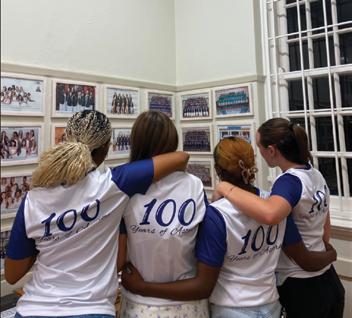
The evening became a bridge between generations, bringing together women who once lived in the residence and those who are currently creating their own memories within its walls. The funds
Every detail of the event carried meaning. From the specially branded glasses to the carefully curated spaces throughout the residence, the celebration honoured everyone who had contributed towards Asterhof’s story. Among the guests was a former resident who lived at Asterhof 60 years ago in 1966. When speaking to PDBY, she shared, “I flew all the way from Cape Town to celebrate all the beautiful memories I created in this place. What I remember most is
the beautiful house and the memories I created in it,” she said. Her connection to Asterhof continues through her granddaughter who is now a resident herself, creating new memories while carrying forward a family legacy that began generations ago.
The significance of Asterhof’s community was also reflected in the experiences of current residents. PDBY spoke to Kyla, a current Asterhof resident, who described what makes the residence special. “What I like most about Asterhof is the sisterhood and how it is grounded in rule and order. As someone who values peace and is dedicated to my studies, Asterhof makes it easier for me because it keeps me focused on my goals,” she said.
The celebration was filled with laughter, meaningful conversations, good food, and an appreciation for fine wine. The highlight of the evening was reached with the live wine auction where guests eagerly participated and celebrated the milestone in true Asterhof spirit. Some attendees left with multiple bottles, while others left with something far more valuable: a renewed connection to a place that has shaped generations of women.
The event captured the essence of Asterhof: a celebration of history, community, and the memories that continue to define the residence. With former Asters, current residents, members of the UP community, and wine enthusiasts gathered together, the evening became a reminder that Asterhof’s legacy is not only found in its past, but in the generations still to come. A century later, Asterhof continues to stand as a home built on belonging, tradition, and the enduring power of sisterhood.
Ompha Mudau
For most students at the University of Pretoria, exam conditions are fixed: the same paper, the same venue rules, and the same time limits. But for students with disabilities, the conditions they write in are adjusted, not to change what is being assessed, but to remove the barriers that may prevent fair participation.
As the first examination period of the year concludes, the university’s approach to exam accommodations has become a major topic of conversation, raising questions about how accessibility is implemented across different faculties and assessment venues.
At the centre of this process is UP’s Access, Disability, and Inclusion Services (ADIS) that manages exam accommodations for students with disabilities. According to ADIS senior disability officer Tshegofatso Kenalepe, support is not based solely on diagnosis, but on how a disability affects a student’s ability to function in an examination setting.
Students who require accommodations must register with ADIS and submit supporting documentation before adjustments are approved. Each case is assessed individually, with recommendations tailored to the specific barriers a student experiences during assessments.
These accommodations can include additional writing time, rest breaks, alternative venues, readers or scribes, assistive technology, enlarged print, electronic exam papers, or adapted seating arrangements. The aim, Kenalepe explains, is to ensure that students are assessed on the same academic content as their peers
under conditions that reduce potential disadvantages. However, implementing these adjustments requires co-ordination across multiple parts of the university. ADIS works with faculties, examination offices, and support staff to ensure that approved accommodations are in place before students arrive to write.
During exam periods, staff oversee the implementation of arrangements and intervene when issues arise. In instances where students are not writing in ADIS-managed venues, co-ordination with faculties becomes essential to ensure consistency across different examination settings.
Despite these systems, Kenalepe notes that several operational challenges continue to affect the process. These include late registration by students, incomplete or outdated medical documentation, increasing demand for specialised support, limited availability of suitable venues, and the administrative co-ordination required across departments during peak examination periods. According to the office, these pressures become most visible

during examination seasons when the demand for accommodations increases significantly and logistical planning becomes more complex. While accommodations are intended to ensure equal access to assessments, Kenalepe says that they do not alter academic standards. The content, marking criteria, and learning outcomes of examinations remain unchanged. For example, additional time may be granted where a disability affects processing speed, while students with visual impairments may receive electronic papers compatible with screenreading software. In both cases, the assessment itself remains the same, with adjustments made only to the conditions under which it is completed.
The university also acknowledges that while feedback from students is welcomed through general channels, there is currently no formal system for collecting post-examination feedback specifically related to accommodation experiences.
With it being difficult to get any thoughts from students who use ADIS’s services, the university will continue to expand access for students with disabilities, making sure that exam accommodations remain one of the clearest areas where policy meets practice. At UP, the system depends not only on approved adjustments, but also on how consistently those adjustments can be implemented across all faculties during the pressures of examination periods.
Months after the University of Pretoria's Formula Student Project was introduced, the student-led initiative has made significant progress towards its goal of designing and manufacturing a Formula-style race car. While the finished vehicle remains the ultimate objective, the project is increasingly proving to be a platform for practical learning, collaboration, and innovation.
Led by a group of engineering students, the project has expanded its team since PDBY last reported its progress. Reynhardt Kruger has joined the Aerodynamics Team, while the Next Generation Programme has welcomed 15 new members, bringing the total number of students in the programme to 25. According to the team, their progress has exceeded expectations, particularly during the design phase. Students have also completed workshop training in welding, machining, and sheet metal work, gaining practical experience that complements their academic studies.

"Theory can only get you so far," said Muhammad Faydhan Kala, highlighting the importance of applying classroom knowledge to real engineering challenges. The project has now completed the design of several key components of the vehicle, including the rolling chassis, front and rear suspension, wheel hub assembly, chassis frame, airbox, powertrain, 600cc engine, steering arm, exhaust, intake, fuel tank, and braking system.
Work is continuing on the custom seat, aerodynamic package, radiator, pedal assembly, and firewall as the team works toward completing the vehicle.
Reflecting on their journey so far, Daivik Tulsee, a final-year Mechanical Engineering student and member of the project, said, "We keep moving forward." The statement reflects the determination that has characterised the project as the students balance demanding academic schedules with the technical requirements of designing
and building a Formula student race car.
Despite the challenges, enthusiasm within the team remains high. "Excitement trumps difficulty any day," said Ryan Flemix, describing the mindset that continues to motivate the students throughout the project.
For Ryan Bennetts, the opportunity to see the project come to life is what motivates him most. "I can't wait to drive this car," he said. The project has also created an environment where students can enjoy the design process while developing industry-relevant skills.
Ayrton Contreiras jokingly summed up his experience by saying, "I enjoy spinning my CAD." The team is aiming to complete the vehicle by 31 August 2026 – a milestone that will mark the end of months of planning, designing, and manufacturing.
Although the race car remains the project's centrepiece, its greatest achievement may be the experience students gain throughout the process. By combining theoretical knowledge with practical application, the Formula Student Project continues to prepare future engineers for careers beyond the classroom while reinforcing UP's commitment to innovation and experiential learning. Students can follow the team's progress on Instagram at @ upformulastudent, where regular updates showcase the development of the project and the work taking place behind the scenes.
‘
Tis the season for new beginnings! A new semester, a new mindset, and, possibly, a new relationship. Before embarking on a new journey, it is always advisable to close the doors behind you. Figuring out how to end things with someone can be tricky, but here is a guide to break-up etiquette.
According to the National Research Foundation, people who have experienced break-ups have a higher post-traumatic stress symptom score than those who have not experienced break-ups. This is not to say that one should be tied to someone forever and fear putting an end to a romantic experience. However, it does mean that the way a break-up is approached can affect how the other party handles it.
One of the first things to do while planning a break-up is figuring out what kind of relationship it is in the first place.
Talking Stage
If you are in a talking stage, the lines could be very blurry. It is possible that you may not know this person very well, or you may have just struggled to make it more than what it is. Whatever the context is, you might have just decided that you do not want the relationship anymore. In this situation, the timeline is your friend. Unless you are a love bomber, no promises of a future should have been made at this point. Verywell Mind offers the best break-up prompt for a situation based around timeline: “This isn’t easy to say, but I don’t think we’re the right fit long-term.” What could be better than someone who clearly cares about their future and wants to avoid potential soulcrushing heartbreak?
Sneaky Link
understanding that both parties are in it for one thing and one thing only. Breaking this dynamic comes down to that one thing – one or both parties no longer want a discreet lover. This makes breaking up ten times easier because there is only one thing to say: “This just isn’t for me anymore.”
Situationship
A situationship is one of the hardest romantic dynamics to describe. With each one holding their own sets of rules and boundaries, it is difficult to think of a universal reason to break up. A good question to ask yourself is, “How much respect has been given to this relationship?” This will help gauge the sensitivity with which you should approach the break-up. The Attachment Project advises that direct communication of how you feel can establish the most certainty and clarity during a break-up. Tell your partner that you are not getting what you would like from the relationship and that you are finally letting go.

Urban Dictionary describes a sneaky link as a “sexual or non-sexual experience that nobody knows about”. The discreet nature of this relationship has its advantages and disadvantages. One disadvantage is that it is difficult to tell anyone else about the break-up because nobody knew there was a relationship to begin with. However, the advantage is that nobody knew there was a relationship to begin with! Contrary to popular belief, sneaky links do have rules. One of the most common rules is the shared
Exclusive Relationship
A lot of thought must be put into breaking up with the former “love of your life”. All of the memories shared, the nights spent together, the inner thoughts shared with the one person you felt was wholly yours, and the “I love you’s” poured in are all aspects to consider when drafting your break-up speech. Roots Relational Therapy suggests that breaking up in person shows your soon-to-be ex how much you value them. This might make the process harder, but it is also a way to show your partner your raw emotions and share that final moment of vulnerability. Laying everything on the table and allowing your partner the same courtesy is the best closure you can get out of an exclusive relationship.
Regardless of the length of a relationship, dignity is something one should offer to a person they once liked. Letting go of someone can be difficult for both sides, but there is no reason for the break-up to be made even harder. So take a deep breath, call the person who has overstayed their welcome in your life, and let go.
Lydia la Grange
Many students living in and around Hatfield have faced multiple power and water outages during the semester one exam season. However, these outages are not a new problem. According to Moneyweb, January to May 2025 saw an average of 4 600 electricity interruptions per month. These outages are caused by cable theft, vandalism, ageing infrastructure, and illegal connections, as well as scheduled maintenance periods. The metropolitan cannot be exclusively blamed for the damage to substations and cables caused by crime, which is a nationwide problem. However, the municipality is frequently criticised for its slow response times and lack of preventative measures towards theft and vandalism.
According to monthly dashboards released by the Department of Water and Sanitation, the City of Tshwane has also experienced recurring water shortages despite the dams in Gauteng having been at full capacity for the past few months. The water shortages in the area stem from problems with the supply and transport of water as opposed to a shortage of water in general. Approximately one-third of the district's water is lost to leaks and damaged pipes every month.
To the municipality’s credit, they are performing maintenance projects on the city’s water and electrical infrastructure, which are designed to alleviate disruptions over time. A statement released by ActionSA mentions how the city’s improved governance has led to increased investment and, in turn, more money is now being put into infrastructure and service delivery. The press statement from April mentions, “Infrastructure delivery continues to accelerate. More than 28 kilometres of pipes have been replaced, over 220 kilometres of roads have been resurfaced, and the procurement of jetpatcher machinery has enabled faster and more efficient pothole repairs.” However,
many critics argue that after years of underinvestment and neglect, the city’s efforts can no longer be described as maintenance to prevent future disruptions, but rather as emergency repairs to a crumbling system.
The water and power outages are not only an inconvenience; they also end up affecting students’ academic performances. In a poll shared by PDBY on Instagram, 91% of respondents indicated that they feel the water and electricity outages have negatively affected their academic performance. When the power went out in the middle of the night across Hatfield during exam season, students living in residences nearby walked to Merensky in droves. When the City of Tshwane announced a potential three-day water interruption at the start of June, many students had to use their own money to buy water bottles. Instead of demanding change from the municipality, students merely adapt to the municipal failures, often sacrificing their own finances, time, and comfort to compensate for the lack of resources that should have been provided by the City of Tswane.
It is easy to accept the failures of municipal services as an inevitable reality of living in Hatfield. However, once residents become complacent about not receiving the services they are entitled to, the situation will only worsen. If you experience an outage, report it to the municipality on e-Tshwane.com or call 012 358 9999. If you want to further advocate for yourself and the community, you can always vote in the upcoming municipal and provincial elections or speak up in public consultations and briefings conducted by municipal representatives.
Regardless of how you choose to go about it, remember that it is everyone's right to demand that the political leaders in power provide the community with reliable access to water and electricity – which is, after all, a basic human right.
Buhle Jantjies
The passing of South African jazz icon Abdullah Ibrahim has prompted reflection on the role artists played in the fight against Apartheid. While the struggle is often remembered through political leaders, protests, and legislation, music, theatre, and cultural expression were equally important in exposing the realities of Apartheid and inspiring resistance.
Apartheid was not only a political system; it was an attempt to control every aspect of life, including culture and identity. In response, artists used their work to challenge oppression, preserve Black experiences, and ensure that South Africa's story reached audiences around the world.
One of the most culturally significant centres of the 20th century, according to Explaining History Podcast, was Sophiatown – a vibrant Johannesburg township that became a home to writers, journalists, musicians, and intellectuals. Despite racial segregation, it flourished as a hub of Black creativity and cultural expression. Its destruction through forced removals in the 1950s was not just the loss of people’s homes – it was an attack on a thriving cultural community. And yet, the spirit of Sophiatown lived on through the artists it inspired.
This spirit was evident in King Kong, South Africa's first major musical featuring an all-Black cast. Premiering in 1959, the production showcased Black talent at a time when opportunities were severely restricted and extremely selective. It also helped launch the careers of future anti-apartheid figures Miriam Makeba and Hugh Masekela.
According to South African History Online, after being forced into exile, Makeba became one of Apartheid’s most influential critics on the international stage. Through her music and public appearances, she brought global attention to the injustices taking place in South Africa. Masekela used his trumpet in a similar way, producing music that reflected the pain of exile and the hope for liberation.
Abdullah Ibrahim also became a symbol of cultural resistance. His composition Mannenberg emerged as an unofficial anthem of the liberation struggle, capturing both the hardships and resilience of Black South Africans. Through jazz, he demonstrated how art could communicate powerful political messages without a single speech being made.
Theatre also became an important weapon for creatives to fight against Apartheid. An article in the Cape Argus highlights the influence of playwright Athol Fugard – a man who worked alongside the Serpent Players, a multiracial theatre group that challenged segregation through performance. Their production, The Island – a play inspired by the experiences of political prisoners on Robben Island – exposed the realities of Apartheid imprisonment to their audiences.
Similarly, Woza Albert! by Mbongeni Ngema used humour and satire to critique racial segregation and social injustice. The play encouraged audiences to confront uncomfortable truths while imagining a more equal society.
These artistic movements helped shape the environment that produced events such as the 1976 Soweto Uprising. Through music, theatre, and storytelling, young South Africans were exposed to ideas of dignity, resistance, and freedom.
The fight against Apartheid was waged on many fronts. Politicians, activists, and ordinary citizens all played vital roles, yet the contributions of artists remain equally significant. They ensured that the struggle was not only documented but felt, heard, and remembered by audiences for generations to come.

Most people grew up hearing the stories of how, on 16 June 1976, students marched in the streets of Soweto, protesting the decree that their education would be delivered in Afrikaans. Even if they were allowed to vote, they were not old enough to do so. And yet, they left their mark on history. That march, met with bullets and violence, paved a long, painful road toward the 1994 elections and the dawn of democracy. Here we are, fifty years later. Many seem to ask why this still matters, and the answer is simple: because the story is unfinished.
A feeling repeatedly expressed by the youth of today is that South Africa has reached a new moment of reckoning. "Something is about to hit us again," warned Tebogo Suping, a young activist. With hunger, poverty, violence, corruption, and skyrocketing unemployment plaguing the country, it is hard not to feel dejected at the state of things. The feeling of today’s youth is starkly juxtaposed with the passion of rebellion in 1976.
The 1976 generation had clarity regarding their enemy: Apartheid was visible and nameable, and its instruments – the batons, the bullets – were concrete. Hector Pieterson's photograph does not need any explanation. The injustice announced itself, and that clarity is what made the rebellion so galvanising. At that time, you knew what you were marching against.
Fifty years later, the crisis is just as real but harder to photograph. Hunger and unemployment do not wear a uniform. Corruption dissolves into systems, tenders, and middlemen. The enemy is structural, and sometimes, it wears the face of liberation itself.
What makes this moment different is that today’s youth have inherited both the victory and the betrayal of 1994. We were handed democracy as a birthright and then watched it struggle to translate into dignity. The marchers of 1976 were fighting for something. We are fighting to hold onto what was promised and never fully delivered.
However, we are not alone. The South African youth are a part of a global tremor. Across the world, a generation is refusing to be quiet about its dispossession. Globally, youth-led uprisings have driven thousands from their screens to the streets, demanding accountability and, in some cases, toppling governments. In 2024, student protesters in Bangladesh brought down a sitting government. In Nepal, Morocco, Madagascar, Peru, and beyond, a singular message has emerged from young people: governments are failing to meet their most basic obligations.
For as long as there have been protests, young people have led the
charge – from the student uprisings of May 1968 in France to the Civil Rights Movement in the US. Today’s youth have something our predecessors did not: digital tools that enable decentralised, realtime co-ordination, rapid information sharing, and viral symbols that unify diverse groups across the globe. The result is movements that are harder to silence, co-opt, and ignore.
Research from Harvard Kennedy School has found that if a nonviolent campaign has extensive youth participation, it is over twice as likely to succeed than campaigns with limited youth participation. The research shows that young people are especially committed, creative in their tactics, and capable of building coalitions across social and cultural divides. One expert noted that this generation feels "short-changed", with their interests consistently left unrepresented.
What connects Lagos and Johannesburg is not geography. It is the broken social contract, the experience of being young and educated enough to understand what you are owed, and watching those in power look the other way.
According to Statistics South Africa, from 1996 to 2022, the total youth population rose from 14.7 million to 21.6 million. Young people between the ages of 18 to 34 now constitute a third of the total population of the country. This is not a minority voice at the margins of the national conversation. This is the national conversation.
without the voices of those most affected by them are decisions made in the dark.
In an interview with The Post, Caitlyn Paddy explained that the political system does not benefit the majority of South Africans. It benefits a privileged, connected few. Real change, she argued, demands that young South Africans organise not only as voters, but as cultural and political agents capable of imagining and building alternatives to the systems that have failed them. We are the architects of the society that comes next. When it is directed, our energy, rage, and vision are the most powerful resources the country has.

This voice has been systematically under-represented where it matters most. Of the approximately 9 473 councillors elected in the 2021 local government elections, only 1 421 (15%) were people younger than the age of 35. The very people making decisions about service delivery, water, schools, and the streets where the youth live and die are overwhelmingly not young themselves. This is not a representational failure. It is a governance failure. Decisions made
On 4 November 2026, South Africans will go to the polls to elect local government councillors. These are the leaders that are responsible for governing municipalities and overseeing the delivery of basic services at a local government level. Local government is where democracy is most intimate and most felt. It is also where it has most visibly failed.
The first voter registration weekend in June recorded over 477 000 new voter registrations, with 80% coming from those under 30 years old. That number is not just a statistic. It is the sound of a generation that has not given up.
The students of 1976 did not march because they believed the system would listen. They marched because they refused to be silent. The result was not immediate. South Africa's unfinished business is not a new failure. It is the original wound, still open. However, we could be the generation with enough numbers and fury to close it. The question is not if the spirit of 16 June still matters. The question is if we will find our own rebellion through moments, ballots, and the refusal to accept the current state of our country.
Buhle Jantjies
The World Cup has once again highlighted the gap between South African football and the world's leading football nations. While countries continue to invest in academies, coaching structures, and youth development, South Africa often finds itself asking why its footballing potential has not translated into consistent success on the global stage. The answer may lie in a history that extends far beyond the pitch. Football, also known as soccer in some parts of the world, has always been a part of South Africa. Long before many children set foot on an organised field, they learnt the game in streets and open spaces. It is one of the country's most accessible sports, requiring little more than a ball and a group of willing players. Yet despite its popularity, football has struggled to attract the same level of investment and institutional support as rugby and cricket. Much of this disparity can be traced back to Apartheid.
As outlined by the Anti-Apartheid Movement Archives, sport was shaped by racial segregation and unequal resource allocation during Apartheid. Rugby and cricket, which were largely associated with White communities, benefited from better facilities, stronger development structures, and greater financial support. Football, predominantly played by Black South Africans, developed in communities that were systematically underfunded and marginalised, and these
inequalities did not disappear with democracy.
Rugby remains deeply embedded in the culture of many South African schools. Well-maintained facilities, specialist coaching, and established talent pathways continue to produce players capable of competing at the highest level. School rugby fixtures often attract significant attention from sponsors, communities, and the media. However, football rarely enjoys the same advantages.
While talented footballers emerge from schools and communities across the country, many lack access to quality facilities, professional coaching, and clear development pathways. For countless young players, talent alone is expected to compensate for structural shortcomings.
Questions have also been raised about the effectiveness of football administration and development strategies. According to Play the Game, grassroots soccer has not received the level of investment necessary to create sustainable pathways from community football to the professional game. As a result, many aspiring players are left relying on limited opportunities rather than a functioning development system.
The contrast with rugby is difficult to ignore. The success of the Springboks is supported by decades of planning, investment, and corporate backing, as reported by SuperSport. Campaigns such as Bok Fridays demonstrate how businesses

and communities actively rally behind the sport. Success attracts sponsorship, and sponsorship helps sustain success. However, football has yet to establish a similar cycle.
The issue is not a result of a lack of passion, as South Africans continue to support local and international football in enormous numbers, nor is it a lack of talent. Every weekend, young players across the country showcase the skill and creativity that have long characterised South African football. What remains absent is consistent investment.
If South Africa hopes to compete with the world's leading football nations, meaningful change is required. Greater investment in school football, grassroots facilities, coaching development, and youth academies must become a priority. What is equally important is ensuring accountability from the institutions responsible for developing the game.
South Africa's football future will not be determined by talent alone. The country has never lacked gifted players. The challenge is creating systems that allow that talent to thrive. The passion is already there. The question is whether the support will finally follow, especially after their World Cup success.
Rona Disetlhe
Has modern-day academia shifted the paradigm of what is required to get the work done? Older generations seem to be constantly confused by the “sudden need” to buy a can (or two) of Redbull before a study session. They cite how all they needed was a glass of water and a brisk walk, maybe even a cup of coffee on a rough day. The question here is why? Why do the younger generations rely on additional caffeine, and is this reliance potentially causing more harm than good?
Each day begins with an iced latte, an energy drink for a library study session, and a Bioplus or energy supplement of choice to get through an all-nighter. This routine especially applies during test week or exam season. Caffeine has cemented itself in campus culture, but this has not always been the case.
The shift may lie in the added pressure students have to endure. Today’s students grapple with a higher unemployment rate and thus a highly competitive job market. The first Quarterly Labour Force Survey of 2026 reported that young people between the ages of 15 and 24 face an unemployment rate of 60.9%. This comes with the pressure to be excellent, regardless of the uncertainty, combined with a heavier academic lifestyle compared to earlier generations. The lines separating academics from students’ lives have become increasingly blurred, with digital integration that leaves room for midnight submissions and constantly active group chats that maintain a continuous cognitive load. In order for students to keep up, a glass of water may not cut it anymore. However, students relying on caffeine to study and optimise productivity are not in a shared state

of delusion. The stuff works, and assignments ultimately get done. A study titled Case report on energy drink consumption among Health Sciences University students in Gauteng Province found that 31% of its students consume energy drinks to stay awake, while 14% use them to be alert and 15% use them to help their concentration. Caffeine is being used as a tool to deal with the workload that students face, and some might say that it has earned its place in the campus ecosystem. Despite this, over-reliance should still be avoided.
Caffeine does not just give people energy. Instead, it blocks a chemical called adenosine, which tells the brain when it is time to sleep. This means that the body is still tired even if you cannot feel it. The alertness and temporarilyimproved attention are useful, but drinking caffeine in excess makes the body go beyond motivation and focus. Instead, this translates into anxiety and an overstimulated brain,

Caffeine is more of a hero when it is consumed in small, strategic doses. Stopping caffeine intake six hours before you go to bed gives it time to wear off. Alternatively, keep your daily caffeine intake to a maximum of 200 milligrams, which is equivalent to around 2 cups of coffee. Ultimately, the goal is not to get rid of every Bioplus on the shelf. Rather, it is important to consume caffeine in moderation and find healthier ways to thrive in modern-day academia.

Promise Erero
There once was a girl who dreamed of the West, Who closed her eyes and said a prayer By the count of three, her head was at rest, And there her destiny began to layer.
From the south she took with her, A best friend and a soul, And left an incredible amount of vigor In the hands of the one who kept her whole.
She arrived in the north with promise and laughter, And paused to admire for a while The spectacle of jesters and crafters And left each of them with a piece of her smile
She finally makes her way to the west, Beaming with excitement of fulfilling her dream, She put her hands on her chest and leaves her final gift,
The journey is fulfilled and her heart is as her head, With scattered presents and a memory for all to share Of the journey of the girl who dreamed of the west
In
2009, The Hangover took the box-office by storm. It did not go on to make hundreds of millions of dollars because of academy-worthy performances or the fact that Bradley Cooper looks that good in a tux, but rather because the film became an anthem for a generation that measured the success of a weekend by how much of it they forgot. The premise is simple: four best friends head to Las Vegas for a bachelor party. What follows is a frighteningly alarming amount of alcohol consumption, a misplaced groom, a hospital visit, and, like all highly-acclaimed comedies, a wedding. The story follows the friends as they desperately try to piece together the night before through a haze of regret. While the movie does not exactly give alcohol a glowing reputation, it perfectly reflects one of the defining aphorisms of the time: drinking used to be cool.
If you think about our infamous Pretoria party scenes, places like the Strip hardly seem to be cooling down. If anything, one would argue the opposite. Thank goodness global metrics are not taken from Pretoria’s local clubs, because, on an international stage, the shift is staggering. When the alcohol industry reports a massive multibillion-dollar valuation slump, one has to wonder: what is going on with Gen Z?
For decades, entering your twenties was synonymous with making terrible, alcohol-fuelled decisions. It was a rite of passage to wake up on a Saturday morning with a pounding headache and a wallet mysteriously emptied by shots of warm tequila. But a massive cultural shift has been brewing. Gen Z are studiously “sober curious” – a movement where people are avoiding alcohol for personal or wellness reasons, curious to examine the reasons that fuel the need to pick up a drink in the first place. Dry January has extended its stay. Welcome to the Dry Year. The contrast between generations is stark. Where a millennial’s Friday night goal was to erase the week, Gen Zs are actively trying to optimise their REM sleep and protect their skin barrier.
So why is this generation turning its back on the bottle? It is not just about avoiding the headache; there are a few distinct, modern realities at play. Because Gen Z tends to go out and socialise in traditional
But painting the decline of drinking as a mere side effect of staying home misses the point. This is not an accident of modern life – it is an intentional choice. Secondly, wellness has become the ultimate status symbol. For this generation, health is wealth. Gen Z do not want to poison their bodies for a temporary buzz. They talk about cortisol levels, gut health, and mental clarity in the way previous generations spoke about sports or local politics. Alcohol simply does not fit into a lifestyle centred on being intentional about what one consumes.
Then, there is the sheer economics of it all. Going out is incredibly expensive, but it is deeper than a conscious choice to budget. Gen Z has effectively been priced out of the market. Whether it is skyrocketing concert tickets or overpriced drinks, traditional avenues of fun seem increasingly unaffordable. It just makes more sense that Gen Z would rather set their sights – and their budgets – on things that offer a better return on investment, like nutrition and gym memberships.
This shift is sending shockwaves throughout the hospitality industry.
Traditional dive bars are sweating, while "sober bars" and non-alcoholic bottle stores are popping up in major cities worldwide. In fact, the nightlife script has been completely flipped into the morning with the sudden rise of "coffee raves". Instead of stumbling out of a club at sunrise, crowds are arriving at trendy cafes at 07:00 before work, trading double vodkas for double espressos and dancing to live DJ sets. Bars have been forced to evolve, and in doing so, non-alcoholic menus are expanding to feature sophisticated, complex flavour profiles rather than the sugary mocktail afterthoughts of the past.
Ultimately, Gen Z is not skipping the party – they are just redefining what a party looks like. They have traded the chaotic, blurry nights of the past for clear-headed connection. And while older generations might poke fun at their lavender-infused waters, nobody can argue with the absolute bliss of a Saturday morning completely free of a hangover.
So, raise a glass of kombucha. The kids might actually be onto something.
I know you, I know you better than anyone
Hello UP student – this is a safe space to shoot your shot at all those cute people you see on campus. Tell those people how you feel about them, hit on your crush, or compliment a person on that outfit they were wearing the other day. Anything positive really. Try to be as descriptive and creative as possible with your description so it makes it easy for the person to identify themselves. If both people agree,
PDBY will arrange a meetup. Do you think this is you?
Email: shootyourshot@pdby.co.za
To the cutie in law of evidence. I don't actually take this module but i followed you to class to stare at you. if i commit the crime, will you collect my evidence?
To the blue-haired girl with a Bob, I know you study art and do welding...but you're the only art I see, and I'd love to weld a possible relationship with you.
to the girl with really cool face piercings and the yellow puma mostro shoes, I haven't stopped thinking about you since I saw you leave merensky once upon a time in April. will I ever see you again?
To the sexy man with glasses and a goatee in my EKN 224 class, a man like you is scarce but I know you can satisfy my unlimted wants and needs<3
To the cute engineering guy, who takes cos132 and looks like Dean from Gilmore Girls. I would treat you better then Rory ever did ;) I'm not afraid to confess my love like she was.

To the dark haired mullet guy in architecture who has permanent shorts uniform and 2 bags. You’re so hot I want to run my fingers through your moustache while you design our dream house ;) Thought you should know.
To the boy whose name starts with O in ekn 110 with the skinny jeans and grey bag who is always playing games on his laptop in the sanlam auditorium, put those gamer fingers to better use
To that hot man with the superman haircut and patchwork tattoos that stays at Hatfield studios. I’ve been planning our wedding for the past two years even though we haven’t met yet. Don’t worry king, your wife is on her way

To the short girl in the piazza, L. I dont know what it is but it feels like you've been on my mind more than you should be... I wonder if you can control me when im not being this innocent :)
To the guy who wore a full denim fit with the white sneakers and put your sunglasses on as soon as you walked out of Humanities, I need to know who you are before I enforce a campus wide hands off rule on you baby xx
To the final-year civil engineer with glasses and a black backpack: I know you’re engaged… but every engineer knows there’s always a stronger structure somewhere.

It would be super cool if you followed PDBY on instagram





Zizo Mtshemla
Fans of Frank Ocean and the Grand Theft Auto (GTA) franchise have one thing in common: they are professional players of The Waiting Game. With the former’s last album release in 2016 and GTA V’s in 2013, fans have created a plethora of viral internet jokes about how they continue to wait. But what if waiting is actually for the better?
Delayed gratification is a self-control practice about waiting for a guaranteed future reward instead of a much smaller one in the present. As people, we have been wired to favour instant gratification; it is easier, faster, and our brains think it is more satisfying. This is parallel to how many industries work, most evidently in entertainment. The easiest and most profitable option is usually chosen in place of high quality.
As frustrating (and unprofitable) as it might be to wait years for your favourite artist’s next album, the waiting might actually be worth it.
The reason Frank Ocean and Rockstar Games’ GTA franchise have managed to create a cult following that is willing to wait an indefinite amount of time is because of their past work. Both have created a portfolio of past work that gives them credibility – their fans are certain that their future work will be worth the wait.
Delayed gratification works when the person practising it knows that the reward is certain and will be valuable. Both Frank Ocean and Rockstar Games know this. Throughout the years of their absence, both have offered teasers of their projects. This hooks any fans that may be losing hope and maintains excitement for those who are disciplined in their game of waiting.
The reception that is received when Ocean’s music snippets or GTA trailers are released is proof that people understand good art takes time.
Both generate a large amount of buzz online. In 2023, the first GTA VI trailer broke the record for YouTube’s most-viewed trailer launch of all-
Ntime with more than 93 million views in 24 hours. Similarly, in 2025, a snippet of music from Frank Ocean surpassed 4.5 million views on TikTok alone.
GTA VI’s many delays have mainly been the result of pandemic constraints and a sought-after “perfection”, according to Rockstar’s parent company’s CEO Strauss Zelnick. Furthermore, the existing GTA catalogue still brings in an astounding amount of profit, consistently putting the games on lists for bestsellers each year. The same can be said for Frank Ocean whose last album, Blonde, celebrated 450 weeks on the Billboard 200 chart in 2025. This obviously makes the waiting easier – their past work has lasting power and keeps fans occupied enough to keep them waiting.
They would not receive such a reception if they did not have their existing portfolio. While the world moves towards a more fast-paced, profit-driven format for art, these entities show that good art will always be more valuable and profitable in the long-run. Quality art is the tortoise and commerce is the hare.
From Drake releasing three albums in one day to Netflix dumping a full season of episodes all at once, instant gratification has become the name of the game in entertainment. Although it feels good in the moment, as soon as it is over, the realisation hits that the series that releases one episode a week was more gripping and offered something to consistently look forward to.
Economics and psychology both refer to the scarcity principle: the idea that people assign higher value to things that are difficult to obtain. In a landscape of entities that treat art like a profit machine that needs to be working 24/7, Frank Ocean and GTA are incredibly valuable in reminding us that waiting is not a punishment. It is a gift that will keep giving when the time is right.
Melissa Aitchison
When the first Toy Story movie hit theatres in 1995, it was revolutionary for children’s animation. Thirty years and five films later, Woody and Buzz are no longer just toys – they are corporate assets with a multi-generational appeal. While many attribute the longevity of franchises like Toy Story to simple nostalgia, that is only half of the story. The real genius lies in their marketing and production, which cater to two audiences simultaneously: the children now and the children then. As one of Disney’s executives put it, the Toy Story franchise “connects with audiences across generations”. This can be seen across everything, from high-profile brand partnerships to massive anniversary campaigns. This is not just a feelgood sentiment; it is a calculated business strategy. A franchise sequel like Toy Story 5 works because a child is worth two tickets: themself and the parent that needs to supervise them. Kids' movies therefore need to appeal to adults too. Studios can use sequels to get parents in the door for movies they loved as children and provide an opportunity to share the magic, thus perpetuating the cycle.
Why is it so important that children’s movies are not just for children anymore? With the influx of social media, there are more and more amateur critics who demand every film must have depth and meaning, or else it will flop. Children’s movies that remain just for children are thus viewed as childish and immature or lacking ambition. Sequels offer studios a safer space to respond to these expectations as familiar characters and established worlds allow filmmakers to experiment with more mature themes and stylistic choices without risking audiences on entirely new intellectual property.

Children’s movies are also becoming increasingly mature with darker themes, placing more focus on the adults in the audience. This broadening of the target audience reflects a growing belief that children’s media can introduce audiences to realistic life experiences, expose them to a wider range of genres, and acknowledge that children are capable of engaging with layered narratives. The new Minions movie, for example, promises elements of film noir and silent film traditions – references that may go over younger viewers’ heads, but demonstrate how multifaceted children’s media has become.
Studios relying on existing intellectual property for movies have become more popular in recent years, with Pixar being dominated by sequels. This is because it is easy to get the audience you have already built back into theatres rather than having to engage with a new one. However, this does not always work, as seen with the backlash of live actions or sequels released too close to the original film. These reimaginings are seen as hollow or as cash grabs because they offer nothing to their audiences. Moana (Live Action) comes out just ten years after the original movie was released and two years after the sequel. It seems unnecessary as audiences are still very familiar with the animation film. Live actions or sequels only seem to work when released with major time jumps in-between. Cinderella was first released in 1950, the sequel in 2002, and the live action in 2015. This means every installment had its own generation to enjoy the story without it feeling overwhelming.
Children’s movies succeed because they are for a range of audiences, both young and old. However, audiences still expect something new, something to warrant a new instalment, such as the iPad kid archetype of Toy Story 5. Familiarity may bring people back, but innovation keeps franchises alive.
othing is off limits in the world of roasting. Whether it be a formal roast or kids on the playground, this is a sentiment many seem to share. But is it really appropriate to make offensive jokes under the guise of “friendly fire”? This is a question on everyone’s mind following the Netflix special The Roast of Kevin Hart. During the comedy special, various jokes sparked outrage among audiences, specifically jokes making fun of violence against black people. Throughout the comedy special, various jokes about lynching, slavery, and similar horrific historical events were met with laughter, leaving audiences appalled.
Roasting is a unique genre of comedy that is based on making fun of others. In this genre, personal matters become comedic material and jokes many would consider hurtful can be considered friendly fire. The issue with this is where we draw the line between using taboo material for the sake of humour and simply making inappropriate or offensive jokes. Trevor Noah remarks that roasts are supposed to be done by people who know and love you and come from a place of love. This may be the factor that was missing in the roast of Kevin Hart. When white comedians used the hypothetical lynching of Hart as a joke on a public forum, it seems that the roasting may be better kept between friends and family. But there is a case to be made for roasting or dissing as a medium for expressing beef. The subgenre of battle rap highlights that well-crafted insults can be enjoyable for both those participating and those viewing.
If we are to use roasts as a medium for entertainment rather than harmless fun between friends, the question, then, should be: is anything off limits? Viewers of the roast on Reddit seem to be divided on the matter. Some argue that roasts are supposed to be aggressive, while others feel that white comedians have gotten too comfortable making racist jokes. Others comment that the real issue was not the subject matter but the fact that when you pick the jokes apart, they are hinged on shock value rather than being funny themselves. The deciding factor when it comes to determining whether a joke is considered acceptable seems to lie in who is making the joke and what they are making fun of. Punching down refers to jokes that criticise or
target someone in a worse or less powerful position, for example, a joke about a marginalised group that specifically targets aspects of their marginalisation. This type of joke is generally not considered funny due to the presence of a power imbalance between “roaster” and “roastee”. But the comedians at the roast were Hart’s peers, so why would this be an issue? Noah comments on the roast of Kevin Hart, remarking that it seemed to him that the jokes of white comedians targeted black people as a whole rather than Kevin Hart specifically. This was a major criticism of the roast.
This criticism seems to hold true for some jokes, including one made by comedian Tony Hinchcliffe that used George Floyd’s death as comedy material. Floyd was a victim of police brutality who was murdered in 2020, but Hinchcliffe uses the man’s last words as the punchline of his joke, which received backlash from many viewers. According to The Hollywood Reporter, Floyd’s brother, Terrence, criticised Hart for not stepping in after the joke was made. Other views across social media shared similar sentiments as they expressed disapproval at Hart’s response, or lack thereof. This then begs the question – who do we hold accountable when inappropriate jokes are made: the comedian making the joke or those who laugh along?
Hart responded to criticism of the roast saying that some jokes, specifically the comments poking fun at George Floyd, were not tasteful. However, he goes on to excuse the comedy saying that hard-hitting jokes with shock factor potential are part of the specific comedy style and that such roasts are not new to comedy. He further responds to backlash by saying that viewers should stop acting as though he made the distasteful jokes himself. While Hart can be seen laughing at many of the jokes that audiences found offensive, he also stands firm that he did not get to approve or even read any of the jokes beforehand, which is the narrative that had been circulating. Despite this, the question continues to persist. Who do we hold accountable: the comedian who wrote and prepared the joke or the audiences that laughed along? Where do we draw the line on what is and is not off limits? There is no clear answer to either of these questions, and maybe that is what makes roasting all the more controversial and entertaining.
Imight get a red card for this, but of course, we will have a look. European colonialist empires may have packed up their ports, but their new flagship export is football –colonialism with better PR, global TV rights, and a Champions League. The Portuguese first arrived in caravels in the South, but now they come bearing 54-page contracts titled, "LongTerm Player Development Plan for 16-Year-Old Left Wingers".
We witness the annual ritual of football scouts descending upon the Global South like migrating birds with suits, Ray-Bans, and LinkedIn Premium to find a gifted 15-year-old from Ecuador, Senegal, or Nigeria and explain to him that his dream is to live in London and play for Arsenal. Then three years later, they just sell him to another club for the modest price of a small nation's GDP.
We have to congratulate the main European football leagues on their mastery of the hegemonic control of the global football value chain. Why simply buy players when you can own the entire supply chain? Academies in Africa, partnerships in Asia, feeder clubs in Portugal, satellite clubs in Belgium, loan clubs in the Netherlands, wingers from Brazil, permanently disappointed-looking centre-backs from the Balkans, and hotshot, aggressive midfielders from Argentina, all while developing nations beg their talented teens to stay and play for their country. But who could blame them? Because at the end of the day, all roads lead to Europe: money, talent, and television rights. No wonder Pep Guardiola, José Mourinho, and Kylian Mbappé think that Europe has “better football culture”.
Even their terminology resembles that of colonial language. An African player is labeled as “raw” before being shipped off to Germany to gain “tactical intelligence”. Richard Giulianotti, a professor of Sociology at Loughborough University, notes in his book, Football: A Sociology of the Global South: “Transforming the athlete into a commodity like a coffee bean or a banana, Western agents build training camps
to refine the raw and rich material of sports talent who accept the specific offer. The finest products are sent to be consumed by the affluent Western market; the inferior residue is left to the local population.”
Passing the ball to credit where it is not due, European leagues boast their “discovery of hidden gems” as proudly as the Queen once wore the Cullinan diamond on her head. Neymar and Julián Álvarez were deemed “unknown” until hitting European soil, even after playing over 200 games, scoring over 80 goals, and having fans name their kids and dogs after them across South America, as noted by ESPN and BBC Sport. It seems as though recognition is only awarded through that oh-so-narrow European lens – call it Eurovision.
ESPN recalled that former Italian Head Coach Gennaro Gattuso said that adding more African teams to the World Cup was “out of hand”. Sky Sports noted that Jürgen Klopp, Liverpool’s former coach, dubbed AFCON a “little tournament”, and even though he responded to the outrage by claiming that it was out of context, the rhetoric remains relevant to how African sports and leagues are perceived as side quests to the European leagues.
No one is asking you to ceremoniously burn your 2007 Manchester United away shirt or swear allegiance to every league south of the Mediterranean. But watching AFCON every now and then, or following the CAF Champions League, the Egyptian Premier League, Botola, the South African Premiership, the J1 League, Brasileirão Série A, or even the A-League Men not only increases your (literal) ball knowledge, but it builds an audience, attracts sponsors, creates commercial opportunities, and ultimately keeps players at home through improved wages and better facilities. Watching Global South football is not charity. After all, Messi, Salah, Mané, Osimhen, and Díaz did not rock up out of nowhere. They played at home first. So review my red card, and maybe we can win the game against colonial football legacies.
Melissa Aitchison
he streaming era has given us the world at our fingertips. Any and every show imaginable is available to you immediately at the click of a button. And yet, it has also taken some things away. A study by Parrot Analytics found that TV shows decreased from an average of 15.4 episodes per season in 2018 to just 10.2 in 2023, while shows with more than 20 episodes dropped from 19% to 4.5% of all shows that aired that year. The eight-episode streaming model suits shows like Stranger Things, where the plot is the main attraction. However, sitcoms like Not Suitable for Work rely on spending time with characters as opposed to racing through storylines, so eight episodes never feel like enough. With seasons becoming shorter, TV has seemingly abandoned the “filler episode”. There is no time to breathe when you only have so much screentime.
While the term “filler episode” has recently become synonymous with criticisms of episodes that do not go anywhere narratively, when we talk about them in this article, we are referring to the slice-of-life episodes that do nothing for the plot but everything for the audience's connection to the characters. Filler episodes can build important character details that often matter most when the big, dramatic moments finally arrive. In slice-of-life storytelling, seeing the characters go about their days can help you understand how and why they do the things they do. You get to see them fall in love and understand how it happened. Consider the evolution of what we call a slow-burn romance. Jim and Pam from The Office dance around each other before finally going
on their first date in season 4 – 54 episodes into the series. Nick and Jess from New Girl took even longer to get together, finally reconciling at the end of episode 138. If you compare it to a modern streaming series, a pairing that gets together at the beginning of season 4 would only be 24 episodes in. It is simply not enough time to “earn” the slow-burn label.
The relationship can feel rushed or even come across to audiences as cliché and inevitable because you have to start building the romance almost immediately instead of establishing the characters. The building blocks of romance need to be set early on in a show nowadays in order to capture the audience’s attention. Who will they make TikTok edits of if there is no one to ship together?
The current entertainment climate means that shows only continue if they are a resounding success, and this is often directly linked to how popular they are on social media. If Paul Baker is not “white boy of the month” with thousands of edits of him to Lana Del Rey, why should studios give Adults a second season?
Audiences enjoy filler episodes in comedies because our

lives are also mostly filler. We often sit in restaurants gossiping with friends about our own “Mr Big”. The average person does not have lifechanging moments every week, and filler episodes accurately reflect this. We want to know what the characters do in-between saving the world or advancing the plot. Filler episodes also give the writers the freedom to try new things. Some of the most memorable sitcom episodes are built around ideas that are never mentioned again – grilled cheezus anyone? Writers can actually have room for error if they are given more than eight episodes to get a storyline across or complete a character arc, and that can lead to some truly sensational television. Comedy series deserve the breathing room that filler episodes provide. The chance to let characters be stupid, to pursue relationships at a natural pace, and to develop the kind of inside jokes and rhythms that make sitcoms feel like home. At the end of the day, we can all take comfort in knowing that the porch light will always be on.
When straight girls begin theorising that the evil misogynist is secretly DL and proclaiming themselves pillow princesses, we have to stop and ask ourselves: do words not mean anything anymore? As queer culture and queer slang continue to become popularised on social media and begin to join the everyday language of people inside and outside of the community, the issue of misuse and appropriation of words becomes increasingly prevalent. So the question is: should words that originate in queer contexts be used exclusively by queer people, or should we let anyone and everyone use language as they deem appropriate?
Language changes as it gets used. What a word means today may not be the same as what it means ten years down the line. As words become used and reused in different contexts and situations, it is inevitable that their meanings change. But what is also important to note is that language is meant to serve a purpose. Yes, it is fun to use words we consider slang, but a lot of terminology created by and for queer people exists within a very specific political and social context.
The term “stud”, for example, is often used colloquially to describe any masculine-presenting woman. However, this word
originated specifically to describe black masculine-identifying lesbians. The term, according to an article by Kris Chesson, was created “to differentiate their experiences from their white counterparts and express gender roles developed within the Black community”. The purpose of this term lies specifically in its identification of a very specific and unique experience. The intersections of their sexuality, gender identity, and race make the experiences of those who are studs different from others who share a single aspect of this identity. This term is not used to divide people based on race or gender expression, but rather to create community between those with similar lived experiences which cannot be separated from these intersecting aspects of who they are. The label highlights the uniqueness of the experiences of studs, acknowledging that while they have been historically marginalised, their experiences matter.
The same goes for most terms which queer people use. Whether it be “butch” or “femme”, these forms of self-identification create language for experiences and expressions which have been previously ignored and therefore give space for queer voices to be heard. This takes cognisance of their identity and how it shapes their world. These identities often have political connotations
which are rooted in anti-patriarchal movements and are tied to efforts towards queer liberation.
Another argument for the case of keeping queer slang within the community is that straight people tend to misuse queer slang and use it in a way that creates negative connotations for the word. Evil ex-boyfriends become twinks and misogynists become DL because apparently, if a man cannot just be a bad person, they have to be something way worse – gay. But since when is being gay a bad thing? Why can we not point out the real issue of misogyny without assuming a man must be bad to women because he does not like them in the first place? In 2026, we cannot be regressing to times of using queerness as an insult because it is easier than combating the real issue of misogyny.
All languages have their own origin. Often slang that originates in the queer community exists to connect and build community between people in a world which, for centuries, has ostracised them. Should straight people be allowed to use these terms? There is no way to truly stop anyone from using whatever language they please, but it is important to acknowledge and respect the history and origins of the terms we use.
AI fruit and vegetable videos seem innocuous on the surface, do they not? A strawberry scolding you for storing it in the cabinet instead of the fridge in an airtight glass jar… Well, AI produce has gone through quite a bit of an evolution. The strawberries are now wearing thongs, people!
Initially, AI fruit and vegetable videos were somewhat informative, provided you could bear to watch a minute-long video of uncanny produce telling you how to store and cook them properly. Who knows how we used to do those things before AI existed. What is important to note about these early iterations of AI produce videos is that, other than being a waste of water, they were generally harmless thematically. The same, unfortunately, cannot be said for their successors. The new generation of AI fruit and vegetable videos has taken a more sexual, violent turn. The female figures have become progressively sexualised, portrayed as untrustworthy, promiscuous, and objects of humiliation and domination.
The story usually goes as follows: a highly sexualised strawberry

wearing lingerie marries a banana, cheats with an eggplant, and gives birth to a cucumber because, shock horror, she cheated on the eggplant too. So, what if Bananito hit and degraded Strawberina for her infidelity? Who cares? It is not like these are real people; they are quite literally AI versions of a strawberry and a banana. But that is precisely what makes these videos so disturbing: the messaging and the visuals of the videos juxtapose each other. It is easy to ignore the blatant abuse of the female characters when it is overshadowed by colourful, gimmicky AI slop. These problematic themes are not only embedded in the storylines, but in what the fruits themselves represent. Female fruits/vegetables are usually yonic (resembling female genitalia), such as peaches, grapefruits, and plums. Conversely, male fruits/vegetables are usually phallic (resemble male genitalia), such as eggplants, bananas, and cucumbers. The harmful and intentional symbolism behind these videos and their characters aids in desensitising us to violent and aggressive content, particularly towards women. So, can we in good faith say that in these videos a strawberry is just a strawberry and a banana is just a

banana?
A large contributor to the popularity of these AI fruit and vegetable videos is our algorithms, because the very nature of these videos is built to make us keep watching. When a video is colourful, absurd, or shocking, it is more likely to grab our attention, and we are more likely to comment on it or share it with others just so that we can be collectively bewildered. The system sees this as us enjoying the videos, so it keeps recommending the content to us. Over time, the videos become more extreme and more sexualised because ultimately, algorithms prioritise engagement over ethicality.
These AI produce videos serve as a reminder that not everything that seems harmless online is harmless. It is up to us to sift through what is rotten, pun intended, and have enough discernment to recognise the hidden dangers behind what we consume, since our algorithms unfortunately do not have moral compasses. So, the next time Fruit Love Island pops up on your for-you page, just watch the real one instead – it is only mildly less degrading towards women.

Tia Haswell
If words like censorship, misinformation, political polarisation, mass surveillance, and artificial intelligence give you the heebie jeebies, you are not alone. Every day, we scroll through unsettling headlines about politics dividing populations, corporations collecting our data, and AI becoming more powerful. Somewhere between waking up, opening Instagram, and checking the news, we feel frustrated, overwhelmed, and anxious. It all starts to feel quite… dystopian. Well, I am here to tell you that you are not crazy. This is not to say that you should don a tinfoil hat, but your concerns are not new. Long before smartphones, algorithms, and superintelligence chatbots existed, writers were imagining worlds haunted by these same anxieties.
Dystopian literature becomes especially important during these periods of uncertainty because it reflects social fears and forces us to think about the world around us critically. Here are four classics that I encourage you to dust off and crack open. These books are old, but you might find that these once farfetched stories have re-entered the zeitgeist because they ask difficult, relatable questions about power, freedom, and society.
1984 by George Orwell (1949)
George Orwell’s 1984 follows Winston Smith, a man living in a society where the government constantly watches its citizens. Ever heard of the phrase “Big Brother” (no, not the reality TV show, although there might be a link considering contestants are also monitored 24/7)? This novel coined the phrase. 1984 was written by Orwell after witnessing the rise of totalitarian governments in the 20th century. Almost eight decades later, it remains relevant as concerns about our privacy and the manipulation of truth by mass media are heightened. Although surveillance is no longer overt, it now looks more like social media tracking our online behaviour, targeted advertisements, and apps asking, “Allow access to location services?” for the fifth time this week. Orwell’s ideas encourage us to ask how much control is too much, and how or if we can stop it before it is too late.
Bonus! The audiobook is narrated by Andrew Garfield. If Orwell cannot convince you, perhaps Spider-Man can. Brave New World by Aldous Huxley (1932)
This book is a complete 180° flip. In complete contrast to Orwell’s world of fear and punishment, Huxley’s fictional society controls people through comfort and pleasure. Citizens are kept entertained, distracted, and emotionally satiated so that they never question the system.
This feels eerily familiar, does it not? We live in a world of endless scrolling (“doom-scrolling,” if you will), personalised content (literally “for you” pages), instant gratification, and an over-saturation of entertainment to fill every quiet moment of the day. Hey! Focus. Do not check that notification.
Scholars often compare Brave New World and 1984 as two different versions of control. Both resonate with audiences today because aspects from both novels can be seen in our modern-day society.
Fahrenheit 451 by Ray Bradbury (1953)
Ray Bradbury’s novel follows Guy Montag as he questions why knowledge and independent thought are considered dangerous. In this society, books are banned and burned by “firemen”. Although censorship today may not always involve literal book-burning, debates around banned books, online censorship, and information control still exist. Bradbury’s warning, and one I want to reiterate, is about the dangers of societies becoming less interested in reading and critical thought.
The Handmaid’s Tale by Margaret Atwood (1985) Atwood’s The Handmaid’s Tale explores Gilead, an authoritarian society where women do not have control over their own bodies.
Atwood notably claims that this is not entirely a fictitious imagining, but rather is drawn from real historical events and systems that existed and persist today. The truly terrifying monsters are rarely invented ones. The current polarising discussions around reproductive rights, bodily autonomy, and gender politics bring me back to this novel, which reminds us that rights may often feel permanent, until suddenly they are not.
Why Should I Care?
It is not entirely true that these books predicted the future. Orwell did not predict smartphones, and Huxley did not predict TikTok or “screen-time” notifications that we immediately ignore. They were simply writing about their own societies and the fears of their own time. However, these stories certainly offer a looking glass… or perhaps a magnifying one. Those fears of insurmountable power, helplessness, and concerns about freedom and autonomy appear in eerily similar forms across generations.
Read. Read because it forces you to ask yourself whether we are paying enough attention to the present. And that is the most uncomfortable truth of all.
Kopanyi Ramokgopa
Street art in South Africa is not just an art form or vandalism; it acts as a voice for communities to express their social and political grievances. It is born of a history filled with struggle and revolution and has been, and continues to be, used as a medium through which ordinary people can fight for and draw attention to matters that affect them most.
During Apartheid, murals and graffiti were used as tools of defiance because they depicted revolutionary leaders, carried slogans of liberation, and actively challenged the regime's propaganda. These works of art took something as basic as a wall and turned it into a canvas of protest, mobilising communities and keeping hope alive in a country that was silencing the voices of the oppressed. After South Africa transitioned into a democratic state, street art did not disappear or lose its momentum. Instead, it evolved to address the new problems everyday people were facing: structural inequality, poverty, xenophobia, and corruption.
Street art is also used as a form of storytelling. It depicts people's lived experiences, particularly those who are overlooked or marginalised. The murals in townships celebrate cultural traditions and local heritage, while memorial murals honour victims of violence – a practice that is especially relevant given that South Africa has the highest rates of genderbased violence and femicide.
Contemporary graffiti, which is rooted in hip-hop culture, has been embraced and adapted by young Africans to blend a globalised art form with indigenous African motifs,
amplifying stories while maintaining a sense of cultural identity
An influential figure in graffiti culture, where street art meets storytelling, is Breeze Yoko. His murals are more than just social commentary: they are made with the help of locals to ensure and maintain authenticity, embodying the often underrated communal nature of street art.
Where a mural or graffiti is located tells us just as much as the art itself. Unlike the art you find in galleries, street art is confronting, accessible, and impossible to ignore. A mural in Mamelodi, Vosloorus, or Soweto speaks directly to the residents, affirming their experiences and meeting them exactly where they are. Falko One, often called the “godfather of South African graffiti”, is renowned for his project Once Upon A Town where he painted his signature elephant across impoverished communities often neglected by the government. This project aimed to turn these low-income areas into “open-air living galleries to spark local pride and boost tourism”.
One final artist that deserves recognition is us, the students at the University of Pretoria. Whether it is us taking time out of our busy schedules to make a mere heart with our fingerprints and signing our names in honour of Sexual Assault Awareness Week, painting a mural to show our allegiance to the Palestinians currently affected genocide, or to commemorate and celebrate Pride, we can be a part of graffiti too. It is something truly beautiful when we are able to come together and colour the walls that tell our most important

Cancer (June 22 –July 22)
Big conversations will happen over shared meals this month.
Leo (July 23–August 22)
Think about what has stuck with you throughout your life.
Virgo (August 23–September 21)
Fatigue is your teacher; listen to your body.
Libra (September 22 –October 22)
Be generous this July.
Scorpio (October 23–November 21)
Find your own sense of direction.
Sagittarius (November 22–December 21)
Aim for big things.
Capricorn (December 22–January 19)
It is time for you to be vulnerable and open.
Aquarius (January 20–February 18)
You need to learn to trust what you do not know.
Pisces (February 19–March 20)
Pay closer attention to your health.
Aries (March 21–April 19)
Make sure you know the people you surround yourself with.
Taurus (April 20–May 20)
Trust those closest in your life.
Gemini (May 21–June 21)
It is time to push your boundaries.
Popular University of Pretoria student and content creator @itunigirl posted a TikTok with the caption, “POV: your daily uni walk is sponsored by a construction site”. The comments were flooded with students – past and present – listing their complaints, with one comment saying “swear they’ve been doing this forever”. However, the main takeaway from the comments is that no one seems to know the true reason for their daily inconvenience.
In various polls that were conducted on the PDBY Instagram page, students were asked about the ongoing construction on campus. In one of the polls, 71% of respondents expressed enthusiasm for the on-campus upgrades. Another poll asked students what they think about the construction, and the results were as follows: 50% felt that it is bad, 41% felt neutral about it, and only 9% feel that it is good. Additionally, some students feel that there are other areas on campus that need to be attended to. One of the areas mentioned was the Piazza, while multiple respondents expressed distress at the state of the Humanities Building with its “nasty bathrooms” and lecture halls that are missing multiple chairs.
Dirty shoes and marked pants have become part of the unofficial student uniform, which is why it is important to ask the right questions: what is happening on our campus, and why is it happening?
Are the workers on the ground even aware of what they are working on?
The main culprit of the messy construction is Lynnwood Road – the source of the dirty shoes and marked pants situation for students living at Brooklyn House, Brooklyn Studios, and Invicta, just to name a few. At the time of writing, the part of Lynnwood Road by the main university entrance is closed off. When one of the workers was anonymously asked about the construction, he said that they have been working on widening the road. When asked if there was an estimated time of completion, no clear-cut answer was given, only a simple “We don’t know”.
A message from ESP, the app that was known as “the load shedding app” but now functions as a way to know what is happening around the community, says, “Please take note that Lynnwood Road will be closed… for 3 weeks commencing Monday 29th June to accommodate road works for storm water pipes to be installed across Lynnwood Road. A second closure will take place between Roper Street to University Road causing traffic to detour into Roper and behind Pretoria Oos Laerskool towards Justice Mahomed.”
For House Nala, Asterhof, House Khutso, and Erica (NAKE) residents, the path between the parking lot and the Student Services Building has been seemingly closed off overnight. It sounds like an insignificant complaint, but if someone was running late and forgot about the construction, it can be a massive hindrance. Ms Nxumalo, a second-year student at UP, has not seen a campus without construction or a residence experience without excessive background
Anastacia Couloubis
In recent years, the FIFA World Cup has started to feel like a competition reserved for football's elite. Ticket prices have soared into the thousands, official jerseys cost a small fortune, and a tournament that was once celebrated as “the people's game” can sometimes feel as though it has become a playground for the one percent. But despite all of that, the 2026 World Cup reminded us why we fell in love with football in the first place. The underdogs stole the show. The teams that nobody expected to make headlines made them. The countries that many people could not point to on a map made a name for themselves. The squads whose combined market value is probably less than what France pays a substitute sitting on the bench proved their worth. And honestly, who does not love an underdog story?
Let us start with a tiny island off the west coast of Africa. Cape Verde has taken the football world completely by surprise. At the time of writing, they had just secured a place in the knockout stages for the first time in their history, proving that belief can sometimes outweigh reputation. They opened their campaign with a remarkable 0-0 draw against tournament favourites Spain. Not even Lamine Yamal could find a way past the Great Wall of Vozinha. They followed that with an entertaining 2-2 draw against Uruguay before another disciplined 0-0 performance against Saudi Arabia sealed their place in the next round and sent Uruguay packing.
Perhaps the most remarkable part of Cape Verde's story is that many of these players do not live the glamorous lives associated with modern football. They
noise. “Amid construction near Thuto and the NAKE residences’ parking lot, studying and applying oneself for semester test week and exams becomes incredibly difficult. Over and above the tools being unbearable, it feels like a huge disregard towards students of the NAKE residence.” Later, she added, “It is a huge disservice to the [student] community [because] not all students have access to noisecancelling headphones over and above exam season traffic where the libraries fill up rapidly. [This] often [leaves] NAKE students no option but to study in their rooms.”
As the background noise seemingly has no end in sight, one worker on the site said that the Student Affairs Building (Roosmaryn) is being refurbished. They said, “What we are taking out, we are trying to repair, not change the heritage of the building.” The worker adds, “Obviously some pieces of the building are old, for example, we have removed the wooden flooring and will be putting in some concrete tiles.”
While no active construction was taking place at the Old Chemistry Building, a notice had been put up outside stating that the building is being restored with an estimated project duration of eight months.
While all of the construction is frustrating, 24% of students feel that the construction is unnecessary, 42% feel that it is absolutely necessary, and the remaining 34% believe that some construction is needed. This begs the ultimate question: are we lucky to have a well-maintained campus, even if it is at the expense of our ears, shoes, and pants?


Living right next to Loftus Versfeld Stadium in Hatfield means accepting that your neighbourhood can be the absolute heartbeat of South African rugby. Over the weekend of 11 July, the quiet lull of the winter recess was completely shattered when the Springboks brought their global showcase to Pretoria to face Scotland. For a few wild days, the quiet streets of our campus ecosystem were transformed into a massive, roaring sea of green and gold, proving exactly what happens when international rugby lands right on our doorstep.
Before kickoff, an Instagram poll on PDBY’s Instagram was conducted to see how the student community was gearing up for the invasion. The feedback painted a clear picture of what hosting a home test means to students. When asked what the best part of having a Springbok game on our doorstep is, 54% of respondents said that it was "the unmatched day-drinking energy on the streets", while 25% loved seeing international rugby superstars in the neighbourhood. The remaining 21% highlighted the massive economic boost that local spots around Hatfield receive over the weekend.
Of course, navigating a massive international fixture also means surviving the inevitable price hikes. A whopping 55% of respondents said that they were staying home to avoid the increased prices they may come across. 21% admitted that they would be "eating noodles for the next two weeks" to afford the “gees”, while only 24% budgeted for a standard weekend. This directly influenced where fans said they would be watching the game. 48% of respondents opted for a braai with their friends, 24% were lucky enough to have tickets to be at Loftus Versfeld, 14% squeezed
are ordinary people chasing an extraordinary dream, standing shoulder to shoulder with global superstars like Kylian Mbappé, Lionel Messi, and Cristiano Ronaldo. Their 40-year-old goalkeeper, Vozinha, has been nothing short of sensational, pulling off save after save like a man who has somehow discovered the fountain of youth. If there was ever proof that heart can compete with star power, Cape Verde is it.
Now, let us hop across the Atlantic to another island nation that captured hearts around the world: Curaçao. The moment footage of the team travelling in their colourful, decorated bus went viral, football fans everywhere adopted them as their second team. While their campaign was not quite as successful as Cape Verde's, that hardly mattered. They belonged on football's biggest stage, and they made sure everyone knew it.
Scoring against Germany was an achievement few expected, and football fans celebrated as if it were their own country that had found the back of the net. Their goalless draw against Ecuador was equally impressive, with goalkeeper Eloy Room producing a heroic performance that included 15 saves. Even though their final match did not deliver the result they had hoped for, Curaçao left the tournament with something just as valuable: respect.
Heading over to South America, a continent dominated by footballing powerhouses, Ecuador also gave us one of the tournament's most memorable stories.
The team accidentally cursed themselves by dressing
a famous statue in an Ecuador jersey. According to local superstition, any team that dresses the statue loses. And at first... it looked like the curse was real. But in their toughest game of the group stage against Germany, Ecuador did not just break the curse – they absolutely shattered it. A 2-1 victory over the German powerhouse became one of the biggest upsets of the tournament and proved that maybe football is stronger than superstition.
And finally, we land back home in Africa, right on its southern tip. Bafana Bafana.
As South Africans, I think we can all admit that we were distressed, traumatised, and just a little bit dramatic after that opening game against Mexico. And yet, the very next day we woke up refreshed, re-energised, and completely "redelulu'd". After all, “delulu is the solulu”.
Our match against Czechia ended in a hard-fought 1-1 draw with Teboho Mokoena confidently converting from the penalty spot. The nation erupted. Fabrizio Romano could not stop posting about us, and honestly, if Fabrizio posted it, then you know it actually happened.
But the real celebrations began when Bafana Bafana defeated South Korea 1-0 to secure a place in the knockout stages for the first time ever. There is something incredibly special about watching South Africans come together. For a few hours, nothing else mattered. We celebrate together, stress together, scream at our televisions together, and somehow convince ourselves that we are definitely bringing the trophy home.
into a student bar, and the remaining 14% were tracking the score on X (Twitter) while studying.
Despite the budget constraints, pre-match confidence in the air was undeniable. A staggering 63% of students predicted an easy, comfortable win for the Springboks (winning by 15+ points), meanwhile 35% expected a tight, stressful battle that ultimately saw the home side win (by 1 to 7 points). A mere 2% thought that Scotland could pull off a massive upset and win the game.
As for what drew everyone’s attention on the field, 59% of respondents said that they were just there for "Rassie’s tactical masterclass", easily beating out the 28% of people that were most excited to see powerhouse forwards dominating the tight five and the 13% looking out for local backline speedsters.
This overwhelming confidence is well-founded when looking at historical data. According to SA Rugby Stats, the Springboks boast a dominant record against Scotland, having played 29 matches, winning 24 of them and losing only 5. Overall, the Springboks have accumulated 774 points against Scotland's 336.
South Africa's biggest win over Scotland was a massive 58-point victory where they reached their highest score of 68 points. While Scotland has managed five victories over the years, their most notable came on 16 November 2002 when they defeated the Springboks 21-6 at Murrayfield.
This rich history only added to the weight of the weekend, proving once again that when the Springboks come to Loftus, Hatfield puts on a show that no other student town can match.
The Springboks ended this buzzing day in Hatfield on top by beating Scotland 42-28.
Sports pages around the world covered Bafana's achievement, and for once, the global football conversation included South Africa for all the right reasons.
If we had to write about every underdog story from this year's World Cup, we would be here all day. But these four nations perfectly captured what football is really about.
Football has never belonged to billionaires, expensive tickets, or clubs with unlimited budgets. It belongs to the people. It is about countries coming together, strangers celebrating like lifelong friends, and entire nations daring to dream. The beauty of the World Cup has never been about who lifts the trophy. Sometimes, it is about the teams who remind us why the tournament exists in the first place. Teams like Cape Verde, Curaçao, Ecuador, and South Africa showed the world that football is not only about billion dollar squads, famous names, or glittering trophy cabinets. It is about hope. It is about representing your country with pride. It is about proving that you belong.
The biggest teams may have the biggest names, but the smaller nations have something money cannot buy: heart. They play with a hunger that reminds us why we fell in love with the game in the first place. Every tackle means something. Every goal means everything. And somehow, without even realising it, the rest of the world ends up dreaming right alongside them.
Cayden Coetzer
Winning back-to-back Rugby World Cups is an extraordinary achievement. Staying at the top, however, is often an even greater challenge.
Many international rugby teams struggle after periods of success as experienced players retire and the next generation is expected to fill enormous shoes. The Springboks, however, appear determined to avoid that cycle. Instead of waiting for veteran players to step aside, head coach Rassie Erasmus is introducing South Africa's next generation while the country's biggest stars are still leading the team.
The Springboks' recent 46-man Nations Championship squad perfectly illustrated this philosophy. Alongside two-time World Cup winners such as Siya Kolisi, Eben Etzebeth, Handré Pollard, and Cheslin Kolbe were six uncapped players taking their first steps into the national setup: Riley Norton, Paul de Villiers, Ruben van Heerden, Carlü Sadie, Vusi Moyo, and Jaco Williams.
Rather than viewing these selections as short-term experiments, Erasmus has presented them as part of a much larger plan.
What makes this approach unique is that the newcomers are not simply replacing injured players or filling gaps. They are being immersed in one of the most successful rugby environments in history, learning daily from players who have already conquered the biggest
stages in world rugby.
20-year-old Riley Norton is perhaps the best representation of this new generation. The Junior Springbok captain impressed against the Barbarians despite having never played senior franchise rugby for the Stormers before his Springbok appearance. His rapid rise highlights the increasingly direct pathway from South Africa's junior structures into the senior national side.
Fly-half Vusi Moyo offers another glimpse into the future. Still an u20 player with limited senior experience, Moyo earned praise from Erasmus for his calmness and composure during his appearance against the Barbarians. Training alongside experienced playmakers such as Pollard and Manie Libbok now provides him with an opportunity that few young fly-halves receive so early on in their careers.
The forward pack tells a similar story. Norton, De Villiers, Van Heerden, and Sadie now share training sessions with some of the world's most accomplished forwards. Every scrum, line-out, and training drill becomes an opportunity to learn from players who have spent years performing under the intense pressure of international rugby.
At the same time, the Springbok coaching staff have continued to reward consistent domestic performances.
Scrum-halves Embrose Papier and Herschel Jantjies both returned to the national squad after impressive
seasons, while 12 Vodacom Bulls players rejoined the Springbok camp following the United Rugby Championship final. Their inclusion demonstrates that experience and current form remain equally important in Erasmus' selection strategy.
Perhaps the most significant aspect of the squad is its versatility. Several players are capable of covering multiple positions, allowing the Springboks to maintain their tactical flexibility while simultaneously developing greater squad depth. This has become a defining feature of Erasmus' coaching philosophy and gives South Africa the ability to adapt to injuries and demanding international schedules without significantly weakening the team.
The system also reflects years of careful planning. Rather than searching for replacements once established stars retire, the Springboks are ensuring that successors are already familiar with the team's structures, expectations, and culture long before they become regular test players.
For South African rugby supporters, this strategy offers reassurance that the country's success is not built solely on a remarkable group of individuals but on a sustainable development system. The current World Cup winners are not simply defending titles – they are actively preparing the players who could one day inherit the famous green and gold jersey.
If this blueprint continues to produce talent at its current rate, South Africa's greatest strength may not be the stars already wearing the Springbok jersey, but the next generation quietly learning beside them.

When you picture an EFC champion, you probably imagine someone intimidating. Someone who enjoys conflict all the time, walks around looking for trouble, and has the confidence to take on anyone who crosses their path. Then you meet Faeez "Troublemaker" Jacobs. He may be the scariest person to be in the cage with, but there is a deeper layer to him outside of that. Behind the EFC bantamweight champion is a man whose greatest fight was never inside the cage.
Growing up in the Cape Flats, Jacobs was surrounded by an environment where gangs and drugs were a reality for many young people. He explains that for many boys, gangs become more than just crime – they become identity. "People gravitate towards what they think respect looks like," he reveals. Looking back, he admits it would have been easy to fall into that lifestyle. Instead, he credits his family, especially his grandmother, for keeping him on the right path. “When the light bulbs went on, I'd better be home," he laughed. "My granny was a ninja with a plakkie." Those strict rules, which probably felt frustrating at the time, became one of the biggest reasons he avoided influences that could have changed the trajectory of his life forever.
Ironically, the man who now steps into a cage for a living was once terrified of confrontation. Jacobs speaks openly about being bullied throughout school and never quite knowing how to stand up for himself. Every day, he would promise himself that the next time someone picked on him, he would fight back. Every day, fear got the better of him. "I was fighting battles I didn't even know I was fighting," he said. Trying to overcome that fear eventually led him down a rebellious path. He was suspended from school multiple times before eventually being expelled. It was during this period that the nickname "Troublemaker" was born. It was bestowed upon him by his headmaster, not because he wanted to become one, but because he was desperately trying to become someone who was not afraid anymore.
Eventually, that search for confidence led him to mixed martial arts. His first backyard fight changed everything. Unlike the confrontations he had feared growing up, there was no anger, no resentment, and no bullying. It was simply two people testing themselves against one another. For the first time in his life, he felt completely present. "I was so locked into the moment," he said. "Nothing had ever put me in that level of presence before." Many athletes describe discovering their sport by accident. Jacobs did not.
the EFC was the first major step towards that dream. Years of amateur competition and relentless training earned him his opportunity, but staying there required something entirely different. The bright lights, television cameras, and growing crowds never intimidated him because, in his mind, he had already rehearsed those moments hundreds of times. "I had modelled myself around champions since I was a teenager," he said.
That mentality carried him through victories, but more importantly, through defeat. One of the biggest turning points in his career came while fighting overseas in Abu Dhabi. Accepting a fight on just two weeks' notice, Jacobs travelled to one of the biggest arenas in the world – an arena previously headlined by some of the sport's biggest names. He won the fight by first round stoppage.
Returning overseas for more bouts exposed him to another level of competition. Although he suffered losses, those defeats ultimately became some of the most valuable experiences of his career. "A win makes you feel good," he reflected. "A loss corrects you thoroughly." Rather than breaking his confidence, those losses forced him to completely rethink how he trained, recovered, and approached competition. Soon afterwards, he opened Troublemakers Gym and rebuilt
sport, becoming a champion is never an individual journey.
Like many athletes around the world, Jacobs faced one of the toughest periods of his career during COVID-19. With competitions paused, he suddenly lost the identity he had spent years building. "I lost my identity," he admitted. Without fighting, he was forced to ask himself why he was chasing championships in the first place.
The answer changed everything. Instead of fighting purely for personal success, he realised that he wanted to use his experiences to help other people. Today, the mission behind Troublemakers Gym is not simply to produce champions. It is to build confident people. He wants every person who walks through his doors to leave believing that they are capable of more than they ever imagined.
As the conversation continued, one thing became increasingly obvious. Faeez Jacobs talks about mindset far more than he talks about fighting. He speaks about purpose, growth, community, faith, and becoming better. Winning almost feels like a by-product.
When asked what advice he would give young people chasing their own dreams, his answer extended far beyond sport. "Don't fear the judgement of others," he said. "Trust yourself." If he could speak to the younger version of himself, his message would be just as powerful. "You have everything. You always had everything. Move towards the thing that scares you the most."

his career from the ground up.
The comeback was remarkable. Within two fights, he had reclaimed EFC gold.
Today, Jacobs is not only an EFC champion. He is also a businessman, coach, and mentor. Running Troublemakers Gym means juggling multiple roles every single day. Between coaching aspiring fighters, managing a business, and preparing for championship fights, his schedule is relentless.
"I didn't get into the sport as a hobby," he said. "I got into the sport because this is what I wanted to do with my life." That mindset shaped everything that followed. Long before championship belts, television interviews, and sold-out arenas, Jacobs was already preparing himself for success. While still fighting as an amateur, he deliberately put himself in front of cameras, practised speaking publicly, and visualised himself becoming a champion.
To him, becoming an EFC champion was never an "if". It was simply a matter of "when". Breaking into
Fortunately, he does not carry it alone. His wife, Lucile, plays one of the biggest roles in his success. Far more than simply supporting him from the sidelines, Jacobs describes her as his biggest source of accountability. "She makes sure I don't take shortcuts," he said with a laugh. Alongside Lucile, his students and fellow coaches have become an extension of his family, helping him manage the gym while allowing him to focus on preparing for fights. Listening to him speak, it is clear that although mixed martial arts is an individual
Earlier this year, Jacobs experienced what he describes as one of the most memorable moments of his career when the EFC returned to Cape Town for the first time in several years. Having made his EFC debut in the city in front of a nearly empty arena, returning as the bantamweight champion to a packed venue was a fullcircle moment. Surrounded by supporters wearing "Troublemaker" t-shirts, Jacobs said the atmosphere was unlike anything he had experienced before as the crowd grew louder with every strike. One moment that stood out came when South African radio legend Darren "Wackhead" Simpson stopped to ask for a photograph with him, something Jacobs admitted was surreal. Facing an opponent with more than double his professional fight experience, he successfully defended his title in what he considers one of the toughest, yet most rewarding victories of his career.
Heading into the title defence on 2 July, Jacobs carried the quiet confidence of a champion who had done the work long before the fight. Rather than focusing on the pressure of defending his belt, his attention remained fixed on execution. "I feel dangerous," he said ahead of the bout. "I feel like I'm going to execute." Having described his previous title defence in Cape Town as a tougher challenge, Jacobs believed that this fight would remind people exactly why he wears the belt.
Confident that the contest would not make it beyond the third round, he approached the fight with the same mindset that has defined his career: complete belief in his preparation, trust in his abilities, and an unwavering determination to prove himself once again. Talk is cheap, unless, of course, it is backed up inside the cage. After joking before the fight, "Where are you sitting? I'll send his jaw your way.", Jacobs spoke with complete confidence about the challenge that lay ahead. A few rounds later, he had done exactly what he promised, successfully defending his EFC bantamweight championship and adding another chapter to an already remarkable journey. And, of course, he sent his opponent's jaw across the arena.
Recovery after a fight looks a little different for Jacobs than most might expect. Before stepping into the cage, he adopts a mindset of complete commitment, explaining that he prepares himself to "walk to the end of this road and beyond," placing his full focus on the challenge ahead rather than what comes afterwards. While cuts, bruises, and the occasional visit to the doctor are accepted as part of the job, Jacobs says the biggest recovery is often mental. After weeks of intense preparation and the adrenaline of fight night, returning to everyday life can take several weeks. To unwind, he and his wife often spend a few days in nature, grounding themselves after the emotional high of competition. For all of the seriousness that comes with being a professional fighter, Jacobs also has a surprisingly relatable side. Ask him what he is looking forward to after fight camp, and he does not mention big celebrations or luxury holidays. He lights up talking about seafood. Specifically, a seafood boil. Apparently nowhere in South Africa gets it exactly right, so he is already planning to make one himself, complete with crayfish, prawns, and every side dish he can think of after weeks of strict dieting. It is such a simple answer, but somehow, it sums him up perfectly.
Behind the championship belt is a husband looking forward to a good meal, a business owner investing in his community, a coach helping young fighters chase their dreams, and a man who still believes his biggest purpose lies in helping others discover what they are capable of.
Towards the end of the interview, he answered one final question: what do you want people to know about Faeez Jacobs outside of the cage? He did not mention championship belts, rankings, or future opponents. Instead, he simply said, "I struggle with everyday things, and I find a way. If you believe in or are inspired by anything I've done, then you can do it too." Perhaps that is why so many people connect with his story. Yes, Faeez Jacobs is an EFC champion, but more importantly, he is proof that champions are not born overnight. They are built through setbacks, sacrifices, support from the people around them, and the courage to keep moving towards the things that scare them most.
As the conversation came to a close, Jacobs took a moment to thank PDBY for sharing his story and expressed his gratitude to everyone reading. His final message was simple, but fitting: "Keep believing. Keep pushing. Champion everybody around you." For a man whose journey has been shaped by resilience, community, and an unwavering belief in growth, there could hardly be a more appropriate way to sign off.

Betty Molefe
For many young athletes, the pressure is real. You are expected to perform on the field, keep up in the classroom, and somehow figure out how to build a future for both. That balance is not easy, and for many, it often feels as though one must give way to the other.
That is where the TuksSport Sport Performance Support Bursary at the University of Pretoria comes in. The bursary is aimed at student-athletes who show promise in their sport, whether at a school, provincial, or national level, and want to keep pursuing it without placing their education on hold. It is about giving young, talented people the chance to grow in both areas and not forcing them to pick one over the other.
What makes the programme stand out is the environment around it. Student-athletes are placed in a community where training, studying, and recovery matter. You are not just left to figure it
out on your own. Instead, there is structured coaching, sport science support, and academic backing that is designed to help you cope with the demands of both worlds.
However, this bursary is not only about performance statistics or highlight reels. It is also about attitude. The kind of student who is willing to work, stay consistent, and keep going even when things are difficult – someone who understands that talent matters, but discipline is what keeps you in the game.

A few of the programme's several performance-enhancing features include access to excellent sporting facilities, professional coaching, and athlete development services.
Athletes will receive mentoring and guidance during their time at the university from knowledgeable, passionate TuksSport coaches who will ensure that they have the tools necessary to excel in their chosen sport.
The following sports are open
for applications: archery, athletics, badminton, basketball, canoeing, chess, cricket, cycling, fencing, football, golf, gymnastics, hockey, judo, karate, netball, rowing, rugby, squash, swimming, tennis, trampoline, triathlon, volleyball, and wrestling.
Before applying, students must meet the minimum admission requirements. For the 2027 academic year, you must be academically enrolled full-time at UP, and you need to be exceptionally good in one of the previously mentioned sports. Furthermore, the closing date is 31 July 2026. Students must reapply for aid each year and take note that bursaries will only be given out for one academic year at a time.
The message is simple: you do not have to choose between your studies and sport. If you have the talent and the drive, this is the place to be.
Betty Molefe
South African tennis fans have another exciting reason to celebrate as the ATP Challenger Tour returns to Centurion for the fourth and final tournament in the city's 2026 Challenger series. It is taking place from 3 to 9 August at the Irene Country Club. Some of the world's rising stars and seasoned professionals will be in Gauteng for a week of highlevel international tennis.
Furthermore, as part of the ATP Challenger Tour calendar, the tournament provides valuable ranking points and serves as an important stepping stone for players aiming to break into the ATP Tour's elite rankings. The event is classified as a Challenger 75 tournament and features both singles and doubles draws, attracting players from across the globe who are eager to climb the rankings.
The tournament is also another milestone in South
Africa's growing role on the international tennis calendar. Following the successful return of ATP Challenger events to the country in 2026, Centurion has become a key destination for professional tennis, hosting multiple tournaments throughout the year and giving local fans access to worldclass competition.
For South African players, the importance extends beyond the home court. Challenger tournaments on local soil offer invaluable opportunities to earn ATP ranking points without the financial burden of extensive overseas travel. The events also allow emerging talent to test themselves against international competition in familiar conditions.
Recent tournaments in Centurion

have already shown the potential impact of hosting professional tennis in South Africa. Local star Philip Henning captured his maiden ATP Challenger title earlier this year in Centurion, which is a breakthrough victory that drove him into the world's top 300 and highlighted the opportunities these tournaments create for South African athletes.
Beyond the competition, Centurion 4 offers fans the chance to watch future ATP stars up close. Many of today's top-ranked players sharpened their skills on
the Challenger circuit before making their mark on the global stage. For spectators, it is a rare opportunity to experience professional tennis at close range and see the next generation of talent before they become household names.
As the final stop in Centurion's 2026 ATP Challenger series, the tournament promises a fitting conclusion to a landmark season for South African tennis. With ranking points, prize money, and traction on the line, fans can expect an intense week of competition as players battle for valuable opportunities on the road to the ATP Tour.
From rising international fans to homegrown hopefuls, all eyes will be on Centurion this August as South Africa once again takes its place on the global tennis stage.
Sport has always been about pushing the limits of human performance. Today, however, success is determined by more than natural talent, discipline, and hard work. Athletes are increasingly relying on technology to gain a competitive edge, with data becoming just as valuable as physical ability. From GPS tracking vests and wearable sensors to artificial intelligence(AI)andadvancedvideoanalysis,technology is changing the way athletes train, recover, and compete. What was once reserved for elite professional teams is gradually becoming more accessible at university and grassroots levels, transforming the sporting landscape.
One of the most widely used innovations is GPS tracking technology. Athletes wear lightweight devices during training and matches that measure distance covered, sprint speed, acceleration, heart rate, and overall workload. This information allows coaches and sports scientists to understand exactly how much physical strain an athlete experiences and adjust training programmes accordingly.
Rather than relying solely on observation, coaches can now make evidence-based decisions. If data indicates that a player is at greater risk of injury due to fatigue, training loads can be reduced before a serious injury occurs. This shift from reactive treatment to proactive injury prevention has become one of sports technology’s
greatest advantages.
Performance analysis has also evolved dramatically. Modern video software allows coaches to break down every movement during a match, from tactical positioning to individual technique. Athletes are able to review their own performances, identify mistakes, and make targeted improvements before the next competition.
Artificial intelligence is taking this process even further. AI systems can analyse thousands of pieces of performance data within seconds, identifying patterns that may not be immediately visible to the human eye. Coaches can use these insights to develop more effective game plans, monitor player development, and predict potential injury risks based on movement patterns and workload.
Wearable technology is also becoming increasingly sophisticated. Smart watches, heart-rate monitors, and sleep trackers provide athletes with continuous information about their recovery, stress levels, and overall health. Since recovery is just as important as training, this data enables athletes to understand when their bodies are ready to perform at their best and when additional rest is needed.
While these innovations offer clear benefits, they also raise important questions about the future of sport.
One concern is accessibility. Many of the most advanced technologies remain expensive, making them readily available to professional organisations while smaller schools, clubs, and universities often struggle to afford them. As technology becomes more influential, there is a growing debate about whether financial resources could create an even larger gap between well-funded teams and those with limited budgets.

Another concern is the balance between technology and human judgement. Data can reveal trends and probabilities, but it cannot fully measure qualities such as leadership, determination, confidence, or resilience under pressure. Great coaches still rely on experience and instinct when making crucial decisions, reminding us that numbers cannot tell an athlete’s entire story.
For university athletes, the rapid growth of sports technology presents exciting opportunities. Many higher education institutions are investing in sports
science laboratories, performance testing, and athlete monitoring systems that were once only available to professional teams. Students pursuing careers in sport are also gaining exposure to fields such as performance analysis, biomechanics, sports data analytics, and sports technology, opening up new career pathways beyond coaching and competition.
The future of sport is likely to become even more data-driven. Artificial intelligence, virtual reality training, motion-capture technology, and increasingly sophisticated wearable devices are expected to become standard tools across many sporting codes. As these innovations continue to develop, athletes will have access to more information than ever before about their performance.
Yet despite these advances, technology cannot replace the qualities that define great sport. Determination, teamwork, creativity, and the ability to perform under pressure remain uniquely human traits.
Technology may help build better athletes, but it is the athlete’s character, commitment, and passion that ultimately determines their success. The future of sport will not be about choosing between people and technology – it will be about finding the perfect balance between the two.