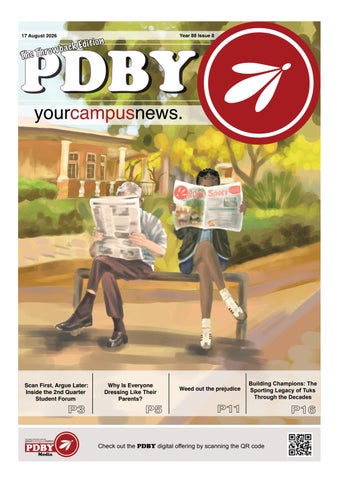
17 August 2026
io t i d E k o w b ac
Year 88 Issue 8
n
PDBY Th e Th r
yourcampusnews.
Scan First, Argue Later: Inside the 2nd Quarter Student Forum
P3
Why Is Everyone Dressing Like Their Parents?
P5
Weed out the prejudice
Building Champions: The Sporting Legacy of Tuks Through the Decades
P11
P16
Check out the PDBY digital offering by scanning the QR code
2 | Editorial
17 August 2026
News Editor and News Team The SRC: Why Even Bother Anymore…
E
very single year, in the second semester, it’s the same old story. The Department of Student Affairs (DSA) announces the official start of the SRC election season and main campus is briefly flooded with all sorts of branding, banners and promises. This year, the campaign is built around the “Citizen Mode:ON” , a tagline meant to entice students to engage in the election of their new campus leaders. The announcement of this campaign season happened on 20 July when current leaders from Residences, Faculty Houses, Day Houses, Student Committees and other student structures were called to attend an announcement event, dressed in their structure or UP merchandise. This was, on paper, a decent effort by the DSA to spark interest and start a buzz around SRC elections. But weeks in, election season is panning out exactly the way it does every single year: painfully low engagement from the general student body, what little interest there is confined mostly to those already inside the system, and an inbox full of reminder emails urging you to vote. Earlier this year, a few PDBY editors attended a student media conference in Stellenbosch, and the SRC came up constantly in discussion. From general student apathy, internal drama and broken promises, it became evident that the “SRC problem” was not UP’s alone. Which raises the real question: what are students actually being asked to care about, and does the SRC have the power to justify the effort? WHAT THE SRC ACTUALLY GOVERNS UP’s student governance is bigger than the SRC alone. Faculty Houses, Sub-Houses, residences, mentorship programmes, RAG and sport structures all report upward through the Constitution for Student Governance (a document most of the student body has never heard of, let alone read). The SRC sits on top, representing students to Council, Senate and management via five sub-councils: Residences, Academic Affairs, Societies, Transformation and Day Houses.
In comparison to other universities, UP’s twist is the Faculty House system, every student is automatically slotted into one based on their field of study, with Sub-houses running tutoring, mentorships and industry exposure beneath them. Add in DSA programmes such as Stars Mentorship and RAG’s SNAPP initiative, and it’s a genuinely interconnected ecosystem. That’s also the problem. Everything reports through one chain, so low voter turnout and a distrusted SRC at the top weaken every structure beneath it. CHECKS THAT DON’T REALLY CHECK The SRC is not entirely unchecked, at least on paper. Elections run through an Independent Electoral Commission (IEC). Once elected, the SRC answers to a student parliament. This is known as Student Forum at UP while Stellenbosch, UCT and Rhodes refer to the proceedings as Student Parliament, with UCT’s version able to pass binding resolutions by two-thirds majority. In practice, these sittings are known for theatrics like walkouts and loud debates between political organisations, while funding and safety discussions that are actually meant to help students go nowhere. Judicial bodies like UP’s Constitutional Tribunal are meant to arbitrate disputes and investigate SRC misconduct. But when “judges” and the people they’re judging share the same lecture and dining halls, that neutrality is worth questioning too. DOES THE SRC HAVE ANY REAL POWER? Here is the core issue. Across UP, Stellenbosch, UCT and NWU, SRC’s share roughly the same limited toolkit: raise issues, request meetings, organise, advocate. What they can’t do is share a single binding decision. As NWU’s Andiswa Tyobeka put it, the SRC can pressure, but management makes the final call. At UP, even fundraising must comply with institutional policy. That leaves the SRC reacting after decisions have already been made, writing letters and launching petitions, usually to slow and absent responses. Stellenbosch’s SRC has repeatedly written to its Rectorate over NSFAS and
PDBY Media
registration; UCT’s has pushed back on fee blocks and access to academic records, with UP’s own SRC previously writing to the Vice-Chancellor over students being unable to register and NSFAS withdrawals leaving students facing eviction. The pattern repeats every year because management rarely feels obligated to respond or work towards real and active change. With no real institutional power, the SRCs fall back on what they can control: grassroots fundraising. Think NWU’s SRC personally driving students to accommodations during a housing shortage, or UP’s “A Re Ageng Bokamoso” initiative. Admirable, but also proof that the official channels are not delivering. SO, DOES ANYONE ACTUALLY CARE? Put everything together, checks that rarely check anything and an SRC with no enforcement power. That’s when apathy starts looking like logic, not laziness. Why bother voting for a body that can write official letters but not make decisions to actually help students? But there’s a harder question to answer: is this a representation problem or a capacity one? No SRC can single-handedly fix NSFAS delays or a national housing shortage. Governance can advocate, it can’t rewrite the economics that students arrive with. This does not let anyone off the hook, it just means the real question this election season isn’t only “will you vote?”, but what’s missing between representation and actual material change, and who is holding both the SRC and the university accountable for closing that gap. This is not a reason to check out even further, it’s actually the opposite. UP’s system depends entirely on participation in order to function, so when turnout drops, legitimacy drops with it across the board. So before deleting that next “VOTE NOW” email, don’t ask whether the SRC deserves your vote, but what kind of SRC you’re willing to hold accountable for the next year. “Citizen Mode” is asking to be switched on. The real question is whether anyone’s still listening.
Inte re sted in wo rkin g at th e PD BY? Sc an th e QR co de be lo w:
Welcome to the PDBY throwback edition. Travel through time with each section of the paper. Welcome to the 40s and black & white papers with the NEWS section. It’s all about pastels and flower power in FEATURES with a delightful nod to the 60s and 70s. You are just in time for an 80s disco in ENTERTAINMENT. Last but definitely not least is SPORT with that oh so nostalgic Y2K aesthetic. Each page and each visual carefully considers what goes into each section as you go along the ERAS Tour (PDBY’s Version). The PDBY has been an estabilished paper for 88 years. Learn all about our history on pages 8 and 9!
Web: Sivenathi Makhanda Owami Malobola Cuma Mancotywa Amahle Khoza Mbali Dube Tadiwanashe Chigeza Copy: Social Media: Hannah Roberts Amai Ngulube Eddy Mailula Owami Malobola Zukhanye Kani Pranavan Naidoo Luke Masala Noluthando Mdakani Paballo Makgabutlane Kutlwano LerekoMnisi Lebata Sashika Chinsamy Hannah Shacklock Mercia Louw
Social Media: Amai Ngulube Jack Tsanwani Precaution Shongwe Lara-Michell Olivier Ompfuna Tsanwani Cover: Danielle Oosthuizen
Layout: Alyx Bell Zukhanye Kani Esethu Maganda Charney Breakspear Fundeka Mbanjwa Lesedi Mathuloe Bernedette Etchells Visual Media: Danielle Oosthuizen Gabriella le Roux Mpho Makwela Jemma Thomson Daniel Green Mila Jordaan Khanyisa Motsepe Amy Lamplough Dynamic Media: Jason Visser Anita Solarin Dineo Tswai Edith Zvavashe Keira Thaoge Web: Sivenathi Makhanda Daniel Cohen Esethu Maganda Lindokuhle Skosana Mpho Makwela
TIP LINE Send us your anonymous news tips by scanning the QR code.
This issue, like all the ones before and after this, is a labour of love. Journalist integrity, hand-drawn visuals, and hours of layout design is the heart of the PDBY. I invite you to read the interesting articles, admire the beautiful visuals, and feel transported by the layout of this issue.
KNOW SOMETHING? SAY SOMETHING
Love, from the Visuals and Layout teams <3
yourcampusnews. PDBYMedia, formerly Perdeby, is the official independent student newspaper of the University of Pretoria. We are committed to providing fresh and entertaining news content for UP students, by UP students, about UP issues. To advertise in PDBY contact
PDBY Media
Print, Digital, and Broadcast Youth Media
www.pdby.co.za Twitter: @PDBYMedia Instagram: @PDBYMedia Facebook: PDBYMedia
Tel: 012 420 6597 Cell: 083 318 9738 carel.willemse@up.ac.za
Editorial Editor-in-chief carel.willemse@up.ac.za Carel Willemse @Ed_in_Chief Editor editor@pdby.co.za Domonique Bennetts @pdbymedia Deputy Editor digitalmanager@pdby.co.za Jason Visser News news@pdby.co.za Relebogile Manana Features features@pdby.co.za Gabriella Hobson Entertainment entertainment@pdby.co.za Cara Heymans Sport sport@pdby.co.za Neo Paledi
Copy Hannah Roberts Layout Alyx Bell Visual Media Danielle Oosthuizen Dynamic Media Jason Visser Web Sivenathi Makhanda Social Media Amai Ngulube
copy@pdby.co.za layout@pdby.co.za multimedia@pdby.co.za
webeditor@pdby.co.za
Letter policy PDBY appreciates that freedom of speech is an inalienable right enshrined in the Constitution of the Republic South Africa. We encourage our readers to engage in discussion and debate on issues that affect them through letters to the Editor, comments on our website, tweets, or posts on Facebook. We ask our readers to keep the following in mind: 1. PDBY will not edit letters, comments, tweets, or Facebook posts in any way. 2. PDBY will label letters, comments, tweets, or Facebook posts as opinion. These do not represent the views of PDBY in any way. 3. The PDBY editorial must approve letters, comments, tweets, or Facebook posts before they are published. 4. PDBY will not publish letters, comments, tweets, or Facebook posts that are defamatory, or libelous, or that contain offensive content. 5. PDBY reserves the right to practice discretion when publishing letters, comments, tweets, or Facebook posts. 6. PDBY reserves the right to publish any content we receive unless the sender specifically requests otherwise. 7. PDBY reserves the right to retract a letter, comment, tweet, or Facebook post after it has been published. 8. PDBY will not accept responsibility for any consequences the author of a letter, comments, tweets, or Facebook posts may experience as a result of the letter being published. 9. PDBY will only publish letters between 150 and 200 words. 10. PDBY will not publish letters unless the writer confirms their full name, student number and contact number. PDBY will not publish this information, we need it for our records.
Tel: (012) 420 6597
Copyright PDBY is printed by Paarlmedia. All rights reserved. Contributions are welcome. All due care will be taken with materials submitted, but PDBY and printers cannot be held responsible for loss or damage. The editor reserves the right to edit, amend or alter in any way deemed necessary. PDBYcannot be responsible for unsolicited material. The opinions expressed in PDBY are not necessarily those of the editors and printers of PDBY.
17 August 2026
News | 3
SCAN FIRST, ARGUE LATER: Inside the Second Quarter Student Forum
Kofi Donkor and Londeka Mbokane
O
n 23 July, the Constitutional Tribunal (Student Court) held UP’s second quarter Student Forum: one of four quarterly meetings where the channels of communication between the wider student body and the UP Student Representative Council (UP-SRC) are opened. As is often the case, the evening was host to political tension, constant interruptions, and unanswered questions. However, the forum was also radically different this time around, with administrative reform that resulted in an arguably more streamlined and efficient meeting. Most notably, the forum formally concluded, completing every item on the agenda and only lasting about two hours – a stark contrast to the usual fourhour, unfinished affair. But despite its shortened runtime, the evening was not scarce with memorable moments. Beyond the administrative hiccups, the meeting commenced under an altered structure that seemingly aimed to improve efficiency and ensure that attendees were able to depart at a reasonable time. Traditionally, each of the 19 SRC members took to the podium to read their individual reports, detailing notable changes made, challenges faced, and future plans. However, this time around, SRC Deputy President Mosa Motloutse gave a comprehensive, condensed overview of all notable portfolio improvements. This allowed for a greater focus to be placed on the questions brought forward with and without notice. The latter, however, proved slightly difficult due to a few absentees. Three SRC members were granted leave, namely SRC President Khutso Manyaka, who was attending a fundraising event at the time, Security Officer Makahdo Ramphefa, who cited family obligations, and Day Students and External Campus Affairs Officer Terrence Shiri, who was in poor health. However, Residence Officer Jaun Oosthuizen was absent without leave, citing “academic commitments” as the reason for his absence, with repercussions for his invalid leave left undisclosed. Notably, the House Committees of UP’s residences were also absent as they were preoccupied with the lively activities of House Week. Despite the altered schedule, Media, Marketing, and Communications Officer Mahlodi Mabitsela failed to submit her report to be included in the overview. She was, therefore, held to account and required to personally read it in its entirety for the record. Mabitsela detailed that the reason for this, along with other shortcomings apparent within her portfolio, was the result of technical difficulties across all of her devices. The explanation was met with scepticism and critique from attendees, with a South African Students Congress (SASCO) delegate pointing out the abundance of technological resources across campus, including internet and computer lab access. The delegate also said that her conduct should not only constitute incompetence – with another remarking that she was Ms “One Post Per Year” – but that it also constituted a breach of the SRC Code of Conduct. She further explained that she was unable to utilise the university’s resources because she was on Groenkloof campus completing her teaching practicals, as is required by her degree. Later in the evening, SASCO would ironically chant “Viva Mahlodi” and “That’s why I voted for you” when she sharply responded to a question without notice posed by the EFF Youth Command (EFFYC) – the political party that delegated her. Following Mabitsela’s report, the Chief Justice opened the floor for questions with notice. Proceedings began with SRC Treasurer Lethabo Pahlane speaking on behalf of President Manyaka, who had provided a written response in his absence. The bulk of Manyaka’s address was spent disclosing the contents of his engagements with Thrive Student Living earlier this year. The president detailed that communications with Thrive took place formally and informally over an unspecified period of time, specifying that discussions largely centred on advocating for student interests. Interestingly, Manyaka briefly remarked that legal action had been taken against him and several other student leaders, most
probably by Thrive, in response to the protests against “top-up” fees that took place back in March. The president continued to recount his discussions with Thrive, stating that there were extensive talks on the eradication of “top-up” fees for NSFAS-funded students and for Thrive to align its pricing models with the NSFAS accommodation guidelines. Manyaka reported that the abovementioned engagements resulted in the removal of “top-up” fees across basic sharing rooms within Thrive buildings. He concluded by providing that in the spirit of longterm collaboration between Thrive and the SRC, Thrive Student Living has pledged R100 000 to the SRC’s fundraising initiative A Re Ageng Bokamoso – an announcement that was met with audible suspicion from SASCO, with several members exclaiming that Manyaka was a “sellout”. Later in the evening, SRC Deputy Secretary Elovuyo Makohilso had taken
behalf of the absent Shiri until the EFFYC had hushed was justifiable. However, her composure was replaced with irritation when questions were directed to her own portfolio. The EFFYC challenged her allocation of funds and accused her of hoarding the funds as if they were her own. This triggered her catchphrase of “The beautiful thing is…” as she countered that she had never promised disbursement of funds in her Plan of Action or any other official documents, citing that the onus rests solely on the Department of Student Affairs to do so. An innocent attendee caught the smoke that the EFFYC had flamed when Moncina provided unnecessarily harsh responses to his questions. She explained that she has been understanding, even refraining from giving deadlines when it came to the appointment of society leadership, largely due to the IT department’s failures. She further said that “the beautiful thing” about her term in office is that she has laid the foundation for whoever her lucky successor is, which yielded little in resolving the immediate concerns of current societies’ executive boards. A further display of political tensions was observed when another female SRC delegate from the EFFYC took to the floor and was honoured – as is custom for their female leadership – with a song contrasting her to the late Winnie MadikizelaMandela. SASCO then retorted that they should not “disrespect Mama Winnie’s name like that”. Moreover, when Makohilso had stood up earlier in the evening, he was met with taunting from an EFFYC member, to which a SASCO member could be heard calling them “useless” and saying that he “has never led anything in [his] life, not even a relationship”. PDBY spoke with SASCO Deputy Secretary Eclayton Nwandzule who provided further insight on the EFFYC-SASCO rivalry. Nwandzule said that although SASCO and the EFFYC share similar sentiments, their differences lie in their morals and values. Nwandzule noted that SASCO consistently advocates for student interests, specifying that the organisation often helps students with matters that get less attention. The deputy secretary further explains that SASCO is not concerned with gaining recognition from assisting students. Instead, the party simply does so because it is their duty. Finally, Nwandzule elaborated on the comments made regarding the funding the SRC received Photograph: Dineo Tswai and Anita Solarin from Thrive Student Living. He questioned why the floor, answering questions on behalf of absent Facilities, Safety, and Security the donation was only announced at a student forum and whether the president Officer Makhado Ramphefa. At the end of his address, a point of order was was being honest about the amount of money received, especially regarding “the raised by Palestinian Solidarity Committee (PSC-UP) Chairperson Ayesha history of the EFF”. Although Nwandzule was hesitant to accuse the EFFYC of Essop regarding an unanswered question. Essop detailed that she had submitted stealing money, he said that, based on anecdotal evidence, there is a possibility a question to the Security Officer within the deadline, but this question was not that members may pocket funds for their own personal use and enjoyment. He addressed. Chief Justice Chidi provided that there is no reason for a question to concluded, explaining that this is all alleged. not be read out at all. Makohilso replied to Essop, providing that he had sent each This year’s quarter two forum marks a monumental shift in how the meeting SRC member their relevant questions the previous morning and that he would is conducted. The increased focus on questions as opposed to the reading of be willing to submit his laptop for auditing. Chidi concluded the enquiry by reports provided greater opportunities for open communication between students advising Essop to resubmit her question via the QR code projected at the front of and the SRC. The Constitutional Tribunal’s restructuring is admittedly a large the venue. The code led to a Google form, allowing attendees to submit questions improvement, allowing the forum to be a more effective means for meaningful that were unanswered during the forum. It should be noted that throughout the student-to-leadership communication than ever. However, the constant back and rest of the evening, Makohilso sat next to Essop, displaying his laptop, most forth between political parties and the combative and oftentimes unprofessional probably attempting to resolve the issue. Following the forum, Essop provided conduct of some SRC members highlighted how student forums tend to devolve that it seemed to be a simple technical mix-up. into a battleground for competing views and unsatisfied resolutions as opposed Exchanges between Societies Officer Lihle Moncina and EFFYC exhibited an to remaining a venue for accountability and awareness. unmistakable breakdown between herself and the party that delegated her during Quarter two’s student forum brought up the question of whether student leaders her campaign and election season. Her initial refusal to address questions on may be the ones responsible for hindering the university’s parliamentary meetings.
South Africa’s Top Universities Take a Stance Against Exploitative Student Accommodation Practices Kofi Donkor
O
n 20 July, the Student Representative Councils (SRCs) of several of South Africa’s top universities released a joint statement condemning the exploitation of students through high accommodation costs and the failure of the NSFAS’s accommodation cap. The statement was made against the backdrop of NSFAS’s failures within the past year, as well as the questionable business practices of student accommodation providers countrywide. The statement made by the SRCs of the University of the Witwatersrand (Wits), Stellenbosch University (SU), the University of Johannesburg (UJ), and the University of Cape Town (UCT) began by detailing how NSFAS had failed to report student accommodation providers to the Competition Commission for possible collusion and price gouging despite announcing that they would do so back in 2023. Additionally, the SRCs highlight the detrimental effects that the NSFAS accommodation cap has had on students. Introduced in 2023, the cost cap allocates a maximum amount per annum towards student accommodation, a decision that would – according to NSFAS – manage the unregulated and increasing costs of student housing. However, as explained by the statement, the cap has only left students struggling, as many bear the brunt of skyrocketing accommodation prices with no means to deal with the costs. The statement further detailed the shortcomings of the accommodation cap. The SRCs provided that the cap fails to consider the differences between regional rates and the difference in the number of beds priced below the cap around each university compared to the total number of NSFAS beneficiaries. The cap makes a distinction between metro and non-metro areas, with the latter receiving a lower cap. The SRCs claim that this classification system is illogical as “non-metro” areas such as Stellenbosch receive less funding despite the rental market being significantly more expensive than other recognised metro areas. As a result, Stellenbosch University must
apply annually for their classification to be reviewed, leaving students unsure of the accommodation allowance they will receive and consequently making it difficult to secure housing in advance. The difference between the actual rental costs and the NSFAS cap has created a shortfall that has severely affected NSFAS-funded students for the past three years. Oftentimes, students are unable to graduate despite completing their degree because of the debt owed to their respective universities. Furthermore, many students are prevented from pursuing postgraduate degrees due to fee blocks that can be directly linked to the cap. The accommodation allowance provided seldom covers full student housing fees. As a result, learners find themselves locked in disputes with private landlords who demand monthly top-ups that they cannot afford – an issue that has been discussed extensively throughout the year. Within the statement, the SRCs call on the Department of Higher Education and Training and the Competition Commission to intervene, demanding that university-owned residences must be subsidised and never be used as profitmaking mechanisms by institutions. They also called for the strict regulation of private student accommodation prices to prevent the extortion of students. The statement also highlighted how the issue of exorbitant housing costs is not an issue exclusive to NSFAS-funded students. As such, Visual: Daniel Green the accommodation cap cannot be the solution to the problem. It should be noted that, at the time this article is being written, NSFAS has yet to announce the meal and rental allowance rates for 2026. The representative councils concluded by demanding the following immediate actions: the removal of the NSFAS accommodation cap, that action should be taken by the DHET and the Competition Commission to regulate the pricing of
student accommodation across both public and private sectors, and that the 2026 NSFAS rates be announced. This statement was unsurprising considering the numerous protests, strikes, and marches that have taken place throughout the year in response to NSFAS’s failings and the exploitative business practices of private student accommodations. Notably, the events that unfolded at several Thrive Student Living accommodations in Johannesburg may have been the catalyst for the SRCs’s united front. On 5 and 11 June, the University of Johannesburg EFF Youth Command (UJ-EFFYC) held a “Thrive Student Living Shutdown” at multiple Thrive buildings in Johannesburg, calling for the removal of top-up fees for NSFAS-funded students. During the protests, Thrive management had placed their buildings on lockdown, trapping residents inside from 09:15 onwards. Despite presenting proof to management that they were writing exams at the time, many students were still prevented from leaving the building and subsequently missed their exams. In a video posted on the “EFFYC UJ APK” TikTok page, a Thrive staff member speaks to protesters, explaining that management is aware that some students have missed their exams and that Thrive will communicate with UJ in order to resolve the issue. She further goes on to condescendingly urge the protesters to remain peaceful. Following the shutdown, the UJ-EFFYC released several statements that detailed how they will open a case against Thrive Student Living regarding the restriction of students during the protests. Additionally, they provided that Thrive has taken legal action against four UJ-EFFYC leaders, demanding a payment of R450 000 and the removal of all social media posts relating to the protests. At the time this article is being written, there have been no updates on the case against Thrive or the legal action taken against the UJ-EFFYC leaders. Ultimately, the protests resulted in the removal of top-up fees for all sharing rooms, with single rooms still being required to pay additional costs at a reduced price of R800 per month. The conversations surrounding student exploitation by institutions meant to benefit them have been discussed ad nauseum, with little ever being done to resolve the issue. However, the uniting of student leadership across the country as seen above may be just what is needed to tip the scales in the right direction.
4 | News
17 August 2026
Beyond the Budget: UP Students Equipped with Financial Knowledge for the Future Lutricia Phiri and Mpho Mahlangu
Photograph: Mpho Mahlangu
O
n 23 July, STANLIB Mind My Money partnered with the Association of Black Securities and Investment Professionals (ABSIP) Student Chapter UP, Tuks Fin’est, and the STARS Mentorship Programme to host a financial literacy workshop aimed at equipping students with the knowledge and practical skills needed to make informed financial decisions. The initiative brought together financial professionals and student leaders to address the growing need for financial education among young people, encouraging students to develop healthy financial habits that will benefit them long after graduation. The workshop challenged students to look beyond simply saving money and instead rethink their overall relationship with money. Through practical examples, Portia Malatji from STANLIB introduced students to key financial concepts such as budgeting, building an emergency fund, understanding debt and credit scores, the power of compound interest, entrepreneurship, and investing. She emphasised that financial freedom is achieved through small, consistent financial decisions rather than a high
income, encouraging students to begin building sustainable financial habits while in university. PDBY spoke to Nakisani Thukutha, the Finance and Investment Officer of ABSIP UP, who shared that the initiative was inspired by a desire to improve financial awareness among students. “The inspiration to host this event came from my passion for spreading financial awareness among young people, equipping them with basic financial knowledge, and empowering them to keep themselves financially informed,” she explained. “This is why we collaborated with STARS Mentorship and Tuks Fin’est because we share the same mission to educate students and continue spreading financial awareness every year.” Thukutha explained that her own experience with financial education inspired her to create similar opportunities for other students. She shared: “Personally, I have benefited from programmes like these. When I attended the financial education workshop last year, I learnt practical skills that I still apply today, such as using the 50/30/20 budgeting
CAMPUS UNDER HEAT: How South Africa's Hottest Summer Could Affect Students
Mpho Mahlangu
T
he hottest summer South Africa has ever seen is coming, but it is not as rosy as it seems. While many students often look forward to “hot girl summer”, this upcoming summer comes with severe weather conditions that not only affect your body, environment, and energy, but also your finances. From the hottest winter to the hottest summer, the winter lovers seem out of luck this year as forecasts predict one of the strongest El Niño events in decades. An El Niño is a natural climate pattern that happens when the surface of the ocean in the central and eastern tropical Pacific becomes warmer than usual. This natural pattern takes things from mild to hot, even for our economy. This is because an intense El Niño can drive up the cost of food and transport as droughts and extreme weather disrupt agriculture and infrastructure. While the El Niño shows up differently across the world, it is associated with extreme conditions like droughts, heatwaves, heavy rainfall, and floods in different regions. If you are already over the heat, brace yourself, because an El Niño typically lasts for nine to twelve months. Unfortunately, it looks like it is slowly catching up with South Africa. The latest report from the US National Oceanic and Atmospheric Administration (NOAA) Climate Prediction indicates a 97% probability that a super El Niño will form. This event will rank among the strongest recorded since 1950. South Africa experienced the most severe El Niño in 2015/16, which triggered the country’s worst drought in 35 years and pushed food price inflation to 18.4%. Because this is predicted to be the worst one yet, prepare for things to get expensive on campus.
How Does El Niño Affect Students?
Climate change does not discriminate, but its effects are often felt more deeply by students. If you are a student operating on a stretched, limited budget, rising prices can unfortunately make it even harder to afford daily essentials. PDBY spoke to an anonymous student who shared, “I am already struggling with my finances; it is hard to make ends meet right now, and I do not know how
I would survive if prices were to go up. As it is now, I am missing out on a lot because I do not have money, so I really hope this El Niño does not make it worse for me.” It does not end there. Extreme heat can also make learning far more difficult, so it looks like UP air conditioners will finally work to the students' advantage because concentrating in a hot lecture hall can negatively affect memory, focus, and productivity. PDBY asked ten students if they can study effectively in heat, and while most acknowledged that they can adjust, all of them vehemently disagreed, with one saying, “I would rather just study at night when it is cooler than to suffer the heat of the weather and my books. I am not that strong.” Unfortunately, El Niño is expected to bring some of its hottest conditions during the academic year, including exam season, when students need to intensively study and perform at their best.
Tips for Surviving Extreme Heat
Stay hydrated. Do not drink water only when you are thirsty, but have little by little throughout the day. Dress for the weather. Wear light-coloured, loosefitting clothing made from breathable fabrics. Do not overwhelm your body with heavy material. Find cool study spaces. Use the library, study centre, or air-conditioned campus buildings to study during the hottest parts of the day. Eat light meals. Choose fruits, vegetables, and water-rich foods like watermelon and cucumber to stay refreshed. Protect yourself from the sun. Wear a hat and sunglasses, carry an umbrella, and apply sunscreen if you will be outdoors for extended periods of time. Keep your room cool. Open windows when it is cooler outside and close curtains during the day. Use a fan if you have one available. Know the signs of heat exhaustion. Dizziness, headaches, nausea, excessive sweating, and fatigue are warning signs that you need to cool down and hydrate immediately.
saying that she believes finance-oriented workshops are method, setting healthy financial boundaries, and planning very important because they show students the opportunities my spending. Another habit I have developed is tracking that are out there. “Hearing an outside and professional my bank statement every month so that I can see exactly perspective from these organisations and gaining more where my money is going and identify areas where I can improve my spending habits. It is programmes like these knowledge from people who work with these types of things that continue to inspire me to do better financially and, more every day [is really helpful].” importantly, to help others empower themselves through Similarly, Mtsweni said that collaborations between financial education.” student organisations and industry partners expose students The workshop’s impact was evident in the experiences to practical financial knowledge while encouraging them to shared by students who attended the session. PDBY spoke prepare for unexpected financial challenges. “Collaborations like these help reach more students and share to Relebohile Molebatsi, the Faculty of Humanities’ comultiple ways of achieving financial ordinator for the STARS Mentorship Programme, who literacy, help students with planning shared how the workshop strengthened her understanding ahead for their future, and having of money management and reinforced the importance backup savings for unforeseen of financial literacy. She explained, “What circumstances such as getting motivated me to attend the event was the fact defunded and/or not having that they were talking about how to manage a bursary or any kind of your money. As a student, I know a lot financial support to further of people who struggle to manage the money they get, so I wanted to hear more your studies and start [about] how to help people and myself businesses.” with money management.” The lessons shared Reflecting on the session, Molebatsi during the workshop have said that learning about how investing can already begun shaping the begin even while studying was one of her financial habits of those who biggest takeaways. “The most valuable lesson attended. Molebatsi said that she has I learned was learning how to budget and that I Visual: Khanyisa Motsepe started planning her spending while can start investing my money even though I am a consistently putting money aside for university student. It is not too early to invest small amounts savings, while Mtsweni intends to apply the recommended every day because, in the future, it will accumulate to more 50/30/20 budgeting method in managing her finances. “I and it will be worth it.” have started planning out my money on what to use it for PDBY also spoke to Nonhlanhla Mtsweni who said that while also saving small amounts every day so that, in the the workshop addressed concerns she had about balancing future, they can accumulate to a large amount.” Molebatsi her daily expenses while planning for the future. Mtsweni said. “Yes, I would definitely recommend this type of noted that she needed help with setting goals and budgeting. workshop for everyone because it was very informative “I was hoping to learn [about] how I could manage my and helpful for money management.” Mtsweni added, money, considering that I need to buy food, pay [for] “I will start budgeting using the recommended budget transport to practicals, and help at home.” method of 50% needs, 30% wants, and 20% savings. I For Mtsweni, understanding the difference between good would recommend [that] other students attend these types debt and bad debt was one of the most practical lessons of events. It’s important to know how to manage and save from the workshop. She added, “The most valuable insight money.” was learning about the difference between good and bad By bringing together industry professionals, student debt. Knowing the difference has just recently helped me. organisations, and students, the collaboration between I almost opened two credit accounts in the hope of having a STANLIB Mind My Money, ABSIP UP, Tuks Fin’est, and good credit score. This lesson made me realise that what I the STARS Mentorship Programme demonstrated the value of financial literacy in preparing students for life beyond was about to do was going to get me into bad debt because I don’t have a stable income. I rely on NSFAS money that has university. As the cost of living continues to place financial pressure on young individuals, initiatives such as these to pay for my basic needs and to help at home.” equip students with the knowledge and confidence to make Both students agreed that initiatives such as these are informed financial decisions, build sustainable financial essential in preparing students to make informed financial habits, and invest in a more secure future. decisions. Molebatsi highlighted the value of learning directly from industry professionals. She concluded by
Citizen Mode: ON Becoming a Student Leader
Mandilive Mbethe
O
ne of the main events in second semester is the Societies Day, while ensuring that students understand election of student leaders across all student the support available when they take on these roles. It structures at the University of Pretoria (UP), also collaborates with faculties and TuksRes to extend this including the Student Representative Council (SRC), awareness, and during Welcome Day, the SRC encourages Faculty Houses, House Committees, and student societies. first-year students and their parents to recognise the value These elections provide students with an opportunity to of student leadership. develop their leadership skills and make a meaningful Every SRC member has a dedicated impact on campus. To support the 2026 SRC elections staff mentor for the duration of their and encourage participation, the Department of Student term, and other student leaders are Affairs (DSA) launched the “Citizen Mode: ON” supported by guardians or specific campaign with the slogan, "Be the leader you wish staff who walk alongside them. to see at UP". This is meant to inspire students The Student Governance to run for SRC, the university's primary student and Leadership Unit runs leadership structure. ongoing leadership training The ability to lead is a very important and retreats throughout the skill to have and can determine the kind year. Mental health support of opportunities one gets, which is and debriefings are readily why students are encouraged to run available through the Student for structures at UP and improve Counselling Unit, and every their leadership skills. Being part of faculty has an academic success an executive committee – whether coach (ASC) who works directly it is for the SRC, a Faculty House, with leaders to keep their or a student society – gives you great studies on track. Hopoyi exposure to what you are capable of further shared, “Having to and what you can improve upon in terms balance academics with of leading people. Dr Kgadi Mathabathe, leadership responsibilities Director of the DSA, said, “Do not think of has required discipline and good a leadership role at UP as only something that time management.” It is a layered enhances your student experience while you system because juggling leadership and are here. Think of it as a lifelong career academic pressure is not a challenge any investment.” one intervention can solve on its own. PDBY spoke with Lusakhanya Hopoyi, Some students question if student leaders the current Marketing and Webmaster EC represent the interests of ordinary students. Visual: Mila Jordaan member for House Humanities. When Njongo Nana, a BSc Geology student, said, “I asked what inspired her to join her Faculty believe that they do, as I've seen them campaign House, she said, “My passion [is] for making a meaningful for students’ interests and against reckless students that contribution to the student experience within the Faculty of endangered others.” Employers today are no longer looking Humanities. I wanted to be part of a team that advocates only at the degree on your certificate. They are also looking for students and ensures that Humanities students feel at soft skills, and some of the best ways to build those are represented and valued." She also mentioned that her through hands-on experiences like leadership. journey in student leadership has been both rewarding and Leadership is worth more than you think. Since the challenging. minimum requirement to access and retain a leadership Through FLY@UP and the Student Governance and position at UP is a 60% GPA, maybe you should consider Leadership Unit, the DSA runs on-campus campaigns running as well in the future. promoting leadership opportunities, including Student
Features | 5
W e n D r o y r hy Is Eve
e
g n i Lik s s
l: Aly
x Be
ll
eT heir Paren
Thiya Kalan
I
n 1989, the World Wide Web was invented. It Today, aesthetics from the 1980s, 1990s, and was groundbreaking. In 1996, Dolly the sheep 2000s are plucked and blended simultaneously with became the first successful cloning experiment. It effortless ease. Past trends usually resurfaced when was historic. In 2007, the first iPhone was released, the people who originally lived through them came changing and ultimately reshaping the world as we know it. Every generation grows up convinced that Visual: Amy Lamplough they have reached the pinnacle of progress. And technically, they are right. While the invention of sliced bread might not carry the same weight as the latest smartphone, every historical innovation has led directly to this present moment. We invented technology to remove friction. Now we are paying money to put it back. Yet, a funny thing happens when a generation reaches adulthood in a world of absolute digital perfection. Ask a 21-year-old today what they want for their birthday, and the answer is probably not the latest smartphone. The answer, stated with genuine desire, is much more likely to be a second-hand digital camera from 2005. We live in an era of unprecedented technological glitz and glamour, but beneath the surface, a yearning has taken root. Gen Z desires one of age and brought them back. It speaks to a much thing above all else: experiences that are tangible and larger phenomenon that Gen Z has become the first real. generation who are fiercely nostalgic for an era they Most things in life are cyclical. The stock market never actually experienced. goes up and down. Diets trend and fade. Hairstyles, According to Chart Kid Matt, Google search interest accessories, colour schemes. Everything gets its in “Analog Radio” is hitting new multi-decade highs, moment in the sun. And then, there is fashion. Usually, and so have the prompts “Boombox” and “1990s”. But fashion operates on a 20-year timeline. Grease (1970) forget about a Google search. Look around, and the romanticised the 1950s, while That ’70s Show (1990) evidence is everywhere: Adidas Sambas straight out revived the 1970s. But the internet broke the clock. of the 1970s, low-rise jeans from Y2K, digicams from
Maze Madness Visu a
ts?
17 August 2026
2005, and vinyl records spun on turntables identical to the ones our grandparents used. It almost makes no sense. This is not just about picking up a retro jacket at a thrift shop: it is about adopting the tools of the past. And therein lies the paradox: vintage digital cameras shoot grainy, overexposed photos. Vinyl records are heavy, expensive, and require physical effort to play. Polaroids are miniature, finite, and costly per exposure. By every metric of modern convenience, these things are objectively worse than the sleek technology sitting in our pockets. So why reject perfection? When you shoot on a Polaroid or a digital camera from 2004, you forfeit digital perfection for emotional permanence. You get one shot, or you get a slightly blurry frame with harsh flash lighting. But that flaw is precisely the point – it feels real. The effort required to pull a vinyl record out of its sleeve, lower the needle, and listen to an album from start to finish creates an intentional experience. In an era where digital life is weightless, a generation raised behind glass is hungering for physical friction. None of this is melancholic. Rather, it is a quiet, intentional effort to reclaim a little bit of texture. It is trading disposable trends for clothes built to last and choosing music that takes up actual physical space on a shelf. Above all, it is a gentle reminder that while technology aims to make everything effortless, the things we have to work for will always mean more.
Flashcards or Quizlet? Which to Trust? Lydia la Grange
M
ost, if not all, students have a preferred study as tutors and teachers. In a 2025 study done by Harvard method that is usually carried over from high University, students who used AI performed twice as school. Many of these “traditional” study well as students who simply used traditional interactive methods have been modified into virtual versions of classroom-based learning methods. AI also outperforms themselves. Instead of flashcards, we have Quizlet. traditional tutoring since it is readily available for longer Instead of hand-drawn notes, we have computers. Instead periods of time. Unfortunately, AI poses a hidden danger of tutors and teachers, we can just ask in that it can lead to overreliance since ChatGPT. The list goes on… These students no longer have to newer study methods are often seen figure out problems on their as more efficient, but are they more own. They also no longer have effective? to actively try to understand A study on the neurological the work themselves. This can effects of typing versus lead to a generation of students handwritten notes never truly understanding the published in Life work they are studying by revealed that while never truly thinking critically both are helpful in word about it themselves. recognition, handwriting Luckily, not many students forces the writer to pause have given up the traditional more over the content methods of learning in favour of they are writing down new ones. In a poll conducted by and contemplate it more, PDBY, 77% of students responded making it a better tool for that they prefer traditional study memorisation. On the other methods over digital methods. Visual: M hand, typing is generally faster This shows that the majority of pho Makw ela and more organised, making it more useful students have a balanced outlook for note-taking during lectures. Both methods have their on which study methods work for advantages, but for different reasons. them instead of just going for the easier-seeming digital Handwritten versus typed flashcards have similar options. attributes to handwriting and typed notes. Handwritten It is not a bad thing to use digital study tools. They are flashcards take longer to make, but writing them down often more time efficient and can help students manage helps students remember the work more effectively. busy schedules and academic pressure. However, even Conversely, typed flashcards can be made faster but often though virtual study tools seem more helpful, traditional take longer to learn since the student does not remember methods have stood the test of time for a reason and should as much from creating them. It is also more effective for not be abandoned. We live in a time where the new and active recall to use handwritten flashcards or notes. technological is often presented as better. While newer Ironically, the only method where new methods proved digital study tools seem shiny and helpful, it is important overall more effective than the old ones was the use of AI to remember: not all that glitters is gold.
6 | Features
17 August 2026
Shoot your Shot
It's Okay To Exist: The Trap Of Being Performative Rona Disetlhe
W
e are all performers. Or rather, at some point, we all perform then informs how they behave when they are on the “front stage” – when versions of ourselves to fit in. Maybe everyone is watching them (or it just feels like it). it means trying a hobby that everyone It is the same idea that is running quietly in your mind as on TikTok is doing. I mean, everyone and their you work your crochet hook or flip a page in mom has picked up a crochet hook in the last your book that you have angled just right in a two years or read a book in a café. These are café window. You are not just doing the thing, not extraordinary activities invented by a cool you are simultaneously watching yourself do 22-year-old wearing Sambas. These are things it, questioning yourself and your authenticity. that have been done and brought joy for ages. You can spend so much energy asking if However, everyone has also felt a tinge of this is authentic enough that you never get to embarrassment, almost like they are “trying the part where you just do the thing. You are too hard”. allowed to exist without justifying why you are Why is that? Does it really matter? not “unique enough” or “an individual”. The why starts here: you could be So, does it matter? Maybe it does, just a little. alone in your room, with no audience and While performance and genuine interest can still feel like you are performing for one, converge, they diverge the moment interest dies wondering, “If someone were here, they out as soon as the internet moves on to underground would think I’m performative… fake… music tastes as the next intellectual or uniqueness cringe.” The Oxford English Dictionary indicator. Then, you might have just rented an defines being performative as doing aesthetic and not done anything for your own joy, something for the sake of appearance, which is by no means a crime but is worth noticing. to impress others, or to improve your Choosing an interest and keeping it out of online image. If you ask yourself whether you discourse may offer you a pleasure that is different – are doing something simply because one that finds individuality and authenticity within the you want to or for what it will do for internet’s interest. your image and you cannot figure out It is okay to exist just as you are. It is also okay for Visual: A my Lam the answer, that is the point. The two motives cannot you to join in on the internet’s fun with no fear of an plough be fully untangled. Sociologist and social psychologist Erving Goffman audience, whether the audience is there or not. developed the idea that compares human interaction with a theatrical performance, arguing that people know how others perceive them, which
To the unbelievably pretty 3rd year Comp Eng with the emerald eyes and whimsically long curly hair. Since I met you in O-week of 2024 I could not stop thinking about you and I cannot go on further if I don't ask you out. You and me, we'd be IT, cause you're HER.
to the pretty aim tutor, you Excel at making my head spin. i might be failing aim but i wouldnt fail you <3
ll
x Be
l: Aly
a Visu
The First To Walk The Path: What It
Means To Carry Your Family’s Hopes Forward W Buhle Jantjies
hat do you say to your mother when she tells the whole street you are going to change your family's life and you have not even figured out where the lecture hall is yet? For thousands of South African students, that is not a rhetorical question. It is the first week of first year, and it lands hard. Nobody warns you that being the first in your family to set foot on a university campus makes you a pathmaker – the one who has to find the route before anyone behind you can follow it, with no older sibling's notes to borrow and no parent who can say, "When I was at varsity..." Call it what you want – first-generation, "die eerste een", the ancestors’ wildest dream. But according to an article published by Taylor & Francis, research on African firstgeneration STEM students at South African universities found five themes recurring: motivation, resilience, toxicity, racism and politics, and Black Tax. Not one theme is "excitement about registration week". Walking a path nobody in your family has walked before means doing a degree while managing debt you did not choose and campus spaces that were never built with you in mind. . It carries you That matters more than it gets credit for. The same research notes that experience this life u yo ile the d wh an in e od you liv South African higher education still carries the fingerprints of its past, with mecomings, the go ho d an s in ak e bre nc art da through he son you don't Black students underrepresented and overextended in fields like science and Dear You, meant to be the rea u today. bad. It was never this letter finds yo love with living. ere engineering decades after apartheid formally ended. Walking into a lecture in l wh fal d er or she nd , wi wo tfit s I ou . ay Hi the e to you alw the photos, wear It is never too lat aring the clothes hall as the only one who has walked the path you have walked is not a hard to attain. e to begin again. Maybe you're we so lat th. d pa too t rke r en wo ve fer u ne yo dif is It ea footnote – it is the whole first semester, a reminder that the path was not sk in the job ver too late to tak your socks ne d is an It en . rld be for, sitting at a de go r wo ve ing the ne e let someth packing across cleared in advance. e to realise you'v en - a lat be s too ay r ve alw ne e u'v Maybe you're back nly ere yo And it is certai So what keeps a person walking a path with no footprints to ng e you're right wh eri yb nd ma wo Or ts, t. ren we e are your pa behind. u - whether you'r ty and living with follow? According to The Journal, a 2025 study on first-generation letter has found yo s g thi student in universi r ttin ve ge ere ply wh , So ing, or sim Black students found that friendship and support – not funding or nk , celebrating, griev what's next. u're alive. And I thi freely give thriving, surviving e reading this, yo counselling, just people who understand – significantly predicted e kindness you so sam the th u wi Either way, if you'r Yo elf r. t. ge lon by - treat yours erything figured ou ev whether students stayed motivated or not. It sounds too simple, but gh to stay a little ou ve en ha t to Jus son . ve rea all ha s t's n't at' to tha to others. You do y. You don't need p for a moment. Th when your parents cannot explain what a "999" code is, the person ordinary every da yourself that tra I implore you to sto of ex be on rsi to ve ve ha ery don't in the residence kitchen who gets it becomes the closest thing to ink about ev on that u are right now. rsi yo ve n tha ery for a moment. Th ng Ev alo it. r be furthe u wouldn't make home you have. They cannot lighten the load, but they can walk ng up. this." wi gh sho ou ep thr t ke ge to to was convinced yo ve ing do You just ha know how I'm go make an effort to beside you while you carry it. e , n't up u'v do Yo "I ng d, wi re. he ere sho u e isp rt. yo wh ried And while you'r tfit. Stay for desse gle one of them car There is a quieter thread too. An article on Wiley’s Online photo. Wear the ou h do you. So give the ug un And yet, every sin ke La uld Ta it. . wo ar ng ht he thi ll ug sti every u once tho Library picks up on research on first-generation students m while they can . elf the e urs lov yo survived things yo d u th an yo wi w le er Tell peop sunset every no ce and be gentl globally: lower engagement, delayed graduation, and higher mom. Watch the yourself some gra t consumed your loudly. Call your ars. The thing tha dropout rates than continuing-generation peers. This is not ely rar u yo Think back five ye too something then. ur life that you're ught is probably because these students are less capable. Rather, it is the result ss a version of yo g, quietly mi vin l every waking tho en u'l mo s yo wh ep y, for ke da g e It . itin On wa called life of the system that was never built to catch them. When you are ay. Your life isn't l moments tod tifu ay au t remember now. It's be aw gh ng Ri the . shi er busy wi nothing - neith first on a path, there is no one ahead to warn you where it dips. ce – it’s happening pla o int er. ls ev fal for y reminding us that is all it as everything fin es - stays exactly And here is what nobody prints on the prospectus: pride on s: ul thi inf r pa be the em r no ce, rem now. talking about gra and the fear of losing your footing can live in the same body at ur skin, or e here. And while we're yo u'r t, yo d igh we gla ur so yo I'm essing over, once. You can be genuinely proud that your name will be on esn't the test you're str Tuesday really do With love, ong on a random the first degree certificate in your family's history and still lie es. A do it u u yo yo ed whatever went wr for inc Someone rooting the world has conv awake wondering if you will make it to the end of the path. as as y ch arl mu ne t as r no tte is ma rfection d day, or an impe Both are true, and they can co-exist. Carrying your family's ply the house sim single grade, a ba is dy bo ur Yo think it is. hopes forward was never going to feel light. It was always important as you going to feel like exactly what it is: a weight worth carrying. If you are that student right now, staring at a lecture slide that might as well be in another language, googling terms your lecturer assumed everyone knew, you are not failing at something everyone else finds easy. You are laying the first stones of a path your family has never had the chance to walk, without a map, and mostly without anyone noticing the weight you are carrying. That does not make you a fraud – it makes you first. And somewhere behind you, someone is already watching where you step.
A Letter To You
an
Thiya Kal
Visual: Daniel Green
17 August 2026
Features | 7
THE LAST ONES WHO HAD TO WONDER WHERE EVERYTHING WAS Buhle Jantjies
W
hen last did you leave the house without your phone and genuinely not know where anyone was or where you were going? For one generation, that was not hypothetical – it was an ordinary afternoon. Walking to a friend's house hoping they would be home, knocking, and simply hoping. No text to check first, no little "seen" tick to tell you they had read your message and ignored it. You either found your friend, or you did not, and either way, you had worked it out for yourself by walking there. That is the strange inheritance of the last generation to grow up before the invention of smartphones swallowed their whole childhood: old enough to remember being properly unreachable, young enough to have watched everyone younger than them grow up easy to find, watched, and online before they could vote. It is easy to romanticise that gap, but it is harder to sit with what it actually meant. akwela Mpho M Psychologist Visual: Jean Twenge coined the term "iGen" for the generation that followed, and according to the Institute for Family Studies, her research found that teenagers who spent more time on screens reported lower wellbeing than those who spent time with friends face-to-face. Crucially, the unhappiness did not come first. The screen time did, with teens in her surveys spending an average of close to six hours a day online. It is not a stretch to see the same pattern locally, where data costs and load-shedding have not stopped the smartphone from becoming the default babysitter in homes. Timelines of the technology itself tell a similarly abrupt story. According to ownership data collated on NowComment, the shift from the first iPhone's release to near-universal teenage ownership happened inside less than a decade – a single generational blink in which "unreachable" quietly
stopped being ordinary and became something closer to an emergency. But statistics only get you so far into what that freedom actually felt like. On Medium, one contributor writing about a childhood before smartphones described it less as deprivation and more as a kind of muscle: the ability to sit with boredom without panicking, to be fully present because there was no second digital moment competing for attention. Friendships from that era, the piece notes, were built entirely in physical space through shared time rather than performance. Nobody curating, nobody building a personal brand, just people showing up. That is the part worth pausing on. Not the nostalgia of "we had it harder", which usually collapses under its own smugness the moment someone mentions dial-up. It is the quieter, more uncomfortable question underneath: was that freedom real, or was it simply the absence of a way to check? Would that same generation who were handed a smartphone at nine years old have chosen boredom over infinite scroll? Almost certainly not. The virtue was not willpower – it was the lack of an alternative. What makes this generation strange is not that they remember a different world. It is that they cannot fully explain it to anyone who did not live in it, including, oftentimes, their own kids. Try describing "getting lost at the mall on purpose" to a ten-year-old with a phone in their pocket and a location pin visible to both parents. It does not quite land. It sounds like a story about the “olden days”, because functionally, it is one. Maybe that is the real inheritance: not the boredom itself, but the memory of what it built – patience, presence, the strange comfort of being alone with your own thoughts. Whether that is worth mourning or just worth remembering, the question this generation is still working out is one unanswered knock on the door at a time.
It’s Getting Hot in Here Alyx Bell
D
o you know what the actual effects of places and floods in others. In a PDBY Instagram global warming are? Climate change, poll, 71% of readers shared they did not know what pollution, and global warming are more the AMOC is. Being aware of the consequences than just buzz words for the environmentally of climate change and global warming allows for conscious. They have actual consequences that are people to make more informed decisions regarding vast and varied. their lifestyle and pollution contributions. According to Ivan Farkas’s article published in The slowing down of the AMOC is just one of Nature Communications, human-inflected climate the real-life consequences of global warming and change has an effect on the Atlantic Meridional climate change. It may feel like a distant concern, Overturning Circulation (AMOC) system. In fact, it but the earth around us is changing. Your favourite is making it slow down. The AMOC is like a giant hot sauce? It may not be so easily available on conveyor belt that circulates ocean temperatures your next grocery store run because there is a across the Atlantic. It pushes water heated at the chili shortage according to EarthDay. Extreme equator up to Europe and warms the climate there, weather patterns are causing difficult struggles then the water cools and becomes denser. This in agricultural spaces and crop scarcity. Warmer water then plunges down to the ocean floor just in weather also means that there is a boost in rat time to be heated up again at the reproduction. The rats will be running the equator and sent right back city soon… Rising sea temperatures also up. The conveyor belt mean that sharks are venturing into new keeps on rolling – spaces (someone play the Jaws until it no longer soundtrack). does… Everything seems to Melting ice caps be looking quite gloomy and increased rainfall now, does it not? Well, are messing up the that is not just your mood salt balance in the after hearing about the Atlantic Ocean. climate crisis. Rising sea Freshwater is temperatures are reducing mixing with the salt low-lying cloud coverage, water and making which reflects sunlight it less dense, which according to EarthDay. prevents it from shooting This results in Earth’s down towards the equator and brightness being heating up. The conveyor belt slightly dimmed. Now becomes frail, and then heat is I bet you are thinking no longer distributed around the that a nice glass of wine will globe. Carbon Brief suggests calm your nerves after reading this that with enough global article. Well, here is one last nail in warming, the AMOC the coffin: changing weather is could reach a tipping affecting the quality of grapes point and become weak and the taste of wine. or even stop working. The Climate change is not this Visual: Gabriella le Roux slowing down of the AMOC distant, meaningless word we can ignore. could result in European temperatures plummeting There are real life consequences and real-world despite global warming. changes as a result of it. And at the risk of sounding In addition to this, global food supply could incredibly cliché, there is only one Earth, and it is be affected, sea levels could increase, and rainfall important that we take care of it. patterns could change, causing droughts in some
PROGRESS OR APATHY: Do Tukkies Still Care about Tradition?
Lydia la Grange
with low turnout leading up to RAG of Hope Day is having to prepare the crafts during the day when most students, especially the first-years who are n 1925, Kollege residents organised a first-year initiation ceremony in the most involved in residence activities, have class. the old Pretoria Church Square that members of the public could pay When asked about RAG of Hope Day itself, the HC responded: to watch. According to UP archives, this raised £197. This tradition “Students don't usually seem excited for RAG of Hope Day because I feel continued for several years and eventually, in 1931, it was formalised into like for people to be excited [about] a cause like this, you have to show a university-wide event after TuksRes students held a procession through them the direct impact. So people don't usually get excited the streets of Pretoria to collect money for a nearby hospital. This Mila Jordaa : l a u n Vis without seeing the direct impact. They know RAG was the first university-wide, annual initiative dedicated Hope Day is a fundraiser, but they don't really to collecting charity donations at a South African know the impact that they're making if they university, and it was known as Reach-Out And come.” RAG of Hope Day is an opportunity Give or, as it is known today, RAG. for students to make a real difference in Since then, RAG has traditionally been their communities, but so few students one of the biggest annual events at UP, with actually know where the raised funds go. students making parade floats, crafts to sell, Eventually, the idea of RAG of Hope holding inter-residential competitions, Day as a fundraiser for a good cause and performances to collect funds. In an falls flat. interview with PDBY, a UP alumni from In spite of the low enthusiasm, the the 1990s described her experience of HC member mentioned the success RAG with great fondness. She described their residence had in selling crafts handing out flyers and booklets for RAG at the event. “The bags sold out so when she was a first-year. “We spent a quickly, like people were even prewhole morning harassing motorists to buy ordering them. It was so crazy,” she these from us. It was a competitive exercise explained. The HC described some of because the first team who could sell all the details that the university shares with their booklets could go for a beer! But mostly, them when organising RAG, including: the it was about the fun. Pretoria was aware that residences figuring out which crafts to make, it was RAG-time,” she said. In her second year, the university telling the residences which she helped create floats for the RAG parade. She materials to use for the crafts, assigning stations described, “It was a lot about the party and building a for residence students to help make them, organising float. Nirvana, Pink Floyd, Madonna, and Michael Jackson the stations to sell them, and working out the rest of the played around each float building team at LC de Villiers (can't say logistics. It is clear to see that the decline in RAG of Hope Day is not the I helped much with the building, but we were there). There was definitely a fault of the students working to bring it to life, but rather a result of less live music event, and the party continued until the morning.” student participation and general apathy across the university. But have we lost the magic that RAG used to hold for so many UP It is easy to claim that an underrepresented and underappreciated event is students? In a poll done by PDBY, less than half of respondents said that not worth attending, but if no students participate, traditions will not be able they attended RAG this year. For more insight, we interviewed one of the to survive. If we resign ourselves to apathy towards university traditions, TuksRes House Committee members in charge of the RAG portfolio. She how long will it be until Tuks loses student culture altogether? mentioned, “It is really challenging to get people to participate, not just [in] RAG of Hope Day but [also] leading [up] to RAG of Hope Day because we have to make crafts and everything.” She explained that the biggest problem
I
Shoot your Shot l in my english class. to the pretty blonde gir working in the uk. is nd frie i hear your boy your how about i become since hes relocating, new home too?
to my h teach istory tutor me yo : ur wa your bob i ys ove s r som bobbing. e drin ks?
ie. crusty bean 20 with the n1 3 ek < u in y to the gu to supply. hm and for you i have a dem
8 | PDBY Throwback
17 August 2026
The Eras Tour (P
PDBY has been around for 88 year newspaper in South Africa chang Extra! Extra! Follow PDBY on Instagram
1955: The May edition of the paper was printed in colour for the first time.
1939: Five students, w ho called them selves the “vyf liberaliste ” (five libe ralists), met in the Theology B uilding and wrote the first ev er edition of Die Perd eby. They n amed it after the wasp beca u s e the news has a “sting”.
rtage per sho per a p a o Due t the pa 1941: War II, d l r o W during d. se was clo was spaper erdeby w e n e Th Nuwe P 1944: as Die d e n e p reo p). ew Was (The N
1956: The paper’s format was changed to a more tabloid layout, which is still used today. However, the front page consisted of headline news and not a cover page as it does now.
1944: red a was decla a Lentedag holiday by ate university celebr rnalist to u jo y b e d r Pe rsity’s the unive -i s sation”. “Afrikaan
1965: T h chargin e newspaper t ried to g for th sta ep initiativ e was q apers again, b rt uickly s ut the studen ts, hu 1968: T remaining fre t down by e h Perdeb e name chang ever since. y on 23 ed back Februa to Die 1975: I ry. n Die Per the Septembe re de (ladies by started a “ dition, ’ sectio D amesbla n). 1975: A d” n article congra w a s publish tulatin ed g Huis (House Erika Erica) o n havin engage me gt girls’ re nts over rece he most ss of all sidence the s (four) .
1976: Die Perdeby was known as the biggest student newspaper in South Africa. 1945: Sonop holds the record for the most Editors in office, holding the position from 1945 to 1986. 1951: Residence Gossip Column “Pssst…” was established because residences were a major part of student culture. 1951: Die Perdeby was distributed for free for the first time. Previous editions cost readers between two to three pennies per paper.
1985: The first female Editor, Dricѐ Odendaal, was appointed. This was not the first time women were on the editorial, but they were often stuck writing in the ladies' or arts sections. Odendaal was also the first female Deputy Editor the previous year.
u d to 50%
200 the the Jo
PDBY Throwback | 9
17 August 2026
PDBY’s Version)
rs, but how has the oldest student ged and grown over the years?
1990: D ie first stu Perdeby becam dent ne e the w comple tely com spaper to be pu 1990: T he Augu terised. s stolen f rom the t edition was p group o rinters f men p b retendin y a be the e g to ditorial. The pap were ev ers en editor a tually found, b ut the t the tim e suspe that So cted nop wa s behin theft. d the 1995: D ie first stu Perdeby becam dent ne e the ws publish ed onlin paper to be e.
, d 2013 l 005 an 2 na n io t e a e Betw the N d e d n e nces y att Confere ity Perdeb ia d e rs tM Studen Rhodes Unive CT y b d n d ea U hoste Activat ity. r e p a p s News per Var newspa
7: from 199 mbers now e t t( er, m kenhou ) burn b o t U c e A e O o T c On 3 la and B House the offi t oe in nd ha Mar Legae a papers rticle t a ews ula g. ide Mor nch of n er a Pr issin k n v a bu trage o two me in ou eatured f
2008: Perdeby go t a new Editor-in Chief, Carel Willem se, who took over from the previous Editor-in-Chief, Schoeman.
2009: Perdeby created its first social media post on Facebook. 2012: Perdeby started publishing only in English. 2012: The newspaper moved into the Opt’hoek building on Hatfield campus, where the paper still functions from today. 2013: UP stopped their Journalism programme, and Perdeby became the sole training platform for journalism at UP. its eated te r c y ebsi erdeb Die P mercial w : 8 9 19 com co.za. own deby. very e w.p r w w t ame a y bec e all b e d r at Pe : Die ccommod 9 9 9 a 1 by to Perde ts. n stude
2001: shut d The newspa ow pe admin n due to fina r was istrati ve pro ncial and univer blems. sity al The so due to the pa said that it w per no as o the l t ad an 0% En guage policy hering glish a nd 50% of having Afrika article ans s. 002: I tw e supe as reopened rvi un Journ sion of the H der alism D ead of epart Kobus Schoem ment, Mr an.
2015 : prim The new spap ary s er o natio nally urce of in became move the form arou a n m 2016 ent and d the #F tion ee : i Stud Perdeby ts happe sMustFa ning ent M host ll s e was held edia Con d the Na at UP. tio fe for th Preto e firs rence, wh nal ria. t 2018 ich time : in offic The new ia s nam lly chang paper's n e, PD ame ed to B w Digit al, B Y, standi its curren as road n t g for cast, and Y Print, outh Med ia.
e only Y was th continue B D P : 0 2 20 r to ewspape n t leveln e d u st e during n li n o g publishin down. ition five lock ember ed ot t p e S e h o 2022: T first “Sh the very d e r u t a fe t”. Your Sho ht back BY broug Media D P : 6 2 0 2 ent nal Stud as hosted io t a N e h t w ce, and it udent Conferen st e h t – atie by Die M at Stellenbosch er newspap y. it s Univer
10 | Advertisement
FS TUKS Advert_80s_FAp.indd 1
17 August 2026
11/08/2026 09:50
e
M
Entertainment | 11
arijuana, Mary Jane, zol, and za. The recently legalised medicinal and also extremely illegal because your depth and distance perception is nonexistent. recreational drug for possession, cultivation, and private use has led However, PubMed studies show that Mary Jane has her fair share of therapeutic uses many to question the misconceptions and myths surrounding the drug in for people with anxiety, ADHD, and other neurodivergences. comparison to the actual science and blunt truths (pun intended). Dreams can also be a hit or miss. You may have the most Between the two extremes of a comedy special and a panic vivid sex dream with your “type yam” or reimagine your most attack, there is a whole multifaceted spectrum of human traumatic events, but it just keeps getting worser and worser. reactions and effects. Some of these could include Most commonly, it will be the weirdest, most obscure, and your newfound appreciation and spiritual seussical experience. Phantom memories are also connection to a song you have heard 300 very common and quite trippy. You could be times or food that would generally mid-conversation or thought and suddenly you taste "meh”, revolutionising it into feel like you have already said or thought these haute cuisine. On the flip side, you get things, or you have always known this new the paranoia or find yourself information that is being presented to you. But crying on the floor do not get too excited because you will probably listening to Mitski's forget the next day unless you strengthen your “A Burning Hill” relationship with your Notes app. and reliving a bad When participating in joint ventures (again, pun breakup. intended), one of the effects that can be a real bummer The first – and is becoming hyper-aware of people's reactions and less spoken expressions, as well as the impending doom of social about – effect is awkwardness. You may miss social cues completely or the obscuring of read into them a little too much. time perception. It is also important to note that if you are going to garden, You could get the urge then you should definitely know your plants. Firstly, THC to clean your room, wash vs CBD: the two main compounds of which the plant all the dishes, rearrange consists. THC is psychoactive, while CBD relaxes your your apartment, have body. Then you get to strains – predominantly sativa a philosophical or and indica, but we live in consumerist times, so there anthropological revelation, is a hybrid as well. Sativa is often associated with the Visual: Gabriella le Roux or write the most beautiful poem mind, creativity, focus, and energy, while indica basically or song you have ever produced. Or, bakes you (again, pun intended) into a couch potato. It is important you could realise that you have been to note that your endocannabinoid system works to maintain homeostasis in the body staring at the ceiling for 20 minutes, when consuming these compounds – definitely some homework for you to look into. and the whole evening can feel like the Lastly, remember that while yes, weed is a drug, you do not have to box every Time Variance Authority (TVA) skipped consumer into a lazy, dumb, and unambitious stereotype. Most people consume weed you and it was never legally recorded. You in moderation, legally and safely, with heavily controlled and regulated "flower” could even be trampled with the guilt of not markets. Weed affects people differently depending on your age, sex, health, and being productive. psychology. Therefore, many people use it for different reasons: relaxing, working, Furthermore, after you smoke that joint, take that sleeping, jolling, etc. Not all of us are cool, weird stoners (excluding myself, of eddie, or hit the bong, your brain's operating system course), as there is no true “image” of what a zaza enthusiast is, so judgement will switches from prioritising survival to prioritising vibes. This not get you far. makes consumption better for creative activities such as listening, Ultimately, all joints aside, weed consumption is a recreational activity that playing or making music, painting, watching movies, going to a buffet requires ball knowledge, so do your research before lighting one up. Obviously, do (the munchies will get you your money's worth), or clubbing. Conversely, while not do drugs, but if you decide to make like Kanye's “Windy” and smoke trees, be you board the mile high club, you may not retain any information if you are planning responsible, moderate, and do not forget to PPP. to study, as your focus and memory will be impaired. Driving is not a good idea and
u t t he O d e :A al
su Vi
e judic e Pr
W
17 August 2026
x ly B
r e d
l el
Milan
G o v e
n
LET’S GET PHYSICAL: WHY PDBY STRIVES TO KEEP PHYSICAL MEDIA ALIVE
Shoot your Shot
Atanda Ntlantsana
I
nstagram, X, TikTok. These days, there are many places to get news from, edit, we create work we can take accountability for. Of course, errors are and it seems like the world is at our fingertips. But what about the good always made, and PDBY prides itself on publicising corrections of anything old-fashioned newspaper? The feeling of the paper on your fingertips inaccurate that has made it to print. However, it is much easier to hold and the smell of the fresh pages – nothing compares to it. However, it seems people accountable for words that are put to paper. that we hardly see anyone reading the newspaper these days. Except at UP, Having a permanent archive also provides a reliable snapshot of a where we get everyone’s favourite paper, PDBY, regularly delivered to us specific time period. PDBY has its own archive of past issues, which serves by smiling faces across campus. Whether it is to find out what is happening as a blast from the past. You get to see what the atmosphere was like and in sports or to see if someone has finally shot their shot at you (your time what people cared about during a particular era of time. is coming, I promise), everyone loves the day the new issue comes out. Physical media provides a tangible archive Everyone on campus is dying to know what is going on, and we have Visual: Mpho Makwela of history and human existence. “Media is got you covered. But in an age where everything is digitised, why the fingerprint of human beings and our even keep printing physical newspapers? collective experience,” PDBY reader Lenaé There are mixed opinions on whether Neels explains. She believes that we have physical media is dying. PDBY’s Head a duty to keep physical media alive both Copy Editor Hannah Roberts believes by making it and consuming it. This is that physical media is finding new an important sentiment – as much as ways to exist. Students seem to we, as PDBY, love the work that goes appreciate and enjoy having a free into making each new edition, we would source of printed media that is be nothing without our readers. Nothing handed to them. However, PDBY’s compares to the excitement across campus Editor-in-Chief Carel Willemse accepts from students who care about what is going that there has definitely been a decline in the on in the world and in our university. Having a presence of physical media. As people become campus newspaper allows us to connect with more environmentally conscious and digital media one another. And distributing is a great form of becomes more accessible, physical media does seem to rejection therapy. be losing its popularity. However, Willemse believes that What is also great about having a physical student publications may be the last to die. But why is it so important to newspaper is that you get to keep it forever. keep it alive? Each PDBY staff member could show you their First and foremost, physical media was here first. Before the smartphone, own personal archive of every issue they have worked we still lived with our heads down. Only back then, they were in books, on, but even the students make sure to take care of magazines, and, of course, the newspaper! There are many reasons why each paper. Whether it be hanging up articles that physical media is important. There is great value in having a physical they resonate with on their wall or simply holding publication, which is why PDBY has never considered letting go of onto the paper, we all take great care of our papers physically printing each issue. It gives us a much-needed break from because they are just that special. Danielle our screens and the endless void of social media, but it also gives us Oosthuizen, Head of Visual Media, describes a sense of ownership. It gives us something that is ours and belongs seeing her and her artists’ work in the paper as to us, where we are free to annotate, flip through, and carry wherever a “religious experience”. On-paper journalism we want. PDBY’s Features Editor Gabriella Hobson says, “In a time provides a reliable account of history, and it is vital where AI is so overwhelming and promotes instant gratification, I that we keep it alive and appreciate the artistry that think a break away from digital media is crucial.” She remarks that “there is goes into it. Entertainment journalist Mazviita Pasi expresses, something special about having to wait until the next piece of information “The publication process involves a lot of steps and many hands and actors, [has been] released or uncovered”. Physical media forces us to search for so getting to see the final result feels rewarding.” answers and really take our time to digest what we are consuming rather According to a poll on PDBY’s Instagram page, 96% of students love than immediately moving onto the next video or “hot take”. having a physical newspaper that gets delivered to them personally. The Physical media also comes with an amount of permanence that digital “P” in PDBY stands for Print, and our paper is not going anywhere any time media simply does not have. You can delete tweets and edit posts, but once soon. Physical media will never be replaced. PDBY will continue to be a something physical is out there, it is out there forever. This also encourages reliable source where you can get the latest news, stories, games, and a bit us to take our time when we create something and forces us to be more of gossip. So if you keep reading, we will keep writing. responsible with our platform. Because physical media is harder to erase or
Visual: Alyx Bell
To the tall guy in BSc please start attending more lectures , I need your motivational eye candy in my lectures ;)
To the first-year geology student whose name starts with M... I know I messed up, but I miss you, baby. Come back home. I’ll treat you right this time. <3
To the tall white guy with curly hair and an eyebrow piercing in my FRK 122 class I need you to balance my sheet,I NEED THAT BADDD
12 | Entertainment
17 August 2026
DAMMIT, JANET: SOUTH AFRICA’S CENSORSHIP OF THE ROCKY HORROR PICTURE SHOW
Melissa Aitchison
censorship machinery. The apartheid government, through the 1963 Act and the subsequent Publications Act of 1974, constructed an extensive system for controlling public access to media. The Publications Control Board determined what qualified as “undesirable”, banning approximately 70 films and 7 000 publications each year. Officials often scrutinised films frame by frame to remove offensive content. The film's gender-bending presentation, celebration of sexual freedom, and defiant refrain of “don't dream it, be it” all contradicted the apartheid regime's rigid racial and sexual hierarchies.
Visual: Gabriella Le Roux
The hypocrisy of the ban is striking, especially considering that at the same time, the government was sending young white men into the Angolan Bush War. The ban deemed them too young to watch The Rocky Horror Picture Show but old enough to be sent to fight in wars. Violence was permissible, but sexual expression was not. The prohibition was not exceptional. Numerous other films suffered similar fates. Guess Who's Coming to Dinner was banned for depicting an interracial couple positively, while
The Death of the South African Sitcom
Zizo Mtshemla
E
verybody and their mother has been struck by Jonasi’s gross infidelity and conduct on Netflix’s The Polygamist. Unfortunately, Jonasi is just a drop in the ocean of characters involved in infidelity in South African television. Over the years, crime and cheating have ruled the soapopera/television world of South Africa. It is almost hard to believe that this is the same country that boasted iconic sitcoms such as City Ses’La and S’gudi S’naysi. The lack of lighthearted, humorous media in mainstream SA television is definitely noticeable. So, what happened to the South African sitcom world? Sitcom is short for “situation comedy”. It revolves around a recurring cast navigating everyday life in a consistent setting. They have the ability to highlight the funny aspects of everyday life. Varying social experiences regarding relationships, work, etc. are brought to the screen in an entertaining manner. There is no better feeling than sitting back after a long day and being guided by a laugh track. In a South African society navigating hardships of all scales, sitcoms have the ability to showcase the amusing and positive aspects of life. Currently, soapies are the dominant genre in SA. Veteran shows like Generations: The Legacy and Uzalo pull in millions of viewers every evening. These soapies have increasingly turned to storylines riddled by varying societal ills such as crime and infidelity, often in conjunction with each other. Similarly, on Netflix – a worldwide offering – SA-based media on the platform tends to rely heavily on these tropes to create stories. This is the version of the country that is most accessible to the world – a crimeridden, cheating society. The international popularity of The Polygamist has heightened this portrayal. Comedy, although very characteristic of South Africa, is few and far between. Attempts at sitcoms in our modern landscape, such as the How To Ruin… franchise on Netflix, also regularly feature these troubling elements. This is obviously what pays. “Low-brow” sitcoms have been phased out by explosive dramas that maintain interest for an extended period, as seen with how long soapies stick around on South African television. An industry heavily constrained by dwindling budgets has no choice but to chase maximum profit. Shocking and gripping content is more financially profitable than lighthearted television that follows a similar formula every episode. Many have taken to social media to mourn the lack of sitcoms on mainstream television. However, it seems the days of Stokvel are gone, leaving a quiet void in South African comedy.
T
W
hen apartheid censors first encountered The Rocky Horror Picture Show, they did not know what to make of it. Here was a film featuring a man in fishnets singing about being a “sweet transvestite from Transsexual, Transylvania”. Here was a celebration of bisexuality, gender fluidity, and hedonistic abandon that directly contradicted everything the conservative state stood for. The film's journey from a banned subversive text to a widely celebrated stage production in 2026 reflects South Africa’s turbulent path from repression towards a more complex present. The story begins not with the film, but with the stage production. The Rocky Horror Show premiered in London in June 1973 at the Royal Court Theatre Upstairs for an audience of just 63 people. Created by Richard O’Brien, the musical won the Evening Standard Theatre Award for Best Musical that same year and was quickly transferred to larger venues. Within two years, the film version – The Rocky Horror Picture Show – had been produced, starring Tim Curry. When this “late night double feature picture show” reached South Africa in 1976, it was initially released with some restrictions. The censorship board operating under the Publications and Entertainment Act of 1963 restricted it to audiences over the age of 21. Approximately 250 000 South Africans managed to see it in this brief window. However, the censors soon determined that the film was too “transgressive”. A journalist who saw the film in Pretoria recalled that it played for just two weeks before it was banned. The official justification was that the film “promoted homosexuality”. The film’s hidden detail of the old South African flag stuck upside-down on a pineapple during the “Time Warp” scene serves as a playful act of defiance – a reminder that even in the darkest times, art found a way to challenge authority and celebrate the very things the state sought to suppress. To understand the decision, one must comprehend the era's
H
Cry Freedom – the biographical film about Steve Biko – was prohibited because it might “sow the seeds of revolution”. The end of apartheid brought an end to state control over public viewing. The old censorship board was replaced by the Film and Publication Board (FPB) in 1996, and their mandate focuses on classification and protecting children rather than suppressing "immorality" or political dissent. The FPB continues to prohibit certain works, but the targets have changed considerably. A campy musical about a transvestite alien no longer raises official concern. The first South African production of the stage show was performed in 1992, with the Cape Performing Arts Board (CAPAB) opening it at the Nico Malan Theatre. Since then, numerous productions have followed. The new production of Richard O'Brien's iconic rock musical, which ran in Cape Town and Johannesburg, featured an award-winning South African cast led by Craig Urbani as Dr Frank-N-Furter. The production was directed by Stephen Stead and presented by Pieter Torien Productions in association with the Luitingh Alexander Musical Theatre Academy (LAMTA). The highvoltage theatrical experience showcased unforgettable songs like “Dammit Janet”, “Hot Patootie”, and “Science Fiction/ Double Feature” while audiences enthusiastically embraced the tradition of dressing up, shouted the famous callbacks, and gave themselves over to absolute pleasure. The very fact that this show – once a symbol of forbidden expression – could be performed openly and celebrated by thousands was a testament to the progressive change South Africa has undergone.
E S U DO
KU CL
B U
17 August 2026
Entertainment | 13
BUILD A B*TCH: THE TRENDIFICATION Do You Really Love H.E.R? OF WOMEN'S BODIES Zizo Mtshemla
F
rom the President closing his addresses with “God bless South Africa and her people” to Kendrick Lamar describing hip-hop as his “b*tch”, gendered signifiers have long been used to describe non-living ideas and objects. But who decided that South Africa and other countries are women? What about hip-hop makes it feminine? Metaphorical gender is the assignment of gender to sexless, abstract objects. For example, ships, countries, and hurricanes are always referred to as women, whereas tools are often masculinised. Unlike languages such as French or German, English does not use grammatical gender: the gendering of various nouns regardless of a lack of biological sex. Antidote’s Blog asserts that English speakers use metaphorical gender for poetic effect and to highlight the heightened emotional connection that humans have with these objects. This is the manner in which rappers have turned to describing hip-hop as a gendered object. American rapper Common released I Used to Love H.E.R in 1994. The song details his introduction to hip-hop and his concern for its turn into a commercialised entity, losing its “purity”. “I met this girl when I was 10 years old / and what I loved most, she had so much soul.” The girl in question is hip-hop, and in order to convey this loss of purity, Common refers to her being sexually involved with multiple men and turning to showbiz. He goes as far as describing her body derogatorily. For something that he claims to love, he sure was comfortable degrading “her” for the actions done unto her by rappers. Common’s song would go on to inspire a plethora of songs that use a woman as a metaphor for hip-hop. Kendrick Lamar’s “Gloria” describes the genre as his “woman and [his] right hand”, all while repeatedly calling her the heavily divisive word: “b*tch”. Although the word is part of many people’s lexicon, many still agree it is offensive in its intention. Hip-hop has long been under scrutiny for its offensive treatment of women. In a genre that generally offers more commercial space to men, women are often the topic. Many rappers have had their careers put under fire because of their misogynistic treatment of women. With lyrics and visuals that often derogatarily objectify and sexualise women, one can almost argue that lyrics have no real-world effect. But many rappers, like Dr. Dre, have been under fire for their violent behaviour towards women. However, this should not come as a surprise. The way we see these feminised entities certainly has the ability to spill over into the way we see women entirely. With hip-hop, it becomes more evident as lyrics directly insulting women are rife. Dionne Warwick famously confronted rappers Snoop Dogg and Suge Knight to call her a “b*tch” to her face and scolded them over their misogynistic lyrics. Language has the power to shape the way we see the world. When we assign femininity to things that we exploit, such as land or insults (as seen in hip-hop), what are we saying about women? Although hip-hop, especially Common’s era and influence, has been labelled as “conscious” and an “advocate of justice”, it is not without its blind spots. But how revolutionary can a woman-hating institution be?
Kopanyi Ramokgopa
Visual: Danielle Oosthuizen
B
eauty standards are ever-changing and cyclical, especially for women. can lead to women losing their periods, enamel damage caused by purging due to Whichever look is popular today may not be what is desired in the next disordered eating, permanent damage to internal organs, and, in extreme cases, couple of years, or even what was desired a few years ago. The ideal body death. This is often seen during invasive, non-essential for women has never been stable. It is a trend that demands adherence, and failure surgical procedures such as BBLs. Societally, the to do so may lead a woman being seen as undesirable. This pressure to adhere impact of women's bodies being trends is the to what society views as beautiful has left women trying to fit into homogenisation of beauty. Ethnic features beauty standards that are often unrealistic, unattainable, and diverse body types are culturally and unhealthy. erased in favour of a standardised ideal In the 1990s, the “Heroin Chic” look was in style, of beauty. and women were expected to look bony, with pale skin Body trends are supported and sharp, angular features that are reminiscent of and amplified by the beauty and people with a drug addiction. This ideal naturally cosmetic industry. These industries led women to adopt unhealthy lifestyle habits, such make women believe that natural as the “cotton ball diet” which saw women using aspects of their bodies – such as hard drugs or taking large amounts of caffeine and cellulite, belly rolls, wrinkles, and nicotine to curb hunger, restrict calorie intake, and still stretch marks – are “flaws”. After maintain high energy levels. successfully making women insecure, In the following decade, the 2000s, “Heroin Chic” they subsequently sell them the “cure”, died out, and a new body trend emerged: the “Size which comes in the form of firming and Zero”. During this trend, women were expected to look anti-wrinkle creams, diet pills, shapewear, extremely thin and tan, and having a big posterior was cosmetic procedures, and fitness programmes. considered the biggest insult known to mankind. This These industries do not profit off of women feeling secure era saw the peak of eating disorders, fuelled by tabloids in their bodies. The constant change of beauty that depicted natural aspects of a woman’s body such as standards ensures that women will always have stretch marks and body rolls as the epitome of “letting insecurities that require rectification, causing yourself go”. them to be eternal consumers in their pursuit An extreme pendulum swing came in the 2010s during the of fitting into beauty standards. “BBL/Instagram baddie era”. The thin look was traded in for The never-ending and ever-shifting large breasts, tiny waists, and larger butts, all of which trendification of women’s bodies could be achieved through a cosmetic surgery called exposes how female appearances are the Brazilian Butt Lift (BBL). treated as a commodity, often at the Now, in the 2020s, society has entered the “Ozempic expense of holistic health, individuality, era”, meaning that skinny is back in style and can and self-confidence. It is important to be achieved by taking the drug Ozempic, which was reject mainstream beauty standards or at initially intended to treat individuals with type 2 diabetes. least engage with them in a way that does Treating women's bodies as trends has posed profound not cause harm to ourselves. It is important to remember psychological, physical, and societal dangers. Psychologically, that our bodies are not clay; they cannot be moulded, broken, women are left feeling deeply insecure and develop distorted views of Visual: Gabriella le Roux and reshaped every time a perceived imperfection or a new body themselves. They continuously chase body ideals that change too rapidly trend emerges. and are often unattainable, leading to psychological disorders such as body dysmorphia, eating disorders, and depression. Physically, extreme weight loss
WORDWHEEL PUZZLE
Create as many words possible with the letters in the wordwheel. You can only use each letter once and every word must contain the letter in the center of the wheel.
Visual: Amy Lamplough Visual: Danielle Oosthuizen
to f
n d t h e 10
le
r re
o
ry
fo
O
The 10 letter word is:
w o rd :
A li t t
er
le h
tt
e lp
i l at i ng t o h
st
14 | Sport
17 August 2026
From Flawless Runs to Historic Triumphs: The 2026 Koshuisrugby Regular Season Wrap-Up
Corné Snyman
A
t the start of the year, we looked ahead at what the 2026 UP Koshuisrugby season might hold. The predictions were made, the traditional heavyweights were backed, and the whispers of day house underdogs starting a revolution were just that: whispers. Ten weeks of brutal, unapologetic rugby later, and the regular season has officially drawn to a close. The logs are locked, the bruising pool stages are behind us, and the campus now knows exactly who the real contenders are. Looking back at the campaign, this season delivered an incredible mix of clinical dominance and unprecedented historic milestones.
The Gold Standard: Sonop 1’s Perfect Blueprint
nd news a of the itha re part atch Il a C . é M rn F o nd nd C Tuks -6PM a Ilitha a ting team at 3 ri F s, , d In Short on, We presen sports Drive Show M Show, Sports Show h e c lk n th Ta n ru s o eB port . ell as th n our S and Fri n Corné o ys 6-7PM as w M Mon, Wed am us o Tuesda orts 9AM-12P .2FM or stre 7 p doing s Tuks FM on 10 .co.za to uksfm Tune in www.t
If there is one story that defined the first-team division this year, it is the absolute machine that is Sonop 1. Up until the final whistle of week ten, they were on an untouchable, flawless run. They closed out the regular season at the top of the first team log with an imposing 31 points and a league-best of +107 point difference. While OP Village 1 managed to snatch a late 16-13 upset in the final round, it does not overshadow the tactical masterclass Sonop 1 put on for the preceding two months. According to Captain Johan van den Heever, that high standard was no accident. "I think the biggest factor was consistency," Van den Heever noted. "Every week, we focused on controlling the controllable. Our preparation, our attitude, and our work rate. We never allowed ourselves to become comfortable, regardless of who we were playing. Every player understood their role, and everyone bought into the same goal." What makes Sonop so dangerous is their institutional continuity. When asked about their incredible unbeaten streak that spanned almost the entire season, Van den Heever pointed straight to the res culture. "The reason for the unbeaten run is the system that we teach the players from first-year through to their final year. We play the same structure and system, so when a new player puts on that beautiful first team jersey, they already know how their teammates are going to play. The secret, I think, is the consistency in our structure." It is more than just tactics, though. "Wearing the Sonop jersey is something we do not take lightly. The team was not just talented players; the team is more like a family by the end of the season. That is what makes this team so special."
The Revolution in the Trenches: The Tower and Dregeana
While Sonop were executing perfect systems at the top, a completely different kind of history was being written in the second-team division. Entering the year off the back of a disappointing 2025, the combined day house and residence squad of The Tower and Dregeana had everything to prove. Not only did they secure their first-ever win as a combined team early on, but they completely flipped the script on the division's traditional hierarchy, finishing a stellar second on the log with 27 points, 6 wins, and a crucial draw. For Head Coach Leo Köster, that historic first victory was just the catalyst. "It meant a great deal to everyone involved, but more than anything, it was confirmation that the work we’ve been putting in every training session is paying off. That first win wasn’t the end goal; it was proof that we’re building something sustainable." The defining shift in their season arrived when they realised that they could dictate the pace against the league's giants. Köster pinpointed a gruelling 10-5 victory over Sonop 2 in week three and a gritty 14-14 draw against OP Village 2 in week four as the moments that everything changed. They later backed that up by defeating OP Village 19-15 in a week seven thriller. "I think the turning point came when the players stopped worrying about who was standing across from them and started focusing on the rugby we wanted to play," Köster explained. "Backing that up with a draw and later on a win against OP reinforced that it wasn’t a once-off performance. Those games changed the belief within the squad." Now, sitting near the pinnacle of the standings, The Tower and Dregeana have their eyes firmly set on silverware. "Absolutely, we believe we can win the Shield," Köster said. "If you don’t believe you can win, you’re in the wrong environment. Our focus isn’t on looking too far ahead – it’s on improving every week and earning the right to compete."
Looking at the Broader Battlefield
Across the rest of the league, the season was equally explosive. Tuks Ekhaya’s under-20s ran an absolute clinic in the junior ranks, highlighted by massive blowouts like their 43-0 win over House TAU in week eight and a 40-0 blanking of Mopane to close out week ten. Tuks Ekhaya have laid down a terrifying marker for the future of the senior divisions. The 2026 regular season has given us flawless systems, historic firsts, and last-minute upsets.
Pints, Pacing, and Podium Finishes:Why House Week is UP's Toughest Endurance Sport Corné Snyman
W
hen we speak about high-performance sports at the University of Pretoria, the conversation usually revolves around Varsity Cup finals, gruelling track sessions at the HPC, or the Koshuisrugby playoffs. But the most demanding test of physical endurance, mental fortitude, and tactical pacing does not happen on a grass pitch. It happens in the Hatfield bars. House Week has officially wrapped up, and looking at the sheer carnage left in its wake, it is time we recognise this annual tradition for what it truly is: a gruelling, multi-day endurance marathon that separates the campus athletes from the amateurs. To survive the sheer volume of consecutive nights out, competitors need more than just a high tolerance – they need a game plan. "House weeks are only for the toughest players. It is no easy feat, and many do not see the end of the week," explained Sir Lats, a seasoned fourth-year veteran from Die Gat van College. Speaking with the gravity of a grizzled Springbok captain heading into a brutal test series, he highlighted that the true test of House Week is a mental one. "As someone who [has] made it through many House Weeks, I can say that a person needs more than just pacing to make it through," he noted.
"You need to be able to thrive on a lack of sleep, some nights end at 4am, if not all of them. On top of no sleep, you need to balance class with house activities. Only the strongest of people are able to keep all the balls in the air." In the modern era of sports, we hear a lot about load management and resting key players to prevent injuries. Sir Lats confirmed that this tactic is crucial for House Week survival. "There is importance in recognising nights that you can go home earlier to spare yourself for the nights that will be till late. The week is all about mental toughness and the ability to push through even when no one around you seems able to do the same." But what does this athletic spectacle look like from the sidelines? Local Hatfield bartender L. Venter made a fatal coaching error this year. "The veterans definitely showed off their skills and incredible tolerance throughout the week, but they made the mistake of keeping the first years' cups full and shots pouring," Venter explained. By supplying the rookies with constant fuel, the seniors inadvertently created an unstoppable offensive onslaught. "[This] ultimately led to the first years taking the lead [in] this match." When it came time to evaluate team performances and hand out the lyx
A ual: Vis
unofficial hardware, the competition at the top of the log was incredibly tight. Every residence brought a unique tactical approach to the bar. Venter commended Sonop for their traditional game plan, praising them "for bringing the game in terms of spirit and traditions". Meanwhile, Mopane executed an extremely aggressive, high-volume offensive strategy, earning recognition "just because they all order six-plus specials in one-go". However, in any tournament, there can only be one true champion. Through a combination of vocal stamina, rapid fluid intake, and sheer destructive energy, the ultimate gold medallists were clear. "TAU [won because of] their amazing karaoke as well as chugging challenges, and the blue gentlemen’s smashing [of] our supply of cups," Venter concluded after reviewing the week's stats. “Ek dink die wenners is Tau." As the dust settles, the hangovers clear, and students drag themselves back to their 07:30 lectures, those who went the distance can finally hang up their boots. As Sir Lats puts it: "At the end, making it through the whole House Week shows character, and it is worth it in every way. You have bragging rights about being one of those who made it to the end." Until next season, athletes. Drink some water.
l
Bel
Redemption for TuksHockey Ladies at USSA Jason Visser
T
he TuksHockey women’s team had an unbeaten run at this year’s USSA tournament all the way to the finals. In a close final match, they ultimately defeated the Stellenbosch side 2-1. The journey to the top step of the podium in Stellenbosch was dominant, with the team scoring 18 goals and conceding only two. In an interview with PDBY, Sport, Exercise Medicine, and Lifestyle Institute (SEMLI) Sport Scientist Demi Leech reflected on a victory she described as the culmination of months of hard work, trust, and resilience. Leech said that the result meant more than simply lifting another trophy. “Tuks has a big legacy in hockey and one that we wanted to uphold,” she said, adding that returning to win after last year's third-place finish felt like “a redemption arc” (the TuksHockey Ladies previously won in 2024). The achievement resonated with students, as PDBY Instagram polls showed that 90% of respondents rated the achievement as “Excellent, super”. According to Leech, success was built long before the first whistle.
She explained that sports science focuses on managing “player workload, monitoring performance through GPS data, and ensuring athletes are physically prepared for the demands of the tournament”. However, she believes that trust is equally important. She said, “The relationship you create with [the players] and the trust you have with them creates the biggest impact.” PDBY followers echoed this view, with 59% voting that a combination of player skill, coaching, and sports science were responsible for the team's success, while 30% credited player skill alone. Leech also praised head coach Nkuliso “Inky” Zondi, describing their partnership as one built on shared values and complete trust. “Our biggest strength as a unit is that we work as a united front,” she said. The growing interest in the sport was also reflected in PDBY's audience, where 86% of respondents said that they would watch USSA hockey if it was more accessible without attending in person or paying. Hopefully, USSA has an answer in the near future for this demand.
17 August 2026
Sport | 15
More Than a Trophy: The Legacy of the 1995 Rugby World Cup Cayden Coetzer
T
here are few moments in South African history where sport has transcended the boundaries of the playing field. The Springboks’ victory in the 1995 Rugby World Cup was one of those rare occasions. On 24 June 1995, a nation that had only recently emerged from decades of apartheid witnessed a powerful moment that would become etched into its collective memory: President Nelson Mandela, dressed in the iconic green and gold Springbok jersey, handing the Webb Ellis Cup to captain Francois Pienaar after South Africa defeated New Zealand 1512 in a dramatic extra-time final at Ellis Park. While the victory itself was extraordinary, its significance extended far beyond rugby. It represented hope, reconciliation, and the possibility of a united South Africa. Nearly three decades later, the question remains: does the legacy of the 1995 Rugby World Cup still resonate, and can sport unite South Africans in the same way today?
More than a Rugby Match
When South Africa hosted the Rugby World Cup in 1995, the country was still in the early stages of rebuilding itself following the end of apartheid. Nelson Mandela had become the nation’s first democratically elected president just one year earlier, and racial divisions remained deeply entrenched. Historically, the Springbok emblem had been viewed by many Black South Africans as a symbol of apartheid, while it represented pride for a large portion of the white population. Rather than discarding the symbol, Mandela recognised its potential to bridge divisions. His decision to publicly support the Springboks surprised many, but it reflected his broader vision of reconciliation rather than revenge. The image of Mandela wearing the number six Springbok jersey, associated with Pienaar, became one of the defining photographs of democratic South Africa. It sent a message that the country’s future depended on unity rather than division.
A Victory that United a Nation
The Springboks entered the tournament as underdogs. Having only recently returned to international competition after years of sporting isolation, few expected them to lift the Webb Ellis Cup. The final against the formidable All Blacks side, led by the legendary Sean Fitzpatrick, became one of rugby’s greatest contests. Joel Stransky’s drop goal in extra time secured a memorable 15-12 victory, sparking celebrations across South Africa. For one brief moment, race, language, and political differences appeared to fade. Streets filled with jubilant supporters wearing green and gold, united by a shared sense of national pride. The tournament demonstrated that sport could become a platform for healing. It gave South Africans something they had rarely experienced together – a collective victory.
The Legacy Nearly Three Decades Later
30 years later, the 1995 Rugby World Cup remains one of the country’s most celebrated sporting achievements. It is frequently referenced whenever South Africans discuss national unity or the power of sport. The tournament has become a case study in leadership, reconciliation, and nation-building, often taught in schools and universities as an example of how sport can influence society. The story also gained international recognition through books and the film Invictus, introducing audiences worldwide to South Africa’s remarkable journey. However, the legacy is not without debate. While the tournament undoubtedly created a powerful symbolic moment, many South Africans acknowledge that it could not erase the country’s deep social and economic inequalities.
Can Sport Still Unite South Africa?
Modern South Africa is vastly different from the country that celebrated
in 1995. Issues such as unemployment, inequality, political polarisation, and social unrest continue to challenge national cohesion. However, sport continues to provide moments of collective pride. The Springboks’ world cup victories in 2019 and 2023 once again united millions of South Africans. The diversity of those teams reflected a changing nation, showcasing players from different backgrounds working towards a common goal. Captain Siya Kolisi’s leadership, in particular, became another defining symbol of hope. As the first Black captain to lift the Webb Ellis Cup for South Africa, Kolisi demonstrated how the Springboks had evolved into a team that accurately represented the country’s diversity. These victories suggest that sport still possesses the ability to inspire unity, even if only temporarily. While it cannot solve structural problems, it can remind South Africans of what they are capable of achieving together.
A Legacy That Endures
The true legacy of the 1995 Rugby World Cup lies not in the trophy that was won, but in the story it created. It showed that leadership, forgiveness, and shared purpose could bring people together during one of the most fragile periods in South Africa’s history. Although today’s challenges differ from those faced in 1995, the tournament continues to serve as a reminder that sport can be more than entertainment. It can become a catalyst for dialogue, understanding, and national identity. Nearly three decades later, South Africans still return to that iconic image of Nelson Mandela and Francois Pienaar. Not because it solved every problem, but because it represented what the country aspired to become. The 1995 Rugby World Cup remains more than a sporting triumph. It remains a symbol of hope, proving that sometimes, one game can help change the story of a nation
Birth of a Giant: The History of Kaizer Chiefs Visual: Alyx Bell
Beyond Borders: TuksCricket’s Rise to Global Champions Betty Molefe
W
hen the University of Pretoria’s TuksCricket team won the global championship in 2019, they made history and proved that university sports can create players who can compete at the top level. Their outstanding accomplishment was the product of commitment, years of patience, and hard work rather than just winning a prize. TuksCricket has a culture of discipline, exceptional coaching, and a dedication to continuous growth which serve as the building blocks of the team’s success. Student-athletes point out that it is viable to excel in school and on the field by investing in a lot of training while balancing academic responsibilities. Both players and coaches put in numerous hours of practice and effort, which paid off with their 2019 world title. Additionally, the TuksCricket team’s capacity to collaborate was one of their biggest advantages. Every player in the sport has a significant role to perform. Captains, fielders, bowlers, and batters all play a significant part in the team’s success. Throughout the competition, the players maintained focus (even in the face of difficult matches), trusted one another, and communicated well. They were able to constantly perform in the face of intense worldwide opposition because of their togetherness and courage. Students can learn valuable life lessons from TuksCricket’s experience. Success does not just happen. It calls for self-control, tenacity, and a will to strive for long-term objectives. The team’s success highlighted the fact that obstacles and failures should not deter people from going after their goals. Rather, they should be seen as chances to grow, learn, and strengthen. Another important lesson from TuksCricket’s story is teamwork. By encouraging one another and placing the team’s objectives ahead of their own, each member of the squad helped the team succeed. Achieving success is vital, but so is learning how to team up, communicate, and respect others. TuksCricket’s 2019 world title remains one of the university’s proudest sporting achievements. Their success demonstrated that with dedication, teamwork, and the right support, student-athletes can compete on the international stage while excelling academically. Their journey continues to inspire young people to believe in themselves, work hard, and strive for excellence in everything they do.
Anastacia Couloubis
E
very South African knows the name Kaizer Chiefs. Even if football is not your thing, you have probably found yourself caught in the middle of a Chiefs vs Pirates argument at a braai, heard someone passionately defend Amakhosi in the Checkers queue, or listened to your uncle confidently announce that this is their season... only to say the exact same thing the following year. Whether you love them, support them, or enjoy winding up their fans, one thing is certain: Kaizer Chiefs is more than just a football club. It is part of South African culture. But before the trophies, the packed stadiums, and one of the biggest rivalries in African football, there was just one man with a big idea. To understand how Kaizer Chiefs became the giant it is today, you have to go back to the 1960s. South Africa looked very different back then. Apartheid affected every part of life, including sport. Football was hugely popular, especially in Black communities, but opportunities were limited and facilities were far from equal. Despite that, the game continued to grow. Every weekend, people gathered around dusty football fields and packed stadiums because football offered something many people desperately needed: a sense of belonging. At the heart of it all was a young striker named Kaizer Motaung. After making a name for himself at Orlando Pirates, Motaung got the opportunity of a lifetime when he signed for the Atlanta Chiefs in the US. This was not a bad career move for someone who was not expecting the US to change more than just his address. While his performances on the pitch caught people's attention, it was everything happening off the pitch that caught his attention. Football was not just about scoring goals. Clubs invested in youth development, built strong identities, marketed themselves, and operated like professional businesses. Motaung realised that a football club could be so much more than eleven players chasing a ball around for 90 minutes. When he returned to South Africa, things with Orlando Pirates did not work out as planned. Most players would have looked for another team. Motaung decided to build one instead. On 7 January 1970, Kaizer Chiefs was born. The name was not particularly complicated. "Kaizer" came from his own first name, while "Chiefs" was inspired by the Atlanta Chiefs. This was a name that would eventually become one of the most recognisable in African football. Of course, coming up with a name was the easy part. Building a football club from scratch? That is a different story. Several players believed in Motaung's vision and joined him. Together, they were not just creating another football team – they were laying the foundations for a club that would become part of South African sporting history. What made Kaizer Chiefs stand out was not only what happened on matchday. Motaung believed in professionalism long before it became football's favourite buzzword. He focused on organisation, discipline, youth development, and creating a club that supporters could genuinely feel connected to. Looking back now, it is easy to see why Kaizer Chiefs grew so quickly. As the years passed, the club became about more than just football.
During apartheid, stadiums became places where people could celebrate, connect, and forget – even if only for 90 minutes – about the realities waiting outside the gates. Supporting Kaizer Chiefs was not just about hoping your team won on Saturday afternoon. It was about identity, pride, and being a part of something bigger. More than 55 years later, Kaizer Motaung's idea is still going strong. Today, Kaizer Chiefs is one of the biggest names in African football. It has produced legends, won countless trophies, and created memories that generations of supporters still talk about. But perhaps the club's greatest achievement is not measured by silverware at all. It is that one man's idea became a club, the club became a community, and the community became a legacy. Not bad for something that started with a footballer who simply believed South African football could be better.
Visual: Mpho Makwela
Sport Building Champions: The Sporting Legacy of Tuks Through the Decades Cayden Coetzer
F
or generations, the University of Pretoria has been synonymous with sporting excellence. Whether on the rugby field, athletics track, cricket pitch, or in the swimming pool, TuksSport has consistently produced athletes who have represented South Africa on the world’s biggest stages. From Olympic medallists and world champions to Springboks and Proteas, the university’s influence extends far beyond its Hatfield campus. What began as a university sports programme has evolved into one of Africa’s most respected high-performance sporting institutions. Today, TuksSport is recognised not only for developing exceptional athletes, but also for fostering a culture of excellence that continues to inspire future generations. Humble Beginnings, Extraordinary Growth Sport has formed part of the university’s identity since the institution’s early years. Over time, the university expanded its sporting codes and invested heavily in coaching, facilities, and athlete development. The establishment of the High Performance Centre (HPC) marked a turning point in TuksSport’s history. The facility became one of the continent’s premier high-performance training environments, providing world-class coaching, sports science, medical support, nutrition, and performance analysis. This holistic approach has enabled student-athletes to balance academic commitments while competing at the highest level. Today, TuksSport offers opportunities across numerous sporting codes, ensuring that aspiring athletes have access to elite resources while pursuing their education. Producing World-Class Talent Perhaps the greatest measure of TuksSport’s success is the calibre of athletes it has produced. Handre Pollard Among the university’s most recognisable sporting alumni is Springbok flyhalf Handré Pollard. Renowned for his composure under pressure and exceptional goal-kicking ability, Pollard has played a pivotal role in South Africa’s recent Rugby World Cup successes. His journey through TuksRugby reflects the university’s commitment to developing players capable of performing on the international stage. Pollard’s professionalism and leadership continue to inspire aspiring rugby players who dream of wearing the green and gold.
Akani Simbine When discussing South African athletics, few names command as much respect as Akani Simbine. A proud Tuks athlete, Simbine has become one of the world’s fastest sprinters, consistently competing in Olympic Games, World Championships, and Diamond League meetings. Known for repeatedly running sub-10-second 100-metre races, he has established himself as one of the greatest sprinters in African history. His success highlights the quality of coaching and athlete support available at TuksSport. Simbine’s achievements continue to inspire young athletes across South Africa, proving that consistent hard work and world-class preparation can produce sustained international success. Lungi Ngidi The university’s impact extends beyond rugby and athletics. Proteas fast bowler Lungi Ngidi developed his cricket while studying at UP. Combining pace, accuracy, and discipline, Ngidi has become one of South Africa’s premier fast bowlers across all formats of the game. His rise through university cricket demonstrates the strength of TuksCricket’s development pathways. The programme continues to produce players capable of competing in domestic competitions before progressing to international cricket. Tatjana Smith (nee Schoenmaker) Swimming sensation Tatjana Smith represents another remarkable UP success story. Training through the university’s high-performance structures, Smith reached the pinnacle of world swimming by winning Olympic gold in the 200-metre breaststroke at the Tokyo Olympic Games while setting a new world record. She also claimed Olympic silver and multiple World Championship and Commonwealth Games medals. Her achievements showcased not only individual brilliance, but the effectiveness of the support structures surrounding elite athletes at TuksSport. And these are just a few well known names that come from UP. More Than Individual Success Although internationally recognised athletes often dominate headlines, TuksSport’s impact extends much further. Every year, hundreds of student-athletes benefit from experienced coaches, sports scientists, physiotherapists, psychologists, and academic support staff.
Winning Against the Odds: Caster Semenya’s Journey to Gold
Betty Molefe
W
hen Caster Semenya won the gold medal in the women's 800 metres at the Rio Olympic Games on 20 August 2016, South Africa celebrated one of their most memorable Olympic moments. There was much more to her success than just winning one race. It was a tale of tenacity, resilience, and courage to carry on in the face of adversity. Millions of South Africans were motivated by Semenya's accomplishment, which served as a reminder to the youth that perseverance and hard work are the keys to success. Semenya had already made a name for herself as one of the best middle-distance runners in the world before coming to Brazil. Her path to Olympic success was not simple. She encountered harsh criticism, public scrutiny, and personal difficulties throughout her career. Under such pressure, many athletes could have lost their confidence, but Semenya stayed committed to her goals. She continued to train because she was confident that her commitment and self-control would finally pay off. Furthermore, Semenya's ability and knowledge were shown off in the women's 800-metre final. She began with assurance, carefully regulating her pace while being around the top runners. Instead of moving too quickly, she waited for the ideal opportunity. She showed off her incredible strength and speed as the athletes approached the last stretch, overtaking her rivals. With an amazing
time of 1:55:28 minutes, she won the Olympic gold medal and secured her position in South African sporting history. Her win represented optimism and tenacity for many South Africans. She proved that obstacles and failures have no power to stop someone from realising their goals. Her accomplishments showed that self-belief, diligence, and dedication are just as crucial. She became an inspiration to young people who are struggling in their own lives, teaching them that challenges can be faced with perseverance and hard work. Semenya's inspirational path could teach students important lessons. Academic pressure, athletic competitions, and often overwhelming personal issues are all common aspects of life at school. Success is rarely attained overnight, as shown by Semenya’s story. Rather, it is developed through persistent work, self-control, and the ability to keep going in the face of failure. One of South Africa's greatest sporting accomplishments is Caster Semenya's historic triumph at the 2016 Rio Olympics. Her story serves as a reminder that the real victors are honoured not just for their medals, but also for their bravery, tenacity, and fortitude. People around South Africa and the world are still motivated by her story to put in effort, have confidence in themselves, and never give up on their goals.
This integrated approach allows students to develop both academically and athletically. The university continues to produce Springboks, Proteas, Olympians, and national representatives across numerous sporting codes, reinforcing its reputation as one of South Africa’s premier sporting institutions. Recent successes in Varsity Rugby, athletics, cricket, and rugby sevens demonstrate that the university’s winning culture remains firmly intact. Players continue to earn national call-ups while UP teams consistently compete for titles in university competitions. Building the Next Generation One of TuksSport’s defining characteristics is its ability to blend tradition with innovation. Modern performance analysis, sports technology, and athlete monitoring now complement decades of coaching expertise. Young athletes entering the university benefit from systems refined through years of producing international competitors. The success of current athletes also creates a powerful cycle of inspiration. Students train in the same facilities, wear the same colours, and learn from coaches who have helped develop Olympic champions and World Cup winners. For many aspiring athletes, this serves as daily motivation that international success is not only a possibility – it has been achieved repeatedly by those who came before them. A Legacy That Continues The story of TuksSport is not simply one of trophies and medals. It is the story of a university that has consistently invested in people, believing that excellence is achieved through preparation, opportunity, and perseverance. From the achievements of Handré Pollard on rugby’s biggest stage to Akani Simbine’s blistering speed on the athletics track, Lungi Ngidi’s performances for the Proteas, and Tatjana Smith’s historic Olympic triumphs, TuksSport continues to shape South African sport. As new generations of student-athletes arrive on campus each year, they inherit more than world-class facilities – they inherit a legacy built over decades. It is a legacy that continues to produce champions, inspire excellence, and strengthen the University of Pretoria’s reputation as one of Africa’s leading sporting institutions. For TuksSport, history is not simply something to celebrate. It is the foundation upon which the next generation of champions is built.
The Women Who Built Tuks Sports: A Legacy 108 Years in the Making Anastacia Couloubis
E
very medal has a story behind it, every record has someone who broke the barrier first, and every sporting powerhouse starts somewhere. Today, the University of Pretoria is known for producing Olympians, world champions, and some of South Africa’s biggest sporting stars. Walk around the High Performance Centre and you never quite know who you will bump into. One minute, you are heading into a two-hour class that you will fall asleep in, and the next you are sharing a walkway with an Olympic medallist. But long before the medals, national colours, and international headlines, there were women who simply wanted the chance to compete. If you go back almost a century, women’s sport looked very different. Opportunities were limited, participation was not always encouraged, and university sport was largely dominated by men. Despite the challenges, female athletes at UP slowly began carving out a space for themselves, proving that they belonged on the track, in the pool, on the hockey field, and everywhere inbetween. In 1942, women represented UP in intervarsity athletics for the first time, marking one of the programme’s earliest milestones. Seven years later, they claimed their first iIntervarsity title, proving that they were not there to make up the numbers – they were there to win. That success did not happen overnight. Behind every medal was another woman who had pushed the door open a little wider. As the decades passed, more UP athletes began earning Springbok colours and national honours, gradually establishing the university as one of South Africa’s leading sporting institutions. Each generation
raised the standard for the next, creating a culture where excellence became the expectation rather than the exception. Fast forward to today and the names are instantly recognisable. Caster Semenya, Tatjana Smith, and Sunette Viljoen all compete in different sports and have had different journeys, but they come from one university. Their achievements have taken UP onto Olympic podiums and world championship stages, but they are also reminders that greatness rarely appears out of nowhere. It grows from decades of investment, opportunity, and the determination of athletes who came before. From hockey and netball to football, rowing, and swimming, women across multiple sporting codes have helped shape the university’s reputation. Teams like Tuks Ladies FC have become pathways to the national stage while athletes continue to represent South Africa at major international competitions. Maybe that is what makes TuksSport so special. It is not just a place where champions train – it is a place where champions keep inspiring the next generation. If you had to walk through the High Performance Centre today, you would see athletes preparing for their next race, match, or competition. What you will not recognise immediately are the decades of history that made those opportunities possible. Every training session, every medal, and every national blazer can be traced back to women who refused to settle for the sidelines. That is the real legacy of women’s sport at UP – not just the records they have broken, but the barriers they have broken along the way. After all, it is Tuks of Niks!
I
II
HOW TO VOTE
IN THE STUDENT REPRESENTATIVE COUNCIL ELECTIONS
Do
STEP 1: Login details At the start of the voting period, you will receive login details in your @tuks.co.za Gmail account
Vo
tin
STEP 2: Accessing the voter portal Log into the voter portal using the provided login details STEP 3: Viewing the candidates Once successfully logged into the voter portal you will have access to the SRC election ballots. Click on the details tab to view candidates manifestos. STEP 4: Selecting the candidates On each ballot vote for your preferred candidate, and click submit after you have reviewed your choices STEP 5: Receipt Once you have submitted, you can download a copy of your receipt
no
ts
Ple
ha
re
yo
ase
ur
no
te:
log sec in de an on ret tail y s, y an ! m Vo t ex ous ou ter , se wh ing i rv ote na ich s an c ure l a is mu ex u d d , p st itin an res No b ee g fi d au sio sta xe rm dit ff/ rci n of f . stu ed sed re by de nt fre e wi s l e l an h ly a an y p ould nd d a art dis rig icu coerc cre ht lar ey etl wa ou y to y. vo te in g is
All manifestos printed in this supplement were received by the IEC within the communicated deadline. The manifestos were placed exactly as received with no edits being made.
Candidates for SRC Portfolio
SRC President
Profile
Aobakwe Moreki
Participation in UP student structures
Why I am the best candidate for this portfolio
This is Aobakwe Moreki, proudly born and raised in the small village of Luka, Rustenburg. Growing up in a close-knit village taught me the values of humility, resilience, community, and the importance of never forgetting where you come from. My journey continues to be guided by Isaiah 41:10: “Do not fear, for I am with you.” I have a deep passion for community engagement and believe that meaningful change begins by serving and uplifting others. Outside academics and leadership, a fun fact about me is that I can spend 30 minutes choosing an outfit, only to change it five minutes before leaving.
My involvement in UP student structures has allowed me to contribute to student life through leadership, service, and sport. I currently serve as the Chairperson of UP RAG, where I have been involved in coordinating student-led fundraising and community engagement initiatives. Prior to this, I served as a UP RAG General Committee Member in 2024 to 2025. I also served on the House Humanities Sport Sub-Committee in 2024/25, contributing to sporting activities and student participation. Beyond committee involvement, I represented House Humanities as a soccer player in 2024. These experiences have strengthened my leadership, teamwork, communication, and commitment to serving the UP student community.
I am the outstanding candidate for this portfolio because my leadership journey has been grounded in service, accountability, and a commitment to making a meaningful difference. As Chairperson of UP RAG, I gained practical experience in leading diverse teams, engaging students, coordinating initiatives, and turning ideas into action. I understand that leadership is not about holding a title, but about listening, taking responsibility, and delivering results. My vision is captured in my slogan, “Leading with Purpose, Delivering Progress.” I want to lead with a clear purpose while ensuring that progress is experienced by students across every corner of our university. I am committed to representing the entire UP student body, regardless of background, faculty, residence, or affiliation.
As a 2nd information Science student with experience as a commuter, a resident at TuksRes resident and in private accommodation I understand on a grass roots level the different challenges each student faces. I have a rich understanding of the power of information and how young, impressionable adults are being taken advantage of contractually. My goal is help students understand how much more this institution can better advocate and support them on and offcampus
A have been an active member in the Up&Out society which provides a safe space for members from the LGBTQ community. I have also participated in the STUKU debates and as a BOSA YBM UP project coordinator
I abide by the philosophy that knowledge is power and information is the greatest tool to empower students to advocate for themselves through the SRC.I am firmly against the exploitative rental market in private accommodations charging above NSFAS capping. I believe that education as a right ought not to be hindered by finances especially in instances where their bursar for financier is so longer supporting them. Safe and functional transport should be provided to students in areas with a high density of UP students such as Sunnyside and Arcadia, whether you live at TuksRes or otherwise.
I am Sade Johnson, a 3rd year Occupational Therapy student running for SRC President. Rooted in serving students, helping students succeed and representing students in a meaningful way.
-Chairperson, Curelitzia Residence (2025/2026) Lead the House Committee and residence operations; represent 350+ residents; oversee Discipline, Alumni & Benefactors and Archives; drive strategic planning, student engagement and stakeholder relations. -Residences Sub-Council Secretary (2025/2026) Facilitate effective communication, coordinate formal meetings and maintain governance documentation. -Faculty Sub-House House OT Executive Committee (2024/2025) Led House OT marketing, branding and student engagement initiatives. -Secretary, Curelitzia Residence (2024/2025) Supported governance, administration, communication and events. -Tuks Alumni Student Ambassador (2026–present) Represent UP and engage with alumni, students as well as university stakeholders, strengthening institutional connections.
I believe I am best suited for SRC President because I believe students deserve leadership that listens across every community, turns concerns into action and represents them with integrity. I bring diverse leadership experience, having represented students, led teams, managed complicated responsibilities and engaged many university stakeholders. My experience beyond UP in legal, media and tutoring environments has also developed my communication, professionalism, adaptability and problem-solving skills. All skills I can transfer into university governance. The UP experience is not the same for every student, and I want to ensure that voices from our broader and outlying communities are not overlooked. At the centre, my motivation is students. I am not seeking this position for any other agenda. I am seeking it because I care about students and believe I can serve them with humility, accountability and purpose.
I am a Political Science graduate and Sociology Honours student at the University of Pretoria, shaped by a deep commitment to student power, social justice and transformative education. I believe leadership is not about occupying a position; it is about organising, listening and delivering. My politics are rooted in the conviction that a university must work for the students who keep it alive especially those navigating exclusion, financial hardship, academic pressure and inequality. I am a student leader, organiser and activist who understands both the frustration students experience and the institutional work required to change it. I enter this election not with promises detached from reality, but with a record of engagement and a clear political programme for a more accessible, accountable and student-centred UP.
My leadership at UP has been rooted in direct student representation. I currently serve as an SRC Academics, Teaching and Learning Officer, where I have worked on academic exclusions, appeals, student success, teaching and learning concerns, and engagements with University structures. I have represented students in institutional spaces, including Teaching and Learning engagements and Senate-related processes, ensuring that student concerns reach decision-makers. I have also served in student residence and faculty structures, including as Transformation Officer of House Humanities, and as a member of SASCO UP. Through these platforms, I have organised campaigns, facilitated student engagements, supported students facing academic and financial barriers, and worked to turn student concerns into concrete institutional demands. My leadership has consistently been about building organised student power.
#KgotsoBatswadiBakaNnaKeVotaSASCO
My name is Zinhle Mankgane, a selfless leader from Rustenburg, North West, currently completing my final year of a Bachelor of Education (BEd) at the University of Pretoria. Raised in a family that prioritised education, I learned the values of hard work, perseverance and service. My leadership journey began through the Making a Difference Club, church leadership and serving as a peer promoter for the South African National Blood Service (SANBS). In 2025, I served as Face of Education, championing student mental health. I was later elected to the SRC, serving as Transformation and Student Success Officer, where I championed student success, inclusion and institutional transformation. I was also elected to the Institutional Forum and served on the Language Development Forum, contributing to discussions on language transformation. My leadership is grounded in one belief: leadership is service.
-Face of House Education 2025
I am the best candidate for SRC President because I do not believe in a leadership that sits comfortably in an office while students are struggling outside it. I am a ground force.I go where students are, listen to their struggles, and fight alongside them.
Khwezi Makhunga
Sade Johnson
Zekhaya Mdunjana
Zinhle Mankgane
In addition to my experiences at UP, my time working in other organizations has also increased my ability to communicate, adapt to change, and solve problems. An effective leader needs to listen outside of their own campus/community experience and understand how the student experience differs from one community to another. Leadership isn’t about knowing all of the answers, it’s about collaborating with those around you to come up with solutions. As SRC President, I intend to lead with humility, integrity and accountability as a reflection of our students.
-SRC Transformation & Student success 2025 -Institutional Forum 2025
I am the best candidate because I understand that student leadership is not a popularity contest it is a responsibility to organise, negotiate and deliver. I bring both institutional experience and political clarity. I have sat with students dealing with exclusions, funding barriers, academic struggles and institutional bureaucracy, while also engaging the structures responsible for resolving these problems. I know where the gaps are, but more importantly, I know how to organise around them. I will not offer students slogans where they need solutions, or consultation where they need action. I believe in an SRC that is present beyond election season, accountable to students and willing to confront difficult questions. My candidacy is built on a simple principle: student leadership must return power to students and that power must produce results.
I have never limited my leadership to issues that affect me personally. I have represented voices beyond my own, including speaking on matters affecting African Indigenous students, because leadership means fighting for those whose voices are often ignored. To every student who has been financially excluded, turned away from residence, denied opportunities or told to accept less: I hear you, and I refuse to accept that as normal.I am not running to manage the status quo. I am running to challenge it
III
Candidates for SRC Portfolio
SRC Secretary
Profile
Participation in UP student structures
Why I am the best candidate for this portfolio
As a Candidate I am passionate about service, leadership and creating meaningful change in the student community. I consider myself organised, approachable, responsible and attentive to the needs of others. My experiences as a mentor and volunteer have taught me the importance of empathy, teamwork and listening to people’s concerns. I believe leadership is not about holding a title, but about using your position to serve others and create solutions.
I have been actively involved in UP student structures, particularly through serving as a Secretary in a UP student society for almost two years. In this role, my responsibilities have extended beyond taking minutes and preparing agendas. I have communicated decisions and action plans to members, ensured that information reaches the relevant people, and followed up on commitments made during meetings. This experience has strengthened my organisational, communication, administrative and accountability skills. I have also served as a mentor and volunteered on two occasions, giving me opportunities to engage with and support fellow students. These experiences have helped me understand the importance of student participation, effective communication and service. They have also given me practical experience working with students and contributing meaningfully to the UP community.
I believe I am the best candidate for the SRC Secretary portfolio because I have both the experience and the service-driven mindset required for the role. Having served as a Secretary in a UP student society for almost two years, I understand that the role goes beyond taking minutes and preparing agendas. I have experience communicating decisions, tracking action plans, following up on commitments and ensuring that information reaches the right people. This has developed my organisation, attention to detail, communication and accountability. My experience as a mentor and volunteer has further strengthened my ability to listen, empathise and work with students. If elected, I will use these skills to help build an SRC that is transparent, organised and responsive, one that documents student concerns, tracks resolutions, communicates progress and, most importantly, follows through.
I am Elovuyo Makohliso, a postgraduate student in Public Administration, with a strong interest in student governance, public administration and student development. I am passionate about building structures that are organised, accessible, transparent and responsive to students. My leadership journey has allowed me to work across different areas of student life, from student governance and welfare to residence leadership and student engagement. I believe leadership is not simply about holding a position, but about taking responsibility, solving problems and ensuring that commitments translate into meaningful outcomes. I bring a practical, service-oriented approach to leadership, grounded in accountability, collaboration and a genuine commitment to improving the student experience at UP.
My involvement in UP student structures has given me practical experience in governance, administration, student representation and engagement. I currently serve as Deputy Secretary of the UP SRC, where I have gained direct experience in supporting SRC governance, coordinating meetings, managing correspondence, documenting proceedings and following up on matters affecting students. I have also contributed to student welfare initiatives, including accommodation engagements, registration and funding interventions and nutritional support. Beyond the SRC, I have served in private accommodation leadership and participated in student-focused programmes and engagements across the University. These experiences have taught me the importance of effective administration, institutional knowledge, teamwork and, most importantly, ensuring that student concerns are not only heard but followed through.
I believe I am the best candidate for Secretary because I understand that effective leadership requires more than making promises; it requires systems that ensure commitments are recorded, communicated, followed up and reported on. My experience as Deputy Secretary of the SRC has given me first-hand knowledge of the responsibilities and demands of this portfolio, while my background in Public Administration has strengthened my understanding of governance, accountability and effective institutional processes. I am organised, dependable and attentive to detail, but I am equally committed to making the Secretary’s Office accessible to students and SRC members. I want to build an office that supports the effective functioning of the SRC, preserves institutional memory, improves communication and tracks progress on decisions. My focus is simple: an organised, accessible, transparent and accountable Secretary’s Office that gets things done.
I’m Khanyisile Gumede from KwaZulu-Natal, a dedicated third-year nursing student with a passion for community advocacy and patient care. My commitment to leadership is reflected in my roles as Deputy Secretary and Treasurer for UP NATESA (2023–2025) and my service on the Health House Faculty (2025/2026). Driven by a spirit of volunteerism, I pour my energy into serving others and ensuring every project I undertake is seen through to completion. I hold myself to high standards, bringing strong organizational skills and genuine compassion to my work. Ultimately, I value community and unwavering commitment, always striving to execute tasks to the absolute best of my capabilities to make a meaningful difference in the health sector.
My active participation in UP student structures demonstrates a strong commitment to leadership and collaborative teamwork. Within UP NATESA, I successfully served as Deputy Secretary (2023–2024) and Treasurer (2024–2025), managing vital administrative and financial responsibilities. Expanding my impact within the faculty, I also served as External Culture for Health House and stepped in as the temporary Secretary for the House Nutrix sub-house. Across all these diverse roles, I consistently fostered a unified team environment, streamlined communication, and worked closely with student leaders to execute impactful initiatives. These experiences have honed my ability to collaborate effectively under pressure and reliably deliver on collective goals within the university community.
My extensive administrative track record as Deputy Secretary for UP NATESA and temporary Secretary for House Nutrix makes me the ideal candidate for SRC Secretary. Built on three pillars, my campaign prioritizes Transparency through clear, accessible documentation and open communication; Advocacy, ensuring student voices are accurately recorded and championed; and Student Wellness, creating an organized, efficient SRC structure that serves student needs without friction. My third-year nursing background brings unmatched empathy and attention to detail to this vital administrative role. I don’t just take minutes. I ensure accountability. I have the institutional knowledge, the collaborative spirit, and the dedication to ensure the SRC operates seamlessly for every UP student.
As a 2nd information Science student with experience as a commuter, a resident at TuksRes resident and in private accommodation I understand on a grass roots level the different challenges each student faces. I have a rich understanding of the power of information and how young, impressionable adults are being taken advantage of contractually. My goal is help students understand how much more this institution can better advocate and support them on and offcampus
A have been an active member in the Up&Out society which provides a safe space for members from the LGBTQ community. I have also participated in the STUKU debates and as a BOSA YBM UP project coordinator
I abide by the philosophy that knowledge is power and information is the greatest tool to empower students to advocate for themselves through the SRC. With the goal of putting power back in the hands of students, I am proposing putting the relationship with students and the SRC at their fingertips with SpeakUp. This is a platform to easily raise concerns, get push notifications for Student Forums (where student issues are discussed by SRC) and where we can hold SRC members accountable to hearing and addressing the concerns of students. I am striving for a more active dialogue between students and the SRC that represents them. Vote Khwezi for change
Bontle Makakaba
Elovuyo Makohliso
Khanyisile Gumede
Khwezi Makhunga
IV
Candidates for SRC Portfolio
SRC Secretary (continued) Profile
Manqoba Kuhlase
Murunwa Simango
Sade Johnson
Sibusiso Msiza
Tebogo Morudu
Participation in UP student structures
Why I am the best candidate for this portfolio
I am a young, grounded and conscious individual who believes that leadership should always remain connected to the people. Coming from humble beginnings, I understand that opportunities, dignity and representation cannot be taken for granted. My passion for education, young people and student development has shaped my commitment to creating spaces where students are heard and their realities are taken seriously. I believe in leadership that listens before it speaks, serves before it demands, and acts when others choose to remain silent. I am part of a generation that refuses to be spectators in decisions that shape our future. I believe young people belong in spaces of influence, carrying with them fresh ideas, courage and the responsibility to make a meaningful difference.
My involvement in student structures at the University of Pretoria has been grounded in organising, student representation and building structures from the ground up. I was part of the inception of the MK Students Movement (MKSM) UP Branch, contributing to the establishment and development of the branch from its early stages. I subsequently served as the first Secretary of the MKSM UP Branch before I became Provincial Secretary of MKSM in Gauteng where I was involved in coordinating activities, strengthening student participation, engaging with student concerns and helping establish an organised presence on campus.
Change comes with the question you ask. I ask why students should continue to rely on structures that no longer adequately represent their realities. That is why I stand for the establishment of a Student Parliament at the University of Pretoria, replacing the ineffective Student Forum with a democratic, representative and accountable platform where students can debate institutional politics, socio-economic realities and matters affecting their education. My candidacy is rooted in this conviction: that the Secretary’s office must not merely record meetings, but become an engine of student participation and accountability. My experience in student structures has taught me the value of organisation, discipline and service. I understand the realities of students because I come from the ground where these struggles are lived. I will champion a Secretary’s office that listens, documents, follows up and acts, because student leadership must not only speak for students; it must give students a voice in shaping their own institution.
I am Murunwa Simango, a MBChB student who is deeply passionate about people, service and making a meaningful difference in the spaces I am part of. I am naturally curious, approachable and someone who believes that listening is one of the most important parts of leadership. I value genuine conversations and learning from people’s experiences, because I believe some of the most important issues are identified by simply paying attention to what people are experiencing around you. As a medical student, I have also learnt the importance of empathy, responsibility and staying committed even when circumstances are challenging. I am someone who believes in doing things with purpose and integrity, and I carry that same approach into my leadership. At the heart of who I am is a commitment to serving people.
My participation in the University of Pretoria has primarily been through student governance, academic representation and institutional engagement. I currently serve as the SRC Academics: Student Engagement ExOfficio, where I engage with Faculty Houses, through the Academic Sub-council, and students on academic matters, registration, appeals, readmission and related concerns. I have represented students through faculty appeal processes and participated in many other institutional committees where student perspectives inform decision-making. I have engaged with Deans, Deputy Deans, Directors, Heads of Department and members of University Executive while escalating student concerns. I previously served as a Faculty House Treasurer for Health House (2024/25). These experiences have allowed me to contribute to student governance while developing practical knowledge of university structures and institutional processes.
I believe I am the best candidate for SRC Secretary because I bring both experience and a practical understanding of student advocacy. Having served in the SRC Academics portfolio, I understand the importance of listening to students, identifying recurring concerns, escalating matters appropriately and following through until outcomes are communicated. My engagement with students, Faculty Houses and university structures has also enabled me to build relationships with Deans, Deputy Deans, Directors, Heads of Department and members of University Executive. As Secretary, I will use this experience to strengthen communication, accountability and institutional memory within the SRC. I understand that the Secretary is more than the custodian of minutes, the portfolio can connect students, SRC portfolios and the University through effective communication and evidence-based representation. I am not learning student governance from the beginning. I am continuing work I have already started.
I am Sade Johnson, a third-year Occupational Therapy student. Rooted in effective student representation and developing the systems that make leadership work. I am detail-oriented, procedurally driven and committed to ensuring that ideas, decisions and student concerns do not get lost. My experiences in student leadership have strengthened my ability to coordinate, communicate, document and follow through, while my experiences beyond UP have developed my professionalism, adaptability and problem-solving skills. I believe good leadership is not only about having a vision, but also about creating the relevant structures and accountability needed to turn that vision into an action.
-Residences Sub-Council Secretary (2025/2026) Coordinate meeting agendas and minutes, manage official communication and support effective governance and continuity within the Sub-Council. -Secretary, Curelitzia Residence (2024/2025) Managed meeting documentation, correspondence and administrative processes while supporting House Committee operations and events. -Chairperson, Curelitzia Residence (2025/2026) Lead the House Committee and represent 350+ residents; oversee Discipline, Alumni & Benefactors and Archives; coordinate with Residence Management and university stakeholders. -Faculty Sub-House House OT Executive Committee (2024/2025) Managed House OT communication, branding and social media, strengthening student engagement. -Tuks Alumni Student Ambassador (2026-present) Engage with students, alumni and university stakeholders as a representative of UP.
I am suited to the Secretary portfolio because I bring the organisation, attention to detail and the procedural discipline required to turn leadership into effective action. My experience has taught me that strong governance depends on accurate documentation, clear communication, consistent follow up and follow through as well as accountability. I am good at working with systems, managing information, coordinating people and ensuring that commitments are recorded and followed through. My experience beyond UP has further strengthened my professionalism, adaptability and ability to work with different people and environments. I want to help build an SRC where students can clearly see what has been raised, what has been decided, who is responsible and the progress made. Being Secretary is about creating systems that keep leadership accountable. I want to contribute to an SRC that is organised, transparent, responsive and intentional.
I am Sibusiso Msiza, a student leader and BAdmin student at the University of Pretoria, committed to student representation, organisational development and service. My leadership journey spans school, community, youth and university structures, where I have served in various leadership and administrative capacities. I am a former Branch Chairperson and Branch Convenor of SASCO UP, former BAdmin@Tuks Executive Committee Outreach Officer, and former SASCO National Help Desk Member. I currently serve as Branch Chairperson of YCLSA UP and hold leadership responsibilities within SASCO Mega Tshwane Region and ANCYL structures. These experiences have developed my ability to organise, communicate, mobilise and work with diverse stakeholders. I believe effective leadership requires discipline, accountability, accessibility and a consistent commitment to advancing students’ interests.
My participation in UP student structures includes serving as Branch Convenor and Branch Chairperson of SASCO UP, where I led organisational programmes, coordinated student mobilisation and engaged students on issues affecting their academic experience. I also served as the Outreach Officer on the BAdmin@Tuks Executive Committee, working to strengthen engagement between the structure and students. In addition, I served as a member of the SASCO National Help Desk, gaining experience in addressing student concerns and supporting organisational coordination. I currently serve as Branch Chairperson of YCLSA UP. These experiences have given me practical knowledge of student governance, organisational administration, communication, programme coordination and leadership. They have also strengthened my understanding of the responsibility that comes with representing students within the University of Pretoria.
I am the best candidate for SRC Secretary because I possess extensive leadership, organisational and administrative experience across student and youth structures. My previous service as SASCO UP Branch Chairperson, BAdmin@Tuks Executive Committee Outreach Officer and SASCO National Help Desk Member has equipped me with the ability to coordinate structures, manage information, communicate effectively and respond to student concerns. My broader leadership experience has further strengthened my discipline, accountability and ability to work within diverse teams. As Secretary, I will ensure that the SRC operates in an organised, transparent and accountable manner. I will strengthen communication between the SRC and students, ensure that resolutions are properly recorded and followed through, and improve the accessibility of SRC information. I will bring institutional experience, organisational discipline and a service-oriented approach to the portfolio, ensuring that the Secretary’s office works for every UP student.
I am a dedicated student leader running for the portfolio of UP SRC Secretary. My leadership journey at the University of Pretoria is grounded in practical advocacy and service. Having served as Chairperson of the VITA Disability Sub-Council, I fought daily for physical and digital accessibility for all students. As Founder and Chairperson of the Aganang Student Club, I built a dedicated platform focused on student mental health. These roles taught me that administration must serve people, not bureaucracy. As Secretary, I bring governance experience, administrative discipline, and an unyielding commitment to transparency, accountability, and equal representation across all five UP campuses.
My active participation in UP student structures is driven by a commitment to inclusion and governance. I served as Chairperson of the VITA Disability Sub-Council within the SRC framework, directly addressing systemic accessibility challenges and advocating for students with disabilities across all campuses. Additionally, I founded and chaired the Aganang Student Club, an approved student society dedicated to promoting mental health awareness, peer support, and well-being for Tuks students. Through these roles, I have engaged extensively with sub-councils, faculty houses, society networks, and university administrative structures. This hands-on involvement within UP’s governance ecosystem equips me with the practical experience needed to effectively run the Office of the SRC Secretary.
I am the best candidate for SRC Secretary because I combine proven governance experience with an uncompromised commitment to student-first leadership. Having chaired the VITA Disability Sub-Council and founded the Aganang Student Club, I possess practical experience navigating UP administrative structures and directly resolving student grievances.
This experience has shaped my understanding of student politics, leadership and collective organisation. It has taught me that meaningful leadership is not about occupying a position, but about building something that outlives the individual and creates a platform through which students can organise, participate and have their voices heard.
The Secretary portfolio demands operational discipline and administrative integrity. I will enforce a 48-hour turnaround for publishing sittings minutes, establish a digital querytracking log at Kopanong office, and activate the Sub-Secretary Council to unite governance across all UP campuses. Furthermore, I will strictly enforce the SRC Code of Conduct to hold elected portfolio holders accountable to their mandates. I offer an open-door administration, complete document transparency, and reliable leadership. Vote for experience, accountability, and dedicated service.
V
Candidates for SRC Portfolio
SRC Treasurer
Profile I am a student fighter who is dedicated in the advancement of free education. I am a leader who listens and is always willing to defend and protect the rights students have to a conducive and welcoming university environment.
Participation in UP student structures Aid by youth NPO Deputy chair- focus on student education and success.
Why I am the best candidate for this portfolio I am the best candidate for the SRC Treasurer portfolio because I have a clear plan of action of how funds can be used to benefit all the students of the University of Pretoria.
Campus cares organisation treasurer -focus on finding donations to help students who are facing financial difficulties SASCO UP deputy secretary- Play a role in organising and coordinating SASCO events for students.
E’clayton Nwandzule
Felicia Pilusa
Talenta Mkansi
My name is Felicia Pilusa, a final-year LLB student at the University of Pretoria, passionate about leadership, service, and creating meaningful change. Through my involvement in student organisations, marketing, volunteering, and community initiatives, I have developed strong communication, organisational, and leadership skills. These experiences have taught me the importance of listening to people, taking responsibility, and turning ideas into action. I am someone who believes that leadership is not about having a title, but about being willing to serve, speak up, and make a difference. I am running for SRC Treasurer because I want to use my skills and experience to promote responsible financial management, transparency, and initiatives that genuinely improve student life. I believe in putting students first and making every opportunity count.
I am a committee member of the Young Builders Movement (YBM) at the University of Pretoria. Through my involvement, I contribute to initiatives focused on student engagement, leadership, development, and creating meaningful opportunities for students. My participation in YBM has strengthened my ability to work within a team, communicate effectively, organise initiatives, and take responsibility for delivering on shared goals. Being part of a student structure has also given me a deeper understanding of the importance of student representation and active participation in shaping the university experience. This experience has encouraged me to continue serving students and to bring the same commitment, accountability, and willingness to contribute to my role as an SRC candidate.
I believe I am the best candidate for SRC Treasurer because I bring a combination of leadership, communication, organisational skills, and a genuine commitment to serving students. As a final-year LLB student and a committee member of YBM, I understand the importance of accountability, responsibility, and ethical leadership. My experience in marketing and student initiatives has also taught me how to build partnerships, communicate ideas effectively, and turn opportunities into meaningful action.
I am a committed University of Pretoria student who believes that student leadership should be built on accountability, integrity and service. I am passionate about creating an environment where students feel heard, supported and confident that their interests are being represented. My approach to leadership is simple: listen, understand the challenges students face and take responsibility for finding practical solutions. I value transparency, fairness and responsible decision-making, especially when entrusted with resources that belong to students. I am not seeking this position for the title, but for the opportunity to serve and contribute meaningfully to the UP community. I believe leadership is measured not by what we promise but by what we consistently do.
My involvement in UP student structures has strengthened my understanding of student leadership, representation and the responsibility that comes with serving others. Through engaging with fellow students and participating in student activities and structures, I have gained valuable insight into the diverse needs and concerns of the UP student community. These experiences have taught me the importance of listening before making decisions, communicating openly and working collectively to address challenges. They have also shown me that effective student leadership requires accessibility, accountability and consistency. My participation has therefore not only been about being present, but about contributing, learning and understanding what students expect from those entrusted to represent them. I hope to bring these values into the SRC Treasurer portfolio.
I believe I am the best candidate for SRC Treasurer because I understand that this portfolio is not simply about managing money, it is about managing student’s trust. I will approach the position with integrity, transparency and discipline, ensuring that financial decisions are made fairly and in the best interests of the student body. I am prepared to ask difficult questions, uphold proper accountability and communicate clearly about how resources are being utilised. I also understand that students should not have to wonder where their resources are going or whether their needs are being prioritised. My leadership will be grounded in responsible financial management, fairness and accessibility. I am not asking students to vote for promises that sound good. I am asking them to trust someone who is prepared to take responsibility, do the work and be accountable for every decision.
What sets me apart is that I do not see the Treasurer portfolio as simply managing numbers. I see it as managing opportunities and ensuring that financial resources are used where they can make the greatest difference to students. I am prepared to listen, remain transparent, explore innovative solutions, and ensure that every cent entrusted to the SRC is managed responsibly and with students at the centre.
Candidates for SRC Portfolio
SRC Facilities, Safety & Security Profile
Participation in UP student structures
Why I am the best candidate for this portfolio
I am a 3rd year BScAgric Applied Plant and Soil Sciences student and I run for the Tuks Athletics Club. I often run in road races and I also do cross country.
Participated in EcoNat sub house in 2nd year (Treasurer)
I see that around the Hillcrest and Hatfield campuses, there is a litter problem, with there being litter on the riverbanks at Hillcrest campus and along the outside of the Hillcrest residences on Lynnwood Road opposite the Strip. I wish to negotiate with the university on this matter and hopefully hire people to clean up more. I also wish to increase security near the ladies’ residences and to encourage the university to be stricter with security regarding their performance, to reduce the likelihood that the women are accosted by strange characters while going to and from lectures. Finally, I want to push the university to advertise the mental health services on the campus and to also encourage people via social media and posters on campus and to speak to others who they feel may be going through a dark period.
I’m a student who believes in solving problems from the root, not just patching the surface. I’ve always believed that real change comes from discipline, consistency, and showing up every single day, even when it’s hard.
My involvement in student structures at UP has been shaped by direct, hands-on representation. I’ve been part of a party that is always on the ground fighting for students, the kind students already know and trust because it shows up when it matters, not just during election season.
I am the best candidate for this portfolio because I don’t do half-measures. Students have been patient long enough waiting on broken taps, dark walkways, and safety concerns that get noted but never resolved. That ends with me.
Jason Gaskin
Kamogelo Thobejane
Khazimla Adam
I’m running for the Facilities, Safety and Security portfolio because I believe students deserve more than promises. They deserve results: safer residences, faster maintenance, better lighting at night, and a university that’s actually prepared when things go wrong. I don’t back down from problems I break them down and fix them, one step at a time. That’s the same discipline and commitment I’ll bring to this portfolio. Vote for someone built to deliver. My name is Khazimla Adam, a young lady from a very small town in the Eastern Cape that is ambitious dreams to make a positive impact on the world. One of my earliest memories is when my family and I want to paint a primary school for Mandela Day. Home is where I learnt the importance of servant leadership and for me that lesson turned into a burning passion. To serve my community with integrity and boldness by putting the needs of the masses at the forefront of initiatives and discussions. I’d be honoured to serve you in the SRC. Remember - voting Khazimla, is voting to make UP a better institution not only for 2027 but years to come.
Serving as a Class Representative in both my second and third year taught me how to listen carefully, raise concerns clearly, and follow up until issues were actually resolved. It wasn’t about attending meetings for the sake of it, it was about making sure student voices reached the right people and led to real outcomes.
I bring discipline, consistency, and a refusal to back down until problems are actually fixed, not just filed. My experience as a Class Representative for two years has already proven that I follow through, I don’t disappear after the meeting ends. This portfolio needs someone who treats safety and infrastructure as non-negotiable, not as a checklist item. I will hold management accountable, push for real timelines, and make sure student concerns are met with action, not silence. I’m not here to manage decline. I’m here to demand better and deliver it.
This experience has prepared me to represent students with the same consistency in the Facilities, Safety and Security portfolio. “I have mostly participated in my residence, particularly in InSync and Step It Up. My favorite experience was the opportunity to play netball for the TuksRes sport league. Whether on the netball court or the dance floor, I was able to create memories with strangers who became friends. Although I did not hold a formal title, I displayed commitment, dedication, leadership by example, and clear communication. All these experiences have allowed me to engage with the student culture, which has immensely enriched my time at UP.”
In short, I will listen, I will engage and lead with integrity and boldness by putting the needs of the students at the forefront of initiatives. Safety is not a privilege, but a right and facilities must serve every student to FLY at UP I have years of leadership experience under my belt, (way beyond my years) because I had the honor of leading in impactful structures like City Council, children’s parliament ect. And through them I have learnt invaluable lessons that can’t be taught in books. I will listen to student problems, brainstorm solutions and implement them. Addressing student needs on the ground and systematically to ensure that such problems are avoided in future. I believe in a better tomorrow, and I know that the only way it can be realized is through action. Vote for action, Vote Khazimla.
VI
Candidates for SRC Portfolio
SRC Marketing, Media, & Communication Profile
Maya Balkisson Chitepo
Participation in UP student structures
Why I am the best candidate for this portfolio
My name is Maya Balkisson Chitepo, I am a final year BAdmin Public Management and International Relations student. My background is Zulu, Shona, Kenyan, and Indian. Beyond my studies, I am developing a non-profit organisation focused on 4IR farming to uplift underprivileged communities through innovative agricultural methods and contribute to land reform debates. I also serve as a regional and provincial leader within Build One SA (BOSA) and on the YBM national task team handling media and marketing. I am driven by a passion for service and social innovation. I believe in making changes that will actually help the people around me.
I currently serve on the Executive Committee for the Young Builders Movement (YBM) UP, where I handle media and marketing. My involvement in student life extends to actively participating in campus workshops. I recently attended the HustleUP workshop to engage with UP’s student business owner platform. My experience within these structures has shown me that many students miss out on vital opportunities simply because they are not informed. This can also include bursaries and funding opportunities which people miss. I am now running for the SRC to bridge this gap, using my marketing expertise to ensure that every student at the University of Pretoria has equal access to the information they need to succeed.
I bring marketing experience from my role on the YBM national task team. “Education Without Barriers” means turning the MMC portfolio into a tool for meaningful information. I will create several social media series to provide essential information on funding opportunities, networking and career events and “What’s happening at TUKS!” I will also advocate for a commute reporting system to assist students in their daily commutes to and from campus. I will ensure emergency information is communicated on time not after the fact. Furthermore, I will improve SRC accountability by ensuring each portfolio fulfills their constitutional obligations to publicize information. I want to ensure sponsorships resonate with the student body, such as monthly pad drives sponsored by pad companies. Lastly, I aim to improve accessibility to information with regard to connectivity, language and disability by utilising every resource available.
My name is Goodwell Mathye, a second year Bachelor of Social Sciences in Industrial Sociology and Labour Studies student at the University at University of Pretoria,I am a highly motivated and driven individual who strives for operational excellence. I am hard working, approachable, and not afraid to speak up for what is fair. I enjoy very challenge and have the willingness to engage in activities that contribute towards benefits not only me others around me
I have been part of the Sociology Sub-house as the Events,Marketing and Media officer, House Humanities Internal Culture Subcommittee and crowned the runner up for Face of Humanities Faculty
I am the best candidate because I am not just promising better communication, i am bringing specific, practical solutions to real problems. A weekly digest so no student misses key deadlines or events. Fair, guaranteed visibility for societies, not just the biggest ones. And real partnerships that bring in funding and resources for students initiatives, not just empty promises. I’m not here to repost flyers and call it a job done. I am here to build a communication system students can actually rely on, clear, honest, and built around what you need to know, when you need to know it.
I’m Harry Choshi, a University of Pretoria student and proud SASCO deployee who believes in student-centred leadership, meaningful communication and accountable service. I am passionate about media, marketing, student engagement and creating opportunities that connect students with the platforms and resources available to them. My experience in student activities, sports and campus initiatives has strengthened my ability to organise, communicate and work with diverse groups of students. I believe leadership is not about positions or titles; it is about service, visibility and action. I am committed to building an SRC that listens to students, communicates effectively, supports student structures and ensures that student voices are not only heard but acted upon. My vision is simple: an informed, connected and empowered UP student community.
My participation in UP student structures has centred on student engagement, sports, communication and campus activities. I have been actively involved in residence life, contributing to sports initiatives, student events and programmes that bring students together. Through these experiences, I have worked with different student groups, helped coordinate activities and contributed to creating opportunities for students to participate beyond the classroom. My involvement has strengthened my understanding of the importance of accessible communication, teamwork and responsive student leadership. It has also allowed me to engage with students from different backgrounds and understand some of the challenges they experience within university spaces. These experiences have motivated me to pursue student leadership and contribute meaningfully to building a more connected, informed and engaged UP community.
I am the best candidate for this portfolio because I understand the power of effective communication, creativity and student engagement. I believe Media, Marketing and Communication should not simply tell students what the SRC is doing; it should create a twoway relationship where students are informed, heard and involved.
My name is Rudzani Motloutsi. I’m from Limpopo and currently studying a Bachelor of Education in Senior and FET phase at the University of Pretoria, majoring in Natural Science and Geography. I serve as a class representative and an executive member at Docendo Day House, where I organize inclusive student events. I’m passionate about helping others and making them feel like they belong, because I believe education and community thrive when everyone feels valued. Outside of academics, I enjoy chess and reading, which help me think critically and creatively.
I have been a class representative since 2025 for multiple modules and also an executive member for Docendo day house
I believe I am the best candidate for this portfolio because I combine creativity, leadership, and a passion for inclusivity. As a class representative and executive member at Docendo Day House, I have successfully organized events that foster belonging and community, ensuring every student feels valued. My background in education equips me with strong communication skills, while my experience in outreach and proposal writing has sharpened my ability to craft clear, persuasive messages. I am passionate about helping others and making them feel like they belong, which aligns directly with the purpose of marketing and communication — connecting people through meaningful engagement. With my ability to balance academic excellence, event planning, and innovative communication strategies, I am confident I can amplify the voice of our community and strengthen its presence across platforms.
I am a final-year LLB student, content creator and experienced student leader. I have earned my stripes through real work, from working with major brands to building a platform where my work and standard are already known by thousands. I am sharp, detail-oriented and approachable, with the confidence to lead and the humility to listen. I am serious about delivering, but I am also fun, creative and know how to bring energy into every room. I refuse to be nonchalant and I have no interest in being a blazer chaser. I am here to work, connect with students and raise this portfolio to a standard that speaks for itself.
I am affiliated with the following organisations in various roles:
I am a final-year LLB student with direct experience in Marketing, Media and Communication and a proven record of getting results. I have worked in this portfolio, built a digital audience of thousands, collaborated with major brands and used my platforms to help hundreds of students access bursaries and academic resources. I understand communication from both sides. I know what students want to hear and I know how to make them listen. I bring creativity, strategy, confidence and, most importantly, execution. I do not need to learn the portfolio on the job. I already understand the work, the platforms and the audience. If you want an MMC that is visible, relevant and effective, I am the candidate for the job.
I am Tshedza Nenjelele, an LLB student and BA Law graduate, running as an independent candidate. No political affiliation, just my own track record. I have navigated this university the way most of you have, figuring things out as I go, chasing down information that should have been easier to find, and relying on other students to get through it. That’s exactly why I care about this portfolio. Communication shouldn’t be a privilege reserved for students who already know who to ask or where to look. I’m not running because I think I’m different from you. I’m running because I’ve felt the same gaps, and I want to close them.
I’m currently a Career Services Ambassador at UP, representing the department at career fairs and activations and encouraging students to sign up for the Ready for Work Programme.
Goodwell Mathye
Harry Choshi
Rudzani Jessica Motloutsi
Thato Radebe
Tshedza Nenjelele
1. Tuks Student Disciplinary Advisory Panel 2. UP Women In Law 3. Asterhof Ladies Residence 4. TuksRes Transformation Committee 5. STARS Mentorship Programme 6. Legal Shebeen 7. National Association of Democratic Lawyers: Student Chapter 8. LawHouse Subcommittee
Last year, I served as Head of Academic Development Tutoring at TULIP, recruiting and training tutors to help high school learners. I sat on the Education Portfolio subcommittee at SLSJ, assisting the EC in planning a gender-based violence awareness event, and supported the Stars Mentorship subcommittee for Humanities, working alongside the EC and the team. I was also part of the Academics Portfolio subcommittee under House Humanities, helping coordinate an events.
As a SASCO deployee, I bring a commitment to accountable and student-centred leadership, while my involvement in campus activities has strengthened my communication, organising and teamwork skills. I want to build a modern SRC communication system that reaches students beyond social media through the SRC Newsletter, ClickUP, Tuks FM, PDPY, WhatsApp and student structures. I also want to create opportunities for UP’s student creators and influencers to participate in brand activations and campaigns. My goal is simple: make the SRC visible, accessible, relatable and responsive — because every student deserves to know, participate and be heard.
Because this portfolio isn’t about how good a caption looks, it’s about whether information reaches you when it matters, especially first years still learning how this works. Whether that’s your NSFAS payout, an accommodation query or top-up, or funding information if you’re self funded, students deserve to know, not guess. I’ve spent years doing that work quietly like recruiting and training tutors at TULIP, supporting SLSJ’s gender based violence awareness event, running Stars Mentorship for Humanities, and now representing Career Services at activations across campus. I was Head Girl in high school and received the Parkin Leadership Award for how I carried out the role, not just for holding it. As an independent, I answer to students, not a party. I want consistent posting, so you stop wondering what the SRC is doing, and a response standard I’ll actually be held to.
VII
Candidates for SRC Portfolio
SRC Day Students & External Campus Affairs Profile
Participation in UP student structures
Why I am the best candidate for this portfolio
I am a 3rd year student currently studying BScAgric Applied Plant and Soil Sciences and I am a part of the Tuks Athletics club. I often participate in road races and I also do cross country.
Participated in EcoNat sub house in 2nd year (Treasurer)
I wish to increase promotion of the Day houses and Faculty clubs for day students, as this gives them the opportunity to participate in sport and cultural activities. This would then give people the opportunity to network with others at the university more easily, helping them in the future. I’ve spoken to Veterinary Science students, and they have told me that the bus schedule doesn’t work for them, meaning that they are unable to get to Hatfield campus conveniently. To resolve this issue, I wish to negotiate with the university alongside Veterinary Science students on changing the bus schedule for them. I also aim to promote sports to students who want to stay active, so as many students as possible are engaging in these activities and as many sports sections can be maintained by the faculties, day houses and residences.
My name is Rudzani Motloutsi. I’m from Limpopo and currently studying a Bachelor of Education in Senior and FET phase at the University of Pretoria, majoring in Natural Science and Geography. I serve as a class representative and an executive member at Docendo Day House, where I organize inclusive student events. I’m passionate about helping others and making them feel like they belong, because I believe education and community thrive when everyone feels valued. Outside of academics, I enjoy chess and reading, which help me think critically and creatively.
I have been a been a class representative from 2025 in multiple modules and an executive member for Docendo day house
I I am the best candidate for this portfolio because I am committed to building inclusive communities where every student feels they belong. As a class representative and executive member at Docendo Day House, I have organized events that connect diverse groups of students, ensuring participation and engagement across campus. Being from Limpopo, I value cultural diversity and understand the importance of representing day students and external campus voices. My passion for helping others and fostering belonging aligns directly with the goals of this portfolio — strengthening student support, outreach, and communication. With my experience in leadership, event planning, and empathetic engagement, I am confident I can bridge gaps between day students, external campuses, and the broader university community, creating spaces that are welcoming, impactful, and empowering for all.
I am a third year Education student. I believe in student advocacy of which is one of the key aspect I intend to focus on (provision of accomodation for all our students, issue of top ups, transport issue and registration fee). Mental health plays an important role in the lives of every student, therefore, I campion that the university increase the number of psychiatrists to curb the increasing issue of mental health. Day students must be involved in all of the significant university activities such as sport and cultural events.
I have been a class representative for the past two years and I am curently serving as a class representative in one of my modules. I have also established and funded an NPO where I assist students in serious need with food and further make means to help females students with sanitary towels. However, I wish to clarify that the NPO is not registered but I am working on that. I believe in sharing the little that I have with my fellow students Furthermore, It is my desire to ensure that student needs are taken care off and that their voices are heard so they will be well holistically.
I am concerned with the fact that students have to pay top ups whereas parents back at home are not working. Private accommodations are financially exploiting students. Students will not finance the luxury lifestyle of the minority wealthy people who already have things in abundance but are still driven by greed. Because of many factors students often have a mental breakdown which requires urgent attention. The provision of more psychiatrists so students won’t destroy their lives due to being put on long waiting list. Day students will be included in student life and the issue of transportation for our students shall be addressed accordingly. This stems from the fact that Day students are often exluded in many significant activities. Finally SRC will be visible throughout our campuses. I am genuinely concerned with the holistic welfare of our students.
I am a dedicated Bachelor of Education student at the University of Pretoria, driven by a passion for community building and student welfare. Balancing academic excellence with active campus involvement, I have developed strong skills in communication, project management, and collaborative problem-solving. As someone who deeply values inclusivity, I consistently seek opportunities to advocate for my peers and foster welcoming environments. I pride myself on being highly approachable, reliable, and motivated to drive meaningful change, ensuring every student feels valued and connected within the broader UP community.
During my time at UP, I have actively contributed to campus life through various student structures. I served as a UP venda society Treasurer a registered Society where I helped coordinate student-led events, academic initiatives, and outreach programs. Through these roles, I gained firsthand experience navigating UP’s administrative systems and addressing diverse student needs. Collaborating with different campus stakeholders taught me the importance of clear communication and adaptive leadership, equipping me with the institutional knowledge needed to effectively support the student body.
I am the ideal candidate for the Day Students and External Campus Affairs portfolio because I deeply understand the unique challenges faced by off-campus and commuting students. Day students often grapple with campus integration, reliable transportation, safety, and equal access to university resources. My primary goal is to bridge this gap by creating tailored support networks and vibrant off-campus engagement initiatives. Furthermore, I possess the strong negotiation and communication skills required to manage external affairs, build strategic community partnerships, and advocate for student interests. I am organized, empathetic, and fully committed to ensuring day students are active, included, and empowered members of the UP community.
I am Benathi Ziyamlandela Dyasi, an Education student at the Groenkloof Campus. I am a quiet person who believes in listening first. I learn more when I listen to people, and that is how I understand the real issues day students face.
I have never held any position in UP student structures, I have been active on the ground with day students. I have listened, organized, and mobilized around accomodation, safety, and study space issues that affect us daily.
I am the best candidate for Day Students & Externa Campus Affairs because I have been on the ground and I know your issues. I am a day student among day students. I understand late classes, no transport, unsafe walks home, and having nowhere to study or rest.
Jason Gaskin
Rudzani Jessica Motloutsi
Saziso Nxumalo
Terrence Mpho Shiri
I may be new to formal structures, but I am not new to the struggle. I am willing to learn fast, work hard, and serve with humility. I bring fresh energy, accountability, and a commitment to put students first.
I am the kind of person who always stands up for others when they are facing difficulties. I do not do it for recognition, I do it because it is right.
Benathi Ziyamlandela Dyasi
I am running to serve Day Students & External Campus Affairs with humility, accountability, and action. My goal is simple: To Build a Campus life Where Every Student Feels Supported and Included.
Give me the opportunity to serve. I will use this portfolio to build inclusive structures where every Day Student and External Campus Affairs member has a voice and a place. No Student must be left behind.
I will fight for practical solutions: security escorts after hours for students walking from campus, more study spaces and rest areas on all campuses, reliable transport links, and food support for day students. I will work with university management, residences, and stakeholders to ensure services come to students. The place in which you will fit in will not exist until you vote for Benathi.
Candidates for SRC Portfolio
SRC Transformation & Student Succes Profile
Ayanda Malungana
My name is Ayanda Malungana, and I am an Honours student in Anthropology, having completed my undergraduate degree in Political Sciences. I am passionate about research and understanding society through authentic, people-centred engagement. My transition into Anthropology reflects my belief that meaningful solutions begin by listening to people’s lived experiences and working closely with communities. I aspire to become a political researcher whose work is grounded in credible, ethical, and community-informed research. I also believe strongly in independence, hard work, and taking initiative. I have worked since matric and have always used university recess periods to gain experience and continue developing myself. These experiences have shaped my resilience, work ethic, and determination to create opportunities rather than wait for them.
Participation in UP student structures
Why I am the best candidate for this portfolio
My leadership journey has developed through different student structures at the University of Pretoria. In my third year, I served as the Transformation Officer for the International Society of Politics (TUKS), where I promoted inclusivity, student engagement, and meaningful dialogue on transformation matters. I later served as the Postgraduate and International Students Officer for the Humanities Faculty House, representing the interests of postgraduate and international students while advocating for improved support and communication. These roles strengthened my leadership, advocacy, teamwork, and problem-solving skills, while giving me valuable experience in representing diverse student voices.
I am the best candidate because I bring experience, empathy, and a proven commitment to student development. My leadership journey spans student societies and Faculty House, giving me insight into student needs at different levels. Beyond leadership, I have served as an academic tutor, supporting student success through learning and mentorship. I have also mentored students in residence and guided second-year students in Model United Nations, helping them develop confidence and practical skills. Having experienced both undergraduate and postgraduate life, I understand the challenges students face and the support they need to succeed. I lead with accountability, collaboration, and genuine care, making me well-equipped to represent and advocate for every student.
VIII
Candidates for SRC Portfolio
SRC Transformation & Student Succes (continued) Profile
Kamogelo Mothapo
Keneilwe Mawela
Khanyisile Gumede
Lesedi Mongau
Lufuno Muruba
Tshidiso Shabalala
Participation in UP student structures
Why I am the best candidate for this portfolio
I am a passionate and dedicated student who believes that every student deserves an equal opportunity to succeed. I am committed to listening to students, understanding their challenges and advocating for meaningful change. Through my involvement in EBIT and UP student structures, I have developed strong communication, teamwork and leadership skills. I believe transformation should create an inclusive environment where every student feels represented, supported and valued. If elected, I will work to promote student success, strengthen student support and ensure that student voices are heard. My goal is to help build a UP where every student has the opportunity to reach their full potential.
I have participated in the Faculty of Engineering, Built Environment and Information Technology (EBIT) and engaged in UP student structures. These experiences have allowed me to interact with students, understand their concerns and contribute to student-related activities. Through this involvement, I have developed valuable leadership, communication, teamwork and problemsolving skills. It has also strengthened my commitment to representing students and contributing to positive change at the University of Pretoria.
I am the best candidate because I believe every student deserves equal opportunities, support and a sense of belonging. I am approachable, committed and willing to listen to students and turn their concerns into action. I understand that transformation is not only about change, but about creating an inclusive environment where students can succeed regardless of their background. If elected, I will advocate for stronger student support, meaningful transformation and opportunities that improve academic and personal success. I am ready to work with students and university structures to create practical, lasting change. Together, we can build a more inclusive UP where every student has the opportunity to succeed.
I am Keneilwe Mawela, a psychology studentathlete and mentor who is passionate about people, growth and creating meaningful change. My faith is at the heart of who I am and my experiences as a student have taught me the importance of feeling heard, supported and included. Balancing academics, sport and mentorship has strengthened my resilience, discipline and ability to work with people from different backgrounds. As a Psychology student, I have developed a deeper understanding of people and the challenges that can affect their well-being and success. I believe leadership is about serving others, listening with empathy and turning students’ concerns into meaningful action.
My involvement in the University of Pretoria community has allowed me to engage with students through mentorship, sport and student activities. I am a mentor in the STARS Mentorship Programme, where I support and encourage fellow students as they navigate their university journey. As a student-athlete, I am also actively involved in the sporting community at UP, which has allowed me to connect with students from different backgrounds and experiences. These roles have strengthened my communication, teamwork, leadership and ability to listen to the needs of others. Through these experiences, I have learned that student leadership is not only about holding a position, but about being present, approachable and willing to serve. I want to build on these experiences through meaningful SRC representation.
I believe I am the best candidate for Transformation & Student Success because I understand that student success goes beyond academics. As a Psychology student, I understand the importance of mental well-being, belonging and having the right support systems. As a student-athlete and mentor, I have experienced the importance of balancing different responsibilities while supporting others through their own challenges. As a person of faith, I believe that leadership is not about power or position but about serving others. I am not promising unrealistic change; I am committed to listening to students, working with existing structures and advocating for achievable solutions. I lead with empathy, accountability and purpose, and I am ready to serve every student.
I am Khanyisile Gumede from KwaZulu-Natal, a dedicated third-year nursing student with a passion for community advocacy and patient care. My commitment to leadership is reflected in my roles as Deputy Secretary and Treasurer for UP NATESA (2023–2025) and my service on the Health House Faculty (2025/2026). Driven by a spirit of volunteerism, I pour my energy into serving others and ensuring every project I undertake is seen through to completion. I hold myself to high standards, bringing strong organizational skills and genuine compassion to my work. Ultimately, I value community and unwavering commitment, always striving to execute tasks to the absolute best of my capabilities to make a meaningful difference in the health sector.
My active participation in UP student structures demonstrates a strong commitment to leadership and collaborative teamwork. Within UP NATESA, I successfully served as Deputy Secretary (2023–2024) and Treasurer (2024–2025), managing vital administrative and financial responsibilities. Expanding my impact within the faculty, I also served as External Culture for Health House and stepped in as the temporary Secretary for the House Nutrix sub-house. Across all these diverse roles, I consistently fostered a unified team environment, streamlined communication, and worked closely with student leaders to execute impactful initiatives. These experiences have honed my ability to collaborate effectively under pressure and reliably deliver on collective goals within the university community.
As a third-year nursing student with extensive experience in UP structures, I am the ideal candidate to drive Transformation and Student Success. Having served as Deputy Secretary and Treasurer for UP NATESA, External Culture for Health House, and within House Nutrix, I have proven track of managing diverse portfolios and fostering collaborative teamwork. Nursing has instilled in me a deep passion for advocacy, empathy, and community service. My vision rests upon: Transparency, ensuring open communication and accountability; Advocacy, using my clinical voice to champion the needs of marginalized students; and Student Wellness, fostering a holistic environment where mental, physical, and academic health coexist. I understand the diverse challenges students face, both academically and socially. I am committed to breaking down barriers, ensuring every student has the resources to thrive, and seeing every transformation project through to completion with accountability and excellence.
My name is Lesedi Mongau a third year education student. I am hardworking person who strives in having a healthy work ethic and that is shown in my consistent academic throughout my schooling career. I am trustworthy person who has led in various committees such as SADTUSC-UP and SASCO UP amongst others. And this also speaks to the leadership skills I have accumulated. I am a reliable advocate for student struggles who is present in various programs that held in the university such as Save The Semester, Pad Drives and Right To Learn Campaign.
Current coordinator of SADTUSC UP
Vote for me because I am committed to transformation, inclusivity, and student success. I will listen to your concerns, represent every student fairly, and work hard to create opportunities, improve student life, and ensure every voice is heard. Together, we can build a stronger future.
Hi, my name is Lufuno and I am a medical student who believes that leadership begins long before a title is given. I am someone who observes, listens and cares deeply about the experience of the students around me and have a genuine desire to see students succeed. I have experienced university from the perspective of an ordinary student navigating the same opportunities, pressures and challenges as many others. That perspective matters. Excellence and belonging should never be reserved for those who already know how to navigate the system. I believe leadership should make room for those who have been watching, listening, learning and are now courageous enough to step forward.
I don’t have a long list of UP student leadership positions and I’ll not pretend that I do.Perhaps that is what this portfolio needs: someone ordinary enough to understand the ordinary student. Experience matters but cannot be the measure of who deserves to lead alone.Transformation asks us to question the norms we have accepted, including the idea that leadership must repeatedly come from the same circles. I have spent my time observing the gaps and experiencing university life from the perspective of someone who has had to find their own place within it. I choose to step forward and I want to shift the norm from choosing experience to choosing those who see what needs change.
I’m the best candidate because I am not running to represent an idealised student but to represent the student who wonders whether their voice matters at all. Transformation and Student Success should not simply be a portfolio that speaks about students; it should be a portfolio that understands them.
My name is Tshidiso Shabalala, a 3rd year Bcom General student running for the Transformation and Student Success portfolio. I am an outspoken person who believes that they can stand for the needs of the students. I believe every student deserves to feel like they belong here, regardless of their background, financial situation, or where they started their academic journey. My interest in this portfolio comes from seeing how many students struggle silently, with mental health, financial pressure, or simply not knowing where to turn for support. I am passionate about building a campus where inclusion is not just spoken about, but actively practiced, and where every student has real, visible pathways to the support and opportunities they deserve.
I have been involved in the JT society on campus, where I contributed to organizing initiatives and engaging with fellow students around shared goals and community building. I also volunteered as a facilitator for the Grade 11 Achievers Award ceremony, where I supported young students in guiding them throughout the event with professionalism and care. These experiences taught me the value of consistency, organization, and genuinely showing up for people, not just when it is convenient, but throughout a process from start to finish. Through this involvement, I have developed a strong understanding of what it means to serve a community, listen to its needs, and follow through on commitments, which I intend to bring fully into this role.
I am the best candidate for this portfolio because I do not just talk about change, I show up and act on it. My focus is on real, measurable outcomes. Pushing for accessible and culturally responsive mental health support, advocating for a curriculum that reflects all students, and creating structured mentorship so no student feels lost or unseen on this campus. I understand that this portfolio cannot solve every problem in one term, but I am committed to consistent progress, transparency, and accountability, reporting back to students regularly, not only at the end of my term. My experience with the JT society and facilitating the Grade 11 Achievers Award has shown me what it takes to organize, follow through, and serve others. I am running because I believe every student deserves to belong, achieve, and thrive.
Proud SASCO member
I know what it means to be ordinary in an environment where extraordinary achievement can sometimes feel like the entry requirement for being heard. I want to redefine what student leadership can look like: not leadership built solely on popularity, titles or previous positions, but leadership built on the willingness to challenge what is no longer working. Transformation begins with choosing differently.
IX
Candidates for SRC Portfolio
SRC Postgraduate & International Student Affairs Profile
Maya Balkisson Chitepo
Buhle Mankgane
Hope Baloyi
Participation in UP student structures
Why I am the best candidate for this portfolio
I am a final-year BAdmin Public Management and International Relations student. Born in South Africa but living in Zimbabwe, I represent a diverse heritage of Zulu, Shona, Kenyan, and Indian roots. I am a provincial and regional leader for Build One SA (BOSA) and serve on the national task team for the Young Builders Movement (YBM). My commitment to social justice is further reflected by my work developing a 4IR farming NPO, which aims to uplift local community food security and contribute to land reform debates. As I prepare to enter postgrad studies myself, I am deeply invested in solving the systemic issues that hinder international and postgraduate students at UP.
I am actively involved in UP’s leadership through the YBM UP Executive Committee, where I lead media and marketing. My participation in student structures is based on a desire to see students empowered. I am strongly against registration fee hikes as well as the current fee. I am fully against xenophobia and afrophobia, having experienced these myself throughout my life. I believe that the student body deserves more direct access to employment via the university’s institutions such our clinic and the counselling offices. We as students of UP need to do more to ensure the safety and security of international students as well as our futures.
As an international resident, I have first-hand experience with the cost and administration of VISAs, police reports and medical reports. I will prioritize helping international students register with the paperwork they have available and assist with the nitty-gritty, like opening new bank accounts, registering new phone numbers and getting medical aid. I will advocate for scholarships through partnerships with high-ranking African institutions, ensuring UP prioritises African student upliftment. For postgraduates, I will fight for historical debt forgiveness and push for increased funding for every faculty. I will also advocate for the employability of our graduates by proposing that they be hired within UP’s own departments, such as the Counselling Unit, UP clinics and IT departments. Lastly, we must fight to stop letting residences abuse us with rental hikes and admin fees for all students, not just postgrads.
I am Buhle Mankgane, a final-year LLB student at the University of Pretoria, passionate about public service, education and advocacy. I am a Global Youth Ambassador with Theirworld, an organisation working to advance SDG 4: quality education, because I believe deeply that thuto ke bokamoso — education is the future. I am also a Legal Intern at Gift of the Givers, where I assist asylum seekers in navigating complex systems. These experiences have shaped my commitment to ensuring that people are not excluded because systems are difficult to navigate. I am naturally drawn to service and believe that leadership should be grounded in listening, compassion and action. My journey has taught me that meaningful change often begins with understanding people’s experiences and finding practical ways to make institutions work better for those they serve.
My involvement in UP student structures has centered on service, representation and creating opportunities for students. I currently serve as Secretary of the NADEL Student Chapter, where I support the Executive Committee through administrative coordination, legal research, drafting agendas and minutes, and chapter reporting. I have also contributed to initiatives aimed at creating professional opportunities for law students, including our vacation work programme, which connected students with opportunities in the legal profession. Previously, I served as a Residence Anchor at Respublica Hatfield Square and as a STARS mentor, supporting students within residence and assisting first-years in navigating university life. These experiences have taught me that effective student leadership requires consistent engagement, collaboration and accountability, and that meaningful representation begins with understanding the experiences of the students you serve.
I believe I am the best candidate because I understand that representation is not simply about speaking for students; it is about bringing the right people to the same table to solve problems. My legal training, experience working with people navigating complex systems, and involvement in UP student structures have strengthened my ability to listen, advocate, research and engage with institutions.
I’m Hope Baloyi, a motivated and detail-oriented person who enjoys learning and solving problems. I’m currently in my final year of my B.Ed degree and have built strong skills in problem-solving, communication, and critical thinking through my studies and leadership role as Class Representative. I’m curious, organized, and I work well both independently and in a team. Outside of academics, I’m responsible, respectful, and I value hard work, growth, and helping others. I’m particularly interested in being part of the SRC because it aligns with my goal to build experience, contribute meaningfully, and develop my leadership skills. I bring a positive attitude, a willingness to learn quickly, and a commitment to quality work. I’m excited to grow with the SRC.
Throughout my time at UP, I’ve actively participated in various student structures. I served as an FYG in 2023/24, where I supported new students during their transition to university life. In 2024/25, I was elected Chairperson of Kutlwanong Promaths Alumni Student Society, leading initiatives that empower students academically and socially. Since 2023, I’ve been a Class Representative for over 10 modules, acting as a link between students and lecturers. These opportunities have allowed me to interact with a diverse range of students and other UP structures. My main focus has been to ensure a smooth transition from high school to university and to make sure that every student receives the assistance they need from the relevant support structures at UP.
I believe I am the best candidate for the SRC Postgraduate and International Student Affairs position because of my proven commitment to student support and leadership at UP. As an FYG in 2023/24 and Chairperson of the Kutlwanong Promaths Alumni Student Society in 2024/25, I have gained experience in welcoming, mentoring, and advocating for students during critical transition periods. With the experience gained, I understand how to communicate student concerns and collaborate with university structures to find solutions. These roles allowed me to interact with a diverse range of students from different backgrounds, which is essential for supporting postgraduate and international students. I’m passionate about ensuring that every student feels included, supported, and has access to the right resources. With my organizational skills, empathy, and dedication to service, I am ready to effectively represent and uplift postgraduate and international students.
I am in my 2nd year of BPolSci International Studies, with interests in peace & security, migration and strategic foresight. I’m also an international student born in Zambia, but I have lived in South Africa since I was two years old. Outside of academics, I’m an avid reader and writer. I’m currently editing the second draft of my debut novel!
I am the current Chairperson of University of Pretoria International Student Association (UPI). This society advocates for all international students and fosters an environment that feels like a home away from home. Through the UPI, I’ve led initiatives like International Students Day, the exchange students’ orientation programmes, the Global Excellence Gala, Africa Day, and many others.
Every student enrolled at the University of Pretoria deserves the chance to thrive, whether they’re South African or from any other land; and whether they’re studying at an undergrad or postgrad level.
As Chairperson, I’ve also worked very closely with UP’s internationalisation department, the DISP. This partnership has taught me a lot about helping students on a large scale and learning about how the university works beyond what students see.
- Every postgraduate student has pathways to funding and employment. - Every local student has access to global opportunities. - Every international student feels welcomed and supported. - Every student has the opportunity to realise their full potential.
I am involved in UP student structures for several years. My involvement spans Student activism, politics, engagement, leading and serving. I currently am Vice Chair of the Palestinian Solidarity Committee, and was previously the Political Officer. I am a proud member of SASCO. This experience taught me about student governance and how to work within the institution, but equally, that activism cannot be limit to the institution. I learnt that a leader needs to be able to stand up for their beliefs, be passionate/emotional about what they care for and to challenge the way things are done for collective success. This showed me that student politics should be about fighting for what’s right and making a difference.
I’m the candidate for the Postgraduate and International Student Affairs portfolio because I believe that representing students is not about blazers and titles. It is about being proactive, supporting Students and understanding what Students are going through. Alongside my other SASCO Candidates, we believe the status quo must be challenged. I ask why things are a way and how they can be improved. My experience as Vice Chair and Political Officer has given me an understanding of how student governance works and taught me how to represent others. Our lived realities contextualised my belief that student leaders need to stand up for what is right. I will fight for students to have access to what we need, to get the support we need and to have a say in the institution. I bring experience, conviction and action to the table.
Lilian-Lee Mumba
Mahima Lalla
I am Mahima Lalla, a final-year BCom student. My activism is driven by one question: why. This question helps me understand people and the world around me. Why do so many Students face exclusion, debt, mental and physical health issues. Why was it so difficult to address our issues. The realisation; student activism isn’t about having a position. It is about speaking up when something is not right. The definition of “politics” to me, is standing up against something you think is wrong and how we can be the solutions to our own problems. Instead of accepting our conditions, we should question a system and fix it. Politics is not something controversial, but rather a way to assist the people.
My vision is to make this office a bridge between postgraduate and international students and the University structures established to support them. I want to strengthen collaboration with the Postgraduate Office, Internationalisation and Strategic Partnerships, Student Funding, Career Services, faculties and student organisations, while creating accessible channels through the MMC for students to raise concerns and receive follow-up. I want to build an office that listens, connects, advocates and delivers, ensuring that no postgraduate or international student is left behind.
Overall, my experiences have taught me that while there are some barriers to access, there are more opportunities. I wish to help deliver those to students. As your representative, I will work towards a UP where:
X
Candidates for SRC Portfolio
SRC Study Finance
Profile
Kamogelo Mothapo
Kaylee Witbooi
Lewatle Nomyayi
Princess Tshikosi
Participation in UP student structures
Why I am the best candidate for this portfolio
am a passionate student who believes that financial challenges should never stand in the way of academic success. I am committed to listening to students, understanding their struggles and advocating for practical solutions. Through leadership, I have developed strong communication, teamwork and problem-solving skills. If elected for Study Finance, I will advocate for better access to funding, transparent financial information and stronger student support. My goal is to make sure every student has a fair opportunity to succeed, regardless of their financial background.
I have actively participated in the Faculty of Engineering, Built Environment and Information Technology (EBIT), where I have engaged with fellow students and contributed to student-related activities. Through my involvement in UP student structures, I have gained valuable experience in leadership, teamwork, communication and representing student interests. These experiences have strengthened my understanding of the challenges students face and the importance of having student voices heard. I am committed to using this experience to serve students, advocate for their needs and contribute positively to the University of Pretoria community.
I am the best candidate because I am passionate about student success and committed to making a real difference. I am approachable, a good listener and willing to advocate for students facing financial challenges. If elected, I will promote better communication about funding, transparency and accessible financial support. I believe in practical solutions, accountability and ensuring that every student has a fair opportunity to succeed. Your financial challenges should never determine your academic future.
I am a BCom Taxation and Economics student and serve as Head of Internal Culture on the Tax@Tuks Executive Committee. Through my studies and involvement in student leadership, I have developed a strong interest in financial literacy and creating opportunities for students. As a class representative across several modules, I have learned the importance of listening to students, understanding their concerns and turning them into meaningful action. My background in taxation and economics has given me a strong understanding of how financial decisions can affect students and their ability to succeed at university. I want to use this knowledge and my experience to advocate for students who may struggle to navigate the financial side of university life. I believe students deserve clear information, accessible opportunities and a representative who gets things done and brings opportunities to you.
My involvement in UP student structures has mainly been through student leadership, representation and mentorship. I currently serve as Head of Internal Culture on the Tax@Tuks Executive Committee, have served as a class representative across seven modules, and am a STARS mentor. As a class representative, I have communicated with students, raised concerns with lecturers, shared important academic information and helped ensure that students’ questions are heard. As a STARS mentor, I support and guide fellow students as they navigate university life. These experiences have taught me the importance of being reliable, approachable and willing to take action. They have also given me a better understanding of the different ways students need support and how effective student structures can help provide it.
I believe I am the best candidate for Study Finance because my academic background and student leadership experience directly align with the portfolio. As a BCom Taxation and Economics student, I have developed an understanding of how financial systems and decisions affect people. More importantly, I want to make that knowledge useful to students. Through serving as a class representative across seven modules and as a STARS mentor, I have experience listening to students, identifying their needs and communicating information in a way they can understand. I also serve on the Tax@Tuks Executive Committee, giving me exposure to the professional side of finance and taxation. I would bring these experiences together to promote financial literacy, improve access to opportunities and make financial information more understandable and useful for UP students. I am not just interested in holding the portfolio; I want to make it meaningful.
I am Lewatle Nomyayi, a third-year BPolSci student at the University of Pretoria with a strong interest in politics, student development and public service. I believe leadership is not about titles, but about being present, listening to people and turning their concerns into meaningful action. My journey at UP has allowed me to grow academically and personally while serving in spaces that place students at the centre. I am passionate about creating opportunities for students to access support and feel represented. Beyond leadership, I am a STARS mentor, where I support and guide fellow students. I am driven by a simple principle: student leadership must be visible, accountable and committed to improving the everyday university experience.
My participation in UP student structures has been centred on service, representation and student development. I currently serve as Treasurer of SASCO UP, where I have strengthened my understanding of financial management, accountability and how resources can be used to advance student interests. I also serve as Vice Chairperson of the International Society of Politics @Tuks (ISP@Tuks) and Vice Chairperson of Politics@ Tuks, roles that have developed my ability to organise, engage students and work collaboratively. As a STARS mentor, I support students beyond formal leadership spaces by helping them navigate university life and academic challenges. These experiences have taught me that effective leadership requires listening, consistency, accountability and a willingness to act on students’ concerns.
I believe I am the best candidate for SRC Study Finance because I bring leadership experience and understanding of financial exclusion. As a student who is not funded by NSFAS or a bursary, I understand the choices between rent, food, transport and studying. Financial hardship is not a policy issue to me; it affects whether students can register, remain accommodated and complete their degrees. My experience as Treasurer of SASCO UP has strengthened my understanding of financial accountability and resource management, while my roles in ISP@Tuks and Politics@Tuks have taught me how to represent students, engage stakeholders and turn concerns into action. My manifesto is built around accessible funding support, case follow-ups, financial transparency, historical debt relief, food and accommodation security, and financial literacy. I want Study Finance to know the system, follow the money and fight for the student.
No Content Submitted
No Content Submitted
No Content Submitted
XI
Candidates for SRC Portfolio
SRC Societies
Profile
Rorisang Pelompe
Sphiwe Phiri
Tshidiso Shabalala
Participation in UP student structures
Why I am the best candidate for this portfolio
I’m Rorisang Pelompe, a second-year Hospitality Management student and candidate for the Societies portfolio. I served as a class rep, where I learned that leadership is about listening, communicating, and following through. I’m passionate about student life because I believe societies are the heartbeat of campus. My vision is practical: fix the admin chaos, break the silos between societies, make the SRC visible, and advocate for students’ real needs—food security, NSFAS transparency, and student debt. I’ve drafted a 100-Day Plan with specific actions and deadlines because I know trust is earned, not given. What I lack in accumulated titles, I compensate for with preparation. Let’s build something better together.
I served as a class representative, where I gained firsthand experience in student advocacy, communication, and follow-through. I engaged with faculty on behalf of my peers, raised student concerns, and ensured feedback was acted on. Through this role, I built a strong foundation in leadership and accountability.
I am the best candidate because I am an all-rounder who is well-versed in multiple areas that matter for this role. I bring leadership skills, research, and a clear, practical 100-Day Plan with specific actions and deadlines, not vague promises. I’ve done my homework: I know the Constitution, I’ve spoken to current SRC members, and I understand the challenges societies face.
Im Sphiwe Phiri a 3rd year University of Pretoria student under the faculty of Education. I grew up in the east of Johannesburg in a township called Kwa Thema attended both my primary and secondary school there. I have increasingly been involved in student politics including campaigning and societies, i am also a young student who is trying to turn my struggles, experience , and political awareness into leadership that will have impact on students. I just don’t want to be known merely as someone who held a position but be known for the impact i bought.
I have been involved in a few like being in a voter registration team that was encouraging young people like myself to register to vote for the upcoming government local elections, and also educating them about the importance of democracy and why we can no longer continue being a youth doesn’t want to participate in this wonderful democracy. I have also been at forefront of fighting residents structures exploiting students into paying top up fees with their meal allowance stipends.
Because I believe societies should not be just extracurricular activities but spaces where students network and get leadership skills that will help them beyond university life. I also recognise the responsibility that student leaders have in addressing social ills like GBV, leaders must know how to respond appropriately and create environment thats safe for students. I believe I’m the best candidate because i am committed, willing to learn and most importantly willing to serve.
I am Tshidiso Shabalala, a third-year BCom General student with a passion for community and connection. Outside of academics, I enjoy cooking and taking content for my Tik Tok page. These two has taught me the value of teamwork, patience, and bringing people together around a shared purpose. My time as a member of the JT Society showed me firsthand how much societies mean to student life on campus. They give students a sense of belonging beyond the classroom. That experience is what drives my decision to run for the SRC Societies portfolio. I understand societies not just from a leadership perspective, but as a genuine member who has felt their impact.
I have been an active member of the JT Society, where I experienced firsthand the value student societies bring to campus life, community, belonging, and personal growth beyond academics. This grassroots involvement gave me insight into the real, everyday challenges societies and their members face, from registration hurdles to a lack of clear communication and support. Rather than approaching this portfolio purely from a leadership standpoint, I bring the perspective of someone who has lived the member experience. This is the foundation of my campaign. Real, first-hand understanding of what societies need, paired with the drive to advocate for meaningful change within the SRC.
I am the best candidate because I approach this portfolio as someone who has lived the member experience, not just observed it from a distance. I don’t offer vague promises; I offer findings and a plan. I already know where to start, simplifying registration through accessible group sessions, not budget-draining one-on-ones, because a society cannot be protected if it never gets the chance to exist. Beyond policy, I understand teamwork and consistency, from cooking to content creation, I’ve learned that real progress comes from showing up and doing the work. I am running to give societies the support they’ve earned.
I have also actively participated in society life, which deepened my understanding of the challenges societies face—administrative gaps, isolation, and limited visibility. These experiences have shaped my commitment to making societies more accessible, collaborative, and student focused.
But beyond the technical leadership skills, I bring compassion and empathy—the willingness to listen, learn, and fight for students. I’m not here for the title; I’m here to do the work. I will fix the admin chaos, break society silos, make the SRC visible, advocate for student needs, and govern fairly. Trust isn’t given, it’s earned. And I’m ready to earn it.
XII
30 000 people read the print version of
To advertise email carel.willemse@up.ac.za
visit www.pdby.co.za for ad rates