CBSE CGPA to Percentage: A Comprehensive Guide
Introduction
The Central Board of Secondary Education (CBSE) in India employs a grading system known as the Cumulative Grade Point Average (CGPA) to evaluate students' academic performance, particularly in classes IX and X. While CGPA offers a standardized method to assess student achievement, many higher education institutions and employers prefer percentage scores for admissions and recruitment processes. Therefore, understanding how to convert CGPA to a percentage is essential for students navigating their academic and professional futures. For a practical tool to assist with this conversion, you can visit our website: cbse cgpa to percentage
Understanding CGPA
CGPA, or Cumulative Grade Point Average, is a numerical representation of a student's average performance across all subjects. Instead of providing exact marks, CBSE assigns grade points on a scale from 1 to 10, corresponding to a range of marks. This system reduces the emphasis on minute differences in scores and alleviates the pressure associated with exact marks.
CBSE Grading Scale
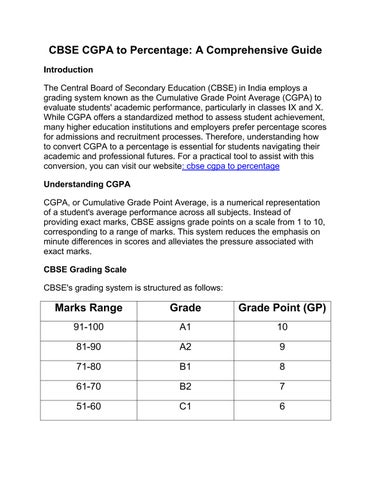
CBSE's grading system is structured as follows:
. This grading scale categorizes students' performance into broad bands, each associated with a specific grade point.
Why Convert CGPA to Percentage?
While CGPA provides a holistic view of a student's performance, percentages are often required in various scenarios:
Higher Education Admissions: Many universities and colleges, both in India and abroad, use percentage scores to set eligibility criteria and compare applicants.
Job Applications: Employers may request academic percentages to assess a candidate's qualifications and suitability for a role.
Scholarships and Competitions: Certain scholarships and academic competitions stipulate percentage-based eligibility requirements.
The Conversion Formula
To convert CGPA to a percentage, CBSE recommends the following formula:
Percentage = CGPA × 9.5
This multiplier of 9.5 was derived by CBSE after analyzing the average marks of students scoring between 91 and 100 marks over several years. The average was approximately 95 marks, and since the grade point for this range is 10, the conversion factor was determined as 95/10 = 9.5.
Step-by-Step Conversion Process
1. Calculate Subject-wise Grade Points: Identify the grade point for each subject based on the CBSE grading scale.
2. Compute the Total Grade Points: Sum all the grade points obtained across subjects.
3. Determine the CGPA: Divide the total grade points by the number of subjects.
Formula: CGPA = Total Grade Points / Number of Subjects
4. Convert CGPA to Percentage: Multiply the CGPA by 9.5 to obtain the percentage.
Formula: Percentage = CGPA × 9.5
Practical Examples
Example 1: If a student has a CGPA of 8.4:
Percentage = 8.4 × 9.5 = 79.8%
Example 2: For a CGPA of 7.2:
Percentage = 7.2 × 9.5 = 68.4%
Tools and Calculators
Several online platforms offer CGPA to percentage calculators, simplifying the conversion process. These tools require inputting the CGPA, and they automatically compute the corresponding percentage using the standard formula. However, it's beneficial for students to understand the manual calculation to ensure accuracy and gain a deeper insight into their academic performance.
Common Misconceptions
Uniformity Across Institutions: The 9.5 multiplier is specific to CBSE. Other educational boards or universities may use different conversion factors. For instance, some institutions might use a multiplier of 10 or have entirely different grading systems.
Exact Equivalence: The percentage obtained from the CGPA conversion is an approximation. It provides an indicative score rather
than an exact mark. Therefore, slight variations may exist when comparing with actual percentage scores.
Conclusion
Understanding the conversion of CBSE CGPA to percentage is crucial for students as they transition from secondary education to higher studies or enter the job market. While CGPA offers a broad assessment of academic performance, percentages are often the standard metric for evaluating eligibility and competence in various professional and educational settings. By mastering this conversion, students can accurately represent their academic achievements and make informed decisions about their future endeavors.