2025
PEPPERDINE SCHOOL OF PUBLIC POLICY
Dean’s Report V O LUM E 24
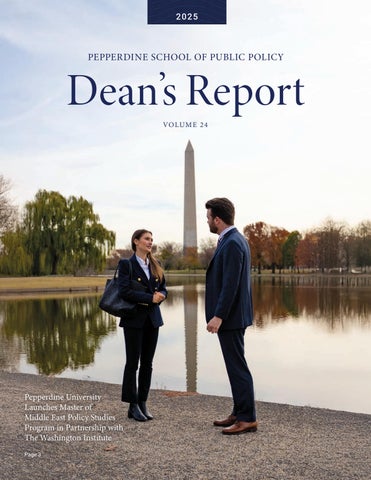
Pepperdine University Launches Master of Middle East Policy Studies Program in Partnership with The Washington Institute Page 3
CONTENTS Dean’s Message........................................................................ 2 Launch of MMEPS Program...................................................... 3 News from the Davenport Institute........................................... 4 Graduation 2025....................................................................... 6 Conferences.............................................................................. 8 Lectures.................................................................................. 10 Faculty Updates...................................................................... 17 School Announcements.......................................................... 19 Endowed Scholars.................................................................. 31 SPP in DC................................................................................ 36 Media...................................................................................... 39 Sound Bites............................................................................. 40
FPO
School of Public Policy Dean’s Report
1
Dean’s Message
This 2025 School of Public Policy Dean’s Report covers one of the most active years in program history. While some of the significant changes outlined herein were barely visible at the time of last year’s report, each of these items align with the University’s 2030 Ascend Together Strategic Plan. The major goals we have set forth for the School of Public Policy are the following: 1. To grow overall student enrollment through the addition of new graduate programs. 2. To expand programming in Washington, DC. 3. To grow SPP’s endowment with a focus on endowed centers, chairs, and scholarships. 4. Through the above steps, to grow the distinctive reputation of the program as one based at a Christian university and dedicated to America’s founding principles and viewpoint diversity in academia. This year we witnessed important steps taken toward each of these goals. Specifically, the work toward and launch of our new Master of Middle East Policy Studies program touches on three of these four targets. Developed through a creative partnership with The Washington Institute for Near East Policy, this new degree offering opened its doors to our inaugural cohort of students in August at Pepperdine’s campus in Washington, DC.
2
publicpolicy.pepperdine.edu
Dubbed “a new hope for Middle Eastern Studies” by The Wall Street Journal editorial board, the new program also aligns with and demonstrates the fourth goal of burnishing SPP’s identity as a school committed to viewpoint diversity in higher education. In this case, preparing future policy leaders for the Middle East region through an education that promotes the exploration of a wider range of perspectives than those considered in many similar programs across the United States. Meeting these Middle East policy students reminded me of regular conversations with our MPP students in Malibu. So often I’ve heard gratitude expressed by our MPP students for the creation of programs that welcome civil discussions on polarizing policy-related topics. I had the exact same impression from these new students. All this is happening in the larger context of what can only be called a movement across higher education to expand academic freedom and develop programs that teach public policy from a civics-minded perspective. In conversations with friends, I’ve noted that SPP “was for viewpoint diversity before it was cool.” But there’s no disappointment in this view—just gratitude that SPP continues to lead as it prepares future leaders. Looking forward,
Pete Peterson Dean, Braun Family Dean’s Chair School of Public Policy
Featured Article
PEPPERDINE UNIVERSITY LAUNCHES MASTER OF MIDDLE EAST POLICY STUDIES PROGRAM IN PARTNERSHIP WITH THE WASHINGTON INSTITUTE On Wednesday, June 18, 2025, Pepperdine University’s School of Public Policy announced the launch of the Master of Middle East Policy Studies (MMEPS) program in partnership with the Washington Institute for Near East Policy. Located at Pepperdine’s Washington, DC, campus, just steps from the White House and Capitol Hill, the MMEPS program combines rigorous academic study with immersive learning experiences, including a multicountry Middle East policy study tour led by scholars at The Washington Institute. Throughout the program, students will explore the foundations of US foreign policy, engage with the pressing challenges facing the region, and emerge equipped to lead with both competence and character. “We are proud to partner with Pepperdine University to launch this visionary program,” said Robert Satloff, Segal Executive Director at the Washington Institute for Near East Policy. “By combining the intellectual and moral resources of both institutions, the MMEPS program offers a vital contribution to the preparation of the next generation of Middle East policymakers and analysts. We look forward to mentoring students who are ready to think seriously, engage deeply, and lead effectively.” Pete Peterson (MPP ‘07), dean of the School of Public Policy, added, “Given the distinctive curriculum we’ve developed and tremendous
faculty we’ve hired, the MMEPS program is an elite academic experience. Our collaboration with The Washington Institute ensures that students will benefit from access to worldclass scholars and practitioners engaged at the highest levels of policy and diplomacy.” Through this unique partnership, the MMEPS program has become the first graduate degree of its kind in the United States—designed to prepare future foreign policy leaders with a deep understanding of the historical, political, religious, and cultural dynamics of the Middle East. “This new program affirms the School of Public Policy’s commitments to upholding the founding ideals of the US and our national security as well as the foundational importance of the JudeoChristian perspective upon which our laws and institutions have been built,” shared Peterson. “It deepens our existing emphasis on preparing leaders who can consider policy decisions from a variety of perspectives and through a number of lenses—from history to political philosophy.” Grounded in the Judeo-Christian moral tradition, the curriculum reflects Pepperdine’s dedication to academic excellence, principled leadership, and global engagement. The curriculum centers on three pillars—understanding the Middle East, understanding US policy toward the region,
and understanding the professional tool kit. While the program aims to prepare future diplomats, intelligence leaders, scholars, and journalists for careers engaged in this region, the last pillar is focused on developing students’ professional skills— from understanding American intelligence and how it informs policy decisions, to researching and writing policy memos for real-world decision-making. Each course is taught by an esteemed group of scholarpractitioners who have served in significant policymaking roles. “In a region as complex and consequential as the Middle East, America needs leaders who are not only strategically informed, but also morally grounded,” explained Peterson. “This program reflects Pepperdine’s distinctive approach—committed to open dialogue and diverse perspectives. The School of Public Policy has been home to world-class scholars throughout its 27-year history, and the addition of this new program only enhances our commitment to academic excellence.” Applications for the fall 2026 program are now open. To continue to attract the best and the brightest students, full-tuition scholarships will be applied for the two years of graduate school enrollment. Visit the School of Public Policy website for more information.
School of Public Policy Dean’s Report
3
News from the Davenport Institute
DAVENPORT INSTITUTE FOR PUBLIC ENGAGEMENT AND CIVIC LEADERSHIP The Davenport Institute for Public Engagement and Civic Leadership has maintained a robust schedule of training, certificates, and convening in 2025, continuing its well-established role as a key resource for local government professionals and a leader in civic engagement. PROFESSIONAL TRAINING AND CERTIFICATES The institute continued its primary mission of building capacity in public engagement through specialized training programs and professional certificates. The 2025 calendar year kicked off with in-person training as the educational partner for the International Association of Government Officials in Myrtle Beach, South Carolina. The institute was represented by then-student Nathan Peterson (MDR ’23, MPP ’25), who delivered his well-received and highly rated training on Conflict Resolution for Local Government. This three-hour interactive course was subsequently offered virtually as a micro-certificate twice to the local government community, with plans to offer it quarterly in 2026. The course equips professionals with practical tools to manage disagreements constructively, foster trust, and turn conflict into a catalyst for collaboration. A second micro-certificate was launched during the summer. Reigniting Purpose: A Resilience Reset for Local Government Professionals, developed and delivered by Davenport trainer Kristin Meyer, is a two-session virtual program designed to enhance mental well-being, build emotional resilience, and reconnect local government staff with their purpose for effective community engagement. The institute’s signature program, the Professional Certificate in Public Engagement for Local Government, was offered twice during 2025. This comprehensive program is designed for mid-career professionals to develop personalized, real-world engagement strategies under the guidance of practitioner-trainers. The Professional Certificate in Local Government and Community, created for the California Association of Realtors, now in its fourth year, continued with two cohorts in 2025. This program provides emerging community leaders with the knowledge to come to the table as educated partners with their local governments. In total, the Davenport Institute awarded more than 500 professional certificates across its various training opportunities, an increase of more than 22 percent from 2024. CONVENING AND OUTREACH The institute also presented and moderated sessions for local government professional groups across California. In April executive director Maureen Tobin led a roundtable discussion with standing room only for the California Association of Public Information Officers (CAPIO) annual conference. The institute kicked off the fall conference season as an executive sponsor of the CAPIO Leadership Summit, where Tobin was the moderator for the keynote leadership insights panel with panelists
4
publicpolicy.pepperdine.edu
Charles Celano, CEO and founder of Chief Leadership; Elisa Cox, assistant city manager of Rancho Cucamonga; Jennifer King, consultant with the Institute for Local Government and advisory council member; Lydia Romero, city manager of Lemon Grove and advisory council member; and Kurt Wilson, executive director of the Western Riverside Council of Governments and advisory council member. In October at the Municipal Managers Association of Northern California annual conference, Tobin participated in a panel discussion along with Davenport Institute advisory council members Justin Lovell, deputy general manager at West County Wastewater District, and Matthew Bronson, city manager of Grover Beach. Moderated by assistant director of the Davenport Institute Robert Jordan, the discussion provided insights regarding authentic public engagement in the California Prop 218 process for rate increases. In November Jordan spoke at the Municipal Managers Association of Southern California in Indian Wells, California. His presentation focused on public engagement basics and provided opportunities for participant networking. Maureen Tobin was also a guest speaker for Santa Barbara County Emergency Public Information Communicators and the CAPIO Chirp podcast. In both engagements, she spoke about planning for and leading effective meetings that provide opportunities for authentic public engagement.
ON-CAMPUS ACTIVITIES AND PERSONNEL UPDATES The institute continues to host its established on-campus programs for students, including Davenport Discussions and the Local Government in Residence programs, which provide unique forums for students, practitioners, and leaders to exchange ideas and best practices in civic life. Noteworthy guest speakers included Los Angeles County supervisor Lindsey Horvath, former mayor of San Diego Kevin Faulconer, and City of Santa Monica community partnerships manager Melissa Spagnuolo. This fall the executive director and the assistant director co-taught an elective course for MPP students in the School of Public Policy. This course, Leadership and Public Engagement, was designed to equip students for successful careers in local government with a strong understanding of public engagement as a requirement for good government and the skills necessary to lead authentic public engagement. Guest speakers included Andrew Powers, city manager of Thousand Oaks; Jeffery Marino, director of the California Office of Data and Innovation; Leandro Tyberg, cofounder and president of Primestor, and Chris Hsiung, executive director and founding member of the Curve. In April two of the institute’s graduate assistants, Nathan Peterson and Richard Barnes (MPP ’25), graduated from the School of Public Policy. The institute’s administrative coordinator and
recent graduate of Pepperdine’s Seaver College began her career journey in Washington, DC, working in donor relations at the Heritage Foundation. Of the other graduate students from the 2024–25 school year, Faith Chang (’24) started her first year at the Pepperdine Caruso School of Law this fall, and Jacob Salas began a full-time role at the American Enterprise Institute while continuing to complete his MPP. For the first time, the Davenport Institute offered a summer internship for a School of Public Policy student. Desiree Deanda-Orozco was welcomed to document the history and work of the Davenport Institute using her well-honed skill as a visual storyteller and award-winning videographer. Deanda-Orozco conducted 15 interviews with local government leaders who played a role in shaping the institute. This opportunity allowed her to build her network in the local government space and provided a powerful marketing asset for the institute. Deanda-Orozco continues her work as a graduate assistant this fall to assist in the completion of her summer project and in support of institute operations. The Davenport Institute is actively managing the upcoming retirement of executive director Maureen Tobin and has been engaged in recruitment efforts to ensure a smooth leadership transition, with a goal of having a new executive director in place early in 2026.
School of Public Policy Dean’s Report
5
Graduation 2025
PEPPERDINE SCHOOL OF PUBLIC POLICY HONORS THE CLASS OF 2025 The School of Public Policy hosted its annual commencement ceremony on April 25, 2025, at Alumni Park on the Pepperdine University Malibu campus to honor its graduating class. Professor of public policy James E. Prieger opened the ceremony, followed by a heartfelt invocation from Gail M. Wilburn (MA ’05), the widow of the late James R. Wilburn, Dean Emeritus of the School of Public Policy. Pepperdine University vice provost Lila McDowell Carlsen extended a warm welcome to the graduates and guests, encouraging the class to live lives of service. “We hope that the academic
journey we now celebrate has poised you for a bright future guided by good judgment and integrity—to put the common good over one’s own personal gain. For in every community, at every level, the world is crying out for these kinds of leaders.”
the Straus Institute for Dispute Resolution, where he earned his master’s degree in 2023. He later joined the School of Public Policy, serving as a graduate assistant at the Davenport Institute for Public Engagement and Civic Leadership.
The student speaker was Nathan Peterson (MDR ’23, MPP ’25), following University tradition wherein an exceptional member of the graduating class is selected to address their cohort. The son of American citizens living abroad, Peterson grew up in the Toronto, Canada, area and enlisted in the United States Army shortly after 9/11 and the invasion of Afghanistan. After serving as an infantry officer, he enrolled in
In his address, Peterson emphasized the importance of relationships, stating, “Regardless of what we all end up doing in our careers or what we ultimately achieve in our lives, it will all boil down to the relationships we have invested in . . . the eternal impact we will have is going to be limited to the people we influence and the love that’s expressed in those relationships.” SPP dean Pete Peterson (MPP ’07) and Pepperdine University president Jim Gash (JD ’93) then presented the 2025 Distinguished Alumnus Award to Kevin McGowan (MPP ’10), director of the Los Angeles County Office of Emergency Management. Reflecting on his time at SPP, McGowan shared, “SPP instilled in me a belief and commitment that it isn’t only what we choose to do with our life but how we actually do it that matters most. SPP is more than just a place to learn public policy; it develops us into true leaders.” The award honored his servant leadership amid the many challenges Los Angeles continues to face during his tenure. Finally, the commencement address was delivered by Ian V. Rowe, senior fellow at the American Enterprise Institute and cofounder of Vertex Partnership Academies. Rowe reminded graduates that “freedom is not free,” calling them to enter the arena of civic leadership with courage and conviction. He urged them to root their work in the four pillars of human flourishing—family, faith, education, and entrepreneurship—and to dare greatly in preserving liberty through moral and faith-based leadership. Following the conferring of degrees by President Gash, the ceremony closed with a benediction by Sara Lindgren (’94, MPP ’01), SPP’s director of recruitment and program relations.
6
publicpolicy.pepperdine.edu
“You have been drafted into the metaphorical battle of ideas to preserve freedom, safeguard the blessings of liberty, and step into the arena, made so famous by Teddy Roosevelt—to be the one who strives valiantly, who spends himself at a worthy cause, who at the best, knows in the end the triumph of high achievement, and who at the worst, if he fails, at least fails while daring greatly.” IAN V. ROWE
Senior Fellow at the American Enterprise Institute
School of Public Policy Dean’s Report
7
Conferences
GOING FORWARD: PLANNING THE REGION’S TRANSPORTATION FUTURE IN A TIME OF CRISIS On February 5, 2025, in the immediate aftermath of the Palisades and Eaton fires, Pepperdine School of Public Policy hosted a conference of experts to discuss “Going Forward: Planning the Region’s Transportation Future in a Time of Crisis.” Richard Florida, one of the world’s leading urbanists and international best-selling author of The Rise of the Creative Class, opened the conference with the reminder that “great cities do not fall because of infectious pandemics or natural disasters.” He highlighted the resilience of cities and emphasized Los Angeles’ need to adapt to “polycentrism,” a trend accelerated by remote work. Cities, he noted, are where people work, play, live, and connect, and their strength lies in speed of connection, both within neighborhoods and to the global economy. The first panel, Transit and Mobility: Following Crisis, moderated by Nolan Gray, senior director of legislation and research at California YIMBY, featured Mitchell Reardon, director of urban planning at Happy Cities; Lindsay Sturman, cofounder of the Livable Communities Initiative; and Marc Vukcevich, director of state policy at Streets For All. Panelists underscored urgent concerns: traffic-related incidents are the leading cause of death for children in Los Angeles, bike lanes remain scarce, and transportation projects cost four times more to build here than in Europe. They also stressed that Los Angeles was once walkable and could
8
publicpolicy.pepperdine.edu
be again, through investments in historic main streets, mixed-use development, and safe end to end connectivity for bikes and pedestrians. When asked what first steps the city should take, panelists recommended legalizing accessory commercial units, supporting small businesses, and reducing dependence on parking.
intelligent speed assist, and AI-driven planning could transform mobility, overreliance on speculative solutions such as robotaxis risks ignoring simpler, proven alternatives. The panel agreed that technology alone will not resolve transportation challenges without policy leadership.
The second panel, At What Level Should These Decisions Be Made?, was moderated by SPP dean Pete Peterson and included Anuj Guta, director of transportation for the City of Santa Monica; Kurt Wilson, adjunct faculty at SPP; and Norm Van Eeden Petersman, member advocate at Strong Towns. Guta described how citylevel innovations often influence regional planning. Wilson emphasized navigating bureaucratic barriers during crises, while Van Eeden Petersman argued that current development patterns are “breaking our cities” and urged for community-driven approaches to make places more safe, livable, and inviting. Panelists also noted the importance of planning for the 2028 Olympics.
The conference concluded with comments from historian Wade Graham, who situated Los Angeles’ transportation and housing struggles within its history of wildfire risk and urban sprawl. Climate change, he warned, is accelerating these crises, while growth and fragmentation have placed communities in harm’s way. Graham urged participants to confront the realities of fire gentrification, collapsing insurance systems, and unsustainable infrastructure. In closing, he argued that in times of crisis, leaders must “cut red tape and reimagine what our goals are.”
The third panel, How Will Technology Shape L.A.’s Future?, moderated by Jarrett Catlin, vice president at Tusk Strategies, included John Rossant, founder and CEO of CoMotion; Alissa Walker, writer at Torched; and David Zipper, senior fellow at the MIT Mobility Initiative. Panelists offered both optimism and skepticism: while technologies such as e-bikes,
REVITALIZING LOS ANGELES On April 16, 2025, SPP hosted a conference titled “Revitalizing Los Angeles: Lessons from New York’s Historic Comeback.” The event featured Gotham: The Fall and Rise of New York film director Matthew Taylor, with scenes from the documentary shown between four panel discussions. The first panel, The Urban Comeback: Why Quality of Life Is the Cornerstone of Change, featured Dan Biederman, president at Biederman Redevelopment Ventures and James Prieger, professor of public policy at Pepperdine University. They discussed the programming pyramid, which illustrates the value of everyday amenities, emphasizing that cities should focus on consistent, high-quality programming rather than 24/7 activity. Biederman and Prieger highlighted opportunities for spaces in Los Angeles such as Third Street Promenade in Santa Monica, Lincoln Road in South Beach, and MacArthur Park. The second panel, The Crime Factor: How Public Safety Fuels Urban Prosperity, brought together Kevin Faulconer, former visiting professor of community leadership and government innovation at the School of Public Policy, and Rafael Mangual, fellow and head of research for the Policing and Public Safety Initiative at the Manhattan Institute and author of Criminal (In) Justice. They described how policing “hot spots” lowered crime rates in New York City and explained the “broken windows” theory. Additionally, they discussed how
by intervening early in low-level offenses, officers often uncover more serious criminal activity. The third panel, The Power of Work: How Opportunity, Not Welfare, Transforms Cities, included dean Pete Peterson, senator Ben Allen of California’s 24th Senate District, and Chris Thornberg, founding partner at Beacon Economics and research fellow at the School of Public Policy. The discussion focused on the aftermath of the Palisades and Eaton fires and their implications for urban resilience.
They argued that when communities unite, economies can rebuild quickly. The final panel, The Comeback Playbook: N.Y.C.’s Lessons for L.A.’s Future, featured Pete Peterson and William Bratton, former chief of the Los Angeles Police Department and former police commissioner of the City of New York. They examined how Los Angeles can learn from New York City’s urban renewal strategies and stressed the importance of understanding a city’s unique history, including its infrastructure, politics, and cultural context.
School of Public Policy Dean’s Report
9
Lectures
FORMER VICE PRESIDENT MIKE PENCE VISITS PEPPERDINE UNIVERSITY TO DISCUSS THE VIRTUES OF SERVANT LEADERSHIP Pepperdine University’s School of Public Policy hosted former vice president Mike Pence on Tuesday, March 4, for a special lecture to students enrolled in the course How to Run the World. Developed by Kiron Skinner, the inaugural Taube Family Chair of International Relations and Politics at Pepperdine, How to Run the World is an exceptional graduate-level course that relies upon insightful dialogues with various world leaders to help students grapple with the theoretical principles and modern-day obstacles of public service. By participating as a guest lecturer, Pence joins Condoleezza Rice, Jim Mattis, Winsome Earle-Sears, and many other notable global figures who have engaged with the School of Public Policy’s master’s students. “I want to tell all the students that I hope they understand what a truly unique place Pepperdine University is,” said Pence in his opening remarks. “It is not the geography. It is the character and commitment to faith and freedom and principles that make Pepperdine University stand out in America.” Pence began his talk by emphasizing that leadership is a skill that grows over time. He explained that aspiring leaders must cultivate their character by investing in their hearts, minds, and the life-giving relationships around them. Highlighting the importance of these intentional investments, Pence asserted that a leader’s
10
publicpolicy.pepperdine.edu
character is shaped by a multitude of experiences—not just the difficult ones. “There’s a misnomer in the rising generation that adversity creates character,” he said. “I believe that adversity reveals character . . . The outcome of [challenging] moments will be determined by every quiet moment that passed before.”
It is the character and commitment to faith and freedom and principles that make Pepperdine University stand out in America. The theme of leadership continued into Pence’s dialogue with students. For more than an hour, future policymakers had the opportunity to ask the former vice president questions on topics ranging from his early days in politics, his time working in the White House, and his personal faith. Throughout the conversation, Pence explained how his Christ-centered perspective shaped his political career. “Focus on servant leadership,” he challenged students. “More than anything else, what I tried to live out in my 20 years in public office was to apply the principles of servant leadership, which are many and diverse. As you do that—from what I’ve witnessed in
my own life and the lives of people I greatly admire—unexpected opportunities open for you. [They happen] when you’re working hard to be a servant of the people around you.” Pence contextualized each of his teaching points by telling stories—about his family, his experiences in Congress, and his service as vice president. These narratives provided students with a rare glimpse into how decisions of the highest order of governance are made by elected representatives. This invaluable first-person perspective from a contributor to American history created a rare experiential learning environment, encouraging master’s candidates to deeply contemplate the issues faced by civil leaders. “Participating in Dr. Kiron Skinner’s How to Run the World class is about more than just being a student—it’s about becoming a leader,” says Logan Lee, a second-year student in the class specializing in international relations and national security. “The policy challenges we face in the United States can’t be solved through textbooks or lectures alone; they require confronting the issues head-on, with determination and persistence. As leaders travel to Malibu to engage directly with us, a unique experience unfolds—one that most students will never have.”
HOPEFUL REALISM: A THOUGHTFUL DIALOGUE ON FAITH AND PUBLIC LIFE Amid today’s turbulent political landscape, the Pepperdine School of Public Policy continues its mission of fostering informed and principled discourse. This commitment was evident in the luncheon conversation featuring esteemed political theorists Jesse Covington, professor of political science and director of the Augustinian Scholars program at Westmont College; Bryan T. McGraw, professor of politics and director of the Aequitas Fellows program at Wheaton College; and Micah Watson, professor and director of the Politics, Philosophy, and Economics program at Calvin University, who joined SPP dean Pete Peterson for a compelling discussion on their latest book, Hopeful Realism: Evangelical Natural Law and Democratic Politics. The conversation, framed around the book’s central theme of “hopeful realism,” explored how natural law serves as a crucial resource for Christian political engagement in a democracy. In an era where political discussions are often defined by deep divisions and competing ideological pressures, the authors offered a perspective grounded in moral conviction, practical decision-making, and a commitment to the common good.
require prioritization—one cannot do everything at once, but must instead focus on what is good and achievable without compromising essential values. One of the most thought-provoking segments of the discussion centered on religious liberty and its role in protecting democratic institutions. The authors argued that true religious liberty is not about seeking power for power’s sake but about ensuring protections against government establishment. “Christianity is volitional” stated Covington—meaning faith and political engagement should be pursued freely, rather than mandated or coerced by governing authorities. “The important theme is that of seeking the common good instead of power for power’s sake,” said Watson. Throughout the conversation, the authors challenged
attendees to consider how their faith informs their approach to political engagement. Rather than being driven by partisanship or libertarian individualism, Christian political thought should prioritize the common good—seeking justice, human flourishing, and the dignity of all individuals. While the authors agreed on roughly 95 percent of their perspectives, they acknowledged areas of disagreement as part of a constructive, long-standing dialogue that has shaped their collaboration over 17 years. As Pepperdine SPP continues to host dialogues that encourage critical reflection and informed discourse, Hopeful Realism offers a valuable lens through which students, scholars, and policymakers alike can navigate the complexities of faith and politics in the modern era.
Drawing upon historical and theological insights, the authors examined how Christian political thought—particularly within evangelical traditions—has engaged with natural law. Unlike Catholic traditions, which have long embraced natural law as a foundation for moral reasoning, Protestant engagement with this framework has been inconsistent. The discussion highlighted how historical prejudices have shaped evangelical attitudes toward natural law and the need for greater integration of these ideas in contemporary discourse. A key theme of the conversation was the inherent tension between upholding moral principles and navigating the practical realities of governance. The authors emphasized that while Christianity calls for adherence to core ethical values, effective policymaking requires trade-offs that do not violate fundamental principles. This “hopeful realism” acknowledges that political and economic decisions
School of Public Policy Dean’s Report
11
ECONOMIC SEMINAR SERIES HOSTS TWO LECTURES TO ADDRESS GLOBAL CONCERNS In the spring the School of Public Policy premiered an Economic Seminar series with two lectures providing an integration of economic analysis on policy decisions that directly impact human flourishing in today’s increasingly complex landscape. Led by Luisa Blanco and James Prieger, professors of public policy, these events convened leading scholars to present specialized research and its applied significance to global concerns. Jesus Fernández-Villaverde, Howard Marks Presidential Professor of Economics at the University of Pennsylvania, discussed inimical economic policy consequences of the ongoing global fertility crisis on February 20, 2025. Following an introduction by Prieger, Fernández-Villaverde opened “The Demographic Future of Humanity: Some Economic Implications” by relating that 2023 was a landmark year that marked the first time in human existence that average global fertility rates dropped below replacement levels. By the term “replacement levels,” Fernández-Villaverde refers to the number of offspring a society must produce to sustain a stable population. He projects that the human population will peak around 2025, and then begin to dramatically decrease. Fernández-Villaverde shared that one of the leading causes of the lowering US domestic birth rate is decreasing marriage rates—influenced in part by media storytelling that increasingly deemphasizes marriage and family life. He further noted that many young people delay marriage
12
publicpolicy.pepperdine.edu
due to financial burdens such as student loans and job security concerns. “In the past decades we have changed a lot of our social norms,” Fernández-Villaverde said. “A lot of changes were good and positive because they made a society that is much more equal and open to all. But now marriage rates have been falling, particularly among noncollege-educated people.” Fernández-Villaverde asserted that fertility collapse will be the defining policy challenge of the next century, as it will affect nations with a wide range of governments and religious affiliations. He emphasized the seriousness of this issue, remarking, “Once you start to think about demographics and fertility it is nearly impossible to think about anything else. There is no more important topic on the planet right now.” Blanco hosted the second Economic Seminar series lecture, “A Quick Tour Around the World: Research on Global Poverty,” on March 13, 2025. The talk was given by Angelino Viceisza, professor of economics and research director of the Center for Black Entrepreneurship at Spelman College. After introducing attendees to his current project in partnership with Blanco, “Mi Retiro / My Retirement,” Viceisza overviewed key areas of his ongoing research, including economic development in primarily rural areas, entrepreneurship in a global setting, racial and ethnic disparities in US retirement, and student success levels and access to institutional resources at historically Black universities.
Gathering research data through fieldbased experiments and surveys across a broad range of locations such as Ethiopia, Central America, Curaçao and the broader Caribbean, France, and Japan, Viceisza partnered with local farmers, firms, and financial-service providers to gain insight on a wide range of behaviors in an experimental context. “[Field] experiments are crucial to understanding people’s behavior,” says Viceisza. “Data shows household finance and entrepreneurship are very closely related to economic development.” For example, one of Viceisza’s studies discovered that when Ethiopian farmers— who are faced with unpredictable and often devastating weather circumstances—were presented with insurance coverage, they were more likely to take entrepreneurial risks. In turn, these farmers’ decisions affect economic outcomes and reveal broader human behavior patterns. Viceisza then discussed his project with Blanco, “Mi Retiro / My Retirement,” which seeks to address two key barriers to retirement preparedness of low-to-middle income workers, specifically, insufficient funding and limited financial literacy concerning retirement planning and banking services. “Some affected individuals have informational gaps about finances, but even if they fully understand the programs and products that exist for retirement, they consider it as very far away, and have more pressing money concerns,” Viceisza added. “The project with Dr. Blanco is meant to try and address both of these constraints.”
A FAITHFUL RESPONSE TO HOMELESSNESS IN CALIFORNIA On September 8, 2025, the School of Public Policy hosted “A Faithful Response to Homelessness in California”—a luncheon panel discussion focused on the state’s unhoused population that featured key leaders from the local community and the US Department of Housing and Urban Development’s (HUD) Center for Faith including: Mathew Dildine (MPP ‘05, JD ‘08), CEO, Fresno Rescue Mission; Caitlyn McKenney, policy advisor, Office of Community Planning and Development, HUD; Shayam Menon, former director, Center for Faith, HUD; Will Spencer, region IX administrator (HUD), and Soledad Ursua, senior advisor, HUD. “This conference and roundtable highlighted the ways in which faith-based organizations are serving the region’s homeless, and explored innovative concepts in governmentnonprofit relationships,” noted the School of Public Policy dean, Pete Peterson. According to HUD’s most recent Annual Homelessness Assessment Report, California has the highest rate of homelessness in the US with an unhoused population totaling 161,445 individuals. In Los Angeles, the problem is most acute. The state’s most populated county estimates that some 72,308 individuals exist in a state of homelessness within the local area. Spencer addressed these pressing statistics in his introductory remarks at the luncheon. He called specific attention to the funds spent on mitigating homelessness in California, citing that in the last five years the federal government invested $24 billion to help those experiencing homelessness in the state; yet, despite that financial commitment, the unhoused population rose by 44 percent. In pointing out this unsuccessful monetary approach, Spencer stated that homelessness is not a crisis of dollars and cents, but a crisis of heart and soul.
Streets will introduce new policies to support the homeless population—policies that turn away from “housing first” and “harm reduction” tactics and prioritize treatment, healing, and accountability. “I want to address all the young folks out here,” Spencer said. “This is something you can make an impact on. This is something you can do. There’s lives to be saved. There’s people to be helped. But proper policy also means not misplaced compassion.” This perspective was shared by others on the panel, with Dildine, McKenney, Menon, and Ursua offering responses to homelessness at the state and federal levels.
We see the problem differently than the government has seen it over the last couple of decades. It’s not about transactions. It’s about transformation. Dildine discussed his firsthand experience serving the homeless as CEO of the Fresno Mission—a California nonprofit that connects the unhoused to the ministry of Jesus by offering them food, shelters, and full-length recovery programs. Working on the front lines of this effort, Dildine expressed that successful rehabilitation from living on the streets does not come through one-off meals or bouts of sleep. Rather, he expressed that the homeless are in need of years of care, love, and devoted recuperation efforts.
“We see the problem differently than the government has seen it over the last couple of decades,” said Dildine. “It’s not about transactions. It’s about transformation.” McKenney, Menon, and Ursua—the panelists involved in leading HUD’s new homelessness strategy—went on to describe the role faith is now playing in seeking solutions at the federal level. All three expressed hope that positive change will come as a result of the recent shifts in federal policy. By integrating faith more fully in HUD—and every office at the federal level—the three experts conveyed a belief that the government would be more able to support those in need. “It’s not compassionate to let people suffer on the streets and slowly die in front of us,” said Ursua. “It [takes] really brave citizens like many of the people here today, who have the courage to call that [injustice] out. We were dismissed by the supposed experts, who keep pushing these failed policies. It is really surreal to be here, and I’m energized and excited to bring a fresh context, a fresh perspective to this [conversation].”
The region IX administrator closed his comments by discussing a brighter future. Spencer elaborated on how president Donald Trump’s Executive Order 14321: Ending Crime and Disorder on America’s
13
PEPPERDINE SCHOOL OF PUBLIC POLICY WELCOMES RABBI DR. STUART HALPERN TO 2025 CONSTITUTION DAY On Monday, September 15, 2025, Pepperdine University’s School of Public Policy welcomed Rabbi Dr. Stuart Halpern, senior advisor to the provost, deputy director, and chief strategy officer of the Zahava and Moshael J. Straus Center for Torah and Western Thought at Yeshiva University, to deliver the University’s 2025 Constitution Day lecture. Dean Pete Peterson opened the lecture by emphasizing the uniqueness of the University in celebrating Constitution Day. He noted that SPP prepares future public leaders in America by grounding them in the nation’s governing document. Peterson also highlighted how the United States was founded on Judeo-Christian tradition, reflected in the principles of the Constitution. Peterson quoted SPP faculty member Ken Starr, who said, “Because Pepperdine remains anchored in values, it can communicate itself to the region as seeking not just numbers and statistics, not just fancy formulations, but value in our public life, by which I mean both religious and philosophic value–the philosophia perennis, the perennial philosophy and the JudeoChristian tradition which has shaped our civilization. It is only rarely that academic discourse refers to these values, yet they remain implicit in what is being thought and said.”
Additionally, Peterson emphasized the importance of the Constitution on college campuses, citing the recent murder of Charlie Kirk at Utah Valley University. He stated that the Constitution is meant to frame how we engage with one another across differences, serving as a uniting document. Halpern further illustrated these themes by delving into a biblical king who stood as a throughline shepherding the American story from its inception to today: King David. He recounted the story of David and Goliath, noting how David served as a significant inspiration for Americans during the Revolutionary War. During the war, the British arrogance was seen to symbolize Goliath. Halpern described how Americans
were “fasting and praying” while the British ridiculed religion. Halpern explained that David continued to inspire Americans after the Revolutionary War, shaping narratives during the War of 1812 and the Civil War. He pointed out how David’s legacy resonated across the political spectrum, quoting Abraham Lincoln: “Both sides read the same Bible and pray to the same God.” Halpern concluded that King David’s story has inspired millions of Americans in the past and continues to do so today. In a divided climate, he suggested, David’s legacy, like the Constitution, serves as a unifying reminder.
AI POLICY AND GOVERNANCE SYMPOSIUM On December 9, the School of Public Policy was pleased to cohost an “AI Policy and Governance Symposium” with the Hoover Institution’s Center for Revitalizing American Institutions and Stanford University’s Deliberative Democracy Lab in Washington, DC. Gathering leaders from the fields of technology, business, public policy, and the nonprofit sector, the attendees focused their attention on the public’s perception of the integration and use of AI in government. Guided by experts from the host organizations, the conversation asked, How can we interpret the public’s opinions on AI? and In what ways can this understanding inform best practices of AI and policymaking? 14
publicpolicy.pepperdine.edu
DANIEL DARLING SPEAKS IN DEFENSE OF CHRISTIAN PATRIOTISM On October 20, 2025, the Pepperdine School of Public Policy hosted author, pastor, and thought-leader Daniel Darling for a discussion of his latest book, In Defense of Christian Patriotism. The event marked the third installment in the Faith, Freedom, and the Founding series, which explores the intersections of faith, citizenship, and public life. SPP dean Pete Peterson opened the event by emphasizing the unique role Pepperdine plays as one of the few Christian public policy schools in the nation. He noted the importance of educating future leaders in both the quantitative and moral dimensions of policymaking. Darling began his lecture by reflecting on the decline of civic gratitude and engagement among Americans. Citing a recent survey, he noted that patriotism tends to decrease across younger generations and warned against what he described as a “crisis of
ingratitude.” He challenged attendees to consider the call for Christians to serve in government and to engage faithfully in the public square. Drawing on themes from In Defense of Christian Patriotism, Darling differentiated between patriotism and nationalism. Patriotism, he explained, is “a love of country manifested through loyalty, service, and honor,” while nationalism represents “a deformation of that patriotic spirit.” He argued that Christians can rightly love their country without elevating it above their love for God. Using the biblical story of Jonah, Darling illustrated the dangers of misplaced devotion, explaining that Jonah’s love for his own nation blinded him to God’s broader mission of mercy. Jonah’s love for his country wasn’t wrong, rather Darling argued, “his love for God was too small.”
He encouraged listeners to order their affections properly—beginning with love for God, then extending outward to family, neighbors, and country, and quoted 1 Peter 2:17, “Honor everyone. Love the brotherhood. Fear God. Honor the king.” In connecting faith to public policy, Darling emphasized that love of country compels citizens to seek its welfare. “It’s impossible to seek the shalom of a city or nation that you hate,” he said, pointing to the example of Daniel’s faithful service in Babylon as a model for engagement. Darling concluded by acknowledging that America, like every nation, is imperfect. Yet he urged Christians to express gratitude and stewardship toward America rather than cynicism. He called for a renewed “stimulus of Christian courage and compassion” in public life, affirming that “nothing on earth should go without its due appreciation.”
HOW CANCEL CULTURE DESTROYS TRUST IN EXPERTISE On February 19, 2025, the School of Public Policy hosted Greg Lukianoff, president and CEO of the Foundation for Individual Rights in Education (FIRE), for his lecture “How Cancel Culture Destroys Trust in Expertise.” In his address, Lukianoff argued that cancel culture is a growing threat to open inquiry, institutional legitimacy, and public trust in expert knowledge. Lukianoff opened by situating cancel culture—not as a fringe phenomenon—but as a visible shift dating from the mid-2010s in which campaigns to punish or ostracize individuals for speech have proliferated. A central theme of his talk was that cancel culture erodes trust in expertise. If experts and scholars fear reprisal for expressing dissenting views, he maintained, the public loses confidence in the integrity and disinterestedness of experts. Undermining faith in the objectivity of scholars and professors is detrimental to academia. “I don’t think academia fully realizes how much damage it’s done to itself,” said Lukianoff. He also added that “this is a very dangerous situation to be in for a democracy.” Lukianoff argued that society should not overlook the importance of K–12 education. “I think a lot of the problem starts there,” he said, and encouraged policymakers to evaluate what reform could look like to create a more tolerant early education environment with administrators who also care deeply about this issue. School of Public Policy Dean’s Report
15
2025 LOS ANGELES ECONOMIC FORECAST AND BUDGET ANALYSIS In October the School of Public Policy hosted the first-of-its-kind Los Angeles Economic Forecast in partnership with the Los Angeles– based economics firm Beacon Economics. The Monday morning event gathered local business leaders, government officials, and financial investors to learn the facts about the current state of the market and to foster a candid conversation among cross-sector leaders on the Los Angeles budget, its benefits, and anticipated repercussions. Addressing the broader state of the US economy, Chris Thornberg, cofounder of Beacon Economics, opened the morning with a data-focused presentation covering the topics of trade deficit, government debt, and the decline in labor supply. Contrary to public assumptions, Thornberg argued that the Gen Z population is financially progressing, performing well in relation to income rates and demonstrated that upcoming generations continue to show upward mobility. Next, Niree Kodaverdian, research manager at Beacon Economics, focused on the city of Los Angeles by analyzing the recently released city budget, which revealed a $1 billion shortfall. Reviewing spending allotments across the $12.8 billion city budget, Kodaverdian identified the three largest over-budget spending areas: liabilities, police, and general services. While she noted that total spending has not increased year over year, the amount originally allocated has been surpassed. Kodaverdian shared the specific types of liability claims most responsible for this trend: traffic accidents, dangerous conditions— transportation and sanitation—and police claims, respectively.
16
publicpolicy.pepperdine.edu
“Police claims have not only been increasing in absolute dollar terms but also as a share of all claims. It went from 28 percent to more than 50 percent in the last fiscal year,” said Kodaverdian. “So, police claims are making up more and more of the liability claims for the city.” The morning forecast concluded with a panel discussion featuring Rick Cole, Pasadena city council member for District 2 and former Los Angeles chief deputy controller; Kevin Harbour, president of the BizFed Institute; and Niree Kodaverdian. The discussion, which was open to questions from the audience, was moderated by Pete Peterson, dean of the Pepperdine School of Public Policy. When asked what the city can expect by this time next year, Cole offered a candid but important message: “We need to take a longer view. Underneath the broken silos is a broken system. Unless we fix the system that brought us to this situation, we face the long-term decline of Los Angeles.” Despite the awareness of the challenges ahead, there was a shared sentiment of gratitude for providing this data-driven analysis to the Los Angeles public. “At the end of the day, it’s about getting everyone in the same room,” stated Harbour. “I commend you for pulling people together, because collaborating and breaking down those barriers with knowledge is really what it’s all about. Let’s get the facts on the table, talk to the people who actually do the work, and figure out the path forward.”
Faculty Updates
LUISA BLANCO Professor of Public Policy Luisa Blanco’s manuscript, “Dollars and Zen: A Randomized Control Trial of a Community-Partnered Financial Capability and Stress Management Digital Intervention among Low-Income Latino Adults,” coauthored with Nataria Joseph, associate professor of psychology at Seaver College, McKenzie Richards (MPP ’25) and Flora Sedrakyan (MPP ’25), has been accepted for publication in an upcoming edition of the International Journal of Stress Management. The article describes a community-based digital intervention to improve money management skills and reduce financial stress conducted by Blanco in collaboration with the Boys and Girls Club of Malibu and Malibu Community Labor Exchange. The program was funded by Pepperdine’s Office of the Provost’s Cross-School Collaborative Research Program. Blanco has been selected as a 2025 research fellow and member of the advisory council of the Julian Bond Institute recently launched by the Center for Responsible Lending. The institute aims to engage academia, policymakers, and financial institutions in researching and developing financial products and policies that meet consumers’ evolving needs while leading to increased financial security and wealth for all. The executive committee members of the G53 Financial Literacy and Personal Finance Research Network voted in favor of inviting Blanco to become a research associate in the organization. The network connects top scholars around the world to facilitate the exchange of ideas, promote evidence-based research, and meet the growing urgency for data-driven solutions to personal finance challenges.
JAMES COYLE Adjunct Professor This year, James Coyle published Tbilisi and the Bear: The Rise of Russian Influence in the Republic of Georgia. The book continues Coyle’s expertise and research in international conflict and explores the significant political transition that occurred in the Republic of Georgia after the collapse of the Soviet Union.
STEVEN HAYWARD Visiting Professor of Energy and Environmental Policy Steven Hayward began the buildout of the Energy and Environmental Policy Lab, which launched in the spring semester with a survey course and an immersive field trip to Washington, DC. There, students met with policy experts and organizations including Resources for the Future, the American Enterprise Institute, C3 Solutions, the Energy Innovation Reform Project, and former senior EPA officials. In the coming year, the lab will expand to offer specialized courses in energy and environmental policy and law, including one based at Pepperdine’s Washington, DC, campus. Hayward continues extensive writing and lecturing, joining Civitas Outlook as a contributing editor and anchoring an online symposium on environmentalism for Law & Liberty. In October, he delivered a lecture series at the University of Mississippi that will be published as a short book under the working title Against Mediocrity. Hayward also made conference and lecture appearances at the Reagan Library, George Mason University’s Scalia Law School, Hillsdale College, and the William F. Buckley Program at Yale University.
ANDY KEISER Adjunct Professor in Cybersecurity Policy Andy Keiser contributed extensively to national security discourse through numerous media appearances, podcasts, and written commentary. He was quoted in House of Huawei: The Secret History of China’s Most Powerful Company and published several opinion pieces on US national security and technology policy. His recent works include “The US Needs a Secure, Reliable Semiconductor Supply Chain” and “How Trump’s Chip Tariffs Can Onshore Manufacturing and Protect National and Economic Security” in RealClearPolicy as well as “How China Is Rewiring Global Telecom to Undermine the West” in The SCIF.
School of Public Policy Dean’s Report
17
JAMES PRIEGER Professor of Public Policy James Prieger presented “How does e-cigarette use affect smoking-related socioeconomic disparities in the US?” at the Society for Benefit-Cost Analysis Annual Conference in Washington, DC, in March; the Western Economic Association International annual conference in San Francisco; the American Society of Health Economics annual conference in Nashville in June; and the Eurasian Business and Economics Society conference in Madrid, Spain, in October. Prieger accepted the invitation to be an instructor/co-presenter with three other scholars on “Building capacity for economic research on tobacco regulation in low-middle-income countries,” at the International Health Economics Association 2025 Congress in Bali, Indonesia, in July. He was also an invited panelist for affordable broadband access at the Technology Policy Institute Conference in Aspen, Colorado, in August, and was invited to participate in the Pew Charitable Trust’s gathering of scholars and policy practitioners to discuss federal broadband internet policy as part of the organization’s Broadband Access Initiative.
KIRON SKINNER Inaugural Taube Family Chair of International Relations and Politics This year marked a significant milestone for Kiron Skinner through the launch of the Institute for Diplomacy, Security, and Innovation at Pepperdine University. Established to bridge the gap between intellectual and policy ideas and decision making in a rapidly evolving global order, the institute seeks to achieve this goal through guiding priorities organized around the concepts of a new geography and American grand strategy that are specifically tailored to 21st-century domestic and geopolitical realities. The activities of the institute include convenings such as seminars, conferences, and summits. The institute also publishes research-based and opinion essays in its Journal of Diplomacy, Security, and Innovation. In addition to her consistent appearances and writings on Fox News, Skinner accepted the invitation to join the international advisory committee of the National Academy of Science.
ABBYLIN SELLERS Edward L. Gaylord Professor of Public Policy Abbylin Sellers received two federal grant awards as principal investigator this year. She was awarded a $30,000 grant from the National Endowment for the Humanities to support the Faith, Freedom, and the Founding Lecture Series, a five-part speaker program on the American founding. Featured speakers include Robert George, Ronald Reagan Honorary Distinguished Professor at the School of Public Policy; Rabbi Dr. Stuart Halpern, senior adviser to the provost at Yeshiva University; author Daniel Darling; Daniel Dreisbach, professor at American University; and Yuval Levin, director of social, cultural, and constitutional studies at the American Enterprise Institute. Sellers also received a $1.44 million grant from the US Department of Education for the American History and Civics-National Activities Grants program funding over three years (2026–2028). This project supports two programs: the Roots of American Order Summer Certificate Seminar for 75 to 100 undergraduate students at Pepperdine’s Malibu campus and the Roots of American Order Faculty Seminar for 20 to 25 university faculty at Pepperdine’s Washington, DC, campus. In addition to her grant work, Sellers has an article currently under review for publication.
18
publicpolicy.pepperdine.edu
School Announcements
HERSCHENSOHN CLASSROOM ENDOWED The School of Public Policy was pleased to endow a graduate classroom at the Malibu Drescher campus to the memory of Bruce Herschensohn through a generous gift from Janet Bresnahan, Violet Herschensohn Logan, and Wes Herschensohn. Facilitated by a dear friend of Bruce, Jay Hoffman, and supported by additional friends, the classroom will honor Bruce’s deep commitment to the pursuit of truth and the preparation of future policy leaders. These funds directly impact student lives through the Bruce Herschensohn Scholarship Fund. For inquiries about endowed gifts to the School of Public Policy, please contact Kevin Royse at kevin.royse@pepperdine.edu.
School of Public Policy Dean’s Report
19
ABOUT THE ENERGY, ENVIRONMENTAL, AND ECONOMIC POLICY LAB: A Q AND A WITH STEVEN HAYWARD The following is a transcription of an interview between Steven Hayward, the School of Public Policy’s visiting professor of Energy and Environmental Policy, with Drew Aguas, a second-year Master of Public Policy student. Drew Aguas: Thank you so much for your time, Dr. Hayward. It’s wonderful to have you here with us for this interview. The first question I have for you is what inspired the creation of the Energy, Environmental, and Economics Policy Lab here at Pepperdine? Steven Hayward: For one, a public policy school in California ought to have a really strong game in energy and environment, just because of where it is. California has been the venue for leading innovation and leading policy ideas—we’ve always wanted to push renewable energy more, energy efficiency, and that has had some success and met with some disappointments. I think students need to know the details of the policy history. Secondly, the lab format is something that’s really suited to a small program like SPP, where the classes are generally, you know, 15 to 20 students. You want the students to get hands-on experience. DA: Why are you so interested in energy and environmental policy? And furthermore, I’m curious to know how your professional career, both in DC and your career as a professor at Berkeley and here at Pepperdine, has informed your desire to pursue this topic. SH: I spent many years engaged in energy and environmental analysis in Washington, DC, and I feel that much of the work being done in the field needs improvement. And I actually think our point of view, which emphasizes greater investigations into whether property rights solutions, market-oriented solutions, or solutions that pay more attention to economics might be more effective than the way we’ve been doing things. And while this approach is being more widely adopted, the dominant mode has been to address concerns through legislation and regulation. And that worked well 40 or 50 years ago, and it still works well today in some areas, but less well in others.
20
publicpolicy.pepperdine.edu
DA: Very interesting. So how does the lab reflect the broader philosophy of the Pepperdine School of Public Policy? SH: Because Pepperdine is a faith-based university, and the School of Public Policy hews to that mission, we take seriously the idea of stewardship. We take seriously how to understand what the personal and collective responsibility we have means. And so we spend more time talking and thinking about that than most other programs do. To that end in particular, I bring a class of students on a trip to Washington, DC, in the spring for a chance to talk to a lot of experts in just three or four days. It’s a great way to get a broad perspective on an issue. DA: This new lab integrates energy, environment, and economics. How do you see these three areas intersecting? SH: Because these topics are so expansive, we’re going to separate them into two courses starting this next semester. So, we’re going to have a class just on energy policy, and then a class just on environmental policy, which will be taught out of our DC campus in the spring by David Schnare, who worked at the EPA for more than 30 years. He knows the subject in great detail, of course, and has written a really interesting book on stewardship in the environment from a genuinely multicultural point of view. So I’m very excited to have him recruited to join the program. DA: I totally understand what you’re saying. You know my personal interest is more related to environmental studies, but understanding the increasingly politically charged atmosphere around energy, it definitely makes sense to devote a full course to that topic. The lab emphasizes limited constitutional government and free-market economics. How do these principles shape the way you approach environmental and energy policy?
SH: You might say that the premise of policy, at least at Pepperdine, is to preserve. The goals of limited government and constitutional government are to preserve individual freedom and democracy. And while much of our modern bureaucratic government presents a challenge to that, there’s a legal revolution underway, some of which affects environmental policy. We have bureaucrats who make laws when actually Congress or the state legislature should make laws, and they’re often ruinously expensive. When we first decided to get serious about pollution control, to impose emissions reduction measures and clean up wastewater treatment plants was reasonably cost-effective—and the benefits exceeded the costs. But as time has gone on with added regulation, the costs have exceeded the benefits. If you understand economics 101, if you’re wasting money or spending it for low return, that is wasting resources. DA: I actually have a follow-up question for that. I know that rural areas across the US oftentimes face the greatest adversity when it comes to economically adapting to hard-set regulations—whether they be environmental protections or different energy policies. Do you think that this more economically driven model for environmental reform will benefit rural areas across the US? SH: I know California best, so I’ll give you one example about rural areas here. In California we think of the big utilities: particularly PG&E and Southern California Edison. You still have big utilities in less populous areas, but you also find in the farm areas a lot of rural electric cooperatives. They’re little consortiums of power producers that feed into a local grid. They’re relatively poor and unsophisticated compared to, say, PG&E—and they have a very hard time adapting to the integration of the renewable energy sources that the larger firms are transitioning to. And the costs for
them are very high, which then leads to very high rate increases for customers. That’s one kind of model you see over and over again—it’s a function of the old onesize-fits-all regulation from the EPA. DA: Exactly. That makes so much sense, especially because a lot of people who live in hyper-urbanized areas—say, like downtown, Los Angeles, or even, the suburbs of L.A.—don’t really consider these problems when formulating theories around environmental policy across the US. So, as far as student engagement goes, What kind of opportunities do students have to contribute to ongoing projects or research in the lab? SH: Let me give a three-part answer to that. First, one object of both courses is for students to get familiar with and become masters of the data sources. Step one is understanding what’s the data. What do we actually know? Are things getting better or worse? Or can we tell? But above all, let’s find the data. And then the second step is being able to use the data—to improve student skills to use the data and analyze it in original ways, all by themselves. And that leads to number three—my goal is for SPP to produce something like an environmental audit of California. We
want to look at the data for California’s environmental issues: energy, air pollution, water, land use, species, forest land and condition, and wildfires. We might even come up with our own reform agendas. But we start out anyway with the data analysis—let’s have a good statistical picture of California—and publish that every couple of years. DA: I love how you talked about the practical skill sets that students have to have, such as gathering data. At the policy school, we talk about the qualitative and the quantitative sides and how both need to go together. So as future policymakers, it’s important to be able to have the right data, but also to be able to interpret that to then create and implement a policy that’s actually effective. So how would you like to see students apply the data they collect to effectuate policy? SH: I think policy ought to have a bias toward preferring markets and cost-effective solutions to problems, rather than defaulting to just a regulatory framework. I think it’s important to have a good grasp of risk assessment and comparative risk assessment. This is important for setting priorities. There’s no end of environmental problems that you can identify, and I think we ought to try and prioritize the more important problems because our resources and our time and our expertise are not unlimited.
DA: What kind of California-specific policies would you like this lab to turn its attention to? SH: The first would be energy. Because we have been intervening pretty aggressively in the energy market in California for 50 years now, since the mid-1970s. The second is water. We have a big problem with water in the Central Valley and elsewhere. And then I think land use. And part of that connects to the problem of housing shortages because we made it difficult to open up new land for housing development. Of course, forest management and wildfire problems are very much on the minds of people in the Malibu area, for obvious reasons. DA: So this last question is a big topic, especially right now. How do you see technological innovation influencing the policy landscape in the next decade? SH: I don’t want to overstate this, but improved technology has been the major force in environmental improvement over the last 50 years. We just need to be thoughtful about how we develop and use new technology; sometimes we try to force the technology to advance too quickly or in a way that’s not cost effective and we ultimately have to back off from it.
School of Public Policy Dean’s Report
21
ALTERNATIVE VIEWPOINTS ON CALIFORNIA POLICY SERIES AIMS TO FOSTER DIVERSE POLICY DIALOGUE The School of Public Policy has partnered with Beacon Economics to launch a new research initiative, the Alternative Viewpoints on California Policy series. The series’ aim is to publish white papers— fact-driven, authoritative reports—that analyze key state policy challenges from multiple, data-driven perspectives. The collaboration involves School of Public Policy faculty, academic researchers, and graduate students working alongside Beacon’s economists to produce balanced, evidence-based insights. Inspired by California’s slowed economic and population growth in recent decades— indicating deeper issues that traditional political and policy approaches have failed to address—the initiative’s aim is to lead open, intellectually honest policy dialogue surrounding issues in California. The series provides valuable hands-on research opportunities for students, connects the University with a respected economic research firm, and reinforces Pepperdine’s mission to shape thoughtful leaders capable of addressing California’s most pressing challenges with integrity and analytical rigor. The series has produced three white papers thus far—Jumping the Gun on the Fast Act (March 2025), Assessing the Ongoing Impact of the 2025 Los Angeles Fires on Malibu Business (April 2025), and The State of Renters in California (California Apartment Association, May 2025). Jumping the Gun on the Fast Act examines the economic impact of California’s Fast Act (AB 1228), which increased the minimum wage for fast-food chain restaurants to $20 per hour beginning in April 2024. The study finds that earlier assessments, such as those from the University of California, Berkeley, and Harvard Kennedy School, that downplayed the law’s effects on jobs and prices were premature. Revised employment data show that California’s fast-food sector lost 21,500 jobs (–2.9 percent) in December
22
publicpolicy.pepperdine.edu
2024, with total job losses between 2024 and 2025 reaching 23,100 (–3.2 percent). By contrast, national fast-food employment grew by 0.8 percent during the same period, while overall employment in California declined by 0.5 percent compared to a 1.2 percent increase nationwide. The authors attribute these losses and slower growth to the sharp rise in labor costs within the sector and argue that earlier expectations of minimal disruption were based on preliminary data that failed to capture the delayed effects of wage increases. In addition to job losses, the authors predict negative impacts such as reduced worker hours and benefits, increased workloads, restaurant closures, and higher prices for consumers. The report calls on the state’s Fast Food Council to pause further regulatory changes until independent, unbiased research is conducted. Evaluating the economic and business impacts of the 2025 Los Angeles fires, the study Assessing the Ongoing Impact of the 2025 Los Angeles Fires on Malibu Business found that the economic fallout extends far beyond physical destruction. The fires killed 30 people, destroyed more than 13,000 structures, and displaced nearly 12,000 families. While recovery efforts have largely focused on housing and debris removal, the report emphasizes that economic recovery for businesses—especially in Malibu—has received far less attention. In the affected areas, 1,407 businesses supporting roughly 13,000 jobs were disrupted, with newer establishments hit the hardest—75 percent were founded after 2010. Closure of the Pacific Coast Highway severely limited access to Malibu and significantly diminished the city’s tourism revenue as well as daily commerce.
The report criticizes the slow pace of recovery planning and permitting, and highlights a lack of coordinated effort from city officials to help indirectly affected businesses. The authors argue that local and regional authorities must balance rapid rebuilding with economic continuity and focus on implementing flexible policy interventions designed with business resilience in mind. The State of Renters in California report examines the current conditions facing renters in California and analyzes such factors as rent affordability, housing supply, demographic shifts, and policy impacts across the state. The report found that California renters continue to face high housing costs, with over half spending more than 30 percent of their income on rent and average housing costs growing faster than wages over the past decade. California continues to underbuild housing and thereby suffer from structural shortages due to regulatory barriers and state-level renter protection laws. These shortages, and the high cost of living, are also impacting migration to California—limiting employers’ ability to attract workers. Other reports show state-wide population declines that disproportionately affect younger renters, families with children, and lower-income communities of color due to housing instability. The authors argue the need for balanced solutions—expanding supply, reforming regulations, and targeting aid toward the most vulnerable renters—while maintaining a stable investment climate for housing providers. Visit the School of Public Policy website to read current and upcoming research from the series.
PEPPERDINE SCHOOL OF PUBLIC POLICY APPOINTS ABBYLIN SELLERS AS EDWARD L. GAYLORD PROFESSOR OF PUBLIC POLICY The School of Public Policy is pleased to announce Abbylin Sellers as the Edward L. Gaylord Professor of Public Policy. Sellers joins the full-time faculty following her service as a visiting professor at the School of Public Policy since 2022. With expertise rooted in the American founding, faith and politics, and welfare policy, Sellers will teach two courses in the fall: Great Ideas: Ethics, Culture, Markets, Politics, and Technology, one of SPP’s distinctive core offerings, and Seminar in Political Issues: 20th-Century Welfare Policy, an elective for the American politics specialization. “It is such an honor to join the full-time faculty at the School of Public Policy,” stated Sellers. “I relish the opportunity to further advance liberal arts learning fastened to the Christian faith as well as cultivate deep thinkers who can evaluate and consider various perspectives and points of view. It truly is a joy to teach and mentor SPP students, helping them as budding policymakers consider how they can best steward their gifts to serve the public good. My hope is to encourage students to not fixate on the lofty goal of changing the world, but to bear witness to it through their actions as a person of influence in
their respective spheres of the policy sector and in their own local communities.”
helping to prepare future public leaders here at SPP for years to come.”
Sellers brings a wealth of academic and professional experience to the position. She earned her PhD in political science from Claremont Graduate University, holds a master of public policy from Regent University, and received a bachelor’s from Westmont College. She has served as a member of the faculty at Azusa Pacific University since 2012, most recently as a faculty fellow in the university’s Honors College.
The Edward L. Gaylord Professorship was previously held by Steven Hayward, who has since transitioned to visiting professor of energy and environmental policy, overseeing the school’s new Energy, Environmental, and Economics Lab.
Sellers was named a 2022–23 Fulbright Scholar to teach American constitutionalism and democracy in Japan at Yokohama National University and Hosei University, Ichigaya, Tokyo. “Since beginning her time with us as a visiting professor in 2022, Professor Sellers has quickly established herself as a deeply respected faculty member by her students who appreciate not only her teaching, but her community building,” said Pete Peterson, dean of the School of Public Policy. “I’m delighted that we were able to bring her on in this full-time position, teaching core classes in the qualitative side of our unique MPP curriculum. I look forward to her
INSIDE THE CLASSROOM “It’s not every day a CIA deputy director walks into your classroom. Earlier this month, our Cybersecurity Policy class had the privilege of hosting Michael Ellis, deputy director of the CIA, as a guest lecturer. Following a brief talk, students were given full freedom to ask questions regarding the CIA’s management of (within security disclosure methods, of course), technology, law, and national security strategy. Ellis’ firsthand perspective offered an exceptional view into the evolving national security challenges facing the United States, particularly in the areas of cyber defense and digital intelligence collection. Professor Andy Keiser facilitated the conversation and ensured that real-world scenarios were the center of the discussion, explaining new concepts as needed. Ellis also gave practical advice for students interested in careers in national security, telling stories from his time at the White House and the Permanent Select Committee on Intelligence, where he served alongside Keiser.
This course has provided me with a great deal of knowledge that I’m certain will serve me in my future career in international relations and American diplomacy. Opportunities like this are what set Pepperdine School of Public Policy apart from other programs, as students are encouraged to not only build the academic foundation needed for successful policy but connect it to current and critical policy decisions happening every day in Washington. You just don’t forget the day you had a genuine conversation with the deputy director of the CIA.” Logan Lee Class: Cybersecurity Policy Second-Year Master of Public Policy Student
School of Public Policy Dean’s Report
23
SCHOOL OF PUBLIC POLICY STAFF UPDATES This year we were delighted to welcome new staff members to the School of Public Policy team across various departments. TABETHA KAY Office Manager
JOHNNIE MOORE
With more than a decade of experience in event management, administrative services, and strategic initiatives, Tabetha Kay unites her talent in operations management and passion for higher education in her new role as office manager at the Pepperdine School of Public Policy.
SARA LINDGREN (’94, MPP ’01) Director of Recruitment and Program Relations Sara Lindgren is a strategic organizational leader with extensive experience in policy development, operations management, and team building across educational, nonprofit, and faith-based sectors. As academic dean and chief policy officer at Beacon Hill Classical Academy, she led the development and implementation of academic and operational policies to ensure institutional excellence. She cofounded Lindcom Global, consulting on global communications, management, and operations for NGOs, and has managed multicultural programs with Pepperdine University’s International Program in Switzerland. Holding a master of public policy, Lindgren has taught graduate courses on family policy and exemplifies her commitment to values-driven education through homeschooling her four children.
Vice Chancellor of Pepperdine Washington, DC, Campus, and Managing Director of the Middle East Policy Studies Program A renowned faith and policy leader, Johnnie Moore is best known for his critical work at the intersection of religion and policy in the Middle East. Twice appointed by the president of the United States to serve as commissioner on the US Commission for International Religious Freedom, he served across both Republican and Democratic administrations. He brings to Pepperdine extensive experience in international diplomacy and religious freedom advocacy.
BOB PETTIT Director of Alumni Engagement, School of Public Policy and Caruso School of Law Bob Pettit is an innovative, collaborative professional with more than 25 years of experience driving strategic value through the delivery and growth of products and services across such sectors as consumer products, technology, and higher education. His career includes leadership roles at Mattel; Activision; Symantec; the University of California, Los Angeles, and Loyola Marymount University. Raised in the Washington, DC, area and having earned a BA in international relations from Stanford University and an MBA from the University of California, Los Angeles, Pettit is fluent in Spanish with international experience in Europe, Asia, and Latin America. As a dedicated husband, father, and Christ follower, Pettit is eager to combine his passion for education and community building with the University’s commitment to faith and purpose.
We also wish to recognize and thank MAUREEN TOBIN as she retires from the Pepperdine Davenport Institute for Public Engagement and Civic Leadership as the executive director after almost five years. Her seasoned leadership has contributed meaningful work at the institute including program expansion, student engagement, and partnership building across the country.
24
publicpolicy.pepperdine.edu
PEPPERDINE UNIVERSITY SCHOOL OF PUBLIC POLICY AWARDED $1.44 MILLION GRANT FROM THE DEPARTMENT OF EDUCATION TO LAUNCH SUMMER CERTIFICATE SEMINAR PROGRAM Pepperdine University’s School of Public Policy was awarded $1.44 million from the Department of Education’s American History and Civics-National Activities Grants program. These funds will support the School of Public Policy’s new summer certificate seminar series, Roots of American Order, which is designed to specifically promote learning in undergraduate students and faculty scholars. “As one of the only graduate policy schools awarded a grant through this program, I’m delighted to see our unique approach to policy education cited in our successful application,” said Pete Peterson, dean of the School of Public Policy and Braun Family Dean’s Chair. “Over the next few years, we look forward to welcoming hundreds of undergraduates to our Malibu campus and dozens of scholars to our DC campus to learn more about our use of applied history in the preparation of public policy leaders.” Based on the School of Public Policy’s core class titled Enduring Legacy of the American Founding, the summer seminar series will focus on the historical roots of America, as well as how to apply its principles and perspectives to policymaking today. The student version of the seminar is fully funded and will welcome 75 to 100 students annually to Pepperdine’s Malibu campus. For one week, from May 31, 2026, to June 5, 2026, undergraduates from around the nation will engage in discussion-based colloquy sessions guided by the School of Public Policy’s esteemed faculty members, where they will analyze primary documents to trace American history and the ideals of self-government, consent, and liberty. The faculty version of the seminar will host 20 to 25 rising scholars at the University’s Washington, DC, campus. Over three days, these educators will be introduced to new methods of pedagogy related to
America’s founding. Specifically, the seminar will focus on using primary texts and applied history to conjoin public policy and historical perspective together. Pepperdine’s School of Public Policy was one of more than 80 academic and nonprofit institutions to be awarded a grant in this current cycle. Abbylin Sellers, the school’s Gaylord Professor of Public Policy, authored Pepperdine’s proposal and will act as the key administrator responsible for executing the award’s programming. For her, this achievement presents the unique opportunity to reach a new audience with the School of Public Policy’s curriculum. “For more than 25 years, the School of Public Policy has sought to provide training to budding policymakers through a deep understanding of the evolution and transmission of the American tradition of ordered liberty, constitutional rule, and the ongoing conversation that remains at the center of this tradition in the modern age,” said Sellers. “We are grateful to have the opportunity to now engage with top undergraduate students from around the country to consider the implications and character of those voices who have contributed to our tradition through the study of primary documents.” Applications for the seminars are now open.
Apply to the Undergraduate or Faculty Roots of American Order program here.
School of Public Policy Dean’s Report
25
School of Public Policy
FAITH, FREEDOM, and THE FOUNDING
NATIONAL ENDOWMENT FOR THE HUMANITIES AWARDS SCHOOL OF PUBLIC POLICY GRANT FOR “FAITH, FREEDOM, AND THE FOUNDING” SPEAKER SERIES In September the Pepperdine School of Public Policy announced receiving a grant from the National Endowment for the Humanities to support the Pepperdine School of Public Policy in hosting a new speaker series to highlight the central importance of the Christian faith and the Bible to the American founding and its founders. The series consists of five events between Pepperdine’s Southern California and Washington, DC, campuses, three of which occurred in the fall semesters—“The Shepherd of American Courage: How King David Shaped the United States” with Rabbi Dr. Stuart Halpern, “A Faithful Free Speech: From Campus to the Hill” with professor Robert George, and “In Defense of Christian Patriotism” with author Daniel Darling. Led by Pepperdine’s Gaylord Professor of Public Policy, Abbylin Sellers, this project was designed to coincide with America’s 250th birthday, homing in on the freedom of religion, what the founders practically applied as America’s “first freedom.” Its foundations can be traced over a century prior as some of the first Europeans arrived on America’s shores for the express purpose of seeking the freedom to practice the Christian faith as they saw fit, and to establish self-government as a principle of the American founding.
26
publicpolicy.pepperdine.edu
Even before there was a United States, the weaving of faith and freedom can be seen throughout the first decades of European presence on the continent going back to the 17th century. To recongize this importance, each lecture will be public, engaging students, faculty, alumni, and the broader public to learn anew about this exceptional aspect of America’s history. “The role of faith in our founding through today’s public policy debates has become misunderstood by many Americans,” said Pete Peterson, Braun Family Dean’s Chair and dean of the School of Public Policy. Exploring the distinctive relationship between faith and freedom, “Faith, Freedom, and the Founding” challenges popular perceptions that the origins of America’s commitment to religious freedom are found only in the secular, European Enlightenment. Rather, this engaging series was created to demonstrate the ability to combine faith and freedom, sustained—both directly and metaphorically— by Scripture. To register for upcoming “Faith, Freedom, and the Founding” events, visit the program webpage.
LEE E. OHANIAN NAMED GILES O’MALLEY DISTINGUISHED VISITING PROFESSOR The School of Public Policy is honored to welcome acclaimed economist Lee Ohanian as the new Terry Giles and Kalli O’Malley Distinguished Visiting Professor. Ohanian serves as the Distinguished Professor of Economics and director of the Ettinger Family Program in macroeconomic research at the University of California, Los Angeles, where he has taught since 1999. He is also an adjunct senior fellow at the Hoover Institution at Stanford University. Ohanian’s extensive scholarship on the topics of economic growth, labor policy, and market crises has brought an unmatched depth to students’ understanding of today’s California economic issues in the fall course, “California Policy: Problems and Opportunities for Reform.” “I am delighted to join Pepperdine as the Giles O’Malley Visiting Professor of Public Policy,” said Ohanian. “I look forward to bringing new perspectives on California’s current economic policies and sharing ideas with the Pepperdine students and community on how tested reforms to these policies can improve our quality of life, increase housing affordability, reduce homelessness, and retain the companies and workers who have been moving to other states,” said Ohanian. Ohanian is the second person to hold the Giles O’Malley title, following Victor Davis
Hanson, who served as the inaugural Giles O’Malley Distinguished Visiting Professor from fall 2022 to spring 2025. Hanson continues his involvement with the School of Public Policy as the Giles O’Malley Senior Fellow. With a focus on applying economic theory to make policy impact, Ohanian has advised many governing bodies, including the Federal Reserve Bank of Minneapolis, Federal Reserve Banks, foreign central banks, and the National Science Foundation. He has also been an economic adviser to gubernatorial and presidential political campaigns and has testified on several economic public policy issues to the US Senate, the US House of Representatives, and the California State Legislative Assembly. “I could not be more thrilled to have Lee step into this endowed professorship at the policy school,” said Pete Peterson, dean of the School of Public Policy. “While we send our graduates to serve around the country and world, we remain committed to preparing leaders for California. Lee’s respected scholarship on California policy will benefit our students greatly and reflects Terry Giles’ (JD ’74) and Kalli O’Malley’s original vision for this endowment in fostering innovative solutions to America’s greatest needs.”
His research, which focuses on economic upheaval, has been published in leading peer-reviewed scientific journals and has been discussed in The Wall Street Journal, The New York Times, The Washington Post, and The Economist. Ohanian received his PhD in economics from the University of Rochester and has been a visiting faculty member at the Stockholm School of Economics, the University of Southern California, and Arizona State University. Additionally, he has presented keynote talks throughout the country and across the globe.
School of Public Policy Dean’s Report
27
SCHOOL OF PUBLIC POLICY BOARD OF ADVISORS UPDATE The School of Public Policy Board of Advisors is composed of dedicated individuals who seek to steward and guide the mission and vision of the graduate policy school. This year, we eagerly welcomed Robert and Julia Lando to the board. Julia Lando (’86), a San Diego native, graduated from Pepperdine University’s Seaver College with a bachelor’s degree in 1986. She then earned an MBA from National University while working in National’s career counseling office. The balance of Julia’s professional career encompassed various roles in the health insurance field. Thereafter, Julia focused on raising the family’s two daughters. While their daughter Rachel attended Pepperdine, Rob and Julia co-chaired Seaver’s Parent and Family Advisory Council. Julia also became a faithful participant in Pepperdine’s Parents in Prayer program. Julia currently supports a number of church ministries as well as leading a weekly Bible study.
28
publicpolicy.pepperdine.edu
Rob Lando is a Vancouver, BC, native. Following numerous horticulture industry roles, he cofounded the Ohio-based AgriNomix, an automation manufacturer for professional growers. After exiting the business in 2022, Rob and Julia relocated to Southern California where Rob currently serves on the boards of Dare 2 Share Ministries— a teen-centered gospel-advancing ministry, Solutions for Change— a homelessness support agency, Coram Flora—a multifaceted horticulture supply company, and on an advisory board at California Polytechnic State University’s College of Agriculture, Food and Environmental Sciences.
REMEMBERING SCHOOL OF PUBLIC POLICY BOARD MEMBERS It is with deep sadness that we announce the passing of three extraordinary friends and dedicated board members: Ed Feulner, Johnny Zamrzla, and Walter Poser. Their commitment to the School of Public Policy and hope in the next generation of policy leaders will long be cherished.
School of Public Policy Dean’s Report
29
SCHOOL OF PUBLIC POLICY HOSTS INAUGURAL JAMES Q. WILSON AWARD FOR PUBLIC SERVICE DINNER On May 7, 2025, the Pepperdine School of Public Policy hosted the inaugural James Q. Wilson Award for Public Service dinner, honoring William J. Bratton as the first recipient. The new award celebrates the school’s service-centered mission and the ideals of James Q. Wilson, the prolific political theorist, scholar, and presidential adviser whose leadership and vision were integral to the founding of the School of Public Policy in the 1990s. Serving as the award’s presenter, Rick J. Caruso (JD ’83) opened the event by recalling Los Angeles in the years after 9/11, when national anxiety about safety compounded local policing challenges such as rising crime, strained race relations, low morale, and a Los Angeles Police Department still under a federal consent decree following the Rampart scandal. Amid protests over the possible failure to reappoint Bernard Parks, mayor Jim Hahn asked Caruso to lead the Police Commission. Caruso accepted only after Hahn assured him he could act without political interference, allowing him to select a chief based on merit and pursue reforms that modernized the department and rebuilt public trust. 30
publicpolicy.pepperdine.edu
Initially hesitant about appointing William (Bill) Bratton, an outsider from New York, as chief of police, Caruso explained that the city needed a leader with the courage and expertise to redesign the department while restoring community confidence. After several meetings, dinners, and a conversation with former president Bill Clinton, who spoke highly of Bratton, Caruso came to see he was the right choice. He emphasized Bratton’s decisive role in helping to stabilize a deeply troubled city, restoring courage, professionalism, and honesty at a pivotal moment. Following Caruso’s remarks, dean Pete Peterson joined Bratton and Caruso on stage for a conversation on public leadership and civic engagement. Bratton reflected on how 9/11 reignited his desire to work in public service. Building on his success in New York, he was confident he could bring meaningful change to Los Angeles, with support from the city’s mayor and from his wife, Rikki, who paused her own career to support his work. Bratton discussed the two levels of transformation he focused on: internal reform within the Los Angeles Police
Department and rebuilding trust between the department and the city’s communities. Before beginning his role, he conducted in-depth research on key stakeholders and challenges. He appointed his former competitors to his leadership team, emphasizing shared commitment to change. He also credited Fred Booker with educating him about the Black community’s history and tensions in Los Angeles. Bratton recounted his influential meeting with James Q. Wilson, whose 1982 “Broken Windows” article with George Kelling shaped his policing philosophy. He also cited the work of Robert Peel, founder of the London Metropolitan Police, whose nine principles emphasized crime prevention through community partnership and minimal force. Bratton concluded the evening by underscoring his core policing strategy: good policing doesn’t mean making arrests, but preventing crime. This cultural shift has inspired lasting change in two of the nation’s most significant cities and across the country. To view the full conversation, please visit the School of Public Policy’s YouTube page.
Endowed Scholars
2025–26 ENDOWED SCHOLARSHIP RECIPIENTS The Pepperdine School of Public Policy awards a number of scholarships each year, which are made available through endowed funds, generous gifts from supporters and alumni, and the allocation of University general funds. The scholarship committee awards scholarships based on merit, academic excellence, and professional experience, as well as standardized test scores. The School of Public Policy is proud to recognize the 2025–26 scholars: LASZLO AND MILKA AMBRUS ENDOWED SCHOLARS The Laszlo and Milka Ambrus Endowed Scholarship was established for students pursuing a degree at the School of Public Policy who are in good standing in all areas of the University. Karl Geist
BS, Public Administration and Criminal Justice University of Central Florida
Joy Kemunto
BA, Political Science The Catholic University of Eastern Africa
WILLIAM S. AND GAY BANOWSKY ENDOWED SCHOLAR Established by Lew O. Ward and supported by a circle of friends, the William S. and Gay Banowsky Endowed Scholarship provides grants to students pursuing a master of public policy at the School of Public Policy who are in good standing in all areas of the University. Enrique Torres
BA, Psychology California State University, Fullerton
Jonathan Tejeda
BA, English and Political Science Westmont College
Debbie Tran
BA, History and Political Science Vanguard University
JOHN AND REBECCA BARTON ENDOWED SCHOLAR The John and Rebecca Barton Endowed Scholarship was established in memory of Harry E. Shafer and Izelle C. Shafer to support gifted and talented students who, in the judgment of the University, offer great promise for leadership in our country or its supporting institutions. Ryan Caton
BA, Politics Pomona College
BOB AND AMY CLARK FAMILY ENDOWED SCHOLAR The Bob and Amy Clark Endowed Scholarship was established for students pursuing a degree at the School of Public Policy who are in good standing in all areas of the University. Wyatt Greco
BA, History and International Relations Creighton University
CONSERVATIVE LEADER ENDOWED SCHOLAR Established by School of Public Policy board member Maureen Grace and supported by a circle of friends, the Conservative Leader Endowed Scholarship Fund shall be restricted to students with financial need pursuing a degree at the School of Public Policy who are in good standing in all areas of the University. Aidan Kohnke
BA, Political Science Butler University
School of Public Policy Dean’s Report
31
DR. FRANK W. AND MRS. SHERRY R. CORNELL ENDOWED SCHOLARS The Dr. Frank W. and Mrs. Sherry R. Cornell Endowed Scholarship provides support for Catholic students pursuing a degree at the School of Public Policy. Julian Anzar
BA, International Studies (Global Politics) Pepperdine University
Isabel Flatley
BA, Political Science San Jose State University
DAVID AND SALLY DAVENPORT ENDOWED SCHOLAR The David and Sally Davenport Endowed Scholarship was established for students pursuing a degree at the School of Public Policy who are in good standing in all areas of the University. Michael Butorac
BA, Business Administration California State University, Fullerton
LYNN AND FOSTER FRIESS ENDOWED SCHOLAR Established by a gift from the National Christian Foundation Giving Fund on behalf of Foster and Lynn Friess and the Friess Family Foundation, the Lynn and Foster Friess Endowed Scholarship shall be restricted to qualified School of Public Policy students who have evidenced leadership based on the principles embedded in the Declaration of Independence and the Constitution of the United States. Isahi Minero
BA, Political Science Biola University
FRITZ ENDOWED SCHOLARS Founded in 2001 by Lynn C. Fritz, the Fritz Institute is a nonprofit organization designed to partner with governments, nonprofit organizations, and corporations worldwide to innovate solutions and facilitate the adoption of the best practices for rapid and effective disaster response and recovery.
ENDOWED JEWISH STUDENT SCHOLAR Established to provide assistance to students in good academic standing who are pursuing a degree at the School of Public Policy and have demonstrated knowledge of and/or commitment to advance Jewish culture. Jewish students are encouraged to apply.
Drew Aguas
Logan Lee
BA, International Relations and Criminal Justice California Baptist University
Ramon Moreno
BA, Education and Early Childhood Development California State University, Los Angeles
Jackson Newsum
BA, International Relations and BA, Philosophy Pennsylvania State University
LINDA M. GAGE AWP ENDOWED SCHOLARS The Linda M. Gage AWP Endowed Scholarship was established by Jerry and Kay Cox to provide scholarship support to Church of Christ students with financial need. Liam Murphy
BS, Political Science Arizona State University
Anna Spivey
BS, International Business Pepperdine University
BERTHA AND JOHN GARABEDIAN CHARITABLE FOUNDATION ENDOWED SCHOLAR The Bertha and John Garabedian Charitable Foundation Endowed Scholarship Fund provides assistance to qualified public policy students from Fresno, Kings, Madera, or Tulare counties in California. Marvin Arevalo
BS, Fraud Examination and Financial Forensics John Jay College of Criminal Justice
BRUCE HERSCHENSOHN ENDOWED SCHOLAR Established by Vi Logan, sister to Bruce Herschensohn, the Bruce Herschensohn Endowed Scholarship was created to support students pursuing a degree at the School of Public Policy who are in good standing in all areas of the University. Chris Carroll
BS, Political Science Manchester University
32
publicpolicy.pepperdine.edu
BA, Political Science and Corporate Communication Baylor University
PETER AND VERONICA JOHNSON ENDOWED SCHOLARS The Peter and Veronica Johnson Endowed Scholarship provides support to students with financial need who are highly qualified applicants to the School of Public Policy and who remain in good standing in all areas of the University. Hakob Shishikyan
BA, Urban Studies and Planning California State University, Northridge
Eve Velasquez
BA, Political Science California State University, Long Beach
RUSSELL AND COLENE JOHNSON ENDOWED SCHOLAR The Russell and Colene Johnson Endowed Scholarship was established for students pursuing a degree at the School of Public Policy who are in good standing in all areas of the University. Kaydee Inouye
BS, Environmental Science and Management University of California, Davis
THOMAS P. KEMP ENDOWED SCHOLARS The Thomas P. Kemp Endowed Scholarship was established in 2006 as a memorial legacy to the Pepperdine regent and avid supporter of the School of Public Policy, Thomas P. Kemp. Aidan Kohnke
BA, Political Science Butler University
Kiara Rascon
BA, Political Science Biola University
LIEBERMAN/WEXLER FOUNDATION SCHOLAR The Lieberman/Wexler Foundation Scholarship was established for students pursuing a degree at the School of Public Policy who are in good standing in all areas of the University. Jade Gonzalez
BA, Political Science Pepperdine University
JACK MCMANUS ENDOWED SCHOLAR The Jack McManus Endowed Scholarship was established by former Pepperdine presidents David Davenport and Andrew K. Benton and former School of Public Policy Dean Emeritus James R. Wilburn to honor the memory of long-time SPP faculty member Jack McManus. The McManus Scholarship is designed for students pursuing a degree at the School of Public Policy who are in good standing in all areas of the University. Drew Aguas
BA, International Relations and Criminal Justice California Baptist University
WILLIAM AND NANCY MORTENSEN CHRISTIAN SCHOOL OF PUBLIC POLICY SCHOLAR The William and Nancy Mortensen Christian School of Public Policy Scholarship was established for students with a denominational background other than Churches of Christ who are in good standing in all areas of the university. Russell Bivens
BA, Communications Arizona Christian University
MALDONADO FAMILY ENDOWED SCHOLAR The Maldonado Family Endowed Fund, established in 2011 by a gift from Ernest and Mary Maldonado, is used, at the direction of the dean of the School of Public Policy, to fund a merit fellowship for a student working in, or planning to work in, a national intelligence agency or in the criminal justice system. Vanessa Rice BA, History Berry College
TED V. McALLISTER ENDOWED SCHOLAR The Ted V. McAllister Endowed Scholarship was established to honor the memory of SPP founding faculty member Ted McAllister. The McAllister Scholarship is for students pursuing a degree at the School of Public Policy who are in good standing in all areas of the University.
WILLIAM AND NANCY MORTENSEN ENDOWED MINORITY SCHOLAR The William and Nancy Mortensen Endowed Minority Scholarship was established for minority students pursuing a degree at the School of Public Policy who are in good standing in all areas of the University.
JASON AND OLENA PATES ENDOWED SCHOLAR The Jason and Olena Pates Endowed Scholarship was established for students pursuing a degree at the School of Public Policy who are in good standing in all areas of the University. Jacob Salas
BS, Civic and Economic Thought and Leadership Arizona State University
PETE AND GINA PETERSON ENDOWED SCHOLAR The Pete and Gina Peterson Endowed Scholarship was established for students pursuing a degree at the School of Public Policy who are in good standing in all areas of the University. Wyatt Greco
BA, History and International Relations Creighton University
WALTER AND NANCY POSER ENDOWED SCHOLAR The Walter and Nancy Poser Endowed Scholarship was established for students pursuing a degree at the School of Public Policy who are in good standing in all areas of the University. Joseph Manacmul
BA, History University of California, Los Angeles
Nataly Luna
BA, Liberal Studies California State University, Fullerton
MIKE E. O’NEAL ENDOWED SCHOLAR Established by Peter Cheung and Fred Prager, the Mike E. O’Neal Endowed Scholarship Fund was created to aid deserving School of Public Policy students. Anthea Enbah
BA, International Relations Wheaton College
Jacob Salas
BS, Civic and Economic Thought and Leadership Arizona State University
School of Public Policy Dean’s Report
33
ALLEN AND MARILYN PUCKETT ENDOWED SCHOLARS The Allen and Marilyn Puckett Endowed Scholarship was established to provide support for students at the School of Public Policy who are in good standing in all areas of the University. Jordan Buenafe
BA, Economics Pepperdine University
HARRY E. AND IZELLE C. SHAFER ENDOWED SCHOLAR The Harry and Izelle Shafer Endowed Scholarship was established in memory of Harry E. Shafer and Izelle C. Shafer to support gifted and talented students who, in the judgment of the University, offer great promise for leadership in our country or its supporting institutions. Emily Daniels
BS, Public Health Hawaii Pacific University
Chris Carroll
BS, Political Science Manchester University
Isabella Elias
BA, International Studies Baylor University
Jacob Payne
BA, History Samford University
Anna Spivey
BS, International Business Pepperdine University
Rudy Torres
BA, Political Science Biola University
MARILYN DUNTON SIMPSON ENDOWED SCHOLAR Established by Marilyn Dunton Simpson in 2009, this scholarship provides support for students at the School of Public Policy who are in good standing in all areas of the University. Michael Butorac
BA, Business Administration California State University, Fullerton
MAURICE H. STANS ENDOWED SCHOLARS Established in 1999 by the Stans trust, the Maurice H. Stans Endowed Scholarship was created to provide support for African American students. LaMontria Edwards
BA, Legal Studies and Criminology Paul Quinn College
Bernetta “Janay” Henderson BA, Political Science Albany State University
Stephen Weinstock
BA, Integrated Marketing Communication Pepperdine University
McCall Zeutzius
BA, Political Science Azusa Pacific University
Courtney Logie
BA, Political Science University of California, Riverside
Lestian McNeal
BA, Political Science Francis Marion University
Jordan Payton S.A. ENLIGHTENMENT SCHOLAR The S.A. Enlightenment Scholarship was established with a gift from the S.A. Enlightenment Foundation to provide scholarship support for students from predominantly Muslim countries. Sara Barahman
BA, Politics Colorado Christian University
34
publicpolicy.pepperdine.edu
BA, Foreign Affairs Hampden-Sydney College
Yididya Sebhatu
BS, Justice Studies San Jose State University
Monserrat Wallace
BA, Political Science University of Las Vegas, Nevada
STANS FAMILY FOUNDATION ENDOWED SCHOLAR Established in 2012, the Stans Family Foundation Endowed Scholarship was created to provide support to students pursuing a degree at the School of Public Policy, with preference given to students who hold a license as a certified public accountant and/or hold a degree in accounting or a related field who are in good standing in all areas of the University. Alessandro Bastien
BS, Business Administration Pepperdine University
TERRALYNN AND EARL SWIFT ENDOWED SCHOLARS Established in 2006 by Terralynn and Earl Swift, the Terralynn and Earl Swift Endowed Scholarship was created to provide assistance to students interested in studying how people from diverse cultures might discover common values in the context of global interdependency. Wyatt Greco
BA, History and International Relations Creighton University
Diego Zuluaga Zuluaga
BA, Political Science BA, Communication and Journalism University of Antioquia Pontifical Bolivarian University
FLORA L. THORNTON ENDOWED SCHOLARS Established by Flora L. Thornton in 2009, this scholarship is a merit-based academic scholarship for students at the School of Public Policy with demonstrated leadership potential. Ryan Caton
BA, Politics Pomona College
Robert “Keane” Emmans BA, Government Hampden-Sydney College
TOCQUEVILLE SCHOLARS PROGRAM ENDOWED SCHOLARS Established by the School of Public Policy Board of Advisors and friends, the Tocqueville Scholars Program Endowed Scholarship shall be restricted to students at the School of Public Policy who have been referred to the program through a P4 partner organization and possess an undergraduate GPA of at least 3.7. Applicants must complete an essay discussing classical liberalism, natural law, and/or the founding of the United States of America, and describing the student’s understanding of and personal response to the same. Recipients must be in good standing in all areas of the University.
M. NORVEL YOUNG ENDOWED SCHOLAR The M. Norvel Young Endowed Scholarship Fund was established for students with critical need. Jade Gonzalez
BA, Political Science Pepperdine University
Isahi Minero Isabel Flatley
BA, Political Science San Jose State University
Logan Lee
BA, Political Science and Corporate Communication Baylor University
Emily McGinn
BA, Journalism California Baptist University
Alex Mikhail
BA, Political Science Wheaton College
Karissa Rodriguez
BA, Environmental Studies University of California, Santa Barbara
BA, Political Science Biola University
Jacob Salas
BS, Civic and Economic Thought and Leadership Arizona State University
LYDELL WARD ENDOWED SCHOLARS Established by School of Public Policy Board of Advisors member Beti Ward, the Lydell Ward Endowed Scholarship is awarded to qualified female students pursuing a master of public policy. Torie Lynch
BA, Broadcast Journalism California State University, Northridge
Anna Spivey
BS, International Business Pepperdine University
John Scoggins
BA, Sociology Vanguard University
Rudy Takala
BA, Legal Studies Hamline University
J. MCDONALD AND JUDY WILLIAMS SCHOOL OF PUBLIC POLICY SCHOLARS Established by J. McDonald and Judy Williams in 1999, the J. McDonald and Judy Williams School of Public Policy Scholarship is designed to assist deserving School of Public Policy students who are members of Churches of Christ. Liam Murphy
BS, Political Science Arizona State University
Anna Spivey
BS, International Business Pepperdine University
School of Public Policy Dean’s Report
35
SPP in DC
SPP DEBUTS DC TRACK, CONNECTING STUDENTS WITH POLICY LEADERS BY CONNOR MERK (MPP ‘25) The year 2025 not only ushered in a new presidential administration, but it also marked an expanded footprint for SPP in Washington, DC. By launching the DC Track, which allows students to spend their final semester in our nation’s capital, the School of Public Policy made a wise investment in its students’ futures. I was honored to help shape this program as a member of its inaugural cohort. Ideally located, the Pepperdine building sits on Pennsylvania Avenue just blocks from the White House. Numerous professional development opportunities facilitated by SPP faculty were defining moments during the semester. They included a dinner at the Embassy of Denmark, a tour of the Pentagon, and visits to think tanks like the American Enterprise Institute. The dinner with the Danish ambassador was a highlight for my classmates and me, as we discussed contemporary domestic and international issues with a key diplomatic figure. Ambassador Møller Sørensen was a gracious host for the students as well as Kiron Skinner, Taube Family Chair of International Relations and Politics, who helped organize the event. Notable insights from the conversation were a better understanding of Denmark’s role in NATO and the trajectory of America’s influence in global affairs. This event underscored the importance of SPP’s DC presence in connecting the school’s academic program with key leaders on rapidly evolving issues, offering us a front-row perspective on developments we might otherwise only read about in the news. The DC Track coursework included classes on American foreign policy, cybersecurity, and the Cold War. They were taught by experts and practitioners, including Elizabeth Spalding, chair of the Victims of Communism Memorial Foundation, Alma Keshavarz (MPP ’13), an SPP alumna with federal government experience, and Robert Kaufman, political scientist and author.
36
publicpolicy.pepperdine.edu
The American Foreign Policy course examined US leadership from George Washington to the present, exploring America’s global role and lessons learned from the foreign policy approaches of recent presidents. The cybersecurity class introduced legal and political challenges in an increasingly digital world, and the Cold War focused on domestic and international events and presidential policies that led to the fall of the Soviet Union, drawing parallels to US-China relations today.
As SPP expands its DC programming, students will continue to gain access to exceptional learning opportunities, curated site visits, and professional networks, all designed to support its foundational commitment to developing servant leaders. Proof lies in the employment outcomes of the inaugural DC Track cohort as they are now servant leaders shaping policy in government agencies, think tanks, and on Capitol Hill.
FAITHFUL FREE SPEECH: FROM CAMPUS TO CAPITOL HILL In October the School of Public Policy, the American Enterprise Institute, and the Washington-based nonprofit Faith and Law cosponsored a timely and thought-provoking forum, “Faithful Free Speech: From Campus to Capitol Hill.” The event featured Robert P. George, McCormick Professor of Jurisprudence at Princeton University and Ronald Reagan Honorary Professor at Pepperdine, in conversation with Pete Peterson, dean of the School of Public Policy. Together, they examined the moral, civic, and theological foundations of free speech in American democracy. Faith and Law’s executive director, Susan Gates, opened the program by grounding the discussion in the organization’s 42-year mission “to encourage and equip Christian policymakers to more fully understand the biblical worldview and its implications for their calling to the public square.” She quoted Proverbs 10:12: “Hatred stirs up strife, but love covers all offenses”—framing
the event as both timely and timeless in an era of deep political and cultural division. Further setting the foundation for the dialogue, Peterson observed that as America approaches its 250th anniversary, it is worth revisiting the First Amendment’s trio of core freedoms—religion, speech, and the press. George elaborated, “Our founders recognize that the public good is served when people can think for themselves about the great questions; the questions of meaning and value, the questions of human nature, the human good, human dignity, human rights, human destiny, and then can communicate freely with each other.” He echoed the words of James Madison—“[A] well-instructed people alone can be permanently a free people”—by arguing that an informed people is only possible with free dialogue. “There’s a currency just as there’s an economic currency. There’s a currency of intellectual discourse. And that currency
consists of reasons, evidence, and arguments,” said George. He summarized that truly grasping this concept and applying it “gives us the best shot at ruling ourselves well and maintaining a system in which the people do rule themselves and are not ruled by others who consider themselves or are considered to be their betters.” Peterson guided the conversation toward contemporary challenges to free expression on college campuses and in the public square. George agreed that everyone, despite their age, should be invested in the academic environment. George admitted that we have a “free speech” problem. “There’s no bigger defender than me,” stated George. “But I want something beyond free speech. I want civil discourse.” “We answer bad speech or false speech with good speech and true speech. The answer to bad speech is more speech. It’s not the government stepping in. It’s not walking away and refusing to listen,” said George.
School of Public Policy Dean’s Report
37
2025 DC SUMMER SCHOLARS PROGRAM BY JACOB PAYNE In July the DC Summer Scholars Program offered a four-week course: Humanizing Education Policy: A Study of Foundational Philosophies and Practices. Students included 13 rising undergraduate juniors and seniors, who had received full-tuition scholarships after a competitive selection process. Taking place at Pepperdine’s Washington, DC, campus, the seminar provided an overview of approaches to education policy in close proximity to Capitol Hill. Andy Smarick and Charmaine Yoest served as faculty members for the program. Smarick is a senior fellow at the Manhattan Institute and has previously served as the chair of the Maryland Higher Education Commission. His other government experience includes serving as an aide in the White House Domestic Policy Counsel and as deputy assistant secretary at the Department of Education. Yoest directed domestic policy research at the Heritage Foundation before serving as executive director of the House Values Action Team. She also served in the White House as associate director of the Office of National Drug Control Policy and as the assistant secretary for public affairs at the Department of Health and Human Services. Over the course of the month, students engaged with the theoretical and practical facets that influence America’s education system and educational policies. Surveying religious, pragmatist, Marxist, and classical liberal approaches to education, they discussed how differing views of human nature result in contrasting methods of teaching. Noting the American tradition of liberal arts education, the seminar explored what type of education best suits the formation of citizens capable of flourishing in a free society with both the knowledge and virtue to sustain self-governance. Engaging with the works of seminal thinkers like Alexis de Tocqueville, John Dewey, and Milton Friedman, the class combined philosophical considerations with contemporary public policy debates. Students entertained pressing issues such as how funding policies impact education policy and the role of government in shaping educational curricula. Participants were also instructed on the research methods used in education policy in order to identify opportunities for revitalizing American education. Upon completion of the program, students received course credit or transfer credit toward their current degree or future MPP and an applied philosophy in education policy certificate. The DC Summer Scholars Program will reach its 10-year anniversary in 2026. The milestone comes amid the recent launch of the Washington, DC, Track, which allows SPP students to live and study in the heart of the nation’s capital during their last semester. The school remains committed to offering a bicoastal public policy program that is set apart by a distinctive core curriculum rooted in the crucial interplay between culture, history, and public policy.
38
publicpolicy.pepperdine.edu
Media
WHAT THE ANCIENTS TAUGHT THE FOUNDERS WITH VICTOR DAVIS HANSON Have you ever wondered what it would be like to be a student of Victor Davis Hanson? Find out by enjoying the School of Public Policy’s latest video series installment, “What the Ancients Taught the Founders.” This three-part interview uproots the fundamental ideas from historical texts that the US continues to rely on as the nation marks an anniversary milestone next year.
WATCH HERE
A NEW HOPE FOR MIDDLE EAST STUDIES In this special episode of PeppTalk, hosts Alexa Borstad and Coby Dolloff speak with Pete Peterson, dean of the Pepperdine School of Public Policy, to discuss the launch of the Master of Middle East Policy Studies program—a first-of-its-kind graduate program in partnership with The Washington Institute for Near East Policy.
LISTEN HERE
CONVERSATIONS WITH STUDENTS ON VIEWPOINT DIVERSITY At Pepperdine’s School of Public Policy, viewpoint diversity is a foundational principle—inside and outside the classroom. Through intellectual inquiry and civil discourse, students develop the ability to think critically about their own perspectives and those of others, preparing them to be humble, collaborative, and optimistic leaders. We asked our graduate policy students what viewpoint diversity means to them and how they experience it in the classroom.
WATCH HERE
School of Public Policy Dean’s Report
39
Sound Bites
The lessons I learned in the private sector are incredibly useful in the public sector. [People who have had multi-sector experience] have a skill set and a go-for-it approach that people who are [in government] all their professional lives don’t bring. AMB A SS ADOR M ARK BR ZEZINSKI US Ambassador to Poland
How to Run the World Course February 26, 2025
We, the United States and Mexico, don’t just trade or buy things from each other, we build things together. C ARLOS GONZ ÁLEZ GU TIÉRREZ Mexican Consul General of Los Angeles
Building Together: A Visit From the Los Angeles Mexican Consul-General Carlos González Gutiérrez October 6, 2025
There would have been no Russian invasion of Ukraine in 2022 if there had not been a lack of response from the West in 2014. There would have been no Russian invasion in 2014 if there had not been a lack of response to the Russian invasion of Georgia in 2008. And finally, there would have been no Russian invasion in 2008 if the world had not given its approval for Russian intervention in Georgia in 1993. JAMES COY LE
Author, Tbilisi and the Bear: The Rise of Russian Influence in the Republic of Georgia Webinar: Tbilisi and the Bear October 16, 2025
40
publicpolicy.pepperdine.edu
This nation has so much goodness in its bloodstream that if we unleash it again with ideas grounded in freedom and faith, and not the religion of politics and the incumbency, I think we will have a different world. KIRON SKINNER
Taube Family Chair of International Relations and Politics, Pepperdine University Understanding the Complexities of Our New Global Landscape, Commonwealth Club World Affairs of California September 10, 2025
American democratic society coheres in a manner that is rich in trust, and collaborative potential requires us integrating our identities in a way that establishes the foundation for community without obliterating or genericizing what nevertheless makes us distinct as individual peoples within the American panorama. JOHN WOOD, JR .
Author, The Omni-American Dream The Omni-American Dream Interview February 17, 2025
It’s not compassionate to let people suffer on the street and slowly die in front of us . . . We see that these experts have failed us, and the experiment has gone horribly wrong. SOLEDAD UR SUA
Senior Advisor, US Department of Housing and Urban Development A Faithful Response to Homelessness in California September 8, 2025
Pepperdine University School of Public Policy 24255 Pacific Coast Highway Malibu, CA 90263-4494
DEAN’S REPORT Pete Peterson (MPP ’07) Dean Braun Family Dean’s Chair EXECUTIVE COMMITTEE Steve Forbes Robert Hertzberg Frederick Ryan BOARD OF ADVISORS Carol Wallace, Chair Viggo Butler (MBA ’80) Frank Cornell (MBA ’78, EdD ’04) Charlotte Florance Day Ramsey Day Alex Duff Doug De Groote Maureen Grace
Peggy Grande (’89)
Stephen Olson (MBA ’73)
Cynthia Guerrero (MPP ’04)
Nishan Partamian
Jay Hoffman
Jason Pates (’95, MPP ’99)
Glen Holden
James Piereson
Colene Johnson
Kasey Pipes
Jeffrey Jones (MPP ’02)
Ronald Plotkin
Jonathan Kemp (’94, MBA ’07)
Gary Polson
Cathryn Kingsbury (’97, MPP ’99)
James Puckett (MBA ’12)
Donald R. Knabe
Kevin Richardson (JD ’82)
Julia Lando (’86)
Eryn Witcher Tillman (’97, MPP ’99)
Robert Lando
Keith Tobias
Jong Lee
Robert Virtue
Darrell Levonian
Charity Wallace (’97)
Ernest Maldonado (’76, MP ’80)
Michael Y. Warder
Chandra Duistermars Melton (’99, JD ’02)
Lisa Smith Wengler
Nicole Neily (MPP ’06) Gary Oakland
DEAN’S REPORT EDITORIAL TEAM Editor: Lena Pacifici Copy Editors: Sheryl Covey (MDR ’00) Amanda Pisani Writers: Natalia Barba Lauren Brown Jessica Curtis-Castillo Jacqueline Cleaveland David Holden Joshua Lee Connor Merk Lena Pacifici Jacob Payne
Barry L. Wolfe UPCOMING EVENTS For more information and additional events, visit publicpolicy.pepperdine.edu/events
PP2505050
PEPPERDINE UNIVERSITY SCHOOL OF PUBLIC POLICY