RAFAEL ACOSTA DE ARRIBA
THE ALLURE OF A GAZE
B O DY P H OTO G RA P H Y I N C U BA ( 1 8 4 0 -20 1 3 )
In this book, the reader will find an exhaustive study, encompassing more than a century, of photographic recreation on the body in Cuba. To that end, Rafael Acosta de Arriba, through accurate critical and methodological machinery and following a consistent chronological and conceptual course, studies the unavoidable recurrence of art and philosophy to the human body, throughout History. Then he stops in figures that, because of their singularity, have marked an essential milestone in national photography and culminates in a vast panorama of contemporary artists which testify their transcendence in the use of the lens when capturing the human body, as well as of their insertion in world art. A wide sample of body images which move, incite, delight and arouse closes this volume and bears witness to what the author has stated, that “body photography in Cuban art has traveled from the faithful mirror of nudity in its beginning in the nineteenth century, passing through the recreation of sex and eroticism, social criticism and as metaphor of the universe, until reaching the postmodern construct.�
THE ALLURE OF A GAZE
2012 ANUAL RESEARCH AWARD FROM THE MINISTRY OF CULTURE, CUBA
RAFAEL ACOSTA DE ARRIBA
THE ALLURE
OF A GAZE
(1840-2013 )
BODY PHOTOGRAPHY IN CUBA
E D I C I O N E S P O LY M I TA G U A T E M A L A C I T Y, 2 0 1 4
Original title in Spanish
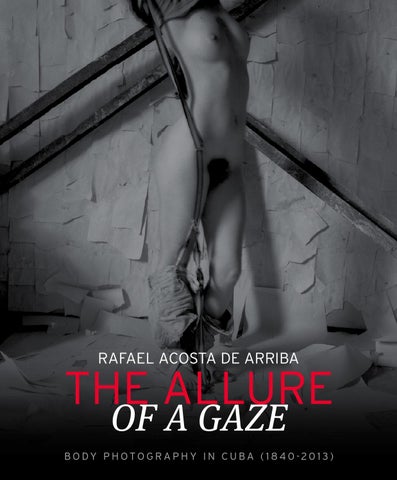
La seducción de la mirada Cover photo
Juan Carlos Alom
Baby, estudio #7, 1989
Back cover photo
Niurka Barroso
Pescando los recuerdos, 2008
Editorial director
Julio Larramendi Design
Pepe Nieto Translators
María Teresa Ortega Frances Martínez © 2014, Rafael Acosta de Arriba © On the present edition:
2014, Ediciones Polymita S. A. ISBN
978-9929-667-04-4 Ediciones Polymita S.A. Guatemala City, Guatemala edpolymita@gmail.com
Printed by
Selvi Artes Gráficas Valencia, Spain
All rights reserved. No part of this book may be reproduced in any form without written permission of the copyright owners.
To Lili and my children, to my brothers and my sister To RaĂşl Corrales y Alberto DĂaz (Korda), teachers and friends, in my memory
CONTENTS 8 ACKNOWLEDGEMENTS
10
13
MORAIMA CLAVIJO COLÓN. STORIES OF THE BODY AS TOLD BY THE LENS THE ALLURE OF A GAZE
1 OVERTURE 14
18 2 THE BODY, THOUGHT, ART
24 3 THE GRAND VOYEUR IS BORN 34 4 WHEN TALKING OF PHOTOGRAPHY, ARE WE TALKING OF ART? 38 5 THE BODY AS A CONSTRUCT AND SUSPENSION POINTS 44 6 CUBA: A BRIEF REVIEW OF ITS EARLY PHOTOGRAPHY AND THE NUDE 52 7 HERMAN PUIG, THE LOST BODY
EDUARDO MOLTÓ. Origen (fragment). 20 0 9
56 8 THEN THERE WAS A LONG PAUSE… 60 9 THE BIG CHANGE 68 10 THE MAIN FIGURES IN THE CHANGE 84 11
ATTEMPTING A CLOSURE
88
IMAGES
364
ABOUT THE ARTISTS
372
BIBLIOGRAPHY
376
ONOMASTIC INDEX
ACKNOWLEDGEMENTS
8
First of all, I would like to express my appreciation to Julio
I would especially like to thank all the artists who
Larramendi for his constant and brotherly encouragement
graciously contributed their pictures and willingly
for the publication of this book. Other persons and
joined this project: Adalberto Roque, from the Cuban
collaborators also provided their invaluable contribution,
Photographic Library; the Historical Archives and
such as Vitalina Alfonso and Pepe Nieto, in charge of
Photographic Library of the Office of the City Historian;
the edition and design of this book. Needless to say that
Norma Corrales and Diana Díaz, Josefina Arias, Hannah
both the intelligent editing and beautiful design are the
Adkins, from Lelong Gallery, Iraida López, Raquelín
result of their irrefutable professionalism: I could not have
Mendieta, Rufino del Valle and Ramón Cabrales. In short,
wished for more qualified and rigorous specialists. I would
to all, either here on the island or from afar, who sent
also like to thank the translators María Teresa Ortega
images or ceded their reproduction rights. To Soledad
and Frances Martínez. Finally, my heartfelt gratitude to
Pagliuca, for her invaluable help. To Manuel García, Carlos
Moraima Clavijo, for her presentation.
Tejo, Roberto Acosta, Gustavo Díaz Sosa and Elena Blanch
To José A. Figueroa, Roberto Salas, Julio Larramendi,
for their bibliographic support. And very specially my
Jaime Prendes and Pepe Nieto, who pooled their knowledge
most sincere thanks to Lourdes Álvarez, Iris Gorostola
(to Fígaro for having provided the saving photogram) in
y Miguel Selvi. Also to Lili, as always, for her patience,
order to rescue a nude photography of the sixties from
logistical support and understanding. To all, my genuine
oblivion and invisibility: La vida y la muerte (Life
appreciation.
and Death) or La miliciana de Korda (Korda’s Militia Woman), however you prefer to call it. It’s true that we were unable to obtain a high-definition image – technically it was impossible – however now we know what it was all about, and to picture the context of that turbulent decade is left to the reader’s imagination.
9
AS TOLD B STORIES OF THE BODY AS TOLD BY THE LENS BY
Moraima Clavijo Colón
DIRECTOR OF THE NATIONAL FINE ARTS MUSEUM OF CUBA
THE BODY IS THE RECEPTACLE OF LIFE. Since prehistoric times, the Venuses, fertility amulets, exhibited their sexual attributes, paying little heed to the face, since only the body could – and needed to – beget another being. Its sinful implication was induced, imposed. Had it not been for the need to cover their bodies to protect themselves from the cold, humans, like other animals, could have remained the same way they came into the world. Caribbean aboriginals lived thus, and the Europeans described them – with a fascination difficult to hide – as shamelessly displaying their “privates,” a term which actually applied only to these hairy and foul-smelling people, as those who had been “discovered” – and “uncovered” – soon realized. And so bodies continued… almost uninterruptedly nude and entered into Art. Except for the hieratic representation during the Middle Ages, bodies continued to be depicted in their naked placidness. The Renaissance retook them,
10
stripped them completely, the Sistine Chapel being the
inventory. At the same time, Acosta de Arriba warns and
highest exponent of this exhibition. By the Baroque period,
admits – with the modesty and wisdom of a researcher –
they adopted inconceivable foreshortenings until finally
the existence of previous attempts at a photographic study
becoming more serene and robed in the thin fabric of
of the body in our country which, although rare are no less
neoclassicism.
valuable or useful.
With the arrival of photography, that great “invention”
In order to understand and decipher many of the
BY
of the mid 19 century, the body was presented in all its
images depicted in The Allure of a Gaze, the author
magnificence, ornamented with the styles in vogue and
broaches, from a sociological standpoint, topics which
was even multiplied, taking advantage of the possibilities
have always been controversial in our society such as
of this new artistic expression, which in turn chose
racism, homosexuality and sexism. He also navigates
portraits, among its first productions, in order to reproduce
through murky and polemical waters such as child nudity
an actual likeness of the subject portrayed, in all its
in international and national photography, a controversial
beauty. And what better way to achieve this goal than to
and complex issue that cannot be oversimplified as mere
undress the body?
pedophilic obsessions, but should be analyzed, due to the
th
In the historical moments when the body was first
intrinsic value of perpetuating the image of an ephemeral
exalted in the photography market, collections were
body. A child grows and, in turn, the elder disappears.
promoted; postcards were printed and were even
The imprints that existence leaves on the bodies of elders
incorporated into other commodities. Apart from being
are also the story of a life (only this time longer and not
evidence of human existence, bodies ceased to be
incipient as that of a child) and photographers are aware
undocumented and could now be sold for themselves.
of this. It is “the body of the flesh elapsed,” as Alejo
We Cubans are highly diverse and our bodies could
Carpentier describes Ti Noel, a character in his novel
not go unnoticed in terms of the beauty of their own
The Kingdom of this World.
heterogeneity. Photographers realized this and the task
The vast iconography accompanying the text surprises
of Rafael Acosta de Arriba has been arduous indeed,
us with its own inclusive diversity, where the decorative
unraveling and studying the enormous complexity
and essential, the erotic and innocent, the living and even
of their gaze, also dissimilar, sensitive, curious, and
the dead are present. The large number and, at the same
transgressive. We must peruse through the first pages
time, meticulous selection, simultaneously complete and
of this necessary study, concatenated with both interest
complement each other. In this book, the reader will view
and rigor, covering the universal journey of photography,
the body as one of the leading characters in the island’s
the aesthetic categories that have defined the ideals of
photographic imagery throughout the very existence of this
our western culture and the views that have drifted away
essential expression in the history of Cuban Art.
from it, as well as those that have sustained, for more
This book, probably unexpected, is a true gift. With its
than twenty-five centuries, a weary and reiterated ideal of
arrival to the hands and visual recreation of readers, its
beauty, accepted, imitated, and even falsified. Once this
author places himself in a respectable position, before and
introductory path has been covered, the author offers a
after everything that has been written and studied about
wide and documented overview regarding the presence of
the body. It is an irrefutable conceptual and academic
body photography in Cuba, without overlooking the social,
contribution, but also an approach to our inner self, to our
political and cultural contexts that marked it and of which
flesh which moves others, to the spirit, from the moment
nude photography has been a unique reflection.
when Plato established that dichotomy more than 2000
Around thirty artists have been studied, with an
years ago. Only our body is tangible, real, identifiable,
emphasis on their ideological-aesthetical postulates.
literally corporeal, and all else that has been placed over it
Others are outlined, leaving the wider description of their
does not really belong to it, neither clothes nor ornaments.
evolution to the images that have been chosen. Probably no photographer has been left out of this exceptional
Havana, July 2011
11
The body is a very much disputed place: its flesh is at the same time receptacle and source of desire, lust and hatred. Like a pawn of technology, it is sacred and sacrificial and withstands the policies of society and the state. The body is our common bond and yet it separates us in terms of its public expression of identity, race and gender.
D A
I
N A
A U G
A
I
T
I
S
Just as sense appears beyond writing […] the body offers itself in its complete entirety, equally to the eyes and equally untouchable: the body is always beyond the body.
O
C
T A V
I O
P A
Z
THE ALLURE OF A GAZE The body: a surface where events are inscribed (while language marks them and ideas dissolve them), a place for the dissociation of the self (which tries to give the illusion of a substantial unity), a volume in perpetual collapse.
M
I C
H
E
L
F
O U C
A U
L T
May archeologists, historians, architects forgive me, but the best thing in Havana are the bodies (human bodies, I mean).
A
B I
L
I O
E
S
T
É
V
E
Z
1
OVERT
OVERTURE
Another form of perceiving the bodies in our country has to do with everyday life, inhabited by undulating bodies, desired and desiring, suffering or sick, hardworking or abandoned, plump or famished, inflamed by sex, swaying with the music, praised with flattering comments, content or defeated by the economic fate of their occupants; bodies that are among the greatest visual assets of this country, simultaneously viewed from an anthropological, artistic, sociological and street perspective. I would like to endorse my affirmation with a short but very enjoyable text by Cuban writer Abilio Estévez, when asked what impressed him most about the city: “[…] the truth is there are bodies everywhere (human bodies I mean)... half-naked and splendid. At any time and in any place […] Beautiful bodies survive disasters. THAT PHOTOGRAPHY WAS BORN BEGUILED BY THE
For example, here is Havana, neglected for so long […]
HUMAN BODY AND THAT THE LATTER FOUND IN IT
where, nevertheless, human bodies, due to a strange
MUCH MORE THAN JUST A MIRRORED REFLECTION, IS
paradox, have become increasingly beautiful. Nowhere
WHAT THIS BOOK ATTEMPTS TO TESTIFY. This is, in
else in the world have I seen such beautiful bodies (and
a nutshell, a study on bodies in Cuba, or better, on their
God knows if there is something I hate it is chauvinism).
iconic representation, a look at the symbolic potential that
And to this I must add: beauty without makeup… It does
photography has gestated regarding the corporality of
not matter that the Principal movie theater is virtually
Cubans. Everything put forward here has to do with this
in ruins, because I have actually seen this old cinema
condition, because even though a vast itinerary has been
surrounded by women and men of such beauty (I swear)
traversed with regards to the forms in which the body has
it makes you want to cry. The joy of miscegenation has
been thought of and represented in western philosophical
found its kingdom here. There are charming bodies that
and artistic tradition, it is also a study of the treatment of
jump over considerations of race…displaying themselves
the body by Cuban photography. Almost one hundred and
brazenly. It could be said that when one lives in the torpor
seventy years of images of the body will be reviewed in the
of hallucinations, the body demands its share. By showing
following pages.
itself, a body looks for another body.” And I would add: it
TURE Cuba and its bodies. An insular body? No, this is not
also looks to be seen, it looks for a look. And that’s what
the case. The slender island has been recreated even as a
this book is about, because as Abilio Estévez concludes
female body1 or as the intertwined bodies of a man and a
in his text, “when everything else disappears, the body
woman – forming only one body – in a harmonious and
appears.”2 Estévez’s prediction became true, as we were
focused mutual fellatio and also, as the sexual organ of
able to witness during the last two decades, when the
both genders, which suggests an identification with the
population had to go through – and still does – a grueling
whole body, with an enormous charge of sexuality as
ordeal (referred to euphemistically as the Special Period)
perceived by some artists. One of the images included in
from which many bodies (not all, of course) emerged even
this volume, Eduardo Moltó’s La Nación (The Nation),
more splendid. These are the bodies that appear in the
depicts a Cuban flag woven with dozens of nude bodies,
book, metaphorically observed, constructed, fragmented,
a very contemporary way of assuming what I am stating.
and metamorphosed. This is what turns the subjectivity of
Previously, Cirenaica Moreira had also resorted to the flag
the gaze of artists into the other main character: body and
in one of her most reproduced pieces.
photography, corporality and art.
15
OV ER T U R E
This study, however, intends to be much more than
a photographic perspective, with a logical predominance
a plain and simple exhibition of bodies in their various
of beauty (Kantian beauty, in order to abide by the canon)
forms of perception by the artists. It is an analysis of the
and what is thematically conceptual: race, eroticism,
complex relations between the images of the body and the
marginality, religion, gender, the postmodern look and
political and social reality of the country, as well as of the
what is strictly aesthetic, above all other interpretations.
development of concomitant ideas on what is corporeal.
We are talking, of course, of the Other body; the one we
The centrality of the body in the Cuban artistic praxis
always talk about when it comes to art, a reference that
has been called into question (and enriched) by political
reminds us of our condition as Homo sapiens, although
and social circumstances and, at the same time, by the
always from the external and physical side. Images
flow of artistic codes, ideas regarding the body, and the
usually scorn that which is internal even though they
talent of artists. Therefore, our analysis will focus on the
evoke it, and I will address, although in general terms,
perception of the individual body, the body as a sign, not
how philosophy has studied the body for centuries, a
on a meta-body but on the vision of each body-image from
quick journey into the body image.
1
Suffice it to browse through magazines of the early 20th century –
C arteles, Social, La Semana and Grafos – to see the nation as a woman wearing a Phrygian cap and the colors of the flag. A good-looking woman, we should underline. 2
Abilio Estévez: “La Habana son los cuerpos”, in La Gaceta de Cuba,
p. 27. The rest of the bibliographic information is at the end of the book.
16
IMAGE
IMAGES
Some names are missing in the present display of images by artists who have worked the body in Cuban photography since the 19th century to our times. The cause has never been deliberate exclusion by the author of the book, but the impossibility to contact some creators during
ES
the entire writing process. They will be in a second edition, if it ever materializes. Images are located according to the moment in which they appeared in the scene of Cuban photography (or that of other countries, as is the unusual case of Herman Puig), so the ages of the photographers are not the main element in the order they appear. In spite of long careers – as is the case of Roberto Salas – some lens artists began to photograph the body rather late. As to younger photographers, it is a group of artists that has hatched in recent years and they are the fortunate coda to this group of images.
89
Untitled
Untitled
CIRCA 19 15
C I RCA 19 15
LEFT PAGE
Untitled
TRINIDAD Y HNO.
CIRCA 19 15
Untitled
Untitled
CIRCA 19 15
C I RCA 19 15
91
Desnudo CIRCA 1920
JOAQUÍN BLEZ
92
Desnudo C I RCA 1920
A L A D A R H A J D Ăš ( R E M B R A N DT )
Kid Chocolate
1931
98
FELIPE ATOY
Untitled CIRCA 1944
99
Ensayando. From the Series “Gente de mi barrio” C I RCA 1 955
TITO ÁLVAREZ RIGHT PAGE
Untitled
C I RCA 1 955
104
Untitled
1 9 97
108
A L B E R T O D Ă? A Z ( KO R DA )
Brigitte Bardot CIRCA 1957
HERMAN PUIG Lingam danzarín C I RCA 1 985
RIGHT PAGE
Brindis de Caravaggio C I RCA 1 9 9 0
114
ANA MENDIETA
Death of a Chicken
1972
130 © THE ESTATE OF ANA MENDIETA COLLECTION. COURTESY GALERIE LELONG, NEW YORK
1 973
Untitled (Rape Scene)
© THE ESTATE OF ANA MENDIETA COLLECTION. COURTESY GALERIE LELONG, NEW YORK
MARTA MARÍA PÉREZ
Firmeza 199 1
No zozobra 1995
136
Albahaca, ruda y romero
JUAN CARLOS ALOM
1 9 92
Untitled 1992
142
143
RENÉ PEÑA Untitled 1994
Untitled 1 9 98
148
Untitled. From the Series “Hacia adentro” 1990
NEXT SPREAD
Mmm 1 9 98
Untitled 19 95
From the Series “Muñeca mía”
From the Series “Muñeca mía”
19 92
1992
From the Series “White Things” 2001
153
Untitled 1995
ABIGAÍL GONZÁLEZ
From the Series “Tarjetas de visitas” 1 9 98
From the Series “Tarjetas de visitas” 1998
154
From the Series “Hormonalmente tuyo” 20 02
From the Series “Hormonalmente tuyo” 20 02
155
EDUARDO
From the Series “Corpus-frágile” 20 02
158
HERNÁNDEZ SANTOS Mi cuerpo. From the Series “Palabras” 2008
159
1 989
Untitled. From the Series “Cuerpos-3”
JULIO BELLO
168
Untitled. From the Series “Cuerpos-1” 1995
169
CIRENAICA MOREIRA Bandera. From the Series “Ojos que te vieron ir” 19 94-96
174
175 19 96- 97
Árbol que nace torcido. From the Series “Lobotomía”
1994
From the Series “Entre ceibas y yagrumas”
ROBERTO SALAS
JOSÉ A. FIGUEROA Chuni, desnudo en estudio 1 970
186
1989
Yo, Avedon
ADALBERTO ROQUE
Untitled
PEDRO ABASCAL
1999
RIGHT PAGE
Untitled 1999
Untitled 1999
20 0 4
NADAL ANTELMO VIZCAÍNO (NADALITO)
From the Series “TV Play”
20 0 4
From the Series “TV Play”
From the Series “TV Play” 20 0 4
From the Series “TV Play” 20 0 4
SANDRA CEBALLOS
Untitled 1995
196
Mami, voy a dejar de comer 1996
197
RENÉ FRANCISCO Cara de culo 20 1 1
210
Untitled. From the Series “Ejercicios de silencio” 20 0 0
212
ELSA MORA
Untitled. From the Series “Ejercicios de silencio� 2000
213
LISSETTE SOLÓRZANO
Untitled 1994
Auto Retrato 1992
220
Piedra 19 9 0
221
JUAN CARLOS BORJAS
224
Untitled. From the Series “Asociaciones” 20 0 6
225
No hay otro lugar 2005
Alimentando los recuerdos 20 0 5
Mujer, miel y girasol 2005
NIURKA BARROSO
232
Arreglando lo torcido 20 0 8
El fuego no se apaga 20 0 8
RAÚL CAÑIBANO From the Series “Trasvesti” 20 02
234
JORGE LUIS PUPO Lightning my Soul 2005
236
Don’t Say What I Saw 20 0 4
237
Horizonte 20 02
Imรกn 20 0 0
Paisaje 20 02
LIDZIE ALVISA
246
20 02
Cruz
EDUARDO MOLTÓ
RIGHT PAGE
La Nación 20 0 9
Fósiles 20 0 9 NEXT SPREAD
Pizarra electrónica 20 0 9
250
NÉSTOR MARTÍ
La Isla. From the Series “La Isla” 20 0 6
Untitled. From the Series “La Isla” 20 0 6
256
My Menu. From the Series “Self Portrait Under Control” 20 0 9
257
LIUDMILA Y NELSON
El viaje 2005
262
263 20 03
Untitled. From the Series “Embarazo utópico”
Untitled 20 11
CARLOS OTERO
Untitled
Untitled
20 11
20 1 1
ERICK COLL
From the Series “Body Express II”
From the Series “Body Express II”
20 10
20 10
276
From the Series “Body Express II” 20 1 0
From the Series “Body Express II” 20 1 0
277
Untitled 20 0 6
JOSÉ JULIÁN MARTÍ
Untitled 2006
282
Untitled 2002
EDUARDO RODRÍGUEZ
Untitled. From the Series “Diecisiete” 2009
Untitled. From the Series “Diecisiete” 20 0 9
Untitled. From the Series “Diecisiete” 2009
284
20 0 9
Untitled. From the Series “Diecisiete”
20 0 8
Vals
JAIME PRENDES
ABOUT THE ARTISTS
Abascal, Pedro — — H A V A N A , 1960
Abascal is a photographer with a wide artistic career and undoubtedly one of the most outstanding to emerge in the nineties. He has been a photojournalist and has worked in advertising photography as well as in film stills. He has held numerous exhibitions in the country and abroad and received important awards and acknowledgements. He has not made large forays into the body topic, but when he has they have shown great skill.
Alom, Juan Carlos
because of its artistic qualities. He has held several exhibitions in his country of origin and has been awarded for them. He lives in the United States of America.
Arcos, Alberto — — HAVANA, 1956
Self-taught photographer. He started to exhibit in 2000. He has received training in Spain, Germany and other countries on photographic technique and photograph preservation.
Arias, Constantino — — HAVANA, 1920- 1991
Alom belongs to the New Generation of Cuban Photographers. He was self-taught when he began his oeuvre. In the 1980s he worked as photojournalist in several Cuban publications. He has held many exhibitions in important artistic venues in Cuba and abroad. His work is one of the most outstanding in Cuban photography from the 1980s to our days.
Arias was the most outstanding photojournalist in the forties and fifties. Before 1959, he collected an important oeuvre on the political conflicts in Havana and of its society. He made important photographies of personalities who visited the Hotel Nacional de Cuba. His work, that has not yet been entirely exhibited, is a fresco of Havana society towards the middle of the 20th century.
Álvarez, Tito (José María González Álvarez
— — REMEDIOS. VILLA CLARA, 1919- 1992
— — H A V A N A , 1964
— — V I C TO RIA DE LA S TUNA S, 1916-2002
Tito was a member of the Club Fotográfico de La Habana since the fifties. He underwent some courses and began his professional life as a photographer in the early sixties. He worked in cultural magazines until little before his death. His work is considered by critics as one of the most valuable in the history of Cuban photography. He received important national and international awards and acknowledgements. His oeuvre is outstanding because of its humanistic and sociological values.
Alvisa, Lidzie — — H A V A N A , 1969
Alvisa is a visual artist with a plural oeuvre, rich in nuances and conceptually very strong. This has won her numerous acknowledgements in her country and abroad. She is not strictly a photographer, but has used photography to document her work and create images with vigorous visual suggestions.
Antequera, Félix — — H A V A N A , 1962
Antequera is a professional photographer since the 1990s. He graduated from the Higher Art Institute as a specialist in Scenic Arts. His work on the body has stood out
Atoy Vasconcelos, Felipe Atoy, a lawyer by training, devoted twenty years of his life to the practice and promotion of photography. He was a member of the Club Fotográfico de La Habana and received many national awards. In 1958 he was granted the condition of Honoraire Excellence of the FIAP.
Ballester, Juan Pablo — — HAVANA, 1966
Ballester is a Plastic Artist and a member of the “Eighties Generation” in Cuba. He has been living in Barcelona for two decades. His work on the body shows a specific treatment. Art critics in Spain have offered highly favorable comments on his work.
Barba, Tessio — — HAVANA, 1975
Barba is a self-taught photographer who has iconically worked the body showing great creativity. He has not held many exhibitions yet.
topics having to do with photographic art and then started working in documentary photography. The cardinal topic in her work is now the body. She has held numerous exhibitions which have brought her various acknowledgements. She lives in Canada.
Batista Herrera, Rodney — — HAVANA, 1988
Batista graduated from the San Alejandro Fine Arts Academy where he is now a professor. He has worked in drawing, painting, installations and photography. As a photographer he has held several individual and collective exhibitions in the past decade and has obtained national awards and acknowledgements.
Bello Aguabella, Julio — — HAVANA, 1947
Bello Aguabella is a self-taught photographer. He graduated from the Graphic Design School in Havana. He has been an advertising photographer and worked as a photojournalist for several periodicals. He is a refined stylist on body topics and has received numerous national awards and acknowledgements.
Blez Marcé, Joaquín — — SANTIAG O DE CUBA, 1 8 8 6 -1 9 7 4
In 1922, Blez Marcé received in Havana a title on technical and professional authorization for photography. Then he traveled in France, Germany and the United States where he completed his training in this specialty. He was one of the founders of the Club Fotográfico de La Habana and set his studio in the capital where his portraits excelled. He is the undisputable pioneer of body photography in Cuba.
Bobadilla Diez, Javier Alejandro — — HAVANA, 1979
Bobadilla graduated in Computation Science and is a self-taught photographer. He has only held and individual exhibition and has participated in several erotic art halls. His work is now in a stage of full development.
Borjas, Juan Carlos — — ANTILLA, HOLG UÍN, 1 9 5 7
Barroso, Niurka — — SANCTI SPIRITUS, 1961
Barroso graduated in Classic Literatures and Languages from the University of Havana. She began to be acknowledged in the field of Cuban photography in the nineties. At the beginning she researched on
365
Self-taught photographer with a vast experience. His works on the body have been approached in various critical studies. He was a war correspondent in Angola. He has also made advertising and architecture photography. He has been frequently acknowledged.
A BO U T T HE ART ISTS
Bou, Francisco (Paco)
Corrales, Raúl (Raúl Corral Fornos)
— — H A VA N A , 1940
— — CIEG O DE ÁVILA, 1925- 2006
Self-taught photographer. His preferred areas have been in the world of dance and films. He has worked for decades as a photographer in the Cuban Institute of Art and Cinema (ICAIC) and has accumulated a rich imaginary that constitutes a vast memory of Cuban cinema as well as of dance and ballet. He has also worked in the world of moving images and held numerous individual and collective exhibitions with significant acknowledgement.
Corrales, a self-taught photographer, worked in Cuba Sono Films before 1959. After the triumph of the Cuban Revolution, he integrated into the political process under Ernesto Che Guevara and later became one of the photographers who accompanied Fidel Castro. His photographic features before and after January 1959 are considered among the best in 20th century Cuban photography. In 1997 he received the Visual Arts National Award.
Calderín, Felco
Corrales, Claudia (Claudia Corral Mesa)
— — H A VA N A , 1970
— — HAVANA, 1987
Calderín is a photographer who is starting in his creative activity with talent and imagination. His treatment of the body is very interesting.
Claudia is a youngster who comes from a family of photographers. She is still studying in the university and her work in photography is still in its early moments.
Cañibano Ercilla, Raúl
Corzo Conte, Carlos
— — H A VA N A , 1961
— — MATANZ AS, 1990
Cañibano is one of the most acknowledged Cuban photographers with a solid and repeatedly awarded oeuvre, characterized by his deep sociological penetration and the sharp eyes with which he examines the topics of his essays. Since the early nineties, his individual and collective exhibitions have been numerous. He has exhibited in important national and international spaces.
Ceballos, Sandra — — G U AN TA N A MO , 1961
Ceballos is a very much acknowledged Visual Artist in Cuba and abroad. She is one of the artists who came to the fore in the nineties as a generation which surprised international specialized critics. She has used her talent in painting, engraving, installations, performances and photography, in every case with originality.
Coll, Erick — — H A VA N A , 1976
Coll graduated in Social Communication and is photography professor at the Higher Industrial Design Institute (ISDI). He has also worked in films and documentaries and has held several exhibitions. His oeuvre has been awarded and his work on the body has the special interest of being experimental. He is a promoter of photography in educational and cultural circles.
Corzo Conte is a young self-taught photographer whose experience is very little yet. He has made his pictures together with Liset Falero Luna.
Cueto Perearnau, Luis del (Karoll) — — HAVANA, 1910- 1979
Karoll studied in the Business School and practiced photography since very young. He set his studio in Almendares neighborhood. During the 1940s he photographed gymnasts and body builders. He was a studio portrait photographer.
he had been exhibiting for ten years in galleries in Havana. He has dozens of individual and collective exhibitions to his name. He lives in the United States.
Figueroa, José Alberto — — HAVANA, 1946
Figueroa is one of the most exceptional Cuban photographers. His work, interested in social and other topics, did not have the body as a goal. He started in photography as an assistant to Korda and later began to work in his own oeuvre. He has received numerous national awards and has exhibited in his country and abroad.
Flores, Adonis — — SANCTI SPIRITUS, 1 9 7 1
The work of this visual artist has mainly been in performances and installations. He has used photography to document his oeuvre. His many exhibitions, in his country and abroad, have won him several national and international awards.
González Piña, Abigaíl — — MATANZ AS, 1964
González Piña is a visual artist, photographer and art video maker. He has been outstanding because of his smart work on the body and eroticism. He lives in his city of origin, has exhibited in his country and abroad and has received numerous awards and acknowledgements. He belongs to what specialized critics call the New Generation of Cuban Photographers.
Díaz Montero, José Luis
Guerra, Eduardo
— — HAVANA, 1967
— — PINAR DEL RIO, 19 6 7
Díaz Montero is a self-trained photographer although he took part in several optional courses in educational institutions. He began to work as a documentary photographer and later made images with a fully artistic meaning. He has held few individual exhibitions and has participated in a small number of collective ones, but has already been acknowledged by the critics.
Falero Luna, Liset — — SANTIAG O DE CUBA, 1976
Falero is a young self-taught photographer who works in Matanzas where she started her incipient artistic life together with Carlos Corzo Conte.
Fernández Delgado, Leonel (Leo) Fernández began his training as a photographer in the nineties, although
366
Guerra graduated from the Higher Art Institute. He is a visual artist with a diverse oeuvre in which photography is one more expression of his talent. He has exhibited in Cuba and in various countries and has received much acknowledgement.
Hajdú, Aladar (Rembrandt) — — YUG OSLAVIA, 192 1 -2 0 0 5
Hajdu was the owner of one of the three most important photographic studios in Havana in the first half of the 20th century. He was a well known photographer of Havana high bourgeoisie.
Hernández Batista, Ramsés — — HAVANA, 1975
Hernández graduated in Comprehensive Photography. His work, still recent, moves
among documentary, artistic, fashion and advertising photography.
Hernández Hernández, Dany — — M A T A N Z A S , 1975
Hernández is a self-taught photographer who has exhibited in individual and collective samples. He has received local awards and acknowledgements.
Hernández Santos, Eduardo — — H A V A N A , 1964
Hernández Santos graduated from the San Alejandro Fine Arts School and later became a professor in it. He has created a line of work with homoerotic love as a topic which identifies him and has won him the acknowledgement of critics. With numerous exhibitions in the country and abroad, he has deserved various national and international awards and acknowledgements. He is a member of the so-called New Generation of Cuban Photographers. His work is one of the most outstanding in the body topic.
Herrera, Hurí — — H A V A N A , 1986
Herrera is a self-taught photographer with a still incipient oeuvre. He has taken some improvement courses.
Herrera Ulashkevich, Cristóbal — — H A V A N A , 1971
Herrera graduated in Industrial Design. He worked in international press agencies in Cuba as photojournalist and advertising and fashion photographer. He held several exhibitions in his country. He left for the United States in the early years of the present century. In Cuba he was awarded several times for his work as a photojournalist and for his artistic pursuits. He made few nudes, all marked by delicacy and suggestion.
Karmona, Anielka — — I SLA D E L A J UVEN TUD , 1972
Graduated in Agronomy. She started studying photography in 2009 and is now working in photography for advertisments.
Korda (Alberto Díaz) — — H A V A N A , 1928-2001
Korda, a self-taught photographer, set up his studio, Korda Studios, in El Vedado together with his friend Luis Pierce Byers. There they led a productive professional life in fashion and advertising
photography. After the triumph of the Cuban Revolution, he integrated into the political process and became one of the photographers who accompanied Fidel Castro. His work reached world relevance with the picture of Ernesto Che Guevara who many consider the most reproduced picture in the history of photography.
Larramendi Joa, Julio Ángel — — SANTIAG O DE CUBA, 1952
Larramendi is a Doctor in Technical Sciences graduated in the former Soviet Union. He has created a plural work in which he has frequently dealt with topics like the flora and fauna, social issues and architecture. He has also embarked in an editorial work that has received much acknowledgement and in which photography has played an important role.
Luis, Lázaro — — HAVANA, 1966
Luis is a self-taught photographer. His exhibitions in collective samples – he has no individual exhibitions yet – are rather recent and begin to show an artist with much imagination, which the awards he has received prove.
Macías, Jorge — — CIEG O DE AVILA, 1953
Mauri, Yanahara — — HAVANA, 1984
Mauri graduated in History of Art at the Havana University. She became a photographer through empirical observation and, after several postgraduate courses having to do with photography, started to exhibit her works in 2009. In a short time she has received various national awards.
Mendieta, Ana — — HAVANA 1948- 1995
Mendieta, a visual artist mostly interested in performances, used photography basically to document her work. She lived in the United States since her early childhood, came to Cuba in the 1980s and her work notably influenced the artistic vanguard of those times. Her oeuvre and presence in the country contributed to a change in Cuban art in general and specifically on the treatment of the body.
Moltó, Eduardo — — HAVANA, 1965
Moltó is a visual artist and a graphic designer with a much awarded oeuvre in the island and abroad. He lives now in the United States.
Montejo Harrys, Yomer Fidel
Macías graduated in higher studies in Philosophy and Sociology. He took photography courses in the Cuban Photographic Library. He has been a photojournalist, a curator and an art critic and has also taught topics related with photography.
— — CAMAG ÜEY, 1983
Martí, José Julián
— — HOLG UÍN, 1971
— — HAVANA, 1953
Martí is one of the most acknowledged photographers in our country, although his on body photography has not been large. His pieces are characterized by accentuated and strong sociological nuances. He has received numerous awards and acknowledgements in his various individual and collective exhibitions.
Martí, Néstor — — HAVANA, 1972
Martí graduated in History of Art at Havana University. He is a self-taught photographer who has been increasingly working in creative and promotional aspects of photography. He has held numerous exhibitions, the most important one at the Tenth Havana Biennial.
367
Montejo graduated from handicrafts schools. He is a self-taught photographer that is just beginning his creative activity and has received some national acknowledgement.
Mora, Elsa Mora is a very highly acknowledged visual artist, both nationally and internationally. Although her participation in body photography has not been large, it has been intense. She is now living in the United States.
Moreira, Cirenaica — — HAVANA, 1969
Moreira graduated from the Higher Art Institute (ISA). Her work has been exhibited in numerous samples in Cuba and abroad. She has received various national and international awards and acknowledgements. She was belatedly included in the New Generation of Cuban Photographers. Her work is one the most relevant examples of body treatment in Cuban photography.
A BO U T T HE ART ISTS
Nadalito (Nadal Antelmo Vizcaíno) — — C A RDEN A S , 1968
This young lensman, graduated as a mechanic engineer and photography technician, has been a persistent photographer of the body and of eroticism which form the thematic focus of his interesting oeuvre. He has held many exhibitions in the island and abroad and has received various acknowledgements. He lives alternatively in Cuba and Spain.
Obregón Batard, Yuri — — H A VA N A , 1979
Obregón graduated from the Higher Art Institute (ISA) and has followed several courses in photography to complete his training. He has held individual exhibitions and participated in several collective ones, which have brought him various national awards and acknowledgements.
Orozco, Marianela — — SA N C TI S P ÍR I TUS , 1973
Orozco graduated in Letters in the Las Villas University. She is a visual artist who has mainly worked in performances. She has participated in many collective exhibitions and held individual ones in Cuba and abroad and has received important national acknowledgements for her work.
Otero, Carlos — — H A VA N A , 1968
Otero is an underwater photographer repeatedly awarded in Cuba and abroad. He contributed the only undersea body images in this book.
Otero, Jorge — — H A VA N A , 1986
Otero graduated from the San Alejandro Fine Arts School and is now studying in the Higher Art Institute (ISA). In spite of his youth, he has already held several individual exhibitions and participated in collective ones. The quality of his work has been awarded.
Pacheco Salazar, Ramón — — R A NC H UEL O , VIL L A C L A R A , 1954
Pacheco is a self-taught photographer who has worked as a photojournalist in periodicals in Matanzas province, where he lives. He has received numerous national awards and acknowledgements.
Padró, Tomás — — SA N TI A GO D E C UB A , 1900-1978
Padró, a member of the Photographic Club
in his natal city, has actively contributed to the development of photography in the eastern part of the country. He made very advanced nude pictures for his times.
which are of a conceptual nature, and as documentation of his work. His oeuvre is nationally and internationally acknowledged and enjoys wide critic acclaim.
Pascual, Omar
Pita, Tony
— — HAVANA, 1971
— — HAVANA, 1959
Plastic artist, critic and poet with a plural work that includes photography. He now lives in Spain and is the director of the Centro Atlántico de Arte Moderno in Palma, Canary Islands.
Pegudo Gallardo, Rafael — — HAVANA, 1899- 1981
Pegudo was a photographer in various newspapers. He was the author of very important texts on photography, especially his book Nude Photography (which has become a classic). In 1939 he organized the First Centennial of Photography in Cuba and received much acknowledgement during his career.
Peña González, René de Jesús (Pupy) — — HAVANA, 1957
Peña González is a member of the New Generation of Cuban Photographers. He has made a notable work in body photography, with a strong emphasis in racial and erotic topics. He has an English Degree from the Enrique José Varona Higher Teaching Institute in Havana. He has exhibited in Cuba and abroad and received numerous national and international awards. His works have been part of individual and collective exhibitions held in important art venues in various countries.
Pérez Bravo, Marta María — — HAVANA, 1959
Marta María belongs to what critics call the New Generation of Cuban Photographers. She graduated from the San Alejandro Fine Arts Academy and the Higher Art Institute. She settled in Mexico in the nineties. Her work has been exhibited in important international art venues and has received considerable acknowledgement from specialized critics. She has repeatedly been nationally and internationally awarded.
Self-taught photographer. He has been a promoter of visual arts in the city he now lives.
Prendes, Jaime — — ISLA DE LA JUVEN T U D, 1 9 6 5
Self-taught photographer with a large corporal work in which the body is a pretext for deep reflections on social and erotic issues. He has participated in numerous collective exhibitions, held many individual ones, some of them abroad, and has received many national acknowledgements.
Puig, Herman — — HAVANA, 1929
Puig left Cuba in 1957 and settled first in Paris and then in Spain, where he began his artistic oeuvre with nudes, preferably male, for which he was persecuted by Franco’s regime. He still lives in Paris and his oeuvre, of an outstanding artistic prominence, is only now barely known in Cuba. In spite of his advanced age, he is still active as an artist and a body photographer.
Puldón Villarreal, Miguel Jesús — — HOLG UIN, 1951
Puldón is a visual artist with an oeuvre in painting and photography. He has received courses in photography and held numerous exhibitions in the country for which he has received several acknowledgements.
Pupo, Jorge Luis — — HAVANA, 1970
Pupo is a self-taught photographer who has worked with great fortune on racial topics and corporal art. He is the author of images with much expressive strength. His numerous exhibitions have been praised by the critics and have received many awards and acknowledgements. He has been living for a decade between Belgium and Paris.
Pino, Alain
Raggi, Ossain
— — CAMAG ÜEY, 1974
— — HAVANA, 1967
Pino is one of the most talented artists in Cuban visual arts emerging at the end of the nineties. He has fundamentally used photography as part of his installations,
368
Photography professor at the High Art Institute (ISA). He has been repeatedly awarded and acknowledged in various exhibitions and because of a life
entirely devoted to gauge and promote photography.
Ramírez, Enrique — — SA N C T I S P Í R I TUS, 1960
Self-taught photographer with a vast experience, although body photography has not been the preferred focus of his work. He has taken part in theoretical events on photography. Since the middle of the eighties he exhibits in Matanzas, where he has lived for many years now. He has received numerous awards and acknowledgements.
Ramírez de Arellano, Nelson — — B E R L I N , GER MA N Y , 1969
of the body. Then he entered into other topics and today is in a sort of recess in his creative activity. He has received numerous awards and acknowledgements.
Rodríguez Decall, Roberto — — CIENF UEG OS, 1915- 1995
Decall, a self-taught photographer, was one of the founders of the Club Fotográfico de Cuba. He also taught photography and in the 1940s published articles on it in the press on it. He took part in international exhibitions held at the Leica Photographic Gallery in New York. He received many national awards and acknowledgements.
Rodríguez Moreno, Daylene
Ramírez de Arellano has lived in Cuba since the sixties. Together with his wife, Liudmila Velazco, he has created an oeuvre that has brought him numerous acknowledgements in Cuba and abroad. He has exhibited in various contemporary art events, especially in the 10th Havana Biennial. He is now the director of the Cuban Photographic Library.
— — CÁRDENAS, MATANZ AS, 1978
René Francisco (René Francisco Rodríguez)
— — CIENF UEG OS, 1955
— — H O LG U Í N , 1960
René Francisco is a very much acknowledged artist, both nationally and internationally. A professor and educator in the Higher Art Institute (ISA), he has led and trained young artists who have later revealed their outstanding talent. His work is very conceptually complex and has been exhibited in important worldwide contemporary art centers. He used photography to register his work. In 2010 he received the National Visual Arts Award.
Rodríguez, Alexis — — H A V A N A , 1966
Self-taught photographer that is just starting his life in art. He works for the Festival of the New Latin American Cinema and for the Office of the City Historian.
Rodríguez, Eduardo — — H A V A N A , 1982
Rodríguez is a very young self-taught photographer with barely two individual and three collective exhibitions, but with a highly interesting series on the treatment of the body.
Daylene has participated in quite a large number of individual and collective samples, as well as in Provincial Halls. Last year she exhibited in the Cuban Photographic Library a sample which legitimates her entry into the art of photography.
Romero, Sergio Romero is a self-taught photographer. He has developed a large and diversified oeuvre in press photography. His exhibition Paisaje vivo (Living Landscape), thirty nude pictures made in 1986, was an important landmark in body photography in Cuba. He is now focused in advertising photography.
Roque, Adalberto — — MINAS DE MATAHAMBRE, PINAR DEL RÍO, 1959
Roque graduated from art schools and later worked as a professor in them. Then he became a photojournalist. As a promoter of photography, he has an outstanding collection of awards. He has held numerous exhibitions and received various acknowledgements.
Rosales, Guibert — — HAVANA, 1979
Rosales graduated at the San Alejandro Fine Arts Academy and took a degree in Visual Arts in the Enrique José Varona Higher Teaching Institute. He has held some visual arts exhibitions which have been nationally acknowledged.
Rodríguez, Ismael
Rottenberg, Enrique
— — H A V A N A , 1962
— — BUENOS AIRES, 1948
Self-taught photographer who stood out in the nineties because of his iconic treatment
Concerning the artist's proffesional training in the movie universe, he has focused the
369
must varied debates on the conceptual discourse. With an increasing number of personal exhibitions in Cuba (where he lives since several years) as well as abroad, he is at present one of the creators who has experimented on the corporal image as supplier of meaningful signs.
Salas Merino, Roberto — — HAVANA, 1940
Salas, a self-taught photographer, started to work very early together with his father, Osvaldo Salas, one of the great masters of Cuban photography of all times. He returned to his country after January 1959 and actively integrated into the Revolution. He worked as a photojournalist for various publications and was one of the photographers who accompanied Fidel Castro. He is part of the “Cuban epic photography” group which preserved the early years of the Revolution with their photographs. Considered by the critics as one of the most versatile and experimental photographers of the country, in the 1990s he started in body photography, a new line in his artistic work. He has exhibited in important venues in Cuba and abroad and received numerous national and international awards.
Siamés, Project (Eduardo Javier and Orlando García García) — — HAVANA, 1978
Eduardo Javier graduated from the Enrique José Varona Higher Teaching Institute in Havana and Orlando from the Industrial Design Institute. They work together and have named their project Siamés. They have already received various acknowledgements.
Socarrás, Yami — — HAVANA, 1989
Yami is a student of the Higher Art Institute (ISA) who is barely starting her artistic life. She is part of the group of students led by acknowledged artist and professor René Francisco. Her work shows an evident mark of artist Ana Mendieta.
Solórzano, Lissette — — HAVANA, 1969
Solórzano is a photographer with vast experience and plural oeuvre. She has held dozens of exhibitions in Cuba and abroad with much commercial and critic success. She has received various awards and acknowledgements, among them
A BO U T T HE ART ISTS
the National Curatorship Award for a photography sample.
Vega Fernández, Carlos (Carlucho) — — C A RDEN A S , 1940
Carlucho has been working as a photographer since 1969. He lives in Varadero Beach, where he has carried out an interesting work in body photography. He has received numerous national awards and acknowledgements.
Velazco, Liudmila — — M O S C O W , R US S I A , 1969
Velazco lives in Cuba since the sixties. She is a photographer with a clearly conceptual oeuvre. Together with her husband and also photographer, Nelson Ramírez de Arellano, she has held several photography and video exhibitions in Cuba and abroad and took part in the 10th Havana Biennial. She has received various awards and acknowledgements.
Vidal, Gonzalo — — P U NTA A R EN A S , C H I L E, 1950
Vidal has lived in Cuba for more than twenty years and has always been linked
to artistic photography. His participation in Cuban creation has always been outstanding. His photography on topics related to jazz has been included in books and his body pictures have been nationally awarded and acknowledged.
Vidal, Juan José — — HAVANA, 1947- 1996
Professional photographer since 1962. He took technical studies on this specialty and later graduated in History of Art in Havana University. He has received several national and international awards. His work on nudes during the 1980s contributed to impel this thematic area of photography in the country.
Vilches, Carolina — — SANTA CLARA, 1965
Vilches graduated in the Visual Art Vocational School in her native town and later in Architecture. She studied photography and started working as a photojournalist and professor. She has held numerous individual exhibitions and participated in collective ones in the country and abroad and has received awards and acknowledgements.
370
Vorojbitov, Andrei R. — — HAVANA, 1971
Vorojbitov is a self-taught photographer who has held several individual exhibitions and participated in some collective ones. He has been widely awarded and acknowledged in the island.
Zambrana, Armando — — HAVANA, 1962
Self-taught photographer. He started in photography while working in Bohemia magazine. Body photography is not the center of his work, but it shows interest and imagination. He has held several personal exhibitions and participated in collective ones and has received numerous acknowledgements for his oeuvre.
Zerquera, Jacqueline — — HAVANA, 1965
Zerquera graduated from the San Alejandro Fine Arts Academy. She started her artistic life as a painter and has exhibited in various countries. She now lives in the United States of America.
BIBLIOGRAPHY ACOSTA DE ARRIBA, RAFAEL: “Del fauno al sexting”, in Sexología
CASTRO, ELVIA ROSA: “El lenguaje misterioso de los cuerpos”.
y Sociedad, Havana, no. 45, January-April, 2010, pp. 26-33.
Catalogue for the exhibition Pulsiones. Fotografía Cubana Contemporánea, Biblioteca Nacional José Martí, Havana, November, 2003, p. 2.
_________: “Pasando de moda, interioridades de una mutación”, in Caminos de la mirada, Ediciones Unión, Havana, 2007, pp. 225-263.
Catálogo Arenas movedizas. Luis Gómez and Juan Carlos Alom, Fundación Ludwig de Cuba, Museo Nacional de Bellas Artes, Havana, 1995, s/p.
_________: “La piel como metáfora del mundo”, in Dentro-Fuera. Exhibit catalogue. Galería de Arte Concha Ferrant, Havana, May-June, 2003, n/p, n/d.
Catálogo Desnudar la imagen. Fondo Cubano de Bienes Culturales, Galería La Acacia, Havana, 1997.
_________: “Un siglo del desnudo fotográfico en Cuba”, in Unión. Revista de Literatura y Arte, Havana, no. 31, April-June, 1998, pp. 73-81.
Catálogo La fotografía en Cuba: exposición retrospectiva. Museo Nacional de Bellas Artes, Havana, 1983.
_________: “Los rituales del cuerpo”, in Artecubano, Havana, no. 1, 1997, pp. 17-21.
Catálogo Primer Salón de Fotografía del Cuerpo Humano NUDI’96. Consejo Nacional de las Artes Plásticas, Fototeca de Cuba, Havana, 1996.
AGUILERA, CARLOS ALBERTO: “Vigilar y castigar (Interview with Juan Carlos Alom)”, in Unión. Revista de Literatura y Arte, Havana, no. 31, April-June, 1998, pp. 70-72.
Catálogo René Peña. Fotografías. Fototeca de Cuba, Havana, n/d, n/p.
ALONSO, ALEJANDRO G.: “Fotografía. ¿La gran ausente?”, in
Fototécnica, Havana, no. 2, 1987, pp. 8-13.
Catálogo Salón Nacional de Fotografía 1999. Consejo Nacional de las Artes Plásticas, Fototeca de Cuba, Centro Provincial de Artes Plásticas y Diseño, Centro de Desarrollo de las Artes Visuales, Havana, 1999.
ARENCIBIA, FÉLIX: “Bellas fotos de Bello”, in Fototécnica,
CEPERO, ILEANA: “Entre los límites de lo incierto. Aproximaciones a
Havana, no. 2, 1983, pp. 3-6.
las nuevas poéticas en la fotografía cubana”, in Artecubano, Havana, no. 1, 2001, pp. 62-66.
ARTEAGA, LUISA MARINA: “Apuntes sobre un fotógrafo-artista o un
artista-fotógrafo”, in Fototécnica, Havana, no. 2, 1984, pp. 1-9.
_________: “El fotógrafo del mundo elegante”, in Cuba, arte e historia desde 1968 hasta nuestros días, catalogue for the exhibition MNBA and Montreal Museum of Fine Arts, Montreal-Havana, 2008, pp. 84-91.
BALBUENA ALMAGUER, RAFAEL J.: “142 años de fotografía
cubana”, in Fototécnica, Havana, no. 1, 1984, pp. 21-22.
BARLEY, NIGEL: El antropólogo inocente, Editorial Anagrama,
CLARK, KENNETH T.: The Nude (a Study in Ideal Form), Princeton University Press, Princeton, 1953.
Barcelona, 1989.
BARTHES, ROLAND: La cámara lúcida, Editorial Paidós-Comunión,
COLOMBRES, ADOLFO: “El desnudo: acción y pasión”, in Criterios,
Barcelona, 1980.
Havana, no. 22, 1992, pp. 24-30.
BATAILLE, GEORGE: “Hegel, la muerte y el sacrificio”, in
CRUZ, JUAN: “Herman Puig fotografía el desnudo masculino”,
Las lágrimas de Eros, Ediciones Signos, Córdoba, 1968, pp. 36-47.
in El País, Madrid, June 13, 1979, p. 37.
BENJAMIN, WALTER: Sobre la fotografía, Pre-Textos, Valencia,
DELANGE, XAVIER: “Un et nudité: le un devant la loi”, in L’Art du
2005.
xix siécle, Hazan/Bibliotèque Nacionale de France, Paris, 1997.
BOBES, VELIA CECILIA: Los laberintos de la imaginación.
ESPINA, RODRIGO AND PABLO RODRÍGUEZ: “Raza y desigualdad en la Cuba actual”, in Temas, Havana, no. 45, January-March, 2006, pp. 44-54.
Repertorio simbólico, identidades y actores del espacio social en Cuba, El Colegio de México, Mexico D. F., 2000.
BOURDIEU, PIERRE: Un arte medio, Fotografía collection, Editorial Gustavo Gili, Barcelona, 2003.
ESTÉVEZ, ABILIO: “La Habana son los cuerpos”, in La Gaceta de
Cuba, Havana, no. 2, March-April, 1999, p. 18.
CABALLERO, RUFO: Agua bendita, Ediciones ICAIC and Artecubano
EWING, WILLIAM: El cuerpo, fotografías de la configuración
Ediciones, Havana, 2010.
humana, Ediciones Siruela, Madrid, 1996.
CALLAHAN, SEAN: NUDES (Introduction: Arresting the Eyes),
FEHER, MICHEL, RAMONA NADDAFF AND NADIA TAZI (Editors):
Zurich, Graphic Press Corp., 1975.
Fragmentos para una historia del cuerpo humano (Second Part), Editorial Alfaguara, Madrid, 1991.
CAMPOS GARCÍA, ALEJANDRO: “Cien años de fotografía cubana”,
in Artecubano, Havana, no. 1, 1999, pp. 41-42.
FERNÁNDEZ, ANTONIO ELIGIO: “Trece que fueron uno”, in González Margarita, Tania Parson and José Veigas: Déjame que te cuente. Antología crítica de los 80, Artecubano Ediciones, Havana, 2002, pp. 141-145.
CAMPUZANO, LUISA: “Ser cubana y no morir en el intento”,
in Temas, Havana, no. 5, January-May, 1996, pp. 4-10.
Cartografías del cuerpo. La dimensión corporal en el arte contemporáneo. (Colectivo de autores). CENDEAC, Murcia, 2004.
_________: “René Francisco. Del arte a la pedagogía”, in La Gaceta de Cuba, Havana, no. 5, September-October, 2010, pp. 18-23.
CASTELLANOS SIMONS, GUILLERMO: “La imagen ambigua”,
in Revolución y Cultura, Havana, no. 5, September-October, 1994, pp. 26-31.
FERNÁNDEZ FIGUEROA, MANUEL: “Julio Bello Aguabella”.
Exhibition catalogue, Havana, (n/d).
372
FOGEL, JEAN FRANÇOIS AND BERTRAND ROSENTHAL: Fin de
Summer, 1985, pp. 23-29.
FONTCUBERTA, JOAN: Estética fotográfica. Selección de
LOSADA, MIGUEL: “Germán Puig. Esculpir con la cámara”, in Academia, Madrid, no. 168, June, 2010, p. 45.
FOWLER, VÍCTOR: “Estrategias para cuerpos tensos: po(li)(é)ticas del
MARZAL FELIA, JAVIER: Cómo se lee una fotografía. Interpretaciones de la mirada, Editorial Cátedra, Madrid, 2010.
siglo en La Habana, Tercer Mundo Editores, Bogota, 1994. textos, Editorial Blume S. A., Barcelona, 1984.
cruce interracial”, in Historias del cuerpo, Editorial Letras Cubanas, Havana, 2001, pp. 99-164.
MASSE ZENDEJAS, PATRICIA: “Fotografía cubana de los noventa. La opción de corregir y aumentar la realidad”, in Revolución y Cultura, Havana, no. 3, 1996, pp. 40-43.
_________: “Los 80 y las lógicas de la complejidad”, in Historias del cuerpo, Editorial Letras Cubanas, Havana, 2001, pp. 215-241.
MATAMOROS, CORINA: Mirada de curador, Editorial Letras
FREUND, GISÈLLE: La fotografía como documento social,
Cubanas, Havana, 2009.
Editorial Gustavo Gili, Barcelona, 1983.
MATEO, DAVID: “Doblez del figurante”, in Queloides. Raza y racismo en el arte contemporáneo cubano, Mattress Factory, Pittsburg, 2010, pp. 132-136.
FUENTE, ALEJANDRO DE LA: Queloides. Raza y racismo en el
arte contemporáneo cubano, Mattress Factory, Pittsburg, 2010.
FUENTE, JORGE DE LA: “Fotografía 6x6”, in Bohemia, Havana, GONZÁLEZ MORA, MAGDA ILEANA: “Cuerpos alterados”, in Artecubano, Havana, no. 1, 1996, pp. 18-20.
MENÉNDEZ, ALDO: “Cabalgata del sueño en el lugar del polvo eterno. Ensayo fotográfico de Rogelio López Marín (Gory)”, in Revolución y Cultura, Havana, no. 5, September-October, 1980, pp. 28-31.
GONZÁLEZ PAGÉS, JULIO CÉSAR: Macho varón masculino.
MENÉNDEZ, LÁZARA: “Por los peoples del barrio”, in La Gaceta de
pp. 87-88 (magazine scrap, n/d).
Cuba, Havana, no. 1, January-February, 2005, pp. 18-21.
Estudios de masculinidades en Cuba, Editorial de la Mujer, Havana, 2010.
MERLAU PONTY, MAURICE: Fenomenología de la percepción,
GUBERN, ROMAN: El eros electrónico, Editorial Taurus, Madrid,
Fondo de Cultura Económica, Mexico D. F., 1957.
GUASCH, ANA MARÍA: El arte último del siglo xx, Alianza
Editorial, Madrid, 2000.
MOLINA, JUAN ANTONIO: “Raza, género y espiritualidad en la obra de Marta María Pérez Bravo”, in Queloides. Raza y racismo en el arte contemporáneo cubano, Mattress Factory, Pittsburg, 2010, pp. 142-148.
HAYA, MARÍA EUGENIA: “Sobre la fotografía cubana”, in Revolución y Cultura, Havana, no. 93, May, 1980, pp. 41-60.
_________: “Aquella sensación de comenzar la historia”, in Artecubano, Havana, no. 1, 1996, pp. 21-27.
_________: “Joaquín Blez y su bella época”, in Fototécnica, Havana, January-March, 1985, pp. 2-7.
_________: “[Prólogo]”, in El voluble rostro de la realidad. Siete fotógrafos cubanos, Fundación Ludwig de Cuba, Havana, 1996.
HERNÁNDEZ, ERENA: “From ‘Man Made Materials’ to ‘White
_________: “Dakota Blue. Rituales y autorretratos. Fotografías de René Peña”, in El voluble rostro de la realidad. Siete fotógrafos cubanos, Fundación Ludwig de Cuba, Havana, March-April, 1996, pp. 50-55.
2000.
Things’”, in Art Nexus, Bogotá, Summer, 2002, pp. 19-23.
HERRERA YSLA, NELSON: “Nuevas estratégicas fotográficas en
_________: “Historia del gesto detenido”, in Cuba siglo xx . Modernidad y sincretismo, Centro Atlántico de Arte Moderno, Fundación La Caixa, Centre d’Art Santa Mónica, Las Palmas de Gran Canaria-Barcelona, April-December, 1996, pp. 267-280. (Catalogue for the exhibition).
Cuba”, in Unión. Revista de Literatura y Arte, Havana, no. 31, April-June, 1998, pp. 68-69.
_________: “Una fotografía del cambio en Cuba”, in Unión. Revista de Literatura y Arte, Havana, no. 21, October-December, 1995, pp. 76-79.
_________: “Nuevas tendencias del desnudo fotográfico en Cuba”, in La Jornada Semanal, Mexico D. F., no. 267, July 24, 1994, pp. 16-23.
_________: “Ante el esplendor de la imagen fotográfica”, in Bohemia, Havana, February 26, 1982, pp. 45-47. HEYWARD, CARL: “The Art Photography of René Peña: Burden
MORELL, GRETELL: “Resistencia y trascendencia: todo por la historia”, in Artecubano, Havana, no. 1, 2003, pp. 42-45.
and Blessing”. (Scanned document, n/d).
HILL, PAUL AND THOMAS COOPER: Diálogo con la fotografía,
_________: “Pequeñas maniobras. El cuerpo humano en la fotografía artística contemporánea cubana”. Thesis in Arts, Arts and Letters Faculty, Havana University, defended it in the Summer of 2006. (Unpublished).
Editorial Gustavo Gili, Barcelona, 2001.
ICHIKAWA, EMILIO: La escritura y el límite, Editorial Letras Cubanas, Havana, 1998.
Independencia y singularidad. La fotografía en el pensamiento artístico contemporáneo. Various authors. Museo de Arte Contemporáneo de Barcelona, 1997.
_________: “El cuerpo y la fotografía en los ojos de Narciso”, in Revolución y Cultura, Havana, no. 2, March-April, 2004, pp. 25-29. _________ AND SANDRA SOSA: “Out line o el límite de la muerte. Fotografías corporales de Juan Carlos Alom”. Catalogue for the exhibition in Luis de Soto Gallery. Arts and Letters Faculty, Havana University, Havana, November, 1999.
JARDINES, ALEXIS: Filosofía cubana in nuce, Editorial Colibrí,
Madrid, 2005.
_________: Del cuerpo y lo otro. Introducción a una teoría general de la cultura, Editorial de Ciencias Sociales, Havana, 2004.
_________: “Y las sombras se abrieron otra vez…” Y las sombras se descorren. Antología del Desnudo Femenino en la Fotografía Cubana”. Galería 23 y 12, Havana, April, 2000. (Catalogue for the exhibition).
KOEZTLE, HANS-MICHAEL: 1 000 nudes, Taschen, Bonn, 1994. KRAUSS, ROSALIND: “Corpus delicti”. October, New York, no. 33,
373
BI B L I O G RAPHY
MORRISROE, PATRICIA: Robert Mapplethorpe, una biografía,
PULTZ, JOHN: La fotografía y el cuerpo, Editorial Akal, Madrid,
Editorial CIRCE, Barcelona, 1996.
1995.
MOSQUERA, GERARDO: “¿Feminismo en Cuba?”, in González,
RAMÍREZ, JUAN ANTONIO: Corpus solus. Para un mapa del
Margarita, Tania Parson and José Veigas: Déjame que te cuente. Antología crítica de los 80, Artecubano Ediciones, Havana, 2002, pp. 255-258.
cuerpo en el arte contemporáneo, Ediciones Siruela, Madrid, 2003.
RIBALTA, JORGE: Efecto real. Fotografía collection, Editorial Gustavo Gili, Barcelona, 2000.
_________: “Hacia una posmodernidad otra: África en el arte cubano. Marta María Pérez”, in Cuba siglo xx. Modernidad y sincretismo, Centro Atlántico de Arte Moderno, Fundación La Caixa, Las Palmas de Gran Canaria, April-December, 1996, pp. 247-250. (Catalogue for the exhibition).
RIPPE, MARÍA DEL CARMEN: “El fotógrafo del mundo elegante”,
in Bohemia, Havana, no. 11, March 13, 1987.
ROJAS, RAFAEL: El estante vacío. Literatura y política en Cuba,
Editorial Anagrama, Madrid, 2009.
SALAS, ROBERTO: Words for the Tobacco: Images on a Legend
_________: “Arenas movedizas”. Words in the for Luis Gómez and Juan Carlos Alom exhibition, in Fundación Ludwig de Cuba-Museo Nacional de Bellas Artes, Havana, 1995.
exhibition catalogue, Metropolitan Arts Center, New York, SeptemberOctober, 1997. Words from the artist about his own work.
SÁNCHEZ, OSVALDO: “Marta María”. In Marta María Pérez
_________: “La fotografía en la 1era. Bienal de La Habana”, in Fototécnica, Havana, no. 4, 1984, pp. 26-29.
catalogue, 21st São Paulo Internacional Bienal exhibition, Centro de Desarrollo de las Artes Visuales, Havana (n/d).
_________: “Marta María Pérez: Autorretratos del cosmos”, in Art Nexus, Bogota, no. 17, July-September, 1995, pp. 84-87.
SERVIAT, PEDRO: El problema negro en Cuba y su solución
_________: “Más allá de la anécdota”, in Revolución y Cultura, Havana, pp. 33-39. (Scrap, n/d).
SOGUES, MARIE-LOUP: Historia de la fotografía. Cuadernos de
_________: “Nueve nuevos fotógrafos”, in Revolución y Cultura, Havana, no. 3, May-June, 1992, pp. 31-35.
SOLANAS, PIEDAD: “Lo sublime tecnológico. Cuerpo, pantalla e
definitiva, Editora Política, Havana, 1966.
Arte collection, Editorial Cátedra, Madrid, 2009.
identidad en la estética posmoderna”, in La certeza vulnerable. Compiled by David Pérez, Editorial Gustavo Gili, Barcelona, 2004, p. 291.
NANCY, JEAN-LUC: Corpus, Editorial Arena, Madrid, 2003. NAVARRETE, JOSÉ A.: Crónica de un estudio (Fotografías
de Joaquín Blez), Museo Nacional, Palacio de Bellas Artes, Havana, 1987.
SONTAG, SUSAN: Sobre la fotografía, Editorial Edhasa,
NUEZ, IVÁN DE LA: El mapa de sal, un poscomunista en
SOSA, SANDRA: “El lenguaje misterioso de los cuerpos”. Catalogue
NUSSA, ELSE: “La fotografía en Cuba”, in Bohemia, Havana.
for the Pulsiones . Fotografía Cubana Contemporánea exhibition, Biblioteca Nacional José Martí, Havana, November, 2003, p. 2.
Barcelona, 1981; Editorial Alfaguara, Madrid, 2007.
el paisaje global, Mondadori, Madrid, 2001.
(Scrap, n/d).
STEPHANSON, ANDERS: “Craig Owens” (Interview), in Beyond
PAZ, OCTAVIO: Conjunciones y disyunciones, Joaquín Mortiz,
Recognition. Representation, Power and Culture, University of California Press, Berkeley, 1992, p. 37.
Mexico D. F., 1978.
_________: La llama doble (Amor y erotismo), Editorial Seix Barral, Mexico D. F., 1988.
TEJO, CARLOS: El cuerpo habitado: fotografía cubana
PEGUDO, RAFAEL: La fotografía del desnudo, Talleres Ayón,
en fin de milenio, Santiago de Compostela University, Santiago de Compostela, 2009.
PERNIOLA, MARIO: El arte y su sombra, Editorial Cátedra, Madrid,
Barcelona, 2007.
PLACENCIA, AZUCENA Y J.A. POLA: “Fotografía cubana”,
VIVES, CRISTINA: “Fotografía cubana, una historia personal”, in Artecubano, Havana, no. 3, 2001, p. 54.
PLUCHART, F.: L’art corporel, Maison de la Cultura de Nevers, Niza,
_________: “Korda, conocido desconocido”, in Artecubano, Havana, no. 1, 2009, pp. 9-16.
Primer Manifiesto del Arte Corporal (Paris, December, 1974), in Art Corporel, Galería Stadler, Paris, January, 1975.
WATRISS, WENDY: “Reflection on Contemporary Photography in Cuba. Interview with Juan Antonio Molina”, in Aperture, no. 141, 1995, pp. 16-29.
Havana, 1950.
VALÉRY, PAUL: Cuadernos (1894-1945), Galaxia Guttenberg,
2002.
in Bohemia, Havana (Scrap, n/d). 1981.
374
ONOMASTIC INDEX A Abascal, Pedro 80, 190 Acconci, Vito 30 Acosta de Arriba, Rafael 11, 83(n) Alom, Juan Carlos 69, 70, 71, 72, 74, 82, 85, 142
Álvarez, Tito 48, 49, 72, 104 Alvisa, Lidzie 82, 246 Antequera, Félix 127 Antonio Eligio (Tonel) 66(n) Arcos, Alberto 242 Arias, Constantino 49, 65, 72, 107 Aristotle 19 Armada, Santiago (Chago) 64 Arteaga, Esteban 45 Atoy Vasconcelos, Felipe 48, 99
B Ballester, Juan Pablo 82, 208 Baquelais 28 Barba, Tessio 124 Barley, Nigel 26, 33(n) Barney, Matthew 31 Barroso, Niurka 232 Barthes, Roland 26, 40, 42 Bataille, George 21, 23, 30, 75 Batista, Fulgencio 57 Batista Herrera, Rodney 82, 354 Baudelaire, Charles 25, 35 Beaufrand, Fran 70 Becerra, Joe 47 Bedia, José 70 Bello Aguabella, Julio 55, 69, 77, 78, 168 Bellocq, Ernest James 28 Benjamin, Walter 22, 25, 26, 36, 37(n), 42 Berthier, Julien 28 Beuys, Joseph 66(n) Blake, William 21 Blez Marcé, Joaquín 45, 46, 48, 49, 51, 65, 78, 85, 92 Bobadilla Diez, Javier Alejandro 338 Bobes, Velia Cecilia 66(n) Borel 27 Borjas, Juan Carlos 224 Bou, Francisco (Paco) 207 Boughton, Alice 81 Bourdieu, Pierre 36, 37, 41, 42(n) Bourgeoise, Louise 41 Brethschneider, Rudolf 27 Burden, Chris 30
C Caballero, Rufo 31, 33(n), 76, 83(n) Cabrales, Ramón 80 Cabrera Infante, Guillermo (G. Caín) 49, 50, 51(n), 54
Cabrera Moreno, Servando 58, 64 Caín (Also see Cabrera Infante, Guillermo) 51(n)
Calderín, Felco 296 Callahan, Sean 25, 33(n) Calvo, Onedys 83(n) Cameron, Julia Margaret 81 Campuzano, Luisa 78, 83(n) Canaletto (Giovanni Antonio Canal) 35 Cañas, Iván 58 Cañibano Ercilla, Raúl 234 Cárdenas, Noemí 66(n) Carneado, José Felipe 83(n) Carpentier, Alejo 11, 64 Carroll, Lewis (Charles Lutwidge Dogson) 29, 81 Cassirer, Ernst 66(n) Castellanos Simons, Guillermo 58, 59(n), 63, 64, 65, 71, 82(n) Castro Ruz, Fidel 51(n) Ceballos, Sandra 196 Cepero, Ileana 46, 51(n) Clark, Kenneth T. 39, 76 Clavijo Colón, Moraima 10 Cocteau, Jean 54 Cofiño, Manuel 50 Coll, Erick 82, 276 Colombres, Adolfo 85, 87(n) Corrales, Claudia 82, 352 Corrales, Raúl 49, 50, 51, 80 Courbet, Gustave 25, 28, 35 Crimp, Douglas 39, 42 Cruz, Juan 53, 54, 55(n) Cuenca, Arturo 61, 66(n) Cueto Perearnau, Luis del (Karoll) 47, 100 Cupic, C. G. 54 Cuty (Also see Hechavarría, Gustavo César)
D Daguerre, Louis 25, 26, 27, 35, 45 Danto, Arthur C. 81 Da Vinci, Leonardo 35 Debord, Guy 30, 58 Degas, Edgard 35 Delacroix, Eugène 25, 28, 35 Delange, Xavier 33(n) Delaroche, Paul 35 Descartes, René 20, 22 Díaz, Alberto (Korda) 49, 50-51, 66(n), 83(n), 108
Diogenes 53 Dodgson, Charles Lutwidge (Also see Lewis Carroll) Duca, Lo 29 Duchamp, Marcel 22, 30, 35, 40, 86 Durero, Alberto 35
376
Durien, Eugène 29
E Eco, Umberto 41, 58 Eder, Joseph Maria 27 Elso, Juan Francisco 70 Enríquez, Carlos 64 Epicurus 19, 20, 29 Espina, Rodrigo 83(n) Estévez, Abilio 15, 16(n) Evans, Walker 72 Ewing, William 25, 33(n)
F Fernández, Ernesto 57 Fernández Delgado, Leonel (Leo) 241 Figueroa, José Alberto 51, 58, 80, 186 Flores, Adonis 322 Fogel, Jean François 66(n) Fontcuberta, Joan 41 Formiguera, Pere 81 Fors, José Manuel 61, 69, 80, 83(n) Foster, Hal 31 Fourier, Charles 21 Fowler, Víctor 76 Fox Talbot, Henry 28 Franco, Francisco 55 Freud, Sigmund 21, 30, 35 Freund, Gisèlle 35, 37(n) Fuente, Alejandro de la 72, 83(n)
G García, Lázaro 82 García, Manuel 82(n) García, Rocío 77 García Joya, Mario (Mayito) 58 García Menocal, Mario 45 Garro, Elena 53 Gates, Bill 41 Gavelot 27 G. Caín (See also Cabrera Infante, Guillermo) Gearon, Tierney 81 Gilbert & George (Gilbert Proesch, George Passmore) 21, 30 Gloeden, Wilhelm von 53, 54, 55(n) Goldin, Nan 31, 74 González, Abigaíl 64, 69, 71, 74, 75, 78, 80, 85, 154 González Álvarez, José María (See also Álvares, Tito) González Mora, Magda Ileana 69, 82(n) González Pagés, Julio César 76 Gorbachev, Mijaíl 61 Gory (See also López Marín, Rogelio) Goya y Lucientes, Francisco de 46
Gramatges, Rafael 48 Greenberg, Clement 71 Griñán Peralta, Leonardo 49 Guasch, Ana María 31, 33(n) Gubern, Roman 29, 30, 33(n) Guerra, Eduardo 258
Liudmila y Nelson (Liudmila Velazco and Nelson Ramírez de Arellano) 262 López Marín, Rogelio (Gory) 61 Losada, Miguel 55 Luis, Lázaro 228 Lyotard, J. F. 66(n)
H
M
Hajdú, Aladar (Rembrandt) 47, 98 Hall, Robert Alan 55 Hausmann, Raoul (Der Dadasophe) 35 Haya, María Eugenia (Marucha) 46, 48, 58, 72 Heartfield, John 36 Hechavarría, Gustavo César (Cuty) 65 Hegel, Georg Wilhelm Friedrich 23 Hernández Batista, Ramsés 298 Hernández Hernández, Dany 305 Hernández Santos, Eduardo 55, 64, 69, 76, 77, 85, 159 Herrera, Hurí 348 Herrera Ulashkevich, Cristóbal 82, 266 Herrera Ysla, Nelson 61, 66(n), 69, 70, 73 Heyman, Ken 83(n) Homer 19 Huber, Rudolph C. 83(n) Husserl, Edmund 66(n)
Machado, Gerardo 72 Macías, Jorge 121 Malevich, Kazimir 30 Mallarmé, Stéphane 30 Malraux, André 25 Mañach, Jorge 62 Mann, Sally 81 Mapplethorpe, Robert 37(n), 54, 55, 70, 73, 79, 81, 83(n), 86 Marey, Étienne-Jules 29 Martí, José Julián 282 Martí, Néstor 82, 256 Martínez, Raúl 64, 65, 66 Marucha (See also Haya, María Eugenia) Masse Zendejas, Patricia 63 Matamoros, Corina 62, 66(n) Mateo, David 73, 83(n) Mauri, Yanahara 342 Mayito (See also García Joya, Mario) McCarthy, Paul 31 Mendieta, Ana 69, 70, 86, 130 Mendive, Manuel 70 Menéndez, Lázara 73, 83(n) Merleau-Ponty, Maurice 20, 23(n) Michelangelo 23 Moholy-Nagy, Lazlo 36 Moix, Terenci 54 Molina, Juan Antonio 63, 64, 66(n), 69, 70, 73, 74, 76, 82(n), 83(n) Molina Foix, Vicente 53, 55(n) Moltó, Eduardo 15, 82, 250 Montejo Harrys, Yomer Fidel 346 Montero, José Luis 315 Mora, Elsa 82, 212 Moré, Rogelio 48 Moreira, Cirenaica 15, 64, 69, 78, 85, 174 Morell, Grethel 48, 49, 51(n), 64, 71, 73, 75, 77, 78, 82(n), 83 Morrisroe, Patricia 37(n), 83(n) Mosquera, Gerardo 69, 70, 82(n) Moulin, F. J. 29 Moya, Ángel de 48 Muñoz, Isabel 83(n) Muybridge, Edward 29
I Ichikawa, Emilio 66(n) Inastrilla, Angelina 51(n) Ingres, Jean Auguste Dominique 25, 35, 46
J Jameson, Fredric 40 Jardines, Alexis 66(n) Jubrías, María Elena 69
K Kant, Immanuel 35, 37 Karmona, Anielka 350 Karoll (See also Cueto Perearnau, Luis del) Kayode, Fani 70, 73 Kid Chocolate (Eligio Sardiñas) 47, 73, 98 Koetzle, Hans-Michael 27, 28, 33(n) Korda (See also Díaz, Alberto) Korda, Luis (See also Pierce Byers, Luis) 49 Krauss, Rosalind 37 Kruger, Barbara 41
L Lacan, Jacques 29, 30, 50 Lam, Wifredo 64 Larramendi Joa, Julio Ángel 188 Lautréamont, Conde de (Isidore Lucien Ducasse) 30 Lehnert & Landrock 83(n) Leibniz, Gottfried Wilhelm 20 Lezama Lima, José 62 Liset-Carlos (Liset Falero and Carlos Corzo) 316
N Nadalito (Nadal Antelmo Vizcaíno) 80, 193 Nadar (Gaspar Félix Tournachon) 35 Nancy, Jean-Luc 27, 33(n) Naretti, Luigi 83(n) Nauman, Bruce 30 Navarrete, José Antonio 46, 51(n), 63
377
Navarro, Desiderio 66(n) Nicolini, Dianora 83(n) Niépce, Joseph-Nicéphore 26 Nietzsche, Friedrich 20 Novalis (Friedrich Leopold von Hardenberg) 20, 80 Nuez, Iván de la 31, 33(n)
O Obregón Batard, Yuri 358 Oppenheim, Dennis 30 Orlán 31, 86 Orozco, Marianela 320 Ortega y Gasett, José 66(n) Otero, Carlos 82, 268 Otero, Jorge 82, 308 Outerbridge, Paul 82 Owens, Craig 39, 42(n)
P Pacheco Salazar, Ramón 64, 69, 72, 77, 164 Padró, Tomás 48, 49, 106 Pascal 86 Pascual, Omar 222 Pasolini, Pier Paolo 30 Paz, Octavio 21, 22, 23(n), 40, 75 Pegudo Gallardo, Rafael 47, 48, 49, 50, 51(n), 65, 101 Peña González, René de Jesús (Pupy) 64, 69, 71, 72, 73, 79, 85, 148 Peña, Umberto 64 Penot, Albert 29 Pérez Bravo, Marta María 64, 69, 70, 71, 82(n), 85, 136 Pérez Ureta, Raúl 83(n) Perniola, Mario 22 Pessoa, Fernando 77 Picard 27 Pierce Byers, Luis (Luis Korda) 49 Piñera, Toni 63 Piñera, Virgilio 62 Pino, Alain 260 Pita, Tony 244 Plato 11, 19 Plotinus 20 Pluchart, F. 33(n) Plüschow, Guglielmo 53, 54 Prendes, Jaime 289 Puig, Herman (Germán Puig) 52, 53, 54, 55, 65, 73, 76, 79, 85, 89, 114 Puldón Villarreal, Miguel Jesús 280 Pultz, John 81, 83(n) Pupo, Jorge Luis 236
R Raggi, Ossain 82, 278 Ramírez, Enrique 200 Ramírez de Arellano, Nelson 82 Ravelo, Humberto 48 Ravelo Fiol, Juan N. 48 Ray, Man 30, 32, 35, 36
O N O M AST IC INDEX
Reisman, Judith 81 Rembrandt (See also Hajdú, Aladar) René Francisco (See also Rodríguez, René Francisco) Repilado, Ricardo 49 Ribalta, Jorge 40, 42(n) Rodchenko, Alexander 36 Rodón, Jorge 49 Rodríguez, Abelardo 48 Rodríguez, Alexis 274 Rodríguez, Eduardo 284 Rodríguez, Ismael 82, 243 Rodríguez, Pablo 83(n) Rodríguez, René Francisco 62, 66(n), 210 Rodríguez Decall, Roberto 48, 49, 65, 73, 102
Rodríguez Moreno, Daylene 81, 82, 319 Rojas, Rafael 58, 59 Romero, Rigoberto 58 Romero, Sergio 202 Roque, Adalberto 187 Rosales, Guibert 292 Rosenthal, Bertrand 66(n) Rosie 81 Rottenberg, Enrique 328 Rousseau, Jean Jacques 21 Rubens, Peter Paul 25 Ruff, Thomas 75
Sapho 29 Serviat, Pedro 83(n) Sherman, Cindy 31, 41 Siamés, Proyecto (Eduardo Javier y Orlando García García) 324 Sierra, Abel 76 Silveira, David Eduardo 49, 51(n) Sizeranne, Robert de la 35 Smith, Kiki 31 Socarrás, Yami 362 Sogues, Marie-Loup 37(n) Solanas, Piedad 40, 42(n) Solórzano, Lissette 220 Sontag, Susan 26, 28, 33(n), 36, 37, 42, 53, 55, 58 Stelzner, Carl Ferdinand 35 Stephanson, Anders 42(n) Stieglitz, Alfred 78, 80 Sturges, Jock 81
Vidal, Gonzalo 216 Vidal, Juan José 61, 122 Vilches, Carolina 270 Vincenot, Enmanuel 55 Viola, Bill 40 Vives, Cristina 49, 50, 51(n), 57, 58, 59(n) Vizcaíno, Nadal Antelmo (See also Nadalito) Vorojbitov, Andrei R. 332
T
Z
Tabío, José 61 Tejo Veloso, Carlos 64, 70, 72, 73, 80, 82(n), 83
Téllez Girón, Pedro 45 Ti Noel 11 Trinidad y Hno. 45, 46, 85, 91 Tunick, Spencer 85
V
S Sade, Marquis de (Donatien Alphonse François de Sade) 21, 55, 75 Salas, Osvaldo 49 Salas, Roberto 55, 72, 78, 79, 80, 83(n), 89, 180
Valéry, Paul 22, 23(n), 30, 40 Valle, Rufino del 80 Vega Fernández, Carlos (Carlucho) 198 Velazco, Liudmila 82 Vent Dumois, Lesbia 83(n)
378
W Washington Halsey, G. 45 Weston, Edward 80 Winckelmann, J. J. 83(n) Wittgenstein, Ludwig 65
Y Yevtushenko, Yevgueny 51(n) Yourcenar, Marguerite 21 Zambrana, Armando 301 Zayas, Manuel 55(n) Zayas Bazán, Héctor 49 Zerquera, Jacqueline 248
FOTO: LIBORIO NOVAL, 2004
RAFAEL ACOSTA DE ARRIBA (Havana, 1953). Art critic, essayist, poet and permanent professor in the University of Arts (ISA) and the Faculty of Arts and Letters in Havana University. He is Doctor in Historical Sciences and Doctor in Sciences and works as Permanent Researcher in the Juan Marinello Institute for Cultural Research in Havana. Mr. Acosta has received various awards and acknowledgements for his intellectual and scientific oeuvre, among them the Annual Research Award from the Ministry of Culture, Cuba, in 1994, 2010, 2012 and 2014, and the Guy Pérez Cisneros National Art Criticism Award in 2011. He was the President of the Seventh and Eighth Havana Visual Arts Biennials and the founder of the Havana Architecture Biennial. He has delivered lectures, postgraduate courses and master’s courses in Cuba, Spain, Brazil, Mexico, Italy. and Israel; has curated visual arts exhibitions in Cuba, Brazil, Spain, Germany, and Holland. He has been editor-in-chief and director of cultural magazines and in 2005 founded the Revista de Fotografía Cubana (Cuban Photography Magazine). From 1999 to 2005, Mr. Acosta headed the National Visual Arts Council. He is the author, among other titles, of Avidez de la palabra (essay, 1994), Puertas oscuras (poetry, 1997), Los silencios quebrados de San Lorenzo (essay, 1999, 2008), El signo y la letra (essays, 2001), Caminos de la mirada (essays, 2007), Haz de espigas (poetry, 2007) and Los signos mutantes del laberinto (essays, 2010).
“The body, almost synonymous with photography, is the topic of The Allure of a Gaze, a text that, with the rigor of research, takes us by the hand through the opinions of writers, poets, philosophers and researchers to validate a careful and zealous selection which does not limit itself to offer an inventory of what has been made in Cuba from the very origins of photography in the country, but exhibits a reflexive categorization, not at all indulgent, at times polemical, but open to all bodies and aesthetics when talking of art.” LESBIA VENT DUMOIS “This book, probably unexpected, is a true gift. With its arrival to the hands and visual recreation of readers, its author places himself in a respectable position, before and after everything that has been written and studied about the body. It is an irrefutable conceptual and academic contribution, but also an approach to our inner self, to our flesh which moves others, to the spirit, from the moment when Plato established that dichotomy more than 2000 years ago.” MORAIMA CLAVIJO COLÓN