FALL/WINTER 2026–27
THE MAGAZINE OF PENN VET
Social Work & Wellbeing at Penn Vet
A Legacy Carried Forward ADVANCING LAMINITIS PREVENTION & TREATMENT
BARBARO’S LEGACY
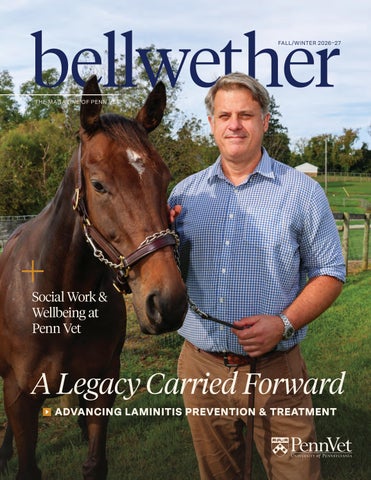
Twenty years ago, Dean Richardson, then New Bolton Center’s chief of surgery, performed a surgery that thousands of horse lovers were rooting for: an attempt to save the shattered leg and the life of Barbaro, winner of the 2006 Kentucky Derby. As the weeks went by, his recovery seemed promising. But then, Barbaro was diagnosed with laminitis, the hoof disease that ultimately led to his demise. Yet Barbaro did not die in vain. Inspired by this wonder horse, millions of dollars have been raised for laminitis research. That includes at Penn Vet, where Andrew van Eps and his team of researchers have made significant inroads in the fight against laminitis. Turn to page 4 to learn about their efforts. Photo by Sabina Louise Pierce
FALL/WINTER 2026–27 #106
2
DEAN’S MESSAGE
21
BOARD NEWS
Penn Vet’s Fight Against Laminitis
Contents
The Legacy of Barbaro
8 Helping the Helpers Social Work & Wellbeing at Penn Vet
28
Penn Vet’s Summer Research Program Has Launched 562 Careers in Science, and Its Main Funder Is About to Walk Away
FACULTY/ STAFF NEWS
32
18 Connected in Caring Giving Now, Giving Forward
12
EVENTS
Twelve Weeks, Lifelong Impact
Mighty Murphy
22
Ryan Critical Care Team Give a Rescue Puppy a Second Chance
25 Years of Impact
Penn Vet’s Swine Center
ABOUT THE COVER Andrew van Eps stands with Iris, a New Bolton Center teaching horse. Van Eps and his team at the van Eps Laminitis and Endocrinology Laboratory are at the forefront in the fight against laminitis. Read about their groundbreaking research and how it is helping horses on page 4.
Explore past issues of Bellwether magazine online at pennvet.pub/bellwether-archives.
STUDENT NEWS
Departments
4
24
15
34
ALUMNI NEWS
38
IN MEMORIAM
40
CALENDAR
DEAN’S MESSAGE
Dear Friends of Penn Vet, This time last year, we introduced Penn Vet’s strategic framework entitled United by Purpose. Built for Impact 2025-2030, defining our priorities for the next five years.
These pillars include advancing world-class specialty care, increasing access to care, leading in global health and One Health initiatives, driving agricultural innovation, and nurturing wellness in our profession. Innovation is at the heart of these strategic priorities, yet some of the most important work we do here happens when no one is watching. It happens in the small hours, as it did when our critical care team at Ryan Hospital used a ventilator to save a puppy struggling to breathe (page 12). That team succeeded because of everything built way before that night: the training, the equipment, and the team. This issue of Bellwether is about that kind of building for the future, so we are ready for our patients any time, day or night. It is about the facilities taking shape on our north campus at New Bolton Center, from the new Gail P. Riepe Center for Advanced Veterinary Education to the groundbreaking of our state-funded Veterinary Diagnostic Laboratory (page 24). It is about the questions our researchers are asking, none more pressing than how to prevent, detect, and treat equine laminitis, at the center of our cover story featuring Dr. Andrew van Eps’ work. It is about caring for our front-line caregivers through clinical social work and driving connections in our community (page 8). And it is about the next generation of veterinary scientists, who discover through our NIH-BI Summer Research Program that a single summer can change the course of a career (page 15).
2
BELLWETHER FALL/WINTER 2026–27
Now, if you’re wondering about the progress of our priorities, one year in, it’s shaping up like this. We are expanding access to care with our forthcoming (2027) Primary Care Mobile Veterinary Unit, which will support rescue partners and community programs while providing our students with hands-on experience. We are advancing One Health through a crossuniversity certificate program and our leadership in the Pennsylvania One Health Consortium. We are pushing agricultural innovation forward at New Bolton Center, where our Swine Teaching and Research Center and ag-tech firm AgriGates are using AI to inform livestock care and management. What strikes me most is how much of this progress rests on the trust, compassion, and generosity of others. To our donors, legislators, alumni, clients, and partners: thank you for building this future with us. To our faculty, clinicians, and staff: thank you for the work that others may never see but that so many depend on. Together we are united by purpose, and together we will keep building for impact. Enjoy the issue.
ANDREW M. HOFFMAN, DVM, DVSc, DACVIM Gilbert S. Kahn Dean of Veterinary Medicine
CONTRIBUTORS
bellwether From her home base in Philadelphia, Sacha Adorno writes about people, institutions, and businesses working to make the planet a better place for all life on it. As director of content and news media, Rita Giordano tells the stories of Penn Vet’s people and animals, as well as the research and initiatives that make this a groundbreaking institution. Sabina Louise Pierce is a Philadelphia-based photojournalist and National Geographic Explorer who has spent more than three decades documenting the powerful connections between people, animals, and the natural world.
EDITORIAL EDITOR Rita Giordano DEPUTY EDITOR John Donges CONTRIBUTING EDITOR AND WRITER Sacha Adorno WRITER AT LARGE Martin J. Hackett CLASS NOTES EDITOR Laura Brown
DESIGN DESIGNER Anne Marie Kane, Imogen Design PHOTOGRAPHERS AT LARGE John Donges, Ashley Hinton, Sabina Louise Pierce
ADMINISTRATION GILBERT S. KAHN DEAN OF VETERINARY MEDICINE Andrew M. Hoffman, DVM, DVSc, DACVIM SENIOR ASSOCIATE DEAN OF DEVELOPMENT AND ALUMNI RELATIONS Jonathan Evans ASSISTANT DEAN OF STRATEGIC COMMUNICATIONS Martin J. Hackett DIRECTOR OF ALUMNI RELATIONS Laura Brown
CHANGE OF ADDRESS Sarah Trout Office of Institutional Advancement School of Veterinary Medicine University of Pennsylvania 3800 Spruce Street Suite 151E Philadelphia, PA 19104 strout@vet.upenn.edu 215.746.7460
None of these articles is to be reproduced in any form without the permission of the School. ©2026 by the Trustees of the University of Pennsylvania. The University of Pennsylvania seeks talented students, faculty, and staff with a wide variety of backgrounds, experiences, and perspectives. The University of Pennsylvania does not discriminate on the basis of race, color, sex, sexual orientation, religion, creed, national origin (including shared ancestry or ethnic characteristics), citizenship status, age, disability, veteran status or any other class protected under applicable federal, state, or local law in the administration of its admissions, financial aid, educational or athletic programs, or other University-administered programs or in its employment practices. Questions or complaints regarding this policy should be directed to the executive director of the Office of Equal Opportunity Programs; Franklin Building, 3451 Walnut Street, Suite 421, Philadelphia, PA 19104-6106; or 215.898.6993.
WWW.VET.UPENN.EDU/BELLWETHER
3
TH E L E GAC Y O F BA R BARO by Rita Giordano
Penn Vet’s Fight Against Laminitis Racing fans and horse lovers the world over will always cherish the memory of Barbaro, the undefeated colt from Chester County, pounding his way to a commanding 6 ½-length victory at the 2006 Kentucky Derby. Nor will they forget the horrific injury just weeks later, moments before the running of the Preakness, that shattered one of his legs. Or the heroic effort by New Bolton Center’s surgical team that saved his leg and, for a while it seemed, his life, only to have him stricken by laminitis, a condition that afflicts the hoof. He was euthanized on January 27, 2007. But Barbaro’s legacy lives on, and it is a legacy of life. An untold number of horses have been saved through the laminitis research that the big, bay Thoroughbred has inspired. And while there is still no cure for laminitis, the two decades since Barbaro was diagnosed have brought substantial advances in prevention, detection, and treatment. “Our understanding then, which is now almost 20 years ago, really was nothing compared to now,” said Andrew van Eps, Penn Vet professor of equine musculoskeletal research and director of the van Eps Laminitis and Endocrinology Laboratory at New Bolton Center. “We really do understand it a lot better.” Van Eps is also Penn Vet’s Dean W. Richardson Endowed Chair of Equine Disease Research, a
4
BELLWETHER FALL/WINTER 2026–27
position named in honor of Barbaro’s New Bolton Center lead surgeon and created with funding from Roy and Gretchen Jackson, Barbaro’s owners. The Jacksons have been generous supporters of laminitis research, particularly at Penn Vet, where the Laminitis Research Fund, as well as the Barbaro Fund for Excellence, which supports equine care at New Bolton Center, have received millions of dollars in donations, large and small. To the Jacksons, helping laminitis research is a fitting way to honor the horse whose struggle touched so many people. “We got letters from every state in the country, and I think 13 foreign countries. We got a couple of letters from China,” said Roy Jackson. He and
“Our understanding then, which is now almost 20 years ago, really was nothing compared to now. We really do understand it a lot better.” Andrew van Eps
Dr. Andrew van Eps speaks
with Jeaneen Sage, manager of the Laminitis and Endocrinology Laboratory at New Bolton Center.
Gretchen kept many of them. “It helped us get through the whole thing.” Many in the veterinary research community have contributed to the fight against laminitis, with Penn Vet’s efforts at the forefront. Laminitis occurs when the lamellae, or the tissues that suspend the coffin bone within the hoof, lose their structural integrity, resulting in attachment failure between the hoof wall and bone. At the time of Barbaro’s injury, most awareness was on supporting limb laminitis—laminitis that usually occurs after an injury like the one Barbaro experienced. Since then, researchers agree there are three types of laminitis with different underlying mechanisms—supporting limb laminitis, sepsis-related laminitis, and endocrinopathic laminitis, which is associated with insulin dysregulation or hyperinsulinemia. During a presentation at the American College of Veterinary Internal Medicine Forum last June, van Eps said the key to successful laminitis management and treatment is early detection and identifying and addressing the cause. At van Eps’ lab, positron emission tomography (PET) is being explored as a means to identify early indicators of developing laminitis before symptoms appear, as well as to perform diagnostic monitoring of existing cases by showing cellular, metabolic, and chemical activity and change. Using PET, they are also able to map the effects of limb load on blood perfusion of the foot in three dimensions, critical to understanding and preventing supporting-limb laminitis.
One of the lab’s biggest achievements, said van Eps, is their published findings on using digital X-ray technology as an early diagnostic tool. Prior to their paper, it was believed that early laminitis couldn’t be seen in a plain X-ray, he said. “What we showed is that you can detect acute (early) laminitis using specific measurements, in the first three days on a plain digital X-ray.” It’s giving horses a much better chance. “One of the problems we run into with laminitis is that once it’s established and more severe, it’s irreversible,” van Eps said, “But if you can catch it early, change some things and remove the inciting factors, then it goes a long way to improving outcomes.” The New Bolton Center lab is working on multiple research fronts to address the different forms of laminitis. As they deepen their understanding of this disease, research team members are developing new devices, pursuing more effective medical and therapeutic management, and providing clinical support. Their endocrine lab is a significant example. “Our endocrine lab is a big part of what we do, and we feel like we help a lot of horses,” van Eps said. As metabolic health screening for horses, including for insulin, has become more routine, the demand for fast, accurate test results has grown. Van Eps said their lab receives upwards of 200 samples a week from across the country.
WWW.VET.UPENN.EDU/BELLWETHER
5
From left: Keith Bartley sits at his desk in the fabrication lab viewing a 3D scan of a patient’s hoof; Bartley and Dr. Andrew van Eps inspect a newly printed orthotic shoe; Bartley fits the orthotic shoe on a patient.
“We do turn around testing quickly, we offer comprehensive panels, and we do offer expert advice and consultation,” he said. Van Eps also regularly collaborates with New Bolton Center clinicians on treatment for their patients. One of them is Kara Brown, assistant professor of equine sports medicine and rehabilitation. Having a lab that can give same-day results has been extremely helpful in making well-informed care decisions. One big example is whether to administer corticosteroids. A treatment option for horses with osteoarthritis, she said, corticosteroids, when given to horses with endocrine disease, can increase the risk of laminitis. “As a sports medicine practitioner, it’s absolutely my worst nightmare,” she said. “I do not want to create a problem that the horse did not have already.” Now she can get accurate test results quickly, so she and horse owners—who often come from far away and cannot make repeat visits—can make the best possible treatment choices.
6
“He has discovered new information about the pathophysiology of the different kinds of laminitis—enough to start defining the common threads mediating the injury at the connection of the hoof to the tissue below. Once you discover the underlying mechanisms, then you can develop defenses against it. That’s what he’s doing right now,” Hinrichs said. “It’s all wonderful.” Van Eps said his team has made supporting limb laminitis a particular part of its mission “because this lab is a legacy of Barbaro.” That has included refining a robotic sling device that could help prevent laminitis in horses recovering from limb injury. Similarly, he said his lab now has a prototype for a dynamic orthotic—a pneumatic shoe-like device—that could help prevent laminitis in the supporting limb of horses that have had serious injuries. In addition, van Eps’ lab has conducted and continues to conduct extensive studies of equine motion patterns, blood perfusion, limb load, and more.
“It’s a substantial benefit for my practice and clients, because I work with a lot of horses with metabolic diseases,” she said.
Keith Bartley, a laminitis research specialist who had previously worked at Children’s Hospital of Philadelphia, conducted research in his career using artificial intelligence to examine facial expressions, posture, and locomotion as a means of diagnosing autism, van Eps said.
Katrin Hinrichs, Harry Werner Endowed Professor of Equine Medicine and Chair of the Department of Clinical Studies—New Bolton Center, said van Eps’ extensive research into laminitis and its causes is providing real-life relief to many horses.
“We’re applying similar technology to horses as a means of analyzing limb motion for early identification of laminitis risk in horses with painful limb conditions such as fractures, just like Barbaro.”
BELLWETHER FALL/WINTER 2026–27
If you have questions about the Laminitis Research Fund or the Barbaro Fund for Excellence or wish to be supportive, please contact Shoshana Milovsky at milovsk1@vet.upenn.edu.
New Bolton Center while Barbaro was a patient. He served as a faculty member back in Australia several years before he was brought back to Penn Vet as a laminitis researcher.
Dr. Andrew van Eps observes the patient’s gait as he walks wearing the new orthotic shoes.
They’ve also had success with cases at high risk for laminitis. In addition, they’re looking at numerous pharmaceutical strategies. For example, they recently published studies on bexagliflozin and pioglitazone, drugs already used in humans and cats to treat diabetes, as treatments to suppress insulin and prevent and treat laminitis in horses. They’re now looking at the effect of botulism toxin injection—Botox—to relax the hoof’s flexor tendon and help in some laminitis cases. Interestingly, the man whom Dean Richardson called “the preeminent laminitis researcher in the world” didn’t always expect to focus on veterinary science. “I was interested in people earlier. I did a year of applied science in human sports physiology,” van Eps said. While he was a veterinary student at the University of Queensland in Australia, he formed a research mentoring relationship with Christopher C. Pollitt, one of his professors. “He was doing some really pioneering research that challenged the dogma that existed about why laminitis happened,” said van Eps. Working with Pollitt, van Eps did his PhD thesis on the benefits of therapeutic hypothermia for horses with laminitis, research that is still in clinical use. From 2005 to 2008, he did a residency in largeanimal internal medicine at Penn Vet; he was at
If Barbaro’s injury had happened today, Richardson said he thinks the outcome could well be different. “If we had a horse come into New Bolton today with the exact same injuries as Barbaro, I would certainly expect better than a 50-50 chance to save his life for sure,” said Richardson, Charles W. Raker Emeritus Professor of Equine Surgery. “I wouldn’t consider it a long shot, whereas that wasn’t probably the case 20 years ago.” Then as now, preventing laminitis is key. “His chances of not getting laminitis would have been better because our surgical tools and techniques are better now than they were 20 years ago. That would have made a difference,” he said. Laminitis might not have developed after what at the time had appeared to be a successful surgical resolution of the horse’s injuries. And today, said Richardson, so much more is known about the disease and the hooves it afflicts. “The understanding of it has advanced so dramatically that I think so have the prospects of figuring out how to prevent it and, furthermore, to actually do scientific testing that could prevent laminitis,” he said. “That’s again all things in which Andrew is at the vanguard.”
“If we had a horse come into New Bolton today with the exact same injuries as Barbaro, I would certainly expect better than a 50-50 chance to save his life for sure.” Dean Richardson
WWW.VET.UPENN.EDU/BELLWETHER
7
BY SACHA ADORNO
W ,L CS W
Part one of a two-part series. A future issue will examine Penn Vet’s work to support student wellbeing.
S ALE A CUMMINGS, M
THE HELPERS
Social Work & Wellbeing at Penn Vet
DURING THE PANDEMIC, MANY OF US TURNED TO MR. ROGERS FOR COMFORT. “LOOK FOR THE HELPERS,” HE ONCE SAID. SO, WE DID. Alea Cummings, MSW, LCSW, Penn Vet’s associate director of wellbeing and veterinary social worker, was especially interested in how the helpers themselves were faring. Were they holding up under the stress of an unprecedented global pandemic? Were their workplaces equipped to support them? A trauma-trained social worker, in 2020, Cummings had spent roughly a decade in rape-crisis and child-advocacy settings. Trained in trauma-focused clinical approaches, she worked alongside law enforcement, medical providers, child protective services, and others responding to sexual violence and trafficking. Over time, her work expanded beyond counseling to examining the conditions that can leave people vulnerable. During COVID-19, she watched essential workers face profound stress, often without adequate institutional support. “I was seeing one field after another struggling to help their people,” she said. “I really wanted to take my training and apply it to helpers.” Alea Cummings, MSW, LCSW, and Ella Chasan, MSW, LSW, CVT
8
BELLWETHER FALL/WINTER 2026–27
Through her sister, a veterinarian at the University of California–Davis, she was aware of the stressors of practicing veterinary medicine.
Penn Vet was ready to have hard conversations and make meaningful changes in how we approach mental health and wellness, rather than treating wellbeing as a checkbox.”
Alea Cummings
Cummings saw an area where she could help the helpers. “Penn Vet was ready to have hard conversations and make meaningful changes in how we approach mental health and wellness, rather than treating wellbeing as a checkbox,” Cummings said. She joined the School in 2022 and has helped shape a program that has grown well beyond its original mandate.
Deeply rewarding, deeply intense work Veterinary medicine is deeply rewarding. It’s also not easy. Clinicians and staff care for animals in pain and people in distress, navigating grave prognoses, euthanasia, financial constraints, and long hours. They weigh medical judgment against what an owner can afford, what a family can bear, and, often, whether continued treatment is in an animal’s best interest. Sometimes what’s best for a patient doesn’t align with what an owner decides.
Then there’s the pace. Patients may move from an exam room to imaging, critical care, or surgery within hours, while owners await answers and more patients wait to be seen. And outside of work, research consistently shows that maintaining work-life balance is key to wellbeing. Yet balance can be elusive. “It’s a pressure cooker,” said Daniella “Ella” Chasan, MSW, LSW, CVT, Penn Vet social work fellow, who spent 17 years as a veterinary nurse at Ryan Hospital before changing careers. “We would have really hard, emotional cases. Because things move quickly, there’s little time to process. Sometimes, it all kind of builds up.”
The pressure isn’t limited to clinics. Students and house officers have spent years meeting high expectations and are learning in an environment where they’re constantly evaluated, alongside equally accomplished peers. “Everybody assumes that the people around them are better at coping,” said Rachel Clarkin-Breslin, V’20, DACVCC, assistant professor of emergency and critical care and chair of the School’s Culture & Wellbeing Committee. “They think the way they can convey mental toughness is by being unfazed, but we’re all fazed at some point.” The perception can make it difficult to ask for help. Clarkin-Breslin said the social work service has helped shift this dynamic.
The social work team facilitates Ethics &
Communications Rounds with students on rotation in the Intensive Care Unit (ICU) , discussing moral injury, client communication best practices, and self-care. These rounds started as a result of student requests and are now a standard, embedded part of the ICU.
WWW.VET.UPENN.EDU/BELLWETHER
9
A confluence of care, education, and community When Cummings started at Penn Vet in 2022, her immediate priority was the clinical team after the pandemic. She began shadowing on rounds and in meetings. Soon, she took on a pet-loss support group and then wellbeing work at students’ request. Today, the Social Work & Wellbeing Service spans three interconnected areas: care, education, and community engagement. Cummings leads the effort with support from social work student interns and Chasan.
Clarkin-Breslin recalled one case involving a critically ill cat. The cat underwent emergency surgery and received intensive care. Both the owners and the clinical team were fully committed to saving the animal. But despite every effort, the cat developed multiple organ failure and continued to decline. “The owners understood what was happening medically,” ClarkinBreslin said. “But emotionally, they weren’t ready to accept where the case was headed. As their distress grew, it became harder for them to trust our medical team.”
Cummings also helps clinical teams deal with repeated exposure to trauma, loss, and difficult decisions. In a fast-moving hospital environment, emotions are sometimes misdirected. “Are you really upset with your colleague, or are you frustrated and devastated by the ramifications of a case?” Cummings said. One tool she teaches is low-impact debriefing. Rather than immediately revisiting the most troubling elements of a case, colleagues are encouraged to ask permission before beginning and start with less-emotional details. “We start with the least distressing material,” she said. “And we normalize asking for consent before talking about a really traumatizing case.” EDUCATION
At the Veterinary Social Work Journal Club, the team discusses recent
scholarly work on relevant subject matter. Left to right: Alea Cummings, Haley Choueiri, Dr. Ben Thompson, Iliana Strauss, and Ella Chasan.
CARE The care pillar serves faculty, staff, nurses, house officers, students, clients, and pet owners. Services include short-term counseling, safety planning, grief support, resource navigation, and referrals. “Our intervention is brief,” Cummings said. “We’re not the group that you go to for long-term therapy. But we are the people that you come to if that’s what you’re looking for and you have no idea where to find it.”
10
BELLWETHER FALL/WINTER 2026–27
Then social work stepped in, providing the clients space to talk through their fears and grief while helping the clinical team navigate a difficult conversation. Over time, the owners recognized they had done everything possible for their cat. “We can explain the medical reality of a case,” Clarkin-Breslin said. “But that doesn’t mean a client is ready to accept it. Having someone who can help people work through that gap allows us to focus on the patient while knowing the family is getting the support they need.”
The education pillar threads throughout the four-year VMD curriculum. Students encounter Cummings in classrooms, workshops, clinical experiences, and rounds. A central goal is to encourage peer support and connection in a high-achieving environment. “I can’t tell you how many times we’ve had students share that they felt like they were the only one who was feeling, ‘this is really hard,’” Cummings said. “Reducing isolation, making people feel more comfortable and aware of each other is one of the best interventions.” As part of the curriculum, the service gives students space to grapple with questions that don’t have easy answers.
Wellbeing rounds during patientcare rotations incorporate reflection, creative and expressive arts activities, and coping skills for the clinical environment. Ethics and communication rounds in the intensive care unit explore issues including suffering, euthanasia, financial constraints, and moral injury.
“Our mission is to help people in communities and groups discover they have the tools they need to be able to do this work and do it really well,” she said. “Those tools look a little bit different from person to person, specialty to specialty, group to group. But overall, it’s really about wanting individuals and communities to feel empowered, safe, and secure.”
“The goal is to equip tomorrow’s veterinarians with the tools and the insights to help them stay in this work for the long haul,” Cummings said.
To this end, Cummings hopes to grow the Penn Vet Social Work & Wellbeing Service.
COMMUNITY ENGAGEMENT The third pillar extends off campus. Through workshops, partnerships and policy work, the team looks at where animal and human health and community wellbeing intersect, whether that means helping families build safe relationships with pets or professionals understand how the bond between people and pets can influence the choices people make. Cummings said these efforts share the common purpose of breaking down silos. “The sooner we understand that we’re all in this together, the better it’s going to be for everybody,” she said. Deborah Sachs, a licensed clinical psychologist and member of Penn Vet’s Board of Advisors, praised the service’s approach. “I particularly love how it’s woven into the curriculum,” Sachs said. “It’s so important for students to have a deeper understanding of the psychological issues impacting their clients and to have the language when communicating about sensitive issues or even sometimes what may feel more mundane.”
Penn Vet recognized a need, responded to it, and is open to figuring out how to put this work into practice in ways that best serve its community.”
In just a few years, it has served hundreds of people. Despite operating with one full-time social worker and a rotating team of part-time trainees, the service has achieved a 95% engagement rate among those seeking services— meaning they followed up on resources and care—and, in a survey, 100% of respondents felt supported and would recommend the service to others. “Penn Vet recognized a need, responded to it, and is open to figuring out how to put this work into practice in ways that best serve its community,” Sachs said. “That’s really exciting. It makes me very excited about what Penn Vet is doing.”
Deborah Sachs She adds that the model Resilience is not it Cummings is careful about how she frames the service’s mission—and the language of resilience is not it. “Resilience is the donut when you get a flat tire,” she said. “It gets you to the auto shop. We want to go further.”
underscores a lesson familiar to anyone in a helping profession—to be an effective helper, you have to help yourself first. “It’s the saying about flying,” she said. “You’ve got to put on your own oxygen mask before you help others.”
Much further.
WWW.VET.UPENN.EDU/BELLWETHER
11
Mighty Murphy Ryan Critical Care Team Give a Rescue Puppy a Second Chance
By Rita Giordano
Murphy Moore is one lucky dog— and a much-loved one, at that. But about a year ago, it looked like this sunny yellow Lab mix would have a very different story. At only five months old, Murphy was rushed to Penn Vet’s Ryan Hospital in acute respiratory distress. He had severe bacterial pneumonia that wasn’t responding to antibiotics. Another specialty and emergency animal hospital had already said they couldn’t help him. Besides round-the-clock intensive critical care and cutting-edge medical support, the Penn Vet staff used a treatment that’s common in human care, but not available in many veterinary centers. Yet it proved crucial to Murphy’s recovery: ventilation. 12
BELLWETHER FALL/WINTER 2026–27
“He would not have made it. He needed the vent,” said Tereza Stastny, an assistant professor of emergency and critical care medicine and a lead veterinarian in Murphy’s case. A strong supporter of ventilation as a treatment option, Stastny said many veterinary clinicians are reluctant to use it because of a perceived low survival rate as well as its expense. However, research she took part in, published in 2025 by the American Veterinary Medical Association, found that if the animal can be kept alive for 24 hours, the survival rate is 52 percent.
“It’s lifesaving for when lungs start failing and get to the stage that Murphy’s were at,” she said. “It’s the only option.” Murphy’s owners, Sharon HallMoore and Bob Moore, couldn’t be more grateful. “Because of their dedication and expertise, they gave Murphy a second chance,” said Hall-Moore. “We’ll never forget how much they mean to us. Murphy means the world to us, and he’s now this fun-loving, happy puppy.” Murphy came into the Moores’ lives as an unexpected joy. The Bellmawr, New Jersey, couple’s beloved Lucy Lu, another yellow Lab mix, died in December 2024. For months, they couldn’t bear to think of getting someone new.
But then in early October 2025, Moore saw a listing for a yellow Lab mix puppy at the Brandywine Valley SPCA. They went to visit post-haste. It was love at first sight all around. “We brought him home that same day” Hall-Moore said. “Murphy chose us as much as we chose him. From the very first day, Murphy became an important part and a cherished member of our family. He brought joy and laughter and love back into our home.” The pup did have a kennel cough, but they weren’t overly concerned. The shelter sent him home with antibiotics. But Murphy’s condition quickly worsened. In the wee hours of October 10, a week after bringing him home, Hall-Moore was up with a coughing Murphy and a puppy pad on her lap. “I felt something funny on the puppy pad, so I flicked on the light. I noticed it was blood.” She woke Moore. “Murphy has blood coming out of his mouth!” she told him.
They rushed him to a South Jersey emergency animal hospital. A clinician told them Murphy’s condition was beyond what they could treat, that he needed to go right away to Penn Vet’s Ryan Hospital. The Jersey hospital called ahead. When they got to Ryan, “they immediately took Murphy from my arms and began treating him,” Hall-Moore said. “They indicated he was in severe respiratory distress, and his prognosis was guarded.” When they returned later that day, they were met by Jordan Tarbutton, a critical care resident, who along with Leanna Hoover, a fellow critical care resident, oversaw much of Murphy’s treatment. “Dr. Tarbutton brought us into the ICU to see Murphy and explained he had developed a severe case of pneumonia,” Sharon said. “She was honest about how critical his condition was. But she also reassured us they were committed to doing everything they could to save him.”
"From the very first day, Murphy became an important part and a cherished member of our family. He brought joy and laughter and love back into our home.” Sharon Hall-Moore
The u se playe of a vent ilato d an role in importan r t M Murp hy’s t ighty and r reatmen t ecove ry.
WWW.VET.UPENN.EDU/BELLWETHER
13
Mighty Murphy Moore on a visit to Ryan Hospital: (left to right) residents Jordan Tarbutton and Leanna Hoover, Sharon HallMoore, Murphy, Bob Moore, and Tereza Stastny. assistant professor of emergency and critical care.
During his almost two-week stay, Murphy received constant care and monitoring. Besides the ventilator, he was on a feeding tube plus he was put on a human-grade antibiotic. When he got stronger, he also received physical therapy, with students working with him. At one point, Murphy unexpectedly and abruptly died, but Tarbutton and Hoover working with nursing staff were able to bring him back with CPR. When Murphy came off the ventilator, the clinicians both made sure they were there. Murphy’s case was impactful for both residents. “I think going into this year, I had never had a ventilator patient survive, so I definitely was getting a bit discouraged. But since Dr. Stastny has come to Penn, we’ve definitely had a lot of big wins with ventilator cases,” Hoover said. “One of the things I love about mechanical ventilation is it really minimizes patient suffering,” she added. “You can take a very stressed animal and breathe for them and get them through the worst of their illness without them having to
14
BELLWETHER FALL/WINTER 2026–27
experience that frightening feeling of not being able to breathe.” Meanwhile, Murphy, a resilient little fighter, won over lots of hearts across the staff. When the Moores started an Instagram to show Murphy’s progress, a couple members of his care team suggested they call it Mighty Murphy Moore. The name stuck. Despite how sick he was, “he still was happy to see people and seemed very trusting of us taking care of him,” Tarbutton said. “Then once he came off the ventilator, he was always a good sport about doing physical therapy and us getting him to eat.” Tarbutton, who’s now also a ventilator supporter, and Stastny both have asked the Moores if they could discuss Murphy’s case in their lectures. They wholeheartedly agreed. “If Murphy can help educate others or contribute in some small way to helping another patient, we are more than happy to allow it,” said Hall-Moore. Nowadays the puppy who almost died is a one-year-old dog who loves
"As critical care specialists, it’s our job to hold onto hope and to care for the sickest of the sick and not give up if there’ s any chance of survival.” Tereza Stastny
fetching balls, swimming, and people—just like any healthy Lab. To Stastny, Murphy is what critical care is all about. “That’s the big takeaway from this case: As critical care specialists, it’s our job to hold onto hope and to care for the sickest of the sick and not give up if there’ s any chance of survival,” she said. “That’s what we did, and he made it through. Now he gets to live a long, happy, life.”
NATHAL IE O
RTH WO S L
EMIL YH U
N IYA NA
DEL AN E
SKYLER MUR PH ANYA C HI N
ELIJA HE L
Y
DEZ NAN ER ’H
BY RITA GIORDANO
S HE G
Y
TH OE
TWELVE WEEKS, LIFELONG IMPACT PENN VET’S SUMMER RESEARCH PROGRAM
HAS LAUNCHED 562 CAREERS IN SCIENCE, AND ITS MAIN FUNDER IS ABOUT TO WALK AWAY Delaney Oeth’s research this summer would have been momentous by anyone’s standards. Using specially engineered T cells, Oeth and her fellow researchers made the surprise discovery that immunological cells can not only kill the pathogenic cells found in pulmonary fibrosis, but they can also be used to attack the extracellular matrix that is part of this fatal lung disease. “This is important because the diseased extracellular matrix is the major component that causes the pulmonary fibrosis disease process,” Oeth said. “If we can get rid of the extracellular matrix, then we can start reversing some of that fibrosis and allow the lungs to work better.” “A eureka moment”—that’s how project lead investigator Ellen Puré, Grace Lansing Lambert Professor of Biomedical Science, described the finding. “We now know that activating these T cells will help get rid of this disease-causing matrix, and Oeth, working together with Henry Utset (a combined MD-PhD student in the lab) helped us figure out they’re sufficient to do that in part all by themselves,” said Puré, also director of the Penn Vet Cancer Center. “She contributed to our understanding of a very important novel function of T cells.” But Oeth wasn’t a veteran researcher. A first-year Penn Vet student, she nonetheless contributed to a discovery that could, in time, help save human and animal lives. She did this through the Penn Vet Summer Research Program. Since 1990, 562 Penn Vet students have taken
part in this program, which provides aspiring young scientists with stipends, mentors, and the opportunity to devote a summer to serious biomedical research. Each year, the students present their work at the international Veterinary Scholars Symposium. Initially funded by the Merck Foundation, the National Institutes of Health (NIH) is now the program’s primary sponsor. But that is about to end. After summer 2027, NIH has said it will no longer fund the program. “This is devastating to every vet school because the majority of them did get these NIH grants,” said Michael Atchison, professor in the Department of Biomedical Sciences and co-director of Penn Vet’s program. “It’s a huge loss.” For Penn Vet’s program, he said that means the loss of about $150,000 a year, which provided funding for 20 students last summer. Boehringer Ingelheim, a pharmaceutical firm that is the other program partner, funded four students. The program’s directors were able to raise the money within Penn Vet for another five students.
“This is devastating to every vet school because the majority of them did get these NIH grants. It’s a huge loss.” MICHAEL ATCHISON WWW.VET.UPENN.EDU/BELLWETHER
15
Those sums may not sound astronomical, but funding for any scientific research has become increasingly difficult to come by. Still, the Summer Research Program’s leaders are determined to seek other funding for this life-changing program.
entire field of veterinary medicine,” said Cole. “That’s what opens you up more—the opportunity to help an even greater number of animals or a greater number of people who love those animals or public health. That’s where the power of research truly is.”
“The program has been transformative for so many people, changing the trajectory of careers,” said Michael May, co-director and associate professor in the Department of Biomedical Sciences.
Cole has done pioneering work on antibiotic-resistant bacteria. A test he developed to identify some of these rare, resistant strains is used by veterinarians all over the country.
Seventy-seven percent of Penn Vet’s program graduates have gone on to pursue advanced study, compared to 40 to 44 percent of all veterinary graduates nationwide. Sixty of Penn Vet’s Summer Research Program alumni have entered PhD programs and 42 have pursued Master of Science degrees. In addition, although the program is only three months long, over 30 percent of its students have published research. Program graduates are two and a half times more likely to pursue science careers in academia, industry, and government than the national average.
The loss of future scientists and their breakthroughs has many people concerned about NIH’s withdrawal of financial support.
The program’s track record of nurturing future scientists is undeniable. Many students who start out just curious about research go on to discover a passion that can ultimately lead to healthier lives for people and animals. Stephen Cole, V’15, associate professor of clinical microbiology and director of Penn Vet’s Clinical Infectious Disease Lab, was not quite sure which way he would go when he signed up for the summer research program. “I kind of knew I wanted to stay in academia, but I didn’t know what route I wanted to take,” Cole said. “I never, never dreamed of running my own lab.” He credits the mentors he met through the summer program with helping him get on a career path where he can make a difference. “Once I got to the end of the second summer (in the program), I saw not only could I have an impact on individual patients, but I could have an impact on the
“The worst thing we can do for this country, in my opinion, financially, innovation-wise, is lose the next generation of scientists, and the veterinary students in particular bring a very different perspective than medical students, straight PhD students, or combined degree students,” said Ellen Puré, Oeth’s leader and mentor on expanding the use of T cells to fight idiopathic pulmonary fibrosis. Puré’s hoping to put their findings to the test soon in human clinical trials. She’s determined to not let budget cutters stop the research. “We can’t let them win, and the only way we let them win is if they stop us from going forward. So we just have to find a way,” Puré said. “I don’t want to condone what the federal government is doing, so I’m trying to fund my lab totally independent of it.” Atchison and May are also exploring replacement funds for the summer program. They want to keep encouraging students to do work that ultimately benefits us all.
Penn Vet’s 2026 Summer Research Program participants and (far right) program co-directors Michael Atchison, professor in the Department of Biomedical Sciences, and Michael May, associate professor in the Department of Biomedical Sciences.
Here are a few of the other Penn Vet students who took part in this summer’s program Elijah Ellsworth worked with Penn Vet’s Susan Volk, Corinne R. and Henry Bower Professor of Surgery, testing the effect of different kinds of collagen on feline mammary cancer, which is similar to an aggressive type of cancer in humans. “So this has cross-species applications,” Ellsworth said. They found that type 3 collagen has a suppressing effect on feline mammary cancer—an exciting discovery for the aspiring small animal surgeon. He couldn’t have participated in it without the program stipend, “It’s obviously a great experience,” he said, “but veterinary school is not cheap. I don’t speak for everyone, but I just don’t think most people have the funds to take a whole summer doing something without any sort of payment.” Emily Hughes is very interested in translational medicine so, for her second year in the program, she was psyched to be involved in research with David A. Hill, an associate professor of pediatrics at the Perelman School of Medicine and an attending pediatric allergist with Children’s Hospital of Philadelphia. They explored the impact of microRNA on metabolic regulation. The information may someday help with problems like eating disorders and obesity. “This further solidified that I want research to be part of my career,” Hughes said. Growing up loving horses, Skyler Murphy knows how devastating laminitis can be. So she’s thrilled to have spent the past two summers exploring cellular changes that occur with sepsis-related laminitis, working with Andrew van Eps, Dean W. Richardson Endowed Chair of Equine Disease Research and director of Penn Vet’s van Eps Laminitis and Endocrinology Laboratory, as her mentor. Now heading into her clinical years, Murphy plans to continue the research in her free time. “At this point, it’s like my baby. It has really developed into a passion project,” Murphy said.
“They’re not simply funding a summer of research. It’s investing in scientists and clinicians and researchers and the minds of the future in veterinary medicine.” ANYA CHINNAIYAN
Right to left: Delaney Oeth, a participant in the 2026 Penn Vet Summer Research Program, with research leader Ellen Puré, director of the Penn Vet Cancer Center and Grace Lansing Lambert Professor of Biomedical Science, and Henry Utset, MD-PhD candidate, who worked with Oeth.
Nathalie O’Hernandez is passionate about becoming a veterinary surgeon, but this past summer, her work with mentor Thomas P. Schaer, associate professor of comparative orthopedic surgery, on a device that could help dogs with lumbosacral disease convinced her research will make her a more effective surgeon. “Yes, I want to become a competent surgeon, but I also want to be able to take a role in research development that will continue to improve clinical outcomes,” she said. “You don’t want to dissuade people from getting into research because it’s such important work.” Anya Chinnaiyan, working with mentor Nicola Mason, Paul A. James and Charles A. Gilmore Endowed Chair Professorship with the Department of Clinical Sciences and Advanced Medicine, participated in research involving osteosarcoma, a bone cancer that afflicts dogs and humans. “This summer made it very clear that research needs to be in my life,” she said. “It was just so transformative.” That’s why taking away funding for other aspiring scientists is such a mistake, she said. “They’re not simply funding a summer of research,” Chinnaiyan said. “It’s investing in scientists and clinicians and researchers and the minds of the future in veterinary medicine.” If you have questions about the program or wish to be supportive, please contact Jocelyn Terranova, at jterra@upenn.edu.
WWW.VET.UPENN.EDU/BELLWETHER
17
Philanthropy
GIVING NOW, GIVING FORWARD
Connected in Caring BY SACHA ADORNO
If you’ve met one Penn Vet donor, you’ve met one Penn Vet donor. People support the School in different ways for different reasons, often very personal. More and more, donors are pairing current gifts with future estate commitments. This approach, known as blended giving, enables people to see their gift’s impact today while also extending it well into the future. We asked three philanthropic partners about their connections to Penn Vet and the commitments they’ve chosen to make.
“I wanted to do something to honor my dad. And this was it—it’s a great way to put money to work!” Susan P. Davis
Davis grew up on Long Island. Her father, Walton Perry Davis Jr., who “had an uncanny eye for horses,” ran the family’s moving, storage, and horse transportation business. “He got me into the horse world,” said Davis, who started riding at a young age, “often on horses other people no longer wanted.” She even trained with the U.S. Equestrian Team and famed coach Jack LeGoff on horses her father found. When she moved to Chester County, Pennsylvania, her friend and veterinarian, Andrew Elser, V’87, introduced her to New Bolton Center.
Susan P. Davis
For the Love of Family, Horses, and New Bolton Center The first time Susan Davis was thrown from her pony, she declared herself “done with horses.” Calling her bluff, her father prepared to sell the pony. “‘No, no, you can’t!’ I told him,” Davis recalled. The pony stayed, and so did her lifelong love of horses.
18
BELLWETHER FALL/WINTER 2026–27
First, Davis was a Penn Vet client; then a volunteer. She began doing whatever was needed—filling brush boxes, grooming horses, and working through lists left by students on their New Bolton rotations. Before long, she knew the clinicians, staff, and students, and had earned a reputation for being comfortable with horses that others might have preferred not to handle. “I even walked goats,” she recalled. “Or, more accurately, they walked me. If you’ve ever tried to walk a goat, you know.”
Marne L. Platt, V’93 Davis now lives in North Carolina. Her connection to New Bolton Center is as strong as ever. She has established three permanent funds to support the School, all named in memory of her father, Walton Perry Davis, Jr. The endowed funds provide assistance to Equine Sports Medicine and Rehabilitation services; the Opportunity Scholarship program through a scholarship that gives preference to students interested in equine medicine; and Large Animal House Officers, including residents and interns. Her scholarship fund has already supported its first recipient, Braden Speck, V’30. Davis has also included New Bolton Center in her estate plans, ensuring her commitment will extend beyond her lifetime. “I wanted to do something to honor my dad,” she said. “And this was it—it’s a great way to put money to work!”
Championing Early Career Veterinarians Marne Platt, V’93, was one of those kids who knew exactly what she wanted to be by age five—a veterinarian. When the time came, Platt chose Penn Vet for training, finding the confidence, community, and professional footing that would shape the rest of her life. After graduation, she practiced equine and small-animal medicine. But a few years in, her career path hit an obstacle—a big one. “I developed allergies to all species,” Platt said. Her childhood dream became physically impossible. Nevertheless, Platt stayed in the field, joining Novartis Animal Health in regulatory affairs, product development, and marketing. Her work brought her to Switzerland, where she led global teams and helped steer projects across markets and disciplines. “I may have left clinical practice, but I never stopped thinking like a veterinarian,” Platt said. The clinical framework she learned at Penn Vet—SOAP, for subjective, objective, assessment, plan—proved useful well outside the exam room. “SOAP gives you a way to take a complicated situation, understand the facts, and decide what to do next,” she said. The approach served Platt through industry, entrepreneurship, and writing. Today, she is semi-retired in Switzerland, where she runs Fundamental Capabilities, a consulting and communications practice built around what she calls “words,” specifically writing, reading, editing, and speaking them—and helping others do so confidently. Platt has been a class agent since graduation and, for the past six years, has served on Penn Vet’s Alumni Board in several roles. “Penn Vet made me who I am,” she said. This gratitude influences Platt’s philanthropy. Through her estate, Platt has made a bequest to support training and professional development of interns and residents. “Residents and interns are at such an important point in their careers,” Platt said. “They’re working hard, building specialized skills, and often carrying financial pressure at the same time.” Her gift is a practical way, she said, to support people at the beginning of their veterinary careers—and the School that opened doors she couldn’t have imagined at five years old.
WWW.VET.UPENN.EDU/BELLWETHER
19
PHILANTHROPY “I’ve always been impressed with Penn Vet’s orientation toward welfare,” he said.
Franklin D. McMillan, DVM
Caring for the Whole Animal — Emotions and All In 1994, Franklin D. McMillan, DVM, lost his Los Angeles home to the Northridge earthquake. The emotional stress this experience caused greatly affected his quality of life. At the time, McMillan said the experience raised questions about his private practice patients. “I came to see how everything I was doing was dictated by my emotional states,” he said. “I wondered, if I can be so affected by my emotions, what role do they play in the lives of the animals I care for?” He began researching animal emotions, convinced that veterinary medicine needed to look beyond outward behavior to how emotional distress can affect quality of life and physical health. “Historically, animal behavior was treated mechanically—there’s a problem, let’s fix that problem, without looking at what’s driving it,” he said. “But emotion is as big an issue for quality of life as physical health, if not bigger.” Since then, McMillan has become a leading voice in animal welfare and mental health, focusing on how trauma affects animals. His career has spanned private practice, academia, and nonprofit service—including Best Friends Animal Society, a pioneer in the sanctuary movement. He is the editor and co-author of Mental Health and Well-being in Animals, a foundational text.
When McMillan began considering endowing a professorship through his estate, he weighed Penn Vet against a few other institutions. “The School is advancing this area in ways I couldn’t find anywhere else,” he said. McMillan established the Franklin D. McMillan Endowed Professorship in Animal Welfare, Mental Health, and Behavior. Current support will allow Penn Vet to appoint the professor during McMillan’s lifetime; a future estate commitment then sustains the professorship. The name of the fund is a big deal. “I wanted the term ‘mental health’ included, because emotional wellbeing is an essential, if historically under-addressed, part of animal welfare,” he said. “Penn Vet had no problem with putting ‘mental health’ front and center. I know their commitment is going to make welfare, and especially animal mental health, a prominent issue.”
A graduate of The Ohio State University College of Veterinary Medicine, McMillan came to Penn Vet through James Serpell, PhD, emeritus professor of ethics and animal welfare, whose work closely parallels his own.
“Penn Vet had no problem with putting ‘mental health’ front and center. I know their commitment is going to be to make welfare, and especially animal mental health, a prominent issue.” Franklin D. McMillan, DVM 20
BELLWETHER FALL/WINTER 2026–27
learn more To learn more about making an impact through a planned gift or bequest, contact the Penn Vet Office of Development and Alumni Relations at vetplannedgiving@vet.upenn.edu or 215.898.1480.
BOARD NEWS
BOARD OF ADVISORS WELCOMES
Deborah Wei Dayton Deborah Wei Dayton, president of Weitron, Inc., a Delaware-based industrial refrigerants manufacturer and packager, has been appointed to the Penn Vet Board of Advisors. Dayton brings decades of business leadership experience, a commitment to sustainability, and a personal passion for animal welfare to her new role. Dayton co-founded Weitron in 1993 with her husband, Colin Dayton. Under her leadership, Weitron has grown into a global operation serving the automotive, residential, commercial, and industrial sectors, with offices and warehouses across the United States and China. The company expanded into the Asia-Pacific region in 2001 and to the West Coast in 2007. In 2017, Weitron built a refrigerant gas facility in North Carolina, and in 2022, it became a Clean Air Act Section 608 certified reclaimer by the Environmental Protection Agency, a certification that allows Weitron to facilitate refrigerant recovery and reclamation for grocery store chains and other applications. Sustainability remains central to Weitron’s mission as the company continues to pioneer low-global-warming refrigerant solutions for the industry. Dayton has also fostered a company culture that prizes innovation and invests in its people. “I am delighted to welcome Deborah to Penn Vet’s Board of Advisors,” said Andrew Hoffman, DVM, DVSc, DACVIM, the Gilbert S. Kahn Dean of Veterinary Medicine. “Her success in building Weitron into a global leader in refrigerant solutions, her commitment to sustainability, and her dedication to fostering an innovative, people-first culture speak to her vision and drive. Deborah’s generous support of the Best Dog Good Samaritan Fund further reflects a genuine commitment to the animals and families we serve. We are fortunate to have her insight and dedication as we continue to advance Penn Vet’s mission.” A three-time graduate of the University of Pennsylvania, Dayton earned a Bachelor of Science in economics and an MBA from the Wharton School, as well as a Bachelor of Science in engineering. Her Penn ties extend to the next generation: her children, Cara and Ryan, are also Penn graduates. Dayton’s passion for animal welfare is reflected in both her personal life and her philanthropic work. A horse and dog owner for many years, she and her family have long been clients of both Ryan Hospital and the School’s large animal hospital, New Bolton Center. In 2022, she established the Best Dog Good Samaritan Fund at Ryan Hospital, which has positively impacted the care of numerous animals and their families seeking veterinary care. Dayton has also supported several clinical priorities at New Bolton Center.
“Animals have always been part of my family’s life, and we’ve relied on Penn Vet’s expertise and compassion for many years. I’m honored to give back to an institution that has meant so much to us, and I look forward to supporting its mission for animals and the people who love them.” DEBORAH WEI DAYTON Board Member
WWW.VET.UPENN.EDU/BELLWETHER
21
25 YEARS
BY RITA GIORDANO
OF IMPACT AT PENN VET’S SWINE CENTER
Jeremy Maurer is a city kid, so when he started at Penn Vet, pigs were about the last thing on his mind. “I’m originally from Philadelphia, so my exposure to livestock was basically zilch,” said Maurer, a 2016 grad.
Penn Vet’s Swine Teaching and Research Center at New Bolton Center celebrates its 25th anniversary this year. For a quarter of a century, it has been inspiring careers, including those that might never have happened if not for this unique institution.
But an internship with an animal health and pharmaceutical company introduced him to precision livestock technologies. It lit a spark. Maurer turned to Penn Vet’s Swine Teaching and Research Center. He found a progressive approach to animal welfare and productionanimal medicine that inspired him. Maurer now has a career he loves, working in precision livestock technology. “I know that without there being a swine medicine division at Penn Vet, I never would have found my way into this career,” Maurer said. The center has also had a big impact on agriculture in Pennsylvania and elsewhere, industry experts say. In Pennsylvania now, about 80 percent of sows are kept in open pen housing, as opposed to confined gestation crates, according to Chris Herr, executive vice-president of the PennAg Industries Association, a major agricultural advocacy organization representing the state’s hog and poultry farmers. He credits the swine center’s influence. “I look at the work they’ve done as really helping change the way hogs are raised in America and the world,” Herr said.
22
BELLWETHER FALL/WINTER 2026-27
But 25 years ago, Thomas D. Parsons, founder and director of the swine center, didn’t know what was ahead when he set out to create a working hog barn of the future. “This has exceeded my wildest dreams,” said Parsons, Marie A. Moore Professor of Animal Welfare and Ethics. Well-known for its advocacy of open pen housing and electronic feeding systems for gestating sows, other center research like Professor of Reproduction and Swine Health Gary Althouse’s work on reproduction and disease control has brought other important innovations. Now associate dean of sustainable agriculture and veterinary practices and Marion Dilley and David George Jones Endowed Chair in Animal Reproduction, Althouse was recruited from the University of Illinois in 2001, lured by the opportunities of “our living lab.” “Dr. Althouse has been probably the most important, influential person in my business,” Mac Magee, general manager of Pennsylvania-based Commercial Concepts AI, the largest independent, commercial boar stud operation in the country. “I don’t know if we would exist if it wasn’t for Dr. Althouse.”
Left to right: Swine Teaching and Research Center piglets; Thomas D. Parsons, Swine Center founder and director and Marie A. Moore Professor of Animal Welfare and Ethics; Meghann K. Pierdon, V’05, associate professor of clinical production medicine.
The innovation continues. In May, a ribbon-cutting was held at New Bolton Center to celebrate what Parsons calls “the next chapter in the swine center’s journey”— DAT-AI-LAB, an initiative that uses AI to understand animal behavior. It’s a collaboration with AgriGates, a Philadelphia-based agritech firm. “Without the swine center, I don’t think we would be where we are in unlocking animal behavior through AI,” said Daniel Foy, AgriGates co-founder and CEO. But the center’s first goal has always been teaching. Some graduates have gone on to become farmanimal veterinarians like David “Bucky” Buckwalter, V’26. Growing up in rural Pennsylvania, Buckwalter knew he wanted to work with food production animals when he came to Penn Vet. But he thinks all students find the center a special place. “Even if you have zero swine experience coming into vet school like some of my classmates, they loved being at the swine center,” said Buckwalter. Like Jeremy Maurer, Heather Fowler, V’10, was a city kid. “I don’t think I ever touched a pig until vet school,” the Trenton native said. But in undergraduate school, a public health class seized her imagination. So at Penn Vet, Fowler took a rotation at the swine center. “It’s what really pushed me to continue that route in public health,” she said. Today, Fowler is the National Pork Board’s director of producer and public health. “I am here through those experiences and opportunities I was afforded at the swine center at Penn Vet,” said Fowler.
(Top) Gary Althouse, professor of reproduction and swine health; and (bottom) Heather Fowler, V’10, National Pork Board’s director of producer and public health.
Meghann K. Pierdon, V’05, a Vermont native, had planned on a career in dairy cattle when she arrived at Penn Vet. But she needed a summer job, and New Bolton Center’s dairy barn wasn’t hiring. The swine center was. Now Pierdon, an associate professor of clinical production medicine, is one of the center’s chief educators and mentors. Pierdon was Tara Gaab’s mentor. Now an assistant professor of animal science at the University of Delaware, Gaab, V’17, brings her students to the swine center. Lots of them get hooked, too. “It has a way of converting you,” Gaab said. “It’s this model for what the industry could be if we are creative and clever and caring enough. We don’t have to just be what we’ve always been.”
WWW.VET.UPENN.EDU/BELLWETHER
23
EVENTS
New Bolton Center’s
North Campus Expansion Penn Vet celebrated the opening of the Gail P. Riepe Center for Advanced Veterinary Education with a ribbon cutting in late August. The clinical skills hub is the first dedicated classroom space at New Bolton Center, as well as the first installment in a three-project redevelopment of the North campus. The Veterinary Diagnostic Laboratory, the second project, broke ground in early October. This state-funded facility will bring together the New Bolton Center laboratory of the Pennsylvania Animal Diagnostic Laboratory System and the Pennsylvania Equine Toxicology Research Laboratory.
24
BELLWETHER FALL/WINTER 2026–27
RIEPE CENTER RIBBON CUTTING
EVENTS
VETERINARY DIAGNOSTIC LABORATORY GROUNDBREAKING
WWW.VET.UPENN.EDU/BELLWETHER
25
COMMENCEMENT
CLASS OF 2 02 6
On May 18 members of the Class of 2026 walked across the stage at Zellerbach Theatre to receive their Veterinariae Medicinae Doctoris.
Lisa Germanis, V’08, Medical Director and Director of Forensics for the Pennsylvania SPCA, delivered the commencement address. Class president Jennifer Grell (left) addressed her classmates and Patricia Brown, V’78, presented the class flag. Holly Yost, V’25, administered the Veterinarian’s Oath. 26
BELLWETHER FALL/WINTER 2026–27
AWB GRADUATION
Animal Welfare and Behavior Program Graduation MASTER OF SCIENCE RECIPIENTS Sita Acharya Ailena Baum Makayla Noel Clemens Lindsay Elizabeth Daly Spike Dougherty Melissa Dragon Amelia Rose Eigerman
On June 12, 25 Master of Science and two Graduate Certificate recipients were honored at Penn’s Fisher Fine Arts Library Building during the Animal Welfare and Behavior Program’s graduation weekend. Cynthia Otto, DVM, PhD, DACVECC, DACVSMR, delivered the keynote address, and Karen Verderame gave the student address.
F. Kelly Greiner Helena G. Harris Melissa Wynne Heisey Reeci Arianna Herrera Vienna Paulina Morales Anna Levouna Mukhina Nat Neal Susanne Bateman Olsen Emily Pearson Ines Rodriguez Margaret Rogers Nicole Leigh Rowley Andrew Timothy Stevens Karen Verderame James Walton Julia Elisabeth Wiggen Lydia Grace Wolf Taylor Yurick
GRADUATE CERTIFICATE CANDIDATES Cole Lachowicz Max Luma WWW.VET.UPENN.EDU/BELLWETHER
27
FACULTY/STAFF NEWS
Faculty/Staff News Hayley Amerman, DVM, DACVP, was appointed as assistant professor of anatomic pathology (AC).
Jessie Cathcart, DVM, received the 2026 William B. Boucher Award for Outstanding Teaching at New Bolton Center.
Montserrat Anguera, PhD, was promoted to professor of biomedical sciences.
Stephen Cole, VMD, MS, DACVM, received the 2026 Giles Scientific BIOMIC Excellence in Veterinary Diagnostic Microbiology Award from the American Association of Veterinary Laboratory Diagnosticians. He was also promoted to associate professor of microbiology.
Susan Bender, VMD, PhD, DACVP, received the 2026 Zoetis Distinguished Veterinary Teacher Award. M. Andrés Blanco, PhD, was promoted to associate professor of biomedical sciences. Rob Briley retired from the Pennsylvania Egg Quality Assurance Program at New Bolton Center after 37 years.
Arin Cox, DVM, DACVP, was appointed as assistant professor of comparative pathology (AC). Stefano De Arcangeli, DVM, PhD, DACVP, was appointed as assistant professor of clinical pathology (AC).
Julie Ellis, PhD, was promoted to adjunct professor of pathobiology. Klaus Hopster, DVM, PhD, DECVAA, was promoted to professor of anesthesia. Carole Johnson, RTR, retired after 45 years of service at New Bolton Center. Leslie B. King, PhD, retired from Penn after 30 years, the last 25 at Penn Vet as scientific director of grant development. Jennifer Lenz, DVM, DACVIM, was promoted to associate professor of small animal medical oncology. David G. Levine, DVM, DACVS, DACVSMR, was promoted to professor of clinical large animal surgery.
Lindback Award Kimberly A. Agnello, DVM, DACVS, DACVSMR, received the Christian R. and Mary F. Lindback Award for Distinguished Teaching. Elizabeth M. Woodward, PhD, received a Provost’s Award for Teaching Excellence by Non-Standing Faculty. Left to right: Dr. Amy Durham, Dr. Elizabeth M. Woodward, Dr. Kimberly A. Agnello, and Dean Andrew Hoffman
28
BELLWETHER FALL/WINTER 2026–27
FACULTY/STAFF NEWS
Left to right: Dr. Lauren Powell, Dr. Oyebola Oyesola, Dean Andrew Hoffman, Dr. Dipti Pitta, and Dr. Stephen Cole, at the fall Faculty Reception celebrating 2025-2026 promotions and appointments.
Eric Littman, DVM, CertAqV, was appointed as adjunct associate professor of zoo and exotics companion animal medicine. Vengai Mavangira, BVSc, PhD, DACVIM, was appointed as associate professor of laboratory animal medicine (AC). Soledad Martín-Peláez, DVM, DACT, was appointed as assistant professor of large animal reproduction (CE). Nicola Mason, BVetMed, PhD, DACVIM, FRCVS, was elected to the National Academy of Medicine. Megan McClosky, DVM, DACVIM, was promoted to associate professor of small animal internal medicine. Uchenna Nlebedum, DVM, PhD, was appointed as assistant professor of veterinary gross anatomy (AC).
Donna Oakley, CVT, VTS, director of clinical governance, retired after a 45-year career at Ryan Hospital. Dayoung Oh, DVM, MS, DACVR (RO), was appointed as assistant professor of radiation oncology (AC). Kyla Ortved, DVM, PhD, DACVS, DACVSMR, has been named the first recipient of the American College of Veterinary Surgeons Rising Star Award. Sangwan Park, DVM, PhD, DAVCO, was appointed as assistant professor of ophthalmology (CE). Mariah Pearson, DVM, DACT, was appointed as assistant professor of large animal reproduction (CE) Mary Ann Pickel, financial administrative coordinator, retired from New Bolton Center’s hospital after 33 years. Meghann Pierdon, VMD, DACAW, was promoted to associate professor of production medicine.
Left to right: Dr. Helen Aceto, Dr. Patricia Sertich, and Dr. Regina Turner celebrate their retirement from New Bolton Center last April.
Dipti Pitta, BVSc, MVSc, PhD, was promoted to professor of ruminant nutrition. Jamie Sebastian, DVM, DACVIM, was appointed as assistant professor of medicine (CE). Jackie Shanley, CVT, retired after serving many years at Ryan Hospital. Boris Striepen, PhD, received the Alice & C. C. Wang Award in Molecular Parasitology from the American Society for Biochemistry and Molecular Biology. WWW.VET.UPENN.EDU/BELLWETHER
29
FACULTY/STAFF NEWS
WELCOME EXECUTIVE DIRECTOR OF RYAN HOSPITAL
Shaun Rowe, MPAS, MBA Penn Vet has appointed Shaun Rowe, MPAS, MBA, as executive director of Ryan Hospital. Rowe joined Penn Vet on July 20, bringing more than a decade of health care leadership experience. As executive director, Rowe will oversee hospital operations and work closely with Chief Medical Officer and Professor of Clinical Neurology and Neurosurgery Evelyn Galban, DVM, MS, DACVIM, and the Department of Clinical Sciences and Advanced Medicine, to further Ryan Hospital’s role as one of the nation’s leading academic veterinary medical centers. “Ryan Hospital’s success has always been rooted in exceptional people, and Shaun is an outstanding addition to that tradition,” said Andrew Hoffman, DVM, DVSc, DACVIM, the Gilbert S. Kahn Dean of Veterinary Medicine. “Throughout his career, he has demonstrated a commitment to building strong partnerships across clinical and administrative disciplines. His experience as a physician assistant gives him a deep appreciation for the teamwork that underpins every successful hospital. He understands that the highest standard of care depends not only on talented clinicians, but also on the operational support that enables them to do their best work. I look forward to working
30
BELLWETHER FALL/WINTER 2026–27
with Shaun as we continue to expand Ryan’s impact.” Prior to joining Penn Vet, Rowe held several leadership positions at Cooper University Health Care, including administrative director of the Center for Advanced Practice and administrative director of the Cooper Bone and Joint Institute (CBJI). In these concurrent positions, he guided more than 700 advanced practice providers while overseeing the strategic, financial, and operational performance of a multidisciplinary musculoskeletal service spanning inpatient and outpatient care. Earlier, as director of clinical operations for the CBJI, Rowe led initiatives to improve patient access, operational efficiency, and interdisciplinary care delivery. Throughout his tenure at Cooper, one of the Philadelphia region’s leading health systems, Rowe partnered with executives and physicians to support the institution’s long-term growth. Before moving into healthcare administration, Rowe practiced as a physician assistant in orthopedic trauma. “Now that I’ve joined the team at Penn Vet’s Ryan Hospital, my career has come full circle,” said Rowe. “My very first experience in healthcare, before and during college, was in
veterinary medicine. It instilled a deep appreciation for the people who dedicate their careers to the health and welfare of animals. I look forward to supporting the work of the faculty, clinicians, staff, and students by ensuring they have the resources to continue to advance the veterinary profession and deliver exceptional patient care.” Rowe received his BS, MPAS (Master of Physician Assistant Studies), and MBA from the University of the Cumberlands in Kentucky. He and his family live in New Jersey.
FACULTY/STAFF NEWS
House Officers This summer Penn Vet welcomed the newest cohort of house officers to New Bolton Center and Ryan Hospital. These interns, residents, and fellows are entering the next phase of their professional veterinary careers, gaining additional training throughout many of our specialty services. Penn Vet has one of the largest house officer programs in the country. Our residencies in Medicine, Surgery, and Emergency and Critical Care are the School’s largest programs, reflecting the high demand for these specialists in veterinary medicine.
WWW.VET.UPENN.EDU/BELLWETHER
31
STUDENT NEWS
White Coat On August 28, the 131 third-year students took part in one of the veterinary school’s most beloved and meaningful transition events—White Coat Day. It is the ceremony in which each year a new cohort of students mark their advance from classroom learning to clinical practice, putting what they’ve learned and will continue to learn into use caring for animals. With family and friends cheering them on, each of the students received their own personalized clinician’s white coat. A distinguished group of speakers were on hand to inspire and celebrate all those moving up. Those speakers were Gilbert S. Kahn Dean of Veterinary Medicine Andrew Hoffman; Elizabeth Woodward, clinical associate professor of biomedical sciences and winner of this year’s Provost’s Award for Teaching Excellence by Non-Standing Faculty; Rose Nolen-Walston, associate professor of large animal internal medicine and an award-winning educator; and John McCauley, V’92, winner of this year’s Penn Vet Alumni Award of Merit and a specialist in feline medicine. Megan McCarthy, V’28 class president, gave a welcome address. And in the moment everyone waits for, the new clinicians donned their white coats.
32
BELLWETHER FALL/WINTER 2026–27
132
Class of 2030
BY THE NUMBERS
STUDENTS
STUDENT NEWS
69 STUDENTS Mid-Atlantic, including Pennsylvania 20 STUDENTS New England 19 STUDENTS West 13 STUDENTS South 4 STUDENTS Midwest 1 STUDENT Puerto Rico
Canada, China, Peru, S. Korea, 6 INTERNATIONAL STUDENTS Spain
32 Pennsylvania residents 13 Pennsylvania counties represented (dark blue)
WWW.VET.UPENN.EDU/BELLWETHER
33
ALUMNI NEWS
ALUMNI & REUNION WEEKEND MAY 16, 2026 Over 310 alumni, family, and friends returned to Penn Vet to reconnect with classmates and see how the campuses have changed. Friday tours at New Bolton Center were followed by a cocktail reception at Allam House and the presentation of alumni awards and 50th reunion medals. Saturday in Philadelphia featured a happy hour in Old Vet Quad.
34
BELLWETHER FALL/WINTER 2026–27
ALUMNI NEWS
Alumni Awards 2026 DISTINGUISHED ALUMNI ACHIEVEMENT AWARD
Patricia A. Brown and David E. Kenny The Distinguished Alumni Achievement Award honors alumni who have demonstrated outstanding leadership and service to the veterinary profession.
Dr. Brown received her BS in animal science from Pennsylvania State University in 1974 and graduated from Penn Vet in 1978. Upon graduation, she served in the U.S. Air Force for eight years. While on active duty, she earned a Master of Science degree from the M.S. Hershey Medical Center, Pennsylvania State University. Dr. Brown transferred to the Commissioned Corps of the U.S. Public Health Service in 1986 and served on active duty in the National Institutes of Health (NIH) intramural research program, including the Veterinary Resources Branch, the National Cancer Institute, and the Office of Animal Care and Use. In 2006, she was appointed as the director of the NIH Office of Laboratory Animal Welfare (OLAW). She completed 31 years of active-duty service as a captain in 2011. She was retained by NIH as the OLAW director and an NIH senior scientist until retiring in 2023. The late Dr. Kenny, born in Staten Island, attended Manhattan College in the Bronx, earning a BS in economics. But his dream was to become a veterinarian. So, after undergraduate school, while working for Prudential in Newark, he took science classes at night at Seton Hall. In 1980, he was accepted into Penn Vet. After graduation in 1984, he began his career at a mixed animal practice. After two years, he won an internship at the Denver Zoo and then became an interim park vet for the Dian Fossey gorilla project in
Rwanda. Upon his return, Dr. Kenny began a two-year residency at the Bronx Zoo. In 1990, the Denver Zoo hired him as a staff veterinarian. In his 25 years there, he cared for all kinds of creatures. After Dr. Kenny left the zoo, he continued to work as a conservation vet, traveling to Mongolia, Africa, Mexico, Nepal, Costa Rica, Argentina, and other countries.
2026 ALUMNI AWARD OF MERIT
John J. McCauley The Alumni Award of Merit recognizes alumni who have demonstrated outstanding leadership and service to Penn Vet, excellence in the veterinary profession, and community engagement.
Dr. McCauley graduated from the University of Pennsylvania in 1988 with a BS in biology and from Penn Vet in 1992. He spent his first two years after graduation working for a small animal practice in Mantua, New Jersey. He took a position at The Cat Doctor in Philadelphia in 1994 and decided to concentrate on feline medicine. He opened The Cat Clinic in 1997 in Cherry Hill, Camden County’s first feline specialty hospital. The following year, Dr. McCauley sat for the board examination and was certified as a diplomate by the American Board of Veterinary Practitioners in the Feline Practice category. Over the next 27 years, Dr. McCauley strove to bring the highest quality veterinary care to South Jersey’s felines. Over the years, Dr. McCauley remained active in the Penn Vet community. He has been a faithful supporter of the Veterinary Student Scholarship Fund and has offered students opportunities in his clinic.
WWW.VET.UPENN.EDU/BELLWETHER
35
PLANNED GIVING
Create a legacy of compassion and care Penn Vet impacts animals everywhere. Our students, faculty, clinicians, and researchers offer invaluable and compassionate care that touches lives. Join us in our mission by considering Penn Vet in your long-term plans. By including Penn Vet in your financial and estate planning, you can leave a legacy that reflects your passion for animals while bolstering our commitment to their health and happiness, both now and in the future. You can make a difference when you: • Leave a gift to Penn Vet in your estate plan—you can designate a percentage or a fixed amount of your estate. • Make Penn Vet the beneficiary of your IRA, other retirement account, or life insurance policy. • Make Penn Vet the beneficiary of your family foundation or donor advised fund. In making a qualified gift, you will be welcomed into Penn Vet’s Veterinary Heritage Circle and the University of Pennsylvania’s Harrison Society.
Together, we can nurture the future of veterinary medicine.
For other ways to give and for more information, please visit giving.upenn. edu/gift-planning or email: Shoshana Milovsky Associate Director of Major Gifts Penn Vet
vetplannedgiving@ vet.upenn.edu
ALUMNI NEWS
1960s
Class Notes 2010s 1980s Christina “Tina” Dougherty, V’85, was appointed associate dean for Clinical Programs and Outreach at the University of Maryland Eastern Shore’s School of Veterinary Medicine. In her new position, Dougherty will lead the Office of Clinical Programs, ensuring excellence in clinical education, strengthening partnerships with veterinary practices and industry leaders, and advancing outreach initiatives that serve both students and the broader community. James F. Dougherty, V’80, was inducted into the Rutgers University Hall of Distinguished Alumni in the spring.
Kathryn Bach, V’13, joined Boehringer Ingelheim in May as a dairy cattle professional services veterinarian and is looking forward to supporting the dairy industry in the eastern US. Amanda Bisol, V’11, has been named vice chair of the AVMA’s Board of Directors for the 2026-27 year. Diane Ford, V’10, was named a 2026 Remarkable Woman by Nexstar Media Group and was interviewed for a TV segment by WHTM ABC27.
IN REMEMBRANCE
1950s George W. Heisey, V’59 Lebanon, Pennsylvania April 4, 2026 William L. Mullan, Jr., V’59 Clinton Township, Michigan April 5, 2026
Members of the Class of 1984 embarked on a bike ride across Missouri this fall. After seven days on the Katy Trail, they are still smiling and sporting their new Penn bike jerseys. L-R: Joe Glennon, Bill Edkin, Jim Lunig, Jack Sinnigen, Andy Nebzydoski, and Dennis Burkett.
Earl C. Pebley, V’55 Belleville, Pennsylvania April 12, 2026 Robert H. Reese, V’59 Lockhaven, Pennsylvania October 6, 2026 Sheldon A. Steinberg, V’59, DMSc Bryn Mawr, Pennsylvania September 1, 2026
James W. Ebert, V’64 Sierra Vista, Arizona October 9, 2024 William J. Solomon, V’68 New Freedom, Pennsylvania May 5, 2026
1970s Edward A. Donaldson, V’77 Irwin, Pennsylvania October 17, 2026 Susan Fisher, V’74 Rocky Hill, New Jersey July 21, 2026 Brenda L. Stewart, V’70 Woodbine, Maryland August 25, 2026
1980s E. Mark Fox, V’81 Meadowbrook, Pennsylvania July 2, 2026 Randall A. “Randy” Frey, V’84 Millersville, Pennsylvania March 28, 2026 Peter C. Rakestraw, V’86 Tubac, AZ March 26, 2026
Send us your news Email your news to the alumni office at vetalumni@vet.upenn.edu, or write to us at Alumni Relations, Penn Vet Alumni Office, 3800 Spruce Street, Suite 151E, Philadelphia, PA 19104. We may edit submissions for space. WWW.VET.UPENN.EDU/BELLWETHER
37
IN MEMORIAM
Abigail LeVan Smith, PhD Abigail LeVan Smith, former professor of pathobiology and associate director of University Lab Animal Resources (ULAR) passed away on April 23, 2026. She was 75.
PET MEMORIAL WALL
Always in My Heart A meaningful way to honor your beloved pet
Smith graduated from Brown University with an AB in Biology in 1972. She then received a Master of Public Health and a PhD in infectious disease epidemiology (in virology) from Yale University. She joined the Yale faculty in 1979 in the Section of Comparative Medicine with a joint appointment in the School of Public Health, attaining the rank of full professor with tenure. Leaving Yale in 1998, she subsequently held appointments at the Loyola University Medical Center with a joint affiliation with the Brookfield Zoo and the Jackson Laboratory. Smith was recruited to ULAR at Penn Vet as the director of diagnostics and quality assurance by Dr. Diane Gaertner in 2004. She served in that role overseeing rodent biosecurity for imports, exports, and transfers to the University’s research centers until her retirement in June 2021. Smith was an expert on infectious diseases of laboratory and wild rodents and was the first woman elected as an honorary diplomate of the American College of Laboratory Medicine in 1994. Also in 1994, she was awarded a Fulbright Senior Scholar Award. “As we honor Dr. Smith's life and legacy, we extend our heartfelt condolences to her family, friends, and loved ones,” said Dr. Claire Hankenson, executive director of ULAR. “Her contributions to ULAR and the Diagnostic Services program, particularly her expertise in virology, will never be forgotten, and her influence and care for animals will continue to be admired for years to come.”
Share a memory. Make a difference. You can make a gift of any amount to Penn Vet in honor of or in memory of a special animal or person. If making a gift online, choose to make your gift “in honor of” or “in memory of” and specify their name. ALWAYS IN MY HEART GIFT OPTIONS A $5,000 gift or multiyear pledge displays your inscription (3 lines, 33 characters each) and your pet’s photo (at least 1200x1800 pixels, submitted with your form) on Ryan Hospital’s pet memorial wall for five-plus years. A $1,000 gift displays a two-line, 50-character inscription for at least one year.
38
BELLWETHER FALL/WINTER 2026–27
Visit www.vet.upenn.edu/about/giving/ or scan the QR code to donate today.
IN MEMORIAM
Sheldon A. Steinberg, VMD, DMSc Sheldon A. Steinberg passed away on September 1, 2026, at the age of 91. A pioneering veterinary neurologist whose career at Penn Vet spanned more than six decades, he was among the small group of veterinarians who built neurology from a niche interest into a recognized clinical and academic specialty—a legacy that reached well beyond Penn’s campus to colleagues across the world.
Steinberg was born on March 24, 1935, and raised in South Philadelphia, Pennsylvania, the son of Charles and Etta Steinberg. After graduating from Temple University, he earned his VMD from Penn Vet in 1959, completed advanced training in comparative neurology, and received a Doctor of Medical Science (DMSc) from Penn’s Graduate School of Medicine in 1968. He joined Penn Vet’s faculty in the early 1960s, becoming full professor in 1976. Upon his retirement in 2004, he was appointed professor emeritus of neurology. Steinberg later returned to administrative leadership as interim chair of the Department of Clinical Studies from 2006 to 2008 and continued teaching and supervising neurology residents. Steinberg’s postgraduate training included a National Institutes of Health fellowship, an affiliate residency in neuropathology at Philadelphia General Hospital, and a Dorothy Harrison Eustis Fellowship for sabbatical study at the University of Bern in Switzerland. He became board certified in Neurology by the American College of Veterinary Internal Medicine (ACVIM) in 1978 and was also credentialed by the European College of Veterinary Neurology. He served as president of the American Veterinary Neurological Association from 1975 to 1976 and president of ACVIM from 1987 to 1990, in addition to extensive service on ACVIM credentials, examination, appeals, and governance committees. He also held visiting professorships in Israel and Italy. Steinberg served as an important bridge between U.S. and European veterinary neurologists through his work with the European Society of Veterinary Neurology and the European College of Veterinary Neurology.
Steinberg’s peer-reviewed research publications spanned more than four decades, beginning with a 1962 report in Science on myotonia in a horse and extended through his work on hearing disorders published in 2005. His research addressed topics including neuromuscular and spinal cord disease, cerebrospinal fluid analysis, polyneuropathy, epilepsy, inherited deafness, neuroimaging, and hereditary and degenerative neurologic disorders. Steinberg was elected to the Society of Phi Zeta in 1960 and Sigma Xi in 1967 and received the Legion of Honor from the Chapel of the Four Chaplains in 1977. His service reached beyond his specialty and Penn Vet. He participated in University governance and, after retirement, served with the Penn Association of Senior and Emeritus Faculty. Beyond his distinguished career, Steinberg found joy in simple pleasures and hands-on problem-solving. He was an avid reader, a devoted member of his faith community, and a regular participant in Torah study. In later years, he and his wife Bette sang together in their temple’s mixed choir. His basement workshop, filled with woodworking equipment, was where he found his passion turning out bowls and vessels on the lathe. Steinberg’s legacy lives on not only in the generations of veterinary neurologists he trained, but also in the family he cherished, the friendships he nurtured, and the countless lives enriched by his wisdom, kindness, and generosity of spirit. He is survived by his beloved wife of 69 years, Bette; his children, Lori and Howard; his sister, Marilyn; and his grandchildren, Jordyn, Jason, and Ellie. WWW.VET.UPENN.EDU/BELLWETHER
39
CALENDAR
2026/27
Follow Us
For more information and to view a full list of upcoming events, visit www.vet.upenn.edu/events
PENN VET
NEW BOLTON CENTER
WWW.VET.UPENN.EDU
PENN VET NEW BOLTON CENTER
PENN VET
@NEWBOLTONCENTER
@PENNVETSCHOOL
December
@PENNVET
9
ALUMNI RECEPTION AT AAEP Las Vegas, NV
Inspired to Give? For those who would like to support Penn Vet’s healing mission, please contact one of the following people:
January 9-16
PENNSYLVANIA FARM SHOW Harrisburg, PA
16
Jonathan Evans
Senior Associate Dean of Development and Alumni Relations evans22@upenn.edu
Claire Wilson
Director of Major Gifts, Ryan Hospital and Philadelphia Campus clwilson@upenn.edu
Laura Brown
ALUMNI RECEPTION AT VMX Orlando, FL
Director of Alumni Relations, Penn Vet alumni gifts brown77@vet.upenn.edu
Shoshana Milovsky
Associate Director of Major Gifts, New Bolton Center Campus milovsk1@vet.upenn.edu
May 21-22
ALUMNI AND REUNION WEEKEND New Bolton Center and Philadelphia Campuses
24
V’26 COMMENCEMENT Philadelphia Campus 40
BELLWETHER FALL/WINTER 2026–27
Jocelyn Terranova
Associate Director of Major Gifts, Ryan Hospital and Philadelphia Campus jterra@upenn.edu
Amber McElrath
Assistant Director of Major Gifts, Ryan Hospital and Philadelphia Campus amcelrat@vet.upenn.edu
L
Last Dilly Dallying into Retirement Dilly, a facility dog at Children’s Hospital of Philadelphia (CHOP), is ready to spend his days relaxing after a long career comforting patients and families. During employment, Dilly frequented Ryan Hospital’s Sports and Performance Medicine and Rehabilitation Therapy services to stay in tip-top shape. Here is Dilly and his care team at his retirement party!
Word WWW.VET.UPENN.EDU/BELLWETHER
41
3800 Spruce Street, Suite 151E Philadelphia, PA 19104-6044 United Way of Greater Phila. & So. NJ: #50178
Our mission at Penn Vet is to train the next generation of veterinary leaders to advance healthcare outcomes and access, ensure global health, bolster sustainable agriculture, create and support interdisciplinary career paths, and foster community and wellness in the profession.