

Letter from the Chair

When most people imagine what planners do, they think about street design and zoning. This year’s edition of Panorama brilliantly demonstrates just how much more there is to what we do. The student work you’ll see in these pages ranges from a rethinking of how planners view equity and advocacy, to examining the parallels between the legal contestation of public electricity and municipal broadband, to exploring how municipal development banks could finance green infrastructure. And that’s just the tip of the iceberg. I hope that when you read through this impressive volume you’ll appreciate the breadth and depth of our students’ work as much as I do.
I think you’ll also notice just how well-suited the work our students are doing is to the big challenges facing our world. Racial equity. Climate change. Financial precarity. These are the wicked problems our students tackle every day in our classrooms and in the field. It may sound cliché, but our students truly are devoted to making the world a better place. As you’ll see, they’re already doing just that.
As the chair of the Weitzman School’s Department of City Planning, and I could not be more proud of the work coming out of our department. Happy reading!
Lisa Servon Professor and Department ChairLisa Servon was previously Professor of Management and Urban Policy at The New School, where she also served as Dean at the Milano School of International Affairs, Management, and Urban Policy. She conducts research in the areas of urban poverty, community development, economic development, and issues of gender and race. Specific areas of expertise include economic insecurity, consumer financial services, and financial justice. Servon holds a BA in Political Science from Bryn Mawr College, an MA in History of Art from the University of Pennsylvania, and a PhD in Urban Planning from UC Berkeley.

- 1 -
Letter from the Editors
Welcome to Panorama!
We are thrilled to bring you the 30th edition of curated student work from the Department of City and Regional Planning at the University of Pennsylvania’s Weitzman School of Design.
Planning discourse has never been more critical as we contend with global challenges of climate change, refugee crises, growing cities, and shrinking landscapes. Panorama seeks to grapple with some of these questions through the intersectional lens of planning, design, policy, and development.
This edition outlines perspectives on international development finance, community empowerment, advocacy planning, and affordable housing. It investigates the manifestations of structural racism, political activity, and public opinion on our built environment; specifically protest patterns in Minneapolis following the murder of George Floyd, the harmful influence of incarceration in California’s Alameda County, and Penn’s own opportunities to repair histories of violence and displacement in West Philadelphia.
Panorama 2022 also features studio pieces that chart ecological exploitation in Appalachia, climate vulnerability in the Caribbean Virgin Islands, flood-risk in Washington DC’s Poplar Point, and mobility infrastructure development in Ciudad del Este, Paraguay. Through interventions that combine planning, landscape architecture, and design, the students of our department co-create solutions that help us imagine our futures on the foundations of equity, sustainability, and justice.
It has been our privilege to curate Panorama 2022. We hope you enjoy it!
Yours, The Panorama Editors
- 2 -
Celine Apollon (she/her) is the Senior Website Editor for Panorama. She is a second-year Master of City Planning student focusing on Urban Design and Community Development. She is passionate about implementing interdisciplinary approaches between the arts, culture, and urbanism in order to continue challenging conventional practices and facilitate long-lasting and equitable community development rooted in place. Ask her anything about music, dance, art, and feminist/black urbanism!


Riddhi Batra (she/her) is a Copy Editor for Panorama and a first-year Master of City Planning student with a background in architecture. A firm believer in the potential of design and communication to transform lives, she is currently exploring the intersection of mobility, infrastructure, and public space to develop solutions for social and ecological equity. When not glued to her laptop, you can find her petting a dog (or a cat), flipping through a book, sniffing coffee beans, or clicking photographs of almost everything.

micah epstein (they/them) is a Panorama Web Editor and first-year Master of City Planning student. They are a storyteller and systems meddler raised on vast swathes of fantasy and science fiction, which taught them the power of stories to change hearts, minds, and systems. As a designer, they’ve designed web experiences for the ACLU of Washington, the MIT Media Lab, the coveillance collective, and many others. When not pushing pixels, you can find them headbanging in grimy basements or racing c*rs on their rusty fixed gear.


Clara Lyle (she/her) is a Senior Copy Editor for Panorama and a second-year Master of City Planning Candidate focusing on environmental planning and energy policy. She is passionate about supporting the growth and development of resilient, equitable cities. Prior to Penn, she lived in New Orleans for nearly seven years where she worked at the intersection of sustainability and equity. When she is not working on Panorama, you can find her walking around Philadelphia with her dog, Soupie.
Anastasia Lyons Osorio (she/her) is a Copy Editor for Panorama and a first-year Master of City Planning Candidate focusing on Housing, Community, and Economic Development. As a designer and writer, Anastasia is passionate about the power of storytelling to mediate our relationship to place and community. When not buried in readings about climate change or housing and economic justice, Anastasia enjoys hosting lavish dinner parties, going on urban adventures, and dancing to music turned up too loud.
Jackson Plumlee (he/him) is a Graphics Editor for Panorama and a second-year dual degree student in the Landscape Architecture and City Planning programs. He focuses at the intersections of design, climate justice, community organizing, and cooperative ownership. Otherwise he’s out watercoloring on location or daydreaming about his next illustration project.
Marc Schultz (he/him) is the Senior Graphics Editor for Panorama and a second-year Master of City Planning student concentrating in Urban Design. Marc aims to design happier cities, figuring out what that means along the way. He can be found trying to cook Sichuan food, losing at board games, or sitting in his West Philly garden reading Ursula K. Le Guin.
Cade Underwood (he/they) is a Senior Copy Editor for Panorama and a dual degree Master of City Planning and Law School student with a general concentration in housing, debt, and ownership. Cade studies cooperative economies, community ownership, housing financialization, public finance, the political economy of debt, and how working people can reclaim the power to their housing and labor.

- 3 -
48
This Place is Not a Place of Honor
Marian April Glebes
50
Dismantling Power in Planning
Amanda Peña
58
To See a Community
Julia Verbrugge; Photo series continues on p. 78, 110, 154
60
Measuring Housing Affordability
Isabel Harner
Renters' Rights
Olivia Scalora
CONTENTS Penn's Broken Promises 6
Nussbaum,
12 Home Repair Cade Underwood 40 Property & Protest Charlie
Anne Berg, Jake
Chi-ming Yang
Townsley
24 32 What Counts as Infrastructure Getting to Green
Ari Vamos Penn Rainworks 16 Fostering Connections *Studio projects noted in blue
A.L. McCullough, Daniel Flinchbaugh,
72 Poplar
Point 66
- 4 -
Green New Deal: Mississippi Delta

New Deal: Appalachia
Jamaica Reese-Julien, Maria Machin, Marc Schultz, Cade Underwood, Diyi Zhang
86 Splitting for Green Samuel Hausner-Levine 80 From Planning for Cars to Planning for People
and
Building Resilience in St.Thomas 92 112 Lake Wind Charlie Townsley
106 Community Circuitry Eleanor Garside and Madeleine Ghillany-Lehar 96 Off the Grid
116
156
146
Qi Si
Gillian Xuezhu Zhao
122
Asha Bazil
Reconstructing Woodlands Yihui Wang 140 Healing by Design Amanda Peña 132 Green
The Cartographer micah epstein
Reparative Ground
- 5 -
President Harnwell outside of College Hall in 1969.
Source: University Archives and Records Center
- 6 -
Penn’s Broken Promises
To the Black Residents of “University City”
By Anne Berg, Jake Nussbaum, and Chi-ming YangThe COVID-19 pandemic has exacerbated an already endemic housing crisis in Philadelphia, killing neighbors and destroying communities. The recent devastating fire in Fairmount took the lives of 12 people–including 8 children–all members of a low-income, extended family squeezed into a four-bedroom apartment in a neglected building owned by the Philadelphia Housing Authority.1 The fire is the latest evidence of a systemic assault on Black residents, of which housing inequity is just one of many forms of violence. As Penn watches its endowment grow to over 20 billion dollars and develops real estate across the city, tens of thousands of Philadelphians struggle to find housing, turning to friends for shelter or living on the street.2 Penn is not just complicit in this inequity; it is one of its foremost perpetrators.
As we write, 69 homes in “University City” and hundreds of Black and working-class residents are Penn-trification’s next target. Just blocks off campus, the University City Townhomes at 3900-3999 Market Street are a private development of federally subsidized units, offering below-market rates to residents, some of whom have lived there a lifetime. In 2021 the Altman Group announced plans to sell the Townhomes, refusing to renew its affordable-housing subsidies.
- 7 -
[1]
University City’s insatiable expansion has ensured that the site now constitutes “prime real estate.” Developers contemplate demolishing the Townhomes in favor of yet another mixed-use building boasting luxury condominiums, commercial space, or science labs.
right of “eminent domain” in 1966. Residents had no choice but to accept small payouts and leave. Those who remained faced bulldozers and arrest. A total of 2,653 people were displaced. Roughly 78% of them were Black.
[2]
The eviction is scheduled for July 2022, and residents will confront Philadelphia’s extreme shortage of low-income housing. Those who hold federal Section 8 vouchers face a closed waiting list 40,000 households long. Neither “natural” nor “inevitable,” such forced displacements are the result of concrete choices made by city and Penn administrators past and present. However, a closer look at the local history reveals that Penn community members also have a vital role to play in resisting this violence. Indeed, the struggle to stop Penntrification led to the creation of the University City Townhomes in the first place.
[4]
[5]
In 1959 the West Philadelphia Corporation – with Penn the majority shareholder – formed to redevelop West Philly as “University City.” Working with the Philadelphia Redevelopment Authority, the Corporation targeted the 105 acres between 34th and 40th Streets, stretching from Chestnut and Ludlow Streets in the south to Lancaster and Powelton Avenues in the north, for “renewal.” This was the Black Bottom, a vibrant Black working-class community that took care of its own. “I come from a place where I had no love… my whole community showed me love,” says long-time activist Gerald Bolling, who grew up in the Black Bottom and has insisted on reparations for over 30 years. Love didn’t faze the Redevelopment Authority, which labeled the Black Bottom “blighted” to invoke the
But anti-Black violence in Philadelphia has always been met with Black-led resistance.3 In the late 1960s, as the Black Bottom organized to defend itself, Penn students refused to sit on the sidelines. In 1967, reporters of the Daily Pennsylvanian explained the insidious term “urban renewal” as shorthand for “giant impersonal institutions like the University ofPennsylvania…devouring small homeowners, spreading segregation and prolonging social inequalities.” Two years later, some 800 Penn and Philadelphiaarea students and local Black activists occupied College Hall for six days. They demanded affordable housing within the core of University City, specifically for displaced Black Bottom residents. They forced Penn’s trustees to the negotiation table, who on February 23, 1969 resolved “a policy of accountability and responsibility that accepts the concerns and aspirations of the surrounding communities as its own concerns and aspirations.”4
Subsequently, the University proposed the creation of three affordable housing complexes for displaced residents. One eventually became the UC Townhomes, but only after a prolonged struggle between community groups and trustees that ended when a private developer, the Altman Group, bought the property at 3900 Market for $1 and committed to building affordable housing there. The other two were never built.
 [3] Palmer, Walter. Web log. Blackbottom (blog). Black Bottom Tribe, April 1, 2010.
Carlson, MacKenzie S. “A History of the University City Science Center.” Penn Libraries University Archives & Record Center. University of Pennsylvania, 1999.
Saffron, Inga. “The City Desperately Needs More Public Housing. There’s a Perfect Site in West Philadelphia.” The Philadelphia Inquirer, January 15, 2022.
Kasakove, Sophie, Nicholas BogelBurroughs, Frances Robles, and Campbell Robertson. “18 People, a Deadly Fire: For Some, Crowded Housing Is Not a Choice.” The New York Times, January 8, 2022.
[3] Palmer, Walter. Web log. Blackbottom (blog). Black Bottom Tribe, April 1, 2010.
Carlson, MacKenzie S. “A History of the University City Science Center.” Penn Libraries University Archives & Record Center. University of Pennsylvania, 1999.
Saffron, Inga. “The City Desperately Needs More Public Housing. There’s a Perfect Site in West Philadelphia.” The Philadelphia Inquirer, January 15, 2022.
Kasakove, Sophie, Nicholas BogelBurroughs, Frances Robles, and Campbell Robertson. “18 People, a Deadly Fire: For Some, Crowded Housing Is Not a Choice.” The New York Times, January 8, 2022.
- 8 -
“About Us.” Penn Office of Investments. University of Pennsylvania, June 30, 2021; Office of Homeless Services, 2020 Annual Report § (2020).
Although the UC Townhomes were meant to house families displaced by the creation of University City, they never came close to compensating for that devastation. Today, those very same homes are targeted for destruction.
Philly politicians have recognized this injustice but fail to provide a viable solution.5 The legislation amended by the city council on November 4, 2021 extends the time to eviction beyond the currently projected 6 months, but offers little beyond that. In fact, it stipulates that only 20 percent
of the current units must be preserved as “affordable” –itself an amorphous term measured against median income, which the continuing displacement of low-income residents will only adjust upward. If ratified, the legislation would reinforce the violent logic of the market, leaving most residents to fend for themselves.
What Altman purchased for $1 is now worth over $100 million. By its sheer presence, Penn increases property value around its perimeter, or more bluntly,
Above: A visualization of the structures proposed for what was to become University City.
Source: 1950 University Redevelopment Area Plan by the Philadelphia City Planning Commission
- 9 -
within its police patrol zone, incentivizing the sale of any and all land to the highest bidder while professing benevolence.
On December 14, 2021 the Coalition to Save UC Townhomes, comprised of Penn faculty and students, the Black Bottom Tribe, housing justice organizers, and West Philly community members working alongside Townhomes residents, held a teach-in on campus calling on Penn to honor the Trustees’ 1969 commitment to a “policy of accountability.”6 After decades of broken promises it is time for innovative solutions to the racialized inequalities that rip through our city. An extension for residents to stay in their homes, considered by current legislation, is only the bare minimum. Residents also need access to Section 8 vouchers right away, without which they can’t even apply for subsidized housing.
But residents deserve justice. Penn should use its wealth and brain power to support a tenantowned cooperative or a Community Land Trust that would enable home ownership and guarantee permanent affordability as an immediate down payment on its debt owed to the community.7
This is a moment of reckoning for the University and its incoming President, M. Elizabeth Magill; a chance to begin the process of repairing the violence of Penn-trification. Penn created University City by displacing Black working-class residents, now it must take responsibility and ensure that Black workingclass people, who are here now, can stay.
“Although the UC Townhomes were meant to house families displaced by the creation of University City, they never came close to compensating for that devastation. Today, those very same homes are targeted for destruction.”Right: A site plan of the affordable housing structures agreed upon by the Quadripartite Commission, drawn by The Young Great Society Architecture and Planning Center, 1969. [6] Bond, Michaelle. “Penn Students and Staff Rally to Help Preserve Affordable Housing for West Philadelphia Residents.” The Philadelphia Inquirer, December 14, 2021
- 10 -
[7] Biehl, Leo. “Penn, Take a Stand to Protect West Philadelphia Residents.” The Daily Pennsylvanian. The Daily Pennsylvanian, December 10, 2021.
Anne Berg is Assistant Professor of History at the University of Pennsylvania.
Jake Nussbaum is a community organizer, artist, and Ph.D. candidate in anthropology at the University of Pennsylvania.
Chi-ming Yang is Associate Professor of English at the University of Pennsylvania.
They write on behalf of the Coalition to Save the UC Townhomes, whose email is: saveuctownhomes@gmail.com. Members of the Coalition and endorsers of this letter include:
Black Bottom Tribe

Black Lives Matter – Philadelphia
Penn Housing For All
Philadelphia Housing Action
Police Free Penn Reclaim Philadelphia
- 11 -
Home Repair We Need to Prioritize Home Repair Interventions in Philadelphia
Above: Middle Class Row House in Black Neighborhood of North Philadelphia, August 1973.

Photographer: Dick Swanson
Source: The U.S. National Archives
By Cade UnderwoodPhiladelphia’s housing crisis—decades in the making, exacerbated dramatically by COVID-19—is overwhelmingly due to the reduction of affordable units. Between 2000 and 2014, Philadelphia lost one out of five housing units with rents that fell below $750 per month. Part of this decline is residents—both homeowners and tenants—have lost homes because they were unable to maintain them.1 Between 2015 and 2017, around 75 percent of low- to medium-income homeowners have been denied home repair loans from traditional lenders, meaning that many of our neighbors are struggling quite literally to keep a roof over their head.2 As we try to recover from a year of profound instability, a growing mountain of evidence is showing that home repair interventions are uniquely powerful tools for equitable city redevelopment.
- 12 -
Home repair is one of the few existing redevelopment tools that strives to keep people in their homes. Devoting public dollars to opportunity zones and abatements on new construction frequently leads to rising prices and the displacement of longtime residents. But investing in home repair for low-income homeowners – especially in a city with one of the highest rates of Black homeownership in the country – grants communities the stability to stand against gentrification, exploitation, and climate change.
In an era of decreased state and federal support, the City of Philadelphia has been locally funding home repair interventions for decades.3 Philadelphia launched its Basic Systems Repair Program (BSRP) in 1995 to provide free repairs to low-income owner-occupied homes.4 More recently, the City of Philadelphia and Philadelphia Redevelopment Authority launched a new initiative, Restore, Repair, Renew (RRR), to help lower income homeowners access low-interest loans for home repairs.5 RRR is specifically for homeowners who make too much for BSRP but do not qualify for traditional financing. These two programs operate alongside several other targeted critical interventions such as adaptive modifications for residents with intellectual and physical disabilities, weatherization for climate resiliency, and HVAC repairs for greater energy efficiency. Homeowners frequently need to apply for several programs to approach their home’s repair needs holistically. Precisely to address this, The Philadelphia Energy Authority (PEA) has launched a pilot program –Built to Last – designed to support homeowners with needs that span across multiple programs.6 PEA’s whole home approach is predicated on not just the intersection of homeowner needs, but also on the fact that stable housing is fundamental to a safe and resilient society. Philadelphia has been making impressive strides on public home repair
“Investing in home repair for low-income homeowners— especially in a city with one of the highest rates of Black homeownership in the country—grants communities the stability to stand against gentrification, exploitation, and climate change.”
interventions, which is commendable. However, these programs often have long waitlists and often do not fully meet low-income homeowners’ needs. As new studies on health, safety, and climate are released, we know now that every dollar spent on repairing homes is not simply stopping homes from collapsing on our neighbors. The following studies demonstrate how every dollar spent on repairing homes is also associated with falling crime rates, increased public health, intergenerational wealth building, and climate change mitigation.
Research at the Children’s Hospital of Philadelphia (CHOP) has identified decaying homes as a central culprit in preventing asthma in Philadelphian children.7 Through their CAPP+ home repair projects, they have seen a reduction of 40 to 50 percent in hospitalization rates in communities they serve.
- 13 -
[1] Howell, Octavia. 2020. “The State of Housing Affordability in Philadelphia.” Pew Trust.
[2] McCabe, Caitlin. 2018. “Getting a home improvement loan in Philly is harder when you’re low-income or a minority, study shows.” The Philadelphia Inquirer, December 27, 2018.
[3] Blumgart, Jake. 2016. “What’s at stake if Toomey and Trump cut funding to Philly?” WHYY, December 2, 2016.
[4] “Basic Systems Repair Program | Making Philadelphia Better Block by Block.” n.d. Philadelphia Land Bank.
Home repair and maintenance also have critical impacts on public health and environmental justice.
Older residential properties often contain unremedied lead, untreated mold, and leaky roofs. Gas hookups for stoves and other appliances are correlated with higher rates of asthma in children. These inefficient homes have external costs: In Philadelphia according to the Office of Sustainability, buildings and industry constitute 79 percent of our city’s greenhouse gas emissions 8
Home repair interventions are uniquely positioned to attack all these problems at once. Home repair unites affordable housing work, the fight for racial justice, and public health. Critically, it also is imperative for meeting environmental justice goals. The energy needed to repair a home compared to that required to build a new one (and demolish and cart away the remains of an older one) is much lower.9 Furthermore, home weatherization makes those homes more efficient as well as sturdier against the rainwracked, increasingly disastrous
storms that characterize our era of climate change.
New research also shows a significant association between home repair and crime reduction in Philadelphia. Contrary to the debunked “broken-windows theory” that has been used to justify heightened policing, this research suggests something critically different. 10 These repair programs help our neighbors feel secure, stress-free, and comfortable in the place that they already call home. The residents who are integral and historic parts of their neighborhoods are the experts on how to keep their own communities safe – not outside agents like the police. And these residents can only keep their neighborhoods safe when they have stable homes in those neighborhoods.

Lastly, long-term homeowners of well-maintained homes can pass those homes down as intergenerational wealth. In a city of Black homeowners, this is critical to building intergenerational wealth in
[5] “Restore Repair Renew | Making Philadelphia Better Block by Block.” n.d. Philadelphia Land Bank.
[6] “Built to Last.” n.d. Philadelphia Energy Authority.
[7] “Repairing a Home, Improving a Child’s Health: CAPP+.” n.d. Children’s Hospital of Philadelphia. Accessed February 20, 2022.
[8] City of Philadelphia Office of Sustainability. 2020. Powering Our Future: A Clean Energy Future for Philadelphia. N.p.: Greenworks Philadelphia.
Council President Darrell L. Clarke in Olney celebrating fresh funding for the Basic Systems Repair Program.
Source: Jared Piper/ PHL Council Fellow
- 14 -
communities of color.11 Years of racist lending practices encoded in federal policy were designed to exclude Black homebuyers from lending and housing markets: from denying access to federally subsidized mortgage lending programs (“redlining”) to practices of locking Black people into substandard properties with punishing loan terms (what the scholar Keeanga-Yamahtta Taylor calls “predatory inclusion”).12
pleads “poverty” in response to public calls for greater spending, a response that could not be more mendacious than today, when the Pennsylvania legislature sits on billions of unspent federal dollars from the American Rescue Plan.13 Importantly, it is not just Philadelphia; the need for home repair is clear across the Commonwealth of Pennsylvania. In its 2020 Pennsylvania Comprehensive Housing Study, the PA Housing Finance Agency (PHFA) found that Pennsylvania has one of the oldest housing stocks in the country and that age correlates strongly with the need for repair.14 It is long past time for Harrisburg to begin investing heavily in the infrastructure for all Pennsylvanians to access holistic home repair programs.
[11] Hyun Choi, Jung, and Alanna McCargo. 2020. “Closing the Gaps,” Building Black Wealth Through Homeownership. Urban Institute.
In many respects, it isn’t surprising that the project of home repair offers an unparalleled look into the profound difficulties, and potential solutions, facing our city and state. And there are still more aspects of the idea that have yet to receive sufficient attention. For example, the extent to which a home repair program could include renters, by having grants to landlords be contingent on guaranteeing deedrestricted affordability. The history and success of existing programs, however partial their implementation and despite the overall lack of federal and state support, suggests the power of home repair as well as the need to do more.
Recent polling from Data for Progress suggests that investing in programs designed to make our homes more efficient has support across the political spectrum in Pennsylvania. The Pennsylvania legislature often
Lastly, while the City of Philadelphia has made strong efforts in home repair, it has yet to consider public programs for home repair as big budgetary priorities. Extensive research suggests home repair interventions could be a powerfully efficient use of city funding to foster safer neighborhoods, less displacement, stronger communities, and intergenerational wealth. It is time for Philadelphia to make home repair a central budget priority.
[13] Southwick, Ron. 2021. “Pa. received $7.3 billion in federal COVID-19 rescue aid. The new state budget spends $1 billion of that money.” PennLive. com, June 25, 2021.
[14]
Cade Underwood is a dual degree Master of City Planning and Law School student with a general concentration in housing, debt, and ownership. Cade studies cooperative economies, community ownership, housing financialization, public finance, the political economy of debt, and how working people can reclaim the power to their housing and labor.
[9] F Pittau et al. 2019. “Environmental consequences of refurbishment vs. demolition and reconstruction: a comparative life cycle assessment of an Italian case study.” IOP Conference Series: Earth and Environmental Science 296. [12] Taylor, KeeangaYamahtta. 2019. Race for Profit: How Banks and the Real Estate Industry Undermined Black Homeownership. N.p.: University of North Carolina Press. PA Housing Finance Agency, Vincent Reina, and Claudia Aiken. May 2020. Pennsylvania Comprehensive Housing Study. N.p.: PA Housing Finance Agency. [10] South EC, MacDonald J, Reina V. Association Between Structural Housing Repairs for LowIncome Homeowners and Neighborhood Crime."Home repair unites affordable housing work, the fight for racial justice, and public health. Critically, it also is imperative for meeting environmental justice goals.”
- 15 -
Fostering Connections
In Ciudad del Este
Instructor: David Gouvernour
Students: Yanhao Chai, Selina Cheah, Hanyu Gao, Linda Ge, Tristan Grupp, Samuel Hausner-Levine, Yue Hu, Ruoxin Jia, Clara Lyle, David Nugroho, Jiamin Tan
Situated at a triple frontier border of Brazil, Argentina, and Paraguay, Ciudad del Este has become an important commercial and trading center, attracting visitors from across the borders and from the greater international region thanks to the diversity of products, competitive prices, and deregulated trade. However, the growth of the city has not been met with necessary planning or provisions and in turn, its urban form, mobility systems, and city services have evolved informally. As a result, it has become a hybrid city where the natural and the urbanized, the formal and the informal, the regulated economies and the contraband, national investments and the local interests, merge and compete.

- 16 -
- 17 -
A composite map of Ciudad del Este with all proposals by the studio laid together.

- 18 -
The central commercial core of the city, called the Microcentro, overflows with activity and vitality and struggles with high levels of highly congestion, especially during the daytime. Meanwhile, while informal settlements at the outer fringe lack infrastructure, services, public spaces, and amenities, forcing most of their residents to commute to access better jobs and the services in the center city.
The Paraguayan and Brazilian governments are jointly investing in the construction of a new bi-national bridge and a peripheral road on the cities on either side of the border, which is expected to have a major impact on city performance and urban growth. This new mobility system will help decongest the central core, by rerouting regional transit and will bring new development pressures to the southern tip of the city and its neighboring departmentos. Ciudad del Este envisions the new bridge as an opportunity to further position the city as a major trading, industrial and high-tech center of the country and the region.


- 19 -
Here the waterway acts as a cultural and ecological asset. Through the use of community gardens, an edge berm, and managed wetlands, this urban asset becomes a multiuse corridor that serves the greater community.
This studio asked participants to foresee and maximize the benefits of this new bridge & ring road initiative, and to ponder possible unwanted effects or unexpected trends, in a holistic and multiscaler approach. Participants were asked to foster spatial and performatives connections that would result in added value to the city. These included:

• Merging the ecological aspects with the urban systems (crucial in such a special natural setting)
• Envisioning the urban changes that will be brought about as the new bridge and peripheral road are completed
• Improving living conditions in the informal settlements and planning for the emergence of new ones (acknowledging that informal urbanism is and will be an important driver of city making)
• Interconnecting macro-economic formal economies with the micro-informal commercial, manufacturing and service-oriented drivers,
• Positioning Ciudad del Este as a progressive/ experimental city projected to the national and regional context without losing its unique cultural identify
These topics were tested by simultaneously analyzing urban dynamics at a metropolitan scale while exploring them in detail at a site-specific scale through pilot projects, from which the public sector and the private sector, as well as the local communities, can derive future policies and implementable courses of action.
This design integrates community agriculture, housing, local commerce, and water management into the same area to create a self-sustaining community that thrives through interdependence.

- 20 -
- 21 -

- 22 -
On the Paraguayan side of the new Puente de la Integración, a park provides a place of recreation and cover from the heat. In the background, a proposed gondola connects tourists and residents between the Iguazu Falls and the Monday Falls, two of the most stunning natural assets in the region.
- 23 -
What Counts as Infrastructure
In Philadelphia, what counts as infrastructure? What deserves repair and maintenance?
by A.L. McCullough, Daniel Flinchbaugh, and Ari VamosAMERICAN INFRASTRUCTURE THROUGH THE LENS OF THE BIPARTISAN INFRASTRUCTURE FRAMEWORK
On November 15, 2021, after more than six months of debate, President Biden signed H.R. 3684, more commonly known as the Bipartisan Infrastructure Framework (BIF), into law.1 What the BIF includes and doesn’t include, what it prioritizes and doesn’t, illustrates what constitutes infrastructure in the American political imagination. Infrastructure is not an objective term; rather, it represents a collective agreement about which aspects of the built environment sustain life and deserve continual repair. Using the BIF as a view into this political imagination, we see that some physical assets are understood as essential for the collective life of the nation–bridges, for example–while other places and systems get left behind—such as public schools.
The BIF negotiations ended with a total of $3.2 billion dollars for bridge repair and maintenance over five years, the largest investment in bridges since the inauguration of the interstate highway system.2 Meanwhile, schools were parsed out a meager sum. The BIF’s investments in schools are drops in the bucket: so-called clean buses, eliminating lead contamination in school drinking water, and grants for energy efficiency improvements, renewable energy improvements, and an energy efficiency materials pilot program.3 These programs hardly represent a landmark investment in public school facilities across the country. This is not to say that the crumbs of BIF won’t improve schools—lead-free drinking water is both a necessity and a right. But this is a marginal investment in programs which, without full funding, programmatic and technical support, will not last beyond five or ten years.
- 24 -
Philadelphia Infrastructure


Playing Cards
Strawberry Mansion Highschool


Central Highschool
Andrew Hamilton Elementary
Year built...........1977
Last Repaired..........NA Programs......grades 9-11 .music production .........culinary ......photography .........drumline .......basketball ......volley ball .....voting venue
Philadelphia Infrastructure: School
Strawberry Mansion Bridge
Year built...........1836

Last Repaired........1937 Programs......grades 9-12 .Barnwell library .IP & AP programs .school newspaper .......chess team ....robotics team .......basketball ......volley ball
Philadelphia Infrastructure: School
Twin Bridges


Year built...........1968
Last Repaired........2021 Programs.......grades K-8
...garden program ......greenhouses ..........orchard ............music ..............art ....robotics Team .....voting venue
Philadelphia Infrastructure: School
Grays Ferry Bridge

Year built...........1976
Year built...........1896
Last Repaired........1995 Programs...14,500 car/day
........two lanes ...sidewalks
Philadelphia Infrastructure: Bridge
Year built...........1960
Last Repair..........2010 Programs..109,000 car/day .......PA Route 2 ...Roosevelt Blvd ........six lanes
Last Repaired........2021 Programs...21,333 per/day
.......pa route 2
..grays ferry ave ........six lanes .......bike lanes ........sidewalks
Philadelphia Infrastructure: Bridge
Philadelphia Infrastructure: Bridge
Here
Cut
- 25 -


Cut Here - 26 -
[1] Peter A. DeFazio, “Text - H.R.3684117th Congress (20212022): Infrastructure Investment and Jobs Act,” legislation, November 15, 2021, 2021/2022.
[2] “FACT SHEET: Historic Bipartisan Infrastructure Deal,” The White House, July 28, 2021.
[3] DeFazio, “Text - H.R.3684 - 117th Congress (2021-2022).”
[4] Walter Licht, Mark Frazier Lloyd, J.M. Duffin, & Mary D. McConaghy, “West Philadelphia Collaborative History - Bridging the Schuylkill: Early- to Mid-19th Century,” accessed March 5, 2022.
[5] “The Bridges of Market Street,” Schuylkill Banks, February 16, 2021; Leonard, Joe. “Rehab Project to Close Chestnut Street Bridge for a Year, Add Bike Traffic Signals,” Philadelphia Business Journal, September, 2017.
[6] Kristen A. Graham, “Philly School Buildings Need Nearly $5B in Repairs, New Report Says,” Philadelphia Inquirer, Jan 26, 2017.
Bridges weren’t always considered infrastructure. In the early days of Philadelphia’s history, residents navigated the city’s rivers through a combination of ferries and pontoon bridges, and there was no consensus on the need to construct permanent river crossings until the early 19th century.4 Since then, however, a series of investments have marked bridges as necessary for the collective life of the city—the Market Street Bridge alone has been rebuilt and repaired five times since its construction in 1805 and is slated for another round of repairs soon. 5 When bridges must be closed because of safety issues or disrepair, there is disruption for entire communities—it complicates supply chains and the lives of families in equal measure. Philadelphia is a city of bridges, its urban fabric woven together by threads of crossing; but it is also woven together by our school communities–and they have and are being left behind. The crises of recent years have highlighted the disruptions from Philadelphia school’s state of disrepair.
Why not compare bridges and schools in terms of their status as infrastructure? Both bridges and schools are vital pieces of the built environment that sustain life and lead to thriving communities. We compare bridges and schools in Philadelphia as contrasts of what constitutes infrastructure in the political imagination of the US—one counted and one contested. Schools must gain status as infrastructure in the political imagination and receive investment with a level of national funding, support and maintenance appropriate for indispensable, life-sustaining pieces of the built environment.
OVER TIME, SCHOOLS IN CRISIS
In Philadelphia, public schools are in crisis. The School District of Philadelphia has a $3.5 billion backlog for “immediate upgrades” for its facilities. 6 School facilities in Philadelphia are plagued with four major hazards; every day, students walk into
[7] Kristen A. Graham, “98% of Philly Schools Tested in a New Study Had Some Lead-Containing Water; District Disputes Findings,” Philadelphia Inquirer, Feb 16, 2022.
[8] Neena Hagen, “Asbestos Troubles at Masterman Raise Safety Concerns about Some Other Philly Schools as First Day Looms,” WHYY, August 17, 2021.
Why not compare bridges and schools in terms of their status as infrastructure? Both bridges and schools are vital pieces of the built environment that sustain life and lead to thriving communities.
facilities with lead in their drinking water,7 cracked asbestos floor tiles,8 mouse droppings on their shelves, and mold forming on their seats and on their carpets.9 These daily hazards are compounded by accidents and disasters. In 2016, a maintenance worker lost his life in a boiler explosion at a Philadelphia public school.10 In 2018, heavy rain caused flooding and ceiling collapse at another.11 The same year, students lost hours of school due to heat wave conditions their facilities couldn’t handle. 12 In 2021, a teacher was hit with debris while in an elevator at a third school.13 Whether an accident, disaster, or an everyday hazard, Philadelphia public school facilities are in crisis and they are endangering students and workers.
School facilities are a $5 billion problem that requires a $3 billion expenditure to address urgent needs; without a major investment in repair and maintenance now,
[9] Barbara Laker, Wendy Ruderman, and Dylan Purcell, “Toxic City: See How Much Lead, Asbestos and Mold Is in Philadelphia Schools,” Philadelphia Inquirer, 2018.
[10] Mike Dougherty, “Worker Dies Months After Boiler Explosion At Philadelphia School,” May 19, 2016.
[11] Tribune Staff Report, “Heat Wave Causes Philadelphia Public Schools to Close Early,” The Philadelphia Tribune, September 4, 2018.
[12] Kristen A. Graham, “Philly Schools to Close Early Wednesday; Officials Decry ‘Dangerous’ Conditions inside Schools,” Philadelphia Inquirer, Sep 4, 2018.
[13] Emily Rizzo, “Masterman Teachers and Parents at Odds with District over Asbestos Fears,” WHYY, August 26, 2021.
- 27 -
the problem will only continue to grow.14
Throughout the history of the School District of Philadelphia, investments in school facilities have been catalyzed by crises. The first was a crisis of numbers: in the early 20th century, Philadelphia’s population soared, putting immense pressure on already overcrowded schools.15 In 1909, classroom space was so scarce that one third of Philadelphia’s public school students could only attend school part time. 16 In 1911, when the state legislature allowed the District to borrow funds, Philadelphia began to build schools at an unprecedented rate, constructing 104 over the next 25 years.17 To make the case to the people of Philadelphia that they should pay for this massive investment in school facilities, District leadership framed schools as community infrastructure : in his 1911 report, School Board President Henry R. Edmunds called for “a new conception of the functions of the public school.”18 He continued:
“To-day, a multitude of interests are being cared for by the public school system which no one dreamed
of…medical inspection, vocational training, music, physical training, social centers, open air classes, evening lectures to adults, school gardens and summer playgrounds. … There is a growing tendency for the community to regard the school as the center of much of its social life.”
In the 1930s, school construction in Philadelphia accelerated due to a national crisis: the Great Depression. As communities across the country struggled through economic collapse, the federal government poured money into the nation’s infrastructure through the Public Works Administration (PWA). The PWA produced classic pieces of infrastructure such as the Triborough Bridge in New York, Reagan National Airport in Washington, DC, and the Grand Coulee Dam; this large umbrella of “public works” also included schools.19 In Philadelphia, PWA funds supported the construction of several large, key public schools, including Bok, John Bartram, and Central High Schools.20 These major investments in schools not only stimulated the local construction industry and created jobs; they also modernized the city’s educational system and
[14] Graham, “Philly School Buildings Need Nearly $5B in Repairs, New Report Says.”

[15] Ken Finkel, “The Rise and Fall of Philadelphia’s Schools,” City of Philadelphia: The Philly History Blog: Discoveries from the City Archive, December 9, 2011.
[16] “The Rise and Fall of Philadelphia’s Schools.”
[17] Steven Ujifusa, “Irving T. Catharine, Philadelphia’s School Design Czar,” City of Philadelphia: The Philly History Blog: Discoveries from the City Archive, February 27, 2020.
[18] Philadelphia
(PA) Mayor, Annual Report of the Mayor of Philadelphia: Containing the Reports of the Various Departments, 1912.
[19] “Public Works Administration (PWA) (1933),” Living New Deal (Department of Geography, University of California Berkeley CA), November 18, 2016.
Above: Four Rooms in a Philadelphia School Facility. Source: Wenjing Fang, Jerry Shang, A.L. McCullough, and Tracy Zhang- 28 -
improved the quality of life for children and neighborhoods alike.
Irwin T. Catharine, the School District architect who oversaw the city’s school building boom from 1920 to 1937, campaigned for modernizing schools to address fire safety and overcrowding, but also to provide amenities such as school gardens, rooftop recreation spaces, and cafeterias.21 As anyone who’s walked around Philly’s neighborhoods can attest, Catharine’s school buildings are also beautiful; ranging in style from Gothic Revival to Art Deco. Catharine schools demonstrate a level of architectural care and investment that mark their status as major pieces of community infrastructure.
None of this is to say, however, that school funding in Philadelphia has ever been adequate or equitably distributed. As Erika Kitzmiller notes in her history of Germantown High School, during the school construction boom in the early 20th century, the District lacked the funds to construct and run all the

schools the growing city needed.22 Many schools relied on parent fundraising and partnerships with charitable organizations, creating inequality between wealthy communities that could afford to subsidize their schools and others that could not.23 These inequalities laid the foundation for a second crisis. As schools integrated, white families fled to the suburbs, taking tax dollars
with them and further destabilizing the city’s already precarious school funding. This second crisis did not spur renewed investment in public schools. Instead, as postwar Philadelphia’s population and public school students became increasingly Black, private and public funding for schools collapsed, precipitating the ongoing budget crisis we see in the District today.24 Rather
[20] “Edward W. Bok Technical High School - Philadelphia PA,” Living New Deal (Department of Geography, University of California Berkeley CA), January 4, 2015.
[21] Philip Jablon, “Why All Philly Schools Look The Same,” Hidden City Philadelphia, June 29, 2012.
[22] Erika M. Kitzmiller, “The Roots of Educational Inequality: Germantown High School, 1907–2011” (Ph.D., United States -- Pennsylvania, University of Pennsylvania), 2012.
[23] Kitzmiller, “The Roots of Educational Inequality.”
"Maybe this time, crisis can help schools take their rightful place as infrastructure in the political imagination.”
- 29 -
Below: Hamilton Elementary School in Philadelphia, built 1968, repaired 2021.
than viewing schools as pieces of infrastructure deserving of ongoing maintenance and investment, the School District of Philadelphia and the statecontrolled Philadelphia School Reform Commission used a logic of “austerity urbanism” to justify closing schools in predominantly low-income, Black and brown neighborhoods. 25 So even when and where there was funding to
CONCLUSION: A CALL FOR REPAIR AND MAINTENANCE
Maybe this time, crisis can help schools take their rightful place as infrastructure in the political imagination. After almost two years, the COVID-19 pandemic has shown public school facilities to be essential elements of American infrastructure as caretakers, students, and workers fight to

[24] Michael Clapper, “School Design, Site Selection, and the Political Geography of Race in Postwar Philadelphia,” Journal of Planning History 5, no. 3 (August 2006): 241–63.
support Philadelphia’s school infrastructure, investments in schools primarily served the needs of white children and majority-white neighborhoods. These inequities provide further evidence that school facilities were never seen as truly “public” infrastructure, meant to serve everyone in a city or its neighborhoods.
keep them open, safe, and healthy. Yet, during the COVID-19 pandemic school closures almost no dent was made in the multibillion-dollar backlog in Philadelphia school facility maintenance. After 536 days out of the school buildings, students and workers returned to Philadelphia schools to find little changed; they found schools which continue to expose them to toxic materials such as asbestos, lead, mold, and vermin.
As we face the overlapping and intensifying crises of COVID-19, toxic school facilities, and climate change, schools must again become essential pieces of community infrastructure in the political imagination as places of health, gathering, learning, and support. Like the architects of the school construction boom in the early 20th century, we can go beyond addressing the urgent needs of the moment and invest in schools as long-term neighborhood infrastructure. The children of Philadelphia deserve more than the bare minimum of a safe, healthy school; they deserve beautiful,
[25] Ariel H. Bierbaum, “Managing Shrinkage by ‘RightSizing’ Schools: The Case of School Closures in Philadelphia,” Journal of Urban Affairs 42, no. 3 (April 2, 2020): 450–73.
[26] Akira Drake Rodriguez, Daniel Aldana Cohen, Erika Kitzmiller, Kira McDonald, David I. Backer, Neilay Shah, Ian Gavigan, Xan Lillehei, A. L. McCullough, Al-Jalil Gault, Emma Glasser, Nick Graetz, Rachel Mulbry, and Billy Fleming, “Transforming Public Education: A Green New Deal for K–12 Public Schools,” Philadelphia: climate + community project, 2021.
Below: Plaque on Falls Bridge."The children of Philadelphia deserve more than the bare minimum of a safe, healthy school; they deserve beautiful, joyful spaces to learn and grow.”
- 30 -
joyful spaces to learn and grow. Philadelphia’s neighborhoods deserve schools that go beyond simply warehousing children for the day so that parents can work. They deserve multifaceted pieces of community infrastructure that are cared for and renewed.
So how is a story about bridges also a story about schools? Bridges tie together communities, they facilitate work, and their continual repair and maintenance provides good jobs—and so too, do public schools. Public schools are infrastructure, from Philadelphia to Arkansas to Oregon—and recognizing public schools as infrastructure in the political imagination means demanding national financial support for repair and maintenance. It is a call to address Philadelphia’s and every other school district’s backlog with novel formations, such as the Green New Deal for K-12 Public Schools.26 It is a call to invest robustly in each piece of infrastructure which, like the weave of the cloth, binds together the threads of living, working, playing, and learning.

Daniel Flinchbaugh is in his final year in the Master of Landscape Architecture program. He earned his BFA focusing on landscape painting and sculpture at the Pennsylvania Academy of Fine Art. He now uses his artistic abilities to visually communicate complex ideas to a broader audience.
Ari Vamos is a second-year Master of Landscape Architecture candidate at the Weitzman School of Design. They hold a Bachelor of Arts in Urban Studies from Vassar College with a concentration in gender, power, and the built environment. Before Penn, they worked in urban agriculture, community organizing, and neighborhood economic development in Philadelphia.
A.L. McCullough is a landscape architect based in Philadelphia and a member of climate + community project.- 31 -
Above: Twin Buses on Twin Bridges.
Getting to Green
Connected Spaces for Environmental Justice and Stormwater Management at Sayre High School

BACKGROUND
Team: Henry Feinstein, Iain Li, Shawn Li, Saffron Livaccari, Cassandra Owei, Jackson Plumlee, Noëlle Raezer, Lorraine Ruppert, Amisha Shahra, Mrinalini Verma, Corey Wills, Haoge Xu
Advisor: John Arthur Miller
Sayre High School (Sayre), located in the Cobbs Creek neighborhood of West Philadelphia, has many assets; an onsite health center, a small garden program, and beautiful student-created murals all serve to create a vibrant community hub. However, Sayre falls within a combined sewer overflow (CSO) area, meaning that during rain events, stormwater and wastewater mix into the same pipes. During rain events, that mixture will overload the combined sewer system, and the excess will overflow into the local waterways. The sewer outfall for Sayre is located just north of Eastwick, a historically marginalized Black community in Philadelphia which experiences chronic issues from flooding and pollution.1 Therefore, the lack of onsite stormwater management at the school not only negatively impacts the school’s students and staff, but also downstream communities.
- 32 -
Additionally, the school is located in the hottest 10% of the city, with an average summer temperature that is up to 7.8°F above other neighborhoods. A recent analysis conducted by Itay Porat (MCP ‘22) found that Sayre is actually the hottest area within West Philadelphia, with temperatures reaching up to 17°F above the rest of the city. These temperatures, created by an urban heat island effect are dangerous to all residents, especially children and the elderly.
The school also lies within a food desert, which means there is a lack of access to fresh produce and other nutritious food at affordable prices. Additionally, according to the 2018 American Community Survey, the median household income in the Cobbs Creek neighborhood is $32,746; over $10,000 less than the median city-wide household income of $43,744. 44.2% of children below the age of 18 in the neighborhood are living below the poverty line – nearly 10% higher than Philadelphia overall.2 As Cobbs Creek’s residents are 93.1% Black, these economic
- 33 -
Rendering of gathering spaces and rain gardens in the East Courtyard
[1] The demographic statistical atlas of the United States— Statistical atlas. (2018, September 14).
[2] United States Census Bureau. American community survey. (2018).
[3] School District of Philadelphia. School profiles. (2021).
[4] Ibid.
[5] Pennsylvania Department of Education. 2019 Keystone Results. Department of Education. (2019)
[6] Kuo, M., Barnes, M., & Jordan, C. “Do Experiences With Nature Promote Learning? Converging Evidence of a Cause-and-Effect Relationship.” Frontiers in Psychology, 10 (2019). 305.
indicators and demographics compelled the Pennsylvania Department of Environmental Protection to classify the area as an Environmental Justice Area.
Sayre’s student body follows the pattern of Cobbs Creek; 90.9% of the school is Black, and at the time of this study, all but one student met the threshold for free lunch eligibility. The school has
heat, food access, poverty, and education. To mitigate these challenges, GSI can lower the school’s stormwater fee, mitigate flooding, alleviate the urban heat island effect, beautify public spaces, provide valuable STEAM education opportunities, and provide access to fresh healthy food for students and the surrounding community. With this in mind, a team of Penn students
"Green stormwater infrastructure can lower the school’s stormwater fee, mitigate flooding, alleviate the urban heat island effect, beautify public spaces, provide valuable STEAM education opportunities, and provide access to fresh healthy food for students and the surrounding community.”
a 45% four-year graduation rate (compared to an 86% state average) and a 16% college matriculation rate in 2019.3 According to the Philadelphia School District’s website, Sayre’s educational attainment scores trail behind their local counterparts, with 0% of students attaining Proficient or Advanced levels on the state standardized math exam and only 11% of students attaining Proficient or Advanced levels on the state standardized English exam. 4 When looking at standardized test scores, Sayre lags significantly behind Pennsylvania state averages. Results for the 2019 Keystone Exams - Pennsyvlania’s public school standardized testing system - scored Sayre students at between 8-16% proficient across literature, algebra, and biology, while the state averages hover around 70%. 5 Several studies have shown that exposure to green spaces, including green stormwater infrastructure (GSI), can boost students’ scores.6
Overall, the school has issues with combined sewer overflows,
is collaborating with the Netter Center for Community Partnerships, the Philadelphia Orchard Project, Mural Arts, the School District of Philadelphia, the Water Center at Penn, the Sayre Health Center, Penn Praxis, and the Philadelphia Water Department to co-design, fund, and ultimately implement a GSI installation at the school which will also act as a green space for recreation and gathering while providing a multitude of nutritional, environmental, health, and educational cobenefits. Design elements will include a green roof, rain gardens, permeable pathways, bioswales, tree trenches, a greenhouse, and raised beds.
COMMUNITY SURVEYS
To fully understand the Sayre community’s priorities, Penn students and Netter Center staff created a survey and conducted site visits to work with the students, staff, and parents of Sayre. These initial surveys will be followed by a series of interactive workshops which will be carried out in
- 34 -
spring of 2022 to gather more nuanced information and enhance community ownership of the design.


Survey respondents identified several existing challenges:


• “The flooding made it hard for me to get to work. The temperature in my room can be very hot.”

• “Very sunny in my classroom all day; it is hot inside the classroom in warm months and cold during the winter months; Little greenery to enjoy.”
• “It is, sometimes, too hot or cold in the building. It seems it’s hard to get the right balance.”
• Respondents’ visions for the space include:
• “A place where the students can spend their lunch period so they do not have to spend
their time in the cafeteria.”
• “I would really love to see a place for students and the community to gather and enjoy the outdoors.”
• “A more natural look around and inside the building; edible plants to eat; plants/ grass on roof.”

• “Outdoor classroom space and a place for science classes to do outdoor studies.”
• “With the pandemic I think it is most important for students to have a green space outside to relax, and where it is safe. There are articles that talk about the number of trees and green space associated with socioeconomic levels.”

• “The courtyards and grounds are becoming green with lots of pretty plants. A garden area to teach students how to grow edible plants.” ,

Walnut St. 59th St. 58th St. 1 7 2 8 3 9 4 5 6 10 11 6 6 8 12 12 12 Pollinator
Sayre High School Community Promenade Existing Vegetable Garden Recreation Spine Gathering Courtyard Orchard Planting Greenhouse & Raised Beds Sports Courts Sayre Rec. Center Parking Viewing mound 1 7 2 8 3 9 4 5 6 10 11 12
Viewing Garden
Left: Site Plan shows the distribution of stormwater infrastructure and program spaces
- 35 -
Right: Performance metrics show the environmental and economic benefits of investing in GSI
DESIGN SOLUTIONS: PERMEABLE PATHWAYS
Permeable pavements are porous surfaces that allow water to penetrate through into the soil while filtering pollutants. The incorporation of permeable pavement in our design will help to create a healthier and pollutionfree environment for the Sayre community. In addition, permeable paving has cooling effects that would work to reduce temperatures in the surrounding environment. To this end, at the south of the
distribution, and a market stand. The pathway expands upon the existing food distribution program in the health center by connecting the school with a greenhouse and raised beds; produce from which will be distributed to the community. This pathway also reconnects the school with the active recreation spaces of the Sayre Recreation Center. The two facilities will share the infrastructure at different times of the day. The existing basketball courts will be renovated to include
school, a former service drive will be repurposed as a permeable, shaded, and flexible corridor that prioritizes pedestrian connectivity and stormwater capture while allowing service access and a variety of uses at different times of the day.

The promenade features spaces for community gathering, food
shaded seating spaces, while lighting will be added to ensure this space is safely usable in the evening as well.
DESIGN SOLUTIONS: HEALTH CENTER FARM STAND
Our survey responses showed that most of the staff and students at Sayre High School
Rain Garden Visible Stormwater Channel 2% slope Outlet Control structure Green roof Shaded Seating Educational Signage Stone paving Section of Gathering Courtyard
- 36 -
would like to see their school beautified. This can take place in a variety of ways, such as planting beautiful flowers in the rain gardens, managing overgrown plants, and overall reducing the concrete space in the central courtyards which the classrooms overlook. Redesigning the school’s parking lots and recreational centers will make the school a more accessible community gathering space for the greater Cobbs Creek neighborhood. With the addition of benches and a greenery, the parking lot can be converted into an outdoor venue for weekend farmers markets in which the students call showcase their produce from the school gardens, as well as being a space for other community events.
An existing program which takes place in the school’s health center sells food grown in the central courtyard to surrounding residents and health center visitors at affordable prices. Our design amplifies and celebrates this connection between the school and the surrounding community by providing a dedicated space along the promenade for a greenhouse, farm stand, seating, and raised garden beds. As a hub for demonstration, education, and connection, the greenhouse showcases stormwater collection from the roof and its reuse for irrigation of the plants in the greenhouse.
DESIGN SOLUTIONS: COURTYARD RAIN GARDENS
Access to, or even a view of, nature can have a lasting positive impact on employees’ job satisfaction levels, well-being, and stress levels.7 GSI can provide both access to and, if properly situated, a consistent view of
nature. This can be applied to the teachers and staff at Sayre, who desire to work in a school that is less industrial. Staff member Joe Brand pointed out that the Sayre building, due to years of underinvestment, can feel more like an “institution” than a school, with striking visuals of exposed pipes and peeling paint. He asserted that such an environment is not one in which students and teachers can feel emotionally safe; a situation which can lead to disputes, escalated situations, and other
manifestations of trauma in the neighborhood. Creating green spaces will lessen the institutional feel of the school, which can lead to higher overall job satisfaction and lower turnover.
Courtyards are key interior spaces of the school. Our design will create three distinct gardens for mental health and wellbeing, education and outdoor learning, and fostering social life. Though they serve different functions, the three spaces are unified through the expression of stormwater treatment and conveyance as an engaging experience. Stormwater processes are made visible through a series of connected channels, pavement treatment, and rain gardens, which call attention to the sights, sounds, and flows of water. Seating and tables within the courtyards will provide spaces for students to gather while being immersed in nature.
"Access to, or even a view of, nature can have a lasting positive impact on employees’ job satisfaction levels, wellbeing, and stress levels”
- 37 -
[7] Natural Resources Defense Council. (2013). The green edge: How commercial property investment in green infrastructure creates value.
The plants and soils within the rain gardens have been chosen to balance the desires of the students and staff at Sayre with functional stormwater retention and infiltration. Rain gardens are designed to allow water to infiltrate through the ground before running off into the storm drains. They are a powerful solution to offset stormwater and concurrently have the benefits
into the parking lot space with the primary goals of decreasing stormwater runoff, addressing the urban heat island effect, improving walkability, creating a community corridor, and overall campus beautification.
of reintroducing nature to urban spaces. The benefits for the school would include a beautiful learning environment, an area to relax and unwind, or an area to chat with friends during lunch time. In addition to stormwater, rain gardens are able to alleviate the urban heat island effect which Sayre currently experiences.
DESIGN SOLUTION: PARKING LOT
When looking at Sayre High School from an aerial view, one immediately notices the vast parking lot space; it is a concrete desert. For this reason, our second focus area when looking at design solutions is the parking lot. Sayre’s parking lot slopes down with stormwater flowing directly in the direction of the street. The parking lot makes up 35,424 sq ft of the school site, making it a suitable area to incorporate GSI while beautifying the space. Our design focuses on incorporating tree trenches and permeable pavement
Bioswales are vegetated ditches that collect and filter stormwater. As the stormwater runs through the bioswale, the pollutants are captured in the stems and leaves of the plants. In addition to reducing stormwater and pollutants, bioswales also recharge groundwater.8 Finally, and most importantly for the needs of Sayre High School, bioswales combat the urban heat island effect by cooling the surrounding environment. With Sayre being in one of the hottest areas in Philadelphia, the inclusion of bioswales in our design solutions directly addresses this problem. Further addressing this issue is the inclusion of permeable paving in the parking lot space.
DESIGN SOLUTIONS: EDUCATIONAL SIGNAGE AND CURRICULUM DEVELOPMENT
A final element of the design incorporates both educational signage and the inclusion of environmental justice topics within the school’s everyday curricula. To improve students’ engagement with GSI and to enhance their understanding of environmental justice issues at Sayre, the project will work with students to create sitespecific educational signage as well as the development and implementation of both watershed-focused and nutritionoriented curricula.
Additional References:
United States Environmental Protection Agency. Benefits of green infrastructure.
United States Environmental Protection Agency.
Lower Darby Creek Area Site Profile [Overviews and Factsheets].
Accessed December 1, 2021 https://cumulis. epa.gov/supercpad/ CurSites/srchsites.cfm
United States Environmental Protection Agency. Protecting Water Quality From Urban Runoff. (2003, February).
United States Environmental Protection Agency. Green Roofs. In: Reducing urban heat islands: Compendium of strategies. (2008).
United States Environmental Protection Agency. Heat Island Impacts [Overviews and Factsheets]. (2014, June 17).
"In addition to stormwater, rain gardens are able to alleviate the urban heat island effect which Sayre currently experiences.”
- 38 -
[8] Lynch R., Sapin A. (2017). Bioswales. Parks and Recreational Business.
CONCLUSION
Sayre’s GSI design will not only manage stormwater, but will provide a multitude of social, environmental, and economic cobenefits for students, staff, and the surrounding community. To increase community ownership of the design and to determine what matters most to the Sayre community, our team is working towards an equitable and inclusive outreach and design process. To ensure that the design is actually implementable, Penn students
have conducted exhaustive analyses of existing conditions, design feasibility, and project performance; identified a wide swath of funding opportunities for which the design is eligible; and have formed partnerships with a diverse range of stakeholders. The GSI project that will be collaboratively designed with the Sayre community will, once implemented, serve to create a more resilient, equitable, and healthy Sayre High School.
 Below: Rendering of greenhouse farm stand and community promenade.
- 39 -
Property & Protest

Property Damage in Minneapolis after the Murder of George Floyd
INTRODUCTION
By Charlie TownsleyThe cover image of this piece shows Minneapolis during the uprising that followed the murder of George Floyd by members of the city’s police department on May 25th, 2020. Protests against police brutality swept across the city, before being echoed across the world, and numbered well into the thousands.1 This period also saw the largest deployment of national guard troops in the state’s history, significant property damage, and an outpour of mutual aid.2
While living in Minneapolis in 2020, I became involved with a project through the Twin Cities chapter of the Architecture Lobby to map property damage that occurred during the protests.3 Our goal was to better understand how these protests manifested in urban space. Our guiding questions centered around the theme of people claiming power in space.
Above: Looting of the Target on Lake Street during the first days of the protests was a striking symbol of a public claiming power over commercial civic space. Source: Nathan Anderson Photography, Flickr CreativeCommons- 40 -
• Why did protests with the greatest intensity, which some called riots, occur in certain parts of our city?
• Were these spatial patterns reactions against a history of “colonists and capitalists appropriating the land of the indigenous and indigent?”4
• Which areas received the most damage?
• We noticed that many damaged properties appeared to be shops along commercial corridors. Was there actually a strong correlation between commercial properties and damage?
• Did protestors target public space as “the battlefield on which the conflicting interests of the rich and poor are set,” as Springer argues protestors have done across time and place?5
To answer these questions, our group worked with a dataset of damaged properties published by the city of Minneapolis, which included addresses of damaged properties as well as the types of damage they received during the four-day period, between May 25th and May 29th, when protests were at their peak intensity. We added property owner and primary taxpayer information to this dataset, after which we began to run into the confines of our limited access to, and knowledge of, GIS mapping software. We decided to put the project on hold in the fall of 2020.
The following essay details my explorations, with data initially collected with the Architecture Lobby, layered with demographic information from the US Census Bureau, and property information from open data portals of the city of Minneapolis and Hennepin County, Minnesota.6 It begins by mapping property damage from the protests in relation to significant features from that time, specifically, sites of protest, police stations, and commercial corridors. It then studies these locations in juxtaposition with visualizations of race and income. Finally, it compares property damage to land use and property value.
My goal for this piece is to understand how mass protests claim power by disrupting existing patterns of ownership and control in space and to shed light on areas for further study.
PROTESTS AND PROPERTY DAMAGE
I began by grounding my inquiry in the primary patterns of protest and property damage that I observed while living in Minneapolis during this period. I noticed that most protest damage occurred along commercial corridors, in particular on Lake Street, and at police stations which became flash points for the crowd’s concentrated anger. Mapping these factors bears out the narrative I heard at the time. Of the 1,182 damaged properties, 65% were along commercial corridors, 66% were within half a mile of a police station, and 50% were within half a mile of a protest site (see Map 1). The dataset of damaged properties contained ten different types of damage which I consolidated into four: “destroyed,” “severe,” “moderate,” and “minor.” “Destroyed” describes properties that were rendered completely uninhabitable.
- 41 -
were
a mile of
police station,
[1] Boone, Anna. “One Week in Minneapolis.” Star Tribune. June 3, 2020.
[2] Bakst, “Guard Mobilized Quickly, Adjusted on Fly for Floyd Unrest”; Hopfensperger, “Mutual Aid Groups Surge”; Boone, “One Week in Minneapolis.” MPR News, July 10, 2020.
[3] An architecture advocacy organization. See http:// architecture-lobby.org/ about/
[4] McDonagh and Griffin, “Occupy! Historical Geographies of Property, Protest and the Commons, 1500–1850,” 1. Journal of Historical Geography 53. July 1, 2016. 1–10.
“Severe” includes significant fire and property destruction. “Moderate” consists of lesser fire damage, looting, and damage that required repair but did not make the building uninhabitable. Finally, “minor” damage includes cosmetic damage such as graffiti and slight vandalism to building elements or grounds.7
Diving into these correlations further, I found that 88% of “moderately damaged” properties were along commercial corridors, 81% of “destroyed” properties were within half a mile of a protest site, and 85% of “moderately damaged” properties were within
half a mile of a police station. A noteworthy outlier is the West Broadway commercial corridor in North Minneapolis, which was not the site of a police station or mass protests, but still experienced significant property damage. Interestingly, the weakest correlation was between “minor property damage” and proximity to protest sites. Just 44% of parcels with “minor damage” fell in this category. Overall, just 16% of all damaged properties did not match the above criteria, meaning they were not on a commercial corridor, and they were not within half a mile of a protest site or police station. Therefore, it appears
Map 1: Locations of damaged properties in Minneapolis from May 24 to May 29, 2020. It draws attention to police stations which served as anchors for many protests, and the clustering of property damage along commercial corridors near protest sites.17
Police Stations Protest Sites Property Damage Significant Features Legend Destroyed Severe Damage Moderate Damage Commercial Corridors Roads Water Parks 0 2 4 1 Miles N Lake Street W Broadway Ave
“Of the 1,182 damaged properties, 65% were along commercial corridors, 66%
within half
a
and 50% were within half a mile of a protest site”
- 42 -
[5] Springer, Simon. “Public Space as Emancipation: Meditations on Anarchism, Radical Democracy, Neoliberalism and Violence.” Antipode 43, no. 2 (2011): 525–62.
[6] The portal for Minneapolis is at opendata.minneapolismn. gov. The portal for Hennepin County is at gis-hennepin.opendata. arcgis.com.
[7] Specifically, I merged the labels “destroyed” and “destroyed by fire” into “destroyed.”
The labels “severe fire damage” and “severe property damage” I merged into “severe.” I put “fire,” “looting,” “medium property damage,” “property damage,” and “fire damage” under “moderate.” Finally, “minor property damage” became “minor.”
that most damage did not occur in residential areas.
Scholarship on protest geographies supports these findings. Salmenkari argues that the majority of demonstration sites fall into the same categories, “outside governmental buildings to communicate with the authorities; at centers of commercial activity to appeal to the public; to places that link them historically, culturally or morally with symbolically important events; or at places connected with a particular grievance.”8 Police stations, commercial corridors, and the various locations of the protests I mapped all fall into these categories.
Minneapolis’ BIPOC population showed a moderate correlation between property damage and areas with greater numbers of BIPOC citizens. Roughly 40% of all damaged properties were in census tracts where more than half of their population identified as BIPOC. 10 Even though this correlation was quantitatively not as strong as others, of note is West Broadway, one of two commercial corridors in Minneapolis that experienced the most significant property damage and lies in the largest majority BIPOC area of the city (see Map 2). North Minneapolis, as the surrounding area is known, is a significant home to the city’s Black community.
SOCIOECONOMIC FACTORS
Preliminary analysis of socioeconomic factors in relation to damaged properties suggests these may be fertile areas for future study in Minneapolis. I chose to compare property damage with the city’s concentration of residents who identify as Black, Indigenous, or people of color (BIPOC) and household income (see Box 2). I selected these factors based on a collective sense that emerged after George Floyd’s murder that the protests and subsequent property damage were “a challenge to the continued marginalization of Black, Indigenous, and other spaces of color through disinvestment and neglect by the state.”9 Mapping the spatial concentration of
Similarly, a study of riots in Los Angeles during the 1960s found a significant correlation between the locations of riots and the size of local Black populations. 11 The lack of a strong correlation between BIPOC population and protest damage in Minneapolis suggests that comparing damage to populations of specific races may have yielded different results.
Similar to mapping BIPOC population concentration, mapping household income (Map 3) did not show a significant positive correlation between the location of damaged properties and areas with the lowest income. However, there was a significant negative correlation between high income areas and property damage. Just 5% of all damaged properties were in census tracts that were in the top
[8] Salmenkari, Taru. “Geography of Protest: Places of Demonstration in Buenos Aires and Seoul.” Urban Geography 30, no. 3. April 1, 2009. 239–60. 1.
[9] Smiles, Deondre. “George Floyd, Minneapolis, and Spaces of Hope and Liberation.” Dialogues in Human Geography 11, no. 2. July 1, 2021. 167.
[10] Equity
Considerations for Place-Based Advocacy and Decisions in the Twin Cities Region.” Dataset. Minneapolis, MN: Minnesota Geospatial Commons, 2019.
[11] Case Study Inquiry into the Spatial Pattern of Four Los Angeles Riot Event-Types12.” Social Problems 19, no. 3. January 1, 1972. 408–26.
“88% “moderately damaged” properties were along commercial corridors and 81% “destroyed” properties were within half a mile of a protest site.”
- 43 -
[13]
25% of median household income.12 These tracts, where the average household income was over $82,400 per year, contained zero “destroyed properties”, 17% of “severely damaged” properties, only 1% of “moderately damaged” properties and 6% of properties with “minor damage.”13 The authors of the Los Angeles study found areas with high unemployment rather than income to be most correlated with sites of looting.14 Although this piece does not examine unemployment, their paper suggests it might be an equally telling metric for future studies of property and protest in Minneapolis. It is interesting to note that Map
3 shows Lake Street, where much of the most intensive property damage occurred, as sitting at a border between the bottom and bottom middle quantiles of household income. This brings into question whether contested class boundaries could have influenced the locations of property damage. Together, maps 2 and 3 suggest that areas of marginalization within Minneapolis loosely correlated with sites of protest. This pattern agrees with scholarship that links “urban riots” with “disadvantaged residential areas.”15
Police Stations Protest Sites Property Damage Significant Features Legend Destroyed Severe Damage Moderate Damage Percent BIPOC 7% - 18% 19% - 30% 31% - 57 % 58% - 92% Commercial Corridors Roads Water Parks 0 2 4 1 Miles N
[12] United States Census Bureau. “ACS5Y2019; Table B19013; Median Household Income in the Past 12 Months (in 2019 Inflation-Adjusted Dollars),” 2019. data. census.gov
Although the 17% of severely damaged properties seems like an outlier, it is important to note the dataset contained only 12 properties in this category with the next largest category (moderate damage) containing over 200. Therefore, it is easy for this category to appear anomalous due to its small sample size.
“Roughly 40% of all damaged properties were in census tracts where more than half of their population identified as BIPOC.”
- 44 -
Map 2: Compares sites of protest, property damage, and police stations with percentage of people who identify as Black, Indigenous, or People of Color (BIPOC), by census tract. Shows a loose correlation between the most damaged properties and areas with large shares of BIPOC residents.18
Property Damage
Severe Damage
Moderate Damage
Features
Police Stations
Protest Sites
Household Income
$18,594 - $44,983
$44,984 - $64,722
$64,723 - $82,375
$82,376 - $250,000
LAND USE
The previous maps in this report illustrated that many of the properties which experienced more than “minor damage” during the protests were on commercial corridors. However, I wanted to better understand which kinds of properties were damaged, regardless of their location (see Box 3). Mapping damaged properties with land use revealed that most damaged properties (67%) were commercial. This is a higher correlation than any other factor I examined and is only similar in quantity to properties on commercial corridors (65%) and
properties near police stations (66%). The correlation between property damage and commercial land use is even higher when looking at the most damaged properties. The vast majority (94%) of properties “destroyed” during the protests and all “severely damaged” properties were commercial. Commercial properties also accounted for 51% of “moderately damaged” properties and 71% of properties that received “minor damage.” Map 4 also suggests that many damaged properties that were not commercial were close to commercial properties, further strengthening the correlation
[14]
Significant
Legend Destroyed
0 2 4 1 Miles N
Commercial Corridors Roads Water Parks
“Just 5% of all damaged properties were in census tracts that were in the top 25% of median household income.”Map 3: Where the previous map suggested a correlation between property damage from the protests and BIPOC areas of the city, this one suggests a negative correlation between property damage and high-income areas.19
- 45 -
Abudu, Margaret J. G., Walter J. Raine, Stephen L. Burbeck, and Keith K. Davison. “Black Ghetto Violence: A Case Study Inquiry into the Spatial Pattern of Four Los Angeles Riot Event-Types12.” Social Problems 19, no. 3. January 1, 1972. 408–26.
[15] Holdo and Bengtsson, “Marginalization and Riots,” 162; Collins and Margo,
Economic
relationship between protest, property damage, and social disadvantage requires further study in Minneapolis. Collins and Margo found that riots in many U.S. cities during the 1960s may have “strengthened and accelerated” existing processes of economic decline in already marginalized neighborhoods. This raises questions of the long-term effects of such powerful moments for those that lived near sites of significant protests.
between protest intensity and commercial property damage. These findings agree with those of the Los Angeles study, which found a significant positive correlation between fire events during protests and the total number of stores in a census tract.16
CONCLUSION
Mapping protest and property damage in Minneapolis from the summer of 2020 against a variety of factors, led me to develop a new understanding of the resulting spatial patterns. I still believe the central struggle of these protests was a fight to temporarily wrest power from the
hands of a State that many people think was not being used in a way that was just, equitable, or humane. However, creating these maps helped me see that existing structures and systems in the built environment may have also played a role in influencing these spatial patterns. While two police stations served as key nodes of protest and damage, it appears these protests themselves followed patterns of historic protests around the world: patterns where economic and racial neighborhood characteristics correlate with areas of impact. Table 1 shows a noteworthy difference in the median value of properties based on level of damage. The average
Map 4: Shows which types of areas experienced maximum property damage. While some overlapped with residential areas, the vast majority were on commercial corridors, especially West Broadway in North Minneapolis, downtown, and Lake Street.20

Police Stations Protest Sites Significant Features Commercial Land Use Legend Damaged Properties Water Parks Residential Industrial Medical Vacant/Utility/Other 0 2 4 1 Miles N
“94% properties “destroyed” during the protests and all “severely damaged” properties were commercial, as were 51% of “moderately damaged” properties and 71% properties that received “minor damage.”“The Aftermath of the 1960s Riots in American Cities.” The
- 46 -
[16] Abudu, Margaret J. G., Walter J. Raine, Stephen L. Burbeck, and Keith K. Davison. “Black Ghetto Violence: A Case Study Inquiry into the Spatial Pattern of Four Los Angeles Riot Event-Types12.” Social Problems 19, no. 3. January 1, 1972. 408–26.
[17] Map 1 Data: opendata.minneapolismn. gov; The Architecture Lobby - Twin Cities; Mapping Protest 2020; some protest sites from author’s memory.
value of “destroyed” and “severely damaged” properties was 2.6 times higher, at $866,000, than the average value of properties that received “moderate” or “minor” damage, at $334,000. This suggests some truth to the narrative on the ground, that property damage was not entirely random and may have targeted higher income sites. The findings of this essay suggest that when protesters struggle for agency in a capitalist society where commerce and power are deeply interwoven, the commercial corridors of society itself are likely to become contested ground. Furthermore, the racial and economic segregation of US cities that has historically concentrated affluence and power
in largely White neighborhoods may also concentrate protests within economically or racially marginalized communities. These observations are meant to be exploratory rather than definitive. I hope this piece can serve as a jumping off point for those continuing the study of spatial characteristics of protest in Minneapolis.
ACKNOWLEDGEMENTS
This report builds on a foundation of work done by the following members of the Architecture Lobby – Twin Cities during the summer of 2020. Samuel Brissett, Jakob Mahla, Ali Karlen, and Mary D. Begley.
PROPERTY DAMAGE BY VALUE
[18] Map 2 Data: opendata.minneapolismn. gov; The Architecture Lobby - Twin Cities; Equity Considerations for Place-Based Advocacy and Decisions in the Twin Cities Region dataset.
[19] Map 3 Data: opendata.minneapolismn. gov; The Architecture Lobby - Twin Cities; US Census Bureau, 2019 5-Year ACS, table B19013_001.
[20] Map 4 Data: opendata.minneapolismn. gov; gis-hennepin. opendata.arcgis.com; The Architecture Lobby - Twin Cities.
Charlie Townsley is an organic farm boy from Wisconsin who, after completing a bachelor’s degree in architecture from the University of Minnesota and practicing design in Minneapolis, is currently in his first year of Penn’s Master of City Planning program. Within the housing, community, and economic development concentration, Charlie is passionate about all things related to community building and empowerment. Outside of school, you can often find him exploring new restaurants, dive bars, or hiking trails.
Table 1: Property Damage by ValueDamage Level Destroyed 36 $752,000 Severe 12 $980,000 Moderate 216 $353,500 Minor All 918 $314,500 1,182 $600,000 # of Properties Median Property Value - 47 -
This Place is not a Place of Honor and the National Garden of American Heroes
By Marian April GlebesOn July 5th, 2020, Former President Donald Trump proposed a “National Garden of American Heroes” in response to growing calls from activists for removal and for control of confederate monuments to slavery, genocide, and inequity. Many, including myself, argue these statues are like toxic waste or relics of another era that had polluted our public space for too long. Instead of eliminating these monuments of hate, Trump’s proposal catered to his conservative base, calling for federal action to collect these discarded objects in one place thereby more efficiently celebrating the dark and nationalistic American legacy of white supremacy and colonialism. The 2021 executive order proclaimed, “The National Garden will be built to reflect the awesome splendor of our country’s timeless exceptionalism.”1 The order was widely derided by professionals working in museum studies, public art, history, architecture, and the humanities. Their disdain was widely reflected across both traditional and social media.
At the time of Trump’s proclamation and continuing today, I find that the horror lurking behind the idea of creating this National Garden of American Heroes recalls a 1993 proposal for a countermonument to nuclear, radioactive waste: the Waste Isolation Pilot Plant in Carlsbad, New Mexico. The Waste Isolation Pilot Plant (WIPP) is the U.S.’s only deep geologic long-lived repository for transuranic waste. Buried a third of a mile below the desert, the waste will remain toxic for over 10,000 years, creating a need for a warning system that could be understood across that massive span of time. In 1991 the Department of Energy commissioned Sandia National Laboratories, who shared their task with a team of six: an anthropologist, an architect, a materials scientist, an astronomer, a
Above: Landscape of Thorns, view 1 (Concept by Michael Brill and art by Safdar Abidi) Source: Sandia National Laboratories Report- 48 -
linguist, and an archeologist. Together they created ‘An Architecture of Peril’, a monument to deter future intrusion at the waste site. This deterrence was intended to extend beyond the human future and into the geologic future of deep time. This group proposed an explicitly menacing landscape, using the language of built form to communicate danger where linguistic communication may eventually fail.
The National Garden of American Heroes belongs in the Waste Isolation Pilot Plant, where we can concentrate the monuments to our country’s legacy of waste and hate in one place. By organizing our collective toxicity under the purview of the curatorial and professional experience of historic preservationists, we might expand the field’s and the public’s discourse on the purpose of heritage sites associated with collective trauma. We may also expand discourse on what happens when we concentrate a manifestation of this trauma in one place for future generations to unpack, or to avoid. We might take two ludicrous proposals and turn them into something productive. In this multifaceted toxic cultural landscape, our messages to the future are simultaneously those of remembrance and of intentional forgetting.
Our 19th century bronzes of de-saddled confederate heroes, along with the broken marble of Columbus, could be mixed amidst similarly menacing earthworks, a landscape of thorns, and plaques that signal to future generations – and future civilizations – as posited by the WIPP proposal:
“This place is not a place of honor …”
“This place is a message…and part of a system of messages…pay attention to it! Sending this message was important to us. We considered ourselvea powerful culture. This place is not a place of honor... no highly esteemed deed is commemorated here… nothing valued is here.What is here is dangerous and repulsive to us. This message is a warning about danger. …. The danger is still present, in your time, as it was in ours”
-- 1992 report by Sandia National Laboratories
What if we created a mashup, remixing the National Garden of American Heroes with a nuclear waste repository? Could it be the role of preservationists, planners, and artists to construct and interpret this landscape of collective hatred and toxicity? Should danger be locked away and hidden forever, or
should it be highly visible, a warning for future generations? We could use these fitting hands to place monuments of hatred alongside the detritus of modernist technological progress - in a landscape stolen and borrowed - to contextualize our past and also our present.
Randall Mason teaches that heritage is the past made useful. In healing, especially from trauma, sometimes the only way out is through. The heritage value of danger must be curated in a way that educates, mourns, warns, and hopefully prevents. This danger, after all, is present in our time and potentially theirs. But as the practice of preservation teaches us, nothing has to last forever.
Below: Spikes Bursting Through Grid, view 1 (Concept and art by by Michael Brill)
Source: Sandia National Laboratories Report
Marian April Glebes is an emerging conceptual and mixed media artist. She received her Bachelor’s of Fine Arts from the Maryland Institute College of Art (MICA) in 2004 and her Masters of Fine Art from the University of Maryland, Baltimore County (UMBC) in 2009. Having taught at MICA since 2012 as part-time faculty in the General Fine Arts Department while working in community and economic development since 2008, Glebes is currently pursuing a Master of City and Planning at the Weitzman School of Design at the University of Pennsylvania.
[1] Executive Branch, and Trump Donald, Executive Order on Building the National Garden of American Heroes (2021).- 49 -

- 50 -
Dismantling Power in Planning
Advocacy and Equity Planning, Learning from Social Work
By Amanda Peña- 51 -
The field of city planning has made greater efforts to include marginalized populations at every phase of the community development process. However, the theory and praxis of contemporary advocacy and equity planning still falls short of being truly inclusive. To promote the inclusion of all people in a community, advocacy and equity planning requires planners to question their role in community development and abandon political neutrality. Stemming from the Civil Rights Era, advocacy and equity planners have sought to better integrate and emphasize multiculturalism, diversity, and sustainability in its solutions to modern sociopolitical challenges,
to the table who code-switch to conform to the dominant group’s communication standards and preferences, planners’ attempts to increase representation in the planning and decision-making processes reflect their comfort thresholds and those of the stakeholders.
environmental conflicts, and economic inequality. This level of “progressivism” in planning takes on a more participatory approach, or mediative position, between state, labor, residential, and capital stakeholders.1 Yet, despite their good intentions, most leading advocacy and equity efforts tend to perpetuate inequitable structural power dynamics between gatekeepers and community residents. Because contemporary planners and many stakeholders are overwhelmingly white, formally educated, and male, these well-intentioned efforts too often come from places of white liberalism and guilt. By inviting community members
When it comes to community planning through an advocacy and equity framework, planners must examine the ways in which the historic legacy of systemic racism influences their expectations for collaboration with residents on development projects. However, planners’ efforts to work with community members often fall flat because of a communication breakdown created from the power imbalance between the dominant and dominated group.2 The dominant group—planners, in this case—serve as an extension of, and provide access to, the political and financial resources the dominated group—residents— need for community development projects. The nature of this power dynamic influences what both the planners and community members understand to be the accepted conventions (script) and form (code) for their conversations, which can often be worlds apart. When planners and residents cannot speak the same language, a communication breakdown will occur (code confusion), and as De Souza Briggs describes, the planners’ failures to address that confusion further marginalizes community voices “despite the fact that organized efforts to involve residents were in place.”3 Thus, if they seek to advance the agenda and goals of their communities, the residents are often forced to carry the responsibility of addressing the disconnect and decoding the scripts of planners.
[3] Ibid.
“Yet, despite their good intentions, most leading advocacy and equity efforts tend to perpetuate inequitable structural power dynamics between gatekeepers and community residents.”[2] De Souza Briggs, X. (1998). Doing Democracy Up-Close: Culture, Power, and Communication in Community Building Association of Collegiate Schools of Planning. Journal Of Planning Education and Research, 18, 1–13.
- 52 -
[1] Beauregard, R. A. (2017). Between modernity and postmodernity: The ambiguous position of US planning. Political Economy, Diversity and Pragmatism: Critical Essays in Planning Theory: Volume 2, 7, 233–247.
This responsibility primarily plays out through code-switching.
These dominant and dominated group dynamics have been an unavoidable part of my experience as a first generation, working class, Chicana. When navigating predominately White institutions, I have become acutely aware of the ways in which my ability to code-switch has afforded me greater academic and professional opportunities than my peers, or even family members. Codeswitching refers to the ways in which a person adjusts their appearance, behaviors, speech, and manners of expression to make another person or group more comfortable for the hopeful exchange of some benefit.4 Whether a conscious strategy or an unconscious tendency, code-switching serves as both a survival tactic for, and access pass to, spaces of privilege for disenfranchised groups. Marginalized individuals who can appeal to those with greater power and privilege through codeswitching are most often entrusted with greater leadership roles, incentivized to organize their community, and serve as bridges of communication between the dominant and dominated groups.
In essence, the hard work of understanding a community’s
issues, and reckoning with the trauma and pain they stem from, falls on the shoulders of the community members. Because they are expected to communicate in a language that the dominant group more easily understands, actors in the dominated group are pressured to perform within those social conventions to get their messages across.5 What angers me most about this experience is that the dominant group is not, and will never be, required to learn the dominated group’s language, mannerisms, or communication styles. Instead, the dominant group gets the recognition for “working with the community” when they are only really working with those members who meet them within their comfort zone. Meanwhile, the community members existing outside of those criteria, namely— Whiteness and formal education— must rely on the translation power of community organizers to have their voices heard by people in positions of power.
I first felt this frustration on a walking tour in my Introduction to Housing, Community, and Economic Development course led by a commercial corridor manager from a Philadelphia Community Development Corporation (CDC). At the end of the tour, our guide shared that he does not disclose his incarceration history, personal
[4] McCluney, C., Robotham, K., Lee, S., Smith, R., & Durkee, M. (2019). The Costs of Code Switching. Harvard Business Review. [5] De Souza Briggs, 1998"Because they are expected to communicate in a language that the dominant group more easily understands, actors in the dominated group are pressured to perform within those social conventions to get their messages across.”
- 53 -
“Meanwhile, the community members existing outside of those criteria, namely— Whiteness and formal education—must rely on the translation power of community organizers to have their voices heard by people in positions of power.”
connection to the community’s issues, or even show his tattoos to people representing the dominant group until much further in the professional relationship. This, he said, was an effort to prevent “the people with the money, power, and education” from discounting his wisdom, expertise, and skills and to keep the bridge between them and his community open and strong. Even though he mentioned he is still himself around these professionals, I could not help but notice how he also code-switched to appeal to us, Penn students, to—as he put it—”tap into [our] educational networks, access, and privilege” for their commercial
corridor development plans.6 To my point, even though we were meeting with a community member, who is on-the-ground in his community, there was no expectation or requirement for us, the observers, to change our script or social performance. Furthermore, I found myself bothered by my classmates who used complicated language that the commercial corridor manager, at various points, admitted that he did not fully comprehend. I even felt embarrassed when he jokingly stated that he would have to explain to the community’s “Mayor,” a highly respected elder and leader in the community, who we were because he saw him
 Below: A mural of Dr. Herman Wrice, a Mantua resident and anti-drug activist, who led a 15-year campaignto drive narcotics out of the local community.
Source: Alan Turkus
Below: A mural of Dr. Herman Wrice, a Mantua resident and anti-drug activist, who led a 15-year campaignto drive narcotics out of the local community.
Source: Alan Turkus
- 54 -
[6] CPLN520: Introduction to Housing, Community, and Economic Development (2021). Conversation and Walking Tour Along Lancaster Avenue.
staring at our tour group multiple times. Because I am used to codeswitching, even when I am part of a dominant group, I seriously struggled with this dynamic because it signals how race and educational privilege continue to infect even the ways we practice advocacy and equity planning.
Without the language, power, or resources to influence the formal development of their own communities, residents are forced to drive crime out, clean up the streets, and create beauty in their neighborhoods themselves. During another class walking tour to Villa Colobó, a community member recounted how she and other residents needed the fearless leadership of another female church leader to plead to local authorities for greater infrastructural support. After their petitions continued to be ignored, they set about revitalizing their own community through the creation of community garden spaces.7 Eventually, their community’s improvement put them on the radar of developers looking to invest further in the neighborhood—a dynamic that was echoed when a representative from Mt. Vernon CDC spoke to our class about changes in his own community of Mantua.
The Mantua resident and CDC representative described at length the need for educating the local community on 1) the scripts and codes used by planners and power brokers and 2) how to
best advocate for the kinds of investments and developments the community members are looking to see in their neighborhood.8 He emphasized how successful community planning projects, like the Mt. Vernon Manor Apartments, require not only the grassroots leaders to learn how to navigate the legal and technical jargon of the planning world, but the resident members too. Community Land Trusts (CLTs), he argued, were one such method for ensuring all community voices—not just the community liaisons and planners— have decision-making power and
 [7] CPLN520: Introduction to Housing, Community, and Economic Development (2021). Conversation and Walking tour of Colobó,/Norris Square Gardens.
[8] CPLN 520: Introduction to Housing, Community, and Economic Development (2021). Conversation about Mt. Vernon CDC and CLT.
[7] CPLN520: Introduction to Housing, Community, and Economic Development (2021). Conversation and Walking tour of Colobó,/Norris Square Gardens.
[8] CPLN 520: Introduction to Housing, Community, and Economic Development (2021). Conversation about Mt. Vernon CDC and CLT.
“Many charities and foundations prioritize paternal metrics and profits over the true needs and hopes of the people they serve, which often further perpetuate racial and class inequities.”Above: Inside the storytelling room at Villa Colobó, a Norris Square Neighborhood Project community garden in Philadelphia.
- 55 -
Source: Amanda Peña, 2021
[10] CPLN 520: Introduction to
agency, especially in gentrifying neighborhoods like Mantua, because the community owns and controls the land on which a project is being proposed.9
In a conversation with a policy professional and board member for the Bread and Roses Community Fund, they further illustrated this problem in the advocacy and equity framework of community planning. They shared that the only point of entry to the purse is through assimilation and codeswitching. When marginalized populations are expected to perform and reap specific outcomes on their projects, they are disempowered and pressured to manipulate their goals in ways that better suit the investor than their own community. Bread and Roses strives to counter this barrier by financially supporting the “scrappy, homegrown-kind-oforganizations” through its base
stories that support community organizers and their initiatives because this data-language is one that dominant groups respond best to.11 Thus, learning how to work within the system remains a critical skillset for grassroots organizers and community members seeking social change and justice.12
of small donors.10 By removing the expectation for a returnon-investment or outcomes from the groups, the Bread and Roses Fund takes on a very anticapitalistic form. This is critical because capitalism creates socioeconomic hierarchies in charities themselves. Many charities and foundations prioritize paternal metrics and profits over the true needs and hopes of the people they serve, which often further perpetuate racial and class inequities.
The Bread and Roses Fund also emphasizes the importance of data for storytelling, using multiple regressions to tell
Ultimately, advocacy and equity planning cannot truly exist in theory or practice without the dismantling of the dominantdominated group power dynamic. Even though many of our readings and conversations with guest speakers attempt to promote greater inclusion and diversity of thought in the field of housing, community, and economic develality of the power dynamic consistently imposes a barrier that only dominated groups are expected to overcome. Amartya Sen argued that education is required for the “informed and intelligent evaluation of both the lives we are forced to lead and of the lives we would be able to choose to lead,” whether that is to leverage organizational capacity or federal resources for developmental freedom.13 My argument, however, pushes this concept back onto the dominant group instead. Community planning through an equity framework must require a posture of humility on the part of the group with greater power and privilege because disenfranchised groups are set up for failure through expectations that they overcome language, financial, organizational, and
[11] Ibid.
[12] Alinsky, S. (1989). Rules for Radicals: A Practical Primer for Realistic Radicals. In Random House, Inc.
[13] Sen, A. (1990). Development as Capability Expansion. Human Development and the International Development Strategy for the 1990s, 987, 41–58.
“Ultimately, advocacy and equity planning cannot truly exist in theory or practice without the dismantling of the dominant-dominated group power dynamic.”[9] Hawkins-Simons, D., & Axel-Lute, M. (2015). Organizing and the Community Land Trust Model. Shelterforce.
- 56 -
Housing, Community, and Economic Development (2021). Conversation About Bread and Roses Community Fund.
sociocultural barriers just to have a seat at the table.
At what point will dominant groups be required to decode the nuances and structures of the dominated groups’ scripts? Whose comforts in these conversations matter more? If we are, as future planners and developers, committed to true advocacy and equity planning, then we must sit with these questions and understand how our internal discomfort with community members’ social performance and manners of expression perpetuate systemic racism and power imbalances.
One of the most important ways planners can do this is through the development of critical listening and communication skills often associated with the field of social work—active listening, cultural competency, and repeating information back for clarification and understanding. When planners practice active listening, they can engage all their senses to not only hear what clients and residents are saying, but also notice the nonverbal and physical messages being communicated. This requires greater cultural education and awareness of how differing communities interact with each other, as well as the ways they feel respected, included, and seen. It also means planners must practice sitting with their feelings of discomfort and actively question their own defensive responses as circumstances of prejudice or true safety concerns. Lastly, before leaving any interaction or encounter with community
members, planners should summarize the points that were made and feelings that were raised. This empowers the community to clarify and redress any breakdowns in communication. Although these kinds of communication skills are not explicitly taught to planners and developers, failure to practice and master these skills will keep us ignorant of the real barriers communities face, and silo us away from the on-theground work where grassroots leaders and residents are getting beaten and bloodied fighting for justice, equity, and inclusion.
In the field learning about environmental, health, and safety concerns from indigenous families in Morochata, Bolivia. These conversations would go on to inform the Eco Casa projects developed at the grassroots organization I interned at, CECAM Bolivia, as an undergraduate.

Source: Alex Balgóbin
Amanda Peña is first generation Chicana social worker, therapist, and educator from the Los Angeles region. She is currently working on her second master’s degree in City and Regional Planning in the Housing, Community, and Economic Development concentration. A staunch youth and mental health advocate, Amanda is passionate about cultivating inclusivity and healing in the social and physical landscapes for children, teens, and families. Some non-academic and career interests include traveling, running, hiking, cooking, reading, and trying different coffee shops and breweries.
Above:- 57 -
To See a Community [Series
1 of 4]
Too often, disinvested communities are reduced to the challenges they face. As one resident of Kensington, a neighborhood in North Philadelphia, describes it, journalists often “drop into the neighborhood just to portray its despair.” Armed with cameras, they meander Kensington Avenue looking for the perfect shot to encapsulate the area’s status as “the Walmart of Heroin” —a title that was popularized by a New York Times article on Kensington. This approach is not only disrespectful, but also yields an incomplete portrait. What about the community’s many assets—the active community organizations, the religious institutions, the library, the small businesses, and the residents themselves? Why, as community activist Gloria Cartagena asked, has no journalist ever stopped her to talk about something good?

This is not to say we should ignore the challenges. Communities are complex, and multiple realities can coexist. However, given the particularly negative tone that major news outlets employ in their coverage of Kensington, these photographs seek to provide an important counterbalance.
To see a community is to see not just the challenges and “despair,” but also the hope, healing, and support.
The Kensington Healing Verse, A collective poem based on poems written by residents in 2021.
Text and photographs by Julia Verbrugge
Measuring Housing Affordability
New Standards of Availability and Attainability
By Isabel HarnerThe number of households that quickly fell behind on rent during the COVID-19 pandemic brought to light the vast number of American families that live on the brink of losing their housing and illuminated the inequities that underlie the growing housing affordability crisis. The percent of a household’s income spent on housing is the most popular public policy indicator of housing affordability in the United States. The Department of Housing and Urban Development (HUD) defines “cost-burdened” households as those that spend more than 30 percent of their income on housing, and “severely cost-burdened” as those that spend over 50 percent of income on housing. Using this threshold metric to draw conclusions about housing affordability is not precise enough and may result in an inadequate assessment of the scale and distribution of the affordability crisis.
The use of cost-burden as a standard measurement of housing affordability can be traced back to the Brooke Amendment to the 1968 Fair Housing Act. Senator Edward Brooke, a vocal affordable housing advocate, pushed forward the Brooke Amendment in 1969 as a response to rent increases in public housing. The amended legislation capped public housing rent at 25 percent of household income in recognition of the fact they have so little to spend,1 and in 1981 congress raised the cap to 30 percent. This policy change came about during the 1981 budget crisis, when congress sought to reduce the amount of federal government spending on housing subsidies.2
Ever since, the cost-burden metric has been the primary lens to assess and define housing affordability. It is an essential output of the Census and often a basis on which housing policy decisions are made. For example, this metric is the backbone of HUD’s Worst Case Housing Needs Assessment. The Worst Case Housing Needs Assessment presented to Congress in 2019 showed that 7.7 million very low-income renter households, not counting those that receive housing subsidies, spend more than half of their income on housing, live in severely inadequate housing, or both.3 Households with the “worst-case housing needs” receive priority on public housing waiting lists, housing vouchers, and other housing programs.
- 60 -
Right: Apartments in New York City.
However, housing affordability is not straightforward as this metric suggests. Without accounting for cost of living, family size, regional market influences, or other housing choice considerations, the metric greatly oversimplifies the housing affordability crisis and results in a lack of nuance that could inform more impactful policy. While it is not possible to capture the entirety of housing affordability issues in one number, additional metrics could better identify where attention is most needed.
The decisions a household makes in choosing housing are extremely nuanced. The cost of health services, food, childcare, taxes, transportation, and other goods all affect what rents families can afford. A household with 60 percent of discretionary income left after paying rent in New York City has drastically different financial burdens than a household with the same discretionary income in a city like Baltimore. Costs of living and household income are both strained when a household is supporting multiple people. Two different households with the same income cannot be expected to afford the same housing costs if one household supports two people and another five. A study examining trends
in housing cost-burden for households participating in the Housing Choice Voucher program between 2003 and 2015 found that those in larger singlefamily units are more likely to experience high or severe housing cost-burdens.4 In addition, the official calculation at the federal level is based on annual pretax, post-transfer income, which is often larger than after-tax income, resulting in a lower estimate of cost-burdens.5
Housing cost-burden metrics also do not adequately capture factors that affect housing affordability and choice, such as neighborhood or housing quality. Housing choices are often subjective and there are various behavioral elements that emerge in making housing decisions. For example, has a family made a tradeoff wherein they pay more for housing to locate near a good school? Is a low-

- 61 -
"Measuring the availability and attainability of housing can expand the conversation around housing affordability.”
[1]
Schwartz,
2008.
[2] The Pew Charitable Trusts, “American Families Face a Growing Rent Burden,” 2018.
[3] National Low Income Housing Coalition, “The Gap,” 2021.
[4]
2017.
[5] The Pew Charitable Trusts, “American Families Face a Growing Rent Burden,” 2018.
[6] Michael Stone, “Shelter Poverty: The Chronic Crisis of Housing Affordability,” New England Journal of Public Policy 20, 1 (2004).
income family paying less than 30 percent of their rent, but in return living in poor conditions with a predatory landlord? Is the housing that is affordable to a certain income group often in segregated neighborhoods? The above referenced study on voucher recipients also found that larger households with children are more likely to be rent-burdened, one explanation being that families with children are likely tied to their school district and social networks, leading them to be less mobile in the event of rising rents. While difficult to capture the tradeoffs households might make in this area, these questions further highlight the oversimplification that accompanies the cost-burden metric and its inability to accurately capture housing needs, affordability, and availability in a holistic way.
1| RESIDUAL INCOME APPROACH
Michael Stone devised the shelter poverty standard, also known as the “residual income” approach, to illustrate that families with the
same income but different household sizes cannot be captured using the same metric of housing costburden. This measurement relies on the calculation of living expenses that are then subtracted from a household’s total income to determine what is left to spend on housing. If the household spends more than this amount, it is “shelter-poor.” According to this analysis, there were 90 million persons living in shelter-poor households in 2001, compared to 84 million people living in households paying 30 percent or more of income. (Figure 1) Analysis also revealed that shelter poverty among households with three persons or more has risen to where about two out of every five are shelter-poor.6
This approach results in a sliding scale that shows how much people can afford to spend on housing, rather than measuring against an arbitrary threshold percentage of income. Smaller households can afford to pay a higher percentage than larger households with the same income, and higher income families can afford to put a larger share of their income
RESIDUAL INCOME APPROACH VISUALIZATION
Affordability Trends: Number of Households, 1970-2001
Source: Stone, “Shelter Poverty,” 2004.
 Figure 1. The gap between households that are shelter poor and households that pay more than 30% of their income towards rent has widened.
Casey J. Dawkins, Jae Sik Jeon, University of Maryland, “Rent Burden in the Housing Choice Voucher Program,”
Mary
Ellen Wilson, “Who Can Afford To Live in a Home?: A look at data from the 2006 American Community Survey,” US Census Bureau,
Figure 1. The gap between households that are shelter poor and households that pay more than 30% of their income towards rent has widened.
Casey J. Dawkins, Jae Sik Jeon, University of Maryland, “Rent Burden in the Housing Choice Voucher Program,”
Mary
Ellen Wilson, “Who Can Afford To Live in a Home?: A look at data from the 2006 American Community Survey,” US Census Bureau,
- 62 -
Figure 2. The Gap analysis produces cumulative shortages of affordable and available homes. Each point on the line corresponds to the difference between the cumulative number of renters and the cumulative number of affordable and available homes for that income level. Source: National Low Income Housing Coalition, “The Gap,” 2019.

GAP ANALYSIS VISUALIZATION
Incremental Change to Surplus (Deficit) of Affordable and Available Rental Homes, 2019 (In Millions)
towards rent and still meet their basic needs. There is currently no standard for measuring cost of living, but there are advanced analyses that could inspire an approach. The Self-Sufficiency Standard quantifies the income families need to meet basic needs at a minimally adequate level, accounting for family composition and age of children as well as geographic differences,7 and U.S. Department of Agriculture has a “thrifty food budget” that captures what typical households need to spend to sustain a healthy diet.8
As the common saying goes, rent eats first. The residual income approach more accurately captures the reality that other expenditures, including those to meet basic needs, must be adjusted after paying for housing and it better illustrates the additional burden that large families face by showing how housing relates to one’s standard of living. It captures an additional share of the population that is struggling to pay rent and, as Stone states, is “a more finely honed tool for identifying those segments of
society that are most vulnerable and where attention is most needed.”9
2| THE GAP IN HOUSING AVAILABILITY
The National Low Income Housing Coalition (NLIHC) annually produces “The Gap,” which measures the availability of rental housing affordable to extremely lowincome households (those with incomes at or below the poverty line or 30% of AMI, whichever is greater) and other income groups. The analysis uses Census data to categorize all household income levels and housing units. They use American Community Survey (ACS) Public Use Microdata Sample (PUMS), which contains individual ACS questionnaire records for a subsample of housing units and their occupants. After households and units are categorized, they analyze the extent to which households in each income category resided in housing units categorized as affordable for that income level. Their methodology illustrates how much is already available through the Census.
[7] Center for Women’s Welfare (CWW), “SelfSufficiency Standard,” 2015-2020. [8] National Low Income Housing Coalition, “The Gap,” 2021. [9] Michael Stone, “Shelter Poverty: The Chronic Crisis of Housing Affordability,” New England Journal of Public Policy 20, 1 (2004).- 63 -
OCCUPATIONAL ANALYSIS
Home Attainability by Occupation and Housing Type
The 2021 report found that nationwide only 37 affordable and available rental homes exist for every 100 extremely low-income renter household. Availability varies across geographies as well. Kentucky has 52 affordable and available rental homes per 100 extremely low-income renter households while Nevada has 20 for every 100 extremely lowincome renter households. This analysis also reveals shortages and oversupply of certain housing types for certain incomes.
(Figure 2)
These estimates of the number of units affordable and available to extremely low-income households illustrate regional supply shortages in relation to household incomes. The report emphasizes that cost-burdens are a direct result of the combination of both a shortage of affordable and available rental homes and low wages, underscoring the nuance behind the commonly used cost-burden metric. Measures of availability of housing are more useful in determining the types of housing needed for specific income groups, which can better
inform regional housing policy and production.
3| HOME ATTAINABILITY INDEX
The Urban Land Institute’s Terwillinger Center created the Home Attainability Index to analyze the extent to which a region’s housing market offers housing choices that are attainable to the regional workforce. The most recent report includes various measures of affordability and attainability, one being attainability by occupation. The occupational analysis connects housing costs to the median wages earned by specific occupations in a region using data provided by the National Housing Conference through its Paycheckto-Paycheck database.
A comparison of housing costs and occupational data results in the identification of an “attainability gap” or the additional income a household would need to afford a given housing type.10 Analysis revealed that a housekeeper, for example, can afford the least expensive housing type in only four regions
 [10] Urban Land Institute, “ULI Terwilliger Center 2021 Home Attainability Index,” 2021.
Figure 3. Occupational Analysis compares what is needed to afford various housing types with the median incomes of different occupations in each region.
[10] Urban Land Institute, “ULI Terwilliger Center 2021 Home Attainability Index,” 2021.
Figure 3. Occupational Analysis compares what is needed to afford various housing types with the median incomes of different occupations in each region.
- 64 -
Source: ULI, “Home Attainability Index,” 2021.
in the US. A hypothetical twoincome household in San Francisco including a childcare worker and teacher can afford only a onebedroom apartment without being cost-burdened. A waitress needs, on average, $5,488 in additional annual income to afford a typical one bedroom at fair market rent.
(Figure 3)
cost-burden, with a greater focus on the availability of housing to various owner and renter groups. This will allow stakeholders, policymakers, and developers to produce housing that meets the needs of varying household sizes and incomes and will help them support renters with greater insight into cost-of-living expenses. Planners
This measurement not only reveals gaps in regional housing markets, but also shows the surplus or deficit of specific housing types for specific income groups in regional economies. Incorporating over- or under-supply of certain housing types may illustrate why certain groups experience higher cost-burdens, and it may also aid policymakers in directing incentives towards the most needed types of housing.
The need for improved metrics and analyses around region-specific housing affordability has become even more urgent in light of exacerbated inequities brought on by the pandemic. More than housing cost-burden does, these additional metrics paint a vastly wider picture of the distribution of the crisis, highlighting the tradeoffs made to obtain housing and how limited housing options impact a household’s ability to meet other basic needs.
There is no one measurement that can be used to identify the full spectrum of housing needs. However, going forward we should expect additional metrics to complement the traditional measurement of
and policymakers should learn not to rely on the threshold of costburden to illustrate affordability crises. They should instead work with currently available data and seek out resources, such as those presented here, to advocate for more targeted remedies to the crises. Attainability gaps by income and residual income analyses can both address the shortcomings of the cost-burden metric, especially by illuminating the unique precarity faced by low-income families and those with children.
Isabel Harner is a second-year Master of City Planning student studying Community and Economic Development. After graduating from the University of Wisconsin-Madison, she was a Venture for America Fellow before working for the Department of Housing and Community Development in Baltimore. She is passionate about equitable neighborhood development and local level policy solutions to the housing crisis. In her free time, you can find her exploring Philadelphia by foot, cooking, and playing cards.
- 65 -
“There is an increased urgency to capture the full scope of housing needs.”
Renters’ Rights
& Landlord Transparency Practices in Philadelphia
By Olivia ScaloraThe City of Philadelphia is not allocating enough resources to programs and policies that enforce landlord accountability, enabling problematic corporate landlord practices that overwhelmingly target low income and minority communities. This report attempts to describe the associations between the under allocation of resources to the Philadelphia License and Inspections Department, the unregulated practices within the rental housing market, and the rise of substandard rental conditions forced upon low-income Philadelphia residents. Finally, this report reviews some of the policies implemented to provide rental assistance and mitigate evictions in response to the pandemic.
A report released by Pew Charitable Trust and Reinvestment Fund in February 2021 found that just under half of Philadelphia households are rentals.1 Homeownership has been on the decline since the Great Recession of 2008, which disproportionately impacted communities of color.2 In response to the economic crisis, the federal government incentivized private equity firms and other large investors to buy foreclosed homes as an attempt to save the housing market,3 perpetuating the transfer of wealth from Black and Brown communities to corporate landlords. Between 2011 and 2017, large investors across the country spent a combined $36 million on more than 200,000 homes.4
- 66 -
By definition, a corporate landlord is a landlord for whom real estate is their main profession– they usually own and operate rental properties through business entities. Two percent of Philadelphia landlords are corporate landlords who own 25 or more rental units.5 These units account for over half of Philadelphia’s rental housing stock. Twenty-five percent of Philadelphia landlords own between 3 and 24 units, which accounts for 30 percent of the city’s rental units.6 The remaining licensed landlords own one or two units and account for 18 percent of rental units. Property owners with one or two units may still be problematic but they don’t represent the issues associated with corporate landlords.
 Right: In many Census block groups with large percentages of Black and Latinx residents, there is a high prevelance of LLC-owned properties.
Source: Azavea and the Public Interest Law Center
Right: In many Census block groups with large percentages of Black and Latinx residents, there is a high prevelance of LLC-owned properties.
Source: Azavea and the Public Interest Law Center
- 67 -
In 2020, the city removed the search by owner name feature from Open Data Philly, and prohibited third party researchers or web developers to create a search by property owner name feature for public use due to privacy concerns.7 Enabling this feature would be a first step in granting the public the right to landlord transparency, however the issue runs a little deeper.
An additional challenge is that common practice for corporate landlords in Philadelphia is to create a shell company – typically an LLC with no identifying owner name attached – for each rental property they own.8 This nesting of shell companies creates an
The report states that 25 percent of non-owner-occupied properties are owned by business entities and found that corporate landlords are disproportionately responsible for substandard housing indicators. For every landlord-owned property in a census block group, there was a 0.86 increase in count of hazard code violations.10
CURRENT SYSTEMS OF LANDLORD ACCOUNTABILITY
[5, 6] Hairder, Elinor and Octavia Howell, “Who Are Philadelphia’s Landlords?,” The Pew Charitable Trusts and Reinvestment Fund, 2021.
anonymous web of ownership, making it very difficult to trace who the owners and investors are behind these properties. Given this phenomenon, a search by property name feature is the tip of the iceberg for landlord transparency tools.
In 2019, a researcher at Azavea published a report analyzing the association between corporate landlords and substandard housing conditions.9 The report identifies a set of indicators of substandard housing which are as follows:
1. Hazardous L&I code violations
2. Eviction filings
3. Potential illegal rentals
Landlord fairness should be monitored by government entities, and there exists a number of ways that these entities can punish landlords who are non-compliant with the law. The Philadelphia Department of License and Inspections (L&I) is responsible for enforcing compliance with City Codes governing construction, new buildings, and existing structures.11 This encapsulates property maintenance inspection, monitoring and demolishing of dangerous buildings, emergency response, addressing public complaints, license issuance, and more. If a tenant has an issue with poor maintenance, unsafe living conditions, or otherwise non-compliant landlords, they will file a complaint with L&I.12
Pew Charitable Trust and Reinvestment Fund released a report in November 2021 reviewing L&I code enforcement in Philly and compared it to practices in other cities. 13 The report revealed serious shortcomings in Philly resources and practices. For example, landlords are technically required to provide tenants with a certificate of rental suitability and the L&I guidebook for landlord and tenant rights and responsibilities. 14 This is unenforced and largely ignored by corporate landlords. Landlords are also required to obtain a rental license which
[7] Adelman, Jacob, ”You can’t look up Philly property owners by name anymore. City cites ‘security matters,’” The Inquirer, September 22, 2020.
[8] Cote, Noah, “Landlord Spotting in Philadlephia Property Data,” Towards Data Science.
[9] Walker, Fay, “Housing & Landlords: Using Open Data to Find Substandard Conditions” Azavea. September 26, 2019.
[10] Walker, Fay, “Housing & Landlords: Using Open Data to Find Substandard Conditions” Azavea. September 26, 2019.
[11] “What We Do,” Philadelphia Department of License and Inspections.
[12] Code Enforcement”, Philadelphia Department of License and Inspections. Philadelphia Research and Policy Initiative, “Rental Code Enforcement in Philadelphia,” Pew Charitable Trusts, November 18, 2021
[13] Philadelphia Research and Policy Initiative, “Rental Code Enforcement in Philadelphia,” Pew Charitable Trusts, November 18, 2021,
"This nesting of shell companies creates an anonymous web of ownership, making it very difficult to trace who the owners and investors are behind these properties. ”[1] Hairder, Elinor and Octavia Howell, “Who Are Philadelphia’s Landlords?” The Pew Charitable Trusts and Reinvestment Fund. February 24, 2021. [2] Anderson, Dana.”Minneapolis, Milwaukee & Salt Lake City Have the Lowest Black Homeownership Rates in the U.S., With Just One-Quarter of Black Families Owning Their Home,“ Redfin, October 19, 2020. [3] Samuels, Alana, ”When Wall Street Is Your Landlord,“ The Atlantic, February 13, 2019 [4] Hairder, Elinor and Octavia Howell, “Who Are Philadelphia’s Landlords?,” The Pew Charitable Trusts and Reinvestment Fund, 2021.
- 68 -
costs $56/year15 —and requires any open code violations to be resolved.
Using OPA data, PEW estimated that about 45 percent of rental properties (30 percent of rental units) were unlicensed in 2020.16 Renting without a license is considered an illegal rental. For a landlord to file an eviction with the court, they must provide proof of rental license17—this then leads to illegal evictions which is difficult to collect data for and hard to measure.
L&I also provides rental licenses to landlords on landlord word
a rental license is obtained.19 There are occasions in which tenants will not file a complaint in fear of retaliatory eviction by the landlord,20 which is also illegal but unenforced and not often justly corrected in court.
The majority (82 percent) of Philadelphia’s rental housing stock is made up of single-family structures, creating a hurdle for inspection regulation efforts.21 However, shortcomings in L&I standards and practices boil down to under-allocation of city resources. The current department budget accommodates only 45 property inspectors for the entire
that the unit is suitable by L&I standards. Current department practice is L&I will not inspect a rental property until a formal complaint is made by the tenant. L&I only inspects 7 percent of rental units every year—amounting to 20,160 units out of 288,00018 and these numbers do not account for illegal rentals. Illegal rentals generally go unnoticed until a tenant files a formal complaint with L&I, in which case, the property owner is subject to as little as $300 daily fine until
city, whose responsibilities extend far beyond rental property and inspections.22 The Pew report stated that revenue from L&I would be sufficient to fund the staff and resources needed to conduct annual inspections of all rental properties, however the L&I department is not selffunded.23 Revenue from violations and other fines is put back into the city’s general fund.
P e r c e n t a g e Distribution of Landlords in Philadelphia 73 60 40 20 0 30 18 25 2 52 Owns 1 to 2 units Percent Landlords Percent Rental Units Owns 3 to 24 units Owns 25+ units
Above: Despite the vast majority of landlords owning only one to two units, Philadelphian renters are still more likely to be renting from a corporate landlord.
[14] City of Philadelphia Department of Licenses and Inspections, “Partners for Good Housing” (2019).
[15] City of Philadelphia, Permits, Violations and Licenses.
- 69 -
[16,17] Hairder, Elinor and Octavia Howell, “Who Are Philadelphia’s Landlords?,” The Pew Charitable Trusts and Reinvestment Fund, 2021.
EXISTING PROGRAMS AND POLICIES
Preservation of the affordable housing stock is not a new conversation and it has elicited policy changes in the past. However in the first year of the COVID-19 pandemic, all levels of government demonstrated a recognition of urgency for renter protection resulting in widely effective programs benefitting low-income renters. Below are a few examples of the federal, state, and local response to the pandemic housing crisis:
percent of landlords having legal representation in Philadelphia landlord-tenant court while only 5-8 percent of tenants have such representation.”24 Providing low-income tenants facing an eviction with an attorney in court increases the chance of a just outcome.25 Most recently, the City of Philadelphia has invested $3 million in the Eviction Prevention Project, which will be carrying out the right to counsel for tenants facing eviction.26
[21] Philadelphia Research and Policy Initiative, “Rental Code Enforcement in Philadelphia,” Pew Charitable Trusts, November 18, 2021.
[22] Bond, Michelle, ” Philly L&I can’t fill open building and code inspector jobs. It’s not alone,” Philadelphia Inquirer, March 11, 2020.
[23] Hairder, Elinor and Octavia Howell, “Who Are Philadelphia’s Landlords?,” The Pew Charitable Trusts and Reinvestment Fund, 2021.
LOCAL LEVEL: RIGHT TO COUNSEL
In 2019, Philadelphia City Council passed a renter’s right to counsel, guaranteeing all low-income renters access to an attorney to fight their eviction. According to the National Coalition for a Civil Right to Counsel, “unrepresented parties operate on an uneven playing field, with 80 to 85
THE EVICTION DIVERSION PROGRAM
The Eviction Diversion Program was the city’s direct response to the COVID-19 pandemic, enabled by the Pennsylvania Supreme Court, as an effort to minimize evictions during an especially precarious economic period. Landlords are required to apply for rental assistance and participate in the mediation process with the tenant
[24] All About Philadelphia’s Eviction Right to Counsel, National Coalition for Civil Right to Counsel.
Percent of Landlords in Philadelphia Percent of Rental Units in Philadelphia Owns 1 to 2 units Owns 3 to 24 units Owns 25+ units 52% 73% 25% 2% 18% 30% Above:
percent
rental
52
of
units in Philadelphia are owned by corporate landlords who make up just two percent of the landlord population of the city.
[18] Allen, Taylor, “Why Philadelphia struggles to enforce rental codes,” Axios Philadelphia, November 19, 2021.
[19] Philadelphia Code, Chapter 1-111: Fraud or Deceit in Obtaining Licenses or Permits. Practices.
[20] Philadelphia Code, Chapter 9-801: Landlord and Tenant- Legislative Findings.
- 70 -
before they can file an eviction due to lack of rent payment. The process includes assigning a housing counselor to the tenants to help with rental assistance applications and resolve any other issues.27 This program was highly successful as proven by the dramatic drop in eviction counts from an average of 20,000 per year to under 5,000 in 2020.28 The timelimited order for this program was extended by the PA Supreme Court twice, and the program is currently under consideration for legislation that would extend it another year. While the program model is original to Philadelphia, the funds are federal, and continuation of the Eviction Diversion Program is dependent on the US Treasury.
FEDERAL LEVEL: RENTAL ASSISTANCE PROGRAM
The Federal CARES act provided the City of Philadelphia with $39.4 million in funds via the federal Coronavirus Relief Funds to create PHLRentAssist in response to the initial economic hardships of the ongoing COVID-19 pandemic. The funds were distributed to a total of 14,000 households across two phases, initially requiring both eligible tenants and their landlords to apply for assistance.29 An additional $30 million provided 4,000 renters with six months of rent for those who were eligible to apply for phase 2 but had uncooperative landlords.30
CORPORATE TRANSPARENCY ACT OF 2019
In October 2019, congress passed the Corporate Transparency Act which requires new and existing corporations and LLCs to provide information about their beneficial
owners. A beneficial owner is defined as an individual who exercises substantial control over a corporation or limited liability company, owns 25 percent or more of the interest in a corporation or limited liability company, or receives substantial economic benefits from the assets of a corporation or limited liability company.31 This bill is a critical step in seeking accountability of corporate landlords who operate through business entities, however it does not require public disclosure of business owner information.
This is not an exhaustive list of the efforts made by government entities to protect tenant rights and minimize evictions. Though these programs are effective and critical for protecting renters’ rights and reducing evictions, they are reactive as opposed to proactive. Until policies are made to take a more targeted approach at corporate landlords, low-income tenants will be subject to substandard housing conditions, illegal and unjust evictions as well as other dangerous situations. Landlord accountability must be obtained through actions that promote transparency and appropriately allocate resources.
[25] Right To Counsel, Community Legal Services.
[26] All About Philadelphia’s Eviction Right to Counsel, National Coalition for Civil Right to Counsel, 2022.
[27] City of Philadelphia Department of Planning and Development, “Philadelphia Launches Eviction Diversion Program,” August 31, 2020.
[28] City of Philadelphia, Bill No. 210920; Eviction Diversion Program. November 18, 2021.
[29] City of Philadelphia, COVID-19 Emergency Rental Assistance Program.
[30] City of Philadelphia, Division of Housing and Community Development, ”Phase 2 of Rental Assistance for Tenants Affected by COVID-19,” June 29, 2020.
[31] Congress.gov. “H. Rept. 116-227 Congress (2019): Corporate Transparency Act of 2019.” October 23, 2019.
Olivia Scalora is completing the Master of Urban Spatial Analytics program at Penn, where she is focusing on applying the powerful tools of data science to her passion in economic and community development. Her professional and academic background is in Architecture, and she is excited to be building both her design and technical skills to approach some of the more complex questions in housing policy and community planning.
- 71 -
Poplar Point
A Resilient District

Instructors: Nando Micale and Danielle Lake
Students: Elizabeth Dobbins, Jenna Epstein, Jonah Garnick, Isabel Harner, Scott Harris, Leah Jones, Heather MacDougall, Maria Machin, Vicky Plestis, Saiya Sheth, Julia Verbrugge, Hannah Wagner, and Jing Zhang
Urban resilience is the capacity of individuals, communities, institutions, businesses, and systems within a city to survive, adapt, and thrive no matter what kinds of chronic stresses and acute shocks they experience. For this Fall 2021 University of Pennsylvania studio course, thirteen Master of City Planning students, with the guidance of adjunct faculty Nando Micale and Danielle Lake, sought to rethink systems that create resiliency as they envisioned a future for Poplar Point in Washington, DC.
Recently, the District of Columbia (DC) developed Resilient DC, a tactical implementation strategy that aligns other major planning efforts into one coordinated approach to confront the complex challenges of the 21st century. The DC Office of Planning (DCOP) assembled a working group tasked with exploring those strategies, with a focus on Poplar Point in Southeast DC. Poplar Point, a 110-acre site, is located along the tidal Anacostia River and is adjacent to the Historic Anacostia neighborhood. The National Park Service (NPS) currently owns and operates the site, though an ownership transfer to DC is underway.
- 72 -
Given Poplar Point is situated in a low-lying area along the river, the site is particularly vulnerable to flooding and its damaging impacts. The surrounding Ward 8 neighborhoods are also vulnerable to the negative externalities that may accompany development. Anacostia, a historically Black neighborhood in a historically Black city, is increasingly experiencing the threats of gentrification and displacement. As such, Poplar Point, which is seen as the last frontier of waterfront development in the District, represents a once-in-a-lifetime opportunity for DC to develop a large-scale site in a way that prioritizes both resilience and equity.
In collaboration with DCOP, the project team envisioned the redevelopment of Poplar Point within the context of the Resilient DC initiative and other planning goals District-wide, as well as the site’s history, culture, and challenges. Key systems considered include water management, open space, circulation, and development.
This studio presents two visions of a resilient Poplar Point. The first proposal, the Building Equity District, contemplates the significance of cultural resilience in a city and neighborhood at the frontlines of displacement. It recognizes the importance of centering housing affordability, community inclusion, and Black cultural preservation in the development of Poplar Point. The second proposal, the Eco-Cultural District, is rooted in a deep understanding of ecological resilience. It recognizes the imminent threats of flooding and sea level rise in Anacostia and presents a vision for Poplar Point as a robust community asset that will adapt to a changing climate future.
Each proposal starts from a different vantage point of what “resilience” might mean for Poplar Point and follows those threads to develop a distinct set of resilience-building proposals. These proposals show the many facets of resiliency planning. They also reveal a need for planners to embrace and deeply explore these multitudes in order to design holistically, with and for both nature and community.
Proposal
Focus Housing affordability and inclusive development Climate resilience, environmental justice, and open space Gross square footage of development 7.9 million square feet 3.7 million square feet Housing units 5,080 units 2,798 units
Proposal
1: Building Equity District
2: EcoCultural District
- 73 -
BUILDING EQUITY DISTRICT
The Building Equity District proposal envisions a dense mixed-income and mixed-use development that emphasizes a human connection to nature and the existing Anacostia community. The proposal is based on the land use map developed by the Anacostia Waterfront Working Group, which concentrates development on higher-elevated ground,
integrates green space both in and out of the development area, and preserves key sightlines across the river. Additionally, this proposal contemplates a future scenario where I-295, the highway that divides Poplar Point and neighboring communities, could be converted into a boulevard, unlocking even greater development potential, and physically linking the fabric of today’s neighborhood and the Poplar Point site.

- 74 -
ECO-CULTURAL DISTRICT
The second proposal recognizes the ecological challenges the site faces and acknowledges that future changes in climate will bring expanded floodplains, permanent inundation from sea level rise, and more severe extreme heat conditions. This vision aligns with the Climate Ready DC Resilient Design Guidelines by concentrating housing development in low-risk locations on the site, designing recreation spaces that can weather periodic flooding events, and enabling communitydriven uses of the site that respond to changes as they come.


- 75 -
Above: Overview of Eco-Cultural District proposal.


Above:
Eco-Cultural District overview.
- 76 -
Right: Building Equity District Development System.
ADAPTATION PATHWAYS FRAMEWORK
The two proposals are not discrete options. Many important elements about the future—such as the extent of climate change, development pressures, and shifting community priorities— are unknown. Accordingly, the project team recommends the use of adaptation pathways, a technique for resilient decision-making. The adaptation pathways framework is a method for supporting robust decision-making under uncertain future conditions. A plan that uses the adaptive pathways approach specifies immediate actions to prepare for the near future, as
well as actions that can be taken to keep options open for future adaption. The pathways are a helpful method for considering and proactively addressing the many possible futures of Poplar Point, since the site faces various, sometimes conflicting pressures, originating from both climate change and the need for housing or demand for development. The Building Equity and Eco-Cultural proposals offer resilient and equitable ways to meet these challenges, but as pressures shift and change—as they inevitably will—these pathways can act as a way to communicate and adapt to the site’s needs.

- 77 -
Above: Illustration of the eco-cultural proposal’s district based stormwater management system and green infrastructure in context.
To See a Community [Series 2 of 4]
Kensington Library
A branch of the Free Library of Philadelphia
Photographs by Julia Verbrugge


From Planning For Cars to Planning for People
A case for Center City Philadelphia

On a normal weekend day in January, I almost got hit by a car while walking on the edge of a sidewalk in Center City. I was trying to maintain a 6-feet distance to another person and it became untenable. With social distancing required under the ongoing pandemic, sidewalks have become uncomfortable and unsafe for pedestrians. Too often, we are forced to walk too close to automobile traffic.
By Gillian Xuezhu Zhao and Qi Si- 80 -
Street eateries in Old City, Philadelphia.
Source: John Boyle
The pandemic has pushed cities to reimagine themselves in several ways, one of which is the possibility of wider, safer, and more attractive streets for people. In Philadelphia, streets made more pedestrian-oriented by closing off roadways to cars and converting traditional parking spots into street eateries. Even before the pandemic, the yearly Philly Free Streets event demonstrated that the city has the capacity to prioritize people over cars at a low cost with a great gain. This is especially true for Center City, where more than 35% of residents commute by walking and even more do so during events and festivals.1 The demand for walking made Center City a strong candidate for the implementation of peopleoriented street designs, an experiment that has proved to be a success. With the success of these pilots, the city should be more proactive in establishing pedestrian-oriented policies.
CENTER CITY STREETS CAN BE FRIENDLIER BY CLOSING SOME STREETS TO CAR TRAFFIC
Philadelphia’s Center City is known for having narrow streets. Narrow streets and sidewalks prohibit social distancing during the pandemic and also prevent pedestrians from moving safely and comfortably in non-pandemic times.2 Without enough width to allow for landscaping and buffering, closing narrow streets with high foot traffic to most car traffic might just be the best solution. COVID has enabled cities to establish bolder pedestrian safety measures than under normal circumstances, but the benefits do not have to be limited to the pandemic. There are ample opportunities to maintain these measures indefinitely.
- 81 -
[1] ACS 2019 (5-Year Estimates). A09005. Means of Transportation to Work for Workers 16 Years and Over , 2019. Prepared by Social Explorer.
[2] Beisert, Oscar. “Pedestrian Streets: Past, Present, and Future Footways.” Hidden City Philadelphia, January 30, 2014.
[3] Reports, Staff. “Safe Social Distancing: Should Philly Close More Streets to Cars during Coronavirus? | Pro/ Con.” The Philadelphia Inquirer. The Philadelphia Inquirer, April 2, 2020.
To provide enough space for physical distance, several cities have closed traditional car lanes for active travel and outdoor activities. For example, Philadelphia closed MLK Drive on March 20th from East Falls Bridge to Eakins Oval so that people could remain beyond 6-feet while commuting or exercising.3
Consistently converting underused car lanes into pedestrian trails during special hours is a great way that Philadelphia could easily add width for active travelers. Walnut Street in the Center City District often holds special
events during weekends, such as the 2021 Rittenhouse Row Festival near Rittenhouse Square. During the festival, shops were set up along Walnut Street, which greatly reduced the space where pedestrians could walk safely. Closing down Walnut Street during special events like this should be seen as a win-win solution for both pedestrians and automobiles. Pedestrians can then walk safely on spacious streets, and vehicles will also avoid waiting too long for the crowds to cross the roads. Wider space for pedestrians will likely be in increased demand
Left: The dancing traffic light in Lisbon, Portugal helped 81 percent more pedestrians to stop and wait for the green light than before.

“Closing streets off to private car traffic is cheap and has equal benefits for pedestrian safety, walkability, and a lower carbon footprint.”Source: Flickr
- 82 -
as the pandemic continues to linger. Even during normal times, commercial streets accessible by foot and bike traffic are found to be great for retail sales. Although, according to a Smart Growth America research, largescale street redesign can be costly and inequitable—complete streets cost $2.1M—on average street closures are much more affordable. Closing streets off to private car traffic is cheap and has equal benefits for pedestrian safety, walkability, and a lower carbon footprint. The city currently takes applications for street closures, but they should be more proactive in initiating them. Furthermore, if the city simultaneously invests in improved public transportation infrastructure, people will have ample opportunities to get around the city efficiently.
CENTER CITY STREETS CAN BE MADE SAFER BY ADDING BETTER VISUAL AIDS FOR DRIVERS TO KEEP OTHERS IN MIND

Transportation planning in North America has been prioritizing cars for decades and roadways have been designed and implemented with quantitative models and computerized software such as VISUM and VISSUM to maximize automobile traffic flow. With this in mind, instead of slowing down at yellow lights, cars will often accelerate through an intersection or stop on the crosswalk and become a barrier to pedestrian flow. This has been done so often in Philadelphia that it has become a norm, posing itself as a huge risk towards accidents.
Ideally, the city should invest in visual aids that will encourage a cultural change and put
Above: Cyclists biking on a car-free road. Source: Flickr- 83 -
[4] Pyzyk, Katie.
“Creative Crosswalks: Street Art Meets Safety Enhancement.” Smart Cities Dive, June 26, 2018.
[5] Oregon State University. “Traffic Signal Countdown Timers Lead to Improved Driver Responses.” Life at OSU, February 7, 2018.
[6] “Dancing Traffic Light Entertains Pedestrians and Improves Safety.” New Atlas, May 2, 2015.
[7] The Inquirer Editorial Board. “For Philly, It’s Time to Put People before Parking Spaces: Editorial.” . The Philadelphia Inquirer, June 1, 2021.
pedestrians and cyclists first. However, these measures can be hard to put into reality because most transportation planning methods rely on quantitative data and statistical evidence to drive these changes. It can take two or more accidents for an intersection to be determined as high risk, whereas people using it every day can easily tell stories about how dangerous it is. The closecalls, like the case mentioned in
St, and the Schuylkill River. Moreover, not all intersections have count-down timers. It has been proven that traffic signal countdown timers can enhance driver responses and slow down when needed more effectively.5 Adding these small-scale visual nudges can help drivers drive more cautiously.
the beginning, are not recorded in any accident dataset. These events should play an important role in transportation decision making. Hence, although models and data are very helpful, planners should not forget about the qualitative evidence that might not be obvious in data and models. The core methods need to be more expansive. Community outreach can support easier interactions. Field surveying and audits can gather detailed feedback.
The use of visual aids is not to only to directly prevent accidents, but to remind drivers that they must be considerate to other users of the road. Several successful examples include the use of colorful, eye-catching artistic painted crosswalks to draw extra attention from drivers so that they decelerate sooner than later. 4 Installing radar speed signs is another type of visual aid to warn drivers when they over-speed. These installations should be first introduced to denser populated areas, especially the area bounded by Walnut St, South St, 7th
CENTER CITY STREETS CAN BE MORE ATTRACTIVE WITH FUN, INNOVATIVE IMPROVEMENTS.
Transportation planning is often too focused on destinations while minimizing the emphasis on experience, especially for pedestrians. However, just like architectural design, form and functionality can co-exist. By putting more focus on people, streets can incentivize other modes of travel. Streets, as a subset of public areas, used to be places where kids could play and people would interact, and this trend has been revisited by a lot of cities today. For example, an intersection in Lisbon has introduced a Dancing Traffic Light to incentivize people to wait for the greenlight to cross the street.6
Foot traffic, as compared to car traffic, is also better for social interactions and local business activities, and the pandemic has shown us some creative ways of utilizing existing assets to
"Streets, as a subset of public areas, used to be places where kids could play and people would interact, and this trend has been revisited by a lot of cities today.”
- 84 -
further support this. Street eateries are outdoor seating areas typically located on prepandemic parking spots. 7 With decreased travel and parking demand, conditions allowed for the conversion of some on-street parking in Philadelphia and many other places into outdoor seating to aid local dining. In addition to providing a safe place for people to eat, this strategy creates scenes of people talking and eating which gives the street a lively ambiance. With decreased parking occupancy in Philadelphia, we see more and more opportunities for this and other creative uses of parking spots as permanent establishments.
Having people-centered streets will not be without opposition from drivers. However, what many may not realize is that peoplecentered streets are not at odds with drivers; rather, they provide everyone with more options for transportation. Furthermore, we anticipate improvements in both the quantity and quality of public transit under SEPTA's new 5-year masterplan. Philadelphians will
reap the benefits of taking public transportation as well as driving, without having to pay for car ownership, maintenance, parking, and gasoline. To say the least, with numerous functioning autooriented streets, those who need to drive can always drive, but those who wish to walk, bike, or other means can do so safely, happily, and proudly.
Complete streets can be costly and can require a lot of effort, but the strategies introduced in this piece, such as closing streets or taking over parking spots, are cost-effective and easy to implement. They will also return more Philadelphia streets from cars to people. Without centering on people, streets are dull paths taking people from origins to destinations. With a focus on people, streets become quality spaces that represent the city, which will boost pride and enhance the quality of living. Philadelphia should maintain its efforts, expand planning methodology, and create more people-oriented streets easily with these strategies.
Xuezhu (Gillian) Zhao, originally from Beijing China, is a Master of City Planning candidate at the University of Pennsylvania. Passionate about urban informatics and cultural heritage, she is enthusiastic about the possibility of leveraging data analytics to promote vibrant and sustainable communities, especially in the realm of economic development and transportation planning.
Qi Si, originally from Zhengzhou China, is a Master of City Planning candidate at the University of Pennsylvania concentrating in sustainable transportation planning. She earned a bachelor’s degree in Geography with a focus on GIS from the University of California, Santa Barbara. Her study area focuses on transportation data analysis and she is also enthusiastic about environmental planning.
“With a focus on people, streets become quality spaces that represent the city, which will boost pride and enhance the quality of living.”
- 85 -
Splitting for Green
Methods to Finance Sustainable Infrastructure
 By Samuel Hausner-Levine
In order to meet the United Nation’s Sustainable Development Goals (UN SDGs) of climate resilience, cities across the globe will need to rapidly update their infrastructure and transportation systems to reduce emissions. While in the long-term projects will pay for themselves with future returns estimated at nearly USD $30 trillion, upfront costs are high. It is expected that through 2030, USD $4.5 to 5.2 will be needed annually to meet global urban infrastructure needs.1 Yet in a global credit market that almost exclusively interacts with sovereign states, few cities have access to the capital needed to implement such projects.
Both commercial and mission-driven financial institutions generally view the extension of credit to cities, particularly in the Global South, as carrying greater risks than returns. Cities often have limited capacities to generate the resources necessary to pay off debt and often lack the technical capacity to effectively implement
Above: Muhuri Irrigation Project, Bangladesh Source: Flickr CreativeCommons- 86 -
complicated infrastructure projects. Yet, by excluding cities from credit markets, financial institutions prevent them from building the technical and financial capacities that might allow them to become creditworthy and effective partners in achieving global sustainable development.
To solve this issue, nations that have committed to achieving the SDGs should establish domestic municipal development banks to enable direct financing. Working exclusively with municipal and local governments, these banks would serve as intermediaries between cities and global financial markets and create opportunities for cities to access capital and invest in their own development. In doing so, central governments can expedite their progress to reaching the SDGs and make cities engines for national economic growth.
THE NEED FOR MUNICIPAL DEVELOPMENT BANKS
In recent years, a growing consensus has emerged within the international community on the critical role cities play in helping the world reach the UN SDGs. Urban areas currently contain half the world’s total population and are responsible for 80% of gross domestic product. They also consume 60-80% of all energy and are responsible for 70% of greenhouse gas emissions.2 Analysis of the SDGs found that achieving 103 of 169 targets will require the participation of local or municipal governments.3
However, cities lack the financial resources required to invest in green infrastructure and other climate risk mitigation and adaptation projects. Subnational public spending comprises nearly 30% of total public expenditures for developed nations, but only 20% for lower-middle income countries and 7% for low-income countries. Cities and subnational governments in developing countries rely disproportionately on intergovernmental transfers from their countries’ central governments, which account for 72% of all local spending.4 While transfers are an essential lifeline for cities without the capacity to generate the necessary revenue, tying municipal finance systems to central government policies can create a range of problems. In particular, it limits municipal autonomy and politicizes flows of capital, leading to investments motivated by political gain rather than project viability.
A major reason for cities’ dependencies on transfers and grants is their inability to access credit markets. Domestically, the ability to assume debt is limited by national laws. In certain countries, such as Cambodia, this may even be expressly forbidden. However, the greater hurdle for cities wishing to access capital is their exclusion from the international credit market. Cities are seen as high-risk investment partners by both commercial and mission-driven financial institutions, and as a result, are not deemed creditworthy.
National Development Banks (NDBs) are a financial mechanism which many nations have established as a way of extending capital for local infrastructure projects. Although varied in structure, NDBs are generally nation-wide financial institutions that have access
- 87 -
[1] Sarah Conway, Priscilla Negreiros, Bella Tonkonogy and Kristiina Yang. “Enhancing the Role of National Development Banks in Supporting Climate-Smart Urban Infrastructure.” Financing Energy for Low-carbon InvestmentCities Advisory Facility. August, 2020.
[2] Conway, Negreiros, Tonkonogy, Yang. 2020.
[3] Paul Smoke. 2019. “Improving Subnational Government Development Finance In Emerging And Developing Economies: Toward A Strategic Approach”. Asian Development Bank Institute. February 2019.
[4] “Finance for City Leaders Handbook.” UN Habitat.
[5] Smoke. 2019.
KEY FIGURES
• USD$4.5-5.2 trillion are needed annually to meet global green infrastructure needs.
• 72% of local government expenditure in developing countries and 38% in developed countries come from intra-governmental transfers.10
• 4% of the largest 500 cities in the developing world are considered “credit worthy” in the international market and 20% match this status in local markets.
• Subnational Development Banks (SDBs) currently make up 15% of Development Financial Institutions but hold only 3% of assets (USD$300 million).11
• 60% of SBDs are located in middle-income countries, and 8% in low-income ones.12
to government funds as well as international credit markets, and can provide grants, loans, and technical assistance to regional and local governments for development purposes. Today, NDBs hold USD$5 trillion in assets, compared to only USD$1 trillion held by multilateral development banks.5
NDBs have been effective in creating pathways for local governments to access capital and build creditworthiness, but also have limitations. First, like transfers, NDBs consolidate financial decision-making in the hands of the central government, tying programs to national political agendas. Politically expedient and high-profile projects are often prioritized for investment, with credit being extended to non-creditworthy local governments and non-feasible projects. Second, working on a national scale, NDBs also lack familiarity with local contexts and specific regional conditions
and needs. Because the scope of their work is so wide, they lack sufficient familiarity with local actors and contacts familiar with the political landscape. As a result, it is harder for NDBs to fully assess viability and identify potential projects for funding.6 Lastly, few NDBs have explicit mandates in their charters to invest in urban infrastructure, and therefore cannot be relied on to prioritize the needs of cities.
POLICY OPTIONS
In order to finance the infrastructure needs of cities, development financial institutions and national governments should consider the establishment of subnational municipal development banks. This entails the creation of banks similar in structure to NDBs, but with a mandate limited to specific subnational territories. Municipal Development Banks (MDBs) have been established in a range of countries, particularly
- 88 -
$4.55.2 trillion is needed annually to meet global green infrastructure needs
4% of the largest 500 cities in the developing world are considered “credit worthy” in the international market
60% of Subnational Development Banks are located in middle-income countries, and 8% are in lowincome ones
within federal systems such as Brazil and India where political power is diffuse. While not a replacement for NDBs, MDBs have several advantages as local financing mechanisms, and can be used in conjunction with “last mile banks” to cover gaps in the national framework.7
The advantages of MDBs range from locally contextualizing projects to greater options for credit access. Working on a localized scale, MDBs acquire a greater knowledge of on-ground dynamics and needs, which reduces the asymmetry of information
that typically makes financial institutions leery of investing at the local level. This knowledge of local actors helps MDBs take a bottom-up approach to financing and allow them to pool local projects to qualify for financing. They are also effective at making sure that second-tier cities and localities without national profiles are able to access credit. By focusing on specific areas and a narrower range of activities, MDBs provide startto-finish technical support and guidance for local stakeholders to make sure that projects functioning with allocated funds
"Successful MDBs have mitigated risks through various measures and an overall strategy of risk sharing amongst stakeholders. ”
- 89 -
[6] “Finance for City Leaders Handbook.” UN Habitat.
[7] Sergio Gusmão Suchodolski, Adauto Modesto Junior, Cinthia Helena De Oliveira Bechelaine, Leila Maria Bedeschi Costa. “From global to local: subnational development banks in the era of Sustainable Development Goals”. Research Initiative on Public Development Banks. The Visible Hand. Agence Francaise de Development. October 2020.
[8] Conway, Negreiros, Tonkonogy, Yang. 2020.
[9] Alliance of Subnational Development Banks in Latin America and the Caribbean. “The role of Subnational Development Banks in financing an urban and territorial resilient post-covid recovery.”
10] Alliance of Subnational Development Banks in Latin America and the Caribbean. “The role of Subnational Development Banks in financing an urban and territorial resilient post-covid recovery.”
[11] George E. Peterson. “Using Municipal Development Funds to Build Municipal Credit Markets.”
[12] Smoke. 2019.
are effectively implemented.
They do, however, come with their own set of risks, most notably the issue of debt-repayment. They have been associated with relatively high rates of nonperforming loans and defaults from borrowers.8 With limited ability to penalize cities for defaulting on loans, there is often no accountability for irresponsible spending or poorly executed projects, and municipalities may still receive other sources of financial support from central governments. Additionally, differences of political interest between local and central governments, and between successive administrations,
Projects were pooled to ensure revenue sufficient to cover debt service. Debt obligations were shared between the state of Tamil Nadu and the Indian government, which remained entitled to intercept state transfers to service debt in the case of nonpayment. The Fund operates as a public-private partnership with private investors and foreign FDIs to ensure that projects are managed to remain profitable. It also provides consistent technical support to municipalities to ensure successful project implementation.
This brief recommends that financial development institutions with an interest in developing
increases risk for lenders and deters the issuance of debt.
Successful MDBs have mitigated these risks through various measures and an overall strategy of risk-sharing among stakeholders. The Tamil Nadu Urban Development Fund (TNUDF) is a notable case that helped finance extensive road, sanitation, and other infrastructure projects in Southern India with a loan recovery rate of 100%. 9 The TNUDF achieved this degree of success and establish itself as a creditworthy actor in the international credit market by following a few key strategies.
sustainable urban infrastructure should work with national governments to establish domestic MDBs, with the strict mandate of supporting cities to assume debt and improve creditworthiness to finance green infrastructure projects. In countries where this role is currently filled by NDBs, MDBs should be implemented as a “last mile bank” to cover gaps in the existing system. In countries in which NDBs do not exist, FDIs should work with national governments to open the regulatory environment for subnational borrowing.
"With limited ability to penalize cities for defaulting on loans, there is often no accountability for irresponsible spending or poorly executed projects.”
- 90 -
PROPOSAL OVERVIEW
Create subnational development banks that partner exclusively with municipal and local governments.
Separate this institution from existing central government agencies and enable it access international credit and assume its own debt.
This bank can issue loans to municipal governments and provide collateral for cities to issue bonds and access credit markets.
Run this bank as a joint venture between government and private institutions to ensure political independence and transparency.
Sam Hausner-Levine is a student in his final year of the Master of City Planning program. Before becoming a planner, Sam earned a bachelor’s in history and worked in education. His interests include climate adaptation finance, urban redevelopment and green infrastructure. Because he did not get to travel for studio due to COVID-19, Sam has doubled down on his commitment to visit Japan by the end of 2022.
- 91 -
Building Resilience in St. Thomas

Instructor: Jamie Granger, Scott Page
Students: Celine Apollon, Corey Wills, Jamaica Reese-Julien, Jazmin Diaz, Jiake Yu, Kayla Lumpkin, Kayla Lumpkin, Kristin Chang, Marc Schultz, Matthew Rivas, Paulina Safari, Qi Si
- 92 -
1. Safe multi-modal transportation networks
2. Equitable access to food and shelter
3. Thriving ecosystems and pristine natural resources
4. Sustainable waste management
5. A self-determined and diversified economy
These five categories of action laid out in the plan are not meant to be comprehensive solutions to the issues we identified, but rather pilot programs that begin to move the island in a more resilient direction given the future of climate change. St. Thomas’ citizens are strong, diverse, and know their island better than anybody. We hope the St. Thomas Resilience Plan will meaningfully contribute to the existing body of work centered around the island’s long term health, safety, and resiliency.
- 93 -
native vegetation growth Soil at base
Above and right: This studio included an analysis of St. Thomas’ natural habitat, followed by design proposals to protect and restore the island’s natural habitats. is naturally composted and full of nutrients
Supports Animals are able to use guts as habitat corridors
of gut
T
he crystal-clear waters that surround Saint Thomas characterize its beauty, history, and the locals’ connection to the land; however, a changing climate resulting in sea level rise, increased storm activity, drought and saltwater intrusion are threats to the island’s assets and economic activity. St. Thomas’ location within “hurricane alley” triggers a precarious cycle of storm damage and recovery. In the past 30 years, eight major hurricanes (Hugo 1989, Marilyn 1995, Bertha 1996, Georges 1998, Omar 2008, Irma 2017, Maria 2017) have caused significant damage and loss of life across the island. Despite the continuous risks climate change presents to vulnerable communities and systems on the island, resilience is the cornerstone of St. Thomas’ history, people, and culture.
Trail system
Upstream terracing
Gut crossings

Floodplain conservation
Building buyouts for damaged homes
The students outlined their process through a series of seven steps that guided them towards addressing the studio’s purpose. In the beginning stages, they gathered research from experts in climate change adaptation. They learned from leaders, teachers, and students on St. Thomas who are leading this work on the ground, and they analyzed quantitative and qualitative data from reliable sources and past research. During the trip to St. Thomas in mid-October, students visited sites and spoke with local experts, residents, and stakeholders to understand St. Thomas’ vulnerability to the impacts of climate change. During the mid–review presentation, the students presented their analysis of the research collected and received feedback to shape their final recommendations.
The studio’s work aims to support current and past resilience work, such as Dr. Greg Gaunnel’s contributions towards the USVI hazard mitigation and resilience plan. Through intentional thought, discussion, and observations, the students developed a vision of resiliency for St. Thomas:
Saint Thomas will leverage its rich cultural fabric and unique natural resources to become a self-determined and thriving community which will be resilient to social, economic, and environmental shocks.
 Detain stormwater runoff outside of gut
Re-green areas of Gut
Above: An analysis of St. Thomas’ natural habitat with larger strategies diagrammed over a representtation of a gut, as the watercourses of St. Thomas are called.
Right: Part of a graphic that analyzes the existing conditions of guts on St. Thomas.
Detain stormwater runoff outside of gut
Re-green areas of Gut
Above: An analysis of St. Thomas’ natural habitat with larger strategies diagrammed over a representtation of a gut, as the watercourses of St. Thomas are called.
Right: Part of a graphic that analyzes the existing conditions of guts on St. Thomas.
- 94 -
The semester-long journey brought the students from urban West Philadelphia to the hilly topography of St. Thomas with a breadth of questions, deep curiosity, and intentionality. The St. Thomas Resilience Plan documents the result of this studio’s journey. Although the plan marks an end for the studio’s work, their hope is that the analysis, data, and ideas can be used as a catalyst for creating lasting, resilient change for all current and future residents of St. Thomas.

 Above: Before and after diagrams showing proposed design changes to a residential street in St. Thomas.
Below: A proposed community art and gathering center constructed using recycled materials from the island.
Above: Before and after diagrams showing proposed design changes to a residential street in St. Thomas.
Below: A proposed community art and gathering center constructed using recycled materials from the island.
- 95 -
Off the Grid
Parallels Between the Legal Contestation of Public Electricity and Municipal Broadband
By Asha BazilIn the United States, the expansion of utility services from the private to the public realm has not been smooth. The most notable public service expansion—that of electricity—emerged in the wake of the Great Depression.
The New Deal, responding to the economic crisis, fundamentally altered the role of the US government through a complex series of policies and interventions, enabling programs like rural electrification. Public utility services must continue to evolve in tandem with society, expanding to encompass emerging needs.

Today, the COVID-19 pandemic shows that reliable internet access is paramount. Without it, working and learning from home, connecting with loved ones, and consulting medical experts may not be possible. To borrow language from New Deal policymakers, access to the internet is “a right of modern citizenship.”1
Several similarities emerge between the expansion of electric grids in the 1930s and 1940s and the
- 96 -
expansion of internet services today. The first is that, historically, the policy window for increased government involvement in utility markets was created by catastrophic events—the Great Depression and the COVID-19 pandemic. Second, marginalized groups are consistently left out of private service delivery—rural communities then and now, as well as urban areas that continue to suffer the detrimental effects of redlining and other racially exclusionary policies of the 20th century.
Third, the arguments opposing increased public intervention in internet service markets are similar to those that were made against intervention in the electricity market. That is, private actors in both markets and both time periods protest public participation and lean on parallel legal arguments. Chief among these is the argument that the government should not be able to compete within private markets, regardless of inefficiencies present in the private markets.
This paper addresses the complexity and conflict regarding the actors and methods of internet service provision—specifically, the private legal action brought against state actors as a means of combating public involvement in electricity and internet service. It begins by examining the municipal internet service achieved in Chattanooga, Tennessee through favorable rulings in lawsuits brought by private internet service providers (ISPs) and how these victories did not
- 97 -

- 98 -
[1] Cebul,
“Creative
establish a meaningful precedent for future municipal internet services. It then unpacks the legal battles fought in the 1930s over the expansion of rural electricity by the Tennessee Valley Authority (TVA), which was eventually affirmed by the US Supreme Court. Finally, this paper identifies that explicit legislative and judicial preemption of states’ ability to restrict municipal internet service is necessary for the meaningful expansion of equitable internet access.
THE ROAD TO MUNICIPAL BROADBAND IN CHATTANOOGA
network in tandem with the updated electric grid.3 This would have placed fiber-optic cable less than one hundred feet away from 50,000 homes.4 The installation of fiber-optic cable, the main capital investment needed to begin providing internet service, would create the infrastructure for internet access to essentially mirror electrical access in the region. The EPB submitted a plan to do just this in 2007.
[2]
Chattanooga, Tennessee provides publicly operated cable and internet service that is much faster and cheaper than the services offered by private ISPs in the region. The legal path to public internet service was challenged due to the potential subsidization of the public internet service by the public electric service revenue, something that is prohibited by Tennessee state law. A federal court of appeals affirmed that the municipality of Chattanooga could provide internet service, timidly introducing the notion that federal authority can preempt restrictive state laws.
The Tennessee Cable Telecommunications Association (TCTA), which includes the two major ISPs operating in Chattanooga: Comcast and AT&T, sued the city in response.5 Under Tennessee statute 7-52-601(a),
Article header page: A rural household in the Tennessee Valley circa 1943 where a meter has just been installed to measure electricity delivered from the TVA transmission line in the background. The difference in size and material between the transmission line and the house is stark—visually representing the scale and ambition of the rural electrification project.
Source: Shutterstock
Left: A poster for the Rural Electrification Administration
[4]
The Electric Power Board (EPB) is a municipal utility that was the pivotal actor in the creation of Chattanooga’s municipal broadband. The EPB provided electric power to Chattanooga, most of Hamilton County, and part of eight other Tennessee counties.2 In response to power outages caused by damage to above ground electrical infrastructure during storms, the EPB began to revamp the grid in the early 2000s. The EPB moved electrical infrastructure underground, making it quite simple to build out a fiber-optic
“A municipality operating an electric plant has the power and is authorized within its service area…. to acquire, construct, own, improve, operate, lease, maintain, sell, mortgage, pledge or otherwise dispose of any system, plant, or equipment for the provision of cable service,… Internet services, or any other like system, plant, or equipment within or without the corporate or county limits of such municipality, and, with the consent of such other municipality, within the corporate or county limits of any other municipality.”6
However, the authorization for The EPB to provide internet service is restricted in a few key ways by Tenn. Code Ann. § 7-52-603(a)(1)(A).7 First, there is a funding restriction that prevents the utility division (the electrical service arm of The EPB) from funding the operation of the cable or internet network (the new service being proposed).
Source: Wikimedia Commons
Brent. Competition: Georgia Power, the Tennessee Valley Authority, and the Creation of a Rural Consumer Economy, 1934–1955. TCTA v. ELECTRIC POWER BOARD, No. M2008-01692-COA-R3-CV (Tenn. Ct. App. Aug. 26, 2009). [3] Subramanian, Samanth. “The Best Broadband in the US Isn’t in New York or San Francisco. It’s in Chattanooga.” Quartz. Taplin, Jonathan. “Chattanooga Has Its Own Broadband-Why Doesn’t Every City?” The Daily Beast. The Daily Beast Company, July 24, 2017. [5] Subramanian, S. [6] Tenn. Code § 7-52-601. Authority to operate services. (n.d.).- 99 -
[7] Tenn. Code § 7-52603. Separate division to provide services – Costs and charges. (n.d.).
[8] (ID at page 3)
[9] Comcast v. Elec. Power Bd., No. E200801788-COA-R3-CV (Tenn. Ct. App. May. 13, 2009).
[10] Comcast of the South v. Elec. Power Bd., 2009 Tenn. App. LEXIS 212, 2009 WL 1328336 (Court of Appeals of Tennessee, At KnoxvilleMay 13, 2009, Filed). =Information Institute.
“Preemption.” Cornell University.
[11] Legal Information Institute. “Preemption.” Cornell University.
[12]Congressional Research Service.
“Federal Preemption: A Legal Primer.” July 23, 2019.
[13] Subramanian, S.
That is, the restriction prohibits cross subsidy of the internet service division by the utility operations division. However, the utility operations may lend money to the cable/internet division for capital expenses–including the initial installation of the fiber. Second, there is a complex statutory procedure that must be followed for an electric operation to provide cable and internet service. This includes filing a detailed business plan, feasibility analysis, and notice of intent. The EPB followed this procedure, and had its plan approved on September 5, 2007 by Chattanooga’s city council.
In TCTA v. EPB, the TCTA alleges that: “the Plan underestimates operating costs while overestimating revenue. Since the cable/internet service will not be able to generate sufficient revenue to repay the loans [from the electric division], TCTA argues, the Plan violates the prohibition of cross-subsidy in Tenn. Code Ann. § 7-52-603(a)(1) (A).” 8 This case was dismissed by the Chancery Court for Davidson County, and the dismissal was affirmed by the Court of Appeals of Tennessee, at Nashville, at which time Comcast filed an identical lawsuit in the Davidson County Chancery Court – Comcast of the South v. Electric Power Board of Chattanooga.9 The Trial Court dismissed this case as well (the dismissal again upheld and affirmed by the Court of Appeals), holding that “because the Plan at issue had specifically been approved by the federal Tennessee Valley Authority, the state law claim was preempted. Because the state law claims were not ripe for review and, even if they were, because they were preempted by federal law, the Trial Court granted The EPB's motion to dismiss.”10
This decision is notable as it has the potential to provide support for other municipalities seeking to provide internet services, but it ultimately delivers a muddled path forward. Broadly, federal preemption refers to the invalidation of a US state law that conflicts with federal law. Federal preemption applies regardless of where the conflicting laws come from – be it legislatures, courts, administrative agencies, or constitutions.11 While the Comcast of the South v EPB decision introduces federal preemption of state restrictions on municipal broadband service, the preemption is implied. That is, nothing in the federal legislation creating the TVA gives it explicit power to preempt state laws. The shortcoming of implied preemption is that it presents more room for interpretation. One interpretation is that preemptive power can be exercised “where states attempt to regulate a field where there is clearly a dominant federal interest.” 12 A litmus test commonly used to determine whether federal preemption is valid is whether the federal law “occupies the field” that the state legislation is attempting to regulate, leaving “no room” for the state law.
Identifying the TVA’s approval of The EPB’s Plan as implied preemption of Tennessee state law provides a new perspective from which to examine state-delivered services. The TVA is commonly associated with its historic role during the New Deal, yet it still operates as a federally-owned electric utility corporation – essentially a regional planning agency of the federal government. Leveraging the TVA, or indeed creating new regional planning agencies that hold federal authority, is one way for the
- 100 -
[14] FCC, 740 F.3d 623, 408 U.S. App. D.C. 92, 2014 U.S., 59 Comm. Reg. (P & F) 975 (United States Court of Appeals for the District of Columbia Circuit January 15, 2014, Reissued).
[15] Advanced telecommunications incentives, 47 USCS § 1302 (Current through Public Law 117-79, approved December 23, 2021, with a gap of Public Law 117-58. Title 26 provisions are current through Public Law 117-79.).
[16] Federal Communications Commission FCC 21-25 before the ... (n.d.).
[17] Brodkin, Jon. “FCC overturns state laws that protect isps from local competition”. Ars Technica. February 26, 2015.
federal government to keep the door open for municipal broadband if its authority explicitly preempts State laws related to internet service provision.
After the EPB of Chattanooga won its case, it began constructing the fiber-optic network in 2009, with the help of federal loans and grants. Notably, this amounted to the federal public subsidization of a utility service, which was distinctly allowed while internal EPB subsidization was distinctly not. The EPB was able to offer one gigabyte broadband speeds for $70 per month almost immediately after network completion. It was only in 2015 that Comcast finally offered something that could compare to that speed – and still at a higher price point. It was estimated that the EPB would need 30,000 customers to break even annually. As of April 2021, it has 120,000.13 This huge increase in customers is indicative of the gap between what private ISPs can provide and the outstanding demand in underserved regions.
BLOCKED FROM EXPANDING
The EPB’s success within its electric service area was followed by requests from surrounding communities for EPB internet service. Due to the aforementioned statute, (7-52-601(a)), the EPB could only provide internet service within its electrical service area. An opportunity arose in 2014 when federal appeals judge Laurence Silberman wrote in an opinion that the FCC has the authority to preempt “state laws that prohibit municipalities from creating their own broadband infrastructure to compete against private companies.”14 This opinion supported the broader holding that the FCC is vested with affirmative authority to enact measures encouraging the deployment of
broadband infrastructure, as described in the United States Code (U.S.C.) pertaining to telecommunications.15
Following this ruling, the EPB petitioned the Federal Communications Commission to preempt the Tennessee statute prohibiting its internet service expansion. Per the Telecommunications Act of 1996, the FCC is required to encourage the expansion of broadband to all citizens by using “measures that promote competition in the local telecommunications market, or other regulating methods that remove barriers to infrastructure investment.” 16 Leveraging this barrier removal ability, recently upheld by the 2014 ruling, the FCC voted to preempt the Tennessee law as well as a similar law in North Carolina in February of 2015. Before the vote, FCC official Gregory Kwan stated that “EPB is an island of competitive high speed broadband service surrounded by areas for the most part with single or no provider of advanced broadband.”17
However, the hopes of expanding this island of broadband were short-lived, as the US Sixth Circuit Court of Appeals overturned the FCC preemption in August 2016. The court held that the Telecommunications Act of 1996 did not give the FCC the power to preempt State laws, and that “the FCC order essentially serves to re-allocate decisionmaking power between the states and their municipalities.”18 As a result the EPB’s ability to
“It was estimated that the EPB would need 30,000 customers to break even annually. As of April 2021, it has 120,000.”
- 101 -
expand is currently at a stalemate over where the decision to allow municipally-provided broadband should be made. The TVA, a regional planning entity that holds federal authority, can preempt state laws in Tennessee. On the other hand, The FCC, a federal entity that holds federal authority cannot preempt state laws in Tennessee because it interferes with the power dynamic that exists between the state and its municipalities. The difference between the EPB’s win in the 2000s and its loss in the 2010s lies in the distinction between which federal authorities have the power to preempt state laws. TVA approval can — hypothetically, as the case was not ripe — override state limits on municipal broadband, but the direct preemption of limitation laws by the FCC is not acceptable. The mixed precedents from various courts demand that a clear standard be set. This can be done through a combination of judicial and legislative actions at the federal level that explicitly preempts states from
prohibiting municipal internet service. The use of the TVA to expand electricity access in the 1930s is a model for how federal authority can be leveraged. In that case, it took a Supreme Court decision to clarify the role of the federal government in electric utility service.

THE TVA’S LEGAL JOURNEY AND LESSONS FOR TODAY
The backlash to, and eventually affirmation of, TVA-driven electrification was based on an evaluation of whether the profits of private utility providers took priority over the larger societal goals of rural electrification. It also illustrates that a similar process—an explicit federal action that serves to reduce the power of private ISPs within state legislatures—is likely a necessary component for achieving universal internet access.
The Tennessee Valley, home to Chattanooga, is not a new site for fundamental challenges to
Below: A spool of fiber optic cable about to be installed underground. The physical placement of fiber is the most capital-intensive portion of internet service expansion projects.- 102 -
Source: Shutterstock
the infrastructure accessibility status quo. The Tennessee Valley Authority (TVA) was created as a New Deal era experiment in federally subsidized electricity generation and distribution, which facilitated the expansion of electricity into rural areas. The goal of New Deal policymakers in creating the TVA was to “diffuse an emerging set of social goods— electricity, consumer appliances, and, they hoped, higher-wage industrial employment—that they believed were rights of modern citizenship.”19 At the time of the TVA’s creation, in 1933, only 9 percent of the nation’s 6.5 million farms were electrified. Private utilities had quite literally left rural Americans in the dark, mainly because they thought it to be unrealistically expensive to connect them to the grid. The stark divide between urban and rural electrical access is what spurred the government’s
involvement in the electric market. Brent Cebul writes, “New Deal officials and private utility officers diagnosed an almost total stalemate in rural markets: energy distribution and electric consumer goods were prohibitively expensive and there seemed little elasticity in the price demand for energy.”20 This picture of electrification in the 1930s should sound familiar. In fact, it is akin to the “island” of quality, affordable internet access created by Chattanooga, contrasting sharply with the patchwork of connectivity in rural municipalities surrounding the city.
In the 1930s, the TVA faced numerous lawsuits in local courts, with two cases making it to the US Supreme Court. The first Supreme Court case was Ashwander et al. v. Tennessee Valley Authority (TVA), in 1936.21 The plaintiffs
Below: A stamp celebrating the 50th anniversary of the Tennessee Valley Authority, displaying a dam and transmission line. The imagery used on this stamp commemorates the legacy of TVA electrification half a century after its success.
Source: Shutterstock

- 103 -
[18] FCC, 832 F.3d 597, 2016 U.S. 2016 FED App. 0189P (6th Cir.), 65 Comm. Reg. (P & F) 330 (United States Court of Appeals for the Sixth CircuitAugust 10, 2016, Filed).
[19] Cebul, B.
[20] Cebul, B.
[21] Ashwander v. TVA, 297 U.S. 288, 56 S. Ct. 466, 80 L. Ed. 688, 1936 (, 1936 ).
[22] (ID at page 10)
[23] Tennessee Electric Power Co. v. Tennessee Valley Authority, 306 U.S. 118, 59 S. Ct. 366, 83 L. Ed. 543, 1939 (, 1939 ).
were dissenting stockholders of the Alabama Power Company, which had entered into a contract with the TVA. The contract “expanded power lines from Wilson Dam to seven surrounding counties with a population of 190,000 and ten thousand electrical customers.”22 A district court ruled in favor of the stockholders, but the Court of Appeals for the Fifth Circuit reversed the decision, setting the stage for a Supreme Court hearing in 1935. While the plaintiff presented a broad argument that the TVA had no legal right to exist, the Supreme Court narrowly ruled on the constitutional authority for construction of the dam and for the sale of the energy generated by the dam. The dam had been constructed in the exercise of the war and commerce powers of Congress. Article IV, Section 3 of the US Constitution granted Congress the authority to dispose of property constitutionally acquired by the US—in this case, the energy from the dam.
It should be noted that damage to private profits is not a grievance explicitly employed by ISPs today. Instead, their legal arguments and power derive from state legislation meant to curtail public competition and thus protect profits. This further underscores the necessity of both legislative and judicial action to create federal preemption of local restrictions on municipal broadband.
Public receptiveness to government involvement in the electricity market, even among proponents of free enterprise, may have been the key to the TVA’s legal success. This was caused in part by the dramatic price disparities between public and private electricity costs and by severely restricted service areas that made it difficult to defend the exclusion of the TVA from the market. John H. Fahey, a former president of the US Chamber of Commerce said that “as a businessman I would prefer private ownership, but when the public cannot obtain the best possible service at the lowest possible cost, the advantages of private ownership disappear.”25 The same could be said about the state of internet service today.
The Supreme Court did not affirmatively uphold the legality of the TVA’s presence in the energy market until 1939, in Tennessee Electric Power Company v. TVA.23 It specifically stated that “the validity of a statutory grant of power cannot be challenged merely because its exercise results in harmful competition. The damage is “damnum absque injuria,”24 that is, the TVA caused damage or loss to the plaintiff, but did not injure them by exercising their grant of power to distribute electricity.
The chief private sector rival of the TVA was Commonwealth and Southern (C&S). C&S was a private utility holding company that led the legal charge against the TVA through their subsidiary companies, which included the Alabama Power Company. When “faced with the TVA’s publicly subsidized prices… C&S began lowering all of its subsidiaries” rates as well. While consumers paid less, the company made up the difference through greater usage, which, in February 1934, was up 15.3 percent over the previous year. It is evident that the expansion of the market
- 104 -
“Private utilities had quite literally left rural Americans in the dark, mainly because they thought it to be unrealistically expensive to connect them to the grid. ”
benefited the private utility, as well as the newly connected consumers.
LEGISLATIVE AND JUDICIAL ACTION
Reflecting on the process of rural electrification in the 1930s and 1940s offers hope that seemingly hegemonic private actors can be counteracted in their efforts to keep publicly subsidized utilities out of the market. It required strong federal legal action—that is, a ruling from the Supreme Court instead of implied preemption by the FCC, TVA, or another federal agency. As with most Supreme Court rulings, the one that opens the door for municipal broadband will likely arrive during a policy window when the country is ready to accept the ruling and the precedent created.
Indeed, this time has arrived. The Chattanooga public internet service nearly eliminated the disparity in internet access by race within the service area, and it ensured that customers’ service was not disrupted by inability to pay due to pandemicrelated economic shocks. During the pandemic, the EPB set up over 130 Wi-Fi hotspots and initiated a program to provide internet service at no cost for economically-disadvantaged students. In many instances, the EPB replaced the internet service for families whose Comcast service had been cut off during the pandemic.26
The Biden Administration’s American Jobs Plan (AJP)
prioritizes “bringing affordable, reliable, high-speed broadband to every American through a historic investment of $100 billion.” 27 This investment will go towards the creation of broadband infrastructure, not to subsidize the inflated cost of private internet service. The AJP specifically discusses removing barriers to municipal providers and requiring clarity on pricing from private and public providers. If this investment is to be effective, the legislation that authorizes it must also create explicit preemption of local barriers to public internet service. The legislation must be subsequently supported by the Supreme Court when it is inevitably challenged.
The judges that comprise today’s Supreme Court might not be amenable to this shift in power from private companies and state legislatures to municipalities. However, the effects of the pandemic, combined with new federal funding opportunities, make this a strategic time to rethink the role of public internet service in the United States. A fundamental shift towards the public provision of internet service will bring the entire country online, just as public power electrified America nearly a century ago.
Asha Bazil is second year City Planning student concentrating in Smart Cities. After graduating from the George Washington University with degrees in economics and international affairs in 2015, she worked in consulting in Washington, D.C., New York, and Medellín. Her current work focuses on leveraging data and technology to support equitable development, as well as to support community advocates in constructing their own narratives. She spends her free time baking, people watching, and collecting too many plants.
[24] Tennessee Electric Power Co. v. Tennessee Valley Authority, 306 U.S. 118, 59 S. Ct. 366, 83 L. Ed. 543, 1939. [25] Cebul, B. [26] Stewart, Emily. “Give Everybody the Internet.” Vox. Vox, September 10, 2020. [27] The United States Government. “Fact sheet: The American jobs plan.” The White House. May 4, 2021.- 105 -
Community Circuitry
A Framework for Adaptive Community Infrastructure
AN ENERGY CRISIS
By Eleanor Garside and Madeleine Ghillany-LeharWhile the state of New York has made progress expanding the number of green energy generation plants, an overwhelming majority of the volume of power comes from nonrenewables. In the densest part of the state, there are virtually no appropriately-scaled green energy plants operating or planned.


- 106 -
Nowhere in the five boroughs is more vulnerable than Brooklyn, whose power is dependent on the functioning of a single transmission line. When demand is high, additional power comes from peaker plants that emit noxious gases within neighborhoods.
Further, Brooklyn’s flood vulnerability is projected to force tens of thousands of residents to move to places in the borough on higher ground, adding heightened stress in diverse neighborhoods like Kensington, which already faces population and energy demand pressure due to large numbers of international migrants.

Brooklyn Energy Sources
Existing infrastructure relies exclusively on local nuclear gas plants and cross-state transmission of renewables.
Visualizing Systems
Energy generation and storage are visualized through reactive elements along the parkway such as solar panels and misters. Pockets at the street level provide charging stations and interactive screens with real time metrics on the parkway’s energy systems.


- 107 -


- 108 -
Ocean Parkway’s location is transformed and utilized for a renewable energy transmission and storage zone. It serves both a new energy park and the adjacent neighborhoods. Topography along the parkway changes to make room for energy storage or energy generation systems.

Housing along the energy park temporarily houses neighbors as their neighborhoods become denser. Passive energy systems as well as renewable energy sources are incorporated in the design.

As people are displaced due to climate hazards around the world,
the housing along the park is occupied by climate migrants. Public program on the ground floor is used by the community for gatherings and job training. And during emergencies, it is used for a shelter.
Eleanor Garside is in her final year of her Master of Architecture studying how to design environments to promote health and wellbeing. Her interests are in healthy spaces across many realms, from healthcare and patient rooms to sustainability and renewable energy systems.
Madeleine Ghillany-Lehar is in the final year of the Master of Landscape Architecture program with a certificate in Urban Resilience. Her work focuses on the experiential opportunities inherent within large-scale climate infrastructure, from flood management to technological carbon capture and storage systems.

- 109 -

- 110 -
To See a Community [Series 3 of 4]
 Left: A Local Pharamacy Located beneath the El
Right: Job Postings
At St. Francis Inn, an outreach ministry with a soup kitchen and thrift store
Left: A Local Pharamacy Located beneath the El
Right: Job Postings
At St. Francis Inn, an outreach ministry with a soup kitchen and thrift store
- 111 -
Photographs by Julia Verbrugge
Lake Wind
By Charlie TownsleyLake Wind
Blows over warm bodies
Ignites ripples
Brushes water’s edge
Lake Wind
Plays with loose fabric
Mingles with summer voices
Dapples adolescent leaves
Lying, open to the world, I conversate with the Water
The Wind, our shared medium
The day, our admired subject
Few speak so softly
Yet enchant so many
Each cool brush
A reassuring sigh
Needing nothing
Giving everything
Lake Wind entwines
This city of mine
- 112 -
 City of Lakes: downtown Minneapolis from the shore of Bde Maka Ska.
- 113 -
Source: Linocut by Nate Ehrlich
I wrote this poem about Bde Maka Ska (beh-DAY mah-KAH skah) in Minneapolis while sitting at the lake’s edge. It is the largest in the Chain of Lakes that are a defining natural and social feature of the city. Bde Maka Ska is the lake’s original Dakota name but for nearly 200 years from 1820 to 2018 it was known as Lake Calhoun after former President John C. Calhoun – a vocal proponent of slavery.1
“Bde Maka Ska is the lake’s original Dakota name but for nearly 200 years from 1820 to 2018 it was known as Lake Calhoun after former President John C. Calhoun – a vocal proponent of slavery.”
I actually wrote this poem the summer before the name change was officially recognized. At the time, I thought of it as a meditation on the spiritual value of natural spaces in the urban landscape. I was enjoying a warm summer’s day by a beautiful natural feature of my city, and I felt compelled to capture the moment.
It is interesting to reflect on this piece now that I am
living in Philadelphia and a new hydrologic feature punctuates the rhythm of my life. Nearly every day, I cross the Schuylkill river to get to campus, which the city calls by its colonial name. In this case, from the Dutch in the 1600s meaning “hidden river.”2 Long before the forced erasure of native peoples from this land, the Lenape people referred to this river as “Ganoshowanna” meaning “falling water.”3
The different names by which we know these two water bodies today call into question the role of natural features in the urban landscape. Are they amenities for a city’s current residents to use as they see fit or are they indigenous places deserving of protection? How does our understanding of a river, a lake, or even a park, influence the way we interact with that space? For me, understanding the deep history of a place means to cultivate a relationship with it based on respect and stewardship rather than simply passing enjoyment. As the poem alludes to, indigenous places are the bedrock of many cities in the U.S. Recognizing that foundation means to recognize our place in it and hopefully, by so doing, to strengthen our bonds to the natural features that shape the places we call home.
Right: Map of Lenape territory of Coaquannock,today known as Philadelphia region. Map includes Lenape names of villages, localities, waterways, islands, and their interpretations.
Source: Historical Scoiety of Pennsylvania
Charlie Townsley is an organic farm boy from Wisconsin who, after getting a bachelor’s degree in architecture at the University of Minnesota and practicing design in Minneapolis for a couple years, is now in his first year of Penn’s city planning master’s program. Charlie’s program concentration is in housing, community, and economic development and he is passionate about all things related to community building and empowerment. Outside of school, you can often find him exploring new restaurants, dive bars, or hikes.
[1] Chanen, David. “The State Officially Changes Lake Calhoun to Bde Maka Ska.” Star Tribune. January 19, 2018. [2] Schuylkill Banks. “Let’s Celebrate the Schuylkill River!,” June 15, 2020. [3] “The Lenape Gave Much Better than They Got.” Accessed February 22, 2022.- 114 -

- 115 -
Reconstructing Woodlands
 By Yihui Wang
This project emerged from the Burning Gardens Event studio I took last semester. The design is inspired by Burning Man, an event focused on community, art, self-expression, and self-reliance, which is held annually in the western United States.
Burning Gardens aims to develop intelligent concepts, imaginative and creative design for radical design expressions, ecological landscapes, resilient spaces, and innovative materials based on a few straightforward principles.

Students were asked to design a garden with a masterplan to hold this event regularly on an American agricultural grid. They were then invited to design one of the temporary gardens based on their larger theme. I focused on Monarch Migration; reconstructing the woodland to provide a habitat to assist the migration of monarch butterflies.

- 116 -
In the United States, expanding farmland is causing habitat loss and endangering native species. Monarch butterflies are one of the important pollinators and are endangered due to the habitat loss, especially along their migration corridor.The Monarch butterfly is the only migratory butterfly in North America. Every year, they migrate from the great lakes and to Mexico. This great migration takes four generations of butterflies and a whole year to achieve. I chose my site based on the monarch migration pattern and my research about farmland expansion in the US. I narrowed my focus to Kansas where the first generation arrives to breed a new generation.

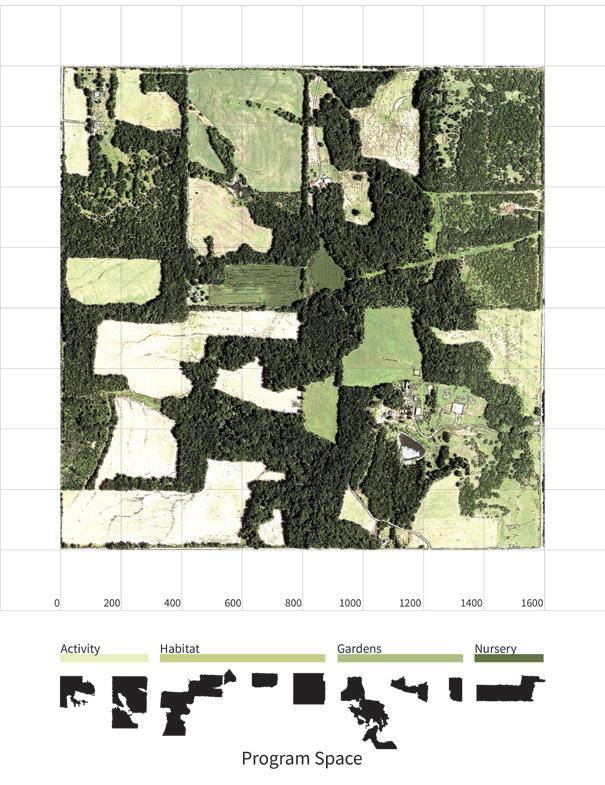 Left: Conflict between Monarch migration and cropland expansion across the United States.
Middle Top: Migration habitats of the Monarch butterfly.
Right: Existing Site Conditions
Left: Conflict between Monarch migration and cropland expansion across the United States.
Middle Top: Migration habitats of the Monarch butterfly.
Right: Existing Site Conditions
- 117 -
Middle Bottom: Existing site section
The studio brief asked us to design within an American Farmland grid. The grid I chose in Kansas is a degraded wood land with several enclosed open spaces that can be transformed through different programs. I reconstructed the woodland to create the Monarch habitat as well as event sites. In the master plan, the large green area are the habitats, and small black polygons are spaces where the invited garden designer will design their temporary garden.

- 118 -
In the second part of my design, as an “invited garden designer,” I wanted to praise the beauty of the life of butterfly as well as this great migration. My garden consists of four parts, they represent the four life stages of butterfly: Emerging, Exploring, Accumulation, and Celebration.

Emerging is where life begins. The first generation of monarchs, born in southern Canada, are looking forward to breaking out of their shells in the cold winds of the Great Lakes to start the great migration.
Exploring is a metaphor for the difficulties on the migration corridors. In the migration path from north to south, monarchs need to cross a whole great plain, which is a long journey full of discovery and adventure.


Accumulation is a metaphor for pupa. After a long flight across the United States, monarchs finally arrived in the warmth of Mexico, where they can escape the harsh northern winter, like pupa will be parked among the branches of the trees to build up strength, quietly waiting for the next flight.
Celebration is a metaphor for becoming a butterfly. When spring blossoms in March, the monarchs that have been waiting for the whole winter reawaken, and thousands of them dance in the fir forest, weaving an ode to this great migration.

- 119 -
CELEBRATION
EMERGING
EMERGING


EXPLORING ACCUMULATION
- 120 -
EXPLORING ACCUMULATION CELEBRATION


 Left: Garden Plan
- 121 -
Yihui Wang is in the final year of the Master of Landscape Architecture program at the University of Pennsylvania. Following a Bachelor of Landscape in China. She enjoys traveling, photography and sports. She has worked in the United States, France and China.
Mississippi Delta
A Field Guide to the Plantation-to-Prison Pipeline

Students: Asha Bazil, Amy Liu-Pathak, Leeana Skuby, and Jackson Plumlee
Instructor: Billy Fleming
The communities surrounding the Mississippi Delta are facing challenges produced by pervasive injustices. Slavery, both historic and modern, has long been a premise underlying the Delta’s mutually reinforcing systems of industrial agriculture, fossil fuel, and incarceration.
As such, the region has some of the highest poverty rates in the country. Residents increasingly experience extreme storms, flooding, and compromised air and water quality. In this context, imprisonment has mistakenly been used as a vehicle for economic development. Each of these systems intensify the ways in which vulnerable communities, typically low-income, Black or African American, and/or Indigenous, are impacted by climate change.
+
Angola Plantations Lafourche 110 mi. SE Parchman Plantation 180mi. Upriver
Left: Plantations of the Mississippi River from Natchez to New Orleans; Composite image of historic maps and insets showing 19th c. rice and sugar cane plantations.
Source: Tennessee State Library and Archives, 1858
- 122 -
Amidst brutality, people have still shown time and time again their capacity to thrive. The land surrounding the river and delta is exceptionally fertile. The region’s music, literature, and other modes of artistic expression are inextricable from American canon. However, such resilience should not justify needless suffering and absolve doers of harm. In a more just society, the lives of those in the Delta would move away from generational traumas and closer to a collective vision for human and environmental flourishing.
In the 16th century, Europeans arrived and brought enslaved Africans to work on plantations. Throughout post-colonial America’s growth, Choctaw, Chickasaw, and Natchez people were enslaved, killed through genocide, or forced to give up land. Between 1801 and 1830, after numerous coercive treaties and forcible seizures, the Choctaw alone ceded more than 23 million acres to the United States. They and other groups were effectively removed by the
federal government from their ancestral homelands.
The Mississippi Delta region is defined by the river. The soil is fertile, the wetlands vast, and the flooding catastrophic. Levees along the Mississippi were built using exploited labor of African Americans to protect the investments of landowners. In his book, Development Arrested: The Blues and Plantation Power in Mississippi, Clyde Woods asserts that “the levee system was, and is, one of the defining features of Delta capitalism.”1
The protection these levees afford is not evenly applied. The failure of the levees surrounding New Orleans during Hurricane Katrina displaced over 1.5 million mostly Black people, destroying their homes and communities. This natural hazard became an even larger disaster as racialized policing skyrocketed in the aftermath of the hurricane, with white residents “finding” food and Black residents “looting” grocery stores.

and Exploitation
Natchez to New Orleans “Cancer Alley” 2021
Extraction
on the MISSISSIPPI RIVER From
Exxon Mobil Refinery
Lake Charles Power Plant
Angola Prison Lafourche Prison 110
SE Parchman Prison 180mi.
Angola Prison
mi.
Upriver
Right: Overlay of current fossil fuel infrastructure and prison sites that have transitioned from historic plantation landholdings to form current day Cancer Alley.
Source: Authors
- 123 -
[1] Clyde Adrian Woods and Ruth Wilson Gilmore, Development Arrested: The Blues and Plantation Power in the Mississippi Delta (London: Verso, 2017).
A FIELD GUIDE TO THE PLANTATION-TOPRISON PIPELINE
This field guide is intended to help readers understand the past and present relationships between environmental and socioeconomic issues in the Mississippi Delta region—namely, the carceral system, the natural and built environments, and capitalism and labor. In doing so, readers may better grasp the urgent need for transformative solutions in the Delta and beyond.

Today’s challenges relating to incarceration and climate change are rooted in the history of the Delta and in the modern iterations of racist worldviews that manifest themselves in systems of power. The systems of power that maintain racialized capitalism in the Delta are complex, intertwined, and entrenched. Iterative changes allow actors to adapt and maintain their exploitative power. Thus a bold reimagining is necessary for meaningful change.
We illustrate the plantation-to-prison pipeline at three carceral sites in the Delta:


• The Louisiana State Penitentiary (Angola Prison)
• The Mississippi State Penitentiary (Parchman Prison)
• The Lafourche Correctional Facility
FOSSIL FUEL INFRASTRUCTURE CARCERAL INFRASTRUCTURE AGRICULTURE INFRASTRUCTURE
3 DELTA CARCERAL SITES
Parchman Prison Angola Prison Lafourche Prison De ta States State Prisons Local Jails Federal Prisons Number of People Incarcerated Parchman Prison Angola Prison Lafourche Prison
Prison Angola Prison Lafourche Prison
3 DELTA SYSTEMS
Parchman
Baton Rouge New Orleans
Greenville Natchez
Vicksburg
Lafourche
Angola
- 124 -
Parchman
Entry gates to Parchman Prison.


Source: MS Dept. of Corrections, 2021
Entry gates to Angola Prison.
Source: LA Dept. of Public Safety and Corrections, 2009
Source: Lafourche Parish Sherrif’s Office, 2019
 Exterior of Lafourche Prison.
- 125 -
ANGOLA PRISON WEST FELICIANA PARISH, LOUISIANA
# of people incarcerated: 5,815 Year opened: 1901

Size: 18,000 acres
Race/ethnicity: 75% Black, 24% White, 1% other Operating budget: $141,592,497
The Louisiana State Penitentiary, also known as Angola Prison, is equal to the size of Manhattan. It is surrounded on three sides by the Mississippi River, the fourth side touching the base of Tunica Hills. Angola Prison operated as a plantation exploiting enslaved people in the late eighteenth century. Its name references the provenance of the people working the land who were initially brought to the site from Angola through the trans-atlantic slave trade. The original owner of the plantations, Issac Franklin, operated one of the most profitable slave trading firms in the pre-Civil War era, the Franklin and Armfield Company. The farm within the prison’s walls produces four million pounds
of vegetable crops annually, in addition to its cotton and livestock operations. Inmates working to cultivate, harvest, and process these products are paid an average $0.20 an hour. At 8 hours a day, 7 days a week, total income amounts to $8.93 per month. The facility also uses incarcerated labor for metal fabrication and powder coating, textile production, tractor repair, and silk screening, among many other intensive jobs.2
The prison is the largest correctional facility in the United States by population with 5,815 inmates as of 2019. The annual operating budget as of 2020 was $141,592,497 – about four times the budget for the Louisiana Department of Economic Development which was $35,557,397. Angola employs 1,420 people making it one of the largest employers in the state, with 800nonincarcerated people living on the prison property.
 Left: Angola Prison farm, 2015
Source: The Atlantic
Above: Angola Prison Farm, 1938
Source: Ogden Museum of Southern Art
Top Right: Covers from Angola’s inmate-led news magazine, The Angolite.
Source: Smithsonian NMAAHC
Bottom Right: Map of Angola Prison
Left: Angola Prison farm, 2015
Source: The Atlantic
Above: Angola Prison Farm, 1938
Source: Ogden Museum of Southern Art
Top Right: Covers from Angola’s inmate-led news magazine, The Angolite.
Source: Smithsonian NMAAHC
Bottom Right: Map of Angola Prison
- 126 -
[2] Louisiana Prison Industries, LA Department of Public Safety and Corrections.
RESISTENCE FROM WITHINTHE ANGOLITE
Incarcerated people at Angola have also resisted by creating their own narratives. One form of this is The Angolite, an inmate-led magazine that has been running since 1976. The Angolite importantly allows for control of and contribution to the narrative surrounding the penitentiary, and the criminal justice system more broadly, by those experiencing incarceration.


 Angola (Town)
Point Lookout Cemetery
Prison View Golf Course
Camp F
Camp G
Camp A
Camp D
Camp I Camp C (Flood Evac. Zone)
CROP FIELDS CROP FIELDS
CROP FIELDS
Angola Ring Levee
Angola Ring Levee
Angola (Town)
Point Lookout Cemetery
Prison View Golf Course
Camp F
Camp G
Camp A
Camp D
Camp I Camp C (Flood Evac. Zone)
CROP FIELDS CROP FIELDS
CROP FIELDS
Angola Ring Levee
Angola Ring Levee
LeveeAngolaRing LeveeSecondary Camp E Camp H Camp B
ENTRANCE
Rodeo Stadium Complex
MonkeyIsland
M I S S I S S I P P I R I V E R T U N I C A H I L L S N
LakeKillarney
- 127 -
PARCHMAN PRISON, SUNFLOWER COUNTY, MISSISSIPPI
# of people incarcerated:1,939
Year opened: 1901
Size: 18,000 acres
Race/ethnicity: 68% Black, 31% White, 1% other
Operating budget: $53,653,895
The Mississippi State Penitentiary, also called Parchman Prison, is a state-owned and operated prison located in Sunflower County, Mississippi. Established in 1901, \ Parchman Prison was intended to be a penal farm, and so the prison site was designed as a plantation. Incarcerated African Americans, who were enslaved by the state of Mississippi under the 13th Amendment, were forced to construct the buildings where they would be held captive. Parchman is now the largest and oldest prison in Mississippi.
Prior to the construction of Parchman Prison, the state utilized the convict-leasing system.
Incarcerated African Americans were sold to private farm and business owners through the convict leasing system. People who leased convicts saw no reason to provide for their wellbeing and brutally tortured anyone who refused to work, including children. The state ensured a steady number of people were convicted of crimes to sustain the convict-lease system by passing laws to criminalize African Americans who were freed from enslavement. By 1877, the number of people incarcerated by the state of Mississippi grew from 272 to 1,072.

Parchman reported annual profits as high as half a million dollars to the state legislature. However, if incarcerated people had been paid for labor, Parchman would have been a financial loss almost every year. In 2019, incarcerated people at Parchman provided more than 100,000 hours of free labor to the surrounding municipalities.
 Camp 2 Hospital
Rome, MS Guard Row (Staff Housing)
Camp 2 Hospital
Rome, MS Guard Row (Staff Housing)
29
Camp 10 Unit
(Death Row)
6
4
11
3
5
B L A C K B A Y O U
Camp
Camp
Camp
Camp
Camp
ENTRANCE
Left: Map of Parchman Prison (Mississippi State Penitentiary)
- 128 -
Above: Freedom Rider Civil Rights activists incarcerated at Parchman in 1961.
LAFOURCHE CORRECTIONAL COMPLEX, LAFOURCHE PARISH, LOUISIANA
# of people incarcerated: 600

Year opened: 2020
Size: 31 acres
Race/ethnicity: 43% Black, 55% White,2% other
Operating budget: $36,500,000
The now defunct Detention Center was built in 1968 and had a capacity for approximately 24 5 inmates. The cost to expand the aging building for a short term fix was undesirable, and its limited space contributed to inmates being regularly sent to other parishes. In 2014, parish residents voted to approve a 0.2% sales tax for constructing today’s Correctional Center, and by 2019, the new building became operational while the old building was closed.
The Correctional Center increases inmate capacity by 140%, and boasts new areas for gardens, counseling, and social services. Despite the parish’s shift toward “correction”, the facility still

stands for a policy paradigm that endangers and devalues incarcerated lives. In September 2021, Louisiana state officials urged residents to evacuate their communities in anticipation of Hurricane Ida. The hurricane would ultimately make its landfall in Lafourche Parish. As residents fled, roughly 600 inmates were required to stay behind. Some were tasked with filling sandbags to protect residents’ property from the flooding.
Further belying “correction”, the complex exploits prison labor for dangerous work in the oil and gas industries. Records show that of the 51 companies that hired the 156 work release participants in October 2019, 30 companies are involved in various aspects of pipeline construction, oil response, and offshore rig production. Offshore jobs, being some of the most specialized and rare placements, command the highest wages at roughly $13.50 per hour. Operators pocket anywhere from 45% - 65% of prisoners’ wages to cover prisoners’ room and board.
 Below: Tweet from Lafourche Parish Sherriff’s Office documents inmate labor used for civilian disaster relief efforts.
N
Below Right: Map of Lafourche Correctional Complex and surrounding areas of Thibodaux.
CROP FIELDS
CROP FIELDS
CROP FIELDS
CROP FIELDS
Leighton-MorvantWelcome Levee
Southern Gun Center Shooting Range Juvenile Justice Center Thibodaux High School
Thibodaux Housing Authority Public Health Office
- 129 -
LAFOURCHE PRISON
THE WORLD THAT PRISON LABOR BUILT
The impacts of incarceration reach far beyond the prison walls and into the daily lives of surrounding residents. Beyond the physical facilities of the prisons, there is a constructed system of relations that reinforce the carceral state as an engine for economic and political hegemony. Shown at left is a typical delta community behind the levees of the Mississippi River.


- 130 -
THE INDUSTRIES AND INFRASTRUCTURE (LEFT)
In x-ray view, we see the regime of exploited labor that underlies daily life in the communities that prisons built. We see this legacy reflected in the infrastructures and industries that sustain the Delta region.

THE PUBLIC REALM AND COMMERCIAL SPACES (RIGHT)
The legacy of forced labor reaches into the everyday spaces and objects in the community as well. Public parks, roads, schools, and churches all benefit from incarcerated labor, whether it is through the inmate work crews that maintain and build them directly or the goods and services that are produced and disseminated from prison factories.
THE HOME
Even within the private spaces of the home, incarcerated labor is exploited for mass consumption through the diverse array of goods that prison factories churn out. Everyday items such as mattresses, clothing, and furniture are all part of this wide array of products. An entire home could be furnished from the catalog of the carceral state.
- 131 -
Appalachia
The Coalfield-to-Prison Pipeline and a Green New Deal

“In Eastern Kentucky, the symbolism of new prisons built on top of former coal mines is clear. These facilities infuse local imaginaries with the promise of being the next great form of economic development. Perched atop mountains artificially flattened by industrial dynamite, penitentiaries
Extractive industries are so entrenched in Appalachia that the region has been referred to alternatively as an internal colony, an internal periphery of the world capitalist system, and as a “national sacrifice zone.” As a concept, colonialism, in this sense, speaks to the broader set of relations in which a wealthy, settler nation extracts raw resources via exploitative labor practices from an external site for its own domestic consumption. In the case of Appalachia, the region’s abundant natural resources—first its land, then its timber and coal, and now its natural gas and leveled mountains—fueled the growth of the rest of the region, country, and world while leaving itself depleted. Speculators representing northern capitalist interests were able to acquire massive acreage and mineral rights through generous land grants provided by the state and other dubious methods. Generations of absentee landowners and financiers extracted immense sums of resources and money out of the region, leaving nothing behind but wages. Today, ownership of the land and its
Students: Claire Ahn, Daniel Flinchbaugh, Hannah Bonestroo, and Huiyi An Instructor: Billy Flemingfill both literal spatial cavities and the economic and affective voids left by coal and the extractive process known as mountaintop removal.”
- 132 -
- Brett Story, Prisonland
Federal Correctional Institutions


Detention Centers Jails
US Penitentiary Coal Fields
Annual Forest Decrease
resources still remains the basis of wealth and power in the region. A 1982 foundational study of land ownership in Appalachia found that of the 4.8 million acres of corporately owned mineral acres in the surveyed region, 89 percent were absentee owned with 62 percent by out-of-state corporations. These imbalances of wealth and power, created generations ago, have left Appalachia impoverished and environmentally degraded. After over a century of extractive activity, Appalachia has become a place with “rich land and poor people.”
While the demand for coal has ebbed and flowed over time, little has ever been done in the way of
introducing sustainable development to Appalachia to capture true economic growth. Appalachia has been failed not only by coal companies but also by the state. Brett Story describes this state failure as “organized abandonment.”After over a century of extractive activity, despite an incredible wealth of resources, the region remains one of the poorest regions in the country with rising poverty rates, opioid addiction, and falling quality of life. To many of the former mining towns, any industry bringing jobs is a good industry so many communities have welcomed prisons. Thus, one extractive industry, mining, is readily replaced by another despite what any statistics show. As activist Angela
- 133 -
Davis describes, “The prison has become a black hole into which the detritus of contemporary capitalism is deposited.” The placement of prisons on the flattened mountains of Appalachia is, therefore, highly symbolic of how the region has been treated as a sacrifice zone, a dumping spot for the “detritus capitalism” for generations.
The contents of the Field Guide, How-To Manual, and work of Climate Fiction sampled here deconstruct the complex dynamics of Appalachia, as well as explore possible solutions and alternative futures.

“The interplay between lofty dreams and earthly victories has always been at the heart of moments of deep progressive transformation… What set these moments apart was not the presence of crises, of which capitalism provides no shortage, but that they were times of rupture…when the utopian imagination was unleashed.”
-Naomi Klein, A Planet to WinBell County Coal, a deconmissioned coal refinery in Kentucky.
- 134 -
Source: Daniel Flinchbaugh
TIMBER EXTRACTION
Depletion of the New England forests by early colonists made Appalachia, with its mountains covered with old growth trees, the next region to exploit
Depletion of New England Forests
Once all the trees were removed from an area, worker shanties would be loaded onto shay engines, transported to the next stand and separated from their families.

Local people served as low-wage labor with their domestic horses, oxens, mules expropriated.
ABSENTEE LANDOWNERSHIP
Absentee land owners began to buy the rights to excavate timber and underground mineral resources. Their tax burden was low due to being out of state, while local residents taxs paid for most of the burden.

Dynamite is used to level land and access resources underground.
Coal companies gained the rights to mine the mountains as long as one of the joint landowners consented.
THE WAR ON DRUGS
Sawmills, dry kilns, lumber sheds, etc took place in the residential area. The profits mostly went to the out-of-state private landowners and Appalachia was left with barren landscape.
Many local people were employed to build railroads. Workers would eat and sleep at their workplace day and night.
The War on Drugs, the effort in the United States since the 1970s to combat illegal drug use by greatly increasing penalties, enforcement, and incarceration for drug offenders.
The war swept the nation, and victims from across the country came to Appalachia to be incarcerated.
More efficeint machines won over manual labor. Workers lost jobs but kept health problems.

Debris dumped into nearby valleys, earth moving machines working until midnight, locals quality of life suffers from mining process.
Lower government revenue from taxes results in lagged civil service and infrastructure.
People in pain asked for help, doctors prescribed painkillers for on-cancer related pain. This with a war on drugs results in pain leading to desperation and now the opiod crisis .
Mined-out areas left large acres of flat land nestled within the mountains.
Chronic Pain
PTSD
Traumatic Injury
- 135 -
COAL SEAM FORMATION (BELOW) AND METHODS OF COAL EXTRACTION (RIGHT)


 A mountaintop removal site neer Whitesburg in Letcher County, Kentucky.
[1] [1] [1] [1] - 136 -
Source: The Mountaintop Removal Road Show (Dave Cooper)
CONTOUR STRIP MINING


MOUNTAINTOP REMOVAL


COAL SLURRY IMPOUNDMENTS


1.arcc.osmre.gov 1. appvoices.org [1] [1] [1] [1] [1] [1] [1] [1]
- 137 -
CLIMATE FICTION


With climate change bearing down on us, the moment we are currently living in has great potential to be a “time of rupture.” However, this will depend first upon being able to expand our imaginations beyond the status quo. People are born into a world where the rules of social life and institutions around them seem natural and immutable. Without being able to perceive beyond this limited vision, it is likely to remain so. The coalfield to prison pipeline is extremely complex and multi-faceted and will require more than just a little creativity to overcome. This climate fiction hopes to inspire and expand your thinking beyond business as usual and “unleash your imagination.” Creating a more just and sustainable world will first begin with imagining its possibility.

DISASTER CATALYST 2028 POST-PRISON LIFE 2034 CHAIN OF CLEAN ENERGY 2045 - 138 -
A WALK IN THE RAIN
OCTOBER 20, 2030
THE DAY OF THE FLOOD


OCTOBER 23, 2030
BALLOONS OVER THE HOLLER JUNE 12, 2034
POISON TO PAINT JUNE 13, 2034
OLD MOUNTAINS NEW HOMES


AUGUST 5, 2050
TO THE FUTURE WORLD BUILDERS MAY 6, 2060

- 139 -
Healing by Design
Responding to Trauma through Youth-Driven
Urban Redevelopment
 By Amanda Peña
WHAT IS TRAUMA?
Definitions:1
1. A physically or emotionally harmful or lifethreatening experience that stimulates a person’s neurobiological response for survival
2. Experienced as a single event, series of events, or set of circumstances that are either personal, historical, racial, or vicarious in nature
3. Can have lasting adverse effects on childhood brain development that is expressed well into adulthood, including
• Difficulty regulating emotions and behavior
• Poor academic and/or professional outcomes
• Chronic pain and health challenges
Measured by Adverse Childhood Experiences (ACES)
*Score of 3+ is considered high
- 140 -
83% of children in poverty experience multiple traumas over time
Black Children
45% more likely than White children to have 1 trauma
21% more likely to have 3 or more
Latinx Children
80% have at least 1 trauma
30% experience 4 or more traumas
6090% Children in the juvenile justice system experience at least 1 trauma
TRAUMA ON YOUTH DEVELOPMENT
The need for intervention:
For more than 80% of children living in poverty, trauma exposure is among the most significant barriers to their academic achievement and upward mobility. The impact of traumatic stress on children’s brain development has long-lasting negative effects on their cognitive, mental, socioemotional, and physical wellbeing, which is associated with poorer academic, financial, and health outcomes in adulthood. As a result, many K-12 public schools in high-risk neighborhoods are implementing traumainformed teaching practices and providing social supportive services to its students.
However, educators do not receive sufficient training or support to respond to student socioemotional needs and trauma-related behavioral challenges, burning out and leaving the profession as a result.
Without trauma-responsive infrastructural support at the local, state, and national levels, schoolbased, trauma-responsive interventions will continue to be insufficient.
Given the important role of public schools on youth and community development, city planners can look to collaborate with K-12th grade educators and students to more directly address factors that perpetuate trauma and poverty in their communities. By inviting students to directly participate in development projects in their neighborhoods and encouraging civic leaders to value youth input and ideas, schools can become stronger anchors in high-risk communities and better support their students’ future academic, social, professional, and personal development.
TRAUMA IN YOUTH Statistics
:2
- 141 -
[1] Substance Abuse and Mental Health Services Administration. (n.d.). Trauma.
[2] American Civil Liberties Union. School-to-Prison Pipeline.; Cooper, J. L. (2007). Facts About Trauma for Policymakers.; Morsy, L., & Rothstein, R. (2019). Toxic stress and children’s outcomes.; The National Child Traumatic Stress Network. Effects.
[3] Barrett, E. (2021). Defining their right to the city: Perspectives from lower-income youth. Urban Affairs Review, 57(3), 709-730.
COMMUNITIES FOR CHILDREN + TEENS
Spatial outlaws:
Public spaces play an important role for youth in their transitional experience into adulthood. Places for communal gathering give youth the freedom to express themselves, build relationships, and find identity in their communities without external pressures.
Without the financial means to pay for goods and services, youth are, in essence, spatially outlawed from private spaces or public land use. Ultimately, youth want safe, clean neighborhoods and structured spaces and activities that promote their physical, emotional, psychosocial development.
TENETS OF YOUTH-DRIVEN DEVELOPMENT4
Believe that youth are:
• Competent, agentic citizens
• Experts on childhood and about their own lives
• Active and important participants in our collective society
Youth need supportive adults who empower and facilitate their engagement in the public domain. When adults create spaces that value and require their ideas and perspectives, youth become essential change agents capable of directly impacting their environment.
Previous spread right: A playground constructed on the Palestinian side of the Israel-Palestine border wall.
Left: Public spaces, like these basketball courts in New York City, are often the only informal spaces youth can gather for free.

“[The] freedom to congregate costs at least the price of a cup of coffee.”3
- EJ Barrett, Defining the Right to the CitySource: Flickr, Roey Ahram
- 142 -
CASE STUDY: Y-PLAN

About:5
Youth--Plan, Learn, Act Now (Y-PLAN) is a strategy created by the University of California, Berkeley Center for Cities and Schools to engage youth in the urban development process. In collaboration with public school administrators and teachers, Y-PLAN partners low-income young people of color with city planners and civic leaders to transform their local communities. Civic projects are place- and communityoriented, covering issues in transportation, public space, housing, schools, services, and amenities. Using a 5-step research methodology, students are academically supported and
empowered to leverage city planners’ resources and technical skills to make real changes in their community.
Y-PLAN Theory of Change:
Youth and civic agents partner together to gain access to one another’s knowledge and expertise for the creation of a just and joyful city. Through this collaborative process, youth develop college, career, and community readiness skills while civic leaders learn how to leverage their power and influence to implement and value youth voices.
[4] Carroll, P.,
Children’s Engagement as Urban Researchers and Consultants in Aotearoa New Zealand: Can it increase children’s effective participation in urban planning? Children and Society, 33, 414-428.
[5] Bierbaum, A. and McKoy, D. (2007).
Y-PLAN: Teaches Youth Why and How to Plan. Race, Poverty, and Environment, Fall.
[6] Ibid.
Witten, K., Asiasiga, L., and Lin, E. (2019).Start-up Making Sense of the City Into Action Going Public Looking Forward and Back
Right Top: Traumatic stress can have long-lasting effects on children’s brain development, which ultimately can adversely affect their socioemotional, relational, and professional development in adulthood.
- 143 -
Right Bottom: Y-PLAN 5-step Research Methodology
Y-PLAN OUTCOMES6
PARTNERSHIPS:
In California
• Los Angeles
• Oakland
• Richmond
• Sacramento
• San Francisco (Bay + Peninsula)
Other Projects
• Resilient by Design
• MTC Horizon
• New York City, NY
• Tohoku, Japan
OUTCOMES:
Youth
After participating in Y-PLAN, students often report having a better understanding, and greater motivation for, pursuing postsecondary education and alternative career paths. The method of experiential learning allowed students to explore professional and technical careers they previously did not know existed, especially in public service.
value of youth voices in decisions about their communities. They are encouraged to leverage their resources to implement student proposals or help students understand the constraints that make it difficult for their project to be implemented.
CONSIDERATIONS
The Y-Plan Model:
Though the Y-PLAN model seems to have a successful record of engaging low-income youth of color in the planning process, the available scholarship does not discuss how these interventions specifically reduce students experience(s) of trauma in their communities. Additionally, information is not included about how the academic profiles of student participants compare to the rest of their school. This is critical for understanding the impact of the Y-PLAN intervention across different student populations, such as English Language Learners, Gifted and Talented, Special Education and 504-accommodated, and higher risk subgroups.
Research opportunities:
Planners
By working closely with youth on Y-PLAN projects, planners and planning students gain more perspective about the kinds of barriers that inhibit public participation on community development plans and projects.
Civil Agents & Leaders
The Y-PLAN experience challenges adults in positions of power and influence to deeply consider the
To better understand how Y-PLAN and similar collaborations can mitigate trauma exposure through urban design, more research is needed about the types of trauma student participants are exposed to, how projects understand trauma and center healing, and how implemented proposals improve the community’s sense of peace and safety over time. One might consider conducting a longitudinal study to measure the impact of this intervention on these considerations, as well as student participant academic and professional outcome.
"How can city planners work with youth to reduce the experience of trauma in their communities?”
- 144 -
CONCLUSION
Planning for the Future, Working With Youth:
City planners and community developers bear incredible responsibility for shaping both the short-term and long-term experiences of life in any given neighborhood. As they attempt to reduce poverty and promote equity, planners should also consider the impact that trauma has on the cultural and social development in the community--especially for youth, who represent the future generations of residents. Given the unique vulnerability of youth, traumas inflicted by both adult and systemic actors heavily influence how they perceive and interact with their physical and
social environments.
By learning to listen to children’s and teenagers’ experiences, planners gain greater insight into the barriers inhibiting the sustainability of development projects at the grassroots level. Youth have immense creative potential and visions for their lives, families, and community that are typically anchored by feelings of hope and passion. Thus, community development plans should consistently seek to empower and include youth in ways that directly change and support their immediate environment. Through those collaborations, youth learn how to advocate for, and invest in, the health and wellness of their own communities for the benefit of themselves and others.
Amanda Peña is a first generation Chicana social worker, therapist, and educator from the Los Angeles region. She is currently working on her second master's degree in City and Regional Planning in the Housing, Community, and Economic Development concentration. Amanda is passionate about cultivating inclusivity and healing in the social and physical landscapes for children, teens, and families. Her other interests include traveling, running, hiking, cooking, reading, and trying different coffee shops and breweries
- 145 -
Reparative Ground
 By Jamaica Reese-Julien, Maria
Machin, Marc Schultz, Cade
By Jamaica Reese-Julien, Maria
Machin, Marc Schultz, Cade
- 146 -
Underwood, and Diyi Zhang
- 147 -
Reparative Ground is a redevelopment proposal intended to serve the community of Oakland, CA, harmed by the Alameda County prison industrial complex with the central ideals of Reparative Justice and Housing First, by establishing limitedequity cooperative homeownership, providing affordable rental housing, and creating workercooperative job opportunities.

This project aims to build resilience by establishing a Permanent Real Estate Cooperative (PREC) to address housing and environmental needs. It seeks to repair the harm done to Oakland’s vulnerable communities by investing in community wealth building institutions while divesting from the prisonindustrial complex. Alameda County contains over 9,000 people experiencing homelessness, 75 percent of Black renters are rent

burdened, and Native and Black poverty rates are 27.04 percent and 24.88 percent, respectively.
This project is in southwest downtown Oakland, CA, next to the Nimitz Freeway. The current site contains the Oakland Police Administration buildings, a former jail building, the Wiley W. Manuel Courthouse, and the Sheriff Department building. The current site and surrounding neighborhood are clear indications of how carceral institutions create surrounding economies catered to supporting and profiting off of those same institutions. Within the study area, there are 213 businesses that directly profit from carceral institutions and many more that indirectly do. In fact, there are five bail bond businesses directly across the street from our site and eleven total in the neighborhood.
- 148 -
Above: The site and surrounding neighborhood are marked by businesses that profit from carceral institutions.
The carceral system in California is heavily invested in exploiting prisoners for labor and debt. While the jail on our site area was removed several years ago, the police institutions currently on our site contribute to incarceration in the current sixteen jails and prisons in Alameda County, serving a population of 1,629,615 people in an area of 739 square miles. The highest paid incarcerated individuals earn less than $1 per hour for their labor.

Reparative Ground invests in the community by replacing carceral institutions with almost 700 units of equity-building cooperative housing and over 90,000 square feet of worker-owned cooperative businesses. It is intended to be a place of healing for communities originally belonging to the site, impacted by a system which has
historically stolen and profited from them.
Moreover, Reparative Ground will provide 346 units of affordable rental housing, including 208 units affordable to “Extremely Low-Income tenants” (below 30 percent of Area Median Income). These tenants will be supported with direct opportunities for worker cooperative ownership and avenues for homeownership equity building.
Through its unique equity structure, Reparative Ground ensures that residents have real financial stake in their community, providing stability and profits even during economic downturns. The cooperative also includes opportunities for living-wage work with worker cooperatives that ensure profitsharing and provide necessary services to residents.
Above: An aerial shot shot of the now disused police and jail complex that exists on the site. Source: Urban Land Institute- 149 -
The heart of Reparative Ground is a Permanent Real Estate Cooperative (PREC) model. Coined by the Sustainable Economies Law Center and first enacted by the East Bay Permanent Real Estate Cooperative (both native to Oakland), the PREC model aims to permanently take land off the speculative market and into community stewardship. A PREC simultaneously de-commodifies land, enables community control for structurally excluded communities, thereby disrupting the root causes of racial inequality. Unlike a conventional housing cooperative, which is formed to provide housing to a defined group of residents, a PREC could be described as a “movement cooperative,” because it is designed to provide housing, build a large membership base, and serve members’ collective goal to transform their neighborhoods and systems of finance and land ownership.
PRECs can be understood as combinations of Limited Equity Housing Cooperatives (LEHCs) and Community Land Trusts (CLTs), where limited equity protects residents from individual unit market speculation, by-laws secure land from speculation and allow for community ownership in perpetuity. Although proponents of traditional homeownership wealth-building argue that limited equity is an obstacle to historically disinvested communities, research shows that limited equity cooperatives are more stable and efficient models for oppressed communities to build wealth. Homeownership wealth-building narratives help overcome market fluctuations and exploitative lending practices, thus challenging the ways in which racism and classism are baked into property valuations. Limited equity cooperatives provide a much safer, supportive model for building individual wealth while developing community space and cooperation.

- 150 -
Reparative Ground is financially feasible without indebting the cooperative to outside investors. By leveraging grant funding, Low Income Housing Tax Credits, local affordable housing trust funds, profits from retail and rentals, and low-cost FHA housing loans, Reparative Ground can move forward with affordable member-owner equity down-payments.
We propose that local governments make a financial commitment to the residents of Reparative Ground to help their community re-build. Reparative Ground proposes that the City of Oakland directly support these communities’ efforts to build equity by waiving all costs for building permits and fees, providing the city-owned land parcels free of charge, using their $169 million Capital Improvements budget to contribute two $20 million grants to construction (one for each phase).

Some grants that could be used to subsidize affordable housing production are the HomeKey Capital Grant, the CA Affordable Housing and Sustainable Communities Grant, CA Transit-Oriented Development Housing Program Grant, CA Home Investments Partnership Program Grant, and the CA Permanent Local Housing Allocation Grant. In accordance with its commitment to equity, the cooperative mission rejects the use of outside investor equity capital beyond the use of Low-Income Housing Tax Credits. The PREC units require 3 percent-10 percent down payments from residents. Initial memberowner equity will contribute an estimated average of 6.5 percent of total unit equity. In addition, the PREC follows the local East Bay Permanent Real Estate Cooperative’s model of accepting local investor and owner donations of $1000 each for 1.5 percent returns.

- 151 -

- 152 -
Reparative Ground builds upon the work of legendary Oakland activists Elaine Brown, Huey Newton, Bobby Seale, and Alicia Garza. It seeks to provide housing and quality public space while building community wealth. As the site moves away from the prison industrial complex paradigm, Reparative Ground aims to secure equitable access and participation to develop a safer, more supportive future for the communities of Alameda County.
- 153 -
To See a Community [Series 4 of 4]


- 154 -
Left Top: Coral Street Community Fridge
Left Bottom: Fanny Lou’s Porch A Cafe and community space
Right: Adriana Abizadeh Executive Director of the Kensington Corridor Trust
- 155 -
Photographs by Julia Verbrugge
By Micah Epstein
“Excuse me sir/ma’am, but what is the name of this square?”


“Just passing through, sorry”
“We live around here so we just call it ‘the plaza’ ”
“Yrros, on emit ot tahc-”
“One of the many Theaters of Justice under the watchful gaze of the Mighty Legion!”
“I ain’t no ma’am, if you don’t move I’ll make you!”
There is no evident agreement on the name of this place. A confluence of two major roads and innumerable alleys, a substrate fountain surrounded with steps almost but not quite at its center. Procrastinating students sunned their chemical-stained skin, heavy-lidded eyes looking with no interest at shambling pack animals pulling precarious wagons to and from the day markets. The cartographer looked down on his recent trace of the Diagram, already packed with revisions. The ink and paper he had with him wouldn’t last even the full district at this pace. Well, at least his last invoice had been filled by the Lady. His pockets were satisfyingly full. Warm bed and a glass of wine full. An exceedingly rare delight for the cartographer.
“Ask someone else, twerp.”
“Bleruay tleilaxu narunta?”
“The Plaza of the Afternoon Sun! because the sun always sets perfectly between those two spires. It’s what gives that fountain such a sparkle, even until the last minutes of the day.”
“Wow, uh, thank you! That’s a great name!”
- 156 -
“Excuse me, this is the Plaza of the Afternoon Sun, right?”
“Huh? Oh...sorry, no, I’m having a really bad day...”
“No way buddy, the Plaza of the Afternoon Sun is tucked away at the end of that alley with the archway, two streets down from the Promenade. Got a sundial that only works in the afternoon and everything.”
The cartographer followed the alley, which resulted in an altogether pleasant afternoon and much-needed change of scenery from that troublesome square. He sat amongst the shade palms on the plinth that served as the 1 o’clock marker at the (now very clearly) Plaza of the Afternoon Sun, half-napping as he admired the shadow’s reliable path in the latter half of the day - a concise truth registered in this substrate sundial, plucked from a complexity of bouncing particles and waves flung from the roaring sun, millions of miles away. Deeper in the daydream, his feet sucked down by soft ground, somehow...not substrate? His vision was clouded, blurry, where was he supposed to go?
“Excuse me, but what do you call this square we are in?”
“Who wants to know? I’m busy.”
“me and my buddies call this Stabby Park ‘cuz onetime Gark and his pack…”
“Excuse me, but are you the cartographer currently under the employ of the Steelworker’s Union? You, sir, are a hard man to find. I bear good tidings from the Union!”
The memetic messenger squared his shoulders, cleared his throat, and recounted those good tidings in a new voice, clipped and silken: the voice of the Lady of Steel. A request for a full district map by the end of the week. With good money - security deposit and a cask of wine kind of money - promised upon delivery. For the rigorous cartographer, the illfated square they both stood in made this request less of a windfall, and more of an impossibility. On his master copy, it was still a glaring, empty hole among the neat orderly script of the rest of his labels. Simply not up to snuff. He sent the messenger back with a plea for more time.
At his desk, ink well, blotter, cap, and solvent meticulously placed as always, he scratched out “Sundial Park(?)”, satisfied to be replacing it with the much more aptly named Plaza of the Afternoon Sun. This hope was quickly overshadowed as his pen caught at the end of the strikethrough, and a great unholy bead of ink spat from the nib and landed in the center of the still-unnamed square, riddling the surrounding area with erroneous dots and splashes. He sighed. Another trace of the Diagram was in order. Blotting, then pinning up the ruined draft, he mechanically unlocked the only drawer on his desk fitted with a lock, and drew out the original. The Diagram. Not a sheet of paper, but an ovoid stone, cast in high-grade substrate with a unique luster and translucence. He turned it on, flipping a switch deep within himself. How did he know how to do that? There it was all about himan understanding of the immutable substrate, twirling about his head and deep in his bones. He began to trace.
“Excuse me, what is the name of this square?”
“Victory Square, of course. Because Winner’s Way runs right through it from the Coliseum.”
“By Winner’s Way, do you perhaps mean Sinner’s Way? I’ve heard from a couple people that’s what they’ve grown up calling it.”
“Of course not, it’s written right into the substrate. Can’t argue with that. Check the center line right before it runs into the square. You’ll see.”


And the cartographer did see, after he had brushed aside some street dust and detritus in a couple of likely places that could be the center line right before it ran into the square, there, embossed into the very substrate of the street:
- 157 -
Way To Winnings →
Godamnit. Even his master copy had Sinner’s Way on it. But…that’s what made sense - the structure at the end of that street had to be a place of worship of some sort. He pondered this as he walked the length of Winner’s / Sinner’s Way, jostled steadily by broad shoulders and bare elbows. He arrived at the steps leading up to the structure in question. What else was the purpose of those giggling gargoyles and flying buttresses, if not to inspire piety? A waft of acrid smoke crossed his path - a troll smoking roll-ups with some troddenon looking humans. He pushed his way past them and wearily trudged up the steps to the neckstretching tall doors of the substrate building. Thick inches of posters and flyers consumed them, advertising giant centipede fights, slimepunk shows, hitmen, calls for attention thinning towards scrawled tags that competed for height until it was blank, reaching ever higher into a arched fresco of an angel, pouring a vessel of some sort, flowing water rendered in substrate with immaculate detail. Scanning down the posters, slightly curious at different address notation used, He saw it then, immediately noticed a similar emboss on the flagstone at the door’s base, on axis with column and structure and the Way to Winnings (Winner’s Way?), all too obvious to him now:
≈ Oasis of Opportunity — Dice, Cards, and So Much More
He looked back up at the casino. It was certainly ostentatious enough. He berated himself for not noticing these embossed signs before. If these were an


original schema, left behind by the Sculptors, it could save him hours, days, months even. He fell to his knees in the dust among the crowd, intent on the words. No. no. He quickly realized this embossing had been chipped away, piece by piece, the curved head of some tool evident in the scalloped texture. The cartographer weighed his reaction to this in unequal measures. Certainly, he was relieved that these markings were not a part of the substrate, which by his definition was smooth, seamless and unmarked. His previous work had not been undone. Some hand had done this sometime, sometime after the first laying of the substrate. But that was impossible? Since as far back as the city could remember, people did not alter the bones of this city. They could not. Substrate chipped the highest-grade tools of heretics. For all the creative differences of this city, this was agreed upon.
He absently practiced a couple styles to denote the markings, how small could he write them, how could he make it disappear? No. This isn’t why he was making this map. He was making a map of the present city, not some past version of it. Whatever those engravings were, it mattered not to him - they were a non-essential detail. His job was concerned with the now, not the then. To bring those bones to life, make them dance with the breath and blood of the city’s people.
When he had first started, he thought the best way to do that was by conducting a census. He knew how an understanding of the demographics and population patterns of this city was a map of its own. He would pass from warren
≈
- 158 -
to hollow to spire, clipboard in hand.
“Excuse me, how many of you are in this...den?”
“How would you describe your race and/or species?”


“Do you have a concept of gender? what do you identify as? and your other housemates?”
The language barrier was insurmountable, hard as substrate, a wall infinitely high in the stress dreams he began having. It was better now, with the mapping, the answers and labels always had a way of resolving themselves. The city was demure but somehow ultimately consistent. It had given up just enough of itself for him to create quite the working relationship with the Lady. Her demand was incessant, she couldn’t get enough of his maps, so neatly written with the faint impression of substrate indicated beneath the streets and galleries, landmarks, trees shaded with green wax pencils, and the names! the names that seemed to fit each place so well. Those were his specialty.
Seizing an opportunity, the cartographer asked,
“You seem new to the Legion…is there anything you knew it as before?”
But the new recruit froze up, totally still, for several noticeable moments, until, slowly, her brows knit and the characteristic fiery zeal returned to her face. She fiercely turned and strided away. This is why the cartographer neglected to use the Mighty Legion diocese designations. Certainly they were tacky, more baroque tribute than place, but the case could be made for using them as a placeholder, as they were more or less consistent - depending on the Legions influence in the area. But the cartographer, his trace of the Diagram in hand, knew how a placeholder could influence the final. They are not the authority. No one really was, not yet at least. Amidst the construction dust and cigarette smoke, chaos reigned supreme. A seething mass of guilds and unions and competing truths. And he had to do something about it.
“Excuse me, could you tell me the name of this plaza?”
“Oh no, not today, sorry.”
“Another, um....holy theater for the Mighty Legion…”
“Excuse me, but what is the name of the square we are standing in?”
“Look mister, that’s the second time you’ve asked me that question this weekWhy the hell do you need to know?”
“My apologies, uh, mister. Sorry to bother you”
“Sir cartographer! Good to see you again. I bring a response from the Lady herself. She says…
- 159 -
And the messenger squared his shoulders, cleared his throat, and recounted in her voice:
“It’s cute that you think you can say no to me. Perhaps my reputation doesn’t quite precede me in the more...rural... districts. We are willing to pay dearly for the map. I will send a courier for it at dusk tomorrow.”
The cartographer did not notice the clear discomfort in the messenger’s face as he mimicked this last point. Instead, the cartographer got stressed. And greedy. A regretfully agreeable combination.


Out of a necessity to at least approach completion that day, the Cartographer filled in the areas surrounding the square. The city welcomed him back with a wealth of agreed upon labels and his pace quickened. In a truly astounding afternoon of research, he followed the entire length of the Boulevard of Dust, the huge winding market that cut through the Merchant District. Each response was more affirmative and uniquely informing than the last. He was scratching down - for once not scratching out - notes as fast as people could talk. He doubleconfirmed The Horse Bazaar, a huge stinking dust-clouded bowl with every mount or steed you could ever desire for sale. At its center was the Sink: the most unholy drain one could imagine, a prison for those who cheated on the exhibition races that went round and round the perimeter. He marked down The Port Canal, a substrate aqueduct from the Port District that brought groaning ships right to market to unload huge shining fish and chests with locks that could bite. He noted
a garden enclosed in glass, the Perfumed Palace, where a whole host of mind opening vendors sold advice, predictions, and consultations disseminated via psychic vaporizers. He had better things to do. With that swath of chaos complete the district map was almost done. Almost. Spires pricked the great yolk of the sun and dusk began to leak across the city. Shopkeepers swept their stoops, sailors casted off towards home, and the cartographer sat at his desk, his eyes beneath closed lids restlessly searching the Diagram. He gimbaled around the immaterial square, from above, from below, traced its off-center fountain, counted its alleys and storefronts, surveying it for a glimmer of a name. Something tapped cold and hard at the glass, startling him from his reverie. Before the cartographer could secret away the Diagram, the window was open and a jackalheaded figure slipped in, stinking of smoke.
“Do you know why I’m here?”
The jackals’ leathers were black, matte, almost dusty. The cartographer widened his eyes slightly. He couldn’t believe the Steelworkers would be so heavyhanded as to send a sootblack for this task. He told the assassin it wasn’t finished, he wasn’t ready, there was one thing he needed to change. Making excuses, panicking as his eyes kept landing on different instruments hanging off the jackal’s person, each one implying a unique, painful death.
“Than change it. I have other business to attend to this evening.”
- 160 -
At that, the cartographer was not surprised. The sootblacks were efficient, too professional for comfort. He said he had to add one more label, it would take no more than a minute. He took a seat again, and tried, as nonchalantly as possible, to place the unassuming diagram stone on the desk. Weak, tepid light spilled in interrupted pieces over his desk, glimmering momentarily off of it’s ovoid surface. He was reminded of how the light might be catching the spray of the fountain in that aggravating square at this very moment. It’s too bad that lead didn’t work out, it would be a fitting name. The Plaza of the Afternoon Sun. And his mind didn’t work fast enough for him to think why not, and it was too easy to simply extend the arrow, pointing it from the little pocket park with the sundial to the place where two roads and many alleys met, terraced steps and the fountain that caught the golden light. A simple omission, easy to overlook. The jackal materialized at his shoulder, stinking.


“I know when a job is done. Let me take that from you.”
substrate. Just gaudy enough for a stock exchange, the cartographer smirked to himself. Hauling himself upright again, he continued down Sinner’s Way, as the shining steel signpost indicated, and a flicker of recognition raised one of his eyebrows. He arrived at what he remembered as a particularly trying portion of his initial survey, a square with an offcenter fountain where students sunbathed their chemical-stained skin. Now they studiously ignored the steel-skinned Steelworkers cargo trolleys that stained the air with soot on their way to the Boulevard of Dust (which was much less dusty now). The Plaza of the Afternoon Sun, noted another steel signpost. He refused to remember the markings that would have sat directly beneath the signpost.
He was curious, wondering what had happened to that quaint backalley sundial, how the Lady and her clerks would have dealt with his hasty omission. Let’s see, the backstreet that led there was the second way over from the Promenade. But...that wasn’t right. Where he remembered an archway between two buildings, was now a smooth substrate wall. A ponderous dead-end. That way was closed to him now.
Years later, the cartographer, older, well-dressed and all the hungrier, wandered. He rested a moment on the wide steps of the newly refurbished Exchange Hall. Well dressed brokers rushed in and out, and a roar of commerce, ownership and futures and chance spilled out over the steps. It was an odd sort of structure, overlarge, dripping in gargoyles and held up by flying buttresses. A fresco adorned the top of neck-stretching doors, an angel overfilling a vessel, all immaculately rendered in
micah (they/them) is a Panorama web editor and first years Master’s in City Planning student concentrating in Housing, Community, and Economic Development. They are a storyteller and systems meddler raised on vast swathes of fantasy and science fiction, which taught them the power of stories to change hearts, minds, and systems. As a designer, they’ve designed web experiences for the ACLU of Washington, the MIT Media Lab, the coveillance collective, and many others. When not pushing pixels, you can find them headbanging in grimy basements or racing (and beating) c*rs on their rusty fixed gear.
- 161 -
