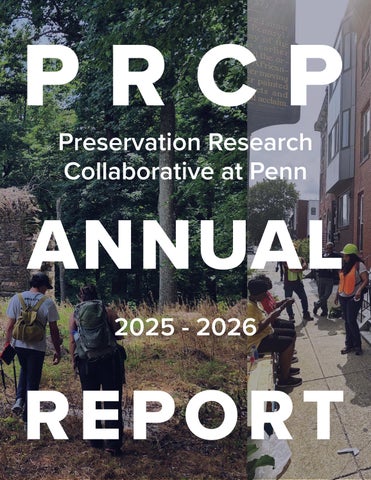
PRCP Preservation Research Collaborative at Penn
ANNUAL 2025 - 2026
R E P O RT
The Preservation Research Collaborative at Penn leads projects that… Contribute new methods and findings to the field of historic preservation
PART 1: HISTORY + EVALUATION +
Support the curriculum of the Department of Historic Preservation at the Weitzman School of Design +
Create professional training opportunities for Weitzman School students + Advance our partners' stewardship work
2 2
INTRODUCING THE PRESERVATION RESEARCH COLLABORATIVE AT PENN 4 Areas of Research and Practice
6
PRCP Faculty + Staff
8
In Memoriam: Frank G. Matero (1953 - 2025)
10
PRCP News
11 —
RESEARCH HIGHLIGHTS (2025 - 2026) Projects 12 Partnerships 20 Student Research + Training
22
Recent Publications
24
Speaking Engagements + Workshops
26
— LOOKING AHEAD (2026 - 2027) New Projects + Initiatives
28
3
Introducing the Preservation Research Collaborative at Penn Launched in fall 2025, the Preservation Research Collaborative at Penn (PRCP) is the research and practice platform of the Department of Historic Preservation at the Weitzman School of Design. Our platform connects, supports, and expands on the department’s longstanding research initiatives, including the Urban Heritage Project (UHP), the Center for Architectural Conservation (CAC), and the Center for the Preservation of Civil Rights Sites (CPCRS). PRCP enables faculty, staff, and students at Weitzman to lead research and practice projects at the intersection of built heritage, cultural landscapes, community values, and societal change. Complementing the work that happens in Weitzman classrooms, labs, and studios, PRCP works domestically and internationally with partners at all scales, including governmental and NGO clients such as the National Park Service, World Monuments Fund, the Mellon Foundation, Monument Lab, Tuskegee University, the Rwandan government, and grassroots heritage organizations in Philadelphia, Washington, DC, the Alabama Black Belt, the American Southwest, and elsewhere around the world.
4
Interspersed with text of strategic vision + goals?
5
Areas of
Research + Practice
6
Cultural Landscapes
PRCP's work explores the history and significance of cultural landscapes at all scales. Our purpose is always to understand deeply the evolution of these historic landscapes and to connect them to the lives, needs, and desires of contemporary communities. Adapting cultural landscape frameworks and preservation planning models to contemporary challenges, we regard our work as research that explores new, more engaged modes of cultural landscape preservation and design.
Architectural Conservation
PRCP encourages cross-disciplinary collaboration on contemporary issues— including issues of sustainability—related to the conservation of culturally significant buildings, monuments, and sites throughout the world. Faculty and staff lead research and teaching initiatives dedicated to documentation, recording, field survey, material analysis, condition assessment, risk analysis, and the development of new treatments and treatment evaluation of historic structures and sites.
Civil Rights Heritage
PRCP seeks to preserve the heritage of civil rights in all its forms. This includes iconic places already recognized as heritage sites, vernacular buildings and landscapes, and cultural memories of spaces that are no longer accessible. This work strives to honor and support our organizational partners’ traditions of education, storytelling, and community stewardship, to remember the profound and significant civil rights stories — tragic and triumphant — across the country.
Preservation Planning + Design
PRCP projects respond to preservation challenges by designing new solutions to manage, conserve, and adapt historic buildings and cultural landscapes. Informed by extensive research, fieldwork, analysis, and stakeholder engagement, PRCP staff use design as a catalyst to creatively rethink a site’s physical resilience, public interpretation, cultural connections, and stewardship context.
Archaeological Site Preservation
PRCP has led projects at several archeological sites, applying a conservation lens to their stabilization and a cultural landscape preservation approach to their broader historical, geographical, social, and management contexts. This research explores the risks and vulnerabilities unique to archeological remnants, assessing the climatic factors that contribute to their deterioration and identifying the opportunities for their long-term management and interpretation as cultural resources.
Monuments + Memorialization
PRCP research staff have led several projects that explore public memory, monuments, and contested heritage in the built environment and public space. In contexts that range from Philadelphia to Rwanda, this research examines both the monuments themselves, as designed places with memorial function, and the practice of memorialization as a complex social process of imagining, creating, interpreting, and sustaining these commemorative places. 7
PRCP
Faculty + Staff RANDALL F. MASON Faculty Director Randall Mason is a professor of historic preservation, city & regional planning, and landscape architecture, and serves as faculty director of the Preservation Research Collaborative at Penn. For 30 years, Mason has maintained a consulting practice in preservation, planning, and design, alongside teaching and research. His teaching and research focus on preservation history and theory, historic preservation planning, urban conservation, social justice, and cultural landscape studies.
MOLLY LESTER Managing Director Molly Lester oversees the day-to-day project management, operations, and administration of PCRP’s major research initiatives. Lester has more than two decades of research experience at the intersection of historic preservation, public history, and community planning. She previously served as a historic tax credit consultant, the director of a national grantmaking program for historic congregations, and a researcher for community-engaged public history initiatives.
JOHN HINCHMAN Senior Research Associate John Hinchman is a Senior Research Associate with PRCP and a lecturer in the Department of Historic Preservation. With more than three decades of experience leading survey and documentation projects for the National Park Service and other clients, Hinchman is an expert in both traditional and digitally based recording methods, including field survey, measured drawings, photography, and rectified photography.
JACOB TORKELSON Senior Research Associate Jacob Torkelson assesses the history and condition of historic sites, drawing on his expertise in design and preservation planning to guide their longterm management. Since joining the research team in 2018, his work has foregrounded issues of social justice and representation, particularly in landscapes with historically excluded narratives. His portfolio includes nationally significant sites such as the Lincoln Memorial and the Martin Luther King, Jr. Memorial in Washington, DC. 8
JIWEN FAN Research Associate Jiwen Fan is a Research Associate with PRCP. Jiwen has been involved with the department's research initiatives since 2023, initially as a student researcher before joining the staff in 2024. Her research background in ancient building techniques and materials drives her focus on the study of earthen and stone masonry. Her projects focus on baseline documentation and assessment methodologies for archaeological sites in the American Southwest.
MEG FRISBIE Research Associate Meg Frisbie is a research associate for PRCP, working on the documentation and planning of cultural landscapes. Her interests include vernacular and working landscapes, public land management, and traditional craft. Prior to joining the Urban Heritage Project team in 2022, she worked for the National Park Service, participating in archeological fieldwork, cultural landscape documentation, and preservation projects across the southeast and southwest.
HA LEEM RO Research Associate Ha Leem Ro is an architectural conservator and research associate with PRCP. Her interests include interpretation of historic sites and conservation and management of archeological sites. Since joining the research staff in 2021, she has been involved in several documentation and conservation treatment projects for historic structures and archeological sites in the American Southwest.
LIA SCHIFITTO Research Associate (2024 - 2026) Lia Schifitto is a research associate with PRCP, with a background in public humanities and sustainable cultural heritage. Before working at the University of Pennsylvania, she led outreach for public programming at the Los Angeles Conservancy, focusing on programs highlighting immigrant and diasporic enclaves in L.A. Her research centers on ways of knowing, collective memory, and regional vernacular landscapes in the heritage interpretation field.
Partner Staff at Weitzman School RESEARCH SUPPORT HUB Stephanie Magee, Director, Sponsored Research Jennifer Sorrentino, Grants Manager Alicia Gao, Onboarding + Compliance Manager Kia Williams, Financial Research Coordinator
DEPARTMENT OF HISTORIC PRESERVATION Micah Dornfeld, Department Coordinator Cassandra Dixon, Administrative + Communications Coordinator 9
In Memoriam
Frank G. Matero (1953 - 2025) Frank Matero died on December 19, 2025, following a protracted battle with cancer. In addition to his roles as the Gonick Family Professor in the Department of Historic Preservation and a professor of architecture, Matero was the founder and faculty director of the Center for Architectural Conservation (CAC), one of PRCP's legacy centers. He maintained a robust portfolio of research projects up to his death; PRCP staff are committed to completing his unfinished sponsored projects. —
“In his dedication to students and colleagues, his advocacy for historic preservation—the original sustainability, he was fond of saying— and his commitment to professional reform, Frank Matero was without peer.” — Fritz Steiner, Weitzman Dean and Paley Professor
10
Matero joined the University of Pennsylvania faculty in 1990, when the historic preservation program was just 6 years old, and he put Penn on the map. He taught courses on theory, architectural surface finishes, masonry conservation, and the conservation of archeological sites, and advised hundreds of students on their capstone projects. He organized sold-out conferences on topics like concrete architecture, and he founded and directed the CAC, a powerhouse for applied research that has protected dozens of priceless cultural heritage sites, from Taliesin West to the Guggenheim Museum to the Ayyubid Wall in Cairo. His engagements took him around the world, but he was particularly proud of his work in Mancos, Colorado, where he collaborated with local residents and colleagues to revitalize an abandoned newspaper office and print shop as a community center. He also founded and was the editor-in-chief of Change Over Time, the international journal on conservation and the built environment published by Penn Press. He served two terms as department chair (1994-2009 and 2018-2025) and was instrumental in the Department of Historic Preservation achieving departmental status. A prolific scholar as well as a sought-after educator and practitioner, Matero focused on the historical and material investigation of architectural technology and its implications for the interpretation and conservation of built heritage. In the course of his career, he authored over 100 publications on conservation history, building technology, ethics, and professional practice, and he was invited to speak at universities and professional forums around the world. In recent years, he was focused on developing a framework for material and site risk and vulnerability related to climate change, and he was completing a book on the conservation of concrete architecture.
PRCP
Photo by Sahar Coston Hardy / ESTO
Photo by Allie Ippolito
News
New office in Weitzman Hall In fall 2025, the Weitzman School of Design opened its first new building in nearly 60 years. Originally completed in 1892 as part of the Foulke and Long Institute for Orphaned Girls, the building's recent adaptive reuse was designed by KieranTimberlake, PORT Urbanism, preservationist Dominique Hawkins, and Penn’s Facilities and Real Estate Services. The building is now Weitzman Hall, an interdisciplinary hub for research and teaching. The Preservation Research Collaborative at Penn is based in the Kevin and Erica Penn Learning Hub (Room 230) of Weitzman Hall (205 S. 34th Street), with additional office space at 4201 Spruce Street. 11
Research Highlights (2025 - 2026)
Projects
Hickory Ridge / Prince William Forest Park Dumfries, VA Public Outreach Study PRCP Project Team Randall Mason Jacob Torkelson Meg Frisbie Molly Lester Autumn Jeter Research Partners Charles Reid Curtis Porter Mae Minor Hilda Howard Prince William County, Department of Parks and Recreation
12
PRCP recently completed a public outreach study in partnership with descendants of the Hickory Ridge community in Virginia. Hickory Ridge was a racially integrated community that was displaced and largely erased for the creation of Chopawamsic Recreational Demonstration Area, now known as Prince William Forest Park (part of the National Park Service). PRCP's project documented and interpreted landscape traces of historic homesteads, combining archival study, GIS mapping, oral history interviews, and design/treatment recommendations to support future interpretation and preservation of this historic cultural landscape.
Catoctin Mountain Park Thurmont, MD Cultural Landscape Inventory Iron Industry Resources PRCP is researching the cultural landscape history of Catoctin Mountain's 19th-century iron industries, and the complex network of colliers and laborers who worked on the mountain. The project will document dozens of remnant charcoal hearths and huts, and will develop thoughtful strategies for identifying, inventorying, and preserving them within a complicated context of trails and public use.
Wupatki National Monument Flagstaff, AZ Preservation Management Plan
Ramah Baptist Church Letohatchee, AL National Register Nomination PRCP-affiliated researchers prepared a National Register nomination for Ramah Baptist Church, the primary religious institution for African Americans in the southeastern part of Lowndes County, Alabama. In 1891, Booker T. Washington worked with Reverend Silas Jones, pastor of Ramah Baptist Church, to establish a Tuskegee model school in the rural community of Calhoun, predating Washington’s betterknown work with the Rosenwald School project.
PRCP staff recently completed a preservation management plan for Wupatki Pueblo, is the largest freestanding pre-contact structure in Northern Arizona. The plan offers essential management guidelines for the long-term stewardship of the site, assessing climate risks and offering resilience and adaptation guidelines.
13
Research Highlights (2025 - 2026)
Projects
C&O Canal - Carderock Area Carderock, MD Cultural Landscape Report The PRCP team is wrapping up a cultural landscape report (CLR) for the Carderock area of the Chesapeake and Ohio Canal. (Our team previously completed a CLR for the Georgetown segment of the canal.) The Carderock segment is particularly significant based on its association with Black labor crews from the Civilian Conservation Corps, who led the effort to transform the industrial waterway into a scenic recreational byway in the 1930s. The final CLR will document this significant history and offer landscape preservation recommendations.
Tumacácori National Historical Park + Pecos National Historical Park Arizona / New Mexico Vulnerability Assessments 14
Catoctin Mountain Park Thurmont, MD Cultural Landscape Inventory Parkwide PRCP is preparing a cultural landscape inventory (CLI) for the full extents of Catoctin Mountain Park—an area that spans 5,100 acres and includes several cabin camps and campgrounds, adirondack shelters, picnic areas, overlooks, and the ruins of a historic stone house. PRCP staff and research assistants surveyed the full park, recording location data, photographs, and condition descriptions for every built feature and significant natural features. The CLI serves as essential baseline documentation for park staff.
Many national parks and historic structures across the country are experiencing accelerating impacts from climate change, including extreme weather events, increasingly severe wetting/drying cycles, and high-wind events. In anticipation of these pressures, PRCP researchers are piloting new methodologies to conduct vulnerability assessments of architectural components and evaluate climate-related risks at Pecos and Tumacácori National Historical Park.
Resurrection City Washington, DC Digital Atlas PRCP Project Team Randall Mason Emily Holloway, PhD Lia Schifitto Elizabeth Donison Research Partners Brent Fortenberry, Louisiana State Univ. Dan Watts, Louisiana State Univ.
Resurrection City was a landscape of protest occupying the National Mall from May 13 to June 23, 1968, as part of the Poor People’s Campaign (PPC). The PPC, initially led by Dr. Martin Luther King Jr. and the Southern Christian Leadership Conference (SCLC), intended to bring economic justice to the forefront of political and civil rights issues. Created in partnership with Louisiana State University and the National Park Service, the Resurrection City Digital Atlas recovers this cultural geography through 3D-mapping and archival media visualization, interpreting now-absent aspects of the protest and reintroducing this site to the cultural landscape of the National Mall.
Prince William Forest Park Triangle, VA National Register Nomination Update
PRCP research staff are preparing a National Register nomination update for Prince William Forest Park, incorporating new research and re-evaluating the significance of park resources to reflect new findings on the park's history of segregation, World War II military use, Mission 66 alterations, and environmental education programs.
15
Research Highlights (2025 - 2026)
Projects
Martin Luther King, Jr. Memorial Washington, DC Cultural Landscape Report + National Register Nomination PRCP Project Team Randall Mason Jacob Torkelson Molly Lester Meg Frisbie Devon Bruzzone Zachary Somberg Research Partner Kofi Boone, North Carolina State University
PRCP is authoring a cultural landscape report for the Martin Luther King, Jr. Memorial in Washington, D.C., on behalf of the National Park Service. Although the memorial was dedicated just 14 years ago, it presents evolving challenges related to sea level rise, monoculture vegetation, character-defining viewsheds, and more—all while welcoming more than 3 million people each year. Penn's research team is working with Kofi Boone, FASLA, of North Carolina State University to analyze this most recent addition to the memorial landscape around the Tidal Basin and design treatment recommendations that will guide the next several decades of NPS's site management. The project will also result in a nomination to designate the memorial on the National Register of Historic Places. In addition to faculty and staff, this project has included 17 graduate research assistants from three departments at Weitzman, training them in methods associated with GIS data collection, cultural resource mapping, observational mapping, and ethnographic interviews.
16
Manassas National Battlefield Park Manassas, VA Cultural Landscape Report
PRCP is preparing a cultural landscape report for a section of Manassas National Battlefield Park. The study area for comprises approximately 259 acres that were owned by Henry Matthew and Martin Matthew at the time of both the First Battle of Manassas (July 21, 1861) and the Second Battle of Manassas (August 28-30, 1862).
Unknown Studio / Pennsylvania Horticultural Society Philadelphia, PA Public Gardens + Vision Plan
Cedar Creek and Belle Grove National Historical Park Middletown, VA Cultural Landscape Report
PRCP contributed research and analysis to Unknown Studio's vision plan for the Pennsylvania Horticultural Society (PHS). Informed by PRCP's historical research and preservation-related comparables, the plan sought to innovate the uses of horticulture for a network of scattered sites, engaging the public and expanding access to PHS's garden sites.
PRCP researchers are preparing a cultural landscape report for the area of Virginia associated with the Civil War's 1864 Battle of Cedar Creek. Based on archival sources and oral histories, researchers are documenting the locations and conditions of Civil War-era trenches, barns, houses, and other significant features. The CLR will present treatment recommendations for the NPS and its partners. 17
Research Highlights (2025 - 2026)
Projects
Pecos National Historical Park New Mexico Historic Structure Report PRCP researchers recently completed a historic structure report (HSR) for Pecos Pueblo, a pivotal site in the Indigenous and colonial history of the Ancestral Pueblos. The report documents the site’s development from ca. 1350 through the 19th century, its extensive history of excavation and stabilization, and its current preservation challenges; it concludes with long-term preservation planning guidelines.
Paul Robeson House Philadelphia, PA Sustainable Site Assessment 18
Bartram's Garden / OLIN Philadelphia, PA Long-Term Landscape Plan PRCP faculty and staff are part of an interdisciplinary design team creating a long-term landscape plan for Bartram's Garden in Southwest Philadelphia. As subconsultants to the OLIN Studio, PRCP is conducting a historic landscape assessment to synthesize existing documentation, evaluate the landscape's multiple character areas, and inform the priorities of the longterm landscape plan.
PRCP is preparing a sustainable site assessment for the Paul Robeson House in West Philadelphia, in collaboration with Tiffani Simple and Joe Torez of Simple Design Solutions. The house is associated not only with Paul Robeson (who captivated audiences as an athlete, singer, actor, activist, and scholar) but with the Civil Rights Movement, as many civil rights leaders and activists came to discuss the movement and seek Robeson’s guidance. The Sustainable Site Assessment is intended to support site stewards by quickly researching, summarizing, and helping prioritize nextstep measures to protect, preserve, and maintain the site.
Tumacácori National Historical Park Arizona Conservation of Interior Surface Finishes PRCP Project Team Frank Matero Ha Leem Ro Jiwen Fan Jose Hernandez Cameron Moon Jenna Mullender Qianhui Ni Colin Cohan Cyrus Yerxa Shixin Zhao
The Mission Church, part of the Sonoran Mission Chain established by Padre Eusebio Kino in the late 16th/early 17th century, is one of the oldest surviving 18th-century Spanish Mission churches in the American Southwest and also the first Spanish Colonial mission site to receive national recognition (1908) for its remarkable architecture and decorative painting. More than 6,000 square feet of original Franciscan-era plaster remain within the lower sanctuary and nave, and the baptistery and sacristy retain nearly 100% of their historic finishes. However, recent condition assessments revealed widespread failure of past repair campaigns meant to reattach plaster to the adobe substrate, along with new cracking and weakened plaster keys identified through photogrammetry. PRCP conservators completed conservation treatments for the interior of the Mission San Jose de Tumacácori, removing incompatible materials and stabilizing the historic plasters using gelatin facings, earthen and lime grout injection, and mortar edging. Beyond its preservation goals, the project provided a valuable platform for graduate students to engage in hands-on, “real world” conservation training.
19
Research Highlights (2025 - 2026)
Partnerships
Friends of the Tanner House + Paul Robeson House + National Trust for Historic Preservation / African American Cultural Heritage Action Fund Place Stewardship Toolbox Developed and piloted with community partners, the Place Stewardship Toolbox will be a public website with resources to help small-scale heritage organizations ensure organizational effectiveness, longevity, and sustainability. Historically, capacitybuilding in the cultural heritage sector has been a challenge; from a scattered funding landscape to a lack of coordination and understanding of the sector, historic preservation organizations often struggle to determine scope. The Place Stewardship Toolbox will provide an overview of the key components of the evolving preservation ecosystem, helping small heritage organizations to assess and plan for their immediate and long-term needs.
McHarg Center for Urbanism and Ecology + Indigenous Ingenuities + John Milner Architects Mifflin House Cultural Landscape Report PRCP researchers worked with landscape architects from the McHarg Center/Indigenous Ingenuities to prepare a cultural landscape report for the historic Mifflin House property in Wrightsville, Pennsylvania. The team's research was conducted in partnership with John Milner Architects, which prepared a historic structure report for the historic farmhouse. Built c. 1800 for Jonathan and Susanna Wright Mifflin, the farmhouse was a stop on the Underground Railroad in the 19th century. Based on its topography and its position near the pivotal Columbia River, it also may have been involved in the skirmishes leading up to the Battle of Gettysburg in 1863. For more than two centuries, the 87acre property was actively farmed as a robust part of Pennsylvania’s agricultural history. In 2023, the Susquehanna National Heritage Area (SNHA) purchased the farm to save it from demolition and commercial development. Based on the recommendations of the CLR and the HSR, SNHA will create an Underground Railroad Learning Center and public trail system on the property. 20
2025 - 2026 Visiting + Postgraduate Scholars Rachel Bondra Emily Holloway, PhD Sarah Lerner Esosa Osayamwen
Research Partners African American Cultural Heritage Action Fund / National Trust for Historic Preservation Alabama African American Civil Rights Heritage Sites Consortium, Inc. Ars Nova Workshop David Rubin LAND Collective
Department of Landscape Architecture, Weitzman School Shore Up: Rural Resilience for a Changing Climate (LARP 7400) PRCP Faculty Director Randy Mason and Senior Research Associate Jacob Torkelson contributed to the advanced studio led by Weitzman landscape architecture Professor Keith VanDerSys. In this exploratory design-research seminar centered on Salem, New Jersey, students worked with flood-vulnerable rural Delaware Bay communities to develop climate adaptation strategies. Through fieldwork, digital modeling, and collaborative design, students develop a Rural Resiliency Toolkit integrating flood mitigation with wetland restoration, and other landscape strategies. Mason and Torkelson challenged the students to think also in terms of preservation of historic landscape character, as well as community assets. Students were asked to expand their evaluation methods and process to include the cultural processes that shaped the environment, its relationships, history. For their design work, they identified significant historical sites at risk due to climate change, including the Nicholson House (shown in the photo), a 1722 brick house in Salem, New Jersey.
Friends of the Tanner House John Milner Architects Johns Hopkins University Louisiana State University McHarg Center Nakashima House + Studio National Park Service North Carolina State University OLIN Studio Paul Robeson House/West Philadelphia Cultural Alliance Pennsylvania Horticultural Society Rwandan Ministry of National Unity & Civic Engagement University of Virginia Unknown Studio 21
Research Highlights (2025 - 2026)
Student Research + Training The Preservation Research Collaborative at Penn creates interdisciplinary research assistant positions across all projects, offering students paid opportunities to gain skills, experience, and connections across departments and disciplines.
Long-Term Research Assistants
Short-Term Research Assistants
Priyanka Amin-Patel (Historic Preservation '25)
Yingzhuo (Angel) Duan (Historic Preservation '27)
Autumn Jeter (Landscape Architecture '27)
Alejandro Duque (City and Regional Planning '27)
Robin Johnson (Historic Preservation '27)
Falere Fagoroye (Historic Preservation '27)
Jenna Mullender (Historic Preservation '27)
Ethan Harner (City and Regional Planning '27)
Hoang Yen Nguyen (Historic Preservation '27)
Yichen Hu (City and Regional Planning '27)
Claire Puckhaber (Historic Preservation '26)
Iqra Khalid (Historic Preservation '26)
Lexington Smith (Historic Preservation '27)
Yuming Jin (Historic Preservation '26)
Alec Tobin (Landscape Architecture '27)
Esosa Osaymwen (Historic Preservation '26)
Mia Webb (Historic Preservation '27)
Caibinfen (Koloris) Wu (City and Regional Planning '27) Zhuosi (Natalie) Yang (City and Regional Planning '27) Muyan (Veronica) Zheng (City and Regional Planning '27)
22
"As a research assistant with PRCP, I designed interpretive materials for a public-facing audience. Working with archival and genealogical records, mapping historical patterns, conducting field research, and collaborating with descendants and the National Park Service allowed me to advance my skills as a designer and researcher. This experience has been integral to my professional development, deepening my understanding of how storytelling can reinforce meaningful relationships between communities and place." — Autumn Jeter (Landscape Architecture ‘27)
"Working with PRCP allowed me to apply my coursework to real preservation projects, and to design effective and creative solutions for archaeological and historic sites. I worked with cutting-edge conservation methods and technology, which allowed me the freedom to both explore my own personal interests and test my own ideas in a real-world setting." — Priyanka Amin-Patel (Historic Preservation ‘25) 23
Research Highlights (2025 - 2026)
Recent Publications 2025
WUPATKI PUEBLO PRESERVATION MANAGEMENT PLAN Wupatki National Monument, Flagstaff, AZ
2025
Wupatki Pueblo Preservation Management Plan 2025 Prepared by Frank Matero Ha Leem Ro Jiwen Fan Colin Cohan Cameron Moon Qianhui Ni Moji Saffarian
Pecos Pueblo Historic Structures Report 2025 Prepared by Frank Matero Priyanka Amin-Patel John Hinchman Jiwen Fan Ha Leem Ro
PECOS PUEBLO HISTORIC STRUCTURES REPORT Pecos National Historical Park, Pecos, NM
i
24
Mifflin House Cultural Landscape Report 2026 Mifflin House
Cultural Landscape Report Susquehanna National Heritage Area
Prepared by Randall Mason Meg Frisbie Molly Lester
Urban Heritage Project Preservation Research Collaborative at Penn Department of Historic Preservation Weitzman School of Design University of Pennsylvania Final Report - August 2026
Hickory Ridge Public Outreach Study 2026
Prince William Forest Park
Hickory Ridge: Public Outreach Study
Prepared by Randall Mason Jacob Torkelson Meg Frisbie Autumn Jeter Molly Lester
Urban Heritage Project Preservation Research Collaborative at Penn Department of Historic Preservation Weitzman School of Design, University of Pennsylvania Final Report + Reference Document April 2026
Ramah Baptist Church National Register Nomination 2026
Prepared by Randall Mason Sarah Lerner Jacob Torkelson 25
Research Highlights (2025 - 2026)
Speaking Engagements + Workshops
Faculty Director Randy Mason presented several research talks this year, including: UVA School of Architecture Hanbury Lecture “Fixing Preservation" October 2025
Mason (right, on screen) speaking to Aarhus University/Denmark ICOMOS
Architectural Association, London Seminar in the Conservation and Reuse Master's Program "Values-based Conservation as Design" November 2025 Aarhus University/Denmark ICOMOS Restaureringsseminar 2026 "Governance as a Conservation Priority" January 2026 (virtual) Texas Historical Commission Real Places Conference, Austin “Two Cultural Landscape Projects” April 2026 — Mason also served on the jury for the Conserving Black Modernism grant program, hosted by the National Trust for Historic Preservation/African American Cultural Heritage Action Fund and the Getty Foundation.
26
As part of the Vernacular Architecture Forum's 2026 national conference, Senior Research Associate Jacob Torkelson chaired a session on revelatory technologies in preservation. Papers focused on historic places as case studies that highlighted new technologies and methods to interpret significant histories that have been lost or obscured over time. Session speakers included: Warren Hofstra, Shenandoah University; Kirk Ranzetta, AECOM; and Laken Sylvander, University of Wisconsin-Madison.
PRCP Research Associate Ha Leem Ro presented a paper at the annual convention of the American Institute for Conservation. Titled “A Framework for Climate Risk and Site Vulnerability at Wupatki National Monument,” the paper discussed a pilot project that Ro conducted alongside Frank Matero (1953-2025). At Wupatki, Ro and Matero built an experimental vulnerability assessment model, seeking to develop a practical tool for archaeological site management that can serve as a scalable, cost-effective model for other heritage sites facing climate uncertainty.
Research Associate Ha Leem Ro attended an intensive, hands-on workshop on Polarized Light Microscopy (PLM), hosted by FAIC/AIC at SUNY Buffalo in Buffalo, NY, in July. The workshop focused on the identification and analysis of historic pigments in cultural heritage objects, covering pigment identification, sample preparation, microscopy techniques, and the practical application of PLM in conservation practice
27
Looking Ahead (2026 - 2027)
New Projects + Initiatives Experiential Learning Project Various sites, Southwest U.S. New phase will launch in Fall 2026 PRCP conservators will research and test plant-based amendments for earthen building materials, including shelter coats, mortars, plasters, and adobe bricks. This project will develop formulations and test various application techniques based on proxies of actual architectural remains in NPS units throughout the southwestern United States. This project builds on previous performance testing and instrumental analysis conducted between 2023 and 2025, and a pilot field trial at Pecos National Historical Park in summer 2025.
DC Small Parks - Rapid Ethnographic Assessment Washington, D.C. New phase will launch in Fall 2026 The PRCP team will conduct a Rapid Ethnographic Assessment (REAP) for small park clusters within the National Capital Region of Washington, D.C. This work builds on the team's 2022 cultural landscape report for this collection of small parks; it will test and refine the REAP methodology at a site-specific scale to support park-level decision-making.
28
Follow these projects and other PRCP news on Instagram: @preservationresearchcollab and on our website: www.design.upenn.edu/preservation-research-collaborative-penn
—
To collaborate on other research initiatives, contact: Randy Mason, rfmason@upenn.edu and Molly Lester, marles@upenn.edu
Rwandan Genocide Memorials Conservation and Training Various locations, Rwanda New phase will launch in Winter 2026 Working with the Rwandan government, PRCP and its partners have collaborated for several years on conservation planning, implementation, and staff training directed at memorials to the 1994 genocide. Many of our efforts have focused on the Nyamata Genocide Memorial—its original church building as well as its extensive collection of textiles associated with genocide—a recent addition to the World Heritage List.
Catoctin Mountain Park Ethnographic Assessment and Overview Thurmont, Maryland Kick-off in Fall 2026 The PRCP team will lead this ethnographic project to learn from the contemporary families, communities, and/or groups with long-standing associations with the resources within Catoctin Mountain Park. This study is critical to help park officials make informed management and stewardship decisions. Through review, analysis, targeted fieldwork, ethnographic interviews, and GIS documentation, the study aims to enhance the park's cultural resource stewardship and community engagement. 29
Looking Ahead (2026 - 2027)
New Projects + Initiatives Eastern State Penitentiary - Wall Documentation Project Philadelphia, Pennsylvania Kick-off in Fall 2026 PRCP researchers will create high-resolution photogrammetric documentation of Eastern State Penitentiary’s perimeter walls, providing critical documentation to support Eastern State’s ongoing conditions monitoring. The project will use UAV (drone) photography and photogrammetry to produce highresolution, rectified photographic elevations (orthophotos) of the entire perimeter wall, including the interior surfaces, exterior surfaces, and caps. This project is partly funded by the Historic Preservation Education Foundation (HPEF).
Fort Dupont Park - Cultural Landscape Inventory Washington, D.C. Kick-off in Fall 2026 The Preservation Research Collaborative will prepare a Cultural Landscape Inventory for Fort Dupont Park, which has links to a Civil War fortification, New Deal employment programs, and several other layers of history. This new project represents a full-circle moment for PRCP, as Fort Dupont Park was the site of the team's first collaboration (in 2012-2013) with the National Park Service's National Capital Region Office.
30
Catoctin Mountain Park - Historic Structure Report, Resource Management Building Thurmont, Maryland Kick-off in Fall 2026 PRCP researchers will prepare a Historic Structure Report for the Resource Management Building (1936), the oldest building constructed for the park. This new project marks PRCP's seventh collaboration with Catoctin Mountain Park since 2020.
Valley Turnpike - Cultural Landscape Report Middletown, Virginia Kick-off in Fall 2026 PRCP will expand upon its current project in Cedar Creek and Belle Grove National Historical Park (see page 17) with a second Cultural Landscape Report. This new project will assess the historic roadway known as the Valley Turnpike, documenting its landscape history as the park prepares a key crossing for public access.
31
www.design.upenn.edu/preservation-research-collaborative-penn @preservationresearchcollab —
To collaborate on a research initiative, contact: Randy Mason, rfmason@upenn.edu and Molly Lester, marles@upenn.edu