digital plantations alenda y. chang
Alenda Y. Chang is an associate professor of film and media studies at the University of California, Santa Barbara. She has written extensively about the environmental impacts of digital games, including the 2019 book, Playing Nature: Ecology in Video Games. At UCSB, Chang co-directs Wireframe, a studio promoting creative media practice with investments in global social and environmental justice. She is also a founding co-editor of the UC Press open-access journal, Media+Environment
“By plantation I mean those ecological simplifications in which living things are transformed into resources—future assets—by removing them from their life worlds. Plantations are machines of replication, ecologies devoted to the production of the same.”1
I t is late January 2025, and I am waiting at the Los Angeles International Airport to board a flight to London. A little more than two weeks earlier, a devastating wildfire had broken out in the hills above the Pacific Palisades neighborhood, just to the northwest of LAX, claiming a dozen lives and destroying nearly 7,000 structures over the course of three-and-a-half weeks. These mountainous areas have a long history of fires – since 1925, when the Los Angeles County Fire Department began keeping records for the Santa Monica mountains, at least 343 fires have been logged within the park’s boundaries, most of them small. However, the past 10 years have seen a dramatic increase in the severity and scale of fire events, which used to occur in the fall with the coming of the Santa Ana winds that blow from dry inland areas to the coast. Today, climate change seems to have upended even the usual disruptions. Thus, the recent Palisades fire occurred during a historic drought in what should have been the wet season.
With the Palisades and Eaton fires on my mind, I couldn’t help but notice the wellmeaning National Park Service ads that kept flashing on the television screens at my gate as well as the charging kiosk where I stood nursing my old iPhone battery back to life. One showed an aerial image of Channel Islands National Park, not far from where I live, and labeled it “The original influencer.” Another showed a verdant foothill in the Santa Monica Mountains National Recreation Area with the exhortation “You belong among these wildflowers.” But the one that stopped me in my proverbial tracks was another image from the Santa Monica Mountains, this time, of a flowerlined hiking trail receding toward the mountainous horizon labeled simply “As seen on TV.” The irony, of course, was that millions of people had, indeed, recently seen these landscapes on their screens, but as they were being rapidly consumed by fire or in shaky, smoke- and ember-filled footage from local news teams of residents trying to navigate their way to safety. Surely, I was not the only one who felt this ecotourism appeal was in poor taste at a time when thousands of Angelenos had recently lost their homes in these areas, as had countless animals that lived in those canyons at the wildland-urban interface. Granted, the public relations strategists at the National Park Service could hardly be expected to anticipate such ironies – or should they? If anything, these now awkwardly situated ads are a testament to the inability of even digital technology to keep up with the rapidly accelerating pace of climate-changeexacerbated disasters.
Between the NPS ads, a separate campaign fluttered by, this time for SAP, a Germanbased company that specializes in providing businesses with the software needed to run supply chains, accounting, human resources, customer services, and so on. As if in response to the Los Angeles fires, one of the ad’s luminous blue panels declared, “A force of nature can’t stop your supply chain when your supply chain is the force of nature” in bold pink and white text. The Santa Monica Mountains are at some remove from the giant port complex that operates at the mouth of the LA River in southern Los Angeles and the neighboring port of Long Beach, but SAP’s ad seemed to reassure once and future clients that the software could withstand abnormally strong wind-fueled infernos even as the older infrastructure of electricity lines and towers, water reservoirs and hookups, roads, and so on are blamed for a range of fire-related problems, from ignition to insufficient firefighting water supply to clogged evacuation routes.2
Gaming, media studies
These observations serve as an unfortunate but undeniably timely reminder that media have become more than the passive vessels through which we contemplate landscapes and each other. Medium, and media, can describe substrates for growth, formal materials, and intervening substances for everything from ghostly visitations to the five o’clock news. Today, the rapid expansion of the nascent field of environmental media studies is, perhaps, proving that we have much to gain by broadening our definition of media beyond traditional categories of mass media to include our bodies, the planet, and even the air we breathe.3 For some, this redefinition of “media” is a gross misuse of the term; for others, it is a salutary acknowledgment that humans have never stood apart from their environments, that what affects the land and water and animals and plants will inevitably affect us as well.
Nature ex situ
Video game environments are another kind of environmental media that, no doubt, seem even further removed from nature than photographic ad campaigns. However, game worlds have much to tell us about ecological relations, or the lack thereof, starting with the provenance of the countless 3D models that populate games and the ever-growing digital surround in cinema, television, art, architecture, and other industries. Artists and designers increasingly aspire to a level of environmental modeling that mimics the real world, whether through painstaking hand work, scanning, or the purchase of prefabricated assets. The environments that we now see and interact with every day on our smartphones, tablets, television screens, and computers (or giant airport kiosks designed to look like touchscreens) thus exert an undeniable influence on how we conceptualize nature and our place within it.
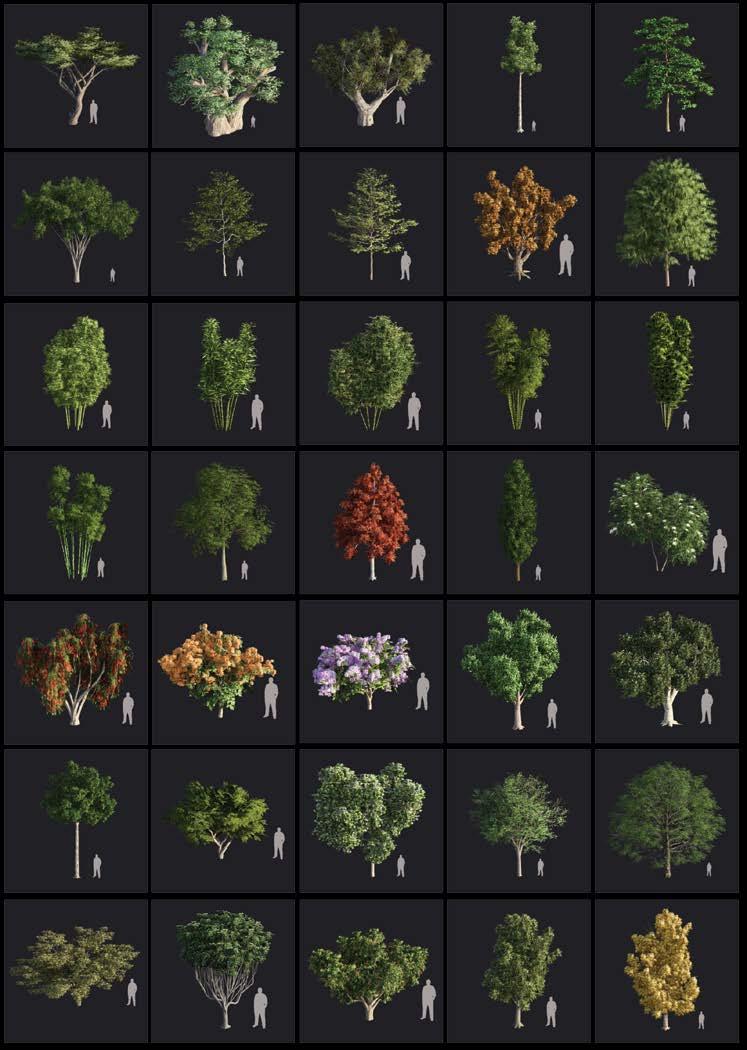
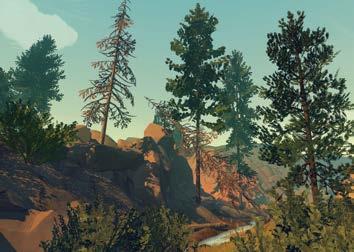
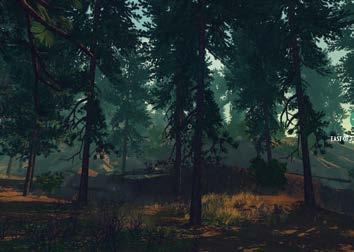
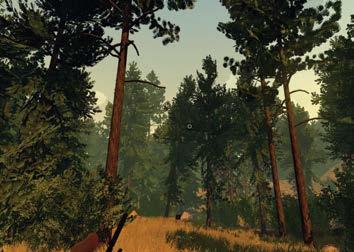
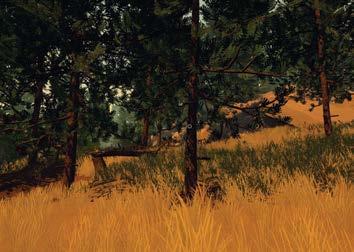
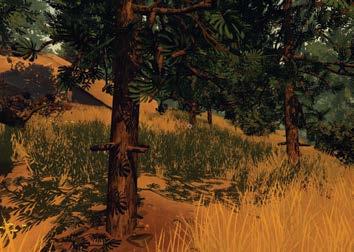
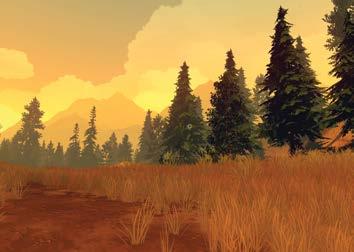
Take the game Firewatch (Campo Santo, 2016), which simulates the Shoshone National Forest in Wyoming as a backdrop to the main character’s plot arc as a summer fire lookout. The game was widely celebrated for its environmental realism even as, for practical reasons, artist Jane Ng individually modeled only 23 distinct types of trees, among them lodgepole pines, blue spruce, and aspen.4 Of these, 14 were the main workhorses, which were placed nearly 5,000 times across the game’s landscape, with the game’s developers trusting that players would be unlikely to notice identical trees when deployed with various degrees of rotation and pitch. When I learned this about the game, which I very much admire despite this sleight of hand, I felt a bit like I did when I first learned that American national forests are extensively logged—disappointed, albeit from a place of naivete.5 Since playing Firewatch, I have made it a habit to peruse popular marketplaces for 3D models, such as the Unity Asset Marketplace, Sketchfab, or TurboSquid, to get a rough sense of the accuracy and proportionality of “natural” assets compared with “built” environment assets such as furniture, vehicles, or buildings. Sometimes these models are produced by amateurs with professional aspirations. Others are made by seasoned artists, small studios, or entire companies dedicated to asset modeling. Although many of these producers
have taken laudable steps toward improving the quality and botanical accuracy of, say, tree models, the dominant approach remains one based on “good enough” approximations set at a tolerable price point for commercial sales, which results in substantial gaps in species and regional coverage. I have come to think of these digital asset libraries as plantations of the 21st century, monocultures of not just the species modeled but also the processes used to produce the models, which range from computer-assisted design software to photogrammetry and lidar scanning.
Naturally, the term “plantation” is not a comfortable one. In the United States, it is inevitably bound up with our country’s ignominious history of employing slave labor, particularly in the South. The dehumanizing commodification of enslaved Africans has always run parallel to the monocultural logic of the plantation—one crop, raised to the exclusion of all other species—both being systems designed for maximum profit with little regard for ecosystem or community health. It is with some trepidation that I deploy the term here to describe a more contemporary set of circumstances, although historical plantations are still with us in the pesticide-laced fields, robot factories, and migrant workforces of modern agriculture. What I am referring to instead is the proliferation of digital models created to serve as nature ex situ, whether in the increasingly computer-generated worlds of professional cinema, television, architecture, and video games or the countless amateur projects for which a quick internet search yields pages of highly portable stock images.6
Like real plantations, digital plantations highlight only what is most valuable as a commercial product. This fact might explain the numerous apple species packs in SpeedTree (a leading digital vegetation catalog and design tool) and the conspicuous absence of trees common to other parts of the world, like mulberry or guava – or the presence of Cannabis sativa but not khobeza, the weedy variety of mallow that has been a staple of the famine diet of Palestinians during the war in Gaza. For me, these plant libraries are akin to the “floating islands” examined by Jussi Parikka and Abelardo Gil-Fournier at the beginning of their book Living Surfaces, trees sent wholesale by barge or cargo ship that speak to the isolation of species, their “synthetic natures” reflective of complex logistics and changes in land use.7 As seen in the epigraph to this essay, Anna Tsing, who popularized the term Plantationocene, views plantations as “machines of replication,” that is, “simplified ecologies” in which “life worlds are remade as future assets.”8 Assets are, for Tsing, “disentangled things” removed from the landscapes from which they come.9 However, they are not just alienated from the land – they are also alienated from the people who labor there, the rest of their complex ecosystems, and the other particularities of actual places, including the possibility of chance encounters. Tsing uses the word “asset” in the financial sense of speculative investment but could just as easily be talking about digital assets given the way in which they are created, stored, and, later, staged as platforms for future play and profit.
1 Anna Tsing, “Earth Stalked by Man,” The Cambridge Journal of Anthropology 34, no. 1 (2016): 4.
2 Christina Dunbar-Hester, Oil Beach: How Toxic Infrastructure Threatens Life in the Ports of Los Angeles and Beyond (University of Chicago, 2023).
3 For a sampling of pivotal work in this area, see John Durham Peters, The Marvelous Clouds: Toward a Philosophy of Elemental Media (University of Chicago, 2015); Melody Jue, Wild Blue Media: Thinking Through Seawater (Duke University Press, 2020); and Yuriko Furuhata, Climatic Media: Transpacific Experiments in Atmospheric Control (Duke University Press, 2022).
4 Alenda Y. Chang, “Between Plants and Polygons: SpeedTrees and an Even Speedier History of Digital Morphogenesis,” electronic book review (December 15, 2019), https://doi. org/10.7273/wtdf-7w30.
5 Oliver Milman, “US Forest Service failing to protect old growth trees from logging, critics say,” The Guardian (August 1, 2024), https://www.theguardian.com/environment/ article/2024/aug/01/us-forest-service-oldgrowth-trees-deforestation-logging.
6 Alenda Y. Chang, “Where the Model Ends,” Configurations 32, no. 2 (Spring 2024): 213–27.
7 Abelardo Gil-Fournier & Jussi Parikka, Living Surfaces: Images, Plants, and Environments of Media (MIT Press, 2024).
8 Tsing, “Earth Stalked by Man,” 2.
9 Ibid., 4.
10 Some will argue that digital archives are ideal because of their ability to float freely across the computing cloud in redundant ways; however, they could also end up fortress-like, along the lines of the Getty Museum’s well-known assertion that its cunningly constructed campus is the “safest place for art during a fire.” See Caitlin Shamberg & Annelisa Stephan, “Why the Getty Center Is the Safest Place for Art During a Fire” (October 29, 2019), https://blogs.getty. edu/iris/getty-center-art-library-collectionssafe-fire/.
11 Bernard K. Means, “Gone These Hundred Years: Digital Zooarchaeology of the Passenger Pigeon (Ectopistes migratorius),” the Virtual Curation Laboratory blog, Virginia Commonwealth University (September 1, 2014), https://vcuarchaeology3d.wordpress. com/2014/09/01/.
12 Xan Sarah Chacko, “The Vault Is a Bunker, the Arsenal Are Seeds,” LA+ Interdisciplinary Journal of Landscape Architecture, no. 19 (2024): 48.
13 Elizabeth Callaway, Eden’s Endemics: Narratives of Biodiversity on Earth and Beyond (University of Virginia Press, 2020), 10.
Opposite: Identical trees in Firewatch, which appear different because of rotation and pitch.
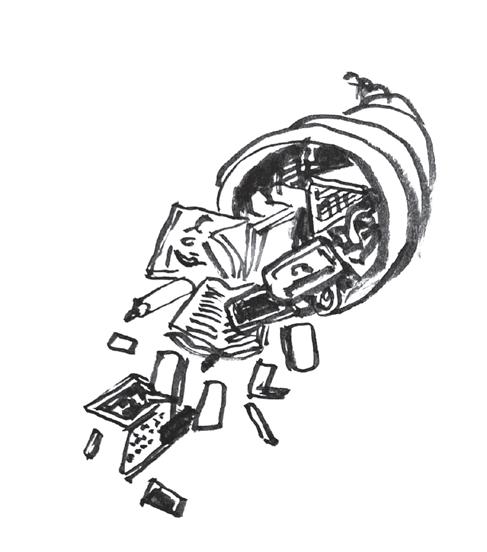
Current libraries could, in theory, turn more toward the conservation model embodied in projects such as the Svalbard Global Seed Vault, which is sometimes called the Doomsday Vault because of its mission to safely store duplicate seeds from seed banks all around the world in case of regional losses. After all, the background extinction rate of species, which is now, because of humans, many times higher than it would normally be, inevitably raises the question of what remains when species vanish. In a few cases, a cornucopia of literature, photographs, sound recordings, films, and even documents related to legal wrangling and conservation efforts may remain as a testament to what has gone. In most cases, though, we are not even aware of what we have lost, as much of the earth’s biodiversity has not been identified. In this context, the flexibility of digital models proves helpful.10 They can point to what has passed and also wonder at the unknown, such as the “digital zooarchaelogical” scans of passenger pigeon remains available from the Virtual Curation Laboratory or the procedurally generated alien worlds of No Man’s Sky (Hello Games, 2016).11
This notion of eschewing digital plantations in favor of an archival model is not without problems. Elizabeth Callaway, in Eden’s Endemics, has written cogently about the Svalbard seed vault and its rhetoric of plant salvation. Callaway faults such projects for constructing a dichotomy in which the perception that the regional storage facilities of the Global South are inherently risky necessitates the placement of duplicates in the Norwegian permafrost. Already, digital asset libraries arguably prioritize species familiar to their designers, who primarily hail from the northern hemisphere and wealthier nations. If a call to better model the world leads only to a fine-grained rendition of certain regions and a patchwork for everything else, we risk retreading age-old provincialisms alongside the colonialist logics of selectively plundering the world’s biodiversity. Xan Sarah Chacko offers a similar critique of Svalbard’s “bunker logic,” entering the vault only to “see omissions, gaps in my mental maps of countries, big and small, that are missing from representation in this future.”12
One might hope that asset libraries, especially those such as SpeedTree (recently acquired by Unity) or Laubwerk (recently acquired by Maxon) that specialize in plant models, could evolve to be less like plantations and more like the seed catalogs dear to avid gardeners. Beyond shopping for desired aesthetics— pink azaleas for the front yard, or blooming rhododendrons for a love scene in the latest role-playing game—gardeners cultivate in expectation of biotic and abiotic relationships, present in everything from soil composition to the visits of winged pollinators. In writing about the seed vault, Callaway criticizes its contrary “impulse to view biodiversity as information rather than a feature of embodied organisms.”13 In the Svalbard database, information about a plant’s potential productiveness is meticulously delineated while data related to experience and care are left out. “It would be easy to use this database,” she writes, “to search for plants that are drought- or heat-tolerant, or resistant to weevil, but it would be impossible to search for
plants that taste sweet or nutty.”14 In the existing catalogs of digital plants, all such information is deemed irrelevant, but encoding more of these properties and their potential impact on wanderers in computer-generated spaces would go a long way toward enriching the vitality of designed environments. For now, as landscape architect Karen M’Closkey writes of plant object libraries such as Lumion “the increasing hyperrealism of images is likely not matched by increasing knowledge about the complex entities and interactions that take place in the landscapes we seek to represent.”15
Lithic models
The Los Angeles subdivisions that were consumed by flames were plantations of a different kind, a reminder that architecture, landscaping, and “wild” lands are dissimilar less in kind than in degree. In the beautifully assembled Feral Atlas, historian Stephen Pyne reminisces about the appearance of the term WUI (wildland-urban interface) in 1986: “It was a clumsy, dumb phrase, but it referred to a dumb problem. Watching houses, and then communities, burn was like watching polio or plague return.”16 Pyne describes how WUI burning, originally “a California pathology,” eventually expanded to the rest of the West. Then, reflecting on the Fort McMurray wildfire in Canada in 2016, Pyne makes the case that there are two kinds of fire: living and lithic. “One burns living landscapes. The other burns lithic landscapes, which is to say, biomass buried and turned to stone in the geologic past” (i.e., fossil fuels such as coal and petroleum).17 Given ample evidence that these two kinds of burning, one natural, the other human-driven, have led to compounded disasters, Pyne proclaims that we have entered the Pyrocene, in which “even climate change has become a subnarrative of fire history.”18
Digital models, like the cars and tar sands set ablaze in the Fort McMurray fire, spring from rare earth elements and global supply chains for gasoline, plastic, semiconductor chips, and electricity – they are lithic, too, even if they do not burn in the conventional sense. Computers are engines of work and play that demand fuel, create heat, and alter the climate at multiple scales.19 While hard to fathom, 3D models are always proxies, not just of their natural and built referents, but also of past and ongoing relations, of risks accepted or harms enacted with our implicit consent.20 If, as Natalie Aikens, Amy Clukey, Amy K. King, and Isadora Wagner argue, “the plantation is as much a narrative construction as it is a literal place,” the orderly rows of today’s digital plantations tell only a partial story of fragmentary places.21
In a not-so-distant future of computational scarcity brought on either by overconsumption or a radical leveling of technological privilege across all the nations of the world, we might be forced to carefully consider the models on which we lavish our lithic resources. Tsing warns that proliferation is a condition of modernity and the plantation and that, in the real world, “Plantations are breeding grounds for virulence.”22 Digital proliferation is at once both less consequential and more
troubling in its potential to ramp up without bounds – what happens when artificial intelligence begins to model and not just skim, summarize, and generate 2D “art”? Unfortunately, mandates for sustainability and efficiency have the potential to align in ways inimical to aesthetics, creativity, and little-d democratic production. Admissions of scarcity might lead us to the conclusion that we should leave matters of design to the professionals who know best how to fabricate or deploy assets. Yet I hunger for digital assets that emerge from something other than market demand, capitalist growth imperatives, and computational wealth. We need more models made by more people that are instilled with the knowledge and humility that comes with making media in the Pyrocene.
14 Ibid., 33.
15 Karen M’Closkey, “Plant Samples,” LA+ Interdisciplinary Journal of Landscape Architecture, no. 19 (2024): 112.
16 Stephen Pyne, “Fort McMurray Becomes a Portal to the Pyrocene,” Feral Atlas, https://feralatlas.supdigital.org/poster/ fort-mcmurray-becomes-a-portal-to-thepyrocene (accessed February 14, 2025).
17 Ibid.
18 Ibid.
19 Alenda Y. Chang, “Micro/Climates of Play: On the Thermal Contexts of Games,” in Antonio López, et al. (eds), The Routledge Handbook of Ecomedia Studies (Routledge, 2024).
20 Dylan Mulvin, Proxies: The Cultural Work of Standing In (MIT Press, 2021).
21 Aikens and her co-authors also argue that thinkers such as Donna Haraway and Anna Tsing could do more to acknowledge the intersections of race and colonialism.
See Natalie Aikens, et al., “South to the Plantationocene,” ASAP Review (October 17, 2019), https://asapjournal.com/feature/southto-the-plantationocene.
22 Tsing, “Earth Stalked by Man,” 13.
David Salomon is chair and associate professor of art, art history, and architecture at Ithaca College. He is the co-editor of Ambiguous Territory: Architecture, Landscape, and the Post-Natural (ACTAR, 2023) and the author of numerous publications investigating the intersection between architecture, landscape, art, and infrastructure.
ARCHITECTURE, DRAWING
“The only historian capable of fanning the spark of hope in the past is the one who is firmly convinced that even the dead will not be safe from the enemy if he is victorious.”1
To know that something exists, that it is right there but cannot be detected by our senses, can produce unnerving and uncanny effects. It can also produce exhilarating and insightful ones. The combination of unease and desire to uncover what escapes one’s grasp and haunts one’s imagination, to see what exists beyond everyday appearances, to unearth what lies underneath the surface of reality is shared by secularists and spiritualists, by physicists, psychoanalysts, painters, priests, and psychics alike. A medium—spiritual, scientific, technical, or artistic—is necessary when one cannot access or communicate information directly. This drive guides the search for scientific knowledge, ghosts, fossil fuels, and art. Finding and representing these forces and things requires the proper instruments and the right medium for discovering, extracting, and communicating what evades our body’s sensorial apparatus. Media translate and transmit messages. They encode, assemble, and amplify information to create and/ or expand the audience for it. Media are never neutral. Each one has a specific set of internal conventions and produces a specific set of external effects.2 In a number of fields, including landscape architecture, architecture, and geology, section drawings are one such medium.
For over a decade, hybrid sections have emerged in the design disciplines to discover, document, and imagine the visible and invisible causes and effects of environmental degradation, often with a focus on the topics of hydrocarbon exploration and extraction. The work of Seth Denizen, NEMESTUDIO, Mathur/da Cunha, SCAPE, Smout Allen, Studio SOC, and DESIGN EARTH are among those engaging these issues via this reimagined genre. They have produced augmented sections, section axons or “chunks,” section renderings, serial sections, scenographic sections, cartoon sections, and so on. Each version depicts a clear cut through the earth and sky, revealing a scaled image that represents the physical matter of the earth. These images also depict intense, exaggerated worlds. They are simultaneously analytic and synthetic, technical and factual, imaginative and hallucinatory.
Taken as a group, they represent a new medium. They have the qualities of allegories and myths. They synthesize natural histories with cultural narratives into a single theatrical story.
More specifically, when they focus on the landscapes of hydrocarbon deposits, they are spectral sections, images that reveal the ghostly presence of the once-organic matter that has been or will be exhumed and incinerated. In other words, these sections depict fossil fuels in their various states of being; states that include their transformation through potential, kinetic, and spent energy. The toxic results of this process haunt the ground, the water, and the air. They show scary, dangerous, monstrous things, things that were once buried deep in the ground but whose disinterment now threatens our present and future. One could argue that, like a spiritualist medium, this new genre of sections gives voice to non-living things that cannot speak for themselves or can only speak in tongues with the not-quitedead. Unlike those mediums, the spirits that today’s specular sections communicate with are the literal stuff of the earth.
What messages are being transmitted by this new medium, and are they being received? To address these questions, this essay first gives some historical background on sections, specters, mediums, and hydrocarbon exploration. It then looks at some examples created by contemporary designers. It concludes by analyzing and theorizing spectral sections via the concepts of sacrilege and care. In doing so, the essay shows how these novel sections embody at least three conceptions of what a medium is and what it can do, namely, transmit information, act as a channel for creative expression, and communicate with the non-living.
The standardization of geological section drawings—scaled, black and white, hatched images—in the early 20th century suggests that they could objectively depict what is present underground.3 Objective? Perhaps. Literal? No. Section drawings present what one can never experience directly. They are diagrams of what could be visible under the impossible condition of cutting into and removing matter that otherwise prohibits direct encounters with things. Like all media, sections make the ineffable legible. Like a spiritualist medium, they make the non-living speak. One could argue that all sections related to fossil fuel exploration communicate with the dead. Just as a human medium attempts to speak to human ghosts, sections of hydrocarbon deposits represent attempts to identify, locate, and capture the remains of the long-dead flora and fauna from which they come.
The rise of spiritualism in the mid-19th century coincided with the invention of the first electronic communication medium— the telegraph—to which it was often compared.4 It was also contemporary with the growth of photography. The sub-genre of “ghost photography” was popular at the end of the 19th century.5 In these cases, a medium received specially coded disembodied messages from a distant body. These bodies had valuable information to share, which was given a physical presence only after a human manipulated the appropriate devices necessary to translate and transform it.
Section drawings also have a history with spirits. From the Renaissance through to the Industrial Revolution, architectural sections were used to reveal immured ideas and bodies said
to be buried in buildings and landscapes.6 As in geology, such practices gave way to a more technical, standardized understanding of the drawing type in the 19th century.7 Sections increasingly lost their theatrical value and became more technical, more instrumental.8 Despite the loss of their supernatural ethos, what remained was the use of sections to uncover the unknown, to make the invisible visible, and to put what they unearthed to work.
Today’s spectral sections are not the first time a medium has been used to put humans in communication with hydrocarbon deposits. In the United States, the history of oil extraction and the rise of spiritualist mediums have coincided. Their alleged ability to hear and see things that others could not endeared them to those searching for crude oil deposits during the second half of the 19th century. In the early days of oil exploration, spiritual mediums like Abraham James were hired to divine where to find oil in the ground. For a short time, the spirits they allegedly spoke with augmented the efforts of wildcatters, geologists, and engineers. This practice grew after James’s “success” at the Harmonial well in western Pennsylvania in 1867.9
The effectiveness of spiritualist mediums in the exploration of fossil fuel would soon be surpassed by geology’s more accurate methods and tools, tools that often included technical section drawings. The search for coal and oil accelerated the creation of modern geological methods and media. These included more detailed horizontal site plans and vertical crosssections to document and represent what existed below the earth’s surface.10 The efficacy of these techniques meant that seances were usurped by science, drama was replaced by evidence, and the fantastic, transcendent, and otherworldly were substituted with hard facts. In other words, the secular sublimated the sacred and the spiritual.11
Classifying a contemporary crop of sections as spectral suggests the reemergence of the religious, immured sections from previous centuries.12 It also reveals an effort to revive a conventional disciplinary medium. Why resurrect and reanimate these now? Can a return to a seemingly obsolete way of knowing and an age-old drawing method generate new messages about the Earth’s past, present, and future? Like all media, today’s spectral sections channel messages between senders and receivers. If the message from the afterlife in the 19th century was: “Here I am, come get me,” the message from today’s spectral sections is “Here I am, beware of what you wish for.” In contrast to a medium such as James, who claimed to be told by ancestral Native American spirits where to find oil, the sources of information for today’s theatrical sections are grounded in scientific and engineering sources, information that is itself often depicted in sectional drawings and diagrams.13 As such, these drawings embody and repeat the section’s longstanding capacity to be at once technically accurate and theatrically evocative.14 They simultaneously distill and exaggerate information. In this, they are similar to the vibrant yet specific sections of the early 19th century by Cuvier,
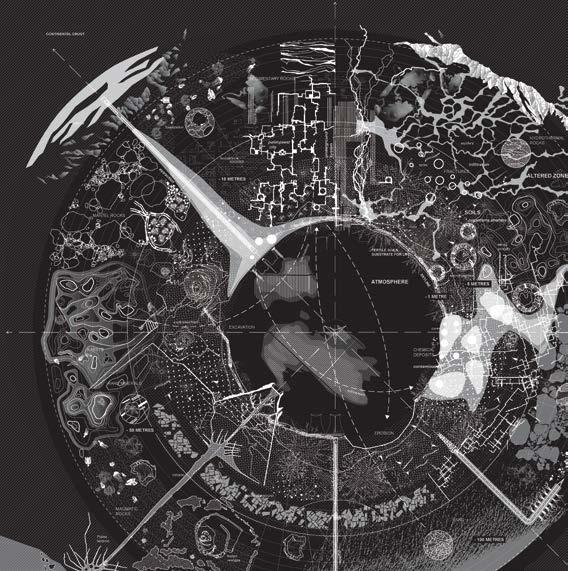
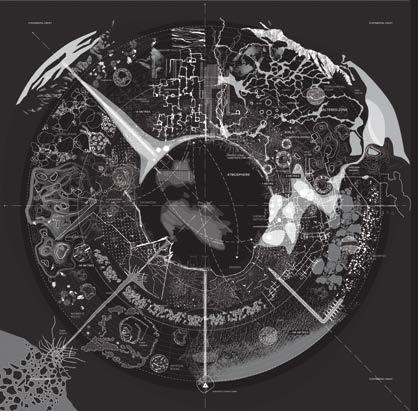
Opposite Top, Middle: Frédérique Aït-Touati, Alexandra Arènes and Axelle Grégoire, “Map: Soils,” Terra Forma: A Book of Speculative Maps, 2022.
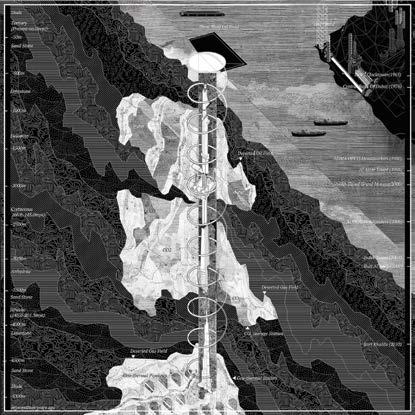
Opposite Bottom: DESIGN EARTH, “Section,” After Oil, 2016.
Humboldt, and Smith.15 Like them, they exuberantly expose things long buried. More specifically, they experiment with the capacity of section drawings to reconceive the real, symbolic, and imaginary relationships between the natural history of the Earth and the human history of energy infrastructure and extraction. In doing so they engage temporalities at once intimate and unimaginable. Neither realist nor utopian, they are perhaps best described as allegorical or mythical.
For example, SCAPE’s sections through the Mississippi River included in the book Petrochemical America are such hybrids.16 The image “From the Earth to the Sky” uses multiple techniques to exhibit the everything-all-at-once aspect of the environment.17 It includes a section-axon cut through rendered geological strata, a graphic evolutionary timeline, an oblique map of Louisiana, and a photographic image of the Mississippi River. The inclusion of silhouettes of dinosaurs in the biological timeline, along with the sections through oil wells, reinforces the relationship between ancient life forms and contemporary culture. It also highlights how the different durations contained in biological evolution, geological processes, and the petrochemical industry are simultaneously active in the present.
The phantom presence of these extinct animals, the abstract depiction of the ground, the perspectival map-as-sky, and the quasi-realistic imagery of the riverscape make an impression that is at once overwhelming and highly calibrated. Everything is present all at once: the slow and the fast, the large and the small, the physical and the social, the living and the dead. While the facts are presented in dramatic ways, they are all true. This is reinforced and grounded by the scaled sectionaxon at the bottom of the drawing. As a medium, it creates and communicates an image of a world that is haunted by its inability to decouple itself from the natural and cultural histories that produced it.
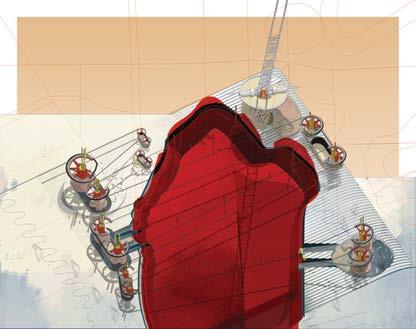
In Smout Allen and Geoff Manaugh’s LA Recalculated, the oil reserves under Los Angeles are represented in their sectionaxons as either blood-red pools or black masses. They are combined with fictional devices that index and announce the underground deposits’ practical use and geological movements. Here too, multiple durations and speeds—of the oil, of technology, of the city—are combined rather than isolated. Similarly, the gap between technology, science, and spectacle is blurred. At once graphic and multilayered, the transparent X-ray-like quality of the drawings announces the oil and the apparatus’s ghostly presence. The machines that the designers depict are fictional. The oil is real. Both are invisible in everyday life. Only in the drawing is their spectral presence imaginable. They are totems and monuments to those buried below. As a medium, they speak with and make legible things that otherwise would remain unimaginable.
The book Terra Forma, by Frédérique Aït-Touati, Alexandra Arènes, and Axelle Grégoire represents the portions of the earth in eight “maps,” many of which are inverted sections
documenting the multitude of actors and processes present in natural and urban landscapes.18 The Soil Map includes a seemingly impossible array of elements occupying dense rings of natural and industrial matter. They are represented by an elastic set of icons, whose size and scale can be stretched or shrunk to emphasize their presence and influence on the Earth’s many critical zones. Everything depicted is verifiable data — data that can be emphasized or deemphasized but never made up. The overwhelming quality of the drawing reinforces the presence of the material, functional, and temporal density of actors and behaviors found underground. This includes pipelines, storage tanks, and mines. Like their biological neighbors, these elements are simultaneously consumed by the soil and actively making, unmaking, and remaking the ground upon which we stand. This interior also includes fossils, minerals, and organic matter. The different ages of these agents and their different rates of decay and growth channel the lingering presence and influence of a diverse set of living, non-living, and never-living artifacts and processes that operate upon the Earth’s critical zones. The use of transparency supplies the drawing with a shadowy sensibility, helping one to recognize how the simultaneous presence of divergent elements and temporalities can coexist and interact with one another, and it connects the long-term and spectral presence of older things with more lively and contemporary ones.
DESIGN EARTH’s intricate yet monumental drawings combine scales, stories, and details of a past, present, and future Earth. The section-axons in their series After Oil directly address the presence and negative influence of hydrocarbon deposits, exploration, and extraction on the surface and subsurface of the earth. Scaled geological strata are juxtaposed with richly detailed images of infrastructure and architecture that tell the story of the dangerous interdependency between them.
In Climate Inheritance, drawing after drawing, section after section, fossils, fish, humans, and other species are depicted as being immured in ice, the ocean, and the earth. These surreal images dramatically juxtapose the organic with the inorganic, the biological with the technical, the historical with the personal, the infrastructural with the architectural, the living with the dead, and the secular with the spiritual. The section-elevations of East Rennell in the Solomon Islands—whose people have a culture that understands all entities as having a soul—include one depicting the underground bauxite extraction process that has wreaked havoc on the islands’ ecosystems. This is juxtaposed with a collage-section that includes a motherearth figure made up of all the islands’ human and nonhuman inhabitants, both dead and alive, on the ground, in the air, and below the sea. The exaggerated scales, colors, and arrangements of these images create compositions that are more effective the more exaggerated they are, giving them an allegorical air. One message the Rennell Island sections send is the risks present when one culture recklessly unearths the spirits of another, turning what was a stable, sacred relationship into an imbalanced and sacrilegious one.19
1 Walter Benjamin, “Theses on a Philosophy of History,” in Hannah Arendt (ed.), Illuminations (Shocken, 1968), 255.
2 Marshall McLuhan, “The Medium is the Message,” in Understanding Media: The Extensions of Man (McGraw Hill, 1964); Clement Greenberg,“ Modernist Painting,” in John O’Brian (ed.), The Collected Essays and Criticism. Volume 4: Modernism with a Vengeance, 1957–1969 (University of Chicago Press, 1995 [1959]), 85–93; Gregory Bateson, “Style, Grace, and Information in Primitive Art,” in Steps to an Ecology of Mind (Dutton, 1972), 137–42.
3 Martin J. S. Rudwick, “The Emergence of a Visual Language for Geological Science 1760–1840,” History of Science 14, no. 3 (1976): 149–95; Carol Siri Johnson, “The Evolution of Illustrated Texts and Their Effect on Science: Examples from Early American State Geological Reports,” Leonardo 41, no. 2 (2008): 120–27; Paul Emmons, “Immured Sections,” in Drawing Imagining Building: Embodiment in Architectural Design Practices (Routledge, 2019), 70–94.
4 Sheri Weinstein, “Technologies of Vision: Spiritualism and Science in Nineteenth-Century America,” in Jeffrey Andrew Weinstock (ed.), Spectral America: Phantoms and the National Imagination (University of Wisconsin Press, 2004), 124–40; Jeffrey Sconce, Haunted Media: Electronic Presence from Telegraphy to Television (Duke University Press, 2000).
5 Tom Gunning, “To Scan a Ghost: The Ontology of Mediated Vision,” Grey Room, no. 26 (Winter, 2007): 94–127.
6 Emmons, “Immured Sections,” 85–89.
7 Mark Lawrence Hineline, The Visual Culture of the Earth Sciences, 1863–1970, Publication No. 304051619, University of California, San Diego, 1993, https://www.proquest.com/ docview/304051619.
8 Emmons, “Immured Sections,” 71, 88–89.
9 Rochelle Raineri Zuck, “The Wizard of Oil: Abraham James, the Harmonial Wells, and the Psychometric History of the Oil Industry,” Journal of American Studies 46 (May 2012): 313–36.
10 Rudwick, “Emergence of a Visual Language”; Hineline, Visual Culture of the Earth Sciences
11 Zuck, “The Wizard of Oil,” 334–35.
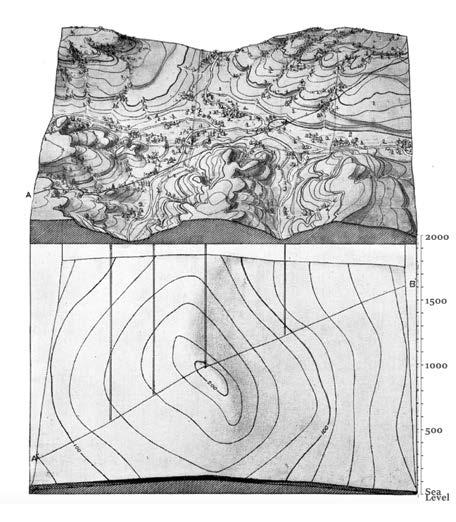
Opposite Top: Stereogram showing surface topography and underground structure of a typical oil and gas pool. Kansas Geological Survey, 1917.
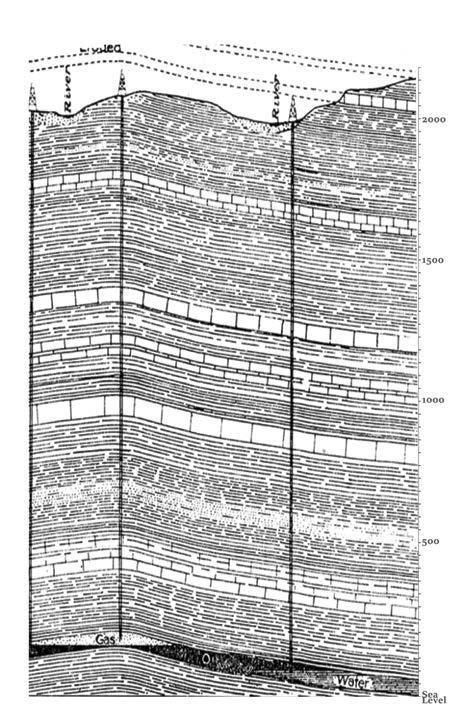
Opposite Bottom: Typical cross section through limestone bed with wells. Kansas Geological Survey Bulletin 3, Oil and Gas Resources of Kansas 1917.
These examples of sections-as-specular-medium contrast with the typically utilitarian nature of this drawing type. Spectral sections do not provide design solutions, per se. They do identify and locate conditions that their makers would like to see transformed, if not eviscerated — things such as hydrocarbon extraction, species extinction, and toxic landscapes. However, they do not propose immediate answers to these problems. Instead, they operate sideways like myths and parables do. They act as fact-based fictions. The facts found in spectral sections are presented neither as neutral evidence nor as a valuable natural resource. Instead, they are displayed as uncanny ancestors. Like spiritualist mediums, they bring the dead back into the realm of the living, not by extracting them and burning them, but by venerating them.
As myths, these images evoke the dangers lurking not just underground, but also in the underworld.20 They speak to the taboo of exhuming bodies that are meant to be left alone. Spectral sections reveal the power that our predecessors— and their literal energy—still hold over us. This is also true of conventional sections used for hydrocarbon exploration. They, too, can uncover the powerful forces found in the earth and help to resurrect and reuse them for human benefit. Such drawings function as harbingers of progress and profit. Spectral sections present the same information differently. They serve as sirens of death and decay. They show sacred fossils that should remain undisturbed. They identify villains and toxins that threaten the present and future if they are let out of their geological and biological graves. Disentombing these things, these monsters, these demons is not just unhealthy, it is also sacrilegious.
For secularists, such language—demons, monsters, sacred and sacrilegious—seems obsolete, if not dangerous. Many humans continue to believe in these and other religious taboos, just as they believe in gods. Modernity has not vanquished religion or religious thought. In fact, at the current historical moment, it is emboldened. This would suggest the need to double down on the rational, on the scientific, and on the logical to combat the return of this faith-based, often anti-scientific way of understanding what is in, on, and above the Earth’s surface and how it got there.
Why speak of spirits? Why talk of the sacred, or seances, or drawings for that matter, when the horrors of the material world are so real and so urgent? Why use such seemingly outdated concepts to describe contemporary issues? What are the advantages of speaking of the Earth’s physical qualities in terms of ancestors and demons? Are not the literal issues, the quantities and qualities associated with fossil fuel extraction and consumption, more relevant for addressing the crises at hand? Perhaps spectral sections have appeared because, in addition to aggregating more facts about our carbondependent past, present, and future, we also need to invent new legends and stories to make legible to our senses and psyches the real threats facing our planet and its inhabitants. Maybe we need this indirect mode of inquiry because the
unintended side effects of our dominant myths—of progress, of domination, of modernity—cannot be overturned with more reason. Instead, the creation of new myths and new mediums is also necessary.
Framing what spectral sections depict as sacred is useful not because they are transcendent or divine. Rather, it is to help to establish entities and processes that need to be treated with care. Michel Serres argues that the opposite of religion is not doubt; it is neglect.21 To be religious, to recognize specific things as sacred is to care for them. Among the things Serres understands as being neglected in modernity is time, specifically, durations operative in the world other than the speed of the present.22 The logic of extraction, the logic of profit, and the logic of problem-solving emphasize the immediate and pay less attention to both the slowness of human and natural history and the very long future of the universe. To venerate the ground, its long, slow process of change, and the old and dead entities housed within it is not to reify it; it is to recognize how they continue to act upon the present and future and how the acceleration, ignorance, or extraction of these processes neglects this pattern.
The spirits Serres would have us communicate with and revere, if not worship, are not eternal gods, but the productive yet entropic entities we depend upon for our existence: the ground, the atmosphere, the water, the sun, etc.23 They are the very things depicted in spectral sections. Worship here is understood as the granting of certain qualities, rights, and powers to things, and the recognition that they should not be exploited or disrespected. That is, it makes things sacred. To venerate is to treat certain things, processes, and histories with respect, adoration, care, and, Serres adds, love.24 The ability to recognize and communicate such messages requires a specific mindset and a specific medium.
If spiritualist mediums of the 19th century sought to prove the presence of supernatural beings, today’s non-spiritualist mediums, i.e., specular sections, recognize that the physical world itself haunts and hurts us when we carelessly exhume and consume it. Spectral sections are a medium to uncover and compose such messages. They depict the ghostly presence of hydrocarbon and other deposits and processes in a way that allows one to communicate with the things and temporalities of the distant past and to interpret the warning signals they send from beyond the grave. These dense, uncanny, everything-allat-once drawings are reminders of the continued presence of these things in our world, our reliance upon them for our wellbeing, and the risks we face if that relationship is neglected.
12 Paul Emmons, “A Window to the Soul: Depth in Early Modern Section Drawing,” in Donald Kunze (ed.), Architecture Post Mortem: The Diastolic Architecture of Decline, Dystopia, and Death (Routledge, 2016), 165–66.
13 Rudwick, “Emergence of a Visual Language”; Johnson, “Evolution of Illustrated Texts.”
14 Emmons, “Immured Sections;” David Salomon, “Critical Sections,” Cornell Journal of Architecture 13 (forthcoming 2025).
15 Stan Allen, “The Zilsel Thesis: A Review of Strata: William Smith’s Geological Maps,” Drawing Matter (May, 2021). https://drawingmatter.org/ the-zilsel-thesis-a-review-of-strata-williamsmiths-geological-maps-2020/.
16 Kate Orff & Richard Misrach, Petrochemical America (Aperture, 2012).
17 On the distinction between a drawing and an image, see John May, “Everything is Already an Image,” Log 40 (2017): 9–26.
18 On the inverted section and the critical zone, see Bruno Latour and Alexandra Arènes, “If the Earth is Not a Globe, How to Sketch It?” Société d’Objets Cartographiques (2020), http://s-o-c. fr/wp-content/uploads/2020/05/Ness-2-LatourArenes2.pdf.
19 DESIGN EARTH, Climate Inheritance (ACTAR, 2023), 106–15.
20 Emmons, “Window.”
21 Michel Serres, The Natural Contract (University of Michigan Press, 1995), 48.
22 Ibid., 29–31.
23 Ibid., 47–49.
24 Ibid., 49.
Opposite Top: Smout Allen + Geoff Manaugh, “One: Seismic Oil & Tar,” LA Recalculated, 2015.
Opposite Bottom: Smout Allen + Geoff Manaugh, “Six: Oil Fountain,” LA Recalculated, 2015.
RANIA GHOSN
Rania Ghosn is an associate professor of architecture and urbanism at the Massachusetts Institute of Technology and founding partner of DESIGN EARTH, a studio practice that employs the speculative project as a medium to make public the climate crisis. Ghosn, along with her team, has authored Geostories: Another Architecture for the Environment (3rd ed. 2022; 2018), Geographies of Trash (2015), The Planet After Geoengineering (2021), and Climate Inheritance (2023). Ghosn is the recipientof a United States Artist Fellowship and Architectural League Prize, amongst other honors.
ARCHITECTURE, NATURAL HISTORY
On a Sunday morning in 1898, Andrew Carnegie, the ScottishAmerican industrialist who led the expansion of the American steel industry in the late 19th century, read about a paleontological find. The New York Journal carried a full-page article about the first well-preserved individual skeleton of a brontosaurus that the American Museum of Natural History collected. The article ran under the banner headline, “Most Colossal Animal Ever on Earth Just Found Out West!”1 The article stated, “When it Walked the Earth Trembled under Its Weight,” and included an illustration of a long-necked dinosaur rearing up on its hind legs, peeking into an 11th-story New York Life Building window. Carnegie wanted such a dinosaur for his namesake museum in Pittsburgh. He mailed the story with a check for $10,000 (approximately $250,000 in today’s purchasing power) to the museum’s director with the note: “Can you buy this for Pittsburgh?” American vertebrate paleontology in the 1890s, following a period of scientific rivalry known as the “Bone Wars,” gradually shifted into large urban science museums established and funded by Gilded Age philanthropists.2 The exhumation of the dinosaur’s first bone on Independence Day, and its later use in American diplomacy via Carnegie’s international donations of replicas, led to its being nicknamed the “star-spangled dinosaur.” Diplodocus carnegii was named for the museum’s benefactor. The illustration of the complete dinosaur was framed and sent to Carnegie at his summer castle in Scotland, explaining that the new species of dinosaur had been named in Carnegie’s honor and that it “is a bigger beast” than the first discovered Diplodocus. “Now the biggest thing on earth of its kind bears your name; so you are sure of immortality in the annals of science.”3
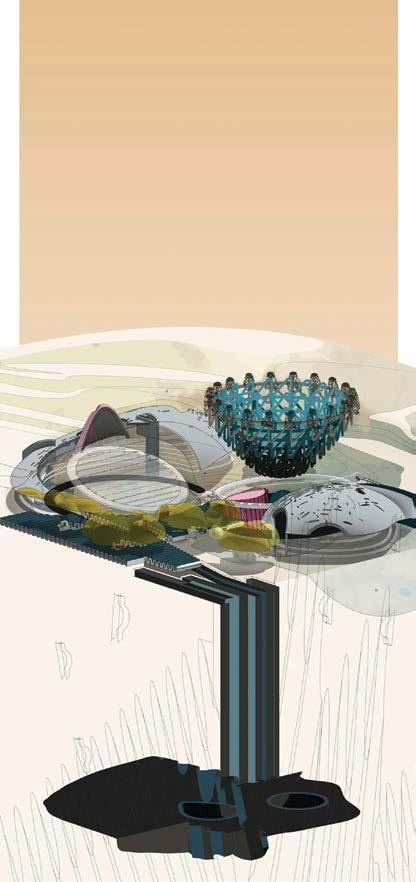
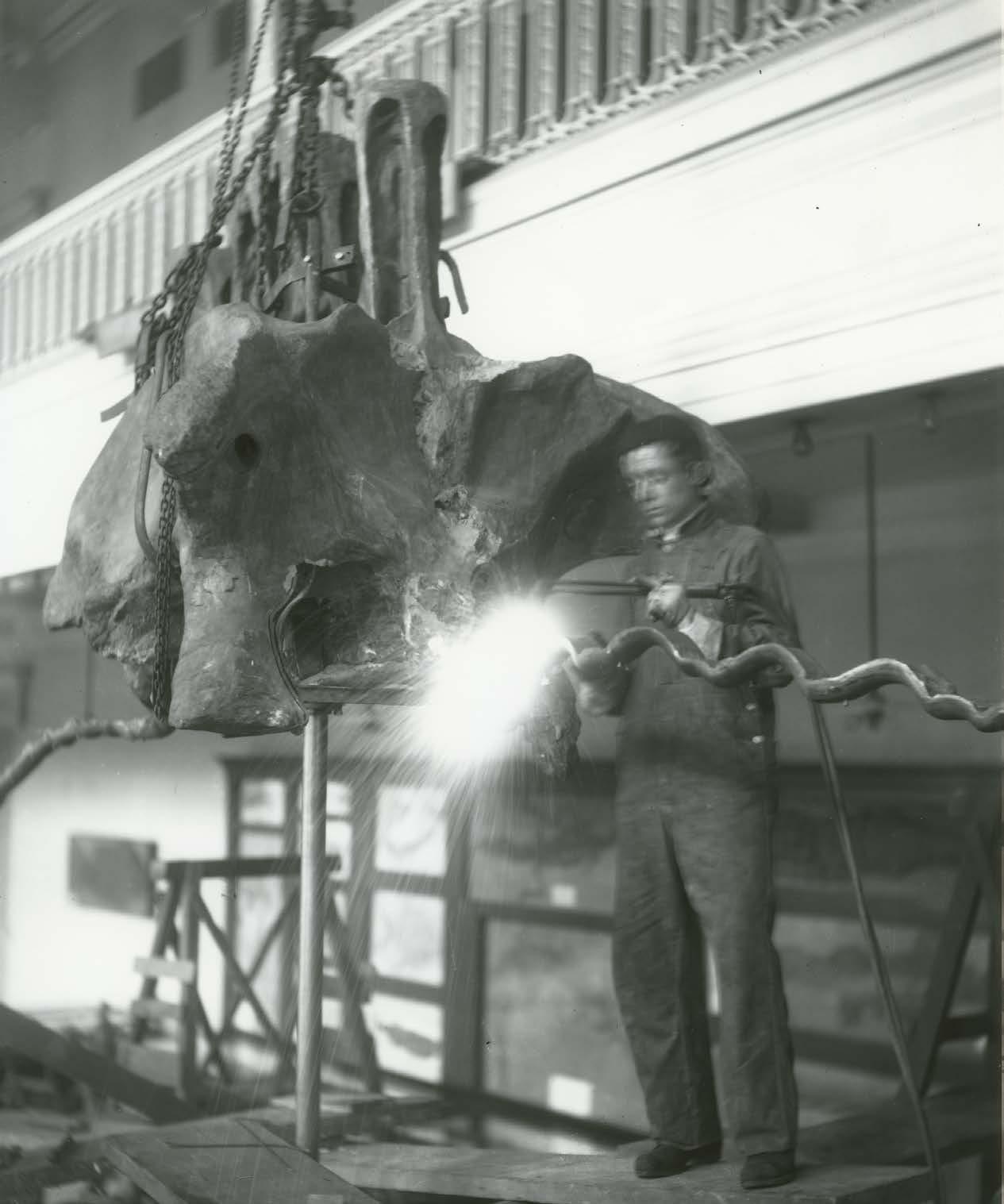
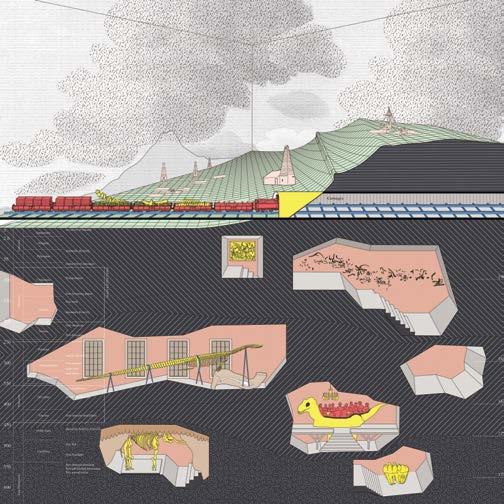
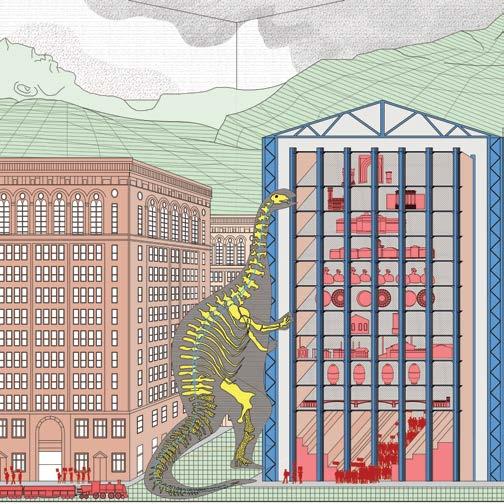
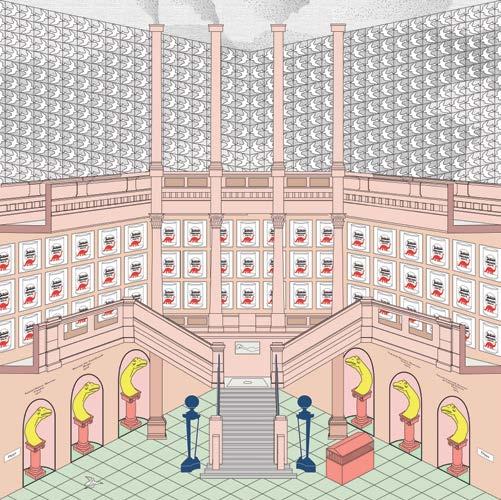
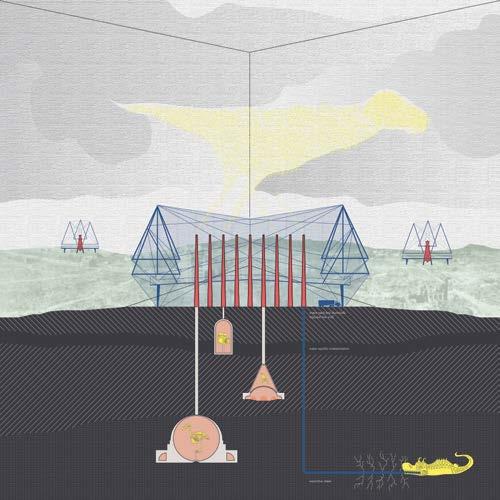
“The Way of Dinosaurs” is a four-act narrative created as an animation in 2023 by DESIGN EARTH and narrated by Kathryn Yusoff.4 Reproduced here as four stills, the acts stage Diplodocus carnegii (later nicknamed “Dippy”) across a series of sites: (a) exhumation at Carnegie Quarry; (b) assembly with Carnegie steel and mounting by Carnegie Steel Building; (c) reproduction in the Carnegie Museum of Natural History (read both social reproduction and the material reproduction of the dinosaur plaster cast as donations to other heads of states); and (d) to ensuing greenhouse gas emissions and extinctions in Carnegie’s world today. Across the four acts, the fossil is the material-narrative medium through which environmental transformations are figured and assembled. The mounted dinosaur figure is reanimated—brought back to life—to narrate a geological era marked by destruction and the potential of extinction, all while reckoning with the entanglement of museums of natural history with histories of extractivism, settler-colonialism, industrial capitalism, and philanthropy. In doing so, “The Way of Dinosaurs” extends the notion of “the end of the world” beyond this present moment of the Anthropocene to other forms of violence to remind us, in the words of narrator Kathryn Yusoff, that settler colonialism, and to that, we add extractive capitalism, “have been ending worlds for as long as they have been in existence.”5
How might stories help us make sense of the fabulous destruction humans face today? In Staying with the Trouble, Donna Haraway describes speculative fabulation as a “mode of attention, a theory of history, and a practice of worlding” to stir up potent responses
to lives that have tragically unfolded.6 Speculative fabulation and the proliferating SFs (e.g., speculative fiction, situated feminisms, and string figures) bend the authority of the documentary and the archive with the playfully surreal to stitch a collection of historical records into a fable. To sow worlds, Haraway appealed to author Ursula Le Guin’s carrier bag theory of storytelling and her method of weaving together stories of technology that account for more protagonists – many unheroic, with complex arcs of entanglements over space and time and with values and losses of many kinds.7 This undisciplined practice stems in part from the attendant desire to weave together fragments from the historical record into material and epistemic practices that feed on the ambiguous resonances of words and images, with oblique references, amplified noises, and gaps to forge new relations among things, animals, tools, strata, people, and power. Figures here are the “material-semiotic knots” through which such stories are knotted and compos(t)ed, as noted by Haraway. Figures help us grapple inside the flesh of the world, making entanglements in which diverse clusters of meaning (e.g., narratives, discourses, precedents, and imaginaries) shape one another through “creating performative images that can be inhabited.”8
In “The Way of Dinosaurs,” the “figure” of the dinosaur becomes a medium for storing and storying environmental narratives. For this moment of crisis, figuration, which bestows personhood onto the dinosaur, is an aesthetic method that reassembles fragments, remains, and ghost figures—of the creature, museum, city, landscape, and world—to make them speak in rhyming verse, colorful imagery, and some poignant humor to the breathtaking capture of life.
Carnegie Quarry
The Carnegie Quarry in Albany County, Wyoming, sits within the Morrison Formation, the primary Jurassic dinosaur-producing strata that extends from northern New Mexico to southern Canada. Dinosaur bones, sometimes visible on exposed rock faces, were known to Native Americans inhabiting the region. “Animal Bones Brutally Scattered About” is the Lakota Sioux name for Carnegie Hill. The Lakota storyteller James LaPointe explained that during the “first sunrise of time,” all the “land was covered with a seething mass of animals,” whose fierce combat left their skeletal remains strewn across the badlands of Nebraska and the Dakotas.9
Appropriations of fossil resources from Native American lands began with the emergence of modern scientific paleontology. Following the General Mining Law of 1872, which established public lands as “free and open to exploration and purchase,” the American West became the site of a Great Dinosaur Rush, where paleontologists worked in the Upper Jurassic and Cretaceous beds of western North America. Collecting old bones was big business. The Union Pacific Railroad, which benefited from land grants for transcontinental transportation development, designed a publicity trust to turn southern Wyoming into a tourist destination by sending invitations to over two hundred scientists across the US, offering free passage to anyone who wanted to see the region’s abundant “reptilian fossils of enormous size” with their own eyes.10 The Quarry Map emerged as a new kind of visual image that showed the exact positions of the bones as they lay when discovered.
During the summer of 1899, scientists from the Carnegie Museum of Natural History exhumed and collected several partial dinosaur skeletons near the banks of Sheep Creek in Albany County, Wyoming. On July 4, 1899, three months into their search, a team member discovered a massive toe bone – the first of Dippy’s bones excavated from two nearly complete Diplodocus skeletons.
Carnegie Steel Building
Dippy’s bones were sent back in 130 crates to Pittsburgh, nicknamed the “Steel City” due to the significance of steel-producing companies, not least Carnegie Steel, in the
19th-century industrial landscape and the heart of western Pennsylvania’s rich supply of high-quality coal. One of Carnegie Steel’s first projects was to contract with the Pennsylvania Railroad Company to manufacture rails. For that, Carnegie modified the burning away of large amounts of carbon found in pig iron, making it more efficient and allowing for steel to be mass-produced inexpensively. Carnegie Steel made extensive technological developments in the 1880s, especially installing the openhearth system at Homestead Steel Works in 1886. This system made it possible to make steel suitable for structural beams and armor plating for the US Navy’s ships. These government contracts paid far higher prices for the premium product. By the late 1880s, Carnegie Steel had become the world’s largest steel manufacturer.
The Carnegie Steel Building, the company’s headquarters, was designed by Longfellow, Alden, and Harlow, architects on many of Carnegie’s projects in Pittsburgh. They used the company’s structural metal beams in the city’s first skyscraper. Another metal scaffold was required to create the freestanding Dippy display because dinosaur bones were too heavy and fragile to support themselves under their own weight. Mounted dinosaurs could not stand on their own; their mounts evolved into elaborate mixed media installations with several materials besides fossils, including shellac, plaster of Paris, paint, and iron or steel. A cast steel beam, conforming to the shape of the bones, supported the vertebral column from below. Hiding the metal supports was crucial for the dinosaur mount to successfully convey the impression of a living mammoth.11
American steel production boomed in the late 19th century, with large corporations forming in a business context of horizontal and vertical integration – mergers, monopolies, and trusts. As his one-time assistant James H. Bridge described it, Carnegie turned his manufacturing enterprise into a “mammoth body” that “owned its own mines, dug its ore with machines of amazing power, loaded it into its own steamers, landed it at its own ports, transported it on its own railroads, distributed it among its many blast-furnaces, and smelted it with coke similarly bought from its own coal-mines and ovens, and with limestone from its own quarries.”12
As the mills expanded, the steelmaking process was sped up, and the labor force grew rapidly. Carnegie ran twelve-hour shifts, seven days a week, with low wages. Workers received a single holiday on the 4th of July. “Labor,” Carnegie noted, “is usually helpless against capital.”13 The dispute between the Amalgamated Association of Iron and Steel Workers and the Carnegie Steel Company on the issue of wages culminated in the Homestead Strike. This strike exploded into violence and resulted in Carnegie’s triumph over the strikers and a setback to the efforts of the steelworkers to unionize.
Carnegie Museum
Carnegie retired from business in 1901 as the wealthiest man in the world following one of the largest business transactions of the 20th century after selling his company to become the major component of US Steel, a newly formed organization set up by J. P. Morgan. Carnegie would later devote his time to philanthropic practice, which he called the “Gospel of Wealth.”14 Here, Carnegie articulated his view of philanthropy as the “true antidote for the temporary unequal distribution of wealth,” when the rich promote the “general good” through some “best uses” such as universities, libraries, medical institutions, and public parks. Carnegie erected his “Palace of Culture” and thought of his museum as “one of the chief satisfactions of my life” or “my monument.” Dippy would be the centerpiece of the Carnegie Museum of Natural History, such that the museum became known as “the house that Dippy built.”15
To make room for the display of his namesake, Diplodocus carnegii, Andrew Carnegie broke ground on Carnegie Museum’s first major expansion in 1904, in what might be described as a “specimen-spectacle complex,” or philanthropy reconstituting the Earth and public space as spectacle.16 It was not until 1907, however, that the Carnegie
1 Wisconsin Historical Society, “New York Journal,” December 11, 1898, https://www. wisconsinhistory.org/Records/Image/ IM86522 (accessed April 28, 2025).
2 Tom Rea, Bone Wars: The Excavation and Celebrity of Andrew Carnegie’s Dinosaur (University of Pittsburgh Press, 2021).
3 Lukas Rieppel, Assembling the Dinosaur: Fossil Hunters, Tycoons, and the Making of a Spectacle (Harvard University Press, 2019), 96.
4 “The Way of Dinosaurs” was screened at the Carnegie Museum of Art on October 6, 2023, in the public programming of “Unsettling Matter, Gaining Ground,” curated by Ala Tannir and Theodossis Issaias, www. carnegieart.org/event/convening-unsettlingmatter-gaining-ground/.
5 Kathryn Yusoff, A Billion Black Anthropocenes or None (University of Minnesota Press, 2018), xiii.
6 Donna Haraway, Staying with the Trouble: Making Kin in the Chthulucene (Duke University Press, 2016), 230.
7 See Ursula Le Guin, “The Carrier Bag Theory of Fiction,” Dancing at the Edge of the World: Thoughts on Words, Women, Places (Grove Press, 1989), 168.
8 Donna Haraway, When Species Meet (Minnesota University Press, 2007), 4–5.
9 Rieppel, Assembling the Dinosaur, 29. See also Adrienne Mayor, Fossil Legends of the First Americans (Princeton University Press, 2005).
10 Ibid, 92.
11 Lukas Rieppel, “Bringing Dinosaurs Back to Life: Exhibiting Prehistory at the American Museum of Natural History,” Isis 103, no. 3 (September 2012): 460–90.
12 Rieppel, Assembling the Dinosaur, 126.
13 Andrew Carnegie, Autobiography of Andrew Carnegie (Constable & Co. Limited, 1920), 253.
14 Andrew Carnegie, The Gospel of Wealth (Carnegie Corporation of New York, 2017, first published in 1889), www.carnegie.org/ publications/the-gospel-of-wealth/.
15 Robert J. Gangewere, Palace of Culture: Andrew Carnegie’s Museums and Library in Pittsburgh (University of Pittsburgh Press, 2011).
16 Brian Noble, Articulating Dinosaurs: A Political Anthropology (University of Toronto Press, 2018).
17 Ilja Nieuwland, American Dinosaur Abroad: A Cultural History of Carnegie’s Plaster Diplodocus (University of Pittsburgh Press, 2019).
18 Mari Lending, “Invented Ex Situ,” Future Anterior 15, no. 2 (2018): 1–14. See also, Mari Lending, Plaster Monuments: Architecture and the Power of Reproduction (Princeton University Press, 2018).
19 Ibid.
20 Elizabeth A. Povinelli, Geontologies: A Requiem to Late Liberalism (Duke University Press, 2016), 10.
21 Ibid., 167.
22 James Parton, “Pittsburg,” The Atlantic (January 1868).
23 Rachel Carson, Silent Spring (Houghton Mifflin, 1962), 3.
The Way of Dinosaurs
Act I: Carnegie Quarry (Exhumation)
In the West, paleontology and mining, two birds of a feather Dinosaurs and fossil fuels were extracted together
The Gold Rush and Bone Wars, a race to unearth Fossilized landscapes, exploited for their worth
Manifest Destiny steamrolled west on steel rail
Staked out mineral rights and land grants at scale
Settlers declared ancestral land a possession free to take Digging up matter that took millions of revolutions to make
Western Expansion built a still world of specimens inside With Andrew Carnegie as one philanthropic guide Slabs of deep time, packed up and shipped in crates East from the Quarry to museums across states
To stamp THE MOST COLOSSAL ANIMAL EVER ON EARTH with his name Camp Carnegie would be Andrew’s claim to fame Diplodocus carnegii was resurrected from below On Independence Day, beginning with one giant toe
Old bones tell of five mass extinctions so far
Of the latest, one dinosaur was cast a world star Dippy! A symbol of the Revolutionary War Pittsburgh: the stage for the star-spangled dinosaur
Act II: Carnegie Building (Manufacture)
The terrible reptile does not stand on its own
A steel beam cast grips the curves of each bone Fossils of bones combined with shellac, iron, and steel Stirred up debate on what was fake and what was real
The steel beast joined together some creatures Sculpting new parts to fill in missing features Upward from there, in vertical integration
A towering Dinomania industrialist creation
Beams and column sections rolled out on repeat As skyscrapers rose up and down the street
Among these, the Carnegie Steel Company towerthe headquarters for his eminent wealth and power
Dark skies, sun up to sun down, laboring without break Workers fed the machine with sweat and much ache
A single holiday they received on the 4th of July
On the day Dippy was found, let the fireworks fly
On a fiery effort to halt exploitation, they bled And went on strike over Independence Day at Homestead Workers demanded plant safety and fair wage For the open-hearth furnace to continue to rage
Act III: Carnegie Museum (Reproduction)
Carnegie’s Palace of Culture was to settle
Social heat bubbling at degrees of molten metal
When Carnegie Steel merged into the largest corporation
The richest man in the world turned to philanthropic donation
His Gospel of Wealth—a handbook for a life of excess— Professed: inequality is essential to progress
Libraries, parks, and museums were The Crowning of Labor or the duty of a man of wealth to his less privileged neighbor
The House That Dippy Built was the robber baron’s view
To fit the large skeleton, the Museum further grew Dippy was the centerpiece of the Grand Staircase
Bringing the world to workers who labor at the base
When the King asked for his own, it was surely no trouble
For the British Museum, they would simply make a double Plaster copies of Dippy were cast from a mold
And repeated for many heads of state to behold
The Hall of Architecture that Dippy stands beside Shaped a plaster world where old masters reside
The factory system and the industrial revolution
Reproduced uneven wealth and mass pollution
Act IV: Carnegie World (Extinction)
A FREE TO THE PEOPLE museum came at great cost
Lands and lives damaged, and many species lost Hell with the lid taken off, carbon out in the air
A trove of toxic harm, what a legacy to bear
After most dinosaurs went extinct, only birds remained
Now, many in turn are taxidermy mounts, neatly framed
In A Fable for Tomorrow, was a spring with no voices the canary in a coal mine to caution human choices
Pipelines and Pipe Dreams: a colossal fracking mess
Calling Natural Gas “Green Energy” puts more under stress
Drilling land in Pennsylvania for remaining carbon stores
Sends more living to museums, the way of dinosaurs
As life is held still, the Earth continues its motion
A world beyond fossil fools is the burning revolution
Birds, people, and critters, all together in mammoth size
A flock of climate action lights up the darkened skies
The Cloud Factory pumping soot out of stacks is removed from service with tiny, mighty acts
Land titles are restructured to leave fossils buried deep
Carbon is tucked in rocky beds and settles back to sleep
Museum of Natural History produced a composite mount of Diplodocus carnegii that incorporated several specimens to complete the mount. Plaster casts of Dippy were also made, churning out facsimiles for London’s Natural History Museum and several other European and American capitals.17
While the most famous product of that growth was the great Dinosaur Hall, its neighboring hall, the Hall of Architecture—a collection of architectural plaster casts—perhaps best embodied Andrew Carnegie’s desire to “bring the world” to the people of Pittsburgh. “The few who travel much fail to remember that the masses of the people travel but little,” Carnegie mused at the 1893 World’s Columbian Exposition, where casts from the Trocadéro were exhibited.18 “If they cannot go to the objects which allure people abroad,” Carnegie pledged, “we shall do the best to bring the rarest of those objects to them at home,” assuring his fellow Pittsburghers that they could pursue their hardworking lives while enjoying “some of the pleasures and benefits of travel abroad.”19 The museum’s three-story Grand Staircase is the centerpiece of the 1907 addition to the original Carnegie Institute building. Within the staircase, the mural The Crowning of Labor by John White Alexander depicts turn-of-the-century ideas of uplift and progress achieved through hard work and industrial power, announcing that Pittsburgh workers would experience the benefits of Carnegie’s collections and exhibitions.
Carnegie World
The extraction of fossil fuels has unleashed what anthropologist Elizabeth Povinelli has called the “carbon bomb.”20 The word “fossil” refers to anything dug up from the ground. Fossil fuel, however, is the extraction of hydrocarbons, “the carbon remainders of previously alive entities” (e.g., coal and oil), which are then transformed into their varying power potential outputs (e.g., electricity and gasoline). Such extraction presents humanity with a “force of life in dead matter,” notes Povinelli, and was key to massive capital expansion. “Capitalism is an enormous smelter,” she added, “shoveling into its furnace the living and the dead.”21
The plants and mills of iron production along the Monongahela River have contributed to continued pollution in Allegheny County communities, described in the late 19th century as “Hell with the lid taken off.”22 A century later, Donora’s killer smog changed the face of environmental protection in the US with an outcry about the dangers of air pollution, eventually leading to the enactment of the first federal clean air laws in the 1950s and 1960s. Sixty years later, however, Allegheny County is in the top one percent of US counties for cancer risk from toxic air pollutants. Here, there is a cocktail of contaminants (e.g., fine particulate matter, sulfur, and nitric oxide), most of which come from industrial sources, such as steel plants and the expanding number of natural gas fracking wells in the southwestern Pennsylvania portion of the Marcellus Shale.
Rachel Carson, whose book Silent Spring is associated in the popular imagination with the environmental movement, refused to adhere to conventional methods of relaying scientific information. Carson resorted to a narrative form to give shape to the toxicity of pesticides. Silent Spring opens with “A Fable for Tomorrow,” which introduces a “town in the heart of America” that awakens to a birdless, budless spring. “This town does not actually exist,” Carson writes, “but it might easily have a thousand counterparts in America or elsewhere in the world,” for “a grim specter has crept upon us almost unnoticed, and this imagined tragedy may easily become a stark reality we all shall know.”23
The dinosaurs might not have disappeared entirely after the asteroid struck 65 million years ago. Birds are their living relatives, but they, too, may be going the way of dinosaurs – the Dodo in 1681, the Passenger Pigeon in 1914, and hundreds of others.24 In the midst of a modern, human-made, sixth extinction, as Elizabeth Kolbert has argued, these canaries in the coalmine portend the environmental
risks associated with fracking in Western Pennsylvania and underscore the urgency of abolishing corporate emissions, tailings, and other “externalities” that feel fundamental and urgent.25
The capacity of stories is to compel us to think and feel a geological era marked by destruction and the potential of extinction in a way that could mediate meaningful engagements with the Earth’s material transformations, past and present. Storytelling brings the past and future to the present; it keeps connections with species, places, “things,” and their landscapes. In his exploration of the ethical and philosophical issues that arise in this time of extinctions, Thom van Dooren proposes, “stories breathe new life into the dead, keeping them moving and enabling them to ‘haunt’ our lives and future possibilities.”26 The “Way of Dinosaurs” cautionary tale reckons with the inheritance of carboniferous capitalism in the midst of the sixth mass extinction. It is a way of mourning for forms of life while opening up potential forms of responsibility to the many threats to life and the end of many lifeworlds.
24 Recent research reveals that approximately 1,400 bird species have been wiped out, twice as many as previously thought. R. Cooke, et al. stated “Undiscovered bird extinctions obscure the true magnitude of human-driven extinction waves,” in Nature Communications 14, 8116 (2023). On extinction, see Deborah Bird Rose, Thom Van Dooren & Matthew Chrulew, Extinction Studies: Stories of Time, Death, and Generations (Columbia University Press, 2017); Ursula Heise, Imagining Extinction: The Cultural Meanings of Endangered Species (University of Chicago Press, 2016); Paul Semonin, “Empire and Extinction: The Dinosaur as a Metaphor for Dominance in Prehistoric Nature,” Leonardo 30, no. 3 (1997): 171–82.
25 Elizabeth Kolbert, The Sixth Extinction: An Unnatural History (Henry Holt and Company, 2014).
26 Thom van Dooren, Flight Ways: Life and Loss at the Edge of Extinction (Columbia University Press, 2014), 285.
Acknowledgment
“The Way of Dinosaurs” DESIGN EARTH project team for text and images: Rania Ghosn, El Hadi Jazairy, Monica Hutton, Anhong Li. Narrator: Kathryn Yusoff. Soundtrack: Jabari Canada.