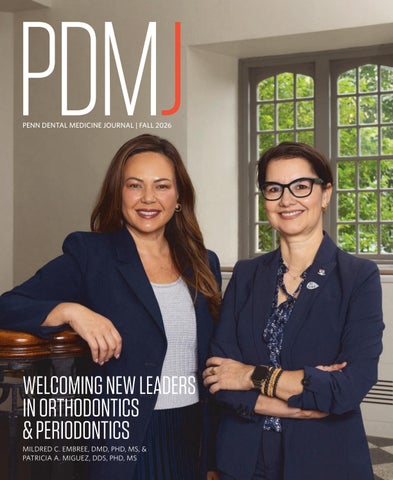
PDMJ PENN DENTAL MEDICINE JOURNAL | FALL 2026
WELCOMING NEW LEADERS IN ORTHODONTICS & PERIODONTICS MILDRED C. EMBREE, DMD, PHD, MS, & PATRICIA A. MIGUEZ, DDS, PHD, MS
FROM THE DEAN
Faculty Excellence in Practice BY NOVEMBER, at Penn Dental Medicine, the pace of the academic year has fully settled in. Students are deep in their work, and faculty are balancing the many demands that define academic life. What gives our community its character is not found in a single moment or milestone. It is measured in collective contributions to the public good. These are lasting contributions that have been shaped and cultivated by people who care deeply about what they do. This issue is, in many ways, about our people. At Penn Dental Medicine, faculty excellence is easy to recognize but its extent is harder to fully capture. It is exemplified in the rigor of our academic and research pursuits and the standards of care that students absorb over time. You can see it in the discoveries made through persistence, while meeting some of the greatest challenges of our time. You can witness faculty guiding students as they become interdisciplinary researchers and competent practitioners who treat every patient with dignity. Our faculty are helping redefine how oral health connects to whole health and how academic institutions can respond to the needs of the communities we serve.
I am especially pleased that this issue highlights, in part, two new department chairs, Dr. Mildred Embree and Dr. Patricia Miguez, who now lead the Departments of Orthodontics and Periodontics, respectively. They are both internationally recognized clinicianscientists with significant backgrounds in research and discovery. They bring their passion for mentorship, which I have seen in practice since the day they arrived. Their leadership has and will shape the future of Penn Dental Medicine in important ways. As you read this issue, I hope you feel the same sense of pride in what is happening here as I do! I also hope you see something more enduring than accomplishment alone. Our School is shaped by the values the faculty embody every day, and they share their expertise selflessly with our students and society. Our faculty are the best. Penn Dental Medicine is stronger because of them, and our future will be shaped by their example.
Mark S. Wolff, DDS, PhD Morton Amsterdam Dean
INSIDE 8 2 12 13 20 22
Breaking Out of the Dental School Bubble Students bridge the gaps of community care
On Campus School News in Brief Alumni Giving & Engagement Celebrating Philanthropic Impact & Engagement in 2025–2026 Donor Spotlight It all started at Penn Research Spotlight Translating Science to Practice Alumni Highlights Profiles, Gatherings & Engagement
14 31 32 33 35 36
Welcoming New Leaders in Orthodontics and Periodontics Clinician-scientists leading dental innovation into the mid-21st century
28
Better Documentation, Better Patient Care Improving the patient intake process supports the whole health of patients
Faculty Perspective Views on Dental Topics & Trends
PENN DENTAL MEDICINE JOURNAL: Vol. 23, No. 1 University of Pennsylvania School of Dental Medicine www.dental.upenn.edu
Student Perspective Views on the Educational Experience
Dean: Mark S. Wolff, DDS, PhD
Class Notes News from Fellow Alumni In Memoriam Remembering Members of the Penn Dental Medicine Community Calendar Upcoming Events & Programs
Senior Associate Dean of Development and Alumni Relations: Brian T. Myers Associate Dean for Development & Strategic Initiatives: Maren Gaughan Assistant Dean of Marketing and Communications: Jenny Lackey Director of Editorial Strategy and Publications: Janene Geiss Contributing Writers: Katie Cottingham, Dom Gaeta, Debbie Goldberg Photography: Lisa Godfrey, Mark Garvin, Nam Le, Eric Sucar Office of Institutional Advancement: 215-898-8951 Penn Dental Medicine Journal is published twice a year by the Office of Communications for the alumni and friends of the University of Pennsylvania School of Dental Medicine. ©2026 by the Trustees of the University of Pennsylvania. All rights reserved. The views expressed in this publication are not necessarily those of Penn Dental Medicine. We would like to get your feedback — address all correspondence to: Janene Geiss, Director of Editorial Strategy and Publications, Robert Schattner Center, University of Pennsylvania School of Dental Medicine, 240 South 40th Street, Philadelphia, PA 19104–6030, jgeiss@upenn.edu
COVER PHOTO CREDIT: Lisa J. Godfrey
PENN DENTAL MEDICINE JOURNAL | FALL 2026 1
ONCAMPUS
By the Numbers:
SCHOOL NEWS IN BRIEF
Recent Grads, Incoming Students DMD Class of 2026
187
DMD GRADUATES IN THE CLASS OF 2026, INCLUDING 125 WOMEN AND 62 MEN
Shaping the Future of Oral and Planetary Health Penn Dental Medicine is helping to shape a new global focus on oral and planetary health, using the 5th Global Oral Health and Climate Action Conference at COP31 as a platform to connect research, policy, education, and practice. The University of Pennsylvania School of Dental Medicine will host the 5th Global Oral Health and Climate Action Conference (GOHCA) during the official COP31 U.N. Climate Conference in Antalya, Turkey, from November 9–20, 2026. The 5th GOHCA conference will span ten days with more than 40 sessions and 150 international experts, policymakers, researchers, and industry leaders from around the world. Penn Dental Medicine will be onsite at the COP31 venue, and the conference will be available to stream online. As dentistry responds to a rapidly changing global landscape, Penn Dental Medicine is advancing a broader, transdisciplinary model of care and policy that connects oral health with planetary and societal health. Key objectives of this year’s conference are to strengthen policy engagement and international collaboration and create a high-impact bridge between science, policy, and industry. The conference will also translate a model for sustainable dentistry into practical applications.
The Center for Integrative Global Oral Health (CIGOH) established its multi-year Global Oral Health and Climate Action Conference to promote and contribute to Dr. Julian Fisher, a consistent and coherent Director of Oral approach to addressing and Planetary Health Policies complex global climate challenges and help advance the discussion on how the dental community can build a resilient model of care in partnership with government, business, and society. “The future of dentistry will not be shaped by clinical science alone,” says Dr. Julian Fisher, Director of Oral and Planetary Health Policies within CIGOH. “It will also be shaped by climate pressures, inequality, technological change, resource constraints, and health security. Our goal at Penn Dental Medicine is to position oral and planetary health as a unifying policy and practice framework, one that connects evidence, education, and global engagement, and to do so early, clearly, and with partners across disciplines.”
Learn about the full program and register to attend virtually: www.dental.upenn.edu/COP31
2 WWW.DENTAL.UPENN.EDU
119 students graduated with honors and 7 with dual degrees (3 Master in Law, 3 Master of Science in Oral and Population Health, 1 Master of Public Health) 85 pursuing postdoctoral study in a dental specialty 48 entering dental practice 42 entering a general dentistry residency or an advanced education in general dentistry program 22 National Health Service Corps scholars 12 entering the military 35 Program for Advanced-Standing Students (foreign-trained dentists earning their DMD to practice in the U.S.), representing 12 countries
DMD Class of 2030
177
DMD STUDENTS IN THE CLASS OF 2028, INCLUDING 122 WOMEN AND 55 MEN 26 states, U.S. territories, and Canadian provinces represented 36 languages spoken 3.85 average science GPA 483.85 DAT academic average 3.88 overall average GPA 3,421 applicants
PHOTO CREDIT: Eric Sucar
“Expanding the scope of dentistry to include vaccine education and administration could increase access to care, vaccine uptake, and disease prevention.” — TAMARA J. CADET, ASSOCIATE PROFESSOR IN THE SCHOOL OF SOCIAL POLICY AND PRACTICE
A New Role for Dental Providers? Rethinking Where Vaccines are Given An interdisciplinary team of Penn researchers used statistical analysis and focus-group feedback to validate a survey that assesses patient perceptions around the role of dental providers in HPV and COVID-19 vaccination. Vaccinations have traditionally been administered in primary care settings or pharmacies. However, for about a decade, some states have authorized dentists to administer vaccines, and many others did so during the COVID-19 pandemic. The effectiveness of this approach has led some countries and states to expand or consider expanding the role of dental providers in delivering routine vaccines, including those against COVID-19 and the human papillomavirus (HPV), and in providing vaccine education. Previous research explored attitudes around vaccine provision in a dental setting, but none of these studies involved a validated survey instrument to assess these perceptions. Now, a multidisciplinary team of researchers has refined a previously tested pilot survey using statistical analyses of the questionnaire and feedback from a focus group in Philadelphia. The results are published in Frontiers in Oral Health.
“The primary aim was to conduct an initial validation of the questionnaire,” says Tamara J. Cadet, an associate professor in the School of Social Policy and Practice. “But we also wanted to further understand perceptions of dentist involvement in vaccine efforts.” By combining their analysis with feedback from the focus group, they were able to reduce the survey length by 25%, says Tyler Moore, a research assistant professor in the Perelman School of Medicine. “We kept the most informative questions and made the language clearer for patients. The result is a short, valid tool that can help us understand and address why some people still question whether dentists should be involved in vaccination,” says Moore. They found that participants were mixed in their attitudes about dental providers administering vaccinations. In particular, participants seemed more opposed to dental providers administering the HPV vaccine than the COVID-19 vaccine, which researchers say may reflect a lack of knowledge about the HPV vaccine.
Empowering dentists to participate in vaccine education is a powerful public health strategy, given how frequently people visit their dentists and the trusting relationships many patients have with them, says Cadet, who also has a secondary appointment in the School of Dental Medicine. “Expanding the scope of dentistry to include vaccine education and administration could increase access to care, vaccine uptake, and disease prevention,” she says. Testing surveys with target populations provides a valuable opportunity to engage people and understand their perceptions, helping inform the development of effective interventions, says Katherine France, formerly an assistant professor in Penn Dental Medicine. “Participants’ comments provide formative data to develop educational interventions that address the lack of knowledge about what HPV vaccines are, the connection to oral health, and the roles dentists can play in their overall health,” she says. If future research using this survey finds that patients are receptive to receiving vaccinations from dental providers, the researchers write, that represents an opportunity to educate legislators and advocate for changes in which professions are allowed to vaccinate. — Deborah Stull
PENN DENTAL MEDICINE JOURNAL | FALL 2026 3
ONCAMPUS “I want to hear someone’s story and truly listen. For me, effective dentistry means seeing the whole person behind the smile.”
PHOTO CREDIT: Nam Le D’27
— ARTIE NAYAK (D’28)
STUDENT PROFILE: ARTIE NAYAK (D’28)
Finding His Path: Dentistry, Storytelling, and Leadership Artie Nayak, B.S. Biomedical Science; University of Pennsylvania School of Dental Medicine ’28 Dentistry wasn’t always on Artie Nayak’s radar. As an undergraduate, he knew he loved science, but wasn’t yet certain how that interest would translate into a career. The turning point came from an unexpected place: behind the camera. Nayak worked as a videographer in college and was hired to film a community outreach program where predental students, dressed as molars, taught elementary school children how to brush and floss properly. One line from that project has stayed with him ever since: “If you don’t floss, it’s almost like taking a shower without washing your armpits.” It was a vivid, funny analogy that made sense to kids and was a useful communication strategy, and Nayak still uses it with his patients today. Curious about the people he was filming, Nayak asked the predental students why they
4 WWW.DENTAL.UPENN.EDU
chose dentistry. Their answers ranged from entrepreneurship to creativity to care. At the same time, he knew he wanted a career that would allow him to be present for those around him, to build something of his own, and to contribute to the public good. During a summer break in college, he shadowed his own dentist. One day, the dentist handed him a shade guide, and Nayak was struck by how much this clinical exercise connected him to the color work he did in videography. After this experience, he knew that he wanted to combine his interests and talents and pursue dental school.
As a member of Penn Dental Medicine’s Class of 2028, Nayak has quickly become an active leader. He serves as president of the Penn Dental Medicine Chapter of the American Student Dental Association. In this role, he ensures that the chapter’s goals align with those of the broader organization. “We focus on advocacy, fighting for the future of the profession. We also emphasize community outreach and service, and wellness, taking care of ourselves, so that we can take care of our patients.” He also serves as vice president of his class, working closely with the other officers to foster an environment that is vibrant and collaborative. Nayak’s interest in the blend of art and science led him to a research opportunity with Dr. Myra Laird, assistant professor in the Department of Basic and Translational Sciences. He is currently studying mastication and food bolus output. The project has been impactful scientifically, but personally as well. “Working with Dr. Laird showed me how valuable it is to have someone who truly wants you to succeed, and I hope that someday I can be that kind of mentor to someone. She has provided me with a chance to learn and develop, while knowing I have that support. It makes a huge difference,” he says. Nayak is inspired by the legacy of alumni who came before him. “There is heart here, and it is beating loudly,” he says. For him, dentistry has been a place to fulfill his interests in health care, creativity, and science. He is drawn to people’s stories, sharing that “no one’s story is the same, and their stories matter,” he says. “I want to hear someone’s story and truly listen. For me, effective dentistry means seeing the whole person behind the smile.”
CDE SPOTLIGHT
The Healthy Aging Symposium As the population ages, dental professionals are caring for more patients whose oral health is shaped by chronic disease, polypharmacy, cognitive decline, disability, and frailty. Yet oral health remains too often separated from the medical and social systems that influence healthy aging. On February 27, 2027, Penn Dental Medicine will host The Healthy Aging Symposium: Connecting Health Across the Lifespan, bringing together visionary leaders in dentistry, medicine, nursing, geriatrics, public health, health economics, and policy to help close that gap. This interdisciplinary symposium will explore the critical connections between oral health, systemic health, function, and quality of life as we age. From chronic disease, cognitive decline, disability, frailty, polypharmacy, Medicare, access to care, and the economic and policy forces shaping healthcare for older adults, the program will examine the clinical and systemic challenges shaping the future of healthy aging. Participants will be challenged to consider not only how we care for older adults today, but how healthcare must evolve as people live longer with multiple chronic conditions and changing functional needs. Attendees will also gain a deeper understanding of the connections between oral and systemic health, practical strategies for supporting older adults and their caregivers, and new perspectives on developing more integrated, accessible, and patient-centered models of care. View all CDE programs and register at https://cde. dental.upenn.edu.
Dr. Sunday O. Akintoye, professor in the Department of Oral Medicine
Dr. Sunday O. Akintoye, BDS, DDS, MS, DABOM, Elected President of the American Academy of Oral Medicine Penn Dental Medicine’s Dr. Sunday O. Akintoye, professor in the Department of Oral Medicine, was inducted as president of the American Academy of Oral Medicine (AAOM) in April at the organization’s annual conference in Dallas-Fort Worth, Texas. During his one-year term, he will lead implementation of a new AAOM strategic plan focusing on four goals: fundraising and development, membership, marketing and communication, and operations and sustainability. “To be entrusted with this role — by individuals I respect, admire, and continue to learn from — is both a privilege and a responsibility that I embrace with gratitude and commitment,” says Dr. Akintoye. As a professor at Penn Dental Medicine, Dr. Akintoye conducts research on skeletal disorders, including ameloblastoma, a rare, aggressive jaw tumor with a high post-surgical recurrence rate. He is a lead investigator on several global research collaborations investigating the biological and molecular underpinnings of ameloblastoma’s aggressive growth and recurrence. Dr. Akintoye has been an AAOM member for 26 years and a member of the Executive Committee since 2019. He received the AAOM Lester Burket Research Award, the Heschfus Memorial Award, and several certificates of merit in recognition of his outstanding research and service as chair of several AAOM committees. Founded in 1945, AAOM is a membership organization that “advances excellence in patient care, education, and research in the field of Oral Medicine; promotes access to quality and cost-effective expert Oral Medical care; and increases professional and public awareness of the field of Oral Medicine.” — Katie Cottingham
PENN DENTAL MEDICINE JOURNAL | FALL 2026 5
ONCAMPUS
A One-Two Punch: Using Lipid Nanoparticles to Transform Oral Cancer Treatment A multidisciplinary team of Penn researchers has developed a platform that delivers a combination of cancer-fighting therapies to treat oral squamous cell carcinoma. Oral squamous cell carcinoma (OSCC) is the most common form of head and neck cancer, and the number of new cases is predicted to rise by 30% in the next decade. Despite decades of cancer research, treating OSCC remains a challenge. The five-year survival rate is approximately 50%, and standard treatments such as ablative surgery and radiation often leave patients with permanent disfigurement or profound, lifelong impairment of essential oral functions such as speaking and swallowing. Now, using lipid nanoparticles (LNPs), a multidisciplinary team of Penn researchers led by Michael Mitchell of the School of Engineering and Applied Sciences and Anh D. Le of the School of Dental Medicine has developed a platform that delivers a combination of cancer-fighting therapies to treat OSCC. The findings are published in Advanced Materials. “mRNA lipid nanoparticles are a potentially promising technology to treat oral cancer, since tumors are accessible locally and can also be leveraged to generate a systemic immune response that targets metastatic tumors,” says Mitchell, the Hibbert Professor of Bioengineering and the Lipid Nanoparticle Delivery Systems Group Leader at the Penn Institute for RNA Innovation. “However, tumor cells can be difficult to target and deliver mRNA into, so we designed a novel LNP delivery system for delivery into oral cancer cells.” The versatility of this platform means that it could benefit far more patients than traditional single-agent therapies, says Le, the Norman Vine Endowed Professor of Oral Rehabilitation, “opening the door to a broader, more effective class of treatments.”
6 WWW.DENTAL.UPENN.EDU
This breakthrough was only possible because Penn’s deeply collaborative culture brings engineers, clinicians, and scientists into the same space — often tackling the same unmet clinical need — creating the kind of crossdisciplinary momentum that enables advances like this. — ANH D. LE, CHAIR AND NORMAN VINE ENDOWED PROFESSOR OF ORAL REHABILITATION AT PENN DENTAL MEDICINE
TAKING A TWO-PRONGED APPROACH More than 70% of OSCC cases involve mutations in p53, a common tumor suppressor protein; ciclopirox is an FDA-approved antifungal drug with anti-cancer and immunotherapy activity. Because both of these drugs require a drug delivery carrier, the team encapsulated them in a single LNP formulation.
Together, these two therapies act simultaneously through multiple mechanisms, directly killing cancer cells while reprogramming the immune system to target them instead of protecting them, says first author Marshall Padilla, a former postdoctoral fellow in the Department of Bioengineering and the Center for Innovation & Precision Dentistry (CiPD). “The potential shift is from one-size-fits-all monotherapy toward a single, tunable delivery vehicle that works even when one of its two drugs fails, which matters because oral tumors vary enormously from patient to patient.” The team found that both p53 and ciclopirox have innate chemotherapeutic properties. In addition, these drugs can create a less immunosuppressive tumor microenvironment. “In aggressive, p53-therapy-resistant cancer models, this new LNP platform significantly reduces tumor burden and extends survival,” says Le, also the chair of the Department of Oral & Maxillofacial Surgery/Pharmacology.
ADVANCING THE SCIENCE THROUGH CONTINUED COLLABORATION Looking ahead, the team plans to continue to partner to advance this work. “The mechanism of how ciclopirox and p53 reprogram tumor-associated macrophages isn't fully worked out,” says Padilla. “The paper points to a plausible pathway but flags that it needs to be confirmed.” Future efforts will include refining the nanoparticle design for greater precision; expanding the therapeutic payloads beyond p53 and ciclopirox; and moving toward different delivery routes. The team also plans to test the platform in more complex preclinical models against the genetic diversity of real patient tumors — the variability of which has historically “sunk” p53 therapies, says Padilla. “This work opens the door to an entirely new class of customizable nanotherapies for oral cancer,” says Le. “This breakthrough was only possible because Penn’s deeply collaborative culture brings engineers, clinicians, and scientists into the same space — often tackling the same unmet clinical need — creating the kind of cross-disciplinary momentum that enables advances like this.” — Deborah Stull ABOVE: Anh D. Le, DDS, PhD, Chair and Norman Vine Endowed Professor of Oral Rehabilitation, Department of Oral & Maxillofacial Surgery / Pharmacology
WHITE COAT CEREMONY
PHOTO CREDIT: Mark Garvin
On Tuesday, August 11, the Class of 2030 celebrated their White Coat Ceremony in front of nearly 1,000 family, friends, faculty, staff, and students.
PENN DENTAL MEDICINE JOURNAL | FALL 2026 7
Roopali Kulkarni, DMD, MPH Director, Postgraduate Oral Medicine Program Assistant Professor of Oral Medicine
8 WWW.DENTAL.UPENN.EDU
PHOTO CREDIT: Lisa J. Godfrey
Abby Quinn Peterson, DMD, MPH Assistant Professor of Clinical Community Oral Health
BREAKING OUT OF THE DENTAL SCHOOL BUBBLE HELPS STUDENTS BRIDGE THE GAPS OF COMMUNITY CARE THE FIRST YEAR OF DENTAL SCHOOL is a flurry of lectures, readings, and labs that help students learn the basics of dentistry. But dentistry is more than learning how to treat cavities and perform root canals. The patients sitting in the chairs are real people with real experiences and challenges that affect their ability to schedule appointments, arrive at clinics, and complete treatment. “In dental school, it is easy to have a mindset of being in this bubble where you're worried about the instructional learning, caring about the grades and the numbers,” says second-year Penn Dental Medicine student Alexis Suk. “But once you're actually at community sites, you end up having a much more personal connection, and you learn a lot more. You have a greater appreciation for the struggles people are going through.”
Suk and 16 of her classmates interned this summer through the Community Health Internship Program (CHIP), a part of the Bridging the Gaps (BTG) program that has connected more than 6,700 health and social service professionals with partner organizations in under-resourced Pennsylvania and New Jersey communities.
“We want to ensure that our community, our city, and the larger Philadelphia community has access to appropriate dental care.” — DR. ROOPALI KULKARNI, DMD, MPH
PENN DENTAL MEDICINE JOURNAL | FALL 2026 9
BRIDGEGAPS CHIPPING AWAY AT COMMUNITY CHALLENGES
“In the reflections, the students often say that the program helps them think about what kind of providers they want to be. It really forces them to reflect beyond just clinical skills to what kind of values they want to exhibit when they are providers.” — DR. ABBY PETERSON, DMD, MPH
Established in 1991, BTG works with groups of health and social service professionals who learn from those they serve. In the process, partnering organizations receive help to sustain or extend existing services. The program works toward a world where optimal health and well-being is accessible to all through partnerships with community organizations, local leaders, and academic health institutions. Penn Dental Medicine has been involved with BTG since 1992, and it is just one of many ways that students perform community service while attending Penn Dental Medicine.
10 WWW.DENTAL.UPENN.EDU
“Bridging the Gaps highlights that there are many communities that are in need, and that mission is shared by Penn Dental Medicine,” says Dr. Roopali Kulkarni, DMD, MPH, former intern and co-chair of the BTG Alumni Network. “We want to ensure that our community, our city, and the larger Philadelphia community has access to appropriate dental care.”
BTG CHIP is a seven-week paid summer internship for students who have completed their first year of studies. “The interns are really committed,” says Dr. Abby Peterson, DMD, MPH. She and Dr. Elizabeth Powell, DDS, MPH, are faculty representatives to the program. “They take a final on a Friday in June and they start the internship on Monday, and after finishing their seven weeks on a Friday, they start their D2 year on Monday,” says Dr. Peterson. Participating students spend four days a week at a community site they’ve been matched with based on their interests. They may also be matched with a medical, nursing, veterinary, or social work student as a partner at the location. Together, they do whatever tasks the staff need. On Wednesday mornings, all of the Philadelphia-area interns hear from an expert about a public health topic. On Wednesday afternoons, all Penn student interns come back to campus and have interactive sessions with public health experts. Interns also write weekly reflections about what they’ve done and how they feel. “In the reflections, the students often say that the program helps them think about what kind of providers they want to be,” says Dr. Peterson. “It really forces them to reflect beyond just clinical skills to what kind of values they want to exhibit when they are providers.” This fall, participants presented a poster about their work at the BTG symposium at the College of Physicians and Surgeons. They also present the poster in the spring at the annual Advances in Clinical Care and Education (ACCE) Day, which celebrates faculty, resident, and student participation in community service and other initiatives. Students can join the BTG Alumni Network to continue their professional development after the internship concludes.
PHOTO CREDIT: Nam Le D’27
WHAT DOES IT MEAN TO TRULY SERVE A COMMUNITY — NOT JUST TREAT ITS SYMPTOMS?
“It is really different once you’re there every day and witnessing interactions, and I feel like I better understood how easily inequities compound.” — ALEXIS SUK
VALUABLE LESSONS OUTSIDE THE CLASSROOM Suk interned at Philadelphia FIGHT, a comprehensive health services organization that provides health care and support services to patients facing health disparities. Along with performing small tasks to free up staff to focus on providing care, she performed a community needs assessment. She created surveys in different languages and called hundreds of patients to find out how Philadelphia FIGHT could better serve them. “Before the internship, I didn't have an in-depth understanding of community health,” says Suk. “It is really different once you’re there every day and witnessing interactions, and I feel like I better understood how easily inequities compound.” In 2016, Dr. Kulkarni was an intern at LIFE (Living Independence for the Elderly), which provides health and social services
to help older adults function independently at home. She was paired with a social work student, and they developed resources to educate caregivers about dentistry and medicine and how they can support the person in their care. “We weren’t performing dentistry, but rather it was about understanding how there are so many different parts to health care,” she says. Dr. Kulkarni values the experiences she’s had as an intern and as co-chair of the BTG Alumni Network. “It’s a really meaningful program that introduces students to interdisciplinary care and emphasizes the role of relationship building,” she says. “There’s a lot you can learn inside and outside the classroom, and Bridging the Gaps, in particular, empowers future health care professionals and allows them to see health care from a different perspective.” n — Katie Cottingham
In honor of BTG's 35th anniversary, a feature-length documentary, This Too is Healthcare: Bridging the Gaps was completed. View the trailer here: www.youtube.com/ watch?v=ndQfd8fwp6I
PENN DENTAL MEDICINE JOURNAL | FALL 2026 11
ALUMNI GIVING & ENGAGEMENT IMPACT REPORT, JULY 1, 2025 – JUNE 30, 2026
BUILDING WHAT COMES NEXT Penn Dental Medicine has always been shaped by people who believe in what the School can make possible. Today, the generosity and engagement of our alumni, friends, and partners are opening doors for students, fueling discovery, strengthening patient care, and helping us imagine an even more ambitious future. As we build on that momentum, we are pleased to share highlights of the impact our community made during the 2025/2026 fiscal year, which concluded on June 30, 2026.
$9,205,166 DOLLARS
committed to support Penn Dental Medicine’s mission of transforming global oral health and well-being through exceptional clinical care, innovation, scholarship, and research.
$3,112,431 DOLLARS
committed to advance faculty excellence and research
$2,517,897
DOLLARS
committed in support of students and residents
@penndentalmedicine @penndentalmedicine @penndentalmed
12 WWW.DENTAL.UPENN.EDU
$502,796 DOLLARS
raised for the Penn Dental Medicine Annual Fund providing essential, flexible support to address immediate needs, pursue new opportunities, and advance the School’s highest priorities.
1,154 86 2,710
TOTAL DONORS
who made a gift to Penn Dental Medicine
DONORS
made their first gift
ATTENDEES
participated in Penn Dental Medicine alumni or continuing education events.
Explore ways to support Penn Dental Medicine at www.dental.upenn.edu/giving.
DONORSPOTLIGHT head, neck, face, and jaw. The specialty has It All Began at Penn the the option to obtain a medical degree as well
Daniel and Shanta Richardson are helping the next generation of Penn Dental Medicine students succeed.
During his second year at Penn Dental Medicine, Daniel Richardson, D’02, now an oral and maxillofacial surgeon, received a call from the school’s admissions office. Could he give a tour to a potential new student, Shanta Williams? By all accounts, the tour was a great success. Shanta, now a pediatric dentist, chose to enroll at Penn Dental Medicine the next year. But that was not the only positive outcome: Daniel and Shanta would marry two years later, while both were still students at Penn. As Shanta Richardson, D’03, explains, “It all began at Penn.”
FROM PENN DENTAL MEDICINE TO SUCCESSFUL CAREERS A native of Canada, Daniel was drawn to Penn by the strength of its specialty programs, especially in his chosen field of oral and maxillofacial surgery, which focuses on the diagnosis and treatment of diseases, injuries, and defects of
as a dental degree. After graduating from Penn Dental, Daniel headed to Boston, where he earned an M.D. from Harvard Medical School and pursued postdoctoral training. He completed his training with a fellowship at the Posnick Center for Facial Plastic Surgery, where he honed his skills in his specialty, dentoskeletal deformities. He opened his own practice, the Richardson Center for Oral and Facial Surgery, in Maryland in 2009. After graduating from Penn Dental Medicine, where she pursued pediatric dentistry, Shanta also went to Boston, where she completed her residency and pursued a fellowship in oral and health policy at the Harvard School of Public Health. Today, she has a private pediatric dental practice, Shiny Chompers, in Maryland. Daniel and Shanta Richardson’s connection to Penn Dental Medicine has come full circle through their support of today’s students.
GIVING BACK TO PENN DENTAL MEDICINE In recent years, Daniel and Shanta have reconnected with Penn Dental Medicine, the place where it all began. Daniel became a valued volunteer for the School. In 2021, he was invited to join the School’s Dean’s Council, an external board advising the Dean. Four years later, he joined the Board of Advisors, the School’s highest-level advisory board. During his tenure on the Dean’s Council, Daniel learned about the School’s Alumni Scholars Program, which funds scholarships that allow aspiring dentists of all backgrounds to pursue an education at Penn Dental Medicine. The program was appealing to Daniel and Shanta. In 2022, they made a gift to establish the Richardson Alumni Scholarship, which provides annual scholarship support to a dental medicine student throughout the student’s four years at the School.
“We both received scholarships to Penn Dental Medicine, and that education changed our lives. We are honored to provide a similar opportunity to today’s students by supporting the Alumni Scholars Program,” explains Daniel. For the Richardsons, the best part of their gift was the chance to meet the students who have benefited from their generosity. That includes one of the first students to receive their scholarship, a recent graduate of Penn Dental Medicine, who coincidentally lives close to their Maryland home.
SUPPORTING THE NEXT GENERATION OF PENN DENTAL STUDENTS Last year, the Richardsons stepped up to support Penn Dental Medicine students in an additional way — by creating the Daniel and Shanta Richardson Student Support Fund. Its goal is to support students in their studies and allow them to take advantage of all that the School offers. In the first year alone, the Student Support Fund has allowed 17 students to travel and present at academic conferences around the United States, including the American Dental Education Association, the American Association of Endodontists, the American Association of Women in Dentistry, and the American Association of Oral and Maxillofacial Surgery, to name a few. While the Student Support Fund is not just for conference presentations and travel, the availability of these funds this year has been a boon to the students who might not otherwise have had the resources to make these trips. “Our students are at the heart of our mission,” explains Dr. Mark Wolff, Morton Amsterdam Dean of Penn Dental Medicine. “Daniel and Shanta’s generosity is opening the door to a Penn Dental education for more students, while also providing the support they need to succeed once they’re here.” —Colleen Cannon
ABOVE: Daniel Richardson, D’02 and Shanta Richardson, D’03
PENN DENTAL MEDICINE JOURNAL | FALL 2026 13
PENN DENTAL MEDICINE WELCOMES TWO OUTSTANDING LEADERS TO PERIODONTICS & ORTHODONTICS FOLLOWING NATIONAL SEARCHES, TWO INTERNATIONALLY RECOGNIZED CLINICIAN-SCIENTISTS HAVE JOINED PENN DENTAL MEDICINE TO LEAD THE DEPARTMENTS OF PERIODONTICS AND ORTHODONTICS INTO THE MID-21ST CENTURY. PATRICIA A. MIGUEZ, DDS, PhD, MS, whose research focuses on novel therapeutics to treat inflammatory diseases and connective tissue disorders, was named professor and chair of the Department of Periodontics, effective May 1.
14 WWW.DENTAL.UPENN.EDU
MILDRED C. EMBREE, DMD, PhD, MS, a leader in temporomandibular joint (TMJ) research and skeletal biology, joined Penn Dental Medicine as professor and Chauncey M.F. Egel Endowed Chair of the Department of Orthodontics on July 1.
In addition to their roles as outstanding educators, clinicians, and researchers, Miguez and Embree also are the first women to lead the departments of periodontics and orthodontics at Penn Dental Medicine.
In addition to their roles as outstanding educators, clinicians, and researchers, Miguez and Embree also are the first women to lead the departments of periodontics and orthodontics at Penn Dental Medicine.
PHOTO CREDIT: Lisa J. Godfrey
PENN DENTAL MEDICINE JOURNAL | FALL 2026 15
TWOLEADERS PATRICIA MIGUEZ: BUILDING ON THE LEGACY OF PERIODONTICS AT PENN DENTAL MEDICINE For Miguez, her appointment is a return to Penn Dental Medicine, where she was an assistant professor in the Department of Periodontics from 2011 to 2014. Following that, she joined the faculty of the University of North Carolina Adams School of Dentistry, most recently as Associate Professor with Tenure, before returning to Penn Dental Medicine as chair of periodontics. “There’s so much that brought me back here,” Miguez says. “I was ready for the opportunity to lead the discipline and impact Periodontics, not only as a researcher, clinician, and educator, but to lead with my own vision. When the opportunity to return to Penn Dental Medicine came up, it felt like a great fit because Penn’s strength across dentistry, biomedical research, and health sciences creates an exceptional environment for advancing periodontics and oral health as integral components of whole-person health.” Having previously served on the Penn Dental Medicine faculty, Miguez returned with an established understanding of the School, its academic culture, and longstanding commitment to research, education, and patient care. “I know Penn and I know the strengths of this institution,” she says. “What is particularly exciting to me is the opportunity to build on those strengths and further connect discovery with education and clinical care. The best patient care is informed by science, and a large part of the most meaningful research is already coming from this institution, which ultimately has the potential to improve health.” The Department of Periodontics celebrated its 70th anniversary last year, and Miguez sees her role as building upon the legacy of a nationally recognized program with a reputation for excellence in education, research, and patient care, while defining the next generation of leadership in periodontics, implant dentistry and regenerative science. “Penn Periodontics has an extraordinary legacy that has helped shape the specialty nationally and internationally,” she says. “My priority is to honor that history while
16 WWW.DENTAL.UPENN.EDU
working with our people to define where we are heading next.” To that end, she says, “This is the home of comprehensive dentistry, and we will build on the long-standing Penn Perio legacy of saving teeth and integrating exceptional periodontal therapy with sophisticated restorative treatment. Our goal is not simply to cherish that legacy by continuing to incorporate interdisciplinary knowledge when teaching periodontics and implant dentistry, but to extend it, to identify the areas in which Penn Periodontics will define the future of the specialty.” Miguez wants to ensure the department continues to provide the best learning environment for future professionals, including the department’s postdoctoral students. She envisions an education that combines not only rigorous foundations in contemporary advances in periodontics, implant dentistry, regenerative therapies, digital technologies,
and interdisciplinary care, but also provides residents with lifelong mentors at Penn. “We have an opportunity to teach what is currently considered best practice, to prepare our students and residents to more critically evaluate evidence, to help shape what comes next, and also to build a relationship that can last a lifetime,” Miguez says. “We hope our graduating residents will be connected to Penn Perio for their entire careers and help us continue supporting future periodontists from Penn through teaching back activities and participating in philanthropic initiatives.” Another priority is to shape periodontal education methods in predoctoral and postdoctoral didactic and clinical curriculum. Miguez hopes to incorporate additional qualitative methods in assessing the dental education at Penn Perio, which more thoroughly evaluates teaching and learning and helps with calibration among faculty and residents.
“When the opportunity to return to Penn Dental Medicine came up, it felt like a great fit because Penn’s strength across dentistry, biomedical research, and health sciences creates an exceptional environment for advancing periodontics and oral health as integral components of whole-person health.” — PATRICIA MIGUEZ, DDS, PHD, MS
“We have an extraordinary team of faculty, and I am confident that together we can strengthen how we assess the effectiveness of our teaching and ensure that our residents are achieving the learning outcomes we expect. Clear and consistent communication is part of the equation.” A major goal for Miguez is to further strengthen scholarly development as a defining component of postgraduate education in periodontics. “Penn is a special place because of its extraordinary culture of collaboration,” she says. “Our residents already have access to remarkable scientific expertise, and I want them to take full advantage of those opportunities during their time here.” Residents will begin engaging in research during their first year through a more structured process. “We want to ensure that all residents, not only our master’s and DScD students, are formally engaged in scholarship,” Miguez says. “Our goal is to help them pursue questions that align with their interests while addressing issues that are meaningful and impactful to the field.” She emphasizes that research training extends well beyond conducting a research project. It teaches residents to critically evaluate evidence, challenge assumptions, and approach clinical questions with intellectual curiosity. “Ultimately, these experiences will help prepare our graduates to become thoughtful, evidence-based clinicians and leaders in their communities.” In her own research, Miguez has established a research program at the intersection of extracellular matrix (ECM) biology
and connective tissue health, disease and regeneration. Her work investigates how the ECM molecules and their biomodification regulate tissue homeostasis, inflammatory responses and tissue regeneration with the goal of translating those discoveries into new therapeutic strategies. “My research has always been driven by the connection between fundamental biology and clinical problems,” says Miguez, who is leading a program that has been continuously funded by NIH and several other nonprofit institutions nationally and internationally for over a decade. Miguez says this research holds particular promise for individuals with hyper-inflammatory conditions such as diabetes, autoimmune diseases, cardiovascular diseases, cancer, etc., as well as oral pathologies such as periodontitis, caries and root resorption, where dysregulated ECM contributes to tissue damage and destruction. Her work is focused on skeletal and craniofacial bones and exploring targeted vs. systemic delivery. Additional projects involving nutritional interventions and connective tissue disorders are in development. One of her most recently funded grants investigates a novel sulfated heparan sulfate (a carbohydrate in ECM) therapeutic for treatment of periodontal disease. The synthetic heparan sulfate’s structure is carefully designed, in collaboration with the Eshelman School of Pharmacy at UNC, to control inflammation and bone catabolism while enabling targeted delivery to periodontal tissues.
A Diplomate of the American Board of Periodontology and Implant Dentistry, Miguez earned her DDS in 1997 and Certificate in Periodontology in 1999 from the Federal University of Santa Catarina in her native country of Brazil. She went on to receive an MS in Operative Dentistry in 2003 and a PhD in Oral Biology and a Certificate in Periodontology in 2011 from UNC’s Adams School of Dentistry. Miguez serves on the editorial board of several prominent journals and has published more than 50 peer-reviewed articles and several book chapters relating to periodontology, regenerative medicine and oral health. In addition, she is the recipient of numerous honors, including becoming a Fellow of the American Association for Dental and Craniofacial Research (AADOCR) in 2024, receiving the 2024 R. Earl Robinson Regeneration Award from the American Academy of Periodontology and most recently the 2025 Highest Research Merit Award from Catarinense Academy of Dentistry in Brazil. She has also held numerous leadership roles within national and international dental research organizations, including serving as president of the NC Section of AADOCR and subsequently president of the International Association for Dental Research Women in Science Network, reflecting a longstanding commitment to research, mentorship and advancement of the profession. For Miguez, the decision to return to Penn Dental Medicine as chair of periodontics was an easy one. “I am a clinician-scientist trained in both restorative and periodontal fields and with extensive research training, thus, I feel this is the right environment for me, where the emphasis on interdisciplinary dentistry, integrative oral health, and investment in research is as strong as education and clinical care,” she says. “Penn has the history, intellectual environment and collaborative strength to help me lead with a shared vision and define what periodontics can become next. I am ecstatic to be here and to help lead that work.”
PENN DENTAL MEDICINE JOURNAL | FALL 2026 17
TWOLEADERS MILDRED C. EMBREE: CHARTING THE FUTURE OF PENN ORTHODONTICS Embree has spent the last two decades working at the intersection of skeletal development, tissue engineering, regenerative medicine, and biomedical innovation to better understand and develop therapies for osteoarthritis and temporomandibular joint (TMJ) disorders. She brings this wide-ranging expertise to her new role as chair of orthodontics at Penn Dental Medicine, where one of her goals is to encourage and facilitate collaborative research and projects across the Penn campus. “Innovation is moving towards more interdisciplinary interaction, and it’s important to me to advance that type of integration within our department, School, and throughout the University of Pennsylvania,” Embree says. Embree is an internationally recognized leader in research relating to TMJ disorders, a group of about 30 conditions that can affect the function of the jaw joint, including a clicking or locking of the joint. She estimates that at least five percent of the population in the United States has some type of TMJ disorder, which can lead to temporary or chronic pain in the jaw. “This is a significant problem in the population,” Embree says, “but there is no established standard of care.” And treatment for TMJ is further complicated by the fact that patients often end up going to a variety of specialists for help, each with the perspective of their own field. Embree’s body of research, which aims to address these issues, is focused on understanding the mechanisms underlying musculoskeletal disease and the development of regenerative therapies for osteoarthritis and temporomandibular disorders. Her interest in these issues is long-standing. Embree joined Penn Dental Medicine from Columbia University’s College of Dental Medicine, where she served as Edwin S. Robinson tenured associate professor and co-director of the Center for Craniofacial Research.
18 WWW.DENTAL.UPENN.EDU
“Innovation is moving towards more interdisciplinary interaction, and it’s important to me to advance that type of integration within our department, School, and throughout the University of Pennsylvania.” — MILDRED C. EMBREE, DMD, PHD, MS
At Columbia, she established a research program, funded by the National Institutes of Health (NIH), in temporomandibular biology, skeletal biology, osteoarthritis and regenerative medicine. Embree earned both her DMD and PhD in Cell and Molecular Biology through the Dental Scientist Training Program at the Medical University of South Carolina. During the eight-year program, she completed four years of graduate research training at the National Institute of Dental and Craniofacial Research, where she established an NIH-funded research program in TMJ biology, skeletal biology, osteoarthritis and regenerative medicine. She then completed postdoctoral training in tissue engineering and regenerative medicine and earned her Certificate and Master of Science in Orthodontics at Columbia University College of Dental Medicine. Throughout her career, Embree has contributed to high-impact publications, lectured internationally, and has been awarded patents for her work and received numerous awards, including NIH Small Business Technology Transfer Awards that have advanced regenerative therapeutics to clinical translation. At Penn Dental Medicine, Embree plans to build on the department’s strengths in scholarship and innovation, while encouraging and fostering more interdisciplinary projects throughout the Dental School and campus. “We want to reaffirm Penn Orthodontics as critical to care, from education to clinics to research projects.” To that end, Embree has been reaching out to colleagues on campus, including those in medicine and engineering, to help spur new opportunities to work together. “My work includes collaboration with orthopedics, bioengineering and stem cell and regenerative medicine, and I’m looking to strengthen that kind of cooperation for my team and students,” she says.
Even prior to her appointment, Embree had worked with Penn Dental Medicine colleagues, including Ahn D. Le, department chair, and Eric J. Granquist, DMD MD, associate professor of clinical oral and maxillofacial surgery/pharmacology and director of the University of Pennsylvania Center for Temporomandibular Joint Disorders. “I’m excited to work with them again,” Embree says of continuing their research collaboration. She also would like to advance treatment and care of special needs patients, an interest she says she shares with Dean Wolff. “What are the best practices for orthodontic treatment for special needs patients, who may have complex medical needs that we need to be part of?” she asks. “Orthodontic treatment may be a critical part of their ability to function, to take in nutrition, and do the best they can in school.” Embree says stepping into her new role has been made easier by the stellar reputation of the orthodontics department across education, scholarship and patient care. “The legacy of Penn orthodontics is very strong,” Embree says, who sees her role as continuing to build on those strengths while fostering more innovation through interdisciplinary collaboration. “I want Penn orthodontics to be a leader in the transformation of the specialty,” Embree says. Shortly after arriving at Penn, she gave a lecture to residents on the evolution of the field. “From the 2000s to 2020, we were in the digital era, with intraoral scans, aligner technology and imaging improvements. Now we’re entering the AI era of precision orthodontics, using patient data and facial scans and building clinical and decision-making models” with the help of artificial intelligence. “With this comes so much opportunity,” Embree says. “I want to position the department and equip our residents to lead the trends in this area, not just follow them.” n — Debbie Goldberg
YOUR INPUT MATTERS — SHARE YOUR THOUGHTS ON PERIODONTICS & ORTHODONTICS PROGRAMS We are both eager to listen and learn from the alumni who know these programs best. Your perspectives and ideas can help inform how we think about the future, what we should preserve, where we have opportunities to grow, and how we can continue to strengthen the program and our community. Please take a few minutes to share your thoughts.
www.dental.upenn.edu/ ortho-survey
www.dental.upenn.edu/ perio-survey PENN DENTAL MEDICINE JOURNAL | FALL 2026 19
RESEARCHSPOTLIGHT TRANSLATING SCIENCE TO PRACTICE
Penn Dental Medicine Researchers are Earning New Federal Support for Studies Advancing Oral Health Dr. Hydar Ali, PhD, professor in the Department of Basic & Translational Sciences, recently received funding for two R01 grants and one R21 grant from the National Institute of Allergy and Infectious Diseases of the National Institutes of Health. Dr. Ali’s team studies the role of MRGPRX2, a human G protein-coupled receptor, on mast cell-mediated allergic and inflammatory disorders. Because the mouse ortholog of MRGPRX2 differs substantially from the human receptor, the team developed mouse models that express human MRGPRX2 in mast cells. “We are using these innovative humanized mouse models to investigate how this receptor, its naturally occurring missense variants, and signaling contribute to the pathogenesis of a variety of conditions including anaphylaxis, drug hypersensitivity, allergic asthma, rosacea, and psoriasis,” says Dr. Ali. The team will investigate the effects of specific MRGPRX2 and signaling inhibitors in disease models in the humanized mice models. These studies may identify novel targets for therapeutic intervention. The mast cell/MRGPRX2 research is supported by grant awards totaling $4,791,626 (100%) from the Department of Health and Human Services (DHHS).
Dr. Zhi Ren, DMD, PhD, assistant professor of Endodontics and a member of the Center for Innovation & Precision Dentistry, has received funding from the National Institutes of Health. The R00 award from the National Institute of Dental and Craniofacial Research will provide about $750,000 over three years. Ren’s team previously showed that Selenomonas sputigena, a bacterium associated with childhood tooth decay and periodontal disease, moves in a novel way that allows it to backtrack and change direction. The new award will allow the team to more fully understand how S. sputigena moves, colonizes, and interacts with other microbes to shape disease-causing dental plaque, while also addressing broader questions about bacterial navigation in the human body. “The R00 award gives us the opportunity to move beyond identifying which microbes are associated with disease and ask how they actually get to the right place, interact with other microbes and host tissues, and build communities that become harmful,” says Dr. Ren. “Childhood tooth decay is an important immediate focus, but the broader goal is to uncover general principles of how disease-associated bacteria navigate and colonize complex environments in the human body.” Probing the role of Selenomonas sputigena in supragingival biofilm spatial structuring and virulence, is funded by the National Institutes of Health (NIH), National Institute of Dental and Craniofacial Research (NIDCR) K99/R00 awards totaling $972,816.
20 WWW.DENTAL.UPENN.EDU
Dr. Ryan Richard Ruff, PhD, MPH, associate professor and division chief of Community Oral Health, recently received funding from the National Institutes of Health. School-based caries prevention can improve student dental health, but 30% of children do not respond to treatment. With a $2.9 million, four-year R01 grant from the National Institute on Minority Health and Health Disparities, Dr. Ruff’s team is developing and testing personalized preventive interventions for schoolchildren in predominantly low-income areas. The goal is to improve caries prevention among children who are unresponsive to conventional treatments. An additional $238,000, two-year R03 grant from the National Institute of Dental and Craniofacial Research will fund further analyses of the CariedAway Study, a longitudinal, randomized clinical trial co-led by Dr. Ruff that studied new approaches to prevent and control dental caries in schoolchildren. The study demonstrated that silver diamine fluoride is an effective treatment that school nurses can administer. The secondary analysis will support wider implementation of this treatment in other school programs. “The awards will fund analysis and pragmatic clinical trials to improve upon the science of school-based oral health,” says Dr. Ruff. “In particular, it will be critical to support community-university partnerships to increase access to care and reduce health disparities.” The Building Adaptive School-based Interventions for Caries Study (BASICS) is funded by the National Institute on Minority Health and Health Disparities of the National Institutes of Health (#R01MD019938), totaling $2,960,441. The “Improving the design and implementation of school-based oral health programs using secondary data analysis” project is funded by the National Institute of Dental and Craniofacial Research of the National Institutes of Health (#R03DE033776), totaling $238,051.
Dr. Marco Tizzano, PhD, associate professor in the Department of Basic & Translational Sciences, has been awarded a five-year, $2.4 million grant from the National Institute of Dental and Craniofacial Research of the National Institutes of Health, scoring in the first percentile. Periodontitis is a common chronic inflammatory disease that often leads to tooth loss. This award will allow Dr. Tizzano’s team to investigate the cellular and molecular mechanisms that protect against the development of periodontitis. In particular, the researchers will explore how bitter compounds activate solitary chemosensory cells in the gingiva to enhance the immune response and preserve gum tissue. The work could lead to noninvasive therapies, including the use of bitter compounds, and novel delivery systems, such as nanoparticles and hydrogels, to treat the disease. “We are profoundly grateful for this support and inspired by the opportunity to explore bold ideas that could reshape our understanding of periodontal disease,” says Dr. Tizzano. This project, "The role of taste receptor cells in periodontal homeostasis" is funded by a grant award totaling $2,444,175 (100%) from the National Institute of Dental and Craniofacial Research of the National Institutes of Health.
-Katie Cottingham
PENN DENTAL MEDICINE JOURNAL | FALL 2026 21
ALUMNIHIGHLIGHTS
PROFILES, GATHERINGS & ENGAGEMENT
ALUMNI PROFILE: DR. DAVID GOODMAN (D'22)
From the Flossraptors to FIFA: David Goodman (D’22) Finds Common Ground in Dentistry and Soccer For Dr. David Goodman (D'22), dentistry and soccer may seem like two very different worlds. One centers on patient care, the other one of the world's most popular sports. Yet throughout his career, Goodman has discovered that both depend on the same essential skills: communication, preparation, teamwork, and service to others. Those qualities recently carried him from his dental practice outside Boston to one of the highest-profile events in international sports as a Venue Referee Liaison Officer (VRLO) for FIFA during the 2026 World Cup.
22 WWW.DENTAL.UPENN.EDU
Goodman’s connection to Penn Dental Medicine runs deep. His father, Dr. Lawrence Goodman (D’89), inspired his interest in dentistry, and Goodman arrived at Penn already carrying a lifelong passion for soccer. While pursuing his DMD, he captained the School's intramural soccer team, the Flossraptors, and remained active in the sport that had been part of his life since childhood. His journey as a referee began at age 12, when he volunteered to officiate recreational games in his hometown of Sharon, Massachusetts. He continued playing competitively while developing his officiating skills, traveling throughout the state and region for matches and tournaments. By the time he was 17, a chance opportunity
“Very few people, only 16 of us in the world, were selected as VRLOs by FIFA based upon our experience and credentials, so the weight of this moment was not taken lightly.” — DAVID GOODMAN (D’22)
would alter the course of his involvement in the game. After refereeing a match, he was invited to shadow officials with Major League Soccer's New England Revolution. He returned whenever he was home from college and later from Penn Dental Medicine, learning about the intricacies of professional officiating from behind the scenes. Today, Goodman practices general dentistry in Braintree, Massachusetts, where he works alongside a multidisciplinary team, including his father, a periodontist. Outside the office, he serves as a referee liaison officer for Major League Soccer, helping support officials before and during matches by coordinating logistics, facilitating communication among stadium personnel, assisting with substitutions, and supporting video review operations. That experience led to an extraordinary opportunity with FIFA. Following a competitive selection process, Goodman was chosen as the venue referee liaison officer (VRLO) for Boston, one of only 16 individuals worldwide serving in the role during the tournament. Across seven matches, including five groupstage contests and two playoff games, he coordinated the arrival and support of 33 referees
from 13 countries. “It was an incredible opportunity to learn from the top referees in the world while witnessing their preparation, performance, and evaluation of the matches,” says Goodman. “Very few people, only 16 of us in the world, were selected as VRLOs by FIFA based upon our experience and credentials, so the weight of this moment was not taken lightly. We were FIFA’s point of contact in each host city to support the referees from arrival to departure. Our job was to make the referees feel welcome and to eliminate any potential off-field stressors so that they could perform their best in the matches.” While the matches themselves featured packed stadiums, international media attention, and electric atmospheres, Goodman says the most meaningful part of the experience was getting to know the officials personally. That perspective echoes lessons he developed at Penn Dental Medicine. As a student, Goodman cared for a broad range of patients who came from all walks of life and had varied experiences with dentists. His work at these early stages reinforced the importance of building trust and communicating effectively.
He sees direct parallels between those experiences and his work in soccer. Both demand collaboration among diverse groups of people, continuous learning, and the ability to perform at the highest professional level. As a referee, maintaining certification requires ongoing education and evaluation. As a dentist, lifelong learning is equally important. After graduating from Penn Dental Medicine in 2022, Goodman earned a Master of Public Health degree in Health Policy from Harvard T.H. Chan School of Public Health. He remains active with the Massachusetts Dental Society, serving previously as a guest board member and founder of an artificial intelligence task force, and is committed to serving his patients and profession. Whether caring for patients or supporting referees on the world's biggest soccer stage, Goodman approaches both roles with the same goal: helping others succeed through trust, preparation, and service. For this Penn Dental Medicine alumnus, those principles have opened doors far beyond what he imagined when he first picked up a whistle at age 12. —Dom Gaeta
PENN DENTAL MEDICINE JOURNAL | FALL 2026 23
ALUMNIHIGHLIGHTS Class of 2026 OKU Inductions Twenty-three members of the Class of 2026 were inducted into Penn Dental Medicine’s ETA Chapter of Omicron Kappa Upsilon (OKU) National Dental Honor Society in May. New inductees are selected based on scholarship, exemplary traits of character, and potential qualities of future professional growth. The new members of OKU include:
Join Us for Greater NY Reception
Save the date to join Penn Dental Medicine in New York, New York, for an alumni reception at The Penn Club of New York on Monday, November 30, 2026. The event will be held from 6:00-8:00 p.m. in the Main Dining Room at 30 West 44th Street, New York, New York, 10036.
Amir Amini
Pietro Maisano
Anna Barckhausen
Julia Milligan
Bryanna Nicole Bravo
Mary Papandreas
Jean Cho
Julia Picarella
Bryce DeSantis
Christy Qian
Dena Enany
Samantha Ragenklint
Cory Fraiman
Alexander Raucci
Gabriella Fuertes
Kaitlin Roberts
Thinzar Swe Htet
Kevin Tao
Joy Kim
Michael Troka
Jack Lin
Shi (Gary) Yen
Sonny Maharjan Faculty and staff inductees include: Mark M. Mitchell and Dr. Henry Daniell
24 WWW.DENTAL.UPENN.EDU
For more information and to register, visit www.alumni.upenn.edu/GNY26.
Alumni Gatherings ALUMNI WEEKEND This past May, alumni and their families returned to Philadelphia for Alumni Weekend 2026, reconnecting with classmates, celebrating milestone reunions, and renewing their connection to Penn Dental Medicine.
PENN DENTAL MEDICINE JOURNAL | FALL 2026 25
ALUMNIHIGHLIGHTS Alumni Gatherings SENIOR FAREWELL Penn Dental Medicine celebrated the Class of 2026 at the annual Senior Farewell, bringing graduating students together to celebrate their accomplishments and take the next step from students to alumni.
26 WWW.DENTAL.UPENN.EDU
AAE RECEPTION Alumni and Friends of Penn Endo reunited in Salt Lake City, Utah, in April for the annual Penn Alumni Reception in conjunction with the American Association of Endodontists annual meeting.
L to R: Paul Espiratu, Joanna Haddad, Anne-Maria Haddad, Mira-Belle Haddad, Hyoungho Jo
ABOVE (L to R): Kaito Shibata, Kaif Alrubaig, Chrissie Jaruchotiratanasakul, Hyoungho Jo, Sam Kratchman, Brenda Yeung, Nazbanoo Farpour, Soorya Gakhar, Kacie Warshowsky, Mira-Belle Haddad, Bushra Alghamdi, Dana Mominkhan BELOW (L to R): Aubrey Deon, Kaito Shibata, Kristin Lee, Natasja Bevans-Bulifant, Chrissie Jaruchotiratanasakul, Meetu Kohli, Bekir Karabucak, George Toro, Mira-Belle Haddad, Andrew Grinsell, Shahd Almasswary, Kacie Warshowsky, Bushra Alghamdi
L to R: Brian Lee, Bekir Karabucak, Meetu Kohli, Syngcuk Kim, Sam Kratchman, Donald Liu
PENN DENTAL MEDICINE JOURNAL | FALL 2026 27
L TO R: Jessica Hilburg, DDS, Assistant Dean of Clinical Quality Improvement and Assurance and Kari Hexem, MPH, DMD, Assistant Professor in the Division of Community Oral Health PHOTO CREDIT: Lisa J. Godfrey
28 WWW.DENTAL.UPENN.EDU
ENHANCING CARE THROUGH BETTER CLINICAL DOCUMENTATION AT PENN DENTAL MEDICINE, a recent effort to refine the patient intake process began with a clear objective: to enhance the electronic health record experience, strengthen student understanding, and better support the whole health of patients. Since last fall, that work has taken shape through an upgrade of the School’s medical history process, bringing together clinical documentation, patient communication, and health screening in a more integrated way. The changes are a practical step to improve care and reduce the number of times a patient is asked the same question, and they shape how students learn to gather information, assess medical complexity, and understand the relationship between oral health and overall health. Dr. Jessica Hilburg, assistant dean of clinical quality improvement and assurance, and Dr. Kari Hexem, assistant professor in the Division of Community Oral Health, collaborated on the initiative. They focused on making the intake process more coherent for student providers and less frustrating for patients.
This focus guided the redesign, bringing medical conditions, symptoms, and related screening questions into alignment. The aim was to reduce redundancy, improve the flow of information, and make the rationale for asking particular questions clearer to students in training. Sonam Pathak, D’27, says that these changes, “allow us more time to dedicate to clinical assessment, treatment planning, patient education, and direct patient care. I believe the revised form is a significant improvement in terms of organization, efficiency, and overall user experience.”
“It is so important that we are teaching our students how to care for patients with substance use disorders, without judgment, removing stigmatizing language.” — DR. JESSICA HILBURG
PENN DENTAL MEDICINE JOURNAL | FALL 2026 29
CLINICALDOCUMENTATION Another important aspect of the revised intake process has been the incorporation of social determinants of health screening questions. In recent years, healthcare institutions have increasingly recognized that factors such as housing instability, food insecurity, transportation barriers, and financial strain can influence both health outcomes and a patient’s ability to engage in care. At Penn Dental Medicine, those considerations are now more deliberately integrated into the intake process. “Patients will have a greater expansion and connectivity to resources, in real time, allowing for action-based opportunities that may not have existed prior to the intake process,”
The revised approach treats this information with greater medical seriousness and uses language intended to reduce stigma. “It diminishes the seriousness of the disorder if it’s framed as a lifestyle,” says Hexem. That shift is pedagogical as well as clinical. Students are learning not only what to ask, but how to ask it. The revised intake process aligns with broader movements across healthcare education toward more open communication. The underlying premise is straightforward. Patients are more likely to share relevant information when a practitioner meets them where they are. “It is so important that we are teaching our students how to care for patients with
“By changing how the form works, we changed how every student and resident at Penn Dental Medicine takes an initial medical history, including which conditions they inquire about, how they assess medical complexity, and how they screen for social determinants of health,” Hexem said. “It deepened my appreciation for what electronic health records can do in implementation work: when well-designed, they are not just documentation tools but also support clinical behaviors at scale.” n
“By changing how the form works, we changed how every student and resident at Penn Dental Medicine takes an initial medical history, including which conditions they inquire about, how they assess medical complexity, and how they screen for social determinants of health.” — DR. KARI HEXEM
says Dawn Carr, director of clinical and regulatory affairs, and patient advocacy and customer service. “This can be an empowering first step for patients, to redefine their life trajectory, by removing hurdles that are often rooted in guilt, shame, and fear.” The objective is to acknowledge that a patient’s health status cannot always be understood through diagnoses and symptoms alone. The work also reflects contemporary thinking around substance use disorders. Historically, such topics have been grouped within a broader “social history,” a categorization that can obscure their clinical relevance.
30 WWW.DENTAL.UPENN.EDU
substance use disorders, without judgment, removing stigmatizing language,” says Hilburg. “Certain substances and their related behaviors can create higher risks of oral health problems, and these are difficult conversations to have with patients, but asking the questions the right way during intake is the first step toward opening those doors.” The initiative also sought to standardize the location of medication and allergy documentation within the clinical environment. From a quality and safety perspective, clearer documentation supports cleaner decision-making.
FACULTYPERSPECTIVE VIEWS ON DENTAL TOPICS & TRENDS
NIH Funding Slowdown in FY2025 and Partial Recovery in FY2026 Dr. Dana T. Graves served as Interim Dean of Penn Dental Medicine from January 2018 through June 2018. In addition to his appointment as a Professor, Department of Periodontics, Dr. Graves is also Vice Dean for Scholarship and Research and Director, Doctor of Science in Dentistry Program at Penn Dental Medicine. He also served as Interim Chair of the Department of Periodontics from 2015 to 2017 and 2024 to 2026. His key research interests are in the areas of inflammation and diabetes as they relate to periodontal disease and the loss and repair of connective tissue and bone. NIH extramural funding at Penn in FY2025 told a mixed story: total grant dollars held close to FY2024 levels, but the number of awards fell about 6%. New research project grants were down over 20% and new R01s were reduced by roughly 22%. Penn's success rate for funding research grants dropped sharply, from 19% to 13%. Several factors drove the decline nationally, including disruptions to peer review, delayed awards, widespread grant terminations, and increased use of forward funding. Forward funding pays a grant's full multiyear cost
upfront, which reduces the budget available for new awards in the current year, with the net effect being fewer grants, lower success rates, funding concentrated in fewer and larger awards, and heightened risk that productive research programs shut down. The uncertainty led Penn to pull back on a number of activities that caused a slowdown in research. FY2026 is bringing a partial recovery. Congress modestly increased NIH funding and indirect cost protections held, both in Congress and in the courts, so grant funding is rising
19% 13%
relative to FY2025. However, new and renewal awards remain below FY2024 levels. The larger worry is a lasting effect on the research pipeline, as U.S. enrollment in science and engineering Ph.D. programs has declined substantially over the past two years, even as doctoral training expands rapidly in other countries. Against that backdrop, signs of momentum on campus are especially welcome. We are proud to see faculty advancing with their research, including those featured in the Research Spotlight on page 20 and 21.
GRANTS
PENN‘S SUCCESS RATE
FY2026 IS BRINGING A PARTIAL RECOVERY
for funding research grants dropped sharply FY2024 to FY2025
Congress modestly increased NIH funding
PENN DENTAL MEDICINE JOURNAL | FALL 2026 31
STUDENTPERSPECTIVE VIEWS ON THE EDUCATIONAL EXPERIENCE
PHOTO CREDIT: Nam Le D’27
“Not only do we get to share these unique experiences, but we get to navigate them for the very first time together, at the same stage of life, facing the same uncertainties and stressors.” — MICHELLE CRISPIN (D’27)
Beyond the Curriculum: The Lasting Bonds Formed at Penn Dental Medicine Contributed by Michelle Crispin (D’27) When you ask a dentist about their education, they won’t hesitate to tell you that dental school was one of the hardest periods of their life. Even now, looking back at my first few years at Penn Dental Medicine, I have no idea how I’ve made it this far. You become your own worst enemy, stretching yourself to wits' end in pursuit of a goal that once seemed so glamorous. But the difficult truths about this experience, and I imagine this career, are some that can only truly be understood from within. And nothing has been more rewarding to me than the deep friendships that blossomed from this tribulation. Coming from a large high school (graduating class of 1,000) and an even larger undergraduate (Go Buckeyes), I initially feared a class size of around 150. But eventually, you realize that those other 149 people are far more similar to you than you ever expected. Every one of them had to possess parallel passions,
32 WWW.DENTAL.UPENN.EDU
values, and accomplishments to arrive in the same place as you. And after a few weeks flew by, the horrors of this educational beast evolve into an incredible sense of camaraderie among your peers. And then, if you are as lucky as I am, you find your family among them. Before I knew it, I was spending all my time with these girls. What started as chatting during lecture, grabbing coffee between classes, and studying together on our afternoons off turned into showing up at each other's house uninvited, staying up far too late playing pointless games, and spending nearly every waking moment together until we inevitably drove each other crazy. Even when our limited free time on the weekends came to an end, it was always just "See you tomorrow" back in the same building, doing the same thing. And somehow, it wasn't so gruesome anymore.
Sure, we have an exam tomorrow, and I still have an unsettling amount of content to get through, but I'm too busy giggling in the library because my friends are being hilarious in an effort to avoid studying too. Sure, I'm frustrated because I just accidentally blasted through the adjacent tooth in preclinical lab, but my friend stops by my bench to tell me hers is worse and about the crazy date she went on last night. Sure, I feel numb after robotically studying all week, but my friend feels the same way and invites me over for a little too much wine and the latest movie release. Sure, Murphy’s law controlled my whole day in clinic, but it happened to my friend last week too, so she brings me a coffee and offers to help with my lab work. Not only do we get to share these unique experiences, but we get to navigate them for the very first time together, at the same stage of life, facing the same uncertainties and stressors. What a beautiful thing it is to live such parallel lives with people you love so dearly. As much as I cherish all the friendships that came before, there is something uniquely deep-rooted and irreplaceable about the bond I share with my dental school girls. No number of words can express the gratitude I feel for this found family. I can't wait to carry these friendships with me into the next chapters of our lives, through our careers and far beyond.
CLASSNOTES
NEWS FROM FELLOW ALUMNI
1950s
1970s
1990s
Dr. Eugene Tunick (D’58) is happy to announce that he will be 97 in October (and still driving safely). He is living happily and would be delighted to reconnect and hear from any of his classmates. Evelyn Gay McQueeney (DH’59) is happily living in Woodstock, Maine.
1960s
Dr. Albert Repicci (D’65) recently published a book titled Becoming Albert: Reflections of a Man Who Merely Showed Up. The memoir follows a young dental student who boards a midnight train to attend President John F. Kennedy’s funeral vigil, setting him on a remarkable journey that spans four decades and fifteen countries. Along the way, he relieves pain, confronts dangerous challenges, and bears witness to some of the most defining moments of the modern era.
Kathleen Arkle Borofsky (DH’66), Kaye Anderson Haggerty (DH’65), Sandy Anderson Abdalla (DH’66), Judy Vanbergen Wagner (DH’66), Margaret Swanson Passalacqua (DH’66), and Liguori Poist Tewes (DH’66) all got together on Maryland’s Eastern Shore for their 60th Dental Hygiene Reunion.
Dr. Thomas Butterfloss (EE’72, D’78, GD’88) and his wife, Fran, recently completed America’s Great Loop in May 2026 on their motor vessel Eclipse.
Dr. Joseph Greenberg (D’72, GD’76) is honored to be elected chairman of the Section of Public Health and Prevention Medicine at the College of Physicians of Philadelphia (1787). Dr. Richard Brogadir (D’73) retired after a wonderful 52-year career. Dr. Joseph Shapira (GD’79) recently co-authored an article in Quintessence International, describing an innovative, non-extraction approach to preventing self-injurious oral behavior in children with Lesch–Nyhan syndrome. Developed at Hadassah Medical Center in Jerusalem, the treatment offers a conservative alternative to irreversible dental extractions and addresses significant clinical and ethical challenges in patient care.
Dr. David Shen (D’79, GD’81) and his practice, OrthoWorks Orthodontics Group, received the Lifetime Achievement Award at the Invisalign Summit in Las Vegas in July 2026. The award recognizes the milestone of providing Invisalign treatment to more than 10,000 patients. Dr. Shen attributes this achievement to the dedication and teamwork of the entire OrthoWorks team. “I am deeply grateful to our doctors, clinical team, and staff, whose commitment to our patients has made this milestone possible,” said Dr. Shen. “This recognition truly belongs to all of us.”
Dr. Daniel Gesek, Jr. (D’91) was named the 2026-27 president of the Florida Dental Association. Dr. Simin Manii (D’91) retired as of April 1, 2026. He says his career was both wonderful and fulfilling and is already missing it.
1980s Dr. David Stall (D’83) has recently cut his schedule to one day per week so he and his wife can spend more time with their grandchildren. He is thrilled to welcome his newest granddaughter, Stella, who was born on August 9. He is enjoying this special time with his family, and says life is good. Dr. Richard Wilson (D’87) is researching and writing The Stomatologists, a historical dental work that chronicles how Philadelphia practitioners and educators helped elevate dentistry from a trade to a respected, science-based profession. The book features the voices of early dental pioneers through their own writings and presentations, with particular emphasis on Penn Dental Dean Edward Cameron Kirk, Dean from 1895-1917, and one of the profession’s most accomplished academicians. Publication is anticipated in mid-2027.
Dr. Tony Saito (D’95) will accept the community service award on behalf of the Penn Club of Worcester at the Alumni Award of Merit Gala on November 13, 2026. He is thankful to all the volunteers from the Penn Club of Worcester, and especially Dr. Laila Dantas (D’11) & Dr. John Kraemer (D’23).
PENN DENTAL MEDICINE JOURNAL | FALL 2026 33
CLASSNOTES
2000s
2020s
Dr. Baker Rawlins (D’06) sends love to the Class of 2006 and wishes everyone well.
2010s
Dr. Leslie Tay (D’20), Dr. Jacqueline Yip (D’20), and Dr. Vidisha Sharma (D’20) reconnected at this year’s AAPD 2026 in Las Vegas!
Dr. Jemima Louis (D’13, GR’13) recently became the general practice residency (GPR) program director at HHC Jacobi Medical Center in the Bronx, New York. Dr. Jacqueline Ogi (D’16) and Dr. Eunice Lee (D’15) celebrated their promotions to the rank of Commander in the US Navy. Both serve as faculty members at the Naval Postgraduate Dental School in Bethesda, Maryland.
Dr. J.B. Peterman (D’14) is an orthodontist in Chatham, New Jersey, a member of the New Jersey Craniofacial Center team, and a proud U.S. Navy veteran. He and his wife, Sarah, are raising three young children. J.B. remains dedicated to his mission of changing lives, one smile at a time.
34 WWW.DENTAL.UPENN.EDU
Share Your News
Dr. Anju Yadav (D’23) encourages students to stay the course, noting that the journey can feel overwhelming at the beginning, in the middle, near the end, and even while balancing work and other responsibilities. However, she emphasizes that there will be many moments of pride and accomplishment that make all the hard work worthwhile.
We want to hear from you. Submit a Class Note to www.dental.upenn.edu/classnotes Or, you can send your submissions to: Robert Schattner Center Penn Dental Medicine Office of Institutional Advancement 240 South 40th Street Philadelphia, PA 19104
INMEMORIAM
REMEMBERING MEMBERS OF THE PENN DENTAL MEDICINE COMMUNITY
Cynthia White Hamilton (DH’47) Schenectady, NY; May 10, 2026
Bruce P. Anderson (D’59) Yarmouth Port, MA; June 6, 2026
John J. Cappello (D’66) Trumbull, CT; April 2, 2026
Edna Ryan Gehrke (DH’49) Hamden, CT; June 27, 2026
Jan A. Olenginski (D’60, GD’68) Dallas, PA; May 10, 2026
Jay P. Goldstein (D’66) New York, NY; June 18, 2026
Arthur M. Miller, Jr. (D’50) Punta Gorda, FL; July 30, 2026
Donald M. Felber (D’61) Morristown, NJ; June 16, 2026
Charles B. Millstein (GD’67) Brighton, MA; June 21, 2026
Joseph F. Karpinski (GD’52) Skaneateles, NY; April 7, 2026
Martin Glassman (D’61) Jackson, NJ; March 19, 2026
I. Stephen Brown (GD’69) Philadelphia, PA; July 20, 2026
Mary Dinagen Bongiorni (DH’56) East Greenwich, RI; August 3, 2026
Martin J. Kimmel (D’61) Roslyn, NY; April 10, 2026
Melvin J. Flamenbaum (D’72) Flint, MI; September 5, 2026
Lois Greiss Grave (DH’56) Audubon, PA; July 27, 2026
Terry L. Smith (D’61) Pittston, PA; July 22, 2026
William B. Kemp (GD’74) Chesterfield, VA; April 17, 2026
Hubert W. Wilkinson (GD’56) Cedar Hills, UT; May 19, 2026
Robert C. Adams (GD’62) Huntingdon Valley, PA; August 30, 2026
Alan Z. Shusner (D’74) Cincinnati, OH; May 10, 2026
Marino A. Bramante (D’57, GD’60) Indiana Wells, CA; June 12, 2026
William E. Black (D’62) Chambersburg, PA; July 1, 2026
Nabil A. Abaza (D’75) Philadelphia, PA; June 19, 2026
Richard M. Cushner (D’57) Winchester, MA; August 20, 2026
John F. Farquhar (D’62) Seaford, DE; May 19, 2026
Bruce P. Bolen (D’75) Marblehead, MA; August 16, 2026
Ira S. Drazner (C’55, D’57) Woodbridge, CT; June 15, 2026
James A. Roberts (D’64) Auburn, IN; May 19, 2026
Anthony E. Breglio (D’76) Westfield, MA; July 9, 2026
Lawrence S. Harte (D’57) Livingston, NJ; May 15, 2026
Norman Goldberger (D’65) Monroe, NY; July 15, 2026
Thomas C. Backenstose, Jr. (D’77) Philadelphia, PA; August 11, 2026
George P. Quirk (GD’57) Houston, TX; June 21, 2026
Jon L. Rauch (D’65) North Miami, FL; May 1, 2026
Andrew M. Lutzker (D’85) White Plaines, NY; August 9, 2029
Elizabeth Forsythe Ziegenfus (DH’57) Newtown Square, PA; March 25, 2026
Kathleen Herb Brower (C’88, D’92) Doylestown, PA; August 25, 2026
PENN DENTAL MEDICINE JOURNAL | FALL 2026 35
2026/2027CALENDAR UPCOMING EVENTS & PROGRAMS
NOVEMBER
JANUARY
NOVEMBER 10, 2026
JANUARY 15, 2027
NOVEMBER 12, 2026
JANUARY 27–29, 2027
CDE: Health Equity: Scaling Access and Closing the Care Gap Webinar American College of Prosthodontists Alumni Reception Chicago, Illinois
NOVEMBER 17, 2026
CDE: One Team: The Future of Medical Dental Integration Penn Dental Medicine
NOVEMBER 19, 2026
CDE: Penn OMFS Recognition Event and 3rd Annual Alumni Lecture Perelman Center for Advanced Medicine & Webinar
CDE: Quarterly Combined TMJ Lecture Series Webinar CDE: AI in Dental Education Symposium Penn Dental Medicine
FEBRUARY FEBRUARY 7, 2027
DECEMBER 4, 2026
Greater New York Prosthodontics Reception Tasca NYC
APRIL 15, 2027
American Association of Endodontists Reception San Antonio, Texas
MAY
36 WWW.DENTAL.UPENN.EDU
MYPENN An online community exclusively for University of Pennsylvania alumni. Visit www.dental.upenn.edu/myPenn.
MAY 13, 2027
CDE: Healthy Aging Symposium Penn Dental Medicine
Advances in Clinical Care and Education (ACCE) Day Penn Dental Medicine
MAY 21–22, 2027
MARCH
Alumni Weekend Penn Dental Medicine
AADOCR/CADR Annual Meeting and Reception Minneapolis, Minnesota
CAREERS Search and post job opportunites within the Penn Dental Medicine community. Visit www.dental.upenn.edu/careers.
MAY 24, 2027
Commencement Philadelphia, Pennsylvania
MARCH 19-20, 2027
FIND A PENN DENTIST Find a Penn Dentist allows visitors to the site to search a directory of Penn Dental Medicine alumni practices. Register at www.dental.upenn.edu/map.
CDE: Digital Dentistry Symposium 3.0 Penn Dental Medicine
Stay up to Date on Events & Programs Visit www.dental.upenn.edu/events or call 215-898-8951 for information on alumni events.
Resources
Research Day Penn Dental Medicine
MAY 20, 2027
FEBRUARY 27, 2027
MARCH 18, 2027
DECEMBER
APRIL 14, 2027
Senior Farewell Philadelphia, Pennsylvania
Alumni Brunch Boca Raton, Florida
NOVEMBER 30, 2026
Greater New York Alumni Reception Penn Club, New York
APRIL
Visit www.dental.upenn.edu/cde or call 215-573-6841 for information on continuing dental education programs.
SOCIAL MEDIA @Penn Dental Medicine (FB) @PennDentalMed (X and IG) “Penn Dental Medicine Alumni” on LinkedIn (private group).
PENN DENTAL MEDICINE ALUMNI SOCIETY 2026–2027 EXECUTIVE COMMITTEE Alyssa Greenberger, D’02 President Katherine France, D’16, GR’16, GD’18 Vice-President Members-at-Large Pam Alberto, D’80 Karam Alyashooa, D’25 David Boschken, D’98 GD’00 Scott Chanin, D’83 Meeta Chawla, D’15 Gail Spiegel Cohen, C’76 D’80 Bahareh Emadzadeh Nia, D’07 Caryn Siegel Finley, C’95 D’99 Kara Fraiman, D’92 GD’94 Andrew Fraser, D’16 Maria Perno Goldie, DH’71 Jason Goodchild, D’98 Meghan Harley, D’17 GD’20 Stephen Howarth, D’16 Kenneth Ingber, D’71 Minhee Jeon, D’26 Anabel Kelso, D’24 Ana Kodra, D’19 GD’24 JV Kracke, D’17 GD’19 Daniel Kubikian, D’01 GD’04 GD’05 Bernard Kurek, D’73 WMP’03 WEV’04 Kristin Lee, D’25 GD’27 Kristen Leong, C’16 GED’20 D’21 Bret Lesavoy, D’19 Kevin Luan, GD’17 Fraz Lugay, D’26 Craig McKenzie, GED’20 D’21 Julie Berenblum Myerson, D’23 John Newland, D’84 Lindsay Pfeffer, D’08 GR’08 Shabnam Sedaghat, D’06 Matt Sones, D’12 Ann Eshenaur Spolarich, DH’82 Shari Summers, D’83 Michael Yasner, C’79 D’83 GD’84 GD’86 Sarah Yoon, D’07 GD’13 Brigitte White Zinkovic, CGS’04 D’07
DEAN’S COUNCIL
Gail E. Schupak, D’83, Chair Robert Brody, C’80 D’84 Stefani Cheung, C’08 D’11 Charlene Jennings Fenster, DH’75 Joseph P. Fiorellini, DMD, DMSc Howard P. Fraiman, D’91 GD’93 GD’94 Joseph E. Gian-Grasso, C’67 D’71 C. Mitchell Goldman, WG’75 Jeffrey N. Grove, D’04 Elliot Hersh, DMD, MS, PhD Anil J. Idiculla, C’98 GD’06 Christopher Joy, D’80 Meetu Kohli, D’02 GD’05 GD’26 Brian Lee, D’00 GD’04 Martin D. Levin, D’72 GD’74, Emeritus Richard Levitt, C’68 D’72 GD’77 Richard Liu, D’95 Daniell J. Mishaan, D’03 Saul M. Pressner, D’79 Michael Ragan, D’77 Louis Rossman, D’75 GD’77 Derek Sanders, D’06 Trina Sengupta, D’08 Tara Sexton, D’88 Abhinav Sinha, D’05 Susan Stern, C’77 D’81 Bobby Vijay, D’05 Arnold Weisgold, GD’65
BOARD OF ADVISORS
David Tai-Man Shen, D’79 GD’81, Chair Ruchi Aggarwal Goel, WG’04 Stanley M. Bergman, Emeritus Dirk Brunner, MSC, MBA William W. M. Cheung, D’81 GD’82, Emeritus Joanne Chouinard-Luth, D’79 Egidio Farone, D‘84 Allen Finkelstein, DDS Anne Koch, D’77 GD’93 David Kochman Myechia Minter-Jordan, MD Vincent Mosimann Catherine O’Hern Lyons, C’86 Joan O’Shea, MD Garry Rayant, GD’77 Daniel Richardson, D’02 Maria Ryan, DDS, PhD Tony Saito, D’95 Hector Sarmiento, GD‘14 Thomas Schwieterman, MD Heather Trombley Robert Zou, WG’94 Ex Officio Members Gail E. Schupak, D’83, Chair, Dean’s Council Alyssa Greenberger, D’02, President, Alumni Society
PDMJ ADVISORY COMMITTEE Dr. Faizan Alawi Associate Professor, Basic & Translational Sciences Associate Dean for Academic Affairs Brian T. Myers Senior Associate Dean for Development & Alumni Relations Dr. Markus Blatz Professor of Restorative Dentistry Chair, Department of Preventive & Restorative Sciences Sarah Burton Flynn Director of Strategic Development & Alumni Relations Maren Gaughan Associate Dean for Leadership Giving Dr. Joan Gluch Division Chief and Professor of Clinical Community Oral Health, Associate Dean for Academic Policies Dr. Dana Graves Professor, Department of Periodontics Vice Dean for Research and Scholarship Dr. Robert Ricciardi Professor, Acting Chair, Department of Basic & Translational Sciences Dr. Thomas Sollecito Professor of Oral Medicine Chair, Department of Oral Medicine Margaret Yang Assistant Dean of Student Affairs
MARKETING AND COMMUNICATIONS Jenny Lackey, jlackey@upenn.edu Assistant Dean of Marketing and Communications Janene Geiss, jgeiss@upenn.edu Director of Editorial Strategy and Publications
DEVELOPMENT AND ALUMNI RELATIONS Brian T. Myers, btmyers@upenn.edu Senior Associate Dean for Development & Alumni Relations Maren Gaughan, gaughan@upenn.edu Associate Dean for Development & Strategic Initiatives Sarah Burton Flynn, sburton@upenn.edu Director of Strategic Development & Alumni Relations Lindsay Murphy, lhonzak@upenn.edu Associate Director of Annual Giving Matthew Breen, breen1@upenn.edu Assistant Director of Events Services Domenic Gaeta, dtgaeta@upenn.edu Development Coordinator
CONTINUING EDUCATION Pam Rice, pamrice@upenn.edu Senior Director of Continuing Education Rachel Dager, rdager@upenn.edu Associate Director of Continuing Education Brittani Kelly, brikelly@upenn.edu Program Coordinator of Continuing Dental Education Development & Alumni Relations: 215–898–8951
The University of Pennsylvania values diversity and seeks talented students, faculty and staff from diverse backgrounds. The University of Pennsylvania does not discriminate on the basis of race, color, sex, sexual orientation, gender identity, religion, creed, national or ethnic origin, citizenship status, age, disability, veteran status or any other legally protected class status in the administration of its admissions, financial aid, educational or athletic programs, or other University-administered programs or in its employment practices. Questions or complaints regarding this policy should be directed to the Executive Director of the Office of Affirmative Action and Equal Opportunity Programs, Sansom Place East, 3600 Chestnut Street, Suite 228, Philadelphia, PA 19104–6106; or (215) 898–6993 (Voice) or (215) 898–7803 (TDD).
Robert Schattner Center University of Pennsylvania School of Dental Medicine 240 South 40th Street Philadelphia, PA 19104–6030
Connect with us online!
Non-Profit Org. U.S. Postage PA I D Permit No. 2563 Philadelphia, PA
www.dental.upenn.edu