FALL 2017
ADVANCES IN
RESEARCH
inside
roberts
heaton | mayson | stevenson
mayeri
An Abolitionist Approach to Criminal Law
The Harm of the Cash Bail System
Tracing the History of the Rights of Unwed Fathers
As we search for insights on the most urgent issues of our day — from criminal justice reform to tax policy to how our brains work — we turn to engaged research by insightful scholars. This publication highlights a sampling of the recent scholarship produced by the academics at Penn Law. Our faculty members are experts in their fields, and they broaden and deepen that expertise by collaborating extensively with each other, with academics from around the University of Pennsylvania, and with scholars at other institutions. The articles in this volume explicate the diverse methodologies and perspectives that put Penn Law at the forefront of academia. I hope you enjoy learning more about the knowledge being produced here at the Law School. Sincerely, Theodore W. Ruger Dean and Bernard G. Segal Professor of Law
The articles in this magazine are intended to provide a concise, but detailed, look into the research conducted by the faculty at Penn Law in their books and articles over this past year. The topics of study are wide ranging, and they demonstrate insights gained through study of the law and related disciplines. The faculty members featured here include scholars at the beginning of promising careers as well as well-known experts in their fields. No matter the phase of their careers or their field of study, the minds at the Law School strive to advance legal knowledge and share that knowledge with the scholarly community. Sincerely, R. Polk Wagner Tess Wilkinson-Ryan Deputy Deans
2 ROBERTS An Abolitionist Approach to Criminal Law 4 MORSE How Brain Scanning Can Predict Legal Mental State
RESEARCH BY
6 HEATON | MAYSON | STEVENSON The Harm of the Cash Bail System 8 GELBACH How Where You Live Influences Whether You’ll Win Your Social Security Disability Litigation Claim
10
GALBRAITH
The Changing Ways the U.S. Makes International Commitments
12
MAYERI
Tracing the History of the Rights of Unwed Fathers
14
FISCH Retail Investors Left Out of Voting Advances
16 DOERFLER What Words Mean When the Stakes Are High
18 HOVENKAMP Antitrust and Progressivism 20 BALGANESH Adding Causation to Copyright 22 HOFFMAN Click to Agree, Even Though You Didn’t Read
24 KNOLL Why Companies Invert 26
BURBANK
Understanding the Pushback Against Private Enforcement
an abolitionist approach to
CRIMINAL LAW on research by
D O R OT H Y R O B E R T S George A. Weiss University Professor of Law and Sociology Raymond Pace and Sadie Tanner Mossell Alexander Professor of Civil Rights
According to noted scholar of race, gender, and the law Dorothy Roberts, making the criminal justice system democratic requires more than reform. The problem is not black communities’ alienation from law enforcement because criminal law is not democratic enough, she argues; the problem is that criminal law excludes black people from democratic participation. In an article in the Northwestern Law Review titled “Democratizing Criminal Law as an Abolitionist Project,” Roberts sets out an alternative vision of criminal justice. The article arose from Roberts’s participation in a conference at Northwestern in November 2016, which gathered leading criminal law scholars to discuss their work on democratic criminal justice. Reform is inadequate to democratize criminal law, Roberts writes. So instead of reform, she proposes another path: an abolitionist approach. Roberts is the George A. Weiss University Professor of Law and Sociology and the Raymond Pace and Sadie Tanner Mossell __ 2
Alexander Professor of Civil Rights. She is also the university’s 14th Penn Integrates Knowledge Professor, holding joint appointments in the Departments of Africana Studies and Sociology and at the Law School. The twentieth anniversary edition of her groundbreaking book, Killing the Black Body: Race, Reproduction, and the Meaning of Liberty, was released this year. “As an initial matter, democratizing criminal law requires acknowledging that the very definition of law breaking in the United States is biased against black people,” Roberts writes. She details how prosecutors addressed drug use during pregnancy by turning the issue into a crime rather than a public health problem, and incarcerated black women rather than provide them with needed health care. In addition, loitering laws incorporated racist notions of criminality in the guise of promoting norms of orderliness. When reform efforts focus on why black people break the law, they ignore the question of how racism affects the definition of law breaking.
DOROTHY ROBERTS
“The criminal justice system’s reinforcement of a presumed commit, and post-conviction monetary sanctions become perpetual association between black people and criminality in the very punishment for the people who cannot afford to pay them. determination of law breaking undergirds the system’s anti-democratic “This cycle targets entire black communities for state regulation function and points to the need for an abolitionist approach,” Roberts that deprives them of the resources, liberties, and legitimacy needed writes. for democratic participation,” Roberts writes. And while law breaking conflates racism and criminality, she Reforming an inherently undemocratic and unjust system argues, the criminal justice system — through mass incarceration, requires “dismantling its anti-democratic aspects altogether and capital punishment, and police terror — excludes African American reconstituting the criminal justice system without them,” she explains. from full political participation. To uphold an The abolitionist project of democratizing unjust racial order, she explains, those three pillars criminal law Roberts describes requires efforts of the U.S. criminal justice system contradict such as: ending stop-and-frisk practices, bail, “[D]emocratizing liberal democratic ideals. monetary sanctions, and disenfranchisement; criminal law requires Mass incarceration confines a staggering and repealing harsh mandatory minimums for disproportionate number of African Americans acknowledging that the violent crimes and eliminating incarceration for and strips a significant proportion of the nonviolent offenses, along with decriminalizing very definition of law population of their voting power through felon drug use and possession, as well as other conduct breaking in the United disenfranchisement. And beyond the dilution of that poses little harm to others; and holding law African American voting power, American history States is biased against enforcement accountable for brutality and rights is rife with examples of law enforcement directly violations. black people.” silencing black political leadership, Roberts notes, Black feminists, she notes, are considering from the jailing of Martin Luther King, Jr. to what abolition means by developing responses the military-style tactics used on protestors in to domestic violence that do not rely on law Ferguson, Missouri, after the police killing of unarmed teenager Mike enforcement for protection. Law enforcement incarcerates large Brown. numbers of black people, and black victims of domestic abuse For black mothers in particular, Roberts notes, the intersection are often arrested, injured, or killed by the police they have called of the prison, welfare, and foster care systems only amplifies the antiupon for help. So rather than turning to law enforcement, women democratic function of the criminal justice system. Cash poor and are developing responses that address the causes of violence while low-income black mothers are disproportionately involved in all three holding community members accountable. systems, and the thousands of black women in prison today (mostly “The black feminist strategy for addressing domestic violence for nonviolent crimes) need better living conditions and social suggests the possibility of taking an abolitionist approach to services, not criminal punishment. criminal law without sacrificing protection from violence in black “By attributing black families’ hardships to maternal deficits,” communities,” Roberts writes. Roberts writes, “these punitive systems devalue black mothers’ bonds Any true democratizing effort must entail ending criminal law’s with their children, and prescribe prison, low-wage jobs, foster care, systematic and violent exclusion of black communities from political and adoption in place of adequate resources and social change.” participation, she concludes. She characterizes the relationship between black communities “Democratizing criminal law requires acknowledging the crimes and law enforcement not as one of protection but of “mass control”: that an anti-democratic criminal justice system perpetrates against discriminatory stop-and-frisk procedures unfairly target black people black people and abolishing them so that black communities have for arrest for minor crimes, many of those arrested cannot pay for greater freedom to envision and create democratic approaches to bail and spend large amounts of time in jail for crimes they did not social harms — for themselves and for the nation as a whole.” __ 3
How Brain Scanning Can Predict
Legal Mental State on research by
STEPHEN J. MORSE Ferdinand Wakeman Hubbell Professor of Law and Professor of Psychology and Law and Psychiatry Associate Director of the Center for Neuroscience & Society
STEPHEN MORSE
“This study is a first step in understanding how the legally defined concepts of “knowledge” and “recklessness” map onto different brain states.”
__ 4
According to the influential Model Penal Code (MPC), a person’s mental state (known as mens rea, from the Latin) when he or she commits a crime determines that person’s culpability. For example, it’s worse to commit an act knowingly (with practical certainty about some legally relevant circumstance) than recklessly (with conscious awareness of a substantial risk that the circumstance exists or will occur). Recent scholarship, however, has shown that people have difficulty distinguishing between the legally defined knowing and reckless states. This has serious implications because the differences in punishment depending on the defendant’s mental state can be substantial. And it has led some to question whether there is a genuine difference between these two mental states as the MPC defines them. Most criminal law theorists believe there is a difference, but the recent scholarship called this distinction into question. Could neuroscientific technology help determine if knowledge and recklessness are discrete mental states? A new study co-authored by Penn Law professor Stephen J. Morse and a number of other researchers from neuroscience, law, and philosophy, led by neuroscientist Read Montague and law professor Gideon Yaffe, shows that brain imaging data can be used, with high accuracy, to predict a participant’s mental state. Morse is the Ferdinand Wakeman Hubbell Professor of Law and Professor of Psychology and Law in Psychiatry, as well as the Associate Director of Penn’s Center for Neuroscience & Society. The article, “Predicting the knowledge— recklessness distinction in the human brain,” appears in the latest issue of the Proceedings of the National Academy of Sciences. “Scientific evidence for (or against) biologically based and brain-based distinctions of knowing and reckless mental states, and the boundary that may
separate them,” the authors of the study write, “could help us either to refine or to reform the ways criminal responsibility is assessed.” In their study, the authors used functional magnetic resonance imaging (fMRI) to determine how the MPC’s “culpable mental states” of knowledge and recklessness are associated with different brain states and, if so, which specific brain regions are involved. For the experiment, 40 participants were asked to undergo fMRI while they decided whether or not to carry a hypothetical suitcase, which could have contraband in it, through a checkpoint. By varying the probably that the suitcase contained contraband, the researchers were able to put participants into either a knowing mental state (since they knew the suitcase had contraband) or a reckless one (since they did not know if the suitcase had contraband in it, but were aware that there was a high risk of that being true). The researchers found that they were able to predict with a high degree of accuracy whether a person was in a knowing or reckless state, and were also able to associate those mental states with unique functional brain patterns. “This study is a first step in understanding how the legally defined concepts of “knowledge” and “recklessness” map onto different brain states and shows, as proof of principle, that it is possible to predict which legally defined mental state a person is in,” the authors write.
The researchers also see this work contributing to how certain recognized mental disorders, such as a schizoaffective disorder, might impact a person’s mental state. “Understanding more about the way our brains distinguish between legally relevant circumstances in the world has the potential to improve what, up until now,” the authors write, “has been the law’s guesswork about the ways in which certain mental conditions might impact criminal responsibility.” They caution, however, that the imaging in the experiment was conducted at the moment of decision making by the participant — criminal defendants will not be in an fMRI scanner at the moment they commit a crime. The researchers do not currently know if it is possible to classify someone’s brain state months, or even years, after the act. Although the study is only a first attempt to do this kind of work and the sample is relatively small, it does suggest that the MPC’s distinction between knowledge and recklessness may be valid. Nonetheless, “Even if several future studies confirm what we have observed here, that knowledge and recklessness are associated with different brain states, if human jurors cannot distinguish them behaviorally, then one may still ask whether they should be considered relevant to assessments of criminal liability,” the authors write. “Our results here do not settle this question.”
__ 5
THE HARM OF THE
Cash Bail System on research by
PAU L H E ATO N
SA N D R A M AYS O N
M E GA N S T E V E N S O N
Senior Fellow Academic Director of the Quattrone Center for the Fair Administration of Justice
Research Fellow for the Quattrone Center for the Fair Administration of Justice
Research Fellow for the Quattrone Center for the Fair Administration of Justice
“Often the poor can’t afford even relatively low amounts of money bail, and the effects of even a few days of jail can be severe, such as the loss of a job or housing.” PAUL HEATON __ 6
SANDRA MAYSON
MEGAN STEVENSON
For defendants who can’t make bail, the repercussions don’t just end with pretrial confinement, according to new research from the Quattrone Center for the Fair Administration of Justice at the University of Pennsylvania Law School. Two new studies from the Center find that defendants subject to pretrial detention are more likely to be convicted and less likely to receive favorable plea terms than similarly situated defendants who make bail. Moreover, those who experienced pretrial detention committed more crimes after their release than similarly situated individuals who made bail, calling into question the public safety benefits of widespread detention through money bail, particularly in low-level cases. Based on these findings, the Center recommends that jurisdictions consider reducing reliance on money bail in misdemeanors and other non-violent, low-level offenses. Such strategies advance a variety of bipartisan community goals, including reducing costly incarceration, while actually improving public safety and reducing crime overall. The first of the studies, conducted by Quattrone Center academic director Paul Heaton and Center fellows Sandra Mayson and Megan Stevenson and published in the Stanford Law Review, examines the consequences of misdemeanor pretrial detention in Harris County, Texas — the thirdlargest county in the United States — using data from 380,689 misdemeanor cases filed between 2008 and 2013. The second study, by Stevenson, analyzes pretrial detention in Philadelphia for all criminal cases which had a bail hearing between September 13, 2006 and February 18, 2013. Heaton is a leading economist looking at the criminal justice system, specializing in data-driven studies of crime, courts, and legal policy. Mayson is a lawyer and criminal law scholar; and Stevenson is an economist studying crime and the criminal justice system. “Often the poor can’t afford even relatively low amounts of money bail, and the effects of even a few days of jail can be severe, such as the loss of a job or housing,” said Stevenson. In Harris County, roughly 50 percent of misdemeanor defendants do not make bail, and in Philadelphia, that number is around 25 percent. Even at bail bond amounts of $50, almost half of Philadelphia defendants are detained for more than three days. “Defendants in these cases have an incentive to plead quickly to secure release, which may contribute to widespread errors in case adjudication, and have ripple effects as individuals come into further contact with the criminal justice system down the line,” said Heaton. Misdemeanor convictions can result in jail time, heavy fines, invasive probation requirements, and collateral consequences that include deportation, loss of child custody, ineligibility for public services, and barriers to finding employment and housing.
In Harris County, misdemeanor defendants incarcerated pretrial were 25 percent more likely to plead guilty, 43 percent more likely to be sentenced to prison, and received sentences more than double the length of those received by similarly situated defendants who were not incarcerated pretrial.
Even at bail bond amounts of $50, almost half of Philadelphia defendants are detained for more than three days. In Philadelphia, felony and misdemeanor defendants detained pretrial were 13 percent more likely to be convicted than similarly situated defendants who were not detained. In addition, detained defendants received sentences five months longer and owed an average of $128 more in court fees. “Our research suggests that the bail hearing is a critical stage in the criminal process,” said Mayson, “which would mean that defendants have a Sixth Amendment right to representation.” Currently many jurisdictions, including Philadelphia and Harris County, do not provide representation for poor defendants at the bail hearings. Bail hearings often last only a minute or two and occur over video conference. In addition to affecting the outcome of the immediate case, in Harris County pretrial detention had a criminogenic impact — it appeared to cause an increase in crime after those detained had served their sentences. After carefully accounting for the fact that those detained pretrial are more criminally involved than those who post bail, the research showed that detainees committed, on average, 22 percent more misdemeanors and 33 percent more felonies than similarly situated releasees within 18 months after the bail hearing. Reducing reliance on cash bail, as the Center recommends, would have had a significant financial and public safety impact on the county. If Harris County had eliminated cash bail for individuals whose bonds were set at $500 during the study’s time period (2008–2013), the county would have reduced incarceration by 400,000 inmate days, saved $20 million in jail supervision costs, and reduced crime in Harris County by 1,600 felonies and 2,400 misdemeanors. The Quattrone Center is a national research and policy hub created to catalyze long term structural improvements to the U.S. criminal justice system. The Center takes an interdisciplinary, data-driven, scientific approach to identifying and analyzing the most crucial problems in the justice system, and proposing solutions that prevent error and improve fairness. Its research and programs are independent and unbiased, engaging all system stakeholders to effect change for the better.
__ 7
HOW WHERE YOU LIVE
INFLUENCES WHETHER YOU’LL WIN YOUR
SOCIAL SECURITY DISABILITY LITIGATION CLAIM on research by
J O N A H G E L BAC H Professor of Law
When people are denied disability benefits after exhausting their appeal options through the Social Security Administration (SSA), their chances of winning an appeal can vary widely based on the federal district court that has jurisdiction. Nearly 20,000 people who sought and failed to obtain disability benefits from the Social Security Administration (SSA) appealed the agency’s decision to a federal court in 2015. But claimants’ experiences in the federal courts differ significantly. For example, in Brooklyn, New York, 70 percent of claimants won their appeal and had their cases remanded, while in Little Rock, Arkansas, that number was only 20 percent. To better understand the varying remand rates among federal districts, how litigation of these appeals works from district to district, and why — on average — claimants prevail so often when they appeal to the federal courts, Penn Law professor Jonah Gelbach and David Marcus of the University of Arizona combined legal research with quantitative analysis to produce a comprehensive set of recommendations on social security disability litigation in the federal courts. These recommendations were issued on December 23, 2016 by the Administrative Conference of the United States, an independent federal agency dedicated to improving the administrative process through research and nonpartisan advice and recommendations. Gelbach is an economist and legal scholar, and his research explores civil procedure, statutory interpretation, law and economics, event study methodology, applied statistical methodology, and applied microeconomics. The SSA supplied Gelbach and Marcus with “a substantial amount of data containing information on outcomes of disability appeals in the federal courts,” they write in their description of their research methodology. In addition, they relied on docket __ 8
report information drawn from PACER — Public Access to Court Electronic Records — and approximately 150 interviews with people involved in disability claims adjudication, including federal judges, law clerks, administrative law judges (ALJs), agency officials and staff, claimant representatives, and Department of Justice personnel. “Federal judges adjudicate many fewer social security cases than the more than 500,000 decisions that administrative law judges render annually,” Gelbach and Marcus write. In comparison to ALJs, the caseload of the federal judiciary may be modest, they note, but the federal judiciary exercises an outsized influence on disability claims adjudication through case law and remands. Social Security cases contribute seven percent of filings in federal courts nationwide. The current disability claims adjudication process faces multiple challenges, Gelbach and Marcus explain. ALJs face heavy workloads, leading to immense backlogs, as do lawyers for the SSA, one of whom described his caseload as “crushing.” Compounding the problem, procedural rules vary greatly from district to district — and sometimes from judge to judge — for social security cases. In their analysis, Gelbach and Marcus offer a number of recommendations for the SSA to improve the disability claims adjudication process. They advocate for Congress to give the Social Security Administration independent litigating authority, which it currently lacks. The SSA must work through the Justice Department to represent itself in federal court, it cannot decide on its own to appeal an adverse district court decision, and it must enter an appearance through a U.S. Attorney’s Office. They also recommend that Congress enact legislation to clarify the U.S. Supreme Court’s authority to promulgate procedural rules for social security litigation, the Judicial Conference authorize the
[I]n Brooklyn, New York, 70 percent of claimants won their appeal and had their cases remanded, while in Little Rock, Arkansas, that number was only 20 percent.
JONAH GELBACH
appointment of a social security rules committee, and the Supreme Court approve the rules drafted by that committee. “The case for a single, national set of rules for social security litigation is strong,” Gelbach and Marcus write. “The substance of these cases differs very little from one part of the country to the next. They emerge from a single, national administrative process, one that produces the same sort of record for review everywhere.” Once a social security rules advisory committee is in place, the authors recommend a number of rules to unify and streamline the process, including requiring that parties exchange merits briefs instead of motions and appropriate deadlines and page limits. They also suggest initiatives to improve communication among the SSA, claimant representatives, and the judiciary, along with efforts to educate the judiciary about the claims adjudication process.
And while the authors do not advocate for the creation of a specialized court for social security appeals, they do recommend that the Appeals Council issue opinions in cases that involve uncertain or inconsistent interpretations of regulations in order to reduce variation from circuit to circuit. Finally, Gelbach and Marcus note, while it is difficult to say what impact any of their particular reform suggestions would have, one recommendation stands out above others. “We nonetheless believe that only a dramatic reduction in ALJ caseloads could permit significant, across-the-board improvements in decision-making quality sufficient to cause the federal court remand rate to plummet sharply,” Gelbach and Marcus write. “To avoid a spike in the backlog of claims, the size of the ALJ corps would have to increase. Ultimately, this may be the most important reform of all.”
__ 9
THE
CHANGING WAYS THE U.S. MAKES
INTERNATIONAL COMMITMENTS on research by
J E A N GA L B R A I T H Assistant Professor of Law
JEAN GALBRAITH
“From the vantage point of constitutional law, the rise of myriad paths for making international commitments amounts to an unvarnished win for presidential power.”
__ 10
The only way the Constitution specifies for the United States to enter into international commitments is through the Treaty Clause, yet, today, international commitments are commonly reached in other ways. In a forthcoming article, Penn Law’s Jean Galbraith explores the multiple avenues for the United States to make international commitments. She shows that checks and balances on these multiple pathways come not just from constitutional law, but also from international law and administrative law. Galbraith is a scholar of U.S. foreign relations law and public international law. Her article “From Treaties to International Commitments: The Changing Landscape of Foreign Relations Law” is forthcoming in the University of Chicago Law Review. Her work focuses on the allocation of legal authority among U.S. governmental actors and, at the international level, between domestic actors and international regimes. The Constitution’s Treaty Clause requires approval from two-thirds of the Senate, which is a difficult hurdle to clear and gives a small group of Senators a large amount of influence. As a result, presidents have sought to make international commitments through other means. Of the New Start treaty on arms control, the Basel III accords on international financial regulation, the Iran deal on nuclear non-proliferation, and the Paris Agreement on climate change — which were all joined during the Obama Administration — only the New Start treaty went through the process outlined by the Treaty Clause. Scholars of foreign relations law typically focus on questions of constitutional law in studying the making of international commitments. Because of this, they overlook ways in which other bodies of law — especially international and administrative law — affect the processes by which international commitments are made. As an example, Galbraith describes how the international legal order both supports the use of “soft law commitments” — formal political undertakings like the Iran deal that are not binding under international law — and cabins their reach. In addition to international law, administrative law affects how the United States engages in international commitments through the crucial role played by executive branch agencies and independent agencies in the negotiation and implementation of international commitments.
“In the process,” Galbraith writes, “principles of regularity, accountability, and transparency have come to play an increased role both in the making of international commitments and in decisions about the pathways by which these commitments are made.” This reliance on international and administrative law, however, does bring up separation-of-powers concerns, Galbraith notes. “From the vantage point of constitutional law, the rise of myriad paths for making international commitments amounts to an unvarnished win for presidential power,” she writes. “The President has the power to choose which pathway to domestic approval to pursue for an international commitment, conditional on this pathway being deemed constitutional. The more constitutionally permissible pathways there are, the more the President can evade the democratic and deliberative check of legislative review.” But it’s important to understand, Galbraith argues, that international law and administrative law also provide constraints to presidential power. These constraints can occur during negotiation, domestic approval, and implementation, and some of these are most effective at times when constitutional constraints are weakest. “[T]he more the President seeks to bypass the Senate and Congress,” she writes, “the more he or she is likely to run up not only against constitutional concerns, but also against alternative constraints arising from international and administrative law and from institutions empowered by these bodies of law.” Galbraith goes on to offer a “qualified defense” of the system, which she explains strikes a balance between two problems within government: presidential overreaching and legislative inaction.
“In general, the rise of the current system is broadly faithful to other developments within public law, including the way in which administrative law values have come to complement and sometimes substitute for constitutional principles,” she states. The article offers the Paris Agreement as a case study. While some have criticized the agreement as executive overreach, Galbraith explains that when the negotiation and implementation of the agreement are taken into account, the powerful constraints that President Obama faced from the intersection of constitutional, international, and administrative law are evident. The agreement’s vulnerability to repeal by the Trump Administration is an example of one such constraint — and is now being put into play. “Overall, the Paris Agreement demonstrates both the strength and the fragility of the President’s power to choose,” writes Galbraith. While the current system of checks is not perfect, Galbraith admits, on the balance, it does an effective job balancing the need for international engagement with the need for constraints on presidential power. “Thinking about checks and balances only from the perspective of constitutional law is like looking for the keys under the lamppost,” she writes. “It is a natural choice but not always the right one. The international landscape is increasingly shaped by legal order rather than anarchy, and administrative law more and more affects how the executive branch engages internationally. These changes in turn matter for how power is allocated and constrained in the practice of U.S. foreign relations law.” __ 11
TRACING THE HISTORY
of
THE RIGHTS OF UNWED FATHERS on research by
S E R E N A M AY E R I Professor of Law and History
SERENA MAYERI __ 12
While married mothers and fathers generally have equal rights when it comes to their children, a new article by Penn Law’s Serena Mayeri traces the constitutional history of how nonmarital fathers managed to win greater legal rights and recognition as parents, but never managed to achieve the same level of rights as married or divorced fathers. The article, “Foundling Fathers: (Non-) Marriage and Parental Rights in the Age of Equality,” appears in The Yale Law Journal and is related to Mayeri’s current book project, tentatively titled The Status of Marriage: Marital Supremacy Challenged and Remade, 1960-2000, which examines the history of challenges to marriage’s primacy as a legal institution and a source of public and private benefits. Mayeri is a Professor of Law and History, and her scholarship focuses on the historical impact of progressive and conservative social movements on legal and constitutional change. Her book, Reasoning from Race: Feminism, Law, and the Civil Rights Revolution (Harvard University Press, 2011) received the Littleton-Griswold Prize from the American Historical Association and the Darlene Clark Hine Award from the Organization of American Historians. “Traditionally, fathers had few rights or responsibilities to their nonmarital children,” Mayeri writes. Women’s rights advocates won legislative and court victories during this period, establishing that husbands and wives could no longer be treated differently based on stereotypes about the proper roles of men and women. The Supreme Court also ruled against some laws that discriminated against children whose parents were not married. “In the early 1970s, nonmarital fathers seized upon emerging constitutional equality principles to challenge their inferior parental status.” In her article, she traces two decades of Supreme Court cases that expanded, at first, the constitutional rights of “unwed fathers,” then contracted them. The particular struggle for the Justices revolved around to what degree the concept of equal protection, which had formally made marriage and divorce sex neutral by the end of the 1970s, applied to the rights of nonmarital fathers.
Further, Mayeri writes, “nonmarital fathers began their quest for rights burdened by deep-seated cultural images, inflected by race and class, branding them as derelicts and deadbeats.” While divorced fathers faced some of the same depictions, the spokesmen for the divorced fathers’ rights movement represented a generally white, middle-class constituency, and they claimed their rights based on their ability to fulfill child support obligations at a time when the image of the “unwed father” was linked to racialized notions of low-income fathers as less deserving of rights. “[R]ace functioned as a powerful subtext in the unwed fathers cases and helped to shape divergent perceptions of divorced and nonmarital fathers,” Mayeri notes. Mayeri also explores how Supreme Court Justices and feminists understood the implications of formal sex equality for nonmarital fathers very differently. While feminists debated how nonmarital fathers’ claims would affect women’s rights, the Justices were more concerned with integrity of the adoption process, and the primacy of the marital family. “Whereas Justices who were sympathetic to equality arguments were primarily concerned with whether fathers, as a group of individuals, were deserving of rights,” Mayeri explains, “feminists who favored equal treatment for fathers did so largely because they hoped mothers, and women, generally, would benefit from disrupting gendered assumptions about parenting.” Tracing the history of nonmarital fathers’ rights complicates the historical relationship between feminism and marital supremacy, Mayeri argues. “Where mothers’ and fathers’ interests coincided, feminists could wholeheartedly attack the legal privileging of marriage. When fathers’ rights threatened mothers’ freedom, marital primacy shielded unmarried women from the downside of sex neutrality. But that protection came at a price: the Court’s failure to grapple with the demands of substantive sex equality or to question the superiority of marital families.”
“[M]arital status remains a legal determinant of parental rights.” Formal sex neutrality, in the view of the Court, prevented the government from distinguishing between husbands and wives and widowers and widows. Courts moved away from maternal preferences in child custody decisionmaking, thanks in part to an active movement for divorced fathers’ rights. But marital status remained a legitimate basis for differentiating between mothers and fathers. So despite winning due process rights, as in Stanley v. Illinois in 1971, never-married fathers did not win the rights afforded to married and divorced fathers. In part, Mayeri writes, they fell short of formally equal rights because, unlike feminists and divorced fathers, they lacked the support of established organizations or social movements.
And while marriage equality for same-sex couples is now the law, Mayeri concludes, the marriage gap, separating the well-off and educated from the impoverished and less educated, does not show signs of closing. “Nonmarital parenthood increasingly is the rule rather than the exception, especially among lower-income Americans, and in communities of color,” Mayeri writes. “How, if at all, the Constitution will speak to burgeoning inequalities between marital and nonmarital families in this new age of marriage equality remains to be seen.”
__ 13
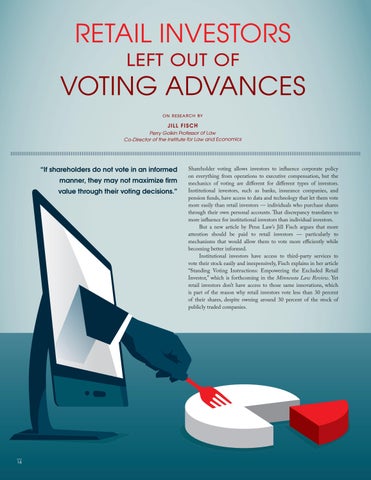
RETAIL INVESTORS left out of
VOTING ADVANCES on research by
JILL FISCH
Perry Golkin Professor of Law Co-Director of the Institute for Law and Economics
“If shareholders do not vote in an informed manner, they may not maximize firm value through their voting decisions.”
__ 14
Shareholder voting allows investors to influence corporate policy on everything from operations to executive compensation, but the mechanics of voting are different for different types of investors. Institutional investors, such as banks, insurance companies, and pension funds, have access to data and technology that let them vote more easily than retail investors — individuals who purchase shares through their own personal accounts. That discrepancy translates to more influence for institutional investors than individual investors. But a new article by Penn Law’s Jill Fisch argues that more attention should be paid to retail investors — particularly to mechanisms that would allow them to vote more efficiently while becoming better informed. Institutional investors have access to third-party services to vote their stock easily and inexpensively, Fisch explains in her article “Standing Voting Instructions: Empowering the Excluded Retail Investor,” which is forthcoming in the Minnesota Law Review. Yet retail investors don’t have access to those same innovations, which is part of the reason why retail investors vote less than 30 percent of their shares, despite owning around 30 percent of the stock of publicly traded companies.
JILL FISCH
“With institutional investors holding a growing percentage of publicly-traded shares, the limited propensity of retail investors to vote their shares and the economic cost of reaching out to individual investors to solicit their proxies, the retail vote has been all but forgotten,” writes Fisch. Fisch, the Perry Golkin Professor of Law, is an internationally known scholar, whose work examines the intersection of business and law, including the role of regulation and litigation in addressing limitations in the disciplinary power of the capital markets. Recent research focuses on corporate governance and securities litigation, as well as a series of experimental projects that analyze retail investor decision-making and financial literacy. She is also the Co-Director of the Institute for Law and Economics. Institutional investors can use voting platforms such as Proxy Edge, Proxy Exchange and Viewpoint to automate the voting process, explains Fisch. The functionality of these platforms allows institutional investors to authorize the voting of their shares in advance by providing standing voting instructions (SVI). Retail investors don’t have that option. This has the practical effect of disenfranchising retail shareholders. Doing so can have important consequences such as preventing issuers from making governance changes, since unvoted shares would essentially count as votes against a proposal. To remedy this problem, Fisch argues for permitting retail investors to submit SVI, also known as client-directed voting. While institutional investors can access internet-based voting platforms that allow them to establish voting instructions in advance, retail investors cannot. “Only very modest changes to [existing SEC rules] would be required to permit brokers to solicit SVI from their customers,” Fisch writes, noting that SVI proposals have been before the SEC for more than ten years. The main concern against SVI for retail investors, she explains, is the prospect that SVI will lead to uniformed voting, which is obviously undesirable. “If shareholders do not vote in an informed manner, they may not maximize firm value through their voting decisions,” she writes. “This behavior has the potential to impose costs not only on shareholders, but also on other stakeholders and society at large.”
But uniformed voting by retail investors — while a risk — is overstated, she argues. Retail investors have an economic stake in the companies in which they invest. Uninformed voters are much more likely to fail to vote, rather than risk voting against their financial interests. Under Fisch’s proposal, brokers would still be required to send federally mandated disclosure information to retail investors. And she adds, shareholders have access to substantial information in addition to proxy statements, such as the voting guidelines of mutual funds and the voting policies of many other institutional investors, that would allow them to make informed voting decisions. Finally, an increased level of retail investor participation would create an incentive for companies to communicate more information beyond the federally-mandated proxy statements. But while uninformed voting not a desired outcome, Fisch also points out that state corporate law, which is the primary source of shareholders voting rights, does not require that shareholders cast an informed vote. Courts have affirmed that shareholders are free to vote selfishly, if they wish, or even “by whim or caprice.” “Shareholder voting power is not conditioned upon shareholderspecific characteristics such as a shareholder’s independence, intent, or good faith,” Fisch writes. “Shareholders do not act as fiduciaries when they exercise their voting rights, and they are under no obligation to vote their shares in the best interests of the corporation.” Even on the federal level, she adds, shareholders are not required to be informed. The obligation is for issuers to disclose information; there is no requirement that investors read it or acknowledge it. Technological advance would allow the gap between institutional investor voting and retail investor voting to be closed relatively easily, Fisch argues. The platforms already exist for institutional investors. Fisch also proposes a variety of safeguards to minimize the potential for adverse effects on the voting process, including providing clients with an opportunity to override their standing voting instructions at any time. “By creating the opportunity for market providers to meet the needs of retail investors,” she concludes, “SVI offers the potential to bring greater legitimacy to shareholder voting.” __ 15
WHAT WORDS MEAN WHEN THE STAKES ARE HIGH
on research by
RYA N D O E R F L E R Assistant Professor of Law
Scholars have noted that in important cases courts appear to be much less rigid in how they interpret statutory text than in more run-ofthe-mill cases. So why do the courts stick to the text in low-stakes cases, but open to interpretation in high-stakes ones? The standard answer is a cynical one — politics prevails over text in big cases. A new article by Penn Law’s Ryan Doerfler draws on work from philosophy of language and epistemology to show, however, that the courts’ varied attitudes toward statutory text are largely rational. The article, “High-Stakes Interpretation,” forthcoming in the Michigan Law Review, argues that the courts need greater epistemologically justification to act when the practical stakes — such as ruling a statute unconstitutional — are so high. __ 16
Doerfler is an Assistant Professor of Law and scholar of legislation and administrative law. His research focuses on questions of statutory and constitutional interpretation, drawing on contemporary work in epistemology and philosophy of language. Philosophers have observed, he explains, that “ordinary speakers attribute ‘knowledge’ — and, in turn, ‘clarity’ — more or less freely depending on the practical stakes.” Doerfler gives the example of someone who uses a train system regularly and is in no particular rush. In that situation, it is easy for that person to “know” that the train will arrive at 7 a.m. But in a highstakes situation, where the person can’t afford to be late, it becomes less than “clear” that the train does, in fact, arrive at 7 a.m.
RYAN DOERFLER
not cover the defendant’s conduct, explaining that otherwise text “[T]his pattern of linguistic behavior reflects a basic insight can be made ambiguous by the serious consequences inherent in concerning the relationship between epistemological and practical accepting the face-value of its meaning — just as Doerfler’s argument reason,” Doerfler writes, “namely that one needs greater epistemic points out. justification to act on some premise the higher the practical stakes.” The applications of his analysis also brings some issues into Following from that insight, he argues that the courts treat stark relief regarding criminal law. According to the rule of lenity, he statutory text loosely partly because of the heightened epistemological explains, courts must resolve unclarity in criminal statutes in favor of standards that apply in high-stakes settings. It’s tougher to “know” defendants. But in practice, as long as courts have some inclination of what statutes mean in high-stakes cases, so it’s understandable that the statute’s meaning, the rule does not come into effect. courts have more difficulty finding a “plain” meaning to the text. “What this suggests is that courts regard criminal cases as having In his article, he presents several cases as examples, including remarkably low stakes,” Doerfler writes. “Indeed, if courts deem Bond v. United States, a case involving a constitutional challenge, statutory meaning ‘clear’ in criminal cases just in virtue of having which courts agree have inherently high-stakes. an ‘opinion as to the best reading,’ the attributed In Bond v. United States, a woman was stakes could not be any lower.” charged by federal prosecutors of violation of the In the age of mass incarceration, he notes, Chemical Weapons Convention Implementation “[I]t is simply harder it perhaps unsurprising that criminal cases are Act of 1998, which defines a chemical weapon to ‘know’ what a regarded as having the lowest stakes imaginable. as any “toxic chemical” not used for a “peaceful As normative matter, though, Doerfler argues we purpose.” The woman, after finding out that her statute means when ought to find this disturbing. husband was engaged in an affair with her friend, the practical stakes Doerfler admits that, sometimes, politics spread toxic chemicals on her friend’s door knob, beats out text in high-stakes cases. But there is along with other places, hoping that the friend are raised,” also more difficulty discerning statutory meaning would develop a rash on her skin. The friend only when the stakes are high. suffered a minor chemical burn on her thumb. “[I]t is simply harder to ‘know’ what a statute The application of the chemical weapons means when the practical stakes are raised,” he concludes. “Again, this statute, Doerfler explains, appears straightforward. The defendant used is not to say that it is impossible to discern the statutory meaning in a toxic chemical for a purpose that was not peaceful. She appealed the high-stakes cases, just that to do so is more difficult. The purpose of case to the Supreme Court on constitutional grounds, citing that the this Article is thus not to excuse all deviations from text in big cases. application of the act exceeded Congress’s powers under the Tenth It is, instead, to recommend a bit more sympathy — and hence, a bit Amendment — Congress could not police “local crime.” less cynicism — as the Court goes about its work at the end of Term.” Yet the Court sidestepped the constitutional question in the case, Doerfler notes, and ruled that the act, when correctly interpreted, did __ 17
Antitrust and Progressivism on research by
H E R B H OV E N K A M P James G. Dinan University Professor
But antitrust policy does not have the same concerns as regulation — it is concerned with restraints on competition. While it may be in line with some regulatory goals, it might be in conflict with others.
HERB HOVENKAMP
__ 18
While most progressive political administrations have advocated interventionist antitrust policies, a new article by Professor Herb Hovenkamp argues that if an administration truly wanted to enact progressive policies, they would be best served by a fundamentally neoclassical antitrust policy. Hovenkamp is the James G. Dinan University Professor and a Penn Integrates Knowledge Professor, holding joint appointments with the Law School and the Wharton School. He is the author of numerous volumes on antitrust law and policy and is internationally known for his expertise in the field. In his article “Progressive Antitrust,” forthcoming in the University of Illinois Law Review, Hovenkamp states that the progressive state is best served by the preservation of market competition as measured by consumer welfare, not the use of antitrust policy as a form of regulation. While progressive policy makers are concerned about “the threats posed by concentration of wealth, big business, industrial concentration and excessive mergers, harmful vertical integration, high entry barriers, or abuses of intellectual property rights,” Hovenkamp writes, they have tended to avoid concerns about market failure — when a market cannot “reach an equilibrium that provides economic satisfaction and growth consistent with competition.” “Progressives have almost always argued for a mixed economy,” explains Hovenkamp, “valuing markets as the primary mechanism for deploying resources, but with a broader conception of market failure and greater confidence in regulatory alternatives than were held by most political opponents on the right.” And while the progressives’ ideas about the role of regulation in the economy may be justified, he writes, those views should not spill over into antitrust policy. The country is best served by neoclassical antitrust policy with consumer welfare — meaning output maximization — at its heart. Not only does that policy line up with overall economic growth, it also provides resistance to special interest capture (when government agencies advance the agenda of a special interest group they are supposed to be regulating). Historically, regulation has had a more diverse set of goals than simply correcting the market, he explains. Regulation has been used to ensure universal service, manage risk, and protect consumers from fraudulent practices. But antitrust policy does not have the same concerns as regulation — it is concerned with restraints on competition. While it may be in line with some regulatory goals, it might be in conflict with others. “The relevant question for antitrust policy is whether it should pursue these goals when they deviate from the ordinary rules of competitive output maximization,” writes Hovenkamp. “The answer is a robust no.” Considering wealth distribution as an example, Hovenkamp concludes that even if using antitrust as a wealth distribution mechanism was justified, antitrust policy just isn’t built for that kind of regulatory use. It simply doesn’t have the tools or the statutory mandate.
“[E]ven to the extent a correlation exists between competition and more equal wealth distribution,” he writes, “that hardly justifies an antitrust policy at odds with an output maximization goal.” Instead, he argues, policy makers should concentrate on antitrust’s primary goal: policing output reducing restraints on competition. Regulations should be accepted as a part of legal and economic life, and antitrust policy should be optimized against the backdrop provided by that regulation. And even though antitrust policy might look like a candidate for combatting special interest capture, Hovenkamp explains, there is no evidence that Congress has ever seen it to be a useful tool for limiting capture. While the benefits of market competition are substantial, Hovenkamp notes, the variations in market-based economies and legal systems have not been equally successful. “[C]ompetitive markets are neither self-creating nor self-executing,” he writes. “They must be supported by wellmanaged institutions or else they will fail to provide socially desirable results. In addition, when markets fail, different markets call for different types of repairs.” The progressive antitrust record lacks coherence, he explains. Antitrust has been looked at as a cure for monopoly, wealth inequality, hardships facing small business, and other market problems. But rather than using antitrust as a cure-all, he attests, policymakers should regulate the market as needed, then use antitrust as “the ‘residual’ regulator.” Antitrust law is an ineffective institution for distributing wealth; it should instead be used to promote consumer welfare, as consumers benefit from high output, high quality, and low prices. Indeed, neoclassical antitrust policy and empirically-based market regulation can work together. “Far too many progressives…failed to appreciate this distinction,” Hovenkamp concludes. “While they were progressive in their regulatory policy, they also saw antitrust itself as a heavy handed regulator, and often for economically indefensible goals. Perhaps as a result, anti-progressives have often viewed antitrust as useless or perhaps even socially harmful. A well designed antitrust policy must avoid both extremes.”
__ 19
ADDING CAUSATION TO COPYRIGHT on research by
S H YA M K R I S H N A BA LGA N E S H Professor of Law Co-Director of the Center for Technology, Innovation and Competition
Copyright law tends to focus on works rather than the process that created them. Most of the time, this framework is usually adequate. But what if, for example, a monkey took a picture of itself with a camera that had been set up by a nature photographer? Would the photographer hold a copyright on that photograph? That’s just what happened to photographer David Slater. In Indonesia, he set up a camera, hoping that a group of macaque monkeys would approach and give him a close-up view. One of the monkeys climbed on the camera, and took a photo of itself. Penn Law professor Shyamkrishna Balganesh examines this and other similar situations in his article “Causing Copyright,” which appears in the Columbia Law Review. The Copyright Office denied Slater and the work copyright protection, declaring that the work needed to be created by a human to be eligible. The case, Balganesh argues in his article, shows that copyright law does, in fact, have an important causal dimension, and he argues for the development of a requirement called “copyrightable causation” as a prerequisite to copyright protection. Balganesh’s scholarship focuses on understanding how intellectual property and innovation policy can benefit from the use of ideas, concepts and structures from different areas of the common law, especially private law. He is also a CoDirector of the Center for Technology, Innovation & Competition (CTIC). “Everyday scenarios of creative production that routinely give rise to potential claims of authorship embody important questions of causation,” writes Balganesh. “And yet, copyright law chooses to address the question of causation only indirectly (and begrudgingly).” He gives the example of an artist who accidently knocks over paint to create an appealing design on someone else’s canvas. In most cases, copyright law examines situations from the doctrine of “originality,” which considers if the work was independently created and requires a minimal amount of creativity from the claimant. That doctrine, however, isn’t sufficient when the process of creation is critical, and copyright law incorrectly presumes that process to be uncontroversial. Copyright law possesses a “latent theory of causation,” Balganesh argues, but overtly acknowledging the role of causation would better serve the law. He proposes the requirement of “copyrightable causation” as a prerequisite to copyright protection. __ 20
SHYAMKRISHNA BALGANESH
“The requirement would bring into sharp focus the act — rather than just the result — of authorship and move copyright doctrine and thinking away from its singular emphasis on the ‘work,’” he writes. “Authorship would in the process re-emerge not just as a symbolic ideal within the system but also as a substantive feature of copyright doctrine that plays a significant role in determining claimants’ rights.” Because the requirement possesses a connection to the common law of torts, the courts would be the best venue to develop it, rather than through congressional intervention, he explains, and it would also need to work in tandem with copyright law’s established requirement of originality. “For a work to qualify for copyright protection as a work of authorship,” Balganesh writes, “the work would have to be the result of human agency that is treated as causally relevant to, and sufficient for, copyright law.”
requirement, would examine whether those actions are sufficient to identify the actor as causally responsible for the work created. “Causation has always been an integral part of copyright law’s basic entitlement structure, even if only rarely acknowledged as such,” writes Balganesh. “Nonetheless,” he adds, “the reality remains that causal principles rarely ever rise to the surface as an overt part of copyright reasoning.” Copyright law would greatly benefit from engaging with authorial causation, he argues. The addition of the copyrightable causation requirement would introduce greater “analytical coherence and normative consistency into important aspects of copyright doctrine.” And by modeling the copyrightable causation requirement on tort law’s rules about causation, the idea that copyright law can look to other areas of common law would be strengthened, along with the
“The requirement would bring into sharp focus the act — rather than just the result — of authorship and move copyright doctrine and thinking away from its singular emphasis on the ‘work.’”
Tort law possesses valuable structures that would be useful in the determination of causality in the context of copyright law, Balganesh explains. The use of causal inquiry in tort law’s determination of negligence could be used for copyright law. And holding an actor responsible for a consequence to determine liability could be used as well. Causally relating the work in question to an actor’s creative actions would be the first step of the copyrightable-causation requirement, which could function much like tort law’s cause in fact requirement. The second step, much like tort law’s proximate cause
notion that the courts have a role to play in the reform of copyright, despite its statutory origin. These are also points that Balganesh has made repeatedly in his prior work. “[I]n so doing, they would do well to look to analogous ideas and concepts that courts have developed and employed with fecundity in other areas,” concludes Balganesh. “The principles of causation represent one such domain, in which logic, theory, and practice serve as convenient guides.” __ 21
CLICK TO AGREE,
even though you didn’t read on research by
DAV I D H O F F M A N Professor of Law
TERMS OF SERVICE Please read these Terms of Service carefully before using this Website operated by the Company. Your access to and use of the Website is conditioned on your acceptance and compliance with these Terms. By accessing or using the Website you agree to be bound by these Terms. Any use of or reliance on any Content or materials posted via the Website is at your own risk. All Content is the sole responsibility of the person who originated such content. We reserve the right to remove Content. These Terms of Service may change at any time.
I AGREE
DAVID HOFFMAN
__ 22
I DISAGREE
Consumers see more and more contracts every day through their day-to-day online interactions, and a new study by Penn Law professor David Hoffman, using experimental data, has investigated the views of younger and older consumers about such agreements. The article, “From Promise to Form: How Contracting Online Changes Consumers” was published in the New York University Law Review. Hoffman, an expert in contracts, law and psychology, and empirical legal studies joined the faculty in January 2017. His scholarship uses observational and experimental data to explore individuals’ behavior relating to legal rules. The proliferation of onerously long online user agreements, he notes, indicates the perverse mechanism behind shifting attitudes about contracting. Though essentially no consumers read consumer contracts, we are all asked (in the “click-to-agree” box) to affirm the contrary: “[I]t seems likely that repeatedly clicking-to-agree to an explicit lie (affirming you have read the contract’s terms) makes consumers feel somewhat differently about contract formation,” he writes.
In his experiment, Hoffman uses a series of scenario experiments to gauge a nationally representative sample of consumers’ attitudes toward the contract formation, performance, and breach. These hypotheticals involved common activities such as buying a new phone or joining a gym, and Hoffman used the scenarios go determine the subjects’ views of contracting. Through these experiments, he found that younger subjects are more likely to believe that contracts can be formed online, that contracting out of rights in writing is legitimate in ways that oral contracting is not, and that contract law is highly formal and does not permit excuses for breach. “Compared to older consumers,” Hoffman explains, “younger ones have come to be somewhat less likely to think that contracts instantiate moral exchanges, and more likely to believe they are merely the rules of the game.” For older consumers, however, contracts don’t have the same implications. To them, a contract implies moral commitment and an inability to exit. But while there may be age differences in attitudes toward contracting, Hoffman notes, he is careful to point out that younger consumers are not against contracting, they simply regard it differently as a social practice. Hoffman’s experimental data bares out the point: while older consumers were more attracted to “no contract clauses,” younger consumers tended not to be influenced in one way or the other by them. In response to these results, Hoffman considers the evolution of contract law. “Imagining contract doctrine operating on a landscape where its subjects think contracts are forms exposes just how deeply contract theory needs citizens to view contracts as moral promises,” he writes. One fear Hoffman notes is that firms would try to engage in cognitive discrimination, trying to find consumers that shouldn’t engage in a transaction, then exploiting cognitive errors to induce them to do so. “There is evidence
that firms change contract terms in response to changes in doctrine,” Hoffman writes. “And firms do change their website interfaces to keep consumers engaged. Might firms, then, exploit consumers’ diverging perspectives on contract by changing how contracts look and are displayed?” While Hoffman admits that the examples are imperfect, he points to several situations where industries change contracting contexts to appeal to consumers by age or some other attribute. For example, a mattress company offers telephone consultations when ordering an adjustable bed (which are primarily bought by older consumers) versus an online order form for a standard mattress. Yet while these companies are offering different contracting contexts, Hoffman notes, they aren’t really selling the same good. They are, however, examples that companies do understand the preferences of older and younger consumers when it comes to contracting. Perfect examples might be hard to come by, but Hoffman concludes that this behavior doesn’t necessarily require regulation, as the contracting context and presentation are simply another attribute of the product. And for situations where firms manipulate consumers by causing them to understand their legal status, that — to him — wouldn’t require a change in law, since it already seems like “a classic case of bad faith.” While his experiment focuses on age, Hoffman argues that further study could examine other demographic differences that motivate and influence views of contract. “But focusing on the effects of individual differences on contract behavior, we would open up a new approach to the problem of contractual obligation,” Hoffman writes. “We already live in a world where firms have the motive and opportunity to use contract as an individualized spur to consumption. The question this Article poses is whether, and how, contract doctrine will respond.”
“[I]t seems likely that repeatedly clicking-to-agree to an explicit lie (affirming you have read the contract’s terms) makes consumers feel somewhat differently about contract formation.” __ 23
WHY COMPANIES
INVERT on research by
MICHAEL KNOLL Theodore K. Warner Professor of Law and Professor of Real Estate Co-Director of the Center for Tax Law and Policy
“Although improving competitiveness might not be the only reason to invert… improving competitiveness is and remains a powerful motivation for inverting.”
__ 24
In 2014, Professor Edward D. Kleinbard, former Chief of Staff of U.S. Congress Joint Committee on Taxation and now of USC’s Gould School of Law, published an article in Tax Notes arguing that competitiveness has nothing to do with why U.S. corporations engage in corporate inversions — a cross-border acquisition where a firm acquires a foreign target, and that foreign target then becomes the parent of the group that includes the original U.S. corporation as a wholly owned subsidiary. Penn Law professor Michael S. Knoll rebuts Kleinbard’s competitiveness claim in a special report titled “Taxation, Competitiveness, and Inversions: A Response to Kleinbard” in the May 1, 2017 issue of Tax Notes. In the piece, Knoll responds that the issue is more “nuanced, complex, and ambiguous” than Kleinbard attests, and that, in his 2014 paper, Kleinbard has not shown that U.S. companies are not at a taxinduced competitive disadvantage relative to their foreign rivals. Knoll is the Theodore K. Warner Professor at Penn Law and Professor of Real Estate at Wharton, as well as the Co-Director of the University of Pennsylvania Center for Tax Law and Policy. Much of his recent research involves
MICHAEL KNOLL
the application of finance principles to questions of international tax policy, especially the connection between taxation and competitiveness. Critics view corporate inversions as a way for companies to reduce their U.S. taxes, Knoll explains, and, in 2016, the federal government proposed regulations designed to discourage inversions. Aside from the tax implications, another fear is that inverted companies will move their headquarters, employment, investment, and research and development out of the United States. Managers of inverting companies, however, claim that U.S. corporations are taxed more heavily than their foreign counterparts, Knoll notes. They attest that a desire to invert is a signal that the U.S. international tax system is punitive toward U.S. corporations. Kleinbard and his 2014 article are important, Knoll writes, because they “have played and continue to play a highly visible role in public policy debates over inversions. His article has been cited for the propositions that U.S.-domiciled companies are not taxdisadvantaged relative to their foreign competitors and that U.S. domiciled companies do not improve their competitive position by inverting.” Kleinbard claims that U.S-domiciled MNCs are taxdisadvantaged from both a financial accounting and a cash flow perspective, Knoll notes. Kleinbard builds his financial accounting argument around a 2015 Tax Notes column by Martin A. Sullivan that reviews studies of multinational corporations’ (MNCs) effective tax rates (ETRs). These studies — using different methods, data, and time frames — conclude that “the global ETR of the average U.S.domiciled MNC is no higher or is not substantially higher than that of the average non-U.S.-domiciled MNC.” But upon closer inspection, Knoll explains, these studies actually point toward U.S.-domiciled MNCs facing a tax disadvantage. They have higher global average ETRs than MNCs domiciled in most other advanced economies. Knoll finds further support for his claim that U.S.-domiciled MNCs are at a tax-disadvantage relative to their foreign rivals from studies of inverting firms. In studies using pre-2004 data, global ETRs following inversions consistently declined. In more recent studies of the effects of inversions on global ETRs, the effect is not uniform, but they do point toward many U.S.-domiciled MNCs lowering their global ETR by inverting. Knoll also looked at the statements by management of inverting companies, and while not all publicly stated expectations of a decline in global ETR, many, in fact, did. For example, Steris Corp., which
inverted in 2015, said it expected its global ETR to fall from 32.1 percent to 25 percent. Pfizer expected its global ETR to fall from around 25 percent to around 17 or 18 percent before its inversion with Allergan was cancelled in 2016. And CF Industries Holdings Inc. expected a drop from 35 percent to 20 percent on its merger with OCI before it, too, was cancelled. “[T]he managers of many inverting corporations expect to see their companies’ ETRs fall,” Knoll writes. “Thus, viewed through the lens of corporations’ global ETRs,” Knoll argues, “Kleinbard’s claim that inverting U.S.-domiciled companies do not improve their competitive position by inverting is not supported by the data and is inconsistent with most studies.” In terms of cash flow, Kleinbard claims that U.S.-domiciled MNCs do not incur costs because of the United States’ worldwide tax system with effectively unlimited deferral on earnings retained overseas. But, according to Knoll, there are good reasons to believe that U.S. firms incur costs from deferral and hence are at a competitive disadvantage. Knoll cites the 2004–2005 tax holiday that receded the maximum repatriation tax rate from 35 percent to 5.25 percent. During that time, 843 U.S. MNCs repatriated $362 billion. “If it were costless for companies to keep repatriated earnings overseas,” Knoll writes, “presumably they would have foregone repatriation during the holiday.” In addition, there is a widespread believe that overseas cash holdings that would be subject to tax are valued at less than their face value by the market. Plus there is evidence that holding large amounts of offshore earnings incurs implicit nontax costs, such as tax planning and structuring costs. The available data and studies do not support Kleinbard’s claim that U.S.-domiciled MNCs are not tax-disadvantaged relative to their foreign rivals — either from the perspective of financial accounting (global ETRs) or cash flow, Knoll writes. At best, the data is inconclusive, though most of it supports that view that U.S.domiciled MNCs can improve their competitive position by inverting. “Although improving competitiveness might not be the only reason to invert (and we do not have a good sense of the magnitude of the advantage), improving competitiveness is and remains a powerful motivation for inverting,” Knoll concludes. “And policies intended to curb inversions that ignore this state of affairs are likely to create tensions and produce adverse effects.” __ 25
PUSHBACK
UNDERSTANDING THE
AGAINST PRIVATE ENFORCEMENT on research by
S T E P H E N B . B U R BA N K David Berger Professor for the Administration of Justice
STEPHEN BURBANK
__ 26
One of the primary mechanisms for the enforcement of civil rights laws is the ability of plaintiffs to recover their attorney’s fees if they prevail in private litigation. This method of enforcing rights is called private enforcement, and it has been a central instrument to implement social and economic policy since the 1960s. But the rise of private enforcement led to a counterrevolution aimed at curtailing it, and that counterrevolution is the focus of a new book, Rights and Retrenchment, by Penn Law professor Stephen B. Burbank and his co-author, Sean Farhang. Burbank is David Berger Professor for the Administration of Justice and the author of definitive works on federal court rulemaking, interjurisdictional preclusion, litigation sanctions, international civil litigation, and judicial independence and accountability. Farhang is Professor of Law and Associate Professor of Political Science and Public Policy at the University of California, Berkeley. He is the author of the award-winning book, The Litigation State (Princeton, 2010). Although liberals evinced faith in a centralized, federal bureaucracy for regulation during the New Deal, the authors explain, by the 1960s liberals became disillusioned as the agencies tasked with regulating business came to identify with the businesses they oversaw as constituencies in need of protection, and the bureaucracy came to be seen as a conservative force. One of the less studied ways liberal groups combated this change, Burbank and Farhang write, was to advocate for rules that circumvented the administrative state by encouraging direct enforcement of legislative mandates through private lawsuits against targets of regulations, such as discriminating employers and polluting factories. Rules that authorized the recovery of attorney’s fees or multiple damages if a plaintiff won the case were especially important to encouraging private enforcement.
The Civil Rights Act of 1964 was a turning point for private enforcement, Burbank and Farhang note. The support of Republicans was crucial to the law’s passage, and they stripped the strong administrative powers that civil rights liberals had proposed from the bill, replacing them with private enforcement instead. Liberals insisted on a fee-shifting mechanism, and — although the measure was viewed initially as a compromise — the result shifted the landscape in favor of civil rights groups. The law led to resources for non-profit public interest groups, a rise in the number of such groups, and the growth of a private for-profit bar to litigate civil rights claims. But the advance of private enforcement was contested by a countermovement, which is the subject of Burbank and Farhang’s book. “The counterrevolution’s strategy was to leave substantive rights in place while retrenching the infrastructure for their private enforcement,” the authors write. The movement employed three different strategies: trying to amend existing federal statutes to reduce opportunities for private enforcement by eliminating or reducing the incentives that stimulated it; trying to amend Federal Rules of Civil Procedure that were salient to private enforcement; and litigating with the goal of gaining rulings in the federal courts that limited private enforcement. Of those three strategies, Burbank and Farhang explain, the most successful was the campaign in the courts.
Finally, the campaign in the courts sought to shrink opportunities and incentives for private enforcement by focusing on issues such as standing, damages, fee awards, and class actions, the authors write, and this was the most successful venue for retrenchment. Using both quantitative and qualitative data, Burbank and Farhang show how an increasingly conservative Supreme Court turned against the private enforcement of federal rights. They found that in cases with at least one dissent, the probability of success for plaintiffs in litigating private enforcement issues in front of the Supreme Court has declined for 40 years, and in 2014, plaintiffs lost about 90 percent of the time, largely due to the votes of conservative justices. Strikingly, the authors find that ideology had a greater influence on justices’ votes in private enforcement cases interpreting Federal Rules of Civil Procedure (such as Rule 23 on class actions) than in the larger domain of private enforcement cases or in cases involving the interpretation of the underlying substantive rights. In support of one hypothesis they offer to explain this phenomenon, the authors demonstrate empirically that newspapers cover the Court’s rulings on substantive rights far more extensively than rulings on laws providing opportunities and incentives to enforce those rights, which are perceived to be technical. “[T]he Court’s decisions on rights enforcement, because of their lower public visibility, are less constrained by public opinion
Liberals insisted on a fee-shifting mechanism, and — although the measure was viewed initially as a compromise — the result shifted the landscape in favor of civil rights groups.
To assess the legislative impact, the authors constructed an original dataset of 500 bills introduced from 1973 to 2014 that attempted to retrench private enforcement. They show that these efforts largely failed. Indeed, early in the counterrevolution, they were abandoned by the Reagan administration, because of concerns that the bills were seen as “anti-rights” and would be politically costly. To examine the rulemaking element of the retrenchment effort, Burbank and Farhang compiled original data sets from 1960 to 2014 identifying every person who served on the Advisory Committee on Civil Rules. These members are appointed by the Chief Justice of the United States. The authors identified the occupation, party affiliation of the appointing president for federal judges, and practice type for practitioners, and they also collected every amendment to the Federal Rules proposed by the committee in that 55-year period. Although the Advisory Committee came to be dominated by judges appointed by Republicans and corporate lawyers over time, Burbank and Farhang explain, few of their proposals have been relevant to private enforcement. Moreover, although those that were increasingly tended to disfavor plaintiffs, changes to the rulemaking process during the 1980s made bold change very difficult.
and therefore less tethered to democratic governance,” write Burbank and Farhang. Although the effects of any particular legal change on private enforcement can be difficult to pin down, the authors have no doubt about the overall effect of the retrenchment movement. “[W]e feel no uncertainly that hundreds of decisions over more than 40 years restricting private rights of action, standing, attorney’s fees, damages, the ability to litigate rather than arbitrate, and access under Federal Rules — cumulatively — have diminished private enforcement of federal rights.” Finally, observing that a majority of the cases in their data involved the interpretation of private enforcement regimes in federal statutes, the authors suggest that “judicial subversion of legislation raises troubling questions from the standpoint of democratic values.”
__ 27
FEATURED SCHOLARS
__ 28
SHYAMKRISHNA BALGANESH is a Professor of Law and Co-Director of the Center for Technology, Innovation and Competition. His scholarship focuses on intellectual property and innovation policy, and his research has appeared in the Stanford Law Review, the Columbia Law Review, the University of Pennsylvania Law Review, and other journals. STEPHEN B. BURBANK is the David Berger Professor for the Administration of Justice. He edited (with Barry Friedman) Judicial Independence at the Crossroads: An Interdisciplinary Approach (SAGE Publications, 2002) and served as Chair of the Board of the American Academy of Political and Social Science. He served as a member of the National Commission on Judicial Discipline and Removal and was a principal author of its report. RYAN DOERFLER is an Assistant Professor of Law. His scholarship examines questions of statutory and constitutional interpretation, drawing on contemporary work in epistemology and the philosophy of language. His research has appeared or is forthcoming in the University of Chicago Law Review, the Duke Law Journal, and the Michigan Law Review. JILL FISCH is the Perry Golkin Professor of Law and Co-Director of the Institute for Law and Economics. Her work focuses on the intersections of business and law, including the role of regulation and litigation in addressing limitations in the disciplinary power of the capital markets. He scholarship has appeared in the Harvard Law Review, the Yale Law Journal, the Columbia Law Review, the University of Pennsylvania Law Review, and the Texas Law Review, among others. JEAN GALBRAITH is an Assistant Professor of Law. Her scholarship on U.S. foreign relations law and public international law focuses on the allocation of legal authority among U.S. governmental actors and between domestic actors and international regimes. Her work has been published in the Cornell Law Review, the Michigan Law Review, the NYU Law Review, the University of Chicago Law Review, the Virginia Law Review, and other international law journals. JONAH GELBACH is a Professor of Law. His research interests include civil procedure, statutory interpretation, law and economics, event study methodology, applied statistical methodology, and applied microeconomics. His scholarship has appeared in the Stanford Journal of Complex Litigation, Yale Law Journal, University of Chicago Law Review, University of Pennsylvania Law Review, American Economic Review, Journal of Political Economy, and Review of Economics and Statistics, among others. PAUL HEATON is a Senior Fellow and Academic Director of the Quattrone Center for the Fair Administration of Justice. His research aims to apply methodological insights from economics to inform issues in legal and criminal justice policy. His research has been published in the Yale Law Journal, Stanford Law Review, New England Journal of Medicine, Journal of Law and Economics, Journal of Labor Economics, and American Journal of Public Health. DAVID HOFFMAN is a Professor of Law. His scholarship uses observational and experimental data to explore individuals’ behavior relating to legal rules, and his recent research appears or is forthcoming in the New York University Law Review and the Stanford Law Review.
HERB HOVENKAMP is the James G. Dinan University Professor and a Penn Integrates Knowledge Professor. He is an internationally renowned expert on antitrust law and policy, and he has written extensively on American history and legal thought. MICHAEL KNOLL is the Theodore K. Warner Professor of Law and Professor of Real Estate. He is also Co-Director of the Center for Tax Law and Policy. His scholarship investigates how income tax laws affect business and investment decisions. His articles have been published in the Yale Law Journal, the Harvard Law Review, the Virginia Law Review, and Tax Notes, among others. SANDRA MAYSON was previously a Research Fellow for the Quattrone Center for the Fair Administration of Justice and is now an Assistant Professor of Law at the University of Georgia Law School. Her research focuses on the intersections between criminal law, constitutional law, and legal theory. Her work has been published or is forthcoming in the Yale Law Journal, Stanford Law Review, and the Notre Dame Law Review, among others. SERENA MAYERI is a Professor of Law and History. Her research focuses on the historical impact of progressive and conservative social movements on legal and constitutional change. Her book, Reasoning from Race: Feminism, Law, and the Civil Rights Revolution (Harvard University Press, 2011) received the LittletonGriswold Prize from the American Historical Association and the Darlene Clark Hine Award from the Organization of American Historians. He recent work has appeared in the California Law Review and the Yale Law Journal. STEPHEN J. MORSE is the Ferdinand Wakeman Hubbell Professor of Law and Professor of Psychology and Law and Psychiatry. He is also the Associate Director of the Center for Neuroscience & Society. His scholarship investigates problems of individual responsibility and agency. He has published numerous interdisciplinary articles and chapters and has co-edited collections, including (with A. Roskies) A Primer on Criminal Law and Neuroscience and (with L.Katz & M. Moore) Foundations of Criminal Law. He was a contributing author (with L. Alexander and K. Ferzan) to Crime and Culpability: A Theory of Criminal Law. DOROTHY ROBERTS is the George A. Weiss University Professor of Law and Sociology and the Raymond Pace and Sadie Tanner Mossell Alexander Professor of Civil Rights. She is an acclaimed scholar of race, gender and the law, and she is a Penn Integrates Knowledge Professor. Her major books include Fatal Invention: How Science, Politics, and Big Business Re-create Race in the Twenty-first Century (New Press, 2011); Shattered Bonds: The Color of Child Welfare (Basic Books, 2002), and Killing the Black Body: Race, Reproduction, and the Meaning of Liberty (Pantheon, 1997). MEGAN STEVENSON was previously a Research Fellow for the Quattrone Center for the Fair Administration of Justice and is now an Assistant Professor at Antonin Scalia Law School, George Mason University. She uses advanced econometric techniques to evaluate criminal law and policy, and her research has been published in the Stanford Law Review and the Review of Economics and Statistics.
__ 29
Advances in Research 3501 Sansom Street Philadelphia, PA 19104