

Accelerating Hyperscale Workloads with CXL® Memory Partner Collaboration: Penguin Solutions, Pegatron
Introduction
As data-intensive applications outpace traditional server memory capacities, Compute Express Link (CXL) technology provides a scalable solution for memory expansion. This study, demonstrates how SMART Modular’s CXL Add-In Cards (AICs) redefine performance and flexibility for memorybound workloads.
Background
Modern data centers face the challenge of managing workloads like In-Memory Databases (Redis) and Large Language Model (LLM) fine-tuning that exceed the physical limitations of CPU DIMM slots. Traditional scaling often leads to performance degradation due to disk swapping. The integration of SMART’s CXL AICs addresses these challenges by utilizing the PCIe interface to add substantial memory capacity and throughput.
Key Features of SMART’s CXL AICs
• Capacity Benefits: Mitigates performance degradation by drastically reducing the need for disk swapping.
• Throughput Enhancement: Increases total system bandwidth through memory interleaving across CXL regions.
• Tiering-Ready Architecture: Optimized for “hot page” tiering strategies. When managed by system software or administrators, latency-sensitive data remains in local DRAM while highbandwidth data is strategically allocated to CXL memory.
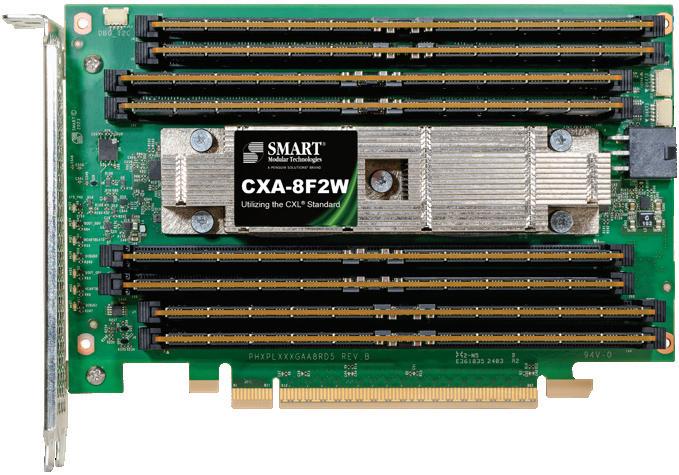
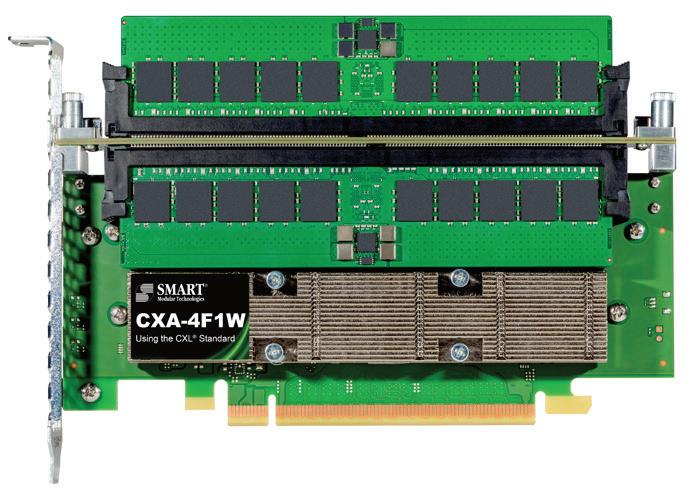
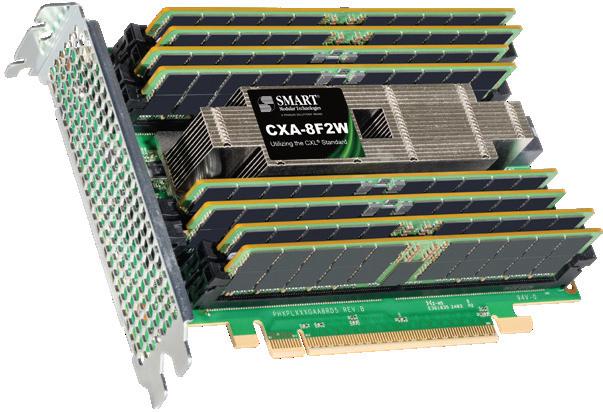
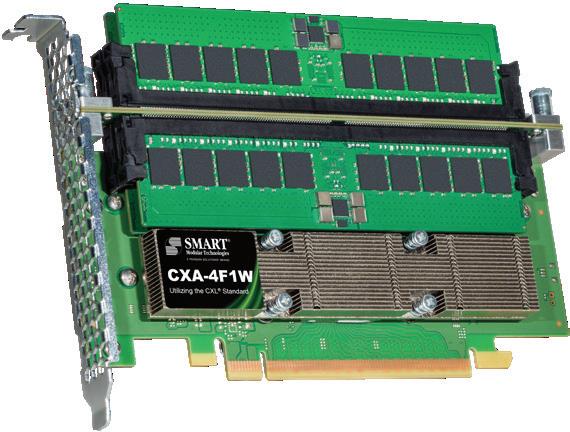
• Scalable Architecture: Available in 4-DIMM and 8-DIMM Add-In Card configurations to bypass physical hardware limitations.
Use Case Scenarios
1. In-Memory Database (Redis)
Redis was benchmarked against a 50GB dataset to measure performance across varying payload sizes.
• Latency-Bound Domain (<64KB): Standard DRAM maintains a slight lead due to lower inherent access latency.
• Throughput-Bound Domain (>64KB): CXL AICs outperform DRAM by leveraging superior aggregate bandwidth through interleaving.
• Outcome: Redis on CXL achieves 98-100% of native DRAM performance in real-world simulations.
2. AI & LLM Fine-Tuning (Llama 3)
Fine-tuning large models requires massive memory footprints (e.g., ~745GB for Llama3-34B) that often exceed a single server’s local DRAM.
Implementation
1. System-Level Management:
• Tiering Facilitation: The desired performance balance is achieved when system administrators or specialized software facilitate hot-page tiering.
• Strategic Allocation: By separately allocating latency-sensitive tasks to DRAM and high-bandwidth workloads to the CXL tier, the system maximizes resource efficiency.
• Topology & Mapping: CXL devices are mapped to specific NUMA nodes (e.g., Nodes 2 & 3) to optimize affinity for memory-only CXL AICs.
• Configuration: CXL regions are interleaved across multiple backing devices (mem0, mem1) to maximize throughput.
2. Strategic Deployment: Organizations can confidently deploy low-to-middle frequency applications on CXL memory without user-perceived degradation.
3. Operational Outcomes:
• Efficiency: Achieved up to 21% increase in AI training efficiency.
• Near-Native Performance: Maintained near-native DRAM performance for database applications while expanding capacity.
Summary
SMART Modular’s CXL AICs provide a high-bandwidth, high-capacity memory tier essential for modern AI and database infrastructure. By strategically placing high-bandwidth workloads on CXL memory, organizations can overcome traditional hardware limitations and achieve significant acceleration in execution times.
Headquarters/North America: T: (+1) 800-956-7627 • T: (+1) 510-623-1231 F: (+1) 510-623-1434 • E: info@smartm.com
For more information, please visit: www.smartm.com *Product images are for promotional purposes only. Labels may not be representative of the actual product.
Latin America: T: (+55) 11 4417-7200 • E: sales.br@smartm.com
Asia/Pacific: T: (+65) 6678-7670 • E: sales.asia@smartm.com
EMEA: T: (+44) 0 7826-064-745 • E: sales.euro@smartm.com
Customer Service: T: (+1) 510-623-1231 • E: customers@smartm.com