How Will Your Pain Be Managed? Medication: • Oral tablets (Paracetamol, NSAIDs) • Stronger medicines (Opioids, if needed) • Patient - Controlled Analgesia(PCA) - allows you to press a button for pain relief • Nerve blocks or spinal/epidural anesthesia (depending on surgery type)
We're Here To Help: Talk to your : • Anesthesiologist - about anesthesia and post op pain options • Surgeon - about surgical recovery activity • Nurse - about comfort measure and medication timing
Non-Medication Methods: • Cold or warm compresses apply to the affected area. • Positioning for comfort • Relaxation technique (deep breathing, guided imagery) • Distraction (music, TV, books)
Discharge Pain Plan 1. You will given a written pain management plan including: • Specific medication (name, dose, when to take) • When to stop or reduce your opioid use (aim to switch to non opioid as soon as possible)
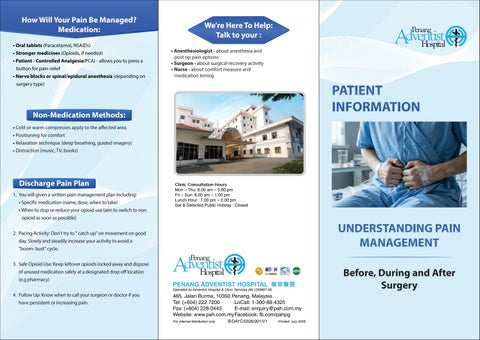
Clinic Consultation Hours Mon – Thu: 8.00 am – 5.00 pm Fri – Sun: 8.00 am – 1.00 pm Lunch Hour : 1.00 pm – 2.00 pm Sat & Selected Public Holiday : Closed
2. Pacing Activity: Don't try to " catch up" on movement on good day. Slowly and steadily increase your activity to avoid a "boom- bust" cycle. 3. Safe Opioid Use: Keep leftover opioids locked away and dispose of unused medication safely at a designated drop off location (e.g pharmacy) 4. Follow Up: Know when to call your surgeon or doctor if you have persistent or increasing pain.
PENANG ADVENTIST HOSPITAL 槟 安 医 院
Operated by Adventist Hospital & Clinic Services (M) (255697-M)
465, Jalan Burma, 10350 Penang, Malaysia Tel: (+604) 222 7200 LoCall: 1-300-88-4325 Fax: (+604) 228 0443 E-mail: enquiry@pah.com.my Website: www.pah.com.my Facebook: fb.com/pahpg For internal distribution only
B/DAYC/0326/001/V1
Printed: July 2026
Before, During and After Surgery
What is Perioperative Pain Management?
Why is Pain Management Important? Pain after surgery is normal, but it can be controlled. Effective pain management helps you: 1. Breathe deeply and move comfortably 2. Start walking and eating sooner 3. Prevent complications 4. Heal faster and go home sooner
Perioperative means the period before, during and after your operation. At every stage, we assess and manage your pain to ensure your comfort.
Phase
Our Pain Management Goals:
Pre op
Pain Score
Description
0
No pain
1-3
Mild pain
4-6
Moderate pain
7-10
Severe pain
We assess you medical history, discuss pain control options 1
During op
3. Improve physical function: Increase mobility, strength and joint function to help with daily tasks. 4. Enhance sleep: Manage night time pain to improve sleep quality.
You'll be asked to rate your pain using a 0-10 scale:
What Happens
1. Reduce pain: keep your pain below 3/10. 2. Restore quality of life: Improve the ability to participate in hobbies, work
How Do We Measure Pain?
2
3
4
5
6
7
8
9
10
Numeruc Rating Scale
Anesthetics options: General Anesthesia, Local Anesthetics/Nerve Block, Epidural or Spinal Anesthesia
0=No Pain, 10=Worst Possible Pain
We may also use facial expression chart especially for children or patient who can’t speak. Post - op
Pain is treated with medications and comfort measures (Oral, IV, PCA, Epidural Infusion)
5. Boost mental health: Reducing the negative impact of pain on mood. 6. Increase activity: Gradually increase physical activity and engagement in social and recreational activities.
0
1
2
3
4
5
No hurt
Hurts little bit
Hurts little more
Hurts even more
Hurts whole lot
Hurts worst
2
4
6
8
10
Alternate 0 coding