Your Health Matters
Weare here to support you. This information will help you understand what to expect after your procedure. Most of your questions will be answered, but you may still have some concerns.
Clinic Consultation Hours
Monday - Thursday : 8.00 am - 5.00 pm Friday & Sunday : 8.00 am - 1.00 pm Saturday & Selected public holidays : Closed (Emergency medical services are available at ER 24 hours)
For more information, please contact: Adventist Urology Clinic Tel : (+604)-222 7775 / 7425
Please write down your questions and bring them with you when you are admitted so we can discuss them with you.
My Questions
PENANG ADVENTIST HOSPITAL Operated by Adventist Healthcare Services(Malaysia) Sdn. Bhd. 465, Jalan Burma, 10350 Penang, Malaysia LoCall: 1-300-88-4325 Tel: (+604) 222 7200 Fax: (+604) 228 0443 Email: enquiry@pah.com.my Website: www.pah.com.my Facebook: fb.com/pahpg For internal distribution only.
B/CURO/0226/001/V1
Printed: Oct 2026
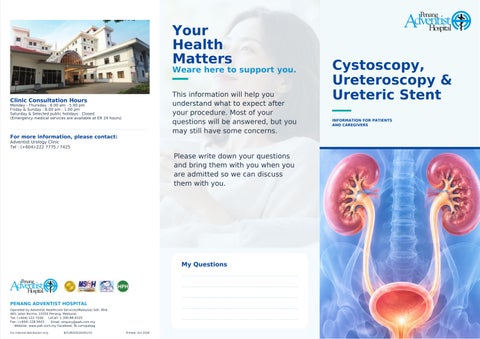
Cystoscopy, Ureteroscopy & Ureteric Stent INFORMATION FOR PATIENTS AND CAREGIVERS
What are these procedures? These procedures allow the doctor to look inside your urinary tract using a thin, flexible camera (scope). They help diagnose and treat problems in the bladder, ureter or kidney.
Why might I need these procedures?
How are these procedures done?
Blood in urine(haematuria) Kidney or ureteric stones Urinary blockage or narrowing
1
Recurrent urinary tract infections Tumours or abnormal growths Difficulty passing urine
Cystoscopy A thin, flexible scope is gently passed through the urethra into the bladder. The doctor examines the lining and may take a sample or perform treatment if needed.
To place or remove a ureteric stent Cystoscopy
Ureteroscopy
Ureteric Stent
To investigate abnormal findings on imaging tests
2
Ureteroscopy
3
Ureteric Stent Placement
How do I prepare?
A small scope is passed through the urethra and bladder into the ureter or kidney. Stones or other abnormalities can be treated.
Your doctor will give you specific instructions. You may need to fast for a few hours before the procedure. Inform your doctor about medical conditions and current medications. Examines the urethra and bladder using a thin camera (cystoscope).
Examines the ureter and kidney using a small scope (ureteroscope).
A soft, thin tube is temporarily placed in the ureter to help urine flow from the kidney to the bladder. Also to dilate ureter prior to surgery to ureter/kidney.
A soft, thin stent may be placed in the ureter to help urine drain from the kidney to the bladder.
You may be asked to provide a urine sample for testing. Arrange for someone to accompany you home after the procedure.
Before you come Bring your medication list and follow all fasting instructions given by your healthcare team.
What are the risks?
After the procedure
Bleeding or blood in urine
Mild burning may occur
Infection
Slight blood in urine is
Pain or discomfort
common
Injury to urinary tract
Drink plenty of water
(rare)
Take medicines as prescribed
Typical duration Important stent reminder A ureteric stent is temporary. Attend the scheduled appointment for removal or change. Do not miss it.
Cystoscopy: 15-30 min Ureteroscopy: 45-60 min Timing may vary by case.
Follow-up
Seek help urgently
Attend appointments
Fever or severe pain
Do not miss stent removal
Heavy bleeding
Further treatment may be planned
Unable to pass urine