THE INDOMITABLE LILLIE SMITH
Founder &Headmistress
Girton House Girls' Grammar School
1915–1925
John Davis
Copyright © John Davis, 2025
All rights reserved. This work is copyright. Apart from any fair dealing for the purposes of private study, research, criticism or review, as permitted under the Copyright Act, no part may be reproduced without written permission of the author. Enquiries should be addressed to the author.
Email: davisjohn@mac.com
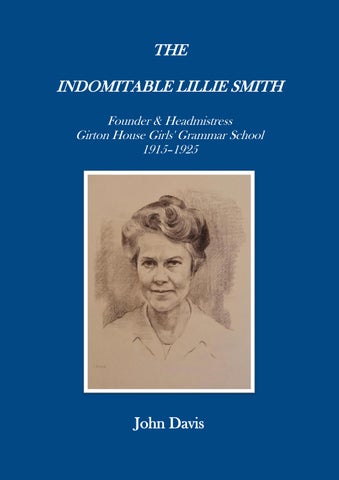
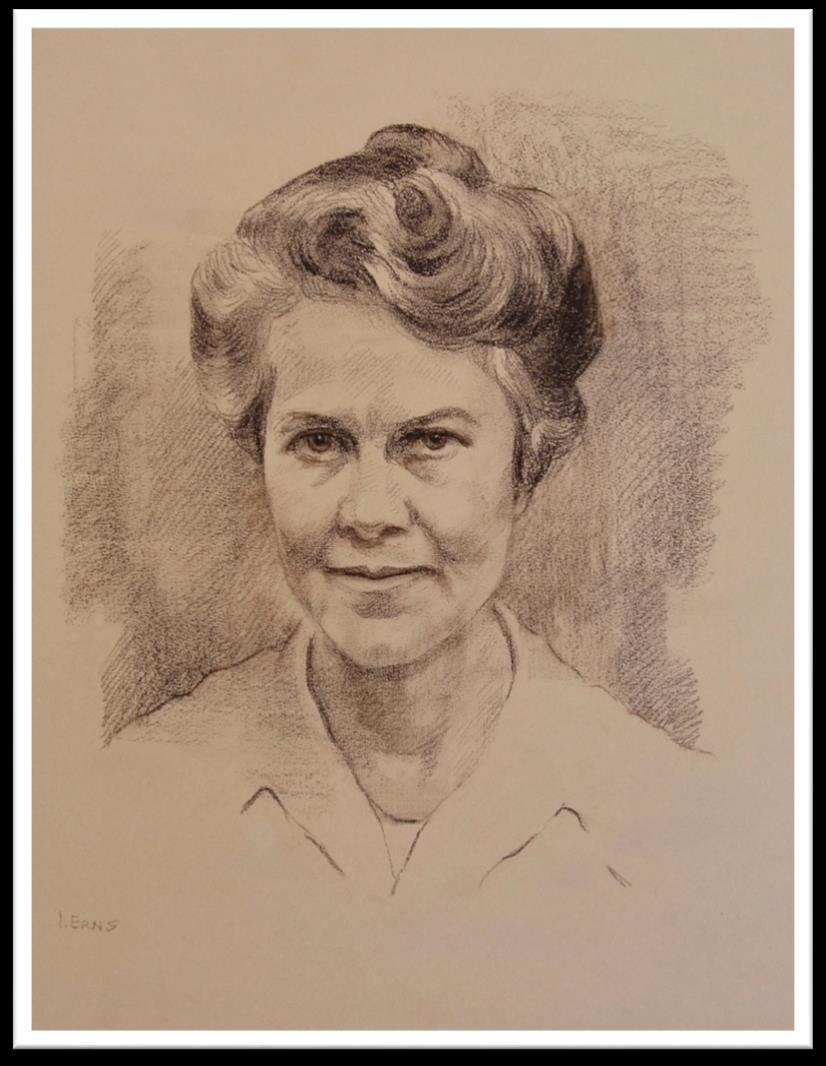
Front Cover: Portrait of Lillie Smith, from a photograph, date unknown. (Artist, Ingrid Erns. Courtesy Pembroke School Archives)
Chapter 1
In the Beginning…
Existence precedes Essence
Jean-Paul Sartre, Existentialist philosopher
Castletownroche is a small, prosaic town in County Cork, Ireland. But it sits above the pretty and bubbling Awbeg River that Edward Spencer referenced in his epic poem, TheFaerieQueen. An old mill straddles the Awbeg and the Church of Ireland's St Mary’s Church with its tall, slender spire looks over it from its lofty vantage point. With its mill, old stone bridge and grassy river banks, this lush part of Castletownroche evokes images of an idyllic rural past, that hide, however, the harsh reality of life for most Irish country folk. Indeed, the first and third lines of Thomas Grey's ElegyWritteninaCountryChurchyard The curfew tolls the knell of parting day / The ploughman homeward plods his weary way ring truer.
Alicia Martha Smith — (‘Lillie’ and nee Thompson) — was born in or near Castletownroche on 6 August 1864, and was christened in St Mary’s Church. John Thompson and his wife, Hannah, were Lillie’s parents and they lived on Annesgrove Estate It was located about a half-hour walk north of Castletownroche along the Awbeg. John and Hannah, their life journeys and their collective genes played a large part in shaping the woman that Lillie became. From the time of her existence, they moulded her very essence.
John Thompson was born in Collinstown, Westmeath, in 1836. From about 1841 to 1850, he attended Farra College in Bunbrosna, which is about 13 miles (21 kilometres) from Collinstown. About 1743, the Rev. William Wilson had bequeathed funds to establish Farra College, which trained mainly Roman Catholic boys in agriculture. Wilson’s uncle established Wilson’s Hospital School at nearby Heathlands for Church of Ireland boys.† This spirit of ecumenism may explain why John Thompson, a Protestant and member of the Church of Ireland, attended a school where Roman Catholics dominated, at least numerically. John’s education proved useful when he became a land steward on the influential Smyth family’s Glananea Estate, Drumcree, Westmeath. From 1850 he served Glananea for three years before becoming land steward and agent for nine years of the Grove Annesley family’s estates in the south of Ireland. He was based at Annesgrove. In 1776, agricultural economist, Arthur Young, had called the land where the Awbeg ran through the estate, ‘a wild romantic glen’. In March and April 1862 at least a dozen advertisements appeared in the CorkConstitutionand the CorkExaminerregarding the letting of houses and land on Annesley estates. Prospective tenants were advised to contact either Richard Grove Annesley, Castletownroche, Edward Farmer Esq. Solicitor, Mallow, or Mr John Thompson on the premises. That John’s boss, Richard Arthur Grove Annesley, JP, owned a total of 1757 acres (2.75 square miles or 711 hectares) in County Cork and was educated at Eton
The author has used the 19th century spelling of Annesgrove, not the modern 'Annes Grove'. † Like the Church of Scotland, the Church of Ireland was affiliated with the Church of England.
and Trinity College, Dublin, suggests a life of privilege, influence and authority not open to most Irish people, especially Irish Catholics.

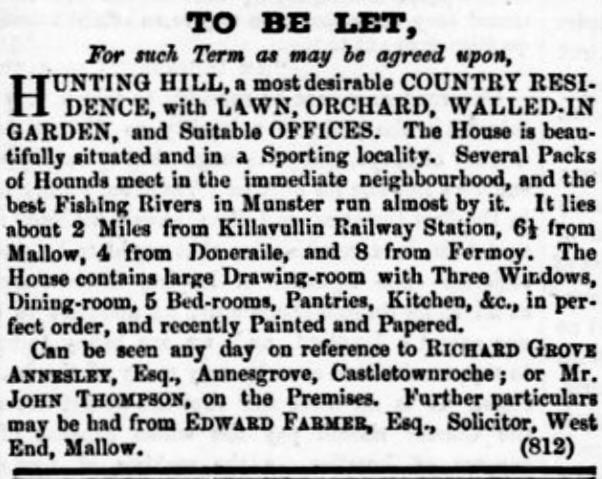
Advertisement showing John Thompson's role as a land steward for Richard Grove Annesley, Castletownroche, 1862. (TheCorkExaminer , 12 March 1862, p. 1)
Mallow is about 10 miles (16 kilometres) from Castletownroche and it is highly likely John Thompson visited solicitor Edward Farmer on business. Certainly, he met Hannah (possibly born ‘Johanna’), youngest daughter of Walter Benn of Newbury Mills, Mallow. John and Hannah married in Newberry Church on Wednesday 7 October 1863. John was 27 years old and Hannah 21. Hannah was almost certainly Protestant. Hannah Benn’s forebears were Huguenots, French Protestants who fled religious persecution in western Europe in the seventeenth century. The family name was originally spelled ‘Behn’, but was gradually changed to ‘Benn’ to facilitate assimilation, beginning when families first migrated from the Germanic lowlands to Ireland in the seventeenth century. First, they settled in Limerick. Subsequent generations dispersed to other counties, most notably Galway and Tipperary. Mallow is about 37 miles (60 kilometres) from Tipperary town. John took his new bride to Annesgrove, where they lived until 1867, when they emigrated to New Zealand with their young family, their first born, Lillie, and her sister, Martha Jane, who was born on 23 January 1866.
Marriages
On the 7th inst., at Newberry Church, by the Rev. Henry Swanzy, Mr. John Thompson, Annesgrove, to Hannah, youngest daughter of Mr. Walter Benn, Newberry Mills.
(Transcript courtesy CorkExaminer , 9 October 1863, p. 3)
Why did they leave Ireland, and why did they choose New Zealand? Author of The Australian Dream , the late Ian Turner, showed that studies of national dreams reveal what dreamers lack. Dreamers are restless, discontented; conservatives are well sated and sleep
peacefully. Late 19th-century radical Australians wanting an egalitarian classless society dreamed of one because they did not live in one. Emigrants do not now, nor ever did, sleep the deep sleep of the contented. But, there’s the rub. Specific evidence about John and Hannah’s reasons for leaving Ireland to settle far away in New Zealand is not available. In short, we do not know the answers to the two questions above. We can, however, speak in general terms without jumping to unqualified conclusions.
Blight (Phytophthora infestans) that decimated Irish potato crops triggered the Great Famine of 1845–1852. With a third of Ireland’s population relying on potatoes for food, it brought to a head underlying discontent, including the belief that landlords of Anglo-Irish estates were to blame and that they had continued to export grain and livestock to England. The Famine sparked the Young Ireland rebellion of 1848, the land question dominated for the next two decades and the Fenian movement emerged with the formation of the IRB in 1856 (it is uncertain whether it stood for ‘Irish Revolutionary Brotherhood’ or ‘Irish Republican Brotherhood’) and the Fenian Brotherhood in 1859. Fenianism decried the ‘curse of monarchical government’ and aimed to rid Ireland of the English ascendency and create an independent Irish Democratic Parliament. Unrest was in the air in the 1860s. British authorities in Ireland worried about Fenianism and its threat to their security. An abortive uprising in 1865 in Cork, Dublin and Limerick saw hundreds of Irish men, and some women, arrested and tried for treason and membership of a secret society. But Cork was the epicentre of Fenianism: of all the Irish counties, it had by far the largest membership of the IRB. In 1865 The CorkConstitutionand TheDublin Gazettereported extensively on Fenian agitation, and the arrests in Cork.
In the event, 1860s’ Fenianism fizzled. The greatest military power of the time, Britain, treated it with disdain and stamped on it effectively. Fenian rhetoric exceeded Fenian action, its call for complete separation of Church and State alienated it from the Catholic Church, it was poorly organised, divided internally and undermined by informers. British counter-revolutionary policies were especially effective in limiting the appeal of Fenianism. Rather than imposing martial law the British used Special Commissions, which meant that ‘punishment would be civil, deliberate and discriminating, ensuring that martyrs would not be made of the Fenian prisoners’. None of this detracts from Fenians’ perceptions that 1860s Ireland laboured under the yoke of an Anglo-Irish hegemony, which had to be replaced with an independent Irish Republic. Fenianism may have been ineffectual, but it spoke of deep-seated discontent, especially among town labourers, clerks, shop assistants, urban workers in general and, eventually, farmers.
Ireland was divided between a small number of Anglo-Irish families and the rest Us and Them. Estate agents, agriculturalists, stewards, clerks, grooms, gardeners and other ‘loyal retainers’ were recruited from the landed and colonial classes, often from Britain. A former verse of the hymn ‘All things bright and beautiful’ leaves no doubt who was in charge:
The rich man in his castle
The poor man at his gate God made them high and lowly Each to his own estate.
Sarah Campbell, LoyaltyandDisloyalty:TheFeniantreasontrials,1865–1867,andtheevolutionofBritish counter-insurgencypoliciesinnineteenth-centuryIreland , p. 1.
Nineteenth-century gentry families sang it in praise of imperial order and that it was sung in the Established Church legitimised the class structure in the minds of its adherents. Public usage simplified it to ‘God bless the squire in his estate, and keep the peasant at his gate’. The message was clear and Irish Fenians knew it. Even the most modest Anglo-Irish landowner lived in ‘privileged extravagance’ compared with his tenant farmers. And in their eyes the likes of John Thompson were on the wrong side, one of the others. It did not apply to John’s landlord, but absentee landlords evoked heightened resentment, not so much from farmers, but from resident landlords who bore local costs not imposed upon those who lived elsewhere, especially landlords who lived in England.
And then there was the religious divide. By 1870 the quest for Home Rule, Catholic demands and farmers’ grievances aligned. Protestants took fright at what they saw as the Catholic temper of the Home Rule movement. And well they might, with Protestants accounting for just 25 per cent of the population but owning 75 per cent of the nation’s wealth. Catholics were very much under-represented in the legal and medical professions, but dominated the ‘greasy till’ occupations. Shopkeepers, fishmongers, publicans and butchers were almost exclusively Catholic. It is not surprising that the Church of Ireland was unpopular. Tied to the Church of England, it ministered to a tiny one eighth of the Irish population. Irish Catholics resented having to pay a tithe in cash or agricultural produce for the upkeep of the Church of Ireland's clergy and assets. This was clearly unfair, and liberal British politician and champion of egalitarianism, William Gladstone, spoke in the 1860s of disestablishing the Church of Ireland. On becoming Prime Minister in 1868, he did so. He also disestablished the Irish landlord class with the Land Act of 1870. By the time both were enacted, John Thompson had left Ireland. It was in this atmosphere that John and Hannah decided to uproot their young family and sow the seeds of a new life in New Zealand. There is one known event at Annesgrove that might have evoked resentment among local tenants and aspiring tenants. By 1825, the estate was poorly. It had been sub-let to inferior tenants. It was dilapidated, many of its trees felled and sold as timber and the house itself was in near ruin. It was Richard Grove Annesley’s father, Arthur, who, in 1837, sacked the unsatisfactory tenants, restored the home and rescued the estate. No doubt the evicted tenants were less than pleased and it may be that Annesgrove’s reputation suffered. But this occurred 30 years before John Thompson decided to leave Ireland. It is doubtful if it influenced his decision. Possibly it was more to do with him being in the employ of an Anglo-Irish estate, having an apparent English heritage and being a congregant of the Church of Ireland. In essence, being linked to the Protestant ascendancy and privilege at a time when tempers were high, resentment ripe and there were indications from Britain that significant changes were in the air. Perhaps it was a good time to leave Ireland’s troubles behind. This is more than conjecture, but well short of evidence-based certainty. Finally, we do not know of any personal reasons to explain why John emigrated. Was his Irish employment guaranteed? Did he not see any opportunity for promotion? Was he or a family member sickly, suffering a serious illness? We do not know. We do know that he was able to pay for the family’s journey to New Zealand. He was not a pauper. The family’s passage was not assisted. But, leave the Thompsons did.
Why did they choose New Zealand, when many, if not most, Irish emigrants chose the United States of America, which was closer and the fare cheaper?
Again, we do not know. John Thompson was literate and it is possible that he had some knowledge of New Zealand, perhaps gleaned from newspaper articles. It is unlikely that he had read Edward Gibbon Wakefield’s ALetterFromSydney in which the author explained his Systematic Colonisation scheme. Perhaps John knew it had been used in South Australia and New Zealand with some success. Wakefield’s scheme was designed to create in New Zealand a ‘Better Britain’, a ‘Britain of the South’. It aimed to attract capitalist investors by establishing a society that included skilled middle-class artisans and farmers supported by a compliant urban and rural working class. British class distinctions were to be preserved, with the added possibility for advancement, prosperity and respectability. When John arrived in New Zealand, the Wakefield System had long run its course. But It had left its mark. New Zealand acquired a distinctly British character. New Zealand Company settlements modelled on Wakefield’s plan attracted only 15,500 settlers but being first in their locations they had a disproportionate influence on the flavour of development. Fifty per cent of New Zealand’s immigrants were from England and Wales, 24 per cent from Scotland and 19 per cent from Ireland. Perhaps significantly for John and his family, the Protestant/Catholic divide was observed less in New Zealand than in Britain, and certainly in Ireland. It is noteworthy that Irish immigration peaked in the wake of the New Zealand goldrushes of the 1860s. The discovery of gold in Otago and the West Coast of the South Island and near Coromandel in the North Island increased the population in those areas. We shall see below that the Thompson family settled in a goldrush town. * There is no evidence that John pursued gold or followed a friend or relative to New Zealand, but his decision to immigrate did coincide with the peak in Irish immigration during the 1860s goldrushes. Perhaps he saw lucrative opportunities to apply his skills in the service industries that are essential to maintaining the viability of a goldrush community.
When John Thompson took his family to live in New Zealand in 1867, he was 31 years old and Hannah 25, Lillie had just turned three and Martha was a mere 18 months. They were about to embark on a very real adventure. And Hannah was pregnant!
They sailed on the S.S. Somersetshire’s maiden voyage from London to Melbourne. Under the command of Captain J.S Atwood, it left Gravesend, London Docks, on Saturday 24 August 1867 for Plymouth, where it took on more passengers before continuing its journey on 28 August. It is unknown where the Thompsons joined the ship. The British and Irish Steam Packet Company ran a ferry service between Dublin and English ports. Assuming John chose to depart from the closer departure port, Plymouth, the family might have taken a British and Irish ferry from Dublin to Torquay, which is about 30 miles (48 kilometres) from Plymouth. Launched in June 1867, the Somersetshire was an iron-hull clipper powered by steam and wind. Passengers were accommodated in cabins for those who could afford them, or in the lesscomfortable ‘steerage’ between decks. For Hannah’s sake alone, we can only hope that the Thompsons had a cabin to themselves.
Michael King, ThePenguinHistoryOfNewZealand , pp. 170–178. Packet companies carried mail on their ships as well as passengers and cargo.
The Somersetshire arrived in Melbourne on 5 November, having burned 360 tons of coal and completing the journey in 10 weeks. Why not sooner, given its steam engine? This type of ship used wind power supplemented by steam. So, in the Roaring Forties for example, a captain would hoist the sails to power ahead. Steam and the all-important coal were reserved for the equatorial Doldrums and other places where the wind refused to blow The conditions on immigrant ships and the travails passengers experienced are well documented.
On 5 January 1854, the BradfordObserverprinted journalist and founder of the South AustralianAdvertiserJohn Henry Barrow's account of his family's journey to Adelaide, including this informative snippet:
Then would come the felicities of dinner with a rolling ship. I have actually been obliged to preserve the level of my plate (soup plate) by putting a pint tin pot under one edge! But sometimes the ship would give as heavy a lurch on the opposite side; and down went soup, meat, pots, plates, and everything on them, into the gangway, yourself on top of them, (unless you happened to go underneath) with an accompaniment of hook pots, canisters, and spare mugs and dishes from the upper shelves of your own, or your neighbour’s berth. Nor is even this all, for sometimes the lurch of the ship would be caused by a sea breaking over her, and rushing down the hatchways, timorously opened at dinner time. In such an event, of course the under deck became a lake of water, floating away bread, meat, puddings, and whatever might have chanced to fall from the tables at the time.
Indeed, the Thompsons may have been tossed about in the storms of the English Channel and the Bay of Biscay, enjoyed pleasant sailing in the trade winds, been scorched by the blistering sun in the Doldrums and pounded by mountainous seas in the Southern Ocean. Conditions were generally cramped; the food sustaining rather than appetising and long periods of boredom were relieved by occasional appearances of wonderful sea creatures and rare birds or other ships. How much of this experience Lillie absorbed is unknown.
Details of the final leg of the Thompsons’ journey to New Zealand are heavily clouded. Hannah gave birth to her third daughter, Mary Elizabeth, in the North Island of New Zealand at Feilding on 6 February 1868. The nearest immigrant port to Feilding is Whanganui and it is possible that at some stage after arriving in Melbourne the family sailed there. Sometime in 1868 John took his wife and three children to Otago in the South Island where he settled at Waitahuna, about 10 kilometres south of Lawrence.

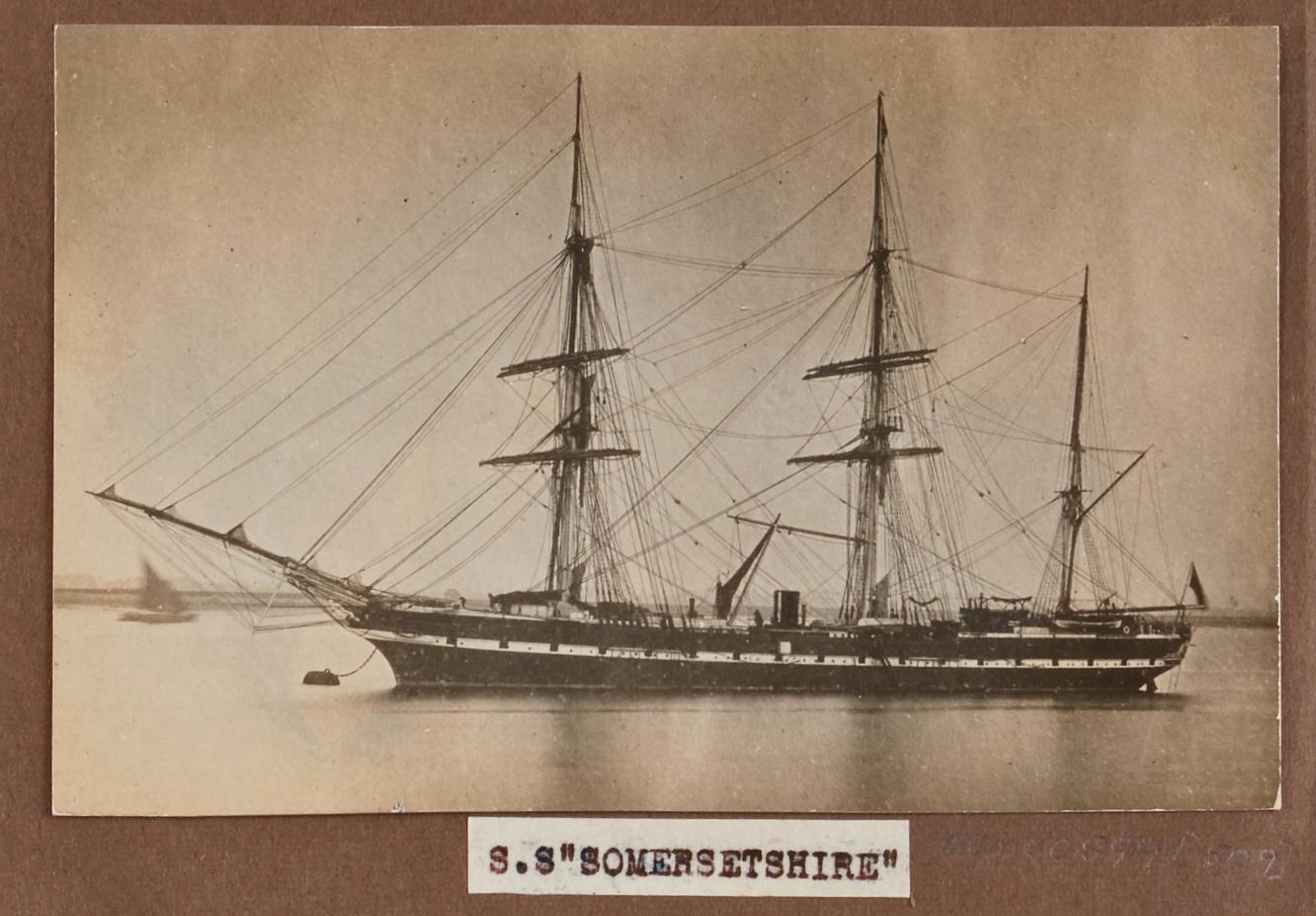
courtesy Australian
Chapter 2
The Making of Lillie Thompson
So, our minds are primed from infancy by the faces we see, the voices and dialects we hear, the foods we eat, and the rituals we participate in...
Tim Dean, Australian philosopher
Her years in New Zealand were Lillie’s formative years. Her genes played their part, but the major influences were her parents’ lives and the environment in which she was raised. She lived in a patriarchal world. Men dominated the public sphere; women were confined to the domestic sphere. Accounts of men’s activities dominated newspapers and journals. As we shall see, we know much about John Thompson and nothing of his wife, Hannah. It would be wrong, however, to suggest that Hannah did not play a part in priming the mind of her daughter, even though she died when Lillie was only ten years old. The same might be said of John’s second wife, Ann.
The Thompsons arrived in Lawrence in 1868, seven years after Gabriel Read discovered gold near the Tuapeka River. The site became known as ‘Gabriel’s Gully’. One in three of the miners who sped to the Tuapeka goldfield was English; and a large number, Irish. Others came from Europe, Australia and China. By February 1864 there were about 24,000 people in and near the goldfield. The rush peaked in the mid-sixties when many miners left for the new West Coast fields. But gold left its legacy on Lawrence. By the time the Thompsons arrived it boasted a bank, several hotels, ironmongers, drapers, a watchmaker and other stores, and it had been proclaimed a municipality. Gold had created it; gold had brought its people and it was to provide John Thompson a golden opportunity to attain wealth and respectability as a prominent and public citizen. But, not as a goldminer

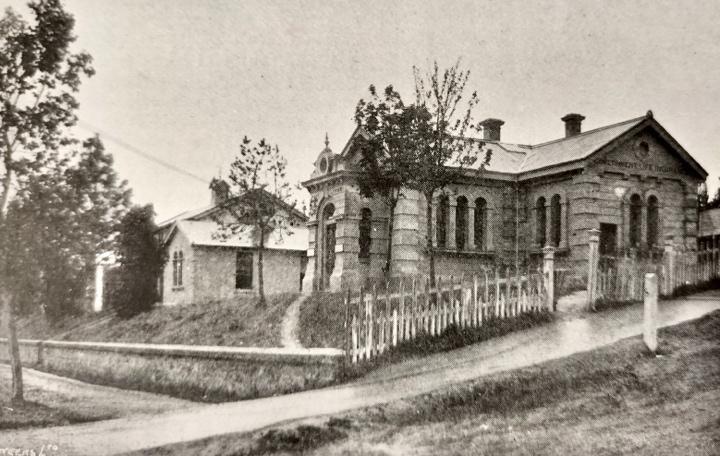
Lawrence Magistrates Court
John Thompson was clerk and bailiff at the court from 1870 to 1878.
(CourtesyTheCyclopediaofNewZealand. Volume 4, p. 684)
John tried farming at nearby Waitahuna, but his skills were more suited otherwise and in 1870 he was appointed clerk and bailiff of the Lawrence Magistrates Court. In 1872, John and
Hannah's fourth daughter, Hannah Margaret, was born. But, in the 1870s early death was not uncommon. On 1 August 1874, Hannah gave birth, prematurely, to twins, a boy and a girl. They survived for only one day. If this tragedy were not too much to bear, John and his daughters must have been devastated when their beloved 34-year-old wife and mother died 18 days later.† John almost certainly employed a maid to care for 10-year-old Lillie and her younger sisters at his Lancaster Street residence while he continued his work at court. Five years later he married a local farmer's daughter, Ann Willing, with whom he had nine sons. In 1878, and in partnership with Andrew Ferguson, he bought H.L. Squires’ Land Agency, located in Ross Place, Lawrence. They advertised their services as auctioneers and land, estate, loan and general commission agents. They offered quick and cheap transactions for the assignment or exchange of agricultural leases; mining leases or claims and the 'Uplifting of Crown Grants'. They negotiated loans and invested money for clients. At the same time, John also acquired a half share in the Tuapeka Times . The newspaper business did not appeal and John shortly sold his share and focused on the land agency. By 1883 he had bought out Ferguson and conducted business alone. He continued until he handed over in 1907 to two of his sons, John Beaumont Thompson and Harold Thompson.
John held auctions on site, at his sale yards and in his rooms. On commission he sold a multitude of things; a blacksmith’s shop and dwelling, hotels, land, livestock, grain, a carrier’s horses and wagon, firewood, the old school site at nearby Moa Flat, its buildings and much more. He was a well-regarded businessman. In January 1883, before the Court in Lawrence, bankrupt farmer, Alexander Michael, admitted that on receiving £50/9/6 from John Thompson he returned £30 to him. When pressed on why he preferred John to other creditors, Michael replied that, ‘He had been very good to me. I thought he deserved it better’. In its obituary of 13 August 1919 for Lillie's father, the Tuapeka Times described John Thompson as ‘a man of forceful character with a keen and sound business instinct, and his judgement in all business matters could be thoroughly relied upon’. The Times noted that Lawrence would miss his genial and kind disposition, his hearty greeting and his sound advice.

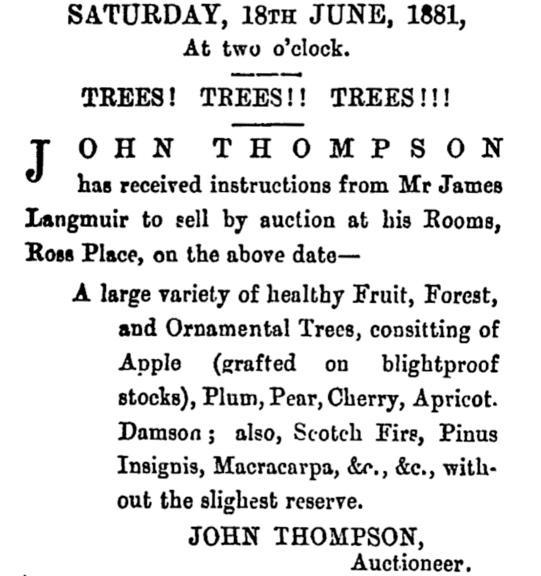
Advertisement for John Thompson. (TuapekaTimes , 11 June 1881, p. 2)
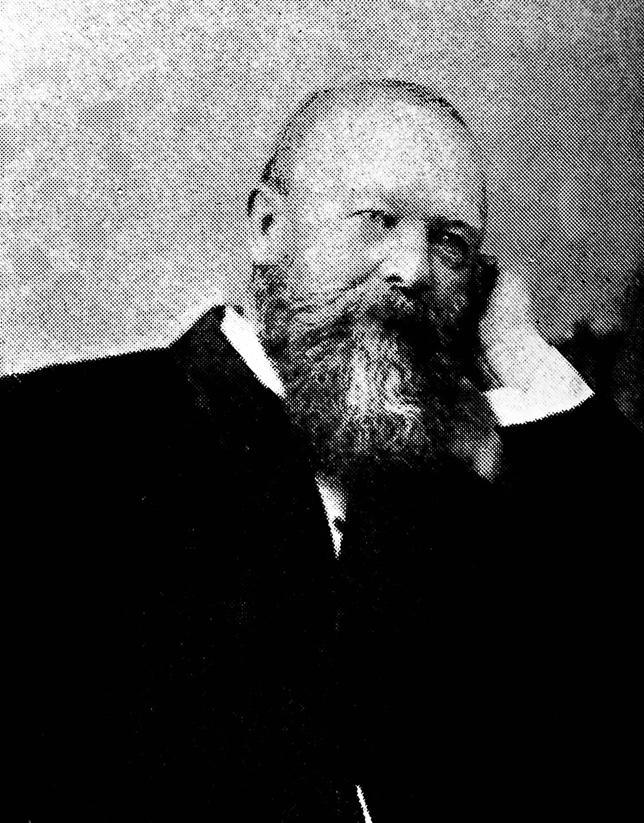
John involved himself in public affairs. He was a long-standing member of the borough council and served one term as its mayor. In an election meeting in January 1883, he incited the ire of the headmaster of Lawrence's St Patrick's School, the Rev. Father O’Leary who complained to the TuapekaTimesthat John had falsely accused him of saying, ‘We will show him (referring to a Mr J.C. Brown) that we can put in any man we like’. O’Leary claimed he never said any such thing and that it was an electioneering trick on the part of Mr Thompson ‘to raise a certain war-
New Zealand Births, Deaths & Marriages Online, Registration number 1872/38445.
† TuapekaTimes , 22 August 1874, p. 2.
cry’. John apologised to O’Leary who accepted, but not John's explanation that he had been overexcited. O’Leary thought this the ‘most charitable construction’ of intent and noted that Mr Thompson had ‘profanely invoked the name of the Creator in the latter part of his address’. Heresy in O’Leary’s eyes, to be sure. In his letter of reply to the editor of the TuapekaTimes , John rejected O’Leary’s claims and proclaimed that he had never in his life committed such a sin as speaking profanely of the Creator. Was there more than a hint of Irish sectarianism at play here?
John served in other ways. In 1884, he was appointed a Justice of the Peace. He was an 'Excellent Companion' and senior warden of the Lodge of St George. A prominent member of the Church of England, he was the superintendent of Lawrence's Holy Trinity Sunday School, whose grounds and buildings he tended with loving care. Indeed, John was the force behind the building of its new brick Sunday School. His interest in education spread beyond Sunday School and from 1870 he was a member of the Lawrence District High School Committee.
John took his turn as Chairman of the school committee. In December 1879, he presided over the final assembly at which student prizes were distributed. He praised the rector, headmaster, his assistant, the matron and the six pupil teachers for their work. He thanked generous benefactor, Mr Fraer, for a new building and improvements to the school grounds. He noted with pleasure that 60 pupils had attended every day, compared with eight in 1878. But he must have indulged in just a little family pride when it came to announcing the prize winners. His youngest daughter, sevenyear-old Hannah, gained second place in Standard I Writing and second in Standard I English. Other daughters, Martha and Mary Thompson made progress in Sewing and Knitting. What about Lillie? How did she do?

Very well indeed, but not at Lawrence District High School, which she left at the end of 1878. In 1879, Lillie attended the Oamaru High School, situated about 70 miles (113 kilometres) north of Dunedin. It must have been a daunting journey for a girl seven months short of her fifteenth birthday when she moved to her new school. She probably travelled by coach from Lawrence to the east coast where she could board a train to Dunedin, and on to Oamaru. Perhaps she was chaperoned, perhaps she travelled with Alicia Thompson. Yes, there was another Alicia Thompson who had attended Lawrence District High School, and who attended Oamaru High School in 1879. Alicia Margaret Thompson was the daughter of Police Inspector Thompson.
Our 'Lillie' Alicia Martha Thompson might have chosen to go by that name to avoid confusion, but we do not know why she was called 'Lillie'. To complicate matters even more both Lillie and Alicia Thompson won scholarships valued at between £20 and £40 to attend Oamaru High School. And they both did well. Alicia Margaret Thompson was the 1879 third dux girl of the school while Lillie excelled, being the dux girl and winner of the medal presented by Messrs Fleming and Hedley. Her father surely glowed with pride.
Lillie not only excelled at school, but in Oamaru she lived in a city six-times the population of Lawrence. Her eyes were opened to wider horizons. John Thompson's business was prospering and he allowed Lillie to train to be a teacher. After finishing school, she became a pupil teacher at George Street School in Dunedin. In January in each of 1882 and 1883, Otago newspapers recorded that Lillie had passed the New Zealand pupil-teacher examinations. On 19 May 1884, she took up a position as third assistant at Dunedin's William Street Primary School. In December 1885, she successfully sat the New Zealand University Entrance Examinations and matriculated. Subsequently Lillie passed the Teachers Examination and in 1887 she was named in the New Zealand Education Department's annual list of licensed teachers. In the same year, 1887, the staff and students of William Street School transferred to new premises, the High Street School. In both 1887 and 1888, Lillie won favourable reports from her School Inspectors. Both noted that 'Miss Thompson's class (in S3 in 1887 and S4 in 1888) has passed a good examination'. One reported that 'She maintains excellent control and teaches with very satisfactory intelligence', the other, 'The order and attention are excellent'. But Lillie resigned her position and left the services of the Otago Education Board in December 1888. Why?
John Thompson had married his second wife, Ann, in the same year Lillie first moved away from home.

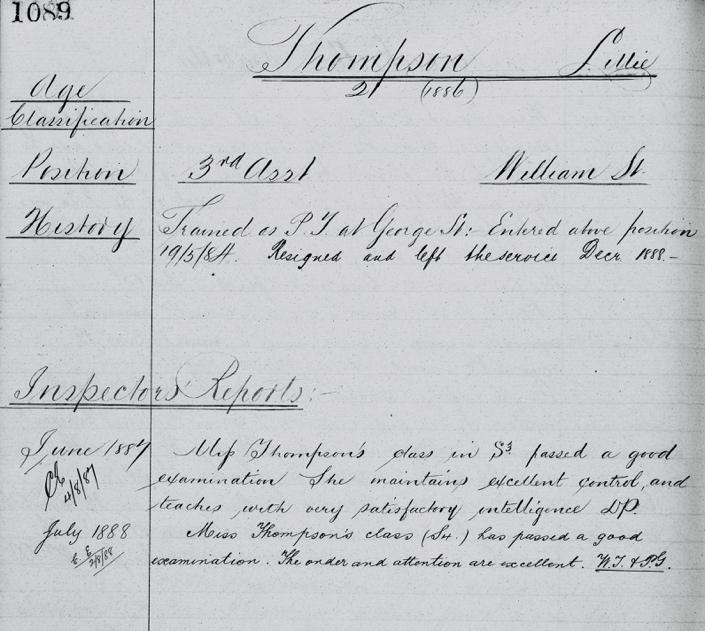
(Entry for Lillie Thompson, Register of Teachers, Employed by the Board, Otago Education Board Records AG-294-32-03. Hocken Collections –Uare Taoka o Hākena)
According to The Girton Book , John required his daughters to help their demanding stepmother raise their sons. The first, John Beaumont Thompson, was born on 2 May 1880, so by the end of 1888 Ann might have had half a dozen of her sons. This likely explains why Lillie resigned from teaching. She had to help at home, as John Thompson by then almost certainly considered home duties the first priority for his eldest daughter. There is no
See LillieThompson'sRecord , Otago Education Board, (Ref: AG-294-32/02) and OtagoWitness , 28 January 1882, p. 11; OtagoDailyTimes , 26 January 1883, p. 1; TuapekaTimes , 30 April 1884, p. 2; OtagoWitness , 3 May 1884, p. 19; Star(Christchurch), 4 February 1886, p. 3 and TuapekaTimes , 11 July 1888, p. 2 for information about Lillie's pupil teacher training and teaching career in Dunedin.
evidence of Lillie teaching between 1889 and when she left New Zealand, either in the service of the Otago Education Board or as a private teacher. Lillie almost certainly viewed the prospect of a life helping her stepmother raise a small tribe of boys with some apprehension, if not horror.

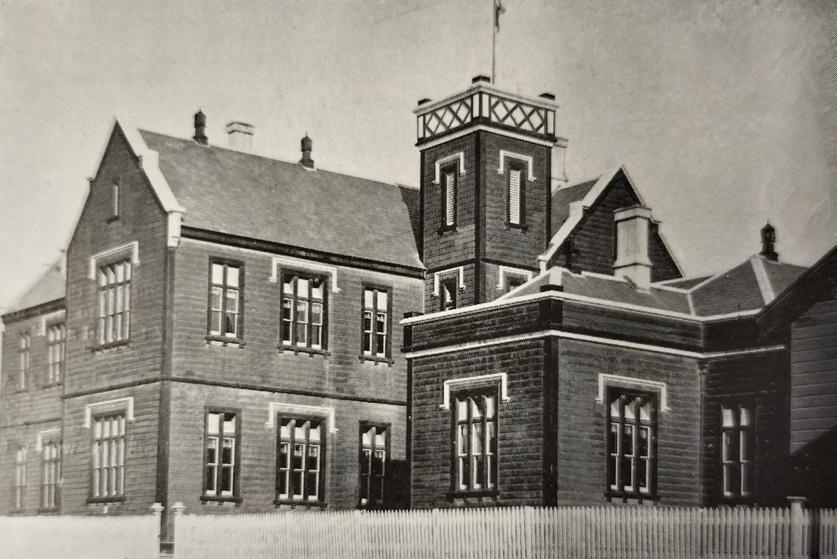

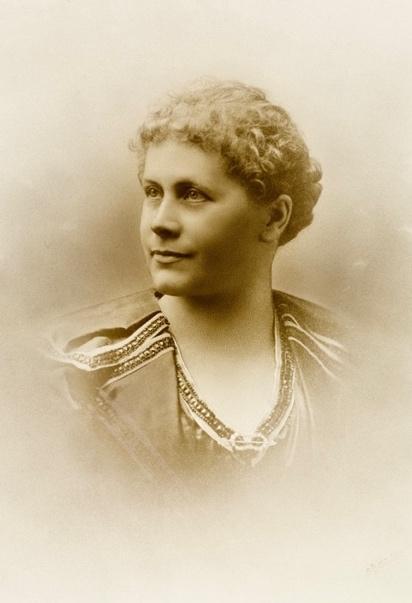
But who inspired her to teach? Where and under whom did she study to become a teacher?
Lillie attended Miss Caroline Freeman's private 'classes for ladies' in Moray Place, located in the centre of Dunedin and which she opened in 1884. Miss Freeman was a strong, courageous and determined woman, a pioneer educator of girls. Born in Yorkshire in the mid-1850s, she migrated in 1858 with her farming family to Dunedin. Her intelligence was apparent to her teachers; she was dux of her school and from 1868 to 1872 she was a pupil teacher. Between 1873 and 1877 Caroline taught at Caversham School in Dunedin and studied part-time to matriculate. Between 1875 and 1878 she achieved high honours at Otago University in Mental and Moral Philosophy, Mental Science and Logic, German, Classics, English, Senior Mental Science and Political Economy. Juggling work and study was a challenge and it was not until 1885 that she graduated Bachelor of Arts, becoming the first female graduate of Otago University. She had achieved this without formal secondary education. She was the personification of new educational opportunities for women. And, she had triumphed in an often hostile environment: Professor of Classics, George Samuel Sale, 'was an absolute ogre' to female students and it took all of Caroline's pluck to persevere. In 1886, with just four students, Caroline Freeman opened Girton
College in Dowling Street in an old hall previously occupied by Dunedin’s Freemasons. Student numbers increased to 60, boarders were accommodated and Girton College gained a reputation for scholarship and as a quality 'finishing school'. Its aims were 'to teach girls to possess themselves and fit themselves for the battle of life' and to 'train teachers for the secondary schools'. And, her message to teachers was that 'the chief thing in teaching children was the influence of character on character'. Miss Freeman insisted on being fully in charge.* Lillie was 21 in 1885 when she first attended Miss Freeman's classes. Importantly for Lillie, Caroline Freeman specialised in ‘English classes for Ladies, in which special attention was given to University and Teachers Examinations’. This advertisement appeared in the OtagoDailyTimesin 1885:
M I S S F R E E M A N 'S
SECOND TERM begins May 11, at her Rooms, Moray Place.
Classes for English, Latin, Arithmetic, Euclid and Algebra.
A Class has been formed for the study of English literature. The Subjects for this term are: ‘The Tempest’, ‘King Lear’ and G. Eliot's ‘Romola’.
Address, care of Mr Horsburgh, George Street; or Box 188. P.O. Dunedin.†
The advertisement suggests the curriculum was shaped by Caroline Freeman's own schooling and experience at Otago University. When she opened Girton College in 1866 she continued to run a special teachers' class. She aimed to educate young women who would become able teachers and who would, in turn, educate the future generations of young women. And, she clearly played an important role in Lillie's preparation for the Teachers Examinations.
In 1897, Miss Freeman opened a second campus of Girton College, in Christchurch. Without detailing her full career, she was a pioneering girls' educator, and when she died in 1914 her pupils erected a tombstone to 'The beloved teacher and guide of many of New Zealand's girls'. In its obituary, the LytteltonTimesof 18 August 1914 described Caroline Freeman as 'a brilliant speaker and an enthusiastic teacher who had acquired the art of imparting her enthusiasm to her pupils', and it had no doubt that she was a leading educationalist in New Zealand. Caroline Freeman was never frightened to speak her mind. In 1904 she commented that:
Women need strength and gentleness. The woman of to-day is trying to throw away the gentleness and get the strength only. I haven't any faith in the kind of woman they used to call an angel,
Dorothy Page. 'Freeman, Caroline', Dictionary of New Zealand Biography, first published in1993. Te Ara the Encyclopedia of New Zealand, https;//teara.govt.nz./en/biographies/2f26/freeman-caroline (Accessed 7 December 2023).
† OtagoDailyTimes , 11 May 1885, p. 1.
but you can be gentle without being of that angelic type, and gentleness is the necessary complement of strength.
Having left Ireland aged three, the faces Lillie saw, the voices and dialects she heard, the foods she ate and the rituals she participated in were entirely located in New Zealand. Ireland must have been a very distant blur, if she recalled it at all.
Her father, John, probably shaped Lillie more than any other person. We shall see that she was very much her father's daughter. She was strong of character, charismatic perhaps, blessed with sound business skills, kind, public-spirited, hard-working, determined, a committed Anglican and convinced of the value of education. Growing up in Lawrence, Lillie and her sisters would have walked down the hill from their Lancaster Street home to their father's auction room in Ross Place, which is on the town's main road. Perhaps they listened in on occasions as their auctioneer father delivered his spiel and worked the room in the best interest of his clients, and his commission. Lillie's love of animals may have been sparked in her father's sale yards, where he sold sheep, cattle and horses.
Lawrence itself might have fostered strength of character with its hilly terrain, cold winters, cool summers, wind, rain, and snow. Tough farmers, shearers, other rural workers and miners who frequented the town may have left their mark on the young Lillie. It is likely that her accent was more typically that of a New Zealander, than Irish. She arrived in Lawrence a three-year-old of Anglo-Irish descent, she left it a New Zealander.†
Sadly, Lillie's mother died when she was ten. As explained above, apart from births, deaths and marriages notices, we do not have recorded evidence of her mother and stepmother. Lillie's mother, Hannah, had four daughters, her stepmother nine boys. Perhaps, their experiences of motherhood and homebound duties taught Lillie the limiting, potentially stifling, nature of a life devoted to caring for a husband and 13 children. And this in a time before electric household appliances such as stoves, irons, washing machines and refrigerators eased the lot of the housewife. Lillie decided this was not to be her lot in life.
Single-woman and career-minded Caroline Freeman's example was more to Lillie's liking. Like John Thompson, Caroline possessed a strong character, but she was directly involved in education. Caroline taught Lillie that education would not only free her from a lifetime of home duties but open the way to a teaching career that she could at the very least pursue before marriage. Caroline Freeman provided a career model for Lillie. But there was more. Caroline encouraged a love of literature, especially classic novels. Under her guidance Lillie read Romola , in which Mary Ann Evans, writing under the male pseudonym, 'George Eliot', questioned women's subordinate position to men in 19th-century England. From Evans Lillie learned that
* PovertyBayHearld , 24 December 1904, p. 3.
† Wisconsin historian Frederick Jackson Turner's Frontier Thesis explained how successive harsh and unforgiving frontiers of settlement transformed British and European immigrants culturally into 'Americans', with their strong commitment to individualism: from log cabin to White House and all that. The same can be said of New Zealand and Australia. Historian, Russell Ward, adapted the thesis to explain the emergence of 'Australians', with their alleged egalitarian mateship
girls should develop their intellectual abilities to the full. Education was a potential leveller for girls. Education promised upward social and gender-based mobility.
Thus, Lillie was primed for life, primed for new adventures, but it was not to be in New Zealand.
Chapter 3
A New Life for a ‘New Woman’
I am a new woman and I know it.
Catherine Helen Spence, social reformer, 1905
Lillie and her youngest sister, Hannah, decided to leave New Zealand for Adelaide, South Australia. We do not know exactly when they arrived or details of their journey. Hannah became of age in 1893, so they might have travelled that year. Certainly, they were in Adelaide in 1894. Adelaide’sExpressandTelegraphof 30 June 1894 reported that Miss Thompson and her pupils had held a dance in the North Adelaide Institute. In November, Hannah achieved a First Class Pass in the University of Adelaide’s Theory of Music Examination. In 1896 Lillie was first recorded as living at 14 Childers Street North Adelaide. Her newly-opened school was located in a new cottage at 91 Childers Street, a short walk from her home. ***
Why did they leave New Zealand to settle in Adelaide?
We cannot be sure. According to The Girton Book , Lillie left New Zealand to escape the prospect of domestic service under a demanding stepmother and tyrannical father who failed to read the signs that women were demanding greater freedom in education and social life, and who expected his daughters to be his ‘handmaidens’.* This explanation may contain some truth, but evidence we saw in Chapter 2 challenges its description of her father’s attitudes and expectations. Certainly, John Thompson’s daughters were expected to help at home. But, as Lillie’s experience showed, he also allowed them to pursue careers. Lillie’s sister, Mary, was a certified teacher of pianoforte who gave private lessons in and around Lawrence and Waitahuna. She lived with her father and stepmother and more than likely helped out when she could. Nevertheless, Lillie and Hannah were unhappy with their lot. Perhaps, their stepmother was demanding and, in their view, an impediment to freedom and future advancement. Perhaps 1893 was a tipping point. Hannah came of age and in September New Zealand women were enfranchised. Perhaps headstrong 29 year-old Lillie and Hannah clashed with their father and stepmother over women winning the right to vote. We do not know.
Why did Lillie choose to resettle in Adelaide?

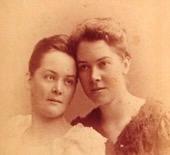
Hannah (left) and Lillie. (Betty Woolley provided this image. Photo courtesy Pembroke School Archives)
Compiled by a committee of old scholars TheGirtonBookwas published in 1951, 25 years after Lillie Smith’s death. Its explanation of Lillie’s reasons for moving to Adelaide is based on recall, rather than strong evidence, and coloured by what we might call stereotypical Victorian attitudes. It contains other factual errors. With the benefit of modern digitised access to newspapers, registers, online biographies and other resources, more comprehensive evidence is available to today’s researcher. This has allowed for a more complete and accurate account of Lillie’s life in Ireland and New Zealand.
South Australia was the only Australian colony without the convict stain. Founded in 1836 and free of felons, initially it was a ‘province’, a metaphorical slice of England that Governor John Hindmarsh towed out behind the ‘Buffalo’. Reality soon put paid to that. Like New Zealand, South Australia was based on Wakefield’s Systematic Colonisation scheme. Of all the Australian colonies it had what Derek Whitelock called ‘a sense of difference’. It was the most English of the Australian mainland colonies. Lillie found in Adelaide a culture and attitudes similar to those she experienced in New Zealand. South Australia’s political and religious liberalism attracted thinkers who respected women’s intellectual capacities and encouraged middle-class women to pursue higher education. Women were admitted to the University of Adelaide from 1876; the Advanced School for Girls was opened in 1879 and private-venture schools provided secondary education for girls whose families could afford their fees. In 1894, South Australian women won the right to vote and stand for parliament, an Australian first. But the advances women achieved did not alter their subordinate position to men. Women who went on to higher education were expected to combine their professional careers with motherhood, and the latter took preference. In this climate, middle-class women who worked outside the home chose employment that complemented their traditional nurturing role. They became teachers or nurses, the two jobs that together accounted for most of the rise in women’s professional employment at the end of the 19th century. Much the same can be said of New Zealand and it was a relatively small step for Lillie to relocate from the ‘Britain of the South’ to South Australia, the climatic differences notwithstanding. The Girton Book claimed that Lillie and Hannah went to Adelaide for a holiday. If so, they liked what they found and decided to settle. Whatever the reason, we do not know why Lillie Thompson settled in Adelaide.
In 1894 Lillie wasted no time in establishing her own business, a private-venture school. Miss Thompson’s School was not the first among the many girls’ private-venture schools that came and went, or came and survived, often reconstituted under a board of directors when their original owners relinquished them. From the very beginning of white settlement, and when official provision for education was not yet available, enterprising women filled the gap. Less than two years into British settlement, in January 1838 Mrs Hillier saw an opportunity:
MRS HILLIER begs to inform her Friends and the Public of Adelaide that she has opened a SCHOOL for a select and limited number of YOUNG LADIES, and from long experience in the arduous task of Education, MRS HILLIER flatters herself that her system of instruction and unremitting attention to her pupils cannot fail to be approved by Parents of those young ladies entrusted to her care. Pavilion Cottage, near Gillies Arcade, Currie Street.*
Helen M.J. Reid, AgeofTransition:AStudyOfSouthAustralianPrivateGirls’Schools1875–1925 , pp. 80–81.
Owners of private-venture schools charged fees from which they drew their income. Often but not always, single women conducted girls’ schools and there were many in Adelaide by the time Lillie opened classes for young ladies in 1894. Most were in inner-city suburbs. Those that have long since closed included Miss Martin’s School and Mrs Greayer’s School in Adelaide, the Misses Thornber’s Unley Park School, Mrs Kelsey’s Dryburgh House in St Peters, Mrs Shuttleworth’s Hardwicke College in Kent Town; and Miss Kathleen Cussen’s Creveen and Miss Caroline Jacob’s Tormore House were in North Adelaide. Mrs Kingston and Miss Dow’s Yoothamurra School was further from the city in Glenelg. Miss Mabel Baker’s Walford House School in Unley Park and the Misses Brown’s Wilderness School in Medindie survived, and operate today as incorporated independent girls’ schools.
Helen Reid explained that these schools transferred Victorian middle-class values and expectations from Britain to colonial South Australia. The middle class embraced a Christian way of life as the right path to respectability and gentility. The ideal woman affirmed the Protestant work ethic. She was industrious in her home duties; she was virtuous, orderly and morally upright. Late 19th-century ‘ladies’ schools’ were vehicles for promoting the ‘woman movement’ of the time. They provided moral training for future middle-class wives and mothers. They promoted the advancement of women and reform of society by enshrining ideals of love, purity and temperance. South Australia’s pioneering ‘New Woman’, Catherine Helen Spence, was confident and assertive; and rejected two proposals of marriage to focus on electoral reform and women’s suffrage. Yet, even she favoured a genteel femininity, believing that well-educated women made better mothers.
The wealthy ‘respectable classes’ favoured these schools for their daughters as they combined traces of the old ‘female accomplishments’ with an academic curriculum and Lillie knew the economic success of her school depended on attracting girls from the affluent suburbs near Adelaide. North Adelaide offered rich pickings. In the ‘Adelaide Ladies’ Letter’ of 29 June 1894, ‘The Gladfly’ effused about Miss Thompson and her pupils’ fashionable dance in the North Adelaide Institute. ‘The Gladfly’ delighted in the well-known Adelaide families whose daughters attended: Nina Boothby and Amy Ayers apparently warranted full recognition. Daughters of well-heeled and well-known families who danced the night away included the Misses Marryat, O’Halloran, Glyde, Goyder, Simpson and Stirling. And there were some ‘bonny lads’, no doubt of the ‘respectable classes’.† Lillie made sure that Miss Thompson’s School was known as one that catered for those who could afford to educate their daughters in a ‘ladies’ school’. Unlike other girls’ schools, Lillie apparently saw no need to advertise in the Adelaide papers, and yet the Registernoted that her private class for girls rapidly grew into a prosperous school.
In 1855 when Mrs T. Nelson advertised for a servant to carry out all forms of work, she made it very clear that ‘No Irish need apply’. Negative attitudes to South Australians of Irish descent had declined by 1894, thanks to prominent Protestant Irishmen, such as George Strickland, and a popular Irish Governor, Sir Dominick Daly, and Lillie’s Irish heritage proved
* ibid., pp. 4–10.
† Ladies' Column. (1894, July 7). SouthAustralianChronicle(Adelaide,SA:1889- 1895) , p. 18. Retrieved April 4, 2024, from http://nla.gov.au/nla.news-article92317262.
no impediment to attracting clientele. She was Protestant, an active member of the Church of England and she had spent all bar three years of her life in New Zealand. It is doubtful that any of her clientele knew of her Irish background.
There is a paucity of recorded information about Miss Thompson’s School. The few references in the local press are about dances, a donation to a charity and the examination result of one student. Quadrille dances were popular among the upper classes in Victorian England and South Australia and with cartoonists who poked fun at the dancers. It is not surprising that Lillie allowed both the Olivette and Ivy groups to use her rooms. In July 1895, The Expressand Telegraphreported that the lady pupils of Miss Thompson’s School had donated £26/16/- to the Children’s Home at Walkerville, while from the EveningJournalwe learn that Eliza Hughes Gordon of Miss Thompson’s School passed the 1895 freehand drawing examination. Alas, Eliza’s award was reduced because she made errors in proportion. What we do have is 'Daisy’s' report card dated 15 April 1897.* It tells us much.
It was titled ‘Miss Thompson’s Classes, North Adelaide’. This suggests that Lillie might have conducted private classes before she established ‘Miss Thompson’s School’. Beneath the title was her motto — ‘Perseverando’! The message was clear — persevere, persist! Twenty-one subjects were listed on the report and 'Daisy’s' card has results for 17. ‘Perseverando’ indeed. 'Daisy' was in the ‘A’ Class, ‘2nd’ Division. She placed First in 10 subjects, Second in three and Third in four. Lillie reported that ‘Daisy’s work has been excellent throughout and she well deserved the high places she has taken’. Well done, 'Daisy'.
Scripture was the first subject in the list and 'Daisy' placed First with 93 per cent. Morality lessons suitable for young ladies may have featured. Given Lillie’s own education under Caroline Freeman it comes as no surprise that English Literature was the second subject. Composition, Dictation, Writing, Grammar and Arithmetic came next all useful in the home and the paid workplace. The humanities included English History, Political Geography and Physical Geography. English History was considered suitable for South Australia, identified on maps of the day as a red-coloured colony of the British Empire. Typically, what were known as ‘soft sciences’ suitable for females came next. There were Geology, Botany and Physiology. But there were also practical reasons why these subjects were preferred. It was expensive to equip Physics and Chemistry laboratories, which often could not be accommodated in small schools. All things French were in vogue and so French Literature, French Grammar, French History and French Conversation were offered. Latin and German were options too. Finally, Algebra and ‘Euclid’ rounded out a comprehensive curriculum. Notable omissions were the ‘accomplishments’. There was no dallying over doilies. And, Home Economics was for working-class girls, certainly not ‘young ladies’. Sewing, Knitting, Elocution, Music and Drawing were not listed. But we know Eliza Gordon sat the drawing examination in 1895, two years before 'Daisy’s' report was written. It is likely that Music lessons were provided by peripatetic part-time teachers.
The author was unable to decipher Lillie Thompson’s spelling of 'Daisy’s' surname.

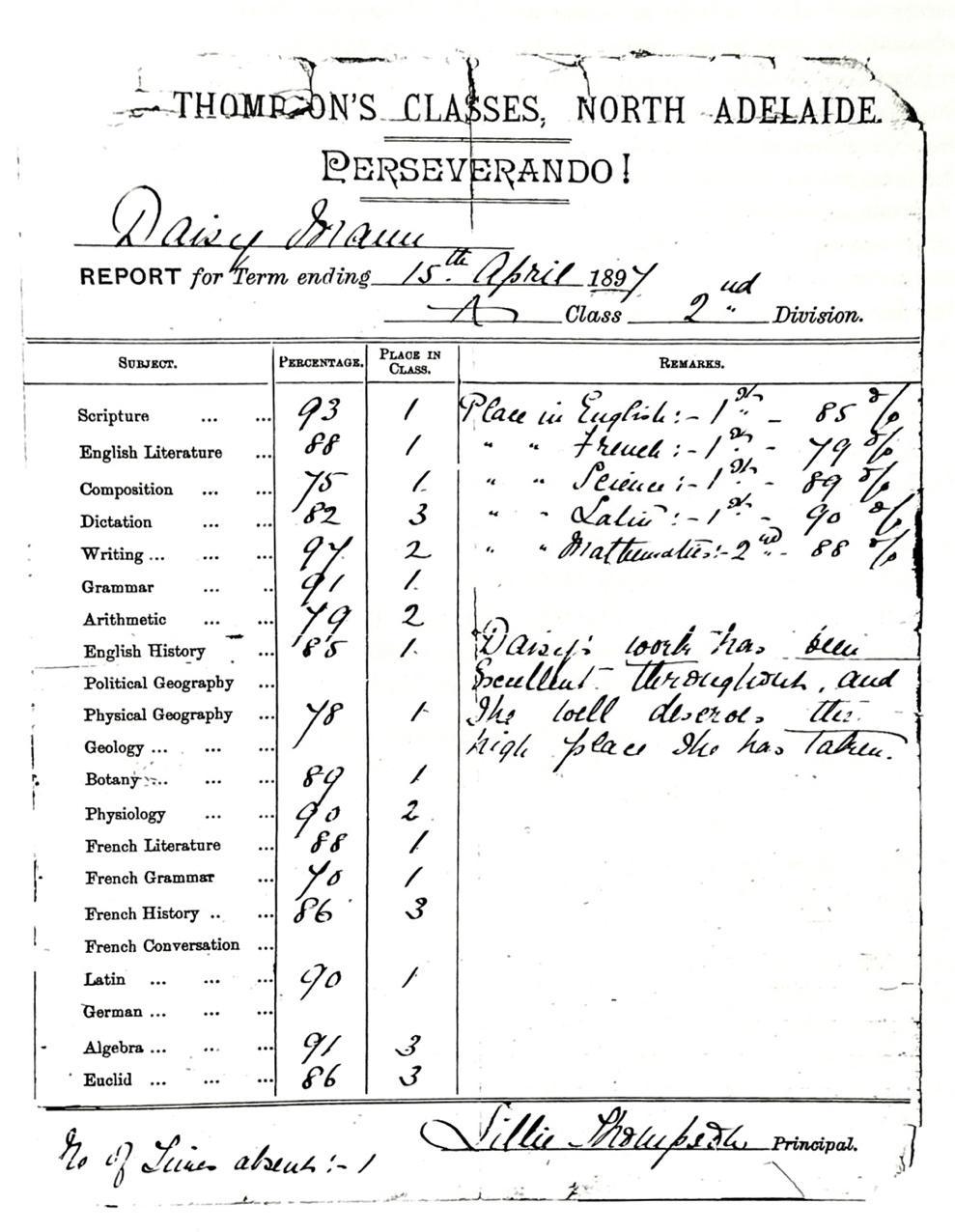
Daisy's Report Card. (Courtesy John Davis, Principles&Pragmatism , 2nd Edition, Vol. 1, p. 5)
We know of only one teacher, apart from Lillie Thompson. Rosa Fiveash was Eliza Gordon’s art teacher. Rosa was a devout Anglican and close friend of Catherine Helen Spence. Like Catherine, Rosa never married. She graduated from the Adelaide School of Art and Design and gained her teachers certificate in 1888, loved painting flowers, pioneered china painting in Adelaide and was recognised internationally for her botanical illustrations. She illustrated the publications of South Australian scientists including John Brown, Richard Rogers, John Cleland and Edward Stirling, the Director of the South Australian Institute. She taught privately, at Lillie’s school and at Tormore House. It comes as no surprise that Lillie employed her. Rosa Fieveash was a new woman, talented, religious and career-minded, an exemplar for Miss Thompson’s girls of what women could achieve in the patriarchal society of the time. Having such a high-profile woman on her staff might have encouraged enrolments, and enrolments equalled income.
Chapter 4
Career Interlude: Marriage and Motherhood
For…Love and freedom.
Alison Mackinnon, South Australian historian
On 5 February 1898 the Criticreported, ‘Very quietly in St Peter’s Cathedral, N.A., Miss L. Thompson, daughter of Mr. J. Thompson, of Lawrence, N.Z., was married to Mr. J.A. Smith, of Barton-terrace, N.A., on the 28th of January.’ None of Lillie’s relations attended. This is not surprising, given the distance between North Adelaide and Lawrence, but it is interesting that Hannah missed her sister’s wedding. We do not know why. Mr Justice Bundey stood in for Lillie’s father and gave her away, as though she were her father’s chattel. TheCriticthought Lillie looked extremely well in her simple white frock, white picture hat, plumes and flowers. A Miss Bundey and Mr C. Goode’s two little daughters were her bridesmaids. They wore white muslin frocks and hats. The Criticsaw no need to comment on Mr J.A. Smith’s dress. The newlyweds left in the afternoon for the country, possibly for Victor Harbor, which was a popular honeymoon destination.
A quiet ceremony it may have been, but it was not lacking in social cachet. It was held in St Peter’s Cathedral, theAnglican landmark of Adelaide. Lillie’s husband lived at ‘Morningside’ on prestigious Barton Terrace, North Adelaide, adjacent to Adelaide’s renowned Parklands. Mr Justice William Henry Bundey lived in style at ‘Stonehenge’, Mount Lofty, in the Adelaide Hills. He was a former Member of the House of Assembly, a judge of the Supreme Court, handsome and ‘well known for his fine presence’. He was, incidentally, a strong advocate for education beyond the basic 3Rs for both sexes and all classes. Six years after Lillie’s wedding Justice Bundey was knighted. He was a more than adequate substitute for Lillie’s father, and bridesmaid, Miss Bundey, was none other than his daughter, Ellen. Mr C. Goode’s ‘two little daughters’ were Lillie’s new husband’s nieces. His sister, Helen, was the second wife of Charles Henry Goode, a leading Adelaide merchant and a generous philanthropist. Goode was knighted in 1912. Lillie and her husband were well connected.
Barton Terrace was very near Childers Street and their close geographic location might explain how Lillie and ‘Mr J.A. Smith’ met. When they married, he was 44 years old and Lillie 34. Who was he?
James Albert Smith was the son of James and Augusta Smith. Augusta was the daughter of Justice William Alfred Wearing, who drowned when the Gothenbergwas wrecked in the Torres Strait in February 1875. This may explain why fellow judge, Justice Bundey, gave Lillie away. Lillie’s James was born in 1854 at Beaumont, near Burnside. Raised a Baptist, James lived with his parents variously in Pulteney Street in the city, at Angaston, where his father worked for George Fife Angas, at Greenhill, at Karrayerta a home on Justice Wearing’s Fullarton estate and, finally, from 1879 at Barton Terrace. His father was a prominent Baptist and successful businessman who provided well for his family.
Details of his education are unknown, but on leaving school James joined the National Bank of Australia and was manager of various branches in the north of South Australia. He was well regarded, and in 1880, aged 26, he was appointed manager of the bank’s Hindmarsh Branch where he served for 14 years. At the end of his term, 40 prominent local businessmen farewelled him in the Hindmarsh Town Hall on 18 August 1894. The Mayor described him as ‘universally respected’. James ‘was pleased to know that he had not become popular in the general sense, but that he had gained the confidence of those who had had transactions with the Hindmarsh branch.’ From 1894 James was the Senior Relieving Officer of the National Bank. He was 40 years old and headed for high office, one suited to a single man able to move at short notice.
But it was not to be. He met Lillie Thompson. Sometime between 1894 and when he married Lillie in 1898, James had bought a seat in the Stock Exchange of Adelaide. He went on to enjoy a stockbroking career of more than 22 years. He began in partnership with W.K. Thompson. In 1899 they had rooms in Davenport Chambers, Currie Street, and later moved to Pirie Street where their office was closer to the Stock Exchange. By 1912 the partnership had dissolved and James was on his own, operating from then on in various locations, including Pirie Chambers. He was in the heart of Adelaide’s stockbroker land and doing very well: he was a valued member of the prestigious Stock Exchange Club. As well as buying and selling for clients on commission he traded in wheat certificates and, after Lillie had died, he was a partner in the Gold Token Syndicate No Liability company.*
Totally innocent, in 1922 James was drawn into a court case in which the colourful manager of the Stock Exchange Club, Ernest Gervis Crespin, claimed £500 damages against stockbroker John Laurie. Crespin asserted that Laurie had slandered him in a conversation with James and another broker, George Twiss, by implying that he was corrupt, had taken secret commissions, embezzled money and was unfit for office. In the event, Crespin was awarded £100, with costs. But Crespin was a cad and a crook. In 1923 while still manager of what the Truthcalled ‘one of Adelaide’s most aristocratic clubs’ he had a very public spat with his wife over his affair with the ‘fashionably-attired’ Mrs Gooden. In January 1926 Crespin was committed for trial for breaking Patrick Golden’s ankle in Queen’s Garden, Brisbane. Two months later he pleaded guilty when charged with stealing two towels, also in Brisbane. Doubtless, tales of Crespin abounded in the Stock Exchange and at James and Lillie’s dinner table.
James and Lillie’s dinner table was vastly different from her father’s. John Thompson fathered thirteen children and Lillie’s mother and step-mother were both tied to household duties. James’s parents had seven children and his mother was similarly housebound. The mother of two sons, Lillie was less confined. Historians Margaret Anderson and Alison Mackinnon showed that South Australia’s ‘New Women’ came from privileged families and had definite ideas of what the ‘modern family’ of the early 20th century would look like. Much had changed in the almost four decades between her mother and father’s marriage and Lillie’s marriage to James. When she married, Lillie had already established a career in education.
World War I devastated wheat exports. The Commonwealth Government established a wheat pool and a Wheat Board that issued farmers certificates as advances on grain delivered to the pool. Certificates could be traded on the stock market before being redeemed
Anderson and Mackinnon noted that marital fertility fell dramatically in South Australia from the 1870s. The average rate fell from eight births in the mid-19th century to 4 by 1900 and continued its downward trend in the 1920s. Statistical averages do not paint the complete picture. The decline was not universal, and educated women such as Lillie Smith had consistently lower fertility rates than other women. They combined love and freedom: marriage and career, where possible. Anderson and Mackinnon argued that this ‘quiet revolution’ was largely cultural in nature:
Increasingly, ordinary people came to believe that the large, unregulated families of the past were passé, inconsistent with a modern, civilised society even increasingly, a source of embarrassment and they modified their sexual behaviour accordingly.*
A shorter child-rearing period, improvements in sanitation, the advent of gas and electric appliances and the ability to hire domestic help provided middle-class women the chance to work in occupations outside the household. Anderson and Mackinnon noted that women’s dress became freer: although their many layers remained, undergarments relaxed a little and long, loose tunics whose hems rose dangerously to ankle height replaced tight waists and high collars. And South Australian women found in the local newspapers many articles about the latest fashions, complete with detailed line drawings. This appeared in the Mail of Saturday 13 September 1919, with a drawing:
MRS. J.A. SMITH’S FROCK, WORN AT THE GIRTON HOUSE DANCE ON SEPTEMBER 4
The black frock is fashioned throughout of charmeuse veiled with silk tulle intricately handworked with beads, and fringe, completed by a deep belt of bright green and purple, the corsage having an underdrape of gold tissue.
There is no doubt that Lillie Smith was well known among Adelaide’s social set; a fashionable, well-educated middle-class woman of note. She was a new woman, and she knew it.
James was a well-established businessman, able to provide a most comfortable home for his wife. But Lillie moved James into her cottage at 14 Childers Street. How common was that in 1898? Was James her chattel? Perhaps it was simply a short-term arrangement before suitable accommodation was available. And, Miss E.H. Ayliffe’s Ladies School began operating at 91
Margaret Anderson and Alison Mackinnon, Newwomenandthemodernfamily:Continuityandchangeinprewardomesticlife , in Oppenheimer, Melanie; Anderson, Margaret and Paul, Mandy, SouthAustraliaontheEve ofWar , p. 43.
Childers Street in 1898, suggesting that Miss Ayliffe had bought Lillie’s school. First son Gordon Wearing Smith was born on 3 July 1899 and James Wearing Smith on 15 February 1901. Their family was complete and by 1902, if not before, James, Lillie and their two boys were living at fashionable Fitzroy Terrace, Fitzroy. Like Barton Terrace it looked upon the Parklands, but from the north. And, it was not far from the homes of several wealthy and well-known stockbrokers, including Tony Fotheringham’s ‘Glenroy’ in Medindie and George Brookman’s and Charles De Rose’s Gilberton mansions. Perhaps Lillie and James aspired to the ‘genteel comfort’ these brokers enjoyed. In 1905 the Smiths moved to Robert Street, New Glenelg (now Glenelg South), and again in 1914 to Grant Avenue, Toorak Gardens.
James Albert Smith may not have ranked with the wealthy brokers mentioned above, but he and Lillie lived in affluent suburbs and moved in polite circles. At Fitzroy Terrace their next door neighbour was the Hon. Charles Willcox, MLC. Newly knighted, Sir Josiah Henry Symon KC, lived six doors away. In 1908, Lillie and James were invited to Mrs Willcox’s home for a progressive bridge party. Lillie won the ladies’ prize, a ‘pretty silver-mounted pincushion’. A silver pencil was presented to leading Adelaide timber merchant and furniture-store proprietor, Malcolm Reid. Prominent Adelaide broker, Gavin Gardner and his wife attended, along with North Adelaide notables, dentist, Dr Theodore Shanasy, and draper, William Honeywill.
New Glenelg was surveyed in 1851, and when Lillie and James moved there in 1905 it was an established and very desirable seaside suburb a short walk from Glenelg, Adelaide’s ‘premier watering place’. James almost certainly commuted to his Pirie Street office on the wellpatronised railway from Glenelg to Victoria Square. No doubt Lillie saw that the very young Gordon and Jimmy enjoyed visits to the beach, Jetty Road, Moseley Square and occasional trips to Adelaide on the steam train. When Gordon and Jimmy reached school age, Lillie may well have enjoyed strolling along South Esplanade past stately mansions. She could admire Stormont, Dundrennan, the Oriental Private Hotel built for proprietor of the Registerand original settler, William Kyffin Thomas, and the Seafield Tower, the two self-contained seaside retreats of Sir Henry Ayers and Sir Thomas Elder. A sprinkling of parliamentarians including George Fowler, David Murray, Samuel Bakewell, George Cotton and Thomas Johnson had built fine homes on South Esplanade, often in the two-storey Georgian style.*
Socially, Glenelg ranked well with Fitzroy, even Medindie. According to the 1983 Glenelg Heritage Survey:
At the beginning of the twentieth century there was still much ‘small town snobbery’ in Glenelg that no doubt went hand in hand with its reputation as being a fashionable, high class residential area where many prominent citizens had erected their mansions in the previous decade or so.†
At Robert Street, New Glenelg, Lillie and James lived next door to his fellow stockbroker and secretary of the Glenelg Golf Club, Frank Southcombe. The secretary of the South Australian Jockey Club, A.O. Whitington, lived across the street in ‘Colonna’, a splendid single-
Hignett & Company, GlenelgHeritageStudy(Stage 1), pp. 98, 99, 116, 118, 124, 133. † ibid., p. 19.
storey home seemingly inspired by Bologna’s elegant colonnaded buildings. Others who lived comfortably in Robert Street were solicitor, T.F. Wigley, and lawyer, president of the Chamber of Commerce, director of the South Australian Brewing Company and chairman of Tattersall’s Club, S.J. Jacobs. Accountant, Joshua Gurr’s ‘Oliveville’, a two-storey ‘gentleman’s residence’, was just 60 yards (55 metres) from South Esplanade. But none of these homes matched ‘Glenara’, which sat on the dunes at the end of Robert Street and looked out over Holdfast Bay. Renowned Adelaide architect, Thomas English, designed this Italianate six-room home with a tower and conservatory for William Hill, a partner of his wealthy flour miller father-in-law, John Dunn. But Hill was a successful wheat and grain agent in his own right. When Lillie and James moved into Robert Street, Hill’s widow still lived at ‘Glenara’.
In Bulls,BearsandWildcatsRon Gibbs noted that ‘the turn-of-the-century broker could be part of a social clique, often cosy and often snobbish’. He observed that brokers’ comings and goings were frequently mentioned in the social pages of local newspapers. The Critic’s‘Society Gossip’ kept the social set well informed. It reported ‘edifying news’ of brokers’ summer holiday activities: Mr and Mrs A.S. Fotheringham were staying at Mount Lofty and Mr and Mrs W. Clark were taking a house on the seawall at Glenelg. And, Glenelg stockbroker, A.J. Roberts, ‘dispensed mayoral hospitality from “The Olives” … with its many rooms, sweeping drive and fine gardens’. We do not know if Lillie and James were part of a brokers’ ‘social clique’. They were, perhaps, on its periphery, enjoying a comfortable, rather than lavish lifestyle. New Glenelg was second fiddle to Glenelg. But, as a mother living at New Glenelg, Lillie was familiar with Glenelg’s stately ‘seawall’ (South Esplanade) homes mentioned above and, perhaps, some of their occupants. As we shall see, she was an excellent ‘networker’. At some stage, for example, Lillie befriended Margaret Cheadle Snr. Her husband was wealthy Medindie wool broker and Congregationalist, Alfred Stanley Cheadle, an entrenched member of ‘Adelaide’s Protestant establishment’ and twice former mayor of St Peters.
We do not know where Gordon and Jimmy went to school when they lived at New Glenelg. There were several options. Glenelg Primary School was established in 1881 and is within walking distance of Robert Street. Miss Mary Dow’s kindergarten, day and boarding school was located on the corner of Robert and Bristol streets, literally across the street from the Smiths, and Mr J.F. Hills, MA, conducted the Holdfast Bay College in nearby Kent Street, New Glenelg. Probably when the family moved to Toorak Gardens, Lillie and James enrolled their sons at the prestigious St Peter’s College. Gordon attended from 1913 to 1915 and Jimmy from 1913 to 1917. In 1917, Gordon began studying Medicine at the University of Adelaide. But in March 1918, he embarked for the Western Front with the 4th Infantry Brigade of the Australian Imperial Force. He returned from the war in 1919 and in 1920 continued his studies. He graduated Bachelor of Medicine, Bachelor of Surgery in 1925. Jimmy began his studies in 1918 and graduated Bachelor of Engineering with a Diploma in Applied Science in 1924. Their ‘New Woman’ mother would have glowed with pride, and may well have spread their news within polite society. Soon afterwards both men added their middle names to their surnames. Henceforth they were ‘Dr Gordon Wearing Smith’ and ‘Mr James Wearing Smith’. Their
R.M. Gibbs, Bulls,BearsandWildcats:ACentenaryHistoryoftheStockExchangeofAdelaide, pp. 144–145.
grandmother, the august, Augusta Smith, surely would have approved the use of her maiden surname.

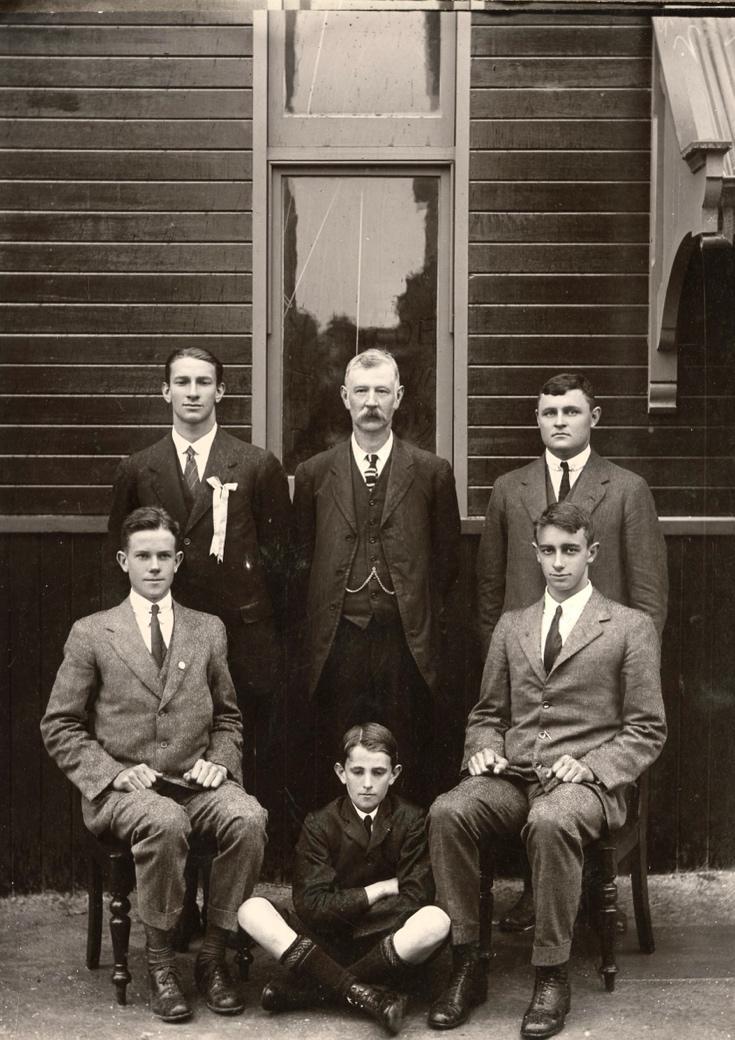
Jimmy Smith (sitting left)
A member of the St Peter's College Second Crew (rowing), 1917 (Courtesy St Peter's College Archives)
We know little of Lillie’s sister, Hannah, from the time she arrived in South Australia until we learn of her marriage. As we saw above, she did not attend Lillie’s wedding. She may have returned to New Zealand. She may have moved to Melbourne. But at 39 years of age, Hannah married the 67-year-old Henry Yorke Lyell Brown on 13 December 1911 in Christ Church, St Kilda, Victoria. The Chronicleof 20 January 1912 reported that a Mr Snowball of Melbourne gave Hannah away, she wore a ‘handsome grey coat and skirt’ and a ‘smart grey hat, relieved with a touch of blue’ and Miss H. Lilias Sanderson of Adelaide was her bridesmaid. There was no mention of Lillie attending. Canadian-born Henry Yorke Lyell Brown was the highly regarded, well-remunerated South Australian Government geologist of whom it was claimed, ‘he knew every mineral belt from Darwin to Mt Gambier’. The newlyweds planned to travel overseas for a year visiting England and Canada, among other places. On their return to
Gordon and James’s uncle, Quinton Stow Smith, similarly added his second given name to his surname. He was named after the renowned Congregational minister, the Rev. Quinton Stow Smith, who married their paternal grandparents in 1845.
Adelaide, Henry and Hannah lived very comfortably at 286 Ward Street, North Adelaide. In January 1917 TheLadies page of the Observernoted that Mr and Mrs H.Y.L. Brown were holidaying at Victor Harbor. Henry died in January 1928. Hannah and their only daughter survived him.
By 1913 it is likely that Lillie and James were living in Grant Avenue, Toorak Gardens. Jimmy was 12 years old and Gordon 14. Both boys began that year at St Peter’s College and Lillie’s child-rearing role was fast diminishing. Her love for her sons was unabated, but prospective freedom from home duties allowed her to consider returning to work in the public sphere. In 1914, she formed a plan.
Chapter 5
Preparing a New Girls’ School
There were people who warned her that failure was more likely than success and she herself faced the undertaking with a certain sense of doubt it meant something of courage to take up school work again after an interval of about 17 years. But she had a very clear idea of what she wanted to do…
TheRegister , 22 June 1926, p. 10
Lillie Smith opened Girton House Girls’ Grammar School on 8 February 1915. We do not know exactly when she decided to establish another school, but in 1914 she secured a suitable property, employed staff and recruited students. It was a brave act. ***
Lillie was six weeks short of her 50th birthday when Bosnian-Serb, Gavrilo Princip, assassinated the heir to the throne of the Austro-Hungarian Empire, Archduke Franz Ferdinand, and his wife, Sophie. When Princip shot the Archduke in Sarajevo on 28 June 1914, he sparked a chain of events that led to the outbreak of World War I. On 5 August the Commonwealth Government of Australia announced that it was at war with Germany, at the time when Lillie was well advanced with her plans.
The outbreak of war and Australians’ response did not deter her. In Adelaide, large crowds gathered in the streets and in Elder Park and greeted the news with cheers and patriotic tribalism. The view that ‘It’ll be over by Christmas’ spread rapidly and galvanised further support. That the nation’s status as a member of the British Empire meant it was legally at war with Germany was irrelevant to public sentiment; except for some South Australians and other Australians of German descent, the most radical section of the Labour Movement — the revolutionary Industrial Workers of the World and militant nationalists of Irish-Catholic descent. Australia’s volunteers who enlisted fought in the Australian Imperial Force, which British officers commanded until the final year of the war. Initial support for the ‘mother country’ and the war effort was strong. Prime Minister Joseph Cook declared that all Australian resources human and material were ‘in the Empire and for the Empire’ while Labor Opposition leader, Andrew Fisher, pledged ‘our last man and our last shilling’. Walter Skipper Francis penned the popular wartime song; AustraliaWillBeThere.
This was the home-front atmosphere when Lillie was formulating her plans for a new girls' school. She had little to fear, as this was the time before the horrid reality of World War I was evident. Later, when generals wedded to British 19th-century military tactics ordered troops to charge across no-man’s-land, it was obvious that the technology of defence was vastly superior to that of attack. Massive fortifications, barbed wire, trenches, witheringly destructive machine guns, flame throwers and poison gas were virtually irresistible until Australian General Sir John Monash developed the rolling artillery bombardment that allowed troops to advance with some protection. The war bogged, a war of attrition. It was certainly not over by Christmas. It was
murderous and lasted four years. But all of this occurred after Lillie had decided to open Girton House, when the mood was optimistic.
***
Indeed, between 1901 and the outbreak of World War I South Australia fared relatively well. Good rains helped farmers recover from the devastating Federation Drought. Renewed efforts to farm marginal lands saw the development of irrigation schemes along the River Murray, the draining of the South East and the expansion of local railways. An upturn in prosperity and expanding industries brought increasing birth and immigration rates. Adelaide was expanding. Prospects seemed rosy. But!
Agriculture especially the growing of wheat and other cereals was South Australia’s economic staple. Drought was agriculture’s enemy and it struck between 1911 and 1914. The lowest recorded rainfall to that time occurred in 1914. The River Murray dried up. While an enterprising Barmera farmer grew oats in Lake Bonney, agriculture suffered badly. Men and resources, including many of the ships that carried imports and exports, were diverted to the war effort. And Lillie’s stockbroker husband, James, grew restless. He worried that he might not provide his family with the comfortable lifestyle it had so far enjoyed. By 1913, the Balkans crisis, poor financial conditions, strikes and ‘The Troubles’ in Ireland weighed upon market confidence. ‘Brokens’ shares in Broken Hill mining companies were Stock Exchange favourites and collapsing metal prices saw BHP shares fall by 23 per cent. In August 1914, with Austria and Serbia already at war and several London broking firms failing, the London Exchange closed until further notice. In Adelaide investors deserted the Exchange. After discussions with the Sydney and Melbourne Exchanges, the Stock Exchange of Adelaide joined them in closing in early August. It remained closed for seven weeks, reopening on 21 September. Like other brokers, and his confidence down, James was without income for almost two months at the very time Lillie was laying down the blueprint for her new school. To compound the family difficulties, school fees still had to be paid for Gordon and James, now in their second year at St Peter’s College. A desire for another source of income at this time may have strengthened Lillie’s determination to start a school for girls.
Lillie established Girton House in Kent Town, an inner-eastern suburb of Adelaide. Nearby former girls’ schools Hardwicke College and Dryburgh House closed in 1910 and 1914 respectively. Opportunistic Lillie saw the need for a new girls’ school in the eastern suburbs. In 1915 Kent Town was well served by a comprehensive electric tram service: the Magill and Kensington Gardens lines from the east were especially convenient. Girls could take several trams to school via the city and at least one combined using the train from Alberton and a tram from the city.
Kent Town was named after local landowner, Dr Benjamin Archer Kent. ‘Kent’ is a habitational name adopted from the name of the English county. Interestingly, the surname was also established in Meath, Ireland. Lillie’s father was born in Westmeath.
According to the first girl enrolled, Margaret Cheadle (McGuire), Lillie ‘had no capital’, but some ‘gentlemen’ financed the new venture trusting that she would succeed. TheGirton Bookclaimed that she borrowed capital to open her school.* Hard evidence to support these claims does not exist. However, Margaret’s mother was Lillie’s good friend mentioned in Chapter 4 and she may have been acquainted with the situation. We know that James and Lillie had wealthy stockbroker friends and other business acquaintances. Perhaps James, other stockbrokers and businessmen backed her. Margaret also claimed that Lillie bought the house that she used, initially, for the Smiths' family home, the boarding house and, in 1915, the classrooms. It was a large two-storey building with 12 rooms at 9 Angas Street on the north-west corner with Kent Terrace (now Fullarton Road). Lillie named it ‘Girton House’. It was set in ‘old-world grounds’ of over half an acre, bordered by tree-lined Angas Street, and it had a tennis court and an old shed in the back yard where the infant students eventually learned.†
Sometime in 1917, Lillie, James, Gordon and Jimmy moved into 7 Angas Street, an Edwardian semi-detached home next door to the school. They lived there until 1925 when Lillie relinquished Girton House.‡
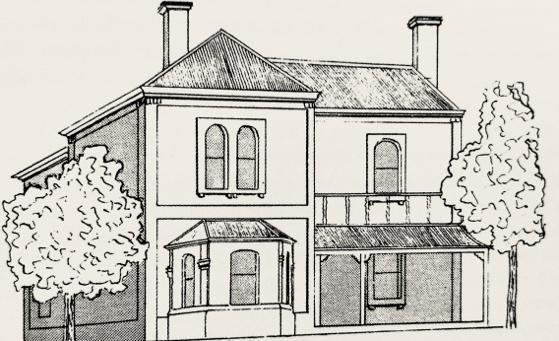

Lillie knew that buildings house schools, staff and students make them. Obviously, student numbers would be low at the beginning and having reputable, respected teachers was the
Margaret McGuire, PersonalitiesRemembered,No.29,LillieSmith, 5CL Radio Talk Transcript, 20 December 1970, p. 1 and The Girton Book Tells An Interesting Story (1951, June 22). TheAdvertiser(Adelaide,SA: 1931- 1954) , p. 11. Retrieved June 26, 2024, from http://nla.gov.au/nla.news-article45722681.
† ibid.
‡ Sands & McDougal's 1916 Directory, p. 169, places J. Smith, sharebroker, at 9 Angas Street, Kent Town. Christopher Lane, Cultural Heritage Research Officer, Norwood, Payneham and St Peters Cultural Heritage Centre advised that the council rate book of 1917–1918 listed James Albert Smith as the occupier at 7 Angas Street. The 1917 Directory, p. 174, lists the occupier as J.A. Kean, salesman. This suggest that the Smiths moved into 7 Angas Street some time in 1917. From the time they moved in to 7 Angas street they lived there until 1925, when Lillie relinquished her school.
key to expansion. As Lillie would combine her headmistress role with teaching she sought a firstclass deputy. She found her in Miss Ida Heyne. Ida was a member of a well-known horticultural family of German descent. She and her three sisters all attended the Advanced School for Girls and graduated from the University of Adelaide. Ida graduated Bachelor of Arts and later completed a Master of Arts degree. She was the outstanding academic on the staff. Apart from Ida Heyne, we do not know exactly who Lillie appointed at the beginning. She certainly needed a few more teachers for the Secondary School, and she employed Miss Lottie Wagg to teach in the Preparatory School. There is an early photograph of the staff and students of Girton House. It shows Lillie and Ida Heyne, at least one other teacher, 23 school-age girls and four young women who could have been either senior students or young teachers.
With buildings and staff in place, Lillie published a prospectus and set out to secure students. She did this by word of mouth and using her connections in ‘society’. When architect Philip Claridge moved to Alexandra Avenue, Toorak Gardens, his home backed on to Lillie’s Grant Avenue property. One day in 1914, Lillie spoke to Mrs Claridge over the back fence advising her that she was opening a school next year and hoped that she could look forward to having her daughter, Dorothy, as a pupil. Dorothy did join Girton House, but not until 1920. Word of mouth worked eventually, in this case. Lillie recruited to the last minute. On the Thursday before she opened her school, she announced that she would be ‘At Home at Girton House’.
Female members of the Adelaide Establishment and other upper-class women regularly visited each other ‘at home’. These social events maintained connections and Lillie saw an opportunity to promote her new school amongst the well-heeled matriarchs of the fashionable inner-city suburbs. Guests enjoyed afternoon tea and inspected the premises, including the comfortable boarding facilities and classrooms. The Mail fussed over the dormitories that ‘looked most inviting with their artistic colour schemes, in which wallpapers, floor coverings and bed spreads all harmonised’; and ‘the halls of learning’ with their long tables, blackboards and other paraphernalia. It was all properly suitable for aspiring highheeled, educated damsels. Their mothers were impressed. Who were they?

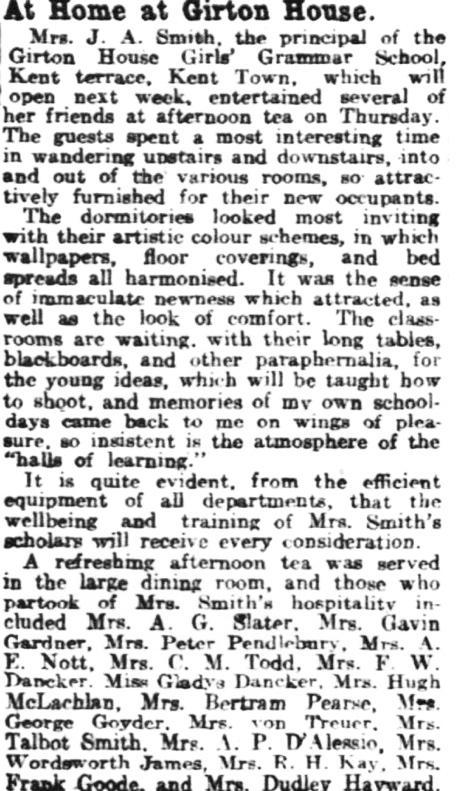
(Courtesy Mail , 6 February 1915, p. 2)
Mrs G. Gardner and Mrs B. Talbot Smith were stockbrokers’ wives. Mrs C.M. Todd’s husband was ‘a widely known … Stock Exchange identity’, though not an official member. Mrs D. Hayward’s husband was Chairman of Directors of the leading Adelaide department store, John Martin’s. Mrs F. Dancker’s husband was a prominent architect. Mrs. H. McLachlan, of the renowned pastoral family, attended, as did Mrs George Arthur Goyder who was married to the Government Assayer and Assay Instructor of the South Australian School of Mines. He was the son of the famous South Australian surveyor, George Woodroffe Goyder. Women who featured in newspaper social pages attended, including Mrs Peter Pendlebury, Mrs F. Nott, Mrs Bertram Pearce and Mrs Wordsworth James.
Lillie’s preparations were thorough and paid dividends. She opened Girton House in 1915 with 20 girls, including four boarders. To reimburse the financial backers alluded to above, she definitely needed more students: this was an educational venture; and a business. It is likely that she had planned in 1914 to secure larger premises when the need arose. She recruited girls throughout 1915 and by the end of the year there were 10 boarders and 89 day students. Girton House was popular, and overflowing. Lillie drastically needed more space and buildings and for 1916 she leased two properties. From that time, they housed the day school while Girton House at 9 Angas Street remained the boarding house.
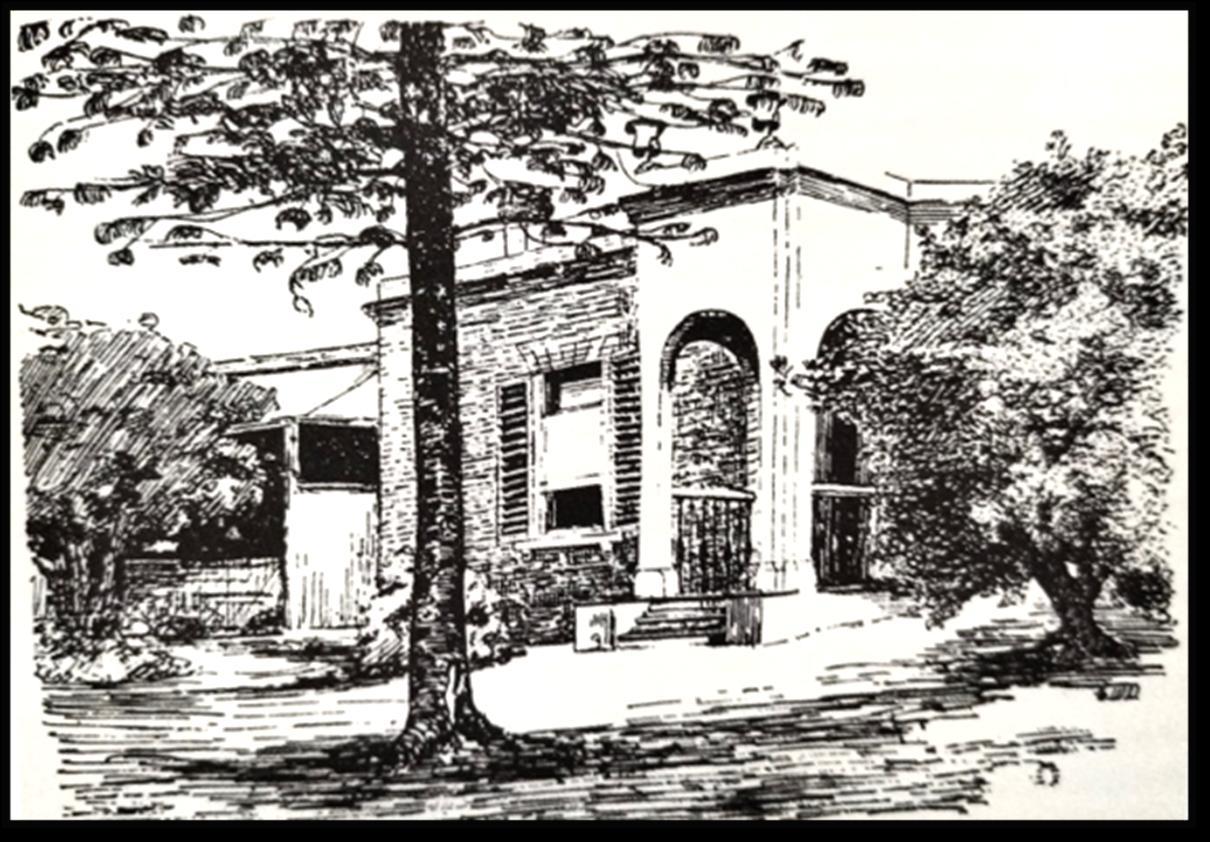
The two new day-school buildings were located contiguously across the road at 86 and 88 Kent Terrace, Norwood. Lillie always advertised and described her school as being in Kent Town, never Norwood. In letters to the Registrar of the University of Adelaide, Gordon and Jimmy gave their home address as ‘Girton House, Kent Town’ or ‘Kent Terrace, Kent Town’. The main School House had 13 rooms while the bluestone Cottage had five and about eight outhouses. The junior and lower secondary classes and the library were in the Cottage. The senior classes were held in the School House. The Staff Room, Book Room, ‘Tuck’, Prefects’ Study and the Headmistress’s Study were in the School House. Groundsman ‘Sandy’ had two rooms in the Cottage, one of which doubled as a store for his tools. It is likely that Lillie leased
)
the two properties in Kent Terrace. When they were sold in 1926, they were listed as being part of the estates of Elizabeth Rhodes and Henry Woodcock.

Prospectus, showing the School Badge. (Courtesy Pembroke School Archives)
Girton House Subdivision (1926, November 27). TheMail(Adelaide,SA:1912- 1954) , p. 13. Retrieved December 16, 2023, from http://nla.gov.au/nla.news-article58840901.
Chapter 6
An Educational Template for Girton House
He had asked, as he was packing up to leave, about her school, and a look of deep regret had come upon her face. ‘I had such high hopes, Mr Gilbert, but it was too soon. I knew that compromise would be necessary; that in order to attract sufficient students I would have to concede to certain parental expectations. I thought I would be able to honour my promise to shape the girls into “young ladies” whilst also instilling in them a love of learning.’ She had smiled. ‘I don’t think I flatter myself that there were some whom I started on a road they might otherwise not have found. But there was rather more singing and sewing than I’d envisaged.’
Kate Morton, TheClockmaker’sDaughter , p. 306
Like Kate Morton’s fictitious Miss Lucy Radcliffe, Lillie Smith had ‘such high hopes’ for Girton House. They were based, of course, on her educational philosophy, her aims and goals for her girls. Like Miss Radcliffe she aimed to instil a love of learning. Lillie also realised she had to give consideration to parents’ expectations of what was a right and proper education for girls. As one old scholar put it, she aimed to produce ‘clever ladies’. Unlike Miss Radcliffe’s school, Lillie established Girton House in more modern times and it had rather more learning than singing and sewing. But, from where did Lillie’s educational ideas sprout and blossom?
Miss Freeman was the conduit for Lillie’s educational ideas, ideas that originated in Britain and, to a lesser degree, Ireland. They shaped the type of schools and education found in New Zealand and all Australian colonies, be it State-funded, private or religious based. In South Australia, Governor Frederick Robe introduced State-funded education in 1846* and the parliament established a Central Board of Education, made primary education compulsory and opened the Advanced School for Girls in 1879. The Protestant and Roman Catholic Churches opened schools. Lillie’s school was a private-venture school, an independent school, and like the Protestant Church Schools these were almost universally modified versions of English Public Schools. They were, and are, what Australians call ‘Private Schools’. While Thomas Hughes romanticised the system in TomBrown’sSchooldays , historians analysed and explained its development. English Public Schools were exclusive, elitist. They charged fees and were almost entirely boarding institutions for the sons of the British ruling class. Thomas Arnold of Rugby, who thought education must focus on religious and moral aspects of life, is usually credited with its establishment. At first the system was strongly uniform, yet headmasters and schools of various nuances and emphases shaped its evolution. Taking school
* Governor Robe introduced State Aid for religious bodies, especially favouring the Church of England, to the horror of Nonconformists and other South Australians of an independent bent. It was short-lived and repealed in 1851.
sport as an example, the pragmatic George Cotton of Marlborough introduced games to divert boys from rioting in town, Edward Thring of Uppingham justified them on the GraecoRenaissance ideal that valued the whole person and Hely Almond of Loretto thought the SpartoChristian ideal of temperance, courage and espritdecorps promoted spiritual and physical health. Importantly, public schools emphasised character training, the development of Christian manliness or 'muscular Christianity', leadership, service and loyalty to school, nation and empire. They aimed to produce 'a grand breed of man' to serve Britain. They prepared upperclass boys to lead, not by force, but by what Antonio Gramsci called an 'ideological hegemony'; their future 'cultural, moral and ideological' leadership over the middle and working classes, which accepted without scrutiny ruling-class values and ideas as self-evident.*
Originally, public schools taught some Mathematics, Scripture and the Classics, Greek and Latin, which were beyond the intellectual capacity of most boys, no matter how well-heeled their dams and sires. By the end of the 19th century the schools' curricula had broadened. With physicist and chemist, Michael Faraday, enjoying royal patronage, public schools introduced Science, despite its anathema to the upper classes.
As with other closed communities, such as monasteries and military institutions, the system had a well-defined machinery. It included the primacy of the chapel, the wearing of uniforms, prefect and house systems, games, 'colours' for excellence in sports, school badges, crests, mottoes, songs, magazines, clubs, military cadets and 'old boys' associations'.
Upper-class women, such as the intelligent Emily Davies, challenged the expectation that a woman’s place was at home ministering to the needs of her husband and children; and drove the quest for girls' education. Despairing the emptiness of their lives, they challenged the paradigm of 'womanhood' and concluded that if women were to be employed in the public sphere, the education of girls was essential. And, if young women were to attend universities and challenge male domination of the professions, girls’ secondary education had to be academic and similar to that of boys.
Not surprisingly the notion that women be allowed to attend universities stirred opposition in Victorian England. In TheDaughtersofEngland , Sarah Stickney Ellis told women in 1845, they were 'inferior to men — inferior in mental power, in the same proportion that you are inferior in bodily strength'. And in 1865, one of Lillie Smith's favourite authors, the influential art critic, John Ruskin, asserted that men's intellect was for speculation and invention, while women's was for 'sweet ordering, arrangement and decision'. According to Ruskin, men's realm was the entire world, women's the home, her own petty kingdom.
In The'GirtonGirl'and'LadyDoctor':Women,HigherEducationandMedicinein PopularVictorianFictionbyWomen , Rachel Carr noted that critics of higher education for women commonly argued that if education literally meant to 'draw out', then education for girls should educe what was already there, their 'womanliness'. And that meant education for motherhood, not university, not the professions. The modern type of woman was not to be a 'university woman'. With Barbara Bodichon, the aforementioned Emily Davies established the
Geoffrey Sherington, Ian Brice and R.C. Petersen chose LearningtoLeadas the title of their 1987 book on the history of boys' and girls' corporate secondary schools in Australia.
Antonio Gramsci (1891–1937) was an Italian intellectual; a philosopher, political theorist, sociologist and a founding member of the Italian Communist Party. He was a vocal critic of Fascism, its ideology and Benito Mussolini, who gaoled him from 1926 to 1937. Gramsci suffered terribly and died in prison, essentially for challenging the ideological hegemony of the day. His theory remains relevant today.
first residential college for women in 1869, Girton College, at Cambridge University. Opponents of the 'university woman' ridiculed the 'Girton Girl'. It was clear where the writer thought Maude should be and what she should be doing when this appeared in South Australia's Advertiseras late as 28 September 1912:
Very Clever
Maude was home from Girton.
'Will you,' she said to her mother, 'pass me my diminutive argentuous truncated cone, convex on its summit, and semi-perforated with symmetrical indentations?'
She was asking for her thimble.
Some 'Girton Girls', as the KangarooIslandCourierof 27 January 1912 suggested, placed a career in medicine before marriage :
'Tell me,' he sighed 'tell me, beautiful maiden, what is in your heart?'
The Girton girl gave him a look of icy disdain and then vouchsafed the monosyllable: 'Blood!'
But, well before women could enrol at Girton College, Cambridge, pioneering headmistresses opened what were, in essence, public schools for girls. They foresaw that only seriously well-educated women would be able to attend university when their time came. Queen’s College for Women and Bedford College opened in 1848. Two of the most influential headmistresses were Miss Frances Buss who opened the North London Collegiate School for Girls in 1850 and Miss Dorothea Beale who operated Cheltenham Ladies’ College from 1854, the latter described as the ‘female Rugby’. According to historian Helen Reid, Cheltenham Ladies’ College was the model for Hardwicke College, which we met in Chapter 5, and which was next door to St Peter's College.
Originally, boys' public schools served the sons of the rural aristocracy, the nobility, lords of the manor and the older branches of medicine, law, the Church, teaching and the Army and Navy. With an emerging middle class, the clientele broadened and historian Helen Reid noted that the same applied to girls' schools. Many of the parents who sent their daughters to North London Collegiate School and Cheltenham Ladies’ College included engineers, architects, actuaries and scientists from the emerging professions. They valued intellectual pursuits, scholarship and the acquiring of practical knowledge; knowledge more useful than a detailed understanding of the Greek Classics, or, even worse for girls, how to dillydally over doilies.
But the public-school system was not monolithic. Not all schools were bastions of conservative English Protestant upper-class values. Nor did they all use traditional pedagogy. There were privately-run progressive schools such as Cecil Reddie's Abbotsholme and John
Badley's Bedales; and democratic-socialist ideals underpinned their cooperative pedagogies. While the hierarchical structure of the traditional public schools reflected the episcopalianism of the Church of England, the progressive schools were often associated with less-popular Nonconformist denominations such as the Congregationalist Church, with its democratic and egalitarian governance. Historian Jonathon Gaythorne-Hardy suggested that progressive schools were infinitely more influential abroad than were public schools. Maybe?
Finally, some privately-operated schools included the word 'grammar' in their names. Grammar schools first operated in sixth-century England and taught Latin. By the 19th century their curricula had broadened significantly and they offered an academically oriented secondary education that included the study of literature, science and the Classics. This is a simplistic explanation of the history and nature of English grammar schools, but for our purposes we can take the word 'grammar' in a school's title to indicate that it catered for academically able boys and girls who were likely to proceed to university.
With modifications to suit the realities of life in South Australia, Adelaide's leading boys’ schools adopted the public-school system. St Peter's College is the perfect exemplar. The Church of England opened it in 1847 primarily as a day-school that provided boarding for country boys. There was even an English exemplar for this model, Clifton School in Bristol. As if to underline the cultural and social imperative the public-school system cultivated, five streets near St Peter's bear the names of famous English boys' schools. There are Eton Lane, Harrow Road and Marlborough, Rugby and Westminster streets. St Peter's College acknowledges that under Bishop Augustus Short's leadership it was established 'in the tradition of the great public schools of England'. The other boys' school the Church of England established in Adelaide was Pulteney GrammarSchool (author's emphasis).

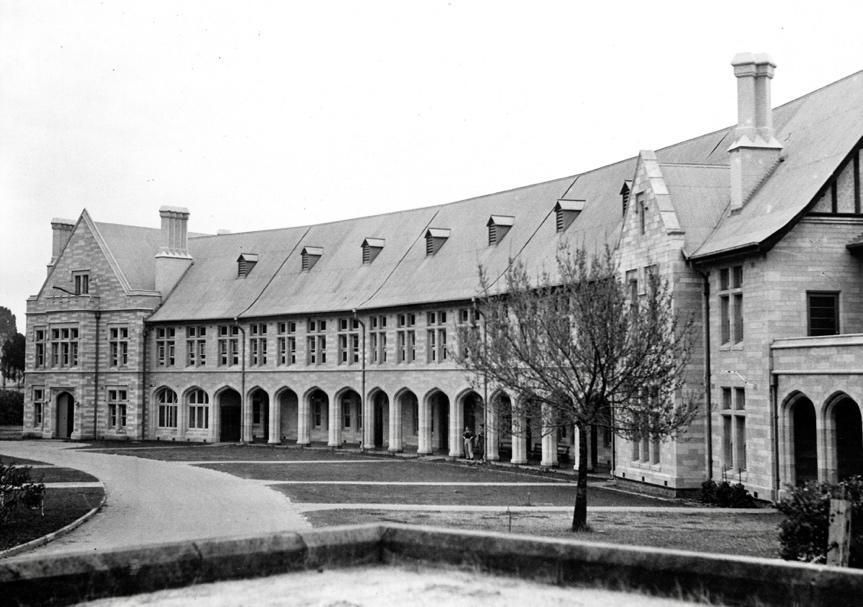
Chapter 7
Getting Girls for Girton House
Education must reach to the heights of things and delve to the depths. It must teach us to live in generous feelings, great thoughts and deeds of good, and a school, to prove her soul, must realise this to the full. Thought, feeling and action, proportioned duly, create a fitness for the part we are to play in the world, this being the aim and end of all true education.
Lillie Smith, cited in TheGirtonBook , p. 19
Most parents who could afford to educate their daughters at Girton House Girls' Grammar School when it opened in 1915 probably had a general idea of the type of education they valued. Few could have articulated a detailed educational philosophy, like the one Lillie stated above. That her school shared the name of an established women's residential college at Cambridge University 'Girton' sent a clear message that she valued an academic education. That it was to be a 'Grammar School' reinforced this. But unlike her mentor, Caroline Freeman, Lillie deliberately called it a 'School', not a 'College'. She told foundation student, Margaret Cheadle (McGuire), she 'wanted her school to be a place of basic education, especially in the correct use of language' and contended that the term 'College' should be reserved for institutions connected with universities. That her school was set in a house was important. Lillie aimed to produce welleducated women and mothers. She wanted her girls to 'take full part in community life' in ways suited to their individual talents and abilities, whether they be destined for higher education, a working life in the public sphere or motherhood. And, she gave some attention to the 'female accomplishments'. She aimed to produce 'clever ladies'. Her approach was holistic.

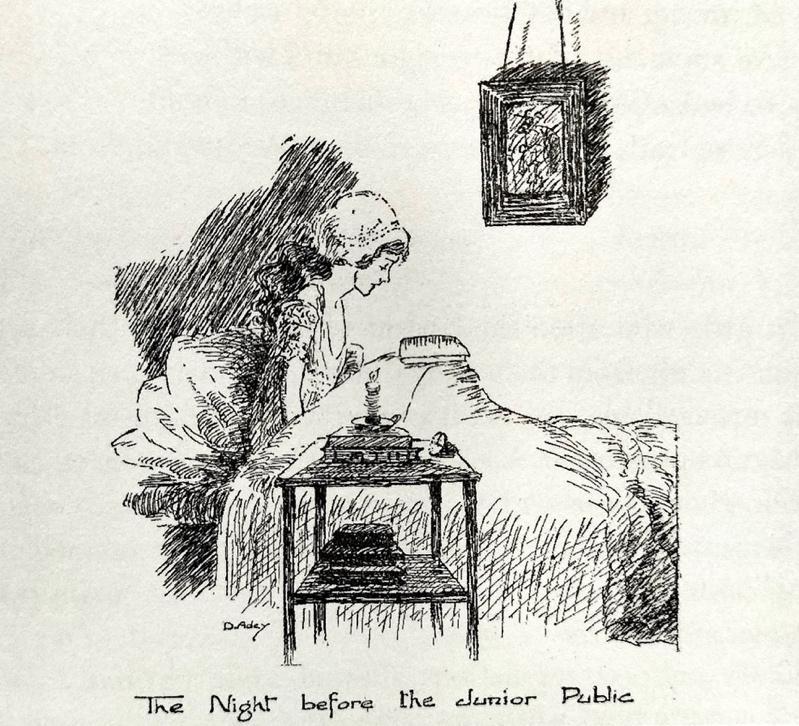
'The Night before the Junior Public (Examination)'.
In this 1922 sketch, Daisy Adey captured an image of a school that offered an academic education for girls.
(Courtesy the 1922 Girton Magazine, cited in John Davis, Principles& Pragmatism , 2nd Edition, Vol. 1, p. 27)
Critics of 'Girton Girls' or opponents of an academic education for females did not scare Lillie Smith. She also appreciated the importance a sound academic reputation played in encouraging parents to enrol their daughters. The first girl Lillie enrolled was the academic Margaret Cheadle (McGuire), she persuaded John Crampton to switch his highly intelligent daughter, Hope, from Miss Dow's Yoothamurra School and, in 1919, she awarded scholarships to Yvonne Wait and Effie Deland (Best). South Australian Premier from 1920 to 1924, Sir Henry Barwell, educated his daughters at Girton House. Mary Barwell was a precocious Girton House student. At just fourteen years, she topped the list of 1400 candidates in the Junior Public Examinations. Mary passed in nine subjects, gaining credits in five. She led the honours list in Latin, came second in French and Physiology and recorded excellent results in History and English Literature. Lillie awarded her a two-year scholarship, not that her father needed it.
For Lillie, the development of character was the most important goal of education. In her 1923 Speech Day Report, she told parents that an education was of no value if it failed to equip girls to participate fully in community life. In the 1916 Girton House Magazine she wrote that:
…success…could only be measured by nobleness of character, and the advancement towards the ideals of true womanhood… Education that failed in raising the ideals of women, and in making them realise their true relationship to the busy, workaday world about them, was worse than useless…The education of girls at the present time stood for more than ever it had done before in the World’s history;…let their lives be so full of joy that for sheer delight they must dance…Save them from…anything that can in any way spoil the natural charm of our girls.
Here, there is the strong sense of the 'womanliness' mentioned in Chapter 6. She called John Ruskin a great admirer of noble women and agreed with him that ‘The path of a good woman is indeed strewn with flowers; but they rise behind her steps not before them. Her feet have touched the meadows, and left the daisies rosy’. To Lillie, Ruskin emphasised the natural rather than the artificial charm of women: genuine and consistent charm was her goal, not calculated, superficial, insincere appeal. But there was more. Lillie aimed to develop her girls' academic talents as well as their natural charms. Looking to the future, Girton House girls were to take their place among men and other talented women in academia and the professions at least before marriage and be ministering angels in the home. She wanted clever, decent ladies fully involved in community life.
Girton House's success confirmed that Lillie's aims synced with those of her clientele, even if most could not define those aims precisely and fully.
Lillie endorsed the English Public School system and the machinery that underpinned it. As we saw in Chapter 6, the system, modified to suit local conditions, permeated Adelaide's independent schools. St Peter's, Pulteney and Prince Alfred Colleges were obvious local boys'
school exemplars. Lillie's two sons attended 'Saints'. And the private-venture girls' schools mentioned in Chapters 3 and 5 used a modified version of the public-school machinery.
It would have been surprising if Lillie had not adopted it, and Girton House had many features of English Public Schools. But it differed in three important ways. First, it was primarily a day school that took in a small number of boarders. As mentioned in Chapter 6, there was an English exemplar for this model, Clifton College in Bristol. Its progressive first headmaster, John Percival, believed that, ‘the best education…was obtained by the boy who lived in a good home and attended a good school near his home a school well organised, well instructed and of high tone’. Lillie saw no reason why this approach should not apply to her girls’ school. The second way in which Lillie deviated from traditional public-school machinery was that she did not establish a house system. Girton House, at least initially, was too small to warrant one. Thirdly, unlike Eton, Rugby and other English Public schools, Lillie could not afford a school chapel.

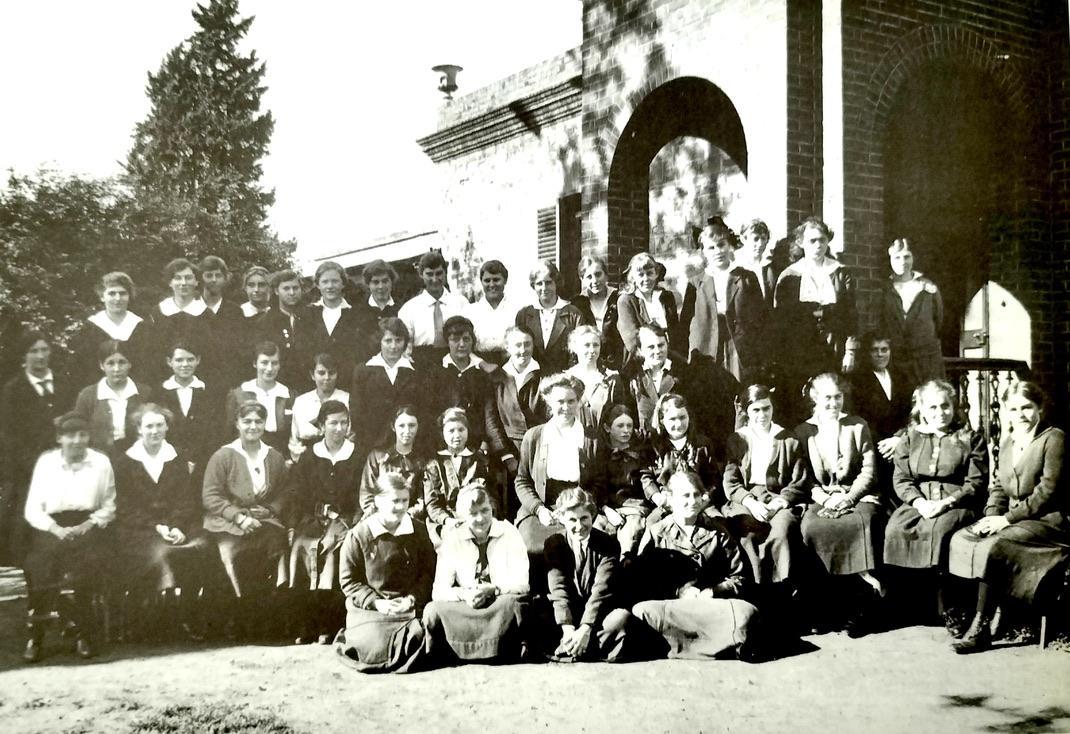
So, what public-school machinery did she use?
True to the model, she called class groups ‘forms' in the English manner: 'First Form', 'Second Form' and so on. Tradition also dictated that Headmistress Lillie took charge of the academic Sixth Form.
Declaring that 'All good schools in England insisted upon uniformity of dress', Girton Girls wore a uniform, of a sort. Lillie allowed some latitude, certainly in the early days. Girls could wear dark blue, white or cream. Most chose a navy skirt and a white blouse. In summer Lillie allowed girls to wear white dresses. Imagine how dirty they would have become in the dusty school grounds. Tan or sand-coloured stockings were matched with black shoes. Girls wore a
navy or blue Panama hat, on which they pinned their school badge. In public-school style, Lillie chose exemplary students as prefects, as role models; and girls identified them by their white felt hats that had distinctive blue, white and gold striped hat bands. Boarders wore their 'Sunday best' to church a cream costume and a cream hat. But, Lillie's latitude in uniform matters had its limits, as we shall see.
Their school badge identified Girton House girls. Lillie chose an ellipse with two gold borders. Within the space defined by the inner border she placed a stylised white rectangle with concave sides. It was set against a dark background. In the centre of the rectangle, she included a cross with equal transepts pierced by an arrow pointing from right to left. The arrow might have represented the importance of having a goal in life. That is not the meaning used in heraldry, and we do not know precisely why she used the arrow. In true public school keeping, Lillie chose a Latin motto, Laboreet Honore 'by labour and with honour' which she placed on a ribbon below the badge. Girton House girls were to work hard at their studies and behave in a morally upright manner.
When the Church of England opened Victoria's Mentone Grammar School in 1923, it chose the same motto for its crest. Sometime later, the motto was located on the badge itself, placed at the top between the two borders.

(Courtesy PembrokeSchool Archives)
Lillie began each day with a morning 'muster'; significantly, in 1915, she chose a military term over 'assembly'. Each form had its own flag, there were inter-form sports contests, communal singing, a school magazine and annual speech-day ceremonies. The object was to inspire espritdecorps , but nothing did that as well as pitting Girton House against other girls' schools in sporting contests.
Lillie entered Girton House in the Girls' Secondary Schools Tennis Association. Her girls played against the Methodist Ladies’ College, Wilderness, Walford, St Peter’s Girls' School and St Dominic’s, the only Catholic school in the competition. St Dominic’s inclusion was probably due to its social standing, its English tradition and its North Adelaide location. Girton House also fielded basketball (now known as 'netball') teams. Other girls’ schools played hockey, but Lillie thought it too dangerous for her young ladies. Realistically, the exclusion of hockey might have had more to do with the cost of finding, establishing and maintaining a pitch. Lillie considered sport important for building character and the annual school magazines featured detailed reports on Girton House's basketball (netball) and tennis teams. Her staff, her girls and Lillie followed the teams' fortunes closely; and she awarded prizes to worthy recipients at the annual speech days.
The tendency of girls' schools to imitate boys’ schools was evident in Girton House's first year. Lillie established a Rowing Club. We know that her younger son, Jimmy, was stroke of St Peter's College's victorious Maiden Fours (Second Crew) in 1917, and his involvement in the sport might have encouraged Lillie. By 1916, 20 Girton House girls rowed on the River Torrens in boats hired from the well-known Jolley's Boathouse. But the club was short lived, and the last reference to it in school magazines was in July 1917. Wilderness, St Peter’s Girls’ School and the Methodist Ladies’ College had crews at the same time.
The chapel and religious worship were important components of the public-school system. In the absence of a school chapel, at morning musters Lillie read the Collects and the
Lord's Prayer and the girls sang a hymn, accompanied by a student playing a violin. As Helen Reid showed, in Victorian England there was a strong link between church attendance, evangelical Protestantism and genteel social respectability: for many people, church attendance was a social necessity, rather than a spiritual imperative. In terms of religious worship, this is more than likely an accurate description of muster under Lillie's direction, and her own commitment to religion. Lillie was an Anglican, but she enrolled Congregationalists, Methodists, Presbyterians, Catholics, Quakers and Jews and did not require them to attend muster. Nonetheless, most boarders attended St John the Evangelist Church of England in Halifax Street, where Lillie was a communicant member. Rector, the Rev. H.P. Finnis was the Girton House Chaplain.

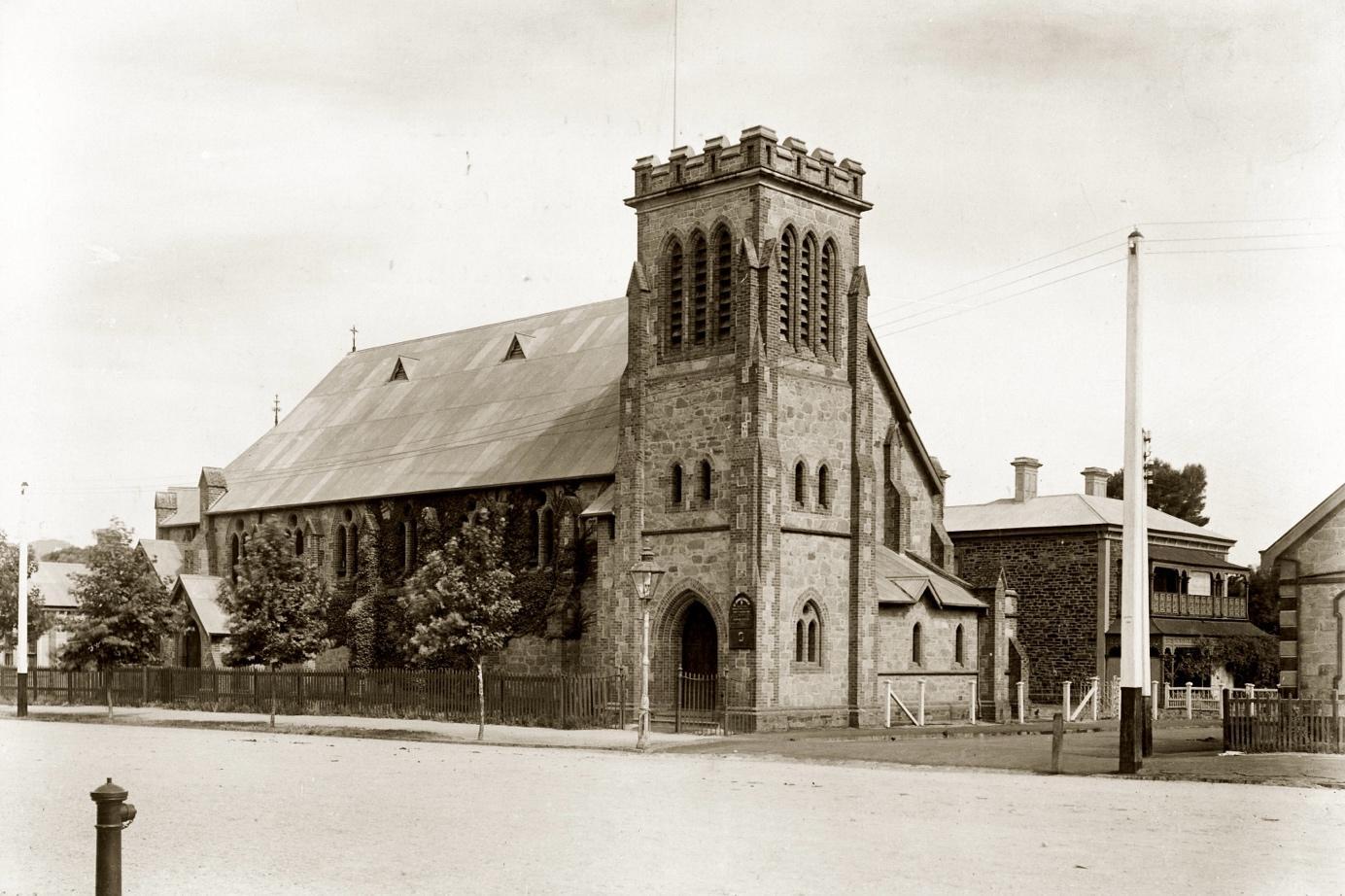
Lillie knew the success or failure of Girton House depended largely on her ability to attract students. There was a limited clientele who could afford a private-school education for their daughters. Lillie set her fees accordingly. She charged senior students over the age of 15, eighteen guineas (£18/18/-) a year with extra charges for stationery, class singing and special subjects. She charged boarders an additional £78/15/- a year, plus £1/1/- pew rent for attending St John's. Fees at comparable schools were lower. Wilderness and Walford charged sixteen guineas (£16/16/-) a
Helen Reid, AgeofTransition:AStudyOfSouthAustralianPrivateGirls’Schools1875–1925 , pp. 4–5.
year for girls over 15, plus extras. In 1898, Tormore House charged twelve guineas (£12/12/-): allowing for inflation, its fees were probably about the same, or a little less, as those Lillie charged when she opened Girton House in 1915. The Methodist Ladies’ College opened in 1902 and its fees were determined by a girl’s age on entry. Girls over 12 years were charged twelve guineas (£12/12/-), but if they joined the school before they turned ten their fees were set at six guineas (£6/6/-) a year for the remainder of their schooldays. A few families who lived near Wilderness sent their daughters across town to take advantage of the cheaper fees the Methodist Ladies’ College charged. Teachers and students at other schools believed that Wilderness served the ‘Adelaide Establishment’: daughters of several prominent families attended. Schools aimed to tap into particular client groups and Lillie competed for the custom of Adelaide’s wealthiest families. Did she succeed?
Yes. She attracted students with little recourse to advertising and her success had an adverse effect on Tormore House. The opening of Girton House was partly responsible for its closure in 1920, and Tormore's headmistress, Caroline Jacob, accused Lillie of poaching students. She claimed Lillie wrote to parents of Tormore girls ‘inviting them to enjoy the greater social benefits of her school’. The Tormoreanwas concerned that some Tormore girls might prefer ‘a more fashionable school’. The precise number is unknown, but some girls did leave Tormore for Girton House. Similarly, Evelyn Hyland and Margaret Cheadle transferred from Miss Shroeder’s Boarding School. Lillie also made good use of James's business connections, word of mouth and direct correspondence to attract the clientele she wanted. Her school included daughters of the South Australian gentry, well-established business families and prominent members of the Stock Exchange.
Historian, Dirk Van Dissel, identified the Adelaide gentry of the period from 1850 to 1920. Van Dissel described the gentry as those men who directed the economic affairs of South Australia and influenced its political decisions through their access to Parliament, especially the Legislative Council. He distinguished between ‘old’ and ‘new’ gentry. The former included the original pastoral families while the ‘new gentry’ consisted of men in commerce, trade and the professions. By the 1890s, the Adelaide gentry had a broad membership and only 20 per cent of its members were pastoralists. The rest were merchants, professional men, government officials and politicians. At Girton House more ‘new gentry’ families such as Bonython, Holden and Verco were represented than the ‘old’, such as Bowman and Rymill. Not all girls could claim a link to the gentry, but some hoped to enter polite society through marriage. Former student and teacher at the school, Hope Crampton, commented that many a Girton House girl hoped to ‘get her man, get him into St Peter’s Chapel, and settle down to a delightful life with few difficulties’.
For men who could not claim gentry status by birth, membership of the Adelaide Club was a marker of a privileged social standing. Of the 77 girls enrolled in the Girton House secondary school in 1916, 22 were daughters of current members of the Adelaide Club, or men who later became members. A comparison of the school’s roll and the club’s membership suggests the number may have been higher. Certainly, daughters of the South Australian gentry were among the students of Girton House. The girls were aware of this, particularly those who
Dirk Van Dissel, TheAdelaideGentry,1850-1920 . In Richards, Eric (Ed.), TheFlindersHistoryofSouth Australia.SocialHistory , pp. 333-337.
came from more modest backgrounds. How they must have envied one girl who lamented being placed on a dress allowance of a mere £3 a month in 1917. Jocelyn Bowman (Evans), 'a tall, shy, eleven year old from the country' and a member of the old-gentry family mentioned above, was one of the pioneer students who joined the school in 1915. Old gentry she may have been, but unsophisticated Jocelyn noted, 'All the society girls of Adelaide attended Girton House'. In 1919, student Effie Deland (Best) observed, ‘at first it was very much a place for snobs’.
Members of Adelaide’s Stock Exchange did support Lillie and Girton House, and the connection survived long after she sold the school. Stockbrokers who educated their daughters at Girton House and its successor, the Girton Proprietary School for Girls, included Gordon Sunter, Henry Warburton ('Harry') Hodgetts Jnr, Cuthbert Viner Smith and Sir Donald Bradman. Hodgetts’s membership of the Adelaide Club underlines the link between the Exchange, commerce and genteel society.
Lillie's reputation — 'Miss Thompson's School' was well remembered and well regarded; her aims for Girton House, the public-school education adapted for girls she offered, the clientele she hoped to attract, her fee schedule and her recruiting methods attracted students. A little hesitant at first, Lillie's fledgling school began with short, tentative steps that grew stronger throughout 1915. By the end of its first year, Girton House's future promised well and in the next few years it grew to be a robust and confident teenager.
Chapter 8
'Playing the Game' at Girton House
Play up! Play up! And play the game!
Sir Henry Newbolt, from his poem, VitaiLampada
Lillie Smith set the values and expectations of Girton House. In its obituary of 22 June 1926, the Register , claimed that many of her girls had benefited from 'her alert mind and stimulating character'. In her ABC radio talk of 20 December 1970, foundation student, Margaret Cheadle (McGuire), ladled on compliments like thickened cream, but her presentation was no hagiography:
If we are going to talk about Lillie Smith ... we must put aside any preconceived picture we may have of the typical headmistress that earnest female with high qualifications and low heels. For Lillie Smith was a very different kind of person sparkling, domineering, demanding, gentle, affectionate, unselfish ..., [a woman possessing] a strong, passionate nature, a fiery temper and impulsive affection, held in leash, schooled and controlled by an indomitable will.
Lillie valued loyalty. She demanded it from her staff and her Girton House girls. And parents, too. On one occasion she publicly reprimanded a woman at a social function for spreading rumours about the school. Lillie told her bluntly:
If what you say is true, you should have first reported it to me and then taken your daughter away. If it is not true, you are impugning the reputation of your own daughter, for your daughter’s reputation is inextricably bound up with that of the school.*
The woman apologised to the whole school in writing, rather than the headmistress in person, and did not withdraw her daughter. Most people connected with Girton House were keen to protect its reputation. Lillie expected and generally won the loyalty of the school community, including staff, students and parents.
Lillie was an individualist, independent. The Commonwealth Government introduced a £5 'baby bonus' for new mothers in 1912 excluding Indigenous, Asian, Pacific Islander and Papuan mothers and Margaret Cheadle (McGuire) suggested that Lillie would have been appalled had she lived to see the full development of the welfare state. Such a concept was anathematic to Lillie who believed that if something needed doing individuals should take on the task, not governments. Lillie believed schools had to teach personal responsibility and duty.
Margaret Cheadle, PersonalitiesRemembered.LillieSmith. The text of a talk given on radio station 5CL on 20 December 1977.
Girton House girls were morally obliged to be self-reliant, self-sufficient, duty bound to 'get on with it'.
Above all, Lillie demanded truth, honesty and justice. She made allowances, however, for minor breaches such as little girls telling 'little' lies because they were a little frightened, insecure or young. She used minor misdemeanours as learning opportunities and handled them gently, stressing to youngsters the value of honesty. But Lillie found abhorrent dishonesty to achieve an advantage or rejecting the truth because it was uncomfortable. Margaret Cheadle (McGuire) identified 'intellectual self-kiddery' as Lillie's prime enemy that had to be brought to justice. According to Margaret, Lillie thought dishonesty mostly harmed the person being dishonest and she often reminded girls of Shakespeare's advice, 'To thine own self be true'.
Colourful, Margaret Cheadle's comments may have been, but she had a well-balanced appreciation of Lillie Smith's character. Before we look at how the English Public Schools influenced the values promoted at Girton House, it is worth noting Margaret's summary of Lillie:
Mrs Smith faced life with an honesty that was frightening for those who cannot sustain a headache without aspirin. She suffered very much, for she would not turn aside from what she knew was the truth, or spare herself in what she considered right. All her faults, and they were mostly faults of temperament and not of character, her temper, her lashing tongue, were countered by really great virtues and a sweetness and generosity that made her beloved of all those who came to know her well.
There were frequent references to opportunity, values and character in Girton House annual magazines. As early as 1917, girls commented on the changing role of women and encouraged Girtonians to take advantage of the opportunities a higher education offered. 'Modern girl’ condemned the traditional male view that restricted girls’ education to little more than reading and writing. She enjoyed greater freedom of speech and action, and believed that Girton House girls were paving the way for their sisters of tomorrow. She warned, however, that ‘modern girls must not lose their femininity'.
The magazines also reported the successes of old scholars at university and in other fields. Described as ‘loyal Girtonians' they had either continued their studies in science, literature, art and music or pursued ‘definite work in business or at home’. They were setting a fine example for the present scholars and living up to the school motto, LaboreetHonore . Indeed, Lillie expected her old scholars to live their lives by the values they learned at school. What were they?
Lillie believed in the principle of service without reward. It was the most highly regarded quality of a Girton House education. In 1917, Lillie presented prizes for ‘Unselfishness and thoughtfulness for others’, ‘Neatness and general helpfulness’ and ‘Helpful work in the boarding house’. While these awards contradicted the principle of giving service without reward, they illustrate how much Lillie valued the service ethic. ‘The Loveday Bonython Prize’ was Girton
ibid.
House’s most treasured prize. Loveday was the daughter of prominent Adelaide architect, Alfred Bonython, and a student of Girton House. Just 12 years old, Loveday contracted double pneumonia and died in September 1919.* In her honour, Alfred Bonython awarded an annual prize to the girl judged to have had the greatest influence for good and who had shown selfless leadership throughout the year. The chaplain presented the prize, always a bible, at the conclusion of the speech-day ceremonies. It was the custom for the recipient to pledge a life of service without reward.
This attitude typified the English Public School ethos, to which the school magazine made frequent references. The Reverend Finnis directly referenced the ‘English public school spirit’ when he addressed the school in 1921. He praised the way it fostered leadership and responsibility, and the even-handed justice it required from that class of boys and girls who attended public schools. Finnis claimed that Girton House girls mixed with girls from different backgrounds in an unaffected manner and showed the best kind of fellowship, an interesting and unusual take on the public school tradition. Public schools taught girls and boys the importance of ‘playing the game’. Girton House girls did play informal games of cricket, in the Parklands. Lillie valued any game that taught girls to play straight in the great game of life, if not always with a straight bat. Former student of Clifton College, Bristol, Sir Henry Newbolt captured the essence of the spirit in his poem, VitaiLampada . Its verse reverberated through Australian schools:
There’s a breathless hush in the Close tonight –Ten to make and the match to win –A bumping pitch and a blinding light, An hour to play and the last man in.
And it’s not for the sake of a ribboned coat, Or the selfish hope of a season’s fame,
But his Captain’s hand on his shoulder smote –‘Play up! Play up! And play the game!’†
Lillie saw that Girton House girls learned the importance of the espritdecorpsso evident in Newbolt’s poem. In 1919 Effie Deland (Best) wrote about the public-school tradition and identified what she saw as its essential elements; loyalty, fellowship and sportsmanship. These qualities, Effie asserted, were to extend beyond the school to the nation — and to the British Empire. Individuals were to subordinate their interests to the common good. Sport fostered corporate spirit, and games against other schools encouraged teamwork and the ability to accept defeat with grace.
Edna Lawrence believed that tradition promoted the right values. For Edna, the school motto helped establish Girton House's traditions. She believed allegiance to the motto and all it
Loveday Bonython's registered birth name was Nancy Loveday Bonython. The devastating Spanish Flu that followed World War I reached Adelaide early in 1919. At first it was a normal form of influenza, but it mutated and became more lethal. It may be that Loveday contracted it. That strain of influenza developed into bacterial pneumonia. Double pneumonia affected both lungs.
† The 'Close' is Clifton's cricket ground. W.G. Grace made 13 centuries for Gloucestershire at Clifton College Close and his children attended the school. This author's Grade 7 teacher introduced him to the poem at Unley Primary School. Many years later, the author was pleased to visit Clifton College during a school cricket tour of England and to umpire a match on the Close. Rain washed out play. Close, but not close enough.
represented was growing among the girls and old scholars of Girton House. The extent to which this was true is impossible to measure, which Edna acknowledged. Writing in 1921, she accepted that Girton House was yet to establish its traditions, but that the process was under way. Edna believed contemporary and future students were honour bound to continue the fine work of the first six years and build on Girton House's high principles so that it may one day vie with its great namesake in the ‘Homeland’. Yes, to most of Girton House's clientele, if not all, England was still 'home'. If Lillie's loyalties lay elsewhere, she was not saying.
In the second and third stanzas of VitaiLampada , Newbolt affirmed that former English Public School boys had a duty to lead their nation in the greatest 'game' of all, war:
The sand of the desert is sodden red, –Red with the wreck of a square that broke; –The Gatling’s jammed and the Colonel dead, And the regiment blind with dust and smoke. The river of death has brimmed his banks, And England’s far, and Honour a name, But the voice of a schoolboy rallies the ranks: ‘Play up! Play up! And play the game!’
This is the word that year by year, While in her place the School is set, Every one of her sons must hear, And none that hears it dare forget. This they all with a joyful mind Bear through life like a torch in flame, And falling fling to the host behind –‘Play up! Play up! And play the game!'
As we saw in Chapter 5, at the outbreak of World War I Australians’ support for the ‘Mother Country’ was strong; and Girton House girls backed the nation’s involvement. Their support was typical of their social class and their Protestant affiliations. World War I provided the ultimate opportunity for Girtonians to display the loyalty the school promoted and that was underlined by the Anglican notion of duty. Individual interests were to be subordinated to those of the nation and the British Empire. Britannia shaped Girton House's values and its girls looked to her to defend the cause of freedom. It was Australia’s responsibility to help in her time of need and, as in peace, Girton House girls were to ‘play the game’.
Lillie of course, showed her girls the way, and nearing the end of the war, her elder son, Gordon, led by example. Having begun his medical degree at the University of Adelaide in 1917, on 2 November he enlisted as a gunner in the 4th Battalion and after basic training he sailed on HMAT Rubic from Sydney for the Western Front on 22 March 1918. His detailed war
experience is unrecorded, but he returned to Australia on 9 July 1919 and resumed his medical course in 1920. Gordon did his bit for the war effort.
In the late 19th and early 20th centuries it was not unknown for wealthy South Australian families of German origin to send their children to Anglican schools. Daughters of the Gebhardt, Homburg and Nitschke families attended Girton House, possibly because their parents sought greater social acceptance than that traditionally accorded colonists of their background. Attendance at schools such as Girton House facilitated the girls’ speedier assimilation into the dominant Anglo-Australian culture. Many families of German descent gave outstanding military service to Australia and, by extension, to the British Empire, despite the fact that some family members were interned during the war. Such experiences may explain why Christel Gebhardt wrote this for the 1916 Girton House magazine:
THE SOUND OF THE BUGLE
The bugle sounds, The war is nigh, Cannot you hear The children cry.
The sound of guns Doth rend the air, While the women and children Cry in despair.
But hark! The hoofs of horses Can be heard a mile away –From the silvery cliffs and mountains To the wide and open bay.
And by the guns are soldiers Of all nations and all kinds, To fight for dear old England, To help her hold the lines.
And by the gates of Antwerp, And by the walls of Ghent, You see the gallant soldier lads Go forward to the front.
The field of battle is before you, The field of love behind, Now boys, show what you’re made of, Britain’s breeding, Britain’s kind!
The public-school ethos is evident in Christel’s verse. The desire of a young girl of German descent to place her loyalty to Australia and the British Empire beyond question may have inspired her nationalistic chauvinism. Perhaps it shows she and her family had already assimilated the dominant Anglo-Australian ideological paradigm. And, Girton House girls had no time for ‘shirkers’ and were quick to exhort all able-bodied men to do their duty. In 1916, Lois Lathlean made her feelings clear:
RALLY
Why don’t you join the forces –You men so strong and brave –To fight for Britain’s honour, And many a life to save?
Wake up, wake up, ye slothful, Throw off your dreams and see That all the men worth owning Have gone right willingly
When Britain wins the struggle, Her sons with victory come: Will you be shamed in saying, That you just stayed at home?
The early support for the war effort was tempered as news of the horrific nature of the hostilities reached Australia. Many young men ignored Lois Lathlean's call to enlist. To meet Australia's commitment and bolster the ranks, Labor Prime Minister, Billy Hughes, held conscription plebiscites in 1916 and 1917, contrary to his party's anti-conscription policy. Australians rejected both. It is no surprise that Girton House girls backed the conscription campaign when the volunteer system failed to produce the number of soldiers Britain required. To Margaret Scott Young the need to consider conscription to increase the size of Australia’s military force was a shameful blemish on the fine record its volunteers had achieved. Margaret lamented in 1916 that 'It is not fair that all the fine men should be killed for the sake of the bounders, the riff raff, that they left. But it is always the way the best are taken, the worst left.'
At school the girls showed their patriotism. During assemblies they sang ‘God Save the King’, ‘The Marseillaise’ and, before the Bolshevik Revolution, the Russian national anthem. Forms 5A and 5B hung pictures of the King between the Union Jack and their form flags. Form 6B chose the colours of South Australia’s 10th battalion for its flag. Throughout the war, girls raised money for patriotic funds. They knitted socks, scarves, mittens and balaclavas for the men at the front line. In return they received grateful letters from England, France, Egypt and Gallipoli, some of which were published in the school magazine.
When peace was announced in November 1918, Lillie thanked God and the courage of the young men who had fought for freedom. In her speech-day report a month later, she expressed Girton House’s great sadness at the loss of life. Forty-eight fathers and brothers of Girton House students who served were acknowledged in the school’s honour roll. The greatest
sorrow was reserved for the five men who were killed. To Lillie, the returning soldiers were loyal heroes, defenders of freedom, the nation and the British Empire. But, Wilfred Owen's posthumous anti-war poem in which he avowed, 'My friend, you would not tell with such high zest / To children ardent for some desperate glory, / The old Lie: Dolceetdecorumest/Pro patriamori.' was yet to be published. Yes, underpinned by the deaths of 60,000 'Diggers' in World War I, many Australians questioned the old lie: 'It is sweet and fitting to die for one's country'.
Lillie reinforced a loyalty to Britain and its Empire that came readily to her girls, given their family backgrounds. Girton House school magazines promoted English values: they included articles on Wordsworth’s poetry and ‘Old English customs’, and a report of Margaret Cheadle’s 1920 pilgrimage to Girton College, Cambridge. English metaphor and literature dominated Lillie’s own writing. But, expressions of loyalty to Australia began to appear as early as 1919 and became more frequent during the 1920s. Student, Lillian Hittman, captured the spirit of nationalism that prevailed among the upper and middle classes when she acknowledged Britain’s influence on the Australian character and national consciousness. Lillian expressed the dual loyalties of the Austral-Briton for whom loyalty to Britain was concomitant with being Australian. Articles about Australia in Girton House magazines started to balance those that extolled British virtues. Effie Deland (Best) and Dorothy Claridge (Ward) noted that student attitudes began to change in the 1920s. They explained this partly by the arrival of some ‘real outback country girls’ and a growing appreciation of the nation’s natural beauty. Nonetheless, the school magazines reveal that Lillie's Girton House never lost its love for the ‘green and pleasant land' of William Blake's England. The clubbable 'Old Boys' Network' was an important and enduring feature of English Public Schools. Old scholars' associations maintained espritdecorpsand loyalty to one's alma mater: literally one's 'generous mother'. Lillie encouraged Girton House old scholars to maintain links with the school, and its Old Scholars’ Association was established on 12 June 1918. The association elected Lillie its president at its first meeting. ‘Old Scholars’ Day’ was fixed for the last Friday in October and no doubt the current students were pleased when Lillie made the day an annual holiday. By 1921, the Old Scholars’ Association was well established. An Old Scholars’ Dance was held annually and was always popular. Fifty-five girls and their partners attended the 1921 dance at which the tables were decorated with blue gum and Iceland poppies. Delicate paper cups and fans completed the picture of elegant simplicity that Lillie so admired. Each year the school magazine included reports of the Old Scholars’ Association’s social and business activities, with news of local, interstate and overseas old girls sharing space with balance sheets. The association presented an annual prize for academic achievement, in a different subject each year. The Old Scholars’ Association became a significant and integral part of the ‘Girton family’.
Schools are typically conservative institutions that reinforce a nation’s dominant ideology, values and attitudes, though they can, and some do, encourage their students to question them. Schools can be powerful forces for change, but more usually they are reflective of society rather than agents of its transformation. With a few exceptions, Australian private schools have been overwhelmingly conservative. Ever conscious of the competitive nature of the market, they present an image attractive to those sections of society able and willing to pay for their children’s
education. These people have middle- and upper-class backgrounds and generally hold conservative values. But all societies allow for varying opinions, and there is a place for their expression as long as they do not deviate beyond the core values. The affluent classes of the early 20th century often embraced the changing cultural values of the time. From the late-19th century on, academic girls’ schools were agents for the transformation of society and Lillie’s Girton House reflected both the conservatism of its clientele and the gentle dynamism promoted by advocates of greater opportunities for women, as long as these opportunities did not threaten male dominance.
Chapter 9
Teaching and Learning Under Lillie Smith
LaboreetHonore
Girton House Motto
Mrs Smith, no doubt, belonged to the generation of autocratic headmistresses, but she and her staff treated the senior girls, not as children but as young adults, taking for granted the ability of each of us to assume responsibility, and treating us as fellow human beings.
TheGirtonBook , p. 20
As would be expected of a 'Grammar School', Girton House’s curriculum was overwhelmingly traditional. Most subjects were based on contemporary English curricula. For example, the History course focused of Britain’s past glories, suggesting the now discredited 'Great Man Theory of History' practised by the likes of Sir Winston Churchill was still in vogue. Not only did it omit references to women and social and cultural history, it focused on politics, great deeds and great achievements. Girton House girls learned that all the red-coloured countries on a world map indicated the extent of the great British Empire.
Lillie's prospectus listed the subjects. They included the same subjects we saw in Chapter 3 and which she had offered in her North Adelaide school in the 1890s. They were commonly found in early 20th-century grammar schools for girls. At Girton House Lillie also offered Geometry, Physiology, Needlework and Physical Training, and the innovative subjects, Domestic Economy and Laws of Health, in the 'Ordinary Course' for the Upper and Middle Schools. And in the Lower School, girls did Needlework, had Physical Training and studied the equally innovative Elementary Science and Nature Studies. Lillie considered Physical Training relatively new in girls' curricula — important and gave it high priority in all parts of her school. Needlework, Drawing and Class Singing were her nod to the female accomplishments, while Physiology was considered a 'soft' science more suited to girls than Physics and Chemistry. It is interesting that Lillie included Domestic Economy in the Middle and Upper Schools. She called it 'Domestic Economy', not 'Domestic Science'. Domestic Science was not offered at Girton House, possibly because of the cost of fitting out a classroom, but it was a subject intended to train working-class girls to become domestic servants. The content of the Girton House 'Domestic Economy' course is unknown and the subject seems to have been short-lived.
This was Lillie's 'Ordinary Course' and it was typical of the period, offering little or no choice. Perhaps, girls were allowed to choose the language they studied. Having an 'Ordinary Course' implies that there was an 'Alternative Course'. Lillie did not articulate one. While it was
The subjects Lillie offered at both her 1890s North Adelaide school and the Upper and Middle Schools at Girton House were Scripture, English, French, Latin, German, Arithmetic, Algebra, History, Geography, Botany, Physiology, Drawing and Class Singing. Girls in the Lower School at Girton House took Scripture, English, French, Arithmetic, Geography, History, Drawing and Class singing as well as the innovative subjects mentioned in the text.
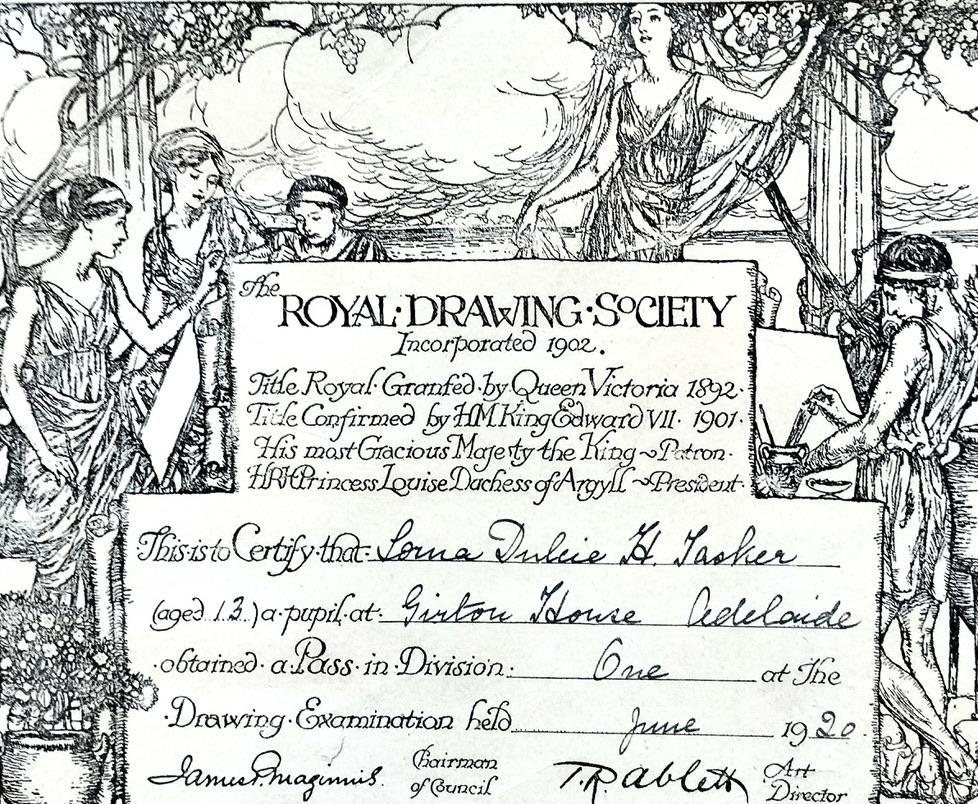

common to have accelerated programs for gifted students at the close of the 20th century, that was not the case in its second decade. However, Lillie made adhocarrangements for several talented girls. She organised Greek lessons for Hope Crampton, whom she allowed to progress at her own rate in others. Hope sat for some senior subjects while still taking the Junior Public (Intermediate) Examinations. In Hope's final year at school, Lillie arranged for her to attend the urbane Professor Henry Darnley Naylor’s Classics class at the University of Adelaide. Dressed in her school hat and cream dress she stood out in the lecture theatre. Hope's father, John Crampton, was an academic at the university and he might have facilitated the arrangement. Even as a school girl, Effie Deland (Best) was determined to challenge male dominance in the sciences. So, she needed to study Chemistry. None of the girls’ secondary schools then had Chemistry or Physics laboratories. Lillie arranged for Effie to attend junior and senior level Chemistry classes at the South Australian School of Mines. In her Senior Public (Leaving Honours) year, Effie took her classes at Adelaide High School. Like most girls from private-venture schools, Effie had not studied Physics and this proved a difficult but not insurmountable problem in studying for her degree.
Most Girton House girls did not proceed beyond the Intermediate Examination and Lillie insisted that those who went on to Leaving Honours did their Leaving year twice, so that they could study subjects they liked as well as the ones they needed to matriculate. Girton House being
small, allowed Lillie to adopt this innovative practice. It also increased Lillie's income, albeit slightly.
Lillie claimed that their education placed Girton House girls among the thinkers of their day. She denounced ‘cramming’ for examinations. She disliked teachers force-feeding ideas and facts, ramming them into girls' heads. In her own subjects, English and History, girls certainly had to learn facts, but they were to use them selectively and effectively. They were to marshal them in support of their arguments; in responding to questions. Lillie even encouraged girls to examine facts for errors. She stressed the Latin origin of the word ‘education’; 'to draw out’. She aimed to elicit each girl's potential and develop her talents fully. This suggests the mildly progressive teaching methods Lillie favoured, but the degree to which the staff used similar approaches is uncertain. It is likely that many resorted to the established methods of the day.
As in all schools, practice varied from teacher to teacher. It is likely that Girton House teaching practice was overwhelmingly traditional, with a few teachers experimenting with progressive methods. There was 'talk and chalk', rote learning and emphasis on the 3 R's reading, writing and 'rithmetic in, at least, the Lower School. There was a strong focus in the Upper School on preparing girls for public examinations. At speech days, Lillie awarded prizes for academic achievement. She even endorsed the draconian practice of each week seating girls in positions determined by their performances in the previous Friday’s tests. This confined the academically poor girl to a life of continued low self-esteem. In this way Girton House adopted one of the harsher traditions of English Public Schools.

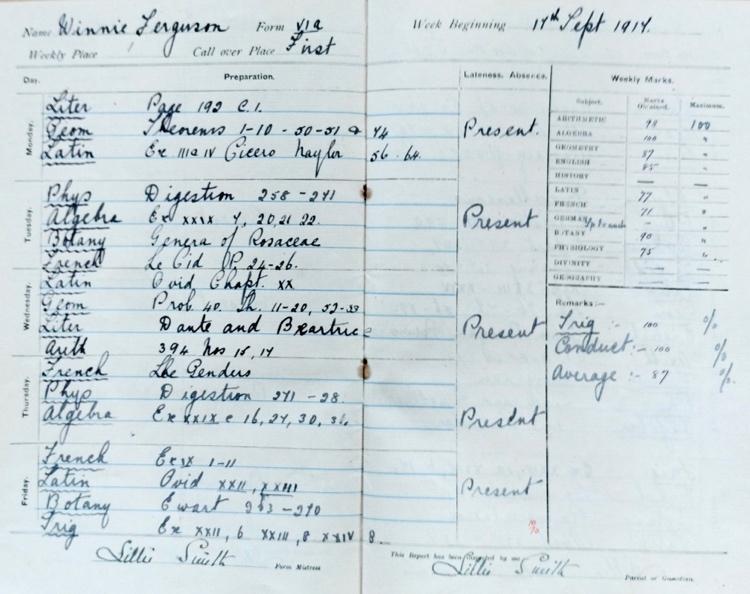
But there were examples of innovative and progressive teaching. Lillie taught Sixth Form English. One Sixth Former thought her unrivalled as a teacher, and 'wouldn't have missed her talks on history or literature for anything in the world'. Lillie did not bother with 'dry' and 'dull' textbooks. She would sit on the edge of the teacher's table being tall she could do this with dignity and talk, not in a vague, meandering way, but with clarity and telling effect that clarified the essential points she made. Shakespeare was her forte. Under her tutelage this Sixth Former learned to 'love and appreciate every line'. Most of all, in class Lillie spoke to the senior girls more as a friend, rather than an authoritative figure. And, each year Lillie took the whole of the Upper School to see Alan Wilkie's Shakespearean Company perform at the Theatre Royal. Former student, Mary Wigg (Lamphee), recalled seeing JuliusCaesar , AsYouLikeItand Hamlet . Ella Baker (Kayser) noted Lillie's love of poetry and how she 'read to us most beautifully'. On one
occasion, Lillie read John Masefield's poem, ToMyMother . Masefield was mourning the loss of his mother who had died giving birth to his sister when he was six years old. It begins, 'In the dark womb where I began / My mother's life made me a man' and, according to Ella, the whole class wondered how 'Mrs Smith would cope with this poem...in those prudish days (when) sex and where we came from was (sic) never mentioned'. Easily apparently, stating, 'Well girls, you all know the facts of life. You are old enough to anyway'. The girls were far more embarrassed than Lillie who carried on undeterred 'as if she were reading a nursery rhyme'. It is doubtful if 'earnest' headmistresses of the 'high qualifications and low heels' brigade, or single female teachers, would have discussed this poem with their Upper School girls in those 'prudish days'. For another reason, it is worth considering Masefield's final stanza:
What have I done, or tried, or said In thanks to that dear woman dead? Men triumph over women still, Men trample women's rights at will. And man's lust roves the world untamed.
This was radical stuff and Lillie Smith was sending a clear and unequivocal message to her senior and most able girls.

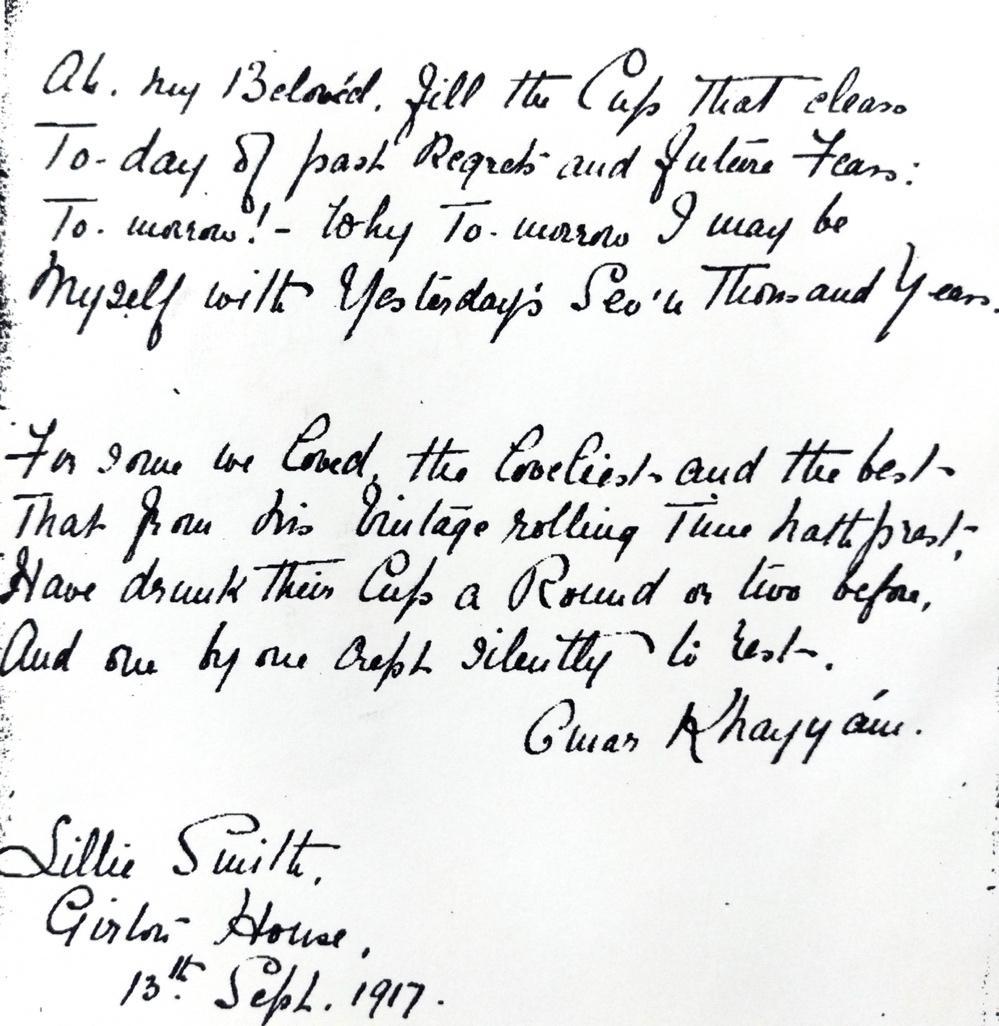
Highly intelligent and well-qualified, Ida Heyne (nicknamed 'Hop') was an outstanding teacher. Like Lillie, Ida had a profound influence on the girls, especially the high flyers destined for further education. Effie Deland (Best), for example, blossomed under her influence. Ida turned her hand to any subject if needs be. She impressed Effie with her modesty and intellectual integrity. In responding to girls' questions, Ida was never afraid to admit 'I don't know'. Such an admission in the days when teachers were seen as fountains of knowledge, is suggestive of progressive thinking. No doubt, Ida researched and offered an answer at a later date. Edith Reeves remembered Ida's Mathematics classes in which she made girls prove theorems using a chain of reasoning, to the chagrin of one poor girl who tried to learn them by heart. One day Ida sent Edith and Phyllis Pedler to a nearby racing stable (probably at Victoria Park Racecourse) to ask for some hay. When the surprised stable hands asked how much they needed and Edith said 'About a handful', they happily handed her the hay. Ida used it in her Physiology class to create a 'hay transfusion', which she placed on the classroom mantlepiece where, in due course, it grew into a healthy crop of mould. Mary Wigg (Lamphee) thought Ida a 'born teacher (who) tried hard to impart knowledge into our unreceptive heads' and recalled the occasion, probably in 1920, when Ida took her class to the Adelaide Observatory on West Terrace in the city. According to Mary, its two telescopes failed to interest the class. The intent, at the very least, was indicative of progressive pedagogy. Together, Ida and Lillie established Girton House's academic aspirations, standards and, eventually, reputation.

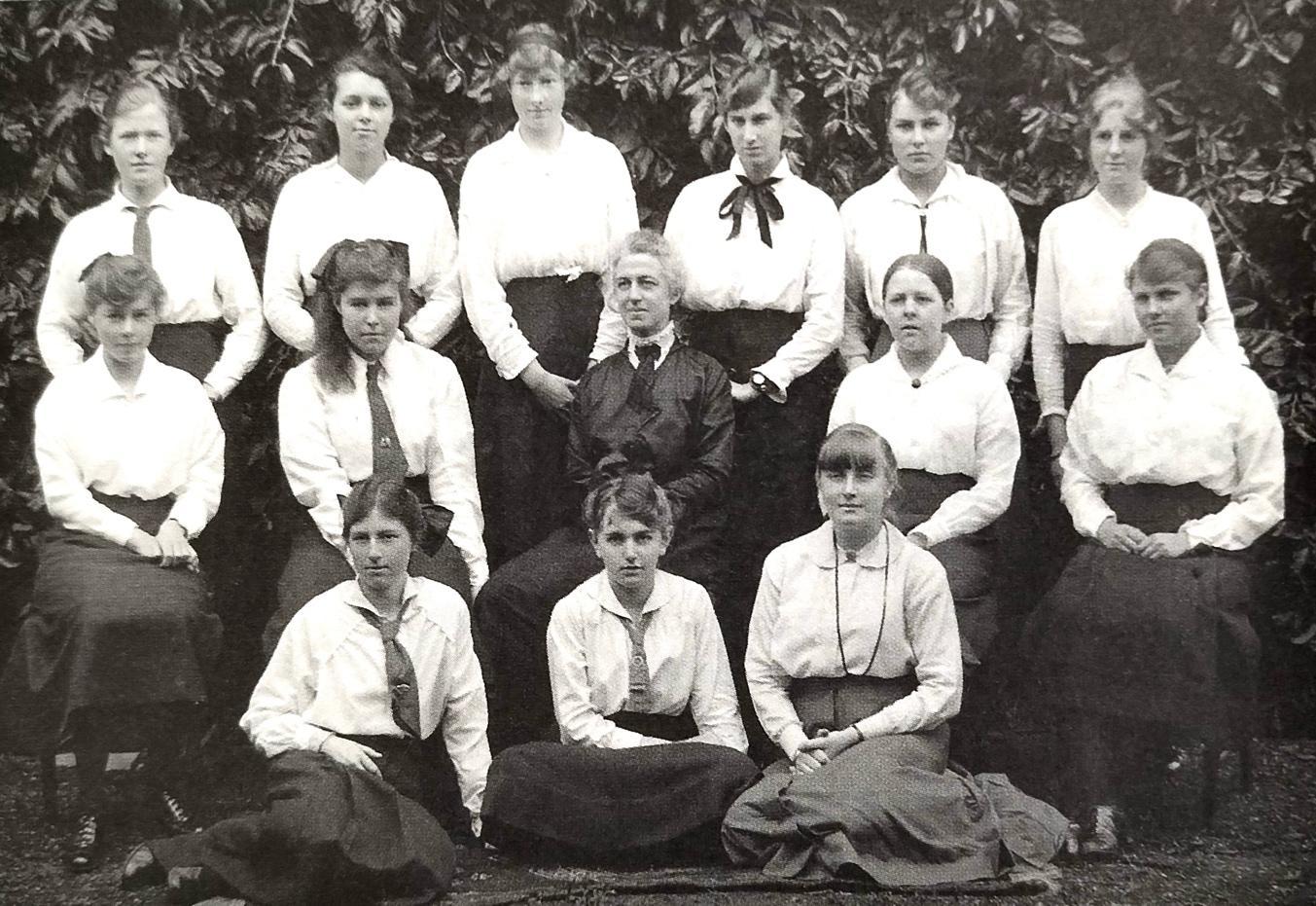
Miss Ida Heyne and girls, 1916.
(Courtesy John Davis, Principles&Pragmatism,2nd Edition, Vol. 1, p 14)
Lillie had a number of single, loyal and full-time teachers, some of whom served Girton House for the 11 years she ran her school. Miss Lottie Wagg was a Lower (Primary) School
classroom teacher who served for 10 years. She also taught girls needlework considered a useful skill for later life up to Fifth Form level and she was a Boarding House mistress. 'A little lady with fluffy untidy hair', Miss Alice Beecher Stow was in charge of the infant class. Miss Alice Stephens taught French and Mathematics. The gentle Miss Kathleen Newman taught History. Miss Minnie Rosman, whose social activities sometimes featured in the local newspapers, taught Latin. Each year she began her introductory lessons with the school motto LaboreetHonore , and Pro Deo Patria 'For God and Country'. English Public School headmasters and headmistresses would have approved. It was Minnie's habit to grasp a pencil in her right hand and prod her left to emphasise a point. She was the tennis coach and popular with the girls.
There were part-time teachers who mainly taught the 'female accomplishments' mentioned in Chapter 7. The colourful French-born Marthe Elisabeth Wait taught French Conversation classes on Tuesdays. The girls addressed her as Madame Wait and they always sang la Marseillaise , that rousing salute to the overthrow of monarchy and revolutionary nationalism at Tuesday morning muster. Ida Heyne's oldest sister, Mrs Agnes Dorsch, BA, also taught French. Miss Florence Cooke, B. Mus., conducted piano lessons for individual girls. Similarly, Miss Dorothy Matheson provided tuition for budding violinists. All Girton House girls had class singing lessons with Mr John Dempster. A young Ella Baker (Kayser) thought him 'dramatic', 'flamboyant', 'enthusiastic'. She recalled the first thing he made them do was to put their forefingers in their mouths while exhorting them, 'Go on, put them in! Eat them!', to make their mouths as wide as possible. And he even taught them to sing Mimi's Aria from Puccini's La Boheme ! On Thursday afternoons, Miss Barnes taught drawing and, for girls who chose, Miss Allen conducted dressmaking lessons three times a week. Dressmaking was not one of the Special Subjects listed in the Girton House Prospectus, whereas Pianoforte, Dancing and Morris Dancing were. There is no evidence of classes or individual lessons being arranged for these three offerings, suggesting a degree of flexibility according to student demand.
Lillie considered girls' health important. Possibly from the start of the school in 1915, each Friday morning a Mr Barringer conducted Callisthenics classes to improve girls' physical fitness, using a series of graceful gymnastic movements. Dressed in his Norfolk jacket and plus fours, he presented the image of an affluent country gentleman. His appearance apparently overawed some of the girls, perhaps the 'littlies'. In 1922 organised sports lessons were first included in the curriculum. Miss Vera Gaetjens was an early sports mistress. Later, Mr Price was the sports master and, aware that he was teaching girls of ‘a ladies’ college’, he believed Girton House had a national duty to safeguard the health and welfare of ‘the coming race’. Thus, he avoided any ‘game or sport likely to have a prejudicial effect when maturity was reached’. National leaders were then concerned that Australia, a 'White' and isolated outpost of the British Empire appended to South–East Asia, should bolster its population. Concerned by the declining fertility rate discussed in Chapter 4, the Observerattacked ‘tight lacing’ (the wearing of corsets) on the grounds that it could impair women's child-bearing capacity. The first sports day was held on 17 October 1922, and included events suitable for active girls, without the alleged risks outlined above. There was no place for high- and long-jump events. While Miss Gaetjens and Mr Price looked after the physical wellbeing of Girton House girls, the School Chaplain, the Reverend H.P. Finnis, guided their spiritual growth and took weekly Scripture lessons. Lillie also took Scripture classes.
There is little evidence of how Girton House girls perceived their learning. Most comments relate to school life in general. Apart from the few remarks about progressive teaching in the above discussion, we can only assume that to girls most lessons were teacher directed and dominated, formal and delivered with strict discipline, with occasional 'lighter' moments. Opinions varied too. While Nancy Holden (Buttfield) thought Lillie 'strict and stern' and 'imperialistic', Marjorie Fisher (Hann) recalled, 'It was not until I went to Girton House that I lost my fear of teachers and found in Mrs Lillie Smith a sweet and gentle headmistress'. Norma Finlayson (Walter) gave an insight into the way Lillie conducted her classes, recalling 'Mrs Smith was a great teacher but easily disappointed with her pupils. The main thing I remember about one class was how little we all knew and when no hands went up for her questions she threw a beautiful lace hanky on her desk in disgust. I remember the hanky, but not the questions!' We can deduce from this that Lillie did try to educe what the girls knew, or how well they could analyse material. Girlie Lynch (Bean) noted that Lillie taught girls to appreciate the English language. Girlie liked how Lillie would read a passage of prose or verse and say 'Isn't that beautiful?' Gwen Goodman (Tennant) liked Lillie very much, but was a little scared of her.
Lillie set the tone of her school. Hope Crampton thought the house on Kent Terrace could have been purpose built for a school. From her study, Lillie could see into every classroom and identify any girl talking out of turn. Girls were to respect their teachers; teachers were to pass on knowledge. Girls were to think, respond to questions; teachers were to draw out what girls knew and thought. Teachers could, however, develop a friendly rapport with girls, without being overfamiliar. There was to be a respectful distance between teacher and student. Authoritative teachers dominated lessons, and from her study Lillie ruled over Girton House in the manner of an old sea captain keeping things ship-shape from the poop deck. Indeed, Jocelyn Bowman (Evans) thought the school 'very rigid and no-nonsense. We would be questioned closely as to whether we had removed our gloves on the way to and from school'. In their reminiscences in WillinglyToSchoolseveral other old girls referred to Lillie's attempts to police the wearing of gloves, which she apparently deemed an important practice for her young 'ladies'. Newspaper article from the Courier , 5 July 1987, courtesy Pembroke School Archives.
Chapter 10
Girton House: The Girls' View
The best school of all for sport and for work, Is Girton the place where none of us shirk, If after hard battles we’re beaten, we’re sure, To take our defeat and try hard once more.
Chorus:
Come along, you Girtons, Never be afraid, Do your best in everything, Show of what you’re made, Here’s three cheers for Girton, Make them loud and long, Let them echo o’er the land, Keep the school fame strong.
At rowing and at tennis we all do our best, We enter the fight with vigour and with zest To make Girton famous her name to uphold, We’re ready to strive for the Blue, White and Gold.
Girton House School Song.
(Lois Lathlean)
In 1916 Fifth Form student Lois Lathlean wrote the Girton House School Song. Yes, the school was a mere one year old and the first line cannot be taken literally: traditions were far from established. Yes, the song reflects the spirit of the times, the influence of the English Public Schools, that the young Australian nation was at war. But it also suggests the confidence of a young woman looking to a successful future for her school, one of which she is already proud, one of which she is pleased to attend. Her headmistress even allowed her to write the school song. So, what were school days like at Girton House? ***
Unless she boarded, each girl's day began with a journey to school. Day girls mainly came from nearby inner-city and eastern suburbs and lived close enough to walk or ride bicycles or ponies, though stabling was not available. Girlie Lynch (Bean) spent three years at Girton. She boarded for some of that time and was also a day student. When she became a day girl, Lillie allowed her to ride her horse, Winnie, to school and tie her to a tree in a nearby lane, probably Little Angas Street. Girlie hung Winnie's feed bag over her head. In 1917, one girl rode a motor cycle to school. While a few arrived in chauffeur-driven cars, most girls who lived farther afield travelled on electric trams, even by train if necessary. That was the lot of Marjorie Fisher (Hann) who
enjoyed two happy years at Girton House as an eight- and nine-year old. Under the watchful eye of 'big girl' and neighbour, Ella Kayser (Baker), Marjorie loved her daily commute from Alberton. She took the train to the city, walked along King William Street to Grenfell Street to catch the 'toastrack tram' it was open at both ends that travelled through the Parklands to College Road, where she alighted and walked along Kent Terrace to school. She enjoyed the camaraderie she shared with other girls and boys who also attended private schools located near the city. She loved the advertising signs on station platforms and city buildings. Until a teacher advised her otherwise, she thought a trade union sign UnionisStrengthread OnionisStrength . Whatever their means of travel to and from school, girls remained on the alert for Lillie's school prefects, who were commissioned to see that Girtonians behaved in a ladylike manner in public. And, boy-conscious girls were ever on the lookout for the long-skirted Miss Rosman, lest she report them for talking to 'Princes' or 'Saints' boys who just happened to pass Girton House on their way to school.
On arrival, girls gathered for morning muster under the tree that shaded the front entrance of the schoolhouse. In the manner of a military commander, Lillie stood at the top of the stairs; tall, majestic, wearing a long navy-blue skirt and, on at least one occasion, a dog standing to each side like regimental mascots. As well as the various anthems mentioned in Chapter 8, the whole school sang a hymn. Henry Milman’s ‘Ride on, Ride on in Majesty’, ‘Rock of Ages’ and ‘Onward Christian Soldiers’ were all popular. When they attended Girton House, in turn Mary Lamphee (Wigg), Eleanor Wood (Skipper) and Mary Hancock perched themselves on the school steps to accompany the singing with their violins, with small ‘prep’ girls’ occasionally tickling their legs.
To some girls, Lillie conducted these daily services like a ritual to be observed before the serious business in the classrooms. While there was little attention paid to religious education at Girton House, girls noted that a Christian attitude pervaded the literature, poetry and daily life of the school. In her own Scripture lessons, Lillie focused more on the literary beauty of the 1885 Revised Version of the Bible rather than doctrinal instruction. One self-described 'scrubby pigtailed teenager' delighted in Lillie's poetic readings of The Psalms, the Books of Ecclesiastes and Isaiah and St Paul's Letters to the Corinthians. Lillie also focused on practical matters, such as behaviour becoming a Christian lady, with the emphasis very much on the ‘lady’. The faith practised encouraged order, duty, propriety and the acceptance of one’s station in life, which may have appealed to upper-class young ladies.
In the school’s first year the ground-floor rooms of the Angas Street property were used as classrooms before Lillie acquired the two properties on Kent Terrace and classes were transferred. Conditions were cramped, especially as enrolments increased. Classrooms were glum and at first girls sat at long tables, some supported by trestles. Before electricity was installed, gaslight lit the rooms on gloomy days. The usual classroom features were present blackboards, maps, rulers, compasses, set squares, form flags, pictures of the royal family and sundry other items. Edith Reeves recalled when the school moved across Kent Terrace, girls' lockers were in the passage ways of both houses. Girls had to take all the books they needed for their classes before lessons began and after each break. They were not allowed to retrieve books left behind or share with other girls. If Lillie saw an untidy locker, she would scatter all the books over the floor. Girls quickly learned to be tidy. Indeed, Lillie’s temper was renowned. She was prone to fly into a rage and one day bit her lip. It bled. Indeed, an erect posture and grey hair piled upon a dignified head forewarned girls of the dangers of failing to meet their headmistress's demanding standards. In class and true to custom, teachers sat at small desks at the front of the room. They
ruled over their charges. They made girls correct errors and complete impositions for breaches of discipline before they were allowed to go home. Unlike their brothers, girls were not subjected to corporal punishment, a rare case in which their characterisation as the weaker sex worked in their favour.
At recess and lunchtimes girls could play or mix in the school yards. Younger girls played hopscotch and 'drop the hanky'. Rounders was a popular game, but the dirt yards soiled many a school outfit. And when ripe fruit fell from the school mulberry tree, it stained girls' white Panama hats. The school tennis court was located across the road and behind the Boarding House where girls played occasional games. It was an 'earth' court, as distinct from a modern-day clay court. Lillie did not allow day girls to cross Kent Terrace to visit the Boarding House unsupervised. Sometimes the duty teacher marched girls two by two across the road where they ate their lunch outside, while she ate in the Boarding House. Lo and behold any girl late back for afternoon classes. Ella Kayser (Baker) recalled when she and two other new girls sat on a bench under the mulberry tree in 1921, two 'big girls' pushed them off. 'Where did we land in our white dresses?' asked Ella. 'In the fallen mulberries.'
There was a shop on the south-west corner of Angas Street and Kent Terrace. To Girton House girls it was simply known as the 'Tuck Shop'. It sold ice cream, sweets, soft drinks, pies, pasties, buns and sandwiches. Class monitors delivered girls' orders first thing in the morning and at lunch time girls collected their food from the 'Tuck' room, which was in the north-west corner of the School House. Many girls bought their lunch from the Tuck Shop, but not Joan Goodman (Morphett) who had to take a cut lunch to school. She thought that boring and considered it 'wonderful' on the odd occasion when she was allowed to buy a bun. One day Nancy Letcher (Edwards) was distrustful of the smell of her pie and refused to it eat it. Her friend, Pat Bailey, said 'Oh, don't waste it. I'll eat it.' She did and the next day was horribly sick. Without her parents’ knowledge, scholarly Hope Crampton walked to school rather than take the tram and bought a penny ice cream and a halfpenny chocolate bar with her lunch money. She spent her tram fare and her unused lunch money on books, which she secretly read at home by candlelight each night. On occasions, Girlie Lynch (Bean) and other boarders crept down the back stairs of the Boarding House to buy sweets at the corner shop. Girlie did not have money, so she paid the obliging proprietor with stamps her parents sent her.
Nancy Hamilton (Burton) attended Girton House from 1918 until 1925 and she recalled several groups of day girls. The 'brainy' group included Kath Miell, Mary and Nancy Barwell, Hope Crampton and Effie Deland (Best). The 'social set' included Nancy Rymill, Evelyn Scarfe and Jean Tolley all from prominent South Australian families and about six more girls. To Nancy they were 'very lively' girls who gathered in a shed they considered their own domain and from which squeals of laughter emanated. There was another special group, a group of boys. Yes, boys. Little ones. It was not unusual for very small boys to begin their schooling in girls' schools. About nine boys attended Girton House, and it's probably stretching reality to call them a 'group'. Just as she accepted girls from all the Christian denominations and Jewish girls, Lillie accepted boys; and their fees. Warren Bonython (1923–1924), Neill Hargrave (1922–1925), Peter Moyes (1925–1926), John Grose, Maurice Finnis and Alastair ('Micky') Sandford attended Girton House. It is likely that most lived nearby. Neil Hargrave lived in William Street, Norwood, a short distance from Girton House. He did not know how his lawyer father persuaded Lillie to enrol him, but he began aged six in Form 1A in 1922. The only specific thing Neill recalled from his
Girton House education was that he learned how to sew on buttons. In Form 2B he won a prize and the right to keep the Honour Homework Book, having won it nine times for producing the best homework of the week. Neill left at the end of 1925 and began at St Peter's College Preparatory School in 1926. A year behind Neill, Peter Moyes first studied Latin at Girton House before he went on to St Peter's too.

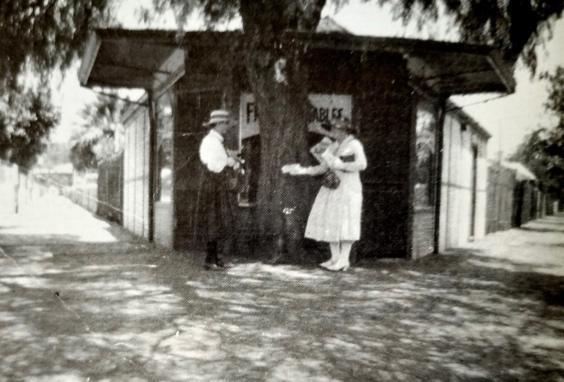
Was this the social set's shed?
(Courtesy Anne Jolley and Gillian Thomas, WillinglytoSchool , p. 96)
(Courtesy Anne Jolley and Gillian Thomas, WillinglytoSchool , p. 96)


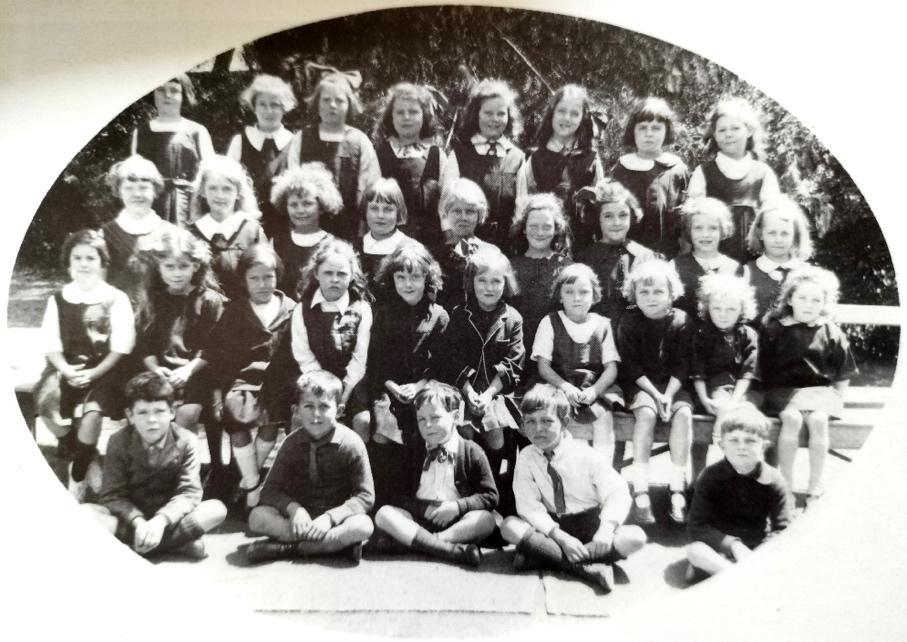
School girls, and boys!
(Courtesy Anne Jolley and Gillian Thomas, WillinglytoSchool , p. 97)
With the 'social' group in mind, Lillie rebuked girls who took her relaxed uniform regulations too far. She declared Mary Laidlaw’s green-and-orange-striped stockings and Evelyn Scarfe’s baby-louis heelsinfradig , and they never reappeared. Girls were to confirm to the elegant
simplicity that Lillie thought most befitted young ladies. Nevertheless, daring girls carried powderpuffs and lipstick, perhaps to make themselves up before and after school to woo the 'Princes' and 'Saints' boys. The girls who joined the short-lived rowing club in 1916 rowed in a white blouse with a square, striped collar, baggy navy bloomers, black stockings and white shoes. Lillie allowed variation in the tennis uniform. Girls could wear pleated or flared dresses with a high or low waistline, or no waistline at all. The most fashionable girls disliked their cotton tennis stockings and replaced them, first with a blend of cotton and silk, and then with straight silk. Changing fashion trends influenced girls’ hairstyles. The Girton House miss of the 1920s favoured teased ear-puffs, large bows, cut and curled side-pieces or Marcel waves, which tended to flatten during tennis matches. Despite the latitude she allowed in dress, Lillie insisted on high standards from all her sports teams regarding their appearance and manners. She expected girls to be perfect hosts to visitors and Forms took turns at providing and serving morning tea at inter-school matches. Groundsman, ‘Sandy’, swept the court and fastened the school flag to the backstop to complete the picture of genteel propriety.

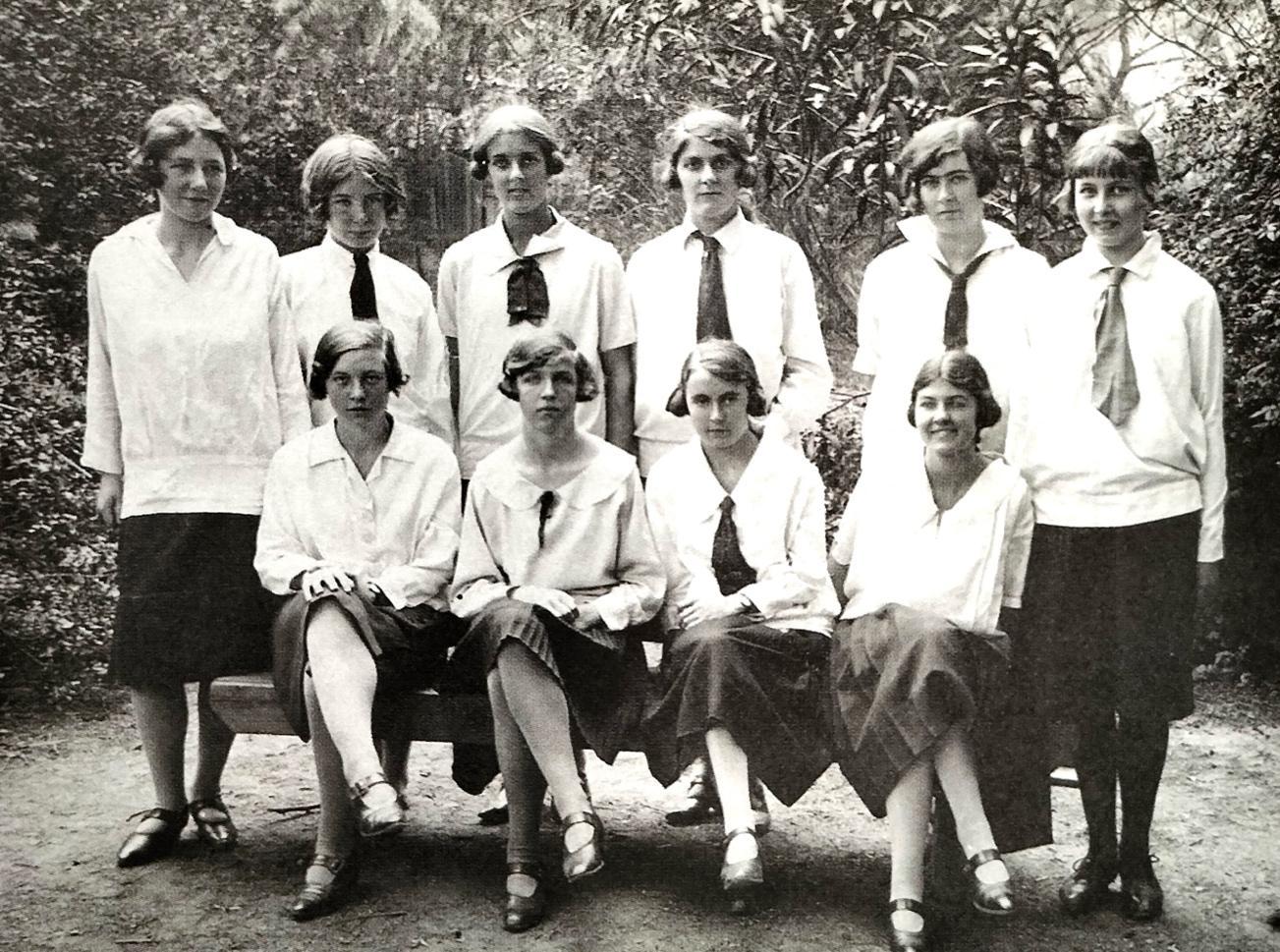
(Courtesy John Davis, Principles&Pragmatism , 2nd Edition, Vol. 1, p. 30)
Talented girls enjoyed inter-school sports matches at Girton House. Unskilled girls and more academically-inclined girls missed out; as was the case in all schools of the era. There is no evidence of Lillie having played sport herself, though she considered it a healthy activity. Financial constraints and lack of space and facilities further reduced the number of girls who could play. Many were spectators. They sang Lois Lathlean's School Song to inspire their basketball (netball)
teams. Kath Cooper (Francis) was Head Prefect, Captain of Sport and captain of a very strong basketball team in 1925. She recalled their training. As Girton House did not have a dedicated court, at 7.00 a.m. girls carried the goal posts along Little Angas Street to the Parklands to practise. It paid dividends. Kath led her team to victory in the finals of the schools' competition on the Adelaide Oval and her team mates chaired her off. And there was more. Kath recalled, 'My father let me have the car and I drove along King William Street with blue, white and gold streamers flying.' Really?
Lillie believed that physical activities improved academic performance in the classroom. It took seven years, but when the school population had increased sufficiently, she introduced the first sports day on 17 October 1922. The events were suitable for active girls. They included 75 yard, 100 yard, hurdle, three-legged and obstacle races for the more athletic girls. To allow all girls to participate egg and spoon, sack, skipping, ‘potato’, flag (team), blindfold driving, hopping, ‘numbers’ (team) and hop and run (team) races were included. Other events included jumping (style) and cricket ball throwing. In English Public School style, forms competed for a shield and the champion athletes were singled out for special praise. Christabel Finlayson and Betty Coulter were the first champions of the Upper and Lower Schools, respectively.
Lillie, James, Gordon and Jimmy reserved the front yard of the Boarding House for their exclusive use, as their home at 7 Angas Street had limited garden space. They took their meals with the girls, but sat at a separate table. The Criticreported that the Smiths spent several weeks during January at fashionable holiday spot, Victor Harbor. This and their other social comings and goings were reported in the social pages of Adelaide's newspapers. The Chroniclereported that Lillie and James hosted a wedding reception at Girton House on Wednesday 28 January 1925, and that 'Mrs J.A. Smith looked well in white silk embroidered marocain and black crin (crinoline) hat with ospreys'. No doubt the Boarding House was decked out fashionably, as the groom, Francis Piers Short, was of the purple. He was the grandson of the late august Anglican Bishop of Adelaide, Dr Augustus Short; the founder, amongst other notable achievements, of St Peter's College, where Francis's wedding to Constance M.L. (Greta) Thomson took place.
The Boarding House had a homely atmosphere; and there was a strong sense of camaraderie among the boarders who probably enjoyed a closer rapport with Lillie than the daygirls. Catherine (Kit) Michelmore boarded and she recalled that boarders and day girls rarely mixed, with the school and the Boarding House on opposite sides of Kent Terrace. The Smiths sometimes took the boarders to the theatre and on some occasions James ‘shouted’. There was great excitement in 1920 when he took them to see pioneer aviators Sir Ross and Sir Keith Smith’s historic landing in Adelaide. The Smiths and the boarders celebrated the occasion with afternoon tea at the Roof Garden of Moore’s Department Store in Victoria Square. Saturday afternoon activities included winter walks in the foothills at Morialta Falls or Waterfall Gully, tram trips to the Violet Farm at Magill and the occasional swim at Brighton on hot summer days. Lillie insisted on girls with fair complexions wearing bathing caps. Ever protective, sometimes Lillie permitted St Peter’s boys friends of her sons, Gordon and Jimmy to walk her boarders ‘home’ after ‘Intercoll’ football and cricket matches. One evening, however, some Prince Alfred College boarders eluded her defences and serenaded the boarders with a kerosene-tin accompaniment.
On occasions the boarders smuggled hampers into the house. Word would spread during evening 'prep' (homework session), a volunteer stayed awake and when the clock struck midnight they enjoyed their furtive feasts. Stories abound about the deplorable food served in school boarding houses, whether deserved or not. Nancy Holden (Buttfield) hated the food served to Girton House boarders: stew on Mondays, mince on Tuesdays, curry on Thursdays, porridge on Sundays...! Unpopular dishes included tripe, lumpy lemon sago pudding, globulous tapioca custard and the dreaded currant pudding the girls called ‘spotted dog’. When they deemed meals inedible, girls hid the offensive food in envelopes and the voluminous bloomers of the era, ready to be stashed in various locations about the school. A favourite spot was beneath the Engineering and Water Supply Department’s inspection plate on the footpath leading to the day school. One day Lillie tripped on the offending plate and discovered the putrid cache. All boarders admitted culpability. Lillie sacked the cook and withheld the boarders’ pocket money for a month. If boarders' Saturday afternoons were reserved for delightful day outings, Sundays were for church. All Anglican boarders worshipped at St John the Evangelist Church in Halifax Street. The Girton ‘crocodile’ made its way through the Parklands and the Victoria Park racecourse to St John’s. Boarding-House mistresses accompanied the girls so they arrived safely and, no doubt, to see they behaved like young ladies during the services. St John’s reinforced the school’s values. Anglicanism emphasised tradition, good order, patriotism and dignified worship. Yet it was not puritanical and allowed greater social freedoms than the other Protestant denominations. For Anglicans, Godliness and the good life could be combined. This appealed to Lillie, and, no doubt, to the boarders. As well as the social cachet associated with Anglican church attendance, there was a spiritual component. Between 1919 and 1923 at least 20 girls were confirmed at St John’s and the exact number was probably higher. Lillie ensured that newly-confirmed boarders thanked St John’s rector, the Reverend Finnis, for preparing them. He greatly appreciated the girls’ involvement in the life of his church.
Generally, Girton House was a kindly school. Lillie loved animals and encouraged her girls to treat them with kindness. The school magazine of 1916 includes a eulogy to ‘Pip’, the 'school dog' that died after taking a bait. The school was often a temporary home to stray animals that had the good fortune to wander on to its grounds. At a time when epidemics frequently threatened public health, many girls were accustomed to trauma associated with the death of a loved one, a school acquaintance or a close friend. Girton House had its share of tragedies and girls showed their compassion for the ill and suffering. Girton House students who died included Loveday Bonython (1919), Shirley Gibson (1921) and Laura McBain (1925). Lillie expected Girton House girls to help people less fortunate than themselves, with Friday donations to charities and relief funds being part of school life. Each year girls sewed dresses to give as Christmas presents. In 1925, for example, girls presented dresses to young girls of the River Murray Settlements. They sent food parcels to needy people and the school’s Donation Fund raised £32 for the Children’s Hospital Fete. They sent donations to missions, babies’ homes, orphanages, the Bedford Park Consumptives’ Home and the Mission to Lepers.
Farewell, Dear Girls of Girton House
I was ever a fighter, so‚ one fight more, The best and the last!
I would hate that death bandaged my eyes, and forbore, And bade me creep past...
From Prospice , Robert Browning
Lillie first realised that her health was failing in 1922: 'ever a fighter', she carried on. When her long-serving Senior Mistress, Ida Heyne, took on more administrative duties from 1923, the girls knew that Lillie was unwell. Word spread that she had worn herself out running the school. In fact, she had pernicious anaemia. Pernicious anaemia is a disease of the red blood cells that occurs when the intestines are unable to absorb Vitamin B12. Until at least the 1920s it was lethal, with patients at very high risk of developing stomach cancer. Its onset is usually slow and symptoms include feeling tired and weak, dizziness and breathlessness. No wonder Girton House girls thought Lillie had worn herself out.
To Margaret Cheadle (McGuire), Lillie faced the challenges of death as she did the challenges of life, 'with courage, honesty and even gaiety'. According to Margaret, Lillie considered Tennyson the father and Browning the prophet of modern poetry. In her radio talk in 1970, Margaret referenced Browning's Prospice , with its themes of death, love and faith. It was Lillie's favourite poem and it was a source of great comfort to her. Browning wrote it in 1861 three months after his wife's death. Tennyson's lines in Oenone , 'Self reverence, self knowledge, self control / These three alone lead life to sovereign power', Margaret argued, were the guiding principles by which Lillie set her life's compass and conduct. Tennyson extolled the virtues of optimism and perseverance: remember the motto of Miss Thompson's School Perseverando. It is no surprise that Lillie faced the prospect of her impending death with courage and the selfdiscipline she expected from her girls. The Girton Book described Lillie as 'a Christian in religion, but of the liberal and humanistic school'. Whether she believed with Browning in an afterlife 'The best is yet to be/The last of life, for which the first was made' is unknown, but it is interesting that on death's doorstep she turned to her favourite poets rather than the Bible. Ida Heyne was acting headmistress in 1925, as Lillie was so unwell she could not attend school. Lillie spent long periods in hospital. She loved flowers, and it was the custom that each year Girton House girls brought flowers to celebrate her birthday. They brought flowers regularly in 1925 and a Sixth Form girl would take them to Lillie. On one occasion Edith Reeves delivered them and she was nervous about visiting her headmistress in hospital. She did not stay long, gave Lillie the flowers and the love and best wishes of the whole school. Edith recalled her feelings afterwards, 'As I walked along Kent Terrace, I felt very sad at our dignified headmistress lying there so weak and ill'. Several old scholars also visited their former headmistress.

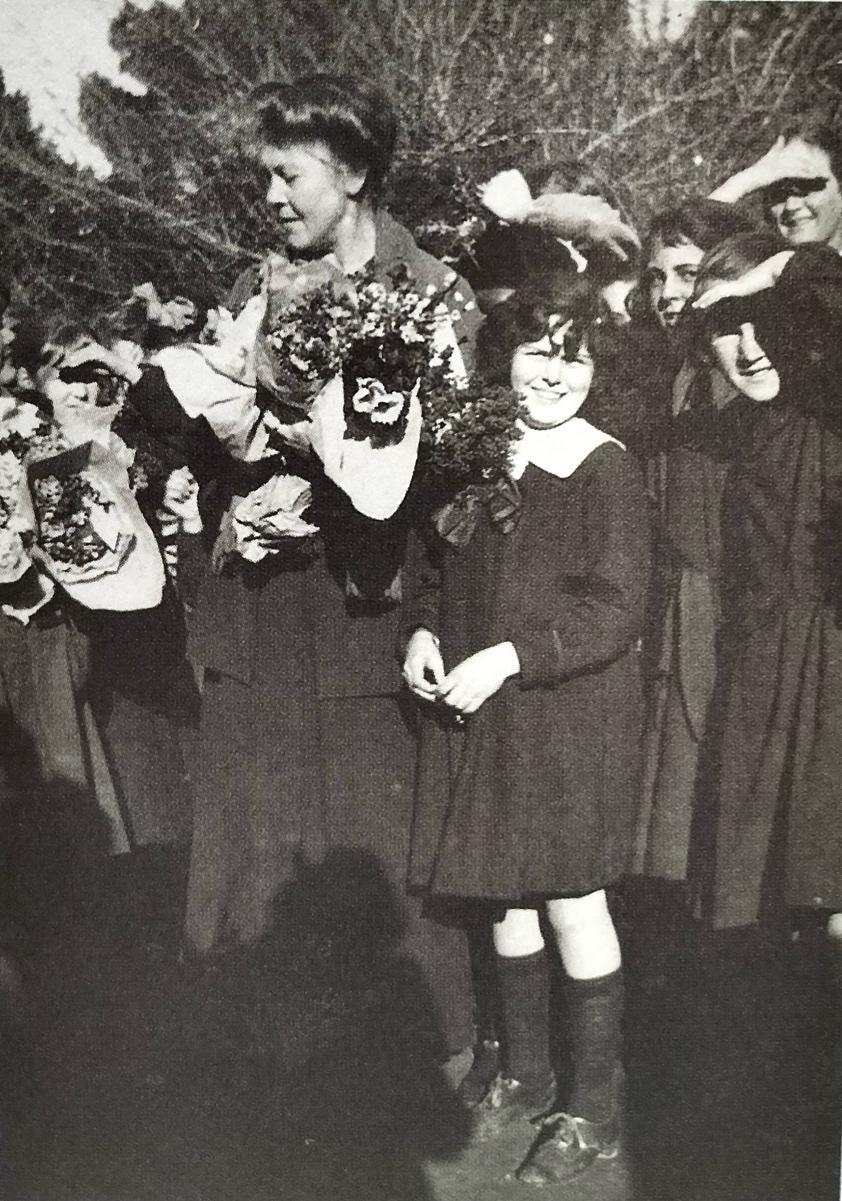
Lillie was too sick to attend the 1925 Speech Day. On 2 December, she sent a letter to her teachers and her girls to say 'Good-Bye' and to express her deep gratitude for their love. She believed her love would follow them through the years. She thanked them for all they had done for her. She rejoiced in the beautiful flowers they had sent: they had kept Girton near to her throughout her illness. In 1926, if not in late 1925, Lillie moved from her home at 7 Angas Street, Kent Town, to 145 Wellington Square, North Adelaide, and she hoped girls might visit her there. Ever the teacher, she explained that 'Good-Bye' meant 'God be with you' and that it was a beautiful word. She urged them to be great and good women, to make the world a better place for having lived in it. In closing, she implored them to remain loyal to the school as 1926 would bring much that was new. She urged them to stand by the school's traditions in the future, to close their ears to those who would influence them against it. She urged them to 'give ear to no one who would encourage you to fail in your support of the Teachers whom you must learn to know and to love'. Two days later on 4 December she sent a final message:
And now, farewell, dear Girls of Girton House. The sorrow of the parting is great, but the Fates have decreed that I can no longer work among you who have been so dear to me. Your love and loyalty have been very real, and have helped me through many weary days. My desire is that you carry a like measure of loyalty into your School in its new form. You must realise that changes are inevitable, and, though it pains us to cast away what has long been dear to us, it is a duty and privilege to face bravely the years among ‘strange faces, other friends’. I commend to you for your special thought and comfort Tennyson’s lines in ‘Morte d’Arthur’: -
The old order changeth, yielding place to new, And God fulfils Himself in many ways, Lest one good custom should corrupt the world.
Girton House survived Lillie's death, albeit reconstituted in a different format 'The old order changeth, yielding place to new'. This was Lillie's wish and as she put it, 'When my doctor told me that it was essential, owing to my indifferent health, that I should give up teaching, I fretted dreadfully lest the school which has become so dear to me should go to pieces.' As we saw in Chapter 5, often private-venture schools did not survive the death or retirement of their owners. So, what had Lillie done to ensure that Girton House lived on after her?
Not much herself. She was too unwell. She offered to sell it to the Church of England. It declined. It had opened Woodlands Church of England Girls' Grammar School at Glenelg in 1923 and refused to commit to another financial obligation. Fortunately, Lillie's desire to sell at that time coincided with another enterprising woman's wish to secure Girton House's future. That woman was Mrs W.H. Irwin, wife of the Rev. Irwin, a chaplain and Senior History Master at St Peter's College. The Irwins were keen to educate their eight-year-old daughter nearby, and Girton House was conveniently placed. And, Mrs Irwin was an experienced educator. With her sister, she had conducted Merton Hall, a private-venture school in South Yarra, Melbourne. In 1903, the Church of England took over Merton Hall and for five years Mrs Irwin had remained as the inaugural headmistress of the reconstituted Melbourne Girl's Grammar School. Imagine Lillie's delight when Mrs Irwin approached her with a proposal that Girton House could be taken over and run as a parents' proprietary school. Lillie thought the proprietary model excellent as parents would buy bonds and have a voice in the newly constituted school's management.
In October 1925, reports of Lillie's impending retirement and negotiations to sell and reconstitute the school appeared in the Advertiser , News and Register. Despite warnings that they were 'over sanguine and that probably nothing would happen', Mrs Irwin and her main supporter, Mrs Carlisle McDonnell, called upon Girton House parents to back financially their plan to buy the school. The 'tactful rumour' that the likely new headmistress would be Mrs
GIRTON HOUSE SCHOOL (1925, October 26). News(Adelaide,SA:1923- 1954) , p. 4 (HOME EDITION). Retrieved September 18, 2024, from http://nla.gov.au/nla.news-article129783256.
Dorothy Angove helped and a committee was formed to investigate the possibility of creating a parent's proprietary school under the auspices of the Church of England. The Venerable J.S. Moyse, Archdeacon of Adelaide, headmaster of St Peter's College, the Rev. K.J.F. Bickersteth, and the Rev. H.P. Finnis commended the move. Their support did not sway the Church of England, which had already rejected Lillie's offer to sell. What was important was the support of wealthy and influential businessmen. Stockbroker, Gordon Sunter, and accountant, Neville Newland, negotiated with Lillie on behalf of the newly created company, Girton Proprietary Limited, to take over Girton House Girls' Grammar School, its furniture and its goodwill on 7 December 1925. Goodwill was settled at £2 for every current student who stayed on at the new school. On 4 February 1926, the Registerreported that Girton Proprietary Limited had been registered as a company with capital of £25,000 divided into 5000 shares of £5 each. Lillie's former private-venture school was now an incorporated company. It had survived. Lillie was relieved and thankful.
In Lillie's final year, 1925, there were 230 girls at Girton House. In 1926, about 150 girls continued at the new school, Girton Proprietary School for Girls. Of the 80 girls who left, perhaps 30 had finished their schooling. Parents of about 50 girls chose to send their daughters elsewhere. What schools they attended is largely unknown, but a few girls, including Nancy Holden (Buttfield), transferred to Woodlands, much to Lillie's disappointment. Three sisters, Cicely, Joyce and Glen Campion, transferred to St Peter's Collegiate Girls' School at North Adelaide. Clearly, some parents ignored Lillie's appeal to remain loyal to her old school. The requirement to purchase a minimum of five £5 shares on enrolling their daughters may have deterred some parents, who might have seen this impost on top of the yearly fees too much to bear.
Lillie must have been greatly disappointed over the treatment of her staff. Ida Heyne told one part-time teacher that Mrs Angove wanted to begin with a new team and Lillie's staff had been 'sacked'. Mrs Angove and the provisional committee terminated the employment of Misses Heyne, Wagg, Stephens, Freeman, Jones, Barnes, Trudinger and Robertson, and Mr Price. Mrs Banningan and Misses Brindley and Mayne were also dismissed, even though they had been at Girton House for just one year. Minnie Rosman, part-time music teacher, John Dempster, and recently appointed old scholars, Hope Crampton and Gladys Wait, were kept on. Some teachers might have left out of a sense of loyalty to Lillie. Following her dismissal, loyal Lottie Wagg nursed Lillie until her death. Altogether, 12 Girton House teachers were lost to the new school and this caused some regret among the girls. Senior girls must have regretted especially the loss of Ida Heyne. Ida joined the staff of Riverside School, Fitzroy, at the beginning of Term 3, 1926. Minnie Rosman served one year under Mrs Angove, before being appointed resident mistress of Riverside, starting in 1927.
While Mrs Angove used her new broom to replace most of the old staff with more academically qualified teachers, she embraced the fundamental values of Girton House, especially the one held most dear. At the end of 1925, the new school's provisional committee had invited Mrs Angove to attend Girton House's final speech day. According to student Dorothy Claridge (Ward), what convinced Mrs Angove to accept the offer to become the new
headmistress was the moment when the Rev. Finnis presented Kathleen Cooper with the Loveday Bonython Prize. Dorothy stayed on at Girton Proprietary School for Girls and she noted that it was the notion of serving others without expecting reward that Mrs Angove found most noticeable among the girls, especially among the Fifth and Sixth Formers. Lillie would have been pleased, relieved and grateful.
Lillie died on Monday 21 June 1926. She was 61 years old. Ella Baker summed up the girls' feelings, 'We were very sad when we learned that Mrs Smith had died. She had always worn most elegant clothes and in the latter part of her life, frequently wore a fur coat (probably because she felt the cold intensely, due to pernicious anaemia).'
Lillie Smith's Letter to the Teachers and Girls of Girton House, 2 December 1925
MyverydearTeachersandGirls,
Asyouwillknowbythetimethisnotereachesyou,thedoctorwillnothearofmygoingoutto youto-day.Itisthelastandgreatestdisappointmentofthisyearofdisappointmentsandtrials.
Iamwritingtosay'Good-Bye'toyouall,andtotellyouthatallyourlovingthoughtsfor mehavehelpedmethroughmanywearyhours.Theflowershavebeensobeautiful,andthey havekeptGirtonnearmeallthetime.Ishouldliketohavesenteachoneofyoualetter,butit wouldmakemetootiredtodosomuchwriting,soImustcontentmyselfwiththesendingof thisoneletter.YoumustcometoseemeanytimelateronifyoucancometoNorthAdelaide. AndnowGood-Bye.
Doyouknowthat'Good-Bye'meansGodbewithyouanditisaverybeautifulword?
Well,mydears,allIcansayisthatIwantyoutobegreatandgoodwomen,makingthis oldworldofoursabrighterandbetterplaceforyourhavinglivedinit.
Mylovewillfollowyouthroughtheyearsasitiswithyounow,andIshallalwaysfeelthat youbelongtome.
TeachersandGirlshavedonesomuchformethisyear.Icanneverforgetitall.
GoonbeingloyaltoyouroldSchool.Itwillbringyoumuchthatisnewnextyear,but closeyourearstoanyonewhowouldinfluenceyouagainstit.
ThosewhofailinloyaltytotheGirtonofthefuturearenotthetruefriendsofyour School,andIwouldhaveyouinnowisebeinfluencedorledbythem.
Standbyyourtraditionsinthefuture,andyoucannotgowrong giveeartonoonewho wouldencourageyoutofailinyoursupportoftheTeacherswhomyoumustlearntoknowand tolove.
Myheartistoofullforanymorewords,andmyeyesareveryfulloftears.
Yoursalwayslovinglyanddevotedly,
LILLIESMITH GirtonHouse.December2nd,1925.
Chapter 12
Lillie Smith's Report Card
She was, of course, a woman whose personality and capabilities were far too big for the Adelaide of her time! She was a big frog in a small pond, and at times the disturbances were considerable! Adelaide was a bit terrified of her, a bit shocked, a bit thrilled, but came to be won over by her charm and her really great moral strength.
Margaret Cheadle (McGuire), 20 December 1970
It would have been entirely due to her strong personality that the school grew and prospered, eventually becoming one of Adelaide's leading girls' schools.
Mary Lamphee (Wigg), WillinglyToSchool , p. 9
To Margaret Cheadle (McGuire) and Mary Lamphee (Wigg), Lillie Smith was a strong woman; a dominant personality, one of South Australia’s ‘New Women’, a leading educator of one of Adelaide's leading schools. Inaccuracies due to the passage of time and Margaret's liking for colourful embellishment notwithstanding, the reminiscences of Lillie’s former students throw light on her character, and her achievements. Mary's claim that her success was entirely due to her personality is a step too far. In its obituary about Lillie, the Register , cited an unidentified teacher probably Ida Heyne who served under her from 1915 to 1925, and who said, 'She gave her whole time, thought, and energy to the school, teaching, managing the staff and maids, indeed, she kept her finger on everything and had no patience with inefficiency.'† Assessing the influence of character definitively is impossible, but we will attempt that task for Lillie, after we have considered more tangible measures of her work and the progress of her school.
In October 1925, Lillie told the News that 'It (the running of Girton House) was a private enterprise of my own'. Reminiscing in WillinglyToSchool , Nancy Holden (Buttfield) asserted that 'Girton, owned and run by Lillie Smith was, in my opinion, intended rather to make money for the proprietor than for the comfortable and happy development of its feminine students.' No other contributor to WillinglyToSchoolexpressed a similar view, or commented on Lillie's financial motives. The truth is that all private-venture schools provided their owners' incomes. This pragmatic approach did not mean that the schools lacked sound educational principles. We know that Lillie opened her school in 1915 with 20 girls, including four boarders. By the end of the year there were 89 girls, including 10 boarders. Lillie used her reputation as an
Margaret gave her talk under her married name, 'Margaret McGuire'. In the interest of consistency within the text, when referencing her talk the author has referred to her as 'Margaret Cheadle (McGuire)'.
† FOUNDER OF GIRTON HOUSE. (1926, June 22). TheRegister(Adelaide,SA:1901- 1929) , p. 10.
Retrieved December 16, 2023, from http://nla.gov.au/nla.news-article56569688
educator and her many social connections by writing to parents of prospective students to more than quadruple her enrolments within the first year. We know nothing of enrolments from then until the school closed in 1925, when there were 230 students, including 30 boarders. Enrolments from the beginning of the school to its closure increased over elevenfold. A more useful period to assess enrolment progress is from the end of 1915 to the end of 1925, which saw an increase of two and a half times. In all, some 400 girls attended Girton House during its 11-year life span.
Lillie used a sliding fee scale. Based on the middle 12 to 15 years age group and taking into account stationery, class-singing and boarders' fees her annual turnover for 1915 was about £1850. She might have increased her fees during the life of Girton House, but based on the same scale in 1925 her annual turnover was about £5000. In October 1925, the male basic wage in Adelaide was £4/6/- a week, about the same cost as a term's tuition at Girton House. Lillie dealt with large sums of money. She made fees payable in advance to create a cash flow. With 'her finger on everything' and having 'no patience with inefficiency', she oversaw the smooth running of the enterprise. She hired full- and part-time teachers and auxiliary staff including maids, cooks, cleaners and handyman 'Sandy': and 'sacked' them when necessary. She saw that members of her staff were paid, she chased late fee-payers, she paid pew rents to St John's for the boarders, she bought sports equipment, desks, blackboards, chairs and whatever else Girton House needed. She logged revenue and expenses; and kept balance sheets. Or did she? It would be surprising if Lillie's husband, James, a former bank manager and a current stockbroker, did not help with or, indeed, take over, the school's financial accounts and banking. This is not to undermine Lillie's contribution. A myriad of financial, practical and managerial issues and responsibilities, as well as her girls' academic, social, emotional and physical development, occupied her mind. Former student, Hope Crampton, noted that Lillie 'needed us'. First it was a school, but it also constituted a large proportion of the Smith family's income. Independent private-venture schools succeeded or failed on their ability to attract custom. Lillie succeeded.
A 'Grammar School' must be academic. In its quest for prestige, and students, a 'Grammar School' must do well in public examinations. Not surprisingly, public examination results were listed in Girton House’s annual magazines and girls who gained honours were acknowledged. In the school’s very first year, Doris Goodman gained top honours in the Senior Examination for Ancient History. In 1915, Hope Crampton was a student at Miss Dow's Yoothamurra School. That year, 14-year-old Hope sat and passed three subjects, English, History and French, in the Junior Public Examinations, with credits in History and French. Lillie was an astute judge of talent and knew who to recruit. Following Lillie's suggestion (or demand!), at the beginning of 1916 Hope's father transferred her to Girton House. In that year's English Senior Examination, Hope now aged 15 placed second in the Honours List behind the winner of the Tennyson Medal, and when she won the medal in 1917, her English teacher, Lillie Smith, verily glowed with pride. According to Hope, Miss Dow was 'furious that Girton had won it'. Hope achieved distinguished results in the 1918 Senior Public Examinations. As we saw in Chapter 7, Mary
THE BASIG WAGE (1925, October 27). BarrierMiner(BrokenHill,NSW:1888- 1954) , p. 1. Retrieved September 25, 2024, from http://nla.gov.au/nla.news-article45913713
Barwell was another precocious and highly successful student who enhanced Girton House's 'Grammar School' moniker. She was an outstanding scholar. In 1919 Lois Lathlean won thirteen prizes for academic work and was dux of the school. Others to do well were Mabel Goodhart and Girlie Lynch (Bean). In 1923, Mabel excelled in Science and German and Girlie was top of the class in English History.
It is important to place Girton House's academic results in the context of the school’s educational practices. There was a gradual increase in the number of girls who sat the Junior Public Examination. The number was never very large, and varied from an estimated eight in 1917 to twenty in both 1923 and 1924. It is difficult to make an accurate assessment, but it is likely that most girls attempted the Junior Public Examination. (In 1923, this was renamed the ‘Intermediate’ examination and the two higher levels, ‘Leaving’ and ‘Leaving Honours’.) The number dropped considerably at the Leaving level and was never greater than six in 1925, and it was more usually four. The trend was even more noticeable at the Leaving Honours level. The highest number of girls who sat Leaving Honours was three, in both 1921 and 1922. Not all girls were as successful as those mentioned above, but most passed their examinations. The fact that few girls proceeded beyond the Intermediate level indicates that Girton House provided a good general education for girls who left after three years of secondary education. In this regard, Girton House was typical of girls’ schools of the time. But as we saw above, the school did claim to be a ‘Grammar School’ and successfully catered for girls with the ability and desire to proceed to higher education.
Reflecting on her career on 26 October 1925, Lillie told the News:
I can say that many Girton girls have distinguished themselves after leaving my care. Some I might mention are Margaret Cheadle, who was one of my first boarders and who is now doing research work at the Adelaide University; Hope Crampton who was the first Girton House girl to gain the honours degree in arts; Mabel Goodhart, who is studying law; and Effie Deland who is doing well in the science course; Mary Barwell and Yvonne Wait, both of whom are distinguishing themselves at the Adelaide University.
At least four girls who attended both Girton House and its successor, Girton Proprietary School for Girls, studied at the University of Adelaide. They were Joan White, MBBS; Jean Wilson, LLB; Margaret Lunn, LLB and Dorothy Claridge, BSc (Hons) who noted, 'They and I owe much to Girton House of 1915–1925 inclusive, and the foundation laid down.'
There were other talented students who chose a different career path after leaving school. Ada Stephens graduated from the Kindergarten Training College and became a director of kindergartens in Adelaide and Brisbane. Later, she studied in the United States of America and gained a PhD. Joan Moncrieff was a student at Girton House, winning the form prize for the Leaving B class in 1924. She completed Leaving Honours as dux of the new Girton Proprietary School for Girls in 1926. In November that year she won the Australasian Secretarial Scholarship to study bookkeeping, accountancy, commercial law and secretarial practice.
Lillie appreciated the kudos and related benefits for Girton House that followed the academic successes of her former students. Good teachers and teaching practice played their parts, but Lillie knew that students' academic successes were largely due to the natural talents of her scholars. In 1925, Hope Crampton finished her course of study at the University of Adelaide and returned to Girton House to try teaching under Lillie's guidance. Hope recalled:
There was only one girl that year to do Leaving Honours. "You can try your hand at Kath Miell," Mrs smith said to me. "I don't know if you can teach, but if you can't, Kath is so good that you can't spoil her."
Like all good headmistresses, Lillie knew her girls. Kathleen Miell won a Leaving Honours prize in 1923, in 1924 she was Captain of the School and of Sport and she stayed on to study more Leaving Honours subjects in 1925, but she did not proceed to the University of Adelaide. Less than two years later, on 20 April 1927, the Newsreported that she had that afternoon married Mr Robert Knox of Kensington Gardens. What a well-educated wife and companion she would have made, just what Lillie Smith wanted a 'clever lady'! Catherine Helen Spence would have approved too. Lillie also noted that many girls who did not shine in intellectual attainments married and had families and 'at any rate distinguished themselves on the domestic side'. It's a strong B+ for academic success.
Those who knew, worked with or studied under Lillie Smith almost universally accredited her success as a headmistress to her strong character, her engaging personality, her charisma. Her bearing impressed some. In her radio talk of 1970, Margaret Cheadle (McGuire) described Lillie's appearance in 1915:
Mrs Smith was then a woman nearing fifty. Somewhat taller than average, her figure gave an impression of strength and authority. The head, with its upward pompadour of greying hair with little ringlets escaping along the neckline, was erect, poised above broad shoulders and a shapely bust. She created confidence in all who met her, even in those who liked her or feared her swift decisions, for she seemed always in command of herself and of the situation in which she found herself. You never saw her make fussy or unnecessary movements. She was never in a hurry. If she walked it was with firm, well-placed steps; if she stood it was with calmness; seated her back was as straight as a guardsman's.
Cited in TheGirtonBook:AnniversaryandMemorialYear,1951, p. 10.
Reflecting on how she came to be a Girton House girl, Hope Crampton recalled Lillie's persuasiveness:
My father never enjoyed dinner parties but was given one by Mrs Smith to which my parents and I were invited. It was party standard, coloured lights, etc. and a jolly nice dinner too. Although a shy man, my father greatly enjoyed this particular party. Mrs Smith was a superb hostess. She knew when a man was frightened of her.*
Student Edna Lawrence recalled Lillie bursting into class to admonish her for once wearing silk stockings while playing tennis against Wilderness School:
"Who gave you permission to wear light-coloured stockings?" In those days it was black or navy — I can’t remember which. My reply was courteous but true, "Oh! They are the latest fashion." Mrs Smith replied, "This is Girton House and we don’t follow we lead."†
And on another occasion:
On many occasions she would enter the classroom and say, "Edna, I wish to see you in my study at 3.30." I thought, "Now what have I done wrong?" and my knees literally shook as I waited outside her study then knocked. "Oh! It's you Edna, come in and sit down. Will you have a cup of tea?" Then she continued "I want to discuss what you think about our sports programme for the coming term."‡
The combined views of old Girton House girls expressed in WillinglyToSchoolsome 70 years after Lillie’s death, give impressions of Lillie's personality and effectiveness as a headmistress. We have already seen that Nancy Holden was not impressed. She thought Lillie ran the school to make money. She thought the buildings not fit for purpose, unappealing. She decried the lack of a proper toilet block. She remembered an ivy-covered outhouse with a single-seat thunderbox (a 'long-dropper') and the absence of taps and basins. She hated the Boarding-House food. She did, however, respect the 'strict and stern' and 'the imperialistic Mrs Smith', but left at the end of 1925 'to find better things at the recently established church school for girls at Glenelg Woodlands'. It was a 'D' Grade at best for Lillie, in Nancy's view. But her contrarian voice was
Anne Jolley & Jillian Thomas (Eds), WillinglyToSchool , p. 6.
Hope Crampton’s father was a distinguished Lecturer of French at the University of Adelaide. The University's John Crampton Travelling Scholarship is name in his honour.
† ibid., p. 10.
‡ ibid.
drowned out by those of many other Girton House old girls. Hope Crampton, Gwen Goodman (Tennant), Ella Kayser (Baker) and Effie Deland (Best) all had more nuanced views than Nancy. They noted the good and the bad, the sharp temper and tongue, the kindness and understanding. Effie, who knew her as a teacher and later worked under her as a Boarding-House mistress, said of Lillie that ‘when she was good, she was very, very good, but when she was bad, she was horrid’. According to Hope, Lillie was positively angelic compared with her previous headmistress, poor Miss Dow. These women saw beyond the deficiencies of the buildings to note the academic and sporting successes of the school. They noted how girls developed socially and emotionally under Lillie's guidance. Winnie Ferguson (Weidenhofer), Joyce Wald (Hope Murray), Joan Goodman (Morphett), Mary Lamphee (Wigg), Marjorie Fisher (Hann), Edith Reeves and Edna Lawrence all heaped favourable judgments on the character of their 'much loved and respected headmistress'. Comments such as 'she was a wonderful and courageous lady', and 'Lillie Smith was a wonderful person, very good to her boarders' represented commonly held views. Lillie developed a rapport with girls uncommon among girls' schools of the time. There were many examples of her wise response to schoolgirl pranks. She knew when to punish and when to make allowances, such as the time she discovered boarders enjoying a midnight feast, and joined in. She even allowed the publication in the 1922 magazine of Eleanor Skipper's page-long description of a furtive midnight feast. How many 'earnest' headmistresses of the 'high qualifications and low heels' brigade would have allowed that? Mary Lamphee (Wigg) had no doubt that the success of Girton House was due to Lillie's strong personality. It's a B+ or an Afor Lillie, in the girls' view.
Measured against other Adelaide private-venture schools and their headmistresses, Girton House and Lillie Smith rate well, but neither school or headmistress was outstanding. Walford, Wilderness and Girton House were three private-venture girls' schools that survived beyond their owners' retirements, albeit in modified form. Those that did not survive included Creveen School, Dryburgh House, Hardwicke College, Miss Martin's School, Poltoonga School, Miss Shroeder's School, Tormore House, Unley Park School and Yoothamurra. The continued success or failure of a private-venture school depended on many factors, relevant to time and place, the owner's circumstances and prospects of a takeover. The major cause of failure was low enrolments and failing reputation. It was a competitive market and reputation mattered. The opening of new Church schools offering modern curricula, such as the Methodist Ladies' College, Woodlands and the Presbyterian Girls' College in the early decades of the 20th century, was particularly challenging. Headmistresses who relied solely on their schools for income were especially vulnerable. Miss Dow's Yoothamurra, for example, was the chief loser when Woodlands opened a street away in Glenelg in 1923. Three Yoothamurra girls transferred in 1923, 15 in 1924 and 16 in 1925 devastating the small and struggling school of about 80. Miss Dow closed Yoothamurra in 1926. By contrast, when Lillie relinquished Girton House it had 230 students and suitors, in Mrs Irwin and her provisional committee, keen to see it survive. It is important to acknowledge James Smith's contribution. James was a successful stockbroker who approved and supported Lillie's enterprise. His income supported the family; and helped Lillie maintain a viable enterprise; a circumstance unavailable to single headmistresses.
Lillie's qualifications, teacher training and experience, which we examined in Chapter 2, were similar to other headmistresses of the time. Headmistress of Tormore House, Caroline Jacob, for example, was home-schooled, entered the Teachers Training College in 1879, gained her teachers certificate in 1884, taught at the Advanced School for Girls and studied Physiology as a non-graduating student at the University of Adelaide in 1885. She won the Elder Prize for Physiology in the very year that the first woman, Edith Dornwall, BSc, graduated from the University. Like Caroline Freeman and Lillie Smith, Caroline Jacob was a pioneer student in the field of teacher education. On the other hand, the first headmistress of Hardwicke College, which opened earlier in 1873, Mrs Jane Shuttleworth was untrained. Mrs Kelsey of Dryburgh House, Miss Thornber of Unley Park School and Caroline Jacob all visited Britain to investigate current educational practices and trends. Lillie did not, possibly because of her age, family commitments and self-belief in her educational program.
In AgeofTransition:AStudyofSouthAustralianPrivateGirls'Schools1875–1925 , Helen Reid noted the educational models of four schools. Hardwicke College and the Unley Park School offered a varied and stimulating academic education, including sciences and languages, combined with accomplishments to foster the art of 'civilised living'. Dryburgh House focused on a moral code that sought truth and beauty and 'accentuated rigour in the accomplishments while encouraging the formation of future independence'. Yoothamurra was traditional and had limited aims. Clearly, Lillie's aim to produce well-educated 'clever ladies' was modern and progressive in its day. Hope Crampton is the only former student to have compared Lillie with another headmistress. Hope boarded at Miss Dow's Yoothamurra before transferring to Girton House. In her view, Miss Dow was a virtual dictator who had rows with teachers in front of the girls. Passionately interested in ideas, Hope found in Lillie's school a far more enlightened academic climate, one much more congenial and she remarked, 'Mrs Smith, the Girton (House) Headmistress, took it for granted that I would be all right, whereas Miss Dow thought I'd be all wrong'.*
Helen Reid, AgeofTransition:AStudyofSouthAustralianPrivateGirls'Schools1875–1925 , pp. v, 154, 155, 257, 262, 267 & 268.

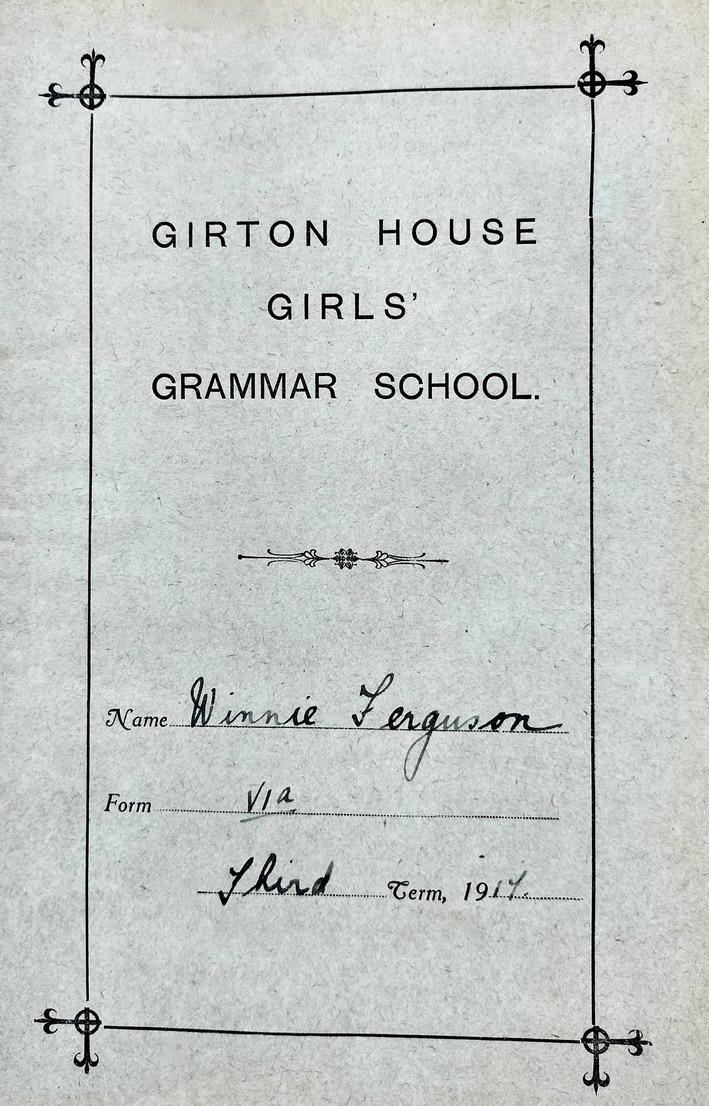
Chapter 13
Lillie Smith's Legacy
When TheGirtonBookwas published in 1951 the Advertisercommented that:
The admirable traditions laid down by Mrs Smith, academic and otherwise, have been carried on through the years. The developments during those 25 years make interesting reading but even more interesting is the way in which the influence of the founder permeates the whole story.
TheAdvertiser , Friday 22 June 1951, p. 11
A committee of old scholars compiled TheGirtonBookin memory of the school's founder and to celebrate the 25 years of its continuation under a board of directors. Implicit in its intentions is the importance of two historical issues; change and continuity. The Advertiser , intentionally or otherwise, put it the other way round and focused on how Lillie's 'admirable traditions' not only survived after she handed over her school but permeated its subsequent evolution in the next quarter century. The obvious question, if TheGirtonBook'sobservation is in fact correct, is whether Lillie did create a legacy that survived to 1951 and beyond, even to the present.
Eulogists often mention a person's legacy, but few try to define the term, perhaps because it is impossible to quantify. Yes, it is difficult to tie down legacy. Psychologist Susan Bosak offered a useful metaphor. She noted that it is best to plant a new tree in an old-growth forest rather than a cleared paddock. In old-growth forests new trees' roots follow the pathways created by existing trees old and more recent and implant themselves more deeply and securely. Overtime tree roots graft to one another to make an interdependent underground foundation in which stronger trees share their resources with weaker ones so that the whole forest becomes healthier. Bosak calls that 'legacy'. In Girton House's 11-year life, did Lillie plant a root system on which the new Girton could thrive and develop? More prosaic than Bosak's metaphor, dictionary definitions tell us that a legacy is a gift of property, anything handed down, a consequence. Yes, legacies can be tangible, but they can be intangible too. Legacy is the passing down of cultural heritage, which includes both physical artefacts and abstractions such as cultural habits, traditions and beliefs. Dutch-American Primatologist, Frans de Waal, described culture as 'an extremely powerful modifier affecting everything we do and are, penetrating to the core of human existence'.† In assessing Lillie's legacy, we must examine the influence of her cultural heritage against other factors that contributed to the evolution of her re-constituted school. These could include changing parental and family attitudes and core community values. Other possible influences include new trends in educational philosophy and pedagogy, major events such as the Great
See Susan V. Bosak at https://www.legacyproject.org/guides/whatislegacy.html.
† Cited in Margaret Atwood, BurningQuestions:EssaysandOccasionalPieces,2004–2022,p. 111.
Depression, World War II, the social revolution of the 1960s and the consequent rise of feminism. And, of course, we must not overlook the influence of headmistresses who followed Lillie.
Lillie did pass on 'admirable traditions', but she was not alone in doing that. She was only one of a team of 'New Women' Adelaide headmistresses such as Caroline Jacob, Miss Thornber and Mrs Kelsey, each of whom visited England to investigate the latest best practice in teaching and learning. Lillie's personal situation and private life did not allow her to take leave to explore the latest developments in educational practice. We cannot claim that she was South Australia's pivotal pioneering girls' educator, but that did not necessarily diminish her influence.
The 'tangibles' can be considered briefly. The school badge, the colours blue, white and gold and the name 'Girton' survived the transition from Girton House Girls' Grammar School to Girton Proprietary School for Girls. The school remained at the Kent Town properties for one year only — 1926 — before it moved to Kensington Park. In 1926 boarders continued to worship at St John the Evangelist Church, but the new headmistress, Dorothy Angove, held communion services for prefects on All Souls' Day and Girton girls were confirmed in September at St Bartholomew's Anglican Church in Beulah Road, Norwood. From 1927, the St John's connection was severed, and the newly-incorporated Girton began a long association with St Matthew's Anglican Church, Marryatville. Lois Lathlean's School Song did not survive the transition and nor did the school uniform. Lillie's blue dresses gave way to grey tunics. Worn by nurses in World War I, grey tunics were in vogue, not least because they did not show dirt readily. But the same could be said of Lillie's navy blue. According to one source, girls revelled in the change. It is doubtful if the 'social set' would have agreed. As we saw in Chapter 11, most of Lillie's teachers were dismissed and replaced. Whereas Lillie had employed only one graduate teacher, Girton Proprietary School for Girls had four in its first year, a number that increased over time. This magnified the importance of the academic education Lillie had provided for girls with the talent, desire and parental support to pursue higher education. Headmistress and university graduate, Dorothy Angove, shared Lillie's desire to educate 'clever ladies', and she placed even more emphasis on cleverness, achievement.
The achievements of Girton House ‘old girls’ were well documented in the school magazines, and a justified source of school pride. Girton House produced some fine women who served with distinction in a number of professions and charities. Many more were dedicated wives and mothers who raised their families with values similar to those Lillie promoted. There is no doubt that these women owed something to Lillie. How much is more difficult to assess.
Among the high-profile women, Margaret Cheadle (McGuire), Hope Crampton, Effie Deland (Best), Mary Lamphee (Wigg), Mary Barwell, Yvonne Wait and Mabel Goodhart (Miller) all studied at the University of Adelaide. Margaret and Hope had the highest public profiles.
An inaugural pupil of Girton House, Margaret Cheadle (McGuire) studied science. In 1920, she won the £200 Bundey Prize for English verse, which was open to all University students.
She did not take a degree, but worked as a biochemist researching gastroenteritis and insulin in the Medical School between 1922 and 1924. Margaret was a Congregationalist and stunned her friends when she married Paul McGuire in November 1927 and converted to Catholicism. Sadly, their two babies were stillborn. Margaret lived in Rome for some years with her husband, who was the Australian Ambassador to Italy. She and Paul founded the Catholic Guild for Social Studies and, amongst other service to Catholicism, conducted 'workshops' on Catholic Action in the United States of America. She was one of the original trustees of the Royal Flying Doctor Service, once Australia’s Women’s Delegate to The League of Nations and she published several books. She was co-author with husband Paul and Betty Arnott of TheAustralianTheatrein 1949. She published a HandbookforCatholicActionGroups;TimeintheEnd ; BrightMorning:The StoryofanAustralianFamilyBefore1914 , (an autobiography); TheRoyalAustralianNavy,Its Origin, Development and Organisation; Twelve Tales of the Life and Adventures of Saint Imaginus ; and GardensofItaly.A few months before she died, Margaret was made a Member of the Order of Australia (AM) in the 1995 Queen's Birthday Honours List. She was an indefatigable champion of science, literature and social equity who acknowledged a great debt to her school headmistress, Lillie Smith.

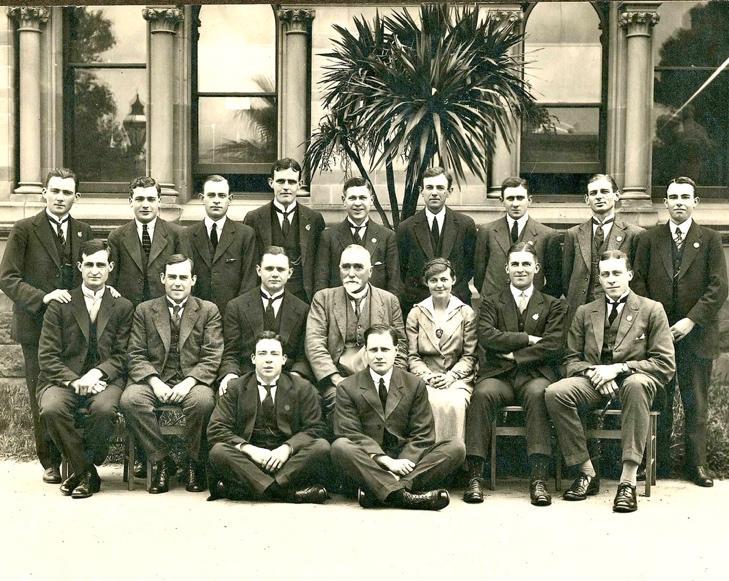
Girton House Old Scholar, Margaret Cheadle (McGuire), with medical students and their professor, University of Adelaide, c. 1922. It is possible that Lillie's elder son, medical-student Gordon, is in the photograph. (Courtesy Faculty of Medicine, University of Adelaide, I. D. UAR-0022)
In 1923, Hope Crampton completed her BA (Honours) in Classics (Class II Honours) and won The John Howard Clark prize for English Literature. She completed her Master of Arts degree in 1926 with credits in English II, French III and Philosophy while teaching part-time at Girton. Following three years further study in France, where she worked with her father at the Sorbonne, in 1931 she joined the French Department at the University of Adelaide where she lectured until 1961. She established a French Language Club for students to practise their oral skills. Attendance was compulsory for undergraduates until 1958. She was the first woman lecturer appointed in a modern language at the University of Adelaide and the first member of staff to publish a textbook, Gaudissart:AGuidetoBetterFrenchPronunciationandBrighter FrenchConversation.It was widely used in schools and a set text in French I at the University of Adelaide. She was an active member of the Alliance Française and promoted good relations between France and Australia. In retirement, she went to Greece to teach English to young emigrants about to embark for Australia.
Effie Deland (Best) graduated with Honours in Zoology and later gained a Master of Science degree. She studied Physics, Biology and Zoology, with a special interest in parasitology. She lectured at the University of Adelaide and was on the Board of Directors of Girton from 1938 to 1945. She later taught at Girton, and in the university’s Science Department. Mary Lamphee (Wigg) studied music at the Elder Conservatorium, played in the South Australian Orchestra, took lessons in painting and exhibited her landscapes and nudes in the 1960s and 1970s. She exhibited in the Adelaide Festival of Arts in 1964. Perth's Fairview Art Collection has five of her artworks. Mary Barwell completed a BA, travelled widely in Europe and worked as a secretary at the National Gallery where she pursued her interest in art. In 1923, Yvonne Wait graduated MA from the University of Adelaide following studies in France and Germany. She went on to teach in Victorian and South Australian schools, including Wilderness. Wait’s career was crowned in 1964 when the French Government awarded her the prestigious Ordre des PalmesAcadèmiquesfor services to French culture. Mabel Goodhart (Miller) graduated LLB from the University of Adelaide, was deputy-director of the Women’s Auxiliary Air Force in 1942-1943, deputy-lord mayor of Hobart in 1954-1956 and 1964-1966 and from 1955 a longserving Liberal politician for the seat of Franklin in the Tasmanian House of Assembly. She was one of the first two women elected to the Tasmanian House of Assembly. Ada Stephens did not attend the University of Adelaide, but after training became a director of kindergartens in Adelaide and Brisbane. Later she studied in the United States of America and on gaining her PhD, she became Professor of Education at the University of Toledo, Ohio.
Margaret Cheadle, Effie Deland, Mary Lamphee and Mabel Goodhart married and juggled their professional careers with family responsibilities. They were the epitome of what Catherine Helen Spence called, ‘the New Women’. The same can be said of single women Hope Crampton, Mary Barwell, Yvonne Wait, Ada Stephens and Lois Lathlean.
Lois maintained her interest in writing and had a long career as a journalist for the Melbourne Herald . She was the Herald's Social Editor and the leader of the female staff. Apparently, serious journalism was the preserve of male reporters. While she gave attention to the Melbourne social set's comings, goings and doings, whenever the opportunity presented, she highlighted women's more worthy contributions to communities. On Anzac Day 1947, Lois wrote an article praising ex-service women, civilian women, housewives and 'young and old business girls' for reaffirming the 'Golden ideals' of courage, selflessness and love of humanity.
She praised their faith in the everlasting ideals of selflessness and service. And on Tuesday 27 March 1945 Lois criticised the hospital visitor who 'is a flower fanatic, a narrator of personal ailments, a gloomy prophetess, a worrier, or a commiserator'. This type of visitor, and those who stayed beyond visiting hours, she protested, caused trouble for patients and the nurses. The first of these articles spoke of Lillie's principles, the second her pragmatism.
Teaching and nursing were two traditional female professions and it is no surprise that some of Lillie's 'old girls' worked in these occupations, at least before marriage. Perhaps Edith Reeves was the most significant Girton House old scholar to become a teacher. She taught History and Geography at Poltoonga, and when it closed in 1940, she joined Girton, which she served for three decades and was its headmistress from 1968 to 1970. Gentle, fun-loving and approachable, she was the 'the spirit of Girton', the embodiment of its ethos and traditions that traced back to Lillie Smith. Several Girton House 'old girls' had impressive careers in nursing. Catherine Michelmore won a gold medal for nursing. She was a tutor sister at the Adelaide Children's Hospital. In 1947 she studied at the College of Nursing in Melbourne and in 1951 she addressed the Adelaide Children's Hospital Nurses' Association about the latest teaching methods. Marjorie Verco was a charge nurse at the Adelaide Children's Hospital and in 1932 she nursed for several months in Johannesburg, South Africa. Mary Connor nursed in Adelaide and London and by 1964 she was assistant-deputy-matron of St Andrew’s Presbyterian Hospital, Adelaide. Dorothy Sneyd was appointed the first matron of Torrens House, Adelaide, a position that she held for 14 years. Torrens House provided care for mothers and their new-born babies. Jessamy Bruce rose through the ranks to become an inspector of children’s health in the Education Department. Similarly, Nellie Verco (O’Halloran Giles) devoted her life to the Red Cross Society and received its Distinguished Service Award. For her service to the Red Cross, Molly Laws was awarded an MBE and the Coronation Medal, both of which Queen Elizabeth II presented when she toured Australia in 1954. These nurturing and nursing professions were consonant with Lillie's Smith's core values.
High-profile Nancy Holden (Buttfield), daughter of motor magnate, Sir Edward, became well known as Senator Dame Nancy Buttfield, the first woman to represent South Australia in the Australian Senate. She had two stints in the Senate from 1955 to 1965 and 1968 to 1974. In 1931, she had enrolled in the University of Adelaide where she studied psychology, music, logic and economics. She was active in voluntary and philanthropic work and was a prominent member of the South Australian Liberal Party. Commenting on her career, the Advertisercalled her a 'robust eccentric' who 'forced open the door of respect for generations of women who followed her'.* It is appropriate to note that Nancy spent only her 'Prep' years at Girton House, leaving at the end of 1923 to complete her secondary education at Woodlands Church of England Girls' Grammar School. We saw in Chapter 12 that Nancy did not think highly of her school days at Girton House and we cannot claim that Lillie influenced her more than any other forces; human, educational or ideological, if at all. ***
Advertiser , 4 September 2005. Cited in Buttfield,DameNancyEileen(1912–2005in TheBiographical DictionaryoftheAustralianSenate . Online Edition.
Lillie showed courage in opening Girton House when she was fifty years old. A significant number of her 'old girls' showed a remarkable capacity for adventure, for travel. That they came from well-heeled families allowed them to follow their interests in ways denied young middleand working-class women. This does not diminish the courage they displayed, but it does question the extent to which Lillie's example and the values she espoused influenced them. Edna Lawrence was an accomplished tennis player whose career took her to other Australian states and oversees. She represented South Australia in interstate tennis competitions. She reached the final of the Adelaide Metropolitan Tournament in 1923, and lost. She reached Round 16 in 1926, 1929 and 1932 of the Australian Championships. In 1927 she reached Round 16 in Seattle, USA. She was a mezzo-soprano in Australian Broadcasting Commission productions in Adelaide and a director of her family’s tobacco business. 'Old girls' Corinna, Vestalia and Ross (Roslyn) Nitschke were all adventurous. In 1926 Corinna and Vestalia visited China, Japan, America and Canada with their mother. Twenty years later, in September 1946, Corinna flew to Alice Spring in a 10-day round trip, stopping to refuel at Marree. In 1951, she and her sister, Roslyn, and another Girton House 'old girl', Miss Trevor (Trev) Scott, spent six months overseas, destination unknown. The energetic Margaret Cheadle (McGuire) was much travelled. In 1920 she visited Dove Cottage in Grassmere, England, the home of William Wordsworth. The Registerpublished her poem, Orion , which she penned on the occasion. In 1929 she visited the Chelsea Flower Show in London and in 1930 the Register-NewsPictorial published her article about Adelaide contralto Clara Serena's performance in London. After the show she met up with Clara and chatted about Adelaide people, those of the purple at least. And in 1930 Margaret and husband Paul were also in Somerset learning to thatch a roof, make cowslip wine and develop 'a respectable capacity for cider'. It was all very proper as well as adventurous, and Lillie would have been delighted.
Proper, indeed. Girton House old scholars 'in society' made their debuts at dances their mothers organised, often in Norwood Town Hall. An invitation to Government House was the pinnacle of social prestige. Jocelyn Bowman (Evans), Nancy Rymill, Evelyn and Audrey Scarfe, Nellie Verco, Christel Gebhardt and Nancy Holden (Buttfield) were known to have graced the ViceRegal dance floor. Imagine Lillie's delight when she learned that two of her young 'clever ladies', Audrey Scarfe and Nellie Verco, had danced with the Prince of Wales (later King Edward VIII) when he visited Adelaide in 1920. Evelyn Highland was just one 'old girl' whose social comings and goings were highlighted in the local papers. In December 1923 the News'ssocial journalist, 'Candida', informed readers that earlier in the year Evelyn had enjoyed the 'most perfect weather' in Paris and that she had bought 'a frock of pale georgette...covered in front with leaves of dark brown velvet'. Three years later in 1926 we learn that Mr Ernest Jolly of Brougham Place, North Adelaide, gave 'a most enjoyable dinner party' at the South Australian Hotel in honour of his engagement to Girton House 'old girl', Miss Evelyn Hyland.
Lillie once told her Girton House girls that she would attend all their weddings. This did not happen. She wanted her 'clever ladies' to marry well and have a good and pleasant social life. We saw in Chapter 12 that the academically talented Kathleen Miell chose this path. But not St Peter's chapel. In April 1927, Kathleen married Robert Knox of Kensington Gardens in Spicer
Memorial Methodist Church, at least located in fashionable St Peters. Those who married well included Nellie Verco (daughter of Dr W.A. Verco, North Adelaide) who wed Hew O'Halloran Giles; Gwen Verco, (daughter of Frank Verco of TheMyrtles , Medindie), who married Kenneth McBryde Horwood of Toorak, Melbourne, and Nancy Rymill (only daughter of Mr and Mrs Arthur Rymill of North Adelaide) who tied the knot with Dr Thomas Giblin of Hobart at St Clement Danes, Strand, London in February 1929. Nancy and Thomas spent their honeymoon in the south of France. Sadly, Nancy did not like living in Hobart, left Thomas and went to live in England with her widowed mother. Thomas filed for divorce in 1943.

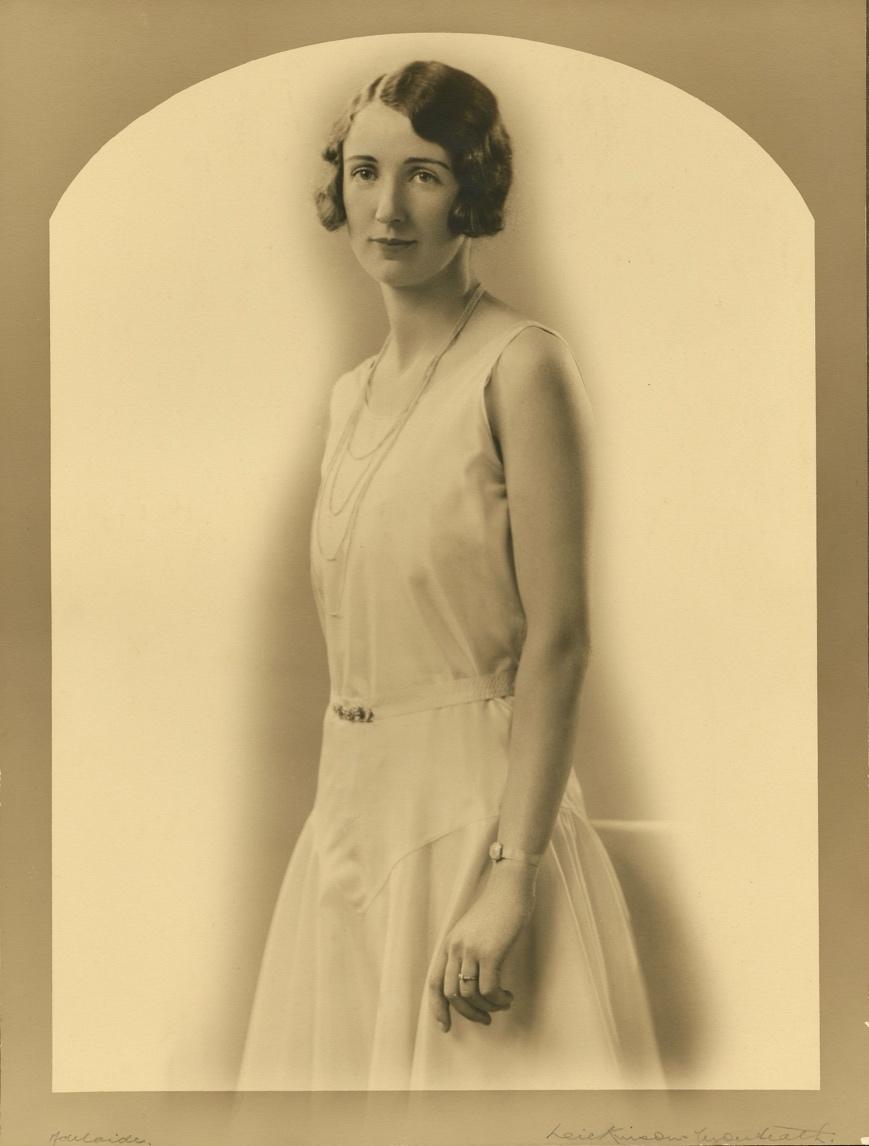
21-year-old Girton House Old Scholar Jocelyn Bowman (Evans), c. 1925. The daughter of a well-known pastoral family, Jocelyn attended social functions in Adelaide. By her own admission she entered Girton House in 1915 as 'a tall, shy, eleven year old from the country', and was unsophisticated. Certainly, she was not pretentious, a woman of whom Lillie would have been proud: a 'clever lady' indeed.
(Photo: Dickinson-Monteath. Courtesy State Library of South Australia, B 68471)
Lillie's legacy is evident in the lives and experiences of the women considered above. Her influence has to be balanced, of course, with other forces that shaped their lives, but the development of these women's values and attitudes can be traced to Lillie to some, but uncertain, degree at least. How far did her influence reach beyond her 'old girls'?
In Chapter 11 we saw that Mrs W.H. Irwin was determined to see Girton House survive Lillie's death, albeit with a revamped form of governance, as it embodied the values, attitudes, pedagogy and traditions she supported. According to Bernard Hyams and his co-authors, Girton
House was one of the schools that emphasised the development of character, the extolling of individual distinction, group loyalty and service; all attitudes located in the English Protestant tradition and that sustained ruling-class values.* In appointing Dorothy Angove as its inaugural headmistress, the Directors of the new Girton Proprietary School for Girls chose an educator cut from the same cloth as Lillie. She continued the service ethic, appointed more graduate teachers and further pursued academic excellence. She continued to organise the school along the same lines as Lillie Lower, Middle and Upper Schools. She streamed the curriculum in the Upper School in two directions; one for girls who wished to matriculate and one for those who did not. Like Lillie, she was bold. When the all-male Board questioned her decision to dispense with the Intermediate Arithmetic class in 1931, she reminded it that her contract gave her sole responsibility for the curriculum, and threatened to resign. Like Lillie, patriarchy did not frighten her.
Over time the former nexus between Girton House and the Adelaide Establishment and other upper-class families diminished as girls from middle-class families became more representative of the clientele, especially after the appointment of Dorothy Yates as headmistress in 1941. There were some significant developments that were not consonant with Lillie's legacy, but much continued unchanged. Dorothy was an active member of the New Education Fellowship; she stopped awarding academic prizes and she favoured cooperative teaching and learning methods. Lillie would have approved her enrolling girls with disabilities, however. She would have approved her bold initiative in establishing a Modern Form in 1952, an experimental secondary three-year alternative course for girls for whom an academic syllabus had little appeal or suitability. And, she would have been chuffed that Dorothy Yates placed her former student, Edith Reeves, in charge. The course's Achilles heel was low self-esteem in parents' eyes and for potential employers its nemesis was the lack of an Intermediate Certificate, even though Modern Form girls were not necessarily prevented from sitting its examinations. To Dorothy Yates's great regret, the course was discontinued after 1955. Interestingly, in HalfaMillionChildren , John Cleverley identified Girton and Wilderness as two girls' schools to view non-matriculation subjects kindly, in much the same way Lillie had provided an all-round education for Girton House girls who did not proceed beyond the Intermediate level and on to higher education.†
Girton's last headmistress, Diana d'Este Medlin, was appointed in 1971. Like Lillie Smith, she was in tune with the mood of the period, in her case the mood of the restless 1960s. She was as bold as Lillie Smith. The school was bookended by two dynamic, courageous women. Diana Medlin exemplified Lillie's legacy, even if her ideas flowed from elsewhere. She established music as a special feature of a Girton education. She was, however, appointed at a difficult time with school enrolments declining. Faced with the real possibility of closure, she embraced wholeheartedly the opportunity to merge with the neighbouring boys' school, King's College, to form, in 1974, a new co-educational school, Pembroke School. A bold initiative indeed, one reminiscent of opening a school at age 50 during a World War. As co-principal Diana Medlin rightly took charge of the school's Girton Campus, which included the Junior and Senior Schools. For Years 11 and 12 she established a modern senior college modelled on ones she had seen in Tasmania. To provide a special service in one area of education, she and male co-principal, John
See John Davis, Principles&Pragmatism:Vol.1AHistoryofGirtonandKing'sCollege,theantecedentsof PembrokeSchool , p. 43.
† John Cleverley (Ed.), HalfaMillionChildren.StudiesofNon-GovernmentEducationinAustralia , pp. 257–258.
Moody, established a Hearing Unit for hearing-impaired children who learned in the mainstream with appropriate teacher support. Lillie would have approved. When John Moody left at the end of 1978, Diana Medlin became sole principal and led Pembroke until she retired at the end of 1990. Diana's liberal Christian beliefs were similar to Lillie's, and she too was an educational trend setter. For example, she introduced new subjects including languages Chinese, Malay and Indonesian; Social Education, in which students explored relationships and studied sex education, and Drama. Diana's essential mantra was 'the pursuit of academic excellence'. To counter what she saw as a general diminution of academic standards in Australian education, in 1989 she added the Diploma Course of the International Baccalaureate for Senior School students keen to pursue an alternative to the South Australian Certificate of Education course. She also replaced the Senior School prefects with a Student Representative Council.
We see Lillie's legacy at Pembroke School, even today. The Kensington Park Holden Street campus bears the name 'Girton'. The school's Smith House was named in her honour. Reeves House was named for one of her faithful students. Until the last Girton House 'old girl' died, each year Diana Medlin hosted an afternoon tea for the 'Lillie Smith Girls'. Importantly, Lillie's influence permeated the entire Girton story and it is no surprise that elements survive today. It is equally unsurprising that it was not the only influence to colour the Girton story, as all schools balance their principles and traditions with pragmatic responses to world events, evolving community core values and their particular changing circumstances.
Chapter 14
The Indomitable Lillie Smith? To Be Sure!
There was only one Mrs Smith. Former teacher, cited in the Register , 22 June 1926, p. 10
We are all unique. Why then, declare 'There was only one Mrs Smith'? It was never meant to be taken literally. Lillie's loyal teacher knew her well and identified her headmistress's special qualities, leading her to conclude that there was no other person quite like Lillie Smith. In her view, Lillie stood out. She was far from ordinary. She had a presence other people lacked. When she appeared, people took note. The same can be said of famous charismatic leaders in the annals of world history. Churchill and Hitler come readily to mind. The term 'indomitable' can be applied to many people, famous or not.
***
Strictly, an indomitable person cannot be subdued or overcome. But we often talk of an indomitable pride, spirit, courage, determination, strength; or enemy! This is useful when considering a person's legacy in respect of cultural heritage. The word 'indomitable' has many synonyms, ranging from the explicit 'invincible' and 'unassailable' to the more implicit 'resolute', 'strong-willed' and 'plucky', suggesting that 'indomitable' can be interpreted more broadly than simply the ability to resist subjugation. In considering Lillie Smith, we shall use the broader interpretation of 'indomitable'. In this sense, Lillie was indomitable, but in that she was not alone in the South Australia of her day.
There were women more well-known and whose work was, at the very least, of equal importance. All had an indomitable will. There was the progressive, and energetic public figure, Catherine Helen Spence, the 'Grand Old Woman of Australia': she of the 'New Woman' tag and champion of electoral reform. Foundation member of the Social Purity Society and member of the Women's Suffrage League, the 'short and plump, but always straight-backed' Mary Lee, was the stout-hearted leader of the successful campaign for the enfranchisement of South Australian women in 1894. Leader of the Woman's Christian Temperance Movement, Elizabeth Nicholls, devoted her life to 'making society more moral' and safer for women. Under her leadership, the WCTU collected 8000 of the 11,000 signatures on the petition calling for women's suffrage. At age 35, the unflinching charge nurse, Margaret Graham, protested the appointment of the Chief Secretary's sister as night superintendent at the Adelaide hospital. The hospital Board demanded she retract. She did not, was sacked and a Royal Commission was held, in which she criticised the Chief Secretary's blatant nepotism, denounced the 'tomfoolery' of her own dismissal and accused Premier Charles Cameron Kingston of resorting to 'mealy-mouthed utterances'. When the Board's term expired early in 1896, the Government sacked it and Margaret was appointed matron in 1898. While subsequent Boards did not trust her, she achieved much for her loyal nurses. Lionhearted Mrs Alexandra Seager ran a prosperous business, the Scholastic Agency, which supplied governesses and servants for country people. During World War I she led a band of women of 'high moral character' who provided comfort to returning soldiers, most notably in
the Cheer-Up Hut at the Adelaide Railway Station. And then there was Kate Cocks. One of her given names was 'Boadicea', and it comes as no surprise that she broke through the lock-up ceiling when, in December 1915, she became the first woman police officer in South Australia, and the British Empire. With her assistant, Annie Ross, she set out to safeguard the welfare of women and children. Working in plain clothes, they patrolled in Adelaide, Port Adelaide and Outer Harbour to protect vulnerable young girls. They visited slums and kept under observation hotels, brothels and areas frequented by prostitutes. Tough stuff, for two tough policewomen. The nature of their journeys and their aims, aspirations and achievements determined these prominent women's undoubted indomitability. They all had high moral and social agendas, which may well have floundered if it were not for their personalities; their drive, tenacity, courage and determination. But there were many less high-profile women, equally deserving of the badge, 'indomitable'. Their journeys are important too, including those women dedicated to educating girls in the late 19th and early 20th Centuries. The fitting of young girls with the skills and attitudes to take advantage of new opportunities pioneering women had opened for them was an admirable vocation.
So how well did Lillie Smith measure up?
Very well, indeed. From the moment her girls entered Miss Thompson's School and, later Girton House, they were greeted with a stern, implacable message Perseverandoin the first, Labore etHonorein the second. Girls were to persevere, they were to work hard and to be honourable right-minded, decent, worthy, noble. And they soon learned the importance of Shakespeare's mantra, Tothineownselfbetrue.And Lillie led by example. She practised what she preached. We saw how her early life experiences shaped Lillie's character. Her genes, growing up in Lawrence, her parents' values and attitudes and Miss Freeman's example shaped the woman Lillie became. Her father's devotion to business and public service, the tragic death of her mother when she was just 10 years old and her demanding stepmother steeled her temperament. She was made of stern stuff. There was no way she was going to have a dozen children and a life devoted totally to hearth and home. Exciting opportunities in the field of girls' education appealed. Career called.
With his hard work, strong personality, popularity, public service and reputation for honest dealing her father's business had prospered. Lillie inherited his character traits and learned from him that individual effort could reap reward. Perhaps, even more importantly, Caroline Freeman showed her that women could match men in the field of education. As her courageous father and the strong-willed Miss Freeman before her, Lillie went on to run her own enterprises in Adelaide, 'private schools', free of bureaucratic control. And she followed her parents' example, uprooting herself and risking fame and fortune in South Australia. There were many private-venture girls' schools operating in Adelaide in 1894 when Lillie opened 'Miss Thompson's School'. She had to break into a competitive market, especially in fashionable North Adelaide, in which enrolments and reputation were critical to success. This she did, with success, as the Registernoted in its obituary of 22 June 1926. We know little about Miss Thompson's School, but Lillie did employ a friend of Catherine Helen Spence to teach
Art, the highly regarded and well-known Rosa Fiveash. Lillie recognised the important link between reputation and enrolments.
She had a well-tuned ear to Adelaide's class distinctions and knew which families could afford and were willing to pay for their daughters' education beyond an elementary level, and those who could not. She was certainly not of the purple, but in marrying James Albert Smith Lillie joined a wealthy family one step removed from the Adelaide Establishment, and with close links to successful business and professional families. This was useful. She became a skilled and highly effective networker of Adelaide's 'social set'. In much the same way, she used the social pull of her Anglicanism to attract wealthy clientele. It was of no oversight that she married her Baptist husband in St Peter's Cathedral. And, at first James moved in with his 'New Woman' at her Childers Street home. We recall how she even intimidated the University of Adelaide academic, John Crampton, and saw in Chapter 4 how as a wife and mother she moved in 'polite company' and maintained good and useful connections. The reporting of her comings and goings in the social pages of the local newspapers kept her in the public eye.
The boldest thing she did was open Girton House Girls' Grammar School in 1915 after a 17-year break from teaching. And, she was 51 years old! Men who derided 'Girton Girls' (graduates of Girton College, Cambridge) for having a university education and militaristic Kaiser Wilhelm's launching of World War I did not deter her. Yes, her initiative was consonant with the progressive and liberal mood that generally prevailed in South Australia, which was sympathetic to girls being educated beyond an elementary level. Yes, she had definite aims and goals when she opened her new school, but she soldiered on in the face of warnings that failure was more likely than success in wartime. She even won over financial backers at the time. Boldness and persuasiveness proved compatible, and successful.
She was on safe ground when she adopted the conservative English Public School machinery and curriculum. Or was she? The machinery was acceptable, but the traditional curriculum was meant for boys and to fit it to girls' education was radical. If girls were to go to university and work their way into the conventional male professions they needed the same secondary education as boys. And she provided it. We saw that she made specific arrangements for Fifth and Sixth Form girls such as Hope Crampton and Effie Deland (Best) to study elsewhere subjects such as Chemistry that she did not offer at Girton House. Headmistresses of the 'high qualifications and low heels' brigade would not have allowed that, let alone organise it. This shows her duality, her blending of progressivism and tradition: she told her girls that discipline must come from within, not from without, and ‘the less you have of the one, the more you will get of the other’.
Lillie Smith was strict with the girls, and the staff, a strong disciplinarian. Her temper was renowned. She was in full command of herschool. She oversaw it all, literally from her study. She demanded efficiency. An inefficient Boarding House cook could cost her money. But she expected nothing she was not prepared to do herself. She was the dominant personality in her school and she dominated it. But girls spoke of her 'magnetic personality', that she was 'more a mother than a school mistress', that she loved her girls, even 'the difficult ones'. They liked that she encouraged them. They liked her sense of humour, the strength of her personality, that she was 'wonderfully human'. They showered her with flowers on her birthday. Old scholars wrote to her, saying that they were trying to live up to the ideals she promoted. A long-term teacher,
possibly Ida Heyne, declared, 'She had a magical way with girls, but not because she indulged them'.
Lillie never allowed anyone, any system or any ideology different from her own to alter her approach to pedagogy, or her educational aims and goals, let alone subdue them. She did not bother with the 'professional development' popular with modern school principals. That she combined traditional and progressive policies does not detract from her rock-solid commitment to the ideas that underpinned her approach to girls' education. When Adelaide artist, Helga Cucchiarelli, viewed Ingid Erns's portrait of Lillie, which appears on the cover of this book, she saw a strong woman 'looking straight at me, without fear or favour'.
Indeed, the indomitable Lillie Smith never wavered.
REFERENCES
Allen, Margaret; Hutchison, Mary & Mackinnon, Alison, 1989, FreshEvidence,NewWitnesses. FindingWomen’sHistory, South Australian Government Printer, Adelaide.
Anderson, Margaret and Mackinnon, Alison, Newwomenandthemodernfamily:Continuity andchangeinpre-wardomesticlife . In Oppenheimer, Melanie: Anderson, Margaret and Paul, Mandy, 2017, SouthAustraliaontheEveofWar , Wakefield Press, Mile End, South Australia.
Atkinson, Neill; Green, Davis; Phipps, Gareth and Water, Steve, 2020, TodayInNewZealand History , Exisle Publishing Pty Ltd, Dunedin.
Atwood, Margaret, 2023, Burning Questions: Essays and Occasional Pieces, 2004–2022, Penguin Random House, Dublin.
Bacchi, Carol, The‘WomanQuestion’inSouthAustralia. In Eric Richards (Ed.), 1986, The FlindersHistoryofSouthAustralia.SocialHistory, Wakefield Press, Adelaide.
Bamford, T.W., 1967, RiseofthePublicBoardingSchoolsinEnglandandWalesfrom1837to thePresentDay, Thomas Nelson & Sons Ltd, London.
Bartlett, Thomas, 2010, Ireland:AHistory , Cambridge University Press, Cambridge.
Boyd, William & Rawson, Wyatt, 1965, The Story of the New Education , Heinemann Educational, London.
Chandos, John, 1984, BoysTogether:EnglishPublicSchools,1800–1864 , Hutchinson & Co. Ltd, London.
Cleverley, J & Lawry, J. (Eds), 1973, AustralianEducationintheTwentiethCentury:Studiesin theDevelopmentofStateEducation, Longman Australia Pty Ltd, Melbourne.
Cleverley John (Ed.), 1978, HalfaMillionChildren:StudiesofNon-GovernmentEducationin Australia , Longman Cheshire, Melbourne.
Cobiac, A.L., 2001, SouthAustralianIndexofRegistrations1842to1916, South Australian Genealogy and Heraldry Society, Adelaide.
Davis, John, 2014, PrinciplesandPragmatism:Vol. 1., AHistoryofGirtonandKing'sCollege, theantecedentsofPembrokeSchool , 2nd Edn, Pembroke School Council, Adelaide.
Dean, Tim, 2001, HowWeBecameHumanAndWhyWeNeedtoChange , Pan Macmillan Australia, Sydney.
Eliot, George, 1985, Middlemarch , Penguin Books, London.
Encel, S., 1974, WomenandSociety:AnAustralianStudy , Cheshire, Melbourne.
Gathorne-Hardy, J., 1977, ThePublicSchoolPhenomenon,597–1977 , Hodder & Stoughton, London.
Gibbs R.M., 1988, Bulls,BearsandWildcats:ACentenaryHistoryoftheStockExchangeof Adelaide , Peacock Publications, Norwood. Harper, B., 1980, PetticoatPioneers:SouthIslandWomenoftheColonialEra. Book Three, A.H. & A.W. Reed Ltd, Christchurch.
Hilliard, David & Hunt, Arnold, 1986, Religion. In Eric Richards (Ed.), TheFlindersHistoryof SouthAustralia:SocialHistory, Wakefield Press, Adelaide. Hilton, James, 1959, Good-Bye,MrChips , Hodder & Stoughton, London. Honey, J.R. de, 1977, TomBrown’sUniverse:TheDevelopmentoftheEnglishPublicSchool intheNineteenthCentury , Quadrangle/The New York Times Book Co., New York.
Hyams, Bernard; Condon, Brian; Grundy, Dennis; Trethewey, Lynne & Vick, Malcolm, (Eds), 1988, LearningandOtherThings:SourcesforaSocialHistoryofEducationinSouth Australia , South Australian Government Printer, Adelaide. James, Stephanie, IrishSouthAustraliansin1914:Unconditionalimperialloyalty?In Oppenheimer, Melanie; Anderson, Margaret and Paul, Mandy, 2017, SouthAustraliaon theEveofWar , Wakefield Press, Mile End, South Australia.
Jolley, Anne and Thomas, Gillian, (Eds), 1996, WillinglyToSchool , Pembroke School, Adelaide.
Jolley, Anne and Thomas, Gillian, (Eds), 2015, WillinglyToSchool , Part II, Pembroke School, Adelaide.
Jones, Helen, 1985, NothingSeemedImpossible:Women’sEducationandSocialChangein SouthAustralia1875–1915 , University of Queensland Press, St Lucia.
Jones, Helen, 1986, InHerOwnName:WomeninSouthAustralianHistory , Wakefield Press, Adelaide.
King, Michael, 2023, ThePenguinHistoryOfNewZealand,Penguin, Aukland.
Mackinnon, Alison, 1984, OneFootontheLadder:OriginsandOutcomesofGirls’Secondary SchoolinginSouthAustralia , University of Queensland Press, St Lucia.
Mackinnon, Alison, 1986, TheNewWomen:Adelaide’sEarlyWomenGraduates , Wakefield Press, Adelaide.
Mangan, J.A., 1981, AthleticismintheVictorianandEdwardianPublicSchool:TheEmergence andConsolidationofanEducationalIdeology, Cambridge University Press, Cambridge.
Maslen, Geoffrey, 1982, SchoolTies:PrivateSchoolinginAustralia , Methuen Australia, Sydney.
Morgan, E.R., 1963, TheAdelaideClub1863–1963 , Privately printed for the Adelaide Club, Adelaide.
Newbolt, Henry, 1917, Poems:NewandOld , John Murray, London.
Oppenheimer, Melanie; Anderson, Margaret and Paul, Mandy, SouthAustraliaontheEveof War , Wakefield Press, Mile End, South Australia.
Pike, Douglas, 1957, ParadiseofDissent:SouthAustralia,1829–1857 , Melbourne University Press, Sydney.
Prest, Wilfred (Ed.), 2001, TheWakefieldCompanionToSouthAustralianHistory , Wakefield Press, Kent Town.
Sherington, Geoffrey; Brice, Ian and Petersen, R.C., 1987, LearningtoLead:AHistoryofGirls’ andBoys’CorporateSecondarySchoolsinAustralia, Allen & Unwin, North Sydney.
TheCyclopediaofNewZealand,Industrial,Descriptive,Historical,BiographicalFacts,Figures, Illustrations,Volume 4 OtagoandSouthlandProvincialDistricts , 1905, Horace J. Weeks Ltd, Christchurch.
TheGirtonBook:AnniversaryandMemorialYear1951 , 1951, Hunkin, Ellis and King, Ltd, Adelaide.
Thomas, Jan (Ed.), 1997, SouthAustralianBirthsIndexofRegistrations1842to1906,South Australian Genealogy & Heraldry Society, Adelaide.
Turner, Ian, 1968, TheAustralianDream:ACollectionofAnticipationsaboutAustraliafrom CaptainCooktothePresentDay , Selected and introduced by Ian Turner, Sun Books, Melbourne.
Twynam, P.M., 1977, ToGrowinWisdom:TheStoryoftheFirstSeventyFiveYearsofthe MethodistLadies’College1902–1977 , School Council, Adelaide.
van Dissel, Dirk, TheAdelaideGentry,1850–1920 . In Eric Richards (Ed.), 1986, TheFlinders HistoryofSouthAustralia , Social History, Wakefield Press, Adelaide. Woodlands 1923–1973. The First Half-CenturyofWoodlandsGlenelgChurchofEngland Girls’GrammarSchool,Inc.,SouthAustralia , 1973. Rigby Ltd, Adelaide.
DIRECTORIES
Sands&McDougall'sSouthAustralianDirectories , Sands and McDougall, Adelaide.
NEWSPAPERS
Australia
Advocate (Melbourne)
BarrierMiner(Broken Hill)
DailyTelegraph(Sydney)
KalgoorlieMiner
ProserpineGuardian(Queensland)
Telegraph(Brisbane)
Truth(Perth)
England
BradfordObserver
Ireland
CorkConstitution
CorkExaminer
DublinGazette
New Zealand
BushAdvocate(Hawke's Bay)
CluthaLeader
EveningStar
LytteltonTimes
NorthOtagoTimes
PovertyBayHerald
OtagoDailyTimes
OtagoWitness
Star(Christchurch)
TuapekaTimes
South Australia
AdelaideTimes
Advertiser
Courier
Critic
EveningJournal
ExpressandTelegraph
KangarooIslandCourier
MurrayPioneerandAustralianRiverRecord(Renmark) News
Observer
Pioneer(Yorketown)
QuizandtheLantern
Recorder(Port Pirie)
Register
RegisterNews-Pictorial
SaturdayJournal
SouthAustralianGazetteandColonialRegister
SouthAustralianChronicle
JOURNALS:
GirtonHouseMagazines
TheNewZealandGazette
THESES, UNPUBLISHED PAPERS, ONLINE and OTHER SOURCES:
AcademicRecordGordonWearingSmith, Special Collections, University Library, University of Adelaide.
AcademicRecordJamesWearingSmith , Special Collections, University Library, University of Adelaide.
AustralianDictionaryofBiography.Online.
Benn Family References online:
OriginandHistoryoftheBennFamily,Irish Family History Centre. TheBennTriangle , Irish Family History Centre.
Bramford, Elisabeth, GordonandJamesWearingSmith'sSchoolandUniversityAcademic Records , School Archives, St Peter's College, Adelaide.
BrianDillon:Cork'sLittleFenian . Accessed online.
Brice, I.D., BadleyofBedales,MakingofanEducationalRadical. University of Adelaide. An occasional paper.
Campbell, Sarah,LoyaltyandDisloyalty:TheFeniantreasontrials1865–1867,andtheevolution ofBritishcounter-insurgencypoliciesinnineteenth-centuryIreland.Accessed online. Castletownroche,DiscoveringCork. Accessed online.
CorrespondenceofGordonandJamesWearingSmithwiththeRegistrar, Special Collections, University Library, University of Adelaide.
ChurchofIreland,Wikipedia. Accessed online.
ChurchofStJohnTheEvangelist.ConfirmationRegister,13April1918–6August1961
ChurchofStJohnTheEvangelist.VestryRecordBook.3July1921–16July1926 . Crampton,Hope(1901–1996) , Institute for the Study of French Australian Relations. Accessed online.
Crampton,MaryHopeSt.Clair:Memoirs"ChroniclesofSmallBeer",Rare Books & Manuscripts: Stories from Archives & Special Collections, University of Adelaide. Accessed online.
Davis, J.R., 1992, AHistoryofGirtonGirls'School(1915–1973),King'sCollege(1924–1973) andtheirSuccessor,PembrokeSchool(1974–1990),Adelaide . A dissertation submitted in partial fulfilment of the requirements for the degree of Master of Education. University of Adelaide.
DictionaryofNewZealandBiography:Freeman,Caroline.Accessed online.
Duffy, Patrick J., ColonialSpacesandSitesofResistance:LandedEstatesin19thCentury Ireland.Accessed online.
EncyclopediaofAustralianScienceandInnovation . Accessed online for information about Rosa Fiveash.
Page, Dorothy, 'Freeman, Caroline', Dictionary of New Zealand Biography, first published in 1993. Te Ara the Encyclopedia of New Zealand, https;//teara.govt.nz./en/biographies/2f26/freeman-caroline (Accessed 7 December 2023). GirtonHouseGirls’GrammarSchool.Prospectus. GirtonHouseRoll.
Glananea House, Drumcree, Westmeath , National Inventory of Architectural Heritage. Accessed online.
GordonWearingSmith'sServiceRecord . Virtual War Memorial. Accessed online.
GroveAnnesleyofAnnesGrove . LandedfamiliesofBritainandIreland . Accessed online. Halliday, B.K., 1986, SuchGreatOpportunities:Acomparativestudyoffourgirls’private schoolsinAdelaide,SouthAustralia,fromapproximately1885to1925. A dissertation submitted in partial fulfilment of the requirements for the degree of Master of Education. University of Adelaide.
HeritageNewZealand,articleonTuapekaTimes . Accessed online. Hignett & Company, February 1983, GlenelgHeritageStudy.Accessed online. HistoryTrustofSouthAustralia,HistoryHub.Accessed online.
Jennings, Margaret Aileen, 1921, TheHistoryofLawrence,Otago,NewZealand,FromEarliest Timesto1921,includingAReviewOfItsFutureProspects , M.A. Thesis, University of New Zealand.
JohnThompson'sBirth,AttendanceatFarraCollegeandEmploymentatGlananeaEstate, RootsChat.Com, Ireland, Westmeath, Farra College. Accessed online.
LandedEstates,Ireland'slandedestatesandhistorichomes,c.1700–1914,Annesley/Grove Annesley(AnnesGrove).Accessed online.
LawrenceCemeteryRecords . Accessed online.
LillieThompson'sTeachingRecord , Otago Education Board, (Ref: AG-294-32/02).
MaryHopeStClairCrampton , Special Collections, University Library, University of Adelaide. MaryMillicentWigg SouthAustralianArtist,Hidden Talent. Untold Stories of The Fairview Art Collection, Perth. Accessed online.
McGuire, Margaret, 1977, PersonalitiesRemembered:LillieSmith. The text of a talk given on radio, 20 December 1977, Special Collections, Archives and Recordkeeping, Barr Smith Library, University of Adelaide.
NewZealandBirths,Deaths&MarriagesOnline , Registration number 1872/38445. NewZealandCompany , The Prow.org.nz. Accessed online.
Page, Dorothy, 'Freeman, Caroline', Dictionary of New Zealand Biography, first published in 1993. Te Ara the Encyclopedia of New Zealand, https;//teara.govt.nz./en/biographies/2f26/freeman-caroline (Accessed 7 December 2023). Reeves, E.L., TheStoryofGirton . An unpublished paper. RegisterofBurials.ParishofStJohnTheEvangelist.
Reid, Helen M.J., 1996, AgeofTransition:AStudyOfSouthAustralianPrivateGirls’Schools 1875–1925 , PhD Thesis, University of Adelaide Smith, Avis Carol, 2008, ChangingFortunes:TheHistoryOfChinaPaintingInSouthAustralia , PhD Thesis, University of Australia. Accessed online.
TheBiographicalDictionaryoftheAustralianSenate . Online Edition. TheIrishAesthete,Glananea. Accessed online.
TheIrishStory:TheFenians:AnOverview.Accessed online.
TwelfthAnnualReportoftheMinisterofEducation,[in Continuation of E.–1, 1888.], 1889, New Zealand Ministry of Education VestryMinuteBook.StJohn’sChurch,Adelaide.9December1840–18April1939. WakefieldandtheNewZealandCompany, Christchurch City Council Libraries. Accessed online.
ORAL SOURCES:
The author interviewed the following women in 1989 when researching Principles and Pragmatism:AHistoryofGirton,King'sCollegeandPembrokeSchool
Mrs E.W. Best (nee Deland)
Miss H.M. Crampton
Mrs J.E. Evans (nee Bowman)
Miss E.L. Reeves
Mrs E.D. Ward (nee Claridge)
PEMBROKE SCHOOL ARCHIVES
Betty Woolley of Mooroolbark, Victoria, provided important information to Pembroke School Archives about Lillie Smith's family origins, including Castletownroche Church of Ireland Records. Courtesy Canon Eithne Lynch, The Rectory. Lower Bearforest, near Mallow, County Cork, Ireland. IndexofUnassistedInwardPassengerListstoVictoria1852–1923. Wearing-SmithFamilyTree.
Acknowledgements
I am most grateful for the generous support of many people. Without their input, the book would be sadly lacking. I thank Elisabeth Bramford, St Peter's College School Archivist, the Pembroke School Archivist, Peta Harries, her volunteer, Alison Bell, and, indirectly Betty Woolley of Mooroolbark, Victoria. Betty supplied the Pembroke School Archives with information regarding Lillie Smith's early life and migration to New Zealand. This allowed me to correct the account that I had penned in Principles&Pragmatism:AHistoryofGirton,King'sCollegeand PembrokeSchool.For that I am indebted. Thinking of New Zealand, I acknowledge Wendy Tong of the Ministry of Education, Amy Coleman of the Dunedin Regional Office of Archives New Zealand, Dr David Murray Archivist, University of Otago and Dr Anna Petersen Curator Photographs, Hocken Collection, University of Otago. They supplied information, and images, of Lillie's New Zealand teaching records. Horace Vella and Ursula de Leeuw, Senior Archives Officers, Special Collections, Archives and Recordkeeping, University of Adelaide, provided access to Margaret McGuire's radio talk about Lillie Smith and important information about the tertiary education of Gordon and Jimmy Smith and old scholars of Girton House. I thank Janine Flew, Publications Officer, Australian National Museum for providing the lovely image of the S.S. Somersetshire and Lorraine Kernick and Geoffrey Frogley of Genealogy SA for their assistance with matters heraldic. Jacquelyne Ladner and Christopher Lane of the Norwood, Payneham and St Peter's Cultural Heritage Centre found for me important information regarding the location and addresses of Girton House itself and Lillie Smith's family home at 7 Angas Street, Kent Town. I thank former Girton Hose students, the late Mrs E.W. Best (nee Deland), Miss H.M. Crampton, Mrs J.E. Evans (nee Bowman), Miss E.L. Reeves and Mrs E.D. Ward (nee Claridge) for allowing me to interview them way back in 1989. Finally, I am indebted to my ever so patient wife, Julie, for her support and for critiquing the manuscript. As ever, she found repetition that needed culling, and for which I am eternally grateful.
John Davis