


helps assess and gauge students’ learning. It may serve as the mid-year and year-end assessment papers.


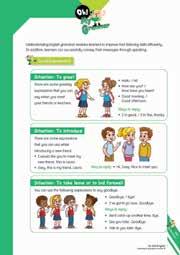




presents everyday social expressions and key grammar points in an easy and concise format, promoting greater understanding.
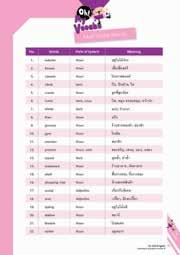
introduces challenging words along with their clear meanings. Students can flip through to quickly find and understand new words.
provides QR codes that link to audio files. Students can listen to them to improve their listening skills and read along to strengthen their speaking skills.


Understanding English grammar enables learners to improve their listening skills efficiently. In addition, learners can successfully convey their messages through speaking.

Situation: To greet
There are some greeting expressions that you can say when you meet your friends or teachers.

Situation: To introduce
There are some expressions that you can use when introducing a new friend.
• I would like you to meet my new friend. This is Laura.
• Joey, this is my friend, Laura.
• Hello. / Hi!
How are you? / How have you been? Good morning. / Good afternoon.
Ways to reply: I’m good. / I’m fine, thanks.

• Hi, Joey. Nice to meet you.
Situation: To take leave or to bid farewell
You can use the following expressions to say goodbye.

• Goodbye. / Bye!
• I’ve got to go now. Goodbye. Ways to reply:
• We’ll catch up another time. Bye.
• See you later. Goodbye.
• Talk to you later. Bye.
Phrasal Verbs
To spend time in a place or an area
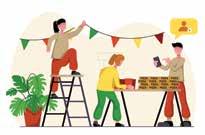
They love to hang
To organise or plan for an activity/event to happen the party.
Keep on To continue doing something
If you keep on trying and do not give up easily, you will succeed.
To go and take someone into a vehicle, especially a car functioning
To answer someone rudely, especially someone in authority
We should not talk to our parents or grandparents.
Please turn off the lights before you leave the room. We friends on the way to the mall.
To tear something (i.e. paper, cloth, etc.) into pieces
He ripped up the letter and threw it into the dustbin.

When you are finished sleeping
David wakes up at 7 o’clock in the morning every day.
1
From?
A. Work in groups. Look at each child. Then, act out the dialogue below with your group members by replacing the words in colour with the information given.










Nice to meet you too. By the way, where are you from, Carlos? to meet you.
Hello. What’s your name?
I’m Paul. I’m from the United Kingdom. I’m from Mexico.
B. Meet two new foreign friends. Let’s get to know them.
Listen. Tick the correct statements and cross out the wrong statements about Akira in the table below.

1. Akira is from Japan.
2. Akira lives in Osaka, Japan.
3 She lives with her parents and brother.
4. She lives with her parents and sister. uring spring.

Listen. Tick cross out Karl in the table below.
2. Karl is from Denmark.


3 He lives in an apartment with his family.
4. He doesn’t live with his family.
5. The capital of Denmark is Copenhagen.
6. The capital of Denmark is Sydney.
7. Denmark has two seasons.
8. His favourite season is winter.
9. He goes skiing during winter.
10. He usually goes ice skating during winter.
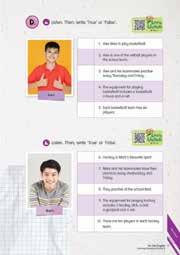
Listen and write ‘True’ or ‘False’.

B.
Ask your friends about their favourite subjects using the dialogue below as a guideline. Then, complete the table.
Example
Hey, Tom! Are you going to class?
I see. I am going to my PE class now.
Hi, Rose. Yes, I am going to my English class.
I can learn about the things around us.
Name
Do you like PE?



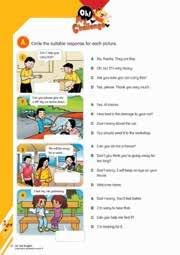
Circle the suitable response for each picture. Then, practise the dialogue with a friend.
Yeah, I did.
Would you like some more soup?
Yes, thank you. Did you make it yourself?
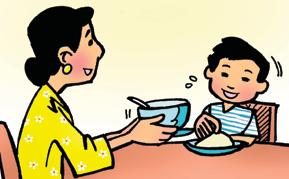
Thanks, Joey. I’m glad you like it.
A Can you do me a favour?
B Would you like some orange juice?
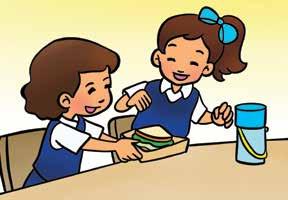
C Would you like a grilled cheese sandwich?
D What would you like to have for breakfast? I don’t want any more soup.
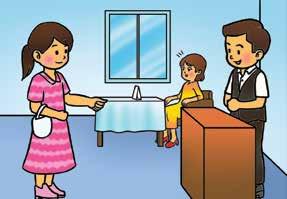
I’m sorry, madam. There is someone sitting at that table.

I’d love to, but I don’t like it.
Yes, please. Mum, your soup is the best!
Excuse me. Can I order some food?
Excuse me. Can I book a table?
Can I make a reservation for a private room?
A What would you like to drink?
B Would you like some desserts?
C Can I have your order, please?
D
Excuse me. Can I order food?

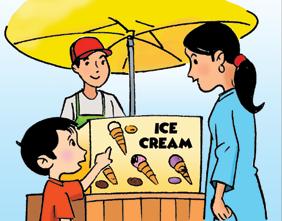
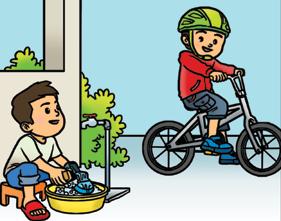
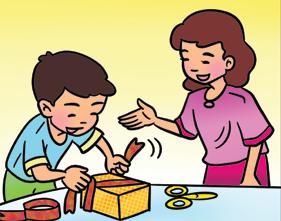
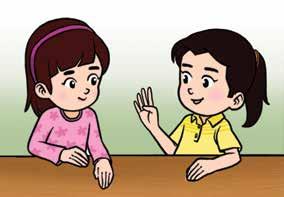
Hi,
Circle the suitable response for each picture.
A How are you, Linda?
B How have you been, Linda?
C Hello, everyone. Nice to meet you.
D I’d like to introduce a new student, Linda.
Can I book a private room for dinner?
Thank you very much for your help.
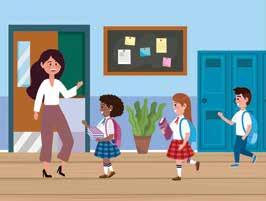
A Teacher, can I go to the restroom?
B Teacher, can I go out and play?
C Teacher, I haven’t finished my homework yet. I’m sorry.
D Good morning, Teacher. How are you?
Listen. Then, circle the correct statement for each question.

D Mum and Jeff decide to go to Rasa restaurant because it is cheaper. 1 2 3 4
A Grace is going to a camp next week. B Grace wants to buy a new pair of rain boots.
C Grace gets pink flip-flops. D Grace is not happy with her new flip-flops.
D Lily, Nelly’s friend, had borrowed her English textbook last week.
from the supermarket.
A Mum and Jeff don’t like Thai food.
B Coco Café is further away from their house.
C The dinner set at Coco Café costs 500 Baht per person.