




Romel Dhalla
The global trading system is undergoing a structural recalibration. Supply chains that once flowed predictably along North American corridors are now subject to geopolitical strain, tariff volatility, and rising costs. For Manitoba, a province whose economy is deeply integrated with the United States, this moment presents both risk and opportunity. The forthcoming visit of India’s High Commissioner to Canada, His Excellency Shri Dinesh K. Patnaik, to Winnipeg at the end of April 2026 comes at precisely such an inflection point.
This visit signals an opportunity for Manitoba to reposition itself within the emerging Indo-Pacific economic order and to diversify both its import architecture and export ambitions in ways that could materially strengthen the province’s long-term resilience.
India today is one of the fastest growing major economies in the world and the most populous nation on earth. Its manufacturing exports have accelerated sharply in recent years, supported by state led industrial policies, infrastructure investment, and tax reform. For a province like Manitoba, whose growth is anchored in agriculture, advanced manufacturing, natural resources, and increasingly digital services, India represents more than a large market. It represents a parallel economic ecosystem with

Manitoba has much to benefit from trade in agriculture, transportation and critical minerals.
scale, demographic momentum, and industrial capacity. The context for this visit matters. Canada and India experienced a period of acute diplomatic strain in 2024 that led to the recall of envoys and a temporary chill in federal level engagement. Since then, both governments have moved toward what officials have described as a constructive recalibration, restoring high level diplomatic representation and reopening channels of economic dialogue. The reappointment of High Commissioners 4 ‘Seize the day' u
There is no better way to get your garden started than through a local plant auction. And no matter what part of the city you are in, you are invited by the Charleswood Garden Club to join them on May 21 at the St. Mary Anglican Church at 3830 Roblin.
The funds are used to host speakers who provide gardening information, problem solving, encouragement, ideas, information on new species and products, and best practices with an eye to the
environment. We stress the personal and environmental benefits of gardening and landscaping. Anyone is welcome to our meetings at no cost.
The Charleswood community endeavours include plantings and maintenance at the Veterans Memorial and the “Welcome to Charleswood” sign. They donate a Christmas hamper to Feed-a-Family program through the Christmas Cheer Board of Winnipeg . They also facilitate a vegetable soup making workshop in the fall with a neighbourhood elementary class. This year, they plan to donate to several community groups including the Urban Retreats
Garden Tour (OneJustCity) and Abundance Community Garden at St. Mary Anglican Church, and to provide scholarships to Oak Park and Shaftesbury High Schools.
Community gardens and a small orchard for club members on the banks of the Assiniboine River are the site of educational opportunities and also where we plant an edge row for community walkers. This year we are adding another raised bed for use by some of our members who need more accessible gardening spaces, allowing them to continue gardening.
Adele Stiles is the co-chair of the Charleswood Garden ClubPlant Auction


Andrea Ladouceur
Globally, over 35 per cent of the world's pharmaceuticals move by air. Ninety per cent of specialized medicines are transported by air. This cargo requires security, temperature control and is considered high-yield cargo, and its regular routes around the world are changing in a big way.
The Strait of Hormuz crisis has exposed the fragility of the global pharma logistics system. What was once an efficient route now threatens the timely and safe delivery of life-saving medicine to the world.
The conversation is now on diversification and redundancy to build resiliency, focusing on these priorities:
• Build logistic capacity in strategic locations that are stable and easy to access (rerouting outside the Gulf).
• Invest in air cargo routes that create capacity when shipping is delayed.
• Industry must expand cold chain and
8 ‘Manitoba's pharmaceutical industry' u


There comes a time, often without warning or ceremony, when we begin to look at our lives a little differently. Not with regret, and not with urgency — but with perspective. We start to notice the moments that mattered, the people who shaped us, and the values that quietly guided our choices along the way.
This is usually when the idea of legacy begins to surface.
Not as a plan or a decision, but as a feeling. A sense that a life well lived is about more than what we have accumulated. It is about what we have shared, what we have stood for, and how our lives have intersected with the lives of others.
For many of us, especially as time gives us room to reflect, legacy becomes less about possessions and more about meaning. About family stories, community ties, acts of kindness, and the causes that touched us personally — often because they touched someone we love.
Yet legacy can feel like an uncomfortable subject. It is sometimes wrapped in formal language or presented as something that must be resolved or decided. In reality, legacy is rarely about immediacy. It unfolds slowly, shaped by experience, relationships, and an evolving understanding of what truly matters.
That is why reflection is so important. Rather than offering answers, reflection invites questions — thoughtful, human questions that allow us to explore our values without pressure or expectation. Questions that acknowledge there is no single path, no right answer, and no requirement to act before we are ready.
The questions that follow are offered in that spirit. They are not meant to persuade, instruct, or bind. They exist simply to open space — to help us think about legacy as a natural extension of a life lived with care, responsibility, and connection to others.
A life well lived leaves something behind. What that “something” is — and how we come to understand it — is deeply personal.
A thoughtful Q&A on legacy giving
1. What does “legacy” truly mean beyond money or possessions? For many, legacy is not defined by what is owned, but by what is valued. It speaks to the principles we lived by the care we showed others, and the quiet in-


fluence our lives had on family, community, and future generations. Financial choices may play a role, but legacy itself is rooted in meaning, not material measure.
2. At what stage of life do people begin thinking about legacy giving? There is no single moment. Some begin reflecting after a significant life event, others gradually as priorities shift and time offers perspective. For many Manitobans, it emerges naturally during a season of reflection — not from urgency, but from awareness.
3. Is legacy giving only for people with large estates or substantial wealth? Not at all. Legacy is not reserved for those of great means. People from all walks of life consider how their values might endure, often in ways that are thoughtful, proportional, and entirely personal.
4. How does legacy giving fit alongside family, loved ones, and personal responsibilities? For most individuals, care for family comes first and foremost. Legacy considerations are typically explored only after loved ones are secure and often reflect shared values rather than competing priorities.
5. Why do many Manitobans feel drawn to causes rooted in their own communities? Local causes carry familiarity and trust. They reflect shared experiences, common challenges, and the places where lives have unfolded. Supporting one’s community often feels less abstract — more human, more connected.
6. What kinds of causes tend to resonate most when people reflect on legacy? Health, children, education, community well-being, and environmental stewardship frequently emerge. These reflections are often shaped by

personal experience — moments of help received, challenges witnessed, or gratitude felt.
7. Is legacy giving something that must be decided immediately, or can it change over time? It can, and often does, evolve. Many people revisit these thoughts periodically as circumstances, relationships, and perspectives change. Reflection does not require finality.
8. How do people typically begin exploring legacy giving? Often quietly. Through conversations with family, trusted advisors, or through personal reflection. For some, it begins simply by reading, listening, and allowing space for thoughtful consideration.
9. What role do life experience, personal stories, and values play in these decisions? They are central. Life experiences — both joyful and difficult — shape how people understand care, responsibility, and contribution. Legacy choices often reflect a personal story rather than a financial calculation.
10. How can thinking about legacy offer reassurance rather than concern? When approached without pressure, it can be grounding. It offers an opportunity to affirm values, acknowledge a life well lived, and find comfort in the idea that what mattered most continues forward in meaningful ways.
Legacy is not something we arrive at all at once. It is shaped slowly, through lived experience, shared moments, and the values that guide us over time. For many of us, simply allowing space to reflect is enough.
The questions you have just read are not meant to lead to conclusions, nor do they ask for decisions. They exist to acknowledge something deeply human — that a life well lived often carries a desire for continuity, care, and meaning beyond ourselves.
There is comfort in knowing that legacy is not measured by scale or certainty, but by intention. It lives in stories told, values passed on, and the quiet ways we remain connected to others.
If these thoughts linger, let them do so gently. Reflection needs no urgency. What matters most tends to reveal itself in its own time.
A life well lived leaves its mark — often more profoundly than we realize.



Follow us online at: lifestyles55.net
Facebook: Lifestyles55
PUBLISHER
Pegasus Publications Inc.
EDITOR
Dorothy Dobbie dorothy@pegasuspublications.net
ART DIRECTOR
Karl Thomsen karl@pegasuspublications.net
GENERAL MANAGER
Shauna Dobbie shauna@pegasuspublications.net
CONTRIBUTORS
Marianne Cerilli, Romel Dhalla, Dorothy Dobbie, Shauna Dobbie, Zofia Dove, Doug Eyolfson, Stefano Grande, Evelyn Jacks, Kevin Klein, Andrea Ladouceur, Ian Leatt, David Leis, Myron Love, Fred Morris, Fred Pennell, Seneka Samarasinghe, Trudy Schroeder, Adele Stiles, Robert Urano, Sherrie Versluis.
Canadian Publications mail product Sales agreement #40027604
PRINT ADVERTISING
Gord Gage • 204-940-2701 gord.gage@pegasuspublications.net
Nathan Avila 204-940-2726 Nathan@pegasuspublications.net
SUBSCRIPTIONS
If you would like to receive Lifestyles 55, we offer both monthly newspaper and online formats. To place your order, call 204-9402700. Subscriptions are $36.00 per year, plus tax. American Express, MasterCard, Visa and cheques are accepted. To view a back issue online visit lifestyles55.net
Published monthly by:
Pegasus Publications Inc. PO Box 47040, RPO Marion Winnipeg, MB R2H 3G9 204-940-2700
Lifestyles55.net pegasuspublications.net
DISTRIBUTION
Available at more that 20 rural towns and cities as well as more than 100 locations in Winnipeg. If you would like bulk copies of this publication, contact Gord Gage at (204) 940-2701 or gord.gage@ pegasuspublications.net. Also available digitally at whatsupwinnpeg/lifestyles and on Facebook: Lifestyles55
EDITORIAL SUBMISSIONS
Call Dorothy Dobbie at (204) 940-2716 or email dorothy@pegasuspublications.net for more information and guidelines. Any opinions expressed in columns by our contributors are their own opinions entirely and are not necessarily shared by Pegasus Publications Inc. All information presented by the contributors is the responsibility of the writers.
Lifestyles 55 is published monthly. Reproduction in part or in whole is prohibited without seeking permission in writing from the publisher.
Copyright Pegasus Publications Inc.




Wab Kinew was elected on the strength of his apparent knowledge and appreciation for economic issues. After all, he does hold a Bachelor of Arts in Economics. With his chequered past, people were generally wanting to give him the benefit of the doubt. Here he was, the lost Indigenous boy who had made some mistakes in his life, but who had seen the error of his ways and deserved a second chance. Nobody mentioned that his very Caucasian mother, Dr. Kathi Avery Kinew, a policy analyst, is the daughter of a Toronto advertising executive, or that his Anishnaabe father was a highly celebrated professor.
It wasn’t that he had any ideas of his own. He simply stepped in and scooped up the Progressive Conservative platform, leaving Heather Stefanson to explain the details, which she did with cool brilliance. She was the clearest thinking Premier the province had seen in several decades.

Among other details, the PC plan included repairing and developing our battered infrastructure, including the rebuilding of roads and bridges, liberating northern resources, reducing taxes for the least affluent, and providing a way forward filled with opportunity for the local indigenous communities.
pening. Sometimes his programs have been just plain silly. Take the big talk about cutting taxes on prepared grocery store food. Most under privileged people are not buying prepared food and even if they did the savings are minimal, plus all the benefit went to chain stores, not local mom and pop shops. Or how about his even sillier call for a ban on social media for kids under 16? Australia, which banned underage access in January, is having little success with seven out of ten kids remaining on one of the major platforms.
Dorothy Dobbie
Meanwhile, according to the records in his speech to the Winnipeg Chamber of Commerce, “Wab Kinew promised an economically focused, fiscally responsible government. The writer noted that “he was short on details and costs”.
“An NDP government would balance the budget within a first term, Kinew told chamber members, while also expanding childcare and promoting immigration.”
Well. We know how that ended up. There has been NO economic development. All we have heard is a lot of lip service paid to the idea of northern development and port renewal at Churchill, and it is all predicated on government money – which we don’t have!
On the social side 1,300 surgeries were canceled in the first three months of his tenure because he withdrew the right to go out of province for treatment. They have not made any inroads as far as the nursing shortage is concerned, with more nurses leaving than can be hired. His other so-called initiatives are all just talk as nothing is hap-
And all this time, the economic horse is being starved to death. There are no new mines in the north, despite the land teeming with prospectors and support from local First Nations. There is no real progress with the Port of Churchill, and it appears that the Feds have turned sour on the plan due to many practical barriers. The Premier has refused to entertain the idea of an Indigenous-led private sector-financed port at Fort Nelson out of partisan spite, when the project, NeeStaNan, would go a long way toward making Churchill viable.
Every announcement he has made is performative and unsubstantive. Yet, even with all time high Equalization payments of $5 billion for this year (an increase of $355 million from the year before), he has managed to double Manitoba’s deficit from his own prediction of $794 million to $1.76 billion. Our net debt is 38.2% of our GDP! Wab is blaming wildfires and Hydro losses because of low water levels (predicted earlier and factored into previous deficit models). And all this is the face of a $93 million windfall from higher fuel prices and $178 million in additional PST on higher retail prices.
I cannot imagine that this is deliberate. Rather, it shows incompetence by both elected officials and the union dominated public service. Or maybe they all like to believe in fairytales like the Feds under Mark Carney do!
Either way, it leaves Manitoba, once the leader of the western Canadian economy and a threat to Ontario and Quebec’s manufacturing autonomy, down at the bottom of the barrel sucking up the dregs of others province’s labour. It is depressing. Even more depressing is the blindness of the voters who are still giving him the benefit of the doubt.





on both sides has laid the groundwork for renewed commercial confidence.
Sub national diplomacy now carries increasing weight. Provinces and states are no longer passive observers in global trade. They are active participants. Manitoba, with its concentrated strengths in agriculture, aerospace, transportation equipment, food processing, and critical minerals, stands to benefit from direct engagement with India’s diplomatic and commercial apparatus.
and mitigate exposure to North American volatility.

The first opportunity lies in supply chain diversification. Manitoba imported 17.54 billion dollars in goods in the first half of 2025, with more than three quarters of that total originating in the United States. While geographic proximity has long been an advantage, such concentration carries vulnerability. Tariff threats, localized bottlenecks, currency swings, and regulatory disputes can quickly ripple through the provincial economy.
India’s emergence as a large-scale manufacturing platform offers a credible alternative in several sectors critical to Manitoba.
Fertilizers and agrochemicals represent one area of exposure, for example. Manitoba imported more than 900 million dollars in mixed mineral and chemical fertilizers in 2024. Global fertilizer markets have been destabilized by geopolitical tensions and export restrictions. India has responded by scaling domestic production capacity and investing heavily in chemical manufacturing infrastructure. Establishing procurement channels with Indian producers could provide price stability
Pharmaceuticals are equally strategic. Manitoba’s healthcare supply chain has shown sensitivity to disruptions, with exports of packaged medicines declining sharply in early 2025 due to cross border bottlenecks. India is widely regarded as the pharmacy of the world, supplying a large share of global generic drugs and active pharmaceutical ingredients. Deepening procurement ties with Indian firms could support healthcare cost containment and supply security within the province.
Yet the dialogue should not be limited to simply import substitution but also include transforming Manitoba’s export capabilities.
India is actively positioning itself as a global manufacturing hub under what has become known as the China plus one strategy. As multinational corporations diversify production away from exclusive reliance on China, India has attracted investment through tax incentives, regulatory reform, and large-scale infrastructure commitments. Manufacturing exports have risen rapidly and are projected to expand substantially in the coming years.
For Manitoba firms seeking access to Eurasian and East Asian markets, geography is a structural constraint. Shipping heavy industrial goods from a landlocked prairie province across the Pacific is costly and slow. By contrast, manufacturing or assembling in India provides proximity to high growth markets, access to major ports, and integration into

regional trade networks.
India’s labour economics reinforce the case. Average hourly manufacturing wages remain far below those in North America. At the same time, India produces millions of engineering and technology graduates annually and is home to the world’s largest working age population. For Manitoba companies, this represents scalable human capital capable of supporting complex production.
Perhaps the most interesting frontier lies in Indigenous trade. Manitoba’s First Nations and Métis governments are increasingly asserting economic sovereignty and pursuing nation to nation trade relationships. Manoomin, or wild rice, holds deep cultural significance and is harvested sustainably in Manitoba’s northern lakes. The province already accounts for a substantial share of Canada’s wild rice exports. India’s expanding middle class and high-end hospitality sector are showing growing demand for premium, health focused grains. Direct trade links between Indigenous producers and Indian distributors could capture higher margins and reinforce sustainable harvesting practices. This is but one example.
The High Commissioner’s visit provides a platform to initiate such dialogues at a provincial level. Meetings with business leaders, Indigenous governments, and sector associations can translate macro strategy into concrete partnerships. Trade missions, memoranda of understanding, and pilot procurement agreements often begin with precisely these diplomatic encounters. It is highly probable that Canada will dispatch a trade mission to India later this year.
For Manitoba, it is a matter of reducing trade concentration with the US and diversification of our international trade
relationships. The province will always remain deeply integrated with the United States. That is a structural reality. But, given the uncertainty of our US partnership, Manitoba must begin building new trade routes.
India offers scale, demographic momentum, industrial capacity, and a strategic location within the Indo-Pacific. Manitoba offers agricultural excellence, advanced manufacturing, resource wealth, and stable governance. The alignment is evident. The economic potential unlocked by this visit will not be realized automatically. It will require disciplined follow through by provincial policymakers, corporate executives, Indigenous leaders, and federal trade officials. The moment is real as the global economy is reordering itself. Manitoba must act and not dither as I have seen it do in the past.
When the High Commissioner arrives in Winnipeg this April, he will bring with him not just diplomatic credentials but an opening. Manitoba can and must treat the visit as a strategic opportunity and seize it. The economic stakes for our Province, its companies, and most importantly, its people, are too high not to.
Romel Dhalla, is President of Dhalla Advisory Corp., provides strategic corporate finance advice to companies and high net worth individuals. He was a portfolio manager and investment advisor with two major Canadian banks for 17 years. Contact him at romel@ dacorp.ca. Any views or opinions represented in this article are personal and belong solely to the author and do not represent those of people, institutions or organizations that the author may or may not be associated with in professional or personal capacity, unless explicitly stated. Any views or opinions are not intended to malign any religion, ethnic group, club, organization, company, or individual.

You should consider having the following in place
The preparation of a will may seem like a daunting task, however, it is essential to ensure that your property is disposed of according to your wishes upon your death. If you pass away without a valid will, the law states what is to happen to your estate.
Power of Attorney
A power of attorney is a document which appoints an individual to handle your affairs in the event you become mentally incapable of making your own decisions. Nothing prevents you from continuing to make your own decisions while you are still competent.
A power of attorney is an extremely valuable document to have in place in case anything happens to you which affects your mental ability, such as a stroke, coma or dementia.
Health Care Directive (Living Will)
A health care directive, commonly called a living will, is a document which appoints an individual to make decisions with regard to your health care only, while you are alive but unable to express your decisions yourself. This document is distinct from a power of attorney and deals only with health care decisions such as whether life sustaining treatments, such as CPR or blood transfusion, should be continued or withdrawn.
My favourite cousin was addicted to drugs. She died at an early age of a hepatitis injection from an unsterile needle, so why wouldn’t I be in favour of safe injection sites? And I was – at first. Then a friend called and asked what I thought of these sites and whether or not I would support one in downtown Winnipeg. I said, Let me think about it! and I began some research. The result was pretty negative from those cities that had run such sites for a few years. Vancouver was heavily affected according to reports at the time. There had been an increase in crime and drug related to activity around the sites. The same was true of cities such as San Francisco and Toronto.
Four years later, as I look for information, I find that those news stories are no longer available as AI now selects what it deems to be the most appropriate, but what I did find, did little to assuage my concern.
First is the vagueness of information surrounding the efficacy of these sites. They claim to save lives, and I am sure they do, but the numbers are ambiguous at best and negligible in the larger scheme of things.
to access supply.
Manitoba also has harm-reduction vending machines, known as, “Our Healthbox” providing free, anonymous, 24/7 access to supplies like naloxone, sterile needles, and hygiene products. In Winnipeg the main locations are in the St. Boniface Hospital basement near Robin's Donuts and at NorWest Community Health in the North End. There are additional sites in northern Manitoba including Flin Flon.
While these efforts are all well-meaning, it seems that there is a misplaced emphasis on this as opposed to shutting down the supply of drugs and that includes the new ones that continually show up on the street. If we really mean to tackle drug addiction, surely there are better methods.

According to the College of Family Physicians and Surgeons of Canada, safe Injection sites reduce overdose mortality with “88 fewer overdose deaths per 100 000 personyears”. What does that mean in terms measurable by the layman? I have not been able to find out.
According to Google, “A highquality study on Supervised Injection Sites in Vancouver, BC, found that for residents living within 500 meters of the site, one overdose death was prevented annually for every 1,137 users.”
All sources agree that beneficial effects are very localized. “This study indicated that such sites reduce mortality rates in their immediate vicinity. There was a 35% reduction in deaths from both infection and overdose in areas immediately surrounding the sites.”
On the other hand, there are countless stories about how neighbourhoods are affected by Safe Injection Sites, and nobody wants one in their backyard.
In Manitoba, all health regions distribute needles/syringes in unlimited quantities to people who inject drugs according to client need and availability of supply, with no requirement for needle/syringe returns or ‘exchange’
verything I understand about illicit intravenous drugs tells me that if you are hooked, getting free of them is not straightforward. Many people manage to stop for a time, but a significant number relapse, sometimes repeatedly, before they stabilise. Long-term studies suggest that perhaps half of people with opioid addiction struggle to achieve sustained recovery without ongoing support.
A supervised consumption site sits at a specific point in that landscape. It operates where risk is highest, at the moment of use, which is the point at which people are most likely to die.
Prevention is first. How much education are kids getting about these substances and what they do to a person? What do their parents know so that they can pass their education down to their kids? Massive antismoking education was the most effective weapon in curbing use, although kids are picking it up again since the advertising has stopped. Any anti-drug education program should explain how addiction takes hold the brain –and that includes the way gambling works – not to mention screen use.
Secondly, what is the strategy to remove traffickers, not just in Manitoba but across the country? The record crime spree currently taking place is out of control, part of the “woke” mentality that accompanied the likes of Justin Trudeau’s philosophy of life. It doesn’t work, folks! There must be action to remove harm perpetrators from the street and keep them away from the population.
We are not keeping prisons full. The federal prison population in Canada has generally been receding, decreasing by 6.1% over the 10 years before 2024.
Finally, the best harm reduction is to get people off drugs. Apparently Safe Injection Site counselors have a high success rate so direct more energies there and extend those energies beyond the site and on the street.
The bottom line is that Safe Injection Sites are a poor bandage for a serious problem.

I don’t know how many people know all this before they inject the first time, but it suggests something important about addicts: they are usually trying to get relief from something that, at that moment, feels worse than the risk.
The discussion in Winnipeg is about whether a supervised consumption site should exist and where it should be placed. Henry Avenue, just a few blocks from Main Street, has become the focal point. The area already carries a high concentration of addiction, poverty and homelessness services. There have been a lot of arguments concerning crime, congregation of addicts and needles being left in the area, and children being exposed to all of these things.
In Winnipeg, we have over 300 people dying each year from overdoses and thousands more require emergency response. These things don’t happen in treatment settings. They happen in back alleys and stairwells. A supervised site probably does not change how many people are using on any given day, but it changes what happens when something goes wrong.

No single approach to dealing with addicted drug users is sufficient on its own. Treatment has clear benefits, especially when it is accessible and sustained, but it does not reach everyone at the same time. Enforcement has a role in controlling crime and disorder, but it has not removed drug use from cities. Prevention can reduce future use; things like stable housing, family support and good mental health care all reduce the likelihood that someone will move toward problematic use. It doesn’t affect current uses, though.
But the people who would use a supervised consumption site are already in that area. They are already using drugs there. Overdoses are already happening. Here’s a question: is it worse for a child to see a strungout junkie or a dead one?
When there is no supervised space, drug use shifts into alleys, stairwells, and public washrooms. Overdoses will still happen in those places as well, even with the supervised sites. The key is to reduce the number.
A supervised consumption site has staff present and naloxone, the drug that counteracts opioid effects. An overdose can be reversed. The person leaves instead of becoming a fatality.
That is the function.
Canada has already tested this approach. In Vancouver, overdose deaths within 500 metres of the Insite facility dropped by about 35 percent after it opened, compared with a much smaller decline across the rest of the city. Ambulance calls for overdoses in the area fell sharply. Inside the facility, thousands of overdoses have been managed over the years with no recorded deaths because staff intervene immediately.
Toronto’s experience points in the same direction. Neighbourhoods near supervised consumption sites have seen substantial reductions in overdose deaths after they opened. Across Canada, supervised consumption sites have responded to more than 60,000 overdoses since 2017, with no recorded deaths at those sites.
There is also a broader question about how systems respond to people who are still using. Some approaches require abstinence before support is offered. Others allow support to begin while use is ongoing. When access depends on immediate abstinence, many people remain outside the system. When support is available during use, more people are engaged, though the process is less orderly and often takes longer.
Some countries have taken this one step further. Switzerland, faced with a severe heroin crisis in the 1990s, began prescribing pharmaceutical heroin to the most entrenched users under strict medical supervision. Patients attend clinics, receive measured doses, and use on site. The result has been fewer overdose deaths, reduced crime and greater stability for participants. It has not eliminated drug use, but it has reduced the chaos around it. That approach is far more intensive than anything being proposed in Winnipeg, but it shows what can happen when the focus shifts from eliminating use to managing its consequences.
A supervised consumption site does not replace treatment, housing, or mental health care. It sits alongside them. Without those supports, it will not achieve what some expect from it. With them, it becomes one part of a broader response.
The alternative to using is not always the absence of drug use. It can be a different setting for it, with different outcomes when things go wrong. If the goal is to reduce overdose deaths, then the evidence from other Canadian cities shows that supervised consumption sites contribute to that outcome.
For more than a decade, Winnipeg has been quietly pulling money out of its water and wastewater system and using it to fund general operations. The total now exceeds half a billion dollars. That is not a rounding error or a technical accounting issue. It is a deliberate policy choice, and it has consequences that are now catching up with the city.
Mayor Scott Gillingham continues to make the case that Winnipeg needs help from other levels of government to fund major infrastructure upgrades, particularly at the North End Water Pollution Control Centre. The cost is significant and growing, and there is no question the project must be completed. What is missing from the mayor’s argument is any acknowledgment of how City Hall’s own decisions have contributed to the situation.
not a political position. It is basic financial management. When a revenue stream is tied directly to a critical service, it should be reinvested into that service, particularly when the infrastructure is aging and the cost of replacement is rising.

Kevin Klein
The price tag for these upgrades has ballooned during Gillingham’s time in office. That alone should prompt serious questions. Large public projects do not increase in cost without reason, yet there has been little effort to clearly explain why estimates have escalated so sharply. Residents are being presented with a higher bill, but not with a detailed, transparent explanation of how it grew or what is being done to control it.
At the same time, the city continues to divert tens of millions of dollars every year from water and wastewater revenues into general coffers. This is money collected from ratepayers with the expectation it will support the system they rely on. Instead, it is being used to support other spending priorities, allowing City Hall to avoid more difficult decisions around taxation and budget discipline.
Councillor Brian Mayes has been consistent on this point: “The money we collect for water and sewer should actually be spent on water and sewer projects.” That is
What makes the current approach harder to justify is that residents are also being asked to pay more. Gillingham approved an additional fee tied to water and wastewater, arguing that upgrades required new revenue. That argument might carry weight if the system were retaining its funds. It does not. The city continues to pull tens of millions out each year, even as it claims there is not enough money to meet infrastructure demands.
This contradiction is not theoretical. It has real financial implications. If even a portion of the diverted funds had been reinvested over the past decade, the city would be in a stronger position today. The need for emergency funding would be reduced, and the pressure on ratepayers would be less severe. Instead, the city is now facing a larger bill with fewer internal resources to manage it.
There are also legitimate questions about how these projects are being delivered. The work required to upgrade Winnipeg’s wastewater infrastructure is being carried out by a company headquartered in the United States. That does not automatically mean the decision is wrong, but it does raise reasonable concerns about procurement, cost control, and whether every effort was made to secure the best value for Winnipeg taxpayers. When costs are rising and local infrastructure has been underfunded, those questions should be answered clearly and directly.
From a business perspective, the current approach would not withstand scrutiny. If a company diverted
revenue from a core asset while seeking outside funding to repair that same asset, leadership would be expected to explain the decision in detail. Shareholders would demand accountability. The same standard should apply to City Hall.
This is not simply about past decisions. It is about what happens next. Winnipeg cannot continue to treat its water and wastewater system as a source of general revenue while also arguing that the system is underfunded. The two positions cannot coexist.
The path forward requires a shift in both policy and mindset. The diversion of water and wastewater revenues into general revenue should end within a defined and short timeline. Transparency must improve so that residents and businesses can clearly see how much is collected, how much is reinvested, and how much, if any, is transferred out. Project costs, particularly those that have escalated, must be explained in detail, with a clear plan to manage and control future increases.
Most importantly, City Hall needs to align its financial practices with its public messaging. If the mayor is asking for billions in support from other governments, he must first demonstrate that Winnipeg is managing its own resources responsibly and prioritizing its most critical infrastructure.
Water and wastewater systems do not attract attention when they are working. That is precisely why they require disciplined, consistent investment. Deferring that investment while redirecting funds elsewhere is not a neutral choice. It is a decision that increases risk, raises future costs, and ultimately places a greater burden on taxpayers.
Winnipeggers are now being asked to pay more for a system that has been underfunded by design. That is not a sustainable approach, and it is not one that can be explained away by pointing to other levels of government. The responsibility starts at City Hall, and it is time that reality is acknowledged and addressed.
Kevin Klein is the publisher of the Winnipeg Sun.
Fred Pennell
Many of us have heard the word antioxidants, but it can sometimes sound like something reserved for health magazines or complicated nutrition discussions. In reality, antioxidants are part of everyday foods and play a simple but powerful role in supporting our health, especially as we age.
Our bodies naturally face daily stress from the environment, from normal body processes, and from illness. Over time, this stress can affect cells and tissues. Antioxidants help protect the body from this kind of wear and tear. They support the immune system, help maintain healthy aging, and contribute to overall wellbeing.
The good news is that antioxidants are easy to include in everyday meals. Small choices made consistently can make a meaningful difference.
What are antioxidants and what do they do
Antioxidants are natural compounds found in many foods, particularly fruits, vegetables, nuts, and certain plant-based ingredients. Their main job is to protect the body’s cells from damage caused by unstable molecules often called free radicals. Free radicals form naturally as part of normal bodily processes and increase with exposure to pollution, sunlight, illness, and stress.
When free radicals build up faster than the body can manage them, they may contribute to inflammation, weakened immunity, and faster aging of tissues. Antioxidants help neutralize these molecules and support the body in maintaining balance and repair.
As we grow older, the body’s ability to recover and repair slows slightly. Including antioxidant rich foods regularly becomes even more valuable for maintaining strength, clarity, and resilience.
Antioxidants benefit several important areas of health that matter to seniors.
They help support the immune system by strengthening the body’s ability to respond to illness and recover from infections. This can be especially helpful during winter months when colds and flu circulate more easily.
They also support heart health by helping reduce inflammation and supporting healthy blood vessels. This contributes to circulation and overall cardiovascular wellbeing.
Brain health benefits as well. Antioxidants support cognitive function and help protect brain cells from oxidative stress, which may support memory and focus over time.
They also contribute to skin health, eye health, and joint comfort, supporting overall quality of life and comfort as we age.
Everyday foods that contain antioxidants
Many everyday foods naturally contain antioxidants. Including a mix of colours and textures in meals helps provide a wide range of nutrients that support overall health. Some easy options to look for include:
• Berries such as blueberries, strawberries, and raspberries. These provide natural sweetness along with fibre and important vitamins.
• Leafy greens like spinach, kale, and Swiss chard. These support circulation, immune health, and overall vitality.
• Bright vegetables including bell peppers, carrots, and tomatoes. These contain antioxidants that support vision and skin health.
• Nuts, seeds, beans, and whole grains which provide protective nutrients and lasting energy.
• Dark chocolate, enjoyed in moderation, which offers antioxidants and a satisfying treat.
• Herbs and spices such as turmeric, cinnamon, and garlic that add flavour and gentle health benefits.
Many of these ingredients appear in balanced meal planning and are naturally included in Heart to Home Meals’ senior friendly menu.
Small changes that add up
Adding more antioxidants does not require major changes or special products. Simple habits make a difference over time.
Choosing fruit as a snack instead of sweets. Adding an extra serving of vegetables to lunch or dinner. Enjoying a handful of berries with breakfast. Selecting meals that include colourful vegetables. These small choices gradually strengthen nutritional quality without feeling restrictive or overwhelming.
Consistency matters more than perfection. The body benefits from regular intake rather than occasional large amounts.
Making healthy eating easier and more accessible
As with many aspects of nutrition, accessibility plays a large role in consistency. Grocery shopping, food preparation, and cleanup can become physically demanding with age. Fatigue, mobility challenges, or winter weather can make it harder to keep fresh produce on hand regularly.
We at Heart to Home Meals help bridge this gap by delivering nutritious meals directly to the home. Meals are thoughtfully prepared and frozen at peak freshness, helping preserve the vitamins and nutrients found in vegetables, fruits, and other antioxidant rich ingredients. This allows seniors to maintain steady access to nourishing meals without the physical strain of frequent shopping or cooking.
Knowing that balanced meals are readily available supports regular eating habits and reduces the temptation to rely on less nutritious convenience foods.
Supporting the immune system through daily nutrition
The immune system relies on consistent nourishment to function well. Antioxidants play a role in supporting immune response and recovery. When paired with adequate protein, hydration, and overall balanced nutrition, they help the body remain resilient.
This becomes especially important during seasonal changes and colder months when immune challenges are more common. Maintaining steady nutrition supports energy, comfort, and peace of mind.
Food as part of Holistic Wellness
Nutrition is not only about physical health. Meals bring comfort, routine, and enjoyment. A familiar flavour can lift mood. A nourishing meal can provide a sense of care and stability.
Antioxidant rich foods support the body quietly in the background while seniors continue enjoying daily life, hobbies, relationships, and rest.
Choosing nourishment that fits real life
Healthy aging is built through steady habits that feel manageable and supportive. Antioxidants are one part of a broader picture that includes movement, rest, connection, and balanced meals.
Small daily choices create long term benefits. By including antioxidant rich foods regularly and choosing meals that support overall wellbeing, seniors can continue nourishing their bodies in ways that feel comforting, empowering, and sustainable.
Wellness does not need to be complicated. It grows from simple, thoughtful habits that support health and enjoyment at every stage of life.
Fred Pennell is the franchise owner of Heart to Home Meals Winnipeg. He and his team provide home-delivered, chef-crafted frozen meals specifically for seniors. Fred is also the President of Pembina Active Living, a community that enhances the quality of life for older adults in South Winnipeg.
The Manitoba NDP government is playing checkers with consumers and grocery store multinationals when they need to play chess.
First the numbers for a cost benefit analysis on the Provincial Sales Tax (PST) cut on in store prepared foods. Most grocery staples like fresh fruit, vegetables, meat, dairy, bread, and eggs are already exempt from PST. The new PST exemption includes junk food, deli, fruit and veggies trays. Things families stretching their dollar would avoid as these prepared foods are where grocery stores are inflating prices the most.
Second it only applies to large grocery chains, not smaller retailers, like the ones, many low-income folks without a car rely on. This tax cut approach is not progressive when considering the cost benefit impact. The average family will save little per month, about $20, but the collective impact on the provincial budget is $24 million.

Marianne Cerilli
Like the NDP gasoline sales tax cut, which has cost the government about a $1 billion by now, these tax cuts are eroding public assets and contributing to doubling the Manitoba government deficit. These tax cuts on grocery PST contribute to Manitoba government’s revenue problem and an are simplistic tactic, like other tax cuts, of buying votes with our own money. And like the gas tax cut, the PST cut on junk and deli does not encourage healthy options like transit, active transportation, and eating whole foods not highly processes foods.
We need systemic supply chain solutions to inflation that intervenes where the profit and price gouging are happening. Otherwise, the government is using public funds to subsidize the profits of the multinational grocery chains.
Analyzing the drivers of food price inflation show some troubling trends. On the positive side the government the Manitoba is trying with new legislation, to address the use of surveillance systems on digital price tags that allow for differential pricing or using consumer data to set the price at the most profitable or the highest price people will pay for that product.
More of this approach is needed to also get at security costs to address food theft. Off-duty police officers are costing retailers $1,200 an 8-hour shift. When considering there are two officers plus security guards at hundreds of grocery stores in Manitoba, the cost of added security onto our groceries is significant. It is

unclear how these costs compare to the costs of theft or “shrinkage”. Spending on police rather than addressing poverty even more problematic when considering that $1200 per shift for a police office per shift is more than a person on welfare has to live on for an entire month.
So far, the attempts to address retail theft have focussed on policing and suppression not on addressing the poverty, trauma, addictions and desperation that drives people to steal food. Now there is the problem of food theft includes more organized crime as well, with people stealing meat and other food for resale.
Besides surveillance and security costs, adding to our food prices, there are costs for transportation, due to rising fuel prices, plus there are food production input costs for farmers, seed, fertilizer, equipment, insurance coverage for more droughts and floods, made worse by climate change. There are more costs for manufacturing and packaging, and other costs.
But the demand for ever increasing shareholder profits among grocery chains is likely the worst driver of inflation. Competition between chains is not working to dive down prices. The problem of inflations is baked into the system and there are no downward pressures. When you see the word inflation it really means growth in profits.
The ideas for social programs and taxing profits, and even the cost of a public option for groceries being developed by the new Mayor of New York, Zorhan Mamdani and NDP Leader Avi Lewis have costs. But are worth considering.
We need the government to take systems change approach to the rising cost of living, not put a Band-Aid on a haemorrhage. This systemic approach will require new collaborative efforts between farmers, labor unions, community and consumer groups alongside governments to stand up to multinational corporations, their shareholders and financial institutions that are profiting from food price inflation.
The same goes for inflation in housing and other areas due to financialization, commodification and privatization of everything. Our governments in Canada must leverage with labour and the community to create systemic solutions or we are just digging ourselves deeper into a growth economics hole and inflation hole.
Marianne Cerilli is an educator, and former MLA working in community development and social innovation. Mariannecerilli.ca. Listen to Marion on CKUW radio. May 8 is on working mothers, and May 22 is on food price inflation at 8 am.
Journalism was meant to challenge power – now it just echoes it
The legacy media have traded the pursuit of truth for partisan activism
Canada’s media is not failing because people stopped reading it. It is failing because people stopped trusting it.
For decades, the media was one of the central pillars of a free and democratic society. Its role was straightforward: to hold power to account, present competing viewpoints and give citizens the information they needed to make informed decisions.
Canada does not lack journalists. There are more platforms, more voices and more content than ever before. The problem is that much of the system no longer operates as a free press.
tion alone is damaging. Media depends on trust. Once the public believes coverage may be influenced, even subconsciously, trust erodes.

David Leis
It behaves like a managed one. And Canadians are starting to notice.
The most obvious reason is simple: government funding. Today, roughly 2,000 media outlets in Canada receive some form of federal support through tax credits, direct subsidies and programs introduced since 2019 to support journalism.
Even if journalists insist the funding does not influence their work, the percep-
But funding is only part of the problem.
When media organizations depend on government programs to survive, incentives change. Stories that challenge power become riskier. Editorial decisions become more cautious. Coverage begins to align, sometimes subtly and sometimes overtly, with a prevailing narrative.
During the last federal election, much of the coverage centred on the United States and President Donald Trump. Meanwhile, issues that dominated daily life for Canadians, such as housing costs, affordability and rising crime, were pushed aside. That was not an editorial accident. It was a choice, and it shaped what voters believed mattered most.
The same pattern shows up in policy coverage. When the federal government announced it had reached NATO’s two per cent defence spending target, much of the reporting simply repeated the claim. Far less attention was given to how
the target was met through accounting changes and reclassification of existing spending rather than through a meaningful strengthening of Canada’s military capacity.
This is not a small oversight. It is the difference between informing the public and reinforcing a preferred narrative.
Too much reporting now begins with a conclusion and works backward. The goal is no longer to discover what is true, but to support what fits the prevailing view inside the newsroom.
That is not journalism. That is advocacy.
There is nothing inherently wrong with opinion. A healthy media ecosystem depends on strong viewpoints from across the political spectrum. But traditionally, there was a clear line: opinion lived on the editorial page, while news reporting aimed for objectivity.
That line has blurred.
When advocacy replaces inquiry, the consequences are predictable. Certain stories are amplified. Others are ignored. Questions that should be asked are left unasked. Over time, the range of acceptable opinion narrows.
Voices that fall outside the dominant perspective are not debated. They are dismissed. Entire areas of discussion are treated as settled when they are not. The result is a media environment that in-
creasingly speaks to itself instead of to the country.
A media that does not consistently challenge power cannot hold it to account. When coverage aligns too closely with government priorities or avoids politically sensitive issues, the public is left with an incomplete picture of reality.
The irony is that while legacy media struggles, independent outlets are gaining ground. Many operate without government funding and rely directly on audiences for support. Not because they are perfect, but because they are doing what audiences expect: asking harder questions, covering neglected issues and being transparent about their perspective.
More government funding will not restore trust or independence. Narrowing the range of acceptable viewpoints will not rebuild credibility.
A healthy media ecosystem requires distance from government, not dependence on it. It requires competing viewpoints, not managed consensus. And it requires journalists willing to follow facts wherever they lead, not where prevailing narratives lead them.
There is no shortage of media in Canada. What’s missing is a press willing to hold power to account.
David Leis is President and CEO of the Frontier Centre for Public Policy and host of the Leaders on the Frontier podcast.
Manitoba leads the way in so many ways. One of these unique operations is Cambrian Shoes from Winnipeg. It specializes in shoes that promote foot care, based on the expertise of Canada’s pedorthic, podiatric, and chiropody professionals. The company has made a meaningful impact on the footwear industry and continues to expand into key markets, including the United States and Europe. In 2025, Cambrian emerged as one of the fastest growing footwear brands worldwide.
Walking is more than simply a means of getting from one place to another, it is an essential part of a healthy, active lifestyle. Cambrian specializes in the design and development of advanced walking shoes and sandals that prioritize foot health without sacrificing style or comfort. The footwear is engineered with orthopedic principles in mind deliver better-designed footwear and outcomes for individuals who rely on proper support and alignment. The designs aim to promote proper posture, reduce strain on joints and muscles, and support a smoother, more natural stride. With its more than 30 years of experience, Cambrian has refined its approach so that its shoes enhance the effectiveness of custom orthotics while promoting natural movement.
When you are a company that has developed as a family-owned business spanning three generations, reputation and concern for the quality delivered to your customers is everything. Those are the principles that have made Cambrian a leader in orthopedic walking shoes and sandals for both men and women.
Whether used for daily errands, professional environments, or regular exercise, Cambrian footwear is developed to elevate overall foot wellness and longterm comfort.
There are few things worse than shoes that pinch of keep you off balance. Issues critical for foot comfort include width, proper size, comfortable foot passing and something we seldom consider, how hat align with you and your body movement. Cambrian considers all this and more:

• Multiple-width options, ranging from Regular to 6E, ensuring a more personalized and accommodating fit.
• An extensive size range, from 6 to 14. Recognizing that proper sizing is essential to both comfort and foot health.
• Smoother stride technology, designed to enhance walking efficiency.
• Built-in stability to help improve alignment and reduce foot fatigue.
• Removable footbeds in every pair, allowing wearers to easily incorporate custom orthotics, even in their sandals.
• Proven orthopedic design, developed with foot health experts to produce premium footwear for optimal outcomes.
• Biomechanically designed, ensuring each shoe works in harmony with your body’s natural movement.
• Body alignment, further contributing to improved posture and long-term physical well-being . Cambrian products are available exclusively through leading foot health clinics and specialized footwear retailers internationally, including Canadian Footwear, a long-standing and trusted partner in Winnipeg. Known for the quality and reliability
of their products, Canadian Footwear has the largest selection of Cambrian products and provides customers with access to expertly curated products and knowledgeable service.
Established in 1932, Canadian Footwear has become a cornerstone of Manitoba’s retail landscape. The company is widely recognized for its “We Fit You” approach, reflecting a strong commitment to personalized customer care. Through their distinctive “sit and fit” service, trained fitting specialists work closely with each individual one-on-one to understand their footwear needs, whether activityrelated, prescription required, or overall foot health concerns. They take the time to assess your current footwear, professionally measure your feet, and guide you in selecting the right shoe with the ideal fit. This hands-on experience sets Canadian Footwear apart, reinforcing the importance of accurate fit in maintaining good foot health.
The retailer’s extensive inventory includes walking and running shoes, safety footwear, hiking boots, slippers, sandals, and everyday casual styles. With over 60 footwear brands and over 2,000 styles to choose from, Canadian Footwear ensures customers don’t have to compromise between function and style.
With five locations across Canada, four in Winnipeg and one in Calgary, Canadian Footwear continues to deliver a unique retail experience. The company understands the critical role that properly fitted footwear plays in supporting mobility, preventing injury, and enhancing overall comfort. Key principles that align closely with Cambrian’s commitment to foot health and with more than 50 different colors and styles in a wide range of widths and sizes available only at Canadian Footwear.
From now until May 25, visit any Canadian Footwear location to try on Cambrian footwear for a chance to win a complimentary pair, and experience firsthand the comfort, support, and innovation that can help you love walking again.
Visit us online at www.CanadianFootwear.com to find out more.
Continued from page 1
specialized handling capabilities in both primary and secondary hubs.
In partnership, the Winnipeg Airport Authority and BAM went to LogiPharma Europe where global leaders met to discuss where industry is heading with cold storage, air cargo and supply chains for pharmaceuticals.
We also shared Winnipeg Airport's new $150M cold storage facility with the specifications needed for pharmaceuticals and Manitoba's ever-expand-
ing transportation advantages.
This is an advantage for Manitoba. The world needs more secure medicine air cargo options and cold storage options. Companies are expanding to areas that are safe, stable and rich in transportation logistics. As the medicine manufacturing hub of Canada, Manitoba has a lot to offer in this space.
The conversation is no longer just about efficiency and speed. Instead, there is a growing emphasis on resilience, redundancy, adaptability, and pre-

paredness amid ongoing global uncertainty. These companies are acting. We met with companies that have opened their first North American location, and others are planning to do the same. This is where Manitoba can play a role in the safe supply of medicine for the world (and maybe for Canada, too).
We're grateful for the opportunity to represent our community at LogiPharma and look forward to continuing these conversations closer to home.







In September 1951, the unfinished St. James Collegiate (SJCI) on Portage Avenue held its first classes. During the 1870s the site had been home to Edwin Bourke, St. James’ first MLA. Many notable guests, including Manitoba Premier John Norquay, visited the white brick house. The new school soon became a meeting place for a different generation of public figures.
On October 9, 1951, Princess Elizabeth (soon to become Queen Elizabeth) and her husband Philip drove by the unfinished school on a Royal Visit. In June 1953, SJCI vice principal Christine Carson represented the Canadian Teachers Federation at the coronation of Queen Elizabeth. During the rest of the 1950s, former Ontario Premier George Drew, Federal Health Minister Paul Martin Sr., Duff Roblin, MP Gordon Churchill, Reg Wightman, Dr. Donald Houser, and CJOB Founder Jack Blick, all spoke at various events at the school.
SJCI won the Suburban Track Meets in 1952, 1954, 1956, 1957, 1958, and 1959.

Fred Morris From the desk of a gadfly
Between 1925-49, the Bourkevale Park Golf Course was at the corner of Ferry Road and Portage. It seems fitting that three future members of the Manitoba Golf Hall of Fame were 1950s SJCI Students. Donna Patton won various Manitoba Junior Championships in 1955, 1957, 1958, 1959. After moving to BC, Donna continued to win championships and helped administer golf. In 2019, Donna was inducted into the Manitoba Golf Hall of Fame.
Jimmy Collins won eight Manitoba PGA's (includes five Seniors). Jim was head Pro at St. Charles for 37 years. Jim is in the Manitoba Golf Hall of Fame as both a player and builder.
George Knudson is considered by many to be Canada's greatest golfer. George won the 1954 and 1955 Manitoba Juniors. During his professional career, George won 30 tournaments. George is a member of at least eight Sports Halls of Fame. George received the Order of Canada.
Billy Dromo became a professional Wrestler based in Minneapolis and Atlanta.
There is no doubt that the 1952-53 polio epidemic was the greatest health crisis of the 1950s. In February 1956, SCJI students raised $60 by lining up dimes on the hallway floors of the school for the March of Dimes to help the Society for Crippled Children.
Later, in 1956, the Winnipeg Tribune reported a human-interest story with an SJCI connection. After returning in 1953 from a one-year teaching assignment in Iceland, Paul Sigurdson contracted polio. Paul experienced a long hospital stay including time in an iron lung. After being released from hospital, he returned to teaching and taught English briefly at SJCI before returning to teach in his home town of Morden. Also, Paul invented the curl away board game, founded the Modern Little Theatre, and wrote plays including one about the Wolseley Elm. Paul was named the 1966 Morden Citizen of the Year.
In 1953, the first Driver Ed program with help from Imperial Oil (Esso) was introduced at SJCI.
In 1954, Roseanne Keyes, a student, designed the school crest. Roseanne went on to a long career as a teacher and administrator of St. James Schools. In 1980-81, Roseanne was the vice principal of SJCCI.
Dave Green, Jackie Briscoe, Gail Oswald, Dave FoxDecent, Ken Postgate Nancy Tucket, and Jackie Welsh were students who reported on student activities to various media outlets including the St. James Leader. Bonnie Davis, a 1959 SJCI grad, was a CJAY TV on air personality during the station's early days.
Christine Carson was a SJCI teacher between 1941-51 and the vice principal of SJCI 1952-59. Christine directed the Glee Club. Christine's "Boys Ballet Supreme" became a comedy staple at the 1950s SJCI teas. Francis Rowlin played the trumpet in a Rose Bowl Parade.
In 1959, Allan Lewis received a bursary from the Second War Memorial trust Fund of the IODE. Allan became an electrical engineer for Teleglobe. Allan worked on a project that included laying cable across the South Pacific.
The 1950s Governor General Medalists were Ted Strain, Karl Hansen, Allan Shaw, Donna Patton, Valerie Davis, Ken Halsall, Margaret Evans, and Leslee Quinn. Student Presidents were Irma Harder, Karl Hansen, Jim Collins, Allan Shaw, Paul Bouchard, Ken Halsall, Bob Chalmers, and Maurice Hogue.
In May 1958, Francis Armstrong, who was an Honours student, member of the Glee Club and the SJCI Foreign Affairs group, tragically drowned at the age of 16. Track+ Field Dominance like the 1950s Montreal Canadiens and 1950s New York Yankees St James Collegiate dominated 1950s Track and Field.
I am still trying to sort through the details of this dominance. I will just mention a few of the stars: Winnie Johnston, Karl Hansen, Audrey Jansen, Jim Simm, Clive Armstrong, Al Price (later managed Canada's first A+W), George Minaker (later became a politician), Bruce Souter, Marlene Stewart, Terry Shepperd, Anne Sutton, Bill Lyons, Tom Cooper, Peter Kuntz, Merv Campbell, Ian Irvine, Wendy Bartlett, Elisabeth Vidler, Herb Cooper, Willa Yates, Jack Crerar, Tom Chalmers, Janice Halsall, Margaret Evans, Eddie Aston, Ken Halsall, Bob Chalmers, Evelyn Wade, Billy Wray, Pat Parr, Joanne Fry, Bob Butler, and many more.
A team without a league at the end of the 1950s
In 1959, Barry Rosborough (a SJCI teacher), Ron Latourelle (a Silver Heights Collegiate teacher) and Winnipeg businessman George Druxman organized a SJCI tackle football team. The Jimmies lost their first game 22-12 to Gordon Bell,
finished second in the Red Feather Tournament, and defeated St. Paul's 12-3 in an exhibition game. The players included Gord Irwin, Howie McMillan, Herb Cooper, and Grant McMillan. Why did the Winnipeg High School Football League not welcome the SJHI team coached by 3 members of the 1958 Winnipeg Blue Bombers Grey Cup Champions? The difficulty in finding a league to play in continued into the 1960s.
Final Note on THE SCHOOL 1917-1951
March Lifestyles Story
During the last school year before the Portage Avenue School, the curling rink of Norm Houck, Bruce Kidd, Bill Eggleston, and Ron Cummings won the Tribune trophy at the Manitoba School Boys Christmas Week Bonspiel. Although the Houck team won this trophy, the rink did not get to represent Manitoba at the Nationals. Mr. Houck, a schoolteacher by day, went on to win seven Manitoba (men's and seniors), three Canadian, and two car spiels as a skip or a third. Houck is a member of the Manitoba Curling Hall of Fame.
Coming Soon: SJCI in the 1970s
Fred Morris is a Grandfather, Sports Fan and Political Activist.


Choosing funeral and cemetery plans can be overwhelming to a grieving spouse. Plan the details now. Together. Order your FREE Estate Planning Kit by calling or visiting the locations listed below.

- 819 - 4297
8547
- 817- 8621


Wow! Finally got a warm day to go garden shopping only to discover that many of the shops do not open till the first week in May. It is so cold that I guess there isn’t much point but that did not stop Shauna and Lori and me. We hit many of the garden centres in the south end of the city that were open already, and we had the luxury of seeing the hot new stuff at every place we visited. Of course, we bought plants – who can resist? They will be living in the garage for a while!
Shelmerdine, Pattersons, T & T, on Roblin, LaCoste, St. Mary’s and Ron Paul on the former St. Mary’s strip were on our list. Guess what we bought at Ron Paul? LISIANTHUS! Every colour!
Lori also found a dozen canna for her new garden boxes, and Shauna bought a lot of perennials because she is still building her garden.
In the next couple of weeks, we will venture out again, this time to the country. There are so many wonderful garden centres within an easy drive of Winnipeg. And it pays to price shop. Not all centres charge the same. On our tour, the most reasonable was Ron Paul, where Ray Dubois and his wife Jeanne plant from seed!
In the country, Our Farm is always at the top of the list. Shea Doherty and his family grow plants I can’t get anywhere else and he is also reasonable, price wise. If you are looking for succulents, they are Shea’s specialty.
Let me also give a special mention to LeClerc just off Highway #1 on the way to Headingley. Their begonias and petunias are superb.
Have a wonderful spring, everyone. And remember, balcony gardening can be great fun, too!






















About 50 Manitobans registered to co-create the Healthy Democracy Initiative on April 22. This stakeholder engagement and system mapping event aims to prioritized challenges to democracy and identified methods to actively engage Manitobans in strengthening our democracy. The host is the Association Former Manitoba MLAs, (AFMMLA), an organization established in 2006 to promote all party relationship building between current and former MLAs and to protect democracy.
In a survey of stakeholders registered, top concerns about democracy were a lack of truthful information and knowledge about politics, declining voter turn out, then “hyper-partisanship, polarization and incivility”. Elections Manitoba investigated voter turn out after the 2023 election, with a Prairie Research Associates study of non-voters. The results are interesting.
“Voters and non-voters shared many characteristics. However, compared to voters, non-voters tended to be younger. They were also more likely than voters to come from households where other members also did not vote.” More research is needed on other population characteristics besides than youth, for example ethnicity and Indigeneity, gender, income, or education level. We know voter turn out in the north is lower than the south and urban centres.
The reasons people gave in the study for not-voting in our last Manitoba election, fall into three broad categories:
• Distraction - they intended to vote but were too busy (18%), out of town (13%), ill (11%), or simply forgot (5%).
• Disassociation - they did not intend to vote because they did not trust the candidates or did not like the choices (15%), were not interested and therefore could not be bothered (7%), were not well informed (7%), or said they did not know who to vote for (4%). They felt their vote did not count (4%) or that the outcome of the election was already determined (3%).
• Displacement - they wanted to vote but technical or administrative issues stopped them, including that they were not on the voters list or did not have the necessary identification (8%), voting locations were too far away (2%), they did not know where or when to vote (2%), or voting locations closed too early (1%).
Non-voters rated the importance of eight reasons in their decision not to vote.
• too busy (26%);
• they did not know enough about the parties, policies or candidates (25%);
• out of town (21%),
• their vote did not matter (20%);
• it was too difficult to make a choice among the parties or candidate running in the election (19%).”
Understanding that many non-voters need to be motivated to vote, the Healthy Democracy Initiative can examine ways to engage non-voters. The initiative is taking the approach of identifying the stakeholders with responsibility in these areas. We are not going to just produce a report but build a collective impact healthy democracy network.
Another big issue identified in our AFMMLA preevent survey was hyper-partisanship, incivility and polarization, which seems to be worse at the Manitoba Legislature. In Question Period recently Obby Khan, Leader of the Opposition, in response to most questions by the Premier, was attached for derogatory comments made about the gender identity of our Health Minister. And the Premier was attacked by the Leader of the Opposition for celebrating the victory of Avi Lewis as new leader of Canada’s NDP, attempting to drive a wedge between NDP supporters. Personal attacks and wedge politics like this are turning people off politics.
The problem with poor decorum becomes clear. It is not disagreement that is the problem, as debate in a good sign in democracy, it shows engagement and that people care. The problem is the animosity, is not about substance of policy; it is psychological warfare. It can seem when there is little difference on substantive policy, then politics becomes nothing more than personal

attacks and posturing. Our Healthy Democracy Initiative will examine what helps and hurts our democracy, including what is driving incivility, abuse of power, or undemocratic use of power, hyper-partisanship and polarization.
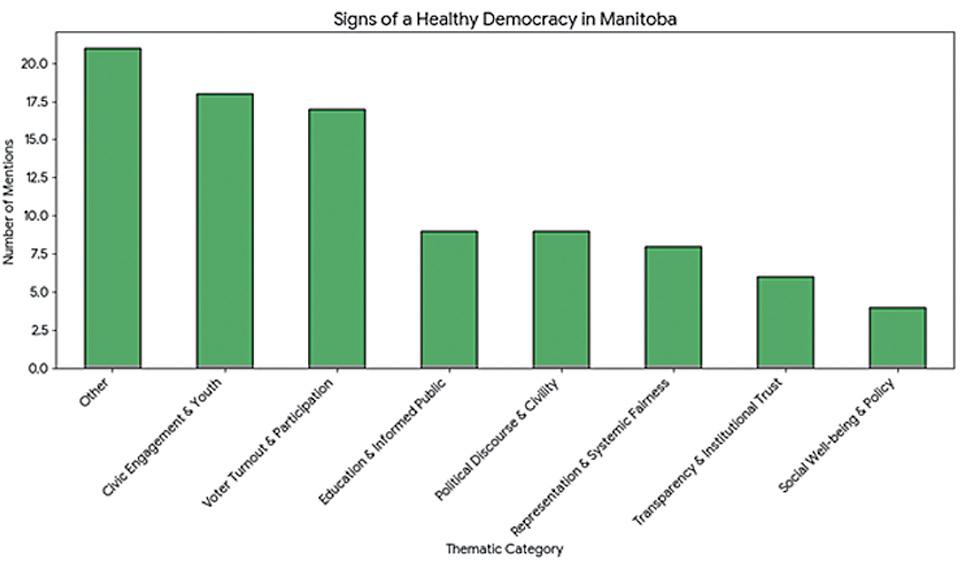
In February, I was contacted by CBC Radio to pose a question for their Saturday call In show, Just Asking, about PM Carney‘s Davos speech to the World Economic Forum. My question was about what his phrase “principled pragmatism” means. It seems another factor turning citizens off politics, is politicians talking but saying nothing, or saying one thing and doing the opposite, which disguises autocracy and authoritarianism. I am researching factors leading to corruption in politics. It seems pragmatism or having low ideals, combined with high partisanship, or “us vs them thinking”, leads people to justify actions that are increasingly unethical. I will be writing more about what makes a healthy democracy based on the outcomes of our stakeholder engagement event on April 22. To end on a positive, the graph sums up our small survey results for signs of a healthy democracy. Find us at infoassocmbformermlas@gmail.com
Marianne Cerilli is the president of the Manitoba Association of Former MLAs, a post-partisan group of former MLAs who believe that the wisdom of those who have “been-there-and-done-that” can add value to the system.
RADIO SHOW: Tune into Marianne at CKUW. They are on the air May 8 on Working Mothers, https://mayworks. org/2026/1816/ and another one on May 22 on Follow the Money on Food Price Inflation. https://mayworks.org/2026/ follow-the-money-on-food-cost-inflation
Irecently enjoyed a performance of The Last Wife by playwright Kate Hennig at the Royal Manitoba Theatre Centre. The play presents the story of Kate Parr (1512-1548) who was the sixth and last wife of King Henry VIII. As good theatre is intended to do, the play caught my attention and inspired further thinking about the pivotal role that seemingly secondary characters can play in history.
The play presents Kate Parr as a beautiful, bright, educated, kind, and wise woman, who entered marriage with King Henry with great trepidation. But she was determined to set the boundaries for a different type of relationship for herself, the king, and his three children, Prince Edward, Princess Mary and Princess Elizabeth.
cession to the throne proved to have significant historical impact.

The worlds of power and politics have always been complicated and dangerous, and even more difficult for women, whose role in the family and the broader world was so limited by the social, religious, and legal systems of the day. There is a point in the play after the death of King Henry where the young princesses ask, “What will we do now?” Kate Parr responds, “We will make history.”
Trudy Schroeder Random Notes
Her role in educating Edward and Elizabeth, as well as her role in encouraging Henry’s passing of the Third Succession Act of 1543 restored princesses Mary and Elizabeth to the line of suc-
This part of the play has been buzzing about in my mind for days, and it has made me recall a Christmas gift I received from my father when I was in high school. I was very interested in history and historical fiction at the time. He gave me a book titled Makers of History from the Earliest Times to the 1970s. It is a very well-presented scan over the millennia to highlight people whose lives and decisions or inventions had a transformative effect on human his-
If not now, then when?
It’s never too late to discover your passion! (Part II) “Gardening Helen” was one of the many people I met and interviewed during my travels in Manitoba. She discovered her passion later in life, and today she is deeply involved in hatching monarch butterflies.
In her late 70s, she attended a fundraising event where she was handed an envelope containing a butterfly. Along with other participants, she released it –and that very moment changed her life.
“I’m almost 90 now and still involved with the monarchs,” she told me. She has since given presentations on the subject and has been interviewed countless times. “People love to learn about butterflies,” she said.
Helen, like my 96-year-old friend mentioned in my previous article, has also been invited to share her knowledge and passion with students in schools. There is no better way to involve the next generation in preserving endangered species than by sharing genuine enthusiasm. Students observe the caterpillars’ transformation and witness the emergence of butterflies. In the end, they get the chance to release them – just as Helen once did. How inspiring. What an experience for these young people. What a memory to cherish, and what a powerful lesson about our planet and its wildlife. Helen is truly making a difference.
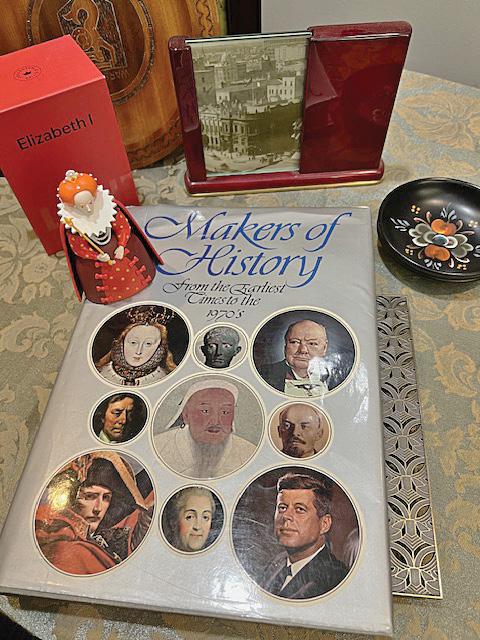
tory. I can remember reading through the book with great interest, and I can also remember my dismay in finding that virtually all the people identified as the “Makers of History” were men. The book was well done, and the historical information was interesting, but it was the first time that I registered that the makers of history, with the exceptions of Queen Elizabeth I, Catherine the Great, Elizabeth II, and Golda Meir, were men.
stress hormone. Studies show that after just 45 minutes of engaging in enjoyable activities, stress can decrease by up to 75%.
Hobbies give us a break from everyday pressures. They allow the mind to step away—even temporarily—from life’s burdens and provide time to recharge. When we immerse ourselves in creative activities like painting, knitting, or writing, or physical activities like yoga, we focus fully on the task at hand. We shift away from a mind preoccupied with the past and future into the present moment.

Zofia Dove Dove's Discoveries
Last month, at the end of my previous article, I promised to share the powerful impact hobbies and passions have on our well-being. The benefits are immense, and we are still discovering more. Let me share some well-known facts:
Engaging in passions and hobbies – especially developing new ones – lowers stress levels, reduces symptoms of depression and anxiety, and improves overall mental health. When we regularly spend time doing what we love, it decreases cortisol, the body’s primary
It is this shift into the now that gives us access to tremendous energy that is otherwise spent worrying about what has already happened or what might come next.
When we engage in our passions, neurotransmitters like dopamine are released. Dopamine is associated with pleasure, improved mood, and a sense of satisfaction. Research shows that having passions is linked to fewer symptoms of depression. One study even found that engaging in hobbies can increase the likelihood of recovery from depression by 200% in older adults.
Because we choose them, hobbies bring positive experiences and emotions – both of which are connected to better health, higher life satisfaction, and increased longevity.
As we develop new skills, we experience small wins that build into a sense of accomplishment. This strengthens our self-worth and reminds us that personal growth is always possible. In turn, our confidence grows.
Hobbies also allow us to form identities beyond our professional roles, often acting as a buffer against hopelessness. They help us navigate difficult periods in life. Group activities such as crafting circles, book clubs, or
Learn how to spot and stop scams at

It was a shocking moment!
It simply does not make sense that half the population of the earth through thousands of years of human history has been relegated to a supporting role to stories that took place in rooms and on battlefields that they could not access.
As I look at the achievements and accomplishments of present-day women in science, business, politics, academics, the arts, literature, and sports, I am filled with thankfulness for the brave women whose persistence and excellence opened doors of opportunity so that women around the world could become active players and use all their skills and talents in making history. I firmly believe that our human story is improved when all people can fully participate in the sectors of society that fit best with their talents, skills, education, and interests.
This is an example of the ways that encounters we have with ideas and values in art, theatre, and music can inspire personal reflection and challenge our plans.
Trudy Schroeder provides project planning and management services to the community through Arts and Heritage Solutions.

exercise classes help us break out of isolation, expand our social circles, and increase our sense of belonging. Trying new activities supports neuroplasticity, helping our brains stay agile and resilient. It combats boredom and stagnation, opening doors to new possibilities and connections.
The only caution is balance. Even passion, when taken to extremes, can interfere with relationships and become unhealthy. Like all good things, it thrives best in harmony with the rest of our lives.
Given all these benefits, only one question remains: When will you begin?
Not someday. Not “when life slows down”. Not when everything feels perfectly aligned, because that moment may never come.
Start now. Start small. Follow the spark of curiosity, however quiet it may seem.
Because a single moment, like releasing a butterfly, has the power to change everything.
So ask yourself again:
If not now… then when?
Zofia Dove is an international keynote speaker, author and producer, host and director of series “Discovering Beauty Everywhere”.



Clean. Sexy. A dish that undresses slowly — and finishes with a whisper.
Some dishes don’t just feed you — they flirt with you. They don’t come crashing in loud and messy; they glide in, all confidence and clean lines, and let their flavor do the talking. Pan-Seared Halibut with Roasted Cherry Tomatoes and Beurre Blanc is that kind of dish — elegant, minimal, and devastatingly effective.

Halibut is the silver fox of the sea — firm, lean, sophisticated, and always in control. When seared just right, it takes on a golden crust that crackles ever so slightly as your knife slices through. Beneath that? A buttery, opaque flake that melts like a whispered promise across your tongue. It doesn’t need a lot of fuss — just the right amount of heat and attention.
Then you’ve got those cherry tomatoes — little red pearls that explode with sweetness after a slow roast. They bring the pop, the brightness, the tease. And just when you think you’ve got the dish figured out, the beurre blanc drips onto the plate — a warm, silky white wine and butter emulsion that wraps around everything like a secret you shouldn’t tell.
This is the dish you serve when you want to say, “I know exactly what I’m doing — in the kitchen, and everywhere else.” It’s seductive but composed, full of restraint and reward. You won’t need dessert. You’ll need a moment.
Chef’s Tip: To get that perfect sear on your halibut, dry the fillet thoroughly and don’t touch it once it hits the pan. Let it sit until it releases naturally. That’s the crust talking — wait for it. And always use a neutral oil with a high smoke point. Save the butter for that luscious beurre blanc.
Wicked Twist: Infuse your beurre blanc with a few drops of vanilla extract and a touch of lemon zest. That whisper of sweetness plays off the acidity and elevates the sauce to something damn near erotic. Finish with a scatter of microgreens tossed in lemon oil for a fresh bite that cuts through the richness and keeps them coming back for more.
Here is what you will need:

For the Halibut:
2 (6-8 oz) fresh halibut fillet, skin on
2 tablespoon olive oil
2 tablespoon butter
Salt & freshly ground white pepper
Lemon zest (for garnish)
For the Roasted Cherry Tomatoes
20 mixed yellow & red cherry tomatoes
1 teaspoon olive oil
Pinch of sea salt
Fresh thyme leaves
For the Beurre Blanc Sauce:
2 tablespoons dry white wine
1 tablespoon white wine vinegar
2 shallots, finely minced
8 tablespoons cold unsalted butter, cubed
4 tablespoons heavy cream
Salt & white pepper to taste
For Garnish:
1-2 edible flowers (such as nasturtium, pansy, or borage)
Microgreens (optional)
The all important how to:
Preheat oven to 400°F (200°C). Toss cherry tomatoes with olive oil, salt, and thyme. Once the oven has reached the desired temperature roast for 8-10 minutes until slightly blistered but still firm.
In a small saucepan, combine white wine, vinegar, and minced shallot. Simmer until reduced by half. Lower heat and whisk in cold butter, until smooth and creamy. Stir in heavy cream and season with salt & white pepper. Leave to simmer on a very low heat.
Pat the halibut dry and season with salt & white pepper. Heat olive oil in a non-stick skillet over medium-high heat. Place the halibut skin-side down, pressing gently to prevent curling. Cook for 3-4 minutes until skin is crispy. Flip and add butter, basting the fish for another 2-3 minutes until just opaque.
To serve, spoon a pool of beurre blanc onto a white plate. Place the halibut skin-side down in the center. Arrange roasted cherry tomatoes on the side. Garnish with edible flowers, lemon zest. Enjoy like only you know how.
Ian Leatt is a trained chef from across the pond.
In the early 1950s, World War II veteran Dave Kowall, partnered with his friend Jake Karlinsky, got hold of some surplus army material and opened a custom manufacturing operation they called Super-lite Electric Mfg. Co. At its peak, the company became one of the largest manufacturers of light fixtures in western Canada.
While Super-lite is no longer involved in manufacturing, under the leadership of Simon Simkin, the company has evolved into one of Winnipeg’s premier independent light and light fixture retailers.
Although light fixtures became an important part of Super-lite Manufacturing’s sales, Simkin points out that the company produced several other products during its manufacturing days.
ments, Simkin points out, was all the overhead lighting for Portage Place when the downtown shopping mall was originally built in the 1980s.
Simkin recalls that he began working for Super-lite in the late 1970s. “I had recently finished university and spent a few months travelling around Europe. I needed a job.”

Myron Love
“Dave and Jake operated a custom manufacturing company specializing in light manufacturing,” Simkin recounted. “In the ‘50s and ‘60s, for example, the company made a lot of rooftop TV antennas.”
Another of their products was chicken brooder lamps that poultry producers used to keep their hens warm. Also in the agricultural field, Super-lite produced hoppers for silos to facilitate grain flow.
The company also had the contract for making Manitoba Lottery signage.
“At one point, K-Tel came to us to repair their new frying pans that had been improperly packed,” Simkin says. “We were hired to repair the pans’ exteriors.”
It was in light fixtures, though, that the company really made its mark. Among the high profile assign-
Simkin notes that cousins of his, Jack and Murray Simkin, had purchased the company from Kowall and Karlinsky in the early 1970s.
“I started sweeping the floor,” Simon recalls. “I later worked in shipping.”
In 1990, his Simkin cousins both moved to San Diego. They sold Superlit to Simon and partners Stewart Pudavick and Alan Hochman. The latter, Simkin reports, was the founder of The Floor Show, the largest dealer in residential and commercial floor coverings in Manitoba, Saskatchewan and Northwestern Ontario. He moved The Floor Show in with Super-lite.
For decades, Simkin says, Super-lite operated out of a location on Logan. “We could see by the late 1980s that we wouldn’t be able to compete as manufacturers with cheap Chinese labour,” he says. “So, we decided to close the factory and transform Super-lite into strictly a lighting retailer and wholesaler.”
“We remained on Logan for several years – until our landlord informed us that he would not be renewing the lease on Logan.”
One day, shortly after Simkin and his partners learned that they would have to relocate, the former recalls, he noticed a real estate sign outside a building on Waverley

which he frequently drove by.
“The owner was looking to rent,” he recalls. “I drove into the parking lot. I noticed there was plenty of parking front and back. And since I knew that the previous tenant had been a commercial printer, I realized that there would be a lot of power available – a feature we would need for air-conditioning and lighting. There would also be space for both Super-lite and The Floor Show.”
Simkin and his partners signed the lease on the new location in the fall of 2008 and opened on Waverley the following April.
Super-lite’s president notes that Super-lite’s main competition is from big box stores. “Our advantage,” he points out, “is that we have knowledgeable longtime staff who can offer personalized service as well as a better grade of merchandise. As well, we make a concerted effort to display interesting products.”
He adds that Super-lite staff find themselves serving that the third or fourth generation owners of the same house.
Simkin reports that business had been growing continuously until the Covid lockdown. “That put a dent in our business,” he reports, “but we are bouncing back nicely – although business is not all the way back yet.” Now that he is in his 70s, Simkin concedes that he is thinking about stepping back but is confident that Super-lite still has a secure future.
Monk’s Visit to Winnipeg
Ven. Kotawaye Suseela Thera was the Chief Incumbent of the Manitoba Buddhist Vihara and Cultural Association (MBVCA) / Manitoba Buddhist Vihara (MBV). This is a Sri Lankan Theravada Buddhist Temple. Now Ven. Suseela Thera is in Edmonton. He visited MBVCA for one week. These days, two resident monks of this Buddhist Temple, namely, Ven. Balangoda Sugathasiri and Ven. Balangoda Ven Amarañ¯ana Theras are in Sri Lanka: Temple's third resident monk, Ven. Gampaha Rathana Thera joined us in the discussion.
When Ven. Suseela Thera was in Winnipeg, and he was closely associated with the late Daya Perera. He plans to visit Sunimal (Daya’s loving wife) to offer his condolences.
South Asian New Year Mass
The South Asian New Year Mass (SANYM) was held at Christ the King Chapel. It was conducted at 11 am on April 12 (SUN) 2026, followed by a potluck reception at 12 noon. In South Asia, Christianity has an extended history dating back to the first century AD. As a result, the Christian community continues to grow well, maintaining a rich culture and holy beliefs.
Accordingly, for the third time, Dilantha Fernando organized this gathering. He is the Dean of Studies and Professor at St. Paul’s College in the Faculty of Agriculture and Food Sciences. More than 50 attended this event. This is a good opportunity to commemorate the New Year for South Asians.
Last year, when I participated in SANYM, I came to know Fr. Mark Filips, Priest Chaplain, St. Paul’s College. Up to now, I have communicated with him directly. This year, too, I met him personally. He never forgets to offer Blessings to me.
Dilantha was the 16th President of the Sri Lankan Association of Manitoba (SLAM) (2011/2013). On 6-6-2015 at the Annual General Meeting (AGM), Dilantha proposed my name as President, SLAM. When I met him at the SANYM, I reminded him of the above incident. He said he is happy that I took the initiative to establish a Seniors Group for Sri Lankans (23-6-2017). This year, I attended SANYM with my wife, Chan Commemorate My Birthday: With Residents at Personal Care Home


of Mr. Jerry and Ms. Rose Peiris. Both are good friends of ours. In 2026, we celebrated the 11th year of my birthday with the residents of this Seniors’ Care Home, excluding the COVID pandemic.

Although my BD was on April 9th (THU), we booked the facility on April 11th (SAT) for the convenience of my invitees, namely my niece Ranmini (Yosa)/Thilan, Navith (son), and Seja (daughter). Our good old friends Arjuna/Kishani, Tharindu (son), and Arali (daughter). All our family members also participated. My granddaughter Chamathi, Tharindu, Seja, Ranmini, and Chandani played the piano, whereas Arali played the flute. When they played old English hits, some elders sang along loudly with our music.

ing, and a cake-cutting ceremony. Most of the participants contributed rice and curry, fruits, and desserts, followed by a movie. For the birthday (BD) celebration, a dozen SLSM members participated. All of them were born in April. In the BD-
from L to R: Ari (April 6), Mathu (April 29), Soma (April 14), Sheela (April 10), Dias (April 8), Kumari (April 10), Jayachandrika (April 24), Manel (April 12), Nandapala (April 28), Senaka (April 9), and Ismath (April 8).
I decided to commemorate my birthday on April 9th by entertaining seniors living as residents in a home for the elderly. For this, in early 2015, I went with Chandani (my wife) to Southeast Personal Care Home, 1265 Lee Blvd, Winnipeg. I was directed to Jean Foster, Executive Director. Jean accompanied both the multipurpose room, which can accommodate around fifty participants and a piano. Three of us decided on the date and time in April 2015. At the end of the discussion, Jean told us that she is the daughter
I donated cash to the facility, and Navjeet issued me a receipt. I am pleased to thank the staff at the seniors' home, including Kevin Friesen, John Marlow, and Navjeet.
Sri Lankan New Year Celebrations
Sri Lankan Seniors Manitoba (SLSM) conducted its annual Sri Lankan New Year Celebrations at the Whyte Ridge Community Centre on April 16th (THU) 2026 from 11.00 am to 2.30 pm.
This festivity comprised three main episodes: a potluck lunch, a movie screen-

s President and CEO of Children’s Hospital Foundation of Manitoba, I have the privilege of witnessing extraordinary generosity every day. Families, health care teams, volunteers, and community members come together to support the best care possible for our kids. These dedicated folks make meaningful change for our sons, daughters, nieces, nephews, grandkids, neighbours, and friends.
There are many ways donors help continue caring for kids in our community including legacy gifts, which hold a special place in our hearts at the Foundation. May is Leave a Legacy Month – a time to reflect and plan how you can make an impact in our community.

Legacy gifts—those made through a will or estate plan—are acts of profound foresight and compassion. They reflect a donor’s values, life experiences, and hopes for the future. They are often deeply personal, and they ensure care continues not just today or tomorrow but for generations to come.
One such gift came from Sharon Torgerson, a
devoted mother, wife, daughter, and nurse, and a proud graduate of our School of Nursing. Sharon believed strongly in sharing what she had. Her decision to leave a legacy gift to support child health care is a reflection of her character and her belief in a hospital dedicated entirely to children. Through her generosity, Sharon’s compassion continues every day at Manitoba’s only children’s hospital.
Legacy gifts like Sharon’s provide stability by supporting leading-edge equipment and technology, programs that provide comfort during difficult times, innovative spaces to provide comfort during healing and world class research at Children’s Hospital Research Institute of Manitoba (CHRIM).
These gifts help ensure when a child in Manitoba needs specialized care, it is available—right here, close to home. They also send a powerful message: our children matter, now and always. Children are our future. What makes legacy giving especially meaningful is that it is not limited by size. Every legacy gift, regardless of amount, contributes to a future where
children receive the best care possible thanks to our compassionate community. For many donors, it is a way to align their life story with a cause that reflects their deepest values.
Sharon’s husband, Glen, has shared with us how much joy it would bring her to know that her gift continues to help children and families in the city she loved. That sentiment stays with us. It reminds us that legacy gifts are not about the past—they are about the future.
I encourage anyone who is considering their estate plans to think about the legacy they wish to leave. Including Children’s Hospital Foundation of Manitoba is a powerful way to reflect your belief in hope and healing. These gifts can also offer tax benefits, so now is a great time to start a discussion with your financial planner about what’s right for you.
Thanks to donors like Sharon, care continues. Hope continues. And the circle of compassion remains unbroken.
Together, we are building a future where every child has the chance to heal, grow, and thrive. To explore how your legacy can #ContinueCaringForKids visit goodbear.ca/give.
Stefano Grande is the president and CEO of Children’s Hospital Foundation of Manitoba.


The Royal MTC, in partnership with Persephone Theatre, presents the lively and energetic production of Rubaboo - A Métis Cabaret.
“Rubaboo is a musical feast for the senses,” explains Creator Andrea Menard. “We take our audience on a journey into the beautiful world of the Métis. We’re not only making music, but a metaphorical “Rubaboo” as well.”
Derived from the Michif word for “leftovers stew”, Rubaboo means soup and as Menard put it, “like every good soup, we sprinkle in ingredients that feed and delight you, as well as surprise and en-
lighten you.”
“We have some fun moments but also we go a little deeper in one particular part of the show and we touch on some difficult things like Residential schools but we do so in a way where audiences can come away instead of feeling discouraged, feeling united and hopeful,” explains Music Director Robert Walsh.
Rubaboo - A Métis Cabaret stars performers Nathen Aswell, Karen Donaldson Shepherd, Andrea Menard and Robert Walsh. The creative team includes Creator Andrea Menard, Music Director Robert Walsh Director Alanis King, Set
Designer Cimmeron Meyer, Costume Designer Samantha McCue, Lighting Designer Emilie Trimbee, Associate Lighting Designer Anika Binding, Sound Designer Mary Jane Coomber, Stage Manager Katie Schmidt, Assistant Stage Manager Tia Morann and Indigenous Cultural Consultant Summer Bressette.
Rubaboo - A Métis Cabaret runs from April 29 to May 23, 2026, at the John Hirsch Mainstage. Showtimes and ticket information are available by visiting the Royal MTC website or by calling Royal MTC Box Office at 204-942-6537.
Yes, that’s right! Defying the odds and several difficult obstacles along the way, including COVID and the death of one of its key founding members, Winnipeg’s local band REWiND will celebrate its 15th anniversary on May 15, 2026.
Although statistics may predict the life expectancy of a band as approximately 7 to 10 years (even The Beatles stayed together only 10), REWiND has not only outlived the average, but has grown from five original members to eleven and has now launched its third album – a doubledisc recording Put A Little Love In Your Heart. Featuring 41 songs, including some recorded over nine years ago as well as the band’s original tune, When You Lose Somebody You Love (written by Larry Ruppel after the passing of bandmate Gord Kudlak), the much-awaited album was launched to a sold-out crowd at
the Big A Tavern on April 18th. Every band has its fair share of obstacles these days, not the least of which is the reluctance of organizations, in the wake of the pandemic, to hold large events. At the beginning of the COVID crisis and the subsequent lockdowns in 2020, REWiND lost its cofounder Kudlak to heart disease. Shortly thereafter, band leader Ruppel found himself fighting his own health battle – cancer. Following their successful “Gig for Gord” (a fundraiser for Heart and Stroke in 2022), multi-instrumentalist Rick Hemmerling retired from the band. The future of the band looked somewhat bleak.
But if you stay optimistic and come up with creative solutions, circumstances will always change, and more often than not, for the better. Ruppel is now celebrating three years cancer-free. New musicians joined, including Ken Kurtz (bass

singer/percussionist), Wayne Lipischak (multi-instrumentalist/singer), and Les Chalmers (second lead guitarist).
Ahead? Recently launching its third album, the band looks forward to celebrating its 15th anniversary with some hard-earned champagne! REWiND will then continue to perform wherever and whenever possible! Two dates during the Corydon Avenue Summer Concert Series (July 11th and August 15th, weatherpermitting) are scheduled, and plans are in the works for shows that RE-
WiND will organize itself. Back in 2011 when its first album, Come Go With Us, was released, REWiND was christened “the little band that could”. Not so little now, and “so much younger than that now” with everyone wiser along with a few new, younger members, REWiND is more than alive and well. It’s rockin’ those nostalgic hit tunes from the 50s, 60s, 70s, and 80s like never before!
For more information: Contact –Larry Ruppel; (204) 299-8507 llbruppel@gmail.com












Creative Retirement Manitoba Inc.
204-481-5030, hello@crcentre.ca www.crcentre.ca
20 Fort Street Seniors Club
2200-20 Fort Street / FortStSeniors@Shaw.ca
A&O Support Services for Older Adults Inc.
200 - 207 Donald Street
204-956-6440 / Toll Free: 1-888-333-3121 info@aosupportservices.ca www.aosupportservices.ca
Archwood 55 Plus
565 Guilbault Avenue / 204-416-1067 archwood55@shaw.ca archwood55plus.wildapricot.org/ Barbados Association of Winnipeg, MB Inc. 204-202-7197
barbadosassociaationof wpg@outlook.com
Black Seniors Support Inc.
D-50 Scurfield Boulevard / 204-599-8566 resourcecoordinator@blackseniors.ca www.blackseniors.ca
Bleak House Centre 1637 Main Street / 204-338-4723 bleakhousecentre@gmail.com www.bleakhousecentre.com
Brooklands Active Living Centre 1960 William Avenue W 204-632-8367 / bpscc@mymts.net
Centro Caboto Centre 1055 Wilkes Avenue / 204-487-4597 ext. 1 executivedirector@cabotocentre.com www.cabotocentre.com
Charleswood Active Living Centre A 357 Oakdale Drive / 204-897-5263 info@charleswoodseniorcentre.org www.charleswoodseniorcentre.org
Dakota Community Centre 1188 Dakota Street / 204-254-1010 ext. 217 seniorresources@dakotacc.com www.dakotacc.com
Delmar Seniors
110 Adamar Road / 204-421-2592
Dufferin Senior Citizens Inc.
377 Dufferin Avenue / 204-986-2608
Elmwood East Kildonan Active Living Centre 180 Poplar Avenue / 204-669-0750 healthrelations@chalmersrenewal.org chalmersrenewal.org
Garden City Community Centre Seniors 55+ 725 Kingsbury Avenue / 204-940-6111 facilities@gardencitycc.com www.gardencitycc.com/seniors
Golden Rule Seniors Resource Centre 625 Osborne Street / 204-306-1114 goldenrule@swsrc.ca facebook.com/goldenruleseniors
Good Neighbours Active Living Centre 720 Henderson Hwy / 204-669-1710 admin@gnalc.ca / www.gnalc.ca
Gwen Secter Creative Living Centre 1588 Main Street / 204-339-1701 becky@gwensecter.com / www.gwensecter.com
Headingley Seniors’ Services 5353 Portage Avenue / 204-889-3132 ext. 3 seniors@rmofheadingley.ca www.headingleyseniorsservices.ca
North Centennial Seniors Association of Winnipeg Inc. 86 Sinclair Street / 204-582-0066 ncsc@shaw.ca / www.ncseniors.ca
Old Grace Housing Co-op 100-200 Arlington Street wellness.oghc@gmail.com
Pembina Active Living (55+) 933 Summerside Avenue / 204-946-0839 office@pal55plus.ca / www.pal55plus.ca
Rady Jewish Community Centre 123 Doncaster Street / 204-477-7539 lmarjovsky@radyjcc.com / www.radyjcc.com
Rainbow Resource Centre 514 St. Mary Avenue / 204-474-0212 ext 255 OTR@rainbowresourcecentre.org www.rainbowresourcecentre.org
The Salvation Army Barbara Mitchell Family Resource Centre 51 Morrow Avenue / 204-946-9153 sheila.keys@salvationarmy.ca
Somali Help Age Association 519 Beverley Street / 204-881-6364 somalihelpage@gmail.com
South Winnipeg Seniors Resource Council 117-1 Morley Ave / 204-478-6169 resources@swsrc.ca / www.swsrc.ca
Sri Lankan Seniors Manitoba 113 Stan Bailie Drive / 204-261-9647 www.srilankanseniorsmb.ca
St. James-Assiniboia 55+ Centre 3-203 Duffield Street / 204-987-8850 info@stjamescentre.com / www.stjamescentre.com
Transcona Council for Seniors 845 Regent Ave / 204-222-9879 tcs@mymts.net / www.transconaseniors.ca
Transcona Retired Citizens Org. 328 Whittier Ave. West 204-222-8473 / trco328@shaw.ca
Winnipeg Chinese Senior Association 204-291-7798 / wcsa.wpg@hotmail.com www.winnipegchineseseniors.ca
BEYOND
ALTONA
Rhineland C.A.R.E. Inc. 240 5th St NE / 204-324-1528 carealtona.com
ASHERN
Living Independence for Elders Inc. #4-61 Main Street / 204-768-2187 lifeashern@gmail.com
BEAUSEJOUR
Beau-Head Senior Centre 645 Park Avenue / 204-268-2444 beauhead@mymts.net
BINSCARTH / RUSSELL
Senior Services of Banner County 204-532-2391 seniorservicesofbannercounty@gmail.com
BIRTLE
Valley Senior Services 663 Main Street / 204-842-3296 valleyserviceforseniors@gmail.com
BOISSEVAIN
Seniors’ Services of the Turtle Mountain Area 204-534-6816 / seniorservicetm@gmail.com
BRANDON
Indigenous Senior Resource Centre Inc. A1- 100 Robinson Avenue / 204-586-4595 executivedirector@isrcwpg.ca / www.asrcwpg.ca Keewatin Inkster Neighbourhood Resources 1625 Logan Avenue / 204-774-3085 kinrc@mymts.net
La Fédération des aînés de la francophonie manitobaine inc.
123-400, rue Des Meurons 204-235-0670 / direction@fafm.mb.ca
Manitoba Korean 55+ Centre 900-150 River Avenue 204-996-7003 / www.ksam.ca

Brandon Seniors for Seniors Co-op Inc. 311 Park Avenue E / 204-571-2050 reception@brandons4s.ca / www.brandons4s.ca Health Checks brandonmbhealthchecks.ca healthchecksbrandon@gmail.com
CARMAN
Carman Active Living Centre 47 Ed Belfour Drive / 204-745-2356 www.activelivingcentrecarman.ca
CRANBERRY PORTAGE
Jubilee Recreation of Cranberry Portage Legion Hall 217 2nd Ave. SE / 204-271-3081
CRYSTAL CITY
Crystal City & District Friendship Club Inc. 117 Broadway St. / 431-867-0122 crystalcityfriendship@gmail.com

DAUPHIN
Dauphin Active Living Centre Inc. 55 1st Avenue SE / 204-638-6485 www.dauphinseniors.com
DELORAINE
Deloraine Community Club Inc. 111 South Railway Ave E / 204-747-2846
Seniors’ Outreach Services of BrenWin Inc. 204-747-3283 / sosbrenwin@gmail.com sosbrenwin.com
DUFRESNE
Tache Senior Services 28007 Mun Road 52 N. / 204-230-2131
ELIE
Cartier Senior Citizens Support Committee Inc. 11 Magloire Street, Suite #1 / 204-353-2470 cartierseniors55@outlook.com
ERICKSON
Comfort Drop In Centre 31 Main Street / 204-636-2047 areas@mymts.net
FLIN FLON
Flin Flon Seniors 2 North Avenue / 204-687-7308
GILBERT PLAINS
Gilbert Plains and District Community Resource Council Inc. 204-548-4131 / gpdcrc@mymts.net gpseniors.ca
Gilbert Plains Drop In Centre 22 Main Street North / 204-548-2210
GIMLI
Gimli New Horizons 55+ Centre 17 Loni Beach Road / 204-642-7909 gimli55@mts.net / www.gimlinewhorizons.com
GRAND MARAIS
Grand Marais & District Seniors 36058 PTH 12 / gmdseniors@gmail.com www.gmdseniors.ca
GRANDVIEW
Grandview Seniors Drop In 432 Main Street / 204-546-2272
HAMIOTA
Hamiota 55+ Centre & Restore Community Co-op Inc. 44 Maple Avenue
KILLARNEY
Killarney New Horizons Centre 520 Mountain Avenue / www.killarneymbseniors.ca
Killarney Service for Seniors 415 Broadway Ave. / 204-523-7115 seniorservice@killarney.ca
LA BROQUERIE and STE. ANNE
Seine River Services for Seniors Inc./ Services Rivière Seine pour aînés Inc. 93 Principale Street / 204-424-5285 src@seineriverservicesforseniors.ca seineriverservicesforseniors.ca
LUNDAR
Lundar Community Resources 35 Main Street / 204-762-5378 lcrc@mymts.net
MANITOU
Pembina Community Resource Council 315 Main Street / 204-242-2241 pembinacrc@gmail.com
MINNEDOSA Minnedosa Senior Citizens Assoc. 31 Main Street S / 204-867-1956 mdsasca@gmail.com
MORDEN
Morden Activity Centre 306 N Railway Street / 204-822-3555 mordenactivitycentre@gmail.com www.mordenseniors.ca
NEEPAWA
Neepawa Drop In Centre 310 Davidson Street / 204-476-5103 Neepawa-dropin@outlook.com www.neepawa.ca/district-drop-in-center
NOTRE DAME DE LOURDES Club D’age Dor Notre Dame 204-248-7291 / ndslchezsoi@gmail.com
PILOT MOUND Pilot Mound Fellowship Centre 203 Broadway Avenue / 204-825-2873
PLUMAS Plumas Seniors Citizens Club Inc. 102 White Street / 204-386-2029

PORTAGE LA PRAIRIE
Herman Prior Senior Services Centre
40 Royal Road N. / 204-857-6951 hermanpriorcentre@gmail.com
www.hermanprior.com
Portage Service for Seniors 40A Royal Road N. / 204-239-6312 psfsmeals@shaw.ca portageservicefors.wixsite.com/psfs
RIVERTON
Riverton Seniors Activity Centre 12 Main Street / 204-378-5155 rdfc@mymts.net / www.rivertonfc.com
ROSSBURN
Rossburn Community Resource Council 71 Main Street / 204-859-3386 rosscomm@outlook.com
SANDY LAKE
Sandy Lake Drop In Centre 100 Main St. / 204-585-2411
Municipality of Harrison Park - Age Friendly Initiative Committee 204-585-5310
SELKIRK
Gordon Howard Centre 384 Eveline Street / 204-785-2092 executivedirector@gordonhoward.ca www.gordonhoward.ca
SNOW LAKE
Snow Lake Senior Centre 71 Balsam Street / 204-358-2151 snowsrs@mymts.net
SOUTH JUNCTION Piney Regional Senior Services 204-437-2604 / lgdseniors@gmail.com
STE. ANNE Villa Youville 15 Charriere Road / 204-422-5624 yannb@villayouville.ca / www.villayouville.ca
ST. LAURENT Age Friendly Committee of St. Laurent 204-906-9607
STARBUCK
MacDonald Services to Seniors 204-735-3052 / info@mcdonaldseniors.ca www.macdonaldseniors.ca
STEINBACH Pat Porter Active Living Centre 10 Chrysler Gate / 204-320-4600 ed@patporteralc.com / www.patporteralc.com
STONEWALL
South Interlake 55 Plus 374 1st Street West - Oddfellows Hall 204-467-2582 / si55plus@mymts.net www.si55plus.org
SWAN RIVER Swan River & District Community Resource Council 126 6th Ave N / 204-734-5707 resourcecouncil@srseniorservices.com
Swan River Senior Citizens Centre 702 1st Street North / 204-734-2212 THE PAS The Pas Golden Agers 324 Ross Avenue / 204-623-3663 seniorsthepas@gmail.com
THOMPSON Thompson Seniors Community Resource Council Inc. 4 Nelson Rd. / 204-677-0987 thompsonseniors55@gmail.com thompsonseniors.ca
TREHERNE Treherne Friendship Centre 190 Broadway Street 204-723-2559 / jstate1066@gmail.com
VICTORIA BEACH
East Beaches Social Scene 3 Ateah Road / 204-756-6468 ebssinc1@gmail.com / www.ebseniorscene.ca East Beaches Resource Centre 3 Ateah Road / 204-756-6471 ebresourcec@gmail.com / ebresourcec.weebly.com
VIRDEN Seniors Access to Independent Living 204-851-2761 / sail.cao.2023@gmail.com
WINKLER Winkler & District MP Senior Centre 102-650 South Railway Avenue / 204-325-8964 director@winklerseniorcentre.com www.winklerseniorcentre.com

There are so many reasons as to why gardening is the biggest hobby in North America. Just ask any gardener why they are so passionate about it and there will never be a simple, short answer. There is the joy of seeing success when that first bud erupts and never mind when the flower shows all its glory. Or, when those delicious vegetables are ready to be harvested there is such satisfaction in enjoying a truly homegrown meal. But, there is so much more to it. The feeling of working with the earth and revelling in that connection with nature activates all our senses. The feel of the soil in our hands, the smell of the earth, the taste of the fresh air, the view of the blue sky above us, and the sounds that soothe our soul. The most prominent sounds being, the music of our precious songbirds.
listening to prolonged times of these beneficial frequencies, people experienced better sleep, concentration, and focus, and just an overall relaxed demeanour. Who can deny what a peaceful feeling and great sleep follows a day in the garden?

Sherrie Versluis Feathered Friends
Even for those who may say they are not into birds, they really are. Who doesn’t connect with seeing their first robin in spring or when flocks of geese fly over us in fall? What about those summer mornings enjoying your coffee outside with the first songs of the day by your local chickadees and friends? It really is something you can’t help but notice and its effects on our spirit is undeniable. The frequency range of human hearing is anywhere from 20 to 20,000 Hz. Bird songs have frequencies that range from 1000 Hz to 8000 Hz which is said to be the ‘sweet spot’ of human hearing and why we find such pleasure in their sounds.
Some of the greatest singers in our region include warblers, sparrows, finches, and kinglets with frequency ranges that can exceed 10,000 Hz when spring courting songs are at their finest. A Blackpoll warblers range can be anywhere from 8,000 to 10,000 Hz making their vocals something that we would not be able to ignore the beauty of. These sounds produce electromagnetic sound vibrations that have an amazing positive effect on the human brain and our health. Studies using an encephalogram (EEG) to measure what positive frequencies like those of our songbirds have on the human body showed the incredible benefits. There was a considerable reduction in stress, strain, blood pressure, heart rate, and respiration rates. On days spent
Besides the physical benefits songbirds bring to us, they play a vital role in the health of our gardens and trees as well. House wrens are an extremely beneficial bird to encourage into the yard as they consume literally thousands of nuisance garden insects like canker worms, cabbage moths, grasshoppers, and flies. An easy way to attract House wrens is to put up a birdhouse designed just for them. By accommodating them you can benefit from their glorious music which is almost shocking that such a voice could come from a tiny little bird. During courtship, the male will sing 9-11 times per minute with a variety of sounds that include 1216 syllables and are a delight to hear. The female will respond with shorter notes filled with joy as she approves of her choice in a mate.
Black-capped chickadees are a year-round visitor and a favourite among many for their cheerful ways and almost tame behaviour. They eat a variety of seed and insects and can be seen throughout summer foraging in trees looking under every leaf and in the bark for insects of all kinds but one of their favourites are gall aphids. Chickadees have a full library of unique songs that includes 16 different types of vocalizations. Chickadees are easily attracted to the yard with a birdfeeder filled with black oil sunflower seed year-round.
One of my favourite spring/summer visitors is the Baltimore oriole. These birds are spectacular on all levels, their sound and appearance are outstanding. Their vibrant plumage brings a tropical feel and their song is that of a solo symphony experience. The males spring song has the most rich flutelike tone that is often described as a pure, liquid sound. The female also sings although a shorter song but just to elevate their glory, mated pairs will sing the finest, harmonic duet that have frequencies sure to bring goosebumps. Orioles are very beneficial to fruit-bearing trees as they pollinate in spring by their delight of the nectar in blossoms. Later in the season, they are one of the biggest

Black-capped chickadee.
consumers of the dreaded Tent caterpillars. Orioles can be brought into the yard by offering grape jelly, oranges, and sugar water in feeders designed just for them. Truly worth the invite!
My own personal joys of gardening to date have been focused on flowers. I enjoy Dahlia’s for their sacred geometry design of blooms, osteospermum daisies because of their happy disposition and blends of colour but one of my favourite gardens is filled with native wildflowers. These perennials bloom throughout the season and bless me with colours and scents and are visited by many birds in every season as the flowers and seeds attract many species. However your garden grows, allow your senses to feed your soul by taking in all of the pleasures gardening offers. Let the magic of the birds add to your experience and if you have to explain why you are going to buy MORE flowers, just say, it’s all about the frequencies.
Sherrie Versluis is an avid birder and owns The Preferred Perch on St. Mary’s Road in St. Vital. Phone: 204-2573724.
When we think of dogs and noises, we usually imagine dogs barking incessantly, causing a disturbance. However, the reverse is also true. Dogs can be frightened, sometimes dangerously so, by noise, and our ever more noise-polluted environment is creating some significant physical and psychological challenges for our canines.
Wild dogs, including wolves, will usually head in the opposite direction to a loud noise. As thunderous clouds approach, the animals make a hurried exit away from the storm. They have learned that if they run far enough they eventually will find peace.
Not so for our pets. First, they are exposed to an ever-increasing number and variety of harsh, chilling sounds. We now have smoke alarms, burglar alarms, car alarms, personal alarms, even some cell phone ring tones that can be unnerving to a dog. But unlike wild dogs, our pets are confined. Imagine a dog alone in a house when a smoke alarm or burglar alarm goes off. The dog will instinctively want to escape but be unable to.
Can be damaging
Worse, what if that dog is kenneled? He can’t even hide. Even in a backyard, a dog cannot flee from a frightening sound. Many have tried to dig their way out. And, of course, a dog locked in a car when the alarm goes off will often claw viciously in an attempt to get out. The inability to escape this uncontrollable terror can lead to serious physical injury and long-term psychological
problems.
The impact loud noises have on our pets is often difficult to assess. Not all dogs respond similarly to startling noises. A few become hyper-vigilant, but most will instinctively try to flee. It is when a dog starts to generalize his fear of noises to the point that almost any loud or unusual sound causes a panic that the dog is considered to be noise phobic.
Some owners think that they merely have a nervous or skittish dog. Some say their dog is just a baby or a coward. But if a dog trembles, urinates, defecates or goes into a blind panic at sudden sounds, the reaction is more than just a dislike of noises.
Left untreated, noise phobias invariably get worse. Some breeds, notably the herding breeds, may be predisposed to the affliction and it appears that dogs who suffer separation anxiety may also be more prone to noise phobia.
If you suspect that your dog is developing a noise phobia, you have to be careful not to reinforce this fear. Although you may want to, you should not overly comfort and pet your dog in such situations. The dog will see this as a reward and also confirmation that the situation requires comforting. Likewise, don’t scold or mock the dog for being afraid, for this will only add to the anxiety of an already anxious situation.
Dogs are pack animals so if you, the leader of the pack, remain calm and confident, the dog will have some reassurance that you are in control of the situation. Your easy-going manner and relaxed demeanor can provide guidance for your dog’s reaction.
Moderate to severe noise phobias require more proactive approaches. Since
no one strategy is successful for all dogs, professional help is usually recommended. The most common approach is to attempt behaviour modification. These techniques try to desensitize the dog to noise in order to extinguish the overreaction.
Drugs ease the anxiety
Environmental controls, where you try to eliminate as many noises as feasible, may also help. Finally, drug therapy is frequently included in treatment. Medication can include different classes of drugs such as anti-anxiety, antidepressants and tranquilizers. You might also consider natural, herbal remedies.

It is important to understand the difference between the normal fear of loud noises a dog expresses and fear that has become pathological. You know your dog best and if you sense that your dog overreacts to noises, then consult with your vet. Remember, a noise phobia left untreated will only get worse and may result in permanent physical and psychological damage.