MIGRATION SERIES
for Jazz Band and Wind Ensemble
Transcribed by Anthony Marinello
Migration Series was commissioned for the American Composers Orchestra and the Jazz at Lincoln Center Orchestra through Music Alive, a national program of the American Symphony Orchestra League and Meet the Composer. Funding for Music Alive has been provided by The Andrew W. Mellon Foundation and The Aaron Copland Fund for Music.

Program Note from the Composer
Migration Series is a concerto for jazz band and orchestra, influenced by many of my compositional heroes, including Charlie Parker, Stevie Wonder, Sarah Vaughan, Eric Dolphy, Thelonious Monk, John Zorn, and the rappers Rakim and Mos Def. I kept in mind the individual voices of the members of the Lincoln Center Jazz Orchestra. The piece is in five movements, with three connecting interludes, and is dedicated to Wynton Marsalis, whose music-making has been a great inspiration to me.
It was as a child in New York that I first encountered the 'Migration Series', a set of 60 paintings by Jacob Lawrence (1917-2000) depicting the Great Migration of African-Americans from South to North during the early decades of the 20th Century. The paintings have remained etched in my consciousness ever since, and as I began work on this piece, many of the sounds in my head evoked memories of the series. Because Lawrence didn't regard the paintings as separate entities, but instead as components of a larger cycle, it felt natural for me to focus on the shapes, colors, moods, and atmospheres evoked by groups of scenes within the series, rather than individual paintings. In this grand American story, I gravitated toward the larger themes, those of determination, mystery, despair, and hope; Lawrence's unique sense of perspective and distance - his generosity and universality of narrative - allowed the space for me to add music.
The first movement is inspired by the wide open Southern landscapes and the theme of the railroad depicted in Lawrence's paintings. The music builds on a relentless four-note ostinato in the strings which combine with a short funk riff in the trumpet. The movement builds as a slowly expanding series of diatonic chord changes evolves and the texture becomes layered in polytonality.
A short solo piano interlude leads to the more lyrical second movement; this section reflects Lawrence's depictions of the emotional pulse prior to migration, the overwhelming disbelief and despair stemming from the prejudices and hardships endured by the former slaves and their families. The music begins as a Gospel ballad, transformed by a trio of rapping trombones which anticipate the vocalizations of the third movement.
Another interlude, this time for solo clarinet and bass, leads to the third movement; This section takes as its point of departure the conversational "call and response", the excitement of rumors in the air and impending change captured by Lawrence in several of the paintings. This vitality is expressed rhythmically by swinging chromatic tone clusters heard in the three trombones (presaged in mvt. II), then later by four bass clarinets, four trumpets, and finally by the whole jazz band. With development of contour, rather than melody, the movement emphasizes gestures of rhythm and syncopation over pitch- i.e. the central interplay is the conversational banter (characteristic of dub or hip-hop music), rather than on the melody-chord relations typical of 'song' forms. Partway through the movement, echoes of the first 'landscape' ostinato reappear in the strings, as the chatter leads to the migratory journey.
The fourth movement follows immediately without pause. Lawrence illustrates the migrants' arrival in the Northern cities, accompanied by joy and expectation, but also by violence, rejection, and new incarnations of poverty. The new urban energy manifests itself in the manic bebop lines of the saxophones - with the cooler serenity - in the strings and harp - recalling the depictions of a simpler, rural life in the South. A trumpet interlude leads out of the fourth movement, picks up steam as a conversation runs throughout the ensemble, into the fifth and final section, a musical and visual summation based on material presented in the earlier movements; this last section evokes the text accompanying Lawrence’s final painting: "And the migrants kept coming."
Derek Bermel
Contents
I. Landscape pg. 1
Interlude I pg. 30
II. After a Lynching pg. 31 Interlude II pg. 50
III. A Rumor pg. 51
IV. Riots and Moon’s Shine pg. 74 Interlude III pg. 89
V. Still Arriving pg. 90
Instrumentation
JAZZ BAND
Reed I (Flute, Clarinet, Soprano Sax, Alto Sax)
Reed II (Soprano Sax, Alto Sax)
Reed III (Clarinet, Tenor Sax)
Reed IV (Soprano Sax*, Tenor Sax)
Reed V (Soprano Sax*, Bari Sax)
*The Soprano Sax parts in Reed IV and V can be played on clarinet for the first movement only.
4 Trumpets in Bb
3 Trombones
Drums
Electric Guitar
Piano
Upright Bass
WIND ENSEMBLE (one player per part except where noted otherwise)
Piccolo
Flute 1 (doubling Piccolo)
Flute 2 (doubling Piccolo)
Oboe 1
Oboe 2
English Horn
Clarinet 1 (2 players)
Clarinet 2 (2 players)
Clarinet 3 (2 players)
Bass Clarinet
Bassoon 1
Bassoon 2/Contrabassoon
Horn 1
Horn 2
Horn 3
Horn 4
Euphonium (2 players)
Tuba (2 players)
Harp
Percussion I
Vibraphone (mallet and bowed); Glockenspiel (mallet and bowed); Triangle, Cowbell; Sleigh Bells; Rain Stick; Caxixi; Suspended Cymbal
Percussion II
Vibraphone (motor); Marimba; Xylophone; Glockenspiel; Conga; Claves; Rain Stick; Cowbell; Ganzá Timpani/Percussion III
Timpani; Vibraphone; Cabasa; Egg Shakers; Cowbell; Triangle; Suspended Cymbal
*Note that the score is in C; however, the Upright Bass, Piccolo, and Contrabassoon parts are notated at written pitch rather than sounding pitch to avoid excessive ledger lines.
Notes on the Transcription
As the Jazz Band functions as a group of soloists in the style of a concerto grosso, very little has been modified from the jazz band’s original parts with a few exceptions.
First, all the improvised solos have been consolidated in order to make this transcription more accessible to a wide variety of ensembles. Because the instruments used in the jazz ensemble are not included in the wind ensemble, the transcription can be performed exclusively by a wind ensemble with a few extra guest performers: the jazz band rhythm section, a strong jazz reed performer on Reed I, and a strong trumpet player on Trumpet IV.
The Reed I part is organized to feature to a stronger jazz player who can double on multiple in struments and improvise All of the reed section solos from the original were moved to the Reed I part and the non-saxophone doubling was modified (see instrumentation note) to accommodate a wide range of performers available. For this reason, the piece can be performed with a wind ensemble saxophone section (with limited doubling/improvising experience) with a guest artist on Reed I.
The Trumpet IV part was originally written for Wynton Marsalis and contains all the improvised solos as he typically plays the Trumpet IV part when he performs with the Jazz at Lincoln Center Orchestra. A strong improviser is needed for that part to perform in the “Wynton” role. It’s important to note that the range of the Trumpet IV part is not a “lead” part, so the Trumpet I part functions as a lead player who does not improvise.
These modifications were made so that the transcription did not necessarily require an entire jazz ensemble in order to be performed by a wind ensemble. With that said, wind ensemble conductors are encouraged to collaborate with their jazz colleagues to perform this piece. If that is the case, conductors are welcome to shift around solo responsibilities to more players in the jazz band.
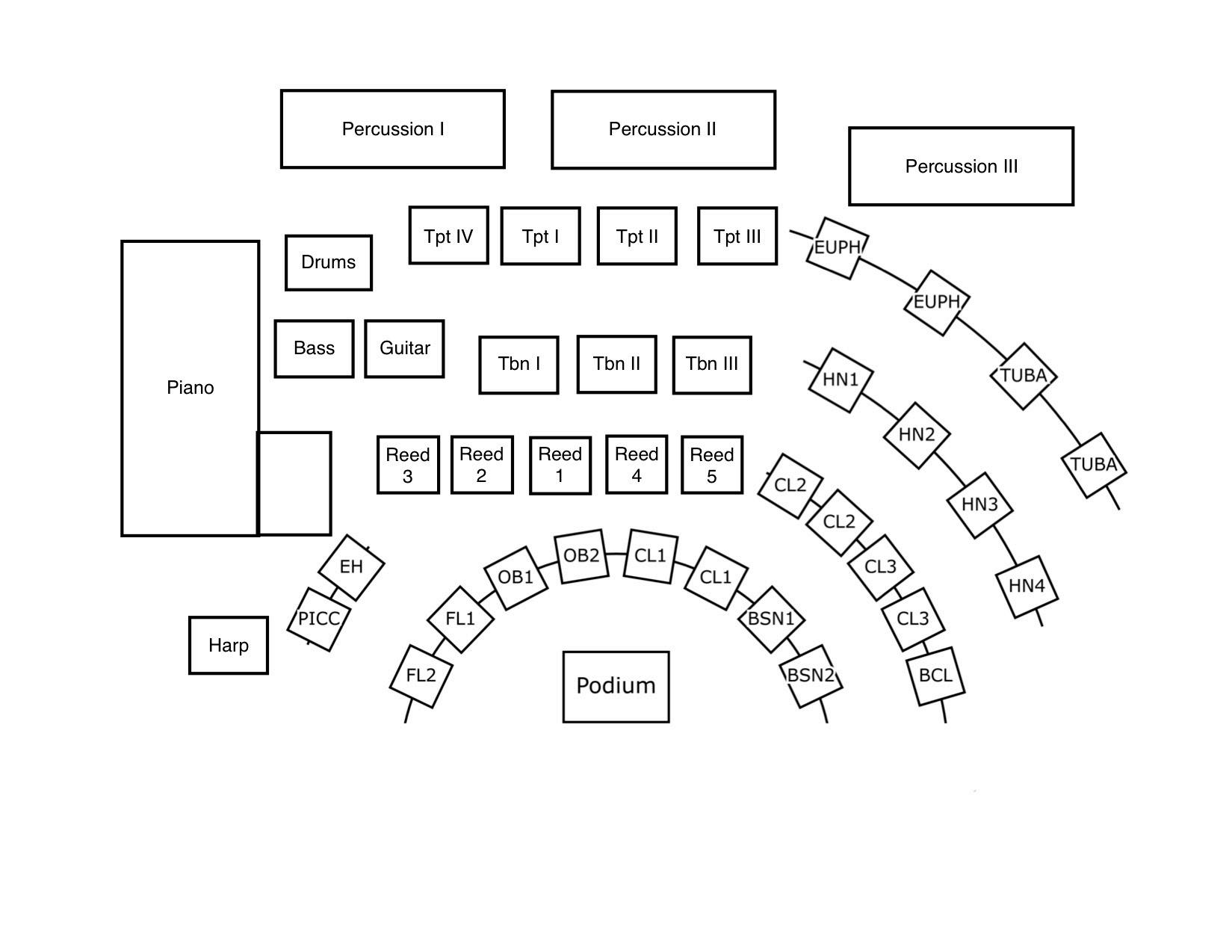
Suggested Stage Plot