INTRODUCTION
1
Credits THE TENNESSEAN
PEDIMENT PUBLISHING
Benjamin Goad – Executive Editor Randall Greenwell – Photo Director Liz Schubauer – Senior Content Manager Bryan West – Senior Reporter Leigh Cuen – Content Strategist
Chris Fenison – President Heather Hewitt – Editorial Project Manager Joey Schaffer, Lee Benson – Designers
KNOXVILLE NEWS SENTINEL Joel Christopher – Executive Editor Jennifer Dedman – Visuals and Communities Editor Robin Gibson – People and Trends Editor
USA TODAY CO. Kate Ellsworth – Director of Commerce Operations Andy Harper, Gene Myers – Book Editors Clarissa Shine – E-commerce Specialist Rivka Holler – Partnerships & Marketing Associate Kate Ellsworth, Andy Harper – Project Coordinators
SPECIAL THANKS REPORTERS: Leon Alligood, Nicole Carroll, Georgia Dullea, Hayden Dunbar Evans, Allie Feinberg, Jordan Green, Clara Hieronymus, Hadley Hitson, Melonee Hurt, Jack Hurst, Jim Patterson, Caché McClay, Robert K. Oermann, Chris Parton, Keith Sharon, Paul Skrbina, Devarrick Turner and Beth Warren. PHOTOGRAPHERS: Jeff Adkins, Angelina Alcantar, Lacy Atkins, Jerry Bailey, Margaret Bentlage, Shauna Bittle, Frank Breithaupt, Adam Brimer, Amy Smotherman Burgess, Adam Cairns, Delores Delvin, Mike Dubose, Paul Efird, Jimmy Ellis, Frank Empson, Dale Ernsberger, Al Fuchs, Nicole Hester, Gerald Holly, Dan Loftin, Mandy Lunn, Calvin Mattheis, Hannah Mattix, Shelley Mays, Larry McCormack, Caitie McMekin, Rick Musacchio, Andrew Nelles, Brianna Paciorka, Eric Parsons, John Partipilo, Michael Patrick, Rex Perry, Bill Preston, Ricky Rogers, Joe Rudis, Callie Shell, Denny Simmons, Samuel M. Simpkins, Kathleen Smith, Bill Steber, George Walker IV, Bill Welch, Mandi Wright, Saul Young and Mark Zaleski. RESOURCES: Columbus Dispatch archives
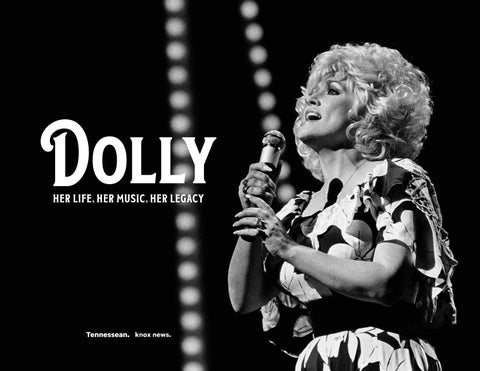
On the cover FRONT COVER: Dolly Parton smiles during a 2024 interview at HeartSong Lodge & Resort in Pigeon Forge, Tenn. A NGELINA ALCANTAR / NEWS SENTINEL BACK COVER: Dolly Parton performs “Applejack” at Middle Tennessee State University’s Murphy Center in Murfreesboro in 1986. B ILL WELCH / THE TENNESSEAN PREVIOUS PAGE: Dolly Parton performs at the 14th annual CMA Awards at the Grand Ole Opry House on Oct. 13, 1980. R ICKY ROGERS / THE TENNESSEAN RIGHT: Dustin Lynn pauses at a Dolly Parton mural on Forrest Avenue in Nashville, Tenn., following news of Parton’s death in 2026. M ARK ZALESKI / THE TENNESSEAN
Copyright © 2026 by The Tennessean and the Knoxville News Sentinel All Rights Reserved • ISBN: 978-1-63846-232-3 No part of this book may be reproduced, stored in a retrieval system or transmitted in any form or by any means, electronic, mechanical, photocopying, recording or otherwise, without prior written permission of the copyright owner or the publisher. Published by Pediment Publishing, a division of The Pediment Group, Inc. • www.pediment.com • Printed in Canada. This commemorative publication is published by The Tennessean and the Knoxville News Sentinel and is not affiliated with, endorsed by or sponsored by Dolly Parton, her estate, Dollywood Company or Dolly Parton’s Imagination Library.
2
DOLLY
Contents Foreword by Wynonna Judd The Making of Dolly Music and Songwriting Dollywood and East Tennessee Service, Generosity and Community Leadership The Dolly Interviews
INTRODUCTION
4 7 41 65 91 117
3
How Dolly Loved
I
FOREWORD BY WYNONNA JUDD
DON’T THINK YOU CAN TALK about Dolly Parton without talking about love. And I’m not just talking about the kind you sing about. I’m talking about the kind you live. The kind that shows up when nobody’s watching. The kind that doesn’t ask for anything in return. The kind that can change somebody’s life without them even realizing it. That was Dolly. When I was a little girl growing up in Kentucky, Mama and I sang Dolly’s songs. I remember hearing “Coat of Many Colors” and feeling like somebody out there understood us. We didn’t have much in those days, but we had music, we had each other, and we had stories to tell. Dolly had a way of making you feel like where you came from wasn’t something to overcome, but something to be proud of. She took the very things that some people might have looked down on and turned them into something beautiful. I didn’t know it then, but that little girl singing along to Dolly Parton would grow up to share stages, stories, laughter, and some of life’s most tender moments with the woman herself. Life has a funny way of coming full circle. Years later, when I got to know the woman
4
DOLLY
behind that extraordinary voice, I discovered that Dolly was exactly who she said she was. There was no separating the woman from the legend. She was larger than life, of course. The hair, the rhinestones, the eyelashes, the whole glorious production. Nobody could light up a room quite like Dolly Parton. But underneath all that sparkle was a woman who knew exactly who she was, where she came from, and what she believed in. And she never apologized for any of it. I loved that about her. In a business that can spend an awful lot of time trying to tell women who they’re supposed to be, Dolly never seemed interested in being anybody but Dolly. She could make you laugh one minute and bring you to tears the next. She could be outrageous and humble, strong and tender, all at the same time. She understood something that has taken me a lifetime to learn: You don’t have to be perfect to be worthy of love. You just have to be yourself. And by being so unapologetically herself, she gave the rest of us permission to do the same. I’ve been blessed to know some extraordinary people in my life, but there are certain moments that stay with you forever. When Mom died, we held a private memorial service at the Country Music Hall of Fame. I’ll
never forget Dolly walking into my dressing room that day. She closed the door behind her and wrapped her arms around me. And for a moment, I didn’t have to be Wynonna Judd. I didn’t have to be strong. I didn’t have to have the right words or hold it all together. I could just be a daughter who missed her Mama. Dolly understood. She knew that grief and gratitude can live in the same heart. That you can be broken and blessed at the same time. And that sometimes the most loving thing you can do for another person is simply show up, close the door, and hold on. That’s the Dolly I knew. The world knew her for the songs, the movies, the wit, and that unmistakable laugh. And Lord knows, she gave us plenty to celebrate. But I think her greatest gift was her ability to make people feel seen. She gave us songs that told the truth, even when the truth was painful. She gave children books and the chance to imagine a bigger world for themselves. She showed generations of women that you could be ambitious without losing your kindness, successful without forgetting your roots, and strong without becoming hard. She took the difficult parts of her own story and used them to bring hope to somebody else’s.
Dolly understood the power of a story. She knew that a song about a little girl’s homemade coat could reach somebody thousands of miles away and make them feel less alone. She knew that music could be more than entertainment. It could be a lifeline. It could be a prayer. It could be the thing that gets you through another day. I know that because I’ve spent my whole life believing the same thing. One of the greatest lessons I’ve learned, both in music and in life, is that being perfectly imperfect is enough. I think Dolly understood that better than most. She never pretended life was easy or that she had all the answers. She just kept showing up with her faith, her humor, her heart, and a whole lot of hairspray. And somehow, she made the rest of us feel a little braver. These days, I find myself asking, “What would Dolly do?” Usually, I imagine she’d find a way to make somebody laugh, tell the truth with a little sugar on top, and remind us not to take ourselves quite so seriously. Dolly had a gift for bringing light into a room without making anybody else feel small. Her light was always turned up to ten, but she never needed to dim somebody else’s to shine. When I think about Dolly’s legacy, I think about the millions of people who found comfort in her music, the children who learned to love reading because of her generosity, and the little girls from small towns who looked at her and thought, “Maybe I can do
that, too.” I also think about the things that never made the headlines. The private acts of kindness. The phone calls. The hugs. The moments when she made somebody feel like they were the most important person in the world. That’s what love looks like when you put it into action. And I think that’s what I want people to understand most about Dolly. The rhinestones were real. The talent was real. The laughter, the faith, the larger-than-life personality. All of it was real. And so was the love. I will forever be grateful that the little girl from Kentucky who once sang “Coat of Many Colors” with her Mama got to know the woman who wrote it. Not just Dolly Parton, the icon whose voice helped shape my own, but Dolly, my friend. The woman who showed up when my heart was broken and reminded me, without saying a word, that I wasn’t alone. People will be singing her songs and telling her stories for generations to come. And they should. I hope that somewhere along the way, they’ll remember that the most extraordinary thing about Dolly Parton wasn’t what she wore, what she accomplished, or even what she sang. It was how she loved. And that is the Dolly I will always carry with me. With love, Wynonna
OPPOSITE: Wynonna Judd backstage at the Grand Ole Opry during the 2023 People’s Choice Country Awards in Nashville, Tenn. NICOLE HESTER / THE TENNESSEAN LEFT: Wynonna Judd at the 2023 Country Music Association Awards in Nashville, Tenn. A NDREW NELLES / THE TENNESSEAN
INTRODUCTION
5
6
DOLLY
OPPOSITE: Host Dolly Parton opens the 22nd annual CMA Awards with a rousing country
number on Oct. 10, 1988, at the Grand Ole Opry House. C ALLIE SHELL / THE TENNESSEAN
AP TE R H C 1
“I don’t judge people and I try not to get too caught up in the controversy of things … I hope that everybody gets a chance to be who and what they are.”
Dolly Parton THE MAKING OF DOLLY
7
8
DOLLY
the small-town girl with an enormous impact PAUL SKRBINA THE TENNESSEAN AUG. 25, 2026
K
NOWN AS THE “QUEEN of Country,” Dolly Parton’s rags-to-riches story began on Jan. 19, 1946, when she was born the fourth of 12 children to stay-at-home mom Avie Lee Caroline and Robert Lee Parton Sr., an illiterate sharecropper and tobacco farmer. The family lived in a one-bedroom cabin with no electricity deep in the mountains of Locust Ridge, near Sevierville, where Parton would sometimes lay on the grass, stare at the airplanes flying overhead and dream of someday reaching those heights. She didn’t just reach them. She reached way beyond them.
Her career included 11 Grammy Awa rds, three Em my Awa rds, 50 albums, 44 top 10 albums, 25 No. 1 singles and more than 100 million records sold. Parton’s charitable work, though, is just as big a part, if not a bigger, of her legacy. ‘I can’t stand to see people hurting’ Her belongings stuffed in four Piggly Wiggly bags, Parton hopped a bus to Nashville to pursue her musical dreams a day after she graduated from Sevier County High School. But she never abandoned her humble roots. Parton donated more than $500 million to a variety of causes during her life, with a good chunk of that money going
to causes in East Tennessee. In 2016 she donated $12.5 million to Sevier County families whose homes were destroyed in wildfires. Eight years later, in conjunction with the Mountain Ways Foundation, Parton donated $1 million to victims of hurricane floods in East Tennessee. “Many people are hurting right now and I can’t stand to see people hurting. These are special people; they’re my people,” Parton said of the floods. “Everyone here grew up in the mountains just like I did, and I’m heartbroken by what I’ve seen.” Not to mention the $1 million she donated to Vanderbilt to help with COVID-19 vaccine research. Or the millions of books she donated through her Imagination Library.
OPPOSITE: Dolly Parton plays a song during a 2022 event at Dollywood. B RIANNA PACIORKA / NEWS SENTINEL ABOVE: Dolly Parton performs during the Grand Ole Opry show at the Ryman Auditorium on July 21, 1973. F RANK EMPSON / THE TENNESSEAN
THE MAKING OF DOLLY
9
‘Everybody should be treated with respect’ Parton not only talked the talk; she walked the walk and put her money where her mouth was in her support of marginalized groups, including the LGBTQ+ and Black communities.
10
DOLLY
“I think everybody should be treated with respect,” Parton told CNN Money during a 2016 interview about pending “bathroom bill” legislation in North Carolina (parts of the bill were later repealed). “I don’t judge people and I try not to get too caught up in the controversy of things … I hope that
everybody gets a chance to be who and what they are. I just know, if I have to pee, I’m gonna pee, wherever it’s got to be.” She donated royalties from the Whitney Houston version of “I Will Always Love You,” a song Parton wrote and recorded in 1973, to help fund an office complex
in a predominantly Black Nashville neighborhood. She was outspoken in 2020, when the Black Lives Matter movement came into national focus after the death of George Floyd. “I understand people having to make
themselves known and felt and seen,” Parton said in an interview with Billboard. “And of course Black lives matter. Do we think our little White asses are the only ones that matter? No!” Dolly Parton, the dreamer from East Tennessee, the woman who has streets and hospitals and theme parks and hotels named after her, a day in Nashville in her honor, the girl from the middle of nowhere who made it to the middle of somewhere, was born a poor girl and left this world a richer place.
OPPOSITE: Dolly Parton sings “I Will Always Love You” during a 2023 event at Dollywood. BRIANNA PACIORKA / NEWS SENTINEL LEFT: Dolly Parton discusses Wildwood Grove, Dollywood’s newest expansion, during a 2018 interview at DreamMore Resort before the park addition opened. BRIANNA PACIORKA / NEWS SENTINEL
Ahead of the Times
Dolly was o n television before her family owne d a televisio n.
THE MAKING OF DOLLY
11
12
DOLLY
Tennessee shaped her music, from the Smoky Mountains to the Opry DEVARRICK TURNER KNOXVILLE NEWS SENTINEL AUGUST 25, 2026
A
T 13 YEARS OLD, DOLLY Parton stood in awe on the Ryman Auditorium stage in front of the classic WSM microphone stand. It was her Grand Ole Opry debut, and she was introduced by country music great Johnny Cash. “We’ve got a little girl here from up in East Tennessee,” Cash said. “Her daddy’s listening at home, and she’s gonna be in real trouble if she doesn’t sing tonight.” “As I hea rd the ba nd play my
introduction, I lifted my head and looked up toward the lights. I smiled at the people in the balcony and then let ‘er rip,” Parton recalled about her Opry debut. She sang George Jones’ “You Gotta Be My Baby,” and though she was just barely a teenager, she received three encores that night. The Opry audience knew they were watching a star being born, but the little girl from East Tennessee was already a star to the people back home. As we remember the icon upon her death Aug. 25, music is always at the heart.
Songs born in the Smoky Mountains Parton was born in January 1946 to Robert Lee and Avie Lee Parton. She was the fourth of 12 children, and the family lived in a two-room cabin in Locust Ridge. The small house was filled with music thanks to her mother. Parton got her musical talents from her mother’s side of the family. Avie Lee was a singer and played hymns, folk songs and traditional mountain music. Parton’s grandfather, the Rev. Jake Owens, played the fiddle. And the family’s connection to music dates back generations, according to a website for
OPPOSITE: Host Dolly Parton, center, leads fellow stars in a hand-clapping country anthem to open the 22nd annual CMA Awards on Oct. 10, 1988, at the Grand Ole Opry House. C ALLIE SHELL / THE TENNESSEAN ABOVE: Dolly Parton performs during a press conference in 1999. M ICHAEL PATRICK / NEWS SENTINEL
THE MAKING OF DOLLY
13
RIGHT: Dolly Parton performs during the WSM
luncheon and Grand Ole Opry Spectacular at Municipal Auditorium in Nashville in 1974.
F RANK EMPSON / THE TENNESSEAN
OPPOSITE: Dolly Parton performs at the Opry Spectacular Luncheon at Municipal Auditorium in 1969, opening the Grand Ole Opry’s 44th anniversary celebration. JIMMY ELLIS / THE TENNESSEAN
n e P c fi i l A Pro
00 son ore than 3,0 m te ro w n Dolly Par to
14
DOLLY
gs.
the 2024 Parton family album “Smoky Mountain DNA.” “I was born to be a songwriter,” Parton says during an immersive movie that plays in the Songteller building of The Dolly Parton Experience at Dollywood. And she really was. Parton was crafting songs before she could even write. With her mom doing the transcribing, Parton wrote her first song at around 5 years old. It was a tribute to her doll made from a corncob with corn silk hair. Soon, she was singing in her grandfather’s church and, by 8, strumming on a makeshift guitar her uncle Bill Owens made from an old mandolin and two bass strings. Uncle Bill, also a musician, quickly realized Parton’s musical talents were extraordinary. Bill and his sister Estelle often gave Parton rides to local shows and a place to stay in Knoxville so she could perform in the city. And it was Uncle Bill who helped Parton land the gig that helped her become a household name, in Knoxville, at least. “I was on television before we ever owned one, on local TV,” Parton recalled to USA TODAY about being on Cas Walker’s “Farm and Home Hour” variety show. The Cas Walker show In 1956, Uncle Bill managed to get Parton backstage at a WIVK radio show where she met businessman and radio and TV personality Cas Walker. The bold 10-year-old walked up to him and told him she wanted to work for him. And that’s how Parton booked her first TV gig before the Parton family even owned a TV. Walker created the “Farm and Home Hour” variety show to promote his chain
THE MAKING OF DOLLY
15
40
DOLLY
OPPOSITE: Dolly Parton performs an original song celebrating Big Bear Mountain. The Dollywood coaster opened in 2023. B RIANNA PACIORKA / NEWS SENTINEL
AP TE R H C 2
“Actually, it wasn’t as severe as I made the song. I was just a little jealous that she was prettier than me.”
Dolly Parton MUSIC AND SONGWRITING
41
42
DOLLY
Want to know more about Dolly‘s life? Listen to her songs MELONEE HURT THE TENNESSEAN AUG. 27, 2026
S
O MUCH OF DOLLY Parton’s life, from being born into a large family in the rural mountains of East Tennessee to her time on “The Porter Wagoner Show,” to her dominance of nearly everything she touches (films, theme parks, hotels, charitable foundations) is common knowledge. And yet, fans can still learn a lot more about Parton’s life in her own words shared with the world through her song lyrics. You may know that hits such as “I Will Always Love You” and “Jolene” were written as specific odes to events
in her life. The first being her goodbye letter to Wagoner and the second a desperate plea to the redhead attracting the attention of her husband, the late Carl Dean. But dig deeper into Parton’s catalog and you’ll hear a literal timeline of her life. Below are a few examples of Parton songs that, when strung together, weave her story from her humble beginnings to now, with more to come. Dolly Parton was born and raised in rural East Tennessee Her song “My Tennessee Mountain Home” was written in the early 1970s and released as a single on her album of the same name in 1973. The Locust
Ridge, Tenn., two-room log cabin featured on the album cover was Parton’s actual childhood home where she grew up in the 1940s and ’50s. The song paints a sweet picture of what Parton’s early life was like. Although the family didn’t have electricity or running water during her childhood, she didn’t see what she didn’t have. Instead, she focused on what she did have. Her colorful childhood in song/movie/book Although Parton has written many songs about her childhood and what her life was like growing up in the mountains with a lot of family and very little money, “Coat of Many Colors,” which
OPPOSITE: Dolly Parton performs “Applejack” at Middle Tennessee State University’s Murphy Center in Murfreesboro in 1986. Kenny Rogers and newcomer T. Graham Brown also appeared on the bill. BILL WELCH / THE TENNESSEAN ABOVE: Dolly Parton performs at Dollywood in Pigeon Forge in 2006. M ANDY LUNN / THE TENNESSEAN
MUSIC AND SONGWRITING
43
she didn’t write until the late 1960s, wraps the whole experience into one song. While literally about being bullied for wearing a coat her mother sewed together from rags, its meaning stretches beyond that to beautifully illustrate appreciating what you have. The song was also adapted into a 2015 movie and a children’s book in 2016. Embracing her love of music While a young Dolly Parton knew she would be famous somehow, it was music that grabbed her early on. “Applejack” is a song she wrote about a Smoky Mountain banjo player who taught her to love the banjo. He would even encourage her to sing along, illustrating these might have been her very first “in the round” performances. Finding her muse — the ‘town tramp’ Parton has famously admitted she patterned her look after the “town tramp.” She saw a woman in town with makeup, red fingernails, red high heels and tight clothes. Young Dolly thought she was “the prettiest thing she’d ever seen” and even went so far as to say, “’Oh, she ain’t nothing but trash,’ but in my mind, I thought, ‘That’s what I’m going to be when I grow up.’” She has also said she wanted to be pretty and flashy, which prompted arguably her most famous quote, “It takes a lot of money to look this cheap.” She encapsulated accepting this persona in the song “Dumb Blonde.” As with many of her songs, the lyrics transcend her own experience and embrace all women who might be judged for their appearance.
Moving to Nashville While Parton was destined to be in the spotlight and had long wanted to move toward the bright lights of Nashville, her song “The Letter” lets the listener in on how hard that move actually was for her. She writes to her parents that they shouldn’t worry about her, because she’s going to be alright. Safe to say, things turned out OK. Her time with Porter Wagoner This era of Parton’s life generated some of her most legendary songs. After deciding to leave “The Porter Wagoner Show,” Parton wrote arguably her most famous song, “I Will Always Love You.” It was a breakup/ love song to her business partner, Wagoner, full of gratitude for believing in her and working with her for nearly a decade. When Parton decided to pursue a career as a solo act, this song expressed her appreciation for all that Wagoner had done to help her career. Dolly Goes Hollywood The song “9 to 5” certainly comes to mind when you think of Dolly Parton in the movies. While she did write the theme song for the movie of the same name (a condition of her accepting the role), it is another song that best describes her observations of life in Hollywood. She wrote “Hollywood Potters” in 1982 after filming her first feature film. Becoming a rock star When Dolly Parton heard she was going to be inducted into the Rock and Roll Hall of Fame in 2022, she initially tried to
RIGHT: Dolly Parton performs during a 1970 taping of “The Porter Wagoner Show” at Nashville’s WSM-TV studios. F RANK EMPSON / THE TENNESSEAN
44
DOLLY
s y a w l A l l i w I u o y e v Lo
ill ong, “I W s s u o m ng to r most fa p/love so e u h k ly a b e r a b Arg u was a r ve You,” o L Wagone s r y e t a r o P Alw , er ess par tn her busin LEFT: Dolly Parton performs at the 10th annual CMA Awards at the Grand Ole Opry House in 1976. GERALD HOLLY / THE TENNESSEAN
politely decline, saying she didn’t feel she had earned that recognition. But in true Dolly fashion, instead of bowing out, she set out to record her very first rock record. She released “Rockstar,” a collection of 30 songs (many of them cover tunes) recorded alongside a superstar list of collaborators. She accepted her nomination, citing “I’m a rock star now,” and also performed during the induction ceremony. She wrote the
song “Rockstar” specifically for this album, which was released in 2023. Losing the love of her life, Carl Dean Just a few weeks after the loss of Parton’s longtime husband Carl Dean, Parton took to the Schermerhorn Symphony stage prior to a performance of “Dolly Parton’s Threads: My Songs in Symphony,” and thanked the crowd for their support and love during her
time of loss. But saying it wasn’t enough. She needed to write it. The resulting song was a love letter to Dean, who had supported her for decades throughout her career while staying completely out of the spotlight himself. “If You Hadn’t Been There,” was the last of several of Parton’s odes to the love of her life throughout their marriage. She wrote it days after his death.
MUSIC AND SONGWRITING
45
ABOVE: Elton John and Dolly Parton perform at the CMA Awards at Madison Square Garden in New York in 2005. L ARRY MCCORMACK / THE TENNESSEAN OPPOSITE: Dolly Parton performs “Rocky Top” at Neyland Stadium in Knoxville during the Tennessee-Georgia football game in 2023. C AITIE MCMEKIN / NEWS SENTINEL
46
DOLLY
MUSIC AND SONGWRITING
47