AMERICA’S
WORLD CUP THE BIGGEST AND BOLDEST SUMMER IN SOCCER HISTORY
INTRODUCTION • 1
The Lineup USA TODAY SPORTS
UNIVERSITY OF GEORGIA
EDITORIAL DIRECTOR Alicia Del Gallo
A partnership between the USA TODAY Network and the University of Georgia
BOOK EDITOR Gene Myers SENIOR EDITOR Jesse Yomtov SOCCER EDITOR Seth Vertelney COLUMNIST Nancy Armour LEAD SOCCER REPORTER Jon Arnold EDITORS Cesar Brioso, Sherlon Christie, Everett Cook, Jace Evans, Ellen Horrow, Eric Larson, Casey Moore, Jim Reineking, Blake Schuster, Erick Smith, Elisha Twerski, Gabe Zaldivar REPORTERS Kristie Ackert, Ralphie Aversa, Scooby Axson, Danielle Barker, Chris Bumbaca, Jacob Camenker, Alex Connor, Austin Curtright, Callie Fin, Elizabeth Flores, Steve Gardner, Mark Giannotto, Meghan L. Hall, Victoria Hernandez, Liam Keaton, Danielle Lerner, John Leuzzi, Jordan Mendoza, Josh Peter, Jim Reineking, Lorenzo Reyes, Erick Smith, Marcus Smith, Andres Soto VIDEOGRAPHERS Samantha Cardona-Norberg, Christine Conetta, David Flores, Nathaniel Gary, Jack Gruber, Josh Morgan, Madison Tenenbaum, Stronz Vanderploeg, Jeff Zegas
2 • AMERICA’S WORLD CUP
STUDENT REPORTERS Carter Braun, Jack Cooney, Derek Oliveros, Katielee Smith, Katie Fryburger, Evan Kane, Erin Kirby, Massimo Bellew, Brooks Thomason, Tatum Esparza, Evan Waldman PROFESSORS Vicki Michaelis, Carlo Finlay, Sam Jones, Meri-Jo Borzilleri
USA TODAY BOOKS DIRECTOR OF COMMERCE OPERATIONS Kate Ellsworth BOOKS EDITOR Andy Harper E-COMMERCE SPECIALIST Clarissa Shine PARTNERSHIPS AND MARKETING Rivka Holler PROJECT COORDINATOR Gene Myers
About the book “America’s World Cup” condenses the best coverage of the U.S. men’s national team and the moments and memories that defined the 2026 World Cup hosted by the United States, Mexico and Canada. A team of more than three dozen journalists from USA TODAY Sports and the USA TODAY Network covered every goal, red card, injury, epic save and the fans who made this World Cup one to remember. Find the best coverage of soccer year-round at usatoday.com/sports/soccer. Order print or digital subscriptions or access the eNewspaper for USA TODAY by calling 800-872-0001 or going to subscribe.usatoday.com/offers.
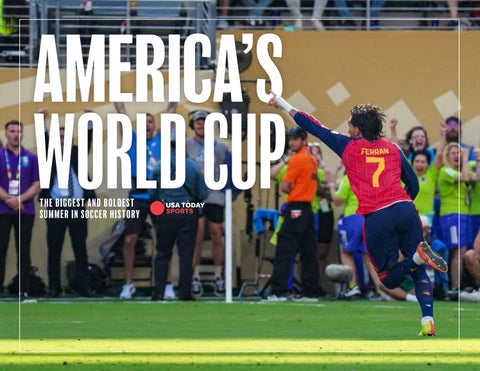
On the cover CLOCKWISE FROM THE LEFT: The USMNT mobbed Malik Tillman (17) after his goal on a stunning free kick secured a berth in the round of 16. … Argentina’s Lionel Messi and France’s Kylian Mbappé supplied memorable goals galore. … Captain Rodri hoisted a third World Cup Trophy for Spain. … Charismatic Erling Haaland rowed Norway’s boat to the quarterfinals. … Forty-year-old Vozinha and tiny Cape Verde proved age and size were only numbers. PHOTOS BY IMAGN IMAGES PREVIOUS PAGE: Forward Ferran Torres, a second-half substitute, celebrated his goal that won the 2026 World Cup for Spain. It came in the 106th minute on July 19. YANNICK PETERHANS / NORTHJERSEY.COM OPPOSITE PAGE: After an ugly skirmish, a Spanish celebration and Argentine tears, the quadrennial celebration of soccer ended with a colorful closing ceremony at MetLife Stadium in East Rutherford, New Jersey. E LSA / GETTY IMAGES
SUPPORT TEAM DESIGNERS Joey Schaffer, Lee Benson PROOFREADERS Heather Hewitt, Sherrill Amo SPECIAL THANKS Chris Thomas, Chris Fenison, Douglas McMurray
No part of this book may be reproduced, stored in a retrieval system or transmitted in any form or by any means, electronic, mechanical, photocopying, recording or otherwise, without prior written permission of the copyright owner or the publisher. Published by Pediment Publishing, a division of The Pediment Group, Inc. • www.pediment.com Printed in Canada. This book is an unofficial account of the 2026 World Cup by USA TODAY Sports. Not endorsed by FIFA, U.S. Soccer or any national team.
Copyright © 2026 by USA TODAY Sports All Rights Reserved • ISBN: 978-1-63846-225-5
AMERICA’S
WORLD CUP 14
34
60
94
106
116
140
CHAPTER ONE
CHAPTER TWO
CHAPTER THREE
CHAPTER FOUR
CHAPTER FIVE
CHAPTER SIX
CHAPTER SEVEN
SPAIN’S REIGN
TEAM USA
MEMORIES
LIONEL KING
FANFARE
OFF THE PITCH
ALMANAC INTRODUCTION • 3
With spirits never higher for the U.S. men’s national team, fans whooped it up before its round of 32 match against Bosnia and Herzegovina in Santa Clara, California, on July 1. The U.S. advanced 2-0. DARREN YAMASHITA / IMAGN IMAGES
4 • AMERICA’S WORLD CUP
INTRODUCTION • 5
FOREWORD
America’s worries faded at kickoff and beautiful game took the stage JON ARNOLD
AMERICA’S WORLD CUP. WHAT DID it mean? The United States, with Mexico and Canada, welcomed the world for a Men’s World Cup for the first time since 1994. It felt like it was coming at the wrong time. Political tensions between the hosts led to frosty moments, though they also led to some thaw as the three heads of state met for the first time at the December 2025 draw. Still, the U.S.Iran war, the denial of entry for the 2025 African men’s referee of the year and skyhigh ticket prices all had fans wondering whether America’s World Cup would feel like a “true World Cup,” whether it would provide the beautiful cultural blend we typically saw every four years. A nd even in Mexico, which stepped up as the host for Iran’s team and generally positioned itself as the antidote to the poison of an overly corporate World Cup in
the U.S., there were big concerns before kickoff. After all, the violence in the wake of the capture of a cartel leader had spooked the country just months before the expanded 48-team tournament. Domestic frustrations were lingering in the Mexican capital with a powerful teachers union threatening to shut down routes to the legendary Estadio Azteca and the Zocalo, the historic center of the city where the fan fest was set to take place. Then, the ball was kicked. The tension was released. The world was welcomed. The goals were cheered. In Mexico City, a last-minute agreement with the teachers union meant the focus was entirely on El Tri smashing South Africa. A day later, the U.S. had its own jubilant start to the tournament, blowing out Paraguay on the way to a group stage that had the country believing — and made the end against Belgium hurt that much more. Canada
JON ARNOLD HAS COVERED international soccer for more than a decade, joining USA TODAY Sports as its national soccer reporter in 2026 ahead of the World Cup. The 2026 tournament was his second World Cup, having covered Mexico and other teams at the 2018 tournament in Russia. It was one of many tournaments tracking Lionel Messi, having told the Argentine’s stor y du r i ng t he 201 5 Copa América, the 2016 Copa América Centenario and the 2023 Leagues Cup among others. Arnold has reported on stories from Paramaribo, Suriname, to Montreal, Quebec, and everywhere in between, earning a reputation as the foremost expert on the CONCACAF region. A graduate of Texas Tech University, he is based in Dallas.
OPPOSITE: Less than 24 hours after Spain won the World Cup in New Jersey, an estimated 1.8 million people in Madrid watched an
evening championship parade and 120,000 jammed the Plaza de Cibeles for a celebratory rally. N ACHO DOCE / REUTERS
6 • AMERICA’S WORLD CUP
INTRODUCTION • 7
OPPOSITE: More than 6.8
million fans jammed stadiums in the United States, Mexico and Canada for the 2026 World Cup. This man in Inglewood, California, for the U.S.-Turkey group match wasn’t alone pretending to be an American eagle. K IYOSHI MIO / IMAGN IMAGES
World Cup commemorative prints are available for purchase. Scan the code to shop. NEIL BALADAD / USA TODAY NETWORK 8 • AMERICA’S WORLD CUP
NEIL BALADAD / USA TODAY NETWORK
not only got its first World Cup point in its opener but followed that with its first World Cup victory and first World Cup knockout victory. The U.S. didn’t shock the world and win the tournament like that Fox Sports commercial that aired during the competition imagined. But America’s World Cup was about far more than what the U.S. men did on the field. America’s World Cup was Lawrence, Kansas, becoming Algerian territory with locals trading their Jayhawks allegiance for the Fennecs during the tournament to support the team they were hosting. It was baseball games being taken over by Scotland or Australia or Norway fans the night before those teams’ matches. It was viral posts about foreigners discovering the Waffle House or quiet moments giving foreigners a tip on the best place to grab a cocktail. It was Lionel Messi still doing it at 39. It was Vozinha doing it for the first time (that the world saw) at 40. It was Erling Haaland winning hearts and scoring goals. It was Mexico coach Javier Aguirre getting a country believing again — and jokingly cussing at England players who barely got the better of his team. It was Paraguay bouncing Germany and Morocco eliminating the Netherlands. It was Spain winning by putting coach Luis de la Fuente’s plan together and carrying it out to perfection. That said, it was not without incident.
Folarin Balogun had a red card suspension overturned, and President Donald Trump took credit. Ticket prices never dipped from their wallet-crunching high point as World Cup fever gripped the country. Still, the World Cup was the best of us, an opportunity to show the world what the United States was, bringing everyday sports fans to the forefront. I got to see it more than a dozen times covering matches in seven cities for USA TODAY Sports. From Kansas City’s excitement to host matches, the Argentina takeover of Miami that turned into a Cape Verde appreciation session after the previously unknown African side pushed Messi and Co. to the brink to event capitals Atlanta and Dallas-Fort Worth showing they could host stunning semifinal soccer matches just as well as they do college football bowls and Super Bowls, the whole country felt abuzz with joy. Shortly after the 2026 World Cup, the discord was back with a proposal from FIFA president Gianni Infantino to privatize future editions of the tournament, sparking debate about who owned the sport and who the World Cup really belonged to. The answer was right there in America’s World Cup. In these pages you will feel the joy of the fans, recall the moments when we all came together to enjoy serving as the world’s host. This was our tournament. It was everyone’s tournament.
INTRODUCTION • 9
INTRODUCTION
Telling America’s World Cup story: Our summer to remember forever ALICIA DEL GALLO
I REMEMBER MAKING CONFETTI angels on the field hours after the final whistle blew on the 2026 FIFA World Cup. The stadium had gone dark. The crowds were gone. The trophy had been lifted. The celebrations had moved elsewhere. Only a handful of us remained. Nancy Armour, Jon Arnold and I wandered down from the press box and onto the field at MetLife Stadium, reluctant to let the moment end. Then, from a tunnel beneath the stands, came light. And laughter. One by one, dozens of volunteers, staff members and workers emerged onto the pitch. For weeks, they had been invisible to the millions of fans who filled stadiums across the United States, Canada and Mexico. They were the people who opened gates, cleaned concourses, checked credentials, moved equ ipment, a nswered
questions and somehow made the biggest World Cup in history feel seamless. Now it was their turn. They laughed and sang. They pocketed specks of golden confetti. They pinched off pieces of turf as keepsakes. They took selfies from every angle and kicked penalty shots toward the same goal where some of the world’s biggest stars had taken aim during a tournament that featured 48 teams, 104 matches and 16 host cities across three countries. It was a reminder that every World Cup is really two events. There is the one billions of people watch. And then there is the one built behind the scenes. What you hold in your hands captures a small piece of both. The stories, photographs and moments collected in these pages represent only a fraction of the work produced by USA TODAY Network journalists throughout the tournament. Behind them were months of planning, countless flights,
ALICIA DEL GALLO’S CAREER in sports journalism grew on Central Florida soccer fields. She covered Orlando City SC’s journey to Major League Soccer and the inaugural NWSL seasons of the Orlando Pride. She traveled to tell stories from soccer stadiums across the nation, then launched Pro Soccer USA, a soccer-specific content vertical for the Orlando Sentinel and Tribune Co. Since joining USA TODAY in 2021, she has worked to grow its authority and footprint in the sport and leads the men’s and women’s World Cup and Olympics coverage. She is also the editorial director of the USA TODAY Sports Network, with a focus on strategy and innovation. She is also the architect behind USA TODAY Studio IX, a home for all things women’s sports.
OPPOSITE: Only seven minutes into its opener, the United States celebrated an own goal by Paraguay. From the left: Weston McKennie,
Malik Tillman, Christian Pulisic and Folarin Balogun. The U.S. triumphed 4-1 in Inglewood, California. K IRBY LEE / IMAGN IMAGES
10 • AMERICA’S WORLD CUP
INTRODUCTION • 11
14 • AMERICA’S WORLD CUP
01
Spain’s Reign FINAL PITTED A TEAM THAT CONCEDED ONE GOAL AGAINST ONE WITH A SERIES OF NARROW ESCAPES
OPPOSITE: MetLife Stadium in East Rutherford — called New York New Jersey Stadium by FIFA — hosted the 104th and final match:
Spain seeking its second World Cup versus defending champion Argentina seeking its fourth. JON DURR / IMAGN IMAGES
SPAIN’S REIGN • 15
16 • AMERICA’S WORLD CUP
JULY 19, 2026 W WORLD CUP FINAL
SPAIN 1, ARGENTINA 0 (ET) METLIFE STADIUM, EAST RUTHERFORD, N.J.
No doubts Spain deserved 2026 World Cup and maybe a new dynasty awaits on horizon NANCY ARMOUR
SPAIN WINNING THE WORLD CUP just felt right. That opener against Cape Verde aside, Spain was the best team in this tournament. Beating Argentina 1-0 to win its second World Cup confirmed it. One goal conceded across eight games. Goals from seven players, including Ferran Torres, who pounced on a Nico Williams header and buried it for the game-winner in the 106th minute. That’s the kind of dominance worthy of a World Cup champion. “Today, we were convinced that it was our final,” Spain coach Luis de la Fuente said. Besides, Argentina had no business winning a second consecutive title, even if it would have been poetic for Lionel Messi to end his World Cup career as a champion. If you couldn’t get off a single shot — not just a shot on
goal, a shot of any kind — until stoppage time of the second overtime, you had no business winning an AYSO tournament, let alone the World Cup. “We’re sad,” Argentina coach Lionel Scaloni said. “In the end, they deserved the victory. That’s reality. We need to accept it.” That the final went into overtime was not a reflection of Spain’s control of the game. La Roja was the better team for the entire game, and it wasn’t even close. Spa in’s midf ield, so ferocious throughout this World Cup, kept Argentina in check and powered La Roja’s offense. The Spaniards created shots from all over the field, and only a near-perfect game by Argentina goalkeeper Emi “Dibu” Martinez kept this from being a laugher. Time and again Martinez stood on his head. There were the two shots by Lamine Yamal in the first 20 minutes.
One in the first half by Mikel Oyarzabal, Spain’s leading scorer. A header from close range by Torres. A screamer of a free kick by Yamal. “It was a very complete game,” de la Fuente said. Spain kept its composure, despite Argentina’s attempts to dirty up the game as it had done to so many others. La Roja took the fouls and kept right on playing, refusing to let Argentina turn its focus from anything but that title. Argentina had been living dangerously all tournament, needing late goals in all of its knockout-round games. And that luck finally ran out when Enzo Fernandez was given the bonehead of the day award, err, a red card for accumulation in the third minute of regulation stoppage time. Spain almost ended it three minutes later. Martinez blocked a shot by Merino but didn’t corral the ball. It fell
to Williams, who was able to put it into the net while Martinez scrambled to get back in position. The goal was disallowed because Merino had stepped on Nicolás Otamendi’s foot. But the best teams find ways to win, and Spain’s victory was inevitable. Torres delivered, setting off a raucous celebration on the bench and among its fans, including King Felipe VI. “We feel pride, satisfaction, recognition to great people, great footballers who will go down in history,” de la Fuente said. “It was an honor to work with them.” Might wind up being a team for the ages, too. This was a young team — Yamal and Pau Cubarsí, the young player of the tournament, were 19 years old — and it held World Cup and European championships. Spain was the best in the world. At this World Cup and maybe others to come.
OPPOSITE: Spain forward Ferran Torres, who entered the final match in the 62nd minute, delivered the game-winner in the 106th minute. “The goal came from 47 million
people, not just those of us that are here,” he said in Spanish to FIFA’s broadcasters. “Today destiny was written. It was made for us to win.” D AVID RAMOS / GETTY IMAGES
SPAIN’S REIGN • 17
18 • AMERICA’S WORLD CUP
Spain winning the World Cup was expected, but the way La Roja did so certainly was not JON ARNOLD • JULY 19, 2026
SPAIN WAS THE CHAMPION OF the world. Everyone saw the Spaniards win the World Cup, with Ferran Torres scoring in extra time to beat Argentina 1-0. You had to forgive Spain’s players themselves, then, if they were having trouble with the fact that they conquered the world. “I still don’t believe it,” said Pedro Porro, Spain’s right back. “I think the first few days will go by, and I’m not going to believe it.” Goalkeeper Unai Simón wore a medal around his neck but said it might take a trans-Atlantic flight and a celebratory parade to jolt him into reality. “I’m still taking it all in a bit,” Simón said. “I didn’t have any kind of emotion when the referee blew the whistle. “What we’ve earned, what we’ve achieved? I think, hearing from my family what they’ve experienced, I’m sure when we get to Spain, we’ll realize the crazy thing we’ve just done.”
That crazy thing, winning the World Cup for only the second time in this country with a rich soccer history, allowing just one goal while doing it and becoming the first team to finally put up a challenge too great for Argentina to overcome. It all happened in an unlikely way. Spain went into the tournament as one of the favorites, but La Roja won the tournament in a way few saw possible. The 19-year-old Barcelona prospect who might have had the most impact was not the f lashy winger Lamine Yamal, the smiling teenager who led Spain to the Euro title two summers ago. Rather, it was center back Pau Cubarsí, who was more influential on matches and was selected best young player of the tournament for his efforts. How did Spain surprise experts on its road to glory? Yamal wasn’t bad, but the attacker was certainly expected to have more counting stats — even coming off a
hamstring injury that ended his Barcelona season early (though he played enough to be selected the best player in La Liga). But Cubarsí was very good. He ended the final as the player who made the most defensive contributions in the deciding game, with eight, and also put 139 touches on the ball. He completed 121 of the 126 passes he attempted, but his positioning, his ability to win back balls and the way he quieted the Argentine threat without committing a single foul in a physical game meant he was one of the most influential players. It was one of several things that worked for Spain and turned on its head the pre-tournament idea the team would rely on Yamal and other creative attackers to compete. In goal, Simón was beaten just once. He embraced the role of sweeperkeeper behind the adventurous back line eagerly — sometimes too eagerly, frightening Spain fans with his charges forward from the box to clear a ball. But Simón didn’t have the starting
place secured heading into the summer. David Raya took the No. 1 shirt after a superb season with Arsenal. “It’s really important to keep the group together, to keep that feeling among everyone, that respect between those who have more or less minutes,” Simón said. “In that aspect, the ‘mister’ is top-class. I think he knew how to manage all the emotions of all the players very well.” What was Spain’s coach doing before the World Cup? That mister, aka coach, Luis de la Fuente, did more than just keep the group in harmony. The togetherness had been there for some time, with the coach leading them to titles at the youth levels, in the Euros and now at the very top level. It would have been easy for things to unravel, to let frustration seep in. After all, while Spain kept Argentina from getting any shots in regulation, there always was the risk of La Albiceleste pulling off a smash-and-grab, getting
OPPOSITE: When Porro’s cross went past the far post, Nico Williams headed the ball back toward Ferran Torres, all alone rushing forward. He blasted it from just outside the
6-yard box with his left foot an instant before it bounced a second time. His shot missed three defenders and rocketed over the keeper. J USTIN SETTERFIELD / GETTY IMAGES
SPAIN’S REIGN • 19
ABOVE: Enzo Fernandez protested a red card for accumulation in the 93rd minute from Slovenian referee Slavko Vinčić. Fernandez received a yellow in the 82nd minute for protesting a noncall and his second yellow for a tackle that flipped Pau Cubarsí off his feet. J ULIAN LESHAY GUADALUPE / NORTHJERSEY.COM
20 • AMERICA’S WORLD CUP
one goal from the greatest player of all time and riding off into the sunset as champions. Instead, Spain continued to play its game, making the man advantage it earned count — doubly so with La Roja almost always in control of the ball and keeping Lionel Messi and the Argentina attack from getting any touches.
“ There was a ph rase we’d sa id: ‘Gentlemen, we have a date with history.’ We’re going to hit them first,” de la Fuente said during his postmatch news conference. “In extra time, it was just about reminding them that we’d played a great game, we had it controlled, but in a final against an opponent like Argentina a slipup at any moment can cost you a goal.
“After the game ended, there were players who have been here for the longest time who asked: ‘Mister, what’s left for us to win? Because we’ve won everything in every category. We decided what’s left?’ The next game in September, because this team is impossible to tire out.” The discovery of Porro, a Premier League player but one off the radar for many Spaniards because he jumped abroad at an early age, was crucial for de la Fuente. In the 26-year-old, he found a player who could combine well with Yamal, both getting forward and creating danger — and finishing off crucial goals twice in the World Cup — but also one who wouldn’t overexpose the rest of the back line. That back line, anchored by Aymeric Laporte but with Cubarsí by his side, also was phenomenal. Marc Cucurella comfortably slid into the final third often, knowing the defenders and the brilliant Rodri would be able to snuff out any attack and recycle the ball on the rare occasion Spain put a pass wrong. An unexpected goalkeeper, surprise defensive superiority and players picking up the slack as Yamal searched for his best? Blend it all, and you end up with what the world saw: A Spain team that was all but unbeatable for the entire World Cup. Stats that would have indicated doom before the tournament, including a 0-0 draw with Cape Verde to open the competition, Yamal scoring just once in the competition and a teenager becoming the most prominent defender, still led to the finish many expected from the start. Believe it or not, Spain was the champion of the world.
Pedri and Ferran Torres
Yéremy Pino and Nico Williams
Pau Cubarsí Lamine Yamal
Rodri
Luis de la Fuente King Felipe VI
Pedri
Unai Simón
Mikel Oyarzabal Marc Cucurella
SPAIN’S REIGN • 21
22 • AMERICA’S WORLD CUP
Don’t cry for Argentina! Spain’s defense, late red card end run of epic comebacks JON ARNOLD • JULY 19, 2026
IT FINALLY WAS A BRIDGE TOO far for Argentina. Lionel Messi and Co. had battled back from all sorts of challenges in the 2026 World Cup, like they did when they won the competition in 2022. That year, it was the deflating defeat to Saudi Arabia in the opener. This tournament, take your pick of the battle with minnow Cape Verde, the rally from 2-0 down against Egypt or the surge past England in the semifinals. But down a man in the final, with both starting center backs injured and playing a Spain team that refused to give up even a shot, Argentina could not find a way to fight back one more time. La Albiceleste fell 1-0 to Spain in extra time, ending the dream of becoming the first back-to-back winners of the World Cup since Pele’s Brazil teams did it in 1958 and 1962. The amount of time that had passed since those teams of yore should
indicate just how difficult it was to repeat as champions. It’s even tougher when you were handicapped by knocks and the self-inflicted wound of the red card Enzo Fernandez earned in stoppage time of the second half. It’s also tougher when you were playing Spain. Spain smothered La Albiceleste as it had done other teams throughout the tournament, notably neutralizing France in the semifinals. But it wasn’t just the big teams. Only Belgium broke through against La Roja, with Spain allowing one goal on the way to the title. Argentina never looked close to threatening Unai Simón, even as Messi tried to create one last moment of World Cup magic with the clock ticking toward the 120th minute. He found some energy left in the tank, but that was limited. The team kept itself in the game. Goalkeeper Dibu Martinez set a record for saves made in a men’s World Cup final with 11 stops. Argentina was able to keep most of the opportunities
Spain had to low-probability chances in areas that weren’t going to beat the veteran shot-stopper. Yet, that was somewhat neutralized when Lisandro Martinez, the team’s best center back, had to make way just before halftime with a muscle injury. His partner, Cristian Romero, had to be substituted at the hydration break in the second half. That meant another aging veteran in a huge role, with 38-year-old Nicolás Otamendi anchoring the defense and Facundo Medina pressed into the middle of defense next to him — with central midfielder Leandro Paredes often slipping behind them to beef up the back line. It worked for a while, but Spain found the breakthrough thanks to Nico Williams’ setup for Ferran Torres. It was not a storybook ending for Messi at the World Cup, but there was little to hang his head about. Messi, at 39, had a tremendous tournament, pulling his team through the group
stage, pushing it to comebacks in the knockout stage. This team still was beloved by Argentina. It would head back to South America and be received with open arms by fans who never would forget what happened four years ago. It hurt to lose a final, especially one that felt like the end of an era. Although Messi later announced his retirement from international competition, he could have a change of heart. After all, he said the same thing in 2016. Plus, the 2030 World Cup would start on South American soil. Yet, the loss to Spain would be the last time the 2022 group was together. The players were looking to have one last tango. Instead, it was a mournful song playing. Argentina ended up sitting on the ground in a circle, waiting to receive its runners-up medals. Messi and Co. had made anything look possible, but it couldn’t be done with the highest stakes.
OPPOSITE: Goalkeeper Dibu Martinez and his Argentine defenders were crestfallen after their attempt to force the World Cup final into a penalty shootout at 0-0 fell 14 minutes
short. Martinez set a men’s record for a final with 11 saves, but Spain’s Ferran Torres broke the deadlock after Argentina lost a player to a red card. D AVID RAMOS / GETTY IMAGES
SPAIN’S REIGN • 23
24 • AMERICA’S WORLD CUP
FIFA lowers boom on Argentina after brawl; Paredes out for 10 games, AFA sanctioned MARK GIANNOTTO • SEPT. 1, 2026
FIFA’S DISCIPLINARY COMMITtee announced a wave of sanctions against Argentina’s soccer team and Spanish star Gavi after an investigation into the brawl that followed Spain’s victory in the last match of the World Cup. Four players were suspended and fined. The harshest punishment went to Argentina midfielder Leandro Paredes: a 10-game suspension and a $90,000 fine for igniting the skirmish between the teams. Also punished for Argentina were fullback Nahuel Molina (seven-game suspension, $90,000 fine), midfielder Thiago Almada (one game, $30,000) and team official and former star Roberto Ayala (three games, $30,000). Gavi received a one-game suspension and a $30,000 fine. After Spain’s 1-0 victory at MetLife Stadium, Paredes rushed to Spain’s Eric Garcia, grabbed him by the throat and knocked him to the turf in front of assistant referee Tomaž Klanč nik
and Argentina coach Lionel Scaloni. As more players and coaches entered the fray — some as combatants, some as peacemakers — Paredes shoved Gavi to the turf in a final wave of violence. Before order was restored, the matchlong tension between the sides that led to postgame skirmishes threatened to overshadow the result. Video from the incident also appeared to show Molina throwing a punch to the midsection of Spain captain Rodri as he ran near midfield with his teammates celebrating immediately after the final whistle. In addition, video surfaced of Ayala allegedly punching Spain’s Dani Olmo after the game. FIFA appointed a prosecutor to investigate potential breaches of the organization’s disciplinary code. Paredes, Molina and Ayala were charged with “assault” in accordance with FIFA’s disciplinary code. Almada and Gavi were charged with “unsporting behavior.” Fol low ing a n appea l from t he Argentinian Football Association, FIFA’s disciplinary committee ruled
that the suspensions could be served in friendlies as well as official matches. The ruling was a boost for Argentina, which would allow several key players to serve their bans in exhibition matches rather than games that counted. Even after the boost from FIFA’s ruling, Argentina said it was weighing a challenge before the Court of Arbitration for Sport. FIFA also punishes AFA FIFA doled out additional penalties to the Argentinian Football Association “after a thorough assessment of the relevant cases,” the governing body said Aug. 21. The AFA was fined $321,000 for several breaches of FIFA’s disciplinary code. The f irst breach was “using a sports event for demonstrations of a non-sporting nature,” which stemmed from a controversial banner displayed by several players after their semifinal victory over England. The banner declared “Las Malvinas Son Argentinas,” meaning that the
“Falklands are Argentine” — a reference to the country’s claim over the islands that remained a British Overseas Territory. In addition, FIFA fined the AFA for team misconduct, discrimination and racist abuse because of chants and gestures by its supporters, and insufficient order and security at matches. Argentina was ordered to play its next two home matches at 50% capacity, but one of the matches and $100,000 of the fine were suspended with a probationary period to apply. The AFA also must invest $100,000 of the fine into a plan to combat discrimination. — Seth Vertelney and Gene Myers contributed
OPPOSITE: The 2026 World Cup ended with a skirmish led by Argentina’s Leandro Paredes (5), who first rushed Spain’s Eric Garcia and then threw down Gavi (pink pinny).
On the scene were assistant referee Tomaž Klančnik plus Argentina midfielder Thiago Almada and assistant coach Walter Samuel. J AMES LANG / IMAGN IMAGES ABOVE RIGHT: After Argentina beat England 2-1 in the semifinals, a banner appeared on the pitch in Atlanta referencing the Falkland Islands. D ALE ZANINE / IMAGN IMAGES
SPAIN’S REIGN • 25
26 • AMERICA’S WORLD CUP
‘This wound will take time to heal’: Messi deals with pain of losing his last World Cup SETH VERTELNEY
LIONEL MESSI SAID “THE PAIN IS huge” after Argentina’s World Cup final loss to Spain, but the legendary figure insisted he would cherish good memories from the competition. Messi could not keep Argentina from a 1-0 defeat after extra time on July 19 at MetLife Stadium in East Rutherford, New Jersey. It was the third World Cup final for Messi, losing twice (2014 to Germany and 2026) and winning once (2022 against France). Messi was in tears after the final whistle. Because he turned 39 during the tournament, the soccer world figured 2026 would be his last World Cup. Six weeks later, on Aug. 31, Messi announced that he had retired from international competition. He d id n’t reti re from play i ng, though. In fact, two days earlier, he scored four goals and provided an assist for his MLS team, Inter Miami CF, which beat CF Montreal 7-1.
Messi did not speak to the media after the loss to Spain on July 19, but the next day, he released a message on Instagram. “The pain is huge, and this wound will take time to heal,” Messi wrote on social media. “But I also hold onto all the good things… The matches we turned around by giving it our all — moments that will remain in our memories forever — and the support of an entire country which, combined with this group’s hard work and effort, brought us back among the world’s elite once again. “It is hard to fully appreciate our achievement right now, but this group reached two consecutive World Cup finals. “Thank you from the bottom of my heart for every greeting and message. Once again, we managed to unite as a country and stand together, sharing the immense pride of being Argentine. “I also want to congratulate Spain on winning the championship.”
Messi scored eight goals in eight matches at the World Cup, finishing runner-up to Kylian Mbappé in the Golden Boot race. Mbappé had 10 goals. In addition to the pain of losing the final to Spain, Messi was also dealing with a more private pain throughout the World Cup. Just one week after the tournament kicked off, Messi’s family was forced to release a statement denying reports out of Argentina that his father, Jorge, had passed away. The statement did confirm, however, that Jorge had been going through a medical situation. On Aug. 8, Jorge Messi passed away at 68. The elder Messi served as his son’s agent throughout his career and was pivotal in bringing him as a 13-yearold to Spain, where he eventually signed with Barcelona. After his father’s death, Messi wrote an emotional letter on Instagram in which he said he hoped that his father
could have traveled to New Jersey for the World Cup final. However, his illness had progressed to the point where travel was not possible. Messi also expressed doubts over how much longer he could continue playing without his father’s presence. In the World Cup’s second week, Messi turned 39 years old. “I don’t know what I’m going to do without you, I don’t know how to go on. I only played soccer, and now I have a lot of doubts about if I might keep doing it for much more time,” he wrote. “You were at my side from the start, there was so little time for the end. Why couldn’t you have held out that little more time and we could’ve finished together?” The note added: “You were father, friend and agent. You always were the person you had to be in each moment and you never made any mistake. Beyond a few scoldings or fights, you were always right. In the end, it ended up going like you said.”
OPPOSITE: Lionel Messi cried on the pitch after receiving his silver medal. His lone shot came in the 117th minute, a good look from the edge of the box, but midfielder Mikel
Merino blocked the strike with his face at close range. In the late moments, Messi delivered two dangerous corner kicks but to no avail. VINCENT CARCHIETTA / IMAGN IMAGES
SPAIN’S REIGN • 27
C ARL RECINE / GETTY IMAGES
JAMES LANG / IMAGN IMAGES 28 • AMERICA’S WORLD CUP
AL BELLO / GETTY IMAGES
MESSI AND YAMAL
Yes, a 20-year-old Messi really did bathe baby Yamal two decades ago In an era where fake AI videos and images were ubiquitous, the photo seemed too unbelievable to be real. When Lionel Messi was a 20-year-old star at Barcelona, he held a baby in a bath who supposedly was Lamine Yamal, now a 20-year-old Spanish superstar. Surely this actually couldn’t have happened, right? But the photo was the real deal. “I did the photo when he was a baby and to face him in the World Cup, it’s crazy,” Messi said two days ahead of the World Cup final between Argentina and Spain. In 2007, Barcelona raffled off the opportunity for local families to have a photoshoot with players. The funds went to support the United Nations International Children’s Emergency Fund, better known as UNICEF. Yamal’s family was among the lucky winners, pairing 5-month-old Lamine with Messi, already a global superstar.
“It is a true miracle of destiny,” the photographer, Joan Monfort, told BBC Sport. “It is serendipity — when you find something extra special, so much bigger than you ever thought. If you wrote this in a film, it would not seem possible.” Messi said: “Lamine is truly amazing. I’ve followed him a lot because he plays for a club I love so much. He has a chance to achieve something historic. We’re going to try to make sure that doesn’t happen this time.” Everything came full circle July 19 at MetLife Stadium in East Rutherford, New Jersey. Spain won 1-0 on a goal in the 106th minute. Yamal did not figure in the scoring, but he was a constant threat for all 120 minutes. Argentina generated almost no offense all match, in part because his teammates couldn’t get the ball to Messi. Messi and Yamal embraced on the pitch after the final whistle. — Seth Vertelney
SPAIN’S REIGN • 29
34 • AMERICA’S WORLD CUP
02
Team USA DESPITE DOUBTERS AND LOOKING TO BOOST SOCCER, AMERICANS STAGE A SPIRITED RUN
OPPOSITE: Lady Liberty parroted coach Mauricio Pochettino’s words from November 2025: “If we believe we can, we can do it. If we
work hard, we can do. If we change our mindset, we can do. And that is why not us, no?” C HARLOTTE WILSON / GETTY IMAGES
TEAM USA • 35
40 • AMERICA’S WORLD CUP
JUNE 12, 2026 W GROUP D
UNITED STATES 4, PARAGUAY 1 SOFI STADIUM, INGLEWOOD, CALIF.
Stunning offensive fireworks from USMNT, Balogun was just what World Cup needed NANCY ARMOUR
THE U.S. MEN’S NATIONAL TEAM opened the World Cup with a rollicking performance that should electrify fans across the country and erase a little bit of the stench that had surrounded the start of the tournament. Folarin Balogun was brilliant, Christian Pulisic was as exceptional as advertised and the USMNT’s 4-1 victory showed that maybe, just maybe, they could do something special in this tournament. It didn’t excuse the ugliness and greed that had marked the lead-up to this World Cup, only the second men’s tournament on U.S. soil. But it made it a whole lot easier for U.S. fans to get enthused about the next five weeks — and to get behind the USMNT. After days of embarrassing headlines, the USMNT gave fans reason to cheer. At full throat. “Being in America, having this crowd around us, seeing the red, white and
blue, all our red-and-white striped shirts in the crowd, it’s awesome,” Pulisic said. “I mean, hearing the U-S-A chants, it’s really pushing us forward. So, we just hope it continues like that.” Balogun had a brace in the first half, the first U.S. man to score two goals in a World Cup game in almost 100 years, and the Americans played with an assertiveness and creativity rarely seen from the USMNT. That’s not a knock. It’s just that grind-it-out was usually more of the USMNT’s style. Not on this night! The Americans came out flying, with Pulisic setting the tone. In the seventh minute, he split two Paraguayan defenders before deftly crossing to Weston McKennie in front of the goal. McKennie’s shot deflected in off Damian Bobadilla. That it was an own goal didn’t matter. For soccer to get another growth explosion from this tournament, people who didn’t know Lionel Messi
from the mess in their kitchen had to be entertained. That meant goals and “did you see that?” plays. The USMNT gave them both. “We have the ability to play and do the things that we do on the ball, score goals,” Pulisic said, “but today just the effort, everything was there.” With the exception of a Paraguay goal in the 73rd minute that was probably a loss of focus more than anything, the Americans dominated this game. They easily could have scored another six or seven goals. And the ones Balogun did score were things of beauty. Balogun, who chose to play for the USMNT over England, had a goal in the 28th minute waved off because Pulisic was offside. No matter. Three minutes later, Antonee Robinson made a nice run up the sideline before dishing to Pulisic, who found Balogun in front of the goal. Balogun didn’t hesitate, sending the ball rocketing into the net
off his instep for a 2-0 lead. His second goal was even more exquisite. He briefly lost the ball on a challenge by a Paraguayan defender, only to get control of it again and bury it in the upper corner of the net. “It’s a dreamy night,” Balogun said. Dreamy, indeed. If this kind of performance didn’t excite fans, and if that didn’t make them want to see more of this group, then they were just never going to get it. “They might have gotten spoiled if they watched the game tonight. Usually we don’t get five goals in a game,” defender Chris Richards said with a laugh. The USMNT probably won’t win the World Cup. Though, as coach Mauricio Pochettino liked to say, why not the U.S.? But the USMNT rescued the tournament, bringing back the wonder and fun that made the World Cup so special. That’s a victory in itself.
OPPOSITE: Folarin Balogun (20) appeared to give the USMNT a 2-0 lead over Paraguay in the 28th minute, but Christian Pulisic was offside. Three minutes later, Balogun delivered
the insurance goal — and ran with Weston McKennie (8) until they were mobbed. Balogun scored again during first-half stoppage time. R ICHARD HEATHCOTE / GETTY IMAGES
TEAM USA • 41
GOAL 1
GOAL 2
GOAL 3
GOAL 4
42 • AMERICA’S WORLD CUP
OPPOSITE TOP LEFT: Goal No. 1!
Paraguay’s Damian Bobadilla (16) felt the agony of an own goal in the seventh minute when Weston McKennie’s shot deflected off him and past goalkeeper Orlando Gill. R ICHARD HEATHCOTE / GETTY IMAGES OPPOSITE TOP RIGHT: Goal No. 2!
Folarin Balogun (20) received a hug from USMNT captain Tim Ream after scoring in the 31st minute off a feed from Christian Pulisic. Balogun, about to turn 25, was making his World Cup debut. K IRBY LEE / IMAGN IMAGES
LEFT: Pulisic set the tone for the U.S.
attack with an electric first half. Alas, he didn’t play in the second half (or the next game) as a precaution because of a kick to his left calf. It caused tightness and inflammation. JAMIE SQUIRE / GETTY IMAGES
OPPOSITE BOTTOM RIGHT: Goal No. 4! Gio Reyna (7), who played sparingly in the 2022 World Cup, entered in the 82nd minute, picked a corner for a goal in stoppage time and celebrated with Chris Richards (3). KIRBY LEE / IMAGN IMAGES OPPOSITE BOTTOM LEFT: Goal No. 3! Balogun struck again in the fifth minute of first-half stoppage time. No American man had scored twice in a World Cup game in nearly a century. In 1930 at Uruguay, when the first World Cup was staged, Bert Patenaude had a U.S. hat trick against Paraguay. KIYOSHI MIO / IMAGN IMAGES
TEAM USA • 43