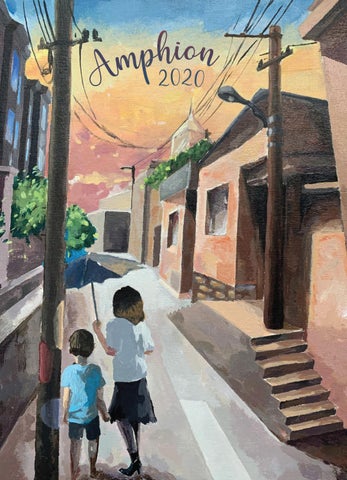
Amphion Student Art and Literary Magazine
The Peddie School 2020
The Legend of Amphion When it was first determined that there was a need of a literary magazine at Peddie, a title was sought which would display more originality and significance than the traditional names of similar publications. Ultimately, the name Amphion was chosen in part for its inherent beauty, partly for its relation with our Greek literary heritage, and primarily for the name’s significant relationship to art. The basis of this relationship is dramatized in the ancient legend of Amphion and his brother: Born of Zeus and Antiope, a princess of Thebes, Amphion was an incomparable musician. His twin brother, Zethus, a man of great physical strength, despised Amphion for his neglect of manly sports and his devotion to art. Once, the brothers undertook to fortify the walls of Thebes. Zethus, despite his far greater physical strength, was unable to emulate Amphion’s feats. Amphion’s stones moved to the sound of his lyre and slid gently into place, while Zethus was obliged to use force, lagging far behind his brother. The symbolic significance of art and imagination and of their intrinsic strength clearly relates the objectives of Amphion with the purpose of Amphion. As Amphion’s medium was the art of music, Amphion’s medium is the art of writing; as Amphion gathered boulders to fortify the wall, Amphion gathers into a single unit the best writing of Peddie students. It is important to note here that many years have passed since the adoption of Amphion’s name. In that time, the literary magazine has expanded to not only encompass written works, but also proudly champion a wide display of visual arts pieces. And so, it is evident that Amphion’s subjective association with the realm of relativity are indicative of Amphion’s display of student creativity. The name Amphion, therefore, is exemplary of the ideal which is the goal of any art and literary publication; that is, complete and unswerving devotion to one’s art. — Revised Introduction to Amphion 1965
Letter from the Editors Dear Readers, The paramount goal for the 2019-2020 edition of Amphion, the art and literary magazine of The Peddie School, was to recognize the most creative, skillful, and innovative works of our community while representing all facets of the student body. This vision entailed diverse representation in media as well as in the grade levels of accepted artists and writers. From masterful works of fiction to intricate mixed media, anyone, from the young poetry-aficionado to the veteran painter, can appreciate this year’s diversified display. As editors-in-chief, it has been both a pleasure and an honor to sift through the submissions of our peers. We are very proud to curate the following work and hope that you enjoy it. Happy reading,
Dennis Zhang
Ryan Hu Editors-in-Chief
Clara Choi
Table of Contents 1 Kill Your Darlings 2 Little Boy 3 Eden 4 Mother Bird 5 Departure 6 Reborn 7 The Brother 12 Medusa 13 Corrosion of Dreams 14 Over Time 15 Taste of Time 17 La Corrida de Toros 18 Allergic 19 Innocence 20 Opportunity in Red 21 Counting Stars 22 Have a Nice Day! 23 How to Call Your Parents 25 Hope 26 Colorful Baby 27 Where Are You Actually From 28 The Good and the Evil 29 hell is empty and all the frat boys are here 37 Global Travels 38 Skinny Chips 39 The Primitive Rhythm Museum 40 This I Believe 41 Town Stories 42 Joy 43 The Grandfather Tree 45 Frigid Water 46 The Man on the Corner 47 Desire 48 Brook Trout
Dennis Zhang Rachel Thomas Labeena Hanif Lowy Shim Gianna Metzger Kathryn Fang Richard Zhu Labeena Hanif Kathryn Fang Anna Radigan Kathryn Fang Jane Anderson-Schmitt Andy Qin Mike Truong Dennis Zhang Melissa Cao Middy Vella Arantxa Galvan Emily Mu Melissa Cao Zoe Chao Jane Anderson-Schmitt Labeena Hanif
Poetry Art Poetry Poetry Art Art Prose Poetry Art Art Prose Art Art Art Poetry Art Art Prose Art Art Poetry Art Screenplay
Gabe Garcia Katarina Kuharsky Sean Lee Melissa Cao Petya Nevona Kathryn Fang Yulia Gu Gabe Garcia Aidan McHugh-Wood Andy Qin Melissa Cao
Art Art Art Art Poetry Art Prose Art Poetry Art Art
49 Wallowa 53 Cicada 54 Men Want Me and Women Want to Be Me 55 Una Lingua in Zwei 57 Afternoon by the Harbor 58 Realization 59 Hair Spray 61 Me and My Shadow Clones 62 Mapping 63 A License to Kill 65 Danger 66 Wake Up 67 Falling 68 Paranoia 69 Alzheimer’s 71 Road Rage 72 What I Have Taken 73 Glamour 74 Through Different Lenses 75 Bean Curd Knots 77 Drowning 78 Lazy Afternoon 79 The Diner 80 10:45 AM 81 S’women 82 Self-Hatred 83 Gringa 87 Childhood 88 The Journeyman 89 Final Frontier 90 Recollections 91 Second Grade 93 Pinwheel 94 9/11 95 Self-Portrait of Modern People 96 Intertwined 97 A Summer Night Dream 99 Rotate Me
Kaya Gorsline Middy Vella Clara Choi
Prose Art Art
Olivia Testa Andy Qin Rea Tonelli Arantxa Galvan Rachel Uy Mary Lynch Anonymous Mary Lynch Emily Mu Jane Anderson-Schmitt Andy Qin Richard Zhu Melissa Cao Arantxa Galvan Rea Tonelli Luiza Chevres Lucia Shen Andy Qin Carol Ge Aidan McHugh-Wood Kaya Gorsline Rachel Uy Gabe Garcia Arantxa Galvan Clara Choi Lowy Shim Luiza Chevres Middy Vella Yulia Gu Luiza Chevres Labeena Hanif Sean Lee Jane Anderson-Schmitt Emily Mu Jake Meneskie
Poetry Art Art Prose Art Art Prose Art Poetry Art Art Poetry Art Poetry Art Art Prose Art Art Poetry Poetry Art Art Prose Art Poetry Art Art Prose Art Poetry Art Art Prose Art
100 Dreams of Peanuts 101 Constructed Doctor 102 Conscious 103 Say Something 105 Light 106 The Parlor Room 107 Eeeee 109 The Nightwatch
Gordon Shi Katarina Kuharsky Carol Ge Arantxa Galvan Mary Lynch Aidan McHugh-Wood Rachel Uy Mike Truong
Cover Ally
Kaya Gorsline
Poetry Art Art Prose Art Poetry Art Art
Kill Your Darlings Dennis Zhang ’20 Poetry Dear Editor, please tell me what it means to love poetry. Is it to dine with her over cheese and wine starry-eyed as I imagine us happily aged with new lines or caress each stressed foot in a bath, easing away cramps under the intimate moonlight of a flickering desk lamp perhaps even delicately tango along voluptuous hips that jut? My bony fingers wander, finding ways to cut and break, holding back tears, as I slash her paper spine with my insatiable ballpoint, leaking crimson from the crime.
1
Little Boy Rachel Thomas ’21 Photography
2
Eden Labeena Hanif ’21 Poetry eve begets the third. it’s not her fault He evicted them while she painted her nails with Smok’n in Havana. adam sighs & looks heavenwards, or at the ceiling. “stop rolling your eyes,” she says. “We’re in this together.” hunting through goodwill to hide their naked bodies, her belly swells like a tidal shift. there is no razor for his unshaven neck, no honey-laden Garden, only dusty tongues and dead figs. she was told not to take & she took. She was starving & she bit. the third is born to no Apples, Gardens. it’s not her fault. the snake was hidden in the drywall.
3
Mother Bird Lowy Shim ’21 Poetry The sun dims its orange lights as the day now comes to an end. Mother Bird’s chicks grow weary and their heads are heavy. She too is tired from a hard day’s work, but hard days have become routine. The gray clouds and distant sounds of thunder warn the creatures of a storm. The chicks, nervous at first, are comforted by Mother’s presence. And as the storm comes nearer and the thunder more violent, The crackles of lightning are drowned out by Mother Bird’s songs, Reassuring the chicks that everything will be okay, For the sun will rise again in the morning, And she will be waiting for them with breakfast.
4
Departure Gianna Metzger ’20 Photography
5
Reborn Kathryn Fang ’22 Oil Painting
6
The Brother Richard Zhu ’22 Prose Pink glasses of champagne sparkled from every corner of the ballroom, like the fallen shards of a vast chandelier. Waiters in crisp tuxedos twirled through the partying crowd, balancing platters of cocktail shrimp and sweetmeats. Arielle’s heart fluttered like a trapped nightingale, its trembling throat sore from trilling the same song of longing. The same song, as the sun glided between day and night, filling the void between them with wispy sunlight and empty, heartbroken notes. But now…she was so close...so close to her beloved Aaron. *** It had been a brutal day in the laboratory, and Arielle entered her cramped, dusty apartment in a half-asleep trance, reeking of blood and fish. Scenes of the screaming sea lions flashed through her mind, their backs arched in agony as she drilled through their skull, embedding silicon computer chips in their neural networks. Five years, but it never got easier. Her deck was stuffed with the profiles of a hundred dead pinnipeds, their bodies long ground into hamburgers. The cardboard box had been placed in the kitchen, displacing the cigarette butts and dirty dishes on the dining table. It was Aaron’s usual menagerie of exotic gifts. She eagerly tore through the pink wrapping paper, and was so busy admiring the sleek iPhone XX that she almost didn’t notice the small letter attached. She tore it open and was confronted with lines of elegant cursive, so refined… Arielle sighed. When they were young, he used to scratch his name in the dirt outside their village classroom, and the letters were so crooked that their teacher would beat him, but now… She scanned the letter, and broke out sobbing, the paper falling from her hands. No...it couldn’t be...it had been twenty years since he left…. Dear Arielle, You are cordially invited to attend a family reunion hosted graciously by BrainComp. This brief vacation celebrates two decades of loyal service to BrainComp. Aaron *** 7
Arielle threaded her way between throngs of gossiping relatives. Their voices sounded like the little wind-up birds the city-children clutched, trilling the same banner of notes with each spin of the crank, beautiful yet superficial. She was in no position to judge, though. Her childhood had comprised of romps through the forest encircling their town, Aaron by her side, splashing mud and trying to identify the plants they had learned in school until Mama’s hoarse yells brought them home for dinner. This newfound luxury was foreign to her….and to think, it was all because of Aaron’s money… Arielle smiled wistfully at the thought of her playful brother, smile lines etched permanently around his mouth. She hurried through the crowd even faster, anxious to see her missing half— “Oh!” A blur of velvety blue and white flashed before her eyes, and the next moment Arielle was reeling backwards, staggering against the nearest table, ripping the lace tablecloth. The waiter she had bumped into did an awkward dance in front of her, his arms tracing circles as the platter of finger sandwiches teetered back and forth while he tried to bow in apology. Arielle burst out laughing, so much did he resemble an ungainly peacock. “I-I’m deeply sorry, m-miss...please, f-forgive me…” he stammered, bowing repeatedly. “It was my fault, don’t worry.” Arielle said, still giggling. As he turned away, however, the smile dropped from her face. The gold filigree of his suit flashed in her mind. His parents were probably richer than Mama would ever be. Suddenly, her thoughts were interrupted as she spied him. Aaron, resplendent in an all-black suit, stood in the middle of the dance floor, couples twirling around him, completely ignored by all around him. Aaron started forward, but suddenly Uncle Morteis shoved past her. Arielle glared at the man. When they were young, he had always chided Aaron for being a bookworm and told Arielle that she was “an uncultured little tomboy who needed to go play with the other little girls.” She heard him tell her brother, “Aaron, I have urgent need of a new Lexus. My wife was just injured in an accident, and the car is completely wrecked. The medical bills eat up my paycheck, and BrainComp seems to pay you decently…” Arielle shoved forward. Morteis had never respected them—who was he to leech away Aaron’s hard-earned money?! But Aaron was already nodding, and the man turned away, immediately to be replaced by a woman claiming to be their aunt and asking for a new air conditioner. Finally, the relatives all trickled away to dance or drink, and Aaron turned towards her. Their eyes locked, and Arielle sprinted forward, choking back a sob, and threw her arms around Aaron. “You’re back…” she whispered, “you’re here…” 8
*** Aaron was different from the other boys in their tiny village. Deep down, he seemed to always nourish a tiny spark of childish curiosity, of innocence. When others were sneaking sly glances at girls, he was looking to the cloud-capped skyscrapers of Mercrawles, so many shiny scalpels held by the white-coated doctors of his dreams. When the others vied for a space in front of the school’s one cracked mirror, flexing their biceps, Aaron was crawling through the pages of their biology textbook, desperate to become smart enough to attend college in Mercrawles. To leave their dirty little hovel. Arielle had been with him every step of the way. They were partners in crime, zealously dissecting butterflies or racing in circles around the village till they collapsed in the dirt, inseparable. They were two water lilies in a cloudy pond, untainted by the carnal grime of the adolescents or the bleak hopelessness of the adults. *** “I am here in Wyle Hotel in the city of Mercrawles, yes.” His voice was a monotone, the coldness jolting. Arielle pulled away, noticing for the first time how stiffly he stood, his jaw set in a hard slash, his gaze dark and guarded. His eyes roved across the ballroom, taking in the joyous crowds, yet the ice did not thaw. The ghosts of arms that had not embraced her seemed to tear at her heart. “Aaron?” Arielle ventured, stepping closer. “Are you alright? Did something happen?” “If you are trying to establish an emotional connection, then I am afraid I am not the best conversational partner.” He started to turn away, and Arielle felt pain stabbing at her exposed heart. No, this was not her brother, this was not… She reached out an arm and stopped him before could walk away. His eyes were so dark, so empty. Only now did she notice his sallow skin, his unkempt hair that hung in knotted clumps from his scalp. “What did they do to you?” she whispered, a lump catching in her throat. “The Comp 43 procedure is a government-approved surgical process,” Aaron replied flatly, his eyes still roving around the room, as if on autopilot. “which may have minimal side effects on emotional centers of the human brain.” “Minimal?!” Arielle hissed, her eyes moistening with tears. “Aaron, you’re—you’re...not even human! Aaron, we haven’t even finished testing Comp 43 on pinnipeds!” “All the preliminary tests were posi—” “Half the sea lions have brain tumors! You call that positive?!” “If you wish to find a more suitable conversation partner—” he began. “No!” Arielle shrieked, wiping furiously at the tears which were flowing down her cheeks, ignoring the glares she was receiving from the surrounding 9
guests. They were all indebted to Aaron for this party, all vile and thankless people—all she wanted was to have Aaron back, not this aloof, robotic stranger… *** The Mercrawles government official was dressed in a rainbow-hued suit, vibrant colors spilling over his potbelly. As Aaron finished his valedictorian speech, the man started clapping furiously, the fat on his jowls wobbling. Arielle glared at the man. Who was he to celebrate Aaron’s achievements? When did Mercrawles ever care about their tiny village, except to pluck out the child prodigies? “Well done, young man!” he squeaked, waddling forward and clapping Aaron on the shoulder, “As valedictorian, you have brought honor upon this dilapidated hamlet!” Arielle huffed in disgust, but Aaron beamed. “I am b-beyond honored, s-sir…by your presence…” He stammered. Aaron never stammered. “Lovely!” the man said. “Mercrawles offers the valedictorian of your village a special opportunity every year. If you choose, BrainComp—which is the leading corporation in human-computer integration—will implant a computer chip in your brain to augment your knowledge in any field of your choosing. What do you say?” Aaron paused, and Arielle noticed a flicker of uncertainty in his eyes. This was a major surgery...she didn’t like the greedy way in which the man was staring at Aaron. “It’s too risky,” she hissed at Aaron. What if he changed, became robot-like? The portly official smiled oily at her. “Young lady, we will also find you a position in BrainComp’s labs, have no worries. Now, why don’t you let your brother decide for himself ?” “Will the surgery get me into Mercrawles?” Aaron asked “Of course,” the man said. “BrainComp will award you a high position in its industries.” And Aaron was sold. The official took their parents aside to sign a few forms, and Arielle tugged on Aaron’s sleeve. “No, I won’t let you do it,” she said, staring at him fiercely. “What if it messes up your brain? What if they can control you after the surgery? Like in the movies?” “Arielle, Arielle,” Aaron said, shaking his head. “When will you learn? Life is not the movies, alright? Do you ever see the people living in hovels in the movies? Or learning in a dirt classroom from an eccentric old bat? This is the only way I can be somebody, don’t you see? The only way I can leave this place.” He stared off into the distance, towards the steel spires of Mercrawles, and sighed. Arielle laid her head on his shoulder, and suddenly she felt like a child again. This was her brother, her best friend… “I don’t want you to leave me.” she said softly. Aaron put his arms around her, and she sank into his embrace, crying softly. “I won’t, I promise.” But he broke his promise. 10
Two days later, he left and never came back. His face was splashed all over the local newspapers as he won accolade after accolade for his ingenuity and success. For Arielle’s fifteenth birthday, he even sent her a pair of wireless headphones, which was admired by all her cousins. But with each passing year, the distance between them grew, and Arielle’s heart slowly withered as she lost her soulmate. *** She buried her head in Aaron’s shoulder, her body heaving, silent tears soaking into his impeccable black suit. “Do y-you...not remember,” she whispered, her voice cracking, “when we used to...to play blind man’s bluff in the forest, and came home looking like termite mounds? When Mama would yell at us f-for catching snakes...Mama’s cornbread...don’t you remember any of it…” “I do.” was his simple reply, yet he had forgotten. Arielle sobbed and sobbed, but Aaron did not move a muscle. Suddenly, she felt a gentle hand on her shoulder, and looked up in surprise, only to have Aaron shove her impassionately to one side. “Oh!” she gasped, and looked up to find Uncle Morteis looking haughtily down at her. “If you’ll allow me to speak with Aaron, I have but a simple request of my Lexus’s color—” “GO AWAY!” Arielle suddenly yelled, shoving back the old man. Who was he to dirty his hands on Aaron’s money? Who was he to even speak to her brother? Who was he— “Leave us.” Aaron said. Arielle watched, open-mouthed, as her brother walked away, his dark shadow swallowed by the partygoers resplendent in their diamond gowns and tailored suits. No one acknowledged him, so busy were they sipping sparkling glasses of champagne.
11
Medusa Labeena Hanif ’21 Poetry My eyes were grey when I was born. A girl before a weapon; gilt-edged hair aglimmer in the sun and all its dying gasps. My sisters held my hands. We spun and laughed. Our palms were soft; we had no need for fangs. The butcher’s axe spun careless, glinting, cold. sometimes i smash perfume bottles to see if the scent really lasts / his hands burn like alexandria / my skin is paper and my blood is ink the scent never lasts / have you noticed that we are always the offerings / decked out in gold and rohypnol yellow veils and ghb / his eyes are so very green my eyes were grey when i was born the couch my altar / your silence the shroud dylan blue pour femme / shattered / our palms were soft What I’m saying is that it’s not a curse. I call my sisters on the way to work; lean my head on the train window and watch with slitted pupils. I do not forget limbs curved into commas. The dirt under my nails has taken me years to dig out. You won’t meet my gaze. The blood etched in the ridges of your skin, black as rot, rust-edged, will take longer to fade. Our palms were soft and clean as dawn, honey-fingered as home. My eyes were grey when I was born. Now they are two mirrors, petrifying as truth, the only thing that cannot be smothered. Call it a curse. I call it liberty. 12
Corrosion of Dreams Kathryn Fang ’22 Mixed Media
13
Over Time Anna Radigan ’22 Oil Painting
14
Taste of Time Kathryn Fang ’21 Prose Another hour passes as I watch the first number of the time change on my phone. The sixth time today. It’s funny to think how much I rely on and look at the time. One thing I have done every single day of my life, is to check the time and watch the hours slide by. One to twelve, the numbers climbed up and fell right back down twice everyday. Pouring grandma’s special limeade into the glass cup, I dig my toes back into the sand as far as I can, allowing my head to fall back onto the pillow of the chair. The same chair my brother took to all of his beach parties, while I was at home reading books and watching TV. The chair he always dragged across the sidewalk of the beachhouse when he came home, too late and too tipsy for grandma’s liking. The metal bottoms of the chair scratching the driveway like nails on a chalkboard, with grandpa’s raspy voice scolding him in the background. Watching him get grounded for another night out was the most adrenaline that ran through me on the weekends, but I never minded those nights. Mostly spent eyeing the clock to see how late he could come home dragging the chair back home, and giggling when multiple hours began to pass after midnight. The clock controlled most of my life, whether it was going to classes on time, rushing to the boardwalk with friends before it closed, or coming home before curfew unlike my brother. Once in a while, I fall behind on my wellorganized schedule, but grandma and grandpa never punish me. I have done everything I have wanted to accomplish the past four years, in school and on the field, and yet all I have done was follow the schedule. Besides the hours I dedicate to sleeping, I try to use up all the other hours of the day productively. I have tried many sports, read many books, watched countless double-o-seven movies, yet my days still feel empty. Four years later, I can’t help but look up to the older brother I once looked down upon. Always doing whatever he wanted, he got to live out his high school years with no regrets. Although he did not get into his top schools, he knows exactly where he wants to go this fall. Taking a sip of my limeade, I can’t help but remember taking that exact sip last summer, the summer before that, and the one before that. I’ve been to 15
parties, I’ve had my fun with friends, I’ve traveled around the world, indulged in the most exotic foods, yet every moment grew from the roots of purpose, rather than desire. I see the waves falling forward and then drifting away from the sand that squishes between my toes. The salty air sprays between my hair and tickles my nose like a brush of a feather. The touch of the feather, reminding me of days that I came home with fingers glued together and glitter sitting inside the tips of my nails for an art project. Days when my mom would try her hardest to smile and mask the disappointment of her daughter failing to properly decorate a hand turkey. As the sun begins to fall down to the horizon, the glow illuminates a straight path on the waves of the ocean with the sky swirling into shades of deep reds and light oranges. Oranges that were placed in the cooler of the trunk for beach days and bags of tangerines dad used to give me while I sat in the grocery cart. Those colors then sat on my desk rotting to a dark mahogany, accompanying the pages of homework on the other side. The days that I sacrificed to make sure the clock was satisfied, were the best worst days. Trading in thrill for training, exploration for essays, and freedom for fatigue, was only my initial test against time. Those summer nights the winds called for me outside the window, began to blow past my room day by day until the window began to shut. My schedule did not allow me to communicate back, for 8pm was designated study time. Even in the summer. The dark green shade of black freshly painted around the frame of the window were now visible on the shells of the baby sea turtles a few feet in front of the sea. Newly hatched, the turtles flopped forward using their flippers, one behind another, until the waves carried them back. With each step the turtles took forward, the water only pushed them farther backwards. Stretching my legs completely straight, I feel the muscles in my thighs tighten and the tops of my toes shoveling up more sand. Rolling my ankles three-hundred-sixty degrees clockwise, I rolled them back counterclockwise. Why can’t I turn the clock back too? I wanted more than anything to get back the only few years I had the opportunity and freedom to explore my innocence, that I was now reaching to hold onto. The years I sacrificed counting the hours and minutes of the day, rather than counting the amount of ice cream I could have in a sitting, or how long I could hold my breath. However, even underwater swimming with the turtles, I could hear the faint whispers of the clock ticking forward. Time followed me everywhere and left me with an internal frustration that felt like sand was stuck in my gums, but even the last drop of grandma’s limeade couldn’t wash down. 16
La Corrida de Toros Jane Anderson-Schmitt ’20 Acrylic, Watercolor, and Ink
17
Allergic Andy Qin ’23 Mixed Media
18
Innocence Mike Truong ’20 Photography
19
Opportunity in Red Dennis Zhang ’20 Poetry On Chinese New Years, you stand in your grandma’s old retirement home looking down at the red envelope that tightly clasps what she had refused to spend on food and medical exams. It gently floats across her open palms like a lonely cardinal stranded in the ocean waiting to be swallowed whole any second by the belligerent ripples of her calloused yellow skin. Her expectant eyes touch yours as she slides the crimson fowl onto your soft, privileged fingertips. Trembling, you pinch its winged flaps shut, pinning it, preventing escape. You glance ahead at the flattened contours of her shriveled cheeks unsure if she had been malnourished for the sake of this frail creature. She has tattooed “for college” across its breast, oblivious to the fact that meager sums will not suffice, although her million-dollar smile and glimmering pupils reflect the image of a phoenix spreading its wings in your golden hands.
20
Counting Stars Melissa Cao ’21 Oil Painting
21
Have a Nice Day! Middy Vella ’21 Ballpoint Pen and Marker
22
How to Call Your Parents Arantxa Galvan ’21 Prose Once. Twice. Three times. You wonder how many more vibrating bursts the phone can burp out. Ten? Twenty? Whatever the number is – it’s too much. Standing up, you walk over to the flowered bed-top where your Android is exiled. Your finger pushes the side button, and you blink at the notifications with an exasperated sigh. Even though it’s 12 AM this is the third time they’ve called you in the past hour. A pulsing black line decorates your Word document that should be a finished essay. Your brother could probably do this in an hour. He wouldn’t be distracted by his ringing phone – he would have already called back. Not like you. Every time you sit down at your desk with the intent to do work, your ringtone reminds you of your neglected obligation. “Why aren’t you coming?” It seems to say in a lilting intonation, “The woman who pays for your school wants to know!” It’s fine. You’ll talk to them later. *** Should you call them now? The question swirls around in your brain like the leftover coffee that you poured down the sink yesterday – around, around, around, back to where it began. Bitter, but strong - your body had felt it after a five-hour night when the darkness had seeped in hours before your eyes shut, and nighttime had greeted your waking eyelids. You didn’t call them yesterday either. “We understand,” they would probably say. You don’t know if they should. You work hard, but for what reason? Your classes aren’t difficult - you’re only taking six of them, and you have hours after school to do little homework they assign. You think you know why you struggle so much, but the reason feels like a letter inside a high school admission’s envelope – closed unless you want a 23
good cry. A letter that if you open and read, would cause wet cheeks, a pinked nose, and a realization of the secret you never tell anyone, the one you hate to admit even to yourself. The secret that maybe you aren’t smart enough for boarding school. That you’re too slow on the erg, too clumsy walking upstairs, too lazy to spend time studying for AP Bio. “We get it,” your parents said when your brother was still in freshman year; “You’re still adjusting. Soon, everything will settle into place.” It did for him. Because everything always works out for your brother. Because for him, it’s always good manners, good grades, good boy.
“It did” for you too. Because you’re not good at anything. Because your parents never attach any adjectives before your name. Because, sometimes, you hide your grades from Mama, and because sometimes is always. Because you know what Mama wants to hear, what she expects to hear. You know what Papa wants, even if he rarely talks to you. You’re the one who makes Mama too tired to wake up on time for work because she stays up late waiting for your call. You’re the one who’s sitting at your desk, waiting for that ringtone to stop, even though you know you should pick up. You’re the one who’s not a good daughter. It’s 12:13 AM, but because of you, Mama hasn’t gone to sleep.
She might be waiting for your call.
You sigh and turn your body towards the desk that partially covers the French-style windows in your room. Out of the corner of your eye, you see your mom’s face, brows tight and lips pursed, dancing on the screen of your phone, waiting for you to answer FaceTime. Pushing the button to green, you pick up. “I was just going to call you.” Silence covers both of you as Mama looks hard into your eyes, and you look everywhere but. “I know honey,” she says after a while, her mouth relaxing into a halfsmile accompanied by a sympathetic nod. “So, how is everything?” You look down at your work, then at the time. 12:15 AM. Angling your face back at the phone, you grin. “Everything is great, Ma.” 24
Hope Emily Mu ’22 Oil Painting
25
Colorful Baby Melissa Cao ’21 Oil Painting
26
Where Are You Actually From Zoe Chao ’23 Poetry Beaded blue eyes drift down to meet my hollow gaze, His blue reveals sincere curiosity uprooted by superiority. As my eyes a pool of tar, Acts as a mirror flaunting a portrait of bigotry. The truth I reply with, Never satisfies his validation. As his gleaming gaze rests upon, A pale face, washed out by years of affliction. He repeats the question again, The second time it might be clearer. Maybe he should say it louder, In a language that I might understand. Indicate the map of the world using large gestures, His blue eyes pinpoint my ethnic region. Educate me on my own genetics, Show me my origin. Rage envelops my mouth, A family history of immigration, I assert. An ancestry originated in China, As his eyes shine with fascination. So you ARE from China, he determines. An assumption extracted from prejudice lies, A fragment of my identity chiseled away. Now an oral tradition inherited by new generations, Tailormade to doubt my narrative. His eyes, glistening with content, A clear blue ocean with the sun high above. And mine, a chasm polluted with obsidian, Eclipsed from the light. 27
The Good and the Evil Jane Anderson-Schmitt ’20 Pen
28
hell is empty and all the frat boys are here Labeena Hanif ’21 Screenplay Character List KATARINA WRIGHT: 18, recently deceased. Stubborn. GUIDANCE COUNSELOR / WAITER / SATAN: ageless. Well-meaning. Scene 1. The stage is dark. A spotlight comes up on center stage, where KATARINA is lying motionless, dressed in all white. She is clutching a sealed envelope in her right hand. All at once, she sits bolt upright. Confused, she takes stock of her surroundings before tearing open the letter in search of answers. As soon as she pulls the letter out of the envelope and begins to read, an androgynous DISEMBODIED VOICE says: DISEMBODIED VOICE DEAR MS. WRIGHT, THE COMMITTEE OF ADMISSIONS HAS REVIEWED YOUR APPLICATION, AND IT IS WITH GREAT REGRET THAT I MUST INFORM YOU THAT WE CANNOT OFFER YOU ADMISSION TO HEAVEN’S AFTERLIFE OF 2020. WE WISH YOU LUCK WITH YOUR FUTURE ENDEAVORS. KATARINA closes the letter in silence. After a few seconds, she crumples it up, shoves it in her pocket, and stands up. Scene 2. KATARINA, now dressed in different clothes, sits at an austere desk across from the GUIDANCE COUNSELOR. The GUIDANCE COUNSELOR’s face is partially obscured, and he is drumming his fingers on the table. He is wearing an expensivelooking maroon blazer over a white button-up. There is a thick golden ring on his pinky finger. GUIDANCE COUNSELOR Katarina Wright. You have a very strong application, you know. It seems that you were fairly well-rounded in life; it says here that you were passably kind and generous, which are important to admissions officers. High empathy level...oh, but... He flips the sheet and clicks his tongue.
29
Extracurriculars are lacking.
GUIDANCE COUNSELOR
He shakes his head. GUIDANCE COUNSELOR And did you play a sport at all? KATARINA Why do sports have anything to do with me going to Heaven? GUIDANCE COUNSELOR Well, it really does bolster your chances. Even without, you do have options. You were accepted by both Purgatory and Hell. KATARINA I’m not going to Heaven because I wasn’t on the crew team? GUIDANCE COUNSELOR I hear fencing is big nowadays as well. This is a—
KATARINA
GUIDANCE COUNSELOR I get it. But thousands of bright kids like you go through rejection like this every year. Just because you didn’t get into Heaven doesn’t mean it’s over. KATARINA Don’t call me a kid. I’m not a kid. GUIDANCE COUNSELOR Do me a favor and look into Hell, okay? It has a really scenic campus. I’ll get you through to a guy I know there. He taps a few numbers on his cell phone, the latest Apple model, and calls someone. KATARINA You cannot be serious. You’re sending me to—— NEXT!
GUIDANCE COUNSELOR, exasperated
Scene 3. KATARINA is at a chaotic restaurant, observing. Loud
30
techno music is playing, and the sounds of people having dinner can be heard in the background. Flames burst up every so often. They are accompanied by screams. At one point, drunken, slightly singed frat boys run past. A WAITER, face partially obscured, comes by with a plate of appetizers. He is wearing an apron over a white button-up and black bowtie. There is a thick golden ring on his pinky finger. KATARINA waves him off. WAITER Would you like to try one of our vegetarian options? We’re permanently out of tofu, but we do offer seitan. KATARINA stares blankly in front of her. WAITER Just our head chef’s little joke. KATARINA gets up and starts to walk offstage. I need some air.
KATARINA
Scene 4. KATARINA is sitting on a bench outside of the restaurant on stage left. There is a maroon blazer draped over the bench. She lights a cigarette and takes a deep drag. On the exhale, she says: This is hell.
KATARINA
UNKNOWN VOICE Try working in the restaurant industry. KATARINA I am literally sitting in Hell. On its campus. A pause. I am on Hell’s campus.
KATARINA
UNKNOWN VOICE At least you don’t run the epicenter of its Greek life. The owner of the UNKNOWN VOICE comes into the light. It is SATAN, wearing a chef’s hat.
31
SATAN Luca Satan, Director of Admissions. KATARINA scrambles to stand up. She drops her cigarette by accident. KATARINA Satan. You’re...Satan. Hi, um, Mr. Satan. Hello. SATAN Call me Luca. Mr. Satan was my father. There is a silence as KATARINA attempts to process current events. SATAN So. Let me guess. Katarina Wright, Heaven reject. Come to visit the safety afterlife. Well, that’s not exactly... Walk with me, Katarina.
KATARINA SATAN
SATAN does not take off the chef’s hat as they walk. KATARINA No offence, Satan——Mr. Satan——Luca, but why didn’t I get into Heaven? I’m a good person. A pause. At least, I think I’m not a bad person. SATAN Look, Katarina, I’ll be honest with you. SATAN sighs deeply and clasps his hands behind his back. SATAN Lately, elite afterlifes such as Heaven have been looking to boost their admission statistics. Nirvana’s 2019 report has them at a five point five acceptance rate because of how rigorous their application process is. Jannah is at seven point two percent, Wicca’s pool of applicants has seen exponential growth, and. Well.
32
They have stopped walking at this point. KATARINA is speechless. SATAN The Catholic afterlife’s recovery has been slow since its admission scandal in ‘17 with those plenary indulgences. SATAN adjusts his collar. Something glints on his hand. SATAN Just logistics, I’m afraid. Heaven will only accept a select few. Legacy acceptances are on the rise as well... A pause. SATAN Lacrosse helps. Or fencing. I hear that’s big nowadays. So the afterlife is a scam. Most things are.
KATARINA SATAN
KATARINA, sarcastically Well, what’s Hell’s acceptance rate, then? Sixty six point six.
SATAN
KATARINA is suprised. KATARINA You can get rejected from Hell? SATAN Oh, sure. Lots of the recently deceased go on to be low-level demons, Purgatory security, fast food workers. You know how it is. A lot of people can’t afford tuition, either. KATARINA You have to pay for the afterlife. What do you even give them? Your soul?
Well, yes.
SATAN
33
A pause. SATAN You can’t tell me you haven’t heard of student loans. KATARINA sits down on the ground with a thump and exhales shakily. Hey, now.
SATAN
SATAN crouches down. He is still wearing his chef’s hat. There’s always FAFSA.
SATAN
KATARINA puts her head in her hands. SATAN At Hell, we provide a sense of community you won’t find elsewhere. You’ll fit in here. Everyone’s depressed in Purgatory, and Heaven’s a pressure cooker. It’s a competitive environment. Super toxic. Trust me, I went there. Really? I was kicked out.
KATARINA SATAN
KATARINA This is bullshit. This whole system is just so—— SATAN, placatingly I know, but you have to go through it. KATARINA abruptly looks up. SATAN is startled. Why?
KATARINA
SATAN Well, it’s——it’s been like this for eternity. It’s just what you do. A pause.
34
SATAN Look, you should sleep on it. I know you’ll love it here. Like I said, you’ll fit in at Hell. KATARINA looks out at the audience. We see a range of unidentifiable emotions pass over her face. As she is thinking, her eyebrows drop lower and lower until she is scowling. SATAN gets up. I recommend the seitan.
SATAN
SATAN starts to walk offstage. Once he is nearly gone, KATARINA says: No.
KATARINA, quietly
KATARINA gets to her feet. SATAN Seriously, they have this teriyaki sauce—— I’m not committing to Hell.
KATARINA, louder
SATAN stops and faces her. SATAN So you’re deciding on Purgatory, then? KATARINA No. I’m out. I don’t want any part of this. SATAN But you——what? That’s not how it works. Isn’t it?
KATARINA
KATARINA paces the length of the stage. Every step she takes is deliberate, purposeful. SATAN laughs incredulously. You can’t be serious.
SATAN
KATARINA does not respond, only looking at him. SATAN appears
35
to become more disturbed by KATARINA’s words with each passing second. He takes a few more steps towards her. SATAN, more frantically Look, you can do a year at Hell and apply for a transfer to Purgatory, wherever——there are resit exams for Heaven——but you can’t just be out. KATARINA You said it yourself. There are some people that aren’t part of the system. “Low-level demons, Purgatory security, fast food workers...” SATAN Well, yes, but those are the people we reject. KATARINA sighs and closes her eyes for a brief second. When she opens them again, she begins to walk offstage, past SATAN. Once she is a few feet away from offstage, SATAN, with his back to her, says: You’re making a mistake.
SATAN
KATARINA stops. Her shoulders slump almost imperceptibly. She turns her face to the audience, and we see that she is exhausted. Maybe so.
KATARINA
KATARINA fishes around in her pocket and comes up with a crumpled piece of paper. She drops it to the floor and exits. SATAN stands still for a few seconds, staring at nothing. He takes off his chef’s hat, runs his hand through his hair, scrubs at his face. He is wearing a thick golden ring on his pinky finger. He picks up the blazer from the bench and takes a crumpled piece of fabric from his pocket—a bowtie—and leaves it undone around his neck. His eyes close, and if we have not already, we notice his striking similarity to both the GUIDANCE COUNSELOR and the WAITER. SATAN opens his eyes and slowly walks after KATARINA. When he passes the crumpled paper, he kicks it with feeling to center stage. SATAN exits. A spotlight comes up on the paper. The Heaven® logo is clearly visible.
36
Global Travels Gabe Garcia ’21 Charcoal
37
Skinny Chips Katarina Kuharsky ’20 Sculpture
38
The Primitive Rhythm Museum Sean Lee ’22 Sculpture
39
This I Believe Melissa Cao ’21 Mixed Media
40
Town Stories Petya Nevona ’21 Poetry Every window hides a story. Some of them are mournful, other full of glory. Some of them are lonely as falling leaves. Others are lucky as clever thieves. A single room keeps a complete aesthetic mess. People lock the doors and go out with a finesse. As they haven’t been using every single crayon in their box. As they haven’t dreamed about a simple leisure on the beachy rocks. Sometimes this powerful world may leave a scar; making you feel as an alienated star. People see you being pale and concerned. Maybe they shouldn’t have learned. You see your shadowy reflection. Your face full of wrinkled complexion. You are exhausted of this heavy life . You contemplate about taking this knife. But then who will continue coloring your mess? Can you end this unique story with just one press? What would happen if every person leaves his room? Our town will be as the deep ocean’s gloom. Mysterious and terrifying, unable to see the inches in front of you. The color of your trembling body is blue. The coldness of the town blows every candle out. People find it difficult to live in this blackout. That’s why every story is essential . It has its own potential. It keeps our world in perfect shape. A world you would never want to escape. 41
Joy Kathryn Fang ’22 Photography
42
The Grandfather Tree Yulia Gu ’21 Prose In the clearing next to the baseball fields, there is a small patch of woods, really only a few solitary trees, spared from the clutches of urbanization. And in a grassy patch near the old parking lot, separated from the rest of the wood, stands a lonely chestnut tree, branches stretched towards the sun in prayer. My grandfather’s tree. Or rather, it was him who found this tree. A hundred and ten years ago, a squirrel might have planted a seed in the autumn ground, hoping for a meal in spring when the weather warmed, but after a busy year, forgot its location. The little seed grew slowly, watered by the melting snow, bathed in the glorious rays of the glowing sun. Perhaps, children used to run by the growing sapling, climbing its branches, carving their names in its bark with a heart, marking it as theirs. But to me, it’s my grandfather’s tree. My mother tells me he was on a walk when he saw it. Upon seeing its leaves, he realized it was a banli shu, a chestnut tree, the kind he climbed when he was a child. Banli, he used to tell me, dui shen ti hao- good for your health. *** I was five, almost six, visiting China for the first time. Everything was big, new, and shiny- intimidating. Just a little taller than her knees, I hid behind my mother, suddenly shy at the sight of a new person. Yeye. He walked by himself, in a tan vest and khakis, a slightly tattered red t-shirt, a round belly, graying hair, holding a clunky old camcorder. I would later learn he owned multiple of that red shirt, because it was his favorite; you shu fu you pian yi - comfortable and cheap. And even though he kept quite good care of all his things, his clothes were worn in with holes from years of wear. He refused to get new clothes- this was good enough for him, yet he always seemed to look out for others, trying to help them whenever he could, insisting on buying the new and best things for others- selflessness he had developed from enduring years of hardships. His actions taught us more than his words. He had a patient smile that lit up his eyes, radiating a certain kind of joy hard to find anywhere but in the presence of your yeye, eyes like pools of wisdom, waiting to be bestowed. I looked up from behind my mother at this stranger. He reached his wrinkled hand out to me. “Zuo zuo you you zhong yu hui jia le!” I remember him saying. You’re finally home. 43
*** Lonely as it is, the chestnut tree flourishes in its solitude. It inhales the air, takes its food and water without having to share. The lonely tree always bears the best fruit. I come to keep it company sometimes, when the leaves are starting to drift off with the wind. I walk around its trunk in circles for hours, breathing in the smell of dew. It leaves a note of something I can’t quite put my finger on- something lightly sweet, fragrant. In return for my friendship, it drops the shelled fruit perched in the highest branches onto the ground, where I am able to reach. I peel back the spikey green exterior, guarding the treasure inside. What’s inside is almost always three perfectly formed chestnuts. The two on the outside are rounded, perfectly formed. The one in the middle is squished, a little smaller than the other two. The triplets fit in my palm, a dark, smokey brown, glistening in the golden glow of the setting sun.
44
Frigid Water Gabe Garcia ’20 Oil Painting
45
The Man on the Corner Aidan McHugh-Wood ’21 Poetry Everyday I hand him A 5 dollar bill He never smiles Or says thank you Just looks me in the Eye And even when the rain Soaks his socks And the ice cuts At his skin His gaze never betrays A hint of jealousy Maybe he knows something I don’t
46
Desire Andy Qin ’23 Ink
47
Brook Trout Melissa Cao ’21 Oil Painting
48
Wallowa Kaya Gorsline ’21 Prose Nestled inside a spiral of purple mountains just west of Idaho, sits a lake, slightly curved, almost resembling a slug or some other creature. I remember glancing out the window as our car swerved between the bases of massive hills, hypnotized by the rush of fir trees against the vibrant blue sky. And then, as the trees parted, catching just a small glimpse of this glittering crescent sea tucked below the cliffs. When I was eight, the Wallowa mountains held up the sky, and the Wallowa Lake was an ocean, where the seafloor continued down forever and ever, down to the center of the earth. My grandfather and his siblings grew up in Joseph, Oregon, a town with a population of 1,081, three hours away from the nearest McDonalds. The few musty, grainy photos from the 50’s that I’ve seen, revealed that they had a dog and a handful of neighbors. Sun-kissed smiles in wheat fields, running and whooping down miles of empty gravel roads; swimming in clear, cold streams from snow melted off the mountains. Standing barefoot, downtown next the convenience store; a ratty backpack slung over one shoulder near a one room schoolhouse. The Gulch House was carved, built, crafted by their father, my greatgrandfather in the 30’s. It’s two stories tall, behind a road that continues for miles through the mountains toward Washington. Tucked in between two wide hills, poised dangerously on springy, marshy ground, it was the space that no one wanted. Unwanted, but ours, and no one else’s. When I was twelve, I awoke on a cot in my great-aunt’s house, to my grandfather and brother standing over me. A knowing smile plastered on his face, my grandpa’s graying moustache twitched as he spoke, “Wanna herd cows?” My brother and I, delicate sheltered children, had never experienced the gratification and agony brought about by the labor performed by farmhands. So that morning, I had no idea what to expect; What exactly had to be done, and how would we do it? Would we be close enough to these bulky creatures to see the emotion in their eyes, and the individual strands of fur lining their pelts? My brother and I were lead to a vehicle which resembled some sort of car-tractor, and was barely big enough for the three of us in the front seat. But Finn squished himself in the middle, and we managed. The conversation was centered around school and other general matters, before the tractor reached a 49
rickety bridge and a chain-link gate in a wooden fence. I saw them. These boxy, splotched creatures, idling in one spot or lumbering around, flicking their tails and ears at bugs, real and imaginary. My grandfather handed me the keys. “You’re driving,” He informed me, gesturing toward the cows, “If you can school all of us in Mario Kart, you’ll be great at it.” I often mowed the lawn at home, but that was different. The patterns created by the lawn mower were neat and orderly, ensuring that the driver always knew what the next move would be. This vehicle? It could drive on roads, speed up to 50 miles per hour - and I was the twelve year old driving it. I cautiously nestled myself in the driver’s seat and eased my foot against the gas pedal, shielding my eyes from the radiant sunlight fighting its way through the trees overhead. The shrill sound of birds far in the distance, the clear smell of fresh wood and pine trees. The cows stared. Flicked their tagged ears. Didn’t move. “Drive on either side of them to try and collect ‘em in a group. Then we’ll try and herd them through that gate on the other side of the field.” The toothpick in my grandpa’s mouth moved up and down as he spoke through gritted teeth. The vehicle crept cautiously toward the dispersed group of cows, who were starting to look annoyed at the presence of this foreign hunk of metal. “Be careful,” my brother poked me, “Don’t mess up.” The vehicle jerked forward and splattered mud in the direction of the cows, who started to lumber away from the source of the filth. Inspired, I swerved around the stragglers, causing them to plod toward the rest of the cows. “Just like that!” My grandfather had to raise his voice, as the cows had begun whining and mooing at the vehicle. My brother clutched his seatbelt and covered his ears. After repeating the jerking and swerving several times, a cluster of creatures had shuffled steadily toward the designated gate, their moos filling the crisp morning air. And then, seemingly out of nowhere, a singular cow broke away from the group and shuffled back toward the sparsely populated field. Several others followed suit. My grandfather groaned. “It’ll be fine, just take these ones into the new pasture and we’ll deal with the rest later.” I drove the vehicle on the left flank of the remaining cows, circling back to tighten the right so that no more tried to escape. Once the group was safely in the pasture, with the metal lock bolted shut, we turned again toward the old pasture. My grandfather wiped the sweat off his moustache, “Alright, seventeen down, thirty-two to go.” 50
It was when I was five, on the trail that winds behind The Gulch House, that I first witnessed death. I knew that living things died, of course, but I’d never seen death; the warmth of life replaced by stiffness. My Dad’s cousin, Chad, was seventeen, eager to show the youngest member of the family all of the hunting tactics that he’d learned from his father. The hunting shed behind their house was so large and looming at the time, walls decorated top to bottom with the heads of slack-jawed deer, their beady, lifeless eyes boring into me. “We’ll start with fishing,” Chad said, running his hand along the rack of fishing poles. There were so many different colors, shapes, and sizes to choose from. I was raised as a vegetarian, and the concept of hunting hadn’t really sunk in to my brain. So each time Chad cast his fishing line far into the water and sighed as the hook returned empty, I simply watched in wonder, not understanding what it meant to fish, to hunt and kill. After several unsuccessful attempts, we came across a small lake tinted with a murky brown color. “This is the last one,” Chad sighed, “if we can’t get one this time we’re heading home.” I watched as the fishing line was cast in the water, and a few moments later, his face light up with excitement as something tugged his rod toward the pond. With a mighty yank, a twitching bloody fish spilled onto the shore. The hook was impaled through its flesh, the pointy end sticking awkwardly out of its side. Its flat eyes screamed as it lost consciousness. I stared for a moment, as Chad celebrated his catch, then looked away, back toward the road and the Gulch House. When I was fourteen, Chad and his fiance, Sylvana, got married in that same cow pasture. The grass had been specially groomed, and the cows had been kept out for a few months prior to the event. Close to one hundred lawn chairs from all over town had been donated to this event. All of the shop owners, farmers, teachers, and neighbors had gathered, teary-eyed, to witness the union of two young adults who had been born and raised as a product of this small mountain town. I wore a simple blue dress and flats, while my brother sported a button up shirt and a bug patterned clip-on tie. We were careful to avoid stepping in manure as we trekked to the site of the wedding, passing on the way the trailer that the couple were living in. The sun cast a golden veil across the valley, and many of the men were wearing cowboy hats and boots with their crisply ironed shirts. “It’s been a while since I’ve seen your grandfather in a suit and tie,” My father whispered to me. He had even trimmed his mustache and slicked back his hair for the event. My grandpa’s face was illuminated with golden light as he gazed into the crowd of people who had gathered in his home, the backyard he had grown up in, to celebrate the union of his sister’s son, his family. Though they were 51
successful in life, his sons had all left their home state of Michigan with no desire to stay in the small town they grew up in; a town not unlike Joseph. But Chad had grown up in the Wallowa Valley and would remain there, something that my grandfather never had the stability to do. As an aspiring engineer, he had left that small town as soon as he graduated high school, finding himself in Detroit to pursue his passion for automobiles. As the ceremony began, a hushed silence fell over the chattering crowd. A young guitarist plucked a tune that murmured sunflowers and pink skies. Sylvana’s dress was lacy with a long white train, a river leading farther into the pasture. The Gulch House, in a canyon between two hills, the musty smell of wood rushing out from between the floorboards. A lake, winding away into a cold, clear stream up in the mountains. Fields of wheat dancing with the chorus of laughter and the light of a campfire. Illuminated by the purple mountains in front of her, the bride flowed past her parents, uncles, aunts, teachers, neighbors, and family, into the arms of her husband-to-be.
52
Cicada Middy Vella ’21 Oil Painting
53
Men Want Me and Women Want to Be Me Clara Choi ’21 Oil Painting
54
Una Lingua in Zwei Olivia Testa ’21 Poetry No language is verbal No person posso capire His words and his wisdom are rolled out into pane spaghetti and empanadas tell his story his fatti in casa can not be replicated packaged goods take away the picture that he took so long to create stringing his mamma and papà into his bolognese. Famiglia becomes life his true meaning is unknown his secret bound by le corde della vita wrapped up in his too divine brain. He doesn’t work for anyone else he doesn’t need blisters from lifting or the palette of a philosopher because his hands are tired enough from kneading. Family comes first strangers come zweite avanzi becomes 55
dinner and uscire becomes a party then strangers become friends and zwei worlds are united as ein. A big culture mixed with ein his words make sense yet play with your sense of time leaving you to fill in the misspoken tongue and play with una lingua en zwei. Which is why people rely on his food to feed them the story of his life no translation needed no guessing game to assemble solo gioia.
56
Afternoon by the Harbor Andy Qin ’23 Painting
57
Realization Rea Tonelli ’21 Photography
58
Hair Spray Arantxa Galvan ’21 Prose The gold stars glittered in my hand – small, delicate jewels precariously tipping off the edge of my palm. I counted, my eyes shifting over each. One. Two. Three. Three gold stars. Three gold stars covered by the parapet of my fingers, by my three-week uncut nails. Three weeks with too-long nails for typing, for writing, for filling in bubble after bubble on a standardized test I already knew the result of. Three weeks with scratches on my face from accidental brushes with my epidermis, with broken contacts sliced open by the sharp ends of my fingers; contacts that blurred my vision, that burned under the hot pellet of artificial rain. The shower water pattered on my blackened wet hair. I felt each heated droplet leave a round burn on my exposed scalp. The warmth was comforting in its embrace – a blanket of translucency intermingled with specks of glitter that hung from the dark strands in front of my face. The locks clumped together, spotted with protruding spheres of water that trembled as they stayed on, and swayed clumsily into my nose under the thundering of the shower. The tap of cold on my face woke me up. I had almost forgotten about my hair. Tracy’s masterpiece. It hadn’t taken her long to change me completely, to make me into someone ready for a pep-rally, someone very unlike who I was. She even commented on the difference. “You almost look like a new person,” she murmured under her breath as she misted hair spray and carefully placed imitation luminaries over my scalp. “You look good.”
A new person. I could be good if I was a new person.
The water sprayed in indignation, angry specks stinging my flesh. I looked up at the showerhead, rusted and orange, its hundred spiderlike eyes staring me down. They loomed over my skull, over my body, over my control. I saw my un-happened yet already written-in future, my report card, my 59
PSAT scores, my essays that “lacked substance,” saw the look on my Ma’s face as she shook her head in disbelief. “How could you mess up so badly, hijita?” “How could you do this to me?” Her words reverberated through my ears and around my brain, almost drowning out the sound of the pounding water. It’s not my fault. I swear.
My fingers loosened.
The stars fell. One. Two. Three. My eyes shifted to my palm; it lay empty now, my blisters raw and bleeding under the water - ugly once again. Was my hair still covered? I reached up to the strands, nails slightly scratching on the outer layer of my scalp and finger pads searching for the gold star flakes. It was smooth. Exposed. Naked. Open for anyone to see, to criticize; no longer covered by the shield of someone else. It couldn’t have lasted anyway. I am already who I am. I looked down at the gurgling drain – a hungry mouth unsatisfied with water or dirt or bubbles of Aveeno body wash. My feet in a triangle around it, I did nothing when it swallowed my stars.
60
Me and My Shadow Clones Rachel Uy ’21 Sculpture
61
Mapping Mary Lynch ’21 Photography
62
A License to Kill Anonymous Prose “How old is he?” asked the woman in the paisley. She straightened her blue silk mask, fingers lingering on the “Official Issue State of New York” stitched in on the side. “Forty-five,” said the one in pumps and pink gingham. “Oh, god,” said the girl in green slacks. She checked the chambers in her pearl-handled pistol. “And how old was the girl he ran off with?” “Twenty-four.” The woman in gingham thumbed through the packet of pink slips from the court. State of New York, they said. Carrier Identification number 68493, SS: XXX-XX-0202. Court issue Sept. XX., 19XX. Cause: Marital Infidelity Suit, Offense: _________, and at the bottom, in bold: THIS SLIP WAIVING ALL CRIMINAL AND CIVIL SUITS FOR LISTED OFFENSES. “Oh,” said the blonde girl, mask slipping. She fixed the knot, took out a pocket mirror, started putting on rouge. “You must have been so put out.” “Oh, it was a fright. But luckily, you know, as men are wont to do, he was thinking with something that wasn’t his head, and he completely forgot about the rule.” The other women in the waiting room twittered sympathetically. “He couldn’t wait two days, let alone thirty. And the kids found out immediately, so what could he do?” The woman to her left nodded, opening her switchblade. “I know, the same with mine. Except his was going on for a long time before, and it used to be an older woman, so it took me a while to bring him up in court for the young bird. And how about you, dearie, you can’t be a day over sixteen. I hope nothing criminal went on?” The girl across the waiting room laughed. “No ma’am. It’s just my mother’s been under the weather ever since she found out, and she’s, you know,” the girl lowered her voice, “attached.” The women nodded. They, too, had been attached. “So,” she went on, “what is a daughter to do? Thankfully, the law does provide for those kinds of contingencies.” “Yes,” said the other youth. “You know, sometimes I just can’t help but thank the government. Think of it- imagine having the forethought to write in that little insurance policy. ” The paisley woman nodded. “It must have been so humiliating, back in the old days. Remember that woman back in ’47, the one whose husband came back legless from the war, and she waited on him hand and foot, and in the end he divorced her for a girl their daughter’s age?” 63
“Yes, but thankfully now, all you have to do is catch him before the divorce’s finalized for a month, check that she’s younger than him, report it and then your own is back, neat as all get out.” The other women stopped polishing their blades to clap gently, ladylike. “Even better if you’re still together.” “Quite right. And I mean, that age provision- what mastery. Of course, adultery happens on both sides of the aisle, and sometimes it’s love, all well and good, but you know, the thing that just never gets even is that.” “Hear, hear,” said the brunette in the corner, pulling out a match box and a small container of lighter fluid. She counted the sticks, checked the lid. “Sure, a woman can go after a man her age, and she might pull a younger lady once or twice. But few men have felt the slap of being dropped for a young boy!” “Well,” said the daughter. “Rightly so- no one who’s had to raise kids would settle for another half-wit child.” “Exactly. So the only way to make it whole is that cute little ten year clause.” The woman became so excited that she lost her grip on her automatic, but the safety was on and nothing came of it. “Authorized acts of arson and skullduggery sounds even to me.”
64
Danger Mary Lynch ’21 Photography
65
Wake Up Emily Mu ’22 Poetry Priorities priorities Priorities. It’s not like in the books In the movies, As it is here. Here, what is it? Not refined to the comfort of your couch Watching other people’s lives fly by on the screen As yours gradually falls away too? Wake up. WAKE UP they tell you But why so soon?
66
Falling Jane Anderson-Schmitt ’20 Ink and Watercolor
67
Paranoia Andy Qin ’23 Painting
68
Alzheimer’s Richard Zhu ’22 Poetry my grandmother’s brain is a soggy sponge her crumbling pores struggle to wrap their frail neuronic arms around each crystalline wobbling drop as they slide away my grandmother’s speech is watery and leaking at the seams my grandfather’s speech is a crude metal pail all hard to her soft he screams and curses at her glazed paralyzed mind yet he is the life to her lifeless pitter-patter of water droplets so broken yet whole as they pool on the metal bottom my grandmother is a star dimly pulsating the red of ambulance sirens of snarling maws of unleashed dogs of brilliant blood of broken legs my grandfather races back astride his eccentric comet but it is too late, he orbits a star dimly pulsating red the dying red of mottled hands gripping wheelchair handles of emergency lights lining an empty brain my grandmother cannot learn how to walk my grandfather cannot walk away his heart aches to buy a newspaper from across town but he cannot leave his star of dying red my grandmother is a yellow butterfly who 69
in days long yellowed by history alighted upon the wondrous palm of a young earth they flitted through shafts of sunlight in a golden duet but now she is fluttering flying over rolling hills dappled with amber sunlight my grandfather wheezes in tempo with the stars blinking across his darkening earth but still he follows her, his tears meandering streams cleaving the craggy mountains his palms rippling blankets of daisies, inviting her begging her his heart throbs the earth shakes but the butterfly flies on and my grandfather’s trembling arteries burst and from the dried riverbeds spring forth raging fires toppling the forests devouring the oceans and the beasts collapse into dust upon the ochre desert plains but still the gusting winds drive my grandmother beyond into dark veils of night billowing over the jagged edge of my grandfather’s torn world and the yellow butterfly floats on they still live but she is gone.
70
Road Rage Melissa Cao ’21 Mixed Media
71
What I Have Taken Arantxa Galvan ’21 Poetry Do I deserve to have a dream made of mopped-Picassos on the floor of a public bathroom, of crushed cloth on an illegal caravan from Peru? Do I deserve to have a dream built by tan hands hidden away by factory walls, by busboys who only speak sank yu’s? Do I deserve to have a dream crafted from my mellow wishes under knitted-quilt-warmth, protected by the shaking arms of others holding up the weight? Do I deserve to have a dream that isn’t mine?
72
Glamour Rea Tonelli ’21 Photography
73
Through Different Lenses Luiza Chevres ’22 Colored Pencil
74
Bean Curd Knots Lucia Shen ’21 Prose My language is not English. It’s not Chinese either. It’s the Shanghainese that everyone speaks—my dad, mom, sister, grandmothers, aunts, uncles—smooth as the milk on television commercials. It’s the Mandarin I speak with a halting accent, unable to fix with an American tongue. The Cantonese my best friend hollers across the dinner table that I try to understand. The English I know, useful and easy, is strict—bland like the dry turkey we make on Thanksgiving—which everyone forgoes for hotpot, rice noodles, and peanut butter sauce. For me, language is thorough and threaded with my identity. It is connected to my culture, a spider’s steel silk thread spinning back to my roots, a web to the opposite corner of the world. My mother is from Chongming, an island off the coast of Shanghai. Her mother, my Nga bu, still lives there. My mom tells stories of growing up on a farm there, of slicing open her foot with a sickle when she was young. Of the stray dogs, demon chickens, hot days of sitting on the porch, shucking corn, pulling cellulose strings out of snap peas, green beans, sweet peas. Leathery bean curd strips tied into knots, ba ye jie to be dunked and cooked into salty, savory sauce for dinner. “Xiao Lei wei lei le,” they say when we arrive. Xiao Lei is home. My mother, the youngest daughter in America, bringing the American family home once or twice a year. As a kid, going home means flinging open the door of the apartment, kicking off my shoes, hearing the metal clang of the gate behind me as my grandmother tsks and shoves plastic slippers onto my feet because I’ll get sick from cold toes. Tsk Americans, you always look so cold. When I go back to China, people ask me; friends and family ask me: Can you speak Chinese?—Their eyes are shifting between my parents and my face—Does she speak Chinese? You know. Coming from America. The American. I laugh and nod during those dinners. The painfully awkward dinners with people I don’t remember, faces I can’t quite place as my head sways from jetlag. But it’s home, and going home means seeing the cousins I know, my family. I drink so much tea it stains my teeth and eat my fill of taro root and yams, ba ye jie and di pong flavored with sweet sauce and cooked so the meat 75
is soft and tender. Going home means hearing my grandmother ask if I still understand Shanghainese, hearing her then say Lulu nanen zhang le ga du le? How did Lulu get so big? The last time I visited, I sat in the car ride there with just my mom and her brother. We waited in the car, parked outside the apartment for five minutes, avoiding the neighbors that would have come spilling out, taking up far more time than we had. When you visit home for just a week in a year, everybody, important and not, wants to have dinner. We hardly had time to visit Chong Ming and Nga bu. But for Nga bu you make the time. So we steal away quickly inside, so the neighbors won’t see. Close the metal gate quietly behind you so they don’t hear. When I walk up the steps, I almost bump my head on the pipes above the stairs. Were those pipes always there? My mom opens the door, and I’m greeted by ghosts of my sister, my cousin, and me years ago. Playing jenga, fingers sticky from melting candies. Nao mong ge zengguang. When the adults laughed so loud the table shook, and everything seemed to be bathed in a warm incandescent light. It was those days when I wasn’t in highschool, my sister didn’t have a job, and my cousin didn’t have a baby. I toe off my shoes and step into the plastic slippers by the door. Tsk tsk, I remember. When I walk in, the past dissolves. The place is empty, sunlight illuminating floating dust motes, cicadas chittering away to fill the silence. But soon enough, I hear Nga bu bustling around the kitchen, lids clamoring onto pots. I see steam wafting out of the kitchen, and the rich aromas of her cooking take me back to when I was a foot shorter, the shadows under my eyes a little lighter. When she sees us, she smiles her crooked tooth smile, crows’ feet gathering at the edges of her eyes. She puts down a plate of ba ye jie and steamed taro roots at the table. Lulu nanen zhang le ga du le?
76
Drowning Andy Qin ’23 Mixed Media
77
Lazy Afternoon Carol Ge ’22 Oil Painting
78
The Diner Aidan McHugh-Wood ’21 Poetry I wonder if things would have been different. Your cherry red lips parted but I had other plans. I left to see the country took my old school Chevy and tore on to the dusty road. Leaving you an empty cup of coffee and a waitress in need of a tip
79
10:45 AM Kaya Gorsline ’21 Poetry If thoughts could build skyscrapers, I would have washed the dishes by now. I would have hung the lights I got for Christmas, scored a 1600 on the SAT, invented time travel, patched the leak in my ceiling, by now. I would have found my earbuds, created top 50 pop hits, climbed to the top of everest, folded my laundry, inspired world peace, by now. I would have painted 50-foot portraits with a toothpick, learned 30 languages, attended Hogwarts, traveled to the edge of the galaxy, discovered the meaning of life, by now. If thoughts could build skyscrapers, I might have gotten out of bed before 10:45 am this morning.
80
S’women Rachel Uy ’21 Oil Painting
81
Self-Hatred Gabe Garcia ’20 Digital Art
82
Gringa Arantxa Galvan ’21 Prose I never tell you the whole story, Ma. Not how I felt when we packed my room into two suitcases or how I nervous I feel now as I stand by the metal door and watch as people try to introduce themselves, my own mouth closed and turned down at the edges. The room is empty – nothing between me and the plastic white lined window where I see your empty Jeep drive out into the road. Everything I brought is now in the hallway behind me, an open invitation for the girl down the hall to gawk. They walk around my suitcases, glance odd stares at my face, silently wonder why I am not unpacking. The blue bed squeaks as I sit down, the sound too loud in the too quiet room where I will eat, work, sleep, and cry for the next year. My roommate walks in and introduces herself. I am thankful for the company but annoyed at the disturbance. I can’t decide which feeling is more important but I need to be decisive, need make good choices because I have to be responsible now. Because I am alone. I need to be able to differentiate between people – good or bad, friend or family. You say that friends aren’t family. To you, Ma, this is the most important distinction. No matter what. I don’t want to believe you. I think you mean that friends are only for now, but family is forever and for always. At least until the sun comes crashing down into the earth, because then, we’re all dead and relationships don’t matter anymore. I explain this to you but you disagree. Your hands pause briefly on top of the white plastic cutting board as you talk. Death doesn’t separate people, you say. Death brings people together. Only the gringos believe that family has an end. You accuse me of sounding like a gringa, tell me that I’m saying these things because I’ve been away for too long, because even though I am Hispanic just like you, my insides are being bleached blonde. Okay Ma, I say, lying through my teeth because I know that you won’t accept any other response.
Telling the truth becomes more far and infrequent as time passes. When 83
I am in school, with my head on the blue squeaky bed covered in flowered sheets, in a different room, in a different dorm, it is easy to skip over my reality and tell you the way I wish my life was. You wouldn’t like my reality and I don’t want your pity, your anger, your realization that sometimes you hurt me. My feelings twist the words coming out of my mouth – like me, they also have not aged, and they are still not true. Yea, everything is fine, Ma. I don’t mention Becky, and how yesterday I was so tired I thought she was you because her hands were so pretty and soft and pale and I just wanted them to rub my back like you used to and say that everything was going to be okay. But those weren’t your hands and Becky wasn’t you and the bus was not home. And now, I feel like most times I don’t even know who’s who anymore. Most times, I feel like everyone shed their epidermis in some secret room during some secret party that I wasn’t invited to, where their faces melted off and the people who I thought were one way became the other. I’m okay, Ma. I’m okay even though yesterday when Becky felt like my family, the people I thought would never leave me did (in a yellow school bus, windows down, music blasting) and the people I thought might understand ignored me, leaving the dinner table to get frozen yogurt. Even though I stayed up until midnight crying to the bear that I pretend is you, I say Estoy feliz Mama. I’m happy Mami. The call ends and your face leaves. I wonder what will happen to me next year when I prefect in this same dorm, and have to pretend that I’m okay because more people will be depending on me. I can’t let them see. Not how my stomach gurgles when I call you or how I stare off to nothing and try to wish myself away. What will happen to me when my blue flowered bed is in the upstairs corner but I’m still not really there? What will happen when another year just like this one passes by – you there, me here, and neither of us really talking or saying anything other than polite lies? I don’t want to become like you and pretend like everything is fine when it’s not, and yet I already am, and I seem to make everyone else happy, at least for now. But I know my words will backfire, because if I am like you that means that my lies are like yours too. And your lies made me cry. You said I could go home. You promised me that I could come back to two years ago to eighth 84
grade when I hadn’t left. When Ninah was there and you still drove me to school and we all had breakfast together and no one would ever leave me crying by myself at the dinner table. You said that nothing would change, but you lied. You lied because when the car pulls into the garage and you say that you have something to tell me, I can hear the apology behind it. Ninah died, hija. You lied because when I left last weekend you told me to hurry up and I didn’t get to say goodbye and now I never can because you’re leading me through the house and into the backyard to the bushes and the mulch and you’re telling me that’s my dog. But that’s not Ninah and it never will be, because Ninah is gone and she is never coming back. I don’t believe she’s in there, but the ground seems to shiver with her presence, and if I squint hard enough, I can see the outline of her body etched into the ground. The light brown mulch darkens under my face and I realize that I am crying. I can’t remember what she felt like, or what she sounded like when she was hungry or wanted to go on walks and I can’t go back now, and I can’t listen to her cry anymore even though before I was so quick to ignore what she was saying. I’m sorry, Ninah. I’m sorry. My head is lying on the dirt, loose ponytail making my hair fall on my back and on the weeds as my hands rest on where you promise Ninah’s head is. I was wrong. Death doesn’t separate people. What separates people is that disgusting layer of worm shit and wood pieces and random green leaves that don’t seem to move, no matter how much I try to claw them away. Even if I stay there until midnight, when my fingernails are bloody and your hands are on my shoulders urging me away, I can’t leave because I already did that once and look what happened. Ninah died and I wasn’t there. And now I am home. But this is not the home I remember – where she would come and greet me, where Gua would make too much noise in his room, where Papa would argue about whether or not his tomato sauce had enough tomato and where you would scream and no one would care because we had another day. Now I am back here, but no one else is so even though I am wrong, you are wrong too. Death doesn’t bring people together. It just shows them that they were always apart. 85
Don’t you see Ma? We were never really one unit – we were never a family because you said that family doesn’t have an end, but look at us now. We’re only a collection of four people who share the same last name. I don’t even think we speak the same language anymore. I explain this you. You tell me that it’s my fault. That it’s because my Spanish is getting worse. That every time I come back from school I sound like the lost gringos who try to ask for directions. My yellow rain poncho, part of the family discount pack, drenched with puddles of water and sticky from Huancayo’s humidity. “Do you know where I could find the Casa Hotel?” I say to the fleeting faces passing by named by squat noses, framed with thick eyebrows, and pronounced through almond eyes. A dark haired woman stops in front of me, her eyes the color of Hershey bars that have spent too long under the sun. “Do you know where the Casa Hotel is?” I ask again, this time, my words more relieved after having found someone willing to listen. “I can’t find it, and my family’s waiting there for me.” She continues staring, and then slowly her mouth widens into a grin, as she nods and walks away from my solitary figure, leaving me behind in the sea of people who don’t understand what I’m asking.
86
Childhood Clara Choi ’21 Pen and Watercolor
87
The Journeyman Lowy Shim ’21 Poetry Starry sky lit by the sounds of Moonlight Sonata, Flowing river calms the babies’ cries. As the lonely journeyman ventures out to find himself, he comes back empty handed. The abandoned ship lost at sea, The worn down building littered with graffiti. These are the things the journeyman thinks about at night, When the sun is asleep and all he feels is quiet serenity.
88
Final Frontier Luiza Chevres ’22 Gouache Painting
89
Recollections Middy Vella ’21 Acrylic Painting
90
Second Grade Yulia Gu ’21 Prose When I was but a wee second grader, I sat in the back of Mrs. Meek’s classroom, a small room tucked in the farthest wing of the school with windows overlooking a half-empty, decaying asphalt parking lot. The school garden, which had once been flourishing with flowers and herbs, lay neglected after the gardener position became vacant. Now, only the sad sight of weeds and the crispy carcasses of plants remained in the dusty soil. With her stoic, wrinkled face, bony physique, and proper manner (the kind that makes it absolutely crucial to articulate the difference between “can I” and “may I” to a child who urgently needs to tinkle), Mrs. Meek was the dictionary definition of that teacher—the strict, old fashioned one, the one that nobody wanted to have. And with my hair tied into two skinny pigtails at the crown of my head, a pair of ugly oval glasses strung with an even uglier gray granny chain on my nose, and absolutely no friends in my class, I was so very extremely excited for the year. I walked into class one morning (two and a half minutes late), the room illuminated with the unnaturally bright yellow tinged glow of the fluorescent lights, just as the pledge of allegiance began over the intercom. It was like every other day of second grade. Except, that day was the day of the first test of the year. The test was on the different counties of New Jersey. We had to be able to label and color a map correctly, color the state flag correctly, and the finishing touch: draw the Lawrence Township seal correctly with all the right colors. For context, no one in the class was even capable of spelling “Lawrenceville” correctly. To think that Mrs. Meek believed we would be able to pass was absurd. Even in elementary school, there was an air of anxiety across the entire class. Alone at my seat, I watched as people fidgeted. Some slowly, secretly rifled through their notes, anxious to squeeze in a minute or two of extra study time, others chattered quietly about the contents of the test with tier friends. “...indivisible with justice for all. Please be seated. Today we are…” the announcements droned on about reminders for field trip money, school-wide events, and the only worthwhile announcement: the lunch menu (mozzarella sticks with marinara sauce, fresh or chilled fruit, and… milk ). Delicious. We settled down, and after announcements, we prepared to take our lifealtering test. Waxy crayons in hand, heart pounding, I got started. In my big chunky writing (made even more atrocious by the thick crayon), I meticulously 91
colored and labeled each of the counties, one by one, my brain straining to remember what I had studied. I used a purple crayon to precisely outline around Middlesex county, and was halfway through shading when a rustle spread across the class, the way wind brushes against all the leaves in a tree. Something groundbreaking was about to happen. Possessed by an ingenious thought, Jake Merrick, a skinny kid with dirty blonde hair, dramatically jumped onto his bright red child-sized chair, its legs scraping against the tiled floor. He stood up straight, paused, as if contemplating his decision for a minute longer, then, with a look of determination on his face, lifted up his weathered grey Batman shirt, chest completely bared, and yelled at the top of his lungs: “JOHN CEEEEENAAAA!” With thirty-two sets of eyes transfixed on him, he paused, took a sweeping look around the room, and sat back down as if nothing had happened. Absolute power move. All of us sat dead silent, attempting to contain our disbelieving grins and giggles, eyes now fixed towards the front corner of the room, where Mrs. Meek sat at her desk. She sat at her desk, typing away at her laptop as if nothing had happened at all. We looked around at each other. Were we dreaming? Was Jake about to get away with that? Did Mrs. Meek really not notice? I looked across the room, making eye contact with Emily Ordonez, my classmate, a new friend. We looked back at Mrs. Meek in unison. Mrs. Meek made no indication of anything out of the ordinary. We looked back at each other. Then, another voice, cutting through the crisp silence—“JOOOHNN CENAAA!
92
Pinwheel Luiza Chevres ’22 Photography
93
9/11 Labeena Hanif ’21 Poetry My father worked in Manhattan but he took that morning off. We call that divine intervention. You cry conspiracy. We pile into the 7-Eleven after mosque, coins jangling in our palms, feel the bullets hidden in your gaze from the slushy machine. We live. We are, and must therefore go to hell. Your eyes tell me that my headscarf and I must have killed Two Thousand Nine Hundred Seventy Seven; your mental math and flickering eyelids change the neon orange and red 7 to a Nine, volatile as a truck bomb. You toss the change off the table. Kill shot.
94
Self-Portrait of Modern People Sean Lee ’22 Sculpture
95
Intertwined Jane Anderson-Schmitt ’21 Acrylic Painting
96
A Summer Night Dream Emily Mu ’22 Prose Dozens of sleek black limousines fill the circular multi-colored stonebrick driveway. The sun begins to set, and the sky’s warm hues outline the grand pavilion that marks the entrance to the opulent mansion. The railings and columns that support the marble building gleam in the waning sunlight. Hydrangeas sway as a gentle breeze runs past, arranging fallen petals into neat piles. The landscapers from the night before toiled hours trimming the shrubs into tidy perfection. The crisp autumn leaves are guided by the breeze, circling in pirouettes throughout the air, like Maia Shibutani’s graceful triple axels on ice. A dove, perched on a neatly trimmed spruce tree branch, flies nimbly out into the cool, fresh air. The front yard is a tremendous festival of lights, filled with laughter and chatter as guests make their way inside. Some stay lingering outside like blind squirrels for dates that will never come. Girls dressed in gaudy tight dresses and leather jackets with chic hairdos, makeup and high heels walk around the estate like they know every inch and corner, always amiably introducing themselves to newcomers as if they’d known them their whole lives. Boys arrive in suits and ties, some partially undone, with smirks on their faces as they make their way around the house, politely introducing themselves to the lucky female. Pop music blares from the speakers, provoking new and crazy state-of-the-art dance moves as the DJ works his magic on the enthralled party-goers. Laughter explodes as people sing along and make fools of themselves on the dance floor. A crew of cameramen arrives with their equipment for an extravagant photoshoot that continues until the moon is shining brightly in the sky. Photos are released, and boys and girls alike laugh and relieve their heavy hearts, reliving the picture-captured moments of this one autumn night. The sharp scent of pumpkin spice travels through the air, drifting aimlessly through the halls. Candles of every color and scent illuminate the halls, lit alive by dancing flames. Red velvet curtains hang from the balconies and windows, framing party scenes of people’s short-lived happiness during these sensational few hours. Dainty roses lie in tall vases, outlining the great halls with their picturesque auras. Movie producers come and set up a viewing arena in the backyard, alongside the giant aquamarine pool, its ripples shining in the thin moonlight. Partygoers launch themselves off the diving boards and catapult gracelessly into the water. The aroma of rich steak and salted and steamed vegetables fill the halls. 97
Tables and tables of intricately designed dishes line the marble dining hall. The chandeliers shine upon juicy turkeys cooked to a golden brown, rich chocolate fountains filled with golden strawberries, and neatly assembled charcuterie tables, piled to the top with every type of cheese and meat imaginable. Garlic shrimp dishes are traded with buttered lobsters and juicy ribs. Succulent pears, tangy tangerines and glazed golden apples are stacked upon one another, filling up countless glass-carved platters. Numerous sodas ranging in levels of carbonation claim their own table. Coffee machines and tea leaves are constantly being managed by the barista, who finds herself going to and fro from request upon request until she is finally relieved by the next-shift worker. As the night approaches, the uproar starts to progress, though half are lulled into the night’s deep sleep, with heavy eyelids and lethargic movements. People stubbornly refuse to let nature’s force overcome them and continue to live the night away groggily, until it finally overtakes them and the mansion falls into a deep sleep.
98
Rotate Me Jake Meneskie ’21 Digital Art
99
Dreams of Peanuts Gordon Shi ’20 Prose I read those panels at night Charlie Brown in bed Snoopy right there next to him I feel like sleeping
Remember the running gag?
Tonight my dreams are doghouse Too claustrophobic Get out before the walls meet Bark myself awake
You held the football
It was anaphylaxis, The doctor tells me And hands me an EpiPen Don’t go back to bed You never let me kick it, though Tonight I will miss you I have your five cents Where’s the psychiatric care? I need it, Lucy Good grief, says Charlie.
100
Constructed Doctor Katarina Kuharsky ’20 Sculpture
101
Conscious Carol Ge ’22 Gouache Painting
102
Say Something Arantxa Galvan ’21 Prose “How have you been?” The spittle from his mouth landed on my bare tongue, left an unguarded by pried open lips. I stared at Dr. Kauzynski, his white coat blending into the grey hairs on the nape of his neck. “It looks like you’ve been doing all too well!” His mouth lifted at the edges in a small, obnoxious chuckle. “You have two cavities young lady. How about that hmm?” He waited for my response but my mouth was still open, the plastic tube was jammed into the pink flesh underneath my tongue, whirring as it continued to suck out the clear globs of saliva. He tsked at me, his large lips exposing dark teeth – darker than the creepy step-dad like goatee he’d grown out, and darker than my set of 32. “Well come on, say something. I know you’re not mute.” I looked up at him from the bent angle of my neck over the dental chair, blinking slowly to try to think of what to do. Trying to think of how to respond. *** The window on the airplane was chill to the touch. Behind the pane, I could still see the lights on in snow globe Shanghai, and if I took a deep breath, I could still smell China lingering in the cramped cabin. It wasn’t pleasant, and stunk like Dr. Kauzynski’s office – an acrid twist on sweet and musty, like it had been kept in a searing hot box overnight. The scent clung to the seats on the airplane, had stuck to the walls of our EFZ dorm room, come in through wafted breezes past the shut windows, dense twirling smoke from restaurant fumes and factory towers. “Does the air quality hurt your chest?” Mr. Gao had asked me once when he was handing out white pollution masks. Had it mattered? The mask couldn’t even do anything – it was born of the smell and could be no more protective of the smog than a child could be of its mother. When it had covered my face and I inflated my lungs, they still filled with taste of soft buns sold for twenty yuan, of the mints on the front desk, of the sound of bikes passing red stoplights, of the air exhaled from the nose of Dr. Kauzynski’s too103
close face. “No,” I said, adding a smile to the end just case I sounded to abrupt, “I’m fine.” *** The nurse came in five minutes after Kauzynski left, the second hand on the clock millimeters from the twelve on top. “How are you feeling honey?” She said, her voice sugary and sweet, dripping of corn syrup and sweeteners. “I see you have some cavities? Your dad was just telling me about how terrible that China trip was for your asthma.” She stopped talking for a moment, her hands fiddling with the tubes attached to the giant machine that I sat in. Looking back at me, the nurse began again. “I’m sure at that greasy food wasn’t that good for you either. Not good for you, or for your teeth!” She hmhed, satisfied and self-assured. I nodded. Yes. China was bad for me. *** On the car ride back home from the dentist, Papa looked at me for moment before opening his mouth. “You can tell me – what did you really think of China?” Predictably, Papa’s hands didn’t hesitate to shut the radio off. Whenever a topic he deemed serious swerved into conversation, his fat white index finger always pushed in the brown knob controlling the music. “I liked it.” There was a silence. A pause really, as Papa struggled to wrap his brain around what I had just said. I could tell he was trying to think of something to change my mind. “Are you sure? Didn’t your asthma bother you at all?” “The air was nice actually. I liked the smell.” “Come on Arantxita, don’t lie to me. You shouldn’t be so nice all the time.” Papa took his eyes off the road to glance at me. “If you don’t like something, then say so.” I stayed quiet. If Papa didn’t like something, then I couldn’t say anything. I never say anything.
104
Light Mary Lynch ’21 Photography
105
The Parlor Room Aidan McHugh-Wood ’21 Poetry Unassuming, back hunched And nose an inch From the keys How could I have known Watching Whiskey in hand That God would open his heart To me The same as he would Open his mouth
106
Eeeee Rachel Uy ’21 Charcoal
107
108
The Nightwatch Mike Truong ’20 Photography
109
Editorial Board Editors-in-Chief Dennis Zhang Ryan Hu Clara Choi
Art Editors Bryanna Mendez Andrew Davis
Literary Editors Eileen Yang Richard Zhu
Layout Editors Lucy Yao Paulina Guajardo
Melissa Cao Luiza Chevres Sanya Desai Moon Ding Yulia Gu Nitasha Gupta Labeena Hanif
Contributing Editors Abbey Jordan Nellie Karnburisudthi Becky Kim Sean Lee Michael Li Meera Pawale Emily Robertson
Lucia Shen Bao To Rachel Uy Middy Vella Mike Yan Kathleen Zhang
Faculty Advisor Diku Rogers
Acknowledgements The 2019-2020 edition of Amphion is published through the generous support of the
Richard L. Chilton ’46 Fund for Excellence in Creative Writing Amphion is The Peddie School’s student-run art and literary magazine. All contributions are submitted by students in the Peddie community. Editorial staff members carefully review and vote on each anonymous submission in order to choose the highest quality work for inclusion in the publication. The selection process takes place during the fall and winter terms. From 142 submissions, 81 were accepted for the 2019-2020 edition of Amphion. Special thanks to Prism Color in Moorestown, New Jersey for printing the magazine. Another special thanks to the Chilton Fund for supporting creative writing endeavors at The Peddie School. This generous support guarantees that Amphion can be distributed free of charge to the Peddie community. The fonts used in this edition of Amphion are:
Bebas Neue Calisto MT Courier New
Hello