DRIVE THE AMERICAN DREAM Some dreams are built on aspiration. The all-new Gyesera is built on something more: precision, innovation, and American craftsmanship. With 566hp and hybrid drive technology, it's the car you drive when you've achieved your dream and want to live it.
KARMAAUTOMOTIVE.COM
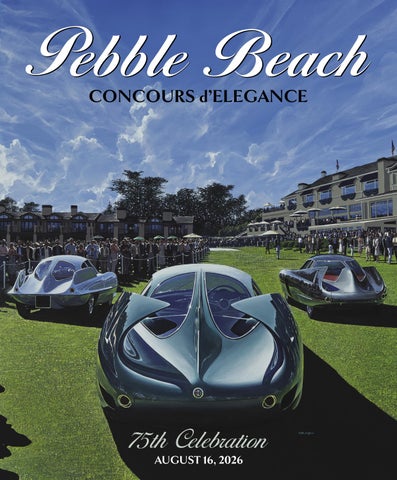
T H E 7 5 TH P E B B L E B E A C H C O N C O U R S d ’ E L E G A N C E ® pebblebeachconcours.net
August 16, 2026
6
72
190
Sandra Button, Chairman Pebble Beach Concours d’Elegance
By Alan Boe
196
Greetings from the Chairman
Luigi Chinetti The Dream of Ferrari in America
8
84
David Stivers, Chief Executive Officer Pebble Beach Company
By Peter M. Larsen
Welcome to Pebble Beach
15
Our Charities & Educational Partnerships
V for Vignale. M for Michelotti. A Perfect Polarity
96
The Art of the Streamliner By Robert Cumberford
20
107
34
By Manvendra Singh
Chief & Honorary Judges The Concours Team
37
Our Sponsors
42
Our 2026 Posters
44
Celebrating the Pebble Beach Road Races
Grand Indian Automobiles of the British Raj
114
Entrants & Classes
124
Judges & Their Teams
127
Our Donors
137
By Mark R. Brinker
The Concept Lawn
57
161
Pebble Beach Concours: Making History Time & Again By Kandace Hawkinson & Gabrielle Garza
Past Best of Show Winners
169
2025 Winners
2026 Awards & Trophies From Rising Sun to Racing Legends By Edward Loh
208
Fast Brass: Race Cars for the Road By Ken Gross
222
Sirens Invade Pebble Beach By Vince W. Finaldi
228
Fearlessly Jaguar
236
The Century of Progress International Exposition By Ron Verschoor & Bob Joynt
246
Icon of Speed: The Sunbeam 1000 HP By Bryn Jones
252
A Look in the Rearview Mirror
OFFICIAL CERTIFICATION PROGRAMME
FERRARI CLASSICHE Is your Ferrari as authentic as you think? Every classic car tells a story—but is yours the genuine article? Ferrari Classiche Certification Certificationof of Authenticity Authenticity gives you the confidence that your vehicle meticulous checks checks on chassis, components, truly reflects its original identity. Through meticulous historical integrity integrity , ensuring it is finishes, and period specifications, we validate your car’s historical not only valuable, but also recognized and preserved as part of automotive heritage. True value. Proven heritage.
Where history meets proof.
Restoration & Rectification.
Inspected at Ferrari or at official
Thanks
More than verification — we revive
dealers, each vehicle is examined by
technical and commercial archive —
authenticity.
our specialists and validated by an
where every project, specification,
restoration and precise rectification,
independent
committee.
to
our
comprehensive
Through
careful
This
and configuration of each individual
we can return each car to the true
ensures a transparent, trustworthy
vehicle is preserved — we can verify
spirit
certification
your car’s originality in every detail.
preserving its heritage and value for
to
preserve
authenticity and heritage.
both
and
splendor
of
its
era,
generations to come.
Ask an official Ferrari Dealer to discover the only official Ferrari Classiche Certification programme.
Discover Ferrari Classiche Via Abetone Inf. 4, 41053 | Maranello ITALY ferrariclassiche@ferrari.com
Our 75th Celebration
Sterling Edwards, founder of the Pebble Beach Road Races, winds through Del Monte Forest in a car of his own making in 1950.
W E LC OME
P EB B L E BE ACH CO N CO URS d ’ EL EGANC E gathering of all three Alfa Romeo BATs and their creator Nuccio Bertone. As early as 1953 we showcased a small display of Carrera Panamericana winners. Recent years have witnessed great gatherings of Jaguar XKSS sports cars, Ferrari 250 GTOs, race-winning Ford GT40s, Porsche 917s, and all eight generations of the Rolls-Royce Phantom. History is so often made here, in our midst!
Thank you for joining us at the 75th Pebble Beach Concours d’Elegance. The car world has been gathering to share great cars on this scenic swath of green continually since 1950—a record unsurpassed by any other event of this kind—and we are glad to have you with us on this momentous occasion. Today we pay tribute to our shared past while also looking to the future with great anticipation. Back in 1950, sports cars were increasingly popular, and enthusiasts sought to race them—on real roads, as was done in Europe. Pebble Beach agreed to host what was billed as the most important road race on the West Coast, and the draw was enormous. The Pebble Beach Concours d’Elegance sprung up beside these races, as a more social occasion for people who admired cars for their style as well as speed. Today we celebrate our road racing origin. We also pay tribute to the many first-ever or even once-ina-lifetime groupings of cars that have been displayed at the Pebble Beach Concours. Such car groupings, often paired with people of significance, have become a hallmark of this event. It was the 1985 gathering of all six Bugatti Royales that first brought the world to Pebble Beach, and this was followed in quick succession by a centennial celebration of Mercedes-Benz and the first automobile, and the first-ever 6
The 75th Pebble Beach Concours d’Elegance
Our concours is much more than a showcase of cars, of course; it is a gathering of people with a shared passion, a strong community that supports and encourages each other and inspires growth in the car world. We’ve built networks of car people, not only here but around the world. And as we come together now, we pool our resources and funds, our time and our energy, to encourage the next generation of car people. We also support the local community, sighting needs and raising funds to fulfill them. By gathering together, we accomplish so much! My sincere thanks to those of you who have been a part of this community for years—and those of you joining with us today for the first time. Our community, like the car world, is ever-expanding, and I, for one, can’t wait to see what comes next. It has been my honor and great pleasure to help guide this Concours for the past four decades. This fall, as many of you know, I am stepping aside from the day-today decision making to serve as Brand Ambassador and Strategic Advisor. I hope this means I get to spend more time with many of you—out on the road! I hope you join me in welcoming Vince Finaldi to his new role as our incoming Chairman. I have every confidence that, working together, our Concours community will continue to do great things. Sincerely yours,
Sandra Button Chairman
AUCTIONS & PRIVATE BROKERAGE
GOODINGCO.COM
310.899.1960
OFFICIAL AUCTION HOUSE OF RÉTROMOBILE NEW YORK
THURSDAY NOVEMBER 19 FRIDAY NOVEMBER 20 LIVE AUCTIONS NEW YORK, USA
I JAVITS CENTER
1957 BMW 507 ROADSTER Iconic US-Market Model Commissioned by Max Hoffman and Debuted in New York City One of 252 Built and 1000 Miglia Eligible, Subject to Registro Acceptance Awarded First in Class at the 2026 Greenwich Concours Accompanied by BMW Birth Certificate
I
I
I
MARCH 2027 FLORIDA, USA FEBRUARY 2027 PARIS, FRANCE
1969 LAMBORGHINI MIURA P400 S SOLD for $2,590,000 World Record for the Model Amelia Island Auctions 2026
I
CONTACT OUR SPECIALISTS TO LEARN MORE: INQUIRY@GOODINGCO.COM Pebble Beach® and Pebble Beach Concours d’Elegance® are trademarks and service marks of Pebble Beach Company. Used by permission.
2018 FERRARI FXX K EVO SOLD for €6,980,000 World Record for the Model Rétromobile Paris Auction 2026
I
P EB B L E BE ACH CO M PA NY Host to the Concours since its founding, Pebble Beach Resorts has seen the event grow, from The Lodge lawn and iconic 18th hole to the 1st and 17th fairways. Today, some of the resort’s most celebrated venues host Concours events, including Casa Palmero, Fairway One, and our recently renovated Lodge main building. Our sincerest gratitude goes to our Chairman, Sandra Button, who has deftly guided this event for 40 years. Following this 75th edition, Sandra steps into a new role as Strategic Advisor and Brand Ambassador with Vince Finaldi succeeding her as Chairman. If you have attended this event for decades, you know how much the Concours has grown and evolved, which is a testament to Sandra’s vision and leadership. Sandra, thank you! This celebration is only made possible thanks to the enormous effort of the Concours and Pebble Beach Company staff. Working alongside more than 1,000 volunteers, these teams create the canvas on which the 2026 Concours story will be written.
Welcome to Pebble Beach: Celebrating 75 Years of Automotive Excellence Once again, the world sets its sights on the preeminent celebration of the automobile. Welcome to the 75th celebration of the Pebble Beach Concours d’Elegance. At the heart of this tradition are the caretakers of these great cars, the world’s top designers and manufacturers, expert judges, and passionate spectators. We cannot wait to celebrate 75 years of automotive excellence at Pebble Beach in August. This Concours was revolutionary in the 1950s, offering its top award to classic cars rather than new ones, casting a light on their significance and spurring an interest in collector cars that grew into a movement. Many first-oftheir-kind displays have debuted here and, in recent years, a driving element has been added to the scoring with Thursday’s Tour d’Elegance.
8
The 75th Pebble Beach Concours d’Elegance
Many things have changed over the past 75 years, but one constant has been this Concours’ commitment to the Monterey community. Since the inaugural event in 1950, the Pebble Beach Concours has raised more than $50 million in charitable donations. This year, with your help, we are on track to set a new record for giving. More than a century’s worth of history has unfolded on these grounds. In this 75th edition of a storied event, we invite you to make history of your own as the next chapter of the Concours d’Elegance unfolds. Sincerely yours,
David Stivers Chief Executive Officer Pebble Beach Company
A L L- N E W T Z
All the technology in the world means nothing if it doesn’t make you feel something. Discover more of what moves you with the all-electric TZ, a three-row SUV that doesn’t just reimagine the luxury experience, it crafts a more human one.
©2026 Lexus, a Division of Toyota Motor Sales, U.S.A., Inc. Pebble Beach d’Elegance Logo® is a trademark and service mark of Pebble Beach Company. Used by permission.
A NEW MEASURE OF LUXURY INTRODUCING THE FLEXJET GULFSTREAM G500™
800.FLEXJET | FLEXJET.COM YOU WON’T JUST BE FLOWN, YOU’LL BE MOVED. © FLEXJET, LLC. 2026
CO N T RI BU T ING WRIT ERS Alan Boe was always interested in cars, and he began focusing on Ferraris, assembling individual car histories and their mechanical details, while earning his degree in journalism from the University of Wisconsin. He has published over 100 feature articles on classic Ferraris in Cavallino magazine. Alan judged Ferraris at Pebble Beach for 24 years, serving as Chief Class Judge for Ferrari for the last 11 of those years. He has also judged Ferraris at other shows, and was invited by Ferrari to judge concours events on the factory test track, Fiorano.
P UBLI S HER Pebble Beach Company
Mark Brinker is a practicing orthopedic surgeon and an award-winning author and screenwriter. His most recent project, Heroes of the Forest: The Complete History of the Pebble Beach Road Race (www.heroesoftheforestbook.com) details the many racing greats—the drivers and their cars, the owners and organizers—that were a part of each of the Pebble Beach Road Races, running from 1950 through 1956. Robert Cumberford has been an automotive and aeronautical design professional for more than sixty years, variously as stylist, engineer, analyst, historian, and critic. He has written for aircraft, automobile, and design publications worldwide.
E D I TO R - I N- CHI E F Sandra Button
Vince W. Finaldi is President of the Pebble Beach Concours d’Elegance. He is also a former trial attorney, a thirdgeneration automotive entrepreneur, and the founder of collector car atelier Finaldi, Inc.
M A NAG I NG EDI TOR Kandace Hawkinson
Gabrielle Garza is the Director of Operations for the Pebble Beach Concours d’Elegance. Beyond her operational duties, she enjoys discovering and documenting the stories of the cars and car people at the heart of this event, deepening her understanding of the car world.
A RT D I R ECTO R & DE SIGN Nicole Doré
Ken Gross is an award-winning journalist, historian, and museum curator. A longtime member of our Pebble Beach Concours Car Selection Committee, he has curated a wide range of classes here, including every Hot Rod class, as well as those focused on Porsche 917, Ford GT40, Tatra, Tucker, Miller Racing Cars and Sport Customs, among others. He also serves regularly as a Chief Class Judge.
SE NI O R EDI TO R S Martin E. Button Gabrielle Garza Camryn Garcia P R O O FR E ADER S Tessa Avila & Robert Pruin P R O DUCT I O N Chris Benzel Printed in Canada by Hemlock Printers
Bryn Jones is Marketing & Communications Officer for the National Motor Museum, based at Beaulieu on England’s south coast. Bryn’s career has been focused on tourism and heritage, having previously worked for the National Trust and English Heritage. Bob Joynt’s deep interest and involvement with automobiles and the study of their history has been a lifelong pursuit. His passion for all things automotive has earned him national recognition as an automotive historian and collector. He is currently a Judge at the Pebble Beach Concours d’Elegance (with 28 years of service) and a Trustee of the Auburn Cord Duesenberg Automobile Museum. In his spare time, Bob is a volunteer Docent with the Chicago Architecture Center, conducting tours of Historic Skyscrapers and the Chicago River. Peter Larsen has co-authored several books with Ben Erickson on French cars and coachbuilders, including an ongoing series about Joseph Figoni where the latest volume about Bugattis that received bodies by Figoni has recently been published. A new book is imminent about a unique Talbot-Lago Grand Sport, the so-called Baillon car. Peter judges at a number of international concours, including the Pebble Beach Concours d’Elegance, where he also serves on the Selection Committee. Ed Loh is a 20+ year veteran of automotive publishing and the head of editorial overseeing MotorTrend and HOT ROD at Hearst Magazines. He covers the future of automotive technology and mobility, which includes electrified and softwaredefined vehicles (SDV) and other emerging tech. Loh also hosts MotorTrend’s The InEVitable podcast and MotorTrend’s annual SDV Innovator Awards. Manvendra Singh, of the erstwhile royal family of Barwani, is a well-known and respected authority on vintage and classic cars in India, having co-authored Automobiles of the Maharajas. He started India’s first vintage and classic car restoration workshop in 1978 and he is a founding member of the Vintage and Classic Car Club of India. Singh now serves as Curator for the Oberoi Concours d’Elegance in India, formerly serving in that role for the Cartier Concours, and he has organized our 2012, 2018, and 2026 Maharaja and Raj classes. Ron Verschoor first attended the Pebble Beach Concours d’Elegance in 1989, he has shared several cars on our competition field, and he participated in the inaugural Pebble Beach Motoring Classic in 2005. A member of a dozen car clubs and automotive museums, he is a life member of the Classic Car Club of America and served as its editor for a dozen years. Ron’s lifelong automotive passion spans a broad range of years and marques with a particular fondness for American Classics.
CO N T RI BU TING P H OTO GRAP H ERS & P H OTO ARCH IVE S Cover: Painting by Tim Layzell
Winners & Trophies: Kimball Studios
Frontmatter & Section Openers: Julian P. Graham/Pebble Beach Company Lagorio Archive, Sherman Chu, Kimball Studios and Coel Mayer
Rising Sun to Racing Legends: Getty Images from Pascal Rondeau/Allsport, Paul-Henri Cahier (x2), Bernard Cahier, James Moy Photography (x3), and Ker Robertson; manufacturer images from Honda Motor Company, Mazda Motor Corporation, Mazda North American Operations, Nissan North America, and Toyota Motor Europe; and archival images from owners Nick Price, Hisashi Kunie, Anthony McIntosh (x2), Bruce Canepa, SAN-EI, and Robert “Bob” Neapole
Sandra Button: The NB Center for American Automotive Heritage/ Fondazione Nicola Bulgari David Stivers: Sherman Chu and Channing Benjamin Our Charities: Bart Keagy/Pebble Beach Company, Pebble Beach Company Foundation, McPherson College, and Academy of Art University Our Judges: Sherman Chu and Kimball Studios Pebble Beach Road Races: Road Race Program covers and Julian P. Graham Photos/Pebble Beach Company Lagorio Archives, and Robert Canaan Photograph Collection/Revs Institute
Pebble Beach®, Pebble Beach Resorts®, Pebble Beach Concours d’Elegance®, Pebble Beach Concours™, Pebble Beach Tour d’Elegance®, Pebble Beach RetroAuto™, Pebble Beach Classic Car Forum™, Pebble Beach® Automotive Week, Pebble Beach Golf Links®, The Hay™ Golf Course, The Lodge at Pebble Beach™, The Inn at Spanish Bay™, The Links at Spanish Bay™, Spanish Bay®, Casa Palmero®, 17-Mile Drive®, The Lone Cypress™, Stillwater Cove™, and their respective underlying images, are trademarks, service marks and trade dress of Pebble Beach Company. Copyright © 2026 Pebble Beach Company. All rights reserved.
Pebble Beach Gatherings: Pebble Beach Company Lagorio Archives, Kimball Studios, Dean Batchelor/Ron Kellogg Collection, Tony Salazar, D. M. Woodhouse, William C. Brooks, Richard Adatto Archives, Steven A. Gann, Steve Burton, John Lamm, John Livingstone, Doug Sandberg, Rich Tsai, David Burton, Julius Kruta Luigi Chinetti & Ferrari NART: David Williams, Kimball Studios, Steve Burton, and Lawrence Auriana Archive Vignale: Peter Larsen Archive, Kimball Studios Streamliners: Michael Furman Photography, Richard Adatto Archive, Kimball Studios, Steve Burton, The Keller Collection, National Automobile Museum, Anne Brockinton Lee/The Lee Collection, and Mercedes-Benz Group
Speedsters: Ronald Sieber Archives and his book Classic Speedsters, including painting by Peter Helck Indian Automobiles: Manvendra Singh Barwani Archives Lamborghini Miura: Kimball Studios, Vince Finaldi Archive, Paul Wu, and Brandon Locket Jaguar: Photos gathered by Jaguar Land Rover: CBS Photo Archive/ Getty Images, Jaguar Land Rover, Revs Institute, George Phillips Photograph Collection, and Rainer Schlegelmilch/Getty Images Century of Progress: Getty Images: Chicago History Museum, Nextrecord Archives (x2), Hedrich Blessing Collection/Chicago History Museum, Chicago Museum of Science and Industry; Kimball Studios, Steve Burton, and Lehrman Collection Sunbeam Land Speed Record Car: National Motor Museum in Beaulieu, UK Rearview Mirror: Domenico Dapuzzo and Kimball Studios
INSURANCE BUILT BY DRIVERS, FOR DRIVERS. At Hagerty, our insurance was built by drivers, so when you call us, you’ll speak to a fellow enthusiast. With Guaranteed Value®, you can set the value of your ride upfront, and it doesn’t depreciate each year. In fact, you can even raise it as values rise. Our claims specialists are enthusiasts too, so they do things right, every time. Visit us at hagerty.com, and get insurance for drivers.
NEVER STOP DRIVING HAGERTY.COM Guaranteed Value includes all taxes and fees unless prohibited by state law. Policies underwritten by Essentia Insurance Company. Some coverages may not be available in all jurisdictions. ©2026 The Hagerty Group, LLC. All Rights Reserved.
SAVE THE DATE | RÉTROMOBI L E N EW YOR K | N OVE MBE R
–
DELAGE D - L GRAND PRIX OF F ERED EXC LUSI VE LY FOR SAL E AT GOODI N G CH R I ST I E ’S RÉTROMOBI L E N EW YOR K AU CT I ON Gooding Christie’s is the Official Auction House of Rétromobile New York Generously donated by Mr. Jim Patterson, all consignor proceeds from the sale of this car will further the mission & initiatives of the Pebble Beach Company Foundation
For 50 years, the Pebble Beach Concours has partnered with the Pebble Beach Company Foundation, a 501(c)(3), to positively impact the lives of young people in Monterey County. Annually, more then 150,000 children benefit from the programs supported by the Foundation. A sincere thank you to all of our generous donors for making this work possible!
To donate an automobile, please contact Judith Ann Raible at jraible@pebblebeachconcours.net Learn more at pebblebeachconcours.net/charity-giving
©2026 Pebble Beach Company. Pebble Beach®, Pebble Beach Concours d’Elegance®, and their underlying images are trademarks, trade dress and service marks of Pebble Beach Company. Image copyright and courtesy of Gooding & Company, LLC. Photo by Mike Maez.
OUR CHARITIES For 75 years, the Pebble Beach Concours d’Elegance has brought together a passion for the automobile and a steadfast commitment to giving back. We are deeply grateful to the judges, entrants, sponsors, spectators, and volunteers whose generosity and dedication have helped make this the most charitable concours in the world. This year, to commemorate 75 years of giving, Chairman Sandra Button set an ambitious and inspiring objective: to raise $5 million in 2026. Achieving this remarkable total propels the Concours beyond $50 million in lifetime charitable giving—a fitting tribute to the generosity of this community. Despite Monterey County’s extraordinary natural beauty and global reputation as a destination, significant challenges remain for many families. Too many children struggle to read at grade level, thousands live below the poverty line, and tens of thousands of residents rely on food assistance each month. Through our charitable partner, Pebble Beach Company Foundation, proceeds from the Concours support more than 120 local nonprofits dedicated to improving the education, health, and well-being of children throughout Monterey County. Each year, the Foundation helps more than 100,000 young people by investing in programs that foster literacy, expand educational opportunities, and create pathways to long-term success. The Foundation’s Grant Committee oversees the grant process, rigorously reviewing applications, the financial health of each organization, and programs to ensure grant funds have
the greatest impact. As Pebble Beach CEO David Stivers has noted, “Pebble Beach Company and the Pebble Beach Concours d’Elegance are a natural complement to one another through our shared commitment to excellence, timeless style, and meaningful community impact.” In keeping with its emphasis on education, the Foundation also partners with the Concours to administer scholarships established in honor of Phil Hill, Jules “J.” and Sally Heumann, and John Lamm. The annual Concours charity drawing—made possible this year through the generosity of Mercedes-Benz, Lexus, and Lincoln—provides direct support to several outstanding organizations, including Boys & Girls Clubs of Monterey County, Montage Health Foundation, MY Museum, Natividad Medical Foundation, Salinas Valley Health Foundation, Seneca Family of Agencies, and United Way Monterey County. The Foundation’s growing impact is made possible through the generosity of donors who believe in strengthening the community around them. Significant support comes from the Pebble Beach Concours d’Elegance.
pebblebeachconcours.net
15
EDUCATIONAL PARTNERSHIPS O UR PARTNERSH IP WITH McP HE RS ON COL L EGE We are proud to note that, through the Pebble Beach Company Foundation, we are supporting three Phil Hill Scholars, one Jules “J.” & Sally Heumann Scholar, and one John Lamm Scholar for the coming academic year at McPherson College. These scholarships go specifically to students of the automotive arts—automotive restoration, design, and communications.
Nicholas King Phil Hill Scholar Nicholas King’s appreciation for Duesenberg is rooted not only in its performance and world-class styling, but also in its connection to his home state of Indiana. Growing up, his father took him to car shows, which planted the seed for his love of vintage automobiles. He enjoys working on prewar American vehicles and hopes to specialize in paint, bodywork or upholstery. “Classic cars are important because they are one of the greatest inventions from the past,” Nicholas said. “Each car has its own unique story that deserves to be appreciated.” He interned at T+J Restoration in Hays, Kansas, where he gained experience in sheet metal fabrication and bodywork. After graduating, he hopes to work for a shop that focuses on concours-level restorations, with the goal of preparing cars for concours events. Ryder Konczak Phil Hill Scholar Ryder Konczak loves the hands-on ability and skills he has honed at McPherson College. His passion for working on cars began at a young age, inspired by his grandfather, who bought, restored, and sold various vehicles. “I think classic cars are important because they tell stories of the past,” Ryder says. “They are a physical history—a time capsule you can interact with and be transported to a different era.” He plans to focus his interests on engine and drivetrain restoration. After college, Ryder is interested in working at a shop or private collection.
16
The 75th Pebble Beach Concours d’Elegance
Caleb Pezold Phil Hill Scholar Caleb Pezold’s fascination with cars and engines was sparked by working on them alongside his father. Together, the two restored a 1953 Chevrolet Pickup. Caleb admires the bold designs and distinctive style of Studebakers and enjoys engaging in all areas of restoration. “I enjoy how so many different components go into making a great automobile,” he says. Caleb recently interned as a mechanic at Benz Auto Alchemy, working under Brad Benz, who specializes in restoring Studebaker Avantis. He previously interned with Evergreen Car Collection in Lebanon, Missouri. After college, he plans to work at a shop or private collection to continue honing his skills. Ultimately, he dreams of opening a restoration shop with his father, combining their expertise to serve their local community and share their love for classic cars.
A McPherson student diligently works on the English wheel in her sheet metal class.
OU R PA RT NE RS HI P WI T H T HE ACA DE M Y OF A RT U NI V E RS I T Y The Academy of Art University has long partnered with us in honoring Phil Hill by providing two-year scholarships to its highly regarded Industrial Design program. The following two Industrial Design students will be joining the prior 26 AAU Phil Hill Scholarship recipients.
A McPherson student checks valve clearance in the McPherson College engine lab.
Garrett O’Connor Jules “J.” & Sally Heumann Scholar An early infatuation with vintage cars quickly grew into a full-blown passion for Garrett O’Connor when he began restoring a 1964 Ford Thunderbird given to him by his uncle. While working at a restoration shop in high school, he discovered McPherson College—a place he could receive formal training while earning a degree. “I love cars that were experimental in design, the ones that stand out and grab people’s attention. . . . Each era of the automobile is often a perfect example of what is happening at that time; the characteristics that define a car give us a glimpse of societal preferences of the time.” Garrett is involved in McPherson’s C.A.R.S. Club and serves on the trophy committee for the annual car show. He interned at the Singleton Collection in Costa Mesa, California, and plans to pursue restoration after graduating. Morgan Moravec John Lamm Scholar The moment she saw a salmon-pink 1957 Ford Thunderbird as a teenager, Morgan Moravec knew exactly what she wanted to do with her life. But it wasn’t until she became a student at McPherson College that she began developing a robust skillset, beginning with the digitization of thousands of documents for individual Shelby Cobras. “Classic cars are important because they are living history,” she says. “These vehicles have stories to tell, history they’ve lived through, and it’s important they are preserved and able to tell their stories for decades to come.” Morgan is an important contributor to the campus newspaper. This summer, she interned at Rare Classic Restorations. After graduation, she hopes to pursue a career in automotive communications.
Amanda Flannery Phil Hill Scholar Amanda Flannery is an industrial and automotive designer whose work explores the emotional relationship between people, mobility, and the environments they move through. Currently pursuing her Master’s degree at the Academy of Art University, she creates future-focused transportation concepts that combine storytelling, sustainability, and human-centered design. Her process blends sketching, digital visualization, and form development, while continuing to expand her skills in Autodesk Alias and VRED to bring immersive design concepts to life. Amanda approaches automotive design as more than transportation, viewing vehicles as extensions of experience, exploration, and connection. Oresnuel Manuel Phil Hill Scholar Oresnuel “Nuel” Manuel’s eye for design wasn’t forged in a traditional art studio, but thousands of feet in the air as a Navy flight engineer. That high-stakes environment gave him a profound, hands-on respect for complex machines and instilled what he calls a “functional intuition.” As an industrial design student today, he relies on this deeply rooted mechanical aptitude to approach creative challenges with a grounded, roll-up-your-sleeves perspective. By anchoring his imagination in genuine reality, he ensures that his work is not only visually compelling but mechanically sound. He doesn’t just sketch vehicles to turn heads on a page; he engineers concepts where every sweeping line serves a purpose, driven by a personal mission to find the perfect harmony between art and engineering.
pebblebeachconcours.net
17
URUS SE
DARE TO LIVE MORE lamborghini.com
OUR CHIEF JUDGES Chris Bock, Chief Judge | Nevada City, California Chris Bock has served as our Chief Judge since 2013. He attended his first Pebble Beach Concours d’Elegance back in 1963 at the young age of 18, he was first appointed a Class Judge a decade later, and he continued to serve among our Judges over the ensuing decades, often acting as Chief Class Judge for American Classics. Mr. Bock is also on our Concours Selection Committee, a group of about 15 experts who choose the cars that are invited to participate in this event, and he plays key roles in overseeing field and ramp operations on Concours Sunday, making certain that all runs smoothly. He has been an entrant on five occasions— often showing Packards, a marque to which he is devoted. Apart from the Concours, Mr. Bock has also served as President and National Head Judge of the Classic Car Club of America and as editor of The Cormorant for the Packard Club. He is a retired real estate broker and a foster parent.
Stephen F. Brauer, Chief Honorary Judge | St. Louis, Missouri Stephen Brauer is Chairman and CEO of Hunter Engineering Company, which designs, manufactures, and sells computer-based automotive service equipment to manufacturers and dealers worldwide. In June 2001 President George W. Bush appointed Mr. Brauer as US Ambassador to Belgium, where he served until September 2003. He is a past member of the Smithsonian National Board and is active in numerous charitable and civic organizations. Mr. Brauer is a longtime collector of American classic cars, Springfield Rolls-Royce and postwar coachbuilt Rolls-Royce and Bentley Motor Cars. He first showed a car at the Pebble Beach Concours—a 1937 Rolls-Royce Phantom III Barker All Weather Tourer— in 1991, and he has continued to share a car here almost every year. He joined our Honorary Judges in 2004 and has served on our Concours Selection Committee since its founding in 2005, choosing the cars to be invited to our competition field.
20
The 75th Pebble Beach Concours d’Elegance
OUR HONORARY JUDGES Davide Loris “Dave” Amantea | Cambiano, Italy Dave Amantea is the Chief Design Officer of Automobili Pininfarina. After earning a degree in Car Design in 2006 from Instituto Europeo di Design Turin, he started his career at the FCA Group as an Exterior Designer, then moved to other companies, such as Jaguar Land Rover where he was an Exterior Design Manager. He joined Automobili Pininfarina in 2018 as Head of Exterior for the electric hypercar Battista and was appointed Chief Design Officer in 2022. Brad Audet | Irvine, California Brad Audet is a seasoned automotive marketing and motorsports executive with extensive experience spanning brand leadership, advertising, creativity, and competitive racing. Currently Chief Marketing Officer at Mazda North American Operations, he has led groundbreaking brand storytelling including First to the Finish, an acclaimed series that redefined how Mazda connects motorsports heritage, human ambition, and modern creativity. Audet brings deep automotive expertise shaped by decades working across agencies and OEM leadership, with a career rooted in elevating craft, performance, and emotional resonance. In addition to overseeing Mazda’s full marketing and customer experience ecosystem, he leads Mazda’s global motorsports portfolio, including the IMSA DPI program, the MX‑5 Cup series, grassroots racing initiatives, and stewardship of the Mazda Heritage Collection—preserving and celebrating the brand’s rich racing legacy. Valentino Balboni | Sant’Agata Bolognese, Italy Valentino Balboni is one of the foremost Lamborghini experts, having driven 80% of Automobili Lamborghini’s production while serving as its longtime test driver. He started in 1968 as an apprentice mechanic, worked in customer service, and was appointed test driver in 1973. He initially tested production cars, including the Miura, Countach, Espada, Jarama, Urraco, and Jalpa, and later became the Research and Development test driver, first developing the Diablo. In 2009 Lamborghini produced a limited special edition of the Gallardo named the Valentino Balboni LP550-2 to honor his 40 years of devotion to the company. He is now an independent consultant, focusing on vintage Lamborghini restorations. Chris Bangle | Clavesana, Italy After graduating from ArtCenter College of Design, Chris Bangle began his career at Opel in 1981, and
then moved on to Fiat, where he designed the brazen Coupe Fiat. In 1992, he was named the first American Chief of Design at BMW, and in 2001, when MINI and Rolls-Royce Design brands joined BMW, BMW M, and BMW Motorcycles, he became Director of BMW Group Design. After leaving BMW in 2009, he founded Chris Bangle Associates and now serves as that firm’s managing Director, leading a team of designers and engineers who, besides working on car and product design, workshops and strategic consulting, have dedicated their efforts to animation: the project Inanimatti. Bangle also founded the Big Bench Community Project and recently published his first book Reading Between the Lines of Car Design (Minerva Editore 2025). Bangle is the winner of the Lifetime Design Achievement Award Eyes On Design 2012, the Compasso d’Oro Career Award 2018, the American Prize for Design 2020-21, and the Ethic Award Oscar Pomilio Blumm Forum 2025. H. H. Rana Manvendra Singh of Barwani | Indore, India His Highness Rana Manvendra Singh belongs to the erstwhile royal family of Barwani in Madhya Pradesh. Keenly interested in automobiles from an early age, he started India’s first vintage and classic car restoration workshop in 1978. Today he is a well-known and respected authority on vintage and classic cars in India. He has been featured on numerous television programs and co-authored Automobiles of the Maharajas with Sharada Dwivedi. A founding member of the Vintage and Classic Car Club of India, Singh serves as Curator for the new Oberoi Concours d’Elegance in India. He formerly served in that role for the Cartier Concours d’Elegance. He also helped to organize the 2012 Maharaja and the 2018 and 2026 Raj classes for the Pebble Beach Concours and was awarded the 2018 Lorin Tryon Trophy. Sam Basile | Dearborn, Michigan Sam Basile is Vice President of Advanced Product Development, Cycle Planning, and Programs at Ford Motor Company. He joined Ford in October 2025 after a nearly 30-year career at General Motors, where he held senior leadership roles across North America, Europe, and Asia, including as Executive Vice President of the SAIC–General Motors joint venture in Shanghai. Basile has also worked in private equity and automotive consulting. He is driven by identifying new product segments that address unmet consumer needs and executing the product solutions to those opportunities.
pebblebeachconcours.net
21
22
Matthias Becker | Stuttgart, Germany Matthias Becker was appointed to the Executive Board of Porsche AG, with responsibility for Sales and Marketing, starting in February 2025. Prior to that appointment, he had served as Vice President of Overseas & Emerging Markets at Porsche AG since 2015. Previously, from 2013 to 2015, he headed sales for Asia and overseas, including China, at Škoda. From 2009 to 2013, he held the position of Head of Marketing at Volkswagen Germany. And he worked for Audi in China from 2006 to 2009, leading sales in the joint venture with FAW-VW. Becker studied mechanical engineering at the Technical University of Braunschweig and he began his professional career in 1996 in the international trainee program at Audi AG.In 1998, he took over responsibility for Audi Sales Europe in Scandinavia, France, and the United Kingdom as Sales Manager, after previously working in product marketing at Audi UK.
distributed. And he works on a highly integrated basis with teams from the parent company in Germany on development planning of new products and technologies for future Audi models in the United States.
Mitja Borkert | Sant’Agata Bolognese, Italy Mitja Borkert was appointed Design Director of Lamborghini’s Centro Stile in Sant’Agata Bolognese in April 2016. He is responsible for the further holistic development of the design DNA of Lamborghini and its design strategy, while coordinating and motivating his design team. He has already contributed to the design of the Urus, Terzo Millennio, Huracan EVO, STO, Tecnica, Sterrato and the Super Trofeo versions, Vision GT, Sian, Countach LPI800-4, the Essenza SC-V12 and SC-63, and diverse one-off projects. His latest contribution includes the new “iconic and essential” Lamborghini design philosophy showcased in the Revuelto, Urus SE, Temerario and Lanzador Concept Car. Borkert graduated from the Design University of Pforzheim and interned at Porsche AG, then in 1999 joined Style Porsche in Weissach, where he contributed to the design of several cars. He is a car guy but he also enjoys the world of supersport bikes and MotoGP. He seeks to give adrenaline a shape.
Marcus Breitschwerdt | Stuttgart, Germany Marcus Breitschwerdt is a true Mercedes-Benz veteran with 30+ years of service, having joined the corporate management trainee program as a controller. Over the years he has held such positions as head of mobility and environment strategy, later taking responsibility for the marketing and the product portfolio strategy of MercedesBenz Cars. He also served as President and CEO of Mercedes-Benz Canada and of Mercedes-Benz UK. In 2014 he was entrusted with creating and leading the new Mercedes-Benz Cars Europe Sales and Marketing Region. Afterwards he served as global Head of Mercedes-Benz Vans, realigning the division in terms of its business, strategy, and technology. Since 2022, as Executive Vice President of Mercedes-Benz AG, Breitschwerdt oversees the entirety of Mercedes-Benz heritage, as a core component of the brand and an expanding business of strategic importance. In 2026 he was named Newsweek’s World’s Greatest Auto Disruptors Legacy of Disruption Award Winner.
Filip Brabec | Herndon,Virginia Filip Brabec is Senior Vice President, Product Management, at Audi of America, with responsibility for product definition and configuration of current models as well as setting the lineup of future US vehicles in concert with AUDI AG. A leader in product planning for the company since 2006, Brabec now oversees two important arenas that contribute significantly to expanding the Audi brand and product platform in the US market. He and his staff ensure that information about the current Audi of America product lineup is completely and properly
Chris Brownridge | West Sussex, England Chris Brownridge is Chief Executive Officer of Rolls-Royce Motor Cars. Brownridge began his career with BMW in 1995. He has held a number of senior sales and marketing positions at BMW, including Chief Executive Officer of BMW Group UK and Ireland from 2021 to 2023. He joined Rolls-Royce Motor Cars as its Chief Executive Officer last year and is based at the home of Rolls-Royce in Goodwood, West Sussex, England.
The 75th Pebble Beach Concours d’Elegance
Ralph Lord Montagu of Beaulieu | Beaulieu, England Lord Montagu serves as President of the National Motor Museum of the United Kingdom, a charity founded by his father, Edward. The museum is located on the Montagu family estate at Beaulieu in the south of England and houses a collection of 280 vehicles and extensive libraries and archives. Lord Montagu is playing a large part in the future development of the motor museum, particularly in building an international network to support the charity’s mission. The Montagu of Beaulieu Trophy, awarded annually at the Pebble Beach Concours d’Elegance to the most significant car of British origin, was originally established in 1982 by Edward Montagu.
Klaus Busse | Turin, Italy Klaus Busse is Head of Design at Maserati, where he defines the brand’s creative direction and its contemporary expression of the Italian GranTurismo. Since joining the marque in 2015, he has led the design of Maserati’s current generation of vehicles, shaping a design language that balances pure performance with Italian elegance. His career spans senior design leadership roles across Alfa Romeo, Fiat, Lancia, Chrysler, Jeep, Dodge, and RAM, following a decade at Mercedes-Benz in Germany. In parallel, he leads Stellantis Design Studio, extending his design approach into adjacent luxury domains, including yachts, furniture, and architecture. Ian Cartabiano | Newport Beach, California Ian Cartabiano has been President of Calty Design Research, based in Newport Beach, California, since 2025. Working with Toyota Motors Corporate headquarters, he oversees Calty’s work on advanced, concept, and production design for the Toyota, Lexus, GR, and Century brands. He recently oversaw the Lexus LS Micro, Lexus LS Coupe, Lexus House, and Hub concepts for the 2025 Japan Mobility Show. After graduating from ArtCenter College of Design, Cartabiano joined Calty, where he was Chief Designer of the Lexus LF-LC Concept and Toyota C-HR. Other notable projects include the 2018 Toyota Camry, designed while at Toyota’s headquarters in Japan, and the Toyota Concept-i, Toyota FT-4X, and Lexus LF-1 Limitless concepts. In 2018, he moved to ED2 (Toyota Europe Design Development) as President and Design Director, and was responsible for the Lexus LF-30 Electrified Concept, Toyota Aygo X, Toyota EV Compact Cruiser, Toyota bZ Compact SUV Concept, 2024 Toyota C-HR, and Toyota IMV Zero. In the summer of 2022, Cartabiano returned to Calty as Vice President of Advanced Design, initially overseeing the Toyota Land Cruiser Sport EV and FT-3e Concepts. He also has taught at ArtCenter since 1998.
Christine Park Cheng | Birmingham, Michigan Christine Park Cheng is the global design director for Lincoln, responsible for leading the long-term design vision of Ford Motor Company’s luxury automotive brand. Cheng has two decades of experience driving the design and development of award-winning vehicles for leading automotive brands. She joined Ford Motor Company in January 2023 and led diverse teams across the F-Series truck lineup. Prior to Ford, Cheng held design leadership positions at General Motors, including their luxury brand, Cadillac. She brings together a team of creative, digital, and human-centered experience designers, to focus on delivering exceptional luxury experiences and marketleading designs. Her knowledge of luxury and automotive is extensive, and she is excited to see Lincoln evolve and transform. Cheng holds a B.S. in Transportation Design from ArtCenter College of Design. Michelle Christensen | Irvine, California Michelle Christensen is a creative executive and awardwinning automotive designer, best known for her role leading the design of the 2017 Acura NSX and becoming the first woman to lead the design of a supercar. A graduate of ArtCenter College of Design, her work spans luxury sedans, supercars, concept vehicles, and corporate rebranding, showcasing her versatility and innovative approach to leadership, brand, and design. Christensen has been recognized on Motor Trend’s “Power List,” Worth Magazine’s “Groundbreaking Women List,” and Moves Magazine’s “Power Women 2020.” Her work has earned the coveted Road & Track “Performance Car of the Year” as well as two EyesOn Design Awards. More recently, as a Vice President of Karma Automotive, Michelle led both design and brand, with responsibility for leading the identity and creative direction of Karma Automotive.
pebblebeachconcours.net
23
Miles C. Collier | Naples, Florida Miles C. Collier is the founder of Revs Institute®, a globally renowned automotive museum housing the remarkable Miles Collier Collections of historic automobiles, an extensive library, and a digital archive. His book The Archaeological Automobile reflects his lifelong advocacy of the automobile as the most significant artifact of the 20th century. Kemal Curic | Woking, England Kemal Curic is McLaren’s Chief Design Officer, responsible for shaping the company’s long-term design vision. He leads all aspects of automotive design, including exterior and interior design, color and materials, and vehicle digital experiences. Prior to joining McLaren, Kemal served as Executive Global Design Director for Lincoln and Global Design Director for Ford Performance and Racing. A lifelong enthusiast of American muscle cars, he maintains a collection of Shelby Mustangs alongside his latest McLaren 750S. Paolo Dellachà | Turin, Italy Paolo Dellachà is Chief Executive Officer and General Manager of Pininfarina S.p.A. since December 2025. After graduating from Politecnico of Milano, Italy, he started at Ferrari S.p.A. in 2000, first serving as CAE Engineer and later cycling through several other roles. In 2012 he joined Maserati with responsibility for Vehicle Integration, and in 2017 he took on the role of Director of Concept Design and Architecture for Maserati and Alfa Romeo. In 2018 he joined Automobili Pininfarina as Product Director, supporting a team with the know-how and skillset required to develop the fully electric hypercar Battista. In 2020 he was appointed to the role of Chief Product and Engineering Officer and in 2023 became CEO of Automobili Pininfarina. Robert T. Devlin | San Francisco, California Robert Devlin has served among our Pebble Beach Concours Class Judges, often as a Chief Class Judge, for 40 years, focusing primarily on Ferrari, Porsche, and Postwar Custom Coachwork. Recognized as the world’s foremost authority on the Pebble Beach Road Races as well as the early Pebble Beach Concours d’Elegance, he is the author of two books on this event: Pebble Beach: A Matter of Style and Pebble Beach: The Art of the Poster, and he has authored or coauthored more than 125 articles in various automotive magazines and event programs. He also taught the History of Automotive Design for five years at the Academy of Art University in San Francisco.
24
The 75th Pebble Beach Concours d’Elegance
Mark Gauntlett | Gaydon, England Mark Gauntlett joined Aston Martin Lagonda in 2003 and now serves as Head of Special Project Sales at the firm’s headquarters in Gaydon, Warwickshire. Born on the day that his father—renowned British businessman and avid car collector Victor Gauntlett—took control of Aston Martin, Mark has a lifelong bond with all things “wings and wheels.” Day-to-day, he is responsible for the bespoke, and demanding, commercial and customer elements relating to some of the company’s most high profile and exclusive creations, from the fabled One-77 hypercar to the Formula 1®-inspired Aston Martin Valkyrie and the track-only Valkyrie LM. Mark has not only acquired unrivaled knowledge of all things Aston Martin, but is also an enthusiast of motorcars more broadly, both modern and classic. He regularly attends endurance racing and concours events around the world. He is also a trustee of the Aston Martin Heritage Trust Liveryman and the Worshipful Company of Coachmakers & Coach Harness Makers. Christophe Georges | Crewe, England Christophe Georges was appointed Member of the Board for Sales and Marketing for Bentley Motors in December 2024. Prior to this he briefly held the position of Global Sales and Marketing Director after previously serving from January 2019 to June 2024 as President and CEO of Bentley Motors, Inc., which is the sales, marketing, distribution, and after-sales channel for the Bentley brand in the Americas. He also led the Americas Region from 2007 through early 2015. In the interim, he moved to Bentley Motors headquarters in Crewe, UK, and served as Director of Product and Marketing for Bentley Motors Ltd. He joined Bentley Motors in August 1998, progressing through a series of positions. More recently, he was Regional Director, Europe, with responsibility for all the company’s business activity in the European region, presiding over a 20-fold increase in Bentley sales and the introduction of the marque to six new markets. He began his career with Rover France after earning a degree in Economic Science from Louis Pasteur University. Ed Gilbertson | San Francisco, California Ed Gilbertson served as Chief Judge of the Pebble Beach Concours from 1999 to 2013 and was a member of the Selection Committee from its inception through 2022. He was previously Chief Class Judge for the Ferrari classes for 15 years. Gilbertson is also Chief Judge Emeritus for the Palm Beach Cavallino Classic and the Ferrari Club of America. He founded and is Chairman Emeritus of the International Chief Judge Advisory Group and the
International Advisory Council for Preservation of the Ferrari Automobile. He is past President of the Ferrari Owners Club and former Regional Director of the Ferrari Club of America. He is a retired mechanical engineer and portfolio money manager.
international automotive events, bringing over 15 years of experience in the automotive industry. He has been deeply passionate about historic automobiles of all generations since early childhood, and his expertise spans both the commercial and heritage aspects of the industry.
Ralph Gilles | Auburn Hills, Michigan Ralph Gilles was appointed Global Chief Design Officer of Stellantis in June 2025, reporting directly to the Stellantis CEO. In this pivotal role, Gilles is at the global helm of strategically shaping and directing design activities for the diverse portfolio of 14 Stellantis vehicle brands. Gilles’ journey with the company began in 1992 when he joined as a designer. Over the years, he has leveraged his extensive academic background in industrial design and business administration to excel in various positions with increasing responsibilities. As an avid car enthusiast, his passion for cars is evident not just in his work but also in his personal life, where he enjoys spending time restoring cars and racing them at the track.
McKeel Hagerty | Traverse City, Michigan McKeel Hagerty is the CEO and Chairman of the Board of Hagerty, a company built by drivers for drivers, protecting 2.7 million vehicles in the United States, Canada, and the UK. McKeel has served as a judge at the Pebble Beach Concours d’Elegance for 24 years and is a board member of the Petersen Automotive Museum in Los Angeles. Known for his passion-based approach to life and business, McKeel has oriented the company around making it easier and more enjoyable to be an enthusiast. In 2016–2017, he was elected by his peers as the Board Chairman of YPO, the largest global organization for chief executives.
David Gooding | Santa Monica, California David Gooding is President of the acclaimed auction house Gooding Christie’s. He began his longstanding career in the automotive auction industry with Christie’s International Motor Car Department, where he oversaw the auction at Pebble Beach for 11 years. He was then promoted to Managing Director of the department, becoming responsible for automotive auctions and staff globally. He also served as President of RM Auctions, Inc. for three years. In 2003, David Gooding co-founded Gooding & Company with Dawn Ahrens. More recently, in 2024, that entity was acquired by global luxury leader and auction house Christie’s. Throughout his career, David Gooding has proven his reputation as one of the most knowledgeable authorities on collector cars. He advises the world’s top collections, serves on the Selection Committee for the Pebble Beach Concours d’Elegance and on the board of the Revs Institute, and has appraised thousands of vehicles for sale at auction, by private treaty, and for charitable donation. In addition, Gooding is a Gold member of YPO (Young Presidents’ Organization). Patrik Gottwick | Stuttgart, Germany Patrik Gottwick has been part of Mercedes-Benz Heritage for more than a decade, and there he currently holds a role in Sales and Marketing. In this position, he works closely with some of the brand’s most significant historic vehicles and collectors worldwide, combining his professional experience with his lifelong enthusiasm for automotive history. He serves as a concours judge at various
Adrian Hallmark | Gaydon, England Adrian Hallmark joined Aston Martin Lagonda in September 2024 as Chief Executive Officer. Prior to joining Aston Martin, Hallmark was Chairman and Chief Executive Officer at Bentley Motors, a position he held starting in 2018. For almost 30 years prior to that, he had held board-level positions with luxury automotive brands including Porsche and Jaguar Land Rover. Frank Heyl | Berlin, Germany Frank Heyl is Design Director of Bugatti as well as Managing Director of the Bugatti Rimac GmbH design center in Berlin, Germany. Heyl’s design expertise has guided many Bugatti creations: Chiron, Divo, Bolide, Mistral, Tourbillon, Brouillard and—most recently— the Veyron F.K.P. Hommage. His design philosophy is tailored toward a sense of timelessness. With cars like the Bugatti Type 35, still revered for its genius even 100 years later, authenticity and purity are key defining features that permeate the design team’s thinking. Heyl fell in love with the Pebble Beach Concours and the Monterey area when he first visited in 2010. His dream is to walk the lawn with his grandchildren one day and show them some of the cars he helped to create. Kevin Hunter | Newport Beach, California Kevin Hunter is Executive Design Director, Toyota North America. As such, he is responsible for overseeing product design for Toyota vehicles designed and engineered in the US. Recent Toyota production vehicles under his leadership include Tacoma, 4Runner, Tundra, Sequoia, Sienna, and Camry. Hunter also serves as an Executive
pebblebeachconcours.net
25
Advisor to CALTY Design Research, which creates innovative vehicle designs for the Toyota and Lexus brands. Hunter has served in a number of roles at CALTY, including Chief Designer, Vice President, and President. Accomplishments under Hunter’s direction include the 2012 Lexus LF-LC concept that became the 2018 Lexus LC500, the 2014 Toyota FT-1 Sports car concept that became the 2020 Supra, the 2021 Toyota Sienna, 2021 Toyota Tundra, 2022 Lexus Electrified Sport that led to the 2025 Lexus LFA BEV concept, 2023 Toyota Sequoia, 2023 Toyota EPU concept, 2024 Toyota Tacoma, 2024 Toyota Land Cruiser, 2024 Land Cruiser ROX concept, 2025 Toyota Camry, 2025 Toyota 4Runner, 2025 Camry GTS concept, and 2025 Scion Side by Side concept. Derek Jenkins | Malibu, California Derek Jenkins is Senior Vice President of Design and Brand at Lucid Motors, a Silicon Valley–based luxury electric automaker. In this role, he oversees exterior and interior design, user experience, colors and materials, vehicle accessories/apparel, and brand strategy and creative. The company’s first vehicle, Lucid Air, won MotorTrend’s Car of the Year in its first year of production. Before joining Lucid, Jenkins was the Director of Design at Mazda North America, overseeing the 2016 MX-5 Miata, Shinari Concept, CX-5, Mazda6, and Mazda3, and 2017 CX-9. Prior to that, he was Chief Designer for Volkswagen North America, overseeing Scirocco and Microbus concepts, the Ragster, and Concept T. He began his career at Audi. Tisha Johnson | Holland, Michigan Tisha Johnson, an American industrial designer, joined SLATE as Head of Design at the end of 2022. Prior to that, she was Vice President of Global Design at Whirlpool Corporation in 2021–22, and was Vice President, Global Product Design at Herman Miller Group in 2020. Previously, Johnson was Vice President, Global Automotive Interior Design at Volvo Car Group in Sweden. She began her career at Volvo in 1999 as a designer for their multidisciplinary innovation hub in California and held several roles including Head of Design in North America. She also worked from 2006 to 2010 at Milliken & Company, managing Strategic Design at their Advanced Concept Studio in California. She has established the design consultancy Trendviz Studio, providing business strategies for several consumer product categories. Her most notable recognitions include the prestigious Design Grand Prize at the 2019 Festival Automobile International in Paris and Industry Innovator of the Year at the 2017 Detroit Auto Show.
26
The 75th Pebble Beach Concours d’Elegance
Dr. Florian Kamelger | Teufen, Switzerland Dr. Florian Kamelger joined the iconic British brand Cosworth in early 2024 and served the company as its Group Chief Executive Officer for more than two years. His passion for high-performance engines paired with a deep understanding of the luxury automotive market led the transition of the company. Kamelger started his professional career as an orthopedic surgeon after qualifying at the Medical University Innsbruck, Austria. Together with his business partner, Kamelger later established a management franchise network for orthopedic surgeons throughout Europe. He studied at the renowned business school at IMD in Lausanne, Switzerland, and was appointed COO of Swiss Sports Medicine Excellence Group in 2011, before becoming its CEO and Chairman. Kamelger’s passion for the motor racing world and a keen understanding of the needs of the car enthusiast led him to expand into the automotive and motorsport industries, co-founding an Aston Martin dealership in Switzerland. He played a key role in the creation of one of the world’s most well-known hypercars. In 2016, he helped establish the luxury automotive and motorsport consultancy R-Universe, then became the co-founder and Team Principal of R-Motorsport, seeing success in different international race series such as DTM and Intercontinental GT Challenge. Tom Kristensen | Hobro, Denmark A true legend of motor sport, Tom Kristensen graduated from a junior karting career in his home country of Denmark to success in international Formula 3, becoming both German and Japanese champion. This led to testing Formula 1 cars under the Michelin brand with Williams and Jaguar. It was in endurance racing that Kristensen found his natural home, winning his Le Mans debut with Porsche in 1997 and recording six consecutive Le Mans 24 Hour wins between 2000 and 2005. In 2013, Kristensen won his ninth Le Mans, making him the all-time champion there, as well as winning the World Endurance Championship with Audi. He also holds the record for wins at the prestigious Sebring 12 Hours, placing first overall six times, in 1999, 2000, 2005, 2006, 2009, and 2012. In 2013, Kristensen was inducted into Motorsport’s Hall of Fame. Grant Larson | Illingen, Germany Grant Larson spent over three decades as a designer at Porsche AG, where he worked from 1989 until his retirement in 2025. He has since founded Grant Larson Design, bringing that experience to new creative ventures. His passion for cars began early as a curator at the Brooks
Stevens Museum in Wisconsin, shaping his appreciation for heritage and form. He earned his BFA from the Milwaukee Institute of Art and Design and later graduated with distinction from the ArtCenter College of Design. Before joining Porsche, Larson spent three years at the Audi Advanced Design Studio in Munich. He served as lead designer on projects including the first Boxster prototype, Carrera GT, and the 997-generation 911, along with a range of Spyders, Speedsters, and limited-edition models such as the Sport Classic, the 935/19, and the GT3R Rennsport. More recently, he was working within the Porsche Sonderwunsch program to create bespoke one-off vehicles for discerning clients. Ikuo Maeda | Hiroshima, Japan The architect of Mazda’s “Kodo—Soul of Motion” philosophy, Ikuo Maeda joined Mazda in 1982. His career has been dedicated to the Hiroshima-based brand, where he became Head of Design in 2009. His vision centers on Japanese simplicity: essential lines and surfaces that capture and reflect light to evoke emotion and movement. His guidance has led to several distinctive models, such as the concept cars RX-Vision (2015), Vision Coupe (2017), and Vision X Compact (2025). Among his favorite production vehicles are the Mazda3, CX30, CX90, and the fourthgeneration MX-5. He is also a representative of the Mazda Spirit Racing Team and has been a racing driver since 2019. Nathan Malinick | Sealy, Texas Nathan Malinick is Director of Design at Hennessey, where he leads the design of high-performance vehicles and hypercar programs, as well as overall brand design curation. Prior to Hennessey, he worked at Embraer Executive Jets, contributing to advanced design initiatives focused on the future of private aviation, alongside a continued focus on automotive design. He holds a degree in Transportation Design from ArtCenter College of Design and a degree in Industrial Design from Auburn University. While his professional work is centered on
contemporary performance vehicles, his enduring passion lies in the great coachbuilt automobiles of the 1920s and 1930s. A regular attendee of the Pebble Beach Concours d’Elegance since 2012, he brings a design-driven perspective and a deep appreciation for the craftsmanship and history that define the concours tradition. Flavio Manzoni | Maranello, Italy Flavio Manzoni has served as the Ferrari Chief Design Officer since January 2010. From 2007 to 2010 he was Director of Creative Design at the Volkswagen Group, where he was involved in designing most of the recent Skoda, Bentley, Bugatti, and Volkswagen cars as well as redefining the aesthetic philosophy of these brands. From 2001 to 2006, he worked at Fiat Group as Head of Design for Lancia, Fiat, and LCV. He has also held design positions at Lancia and Seat. Manzoni holds a degree in architecture with a thesis in industrial design from the University of Florence. He also received an honorary master’s degree in Literature, Modern Philology and Cultural Industry at the University of Sassari, an honorary master’s degree in design from the University of Firenze, and an honorary master’s degree in design from the Arts and Design University Cluj-Napoca. Dave Marek | Los Angeles, California Dave Marek is the retired Executive Creative Director for Acura, where he held advisory responsibility for projects across American Honda Motor R&D following a distinguished career spanning nearly four decades. He began at Honda R&D Americas in 1987 and, as Design Project Leader, oversaw influential vehicle programs including the 1994 Honda Accord Wagon, 1997 Acura CL, 2003 Honda Element, and 2006 Honda Ridgeline. A graduate of ArtCenter College of Design, Marek continues to teach there as an instructor, mentoring future generations of transportation designers. He is also the principal at Dave Marek Design, creating fine art, graphics, and custom design work for a variety of clients. In addition,
pebblebeachconcours.net
27
he supports several museums through board service and remains actively involved in automotive culture, design education, and creative projects.
Group Executive Chairman to concentrate on leading design and strategic development. In May 2019, he was made a Commander of the British Empire (CBE).
Kim McCullough | Pompton Plains, New Jersey Kim McCullough is the Chief Marketing Officer for Parella Motorsports Holdings, owner of Trans Am, SVRA, F4, and IGT. In addition to her work for Parella Motorsports, she is focused on bringing more women into the automotive industry through her work on the Board of Directors of the TechForce Foundation and as a founding member of Women in Motorsports North America. Prior to joining Parella Motorsports, McCullough ran marketing operations for Mazda, Nissan, Toyota, and Jaguar Land Rover. She was recognized as one of “100 Leading Women in the North American Auto Industry” by Automotive News.
Shiro Nakamura | Tokyo, Japan Shiro Nakamura is the CEO of SN Design Platform in Tokyo and President of Hollywood Hills Creative Platform in Los Angeles. During his tenure as SVP and Chief Creative Officer at Nissan (2000–2017), he played a pivotal role in the company’s historic turnaround. He oversaw a remarkably diverse portfolio for both Nissan and Infiniti, leading the design of icons like the Nissan GT-R and 350Z. Prior to Nissan, he gained acclaim for the distinctive Isuzu VehiCROSS. Perhaps his most significant legacy is the creation and popularization of the crossover segment; he pioneered the concept with the Nissan Murano and Infiniti QX, solidifying its global dominance with the Qashqai and Juke. Since departing Nissan, he has continued his global creative pursuits through his own design firm. Deeply involved in automotive culture, he also serves as the president of the Classic Car Club of Japan.
Jordan Meadows | Long Beach, California Jordan Meadows has served as the Vice President of Exterior Design at Scout Motors since October 2023. With a significant career in automotive design, Meadows has held key positions, including Head of Exterior Design at Slate Auto and Exterior Design Team Leader at Ford Motor Company. His experience spans from 1998 as a Senior Designer at Jeep and Dodge, to roles such as Design Manager at Mazda’s North American Operations and Team Leader at Volkswagen AG. In addition to his industry work, Meadows authored Vehicle Design: Aesthetic Principles in Transportation Design and has served as an Instructor at the ArtCenter College of Design since September 2014. His academic credentials include a Master’s in automotive design from the Royal College of Art and a BFA in Industrial Design from the Rhode Island School of Design. Gordon Murray CBE | Surrey, England In 2025, Gordon Murray celebrated 60 years of car design. Having spent 20 years as Technical Director to two Formula One teams—from 1969 to 1990—Gordon Murray has a wealth of technical, design, and engineering experience. At Brabham he was instrumental in two world championship wins, then recorded three consecutive championship wins with McLaren Racing. In 1990—after 50 Grand Prix wins—Murray moved away from Formula One to establish a new company for the group, McLaren Cars Limited. His first project there, the F1 road car, is still regarded as one of the world’s best-engineered cars. A racing version won two World Sports Car Championships and the 24 Hours of Le Mans in 1995. His work with McLaren Cars culminated in the Mercedes-Benz SLR McLaren. In 2007, Murray founded Gordon Murray Design Ltd, an innovative world leader in automotive design. In April 2022, Murray moved to the position of
28
The 75th Pebble Beach Concours d’Elegance
Dan Neil | Raleigh, North Carolina Dan Neil is the Pulitzer Prize-winning automotive critic for The Wall Street Journal and the author of Assouline’s The Impossible Collection of Cars. He has worked for the Los Angeles Times and Car and Driver. Steve Nichols | Woking, England As a teenager, Steve Nichols wanted to be a Formula 1 designer, not an obvious path for a young man growing up in Utah. This meant a degree in aeronautical engineering and a first job at Hercules designing rocket motors and familiarizing himself with a new material, carbon fiber, years before its introduction in motorsport. Nichols then spent two spells at McLaren, the first bringing his experience with carbon fiber to the McLaren MP4/1, working alongside John Barnard in a design department initially consisting of just three people. When John left for Ferrari, he became Chief Designer, while also acting as Ayrton’s race engineer. Nichols was the Chief Designer of the McLaren MP4/4, the most successful F1 car of all time. Nichols eventually moved to Ferrari but returned to McLaren several years later at the request of CEO Martin Whitmarsh in a broad and hugely satisfying role covering all aspects of the F1 team. Nichols is now Co-founder and Technical Director of Nichols Cars, Ltd. Joaquin Nuño-Whelan | Ann Arbor, Michigan Joaquin Nuño-Whelan has been President of Lincoln since May 2025. In this role, he is responsible for leading the brand’s global operations and for the continued evolution and growth of Lincoln as a world-class luxury brand.
He will continue to advance the brand’s global product portfolio and develop differentiated, connected experiences for Lincoln customers around the world. Nuño-Whelan brings more than 25 years of global experience in vehicle and technology development to this role, with a strong focus on luxury brands and premium vehicle development. He joined Ford in 2024 as the Vehicle Program Director for full-size utilities. Prior to joining Ford, he was the senior vehicle line director for new programs at Rivian and held several leadership roles during his more than 20 years at GM, where he contributed to the development of premium vehicle lines. Nuño-Whelan holds a bachelor’s degree in mechanical engineering from University of Detroit Mercy and a Master of Science degree from Rensselaer Polytechnic Institute. Ken Okuyama | Tokyo, Japan Ken Okuyama is the CEO of Ken Okuyama Design. After studying automotive design at ArtCenter College of Design in Pasadena, California, he worked as a chief designer for General Motors, a senior designer for Porsche AG, and a design director for Pininfarina S.p.A., and was responsible for the Ferrari Enzo, Maserati Quattroporte, and many other cars. He then served as a department chairman at ArtCenter College of Design and started the ArtCenter College of Design Award at the Pebble Beach Concours. In 2007, he founded his own brand, Ken Okuyama, and his own consulting company, producing one-off cars like the Kode57, eyewear, and interior products, and providing consultancy services to numerous corporations. Marek Reichman | Gaydon, England Marek Reichman joined Aston Martin Lagonda in 2005 and is the Executive Vice President and Chief Creative Officer responsible for design developments. During his professional career he has held design roles at Ford, BMW, Land Rover, Rover Cars, and Nissan. Prior to joining Aston Martin Lagonda, he was Design Director at Ford North America. Reichman holds a BA in Industrial Design from Teesside University and an MDes in Vehicle Design from the Royal College of Art, London. In 2011, he received an honorary doctorate from Teesside University. Frank Saucedo | Costa Mesa, California Frank Saucedo is the former Director of GM Advanced Design, California. A native Californian, Saucedo’s first position was with Opel in Germany, where he started as a designer and went on to become chief of Opel’s first Advanced Design Studio. Upon returning to California, he took a position at the former GM Advanced Concepts Center and later joined the Volkswagen Design Studio. In 1999, General Motors invited him to open a design studio
in California. Today, GM’s Advanced Design Studio in Los Angeles employs a staff of more than 70. Saucedo’s portfolio includes Opel vehicles such as the 4200 Corsa, Astra, Omega, and Tigra. At GM Advanced Design, he created the Borrego, Chevy SS, Pontiac Solstice, Cadillac Ciel, Cadillac Elmiraj, and Chaparral 2X concepts, and, most recently, a trio of concept Cadillacs named InnerSpace, SocialSpace, and PersonalSpace. He recently retired after 34 years with GM and has taken on a new challenge as Chief Design Officer with Meyers Manx, helping build the next generation of the iconic brand as an EV. Lyn St. James | Phoenix, Arizona Named one of the “Top 100 Female Athletes of the 20th Century” by Sports Illustrated, Lyn St. James has set 21 national and international speed records. As a seven-time competitor in the world’s largest sporting event—the Indianapolis 500—St. James earned Rookie of the Year honors in 1992 and competed in 15 IndyCar races. She has competed all over the world, including twice at the 24 Hours of Le Mans (in 1989 and ’91), with victories in the IMSA Series at Watkins Glen, Road America, Daytona, and Sebring. She is a recipient of the prestigious “Spirit of Ford” award, the “Guiding Women in Sports Award,” and the “Office Depot Visionary Sportswomen of the Year” and was named on the Automotive News list of the Top 100 Women in the Automotive Industry. She is the co-founder of Women in Motorsports North America and was inducted into the 2022 Automotive Hall of Fame and the 2026 IMSA Hall of Fame. Jascha Straub | Lahr, Germany Straub worked as an exterior designer for Bugatti from 2016 to 2020 on one offs such as Divo, Centodieci, and Chiron derivatives. Since 2020 he has been officiating as a Bugatti Molsheim resident designer and Manager of Sur Mesure & Individualization. He is the creator of the Bugatti Chiron Super Sport Golden Era and several bespoke projects. Freeman Thomas | Dana Point, California Upon graduating from ArtCenter College of Design in 1983, Thomas began his career at Porsche AG as a member of the 959 Design team. In 1990 he joined Audi AG as a Chief Designer, co-creating the 1994 VW Concept 1/New Beetle, and then penned the iconic Audi TT. In 1996 he became a Chief Designer for Volkswagen AG. In 1999, he joined DaimlerChrysler as VP Advanced Design Strategy, leading multiple preproduction programs and design concepts, including the Dodge Tomahawk motorcycle and the Noble American Sedan that became the iconic Chrysler 300. In 2005 he joined Ford Motor
pebblebeachconcours.net
29
Company, leading North American Advanced Design and later Global Advanced Design with studios in Irvine, Dearborn, London, and Shanghai. After retiring from Ford, he co-created the CTR and SCR for RUF Automobile GMBH, and in 2020 he co-led the acquisition of the iconic Meyers Manx brand, being named its CEO and CCO and recently Vice Chairman. Andreas Thurner | Los Angeles, California Andreas Thurner began his career at Rolls-Royce Motor Cars in 2004, where he was responsible for the exterior design of the Ghost, Ghost Series II, Wraith, Dawn, and Phantom VII Series II. The Ghost became the most successful Rolls-Royce ever produced and received the Red Dot “Best of the Best” award, while the German Design Council honored the Dawn with its “Best of the Best” distinction. From 2013 to 2016, he led the Advanced and Innovation Design Team at BMW Group in Munich. Between 2016 and 2020, he served as Vice President of Global Design and Architecture at Karma Automotive, overseeing the SC2 Hypercar, named 2020 Concept Car of the Year by Robb Report. In 2020, he founded Thurner Design, a Los Angeles–based design house serving an international clientele. Yasutake Tsuchida | Torrance, California Yasutake Tsuchida is the Acura Creative Director and vice president of R&D at American Honda Motor Co., Inc. (AHM). In this role, Tsuchida is responsible for leading Acura design direction and working with design studios in the US and around the world supporting automotive design and new business activities. Tsuchida joined Honda in March 2024 as senior chief designer, creative director at Honda R&D Co., Ltd. Design Center in Japan. In July 2024, he moved to Torrance, California, to become the vice president of R&D at AHM, overseeing production design and advanced design. In April 2025, Tsuchida assumed his current role as Acura Creative Director and vice president of R&D at AHM. Prior to joining Honda, Tsuchida spent 25 years with Mazda in Japan and the US, most recently serving as senior director of design for Mazda North American Operations, based in Irvine, California. Tsuchida was named a 2021 Rising Star by Automotive News. Tsuchida studied design at the Kanazawa College of Art in Ishikawa, Japan. Franz von Holzhausen | Los Angeles, California Franz von Holzhausen is the Chief Designer at Tesla, reporting directly to Elon Musk and responsible for all Tesla Design programs, charged with establishing a world-class design language for all Tesla products. He joined Tesla in 2008 to design the all-new Model S.
30
The 75th Pebble Beach Concours d’Elegance
He also contributed to the first-generation Roadster and has since led the design of the Model X, Model 3, Model Y, Semi, the all-new Roadster, Cybertruck, Cybercab, and Robus, as well as Tesla Superchargers, and the Powerwall and Solar products from Tesla Energy. He holds a variety of patents for Tesla. He was named one of MotorTrend’s top 50 most influential automotive executives and one of the top 25 designers of all time by Automobile Magazine. Prior to joining Tesla, he worked on the New Beetle and the Audi TT at Volkswagen, designed the Pontiac Solstice and Saturn Sky at General Motors, and pioneered the Nagare surface language at Mazda. Dr. Frank-Steffen Walliser | Crewe, England Dr. Frank-Steffen Walliser is the Chairman and CEO of Bentley Motors. With a background in engineering and a notable career at Porsche, Dr. Walliser brings expertise to Bentley that is set to take the brand to new heights in the luxury automotive sector as it transitions to electric vehicles. From Stuttgart, Germany, Dr. Walliser’s professional journey began at Porsche in 1995, and his tenure there over nearly three decades is marked by significant achievements. In 2010, he became the overall project leader of the Porsche 918 Spyder super sports car, a model synonymous with innovation and performance. His leadership extended to motorsport and street legal GT cars, where, starting in 2014, he guided Porsche to numerous victories, including the 24 Hours of Le Mans in the GTE category and the 24 Hours of the Nürburgring. In 2019, Dr. Walliser took on the management of Porsche’s 911 and 718 product lines. By 2022, he was overseeing overall vehicle development. Since Dr. Walliser’s arrival in 2024, Bentley has announced an extension of its forwardthinking business strategy, Beyond100+, and unveiled its plans to launch its first electric car in 2026. Jay Ward | Orinda, California As Creative Director for Franchise at Pixar, Jay Ward consults on all Cars-related projects worldwide, providing guidance for Consumer Products, Interactive, Marketing, Publishing, and Theme Park activations. He also serves as a liaison with automotive manufacturers and museums working on Pixar-related projects around the world. Jay was the automotive and later franchise creative consultant on all three Cars films and the Cars Toons, and he helped create Cars Land at Disney’s California Adventure Park. In addition to his direction on Cars projects, he worked in the art departments of Monsters Inc., Ratatouille, and Brave, and served as Associate Producer of the 2008 Pixar short film Presto. He also created the Pixar campus classic car show Pixar Motorama in 2001, hosting rare and one-off vehicles from collectors and manufacturers alike.
Jay is currently bringing the immersive “Mundo Pixar Experience” to locations around the world. Todd Willing | Franklin, Michigan Todd Willing is Head of Design at Ford Motor Company where he leads design for Ford and Lincoln brand vehicles worldwide. A graduate of Monash University in Melbourne, Australia, his automotive journey began in high school as part of a work experience program offered by Ford’s Australian Design Studio. During his time at Ford, Willing played a pivotal role in shaping iconic Ford vehicles, with career highlights including Chief Designer for the 2017 Ford GT and Design Director for the 2022 Ford Ranger and the 2023 Ford Super Duty. He had assignments in Japan, Germany, England, and the US, before taking the role of Head of Design in 2024. Willing is a motorsport fanatic and a historic racer of Formula 2, Formula Atlantic, and Formula Ford with an ex-Trans-Am Ford Escort Twin Cam. Stephan Winkelmann | Sant’Agata Bolognese, Italy Stephan Winkelmann has been Chairman and CEO of Automobili Lamborghini since December 2020, a position he previously held from 2005 to 2016. He also previously served as the Chairman of Bugatti and the CEO of Audi Sport and has held other major roles in many European automotive groups. In 2014 Winkelmann was appointed Grand Officer in the Order of Merit of the Italian Republic. David Woodhouse | Warwickshire, United Kingdom David Woodhouse is Chief Creative Officer, McLaren Automotive. He was recently appointed to this role and is responsible for leading all McLaren Creative and Brand activities. A globally recognized automotive design leader with more than 34 years of experience shaping premium, luxury, and performance brands, he has led design organizations and created award-winning vehicles for Nissan, Infiniti, Ford, Lincoln, Cadillac, BMW, Land Rover, MG, Rover, and Mini. Woodhouse is a respected automotive racing historian, vintage car collector, and
racer. He is passionate about innovation, design excellence, and developing creative talent. Woodhouse holds a Master of Design in Vehicle Design from the Royal College of Art in London and a Bachelor’s Degree in Industrial Design from Coventry University in England. Kazunori Yamauchi | Tokyo, Japan Japanese game creator Kazunori Yamauchi is renowned for the Gran Turismo game series that has sold over 100 million units worldwide. Joining Sony Music Entertainment in 1992, he was involved in the startup of the Sony PlayStation. Transferring to Sony Computer Entertainment in 1994, he produced his first game title, Motor Toon Grand Prix, and in 1997 the first of the Gran Turismo series, which sold approximately 10.85 million units worldwide. Yamauchi went on to establish Polyphony Digital in 1998 and serves as its President. He has also served as a board member of the Japan Car of the Year awards since 2001. Andrea Michele Zagato | Rho, Italy Andrea Zagato is the third-generation leader of the renowned Zagato marque, established in 1919. Holding a degree in Economics and Commerce from Bocconi University, he specialized in corporate finance with a focus on automobile design. Starting his career in the family business, he soon gained experience in communications, finance, and contract management. Notable achievements include negotiating with Fiat for the Alfa Romeo SZ and RZ and spearheading the creation of the limited-series Lancia Hyena. In the 1990s, he partnered with Marella Rivolta, leading Zagato’s transition into a modern Total Design Center and Coachbuilding Atelier. Today the firm continues to build upon its legacy of innovative design and advanced engineering by applying the same Milanese philosophies of functionalism and rationalism that Founder Ugo Zagato had more than 100 years ago. Its portfolio of internationally renowned projects includes Alfa Romeo, Aston Martin, Bentley, Ferrari, Lamborghini, Maserati, and Porsche, to name a few.
pebblebeachconcours.net
31
YOUR NEW HOME FOR CLASSIC AUTOMOTIVE CULTURE
COMING SOON A PREMIUM MEDIA NETWORK BUILT SPECIFICALLY FOR COLLECTORS, AUCTIONS, AND CONCOURS CULTURE Presented by
Introducing the First-Ever INFINITI QX65 S P O R T Y. S M A R T. S P A C I O U S . U N S T O P PA B L E .
The INFINITI QX65 never stops moving forward. This sporty fastback SUV delivers turbocharged performance, standard Intelligent All-Wheel Drive and available Individual Audio powered by 20 Klipsch® premium speakers that make every drive feel luxurious. Upgrade to Unstoppable. To learn more, visit INFINITIUSA.com today.
2027 QX65 Autograph with optional features shown.
THE CONCOURS TEAM CO NCO UR S SELECTION CO M M I T TEE
CONCOU RS M A NAGE M E NT T E A M
VOLU NT E E R E XEC UT IV E COM M I T T E E
Chairman Sandra Button
Chairman Sandra Button
Richard S. Adatto Chris Bock Stephen F. Brauer Martin E. Button Colin Feichtmeir Vince W. Finaldi David Gooding Ken Gross Paul Hageman Peter Hageman Evan Ide Julius Kruta Peter Larsen Al McEwan Miles Morris Jonathan Sierakowski
President Vince W. Finaldi
Corporate Hospitality Ben Beesley Shannon Highfield Rob Pappani
CO NCO UR S ADVI S O RY BOAR D Todd Blue Camilla Brauer John Clinard Bob Cole Bruce Meyer Tom Peck David Sydorick
AN N O UNCER S Master of Ceremonies Amanda Stretton Awards Show Announcers Martin E. Button Nic Waller Morning Announcer Barbara Rose Shuler
Vice President General Manager Judith Ann Raible Vice President Business Development Tour d’Elegance Director Sean Jacobs Brand Marketing & Creative Nicole Doré Content Strategy & Communications Kandace Hawkinson Operations Director Gabrielle Garza Participant Relations Director Michaela Papazian Production Director Jeff Burghardt Finance & Operations Manager Quintin Souza Volunteer & Concours Village Manager Sandi Pappani RetroAuto & Classic Car Forum Manager Cindy McGrane Media Center Manager Greg Guggenheim Digital Systems & Ticketing Lead Jonathon Huber Office Administrator Chrissy Liguori Media & Marketing Coordinator Camryn Garcia Hospitality Coordinator Rachel Dreyer Project Assistant Claire Wilson
34
The 75th Pebble Beach Concours d’Elegance
Docents Alan Galbraith Field Layout Tom Rakestraw Justin Robinson General Admission Ticket Sales Katy Castagna Tina Engquist Info/Office Reception Jane Durant-Jones Military Liaison Distribution Manager Ed Cahoon Ramp Operations Chris Bock Security Christian Haun Michael McNamara Show Field Management Dennis Palma Show Field Operations Paul Cain Mike Pelly Larry Walker Spectator Transportation Louis Lee Wanda Lee John Whitacre Tour d’Elegance Dennis Palma Rob Pappani
I NT E RNS Scarlet Bailey Lucas Cuda Dylan McMains Tania Nasser Riley Palshaw
This model is not subject to directive 1999/94/EC, as type approval has not yet been granted.
THANK YOU TO OUR SPONSORS Pebble Beach Concours d’Elegance proudly recognizes and thanks our sponsors for their generous support. Their commitment allows us to sustain the highest standards of excellence while making a meaningful impact in support of charitable initiatives.
pebblebeachconcours.net
37
THANK YOU TO OUR SPONSORS
38
The 75th Pebble Beach Concours d’Elegance
pebblebeachconcours.net
39
There is no substitute. © 2026 Porsche Cars North America, Inc. Porsche recommends seat belt usage and observance of traffic laws at all times.
SOLD | 1936 MERCEDES - BENZ 540 K SPEZIAL ROADSTER
CONSIGN, BUY, AND SERVICE WITH
THE WORLD’S FINEST
VIEW OUR INVENTORY hymanltd.com | +1 314.524.6000
OUR 2 026 POSTERS The posters for the 75th Pebble Beach Concours d’Elegance celebrate the innovation and artistry that helped shape our automotive history and define generations of motoring excellence.
42
THE CO N COURS P OSTER
T HE ROA D RACI NG P OST E R
Our Concours poster captures all three BATs approaching the Awards Ramp in striking detail, highlighting their sculptural beauty. Alfa Romeo’s visionary 1900 Berlina Aerodinamica Tecnica (BAT) series pushed the boundaries of automotive design in the early 1950s, studying drag to achieve minimal aerodynamic resistance. First united at the Pebble Beach Concours in 1989, with creator Nuccio Bertone in attendance, the three BAT cars (shown left to right: BAT 9, BAT 7, and BAT 5) captivated enthusiasts and designers alike, offering a rare glimpse of these radical concepts together.
The Pebble Beach Concours d’Elegance began in tandem with the Pebble Beach Road Races in 1950, and this special poster pays tribute to those early races. On the twisting roads of this famed circuit, drivers tested skill and nerve as spectators lined the route. This poster celebrates one such competitor, the 1955 OSCA MT4-TN Barchetta driven by Ernie McAfee, shown leading a Porsche-engined Cooper (the “Pooper”) around a bend in the 1953 Pebble Beach Road Race. Lightweight and agile, the Italian sports car featured a sculpted body with an open cockpit designed for competition.
THE TO UR P OSTER
OU R P OST E R A RT I ST
The Ferrari 375 America was introduced in the early 1950s as Ferrari’s premier grand touring model, powered by a Lampredi V12 and often clothed in custom coachwork by Italy’s leading design houses. The 1954 Ferrari 375 America Vignale Cabriolet received a unique openbody design from Vignale, distinguished by its dramatic proportions, wraparound windscreen, and five-gill vents flowing into the rear fenders. It rounds a bend on California’s Highway 1 with the iconic Bixby Bridge in the background.
The artwork featured on all three 2026 posters was created by Tim Layzell, an internationally acclaimed artist whose portfolio celebrates both the world’s most iconic automobiles and many of motorsport’s most prestigious events. Layzell’s work ranges from highly detailed, nostalgic renderings that capture the spirit of automotive history to his signature pop-art-inspired style, where bold lines and vivid blocks of color convey energy, motion, and drama. Learn more at www.timlayzell.com.
The 75th Pebble Beach Concours d’Elegance
®
CONGRATULATING PEBBLE BEACH ON 75 YEARS OF ELEGANCE
IT IS OUR HONOR TO SHARE IN BEST OF SHOW HISTORY
1990
1993
2012
2021
PAULRUSSELL.COM
ESSEX, MASSACHUSETTS, USA
978-768-6919
Pebble Beach® and Pebble Beach Concours d’Elegance® are trademarks and service marks of Pebble Beach Company. Used by permission.
The inaugural Pebble Beach Road Race crackled with electricity. Thousands of spectators packed the tree-lined circuit, their pulses pounding in sync with the thunder of speeding cars with fearless drivers behind the wheel. As sports cars roared through one of America’s most spectacular landscapes, engines in full song echoing across the peninsula, the air was filled with a curious mix of ocean mist, gasoline, and adventure. And the juxtaposition of young amateur racers sharing the spotlight with California’s wealthy, famous, and elite was beyond intriguing. The racing action was exhilarating and unforgettable as brave young men, and occasionally women, guided their race cars along dangerously narrow roads lined with the pine trees of the Del Monte Forest. And the course was encircled by a wall of cheering fans who were protected from the speeding cars by—wait for it—bales of hay. The Pebble Beach Road Race ignited something truly magical in America. For a brief and brilliant moment in time, this event was far more than a race—it was an epic happening, characterized by the freedom and romance that defined an unforgettable era of motorsport. This was a time when racing still possessed a rare innocence, untouched by corporate influence and commercial ambition. It was a time when racing was driven by passion, obsession, and the unshakable belief that speed itself was worth chasing. This year, as we celebrate the 75th Pebble Beach Concours d’Elegance, we remember the Pebble Beach Road Race and those heroes of the forest—both the drivers and the cars—that served to inspire this event.
44
The 75th Pebble Beach Concours d’Elegance
Phil Hill and his Jaguar XK120 M (#2) recovered from a problematic start in the 1950 Pebble Beach feature race to move past race leader Bill Breeze’s Jaguar XK120 (#4). Breeze would soon retire from the action with a cracked brake drum and Hill would go on to win.
Celebrating the
Pebble Beach
Road Races
The Pebble Beach Concours Honors Its Origins By Mark R. Brinker
Pebble Beach Road Races
In 1951 Jim Kimberly’s 166 MM Touring Barchetta (#20) became the very first Ferrari to race at Pebble Beach. Here he leads Jim Seely and the Cannon Special Mk I (#17), Roger Barlow and the first Barlow Simca (#62), and Dick Scott driving his supercharged MG TC (#64).
Organizing The First Major SCCA West Coast Road Race The Pebble Beach Road Race was the brainchild of Sterling Edwards, the wealthy scion to a family fortune earned in the wire-rope manufacturing industry. Edwards was a sportsman and specialty car builder, and in the late 1940s, he was an active member of the San Francisco Region of the Sports Car Club of America (SCCA). He was also passionate about organizing the first important SCCA race on the West Coast. Edwards discussed this desire with East Coast SCCA luminaries Sam and Miles Collier. Sam connected him with his Yale classmate John Boit “Jack” Morse, who was then president of the Del Monte Properties Company, which oversaw all activities involving the privately owned Pebble Beach resort. Whereas California state law strictly prohibited automobile racing on public roads, it had no jurisdiction over the private roads winding through Del Monte Properties. After several face-to-face meetings with Morse, Edwards was granted permission to organize a road race at Pebble Beach. Of course, there were several additional challenges to be faced. Edwards had to overcome many political obstacles involving various factions within the SCCA—both nationally and regionally. He also had to navigate local opposition from residents living in
46
The 75th Pebble Beach Concours d’Elegance
Pebble Beach, who summarily rejected the layout of his first proposed 3.8-mile racing circuit. Nevertheless, he soldiered on with a combination of skill, intellect, dedication, and tenacity, shepherding the Pebble Beach Road Race into existence by sheer force of will. The inaugural event was contested on November 5, 1950, over a 1.8-mile circuit that ran clockwise with a Start/ Finish line located on Portola Road. When the races were repeated one-half year later, in May of 1951, the course was expanded to 2.1 miles, adding a large left sweeper followed by a tight right hairpin around
Above Left: John von Neumann’s MG Special (#11) leads Dick Scott and his supercharged MG TC (#64) in the 1950 Pebble Beach Cup race. Above: Phil Hill wins the 1950 Pebble Beach Cup race.
1950 Winner
1950 Jaguar XK120 Roadster Phil Hill drove his own Jaguar XK120 to victory in the first featured Pebble Beach Road Race.
Pebble Beach Road Races Right: For the cover of the 1951 program, Pebble Beach photographer Julian P. Graham captured a Jaguar XK120 driving along 17-Mile Drive near Pescadero Point, bringing to life the etched image on the 1950 program. Below Right: In 1952 an overjoyed Roger Barlow, winner of the Pebble Beach Trophy race, accepts his award from John Boit “Jack” Morse and Kjell Qvale as starter Al Torres looks on. Below: Jim Kimberly and his 166 Touring Barchetta (#20) are captured racing here, with Allards entered by Jack Armstrong (#40) and Tom Carstens (#14) giving chase.
1951 & 1952 Winner
1951 Allard J2 Bill Pollack won consecutive feature races with this Allard in 1951 and 1952—and he came close to a third win in 1953.
a tall Monterey pine, and remained largely unchanged thereafter. Subsequent races occurred each year in April. Other than 1953, which saw contests on both Saturday and Sunday, all races were held on Sunday. Each year the number of individual races ranged between three and five, with divisions based on various criteria including driver experience, car type, and engine size. Their length ranged from approximately 12 to 100 miles. Paired with the inaugural race was a secondary and intentionally more social event called a “concours d’elegance” where current cars would be judged for style and sophistication rather than speed. Concours cars were shown near what is now the Beach Club and then paraded along the start/finish line of the race. When racing in the forest concluded in 1956, the concours would go on to greatness. But that is a story for another time. This story focuses on the people and cars of the Pebble Beach Road Race.
The People Who Raced at Pebble Beach Steve Earle, who pioneered historic racing in America in the 1970s, was inspired, in part, by the early Pebble Beach pairing of races and concours. Earle has always maintained “the cars are the stars”—and regarding historic racing he is, of course, spot on. But when we look back at what was happening in America in the early 1950s, the focus was decidedly on the drivers.
professional driver, and in 1961 he became the first American to capture a Formula One World Championship. He also climbed to the top step of the podium at Le Mans and Sebring three times each and was victorious at the Daytona 24 Hours once. Hill made no secret of the fact that his early experience at Pebble Beach significantly contributed to his later success as a professional racer. Several other Pebble Beach drivers also graduated to the professional ranks and international acclaim, including Carroll Shelby, Ken Miles, Masten Gregory, Chuck Daigh, and Richie Ginther. Shelby won the main event at Pebble Beach in 1956 with a dramatic come-from-behind victory over Phil Hill. As a driver, he would go on to win the 1959 24 Hours of Le Mans and later scored numerous international team victories with the Shelby Cobra Daytona Coupes and the Shelby American Ford GT40 race cars. Having been disqualified from the 1952 Pebble Beach Trophy race for reckless driving, Ken Miles returned to the event in 1953 with his new American Special known as MG TD Special R-1. At the time Miles was largely unknown, and his homebrewed machine was not
In 1950 when the first green flag dropped at Pebble Beach, there were no famous racers or professional hot shoes working the pedals. In America, the sport of road racing was dominated by amateurs, many having returned home from the war, who simply drove for the thrill of competition. More than 300 drivers competed at the Pebble Beach Road Races over the event’s seven-year run. Most were hobbyists looking for a bit of fun and excitement, but the Pebble Beach races also served as an important launching pad for several of America’s future superstars. Naturally, Phil Hill must be at the top of any list. When Hill began competing at Pebble Beach in 1950, he was just one of any number of drivers who showed some aptitude for piloting a race car. He was respected locally but was not widely known. Hill raced at Pebble Beach every year except 1954 and used the tree-lined forest as a classroom to hone his craft. With each Pebble Beach victory—and there were four, with three being feature race wins—his confidence and opportunities grew. Hill would go on to become a
pebblebeachconcours.net
49
Pebble Beach Road Races
In the 1953 Pebble Beach Cup race, Ken Miles drove his MG TD Special R-1 to a commanding victory.
Crowds lined the course, separated from the action by hay bales or nothing at all.
considered a serious contender. But in the 1953 Pebble Beach Cup, Miles and R-1 annihilated the field. This was his first significant win—and the margin of victory sent a serious message to the racing community regarding Miles’ ability behind the wheel. In 1955 Miles drove his next American Special, MG Special R-2, to a commanding win in the Pebble Beach Cup. From there, he went on to international acclaim winning numerous important races including Daytona twice and Sebring once. In addition to the future professionals, there was an even greater number of incredibly talented amateur drivers who raced at Pebble Beach. Bill Pollack famously won the large bore main event in 1951 and 1952, wheeling Tom Carstens’ powerful Allard J2 Cadillac. In both years Pollack
50
The 75th Pebble Beach Concours d’Elegance
beat everyone, including Hill. Pollack and Allard #14 were nearly unbeatable in the early years and their back-to-back victories in the Pebble Beach main event attracted the attention of the racing community on a national level. Sterling Edwards not only had a vision to create the Pebble Beach Road Race, but he also had a burning desire to be the event’s overall winner. In the years 1950 through 1952 Edwards raced bespoke cars built to his own specifications. These were very capable machines, but they did not produce a feature race win. In 1953 Edwards arrived with a Jaguar C-type, which was soon crashed by his mechanic, Phil Remington, during practice. Undaunted, Edwards immediately purchased Irving Robbins’ C-type, which was
In 1954 Sterling Edwards and his Ferrari 340 MM Vignale Spyder (#26) are captured here sandwiched between Carl Block’s Allard J2X Le Mans Chrysler (#64) and Chuck Tatum’s Tatum Special (#14).
1953 Winner
Top Left: Phil Hill won the main event at Pebble Beach in 1953 racing his 250 MM Vignale Spyder Series I (#2). Above Left: Starter Al Torres is captured here congratulating Sterling Edwards following his 1954 Pebble Beach feature race victory.
1953 Ferrari 250 MM Vignale Spyder Hill garnered a second feature race win at Pebble Beach in 1953, driving this Ferrari 250 MM.
Pebble Beach Road Races
Above Left: Following his overwhelming victory in the 1955 Pebble Beach Cup race driving MG Special R-2, which was commonly known as the “Flying Shingle,” Ken Miles was both soaked and happy. Left: Ken Miles and his Flying Shingle (#50) prepare to blast by William Eschrich and his Eschrich Offenhauser Roadster (#159) during the 1955 Pebble Beach Cup race.
1954 Winner
1953 Ferrari 340 MM Vignale Spyder Sterling Edwards, who was instrumental in founding the Pebble Beach Road Races, won the 1954 feature race at the controls of his Ferrari 340 MM Vignale Spyder.
also entered for the event. With this second C-type Edwards finished 5th in the feature race. Finally, in 1954, Edwards got the big payoff—winning the featured Del Monte Trophy driving his Ferrari 340 MM Vignale Spyder. Jack McAfee was a self-professed amateur driver who competed in six of seven Pebble Beach events. In 1956, he won the Pebble Beach Cup at the helm of John Edgar’s Porsche 550 Spyder, and that same year he captured the SCCA F Modified National Championship. He is widely recognized as one of the greatest Porsche Spyder racers of all time; in 1958, Road & Track listed him as one of America’s Top Nine Race Drivers.
The Cars that Raced at Pebble Beach The race cars you will see on the show field today represent a sampling of the finest examples that competed at the Pebble Beach Road Race. The cars are divided into two distinct classes—one for production cars that were raced with few modifications and the other for specials that were heavily modified or even built from the ground up by individuals.
The Production Cars In the earliest years of the Pebble Beach Road Race, the cars of MG dominated the field, accounting for 59% and 48% of all starters in 1950 and 1951, respectively. Over the seven-year span of the event, 11 factory-bodied MGs won their class at the Pebble Beach races. Moreover, in 1950, John von Neumann drove his MG Special to an overall win in the Cypress Point Light Car race, and that car is here for the 75th celebration. Jaguars were also present at the Pebble Beach races from the very beginning; an XK120 was showcased on the poster for the first race in 1950, and three Jaguars competed that year. One of these was an alloy-bodied XK120 M that Phil Hill purchased in 1949 in England while enrolled in a mechanic’s training program for Los Angeles-based International Motors. Racing without a clutch and with failing brakes, Hill won the main event with this Jaguar at Pebble Beach in 1950, the first significant victory of his young career. In 1952 Charles Hornburg Jr. entered two examples of the very special Jaguar XK120 LT Silverstone in the large bore feature race. Regrettably, both examples suffered from overheating, including Phil Hill’s mount, and were never a serious factor. A total of seven C-types were entered for the 1953 race, but these Le Mans–winning cars did not take well to the narrow and twisting Pebble Beach circuit. Fortunately, the two Sterling
Fred Wacker (in car) drove this Jaguar C-type in the 1953 Del Monte Trophy for owner Charles Hornburg (leaning over car).
Edwards C-types described above are on the show field today. In total, Jaguars won four races and scored nine class wins at Pebble Beach. Allard was a dominant racing marque in the early 1950s, and this held true at Pebble Beach. Allards won a total of five Pebble Beach races, including the two main events captured by Bill Pollack. Allards also scored a total of 12 class wins. This makes Allard the winningest manufacturer for cars raced through the forest. The first winning Allard was a J2 Cadillac owned by Al Moss and driven by Michael Graham in the 1950 Monterey Unlimited Class Race. This is yet another splendid Pebble Beach Road Race veteran that is on the field today. The first Ferrari to race through Del Monte Forest was a 166 MM Touring Barchetta owned and raced by Jim Kimberly in 1951. Kimberly rolled the car during the feature race but escaped without injury and was comforted by his girlfriend, Hollywood actress Ginger Rogers. This beautiful car is one of four ex-Pebble Beach Road Race Ferraris here today. The other three are Phil Hill’s 250 MM Vignale Spyder Series I that won the feature race in 1953, Sterling Edwards’ 1954 feature-race-winning 340 MM Vignale Spyder, and Edwards’ 1955 2nd place finishing 735 Sport Spyder. In total, Ferraris scored four consecutive Pebble Beach feature race wins (1953–1956) as well as nine class wins. In the under 1500 cc races at Pebble Beach, OSCA and Porsche were among the most successful. Seymour “Chick” Leson was the overall winner of the coveted 1954 Pebble Beach Cup race driving an OSCA MT4 1350. Ernie McAfee had the 1956 Pebble Beach Cup race well in hand driving an OSCA MT4 1500 before his car suffered a problem with the distributor rotor. Both of these
pebblebeachconcours.net
53
Pebble Beach Road Races
At the start of the 1956 large bore main event at Pebble Beach, Bill Pollack blasted off first at the helm of Tom Carstens’ HWM Chevrolet Stovebolt Special (#14).
Pebble Beach veterans are on display today as is Don Dickey’s Porsche 356 Carrera GS Reutter Coupe that raced in 1956. Kurtis Sports Cars were part production car, part kit car, built in very low numbers, but some of these did race at Pebble Beach, including Bill Murphy’s Kurtis 500S.
Road Race Specials The second class of Pebble Beach competition cars presented in today’s show are one-of-a-kind machines, commonly known as Road Race Specials or American Specials. These cars occupy a spectrum of vehicles ranging from scratch-built one-off sports cars to production cars that received significant performance enhancements, including a new lightweight body, and in some cases a uniquely fabricated chassis. These Specials represent a period in America when talented enthusiasts could build their own dream car and go racing. In some cases these were crude machines, but in others they were built to an extremely high standard by skilled artisans, and often ran at the front of the field. As a group, 69 Specials competed at the Pebble Beach Road Race capturing four outright race victories and 18 class wins. Several splendid Specials can be viewed on the show field today, including Roger Barlow’s first Barlow Simca, the Baldwin Mercury Special, the Parkinson Jaguar Special, the Mameco-Ardun (also known as the C-T Special Ford Ardun), both of Ken Miles’ magnificent MG-based American Specials (MG TD Special R-1, and MG Special R-2), and the Barneson Hagemann Special.
54
The 75th Pebble Beach Concours d’Elegance
Epilogue From 1950 to 1956 the Pebble Beach Road Race was the automotive event of the Monterey Peninsula, the West Coast, and in some respects all of America. It was not the first race of its kind in the United States. It was, however, the greatest, the longest running, and the very last of its kind. Road racing in the Del Monte Forest ended on Sunday, April 22, 1956, when Ernie McAfee was tragically killed in a horrific racing accident at Pebble Beach. The following year racing resumed on a purpose-built circuit at Laguna Seca constructed specifically to host the 8th Annual Pebble Beach at Laguna Seca National Championship Sports Car Road Races. Today, the Pebble Beach Road Race is a distant memory and very few who attended or competed are still with us. The present-day historic races at Laguna Seca remind us of an extraordinary period of early postwar sports car racing on the Monterey Peninsula. Meanwhile, the original Concours d’Elegance not only endures but has grown to be the ultimate event of its kind on the planet. Given the above, it is interesting to reflect on the fact that the road race was the driving force in the beginning, with the concours being a secondary and perhaps minor attraction. Simply stated, if not for the Pebble Beach Road Race, it is possible that the magnificent Pebble Beach Concours d’Elegance might never have existed. Today, three-quarters of a century later, we honor the Diamond Jubilee Anniversary of both magnificent events.
Left: Ernie McAfee and his OSCA MT4 1500 (#176) went to the lead on the 18th lap of the 1956 Pebble Beach Cup race, passing Pete Lovely’s Cooper-Porsche (#125) and eventual race winner Jack McAfee who was driving John Edgar’s Porsche 550 Spyder (#188). Below: Carroll Shelby won the feature race at Pebble Beach in 1956 racing this Ferrari 750 Monza Scaglietti Spyder Series I (#24). This was the same car that Phil Hill piloted to victory at Pebble Beach the prior year.
1955 Ferrari 750 Monza Scaglietti Spyder This double winner scored a victory first in 1955 with Phil Hill at the wheel, then again in 1956 when driven by Carroll Shelby.
1955 & 1956 Winner
PEBBLE BEACH CONCOURS d’ELEGANCE
MAKING HISTORY
TIME & AGAIN
Once-in-a-Lifetime Gatherings are the Hallmark of the Pebble Beach Concours BY KANDACE HAWKINSON & GABRIELLE GARZA
All three BATs were first united at the 1989 Pebble Beach Concours d’Elegance and were reprised in 2005.
n the mid-1980s, an unusual listing in Hemmings caught the eye of collector Said Marouf, and he flew from California to Indiana with restorer Rob Shanahan to see the car firsthand. When they arrived, much of the car was in boxes, and the body seemed to be missing—until the owner pointed to the rafters, where it was hanging upside down. “He said, ‘Where else would a BAT hang out?’” recalls Rob. So begins the story of the resurrection of all three Alfa Romeo BATs (short for Berlina Aerodynamica Technica) and their dramatic first-ever union at the 1989 Pebble Beach Concours d’Elegance. The story details just one of many once-in-a-lifetime automotive gatherings that have taken place at Pebble Beach, where historic moments are now a hallmark of the Concours. Some stories, like that of the first-ever gathering of all six Bugatti Royales, are often told. Others, like that of our earliest gathering—a small two-car display of Carrera Panamericana winners
58
The 75th Pebble Beach Concours d’Elegance
in 1953—are little known. The following timeline offers a sampling of several special moments. Until their appearance at the 1989 Pebble Beach Concours, Nuccio Bertone’s fabulous BAT concepts had never been seen together, not even by their creator. Upon completion, each concept was introduced at the Turin Motor Show and wowed the world—one after another, in 1953, 1954, and 1955. Then each, in turn, went into private ownership and soon made its way to the US. BAT 5 went to Stanley “Wacky” Arnolt, who had commissioned several cars from Bertone. He spotted the concept at the New York Auto Show, purchased it, put 7,000 miles on it, then sold it to a friend in Indiana, who soon dismantled it and began to chrome plate it, part by part. BAT 7 was purchased at the next New York Auto Show and competed at the Pebble Beach Concours— in 1955 with owner Al Williams and in 1958 with Ken Shaff—departing without a ribbon on each occasion. By then, perhaps to improve the driver’s rear view, the fins of the concept had been cut down. A later owner sought to have a broken windscreen repaired but didn’t pay his bill—so BAT 7 sat tucked in a corner of a repair shop for
Opening Page: Ferrari 250 Testa Rossas gathered en masse on the 17th fairway in 2014. Clockwise from top: Designer Nuccio Bertone was on hand to greet his creations when the BATs first appeared at Pebble Beach; details of the rear fins on BAT 7 and BAT 9.
decades. No one seems to know how BAT 9 got to the US, but in March of 1957 it was spotted with a “For Sale” sign at the 12 Hours of Sebring. Harry Woodworth and Tom Barrett purchased it and then sold it to a Michigan man. It later turned up in a rural car dealership where 16-year-old Gary Kaberle saw it and convinced some family members to help him buy it. It served as his daily driver for years. By the mid-1980s, not one of the BATs was a real candidate for a car show, and the first two of the three were largely lost to history—but that soon changed. As BAT 5 went into restoration with Shanahan, collector Lorenzo Zambrano and his restorer Steve Tillack went in search of BAT 7; the repair shop owner had left the country, but his
son was able to point them to the car. Strother MacMinn happened upon Kaberle at a car show and noted that BAT 9 would be welcomed at a concours if it was refreshed. In 1988, BAT 5 reappeared at Pebble Beach and BAT 9 at Meadow Brook. Then came word that Nuccio Bertone was headed to California to accept an award from ArtCenter College of Design—and a plot was hatched to unite all three BATs for the first time. The rest is history.
pebblebeachconcours.net
59
A Timeline of
GREAT GATHERINGS 1953
CARRERA PANAMERICANA Although details are spare and photos are unknown, advertisements and news accounts note that two winners of the “Mexican Road Race” were showcased— the Lincoln Capri and a Mercedes-Benz. This was the first special exhibit at the Pebble Beach Concours d’Elegance.
1981
BRIGGS CUNNINGHAM CARS Few people have done more than avid sportsman Briggs Cunningham to raise the profile of Americans in overseas competition. His determination to win at Le Mans is a story for the ages, and it was a story told in detail at the 1981 Concours, with a selection of the most famous Cunningham creations—from the two 61 Cadillacs nicknamed Le Monstre and Petit Pataud to his namesake C-1 through C-6R. And Briggs was on hand to acknowledge the accolades.
60
The 75th Pebble Beach Concours d’Elegance
1982
DELAGE & DELAHAYE A display of more than 20 automobiles from Delage and Delahaye brought curvaceous French coachwork to the fore. Soon they would be consistent contestants for the Concours’ top award.
1985 BUGATTI ROYALE Our 1985 celebration is often said to be the one that first brought the whole of the car world to Pebble Beach. Enthusiasts were drawn by what was then the first and what remains the only showing of all six examples of Ettore Bugatti’s masterwork, the Type 41 Royale. These massive creations came together after an uncommon effort that included both the US and French governments, a bevy of attorneys, a formal grant of diplomatic immunity, three museums, two direct overseas air flights, and the efforts and contributions of a multitude of enthusiasts.
Bernard Lointron, John Burgess, Briggs Cunningham, Jean-Claude Delerm, Jules “J.” Heumann, and many others helped to gather the Royales.
pebblebeachconcours.net
61
GREAT GATHERINGS At Pebble Beach
1986
MERCEDES-BENZ CENTENNIAL The year 1986 was the centennial of Mercedes-Benz—and seven very full classes celebrated the occasion. But it was a small near-mishap near end of day that caught everyone’s attention: as they piloted a replica of the very first Benz Patent Motor Wagen up onto the awards ramp, racing greats Juan Manuel Fangio and Stirling Moss nearly fell over. They clung to each other as Mercedes mechanics came running and helped to steady the tri-wheeler. Several sighs of relief and a few chuckles followed.
1989
BATS & DREAM CARS
Having been showcased at the Turin Motor Show one by one— each taking the world by storm and then being sold into seeming obscurity—all three Alfa Romeo 1900 C Bertone BATs were showcased together for the first time ever at the 1989 Pebble Beach Concours. And creator Nuccio Bertone was on hand to see them. Separately, in what was intended to be an interesting one-off display, early American Dream Cars were showcased on the Upper Lawn. It drew such crowds that Dream Cars were repeated in 1990, 1991, and 1992 . . . and so the Concept Lawn was born.
62
The 75th Pebble Beach Concours d’Elegance
1997
HOT RODS & MICROCARS Encouraged by key collectors, in order to expand the breadth of the cars shown on the 18th fairway and to widen the appeal of the Concours itself, Lorin and J. made a bold statement by inviting historic Ford Hot Rods onto the show field in 1997. The display was so popular that Hot Rods, and a multitude of related forms such as Sport Customs, are regularly showcased. The same year witnessed a dramatic display of 30 Steam Cars, an overview of designs by Tom Tjaarda, and a petite collection of Micro Cars.
1998
SERGIO SCAGLIETTI It was his first trip to the United States and his English was non-existent, but with his quiet tears of joy and his clasped hands raised overhead acknowledging the applause of the audience, Italian designer Sergio Scaglietti made his way into the hearts of everyone in attendance at the1998 Pebble Beach Concours awards ceremony. Earlier in the day, he walked the show field, pausing before his creations, acknowledging them and their caretakers.
2002 CHASSIS
A concours d’elegance focuses on elegance by virtue of its name, and that has often meant focusing on a car’s body. But the underpinnings of cars can be elegant too, in their design and function. Former Concours Chairman Glenn Mounger made a move to help everyone see that when he mounted a special class of chassis at the 2002 Pebble Beach Concours.
pebblebeachconcours.net
63
GREAT GATHERINGS At Pebble Beach
2005
PININFARINA 75TH ANNIVERSARY Over time, coachbuilders have become the focus of many Concours displays—and one of the largest was that for Pininfarina on its 75th anniversary, with cars ranging from a 1949 Cisitalia 202 to what was then its latest creation, the Maserati Birdcage 75th.
2008
GM CENTENNIAL The centennial of GM was celebrated with might and wonder. Just over 16 magnificent V-16s lined up along the water, while nearly that many GMpowered sports cars were perched nearby, and the many stars of past GM Concepts and Motoramas—from the Buick Y-Job to the Chevrolet Corvette Stingray and even a Futurliner—were a delight to the eye. Meanwhile, in a separate display, four behemoths—cars built with engines displacing more than 20 liters—shook the ground.
64
The 75th Pebble Beach Concours d’Elegance
2009
BENTLEY CENTENNIAL Commemorating a century of Bentley, the 2009 Pebble Beach Concours assembled some of the marque’s most important competition cars, highlighting its goldenera achievements at Le Mans and Brooklands and underscoring its engineering evolution and its defining role in prewar endurance racing. All three Speed Six “Old Number” cars were on hand—from Old No. 1 that reigned victorious at the hand of Woolf Barnato to Old No. 2 with its Brooklands Double Twelve win and Old No. 3 with its dramatic racing history. Also showcased were the complete set of Birkin Blower Bentleys and two of the famous team 4½ Litres, creating an unmatched representation of Bentley’s early racing dominance.
2010
JAGUAR 75TH ANNIVERSARY The 75th anniversary celebration for Jaguar brought together several iconic racing models, including an early SS90 prototype, C-types, a Le Mans–winning D-type, and the experimental XJ13 prototype— famously associated with test driver Norman Dewis, who was also present at Pebble Beach that year. The display was capped by the presence of 12 of the 16 XKSS models extant in the world—a defining moment in Jaguar’s Pebble Beach Concours history.
2011
FERRARI 250 GTO Many models of Ferrari have been celebrated on the famed 18th fairway of Pebble Beach, but few such celebrations rival that of 2011, when the Concours brought together 21 Ferrari 250 GTOs. An early 250 GT Sperimentale was also on hand. The display remains one of the most valuable and memorable displays ever assembled on our show field.
pebblebeachconcours.net
65
GREAT GATHERINGS At Pebble Beach Right: Arvind Singh Mewar, the Maharana of Udaipur, shares his Rolls-Royce 20 HP with Sandra Button.
2012
MOTOR CARS OF THE MAHARAJAS The Pebble Beach Concours has recognized India’s rich automotive heritage on several occasions, first with a Maharaja class in 2012 and with Raj classes in 2018 and again this year. Indian automobiles are distinctive in the way foreign engineering has been adapted to the country’s climate, customs, and culture. Cars often have higher ground clearance for rough roads, shaded glass and curtains for privacy, ventilation for heat, spotlights and practical features for hunting, and grand ceremonial bodies designed for visibility and display. Together, they created a style of motoring unlike anywhere else in the world—and today they serve as a reminder of India’s rich motoring history.
2014 RUXTON & FERRARI 250 TESTA ROSSA Few displays will equal the rainbow of shades showcased when 16 Ruxtons rested at the edge of Stillwater Cove. This special feature came together at the suggestion of one passionate enthusiast, Jim Fasnacht, who managed to translate his dreams and inspiration into a display that excited many other enthusiasts. Streamlined Tatras rested just a bit farther down the row of cars, and 20 Ferrari 250 Testa Rossas formed a serpentine line on the 17th fairway.
66
The 75th Pebble Beach Concours d’Elegance
2015
WALKER-LaGRANDE The Walker-LaGrande Convertible Coupe, penned by Herb Newport at the start of his career, is sometimes said to be the most beautiful body ever created for Duesenberg. Just three were built in the mid-1930s, and all three were showcased on the awards ramp at the 2015 Pebble Beach Concours.
2016 FORD GT40
To commemorate the 50th anniversary of Ford’s historic 1-2-3 finish at the 1966 24 Hours of Le Mans, the 2016 Pebble Beach Concours gathered every major race-winning Ford GT40. A total of 13 Ford GT40s pulled onto the 18th fairway, including the winning cars from 1966 through 1969—the first time these Le Mans–winning Fords had ever appeared together. Also on hand were three early Ford GTs and a Mirage. It was a landmark display honoring one of the most consequential competition programs in motorsport history.
pebblebeachconcours.net
67
GREAT GATHERINGS At Pebble Beach
2019
BUGATTI TYPE 59 The 2019 Pebble Beach Concours reunited all four Bugatti Type 59 “English” cars—chassis 59121, 59122, 59123, and 59124—for the first time since 1935. Introduced by Ettore Bugatti for the 1933 season, the Type 59 is often regarded as the ultimate expression of the prewar Bugatti Grand Prix car and stands as one of Ettore’s final creations. Though its racing career was brief, the Type 59 remains one of the most rare and captivating cars from Molsheim, admired for its mechanical elegance, striking pianowire wheels, and one of the most beautiful bodies ever fitted to a racing car—a legacy further affirmed in 2024, when an unrestored 1934 Bugatti Type 59 Sports became the first preservation-class car to win Best of Show at Pebble Beach.
Julius Kruta pilots a Bugatti Type 59 as they head out on 17-Mile Drive and down Highway 1.
2021
LAMBORGHINI COUNTACH Lamborghini was first featured in 1993, 30 years after its creation. More recently, dedicated classes for the Miura (first showcased in 2016) and the Countach (in 2021) are consistent crowd pleasers.
68
The 75th Pebble Beach Concours d’Elegance
2021
Right: Rob Kauffman celebrates the class award won by his Porsche 917, which also completed the Pebble Beach Tour.
PORSCHE 917
The year 2021 witnessed the finest gathering of Porsche 917s ever assembled at a Concours event—and one that rivaled even Porsche-specific racing gatherings. The class honored one of the winningest race cars of all time, a machine that transformed Porsche from an ambitious challenger into an outright force at the highest level of international sports car racing. The 917 gave Porsche its first overall victories at Le Mans in 1970 and 1971, earned the World Sports Car Championship in both years, and later conquered Can-Am in North America.
2025
ROLLS-ROYCE PHANTOM Rolls-Royce holds a singular place in Pebble Beach Concours history: it was our first ongoing featured marque, and more Rolls-Royce motor cars have appeared on our show field than any other marque. In 2025, we marked the centennial of the Phantom— the longest-running nameplate in automotive history—by bringing together all eight generations of the Phantom. Phantoms I through VI later took to the showfield for the main Concours competition, reprising a similar gathering in 2011, while the modern Phantom VII and VIII were displayed nearby.
pebblebeachconcours.net
69
For unrivalled writing on art, design and culture, turn to FT Weekend.
Start your weekend thinking
Get 25% off FT.com today
THE MOST POWERFUL FRONT-ENGINE V12 ASTON MARTIN EVER VALEN
LUIGI CHINETTI & the Dream of Ferrari in America BY ALAN BOE
When Enzo Ferrari began building cars bearing his own name in 1947, they were built to race and race successfully—a dream he had harbored long before the terrible years of World War II. And then the dream came true.
Ferrari’s Race Dreams Realized in Europe The first Ferrari rolled out of the factory gates on March 12, 1947. It was only a motor, chassis, gear box, and differential—no coachwork yet—but Ferrari was on his way to building race cars. Just two months later, on May 25, Ferrari would get his first race victory when Franco Cortese won the Roman Grand Prix on the Terme di Caracalla street circuit around the Colosseum in a 125 C Spyder Corsa (chassis 01/010 I C).
Luigi Chinetti scores a major victory for Ferrari driving this 166 MM Touring Barchetta in the 1949 24 Hours of Le Mans.
In those long-ago days, the number one event on Enzo Ferrari’s competition calendar was Italy’s very dangerous Mille Miglia. Ferrari won that 1,000-mile, high-speed run on public roads from Brescia down to Rome and back up to Brescia eight times between 1948 and 1957. A 166 S Coupe Allemano driven by Clemente Biondetti and Giuseppe Navone recorded the first of these victories and a 315 S driven by Piero Taruffi was the last. When the Mille Miglia was banned thereafter due to the high number of accidents, injuries, and fatalities, the 24 Hours of Le Mans in France moved to the number one position followed closely by the Targa Florio on the Island of Sicily. Ferrari’s first win at Le Mans came on June 26, 1949, when Italian born race car driver Luigi Chinetti drove a Ferrari 166 Mille Miglia Touring Barchetta (chassis 0008 M) owned by England’s Lord Peter Selsdon, for just under 23 hours of the twice-around-the-clock race—a Herculean feat. The little Barchetta (Italian for “little boat”) had already produced a major win for Ferrari on April 24, two months prior to Le Mans, in that year’s Mille Miglia thanks to driver Biondetti and navigator Ettore Salani. Those two major victories in succession made Ferrari famous overnight.
pebblebeachconcours.net
73
Luigi Chinetti
Luigi Chinetti powers through the esses at the 1949 24 Hours of Le Mans.
Since that 1949 win in France, numerous Ferraris have raced at Le Mans and the marque has finished first overall in 12 of those races, including recent wins in 2023, 2024, and 2025 with the factory 499P hypercar. From the beginning, Ferrari’s factory entries have been helped on the world’s road and racetracks by private owners and privately run racing teams—none more prominent than Luigi Chinetti’s North American Racing Team, better known as NART. It was Chinetti who brought Enzo’s racing dream to life in the United States.
Luigi Chinetti Enters the Picture Luigi Chinetti was born on July 17, 1901, in an area called Jerago con Orago on the north side of Milan, and his life spanned 93 years. His lifelong association with machinery, automobiles, and racing began in 1916, at just 16 years of age, when he took employment in a local metalworking shop, Forgeria Milanese. He first joined Alfa Romeo in 1919 but soon departed to complete his mandatory military service in the Italian
74
The 75th Pebble Beach Concours d’Elegance
army, where he worked on aircraft engines, before returning to Alfa in September 1923. There he served as a machinist and mechanic, and gained some exposure to Alfa’s racing operations. He also met and worked with figures such as the yet-to-become-legendary Enzo Ferrari and the great engineer Vittorio Jano, learning about race preparation and strategy. By early 1925, Chinetti, along with many others in the Italian intelligentsia, decided to leave Italy due to the rise of fascism. In Chinetti’s case, the move was made somewhat easier because Alfa initially offered him employment in Paris. There, he began working on the luxury automobiles of wealthy owners while also enjoying the Parisian nightlife. In 1928, Alfa closed its Paris showroom and garage, and Chinetti was released, but he continued to live comfortably by working on the cars of his wealthy clientele while setting up an automobile showroom and garage of his own. About this time, Chinetti also took up auto racing, often driving cars he had sold or prepared for amateur racing customers. He went on to win the Le Mans 24 Hour race
This little Ferrari 166 MM Touring Barchetta (chassis 0010 M) is a twin to the car Chinetti drove to first place at the 24 Hours of Le Mans in 1949.
Left: Chinetti was exhausted after driving 23 hours of the 24 Hours of Le Mans in 1949. Below: This 1958 Ferrari 412 S Spyder was imported new to the U.S. by Luigi Chinetti for West Coast Ferrari dealer John von Neumann.
pebblebeachconcours.net
75
Luigi Chinetti
This Ferrari 250 Testa Rossa TRI/61, bodied by Fantuzzi, was driven to victory at Le Mans by Phil Hill and Olivier Gendebien in 1961.
76
The 75th Pebble Beach Concours d’Elegance
Left: Early Ferrari brochures printed for the American market. A recent lineup of Le Mans winners at Pebble Beach is headed by the Ferrari 250 LM NART driven to victory by Masten Gregory and Jochin Rindt.
twice while driving Alfas, in 1932 with Raymond Sommer and in 1934 with Philippe Ètancelin. He also finished a close second in 1933. From the mid-1920s through 1930s, Chinetti moved comfortably in Parisian social circles surrounded by a coterie of wealthy and well-placed friends who owned rare and expensive automobiles and dabbled in motor racing. By 1940, he had become friends with the very wealthy Lucy O’Reilly Schell, who had a financial interest in Delahaye and owned the racing team Ecurie Bleue. She had also proved herself a capable race car driver and, although she lived most of her younger years in France, held an American passport.
Chinetti and team personnel arrived in the US on May 23, 1940, just three weeks before the German army captured Paris. Although one car failed to qualify for the race, held on May 30, the other finished tenth driven by René Le Bègue and René Dreyfus, making the venture a modest success. Thereafter, Chinetti remained in the US for the duration of World War II. Soon after the race, Chinetti brokered the sale of Schell’s two Maseratis, drawing on a talent he had developed to great advantage in pre-war France. This talent provided Chinetti with a steady income through the war years, enabling him to live comfortably in New York City.
Chinetti’s Ticket to America
In early 1942, Chinetti married Marion Schellens of Antwerp, Belgium, and by the end of that year the couple had a son, Luigi Junior.
Chinetti became associated with Schell through a client and mutual friend, Englishman Walter Watney, and Schell became Chinetti’s ticket to America. Schell planned to run a two-car team of Maserati 8CTFs in the 1940 Indianapolis 500, with Chinetti serving as chief mechanic and relief driver.
During the early postwar years, Chinetti maintained a trans-Atlantic commuting schedule, managing both his Paris exotic-car dealership and his New York business. While in Europe, he also made occasional visits to Ferrari.
pebblebeachconcours.net
77
Luigi Chinetti Chinetti lived up to his promise to Ferrari, quickly selling the first Ferrari to arrive in the US. This was a 166 MM Touring Barchetta (chassis 0002 M) that Chinetti himself purchased off the floor of the 1948 Turin Auto Show for Tommy Lee of Los Angeles. That same year Chinetti sold a 166 MM Spyder Corsa (chassis 016 I) to Briggs Cunningham after racing it in Belgium and France. Another early Ferrari sale by Chinetti involved a 166 Touring Barchetta (chassis 0010 M) that he had used to win the 24 Hours of Spa, in 1949; it was purchased by Jim Kimberly, heir to the Kimberly Clark Kleenex fortune, and Kimberly raced that Ferrari successfully in several US races, including the 1951 road races at Pebble Beach. Chinetti even sold Phil Hill his first Ferrari, a 212 Export Touring Barchetta (chassis 0078 E) and vigorously promoted Hill to Enzo as an up-and-coming driver. Eventually Chinetti’s success and keen understanding of the American market influenced Enzo to build the beautiful 250 GT California Spyders and the ten 275 GTS/4 NART Spyders.
NART is Established
During this period, Chinetti became friends with Alfred Momo, another Italian émigré and master race car mechanic living in New York City. Momo would later gain renown in the 1950s as Briggs Cunningham’s longtime chief racing mechanic. The two men connected immediately and Momo began sending work to Chinetti because of his talents as a machinist.
Introducing Ferrari to America
78
After several years spent buying, selling, and maintaining Ferraris, Chinetti, with financial support from wellconnected friends, established the North American Racing Team in 1957. Better known as NART, it fulfilled his desire—and built on that of Enzo Ferrari—to compete in racing events in the US, Canada, Mexico, and Europe with Ferrari machinery. The team’s first race was the 24 Hours of Le Mans in 1957. Chinetti entered a Ferrari 290 MM (chassis 0616) driven by NART investors George Arents and Jan de Vroom but, due to brake problems, the car only lasted until the 16th hour while running seventh overall.
In December of 1946, Chinetti again returned to Paris, making the difficult trip through war ravaged France, across the snowy Alps, and into Italy, to meet with Enzo Ferrari in Modena on Christmas Eve. Chinetti was determined to convince Ferrari that he could race and sell his cars in the states—and he did.
The first important win for NART was a first in class and fifth overall result posted by a NART 250 GT LWB Berlinetta (chassis 0773 GT) driven by Paul O’ Shea, Bruce Kessler, and David Cunningham in the 1958 12 Hours of Sebring. But the biggest NART win came in the 1965 24 Hours of Le Mans when Chinetti’s 250 LM (chassis 5893) driven by Jochin Rindt from Austria and Masten Gregory from Kansas City came home first overall.
With Enzo’s authorization, Chinetti established a showroom at 444 West 55th Street in Manhattan—and by December 1948, he was the premier importer, distributor, and first official dealer of Ferrari automobiles in North America.
Along with NART’s big win at Le Mans in 1965, first overall victories were achieved by NART at the Paris 1000 Kilometers in 1961, 1962, and 1964, at the Bridgehampton, New York, 400 in 1962, at Daytona in 1963 and 1964,
The 75th Pebble Beach Concours d’Elegance
Left: One of the many beautiful Ferraris imported into the U.S. by Luigi Chinetti, this 1964 250 GT Lusso Berlinetta was designed by Pininfarina and built by Scaglietti. Below: An early NART promotional poster.
Opposite Page: One of Ferrari’s first distributorships in America, opened by Luigi Chinetti. Above: Luigi Chinetti (right) talks with one of his star drivers, Pedro Rodriguez. Right: Driver Sam Posey stands in front of the Ferrari 512M he drove to third overall with Tony Adamowicz— behind two Porsche 917s—at the 1971 24 Hours of Le Mans.
pebblebeachconcours.net
79
Luigi Chinetti Left: The first of ten 275 GTB/4 NART Spyders built by Ferrari at Luigi Chinetti’s suggestion is photographed in front of The Lodge at Pebble Beach. Below: Over thirty years after his virtually solo victory at Le Mans, the man who brought Ferrari to America, Luigi Chinetti, stands proudly next to the Ferrari 512 BB LM.
and at Reims, France, in 1965. Beyond those eight overall wins, NART Ferraris also finished first in class in fourteen other races. Another landmark in NART’s history was its record speed run attempt on the Bonneville, Utah, salt flats in 1975. Lou Chinetti Jr. hatched a plan to run a NART Ferrari Daytona (chassis 14141) and a NART 512 M (chassis 1020) with drivers Graham Hill, a world champion and Le Mans and Indy winner; Milt Minter, a highly successful amateur; Paul Newman, heart throb and SCCA champion; and himself, a Daytona and Le Mans veteran. After several missteps, the team set five national and international speed records. Of course, it takes people to run any business or racing team, and for NART no one was more prominent than Dick Fritz, who served as team manager from 1967 until 1978, and now serves as a judge of competition Ferraris at the Pebble Beach Concours d’Elegance—a job he has accomplished with distinction for more than a dozen years. Along with a capable team manager, a racing team needs strong mechanics and NART had some of the best. One of those was Nereo Iori, who joined NART at age 25 after honing his skills building engines for Ferrari. He soon became the team’s chief mechanic. Not only could he tune twelve cylinder engines by ear, he served as an excellent mentor to other NART mechanics such as Wayne Sparling and François Sicard. The NART Team was a combination of great team managers, racing drivers, and expert mechanics—all of whom contributed to the global success and numerous wins of the North American Racing Team.
80
The 75th Pebble Beach Concours d’Elegance
Ultimately, NART proved to be a very successful private racing venture using factory fresh racing machinery bought from, or loaned by, Ferrari. NART continued to race until 1982; after that year’s 24 Hours of Le Mans, the NART team was disbanded. By that time, it had run Ferraris (and one Corvette) in over 200 races with drivers that included World Champions Phil Hill and Mario Andretti. The end for NART came largely because, in the early 1980s, Ferrari was interested primarily in contesting Formula One races and had stopped building grand touring and sports racing cars of the type NART raced. Nonetheless, the worldwide success that Ferrari enjoys today as a manufacturer of exotic automobiles for road and track can be traced all the way back to the 1950s when one man opened the very lucrative American market to Enzo Ferrari’s automobiles. That man was Luigi Chinetti. Chinetti died in 1994, at age 93, but he was honored for several years thereafter at Pebble Beach when the Best Ferrari on the field was presented with the Luigi Chinetti Trophy.
NEED A RESET?
T H E 2 0 2 7 N A V I G AT O R ® Cargo and load capacity limited by weight and weight distribution. 2027 Lincoln Navigator® Black Label™ model shown with available features and extra-cost color option. Available at participating Lincoln Black Label Retailers only. Computer-generated imagery shown. © 2026 Ford Motor Company. Lincoln and Navigator are trademarks of Ford or its affiliates. All rights reserved.
ONCE TASTED, NEVER FORGOTTEN. penfolds.com ©2026 TWE IMPORTS, SONOMA, CA
You’re invited to reserve a copy in advance at pebblebeachconcours.net/75th-book or scan the QR code.
There is no energy unless there is a tension of opposites. — C.G. Jung
for VIGNALE
for MICHELOTTI
A PERFECT POLARITY By Peter M. Larsen
VIGNALE
n the darkness of a cold and misty pre-dawn morning on November 16, 1969, a car turned a sharp corner in the Strada del Portone in the middle of Turin. The driver lost control; the car slammed hard into a lamp post and went into the ditch. The careworn man behind the wheel was still alive when he was pulled from the wreckage but had suffered grievous head trauma. It was 4:30 a.m. At 5:00 a.m. he passed away in the local hospital emergency room. The driver was Alfredo Vignale. Born on November 15, 1913, he was 56 years and one day old. His large and embattled carrozzeria was a 23-year-old youngster when compared to the grand old coachbuilding establishments that peopled the great city of Turin. It is ironic that the car that took his life as he was returning from a birthday celebration with close friends was the first he had ever owned. His death extinguished one of the brightest stars on the Italian coachbuilding firmament.
86
family home. He was eleven years old and under the legal working age. Six years later, in 1930, Alfredo moved to Giovanni Battista “Pinin” Farina’s newly formed Carrozzeria Pinin Farina. Alfredo was conscripted in 1935 and posted to a military hospital, and when he returned home, in late 1937, he joined Stabilimenti Farina, led by Battista’s older brother Giovanni Carlo Farina. There he would stay until 1945, shaping metal for the Italian war effort while surviving the Allied bombings of Turin. At the war’s end, Alfredo conceived the idea of starting up on his own. He obtained some subcontract work, and in a tiny workshop in the family apartment, he made bicycle mudguards in his spare time. From little acorns: he then registered a company called VI.FRA, short for VIgnale FRAtelli. He remained the foreman at Stabilimenti to support the family—but it was a beginning.
Alfredo came into this world on the fifth floor of a modest apartment building at no. 42 Via Oropa in an area known as El Borgh del Fum (the smoke district) of Turin due to the many foundries located there. As the fifth of seven brothers, his prospects were small. In fact, the Vignale family faced starvation when Alfredo’s father, Francesco, was forced to serve in the Great War.
In the summer of 1946, Piero Dusio had Stabilimenti Farina create the first Cisitalia prototype to a design by Giovanni Savonuzzi. Alfredo subcontracted to build the body, working with Giovanni Michelotti—and this would be the most seminal encounter of his life. Dusio was happy with the result and helped Alfredo rent proper premises to set up Carrozzeria Alfredo Vignale & Co. in October of that year.
In 1924, after a mere six years of public school, Alfredo was apprenticed as a panel beater with a long-forgotten shop named Officina Ferrero e Morandi, close to the
After that, things happened quickly. Work soon followed from Dusio, Stabilimenti Farina, and Pinin Farina.
The 75th Pebble Beach Concours d’Elegance
Left: The artisanal assembly of a Ferrari body in the white in the Vignale shop in 1953. Note the panel beater in front of the car measuring sheet metal. Below Left: The 1953 Ferrari 212 Coupé Ginevra, another Michelotti chef d’oeuvre, makes its debut at the Geneva Auto Show. Below: Michelotti’s 1950 FIAT 1400 Orchidea was also influential.
Previous Spread: Giovanni Michelotti (right) explaining one of his quick design sketches to Alfredo Vignale in 1953. Opposite: The Vignale V logo (1948)
The Savonuzzi-designed 1946 Cisitalia 202 prototype was built at Stabilimenti Farina by Alfredo Vignale.
VIGNALE
Above, Clockwise from Top Left: Jeffrey and Frances Fisher cross the awards ramp in their 1951 Ferrari 212 Export Spyder in 2002; a 1952 Ferrari 342 America drives past The Lodge at Pebble Beach amidst the Tour d’Elegance; a 1952 Ferrari 340 Mexico Berlinetta crosses the awards ramp in 2021; a 1954 Ferrari 250 GT makes its way down Highway 1 on the 2012 Tour d'Elegance.
Giovanni Michelotti measuring a windshield angle in 1953.
The first complete body was manufactured in the small works in 1947, a rounded berlinetta with fully enclosed fenders mounted on a dilapidated factory-bodied Fiat 500 Topolino chassis given by a friend. Displayed at a local dealer, the car drew enough attention to earn coverage in Britain’s Autocar magazine. But while Alfredo Vignale had taken evening courses in design drawing and was a reasonable draftsman, being a panel beater was his true calling; he was not a stylist or designer. His talent was consummate workmanship and an intuitive, three-dimensional sense of proportion, giving him the ability to translate sketches into metal, hammer in hand. Enter Giovanni Michelotti, who had been hired in 1936 at the age of 16 as a design apprentice at Stabilimenti, where chief stylist Pietro Frua served as his mentor. When Frua resigned on April 30, 1939, Michelotti stepped into his shoes as the new chief stylist. He was 25. In 1949, after a short stint at Allemano, Michelotti went freelance. One of the first people he paid a visit was Alfredo Vignale. It may be trite to say that the rest is history, but in this case, it was. Their friendship from their days working together at Stabilimenti Farina was rekindled, and the meeting marked the birth of one of the most fecund and creative partnerships in coachbuilding history. While Michelotti worked with many coachbuilders in his career, including Boano, Ghia, Balbo, and Viotti, it is the outstanding work he accomplished with Alfredo Vignale that secured both men permanent stars on the Italian coachbuilding walk of fame. Their dynamic was an electrifying spark ignited by their physical and mental differences. Alfredo Vignale was of normal size, slow of movement and emotion, given to moroseness at times, while Giovanni Michelotti was a small, vivacious, elegant, and extroverted man with a contagious laugh coupled with the look of an artist. Alfredo dressed like a laborer, wore lace-less moccasins and was always thumbing the chalk in his rough-spun coat pocket with nicotine-stained fingers; Giovanni was unfailingly dapper in tailored jackets and pressed white shirts. Michelotti’s productivity and speed soon became legendary: he moved rapidly from color sketches to scale drawings and full-size elevations, sometimes completed overnight while consuming two packs of cigarettes. In the beginning, there was no money or time to create wooden bucks; instead, the drawings were translated to thin wire cages over which the body panels were fitted.
Meanwhile, Alfredo created a three-dimensional mental image of the proposed body. After studying the chassis and Giovanni’s sketches, he would aggregate the shapes to be created, teasing out where reinforcements were needed for strength and stiffness before instructing craftsmen with remarkable accuracy. Incredibly, Carrozzeria Alfredo Vignale was able to manufacture and complete a full one-off in as little as three weeks from first sketch to finished metal! Initial bodies were mounted on Fiat 1100 and 1500 chassis that were moderately priced and relatively easy to come by. The first official showing of a Vignale body was a Fiat 1100 spider displayed at a small concours in Turin in 1947, followed by an elongated and elegant Fiat 1500 spider shown the following summer. In September 1948, three cars were displayed on the Vignale stand at the Turin Motor Show: Fiat 1100 and Lancia Aprilia coupes flanked by an Alfa-Romeo 6C 2500 cabriolet. The quality of workmanship was high, and the styles were modern and up to date, if somewhat derivative. In 1950, Vignale had a three-car stand at the Geneva Motor Show, premiering a Cisitalia cabriolet, a Lancia, and a Fiat 1400 hard top named Orchidea (Orchid)—the latter being noteworthy for its crisp and airy greenhouse with slim pillars and a curved panoramic rear window that distanced the design from the earlier Farina influences. The Orchidea signaled Michelotti’s growing influence and would spawn designs for Abarth and Ferrari chassis. Later that year, the Orchidea was followed by a sensuous coupé on the new Abarth 205A chassis. Here, Michelotti truly flexed his muscles. This delicate, sexy, ultra-low creation was a complete stylistic break with the bulbous proportions of the immediate postwar years, and a harbinger of the lithe and futuristic designs lurking just around the corner. October 1950 marked the arrival of the first Ferrari at the carrozzeria: 166 Inter chassis 0062M, sent Vignale’s way by a local racing driver and dealer. The chassis received a simple and elegant coupé gran sport body to a Michelotti design. For the next four years, until December 1954, Vignale would build approximately 150 bodies on Ferrari 166, 195, 212, 225, 250, and 340 chassis. No two were entirely alike—approximately one half were gran turismo road cars, and the other half were racers. More than anything, these creations have secured the enduring fame of the Carrozzeria Alfredo Vignale. Despite this, there was never any formal agreement between the
pebblebeachconcours.net
89
VIGNALE carrozzeria and Ferrari. Indeed, if legends hold true, there were never any particularly warm feelings between Alfredo and Il Commendatore, even though factoryordered Vignale-built racing Ferraris won the Milli Miglia three years in a row from 1951 to 1953. Most orders for Vignale bodies on Ferrari chassis came from privateer racing teams, gentleman drivers, dealers and importers, including Luigi Chinetti. Clients, while of different caliber, were drawn by a shared desire for lightness, strength, rigidity—and beauty. The first three were due to Alfredo Vignale, while the last was the exclusive responsibility of Giovanni Michelotti. In 1950 and 1951, berlinetta and spider styles were relatively unadorned, sometimes bordering on the austere, but so very smooth, rounded, and cohesive that they lacked for nothing. Various grilles and front air intakes were experimented with, but soon variations on a smooth oval with an inserted eggcrate grille became the norm. Toward the end of 1951 and in 1952, bodies became longer, lower, and a bit wider: headlights were repositioned on either side of the grille opening and the front fenders were extended for a Dagmar-like effect, while the rear fenders received a similar treatment, topped with thin blade-like fins. Greenhouses became lower and smoother. Some bodies were two-toned, and various chromed trim pieces could be mixed-and-matched to the front fenders and side profile. Many featured portholes. As a result, and at the drop of a hat, Michelotti could create any kind of Ferrari the customer might desire, from an elegant gentleman’s berlinetta that oozed la dolce vita as it was driven along the Italian Riviera, to hardcore racing steeds suitable for Le Mans, Millie Miglia, or the Carrera Panamericana. During this period, some twenty Lancia Aurelias were bodied, and an assortment of chassis passed through the carrozzeria, including Fiat1400, Cisitalia, a Maserati A6G 2000, some Alfa-Romeo, several OSCA MT4, and an Aston Martin DB2/4 for King Baudouin of Belgium. Even Briggs Cunningham turned up at Alfredo’s doorstep. The result was the Chrysler-powered Cunningham C3, built in limited numbers. The approximately twenty coupés and five convertibles were, in essence, a scaledup version of a design for the Ferrari 212 Inter chassis. The carrozzeria had come a long way in a few short years, yet all these heavenly bodies continued to be hand-built without wooden bucks and hammered out to the instructions of Alfredo Vignale after he had consulted Michelotti’s color sketches and simple technical drawings. But things were about to change. The relationship with Ferrari—such as it was—broke down toward the end of 1954. Some have cited financial disagreements, others the continued friction between Alfredo and Enzo. Alfredo Vignale was not an easy man to work for or with. Irascible, driven by his need to always achieve perfection, he was given to mood swings and bouts of depression, passion, or anger. Enzo Ferrari was more of the same.
90
The 75th Pebble Beach Concours d’Elegance
Above: The 1964 Maserati 3500 GTI Spider was designed by Virginio Vairo.
Carlo Abarth with the gorgeous 1950 Abarth 205A, a development of the Orchidea and a sleek Michelotti masterpiece.
This Vignale design, shown here on a 1952 Cunningham C4, was also used for the larger Cunningham C3 of which approximately twenty were built.
VIGNALE
An overview of the main hall of the Vignale works in 1953. At center is a Ferrari Coupe Ginevra in the white.
Importantly, the severance heralded a rethink of the Vignale business model: while the artisanal manufacture of bespoke one-offs on high-end chassis continued, it would become a sideline. Instead, the focus shifted to the production of small series on lesser chassis, intended for a wider and less wealthy customer base than the one that had included Hollywood stars such as David Niven, Robert Taylor, and William Holden as well as Italian luminaries like Anna Magnani, Gina Lollobrigida, and director Roberto Rossellini. The wooden buck made its entrance on the manufacturing side, and the need for increased sales demanded the creation of a small sales network. Beneficiaries were the tiny rear-engined Fiat 600 model, the otherwise humdrum Fiat 1100 sedan platform, and other everyday vehicles such as the Lancia Appia. These mundane platforms were transformed into elegant and jewel-like berlinettas and spiders that always managed to retain a unique Vignale look. And prototype designs were still created for some successful series-produced cars, including the Maserati Vignale Spider, which heralded a cooperation with the Trident that would last until Alfredo’s death. By the late 1950s, Vignale was swamped with orders and could not keep up with demand in spite of the fact that a complete car was being turned out every day. Bertone and Pinin Farina had moved to much larger factories on the outskirts of the city, and Vignale followed suit in 1959,
92
The 75th Pebble Beach Concours d’Elegance
purchasing nine acres of land on the Strada del Portone in the village of Grugliasco behind the Fiat Mirafiori plant. 1959 was also the year Giovanni Michelotti started his own design studio in the Via Levanna and began working directly with Bertone, Allemano, and Ghia. The cooperation between Vignale and Michelotti continued for a while but ended in 1962 when Michelotti decided to become a coachbuilder in his own right. Michelotti eventually died in 1980 at the age of 58. The Grugliasco factory was finished in August 1961 and the Carrozzeria Alfredo Vignale transformed itself into an industrial enterprise. Alfredo himself had now become a businessman, directing his company, with more than 150 employees, from his office desk. With the great expansion came large responsibilities and endless problems and headaches. The days when he could happily exert his masterful talent and shape an impeccable body were long gone. His hair went grey. He gained weight, became exhausted. Virginio Vairo was headhunted from Pininfarina in 1963 to replace Michelotti—but he was a technical designer rather than a stylist. While construction standards remained high, creativity suffered, and the stylistic forcefulness, vivacity, and potency that had been Michelotti hallmarks evaporated, slowly but surely. By 1964, 30 cars were being manufactured per day, including the Maserati
Sandra Button gives a thumbs up to the owners of a 1951 Ferrari 212 Export as they drive onto the show field at Dawn Patrol.
Vignale Spider, Sebring, Quattroporte and Mexico, in a 200,000-square-foot factory that continued to expand. But just as waves roll in, they roll out. At the end of 1967, Vignale production was down to 25 cars a day, including various Fiat and Maserati models and the Jensen Interceptor, while it had become a constant struggle to maintain operating capacity. By 1968, Vignale was laying off workers and taking in subcontract work. Alfredo had never been a professional manager trained in how to handle hard times in business. Prices had to be slashed just as credit terms were withdrawn by the manufacturers, wary that the company was not under proper guidance. Carrozzeria Alfredo Vignale went into receivership in the spring of 1969, and Alfredo contacted Alejandro de Tomaso. Negotiations progressed across the summer and autumn, and a contract was signed a week before the fatal crash. De Tomaso acquired 90% of Carrozzeria Alfredo Vignale shares in exchange for covering all financial liabilities. Alfredo had never married and had no children. After his death, De Tomaso took over the carrozzeria; in 1970 Ford took an 80% interest in De Tomaso. This gave the Dearborn giant control over the Vignale factory in order to manufacture the De Tomaso Pantera.
to the Ghia brand that had been included as an added perk in the 1970 deal—which explains why both have ended up as fancy lettering on the rump of mass-produced Fords to indicate a trim level. Sic transit... On a cold afternoon in late November 1969, about a week after the crash, the funeral procession wound its way to the mausoleum Alfredo Vignale had built to house members of his family: his mother, his father, his grandfather, his sister who died young, and his grandmother who left him last. Stressed-out, Alfredo’s health had been poor in the months leading up to the accident: shortness of breath, palpitations, a sallow look. There was speculation that he had suffered a heart attack and that this was the reason his car went off the road. A few aired the possibility of suicide, but that was ruled out. The bereaved could take comfort in the fact that, in spite of his troubles, Alfredo Vignale’s last evening on earth had been a happy one. He had spent his birthday in the club close to the factory, his favorite place of relaxation, playing games, drinking wine with old friends, and enjoying the last moments of an extraordinary life well lived—a life that had taken him from virtually nothing to being one of the greatest names in the history of Italian coachbuilding.
All Vignale operations ceased in 1973, and the Ford– De Tomaso partnership ended in 1974. Ford retained ownership of the Vignale nameplate, however, and added it
pebblebeachconcours.net
93
Honoring the Past
Celebrating the Present
Driving the Future
Together, We Drive Forward. Founded in 2016, America’s Automotive Trust brings together like-minded organizations through collaboration and shared resources to foster a strong community where all enthusiasts can thrive – from the classroom, to careers, to the open road. Today, we proudly work to celebrate all areas of car culture – and to secure our automotive heritage.
AMERICASAUTOMOTIVETRUST.ORG
The Art of the Streamliner
The 1937 Dubonnet Xenia
Creating Dreams
that Glide through the Air
with Ease
By Robert Cumberford
This preliminary sketch by Joseph Figoni shows a sunroof option on a 1936 two-door Delahaye 135 S Coupé on a short wheelbase chassis.
hen the automobile emerged at the end of the 19th century, no one knew what it should look like. Early cars borrowed from familiar modes of transportation—horse-drawn carriages, boats and ships, trains, and eventually dirigibles and airplanes—but for decades most bodies were mainly ungainly agglomerations of wooden-framed boxes not particularly related to any clear overall scheme. They had just one common trait: the wheels that allowed cars to move were universally located at their outer sides, usually covered with primitive “mud guards” to protect the passenger’s boxes from the detritus they kicked up. At one point in the early 1920s more than half of all the cars extant in the world were Ford Model Ts, which had no cohesive shape. That of course influenced other manufacturers, so most cars were more strictly utilitarian objects, not subjects of admiration. While there was little grace in series-produced cars, many designers of custombodied cars for the wealthy had a fine eye for line if not for volume or form. Perhaps their strongest visual influence was the steam locomotive with its height, long boiler, and an appealing visceral sense of enormous power. In the 1930s all of this began to change with the introduction of “streamlining,” a word popularized in magazines, films, and the press in reference to new sleek designs for static objects of all kinds, even coffee pots and pencil sharpeners. In the automotive world, it is assumed that the word “streamlined” refers to reduced-drag aerodynamics—and it does generally, but not exactly. Early automotive “streamliners” often evoked the concept of slippery, wind-cheating forms with the increased use of long curving lines and aircraft-inspired design elements, but as a whole they seldom truly reduced air resistance.
98
The 75th Pebble Beach Concours d’Elegance
Some World War I aircraft makers who really knew practical aerodynamics later turned to automobiles. Gabriel Voisin, who built more than 10,000 bombers for France during the war, made cars that emphasized comfort, turning to low-drag forms only a decade after establishing a reputation for quality, as seen in the coupé on the field today. German aircraft-maker Edmund Rumpler’s incredibly efficient 1921 seven-seat mid-engine cars were streamlined vertically, not horizontally like the Rocket and indeed most cars today. Rumpler’s cars had aerodynamic drag coefficients lower than any of today’s four-seat production vehicles, but almost no one was willing to buy them. What was missing in those Rumplers and early Voisins was sensual beauty, as represented in centuries of paintings and sculptures of voluptuous human nudes, humanity’s universal aesthetic standard. In contrast, a 1934 HispanoSuiza J12 Coupé de Ville built by Fernandez et Darrin for the Rothschilds of London measures up to that classical standard of beauty perfectly—its curves and lines, its swirls of color, are magnificently sensual—but it is not really a low-drag aerodynamic design. While its front fenders are excellent drag-cheating forms that unquestionably qualify the automobile as a streamliner, its huge radiator is a massive blunt air brake. And while there is plenty of space between those slippery fenders and the hood for air to pass, giant headlamps block free airflow through that space and create high-drag turbulence.
The 1937 Dubonnet Xenia is at once extremely modern & classic
The Art of the Streamliner
1936 Voisin C28 Aérosport Coupé The radically streamlined Voisin C28 Aérosport is regarded as a defining creation of aviation pioneer and automobile designer Gabriel Voisin.
1925 Rolls-Royce Phantom I The dramatic back of this Phantom I is on full display at the 2005 Pebble Beach Concours.
1932 Duesenberg Model J Now known as the “Mudd Coupe,” this Duesenberg Model J— originally owned by Dr. Steely Mudd—is one of the most unusual custom Duesenbergs ever created.
An original brochure featuring the Phantom Corsair (above) comes to life in a contemporary photograph of the Phantom Corsair (below).
100
The 75th Pebble Beach Concours d’Elegance
1932 Austro Daimler ADR8 An ADR8 claims First in Class at the 50th Pebble Beach Concours d’Elegance.
There are several interesting anomalies, like that HispanoSuiza, in the Streamliners being featured at the Pebble Beach Concours today. Each of these automobiles exhibit various characteristics of streamlined design, but most are not actually scientifically aerodynamic. All of these quite different-looking Streamliners have just one physical characteristic in common: rounded, downward-sloping rear bodywork, with a roof that is uninterrupted from the top of the windshield to chassis level at the back. The roofline is usually a simple convex curve, but some of these cars exhibit a gentle S-shape when viewed in profile. The 1932 Austro-Daimler ADR8 Oeffag Alpine Sedan and the Duesenberg J Bohman & Schwartz Streamline Coupé from the same year each showcase that one-box rear body treatment coupled with a slightly inclined front vee-shaped windshield, although both have conventional front ends with vertical radiators and free-standing headlamps. Viewed from the front, there is little that might incline a casual observer to think of the word streamlined in connection with these cars, but the sloping rear view clarifies their being named “streamlined.” And the Duesenberg also has rear fender skirts, a rather early application of this feature. Consider the later-by-six-years 1938 Mercedes-Benz 320 Stromlinien-Limousine, which from the front is much the same as these two, but with a bulbous body from the vee-windshield back, clearly aimed at inducing smooth flow of the air through which it was
passing. That characteristic ensured less noise from the air, thus more comfort for the passengers. The Phantom Corsair is the only streamliner shown here with completely covered front wheels, a feature that caught the interest of only one mainstream manufacturer, Nash-Kelvinator, which produced cars with covered front wheels for four years, touting excellent fuel economy from aerodynamics, starting with the 1949 models. Several Parisian-based coachbuilders, Saoutchik among them, built extravagant models with bulbous fenders totally hiding the front wheels just before and after World War II. Whether streamlined or not, many cars of the period had complete discs covering their wheels, and these coverings did help smooth airflow—but they were more likely adopted to avoid the need to clean their wire wheels, a tedious and difficult task when done by hand. The superb Alfa Romeo 2900 has such covers on its front wheels, but not on the rears which were hidden by fender skirts that are themselves slotted to allow for brake cooling, clearly a concern for what was the fastest road-going car of its time, equivalent to today’s hypercars in every way but one: they actually got driven on the road, their capabilities used, not just bragged about. André Dubonnet’s old Hispano-Suiza chassis, rebuilt in 1937 to serve as a demonstrator for one of the inveterate inventor’s independent front suspension systems, was
pebblebeachconcours.net
101
The Art of the Streamliner
Above: A 1938 Tatra T77A Limousine is showcased at the 2010 Pebble Beach Concours.
1934 Hispano-Suiza J12 Left and Below: A 1934 Hispano-Suiza J12 is paraded on the 2014 Pebble Beach Tour d’Elegance.
rebodied by Saoutchik. It offers a fascinating study in streamlined design; it clearly respects the necessary aesthetic. Nicknamed the “Xenia,” it is at once extremely modern—its wraparound windshield would eventually be adopted by the automotive industry worldwide in the late forties and early fifties—and classical, with its locomotivelike high and straight-hood proportions and its retention of separate fender shapes despite having an all-encompassing surface skin. Regardless of its late-twenties proportions, the Xenia is decades-ahead in its overall appearance. The entire upper structure is far more like that of early jet fighter planes from a decade later rather than anything that had been seen before. Alas, it offers a relatively timid solution to the headlamp problem, placing them in conical fairings between radiator and fender. A 1938 Delage D8-120 Aérocoupe by Letourneau et Marchand with side windows sweeping entirely down the side of the cabin without any pillars provided great visibility, but it weighed almost two tons—a lot of weight to be moved by 100 horsepower in a car meant to be sporty. Like the Xenia, several streamliners utilized glass to a greater extent than in prior automotive designs, but
102
The 75th Pebble Beach Concours d’Elegance
this pointed out one problem with aerodynamic shapes: with the construction techniques of the time they tended to be very heavy. Glass is extremely dense and at the time the framing to support it tended to be heavy as well. The resulting resistance of many sports car makers to aerodynamic shapes lasted until the fifties; Talbot won the 24 Hours of Le Mans in 1950 with a slim body and bicycle-style mudguard fenders over exposed wheels to keep weight low. As interesting as it is to review some of these transitional designs and perceive how they influenced both the near and long-term future, it is also useful to note that some streamlining ideas were simply never accepted. For example, the single centerline rear fin was never adapted to any road cars other than the Tatra, although all three of General Motors’ experimental Firebird gas turbine show cars had them, and of course paired rear fins were common stylistic gimmicks in the middle fifties, even infecting conservative Mercedes-Benz products.
1937 Talbot-Lago T150 C-SS This T150 C-SS rests at the edge of Stillwater Cove at the 2021 Pebble Beach Concours.
Below: This preliminary drawing (#73120) by Joseph Figoni shows a 1936-37 Delahaye 135 two-door racing coupé on a short wheelbase chassis.
It is also important to note that some seemingly small details were often left unresolved, to the great detriment of aerodynamics in many streamlined designs. Awkward headlight placement is a characteristic shared by most of these cars; designers simply could not bring themselves to abandon intrusive headlights, as Gordon Beuhrig ultimately did on the 1937 Cord by retracting them into the fenders. The 1937 Figoni et Falaschi–bodied TalbotLago T150 C-SS Teardrop Coupé, visually one of the sleekest cars here, has headlamps hidden low on the bodywork. With few protruding details, nothing interrupts the airstream. Forty years ago, I decided to reinterpret the typical classic French grand routiers of the 1930s, and in the process I used contemporary design technology, testing my 1:5 scale clay model in the ancient Eiffel-built wind tunnel at St. Cyr l’École near Paris. I was astonished to discover that Jean Bugatti’s 1935 Aérolithe, precursor to the Type 57 Atlantic that had inspired my model, was quite efficient with its
low-mounted and incorporated headlights. Indeed, a St. Cyr technician told me that my model and that of a same-scale Porsche 928 previously tested there had identical drag coefficients, showing that the tubular support structures for the headlamps used on many “streamliners” were the real culprits for high drag. Jean Bugatti’s intuition and vision in eliminating them was obviously brilliant. Just one streamliner on the Concours show field today is the direct result of scientific aerodynamic research— the 1938 Tatra T77A. Body designer Paul Jaray had been working with wind tunnels and seeking to reduce the aerodynamic drag of automobiles for years, and Tatra engineer Hans Ledwinka was perfectly happy to accommodate his thoughts by rearranging mechanical elements, putting the air-cooled engine in the long tail. Jaray’s ideas, widely published in Europe, likely influenced the final form of the 1934 re-body of the 1925 Rolls-Royce in Belgium by Jonckheere; its steeply raked windshield, raked-forward grille, and extremely long tapered tail
pebblebeachconcours.net
103
The Art of the Streamliner
1938 Alfa Romeo 8C 2900B This Touring Berlinetta captured Best of Show at Pebble Beach in 2008, shown by Jon and Mary Shirley.
Below: This preliminary side view drawing (#509M) by Joseph Figoni shows a Delahaye 135, using his patented design of the 1938 Paris Salon car that was placed on a Delahaye standard chassis.
1938 Mercedes-Benz 320 Saloon This 320 Saloon vee-windshield back aimed at inducing smooth airflow to ensure less noise within the cabin.
surmounted by a central fin are all very much in line with Jaray’s work. Unfortunately, in its imaginative and forward-looking design, the headlamps spoil the airflow between engine compartment and wheel fairings despite their pillar-mounted nacelles being inelegantly elongated, presumably to improve airflow past them. Even Jaray just stuck the headlamps onto the front fenders of his Tatra, with cylindrical tubular fairings leading straight back to the fender surface, a fairly crude solution that doesn’t really penetrate the air and instead creates turbulence. The same fairly crude approach, fitting a sort of “tin can” behind the headlight lens, is applied on the streamlined Voisin coupé, but the headlight is applied to the valance panel between
104
The 75th Pebble Beach Concours d’Elegance
radiator shell and fender. It’s a little less intrusive to smooth airflow than on the Tatra, but not much so. The late 1930s period covered in this Streamliner class marked a major change in automobile body design, leading to today’s all-encompassing bodies intended to penetrate the air with ease. So many legislative design constraints have been added that cars have become quite similar. That is a situation not likely to change overall car design in as fundamental a way as cars in this class did almost a hundred years ago. So we can be grateful that this class was conceived, organized, and presented for us to enjoy today.
Defining the Standard
The 2025 Pebble Beach® Best of Show-winning 1924 Hispano-Suiza H6C “Tulipwood” Torpedo by Nieuport-Astra, as restored by RM Auto Restoration and RM Machine Works. The Hispano-Suiza H6C “Tulipwood” has been returned to its most exacting specification through a close collaboration between leading specialists in automotive restoration and precision machining. The work includes a complete precision engine rebuild and a concours-level, all-bolts-off restoration, with every detail executed to the highest standard.
9 Pebble Beach‰ Best of Show Wins Pebble Beach® and Pebble Beach Concours d’Elegance® are trademarks and service marks of Pebble Beach Company. Used by permission.
+1 519 352 4575 dmclellan@rmautorestoration.com emorreau@rmautorestoration.com
rmautorestoration.com
• By Manvendra Singh •
Grand Indian
Automobiles of the British Raj
A family in a 1908-10 De Dion Bouton Touring car makes an official visit to a construction site. Previous Page: H.H. Rana of Barwani takes the wheel of his 1913 Daimler 40 hp two-seater Tourer with a dickey seat.
ndia is a land of remarkable diversity, where language, food, climate, landscape, and custom can change within a short distance. These differences are reflected not only in culture and tradition but also in the way automobiles have been used across the country. Historically, in many parts of India, the body style of a car was extremely important because it had to suit royal preferences as well as local conditions and practical needs. The Maharajas, Nawabs, and princely rulers of India always demanded the very best, and automobiles became another symbol of their wealth and prestige. Originally, the automobile was regarded as a fancy toy, a luxury novelty item for the wealthy. The Maharaja of Patiala, one of the earliest automobile owners, imported a De Dion 3.5 HP as early as 1900. The car was showcased and driven around his lawn after official dinners, serving as entertainment for guests, many of whom were seeing a motorcar for the first time. As cars evolved, the Maharajas were quick to employ them in service as an important mode of transport. In addition to conveying them across the long distances of
108
The 75th Pebble Beach Concours d’Elegance
their vast estates and princely states, they were useful for visiting hunting grounds, making religious pilgrimages, and participating in ceremonial parades and state functions. From mere convenience, cars soon transformed into powerful symbols of their opulent lifestyle. Automobiles were no longer purchased; they were commissioned and customized to reflect personal identity and royal status, as well as practical use. Cars were specially designed to suit customs, religion, travel requirements, and sporting ventures. Pebble Beach has sought to showcase all of these elements of Indian automotive heritage. The event’s first Maharaja class in 2012 highlighted India’s diverse and unusual use of the automobile. It brought global attention to the fact that Indian royalty used cars not only as transportation but as symbols of culture and identity. The Raj classes in 2018 focused specifically on Indian automobiles made by Rolls-Royce and Bentley as well as other notable marques. For the 75th anniversary, the show field today is filled with more fascinating Indian automobiles, each carrying stories of princely ownership, custom design, and historical importance. Nearly all automobile manufacturers tried their luck in the Indian market from the early 1900s to the 1930s. It was a highly desirable market due to both its wealthy rulers and its rapidly growing class of elites. British luxury brands such as Rolls-Royce and Bentley found immense success,
Below: This lineup of three Daimlers and one De Dion belonged to the Maharaja of Dhangadhara.
Lights on the fenders and a personal crest signal that H.H. Maharaja Holkar of Indore is in his Bentley 4¼ Litre Gurney Nutting.
This hunting expedition in Palanpur, in the Indian state of Gujarat, employed a Chevrolet.
This nickel-plated Daimler by Windover was owned by H.H. The Maharaja of Rewa.
while American manufacturers like Ford, Chevrolet, Cadillac, and Packard also gained popularity. French and German marques were present as well, but British and American cars soon dominated because they were more readily adapted to Indian roads and climate. Eventually, practicality and reliability grew to be more important than mere luxury. The manufacturers that proved their cars could survive India’s difficult terrain, extreme weather, and long-distance travel became the most respected and widely used. Among them, Rolls-Royce held a special position not only because of its prestige but also because of its reliability and the ease with which it could be customized. Its strong chassis and proven engineering made it ideal for Indian roads, while its luxury image perfectly suited royal households. Similarly, American cars such as Ford, Chevrolet, and Cadillac became popular because they were durable, powerful, and easy to maintain. There is an instance of an ordinary Ford custom-built for a Maharaja with modifications so extensive that its final cost
110
The 75th Pebble Beach Concours d’Elegance
came close to that of a Rolls-Royce. It was custom-built with silver repousse work and lace curtains. The Maharajas who traveled around the world developed a broader and more refined taste in automobiles. Exposure to European motor shows and salons influenced their choices greatly. Many of them purchased cars directly from the salon floor rather than ordering them from factories. This gave them not only a unique automobile but also the prestige of owning a showpiece that had been admired internationally. Buying directly from European exhibitions became a matter of pride and status, and often these cars were far more expensive than standard factory-ordered models. These cars often represented European elegance and sophistication. In contrast, automobiles ordered directly for use in India developed a very distinct Indian body style. They were adapted for Indian weather, roads, ceremonial needs, and cultural preferences: some had higher ground clearance for rough roads; touring limousines offered ventilation without
Opposite, clockwise from top left: Thakur Sahab of Lathi shows off his Amil Racing car in 1926; H.H. Maharani of Indore with her 1934 Packard Eight Saloon receives guests; a Rolls Royce Phantom I carries the Groom’s Best Men heading to his wedding; this Rolls-Royce purdah car was a dowry gift.
sacrificing space and shade; curtains and shaded glass preserved the modesty of royal women; hunting cars were fitted with spotlights and practical features for outdoor travel; and ceremonial cars emphasized grandeur and visibility during public appearances. India’s automotive identity during this period was unique because it combined foreign engineering with Indian customization. This created a style of motoring unlike anywhere else in the world. Cars were not simply imported—they were transformed into expressions of local tradition and royal power. This made India one of the most fascinating automotive markets of the early twentieth century—so much so that Rolls-Royce, for the first time in its history, sold a selection of certified second-hand cars in India. The demand of the Indian market helped the British automotive industry survive during the years of the Great Depression. The golden era of Indian automotive culture began in the early 1920s and lasted until the 1950s, shaped by princely
H.H. Maharaja of Navanagar goes hunting in his 1935 Hillman Twenty 70.
wealth, colonial influence, and a deep appreciation for luxury and individuality. It was a time when the automobile was more than transport; it was a reflection of power, personality, and prestige. Today, these cars remain living reminders of that extraordinary age and continue to represent one of the richest chapters not only of India’s but the world’s motoring history. In the years following the Second World War, India gradually became a forgotten continent in the automotive world. It was often compared to Cuba, where generations were left with memories of old cars, but they had lost the strong connection to automotive progress and innovation. After independence, princely states were dissolved, and the grand royal garages that had preserved these remarkable machines disappeared. The automotive world in India stood still from the 1950s well into the 1980s, when Japanese manufacturers introduced new technology and modern design. What remained from the British Raj was the memory of a grand India with a fantastic automobile history and legacy.
pebblebeachconcours.net
111
Lord Mountbatten rides with H.H. Maharaja Bikaner in his Rolls Royce Phantom II at a guard of honor. Left: H.E.H. The Nizam of Hyderabad poses in his 1908 Brasier Touring car.
It was not until the twenty-first century that India’s early automotive history would be remembered and revived. In 2003, The Automobiles of the Maharajas was published—the very first work dedicated to the fascinating history, heritage, and culture of Indian automobiles. The impact of this book helped fuel international interest and laid the foundation for the first Indian concours. In 2008, Cartier hosted India’s first international concours in Mumbai. A Maharaja Class was introduced for the first time at this event, bringing together some of the most significant examples of royal motoring. Cartier brought more than prestige to the event; it also introduced a selection of internationally renowned judges, who immediately recognized the historical and cultural significance of these automobiles, helping to globalize them. This sudden international attention and publicity jumpstarted India’s classic car movement, with many royal households refurbishing their historic cars and garages, and new collectors seeking important automobiles to acquire and restore for display. With the growing exchange of information and expertise between enthusiasts in India and elsewhere, Indian restorers and collectors soon grew to understand the international standards required for restoration and preservation. The effect was so profound that many cars once considered “unrestorable” were brought back to life during this period.
112
The 75th Pebble Beach Concours d’Elegance
The Cartier “Travel with Style” Concours was first held in large Indian cities such as Mumbai and Delhi, but in 2017, a conscious shift was made to move the event into India’s historic palaces and heritage properties. This transformed the image of the Indian concours from a conventional automotive gathering into a royal experience, defined by grandeur and authenticity. The 2017 and 2019 Editions of Cartier at Rambagh Palace and Falaknuma Palace of the Nizam of Hyderabad, clearly showed what Indian concours are capable of, replacing mundane urban settings with an atmosphere that reflected the very heritage the cars represented. Rising interest also inspired other car events. The 21 Gun Salute Vintage Car Rally & Concours d’Elegance was first held in 2011 and eventually alternated with the Cartier Concours for a time, until the Cartier concluded its run in 2019. More recently, the first edition of The Oberoi Concours took place in 2024, filling the void left by Cartier and enhancing both the setting and the architectural and historical experience of a concours event In India. Its second edition was held in 2026, and a third edition is already being planned. As the future unfolds, India’s unique automotive past is increasingly brought to light.
2 026
Entrants & Classes Judges & Their Teams Our Donors pebblebeachconcours.net
113
ENTRANTS & CLAS SES A
A N TI QU E
A-01
1902 Packard G Rear Entrance Tonneau
Stephen R. Plaster, Lebanon, Missouri
A-02
1904 Rolls-Royce 10 HP Barker Park Phaeton
Terry Bramall, Harrogate, United Kingdom
A-03*
1905 American Mercedes 45 HP Double Phaeton
Mercedes-Benz Group AG, Stuttgart, Germany
A-04
1907 Itala 120 HP Grand Prix Race Car
Peter Klutt, Halton Hills, Canada
A-05
1908 ALCO 60 HP Five-Passenger Tourer
Brad & Maria Baker, Oshawa, Canada
A-06
1908 Packard 30 Four Roadster
Bill Parfet, Hickory Corners, Michigan
A-07
1910 Glide 45 HP Scout Touring
Ross & Beth Myers, Boyertown, Pennsylvania
A-08
1910 Simplex 50 HP Holbrook Tourer
Beth & Ross Myers, Boyertown, Pennsylvania
A-09
1912 Fiat Tipo 56 Seven-Passenger Touring
Dale & Mary Balderson, Arlington,Virginia
A-10*
1913 Packard 1-38 Runabout
Don & Glenda Sears, Tiburon, California
A-11*
1913 Packard 2-38 Six Five-Passenger Phaeton
JBS Collection/Jack Boyd Smith Jr., Topeka, Indiana
A-12
1914 Packard 3-48 Seven-Passenger Touring
Donald Ghareeb,Vestavia Hills, Alabama
A-13*
1911 Cottin & Desgouttes Model C Grand Prix
George F. Wingard, Eugene, Oregon
B
EARLY S P E E DSTE RS ( P R E– WO R L D WA R I)
B-01
1907 American Underslung Four Roadster
Rob Kauffman/RK Motors, Charlotte, North Carolina
B-02
1907 Thomas-Detroit Model C Runabout
Johnny & Christine Crowell, San Ramon, California
B-03
1911 Mercer Model 35 R Raceabout
Dana & Patti Mecum, Geneva Lake,Wisconsin
B-04 1911 Oldsmobile Autocrat “Yellow Peril” Speedster
Ted Stahl/Stahls Motors and Music Experience, Chesterfield, Michigan
B-05
1912 Moon 30 Raceabout
Leland F. Powels, Cambria, California
B-06
1912 Stutz A Bearcat
Paul Gould, Pawling, New York
B-07
1913 Mercer 35 J Raceabout
Steve Adler, New Vernon, New Jersey
B-08
1913 National Semi-Racing Roadster
Jim Grundy, Horsham, Pennsylvania
C -1
A M E RI CAN C L AS S I C OP E N
C1-01
1930 Jordan Model Z Speedway Ace Roadster
David Jordan, Dilliner, Pennsylvania
C1-02
1932 Chrysler CL Imperial LeBaron Convertible Coupe
The Santomauro Collection, Phoenixville, Pennsylvania
C1-03
1932 Marmon Sixteen LeBaron Convertible Sedan
Jeffrey C. Tannenbaum, Rutland, Massachusetts
C1-04
1933 Cadillac 452C V-16 Fleetwood Convertible Sedan
Stephen Brauer, St. Louis, Missouri
C1-05 1934 Buick 98C Fisher Convertible Phaeton
The NB Center for American Automotive Heritage, Allentown, Pennsylvania
C1-06
1935 Auburn 851 Supercharged Speedster
DuCoing Family, Anaheim, California
C1-07
1942 Lincoln Continental Darrin Cabriolet
Kevin Bischoff,Vancouver,Washington
*Exhibit Only 114
The 75th Pebble Beach Concours d’Elegance
ENTRANTS & CLAS SES C -2
A M E RI CAN C L AS S I C C LOSED
C2-01
1930 Packard 734 Speedster Eight Victoria Coupe
John Sonday, McEwen, Tennessee
C2-02
1931 Packard 845 Deluxe Eight Dietrich Sport Sedan
Rob & Jeannie Hilarides,Visalia, California
C2-03*
1931 Pierce-Arrow 41 LeBaron Sport Sedan
Allen Strong, Urbana, Illinois
C2-04
1931 REO Royale 8-48 Dietrich Newport Sport Sedan
A. J. & Pam SanClemente, Northborough, Massachusetts
C2-05
1932 Marmon Sixteen LeBaron Coupe
Nicholas & Shelley Schorsch of the Audrain Collections
C2-06* 1936 Cord 810 Westchester Sedan
Elisa Stephens/Academy of Art University, San Francisco, California
C -3
193 3 C E N TURY OF P ROG R E SS EX H IB IT IO N
C3-01*
1933 Duesenberg SJ “Twenty Grand” Rollston Arlington Torpedo Sedan
The Nethercutt Collection, Sylmar, California
C3-02
1933 Pierce-Arrow Silver Arrow Sedan
Chris & Teresa George, Fremont, California
C3-03
1934 Packard 1108 Twelve “Car of the Dome” Dietrich Sport Sedan
The Bob Bahre Collection, Paris, Maine
C3-04
1936 Cadillac Series 90 V-16 Fleetwood Aerodynamic Coupe
Lehrman Collection, Palm Beach, Florida
D
PAC KARD
D-01
1930 Packard 734 Speedster Eight Runabout
The Singleton Collection, Costa Mesa, California
D-02
1930 Packard 745 Deluxe Eight Roadster
Craig Kappel & Meg McCarthy, Orlando, Florida
D-03
1934 Packard 1108 Twelve Individual Custom Dietrich Convertible Roadster
John Groendyke, Enid, Oklahoma
D-04
1937 Packard 1507 Twelve Convertible Roadster
David & Linda Kane, Bernardsville, New Jersey
D-05
1937 Packard 1508 Twelve Convertible Sedan
Brian Cunat, McHenry, Illinois
D-06
1940 Packard Super Eight One-Eighty Darrin Convertible Victoria
William Lyon Family, Newport Beach, California
D-07
1941 Packard 1906 Custom Super Eight One-Eighty Darrin Convertible Victoria
George Myers, Saint Helena, California
*Exhibit Only pebblebeachconcours.net
115
ENTRANTS & CLAS SES E
ST RE AM LI N E R ( P RE – WOR L D WA R II)
E-01
1925 Rolls-Royce Phantom I “Round Door” Jonckheere Aerodynamic Coupé
Petersen Automotive Museum, Los Angeles, California
E-02
1932 Austro Daimler ADR8 Oeffag Alpine Sedan
The Nethercutt Collection, Sylmar, California
E-03
1932 Duesenberg J Bohman & Schwartz Streamline Coupe
The Keller Collection at the Pyramids, Petaluma, California
E-04
1934 Hispano-Suiza J12 Fernandez et Darrin Coupé de Ville
Anne Brockinton Lee/The Lee Collection, Sparks, Nevada
E-05
1936 Voisin C28 Aérosport Coupé
The Keller Collection at the Pyramids, Petaluma, California
E-06
1937 Dubonnet Xenia Saoutchik Aerodynamic Coupé
Petersen Automotive Museum, Los Angeles, California
E-07*
1937 Talbot-Lago T150 C-SS Figoni et Falaschi Teardrop Coupé
William E. (Chip) Connor, Hong Kong
E-08
1938 Alfa Romeo 8C 2900B Touring Berlinetta
Revs Institute, Naples, Florida
E-09*
1938 Mercedes-Benz 320 (W 142) Streamlined Saloon
Mercedes-Benz Group AG, Stuttgart, Germany
E-10
1938 Phantom Corsair Experimental Bohman & Schwartz Six-Passenger Coupe
National Automobile Museum, Reno, Nevada
E-11
1938 Tatra T77A Limousine
Bruce R. McCaw, Bellevue,Washington
F
AUTOMOB I LE S OF ROYAL IN D IA
F-01
1929 Mercedes-Benz 630K Sports Tourer
Hemant Kumar Ruia, Mumbai, India
F-02
1931 Pierce-Arrow 42B Seven-Passenger Tourer
Nishant Dossa, Mumbai, India
F-03
1934 Packard 1101 Eight Seven-Passenger Tourer
Rajiv Kehr, Gurgaon, India
F-04
1937 Bentley 4¼ Litre Vanden Plas Sports Tourer
Harsh Pati Singhania, New Delhi, India
G
DUE S E N B E RG
G-01
1926 Duesenberg A Schutte Roadster
Perry Pintzow, Albuquerque, New Mexico
G-02
1929 Duesenberg J Murphy Convertible Coupe
Ted Reimel,Wayne, Pennsylvania
G-03
1936 Duesenberg J Murphy Sedan
David Donner, Colorado Springs, Colorado
G-04
1932 Duesenberg J Murphy Convertible Coupe
Tom Maoli/The Maoli Collection, Mendham, New Jersey
G-06*
1935 Duesenberg J Rollston Convertible Coupe
The Singleton Collection, Costa Mesa, California
G-07*
1935 Duesenberg SSJ LaGrande Special Speedster
John & Heather Mozart, Palo Alto, California
G-08
1935 Duesenberg SSJ Special Speedster
Harry Yeaggy, Cincinnati, Ohio
*Exhibit Only 116
The 75th Pebble Beach Concours d’Elegance
ENTRANTS & CLAS SES H
ROLLS - R OYC E P REWAR
H-01
1923 Rolls-Royce Silver Ghost Pall Mall Tourer
Joe & Janice Conzonire, San Marino, California
H-02
1929 Rolls-Royce Phantom I Berwick Limousine
Edward McLaren, Thornwood, New York
H-03
1929 Rolls-Royce Phantom II Barker Tourer
Harry & Heather Clark, Paradise Valley, Arizona
H-04
1930 Rolls-Royce Phantom I Brewster Super Sport
Blake & Lauren Atwell, Buda, Texas
H-05
1931 Rolls-Royce Phantom II Hooper Tourer
OldiBox, Menzingen, Switzerland
H-06
1931 Rolls-Royce Phantom II Brewster Special Newmarket Convertible Sedan
Michael Billhymer, Buckeye, Arizona
H-07
1934 Rolls-Royce Phantom II Continental Freestone & Webb Drophead Coupé
Bill & Adriana Hayward & The Hayward Family, Carmel, California
H-08
1937 Rolls-Royce Phantom III Barker Touring Limousine
Bill & Lisa Doyle, San Diego, California
H-09
1937 Rolls-Royce Phantom III Voll & Rohrbeck Four-Door Cabriolet
Valerie & Aaron Weiss, San Marino, California
J-1
EU R OP E AN C L AS S I C U N D ER 4 L IT ER S
J1-01
1927 Bentley 3 Litre Speed Martin Walter Tourer
Edward Gregory, Bernardsville, New Jersey
J1-02
1934 Alfa Romeo 8C 2300 Lungo Eagle Coach Works Spider
Joe Novogratz, Chanhassen, Minnesota
J1-03
1935 Bugatti Type 57 James Young Drophead Coupé
Thomas S. Heckman, Newtown Square, Pennsylvania
J1-04
1937 Bugatti Type 57SC Atalante
Bison Enterprises, Missoula, Montana
J1-05
1937 Bugatti Type 57S Gangloff Coupé
The Hon. Sir Michael Kadoorie, Hong Kong
J1-06
1937 Delahaye 135 Chapron Coupé des Alpes
The Sport Clips Collection, Georgetown, Texas
J1-07
1938 Alfa Romeo 8C 2900B Lungo Touring Spider
Dr. Richard Workman,Windermere, Florida
J-2
EU R OP E AN C L AS S I C OVER 4 L IT ER S
J2-01
1924 Isotta Fraschini Tipo 8 LeBaron Tourer
Tom Johnson, Ballico, California
J2-02
1925 Isotta Fraschini Tipo 8A Castagna Cabriolet d’Orsay
Museu Carde, Campos do Jordão, Brazil
J2-03 1930 Invicta Type A Corsica Tourer
Richard D. Lisman & Lea M. Butler, Southampton, New York
J2-04
1931 Minerva Type AL Rollston Convertible Sedan
Blake & Lauren Atwell, Buda, Texas
J2-05
1936 Delage D8-120 Letourneur et Marchand Aérosport
Mark Hyman, St. Louis, Missouri
J2-06
1938 Delahaye 165 Figoni et Falaschi Cabriolet
The Pearl Collection, Baar, Switzerland
J2-07
1939 Lagonda V12 James Young Sedanca Coupé
Martin Moore, Englewood, Colorado
pebblebeachconcours.net
117
ENTRANTS & CLAS SES K-1
T H E GATHE RI N G: BU GAT T I R OYA L E & AT L A N T IC
K1-01*
1931 Bugatti Type 41 Royale Weinberger Cabriolet
The Henry Ford, Dearborn, Michigan
K1-02*
1936 Bugatti Type 57SC Atlantic
Rob Walton, Scottsdale, Arizona
K-2
T H E GATHE RI N G: ALFA R O M EO BATS
K2-01*
1953 Alfa Romeo 1900 Bertone BAT 5 Coupé
Rob Walton, Scottsdale, Arizona
K2-02*
1954 Alfa Romeo 1900 Bertone BAT 7 Coupé
Rob Walton, Scottsdale, Arizona
K2-03*
1955 Alfa Romeo 1900 Bertone BAT 9 Coupé
Rob Walton, Scottsdale, Arizona
L-1
PR EWAR P R E S E RVATI ON
L1-01
1916 Crane-Simplex Model 5 Farnham & Nelson Dual Cowl Phaeton
Stephen & Susan Babinsky, Lebanon, New Jersey
L1-02
1916 Packard 1-35 Twin Six Seven-Passenger Touring
The Singleton Collection, Costa Mesa, California
L1-04
1934 Packard 1107 Twelve Formal Sedan
Alexander Schilling, San Francisco, California
L1-05
1927 Hispano-Suiza H6C Gurney Nutting Sports Saloon
Susan & William Evans, Del Mar, California
L1-06
1930 Cord L-29 Murphy Town Car
Dano Davis, Jacksonville, Florida
L-2
POST WAR P R E S E RVATI ON
L2-01
1953 Cunningham C-3 Continental Vignale Convertible
Anne Brockinton Lee/The Lee Collection, Sparks, Nevada
L2-02
1953 Paxton Phoenix Prototype Brooks Stevens Retractable Hardtop
Myron & Kim Vernis, Akron, Ohio
L2-03
1954 Ferrari 212 Inter Vignale Berlinetta
Charals & Diana Haagen, Los Angeles, California
L2-04
1956 Mercedes-Benz 300 SL Gullwing
Joshua Scherling, Pebble Beach, California
L2-05
1958 Porsche 356A Reutter Coupe
Roger Hoffmann, Inverness, California
L2-06
1963 Jaguar E-type Fixed Head Coupé
Buzz & Julia Lynn, Reno, Nevada
L2-07
1969 De Tomaso Mangusta Ghia Coupé
Thomas Shannon, Surfside, Florida
L2-08
1971 Lamborghini Miura SV Bertone Coupe
Louis Flory, Kingwood, Texas
L2-09
1973 Porsche 911 Carerra RS 2.7 Lightweight
HS Motorcars, Helena, Montana
L2-10
1974 Lancia Stratos HF Stradale Coupé
David & Erin Eichenbaum, St. Petersburg, Florida
*Exhibit Only 118
The 75th Pebble Beach Concours d’Elegance
ENTRANTS & CLAS SES M-1
F ER RAR I COMP E TI TI ON : C H IN ET T I/N A RT
M1-01
1949 Ferrari 166 MM Touring Barchetta
Anne Brockinton Lee/The Lee Collection, Sparks, Nevada
M1-03
1957 Ferrari 250 GT LWB “Tour de France” Scaglietti NART Berlinetta
Mark Hoplamazian, Chicago, Illinois
M1-04*
1960 Ferrari 246 S Dino Fantuzzi Spyder
Craig McCaw, Montecito, California
M1-05*
1960 Ferrari 250 GT SWB Scaglietti NART Competizione Berlinetta
Espresso Motors, Los Angeles, California
M1-06
1961 Ferrari 250 GT Sperimentale Pininfarina Coupe
Bruce R. McCaw, Bellevue,Washington
M1-07
1961 Ferrari 250 TRI/61 Fantuzzi Spyder
Scuderia N.E., Stamford, Connecticut
M1-09
1973 Ferrari 365 GTB/4 Scaglietti NART Competizione Coupe
Espresso Motors, Los Angeles, California
M-2
F ER RAR I COMP E TI TI ON
M2-01*
1950 Ferrari 166 MM/195 S Touring Le Mans Berlinetta
Collezione Abetone
M2-02
1956 Ferrari 500 Testa Rossa Scaglietti Spyder
Larry Solomon, Napa, California
M2-03
1958 Ferrari 250 Testa Rossa Competizione/335 GT Scaglietti Spyder
Chris & Ann Cox, Chapel Hill, North Carolina
M2-04
1960 Ferrari 250 GT SWB Scaglietti Berlinetta Competizione
Larry & Anne Page, Crozier,Virginia
M2-05
1960 Ferrari 250 GT SWB Scaglietti Berlinetta Competizione
Robert Davis, New York, New York
M2-06
1962 Ferrari 250 GTO Scaglietti Berlinetta
David SK Lee,Walnut, California
M2-07 1963 Ferrari 330 LMB Coupe
RAWSport Motors/The Dick Wolf Collection, Santa Barbara, California
M2-08
1964 Ferrari 275 GTB/LM Scaglietti Competizione Speciale
Dana & Patti Mecum, Geneva Lake,Wisconsin
M2-09
1966 Ferrari 275 GTB/C Scaglietti Coupe
David & Melissa MacNeil, Manalapan, Florida
M2-10*
1957 Fiat Tipo 642RN R2 Bartoletti Transporter
Jon & Kim Shirley, Medina,Washington
M2-11*
1958 Ferrari 250 Testa Rossa Scaglietti Spyder (on Transporter)
Gwen & Tom Price, Belvedere, California
M2-12*
1963 Ferrari 250 GTO Scaglietti Berlinetta (on Transporter)
Gwen & Tom Price, Belvedere, California
M-3
F ER RAR I GRAN D TOUR I N G
M3-01
1955 Ferrari 375 MM Pinin Farina Berlinetta
Heinecke Family Collection, Bangkok, Thailand
M3-03
1958 Ferrari 250 GT Series I Pinin Farina Cabriolet
Julio Grosso, Danbury, Connecticut
M3-04
1963 Ferrari 400 Superamerica Pininfarina Coupe Aerodinamico Jack & Debbie Thomas, St. Louis, Missouri
M3-05
1966 Ferrari 275 GTB Scaglietti Berlinetta
Chuck Akre,Washington,Virginia
M3-06
1967 Ferrari 275 GTB/4 Scaglietti Berlinetta
Chad Odom, Greenville, South Carolina
M3-07
1967 Ferrari 275 GTS/4 Scaglietti NART Spyder
Dana & Patti Mecum, Geneva Lake,Wisconsin
M3-08
1972 Ferrari 365 GTB/4 “Daytona” Scaglietti Berlinetta
Michael Regalia, Sun Valley, California
M3-09
1973 Ferrari 365 GTS “Daytona” Scaglietti Spyder
Bruce Miller, Longboat Key, Florida
pebblebeachconcours.net
119
ENTRANTS & CLAS SES M-4
F ER RAR I VI G N ALE
M4-01
1950 Ferrari 166 Inter Sport Vignale Coupe
Tom McGough, Shoreview, Minnesota
M4-02*
1951 Ferrari 212 Export Vignale Spyder
Wicked Machine Works, Shoreview, Minnesota
M4-03
1951 Ferrari 212 Export Vignale Spyder
Jeffrey & Frances Fisher, Palm Beach, Florida
M4-04*
1951 Ferrari 212 Export Vignale Berlinetta
Peter & Kacey McCoy, Beverly Hills, California
M4-05*
1951 Ferrari 212 Export Sport Vignale Coupe
Ryan Cairns, Carmel, California
M4-06
1951 Ferrari 212 Inter Vignale Coupe
Rodin Younessi,Wellington, Florida
M4-07
1951 Ferrari 212 Inter Vignale Coupe
Peter Kalikow, New York, New York
M4-08*
1952 Ferrari 225 Sport Vignale Coupe
Bill Pope/Rob Walton WP Italia, Scottsdale, Arizona
M4-09
1952 Ferrari 340 Mexico Vignale Berlinetta
Santiago Martinez, Madrid, Spain
M4-10*
1952 Ferrari 342 America Vignale Cabriolet
Dennis & Susan Garrity, Green Bay,Wisconsin
M4-11 1953 Ferrari 250 Europa Vignale Coupe
William Johnston Off Brothers Collection, Richland, Michigan
M4-12
1953 Ferrari 250 MM Vignale Coupe
Anton J G Bilton, Gstaad, Switzerland
M4-13*
1954 Ferrari 250 GT Vignale Coupe
Jaime Muldoon, Appleton,Wisconsin
M4-14
1954 Ferrari 375 America Vignale Cabriolet
RQ Collections, The Woodlands, Texas
M4-15
1953 Ferrari 166 MM/53 Vignale Barchetta
Josef Eim, Prague, Czech Republic
N
V I G N ALE
N-01
1949 OSCA MT4-2AD 1350 Vignale Berlinetta
The Cultivated Collector, New Canaan, Connecticut
N-02
1950 Abarth 205A2 Vignale Berlinetta
Wolfgang Biedermann, Hamburg, Germany
N-03
1952 Cunningham C-3 Continental Vignale Coupe
Karra L. Canum, San Jose, California
N-04 1953 Siata 208 CS Vignale Coupe
Don Bernstein & Patt Taylor, Clark’s Summit, Pennsylvania
N-05
1955 Alfa Romeo 1900 C Super Sprint Vignale Cabriolet “La Flèche”
Michelle & Steve Wolf,Wayland, Massachusetts
N-06*
1955 Lancia Nardi Blue Ray I Vignale Coupe
Private Collection
N-07*
1958 Lancia Nardi Blue Ray II Vignale Coupe
Private Collection
N-08
1959 Maserati 3500 GT Vignale Spyder
Phil White, Redwood City, California
N-09
1960 Maserati 3500 GT Vignale Spyder
Jim & Ann Gianopulos, Los Angeles, California
*Exhibit Only 120
The 75th Pebble Beach Concours d’Elegance
ENTRANTS & CLAS SES O-1
POST WAR S P ORTS RAC I N G
O1-01
1948 Cisitalia 202 Corsa Farina Coupé
Ed Godshalk, Newberg, Oregon
O1-02
1950 Aston Martin DB2 Sports Saloon
Lusail Enterprises, Missoula, Montana
O1-03
1953 Jaguar Walt Hansgen Special
Christian Jenny, Thalwil, Switzerland
O1-04
1954 Mercedes-Benz 300 SL Coupe
Juan J. Escalante/Carlos J. Acosta, Miami, Florida
O1-05
1956 OSCA MT4-TN 1500 Morelli Spyder
The Cultivated Collector, New Canaan, Connecticut
O1-06*
1959 “Old Yeller II” Max Balchowsky Special Roadster
Ernest T. Nagamatsu, Monterey Park, California
O1-07
1960 Aston Martin DB4GT Lightweight Coupé
Lawrence Stroll, St. Neots, United Kingdom
O1-08
1960 Aston Martin DB4GT Zagato Coupé
Lawrence Stroll, St. Neots, United Kingdom
O1-09
1964 Porsche 904 Carrera GTS Coupe
Richard Mershad, New Albany, Ohio
O-2
POST WAR S P ORTS TOUR IN G
O2-01
1953 Fiat 8V Ghia Supersonic
Private Collection, San Francisco, California
O2-04
1959 BMW 507 Roadster
William S. Brown, Sewickley, Pennsylvania
O2-05
1963 Porsche 356B Carrera 2 Cabriolet
Eric Blumencranz, Sands Point, New York
O2-06
1965 Iso Grifo A3/C Berlinetta
Thierry Halff, Gy, Switzerland
O2-08
1972 Lamborghini Miura P400 SV Coupé
William E. (Chip) Connor, Hong Kong
O-3
POST WAR LUXU RY TOUR IN G
O3-01
1948 Bentley Mark VI Park Ward Drophead Coupé
Khushi Dossa, Mumbai, India
O3-02
1951 Bentley Mark VI Park Ward Drophead Coupé
Rajiv Kehr, Gurgaon, India
O3-03
1955 Mercedes-Benz 300 B Pinin Farina Coupe
Fred & Donna Kriz, Arroyo Grande, California
O3-04
1956 Mercedes-Benz 300 SC Pinin Farina Coupe
Fred & Donna Kriz, Monaco
O3-05
1957 Bentley S Continental Park Ward Drophead Coupé
Julian & Susie Oakley, London, United Kingdom
O3-06
1957 Maserati A6G 2000 Series III Frua GS Spyder
Brendan & Rebecca Gallaher, Jackson Hole,Wyoming
O3-07
1961 Maserati 5000 GT Touring Coupe
Steve Girard, Nashotah,Wisconsin
O3-09
1963 Studebaker Avanti R3 Coupe
David Kinney, Great Falls,Virginia
O3-10
1948 Tucker 48 Sedan
Matthew Katz, Los Angeles, California
*Exhibit Only pebblebeachconcours.net
121
ENTRANTS & CLAS SES P
JA PAN E S E MOTORS P ORT
P-01
1985 Toyota 85C L Longtail Le Mans Coupe
Hisashi Kunie, Gifu-City, Japan
P-02
1986 Toyota Celica All American Racers IMSA GTO Coupe
Nick Price, Larkspur, California
P-03* 1988 Nissan GTP ZX-T IMSA GTP Prototype
Z Car Garage on behalf of Nissan North America, San Jose, California
P-04
1989 Mazda 767B Le Mans GTP Coupe
Anthony McIntosh
P-05*
1990 Mazda 787 Group C Prototype
Mazda North America Operations, Irvine, California
P-06
1990 Nissan NPT-90 IMSA GTP Coupe
Bruce Canepa, Scotts Valley, California
P-07
1990 Nissan R91CP Group C Prototype
Katsu Kubota, Shibuya, Japan
P-08
1990 Toyota Eagle HF89 IMSA GTP Coupe
Anthony McIntosh
P-09*
1991 Mazda 787B Group C Prototype
Mazda Motor Corporation, Irvine, California
P-10
1991 Toyota AAR Eagle MK III IMSA GTP Coupe
Anthony McIntosh
P-11*
1996 Honda NSX-GT2 Le Mans Coupe
Honda Motor Co., Motegi, Japan
P-12
2010 Honda HPD ARX-01c Le Mans Prototype
Robert “Bob” Neapole, Santa Clarita, California
P-13*
2018 Toyota TS050 Hybrid Le Mans Coupe
Toyota Motor Europe, Brussels, Belgium
R-1
PEB B L E B E AC H ROAD RAC E P R O D U C T IO N
R1-01*
1949 Ferrari 166 MM Touring Barchetta
Jon & Kim Shirley, Medina,Washington
R1-02*
1950 Allard J2 Roadster
John & Koko Carlson, Belcarra, Canada
R1-03
1950 Jaguar XK120 Roadster
Mark Miller, California
R1-04*
1950 MG TD Emil Diedt von Neumann Special
Rob Manson, Carmel Valley, California
R1-05
1951 Jaguar XK120 LT-3 Silverstone Lightweight
Jim & Lisa Hendrix, Chesterfield, Missouri
R1-06
1952 Jaguar C-type Roadster
Terry & Darlene Larson, Mesa, Arizona
R1-07
1952 Jaguar C-type Roadster
Jack Croul Collection, Newport Beach, California
R1-08
1952 OSCA MT4 Prototype Frua Spyder
Dario Calandra,White Rock, Canada
R1-09
1953 Ferrari 250 MM Vignale Spyder
The Cultivated Collector, New Canaan, Connecticut
R1-10
1953 Ferrari 340 MM Vignale Spyder
Wolf Family, Beverly Hills, California
R1-11
1955 Kurtis 500SX Roadster
Jose Fernandez, Madrid, Spain
R1-12
1955 OSCA MT4-TN Barchetta
Elad Shraga, Savyon, Israel
R1-13*
1956 Porsche 356 Carrera GS Reutter Coupe
Richard Emerson, Boulder, Colorado
*Exhibit Only 122
The 75th Pebble Beach Concours d’Elegance
ENTRANTS & CLAS SES R-2
PEB B L E B E AC H R OAD RAC E SP EC IA L
R2-01
1950 HWM-Chevrolet “Stovebolt Special”
Simon & Pearl Taylor, London, United Kingdom
R2-02*
1950 Jaguar XK120 Don Parkinson Special
Derek Hill, Ojai, California
R2-03*
1951 Simca Roger Barlow Special
Rob Manson, Carmel Valley, California
R2-04*
1952 MG R1 Ken Miles Special
Hart Family, Redmond,Washington
R2-05
1953 Glasspar Mameco-Ardun Bill Tritt Special
Montse Andrade,Villafranca del Castillo, Spain
R2-06
1953 Kurtis 500S Roadster
Jim Weddle, St. Louis, Missouri
R2-07
1954 MG R2 Ken Miles “Flying Shingle” Special
Bill Hart, Carnation,Washington
R2-08
1955 Chrysler Barneson Hagemann Special
Steve & Jeanne Schuler, Capistrano Beach, California
S
LA N D S P E E D RECORD CA R
S-01* 1927 Sunbeam 1000 HP World Land Speed Record Car
Lord Montagu of Beaulieu/National Motor Museum of United Kingdom, Beaulieu, United Kingdom
X
HISTOR I C JAGUARS
X-01*
1955 Jaguar D-type Long-nose Briggs Cunningham Race Car
Revs Institute, Naples, Florida
X-02*
1957 Jaguar XKSS Steve McQueen “Green Rat” Roadster
Petersen Automotive Museum, Los Angeles, California
X-03*
1967 Jaguar E-type Series 1 4.2 Litre Open Two-Seater
Jaguar Daimler Heritage Trust, Gaydon, United Kingdom
X-04*
1978 Jaguar XJ-S/XJR 3 Group 44 Bob Tullius Trans-Am Competition Spec
George Stauffer, Mahwah, New Jersey
X-05*
1987 Jaguar XJ-S V12 Princess Diana 2+2 Cabriolet
Jaguar Daimler Heritage Trust, Gaydon, United Kingdom
*Exhibit Only pebblebeachconcours.net
123
JUDG ES & THEIR TEAMS C LASS A
AN TI QUE
C L ASS E
ST R EA M L IN ER (P R E-WO R L D WA R II)
Chief Class Judge:
John Bertolotti, Los Gatos, California
Team Judges:
Dan Erceg, San Jose, California Brian Martin, McPherson, Kansas Rick Rawlins, Santa Ana, California
Chief Class Judge:
Paul Sable, Jim Thorpe, Pennsylvania
Team Judges:
Peter Larsen, Copenhagen, Denmark Jonathan Lee, West Bath, Maine
C LASS B
E ARLY S P E E DSTE R S ( P RE - WOR LD WA R I)
C L ASS F
AU TO M O B IL E S O F R OYA L IN D IA
Chief Class Judge:
Colin Feichtmeir, Los Gatos, California
Chief Class Judge:
Allan Winn, Tadworth, United Kingdom
Team Judges:
Ellen Bireley, Indianapolis, Indiana Scott Henningsen, Salinas, California Paul A. Ianuario Sr., Duncan, South Carolina
Team Judges:
Ben Erickson, Copenhagen, Denmark Nigel Matthews, Richmond, Canada Sam Movizio, Auburn, Australia
C L ASS G
D U E SEN B ER G
Chief Class Judge:
Steve Snyder, Orange, California
Team Judges:
Allan A. McCrary, Vacaville, California Nelson V. Thorpe, Oakland, California
Team Judges: Caroline Cassini, Santa Monica, California Bob Joynt, Batavia, Illinois Jeff Mihaly, San Leandro, California Whitney H. Overocker, Newport, Rhode Island Eric Voigt, Riverside, California Thomas Watling, Turlock, California
C L ASS H
R O L L S- R OYC E PREWA R
Team Judges:
Knox Kershaw, Montgomery, Alabama Siddhraj Singh, Indore, India Rubén L. Verdés, Palm Beach, Florida
C LASS C -3
1 93 3 C E N TURY O F P R OG R E S S E XHI B IT IO N
C L ASS J-1
Chief Class Judge:
Julie Summerville, Genoa, Nevada
EU R O P EA N C L ASSIC U N D ER 4 L IT ER S EU R O P EA N C L ASSIC OV ER 4 L IT ER S
Team Judges:
Rich Heley, Menlo Park, California Jonathan A. Stein, Hockessin, Delaware
C LASS C -1 AM E RI CAN C L ASSIC O P EN C LASS C -2 AME RI CAN C L ASSIC C LOS E D Chief Class Judge:
Larry Seidell, Pinole, California
Chief Class Judge: Robert Miller, Santa Barbara, California
C L ASS J-2
C LASS D
PAC KAR D
Chief Class Judge: Matthew Kilkenny, Los Gatos, California Team Judges:
124
Aniruddh Kasliwal, Mumbai, India Allen Strong, Urbana, Illinois
The 75th Pebble Beach Concours d’Elegance
Chief Class Judge:
Al McEwan, Redmond,Washington
Team Judges:
David Cohen, West Vancouver, Canada L. Scott George, Naples, Florida Christoph Grohe, Féchy, Switzerland Julius Kruta, Gengenbach, Germany Jonathan Sierakowski, Raleigh, North Carolina David B. Smith, Clyde Hill,Washington
JUDG ES & THEIR TEAMS C LASS L-1 C LASS L-2 Chief Class Judge:
P R EWAR P R E S E RVAT IO N P OST WAR P R E S ERVAT IO N Peter Hageman, Kirkland,Washington
Team Judges:
David Brynan, Los Angeles, California Todd Gilmour, Sydney, Australia Scott Grundfor, Arroyo Grande, California Chris Kidd, Monrovia, California Simon Kidston, Geneva, Switzerland Daniel Sielecki, Maldonado, Uruguay
C LASS M-1 C LASS M-2 C LASS M-3
F E R RAR I COMP ET IT IO N : C HI N E T TI / N ART F E R RAR I COMP ET IT IO N F E R RAR I GRAN D TO U R IN G
Chief Class Judge:
Chris Current, Silver Spring, Maryland
Team Judges:
Scott Bergan, Gardnerville, Nevada Dick Fritz, Westport, New York Sean Gill, Kingston, Massachusetts Gabriele Lalli, Maranello, Italy Patrick Ottis, Berkeley, California Eric Peterson, Lahaska, Pennsylvania Paul Russell, Essex, Massachusetts Rob Shanahan, Carlsbad, California Marcus Willis, Oxford, United Kingdom
C LASS M-4
F E R RAR I VI G N AL E
Chief Class Judge:
Miles Morris, Weston, Connecticut
Team Judges: Christopher Dugan, Oceanside, California Dennis Garrity, Green Bay,Wisconsin Tim McNair, Blue Bell, Pennsylvania
C LASS N
VI GN ALE
Chief Class Judge:
Richard Adatto, Seattle,Washington
C L ASS O -1
POST WAR SPORTS RACING
Chief Class Judge:
Paul Hageman, Ojai, California
Team Judges:
Jim Farley, Dearborn, Michigan William I’Anson, Birdlip, United Kingdom Steve Mraovic, Phoenix, Arizona
C L ASS O -2 C L ASS O -3
Chief Class Judge:
P OST WA R SP O RTS TO U R IN G P OST WA R LUXU RY TO U R IN G Matt Stone, Camarillo, California
Team Judges:
David Carlson, Seattle,Washington J. J. Carlson, Oak Harbor,Washington Lorenz Eisner, San Francisco, California Rob Ianuario, Greenville, South Carolina Ivan Ruiz, Dawsonville, Georgia Raoul E. San Giorgi, Schilde, Belgium Joshua Scherling, Pebble Beach, California Conrad Stevenson, Berkeley, California
C L ASS P
JA PA N E SE M OTO RSPO RT
Chief Class Judge:
John Carlson, Belcarra, Canada
Team Judges: Trevor Green-Smith, Petaluma, California John Ling, Fort Lauderdale, Florida Kerry Morse, Irvine, California
Team Judges:
John Clinard, Irvine, California Chris Kramer, Roesrath, Germany Donald W. Osborne, Palm Springs, California
pebblebeachconcours.net
125
JUDG ES & THEIR TEAMS C LASS R-1 C LASS R-2
Chief Class Judge:
P E B B L E B E AC H R OAD RAC E P R OD U C T IO N P E B B L E B E AC H R OAD RAC E S P ECIA L Ken Gross, Hamilton,Virginia
Team Judges: Victoria Bruno, Palm Springs, California Les Burd, Alameda, California David Grant, Castaic, California Robert Manson, Carmel Valley, California Raffi Minasian, Bainbridge Island,Washington David Steele, North Hollywood, California Ivan Zaremba, San Rafael, California
A RTC ENT E R COL LEG E OF D E S I G N AWA R D Team Leader:
Karen Hofmann, Pasadena, California
Team Judges:
Robert Cameron, Pasadena, California Marek Djordjevic, Pasadena, California
E LEGA NC E I N M OTI ON TR OP HY Team Leader: Robert T. Devlin, San Francisco, California Team Judges:
Caroline Cassini, Santa Monica, California Nigel Matthews, Richmond, Canada
F I VA T ROPHI E S
126
Team Leader:
Adolfo Orsi, Carpi, Italy
Team Judges:
Massimo Delbo, Borgo Ticino, Italy Mark Gessler, Brescia, Italy Fred Johansen, Woodside, California Tom Meadows, Los Osos, California Rick Mikulski, Chicago, Illinois Gary Schroeder, Franktown, Colorado
The 75th Pebble Beach Concours d’Elegance
OUR DONORS GIF TS OF $1 ,000,000 & AB OVE Tom Peck — In Memory of Thomas R. Peck Sr.
GIF TS OF $1 00,000 TO $49 9,9 99 Mark Hoplamazian — In Honor of the Phil Hill Scholarships John C. Manly — In Honor of Vince Finaldi and all other US Marine and Navy veterans involved in the Pebble Beach community and the concours.
Jon A. & Kimberly R. Shirley / Jon & Mary Shirley Foundation — In Memory of Erick Shirley and In Honor of Sandra Button and the Sandra Button Scholarships Will & Cary Singleton — In Honor of all four scholarship programs
GIF TS OF $50,000 TO $9 9,9 9 9 Donald M. Ghareeb — In Honor of the Sandra Button Scholarships Ed Gilbertson & Sherry Lindberg
Phillip Sarofim — In Honor of Sandra Button and the Sandra Button Scholarships
John D. Groendyke — In Honor of the Don Williams Classic Car Restoration Program
Dany Sielecki — In Honor of the Sandra Button Scholarships
Robert & Rachel Kauffman — In Honor of Sandra Button and the Sandra Button Scholarships
Bill & Cheryl Swanson/Center of Effort Wines
David & Melissa MacNeil
Harry Yeaggy — In Honor of Sandra Button and the Sandra Button Scholarships
One Root Foundation/David A. Pyle Family — In Honor of PBC Foundation and Rancho Cielo Roberto & Jami Quiroz
Robert & Michelle Stevens
Dick Wolf
Anonymous — In Honor of 75th Pebble Beach Concours Anonymous — In Honor of the Sandra Button Scholarships
GIF TS OF $25,000 TO $49,9 9 9 Robert & Perri Bishop Foundation Robert Bishop — In Honor of the Sandra Button Scholarships Eric Blumencranz — In Honor of Sandra Button Stephen & Camilla Brauer — In Honor of Sandra Button and the Sandra Button Scholarships Chris & Ann Cox — In Honor of Sandra Button and the Sandra Button Scholarships Dito Devcar Foundation Jimmy & Lisa Dobbs — In Honor of Sandra Button’s retirement and the Sandra Button Scholarships Vince & Melissa Finaldi — In Honor of Sandra Button Louis & Gabrielle Flory — In Honor of the Phil Hill Scholarships Tom Hartley Jnr — In Honor of the Sandra Button Scholarships
Bill Hayward — In Honor of the Don Williams Classic Car Restoration Program ITN Holdings LLC — In Honor of the Don Williams Classic Car Restoration Program Samuel Lehrman Tom J. McGough — In Honor of the Sandra Button Scholarships Nicholas & Shelley Schorsch — In Honor of the Sandra Button Scholarships Elad & Ronit Shraga and Family — In Memory of Raphael Shraga and In Honor of the Jules “J.” & Sally Heumann Scholarships Harry Yeaggy — In Honor of the Sandra Button Scholarships Anonymous — In Honor of the Sandra Button Scholarships
pebblebeachconcours.net
127
OUR DONORS GIF TS OF $1 0,000 TO $24 ,9 9 9 Richard Adatto — In Honor of the Sandra Button Scholarships
Beth & Ross Myers
John Bentley MBE — In Honor of the Sandra Button Scholarships
J Chad Odom — In Honor of the Phil Hill Scholarships and Sandra Button Scholarships
Anton J. G. Bilton — In Memory of Godfrey Bilton Fritz Burkard Mark & Newie Brinker Anne Brockinton Lee, Trustee, Robert M. Lee Trust — In Memory of Robert M. Lee, and Alta & D. A. Brockinton Jr. B P Moser Trust — In Honor of the Phil Hill Scholarships William S. Brown
Jim Patterson — In Honor of the Sandra Button Scholarships James R. & Judith Ann Raible, Jr. — In Honor of our sons, Justin & Nicolas, and their families RM Sotheby’s — In Honor of the Sandra Button Scholarships
Martin & Sandra Button
Gail Schaevitz — In Memory of Howard A. Schaevitz and In Honor of the Phil Hill Scholarships
Karra L. Canum — In Honor of Pebble Beach Motoring Classic
Larry Solomon — In Honor of the Sandra Button Scholarships
Coretz Family Foundation The Croul Family Foundation
David & Ginny Sydorick — In Honor of Sandra Button and the Sandra Button Scholarships
Josef Eim — In Honor of Ferrari 166MM at 75th Pebble Beach Concours and the Sandra Button Scholarships
Jack & Debbie Thomas — In Memory of Lee Herrington and In Honor of Sandra Button and the Sandra Button Scholarships
Evelyn & Jim Fasnacht — In Honor of Mrs. Nancy C. Fasnacht
Jim & Nancy Utaski
The Frances and Jeffrey Fisher Charitable Foundation, Inc. — In Honor of Sandra Button and the Sandra Button Scholarships
Jim & Stacey Weddle
Leon Flagg & Curtis Lamon Jim & Ann Gianopulos Thiery Halff Leslie Heumann — In Memory of Jules and Sally Heumann and In Honor of the Jules “J.” & Sally Heumann Scholarships Rob & Jeannie Hilarides — In Honor of the Phil Hill Scholarships Greg Manocherian — In Honor of the Sandra Button Scholarships Craig Kappel & Meg McCarthy — In Memory of Our Parents, Grandparents, and Brother Irvin Kessler — In Honor of the Phil Hill Scholarships Sam & Emily Mann — In Honor of Sandra Button, builder of the world’s greatest concours, and In Honor of the Don Williams Classic Car Restoration Program Mazda Mark Miller — In Memory of my brother Dave, who let me help restore his model A when I was 13, and In Honor of the Phil Hill Scholarships and the John Lamm Scholarships Nikolay Miroshnichenko Museu Carde — In Honor of the Sandra Button Scholarships
128
Kiyoyuki Ken Okuyama — In Honor of the John Lamm Scholarships and the Sandra Button Scholarships
The 75th Pebble Beach Concours d’Elegance
Anonymous
OUR DONORS GIF TS OF $5,000 TO $9,9 9 9 Montse Andrade — In Honor of Don Williams Classic Car Restoration Program
Peter G. Sachs — In Honor of the Phil Hill Scholarships and John Lamm Scholarships
Stephen & Susan Babinsky — In Memory of Craig Watrous, David Schultz, & Mark Smith
Joshua & Stacey Scherling — In Honor of Vince Finaldi and Judith Ann Raible and In Memory of Paul Woudenberg
Alfred & Mary Barbour
Jeffrey & Susan Tannenbaum
Donald Bernstein Family Foundation
Valerie & Aaron Weiss — In Honor of the Jules “J.” & Sally Heumann Scholarships
Larry & Juana Carter Charitable Fund — In Honor of the Phil Hill Scholarships
Anonymous
David & Erin Eichenbaum — In Honor of the Sandra Button Scholarships Jose M. Fernandez — In Honor of the Phil Hill Scholarships Dennis & Susan Garrity — In Memory of David Carte, Ferrari expert extraordinaire Edward & Marylyn Gregory Jim & Lisa Hendrix — In Honor of passed loved ones and the Phil Hill Scholarships The Heinecke Family — In Honor of the Sandra Button Scholarships Mark Hyman — In Honor of the Don Williams Classic Car Restoration Program Christian J. Jenny — In Honor of the Don Williams Classic Car Restoration Program Peter Kappeler Matthew Katz — In Honor of the Don Williams Classic Car Restoration Program David Kinney & Stella Koch — In Honor of the McPherson College Automotive Restoration program, restorer Brad Bez, and staff at Cornerstone Automotive Restorations of Lititz, PA Richard D. Lisman — In Memory of Lee Cunningham Lisman Bruce Miller — In Honor of the Sandra Button Scholarships Henry E. & Lola Monroe Foundation — In Memory of Mr. & Mrs. Frank R. Miller Jr. and In Honor of the Phil Hill Scholarships George & Kathleen Myers Joe Novogratz Kevin O’Brien — In Honor of the Don Williams Classic Car Restoration Program Larry Page — In Memory of David Carte Michael Regalia — In Honor of Sandra Button and the Sandra Button Scholarships
pebblebeachconcours.net
129
OUR DONORS GIF TS OF $2 , 500 TO $4 ,9 9 9 Caroline Cassini — In Memory of Judge Joseph C. Cassini III
Peter McCoy
Harry & Heather Clark — In Honor of the Don Williams Classic Car Restoration Program
Bruce Miller — In Honor of the Jules ”J.” & Sally Heumann Scholarships
Johnny & Christine Crowell
OldiBox
Alain Degraeve — In Honor of Huguette Steelandt
Lucy & Rick Rawlins
Gregor Fisken — In Honor of the John Lamm Scholarships
Paul M. Russell — In Memory of Jack Croul and In Honor of the Phil Hill Scholarships
Brendan & Rebecca Gallaher Ed Godshalk — In Memory of Ted Reich Ken Gross — In Memory of John Lamm Jim Grundy McKeel & Soon Hagerty David & Linda Kane — In Memory of Dennis Kane Peter Klutt — In Honor of the Phil Hill Scholarships Kurtz Family Foundation — In Memory of Robert T. Kurtz Ben Erickson & Peter Larsen
Steve & Jeanne Schuler — In Memory of Jack Hagemann, “Haulin’ Ass Forever,” and In Honor of the Phil Hill Scholarships Steve & Michelle Snyder John & Kim Sonday James Sprague Phil White — In Honor of the Phil Hill Scholarships Rodin Younessi Egon Zweimueller
GIF TS UP TO $2 , 49 9 Charles Akre, Jr.
Massimo Delbo — In Honor of the Phil Hill Scholarships
Jack & Debbie Bell — In Memory of Steven Juliano and In Honor of the Don Williams Classic Car Restoration Program
Elizabeth D. & Robert T. Devlin — In Honor of the Phil Hill Scholarships
Wolfgang Biedermann
Mark & Deborah Eitelberg
Michael Billhymer
Harrison Fisher — In Honor of Richard Adatto and the Don Williams Classic Car Restoration Program
Chris Bock — In Honor of Sandra Button and the Sandra Button Scholarships as well as our Class and Honorary Judges Alan Boe — In Memory of Lee Herrington David Brynan
Camryn Belle Garcia — In Honor of the Sandra Button Scholarships
Jeff Burghardt & Nicole Doré
Gabrielle Garza — In Honor of the Sandra Button Scholarships
J. Bruce Campbell
Mark Gauntlett
David Carlson
Scott Grundfor
John J. Carlson — In Memory of Tom Sparks, Jack Passey, Mark Lambert, Bill Davis, and Leo Levine and In Honor of Ralph & Rose Phelps and the Phil Hill Scholarships
Janine & Michael Hattem — In Honor of the Phil Hill Scholarships
J.J. Carlson — In Honor of John Carlson Sr.
130
Lauren Fix, Car Coach Reports
Kandace Hawkinson — In Honor of Sandra Button and the Sandra Button Scholarships
Chris Current — In Honor of the Phil Hill Scholarships
R. Hoffmann
Mike Czako — In Honor of the Phil Hill Scholarships
Heidi and Jeff Huber
The 75th Pebble Beach Concours d’Elegance
OUR DONORS GIF TS UP TO $2 , 49 9 Continued Jonathon Huber
Perry Pintzow
Brooke Hyman & Sam Feldman — In Honor of Sandra Button
Paul F. Sable
Paul A. Ianuario
AJ SanClemente
Rob & Brittany Ianuario — In Honor of the Jules “J.” & Sally Heumann Scholarships
Alexander Schilling — In Honor of the Don Williams Classic Car Restoration Program
Bob & Sheila Joynt — In Memory of Gerald & Susanna Joynt
Harvey T. Schmit
The Hon. Sir Michael Kadoorie — In Honor of the Sandra Button Scholarships Grant Larson — In Honor of the John Lamm Scholarships
Larry & Leona Seidell — In Memory of Dale Johnson and Stan Ramondo and In Honor of the Don Williams Classic Car Restoration Program
Norman & Fran Leve — In Honor of Judith Ann Raible
Quintin Souza — In Memory of Ron Taylor
The Liguori Family — In Honor of the Sandra Button Scholarships
Jonathan Stein — In Honor of the Phil Hill Scholarships
Gordon B. Logan — In Memory of Joseph E. Logan, Sr., and In Honor of the Don Williams Classic Car Restoration Program
Diljeet Titus — In Honor of Rana Manvendra Singh of Barwani
Buzz & Julia Lynn — In Memory of Stanley Lynn, Original Owner, 1963 Jaguar E-type Coupe
Alexandros Vazaios — In Honor of the Don Williams Classic Car Restoration Program Rubén Verdés
Dave Marek — In Memory of Strother MacMinn
Ron Verschoor — In Honor of The Lost Angels Children’s Project
Alan W. McEwan — In Memory of Bill Davis
Matthias Waehren
Edward McLaren — In Memory of Edward McLaren Sr. and In Honor of the Don Williams Classic Car Restoration Program
Michelle & Steve Wolf — In Memory of the Phil Hill Scholarships
Tim McNair — In Honor of the Don Williams Classic Car Restoration Program
James Wood — In Memory of Bob Wood and In Honor of the Phil Hill Scholarships Allan Winn
Miles Morris — In Memory of Martin Morris, Bon Vivant, Racer, Collector, Mechanic, and beloved Dad Kerry Morse & Lizett Bond — In Honor of the John Lamm Scholarships Moore Family Collection — In Memory of Ronald & Carol Moore Sam Movizio Charles & Karen Nearberg — In Memory of Rett Nearberg and In Honor of the Sandra Button Scholarships Rexford Nguyen Kurt & Sharon Oblinger Donald W. Osborne, ASA — In Honor of the Don Williams Classic Car Restoration Program Whitney H. Overocker — In Honor of Jean M. Hoffman and the Phil Hill Scholarships Rob & Sandi Pappani — In Honor of Sandra Button and In Memory of Wayne Craig, former Docent Chair Eric Peterson — In Honor of the Phil Hill Scholarships
pebblebeachconcours.net
131
OUR DONORS One of the primary objectives of the Pebble Beach Concours d’Elegance is giving back to the community and those in need. Through our annual Charity Drawing, a select group of charities can raise much-needed funds by giving donors the opportunity to win cars donated by our generous sponsors — and the charities get to keep 100% of the proceeds. We are pleased to have generous manufacturers and to be able to pair them with nonprofits working to provide critical services in our community. These charities run a summer-long campaign, reaching out to their constituents and selling tickets all in support of raising funds.
WE T HA NK THE M AN UFAC TU R E R S PA RT IC IPAT IN G IN T H E 2026 PE BB L E B E AC H CON COU R S d ’ EL EGA N C E C H A R IT Y D RAWIN G Lexus 2-Year Lease on a 2026 Lexus GX Overtrail • Pebble Beach Resorts Stay & Play package, including 2-night stay at The Lodge at Pebble Beach and twosome at Pebble Beach Golf Links • Two (2) 2027 Pebble Beach Concours d’Elegance VIP Tickets including VIP Parking Package Value: $40,000 100% of proceeds benefit Boys and Girls Clubs of Monterey County & Natividad Medical Foundation Lincoln 2026 Lincoln Nautilus MSRP: $53,995 100% of proceeds benefit Salinas Valley Health Foundation, Seneca Family of Agencies & United Way Monterey County Mercedes-Benz, USA 2027 Mercedes-Benz CLA 250+ Electric Sedan Approximate MSRP: $47,950 100% of proceeds benefit Montage Health Foundation & MY Museum
OUR 2026 C HAR I T Y D RAW I N G PA RT N ER S Boys and Girls Clubs of Monterey County Natividad Medical Foundation Montage Health Foundation MY Museum Salinas Valley Health Foundation Seneca Family of Agencies United Way Monterey County
132
The 75th Pebble Beach Concours d’Elegance
Proud to be the Primary Charitable Partner of the Pebble Beach Concours d’Elegance
Pebble Beach Company’s Mark Verbonich and John Chadwell present Pebble Beach Concours Chairman Sandra Button a $167,725 check to support local nonprofits in 1997.
Celebrating A Legacy of Giving
We Believe That Education Changes Lives To date, the Foundation has granted more than $21 million in financial support to the region’s best youth-focused nonprofits who are committed to providing a brighter future for all Monterey County youth. Learn more and get involved at pebblebeach.com/pbc-foundation
Occasions of distinction demand arrivals to match.
P R I VAT E AV I AT I O N . T H E R I G H T W AY.
LAS VEGAS, NV SEPTEMBER 10-12, 2026
SCOTTSDALE, AZ JANUARY 23-31, 2027
[SOLD // 2016 PAGANI HUAYRA // $3,190,000]
SELL YOUR COLLECTOR CAR WHERE THE BIDDERS ARE NO RESERVE AND SELECT RESERVE OPTIONS AVAILABLE. Consign today at Barrett-Jackson.com or call 480.421.6694 to speak to a consignment specialist. Experience the Barrett-Jackson Auctions live exclusively on A+E Networks’ FYI and HISTORY channels.
ALL THE CARS, ALL THE TIME. Streamed live on Barrett-Jackson.com
CARS is a global leader in rare and luxury automobile transport, trusted by the most prestigious auctions, concours events, manufacturers and collectors around the world.
Pebble Beach Concours d’Elegance Logo® and Pebble Beach Concours d’Elegance® are trademarks and service marks of Pebble Beach Company. Used by permission.
The Concept Lawn showcases the latest models and concepts— and often plays host to debuts.
THE C ONC E P T LAWN
ACURA NEXERA Vision
The Acura NEXERA Vision ignites a bold new era for Acura and introduces a new design direction inspired by the brand’s challenger spirit—a defining tenet of Acura since its inception 40 years ago. The NEXERA Vision represents a unique fusion of timeless beauty and hightech design details that will influence the design of future Acura models, beginning with the fourth-generation RDX Hybrid arriving in 2028. The NEXERA Vision was designed in Southern California under the guidance of Yasutake Tsuchida, the new Acura Creative Director and Vice President of Auto Design. The NEXERA Vision demonstrates Acura’s commitment to performance, delivering visual exhilaration by combining timeless design and proportion with dramatic dual-hinge butterfly doors, active aerodynamics, and a distinctive new lighting signature. Finished 138
The 75th Pebble Beach Concours d’Elegance
ACURA.COM
in Matte Titanium, a sleek new exterior color, the NEXERA Vision is defined by its long dash-to-axle ratio and one-motion cabin that creates a striking profile. Hidden behind the bodywork, innovative “phantom lighting” is dramatically revealed when illuminated. Ultrathin headlights and taillights, inspired by the brand’s “Caliper A-mark,” create a unique new lighting signature that will be found on future Acura production designs, starting with the next-generation RDX Hybrid. Inside, the NEXERA Vision redefines the sports car cockpit, perfectly balancing spaciousness with precision-focused intimacy. Every detail is crafted for performance and expressed in pure form and function, pairing premium sustainable materials and forged carbon with high-contrast pink accents.
ASTON MARTIN ASTONMARTIN.COM
Valen. The most powerful front-engine V12 in Aston Martin’s 113-year history, and the next icon in the lineage of Aston Martin Specials. For over 100 years, Aston Martin has produced some of the world’s rarest cars, each one laying the groundwork for this future-defining model. Valen is the result of a century of commitment to pushing boundaries in performance, design, and sound to create one of the most visually striking and dynamically capable cars the brand has ever produced. Valen’s 5.2-liter twin-turbocharged engine delivers 850 PS through a bespoke 8-speed ZF automatic transmission, with shift speeds tuned to help deliver track-level aggression, building on the race-proven shift strategy of the successful Vantage GT4 race car.
Valen
Exceptional dynamic performance is accentuated by the colossal sound of Valen’s 12-cylinder heart, ensuring one of the purest and most exhilarating driving experiences imaginable. One glimpse of Valen lets you know you’re in audacious company, defined by design cues you rarely see in current front-mid engine sports cars. The iconic “S-curve” hood line and grille transition, a hallmark of Aston Martin’s design language, gives way to something sharper, a deliberate evolution into new territory, where at the rear, the dominant diffuser and 3D-printed quad titanium exhausts stacked in a 2-up, 2-down arrangement are unique. Beneath Valen’s fierce exterior form lies a full carbon-fiber body, a core element of the lightweighting strategy applied to ensure Valen’s agility matches its potency. pebblebeachconcours.net
139
AUDI Nuvolari
AUDIUSA.COM
The Audi Nuvolari will be the fastest and most powerful production vehicle in the brand’s history.
with a distinctive design. Taut surfaces, seamlessly integrated technology, and intelligent aerodynamics define its appearance.
With the Nuvolari, Audi is unveiling its first supercar with a highperformance hybrid powertrain—further accelerating technological progress. With 1,001 PS and a top speed of more than 350 km/h, the Nuvolari is set to become the most powerful vehicle and the fastest production vehicle in the history of the four rings.
The Audi Nuvolari is a European Pre-Production Prototype. The arrival of the Audi Nuvolari to the U.S. is subject to a future announcement and will vary from what is detailed in global materials. Final market-specific information, including performance specifications, pricing and EPA-rated mileage / emissions figures for the Audi Nuvolari will be subject to a future announcement and may vary from the current information provided.
As the first production vehicle that follows Audi’s new design philosophy, the Nuvolari will combine the high-performance character of a supercar
140
The 75th Pebble Beach Concours d’Elegance
BENTLEY BENTLEYMOTORS.COM
This unique Bentayga X Concept has been developed to stimulate and gain feedback for an enhanced off-road-capable Bentayga. The core SUV is already known for its breadth of abilities, offering incredible performance, luxurious comfort and refinement, and off-road capability. It is based on a Bentayga Speed, with a 650 PS 4.0-liter twin turbo V8 engine, with permanent four-wheel drive and an eight-speed transmission. Air suspension is complemented by Bentley Dynamic Ride, Bentley’s 48V electric active anti-roll control system. The stance and presence have significantly changed with forged singlepiece 22" wheel rims, created by specialists at Brixton, with large aspect ratio off-road tires. The track width has increased by 120 mm to enhance
Bentayga X
stability, and the ride height has been increased by 55 mm, for maximized suspension travel and ground clearance. To accommodate these changes the wheel arches have also moved outboard by 40 mm. The changes lead to a wading depth of over 550 mm and a ground clearance of just under 310 mm. The exterior appearance has been kept functional, with roof-mounted storage and four spotlights to enable longer off-road adventures. In the case of the concept, an electric Bambino-size Go Kart (as used in the FAT Karting League) demonstrates the additional cargo ability. These roof additions bring the overall height of the Bentayga X Concept to 2.49 meters. To the rear of the car the titanium sports exhaust from Akrapovic remains prominent, along with the addition of twin towing eyes at the front. pebblebeachconcours.net
141
BMW M Concept Neue Klasse
The BMW M Concept Neue Klasse ignites a bold new chapter for BMW M, as an electrifying vision of the brand’s all-electric future, where expressive design and next-generation performance converge. Its refined design language combines powerful proportions, precise lines, and a muscular stance with signature cues including flared wheel arches, a forward-leaning shark nose, and a seamless kidney grille-andheadlight graphic. Distinctive M Yellow Lights and sculptural Track Lights reinforce its motorsport DNA, while every surface follows a clear principle: form serves performance by supporting aerodynamics, cooling, and high-speed stability. At its core, the concept signals a major leap in BMW M development. The concept debuted at the 24 Hours of Le Mans, and makes its North American debut amidst Car Week. 142
The 75th Pebble Beach Concours d’Elegance
BMW-M.COM
The new BMW M eDrive is based on BMW Gen6 Neue Klasse technology and was developed specifically for fully electric highperformance applications. Two drive units on the front and rear axles, four electric motors, and the central control software M Dynamic Performance Control work together in the high-performance computer Heart of Joy— enabling integrated, wheel-specific control of the drivetrain and braking system. Inside, a highly driver-focused cockpit anchored by BMW Panoramic iDrive delivers clarity, control, and an immersive performance experience. Bridging heritage and innovation, the concept remains unmistakably M—rooted in motorsport, reimagined for an electrified era, and poised to set an exhilarating new benchmark for performance.
BUGATTI BUGATTI.COM
The Bugatti Destrier—the sculpture of speed. The unbridled power of the W16 engine, housed in an automotive work of art that blurs the lines between the racetrack and the road. Elegance and grace combined with proportions never before seen on a Bugatti, designed to evoke emotion and endure through time. Following the Bugatti Brouillard and the F.K.P. Hommage, the brand now presents the third creation from the “Programme Solitaire.” Bugatti has revived the art of coachbuilding with this program, dedicated to creating truly bespoke, one-of-a-kind vehicles that celebrate the brand’s rich heritage while pushing the boundaries of personalization and craftsmanship.
Destrier
This art has flowed through Bugatti’s DNA for over a century. From the timeless designs of Jean Bugatti to the masterful sculptures of Rembrandt Bugatti, the pursuit of singular automotive artistry has defined the marque since its inception. Now it is being driven to unprecedented heights. Named after a knight’s most prized horse, the Destrier draws its design inspiration from the Bugatti Bolide, the brand’s exclusive racetrack car, while adopting the refined elegance of a road-going Bugatti. Much as a Type 57 Tank and a Type 57 SC Atlantic share the same platform yet possess entirely different characters, the Destrier debuting amidst Car Week is something impossible, made tangible: speed, sculpted in perfection.
pebblebeachconcours.net
143
ECCENTRICA V12 Roadster
Some cars are defined solely by speed. Others transform speed into feeling. The Eccentrica V12 Roadster is the latter: open, mechanical, unfiltered. This will make its global debut amidst Car Week 2026. It begins with a first-series Diablo. Taken apart completely. Rebuilt without compromise. Over 3,500 new components. A full carbon-fiber body. A 5.7-liter naturally aspirated V12. A gated manual gearbox. No roof. No digital layer between the driver and the machine. This is not a restoration. It is the analogue supercar the 1990s never quite had the technology to fully deliver. The platform beneath has been rebuilt to respond, not just perform. Hydraulic steering preserves every texture the road offers. Nothing is 144
The 75th Pebble Beach Concours d’Elegance
ECCENTRICA.COM
absorbed on your behalf. At the center: 550 horsepower at 7,000 rpm. The sound climbs without apology. This is not power reduced to numbers. It is combustion elevated into sensation. Without a roofline, the body becomes aerodynamic. Leather and Alcantara where your hands grip. Exposed carbon where your eye lands. Not decoration. Material emotion. Nineteen will exist. Three worlds of configuration: Heritage, Sport, Eccentric. The catalogue is where configuration begins, not where it ends. Each owner can develop components beyond what already exists. Because analogue emotion was never meant to be comfortable. It was meant to stay with you.
FORD DESIGN FORD.COM
Built Wild meets Unfailing Goods: The Bronco Filson unveils how rugged premium 4x4s will be defined. The Bronco Filson represents a rare collaboration between two enduring American originals—Ford and Filson—united by a shared belief in craftsmanship, authenticity, and a life well spent outdoors. It pairs Bronco’s Built Wild capability with Filson’s heritage of uncompromising, field-tested design, resulting in a 4x4 that is as considered as it is capable. Every detail has been thoughtfully executed to balance rugged performance with a more tailored, refined experience. Inside, Filson’s
Bronco Filson
influence is unmistakable—rich, tactile materials like quilted leather and signature woven textiles are selected not just for durability, but for how they age, developing character over time. Function is elevated, not sacrificed. Integrated storage solutions— featuring Filson-inspired removable bags and saddle-style compartments—are seamlessly incorporated, offering practical utility with a craftsman’s touch. The result is a vehicle designed for those who venture beyond the pavement, but appreciate the nuance of materials, design, and detail along the way.
pebblebeachconcours.net
145
HENNESSEY SPECIAL VEHICLES Venom F5-M “Sheikh”
The Hennessey Venom F5-M represents the latest evolution of the Venom F5. Limited to just 12 examples worldwide, every F5-M is built exclusively as an open-top Roadster and equipped with Hennessey’s six-speed gated manual transmission. Beneath its striking design lies a comprehensively evolved platform featuring aerodynamic optimization, an all-new active suspension system, and an increase in output to 2,031 horsepower, making it the world’s most powerful and fastest manual internal combustion hypercar. The first example, commissioned through Hennessey’s Maverick Division and aptly named “Sheikh.” The F5-M is distinguished by a dramatic vertical stabilizer flowing seamlessly into an all-new roof scoop, creating one of the model’s defining visual signatures. 146
The 75th Pebble Beach Concours d’Elegance
HENNESSEYSPECIALVEHICLES.COM
Finished in exposed purple-tined visual carbon fiber, “Sheikh” is accented throughout with bespoke metallic gold details. The forged wheels, engine cover vents, exterior brightwork, and trim feature a unique gold anodized finish, while the Hennessey nose badge is crafted from solid 24-karat gold. The owner’s vision celebrates both Hennessey’s American heritage and his own British nationality. Hand-painted American and British flags adorn the vertical stabilizer, while matching enamel American and British flags are inlaid into precision-machined solid metal inserts seamlessly integrated within the exposed carbon fiber door handles. The first Venom F5-M stands as both a milestone for Hennessey and the debut of one of the world’s most exclusive manual-transmission hypercars.
KARMA KARMAAUTOMOTIVE.COM
Gyesera Grand Coupe
Great American automobiles once represented more than just transportation. They represented optimism. Innovation. The belief that progress could be beautiful.
Gyesera is powered by Karma’s EREV Hybrid powertrain, offering an innovative blend of electrified performance and long-distance capability beyond the limits of charging infrastructure.
The Karma Gyesera Grand Coupe carries that spirit forward.
Designed, engineered, and assembled in California, Gyesera represents a new expression—one rooted in innovation, individuality, and authentic experiences.
Its striking proportions and modern surfacing create a powerful visual statement while avoiding unnecessary complexity. The result is a design that feels confident, contemporary, and enduring. Inside, craftsmanship and technology work together to create a refined driving environment centered on comfort, wellbeing, and connection.
Not a recreation of the past, but rather a reinvention of American ultra-luxury.
pebblebeachconcours.net
147
KEN OKUYAMA CARS Kode89
The Kode89 concept is a lightweight, mid-engine car with an aluminum space frame and carbon-fiber skin structure, combining a naturally aspirated V12 engine with a manual transmission. Kode89 will make its world premiere at the Pebble Beach Concours d’Elegance, marking the latest one-off two-seater creation from Japan’s top coachbuilder, Ken Okuyama Cars. This super sports car can handle everything from the racetrack to daily use, allowing both professionals and gentlemen drivers to drive it exactly as they wish.
148
The 75th Pebble Beach Concours d’Elegance
KENOKUYAMADESIGN.COM
The concept’s elegant yet powerful design revives the glory of 1989, when Italian and Japanese cars reached the pinnacle of the 20th century. Kode89 is Ken Okuyama’s long-held dream, realized through his own design vision and manufactured at his own factory. He has designed numerous Italian supercars for brands such as Ferrari and Maserati, and he created Kode89 based on his design principles of “modern, simple, and timeless.”
AUTOMOBILI LAMBORGHINI LAMBORGHINI.COM
Automobili Lamborghini unveils the Revuelto SV, the latest heir to its legendary Super Veloce lineage and the most powerful production Lamborghini ever built in Sant’Agata Bolognese. Fifty-five years after the debut of the Miura SV, the Revuelto SV carries forward a tradition reserved for Lamborghini’s most extreme performance machines. Super Veloce represents the ultimate expression of speed, lightweight engineering, aerodynamic efficiency, and driving emotion. Based on the revolutionary Revuelto, the brand’s first V12 hybrid super sports car, the Revuelto SV elevates performance to unprecedented levels. Its advanced hybrid powertrain delivers 1,065 CV and 1,425 Nm of system torque, accelerating from 0–100 km/h in just 2.4 seconds and 0–200 km/h in 6.7 seconds, with a top speed exceeding 345 km/h.
Revuelto SV
Every element has been refined to create a more focused and exhilarating driving experience. Optimized aerodynamics, reduced weight, enhanced power delivery, and a sharpened chassis setup combine to deliver the purest expression of Lamborghini performance. The Revuelto SV introduces “The Quantum of Driving”—the precise moment when performance transcends numbers and transforms into pure sensation. Inspired by the concept of a quantum shift, it represents a new state of driving where power, precision, and emotion converge. More than a super sports car, the Revuelto SV is the ultimate embodiment of Lamborghini DNA: uncompromising, exclusive, and engineered to redefine the boundaries of driving emotion.
pebblebeachconcours.net
149
MERCEDES-AMG Mercedes-AMG GT 63 4-Door Coupé
The Mercedes-AMG GT 63 4-Door Coupé redefines performance: With extreme power, enormous continuous performance, highly precise driving dynamics, and a thrilling AMG intensive driving experience, the 4-door sports car catapults performance and driving pleasure to a new level. The 4-Door Coupé is based on the high-performance AMG.EA architecture and consequently underlines Affalterbach’s pioneering spirit with numerous world firsts.
150
The 75th Pebble Beach Concours d’Elegance
MBUSA.COM
Central to this is a newly developed drive concept, strictly designed for high performance, which is being used for the first time in a series-production EV. It utilizes a new, highly innovative electric motor technology, so-called axial flux motors, combined with a highperformance battery. The result is a drive unit that not only impressively delivers peak power but can also call upon it repeatedly and continuously, thereby shifting the benchmark in the high-performance segment.
PORSCHE PORSCHE.COM
Porsche has a long-established history of collaborating with Disney and Pixar. In 2024, Bob Pauley and Jay Ward approached PCNA CEO Timo Resch during Car Week with conceptual sketches and an idea to customcreate three cars to celebrate the release of Toy Story 5. From unique paint to bespoke tires and Easter eggs hidden throughout, each vehicle is extensively customized and a true one-of-one, inspired by each of the three lead Toy Story 5 characters: Jessie, Woody and Buzz Lightyear. The Porsche 911 GT3 RS, inspired by Buzz Lightyear, features a green and purple color scheme and a prominent rear wing. Jessie’s character is represented by a 532 hp 2026 911 Targa 4 GTS—
Toy Story 5 Collaboration
showcasing Jessie White Metallic—white with a pearl overlay – paying homage to the character’s pearl buttons on her western shirt. Woody is based on a 911 Carrera T painted in a custom color developed through a process specifically designed for this project to highlight patina and mimic the natural wear characteristic of blue jeans. Following the positive, inspiring spirit of the characters in the films, the cars were designed not only to make people smile, but to support a charitable initiative benefiting the American Red Cross, Starlight Children’s Foundation, and Big Brothers Big Sisters of America to help families and children in need.
pebblebeachconcours.net
151
SPYKER C8 Preliator XXV
The Spyker C8 Preliator XXV is a hand-built hypercar. Each Preliator, from I to XXV, is commissioned around its owner rather than configured from a menu. Preliator stands for warrior in Latin. The Preliator’s chassis and bodywork are formed from high-grade aluminum. Power comes from a twin-turbocharged V8 of the same lineage that has propelled virtually every Spyker to date. Where the original Spykers boasted 400 bhp from a 4.2-liter unit, a quarter of a century later that figure has doubled to 800 bhp. Mid-mounted, ahead of the rear axle for optimal road holding and weight distribution, it remains resolutely mechanical. There is no hybrid or electric propulsion: this is an analog machine made to be experienced with all senses.
152
The 75th Pebble Beach Concours d’Elegance
SPYKERCARS.COM
In the details is where a Spyker reveals itself. Each car takes eight hundred hours to build by hand, forty of them on the interior alone. Eleven hides from the best tannery cover the cabin. The steering wheel is stitched with two needles at once by one craftsman over four hours. The screwheads are aligned by hand to face the same direction. No one will notice, which is precisely the point. Each chassis number is stamped into the aluminum spaceframe by hand by founder Victor R. Muller, no two impressions alike. Built in a small workshop near Amsterdam by a marque making carriages and cars by hand since 1880, the Spyker C8 Preliator XXV makes its world debut during Car Week 2026. Nulla Tenaci Invia Est Via (For the tenacious, no road is impassable).
TOURING SUPERLEGGERA TOURINGSUPERLEGGERA.EU
A sculptural grand tourer balancing open-air freedom with coupé refinement, the Superleggera Veloce12 Aperta embodies the Touring Superleggera vision of another coach-built expression of Pure Italianità: the Touring Superleggera Weekender. Positioned between the intimacy of the Superleggera Veloce12 Coupé and the openness of the Superleggera Veloce12 Barchetta, the Aperta—Italian for open—introduces a removable modular roof framed by a sculpted aluminum arch. Handcrafted in Milan, the Superleggera Veloce12 Aperta combines artisanal precision with timeless elegant proportions. Its Alba White bodywork is accented by the 24-carat gold emblem signature, enhancing
Superleggera Veloce12 Aperta
its exclusivity and heritage craftsmanship. Inside, deep burgundy tones and woven leather accents evoke the elegance of 1960s Italian gran turismo cars, while bespoke crocodile-leather travel accessories transform the 327-liter cabin into a curated, luxurious environment designed for elegant journeys. At its core lies a naturally aspirated 5.5-liter V12 paired with a six-speed manual gearbox, delivering the Veloce12 unique analogue driving experience. Produced in a strictly limited series, the Superleggera Veloce12 Aperta represents the natural evolution of the Veloce12 philosophy, extending beyond automotive engineering into a lifestyle-oriented expression of driving culture.
pebblebeachconcours.net
153
An exhibition of elegance in motion, the annual Pebble Beach Tour d’Elegance presented by Rolex features more than 150 Concours entrants seeking to prove they are roadworthy and gain an advantage in the Pebble Beach Concours as they trace a scenic route on Highway One.
Save the Date! AUGUST pebblebeachconcours.net/tour
The 1910 Benz 21/80 Prinz Heinrich Renn Wagon crossing the iconic Bixby Bridge in Big Sur during the 2025 Pebble Beach Tour d’Elegance. ©2026 Pebble Beach Company. Pebble Beach®, Pebble Beach Concours d’Elegance®, Pebble Beach Tour d’Elegance® and their underlying images are trademarks, trade dress and service marks of Pebble Beach Company.
A Legacy of Excellence Situated in the heart of Oakville, Far Niente stands as a revered Napa Valley estate with a rich history dating back to 1885. Our iconic Napa Valley Cabernet Sauvignon and Chardonnay embody a distinctive signature style, refined over more than four decades of mastery, dedication, and an unwavering commitment to our legacy. ©2026 FAR NIENTE WINE ESTATES, ALL RIGHTS RESERVED.
The World’s Best Cars Need the World’s Best Stage
1960 Ferrari 250 GT SWB California Spider by Scaglietti Sold for $17,055,000 USD The highest-selling car of Monterey Car Week 2024
2025 Ferrari Daytona SP3 ‘Tailor Made’ Sold for $26,000,000 USD The highest-selling car of Monterey Car Week 2025
Speak with our team about consignment opportunities, at auction or via private sale. NORTH AMERICA +1 519 352 4575 EMEA +44 (0) 20 7851 7070 info@rmsothebys.com
Experience the StudioBecker Difference
Book an appointment for a private tour of an exclusive showroom theater Headquarters: 680 8th St., Suite 200 | San Francisco, CA 94103 USA | 415.626.9000 | info@studiobecker.com | studiobecker.com Interior design by: Bayon Design Studio
PLEASE DRINK RESPONSIBLY. KETEL ONE Vodka. Distilled from Grain. 40% Alc/Vol. © Double Eagle Brands, B.V. Imported by Ketel One USA, Aliso Viejo, CA.
www.lalique.com
1950 Best of Show
2022 Best of Show
PAST BEST OF SHOW WINNERS 1950
1 95 8
1 967
1950 Edwards R-26 Special Sport Roadster Sterling Edwards
1930 duPont Model G Merrimac Town Car J. B. Nethercutt
1937 Rolls-Royce Phantom III H. J. Mulliner Saloon Ralph C. Shermund
1951
1 959
196 8
1951 Jaguar Mark VII Saloon Mrs. Charles H. Hornberg Jr.
1939 Bugatti Type 57C Atalante J. B. Nethercutt
1964 Maserati Mistral Coupé Stanley W. Good Jr.
1952
1 961
1969
1952 Jaguar XK120 Fixed Head Coupé Glen Sorey
1930 Packard 740 Custom Eight Roadster Scott Newhall
1934 Duesenberg J Murphy-style Dual Cowl Phaeton J. B. Nethercutt
1953
1 962
19 70
1953 Austin Healey 100 Roadster Peter Clowes
1913 Rolls-Royce Silver Ghost London to Edinburgh Tourer Alton H.Walker
1931 Daimler Double-Six 50 Royal Limousine J. B. Nethercutt
1 96 3
19 7 1
1931 Pierce-Arrow 41 LeBaron Custom Club Sedan William Harrah
1927 Mercedes-Benz S Three-Door Tourer Owen Owens
1931 Pierce-Arrow 41 LeBaron Town Cabriolet Phil Hill
1 96 4
19 72
1932 Bugatti Type 50 Coupé Profilé William Harrah
1956
1 96 5
1922 Hispano-Suiza H6B Labourdette Skiff/Torpedo Mr. & Mrs. Jules M. Heumann
1930 Bugatti Type 37 Grand Prix Dr. Milton R. Roth
1927 Bentley 4½ Litre Vanden Plas Tourer Christopher F. Coburn
1954 1952 Jaguar XK120 Fixed Head Coupé Barclay Cotter
1955
1957 1937 Rolls-Royce Phantom III Mulliner Sedanca de Ville Frank B. Cox
1 96 6 1931 Bugatti Type 41 “Royale” Binder Coupé de Ville William Harrah
19 73 1939 Mercedes-Benz 540K Special Cabriolet A Mrs. Otis Chandler
19 74 1929 Rolls-Royce Phantom I Brewster Regent M. L. Post pebblebeachconcours.net
161
1955 Best of Show
1975
1 983
19 9 1
1934 Packard 1101 Eight Convertible Victoria Robert Milhous
1930 Isotta Fraschini Tipo 8A SS Castagna Special Sports Tourer Irwin Ginsberg, M.D.
1932 Chrysler Imperial CH Speedster Sam & Emily Mann
1976
1 984
19 9 2
1937 Bugatti Type 57SC Atalante William Harrah
1929 Cunningham V5410 All Weather Cabriolet Mr. & Mrs. Kenneth Vaughn
1929 Rolls-Royce Phantom II Brewster Town Car J. B. Nethercutt
1 985
19 93
1939 Bugatti Type 57 Saoutchik Cabriolet Jack Becronis
1930 Mercedes-Benz SSK Count Trossi Roadster Ralph Lauren
1 986
19 94
1936 Mercedes-Benz 500K Special Roadster Arturo Keller
1933 Duesenberg J Rollston Torpedo Convertible Victoria Terence & Mary Beth Adderley
1 987
19 95
1928 Minerva Type AF Hibbard & Darrin Transformable Town Car Thomas Lester
1931 Isotta Fraschini Tipo 8B Viggo Jensen Cabriolet d’Orsay W. K. Haines
1 988
19 96
1937 Alfa Romeo 8C 2900B Touring Spider John Mozart
1938 Delage D8-120 de Villars Cabriolet Sam & Emily Mann
1 989
19 9 7
1922 Hispano-Suiza H6B Labourdette Skiff Robert L. Meyer
1937 Talbot-Lago T150C Figoni & Falaschi Coupé William E. “Chip” Connor II
1 99 0
19 98
1938 Bugatti Type 57SC Atlantic Ralph Lauren
1938 Bugatti Type 57SC Corsica Roadster John Mozart
197 7 1927 Packard 343 Eight Murphy Convertible Sedan Mr. & Mrs. Phil Hill
1978 1929 Duesenberg J LeBaron Dual Cowl Phaeton Peter Rosi
1979 1931 Chrysler Imperial CG LeBaron Dual Cowl Phaeton Mr. & Mrs. Gerry Jensen
1980 1933 Duesenberg SJ Rollston Arlington Torpedo Sedan J. B. Nethercutt
1981 1929 Duesenberg J Murphy Convertible Coupé Terry Radey
1982 1935 Mercedes-Benz 500K Special Roadster Tom & Gerd Perkins
162
2023 Best of Show
The 75th Pebble Beach Concours d’Elegance
1956 Best of Show
2024 Best of Show
1999
20 0 8
2 017
1932 Daimler Double-Six Martin Walter Sport Saloon George Lingenbrink & Charles Bronson
1938 Alfa Romeo 8C 2900B Touring Berlinetta Jon & Mary Shirley
1929 Mercedes-Benz S Barker Tourer Bruce R. McCaw
2000
20 0 9
2 018
1937 Delahaye 135 M Figoni & Falaschi Cabriolet Jacques & Betty Harguindeguy
1937 Horch 853 Voll & Ruhrbeck Sport Cabriolet Robert M. Lee
1937 Alfa Romeo 8C 2900B Touring Berlinetta David & Ginny Sydorick
2001
2010
2 019
1930 Mercedes-Benz SS Erdmann & Rossi Roadster Arturo & Deborah Keller
1933 Delage D8 S de Villars Roadster Jim Patterson/The Patterson Collection
1931 Bentley 8 Litre Gurney Nutting Sports Tourer The Hon. Sir Michael Kadoorie
2002
1934 Voisin C-25 Aerodyne Peter & Merle Mullin
1934 Voisin C-15 ETS Saliot Roadster Sam & Emily Mann
2003
2011
2012
1936 Bugatti Type 57SC Atlantic Peter D. Williamson
1928 Mercedes-Benz 680S Saoutchik Torpedo Paul & Judy Andrews
2004
2013
1938 Horch 853A Erdmann & Rossi Special Roadster Joseph & Margie Cassini III
1934 Packard 1108 Twelve Dietrich Convertible Victoria Joseph & Margie Cassini III
2005
2014
1937 Delage D8-120 S Pourtout Aéro Coupé Sam & Emily Mann
1954 Ferrari 375 MM Scaglietti Coupe Jon Shirley
2006
2015
1931 Daimler Double-Six 50 Corsica Drophead Coupé Robert M. Lee
1924 Isotta Fraschini Tipo 8A F. Ramseier & Cie Worblaufen Cabriolet Jim Patterson/The Patterson Collection
2007 1935 Duesenberg SJ “Mormon Meteor” Speedster Harry Yeaggy
2 02 1 1938 Mercedes-Benz 540K Autobahn Kurier The Keller Collection at the Pyramids
2 02 2 1932 Duesenberg J Figoni Sports Torpedo Penny & Lee Anderson Sr.
2 02 3 1937 Mercedes-Benz 540K Special Roadster Jim Patterson/The Patterson Collection
2 024 1934 Bugatti Type 59 Sports Fritz Burkard/The Pearl Collection
2 02 5 1924 Hispano-Suiza H6C Nieuport-Astra Torpedo Penny & Lee Anderson Sr.
2016 1936 Lancia Astura Pinin Farina Cabriolet Richard Mattei pebblebeachconcours.net
163
School of Industrial Design Automotive Restoration I Transportation Design
Design by: 2025 Phil Hill Scholar, Jinghan Yang
RESTORE LEGENDS. DESIGN WHAT’S NEXT. Master the Craft. Shape the Future.
Scan to explore our programs and meet with an admissions specialist today.
79 New Montgomery Street, San Francisco, California 94105 info@academyart.edu I 1 800 544 2787 I academyart.edu
Valuations Valuations
Plan. Protect. Invest. Access unparalleled knowledge and valuations expertise to protect your assets.
Our comprehensive services covers the following: Collection Management Estate Planning & Administration Loan Collateral Support
Connect with us to learn how our team can support your planning. NORTH AMERICA: +1 519 352 4575 EMEA: +44 (0) 20 7851 7070 valuations@rmsothebys.com
Inheritance, Gift, and Capital Gains Taxes Charitable Donations Insurance Valuations
UNDER THE HIGH PATRONAGE OF HIS SERENE HIGHNESS PRINCE ALBERT II OF MONACO
5 - 9 MAY 2027 | MONACO ‘‘The World’s Most Exclusive Auto Show’’*
*THE NEW YORK TIMES
www.topmarquesmonaco.com
#topmarquesmonaco
Transporting luxury automobiles and fine art for collectors, investors, and manufacturers. Powering the most coveted auctions, art shows, and exhibitions - our team of experts across the globe deliver every asset with unparalleled precision, passion and absolute trust.
CARSWORLDWIDE.COM | DIETL.COM
Celebrating Our 2025
W I N N E RS
Our 2025 Best of Show winner, the 1924 Hispano-Suiza H6C Nieuport-Astra Torpedo shown by Penny and Lee Anderson, crosses the awards ramp.
2025 Winners | BE ST O F S H OW N OMI N EES
1939 Maybach SW38 Spohn Sport Zweisitzer
1933 Invicta 4½ Litre S Type Corsica Drophead Coupé
DANA & PATTI MECUM, GENEVA LAKE, WISCONSIN
SBH, RIFFA, BAHRAIN
1956 Maserati 200SI Fantuzzi Open Sports Racer PHILLIP SAROFIM, BEVERLY HILLS, CALIFORNIA
170
The 75th Pebble Beach Concours d’Elegance
BEST OF SHOW | 2025 Winners
1924 Hispano-Suiza H6C Nieuport-Astra Torpedo P E NNY A ND L E E A N D E R S O N S R ., N A P L E S, FLO R I DA .
pebblebeachconcours.net
171
2025 Winners | E LEGA N C E AWAR DS GWE NN GRA H AM MOST E LEGA N T CON VE RTI B LE
J. B . & D O R OT H Y N ET H ER C U T T M OST EL EGA N T C LOSED CA R
1933 Rolls-Royce Phantom II Brewster Henley Roadster
1937 Bugatti Type 57 Atalante Rolltop Coupé
LEHRMAN COLLECTION, PALM BEACH, FLORIDA
THE PEARL COLLECTION, ZUG, SWITZERLAND
J ULE S HEUMA N N MOST E LEGA N T OP E N CAR
ST R OT H ER MacM IN N M OST EL EGA N T SP O RTS CA R
1951 Ferrari 340 America Touring Barchetta
1953 Siata 208 CS Balbo Coupé
NIKOLAY MIROSHNICHENKO, ALMATY, KAZAKHSTAN
JONATHAN & WENDY SEGAL, SAN DIEGO, CALIFORNIA
172
The 75th Pebble Beach Concours d’Elegance
SP EC I AL AWAR DS | 2025 Winners AL EC ULMA NN TR OP HY
A N SEL A DA M S AWA R D
1924 Hispano-Suiza H6C Hooper Saloon Limousine
1908 Welch Model 4L Seven-Passenger Touring
SIMON KIDSTON, MILAN, ITALY
BOB & LINDA WELCH, WEST VANCOUVER, CANADA
ARTC ENT E R COLLEG E OF D E S I GN AWA R D
B R IG G S C U N N IN G H A M T R O P H Y
1967 Ferrari 275 GTB/4 Scaglietti Berlinetta
1956 Maserati 200SI Fantuzzi Open Sports Racer
WILLIAM H. & CHERYL K. SWANSON, PEBBLE BEACH, CALIFORNIA
PHILLIP SAROFIM, BEVERLY HILLS, CALIFORNIA
pebblebeachconcours.net
173
2025 Winners | S P EC IA L AWA RDS CHA IRMA N’S TROP HY
C H A R L E S A . C H AY N E T R O P H Y
1989 Ferrari 640 Formula 1
1910 Benz 21/80 Prinz Heinrich Renn Wagon
SIMON FURLONGER / EGON ZWEIMUELLER, ENNSDORF, AUSTRIA
MERCEDES-BENZ CLASSIC, STUTTGART, GERMANY
CLAS S I C CA R C LUB OF AME RI CA TR O P H Y
EL EGA N C E IN M OT IO N T R O P H Y
1937 Lincoln K LeBaron Coupe
1965 Bugatti Type 101C-X Roadster
JAMES FARLEY, BIRMINGHAM, MICHIGAN
GENERAL WILLIAM LYON FAMILY, NEWPORT BEACH, CALIFORNIA
174
The 75th Pebble Beach Concours d’Elegance
SP EC I AL AWAR DS | 2025 Winners EN ZO F ERRA R I TR OP HY
FIVA P R EWA R T R O P H Y
1964 Ferrari 250 LM Scaglietti Berlinetta
1906 White Model F Roi des Belges Touring
PETER & JAN HARBURG, BRISBANE, AUSTRALIA
JOE & JANICE CONZONIRE, SAN MARINO, CALIFORNIA
FIVA POST WA R TR OP HY
T H E FR EN C H C U P
1955 Mercedes-Benz 300 S Sunroof Coupe
1910 Renault BZ Moore & Munger Town Car
CRAIG KAPPEL & MEG MCCARTHY, ORLANDO, FLORIDA
PETER & MONICA KUMAR, ASTORIA, NEW YORK
pebblebeachconcours.net
175
2025 Winners | S P EC IA L AWA RDS GRA N T URISM O TROP HY
1931 Invicta 4½ Litre S Type Carbodies Tourer STEVE & MARILEE HAMILTON, WASHOE VALLEY, NEVADA
T H E L A P O F LUXU RY AWA R D P R E SEN T ED BY L A P IS
1928 Isotta Fraschini Tipo 8A SS Cesare Sala Guida Interna Super Sport MUSEU CARDE, CAMPOS DO JORDÃO, BRAZIL
LI NCOLN T ROP HY
LO R IN T RYO N T R O P H Y
1929 Lincoln L Rollston All Weather Non-Collapsible Brougham
BRUCE MEYER, BEVERLY HILLS, CALIFORNIA
MIKE ANDERSON, ELKHART, INDIANA
176
The 75th Pebble Beach Concours d’Elegance
SP EC I AL AWAR DS | 2025 Winners LUC IUS BE E BE TROP HY
M ER C ED E S-B EN Z STA R O F EXC EL L EN C E AWA R D
1954 Rolls-Royce Phantom IV Hooper Landaulet
1939 Mercedes-Benz 540 K Special Roadster
STEPHEN BRAUER, ST. LOUIS, MISSOURI
THE KELLER COLLECTION AT THE PYRAMIDS, PETALUMA, CALIFORNIA
MONTAGU OF B E AULI EU TROP HY
T H E P H IL H IL L C U P
1935 Aston Martin Mark II Bertelli Sports Saloon
1970 March 701 Formula 1
NEIL PICKSTONE, STOCKPORT, UNITED KINGDOM
TOM HARTLEY JNR., SWADLINCOTE, UNITED KINGDOM
pebblebeachconcours.net
177
2025 Winners | S P EC IA L AWA RDS TONY HULMA N TROP HY
P IN IN FA R IN A T R O P H Y
1967 Lotus 49 Formula 1
1959 Ferrari 250 GT Pinin Farina Cabriolet Series 1
CHRIS MacALLISTER, INDIANAPOLIS, INDIANA
ROY & JANICE BROD, LANCASTER, PENNSYLVANIA
SPIRI T OF V IR GI L E XN E R TROP HY
1955 Chrysler Falcon JOE BORTZ AUTO COLLECTION, HIGHLAND PARK, ILINOIS
178
The 75th Pebble Beach Concours d’Elegance
Bruce Meyer is elated after being named the Lorin Tryon Trophy winner.
C L AS S AWAR DS | 2025 Winners AN T IQUE
V IN TAG E 19 16 – 19 28
1915 Packard 3-38 Six Five-Passenger Phaeton
1917 Packard 2-25 Twin Six Runabout
THE COLLECTION OF HOWARD A SCHAEVITZ, EDGEWATER PARK, NEW JERSEY
ROBERT & LINDA MOLLNO, SAN MARINO, CALIFORNIA
AM E RICA N C L AS S I C OP E N
A M ER ICA N C L ASSIC C LOSED
1935 Auburn 851 Speedster
1934 Packard 1107 Twelve Coupe
HERMAN-BOSMAN BRANDT, PAARL, SOUTH AFRICA
DONALD GHAREEB, VESTAVIA HILLS, ALABAMA
pebblebeachconcours.net
179
2025 Winners | C LA S S AWA R DS PAC KA RD OPE N
C H RYSL ER C EN T EN N IA L
1932 Packard 905 Twin Six Coupe Roadster
1933 Chrysler Imperial CL LeBaron Phaeton
ROSS & BETH MYERS, BOYERTOWN, PENNSYLVANIA
DAVE KANE & DONALD GHAREEB, BERNARDSVILLE, NEW JERSEY
CHRYS LER TOW N AN D COU N TRY
IN V IC TA C EN T EN N IA L
1942 Chrysler Town and Country Station Wagon
1933 Invicta 4½ Litre S Type Corsica Drophead Coupé
VALERIE & AARON WEISS, SAN MARINO, CALIFORNIA
SBH, RIFFA, BAHRAIN
180
The 75th Pebble Beach Concours d’Elegance
C L AS S AWAR DS | 2025 Winners DUE SENBE RG
R O L L S- R OYC E P R EWA R
1929 Duesenberg J Weymann American St. Cloud Sport Sedan
1933 Rolls-Royce Phantom II Brewster Henley Roadster LEHRMAN COLLECTION, PALM BEACH, FLORIDA
DONALD GHAREEB, VESTAVIA HILLS, ALABAMA
ROLLS -ROYC E P HAN TOM C E N TE N N I A L
M ER C ED E S-B EN Z P R EWA R
1929 Rolls-Royce Phantom I Brewster Ascot Phaeton
1939 Mercedes-Benz 540 K Special Roadster
NICHOLAS & SHELLEY SCHORSCH OF THE AUDRAIN COLLECTION, NEWPORT, RHODE ISLAND
THE KELLER COLLECTION AT THE PYRAMIDS, PETALUMA, CALIFORNIA
pebblebeachconcours.net
181
2025 Winners | C LA S S AWA R DS EUROPE A N CL AS S I C E AR LY
EU R O P EA N C L ASSIC L AT E
1924 Hispano-Suiza H6C Nieuport-Astra Torpedo
1939 Maybach SW38 Spohn Sport Zweisitzer
PENNY & LEE ANDERSON SR., NAPLES, FLORIDA
DANA & PATTI MECUM, GENEVA LAKE, WISCONSIN
P REWA R PRE SE RVATI ON
P OST WA R P R E SERVAT IO N EA R LY
1925 Locomobile Model 48 Boattail Roadster,
1952 Jaguar C-type
BILL PASSEY, WATSONVILLE, CALIFORNIA
MICHAEL DACRE, SOLIHULL, UNITED KINGDOM
182
The 75th Pebble Beach Concours d’Elegance
C L AS S AWAR DS | 2025 Winners P OST WA R PRE S E RVATI ON LATE
FER RA R I CO M P ET IT IO N
1973 Ferrari Daytona Spyder
1964 Ferrari 250 LM Scaglietti Berlinetta
EVAN METROPOULOS, KEY BISCAYNE, FLORIDA
PRIVATE COLLECTION, MILAN, ITALY
FERRA RI GRA N D TOU R I N G
P OST WA R SP O RTS TO U R IN G
1956 Ferrari 410 Superamerica Pinin Farina Coupe
1953 Siata 208 CS Balbo Coupé
AL & MARY BARBOUR, SEWICKLEY, PENNSYLVANIA
JONATHAN & WENDY SEGAL, SAN DIEGO, CALIFORNIA
pebblebeachconcours.net
183
2025 Winners | C LA S S AWA R DS P OST WA R S PORTS RAC I N G
P OST WA R LUXU RY TO U R IN G
1956 Maserati 200SI Fantuzzi Open Sports Racer
1959 Rolls-Royce Silver Wraith Hooper All Weather Tourer
PHILLIP SAROFIM, BEVERLY HILLS, CALIFORNIA
ANNE BROCKINTON LEE / THE LEE COLLECTION, SPARKS, NEVADA
SHE LBY COBRA
M O R ET T I C EN T EN N IA L
1966 Shelby Cobra 427 Competition Roadster
1954 Moretti 750 Gran Sport Berlinetta
PETER KLUTT, HALTON HILLS, CANADA
ARIEL SHRAGA, LONDON, UNITED KINGDOM
184
The 75th Pebble Beach Concours d’Elegance
C L AS S AWAR DS | 2025 Winners 75 T H A NNIV E RSARY OF FORMULA 1 : 1950–1973
75 T H A N N IV ER SA RY O F FO R M U L A 1 : 19 74 – P R E SEN T
1967 Lotus 49 Formula 1
1976 Ferrari 312 T2 Formula 1
CHRIS MACALLISTER, INDIANAPOLIS, INDIANA
CHRIS MACALLISTER, INDIANAPOLIS, INDIANA
VIRGI L E XNE R E ARLY
V IR G IL EX N ER L AT E
1952 Chrysler Styling Special
1957 Dual Motors Dual-Ghia Convertible
MARK HYMAN, ST. LOUIS, MISSOURI
THE SINGLETON COLLECTION, NEWPORT BEACH, CALIFORNIA
pebblebeachconcours.net
185
CALIFORNIA DREAMIN’ IS OUR SPECIALTY
For 66 years, we’ve built a legacy of trust, proudly transporting treasured vehicles from coast to coast with the same care and dedication we’d give our own.
V E H I C L E S TA K E N S E R I O U S LY TM
800.521.6393
reliablecarriers.com
AUTOMOTIVE M&A ADVISORY
DaveCantinGroup.com A D V I S O R S . A D V O C AT E S . A L L I E S .
All roads lead to ArtCenter College of Design ArtCenter stands unrivaled in its profound impact on the world of automotive design. From the 1963 Corvette Stingray to the 2026 Aston Martin Valhalla—and countless innovative vehicles along the way—our alumni have created some of the road’s most iconic machines. ArtCenter College of Design
Pasadena, California
Student-designed concept from a project sponsored by Lincoln.
And that’s just for starters. Whether it’s the shoes on your feet, the phone in your hands, the games you play or the movies you love, ArtCenter influences the world around you. If you’re driven to create, there is only one destination. artcenter.edu
est. 2002
www.highline – autos.com Your Source For Distinguished Automobiles
Buy | Sell | Search | Read | Subscribe Founded in 2002 www.Highline-Autos.com is quickly becoming the number one source to Buy and Sell Luxury, Exotic & Classic vehicles. Whether you are in the market to buy the perfect Ferrari or to sell your 1962 Lincoln Continental Log on Today.
SCAN TO VISIT
HIGHLINE-AUTOS.COM
@HighlineAutos
2025 Best of Show
2 026 AWARDS & TROPHIES BE ST OF S HOW Best of Show is chosen from among the First in Class winners through a simple tally of the independent and secret ballots cast by the Chairman, the Chief Judge, the Chief Honorary Judge, Chief Class Judges, Honorary Judge Team Leaders and selected Class Judges. This top award is sponsored by Rolex, Coachbuilt Press, Penfolds Wines, Dom Perignon, and Brilliant Stars. The Best of Show Trophy is perpetual and is maintained at Pebble Beach. The winner is presented with a personalized reproduction of the perpetual trophy, a Rolex watch, a studio session and portfolio by photographer Michael Furman, a model of the Best-ofShow-winning car created out of diamonds and jewels, fine wine from Penfolds Wines, and Dom Perignon Champagne.
BE ST OF S HOW N OM I N E E S The final nominees for Best of Show will be presented with an elegantly mounted automotive sculpture created from the Pebble Beach Concours d’Elegance Trophy designed by world-renowned artist Emmanuel Zurini.
190
The 75th Pebble Beach Concours d’Elegance
F I R ST, SECO N D & TH IR D IN C L ASS
Jules Heumann Most Elegant Open Car
Our Class Winners are selected by our Class Judges based on originality, authenticity, and proper and excellent preservation or restoration. Class Awards are created from an original sculpture designed by Emmanuel Zurini and are polished stainless steel mounted upon walnut bases. This year’s Preservation Class Awards are sponsored by Meguiar’s, Inc.
Sponsored by Outlierman, this award goes to the most elegant open car present—a car that has no side windows, though it may have side curtains, as compared to a convertible, which generally has roll-up windows. The trophy is named for our former Chairman who was a guiding light to this Concours for over 45 years.
E L EGA N C E AWA R DS
Strother MacMinn Most Elegant Sports Car
J. B. & Dorothy Nethercutt Most Elegant Closed Car Sponsored by The JBS Collection, this award goes to the most elegant closed car present. This trophy is named for the couple who won our top award, Best of Show, a recordsetting six times. J. B. & Dorothy Nethercutt established the standards of authenticity and quality to which all Concours entrants now aspire.
Gwenn Graham Most Elegant Convertible Sponsored by Lalique North America, this award goes to the most elegant convertible present. The trophy is named for the woman who was involved in founding the Pebble Beach Concours d’Elegance.
Sponsored by William E. Connor & Associates, Ltd., this trophy goes to the most elegant sports car present. The trophy is named for a respected automotive designer, instructor and historian who was Chief Honorary Judge of the Pebble Beach Concours d’Elegance.
A D D IT IO N A L SP EC IA L AWA R DS Special Awards, including Elegance Awards, are generally selected by special committees of Honorary Judges. While most Special Award Trophies are perpetual and are maintained at Pebble Beach, winners are presented with an inscribed sculpture created from the Pebble Beach Concours Trophy or with another unique trophy.
Alec Ulmann Trophy, sponsored by The Davis Family and in memory of Oscar Davis, is awarded to the most exciting Hispano-Suiza present. The trophy is named for the founder of the Sebring races. Ulmann was an important contributor to the hobby and to this Concours. Ansel Adams Award is presented to the most desirable touring car of its era. The trophy is named for the photographer who served often as an Honorary Judge at this Concours. The winner receives a photograph donated by the family of Ansel Adams. ArtCenter College of Design Award, sponsored by Ron Lee and Leslie Carol, goes to the car that showed the best use of new technology in its era, has groundbreaking style and engineering, and is considered to have had the greatest impact on car design today. Briggs Cunningham Trophy, sponsored by Ford Motor Company Design, is awarded to the most exciting open car present. The trophy is named for a great American sportsman and automobile creator and collector. Chairman’s Trophy is awarded to the most deserving car present as selected by the Chairman. Charles A. Chayne Trophy, sponsored by Bill & Cheryl Swanson, is awarded to the car with the most advanced engineering of its era. The trophy is named for a former General Motors Vice President of Engineering who was a great supporter of this Concours. Classic Car Club of America Trophy, sponsored by The Joseph Cantore Family, is awarded to the most significant classic car present.
Dean Batchelor Trophy, sponsored by Ford Motor Company, is awarded to the most significant car related to our Hot Rod heritage. Dean Batchelor was a noted writer and historian. Elegance in Motion Trophy, sponsored by Gooding Christie’s, is awarded to the car deemed to be most elegant in motion. To qualify for this award, a car must have successfully completed the Pebble Beach Tour d’Elegance. Enzo Ferrari Trophy, sponsored by The Candy Store, is awarded to the best Ferrari present. The trophy is named for the Maestro himself. FIVA Trophies, presented by Hagerty Drivers Foundation, go to the best preserved prewar and postwar cars as determined by a special committee guided by Fédération Internationale des Véhicule Anciens (FIVA) regulations. The French Cup is awarded to the most significant car of French origin. Gran Turismo Trophy, sponsored by Polyphony Digital, is awarded to the most significant car present balancing both artistic beauty and performance at the highest level, and most desired for inclusion in Gran Turismo. Lincoln Trophy, sponsored by Lincoln, goes to the most significant Lincoln present. Lorin Tryon Trophy recognizes an automotive enthusiast who has contributed significantly to the Pebble Beach Concours d’Elegance. It is named for the man who served as this event’s Co-Chairman for nearly three decades—a man whose passion and expertise drew the most elegant cars to Pebble Beach year after year.
Lucius Beebe Trophy, sponsored by Laura & Jack Boyd Smith Jr., is awarded to the Rolls-Royce considered most in the tradition of Lucius Beebe, a bon vivant who served among our early judges. Mercedes-Benz Star of Excellence Award, sponsored by Mercedes-Benz, is presented to the most significant MercedesBenz present. Montagu of Beaulieu Trophy, honoring Edward Lord Montagu, is awarded to the most significant car present of British origin. The LAP of Luxury Award presented by LAPIS, and established in 2025, is awarded to the ultimate luxury show car. The Phil Hill Cup, sponsored by Mark and Sharon Newman, is named for a great participant and friend of both the Pebble Beach Concours d’Elegance and the Pebble Beach Road Races. The trophy is awarded to a significant race car. Tony Hulman Trophy, sponsored by the Indianapolis Motor Speedway Foundation, is awarded to the most significant open wheel race car present. Hulman owned the Speedway for decades, and he said “Gentlemen, start your engines” before each Indianapolis 500.
pebblebeachconcours.net
191
19-22
NOVEMBER 2026
JAVITS CENTER, NEW YORK RETROMOBILE.US
OFFICIAL AUCTION HOUSE
03-07
FEBRUARY 2027 PARIS EXPO PORTE DE VERSAILLES RETROMOBILE.FR U LT I M AT E - S U P E R C A R - G A R A G E . C O M
OFFICIAL AUCTION HOUSE
A visual history of the jewels that imparted prestige, elegance, and horsepower onto America’s early automobiles.
D
uring the late 19th and early 20th centuries, thousands of forward-thinking entrepreneurs tried their hand at automobile manufacturing. Many of these marques vanished, leaving behind finely crafted name plates and radiator emblems reflecting their brand through typography, color, symbolism, metalwork, and enamel. Author and collector Kurt Hohl presents more than 400 American name
plates and the remarkable stories behind their efforts in this third installment of Coachbuilt Press’s Automotive Jewelry Series. With photography by Michael Furman, an introduction by design historian Steven Heller, and a foreword by automotive historian Ken Gross, the book serves as both a collector’s reference and a visual exploration of the artistry and enterprising spirit of the early U.S. auto industry.
World debut during Monterey Week and online.
Upgrade your Mojo! www.floyd.one · @floyd.one
RISING SUN
FROM
RACING TO
LEGENDS
HOW JAPAN’S AUTOMAKERS TRANSFORMED FROM POSTWAR UNDERDOGS INTO THE ENGINEERING VANGUARD OF GLOBAL MOTORSPORT By Edward Loh
FROM RISING SUN TO RACING LEGENDS
Here and Prior Page: A Mazda 787B, with quad rotor R26B engine, ran flawlessly to triumph overall at the 24 Hours of Le Mans in 1991—the first such victory for a car built in Japan.
For Japan’s automakers, motor racing was never merely a sport. It was a proving ground, a diplomatic mission, and a declaration that the nation’s engineering belonged on the world stage. 198
The 75th Pebble Beach Concours d’Elegance
From the raw, unvarnished club racing of the postwar era to the hybrid thunder of modern Le Mans prototypes, Japanese manufacturers spent decades battling Europe’s entrenched automotive aristocracy—Porsche, Ferrari, Jaguar, and Mercedes-Benz. They often lost gloriously before finally conquering the world’s most demanding circuits. Their journey produced some of the most captivating racing cars ever built: screaming rotary Mazdas, twin-turbo Nissan monsters, jewel-like Honda Formula One engines, and the ultra-sophisticated hybrid prototypes of Toyota’s modern endurance dynasty. For enthusiasts who appreciate where competition history meets technical artistry, Japan’s racing legacy is a compelling masterclass in persistence and innovation.
Building a Racing Nation Japan’s racing culture emerged gradually from the ashes of World War II. Throughout the 1950s, as the nation rebuilt its industrial base, automobiles remained luxury items out of reach for average citizens. Early competitions relied on improvised airfield circuits and public roads. The turning point came in 1962, when Honda constructed the permanent Suzuka Circuit. Built primarily as a test track, Suzuka was also an unvarnished statement of global ambition. With its unique figure-eight layout and flowing
A Honda RA272, with high-revving V12 engine, scored the first F1 victory for a Japanese manufacturer, in the 1965 Mexican Grand Prix.
Right: Honda supplied the engines that led to dominant performances for Williams and McLaren in the 1980s. Here a Honda mechanic works on the 1.5 liter V6 turbocharged engine of a McLaren-Honda MP4/4.
1985 TOYOTA 85C-L This turbocharged prototype carried Toyota to its debut Le Mans finish, placing a respectable 12th overall.
The wide-body 1986 Toyota Celica IMSA GTO transformed a humble commuter car into a space-frame, fire-breathing silhouette racer.
1986 TOYOTA CELICA IMSA GTO
FROM RISING SUN TO RACING LEGENDS
1989 MAZDA 767B GTP This quad-rotor Mazda participated in three rounds of the World Sportscar Championship, completing the 1990 24 Hours of Le Mans and enjoying two notable finishes at Fuji.
1990 NISSAN NPT-90 Nissan Performance Technology secured four consecutive IMSA GTP Driver Championships and three manufacturer titles, sparked in part by this car, the first NPT-90 built.
ribbon of high-speed corners, it quickly earned a reputation as one of the world’s premier driver’s circuits. Domestic racing served as a strict engineering laboratory. Small-displacement touring cars and lightweight sports racers dominated early fields. Manufacturers didn’t just race to entertain; they raced to survival-test engine durability, high-speed stability, and overall mechanical reliability.
Honda Opens the F1 Door Honda was the first Japanese manufacturer to challenge Europe on its own turf. The company entered Formula One in 1964, astonishing the paddock by building both the chassis and the engine entirely in-house. At the time, the pinnacle of open-wheel racing was dominated by European boutique teams like Lotus, BRM, and Ferrari. Honda’s early efforts were mechanical marvels. Their transverse-mounted V12 engines revved higher than their rivals, producing an iconic, piercing shriek. In 1965, the Honda RA272, driven by Richie Ginther, secured a historic breakthrough victory at the Mexican Grand Prix.
200
The 75th Pebble Beach Concours d’Elegance
Barely two decades after the end of the war, a Japanese manufacturer had defeated Europe at the absolute apex of motorsport. F1 success, however, proved difficult to sustain. Escalating costs and intensifying competition ultimately forced Honda to withdraw from the sport in 1968 following the tragic death of driver Jo Schlesser. Consequently, Japan’s grandest racing ambitions shifted toward the grueling arena of endurance racing.
Why Le Mans Mattered If Formula One was a sprint, the 24 Hours of Le Mans was a war of attrition. The historic French circuit demanded outright velocity sustained over an entire day and night, rain or shine. It forced a brutal marriage of pace, fuel efficiency, aerodynamic low-drag, and total mechanical reliability. Before chicanes tamed the 3.7-mile Mulsanne Straight in 1990, cars ran flat-out at over 240 mph for sustained intervals, punishing the slightest design and engineering flaws mercilessly.
1990 TOYOTA EAGLE HF89 Toyota partnered with Dan Gurney’s All American Racers to develop dominant IMSA GTP cars, including the Eagle HF89, which combined ground effects, a vertically mounted suspension, and Toyota's 2.1-liter, turbocharged, 4-cylinder engine.
Here and Below Left: The 1990 Nissan R91CP shattered prior records, completing 728 laps at the 24 Hours of Daytona in 1992.
A Honda NSX won the GT2 class at the 24 Hours of Le Mans in 1995, and this car returned in 1996 to place 3rd in the GT2 class and 16th overall.
Endurance racing aligned perfectly with the corporate identity of Japanese automakers, offering a direct proving ground for real-world reliability and efficiency.
constructors Dome and TOM’S, the turbocharged prototype carried Toyota to its debut Le Mans finish, placing a respectable 12th overall.
Toyota Learns the Endurance Game
Meanwhile, across the Atlantic, Toyota built a formidable reputation in America’s IMSA GTP championship. Partnering with Dan Gurney’s legendary All American Racers (AAR), the program developed the dominant Eagle HF89 and Eagle Mk III GTP prototypes. Powered by highly tuned, turbocharged four-cylinder engines, the
Toyota’s modern endurance story began in earnest during the Group C era of the 1980s. A pivotal early challenger was the 1985 Toyota 85C-L. Developed alongside
pebblebeachconcours.net
201
FROM RISING SUN TO RACING LEGENDS
1991 TOYOTA EAGLE MK III The Eagle Mk III debuted in IMSA GTP competition in 1991 and went on to capture Manufacturer and Driver Championships in 1992 and 1993, winning at the 12 Hours of Sebring and the Rolex 24 at Daytona.
1988 NISSAN GTP ZX-T The GTP ZX-T was central to Nissan’s back-to-back championships in IMSA, achieving 8 victories in 1988 and 10 in 1989.
Eagle cars utilized advanced underbody ground-effects tunnels to effectively vacuum themselves to the tarmac. They routinely trounced the factory teams of Porsche, Jaguar, and Nissan. Toyota also experimented with production-based racing. The wide-body 1986 Toyota Celica IMSA GTO transformed a humble commuter car into a spaceframe, fire-breathing silhouette racer, cementing Toyota’s performance credentials in North America.
Mazda’s Rotary Gamble While rivals focused on traditional piston-power, Mazda bet its reputation on the unconventional Wankel rotary engine. Rotary powerplants were incredibly smooth, compact, and capable of astronomical RPMs, but they were historically hampered by high fuel consumption and apex-seal durability issues. Mazda’s persistence with the design mirrored its independent corporate culture. By the late 1980s, the
202
The 75th Pebble Beach Concours d’Elegance
company was refining its endurance prototypes, using the 767B to iron out structural weaknesses. This evolution paved the way for the 1991 Mazda 787B. Finished in a striking orange-and-green Renown livery and powered by a naturally aspirated, four-rotor R26B engine, the 787B produced an unforgettable, high-pitched banshee wail. At the 1991 24 Hours of Le Mans, the 787B did the unthinkable: while faster factory Porsches and Jaguars faltered, the reliable Mazda ran flawlessly through the night to capture overall victory. It remains a watershed moment—the first overall Le Mans win by a Japanese automaker, and the only victory ever achieved by a rotarypowered car.
Nissan’s Prototype Power and “Godzilla” Nissan attacked the late ’80s and early ’90s with raw horsepower and technological sophistication. In sports prototype racing, the Nissan NPT-90 became an intimidating force in the IMSA championship, winning
After prep and practice sessions (here and lower right), Toyota Gazoo Racing’s TS050 Hybrid is seen at speed (top right) at Circuit de la Sarthe, heading to victory at the 2018 24 Hours of Le Mans.
consecutive driver titles through brute turbocharged power and massive aerodynamic downforce. Concurrently, Nissan unleashed an absolute icon on the touring car world: the R32 Skyline GT-R. Dubbed “Godzilla” by the Australian automotive press for utterly annihilating its competition, the GT-R featured a sophisticated, high-tech ATTESA E-TS all-wheel-drive system paired with the legendary twin-turbocharged RB26DETT inline-six engine. The car possessed unprecedented traction and acceleration, defining an era of Japanese performance engineering.
Honda’s Second Golden Age In the 1980s, Honda returned to Formula One as an engine supplier, initiating one of the most dominant technical dynasties in motorsport history. Turbocharged Honda V6 engines propelled Williams and McLaren to successive world championships.
This was F1’s legendary unrestricted turbo era, where tiny 1.5-liter engines produced well over 1,000 horsepower in qualifying trim. Honda excelled by masterfully balancing immense power with precise electronic fuel management and drivability. The 1988 McLaren-Honda MP4/4, driven by Ayrton Senna and Alain Prost, won an astonishing 15 out of 16 races—a record of dominance that stood for decades. Off the open-wheel grid, Honda applied its engineering philosophy to sports cars. The 1995 Honda NSX GT2 took the world’s first mass-produced all-aluminum supercar and transformed it into a Le Mans class winner, proving its balance and mid-engine poise against entrenched GT machinery from Porsche and Ferrari. Conversely, Toyota’s subsequent foray into F1 as a full constructor in 2002 served as a cautionary tale. Despite spending billions of dollars, the team never scored a single Grand Prix victory before withdrawing in 2009, proving just how elusive success at motorsport’s highest level can be.
pebblebeachconcours.net
203
FROM RISING SUN TO RACING LEGENDS
Toyota Gazoo Racing TS050 drivers Fernando Alonso, Kazuki Nakajima, and Sebastien Buemi celebrate their 2018 Le Mans victory. Below: This open-top Strakka Racing HPD sports prototype scored a dramatic LMP2 class victory and was fifth overall at Le Mans in 2010.
2010 HONDA HPD ARX-01c
The Modern Prototype and Hybrid Era As racing transitioned into the 21st century, regulations shifted toward environmental efficiency and energy management. Honda found immense success in prototype racing via its American motorsport arm, Honda Performance Development (HPD). Open-top sports prototypes like the HPD ARX-01c scored a dramatic LMP2 class victory at Le Mans in 2010, which later evolved into the highly competitive LMP1-class ARX-03a. However, it was Toyota that would become the undisputed titan of the modern hybrid era. After several agonizing near-misses—including a heartbreaking breakdown on the final lap of the 2016 race—Toyota’s commitment culminated in the spectacular Toyota TS050 Hybrid. Integrating a twin-turbo V6 engine with highly sophisticated front and rear energy-recovery systems, the TS050 deployed thousands of volts of hybrid power out of corners while maintaining strict fuel efficiency.
204
The 75th Pebble Beach Concours d’Elegance
In 2018, the TS050 finally secured Toyota’s long-sought, historic maiden overall win at Le Mans. Today, Toyota Gazoo Racing continues this legacy with its GR010 Hybrid Hypercar, defending its turf in a vibrant, renewed golden age of endurance racing against a field stacked with Ferrari, Porsche, and Cadillac.
From Challengers to Leaders Japanese manufacturers no longer look like standard-issue underdogs trying to copy European traditions. Today, they help set the technical agenda for global motorsport. Honda continues to serve as an engineering powerhouse in modern F1, providing the complex, highly efficient hybrid power units that propelled Red Bull Racing and Max Verstappen to multiple world championships. From the scream of Honda’s early V12s down the straight to the electromechanical whine and abrupt roar of Toyota’s hybrid hypercars leaving the pit box, Japan’s road to racing greatness was never about replicating existing blueprints. It was about reinventing them entirely.
BUSINESS MANAGED IT SERVICES
LET US MANAGE YOUR IT DEPARTMENT WITH OUR MANAGED IT SERVICES & SUPPORT Adaptive can improve the productivity and security of your IT network, but we’ll also give you back your valuable time along with a newfound peace-of-mind. CYBER SECURITY
MANAGED IT SERVICES
IT NETWORK SECURITY
• Reliability • Quality Service • A Dedicated Team • Proactive Support • Transparent Pricing • Satisfaction Guaranteed DATA BACKUP SERVICES
CLOUD SERVICES
ADAPTIVE IS MORE THAN OUR NAME – IT’S HOW WE WORK.
831.644.0300 • adaptiveis.net Salinas | Monterey | Carmel | Pacific Grove | Watsonville | Hollister | Soledad | King City | Gilroy
lisecharmel.com
By Ken Gross
ore than a century after Stutz Bearcats and Mercer Raceabouts tore up the roads, their evocative names are still familiar to serious car enthusiasts. These barebones cars were known as Speedsters. Uniquely American, little more than a stripped chassis, a powerful engine covered by a tightly fitted hood, lightweight fenders, twin bucket seats, and a fuel tank, they closely resembled the race
208
The 75th Pebble Beach Concours d’Elegance
cars of their era, and they were only slightly better equipped. The faded image of a period Speedster evokes a bold driver clad in a raccoon fur coat, probably sporting a hip flask, accompanied by a stylish young lady, wrapped in a duster, and wearing a cloche hat. These were America’s first sports cars—impudent, brash, racy, loud, and fast. About 75 years ago, the late Ken W. Purdy, arguably America’s finest auto writer, wrote enthusiastically about Speedsters: “...many a man crossing a city street that is a turgid river of jelly-bodied clunkers, remembers a day when he ripped down a country road in a canary-yellow, bucket-seated Mercer, master of all he surveyed, high-riding, able to see where he was going, with a wheel in his hands that really steered the car instead of shyly suggesting that it change direction."
Peter Helck’s evocative painting of a Stutz Bearcat racing a train captures the spirit of the speedster—a fast car, driven boldly in harm’s way.
Opposite: In 1925, endurance racer Erwin G. “Cannonball” Baker drove a Stutz Bearcat from San Diego to New York, in 11 days, 7 hours, and 15 minutes, breaking the existing record.
FAST BRASS The automobile was still in its infancy. Back in the horsedrawn carriage era, sporting young bloods with money to burn owned a lightweight, twin-seater, twowheeled runabout, drawn by a fast horse. The speedster became its logical motorized successor. Besides Stutz and Mercer with their storied Bearcats and Raceabouts, Apperson offered the Jackrabbit, Hudson the “Milea-Minute Speedster,” Simplex sold its “Speed Car,” Kissel and National offered “Semi-Racers,” Franklin and Marmon had their “Special Speed Car,” Stanley touted its “Gentleman’s Speedy Roadster,” and there were many others. If you couldn’t afford a production model, you modified a Model T Ford with a Mercury Speedster body, souped up the engine with a Rajo high-compression cylinder head, fitted a Ruckstell two-speed axle and Buffalo wire wheels, and looked for someone to race. On the crude tracks and dusty road courses of that era, intrepid drivers like Barney Oldfield, “Wild Bob” Burman, Ralph de Palma, Eddie Pullen, Ray Harroun, and Earl Cooper made headlines, set records, and risked their lives, often dying in the process. Early carmakers quickly realized that a winning sports car in a dealer’s showroom was a magnet, inexorably drawing curious customers, and while the resulting sale was usually a more prosaic touring car or a stately sedan, the Speedster had accomplished its mission. Ray Harroun’s inaugural Indy 500-winning Marmon Wasp was reminiscent of the racy Marmon roadster you could buy at a dealership. We’ll have a rare Marmon 41 Speedster on the lawn at this year’s Pebble Beach Concours. When old car collecting began in the 1930s, the first cars to be coveted were the Speedsters. Writing in his well-known book, The Kings of the Road, Ken Purdy noted, “...there are American cars that rank higher in rarity than the Mercer Raceabout, but no car ever made in America is more sought after or more prized. There are two reasons: the sports cars of the years between 1900 and World War I were starkly functional, unburdened by frills or the weight of useless metal, a characteristic much to be desired; and of all the many contemporary two-seaters, the lean, high-striding Mercer is indisputably the best-looking. Second, most antique automobiles are not at all fast, and this one is.” With alloy pistons and higher compression, a Mercer could be tuned to hit 100 mph, a startling speed for that era. As the Director of the Petersen Automobile Museum in the late 1990s, I used that logic with the museum founder, Robert E. “Pete” Petersen, when he trusted me to bid on a three-owner 1913 Mercer Raceabout in a Christie’s
210
The 75th Pebble Beach Concours d’Elegance
Eddie Pullen, in a Mercer Model 45 racer, fights a blown tire, moments before he crashed at “Death Curve” in the 1914 Vanderbilt Cup Races at Santa Monica. He survived.
THESE WERE AMERICA’S FIRST SPORTS CARS— IMPUDENT, BRASH, RACY, LOUD & FAST.
A hard-charging Mercer Raceabout at speed—the driver is using the hand brake to control his drift because it was more effective than the foot brake. Opposite: This 1911 Mercer Brochure is beautifully illustrated, as befitting the speedster everyone wanted.
FAST BRASS
Speedster advertising of the era touted each brand’s racing prowess. Right: “In my Mercer Racing Car” song lyrics included “In my racing car, like a shooting star, through the silent night we’ll fly…” 212
The 75th Pebble Beach Concours d’Elegance
Speedy Gil Anderson is airborne at Elgin in his Stutz Bearcat. Along with Earl Cooper, Anderson was a successful Stutz “White Squadron” driver.
A publicity postcard shows the 1912 Raceabout in popular “Canary Yellow.”
auction in Florida. I opined that the Raceabout would be the first million-dollar American brass car, and when our winning bid was over $900,000, Pete quipped, “We paid too much.” But I was vindicated a few years later, when Gooding and Company sold the late Otis Chandler’s Raceabout for $1.6 million. Real Raceabouts are worth a lot more today. The Raceabout was built in Trenton, N.J. by the capitalistic Roebling and Kuser families. The Roeblings’ company supplied the immensely strong, stranded steel cables that supported the Brooklyn Bridge. The Kuser’s owned successful businesses from gas companies to breweries. Light in weight and quick for its time, the Mercer was designed by Finley Robertson Porter, a visionary engineer who early on realized that the 7- to 10-liter behemoths of that era could be beaten by a lightweight Speedster. The Mercer’s 5-liter, 4-cylinder, T-head engine was rated at 32bhp but actually developed about 60-bhp; but it delivered a considerable dollop of torque, and the Raceabout’s low-silhouette ensured adroit handling. You could buy a Raceabout off a showroom floor, tune it up, strip off the lights and fenders, take it to a track, and win a race—and some people did. Pioneer collectors like James Melton, Briggs Cunningham, Phil Hill, George Wingard, and Peter Helck all owned Mercers. Purdy had a Mercer, as well. Today’s Raceabout owners include Jay Leno, Miles Collier, Sam Mann, The Petersen Automotive Museum, David Gooding, and, until recently, John Price.
“The Mercer’s four-speed is one of the best-shifting gearboxes I’ve ever driven,” Leno enthuses. “You can shift very quickly, with big cogs that engage perfectly, time after time. And if you want to hit a paper cup with your left rear tire, you can do that, too, thanks to the Mercer’s precise steering.” Of course, there were rivals. The splendid Stutz, built in Indianapolis, Indiana from 1912 to 1934, always had a distinctly sporty mien. Founder Harry C. Stutz built his first production car in just five weeks, and he bravely entered it in the grueling 1911 Indianapolis 500-mile race against purpose-built race cars. Gil Anderson’s essentially stock model Stutz finished in eleventh place due to tire problems. Harry Stutz had made his point. He adopted the slogan, “The Car That Made Good in a Day,” and before long, racy Bulldogs and Bearcats were a must-have mount for serious sportsmen in the early teens and through the 1920s. A Stutz “White Squadron” racer finished third at the Indianapolis 500 in 1913. The Stutz team, resplendent in white livery and led by then-well-known race driver Earl Cooper, embarked on a nationwide racing campaign. Stutzs ran competitively at the 24 Hours of Le Mans—a Model M finished second in 1928—and were still competing in races in 1929, by which time arch rival Mercer had given up the ghost. The two marques were bitter rivals with devotees insisting, “Nothing is worser (sic) than driving a Mercer,” countered by, “you have to be nuts to drive a Stutz.” pebblebeachconcours.net
213
FAST BRASS Ralph Beardsley with mechanician J. D. Coote, in their Simplex, drives past the judges, at the 1910 Vanderbilt Cup Race on Long Island.
Also built in Indianapolis, National began as an automaker with electric cars, but by 1906, the firm was clearly in the gasoline engine column. In 1911, National entered a three-car team at the newly paved Indianapolis Motor Speedway, finishing a creditable seventh. The following year, Joe Dawson won the 500 outright, with an average speed of 78.22 mph. Factory driver Howdy Wilcox finished ninth that year, after which National did not enter the 500 again. Perhaps they felt they’d proven their point? National’s racy Speedway roadster was offered from 1911 to 1914, looking much like other competitive Speedsters, with bucket seats and a cylindrical fuel tank. A bolder road model called the Semi-Racing Roadster bowed in 1914. National would linger until 1924, but its best years were before the Great War. Simplex, originally based in New York City until 1913, and then in New Brunswick, New Jersey until 1919, produced some of the most respected cars in the US. Chief Engineer Edward Franquist designed the legendary Simplex 50, with a massive “short-stroke” 5-¾-inch-square 4-cylinder engine, four-speed selective transmission, and double chain drive. Simplexes were acclaimed sporting machines, and one finished sixth at Indianapolis in 1911. They evolved
214
The 75th Pebble Beach Concours d’Elegance
into massive and respected luxury automobiles. When its parent, the Wright-Martin Aircraft Company—which produced Hispano-Suiza engines under license during WWI—elected to stop building cars, former Packard executive Emlen S. Hare tried and failed to launch Hare Motors, a short-lived consortium that included Simplex, Mercer, and Locomobile. Plattsburg, in upstate New York, was the unlikely location for Henry Abram Lozier and his namesake automobile. Lozier initially wanted to build marine engines, but his associates convinced him to experiment with electric and gasoline-powered cars. Lozier’s son Harry succeeded his father, and he became enamored with European makes. In 1905, with Mercedes as his example, Harry dazzled attendees at the New York Auto Show with his new Lozier car. Like so many rivals in that era, Lozier turned to racing in 1907 with “Smiling Ralph” Mulford as its driver. The Lozier’s specialty became 24-hour races and world records, and they won more of them than any other automaker. Writing in the “Standard Catalog of American Cars,” respected authorities Beverly Rae Kimes and Henry Austin Clark noted that “...Lozier prowess in racing was
Like its rivals, the 1914 Marmon Model 41 Speedster was strictly bare bones, with just a hood, twin bucket seats, and a cylindrical fuel tank.
By removing the headlights of the 1909 Simplex Gentleman’s Speed Car, shown here in a catalog image, it shifted from street speedster into a track star.
Indy 400 winner Ray Harroun can be seen in the background of this image of the 1911 Marmon “Yellow Jackets” racing team.
FAST BRASS
Driving without a riding mechanic, but with the help of a rear-view mirror, Ray Harroun and his Marmon Wasp won the inaugural 1911 Indianapolis 500 race, averaging 74.59 mph.
not because it was the biggest and fastest . . . but there was no car anywhere that had its stamina and durability. If anything ever broke on a Lozier,” they continued, “it was a major news story.” Lozier marketed its famed Briarcliff sports model for several years. The “bronze” striping on a Lozier car was 24-carat gold—in the words of New York coachbuilder J. M. Quimby, “. . . like everything else on a Lozier car.” Sadly, a move to Detroit and an ill-advised attempt to compete against Packard and Cadillac proved fatal for Lozier. Harry Knox’s first automobile went on sale in 1901. He called it the “Knox Waterless,” and used steel rods screwed onto the cylinder head for cooling. People called this curious setup “Old Porcupine.” Knox persisted with this approach until 1908, when he began to offer both aircooled and water-cooled 4-cylinder engines. That same year, Knox introduced the Model H Sportabout, which was soon followed by the Model O two-passenger Raceabout. Knox entered the Vanderbilt Cup races with a prototype Speedster with nominal success. Sadly, the deaths of race driver William Bourque and his riding mechanic, on a cinder track in Indianapolis, curtailed Knox’s factory efforts, but Knox supplied race cars to privateers until 1912.
216
The 75th Pebble Beach Concours d’Elegance
The Knox Model M Raceabout was nicknamed “The Giant” because it was fitted with a huge 523-cid engine, and it was constructed to limited order. Built on a relatively short 106-inch-wheelbase chassis, the Giant was the choice of one of the first woman champion race drivers, Joan Newton Cuneo. She convincingly won or placed high in many races, often finishing ahead of male drivers—until the AAA, then the major race sanctioning body, banned women from competition. Knox-mounted early racing legend Barney Oldfield famously raced pioneer airman Glenn Curtiss in a match contest in 1910. Fred Belcher finished ninth in the inaugural Indy 500 in 1911 in a Knox, lapping at 90 mph, often ahead of eventual winner Ray Harroun, who elected to motor at a steady pace, conserved his tires, and won convincingly. Other Speedsters we’re featuring at the Pebble Beach Concours this summer include a rakish American Underslung, notable for its unique Fred Tone-designed dropped frame that passes under its axles, tall 40-inch wheels, and an ultra-low (for the period) silhouette; a rakish ex-Henry Austin Clark/Bill Harrah Moon Raceabout from a little-known but innovative company in St. Louis; a huge Oldsmobile Autocrat, better known as the “Yellow Peril,” from the Stahls Motors and Musical Experience
Joan Newton Cuneo was the most successful early lady racer, finishing second to Indy winner Ralph DePalma in New Orleans in her Knox Model M “Giant” speedster.
Bottom Right: A popular county fair feature pitted an airplane against a speedster in a match race—Glenn Curtiss was usually the pilot and the irrepressible Barney Oldfield was his competition.
Museum; and a Thomas-Detroit Speedcar, a predecessor to the famous “New York To Paris”race-winning, Buffalo-built, 1908 Thomas Flyer. When you look closely at these early sports models and compare them with conventional cars of the brass era, their purpose-built athleticism shines through. These and other manufacturers would offer speedster-style models through the 1930’s, but the later, much more civilized offerings, like the Auburn 851 Speedster or Stutz Super Bearcat, were never as close to real race cars as their pre-WWI forbears. Porsche took up the spirit of the Speedsters in 1954, when it offered a lightweight, stripped-down roadster that could easily be adapted for Sports Car Club of America competition. But nothing will ever compare to the lithe and racy Speedsters of the early decades.
The author would like to thank Ronald D. Sieber, the author of Classic Speedsters: The Cars, the Times, and the Characters Who Drove Them, for help with images (ClassicSpeedsters.com).
pebblebeachconcours.net
217
Finance your next classic, collector, or exotic with Woodside Credit. Since 2003, collectors and enthusiasts alike have found value in the Lowest Monthly Payments in America and unmatched financing terms. Get a no-obligation estimate at woodsidecredit.com or call us directly at 831-539-2793
SCAN TO ESTIMATE YOUR MONTHLY PAYMENT
Woodside Credit is a proud sponsor of Pebble Beach Concourse d’Elegance®
Pebble Beach d’Elegance Logo® is a trademark and service mark of Pebble Beach Company. Used by Permission.
Every curve tells a story
Discover us at www.cavallino.com
TIM LAYZELL ORIGINAL PAINTINGS, COMMISSIONS & LIMITED EDITION PRINTS
timlayzell.com
tim@timlayzell.com
+ 44 (0) 7974 900580
@timlayzell
SIReNS InVADE PEBBLE BY VINCE W. FINALDI
BEACH MIURAS GATHER EN MASSE ON 60th ANNIVERSARY
Greek and Roman literature is replete with compelling parables of sirens—seductive temptresses who beckon the masses to the coastline with their soothing sounds and delicate curves. Fair warning: on August 15 and 16, as many as 60 sirens will be landing on the 3rd fairway of the famed Pebble Beach Golf Links, mere steps away from the crashing waves of Stillwater Cove and the Pacific Ocean. Take heed, because following the lure of a siren can be a life-changing event.
222
The 75th Pebble Beach Concours d’Elegance
The Lamborghini Miura, the car often said to be the original supercar, made a bold statement on our Concours competition field on its 50th anniversary in 2016.
In November of 1965, at the Turin Motor Show, Automobili Lamborghini, then a fledgling automotive company led by an aspirational and charismatic industrialist with a track record of success, stunned the world by presenting an innovative box-sectioned, lightened, rolling chassis with a transversely mounted mid-engine V12. This was not a chassis developed by a large committee of seasoned automotive engineers and designers. Rather, it was a state-of-theart technical wonder designed in secret, by a pair of brash, innovative Italian engineers—Giampaolo Dallara and Paolo Stanzani—who were still in their 20s, with critical input from New Zealander Bob Wallace, also in his 20s, who had previously moved to Italy to work for the Camoradi and Serenissima racing teams. Clearly, they had been scrutinizing motorsport development and were eager to apply those principles to the world’s first mid-engined V12 production sportscar.
Above: Three striking Miuras pose together at Pebble Beach in 2013: a 1971 Miura SV (chassis 4904) in red with gold sills; the last Miura to be built, a 1973 SV (chassis 5110) in Nero Metallizzato; and a Miura P400 Prototype (chassis 0862), in pearlescent white. Left: The author’s father in 1978 with P400 chassis 3042.
The stage was set, and Ferruccio Lamborghini issued a challenge: a lucrative contract would be awarded to whichever coachbuilder could most elegantly clothe the beast. Nuccio Bertone accepted the challenge and issued the design brief to another young Italian—designer Marcello Gandini—who, through a perfect combination of genius and divine intervention, penned what would become his signature masterpiece, before the age of 28. Bertone was awarded the contract, and at the Geneva Motor Show, in March of 1966, the world was introduced to what is now widely regarded as the world’s first “supercar”—the Lamborghini Miura. In 1978, I was four years old and part of a normal, middleclass family living in a sprawling Southern California suburb, when my father, a young Italian who owned an automotive shop and imported European sports cars,
A rear view of chassis 4904.
brought home a Miura P400. It altered the trajectory of my life. Low, sleek, and smooth with dangerous curves, resplendent in its ochre glow, and adorned with long eyelashes, louvers, blacked out trim and a swooping tail, it was beautiful and unapologetic. Mesmerizing and very Italian. On weekend mornings, my father would take us for a drive. With the turn of a key, the silent beauty breathed to life with an unmistakable V12 scream before settling into a low melodic purr. The Miura would step out onto the runway—our driveway—to the hypnotic gazes of
pebblebeachconcours.net
223
Left and Below: The class-winning 1971 Lamborghini Miura P400 SV Bertone Coupe Speciale (chassis 4878) shown by Devon MacNeil.
inquisitive onlookers lured by the sound of her seductive song. Mostly my friends on their big wheels, but some fathers as well. Like me, they were powerless to her draw. Unlike me, however, they could only watch while I rode in the Miura with my father at the wheel, taking in all of the wonderful, unforgettable sights, smells, and sounds of the Italian masterpiece, including the whine of the straight-cut gears and the popping in the Webers mere inches behind my ears, while we flew through the hills at a spirited pace. The car would become an elusive muse that I would chase throughout most of my life. I was fortunate to eventually catch one, then own and enjoy several more. The chase was a road that led me to my current position with the Pebble Beach Concours d’Elegance. Since its debut in 1966, the Miura has cemented itself in the annals of motoring history. A car that has inspired and enthralled the world since its unveiling, it firmly sits alongside such regal marvels as the Mercedes-Benz 300SL Gullwing and the Bugatti Type 35. Despite the passage of time, she has been able to remain relevant without aging a day. Her eyelashes are still perfectly groomed, and her swooping lines fit as comfortably into the show field today as they did when first introduced. To be certain, no supermodel is without a flaw, and that applies to the Miura as well. However, the difference between their flaws and those of the average person is that theirs somehow become
224
The 75th Pebble Beach Concours d’Elegance
“beauty marks” that just add to their allure, making them even more captivating. So unfair. Even today, the Miura looks as young, fresh, and relevant as she did in Geneva in 1966. For 60 years, the Miura has quietly remained undisturbed on her throne. Unimpressed. Never relinquishing her position. A mythical muse that has eschewed tradition, avoided the spotlight, and ignored fads. Economies have risen and fallen, styles have come in and out of favor, and marques have come and gone, but the siren remains. To honor the 60th anniversary of the Miura, Lamborghini is hosting a curated display of Miuras, encompassing the entire color palette and model range, spread across the 3rd fairway of the Pebble Beach Golf Links—the first time Pebble Beach has opened this space for display amidst Concours week—in what might be the largest-ever gathering of the model. We hope to see you there. But beware, because seeing these sirens in person might forever alter the course of your life.
LAMBORGHINI CLUB
UNITED STATES OF AMERICA
MIURA60 HISTORY IS MADE IN MONTEREY The Lamborghini Miura changed everything. When it debuted in 1966, it was the world’s first true supercar — revolutionary, beautiful, and decades ahead of its time. Sixty years later, its legacy continues to inspire. From collectors to dreamers, the Miura remains the ultimate expression of design, performance, and passion. Automobili Lamborghini and Lamborghini Club USA proudly celebrate the Miura’s 60th anniversary with a record gathering of Lamborghini Miuras. Join us on the 3rd Fairway Lawn at the Pebble Beach Concours d’Elegance® as we make history together.
T H R E E H I S TO R I C G AT H E R I N G S
◆
MONTEREY 2000, 2016, 2026
LAMBORGHINICLUBUSA.COM Pebble Beach® and Pebble Beach Concours d’Elegance® are trademarks and service marks of Pebble Beach Company. Used by permission.
Steve McQueen’s Jaguar XKSS began life in white with a red interior, but he had it repainted in British Racing Green and nicknamed it the “Green Rat.”
FEARLESSLY JAGUAR SHOWCASING THE BOLD AND ORIGINAL DESIGNS LINKED TO ITS MOSTCELEBRATED OWNERS For as long as the visage of a lustrous Jaguar has raced across the Monterey Peninsula, the connection between the storied British marque and North American enthusiasts has been inextricably close. Particularly so when it comes to the Pebble Beach Road Races and Concours d’Elegance, where Jaguar models have consistently received plaudits for their mold-breaking designs and high-performance technical innovation.
A Jaguar XK120 driven by Phil Hill took the overall win at the first Pebble Beach Road Race in 1950, and Jaguars garnered three of the first five Concours Best of Show Trophies. Over the years, Jaguars have populated several amazing displays and taken home many more class and special awards. Fundamental Jaguar attributes continue to captivate the public as their stories unfold. This year, Jaguar unveils its newest generation of groundbreaking vehicles in the form of the Jaguar Type 01 luxury grand tourer. On the show field today, Jaguar brings a one-of-a-kind collection of iconic sports and GT cars to the Pebble Beach Concours, showcasing its heritage of bold and original designs through its connections with its most-celebrated owners: racing legends, movie stars, and royalty among them. Individuals as original and treasured as the Jaguars they drove. These vehicles are presented with the generosity of the Royal Household, Jaguar Daimler Heritage Trust, and North American private collections.
1957 JAGUAR XKSS STEVE MCQUEEN “GREEN RAT” ROADSTER What’s better than racing a Jaguar D-type? A D-type you can drive on the road. Fast, glamorous, and exceptionally rare, the 3.4-liter Jaguar XKSS was already a sensation before Hollywood actor Steve McQueen bought his from TV personality Bill Leyden, who in turn had bought it from Riverside Raceway designer James Edward Peterson. After that day in late 1958, and especially once immortalized in a photoshoot for Life magazine, the XKSS became untouchably cool thanks to the McQueen effect. McQueen nicknamed his XKSS “Green Rat,” repeatedly tested its licensethreatening performance with abandon, and made it uniquely his. The fifth of
228
The 75th Pebble Beach Concours d’Elegance
Below: This special Jaguar XJ-S V12 Cabriolet, with rear seats and a fixed rear hardtop, was commissioned for Diana, Princess of Wales.
Sportsman Briggs Cunningham behind the wheel of a long-nose Jaguar D-type.
just 16 examples built, XKSS 713 wasn’t always green, but rather white with a red interior; the dark British Racing Green paintwork and the black leather interior retrim by upholsterer Tony Nancy were done at McQueen’s request—as were the polished Dunlop wheels and a specially made glove box door fitted by legendary hot-rod artist Von Dutch. McQueen briefly parted with XKSS 713 in the 1970s, but realizing the error of his ways he bought it back in 1977. The car is now in the collection of the Petersen Automotive Museum, Los Angeles, California.
1987 JAGUAR XJ-S V12 PRINCESS DIANA 2+2 CABRIOLET Effortlessly powerful, long after Jaguar’s Grace, Space, and Pace era, is this a one-of-a-kind XJ-S V12 Cabriolet. Usually only available with two seats and a targa-top roof, this Jaguar Racing Green 2+2 Cabriolet was specially commissioned for Diana, Princess of Wales, as her personal car, with rear seats and a fixed rear hardtop to keep the young Princes William and Harry safe. Princess Diana was the third generation of the Royal family to have chosen Jaguars for personal transport and used this XJ-S extensively from 1987 to 1991. Distinguishing
features that set it apart include personalized leather and Harris Tweed seat upholstery, and American-export-style four round headlights set in chrome-plated surrounds. On display in North America for the first time ever, this car is cared for by Jaguar Daimler Heritage Trust in the UK alongside the Jaguar Mark VII originally used by HM Queen Elizabeth the Queen Mother, and cars used by HM Queen Elizabeth II.
1955 JAGUAR D-TYPE LONG-NOSE BRIGGS CUNNINGHAM RACE CAR A racing revolution that added radical aircraft-inspired aerodynamics and a lightweight semi-monocoque tub to the preceding C-type’s powerful XK six-cylinder twin-cam engine and pioneering disc brakes, the D-type reaffirmed Jaguar’s place among the 1950s sports car racing elite. The D-type would win the 24 Hours of Le Mans three times—in 1955, 1956, and 1957—yet this was a purposebuilt race car, manufactured right alongside road-going XK140s in Coventry, that anyone with a $10,000 budget could put on the grid. Thanks to East Coast distributor Briggs Cunningham, encouraged by Jaguar founder Sir William Lyons, back-to-back SCCA C-Modified Championships were also secured in 1956 and 1957.
pebblebeachconcours.net
229
FEARLESSLY JAGUAR
A veteran of the 24 Hours of Le Mans, this long-nose Jaguar D-type (XKD 507) also enjoyed success in the U.S. in the hands of Briggs Cunningham, Sherwood Johnston, and John Fitch. Right: Group 44 team owner Bob Tullius brought Jaguar back to prominence on the North American racing scene with the E-type, XJ-S, and IMSA GTP prototypes.
Meticulously preserved in original condition, right down to the sweat-stained seat from its drivers back in the day, this particular works-supported 3.4-liter “long-nose” D-type (XKD 507) spearheaded Jaguar’s highly successful whiteand-blue-striped racing partnership with Cunningham—a partnership that would span one-offs such as E2A through to Lightweight E-types on both sides of the Atlantic. A veteran of the 1955 Le Mans 24-hour race, XKD 507 scored, amongst others, three victories with Sherwood Johnston once it was Stateside, including the 1955 Watkins Glen Grand Prix and the Eisenhower Trophy at Hagerstown, Maryland, and it would also enjoy success with Briggs Cunningham and John Fitch. Today, XKD 507 is fastidiously cared for and maintained by the Revs Institute, in Naples, Florida.
1978 JAGUAR XJ-S/XJR 3 GROUP 44 BOB TULLIUS TRANS-AM COMPETITION SPEC When Jaguar returned to the North American auto racing spotlight, it did so with a 5.3-liter V12 bang, thanks to Group 44 team owner and racing driver Bob Tullius. Initially fielding the last-of-the-line E-type V12 in SCCA East Coast competitions through 1974–75, the team’s attentions turned to Trans-Am with the daringly different XJ-S and later IMSA GTP prototypes that would see Jaguar officially back on the grid at Le Mans. This is the 1978 Trans-Am-winning XJ-S V12 (XJR-3), the second of two Quaker State–sponsored Jaguars that the Winchester, Virginia team built for Trans-Am Category 1 competition between 1976 and 1978. XJR-3 represents the ultimate lightweight tube-framed specification and was purpose-built for the 1978 season.
230
The 75th Pebble Beach Concours d’Elegance
Tullius scored nine podium finishes with this car, including seven straight wins, to secure a second consecutive Driver’s Championship title as well as the Manufacturers’ Championship—aided by Brian Furstenau in the team’s earlier car. The presence of this Group 44 legend is a poignant tribute to Bob Tullius, who passed away in March 2026.
1967 JAGUAR E-TYPE SERIES 1 4.2 LITRE OPEN TWO-SEATER There’s no doubting the influence Jaguar’s racing division had on the development of its seminal sports car for the road, with a direct lineage and race-to-road technology transfer that can be traced from the D-type, through the XKSS, and the Briggs Cunningham-run E2A, to the E-type (or XK-E). Today, 65 years since its sensational 1961 Geneva Motor Show debut, the E-type is still seen as an icon of automobile design due to its unmistakable sculptural quality, effortless performance, and its impact on popular culture. It is arguably the first, but definitely not the last, Jaguar to be christened “the most famous car in the world.” In 1996, the E-type became only the third car included in the permanent collection at the Museum of Modern Art in New York—recognition of its status as a landmark design object. This 1967 Primrose Yellow example, with North American market-style headlamp fairings, routinely visited New York in its heyday, yet only has 381 miles on the odometer. One of the most original E-types in existence, it was displayed on the Cunard liner RMS Queen Elizabeth, which ran between New York and Southampton in the UK until that transatlantic ocean liner was retired in 1968, so it’s remarkably well preserved. And this is the first time it has actually touched North American soil.
BEST IN SHOW two years in a row WORLD WINE AWARDS
@trefethenfamily www.trefethen.com
Oak Knoll District of Napa Valley
FINAN CI AL SE RVI C ES
TIMELESS CARS, MODERN FINANCING.
Transparent Upfront Fees Competitive Interest Rates Interest-Only Payment Options Fast Approvals Smooth Buying Process Loans up to $300 Million Plus More
Looking to unlock equity? Let your passion work for you. Ask us about equity releases up to $300M from the industry leaders in collector car financing.
© RM FINANCIAL SERVICES LLC D.B.A. RM SOTHEBY’S FINANCIAL SERVICES ALL RIGHTS RESERVED. Financing is contingent upon but not limited to the following: (i) underwriting approvals; (ii) due diligence including credit bureau checks; and (iii) fully executed agreements. RMSFS works with other financial institutions, including Premier Financial Services, to provide customers with additional financing solutions. RMSFS Florida Consumer Collection Agency License No. CCA9904873.
NORTH AMERICA: +1 519 352 4575 EMEA: +44 (0) 20 7851 7070 financing@rmsothebys.com
RON VERSCHOOR & BOB JOYNT
THE CENTURY PROGRESS ºf INTERNATIONAL EXPOSITION Lights and their reflections heightened architectural elements of the Chrysler Motors building at the 1933 Chicago World’s Fair, more formally called the Century of Progress International Exposition.
236
The 75th Pebble Beach Concours d’Elegance
This Duesenberg SJ Rollston Arlington Torpedo Sedan, nicknamed “Twenty Grand” for its rumored early price tag, was named Best of Show at Pebble Beach when shared by the Nethercutts in 1980.
A PATH FORWARD THROUGH THE AUTOMOTIVE LENS
tched into the façade of the General Motors exhibit at the 1933 Chicago World’s Fair was a quote by British author and philosopher Gilbert Keith Chesterton: “The world will never starve for want of wonders; but only for want of wonder.” The quote would have been equally appropriate affixed to the fair’s main entrance. The first half of 1933 marked the depths of the Great Depression, when productivity dropped by one-third and the unemployment rate stood at 25%. During his inaugural address, President Franklin D. Roosevelt attempted to reassure the nation with his immortal words, “The only thing we have to fear is fear itself,” and on his second day in office he declared a bank holiday, suspending all transactions in an attempt to stem the tide of bank failures and shore up financial markets. The nation needed a glimmer of hope—and for the 50-cent cost of admission, visitors to the fair could temporarily escape the hardships of daily life and imagine a better future. Planning for the 1933 Chicago World’s Fair, formally the Century of Progress International Exposition, began five years earlier. Originally envisioned as a commemoration of Chicago’s founding and subsequent growth to become the second largest city in the nation, the event’s intended reflective focus was turned upside down following the stock market crash of 1929, when a forward-looking perspective was needed. Spanning 424 acres of reclaimed shoreline property on Lake Michigan, the fair boasted all manner of innovation designed to improve industry, agriculture, and well-being.
The 180-page Exposition program promoted the advances made in transportation under the heading “From Wagons to Wings”—with the automobile spaced somewhere in between. In the late 19th century, “The horseless carriage chugged its way into our existence,” but by 1933, the automobile allowed the population “to go places whenever the whim seized them.” Automobile manufacturers capitalized on the opportunity to showcase their finest offerings and latest innovations. Albert Kahn designed the $3 million General Motors building, which included a working assembly line producing Chevrolets. Not to be outdone, the Chrysler exhibition spanned seven acres and included a quarter-mile outdoor test track “on which visitors ride free with Barney Oldfield and his staff of skilled drivers.” Independent automakers displayed their offerings in the Travel and Transportation Building, which stretched a thousand feet long and featured a dome 200 feet in diameter suspended by 12 towers. Against this backdrop, four premier American luxury marques presented their automotive finery: halo cars equipped with stunning coachwork, ornate interiors, and the latest in propulsion. Designs ranged from traditional yet modern offerings from Duesenberg and Packard to bold, innovative models from Cadillac and Pierce-Arrow. The automobile promised not only access to the open road, but to boundless opportunity.
pebblebeachconcours.net
237
CENTURY ºf PROGRESS
Quiet luxury was evident in Packard’s offering, an elegant Dietrich Sport Sedan, now in the care of the Bob Bahre Collection.
1933 Duesenberg SJ “The Twenty Grand” Rollston Arlington Torpedo Sedan Duesenberg named its SJ Torpedo Sedan “Arlington,” but as word of its rumored $20,000 price tag spread among the crowds, the nickname “Twenty Grand” took hold. Gordon Buehrig penned this one-off design, a closed-coupled sport sedan built by Rollston of New York. In his book Rolling Sculpture, Buehrig wrote, “The design is an attractive combination of a greenhouse reminiscent of the Beverly Berline, but with even more Hibbard and Darrin influence. The rear of the body is similar to the Torpedo Phaeton.” The Beverly reference is found in its tapered B pillar, while the Torpedo designation with its low roofline and built-in trunk rounds out a trio of similar Rollston designs that included the Torpedo Phaeton and Torpedo Convertible Victoria. The intimate interior compartment featured individual armchair seating and a rear instrument panel. Its chassis was equally impressive, employing a long wheelbase of 153½ inches with power provided by the supercharged version of Duesenberg’s straight-eight engine. With an advertised 320 horsepower, it was by far the most powerful production engine at that time. Carrying J bell housing number 513 with frame number 2539, the Duesenberg was the most traditional of the Century of Progress cars, featuring an upright grille,
238
The 75th Pebble Beach Concours d’Elegance
flowing, open fenders topped with side-mounted spares, chrome external exhaust pipes, and wire wheels. It returned to the Exposition the following year updated with skirted fenders, wheels capped with disc covers, and a black finish. While its presence at the Exposition was well documented in press coverage, there are no known photos of it there. Notable owners later included D. Cameron Peck and J. B. Nethercutt, who acquired J-513 in 1978 and returned it to its original configuration during restoration. It was named Best of Show at the 1980 Concours and is arguably the best known and most coveted Model J of all time.
1934 Packard 1108 “Car of the Dome” Dietrich Sport Sedan Packard’s offering was evolutionary, not revolutionary, a refined and elegant Sport Sedan by Dietrich that incorporated styling cues destined for subsequent models. The lengthy 147-inch wheelbase ensured stately proportions, enhanced by a rear-mounted spare tire and an Alexis de Sakhnoffsky false hood design. Dietrich’s signature V-angled windshield was echoed in the traditional Packard grille as well as the headlamps. Finished in a distinctive bronze tone, this was the pinnacle of Packard style and grace, conveying a quiet elegance compared to the Duesenberg demanding attention. Its interior is best described as lavish. Like the Duesenberg, the rear compartment featured individual seating for two,
Cadillac’s sleek aerodynamic fastback coupe survives today on just five Cadillac V16s, including this one from the Lehrman Collection.
Above Left: Neon lights illuminated the Ford Motor Company pavilion at night, as seen on this souvenir postcard. Above: Posters for the Chicago World’s Fair focused on the future. Left: A peek of the showroom inside the Chrysler Motors building.
pebblebeachconcours.net
239
CENTURY ºf PROGRESS
Left: GM highlighted not only its marques, but Fisher bodies and its ties to Frigidaire. Below: Chrysler’s exhibition spanned seven acres and included a quarter-mile test track.
but the Packard’s chauffeur’s division was considerably more ornate. The panel was trimmed in burled Carpathian elm and included twin fold-down writing tables, a drinking cabinet with gold-plated drinking cups and flasks, a smoking set, and a makeup mirror. Power came from a second generation 445-cubic-inch, V-12 engine producing 160 horsepower. Smooth, silent operation was guaranteed. Ultimately, the Packard was selected by an art jury as “the highest expression of the industry,” earning its own nickname: “The Car of the Dome.” Automotive historian Beverly Rae Kimes simply referred to it as “The most famous Packard of all time.” Upon its 1934 return engagement, its front fenders extended further downward and delicate chrome spears had been applied to the hood ventilation doors. It inspired limited series production that year, with seven Dietrich Sport Sedans or “Dome Clones” built, of which three survive. In 1999, on the occasion of Packard’s centennial celebration, the Car of the Dome was featured on the Concours poster and program cover.
1933 Cadillac V-16 Fleetwood Aerodynamic Coupe Cadillac had startled the world in 1930 with the introduction of its legendary 16-cylinder engine, and its entry for the Exposition broke new ground in terms of styling. Named the Aerodynamic Coupe, it was the first concept car developed by Harley Earl’s Art & Colour Section, which opened in 1928 and would evolve into General Motors Styling.
240
The 75th Pebble Beach Concours d’Elegance
The Aerodynamic Coupe’s streamlined body was an exercise in simplicity, a sharp contrast to the more traditional offerings displayed by Packard and Duesenberg. And unlike the other cars, the Cadillac was a two-door, five-passenger coupe, predicting the trend away from chauffeur-driven automobiles to owner-operated cars. The Aerodynamic Coupe was a cohesive design with the contour of the fastback body repeated in the pontoon fenders and a spare tire hidden from sight in the trunk. Wire wheels gave way to simple chrome caps adorned with a single blade. Headlamp pods were body colored and the use of chrome was limited to a single horizontal beltline molding and surrounds for the window frames. Painted in a color known as Ivory Jet Black Lacquer, its presence exuded a sense of motion. In comparison to the other cars, its interior seemed almost stark, yet was perfectly suited to its minimalist exterior. While the show car did not survive, the body design (identified by Fleetwood type 5599) was offered in extremely limited numbers from 1934 through 1937; eight such bodies were assigned to the V-16 chassis, priced at
The Silver Arrow showcased by Pierce-Arrow, shared here by Chris and Teresa George, was the most futuristic offering.
$8,150. For the 1934 model year, the wheelbase increased from 149 inches on the show car to 154 inches for the series production car, besting the long-wheelbase Duesenberg by half an inch. Now labeled body type 5899, production examples gained single-piece bumpers, elongated headlamp pods, and three horizontal chrome spears affixed to the front fenders. Just five V-16 Aerodynamic coupes survive, with a 1936 model representing Cadillac’s Exposition offering on the show field today.
design matching the windshield treatment. The marque’s signature faired-in headlamps appeared more prominent thanks to an exaggerated trailing molding that extended the length of the hood. Beneath that raised molding, the front fenders concealed the spare tires and wheels. The roofline and green house blended seamlessly into the rear deck, flanked by pontoon fenders fitted with fender skirts enclosing the rear wheels. Running boards were absent, and vision to the rear was limited to a shallow V-shaped aperture. The result was a futuristic, almost startling design.
1933 Pierce-Arrow Silver Arrow
With a wheelbase of 139 inches, the Silver Arrow was considerably shorter than the other two sedans and did not feature a chauffeur’s division, but the V-angle treatment continued inside on the dashboard and the rear bulkhead, captured in a wood panel that housed a clock and speedometer. The Pierce-Arrow brochure succinctly declared, “The Silver Arrow is more than an ultramodern version of the stream-lined automobile. It is a rare expression of beauty brought to science.”
“Pierce-Arrow Looks Ahead” stated the brochure introducing its Silver Arrow at the Exposition. The company’s survival was pinned to this show car as its acquisition by Studebaker five years earlier had done little to reverse fortunes. While working at General Motors, designer Phil Wright submitted an entry for one of Harley Earl’s internal “Car of the Future” competitions, but his design was overlooked. He had better luck when he pitched the concept to Roy Faulkner at Pierce-Arrow and the decision was made to produce a limited number of this avant garde design. Five V-12-powered Silver Arrows were completed at Studebaker’s plant in South Bend, Indiana, and were dispatched across the country as part of a nationwide promotional tour. The third was delivered to Chicago for the Exposition. The Silver Arrow was an extreme departure from PierceArrow’s usual conservative offerings. The traditional upright grille was angled rearward, incorporating a vee’d
Attendance at the 1933 Century of Progress Exposition far surpassed expectations, warranting an encore fivemonth run in 1934. Combined attendance for both years exceeded 39 million and an estimated 80% of attendees visited the transportation exhibits, validating the automobile’s role in forging a path forward. The Duesenberg, Packard, and Pierce-Arrow show cars all survive and are being reunited at this year’s Concours for the first time since 1934. Joining them will be one of the five surviving limited production examples of the Cadillac Aerodynamic Coupe, providing Concours attendees with a rare opportunity to appreciate some of the most significant automobiles of the Classic Era.
pebblebeachconcours.net
241
Two curated automotive experiences set within the natural beauty of Northern Michigan. Uniting significant automobiles, collectors, designers, manufacturers, and industry leaders in an intimate, design-forward environment. From land to ice — a celebration of automotive heritage, design, craftsmanship, and the future of the collector car world. Aligned with distinguished automotive, cultural, and design institutions: The Automotive Hall of Fame The Henry Ford Gilmore Car Museum
bayharborconcours.com icerunwalloon.com
LONG LIVE THE SCENIC ROUTE.
Monterey Car Week is the global epicenter of car culture. Experience every mile, every event, and every unforgettable moment— and take The Right Path. Help preserve the roads, landscapes, and communities that make this legendary week possible for generations to come.
SEEMONTEREY.COM /CARWEEK
FRIDAY, AUGUST 7 - SUNDAY, AUGUST 16, 2026
THE FUTURE OF AUTOMOTIVE HAS A NEW HOME IN ABU DHABI
Pebble Beach® brings the automotive world together. So do we. Meet the Abu Dhabi Investment Office (ADIO) and explore Abu Dhabiʼs growing automotive ecosystem.
Pebble Beach® and Pebble Beach Concours dʼElegance® are trademarks and service marks of Pebble Beach Company. Used by permission.
adio.ae
A painting of the Sunbeam 1000 HP at speed on the sand of Daytona Beach. In March of 1927, the car was the first to exceed 200 mph on land.
THE SUNBEAM 1000 HP BY BRYN JONES OF THE NATIONAL MOTOR MUSEUM IN BEAULIEU UK
One hundred years ago England was on the verge of a new era. A little princess was born who would become Britain’s longest reigning monarch, and the United Kingdom was brought to a standstill by its only nationwide General Strike. Internationally, Hirohito became Emperor of Japan, and the first transatlantic phone call was made. Whilst Winnie-the-Pooh was published, technology was moving forward and the pursuit of speed was making the headlines. In the Midlands town of Wolverhampton, the Sunbeam factory was preparing a beast of a vehicle that was purpose-built to challenge the World Land Speed Record. Three brave drivers fought for the title of fastest; beaches in Wales and England saw Malcolm Campbell, J. G. Parry-Thomas, and Baltimore-born Henry Segrave risk their lives driving on the edge, pushing speed records to nearly 175 mph. Now a beach in the US was the only option to prove that man could go faster. The Sunbeam was to be powered by two huge Sunbeam Matabele aircraft engines that were in storage at the factory, having already led rather eventful lives. Built in 1918, they were surplus to requirements when World War I ended, so in 1920 they were placed in a hydroplane competing in an international powerboat race off the Isle of Wight. Another race followed in Detroit in 1921, but the boat’s fragile hull gave way and it sank. The waterlogged motors were recovered, returned to Britain, and sat in Sunbeam’s Moorfield works until chief engineer, designer, and Managing Director Louis Coatalen and Henry Segrave saw their potential for a record-breaking vehicle. The concept for the car saw one engine in the forward position and another placed behind the cockpit, with transmission via a three-speed gearbox and chain final drive. The bodywork was designed to be like an upturned boat, which was to improve its aerodynamics. The firm’s chief engineer, Captain J. A. “Jack” Irving, put the concept together, combining a chassis frame made by John Thompson Motor Pressings, steel forgings produced by Vickers, specially built Hartford shock absorbers, and a Dewandre Vacuum servo braking system.
pebblebeachconcours.net
247
THE SUNBEAM 1000 HP
Wind-tunnel tests were completed on March 2, 1927— less than four months after construction started on November 11, 1926—and the car, along with 18 crates of spares, was loaded on the Cunard liner Berengaria in Southampton, bound for New York. From there, the car was shipped to Daytona Beach in Florida.
In 1958, the Montagu Motor Museum at Beaulieu received the Sunbeam on loan from the Rootes Group, and in 1970 when the National Motor Museum was established, the iconic car was formally acquired at auction by Lord Montagu for the museum, with the assistance of the Rootes Group.
When the car, driver, and Sunbeam entourage arrived there, they were met with a flurry of press, escorted by the local police and feted by Daytona Beach dignitaries.
For years, the car sat proudly at the heart of the National Motor Museum’s World Land Speed Record breakers display, alongside other World Land Speed Record breakers: the Sunbeam 350 hp, the Golden Arrow, and the Bluebird CN7.
The huge red machine rolled out for its first test run on March 21 in front of an estimated 10,000 spectators. Tests completed, and problems overcome, at 9:30 a.m. on March 29 the impressive car rolled out onto the Daytona sands, where the waiting press snapped photographs of car and driver. The engines roared, Segrave pulled onto the beach track, and the run began. He motored through the measured mile only to be pushed off course, but Segrave brought the monster vehicle back under control. Then the brakes failed. Realizing that the beach was running out fast, Segrave pulled the Sunbeam left into the sea, steering for the shallows, which slowed the car enough for him to once again regain control and return to the north end of the beach. New tires were fitted before he started on the return leg, and his thunderous drive was successful. His average of 203.79 mph for the mile made him the fastest man on the planet; the Sunbeam 1000 hp had broken the World Land Speed Record. The press, in both America and Great Britain, went wild. On its return to Britain, the Sunbeam was displayed in the shopfront of Selfridges department store in London, and there were demonstration runs at both Brooklands and Montlhéry circuits before the car returned to Wolverhampton.
248
The Sunbeam 1000 HP is normally on display with other speed machines at the National Motor Museum in Beaulieu.
The 75th Pebble Beach Concours d’Elegance
More recently, National Motor Museum Senior Engineer Ian Stanfield and his team started work to strip down the rear engine of the Sunbeam 1000 hp, to discover the extent of corrosion damage over time. After quiet years of investigation and steady restoration a campaign was launched to bring the Sunbeam 1000 hp fully back to life and to introduce a whole new generation to an extraordinary feat of engineering and part of our global automotive heritage. The Museum made the decision to return the car to running condition—and send it back to Daytona Beach on the 100th anniversary of its World Land Speed Record run, in March 2027. Three years of extensive restoration have seen both rear and front engines stripped, keeping everything as original as possible. Extensive work has been undertaken to clean and restore the colossal 22.5-liter Matabele V12 aero engines, which once produced 435 bhp to break the 200 mph barrier. Parts that were weakened over time— valve springs, piston rings, brake linings—and other parts that were either missing or damaged have been replaced. Makers’ marks were found when the chassis was pressurewashed before soda-blasting. Unpainted parts were cleaned with a laser process, and other components were made from
It was Major Henry Segrave who dared to push the four-ton 23-foot-6-inch car past the 200 mile-per-hour mark.
The success of the Sunbeam was the result of a unique cross-Atlantic pairing, with British engineering making its mark on US soil. Left: Segrave pilots the Sunbeam outside the factory.
scratch. The compressed air starting mechanism for the engine had been lost over time, so another was recreated.
motoring development and dynamics, and a remarkable story of courage and achievement.
Fascinating links back to the car’s construction were found. A 1921 shilling and an adjustable spanner were discovered embedded in thick oil on the suspension. When the oil tank was cleaned engineers discovered that the oil had solidified, but after a bit of shaking a vintage screwdriver eventually tipped out. Museum engineers now claim it to be the first 200 mph screwdriver!
On March 29, 2027, exactly 100 years after Segrave’s run, the car will once again thunder down Daytona Beach. To preserve both the driver and this piece of motoring heritage, it won’t try to repeat the 203 mph record—but the unique spectacle of hearing this leviathan roar again on the very sands where it made history will be an experience not to miss.
The car with its distinctive bodywork, emblazoned with the flags of the United Kingdom and the United States, is now making its post-restoration debut as the headliner of a special feature at the 75th Pebble Beach Concours d’Elegance. Its display at this event celebrates this symbol of great British endeavour and engineering as a significant piece of Anglo-American history, a step forward in
Donations to support the Sunbeam 1000 hp Restoration Campaign, its appearance here, and its centennial can be made at www.nationalmotormuseum.org.uk. As a charity, with no core government funding, the Museum relies on supporters to help achieve these goals and to fund the education programs, support museum displays, and ensure the preservation of the Museum’s Collections for future generations to enjoy.
pebblebeachconcours.net
249
Banquets • Wedding Rehearsals Wedding After Parties • Holiday Parties
Brunch 10-2 • Lunch 11:30-4 • Dinner 4-10 • Late Night 10-12 400 Tyler St., Monterey, CA 93940 • info@turn12barandgrill.com • www.turn12barandgrill.com • (831) 372-8876
F ill ‘er up!
Get away from the city and join us for fantastic food, an exceptional bar, and a festive lively atmosphere!
Company Parties • Rehearsal Dinners • Birthdays • Special Occasions 7166 Carmel Valley Rd., Carmel, CA 93923 • www.carmelcantina.com • (831) 625-2252
A LOOK IN THE REARVIEW MIRROR
The Pebble Beach Concours welcomed examples of Hong Qi, China’s luxury marque, to its show field in 2018.
Welcoming the World to Pebble Beach The Pebble Beach Concours was primarily a social event for locals when it began. All but one of the entrants at the first event made their home in California—and the exception was Julian Eccles, who drove a 1946 Ford 69A across the state line from Klamath Falls, Oregon. But the event, then paired with the Road Races, grew rapidly, drawing participants from the Midwest and the East Coast in ensuing years. The first entrants from overseas were Britt Anddreasson of Oslo, Norway, who showed up in 1964 with a then-new Jaguar 3.8 S. That same year, Ben Solomon of Victoria, Canada, shared a 1939 Rolls-Royce Wraith Mulliner Saloon. But foreign participation was rare until the mid-1980s when the Concours began to host once-in-a-lifetime gatherings, like that of the Bugatti Royales and Alfa Romeo BATs. The past two decades have witnessed another jump in international participation; we now often draw about 25% of our entrants from countries outside the US. The change is perhaps most noticeable in the years we host classes for Cars of the Raj from India, or the Hong Qi from China, or Japanese Motorsports (taking to the show field for the first time today). But we now often have entrants from Thailand, New Zealand, and Australia, Slovakia and Poland, the Czech Republic, Brazil and Uruguay, and the Middle East. Please join us in welcoming them!
252
The 75th Pebble Beach Concours d’Elegance
Below: Maharaja cars were first featured in 2012, and Yuvraj Saheb Mandhatasinh Jadeja of Rajkot shared the famed 1934 Rolls Royce Phantom II “Star of India.”
T:8"
LU X U RY H A S NO CEI L I NG. The Mercedes-Maybach SL.
T:9.875"
2026 Mercedes-Maybach SL 680 Roadster in MANUFAKTUR Moonlight White Magno paint with 21-inch Maybach 5-Hole Forged Wheels.
©2026 Mercedes-Benz USA, LLC
HEADLINE: 32 pt. • BODY COPY: 11 pt.
For more information, call 1-800-FOR-MERCEDES, or visit MBUSA.com.