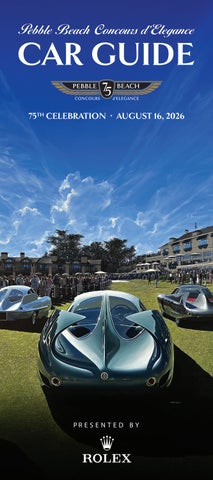
75TH CELEBRATION • AUGUST 16, 2026
CARS is a global leader in rare and luxury automobile transport, trusted by the most prestigious auctions, concours events, manufacturers and collectors around the world.
Finance your next classic, collector, or exotic with Woodside Credit. Since 2003, collectors and enthusiasts alike have found value in the Lowest Monthly Payments in America and unmatched financing terms. Get a no-obligation estimate at woodsidecredit.com or call us directly at 831-539-2793
UNITED KINGDOM | NETHERLANDS | MIDDLE EAST | JAPAN NEW YORK | MIAMI | LOS ANGELES | SAN FRANCISCO
Pebble Beach Concours d’Elegance Logo® and Pebble Beach Concours d’Elegance® are trademarks and service marks of Pebble Beach Company. Used by permission.
SCAN TO ESTIMATE YOUR MONTHLY PAYMENT
Proud Sponsor of
Pebble Beach d’Elegance Logo® is a trademark and service mark of Pebble Beach Company. Used by Permission.
2026 CLASSES
A
Antique . . . . . . . . . . . . . . . . . . . . . . . . . . . . . . . . 3
B
Early Speedsters (Pre-World War I) . . . . . . . . . . . 8
C-1
American Classic Open . . . . . . . . . . . . . . . . . . . 12
C-2 American Classic Closed . . . . . . . . . . . . . . . . . . 15 C-3 1933 Century of Progress Exhibition . . . . . . . . 18 D
Packard . . . . . . . . . . . . . . . . . . . . . . . . . . . . . . . . 20
E
Streamliner (Pre-World War II) . . . . . . . . . . . . . . 23
F
Automobiles of Royal India . . . . . . . . . . . . . . . . 29
G
Duesenberg . . . . . . . . . . . . . . . . . . . . . . . . . . . . . 31
H
Rolls-Royce Prewar . . . . . . . . . . . . . . . . . . . . . . . 36
J-1
European Classic Under 4 Liters . . . . . . . . . . . . 41
J-2
European Classic Over 4 Liters . . . . . . . . . . . . . 44
K-1
The Gathering: Bugatti Royale & Atlantic . . . . . . 48
K-2
The Gathering: Alfa Romeo BATs . . . . . . . . . . . 49
L-1
Prewar Preservation . . . . . . . . . . . . . . . . . . . . . . 51
L-2
Postwar Preservation . . . . . . . . . . . . . . . . . . . . . . 54
M-1
Ferrari Competition: Chinetti/NART . . . . . . . . . 58
M-2 Ferrari Competition . . . . . . . . . . . . . . . . . . . . . . 62 M-3 Ferrari Grand Touring . . . . . . . . . . . . . . . . . . . . 67 M-4 Ferrari Vignale . . . . . . . . . . . . . . . . . . . . . . . . . . . 70 N
Vignale . . . . . . . . . . . . . . . . . . . . . . . . . . . . . . . . 77
O-1
Postwar Sports Racing . . . . . . . . . . . . . . . . . . . . 81
0-2 Postwar Sports Touring . . . . . . . . . . . . . . . . . . . . 85 0-3 Postwar Luxury Touring . . . . . . . . . . . . . . . . . . . 87 P
Japanese Motorsport . . . . . . . . . . . . . . . . . . . . . . 91
R-1
Pebble Beach Road Race Production . . . . . . . . . 97
R-2
Pebble Beach Road Race Special . . . . . . . . . . . 104
S
Land Speed Record Car . . . . . . . . . . . . . . . . . . 109
X
Historic Jaguars . . . . . . . . . . . . . . . . . . . . . . . . . 110
Please note: Cars with an asterisk (*) are being Exhibited, not Judged.
ACCELERATE THE FUTURE OF SAN DIEGO’S YOUTH
Empower underserved youth to thrive in the automotive industry. Through IGNITE Academy, students gain hands-on technical training and career skills for lasting success.
Fuel Bright Futures. Donate Today! www.sdautomuseum.org/ignite
A NTIQ U E
A
Often terms like “antique,” “vintage,” and “classic” are used rather generically—and interchangeably—to refer to something old that retains some value. But in the collector car world, each of these terms has a distinct and very specific meaning.We reserve the term “antique” for early and innovative cars that ushered in the Automotive Age—cars built in the late 1800s or early 1900s, up to World War I.We honor these historic cars as the ancestors of all cars over time.
A - 01
1902 Packard G Rear Entrance Tonneau Stephen R. Plaster, Lebanon, Missouri This 1902 Packard Model G is the sole surviving example of what are believed to be just four two-cylinder Packards. Ownership history is documented from new and includes the Packard Motor Car Company as well as a remarkable 87-year residence at the famed Bothwell Ranch. After a 1949 fire damaged the original coachwork, the body was carefully recreated by aviation pioneer Otto Timm. Power comes from a distinctive 24-hp twin-cylinder engine comprising two single-cylinder units conjoined, each with its own carburetor and fuel tank, driving through a three-speed sliding-gear transmission with chain drive. A meticulous body-off restoration completed in 2017 returned the car (chassis 218) to original configuration, and it continues to be actively toured as well as exhibited today.
A - 02
1904 Rolls-Royce 10 HP Barker Park Phaeton Terry Bramall, Harrogate, United Kingdom This 1904 Rolls-Royce 10 HP is the oldest known surviving Rolls-Royce and among the earliest products of the partnership between Charles Stewart Rolls and Frederick Henry Royce, formed in May 1904. The fourth automobile to bear the Rolls-Royce name, this car (chassis 20154) was displayed at the 1904 Paris Auto Salon and later at the 1905 Olympia Motor Exhibition. Powered by a 1.8-liter twin-cylinder engine, the compact car could reach nearly 39 mph. Originally fitted with a Barker Park Phaeton body in Primrose Yellow, it was discovered in a barn in 1950, restored, and then participated in the London to Brighton Veteran Car Run. A recent thorough restoration has returned the car to its original 1904 configuration. Pebble Beach®, Pebble Beach Concours d’Elegance®, The Lodge at Pebble Beach™, 17-Mile Drive™ and their distinctive images are trademarks and service marks of Pebble Beach Company. All rights reserved. ©2026 Pebble Beach Company. Printed in Canada.
pebblebeachconcours.net
3
A
AN T I Q U E
A - 03
1905 American Mercedes 45 HP Double Phaeton* Mercedes-Benz Group AG, Stuttgart, Germany The “American Mercedes” reflects an ambitious effort by Daimler-Motoren-Gesellschaft to bring European engineering excellence while avoiding the large tariffs on US imports. Introduced at the 1905 New York Automobile Show and built on Long Island by the Steinway & Sons Piano Company under the name Daimler Manufacturing Company, the Mercedes 45 HP was an exact counterpart to its German-built sibling. Powered by a substantial 6.8-liter four-cylinder engine and equipped with a four-speed gearbox, it offered refined performance with a top speed approaching 80 km/h (50 mph). Priced at $7,500, it catered to a discerning clientele. Production proved short-lived, however, ending abruptly after a devastating 1907 factory fire. This example (chassis 63937) has been with the Mercedes-Benz Group AG since 1964.
A - 04
1907 Itala 120 HP Grand Prix Race Car Peter Klutt, Halton Hills, Canada Beginning in 1906, Itala entered top-level motor racing with formidable purpose-built machines. The 1907 120 HP race car featured a massive 15-liter four-cylinder engine with mechanically operated overhead intake valves, sprayjet carburetors, and low-tension ignition, mounted in a robust chassis with a mid-mounted four-speed gearbox. Renowned for strength and endurance, the model achieved early success when Alessandro Cagno won the Coppa della Velocità at Brescia. This example (chassis MVIN22215) is one of two surviving 120 HP competition chassis built exclusively for Itala’s works racing team. Later owned by land-speed record holder Henry Segrave, it retains its original mechanical components and stands as a remarkable survivor of the giant-displacement Grand Prix era.
A - 05
1908 ALCO 60 HP Five-Passenger Tourer Brad & Maria Baker, Oshawa, Canada This remarkable automobile is the only surviving 60 HP chain-drive model built by the American Locomotive Company, commonly known as ALCO. Produced in Providence, Rhode Island, the design was licensed from Berliet of France and represents the earliest known 4
The 75th Pebble Beach Concours d’Elegance
A NTIQ U E
A
surviving ALCO automobile. During its early life the coachwork of this car (chassis 56C17) was updated by the factory around 1911. Originally owned in Vermont, the car was acquired in the 1940s by pioneering collector George Waterman. A recent meticulous restoration has returned the car to that 1911 configuration, carefully preserving original materials, while recreating traditional finishes.
A-06
1908 Packard 30 Four Roadster Bill Parfet, Hickory Corners, Michigan Packard’s Model 30 Gentlemen’s Roadster embodied the performance, quality, and reliability that established the marque as one of America’s premier luxury automobile manufacturers. Introduced as Packard’s sporting model on the 108-inch runabout wheelbase, it combined elegant styling with impressive performance from its massive 431.9-cubic-inch (7.1-liter) T-head four-cylinder engine. Renowned for its durability and engineering excellence, the Model 30 helped demonstrate the practicality of the automobile during the pioneering years of motoring, most famously through the Murdock family’s transcontinental journey from Los Angeles to New York in 1908. This example (chassis 5414) was acquired by noted collector Donald Gilmore in 1965 and remained in the Gilmore Car Museum collection for decades. In 2021, Bill Parfet, Gilmore’s grandson, commissioned a comprehensive restoration, returning the car to its current condition.
A - 07
1910 Glide 45 HP Scout Touring Ross & Beth Myers, Boyertown, Pennsylvania The 1910 Glide Scout is a striking and rare example of early American sporting design. Built in Peoria, Illinois by the Glide Automobile Company, it is powered by a robust 45-hp Rutenber four-cylinder engine and distinguished by its rakish proportions and elegant toy tonneau coachwork. Notably, it is among the few cars of the era fitted with exceptionally large wheels, lending both presence and performance. One of very few surviving Glides, this example (chassis 1040) has passed through notable collections, including those of Homer Fitterling and the Imperial Palace. Carefully restored to its original colors, it is an innovative and stylish early motorcar.
pebblebeachconcours.net
5
A
AN T I Q U E
A-08
1910 Simplex 50 HP Holbrook Tourer Beth & Ross Myers, Boyertown, Pennsylvania In 1904 European car importers Smith & Mabley began producing their own car branded the S&M Simplex. Rescued from bankruptcy in 1906, the newly branded Simplex Automobile Company of New York was building fast race-ready automobiles, a near copy of the famed Mercedes Simplex design but with a substantially larger engine. This 1910 Simplex 50 HP Tourer, with unique sporting coachwork by Holbrook Company, is among the most exciting surviving examples of this storied American sports car. Powered by Simplex’s nearly 600-cubic-inch 50-hp T-head four-cylinder engine with dual chain drive, the model earned a reputation for exceptional speed and durability. Discovered on Long Island after being adapted for fire-apparatus duty, this car (chassis 10351) retained its original chassis, engine, and much of its front bodywork. It has undergone a comprehensive restoration to accurately return the car to its original touring configuration.
A-09
1912 Fiat Tipo 56 Seven-Passenger Touring Dale & Mary Balderson, Arlington,Virginia This is a rare surviving example of the American-built Fiat Tipo 56, the flagship “Master Car” produced during Fiat’s brief U.S. manufacturing venture. Built at the American Fiat factory in Poughkeepsie, New York, these cars combined Italian engineering heritage with American production aimed at the domestic luxury market. Introduced in 1912 on a 135-inch wheelbase, the Tipo 56 featured an imposing seven-passenger touring body and abundant Brass Era detailing. Note the long-hood profile, large brass headlamps, bright fittings, period hardware, and generous seating capacity. Power came from a massive 8.6-liter T-head inline-six rated at 50 horsepower. This car (chassis S1570) has benefited from careful restorations and remains an impressive example of early transatlantic automotive craftsmanship.
A - 10
1913 Packard 1-38 Runabout Don & Glenda Sears, Tiburon, California An early milestone in Packard engineering, this 1913 Packard Model 1-38 Runabout represents the first year 6
The 75th Pebble Beach Concours d’Elegance
A NTIQ U E
A
for electric lighting and starting, featuring the innovative Delco starter-generator developed by Charles Kettering. Powered by a 415-cubic-inch L-head inline-six producing 60 horsepower, it also introduced left-hand drive and a driver-focused control layout conceived by chief engineer Jesse Vincent. Believed to be one of just two examples in this configuration, it carries a deeply personal history, remaining with the original owner’s family for decades before a cosmetic restoration in the late 1980s. This car (chassis 39602) stands as a rare and significant example of early Packard innovation.
A - 11
1913 Packard 2-38 Six Five-Passenger Phaeton* JBS Collection/Jack Boyd Smith Jr., Topeka, Indiana Introduced in 1913, the Packard Six Series 1-38 represented a major step forward in American luxury motoring. Its six-cylinder engine, cast in three blocks of two cylinders, produced 74 horsepower and could propel the car to nearly 80 mph—remarkable for the era. The model was also among the first Packards to feature lefthand drive and an electric starter, along with a compact control board that allowed the driver to operate the car without leaving the seat. Equipped with gas headlamps, oil and electric lighting, artillery wheels, and Packard’s multidisc clutch, it exemplified advanced engineering. The early history of this car (chassis 38471) is largely undocumented, but was showcased in the Harrah’s collection for some time and has been with the current owner since 2022.
A - 12
1914 Packard 3-48 Seven-Passenger Touring Donald Ghareeb,Vestavia Hills, Alabama One of just two surviving examples on the 3-48 chassis, this 1914 Packard Model 3-48 Seven-Passenger Touring boasts a continuous, well-documented history dating to its discovery in the early 1950s. Powered by a 525-CID T-head inline-six-cylinder engine, it reflects Packard’s leadership in early engineering, featuring left-hand drive, electric starting, and lighting. The car (chassis 50038) has been enjoyed as intended, notably summiting Pikes Peak during the 1976 Glidden Tour. Long owned by prominent collectors including Otis Chandler, it was restored and displayed at the 1999 Pebble Beach Concours d’Elegance. It remains an exceptional example of early American motoring.
pebblebeachconcours.net
7
A
AN T I Q U E
A - 13
1911 Cottin & Desgouttes Model C Grand Prix* George F. Wingard, Eugene, Oregon Founded by Pierre Desgouttes in 1904 and renamed Cottin & Desgouttes after Cyrille Cottin joined the company in 1906, the marque became known for producing both luxury automobiles and competitive racing machines. This 1911 Grand Prix car (chassis 534) established its credentials by recording the fastest lap at the 1911 French Grand Prix before claiming victories at the 1911 and 1912 Ventoux meetings. Following an active competition career, it later appeared in the 1968 film Chitty Chitty Bang Bang. At the 2002 Pebble Beach Concours d’Elegance, it earned First in Class in the Open Wheel Race Car category as well as the French Cup. The car returned to competition at the 2009 Monterey Historic Races, celebrating its enduring place in early Grand Prix history.
B
E A R LY S P E E DST ER S (P R E - WO R L D WA R I)
Before World War I, a few pioneering American automakers created the Early Speedsters: exciting, fast, bare-bones iterations of the newly emerging horseless carriage. Speedsters could be used for basic transportation, but they were intended to move at a fast pace and were often raced. The class features well-known examples and some little-known-but-exciting competitors.
B - 01
1907 American Underslung Four Roadster Rob Kauffman/RK Motors, Charlotte, North Carolina Known as the “Honeymoon Roadster,” this early American Underslung Roadster was purchased new by F. C. Deemer for his post-wedding adventure with his bride, Anna. Among the earliest American sports cars, it featured a dramatically low chassis, with the frame mounted under the springs, large 36-inch wheels, and a powerful 476.5-cubicinch four-cylinder engine capable of speeds approaching 75 mph. Famously damaged in a barn fire during the honeymoon, the couple simply continued their trip in another American owned by Deemer. Stored for decades after the marque’s closure, this car (chassis 1402) was rediscovered and restored in the 1960s and reunited with
8
The 75th Pebble Beach Concours d’Elegance
E A R LY SPEEDST ER S ( P RE- WOR LD WA R I)
B
Deemer’s son in 1968 at Hershey. Today, it continues to participate in brass tours across America.
B - 02
1907 Thomas-Detroit Model C Runabout Johnny & Christine Crowell, San Ramon, California The Thomas-Detroit Model C Runabout reflects the entrepreneurial vision of E. R. Thomas, whose company helped shape early American motoring. Introduced in 1907, the Model C offered a lighter, sporting alternative to the marque’s larger cars, with a 40-hp inline four-cylinder engine capable of impressive performance for its day. With its simple open-body design and lively character, it embodied the spirit of early motoring with spartan features. Remarkably, this example (chassis 7138) remained in single-family ownership for a century, having been purchased in 1915 by William B. Bolmer and carefully preserved and maintained on the road thereafter. Rare when new, even rarer today, it emerges freshly restored, as an authentic survivor of the pioneering brass-era.
B - 03
1911 Mercer Model 35 R Raceabout Dana & Patti Mecum, Geneva Lake,Wisconsin The 1911 Mercer Type 35R Raceabout stands among the ultimate American Brass Era sporting motorcars. Renowned for its advanced engineering, powered by a 300-cubic-inch T-head four-cylinder engine, it could reach 70 mph, and was famously guaranteed to cover a mile in just 51 seconds. This rare first-year example traces its provenance to early collector Webster Knight III of Fruit of the Loom Co. fame, and was later discovered in original condition before a careful restoration preserving many original components. Following its restoration, this Mercer (chassis 478) earned the Briggs Cunningham Award at the Pebble Beach Concours in 1988. Formerly part of the renowned collections of Otis Chandler and Ambassador John Price, it remains an iconic symbol of early American performance motoring.
pebblebeachconcours.net
9
B
E A R LY S P E E DST ER S (P R E - WO R L D WA R I)
B - 04
1911 Oldsmobile Autocrat “Yellow Peril” Speedster Ted Stahl/Stahls Motors and Music Experience, Chesterfield, Michigan Purchased new in 1911 by John Henry Greenway Albert, this Oldsmobile Autocrat—nicknamed “Yellow Peril”—was transformed into a formidable East Coast competition machine. Albert modified the car extensively, replacing its original coachwork with a lightweight, boattailed aluminum body of his own design to enhance performance. Powered by a massive 500-cubic-inch engine, it proved highly competitive, with Albert later recalling only a single defeat. Remarkably, he retained and actively drove the car long after its racing days. Following decades of preservation and later restoration, the Speedster (chassis 65877) continued its competitive legacy, including strong finishes in the Great American Race in the mid-1980s, embodying the enduring spirit of early American motorsport.
B - 05
1912 Moon 30 Raceabout Leland F. Powels, Cambria, California The 1912 Moon Raceabout stands as a rare and remarkably original example of early American sporting design. Built by the Moon Motor Car Company, St. Louis, Missouri, it features a 40-hp, T-head four-cylinder engine on a 116-inch wheelbase. It was unveiled as a concept car at the Madison Square Garden Automobile Show, where it captured widespread attention. Inspired by the success of the Mercer Raceabout, it embodied performance and style. Acquired in 1947 by pioneering collector Henry Austin Clark Jr., the Raceabout (chassis 5368) was lightly refreshed and displayed in his Long Island museum. Later owned by William F. Harrah, it remains well preserved, retaining original finishes and patina.
B-06
1912 Stutz A Bearcat Paul Gould, Pawling, New York This early Stutz Bearcat, initially referred to as a Bear Cat, is believed to be among the earliest examples built— possibly even a prototype—featuring a late-1910 Wisconsin-built engine and distinctive early production details. Evidence suggests it was delivered new as a
10
The 75th Pebble Beach Concours d’Elegance
E A R LY SPEEDST ER S ( P RE- WOR LD WA R I)
B
competition-oriented car, likely privately campaigned from the outset rather than used on the street. Discovered in California in 1949 in remarkably complete “as-raced” condition, it retained key original features, including its unique radiator and early modifications. Extensive research by noted historians supports this car’s significance as an authentic early racing Bearcat (engine number A730). Restoration has preserved both its originality and its legacy as one of America’s earliest high-performance sporting cars.
B - 07
1913 Mercer 35 J Raceabout Steve Adler, New Vernon, New Jersey First introduced in 1911, the Model 35 J Raceabout’s 4.9-liter T-Head four-cylinder engine was rated at 32 horsepower, but developed about 60 bhp. Designed by famed engineer Finley Robertson Porter, it was intended to be light and nimble in comparison with its peers. Successful race results came thick and fast, including a 12th place finish at the first Indianapolis 500. This 1913 Model 35 J (chassis 1330) was equipped with a four-speed transmission and a shorter chassis, and in this form, it is considered to be one of the legendary sports cars of all time. Properly tuned, it is capable of 100 mph. This car, retaining its original bodywork and engine, was discovered in a barn in Arkansas, after it lay dormant for nearly 50 years. It was restored in 2012.
B-08
1913 National Semi-Racing Roadster Jim Grundy, Horsham, Pennsylvania Built in the wake of the marque’s 1912 Indianapolis 500 victory, this 1913 National Semi-Racing Roadster is one of approximately 50 examples offered exclusively to “Friends of the Speedway.” Powered by a formidable 450-cubicinch T-head four-cylinder engine, it reflects National’s direct link between competition success and road-going performance. Originally owned by the Speedway’s official physician and later by his chauffeur, this car (chassis 7173) has remained remarkably intact, with just three owners from new. Lightweight, purposeful, and engineered for speed, the Semi-Racing Roadster embodies the spirit of early American motorsport and National’s brief but influential racing legacy.
pebblebeachconcours.net
11
C1
AMERI CA N C L A S S I C O PE N
While furniture, clothing, and even popular beverages that survive over 20 years are often labeled “classics,” we reserve that term for cars built amidst what is often considered the golden era of the automobile—that era when coachbuilding was at its peak and the latest one-off custom creations competed in early concours on the Bois de Boulogne and throughout Europe. In this period, running from the mid-1920s to the early 1940s, people with means often purchased a car chassis from one company and then sent it off to be bodied by their favorite coachbuilder. “Classic” cars often fill several classes on our competition field and have often won our top award. Here we focus on American Classics with open or convertible bodies.
C 1-01
1930 Jordan Model Z Speedway Ace Roadster David Jordan, Dilliner, Pennsylvania This 1930 Jordan Model Z Speedway Ace is one of two built, the only surviving example. Built near Cleveland, Ohio, by the Jordan Motor Car Company, the car reflects Edward S. “Ned” Jordan’s philosophy of producing stylish, individualistic automobiles with assembled components, including a Continental engine, Timken axles, and Bosch ignition. Ned Jordan was famed for an advertisement he placed in the 1920s, featuring a young woman on a galloping pony racing the Jordan Playboy Roadster with the slogan “Somewhere West of Laramie!”—extraordinary for its time. This roadster (chassis 00014) remained largely hidden in Ohio near the original factory until it was discovered by James Stecker, who restored and showed the car at the Pebble Beach Concours in 2008. In 2025, it was acquired by the Jordan Motor Car Company Museum. The Model Z Speedway was Jordan’s swan song before the company ceased operations in 1931.
C 1-02
1932 Chrysler CL Imperial LeBaron Convertible Coupe The Santomauro Collection, Phoenixville, Pennsylvania The 1932 Chrysler CL Imperial Convertible Coupe represented Chrysler’s ambitious entry into the luxury market during the early 1930s. Built on a 146-inch wheelbase and powered by a high-compression 385-cubic-inch “Red Head” inline eight engine, the Imperial combined strong performance with elegant design. Its handsome coachwork
12
The 75th Pebble Beach Concours d’Elegance
A M E R I CA N CLA S S IC OPEN
C1
was created by LeBaron, the prestigious Detroit-based firm known for its semi-custom bodies. Only about 220 CL Imperials were produced for 1932, including just 28 convertible coupes. This example (chassis 7803368) was delivered new in Portland, Oregon, and later gained colorful notoriety as the “Denver Car” after a dramatic police chase following a robbery in the early 1960s. This convertible coupe has been meticulously restored.
C1-03
1932 Marmon Sixteen LeBaron Convertible Sedan Jeffrey C. Tannenbaum, Rutland, Massachusetts The exact number of Marmon 16-cylinder cars built is not known, but it is believed fewer than 400 were produced between 1931 and 1933. New for 1931 was Marmon’s very advanced OHV V16 491-cubic-inch engine. This 1932 Marmon (chassis 16-145833) is one of 11 convertible sedans known to exist. It was purchased new by oil tycoon Jean Paul Getty, who gifted it to his nephew in 1938. In the late 1990s it was fully restored, subsequently earning CCCA Primary and Senior awards. The current caretaker has orchestrated a mechanical and cosmetic refurbishment to bring it back to its former glory, and with very few V16 Marmons existent in any body style, this example remains a rare high-performance ambassador of its era.
C1-04
1933 Cadillac 452C V-16 Fleetwood Convertible Sedan Stephen Brauer, St. Louis, Missouri In 1933, Cadillac announced it would produce just 400 V-16 automobiles, creating demand through exclusivity. Only 126 were built, and eight were finished with the Fleetwood 5579 all-weather phaeton body. Ten of the original 1933 V-16 cars are listed in the CCCA roster, three of which are convertible sedans, including the famous Al Jolson car at the National Automobile Museum in Reno, Nevada. This unique car (chassis 5000116) was commissioned by G. E. Crandall of Montgomery Ward department store fame at a cost of $8,000—twice the price of a comparable Fleetwood V-8 all-weather phaeton—and is the only one with a small built-in trunk. It has attended the Pebble Beach Concours twice before, winning First in Class in 1990.
pebblebeachconcours.net
13
C1
AMERI CA N C L A S S I C O PE N
C 1-05
1934 Buick 98C Fisher Convertible Phaeton The NB Center for American Automotive Heritage, Allentown, Pennsylvania Introduced on December 27, 1933, the 1934 Buick Series 98C Convertible Phaeton reflected the renewed vision of Buick President Harlow “Red” Curtice during a pivotal period for the marque. Beneath its elegant coachwork was one of Buick’s most significant engineering innovations: an advanced independent front suspension with hydraulic “knee-action” shock absorbers and a rear ride stabilizer— so effective that Rolls-Royce later licensed the design for its own models. Just 138 examples of the 98C Phaeton were produced, with only six known to survive today. Acquired for The NB Center in 2001, this rare open Buick (chassis 2743446) received a comprehensive restoration completed in 2015 in correct colors, and represents an all-time favorite for Mr. Nicola Bulgari dating back to his childhood years.
C 1-0 6
1935 Auburn 851 Supercharged Speedster DuCoing Family, Anaheim, California The 1935 Auburn 851 Speedster stands among the most celebrated designs of the Classic Era. Designer Gordon Buehrig rapidly transformed Auburn’s styling with sweeping lines, pontoon fenders, and a dramatic boat-tailed rear, producing one of the most recognizable American automobiles of the 1930s—at just $2,245. Power came from the supercharged Lycoming inline-eight developed by Augie Duesenberg, enabling the Speedster’s famed 100mph capability. Despite being a loss leader, the Speedster style Auburn 851 helped reassert the brand in the market. This Auburn (chassis 33520E) appeared in several films including Desire with Marlene Dietrich and Gary Cooper, before entering private ownership. Recently restored, this Speedster exemplifies the striking style and performance that secured Auburn’s enduring legacy.
C 1-07
1942 Lincoln Continental Darrin Cabriolet Kevin Bischoff,Vancouver,Washington This unique 1942 Lincoln Continental Cabriolet was originally purchased by Vladimir de Rachevski, brother of Grand Duchess Zenaida of Russia, after he and his wife Harriet Straus settled in Beverly Hills during the early years of World War II. Soon after delivery, the car was sent 14
The 75th Pebble Beach Concours d’Elegance
A M E R I CA N CLA S S IC OPEN
C1
to Howard A. “Dutch” Darrin, who dramatically reshaped its profile. Extended front fenders, lengthened doors and quarter panels, and the signature “Darrin Dip” created a sweeping, elegant silhouette. This Lincoln (chassis H135803) was finished in 25 coats of green lacquer, and the total transformation reportedly cost $7,500. Believed to be the only Lincoln modified by Darrin and his final prewar one-off design, the car has been meticulously restored.
A M E R ICA N C LA S S IC C LOSED
C2
These American Classics have closed bodies. They are most often coupes or sedans, although on some occasions we feature broughams and other body styles.
C2- 01
1930 Packard 734 Speedster Eight Victoria Coupe John Sonday, McEwen, Tennessee The 1930 Packard 734 Speedster Eight represents one of the marque’s boldest departures from its former product offering, blending luxury with sporting performance. The Speedster, named for its sporting chassis rather than its body style, was built on a 134-inch chassis with a strengthened straight-eight, 385-cubic-inch engine, a fourspeed gearbox, upgraded finned exhaust manifold, and oversized brakes—capable of 100 mph and extraordinary for its era. Offered in five factory body styles, including the rare two-seat Boattail Runabout, only about 113 examples were produced. This coupe for four passengers (chassis 184006) was part of the famed William F. Harrah Collection and is one of only two Packards with this rare body style that is known to survive.
C2- 02
1931 Packard 845 Deluxe Eight Dietrich Sport Sedan Rob & Jeannie Hilarides,Visalia, California This Packard Custom Dietrich Sport Sedan is built on the 845 chassis, part of Packard’s Eighth Series of straight-eight automobiles. The design features the first body-integrated luggage compartment on a Packard sedan with balanced proportions suited to the long 145-inch wheelbase. Styling details include a curved coach-sill and center-post door hinging with many similarities to Packard’s 1933 pebblebeachconcours.net
15
C2
A M E R ICA N C LA S SIC C LOS E D
“Car of the Dome,” which was also a sport sedan body type. Discovered in the early 1970s in a junkyard near Syracuse, New York, the car later underwent restoration. Correspondence from Raymond Dietrich suggests only 6 to 12 examples were built. This car (chassis 845-72) won its class and the Roy Warshawsky award at the 2012 Pebble Beach Concours.
C 2- 03
1931 Pierce-Arrow 41 LeBaron Sport Sedan* Allen Strong, Urbana, Illinois The 1931 Pierce-Arrow Model 41 represented the marque’s return to grand luxury, built on a 147-inch wheelbase and powered by a 385-cubic-inch L-head inline—the most powerful eight-cylinder engine in its class. Advanced features included a four-speed manual transmission with freewheeling and robust mechanical drum brakes. This example carries elegant LeBaron Sport Sedan coachwork, one of just six built on the longwheelbase Series 41 chassis, remarkably all of which survive today. This Sport Sedan (chassis 3050216) was originally delivered to a circus family in California, and the car was later owned for many years by noted collector James Weston, who donated it to the Pierce-Arrow Museum at the Gilmore Car Museum in Michigan. After years as a centerpiece of the collection, it was acquired by its present caretaker, who regards it as among the most beautiful closed cars of the Classic Era.
C 2- 04
1931 REO Royale 8-48 Dietrich Newport Sport Sedan A. J. & Pam SanClemente, Northborough, Massachusetts The REO Royale stands among the most impressive yet often overlooked American luxury automobiles of the early 1930s. Powered by a 358-cubic-inch inline eight, the Royale combined robust engineering with advanced features, including single-shot lubrication, thermostatically controlled radiator shutters, and large Lockheed hydraulic brakes. Styling by Amos Northrup featured flowing lines, skirted fenders, and a distinctive V-shaped radiator shell. This Dietrich Sport Sedan (chassis 45N44) built on a special 148-inch wheelbase chassis, was one of three custom-bodied display cars created for REO’s Park Avenue showroom—and is the sole survivor of the trio. It was 16
The 75th Pebble Beach Concours d’Elegance
A M E R I CA N C LA S SIC C LOSED
C2
originally advertised at $5,575 and sold in the New York City area. Recently completing a lengthy restoration, this unique Royale represents a rare and striking example of early American coachbuilt luxury.
C2- 05
1932 Marmon Sixteen LeBaron Coupe Nicholas & Shelley Schorsch of the Audrain Collections The Marmon Sixteen represented one of the most advanced American luxury automobiles of its era. Introduced in 1931, it was powered by a remarkable 491-cubic-inch aluminum V16 engine—an engineering achievement recognized by the Society of Automotive Engineers for its innovative design and quiet operation. Despite performance comparable to the finest luxury cars of the period, the model arrived during the depths of the Great Depression, limiting total production to fewer than 400 examples. This LeBaron-bodied two-passenger coupe (chassis 16 141 830) is one of only six built and features elegant styling with a rumble seat and golf-bag compartment. It has a well-documented ownership, including noted collectors and CCCA competition success. This car has been recently restored to its original factory specifications.
C2- 0 6
1936 Cord 810 Westchester Sedan* Elisa Stephens/Academy of Art University, San Francisco, California The 1936–37 Cord 810/812 stands among the most innovative and visually arresting automobiles of the era, redefining American design with its groundbreaking frontwheel-drive layout. Styled by Gordon Buehrig, the Cord 810 had a low-slung profile, eliminating running boards and introducing hallmark design features including the “coffin” nose, an “alligator” style hood hinged at the rear, and hand-cranked disappearing headlights. Beneath the streamlined body a 289-cubic-inch Lycoming flathead V8 engine powered the car, producing 125 horsepower. Though early mechanical complexity challenged reliability, the Cord’s influence proved lasting. This example (chassis 1490A) was purchased new in San Francisco and remained with its original owner until 1970 and its second owner until 2024, when it was acquired by the Academy of Art University in San Francisco. pebblebeachconcours.net
17
C3
1 93 3 CENT U RY O F P R O G R E S S EXHIB ITIO N
The 1933 Chicago World’s Fair, formally named the Century of Progress Exposition, opened at the height of the Great Depression, so rather than looking at the past or present, the focus turned to the future. Automobile makers exhibited the latest styling and technological advances while emphasizing all that this modern mode of transport would bring—not only freedom and personal expression but also economic and industrial recovery. Four star cars from this exposition are featured on our show field, a testament to the style and technology that now define the Classic Era.
C 3-01
1933 Duesenberg SJ “Twenty Grand” Rollston Arlington Torpedo Sedan* The Nethercutt Collection, Sylmar, California This Duesenberg SJ is arguably the best known and most coveted Duesenberg of all time. The one-off show car was created for the 1933 Century of Progress Exhibition, with a design penned by legendary stylist Gordon Buehrig and built by Rollston of New York. While Duesenberg named it Arlington, crowds soon dubbed it “Twenty Grand” for its rumored price tag. The intimate interior compartment featured individual armchair seating and a rear instrument panel. Its chassis was equally impressive; the long wheelbase of 153 inches was powered by a supercharged version of Duesenberg’s straight-8 engine providing 320 horsepower—by far the most powerful production engine at that time. In 1933, the sedan (J-513) had an upright grille, flowing open fenders topped with side-mounted spares, chrome external exhaust pipes, and wire wheels. For 1934 it was updated with skirted fenders, wheels capped with disc covers, and a black finish. J. B. Nethercutt acquired the sedan in 1978 and returned it to its original configuration, working with Buehrig, who still had the original paint samples and build sheets. Nethercutt then shared it at the 1980 Pebble Beach Concours, where it was named Best of Show.
C 3-02
1933 Pierce-Arrow Silver Arrow Sedan Chris & Teresa George, Fremont, California The 1933 Pierce-Arrow Silver Arrow stands as one of the most daring and visionary automobiles of the prewar era, a rolling symbol of American luxury and ambition during a time of economic hardship. Designed by Phil Wright to
18
The 75th Pebble Beach Concours d’Elegance
1 93 3 CENT U RY O F P R O G R E S S EXHIB ITIO N
C3
showcase Pierce-Arrow’s engineering prowess and stylistic leadership, the Silver Arrow was far ahead of its time, blending advanced aerodynamics with uncompromising elegance. Its long, flowing body is instantly striking. The smooth tapering lines, integrated headlights and spare tires, angled grille, lack of running boards, and dramatically sloped rear give the car a streamlined appearance rarely seen in the early 1930s. Finished in shimmering silver tones, the Silver Arrow looked more like a machine from the future than a product of the Great Depression. Under the hood, a powerful V12 engine delivered smooth, effortless performance, with a top speed of 115 mph. Only five Silver Arrows were built, and only three remain, making this one of the most rare and iconic American cars in history. Belonging to the Harrah’s Collection from the early 1960s until 1987, this car (chassis 2575018) received a full inhouse restoration completed in 1968. Since that time, it has been well preserved by its caretakers.
C3-03
1934 Packard 1108 Twelve “Car of the Dome” Dietrich Sport Sedan The Bob Bahre Collection, Paris, Maine This Packard Twelve Sport Sedan by Dietrich, created specifically for the 1933 Century of Progress Packard display, is the first of the long-hooded Dietrich V-windshield custom-bodied Packards built. One of three surviving 1108 Dietrich Sport Sedans, it is the only one with a rear compartment cabinet, a rear-mounted spare, and interior gold-plating. The design was stunning with its long hood, graceful V-windshield and perfectly proportioned body. The rear compartment cabinet contained a magazine rack, makeup mirror, smoking set, clock, writing desk, radio speaker with volume control, and bar with four gold cups and two gold flasks. Art deco interior lighting, a privacy blind, a mouton rug, a lap robe, and comfortable armchair seating completed the picture. The final result was so spectacular that a jury of artists selected this one car (chassis 902262) to be placed under the central suspended dome of the Travel & Transport Building as the finest representation of the advancement of the automobile at that point in time. Packard heavily promoted the “Car of the Dome” throughout the country. It later featured prominently in Packard Centennial celebrations and was the poster car for the Pebble Beach Concours in 1999.
pebblebeachconcours.net
19
C3
1 93 3 CENT U RY O F P R O G R E S S EXHIB ITIO N
C 3-04
1936 Cadillac Series 90 V-16 Fleetwood Aerodynamic Coupe Lehrman Collection, Palm Beach, Florida Cadillac had startled the world in 1930 with its legendary 16-cylinder engine, and its entry for the 1933 Century of Progress Exposition was a pioneer of automotive streamlining. Named the Aerodynamic Coupe, it was the first concept car developed by Harley Earl’s Art & Colour Section. Its streamlined body was an exercise in simplicity, unlike other cars being showcased, and it was a two-door, five-passenger coupe, predicting the trend away from chauffeur-driven automobiles to owner-operated cars. The Aerodynamic Coupe was a cohesive design with the contour of the fastback body repeated in the pontoon fenders and a spare tire hidden from sight in the trunk. Wire wheels gave way to simple chrome caps adorned with a single blade. Headlamp pods were body colored and the use of chrome was limited to a single horizontal beltline molding and surrounds for the window frames. While the show car did not survive, the body design was offered in extremely limited numbers from 1934 through 1937; just eight were assigned to the V-16 chassis. Just five V-16 Aerodynamic Coupes survive, including the 1936 model (chassis 5A209) shown today, which is emerging from a fresh restoration.
D
PACKA R D
More Packards have been showcased here at Pebble Beach than any other American marque, and Packard has garnered four Best of Show trophies. Most of those overall wins went to classic Packards, like the cars in this class.
D- 01
1930 Packard 734 Speedster Eight Runabout The Singleton Collection, Costa Mesa, California This 1930 Packard 734 Speedster Eight Runabout, built on the 134.5-inch Seventh Series chassis, is one of a limited production of high-performance Packards offered only by special order. The car features high-speed gearing, 19-inch wheels, finned brake drums, and numerous engine
20
The 75th Pebble Beach Concours d’Elegance
PAC K A R D
D
modifications, culminating in a reported top speed of 110 mph. Built by Packard’s in-house coachworks, this 734 Speedster (chassis 184087) was originally purchased by 21-year-old Nelson W. Brinckerhoff, an orphan adopted by an uncle with a substantial inheritance. The car subsequently passed through several owners before entering the Petersen family, whose long stewardship ensured its survival as one of the few authentic 734 Speedster Eight Runabouts remaining. This car joined the Singleton collection in 2025.
D- 02
1930 Packard 745 Deluxe Eight Roadster Craig Kappel & Meg McCarthy, Orlando, Florida Fewer than 150 745 Deluxe Eight Roadsters were produced in 1930, when Packard sold almost twice as many cars abroad as any other luxury car manufacturer. At the onslaught of the Great Depression, production of the Packard Model 745 was just 1,789 across a variety of body styles. This roadster (chassis 185585) represents one of the limited open sporting bodies offered on the 145-inch wheelbase during the Seventh Series. The car was discovered on a farm in Middleburgh, New York, in 1949, where it had been acquired as a potential source of mechanical power for farm equipment. Thankfully it was discovered, purchased, and preserved intact. In 2016 it was restored and attended the Pebble Beach Concours.
D- 03
1934 Packard 1108 Twelve Individual Custom Dietrich Convertible Roadster John Groendyke, Enid, Oklahoma This 1934 Packard Model 1108 Convertible Runabout is one of three surviving examples on the 1108 Twelve chassis. The body style was part of Dietrich’s Individual Custom series built for the most distinguished buyers during the early Classic Era. The car features a long hood, V-shaped windshield, and flowing beltline, characteristic of Dietrich’s approach to bespoke coachwork. Powered by a 445 CID L-head V12, it combined Packard performance with distinctive style. Originally purchased by Mirko Paneyko of New York, this car (chassis 902536) remained in private hands for decades and emerges fresh from restoration. This body style is considered to be one of the most distinguished in Packard’s history.
pebblebeachconcours.net
21
D
PACKA R D
D- 04
1937 Packard 1507 Twelve Convertible Roadster David & Linda Kane, Bernardsville, New Jersey This 1937 Packard Twelve Model 1507 Convertible Roadster is believed to be the first 1507 of this style built in 1937 and was originally sold through Earle C. Anthony in California. Constructed on Packard’s 139¼-inch wheelbase, the car is powered by a 473 CID L-head V12, paired with a three-speed selective synchromesh manual transmission. The Fifteenth Series Twelve introduced hydraulic brakes, Safe-T-Flex independent front suspension, and disc-type steel wheels. The rear-hinged doors and Bijur lubrication were eliminated. This example (chassis 1039-204) was purchased by the current owner in 2004, and again in 2024. Very few 1507 Convertible Roadsters are known to exist, making this a rare survivor of Packard’s V12 production.
D- 05
1937 Packard 1508 Twelve Convertible Sedan Brian Cunat, McHenry, Illinois Packard’s second generation of V12 powered cars were built from 1932 to 1939, with 1937 being their largest production year. Convertible Sedans represented a small portion of Twelve production in 1937, when approximately 1,300 examples were built across the series. This example (chassis 1073238) is built on Packard’s 144-inch wheelbase platform, the longest offered for the Fifteenth Series, and is among the final applications of this chassis. Powered by Packard’s 473-cubic-inch L-head V12, it reflects significant mechanical improvements introduced for 1937, including “Safe-T-Flex” independent front suspension and hydraulic brakes. These developments enhanced ride and handling while maintaining the silky smooth performance associated with the Twelve. Delivered new in May of that year, the car has remained in long-term private ownership and was restored in 2011.
D- 0 6
1940 Packard Super Eight One-Eighty Darrin Convertible Victoria William Lyon Family, Newport Beach, California The 1940 Packard One-Eighty Convertible Victoria represents the height of prewar American luxury and style. Designed by Howard “Dutch” Darrin, the Convertible Victoria combined Packard engineering with dramatic coachwork defined by low lines and cut-down doors. 22
The 75th Pebble Beach Concours d’Elegance
PAC K A R D
D
One of fewer than 50 believed built on the senior OneEighty chassis for 1940, this example (chassis 1806 2027) is thought to be the 27th completed, as denoted by its chassis number. Once part of the Harrah Collection, it was acquired in 1984 by the late General William Lyon and comprehensively restored in 1991. Favored for many years by Willa Dean Lyon, William Lyon’s wife, the car has remained in the family over 40 years and reflects Packard’s final great expression of custom-bodied elegance before wartime production reshaped the American automobile industry.
D- 07
1941 Packard 1906 Custom Super Eight One-Eighty Darrin Convertible Victoria George Myers, Saint Helena, California Howard “Dutch” Darrin established a reputation reworking open Packards for movie stars throughout the late 1930s and convinced Packard to include one of his Convertible Victoria designs in its 1940 catalog of custom bodies. Constructed on the Packard Eight and later the One-Eighty chassis, the car featured the distinctive “Darrin Dip” to the door and was powered by a 356-CID L-head straighteight engine. Fewer than 100 examples were built through 1942. When the current owner acquired this car, every original Darrin detail was intact although the car had been repainted. Now emerging from a top-down restoration, this Convertible Victoria (chassis 1429-2005) remains a superb representation of Packard’s 19th Series and their top-ofthe-line luxury model.
ST R EA MLINER ( P RE- WOR LD WA R II)
E
The latter half of the 1930s was a time of great creativity and originality in auto design as the new science of aerodynamics rose to the fore and old upright and angular three-box car designs were retired. Many designers were caught up in the spirit of the age and its catchword, “streamlining,” and began to experiment with more flowing forms—rounded fenders, sloping grilles, and fastback rear ends. Others utilized more scientific methods, employing a wind tunnel to test the air flow around their designs. No matter the method, they created some of the most extravagant and breathtaking machines ever created. pebblebeachconcours.net
23
E
ST R E A M L IN ER (P R E - WO R L D WA R II)
E -01
1925 Rolls-Royce Phantom I “Round Door” Jonckheere Aerodynamic Coupé Petersen Automotive Museum, Los Angeles, California Constructed in 1925 on a Rolls-Royce Phantom I, this car (chassis 94MC) was originally bodied as a cabriolet by Hooper & Co. for Mrs. Hugh Dillman, heiress to the Dodge fortune, but it never left England. Shortly thereafter, it was acquired by the Maharaja of Nanpara. In 1934, it was rebodied in Belgium by Jonckheere with distinctive aerodynamic coachwork, including twin sunroofs, a pronounced rear fin, and circular doors, which earned it the nickname “Round Door Rolls-Royce.” Also featuring a rare slanted reworking of the classic Rolls-Royce grille, which most certainly would have been disapproved of by the factory, the coachwork exemplifies so-called design streamlining as no wind tunnel work was involved. The car later passed through several owners before being discovered in New Jersey in the early 1950s in derelict condition. Subsequent years saw it in collections in the United States and Japan before joining the Petersen Automotive Museum in 2001.
E -02
1932 Austro Daimler ADR8 Oeffag Alpine Sedan The Nethercutt Collection, Sylmar, California Founded in Vienna in 1899 by Paul Daimler, AustroDaimler developed a reputation for advanced engineering, which included work performed by Ferdinand Porsche. Introduced at the 1928 Olympia Motor Show, the ADR evolved into the ADR-8 in 1930, featuring an 8-cylinder 4.6-liter engine on a 147-inch chassis. Approximately fifty examples were produced. Its design incorporates a single spine tubular chassis and forced-feed dry sump lubrication. This example, (chassis 27802/50) was bodied as a sedan by Austrian Oeffag Karosserien and built for Mr. Moser, a Swiss industrialist. An early example of streamlining influences, the coachwork displays an interesting mix of stylistic elements, as it fuses a slanted windshield, a fastback rear end and semi-pontoon fenders with free-standing headlights that are coupled with a traditional upright grille and hood design. The car later spent time in South Africa before joining the Nethercutt Collection in 1982.
24
The 75th Pebble Beach Concours d’Elegance
ST R EA MLINER ( P RE- WOR LD WA R II)
E
E-03
1932 Duesenberg J Bohman & Schwartz Streamline Coupe The Keller Collection at the Pyramids, Petaluma, California This 1932 Duesenberg Model J, now known as the “Mudd Coupe,” began life as a short-wheelbase Derham-bodied sedan before being transformed into one of the most unusual custom Duesenbergs ever created. Originally owned by Dr. Seeley Mudd, the car (chassis 2234/J-212) was returned to Duesenberg for performance upgrades, which included fitting a supercharger and the extremely rare 8-in-1 external exhaust manifold. It was then rebodied by Bohman & Schwartz in 1937 as a dramatic, almost sinister-looking streamliner. The svelte form incorporated experimental aerodynamic ideas, rear skirted fenders, a sliding sunroof, and body panels consisting of leather-like Zapon cloth that lightened the car by several hundred pounds. Powered by the supercharged Duesenberg 325hp 6.9-liter straight-8, this very fast car later was referred to as the “Circus Wagon” after a colorful repaint, before being restored closer to its original and dramatic black presentation.
E-04
1934 Hispano-Suiza J12 Fernandez et Darrin Coupé de Ville Anne Brockinton Lee/The Lee Collection, Sparks, Nevada Commissioned in 1934 by Anthony Gustav and Yvonne de Rothschild of London, this Hispano-Suiza J12 (chassis 14036), represents the height of prewar luxury and bespoke craftsmanship. Bodied by Fernandez et Darrin of Paris, with styling by Howard “Dutch” Darrin, this one-off coupé de ville was built on the formidable 9.4-liter V12 HispanoSuiza chassis and was among the most expensive of its era. Its design reflects an emerging streamline design aesthetic, that combined elegant proportions with forward-looking, aerodynamic influences, including its fastback design and semi-pontoon fenders. Created without regard to cost, it embodied the refined yet progressive tastes of its prominent owners. Though later modified, the car has since been carefully restored by the Lee Shop to its original form, preserving its distinctive post–Art Deco character and presence. pebblebeachconcours.net
25
E
ST R E A M L IN ER (P R E - WO R L D WA R II)
E -05
1936 Voisin C28 Aérosport Coupé The Keller Collection at the Pyramids, Petaluma, California The radically streamlined Voisin C28 Aérosport was the talk of the 1935 Paris Auto Salon and is regarded as a defining creation of aviation pioneer and automobile designer Gabriel Voisin. One of only three or four examples built and believed to be the sole surviving C28 Aérosport, this car (chassis 53048) features an advanced fastback body in aluminum that showcases a predictive pontoon side treatment, designed at a time when aerodynamic automotive design was still in its infancy. Originally purchased by Paris chocolatier Antoine Menier, the car was finished in French racing blue and equipped with Voisin’s patented externally sliding sunroof as well as dual exhaust systems for both road and competition use. Retaining much of its original interior and mechanical character, with very low mileage, the automobile survived decades hidden away before being rescued in the 1950s by noted French collector Serge Pozzoli. This exciting Aérosport was first displayed at the Pebble Beach Concours d’Elegance in 2006.
E -0 6
1937 Dubonnet Xenia Saoutchik Aerodynamic Coupé Petersen Automotive Museum, Los Angeles, California Commissioned in the late 1930s by André Dubonnet, this Xenia was conceived on a highly modified HispanoSuiza H6C chassis (Dubonnet no. 103) to demonstrate Dubonnet’s advanced independent front suspension system. The streamlined body, designed by Jean Édouard Andreau and built by Saoutchik, reflects aerodynamic principles and aviation influence, echoed in its cockpitinspired interior. Distinctive features include a lift-off roof panel, outward-pivoting windows, parallel-opening cantilever doors, (a patent for which Saoutchik had licensed from James Young), plus what is likely to be the world’s first wrap-around windshield. Powered by the 8-liter HispanoSuiza H6C straight-six engine, the car offers smooth, capable performance. Created as a tribute to Dubonnet’s late wife, Xenia, the Dubonnet Xenia received little use and remained hidden during the war as Dubonnet’s second wife took umbrage to this homage to his first love. The car emerged in 1946 and later joined noted collections. It was 26
The 75th Pebble Beach Concours d’Elegance
ST R EA MLINER ( P RE- WOR LD WA R II)
E
shown at the Pebble Beach Concours in 2000, where it was awarded Most Elegant Closed Car.
E-07
1937 Talbot-Lago T150 C-SS Figoni et Falaschi Teardrop Coupé* William E. (Chip) Connor, Hong Kong In 1997, this Talbot-Lago T150 C-SS Teardrop Coupé won Best of Show at the Pebble Beach Concours. It is one of only three T150 C-SS built by Figoni et Falaschi with this bodywork, and this is the only survivor. The model was named “Jeancart” after the wealthy French businessman who bought the first Delahaye featuring this notchback styling. Its patented “Goutte d’Eau” (“Teardrop”) coachwork by Figoni et Falaschi, with flowing fenders, tapered tail, and integrated body, became one of the defining expressions of prewar aerodynamic streamlining and Art Deco design, symbolizing nature’s most perfect aerodynamic form. A direct competitor of the Bugatti Type 57S, the T150 C-SS was recognized as a supercar of its day with a racing chassis and 4.0-liter engine. This car (chassis 90104) was owned for almost half a century by Dr. Fernand Masquefa, a plantation owner in Algeria who raced the car in many north African events. Following a 4,000hour restoration by the current owner, the automobile returns to the Pebble Beach Concours for exhibition only.
E-0 8
1938 Alfa Romeo 8C 2900B Touring Berlinetta Revs Institute, Naples, Florida The Alfa Romeo 8C 2900B was derived directly from Alfa Romeo’s Grand Prix program, sharing both its advanced chassis and powerful Vittorio Jano-designed supercharged straight-8 engine with the racing cars. The model demonstrated its dominance when three examples finished 1st, 2nd, and 3rd in the 1936 Mille Miglia. Produced in limited numbers between 1937 and 1939, the 2900B was offered in short-wheelbase Corto and long-wheelbase Lungo forms, with this Touring-bodied 1938 Lungo example (chassis 412036) displayed on the Alfa Romeo stand at the Paris Auto Salon. The Touring Berlinetta body, shaped with a streamlined fastback profile and built using the lightweight Superleggera processes, reflected the growing influence of aerodynamic design in late-1930s high-performance
pebblebeachconcours.net
27
E
ST R E A M L IN ER (P R E - WO R L D WA R II)
automobiles—streamlined for purpose rather than aesthetic. Hidden during World War II by its second owner in Iseo, Italy, it later returned to competition in the 1947 Mille Miglia under Emilio Romano, who converted the engine to normally aspirated specification. Co-driven by Clemente Biondetti, the car claimed overall victory in torrential rain, marking Alfa Romeo’s final Mille Miglia win and cementing the 2900B’s place among the most successful competitionderived road cars of its era.
E -0 9
1938 Mercedes-Benz 320 (W 142) Streamlined Saloon* Mercedes-Benz Group AG, Stuttgart, Germany The Mercedes-Benz 320 (W 142) Stromlinien Limousine, or Streamlined Saloon, was introduced in 1937. Intended as an owner-driver model, it captured the spirit of Germany’s emerging autobahns, which enabled a new kind of fast, long-distance travel that in turn required refined, aerodynamic coachwork. Designed by Gustav Röhr as the successor to the Model 290, the 320 chassis combined elegance with durability, its 3.4-liter engine delivering smooth, reliable performance. Though gains in speed and efficiency due to the novel and more slippery body shape were modest, the car’s quiet operation, robust engineering, and advanced four-speed gearbox made it an exceptional touring car. The longer-wheelbase chassis allowed for a wide range of coachwork, including this striking Stromlinien Limousine. This example (chassis 191159) has resided with the Mercedes-Benz Group since 1996 and has been carefully restored to its original specification.
E -10
1938 Phantom Corsair Experimental Bohman & Schwartz Six-Passenger Coupe National Automobile Museum, Reno, Nevada This six-passenger coupe was conceived by Rust Heinz of the H. J. Heinz family, in collaboration with Maurice Schwartz of Bohman & Schwartz in Pasadena. Built in 1938 on a modified Cord 810 chassis, it incorporates sleek aerodynamic coachwork coupled with Cord front-wheel drive, an electro-magnetic gearbox and a 288.6-cubic-inch Lycoming L-Head V8 engine producing 190 hp. The steel and aluminum alloy body does not have running boards and external handles, with doors operated by push-button controls on the outside of the car and on the instrument 28
The 75th Pebble Beach Concours d’Elegance
ST R EA MLINER ( P RE- WOR LD WA R II)
E
panel. The interior is insulated with cork and rubber and includes specialized instrumentation. This prototype (chassis CH-FB 729) cost Heinz $24,000 to develop and was slated for limited production with a sale price of $12,000. Unfortunately, plans were scuppered by Heinz’s death. The car appeared in the movie The Young in Heart, starring Douglas Fairbanks Jr., where it was renamed “The Fabulous Wombat” by the Hollywood marketing machine.
E-11
1938 Tatra T77A Limousine Bruce R. McCaw, Bellevue,Washington Introduced in 1934, the Tatra T77 reflects an early focus on aerodynamic efficiency, achieving an incredible drag coefficient for its era. Conceived with aerodynamic pioneer Paul Jaray, its teardrop body, central stabilizing rear fin, and smooth, integrated form made it one of the world’s first production automobiles designed around aerodynamic principles and scientific engineering, rather than aesthetic styling alone. This approach increased the available performance from its rear-mounted, air-cooled engine, which produced a mere 75 horsepower, yet made a top speed of 90 mph possible. Developed under the direction of Jaray and Hans Ledwinka, the design contributed to later rear-engine concepts, most famously the Ferdinand Porsche-designed KDF Wagen that eventually became the Volkswagen Beetle. Originally delivered to a Czech industrialist, this car (chassis 35719) was later requisitioned during World War II by the Nazis and eventually the Soviets and remained in the Soviet Union for decades. It was subsequently acquired and brought to North America, where it survives as one of approximately 20 known examples of a total production of 249.
AUTO M O B I L E S O F R OYA L INDIA
F
These automobiles of royal India (as well as those judged in the Postwar Luxury Touring class) exemplify not only the exquisite and luxurious custom coachwork commissioned by India’s royal families, but also the unique designs and technology that were required by India’s diverse landscapes and its rich cultural history.
pebblebeachconcours.net
29
F
AU TO M O B I L E S O F R OYA L INDIA
F-01
1929 Mercedes-Benz 630K Sports Tourer Hemant Kumar Ruia, Mumbai, India The Mercedes-Benz 24/100/140 PS was a large luxury car introduced by Daimler of Untertürkheim in 1924. Production of this model continued until 1929, with the name changed to Mercedes-Benz Type 630, with Type K for the switchable supercharger (“Kompressor”) fitted to the engine. This car (chassis 35301) was created for the Maharaja of Tikari, Gopal Saran Narain Singh, who commissioned it, in Right Hand Drive configuration, through dealers in Calcutta. A keen and accomplished early motorist, the Maharaja was one of the first Indians to race in Europe and England, where he held his own against some of the best drivers of his day. So he likely made very good use of the compressor. The Sport Tourer’s originality is confirmed by the car’s original registration papers, which remain with the car to this day.
F-02
1931 Pierce-Arrow 42B Seven-Passenger Tourer Nishant Dossa, Mumbai, India At the New Delhi Prince’s Convention in 1931, as royal representatives gathered to consider a possible future federated India, Pierce-Arrow showcased five Model 42B seven-passenger touring cars along with a jeweled V12 from the Kansas Motor Show. They sold all five touring cars (fitted with conventional free-standing headlights) although they took the Motor Show car back to New York. Of the three surviving tourers, this particular car (chassis 3040208) was bought by the Maharaja of Jhabua, a princely state amidst the Raj and now located on the western edge of Madhya Pradesh in India. The car was generally used for ceremonies and long-distance travel by the Maharaja. In more recent times, it participated in the Louis Vuitton Vintage Equator Run from Singapore to Kuala Lumpur.
F-03
1934 Packard 1101 Eight Seven-Passenger Tourer Rajiv Kehr, Gurgaon, India Six Seven-passenger Touring cars were imported by the Packard Dealer in Mumbai, Dadajee Dhackjee, in 1934, and they feature small changes unique to this batch. This particular car (chassis 182556) was delivered new to the Rajah of Nawalgarh in Rajasthan, where it remained for 30
The 75th Pebble Beach Concours d’Elegance
AUTO M O B I L E S O F R OYA L INDIA
F
over three decades. The current owner is its fourth. Sales of the Eleventh Series Packard helped to secure Packard’s survival amidst the Great Depression. Technical innovations included a full-flow oil filter, thermostatically controlled grille shutters, adjustable vacuum servo-assisted brakes, ride-control shock absorbers, and Luvax-Bijur chassis lubrication system. To compete in the Indian market, which was dominated by Rolls-Royce and Bentley, this Packard included a chrome bonnet, a folding windscreen, special export disc wheels, and twin side-mounted spares—an appealing and rare combination of bespoke features on a 1101 chassis.
F-04
1937 Bentley 4¼ Litre Vanden Plas Sports Tourer Harsh Pati Singhania, New Delhi, India One of the most desirable body styles on the Derby Bentley was the handsome Vanden Plas open Sports Tourer with cutaway doors, low windscreen and pontoon-like running boards. Fourteen were built and a few made their way to India. One of the last ones to be sold was this particular Sports Tourer (chassis B185HM), which was once owned by the Raja Sahab of Nilgiri. It was initially sold to L. Ivan Arnott of London, but by that May was in Nilgiri, a princely state now located in Orissa in Eastern India. Then finished in light cream with painted wheel discs, a large spot lamp, and a chrome dashboard, it was soon used in a royal wedding procession. H. H. Rana Manvendra Singh of Barwani later owned the car, who restored it to its current specification, with an understated gray finish and contrasting red interior.
DU ES ENB ER G
G
Duesenberg, which existed for less than two decades, from 1920 to 1937, is the winningest American marque at Pebble Beach, with a total of seven Best of Show trophies. The mighty Model J and the supercharged SJ have borne a wide variety of coachbuilt creations, from formal Victoria coupes to more sporting dual cowl phaetons, torpedo sedans, and even land-speed-winning speedsters.
pebblebeachconcours.net
31
G
D U E S E N B E RG
G -01
1926 Duesenberg A Schutte Roadster Perry Pintzow, Albuquerque, New Mexico This 1926 Duesenberg Model A Roadster is one of only two long-wheelbase examples bodied by Schutte of Lancaster, Pennsylvania. Notably, it was fitted with an experimental supercharger developed during early performance testing for the Model A, technology later refined for the Model J. When new, this car (chassis 1160) appeared in a Woodlite promotional brochure and was later featured in an advertisement for the Lloyd S. Johnson Duesenberg distributor in San Francisco. Delivered on June 17, 1927, to actor John Barrymore, it passed through several owners, including collector William Harrah. Restored in the late 1980s, the car was acquired by its current owner in 2023 and was mechanically recommissioned while preserving the earlier restoration.
G -02
1929 Duesenberg J Murphy Convertible Coupe Ted Reimel,Wayne, Pennsylvania This car is believed to be the first Murphy Convertible Coupe constructed with a fully disappearing top. It was driven from Indianapolis to Chicago and displayed there at the Automobile Salon held at the Drake Hotel. This Duesenberg (engine J-236, chassis 2266) was purchased by its original owner, Mrs. W. S. Davidson of Newport, Rhode Island, as a gift for her daughter, Marion Snowden. It passed through a succession of known owners, perhaps most notably Briggs Cunningham and A. J. “Jim” Hoe, before becoming one of the centerpieces of the collection of the late Mark J. Smith in the 1990s. Passing into the current ownership from Smith’s estate, it has been continually enjoyed as a landmark in the history of the Model J.
G -03
1936 Duesenberg J Murphy Sedan David Donner, Colorado Springs, Colorado This Duesenberg Model J offers a rare and compelling story of continuous family stewardship, having remained with the Donner family since its purchase in 1940 by Robert Donner Sr. from its first owner, family friend P. B. Stewart. This car (engine J-584, chassis 2609) stands among the few surviving Model J automobiles with just two owners and remains preserved and unrestored. 32
The 75th Pebble Beach Concours d’Elegance
DU ES ENB ER G
G
Originally delivered in the mid-1930s as a long-wheelbase convertible sedan by the Walter M. Murphy Company, it was later modified into a fixed top to facilitate Stewart’s touring between Colorado and California. Maintained as a driver rather than being restored, it underwent a color change from yellow to grey in the 1950s. It retains unique period modifications and a special place in the heart of the Donner family.
G- 04
1932 Duesenberg J Murphy Convertible Coupe Tom Maoli/The Maoli Collection, Mendham, New Jersey This 1930 Duesenberg Model J is fitted with “disappearingtop” Convertible Coupe coachwork by Walter M. Murphy Company of Pasadena. Murphy bodied 144 Model J chassis, but just 25 examples of this disappearing-top design were produced between 1928 and 1932. Delivered new through the Los Angeles Duesenberg branch, the car was first sold to an East Coast socialite and equestrian. Beginning in the early 1960s this Model J (engine J-284, chassis 2310) entered a succession of noted collections, including that of the late General William Lyon, and during a previous restoration it had an authentic supercharger installed. The car retains its original chassis, engine, and Murphy coachwork and previously appeared at the Pebble Beach Concours d’Elegance in 2007.
G- 0 6
1935 Duesenberg J Rollston Convertible Coupe* The Singleton Collection, Costa Mesa, California The Duesenberg Model J is considered one of the finest American automobiles ever produced. This 1935 Duesenberg Model J (engine J-550, chassis 2576) wears a unique two-passenger Convertible Coupe body by Rollston of New York. The body was transferred from a 1933 Duesenberg long wheelbase chassis by its first owner, New York socialite Isabel Townsend Pell. The body incorporates several Rollston hallmarks, including a sharply raked windshield, quadruple external door hinges, concealed convertible top, and distinctive door handles. Pell, a leader in the French Resistance, took the car to France in 1939, where it was seized during the German occupation. It later traveled to Havana, Cuba, before returning to the United States in 1952. The car received a comprehensive restoration in 1965, which it retains today. pebblebeachconcours.net
33
G
D U E S E N B E RG
G -07
1935 Duesenberg SSJ LaGrande Special Speedster* John & Heather Mozart, Palo Alto, California The Duesenberg SSJ represents the ultimate evolution of the legendary Model J. One of only two short-wheelbase SSJs built—both are represented here at the Concours— this extraordinary automobile featured lightweight sporting coachwork designed by Herb Newport and constructed by the Central Manufacturing Company, which was badged as “LaGrande” for gravitas. The twin-carbureted, supercharged motor of the SSJ produced 400 horsepower, making it among the most powerful road cars of the prewar era. Delivered new to Hollywood icon Gary Cooper as a publicity effort to avert collapse of the company (the sister car was presented to Clark Gable), this SSJ later passed through the hands of notable enthusiasts including Briggs Cunningham and Miles Collier. Remarkably authentic, it retains its original chassis (2594), engine (J563), and bodywork. The SSJ remains both an engineering triumph and an enduring symbol of American automotive glamour.
G -0 8
1935 Duesenberg SSJ Special Speedster Harry Yeaggy, Cincinnati, Ohio The Duesenberg SSJ represents the ultimate expression of Fred Duesenberg’s performance vision—lightweight, powerful, and uncompromising. One of just two Special Speedsters designed by Herb Newport on the shortened 125-inch chassis, both were fitted with superchargers and dual carburetors, producing well over 320 horsepower. This example (engine J-567, chassis 2595), famously associated with its original owner Clark Gable, embodies the dramatic styling of the era, with its sweeping hood line and rakish, aerodynamic windshield. Owned by the Ferrara family for over six decades, it was passed to the current owner on the express wishes of the Ferrara family patriarch. Recently restored, the car has been returned to its original black lacquer finish with light saddle leather, faithfully reflecting its initial presentation.
34
The 75th Pebble Beach Concours d’Elegance
You’re invited to reserve a copy in advance at pebblebeachconcours.net/75th-book or scan the QR code.
H
R O L L S - R OYC E PR EWA R
Rolls-Royce was the first marque to get an ongoing class at the Pebble Beach Concours, and often in our early years these motor cars filled two or three classes—long before any other marque was featured. Consequently Rolls-Royce is the marque that has been most shown here.We use the term “Prewar” to refer to cars built before World War II.
H -01
1923 Rolls-Royce Silver Ghost Pall Mall Tourer Joe & Janice Conzonire, San Marino, California This 1923 Springfield-built Rolls-Royce Silver Ghost was delivered on July 9, 1923, to Captain John G. Winant of Concord, New Hampshire, with a Tilbury Limousine body by Rolls-Royce Custom Coachworks. Winant later served three terms as the Governor of New Hampshire and went on to serve as United States Ambassador to the United Kingdom during World War II. In the late 1920s this Silver Ghost (chassis 368KG) was returned to the Springfield factory, where the original closed body was replaced with a sporting Pall Mall coachwork built by New Haven Body Co. At that time, it also received updates that included four-wheel brakes and tubular bumpers, giving it a more modern appearance. The car remained in long-term family ownership for almost 60 years and has been actively toured and shown, including at the 1995 Pebble Beach Concours.
H -02
1929 Rolls-Royce Phantom I Berwick Limousine Edward McLaren, Thornwood, New York This 1929 Rolls-Royce Phantom I, built at the Springfield factory, is fitted with a Berwick sedan body by Rolls-Royce Custom Coach Works on the 144-inch-wheelbase chassis. The body (number 1838) was likely produced in 1927, two years prior to chassis S130FR, making it among the final examples to carry RRCW coachwork. Before delivery in December 1930, the car received the updated conical headlamps and flat bumpers. A glass division was also installed, converting the body from a Berwick-style sedan into a limousine. Originally owned by William Fox, founder of 20th Century Fox, the car has been with the McLaren family since 1961. A 13-year restoration was recently completed, and thanks to the aluminum body and Bijur lubrication system, much of the car remains original.
36
The 75th Pebble Beach Concours d’Elegance
R O L L S- R OYC E PR EWA R
H
H - 03
1929 Rolls-Royce Phantom II Barker Tourer Harry & Heather Clark, Paradise Valley, Arizona This 1930 Rolls-Royce Phantom II was commissioned by Mahant Sarveshwar Das, the 10th Ruling Chief of Nandgaon State in India, on the long-wheelbase 150-inch chassis with louvered bonnet and polished nickel radiator shell. Its low tourer body was built by Barker of London, and the dashboard features a Tapley gradiometer for India’s steep roads. The Nile Blue interior comprises finely inlaid cabinetry, typical of Barker craftsmanship. Featured in the August 1930 issue of The Autocar, this Phantom II (chassis 50XJ) was exported new to Calcutta. It was discovered in 1966 under the ownership of the Maharaja of Orissa by an American working in India and shipped to the US for restoration. It has recently undergone a full mechanical rebuild and remains a beautiful example of a true Maharaja Rolls-Royce.
H - 04
1930 Rolls-Royce Phantom I Brewster Super Sport Blake & Lauren Atwell, Buda, Texas This 1930 Springfield Rolls-Royce Phantom I was bodied by Brewster of Long Island, New York. The chassis was built at the Springfield, Massachusetts factory. The dramatic rear-slanted bodyline led the press to nickname the design the “Windblown Coupe,” though Brewster presented it as the “Super Sport.” Developed in secrecy for the Phantom II, the body was ultimately mounted on a Phantom I chassis due to production timing and debuted at the 1930 New York Auto Show. The two-door coupe featured laminated running boards, Marchal headlamps, and diamondpleated broadcloth upholstery. This car (chassis S132PR) was purchased directly from the show-stand by Tommy Manville, heir to the Johns-Manville asbestos fortune, who married 11 women 13 times. This car has remained with the Atwell family since 1966.
H - 05
1931 Rolls-Royce Phantom II Hooper Tourer OldiBox, Menzingen, Switzerland The Phantom II debuted in 1929 and was the last of the great 40/50 hp six-cylinder models from Rolls-Royce. With a new chassis and improved engine bolted directly to the 4-speed manual transmission on the 150-inch wheelbase, the Phantom II offered improved handling and pebblebeachconcours.net
37
H
R O L L S - R OYC E PR EWA R
performance. This example (chassis 21JS) was delivered new to diplomat and military officer Robert Roger Glen, who used the car regularly for long-distance touring between London and Biarritz, France, and had it equipped with Hartford hydraulic shock absorbers adjustable from the dashboard. This Phantom II underwent an engine rebuild in the United Kingdom using many original components and its current paint scheme reflects the colors shown in the original delivery image.
H -0 6
1931 Rolls-Royce Phantom II Brewster Special Newmarket Convertible Sedan Michael Billhymer, Buckeye, Arizona This 1931 Phantom II was originally delivered with Brewster’s Croydon Convertible Victoria body, but in 1935 the coachwork was reconfigured by Brewster into a distinctive Newmarket-style convertible sedan. The car retained the Croydon cowl and low raked windshield and still displays its original body number and stamped floorboards. Unlike most Newmarket sedans, this example (chassis 245AJS) was built without a chauffeur’s division, allowing greater cabin space and the addition of twin cocktail cabinets. Most notably, the car appeared in advertising for Hiram Walker Canadian whiskey and remained with the same family for 40 years. Restored in 1980, this Phantom II was shown at the Pebble Beach Concours in 1986 and still wears its 40-year-old restoration.
H -07
1934 Rolls-Royce Phantom II Continental Freestone & Webb Drophead Coupé Bill & Adriana Hayward & The Hayward Family, Carmel, California The Rolls-Royce Phantom II Continental was introduced as the sporting variant of the Phantom II and built on a shorter chassis. Only 281 Continental chassis were produced. This example (chassis 47RY) was delivered in 1934 to Sir John Leigh of Lancashire, with drophead coupé coachwork by Freestone & Webb, one of just three such bodies built on the Continental chassis by the firm. Later owners included Don Williams and Lord Bamford, who undertook its restoration. The car retains its original coachwork and period color scheme. The car has recently been reunited with its original engine, returning the chassis to its factory matching-numbers configuration. 38
The 75th Pebble Beach Concours d’Elegance
R O L L S- R OYC E PR EWA R
H
H-08
1937 Rolls-Royce Phantom III Barker Touring Limousine Bill & Lisa Doyle, San Diego, California This 1937 Rolls-Royce Phantom III was delivered new to shipping magnate Captain McEacharn and Princess Hermine zu Erbach-Schönberg specifically for use on the European continent and included French lighting and other continental touring equipment. The Touring Limousine (chassis 3BU112) wears distinctive swept-tail coachwork by Barker, a style introduced in the final Phantom II years and adapted to the Phantom III chassis. Power comes from Rolls-Royce’s 7.3-liter all-aluminum V-12 paired with the model’s advanced engineering features, including independent front suspension, centralized chassis lubrication, servo-assisted braking, and a built-in jack system operated from the driver’s seat, capable of lifting the car for repair. Of the examples built, this is one of two with a rear quarter window and extended roofline accentuating the superbly streamlined tail.
H-09
1937 Rolls-Royce Phantom III Voll & Rohrbeck Four-Door Cabriolet Valerie & Aaron Weiss, San Marino, California This 1937 Rolls-Royce Phantom III boasts singular coachwork, originally commissioned by Dutch industrialist Johannes A. G. Sandberg. Bodied in Berlin by Voll & Rohrbeck as a striking Four-Door Cabriolet, this car (chassis 3BT187) reflects Sandberg’s preference for bespoke German craftsmanship. Likely the only Phantom III so bodied, its history and provenance was shaped by World War II, during which it was requisitioned and later used by the British Army as a staff car. Postwar ownership included Sir Ivone Kirkpatrick, the British High Commissioner in Germany in 1951, and later members of the McCormick family of International Harvester fame in the United States. Restored in the late 1990s, it remains a rare and distinguished example of prewar luxury and resilience.
pebblebeachconcours.net
39
Some arrivals are unrivaled. The new Mercedes-Maybach S-Class.
Available features and equipment may vary by country, region, and dealer. Certain colors and materials may be available at an additional cost. See your local Mercedes-Benz dealer for details.
©2026 Mercedes-Benz USA, LLC For more Information, call 1-800-FOR-MERCEDES, or visit MBUSA.com.
EU R OPEA N C LA S S IC U NDER 4 LITER S
J1
Historically, the competition here at the Pebble Beach Concours has often been most fierce among our European Classics, which include a wide variety of British, French, German, Italian, and other European cars built in the Classic Era between World Wars I and II. This year we have divided our European Classics by the displacement of their engines. The cars in this class have engines displacing less than four liters.
J1- 01
1927 Bentley 3 Litre Speed Martin Walter Tourer Edward Gregory, Bernardsville, New Jersey This 1927 Bentley 3 Litre Speed model, fitted with unique boattail coachwork by Martin Walter Ltd., is the only example of its kind. Its striking sporting design features a tapered tail with varnished teak decking, and the car still retains its original bodywork. Delivered new to Captain Francis Ronald Lambert Mears of the King’s Own Royal Regiment in India, the car later returned to the United Kingdom and remained there for decades. This Bentley (chassis TN 1564) is supported by factory records and period photographs, which aided in a recent restoration that prioritized authenticity and returned the car to as-delivered specification. Its presence at Pebble Beach marks the Bentley’s first appearance in the United States.
J1- 02
1934 Alfa Romeo 8C 2300 Lungo Eagle Coach Works Spider Joe Novogratz, Chanhassen, Minnesota Originally bodied by Castagna in 1934, this Alfa Romeo was later fitted by Eagle Coach Works Ltd. of Surrey, England, with the striking one-off alloy boattail spider coachwork it now bears. The historically minded enthusiast will note traces of an American Auburn speedster and French Amilcar Pégase in the car’s flowing curves. Built for dealer Jack Barclay and delivered to racing driver Roy Gibson, the car (chassis 2311237) remained in his care until after World War II and later spent over four decades with Alfa authority Angela Cherrett. The car, which has been well documented by noted historian Simon Moore, retains its original body and major mechanical components, including its supercharger. Recently restored, it stands as an extraordinarily authentic 8C 2300.
pebblebeachconcours.net
41
J1
EU R O P E A N C LA S S IC U N D E R 4 L IT ER S
J1 - 03
1935 Bugatti Type 57 James Young Drophead Coupé Thomas S. Heckman, Newtown Square, Pennsylvania One of only two Bugatti Type 57s bodied by James Young, this elegant Drophead Coupé is distinguished by its flowing fenders, rear-hinged doors, and Art Deco detailing on the lamps, handles, and brightwork. Ordered new by Canadian newspaper publisher Wilson McConnell, the car (chassis 57236) was delivered through Bugatti’s London agent, Colonel Sorel, in 1934. Later updated with a Scintilla Vertex magneto and 1936 inlet manifold, the Bugatti has enjoyed active touring history. The car was displayed at Pebble Beach in 1984, where it earned First in Class, and in 2019 it successfully completed the 1,500-mile Pebble Beach Motoring Classic from Seattle to Pebble Beach. Well preserved to this day, the car retains its original engine, transmission, chassis, and running gear. Its current owner is its third since new.
J1 - 04
1937 Bugatti Type 57SC Atalante Bison Enterprises, Missoula, Montana The Bugatti Type 57SC Atalante stands among Jean Bugatti’s most celebrated designs, and the elegant Atalante coachwork is paired here with the lowered “Surbaisse” chassis for heightened performance and striking proportion. Supercharged examples delivered exceptional speed for the era, reflecting Bugatti’s success at Le Mans. This example (chassis 57472) is the fifth of just seventeen Atalantes built, originally ordered by 25-year-old Lucie Vogt following the 1936 Paris Auto Salon. Retained within her family through the war, it later underwent several cosmetic and mechanical changes, including evolving headlamp configurations. Following multiple restorations, the car is today returned to its original specification—featuring early cup headlights, black finish, and pigskin interior—presenting a rare and authentic expression of this iconic model.
J1 - 05
1937 Bugatti Type 57S Gangloff Coupé The Hon. Sir Michael Kadoorie, Hong Kong This 1937 Bugatti Type 57S was bodied by Gangloff with its singular three-seat configuration—the only example of its kind. Built in Molsheim between 1936 and 1938, the “S” (“Surbaissé”) denoted its lowered, high-performance 42
The 75th Pebble Beach Concours d’Elegance
EU R OPEA N C LA S S IC U NDER 4 LITER S
J1
chassis, making it among the most advanced Bugattis of its era. Originally delivered to Camille Jourde, the car (chassis 57501) endured wartime requisition by a German general before returning to its owner and later joining the famed collection of Fritz Schlumpf. Rediscovered after decades of obscurity in North America, it reemerged in the 1990s and was acquired by the current owner in 2001. A comprehensive restoration has preserved its distinctive coachwork, securing its place among the most important surviving Type 57S models.
J1- 0 6
1937 Delahaye 135 Chapron Coupé des Alpes The Sport Clips Collection, Georgetown, Texas Introduced at the 1935 Paris Auto Salon, the Delahaye Type 135 quickly established itself as one of the great grand touring cars of its era, with victories in the Monte Carlo Rally and 24 Hours of Le Mans. This example (chassis 47545) is one of just seven two-seat roadsters with dickey (rumble seat) by Henri Chapron, and one of only three known survivors. Powered by a 3.5-liter, overhead valve, 110 hp engine with triple carburetors, it was built for both competition and touring. Delivered new to Cyriel Depery, a member of the French Resistance, the car notably led the Liberation Day parade in Annecy in 1944. Meticulously restored, it earned First in Class honors at the Pebble Beach Concours in 2016.
J1- 07
1938 Alfa Romeo 8C 2900B Lungo Touring Spider Dr. Richard Workman,Windermere, Florida This was the third of just seven Alfa Romeo 8C 2900B Lungo Touring Spider examples built and is widely regarded as very original survivor. Delivered to Switzerland in November 1938, this spider (chassis 412023) featured distinctive details including partial rear wheel spats, wheel discs, and rare factory-supplied side windows for full weather protection. Campaigned postwar in events such as the Maloja Hillclimb, it later passed through a succession of Swiss and American owners, including long-term custodian Judge John North. An Alfa 8C is considered the pinnacle of prewar performance motoring, and this example retains its original engine, chassis, and major components. Carefully preserved rather than over-restored, it stands today as an exceptional benchmark of authenticity and design.
pebblebeachconcours.net
43
J2
EU R O P E AN C LA S SIC OV E R 4 LITER S
The European Classics shown together in this class have engines displacing more than four liters.
J2 - 01
1924 Isotta Fraschini Tipo 8 LeBaron Tourer Tom Johnson, Ballico, California The Isotta Fraschini Tipo 8 was introduced at the 1919 Paris Auto Salon. The 5.9-liter, overhead valve straight-8 was the world’s first production car powered by a straight-8 engine, which furthered the marque’s reputation for advanced engineering and uncompromising luxury. During the twenties, at least one third of Isotta Fraschini production came to America, either in chassis form or with Italian coachwork. This 1924 example (chassis 489), bodied by LeBaron, is one of approximately 20 surviving Tipo 8s. It was documented in Hugo Pfau’s book The Custom Body Era as one of several bespoke LeBaron-bodied automobiles commissioned by New York stockbroker and polo player George Piperno. Restored in its original color scheme, the car showcases LeBaron’s signature “spade” styling (with a prominent accent molding along the length of the hood) and remains a distinguished example of American coachbuilt elegance.
J2 - 02
1925 Isotta Fraschini Tipo 8A Castagna Cabriolet d’Orsay Museu Carde, Campos do Jordão, Brazil Founded in 1900 by Cesare Isotta and the Fraschini brothers, Isotta Fraschini became synonymous with luxury and engineering excellence. Introduced in 1924, the Isotta Fraschini Tipo 8A represented the height of Italian sophistication, powered by a 7.4-liter inline eight-cylinder engine. This one-off example (chassis 810) features elegant Cabriolet d’Orsay coachwork by Carrozzeria Castagna, offering both limousine comfort and open-air versatility. Documented in Angelo Tito Anselmi’s authoritative marque history, it has resided in Brazil since new and was originally owned by industrialist Henrique Lage. Carefully preserved through prominent collections, this rare automobile stands as a striking testament to bespoke coachbuilding and 1920s automotive grandeur.
44
The 75th Pebble Beach Concours d’Elegance
EU R O PEA N C LA S S IC OV ER 4 LIT ER S
J2
J2 - 03
1930 Invicta Type A Corsica Tourer Richard D. Lisman & Lea M. Butler, Southampton, New York This Invicta A-Type is a rare high-chassis example powered by a 6-cylinder 4½-liter Meadows engine and capable of 70 mph. It is fitted with lightweight aluminum coachwork by Corsica Coachworks of London, featuring a distinctive open tourer design with fold-flat windscreen and full weather equipment. As such, it one of just two Invictas known to carry a Corsica body—more commonly seen on marques such as Bentley and Bugatti. Noted Invicta historian James Wood has confirmed it as the only surviving high-chassis Corsica-bodied example, praising its remarkable originality. Recently restored, this car (chassis A91) is nicknamed “Sentinel” and retains its correct specification.
J2 - 04
1931 Minerva Type AL Rollston Convertible Sedan Blake & Lauren Atwell, Buda, Texas The Belgian Minerva Company adopted a Sleeve Valve engine design during the early years of the automobile and continued its use into the early thirties. The straight-8 Type AL chassis is considered to be the ultimate Minerva. Henry Walker Bagley and his wife, tobacco heiress Nancy Reynolds, ordered this AL (chassis 80105) with a Rollston body, designed to the Walkers’ specification. It is believed to be the only AL chassis delivered to America. After gracing the Cameron Peck Collection, this car was acquired in the 1990s by Charles Morse. Following restoration, this Minerva was runner up for Best of Show at the 1998 Pebble Beach Concours.
J2 - 05
1936 Delage D8-120 Letourneur et Marchand Aérosport Mark Hyman, St. Louis, Missouri Widely regarded as the first D8-120 Aérosport constructed, this Delage (chassis 51012) debuted at the 1937 Paris Auto Salon, where its dramatic pillarless profile and flowing Art Deco lines captivated audiences. Delivered new to industrialist Maurice Le Guyader, the car remained with his family through World War II and later served as the wedding car for his daughter in 1950. Acquired in 1954 pebblebeachconcours.net
45
J2
EU R O P E AN C LA S SIC OV E R 4 LITER S
by noted collector Vojta Mashek, it became a highlight of his celebrated collection of French coachbuilt automobiles. Exceptionally original, the car retains its coachwork, wood structure, and straight-8 engine. A sympathetic restoration has preserved these elements while returning it to its original metallic red finish, as displayed in Paris in 1937.
J2 - 0 6
1938 Delahaye 165 Figoni et Falaschi Cabriolet The Pearl Collection, Baar, Switzerland This Delahaye 165 debuted at the 1938 Paris Auto Salon, where its dramatic V-12-powered chassis and flowing coachwork by Figoni & Falaschi made it the sensation of the show. Widely praised for its advanced aerodynamics and sculptural form, it was described by The Motor as a “sportsman’s dream.” This car (chassis 60743) was first owned by Count Doric Heyden, and later passed through notable hands, including W. E. “Billy” Butlin, an English entrepreneur in the “holiday camp” and amusement park business and Adrian Conan Doyle, son of the author of the Sherlock Holmes series. After postwar travels across Europe and the United States, the car became a celebrated concours entrant, earning honors at the Pebble Beach Concours in 1976, 1978, and 1988. Having emerged recently from a fresh restoration, it remains one of the most iconic expressions of prewar French aerodynamic design.
J2 - 07
1939 Lagonda V12 James Young Sedanca Coupé Martin Moore, Englewood, Colorado W. O. Bentley was hired to head up the design of the Lagonda V-12, which resulted in one of the finest grand touring automobiles ever built. Powered by an overhead cam, 4.5-liter V-12, this (chassis 16055) is one of four built with a James Young Sedanca Coupé body. The car was used in New York by the Duke & Duchess of Windsor and later purchased by Jim Kimberley, the Kleenex heir and well-known race car driver. Bill Holt of Vancouver, Canada, purchased the car from actor Sebastian Cabot in the 1980s. In 1999 the car placed First in Class at Pebble Beach and has been recently refreshed by the new owners.
46
The 75th Pebble Beach Concours d’Elegance
Official International Logistics Partner of the 2026 Pebble Beach Concours d’Elegance®
Transporting luxury automobiles and fine art for collectors, investors, and manufacturers. Powering the most coveted auctions, art shows, and exhibitions - our team of experts across the globe deliver every asset with unparalleled precision, passion and absolute trust.
CARSWORLDWIDE.COM | DIETL.COM UNITED KINGDOM | NETHERLANDS | MIDDLE EAST | JAPAN NEW YORK | MIAMI | LOS ANGELES | SAN FRANCISCO
K1
T H E GAT H ER ING : B U GAT T I R OYA L E & ATLA NTIC
Bugatti is currently tied with Mercedes-Benz as the winningest marques here at Pebble Beach, with ten Best of Show trophies apiece.While Ettore Bugatti earned his reputation by crafting small and quick unbeatable racing greats, his later touring and luxury creations often garnered top prizes for their unmatched style.
K 1- 01
1931 Bugatti Type 41 Royale Weinberger Cabriolet* The Henry Ford, Dearborn, Michigan The Bugatti Type 41, more commonly known as the Royale, is often considered Ettore Bugatti’s master work. After an admirer of his competition cars said she would look elsewhere for true luxury in an automobile, he determined to build an automobile fit for monarchs, and the Type 41 was the result—a massive 21-foot-long chassis, with a 12.7-liter, 300 hp engine capable of powering the car to 100 mph. The first Royale was completed in 1927, and Bugatti nurtured hopes of building two dozen more, but the Great Depression intervened. Just six Royales were built and all six were united at the Pebble Beach Concours d’Elegance in 1985—a watershed event that greatly expanded the fame of this event. This Bugatti Royale (number 41121), bodied by Ludwig Weinberger of Munich, was delivered to German physician Josef Fuchs in 1932. As war loomed, Fuchs and his car emigrated to the United States by way of Switzerland, China, and Canada. Although it escaped the war unscathed, the Bugatti soon fell victim to cold New York weather; over the winter of 1937–38, the engine froze and cracked its block, and Fuchs abandoned it to a Bronx junkyard. Buick executive and engineer Charles Chayne rescued and restored the Bugatti in the mid-1940s, adding a few technological updates of his own—replacing the single carburetor with four Stromberg units, changing from mechanical to hydraulic brakes, and redoing the electrical wiring. In 1958, Chayne donated the Royale to The Henry Ford.
K 1- 02
1936 Bugatti Type 57SC Atlantic* Rob Walton, Scottsdale, Arizona In the mid-1930s, Jean Bugatti sought to build the ultimate high-speed, high-performance sports cars, and it has been said that he went beyond that with his designs for the Type 57S and SC automobiles. Exactly 42 such chassis were
48
The 75th Pebble Beach Concours d’Elegance
T H E GAT H E RING: B U GAT T I R OYA LE & AT LA NTIC
K1
sold, and just three of these were bodied as now-legendary Atlantics. This particular Atlantic (built on chassis 57374), the oldest of the three, was first registered to Lord Victor Rothschild in London, England, in September 1936. It was initially a Type 57S with a beautiful silver-blue body, but it had its problems: the side windows didn’t open and there were no vents on the hood, so it was impossibly hot to drive. So the car was returned to the factory and front-facing louvers were cut into the doors. In 1939, the factory added a supercharger and hydraulic brakes. It was later purchased and eventually restored under the ownership of Peter D. Williamson, a respected neurologist with one of the best Bugatti collections on the planet. He shared it at the 2003 Pebble Beach Concours, where it was named Best of Show. The other remaining Atlantic won our top award in 1990 when shown by Ralph Lauren.
T H E GATHER ING: A L FA R OMEO BATS
K2
Emerging from the ashes of World War II, Italian carmaker Alfa Romeo and coachbuilder Giuseppe “Nuccio” Bertone each sought to make a statement—and they ultimately did so together. Alfa Romeo released its new 1900 gran turismo model, recognized for its performance and touring ability, and then Bertone used it as the basis for three dream cars built to showcase the latest in streamlined styling. Released consecutively at the 1953, 1954, and 1955 Turin Auto Shows, each was striking, ostentatious, futuristic, beautiful, and timeless. All three BATs were brought together for the first time ever at the 1989 Pebble Beach Concours d’Elegance—and Bertone was on hand to greet them.
K 2 - 01
1953 Alfa Romeo 1900 Bertone BAT 5 Coupé* Rob Walton, Scottsdale, Arizona To bring his postwar dream cars to life, Nuccio Bertone called upon Franco Scaglione, a stylist with a background in aerodynamics, who drafted a series of designs for approval. After the first four designs were each discarded for one reason or another—either by Bertone or Scaglione himself—a fifth was approved. Constructed rapidly on Alfa Romeo 1900 chassis 01396 and then introduced in
pebblebeachconcours.net
49
K2
T H E GATHER ING: A L FA R O MEO BATS
Turin in 1953, Berlinetta Aerodynamica Technica (BAT) 5 was a sensation, making headlines on both sides of the Atlantic and drawing major auto companies to Bertone’s front door to discuss future projects. BAT 5 was purchased that fall by Stanley Arnolt of Chicago, Illinois, who also contracted with Bertone to produce a series of specialbodied Ace Bristols and MGs. Arnolt displayed BAT 5 at the Los Angeles and Chicago Auto Shows during the 1950s before selling it to Joe Prysak of South Bend, Indiana, who owned it for nearly three decades, eventually dismantling it and hanging the body from the ceiling of his garage. In 1987, Said Marouf of La Jolla, California, acquired the car and had it completely restored before sharing it at the 1989 Pebble Beach Concours d’Elegance.
K 2 - 02
1954 Alfa Romeo 1900 Bertone BAT 7 Coupé* Rob Walton, Scottsdale, Arizona The second BAT to take physical form, BAT 7, was built on Alfa Romeo 1900 chassis 01485 and unveiled to the world at the 1954 Turin Auto Show. It took streamlined design to the farthest extremes, with large enveloping fins that dominated the car. After its appearance on behalf of Bertone, it was reacquired by the Alfa Romeo factory, which sent the car to the United States to “highlight” the company’s offerings at the Chicago Auto Show before selling it to Charles Rezzaghi, Alfa’s San Francisco, California, dealer. The car was soon sold to Al Williams who showed it at local concours, including Pebble Beach. There were reports that its fins had by then been shaved down for visibility. A cracked windshield later landed it in the garage of Los Angeles exotic car dealer Sal di Natale, and when a bill went unpaid, it remained there. Collector Lorenzo Zambrano liberated it in 1987, and BAT 7 was then restored before gathering with the other two BATs at the Pebble Beach Concours in 1989.
K 2 - 03
1955 Alfa Romeo 1900 Bertone BAT 9 Coupé* Rob Walton, Scottsdale, Arizona The third and final BAT to be made, BAT 9—built on Alfa Romeo 1900 chassis 01600 and debuting in 1955— offered a more sober presentation of streamlined styling, intentionally underscoring the possibility of translating important lines and cues to regular production vehicles. Its wings were less pronounced and its lines were cleaner. 50
The 75th Pebble Beach Concours d’Elegance
T H E GATHER ING: A L FA R OMEO BATS
K2
After its debut, BAT 9 followed its siblings to the United States and was seen in Illinois and Florida before moving to Michigan, where it was purchased from a used car lot by 16-year-old Gary Kaberle in 1963. He owned and drove it, conserved and refreshed it—and then shared it at the Pebble Beach Concours in 1989. The trio of BATs shown that year drew renewed attention and interest, and by 1991 Japanese businessman Mitsuo Ito had purchased all three of Nuccio Bertone’s dreamy creations. When he learned that he would not be allowed to bring the cars into Japan, they began a long odyssey through the hands of multiple owners and through England, Belgium, Holland, and then back to the United States before joining the collection where they have now resided since 2020.
P R EWA R PR ESERVAT IO N
L1
Given the impetus to improve on prior creations, many early cars were discarded. Over time, as cars became collectibles, the initial focus was often on restoring cars to “as new” condition, but recent decades have witnessed a growing appreciation for cars that bear witness to history. Our Preservation classes, which date back to 2001, have historically covered a wide range of unrestored cars—from untouched barn finds to cars that have been lovingly cared for over the years. In more recent years, we have increasingly focused on the latter, since long-term preservation requires not neglect but care.
L 1-01
1916 Crane-Simplex Model 5 Farnham & Nelson Dual Cowl Phaeton Stephen & Susan Babinsky, Lebanon, New Jersey The merger of Crane Motor Company and Simplex Automobile Company in 1914 resulted in the CraneSimplex Model 5 with its L-Head six-cylinder engine. It was expensive at $5,000 and appealed to the likes of the Rockefeller and Vanderbilt families. Prior to switching to the manufacture of aircraft engines in 1916, Crane-Simplex built approximately 465 cars. This example (chassis 2445) was originally delivered as a Brewster limousine but was then fitted with this dual-cowl phaeton body by Farnham & Nelson, modeled after the innovative DeCausse coachwork created for Locomobile in 1916—a highly modern design pebblebeachconcours.net
51
L1
P R EWA R P R ESERVAT IO N
for its time. Today, this Crane-Simplex retains its original upholstery and remarkable patina. With notable ownership including D. Cameron Peck and Otis Chandler, this automobile earned Preservation honors at the Pebble Beach Concours in 2004 and remains an exceptional Brass Era survivor.
L 1- 02
1916 Packard 1-35 Twin Six Seven-Passenger Touring The Singleton Collection, Costa Mesa, California Introduced in 1915 for the 1916 model year, the Packard Twin Six marked a revolutionary leap in American automotive engineering, ushering in the era of multicylinder luxury performance. Its 424-cubic-inch V12 engine, producing 88 horsepower, delivered exceptional smoothness and power, helping spark the famed “cylinder wars” among American manufacturers. This seven-passenger touring example (chassis 83127) is an extraordinary survivor, remaining highly original and unrestored, with its factory paint, upholstery, drivetrain, and even details such as the dry cell battery intact. Carefully preserved over decades and recently recommissioned with sympathetic mechanical work, it retains the authentic character and patina that define the finest examples of early Packard craftsmanship.
L 1- 04
1934 Packard 1107 Twelve Formal Sedan Alexander Schilling, San Francisco, California The Packard Twelve represented the height of American automotive sophistication in 1934, and this Formal Sedan on the 1107 chassis is one of thirty produced. It is believed to be among a handful surviving and possibly the only unrestored car of its kind. Delivered new in San Francisco in August 1934 to the current owner’s grandmother, this Packard (chassis 732 140) was finished in a special-order brown exterior over grey and rose wool broadcloth— extending to the driver’s compartment, which was usually dressed in leather. It retains an array of advanced factory features, including a concealed-antenna radio, Bijur centralized chassis lubrication, driver-adjustable braking and suspension systems, and headlamps that turn with the steering. A larger custom luggage trunk was ordered for extended touring. This car has returned to its original family after more than 80 years.
52
The 75th Pebble Beach Concours d’Elegance
P R EWA R PR ESERVAT IO N
L1
L 1-05
1927 Hispano-Suiza H6C Gurney Nutting Sports Saloon Susan & William Evans, Del Mar, California The Hispano-Suiza H6C was introduced in 1924. This well-preserved example was delivered from the Bois-Colombes factory in January 1928, featuring the indomitable 8.0-liter overhead-cam inline six, capable of 100 mph and producing between 165 and 195 horsepower, originally derived from Hispano-Suiza’s World War I aero-engine designs. The H6C features the advanced servo-assisted four-wheel drum brakes—an innovative mechanical system that was so effective it was later licensed by Rolls-Royce. This H6C (chassis 12039) was originally fitted with a sporting two-seater Compton “Bumble Tail” roadster body but, due to an accident in the mid-1930s, was rebodied with elegant Gurney Nutting Weymann patent fabric Sportsman Saloon coachwork while retaining its distinctive aluminum bonnet and scuttle. Long associated with noted Hispano enthusiast Peter Hampton, the car stands as a rare and historically significant survivor of the Classic Era.
L 1-0 6
1930 Cord L-29 Murphy Town Car Dano Davis, Jacksonville, Florida One of just four Town Cars bodied by Murphy of Pasadena, this 1932 Cord L-29 is the only surviving example built on the standard wheelbase chassis. The L-29 was powered by the 298.6-cubic-inch straight-8 motor with 125 horsepower and a top speed close to 80 mph. Very few were produced amidst the Depression, making these cars especially rare— and an unrestored example is an endangered species! This car (chassis 2926823), known as the “Dolores del Río Car,” was originally owned by the celebrated Hollywood actress, who left it behind when she returned to Mexico in 1942. Stored in a Los Angeles garage for seven years, it was rediscovered in 1951 and later became part of the noted Jay Hyde Collection, appearing at the Pebble Beach Concours in 1987. Acquired by its current owner in 2015, this automobile remains an important survivor, representing the elegance of custom American coachbuilding and Hollywood’s Golden Age.
pebblebeachconcours.net
53
L2
P OST WA R PR ESERVAT IO N
It was back in 2007 that we first split our Preservation class into two, offering one class for prewar cars and one for postwar, hoping to stress the importance of keeping the entire history of a car intact whenever possible, beginning from new.
L 2- 01
1953 Cunningham C-3 Continental Vignale Convertible Anne Brockinton Lee/The Lee Collection, Sparks, Nevada Driven by Briggs Cunningham’s ambition to bring America glory at Le Mans, the 1953 Cunningham C-3 Continental was created to meet homologation requirements. Based on the Le Mans–raced C-2, the C-3 combined race-bred engineering with grand touring refinement, powered by a Chrysler Hemi V8. Just 25 were bodied by Carrozzeria Vignale, including this rare convertible (on chassis 5230)— one of only five built and uniquely styled with rear wheel spats. This C-3 was delivered new in 1953 to Nelson Rockefeller, who would later become New York Governor and then US Vice President, and the car remained in his care until his death in 1979. Robert M. Lee purchased this car on his birthday, October 2, in 1988.
L 2- 02
1953 Paxton Phoenix Prototype Brooks Stevens Retractable Hardtop Myron & Kim Vernis, Akron, Ohio Conceived in the early 1950s by entrepreneur Robert Paxton McCulloch, this one-off prototype represents an ambitious attempt to create a technologically advanced American grand touring car. McCulloch assembled a remarkable team, including designer Brooks Stevens, engineer Roscoe Hoffman, and steam pioneer Abner Doble. Originally intended to be powered by an advanced steam engine—which proved unreliable—the project was ultimately fitted with a Porsche 356 engine and drivetrain, allowing it to become fully operational. The resulting car (chassis 91915) featured innovative engineering, including torsion-bar suspension, independent rear suspension (adopted by the Porsche 911 a decade later), and an electrically retractable hardtop. Featured on the cover of Road & Track in April 1957, this prototype has fewer than 800 miles from new, including participation in the 2008 Pebble Beach Tour d’Elegance.
54
The 75th Pebble Beach Concours d’Elegance
P OST WA R P R ES ERVATIO N
L2
L 2- 03
1954 Ferrari 212 Inter Vignale Berlinetta Charals & Diana Haagen, Los Angeles, California The 1954 Ferrari 212 Inter was conceived as a refined road-going sports car, blending performance with comfort for the discerning enthusiast. Introduced in 1951 as the successor to the 166 and 195 Inter, it stood apart from the competition-focused 212 Export. The Ferrari 212 Inter is powered by a Colombo-designed 2.6-liter V-12 with a single Weber carburetor. Of just 82 examples built, Carrozzeria Vignale bodied approximately half, including 13 Berlinettas like this car (chassis 0219EL). Highly original and well preserved, this example reflects the elegance and versatility of early Ferrari grand touring design and was previously shown at the Pebble Beach Concours in 2014.
L 2- 04
1956 Mercedes-Benz 300 SL Gullwing Joshua Scherling, Pebble Beach, California This 1956 Mercedes-Benz 300SL Gullwing (chassis 6500217) is a remarkable competition example with extraordinary period history. Peter Culkin, the original owner, successfully campaigned this car in Sports Car Club of America (SCCA) competitions. In 1960 alone, it secured 27 victories out of 30 races, another 13 in 1961, and multiple championships, dominating races across California and beyond. Largely unseen for over six decades, the car remains exceptionally well preserved, retaining mostly original paint and interior. It also features the DaimlerBenz factory badge, awarded in 1961 to honor 100,000 kilometers.
L 2- 05
1958 Porsche 356A Reutter Coupe Roger Hoffmann, Inverness, California This well-preserved Porsche 356A Type 2 Coupe is an early example of Porsche craftsmanship, presented in its original metallic silver over red interior. Built between 1957 and 1959, the rear-wheel-drive 356A T2 series featured a 1.6-liter flat-four engine, producing 99 horsepower with a top speed of 124 mph. This car (chassis 102783) has 34,000 miles from new, and is exceptionally original, retaining its factory paint, interior, and running gear. Long associated with noted specialist Weldon Scrogham, the car has been carefully maintained with meticulous driving pebblebeachconcours.net
55
L2
P OST WA R PR ESERVAT IO N
journals and stands as a true “time-warp” survivor of one of Porsche’s most iconic early models.
L 2- 0 6
1963 Jaguar E-type Fixed Head Coupé Buzz & Julia Lynn, Reno, Nevada This 1963 Jaguar E-type (chassis J63-887530) is an exceptionally original example with just over 30,000 miles from factory. Purchased new in California, it remained with its first owner for 25 years before passing through a small circle of dedicated caretakers, all of whom preserved it in its original state with limited road use. Still finished with approximately 70 percent original paint, it retains its original running gear, interior, tools, and documentation. Reacquired in 2023 by the original owner’s grandson— who recognized his grandfather in period photographs accompanying an online listing—this E-type carries a deeply personal story alongside more than 60 years of careful preservation.
L 2- 07
1969 De Tomaso Mangusta Ghia Coupé Thomas Shannon, Surfside, Florida The Mangusta was produced by Italian automobile manufacturer De Tomaso between 1967 and 1971. “Mangusta” is Italian for mongoose, a predator of the cobra, probably named in retaliation for a failed deal with Carroll Shelby, creator of the Cobra. The Mangusta, with its low, aggressive stance, sharply sculpted headlight bezels, mid-engine layout, and distinctive gullwing engine covers, remains one of the most visually dramatic designs of its time. Just 401 examples were produced, with fewer than 250 believed to survive. This exceptionally original car (chassis 8MA716) remained with a single owner until 2021 and has had just three owners from new. Preserved with remarkable care, it retains its original paint, interior, drivetrain, Dunlop SP tires, Campagnolo wheels, and factory accessories.
L 2- 0 8
1971 Lamborghini Miura SV Bertone Coupe Louis Flory, Kingwood, Texas Delivered new to former Formula One and hill climb driver Erwin Sommerhalder through a Swiss Lamborghini concessionaire, this Miura SV, or “Super Veloce”
56
The 75th Pebble Beach Concours d’Elegance
P OST WA R P R ES ERVATIO N
L2
(Super Fast), features a 3.9-liter V12 engine, producing approximately 370 horsepower. Mated with a 5-speed manual gearbox, the car could accelerate from zero to 60 mph in 6.7 seconds with a top speed of 180 mph. The iconic wedge shape was designed by Marcello Gandini at Bertone, and only 150 units were produced. Remaining with its original owner for more than four decades, this car (chassis 4902) is accompanied by logbooks documenting virtually every journey through the 1990s. Uniquely specified with rare pig skin leather upholstery and a Nero leather dashboard, this car remains superbly preserved and is making its first-ever public appearance.
L 2- 0 9
1973 Porsche 911 Carrera RS 2.7 Lightweight HS Motorcars, Helena, Montana One of the most significant air-cooled Porsche 911s ever produced, the 2.7 RS was the first to wear the now-iconic “RS” (Rennsport or Racing Sport) designation, created as a homologation model for FIA Group 4 competition. This “M471 Lightweight” example is one of just 200 built worldwide. Delivered new to Italian enthusiast Domenico Constantini—who ordered it at the factory in Germany— this car (chassis 9113601399) resided near Rome its entire life and was maintained in remarkably original condition. The car remained with Constantini until he was 94 years old, when it was acquired by the current owner.
L 2- 10
1974 Lancia Stratos HF Stradale Coupé David & Erin Eichenbaum, St. Petersburg, Florida The Lancia Stratos HF Stradale is one of the most iconic rally cars of the 1970s, dominating the World Rally Championship and redefining the sport. Of the 492 produced, this car (chassis 001527) is among the most original surviving examples. Finished in its factory Rosso Arancio over Havana Alcantara, it remains a well preserved Stratos, retaining original trim and factory details throughout. Delivered new in Rome in 1974 and later exported to the UK and New Zealand, its first owners kept the car for 30 years. It now serves as a reference for authenticity for the model.
pebblebeachconcours.net
57
M1
F E R RA R I CO MPETIT IO N: C H I N E T T I/ NA RT
Apart from Enzo Ferrari himself, few people have contributed as greatly to the success of Ferrari as racing great and distributor Luigi Chinetti. A renowned racing great, he paired with Ferrari early in its history, driving a 166 MM Barchetta to victory in the first postwar 24 Hours of Le Mans. He soon gained the right to distribute Ferrari in the United States, importing some of the earliest Ferraris to this country and later helping to conceive of Ferraris that would be uniquely suited to meet the desires of this market. Moreover, he created the North American Racing Team (NART) to ensure that the marque would be able to compete and win in competition here.
M 1- 01
1949 Ferrari 166 MM Touring Barchetta Anne Brockinton Lee/The Lee Collection, Sparks, Nevada The debut of the first 166 MM at the 1948 Turin Motor Show was a watershed moment in the history of Ferrari, quickly establishing the marque’s presence at the cutting edge of automotive design and racing performance and eventually ensuring the long-term success of the marque. Enzo Ferrari had founded his namesake company the year prior, and there was not yet any discernable style to unify its models. Carlo Felice Bianchi Anderloni of Carrozzeria Touring was tasked with creating that style, and his offering was a little gem. Journalist Giovanni Canestrini said it looked a bit like a small boat—and that’s how the car got the name “Barchetta.” In the 1949 racing season, the Barchetta proved its mettle. This particular Barchetta (chassis 0008M), with Columbo V12 displacing 1995 cc and generating 140 hp at 6600 rpm, was first piloted to victory overall in the Mille Miglia, wearing number 624 and driven by Scuderia Ferrari’s Clemente Biodetti and Ettore Salani. Then, just two months later, it won the first postwar 24-hour race at Le Mans, as No. 22, under Luigi Chinetti with Lord Selsdon. To this day it still sports the number “22,” honoring its seminal Ferrari racing history.
M 1- 03
1957 Ferrari 250 GT LWB “Tour de France” Scaglietti NART Berlinetta Mark Hoplamazian, Chicago, Illinois Ferrari built a total of 77 long wheelbase berlinettas, which have been separated into four series by historians. This car (chassis 0893 GT), completed on March 2, 1958,
58
The 75th Pebble Beach Concours d’Elegance
FE R RA R I COMPETIT IO N: C HINET T I/ NA RT
M1
is the last of 17 examples with three louvers in their sail panels, making it a Series III car. It was sold new to George Reed of Midlothian, Illinois, by Luigi Chinetti. It was first raced as a Chinetti/NART entry in the 1958 12 Hours of Sebring by Reed, George Arents, Don O’Dell, and David Cunningham. They brought the berlinetta home in seventh overall and second in the grand touring class for cars with 3-liter engines. The car went on to win the 1958 SCCA C-Production national championship for Reed. After its racing days were over, this 250 GT had some prominent owners including Jim Kimberly, an accomplished racer and heir to the Kimberly-Clark fortune, Ike Uihlein Jr. of the Schlitz brewing family, and Rob Walton, former CEO of Walmart. It also was on display for more than a decade in the Brooks Stevens Museum in Brown Deer, Wisconsin.
M 1-04
1960 Ferrari 246 S Dino Fantuzzi Spyder* Craig McCaw, Montecito, California The 1960 Ferrari Dino 246 S Sport Spyder (chassis 0778) represents an important turning point in Ferrari history. Developed during a period of rapid innovation, the Dino program marked Ferrari’s shift away from traditional large-displacement V12 race cars toward lighter, more agile V6-powered sports racers. The “Dino” name honored Alfredo “Dino” Ferrari, Enzo Ferrari’s late son, whose engineering ideas heavily influenced the development of Ferrari’s V6 engines. Just a small number of factory-built Dino 246 S competition cars were produced, and this is one of them. Featuring lightweight aluminum bodywork by renowned Italian coachbuilder Fantuzzi, the car combined elegant aerodynamic styling with a purposeful open-cockpit racing design. Its compact V6 engine emphasized balance, handling, and efficiency, helping pave the way for Ferrari’s later mid-engine sports prototypes and Dino road cars. This car competed as a factory-backed Scuderia Ferrari entry in major international endurance races including the Buenos Aires 1000 km, Targa Florio, and Nürburgring 1000 km. It was later imported to the United States through Ferrari importer Luigi Chinetti and associated with the North American Racing Team.
pebblebeachconcours.net
59
M1
F E R RA R I CO MPETIT IO N: C H I N E T T I/ NA RT
M 1- 05
1960 Ferrari 250 GT SWB Scaglietti NART Competizione Berlinetta* Espresso Motors, Los Angeles, California This SWB Berlinetta (on chassis 1759 GT), the sixth built, was sold new on June 18, 1960, to Luigi Chinetti, just in time for the 24 Hours of Le Mans a week later. It was entered in that race by Chinetti’s NART racing team for Augie Pabst and Ed Hugus, and it came home seventh overall and seventh in class, completing 299 laps. Its SCCA competition career in the early 1960s took it to races around the US for Pabst and Hugus. It was also raced in the early editions of the Monterey Historics at Laguna Seca, California, and in the 2009 Ferrari Historic Challenge race in Palm Beach, Florida, driven by Danny Sullivan and John Kotts. Remarkably, the car’s body panels, engine, transmission, and differential are all original to the car.
M 1- 0 6
1961 Ferrari 250 GT Sperimentale Pininfarina Coupe Bruce R. McCaw, Bellevue,Washington Beginning in 1962, the constructors’ world championship would be contested by closed cockpit grand touring cars, not open sports cars. To compete for the championship, Enzo Ferrari needed a new GT race car, so he turned to Pininfarina for the styling of this new machine. That car, called the “Sperimentale,” was powered by a V12 engine built to full Testa Rossa specifications. Only one such car (2643 GT) was built due to aerodynamic insufficiencies discovered in the new design, but the car led to the now world famous 250 GTO, Ferrari’s new GT contender and championship winner for 1962. The first race for 2643 GT was the 1961 Le Mans 24 Hours, driven by Fernand Tavano and Giancarlo Baghetti, but its race ended after 163 laps with oil pressure issues. Over the winter of 1961/62, it was sold to Luigi Chinetti’s North American Racing Team and entered in February’s Daytona Three Hour race for Stirling Moss, who brought it home fourth overall and first in class. It also was eighth overall and third in class at the 1962 Sebring 12 Hour race, and ninth overall and fourth in class at Le Mans in 1962.
60
The 75th Pebble Beach Concours d’Elegance
FE R RA R I COMPETIT IO N: C HINET T I/ NA RT
M1
M 1-07
1961 Ferrari 250 TRI/61 Fantuzzi Spyder Scuderia N.E., Stamford, Connecticut This Ferrari 250 TRI/61 Fantuzzi Spyder is the second of two built for the 1961 racing season. It (chassis 0794) got off to a good start by winning the 1961 Le Mans 24 Hours in June as a factory entry with Phil Hill and Olivier Gendebien. It was then sold to and rebodied for Luigi Chinetti by Ferrari in September 1961, and raced by NART in the Canadian Grand Prix at Mosport to a second place finish by Pedro Rodriguez. It was also raced in the Nassau Speed Weeks that December, producing a win in the Governor’s Trophy race and a third overall in the Nassau Trophy race, driven both times by Pedro Rodriguez. In 1962 it was raced by NART in the Daytona Continental, driven by Ricardo Rodriguez and Peter Ryan and finishing fifteenth, and in the Sebring 12 Hours, driven by Stirling Moss and Innes Ireland (where it was disqualified). It was back at Le Mans in 1962 for Ryan and Buck Fulp, but it did not finish. It was then sold into private ownership and raced on the West Coast in local events. After spending time in Swiss and British collections, it is now in a prominent collection in Connecticut. The Ferrari has been restored to its 1961 Le Mans winning configuration.
M 1-0 9
1973 Ferrari 365 GTB/4 Scaglietti NART Competizione Coupe Espresso Motors, Los Angeles, California This Ferrari (chassis 16407) was sold new to Luigi Chinetti in February of 1973. Its first race was the Watkins Glen Six Hours on July 21, 1973, with drivers Sam Posey and Francois Migault, finishing fourteenth overall. It ran in the 24 Hours of Le Mans in 1974 but did not finish due to an accident on lap 4. It continued to race until 1980 with appearances at Watkins Glen in 1974, Sebring in 1977, and Daytona in 1978, 1979, and 1980. Thereafter, it was entered in numerous vintage racing events between 1982 and 2007. It also recently appeared at the Pebble Beach Concours and took home the Enzo Ferrari Trophy, which is awarded to the best Ferrari in the show.
pebblebeachconcours.net
61
M2
F E R RA RI COMPETIT IO N
A Ferrari first appeared at Pebble Beach in 1951: Gentleman Jim Kimberly, heir to the Kimberly-Clark Kleenex fortune, showed his 1949 Ferrari 166 MM Touring Barchetta at the Concours and went on to compete in the Road Races. Longtime Co-Chairmen Lorin Tryon and Jules “J.” Heumann introduced an ongoing class for Ferrari in 1973, when the marque was less than four decades old. After Rolls-Royce, Ferrari is the mostshown marque here—more than 900 have pulled onto our show field. This Ferrari class focuses on competition cars.
M 2- 01
1950 Ferrari 166 MM/195 S Touring Le Mans Berlinetta* Collezione Abetone The Ferrari 166 MM/195 S Touring Le Mans Berlinetta (chassis 0026 M) is the first of just six Le Mans Berlinettas built by Carrozzeria Touring and one of Ferrari’s most important early competition cars. Displayed at the 1950 Geneva Motor Show, it was fitted with a larger 2.4-liter Tipo 195 V12 before Giannino Marzotto drove it to victory in the 1950 Mille Miglia, securing Ferrari’s second win in the celebrated race. That same season, it competed at the 24 Hours of Le Mans with Raymond Sommer and Dorino Serafini and achieved strong results in Italian competition. Rediscovered years later in a dilapidated state, the car was meticulously restored, returning to Pebble Beach in 2007 and the Mille Miglia in 2008 and 2009. The car was finished in its distinctive original light blue, so painted because Giannino Marzotto’s father warned his son to stop racing “those damn little red cars.”
M 2- 02
1956 Ferrari 500 Testa Rossa Scaglietti Spyder Larry Solomon, Napa, California After Aurelio Lampredi left Ferrari, the newly designed 500 Testa Rossa, led by famed engineer Vittorio Jano, was Ferrari’s response to Maserati’s four-cylinder contender in the 2.0-liter racing class. This example (chassis 0654 MDTR) was the last of 17 built and was purchased by French racing driver FranÇois Picard. In its debut race at the 12 Hours of Reims, this 500 TR won its class and placed 6th overall. It entered the 24 Hours of Le Mans, and later Peter Collins drove it at the 1957 Cuban Grand Prix, the inaugural street circuit through Havana, finishing first in class and 4th overall. The event was won by Juan Manuel Fangio in a Maserati 300S. Today, freshly restored, this 62
The 75th Pebble Beach Concours d’Elegance
F E R RA R I COMPETIT IO N
M2
500 TR presents in the correct configuration and livery of its 1956 debut in Reims.
M 2- 03
1958 Ferrari 250 Testa Rossa Competizione/335 GT Scaglietti Spyder Chris & Ann Cox, Chapel Hill, North Carolina The 250 Testa Rossa Competizione represents the pinnacle of Ferrari’s 250 TR lineage—an advanced, unaltered example of Maranello’s late-1950s works racing cars. Built in 1958, this Testa Rossa (chassis 0744) was the fourth and final TR58, and the only one constructed with Ferrari’s latest innovations: a fully enveloping nose, De Dion rear suspension, a transverse-shaft rear transaxle, and later disc brakes. Originally fitted with a 3.0-liter 4-cam Tipo 142 V12, it was upgraded to a 4.1-liter version used in the Mille Miglia 335 Sport and 412MI single-seater. Factory team drivers Olivier Gendebien and Phil Hill piloted the car, followed by Richie Ginther. This Testa Rossa embodies a pivotal moment in Ferrari’s racing development when technical ambition met the demands of evolving competition.
M 2- 04
1960 Ferrari 250 GT SWB Scaglietti Berlinetta Competizione Larry & Anne Page, Crozier,Virginia This Ferrari 250 GT SWB Berlinetta was specially ordered by Adrian Conan Doyle, son of Arthur Conan Doyle, author of the Sherlock Holmes series. Built to competition specification, the Ferrari (chassis 2231GT) features alloy coachwork, quick jacks, an enlarged fuel tank, and lightweight bumpers. Unusually, it was also specified with a fully trimmed leather interior, including padded dash, grab handle, and roll-up windows. Delivered new in a bespoke shade known as “Blu Conan Doyle,” it represents a unique combination of racing intent and comfort. The car resided in the United Kingdom for many years, later spending time in Germany before moving to the United States in 2023, where it has recently undergone restoration.
M 2- 05
1960 Ferrari 250 GT SWB Scaglietti Berlinetta Competizione Robert Davis, New York, New York This car represents the evolution of the Ferrari 250 GT SWB, developed to improve upon the competition success pebblebeachconcours.net
63
M2
F E R RA RI COMPETIT IO N
of earlier 250 GT variants. Featuring a shorter chassis, four-wheel disc brakes, and the 168-type 3.0-liter V12, the SWB offered a balanced combination of power and durability. One of 45 alloy-bodied Competiziones built in 1960, this car (chassis 2179 GT) was delivered new to Écurie Francorchamps. It debuted at the 1000 km of Paris at Montlhéry, but crashed and was returned to the factory for repair. It then competed at the Nürburgring and Zandvoort before passing through several owners. In 1974 it was acquired by historian Rob de la Rive Box, and later by Oscar Davis. The car has been restored to its original 1960 Écurie Francorchamps livery.
M 2- 0 6
1962 Ferrari 250 GTO Scaglietti Berlinetta David SK Lee,Walnut, California The Ferrari 250 GTO represents the pinnacle of Ferrari’s front-engine GT racing development. Built for the 1962 FIA GT Championship, it combines a lightweight tubular chassis with aluminum coachwork by Carrozzeria Scaglietti, incorporating an elongated nose, functional hood vents for improved cooling, and a truncated Kamm-style tail designed to enhance high-speed stability. The 250 GTO is powered by a 3.0-liter Tipo 168/62 Colombo V12. This early Series I example (chassis 3729GT) is uniquely finished in Bianco. Delivered new to John Coombs, it was actively campaigned at leading circuits, including Goodwood. During its early career, it was evaluated by Jaguar Cars for comparative development purposes, and according to reports, it delivered a sterling performance. Carefully maintained throughout its life, this 250 GTO reflects Ferrari’s GT racing heritage.
M 2- 07
1963 Ferrari 330 LMB Coupe RAWSport Motors/The Dick Wolf Collection, Santa Barbara, California The Ferrari 330 LMB showcases the evolution of Ferrari’s front-engine V12 racers developed for endurance competition. Created under the direction of Enzo Ferrari and developed with input from Mike Parkes, this example (chassis 4381SA) was the first competition chassis and entered the 1963 season as a factory team car dubbed 001. It competed at Sebring and was later tested at Le Mans, where it topped a record breaking 300km/h (186 mph).
64
The 75th Pebble Beach Concours d’Elegance
F E R RA R I COMPETIT IO N
M2
During the race, driven by Pierre Noblet and Jean Guichet, it retired while running in fourth place, due to a broken oil line. Subsequently restored to original configuration using period documentation, right down to the sodium-filled engine values, this Ferrari reflects the marque’s transition as the last front-engine to mid-engine competition design.
M 2- 08
1964 Ferrari 275 GTB/LM Scaglietti Competizione Speciale Dana & Patti Mecum, Geneva Lake,Wisconsin The Ferrari 275 GTB/LM Competizione Speciale represents a direct evolution of the Ferrari 250 GTO, developed for GT racing in the mid-1960s. Constructed in limited number, these Speciale models featured a lightweight tubular chassis derived from Ferrari’s competition designs and were powered by a 3.3-liter V12 engine built to “Le Mans” specification. Aluminum coachwork by Carrozzeria Scaglietti incorporated aerodynamic refinements and reduced mass through thin-gauge panels and Plexiglas windows. Completed in November 1964, this example (chassis 06701) was retained by Ferrari for development and homologation before being sold to Pietro Ferraro under agreement it would not be raced. It later passed through European and American collections until in 2024 it was sent to Italy for full restoration by the current owner.
M 2- 09
1966 Ferrari 275 GTB/C Scaglietti Coupe David & Melissa MacNeil, Manalapan, Florida Developed in response to homologation challenges with the Ferrari 250 LM, the Ferrari 275 GTB/C was extensively reengineered for GT racing under Mauro Forghieri. Built on a lightweight Type 590/A chassis, it featured thinner-gauge tubing for reduced mass and increased rigidity. Power came from a Tipo 213 V12 engine with dry sump lubrication, paired with a lightweight alloy transaxle. Though visually similar to the production 275 GTB, this aluminum body by Carrozzeria Scaglietti was entirely new, incorporating riveted panels, wider fenders, and Perspex windows. Delivered to Renzo Sinibaldi, this example (chassis 09051) was actively campaigned in 1966–1967 with multiple class finishes and has since been restored.
pebblebeachconcours.net
65
M2
F E R RA RI COMPETIT IO N
M 2- 10
1957 Fiat Tipo 642RN R2 Bartoletti Transporter* Jon & Kim Shirley, Medina,Washington In 1957, Ferrari commissioned a more advanced solution for transporting its competition cars, resulting in custom transporters built on the Fiat 642 RN2 platform and bodied by Carrozzeria Bartoletti. Designed for practicality, each featured hydraulic loading equipment and space for three cars, along with storage and basic accommodations for mechanics. Powered by a straight-six diesel engine with an eight-speed forward range, these right-hand-drive trucks regularly supported Ferrari’s racing efforts across Europe. This transporter (chassis 003002) remained with Ferrari until 1963. It was rediscovered in 1995, in derelict condition in a farmer’s field in Italy where it had been hauling hay. It was subsequently restored to its original configuration by Bartoletti, based on the original drawings.
M 2- 11
1958 Ferrari 250 Testa Rossa Scaglietti Spyder* Gwen & Tom Price, Belvedere, California The Ferrari 250 Testa Rossa, developed in the late 1950s, is powered by a 3.0-liter V12 engine producing approximately 300 horsepower. As the ultimate sports racing Ferrari of the era, the “TR” achieved success in endurance competition, including victories at the 24 Hours of Le Mans. The name “Testa Rossa,” meaning “Red Head,” refers to its red camshaft covers. Of the limited production, 19 were built as customer cars with pontoon fenders. This example (chassis 0754TR) was first entered at Le Mans in 1958, where it ran among the leaders before retiring. It later competed extensively in the western United States, in both SCCA and historic events, and it remains an active participant in historic racing today.
M 2- 12
1963 Ferrari 250 GTO Scaglietti Berlinetta* Gwen & Tom Price, Belvedere, California Created by Giotto Bizzarrini, the 250 GTO owes its lines to research carried out in a wind tunnel. Just 36 250 GTOs were built and all still exist. This car (chassis 4757GT) was completed by Ferrari on June 5, 1963, and delivered to Scuderia Serenissima. It raced extensively, including the 1963 24 Hours of Le Mans—ten days after being delivered—where it crashed when Carlo Maria Abate slid off the road in the middle of the night, spilling oil across the 66
The 75th Pebble Beach Concours d’Elegance
F E R RA R I COMPETIT IO N
M2
track. After a full rebuild at the Ferrari factory, the car raced throughout 1963 and 1964, including the Tour de France under the Écurie Francorchamps banner, requiring a rebuild at the end of the season. After retiring from racing in 1965, the GTO was sold to a movie producer in the United States and later acquired by the US Government. The current owner has raced the car in over 180 historic events.
F E R RA R I G RA ND TO U R ING
M3
This Ferrari class focuses on the marque’s Grand Touring cars, built for drivers who relish both power and beauty as they take to the road.
M 3-01
1955 Ferrari 375 MM Pinin Farina Berlinetta Heinecke Family Collection, Bangkok, Thailand The Ferrari 375 MM was developed directly from Ferrari’s 4.5-liter Grand Prix program, blending race-bred engineering with bespoke coachwork for select clients. This car (chassis 0472 AM) is one of the rare Pinin Farina Berlinettas, commissioned in 1955 by San Francisco collector Alfred Ducato, a close associate of Enzo Ferrari and Luigi Chinetti. Delivered in Azzurro with a black roof over natural leather, it debuted at the 1956 Pebble Beach Concours d’Elegance, earning First in Class. Acquired in 1969 by Ferrari Club of America founder Fred Leydorf, it remained in his care for over fifty years. A comprehensive restoration has since returned the car to its original configuration, guided by factory records and period documentation.
M 3-03
1958 Ferrari 250 GT Series I Pinin Farina Cabriolet Julio Grosso, Danbury, Connecticut Introduced in 1957 and styled and built by Pinin Farina, the Series I Cabriolet marked Ferrari’s first series-produced open model, with approximately 30 examples constructed. Powered by the 3.0-liter Colombo V-12 engine, producing around 240 horsepower and paired with a four-speed gearbox with overdrive, it combined strong performance with refined touring capability. This Ferrari 250 GT Cabriolet Series I (chassis 0915 GT) was delivered new pebblebeachconcours.net
67
M3
F E R RA RI GRA ND TO U R ING
with distinctive vertical bumperettes and an enlarged racing radiator. It later spent decades disassembled yet remarkably complete, its components gathered from multiple locations before a three-year restoration brought the car back together, ensuring its longevity and honoring its significance as part of Ferrari’s early grand touring legacy.
M 3 -04
1963 Ferrari 400 Superamerica Pininfarina Coupe Aerodinamico Jack & Debbie Thomas, St. Louis, Missouri Introduced in 1959, the Ferrari 400 Superamerica Coupé Aerodinamico represented the pinnacle of Ferrari’s grand touring cars, powered by a 4.0-liter Colombo V-12 and among the first Ferrari road models fitted with disc brakes. Styled by Pininfarina, each example was individually built, continuing the marque’s tradition of custom coachwork for elite clientele and favored by Enzo himself. This 1963 long-wheelbase Series II example is one of just 35 Coupé Aerodinamicos produced, and one of only 14 with covered headlights. Originally delivered in Italy and exported to the United States in 1971, this Ferrari (chassis 4279SA) has had limited ownership and extensive touring use and was shown at the Pebble Beach Concours d’Elegance in 2013 following restoration.
M 3 -05
1966 Ferrari 275 GTB Scaglietti Berlinetta Chuck Akre,Washington,Virginia Unveiled at the Paris Auto Salon, the Ferrari 275 GTB represented the latest evolution of Ferrari’s highperformance berlinettas, drawing directly from Scuderia prototype racers while introducing the marque’s first fourwheel independent suspension and a rear-mounted fivespeed transaxle. Capable of approximately 150 mph thanks to its 3.3-liter Type 213 SOHC V-12 engine, it ranked among the fastest road cars of its era. Of the 453 two-cam examples built, 205 featured Scaglietti’s desirable longnose body, with only 107 incorporating the torque-tube driveline, including this car. Delivered new to Verona in rare Verde Medio over beige Connolly leather—one of just three so finished—this car (chassis 08545) remained in Italy until 1971 when it was exported to America. Restored to exact factory specifications in 2012, it is a well-documented and carefully maintained example.
68
The 75th Pebble Beach Concours d’Elegance
F E R RA R I G RA ND TO U R ING
M3
M 3-06
1967 Ferrari 275 GTB/4 Scaglietti Berlinetta Chad Odom, Greenville, South Carolina This Ferrari 275 GTB/4 was delivered new in March 1967 to Swiss Formula One driver Jo Siffert at the height of his racing career, the same period in which he secured class victories at the 24 Hours of Le Mans with Porsche. Finished in the rare Blu Chiaro over black— one of just four examples in this color, and one of three with a black interior—this Ferrari (chassis 09689) is also an early four-cam car equipped with the distinctive nose-mounted oil cooler. Retained by a single long-term owner for five decades and preserved in highly original condition, including its factory components throughout, it later became the subject of a comprehensive restoration completed in 2024, carefully returning the car to its asdelivered specification.
M 3-07
1967 Ferrari 275 GTS/4 Scaglietti NART Spyder Dana & Patti Mecum, Geneva Lake,Wisconsin The Ferrari 275 GTS/4 NART Spyder was created at the request of Luigi Chinetti, who sought an open version of the 275 GTB/4 for his American clients. Built by Scaglietti in Modena, just 10 examples were ultimately produced from an initial plan of 25, their high price limiting demand. This car (chassis 10749) was the ninth built and the final example imported to the United States. Delivered new in 1968 in striking Argento over red, it was notably photographed at Bridgehampton with Stirling Moss during a parade lap. Powered by Ferrari’s four-cam 3.3-liter V-12 and retaining its Scaglietti coachwork, it has since been restored to its original colors and exhibited at leading concours worldwide.
M 3-08
1972 Ferrari 365 GTB/4 “Daytona” Scaglietti Berlinetta Michael Regalia, Sun Valley, California Introduced in 1968, the model 365 GTB/4—unofficially dubbed “Daytona” following Ferrari’s 1-2-3 finish at the 1967 24 Hours of Daytona—featured bodywork by Leonardo Fioravanti at Pininfarina, executed by Scaglietti. Powered by a 4.4-liter Colombo V-12 paired with a fivespeed manual, it offered a top speed of approximately pebblebeachconcours.net
69
M3
F E R RA RI GRA ND TO U R ING
174 mph. With four-wheel independent suspension, disc brakes, and balanced weight distribution, it combined high performance with grand touring comfort. This Ferrari 365 GTB/4 Daytona (chassis 15753) is finished in Celeste with Rosso interior, retaining its original components and presenting as a well-preserved 23,000-mile car, owned by its current caretaker since 1999.
M 3 -0 9
1973 Ferrari 365 GTS “Daytona” Scaglietti Spyder Bruce Miller, Longboat Key, Florida The Ferrari 365 GTS Spyder was produced from 1968 through 1973 and dubbed “Daytona” for Ferrari’s triumphant 1-2-3 finish at the 1967 24 Hours of Daytona. Designed by Leonardo Fioravanti at Pininfarina and built by Scaglietti, the Daytona succeeded the 275 GTB/4 and featured a 4.4-liter Colombo V-12 (365 cc per cylinder, hence the name) with six Weber carburetors, dry-sump lubrication, and a five-speed manual transaxle, capable of approximately 174 mph. This example (chassis 16857) was produced in September 1973, one of 121 factory-built Spyders, and was restored in 1997. Representing Ferrari’s front-engine GT tradition, the Daytona combined highspeed performance with refined long-distance touring capability.
M4
F E R RAR I V IGNA LE
Carrozzeria Alfredo Vignale & Co. was founded in October of 1946, and its first creation, a Berlinetta on an older Fiat 500 chassis, appeared the following year. It was in 1950 that Vignale was invited to take on its first Ferrari, a 166 Inter, owned by a local racing driver and dealer, and it received a simple and elegant coupé gran sport body designed by Giovanni Michelotti. Through December 1954,Vignale would build approximately 150 bodies on Ferrari 166, 195, 212, 225, 250, and 340 chassis. No two were entirely alike—approximately one half were gran turismo road cars, and the other half were racers, three of which won the Mille Miglia. More than anything, these creations secured the enduring fame of the Carrozzeria Alfredo Vignale.
70
The 75th Pebble Beach Concours d’Elegance
F E R RA R I V IG NA LE
M4
M 4 - 01
1950 Ferrari 166 Inter Sport Vignale Coupe Tom McGough, Shoreview, Minnesota Constructed in 1949, this is the earliest Ferrari originally bodied by Vignale and represents the first Ferrari design by the stylist Giovanni Michelotti. The coupe was built for French driver Raymond Sommer—a two-time winner of the 24 Hours of Le Mans and Ferrari’s only non-Italian F1 driver at the time—but he was tragically killed before he could campaign the car. As an exceptionally early Ferrari sports racer, this car (chassis 0045 S) features several unusual elements, including an auxiliary fuel tank, Mille Miglia–style seats and brakes, and triple Weber carburetors. Remarkably original and numbers-matching, this 166 spent decades in Bologna with Sandro Blosi and contested the Mille Miglia in 1982. This car appears today in its original factory colors following an exacting restoration.
M 4 - 02
1951 Ferrari 212 Export Vignale Spyder* Wicked Machine Works, Shoreview, Minnesota The 1951 Ferrari 212 Export Spyder is among the earliest even-numbered Ferrari competition cars, reflecting the factory’s original practice of assigning even serial numbers to racing chassis. Completed in January 1951, this spyder (chassis 0076E) was bodied by Carrozzeria Vignale to a Giovanni Michelotti “Spyder Super Sport” design distinguished by its low windscreen, restrained detailing, and compact proportions. Powered by Ferrari’s 2.6-liter Colombo V12 with five-speed gearbox, it debuted at both the Geneva and Turin Auto Shows before being purchased new by acclaimed Italian film director Roberto Rossellini, during his relationship with Ingrid Bergman. Retained for more than four decades in a prominent American collection, this Spyder survives today in remarkably original condition with documented history tracing back to its factory build sheets.
M 4 - 03
1951 Ferrari 212 Export Vignale Spyder Jeffrey & Frances Fisher, Palm Beach, Florida This Ferrari 212 Export Vignale Spyder exemplifies the balance of racing purpose and the restrained elegance of Alfredo Vignale’s coachwork. Delivered on March 12, 1951, to Count Umberto Marzotto in green and black, the car (chassis 0090E) quickly entered competition, appearing in pebblebeachconcours.net
71
M4
F E R RAR I V IGNA LE
the Coppa della Toscana and Coppa d’Oro delle Dolomiti before achieving overall victory at the Trieste–Opicina Hillclimb later that year. Campaigned through 1953 by Marzotto, Bruno Venezian, and Countess Gaea Pallavicini, the Spyder also became the first Ferrari to undergo a published road test at the Autodromo di Moderna in 1951, with outstanding results. Restored to its original colors and configuration, it later earned Most Elegant Sports Car honors at the Pebble Beach Concours in 2002.
M 4 -04
1951 Ferrari 212 Export Vignale Berlinetta* Peter & Kacey McCoy, Beverly Hills, California This 1951 Ferrari 212 Export Vignale Berlinetta has been driven by some of the most famous race car drivers in history. Following the introduction of the 166 MM, Ferrari introduced a series of road-going sports cars, including the 212 Export, each model fitted with an ever-larger version of Ferrari’s Colombo-designed V12 engine. This 212 Export (chassis 0092E) is one of three to feature an upgraded interior, “T51 De Luxe,” and was first sold to Italian racer Franco Cornacchia. After just a few races, the coupe went to Ferrari’s American importer, Luigi Chinetti, who loaned the car to Ferrari works driver Alberto Ascari. In November 1952 Phil Hill raced the car in the Carrera Panamericana. Later that decade, the Export disappeared into the famed California collection of Nicholas Begovitch, where it remained disassembled for years, only to reemerge at the 2010 Pebble Beach Concours where it was awarded First in Class.
M 4 -05
1951 Ferrari 212 Export Sport Vignale Coupe* Ryan Cairns, Carmel, California This Ferrari 212 Export Sport is a competition-oriented example of Ferrari’s early Colombo-engined sports racers and is fitted with distinctive coachwork by Carrozzeria Vignale. Only 27 of the 212 Export models were produced between 1951 and 1952, each powered by Gioacchino Colombo’s 2.6-liter V12 engine fed by triple Weber carburetors and paired with a four-speed transmission. This car (chassis 0111ES) originally appeared in yellow and dark blue but was refinished in red with a silver roof during a restoration in the 1980s. Notably, it is the only Vignale-bodied Ferrari known to carry twin nose badges and is featured on the cover of the book Ferrari by Vignale, 72
The 75th Pebble Beach Concours d’Elegance
F E R RA R I V IG NA LE
M4
penned by Marcel Massini. Raced by Luigi Piotti in the Coppa InterEuropa at Autodromo Nazionale Monza in 1953, the car has since participated in touring events including the Mille Miglia and the California Mille.
M 4 - 06
1951 Ferrari 212 Inter Vignale Coupe Rodin Younessi,Wellington, Florida The 1951 Ferrari 212 Inter Coupe represents Ferrari’s early transition from pure competition machinery to refined gran turismo road cars. Completed in June 1951 and bodied by Carrozzeria Vignale to a Giovanni Michelotti design, this 212 Inter (chassis 0135/E) was displayed at the 1951 Paris Auto Show and later appeared on the cover of Road & Track in February 1952. Powered by Ferrari’s 2.6-liter Colombo V12 paired with a five-speed gearbox, it shared its mechanical foundation with the successful 212 Export racers of the period. Distinctive Vignale styling details and its original black-over-dark-red livery make this one of the most recognizable 212 Inters ever built. Restored in the late 1990s, it received an award at the 2003 Pebble Beach Concours d’Elegance.
M 4 - 07
1951 Ferrari 212 Inter Vignale Coupe Peter Kalikow, New York, New York The 212 Inter with four-seat bodywork replaced the similar 166 Inter and led to the later 212 Export model. Ferrari production was just getting started in 1951 and only three or four cars were delivered a month. Ferrari produced 78 of the 212 Inter model, and 36 of these were bodied by Vignale. To gain sales in North America, Ferrari entered a pair of road-going 212 Inters for the 1951 Carrera Panamericana; they placed 1st and 2nd respectively. This example (chassis 0163) was sold new to Portugal and has a unique front grille. It joined its current owner’s collection in 2011 and, after restoration, has been shown at many concours events around the world.
M 4 - 08
1952 Ferrari 225 Sport Vignale Coupe* Bill Pope/Rob Walton WP Italia, Scottsdale, Arizona Among the early competition Ferraris of the 1950s, the Ferrari 225 holds a notable place. This Vignale Coupé (chassis 0152EL) was the first example built and one of just six fitted with Berlinetta coachwork by Carrozzeria pebblebeachconcours.net
73
M4
F E R RAR I V IGNA LE
Vignale. Powered by a 2.7-liter Colombo 12, it produces approximately 207 horsepower and is paired with a fivespeed manual gearbox. This Ferrari raced successfully in period; its competition record includes first in class and ninth overall in the 1952 Mille Miglia, second overall in the 1952 Tour de France Automobile, participation in the 24 Hours of Le Mans, and a fifth-place finish at the Monaco Grand Prix sports car race. Although it retired from racing later that year, this car participated in the Mille Miglia six times between 1987 and 2004. It was reunited with its original engine in 2007.
M 4 -0 9
1952 Ferrari 340 Mexico Vignale Berlinetta Santiago Martinez, Madrid, Spain This 340 Mexico is one of three built by Ferrari for the 1952 Carrera Panamericana. Designed by Michelotti and built by Vignale, this 340 Mexico (chassis 0226 AT) has a Lampredi 4.1-liter V12 engine with 276 bhp—the most of all the 1952 Carrera Panamericana contestants—and a top speed of 174 mph. It was entered in the 1952 race for future Formula 1 double world champion Alberto Ascari and Giuseppe Scotuzzi. In dense fog, Ascari crashed and failed to finish, so the car was sent back to the Ferrari factory for repairs before being driven by Carroll Shelby and Jack McAfee in the Sports Car Club of America races of 1953. This car is now shown in its correct 1952 Carrera Panamericana specifications and livery.
M 4 -10
1952 Ferrari 342 America Vignale Cabriolet* Dennis & Susan Garrity, Green Bay,Wisconsin The 1952 Ferrari 342 America Cabriolet was conceived as Ferrari’s premier luxury grand tourer, combining competition-derived engineering with bespoke coachwork. One of only six 342 Americas built, this 342 America (chassis 0232 AL) is the first of just three cabriolets produced and the only example bodied by Carrozzeria Vignale. Designed by Giovanni Michelotti and powered by a Lampredi V-12 derived from Ferrari’s racing program, it was delivered new in 1952 to Swiss enthusiast and racer Odofranco “Otto” Wild, a close associate of Enzo Ferrari. Imported to the United States in the late 1950s, the car spent more than three decades in California before undergoing a comprehensive restoration to original factory
74
The 75th Pebble Beach Concours d’Elegance
F E R RA R I V IG NA LE
M4
specifications, preserving numerous original Vignale body stampings throughout. This unique Vignale Cabriolet has received many Concours awards.
M 4 - 11
1953 Ferrari 250 Europa Vignale Coupe William Johnston Off Brothers Collection, Richland, Michigan This Ferrari 250 Europa occupies a singular place in Ferrari history as the very first 250 Europa and, effectively, the genesis of the legendary 250 GT lineage. Unveiled by Ferrari at the 1953 Paris Auto Salon, this car (chassis 0295 EU) was the first luxury road-going Ferrari powered by Gioacchino Colombo’s celebrated 3.0-liter 250 V12 engine—an engine that would define Ferrari for more than a decade. One of only two 250 Europas fitted with a Colombo V12 (the following 20 examples were given the Lampredi-designed engine) and one of just three Vignalebodied coupes designed by Giovanni Michelotti, this car’s dramatic styling blended elegance with unmistakable performance. The car underwent a meticulous five-year restoration before appearing at the 2015 Pebble Beach Concours and later gracing the cover of Cavallino magazine and participating in several other world-class events.
M 4 - 12
1953 Ferrari 250 MM Vignale Coupe Anton J G Bilton, Gstaad, Switzerland Introduced to commemorate Ferrari’s success in the Mille Miglia, the Ferrari 250 MM was produced in a limited series of 32 cars with both open and closed coachwork. Built in 1953, this car (chassis 0334/MM) is among the most refined of the early berlinettas and features distinctive one-off coachwork by Vignale. Its compact proportions reflect the purposeful design of the first-series Mille Miglia coupés by Pinin Farina, while added chrome detailing and subtle styling elements lend a slightly more luxurious character. The interior provides modest luggage space, underscoring its dual role as both a competition-capable machine and a grand touring berlinetta. Powered by Ferrari’s Colombo V-12, 0334/MM represents an important step in the evolution toward the later 250 GT “Tour de France” berlinettas.
pebblebeachconcours.net
75
M4
F E R RAR I V IGNA LE
M 4 -13
1954 Ferrari 250 GT Vignale Coupe* Jaime Muldoon, Appleton,Wisconsin Launched at the 1955 Paris Auto Salon, the first 250 Europa GT looked similar to the 250 Europa from two years earlier but was quite different under the skin, where a more powerful 3.0-liter Colombo V-12 short-block engine replaced the prior Lampredi long-block unit. The Ferrari 250 GT Coupé represented a series of grand touring cars produced by Ferrari between 1954 and 1960. This one-off Ferrari 250 Europa GT (chassis 0359GT) was the second 250 Europa GT built and was sold new to Princess Liliane de Réthy of Belgium. The Vignale coachwork on this car is unusually smooth; only the small fins on the rear fenders give a hint to the identity of the designer. Also notable: this car was built with a windscreen from a Chevrolet Corvette! This unique example was featured in a full-color page advertisement for Carrozzeria Vignale in 1955.
M 4 -14
1954 Ferrari 375 America Vignale Cabriolet RQ Collections, The Woodlands, Texas This Ferrari 375 America Cabriolet represents a singular open interpretation of Ferrari’s flagship grand touring model of the early 1950s. Built on a long-wheelbase (AL for America Lungo) and powered by Lampredi’s 4.5-liter V-12, its mechanical specification closely parallels that of Ferrari’s contemporary competition models while offering the refinement expected of a touring car. The unique aluminum cabriolet coachwork shares few thematic similarities with other Vignale designs and is the only open example among just twelve 375 Americas produced. Originally completed as a 250 Europa before being returned to the factory and upgraded to full 375 America specification, this Ferrari (chassis 0353 AL) reflects Ferrari’s willingness to accommodate individual commissions. Delivered new in Rome in 1954 with the personal involvement of Enzo Ferrari, the car was photographed in the pit lanes at Monza during the 1957 Race of Two Worlds. It came to the States in 1958 and has remained here ever since.
M 4 -15
1953 Ferrari 166MM/53 Vignale Barchetta Josef Eim, Prague, Czech Republic This Ferrari 166 MM/53 Spider by Vignale (chassis 0278 M) is one of just 13 examples built and the sixth completed. 76
The 75th Pebble Beach Concours d’Elegance
F E R RA R I V IG NA LE
M4
Delivered new in 1953 to Count Enrico Sterzi of Milan in its spectacular Vignale Spider coachwork, it quickly established an impressive competition record, winning its class in the Giro di Sicilia, finishing fifteenth overall in the Mille Miglia, placing third overall at the Coppa Acerbo 12 Hours, and competing in other events, including the Messina 10 Hours and Stella Alpina. Exported to the United States in 1954 and purchased by future World Champion Phil Hill, it was modified for its appearance in the film The Racers before returning to competition. Rediscovered after years in storage, it was restored, shown at Pebble Beach in 1984, and completed the historic Mille Miglia in 2023.
V IGNA LE
N
Alfredo Vignale was a master coachbuilder whose work transformed Italian automotive design. Born in 1913, he first found work as a panel beater at the age of eleven, then worked with Pinin Farina and later Stabilimenti Farina before starting his own carrozzeria in the late 1940s. Renowned for his collaboration with designer Giovanni Michelotti,Vignale brought to life some of Italy’s most iconic Ferrari, Lancia, FIAT 8V, and Maserati chassis. His cars are celebrated as the epitome of 1950s la dolce vita: sleek, elegant, and breathtaking.
N- 01
1949 OSCA MT4-2AD 1350 Vignale Berlinetta The Cultivated Collector, New Canaan, Connecticut This OSCA MT4 Vignale Coupe began life in 1949 as a “siluro” competition car built for Luigi Villoresi. Campaigned at the 500 Kilometers of Pescara, it achieved 4th overall and led all OSCA entries. In 1951, Villoresi commissioned Carrozzeria Vignale to create the distinctive coupe body the car is fitted with today, while OSCA upgraded the chassis with a 1350 cc MT4 engine and ZF gearbox. The car continued to compete with Villoresi, including participating in the Mille Miglia, and later passed through European ownership before arriving in the United States. Retaining its original coachwork and factory components, it remains a rare and authentic expression of Vignale design and OSCA competition heritage.
pebblebeachconcours.net
77
N
VIG N A L E
N -02
1950 Abarth 205A2 Vignale Berlinetta Wolfgang Biedermann, Hamburg, Germany This Fiat-Abarth 205A, bodied by Carrozzeria Vignale, is the first of just three examples built. Completed in March 1950, it served as a factory prototype and competition car. Campaigned by Scuderia Carlo Abarth, this car (chassis 205-101) achieved notable results, including class wins at Monza’s Coppa Intereuropa and a strong showing in the Targa Florio, as well as participating in the Mille Miglia. Continuously developed during its racing career, the car represents Abarth’s early engineering ambitions. Retained in Italy until 1953, later exported to the United States, and now in Germany, it remains a rare and important piece of Abarth history.
N -03
1952 Cunningham C-3 Continental Vignale Coupe Karra L. Canum, San Jose, California This Cunningham C-3 is the fifth example built; it was completed in 1952. Used as a factory demonstrator by B. S. Cunningham Co., the car (chassis 5210) was sold in 1953 to Edmond du Pont and featured in period publications, including a 1954 Auto Age road test by Phil Stiles. Notably, it is the first C-3 equipped with fluid-drive transmission and suspension upgrades by Red Byron. The car, known affectionately as “Swifty,” was acquired by its current owner in 2015, following a long search after having first seen Lucie Cunningham McKinney’s C-3 in 1981. Retaining its original Zenith carburetors and Cunningham manifold, it has been carefully restored in its original colors with correct luggage and remains a highly authentic and historically important example.
N -04
1953 Siata 208 CS Vignale Coupe Don Bernstein & Patt Taylor, Clark’s Summit, Pennsylvania Built to challenge Ferrari and Maserati in the fiercely competitive two-liter class, the Siata 208 CS combined Fiat’s advanced all-alloy V8 with a lightweight, oval-tube chassis engineered for performance. This Vignale-bodied coupe (chassis CS070) is one of just three examples of the 208 CS chassis styled by the coachbuilder, showcasing a distinctive and elegant interpretation of the so-called 78
The 75th Pebble Beach Concours d’Elegance
V IG NA LE
N
Coupé Ginevra design first seen on a Ferrari 212 Inter that made its debut at the 1953 Geneva Salon. Sold new in Rome to a pharmaceutical company and exported to the United States in 1960, the car has been the subject of a painstaking restoration and is now reunited with its original engine and gearbox.
N- 05
1955 Alfa Romeo 1900 C Super Sprint Vignale Cabriolet “La Flèche” Michelle & Steve Wolf,Wayland, Massachusetts The 1955 Alfa Romeo 1900 C SS “La Flèche” by Carrozzeria Vignale is a stunning one-off design penned by Giovanni Michelotti and unveiled at the 1955 Turin Motor Show. It epitomizes the elegance of postwar Italian coachbuilding, featuring unique details including a heartshaped grille, bespoke taillights, and a finely matched interior. Inspired by the Jet Age, La Flèche (French for “The Arrow,”) is an uncompromisingly sleek and aerodynamic design. Possibly the only Alfa Romeo 1900 spider bodied by Vignale, this is a unique, hand-built example of the coachbuilder’s superb craftsmanship. The car (chassis AR1900C 01942) has previously been showcased in Italy, but this is its debut in the United States.
N- 0 6
1955 Lancia Nardi Blue Ray I Vignale Coupe* Private Collection The 1955 Nardi Blue Ray I is among the most futuristic Italian dream cars of the postwar era, created by Enrico Nardi as a dramatic showcase for advanced engineering and design. Built on a bespoke tubular chassis with Lancia Aurelia mechanicals, it combined a tuned 2.5-liter V6 engine and de Dion rear suspension with lightweight alloy coachwork styled by Giovanni Michelotti. Distinctive features of this car (chassis 955-45) include a blue Perspex roof with an integrated air scoop and matching tinted windows, giving the car its evocative name, Raggio Azzurro—which translates as Blue Ray. Displayed at the Turin and Paris Auto Salons, as well as the New York Auto Show, the car showcased the rocket ship–influenced optimism of 1950s Italian coachbuilding, and it remains one of Nardi’s most celebrated creations. This car was the inspiration for the Blue Ray II built in 1958.
pebblebeachconcours.net
79
N
VIG N A L E
N -07
1958 Lancia Nardi Blue Ray II Vignale Coupe* Private Collection The 1958 Nardi Blue Ray II was created for an American enthusiast who had been captivated by the dramatic Blue Ray I but was seeking a more practical interpretation of Enrico Nardi’s futuristic concept. Built on a modified Lancia Aurelia B24 Spider chassis, the Blue Ray II (chassis 958/1) retained Giovanni Michelotti’s striking design language while adopting steel coachwork and a more restrained approach to styling. Power came from a Nardituned 2.5-liter Lancia V6 fitted with a special intake and Weber carburetion. Distinctive details included unique 68-spoke Borrani wire wheels and a sliding blue Perspex roof designed to improve cabin ventilation. Displayed at the Turin Auto Salon, the New York Auto Show, and later at the Pebble Beach Concours, the Blue Ray II remains a fascinating one-off blend of Italian show car fantasy combined with grand touring practicality.
N -0 8
1959 Maserati 3500 GT Vignale Spyder Phil White, Redwood City, California This Maserati 3500 GT Spyder Prototipo, built in August 1959, is Vignale’s first open-bodied interpretation on the shortened Tipo 101 chassis. Designed by Giovanni Michelotti, its hand-formed aluminum body features distinctive details including an asymmetric hood scoop, seamless brightwork, and elegantly integrated lines. Powered by a six-cylinder DOHC engine with Weber carburetors and front disc brakes, it reflects a competitioninfluenced approach. Delivered new to Los Angeles, this car (chassis AM 101504) spent decades in storage before a meticulous restoration was completed in 2012, preserving much of its original structure, components, and interior. Acquired by its current owner in 2014, this rare one-off remains a landmark Vignale-styled Maserati prototype.
N -0 9
1960 Maserati 3500 GT Vignale Spyder Jim & Ann Gianopulos, Los Angeles, California This Maserati 3500 GT Spyder, styled by Giovanni Michelotti for Carrozzeria Vignale, is one of 242 Spyders produced and retains its matching engine and original build documentation. An early production example, it 80
The 75th Pebble Beach Concours d’Elegance
V IG NA LE
N
features front disc brakes, a five-speed gearbox, and a 3.5-liter twin-cam inline-six engine. In August 1960, the car (chassis 101.975) was delivered new to Amelia Riis, wife of the Norwegian Consul residing in Rome. It remained in Europe before moving to the United States in 1964 and was acquired by the current owner in 2017 following 35 years in storage. The car has been comprehensively restored to its original configuration.
P OST WA R S P O RTS RAC ING
O1
Although “Sports” cars emerged prior to World War II, they grew exceedingly popular in the postwar period. The cars in this class are sporting, but they were built specifically to be raced, often on winding circuits and road courses such as Le Mans and the Mille Miglia.
O 1-01
1948 Cisitalia 202 Corsa Farina Coupé Ed Godshalk, Newberg, Oregon Cisitalia, founded by Piero Dusio, is generally credited with introducing the first European postwar racing car, the D46 monoposto, in 1946. This is one of the purpose-built “Corsa” versions of the Cisitalia 202, prepared by Cisitalia for the 1948 Mille Miglia and Targa Florio. Designed under Dante Giacosa, this car (chassis 066) features a lightweight spaceframe and aerodynamic body, with early coachwork attributed to Stabilimenti Farina. Driven by Adolfo Macchiaraldo, this Cisitalia placed third in the Targa Florio and ran very competitively in the Mille Miglia before retiring. Distinct from later production models, it retains early construction details and significant original components. Period documentation records two different engine installations during its 1948 competition use, reflecting its active factory racing history.
O 1-02
1950 Aston Martin DB2 Sports Saloon Lusail Enterprises, Missoula, Montana This Aston Martin is recognized by the Aston Martin Owners Club as the first production Aston Martin DB2 offered for sale, and the first DB-series car delivered to a customer. Retained initially by Sir David Brown, pebblebeachconcours.net
81
O1
P OST WAR S PO RTS RAC ING
owner of Aston Martin (1947-1972), the DB2 (chassis LML/50/11) served as a development car, testing features including improved heating, a close-ratio gearbox, and a column-mounted gearshift. Sold in 1950 to George Schrafft, it was driven through Europe and Africa before being imported to the United States with assistance from Max Hoffman. The car later competed in early American races, including Bridgehampton, Watkins Glen, and the 12 Hours of Sebring. It has been restored to its original factory configuration with black coachwork and Connolly grey leather interior and is complete with the rare column shifter.
O 1-03
1953 Jaguar Walt Hansgen Special Christian Jenny, Thalwil, Switzerland Built in 1952 by famed American racer Walt Hansgen, this Jaguar-based Special was conceived as a home-built alternative to the Jaguar C-type. Using components from an XK120, Hansgen constructed a tubular chassis and hand-formed aluminum body in his family’s New Jersey workshop. The car (chassis 670835) proved competitive in 1953, achieving multiple podium finishes and a notable victory at the Watkins Glen Grand Prix. It was later campaigned by Paul Timmins and J. D. Iglehart, remaining active in racing and hill climbs for decades. A comprehensive restoration returned the car to its 1953 configuration, retaining many original components and reflecting its early competition history, and in 2023 it debuted at the Goodwood Revival, with Peter Hardman at the wheel. Walt’s son, Rusty, flew over for the event, and was reunited with the car for the first time in decades.
O 1-04
1954 Mercedes-Benz 300 SL Coupe Juan J. Escalante/Carlos J. Acosta, Miami, Florida This Mercedes-Benz 300 SL Gullwing was delivered new to Chester “Chet” Flynn, General Motors’ Venezuela factory manager, who acquired the car through his connection with Rudolf Uhlenhaut. The Gullwing (chassis 1980404500143) raced extensively in period; it competed in Caracas in 1955, finishing second, and appeared in multiple editions of the 12 Hours of Sebring as well as Sports Car Club of America events at Watkins Glen and Road America, as well as the Governor’s Trophy in Nassau. Campaigned through the mid-1950s, the car reflects
82
The 75th Pebble Beach Concours d’Elegance
P OST WA R S P O RTS RAC ING
O1
the dual-purpose nature of the 300 SL as both road and competition machine. A recent restoration has returned it to period race livery, referencing its 1957 Sebring class result.
O 1-05
1956 OSCA MT4-TN 1500 Morelli Spyder The Cultivated Collector, New Canaan, Connecticut This OSCA MT4 1500 TN is a 1956 works car campaigned by drivers including Giulio Cabianca, Fernando Natella, and Ada Pace. Its competition record includes overall victories at the 1956 Bolzano-Mendola Hillclimb and the Coppa d’Oro delle Dolomiti, as well as a class win and second overall at the Targa Vesuvio. Retaining its original body, chassis (1175) and engine, the car remained with long-term private owner Renato Calmonte from 1962 for over five decades. A sympathetic restoration completed in 2023 preserved its originality and marked the beginning of its next chapter in the United States.
O 1-0 6
1959 “Old Yeller II” Max Balchowsky Special Roadster* Ernest T. Nagamatsu, Monterey Park, California Old Yeller II was built from the ground up by Max Balchowsky, a prominent mid-century American race car builder and driver, along with his wife, Ina, at their legendary “Hollywood Motors” in the fall of 1959. Using a tuned Buick 401 “Nailhead” V8 engine, paired with a homebuilt chassis and coachwork, they created a lightweight, high-powered racer capable of competing against the best contemporary European sports cars from Ferrari, Jaguar, and Maserati. With its notable yellow paint and somewhat crude appearance the car was likened to a junk yard dog, begging the name “Old Yeller.” However, the car produced over 300 horsepower and could achieve 0-to-60 mph in under four seconds. Debuting in 1959, Old Yeller II achieved consistent success by 1960, winning multiple races—much to the chagrin of many European manufacturers and their owners! Famous drivers included Carroll Shelby, Dan Gurney, Bob Bondurant, and Billy Krause. Raced in both period and historic events, this is a legendary American Sports racer with a remarkable winning underdog story.
pebblebeachconcours.net
83
O1
P OST WAR S PO RTS RAC ING
O 1-07
1960 Aston Martin DB4GT Lightweight Coupé Lawrence Stroll, St. Neots, United Kingdom This is one of the original lightweight examples of the Aston Martin DB4GT and the only left-hand-drive car among the first five built to this specification. Completed in February 1961 for North American export, this car (chassis DB4GT/0168/L) was finished in Peony with black Connolly leather. The car retains its original high-compression engine and gearbox and features key components such as its lightweight chassis and exhaust system, and competition-type suspension. Ordered by Aston Martin’s North American distributor for Sebring, it sadly arrived after the event was finished. Later owned by Jack Boxstrom, it has been owned by Lawrence Stroll since 2022. It has been restored and has participated in many long-distance tours, including the Colorado Grand and Copperstate 1000.
O 1-0 8
1960 Aston Martin DB4GT Zagato Coupé Lawrence Stroll, St. Neots, United Kingdom This Aston Martin is one of 19 examples of the DB4GT Zagato built, and one of eight produced with left-hand drive. Designed by Ercole Spada at Zagato, the model combined the DB4GT chassis with a lightweight aluminum body. This car (chassis 0178/L) was displayed at the 1961 Geneva Auto Salon and then was raced by Edy Corthesy in the Grand Prix of Spa-Francorchamps. Power comes from a 3.7-liter twin-spark inline six-cylinder engine. DB4GT Zagatos were used extensively in competition, including appearances at Goodwood and Le Mans. In 1962 this example was imported into the US and for nearly 40 years was in the ownership of the longest serving Pebble Beach Concours judge, Jerry Rosenstock. It has been in Lawrence Stroll’s care since 2021 and was recently restored. This car reflects both the design and engineering approach of Aston Martin’s early 1960s sports/grand touring cars.
O 1-0 9
1964 Porsche 904 Carrera GTS Coupe Richard Mershad, New Albany, Ohio The Porsche 904’s ground-breaking design by Ferry Porsche’s eldest son, “Butzi,” was mid-engined and featured aerodynamic fiberglass coachwork built by the Heinkel aircraft company bonded to the steel chassis frame. 84
The 75th Pebble Beach Concours d’Elegance
P OST WA R S P O RTS RAC ING
O1
This is one of approximately 108 examples built by Porsche featuring the 2.0-liter Type 587/3 flat-four Carrera fourcam engine and was designed as a road-going competition car. This car (chassis 904060) was delivered new in Stuttgart, with Silver Metallic paintwork and blue leather upholstery and early owners included Albert Gwinner and Hasse Radefalk, who is reported to have used it in practice for the 1964 Targa Florio. Period results include a thirdplace finish in Sweden and a class result in Germany. It was later owned by Jerry Seinfeld, who orchestrated a Porsche factory engine rebuild. More recently it has been fully restored to its 1964 factory-correct colors.
P OST WA R S P O RT S TOU R ING
O2
The Sports cars in this class were built for the road, but with the speed and performance needed when a bit of friendly competition arose.
O 2- 01
1953 Fiat 8V Ghia Supersonic Private Collection, San Francisco, California One of 114 examples built on the celebrated Fiat 8V chassis, this Ghia-bodied Supersonic is among possibly 15 styled by Giovanni Savonuzzi, whose aeronautical background influenced its “Jet Age” form, including a streamlined body, small tail fins, and swept roofline. This example (chassis 000040) was purchased new in 1954 by hydroplane racer Lou Fageol, who commissioned unique detailing consistent with his earlier “Fageol Supersonic” design language. Fageol presented the car at the Pebble Beach Concours in 1955, where it earned First in Class. After later use with a Chevrolet engine and long-term storage, it has been restored and returned to the original Ghia specification, without the Fageol accoutrements, exactly as it was delivered in 1953.
O 2- 04
1959 BMW 507 Roadster William S. Brown, Sewickley, Pennsylvania The BMW 507 Roadster, designed by Count Albrecht von Goertz (Graff Goertz), was unveiled at the 1955 German International Motor Show as BMW’s flagship Touring pebblebeachconcours.net
85
O2
P OST WAR SPORTS TOU R ING
Sport roadster. Powered by a 3.2-liter V8 producing 150 hp, it was conceived as a refined grand touring sports car with a top speed approaching 200 km/h. This example (chassis 70251) is number 251 of 252 produced, the penultimate car of all built between 1956 and 1959. Delivered new in France, it was gifted to Francois Bousquet, the first owner, on his 18th birthday and remained in single-family ownership until 2012. It has had only three owners from new and has continuous documentation. It underwent a restoration by the BMW factory, completed in 2015, aided by archival photographs from its period in Paris.
O 2- 05
1963 Porsche 356B Carrera 2 Cabriolet Eric Blumencranz, Sands Point, New York Among the most advanced of all early Porsche models, the 356 Carrera 2 represents the pinnacle of the marque’s original sports car lineage. One of 34 B model Cabriolets produced in Carrera 2 form, this car (chassis 158436) is powered by the sophisticated 2.0-liter Type 587/1 fourcam engine, delivering 130 horsepower, with a top speed of around 120 mph—excellent performance for its era. Finished in its factory-correct Bali Blue over cognac, it has been restored to original specifications. Remarkably, its history is fully documented from new, and it remained in Germany until 2025.
O 2- 0 6
1965 Iso Grifo A3/C Berlinetta Thierry Halff, Gy, Switzerland This is an early Iso Grifo A3/C constructed by Piero Drogo’s Carrozzeria Sports Cars of Modena as part of Giotto Bizzarrini’s competition-focused evolution of the Grifo platform. The A3/C used either a lightweight riveted alloy body or fiberglass coachwork and Bizzarrini’s mechanical layout expertise, creating a front-mid-engine configuration powered by a Chevrolet-sourced 327-cubicinch V8 engine producing 405 horsepower. First shown in unpainted form at the Turin Auto Salon, this car (chassis B0209) is the eighth of ten riveted A3/C examples built for 1964. It was delivered new to French singer Johnny Hallyday, and later spent over two decades with HSH Prince Pierre Sanguszko, during which it was refinished in white with a central blue stripe. Acquired by the current owner in 2021, it has since undergone a restoration to original specification. 86
The 75th Pebble Beach Concours d’Elegance
P OST WA R S P O RT S TOU R ING
O2
O 2- 0 8
1972 Lamborghini Miura P400 SV Coupé William E. (Chip) Connor, Hong Kong The Lamborghini Miura debuted as a rolling chassis at the 1965 Turin Auto Salon before appearing in Bertonedesigned form at Geneva in 1966. The mid-engined Miura coupe propelled Lamborghini from an upstart Ferrari challenger with competent GTs to a world-class supercar manufacturer. The P400 SV represents the final evolution of the model, featuring a revised 4.0-liter transverse V12, updated suspension, and wider rear bodywork, with output increased to 385 horsepower capable of 0-60 mph in under 6 seconds and a top speed of 180 mph. One of 150 SVs produced, this car (chassis 5030) was delivered new in 1972 in Oro Metallizzato over black leather. It was restored in 2017 by Automobili Lamborghini’s heritage department, which confirmed its originality.
POST WA R LUXURY TOU R ING
O3
As with prewar touring models, postwar touring cars were built to carry their passengers over both short and long distances in comfort—and style. Many of the cars in this class starred in auto shows or competed in concours competitions in their day. They were the epitome of luxury on wheels.
O 3-01
1948 Bentley Mark VI Park Ward Drophead Coupé Khushi Dossa, Mumbai, India Introduced in May 1946, the Bentley Mark VI was the company’s first postwar model and marked a significant step toward standardized production. While most examples were delivered with factory steel saloon bodies, discerning clients could still commission bespoke coachwork from firms such as Park Ward, Hooper & Co., and James Young Ltd. Among the most elegant of these was Park Ward’s drophead coupé design, produced with lightweight aluminum body panels. Powered by Bentley’s smooth 4.3-liter inline-six engine and a four-speed manual gearbox, these cars combined refined touring performance with handcrafted luxury. This is one of six 1948 Bentley Mk VI motor cars commissioned by the Maharaja of Mysore, who
pebblebeachconcours.net
87
O3
P OST WAR LUXU RY TOU R ING
specified that each car be built with a different body, most bespoke. This example (chassis B438CF), crafted by Park Ward, reflects the enduring tradition of bespoke British coachbuilding in the early postwar era. The present owner received it as a gift from her grandfather.
O 3-02
1951 Bentley Mark VI Park Ward Drophead Coupé Rajiv Kehr, Gurgaon, India This 1951 Bentley Mark VI Drophead Coupé by Park Ward was commissioned by Maharaja Sir Kameshwar Singh of Darbhanga, renowned for his distinguished motor car collection, which numbered over 100 automobiles including the most discerning Rolls-Royce and Bentley motor cars. The car (chassis B171KL) was built to export specification and equipped with features including a radio, oil-bath air cleaner, and Continental touring springs. Its elegant coachwork is defined by Park Ward’s sweeping rear wings, while the bespoke interior features picnic tables bearing the Maharaja’s crest, with reversible chess and backgammon boards. Retained by the Maharaja for many years, the car showed just 25,000 miles when acquired by its current owner in 2000. A comprehensive three-year restoration begun in 2022 has returned it to its original Dark Blue over Silver Blue livery.
O 3-03
1955 Mercedes-Benz 300 B Pinin Farina Coupe Fred & Donna Kriz, Arroyo Grande, California A singular collaboration between Mercedes-Benz and Pinin Farina, this 1955 300 B Coupe represents a striking fusion of German engineering and Italian design. Built on a 1954 300 B chassis delivered to Milan, Pinin Farina created a pillarless coupe of remarkable elegance and forward-thinking style, anticipating later Mercedes-Benz coupes of the late 1950s. More contemporary than its factory counterparts, the car’s clean lines and balanced proportions distinguish it as one of the most harmonious of Pinin Farina’s Mercedes-based designs. Documented in period publications and exhibited at the 1956 Turin Motor Salon, this one-off coachbuilt automobile has enjoyed longterm Swiss ownership and remains a unique expression of postwar automotive artistry.
88
The 75th Pebble Beach Concours d’Elegance
POST WA R LUXURY TOU R ING
O3
O 3-04
1956 Mercedes-Benz 300 SC Pinin Farina Coupe Fred & Donna Kriz, Monaco The 1956 Mercedes-Benz 300 SC Pinin Farina is a unique one-off coupe unveiled at the 1956 Turin Motor Salon, representing a remarkable collaboration between MercedesBenz and Pinin Farina. Built on the 300 SC chassis and powered by a 3.0-liter engine producing 175 bhp, it embodies a sophisticated synthesis of Italian design flair and Mercedes-Benz engineering. While sharing lineage with the 1955 300 B coupe, Pinin Farina’s interpretation is distinct, with graceful lines and meticulous detailing that set it apart from standard 300 SC models. Of the 200 examples of the 300 SC produced between 1955 and 1958, only this car (chassis 1880146500137) features Pinin Farina’s bespoke coachwork, making it an exceptional example of postwar automotive artistry.
O 3-05
1957 Bentley S Continental Park Ward Drophead Coupé Julian & Susie Oakley, London, United Kingdom The Bentley S-Type was introduced in 1955 alongside the Rolls-Royce Silver Cloud, with a Continental version appearing six months later. This example (chassis BC93BG) is one of only 58 right-hand-drive, aluminumbodied drophead coupés built to Park Ward Design 700, widely regarded as among the most elegant of all coachbuilt Continentals. Park Ward’s advanced construction techniques—replacing heavy wood with slim steel and aluminum—enhanced stability, visibility, and performance, allowing the car to reach approximately 120 mph. First registered to luxury car dealer P. F. Swain in May 1957, it later passed through several owners, including a 39-year custodianship within a single family. A full restoration completed in 2016 returned the car to its original elegance.
O 3-0 6
1957 Maserati A6G 2000 Series III Frua GS Spyder Brendan & Rebecca Gallaher, Jackson Hole, Wyoming Factory records for chassis 2104 reveal two shipment dates to Carrozzeria Frua in Turin—December 2, 1954 and May 9, 1955—likely reflecting Frua’s request for the longer Series III chassis delivered in 1955. Coachwork pebblebeachconcours.net
89
O3
P OST WAR LUXU RY TOU R ING
required nearly eighteen months to complete, after which the car returned to the factory before final delivery to a Rome dealership on July 30, 1957. Long believed to be an early Series I Frua Spyder due to its low chassis number, research confirms it was in fact the first Series III convertible produced by Frua on the longer chassis. Exported to Oakland in 1958, the car remained in the Bay Area for years. A meticulous restoration lasting more than twelve years reunited the car with its original engine.
O 3-07
1961 Maserati 5000 GT Touring Coupe Steve Girard, Nashotah,Wisconsin The Maserati 5000 GT (Tipo AM103) was among Maserati’s most remarkable grand touring automobiles. Introduced in 1959, it was the marque’s first V8-powered road car, derived from the formidable 450S racing engine, and among the earliest European production cars to feature fuel injection. Commissioned initially for Mohammad Reza Pahlavi, the Shah of Iran, the model was built in very limited numbers with bespoke bodies by several Italian coachbuilders. This example (chassis 103.010) served extensively as a factory test and show car and appeared at the Turin and Geneva Auto Salons in 1960. Registered as the fifth 5000 GT, it was later gifted as a wedding present to Antonio Orsi, cousin of Omer Orsi of the Maserati management family. Subsequently delivered to Prince Abdel Majid bin Saud of Saudi Arabia, it has since undergone a meticulous restoration and is presented as it appeared when displayed by Maserati in 1960.
O 3-0 9
1963 Studebaker Avanti R3 Coupe David Kinney, Great Falls,Virginia The first of nine production examples, this 1963 Studebaker Avanti R3 (chassis R5089) stands as the definitive expression of Studebaker’s high-performance ambition and the genius of French-born industrial designer Raymond Loewy. Developed from the marque’s recordsetting Bonneville program led by Andy Granatelli, the R3 featured a hand-built, supercharged 289-cubic-inch V8 producing 335 horsepower, making it the fastest production car of its era. One of only four equipped with a four-speed manual transmission, this Avanti was completed in October 1963, just weeks before Studebaker ceased US production. Painstakingly restored in its original Avanti Turquoise 90
The 75th Pebble Beach Concours d’Elegance
POST WA R LUXURY TOU R ING
O3
livery and reunited with its matching engine, it remains an exceptionally rare and historically significant American performance icon.
O 3-10
1948 Tucker 48 Sedan Matthew Katz, Los Angeles, California The Tucker 48, also known as the Tucker Torpedo, utilizes a modified Franklin helicopter engine and safety features decades ahead of its time. This example (chassis 1029) is distinguished by several rare factory and Indianapolis testing components, including rear suspension stabilizers, a six-pipe exhaust system, engine sound insulation, a hollow “lollipop” gearshift, and a pivoting center headlight. The interior features a unique stitching pattern seen only on this car, while a handwritten dashboard note from the Indianapolis testing program provides a direct link to its development history. Formerly owned by Winthrop Rockefeller, this Tucker represents both Preston Tucker’s remarkable ambition and the enduring legacy of one of America’s most significant postwar automobiles.
JA PA N ESE MOTOR S PO RT
P
Throughout much of their early history, Japanese manufacturers focused primarily on building reliable cars for the masses, but in more recent decades, they set their sights on building some of the world’s fastest machines—and racing them in international series on some of the world’s foremost circuits, such as Le Mans. This class offers a showcase of some of the most important Japanese race cars in existence.
P- 01
1985 Toyota 85C L Longtail Le Mans Coupe Hisashi Kunie, Gifu-City, Japan The Toyota 85C was the marque’s first determined step onto the world stage of endurance racing, debuting in 1985 and initiating a legacy at the 24 Hours of Le Mans. Developed with Dome and powered by a turbocharged 2.1-liter four-cylinder engine producing approximately 500 horsepower, the 85C featured advanced ground-effect aerodynamics and a lightweight aluminum monocoque. For Le Mans, this 85C (chassis 85CL 001) evolved into the pebblebeachconcours.net
91
P
JAPA N E S E M OTOR S PO RT
longtail 85C L, optimized for high-speed stability. Entered by TOM’s with an all-Japanese driver lineup including Nakajima, Sekiya, and Hoshino, it achieved a notable 12thplace finish—becoming the first Japanese car to complete the race. This milestone marked the beginning of Toyota’s enduring pursuit of Le Mans victory, which would find success in 2018.
P - 02
1986 Toyota Celica All American Racers IMSA GTO Coupe Nick Price, Larkspur, California The Toyota Celica Turbo IMSA GTO represents a defining moment in American sports car racing, when Japanese engineering rose to challenge and then surpass established factory rivals. Developed in partnership with Dan Gurney’s All American Racers, just three examples were constructed between 1986 and 1988. Though a Celica in name, this car (chassis 86T-002) is a purpose-built racing machine, featuring a tubular spaceframe, rear-wheel-drive layout, and a rear-mounted Hewland transaxle. Power came from Toyota’s formidable turbocharged four-cylinder, derived from its successful global competition programs. Continuously evolved, this example incorporates the ultimate 1988 specifications. Sold new to driver Chris Cord, it stands today as a landmark of Toyota’s ascent in IMSA competition.
P - 03
1988 Nissan GTP ZX-T IMSA GTP Prototype* Z Car Garage on behalf of Nissan North America, San Jose, California The 1988 Nissan GTP ZX-T—nicknamed “Elvis”— stands as one of the defining prototypes of the IMSA GTP era and a cornerstone of Nissan’s ascent to international motorsport dominance. Developed and campaigned by Electramotive Engineering, the ZX-T combined advanced aerodynamics with a potent twin-turbocharged VG30 V6 engine to extraordinary effect. Driven by Geoff Brabham and other leading talents, the program captured consecutive IMSA championships, with Nissan securing eight victories in 1988 and ten more in 1989 against formidable factory rivals from Porsche and Jaguar. This car (chassis 8801) played a vital role in this success, helping establish Nissan as the first Japanese manufacturer to consistently dominate top-level American sports car racing. 92
The 75th Pebble Beach Concours d’Elegance
JA PA N ESE MOTOR S PO RT
P
P- 04
1989 Mazda 767B Le Mans GTP Coupe Anthony McIntosh The 1989 Mazda 767B (chassis 003) stands among the most significant of Mazda’s Group C prototypes and is one of only two four-rotor examples in private hands. Retaining its original 13J-M2 quad-rotor engine, it remains in remarkably authentic condition following a comprehensive restoration that confirmed the car had never sustained major accident damage. Campaigned by Mazdaspeed, it competed in the 1989 World Sportscar Championship, highlighted by a class podium at Fuji. At the 1990 24 Hours of Le Mans, it was the sole Mazda finisher, securing first in the GTP class. Restored to original specification, it continues to demonstrate exceptional performance and reliability in historic competitions.
P- 05
1990 Mazda 787 Group C Prototype* Mazda North America Operations, Irvine, California Developed for the 1990 24 Hours of Le Mans, Mazda’s 787 embodied the company’s decades-long commitment to rotary engine technology. This 787 (chassis 002) is powered by the naturally aspirated 2.6-liter R26B four-rotor Wankel engine, producing approximately 720 horsepower. Although an electrical failure ended its 1990 Le Mans campaign, the car returned in 1991 to compete in the 24-hour endurance race alongside two new 787B models. All three Mazdas finished in the top 10, with this car placing eighth overall, while 787B-003 claimed Mazda’s historic victory—the first ever by a Japanese manufacturer at Le Mans. Today, chassis 787-002 is preserved by Mazda North America Operations as part of the Mazda Heritage Collection.
P- 0 6
1990 Nissan NPT-90 IMSA GTP Coupe Bruce Canepa, Scotts Valley, California The Nissan NPT-90 represents the pinnacle of the marque’s dominance in IMSA GTP competition, born from the evolution of Don Devendorf’s Electramotive team into Nissan Performance Technology, Inc. Designed by Trevor Harris, the NPT-90 combined advanced aerodynamics with pioneering electronic fuel management, setting new standards for prototype performance. The first pebblebeachconcours.net
93
P
JAPA N E S E M OTOR S PO RT
of its kind, this car (chassis 90-01) led an extraordinary campaign with multiple victories and consistent podium finishes, driven primarily by Geoff Brabham. Recalled from retirement for the 1992 season and updated to ultimate specification, it continued to excel at the highest level. Now restored to its original configuration, it stands as a powerful testament to Nissan’s championship-winning legacy.
P - 07
1990 Nissan R91CP Group C Prototype Katsu Kubota, Shibuya, Japan This Nissan Group C Prototype (chassis R91CP-01) is one of Nissan’s most significant competition cars and the overall winner of the 1992 24 Hours of Daytona—the first Japanese car and team to claim victory in the legendary endurance race. Driven by Masahiro Hasemi, Kazuyoshi Hoshino, and Toshio Suzuki, the Nissan completed a record-setting 738 laps (4,365 km), a mark that stood until later changes to the circuit configuration. Developed entirely in-house by Nissan and NISMO, the iconic prototype featured a carbon-fiber monocoque chassis and a twin-turbocharged 3.5-liter VRH35Z V8 producing a staggering 800 plus horsepower. Remarkably preserved, R91CP-01 remains unrestored and unrebuilt and retains its original paint, representing a rare and authentic survivor of the golden era of Group C racing.
P-08
1990 Toyota Eagle HF89 IMSA GTP Coupe Anthony McIntosh The 1990 Toyota Eagle HF89, developed by Dan Gurney’s All American Racers, represents a pivotal moment in IMSA GTP evolution. Designed by Ron Hopkins with aerodynamicist Hiro Fujimori, the HF89 combined a rigid aluminum honeycomb monocoque with advanced composite bodywork and sophisticated ground-effect aerodynamics. Its turbocharged 2.1-liter four-cylinder engine—derived from Toyota’s Celica GTO program— produced over 600 horsepower in period. Campaigned by Juan Manuel Fangio II, this car (chassis 89T004) secured key victories at Sears Point, San Antonio, and Del Mar, with a further win at Watkins Glen in 1991. These successes laid the groundwork for Toyota’s later dominance. Meticulously restored to period specification, it now produces over 800 horsepower and remains an active historic competitor.
94
The 75th Pebble Beach Concours d’Elegance
JA PA N ESE MOTOR S PO RT
P
P- 0 9
1991 Mazda 787B Group C Prototype* Mazda Motor Corporation, Irvine, California The Mazda 787B secured its place in motorsport history with victory at the 1991 24 Hours of Le Mans, becoming the first—and still only—Japanese manufacturer to win the race outright. Driven by Johnny Herbert, Volker Weidler, and Bertrand Gachot, car #55 is powered by Mazda’s unique 2.6-liter (4 x 654cc) R26B four-rotor Wankel engine, producing approximately 700 bhp. This car’s distinctive high-revving pitch became synonymous with the marque’s engineering philosophy and unique approach. The victory validated decades of rotary engine development at a time when most manufacturers had abandoned the technology. Today, the 787B (chassis 787B003) remains one of Mazda’s most iconic competition cars, symbolizing the company’s enduring commitment to individuality, both on the racetrack and on the road. This car has never been repainted, restored, or reconstructed since its 1991 Le Mans victory.
P- 10
1991 Toyota AAR Eagle MK III IMSA GTP Coupe Anthony McIntosh The 1991 AAR Toyota Eagle Mk III marked the beginning of one of the most dominant prototype programs in endurance racing history. Developed by Dan Gurney’s renowned All American Racers, the Mk III introduced a new standard of aerodynamic and engineering sophistication to IMSA GTP competition. Constructed around an advanced carbon-fiber monocoque and powered by Toyota’s turbocharged 503E four-cylinder engine, it combined exceptional reliability with extraordinary performance. Its wind tunnel-developed bodywork and highly refined ground-effect aerodynamics quickly established a decisive competitive advantage. Though chassis 002 dates from the program’s inaugural season, the Mk III platform would soon capture multiple IMSA championships and major endurance victories, cementing its status as the defining prototype of the GTP era.
P- 11
1996 Honda NSX-GT2 Le Mans Coupe* Honda Motor Co., Motegi, Japan Following Honda’s landmark GT2 class victory at Le Mans in 1995, Team Kunimitsu returned to Le Mans in 1996 pebblebeachconcours.net
95
P
JAPA N E S E M OTOR S PO RT
with a single Honda NSX-GT2 entered under the iconic Raybrig livery. Driven by the same driver lineup, the NSX completed 305 laps to finish 16th overall and third in the GT2 class. Developed from a factory NSX-R shell and extensively re-engineered by TC Prototypes in England, the car features a carbon-fiber reinforced chassis, a reconfigured nose and a 400-hp dry-sump VTEC V6 paired with a Hewland sequential gearbox. Following Le Mans, the team entered this GT2 in the renamed GT500 class—the first team to field a Honda vehicle, although without full factory support. Despite a power deficit compared to the dedicated GT500 and GT1 cars, the team scored three finishes in the points and a best result of seventh, cementing its position as an important artifact of Honda’s endurance-racing history.
P - 12
2010 Honda HPD ARX-01c Le Mans Prototype Robert “Bob” Neapole, Santa Clarita, California The HPD ARX-01c represents one of the most successful LMP2 prototypes of the modern endurance-racing era. Campaigned by Strakka Racing, the lightweight carbonfiber prototype was powered by a 3.4-liter V8 producing approximately 480 horsepower. In 2010, the ARX-01c dominated the Le Mans Series, consistently running over two seconds quicker than its nearest rival, and even a sevenminute repair did not prevent a class win at Paul Ricard. The team also captured LMP2 victories at Silverstone and achieved an overall win at the Hungaroring—marking the first time in LMS history that an LMP2 car finished ahead of LMP1. Its greatest achievement came at the 24 Hours of Le Mans, where it won the LMP2 class from pole position, set a new class lap record, and finished an extraordinary fifth overall. Always retained by Honda, it remains a landmark in the marque’s endurance-racing history.
P - 13
2018 Toyota TS050 Hybrid Le Mans Coupe* Toyota Motor Europe, Brussels, Belgium The No. 8 Toyota TS050 Hybrid achieved a landmark victory at the 2018 24 Hours of Le Mans, delivering Toyota Gazoo Racing’s first overall win after two decades of determination. Introduced in 2016 for FIA World Endurance Championship competition, the TS050 combined a 2.4-liter twin-turbocharged V6 engine with an advanced hybrid-electric system, representing the cutting 96
The 75th Pebble Beach Concours d’Elegance
JA PA N ESE MOTOR S PO RT
P
edge of prototype racing technology. Driven by Sébastien Buemi, Kazuki Nakajima, and Fernando Alonso, this car (chassis TS0501809) led Toyota to a historic one-two finish, crossing the line 16.9 seconds ahead of the sister No. 7 entry. The victory marked a defining moment in Toyota’s endurance racing legacy and secured the drivers’ world championship for its winning trio.
P EB B L E B E AC H R OA D RAC E PR O D U CTIO N
R1
Amidst our 75th celebration, the Pebble Beach Concours pays tribute to its historic roots in road racing. The inaugural Pebble Beach Road Race took place in 1950, and the first Pebble Beach Concours was held in tandem with it; concours cars were shown and judged in a field near the tennis courts and then paraded down the start-finish straight of the racecourse. Racing continued in Del Monte Forest through 1956, and a multitude of top racers and constructors took part, including Phil Hill, Carroll Shelby, Ken Miles, Richie Ginther, Bill Pollack and Phil Remington, along with celebrities such as Jackie Cooper. This class focuses on production cars that raced here.
R1-01
1949 Ferrari 166 MM Touring Barchetta* Jon & Kim Shirley, Medina,Washington In 1949 the Ferrari factory built three new 166 MM race cars to compete in long distance races in Europe. These Touring-designed barchettas won the Mille Miglia, the 24 Hours of Le Mans, and the 24 Hours of Spa—and the Ferrari legend was born. This car (0010M) placed 2nd in the Mille and was the Spa-winning car, with Luigi Chinetti driving. In 1950 Chinetti sold the car to Jim Kimberly, heir to the Kimberly Clark Kleenex fortune, who raced it on the East Coast, winning the first race at Elkhart Lake, 2nd in class at Bridgehampton, 4th overall at Watkins Glen and 2nd overall at Sebring, before winning at Palm Springs. At the 1951 Pebble Beach Road Races, Kimberly placed sixth in the Del Monte Handicap race and was running third on lap 27 of the Pebble Beach Cup when he flipped the car. He emerged unhurt, but the car was undrivable. He was consoled by the actress and dancer Ginger Rogers, Kimberly’s date for the weekend. The car was later repaired, sold to James Simpson, and raced through 1955. pebblebeachconcours.net
97
R1
P E B B L E B EAC H R OA D RAC E P R O D U CTIO N
R 1 - 02
1950 Allard J2 Roadster* John & Koko Carlson, Belcarra, Canada Allards were often dominant at races in the early 1950s, and this held true at Pebble Beach, where Allards won five main events and three other races and scored twelve class wins, making it the winningest marque in the forest. This J2 Allard (chassis 1736) won the first Monterey Unlimited Pebble Beach Road Race (for cars displacing 3,000 to 8,000 cc) and placed 4th in the first main event, then called the Pebble Beach Cup, setting five lap records in the process. It was the first Allard imported to the West Coast by E. Allan Moss and often served as his personal race car, but on that occasion it was driven by Michael Graham. In 1953, this car was raced by Tom Sparks, later a Pebble Beach Concours judge, for its then-new owner, Bill Carmen. Later owners Ray Sinatra and Fred Doriot also raced it extensively up to 1970. John Carlson purchased the car in 1980, and he and the car were presented with the General Curtiss LeMay Award at Laguna Seca Raceway in 1990. The Carlson family still owns the car today, and it often participates in historic events.
R 1 - 03
1950 Jaguar XK120 Roadster Mark Miller, California This is the winning car from the main event at the very first Pebble Beach Road Race, which took place on November 5, 1950. In a dramatic and decisive victory, Phil Hill started at the back of the field because he had a shattered clutch, and as the race wore on he wore through most of his brakes, but he won by a substantial margin. It was the first significant victory for Hill, who would go on to win the World Driver’s Championship. The car itself (chassis 670138) was Phil’s own. After undergoing a brief period of service training with Jaguar, Phil purchased this early XK120—one of just 240 aluminum alloy-bodied cars—and shipped it from Coventry to New York as his personal baggage on the Queen Mary. Modifications over the summer included boring the engine to almost 3.8 liters and stripping out needless weight—not just seats, bumpers, and windscreen but much of the underlying rear bodywork.
98
The 75th Pebble Beach Concours d’Elegance
P EB B L E B E AC H R OA D RAC E PR O D U CTIO N
R1
R1-04
1950 MG TD Emil Diedt von Neumann Special* Rob Manson, Carmel Valley, California MGs predominated the field at the early Pebble Beach Road Races, accounting for 59% and 48% of all starters in 1950 and 1951. Over the span of the event, 11 factorybodied MGs won their classes, and Johnnie von Neumann drove this MG Special (chassis 1114) to an overall win in very first road race in the forest, the Cypress Point Light Car Handicap, for cars displacing 750 to 1500 cc. Von Neumann moved into the lead early in the race and then led to the finish, averaging 60 mph. He also placed 7th in the main event, then called the Pebble Beach Cup. As raced in 1950, with modifications to the engine, a lightened frame, and a new aluminum front fairing, the car was still substantially an MG. But in ensuing years, it was modified much more dramatically, including significant body modifications with aluminum panels by Emil Diedt, for the Pebble Beach Road Races from 1951 through 1954. It has been continually raced in historic competitions since Al Moss restored it to its early 1950s form in the early 1980s.
R1-05
1951 Jaguar XK120 LT-3 Silverstone Lightweight Jim & Lisa Hendrix, Chesterfield, Missouri In 1951 Jaguar prepared to return to La Sarthe with a bold new weapon: the space-framed C-type. But William Lyons, ever pragmatic, would not entrust his Le Mans ambitions to a single plan. As insurance, he authorized a trio of specialized XK120 racers—lighter, leaner, and built with quiet urgency—should the C-types fail to be ready. They were known simply as LT-1, LT-2, and LT-3. Though rooted in modified XK120 running gear, the rare factory LT cars wore something more exotic: ultra-lightweight aluminum bodies shaped over a Superleggera-style tubular framework. Only LT-2 and LT-3 were completed, and when it became clear the C-types would make the race, the LTs were mothballed at Browns Lane, their destinies paused. Charles Hornburg, Jaguar’s West Coast distributor, struck a deal with Lyons and brought the two cars to America that August. LT-3 (chassis 660741) debuted at Elkhart Lake that month, where Phil Hill drove it to 3rd overall and 1st in class. It was also Hill who drove the LT-3 to 5th overall in the Del Monte Trophy race at the 1952 Pebble Beach Road Races. Later owner Charles Fifield placed 5th in the 1955 Del Monte Trophy race. pebblebeachconcours.net
99
R1
P E B B L E B EAC H R OA D RAC E P R O D U CTIO N
R1-06
1952 Jaguar C-type Roadster Terry & Darlene Larson, Mesa, Arizona This 1952 Jaguar C-type (XKC 017) was first purchased by Sterling Edwards, who founded the Pebble Beach Road Races and won the first Pebble Beach Concours, and he had high hopes for the car. He placed 3rd overall with it in a race at Torrey Pines, then headed up the coast to race at Pebble Beach. Unfortunately, Phil Remington, who worked for Edwards, had a shunt in practice, so the car didn’t make it to the starting line. The car was later sold to Lou Brero, who placed 1st with it in a 6-hour endurance race back at Torrey Pines; he held off the 2nd place finisher for 2 hours despite dealing with a broken upper axle link. The car was later sold to Ray Seher in 1955 and Joe Simpson in 1956, each of whom also had success with it. Simpson even won his class at the Bonneville Salt Flats, achieving a speed of 155.97 mph. Chuck Davis acquired the car in 1962 and shared it at several concours events, including Pebble Beach, where it placed 1st among competition cars in 1964. The Larsons purchased the car in 1987 and have raced it in over 100 races, often garnering top 3 finishes, and driven it on many tours.
R 1 - 07
1952 Jaguar C-type Roadster Jack Croul Collection, Newport Beach, California This 1952 Jaguar C-type (XKC 026) was imported by British Motor Car Distributors in San Francisco and, after a brief time with another owner, it was purchased by Sterling Edwards at the 1953 Pebble Beach Road Races after his car had been damaged in practice. The next day Edwards went on to drive the car (wearing car number 23) in the main event, the Del Monte Trophy Race for cars over 1500 cc. He moved into 5th position on the 12th lap, and there he remained to the end. A total of seven C-types participated in that race, and none did better; the tight circuit didn’t suit them. A California import car from inception, this car also competed in the Golden Gate, Stockton, Santa Barbara, and Madera, California, road races. Its final race was the 1954 Carrera Panamericana, where it crashed and did not finish.
100
The 75th Pebble Beach Concours d’Elegance
P EB B L E B E AC H R OA D RAC E PR O D U CTIO N
R1
R1-0 8
1952 OSCA MT4 Prototype Frua Spyder Dario Calandra,White Rock, Canada This OSCA MT4 (chassis 1121) has an incredible history on the roads of Pebble Beach, having raced here three times. In 1953 Bill David placed 2nd after Ken Miles in his MG R1 Special in the Pebble Beach Cup for cars under 1500 cc. In 1954, with Chick Leson behind the wheel, it placed first in the same race, and in 1955, it again placed 2nd to Miles, who was then driving his new MG R2 Special. This prototype MT4 is the first OSCA designed and built with headlights in the fenders, a design feature that was repeated in ensuing OSCAs. This car was ordered through the New York race car dealership owned by the Italian-born race car guru Alfred Momo. Its first owner was Bill Spear, who drove the car at Elkhart Lake and Watkins Glen, winning both races. It was then sold to Bill David on the West Coast. In addition to racing at Pebble Beach, it competed in 25 other Sports Car Club of America races, garnering seven wins and six 2nd places. After the MT4 retired from racing, it passed through several owners before being found in British Columbia by the current owner, who returned it to as-new condition.
R1-0 9
1953 Ferrari 250 MM Vignale Spyder The Cultivated Collector, New Canaan, Connecticut This Ferrari 250 MM (chassis 0260MM) is one of just two Series I Spyders produced by Vignale and the only one surviving with its original coachwork. It was originally intended to compete in the 1953 Mille Miglia, but fate intervened, and Ferrari agreed to send it to spearhead Ferrari’s racing efforts in North America. Ferrari racer and importer Luigi Chinetti delivered it to future Formula 1 Champion Phil Hill, who immediately entered the car in the 1953 Pebble Beach Road Races. There Hill drove the Ferrari to victory overall, trouncing the competition in the main event, the Del Monte Trophy race for cars over 1500 cc. Thereafter, Hill continued to compete with the car, achieving several additional victories throughout that season, then sold it. The Ferrari eventually ended its racing career injury free. After making its way through several owners and undergoing a restoration, the car was shown at the 1990 Pebble Beach Concours by David B. Smith, and it placed first among Competition Ferraris with custom coachwork. It has also done well at other concours events. pebblebeachconcours.net
101
R1
P E B B L E B EAC H R OA D RAC E P R O D U CTIO N
R 1 - 10
1953 Ferrari 340 MM Vignale Spyder Wolf Family, Beverly Hills, California Ferrari 340 MMs dominated the 575 entries for the 1953 Mille Miglia, finishing in 1st, 4th, and 9th places, and they also won the Tour of Sicily, at Silverstone, and at the Nürburgring. This car (0350AM), the last of the ten 340 MM Spyders built and the fifth to be bodied by Carrozzeria Vignale, was ordered by Sterling Edwards, who founded the Pebble Beach Road Races, and he took delivery of it while on his honeymoon in Italy. The Ferrari shared many features with a similar car (0324AM) that had been delivered to American racer Bill Spear, including the eggcrate grille, the three portholes, and the triangular cutaway extractors in the rear fenders. Upon his return to the states, Edwards entered the Ferrari in several races, and success was instantaneous; 0350AM won at its US debut in Reno, Nevada, in October 1953, and at Palm Springs in February 1954. At the 5th Annual Pebble Beach Road Races that April, Edwards spun the car early in the Del Monte Trophy race but was able to climb back through the field to third position behind Bill Stroppe’s Kurtis and Tom Bamford’s Cadillac-powered Allard—and then went on to win. Other early owners included Jim Pauley, Ernie McAfee, Tom Bamford and Sabu Dastagir. The car was sold to Sherman Wolf in 1984 and is now back with the Wolf family.
R 1 - 11
1955 Kurtis 500SX Roadster Jose Fernandez, Madrid, Spain After the success of the 500S, Frank Kurtis created the 500SX. Unlike its predecessor, which employed a ladder frame, the SX was constructed on a 4130 chrome-moly spaceframe and the body fully cloaked the car. Fewer than a dozen—perhaps just half that number—were constructed. This car (chassis 8 55 SX3), powered by a Buick “Nailhead” V8, competed in the final Pebble Beach Road Race, the 1956 Del Monte Trophy for modified cars over 1500 cc. Owned and driven by Bill Murphy, it hung with race leaders for the first third of the race and then faded. A Cadillac-powered Kurtis 500S driven by Lou Brero did a bit better, placing fourth overall and winning his class in the same race. Although Kurtis cars were top contenders at the Indianapolis 500 and on various road racecourses, they didn’t do particularly well at Pebble Beach; just five are confirmed to have competed there, and Brero recorded the only win. 102
The 75th Pebble Beach Concours d’Elegance
P EB B L E B E AC H R OA D RAC E PR O D U CTIO N
R1
R1-12
1955 OSCA MT4-TN Barchetta Elad Shraga, Savyon, Israel Driving this OSCA MT4-TN, Ernie McAfee started back in the pack for the 1956 Pebble Beach Cup—a race for modified cars under 1500 cc—but he quickly worked his way through the competition and took the lead. The 2026 Pebble Beach poster celebrating the Road Races depicts this scene. A race win seemed to be well in hand when a screw came loose in the rotor of the OSCA’s distributor and McAfee was forced to retire. Constructed in early 1955, this MT4 (then chassis 1163) was the first to have the Tipo Nuovo (TN) streamlined body, and it also had the new tipo TN 1492 cc-engine. Its unique shape, with wide low-slung front and upswept tail, later earned it the nickname “the Whale.” After participating in the Mille Miglia, Le Mans and several other races that year, it returned to the factory to be refreshed (and restamped as chassis #1169) and was then sold to US West Coast distributor Harry Chapman, who installed the engine it still bears today, from the Simpson Special Bonneville land speed record car. The car raced first in the 6 Hours at Torrey Pines where it suffered ignition issues, then won two races at Santa Barbara before heading to Pebble Beach, where McAfee hoped to win both the small and large bore modified contests. Neither win was to be.
R1-13
1956 Porsche 356 Carrera GS Reutter Coupe* Richard Emerson, Boulder, Colorado Bay Area racer Don Dickey drove this Porsche 356 Carrera GS Reutter Coupe (chassis 55485) to a 3rd place finish in the Cypress Point Handicap race for production cars under 1500 cc at the 1956 Pebble Beach Road Races. Dickey purchased the car when new from Transport Motor Company in Oakland, California, specifying that it be equipped with the Type 547/1 four-cam engine. Dickey raced the car extensively in 1956, at competitions in Santa Rosa, Buchanan Field, Arcata, Sacramento, and Palm Springs, ultimately ending 7th nationally in SCCA points. He then sold the Carrera in 1957 to second owner Roger Craig, who had seen and photographed it being raced at Pebble Beach. Craig owned the Carrera for well over 50 years, entering it as recently as 2009 in the Monterey Historics, where it placed 3rd in its preservation class group, and he has volunteered to be with the car at pebblebeachconcours.net
103
R1
P E B B L E B EAC H R OA D RAC E P R O D U CTIO N
the 2026 Pebble Beach Concours. The car now has just over 39,000 miles on it and retains its original engine, transmission (#7966), all original body panels, and original interior. It also has the parking sticker from NACA (forerunner to NASA) at the Ames Research Center at Moffett Field where Craig worked as an aerospace engineer.
R2
P E B B L E B EAC H R OA D RAC E S P EC IA L
These Pebble Beach Road Racers are one-of-a-kind machines, commonly known as American Specials. This phrase defines a spectrum of vehicles ranging from scratch-built one-off sports cars to production cars that received significant performance enhancements, sometimes including a new lightweight body or a uniquely fabricated chassis. These cars represent a period when talented enthusiasts could build their own dream car and go racing. In some cases, these were crude machines but in others they were built to an extremely high standard by highly skilled artisans, often running at the front of the field. As a group, 69 American Specials competed at the Pebble Beach Road Races, capturing 4 outright race victories and 18 class wins.
R 2-01
1950 HWM-Chevrolet “Stovebolt Special” Simon & Pearl Taylor, London, United Kingdom At the drop of the green flag in what would be the very last Pebble Beach Road Race, two-time past winner Bill Pollack jumped into the lead in a much-modified car that would come to be known as the “Stovebolt Special”—a 1950 HWM (chassis 49002) fitted with experimental disc brakes and the very first Chevy V8 to be used in competition. For a brief time, the special led the race. It was powered to win— but with its long wheelbase and narrow track, it struggled to navigate the tight and twisting course at speed, and finished sixth. The HWM had already lived a long and storied life. In original form, it served as the steed for Stirling Moss in his first paid competition, and was also driven by Johnny Claes, Rudi Fischer, and Raymond Sommer. A few years later, the car was used by 20th Century Fox in the film The Racers, starring Kirk Douglas—and was crashed in accord with the script. Tom Carstens resurrected it for Pebble Beach, doing all he could to improve the chassis, transmission, and body. The new Chevy V8 engine was 104
The 75th Pebble Beach Concours d’Elegance
P EBB L E B E ACH R OA D RAC E SPEC IA L
R2
bored and stroked to just under five liters by Bobby Meeks at Vic Edelbrock’s shop and then was fitted in the car by Eddie Kuzma, who had to reposition the firewall and fabricate new rear bodywork. Ted Halibrand’s shop added a quick-change rear axle and disc brakes. Sports Car Illustrated dubbed it the “Stovebolt Special”—and the name stuck. The car is displayed here thanks in part to the American Hot Rod Foundation.
R2- 02
1950 Jaguar XK120 Don Parkinson Special* Derek Hill, Ojai, California In somewhat modified form at the 1950 Pebble Beach Road Races, this Jaguar XK120 (chassis 670191) served as the steed for Don Parkinson, a respected architect who grew up near Phil Hill and married Hill’s sister Helen. Parkinson finished third in the Monterey Unlimited Class and second in the featured Pebble Beach Cup—just behind his brotherin-law in both races. An accident in practice the following year led to the creation of the Don Parkinson Special: the chassis was improved, a bored-out 3.8-liter engine was used, and it was dressed in a body penned by a young Robert Cumberford and fabricated by Marvin Faw. In its new form, the Special placed 3rd (two places above Hill) in the 1952 Del Monte Trophy at Pebble Beach. It also raced successfully in Reno and throughout California, before being sold to Jay Beesmeyer. With Chuck Daigh driving for Beesmeyer, the Special placed 4th in the 1954 Del Monte Trophy at Pebble Beach and did well elsewhere. The car was entered in the same race by a new owner in 1955 but there is no record of it racing then. Later owners substituted a Cadillac V8 and drag-raced it. Terry Buffam acquired the car in 1974 and returned it to original form, and it has been vintage raced for the past four-plus decades.
R2- 03
1951 Simca Roger Barlow Special* Rob Manson, Carmel Valley, California This is the first of two unique Simca-based Specials built for Roger Barlow at International Motors in Hollywood, California. It first raced at the 1951 Pebble Beach Road Races, where Barlow drove the wee 1200 cc machine to 1st in class and 5th overall in the featured Pebble Beach Cup. Barlow and his “little blue car” (Barlow Simca #1) went on to dominate races for cars displacing 1500 cc or less throughout California. That same year Phil Hill pebblebeachconcours.net
105
R2
P E B B L E B EAC H R OA D RAC E S P EC IA L
drag-raced it and Barlow climbed Pike’s Peak with it. It is based on a modified Simca 8 (Huit) Sport chassis, with modified engine and stock running gear, and it bears an aluminum body fabricated by Emil Diedt. As Barlow set about creating his second Simca special, he determined to go even smaller and lighter. Meanwhile, Bill Pringle raced this first Special at Pebble Beach in 1952 and 1953, and Bill Fuetel did so in 1954. The car was also raced by Frank Monise. It was sold in 1956 to Jim Lawrence, who died that same year, and then the car disappeared for several years. Ken Walden discovered it and began a restoration that would take 20 years. Thereafter the car passed to the Hart family and to Rob Manson, who actively races it.
R 2-04
1952 MG R1 Ken Miles Special* Hart Family, Redmond,Washington Flying over a rain-drenched course in his first MG Special, Ken Miles totally dominated the field of the 1953 Pebble Beach Cup for cars under 1500 cc. His margin of victory was quite possibly the largest ever in the history of these races. This MG Special (EX179/2), dubbed R1, was an early showcase for Ken Miles’ engineering brilliance. Designed and built in California from 1951 to 1952, it was created with one goal: to defeat larger, more powerful cars through balance, lightness, and intelligent design. He told the readers of Road & Track that he sought to build a car that would accelerate quickly out of a turn, remain stable on uneven surfaces, and hold the road in a fast open bend. Using MG mechanical components, Miles engineered his own lightweight oval tube chassis, keeping the center of gravity exceptionally low. Its narrow, low-slung body is shaped entirely by function, with no decorative elements. From August 1952 through the end of the 1954 season, the car competed in 24 races, earning 12 victories and 19 podium finishes, including multiple wins at Pebble Beach. At the conclusion of the 1954 season, R1 was sold and passed through several careful owners before being restored to its final period configuration.
R 2-05
1953 Glasspar Mameco-Ardun Bill Tritt Special Montse Andrade,Villafranca del Castillo, Spain During the 1953 Pebble Beach Road Races, this unique roadster participated in the Cypress Point Handicap for novices with cars over 1500 cc. Driven by Warren Gerdes, 106
The 75th Pebble Beach Concours d’Elegance
P EBB L E B E ACH R OA D RAC E SPEC IA L
R2
it was in the lead on the last lap when its engine caught fire and it retired. The special was the brainchild of Bill Tritt and built by Ed Martindale and Ted Mangles of Southern California, who created a one-off racing tube frame and paired it with a modified Glasspar body. Powered by a flathead Ford V8 with an overhead valve Ardun head designed by Zora Arkus-Duntov and built by C-T Automotive, the special (G2353141) was alternately known as the Mameco-Ardun, the MamecoGlasspar, or the C-T Special. Intended to promote the growing automotive side of the Tritt’s Glasspar business, the car raced at Golden Gate and Santa Barbara, but its best finish was at March Field where Bill Pollack drove it to sixth place in 1953. It also recorded several drag race victories, and was in the entry list for Bonneville in 1953 but no results have been found. It went missing for a time, then turned up in a pasture in Arizona in 1969, but its identity remained unknown until 1997. In 2007, the car was sold to Dr. Mark Brinker, who restored it and debuted it at the 2012 Pebble Beach Concours, where it received the Dean Batchelor Trophy.
R2- 0 6
1953 Kurtis 500S Roadster Jim Weddle, St. Louis, Missouri Frank Kurtis is best known for the dozens of Kurtis-Kraft roadsters he built to compete at the Indianapolis 500, where his creations dominated the race from 1950 to 1958, winning five times. During this same period, from 1953 to 1955, Kurtis built 25 to 30 examples of the 500S. The 500S was developed alongside the Kurtis 500B Indy roadster, and the cars share similar chassis architecture. A variety of engines were used in the 500S cars, but this car (chassis 500 S 15) is the only one with a 322 CID Nailhead Buick V8. The model 500S was raced by Briggs Cunningham, Frank McGurk, Jack Engler, Mickey Thompson, Bill Stroppe, Sam Hanks, and Bill Murphy, among others. To build this car for Murphy, Kurtis utilized a quick-change rear axle and much of the running gear from an Indy car. Front fenders designed by George Barris, “King of the Customizers,” were added later. Murphy competed with this car in the 1955 Del Monte Trophy race at Pebble Beach, at many other races in California, and at Sebring, Florida, before retiring the car at the end of the season. The car was restored by Arlen Kurtis, son of Frank Kurtis, for the 2006 Pebble Beach Concours. pebblebeachconcours.net
107
R2
P E B B L E B EAC H R OA D RAC E S P EC IA L
R 2-07
1954 MG R2 Ken Miles “Flying Shingle” Special Bill Hart, Carnation,Washington In 1955, Ken Miles once again drove away from the field to win the Pebble Beach Cup for modified cars under 1500 cc. He was again driving in rain, as he did in 1953, but this time he was driving his second MG Special, dubbed R2. Even more astonishingly, following a short break, Ken Miles hopped back into R2 to contest the featured Del Monte Trophy, starting from the back of the grid—and by race end, he had passed nearly the entire field, beaten only by Phil Hill and Sterling Edwards in powerful Ferraris. R2 was even lower, smaller, and faster than its predecessor, and it was quickly nicknamed the “Flying Shingle” for its speed and shape. It was built by constructing a space frame from 250 linear feet of one-inch mild-steel tubing, paired with a modified MG TF engine tilted down in front to decrease the frontal area and aerodynamic drag. For the same reason, the grille was also cut down and the driver’s seating position was lowered. The Flying Shingle went on to win no less than three additional races before Miles moved on, advertising the car for sale in Road & Track with an asking price of $5,000. The car was sold to Francis Lederer, who had Jack Duncan race it from 1956 to 1958. He competed in the 1956 Pebble Beach Cup race, finishing a respectable 8th overall.
R 2-0 8
1955 Chrysler Barneson Hagemann Special Steve & Jeanne Schuler, Capistrano Beach, California Seeking to replace his Allard J2X, John Barneson made for plans for a new car, to be built with partners Jack Hagemann as fabricator and George Nauro as the engine builder. Hagemann used all the latest Halibrand Racing suspension components, including disc brakes (this was one of just two cars to use disc brakes at the Pebble Beach Road Races in 1956). The chassis (HS55001) used a chromoly tube ladder, and the aluminum body was removeable. Driving it, John Barneson finished 2nd in class and 12th overall in the 1956 Del Monte Trophy race at Pebble Beach. He went on to win his next three races outright and finished on the podium throughout the 1956 and 1957 season. Over the next few year, Dr. Alex Budurin and Ray Wolff also owned and raced the Special successfully. Wolff re-powered 108
The 75th Pebble Beach Concours d’Elegance
P EBB L E B E ACH R OA D RAC E SPEC IA L
R2
it with a Max Balchowsky Buick engine, repainted it red, and renamed it the “El Lobo Special.” In 1978, the car was found by its current owner on an abandoned Red-Car Tram siding in Venice, California, covered in carpets and tarps, intact and still in its 1965 Ray Wolff livery. He restored it, reinstalling the original Chrysler Hemi, livery, wheels, and interior, and Jack Hagemann reversed some bodywork changes. It has been vintage raced since that time.
L A N D S P EED R ECO R D CA R
S
As its name would indicate, a concours d’elegance focuses on automotive style, but racing greats have been hosted here at Pebble Beach from our earliest days. Our first special exhibit showcased cars of the Carrera Panamericana in 1953. And at least one land speed record car, the Duesenberg SJ Speedster known as the “Mormon Meteor,” has earned our top award.
S-01
1927 Sunbeam 1000 HP World Land Speed Record Car* Lord Montagu of Beaulieu/National Motor Museum of United Kingdom, Beaulieu, United Kingdom A century back, as the automobile turned 50, the competition for speed was already well underway. The 100-mph barrier was first broken in 1904, but it took two more decades to surpass 150 mph—a record Malcolm Campbell achieved in July of 1925 at the wheel of a Sunbeam 350 HP. The Sunbeam 1000 HP came into being less than two years later and proved to be revolutionary. With Harry Segrave at the wheel, driving on the smooth sands of Daytona Beach on March 29, 1927, the car recorded a speed of 203.79 mph. Shaped like a long upside-down canoe, it was crafted around two massive 22.4-liter Matabele aero engines placed to the fore and aft of a chassis made by John Thompson Motor Pressings, with steel forgings by Vickers, custom made Hartford shock absorbers, and a Dewandre vacuum servo braking system. In truth, the engines were both old and used; built in 1918, they were surplus leftovers from World War I, later employed in hydroplane competitions, sunken and recovered. Plans for the land speed record car came pebblebeachconcours.net
109
S
L A N D S P E E D R ECO R D CA R
together quickly; it was constructed in less than four months, wind tunnel tested, and shipped overseas. After its success, the Sunbeam enjoyed a long slumber, but restorers at the National Motor Museum in Beaulieu, England, have reawakened the beast, and it makes its US debut here before attempting a centennial run at Daytona next spring.
X
HI STO R IC JAG UA R S
On the show field today, Jaguar displays a one-of-a-kind collection of iconic sports and GT cars, showcasing its heritage of bold and original designs through its connections with its most-celebrated owners: racing legends, movie stars, and royalty among them. Individuals as original and treasured as the Jaguars they drove. These vehicles are presented with the generosity of the Royal Household, Jaguar Daimler Heritage Trust, and North American private collections. The marque also unveils its newest generation of groundbreaking vehicles in the form of the Jaguar Type 01 luxury grand tourer.
X -01
1955 Jaguar D-type Long-nose Briggs Cunningham Race Car* Revs Institute, Naples, Florida A racing revolution that added radical aircraft-inspired aerodynamics and a lightweight semi-monocoque tub to the preceding C-type’s powerful XK 6-cylinder twin-cam engine and pioneering disc brakes, the D-type reaffirmed Jaguar’s place among the 1950s sports car racing elite. The D-type won the 24 Hours of Le Mans three times—in 1955, 1956, and 1957—and it also secured back-to-back SCCA C-Modified Championships in the US thanks to East Coast distributor Briggs Cunningham, encouraged by Jaguar founder Sir William Lyons. This particular works-supported 3.4-liter “long-nose” D-type (XKD 507) spearheaded Jaguar’s highly successful white-andblue-striped racing partnership with Cunningham—a partnership that would span one-offs such as E2A through to Lightweight E-types on both sides of the Atlantic. A veteran of the 1955 Le Mans 24-hour race, this D-type scored numerous victories stateside driven by Cunningham, Sherwood Johnston, and John Fitch, among others.
110
The 75th Pebble Beach Concours d’Elegance
H I STOR IC JAG UA R S
X
X -02
1957 Jaguar XKSS Steve McQueen “Green Rat” Roadster* Petersen Automotive Museum, Los Angeles, California Fast, glamorous, and exceptionally rare, the 3.4-liter Jaguar XKSS was already a sensation before Hollywood actor Steve McQueen bought his from TV personality Bill Leyden, who in turn had bought it from Riverside Raceway designer James Edward Peterson. After that day in late 1958, and especially once immortalized in a photoshoot for Life magazine, the XKSS became untouchably cool thanks to the McQueen effect. McQueen nicknamed his XKSS “Green Rat,” repeatedly tested its license-threatening performance with abandon, and made it uniquely his. The fifth of just 16 examples built, XKSS 713 wasn’t always green, but rather white with a red interior; the dark British Racing Green paintwork and the black leather interior retrim by upholsterer Tony Nancy were done at McQueen’s request—as were the polished Dunlop wheels and a specially made glove box door fitted by legendary hot-rod artist Von Dutch. McQueen briefly parted with XKSS 713 in the 1970s, but bought it back in 1977.
X -03
1967 Jaguar E-type Series 1 4.2 Litre Open Two-Seater* Jaguar Daimler Heritage Trust, Gaydon, United Kingdom Today, 65 years since its sensational 1961 Geneva Motor Show debut, the E-type is still seen as an icon of automobile design due to its unmistakable sculptural quality, effortless performance, and its impact on popular culture. In 1996, the E-type became only the third car included in the permanent collection at the Museum of Modern Art in New York—recognition of its status as a landmark design object. This 1967 Primrose Yellow (chassis 1E/16167) example, with North American market-style headlamp fairings, routinely visited New York in its heyday, yet only has 381 miles on the odometer. One of the most original E-types in existence, it was displayed on the Cunard liner RMS Queen Elizabeth, which ran between New York and Southampton in the UK until that transatlantic ocean liner was retired in 1968, so it’s remarkably well preserved. And this is the first time it has actually touched North American soil. pebblebeachconcours.net
111
X
HI STO R IC JAG UA R S
X -04
1978 Jaguar XJ-S/XJR 3 Group 44 Bob Tullius Trans-Am Competition Spec* George Stauffer, Mahwah, New Jersey When Jaguar returned to the North American auto racing spotlight, it did so with a 5.3-liter V12 bang, thanks to Group 44 team owner and racing driver Bob Tullius. Initially fielding the last-of-the-line E-type V12 in SCCA East Coast competitions through 1974–75, the team’s attentions turned to Trans-Am with the daringly different XJ-S and later IMSA GTP prototypes that would see Jaguar officially back on the grid at Le Mans. This is the 1978 Trans-Am-winning XJ-S V12 (XJR-3), the second of two Quaker State–sponsored Jaguars that the Winchester, Virginia team built for Trans-Am Category 1 competition between 1976 and 1978. XJR-3 represents the ultimate lightweight tube-framed specification and was purposebuilt for the 1978 season. Tullius scored nine podium finishes with this car, including seven straight wins, to secure a second consecutive Driver’s Championship title as well as the Manufacturers’ Championship—aided by Brian Furstenau in the team’s earlier car. The presence of this Group 44 legend is a poignant tribute to Bob Tullius, who passed away in March 2026.
X -05
1987 Jaguar XJ-S V12 Princess Diana 2+2 Cabriolet* Jaguar Daimler Heritage Trust, Gaydon, United Kingdom Effortlessly powerful, long after Jaguar’s Grace, Space, and Pace era, is this one-of-a-kind XJ-S V12 Cabriolet. Usually only available with two seats and a targa-top roof, this Jaguar Racing Green 2+2 Cabriolet was specially commissioned for Diana, Princess of Wales, as her personal car, with rear seats and a fixed rear hardtop to keep the young Princes William and Harry safe. Princess Diana was the third generation of the Royal family to have chosen Jaguars for personal transport and used this XJ-S extensively from 1987 to 1991. Distinguishing features that set it apart include personalized leather and Harris Tweed seat upholstery, and American-export-style four round headlights set in chrome-plated surrounds. On display in North America for the first time ever, this car is cared for by Jaguar Daimler Heritage Trust in the UK alongside the Jaguar Mark VII originally used by HM Queen Elizabeth the Queen Mother, and cars used by HM Queen Elizabeth II. 112
The 75th Pebble Beach Concours d’Elegance
CARS is a global leader in rare and luxury automobile transport, trusted by the most prestigious auctions, concours events, manufacturers and collectors around the world.
Finance your next classic, collector, or exotic with Woodside Credit. Since 2003, collectors and enthusiasts alike have found value in the Lowest Monthly Payments in America and unmatched financing terms. Get a no-obligation estimate at woodsidecredit.com or call us directly at 831-539-2793
UNITED KINGDOM | NETHERLANDS | MIDDLE EAST | JAPAN NEW YORK | MIAMI | LOS ANGELES | SAN FRANCISCO
Pebble Beach Concours d’Elegance Logo® and Pebble Beach Concours d’Elegance® are trademarks and service marks of Pebble Beach Company. Used by permission.
SCAN TO ESTIMATE YOUR MONTHLY PAYMENT
Proud Sponsor of
Pebble Beach d’Elegance Logo® is a trademark and service mark of Pebble Beach Company. Used by Permission.
75TH CELEBRATION • AUGUST 16, 2026