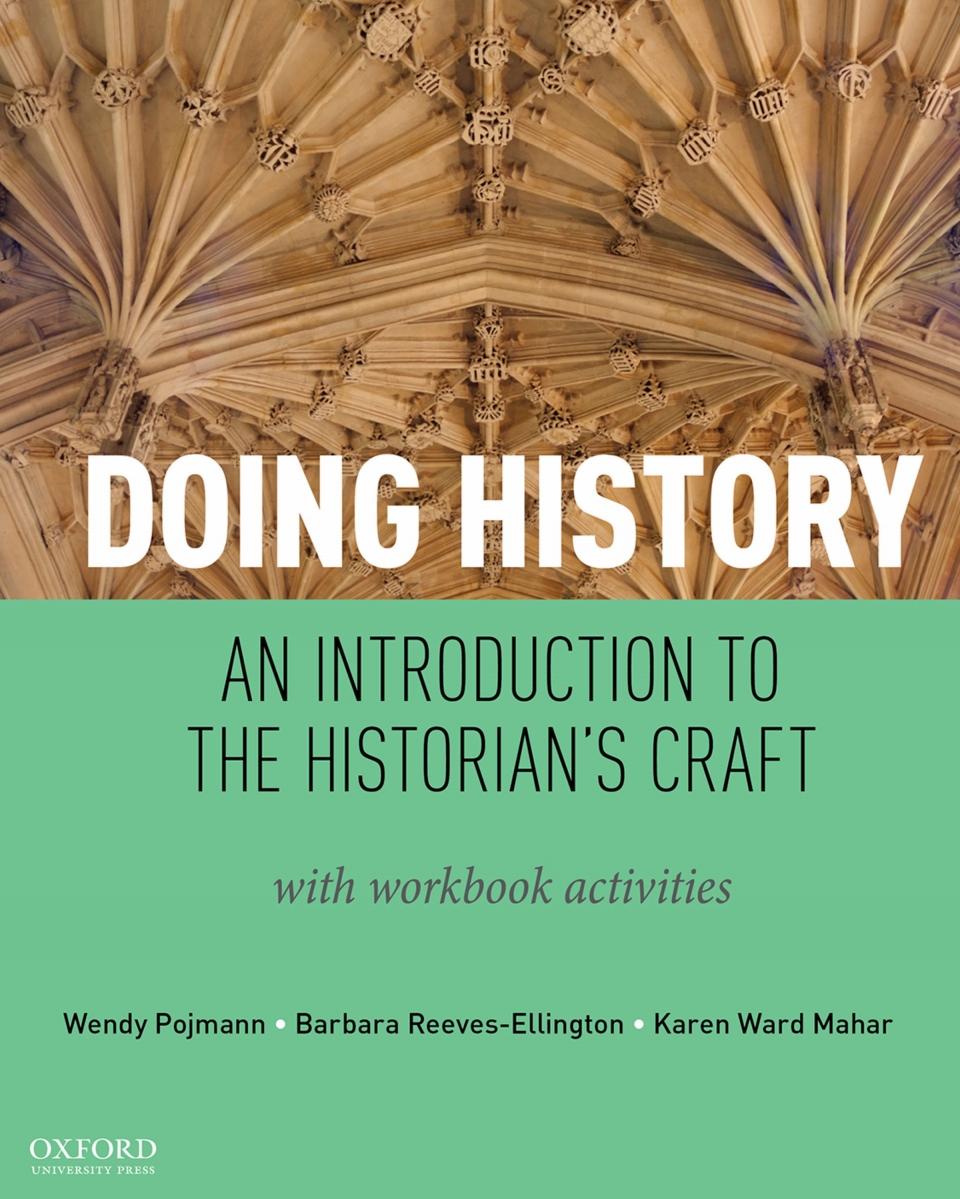
(eBook PDF) Doing History: An Introduction to the Historian's Craft, with Workbook Activities download
https://ebooksecure.com/product/ebook-pdf-doing-history-anintroduction-to-the-historians-craft-with-workbook-activities/
We believe these products will be a great fit for you. Click the link to download now, or visit ebooksecure.com to discover even more!
(eBook PDF) Hergenhahn's An Introduction to the History of Psychology 8th Edition
http://ebooksecure.com/product/ebook-pdf-hergenhahns-anintroduction-to-the-history-of-psychology-8th-edition/
Hergenhahn's An Introduction to the History of Psychology, 8th Edition Tracy Henley - eBook PDF
https://ebooksecure.com/download/hergenhahns-an-introduction-tothe-history-of-psychology-8th-edition-ebook-pdf/
(eBook PDF) Living with Earth: An Introduction to Environmental Geology
http://ebooksecure.com/product/ebook-pdf-living-with-earth-anintroduction-to-environmental-geology/
(eBook PDF) Think with Socrates An Introduction to Critical Thinking
http://ebooksecure.com/product/ebook-pdf-think-with-socrates-anintroduction-to-critical-thinking/
Mathematics for Elementary Teachers with Activities 5th Edition (eBook PDF)
http://ebooksecure.com/product/mathematics-for-elementaryteachers-with-activities-5th-edition-ebook-pdf/
(Original PDF) The History and Theory of Rhetoric: An Introduction 6th Edition
http://ebooksecure.com/product/original-pdf-the-history-andtheory-of-rhetoric-an-introduction-6th-edition/
(eBook PDF) Biostatistics with R An Introduction to Statistics Through Biological Data
http://ebooksecure.com/product/ebook-pdf-biostatistics-with-r-anintroduction-to-statistics-through-biological-data/
(eBook PDF) Digital Design: With an Introduction to the Verilog HDL, VHDL, and System Verilog 6th Edition
http://ebooksecure.com/product/ebook-pdf-digital-design-with-anintroduction-to-the-verilog-hdl-vhdl-and-systemverilog-6thedition/
(eBook PDF) Knowing the Odds An Introduction to Probability
http://ebooksecure.com/product/ebook-pdf-knowing-the-odds-anintroduction-to-probability/
with workbook activities
Wendy Pojmann
Barbara Reeves-Ellington Karen Ward Mahar
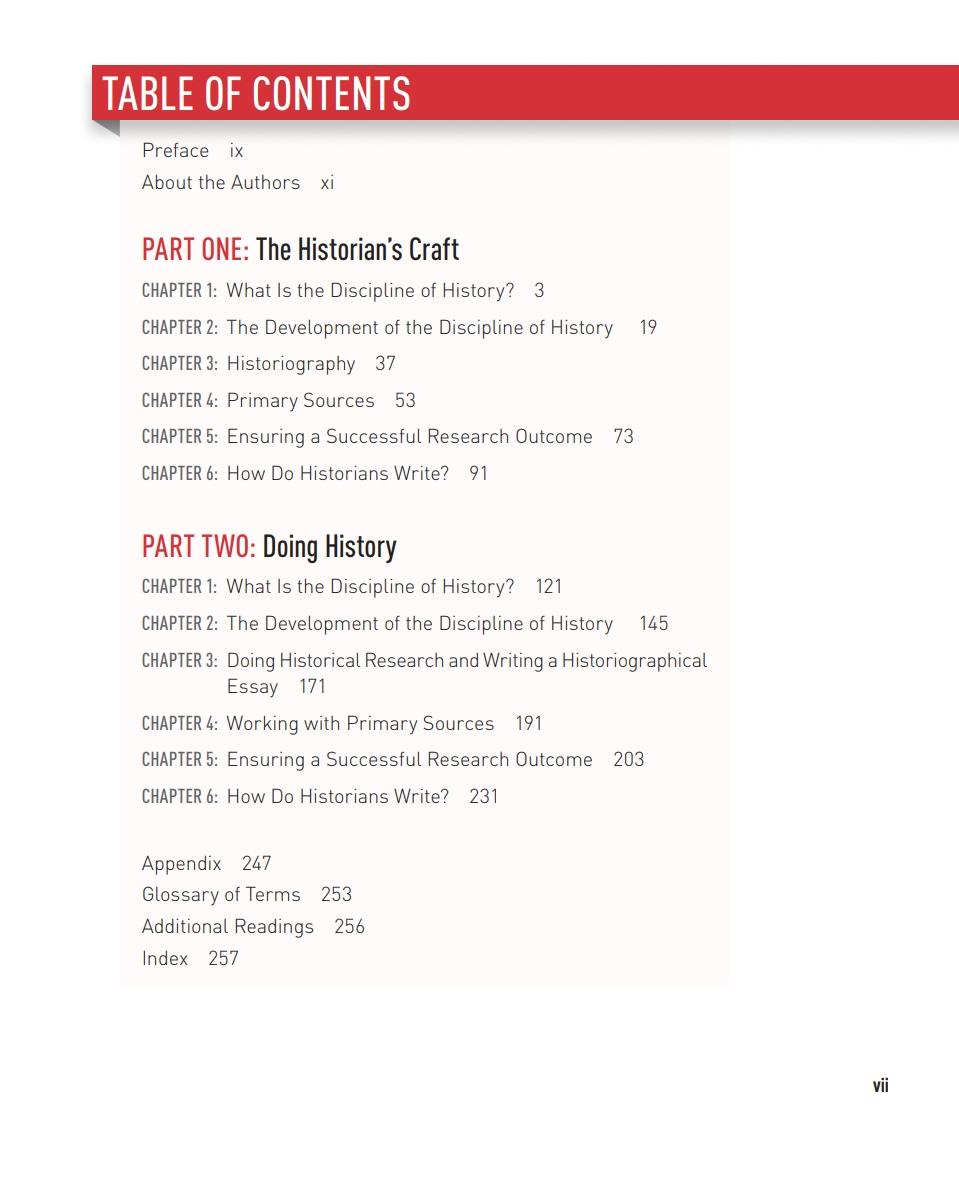
Pre f ace ix
About the A u thors xi
PART ONE: The Histo rian 's Craft
CHAPTER 1: What Is t he Discip li ne of History? 3
CHAPTER 2: T he Deve l opment of the Discipl i ne of H i s t ory 19
CHAPTER 3: Histori ography 37
CHAPTER 4: Primary Sources 53
CHAPTER 5: Ensuring a Success fu l Research Outcome 73
CHAPTER 6: How Do H i stor i ans Write? 91
PART TWO: Doing Hi st or y
CHAPTER 1: What Is t he Discip li ne of History? 121
CHAPTER 2: T he Deve l opment of the Discipl i ne of H i s t ory 145
CHAPTER 3: Doing His t orica l Research and Writing a H i stor i ographical Essay 171
CHAPTER 4: Working with Pr i mary So u rces 191
CHAPTER 5: Ensuring a Success fu l Research Outcome 203
CHAPTER 6: How Do H i stor i ans Write? 23 1
Appendix 247
Glossary of Terms 253
Add i tional Readings 256
Index 257
Our project emer ged when, afte r a series of discussions about texts cur rently in use in methodology and sen ior thesis courses , Cha rles Cavaliere , our percepti ve editor, asked whether \,Vendy Pojmann would be interested i n writi ng the sort of book she woul d want to use in her own cour ses. She immedi ately thought that, yes, she woul d love to have her idea of a s i ngle great r esource at hand to assign to her students, but she a lso recogn i zed that alone she d id not possess the br eadth of experience and knowledge she knew would be necessary to have the book Cha rles and she env isioned take shape. Wendy turned to her colleagues, Ba r bara Reeves-Ellington and Ka r en \'\Tard Maha r, whose pr oven pedagogical creativity and sk ills she was su r e would complement her s and whose own research and wr i ting wer e cur rent and being pr aised by respected peer s. Thankfully, they accepted what we all recognized to be both a challenge and a g r eat opportunity.
This two-part, hands-on methodology and r esearch textbook p r ovides a va l uable resource for students en r olled in cou r ses simi la r to Siena College 's two-semester pr osem i nar/ capstone cour se sequence and other resea r ch-methods courses at the underg r aduate and graduate l evel s. Students i n histo r iography and methodol ogy courses w ill find the text valuable for i ts i ntellectually engaging discussions of the discipline of h istor y, which are enriched by concr ete examples of published schol arsh ip. At the same time, students prepa r ing p ri mary sou r ce-dri ven resea r ch projects will benefit from stra ightforward guidelines to the resea r ch and wr it i ng pr ocess that are supplemented by assessment exe r cises and ski ll-buil ding assignments.
In this text we offer concrete examples of historical approaches and theor ies and have devel oped specific ass ignments to ident i fy students' weaknesses, buil d their skills, and p r ovide detail ed guidelines to help them complete their work with i n the const r a i nts of the academic ter m. We have integ r ated our efforts i nto a si ngle, compr ehensive na r rative wr i tten i n livel y, accessible prose. We use s imple, d ir ect language to help students gr apple with complex ideas and avoid the pitfalls that commonl y ent r ap them as they l earn to th i nk and wri te as h istorians
The text d r aws dir ectly from our exper iences as educators and scholars. It is r ooted in classic teaching techniques that have endu r ed for good reasons as well as i n some of the latest strategies known to be effective with today's under graduates, many of whom are now completing r esearch sem i nars or sen ior capstone courses as part of the r equ i rements of the major and pursuing graduate study. Ou r tri al and err or in the classr oom and subsequent successes and shortcomings i n wor k i ng w ith students have led us to design and r edesign a curr iculum that works well fo r them. We a r e excited to be able to assign this book in ou r cou r ses and confident that students and faculty across history departments and campuses of all sizes and configurations will find it to be a valuable r esour ce.
ACKNOWLEDGMEN TS
We thank the staff at Oxford Un iversity Press, espec ially our enthusiastic and i nt r epid edi tor, Charles Cava l iere , and his efficient assistant, Lynn Luecken. The production staff proved especially deft at shapi ng the layout fo r the workbook
Many rev iewe r s commented on the p r oject at var ious stages and offer ed much wel come pra i se. T hey a l so challenged us to make the tex t as comprehensib l e as poss ible whi le mainta i n i ng i ntellectual r igor. We appreciate all their feedback, both positive and negative, and know the book is better for it. In par t icular, we would l ike to thank W. Brian Newsome, Eli zabethtown College; Connie Shemo, SUNY-Pl attsburgh; Kyle Livie, San Francisco State Universi ty; Scott K. Taylor, Un iver s ity of Kentucky; Lyn A. Bl anchfield, SUNY-Oswego; W i lliam Caraher, Universi ty of North Dakota; Er ic Josef Carlson , Gustavus Adolphus College ; Ber nard Cooperman, Un i versity of Maryland; Adam M. Schor, University of South Caroli na; Sherry J. Katz , San Francisco State Univers ity; and Ch r istina M. Ji menez, University of Color ado-Colorado Spri ngs. Of course, any er ror s and omissions rema i n our own .
At Siena College we benefited from an environment that values great teaching and schola r ship and seeks ways for faculty to model best practices for students. We thank James C. Harrison and Br uce Vv. Eelman fo r having i ntroduced and developed the capstone course for wh ich our text is i ntended and Karl Barbir for his leadersh ip in the p r osem i nar cou r se that p r ecedes it. D iscuss ions i n ou r department Jed to many of the ideas and examples used i n th is text. We particul arly thank T im Cooper III fo r sharing a few of h is most effecti ve assignments w ith us. Our close working relationship with the staff of the Standish Library, especially information liter acy l ibr a r ian Cather i ne Crohan and technology expert Sean Conley, allowed us to explore new ideas fo r helping students conduct resea r ch. Vve greatly value the cont ri butions of two of ou r outstanding students, Nick Moscatiello and Francis Butler, who agreed to allow us to use the ir wor k but also recogn i ze so many others whose str uggles and t ri umphs have shaped ou r approach to teaching.
We extend our sincerest appreci ation to the colleagues , a r ch ivists , l ibrari ans, and students we have had the benefit of working with over the yea r s i n inst i tut ions acr oss the Un i ted States and Eu r ope. Fi nally, we expr ess our g r at i tude to the numerous fr iends and family member s who supported us i n fundamental, human ways .
Dr. Wendy Pojmann is P r ofessor of H istory at Siena College. He r teaching inter ests include world history surveys, upper- level courses in modern Eu r opean and women's histo r y, and the methodology and sen ior thesis cou r ses. Pojmann has spea r headed engagement on capstone learning with the wider academic community (Perspectives in History, Ma r ch 2009; Council of Independent Colleges Conference, March 2011; Amer ican H istorica l Association roundtable on capstone courses, Janua r y 2013 ; Phi A l pha Theta biennial conference panel on the teach i ng of histor iography to undergraduates, January 2014). A lso an act ive schol ar, Pojmann is the author of Italian Wo,nen and International Cold War Politics, 1944-1968 (Fordham Universi ty Press, 2013) and Imtnigrant Women and Fetninistn in Italy ( Ashgate, 2006) She edited A1igration and Activistn in Europe since 1945 ( Palgr ave Macmillan, 2008) and has publ ished in leadi ng history journals , such as the Journal of Wo,nen 's History and Gender & History She is currently working on a book about the h i sto r y of espresso in modern Italy.
Dr. Barbara Reeves-Ellington was unti l recently Associate Professor of History at Siena College. Her teaching i nterests include U.S. fore ign rel ations , i mmigration, and globalization stud ies as well as the global and Amer ican history surveys and sen i o r thesis course. An early advocate of information literacy learning and undergraduate resea r ch at Siena , she joined the scholarly debate on capstone courses with a co-authored a r t icle that appeared i n Perspectives in History in March 2009. ReevesEllington has been a Fulbright schola r (Institute of Bal kan Studies , Sofia, Bulgaria, 1999-2000) and fellow of the Leslie Center Humanities Insti tute, Da r tmouth College (2002) and the Rothe r mer e American Institute, Un iver sity of Oxford (2012-2013). She is the author of Do,nestic Frontiers: Gender, Refortn, and American Interventions in the Otto,nan Balkans and the Near East ( Univer sity of Massachusetts Press, 2013) and co-ed i tor of Cotnpeting Kingdoms: Wo,nen, A1ission, Nation , and the American Protestant Etnpire, 1812-1960 ( Duke Unive r sity P r ess, 20 10). She is cur r ently w r iting a book about Anglo-Amer ican pol itics i n nineteenth-century Istanbul.
Dr Karen Ward Mahar is Professor of Histor y at Siena College and the co-di r ector of the American Studies Prog r am. Her teachi ng i nte r ests i nclude world h istory surveys, U.S history since 1877, and upper-division courses on publ ic history, women's histo r y, gender, culture, business, and the histor y of capi talism in the United States.
As an American Studies professor, Mahar taught the o r igi nal capstone requirement in the School of Liberal Arts at Si ena College. She was also an ea rl y advocate fo r info r mation li teracy and is interested in digital humanities and the rol e of use rgenerated data (SUNY Conve r sations in the Discipline: " Developing Metaliterate Learne r s: Transforming Li teracy across Disciplines ," December 2013). Author of Women Fil1nn1akers in Early Hollywood (Johns Hopkins University P r ess, 2006, cowinne r of the OAH Lerner -Scott Pr ize as a disse r tat ion), Mahar is currently examining the masculinized culture of the American corpor ate elite fo r a book-length p r oject and is act ive i n several schol arly organ i zations as well as l ocal museums and historic sites.
What Is the Discipline of History?
"The best h istory is always i nformed by art," explained the celebr ated histori an C. Vann Woodwa r d (1908- 1999) i n an i nterview with his former student James M. McPherson, now himself a famous histor i an of the Un i ted States.' That histor y is the study of the past that is scientific i n method and artistic in its conclus ions is a common explanation of the d iscipline of history. Some of the most h ighly r ega r ded histor ians of yesterday and today have succeeded in making effecti ve arguments about the past using ample evidence from a vari ety of sources , such as empi r ical data , archival documents, and oral histo ri es, whi le at the same time craft i ng prose w ith the finesse of a l ite r a r y fict ion w r iter Like biologists wor k i ng in a l abor ator y, histor ians offer hypotheses and set out to support them with a collection of facts. They also lead their r eaders to th i nk about big questions they have presented through a creative form, writing , much as a skilled painter would do through br ushstrokes.
Of cour se, h istory is nei ther pu r e science nor pure art. It is, in fact, somet i mes quite d i fficult to neatly l abel and classify. Some college and universi ty adm i n istrators have even debated where histor y should be located with i n the structure of their i nst itutions. Is h istory part of the h uma n i ties? O r is it a so cial sci e n ce? History depa r tments throughout the United States and Engl and can be found in either groupi ng. Some people view h istor y's primary role as fostering an understand i ng about what it means to be human and therefor e t i e it to the human it ies al ong with l iterature , philosophy, art history, classics , and religious studies. Other people, however , focus on h istor ical methodology as ev idence based and thus categori ze histo r y as a socia l sc ience, seeing it as mor e s im i la r to pol i tica l science , sociol ogy, and psychology. Such overlapping classifications underscore the idea that h istory is both an art and a science. How much of each i nfuses its way into the w r iting of history depends very much on the h istorian and his or her own approach to understand i ng the past. Th is chapter addr esses the question of what prec isely h istor y is as a d iscipl i ne and examines ways i n wh ich h istory has been told since the advent of the wr itten word. It also explains diffe r ences between popula r and academic h istor y i n an attempt to set apart the methodol og ies and sk i lls students develop i n college and un iversi ty classrooms.
8 What historical study is not
Fa r too frequently, many people tend to view h istory as a stat ic set of names and dates from the past , as a kind of record that changes l ittle un less someone discovers new p ieces
1. James McPhers on, " Hi stor y: It's Still about Storie s," Tu e Ne w Yo rk T i mes on the \ Ve b, September 19 , 1999 ( http: //www.nyti mes com/ books/99/09/ 19/bookend/ bookend.html/)
of i nformat ion and adds them to the large r p icture. Even i n the minds of many students of history, only a prev iously unknown d i ary of a famous per son, a cache of h idden government documents, or the r estor ation of a damaged arti fact a r e the sorts of i tems that have the power to alter our under stand i ngs of the past. Sometimes this is indeed the case. In Tlie Pope and A1ussolini, for example, David Ker tzer turned to l ittle-studied documents in the Vatican Archives to show the ways in which Italian fascist dictator Benito Mussolini enl isted the support of Pope Pi us XI. Ke r tzer, using sources such as spy r ecor ds, a r gues that contrary to the popular vi ew of the Vatican fight i ng fascism, the two leaders actually closely cooperated for more than a decade unti l Italy's alli ance with Germany tur ned mor e vi rulentl y ant i -Sem it ic. 2 Tangibl e, documented facts, such as the ones Ker tzer consulted i n h is study, a r e i mportant evidence to cons ider when rewr i ting h istory, but r ei nter pretations do not necessa r ily depend on them. Some i ndividuals, i n fact, are not swayed by new d iscover ies at all because they see little purpose to h istorica l study. They argue that so little changes over t i me that i t is useless to study what happened before. Pronouncements such as " th r oughout history peopl e have always" or assertions that rely on notions such as " i t is human natu r e to " a r e i ndications of the kind of pe r spect ive that holds that although numer ous, disparate events may occur, women and men have remained basically unchanged since the beg i nning of time. Accor ding to proponents of th is point of view, human motivations , emotions, and des i res have been constant and cons istent and a r e at the source of all that has happened in the world, even i f the names and details of events have changed. For instance, many people believe that love and ma r riage have r ema i ned l argel y unchanged th r oughout the centur ies despi te ample ev idence to the contrary. H istorian Stephan ie Coontz , fo r example, has successfully demonstrated that the Western notion of int i mate, compan ionate ma r r iage has not always been prevalent but is i nstead a p r oduct of the Victorian age when idea ls of ind ividua l ism contr ibuted to the search for emot ional and sexual satisfaction w ithin the bonds of a lifelong union.3 Still another camp of histori cal naysayer s r ecognizes that h istory does i mply change but questions whether anybody is pay i ng attention. The old cliche that history repeats itself is typically followed by a mention that so few of us not ice when this happens that i t may not be worth looki ng for patterns . What good is it to al ert othe r s to a sim i la r sequence of events taking place now i f no one i ntends to do anything d ifferent ly this time around anyway? Such a r guments are common among people who view warfare as i nev itable.
Of course, each of the perspect ives above fa ils to account fo r dynamism i n h istorica l study and points to the fact that few educated people, even wi th i n the acad e m y itsel f, r eally understand what it is that professional historians do. Unfortunately, the misconception that historians are just storyteller s who keep ali ve knowledge about days long gone persists. Some people believe h istorians are mainly men who have stored hund r eds of facts in thei r heads to r attle off when the oppor tunity p r esents i tself. Popular culture frequently depicts h istory teachers and professor s as monotonous drones who call on
2 · David Kertzer, The Popeaud Mussolini: 11teSecret History of Pius XI and tire Rise ofFascism in Europe (New York: Random House, 2014)
J.. Stephanie Coontz, Marriage, a History: From Obedience to lutimacy or How Love Conquered 1"1arriage (New York: Viking, 2005).
unsuspecting students to recite names and dates i n front of thei r classmates befor e cuei ng up a long, boring documentary fi l m about war time experiences. Sometimes histor y educator s appea r i n television shows and films as the not-so-br ight teacher and coach , insulti ng, of cou r se , to both. After all, i f all that is at stake is memor izing a timeline, any average Joe or Jane can do it, r ight? Even when former students fond l y r emember a history teache r, they do not always have a cor r ect idea of what comprehensive study of the discipline entails. A common fallacy, for example, is that h istorians are ma i n ly preoccupied wi th what might have happened, the "what- i fs?" of history. What would have happened i f the South had won the Civ il War? What if Pres ident Har r y Truman had decided not to use the atomic bomb on Japan? Such questions can generate li vely d iscussions and debates but a r e not really a fundamental part of the academic discipline of h istory. Instead, histori ans are preoccupied with alte r natives in another sense. That is, they often search fo r new or other ev idence and i nter pretations of the past to show that ther e a r e many d i fferences and var iations among people of multipl e t i mes and places. The world was not and does not have to be seen in a singul ar way. As we discuss in deta i l in Chapter Three, h i stori ography, or the h istory of writi ng h istory, allows fo r the poss ibi l ity that the r e are many compelling and ordinary tales to share and eval uate.
Arguably, the ways in which histor y is taught in many high school s, especially when the focus is on pass i ng state mandated exams , perpetuate the sorts of ste r eotypes outlined above. I n college classrooms, too , students generally spend more t ime l earn i ng content than engag i ng i n h istorical wr iti ng themselves, which cont r ibutes to the perpetua tion of the view tha t what is really important to know is what happened, not how or why it d id. Instructors may struggle to incorporate methodology and skills development into the ir cour ses, part icularly when ther e is so much material they would li ke to cove r over the lim ited time they have at their d isposition. However, i n a r igorous course of study, students do beg i n to develop an awareness of h istor ical debate and h istoriography, to i nterpr et the use of p r imar y and seco nda r y source ev iden ce, and to anal yze the applicat ion of theor y to history-all activ it ies professional histo ri ans unde r take themsel ves. By moving beyond a timeline of events that occur r ed in the past, history students come to r ea l ize that the discipli ne is anyth i ng but stat ic . Since the t i me of the Greeks, h istori ans have defined the past through ana lysis, not just storytelling, and have been aware that his tory can be approached from mult iple vantage po i nts. Histori ans have long been concerned with in terpreting , not just r ecounting, the meanings of speci fic events as well as examining big t r ansformations over t i me. The best h istor ians also succeed i n help i ng their contemporar ies to develop a sense of what men and women wer e like i n the past and even to feel empathy for them. After all, without histor ical acto r s, change carries little significance.
DOES HISTORY REPEAT ITSELF? UNDERSTANDING HISTORICAL ANALOGIES
The answer is no . We would like to be clear. H istory does not repeat itself. It s i mply cannot. No two situat i ons can ever be i dent i cal. The h i storical actors invo l ved are di fferent people w i th the i r own exper i ences Ci rcumstances are not the same. Context is made up of so many d i sparate factors that it is j ust not poss i bl e for a l l of them to l i ne up together and
continued on next page
continu e d
allow us to reach the same conclus ions about two d istinct moments. We can, however, look to ana l ogous condit ions to help us recogn i ze s i m i lari t ies between past and present. Ana l og i es s uggest that certa i n t i mes are l i ke others , not that t h ey are the same , and therefore they shou l d offer us the opport u ni ty to reach more nuanced or prec ise cons i d · erations of key factors i n two events. Ana l og i es also offer hi stor ians moments for underscoring the i mportance of hi story i n u nderstand i ng how we got to where we are now . Caut i on shou l d be taken even here, however. How many of us have seen i mages depict · ing the hated German d ictator Adolf Hi tler on one s ide and any recent U.S. president on the other? Th i s is an examp l e of a terrib l e analogy . No matter how much someone may desp i se George W. B ush or B arack Obama , to compare either of them to a man respon · s i ble for the mass execut i ons of more than 6 m il l i on J ews and 6 m il l i on others labeled as undesirab l es i s s i mply reckless. In contrast , to use know l edge abo u t the horrors of the Ho l ocaust and app l y i t to the study of other genocides in the hopes of prevent i ng new ones from occ u rr i ng can be an effect i ve use of h istory. Unfortunately , th is has not been the case, as the genoc i des i n Rwanda , the Sudan , and the former Yugoslav ia show us . Dur i ng the 2008 econom i c cris i s that h i t the Uni ted States , economic h istor i ans turned to the Great Depress i on for poss i bl e insights and so l ut i ons bu t ma i nly just came to rea l · ize that the per i ods were so di st i nct that on l y a few ideas , such as pub l i c works projects , seemed re l evant. J ames J Sheehan , past pres ident of the Amer ican Hi stor ical Assoc i at i on , has descri bed inacc u rac i es h istor i cal commentators made when compar i ng the American occupations of Germany in 1945 and Iraq in 2003 , not i ng that pri mary source ev i dence ind i cates that the Germans u nl i ke the Iraqis. were not opposed to the Amer ican presence. Sheehan wr i tes , "Without [the proper tools) what we extract from hi story will not be gra i ns of w i sdom but the fool's gold all too often offered as prec i ous lessons from the past. What we l earn from h i story depends ent i rely on how we do i t."' Students of h is · tory should stri ve to do i t w i th care.
N OTE
' James J Sheehan "How Do We Lear n f rom Hi sto r y?" Perspectives on History January 20 05. http:// www. h ,storia ns org/p ubli ca t , o ns -an d- di r ec tories/pe r s pectives - on - h isto r y/ja nu a r y- 20 05/h ow - dowe - t ea r n- from - h istory/. ,,
8 History and context
Perceptions of the ways i n wh ich his tory shifts are key to establish i ng what histor y is and how it should be stud ied, assuming it should be stud ied at all. The not ion that histor y is linear is relatively modern; anc ient peopl es saw t i me as cycli ca l. More than two thousand years ago , the Maya cr eated ca lendars based on the cycles of the moon, stars, and planets. The Maya held that some of these cycles began and ended wh i le others cont i nued and they established a sense of order i n a context of instabili ty. By the time of the scientific revolu tion of the seventeenth century, however, co ncepts of t i me had drama t ically changed. Modern men and women conceived of t i me as a li ne advanci ng i nto the future. In other wor ds, people today ten d to see h istory as moving forward in time,
wher eas the peopl e of early premodern societies d id not believe there was a d i rection to h istor y or held that h istorical moments r ecurr ed. A linear appr oach to h istory developed within the Judea-Christian tradition that accounted for a beg i nning and an end to histor y, ma r ked by God's creati on of the un i verse at the start and concluding with the appearance of the Messiah o r the return of Chr ist. Modern histori cal study, and in pa r ticul ar the creati on of a category of professional h istorians , can be said to date to the work of Leopold von Ranke , a German Ro m a n ticist of the nineteenth centu r y who developed the concept of historicism. Accord i ng to von Ranke, histori cism holds that the past and the p r esent are d ist inct. Vve must have some r ecogn it i on of the autonomy of history to be able to understand the p r esent and not see it as a conti nuous pr ocess. In other words , the past is diffe r ent from the present. It is not made up of the same values, emot ions, or actio ns. Peopl e have not always behaved as they do now. Ther efore , we should not make the assumption that humans have always behaved in the same ways because they a r e human. Instead , the past requires a con t ext. We need to know someth i ng about the l arger picture to understand how people react to s ituat ions. Von Ranke suggested applying the scient i fic method to histor ical study. Using empir ical ev idence , such as r ecorded data, as well as primary source mate ri als , historians could form a clea r er idea of why and how events unfolded. Histo r icism treats histor y as a process in which there is cause and effect. There is always a reason beh i nd human responses; things do not just " happen." It is the h istorian's task to discover and share what those reasons are. H istor icism lends itsel f to narrative history ; the recount i ng of the past emerges as a story with a beginn ing, a middle, and an end. History in th is sense follows a timeline of events in which facts take center stage and a sort of t r uth of h istory told from an object ive standpoi nt unfolds The histori an's role in this case is to decide wher e the beginn i ng, m iddle, and end are s ituated , which facts are worth emphas izi ng, and whose vantage po i nt is the objective one. The Oxford H istor y of the United States , fo r example, is a series especi ally known for its compr ehens ive na r ratives of count r ies and periods and i ts abi lity to reach br oader audiences than more analytica l texts. As r enowned h istorian and ser ies ed itor C. Vann Woodward explained in an interview, "'Na r rati ve histo r y is the end product of what h istorians do. The nar r at ive is wher e they put i t togethe r and make sense of it for the reader Other types of h istory-analyt ical , quantitative, comparative h istory-as important as they are , a r e mainly fo r othe r h istor ians."' \.Yoodwa r d advocated wr iti ng fo r general r eaders who appreciated strong storytell i ng.
Metahistorians wor k wi thin the framework of histor icism but search for an underlying mean i ng to h istory that can be uncovered by seeking to unde r stand its mechan isms, an ordered set of patterns that can be stud ied for ce r ta i n regular it ies. By exam i n ing h istory through a p r ima r y motor of change, such as economics or demographics, metah istor i ans look to offer a sc ient i fic measur e of human p r og r ess. For example, i n his award-winning text Pathfinders, Felipe Fernandez-Armesto bases the histor y of global exploration on the ideas of human cultural dive r gence and convergence to show that trave r s i ng the gl obe is a dist i nct l y human phenomenon. 6 Metahistor i ans such as
5 · McPherso n, '' Hi story: It's Still about Stories."
Felipe Fernandez-Armesto, Pathfi 11ders: A Global Hi sto ry of Explo ra tio11 (New York: Norton , 200 7)
Alfred Crosby and \.Yi ll iam McNe i ll have successfully demonstr ated that approach i ng big h istor ical questions through nar r owe r lenses can open up c r isp and exci ting i nterpretat ions of the past. Both Crosby and McNeill demonstrated that pathogens, as well as people and goods , t r aveled the world. By examining the impact of some of the liv ing o r gan isms (i ncluding an i mals, pl ants, and d iseases) that crossed the Atlantic duri ng the late fifteenth century, Crosby's 1972 The Columbian Exchange became one of the founding works of environmental history. McNeill's 1976 Plagues and Peoples intr oduced readers to the l ong-ter m g l obal impact of d isease on politica l , economic, and cultural development. '
Of course, not all histo ri ans have followed Ranke 's cha r acter ization of historical study. Postrnodernists, such as M ichel Foucault and Jacques Derrida, for example, whom we will discuss at length in the next chapter, r eject the notion of a scientific or objective t r uth of histor y. They hold that histor y is constr ucted, espec ially through language, and argue for a d iscursive study of the past that considers power/knowledge systems as a dr iv i ng fo r ce behind h istorical change. Followers of the Annales School , too, rejected Ranke's historicism in favor of a problem-based approach to historical inqui ry that attempted to be both mor e empi r i cal and total. A l though the Annales histor ians, most famously the school's founder , Fr ench h istor ian Fe r nand Braudel (1902- 1985), were overwhelm ingl y scientific in thei r methodolog ies, some soc ial scientists i n discipl ines such as anthropology and sociology have seen little relevance fo r the study of h istory at a l l. They argue that cultural differences , kinsh ip structures, l inguist ic tradi t ions, and other facto r s may have more bearing in understand ing differences among peoples than do actual h istor ical events. In her classic Coming of Age in Sa,noa, for example, anthropologist Ma r garet Mead ( 1901- 1978) focused on how cultural r ather than temporal differences shape adol escence. Mead found that Samoan girls made a smoother t r ans it ion to adulthood than their Amer ican counterparts because Samoans p r ioritized discussions of matters such as sexual ity and death. 8 Working from diffe r ent methodol og ies than historians, soc ial scientists may also apply theor y to concept ions of society w i thout accounting for particulari t ies or la r ge r p r ocesses. Moreove r, many individua ls simply bel ieve that inst i ncts and emot ions drive human actions and argue that they have changed l ittle over t i me. If love, hate , greed, des ir e, and compassion have consistently infor med human inter actions, what is to be ga i ned by knowi ng the la r ger context? H istori cal anachronisms frequently resul t from this line of th inking, however . We cannot simply appl y elements from one per iod to another w i thout creating large inaccurac ies. For instance, h istor ians , such as Ph i l ippe A r ies, have shown that the idea of a distinct and protected per iod l abeled childhood emer ged i n Weste r n Europe in the seventeenth century.9 To accuse medieval Frenchmen of abusing the i r chi l dren by not sending them to school or l etting them play would be e r roneous because i t would mean placing modern va l ues on people who lived befor e the va l ues took shape. It is also p r oblematic to suggest
' · A l fred \V. Crosby, T/Je Colum bian Exchange: Biological and Cultural Conseque11ces of 1492 (\Vest port, C T: Greenwood, 1972); \Villiam H. McNeill, Plagues a11d Peoples (Garden Ci t y, NY: Anchor Press, 1976).
'· Margaret Mead, Coming ofAge in Samoa: A Psychological Study of Primitive Youth for \,Vesfern Civilizatio11 (New York: Morrow, 1928)
'· Philippe Aries, Centuries of Child/Jood: A Social History of Family Life (New York: A l fred A. Knopf, 1962).
that ind ividuals i n the past were "ahead of their time" since do ing so ignores the h istorica l context that produced them.
Another form of ahistor i c is m pr ac t iced i n the academy, even by some histori ans, comes from presentists. These i ndi viduals mainta i n tha t history is fixed and stable but that our ideas about i t change based on what is going on now. They assess p r ogress and decl i ne in the past based on how th i ngs have turned out in the p r esent. A couple of big problems resul t from eva l uati ng h istory from an exclus ively contemporary vantage poi nt. First, presen tism can lead to nostalgia, or to a decrying of loss of the good old days when everyth ing was better. Common myths dissem i nated by nosta lgists are that life was simpler and easier, that roles were better defined and unde r stood, and that people knew thei r "pl ace" in the world. Such beliefs tend to be used for pol itical purposes, especially to glor ify a past in which women, Afr ican Amer icans, or less desi rable "other s" had little voice or to uphold the trad it ional values of a g r oup that fee l s th r eatened by perceived change. Second, presentism may lead to apathy. If l ife is challeng i ng today, it means it can only get better from here. Why bother to try to do anything about it when you can j ust wait and see what happens? The advantages of evaluati ng histor y on its own te r ms should not be lost behind contempor a r y preoccupations. To discount the r ichness of the past and see onl y thousands of years of sameness is to Jose the abil i ty to compr ehend how we got to wher e we are now.
WHAT IF ? THE PURPOSES AND PITFALLS OF COUNTERFACTUAL QUESTIONS
In his Pulitzer prize- winn i ng book Embers of War: The Fall of an Empire and the Making of America s Vietnam (2013). Fredr i k Logevall offers some illum i nating examp l es of how promi nent h i storians engage i n counterfactuals. His in tent i on is to demonstrate that noth i ng in history is preordained. The Vietnam War was not inev i tab le. L ogevall reminds us that , for actors who had responsibility for mak i ng decis ions in the past the future was merely a set of possib i lit i es:·• 0 In th is viv id account of Vietnamese attempts to gain the ir i ndependence f rom France through d ip l omacy and war, French efforts to sa lvage the i r empire. and i ncreasing U.S. engagement in southeast Asia in the early years of the Co l d War. Logevall shows how key players wrestled w i th those possib i lities and how they succeeded , or failed , to imag ine alternat ive outcomes. They always had cho ices but the choices were always constra ined by context.
L ogevall shows us that counterfactuals serve a val i d purpose when they are used by players in the past to he l p make decisions. In early 1947. for example , Viet Minh l eader Ho Chi Mi nh encountered the poss i bi l ity that the French might succeed i n entic ing away elements of the Vi etnamese popu lati on that, until then. had supported him What if French d i pl omats made a deal with a rival l eader who cou l d undermine his pos i tion? Logevall tells us that this k i nd of quest i on was not mere l y an enterta i n ing counterfactual; on the contrary , i t was .. much discussed in the Viet Minh inner councils and among i nformed analysts elsewhere:·11 French military off i cers also envisaged dif fe rent outcomes as they pl anned battle strategy. In the autumn of 1946 , as the French prepared to strike Viet Mi nh positions in the north of Vietnam General Jean Et i enne Valluy was determined to hold the key port city of Ha i phong but nevertheless fe ared its possible l oss: But what if Hai phong cou l d not be
continued on next page
continu e d
held?'" 12 In 1952. as French polit i ci ans became increasingly concerned about the cost of wag i ng war i n Vietnam in terms of l ives and finances. they a l so debated the w isdom of re · ly i ng on materi al aid from the United States , fear i ng that Amer ican pol i t i c ians sought to rep l ace France as a co l on i al power i n southeast As i a. What i f U.S. advisors became ··100 meddlesome·· and the U S. adm i ni stration tr ied to "tie str i ngs to i ts ai d'"?' 3 What would the French do? And how would the Un i ted States respond? These were rea l quest ions that real people had to contend w i th Ev idence from the i r de l i berations helps us understand the complex i ties they faced as they i mag i ned different outcomes. L ogevall enters quite different territory when he asks whether th i ngs might have turned out di fferently had people made di fferent decisi ons. What i f Vi et Mi nh Genera l Vo Nguyen Giap had not delayed h i s attack on French posi t ions at Dien B i en Phu from Janu · ary 25 , 1954, to March 13 of that year? " What i f French Genera l Henr i Navarre had not chosen to make a stand at Di en Bien Phu? 15 Logevall engages i n a seri es of arguments and counterarguments. He nonetheless acknowledges that we can never know how the batt l e might have deve l oped had Gi ap and Navarre acted d i fferently. Giap did not attack in January. Navarre did make a stand at Dien B i en Phu. The Viet Mi nh di d w i n the war The French d i d l ose Vi etnam. Logeva l l also ra i ses what ifs on the U.S side but likewise re j ects the counterfactuals. What i f Pres i dent Frankl i n Delano Roosevelt had lived be · yond 1945? Logevall argues that it is ··not fanc i ful"' to be l i eve that Roosevelt m ight have changed history by persuading the French to relinquish the i r colony: but. he counters , "Roosevelt di ed:· 1• Future Ameri can adm i n i strat ions m i ght have dec i ded aga i nst engage · ment i n Vi etnam Success ive pres i dents and secretar ies of state debated the opt i ons , and they chose to i ntervene. Logeva l l teaches us that we must not a l low the distort i ng influences of hi nds ight to di stract us from the ev idence. What we can imag ine is merely conjecture.
N OTES
" Fr edrik L ogeva ll Embers of War: The Fall of an Emp i re and the Making of Ameri ca's Vietnam [N ew York : Random Ho use. 20 13). xvii.
11. I b id., xviii.
12 I bid 155
13 I bid 3 12.
14 Ib id L.2L. - 25, 4L.5.
15 I bid 5L.3.
" I bid 710.
Defining history
So what is h istor y? We asser ted that it is part art and part science. We challenged the notion that it is a mere recounting of facts. We questioned historical under stand ings based solely on p r esent-day cons iderations. But, as professional histor ians we want to beg in to define the discipline. We would like to suggest that h istory is a fo r m of collecti ve me m ory that is key i n the fo r mation of identity. Identity, of course, encompasses many
groups of peopl e. One of the challenges h istor ians face is to decide who is " i n" or "out " of a particula r group at a particul a r moment and how gr oup identi ties change over time Shifts in identity often revea l major h istor ical trends , in fact. Historians wri ting about t r aditi onally underrepresented groups , for example, such as Afr ican Americans or women , have noted that definitions of who exactly is " black" or what makes someone a "woman" have not been consistent. Legal decisions, socia l customs, and consider ations of class, among other vari ables , have affected percept ions of blackness and womanliness in speci fic contexts. Nationali ty, a centr al ma r ker of collective memory and identity, must also be under stood in historical terms. Groups that define themselves based on a nati onal identi ty and then make cla i ms to actua l statehood a r e at the center of countless h istori cal developments. The breakup of the Austro-Hungari an Empire at the conclusion of\.Yorld War I, for example, allowed fo r the later cr eation of i ndependent states such as Czechoslovakia and Hungary. Nationa l ity can be tied to trad it ions, to ethnicity, to what l anguage people speak, which relig ion they pract ice, and what they eat for d inner. Many Japanese, for example, cla i m that eating Japanese food and speaking the Japanese l anguage is what makes them Japanese and contr ibutes to national un ity. In Italy, the pr evalence of regiona l dialects and food traditions, pasta versus polenta, fo r instance , hinder ed the un ification of that country in the late nineteenth century. Part of having a h istory as a people is the r efor e based on writi ng and d issem i nating it or, as in the case of many Native Amer ican tribes, passi ng i t along through oral t r adition. For example, schola r Peter Nabokov has wri tten about the importance of the sel f-transmiss ion and i nterpretat ion of history to Nat ive American t r ibes i n the i r identi ty formation and surv i val. 17 His careful study rem inds us that profess ional historians must take care not to flatten ident it ies and assess how they constr uct or r epresent h istor ica l gr oups and fo r what purpose. They must also keep in m ind the importance of collective identity. After all, h istory is not the stor y of one ind ividual but that of many i ndividuals. Biographers , too, must consider relationships and context when telli ng the story of a particula r person, since they cannot rely solely on the memories of the subject at hand.
The concept of social memory is intr i nsically linked to identity fo r mat ion and thus to the definition of h istory. Memor y is based on the reflection of exper iences that have alr eady occur r ed. It means having a r ecollection of the past. An awareness of the past is not the same thing as the devel opment of socia l memory, however On one hand, part icipants in the same event may not remember it in the same way. In the famous 1950 Japanese fi lm Rasho,non, for example , four eyewitnesses to the murder of a samurai and the r ape of h is wife recount the event in dramatically different ways . The stor y of one person can add an impor tant dimension to a histor ical account, but it is generally not sufficient fo r a professiona l histo r ian to base an entire a r gument on that singular tale. We would not expect a peasant , an u r ban worke r, and an a ri stocr at to have the same exper ience of the French Revolution. Collecti ve memory, as told th r ough mult iple fi r sthand accounts , is thus much mor e reliable. On the other hand, histor ical actors may instead seek to use an event to gene r ate knowledge about shared exper iences and construct an identi ty. In this case , collective memor y is diffe r ent from h istory because
11 • Peter N abokov, A Forest of T i m e: Ame rican ludian Way s of His tory ( New Yo rk: Cambridge Un iversit y Press. 2002)
indiv iduals use it for the i r own pur poses, especi ally by select i ng certa in moments to recount wh ile intent ionally ignor i ng others. For i nstance, u l t r anat ionalist histor ies, such as Nazi leader Albe r t Speer 's Inside the Third Reich, use h istor ica l " facts" to r ecount fa lse glories and distort real ity.'a Recalling the past requires that the his tor ian pay attent ion to accuracy and to matters that are not necessar i ly those wi th which we are pr eoccupied i n the present. Social memory that prima r il y ser ves particular poli tica l , social, or cultu r al needs should be discarded i n favor of greater accuracy. Cl early, even when we are wor k i ng from a la r gely unb iased perspect ive, we know that memories can be mislead i ng or incomplete and they wi ll always be fi l tered by a cur r ent vantage point. The histor ian 's task is to see the la r ger picture and attempt to r each an honest conclusion about it based on available evidence.
8 When and where
One of t he g r eatest values of h isto r y as a d iscipline is i ts abi l ity to so r t and catego r ize small and la r ge blocks of time to establish periods , wh ich is a useful tool for characterizing common elements and under standing change H istor ians have established a vocabula r y for discussing particul ar eras . If we use the ter m Rena issance , for example, we understand it to encompass the yea r s between roughly the fou r teenth and seventeenth centur ies , depend i ng on the region of Eu r ope. Amer ican his tory is common l y divided at the C ivi l War, with the terms antebellum and postbellum used to distingu ish the decades before and afte r the Civ il War itself (1861-1865). New histor iog r aph ical inter pretat ions have also led to modi fications of ter minology. Referr ing to the M iddle Ages as the Dark Ages is no longer accepted p r actice si nce the idea of da r kness suggests that no learning or progr ess took place. Instead, medieval ists now make d ist inct ions among the Early, H igh, and Later M iddle Ages to more accurately define periods. Da t ing convent ions have a lso changed. Archaeol ogists and histor ians have moved away from the use of BC, "befor e Chr ist," and AD , "anno Dornini," meaning in the year of our Lord , in favor of BCE and CE , "befor e the common er a" and "common era ," in recognition of the nonuniversalism of Ch r is t ianity.
So exactly when and where has history occurr ed? Al though the response to such a question m ight seem fac ile or obvious, histor ians do not universally agree on wh ich er as and pl aces make su i tabl e subjects for histor ical study. At the edges of what is conside r ed histor y are the ver y distant and the very recent past. Most histor ians look to ancient Mesopotamia as the bir thplace of ci vilization. On the banks of the T igris and Euph r ates r i vers, i n moder n-day I r aq, the hero Gi lgamesh ruled his ki ngdom , a stable agricultural society that developed writing. Of course, civili zat ion is a loaded t erm. It i mpl ies that nonnomad ic peoples who kept wr itten records were more advanced than thei r mo r e mobile counterpa r ts who practiced oral trad it ions for the passing on of i nformat ion about thei r communities. Never theless, many Weste r n o r world civil iza t ion instructors choose Mesopotamia as the ir starti ng point. They perhaps make a nod to earl ier g r oupings of humans and the role of cave pa intings in unde r standing how they l ived as well.
" · A lb er t Speer, lll sid e t h e Third Reich: Me moirs ( Bronx, NY: Jshi Pres s Internat ion a l , 2009)
Another Random Scribd Document with Unrelated Content
buckler; but Ormiston and Coldinghame wore only pyne doublets, or undercoats of defence quilted with wire, and so called from having been first worn by pions, or foot-soldiers. They were all disguised by black velvet masks and dark mantles, under which they carried their swords and daggers.
"How goeth the night, Marquis?" asked Bothwell, as they stumbled along the dark street, breaking their shins against the outside stairs that then in hundreds encumbered the way.
"By St. Denis!" lisped the French noble in his broken dialect; "I know not, for I never was rich enough to buy me a horologue."
"How! is thine appanage of Elboeuff in the Rumois so poor?"
"'Tis past midnight," said Coldinghame; "I heard St. Giles toll twelve."
"A bonny hour and a merry for thee to be abroad, Lord Prior, when thou oughtest be saving thy nocturnal," said Bothwell.
"True; but belonging, as I do, to the Reformed kirk, I own no monastic law; no! by the most immaculate Jupiter!" bawled the lay prior as he swaggered along; "'Tis very long since I abjured the follies of the Church of Rome."
"She lost much by thy defection," said Bothwell, scornfully; "but devil take me, Prior, if thou art not very drunk."
"By the body o' Bacchus, thou art no better than a horned owl to say so! But keep your rapiers ready, sirs; for yonder is a tall fellow who seems disposed to bar the way."
"Where? ventrebleu!" exclaimed d'Elboeuff, drawing his sword.
"Where?—where?" asked the others.
"Why, right on the crown of the causeway; and, fore Heaven! he dothseem a marvellously tall fellow."
"By cock and pie! 'tis the city cross, thou blind bat!"
"Right, Ormiston!" replied Bothwell; "but his reverence is so drunk that he knows not a cross from a cow. Past midnight? soh! a famous hour for such regular men as we to be strolling along the streets, like knights of the post; and thou, bully Hob, art without thine armour."
"I have a pyne doublet that would turn the bolt of an arblast double quilted."
"The streets are dull, and I am very sleepy," stammered Coldinghame.
"Speak not of sleep, my Lord Privy Seal," said the Earl; "for we have a notable brawl to make yet. We must show these rascally bailies that their night-watch and captains of the thirty wards had no reference to us, who are lords and barons of Parliament."
"Thou hast ever some wicked thought in thy gomeral's costard. A brawl! with whom, pray?"
"With thee, Lord Prior, if thou talkest thus!" rejoined Bothwell, adjusting his mantle, angrily.
"Vrai Dieu! chevaliers," said the Frenchman; "after so happy a night, don't quarrel, I pray you."
"I would give a score of bright bonnet-pieces to meet a few of Moray's or Morton's swashbucklers coming down the street just now! I am in the right mood for a fray," said Black Hob. "Suppose we ring the Tron bell, and shout fire, sack, and the English!"
"Or break into the house of some rascally bourgeoise, and carry off his pretty wife," said the Marquis d'Elboeuff. "Oh, ventrebleu!de Brissac, de Vendome, and I, have played that prank many a night
among the Hugonets in the Rue de Marmousets, and the dear rogues in the Rue de Glatigy"——
"At Paris, thou meanest," said Bothwell; "but our woodenheaded burghers set a value upon their conjugal ware different from your countrymen. The price French, is by francs and livres; the price Scottish, blows and steel blades. One might as well venture into a wasps' nest."
"Nom d'un Pape! Bothwell is growing tame," retorted the Marquis. "I knew that being once regularly wedded would spoil him."
"Once!" laughed Ormiston. "I warrant him"——
"Peace, gomeral!" thundered the Earl, placing his gauntleted hand on Hob's mouth. "What wert thou about to say, i' the devil's name?"
"Only that I would wish to show some of these fanatical Protestants that, being doubly damned, they have no right to keep their wives and daughters, or handmaidens, all to themselves."
"Tete Dieu!" cried d'Elboeuff, brandishing his rapier; "ah, the selfish Hugonets!—we must teach them the new law. Who will follow me? for Bothwell seemeth white-livered."
"Dost thou gibe me, Marquis? God wot! I should like to see thee ettle at aught that I will not surpass."
"Then here is a house. Draw, chevaliers!—vive la joie! let us beat up the door, knock down the bourgeoise, and carry off the first pretty woman to my hotel in the Cowgate!"
Lord Coldinghame grasped his cloak, saying—
"Beelzebub! Marquis, art thou mad? 'Tis the house of Master John Knox."
"A million of thunders!" grumbled the Frenchman, falling back abashed on hearing that formidable name; "we should have the whole city about our ears. But come—allons! I will show ye a place better suited for such merry rogues as we than the house of that arch-heretic. There is Madame Alisong Cragg—a notable lady of joy!"
"Bravo, Marquis! thou art right!" exclaimed Bothwell; "my rascal, French Paris, tells me there is a famous foreign beauty concealed there—brought, 'tis said, by Morton or Arran. And dost thou know that the ambassador of Duke Philibert of Savoy what is his name?"
"The Count di Mezezzo."
"Ah! the same—saw her yesterday as he rode past, and hath raved about her ever since."
"Monsieur l'Ambassadeur has the eyes of Argus for a pretty woman; so allons,messieurs!" said the gay Frenchman, and they all staggered arm-in-arm down the wynd.
"Hark! listen!" said Bothwell.
They halted under the windows of Dame Craig's dwelling; some of these were partly open, and emitted into the misty street the odour of a close room and a luxurious supper—the fumes of wine and a night debauch. Through the thick gratings that defended them, flakes of light streamed into the dark and gloomy wynd, while a clear and manly voice was heard to sing one of those blasphemous ballads which were so obnoxious to Queen Mary—
"Ane cursed foxhath lain in the rocks, Hidden this many a day, Devouring sheep; but a huntershall scare This cursed fox away.
"The hunter is Christ, that spurs in haste, His hounds are St. Peter and Paul; The Pope is the fox, and Romeis the rocks, That rub us to the gall.
"Poor Pope! had to sell the Tantony bell, And pardons for ilka thing; Remission of sins in old sheep skins, Our souls from hell to bring.
"With bulls of lead, white wax and red, And other whiles of green; This cursed fox, enclosed in a box, Such devilry never was seen."
On hearing this doggerel ballad,[*] Bothwell and his friends drew their swords in deliberate anger, intent, less on a brawl, than on punishing the singer; for this ditty was one of those which, by the efforts of the more zealous clergy, had been set to the ancient music of the Catholic church, and were usually sung by the lowest rabble, "to ferment that wild spirit of fanaticism, which in the following age involved the nation in blood, and overturned the state of three kingdoms."
[*] For which see Andre Hart's Godly Ballade Buik. NOTE by the Magister Absalom.
Neither Bothwell nor d'Elboeuff were very rigid Catholics, yet they burned to punish this irreligious ribaldry, coming as it did from a place which, in their younger days, had been appropriated to purposes so very different. Black Ormiston and John of Coldinghame cared not a bodle about the matter; but, nevertheless, they muffled their mantles about their left arms, adjusted their masks, and assailed the house with drawn swords.
CHAPTER XIV. THE GLEEWOMEN.
Fiorello.—Hallo! house here! Hey, good people! Hallo! house here! Faith, you sleep ill!
Bartolo. Who can this be? Ugly fellow! Drunken rascal! thus to bellow!
TheBarberofSeville.
Furiously they knocked, and immediately the lights were extinguished, the singing ceased, and the windows were closed. Again and again they thundered on the planking of the nail-studded door, till the solid walls of the house were shaken, but there was no attention paid.
"Ho, within there!" cried Bothwell; "Alison, devil take thee, art thou deaf or drunk?"
"Ventre St. Gris!" grumbled the Marquis, skipping aside, as a stoup of water was poured from the upper story upon his laced mantle. "I will spit them all like larks. Tonnere!but I will."
"Hallo! 'ware your costards, sirs!" exclaimed Ormiston, as a large billet of wood came down next. "Cock and pie! the garrison shew mettle."
"Who are without there?" asked a man, through one of those reconnoitring holes with which all the doors in the city were then provided; but they could perceive the voice to be a feigned one. "What ribald cullions are ye?"
"The godly Earl of Arran, and his friend Master John Knox!" replied Bothwell, in a snuffling voice, amid a shout of laughter.
"Lewd varlet, thou liest! for the Lord Arran is here a-bed."
"Oho! then, tell him there are four tall fellows here, each of whom is better than he; so bid him take sword and cloak and come forth, lest we burn the house and Dame Alison to boot, for we have vowed a vow to make entrance."
"Help! help! Axes and staves! Armour! armour! Fie!" screamed the shrill voices of Alison Craig and several of her gleewomen and companions from the upper windows. "Thieves! stouthrief! and hamesucken! Help! help!"
"Sacré bleu! what a devil of a noise thou makest, Madame Alisong!" cried d'Elboeuff. "Mabellecoquette—machèremadame."
While Bothwell and Coldinghame were endeavouring to burst open the door (using as much energy as if the whole salvation of men depended upon their success), it was suddenly opened; a strong glare of light flashed into the gloomy wynd, and a tall cavalier, masked and muffled in a mantle of scarlet velvet, and
wealing a very broad beaver flapped down over his eyes, appeared in the passage, armed with a long glittering sword and bowl-hilted dagger for parrying. He burst out, and commenced hewing right and left; but, finding his escape barred in every direction, he fell on desperately, bending all his energies to slay Bothwell, who encountered him hand to hand.
Daringly they fought for some twenty passes, the fire flashing from their swords, when the stranger suddenly broke away and escaped, leaving behind his rich mantle, of which the Earl immediately possessed himself.
"Scarlet taffeta—lined with white satin—laeed with gold, too! Now, whose ware may this be?"
"The King's!" said Ormiston and others.
"Darnley's—now, by Heaven!—"
"Send it to her Majesty," said Hob, "with Madame Craig's leal service."
"Nay, by St. Bothan! I will wear it under King Henry's nose at Court to-morrow," replied the madcap noble, as they all burst into the house with their drawn swords, and made a tremendous uproar by rushing from room to room, up the narrow wooden stairs, and through the pannelled corridors, pursuing the shrieking glee-girls with oaths and boisterous laughter. In one apartment they found the remains of the feast, and several flasks of good wine, which they immediately confiscated for their own use, and then made more noise than ever.
Alison Craig was dragged from her hiding-place in an oak almrie by the reformed Prior of Coldinghame, who placed his rapier at her
throat, and threatened instant death if she did not produce the fair Ribaude, whom the Lord Morton had committed to her charge.
"Aroint thee, dame!" said Bothwell. "We will have thee ducked on the cuckstule as a scold, and pilloried for dancing round the summer-pole, which thou knowest to be alike contrary to the Bible and John Knox."
Pouring forth alternate threats of vengeance and entreaties to desist, Alison, whose well-rouged cheeks and painted brow were by turns blanched with terror and crimsoned with rage, led them reluctantly towards an apartment which, in former days, had been a little private oratory for the Lady Superior, or Reverend Mother. The pointed door was of oak, carved with the emblems of religion—the crown of thorns, and the hands and feet pierced by nails; the sacred heart and the cross were still there, but they ornamented what the change of manners had made the abode of a gleewoman.
Bothwell, whose whole spirit was now bent on mischief and frolic, with one kick of his heavy buff boot split the old door in two, and, as the falling fragments unfolded, to his consternation he beheld—Anna Rosenkrantz!
Pale, terrified, and motionless as a statue, she was standing about six paces from him, and near a little table, on which lay her crucifix and missal, in evidence that she had been praying devoutly. Her cheeks were blanched, her eyes were dilated, and her lip curled slightly with anger at the insults she anticipated; but with a serene brow, and aspect of modesty and dignity, she drew herself up to her full height, and with her stately train sweeping behind, and her high ruff bristling with starch and pride, confronted these violent intruders, the two principals of whom she failed to recognise under
the black velvet masks—an article of wearing apparel which the residence of so many French, Spanish, and Italian ambassadors, had now made common among the Scottish noblesse.
"Death and confusion!" muttered the Earl, falling back a pace.
"Cock and pie!" said Ormiston, under his bushy mustaches; "we have started the wrong game."
"Aha, my belle coquette!" said d'Elboeuff, advancing with his blandest smile, and kissing his hands as he bowed to the rosettes at his knees; "majoliedamoiselle—commentvousenva?"
"Hold, Marquis! we are in error," said the Earl, in a deep and fierce whisper, as he grasped the arm of the French noble, and drew him back.
Though Anna did not hear the words, there was something in their accent and in the air of Bothwell that struck a chord in her memory; her colour heightened, and her eyes lit up. He saw in a moment that he would be recognised; and, pushing his friends before him by main strength down the narrow stair, he drove them into the street—an unexpected proceeding—which filled them with so much rage, that their swords would infallibly have been turned against him had other work not been prepared for them.
Now the blaze of torches filled the narrow wynd, glinting on its fantastic architecture, its grated windows, and carved outshots, on the steel caps, green doublets, and arrow-heads of a band of Mary's Archer Guard, which hurried to the scene of the uproar, led by their captain on horseback, in a handsome suit of light armour, to assist the two civic commanders of that district a baxter and a daggermaker—who, with twenty citizens in steel bonnets and jacks, and
armed with partisan and whinger, had also sallied forth to maintain the peace of the burgh.
Dreading that, if taken, he would be unmasked, discovered, and brought before Mary, and, by being involved in an adventure so dishonourable, lose perhaps her favour for ever, Bothwell fought desperately up the street, and wounded several of the archers, shouting all the while, "A Hamilton! a Hamilton!" to mislead the assailants as to his identity, and make them suppose him to be the young Earl of Arran, who was known to be slightly deranged by his love for the queen.
On hearing the war-cry of his house, the clang of the swords and axes, and all the uproar excited by such a brawl, (where the parties engaged were well protected by defensive armour), Gavin Hamilton, abbot of Kilwinning, a younger son of the Duke of Chatelherault, with a few of his retinue, sallied forth in armour to aid the Earl and his three friends, who had gradually changed the scene of their conflict to the broad central street of the city, up which they were pressing with great vigour.
The arrival of the gallant abbot, caused a continuance of the brawl with renewed energy and fury, and the dense masses pressing to the centre, shouted on one side, "A Hamilton!" on the other, "A Darnley! a Darnley!" and swayed too and fro, from the turreted platform of the city cross to the Tron beam, where the merchandise was weighed; while the clangour of bells, and the clamour of the arming citizens, uniting with the fury of the fray, drowned the cries of the wounded, and the twanging of the bows, as the royal archers shot at random into the mist and gloom.
The deacons of the crafts were crying "Armour! armour! Axes and staves!" Craigmillar, the provost, was buckling on his harness in his strong dwelling at Peebles Wynd, and the council were mustering in their usual place of meeting, the Holy Blood Aisle in St. Giles' Church; but the arrival of the Earls of Huntly and Moray with a fresh band of archers, compelled the Abbot of Kilwinning to make a hasty retreat. Black Hob escaped with him, and reached in safety his own dwelling in the Netherbow, above Bassyndine the printer's establishment; but Bothwell and his two remaining friends were made prisoners, disarmed, deprived of their masks, and rather unceremoniously conducted to Holyrood.
"I thought, good-brother of mine, thou hadst got rid of thy follies, and become a very Carthusian," said the young Earl of Huntly, with some little scorn, to Bothwell, as he returned him his magnificent rapier.
"Ah—indeed!" said the other with a polite smile.
"My sister Jane—thy countess," continued Huntly gravely; "from being quiet, silent, and dejected, since thou leftest Bothwell castle, hath become delirious—yea, frantic; and canst thou tell me aught of this Anna, of whom she raves incessantly?"
"By the holy Paul!" replied Bothwell, with admirable coolness, "I know no more than thou. 'Tis some phantom of her brain, and this horrible calamity hath so oppressed me, that"——
"Thou plungest into every mad extravagance and folly. Thou spendest thy days among dicemen and drinkers, thy nights among wantons and gleewomen, with such blockheads as Ormiston and d'Elboeuff, to bury all memory of my sister—ha! is it?"
"Exactly; 'tis the wisest mode and the merriest, by the mass! So a fair good-morning, my Lord—well-a-day, fair, noble Moray!" said the Earl, bowing to the nobles of his escort as he raised his plumed bonnet, and entered the little doorway of the Duke of Albany's tower. A dark frown knit the broad brow of the young Highland noble, as he watched the Earl's retreating figure, and he muttered in Gaelic between his teeth—
"Had not my sister vowed before the altar of God to love, obey, and cherish thee, by all that is sacred on earth and blessed in heaven, false Lord of Bothwell, this dagger had rung on thy breastbone!"
Elboeuff and the Prior of Coldinghame were also conducted to separate chambers, where, just as daylight began to glint on the city vanes, and to lighten the gloomy courts and cloisters of the ancient palace, they were securely locked up, and left to their own confused reflections, and the occupation of nursing their bruises.
CHAPTER XV.
A MOMENT LONG WISHED FOR.
Bright queen! illustrious nymph, whose gentle sway
Fair Caledonia's hardy sons obey;
Whose sacred hand the royal sceptre bears—-
The ancient sceptre of two thousand years.
Oh, great descendant of a noble line!
Thy rank superior, but thy worth divine;
Beyond thy sex with every virtue bless'd; Beyond thy birth of dignity possess'd! BuchanantoMaryStuart,1659.
The red October sun was gleaming on the casements of Holyrood, and filling the north and western sides of its courts (the palace then had five) with light and warmth, while the southern remained in shadow. The royal standard waved on the tower of James V., then the northern and most lofty part of this palace, which was burned by the fanatics of Cromwell, and was much more irregular in architectural design, and very different in aspect from the present stately edifice, which the skill of Sir William Bruce engrafted on the old remains.
The queen's archers were bustling about the gothic porch and outer gates, with their bows strung and belts bristling with arrows; the tramp of hoofs, the clatter of harness, the voices of pages, grooms, and yeomen, rang in the royal stables, and all the usual stir and business of the day were commencing, though somewhat earlier —for on that morning the Privy Council were to meet, and already the Lord Chancellor, Morton, Stewart the High Treasurer, the Secretary of the Kingdom, Macgill of Rankeillor, the Lord Clerk Register, and many other nobles and officers of state, were arriving, attended by their usual retinues of armed horsemen, and quarrelsome swashbucklers on foot, clad in half armour, with swords, targets, and pistolettes, and having the badges of their feudal lords fixed to their basinets.
Elbowing his way through the mass of pages, valets, and menat-arms, that filled the outer court, and whistling merrily as he went, the handsome young lieutenant of the royal archers, Sir John Hepburn of Bolton, was seen clad in his gayest attire—a green velvet doublet trimmed with scarlet, and laced with gold, a purple mantle, and blue bonnet garnished with a white feather. He ascended the narrow and winding staircase of the Albany tower, where Konrad was confined, and into which he was admitted by an archer of his own band, who was posted as sentinel in the corridor.
By Bothwell's directions, Konrad had been treated like a knight or gentleman rather than an outlawed moss-trooper, or broken borderman, under which name he was charged with an attempt to slay the queen's lieutenant.
Calm and collected, but sad and thoughtful, he was leaning against the grated window, and watching the October sunrise, the warm light of which was rendering yet more red the faded foliage of the copsewood that lay to the eastward of the palace, and the old red walls of the Abbey church, where at that moment the queen was kneeling on St. David's grave, and praying at the same altar before which her sires had prayed four hundred years before.
Konrad's garments were now rather nondescript, and considerably worn; his beard and mustaches had been long untrimmed; his eyes were hollow, and his cheeks were becoming ghastly and wan.
"What manner of man art thou?" asked Bolton, who now saw Konrad for the first time, and remarked, with surprise, the contrast of his address and attire. "Thou lookest somewhat like a follower of the lord of little Egypt—perchance thou art the great Johnnie Faa
himself? Mass! man, but thou art an odd specimen of the tatterdemalion!"
"Sir," replied Konrad, mildly, "I am a foreigner, and must be excused if I cannot decern the politeness of your queries."
"Foreigner—eh!" rejoined the young laird of Bolton, who, though far from being ill-natured, had a blunt manner; "a fiddler, I warrant! as if we had not enow and to spare, before David Rizzio was dirked in the next room. Mass! we have Jehan d'Amiot, the French conjurer, who foretold Davy's death; we have Sebastian, the violer; Francisco Rizzio; French Paris; and the devil knoweth how many more about us. Dost thou play the guitar, or the viol-degambo?"
"I play neither," replied Konrad, haughtily.
"Then in what dost thou excel? for all these foreign knaves excel us poor Scottish barbarians in some slight of hand."
"I can handle the bow, the arblast, the backsword and dagger, the morglay and ghisarma, with all of which, Sir Archer, I am very much at your service."
"Now, God be with thee!" replied Bolton, frankly clapping him on the shoulder; "thou art a right cock o' the game. I love thy mood; and, if I can see thee well through this ugly business—by St. Bothan of Hepburn I will! But thou hast a powerful foe in the Earl of Bothwell, with whom thou art about to be confronted, though he (madcap that he is!) has fallen into a small escapado with a certain gay damsel of the city, whom I have sent twelve of my archers to bring before the council, by Lord Morton's order; but come with me, sir, for the queen requires your presence."
"The queen!" reiterated Konrad, but thinking only of Anna. "Oh, the long-wished moment must be come at last! 'Tis well—I hasten to implore her clemency, and to trust to her justice."
The apartment in which the council met was in that part of the monastery of Holyrood which had been decorated by the late king, James V.; it was wainscoted, and had been painted with various devices by Sir Thomas Galbraith, the royal limner; but part was hung with that ancient tapestry which is still preserved in the newer palace, and represents the battles of Constantine. The ceiling was blue, studded with fleur-de-lys, in compliment to the late queen mother, Mary of Lorraine; but the floor had been fashioned by the early monks of the Holy Rood, in the old Scottish manner, before the invention of saw-mills, and when trees were simply split by wedges, and the boards roughly dressed by the adze or axe, and then secured with nails having heads of polished iron as broad as penny pieces.
This primitive style is still to be seen at Castle Grant, in Strathspey.
The deep-mouthed fireplace was a gothic arch, rich with cabbage leaves and sculptured roses; it contained one of those massive old grates, surmounted by an enormous thistle, which we may still see in James V.'s tower; and above it hung a portrait of the late Cardinal Beatoun, with his grave dark eyes and red baretta.
The table was covered with green cloth; the Regiam Majestatem, Quoniam Attachiamenta, and other ancient tomes; the silver mace and seal of Council lay upon it, together with a mass of parchments and papers, before which sat he of the keen eye and thoughtful brow, Secretary Lethington, with two servitors or clerks