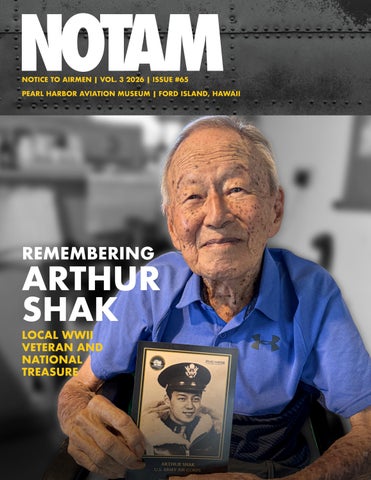
NOTICE TO AIRMEN | VOL. 3 2026 | ISSUE #65 PEARL HARBOR AVIATION MUSEUM | FORD ISLAND, HAWAII
REMEMBERING
ARTHUR SHAK LOCAL WWII VETERAN AND NATIONAL TREASURE
PearlHarborAviationMuseum.org | Page 1
3
6
4
7
10
8
12
CONTENTS - VOL. 3, 2026
3
CEO Column
4
The 9/11 Boot Memorial
6
Amelia Earhart’s Crash at Luke Field
7
Japan’s Midget Submarines at Pearl Harbor
8
Arthur Shak Tribute
10 Aviation Pathways Builds on Success 12 Remember Pearl Harbor Capital Campaign
14
15 ON THE COVER: Honoring WWII Veteran Arthur Shak - a local hero, patriot, and living legend. From the battlefields of Europe, the Mediterranean and the Pacific to the fairways he loved, Art’s courage, kindness, and unforgettable smile left a lasting legacy.
Page 2 | NOTAM Vol. 3, 2026 – Issue #65
14 Rosie the Riveter: Erlinda Gallego Ávila 15 Beyond Today’s Gift
WHY WE ARE HERE By John P. Hiltz, Chief Executive Officer As I reflect on my first year at Pearl Harbor Aviation Museum, I often come back to a simple question: Why are we here?
families return again and again. Our PHAMily Fun Days are an important part of that effort, creating opportunities for generations to experience history together in ways that are educational, memorable, and fun.
The answer begins with time and place.
We want to be a true community resource organization for Hawaii. Programs such as Aviation Pathways demonstrate what that can mean by helping young people see a future for themselves in aviation, skilled trades, technology, and leadership.
Few locations in the world sit at the nexus of history, aviation, service, sacrifice, and possibility. We are entrusted with an extraordinary historic site, remarkable aircraft and artifacts, and the stories of people whose courage and ingenuity shaped our nation and the world. I did not come to Pearl Harbor Aviation Museum simply to preserve what is already here. I came because I was shaped by childhood visits to aviation museums, and I believe deeply in what this Museum is and what it can become. Our vision remains ambitious, but clear. It is at the heart of our Remember Pearl Harbor campaign. We want Pearl Harbor Aviation Museum to have a beautiful campus, one worthy of the history that unfolded here and one that tells every guest they have arrived somewhere special. We want to provide an outstanding visitor experience, from the moment someone begins Museum CEO John Hiltz shares the joy of planning a visit until aviation with future pilots at Ford Island. they leave Ford Island. Our history is powerful, but how we welcome people and help them connect with that history matters just as much. We want to become the most “PHAM-ily” friendly destination in Pearl Harbor, a place where local and visiting
We want to be recognized as a national museum and historic education leader, with a voice and reach equal to the significance of the ground we occupy. The stories preserved here belong to Hawaii, but also to America and the world. This December, those ideas will come together in a particularly meaningful way. At our For Love of Country gala on December 5, we are preparing to welcome approximately 85 World War II veterans and five Medal of Honor recipients to historic Hangar 79. With the support of American Airlines and an Honor Flight bringing veterans to Oahu, this will be far more than a fundraising event. It will be a rare opportunity to bring generations together, honor living history, and recognize extraordinary service in the very place where one of the defining chapters of World War II began. Few museums in America could host an evening like this in a setting like ours. That is part of what makes Pearl Harbor Aviation Museum so special, and it is a reminder of the responsibility we carry. As we approach the 85th anniversary of the attack on Pearl Harbor and the Museum’s 20th anniversary, we have an extraordinary opportunity to shape what this institution will be for the next generation. That is why we are here.
John Hiltz Chief Executive Officer Pearl Harbor Aviation Museum PearlHarborAviationMuseum.org | Page 3
WHY THE BOOTS? THE 9/11 BOOT MEMORIAL By Bill Miller, Director of Visitor Services and Programs
Volunteers lace and shape the boots, attach the tags, and add a red, white and blue-ribbon lei and a small American flag. Each September, the grounds around Pearl Harbor Aviation Museum are transformed. More than 9,000 combat boots are planted along O’Kane and Enterprise, each representing an American service member who died in the years following the terrorist attacks on September 11, 2001.
CARE IN EVERY DETAIL The care begins before visitors arrive. Service members donate worn boots. Volunteers lace and shape them, attach the tags, and add a red, white and blue-ribbon lei and a small American flag.
Each boot carries a name, photograph and brief account of a life. Crewmembers killed together are tied together. Standing in formation once more, the rows remind us of the importance of selfless service and the following soulcrushing emptiness of sacrifice in tribute to the young people who stepped forward, raised their hands and served.
That care continues in the field. Volunteers help visitors find loved ones, then listen to their stories. Johnson remembers a young veteran who found boots honoring 21 of his friends during the memorial’s first year. He became involved and later told her the experience had saved his life.
“OUR 9/12” Theresa Johnson, the Army spouse who founded the memorial 14 years ago, calls it “our 9/12.” September 11th is a day to remember those killed in the attacks. September 12th marks what came next: Americans stepped forward to serve, beginning years of deployments and sacrifice. The boots honor service members lost in the years that followed. Johnson wants visitors to remember their lives and their service, rather than define them by how they died. Page 4 | NOTAM Vol. 3, 2026 – Issue #65
STORIES THAT ENDURE That human connection is central to the Hawaii display. Johnson and her volunteers add names as families come forward, and Pearl Harbor Aviation Museum has partnered with the memorial since its first appearance alongside the Biggest Little Airshow in 2012. Johnson has also partnered with the Daniel Kahikina Akaka Family Foundation (DKAFF) on Every Boot Has a Story, a podcast preserving service members’ stories through the voices of those who loved and served with them.
From a distance, we saw the staggering cost. Up close, we met sons and daughters, spouses, parents, friends and fellow service members. The boots have since been removed from the field, but each name and story remains with us. For those of us who served and for the families who continue to carry these losses, the Boot Memorial is more than a display; it is a place of return. I served with A Company, 2-25 Aviation in Afghanistan in 2012, where we lost eight men. To stand beside these boots is to see them remembered with dignity and to be reminded that their names, stories and service remain part of us. Mahalo to Theresa Johnson, her volunteers and all who help keep this memorial alive.
9/11 Boots Memorial Project: The boots of OZZIE 72 are tied together in remembrance. On August 16, 2012, the UH-60 Black Hawk was shot down in Afghanistan, killing all 11 aboard. Among the fallen were CW3 Brian D. Hornsby, CW2 Suresh N. A. Krause, SGT Richard A. Essex, and SGT Luis A. ‘Ollie’ Galbreath.
The 9/11 Boot Memorial on the grounds of Pearl Harbor Aviation Museum. PearlHarborAviationMuseum.org | Page 5
“I THINK NOT”: AMELIA EARHART’S CRASH AT LUKE FIELD By C.D. Weatherholtz, Museum Docent A crowd gathered around. Amelia Earhart stood upright in the cockpit as Fred Noonan, her navigator, calmly folded his charts. “Will you give up the flight now?” asked reporters. The accident that morning at Luke Field on Ford Island would delay Earhart’s round-the-world flight for months and forced the Electra to be shipped to the Lockheed Aircraft Corporation for repairs at the cost of $14,000. Yet, this incident would become one of the island’s lesserknown moments in aviation history. Ford Island is full of appealing history. Known as the center of Pearl Harbor, it is also a place whose stories make you appreciate its idyllic beauty and pause to wonder, “What if?” EARHART’S RECORD SETTING FLIGHTS Amelia Earhart was already known for her extraordinary voyages across the Atlantic, not once but twice—as well as her adventure from Oakland, California, to Honolulu, Hawaii, and her final voyage, which would become one of aviation’s enduring mysteries of all time. THE FIRST WORLD-FLIGHT ATTEMPT Her first attempt, though, began in Oakland with navigator Fred Noonan, Captain Harry Manning, who handled radio communications, and technical adviser Paul Mantz aboard, bound for Wheeler Field. Carrying around 600 gallons of fuel and four passengers, the Electra and its crew began their world flight at 4:37 p.m. on March 17, 1937.
Amelia Earhart, 1937. Courtesy of the Emil Buehler Perpetual Trust Library & Archive, Pearl Harbor Aviation Museum.
ARRIVAL AT LUKE FIELD It was an uneventful flight, except for a few technical issues with the propeller that occurred about six hours from Hawaii. After 15 hours and 43 minutes in the air, they landed at Wheeler Field on March 18, 1937, at 8:25 a.m., breaking a record east to west. The blades were repaired, and the Electra was ready for its long flight to Howland Island. Earhart also decided to fly the plane from Wheeler to Luke Field because the airstrip had 3,000 feet of pavement, unlike the grass surface of Wheeler Field. Concerned about the weather, Earhart preferred Luke Field, where the runway was less affected by the elements. That night, light rain wet the field. With preparations complete, the Electra was refueled—now with 900 gallons—and two passengers and one pilot were ready for the next leg of the flight. THE CRASH ON TAKEOFF On March 20, 1937, as dawn broke, Amelia Earhart, Fred Noonan, and Captain Manning boarded the Electra. Everything was in order. At 5:30 a.m., the plane’s engines pierced the quiet morning air. The mighty plane accelerated, approaching takeoff speed. Suddenly, the right wing dipped low. The plane veered to the left. Sparks flew from beneath the Electra, and the sound of metal grated the air as the mighty plane slammed to its belly and came to a grinding halt.
Separated landing gear of Earhart’s Lockheed Electra after her crash on Ford Island.
Page 6 | NOTAM Vol. 3, 2026 – Issue #65
“I THINK NOT” Within minutes of takeoff, the attempt was over. Three were unhurt. The Electra lay broken on the runway. As reporters gathered around, Earhart assessed the situation. As the question of abandoning her quest is asked, she boldly replied, “I think not.”
THE IMPOSSIBLE MISSION: JAPAN’S MIDGET SUBMARINES AT PEARL HARBOR By Tomoko “Moko” Kamiya, Museum Docent The Pearl Harbor attack is best known for the aerial assault by Imperial Japanese Navy airplanes on December 7, 1941, but few know that five Japanese midget submarines were deployed as an advance force before the air raid. ORIGINS OF THE MIDGET SUBMARINE PLAN Originally, midget submarines were not part of the attack plan. The first two-man midget submarine Kō-hyōteki (“Target A”) was completed in April 1941. It measured 78 feet in length and six feet in diameter and carried two 18inch torpedoes. In September 1941, Lieutenant Naoji Iwasa, leader of the midget submarine unit, proposed using five midgets to fire torpedoes during the aerial attack.
KEEPING THE STORY ALIVE Pearl Harbor Aviation Museum’s “Media Table” in the Aerological Tower on the Rooftop Terrace exhibit presents the timeline of the Pearl Harbor attack, including the midget submarine mission. From Top of the Tower Tour, the breathtaking panoramic view of the entire Pearl Harbor reveals just how impossible the submarine mission truly was.
Admiral Isoroku Yamamoto initially rejected the idea as suicidal, but after Iwasa revised the plan to guarantee the retrieval of midget submarines, it was approved on October 19, 1941. Five large mother submarines were quickly modified to carry the midgets on their decks and departed for Pearl Harbor on November 18, 1941. THE MISSION AND ITS OUTCOME The midget submarines’ mission was to enter Pearl Harbor, wait for the aerial attack, each fire two torpedoes at American ships, escape, and then rendezvous with their mother submarines off Lanai Island. None were retrieved. One was sunk by USS Ward before entering the harbor. According to recent studies, two midgets—commanded by Lieutenant Iwasa and Sub-lieutenant Masaharu Yokoyama—penetrated Pearl Harbor, and one of them may have fired torpedoes against USS West Virginia or USS Oklahoma. Iwasa’s sub was later sunk by USS Monaghan, and Yokoyama’s was self-destructed. CASUALTIES, CAPTURE, AND LEGACY Nine out of 10 crew members died. Ensign Kazuo Sakamaki, whose submarine malfunctioned by the faulty gyrocompass and failed to enter the harbor, was captured at Waimanalo Beach and became the first Japanese prisoner of World War II. In Japan, the fallen nine crew members were enshrined as “war gods,” while Sakamaki was viewed as a disgrace and erased from public record. After the war, he returned to Japan, joined Toyota, later became the president of Toyota’s Brazilian subsidiary in 1969, and retired in 1987.
(Japanese Type A midget submarine) On an eastern Oahu beach, after it went aground following attempts to enter Pearl Harbor during the 7 December 1941 Japanese attack. The photograph was taken on or shortly after 8 December 1941. Official U.S. Navy Photograph, from the collections of the Naval History and Heritage Command.
This color photo shows one of the five midget submarines Kō-hyōteki discovered at the bottom of the Keʻehi Lagoon in 1960 and returned to Japan in 1961. It was likely the midget commanded by Lt. Furuno. It’s displayed at the former Naval Academy at Eta Jima in Hiroshima.
PearlHarborAviationMuseum.org | Page 7
A TRIBUTE TO LOCAL WWII HERO ARTHUR SHAK By RADM Alma Grocki, USN (Ret.), Board Member and Friend Arthur Shak, a Kauai born and raised World War II veteran and national treasure, liked to say he was there for the beginning and the end of World War II. After graduating from Kauai High School in June 1941, he worked as a stock clerk for Pacific Naval Air Bases, Pearl Harbor. A WITNESS TO PEARL HARBOR On 7 December 1941, the “Day of Infamy,” Art witnessed the fires and explosions of the great U.S. Navy battleships anchored along Ford Island. Shortly thereafter, he enlisted as an Aviation Cadet in the U.S. Army Air Corps, earning Bombardier Wings, Navigator Wings, and a 2nd Lieutenant commission. He was assigned to a Consolidated B-24 Liberator bomber aircraft attached to the 824th Bomb Squadron, 484th Bomb Group, 49th Wing, 15th Air Force. FIFTY-ONE MISSIONS OVER EUROPE During March to August 1944, Art completed an amazing 51 combat missions across Germany, Italy, France, Belgrade, Romania, North Africa and the Mediterranean theater of operations. In later years, when asked why his crew flew so many missions, Art replied, “. . .we were young and foolish, but glad we did not fly lead or rear on bombing missions. Middle of the formations was good!” During one especially harrowing mission over Ploesti, Romania on 10 August 1944, his aircraft was hit by flak, severing gas lines and damaging two engines, with the plane flying on only two good engines. A 500-pound bomb also became stuck in its shackles and had to be released manually while the bomb bay doors remained open to disperse fumes from the severed fuel lines. The pilot took evasive action to avoid additional flak, and managed to reach the coast of Yugoslavia, where he made a one-pass landing on a British-held short airstrip on the Island of Vis. After landing, the fuel tanks were inspected and found to be dry.
WWII Veteran Arthur Shak at the Museum’s 2025 For Love of Country Gala.
Page 8 | NOTAM Vol. 3, 2026 – Issue #65
SERVICE IN THE PACIFIC After his European tour of duty, Art was assigned to the 19th Troop Carrier Squadron, then 316th Troop Carrier Squadron as a Navigator on twin engine Douglas C-47 Skytrains to forward bases in the Pacific, such as Guam, Saipan, and Tinian in the Marianas Islands. It was here, on 5 August 1945, heading home to Hickam Field in Hawaii, that he took off from the same airfield in Tinian, North Marianas Islands, that the Enola Gay, carrying the atomic bomb that was dropped on Hiroshima, Japan, had just left. That bomb was the event that led to the end of WWII between Japan and the United States. HONORS FOR EXTRAORDINARY SERVICE While in the 15th Air Force, Art was awarded the Distinguished Flying Cross, Air Medal with three Bronze Oak Leaf Clusters, numerous other decorations and citations, and in 2024, France’s highest award for valor, the Legion of Honor. Asked to say a few words, Art asked the audience to rise, then led them in the French National Anthem in French! However, Art was the proudest of his U.S. Congressional Gold Medal awarded to Chinese American WWII veterans on February 6, 2022.
Arthur Shak served as a navigator with the U.S. Army Air Corps’ 15th Air Force.
LIFE AFTER THE WAR Following WWII, Art used his GI Bill benefits to obtain his Master of Science degree in Civil Engineering at Purdue University in Indiana. He married his hometown sweetheart, Eva Lum, and returned home to Kauai and Oahu, to start his own engineering firm, raise his family, and work with the Army Corps of Engineers, retiring after 25 years of service. REMEMBERING ART SHAK Art’s service in the Army Air Corps in WWII was the stuff of legends, but those that knew him personally remember his wide, beautiful smile, his kindness, his willingness to share his stories, and his absolute love of golf. When he was a mere 100 years old, he was still able to shoot a golf score that matched his age! Art passed away on 25 August 2026 at 102 years old. He was a true American patriot, a local hero and national treasure. Rest in peace Art, we have the watch. Arthur Shak and fellow WWII veteran John Gleeson shared their stories of courage and resilience with Museum visitors.
PearlHarborAviationMuseum.org | Page 9
SOARING FORWARD: AVIATION PATHWAYS BUILDS ON SUCCESS By Rojo Herrera, Aviation Pathways Program Director
Twenty future aviators took the next step toward their dreams as they were inducted into Cohort 4 of the Aviation Pathways Pilot Training Program on September 30.
My, how time has flown! Cohort 3 of the Aviation Pathways Pilot Training Program have completed their training year; Cohort 4 has just been inducted, and the Airframe & Powerplant (A&P) students have begun their second year. The Pilot Cohorts (aka, the “Pathfinders”) have a combined success rate of 65%--twice the national average! And the A&P Cohort has completed the most difficult portion of their training and will graduate in less than 10 months. Congratulations to all members of these cohorts and we are excited to see what’s in your future! OVERCOMING CHALLENGES Pilot Cohort 3 and the A&P Cohort deserve special recognition for their perseverance. They fought through the most challenging spring weather in many years. The backto-back Kona Lows, followed by a “higher than normal” number of tropical storms, made it nearly impossible to maintain good continuity for their training. Despite these
Page 10 | NOTAM Vol. 3, 2026 – Issue #65
challenges, both cohorts were very supportive of the Museum’s monthly PHAMily Fun Days. WELCOMING COHORT 4 The atmosphere at Cohort 4’s Induction ceremony on September 30 was electric. We welcomed 20 new Pathfinders and congratulated the cohort on their achievements (14 Pathfinders have already logged more than 10 flight hours and 10 have already completed their initial solo flight). Considering this great start, John Hiltz, Pearl Harbor Aviation Museum’s CEO, noted, “Cohort 4 is joining the PHAM-ily with tremendous momentum and has the potential to become the most successful pilot cohort yet. We are excited to part of their aviation journey!” A PATHFINDER’S PERSPECTIVE Then, the new Pathfinders got to hear from one of their own—Jordan McKenzie. Jordan was one of the original
Pathfinders in Cohort 1 and has gone from high school senior to Private Pilot to Certified Flight Instructor (earning his Instrument and Commercial ratings) in just 2 ½ years! Jordan addressed the aspiring pilots from Alaska, where he is currently earning taildragger and seaplane endorsements. He shared lessons from his own challenges and successes, then encouraged the new Pathfinders with a simple message: “You can do it too—but you really have to want it!”
Cohort 1 Pathfinder Jordan McKenzie is reaching new heights in Alaska, adding seaplane and taildragger qualifications to an already impressive aviation journey.
SOARING TOWARD SUCCESS Together, John and I presented the incoming cohort with flight bags filled with the books and equipment they will need for their FAA examinations and check rides. The event concluded with a reception for the Pathfinders and their families, giving them an opportunity to connect with one another, meet Museum Board Members, and begin building the community that will support them throughout their aviation journey. With Cohort 3’s accomplishments behind us, the A&P students moving steadily toward graduation, and Cohort 4 already off to an impressive start, Aviation Pathways continues to soar forward—opening doors, building confidence, and helping the next generation of aviation professionals take flight.
Learning by doing: A&P students hone their technical skills at Pearl Harbor Aviation Museum.
PearlHarborAviationMuseum.org | Page 11
REMEMBER PEARL HARBOR: PROTECTING AMERICA’S WWII AVIATION BATTLEFIELD By Gen. and Mrs. Richard Myers, Remember Pearl Harbor Capital Campaign Co-chairpersons Fast approaching is the 85th commemoration of the attack on Pearl Harbor. In recognition of this pivotal moment and the extraordinary resilience that followed, American Airlines is coordinating an honor flight to Hawaii, welcoming 85 WWII veterans and their caregivers to join us as we remember their courage, patriotism, and sacrifice. We invite you to join us, in person or virtually, as we commemorate this historic anniversary and celebrate the 20th anniversary of Pearl Harbor Aviation Museum. Together, we remember, we honor, and we protect the legacy of our Greatest Generation—and ensure their stories endure for generations to come. A NATIONAL IMPERATIVE The grounds and hangars of Pearl Harbor Aviation Museum hold extraordinary significance and impact. We are America’s WWII aviation battlefield. You can feel the power of that legacy as you walk our grounds, see the bullet holes still marking the windows of Hangar 79, and take in Pearl Harbor from the historic 168-foot Ford Island Control Tower. Preserving this battlefield and sharing the first-hand stories, artifacts, photographs, and experiences of those who lived through December 7 and the war that followed is more than our mission—it is a national imperative.
The Museum’s P-38 Lightning will be featured in a major Hangar 79 exhibit.
Sailors on Ford Island watch flames erupt from the USS Shaw during the attack on Pearl Harbor on December 7, 1941.
Page 12 | NOTAM Vol. 3, 2026 – Issue #65
The views of aircraft in Hangar 79 will be stunning from every angle.
TRANSFORMING HANGAR 79 With the Ford Island Control Tower experience complete, we have now broken ground on Hangar 79. Within these historic walls, visitors will encounter stories of courage, ingenuity, and resilience from those who sought shelter here during the attack and later served in the Pacific, to the battles that turned the tide of the war, the evolution of military aviation, and the civilians whose contributions strengthened the home front. We hope the images on these pages stir something within you - tears for those we lost, pride in those who served, and hope for what these stories can teach the next generation. We invite you to join us however you can. Remember Pearl Harbor. Protect America’s WWII aviation battlefield. Visit RememberPearlHarbor. org or scan the QR code to learn more.
The Hope for Humanity exhibit in Hangar 79 will feature an interactive map of Bob Hope’s travels around the world to support America’s troops over five decades.
PearlHarborAviationMuseum.org | Page 13
ERLINDA GALLEGO ÁVILA: THE “ROSIE” WHO WORKED INSIDE THE WING By Pearl Harbor Aviation Museum, Story collaboration with Beyond the Call and Black Rifle Coffee Company On December 7, 1941, Erlinda Gallego Ávila of Flagstaff, Arizona was dancing to the Glenn Miller Orchestra with her sister when a news bulletin suddenly interrupted the radio program. At just 15, Erlinda Ávila stepped into the Japanese aircraft war effort, proving that determination — had attacked not a uniform — defined service. Pearl Harbor. As a teenager, Erlinda didn’t know what that meant at the time, but she watched her mother and neighbors cry and rush to the church. That moment marked the beginning of America’s entry into World War II. Erlinda, eager to help, went to a recruiting office at just 15. When the recruiter told her, “We don’t take women,” Erlinda replied, “Well, I’m not a woman. I’m a girl.” Denied a military uniform, she found another way to serve by joining the war effort in industrial work. She enrolled in a program at Phoenix Union High School District, learning aircraft production skills like rivets, bucking, and other precision work. BUILDING BOMBERS FROM THE INSIDE Not provided tools, Erlinda borrowed $25 against her sister’s wristwatch to buy goggles and bucking bars. Soon, she was sent to Goodyear, Arizona, to work on North American B-25 Mitchell bombers. Inside the aircraft, Erlinda worked on the port (left) wing, bucking rivets by hand while another young woman worked on the starboard (right) wing. Rivets, which held the bomber together, were driven from the outside, while Erlinda sat inside, securing them with precision. “The rivets are the buttons of a bomber,” she explained. Her work became second nature, and despite the harsh environment— only fans, hot water, and salt tablets—she and her coworkers produced aircraft at an incredible rate. By the end of the day, her blouse was soaked with sweat from the heat. Page 14 | NOTAM Vol. 3, 2026 – Issue #65
UNITED AS ROSIES Though the work was grueling, Erlinda fondly remembers the camaraderie among the women she worked with. They traded lunches and shared experiences. “All of us Rosies were united in what we were doing,” she recalls. A FAMILY CONNECTION TO VICTORY Her motivation was personal: her brother had been drafted, and she wanted to contribute. Many years later, when she stepped onto the USS Missouri—the site of Japan’s surrender—she felt a profound connection to the victory. Erlinda’s connection to the USS Missouri was especially personal, as her brother Pete had stood guard while the surrender papers were being signed, making stepping onto the deck in 2025 all the more meaningful for her. “Our freedom did not come free,” she said. “It cost blood and tears.” A LEGACY BUILT ON THE GROUND Erlinda’s story, remembered at Pearl Harbor Aviation Museum, demonstrates that aviation history isn’t just about what happens in the sky. It’s written on factory floors, inside aircraft wings, and by women like Erlinda, who refused to be sidelined. She may not have flown the bombers, but through her work on the ground, she helped win the war. Please scan the QR code or visit tinyurl.com/PHAMRosieBlog to watch Erlinda share her remarkable story in a powerful interview, told in her own words.
During WWII, Erlinda Avila bucked rivets inside the wing of a B-25, supporting the war effort from the homefront.
BEYOND TODAY’S GIFT: CREATING A LASTING LEGACY FOR PEARL HARBOR Woo Ri Kim, Sr. Director of Philanthropic Strategies PUT YOUR IRA TO WORK TODAY If you are age 70½ or older, a Qualified Charitable Distribution (QCD) from your IRA may provide an opportunity to support Pearl Harbor Aviation Museum today. A QCD is transferred directly from your IRA custodian to the Museum and may be excluded from taxable income while also counting toward your required minimum distribution, when applicable. Eligible donors may make direct QCDs of up to $111,000 in 2026. Your IRA custodian or professional tax adviser can help determine whether this option is appropriate for you. Legacy in action — bridging the past and future at Pearl Harbor Aviation Museum.
At Pearl Harbor Aviation Museum, we are entrusted with preserving the aircraft, artifacts, and personal stories of December 7, 1941, and the battles fought across the Pacific. Here on Ford Island, the bullet-scarred windows of Hangar 79 and the historic structures around us make that history tangible. A planned gift to Pearl Harbor Aviation Museum offers you the opportunity to help ensure that these national treasures, and the lessons they carry, endure for generations. GIVE THROUGH YOUR WILL OR TRUST A gift through your will or revocable living trust is one of the simplest and most meaningful ways to create a legacy. You may designate a specific amount, a percentage of your estate or trust, or a portion of the assets remaining after providing for family and other commitments. Bequests allow you to support the area of Pearl Harbor Aviation Museum’s mission that matters most to you while retaining control of your plans during your lifetime. Whether you choose to help preserve historic aircraft or expand educational and career opportunities for young people, your gift can help sustain that work for generations. Your legacy supports education, preservation, and the spirit of discovery at Pearl Harbor Aviation Museum.
MAKE THE MUSEUM AN IRA BENEFICIARY You can also create a legacy by naming Pearl Harbor Aviation Museum as a beneficiary of all or a percentage of your IRA. This typically requires only a beneficiary-designation form from your account custodian. You retain complete control of your retirement assets throughout your lifetime, while ensuring that the resources you have built over a lifetime can one day help preserve the history and lessons of Pearl Harbor. YOUR LEGACY. AMERICA’S STORY. A planned gift is an opportunity to help shape the future of Pearl Harbor Aviation Museum. Your gift can ensure that the history entrusted to us continues to inform, challenge, and inspire others for generations to come. If you have already included Pearl Harbor Aviation Museum in your estate plans, or would like to explore your possibilities, we would be honored to hear from you. A conversation with our Development Team can help us understand your wishes and ensure that the legacy you envision can have the greatest possible impact. Please contact our team at plannedgiving@pearlharboraviationmuseum.org or reach out directly to our Sr. Director of Philanthropic Strategies, Ms. Woo Ri Kim at 808-824-3505. Pearl Harbor Aviation Museum does not provide legal or tax advisory services. Work with your attorney and financial advisor to plan charitable arrangements that work best for you and your estate. The information contained herein is intended solely for general informational purposes.
PearlHarborAviationMuseum.org | Page 15
NONPROFIT ORGANIZATION U.S. POSTAGE PAID HONOLULU, HI PERMIT NO. 1633 Historic Ford Island | 319 Lexington Blvd. | Honolulu, HI 96818