PEAK ASSOCIATES Cli! Ebora, Jackie Peng, Olivia Blackmore, and Victoria Lo
COVER ARTWORK
Victoria Xi
The Peak MBC2900 8888 University Dr. Burnaby, BC V5A 1S6
READ THE PEAK
Pick up paper copies at any SFU campus
Find extended, cited, and web-accessible articles at the-peak.ca Download digital issues at issuu.com/peaksfu
The Peak is SFU's weekly student newspaper published every Monday, by students, for students. We’re funded by a student levy and governed by a Board of Directors. Any SFU student can apply to become staff
We reserve the right to edit submissions for length, as well as style, grammar, and legality. We also reserve the right to reprint submissions at any time, both in print and on web. We will not publish content that is sexist, racist, or otherwise prejudiced.
TERRITORIAL ACKNOWLEDGEMENT
We acknowledge that The Peak’s office is located and our paper is produced, distributed, and read on the unceded Coast Salish Territories of the Skwxwú7mesh (Squamish), xwməθkwəy̓əm (Musqueam), səlilwətaɬ (Tsleil-Waututh), kʷikʷəƛ əm (Kwikwetlem), qʼʷa:nƛʼən (Kwantlen), qicəy (Katzie), sc̓əwaθən məsteyəxʷ (Tsawwassen), Qayqayt, and Semiahmoo Peoples. Unceded means that this land was never surrendered, relinquished, or handed over in any way. We recognize that the unceded land that we occupy includes not only the Lhuḵw’lhuḵw’áyten (Burnaby Mountain), but extends to the land occupied by the Vancouver and Surrey campuses.
the-peak.ca @thepeakatsfu @thepeakpublicationssociety SFU students can contribute and get paid for work that is published in The Peak! Email us at promotions@the-peak.ca to learn about writing, illustrating, or taking photos for us!
and
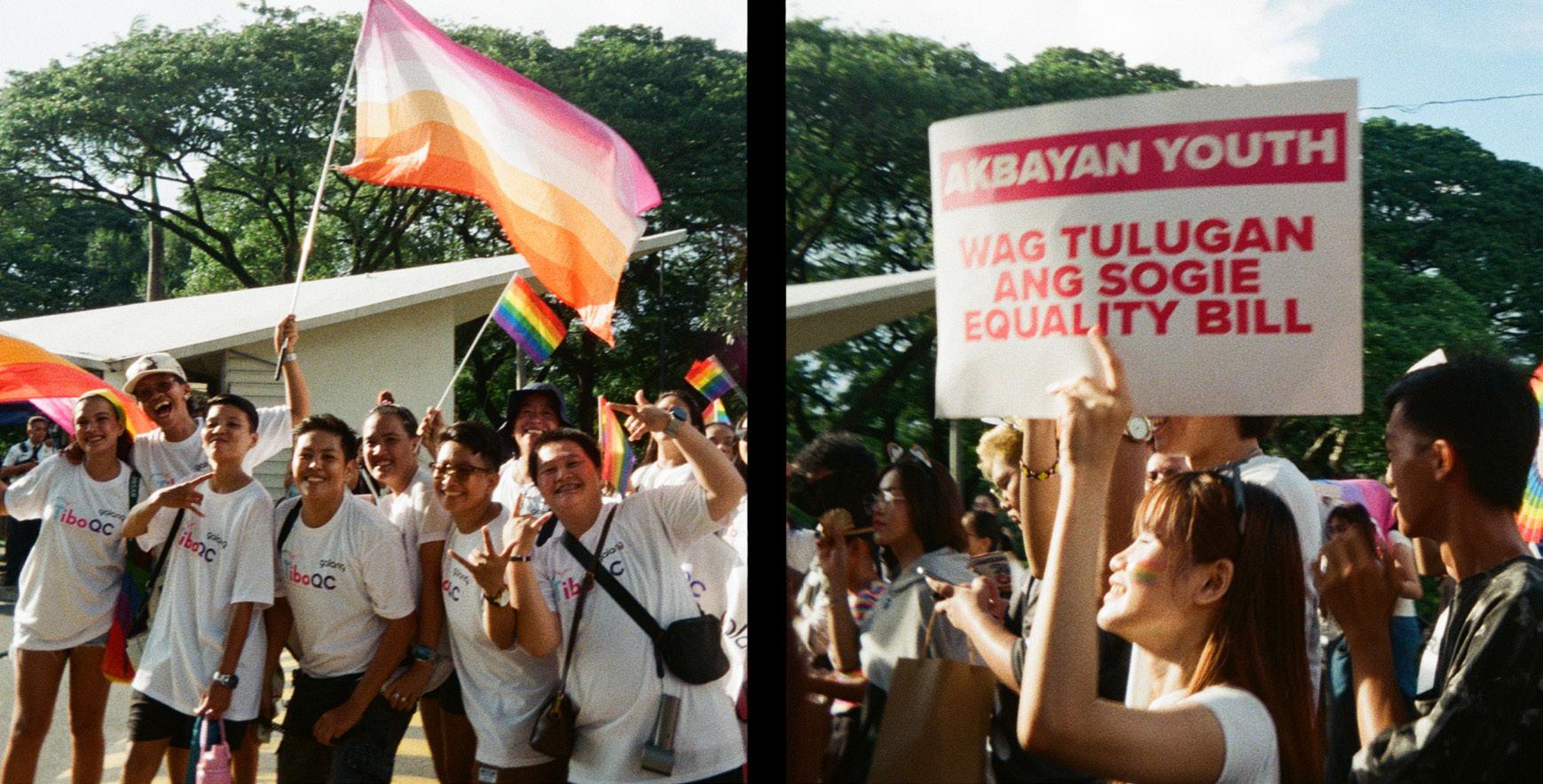
2SLGBTQIA+ campus groups celebrate $50,000 coverage for gender-a rming healthcare
Groups celebrate per-procedure cap removal for students but hope to extend victory to sta
and faculty
On July 16, the Graduate Student Society (GSS), in a joint Instagram post with the SFU Queer Collective, announced that per-procedure caps were being removed from gender-a rming healthcare bene ts. These caps previously set a $5,000 limit on how much coverage students can receive from their health plan for a single procedure. Additionally, the GSS noted that the lifetime maximum has increased from $10,000 to $50,000, and has “expanded eligibility” to not only to those diagnosed with gender dysphoria, but also those with gender incongruence. Gender incongruence describes a situation when someone’s gender is di erent from their assigned sex while gender dysphoria describes the unease people may feel when they have gender incongruence. These changes will impact not only graduates at SFU but also any student enrolled in a Canadian university that has a student health plan through GreenShield.
“The changes [in coverage] are the direct result of organizing led by trans and queer students who have been advocating for the removal of the per-procedure caps for a while now,” said the GSS Executive Committee in a statement to The Peak They highlighted the importance of open letters, but said that it only provides the public a “snapshot of a broader picture of organizing and advocacy.” The GSS shared, “We want to honour and emphasize the signi cant amount of emotional, physical, and intellectual work that the trans community put into making a positive change in our healthcare bene t plan.”
On June 16, the SFU Queer Collective, SFU Faculty Association, SFU Trans Equity Pod, Administrative and Professional Sta Association, and union CUPE 3338, released an open letter calling for more comprehensive gendera rming healthcare coverage.
The Peak reached out to Clio Lake, the outgoing advocacy chair of the SFU Queer Collective with a masters in public health. They said that the letter was “community-driven” which showed “the signi cant allyship from the bargaining units, from the employee groups, and from community leaders.” Lake noted, “This kind of advocacy shows how important it is to centre the material, basic needs for Two-Spirit, trans, and nonbinary people to have health, welfare, and dignity, and safety, and be included in their communities.”
Lake said that the groups have thus far received no response from the Simon Fraser Student Society (SFSS), however noted that the aforementioned changes would be relevant
for undergraduate students as their health insurance was being carried under the Paci c Blue Cross and GreenShield medical programs.
This kind of advocacy shows how important it is to centre the material, basic needs for Two-Spirit, trans, and non-binary people to have health, welfare, and dignity, and safety, and be included in their communities.
CLIO LAKE SFU QUEER COLLECTIVE
The open letter from the advocating groups called upon the university to “create a comprehensive funding mechanism for all sta and faculty health bene t plans across bargaining units, to ensure lifesaving gender-a rming healthcare is never out of reach for our community members.”
The groups stated that university employees “remain dangerously underinsured by employee bene t plans, which exclude the amount of coverage necessary to fund these critical interventions.” They called on SFU to match the rate of coverage o ered at alternative institutions such as UBC, which o ers $50,000 lifetime maximum levels of coverage.
The open letter also called upon the SFSS and GSS to create a “comprehensive funding mechanism for gender-a rming procedures to be covered by the Alumo plan and reserve funds without exclusions, removing coverage-stigmatizing per procedure caps.”
The groups said that the SFSS and GSS had signed an updated student healthcare agreement last year which included procedure caps on funding, which they shared were “despondently below what’s needed to cover acutely needed and di cult to access interventions.” These interventions refer to gender-a rming medical procedures or treatments.
GreenShield, the gender a rmation healthcare provider for SFSS and GSS, covers foundation procedures, such as eligible “chest/breast surgeries,” and focused procedures, such as “hair transplants/implants.”
The cost of many of these interventions are high. For example, full body laser hair removal for larger areas can cost upwards of $1,300. Body contouring ranges from $4,000 to $10,000 depending on the size of the area. Hormone treatment can cost as little as $9–30 per month for injections, but some individuals may opt for more expensive options that range from $150–170 per month, due to preference or side e ects.
The open letter highlighted the importance of proper coverage to “keep trans people safe from gender-based violence, sexualized violence, and suicidality, reduce impacts of antitrans discrimination in education, housing, and jobs, and support the well-being and mental health of trans people.”
Lake said that the change was a “big win” and the amount of coverage trans individuals could receive was “groundbreaking, life-changing,” and “life-saving.” Noting the reaction in the community, they said, “There’s been a lot of celebration and a lot of gratitude for the folks who’ve been involved in advocating, the folks who’ve been carrying that advocacy through to the insurer.”
They also noted the change was relevant for alumni who had recently graduated from their respective programs, with individuals having access to bene ts until August 31. Lake shared, “There’s yet to be a formal announcement from either GreenShield or Studentcare/Alumo about this bene t change, but we expect that the membership will be informed widely,” come September.
Lake shared, however, that sta were only covered under the Paci c Blue Cross program for extended health and dental and “now have worse gender a rming bene ts than students at the university.” They said, “From what we’re aware of, sta and faculty have access to $10,000 of [lifetime] coverage, which is really insu cient to provide coverage for some of the really costly, inaccessible, and medically necessary procedures that are excluded by public health insurance.” Lake encouraged sta and faculty impacted by the coverage to get “engaged in this process” of advocating for more comprehensive bene ts.
PHOTO TONG SU / UNSPLASH
NIVEJA ASSALAARACHCHI NEWS WRITER
SFU to retain contract worker model for cleaning, despite calls for in-house emplo$ment
The university is currently in the process of signing a new janitorial contract
LUCAIAH SMITH - MIODOWNIK NEWS WRITER
Content warning: mention of death.
For the last 15 years, SFU has outsourced its janitorial services through BEST Service Pros, meaning cleaning sta are not directly employed by the university.
This decision to outsource labour has been met with notable and continued pushback. The SFU coalition, Contract Worker Justice (CWJ), organized a rally in late 2024 to advocate for in-house contracting of janitorial and food service work. SFU food service workers, employed by Compass Group Canada, led bargaining e orts in 2025 for livable wages by their employer. These organized protests call for the university to in-source and directly employ these sta
Advocacy for this shift was ampli ed in July 2025, when Kulbir Kaila died during a cleaning shift at SFU. Coworkers later came forward and described the conditions under which she and many others worked: “up to 40,000 steps each shift,” “a lack of job security,” and “a culture of fear.” BEST previously denied these allegations. With SFU’s BEST contract set to expire in April 2027, organizations like Contract Worker Justice (CWJ) are calling upon the university to transition to in-house employment.
SFU’s recent press release suggests a different path. On July 10, the university announced that it “is issuing a
SFU Kendo Club gears up for national championships in August
Club and national federation executives speak to the sport’s growth in the Lower Mainland
Request for Proposals [ . . . ] for our next janitorial services contract.” A Request for Proposals is a competitive submission process, wherein potential vendors submit their interest and apply to fill a role outlined by a contracting business. The Peak corresponded with SFU and CUPE 3338, the union that represents the janitorial staff, for more information on the decision.
“We are disappointed that SFU is moving forward with another contracting process for cleaning services rather than seriously considering bringing this essential work back in-house,” the union noted. “Bringing these services in-house would allow SFU to take greater responsibility for sta ng levels, working conditions, accountability and the respectful treatment of the workers who clean its campus.”
In a July 13 Instagram post, CWJ echoed these sentiments, adding that “the university continues to refuse to do the right thing and take these workers into direct employment — even after documented workplace safety cases, managerial bullying, and harassment, and the horri c tragedy of Kulbir Kaila’s death on the job.”
CWJ also expressed alarm over the proposed timeline for new contract proposals. “The deadline for companies to declare their intent to bid is July 17 — an exceptionally tight timeline — and interested bidders must also attend three mandatory site visits this summer,” the organization wrote. “Our reading
is that these requirements give the current contractor, BEST, a signi cant inside track in the bidding process.”
The group noted additional concerns regarding how “the posting makes no mention of SFU’s living wage commitment,” a certification that SFU has been seeking since 2022. CWJ also shared that the Request for Proposals states that “the successful proponent shall perform quality work according to the specified performance level of service and to the ‘best practice’ of the janitorial industry,” though they characterized the statement as “a remarkably low bar.”
The university commented in a statement to The Peak , “Public institutions in BC are required to run competitive procurement processes [like Request for Proposals] once contracts reach certain dollar thresholds or time limits to ensure fairness, transparency, and value for public funds.” Additionally, “regularly re-competing contracts also ensures the institution continues to receive best value, up-to-date services, and innovative solutions, while meeting provincial trade agreement and procurement policy requirements.”
The school “completed a review of the feasibility of bringing janitorial services in-house in 2021/22 and it was determined that an insourced model is not nancially viable,” added SFU.
The Peak contacted CWJ but did not hear back by the publication’s deadline.
NIVEJA ASSALAARACHCHI NEWS WRITER
Editor’s note: The Peak’s Arts & Culture editor Phone Min Thant is a member of the SFU Kendo Club, but was not involved in the writing of this piece.
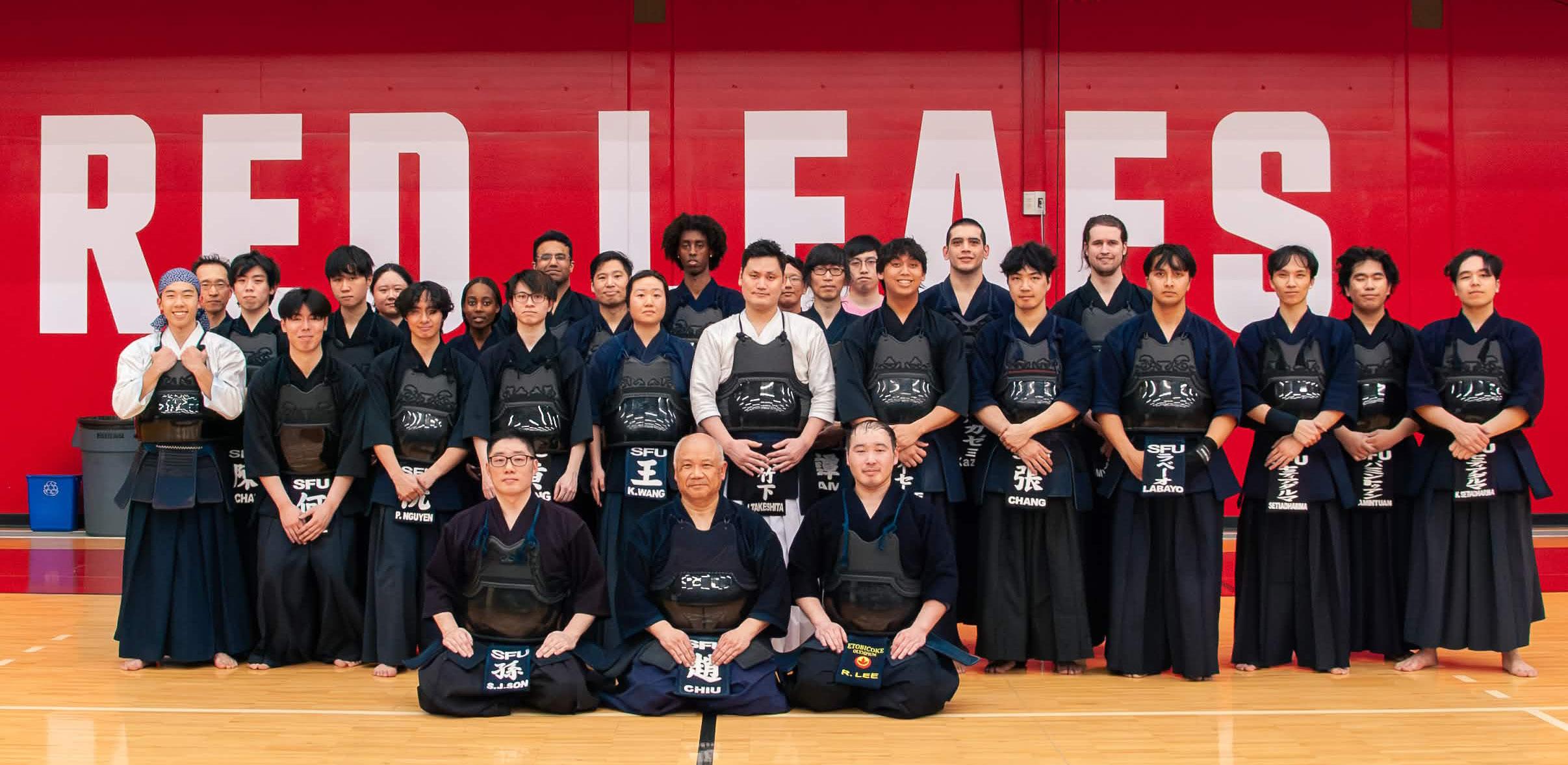
From August 7 to 9, the BCIT Burnaby Campus will host the 23rd annual Canadian National Kendo Championships. The tournament will see 190 kendo practitioners gather, with competition split into three main competing categories: an individual bracket, a club bracket, and a provincial club bracket.
Nine university clubs from BC will compete in the tournament, including the SFU Kendo Club. The Peak reached out to PJ Arce, the president of the club, to learn more about SFU Kendo’s goals for the championship and beyond.
The SFU Kendo Club was founded in 2001 with seven members, and has grown to more than 35 active members across di erent skill groups, according to Arce. He said that ve students and three alumni will compete on behalf of SFU, with a group of ve students “selected to represent us in the team bracket.” Arce highlighted quali cation to the tournament “use an open-entry format rather than requiring athletes to qualify through a conventional regional pathway” thus di ering from other sports. He noted he saw the championship as an “opportunity to test the quality of our training against experienced kendoka from across Canada. I think it represents both our development as competitors and the character we have built through the hardships of practising this martial art.”
Kendo is a Japanese martial art sport which features players wearing protective armour and ghting with bamboo swords. The aim of the sport, according to Arce, is for competitors to try and “score valid strikes to designated target areas while demonstrating proper technique, spirit, and control.”
With the rst Canadian dojo for the sport being established in Steveston in 1914, the kendo scene in the Lower Mainland has an extensive history. In a statement to The Peak, the vice president and general manager of the the Canadian Kendo Federation Makiko Ara said, “Kendo has a well-established and growing community throughout BC,” with her noting that clubs operated in cities like Coquitlam, Surrey, Burnaby, Victoria, and Kelowna. She noted university clubs like SFU Kendo were important as “they introduce kendo to students from a wide range of backgrounds and help make the sport accessible to adults trying the sport for the rst time,” thus playing “an important role in the future growth of Canadian kendo.”
Arce said that SFU Kendo was aiming to grow the club and win an upcoming college-level kendo tournament. Beyond results, he said, “We want to continue fostering an environment where kendo can be at the centre of a welcoming, kind, disciplined, and character-driven community. Kendo gives people a reason to challenge themselves, but it also brings people together.”
ILLUSTRATION: VICTORIA LO / THE PEAK
PHOTO COURTESY OF ELTON CHEN
We need an Indigenous approach to wildfire control
Indigenous fire management techniques need to be adopted
JONAH LAZAR STAFF WRITER
For many people in the north of Turtle Island (Canada), the summer has become synonymous with the re season. Forest res wipe out entire towns and have displaced thousands across the country, leaving many communities wondering when it will be their turn. Over the past ve decades, there’s been twice as much land victim to wild re in northern Turtle Island, and it has been commonplace for these res to cross over into towns and people’s homes. Three years ago, nearly 50,000 people were evacuated from their homes in a recordbreaking re season in BC. On July 7, the Namaygoosisagagun (Collins) First Nation, were forced to evacuate with only minutes of notice. They did not receive any warnings from the provincial or federal government. Indigenous communities have been disproportionately a ected by these res and are “33% more likely to evacuate from a wild re.” Many of these communities have not been equipped to ght these res e ectively. Various First Nations groups have called for additional equipment, like re trucks, upgrades such as water systems, and increased funding.
The climate is changing, and one of the more drastic, direct impacts that this change has had on northern Turtle Island is the increase in forest res. In the record re season of 2023, 93% of the area set ablaze in northern Turtle Island came from lightning strikes. This wasn’t an anomalous year — in fact, this is a taste for what is to come.
What makes matters worse is the government’s approach
OPINIONS
to forest res. It has predominantly been to ght them head on, with a priority on containment and re suppression, an approach where minimizing res is the biggest concern. In previous decades when we consistently had more temperate summers and less intense forest res, this approach worked to some extent. However, there is now a dangerous collection of dead wood in our forests, which are pure jet fuel for any potential res. With the increased lightning frequency brought on from climate change, and the copious amounts of fuel left dry on the forest oors, res have become an inevitability.
Vast bodies of knowledge of the practice has been lost due to generations not being permitted to practice controlled burning.
Queer content being unfairly labeled NSFW leads to it getting swept away with the corporate panic
JONAH LAZAR STAFF WRITER
Content warning: mention of rape, incest, and child sex abuse.
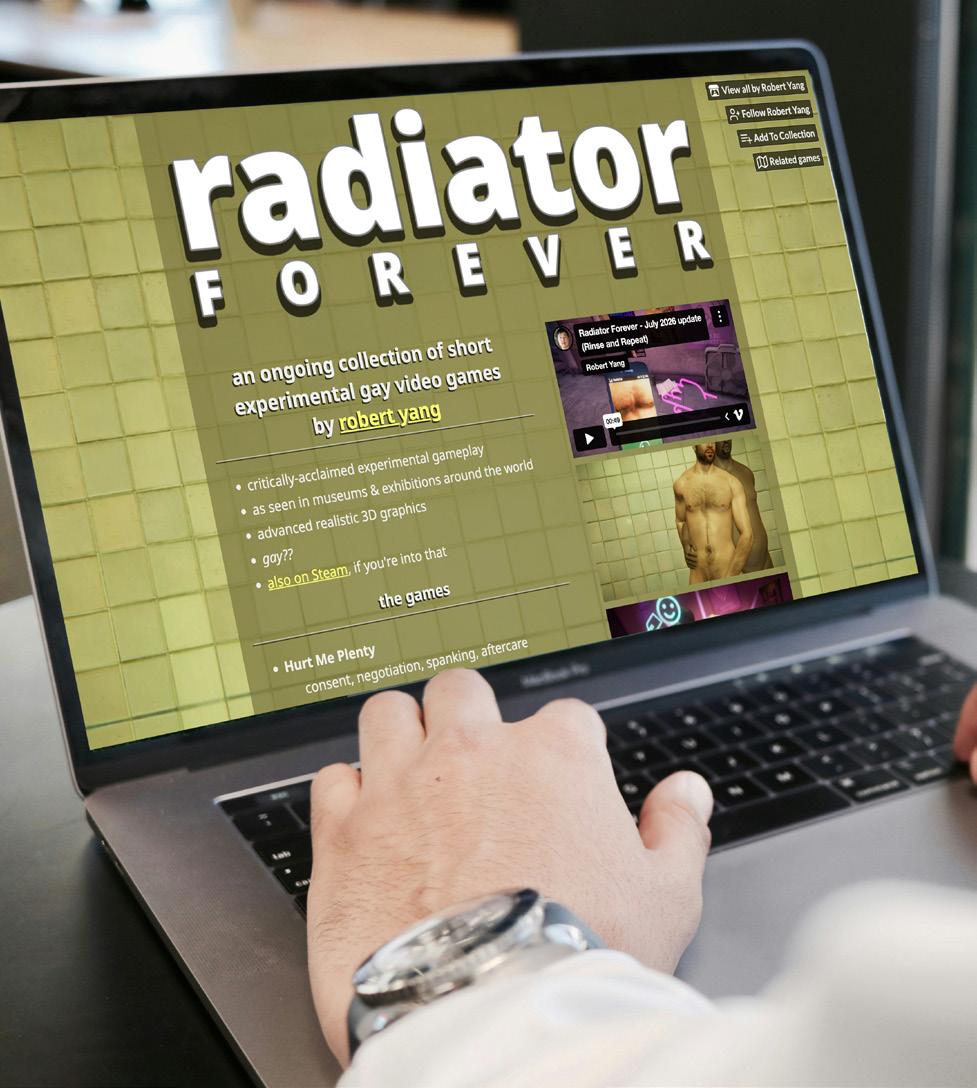
Last year, anti-porn organization Collective Shout successfully lobbied to prevent transactions from users buying video games containing “adult content” on game purchasing sites Steam and Itch.io. In an open letter addressed to payment processors like VISA, MasterCard, and PayPal, Collective Shout condemned the sale of video games containing rape simulation, incest, and child sex abuse. They called on these companies to cease their relationship with these gaming platforms so long as they host games and content of this nature. Limitations on content involving rape, incest, and child sex abuse are undoubtedly a good thing. However, since then, there are claims that over 20,000 not safe for work (NSFW) games across platforms are deindexed, removed, or no longer purchasable.
The content ban has largely followed a non-transparent approach that prevents the purchasing of any content tagged as NSFW, which is much broader than Collective Shout’s stated issues. This has had a disproportionate impact on queer media, which is often labeled NSFW due to lingering stigmas around queer sexualities and relationships, even when the content itself is no more explicit than its heterosexual equivalents.
Websites removing NSFW content to appease payment
processors or app stores is not a new phenomenon. In 2018, Tumblr was removed from the Apple App Store for having abuse images circulating. In response, Tumblr purged all explicit content, erasing vast swathes of the 2SLGBTQIA+ communities’ content on the platform. The reason is 2SLGBTQIA+ content gets agged as NSFW even when dealing with non-sexual themes. This happened on Tumblr after they used an algorithm to detect explicit content, but
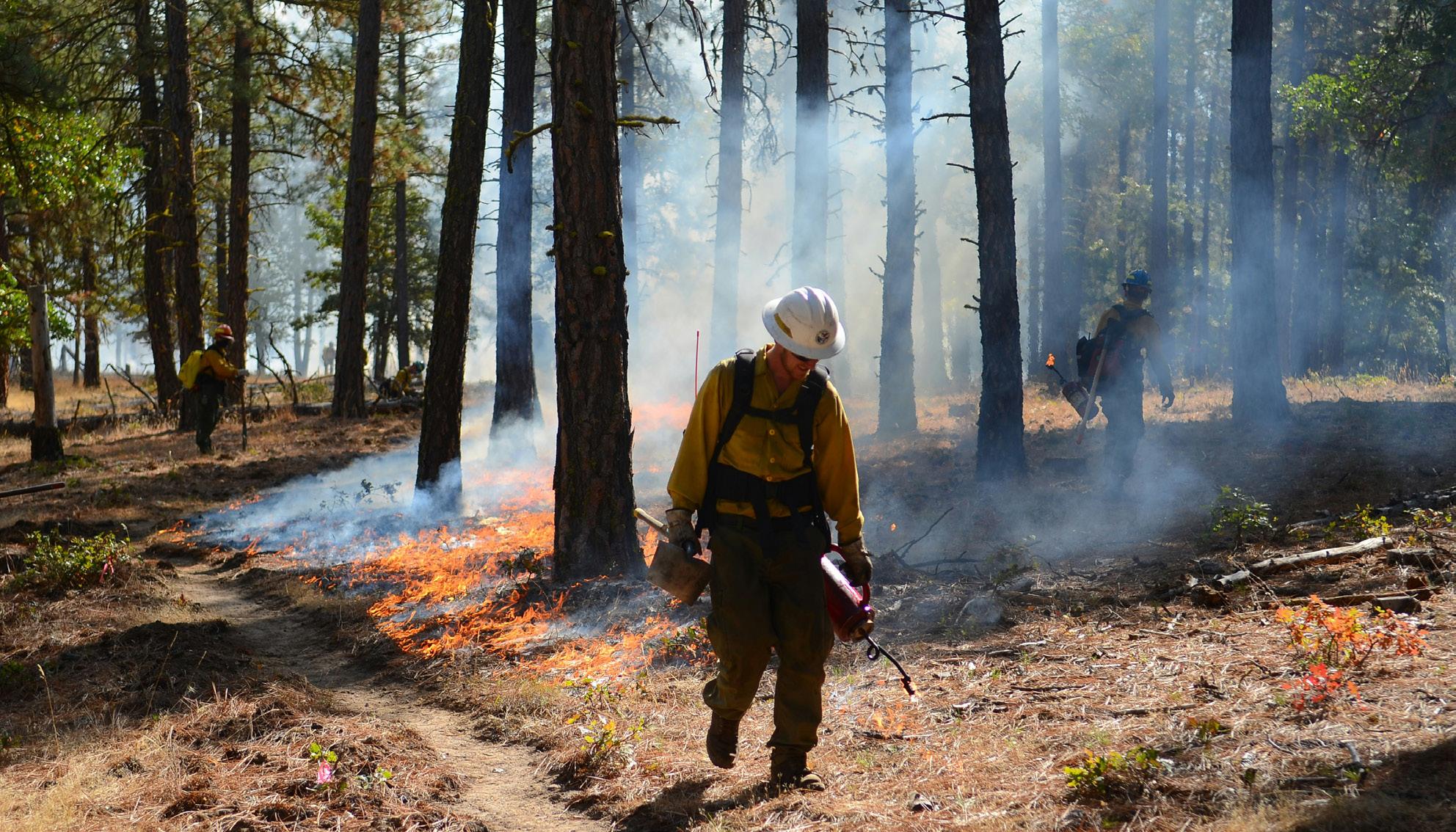
Indigenous communities across Turtle Island (North America) and South America, as well as Australia, have traditional re management practices; controlled burns. These burns are carefully started to preempt an uncontrolled re. These controlled burns are planned when the weather would help in ensuring that the re wouldn’t grow out of control. These tactics are not just e ective in reducing out of control res, but also bene cial for the environment as it regenerates the soil with nutrient rich ash, promoting ecological growth.
Controlled burns, however, were banned by the BC government in 1874 through the implementation of the Bush Fire Act — the colonial government incorrectly viewed these burns as damaging to timber. While some burning is now allowed, albeit heavily restricted, the current controlled burning falls far short from what experts view as needed in BC’s ght against wild res. Since then, vast bodies of knowledge of the practice has been lost due to generations not being permitted to practice controlled burning.
Continuing down the colonial approach of re ghting will not work in the modern reality of climate change. Intense storms caused by warmer temperatures and prolonged droughts through the summer months will only lead to more of a re risk, and the current approach of re suppression is not keeping up. It’s time to begin crafting alternative ways of re control, and utilizing Indigenous re management systems is a great place to start.
The queer community consistently has had to fight for the right to exist in public, without their experiences and expressions being reduced to stories about sex.
agged regular art. For Steam, any user can add tags to a game, even if the developer disagrees with it. Content dealing with sensitive topics like queer expression and existence gets agged simply for its queerness; even a two-dimensional, nonsexual game was banned due to having a transgender main character. Heteronormative content is able to get away with a lot more, and gets to exist in a grey area of appropriateness that is not a orded to queer content. It’s not that the content is explicit, it’s that content with queer characters gets agged for just existing.
The queer community consistently has had to ght for the right to exist in public, without their experiences and expressions being reduced to stories about sex. This latest wave of content moderation is yet another example of queer voices being silenced. Until queer content begins to be held to a similar standard to straight content when labels such as NSFW are assigned, queerness will continue to be abruptly ltered out without warning or care.
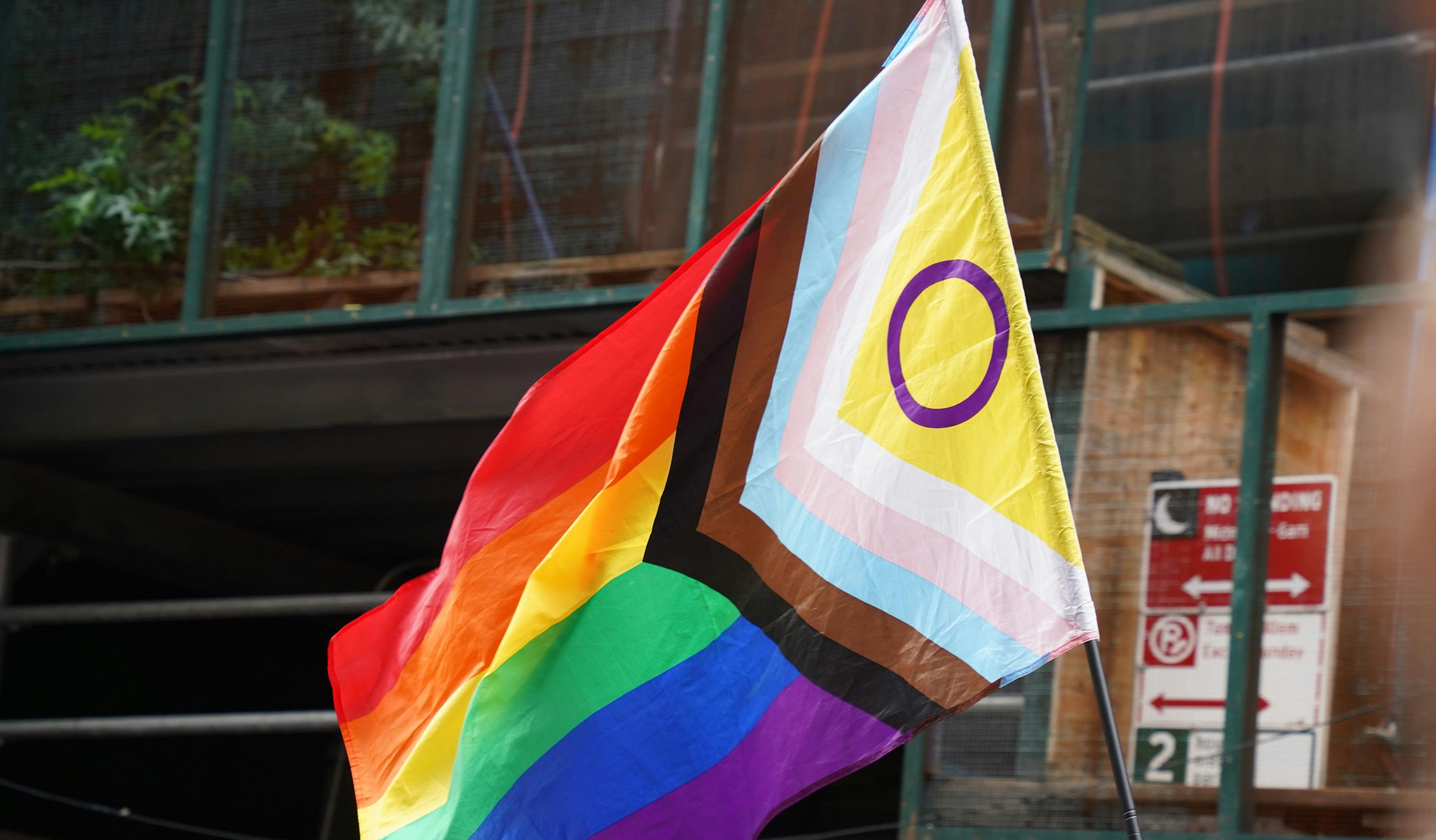
PHOTO EMMA RENLY / UNSPLASH
IMAGES: COURTESY OF ROBERT YANG (RADIATOR FOREVER) AND CAMPAIGN CREATORS / UNSPLASH
Transvestigation hurts everyone
Liberation for trans folk is liberation for all
Content warning: transphobic language, misogyny.
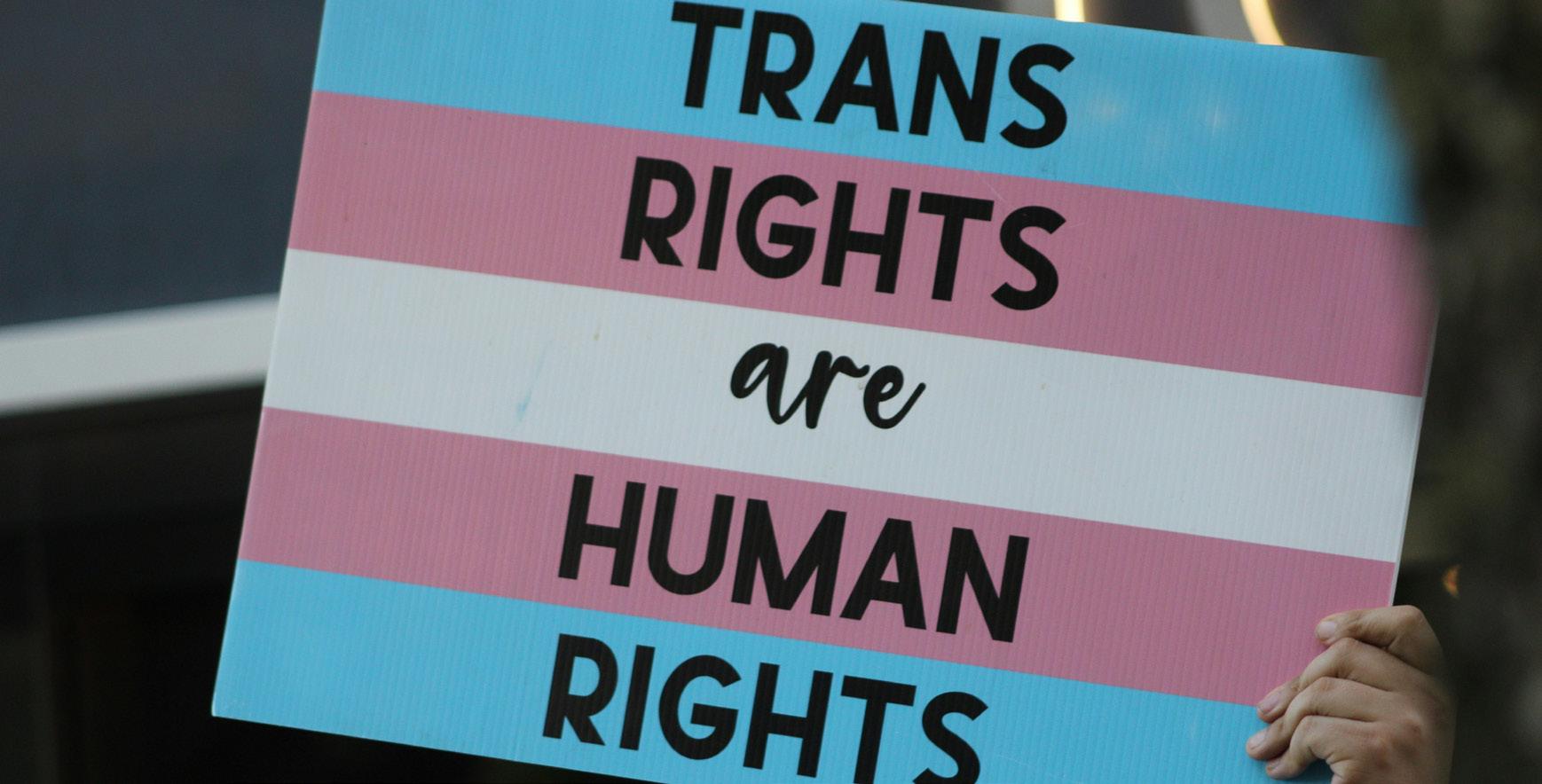
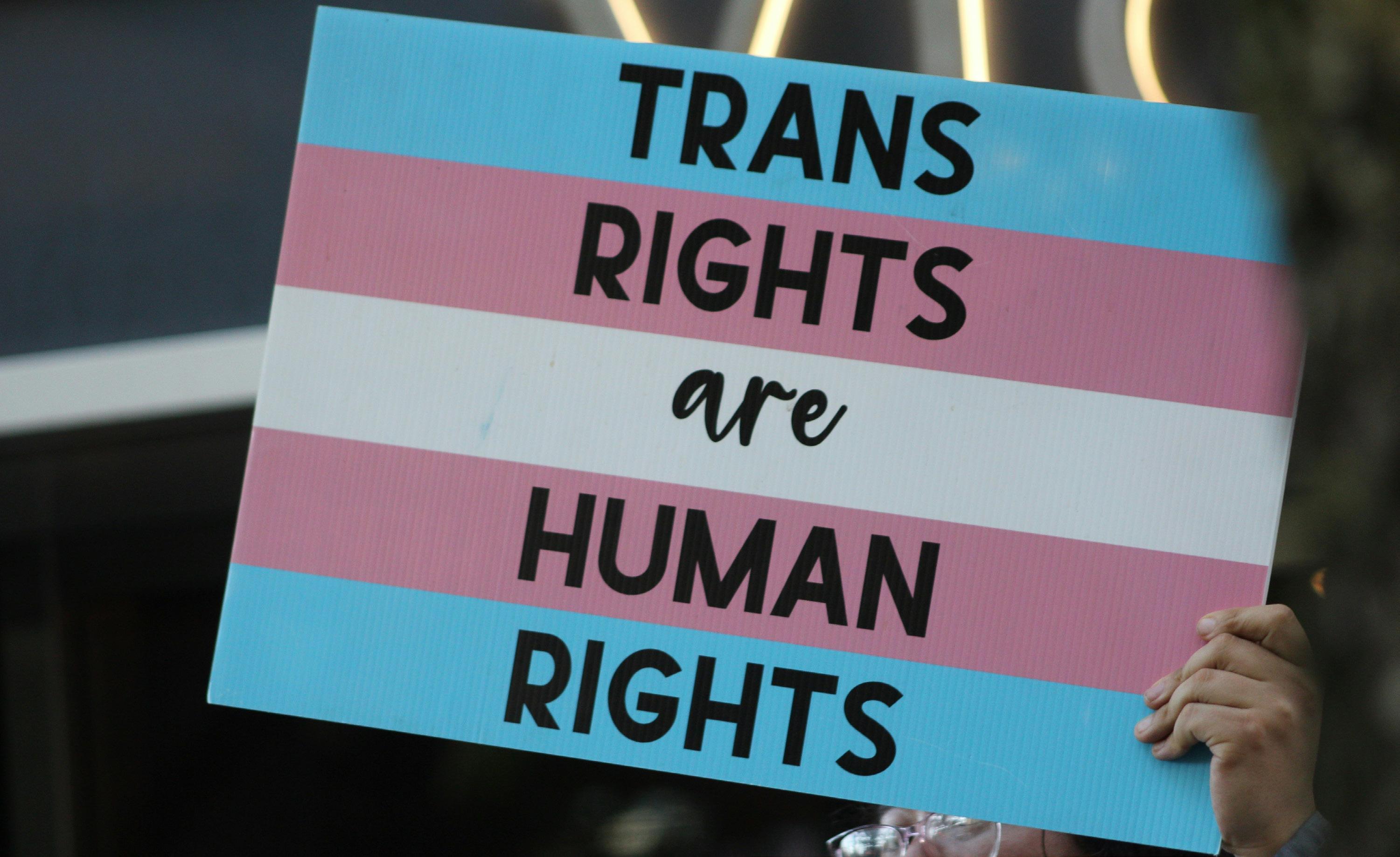
Transvestigation, the process of “investigating” whether someone is transgender, has a ected an untold number of public gures. From Michelle Obama to Serena Williams to Beyoncé: online conspiracists have utilized pseudoscienti c anatomy diagrams, and demanded invasive testing to falsely “determine” someone’s sex. These investigations label appearances and behaviours according to traditional notions of gender roles, target gender nonconformity, and reinvigorate misogyny. The most notable way transvestigation occurs is by targeting successful cisgender women. It implies that trans women are seeking to take advantage of so-called “biological” women, and that a cis woman’s successes only happened because she was “secretly trans.” It also reinforces misogynistic norms, by threatening women’s privacy and reputations if they defy traditional gender roles — for example, if a woman has “masculine” features, like extra body hair, or participates in “manly” activities, she may be the victim of transvestigation and face harassment, cyberbullying, or worse. Transvestigation is treacherous: it harms both transgender people and cis women.
Since transvestigation leans on gendered expectations, it also disproportionately a ects racialized women, who have long faced sexual scrutiny. It’s no coincidence that every example in the introduction was a Black woman. Since transvestigators push a standard of “femininity” based in whiteness, racialized women will often be punished for any perceived nonconformity. Thus, any woman who is successful and doesn’t conform to racist standards of femininity is at risk.
This issue goes far beyond celebrities. Calls for women to prove their sex while participating in athletics have resounded internationally, including the new Olympics policy, which mandated gene-screening for people competing in women’s category events this March. Trans sports bans such as these have become increasingly enforced as a way to apparently “protect women and girls’ sports,” at the cost of trans inclusion and acceptance. These bans are supposedly made to allow cisgender women to win against “stronger” opponents. However, according to Dr. Joshua D. Safer, speaking to the ACLU, “a person’s genetic make-up and internal and external reproductive anatomy are not useful indications of athletic
performance.” Additionally, trans women athletes may even have physical disadvantages against cis women in sports. But trans sports bans lead to even more hurdles for women to participate in sports.
I reject the framing of issues, such as in sports, as some mythic battle between trans rights and women’s rights.
This form of institutionalized transvestigation is all over the place. Last year, the Fairness and Safety in Sport Act was enacted in Alberta. The system is managed via complaint. If someone questions a teenager’s sex, they will have to prove their eligibility to play on a girls’ sports team via birth registration document if they’re 12 or older. People wanting to participate on boys’ teams don’t have to do a thing. According to the Edmonton Journal, the bill has led to girls’ teams being cut or turned co-ed because there aren’t enough participants. Considering that trans people are estimated to make up about 0.5% of the youth population in Canada, how is this legislation “protecting women and girls?” To me, it seems like it’s holding them back. Protecting women and girls means letting them participate in sports, and allowing them dignity and privacy.
A similar bill was raised in BC (and thankfully didn’t pass). If you think transvestigation is isolated to conservative areas or public gures, think again. A nine-year-old girl’s gender was questioned at a track meet in Kelowna just because she had a pixie cut.
Just look at Imane Khelif, an Algerian Olympic gold medalist boxer. Khelif is a cisgender woman, but failed a “murky eligibility test for women’s competition” in 2023 from an association that was banned from the Olympics the following year. Afterwards, rumours of her being secretly male spread far and wide, especially when she was competing in 2024. Khelif faced a wave of harassment and calls for her to be removed from competition (even though she was fully eligible) by people like JK Rowling, Elon Musk, and JD Vance. Khelif’s race and physical strength absolutely a ected how she’s been treated. Khelif notably played a match with Italian boxer Angela Carini, who withdrew and burst into tears after a punch to the nose. All ordinary, this was a boxing match between two professional ghters at the Olympics. But seeing a “victimized” white woman being defeated by a strong woman with North African features was apparently too much for the internet, and Khelif received droves of scrutiny, speculation, and hatred — yet another example of a woman being unfairly targeted due to gender nonconformity and racism.
That’s the reality of transvestigation: it goes far beyond defaming and harassing public gures. Beyond transphobia, transvestigation is inherently misogynistic. Gay & Lesbian Alliance Against Defamation has termed it a “hate-driven conspiracy theory.” Its proponents are promoting a theory called “Elite Gender Inversion,” which holds that a shadowy cabal of elites are all secretly trans. It’s one step further on the alt-right radicalization pipeline.
Transvestigation is presented by the right as a way to protect and empower cisgender women. Women’s rights are often pitted against trans ones in this way. This is a transexclusionary radical feminist (more commonly known as TERF) idea, that “gender ideology” is incompatible and dangerous to women and feminism. This viewpoint has majorly informed recent pathways to transphobic legal discrimination. To me, though, the idea that trans rights and women’s rights can’t both exist freely at once is ridiculous. Enforcing a delineation between transgender and cisgender people is defended under the guise of “protecting women,” but does the opposite. I reject the framing of issues, such as in sports, as some mythic battle between trans rights and women’s rights. Our liberations are intertwined: they can, will, and do coexist.
PHOTO: GABRIEL DALTON / UNSPLASH
SASHA RUBICK FACT CHECKER
Exploring queer spaces in the city
Vancouver’s 2SLGBTQIA+ landmarks and histories
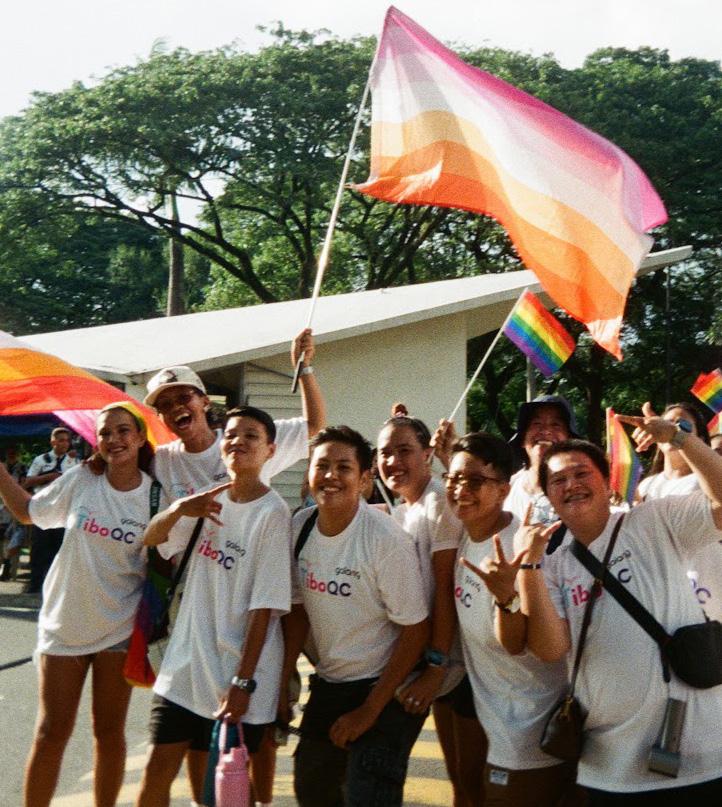
As we approach Pride here in “Vancouver,” members of diverse queer communities in Davie Village and Chinatown are still advocating for one another Many queer walking tours are made to platform queer people’s struggles and joys. To learn more, I read an article from XtraMagazine where author Robin Perelle and her interviewees reflect on queer spaces. Today, Davie Village is “the heart of gay Vancouver,” but before the ‘80s, queer businesses were scattered throughout Vancouver. Archivist Ron Dutton said, “Gay people could get away with being gay” in places like Chinatown and Gastown.
More visibility meant more harassment. Perelle wrote that in 1974, police “raided at least a dozen more gay bars.” It also meant the community was invigorated to hold one another. Another interviewee, Don Hann, said, “We were asserting our sexuality and claiming space that had never before been available to us.”
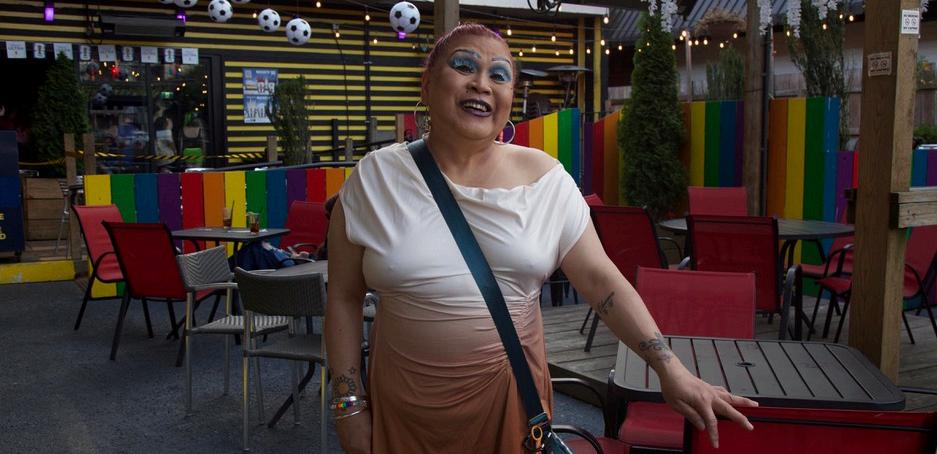
With so much history before me to reference, I wanted to highlight the community that exists today. I started in Chinatown. Historically a place where Black, Chinese, and Indigenous people experienced rampant discrimination, Chinatown is also built on treasuring community among immigrants and other marginalized groups. Kimberley Wong, program manager at Hua Foundation, embraced their Chinese queer identity while “heaving crying” watching local drag queen, Maiden China, in Chinatown.
Gina’s
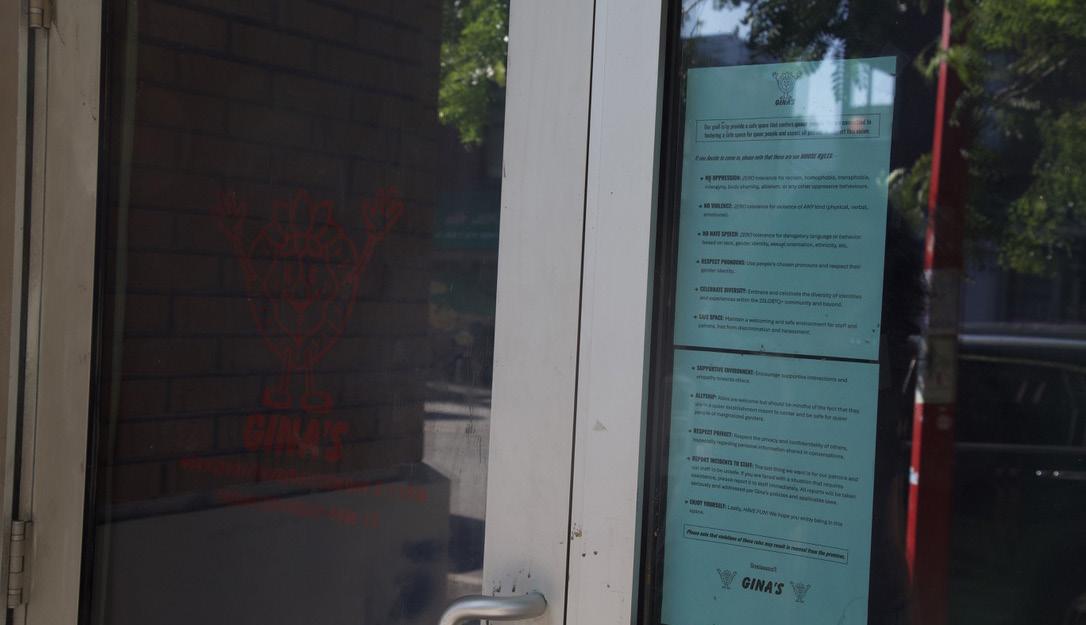
My first stop was Gina’s, a sapphic “for queers, by queers” event space which holds karaoke nights. It is only open on Sundays from 6:00 p.m.–11:00 p.m., but as I drew up to the glass, I saw Gina’s was closed.
“No oppression, No violence, No hate speech,” the sign instructs patrons. “Allies are welcome but should be mindful of the fact that they are in a queer establishment meant to centre and be safe for queer people of marginalized genders.”
When I contacted owner Valeria Velazquez to ask her about Gina’s, she told me she opened the spot because “there needed to be a space that was a little bit more chill than the alternative,” something with less of a “party scene.” It’s a space designed with talking in mind; Gina’s is a close-knit community knit together by Velasquez and her girlfriend.
Gina’s operating hours had slimmed, and now the doors have shuttered. On July 22, Velazquez announced that Gina’s would be closing. In face of this, Velazquez says, “Queer spaces aren’t just about walls or locations; they go beyond that. Even if physical spaces close, our queerness and our community persist.”
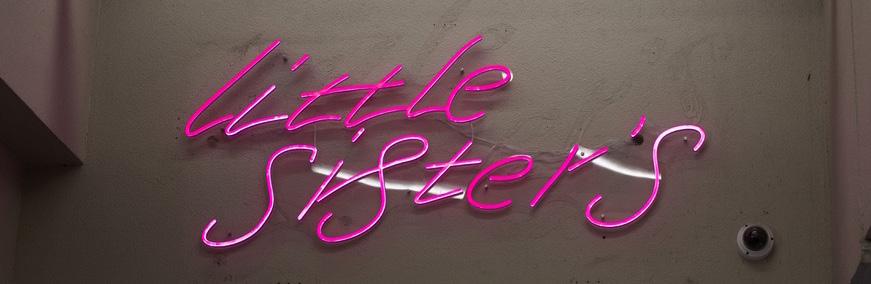
Little Sisters
Little Sister’s bookstore is the first queer bookstore in Western Canada. It was where 2SLGBTQIA+ community members “discussed the happenings during the AIDS epidemic.” In 1987, it was bombed in a hate crime that thankfully didn’t kill anyone. Little Sister’s was also at the helm of an important landmark case. The late original storeowners Jim Deva and Bruce Smythe noticed their shipments from the US would sometimes arrive damaged or missing. They challenged the Canada Border Services Agency for violating their freedom of expression and won in 2000. The Supreme Court of Canada agreed Little Sister’s had been discriminated against.
Still, through legal and physical threats, the bookstore has survived as an important space for the 2SLGBTQIA+ community. “I think it will be here long term,” current owner and longtime friend of Deva and Smythe Don Wilson told CBC.
When I visited the store I was amazed by the bright displays of colourful packaging. I spoke with cashier Aurora Jones, who explained that as e-commerce took centre stage, many bookstores were forced to pivot their business models.
Compared to the primarily literature-based stock in the past, they now “have clothing, adult novelty, sex toys,” Jones said. “We still have a pretty diverse collection of fiction, non-fiction, and used books.” Looking through the magazines and used books from di!erent time periods, the store has an archive su!used into its contemporary collection. “People bring collections from back when they were shopping in the ‘80s, so more generations can enjoy stu! from that time.”
Aware of the space’s legacy and how it serves the community, Jones focuses on the current responsibilities of the shop. “Little Sister’s has been able to survive this long because of the community and because people just keep coming back to support this smaller business.” This includes “parents looking for information about their kids who have come out to them,” he added. Davie is “definitely a community that’s not ashamed to be who they are,” but many other places “could stand to be a little more open and honest with themselves.”
The Junction
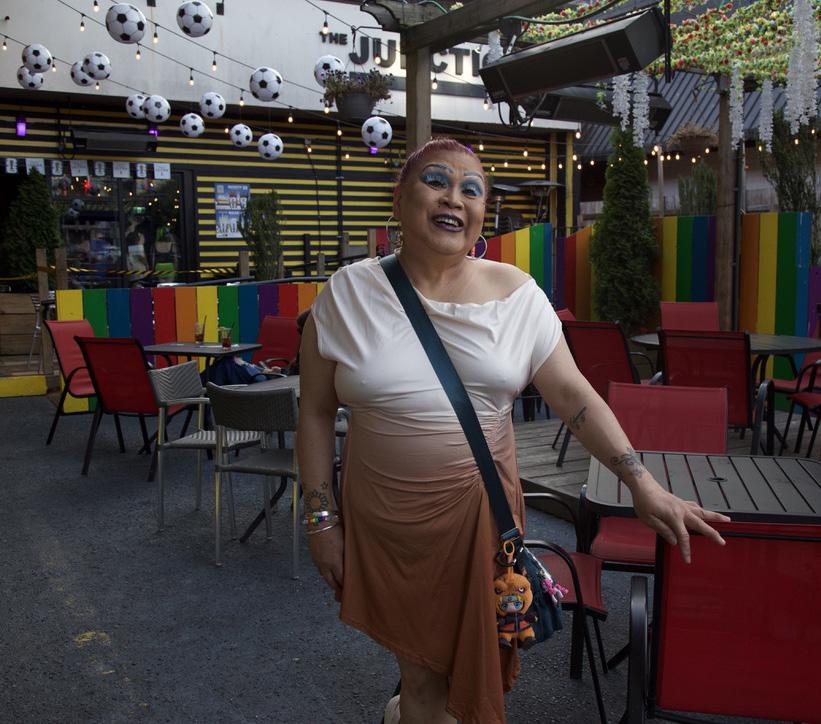
The Junction is a bar with a dance floor that runs a variety of events. A drag show was happening that night (they happen every night!), but the patio by the host stand was open to non-ticketholders. It was my first visit. We sipped our drinks there as we watched attendees filter in, many wearing extravagant outfits themed around video game characters.
I spoke to Imelda Mae Santos, a performer about to go on stage that night, over the roar of the crowd audible from inside. “I’ve been here for a long time.” She gestured at me: with a chuckle and said I was “not even born.” I asked her what her favourite part about performing is, and she enthusiastically responded, “It’s just a rush. I love being a performer, I really do!”
I also spoke to a bartender, name tag reading Mikheel, wondering what it’s like to work somewhere so alive. He recounted a broad audience, too; young people, seniors, families with babies visit in the daytime. “Everyone’s here, everyone’s welcome.”
But around 10:00 p.m., it becomes an adult-only space. “Nightclub mode,” Mikheel said. “We have drag shows every night. This is like the drag show central.”
The Junction also has other events: queer improv, bingo, trivia shows, and more. Mikheel told me with a smile that “most of the community events happen here.”
The Junction has been renamed over the years, but the space has been a hub for queer people for a long time.
I learned a lot about how important pride is for resistance. Everyone I spoke to or interacted with was deeply enthusiastic about their work and role in building a welcoming community, proud of the scene that exists today.
PHOTOS MAYA BARILLAS MOHAN / THE PEAK
MAYA BARILLAS MOHAN · STAFF WRITER
KELLY CHIA · PEAK ASSOCIATE
How art supports healthy aging
Collaborative art helps us view the gift of aging through a lens of hope
MARIE JEN GALILO STAFF WRITER
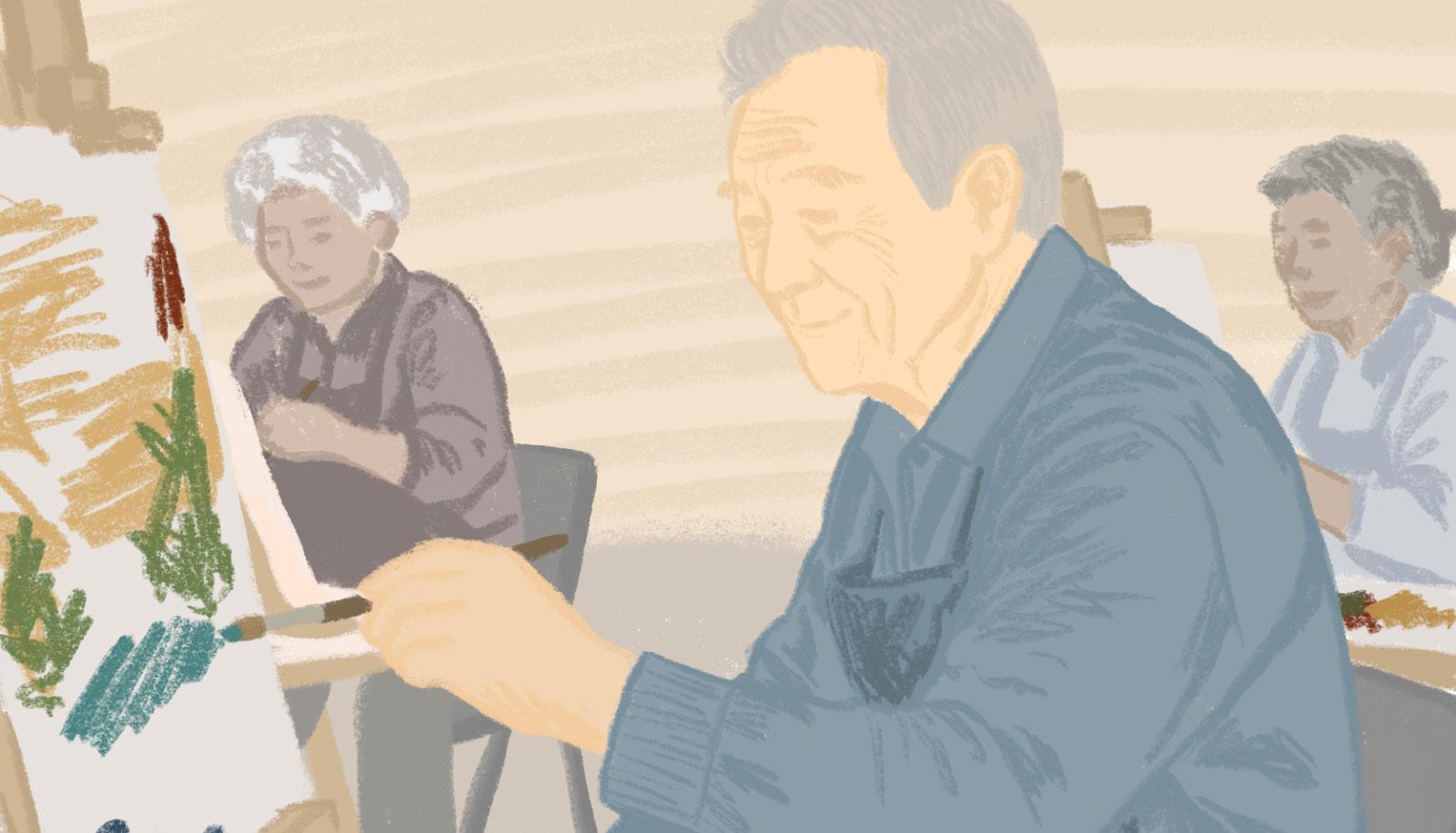
Many people are afraid of growing old because they fear its features, including changes in physical appearance and cognitive abilities as well as social isolation. Art can help us reframe our perspective on aging and learn to view it as a gift. The Arts & Health: Healthy Aging Through the Arts project creates collaborative spaces where seniors and Indigenous Elders work with artists to explore di erent art media. To learn more about this initiative, The Peak corresponded with its coordinator, Caroline Li mann.
As I watch time turn the hairs on my parents’ and loved ones’ grey, knowing there are community-based support networks that will help them navigate this stage of their life gives us the reassurance we need to enjoy the present and remain hopeful for what the future will bring.
Exp
Arts & Health is a Vancouver Board of Parks and Recreation project, in partnership with Vancouver Coastal Health, and local organizations. The project was founded 20 years ago and was in uenced by Dr. Gene Cohen’s research on creative aging, the use of art-based learning and community-building to promote healthy aging in seniors. His research showed that seniors who participated in art programs exhibited “reduced chronic pain, reduced stress and anxiety, increased brain connections.” In the project’s rst three years, the UBC School of Nursing conducted a study on its impacts on senior health, and found that seniors in arts programs had “increased social connections.”
“One participant this year shared how grateful she was for the project and the group, because she usually leaves her apartment just twice a week — once to get groceries, and once to come to her weekly Arts and Health group,” Liffmann shared.
There are currently ve active Arts & Health programs in which artists and participants work together on a variety of projects, including “digital storytelling, memoir, beading, improv theatre, screen printing, and contemporary dance practices.” Even after the program ends, participants stay connected and continue making meaningful art. This year, a group of such participants who worked on a project 20 years ago called “Queer Imaging and Riting Kollective for Elders” received an award from SFU’s Gerontology Research Centre. Achievements like this show the
loring Canadian women printmaking trailblazers at
The Gibson
Working Proof shines a light on an incredible yet underrepresented art form
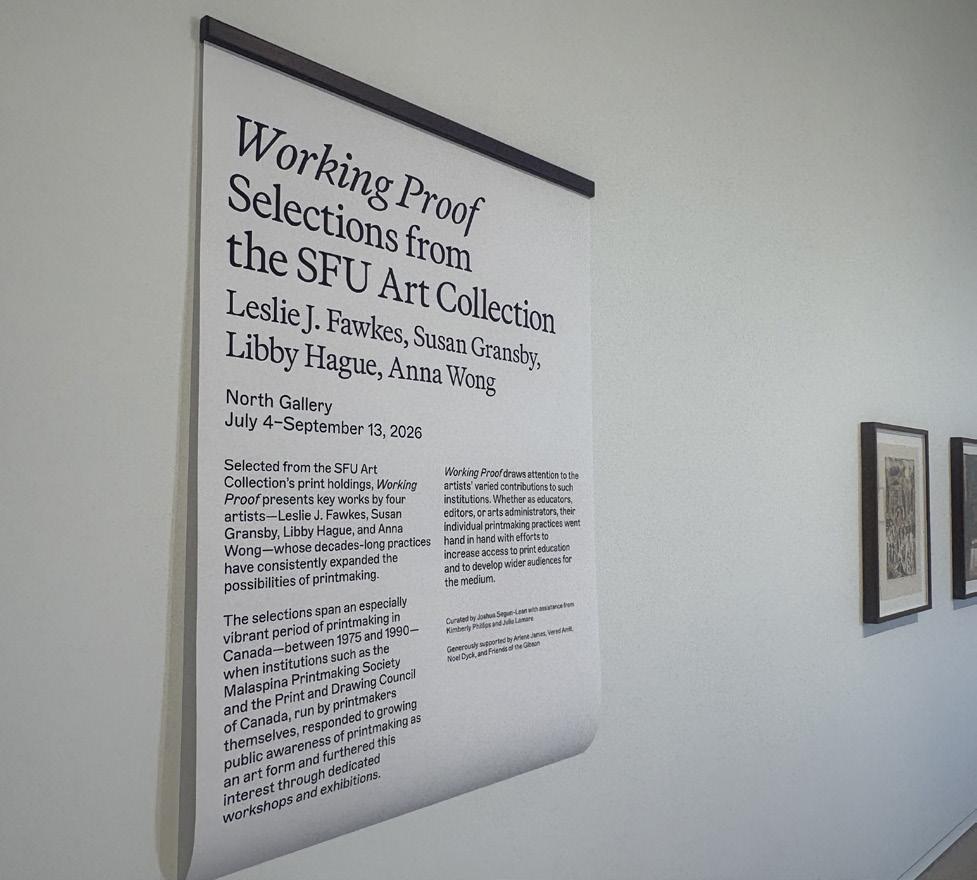
Working Proof is an art collection displayed in the North Gallery of SFU’s Gibson Art Museum to celebrate four artists who played an integral role in promoting printmaking in Canada. Curated by SFU MA graduate Joshua Segun-Lean, the exhibit brings together pieces from SFU’s art archive, spotlighting printmakers, Leslie J. Fawkes, Susan Gransby, Libby Hague, and Anna Wong. The works displayed were created roughly between the years 1975–2000, a period when artist-run institutions like Granville Island’s Malaspina Printmakers were pushing printmaking back on the pedestal of artistic practice in Canada.
Walking into the exhibit, the rst thing I noticed were the prints created by Wong: carefully constructed pieces containing a mixture of Chinese embroidered patterns, Chinese script, and fragments of traditional paintings. Wong trained in Chinese brush painting in Hong Kong before coming to Vancouver to pursue printmaking as an academic and professional endeavour, and that dual inheritance is everywhere in her work. The piece that most captured my attention in the whole exhibit came from her section; the surreal collage of the Great Wall of China spread across two frames, and was a slight departure from the aforementioned themes. With stunningly delicate shadowing accentuated the rolling, gentle green hills and the winding wall, this piece felt like a still frame from an Akira Kurosawa lm.
Further along the exhibit came some pieces by Hague, which primarily involved stencilled cutouts of murky black and white figures moving around in day-to-day activities. The figures in her works often display a flattened, posterlike quality, almost as if they were the shadows. None more telling of this than “The Women Walking By” (1978), where three silhouetted women clad in black, carrying purses seem to be convened at a bus stop, collectively going through the motions of everyday life.
This exhibit served as a quaint, yet powerful, tribute to these four trailblazing artists, as well as a great source of artistic inspiration and accessible public education on Canadian print making.
lifelong impacts of practicing creative aging through arts, both for individual empowerment and to society at large.
Arts & Health aims to empower seniors by letting them lead the creation of their own art through which they “explore issues and ideas that are important to them.” In a Strathcona Community Centre puppetry project, for instance, the participants “didn’t think of themselves as artists initially,” but they “became more con dent and vocal about their interests, beginning to take on more leadership roles,” and used puppetry to share their “experiences of war as children.” Li mann shared a testimonial from one of the participants: “Arts & Health brings out our happiness and sadness. It helps us recollect our memories, life experiences and individual stories, with laughter and tears. We forget our age, health limits, and pain . . . we support each other.”
After seeing the positive impact that art has on the health and well-being of seniors and Elders, Li mann views arts as “a way to process the information of our life experiences, and to express and imagine ideas, memories, futures, heartbreaks, complexities, fragments, joys, and new possibilities, large and small.” As I watch time turn the hairs on my parents and loved ones grey, I worry about how to support them as they age. Knowing there are community-based support networks that will help them navigate this stage of their life gives us the reassurance we need to enjoy the present and remain hopeful for what the future will bring.
Moving clockwise through the room, I arrived at Fawkes’ explorations of the nude body. Monotone black gures with thin white engravings that demarcate di erent body parts, these pieces balance a kind super cial strikingness with an underlying tenderness, inviting the observer to engage with the humanity of the two-dimensional gures.
Finally I arrived at Gransby’s works, which are displayed next to newspaper clippings, brochures, and memorabilia of the Malaspina Printmakers where Gransby once plied her trade. Gransby’s works on display are distinguished from others by their striking focus on architectural styles, most of them often leaning towards colourful, abstract depictions of buildings, houses, and rooms, with chaos and nostalgia abound in her artworks.
Overall, Working Proof provided a very accessible point of introduction to the print making world, an art form that deserves its owers. This exhibit served as a quaint, yet powerful, tribute to these four trailblazing artists, as well as a great source of artistic inspiration and accessible public education on Canadian print making.
Working Proof will be on display at The Gibson Art Museum until September 13, 2026.
ILLUSTRATION: JACKIE PENG / THE PEAK
ARTS & CULTURE
PHOTO: HARMEET GILL / THE PEAK
JONAH LAZAR STAFF WRITER
Immersive art as a call to action in Interglacial
How art translates scientific data into human experience
MARIE JEN GALILO STAFF WRITER
Glaciers are not only rivers of ice, but also ancient, geological re ections of time. We are currently living through interglacial — the stage of the ice age characterized by warmer temperatures. Through her exhibition Interglacial, environmental artist Desirée Patterson explores the impacts of climate change and our responsibility to protect not only glaciers, but also diverse ecosystems. The Peak spoke with Patterson to learn more about Interglacial and her artistic practice leading up to the exhibition.
After being inspired by Mission Blue — an acclaimed documentary that highlights the work of marine biologist Dr. Sylvia Earle — Patterson recognized “the environmental degradations to these ecosystems that [she] deeply loved and connected with.” This was monumental for her; she became passionate about environmental mindfulness and protecting the natural environment, which “organically permeated into [her] practice.” She added, “I came to this place as an artist — you make work from your heart, you make work from your soul.”
Patterson joined the United Nations International Year of Glacier Preservation initiative as an artist-in-residence, where she worked with eminent environmental scientists across northern Turtle Island (Canada), to translate geological data into immersive artistic visualizations to produce Interglacial.
Interglacial explores deep time, wild res, and deglaciation through ve pieces. Each piece involves a “video didactic,” in which the scientists explain their research and remind us that not all hope is lost — we can protect our ecosystems if we understand the gravity of our impact and choose to act now.
ARTS & CULTURE
For deep time, Patterson collaborated with ecologist Dr. Eric Higgs, and used repeat photography, which involves taking a picture of a place from the same spot at a di erent time. The piece consists of “eight di erent pairs of deglaciated repeats,” which the audience can directly lift to reveal the more recent glacial pictures below.
I really hope that this inspires other people to step into their own power and use their voice in their own unique ways.
DESIRÉE PATTERSON
ENVIRONMENTAL ARTIST
The wild re section consists of three sculptures and multimedia installations, and was made in collaboration with
Exploring queerness across Southeast Asia
Queer Southeast Asia: An Afterword sows hope of expanding a field of research
PHONE MIN THANT ARTS & CULTURE EDITOR
“Queer Asia does not have a great history; it has never found an institutional home in the region.” This quote is one of the last sentences in Queer Southeast Asia: An Afterword, in a section about nding hope through the study of queer experiences. It is a wonder, of course, why I chose to start with this quote. It does not sound particularly hopeful. I chose it because it perfectly describes queerness across Southeast Asia: a largely grassroots network of movements fuelled by activism, passion, collective reimagination, trial and error, and language reclamation against institutions that have prevented queer expression and quelled social dissent.
Queer Southeast Asia reminds us that there is a community actively trying to unearth the complex roots of queer communities in the region, and that there is hope for its future tree of knowledge to grow.
Queer Southeast Asia can be best described as a collection of both academic research and personal experiences inside Southeast Asia, and to a lesser extent, by its diaspora abroad. The book does not try at all to generalize queerness in Southeast Asia, something I appreciated as a researcher of Southeast Asian studies myself. It lays out the history of some of the region’s most prominent activist movements and sheds light on the less visible forms of expressing queerness in a region which has largely remained conservative. The book covers covert distribution of queer lms inside Singapore, building community at night-clubs in Bangkok, and practicing freeform expression in an increasingly-populist regional political landscape.
While I suggest the whole book for a more comprehensive and intersectional outlook on advocating for, and being, queer Southeast Asians, I found a few chapters to be particularly intriguing. The rst was a chapter by Dr. Benjamin Hegarty, a prominent Australian expert on Southeast Asian gender, sexuality, and reproductive health. Hegarty explores the politics of reclaiming the word “transpuan,” an activist word for transgender women in Indonesian, from the oppressive language describing trans and queer communities coined by the Indonesian government. Coming from a nearby state that also lacks a word for queer women, it was inspiring to see queer activists and allies challenge discriminatory narratives imposed by authoritarian governments against those simply practicing their rights. I was also drawn to the chapter by Dr. Quah Ee Ling Sharon and Dr. Shawna Tang, two queer academics of Southeast Asian heritage, exploring the nuances behind Southeast Asian queer migrants’ search for “utopia,”
wild re ecologist and tree ring scientist Dr. Lori Daniels. One piece, “From the Ashes” consists of speakers made of “charred wood that was taken mostly in Mount Currie in a cultural burn with the Líl wat Nation,” which play the sounds of returning birds in a forest following a wild re, a manifesto that displays the “resilience of nature and the ability of ecosystems to regenerate.”
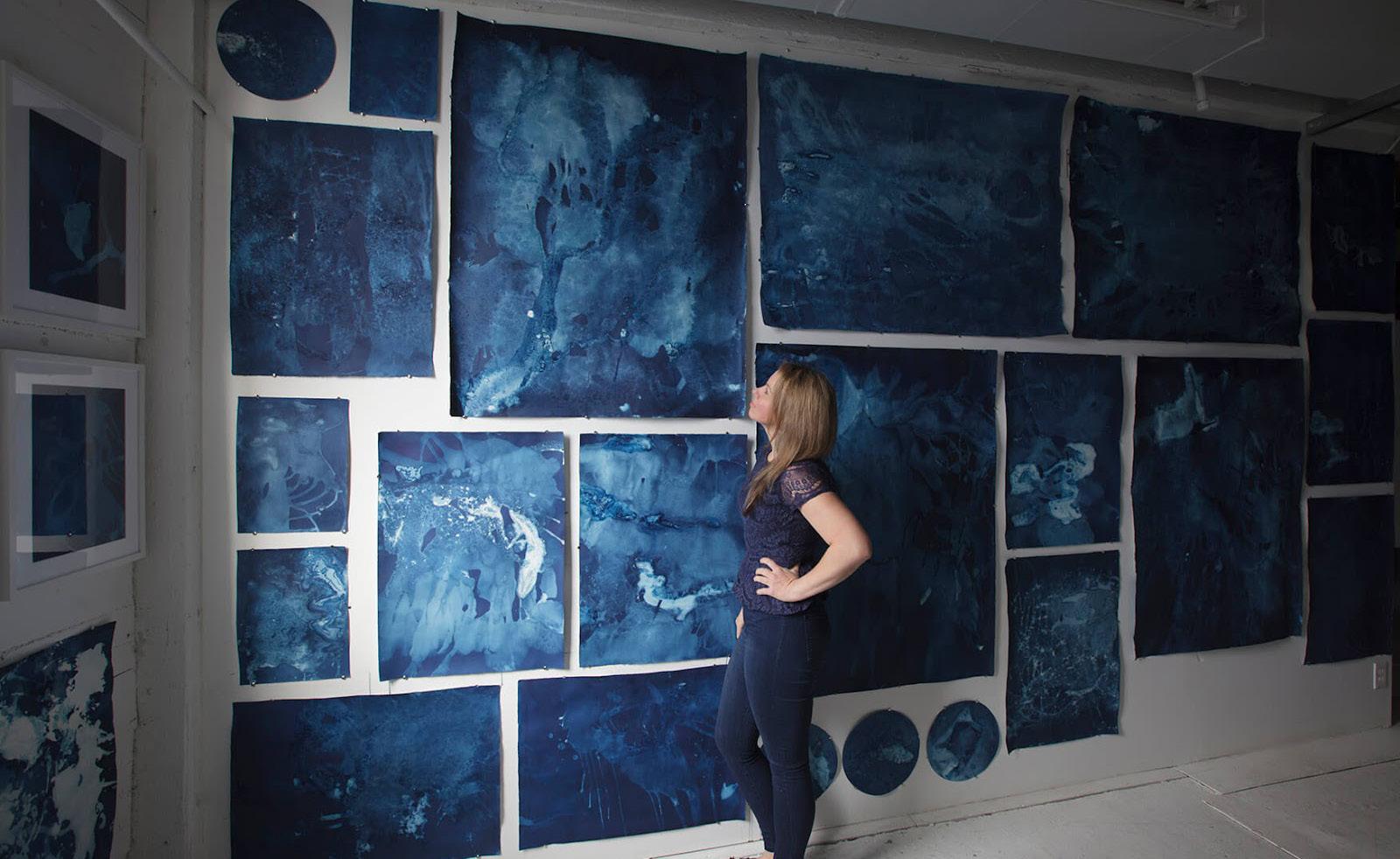
“Still in Place” is the heart of the exhibition and was made in collaboration with glaciologist Dr. Brian Menounos. Patterson made “the glacier a direct collaborator in the process,” by creating the textile art piece at Place Glacier, using a tarp as a “barrier” between the ice and the fabric. She used cyanotyping, which involves coating the textile canvas in an iron solution that turns the fabric blue when exposed to UV. The audience walks under the canopy of “blue and white striations,” while listening to the sound of melting ice.
Patterson hopes that experiencing this exhibition will inspire audiences to take action against climate change. “I really hope that this inspires other people to step into their own power and use their voice in their own unique ways,” Patterson said. “We all need to rise to this call to act.”
Interglacial will be on display at The Reach Gallery until March 20, 2027.
a safe haven where they are able to freely, safely, and visibly exist, usually meant to generalize democratic Global Northern states. In this chapter, however, Sharon and Tang explore the intersectionalities of being queer Asian migrants, who can express themselves freely, but are then victims of xenophobia, racism, and homophobia. This rejects the assumption that queer diaspora “would nd freedom and a happy ending,” post-migration. Other favourites also include Dr. Sim Jiaying’s explorations of how queer Singaporeans nd community and recreation through discreetly-distributed queer short lms, as well as Dr. Anthony Langlois’ discourse on how queer activists remain resilient against the rise of surveillance states.
It is here that perhaps the rst quote may be recalled; in Southeast Asia, queerness has little institutional support, particularly for those attempting to study it. However, Queer Southeast Asia reminds us that there is a community actively trying to unearth the complex roots of queer communities in the region, and that there is hope for its future tree of knowledge to grow.
PHOTO COURTESY OF DESIRÉE PATTERSON
PHOTO: RUIE BOTRON / PEXELS
FLIRTING WITH CUTE ROCK CLIMBING GIRL
WRI EN BY A HOPELE ROMANTIC
Day 1
I picked up climbing because I want to make more queer friends. Starting as a total newbie at the activity will be fun. I want someone to show me how it’s done!
Day 2
The girl at the front desk is literally a dream come true. She gave me some advice about climbing — but what really got my heart racing wasn’t the steep climb ahead, it was her smile. Her delicate ear piercings framed her perfect face like a halo. I probably didn’t have a chance with her, but I was happy to see her regardless.
She showed me how to shimmy up the problem and she was so graceful I was fully enchanted. “All yours now,” she said, gesturing up the climb.
Day 3
I asked her if the white Jeep out front was hers. She said yes, but then said, “Me and my boy go up to Squamish from time to time. I just got it. Super spacious for packing all our gear.” BOY? Is there a Mr. Climbing
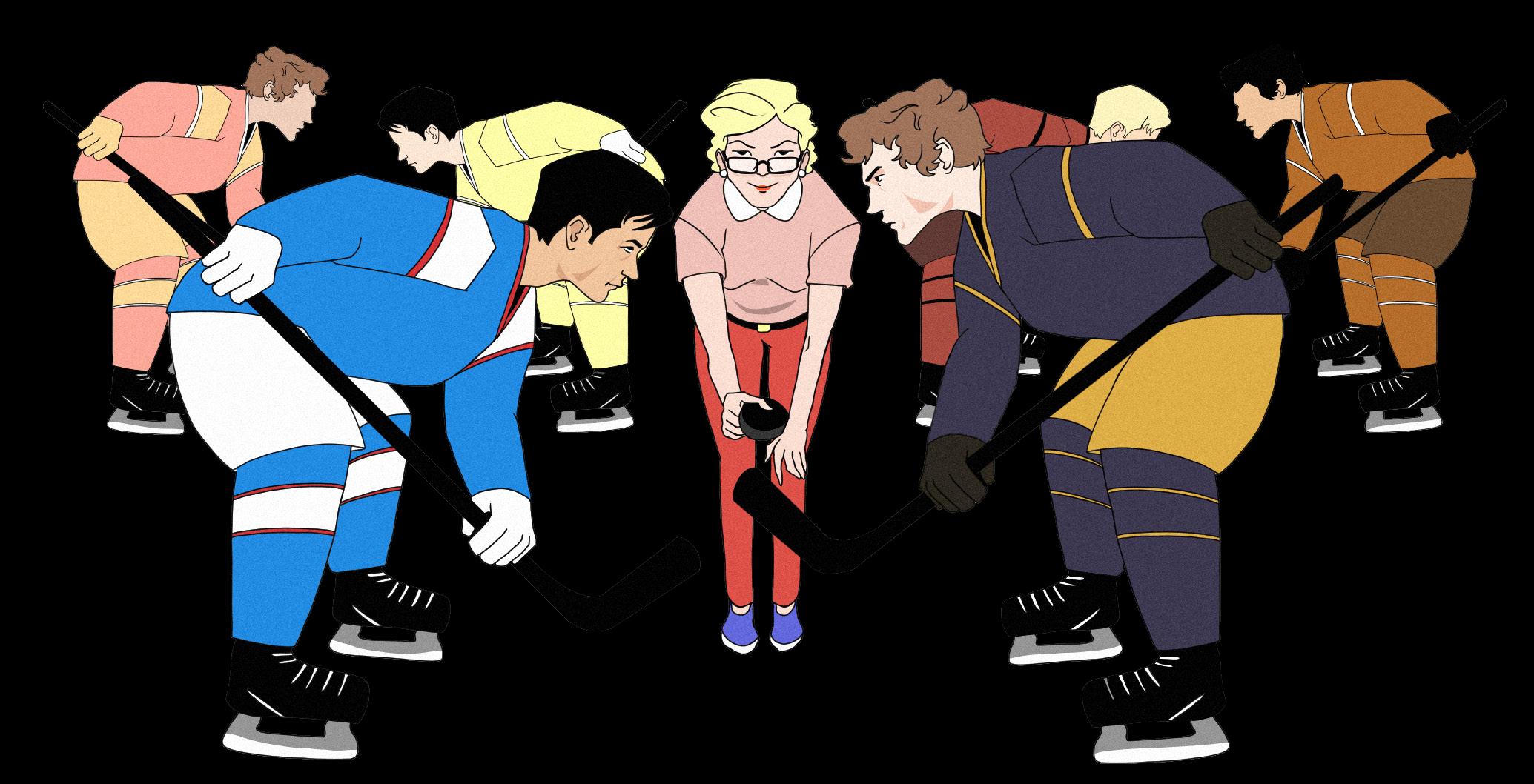
How did I, a straight middle-aged white woman, end up at a gay club during arguably the busiest season of all time — Vancouver Pride? Well, to tackle that question, you’ll have to understand the last few months of my life.
Ever since Heated Rivalry started streaming, I’ve been eating, sleeping, and breathing that steamy show. I like how relevant it is to contemporary Canadian culture. Since the ‘90s, many gays have been popping up everywhere. Maybe something’s in the air? I also found the show to be a way better reflection than them deciding to put lesbians in Bridgerton that on the other hand is not historically accurate. Lesbians didn’t exist before Britney Spears kissed Madonna.
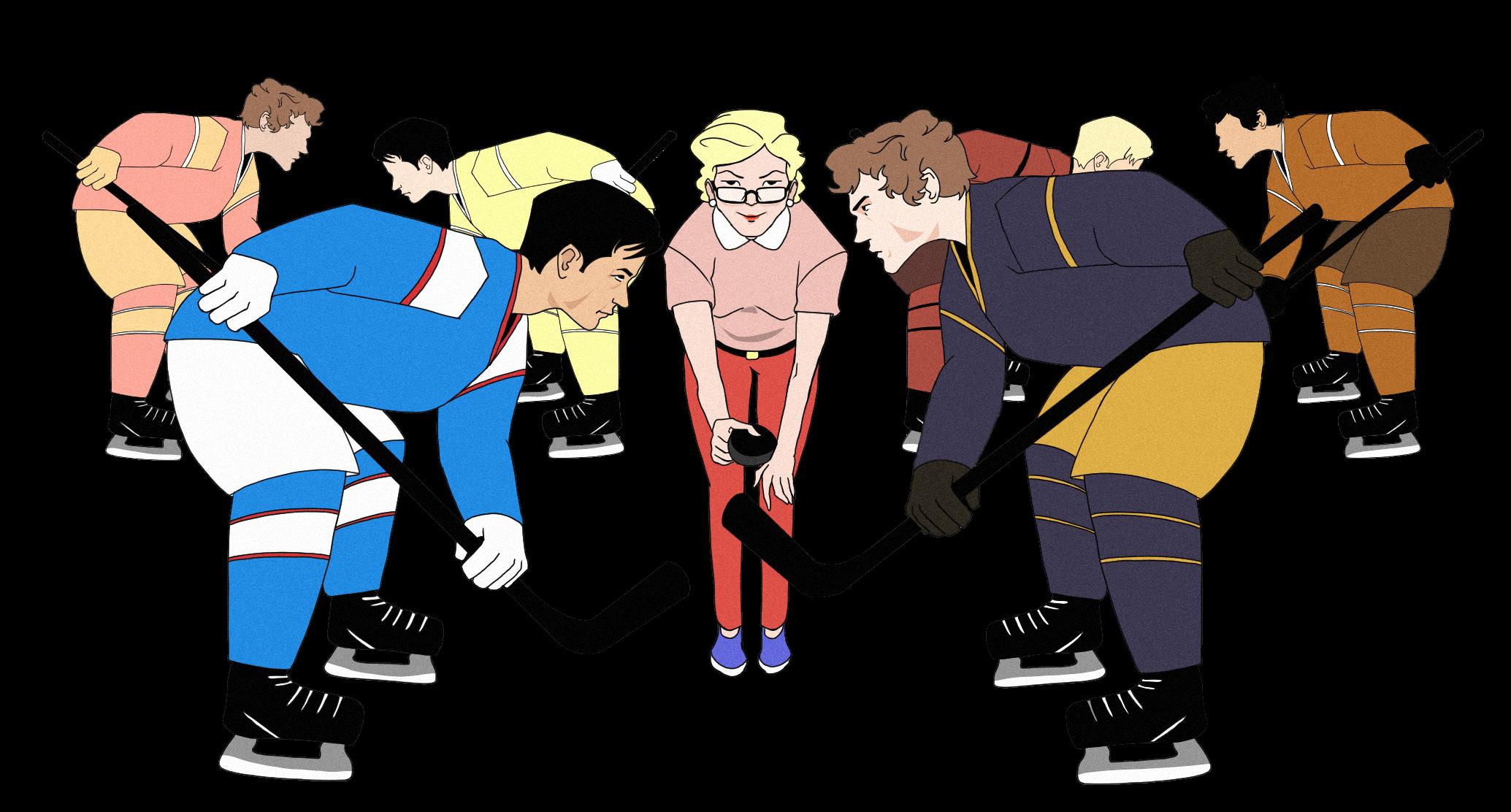
I think I understand more about gay culture than they do. So much so that I learned something particularly interesting that not a lot of my friends in the Heated Rivalry Facebook group know. All of my friendly gays (you iceskating queens!!) are professional hockey players. Yes, you heard that right.
I felt so ignorant. So blatantly out of touch with the realities of 21st century Canada. When my gay neighbour told me that he was seeing someone, I thought he was going on a date — not being forbidden lovers on the ice. When I heard someone say they were together for six years, I had no clue they meant six seasons. When I read an article on the best dildos to use in bed from Queerty, I didn’t know they were all hockey sticks.
I told myself: Linda, you are such a bad gal. How could I have been so ignorant? So fervently discriminatory? To make up for my clear transgressions, I decided to act in the only way possible. Celebrating gay culture by participating in their most sacred tradition. Clubbing.
I pulled up to Celebrities Nightclub on Davie Street, my son’s hockey stick in tow so I could fit in with the rest of the gang. I paid my cover, walked past the bouncer, and pranced onto the dancefloor.
“Hey, hockey players! My name is Linda. I’m a huge fan and ally,” I said, waving my hockey stick in the air.
Around them, I could see other people dressed in their hockey apparel. I waved to get their attention over the loud EDM music . . . we had a good time dancing.
“And the winner of the Heated Rivalry lookalike contest is Jack and Ralph!” an announcer proclaimed. What? Lookalike? Surely these people couldn’t be dressing up for a contest . . . how rude of them to appropriate gay culture. Suddenly, everyone on the club floor ripped off their hockey jerseys and began dancing. And why were there lesbians at a gay club?? I was so confused.
Girl of my Dreams?! I didn’t know how to ask that, so instead I tried to suss out if the Jeep was manual. She said it was. Her dad taught her, and I should get someone to teach me how. I asked if she would, prompting her to quip back that lessons aren’t included with my membership.
Day 4
Dream Girl noticed my nubby nails when I scanned in today. “Keeps us climbers humble.” US? Is there an US?! She asked how my new callouses were going, and before I could show her, she grabbed my hand to take a peek. My heart skipped a beat. She called over to a coworker and asked him to bring a file from the disp!ay. Instead he tossed two. He beamed when she caught it. “Keep the spare for the next Squamish trip. We’ll definitely want it when away from civilization.” So . . . these two climb . . . together . . .
Day 5
Today she was wearing a sweater with holes in the knit. “I didn’t know you had a tattoo,” I said. Totally a coincidence, but I can’t lie that it feels like fate when she rolls up her sleeve. She has the same tattoo I’ve wanted
for years, but was always too indecisive to actually get. I told her, and she said it was a pretty basic design, but she’s f!attered. I don’t know how to make it more obvious I want . . . to be with her.
She quickly asked me if I heard Dean Brody’s !atest work. Apparently he’s some country singer? Fuck. I’m losing her . . . there’s no way she’s a lesbian.
Day 6
A week of pining must make us friends now? I asked her to go for a matcha before my climb tomorrow. Throughout my climb, I could see her catching glimpses at me. When I returned my shoes, she agreed.
Day 7
“So, I’m g!ad we’re doing a hangout. You’re a chill friend,” I told her with my usual sparkly eyes.
She looked at me b!ankly. “What do you mean . . . hangout? This isn’t a date?”
I couldn’t believe my luck. Turns out she is queer . . . and her “boy” was actually her “bro.”
ILLUSTRATION: Cliff Ebora / The Peak
e breakdown of the modern gaydar
DINA BOUNINE SFU STUDENT
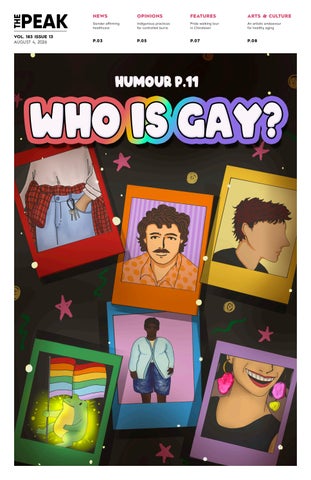
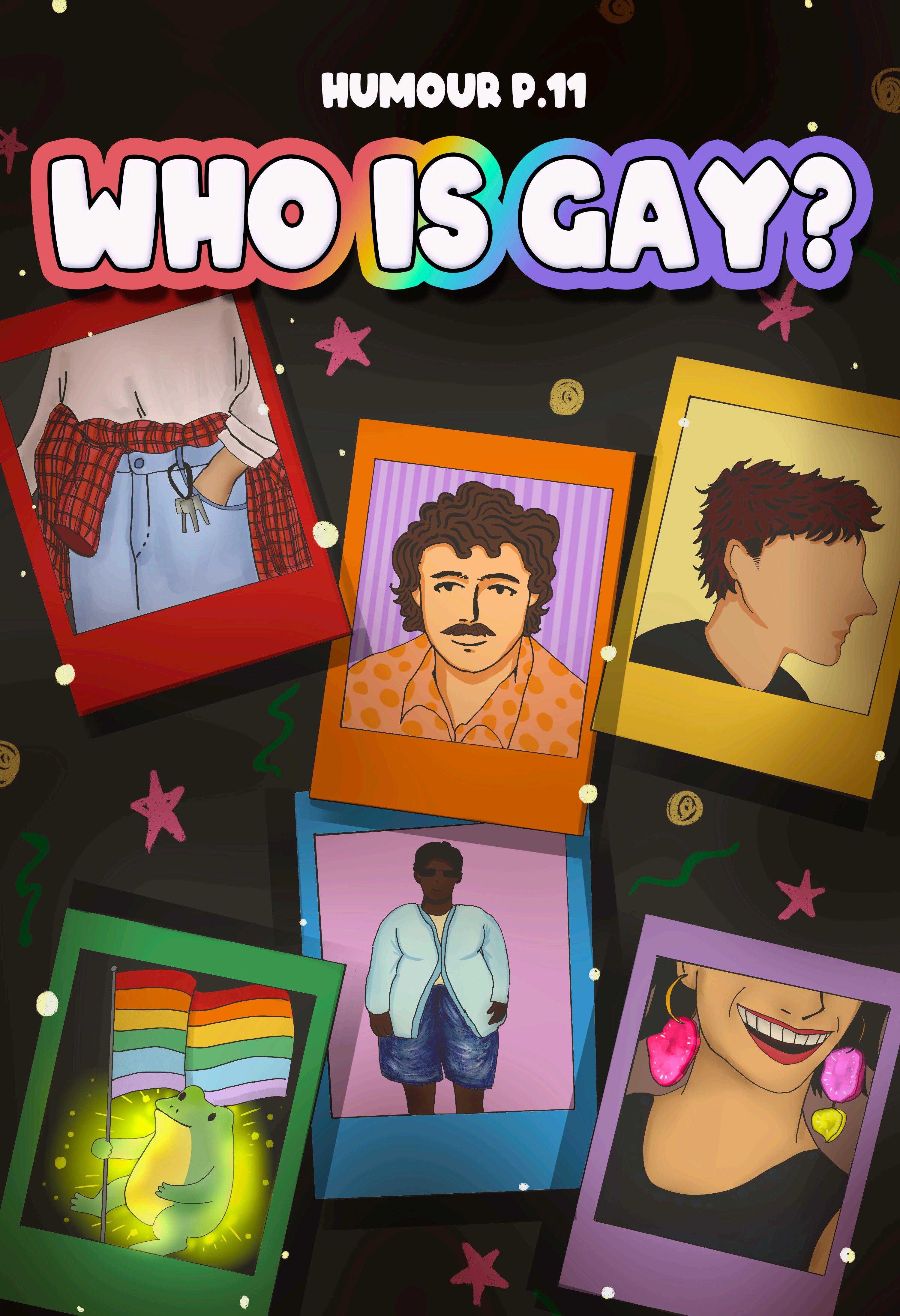
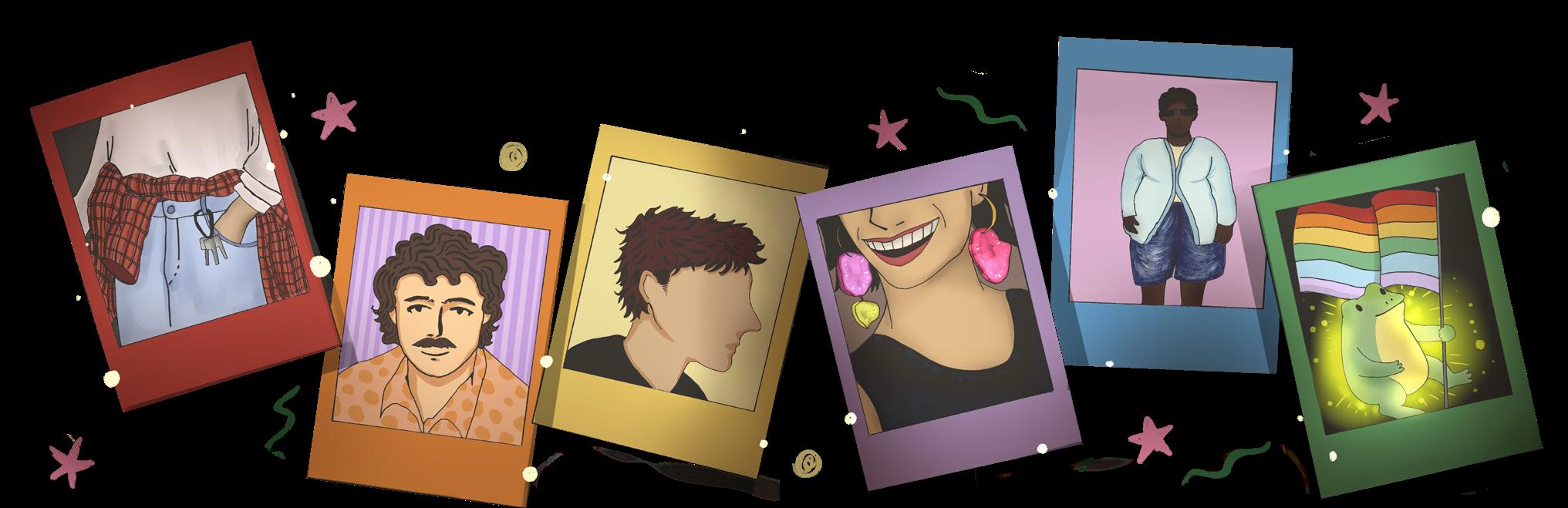
Imagine, you’re on the bus and you see a guy (ew). He’s got a good mullet (as in one you would see scrolling on Pinterest instead of on a hockey p!ayer). His mustache is straight out of an ‘80s porno. He’s wearing the tightest tank top paired with some nice baggy highrise jeans and a singu!ar earring. Five years ago you could’ve bet your limited-edition brat vinyl that this guy is one of them queers. Now you find yourself wondering whether he works out to impress other men in a gay way or in a manosphere gymbro way, and whether his canvas tote bag contains poppers (the one thing straight people will never steal), or an unread book on feminism he’s going to poorly mansp!ain to a woman he wants to sleep with !ater.
Or what about that shredded !ady with a good mullet at your rock-climbing gym (who you definitely don’t have a crush on)? She drives a Subaru, wears her keys on a carabiner, and a f!annel around her waist. She’s always going on about her “partner.” She has a naked woman tattooed on her arm. But when you ask if she listens to girl in red, she says she tried women in college before meeting her husband and it just wasn’t for her. Another L for the lesbian community.
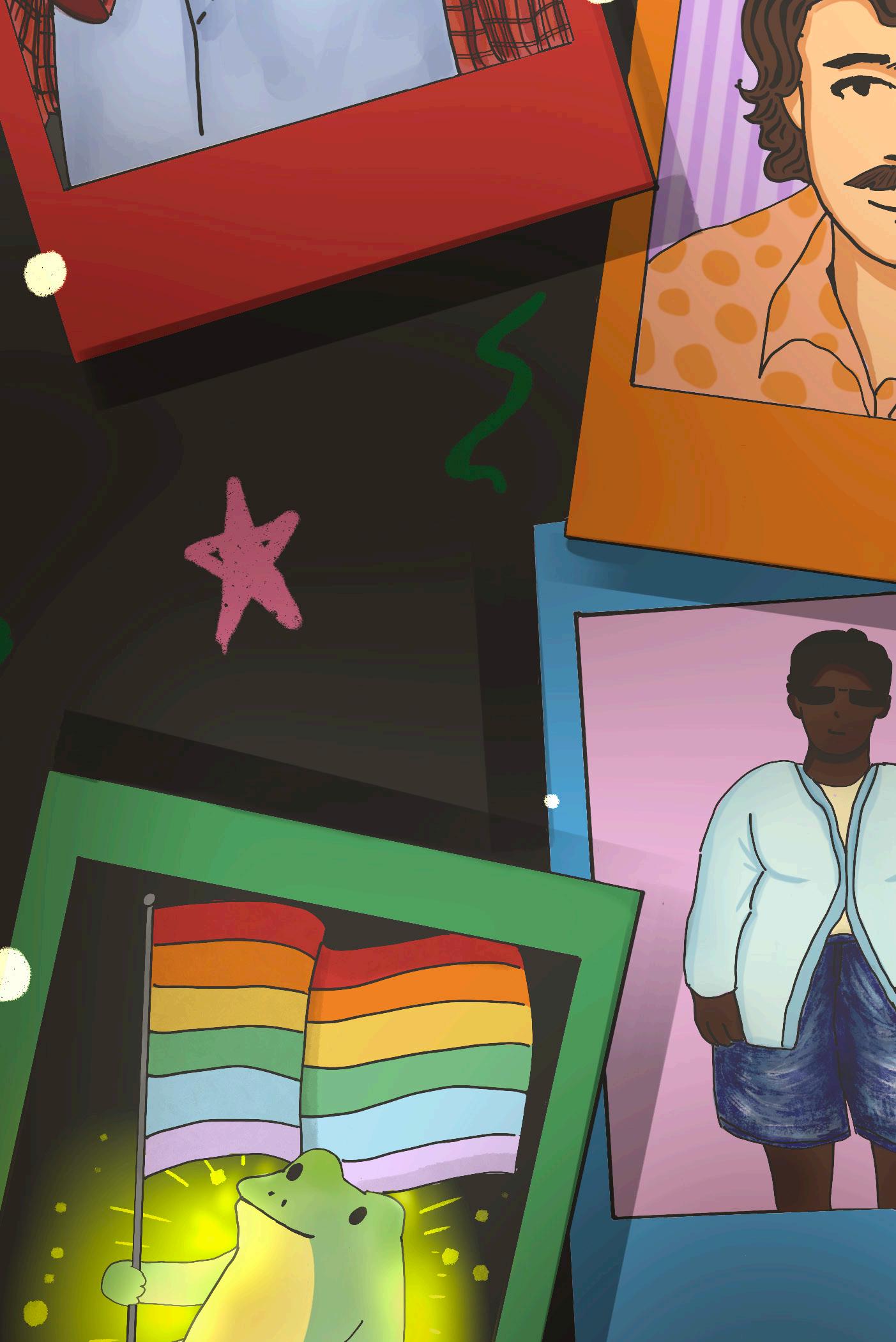
Our society has been besieged by an epidemic. As they say, ”they’re putting chemicals in the water to turn the frickin’ frogs gay.” I don’t see more gay people (or gay frogs), but I do see our fashion everywhere. Especially our good mullets (seriously, when did they figure that out)? Queers are reeling as our once semi-reliable gaydar is now leading us astray.
Do’s and don’ts to have a great backpacking experience this su er
JONAH LAZAR · STAFF WRITER
Throughout my time at SFU, I’ve had the luxury of taking summers off and the irresponsibility to max out my student loans so that I can backpack. During these summers, I’ve visited a lot of places that taught me a lot of lessons. For those of you who decide to travel during the last few weeks of summer, or who are gearing up for a big trip next year, I figured I’d impart a few do’s and don’ts that I’ve learned during my summers abroad.
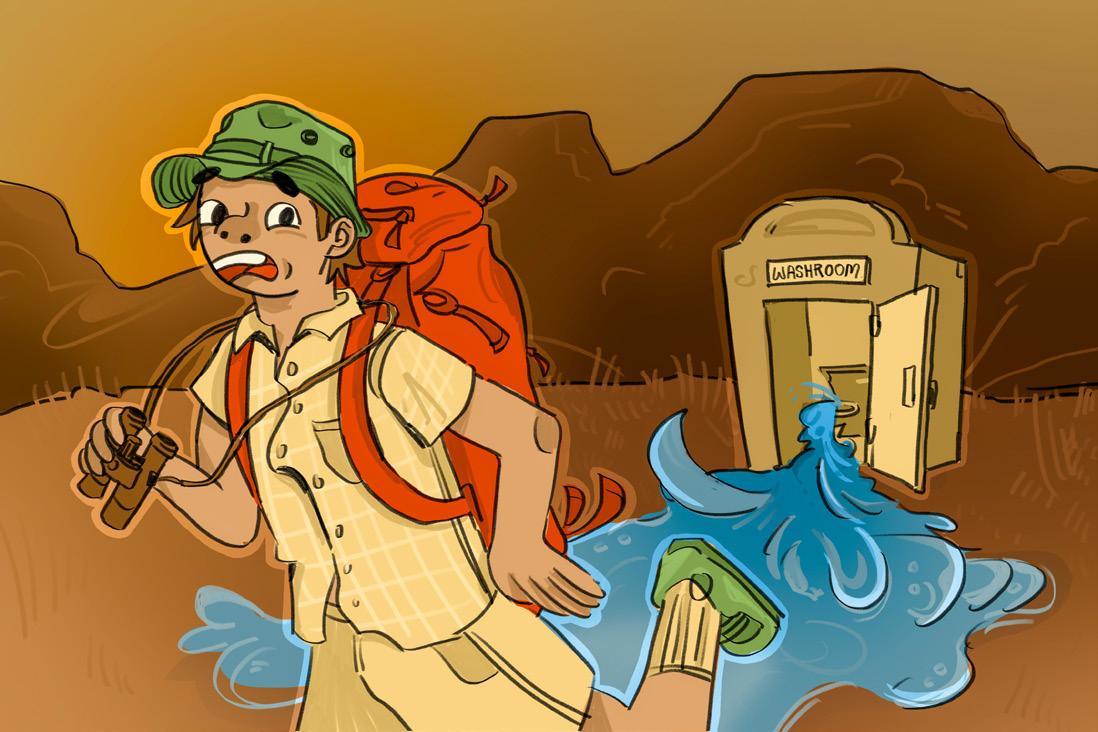
Don’t: skimp on hotels, you may end up naked and afraid.
Two years ago, after a few nights sleeping on buses in Italy with my brother, I ended up in Baku, Azerbaijan. Upon arriving at my $10 a night Airbnb, I stripped down and passed out instantly, waking up sometime around 1:00 a.m. disoriented and naked. Upon rolling out of bed, I took a piss, and flushed the toilet to a very strange rattling and choking sound. Before I could even process what was wrong with the toilet, the water heater in the bathroom exploded into a million pieces, steam instantly filling the whole apartment. In a panic, I ran out into the street and slammed the automatically locking apartment door behind me, calling out for help. Standing ass-naked in the middle of downtown Baku, police and onlookers circling the building due to the sound of the explosion, I wondered if I remembered to put my passport and phone on the bedside table of my rapidly-flooding Airbnb.
Do: ca y cash, unle you want to get rea y drunk, rea y fast.
That same summer, I did a four day-long solo hike across a mountain range in Albania, stopping at hostels in remote villages overnight. Trying to be clever and save my money, I brought half as much cash as I was advised to bring, in order to limit my spending. To my great surprise, I ran out of money on day two.
Straight men have so long tried to avoid looking gay and now they’re following straight women into gay clubs and getting angry when they get hit on. Buddy, that yellow hanky in your right back pocket means something specific here so don’t be surprised if someone asks to pee on you.
This problem is so severe that the gays have been forced to abandon everything we hold dear. The gay men are tragically getting buzzcuts and shaving their mustaches. The femme lesbians have been forced to abandon the cottagecore aesthetic lest they be mistaken for trad wives. The butches? Well the butches still dress like Adam Sandler . . . but unfortunately jorts are trendy too now.
Perhaps even more problematic than the heterosexual assault on our eyes is the stream of nonsense the straights are hitting our ears with. I do not want to hear how your incredibly basic outfit is “giving clock it house down boots” or how your average boyfriend is “DL trade.” This is the gay “chai tea.” I’m embarrassed for you.
In truth maybe this is partially a good thing. This is a sign that rigid rules around gender and self expression are loosening and association with our identities is less taboo. At the same time I will crash out if one more combat boot, funky earring-wearing woman I hit on is straight.
With no cell service and the nearest card reader at the end of the hike, 60 km away, I hiked 30 km to the next village, where my prearranged hostel for the night promised complementary dinner. With a handful of wild strawberries and a drink from a creek as my only sustenance in the past 24 hours, I staggered into the hostel famished, only to find that the complementary dinner was endless vodka refills, a half bowl of soup, and some lettuce.
I threw up the soup and lettuce about three refills later.
Do: be wary of friendly animals some want to be more than friends.
With a very rational fear of flushing toilets still lingering within me, I went solo traveling to Southeast Asia last summer. On a warm summer afternoon in a seaside cave near Ao Nang, Thailand, I was drifting in and out of a nap, smoking far too much of a joint (so glad it was legal in the country), and sipping lychee juice, when I felt my drink wrenched out of my hand.
As I turned around in my inebriated haze, I came face to face with a macaque who had stolen not just my lychee juice but my wallet as well, and had jumped up onto a ledge to where we were now eye-to-eye. I inevitably jumped to my feet in panic. As I yelled at him to give me my stuff back, fighting back a full-blown, weed-induced meltdown, I saw the macaque’s little red penis extend like a toy lightsaber, dropping my stolen wallet so that he could stroke it to the excitement of the situation we’d landed ourselves in.
Unfortunately I did not get my lychee juice back. But I did avoid weed for quite a while afterwards.