Find extended, cited, and web-accessible articles at the-peak.ca Download digital issues at issuu.com/peaksfu
The Peak is SFU's weekly student newspaper published every Monday, by students, for students. We’re funded by a student levy and governed by a Board of Directors. Any SFU student can apply to become staff
We reserve the right to edit submissions for length, as well as style, grammar, and legality. We also reserve the right to reprint submissions at any time, both in print and on web. We will not publish content that is sexist, racist, or otherwise prejudiced.
TERRITORIAL ACKNOWLEDGEMENT
acknowledge that The Peak’s office is located and our paper is produced, distributed, and read on the Unceded Coast Salish Territories of the xwməθkwəy̓əm (Musqueam), səlilwətaɬ (TsleilWaututh), kʷikʷəƛ əm (Kwikwetlem), qʼʷa:nƛʼən (Kwantlen), qicəy (Katzie), Semiahmoo, and Skwxwú7mesh (Squamish) Peoples. Unceded means that this land was never surrendered, relinquished, or handed over in any way. We recognize that the unceded land that we occupy includes not only the SFU Burnaby campus, but extends to the land occupied by the Vancouver and Surrey campuses as well.
App created for people with ADHD
Senate Spotlight
Talks of cyberhacks, medical school applications, and university values
On May 19, the SFU Senate convened for their monthly meeting. The Peak attended for more information on new and existing policies and proposals regarding the university.
Discussions of note during May’s assembly included SFU’s strategy in the wake of the recent Canvas cyberattack, statistics surrounding the candidates for the university’s newly minted School of Medicine, and controversy regarding a BC Cancer Foundation and SFU health sciences endowment.
Chief information o cer Brian Stewart and chief information security o cer Jastej Singh Aujla addressed senators’ questions around the hack, which impacted close to 9,000 institutions. Senator Colin Percival inquired about the possibility for students with privacy concerns to use pseudonyms on Canvas, with the hope of providing extra security. O cers were receptive of the idea, noting potential interest in the idea moving forward. No speci c plans of action were noted during this meeting.
On the agenda was also discussion regarding SFU’s incoming inaugural School of Medicine class, with a cohort set to begin in August of this year. The university received 1,864 applications, while ultimately o ering interviews to 205 candidates, and is set to admit 48 students. Currently, all spots are being lled by accepted or waitlisted students.
Senator Dr. David Price, founding dean of Medicine, spoke about the Indigenous stream, a portal designed for First Nations, Inuit, and Métis applicants of the School of Medicine. Price shared he believed that the number of applications from Indigenous students “indicated endorsement of the work that Simon Fraser University has been doing in the Truth and Reconciliation process.”
SFU’s Geography Student Union hosts RANGE 2026 conference
Career and education advice in a student-run conference
MAYA BARILLAS MOHAN STAFF WRITER
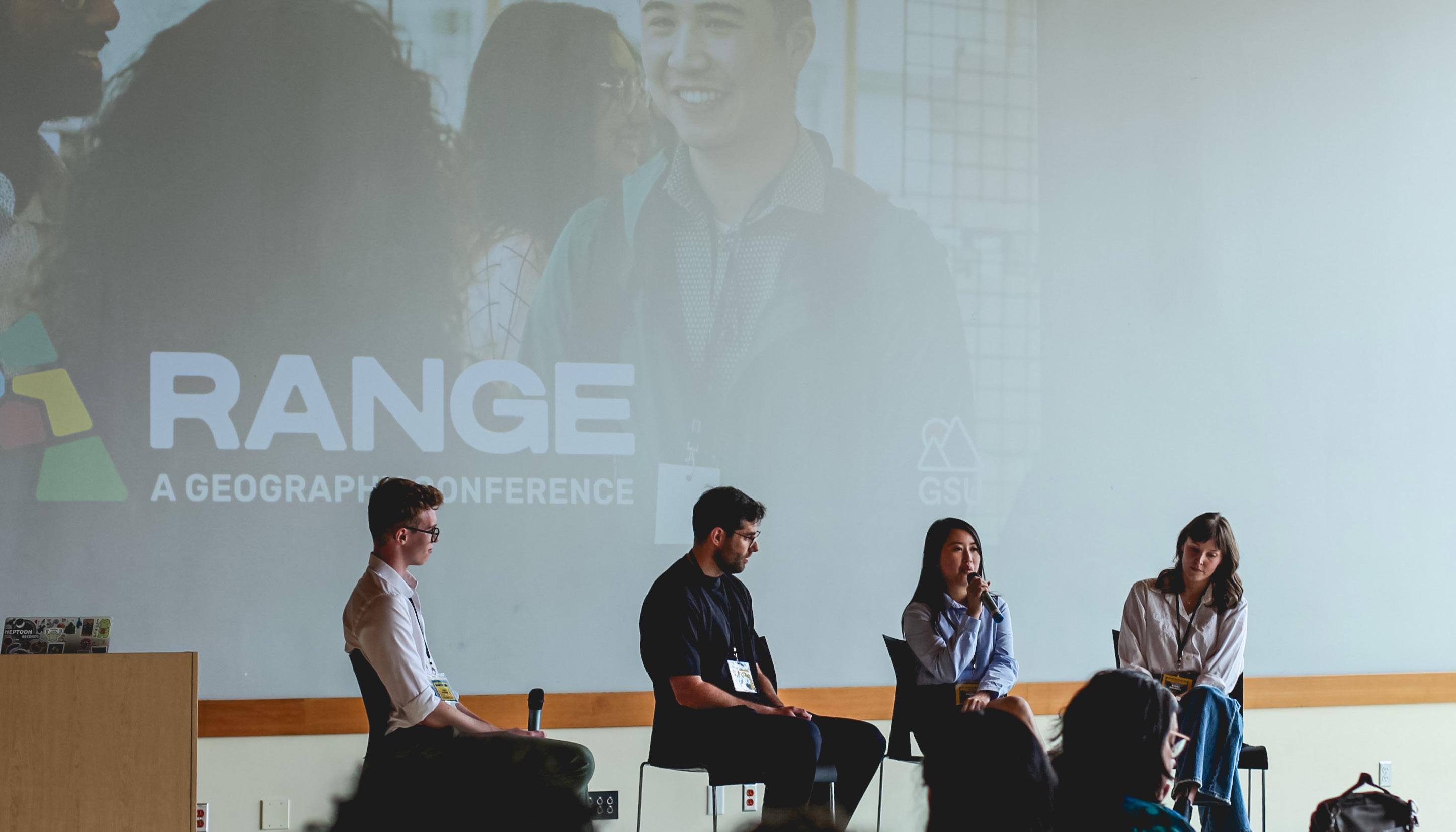
Flush with undergraduates, graduate students, and a sprinkling of high school students, the SUB Ballroom was bustling on Saturday morning, May 9. Everyone had congregated for the RANGE 2026 geography conference, “a one-day academic conference featuring research presentations, workshops, and networking — giving you a sense of what geography looks like as a career,” according to the RANGE website. Hosted by the Geography Student Union (GSU), the conference featured an introductory Q&A panel, talks from six presenters on various topics in geography, as well as a hosted lunch.
Gabrielle Wong, former co-chair of the GSU who was a key organizer in 2023, told The Peak the name referred to the literal “mountain range that surrounds us and the breadth that de nes studies in geography.” Wong’s 30-minute presentation investigated the complicated issue of carbon credits relevant from BC to Ontario, where she is now pursuing an MA at U of T.
Mosaic Forest Management Corporation is a private forest landowner that has established the BigCoast Forest Climate Initiative. The initiative sells carbon credits to other companies to incentivize the deferring of tree logging. When tree logging is delayed, a calculation is made to see how much carbon would have been released, and how much isn’t, by keeping trees standing. Trees are carbon sinks, meaning that atmospheric carbon is held in a tree until the stand is disturbed, such as through re or cutting. Mosaic
“Every Canadian medical school in this country does have an Indigenous admittance pathway,” Price added. “That in part is how we as a medical education community are responding to the TRC number 23,” he said, in reference to the Truth and Reconciliation Commission’s Calls to Action. The 23rd call urges the Canadian government to “increase the number of Aboriginal professionals working in the health-care eld, ensure the retention of Aboriginal health care providers in Aboriginal communities, [and] provide cultural competency training for all health care professionals.”
Senators also discussed the terms of reference for the Leslie Diamond Chair in Cancer Survivorship. The endowment is designed to support a chair member and recently a professor as well, in their mission to “enhance the development, execution and translation of cancer survivorship research at regional, national and international levels.”
As it stands, the endowment terms of reference state that “it is the wish of the Diamond Foundation that holders of the professorship are aware of its values.” These values include “a commitment to the pursuit of justice (tzedakah), repairing the world (tikkun olam), acts of loving kindness (chessed), and ensuring the Jewish Community and Israel, the Jewish Homeland is secure, prosperous, and healthy (Ahavat Yisrael).”
Senator David Bangsberg clari ed that “there is no expectation that the recipient of the chair holds these values, but simply be aware of the Diamond’s values.” In response, questions were brought up by various members of Senate about the need of making these values clear, what inclusion of such values indicates regarding SFU’s own moral standing, and more. Ultimately, the Senate sought greater clari cation from the donor before continuing with a motion.
The Senate will meet next on July 6, as the June 8 meeting has been cancelled.
translates one tonne of CO2 that is preserved within the trees to one sellable credit, which is then purchased by a company to o set their own emissions. The BigCoast Forest Climate Initiative is one of many carbon o set programs run in Canada, a government-incentivized federal program that creates sellable carbon credits for the reduction or removal of greenhouse gas emissions in the atmosphere.
I’m very proud of the current executive team for all the e ort they put into the event and the many ways they continue to build a vibrant, inclusive community on campus.
GABRIELLE WONG
FORMER CO - CHAIR OF THE GEOGRAPHY STUDENT UNION
Wong highlighted several criticisms of Mosaic’s system, including how carbon credits are only sellable if ownership can be proven, and Mosaic’s private forests exist on unceded Indigenous land — a vital matter for Indigenous treaty groups such as the Hul’qumi’num, because almost 85% of their territory is privately owned land. Wong claimed that Mosaic manages some of this land “without consultation or compensation.”
PhD candidate Will Niver presented on coal mining: a largely di erent topic than Wong, but rmly in the realm of geography. Niver said that a bene t of RANGE is its ability to allow students to imagine themselves pursuing geography in education and or as a career.
In his presentation, Niver narrated the social experiences of coal miners, detailing that in parts of the US, it was typical for miners to go on a summer beach vacation until the ‘80s or ‘90s. He added, “It’s much rarer, but some miners still actually observe the traditional midsummer miners’ vacation.”
Wong later said they appreciated the opportunity to return to SFU and RANGE with a speaking role. “I’m very proud of the current executive team for all the e ort they put into the event and the many ways they continue to build a vibrant, inclusive community on campus.”
PHOTO: MAYA BARILLAS MOHAN / THE PEAK
NOEKA NIMMERVOLL NEWS EDITOR
LUCAIAH SMITH - MIODOWNIK NEWS WRITER
North Vancouver
man launches productivity app to help people with ADHD
Founder James Smith says conventional apps leave people behind
NIVEJA ASSALAARACHCHI NEWS WRITER
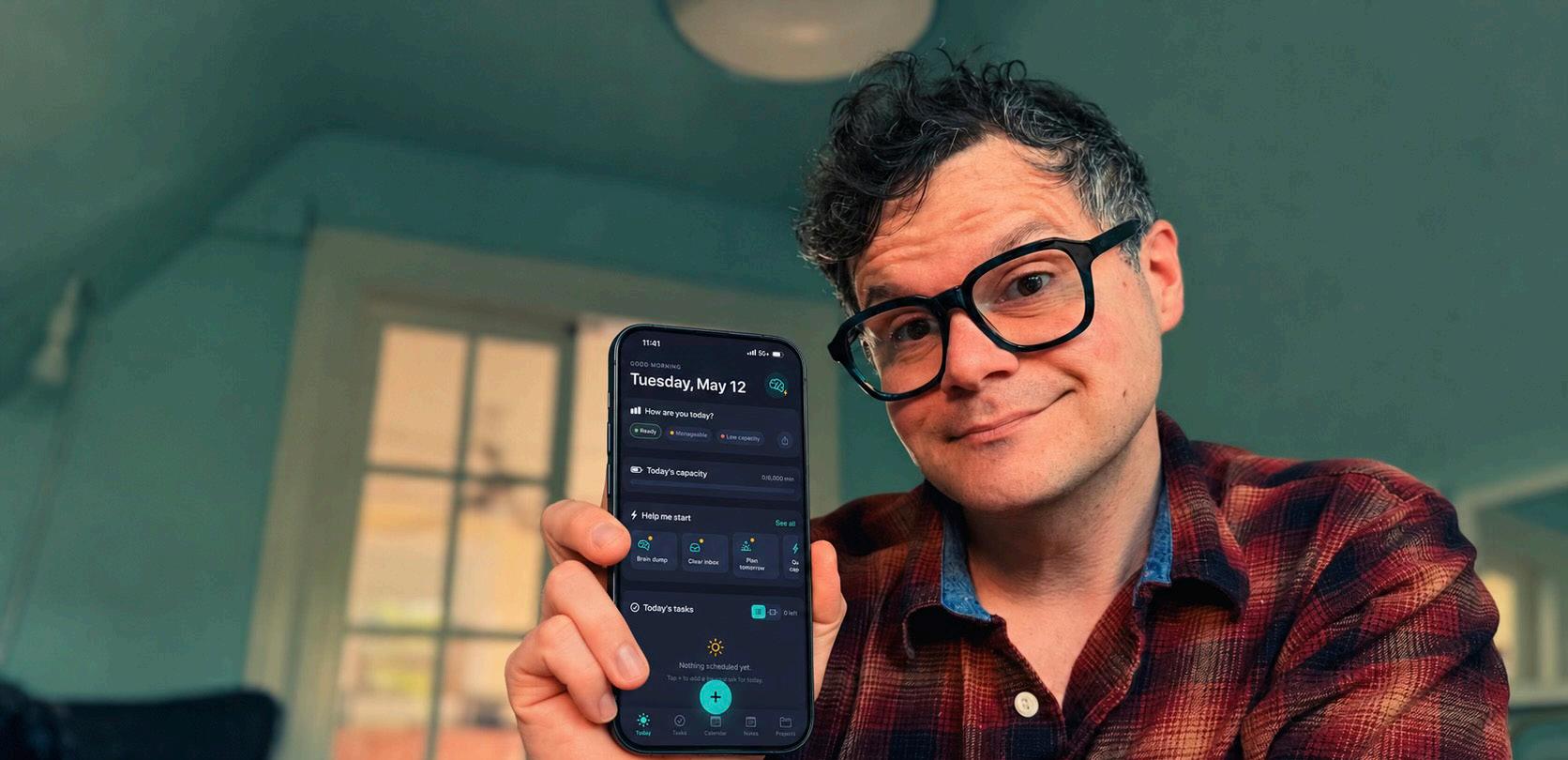
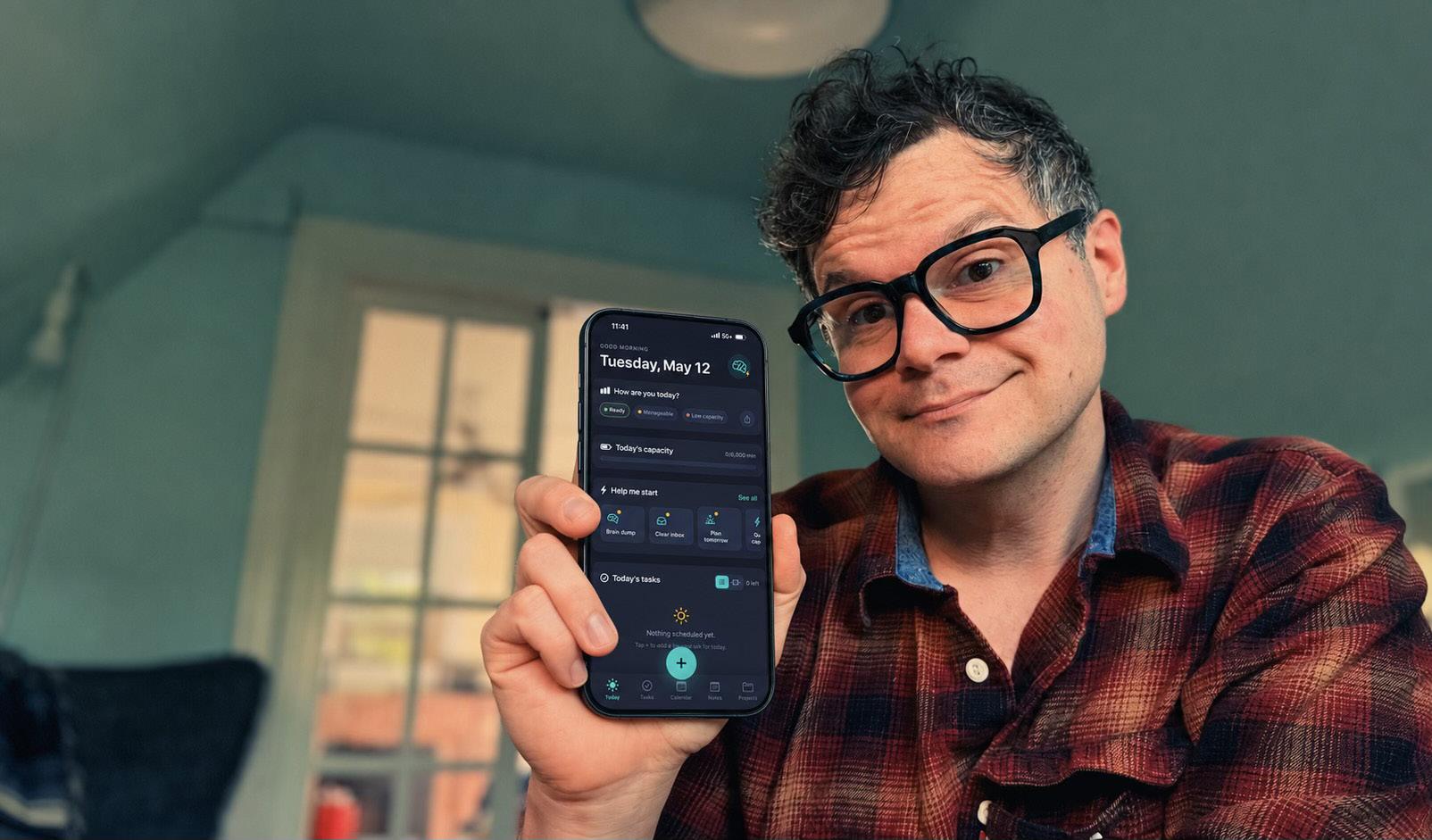
In early May, the productivity app Flint was released exclusively on the Apple App Store to iPhone users worldwide. Sold for a one-time fee, the app was developed by North Vancouver local James Smith to work for people with attention-de cit/ hyperactivity disorder (ADHD). ADHD a ects many individuals commonly starting in childhood. People with ADHD may experience challenges with organization, prolonged attention, or have trouble sitting still. Additionally, people with ADHD may often hyper xate on certain tasks until completion, or until a goal is reached. This disorder a ects roughly 1.8 million Canadians.
Using AI, the app helps users intuitively organize daily tasks and activities of “low, medium, or high focus” into a schedule. The app also includes features such as colour coding tasks into projects, voice capture to note down activities, and an hourly tailored schedule, among other functions.
The Peak reached out to Smith to further understand the process that went into creating the app. Smith shared that developing the app came out of his own experience with productivity apps and hearing from people with ADHD in online circles. “I’d tried a lot of productivity tools over the years
First Nation leaders and more push for changes to the Indian Act
As it stands, the act continues to dictate who is eligible for Indian Status
LUCAIAH SMITH - MIODOWNIK NEWS WRITER
In 1876, the Indian Act established the Canadian government’s legal ability to determine who is or is not considered a First Nations person under federal law, with the intent to “control and assimilate Indigenous Peoples into Euro-Canadian culture,” as written by The Canadian Encyclopedia. 150 years later, despite some changes to the policy, Canada retains the authority to dictate Indian Status.
In 1985, amendments to the Indian Act under Bill C-31 introduced the second generation cut-o rule. Under this legislation, after two generations of parents where only one individual is registered or entitled to Indian Status and the other is not, a child born is no longer entitled to such status.
The legacy of the Indian Act is also one of gender-based discrimination. Prior to 1985, a First Nations woman with status who married a non-status man would lose status herself. The same was not the case for First Nations men. Additionally, “the children and grandchildren of those unions were unable to get status, meaning neither the women nor their children had the right to live on reserve.” This practice distanced women physically and emotionally from systems of support, which contributed to higher likelihoods of violence against Indigenous women and girls.
Now, new amendments to Bill S-2 aim to abolish remaining discriminatory practices. On May 5, Káwáziɫ Marilyn Slett,
and kept running into the same gaps. Nothing quite t how my brain works.”
Smith added, “I spent time in the r/productivityapps and r/adhd subreddits reading through wish lists, complaints, feature requests. That shaped a lot of what Flint became. It wasn’t built from assumptions. It was built from what people said they needed and weren’t getting.” He highlighted features such as “single task mode” to minimize distractions, “easy rescheduling” to lighten the load of catch-up, and “calendar integration” for coordination between di erent platforms, which were added at the request of people on these subreddits.
Smith underlined that what makes his app unique is that its features combine the “most useful pieces together in one place without overwhelming you.” He highlighted that a major feature of the app is the ability for users to report their own capacity, whether it be complete, depleted, or in the center. He argued this helps the app adjust to the user’s current state. “The whole thing is built around one idea: your capacity changes day to day, and your planner should respond to that instead of ignoring it,” Smith emphasized.
Smith said while he did not develop Flint with university students in mind, he recognized the di culties of the environment. “University is one of the hardest environments for someone with ADHD. The structure that got you through school is suddenly gone, deadlines pile up, and nobody is chasing you.” Beyond the app’s “note-taking and project features,” Smith noted that Flint’s ability to track mood data over time could be very important for students pursuing tertiary education. “Being able to see patterns in your own energy and focus, when you’re most productive, when you consistently crash, gives you something concrete to work with. For a student managing their own well-being, that’s a genuinely useful self-monitoring tool.”
In terms of the app’s widespread accessibility, Smith said that bringing Flint to Android devices was “on the list.” Additionally, he shared that the cost of the app was something he mulled over. “The alternative most apps go with is a subscription, and subscriptions are actually a real problem for people with ADHD,” sharing that a subscription system can be easily forgotten and neglected. “A single payment of $5.99, roughly the cost of a co ee, felt more honest.”
Chief Councillor of the Haíɫzaqv (Heiltsuk) Tribal Council and secretary-treasurer of the Union of British Columbia Indian Chiefs spoke in front of the Standing Committee on Indigenous and Northern A airs in Ottawa to advocate for the removal of several discriminatory aspects of the legislation, including the second-generation cut o
If passed by Parliament, the bill would rid the act of the second-generation cuto by creating the “single-parent rule, allowing status to pass on inde nitely to future generations.” Additionally, initial amendments seek to ensure that First Nations whose past family lost Indian Status are still equally entitled to status themselves.
“This piece of racist and sexist colonial legislation continues its objective of eliminating the ‘Indian problem’ by assimilating
History is repeating itself. There are children in our communities that are ghosts. They have no rights or recognition or belonging.
First Nations people through the second-generation cut-o ,” said Chief Slett about the Indian Act.
As reported by CBC, Cynthia Lapierre of the Wendat (Wendake) Nation shared that the Indian Act has an overarching “objective of genocide,” achieved through the removal of status for women and children. “History is repeating itself. There are children in our communities that are ghosts. They have no rights or recognition or belonging,” she testi ed to the Committee.
The Expert Mechanism on the Rights of Indigenous Peoples, a branch of the United Nations Human Rights Council, also recently urged The Parliament of Canada to do away with the cut-o . The organization deemed the practice to be a breach of Article 8 of the United Nations Declaration on the Rights of Indigenous Peoples, “which prohibits forced assimilation and destruction of culture.”
“In 2026, it is still dictating who we can parent with if we wish to pass status onto our children,” said Chief Slett to the Committee. “I am here today to urge the Committee and Prime Minister Carney to support Bill S-2 as amended to advance the rights and safety of First Nations women and our descendants, to prevent the legal extinction of our people, and to end the discrimination once and for all.”
You can read the Union of British Columbia Indian Chiefs’ full news release at www.ubcic.bc.ca/.
PHOTO: COURTESY OF JAMES SMITH
PHOTO TONY WEBSTER / WIKIMEDIA COMMONS
CYNTHIA LAPIERRE WENDAKE NATION
Alberta sets Canada back by 10 years in achieving climate change goals
The pipeline is not supported by Coastal First Nations
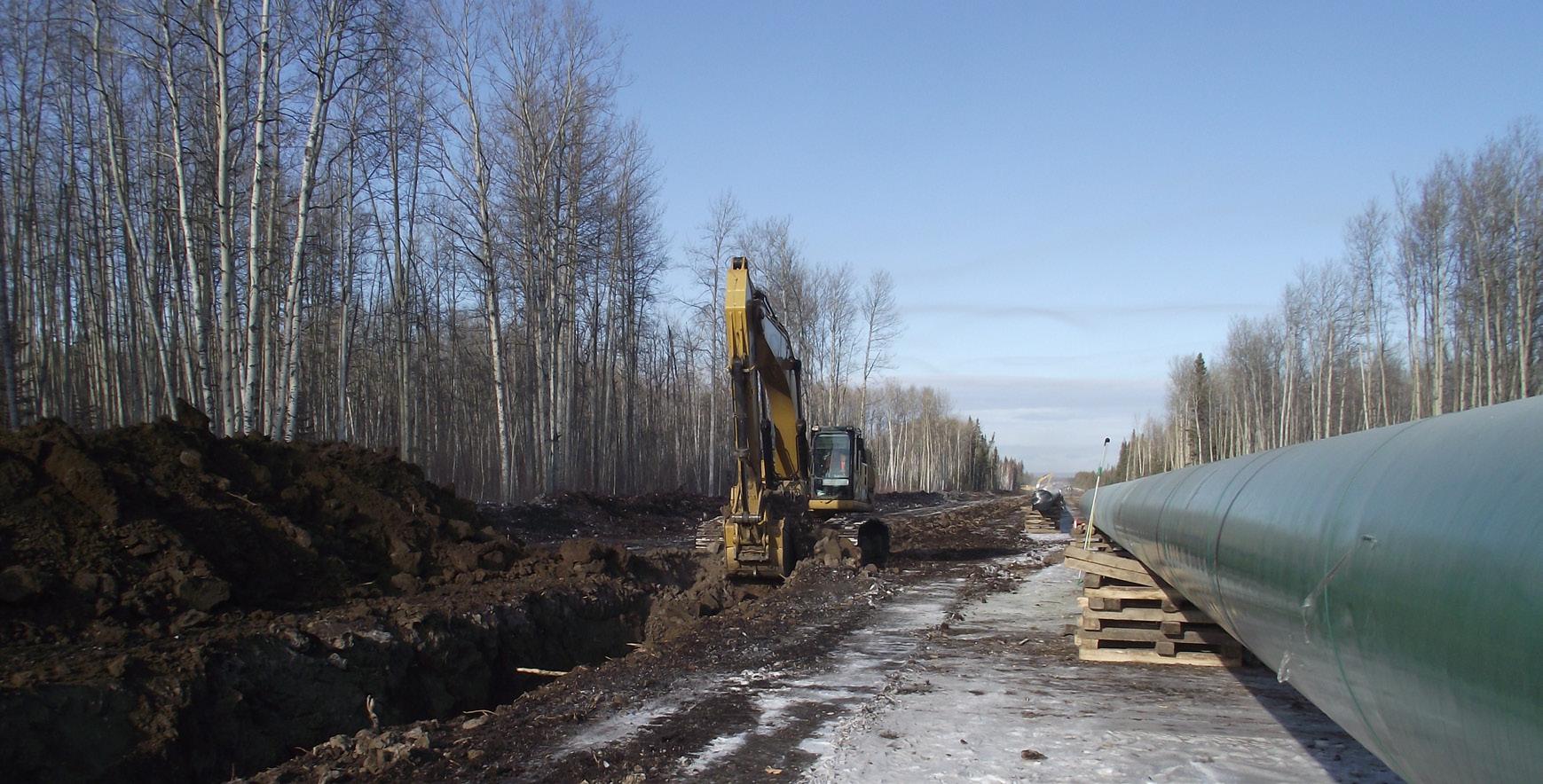
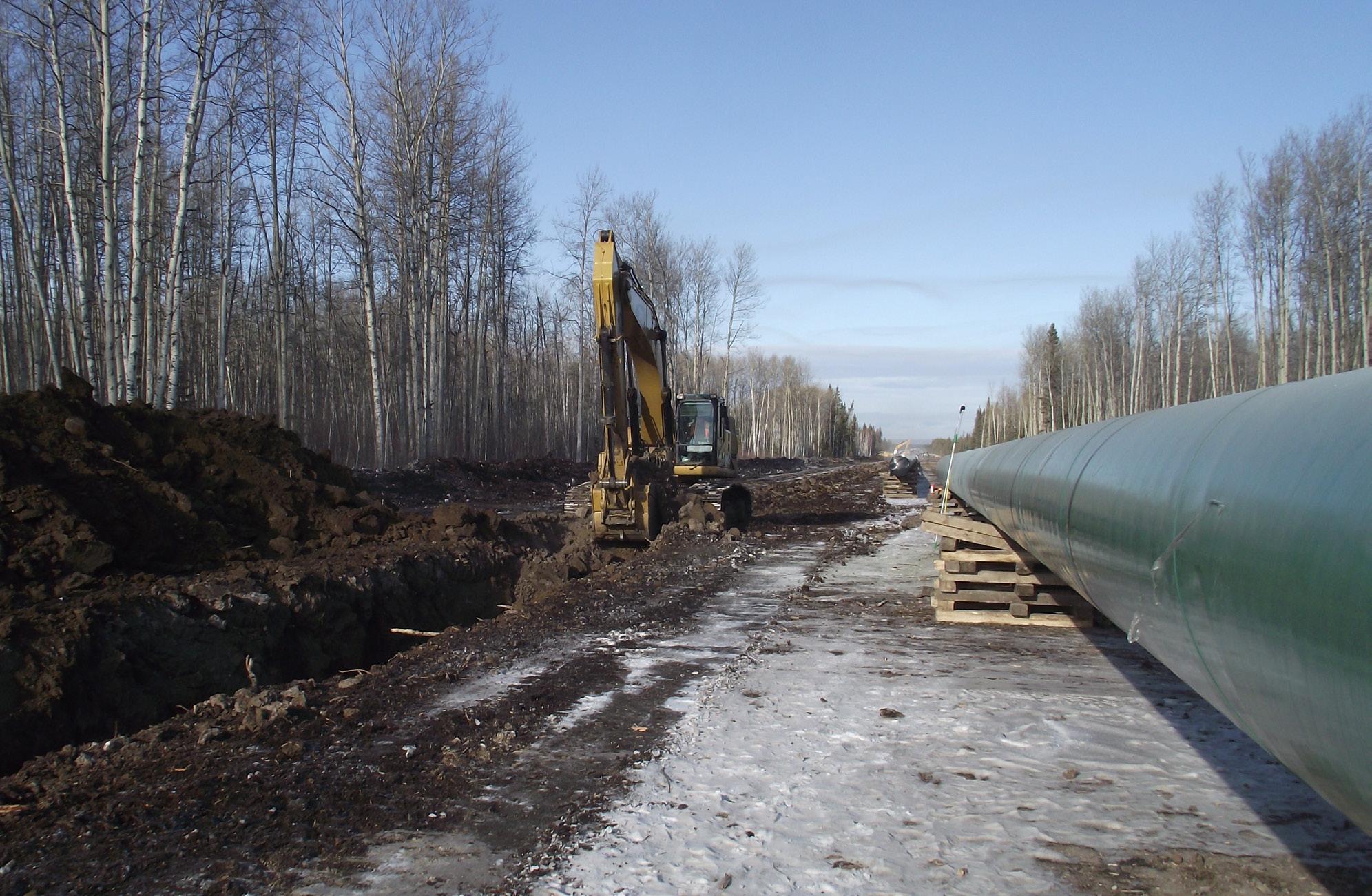
On May 15, 2026, Prime Minister Mark Carney and Alberta Premier Danielle Smith signed an agreement that permits Alberta to use its own carbon pricing system instead of the federal one, and outlines the construction of the West Coast pipeline. The agreement also pauses the Canadian Electricity Regulations (CER) in Alberta while the regulations are argued in the provincial and/or federal court. These regulations were designed to help Canada reach “net-zero emissions by 2050.” The adjusted carbon pricing saves Alberta’s oil industries “$250 billion in compliance costs” and provides a baseline carbon credit price to address Alberta’s carbon market ood. The pipeline, on the other hand, would increase the pro t of oil industries by $3.16 billion 15 years after the pipeline is built. However, these economic bene ts mean nothing if it requires us to sacri ce our climate change goals of reaching net-zero by 2050.
Alberta and the rest of Canada will now be working towards a headline industrial carbon price of $130 by 2035 and then a yearly increase to $140 over ve years. This is $30 less per megatonne than the original target set in 2023. The “headline price” is what large-emitter companies must pay to the government as a form of monetary punishment if they exceed their assigned emission thresholds. Companies that fall below the threshold earn credits which can be purchased by the companies that exceed the threshold as an alternative to paying the government directly. The carbon credit price is the price at which carbon credits are sold. This pushes Canada a decade back from achieving its goal of a 40% decrease in emissions in 2030 relative to emission levels in 2005. We have no more room for error, and yet we’re compromising our goals in pursuit of pro t.
Alberta will also aim for a carbon credit price of $130 by 2040, however the current carbon credit market has a large surplus due to years of stored credits. This has led to carbon credits costing closer to $20 per megatonne instead of the current headline carbon price of $95. Large-emitting companies that exceed their emissions threshold are more likely to purchase cheap carbon credits rather than pay an expensive headline carbon price. The discrepancy between carbon headline and credit prices ultimately obliterates the punitive purpose of the carbon pricing system so that these prices no longer dissuade companies from exceeding their emission benchmarks.
An analysis by 440 Megatonnes and Navius Research reinforces that the CER is needed to achieve our goals with its strong carbon pricing. Applying this new agreement’s weaker carbon prices along with the 20 megatonne of emissions from oil extraction prevents Canada from reaching net-zero by 2050.
A strong carbon market that starts at $130 and increases by $5 per tonne each year with the CER plus the pipeline puts
Canada on track for achieving its emission reduction goals.
We must also consider how the West Coast Oil Pipeline would a ect Indigenous communities and their lands. While the exact route of the pipeline is still being nalized, it is predicted to cross into either the coast of northern BC or Roberts Bank in Delta. Coastal First Nations (Gitga’at, Gitxaa$a, Haida, Heiltsuk, Kitasoo Xai’xais, Metlakatla, Nuxalk, and Wuikinuxv First Nations) have expressed their opposition to the pipeline saying, “Governments and would-be proponents should be aware of our absolute determination to protect our economy and our coast” and that “there is no technology that can cleanup an oil spill at sea, and one spill could destroy our way of life.” Respecting First Nations and acknowledging ownership over their lands is crucial in the ongoing process of reconciliation.
Economic demands, environmental concerns, and a ected Coastal First Nations support call for careful consideration of future action; reframing our perspectives to view economy, people, and environment as intertwined.
This new agreement shows Carney’s plans to combat climate change are illusory. The agreement also aims to “double Canada’s electricity grid” and power it using clean energy, but if we’re expanding natural gas industries and using it as a crutch, we’re tethering ourselves to the very emissions we’re trying to escape from. Transitioning to clean electricity with less dependence on natural gas is a crucial step that safeguards both the environment and the Canadian economy, it reduces emissions while also avoiding “price shocks” from unstable fuel markets.
Economic demands, environmental concerns, and a ected Coastal First Nations support call for careful consideration of future action; reframing our perspectives to view economy, people, and environment as intertwined. Investing in clean industries would not only provide long-lasting and stable nancial support to Turtle Island, but also protect the very land we live on for many years to come.
The Bright-er Side
Music, space, and flipping a record over
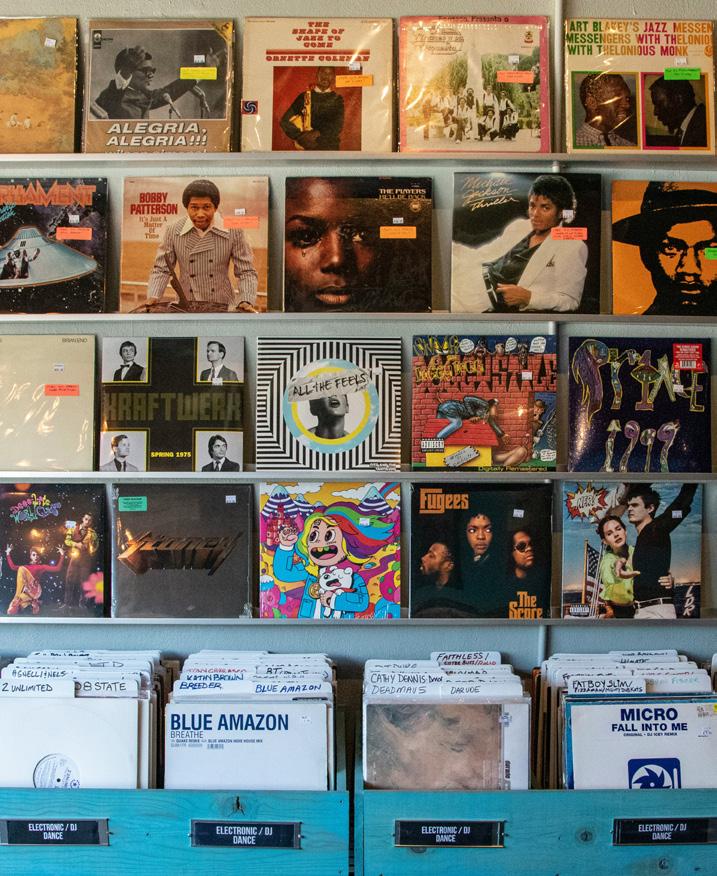
The most important thing about owning a record is having it for myself, forever. Streaming services are at your ngertips when you need them, but owning a physical record gives you a space and a library of music that streaming or a digital track does not. This musical space, where the sound physically rings out around me, is important as I’m sharing and placing myself in the midst of the melody.
Today’s spin is Pang by Caroline Polachek, rst listened to in 2020. The record is a tactile experience — all labels and edges, never the grooves — and ipping it over to the B-side before placing the needle in the middle provides pause, letting me absorb “Hey Big Eyes” before “Ocean of Tears.”
This intermission does more than let me absorb what I’ve heard, though — it is a natural pause in the narrative, a contribution to the afterlives of an album and its longevity. What I listen to and am a ected by stays in my actions and in the way I experience art, and gives me a chance to think about an album and what I’ve heard. Flipping a record really does enhance the listening experience — the anticipation, the division between songs on side A and B, and the power of the artist to pause their music all drive a message home for me.
Someday I’ll get more into jazz — for now, I enjoy Olivia Dean’s classical cadence or Sophie’s hyperpop beats. This is how music lives on, how its staying power carries through generations — when it is in your hands and entirely yours.
PHOTO: MICK HAUPT / UNSPLASH
ZAHRA KHAN SFU STUDENT
PHOTO JASON WOODHEAD / WIKIMEDIA COMMONS
MARIE JEN GALILO STAFF WRITER
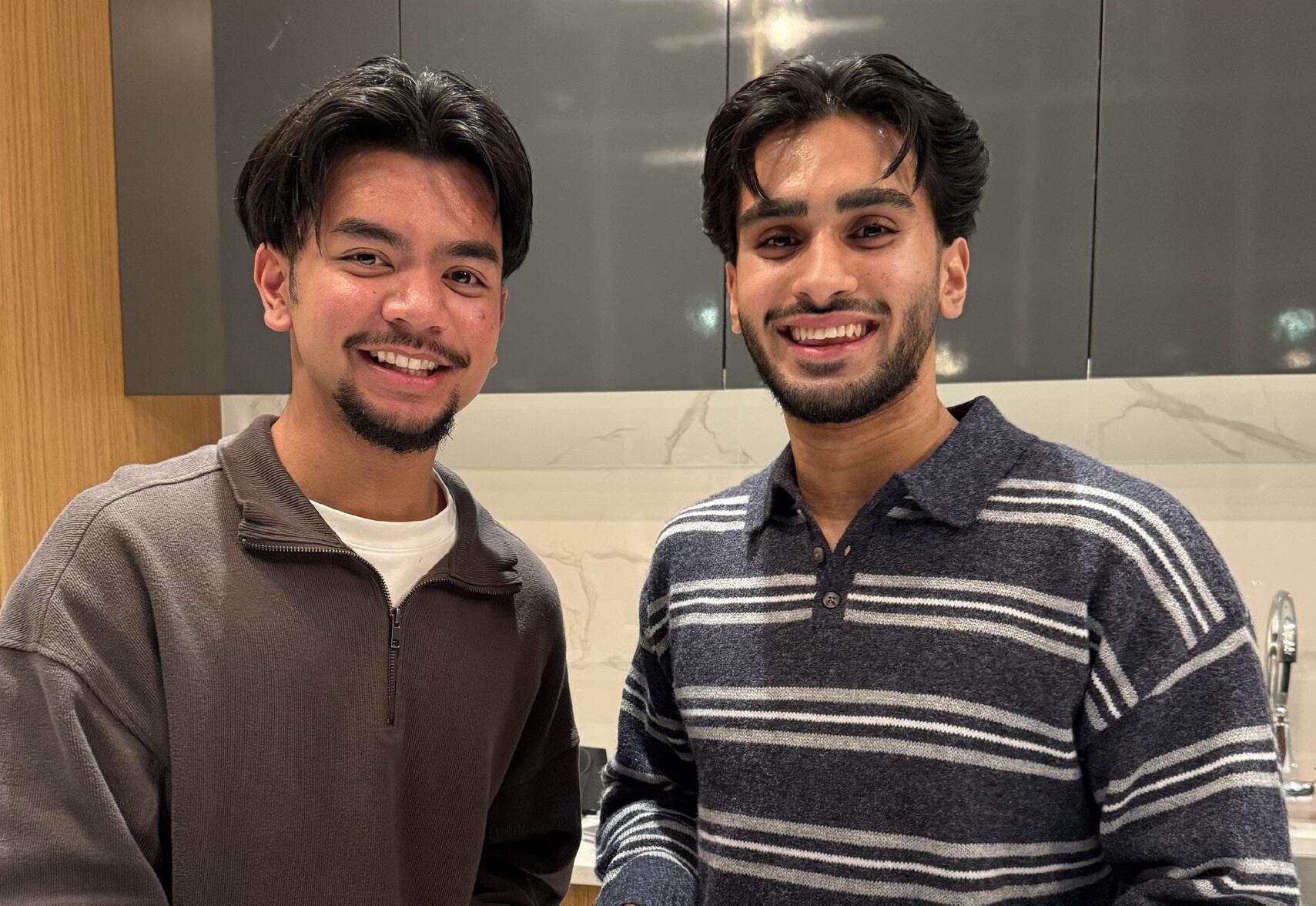
SFYou: Cedric and Savar, creators of Unif y Social
Two SFU student-entrepreneurs discuss education, community, and how their new app helps foster both
PHOTO: COURTESY OF UNIFY SOCIAL
If you are a student, for example, we provide a learning module for SFU, information on finding courses, study spots on campus, and other nitty-gritty details that only SFU students would need to know. “
CEDRIC TANAFRANCA · UNIFY SOCIAL CO - FOUNDER
TOMOS LAND · STAFF WRITER
Every year, hundreds of thousands of people move to Canada, but oftentimes getting here is only half the battle. Between meeting immigration requirements, learning a foreign language, and finding bearings in a new city, being a newcomer can be overwhelming.
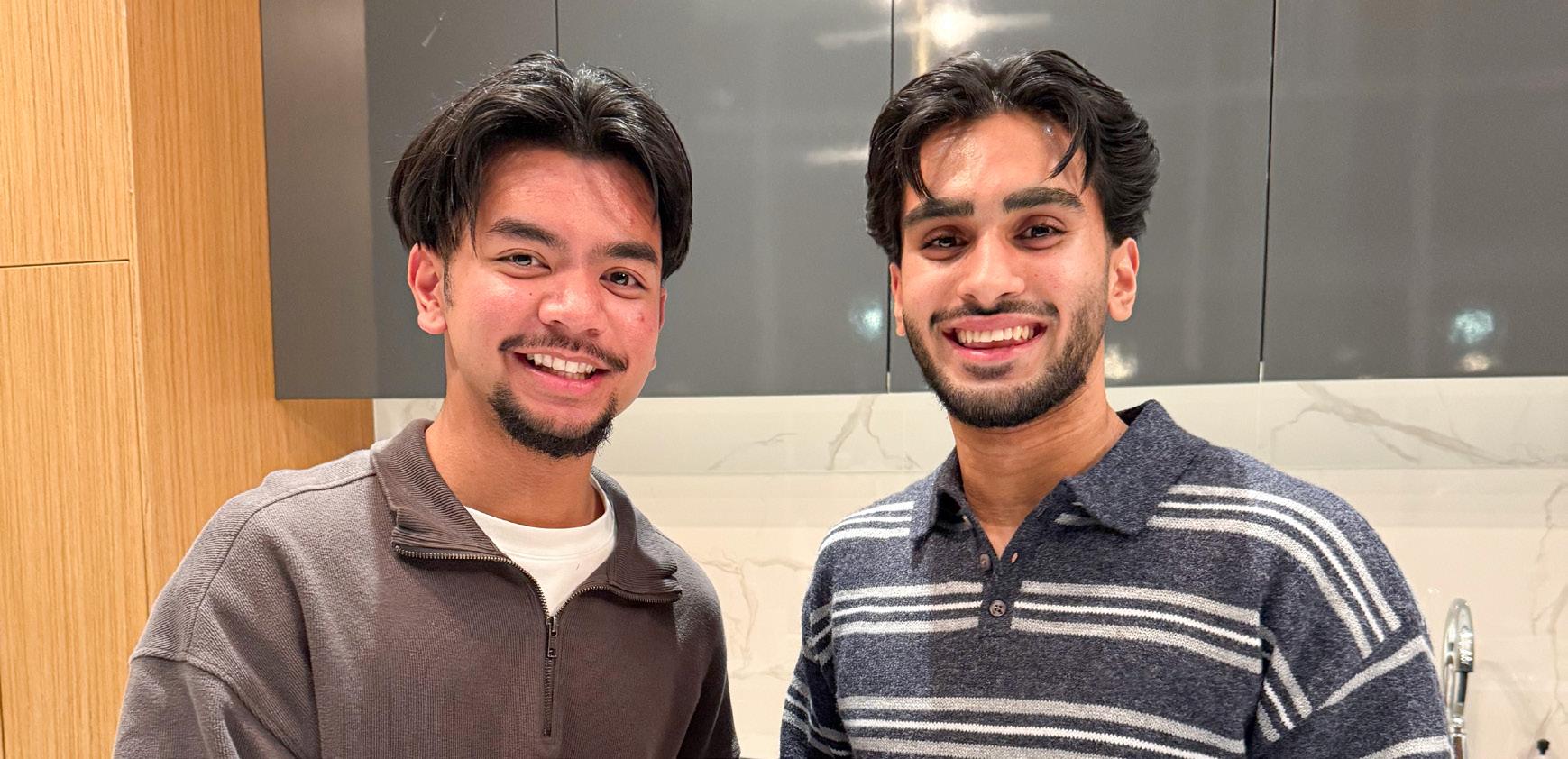
Two enterprising SFU students — and childhood friends — Cedric Tanafranca and Savar Gupta developed an app that aims to make newcomers’ experiences that much easier. Launched in March, Unify Social centralizes essential resources and educational tools on their platform, while creating a community through in-person workshops. The Peak spoke with them to learn more.
The following interview has been edited for concision.
The Peak: What are your backgrounds and what do you study at SFU?
Tanafranca: My name is Cedric and I am currently in my final year of university studying business administration. For the past couple of years, I have been involved in a student organization called Enactus, which focuses on social entrepreneurship — using technology and entrepreneurship to address a problem in the world. This led to building Unify along with Savar, who I have known since elementary school.
Gupta: My name is Savar and I am also in my final year, studying business and mechatronics engineering as a double degree student. I have always been passionate about entrepreneurship and making a social impact. Witnessing the struggles my parents went through when they immigrated to Canada is part of why I started Unify.
The Peak: What experiences were catalysts for the creation of your app?
Gupta: It really stemmed from being part of an Enactus engineering project in my first year. I also got to be involved with the business side more and compete for competitions, and that led me to pursue a double degree now. So the main thing has been the community at SFU, the clubs, and the technical skills I developed through my background in engineering.
Tanafranca: The catalyst for me was also extracurricular activities. Experiences like co-op, being co-president at Enactus, and being involved in other clubs like Axis Consulting gave me the skills. My family being an immigrant family was a big piece of why I wanted to build this out. Growing up, I saw this struggle firsthand: visiting food banks, navigating systems we didn’t understand. They left behind everyone and everything they knew in the Philippines — extended family, community, a life they had built — and arrived in a new country without anything. One of the hardest parts was watching my parents have to reset their credentials entirely, like going back to school and working their way through various jobs.
The Peak: Tell us more about what went into creating this app.
Tanafranca: Building the app was very much a team e ort, which began in August 2025. We brought together students who not only resonated with the mission but also came from diverse academic backgrounds. Our team spans software, design, marketing, events, partnerships, and campus ambassadors. Savar and I led the cross-functional coordination. We also surveyed over 225 individuals and conducted in-depth interviews with more than 50 people, including international students, skilled workers, and immigrants, and spoke with non-profits that serve newcomers directly, to hear firsthand about their experiences and challenges.
Savar: We beta-launched in January 2026 with over 100 users. We then o cially launched on the Apple App Store in March.
Today, Unify is built by a team of 30 SFU students. The core product team that directly worked on the app includes around 10 students from the School of Interactive Technology and computer science.
The Peak: As newcomers to Canada, what do international students in particular seem to struggle with the most?
Gupta: When you come to Canada, it is really hard to figure out where to start. There are tons of resources, but they are scattered all over the place. International students also tend to struggle with finding a community. SFU and student clubs host many events and provide resources to students, but it’s still hard to connect and find that community, like making long-term connections beyond meeting someone at an event.
The Peak: How does Unify Social try to alleviate these struggles?
Tanafranca: One of our main missions is to centralize everything newcomers need on to our platform, whether that’s resources, community, or events, by creating a one-stop shop for all their basic needs. Right now, everything is scattered through government websites, Reddit, Facebook forums. The app also has a social hub where newcomers can ask questions and connect. Another piece is that, whether you are an international student, refugee, skilled worker, or trying to get your permanent residence, we try to personalize everything to the user’s specific needs, and provide checklists based on this and how long you’ve been here. If you are a student, for example, we provide a learning module for SFU, information on finding courses, study spots on campus, and other nitty-gritty details that only SFU students would need to know. Beyond that, we also host events with not-for-profits, including SFU International Student Services and public libraries.
The Peak: What is the importance of the in-person component of your work?
Tanafranca: We knew our solution couldn’t just live on a screen, and hearing that isolation was such a di cult piece for students, we wanted to have that in-person component to put everything from the app into a community building process. We also want to make everything accessible for people who might not be technologically capable. We also noticed that a lot of the existing events for newcomers happen during the workday, and a lot of immigrants work or have school, so we usually host events on weekends and outside the workday. As long as someone can make one meaningful connection at these events, or learn something that can contribute to their integration within Canada, that’s a win in our eyes.
The Peak: How do you envisage Unify Social growing and what are your plans for the future?
Tanafranca: It comes back to accessibility, which is the big focus for us. We would like to provide the app in every language and expand across Canada. For example, the materials required for newcomers in Ontario are di erent to elsewhere, so providing accessibility across provinces and territories is one of our next steps. We are also currently developing a web app, as right now we are mobile only, but we are in the works to launch our web app in the very near future.
Gupta: We are also starting to roll out our app in other languages, such as Hindi and Punjabi, which is a major area that the government could help support to make information accessible to those who don’t yet speak English.
Visit Unify Social on LinkedIn or Instagram (@unifysocial.ca) for the latest news or download the free app on the Apple app store.
Future Geographies shifts
the
despair of climate change into artistic inspiration
Visit the exhibition at the Vancouver Art Gallery to spend a few hours reflecting on your responsibility to the earth
The words “climate change” often inspire a sweeping !ood of anxiety, but the new Vancouver Art Gallery exhibition, Future Geographies, uses these words for education, contemplation, and hope. Spanning multiple !oors, the gallery displays a variety of media to deliver ideas and information. On behalf of The Peak, I went on the opening weekend.
The goal of the exhibition is to “confront pressing questions about our shared future” through sculptures, photography, paintings, and other mixed media forms. The viewer can take their time through sections named “living knowledge,” “consumed earth,” “speculative worlds,” and “material memory.” Each section is spacious, giving visitors and artwork alike breathing room for in-depth re!ection.
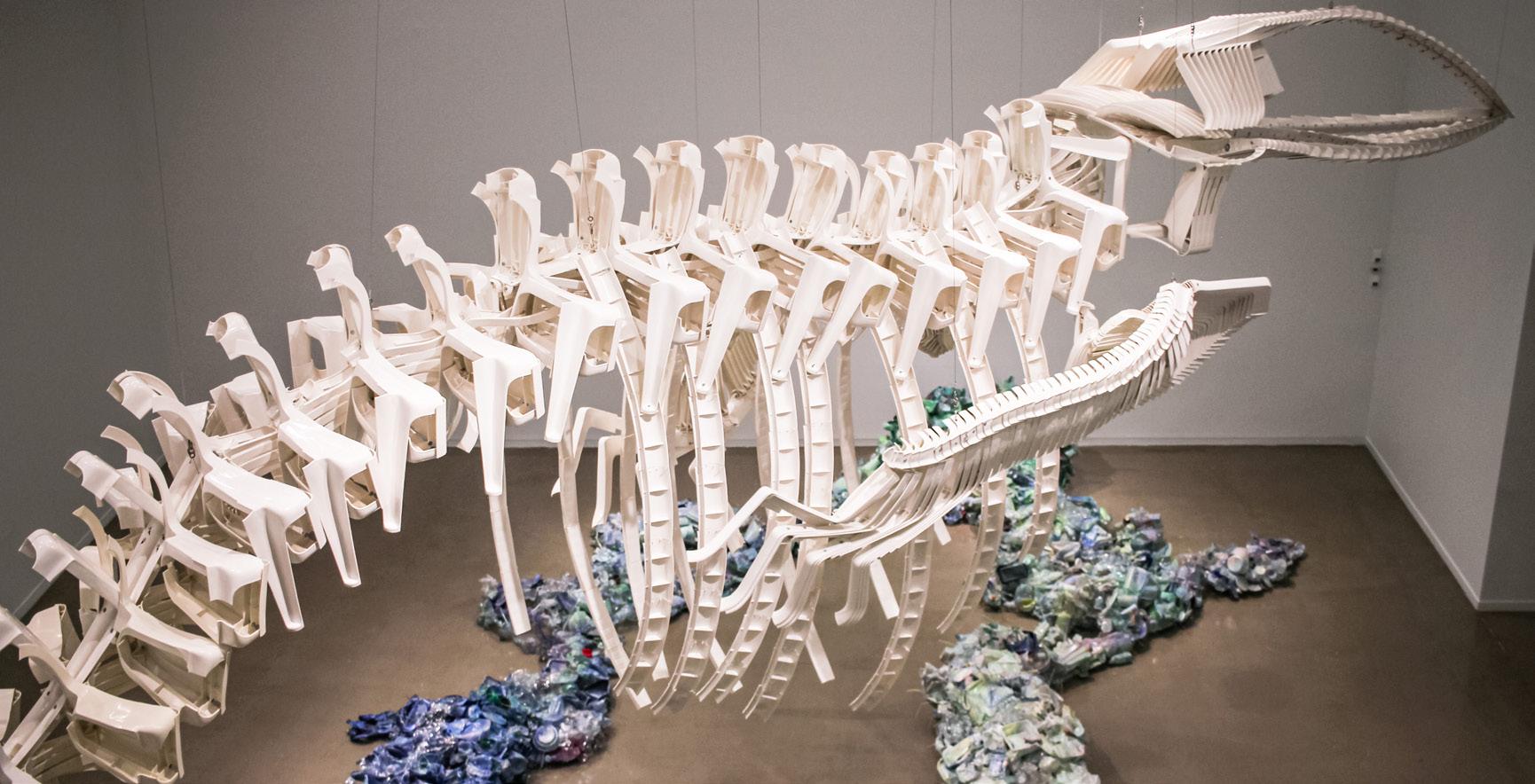
Two of my favourite pieces transformed common disposable objects into horrifying, captivating sculptures. Artist Brian Jungen’s whale skeleton (named Cetology) made of white plastic patio chairs looms forebodingly over Liz Larner’s Meerschaum Drift assembly. The large skeleton suspended from the ceiling reminds me of New York’s whale, but Cetology seems to speci cally reference increasing plastic pollution. The whale is made of and surrounded by plastic; Jungen merges wildlife with the sheer excess of consumer convenience. As the viewer is guided around Larner’s !oor display of painted plastic bottles arranged to look like crashing
waves, it’s hard not to reevaluate our own contribution to single-use containers.
I believe it’s important to engage with these ideas as spectators to the interpretation of others, but also be aware of our own placements inside the climate crisis.
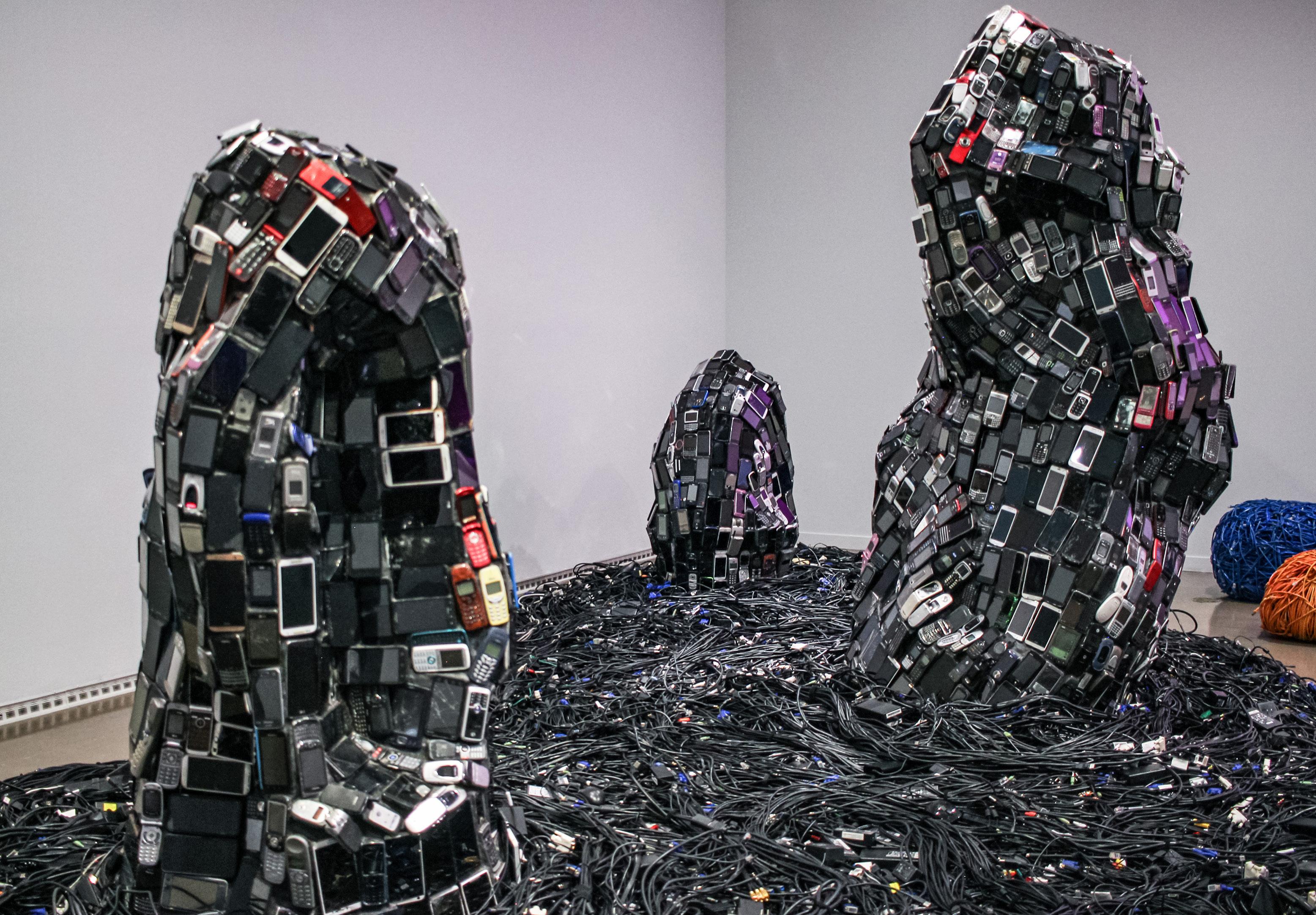
Rock formations shaped from discarded phones stand atop a literal island of computer cables in Huddled Masses. Artist Jean Shin mimics the shape of “scholar’s rocks” with discarded phones, collected via the electronics recycler Green Citizen. The sculpture draws attention to the deluge of e-waste that comes with modern life, and how technology has become fused with our environment. It was visceral, and almost nauseating, to gaze at these totems of waste. For a record, I snapped a photo. I realized then that my cracked blue phone could belong to an installation like this.
One exhibit that must definitely be experienced in person is LaToya Ruby Frazier’s Flint is Family photojournalism series. A collection of prints and accompanying passages depict the impact of contaminated water on marginalized communities, and then the miraculous solution of the atmospheric water generator. The photos were portraitstyle, with sharp depictions of community members in their Sunday best. Part of what incited such a strong reaction for me was the tragedy at every level of this crisis, and the evocative way Frazier handled her descriptions. It’s sad, but at the same time, it’s hopeful.
Future Geographies accumulates work produced this century from around the world to conceptalize climate and resource issues as globally pressing. The viewer is reminded that everyone can do their part to reduce (Meerschaum Drift), reuse (Huddled Masses), and recycle (Cetology). Climate change is horrifying, but these art works have shown that there is hope of resisting it in multiple ways, both collectively and individually. It’s important to engage with these ideas as spectators to the interpretation of others, but also be aware of our own placements inside the climate crisis. The gallery makes a space for these ideas to reverberate.
Future Geographies will be on display at the Vancouver Art Gallery until January 10, 2027.
PHOTO: MAYA BARILLAS MOHAN / THE PEAK
MAYA BARILLAS MOHAN STAFF WRITER
Music as a healing tool: A review of Teresa Alfeld’s Hearse Chasing
The SFU alum documents a musician’s process of recovery from CPTSD in her latest documentary
NEJDANA HOUSHYAR PEAK ASSOCIATE
Content warning: brief mention of domestic violence and substance use.
Music can transport one into a completely di erent world.
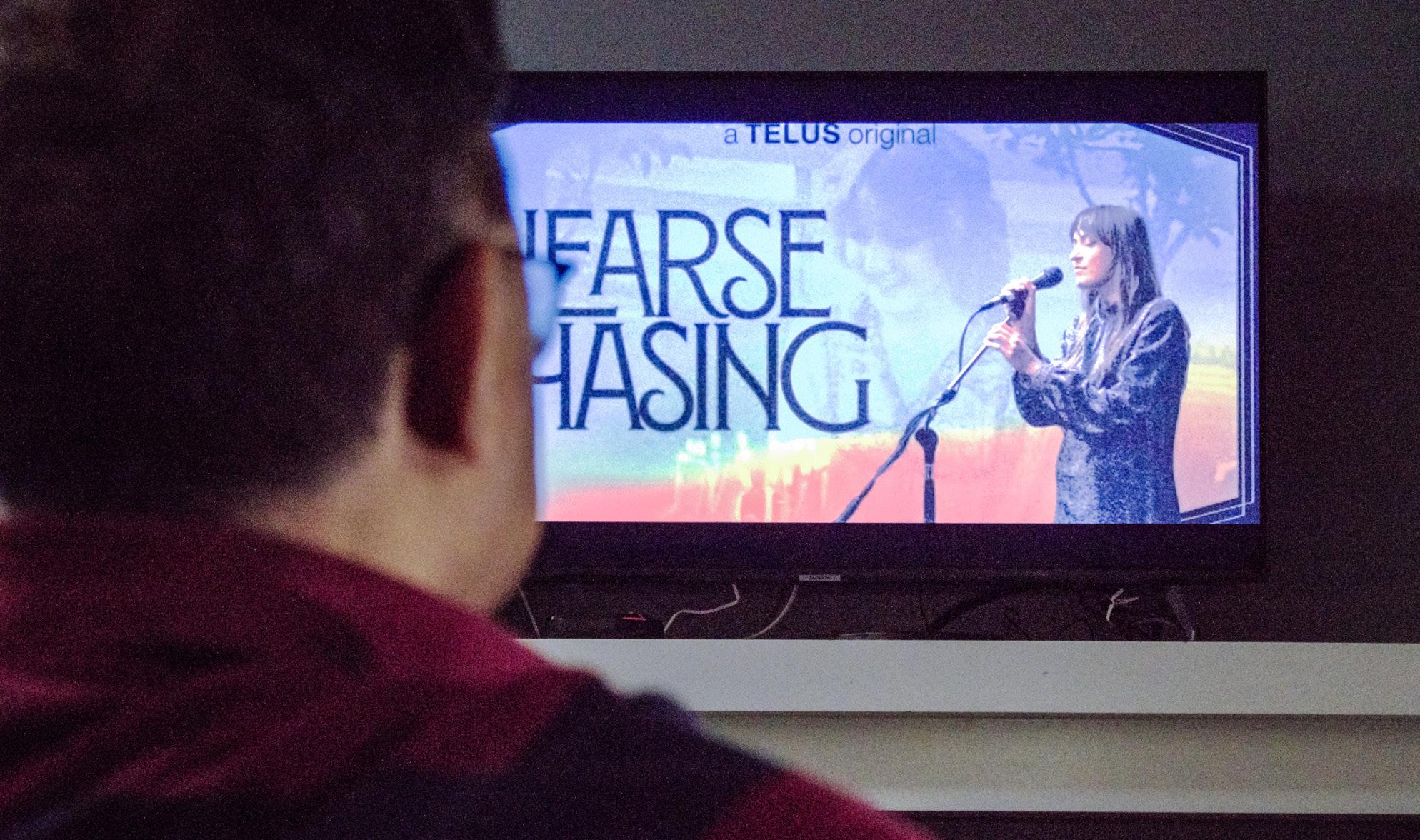
In Hearse Chasing, a harrowing documentary by SFU alum Teresa Alfeld, music serves as the central thread that sustains hope and ambition. The lm follows Cassidy Waring, an indie folk musician, who, through a life of viewing and experiencing abuse, substance use, and the death of her mother, has been diagnosed with complex post-traumatic stress disorder (CPTSD) and travels back to her hometown of Calgary to uncover some truths about her family.
The lm o ers a deep dive into the complex, yet familiar, world of Waring’s past. It begins with Waring and her younger brother Cooper exploring their old family home, which is now inhabited by a di erent family. In these scenes, I could feel the tension and heartbreak both siblings are feeling as they move through this uncanny space. Memories !ood back to them, and I was able to empathize with the siblings as home movies overlap.
The lm narrates Waring’s story through interviews with family members and friends, such as her cousin Shelaine, her uncle Chris, and neighbours Lynn and Brad. These accounts seem long overdue, almost as if they were begging to be shared. The emotions in each individual are so palpable and raw, to a point of uncomfortable intimacy — it feels almost wrong to view them. However, this is the beauty Alfeld designs in this
lm — a discomfort where the audience is almost forced to look at and examine their own lives vis-à-vis the shots from the camera. The lm proves, through these intense conversations, that it is better to experience hardships with a community — one does not need to su er alone.
The film proves, through these intense conversations, that it is better to experience hardships with a community — one does not need to su er alone.
The lm discusses heavy topics such as domestic violence, alcohol addiction, and death in a thoughtful and sympathetic way. There is no hatred directed towards Waring’s parents, especially her mother, who, although had contributed to
the children’s abuse, was a victim of it herself. The family accounts are not only used to understand Waring’s childhood and eventual CPTSD diagnosis but also as a helpful guide to anyone else struggling with similar situations, reassuring them that it does get better.
It is clear that the whole process of creating music — songwriting, producing, and performing — is the strongest tool that helps Waring work through her trauma. Scenes of her writing alone, or with others, provide glimpses of peace in the lm. These moments show so much about why Waring became motivated to be a musician. The scene of her sitting with an array of family photos scattered on her bed, writing about her family and mother, shows her chosen outlet to display her emotions in a way she could not previously. During the nal scene of the lm, every bottled-up emotion and word left unsaid gets laid out as Waring debuts the song she has been working on, “Hearse Chasing.” Waring delivers a raw and emotional performance dedicated to her mother, singing with her eyes in peaceful trance as if she were only in the audience. You can watch Hearse Chasing on TELUS originals YouTube channel.
Nu itious Nibbles
Nu itious Nibbles
Ingredients:
For the meat:
1 pound of ground beef
1 large or 2 medium-sized onions, grated
1 tsp salt
1 tsp pepper
1 tsp turmeric
1 tsp paprika
A pinch of sa ron Cooking oil
For the rice:
A pinch of sa ron
⅓ cup water to activate the sa ron
2 cups of basmati rice
About 4 cups of water
3–4 tablespoons of butter
1 tsp salt
Optional garnishes:
2 tomatoes
Sumac powder
Instructions:
Preparing and cooking your sa ron rice
1. Wash the rice in a bowl till the water runs clear, then soak it in water for 20 minutes.
2. After the rice is fully soaked, drain the water.
3. Then add four cups of water and one tablespoon of salt to a pot and dump the rice in.
4. Bring the rice to a boil over medium-high heat and cover the pot with a lid.
5. Cook for about 15 minutes, or until the water is fully absorbed by the rice.
6. While the rice is cooking, boil some extra water — about ⅓ cup — and put a pinch of sa ron in it until dissolved.
7. When the water is absorbed (when the rice nishes cooking), take the rice o the stove and let it steam for 10 minutes with the lid still on.
8. When nished, take some rice and put it in your sa ron water, mix it, and then dump it back in the pot.
Making the kebab on a stove
1. In a bowl, mix the ground beef, grated onion, salt, pepper, turmeric, paprika, and sa ron.
2. Then, put the meat mix in a pan and !atten it into the shape of the pan — think of it as !attening and rounding pizza dough.
3. Then, grab a spatula and create as many kebab strips in the pan as you like.
4. Put the pan on medium-high heat and add oil.
5. When the meat starts to sizzle, lower the heat and cook for about 15 minutes, or until brown, on each side.
6. At this point, you can add the tomatoes if you would like and let them cook for about seven minutes.
7. When meat is done, serve with rice (and sprinkle sumac powder if you want extra !avour), and enjoy!
When they’re ready, eat them with your choice of dipping sauce. But, in my opinion, ketchup goes best with them!
PHOTO: PRERITA GARG / THE PEAK
Chelow kebab
PHOTO: Taylor and Kevin / Wikimedia Commons
NEJDANA HOUSHYAR SFU STUDENT
June 1–6
your weekly horoscopes
Unsolicited relationship advice from our celestial bodies
Cupid is on leave for quite some time (he’s reportedly on his honeymoon with Psyche — one that doesn’t seem to have an end date), so the planets decided to send in a substitute envoy instead. After several missed stops, Mercury called back — and was reprimanded for not reaching his stop at The Peak he kept on stopping to barter with merchants for the “best deal ever.” Venus has declined a job that is so below her beauty and station, and Saturn is just out to make someone’s life unnecessarily di!cult “for character development.”
The Editor-in-Chief of this publication decided to take matters into her own hands, and voyage on a treacherous journey to retrieve the absolutely necessary celestial intel hidden within the stars themselves. After surviving several retrogrades and an emotionally confusing co ee date, she has returned bearing the only thing more powerful than love itself: unsolicited relationship advice!
As the planets dance in the sky . . . and love lives are in shambles . . . the longawaited, with bated breaths, heavenly relationship advice tailored for all of you!
Aries March 21–April 19
Rushing head- rst into love might end with you slamming into one of AQ’s concrete walls — and honey, there are many of those walls everywhere you go. The stars advise you to stop treating every crush like a speedrun challenge. Not every “sup” requires a boombox love confession! Venus in Cancer asks you to delay your marriage proposal just a few more weeks. Maybe better luck when Venus moves into the ery Leo on June 13.
Gemini
May 21–June 20
Your mercurial ways can’t help but to juggle those three crushes, four talking stages, and one sincere yearning for a special someone to notice you. The stars this week suggest that you stop sending mixed signals!
Sending “I miss you” at 2:13 a.m. and then replying “lol who is this” a week later, is very stereotypical, but that doesn’t mean you should be a stereotype. Let’s grow up this week, Gemini. I believe in you!
Taurus April 20–May 20
Take your date to the best restaurant ever: the IKEA restaurant! A relationship that cannot survive entirely on meatballs, lingonberry sauce, and “how about this couch?” isn’t even worthwhile. Venus in Cancer urges you to embark on a six-hour furniture labyrinth to test out your possible partner. The one is the person who can actually appreciate the ner things in life — in this case, you need to be budget conscious, so IKEA it is.
Cancer
June 21–July 22
Don’t worry. Your classmate, the one you have a crush on, has no idea you’ve already imagined a joint-chequing account with them; or that you’ve mentally planned your future grocery runs together — nothing screams romantic more than an impromptu chicken nuggets purchase on aisle nine. I feel it is my duty to note that your e!ort of making them “catch a hint” didn’t actually work. Just because they’ve given you their pencil, when you’ve asked to borrow one, doesn’t mean they know you like them.
Leo
July 23–August 22
Your front-facing camera screen time is becoming spiritually concerning. The stars encourage you to search for other re ective surfaces to admire yourself on.
Ask Narcissus, he knew how to nd one. On a serious note, the stars ask you to prepare yourself for the ultimate love come mid June!
With Venus moving into your sign, you’re fated for a once-in-a-lifetime encounter with a special someone — it might be your re ection in your computer screen during midterm season, but hey, self-love is love.
Libra
September 23–October 22
This week a hot new bombshell enters the villa! And the stars are already exhausted with your inability to decide so they decided to exit your villa. At this point, the stars are actually closed for business, because what the hell man, this is the 27th date that you’ve been to this year and you seem to “lose the spark” by the time the entrée makes it onto the table! Like you asked them out . . . ?
Sagittarius
November 22–December 21
This week is an auspicious week for you to be a romantic menace. Go out on that date, and proceed to ghost the person you went on that date with. Romance is but a vibe, am I right? WRONG! Jupiter in Cancer warns you against letting life dictate your path. Your crush would like to know if you’re emotionally unavailable or simply hiking somewhere without reception again.
Aquarius
January 20–February 18
To nd your soulmate, or improve your current relationship, the stars advise you to put down that damned notepad from your hand, and actually engage in human interaction. Explaining love through obscure philosophy references and a diagram you drew on a napkin is not irting. Your crush might not know about Plato’s “ladder of love.” And honestly? They’re on this date trying to learn about you, not Plato.
Virgo
August 23–September 22
I won’t lie Virgo, it just might be hopeless for you. The South Node stationing in your sign is just a big ‘ole yikes. At this point, your inner monologue has become a 24-hour customer service complaint chain run entirely by you! Like, maybe go on a run to escape the existential dread that’s been accumulating in your catastrophizing little heart? The stars wish to help you, but every time they o!er guidance, you respond with “well technically . . . ” and start overanalyzing the advice. For legal purposes, and as a time-saving strategy as instructed by HR, the stars decline to o!er advice!
Scorpio
October 23–November 21
I’m not sure how to advise you on how to make your intentions known, but I’ll start with telling you to tone down that stare. You examine your crush like you’re hoping to uncover some classi ed information. The stars advise you to blink occasionally, and to approach your crush more.
Capricorn
December 22–January 19
I’ll just say it: you need to practice other irting techniques. Asking people to provide their credit scores, and ve-year-plans won’t cut it for long. Romance can enter your life, once you stop penciling it in. Your partner shouldn’t have to put up with your quarterly performance reviews, and just enjoy romancing you. Saturn in Aries demands that you stop referring to emotional vulnerability as “an ine cient allocation of resources.”
Pisces
February 19–March 20
Yes, Pisces, there are plenty of sh in the sea, but apparently you can’t swim. The stars advise you to sign up for swimming lessons to help you catch some “ sh.” With Neptune in Aries you’re asked to stop falling in love with people based on “their aura” and one shared passing glance during a lecture that happened a year ago.