1
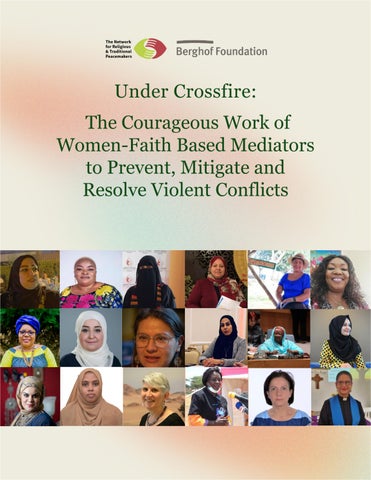
Synthesis Paper: Under Crossfire: The Courageous Work of Women-Faith Based Mediators to Prevent, Mitigate and Resolve Violent Conflicts
This publication is part of the Women Faith-Based Mediators project, led by The Network for Religious and Traditional Peacemakers and Berghof Foundation. Authors: Carla Schraml, Advisor for Negotiation and Mediation Support and Luxshi Vimalarajah, Senior Mediation Advisor, Berghof Foundation Editors: Jessica Roland, Senior Specialist on Inclusive Peace and Sarah Tyler, Communications Consultant, The Network for Religious and Traditional Peacemakers Design: Triss Yap, Graphic and Visual Designer, The Network for Religious and Traditional Peacemakers Acknowledgments: We are particularly thankful for the intensive and dedicated work of the researchers who wrote the case studies as well as those women and men who were ready to be interviewed and who gave insights to their selfless, constant, highly relevant and creative work pushing for peace and less violence every day. We want to thank the colleagues from the Berghof Foundation, including Beatrix Austin, Dalia Barsoum, Victoria Cochrane-Buchmüller, and Mir Mubashir for their comments and revisions, as well as the colleagues from the Network for Religious and Traditional Peacemakers who supported the development of this study. To cite: Schraml, Carla and Luxshi Vimalarajah. Synthesis Paper: Under Crossfire: The Courageous Work of Women-Faith Based Mediators to Prevent, Mitigate and Resolve Violent Conflicts. The Network for Religious and Traditional Peacemakers. https://www.peacemakersnetwork.org/women-of-faith-based-peace-mediators/. 2023.
2
CONTENTS
0. Executive Summary ........................... 4 1. Key Insights and Learnings ................ 5 2. Introduction ........................................ 7 3. Clarification of Terms and Concepts ........................................ 10 4. Women Faith-Based Mediators Within the Frame of the Study .......................... 11 5. Self Perception of Women Faith-Based Mediators .............................................. 12 6. Ambivalent Roles of Faith and Religion in Different Contexts ............................. 14 7. Faith and Religious Literacy as a Tool and Entry Point to Mediate Protracted Conflicts ................................................ 16 8. Women and Young Women’s Roles Within Faith-Based Mediation ............ 20 9. Areas of Operation and Levels of Engagement ........................... 23 10. Distinct Features and Added-Value of WFBMs ................................................. 25 11. Risks and Challenges ...................... 29 12. Strategies to Mitigate Risks and Challenges ..................................... 30 13. Support Needs of WFBMs .............. 32 14. Recommendations .......................... 35 15. Bibliography .................................... 39 16. About the Authors ........................... 43
3
Synthesis Paper: Under Crossfire: The Courageous Work of Women-Faith Based Mediators to Prevent, Mitigate and Resolve Violent Conflicts
0. EXECUTIVE SUMMARY Against the background of the increasing complexity of ‘modern’ conflicts and the inadequacy of the global peacemaking system, local resources, instruments, and actors have started to gain more attention and prominence. This ‘local-turn’ in peacemaking and broader peacebuilding has led to a better understanding and acknowledgment of insidermediators inspired by faith and religion, commonly described as faith-based actors and faith-based mediators (WFBM) and negotiators. Historically, in many contexts around the world, conflict parties have turned to faith and traditional leaders to resolve conflicts on the ground - be it neighborhood, pastoralist, border conflicts or clan conflicts. While faith and traditional leaders have continued to serve as arbitrators and mediators in tribal, religious, traditional, and clan-based societies, their contribution to conflict transformation, in particular, mediation, negotiation, and peacemaking, has only been recently discussed in scholarly debate. Although the relevance and effectiveness of faithbased mediation has been well researched, the role and potential of women and young women within those processes are less so. When faith-based mediation is referred to, it typically is associated with formal religious institutions mostly run by male religious leaders. Consequently, WFBMs face double levels of gender discrimination within their peace mediation work: societal prejudices and stereotypes and institutional discrimination that they face due to the patriarchal nature of religious institutions, customs, and practices. While WFBMs utilize creative strategies to achieve results despite these barriers and risky conditions in which they are forced to work within, their efforts remain largely invisible, unexplored, and uncaptured. Interviews and case studies conducted for this study 4
show that WFBMs have been very present in the peace mediation space: from high-level mediation, such as in Colombia, to grassroots negotiations such as the reopening of schools and access to education for girls, humanitarian access or safe passage, the release of hostages, abductees, and prisoners, and the stopping or prevention of violence on the ground. WFBMs have also successfully negotiated the temporary relief of siege or the cessation of violence with religious extremist group, including the Lord Resistance Army (LRA) in the Northern part of Uganda, Boko Haram in Northern Nigeria, as well as the Al Nusra front and the Islamic State of Iraq and the Levant in Syria - to name just a few. Yet, it is not visible to the outside world how WFBMs manage to navigate in highly gendered conflict contexts and get access to, and build trust with actors as well as what makes them unique and effective mediators and negotiators. With this study, the Network for Religious and Traditional Peacemakers (NRTP) and the Berghof Foundation (BF) would like to give visibility to these brave women and young women, their daily struggles and their unmatched courage and perseverance. While WBFMs share many similarities with the way insider women mediators generally operate in conflict contexts, they also stand out exposing distinct features and the concomitant risks, hurdles, entry points and strategies within their peace mediation work.
Drawing on extensive case studies from Colombia, Nigeria, Syria, Cameroon, Iraq, and Kenya, and complemented by interviews with individual WFBMs from Israel, Uganda, Yemen, and Aceh, this study tries to unearth the potential of WFBMs for peacemaking, their motivations, their strategies to overcome societal and religious boundaries, their areas of operation and their achievements in the cessation and prevention of violence. Relevant stories and lived experiences of individual WFBMs from different parts of the world build the foundation of the study to understand how faith and being a woman or young woman can impact the effectiveness of peace mediation and negotiation processes at all tracks. The study concludes with identifying specific support needs expressed by the WFBMs interviewed for the purpose of this study and subsequent recommendations for national governments, religious authorities, and the international community.
1. KEY INSIGHTS AND LEARNINGS 1. Many WFBMs have difficulty identifying themselves with the term ‘mediator’ or ‘negotiator.’ These terms and concepts are seen as alien to local understandings and practices. In practice, all tools (mediation, dialogue, reconciliation work, trauma healing, human rights advocacy, etc.) are used simultaneously and consecutively. Mediation is therefore not seen as a ‘stand-alone’ activity but ‘linked to broader peacebuilding initiatives.’1 In their understanding, mediation, dialogue, and negotiation are all fluid concepts. For WFBMs, it is the purpose that matters and not the tool. 2. Almost all WFBMs see themselves as religious and faith-based actors. Clearly distinct from secular actors, WFBMs feel a concrete vocation for what they are doing, working with a lot of passion, and acting on a particularly unselfish basis and in a non-attention seeking way. Most of all, their command of religious literacy stands out and gives them access and a unique positioning within the circle of local women mediators. 3. By virtue of their role as respected traditional and religious leaders in the community, WFBMs get involved to raise topics of very strong concern for the community towards armed groups, military, and government stakeholders. Other WFBMs are well trusted people in their community because they serve the community in other respects, such as humanitarian aid and community work.
Photo: Nuha Andrious conducting a conflict analysis and mediation session in the Nineveh region in Iraq, September, 2019.
1 Ramadhan, Shamsia. Women-Faith Based Mediators in Kenya: Challenges and Opportunities for Participation Within Peace Mediation, The Network for Religious and Traditional Peacemakers and Berghof Foundation. https:// www.peacemakersnetwork.org/women-of-faith-based-peace-mediators/. 2023.
5
Synthesis Paper: Under Crossfire: The Courageous Work of Women-Faith Based Mediators to Prevent, Mitigate and Resolve Violent Conflicts
4. Many of the peace mediation and negotiation efforts emerge out of an immediate need on the local level.
8. Being part of a faith-based organization certainly lends more credibility and legitimacy in the eyes of those involved within peace mediation efforts.
The majority of WFBMs are involved in track 3 processes, negotiating, and mediating at a local level with local stakeholders and leadership of armed groups. Few WFBMs are involved in peace processes at the national level. Most of the time, WFBMs are able to build on their experiences and mediate and negotiate in other contexts, often with institutional support and funding. Their effective and successful work on track 2 and 3 is crucial to getting the opportunity to mediate at the national level. This context-rooted, genuine progression and acknowledged experience provides legitimacy for further engagements.
A faith-based organization background lends credibility and legitimacy, however he access to local conflict contexts and the ability to build trust and relationships depends partially on personality.
5. Faith and religion are constitutive for the motivation of WFBMs, and it gives them courage, resilience, hope, and persistence. WFBMs use faith-based references and knowledge for leveraging their processes, creating entry points, and building trust. Faith gives them strength and confidence to serve as mediators and negotiators in highly complex situations. 6. The more relevant faith and religion is within a society or community, the more relevant the capability to operate based on faith-based knowledge and references. In contexts where religion, faith and culture are seen as a major source of conflict, WFBMs are more exposed to physical threat than in conflicts in which religion is not the main fault line. 7. Despite contextual and individual dynamics, religion as a cultural and societal force has been seen to play a constructive role of opening doors. Religion and faith is a strong door opener and helps to involve hard-to-reach-actors. However, religion also has the potential to close doors when viewed as one of the main conflict drivers. 6
9. The potential of WFBMs is not sufficiently utilized due to prevailing patriarchal culture in religious contexts. Gender discrimination can be further entrenched by direct reference to religious texts. This partly explains the reasons for the limited role they play and the dearth of WFBMs in conflict contexts. 10. Being seen as less threatening and intimidating allows WFBMs in some situations to take greater risks and to negotiate and advocate for the cessation of violence where faith-based men were unable to do so. Despite the very strong risks WFBMs bear, being heavily threatened, abused and even killed due to their gender and faith identities, they see themselves to be comparatively safe and untouched in some situations. Men are under stronger threat of being punished. 11. Communities take WFBMs seriously as they are not viewed as part of the problem. Women and WFBMs are perceived as pursuing less personal or political goals and interest. Being seen as not having personal stakes in the conflict allows WFBMs to change between different roles of advocating, negotiating, and mediating. 12. The networks created by WFBMs create an added value. WFBMs are able to utilize these networks to open new communication channels and build internal group pressure to leverage during the peace mediation process.
13. In utilizing an inclusive approach, many WFBMs engage and partner with male gatekeepers, including male religious and traditional leaders, to facilitate their entry and outreach. Religious and traditional leaders hold substantial influence or authority within specific communities and can leverage their positions to promote active participation and interaction between their communities and WFBMs.
2. INTRODUCTION The world is now facing more violent conflicts than at any point in time since 1946.2 At the same time, since 2016, no comprehensive peace agreement has been brokered which has ensured long-term peace and stability. Furthermore, international peacemaking systems, structures, and actors negotiating and brokering peace are lacking efficiency and are increasingly under pressure.3 In parallel to this, experts and observers of the field see this era of, ‘Big men diplomacy and multi-track mediation,’ often associated with the way the UN system operates (e.g. the UN standby mediation team),4 to have reached its limits. The peacemaking field is frequently cited as ‘crowded’ with a multiplicity of third-party actors, states, regional, and local and global civil society organizations specialized on peace mediation. Yet, the peacemaking field has not been able to cope with the complexity of today’s conflicts characterized by the proliferation of armed groups, the re-emergence 2 Palik, J., Rustad, S. A., Methi, F. Conflict Trends: A Global Overview, 19462019, Prio Paper, https://www.prio.org/publications/12442, 2020. 3 Waldman, Matt. Falling short. Exploring Mediation Effectiveness, Folke Bernadotte Academy, https://fba.se/globalassets/publikationer/falling-shortexploring-mediation-effectiveness.pdf, 2022. 4 Center for Peace and Conflict Studies. Moving Beyond Multi-Track Diplomacy and Big Man Mediation. Peace Processes in the 21st Century and Beyond, https://www.centrepeaceconflictstudies.org/wp-content/uploads/ MOVING-BEYOND-MULTI-TRACK-DIPLOMACY-AND-BIG-MAN-MEDIATIONeBook.pdf.
of geo-politics, coupled with the global climate crisis and growing global economic disparity. It is against this background of increasing complexity of ‘modern’ conflicts and the inadequacy of the global peacemaking system that local resources, instruments, and actors have started to gain more attention and prominence. This ‘local-turn’ in peacemaking and broader peacebuilding has led to a better understanding and acknowledgment of insider-mediators inspired by faith and religion, commonly described as faith-based actors and faith-based mediators and negotiators (WFBMs).5 Historically, in many contexts around the world, conflict parties have turned to faith and traditional leaders to resolve conflicts on the ground - be it neighborhood, pastoralist, border conflicts or clan conflicts. Arguably, their role as peacemakers in protracted conflicts at the national-level have gained much prominence during the Apartheid in South Africa with late Archbishop Demond Tuto, the East Timor peace process with Bishop Bella and Monsignor Arturo Rivera y Damas, in the Salvadorian conflict between the Government and Farabundo Martí National Liberation Front (FMLN). While beyond these prominent cases, faith and traditional leaders have continued to serve as arbitrators and mediators in tribal, religious, traditional, and clan-based societies. However, their contribution to conflict transformation has only been recently discussed within scholarly debate. Since the Iranian Revolution and the Soviet Invasion of Afghanistan, religion and faith have widely been acknowledged as a force to reckon with. They are seen both as dividers and connectors influencing armed conflict dynamics around the world.6 While the 5 Terms of References: Baseline study: “Women faith based (insider) mediators & negotiators (WFBM): exploring challenges, entry points, risks and support needs further” 6 Baumann, Jonas, Daniel Finnbogason, and Isak Svensson. Rethinking Mediation: Resolving Religious Conflicts. Center for Security Studies (CSS) ETH Zürich, https://css.ethz.ch/content/dam/ethz/special-interest/gess/cis/ center-for-securities-studies/pdfs/PP6-1.pdf, February, 2018.
7
Synthesis Paper: Under Crossfire: The Courageous Work of Women-Faith Based Mediators to Prevent, Mitigate and Resolve Violent Conflicts
negative and divisive role of religion and faith continue to dominate the popular discourse on religion, the UN General Secretary Ban Ki Moon made a critical statement in 20087 which highlighted that faith and religion play a vital role in transforming conflicts that helped to illuminate the constructive role of religion and faith in peacemaking.8 Foreign policies and the broader peacebuilding community have started to integrate faith and religion more strongly into their analysis.9 This in turn, led to increasing interest in how faith based (insider) mediators operate, what unique potentials, approaches, and tools they might offer, what challenges they may be facing, and what further support they might need, acknowledging their relevance and significance in war-to-peace transitions.
Photo: Consultation between WFBMs, Network for Religious and Traditional Peacemakers and Ministry of Foreign Affairs Finland to understand support needs of WFBMs, held in Helsinki, Finland in 2022. 7 United Nations Information Service. UN Secretary-General Ban Kimoon Press Release: https://unis.unvienna.org/unis/en/pressrels/2008/ unissgsm058.html, July 16, 2008. 8 See e.g. Abu-Nimer, Mohammed. Alternative Approaches to Transforming Violent Extremism. The Case of Islamic Peace and Interreligious Peacebuilding, in: Beatrix Austin and Hans J. Giessmann (eds). Transformative Approaches to Violent Extremism. Berghof Handbook Dialogue Series No. 13. Berlin: Berghof Foundation, http://image.berghoffoundation.org/fileadmin/redaktion/Publications/Handbook/Dialogue_ Chapters/dialogue13_violentextremism_lead.pdf>. First launch 10/01/2018, 2018. 9 Hayward, Susan. Religion and Peacebuilding. Reflections on Current Challenges and Future Projects. Special Report, United States Institute for Peace, https://gsdrc.org/document-library/religion-and-peacebuildingreflections-on-current-challenges-and-future-prospects/, 2012.
8
Although the relevance and effectiveness of faith mediation has now been well researched10, the role and potential of women and young women in this space is less so. When faith-based mediation is referred to, it is typically associated with formal religious institutions and religious leaders in formal roles. Susan Hayward and Kathrine Marshall were the first to explore the specific challenges and opportunities of women of faith and their contribution to peacebuilding efforts more generally in 2015.11 However, the potential of faith-based and religious women and young women in peace mediation and negotiation efforts, often operating in informal sections and functions, has not received much attention until recently with the United States Institute of Peace’s (USIP) project, ‘Religious Women Negotiating on the Frontlines.’12 Like other Insider Mediators,13 women faithbased mediators and negotiators have long been contributing to national and local efforts to transform conflicts - albeit less prominent and less visible. As their male colleagues, they are deeply interwoven in local contexts, deeply invested in their work, with high motivation, dedication, and passion to bring peace to their contexts. As a WFBM and a ‘faith-based peace seeker’ from Israel, Sarah Bernstein, describes: ‘This is your life, and you live in this community, you are not just parachuting in.’14 WFBMs, their networks, work and life are part of a system, which is intrinsic to the respective conflicts.15 10 Mubashir, Mir and Luxshi Vimalarajah. Tradition and Faith-Oriented Insider Mediators (TFIMs) as Crucial Actors in Conflict Transformation. Potential, Constraints, & Opportunities for Collaborative Support. The Network for Religious and Traditional Peacemakers, https://peacemakersnetwork.org/ wp-content/uploads/2016/11/TFIM_FullReport_final.pdf, 2016. 11 Hayward, Susan and Katherine Marshall (Ed.). Women, Religion, and Peacebuilding: Illuminating the Unseen. Washington, DC: United States Institute of Peace Press, S.2, 2015. 12 United States Institute of Peace. Accessed September 9, 2023: https:// www.usip.org/programs/religious-women-negotiating-frontlines. 13 Mubashir, Mir, Engjellushe Morina, and Luxshi Vimalarajah. OSCE Support to Insider Mediation. Strengthening Mediation Capacities, Networking and Complementarity, https://www.researchgate.net/publication/328542777_ OSCE_support_to_Insider_Mediation_Strengthening_mediation_capacities_ networking_and_complementarity, 2016. 14 Sarah Bernstein, Executive Director of the Rossing Center for Education and Dialogue, Jerusalem, Israel, online interview conducted by Carla Schraml on March 7, 2023. 15 Emma Leslie, Executive Director Centre for Peace and Conflict Studies, Siem Reap City, Cambodia, online interview conducted by Carla Schraml on January 30, 2023.
This notwithstanding, WFBMs face double levels of gender discrimination within their peace mediation work. Consequently, WFBMs face double levels of gender discrimination within their peace mediation work: 1) societal prejudices and stereotypes; and 2) institutional discrimination that they face due to the patriarchal nature of religious institutions, customs, and practices. While WFBMs utilize creative strategies to achieve results despite these barriers and risky conditions in which they are forced to work within, their efforts remain largely invisible, unexplored, and uncaptured. With this study, the Network for Religious and Traditional Peacemakers (NRTP) and the Berghof Foundation (BF) would like to give visibility to the brave women and young women, their daily struggles and their unmatched courage and perseverance. This study tries to unearth the potential of WFBMs for peacemaking, their motivations, their strategies to overcome societal and religious boundaries, their areas of operation and their achievements in the cessation and prevention of violence. Relevant stories and lived experiences of individual WFBMs from different parts of the world, such as Colombia, Kenya, Nigeria, Iraq, Cameroon, but also Israel, Uganda, Yemen, and Aceh, build the foundation of the study to understand how faith and being a woman or young woman impact the effectiveness of peace mediation and negotiation processes at all tracks. Thereby, stories of peace mediation and negotiation work were collected from WFBMs working at all track levels. This study also focuses on the challenges and risks that WFBMs face within their roles as mediators. These challenges and risks obviously vary according to the context and whether faith and religion is a conflict marker or not. In order to ensure much needed crosscontextual and experienced based learning, this study looks at strategies which WFBMs themselves have developed to deal with and overcome such risks and challenges.
Despite the potential and demonstrated ability of WFBMs, only a few initiatives and projects, such as Religion for Peace’s support on the global level as well as the Tastakel, the Justice and Peace Commission of the Archdioceses of Bamenda or Women for Positive Peace Building Initiative (WOPPI) on the grassroots level in Syria, Cameroon and Nigeria have been providing specific support to WFBMs. Therefore, the study also explores the specific support needs of WFBMs, to provide orientation for future programming and support. The study draws mainly on six case studies on Iraq, Syria and Nigeria, Cameroon, Colombia, and Kenya, which were conducted by researchers based in their respective country context. Partly these researchers are experienced, faith-based mediators and negotiators themselves, as in the case of Nigeria, Cameroon, and Kenya. Interviews with individual WFBMs from Israel, Uganda, Yemen, and Aceh complement the picture.16
Photo: Front covers of the six country case studies for this synthesis paper. 16 Each of the six case studies is based on 14-17 online and in-person interviews. Interviews were conducted with (a) 7-10 WFBM as well as with (b) 4 relevant stakeholders to the context/peace process, who have relevant insights on the work of WFBM and with (c) 3 male faith- based mediators (FBM). The interviews with WFBM and male FBM ensure a diversity in respect to 1) tracks at which they mediate, 2) religious and faith backgrounds, 3) regional and organizational background as well as 4) age.
9
Synthesis Paper: Under Crossfire: The Courageous Work of Women-Faith Based Mediators to Prevent, Mitigate and Resolve Violent Conflicts
3. CLARIFICATION OF TERMS AND CONCEPTS This study is inspired by the research on religious women in peacebuilding17 as well as faith-based (insider) mediators.18 It uses a broad understanding of faith and religion encompassing ancestral beliefs, tradition, and spirituality but a narrow understanding of peace mediation. Accordingly, peace mediation is defined here as a process, ‘whereby a third party assists two or more parties, with their consent, to prevent, manage or resolve a conflict.’19 ‘The term peace mediation comprises the entire structured process of supporting negotiations, from initial contact between mediators and conflict parties to ceasefire negotiations and the implementation of peace agreements. Mediation is thus an instrument that can be used throughout the whole conflict cycle.’20 In line with these parameters, we define women faithbased mediators and negotiators as those, ‘who are working on various tracks for ceasing violence and finding agreements in order to prevent and mitigate violence. In doing this work, their tools and methods are inspired by faith, and/or they are cooperating 17 Within Hayward and Marshall’s fundamental work on crucial challenges, (such as a weak role and authority of women within religious and faithbased structures) and relevant opportunities, (such as the “ambivalence of the invisibility of women’s work”, and the consciously and unconsciously taking advantages of traditional gender roles, including roles of mothers) are pointed at. These outlined aspects have given orientation for the present research. 18 Mubashir’s and Vimalarajah’s ground laying study on TFIMs established an understanding of faith-based mediators and their work and explored opportunities and challenges, on which the present study drew in its conceptualization. 19 The United Nations (UN) Guidance for Effective Mediation, July 2012, https://peacemaker.un.org/guidance-effective-mediation. 20 Initiative Mediation Support Deutschland (IMSD). Basics of Mediation: Concepts and Definitions. Fact Sheet Series: Peace Mediation and Mediation Support https://berghof-foundation.org/library/basics-of-mediationconcepts-and-definitions, 2017.
10
within or with faith-based structures and/or with faith-based actors, and/or are gaining motivation and inspiration for this work through faith’.21 This definition is largely drawn from the baseline study on traditional and faith-based insider mediators which the Berghof Foundation and the Network for Religious and Traditional Peacemakers conducted in 2016. In that, tradition, and faith-oriented insider mediators (TFIMs) are defined as, ‘a specific subset of insider mediators who take an assortment of concepts, values and practices from tradition and faith (among other sources) as inspiration, motivation, guidance and as methodological support for their peace mediation efforts.’22
The term peace mediation comprises the entire structured process of supporting negotiations, from initial contact between mediators and conflict parties to ceasefire negotiations and the implementation of peace agreements. Mediation is thus an instrument that can be used throughout the whole conflict cycle. Basics of Mediation: Concepts and Definitions Initiative Mediation Support Deutschland
21 Berghof Foundation and Network for Religious and Traditional Peacemakers (NRTP). Terms of References: Baseline study: “Women faith based (insider) mediators & negotiators (WFBM): exploring challenges, entry points, risks and support needs further.” https://www.peacemakersnetwork. org/women-of-faith-based-peace-mediators/, 2023. 22 Mubashir, Mir and Luxshi Vimalarajah. Tradition and Faith-Oriented Insider Mediators (TFIMs) as Crucial Actors in Conflict Transformation. Potential, Constraints, & Opportunities for Collaborative Support. The Network for Religious and Traditional Peacemakers, https://peacemakersnetwork.org/ wp-content/uploads/2016/11/TFIM_FullReport_final.pdf, 2016.
The distinct engagement of insider mediators, as the largest category relevant to this study, is fundamentally defined by a different dimension, ‘Insiders are intrinsic to the conflict context, i.e. they are part of the social fabric of the conflict and their life is directly affected by it. They may have a stake in the conflict, but they prefer non-violent means of addressing it. Their legitimacy to mediate is not necessarily based on impartiality but on their rootedness in the context as well as their influence and authority, which provides them access to conflict actors that is unavailable to others (e.g., radical, hard to reach and armed actors). Insiders have inside knowledge of subtleties in mood and positions – within or across constituencies.’23 Fairness is a central principle within faith-based mediation deviating from secular mediation approaches that place importance on impartiality and neutrality. One demonstrated example of this is from the Qur’an: ‘O you who believe, be upright for God, bearers of witness with justice, and not let the enmity and hatred of anyone incite you not to be fair; be fair, that is closer to piety.’24
O you who believe, be upright for God, bearers of witness with justice, and not let the enmity and hatred of anyone incite you not to be fair; be fair, that is closer to piety. Qur’an 5:8
23 Mubashir, Mir, Engjellushe Morina, and Luxshi Vimalarajah. OSCE Support to Insider Mediation. Strengthening Mediation Capacities, Networking and Complementarity, https://www.researchgate.net/publication/328542777_ OSCE_support_to_Insider_Mediation_Strengthening_mediation_capacities_ networking_and_complementarity, 2016. 24 The Quran, 5:8.
4. WOMEN FAITH-BASED MEDIATORS WITHIN THE FRAME OF THE STUDY This study is based on extensive case studies from contexts in which religion and faith play a largely reinforcing role with respect to dominant violent conflict lines, such as, Iraq, Syria and Nigeria, as well as three contexts in which religion and faith largely play an integrative role with respect to the dominant violent conflict lines, such as Cameroon, Colombia and Kenya. Only a very few of the WFBMs, who were interviewed for this study have a clerical or (laic) consecrated role, such as Pastor Adeleida Jiménez from Colombia, Bishop Betty Onyango from Kenya, Reverend Sr. Patience Muring, who is heading the La Verna Spiritual Center of the Tertiary Sisters of St. Francis (TSSF) in Bamenda, or Rosa Inés Floriano, a consecrated lay person, who has worked for 20 years with the Catholic Church and is member of Laica Congregación de Misioneras Guadalupanas del Espíritu Santo. Some interviewees have an official position within religious or faith-based structures, such as Laura Anyola Tufon, who is the Northwest regional coordinator of the Peace and Justice Commission of the Dioceses of Bamenda. Many WFBMs who are part of this study work closely together with religious leaders and other authorities and complement their work by reaching out to faith-based womenled networks and thereby create further important channels for peace. Others are married to men who are clerics or religious authorities, or are their descendants, such as Lucy Dlama from Nigeria, who effectively use the authority by association and platform of the Church to prevent violence, or Asmaa Kuftaro, who is the grand-daughter of the former 11
Synthesis Paper: Under Crossfire: The Courageous Work of Women-Faith Based Mediators to Prevent, Mitigate and Resolve Violent Conflicts
Grand Mufti of Syria, Sheikh Ahmad Keftarou and a former member of the Syrian Women’s Advisory Board for the UN Special Envoy, Staffan de Mistura. Some WFBMs interviewed for this study have very specific profiles, as for example, the spouse to a highranking fighter of the Al Nusra Front in Syria, who was able to negotiate through him the release of hostages. Others again, have a very strong identification with their faith and make this explicit through their knowledge and references, the rituals they observe and the way they are dressed, including Shadia Marhaban, an international mediator and former negotiator of the Free Aceh Movement (GAM), Esther Omam from Cameroon, or Amat Alsalam Abdullah Abdu Al-Hajj from Yemen. As strong believers, their motivation, resilience and references are shaped by faith, as exemplified through their work mobilizing thousands of women and prominently advocating for the cessation of violence in North-West and SouthWest of Cameroon, as Esther Oman, or when playing a crucial role in helping to release 950 forcibly disappeared persons in Yemen since 2016, as Amat Alsalam Abdullah Abdu Al-Hajj. While being part of a faith-based organization certainly lends more credibility and legitimacy in the eyes of those involved within peace mediation efforts, ultimately, the access to local conflict contexts and the ability to build trust and relationships depends partially on personality. As Josefina Perdomo, who as a Catholic lay person prominently and effectively negotiated with armed groups in the Caquetá region in Colombia, puts it, ‘The organization or institution only gets someone so far and the person themselves has to know how to gain legitimacy.’25
25 Josefina Perdomo, advocate for women’s rights and mediator from Caquetá region in Colombia, in person interview conducted by Rebecca Gindele on February 3, 2023.
12
5. SELF-PERCEPTION OF WOMEN FAITH-BASED MEDIATORS Only a few WFBMs would explicitly identify with faith-based mediation or negotiation. Atim Evenye identifies as one of the few with the term, ‘I am a frontline negotiator who is attached to a religious system and belief. Religion is what I always bring to the line.’26 As the head of the non-governmental organization, Authentic Memorial Empowerment Foundation (AMEF), Atim regularly negotiates with factions of the Ambazonia Defense Forces (Amba) for access to different communities in the North-West and South-West region of Cameroon. Many WFBMs have difficulty identifying themselves with the term ‘mediator’ or ‘negotiator.’ These terms and concepts are seen as alien to local understandings and practices. Stella Mystica Sabiiti, an experienced peace and security practitioner, emphasizes that ‘mediation,’ ‘negotiation’ and ‘faith-based’ do not make sense in local languages. This is exemplified in Uganda, where she has been crucially involved in negotiations with the Uganda National Rescue Front 2 (UNRF 2) in the early 2000s, in particular when they are directly translated, thus ‘they have to be localized.’ Within the interview Stella explains: ‘The terminology in English does not translate directly into our local languages. Most of the peace processes in which women of faith find themselves intervening are embedded in communities. Most of the stakeholders have a shared culture and language. For this reason these processes are conducted in local or regional African languages, which are less restrictive and deeper and more nuanced than for example in French or English. The terminology already allows spaces or arenas for peace intervention to open 26 Schraml, Carla and Laura Anyola Tufon. Women-Faith Based Mediators in Cameroon: Challenges and Opportunities for Participation Within Peace Mediation, The Network for Religious and Traditional Peacemakers and Berghof Foundation. https://www.peacemakersnetwork.org/women-offaith-based-peace-mediators/.2023.
up to anyone.’27 In practice, all tools (mediation, dialogue, reconciliation work, trauma healing, human rights advocacy, etc.) are used simultaneously and consecutively. Mediation is therefore not seen as a ‘stand-alone’ activity but ‘linked to broader peacebuilding initiatives.’28 In their understanding, mediation, dialogue, and negotiation are all fluid concepts. For WFBMs, it is the purpose that matters and not the tool. In the same vein, Rosa Ines Florino, a consecrated lay person who currently supports the Catholic Church’s delegation in the negotiations with Ejército de Liberación Nacional (ELN) and has significant experience to promote dialogue and mediate between different groups and factions in civil society, laments about the conventional models of peacebuilding that focuses rather on victims than on dialogue between the different parties. She sees peace mediation work as a strong component of reconciliation to initiate communication and dialogue between the parties. Furthermore, the term ‘religious’ or ‘faith-based mediators’ is associated with formal religious institutions (of which only few are officially part), and strengthens the association with ‘men’ and ‘male religious leaders.’29 There is a general feeling that the term deviates from the actual capacities and competences of WFBMs and invokes a less professional image. As Shadia Marhaban, a very experienced and renown mediator and negotiator from Aceh puts it, ‘I see myself more as a mediator, not as women faith-based mediator. What I wear represents Muslim community, however I try to focus on delivering the work. I try to be professional.’30
Moreover, for many WFBMs, religion and faith are a distinct feature of their identity; therefore, it does not make sense to explicitly point out the obvious fact that they are ‘faith-based.’ Amat Al-Salam Abdullah Al-Hajj, a strongly religiously inspired Yemeni negotiator, does not identify with the term. As anything else, her life and work is - as everything else in Yemen - interwoven with faith. Furthermore, by highlighting explicitly that she is a faith-based mediator, she would put herself at risk of being seen as a non-believer and thereby pose a security threat, as Islam is directly linked to the political project of the Yemini state and society. Also, against the background of a globally dominant, politically strong exploited discourse discrediting and reducing Islam to violence and terrorism, when being seen as explicitly referring herself to faith-based and obvious Muslim negotiator, Amat equally fears the accusation of ‘terrorism.’31 Similarly, large parts of WFBMs refuse to call themselves women faith-based mediators and negotiators when negative association with religion and faith are very present in specific contexts, where religion and ‘sectarianism’ are seen to have largely played a disintegrating and escalating role in the recent violent conflicts, such as in Syria or Iraq. Hind Kabawat, who has been involved for years in different faith-based mediation and dialogue efforts on various tracks, from high-level negotiations on Syria in Geneva to grassroot dialogues in different areas in Syria, and who sees her motivation, inspiration and raison d’être as a mediator fundamentally driven by faith, shares why she does not like to use the term women faith-based mediator, ‘It may widen the gap in society, especially during sensitive times of conflict.’32
27 Stella Mystica Sabiiti, peace and security practitioner, Uganda, online interview conducted by Carla Schraml on December 9, 2022. 28 Ramadhan, Shamsia. Women-Faith Based Mediators in Kenya: Challenges and Opportunities for Participation Within Peace Mediation, The Network for Religious and Traditional Peacemakers and Berghof Foundation. https://www.peacemakersnetwork.org/women-of-faith-based-peacemediators/.2023. 29 Schraml, Carla and Laura Anyola Tufon. Women-Faith Based Mediators in Cameroon: Challenges and Opportunities for Participation Within Peace Mediation, The Network for Religious and Traditional Peacemakers and Berghof Foundation. https://www.peacemakersnetwork.org/women-offaith-based-peace-mediators/.2023. 30 Shadia Marhaban, Mediator and Regional Peace Leader, Former Free Aceh Movement (GAM) Negotiator, Aceh, Indonesia, online interview conducted by Carla Schraml on March 17, 2023.
31 Amat Al-Salam Abdullah Al-Hajj, President and Co-Founder of The Abductees Mother Association, Sana’a, Yemen, online interview conducted by Deema Aasy on February 26, 2023. 32 Aasy, Deema and Carla Schraml. Women-Faith Based Mediators in Syria: Challenges and Opportunities for Participation Within Peace Mediation, The Network for Religious and Traditional Peacemakers and Berghof Foundation. https://www.peacemakersnetwork.org/women-of-faith-based-peacemediators/. 2023.
13
Synthesis Paper: Under Crossfire: The Courageous Work of Women-Faith Based Mediators to Prevent, Mitigate and Resolve Violent Conflicts
Along similar lines, strong skepticism was expressed in post the Islamic State of Iraq and the Levant towards the terms, as it is seen to undermine trust by the population and conflict parties.33 For WFBMS in Iraq and Syria, it is not always prudent to disclose their religious affiliation when working as a mediator as it may close the doors for engagement, particularly if the WFBM stems from a minority religion, as the case of a WFBM from Syria who mentions, ‘I don’t feel safe to introduce my faith identity explicitly. I would rather take a secular line reflecting a humanbased approach.’34 Despite the complexity of the term and a strong reluctance to identify themselves with the label WFBM for the reasons outlined above, WFBMs still see a value in this, as it is about, ‘recognizing and acknowledging the role of women and faith-based women in the field of peace work.’35 By giving it a name, the term creates visibility and confirms the relevance of their peacemaking role that is strongly inspired by faith, tradition, ancestral beliefs and religion.36 Almost all WFBMs see themselves as religious and faith-based actors, clearly distinct from secular ones, in feeling a concrete vocation for what they are doing, working with a lot of passion, and acting on a particularly unselfish basis and in a non-attention seeking way.37 Most of all, their command of religious literacy stands out and gives them access and a unique positioning within the circle of local women mediators.
6. AMBIVALENT ROLES OF FAITH AND RELIGION IN DIFFERENT CONTEXTS The ambivalent relationship between religion and violence, described by R. Scott Appleby in 2000,38 is important to consider when the potential of faithbased actors for the effective transformation of conflicts is assessed. Faith, religion, and faith-based and religious institutions and actors, can have a more integrating, while simultaneously more polarizing role in respect to violent conflicts and situations. This of course is related to: 1) whether and in which way faith and religion are seen to be related to specific political ideas, projects, and goals; 2) whether they are seen to be pursued by largely violent means; and 3) whether political and religious authorities and opinion leaders are seen to instrumentalize religion and faith for ulterior motives.
I don’t feel safe to introduce my faith identity explicitly. I would rather take a secular line reflecting a human-based approach. A WFBM in Syria
33 Aasy, Deema and Carla Schraml. Women-Faith Based Mediators in Iraq: Challenges and Opportunities for Participation Within Peace Mediation, The Network for Religious and Traditional Peacemakers and Berghof Foundation. https://www.peacemakersnetwork.org/women-of-faith-based-peacemediators/. 2023. 34 Aasy, Deema and Carla Schraml. Women-Faith Based Mediators in Syria: Challenges and Opportunities for Participation Within Peace Mediation, The Network for Religious and Traditional Peacemakers and Berghof Foundation. https://www.peacemakersnetwork.org/women-of-faith-based-peacemediators/. 2023. 35 Schraml, Carla and Laura Anyola Tufon. Women-Faith Based Mediators in Cameroon: Challenges and Opportunities for Participation Within Peace Mediation, The Network for Religious and Traditional Peacemakers and Berghof Foundation. https://www.peacemakersnetwork.org/women-offaith-based-peace-mediators/.2023. 36 IBID.
14 37 IBID.
Photo: Kahdija Shaqroug mediating a conflict among camp residences and the owner of the camp land at the Armanaz Camp in Idlib city in Syria in October, 2022.
38 Appleby, Robert Scott. The Ambivalence of the Sacred: Religion, Violence, and Reconciliation. Lanham, MD: Rowman & Littlefield Publishers, 2000.
Often, the potential of faith and faith-based actors depends very much on the respective local dynamics and individual actors involved. As Shadia Marhaban of Aceh, whose strong affiliation to Islam is very explicit in the way she dresses, shares that her potential as a faith-based women and mediator to positively contribute to the transformation of violent conflicts depends very much on the individual perceptions and local dynamics.39 The relevance of local context and individual actors can also be seen in the example of a WFBM, who asked to remain anonymous. As an atheist woman, who is known to be socialized as Christian from Aleppo, she was able to negotiate the release of 84 severely ill women in exchange of the fighters from the Islamic State of Iraq and the Levant imprisoned in the regime-controlled areas with the Prince of ISIS in 2016. Her tools and practices are strongly informed by Islam faith and reference, and she made sure to show her profound ability to navigate in the Muslim belief system as well as the acknowledgment of religiously inspired codex, through wearing a Hijab and the abaya.40
Photo: Kwale Women of Faith Network Chairperson Immaculate Mungai during community sensitization at Kinango Kwale, Kenya on women and children rights in July, 2023. 39 Shadia Marhaban, Mediator and Regional Peace Leader, Former Free Aceh Movement (GAM) Negotiator, Aceh, Indonesia, online interview conducted by Carla Schraml on March 17, 2023. 40 Anonymous WFBM, North Aleppo, North Syria, online interview conducted by Deema Aasy on February 3, 2023.
Photo: Shadia Marhaban, Mediators Beyond Borders International.
Despite this contextual and individual dynamics, religion as a cultural and societal force has been seen to play a constructive role of opening doors, including for hard-to-reach actors. However, religion also has the potential to close doors when viewed as one of the main conflict drivers. For example, in the Colombian case, faith institutions and actors, namely churches and their representatives, have been important actors in peace negotiations with major non-state armed groups, such as the Fuerzas Armadas Revolucionarias de Colombia (FARC) and the Ejército de Liberación Nacional (ELN).41 Conversely, faith-based initiatives for overcoming the main conflict between different fractions of Ambazonia Defense Forces (Amba) and the Cameroonian government have not proven to be successful. In the case of Syria, Nigeria and Iraq, religion and faith are largely discredited and seen as something to be avoided in the growing efforts to overcome conflict and stopping violence.42
41 Gindele, Rebecca and Carla Schraml. Women-Faith Based Mediators in Colombia: Challenges and Opportunities for Participation Within Peace Mediation, The Network for Religious and Traditional Peacemakers and Berghof Foundation. https://www.peacemakersnetwork.org/women-offaith-based-peace-mediators/. 2023. 42 Aasy, Deema and Carla Schraml. Women-Faith Based Mediators in Syria: Challenges and Opportunities for Participation Within Peace Mediation, The Network for Religious and Traditional Peacemakers and Berghof Foundation. https://www.peacemakersnetwork.org/women-of-faith-based-peacemediators/. 2023.
15
Synthesis Paper: Under Crossfire: The Courageous Work of Women-Faith Based Mediators to Prevent, Mitigate and Resolve Violent Conflicts
7. FAITH AND RELIGIOUS LITERACY AS A TOOL AND ENTRY POINT TO MEDIATE PROTRACTED CONFLICTS The potential of WFBMs is not sufficiently utilized due to prevailing patriarchal culture in religious contexts. Gender discrimination is further entrenched and legitimized by direct reference to religious texts. This partly explains the reasons for the limited role they play and the dearth of WFBMs in conflict contexts. However, WFBMs do strengthen peace mediation processes by bringing in different cultural beliefs and ideas regarding gender as well as faith. Furthermore, faith and religion play a very relevant role in the peace mediation and negotiation practice of women. Faith and religion are constitutive for the motivation of WFBMs, and it gives them courage, resilience, hope, and persistence. WFBMs use faith-based references and knowledge for leveraging their processes, creating entry points, and building trust. Faith gives them strength and confidence to serve as mediators and negotiators in highly complex situations. Religious literacy stands out as the most essential ingredient for their effectiveness.
For many WFBMs, faith is the crucial element of their motivation: they feel the commandment to work for positive change, ending and preventing violence, working to get hostages released, getting humanitarian access to communities, while accepting extremely difficult and endangering situations. ‘I feel whatever I do, should be something good for humanity, something just, so that when I die one day I have done something good.’43 Some WFBMs feel ‘blessed’ or even ‘chosen’ when they have an opportunity to fill these roles and make positive change in their communities. ‘I am an instrument in the hands of God,’ describes Esther Omam, who has effectively been negotiating the humanitarian access in rebel-controlled areas and the cessation of violence as well as the reopening of schools with different levels of Amba leadership in Cameroon. ‘Many are called, but a few are chosen. I think I am one of the few,’ she shares.44
I am an instrument in the hands of God. Esther Omam
43 Shadia Marhaban, Mediator and Regional Peace Leader, Former Free Aceh Movement (GAM) Negotiator, Aceh, Indonesia, online interview conducted by Carla Schraml on March 17, 2023.
Photo: Esther Oman, Executive Director for Reach Out Cameroon, speaking at a side event on, ‘Intersectional Challenges Faced by Women Faith-Based Mediators’ at the Stockholm International Peace Research Institute (SIPRI) 2023 Forum. 16
44 Schraml, Carla and Laura Anyola Tufon. Women-Faith Based Mediators in Cameroon: Challenges and Opportunities for Participation Within Peace Mediation, The Network for Religious and Traditional Peacemakers and Berghof Foundation. https://www.peacemakersnetwork.org/women-offaith-based-peace-mediators/.2023.
In addition, many WFBMs attribute their peace mediation successes to their faith, which gives them courage, resilience, hope, and persistence amongst others. Sarah Bernstein who has dedicated her life to improving Israelian-Palestinian relationships, feels that in her context the conflict grows worse day by day and yet recognizes that to continue this type of work requires a lot of resilience, which comes with ‘the sense to be commanded and called as a Jew to do this work.’45 Other WFBMs see their effectiveness related to a working style as well as being able to leverage being perceived as a faith-based person or being associated with a faith-based person for opportunities. Asmaa Kuftaro, the grand-daughter of the former Grand Mufti of Syria – Sheikh Ahmad Keftarou, advances her negotiation practices through employing religious teachings and leveraging her social positioning, as she is related to a national religious figure. For Asmaa, her work is strongly supported by ‘Sheikh Ahmad Keftarou’s legacy and religious teachings.’46
Faith-Based references and knowledge for stronger leverage, credibility and building trust The more relevant faith and religion is within a society or community, the more relevant the capability to operate based on faith-based knowledge and references. WFBMs among others from Syria and Yemen emphasize this.47 The spouse to a former high-ranking fighter of the Al Nusra Front in Syria, who was able to negotiate the release of Al Nusra hostages, strongly believes that religious references are key, ‘to bridge gaps and build trust with extremist groups who value religious influence and credibility within mediation processes.’48 For Ambassador Betty Bigombe, when reaching out and building trust as a government lead negotiator to the Lord’s Resistance Army (LRA) in North Uganda - a ‘religious sect, that believed to be commanded by God,’ as she describes them. In the early 1990s, it was crucial to show ‘I am a Christian as you, I believe in your faith, it is the God I know,’ she shares.49 Similarly, Atim Evenye negotiates on a regular basis with armed groups as well as the military in the Northwest of Cameroon and refers to her faith to create trust and show herself being trustworthy. In respect to a very dangerous situation for her and her team she says, ‘I told him (Amba) about my belief in God and my practices as a good Christian, in order to show him my credibility and trustworthiness.’50
I told him [Amba] about my belief in God and my practices as a good Christian, in order to show him my credibility and trustworthiness. Atim Evenye Photo: Atim Evenye, Leader of the NGO Authentic Memorial Empowerment Foundation, South-West Region of Cameroon.
45 Sarah Bernstein, Executive Director of the Rossing Center for Education and Dialogue, Jerusalem, Israel, online interview conducted by Carla Schraml on March 7, 2023. 46 Aasy, Deema and Carla Schraml. Women-Faith Based Mediators in Syria: Challenges and Opportunities for Participation Within Peace Mediation, The Network for Religious and Traditional Peacemakers and Berghof Foundation. https://www.peacemakersnetwork.org/women-of-faith-based-peacemediators/. 2023.
47 Amat Al-Salam Abdullah Al-Haj, President and Co-Founder of The Abductees Mother Association, Sana’a, Yemen, online interview conducted by Deema Aasy on February 26, 2023. 48 Anonymous WFBM, Idlib, Northwest of Syria, online interview conducted by Deema Aasy on February 5, 2023. 49 Ambassador Betty Bigombe, international mediator, conflict resolution practitioner and Uganda government official, online interview conducted by Carla Schraml on December 4, 2022. 50 Atim Evenye, Leader of the NGO Authentic Memorial Empowerment Foundation, South-West Region of Cameroon, online interview conducted by Laura Anyola Tufon and Carla Schraml on March 2, 2023.
17
Synthesis Paper: Under Crossfire: The Courageous Work of Women-Faith Based Mediators to Prevent, Mitigate and Resolve Violent Conflicts
One reason why knowledge of religious references aids the work of WFBMs is that it helps to validate their arguments for peace and non-violent behavior. Shadia Marhaban describes this ‘technique’ of her work, ‘In Islam there is a lot of religious wisdom about war and peace. I use these pieces as examples to say making peace in Islam is crucial. I ask them: why are you fighting? Mohammed gave the land to the Jews, many different religious communities lived in Medina, why do we not think about that?’51 Rekyatu Mbappe, a Muslim community leader in a rural community not far from Bamenda, Northwest Cameroon, used the reference to the Bible when she effectively negotiated and convinced local Amba leadership about the re-opening of a local school in her community, ‘God loves all of us. God loves you, but how can he love you when you go to kill others. How can God love his kids when these kids are killing his other kids.’52 Another reason why knowledge of religious references can assist the work of WFBMs is that, ‘Faith can create common ground,’ as highlighted by Amina Hassan Ahmed, who has worked on restoring broken community fabrics by bringing together women from segregated Christian and Muslim communities in Jos Plateau State, Nigeria. Amina engaged Biblical and Quranic injunctions on harmonious coexistence through pairing Christians and Muslims together during dialogues to promote bonding and communication among conflict parties. Through Amina’s activities, mutual suspicion was significantly doused and the broken social relationship restored, evident by the restoration of economic activities.53
51 Shadia Marhaban, Mediator and Regional Peace Leader, Former Free Aceh Movement (GAM) Negotiator, Aceh, Indonesia, online interview conducted by Carla Schraml on March 17, 2023.
Faith-based knowledge can also be crucial for avoiding high risks. As Amat Al-Salam shares against the background of negotiating and liaising frequently with Al Houthi rebels, traditional authorities and tribal elders in Yemen in order to gain the release of prisoners and hostages, ‘WFBMs must be very well educated and versed in Islam’s literature. This is important to succeed in mediation processes. Not being sufficiently knowledgeable entails even the risk of “being charged with renouncing religion.’54
WFBMs must be very well educated and versed in Islam’s literature. This is important to succeed in mediation processes. Not being sufficiently knowledgeable entails even the risk of ‘being charged with renouncing religion.’ Amat Al-Salam
Photo: Amat Alsalam Abdullah Abdu, Co-Founder, Abductees Mother Association.
52 Rekyatu Mbapeh, community leader, from the rural surroundings of Bamenda, North West Region of Cameroon, in person interview conducted by Laura Anyola Tufon and Carla Schraml on February 2, 2023. 53 Amina Hassan Ahmed, Executive Director, Women Initiative for Sustainable Development (WISCOD), Plateau State-North Central Nigeria, in person interview conducted by Lantana Bako Abdullahi on January 26, 2023.
18
54 Amat Al-Salam Abdullah Al-Haj, President and Co-Founder of The Abductees Mother Association, Sana’a, Yemen, online interview conducted by Deema Aasy on February 26, 2023.
A fourth reason why knowledge of religious references aids the work of WFBMs is that it builds trust with communities and with actors within the peace mediation process. This can be exemplified through the example of Clotilda Andiensa, a community worker who needed to go to a village in the Northwest of Cameroon, Njinikom, which was controlled by Amba.55 The local representatives resisted and called for their General, who appeared to be familiar to Clotilda, ‘He looked like somebody I went to Catholic school with. I took all my courage and said (as we used to say): ‘Glory be to Jesus’ and he replied (as we used to do) ‘for all times.’’ Afterwards they continued talking about faith and prayer and the importance it has for them personally. The joint faith and experience as well as the religiously inspired phrase have been crucial for building trust and getting access to the community. Another example is of Justina Ngwobia, a church leader who has worked extensively in religiously segregated communities in North-Central Nigeria. In her peace mediation practice, as a woman of faith, Justina always lays strong emphasis on the shared humanity that binds adherents of all religious groups. She begins her mediation efforts by having participants read from their various books of faith to identify areas of similarities with regards to love, peaceful living and respect for the sanctity of human lives.56
A final reason why knowledge of religious references aids the work of WFBMs is that it helps build confidence in themselves and within the peace mediation process. WFBMs believe that faith helps them to find the right words and actions in highly sensitive and often dangerous situations.57 In the case of Esther Oman, when she had the chance to talk to the Amba leadership 2019 in Maryland, USA, she was by then a trained and experienced mediator. When she left the house, she prayed, ‘Give me the right word to speak, to introduce myself…’ During the negotiations, the separatists were very harsh on her and ‘tried to break her psychologically,’ but she resisted. ‘I was calm. I had prayed before and this made me very at ease and able to stay with myself!’58 Similarly, Ambassador Betty Bigombe wonders, ‘How did God put these words in my mouth?’ – recalling one situation during the negotiations with the Lord’s Resistance Army (LRA)’s leader Joseph Kony. It became dark and he invited her to spend the night with them in their camp in the jungle in order to promptly resume talks the next morning. She feared that she would be kidnapped, but she also did not know how to turn down the offer. ‘I prayed quietly to God to give me wisdom and then I praised them. We were using inflammatory language and now we are thinking to spend the night here in a friendly atmosphere; however, I am also a government official. The government might misunderstand if I do not come back, and they might come to rescue me, and we might all be killed. O God, how did this come into my mind, I was asking myself, I was so scared.’59 Ambassador Betty Bigombe further recalls how faith and religion gives her strength and confidence in peace mediation processes when there are uncertain outcomes, contracting narratives as well as strong opponent to the process itself, ‘I believe that God will hold my hand and will help me in the process.’60
Photo: Elder Justina Mike Ngwobia, Executive Director, Justice, Peace and Reconciliation Movement; Founder Women Peace Builders Network in Nigeria; Co-chair, Women Peace Mentors and Mediators Forum, Nigeria. 55 Schraml, Carla and Laura Anyola Tufon. Women-Faith Based Mediators in Cameroon: Challenges and Opportunities for Participation Within Peace Mediation, The Network for Religious and Traditional Peacemakers and Berghof Foundation. https://www.peacemakersnetwork.org/women-offaith-based-peace-mediators/. 2023. 56 Justina Ngwobia, Justice Peace & Reconciliation Movement, Plateau State-North Central Nigeria, in person interview conducted by Lantana Bako Abdullahi on January 27, 2023.
57 IBID. 58 IBID. 59 Ambassador Betty Bigombe, international mediator, conflict resolution practitioner and Ugandan government official, online interview conducted by Carla Schraml on December 4, 2022. 60 IBID.
19
Synthesis Paper: Under Crossfire: The Courageous Work of Women-Faith Based Mediators to Prevent, Mitigate and Resolve Violent Conflicts
8. WOMEN AND YOUNG WOMEN’S ROLES WITHIN FAITH-BASED MEDIATION In all researched contexts, power relations and dynamics regarding faith and gender limit or amplify the potential of women faith-based mediators and negotiators. For example, due to entrenched norms, women are often limited in their ability to lead and participate within peace mediation efforts because they need to be accompanied by men to leave the house, such as is in the case in Syria, Iraq, and Yemen. Limitations or opportunities can further be amplified through other intersectional identities of the women, including their age, ethnicity, ability, or sexual orientation. All case studies demonstrate to varying degrees that patriarchal societal norms, institutional structures and sometimes laws, limit the potential of women mediators and WFBMs.
Widely spread perceptions of women as powerless and less able to hold parties to agreements or the belief that women should not be in spaces with armed actors, significantly reduces the authority of women mediators.61 Depending on specific situations, actors and the level of negotiations, WFBMs can be rejected or met with skepticism to participate in leading roles or even within peace mediation processes by armed groups, such as the Fuerzas Armadas Revolucionarias de Colombia (FARC) in Colombia, the Al Houthi in Yemen, Boko Haram in Nigeria and the Lord Resistance Army (LRA) in Uganda. Because of these societal perceptions, WFBMs are often limited to ‘soft topic’ mediation spaces, such as family mediation and seen as less credible and fitting for political negotiations. Huda Serjawi, a lawyer and member of the local council’s legal office in A’zaz city, Northern Syria, has strong access for mediating local conflicts through her official role in the council; however, when it comes to resolving major disputes or freeing hostages, she lacks proper recognition from the ruling authorities.62
...religious leaders challenged me with Quranic verses referring to women’s limitations. Amina Al Thahbi
Photo: Amina Al-Thahabi, Executive Director, Masarat Center for Conflict Resolution.
20
61 Gindele, Rebecca and Carla Schraml. Women-Faith Based Mediators in Colombia: Challenges and Opportunities for Participation Within Peace Mediation, The Network for Religious and Traditional Peacemakers and Berghof Foundation. https://www.peacemakersnetwork.org/women-offaith-based-peace-mediators/. 2023. 62 Aasy, Deema and Carla Schraml. Women-Faith Based Mediators in Syria: Challenges and Opportunities for Participation Within Peace Mediation, The Network for Religious and Traditional Peacemakers and Berghof Foundation. https://www.peacemakersnetwork.org/women-of-faith-based-peacemediators/. 2023.
In addition to barriers created from societal roles and norms, religious institutions, references, and fundamentalist and dogmatic interpretation of faith can further limit the role and potential of WFBMs. Faith-based institutions and structures are historically patriarchal, with very few women in official and clerical roles. These limited opportunities for women to join official structures further limits their access and ability to increase their individual faith-based knowledge and authority.63 This is the case for almost every religious tradition with structurally defined gender roles, which add to further power imbalances between ordained male clerics and laywomen.64 For example, the public and leading roles of female adherents of Baptist or Pentecostal churches in Cameroon are limited. These churches and faith communities and in particular female members, see their purpose in worshiping, dedicating their life to God and the faith community, and serving with humility. Leading and public roles for women are seen to be problematic within many of these societies, which results in strong social and moral pressure on WFBMs.65
These limited formal opportunities for women are further challenged by the issue of faith actors using religious references as justification to prevent the ability of WFBMs to participate and lead within peace mediation efforts. Amina Alzahabi, who has in-depth experience in negotiating the return of internally displaced families in Iraq formally associated with the Islamic State of Iraq and the Levant, recalls situations when, ‘religious leaders challenged me with Quranic verses referring to women’s limitations’ and banned her from peace mediation efforts.66 Resistance by men and women, that is justified by theology, ‘is the hardest to change,’ as Sarah Bernstein also observes against the background of the first, recently ordained female Palestinian pastor in Israel.67 However, within contexts in which faith interpretations strongly limit public and leading roles of women and young women, WFBMs have unique roles and opportunities to play, including in liaising with women who are part of radicalized armed groups in order to reintegrate them or to liaise with women in the community or through specific women-led networks.
63 Sarah Bernstein, Executive Director of the Rossing Center for Education and Dialogue, Jerusalem, Israel, online interview conducted by Carla Schraml on March 7, 2023.
In contexts where religion and faith have a largely polarizing role in respect to the main violent conflict lines, such as in Nigeria, Syria, Iraq, parts of Kenya, and Israel and Palestine, WFBMs as well as other faithbased actors are often challenged in their authority, neutrality and multi-partiality based on perceived religious identity. WFBMs who are mediating and reaching out to the other side in dialogue and bridge building work often find strong pressure from their own religious communities regarding views on their neutrality. Sarah Bernstein who is working in interreligious dialogue and using faith-based tools to improve relationships between Jews and Palestinians feels that she is marginalized by her own community because she is ready to talk to ‘the other side, as somebody like me is branded as traitor.’68 Despite this general tendency which WFBMs and those supporting them do have to consider, perception and acceptance is obviously highly dependent on
64 Hayward, Susan and Katherine Marshall (Ed.). Women, Religion, and Peacebuilding: Illuminating the Unseen. Washington, DC: United States Institute of Peace Press, S.2, 2015.
66 Amina Alzahabi, Baghdad, Iraq, Director of Masarat Center for Dialogue and Mediation, online interview conducted by Deema Aasy on April 04, 2023.
Photo: Group work with Catholic Women Organization in Cameroon.
65 Schraml, Carla and Laura Anyola Tufon. Women-Faith Based Mediators in Cameroon: Challenges and Opportunities for Participation Within Peace Mediation, The Network for Religious and Traditional Peacemakers and Berghof Foundation. https://www.peacemakersnetwork.org/women-offaith-based-peace-mediators/. 2023.
67 Sarah Bernstein, Executive Director of the Rossing Center for Education and Dialogue, Jerusalem, Israel, online interview conducted by Carla Schraml on March 7, 2023. 68 IBID.
21
Synthesis Paper: Under Crossfire: The Courageous Work of Women-Faith Based Mediators to Prevent, Mitigate and Resolve Violent Conflicts
personality and specific situations. While faith can enable access to communities, it can also hinder access to communities of different faiths and culture. In her way of dressing, Shadia Marhaban of Aceh identifies with Muslim faith and tradition. Sometimes her attire makes others around her uncomfortable, particular those from other faith backgrounds. Conversely, sometimes individuals feel comfortable around her precisely because of her attire.69 This experience that being perceived as a faith-based person or having a faith inspired attitude can be helpful to bridging divides is shared by Stella Mystica Sabiiti. When she supported the negotiation process between Ugandan government and the Uganda National Rescue Front 2 (UNRF 2) in the early 2000s, she was from a different tribe and religion as most of the fighters and leaders of UNRF 2. However, she was able to give them the feeling that they are all the same – a capability which for her is very much related to faith and spirituality.70
Moreover, WFBMs also find obstacles created by secular actors and organizations that hinder their leadership and participation within peace mediation processes sometimes because of their lack of acceptance and acknowledgment by secular actors and the secular world. Furthermore, WFBMs face strong competition for resources and funding with secular and faith-based actors which hinders their participation further. Partly, WFBMs feel sidelined by secular actors of the peacebuilding and mediation support industry in the competition for resources. They feel that secular actors are more focused on profit maximizing. All in all, they feel that their contribution to peacemaking is neither acknowledged nor recognized in policy frameworks, including within UN Resolution 1325 on Women, Peace and Security, which gives them a weak role compared to secular organizations and female mediators and negotiators.
Someone like me is branded as a traitor. Sarah Bernstein
69 Shadia Marhaban, Mediator and Regional Peace Leader, Former Free Aceh Movement (GAM) Negotiator, Aceh, Indonesia, online interview conducted by Carla Schraml on March 17, 2023. 70 Stella Mystica Sabiiti, peace and security practitioner, Uganda, online interview conducted by Carla Schraml on December 9, 2022.
22
Photo: Sarah Bernstein, Executive Director, Rossing Center for Education and Dialogue.
9. AREAS OF OPERATION AND LEVELS OF ENGAGEMENT In many contexts with immediate physical and large-scale violence, such as today’s North-West and South-West Cameroon, Nigeria, Syria, and Colombia, WFBMs do not necessarily seek the role of negotiator and mediators. In these cases, many WFBMs find themselves in areas where violence reigns. Juana Ruiz’s community Mampuján in Northern Colombia as well as Ana Deida’s Nasa’s71 community in the Southwest Highlands of Colombia, suffered human rights violations, forced displacement, and organized violence. Based on the immediate needs of survival and safety or return, Ana Deida and Juana find themselves negotiating with paramilitary and other armed groups. In the Northwest and Southwest of Cameroon, many WFBMs respond to the immediate need emerging out of the closure of schools, reigning violence, and non-accessibility of areas for humanitarian aid and community work. By virtue of their role as respected traditional and religious leaders in the community, such as being Fon Princess in the Northwest region of Cameroon or belonging to a specifically influential tribe in Iraq, WFBMs get involved to raise topics of very strong concern for the community towards armed groups, military, and government stakeholders.
Other WFBMs are highly regarded individuals within their local area, as they contribute to various community-oriented efforts, including humanitarian assistance and engagement in communal projects. Hamsatu Allamin engaged in dialogue with Boko Haram members throughout the heights of the Boko Haram crisis from 2009 on, through emissaries, letters, and satellite phones and ensured the provision of basic goods for affected populations as well as for Boko Haram fighters through negotiations for humanitarian access and aid in Boko Haram controlled areas. This made Hamsatu a trusted figure for negotiations with Boko Haram leadership later in 2013. Unlike many failed government-led processes with Boko Haram, which often were disturbed by the leaking of information to the public as well as security interventions which arrested all Boko Haram negotiators, these negotiations successfully ended in 2013 and 2014; however, were not pursued by the Nigerian government later on.72
Photo: Hamsatu Allamin, Executive Director, Allamin Foundation for Peace and Development.
71 Native American community who live in the South-West Highlands of Colombia.
72 Abdullahi, Lantana Bako and Carla Schraml. Women-Faith Based Mediators in Nigeria: Challenges and Opportunities for Participation Within Peace Mediation, The Network for Religious and Traditional Peacemakers and Berghof Foundation. https://www.peacemakersnetwork.org/women-offaith-based-peace-mediators/. 2023.
23
Synthesis Paper: Under Crossfire: The Courageous Work of Women-Faith Based Mediators to Prevent, Mitigate and Resolve Violent Conflicts
The example of Hamsatu’s very effective work also points to another feature defining the WFBM work: Hamsatu and other WFBMs are engaged in different activities, with peace mediation and negotiation work being only one among others. Many WFBMs, such as those in Cameroon and Colombia, are foremost activists, advocating for the cessation of violence and reacting to the tragic deaths of innocent children. Esther Oman works together with several hundred other women in the South and Northwest region of Cameroon on joint advocacy efforts.73 Josefina Perdomo from the Caquetá region in Colombia has convened stakeholders, negotiated to ensure humanitarian access, reduced and prevented violence and saved lives by offering a safe haven at a time of intensive violence in her region. Josefina herself describes all this work as “advocacy for communities and especially women.”74 Many times, their strong and prominent advocating role brings WFBMs into the position to be able to negotiate with national and local leadership, as it was for the case of Esther Oman in Cameroon negotiating for the re-opening of schools with the national leadership of the Amba in 2019.75 Others, such as Amat Al-Salam Abdullah Al-Hajj and the Mothers Abductee Association, deliberately combine different approaches when working for the release of hostages and prisoners.
73 Schraml, Carla and Laura Anyola Tufon. Women-Faith Based Mediators in Cameroon: Challenges and Opportunities for Participation Within Peace Mediation, The Network for Religious and Traditional Peacemakers and Berghof Foundation. https://www.peacemakersnetwork.org/women-offaith-based-peace-mediators/. 2023.
24
They make intensive efforts to communicate with their UN Envoy and other international organizations, as well as with influential religious leaders from the area to support a peace mediation process with the Al Houthi groups. Also, they use advocacy tools to draw public attention into this case, such as public demonstrations and statements of condemnation.76 Since many of the peace mediation and negotiation efforts emerge out of an immediate need on the local level, the majority of WFBMs are involved in track 3 processes, negotiating, and mediating at a local level with local stakeholders and leadership of armed groups. Most engagement by WFBBM’s at the local level is effective. Many WFBMs are involved in recurring, one-off negotiations with different interlocutors on the ground. However, few WFBMs are involved in peace processes at the national level. Most of the time, WFBMs are able to build on their experiences and mediate and negotiate in other contexts, often with institutional support and funding. In Colombia, where WFBM’s, due to the comparatively long history of the conflict, have a longer tradition of negotiating with armed groups, some WFBMs, such as Pastor Adeleida Jiménez, a government-appointed negotiator, who was involved in track 1 negotiations with the the Fuerzas Armadas Revolucionarias de Colombia (FARC) and Ejército de Liberación Nacional (ELN) negotiations from 2022 to 2023 in Colombia. Her effective and successful work on track 2 and 3 was crucial to getting this opportunity. This context-rooted and genuine progression and the acknowledged experience provides legitimacy for further engagements.77
74 Gindele, Rebecca and Carla Schraml. Women-Faith Based Mediators in Colombia: Challenges and Opportunities for Participation Within Peace Mediation, The Network for Religious and Traditional Peacemakers and Berghof Foundation. https://www.peacemakersnetwork.org/women-offaith-based-peace-mediators/. 2023.
76 Amat Al-Salam Abdullah Al-Haj, President and Co-Founder of The Abductees Mother Association, Sana’a, Yemen, online interview conducted by Deema Aasy on February 26, 2023.
75 Schraml, Carla and Laura Anyola Tufon. Women-Faith Based Mediators in Cameroon: Challenges and Opportunities for Participation Within Peace Mediation, The Network for Religious and Traditional Peacemakers and Berghof Foundation. https://www.peacemakersnetwork.org/women-offaith-based-peace-mediators/. 2023.
77 Gindele, Rebecca and Carla Schraml. Women-Faith Based Mediators in Colombia: Challenges and Opportunities for Participation Within Peace Mediation, The Network for Religious and Traditional Peacemakers and Berghof Foundation. https://www.peacemakersnetwork.org/women-offaith-based-peace-mediators/. 2023.
As a mediator on track 3, it is easier to value faith, just because most for most of the people, faith is very present in their daily life. Ambassador Betty Bigombe
Many WFBMs share that referring to religion or generally introducing a religious framing or religiously inspired activities, such as praying together, is easier to do on the grassroots level. ‘As a mediator on track 3, it is easier to value faith, just because for most of the people faith is very present in their daily life,’ shares Ambassador Betty Bigombe, against the background of her experiences as the Ugandan government lead and later on independent negotiator with the Lord Resistance Army (LRA) in Northern Uganda and later experience from other contexts, ‘The majority pray all the time, even starting their speeches. Since many of the people involved on the grassroots level are directly and fundamentally affected by the reigning violence, emotions are very high.’78 However, despite this tendency, Shadia Marhaban, after her crucial experiences as a former Free Aceh Movement (GAM) negotiator, has been involved in peace processes around the world, sees – depending on the context – a huge relevance for faith also in track 1 processes, ‘In Afghanistan, Yemen, Mali, and the Middle East, in track 1 processes faith is used as a tool and is highly relevant to enter deeper into their own situations. Sometimes we do pray together, opening and closing, it gives them some comfort. Sharing the same belief and faith does completely change the dynamic.’79
10. DISTINCT FEATURES AND ADDED-VALUE OF WFBMS Despite major constraints and challenges, WFBMs are very effective in negotiating and mediating. Shamsia Ramadhan, in her case study on Kenya, concludes that WFBMs have, ‘manifested capacity and effectiveness in convening communities for mediation’ and confirms the ‘effectiveness is credited to adequate preparation and understanding of what the community is facing at a particular time.’ Preparatory measures include conflict prevention and rapid response interventions through a variety of measures. Interviews and case studies show in many instances that WFBMs have been able to negotiate access to schools for young girls and the re-opening of schools, humanitarian access or passage, the release of hostages, abductees, and prisoners and the stopping or prevention of violence. In doing so, they often complement the work of faith-based men as well as partner directly with them for greater outcomes and success, as sometimes there is greater risk for men to participate within peace mediation processes than women due to women being perceived as less threatening.
78 Ambassador Betty Bigombe, international mediator, conflict resolutions practitioner and Ugandan government official, online interview December 4, 2022. 79 Shadia Marhaban, Mediator and Regional Peace Leader, Former Free Aceh Movement (GAM) Negotiator, Aceh, Indonesia, online interview conducted by Carla Schraml on March 17, 2023.
25
Synthesis Paper: Under Crossfire: The Courageous Work of Women-Faith Based Mediators to Prevent, Mitigate and Resolve Violent Conflicts
As observed also for the general field of peacebuilding, the distinct features and specific opportunities as well as their constraints of WFBMs are implicitly or explicitly often related to the culturally embedded images and ideas of ‘mothers’ and ‘motherhood.’ Being seen as respectful mothers enables WFBMs to access hard-to-reach actors who tend to listen to their advice more than they would otherwise do. Rebecca Gindele observes as author of the Colombian case study, ‘One of the cultural stereotypes that offers specific entry points for WFBMs is the association of women with motherhood and motherly attributes, such as being caring and gentle.’80 The experiences as well as the self-perception of WFBMs reflect this connection, Ana Deida in Colombia affirms that in indigenous belief systems, ‘women provide balance and negotiate between the spiritual realms, connecting with Mother Earth through motherhood and creation.’ The reaction by conflict parties and relevant stakeholders also reflects this notion of motherhood. Hamsatu Allamin, who was engaged in the reintegration and deradicalization of extremist women in Nigeria was called ‘mama,’ a Housa word referring to motherly respectful status.81 ‘We are all mothers. This is how women make a difference’, says Ambassador Betty Bigombe, when sharing from her experiences with Joseph Kony, the Lord Resistance Army (LRA) leader in Uganda, ‘When I was talking to Kony, suddenly he changed the language and addressed me as ‘Ma,’ it is this feeling of motherhood, which is different.’82
80 Gindele, Rebecca and Carla Schraml. Women-Faith Based Mediators in Colombia: Challenges and Opportunities for Participation Within Peace Mediation, The Network for Religious and Traditional Peacemakers and Berghof Foundation. https://www.peacemakersnetwork.org/women-offaith-based-peace-mediators/. 2023. 81 Abdullahi, Lantana Bako and Carla Schraml. Women-Faith Based Mediators in Nigeria: Challenges and Opportunities for Participation Within Peace Mediation, The Network for Religious and Traditional Peacemakers and Berghof Foundation. https://www.peacemakersnetwork.org/women-offaith-based-peace-mediators/. 2023. 82 Ambassador Betty Bigombe, international mediator, conflict resolution practitioner and Ugandan government official, online interview conducted by Carla Schraml on December 4, 2022.
26
These cultural stereotypes can be used to advance the peace mediation work and build trust and relationship with the parties. Foremost, being seen as motherly makes WFBMs less intimidating and threatening than their male counterparts and is associated with the idea of working for the greater good. Being seen as less threatening and intimidating allows WFBMs in some situations to take greater risks and to negotiate and advocate for the cessation of violence where faith-based men were unable to do so. Despite the very strong risks WFBMs bear, being heavily threatened, abused and even killed, due to their gender and faith identities, they see themselves to be comparatively safe and untouched in some situations. Reverend Sr. Patience, who together with her nun sisters, effectively negotiated the cessation of violence and humanitarian passage with factions of Amba in Bamenda, the North-West of Cameroon. Reverend Sr. Patience assumes that because of her gender and faith-affiliation, it gave them the opportunity to talk to them, whereas men would usually be killed.83 Similarly, in Yemen, WFBMs are able to gather information and come to the house of persons abducted by Al Houthi Rebels as part of the negotiation process for their release. Men are under stronger threat of being punished, including castration in some cases.84
One of the cultural stereotypes that offers specific entry points for WFBMs is the association of women with motherhood and motherly attributes, such as being caring and gentle. Rebecca Gindele
83 Schraml, Carla and Laura Anyola Tufon. Women-Faith Based Mediators in Cameroon: Challenges and Opportunities for Participation Within Peace Mediation, The Network for Religious and Traditional Peacemakers and Berghof Foundation. https://www.peacemakersnetwork.org/women-offaith-based-peace-mediators/. 2023. 84 Almost all WFBMs included in this study face horrifying threats, heavy security risks and violence as part of their work as mediators and negotiators.
WFBMs are taken seriously, as they are not seen as part of the problem. Women and WFBMs are perceived as pursuing less personal or political goals and interest. This becomes clear in the example of Nour Burhan from Syria, who together with a group of ‘normative women,’ or explicit faith-based and elderly women, contributed to temporarily uplift the siege of the city of Al-Zabadani, Syria in 2015. They were able to contribute to the negotiation and temporarily find a solution between Hayat Tahrir al-Sham (HTS) controlling the area and the Syrian regime because they were seen, as Nour reports, as ‘not part of the problem,’ so not part of the power struggle and more neutral than other male actors. Involving the network of ‘normative women’ reportedly made a difference since, according to Nour, it granted their initiative relevant credibility, ‘At large, we relied on including normative religious women in the negotiating delegation, only then, we were taken seriously.’85 Being seen as not having personal stakes in the conflict, allows WFBMs to change between different roles of advocating, negotiating, and mediating. Another added value of WFBMs is the networks which they create and operate through. WFBMs are able to utilize these networks to open new communication channels and build internal group pressure to leverage during the peace mediation process. When Laura Anyola Tufon was working to overcome deadly local conflict among two communities, Bali and Bawock, in the surroundings of Bamenda in the North-West region of Cameroon between 2008 and 2009, she built on pre-existing faith and communitybased women-led networks. By working through these women-led networks and by working with religious scriptures, she has been able to establish trust and relevant communication channels.86 85 Aasy, Deema and Carla Schraml. Women-Faith Based Mediators in Syria: Challenges and Opportunities for Participation Within Peace Mediation, The Network for Religious and Traditional Peacemakers and Berghof Foundation. https://www.peacemakersnetwork.org/women-of-faith-based-peacemediators/. 2023. 86 Laura Anyola Tufon, Northwest regional coordinator of the Commission on Justice and Peace of the Diocese of Bamenda, in person interview conducted by Carla Schraml on February 2, 2023.
Similarly,when heavy and widespread inter-religious violence broke out in Jos, in the Northern region of Nigeria in 2001, Amina Ahmed, Lantana Abdullahi and Justina Ngwobia, worked as an inter-religious team of faith-based women mediators. They created a women-led process, which they based on their respective faith traditions and reached out to women from Muslim and Christian communities affected by conflict. These women became part of the process for ending the violence by pressuring in meetings and in large protests for the cessation of violence and the signing of an agreement in 2021 which put an end to the violence.87 In contexts where faith interpretations strongly limit the public and leading role of women, WFBMs have an important and unique role in liaising and networking with women who are of specific relevance for leveraging the process. In the case of Syria, the spouse of a former high-ranking fighter of the Al Nusra Front was approached and provided with information by women who were relatives to abductees and hostages made by Al Nusra. Through her husband, she was able to negotiate and pass on information which were relevant for the relief of the hostages in 2021.88 Similarly, at the height of the farmer-pastoralist violence in Central Nigeria from 2010 to 2020, Lantana Bako Abdullahi and her colleagues were able to reach out to women pastoralists from violence affected, culturally closed and strongly religious communities, who were very difficult to reach, in particular, for men.
87 Abdullahi, Lantana Bako and Carla Schraml. Women-Faith Based Mediators in Nigeria: Challenges and Opportunities for Participation Within Peace Mediation, The Network for Religious and Traditional Peacemakers and Berghof Foundation. https://www.peacemakersnetwork.org/women-offaith-based-peace-mediators/. 2023. 88 Aasy, Deema and Carla Schraml. Women-Faith Based Mediators in Syria: Challenges and Opportunities for Participation Within Peace Mediation, The Network for Religious and Traditional Peacemakers and Berghof Foundation. https://www.peacemakersnetwork.org/women-of-faith-based-peacemediators/. 2023.
27
Synthesis Paper: Under Crossfire: The Courageous Work of Women-Faith Based Mediators to Prevent, Mitigate and Resolve Violent Conflicts
Being a faith-based woman and sharing the same religion, created entry points for her to work with the pastoralist women as well as the women from the farmer communities, who then got into the role of advocating for the stopping the cycle of violence and revanches in their respective communities. The religious framing of the messages conveyed to the community strengthened their acceptance.89 In some contexts, being polarized along faith and religion, such as current contexts in Syria and negotiators are hesitant to be associated with religion and faith in order not to undermine their legitimacy.90 Nonetheless, in these contexts, religion continues to be of particular importance. This reveals a particular potential for WFBMs who are less associated with the official institutions and political projects of faith and religion. Regardless of her faith background, Esther Oman was invited to the ‘All Anglophone Conference of Cameroon’ where different religious leaders were present. A WFBM who asked to remain anonymous, successfully negotiated with the Prince of ISIS in 2016. She did so as an atheist and mediator being socialized as Christian.91 This indicates that WFBM can be active participants within peace mediation and broader peacebuilding efforts outside of their specific faith affiliation.
WFBMs do sustain processes and are prepared for the long haul, which allows for specific trust and relationship building with communities. ‘Women are the fabric to a process,’ Lantana Abdullahi Bako says, after being involved for years in settling inter-religious violence in different parts of Nigeria, ‘Compared to men, I see that women and women of faith engage in a very embracing manner, with a lot of empathy, which goes beyond a professionally distant way of working that I observe with many male colleagues.’92 This way of engaging creates specific entry points and opportunities, as can be seen with the work of Hamsatu Allamin, who was drawn by Boko Haram fighters into intra-faith dialogue and eventual negotiations with the Nigerian government. This was possible due to the trust she enjoyed being a faithbased woman but even more so because of having been engaged for many years in deradicalization work and negotiations for humanitarian access and provision of basic goods to local communities as well as fighters living in the territories controlled by Boko Haram.93
Compared to men, I see that women and women of faith engage in a very embracing manner, with a lot of empathy, which goes beyond a professionally distant way of working that I observe with many male colleagues. Lantana Abdullahi 89 Abdullahi, Lantana Bako and Carla Schraml. Women-Faith Based Mediators in Nigeria: Challenges and Opportunities for Participation Within Peace Mediation, The Network for Religious and Traditional Peacemakers and Berghof Foundation. https://www.peacemakersnetwork.org/women-offaith-based-peace-mediators/. 2023. 90 Mubashir, Mir and Luxshi Vimalarajah. Tradition and Faith-Oriented Insider Mediators (TFIMs) as Crucial Actors in Conflict Transformation. Potential, Constraints, & Opportunities for Collaborative Support. The Network for Religious and Traditional Peacemakers, https://peacemakersnetwork.org/ wp-content/uploads/2016/11/TFIM_FullReport_final.pdf, 2016. 91 Anonymous WFBM, North Aleppo, North Syria, online interview conducted by Deema Aasy on February 3, 2023.
28
Photo: Lantana Bako Abdullahi, National Co-Coordinator for the Nigerian Women Mediators Network speaks on the work of WFBM at the National Dialogue Conference in Helsinki, Finland. Photo by: Maria Santto, CMI.
92 Lantana Bako Abdullahi, leader of the Women for Positive Peacebuilding Initiative (WOPPI), online interview conducted by Carla Schraml on June 2, 2023. 93 Abdullahi, Lantana Bako and Carla Schraml. Women-Faith Based Mediators in Nigeria: Challenges and Opportunities for Participation Within Peace Mediation, The Network for Religious and Traditional Peacemakers and Berghof Foundation. https://www.peacemakersnetwork.org/women-offaith-based-peace-mediators/. 2023.
11. RISKS AND CHALLENGES Due to their public and leading role as women, WFBMs face serious personal threats and harassment when challenging religiously and culturally supported norms. In the case of Iraqi WFBM Amina Al Thahabi, she was shot and kidnapped during her peace mediation efforts between US troops and Shia religious leaders. WFBM Masrour Mohildeen Aswad recalls the harrowing experience of Fatima Al-Bahadli, who tragically was killed along with her son because of mediating a local conflict that was perceived to be affiliated with individuals from the Islamic State of Iraq and the Levant. WFBM Alia AlAnsari explains, ‘We face the danger of defamation, and it may lead to murder in certain areas.’94 Since WFBMs are often used as targets of violence, many constantly fear the risk of sexual abuse and rape. Rape is the main mechanism of violence against women that strongly hinders their willingness to work in these communities.95 WFBMs also encounter psychosocial risks and trauma within their work as a result of the constant security threats they face. These risks and trauma are further heightened in times of economic instability or security risks impacting their families. This can be exemplified through the COVID-19 pandemic where many WFBMs had to reduce their time spent in peace mediation processes for these reasons.96 Furthermore, talking and dealing with armed groups and fighters on a regular basis, who themselves are
living and operating in extremely difficult situations for their mental and physical health, implies heavy psychosocial loads for WFBMs, ‘Listening to them and their stories is really heavy as well.’97 While WFBMs continue to work under these conditions, there continues to remain a lack of debriefing mechanisms that would allow them to cope with the secondary trauma that they experienced during peace mediation. Many women choose not to participate in peace mediation due to the lack of support systems available to address these secondary impacts.98 In addition to physical and psychological risks, WFBMs also face levels of online violence. Social media poses a significant obstacle for WFBMs in Syria, exposing them to online hate speech and abuse. One Syrian WFBM expressed, ‘Social media exposed me to harassment, accusations of affiliations to external agendas, and even isolation, making my work in mediation more difficult.’99 Bishop Betty of Kenya states, ‘Mediation in Kisumu is difficult and exhausting. We hear much divisive political language and hate speech during campaigns and on social media platforms that push us to engage in mediation but take a toll on our mental health.’100
97 Schraml, Carla and Laura Anyola Tufon. Women-Faith Based Mediators in Cameroon: Challenges and Opportunities for Participation Within Peace Mediation, The Network for Religious and Traditional Peacemakers and Berghof Foundation. https://www.peacemakersnetwork.org/women-offaith-based-peace-mediators/. 2023.
94 Aasy, Deema and Carla Schraml. Women-Faith Based Mediators in Iraq: Challenges and Opportunities for Participation Within Peace Mediation, The Network for Religious and Traditional Peacemakers and Berghof Foundation. https://www.peacemakersnetwork.org/women-of-faith-based-peacemediators/. 2023.
98 Ramadhan, Shamsia. Women-Faith Based Mediators in Kenya: Challenges and Opportunities for Participation Within Peace Mediation, The Network for Religious and Traditional Peacemakers and Berghof Foundation. https:// www.peacemakersnetwork.org/women-of-faith-based-peace-mediators/. 2023.
95 Ramadhan, Shamsia. Women-Faith Based Mediators in Kenya: Challenges and Opportunities for Participation Within Peace Mediation, The Network for Religious and Traditional Peacemakers and Berghof Foundation. https:// www.peacemakersnetwork.org/women-of-faith-based-peace-mediators/. 2023.
99 Aasy, Deema and Carla Schraml. Women-Faith Based Mediators in Syria: Challenges and Opportunities for Participation Within Peace Mediation, The Network for Religious and Traditional Peacemakers and Berghof Foundation. https://www.peacemakersnetwork.org/women-of-faith-based-peacemediators/. 2023.
96 Gindele, Rebecca and Carla Schraml. Women-Faith Based Mediators in Colombia: Challenges and Opportunities for Participation Within Peace Mediation, The Network for Religious and Traditional Peacemakers and Berghof Foundation. https://www.peacemakersnetwork.org/women-offaith-based-peace-mediators/. 2023.
100 Ramadhan, Shamsia. Women-Faith Based Mediators in Kenya: Challenges and Opportunities for Participation Within Peace Mediation, The Network for Religious and Traditional Peacemakers and Berghof Foundation. https://www.peacemakersnetwork.org/women-of-faith-based-peacemediators/. 2023.
29
Synthesis Paper: Under Crossfire: The Courageous Work of Women-Faith Based Mediators to Prevent, Mitigate and Resolve Violent Conflicts
Another major risk that WFBMs face is the lack of access to flexible and impartial funding for their work. Many WFBMs serve in a voluntary capacity. While many WFBMs are committed to providing services to the community, many are providers for their families and engaged in microeconomic activities. This means that they frequently lose financial opportunities in order to serve as mediators. Where financial funds are provided for faith-based mediators, they are often tailored for men, as donors prefer to engage with formal institutions, which are almost always led by men.101
The role of WFBM is delegitimized when the public perception views them as having ulterior motives. Strong support and involvement of international actors and funding might have this effect and will need to be considered. This is supported by the experiences of Amina Alzahabi who negotiates the return of internally displaced families in Iraq who were formerly affiliated with the Islamic State of Iraq and the Levant, states, “money often creates a lack of trust, yet coverage of commuting is absolutely necessary.”104
Without access to long-term flexible and impartial funding, WFBMs risk their credibility and views of neutrality by local communities and actors, which puts themselves at more risk of harm. WFBM Nuha Androus shares that the operational landscape of WFBMs in Iraq is highly affected by diverse political agendas. Furthermore, WFBM Amina Al Thahabi builds on this in her experience, sharing that political funding can impact peace mediation processes. She explains that funded peace mediation processes are often, ‘manipulated in their proceedings, for the donors’ own benefit.’’ Amina’s own organization was accused of promoting normalization with considered enemies in Iraq and as a result, was no longer given any foreign or politically associated funds.102 In Ambassador Betty Bigombe’s case, no one wanted to fund talks with Boko Haram, except the Nigerian government. Yet, she had to exercise neutrality and could not take the money from government.103
12. STRATEGIES TO MITIGATE RISKS AND CHALLENGES
101 IBID. 102 Aasy, Deema and Carla Schraml. Women-Faith Based Mediators in Iraq: Challenges and Opportunities for Participation Within Peace Mediation, The Network for Religious and Traditional Peacemakers and Berghof Foundation. https://www.peacemakersnetwork.org/women-of-faith-based-peacemediators/. 2023. 103 Ambassador Betty Bigombe, international mediator, conflict resolution practitioner and Uganda government official, online interview conducted by Carla Schraml on December 4, 2022.
30
With WFBMs facing threats of violence and obstacles to their peace mediation work, many formulate strategies to mitigate these risks and challenges. Strategies can include a range of security measures, such as: screening people they are meeting with; making their objectives very clear to avoid misunderstandings or miscommunication; establishing their own security networks or switching up their routines to avoid being traced or identified. Some of the WFBMs who are operating with organizational support do have tracking system support services when they go into insecure areas. Another strategy used by WFBMs is their inclusive and holistic approach to peace mediation and negotiation processes. Many WFBMs take an interreligious approach to peace mediation to address sensitivities of the conflict, ensuring that major faiths are represented, and scriptures are utilized. For instance, Halima Dida of Nigeria highlights the rights of women who experience violence, regardless of whether they are Muslims or Christians to show 104 Amina Alzahabi, Baghdad, Iraq, Director of Masarat Center for Dialogue and Mediation, online interview by Deema Aasy on April 04, 2023.
that their suffering is the same. Immaculate Mungai of Nigeria notes that even though she is a Christian working in a predominantly Muslim area, she ensures to respect the customs of both religions, including dressing appropriately as a sign of respect for the Muslim culture that prescribes a strict dress code for women.105 Many WFBMs also place emphasis on the building of relationships and networks as key to their success in peace mediation processes to gain access to conflicting parties. Josefina Perdomo’s respected position as an experienced laywoman in the Catholic Church in Colombia aided her in gaining access to an extremely closed-off region in Caqueta in the early 2000s. Her access was the result of persistent engagement to develop and maintain relationships with the local communities and formal institutions.106 Networking with local communities also serves as protective measures for WFBMs and can act as a crucial safety net.107 In utilizing an inclusive approach, many WFBMs engage and partner with male gatekeepers to facilitate their entry and outreach, including male religious and traditional leaders. These individuals hold substantial influence or authority within specific communities and can leverage their positions to promote active participation and interaction between their communities and WFBMs.108 In Isiolo, Kenya, women will often provide male religious leaders with information on the context and conflict and use the information sharing as an entry point, highlighting
the issues that must be addressed in mediation.109 Sympathetic male mediators and negotiators can insist on including WFBMs at the table when an armed group refuses to allow women mediators or negotiators or introduce women in secondary roles, with the motive to demonstrate their credibility and legitimacy. For example, Pastor Adelaida Jiménez worked closely with Monsignor Hector Fabio, a male faith-based mediator in the Ejército de Liberación Nacional (ELN) negotiations. She was moved by an act of allyship by Hector, who invited her as a co-celebrant at mass. This act of inclusion by her male counterpart supported her efforts to build trust between the parties and legitimize her role as mediator.110 WFBMs associate themselves with religious and traditional leaders also for their safety and protection. Syrian WFBM Arya Joumaa notes, ‘We turn to religious leaders in such situations, as people tend to feel rather secure in the presence of religious leaders.’111 Another strategy utilized by WFBMs is their approach to assuming complementary roles. In Kenya, younger WFBMs sometimes use peace mediation as a tool of prevention to engage with religious leaders. Even if they do not lead the community peace mediation process, they take up other useful roles such as developing conflict analysis studies that serve as the foundation for the peace mediation work.112
105 Abdullahi, Lantana Bako and Carla Schraml. Women-Faith Based Mediators in Nigeria: Challenges and Opportunities for Participation Within Peace Mediation, The Network for Religious and Traditional Peacemakers and Berghof Foundation. https://www.peacemakersnetwork.org/women-offaith-based-peace-mediators/. 2023.
109 Ramadhan, Shamsia. Women-Faith Based Mediators in Kenya: Challenges and Opportunities for Participation Within Peace Mediation, The Network for Religious and Traditional Peacemakers and Berghof Foundation. https://www.peacemakersnetwork.org/women-of-faith-based-peacemediators/. 2023.
106 Gindele, Rebecca and Carla Schraml. Women-Faith Based Mediators in Colombia: Challenges and Opportunities for Participation Within Peace Mediation, The Network for Religious and Traditional Peacemakers and Berghof Foundation. https://www.peacemakersnetwork.org/women-offaith-based-peace-mediators/. 2023.
110 Gindele, Rebecca and Carla Schraml. Women-Faith Based Mediators in Colombia: Challenges and Opportunities for Participation Within Peace Mediation, The Network for Religious and Traditional Peacemakers and Berghof Foundation. https://www.peacemakersnetwork.org/women-offaith-based-peace-mediators/. 2023.
107 Aasy, Deema and Carla Schraml. Women-Faith Based Mediators in Syria: Challenges and Opportunities for Participation Within Peace Mediation, The Network for Religious and Traditional Peacemakers and Berghof Foundation. https://www.peacemakersnetwork.org/women-of-faith-based-peacemediators/. 2023.
111 Aasy, Deema and Carla Schraml. Women-Faith Based Mediators in Syria: Challenges and Opportunities for Participation Within Peace Mediation, The Network for Religious and Traditional Peacemakers and Berghof Foundation. https://www.peacemakersnetwork.org/women-of-faith-based-peacemediators/. 2023.
108 Abdullahi, Lantana Bako and Carla Schraml. Women-Faith Based Mediators in Nigeria: Challenges and Opportunities for Participation Within Peace Mediation, The Network for Religious and Traditional Peacemakers and Berghof Foundation. https://www.peacemakersnetwork.org/women-offaith-based-peace-mediators/. 2023.
112 Ramadhan, Shamsia. Women-Faith Based Mediators in Kenya: Challenges and Opportunities for Participation Within Peace Mediation, The Network for Religious and Traditional Peacemakers and Berghof Foundation. https://www.peacemakersnetwork.org/women-of-faith-based-peacemediators/. 2023.
31
Synthesis Paper: Under Crossfire: The Courageous Work of Women-Faith Based Mediators to Prevent, Mitigate and Resolve Violent Conflicts
In Syria, Salam Al-Ghadir did not have the opportunity to engage in direct negotiations for the release of a group of young men arrested by the Islamic State of Iraq and the Levant in Deir ez-Zor city, as women in her area were not allowed to take the front lines in the negotiation process. However, she was able to contribute through an indirect method by preparing arguments and negotiating terms as part of the mediating committee.113 WBFMs utilize the small spaces they are given to operate to demonstrate their capability and expand the space for engaging in peace mediation. They are engaged in behind-the-scenes activities, informal discussions and early-warning and response activities to strengthen peace mediation processes on the ground. Sometimes WFBMs utilize religious references to advance their work and sometimes they prefer not to be affiliated with their faith-based identity. Shadia Marhaban, a negotiator from Aceh, echoes this, ‘In Islam there is so much religious knowledge, in the textbook and Sharia, which apply to so many situations. I am referring to that also sometimes when I am working with nonMuslims. Sometimes it makes sense for them and sometimes not.’114
In Islam, there is so much religious knowledge, in the textbook and Sharia, which apply to so many situations. I am referring to that also sometimes when I am working with non-Muslims. Sometimes it makes sense for them and sometimes not. Shadia Marhaban
32
13. SUPPORT NEEDS OF WFBMS Throughout this study, three specific support needs were identified by WFBMs across all contexts to better support the implementation of their work. The first support need identified by WFBMs is the need for flexible, timely, independent and long-term funding. There is a lack of financial resources available to support the work of WFBMs, which hinders their overall participation and leadership within mediation processes. In contexts where there are social and cultural norms that restrict women’s mobility and involvement in public activities, financial support can assist women in overcoming barriers through resources for transportation, logistical needs and even childcare.115 ‘I would not have done negotiating with the Lord Resistance Army (LRA) without external support,’ shares Ambassador Betty Bigombe. She, however, sees the funding to be heavily bureaucratic and not flexible and timely for the often very dynamic peace mediation processes, ‘Funding is very critical, however too bureaucratic. Time of intervention is of the essence; however, support comes late. The bureaucracy that is involved can make you lose a golden opportunity.’116 While mediation initiatives should not be influenced by financial enticements, financial resources are imperative to both the women mediators and those whom they are representing. Due to the competing nature of various political agendas, it is essential that funding opportunities for WFBMs come from an array of international organizations to ensure that communities feel that the funding is being offered in an impartial manner.
113 Aasy, Deema and Carla Schraml. Women-Faith Based Mediators in Syria: Challenges and Opportunities for Participation Within Peace Mediation, The Network for Religious and Traditional Peacemakers and Berghof Foundation. https://www.peacemakersnetwork.org/women-of-faith-based-peacemediators/. 2023.
115 Aasy, Deema and Carla Schraml. Women-Faith Based Mediators in Syria: Challenges and Opportunities for Participation Within Peace Mediation, The Network for Religious and Traditional Peacemakers and Berghof Foundation. https://www.peacemakersnetwork.org/women-of-faith-based-peacemediators/. 2023.
114 Shadia Marhaban, Mediator and Regional Peace Leader, Former Free Aceh Movement (GAM) Negotiator, Aceh, Indonesia, online interview conducted by Carla Schraml on March 17, 2023.
116 Ambassador Betty Bigombe, international mediator, conflict resolution practitioner and Uganda government official, online interview conducted by Carla Schraml on December 4, 2022.
Funding also needs to be flexible for the specific work of WFBMs. Nuha Androus, a member of the Network of Iraqi Facilitators has personally covered the costs associated with the mediation sessions. She explains that international donors often neglect time to budget for WFBMs miscellaneous expenses, as exemplified when an international organization did not budget for her travel or accommodation for a mediation session 400 km away from her hometown.117 Funding should also be made to support the long-term peace mediation efforts of WFBMs. ‘When you look at the seed, you have to be able to see the tree and the fruit that will eventually blossom,’118 says Juana Ruiz from the village of Mampujan in the Montes de Maria area in Colombia, to make the point that mediation requires tenacity and patience as it is often fraught with setbacks and the impact of mediation might take years to bear results.
Photo: Fundación Instituto para la Construcción de la Paz, CONPAZ Encuentro Departamental Cauca, 2022.
117 Aasy, Deema and Carla Schraml. Women-Faith Based Mediators in Iraq: Challenges and Opportunities for Participation Within Peace Mediation, The Network for Religious and Traditional Peacemakers and Berghof Foundation. https://www.peacemakersnetwork.org/women-of-faith-based-peacemediators/. 2023. 118 Juana Alicia Ruiz, social leader and human right defender, online interview conducted by Rebecca Gindele on January 26, 2023.
The second overwhelming support need identified by WFBMs are support for their protection and security measures. WFBMs employ a wide range of security measures to safeguard their risky tasks. While some WFBMs receive support from organizations that track them in insecure areas, many lack secure transportation, communication and information gathering mechanisms.119 WFBMs are taking big risks when engaging with armed groups. The security of WFBMs can be increased if they are provided with secure means of transportation and communication. Security protocols and mappings should also be shared with WFBMs working in a particular area to assess the security engagement when engaging with difficult actors. WFBMs should also have the opportunity to be trained in communication techniques for safely and effectively negotiating. The choice of the right words can be very crucial, since, ‘One wrong word, and they might seriously harm you.’120 Accordingly, there is an expressed need to learn more about de-escalating, non-aggressive communication, which some of the WFBMs apply intuitively and based on their faith, but which should be supported and further enhanced with tailored training programs on non-violent communication and communication techniques in negotiations. Furthermore, protective legal frameworks must be implemented to help support the protection of both WFBMs and the communities they serve.121 Finally, constant security threats and the confrontation with situations marred with violence and danger increases tremendous stress and mental health issues. All WFBMs expressed the need for psychosocial support, recuperation measures and mental health training. 119 Schraml, Carla and Laura Anyola Tufon. Women-Faith Based Mediators in Cameroon: Challenges and Opportunities for Participation Within Peace Mediation, The Network for Religious and Traditional Peacemakers and Berghof Foundation. https://www.peacemakersnetwork.org/women-offaith-based-peace-mediators/. 2023. 120 IBID. 121 Aasy, Deema and Carla Schraml. Women-Faith Based Mediators in Iraq: Challenges and Opportunities for Participation Within Peace Mediation, The Network for Religious and Traditional Peacemakers and Berghof Foundation. https://www.peacemakersnetwork.org/women-of-faith-based-peacemediators/. 2023.
33
Synthesis Paper: Under Crossfire: The Courageous Work of Women-Faith Based Mediators to Prevent, Mitigate and Resolve Violent Conflicts
The third common support need identified by WFBMs is increasing their credibility and capacity. The credibility of WFBMs can be increased through the acknowledgment or support of formal faithbased actors and institutions, government actors and the international community. Reverend John Joseph Hayab echoes this in stating that moral backing and sensitizing faith communities working with WFBMs ‘gives a lot of advantage’ and boosts the standing of WFBMs, while contributing to changing perceptions in conservative circles.122 Developing robust policy frameworks to increase the recognition and legitimacy of WFBMs at all levels would also help ensure the participation of WFBMs within mediation processes.123 Furthermore, more research should be supported which captures the work of WFBMs. Many expressed the need to systematically collect impact stories to show the impact of their work, which is hardly ever possible due to the non-linear nature of transformation processes. ‘Concrete and solid examples of WFBM’s impact on peace processes’ would deliver ‘compelling arguments and show the positive impact WFBMs have,’ shares Ambassador Betty Bigombe reviewing her intensive experiences in the field.124 Two topics identified in the study for further relevant research are deepening our understanding on 1) how WFBMs work across tracks as well as 2) how secular and faith-based actors cooperate and work together.
122 Reverend John Joseph Hayab, Kaduna State Secretary General for the Christian Association of Nigeria, Kaduna, Nigeria, in person interview by Lantana Bako Abdullahi on February 18, 2023. 123 Abdullahi, Lantana Bako and Carla Schraml. Women-Faith Based Mediators in Nigeria: Challenges and Opportunities for Participation Within Peace Mediation, The Network for Religious and Traditional Peacemakers and Berghof Foundation. 2023. 124 Ambassador Betty Bigombe, international mediator, conflict resolution practitioner and Uganda government official, online interview conducted by Carla Schraml on December 4, 2022.
34
The capacity of WFBMs can further be strengthened through increasing their education on theological and sacred teachings that can be applied to mediation, as well as other mediation and broader peacebuilding trainings, such as training in conflict analysis and negotiation skills.125 The creation of WFBM networks to offer the opportunity to exchange best practices and lessons learned would also increase the capacities and confidence of WFBMs. Nigerian WFBM Lantana Bako Abdullahi sees the, ‘specific need around strengthening more productive and collaborative partnerships among WFBMs with relevant stakeholders, both locally and internationally.’126
There is specific need around strengthening more productive and collaborative partnerships among WFBMs with relevant stakeholders, both locally and internationally. Lantana Bako Abdullahi
125 Ramadhan, Shamsia. Women-Faith Based Mediators in Kenya: Challenges and Opportunities for Participation Within Peace Mediation, The Network for Religious and Traditional Peacemakers and Berghof Foundation. https://www.peacemakersnetwork.org/women-of-faith-based-peacemediators/. 2023. 126 Abdullahi, Lantana Bako and Carla Schraml. Women-Faith Based Mediators in Nigeria: Challenges and Opportunities for Participation Within Peace Mediation, The Network for Religious and Traditional Peacemakers and Berghof Foundation. https://www.peacemakersnetwork.org/women-offaith-based-peace-mediators/. 2023.
Recommendations provided by WFBMs In recognizing the many risks and challenges that WFBMs face within their work as well as the specific support needs that they have identified, below are tailored recommendations for the international community, national governments, and religious authorities and institutions to further support the critical work of WFBMs. To the International Community 1. Acknowledge and recognize the specific role of WFBMs through promoting their leadership and participation within international policy frameworks and high-level mediation processes. UN Security Council Resolution 1325 on Women, Peace and Security affirms the important role of women in the prevention and resolution of conflicts and peace negotiations but fails to acknowledge the work of WFBMs. The inclusion of WFBMs as critical peacemakers on the ground would elevate their visibility and international standing. Although religious actors are increasingly given a seat at track 1 negotiation tables, WFBMs are not invited to high-level mediation processes owing to their informal roles. WFBMs can play a multiplicity of useful roles, including but not limited to early warning activities, conflict analysis, back channel and shuttle mediation, in order to strengthen international mediation processes. The work of WFBMs should also be gathered and documented to further add to data analysis on their potential roles within peace mediation and negotiation processes. 2. Develop and increase funding mechanisms for WFBMs that are flexible, independent and offer long-term support. Almost all WFBM interviewees confirmed the need to have financial stability, as most of them do mediation work on a voluntary basis and without economic remuneration. All expressed the need for tailored, accessible, and sustained funding opportunities. Financial support is seen to empower WFBMs to have a greater impact in settling conflicts. Moreover, the international community should make the inclusion of women of faith, in different roles, a conditionality for funding. However, WFBMs also cautioned that foreign funding could make it harder for WFBMs to demonstrate their independence. Channeling funding through WFBM networks and civil society-led organizations could potentially address the risk of misconception and reduce the risks for individual WFBMs. Building trust, relationships with local stakeholders and conflict actors requires time, perseverance, and long-term commitment. For WFBMs operating under dire conditions that are often gendered violent contexts, taking a direct path to mediation is often not possible. Careful maneuvering is needed to sustain delicate mediation processes that not always follow a linear pattern. Flexible funding mechanisms and long-term commitment are therefore key requirements in supporting WFBMs.
35
Synthesis Paper: Under Crossfire: The Courageous Work of Women-Faith Based Mediators to Prevent, Mitigate and Resolve Violent Conflicts
3. Offer further capacity-building and training opportunities for WFBMs. WFBMs have a wealth of knowledge when it comes to the local context, actors, approaches, and methods that could work to bring peace within their communities. All WFBMs in this study see the need to enhance their skills in specific fields to enhance their knowledge and improve the quality of their work. Many mentioned the following training measures to be useful: leadership trainings, training in small business management or economic stimulus, training opportunities in mediation methods and skills, training for public facing roles, trainings in human rights and humanitarian law, and trainings to enhance their personal safety. Training of trainer’s programs in the above fields catered to the specific needs of WFBMs could help to create multipliers who would be able to pass on the learnings to other WFBMs. 4. Support the establishment of WFBM networks and platforms as well as advocate for the inclusion of WFBMs within existing women mediator’s networks. In contexts where there are no women faith mediators’ networks, it is important to support the establishment of such networks. Although informal networks already exist on the ground, formal institutional spaces are important to create visibility and recognition of the work of WFBMs. These spaces can also serve as spaces for peer-learning and exchanges, experience-sharing, and further capacity-building, as well as mentoring and psychosocial support. In recent years, a surge of women mediator networks around the globe were founded but hardly any have a dedicated focus on the cross-cutting nature of faith and WFBMs specifically, leaving many WFBMs feeling marginalized and excluded from discourses, policy formulations and funding. 5. Offer mental health and psychosocial support. The WFBMs in this study indicated the strong need for psychosocial support and mental health training due to the psychological and emotional harm that they encounter from their peace mediation work. Offering this specific form of support will help WFBMs to avoid burnout and help to process trauma. Offering this form of support will also encourage other women to participate as mediators knowing that they can access these additional resources.
36
To National Governments 1. Acknowledge and recognize the specific role of WFBMs. WFBMs are a central mosaic in the toolbox to prevent, mitigate and resolve conflicts, especially at the local level. Their local networks, trusted relationships and their personal commitment and dedication are vital assets to reduce tension and violence on the ground. State acknowledgment of this constructive role is pivotal to boost their relevance and importance in both the society and with religious institutions. In the case of Kenya, several national platforms were founded as the result of the development of the Kenya National Action Plan based on the UN Resolution 1325 in 2016, which inspired the creation of the Kenya Women of Faith Network, a dialogue and exchange platform for women of faith.127 In the case of Colombia, the final report of the Colombian Truth Commission recognizes the impact that women mediators have had at the local and national levels and the importance of faith and spiritual practices.128 2. Promote the inclusion of WFBMs within peace mediation processes and government-led negotiations. WFBMs draw their strength from trusted relationships with a wide range of actors and local networks. Having them in mediation and negotiation teams could lead to the better understanding of the context and access to otherwise hard to reach actors. WFBMs might also take roles that are difficult for formal state officials to take, such as roles within back-channel negotiations, particularly when dealing with proscribed non-state armed groups. The recent negotiations with the Ejército de Liberación Nacional (ELN) in Colombia in which WFBMs are included in the government delegation offers a good example of how strategically WFBMs can be used to increase credibility and legitimacy of the peace-making undertakings.129 3. Ensure the physical safety of WFBMs. WFBMs are exposed to physical threats, sexual assault, harassment, torture, kidnapping, killing and other forms of gender-based violence like their secular female colleagues in mediation. When their mediation work is intertwined with advocacy for human rights, land rights and indigenous rights, they become even more vulnerable as huge economic interests of multinational corporations, landlords, the mining and oil industry, are seen to be at stake. Effective protection measures must be put in place through regional security guarantee systems, such as in Colombia. Secure transportation and communication means are additional measures to reduce the vulnerability of WFBMs. 4. Ensure the legal safety of WFBMs. WFBMs also operate in highly volatile and militarized contexts in which links to armed movements can result in arrests and detention. Amed groups are critical stakeholders when it comes to resolving conflicts on the ground. Unlike in Colombia where faith-based actors, specifically the formal church institutions are exempt from legal persecution when they engage with armed illegal groups, other countries impose severe sanctions on individuals and institutions for association with armed movements.130 Exemptions and special permissions to engage with armed groups will increase the likelihood of finding sustainable solutions. Moreover, it will mitigate the risk of stigmatization or labelling as supporters of terrorism, which tarnishes the image of WFBMs, rendering their work null and void. Establishing desk offices within military and police offices to serve as liaisons to support mediation practices, to support information flow and report incidents has proven to be another useful protection mechanism for WFBMs. 127 Ramadhan, Shamsia. Women-Faith Based Mediators in Kenya: Challenges and Opportunities for Participation Within Peace Mediation, The Network for Religious and Traditional Peacemakers and Berghof Foundation. https://www. peacemakersnetwork.org/women-of-faith-based-peace-mediators/. 2023. 128 Gindele, Rebecca and Carla Schraml. Women-Faith Based Mediators in Colombia: Challenges and Opportunities for Participation Within Peace Mediation, The Network for Religious and Traditional Peacemakers and Berghof Foundation. https://www. peacemakersnetwork.org/women-of-faith-based-peace-mediators/. 2023. 129 Gindele, Rebecca and Carla Schraml. Women-Faith Based Mediators in Colombia: Challenges and Opportunities for Participation Within Peace Mediation, The Network for Religious and Traditional Peacemakers and Berghof Foundation. https://www. peacemakersnetwork.org/women-of-faith-based-peace-mediators/. 2023. 130 IBID.
37
Synthesis Paper: Under Crossfire: The Courageous Work of Women-Faith Based Mediators to Prevent, Mitigate and Resolve Violent Conflicts
To Religious Authorities and Institutions 1. Acknowledge and promote the leadership role of WFBMs within peace mediation processes. Society will only embrace the leadership and participation of WFBMs within peace mediation processes if religious authorities and institutions acknowledge, recognize, and promote their role. The acceptance of society is imperative to have tangible impact on the ground. Furthermore, religious authorities and institutions should promote the leadership of women across all peacemaking and broader peacebuilding opportunities. Accessing leadership roles has been challenging for women of faith. They are usually relegated to secondary and assistance positions. Senior positions are filled with men of faith, which explains partly the lack of WFBMs in high-level mediation processes in which seniority is an important criterion for participation. Women’s leadership and visibility are related to their participation in mediation activities. 2. Promote the allyship and partnership between male religious authorities and actors and WFBMs. It is critical that male religious authorities and actors use their power and influence to make space for their sisters of faith. Creative ways can be found for male religious authorities and actors to involve women in mediation processes, even if there is strong resistance by the conflict parties as well as other broader peacebuilding leadership positions. In Colombia, when the armed movement refused to engage with women, a male faith-based mediator brought women as ‘listeners’ into the process, which in turn created opportunities for their participation within the mediation process.131 Male religious leaders and actors can also act as mentors to WFBMs in sharing their best practices, experiences and networks to further their leadership development and participation. 3. Offer formal religious education. Many WBFMs operate in informal settings outside of the formal institutional process. One of the reasons for their effectiveness is precisely this informality, operating outside of the lime-light, behind the scenes and under the radar. Although religion and faith are key motivating factors for WFBMs to pursue non-violent means to resolve conflicts, some lack thorough religious literacy and do not have enough theological knowledge at the level of their male religious counterparts. WFBMs are sometimes perceived as not having the same level of knowledge and authority as their male colleagues. The authority and acceptance of WFBMs has proven successful if they approach peace mediation processes with knowledge of religious texts. This is critical in order to demonstrate professionalism and credibility. 4. Collect data and advance resources on the work of WFBMs. It is important to collect and archive the impact stories of WFBMs. To date, there is a small amount of data and information that exists on who these women of faith are and what their precise contribution to mediation and negotiation processes have been. No official records exist about WFBMs or their work. This is partly due to the nature of their work, their informal role, and their choice to remain invisible for security reasons. This invisibility in the media and society has led to the erroneous assumption that women of faith are only involved in charity work. More importantly, their experiences, lessons and wisdom are hardly passed on to the next generation of WFBMs. Religious institutions should set up a dedicated database on the work of WFBMs and archive their stories of the engagement within peace mediation and negotiation processes.
131 IBID.
38
15. BIBLIOGRAPHY 1. Aasy, Deema. Women Faith-Based Mediators in Iraq: Challenges and Opportunities Within Peace Mediation. The Network for Religious and Traditional Peacemakers. https://www.peacemakersnetwork.org/ women-offaith-based-peace-mediators/. 2023. 2. Aasy, Deema and Carla Schraml. Women Faith-Based Mediators in Syria: Challenges and Opportunities Within Peace Mediation. The Network for Religious and Traditional Peacemakers. https://www. peacemakersnetwork. org/women-of-faith-based-peace-mediators/. 2023. 3. Abdullahi, Lantana Bako and Carla Schraml. Women Faith-Based Mediators in Nigeria: Challenges and Opportunities Within Peace Mediation. The Network for Religious and Traditional Peacemakers. https:// www. peacemakersnetwork.org/women-of-faith-based-peace-mediators/. 2023. 4. Abu-Nimer, Mohammed. Alternative Approaches to Transforming Violent Extremism. The Case of Islamic Peace and Interreligious Peacebuilding, in: Beatrix Austin and Hans J. Giessmann (eds). Transformative Approaches to Violent Extremism. Berghof Handbook Dialogue Series No. 13. Berlin: Berghof Foundation, http://image.berghof-foundation.org/fileadmin/redaktion/Publications/Handbook/Dialogue_Chapters/ dialogue13_violentextremism_lead.pdf>. First launch 10/01/2018, 2018. 5. Al-Haj, Amat Al-Salam Abdullah. President and Co-Founder of The Abductees Mother Association, Sana’a, Yemen. Interview conducted by Carla Schraml. 6. Appleby, Robert Scott. The Ambivalence of the Sacred: Religion, Violence, and Reconciliation. Lanham, MD: Rowman & Littlefield Publishers, 2000. 7. Baumann, Jonas, Daniel Finnbogason, and Isak Svensson. Rethinking Mediation: Resolving Religious Conflicts. Center for Security Studies (CSS) ETH Zürich, https://css.ethz.ch/content/dam/ethz/special-interest/ gess/cis/center-for-securities-studies/pdfs/PP6-1.pdf, February, 2018. 8. Bernstein, Sarah. Executive Director of the Rossing Center for Education and Dialogue, Jerusalem, Israel. Interview conducted by Carla Schraml. 9. Bigombe, Ambassador Betty. international mediator, Conflict Resolution Practitioner and Ugandan Government Official, Kuala Lumpur, Malaysia. Interview conducted by Carla Schraml. 10. Center for Peace and Conflict Studies. Moving Beyond Multi-Track Diplomacy and Big Man Mediation. Peace Processes in the 21st Century and Beyond, https://www.centrepeaceconflictstudies.org/wp-content/uploads/ MOVING-BEYOND-MULTI-TRACK-DIPLOMACY-AND-BIG-MAN-MEDIATION-eBook.pdf.
39
Synthesis Paper: Under Crossfire: The Courageous Work of Women-Faith Based Mediators to Prevent, Mitigate and Resolve Violent Conflicts
11. Gindele, Rebecca and Carla Schraml. Women Faith-Based Mediators in Colombia: Challenges and Opportunities Within Peace Mediation. The Network for Religious and Traditional Peacemakers. https://www. peacemakersnetwork.org/women-of-faith-based-peace-mediators/. 2023. 12. Hayward, Susan and Katherine Marshall (Ed.). Women, Religion, and Peacebuilding: Illuminating the Unseen. Washington, DC: United States Institute of Peace Press, S.2, 2015. 13. Hayward, Susan. Religion and Peacebuilding. Reflections on Current Challenges and Future Projects. Special Report, United States Institute for Peace, https://gsdrc.org/document-library/religion-and-peacebuildingreflections-on-current-challenges-and-future-prospects/, 2012. 14. Initiative Mediation Support Deutschland (IMSD). Basics of Mediation: Concepts and Definitions. Fact Sheet Series: Peace Mediation and Mediation Support https://berghof-foundation.org/library/basics-of-mediationconcepts-and-definitions, 2017. 15. Leslie, Emma. Executive Director Centre for Peace and Conflict Studies, Siem Reap City, Cambodia, Online interview conducted by Carla Schraml on January 30, 2023. 16. Marhaban, Shadia. Mediator and Regional Peace Leader, Former Free Aceh Movement (GAM) Negotiator, Aceh, Indonesia. Interview conducted by Carla Schraml. 17. Mubashir, Mir, Engjellushe Morina, and Luxshi Vimalarajah. OSCE Support to Insider Mediation. Strengthening Mediation Capacities, Networking and Complementarity, https://www.researchgate.net/
publication/328542777_OSCE_support_to_Insider_Mediation_Strengthening_mediation_capacities_ networking_and_complementarity, 2016. 18. Mubashir, Mir and Luxshi Vimalarajah. Tradition and Faith-Oriented Insider Mediators (TFIMs) as Crucial Actors in Conflict Transformation. Potential, Constraints, & Opportunities for Collaborative Support. The Network for Religious and Traditional Peacemakers, https://peacemakersnetwork.org/wp-content/uploads/2016/11/ TFIM_FullReport_final.pdf, 2016. 19. Palik, J., Rustad, S. A., Methi, F. Conflict Trends: A Global Overview, 1946-2019, Prio Paper, https://www. prio.org/publications/12442, 2020. 20. Ramadhan, Shamsia. Women Faith-Based Mediators in Kenya: Challenges and Opportunities Within Peace Mediation. The Network for Religious and Traditional Peacemakers. https://www.peacemakersnetwork. org/ women-of-faith-based-peace-mediators/. 2023. 21. Sabiiti, Stella Mystica. Peace and Security Practitioner, Uganda, Online interview conducted by Carla Schraml on December 9, 2022.
40
22. Schraml, Carla and Laura Anyola Tufon. Women Faith-Based Mediators in Cameroon: Challenges and Opportunities for Participation Within Peace Mediation. The Network for Religious and Traditional Peacemakers. https://www.peacemakersnetwork.org/women-of-faith-based-peace-mediators/. 2023. 23. The United Nations (UN) Guidance for Effective Mediation, July 2012, https://peacemaker.un.org/guidanceeffective-mediation. 24. United Nations Information Service. UN Secretary-General Ban Ki-moon Press Release: https://unis. unvienna.org/unis/en/pressrels/2008/unissgsm058.html, July 16, 2008. 25. United States Institute of Peace. Accessed September 9, 2023: https://www.usip.org/programs/religiouswomen-negotiating-frontlines. 26. Waldman, Matt. Falling short. Exploring Mediation Effectiveness, Folke Bernadotte Academy, https://fba.se/ globalassets/publikationer/falling-short-exploring-mediation-effectiveness.pdf, 2022.
41
Synthesis Paper: Under Crossfire: The Courageous Work of Women-Faith Based Mediators to Prevent, Mitigate and Resolve Violent Conflicts
42
ABOUT THE AUTHORS Dr. Carla Schraml is Advisor Mediation & Negotiation Support. She is a certified mediator, holds a doctorate in peace and conflict studies from the University of Marburg and a diploma/laurea in sociology from the TU Dresden and the Università degli Studi di Trento. Before joining Berghof, she worked in the field of peace, dialogue and mediation support at CSSP Berliner Zentrum für Integrative Mediation, as a freelance consultant, at GIZ and the Working Group for Peace and Development (FriEnt) and at the University of Marburg. Carla has lived and worked in Côte d’Ivoire, Rwanda, Burundi and France, has led a dialogue and mediation project in Bosnia-Herzegovina for several years, and has experience with short-term assignments and projects in Kenya, Uganda, Guinea, DR Congo and Liberia.
43
Synthesis Paper: Under Crossfire: The Courageous Work of Women-Faith Based Mediators to Prevent, Mitigate and Resolve Violent Conflicts
Luxshi Vimalarajah is a Senior Peace Mediation Advisor at the Berghof Foundation. Since 2003, she has been both conceptually and practically involved in designing, leading, and facilitating dialogue and mediation processes and providing negotiation training and on-demand support for negotiators, advisors, special envoys, and mediators involved in peace negotiations. As a scholar-practitioner in mediation, providing mediation support to thirdparty mediators is a strong pillar of Luxshi’s work, ranging from policy advice to knowledge provision, capacity-building, technical and thematic support. Previously, she spent several years accompanying peace negotiations and national dialogue processes at track 1and track 1.5 level in Sri Lanka, Nepal, Myanmar, Turkey, Yemen, the Basque country, Northern Macedonia and Colombia. Currently, she is involved in discreet processes in Europe and Asia. She led the conceptual work on National Dialogues and Insider Mediation (including faith-based mediation) at the Berghof Foundation. She developed the UNDPPA/Berghof Foundation project “Mediation and Constitution-building” and co-wrote the Primer on the subject. Since 2006, Luxshi has been leading the global engagement with opposition and resistance/ liberation movements, where they are trained in negotiation skills and negotiation topics. Luxshi Vimalarajah holds an MA in Political Science from the Free University in Berlin.
44
45
Synthesis Paper: Under Crossfire: The Courageous Work of Women-Faith Based Mediators to Prevent, Mitigate and Resolve Violent Conflicts
46