EXCHANGE THE
A PUBLICATION OF THE MERCHANTS EXCHANGE OF PORTLAND
WINTER 2017
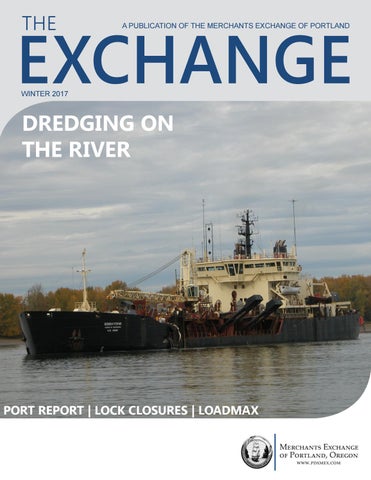
DREDGING ON THE RIVER
PORT REPORT | LOCK CLOSURES | LOADMAX MERCHANTS EXCHANGE OF PORTLAND, OREGON WWW.PDXMEX.COM
WELCOME TO THE
EXCHANGE NOTE FROM THE EXECUTIVE DIRECTOR: With the backing of our members, commitment of our Board of Directors and the knowledge and dedication of the staff, the Merchants Exchange continues to serve our members and the maritime transportation industry with our mission
“To be the leading provider of information and related services to all stakeholders of the Pacific Northwest intermodal transportation system and to support related business interests for domestic and foreign commerce.” The Exchange shares the work being done by staff and the direction we are going, as well as reports from industry stakeholders that we hope our membership will enjoy! We look forward to each opportunity to continue to serve our members in 2017 and beyond. Thank you for your ongoing support!
Liz Wainwright Executive Director Merchants Exchange of Portland
NOTE FROM THE EDITOR: Bekah Canfield is Editor of The Exchange and would love to hear from you! Members: If you have an article or an announcement that you would like to be included in future issues of The Exchange, please contact us: newsletter@pdxmex.com.
CONTENTS 2 3
Merchants Exchange Annual Meeting Merchants Exchange Board of Directors
4
Membership
5
Maritime Education Program
7
Special Report: Dredging
11
Lock System Outage
12
LOADMAX
15
Port Report
17
Merchants Exchange Scholarship Fund
19
Maritime Fire & Safety Association and FPAAC
21
Clean Rivers Cooperative
22
Pacifc Northwest Grain & Feed Association
23
Maritime Commerce Club
25
CRSOA & LCRHSC
26
Staff
27
Industry Calendar
© 2017 by Merchants Exchange of Portland, Oregon All rights reserved. No part of this document may be reproduced without prior written permission from the Merchants Exchange of Portland, Oregon. All persons and/or companies who contributed material to this book are entitled to full © Copyright protection of their statements, pictures, and project works that were submitted. None of their material may be redistributed without the original creator’s written permission.
1 • Merchants Exchange of Portland • WINTER 2017
Cover photo courtesy of Chann Noun
SAVE THE DATE
ANNUAL MEETING
FEB. 22, 2017 Merchants Exchange Annual Meeting Registration is now open! Members and Stakeholders are welcome!
The Merchants Exchange is proud to announce the recipient of the 2016 Merchants Exchange Excellence Award
Amer Badawi
Columbia Grain
Join us at the Merchants Exchange Annual Meeting to congratulate Amer! WINTER 2017 •
The Exchange
•2
THE PRINCIPAL ROLE OF A BOARD MEMBER
IS STEWARDSHIP. THE DIRECTORS OF THE MERCHANTS EXCHANGE ARE ULTIMATELY RESPONSIBLE FOR THE MANAGEMENT OF THE AFFAIRS OF THE EXCHANGE. THIS REQUIRES ACTIVE PARTICIPATION. THE BOARD MUST ENSURE THAT THE ORGANIZATION IS OPERATED FOR A NONPROFIT PURPOSE; IT MAY NOT BE OPERATED FOR PRIVATE BENEFIT. PROPER STEWARDSHIP REQUIRES THAT THE ORGANIZATION’S ASSETS BE HELD “IN TRUST” TO BE APPLIED TO ITS MISSION.
Mark Jensen (2018) President TEMCO
Bart Goedhard (2019) Ports America
Mike Morgan (2017) Treasurer Columbia Export Terminal, LLC
Doug Lenz (Ex Officio) Board President, Clean Rivers Cooperative Columbia Pacific
Ken Anderson (2018) Secretary Shaver Transportation Company Sebastian Degens (2017) Port of Portland Kristin Meira (2018) Pacific Northwest Waterways Association Carl Bertapelle (2017) talon marine Chris Cummins (2019) General Steamship Term expires (listed in parenthesis) in February of the given year
3 • Merchants Exchange of Portland • WINTER 2017
Andrew Holbrook (Ex Officio) Board President, Maritime Fire & Safety Association Kinder Morgan Capt. Rick Gill (Ex Officio) Columbia River Pilots Legal Counsel: Tyson Calvert Lindsay Hart LLP
MERCHANTS EXCHANGE MEMBERSHIP OUR INDUSTRY MEMBERS: Our membership makes up the core of the local marine shipping community. Our members include, but are not limited to: steamship operators, admiralty attorneys, customs brokers, tug and barge companies, freight forwarders, stevedores, ship repair service facilities and port authorities. BENEFITS OF MEMBERSHIP: The Exchange is a provider of vessel and cargo information and serves as a hub for local industry education and association management networking activities. Our members enjoy a direct relationship with the Exchange and its services. Each member company holds a vote for board of director nominations and eligibility for board membership. All of our services and activities are member focused. Vessel and cargo information services currently offered include: • Vessel Reporting
Merchants Exchange Employee Wins Vegas Trip Merchants Exchange employees Bekah Canfield and Curtis Cannizzaro competed in the 200 Market Building Annual Bocce Ball Tournament this year. While a Bocce Ball tournament doesn’t sound all that fun in November, they both knew that prizes this year included a trip to Hawaii or a trip to Vegas. Facing fierce competitors from the other building tenents, Bekah and Curtis formed a team and represented the Merchants Exchange well. While they did not make it into the finals, both names were entered into the grand prize drawing.
•
Communication Support Service
•
Cargo Statistics
•
Vessel Statistics
•
Custom Reports
•
Grain Bulletin
Finally! The long process of installation of the Bocce Ball courts outside our offices has paid off!
•
Grain Committee Membership
Congratulations, Curtis!
•
Answering Service
•
Special Reports and Services*
We are pleased to congratulate Curtis for his prize win: the trip to Vegas!
*The Merchants Exchange caters its services to the everchanging needs of local industry. We are constantly working to develop new ways to help our members do business. If the service you need is not listed, ask us and we can work to develop it for you. FOR MORE INFORMATION AND DETAILS ON BECOMING A MEMBER, VISIT OUR WEBSITE.
WINTER 2017 •
The Exchange
•4
SAVE THE DATE!
SHIPPING 101 THE BUSINESS OF SHIPPING
MARCH 22, 2017 PORTLAND, OREGON
MORE DETAILS TO FOLLOW. QUESTIONS? PLEASE CONTACT MARGERIE SEDAM AT SEDAM@PDXMEX.COM
5 • Merchants Exchange of Portland • WINTER 2017
SHIPPING 201 THE MOVEMENT OF A SHIP
NOVEMBER 3, 2016
THANK YOU TO OUR SPEAKERS
Liz Wainwright, Merchants Exchange of Portland Kate Mickelson, Columbia River Steamship Operators’ Association Tony Anderson, Transmarine Navigation Corporation Capt. Dan Jordan, Columbia River Bar Pilots Capt. Rick Gill, Columbia River Pilots LCDR Karen Denny, United States Coast Guard David Byer, Washington Department of Ecology Rian Hooff, Oregon Department of Enviromental Quality Holly Robinson, Maritime Fire & Safety Association Ernie Quesda, Clean Rivers Cooperative Amer Badawi, Columbia Grain, Inc. Rob Rich, Columbia River Tow Boat Assocation Bill Hurst, Durham & Bates Insurance Todd Zilbert, Lindsay Hart, LLP David Boyajian, Schwabe, Williamson & Wyatt
WINTER 2017 •
The Exchange
•6
DREDGING REPORT
The Most Important Piece Of Regional Infrastructure: Something Most People Don’t See
September 2016 Kenny McDonald: Media Relations Manager, Port of Portland www.portofportland.com/NewsRoom_Home.aspx
Throughout Portland’s history, efforts to create a safe navigation channel for the cost-effective movement of goods from the Willamette Harbor to the Pacific Ocean have shaped the landscape and economic fortunes of the region. Early city and state leaders, recognizing the importance of transportation infrastructure in the Portland harbor established the Port of Portland in 1891 for the express purpose of dredging the navigation channel from Portland to the sea. They also made investments in roads, railways and runways that positioned the city as an international trade hub. By the mid-1920s Portland had become the region’s gateway for the export of wheat, lumber, wool and manufactured goods. Over the years, the dredging activity that shaped the river bottom to accommodate increasingly larger ships also shaped the region’s geography, playing an active role in the physical development of places like Swan Island and Guild’s Lake. Oaks Amusement Park, a parking lot at Multnomah Falls, the Columbia River Highway, Portland International Airport and even the Nike campus in Beaverton all sit on fill from dredging activity. Today, Portland retains its position as a gateway to global trade and the Port, in cooperation with the Army Corps of Engineers, still carries out its original dredging mission maintaining a 40-foot channel in the Willamette and a 43-foot channel in the Columbia River all the way to Astoria – a 103-mile long stretch of waterway. Much of this work is performed by the Port’s crew on the Dredge Oregon. The Oregon has been the Port’s workhorse since it was built by Bauer Dredging Company in 1965. The average age of a dredging vessel in the United States is 25 years. The Oregon turned 50 in 2015. The Oregon is a cutter-suction type dredge, which digs into the river bottom with its winch-controlled bit up front and then sucks up the resulting sand and water slurry, pumping it through a pipe to a deposit location that may be up to two miles from the dredge operations..It is distinct from the U.S. Army Corps of Engineer’s hopper-type dredges, which use a clamshell to scoop sediment off the bottom and carry in its hold until it is deposited.
7 • Merchants Exchange of Portland • WINTER 2017
DREDGING REPORT
In November 2012, the Port began replacing the vessel’s 1960s-era engine as part of complete repower project. First the generators were replaced with smaller, more fuel-efficient engines. The switchgear, distribution panel, cutter motor and gear box that drive the cutter head were also replaced. Phase II of the project was completed in time for the 2014 dredge season and included replacement of the dredge’s main engine and pump, control system, and control panels in the lever house and engine room. The result is a more fuel-efficient and cleaner running vessel. In fact, it is estimated that the repowering will reduce diesel particulate emissions by 88 percent, and lower greenhouse gas emissions by approximately 40 percent. The dredge captain, Mark Still well says the volume capacity and rated horsepower of the dredge remains close to the same as before the upgrade, but the distance it can pump the slurry has increased almost two fold. “With the old system we could move the material out about 6800 to 7000 feet. Our first year with the new pump we finished with nearly 12,300 feet of pipeline behind the dredge with the potential for more.” The Columbia River Navigation Channel is six hundred feet wide, so the dredge tackles one half of the channel at a time to allow river traffic to pass. Oregon typically digs around 48 feet deep, but with the potential to dig as deep as 85 feet. “As a trade-dependent state, our marine highways are critical to our region’s continued success,” said Port Executive Director Bill Wyatt. “A big part of that success as a trade gateway is attributable to what you might call the most important vessel that nobody sees – the Dredge Oregon.”
WINTER 2017 •
The Exchange
•8
DREDGING REPORT
Historical Timeline: 1865 Portland Mayor Henry Failing authorizes the city’s purchase of its first dredge. The city begins efforts to dredge the Willamette River. The river’s average depth at the time is 12 feet.
1871 The U.S. Army Corps of Engineers establishes an office in Portland and four years later dredges the navigation channel on the Willamette and Columbia rivers to a depth of 17 feet.
1883 Senator Henry Corbett successfully lobbies for federal funding for dredging projects and a transcontinental railroad line, helping launch Portland as a serious seaport.
1891 The Oregon Legislature establishes the Port of Portland to construct and maintain a 25-
foot channel in the Willamette and Columbia rivers. It is the second port authority on the West Coast, after San Francisco.
1910 The City of Portland creates the Commission of Public Docks to develop maritime
commerce. Four years later Terminal 1, the first municipal dock, opens. The commission eventually operates four waterfront terminals.
1921 The Port of Portland acquires Swan Island, considered a key site for the development
of the inner harbor. Six years later the Port opens the city’s first commercial airport there on a site created with dredged material from the Willamette River.
1940 Needing a larger facility to accommodate ever increasing sizes of passenger and
cargo aircraft, the Port of Portland opens the Portland-Columbia Airport, later renamed Portland International Airport. The facility sits on land created from dredged material.
1970 The Oregon Legislature consolidates the Port of Portland, a public corporation, and the Commission of Public Docks, a city agency.
1980 The eruption of Mount St. Helens on May 18 results in one of the largest dredging efforts in the region. The Port of Portland, U.S. Army Corps of Engineers and private dredging companies work nonstop to clear the navigation channel on the Columbia River.
2010 Construction of the current depth of the Columbia River navigation channel, 43 feet, is completed. The Willamette River channel remains at 40 feet.
2014
The Port completes the repowering of the Dredge Oregon.
9 • Merchants Exchange of Portland • WINTER 2017
DREDGING REPORT
DID YOU KNOW? Fast facts about dredging in the Columbia... • From 1898 to today, the Port has owned seven dredges. One of its dredges, the Willamette, was sold in 1930 and destroyed while working in the Pacific Ocean during World War II. • In 1978, the Dredge Oregon sank at the Port’s Terminal 2 on the Willamette River just two days before the start of the dredging season. It took eight weeks of salvage efforts to raise the dredge. The Oregon returned to service the following summer. • When Mt. St Helens erupted in 1980, debris filled the Columbia River navigation channel, reducing its depth to 14 feet in some areas and stopping maritime trade in its tracks. The Dredge Oregon and several other dredges worked day and night to clear the channel. When all was said and done, more than 76.5 million cubic yards of material was removed – enough to cover a football field to a height of nearly 7 miles • Dredging is not without controversy due to potential impacts to fish and river ecology. Dredging and placement of dredge material is highly regulated by federal and state agencies. In-water work is constantly monitored and restricted to certain times of the year and dredge material is tested. Sediment that does not pass the review process is sent to a landfill. The Port uses material that is deemed safe for humans and the environment for construction projects, beach nourishment and the creation of new wildlife habitats. • Forty-two Port employees serve as crew on the Dredge Oregon – including those who work on the river and on the shore. During the season – late spring to early fall – the dredge operates 24 hours a day, six days a week. At the end of each dredge season, crew members are either laid off or return to the yard in Portland to work on necessary maintenance and repairs.
WINTER 2017 •
The Exchange
• 10
Columbia-Snake River Navigation Lock System Extended Outage– December 2016-March 2017 U.S. ARMY CORPS OF ENGINEERS
BUILDING STRONG
®
The U.S. Army Corps of Engineers is planning an extended navigation lock maintenance outage beginning Dec. 12, 2016. The 14-week-long closure will affect all Corps navigation locks on the Columbia and Snake rivers. Critical major repairs, routine maintenance and improvements will include: Bonneville Lock and Dam – The lock controls will be updated, which includes removing existing navigation lock systems and control interfaces, and installing new redundant systems with important safety elements. The navigation lock will be dewatered during the extended lock outage. The modernized equipment will improve automated functions and make the controls easier to use for navigation lock operators. The Dalles Lock and Dam – The upstream gate and critical portions of the navigation lock controls require replacement. The downstream gate was replaced during the fiscal year 2011 (FY11) extended lock outage. The gudgeon anchors, however, were not included during the FY11 closure and will be replaced during the fiscal year 2017 (FY17) extended lock outage. John Day Lock and Dam – Portland District has no extensive repairs planned for the John Day navigation lock. Maintenance crews will use the time to clean and check equipment, paint, clean staff gauges, change gear box fluids, repair upstream and downstream guidewall, and conduct preventive-maintenance actions and dam-safety inspections. The John Day Dam will not be dewatered lower than the chamber floor. McNary Lock and Dam – Walla Walla District plans to complete downstream miter gate repairs that were delayed in order to return the lock to service on schedule during the 2015 annual maintenance outage. Ice Harbor Lock and Dam – New operating machinery for the downstream gate at Ice Harbor is a very high priority for the Walla Walla District. Critical components of the machinery and control systems require replacement during the extended closure. Lower Monumental Lock and Dam – A new downstream lock gate was installed at Lower Monumental during the FY11 extended maintenance closure. The second phase of this installation is the replacement of the machinery and control systems that operate the gate -- the existing equipment has reached the end of its service life. Little Goose Lock and Dam – Following an emergency outage in 2014 to repair a failing gudgeon arm, additional work is required during the FY17 outage to complete replacement of the aging components of the gate. This project will involve replacement of the remaining original gudgeon arm and linkage, and replacement of the pintle assembly for both gate leafs. Structural repairs will include resurfacing the quoin and miter, and crack repairs to structural members. Repairs are critical to ensure reliable gate operation. Lower Granite Lock and Dam – Although Lower Granite does not have large-contract repairs planned, Corps maintenance personnel will conduct annual routine lock maintenance and repairs during the scheduled outage. Non-routine work includes replacing the upstream gate wire ropes.
11 • Merchants Exchange of Portland • WINTER 2017
Stakeholders’ Perspective Stakeholders Perspective
The Columbia River Helping shape 21st century navigation. by MR. FRED MYER Senior Waterways Planner Port of Portland
Columbia River ports in Portland, St. Helens, and Astoria, Oregon; along with Vancouver, Kalama, Longview, and Woodland, in Washington state, comprise important economic gateways for shipping cargo into and out of the U.S. West Coast. About 60 million tons of oceangoing cargo move up and down the Columbia River in approximately 4,000 ship transits each year. 1
Columbia River Datum Users developed the Columbia River Datum (CRD) to define an accurate baseline in this dynamic river system. CRD, or “zero gauge,” is a solution to the problem of a 103-mile channel running down an imperfect inclined plane. CRD provides a worst-case zero state. Simply stated, the Columbia River Datum is the lowest river level that can be expected in an average year. It was established in the 1920s, when the U.S. Army Corps of Engineers sent teams of surveyors into the field to measure the low water profile at a low flow of approximately 80,000 cubic feet per second (cfs). Natural low flows rarely reach that level in the river and, with the advent of upstream storage reservoirs, it is even more of a rarity. Since the annual combined flow of the Columbia and Willamette Rivers is approximately 227,000 cfs, water levels in the river above Westport, Oregon, are likely to be above zero datum for most of the year. Fortunately, the river sees negative CRD numbers for only 10 to 30 hours a year. At all other times, there is some amount of water available above this established baseline. Tracking this water level accurately is critical fuel for the economic engine of Columbia River commerce.
32
Proceedings
Today’s Port of Portland is also involved in aviation, industrial, and marine operations; within the latter, river channel maintenance remains a top priority. In fact, the Port of Portland owns and operates the dredge Oregon, which is devoted to Columbia River channel maintenance, under contract to the U.S. Army Corps of Engineers. Close coordination among maritime stakeholders, including river and bar pilots, the U.S. Coast Guard, the U.S. Army Corps of Engineers, and lower Columbia River port personnel, ensures ships can transit through the river channel safely, without delay.
Challenges The challenges to channel maintenance are many and can depend on varying river flows, tidal influence, and complex dam release flow rates. Portland’s tide range is usually on the order of two feet; this increases to about eight feet near the river’s mouth. Minimum water levels (low tide) at the Portland/Vancouver terminals are typically about six feet above Columbia River Datum (see sidebar), during high flow months (December to May/June), and two feet above datum from July to November. River current is typically one to two knots on the flood (coming from the sea to the shore ) and three to four knots on the ebb (coming from shore and returning to the sea), but can on occasion reach six knots on the ebb in the lower river. In this active environment, accurate river level forecasting tools and navigation systems are crucial.
Solutions To this end, the LOADMAX system and the Physical Oceanographic Real-Time System (PORTS®), form a public information acquisition and dissemination technology partnership between the National Oceanic and Atmospheric Administration (NOAA) and the Port of Portland. LOADMAX consists of seven computer-connected PORTS gauges along the lower Columbia channel, from river mile 17 at Astoria, Oregon, to river mile 106.5 at Vancouver, Washington. These
www.uscg.mil/proceedings
Summer 2015
WINTER 2017 •
The Exchange
• 12
measure water level in real time and are tied into a system that produces daily email forecasts of river stage and velocity at one-hour intervals, with a forecast horizon of 10 days.
LOADMAX River Level Forecasting
Pilots and terminal operators routinely use this data to time river transits and maximize loading. For example, personnel operating draft-constrained vessels transiting the Columbia River have to adjust their loading and/or the time of their transit to allow for two feet of under-keel clearance on the river and three feet (rising tide) or four feet (falling tide) of clearance on the Columbia River bar. At times, timing issues arise for outbound transits for fully loaded dry bulk carriers that, in most circumstances, are required to transit the bar on a rising tide. An outbound voyage from Portland to the river mouth will usually take between six to eight hours. To cross the bar on a rising tide, vessels leaving Portland have to pass the low water point somewhere en route. In the middle of the deep-draft channel near Longview, this low water point can represent river stage levels within two feet of zero gauge even during the period of high river flow. In some cases, upbound transits are able to avoid waiting for maximum tide in this way; there are some draft-limited inbound vessels, such as gypsum carriers, that must time upriver transits carefully. It is estimated that using LOADMAX affects river transit timing by about 10 percent (approximately 400 vessel movements per year), and can reduce delays for these transits by about 60 minutes. 2
LOADMAX river level forecasting example. Graphic courtesy of the Port of Portland.
While LOADMAX facilitates depth/ risk management for ship movements, the Columbia River Pilots’ Vessel Traffic Information System, also known as Transview 32 (TV32), is another critical navigation technology. TV32 displays information from all automatic identification system (AIS)-equipped vessels, with scaled icons based upon AIS broadcast; it tracks speed, heading, course over ground, estimated time of arrivals to various points, and predicts real-time vessel meeting/overtaking locations. www.uscg.mil/proceedings
13 • Merchants Exchange of Portland • WINTER 2017
Pilots display TV32 on their laptops as a real-time vessel traffic display that is connected through the vessel’s AIS. TV32 information is broadcast via secure Internet connection to dispatch/vessel movement coordinators and other industry stakeholders to monitor vessel traffic, manage anchorages, and maintain maritime domain awareness.
Summer 2015
Proceedings
33
The TV32 system integrates with U.S. Army Corp of Engineers channel surveys to show the most recent depth information. Along with this bathymetric information, covering the 100-plus mile length of the Columbia River, the system also integrates NOAA charts, the NOAA PORTS river level sensors (the same ones used in LOADMAX), and Google Earth information.
Vessel Squat Looking forward, the Columbia River’s many stakeholders continue to strive for better navigation through improvements. Since the first days of steam power, it has been understood that, the faster a ship goes, the more it tends to sink; this is known as vessel “squat.” The problem is that while squat is well understood for vessels operating in deep ocean waters, it is surprisingly poorly understood for vessels operating in shallow, constrained, or confined channels. In part, this is because precise measurement of vessel motion at this level had not been possible until the advent of GPS. For decades vessels have operated along the Columbia River with an excellent safety record, but without a comprehensive understanding of vessel squat in shallow water. This ambiguity, although successfully managed in the past through caution and prudence, came without the benefit of rigorous empirical data. Compounding the confusion, vessel squat can vary greatly from vessel to vessel and river to river. For example, the same vessel may squat very differently in a shallow channel bordered by steep walls, as opposed to a similar shallow channel bordered by wide, flat, shallow areas. Both of these are present on the Columbia River.
Under-Keel Clearance Study A river bar dynamic under-keel clearance study found, not surprisingly, that under-keel clearance needs to be carefully managed on the bar. While researchers weren’t able to establish clear “rules of thumb,” they did develop a program to help determine squat, based on varying conditions, including: • • • • •
ship’s particulars, loading and stability parameters, speed, LOADMAX input, weather and seas.
In general, wave response of vessels crossing the bar is the greatest contributor to risky and hazardous transits. Shorter and slightly shallower vessels tended to resonate more with prevailing swells; in other words, larger vessels did not necessarily present the greatest risk.
With the bar dynamic under-keel clearance study as a primer, the time may be right for a comprehensive river study that will enable us to more definitively measure vessel motion during transits of the entire Columbia. Benefits include: • • • •
safely maximizing vessel draft, potentially decreasing the carbon footprint per ton of export cargo, pinpointing the most critically needed dredging areas, improved ability to time voyages.
From an economic perspective, it is important to maximize the tonnage of cargo that each vessel can safely move into and out of the river, as fixed vessel operation costs are spread out over more tons of revenue-generating cargo. Additionally, all other things being equal, a deeper draft vessel is “greener” than the same vessel running at a shallower draft, since every additional percent of cargo loaded onboard increases fuel consumption by much less than one percent. 3 Finally, stakeholders are also considering better sensors along the lower Columbia. The PORTS’ river gauges upgrade was a first step. Now, additional upgrades, including potentially installing fog sensors closer to the mouth and air gap sensors for more accurate under-bridge clearance data, are being considered, as ways to better inform the mariner. About the author: Mr. Fred Myer is the senior waterways planner for the Port of Portland. Endnotes: 1. See http://tidesandcurrents.noaa.gov/publications/Columbia_River_PORTS_ Economic_Study.pdf. 2. Hauke Kite-Powell, “Estimating Economic Benefits from NOAA PORTS Information: A Case Study of the Columbia River,” June 2010. 3. Captain Paul Amos, “COLRIP Connect Oregon IV Program Application for Under Keel Clearance Study,” November 2013.
Get LOADMAX Reports through the Merchants Parsons Brinckerhoff Vessel Routing and Stage Analysis, October 2013. Available at http://ascelibrary.org/doi/abs/10.1061/9780784413067.046. Exchange! Columbia River Pilots (COLRIP). Available at http://colrip.com/.
Bibliography: Beeman, O. Columbia River Reflections: A Memoir by Ogden Beeman, copyright 2011, Port of Portland.
USACE Deep Draft Vessel Costs. Available at http://planning.usace.army.mil/toolbox/library.cfm?Option=Listing&Type=EGM&Search=Policy&Sort=Default.
Available daily through a monthly Powell, Dr. K. (2010) Estimating Economic Benefits from NOAA Information: A Case subscription or per voyage. Study of the Columbia River. Woods Hole Oceanographic Institute Marine Policy COLRIP Connect Oregon IV Program Application for Under Keel Clearance Study.
Center Report. Available at http://tidesandcurrents.noaa.gov/publications/ Columbia_River_PORTS_Economic_Study.pdf.
2017 Rates: $23/per voyage $48/mo (Members)
Burnette, E. “CRD” / Zero Gauge background information. Oregon Board of Maritime Pilots.
$100/mo (Non Members) www.pdxmex.com 34
Proceedings
www.uscg.mil/proceedings
Summer 2015
WINTER 2017 •
The Exchange
• 14
PORT REPORT
PORT SEES TONNAGE SURGE IN RECORD BREAKING YEAR Longview, WA– In a record breaking cargo handling year, the Port of Longview moved more than 8.3 million metric tons of cargo across the dock in 2016 - the most cargo handled annually in the last three decades. 2016 saw a nearly 30 percent increase over the 6.4 million metric tons handled in 2015. Pushing the Port over the 8 million mark was grain terminal EGT, LLC, which alone moved over 6 million metric tons of primarily wheat, soybeans and corn. This marks EGT’s best year since coming on-line in 2012. “This is precisely the tonnage outcome we were aiming for when EGT signed on at the Port of Longview,” said Chief Executive Officer Norm Krehbiel. “EGT utilizes key infrastructure, such as the Port’s dedicated Industrial Rail Corridor and our position on the deep-draft navigation channel, designed to efficiently move bulk commodities for the benefit of the entire region.”Although dry bulks made up the majority of the tonnage in 2016, the Port had a strong year in breakbulk as well. The resurgence of wind energy cargo, coupled with oversized project cargo made for a well-rounded year and demonstrated the Port’s flexibility in cargo handling. With a new year underway, cargo prospects for 2017 predict another successful at the Port of Longview.
NEW YEAR, NEW CHALLENGES MEAN NEW SOLUTIONS In the first four months of 2016, the port handled nearly 100,000 autos over our dock and we have a chance of breaking 300,000 units this year, volumes we have not seen since 2008. Auto imports are expected to increase 16 percent and exports of Fords to Asia 25 percent. Grain volumes at Columbia Export Terminal are up 35 percent this year. Mineral bulk exports like potash and soda ash are down and projected to stay lower than normal, but those facilities have made significant capital investments in anticipation of long-term growth. Although breakbulk cargo remains flat, we expect higher volumes next year. Westwood Shipping announced to customers its last call to Portland was May 21. Westwood has called Portland’s Terminal 6 with container service since July 2010. The Puyallup-based shipping company cited economics of a single call per month do not justify continued Portland service. 15 • Merchants Exchange of Portland • WINTER 2017
PORT REPORT
While we are disappointed with this news, we also understand the underlying economics of the carrier industry are at play. Each call to Portland took about 150 containers of hay, grass seed, dried fruits, other mixed agricultural goods and paperboard for export to Japan. We are hopeful that Westwood will return to T-6 when market dynamics improve. We very much appreciate Westwood’s support and partnership over the last few years. Containers represent about 10 percent of the Port’s marine business, and the port understands and share the frustration of affected Oregon shippers – especially our agricultural exporters. Prior to the withdrawal of Hanjin and Hapag-Lloyd container service and recent suspension of Westwood service, shippers from 31 out of 36 Oregon counties moved cargo through T-6. While we are working diligently to resolve the situation, there are challenges to recruiting new service, both local and global. Carrier recruitment will require assurances the labor-management problems are resolved and that carriers can expect a reasonable level of productivity at competitive prices. It is also important to note that the global container shipping industry is struggling from overcapacity, low freight rates and significant reshuffling of alliances affecting vessel deployments and routing decisions that make recruitment to Portland difficult. Even with these challenges, we believe there is a strong market proposition for direct carrier service in Portland. We know that trade cannot wait on a solution and that solutions aren’t simple. In the meantime, we have been working with partners to restart container barge service from Lewiston, Idaho and increased container train frequency from Boardman, Oregon. We’re working on projects that link importers with exporters to round-trip containers from the Willamette Valley, to reduce empty repositioning costs and take trucks off the road. And we lobbied the Oregon Legislature for funding projects identified in the State’s Trade & Logistics study to alleviate obstacles identified by shippers in statewide workshops.
Ships docked at the Port of Portland.
It is a tall order, but we are committed to working through this situation, to find long and short term solutions for shippers and to do whatever it takes through legal, political and business means to reopen the container terminal and ensure the Port continues to live up to our mission of assisting Oregon businesses in accessing global markets.
WINTER 2017 •
The Exchange
• 16
Sc
e
M
nts Exch an cha g er
ho
larship Fu
Merchants Exchange
SCHOLARSHIP FUND
nd
CONGRATULATIONS TO THE
2016
SCHOLARSHIP WINNERS Sam Bordia - $2,500 University of California, Berkeley Master of Development Practice Colton Carey - $2,500 California Maritime Academy Mechanical Engineering with third mate license Scott Olson - $1,500 University of Oregon, School of Law Law: Maritime and Export emphasis Drake Pooley - $1,500 University of Virginia Masters of Global Commerce Andy Smith - $1,500 Portland State University Business Ad Supply and Logistics Management
The Merchants Exchange Scholarship Fund wishes all winners and applicants the best of luck pursuing their chosen fields of study!
“Strengthening the Maritime industry through education and engagement.”
www.pdxmex.com/scholarship 17 • Merchants Exchange of Portland • WINTER 2017
Sc
e
M
ants Excha ch ng er
ho
la r s h i p F u n
d
Merchants Exchange of portland
ScholarShip
Have you demonstrated academic achievement & have exemplary qualities in personal character?
Have you chosen Maritime affairs or international Trade as your field of study? Are you a current student pursuing a 2-year or 4-year degree at an accredited institution of higher education?
2.5
Have you maintained a minimum 2.5 Gpa?
Merchants Exchange of portland
APPLY FOr THE ScholarShip Up to $2,500 January 1st - May 31st
Maritime affairs and/or international Trade Majors apply at www.pdxmex.com/scholarship
Our ScholarShip: The mission of the Merchants Exchange Scholarship Fund is to support the educational goals of students seeking careers in Maritime Affairs and/or International Trade, in order to ensure the future prosperity of the Maritime industry. The scholarship is awarded to those who have demonstrated academic ability and possess qualities in personal character that exemplify their drive to obtain their education goals.
POSSIBLE CArEErS:
Admiralty Law Tug & Barge Forwarder & Broker Pilot
Agent Port Authority Stevedore Maritime Trade Groups WINTER 2017 •
The Exchange
• 18
MARITIME FIRE & SAFETY ASSOCIATION
Partnership Awards In order to achieve its goal of being the leading provider and advocate of safe, environmentally responsible, and cost-effective response services to commercial vessels in the Lower Columbia Willamette River Marine Transportation System, the MFSA has relied on the strong partnerships developed. As a recognition of the dedication and investment that the membership and local organizations have put into this goal, the MFSA has initiated partnership awards. For 2016 three organizations have been selected. While many more could have been chosen, these three were selected based on their significant support of the programs and activities of MFSA this year and in the years previously. United States Coast Guard, Sector Columbia River: Vessel Partnership 2016 The MFSA has had a long standing partnership with the USCG and so seemed an appropriate recipient of the first Vessel Partnership Award. Our interaction with them touches on all aspects of the MFSA – oil spill response, shipboard firefighting and maritime communications. The MFSA would truly not be the organization we are today without the support of Sector Columbia River. TEMCO: Facility Partnership 2016 FPAAC Technician Level Training requires continual exercising of skills and techniques to maintain readiness. This training is far more effective when there is access to a vessel for the trainees. In March of 2016, TEMCO LLC opened their facility to the training group to conduct a day long training within their facility and onboard a working ship. The coordination with the ship’s crew and support of the training activities led to a successful and well received training. Concordia University: Community Partnership 2016 As detailed in the FPAAC Highlights section, Concordia University was a critical partner in two of FPAAC’s Command Level Trainings in 2016. Their facility provides classroom space to conduct tabletop exercises and their simulator room allows for immersive training that has been tailored to the incidents being trained on. The staff’s ability and willingness to customize fire scenarios to the needs of the group has helped to achieve a new level of training within the region.
19 • Merchants Exchange of Portland • WINTER 2017
es
tection Agen Pro ci re Fi
M F S A
1 9 8 3 Ad
l v i so r y C o u n c i
Fire Protection Agencies Advisory Council (FPAAC)
MEET THE FPAAC CHAIR Fire Chief Phil Jurmu of the Longview Fire Department has served as the Chair of FPAAC since January of 2016. Phil began his career with the Longview Fire Department in March of 1993. The Longview Fire Department has participated in the Maritime Fire and Safety Association since its inception and continues to participate in MFSA/FPAAC at all levels of the organization. Phil believes strongly that participation with regional partners is critical for local success.
Fire Chief Phil Jurmu, Longview Fire Dept. 2016 FPAAC Chair
“My goal is to continue to develop and improve relationships prior to emergencies occurring. Currently, a large network of agencies and organizations are focused on ensuring that the Lower Columbia Waterways are maintained. When in the heat of the emergency it helps to understand where additional resources are available, regardless if they are public or private resources. In addition, our partners are aware of our limitations and capabilities and are prepared to render assistance as needed, prior to an emergency event.”
MEET THE FPAAC TRAINING COORDINATOR
Don Doyle, FPAAC Training Coordinator
Don Doyle has served as the FPAAC Training Coordinator for the past five years, although his involvement with FPAAC goes back to 1998. His experience and his enjoyment working with FPAAC led to his desire to enter into the role of training coordinator. As training coordinator, his goals are continuous improvement and developing trained personnel who become the national standard for marine firefighting. Recent completion of a training guide and the use of task books has helped to maintain structure and continuity with the trainings. These developed resources have also allowed more in-house training with greater involvement and collaboration from participating agencies. He believes his previous employment in the timber industry and its similarities to the fire service has helped with his current role as the FPAAC Training Coordinator.
WINTER 2017 •
The Exchange
• 20
ENVIRONMENTALLY RESPONSIBLE READINESS
The Clean Rivers Cooperative and MFSA, through the Joint Equipment Committee, has been undertaking a project to convert the Fast Response Vessels (FRVs) and Oil Spill Response Vessels (OSRVs) from Inboard/Outboard (I/O) engines to Outboard engines. The project is nearing completion. The decision was made based on a number of factors including reliability and maintenance costs. However, one
21 • Merchants Exchange of Portland • WINTER 2017
of the major benefits to the upgrades is the drastic reduction in emissions through the conversion. Since engine conversions took place there has been a 52% reduction in fuel consumption compared to the previous I/O system. This reduction in fuel consumption allows the MFSA to advance its goal of environmental responsibility while still maintaining safe and cost effective response.
PNWGFA Annual Directory Listing & Advertising For the past 68 years, the annual Directory has grown into a 200 page publication providing the most comprehensive directory in the region. The Directory lists 1,000+ member and non-member companies handling grain, feed, seed processing and allied industry suppliers in the Association’s four state region and beyond. The PNWGFA Directory provides you and your customers with the necessary contacts, addresses, phone and fax numbers, as well as website and email contact information. This all helps to enhance your business in the Pacific Northwest. Advertising in the Directory reaches industry members and non-members operating in the Pacific Northwest and beyond. Put your advertising dollars to work. Space is limited! The advertising contract will be released soon. Additional PNWGFA Directory information can be found at www.pnwgfa. org/annual-directory. Update your company listing here: http://www.pnwgfa.org/media/documents/2017_directory-listing-update-letter_new-listing.pdf
2017 Schedule of Events 50th Annual Warehousemen’s Conference & Trade Show Coeur d’Alene Resort - CDA, Idaho February 15 -17, 2017
Coeur d’Alene Resort
4th Annual Southern Idaho Pesticide Conference Burley Inn & Convention Center - Burley, Idaho May 2017 (TBA) 37th Annual Country Elevator Council Meeting & Golf Tournament *OSHA, FDA & EPA Compliance Seminar Workshop Added! Northern Quest Resort & Casino - Spokane, Washington April 26 -28, 2017
Northern Quest Resort & Casino
Best Western Plus Burley Inn & Convention Center
100th Annual Convention & Golf Tournaments **CENTENNIAL CELEBRATION!** (more info to follow soon!)
The Davenport Grand - Spokane, Washington June 14 - 16, 2017 Annual Idaho Trout Fry & Golf Scramble Clear Lake Country Club - Buhl, Idaho September 28, 2017
The Davenport Grand
Clear Lake Country Club
WINTER 2017 •
The Exchange
• 22
Pacific Northwest Grain & Feed Association
Centennial 1917 - 2017 the pnwgfa board of directors cordially invite you to attend the
1ooth Annual Convention & Golf Tournaments June 14-16, 2017 The Davenport Grand Hotel - spokane, WA
100 MARK YOUR CALENDARS REGISTRATION INFORMATION WILL BE RELEASED VERY SOON! 23 • Merchants Exchange of Portland • WINTER 2017
! E T A HE D
’S N E M E US O H E AR W W O L H A S U E NN AD R A T h t & 0 *5 CE N E R 2017 , E 7 F 1 N 5 CO RY 1
SAVE T
A
FEBRU
Coeur d’Alene Resort
This popular annual event provides necessary pesticide credits and awareness to warehousemen and pesticide applicators in Idaho, Montana, Oregon and Washington. The conference also provides a venue for the industry to network, socialize and share ideas. The 2017 event will be held at Coeur d’Alene Resort, in CDA, Idaho. We conduct two full days of seminars; while mainly focused on pesticide credits, wheat varieties, grain inspection and safety is also covered. Our industry Trade Show runs concurrently with the conference, further allowing networking and commerce within the industry. The PNWGFA Trade Show has grown into a leading industry trade show opportunity in the Pacific Northwest. We anticipate 35-40 exhibitors in 2017! *NEW! Because this is our 50th Warehousemen’s event, we have added interactive vendor group “POD” sessions in the Trade Show area; 20-minute dedicated timeslots with selected vendors, designed to foster interactive small-group hands on learning and/or specific Q&A. A 50th Anniversary celebration cocktail cruise will also be held Thursday, Feb. 16 evening. Warehousemen and managers are encouraged to attend! REGISTRATION FORM HERE Contact Margerie at 503-227-0234 with questions. WINTER 2017 •
The Exchange
• 24
2017
Winter Event and Old Salt Celebration Dinner Please join us as we celebrate the maritime industry through recognition of achievement and service. The Old Salt Award is presented each year to someone who, through dedication to service, has advanced the Willamette and Columbia River maritime industry. Don’t miss out on this honored annual tradition!
See our previous Old Salts from 1958 to present day here!
The Maritime Commerce Club is pleased to present the 2017 Old Salt Award to:
Sebastian Degens, Port of Portland
Wednesday, February 23, 2017 Chart House Restaurant - Portland, Oregon Cocktails at 5:30 pm Dinner at 6:00 pm
TICKETS
$70 Member/non-member $500 Table of 8- based on availability
INCLUDES BUFFET DINNER & TWO DRINK TICKETS REGISTER ONLINE Cancellations must be received no later than Friday, February 17, 2017. No-shows will be billed. Questions? For more information about MCC events, please contact Rachel Perry at (503) 220-2092 or perry@pdxmex.com.
www.pdxmex.com/mcc 25 • Merchants Exchange of Portland • WINTER 2017
2016 Spree Donations $7,000 $6,500 $6,000 $5,500 $5,000 $4,500 $4,000 $3,500 $3,000 $2,500 $2,000 $1,500 $1,000
Thank you to all our volunteers and sponsors to make the 2016 Christmas
Charmin Shiely Noah Jarrett Lisa Whiles Darien Loiselle David Dent Susan King
Todd Zilbert Vie Anderson Dan Beaty Lewellyn Robinson Susan Broyer Kristin Meira
MCC FALL EVENT
AT PUNCH BOWL SOCIAL
$500 $0
Dave Boyajian Janet Moore Allison Brady Shelby Wagner Rebecca Smead
MCC hosted Fall Event at a Punch Bowl Social on October 20, 2016, where over 30 members and guests enjoyed bowling, nostalgic arcade games, and great food and drinks. Punch Bowl Social was a great location for guests to network in a casual and social setting.
WINTER 2017 •
The Exchange
• 26
Lower Columbia Region Harbor Safety Committee
MARK YOUR CALENDARS! 2017 CALENDAR OF EVENTS February 7: Industry Luncheon
Thank you to all who participated in the National Harbor Safety Committee Conference, September 13-15, 2016 in Portland!
February 14: Director’s Luncheon April 22: Spring Fling June 8: Industry Luncheon July 13: Summer Picnic August 10: Industry Luncheon October 12: Industry Luncheon December 14: Christmas Luncheon
Keep updated with crsoa on Facebook!
WWW.FACEBOOK.COM/CRSTEAMSHIP
27 • Merchants Exchange of Portland • WINTER 2017
Admiral Paul F. Zukunft, Commandant of the United States Coast Guard awarded the Lower Columbia Region Harbor Safety Committee with the 2014/2015 Harbor Safety Commitee of the Year Award!
STAFF
Welcome Rachel
Welcome Emily
Rachel Perry joined the Emily started as the Merchants Exchange team Communications and in October 2016 as the Administrative Services Association Administrator. She Assistant at the Merchants works with Margerie Sedam, Exchange in November of Asssociation Director on 2016. She works closely with many of the client association Robin Wright, Communications accounts. Previously, Rachel and Administrative Services worked as an Event Marketing Manager. Emily holds an Coordinator for Quality Cellular in Madison, WI. undergraduate degree in She attended the University of Wisconsin-Eau Claire Professional Communication and has a background and graduated with an undergraduate degree in marketing and graphic design. Emily has in Public Relations and Psychology. After school previously worked in music education, government, she moved to Madison to work at her previous and live theater production. In her free time, Emily employer for four years. She and her fiance moved likes to write and create music, freelance design, to Portland for a new adventure. They spend many hike, and camp with her husband, Thomas. You can of their weekends exploring the Pacific Northwest reach Emily at: bamford@pdxmex.com. You can reach Rachel at: perry@pdxmex.com.
Come join the team at the Merchants Exchange! Now hiring a Communications Center Operator visit www.pdxmex.com to apply.
WINTER 2017 •
The Exchange
• 28
CONTACT US MISSION OF THE MERCHANTS EXCHANGE
24 / 7 COMMUNICATION CENTER (503) 228-4361
To be the leading provider of information and related services to all stakeholders of the Pacific Northwest intermodal transportation system and to support related business interests for domestic and foreign commerce.
contactus@pdxmex.com
200 SW Market Street Suite 190 Portland, OR 97201
INDUSTRY EVENT CALENDAR
7
FEBRUARY CRSOA Industry Luncheon
15-18 PNWGFA Warehousemen’s
Conference & Trade Show
20 President’s Day Exchange Annual 22 Merchants Meeting & Board of Directors Meeting Old Salt Award & Winter 23 MCC Event
8
MARCH LCRHSC Managing Board & General Membership Meeting
Exchange 22 Merchants Shipping 101
APRIL
County 26-28 PNWGFA Elevator’s Meeting
and Golf Tournament